We, Axghouse AntiPiracy, prepared this report to demonstrate that combating online piracy requires a deep analytical approach, not just content removal. Our goal is to provide the market with valuable data and expertise to identify leaders and laggards in copyright protection We aim to show that we possess unique knowledge of platform operations and are ready for an open dialogue to improve global anti-piracy practices
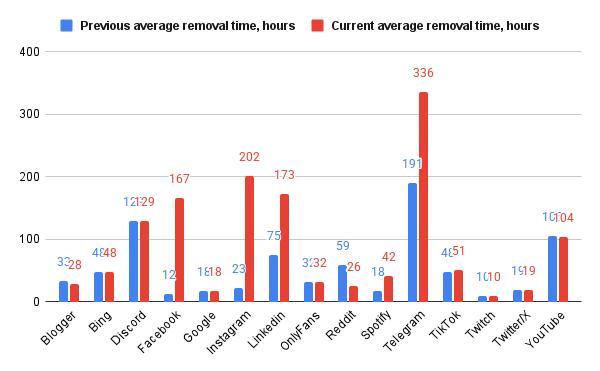
An analysis of the dynamics of pirate content removal time over the last six months has revealed significant changes in platform approaches. While some continue to demonstrate high efficiency, others have experienced a significant decline in performance.
● Telegram: This platform showed the largest increase in removal time, rising from 191 hours to 336 hours. This points to serious issues in their anti-piracy system. As our experience shows, Telegram effectively lacks a functioning service for removing pirate content. The email address provided on their website fails to process the majority of incoming complaints. To achieve a takedown, users are often forced to appeal to the App Store and sometimes to Google Play. Cooperation with anti-piracy companies, although it exists, remains unstable and unreliable, which is confirmed by the sharp rise in average removal time.
● Facebook and Instagram: The increase in removal time on these platforms was a major surprise, as they previously performed takedowns consistently and quickly On Facebook, the average time increased from 12 to 167 hours, and on Instagram, from 23 to 202 hours. This may indicate changes in their algorithms or priorities.
● LinkedIn: A significant increase in removal time was also observed here, from 75 to 173 hours, suggesting potential problems with complaint processing.
● YouTube: The average removal time on YouTube shown in the chart is 104 hours. However, the process is often faster in reality because our company
uses a method that allows the channel owner to remove the video themselves within 7 days without incurring penalties.
● Blogger, Google, TikTok, Twitch, and Twitter/X have maintained their previous performance levels, demonstrating stability and predictability in handling requests.
Success rate is a key indicator of the effectiveness of anti-piracy measures. While most platforms show a high success rate, there are exceptions that are a cause for concern.
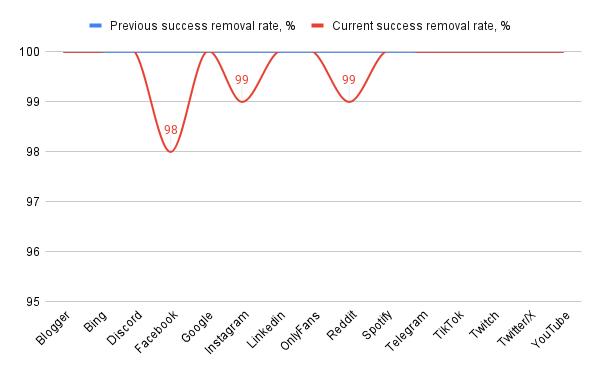
Facebook and Instagram: These platforms are falling behind not only in removal time but also show a decline in their success rate to 98% and 99% respectively This is because they struggle to process cases that differ even slightly from basic ones, immediately leading to an increased removal time.
Reddit: The situation with this platform is even worse. We have been unable to block one complex case for over two months, which directly impacts our success rate.
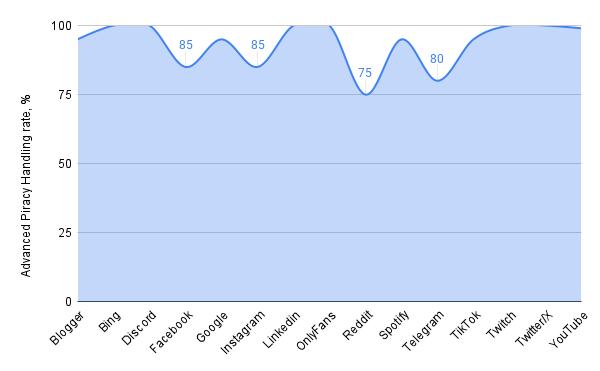
Facebook and Instagram: These platforms are not only slow but their success rate declines when we submit cases that deviate even slightly from basic ones, immediately increasing the removal time.
Reddit: The situation is even worse. One complex case has been unblocked for over two months, which directly impacts our success rate.
YouTube, Bing, Discord, OnlyFans, and Twitter/X show the highest performance in handling complex cases with a 100% score.
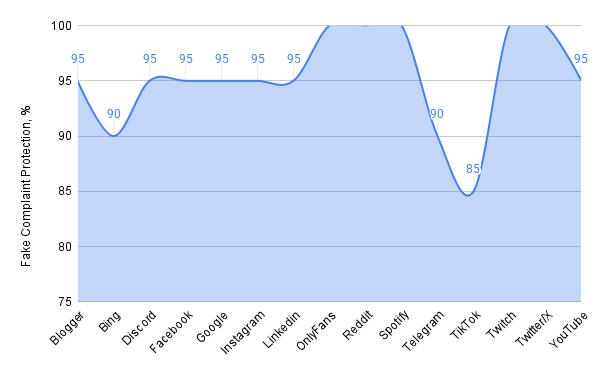
Protection against fake complaints is crucial for maintaining trust in a platform.
● TikTok: A particular concern is TikTok. Despite having two-factor authentication (2FA) for submitting complaints, this system does not function properly Any user can submit a complaint using an email address they do not have access to, making the platform vulnerable to abuse.
● Reddit, Spotify, Telegram, Twitter/X, and YouTube showed the highest level of protection against fake complaints, all at 100%. This indicates they have robust and effective mechanisms in place.
The counter-notice process is a litmus test for an anti-piracy system.
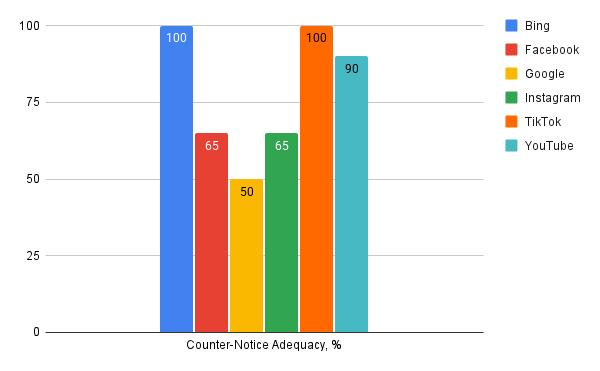
● Google: Significant problems are observed with Google. It seems their algorithms changed about two years ago, and they still haven't resolved the resulting issues. Pirates abuse the counter-notice system by simply filing a counter-notice instead of removing the content. If the copyright holder takes no action within 10 business days, the pirate link will be restored. A subsequent takedown request for the same link is likely to be rejected. Some pirates also make content visible only in specific countries, which makes moderation difficult for Google. Even providing a copy of a legal complaint does not guarantee that the restoration process will be stopped. Additionally, restoring links to legitimate sites that have been mistakenly removed by malicious users can take up to 3-6 months, which is an unacceptable timeframe.
● Facebook and Instagram: The counter-notice process here is strange. These platforms do not provide the complainant's details to file a lawsuit, which is standard practice under DMCA law They simply restore the content if they believe it was removed in violation of their procedure and suggest that the copyright holder seek resolution through a certified out-of-court dispute or directly with the user who uploaded the content. We consider this to be a sign of low-quality procedures. Page 7/8
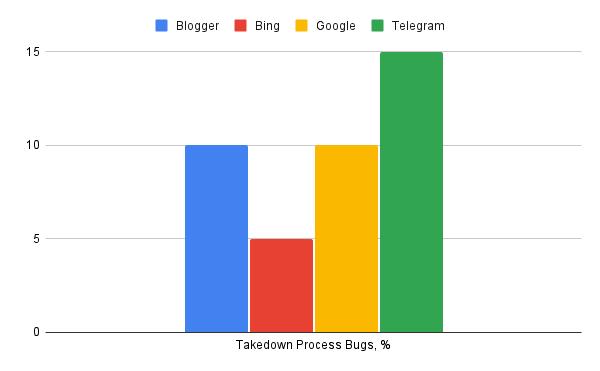
Technical failures in complaint submission forms impact the reporting organization's statistics by increasing the percentage of rejected links.
● Blogger and Google: Occasionally, after submitting complaints, an email is received containing a source code bug, resulting in the rejection of links. These must be resubmitted.
● Bing: The issue with Bing is not the CAPTCHA for bulk submission, but that the bulk submission page occasionally fails to load. Although rare, this creates an impediment to efficient operations.
● Telegram: In addition to the lack of a functional DMCA service, as we have already pointed out, Telegram also has technical problems related to the platform's unique structure. A channel or group owner can change the URL address multiple times a day Because of this, after a pirate link has been identified and a takedown request sent, it becomes impossible to remove the active content, as the link may become inactive within a few hours. Given that Telegram processes takedown requests very slowly, this feature makes effective response virtually impossible, as the pirate link becomes invalid even before it can be processed.
● Platforms without Critical Issues: YouTube, Twitter/X, Twitch, OnlyFans, Spotify, Reddit, Discord, LinkedIn, Instagram, Facebook no critical bugs affecting the request submission process were found for these platforms.