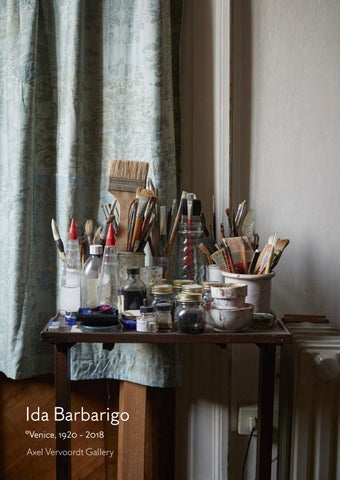
Ida Barbarigo °Venice, 1920 - 2018 Axel Vervoordt Gallery
Axel Vervoordt Gallery
Ida Barbarigo was born in Venice in 1920 as Ida Cadorin into a family of artists, architects, and sculptors. Although not encouraged by her father to become an artist, she realized from a young age that she had a gift for drawing and an eye for tones and shades. She wanted to become an artist and work in great freedom, not being obstructed by marriage or children. While attending Venice’s Accademia di Belle Arti, she transitioned away from architecture studies in order to study painting. Giotto and Cimabue, many Renaissance painters, as well as the art of early civilizations and modern painters such as Piet Mondrian influenced her work. In 1949 she married another artist, Zoran Mušič, the love of her life, while stubbornly keeping her independence and continuing her artistic path. Her restlessness and curiosity led her to travel. In 1952, she moved to Paris, where she wanted to “unlearn” painting and forget academic teaching to create her reality, valid for itself, and able to communicate its world. Soon, she turned towards abstraction, using sinuous forms skillfully orchestrated against light, airy backgrounds, almost always in tone, and often infused with the rhythm of white brushstrokes suggesting the scintillation of light and the fluttering of leaves on the wind. From 1959 onwards, she lived in Venice and Paris, where she encountered other artists like Germaine Richier, Vieira da Silva, Léon Gischia and Hans Hartung but also critics and art historians, such as René de Solier, Jean Bouret, Jacques Lassaigne, and Pierre Francastel. In 1978, in Venice, she installed herself in the “piano nobile” of Palazzo Balbi-Valier along the Grand Canal. In the attic of the Palazzo she re-created the artistic atmosphere of the house where she was born. She stayed there surrounded by hundreds of artworks, which she created as well as those of the Cadorin family while continuing painting. She passed away in 2018.
Axel Vervoordt Gallery
Ida Barbarigo participated three times in the Biennale of Venice: in 1942 as a ‘young talent’, in 1978 with ‘I Persecutori’ and in 1995 she was selected by Jean Clair for the main pavilion, where an entire room was dedicated to ‘Le Sfingi’. The American dealer Patti Birch bought her work to New York. From 1969, the American collector Eric Estorick was one of the main collectors who bought her work. In 1972 she had a retrospective at Le Musée Moderne de la ville de Paris. In 1986 she received a special commission to make portraits of Président Mitterand that were shown at the Elysée in Paris. In 2002 she showed her series “Guardando Guardando” in Giulio Romano’s magnificent Palazzo Te in Mantua. In 2004 she had a large exhibition at IVAM in Valencia, curated by Kosme de Barañano. Palazzo Fortuny in Venice hosted an exhibition of her ‘Terrestri’ in in 2006. Axel Vervoordt presented her work in Infinitum in the same Palazzo Fortuny in 2009. Ida Barbarigo died peacefully at the age of 97 in her home in Venice. In 2020, Axel Vervoordt Gallery started representing the Estate of Ida Barbarigo. In June 2021, the Archivio BCM, regrouping the archives of the artists Barbarigo, Cadorin and Mušič was founded under the direction of Daniela Ferretti. Its role is to defend and support the work of artists and to promote their historical value by scientifically studying and cataloguing their work. A full catalogue on the work of Ida Barbarigo raisonné is in preparation.
Axel Vervoordt Gallery
The artist’s career consists of thorough and patient iconographic research of a number of themes and symbols. These include chairs, being her most central theme, but also flowers and leaves, judges, faces, demons, beaches, and city views. Barbarigo developed these connotative signs over several decades in deep silence and an almost obsessive manner. Art historian Giuseppe Mazzariol described the enigmatic and evocative character of Barbarigo’s work as follows: “The signs recur obsessively, each time losing their descriptive dross and producing images of greater connotative depth, in other words becoming more essential and less explicit, more suggestive, but in the end more definitive.” Omnipresent in her oeuvre, Barbarigo’s reproductions of chairs sought to capture the energy of the unseen. She sensed the atmosphere and vibrancy of life on city squares and aimed to express this in a material way. In this case, she gave body to the energy surrounding the silver chairs from San Marco’s Caffè Florian, chairs which were abandoned and deserted in winter. As one of Barbarigo’s long-time friends, Daniela Ferretti also explains: “When I think of Ida, most of the time I imagine her sitting at one of the cafés on the Zattere, or Piazza San Marco, or along the Parisian boulevards, contemplating the chairs and above all observing. Observing the mysterious, enigmatic voids and the interstices of simple chairs stacked in piles or abandoned in random geometric lines, she waited for a new vision to come to replace the usual image of these daily objects designing them to reveal their essence. Nothing comes from anything. Everything takes place in a suspended, motionless time and suddenly in a new space appears the other image, the one that emerges from the deepest part of the soul.” Barbarigo picked chairs as emblems of the contemporary, ephemeral artefacts of a Venice that must be entirely reinvented: “The true new monuments of our time are chairs” she is fond of saying. A leitmotif that runs through her painting, an alphabet, almost a basso continuo in painting that she would endeavour to develop and pursue to its utmost consequences; a way to artlessly capture the true essence of the fluid city. Her own personal handwriting. Chairs: the ones in stacks, ferruginous and stiff, forlorn and rusty, the ones scattered along the cafés on the Zattere, exposed to the elements, their silvery ugliness carving the light. “They are blended and transformed with all the rest, become something else.” They also can “express violence” when they assume the threatening shapes of glaring armies. When late in the evening or at dawn lying there in stacks, helpless, the nested tables become autonomous impersonal forms, games of chance and function, and the unexpected mingling with air.
Axel Vervoordt Gallery
Axel Vervoordt Gallery
Promenades - Passeggiate Ida Barbarigo was a restless soul. She used to wander around the city and make observations of what she noticed of daily life. On the long quay of the Zattere in Venice, she observed the changes in things, was aware of the anonymous “massive” flow of people unloaded from the huge tourist ships like uniform crustaceans migrating from the bottom of the oceans. For her, Venice catalyses and emits frequencies of water and stone. “I spent all my time wandering around possibly deserted places, outdoors, seeing light on things, tones, grey details […]” Later Ida would call this ecstatic vagabonding approach “Passeggiate” or ‘Promenades’ (Walks). “I had always gone on the Zattere, as a child, the quay was right behind my house… then, after staring for hours, spending hours in utter solitude, when the others maybe were eating or during recess, I began to see this wonderful condensation of air and light, the reflections on the water that in Venice multiply all things and dissociate them from all the rest. An expanse of stone, a pink dust cloud, shadows, water a sheet of gold. This possibility of being touched erases everything else and makes you so strong. Not being something physical, how can you get hold of it?”
Axel Vervoordt Gallery
La Ville (the City), 1955, oil on canvas, 60 x 73 cm, A1117.110.
Axel Vervoordt Gallery
Untitled, 1956, oil on canvas, 116 x 81 cm, A1117.113.
Axel Vervoordt Gallery
Promenade (Walk), 1958, oil on canvas, 130 x 89 cm, A1117.115.
Axel Vervoordt Gallery
Untitled, 1958, oil on canvas, 58 x 70 cm, A1117.119.
Axel Vervoordt Gallery
Axel Vervoordt Gallery
Axel Vervoordt Gallery
Axel Vervoordt Gallery
Axel Vervoordt Gallery
Chairs – Barbarigo’s omnipresent leitmotiv The subject of chairs is a prominent feature. Omnipresent in her oeuvre, it remained her leitmotif and became a personal script, a form of handwriting. As in all her series, she worked obsessively for months, sometimes several years. Barbarigo’s reproductions of chairs capture the energy of the unseen. In seemingly conscious and unconscious ways, the chairs serve as a primary motive to access deep emotions, only to transform, and evolve into something else entirely. She sensed the atmosphere and vibrancy of life on city squares and aimed to express this materially. Her expressive work gives body to the energy surrounding the chairs at the cafés on the public squares in Venice or Paris, where she loved to sit for hours observing people. The chairs express aspects of melancholy, mystery, or even darker themes when they resemble human skeletons or demons.
Passeggiata spericolata (Reckless Walk), 1968, oil on canvas, 100 x 72,5 cm, A1117.102.
Axel Vervoordt Gallery
She draws them all the time, calls them “chair families”, discovers their inexplicable appearance of motionless armies, turns them into tight-set geometric lines, instruments for obtaining an anti-rhetorical vision of the water city. “Something you are used to seeing every day and that suddenly appears to you eternal, beyond expression. Continuous alternating refractions of forms, the transparent chairs and their shadows pressed upon by space that emphasises their forms yet leaves the m in negative.” Some are venomous, menacing, cracked, “separate chairs”, liana chairs, squashed, “they reminded you of those plants that take over a wall and split it apart.”
Axel Vervoordt Gallery
Aimez-vous la cuisine allemande? Ovvero i sportivi (Do you like German cuisine? That’s it, athletes), 1965, oil on canvas, 100 x 81 cm, A1920.00209.
Axel Vervoordt Gallery
Seggiole a parte (Chairs apart), 1973, oil on canvas, 142 x 93 cm, A1920.00113.
Axel Vervoordt Gallery
Untitled, 1969, oil on canvas, 46 x 37,5 cm, A1920.00136.
Axel Vervoordt Gallery
Riso di Socrate, 1969, oil on canvas, 64,5 x 54 cm, A1920.00419.
Axel Vervoordt Gallery
Axel Vervoordt Gallery
Axel Vervoordt Gallery
Caino, 1977, oil on canvas, 55 x 46 cm, A1920.00418.
Axel Vervoordt Gallery
Tiene cara de león (He ha oil on canvas, 80 x 98 Axel Vervoordt Gallery
as the face of a lion), 1971, 8,5 cm, A1920.00907. Axel Vervoordt Gallery
Les jardins d’Orphée (The gardens of Orpheus), 1975, oil on canvas, 50 x 65 cm, A1920.00068.
Axel Vervoordt Gallery
Spellbinding - son cose che incantano A series Ida Barbarigo painted in the 1970s. This series “son cose che incantano” literally means ‘these are things that enchant’ or ‘Spellbinding’. In this enigmatic series Barbarigo presents a vision of “another” world, like a spellbinding dream becoming a nightmare. Infused with a deep melancholy, these works present a dark side which is enchanting, yet fascinating. As Barbarigo stated about her use of chairs as signs/symbols: ‘They are an agile and ambiguous group who live elsewhere and in another time. I haven’t understood if they are calling me or waiting for me.” Indicative of many of the artist’s series, the works of “son cose che incantano” present an atmospheric and emotive reawake of the buried images, as archetypes, like images reemerging from a deep psychic abyss. The grey, black and white tones of these works evoke the fog and the ‘disconsolate solitude’. Barbarigo derived the title from ‘Le Nozze de Figaro’ wherein the third act Figaro sings the enchanting aria, “Son orse benigne...’. In the artist’s notes, we find confirmation of the impression of deserted places populated by mysterious presences: ‘There was a time when Piazza San Marco appeared to me like a great silver beach. In the foreground, the chairs of Florian’s interlaced in a convulsive crisscrossing of backs, seats, metal feet like the ‘cold spirits of Hades’, who, like flagellated clouds, rush towards Orpheus.”
Axel Vervoordt Gallery
Son cose che incantano, 1974, oil on canvas, 114,5 x 146,5 cm, A1920.00410.
Axel Vervoordt Gallery
Axel Vervoordt Gallery
Persecutors or Judges or The Alchimists A series Ida Barbarigo painted in the 1970s. These are characters emerging from the daily news, placed in respectable positions of power in society: government, banks, courts, University Chairs, etc.. For Barbarigo they are – often unconsciously – the agents of violence, cruelty, repression and persecution. They bear masks of “inhuman humanity”. Painted in dark greys and browns only the heads are gleaming, coming out of the shadows. Partly machines, partly fragile human beings. However, her only motivation is “love, a ravishment, an unceasing exploration, almost as if this were the only way of living: gazing around in a constant state of wonder, a perpetual surrender before the mystery which is beauty”. In 1978, Luigi Carluccio selected several Persecutori for the Biennale di Venezia for a dedicated room to Barbarigo’s work. He also wrote the text for the catalogue.
Axel Vervoordt Gallery
Untitled, 1979, oil on canvas, 65 x 81 cm, A1920.00146.
Axel Vervoordt Gallery
Il Persecutore (The Persecutor), 1978, oil on canvas, 160 x 114 cm, A1920.01130.
Axel Vervoordt Gallery
I giudici (The judges), 1970, oil on canvas, 65 x 81 cm, A1920.00414.
Axel Vervoordt Gallery
Flowers A series Barbarigo made in the late 1970s, early 1980s. Ida loved peonies and kept them in large quantities in randomly arranged bouquets in her apartment. She became obsessed with the process of the florescence and the richness of colours thee revealed “as if a spell had been lifted and the concentrated essence of beauty itself were being revealed through the opening of those eyes”. As often in Barbarigo’s paintings, they start transforming into figures, Her self-portraits seem to disintegrate into flowers. Literature : G. MAZZARIOL, Flowers and Persecutors by Ida Barbarigo, Patti Birch, New York, 1980.
Axel Vervoordt Gallery
Fleurs (Flowers), ca. 1980, oil on canvas, 50 x 61 cm, A1920.00444.
Axel Vervoordt Gallery
Gigli (Lilies), 1983, oil on canvas, 50 x 61 cm, A1920.00437.
Axel Vervoordt Gallery
Diventar peonia / devenir pivoine (Becoming a peony), 1979, oil on canvas, 55 x 65 cm, A1920.00450.
Axel Vervoordt Gallery
Herms ‘Erme’ A series Barbarigo produced in the early 1980s. Derived from mythology, this enigmatic series embodies a sense of mystery and ambiguity. Herms were placed at crossroads, at entrances of homes, in distant and lonely landscapes where man needs a rest to then be able to continue his journey under the auspices and the eyes of the god. For Barbarigo, they function as a mirror; She explains: “Herms can be understood as living sculptures; they represent the gods, from whom they derive their smile. Herms are beings that give comfort in life […] because it is associated with eremitage in the sense of a hermit, it protects and indicates […] They are melancholic female figures, often self-portraits, sometimes transforming into vegetation or fruit.
Axel Vervoordt Gallery
Erma, 1982, oil on canvas, 162 x 130 cm, A1920.13103.
Axel Vervoordt Gallery
Axel Vervoordt Gallery
Autoportrait (Self-Portrait), 1981, oil on canvas, 100 x 81 cm, A1920.00121.
Axel Vervoordt Gallery
Erma, 1983-1984, oil on canvas, 162 x 97 cm, A1920.13099.
Axel Vervoordt Gallery
Untitled, 1980, oil on canvas, 24 x 14 cm, A1920.00759.
Axel Vervoordt Gallery
The Beach – Nudes In the mid 1980s, Barbarigo goes frequently to the beach where she observes sunbathers. Fascinated by the naked bodies, it becomes a new series.
Axel Vervoordt Gallery
Les damnés de la plage (The damned of the beach), 1985, oil on canvas, 65 x 81 cm, A1920.00684.
Axel Vervoordt Gallery
Assolata (Sunbather), 1985, oil on canvas, 73 x 60 cm, A1920.00685.
Axel Vervoordt Gallery
Untitled, 1988, oil on canvas, 92 x 60 cm, A1920.00092.
Axel Vervoordt Gallery
Self-portraits and Sfinxes Barbarigo had a profound familiarity with the psychological condition of the human being. Throughout the 1980s and 1990s, she painted a series of Autoritratti or Self-portraits, an enigmatic series that is less-known to the public, but which represents important theme in her oeuvre. These works expose layers of the artist’s personality while conveying aspects of melancholy, a dark side that’s mysterious, yet fascinating. They are based upon an intensive research and personal introspection leading towards a self-knowledge. Like in her other works, they reveal how the artist’s layers of flowing, dripping lines approach an enchanting abstraction. In 1992, whilst visiting a museum in Vienna, Barbarigo was affected by an Egyptian head she encountered. The sculpture haunted her dreams and she instinctively translated the portrait through her canvasses. In an interview with Michael Peppiatt in 1995, she described the strong emotion that came to her like a shock and greatly intrigued her that she had to paint and draw them obsessively. Writer and journalist Paolo Levi explains: “The Sphinx is a mysterious, disturbing presence that lives in our collective unconsciousness and dwells in us. Suddenly, in fact, a shadow figure appeared on the surface between the meshes of beautiful material, on a dark background, without any hint of light.” The sphinx are all self-portraits of the artist who used her paintings as a tool for self-knowledge.
Axel Vervoordt Gallery
Untitled, 1992, oil on canvas , 80 x 65 cm, A1920.00870.
Axel Vervoordt Gallery
Singe verte (Green Sfinx), 1994, oil on canvas, 100 x 81 cm, A1920.00362.
Axel Vervoordt Gallery
Axel Vervoordt Gallery
Le sphinx, 1995, oil on canvas, 161 x 113 cm, A1920.01133.
Axel Vervoordt Gallery
Sfinge, 1994, oil on canvas, 92 x 65 cm, A1920.00607.
Axel Vervoordt Gallery
Saturns “I Saturni” A series Barbarigo made in the late 1990s. Saturn is the mythologically the father of the artists, the founder and origin of the male/ female duality, the god of life and death, of agony and pleasure. Barbarigo described them as ‘origins’, the desperate and terrible proto-male who in the bubbling of foam, mythologically violent and drenched in blood, sees the birth of beauty. She paints them as huge demonic figures, filling the entire canvas with their impressive torsos and large hands covering their face. They seem wild, dramatic and loud. Daniela Ferretti dedicated an exhibition to the series ‘Herms and Saturns’ in Palazzo Fortuny, Venice, in 2016.
Axel Vervoordt Gallery
Demoni Svaghi (Amusing Demons), 1998, oil on canvas, 130 x 97 cm, A1920.13108.
Axel Vervoordt Gallery
Demoni Svaghi, 1998, oil on canvas, 116 x 97 cm, A1920.13108.
Axel Vervoordt Gallery
Saturno, 1997, oil on canvas, 116 x 73 cm, A1920. 13116.
Axel Vervoordt Gallery
The Earthlings - I Terrestri Series painted around 2000-2010. An evocative depiction of various human figures full of life, who move, hesitate, fall, stand up, advance, retreat, stop, flee, but always emanating an organic vitality, induced, absolute and necessary. Barbarigo explained: “These mammals of the Terrestrials are invading my home, I don’t know what they are, where they come from. There was no way to stop them. But I can’t explain them. I am just an instrument, me, the plant that produces these Earthlings. As if they were tomatoes.” Barbarigo executes them in numerous variations, on canvas and on paper.
Axel Vervoordt Gallery
I Terrestri, 2003, oil on canvas 54 x 65 cm, A1920.00639.
Axel Vervoordt Gallery
I Terrestri, 2005-2006, oil on canvas, (LTR) 117 x 82 cm, A1920.00302; 117 x 90 cm, A1920.00300; 117 x 82 cm, A1920.00301. Axel Vervoordt Gallery
Axel Vervoordt Gallery
Axel Vervoordt Gallery
I Terrestri, 2004, oil on canvas 38 x 46 cm, A1920.00642.
Axel Vervoordt Gallery
Extended Biography
Barbarigo in her studio in Venice in 1974.
“I Saturni” in Barbarigo’s workshop in Venice, 1997.
Axel Vervoordt Gallery
“I Terrestri” in Barbarigo’s
In 1995, chief curator of the Biennale of Venice, Jean Clair dedicates a room in the central pavilion to Barbarigo’s “Sfinxes”.
s studio, Venice, ca. 2008. Axel Vervoordt Gallery
Biography Born 1920 in Venice, Italy as ‘Ida Cadorin’. Lived and worked in Venice (Palazzo Balbi Valier) and in Paris. Passed away in 2018 in Venice, Italy. 1920 Ida Cadorin Barbarigo is born in Venice in a family of artists, sculptors, architects originating from the Cadore district in the Dolomites north of Venice. The Cadorin had been one of the first art workshops to be officialised by the Serenissima Repubblica of Venice even before the first Renaissance. 1942 Enrolled in the Fine Arts Academy of Venice she attends the courses of her father, Guido Cadorin, and the sculptor Arturo Martini. After a contest for young artists one of her canvases is shown at the Biennale di Venezia. 1944 In Trieste where she temporarily seeks shelter from the war with her family she meets the painter Zoran Mušič. 1948 During a visit in Switzerland she discovers modern painting. 1949 She marries Zoran Mušič. 1952 They settle in Paris. She comes in contact with the painters Léon Gischia, Maria Helena Viera da Silva, Germaine Richier, Hans Hartung, Veno Pilon, the critics René de Solier, Jean Leymarie, Jack Lassaigne, Pierre Francastel and Jean Bouret among others. 1955 Shows at the Salon de Mai, Paris, France. 1957 Travels to Belgium, Holland and London. The bleak landscapes of the North Sea coasts leave a deep impression. 1958-1959 Léon and Odile Degand put her in touch with Jacques Seletti who opens a gallery in New York, solo show at the Seletti Gallery, New York. 1964 Solo show at the Galleria Il Traghetto in Venice where she meets Lucio Fontana. 1966 The beginning of the Commandeur and Chaises-Arbres series.
Axel Vervoordt Gallery
1968 Wins a prize at the Menton Biennial for the triptych Histoire de Caïn. 1969 Eric Estorick is interested in her work and becomes one of her main collectors. Beginning of her collaboration with the Grosvenor Gallery in London: Season of Italian Art. 1975 Works on the I Giudici series. 1977 The American art patron Patti Cadby Birch begins to collect her works. 1978 She installs herself in the ‘piano nobile’ of Palazzo Balbi-Valier along the Grand Canal. In the attic of the Palazzo she recreated the artistic atmosphere of the house where she was born. She participates again in the Biennale di Venezia with a wall full of I Persecutori. 1983 Nudi series. 1986-1988 Le Spiagge series. The French Presidency commissions her to paint the portrait of President Mitterand. 1995 Jean Clair selects her for the main pavilion of the Biennale di Venezia where she gets an entire room dedicated to I Sfingi. 2005 Death of Zoran Mušič on May 25, at the age of 96. 2013 On the occasion of the exhibition Unity in the Depth in the Axel Vervoordt Gallery the book Ida Barbarigo is published by the Axel & May Vervoordt Foundation. 2018 Passes away on January 25 in Venice, Italy.
Axel Vervoordt Gallery
Selected solo exhibitions 2022 Ida Barabrigo. Cafés, Axel Vervoordt Gallery Hong Kong. Dialogue with the Self-Portrait. Ida Barbarigo presents Zoran Music, Axel Vervoordt Gallery, Kanaal, Belgium. 2020 Selfportraits/ Cose che incantano, Axel Vervoordt Gallery, Kanaal, Terrace Gallery, Wijnegem, Belgium. 2015-2016 Herms and Saturns, Palazzo Fortuny, Venice, Italy. 2013 Unity in the Depth, Axel Vervoordt Gallery, Antwerp, Belgium. Ida Barbarigo, Palazzo Barbaro, Venice, Italy. 2006 Ida Barbarigo: I Terrestri, Palazzo Fortuny, Venice, Italy. 2004 Ida Barbarigo: Donación, IVAM Museum of Modern Art, Valencia, Spain. I terrestri, Galleria Contini, Venice, Italy. 2002 Ida Cadorin Barbarigo. Opere recenti, Museo Civio di Palazzo Te, Mantua, Italy. 2001 Guardando, guardando, Ikona Gallery, Magazzini del Sale, Venice, Italy. 2000 Ida Barbarigo, BBK Foundation, Bilbao, Spain. 1998 Ida Barbarigo. Alle Zattere 1962-1976, Ikona Gallery, Magazzini del Sale, Venice, Italy. Ida Barbarigo, Contini Gallery, Venice, Italy. Ida Barbarigo. La cerchi di Saturno, Maggiore Gallery, Bologna, Italy. 1997 Ida Barbarigo. I Volti 1966-1996, Ditesheim Gallery, Neuchâtel, Switzerland. 1996 I volti, Contini Gallery, Venice and Cortina d’Ampezzo, Italy. 1995 Biennale di Venezia, Venice, Italy (I Sphingi selected by Jean Clair for the main pavilion). 1994 Ida Barbarigo, Vallois Galerie, Paris, France. Axel Vervoordt Gallery
1991 Ida Barbarigo, Gallery Krugier-Ditesheim, Geneva, Switzerland. 1989-1990 Ida Barbarigo, Museo d’Arte Moderna Rimoldi, Cortina d’Ampezzo, Italy. Ida Barbarigo, Museo Diocesano d’Arte Sacra di S. Apollonia, Venice, Italy. Tancredi-Barbarigo 1950-1960, Contini Gallery, Asiago, Italy. Ida Barbarigo, Lambert Gallery Atelier, Paris, France. 1988 Ida Barbarigo, Galerie des Amis des Arts, Neuchâtel, Switzerland. Ida Barbarigo, Galleria Contini, Venice, Italy. 1987 Ida Barbarigo, Kara Gallery, Geneva, Switzerland. 1983 Ida Barbarigo, Gallery Manus Presse, Stuttgart, Germany. 1982 Ida Barbarigo, Bayerische Staatsgemäldesammlungen, Munich, Germany. 1980 Ida Barbarigo, Galerie de France, Paris, France. 1979 Ida Barbarigo, Il Traghetto Gallery, Venice, Italy. 1978 I Persecutori, curated by Carluccio, Biennale di Venezia, Venice, Italy. 1977 Italian Institute of Culture, Helsinki, Finland. Ida Barbarigo – engravings, Alvar Aalto Museum, Jyväskylä, Finland. 1976 Ida Barbarigo, Galerie de France, Paris, France. Ida Barbarigo – engravings, Italian Institute of Culture, Stockholm, Sweden. Ida Barbarigo – engravings, Italian Institute of Culture, Copenhagen, Denmark. 1975 Ida Barbarigo, Fondazione Querini Stampalia, Venice. 1974 Travelling exhibition in the Museums of Modern Art in Linz and Vienna, Austria. 1972 Retrospective (1964-1972), Musée d’Art Moderne, Paris, France. Ida Barbarigo – engravings, The Meeting Gallery, Venice, Italy.
Axel Vervoordt Gallery
1971 Ida Barbarigo, Grosvenor Gallery, London, UK. Ida Barbarigo, La Nuova Loggia Gallery, Bologna, Italy. 1970 Ida Barbarigo – engravings, Galerie Schmücking, Brunswick, Germany. 1969 Ida Barbarigo, Galleria Bergamini, Milan, Italy. 1968 Ida Barbarigo, Alik Cavaliere and Bruno Pulga, Nuremberg Kunsthalle, Nuremberg, Germany. Tre personali al Palazzo Chiericati, Palazzo Chiericati, Vicenza, Italy. 1966 Ida Barbarigo, Handschin Gallery, Basel, Switzerland. 1965 Ida Barbarigo, Paul Facchetti Gallery, Paris, France. Ida Barbarigo, Galleria L’Elefante, Venice, Italy. 1964 Ida Barbarigo, Galleria Il Traghetto, Venice, Italy. 1960 Ida Barbarigo, curated by Boris Vizintin, Museum of Modern Art, Rijeka, Yugoslavia, travelling exhibition until 1961 (Modern Art Museum, Ljubljana, Slovenia; Modern Art Museum, Zagreb, Croatia).
Selected group exhibitions 2024 Beyond Form: Lines of Abstraction, at Turner Contemporary, Margate, Kent, UK. Curated by Flavia Frigeri 2023 Gesture, Paint. Women Artists and Global Abstraction 1940–70, at Whitechapel Gallery, London and Fondation Vincent van Gogh, Arles, France. Curated by Laura Smith. 2020 Prelude: Melancholy of the Future, Museum Dhondt-Daenens, Deurle, Belgium. Curated by Antony Hudeck and Laurens Otto. 2018-2019 Room of Wonders, curated by Axel Vervoordt, DIVA, Antwerp, Belgium. 2017 INTUITION, curated by Axel Vervoordt, Palazzo Fortuny, Venice, Italy. Axel Vervoordt Gallery
2016 The Bottega Cadorin – A Dynasty of Venetian Artists, Palazzo Fortuny, Venice, Italy. 2015 PROPORTIO, curated by Axel Vervoordt, Palazzo Fortuny, Venice, Italy. All Summer in a Day, Gavin Brown’s Enterprise, Hancock, New York. 2011 Doppio Ritratto (Double Portrait), with Zoran Mušič and curated by G. Dal Bon, Estorick Collection, London, UK. TRA, curated by Axel Vervoordt, Palazzo Fortuny,Venice, Italy. Anti-corpi, curated by G. Bianchi and G. Dal Bon, Fortezza Massimiliano, Island of Sant’Erasmo, Venice lagoon, Italy. 2009 IN-FINITUM, curated by Axel Vervoordt, Palazzo Fortuny, Venice, Italy. 2002 Peintres 1978-2002, Galerie Albert Benamou, Paris, France. 1999 La cerchia di Saturno e la dimora di Dioniso, Ikona Gallery, Magazzini del Sale, Venice, Italy. 1972 Biennale di Venezia (graphic section), Venice, Italy. International Engraving Biennale, Modern Art Museum, Kyoto, Japan. 1967 Holst Halvorsen Gallery, Oslo, Norway. Peintres italiens de Paris, Institut Italien, Marseille, France. 1964 6 Pariser Maler, Wolfsburger Kunstverein, Wolfsburg, Germany, travelling exhibition to Nuremberg Kunsthalle, Nuremberg, Germany. 1959 Seletti Gallery, New York, USA. 1956 Ten Young Painters of the Ecole de Paris, Galerie de France, Paris, France. 1955, 1956, 1961, 1966, 1972 until 1980 Salon de Mai, Paris, France. 1942 Trivenete, Opera Bevilacqua La Masa, Venice, Italy. Biennale di Venezia, Venice, Italy.
Axel Vervoordt Gallery
Public Collections IVAM, Valencia, Spain. Musée d’Art Moderne de la ville de Paris, France. Museo Rimoldi Cortina d’Ampezzo, Italy. Tate Modern, London, UK. Estorick Collection, London, UK. Patti Cadby Birch, New York, USA. Axel & May Vervoordt Foundation, Antwerp, Belgium. Staatsgalerie Moderner Kunst, Munich, Germany. Neue Museum, Nuremberg, Germany. Kunstforening, Narvik, Norway. Kastrupgårdsamlingen, Kastrup, Denmark.
Publications Daniela Ferretti, Ida Barbarigo : herms and saturns, Venice, 2016. Daniela Ferretti, Laura Bossi Régnier, La bottega Cadorin: una dinastia di artisti veneziani, Crocetta del Montello (Antiga), 2016. Giovanna Dal Bon, Ida Barbarigo, Gent (AsaMER), 2013. Lydia Harambourg, Dictionnaire des peintres de l’École de Paris, 1945-1965, Neuchâtel (Éditions Ides et Calendes), 1993; new edition, 2010. Giovanna Dal Bon, Doppio Ritratto. Ida Barbarigo-Zoran Mušič, Milan (Johan & Levi), 2008. Ida Barbarigo. I terrestri, Venice (Marsilio), 2004 en 2006. Consuelo Císcar Casabán, Ida Barbarigo. Donación, Valencia (Institut Valencià d’Art Modern), 2006. Ida Barbarigo, Madrid (Celesa), 2005. Ida Barbarigo: 19-XI-2004 30-I-2005, Valencia (Generalitat Valenciana), 2004. Kosme de Barañano, Sabine Schulze, Jean Clair and Michael Peppiatt, Ida Barbarigo – published on the occasion of the exhibition held at Institut Valencia d’Art Modern, Valencia (IVAM), 2004. Kosme de Barañano, Ida Barbarigo, Bilbao (Bizaia Kutxa Foundation), 2000. Riccardo Held, Ida Barbarigo: la cerchia di Saturno e la dimora di Dioniso, Venice, (Ikona Gallery), 1999. Pierre Wat, Une vie, deux œuvres, Paris (Galerie Marwan Hoss), 1999. Ida Barbarigo, Alle Zattere 1962-1976, Venice (Ikona Gallery), 1998. Enrico Benaglia and Rossana Bossaglia, Ida Barbarigo, Rome (Italarte), 1998. Marilena Pasquali, Ida Barbarigo: la cerchia di Saturno, Bologna (Grafiche del Sasso), 1998. Ida Barbarigo: peintures, Neuchâtel (Gallery Ditesheim) 1997. Michael Peppiat, Ida Barbarigo, ‘i volti’ 1966-1996, Venice and Cortina d’Ampezzo (Galerie Contini), 1996. Axel Vervoordt Gallery
Philippe Carteron, Ida Barbarigo, Les Sphynges, Les Persécuteurs, Paris (Galerie Vallois), 1994. Nino Frank, René de Solier, Barbara Wright, Ida Barbarigo: peintures 1968-1991, Venice (Galerie Contini) and Paris (Salon de Mars), 1992. Ida Barbarigo: Lieux intérieurs, Paris (Galerie Jan Krugier), 1991. Jean Clair, Ida Barbarigo, Paris (Galerie atelier Lambert), 1989. Paolo Rizzi, Due artisti a confronto, Tancredi - Barbarigo, 1950-1960, Venice (Galerie Contini), 1989. Silvio Acatos, Ida Barbarigo : peintures, Genève (Galerie Kara), 1987. Erich Steingräber, Jean Clair, Ida Barbarigo, Munich (Bayerische Staatsgemäldesammlungen), 1982. Ida Barbarigo: Peintures récentes, Paris (Galerie de France), 1980. Giuseppe Mazzariol, Flowers and persecutors by Ida Barbarigo, New York (P. Birch), 1980. Jean Bouret, Jacques Lassaigne, Giuseppe Mazzariol, René de Solier and Marco Valsecchi, Ida Barbarigo, Paris (Galerie de France), 1976. Jean Bouret, Ida Barbarigo, Venice (Palazzo Querini Stampalia), 1975. Jacques Lassaigne, Barbarigo, Paris (Le Musée de Poche), 1972. Jacques Lassaigne, Ida Barbarigo, Paris (Musée d’art moderne de la Ville), 1972. Jacques Lassaigne, Ida Barbarigo, Bologna (Galerie La Nuova Loggia), 1971. Jean Bouret, Ida Barbarigo: exhibition of paintings, London (Grosvenor Gallery), 1971. René de Solier, Chaises et Voyeurs/Sedie e Guardoni, Venice (Bruno Alfieri), 1970. Marco Valsecchi, Ida Barbarigo, Milan (Galerie Bergamini), 1969. Drie italienische Künstler: Ida Barbarigo, Alik Cavaliere, Bruno Pulga, Nuremberg (Kunsthalle), 1968. Jean Bouret, Ida Barbarigo, Bâle (Galerie Handschin), 1966. 6 Pariser Maler, Nürnberg (Fränkische Galerie), 1965. Giuseppe Marchiori, Ida Barbarigo, Paris (Paul Facchetti), 1965. Nino Frank, Ida Barbarigo, Venice (Galerie L’Eléfante), 1965.
Axel Vervoordt Gallery