the Analyst The Voice of the Water Treatment Industry
Volume 28 Number 3
1300 Piccard Drive, Suite LL 14 • Rockville, MD 20850
Summer 2021
Can Onsite qPCR Testing Improve Management of Legionella Infections From Cooling Towers? To Filter or Not Filter, That Is the (Wastewater) Question Keys to Implementing Sustainable Cooling Tower Treatment in the Food Industry Using Plastic Piping to Carry Wastewater Chemicals How to Select the Right Test for Monitoring Chlorine
Volume 28 Number 3 Summer 2021
Published by
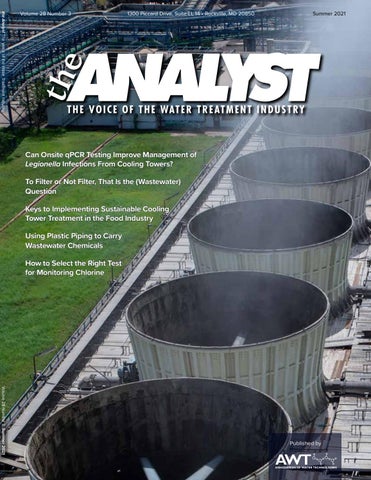
Cover Power plant cooling tower. Photo courtesy of Chatchawal Kittirojana/ Shutterstock.com.
Summer 2021
Volume 28
Number 3
8 Can Onsite qPCR Testing Improve Management of Legionella Infections From Cooling Towers?
Loraine Huchler, P.E., CMC®, FIMC, MarTech Systems, Inc.; and Desmond Fraser, Dipl-Ing., Reverse Ionizer, LLC and Rhein Tech Laboratories, Inc.
ASHRAE’s Legionellosis risk management standard codifies a systematic process for assessing and controlling the risk of Legionella pneumophila in evaporative comfort-cooling water systems. This article introduces an innovative plasma disinfection system that provides biocidal treatment to control the population of all planktonic and sessile bacteria, including Legionella, other gram-negative bacteria, and heterotrophic bacteria in a model evaporative cooling water system without the use of toxic nonoxidizing biocides.
20 To Filter or Not Filter, That Is the (Wastewater) Question
Kevin Cope, Brenntag North America (retired)
Terms like soluble biological oxygen demand (BOD), dissolved metals, pin-floc carryover, colloidal particles, and others are used throughout the wastewater industry. Each can give some indication of a problem, but we must know the exact reason why a discharge is over the limit so that the appropriate treatment actions can be taken. Before we can effectively address this problem, we must first know the root cause. The goal of this article is to explain why both filtered and unfiltered analytical test results are important and necessary.
26 Keys to Implementing Sustainable Cooling Tower Treatment in the Food Industry
Mike Hunter, AP Tech Group, Inc.
It is well known that solid-form chemical treatment technologies reduce freight, carbon dioxide (CO2) emissions, operator handling and exposure, and landfill disposal volume compared to traditional liquid treatment chemicals. The main challenge is to deliver a full water treatment program cost effectively to take advantage of these benefits across multiple types of chemicals and at the same time maintain or improve the program performance. This article describes how a total water treatment program can be administered using solid chemistries to maximize the safety and environmental gains associated with this form.
36 Using Plastic Piping to Carry Wastewater Chemicals
4
Calendar of Events
5
President’s Message
6
Message From the President-Elect
56 Membership Benefits 58 Industry Notes 63 CWT Spotlight 64 Making a Splash 65 Capital Eyes 66 Tales From the Waterside 68 Life Beyond Water 72 T.U.T.O.R. 76 Business Notes 78 Advertising Index
Alexandra Peters, David Seiler, Averie Palovcak, Arkema Inc.
Water treatment systems pose interesting challenges for the designer due to the broad range of chemicals that can make up the original flow stream as well as the water treatment chemicals that are chosen to effectively run the system. The water treatment process often requires stabilization of the chemicals, removal of solids, elimination of bacteria, and odor control. This article will focus on plastic piping systems that can be considered for the handling of wastewater and for the addition of these necessary additive chemicals that vary from facility to facility.
46 How to Select the Right Test for Monitoring Chlorine
Catherine Allen, Tintometer Inc.
While chlorine is one of the most widely used test parameters to determine water quality throughout the world, do we really understand the mechanism that chlorine uses to achieve disinfection? Understanding the way in which chlorine interacts with other components of the water system is fundamental to choosing the correct test for the application.
3 the ANALYST Volume 28 Number 3
1300 Piccard Drive, Suite LL 14 Rockville, MD 20850 (301) 740-1421 • (301) 990-9771 (fax) www.awt.org
2021 AWT Board of Directors President
Michael Bourgeois, CWT
Calendar of Events
Association Events 2021 Business Owners Meeting
Secretary
September 21, 2021 Providence Convention Center and Omni Hotel Providence, Rhode Island
Treasurer
2021 Annual Convention & Exposition
President-Elect
Matt Jensen, CWT
Stephen C. Hallier, CWT
September 22–25, 2021 Providence Convention Center and Omni Hotel Providence, Rhode Island
Noah Baskin
Immediate Past President
Thomas Brandvold, CWT
Directors
John D. Caloritis, CWT Mark Coldren, CWT Stephanie Keck, CWT Fred Shurtz
2022 Annual Convention & Exposition
Ex-Officio Supplier Representative
Garrett S. Garcia
Past Presidents
Jack Altschuler John Baum, CWT R. Trace Blackmore, CWT, LEED AP D.C. “Chuck” Brandvold, CWT Thomas Brandvold, CWT Brent W. Chettle, CWT Dennis Clayton Bernadette Combs, CWT, LEED AP Matt Copthorne, CWT James R. Datesh John E. Davies, CWT Jay Farmerie, CWT Gary Glenna Charles D. Hamrick Jr., CWT Joseph M. Hannigan Jr., CWT Mark R. Juhl
Brian Jutzi, CWT Bruce T. Ketrick Jr., CWT Bruce T. Ketrick Sr., CWT Ron Knestaut Robert D. Lee, CWT Mark T. Lewis, CWT Steven MacCarthy, CWT Anthony J. McNamara, CWT James Mulloy Alfred Nickels Scott W. Olson, CWT William E. Pearson II, CWT William C. Smith Marc Vermeulen, CWT David Wagenfuhr Casey Walton, B.Ch.E, CWT Larry A. Webb
Staff
Executive Director Heidi J. Zimmerman, CAE Deputy Executive Director Sara L. Wood, MBA, CAE Senior Member Services Manager Angela Pike Vice President, Meetings Grace L. Jan, CMP, CAE Meetings Planner Marci Hickey, CMP Exhibits and Sponsorship Manager Barbara Bienkowski, CMP Marketing Director Jennifer Olivares Marketing Coordinator Mary Claire Gordon Managing Editor Lynne Agoston Production Manager Maryia Alenchyk Director of Accounting Services Dawn Rosenfeld
September 21–24, 2022 Vancouver Convention Centre Vancouver, Canada
2023 Annual Convention & Exposition
October 4–7, 2023 Amway Grand Hotel and Grand Rapids Convention Center Grand Rapids, Michigan
Also, please note that the following AWT committees meet on a monthly basis. All times shown are Eastern Time. To become active in one of these committees, please contact us at (301) 740-1421. Second Tuesday of each month, 11:00 am – Legislative/Regulatory Committee Second Tuesday of each month, 2:30 pm – Convention Committee Second Wednesday of each month, 11:00 am – Business Resources Committee Second Friday of each month, 10:00 am – Special Projects Subcommittee Second Friday of each month, 11:00 am – Cooling Subcommittee Second Friday of each month, 2:00 pm – Pretreatment Subcommittee Third Monday of each month, 9:00 am – Certification Committee Third Monday of each month, 3:30 pm – Young Professionals Task Force Third Tuesday of each month, 3:00 pm – Education Committee Third Friday of each month, 9:00 am – Boiler Subcommittee Third Friday of each month, 10:00 am – Technical Committee Quarterly (call for meeting dates), 10:00 am – Wastewater Subcommittee
Other Industry Events
USGBC, GreenBuild, September 21–23, 2021, San Diego, California WEFTEC, Annual Technical Exhibition & Conference, October 16–20, 2021, Chicago, Illinois IWC, Annual Conference, November 7–11, 2021, Scottsdale, Arizona RETA, Annual Convention, November 9–11, 2021, Schaumburg, Illinois
The Analyst Staff
Publisher, Heidi J. Zimmerman, CAE Managing Editor, Lynne Agoston Production Manager, Maryia Alenchyk Technical Editor Michael Henley, mdhenleywater@gmail.com, (303) 324-9507 Advertising Sales Manager Carol Nettles, carol@adboomadvertising.com
The Analyst is published quarterly as the official publication of the Association of Water Technologies. Copyright 2021 by the Association of Water Technologies. Materials may not be reproduced without written permission. Contents of the articles are the sole opinions of the author and do not necessarily express the policies and opinions of the publisher, editor or AWT. Authors are responsible for ensuring that the articles are properly released for classification and proprietary information. All advertising will be subject to publisher’s approval, and advertisers will agree to indemnify and relieve publisher of loss or claims resulting from advertising contents. Editorial material in the Analyst may be reproduced in whole or part with prior written permission. Request permission by writing to: Managing Editor, the Analyst, 1300 Piccard Drive, Suite LL 14, Rockville, MD 20850, USA. Annual subscription rate is $100 per year in the U.S. (4 issues). Please add $25 for Canada and Mexico. International subscriptions are $200 in U.S. funds.
4 the ANALYST Volume 28 Number 3
President’s Message
By Michael Bourgeois, CWT
As I write this, California is experiencing another drought. This is not uncommon and has become a routine part of any water treatment professional’s job in this part of the country. It means that water reuse is more important than ever. It also means, as we all know, that water conservation and energy efficiency are key components of our work. Being a water treater isn’t a job in which one receives a lot of outside praise. We might hear about a job well done internally or from our customers, but it’s important to remember the key role we play in addressing the water crisis many are facing. We all know and understand the critical role we play in the industry and in addressing the situation at hand, but our customers and the public don’t always understand our role. One way to quickly and easily demonstrate your expertise is to obtain the Certified Water Technologist (CWT) designation.
Certification I hope you will consider becoming a Certified Water Technologist (CWT). Gaining this credential is a great way to display your expertise in the industry. Sitting for
the CWT exam can be intimidating, but if you have the experience and take advantage of the resources AWT has, such as the Technical Reference and Training Manual, you will do fine. Obtaining the CWT demonstrates to your customers that you are a skilled professional who is knowledgeable on the latest water treatment procedures.
Convention I also hope that I’ll see you at the Annual Convention in Providence. We have a great program planned with a fantastic educational program. If you haven’t had a chance to see some of your suppliers in over a year, now is the time to visit them in the exhibit hall! And, you will once again have the opportunity to walk away with equipment or services you’re in need of, all while supporting our charity partners, Pure Water for the World, through our silent auction. At the conclusion of the convention, I end my term as AWT’s president. I’ve learned a lot during this time and have found it incredibly rewarding to serve AWT. This is an exciting time to be part of this great organization! Thank you for the opportunity to serve. I can be reached at mbourgeois@chemcoprod.com.
5 the ANALYST Volume 28 Number 3
Message From the President-Elect As I write this, I can’t help but think what many of us were doing and thinking at this time last year; it has been a crazy 12 months, well, really 18 months. Right now the cooling season is in full swing, and many things are “kind of ” back to normal. By the time we reach September and the Annual Convention & Exposition, we will be so excited to see our friends and colleagues in person once again! While fall this year is sure to be as busy a time as any before, the Annual Convention offers the perfect opportunity to meet with suppliers and learn about new technologies. This year will not disappoint! I’m looking forward to hearing some really great presentations and connecting with all of our exhibitors. I’m also excited to introduce you to our keynote speaker, Brett Culp. You might wonder how the experience of a documentary film maker could relate to the field of water treatment, but you’ll soon learn that Brett is all about making an impact. When we’re out in the field, we sometimes forget the larger picture and impact of our work on a facility, a community, and our world at large. The work we do matters and is impactful. Brett will help remind us of our meaningful mission and how our work makes us superheroes.
By Matt Jensen, CWT
I also can’t wait to honor the winners of the Ray Baum Memorial Water Treater of the Year, the Supplier of the Year Award, and the Rising Star Award. These awards are a great honor, and it’s such a privilege to be able to present them to our exceptional winners. I’m humbled to have the honor. I also encourage you to participate in our silent auction. Thanks to the generous donations from so many of our exhibitors, we will have a plethora of equipment, products, and services that you can bid on. All of the funds raised go to a great cause—Pure Water for the World. And you can walk away with something that you have been needing or wanting to better your company. It’s a win-win. At the conclusion of the Annual Convention, I will assume my role as AWT president. AWT has some great programs and services in the works for the coming year, and I look forward to developing them alongside our committed volunteers. As I step into my new role, I welcome your input on the future direction of AWT. I can be reached at mjensen@ gwt-inc.com. Thank you for the opportunity, and I look forward to serving you!
6 the ANALYST Volume 28 Number 3
Taking You To The Next Level Of Water Treatment Offering a wide array of pumps and controllers designed to work together seamlessly. Come to our booth at AWT to learn more about our growing portfolio.
Learn About “IoT Augmented Water Treatment” at AWT Session.
Come By Booth #569. To learn more, contact your Pulsafeeder Sales Representative at pulsatron.com today!
Coming Soon
Can Onsite qPCR Testing Improve Management of Legionella Infections From Cooling Towers? Loraine Huchler, P.E., CMC, FIMC, MarTech Systems, Inc.; Desmond Fraser, Dipl-Ing., Reverse Ionizer, LLC, Rhein Tech Laboratories, Inc.
8 the ANALYST Volume 28 Number 3
ASHRAE’s Legionellosis risk management standard (1) codifies a systematic process for assessing and controlling the risk of Legionella pneumophila in evaporative comfortcooling water systems. This standard supports a systematic approach to managing bacteria that includes water treatment, routine monitoring, proactive risk assessment, preventative maintenance, and management of water quality during service and idle periods. This article introduces an innovative plasma disinfection system (PDS) that provides biocidal treatment to control the population of all planktonic and sessile bacteria, including Legionella, other gram-negative bacteria, and heterotrophic bacteria in a model evaporative cooling water system without the use of toxic nonoxidizing biocides. The key benefits from controlling the population of sessile bacteria and the associated biofilm are improving the heat transfer (2), reducing the rate of proliferation of Legionella (3), and minimizing the adaptive ability of bacteria (4) by using multiple biocidal technologies (5). By using a novel, sophisticated onsite Legionella qPCR test device, owners of cooling towers can quickly measure the Legionella population and proactively optimize bacteria control by making real-time adjustments in the PDS. This article describes the use of an onsite Legionella qPCR rapid-test device and an innovative bacterial control system to control the population of Legionella bacteria in a model evaporative cooling water system. The sample-to-result turnaround time is less than one hour, allowing for immediate adjustments to the PDS. Researchers documented the value of the qPCR test results for assessing the risk of Legionella bacteria by comparing the qPCR test results to the results of a modified culture test and confirmed the efficacy of the innovative bacterial control system to control planktonic and sessile bacteria.
Plasma Disinfection System
The patented PDS (6) pairs two traditional technologies—copper-silver biocidal ions and hypobromous acid—with nonthermal atmospheric plasma, a novel technology. The PDS controls sessile and planktonic bacteria, including Legionella and heterotrophic aerobic bacteria (HAB).
“The PDS controls sessile and planktonic bacteria, including Legionella and heterotrophic aerobic bacteria (HAB).” Plasma is the fourth state of matter that occurs when an electrical source with a sufficiently high voltage frees electrons from atoms or molecules, creating an ionized gas in which ions and electrons coexist (micro-discharge filaments—“plasma streamers”) at atmospheric pressure. By its nature, plasma is very unstable, resulting in the dissipation of the electrical energy as the cooling water flows between the two closely spaced electrodes. During this brief period of electrical discharge, the elevated temperature of the plasma streamers effectively kills planktonic bacteria; the low rate of conductive heat transfer does not measurably raise the temperature of the cooling water. These plasma streamers also initiate chemical reactions at ambient temperatures that produce very low concentrations of numerous short-lived ionized species, including several biocidal species: hydrogen peroxide (H 2O2), ozone (O3), and ultraviolet light (UV). Copper and silver ionization. This system includes sacrificial electrodes to generate and automatically dose copper and silver ions to control sessile bacteria. Oxidizing biocides. The electrolyzer produces sodium hypochlorite from a brine solution. An automatic feedback control system uses an online oxidation-reduction potential (ORP) sensor for feedback control of a mixture of sodium hypochlorite and hypobromous acid to control planktonic bacteria. The PDS system includes an online amperometric free-chlorine sensor to monitor the free-halogen residual. The PDS is a fully integrated, skid-mounted assembly with a central programmable logic controller (PLC) that controls the onboard subsystems: plasma generation, copper ionization, and silver ionization. The PLC also controls the flow systems (valves and internal pump) and records operating parameters (plasma parameters [e. g., power and probe temperature] fan speed, pump speed, inlet and outlet water pressure, water flow rate, inlet and outlet water temperatures, leak sensor) and water quality parameters from online sensors (conductivity, pH, ORP, temperature).
9 the ANALYST Volume 28 Number 3
Can Onsite qPCR Testing Improve Management of Legionella Infections From Cooling Towers?
continued
Figures 1 and 2 show the configuration of the prototype unit evaluated in this laboratory study and now installed at a corporate campus supporting the first field study—two parallel evaporative cooling water systems: a “test” system using the innovative PDS technology and a “control” system using conventional oxidizing and non-oxidizing biocides.
Figure 3 shows the process flow; a portion of the recirculating cooling water is treated by the PDS unit and returns to the recirculating cooling water system. A second skid generates and feeds the oxidizing biocide: a bromine storage tank and an electrolyzer that generates sodium hypochlorite. This system uses Internet of Things (IoT) technology to create a cloud-based data archive.
Figure 1: PDS user interface.
Legionella Test Methods The Centers for Disease Control (CDC) and New York City and New York State regulations and legislation have approved two Legionella test methods to determine an “outbreak”: the standard culture test (7–14 day incubation) and the modified culture test, which uses a bacterial enzyme detection technology (7-day incubation). These laboratory tests are a poor fit for cooling tower owners because the objective of routine monitoring is not to identify an outbreak of Legionnaire’s disease but rather to provide a timely indication of the viability of Legionella bacteria in the recirculating cooling water, allowing owners to proactively implement bacteria control procedures to minimize the risk of legionellosis infections.
Figure 2: Plasma/copper-silver ionization unit and oxidizing biocide generator.
Timely Legionella test results are critical because the ecosystem of cooling water is highly dynamic; the population and viability of bacteria can change hourly due to factors such as the heat load and evaporation profile, varying airborne contaminants, degradation of oxidizing biocides by sunlight, and concentration of intermittently fed biocides. Cooling tower owners need rapid field test results to implement timely corrective action and reduce the risk that their cooling tower will discharge Legionella-contaminated water droplets. Figure 3: Process flow diagram—PDS and electrolyzer system.
10 the ANALYST Volume 28 Number 3
Can Onsite qPCR Testing Improve Management of Legionella Infections From Cooling Towers?
There are two commercialized technologies for Legionella field tests: immune-magnetic method (IMM) and quantitative polymerase chain reaction (qPCR). The sensitivity of these technologies is critical for real-time testing; the Cooling Technology Institute (CTI) guideline defines the performance of the Water Management Plan as “effective” if the Legionella test results are consistently less than 10 colony-forming units per milliliter (CFU/mL) (7). The IMM field test that measures tagged antibodies lacks sufficient sensitivity (minimum detection limit: 100 CFU/mL). The qPCR field test has sufficient sensitivity to serve as an early warning of Legionella pneumophila proliferation. The minimum detection limit is 8 CFU/mL, which is an approximate correlation from genomic units (GU). The analysis time for qPCR field tests ranges from one to four hours. Although studies have not shown a reproducible correlation between the qPCR test results and the culture results, the field qPCR test results provide relevant information for routine monitoring and control of the risk of Legionella pneumophila bacteria (8). Because the qPCR measures DNA, this test has several advantages over the culture methods, including specificity, no cross-reactivity with other bacteria, and the ability to identify true negative results and sensitivity. The test also shows the ability to identify true positives by detecting low concentrations of DNA. The fact that qPCR measures the total DNA from live and dead cells sometimes results in higher estimates of Legionella pneumophila concentrations than the culture tests that do not detect viable-but-not-culturable (VBNC) bacteria. The qPCR test does not provide any serotype information. In rare cases, the qPCR test may react with non-Legionella pneumophila bacteria, creating a false positive. These statistically small, positive biases in the qPCR test results will prescribe a slightly higher level of corrective action to reduce the population of Legionella pneumophila in the recirculating cooling water—a reasonable approach to managing risk.
continued
This model cooling tower study used both the qPCR test method and the modified culture test method to validate the value of the field test to assess and manage the risk of Legionella pneumophila in evaporative cooling water systems.
Discussion
PDS Test System. The PDS system used in this test is a full-scale pre-production model. Key specifications include the electrical requirements [208 V, single phase, 20 A, 50/60 Hz]; nominal energy requirements [1,000 KVA]; ambient conditions [conditioned space < 40 oC (105 oF)]; cooling water sample flow rate (20 gallons per minute [gpm]); dimensions [81.5 centimeter [cm] x 61 cm x 152.5 cm (32” x 24” x 60”)]; and weight [340 kg (750 pounds [lb])]. A second skid, integrated with the PDS PLC via Modbus communications, includes a bromine storage tank and the electrolyzer equipment [181 kg (400 lb.), 145 cm X 94 cm X 183 cm (45” X 37” X 72”)]. Model Cooling Tower. Researchers conducted this test in a Baltimore Aircoil (BAC) cooling tower rated for 12 tons installed behind the research facility. A gas-fired heater produced water at approximately 30 oC (85 oF) to simulate the normal operation of a recirculating evaporative cooling water system. This test did not include the addition of traditional water treatment chemicals for deposit and corrosion control. Test Methods and Analytical Measurements. Table A lists the analytical measurements for this study. This list does not include the biocidal ionized species (hydrogen peroxide [H 2O2], ozone [O3], and ultraviolet light [UV]) formed from the reaction of plasma with cooling water because these biocides are short-lived and occur in incredibly low concentrations.
“Cooling tower owners need rapid field test results to implement timely corrective action and reduce the risk that their cooling tower will discharge Legionellacontaminated water droplets.” 11 the ANALYST Volume 28 Number 3
Can Onsite qPCR Testing Improve Management of Legionella Infections From Cooling Towers?
continued
Table A: Analytical Measurements Measurement
Equipment
Test Method Range
Heterotrophic Aerobic Bacteria
Laboratory spread plate culture
--
Heterotrophic Aerobic Bacteria1
Field paddle tester
102–106 CFU/mL
Gram-Negative Bacteria
Field paddle tester
--
Legionella
Laboratory modified culture
--
Legionella
Field qPCR test
1–80,000 GU/mL
Free Halogen
Colorimeter
0.04–4.00 mg/L
Halogen, pH
Online amperometric free halogen analyzer
0.04–4.00 mg/L, 0–14 pH
Bromine
Spectrophotometer
0.04–10 mg/L
Copper
Spectrophotometer
0.06–5.00 mg/L
Silver
Spectrophotometer
0.01–0.25 mg/L
Total Hardness
Spectrophotometer
3–100 mg/L as CaCO3
Conductivity
Online conductivity sensor
10–10,000 mS/cm
Temperature
Online thermocouple
0–400 oC
ORP
Online ORP sensor
±1,500 mV ± 1 mV
Research Approach
Heterotrophic aerobic bacteria: This study used two methods to measure the concentration of heterotrophic aerobic bacteria—a laboratory spread plate culture and a field paddle tester. Gram-negative bacteria: This study included the measurement of gram-negative bacteria using the field paddle tester. Legionella species, as well as other pathogens such as Escherichia coli (E. coli) are gram-negative bacilli that have a thick cell wall and outer layer and often exist within biofilms. For this study, the incubation time was 48 hours at 37 °C. Legionella: This study used two methods to measure the concentration of Legionella—modified laboratory culture and qPCR field test. The modified laboratory culture, approved by the CDC for outbreak investigations, provides results approximately seven days after submission to the laboratory. The qPCR test procedure used pre-measured reagents that included a pH adjustment for “high-conductivity” cooling water had available results in 45 minutes.
Bromine, Copper, Silver, Total Hardness: This study uses spectrophotometric methods to manually measure the concentrations of bromine, copper, silver, and total hardness. Conductivity: This study uses an online sensor to measure the conductivity. Temperature: This study uses a thermocouple to measure the temperature of the water entering the PDS. ORP: This study uses an online oxidation-reduction potential meter to monitor the oxidizing biocide concentration.
PDS and Model Cooling Tower—Study Design The study has two parts: inoculation and test. The objective of this study was to demonstrate the efficacy of several combinations of biocidal modalities. Tables B and C define the water quality specifications and success criteria.
Free Halogen: This study used two methods to measure the concentration of free halogen—manual colorimetric method and online amperometric sensor.
12 the ANALYST Volume 28 Number 3
What Does Your Warehouse Staff Want in TOTES and DRUMS? North Metal and Chemical Company provides corrosion inhibition raw materials to solve your boiler and cooling water challenges.
BUTTRESS COARSE THREADING for QUICK VACUUM PREVENTION
NTP BUNG THREADING for PUMPS and VALVES
Serving AWT members as the largest, and best value, manufacturer of Sodium Molybdate in North America!
E CARBOYS and DELDRUMS for SMALLER NEEDS
CAM-LOCK QUICK DISCONNECT
BALL VALVES for MULTI-USE LEAK PREVENTION
EASY-SHIP PAILS with POUR SPOUTS
Shipping U.S. Specification drums and totes.
North@NMC-NIC.com | 717.845.8648 See our technical data and SDS documents at www.northmetal.net Now stocking in both California and our York, PA manufacturing plant.
Fourth generation, family-owned company since 1921. Most orders ship same or next day! Major credit cards accepted. Convenience fees apply.
We care about the details. Just like you.
Can Onsite qPCR Testing Improve Management of Legionella Infections From Cooling Towers?
continued
Table B: Water Quality—Specifications Water Temp (˚C [˚F])
Phase
Conductivity (mS/cm)
pH
[Calcium Hardness] (mg/L as CaCO3 )
ORP (mV)
Free Halogen (mg/L)
Inoculation
27–32 (80–90)
8.4–8.8
NS
NS
0
0
Test
27–32 (80–90)
8.4–8.8
NS
NS
NS
0.2–1.2
NS = not specified
Table C: Bacteria and Biocide—Success Criteria Legionella Bacteria qPCR (GU/mL)
Phase
Modified Culture (CFU/mL)
Heterotrophic Bacteria HAB (CFU/mL)
HPC (CFU/mL)
Ionization GramNegative (CFU/mL)
[Cu] (mg/L)
[Ag] (mg/L)
Inoculation
>1,000
>150
NS
NS
NS
0
0
Test
ND
<10
<1X10⁴
<1X10⁴
NS
0.8–1.2
0.04–0.08
ND = non-detectable
NS = not specified
This study used potable water supplied by the municipal water authority, Loudoun Water. The low concentrations of free halogen (0.08 mg/L) in the potable water did not impact the results of this study. The relatively high concentrations of copper (0.12 to 0.21 mg/L) in the potable water at the laboratory may have influenced the results of the test phase. Inoculation phase. Although there is no strict correlation between the results of the qPCR and the laboratory culture, the researchers’ used their experience with this model cooling tower to define the end of the inoculation period: >1,000 GU/mL for 24 hours that results in a Legionella concentration above 1,000 CFU/mL. Test phase. The test phase of this study sequenced each of the three modes in the following manner: plasma only ~three-day segment; plasma and copper:silver (Cu:Ag) ionization ~two-day segment; plasma, Cu:Ag ionization and oxidizing biocide ~two-day segment. The performance of each mode depends on several factors: duration of the test segment; dosage of copper, silver, and bromine; and the concentration of Legionella and heterotrophic aerobic bacteria. The test conditions in the third
phase, plasma + Cu:Ag ionization + oxidizing biocides, most closely matches the environmental conditions in an evaporative cooling water system. All specification limits are consistent with application guidelines for evaporative cooling water systems.
PDS and Model Cooling Tower—Study Results The test conditions simulated the hydraulic, thermal, and environmental conditions of a comfort cooling tower except for chemical additives for control of deposits and corrosion. Water treatment chemicals serve as nutrients for bacteria. Researchers compensated for the absence of water treatment chemicals by creating a concentration of L. pneumophila (1,300 CFU/mL) that was an order of magnitude higher than the CTI Guideline WTP-48 (9) for online disinfection (“hyper-halogenation”) during the six-day inoculation phase. The duration of the test phase was 136 hours: plasma-only (56 hours); plasma with Cu:Ag ionization (24 hours); plasma with Cu:Ag ionization and oxidizing biocides (56 hours). Table D defines the water quality during the test.
14 the ANALYST Volume 28 Number 3
Can Onsite qPCR Testing Improve Management of Legionella Infections From Cooling Towers?
continued
Table D: Water Quality—Specification Limits and Test Results
End of Each Phase
Water Temp (˚C [˚F])
Calcium Hardness (mg/L as CaCO3)
Conductivity (mS/cm)
pH
ORP (mV)
Free Halogen (mg/L)
Inoculation
30.4 (86.7)
8.80
1,179
658
176
<0.02
Plasma-only
31.8 (89.2)
8.81
1,236
700
140
<0.02
Plasma + Cu:Ag ionization
30.8 (87.5)
8.81
1,233
660
142
<0.02
Plasma + Cu:Ag Ionization + Oxidizing Biocides
31.4 (88.5)
8.61
1,264
656
594
1.14
Test Phase Specs
27–32 (80–90)
8.4–8.8
NS
NS
NS
0.1–1.2
Table E defines the success criteria and summarizes the test results for each phase. Table E: Bacteria and Biocide—Success Criteria and Test Results Legionella Bacteria Test Phase (Duration)
Heterotrophic Bacteria
Modified Culture (CFU/mL)
qPCR (GU/mL)
HAB (CFU/mL)
HPC (CFU/mL)
GramNegative (CFU/mL)
Ionization [Cu] (mg/L)
[Ag] (mg/L)
Inoculation (six days)
7,900
1,300
1X10⁶
16,000
3,600
0.11
0
Plasma-only (56 hours)
2,200
720
100
940
410
0.21
0
Plasma + Cu:Ag Ionization (24 hours)
840
140
<100
360
NG
0.09
0.07
Plasma + Cu:Ag Ionization + Oxidizing Biocides (56 hours)
ND
2
ND
10
NG
0.06
0.06
Success Criteria
ND
<10
<1X10⁴
<1X10⁴
NS
0.8–1.2
0.04–0.08
NG = no growth
NS = not specified
ND = non-detectable
Although there is no strict correlation between the results of the Legionella culture and the qPCR tests, the trend information shown in Figure 4 confirms that
having real-time information about the concentration of L. pneumophila bacteria allows proactive corrective action.
Figure 4: Legionella-modified culture (CFU/mL) versus qPCR (GU/mL) in a model cooling tower (February 2021).
15 the ANALYST Volume 28 Number 3
Can Onsite qPCR Testing Improve Management of Legionella Infections From Cooling Towers?
continued
Although the field paddle test method is a semi-quantitative method, with no sensitivity below 100 CFU/ml, Figure 5 shows that the trend information is consistent with laboratory spread plate culture method. Figure 5: Heterotrophic culture versus paddle tester aerobic bacteria (CFU/mL) in a model cooling tower (February 2021).
Figure 6 shows that the information provided by the field paddle test method for gram-negative bacteria provides useful information about the efficacy of the nonthermal plasma and copper: silver (Cu:Ag) ionization technology to control sessile bacteria. Figure 6: Legionella-modified culture (CFU/mL) versus qPCR (GU/mL) and gram-negative bacteria (CFU/mL) in a model cooling tower (February 2021).
16 the ANALYST Volume 28 Number 3
Can Onsite qPCR Testing Improve Management of Legionella Infections From Cooling Towers?
continued
Figure 7 shows the bacteria data available to an owner or operator of an evaporative cooling tower using the PDS and the field qPCR L. pneumophila test to control bacteria. Figure 7: Legionella qPCR (GU/mL) and Paddle Tester Aerobic Bacteria (CFU/mL) in a Model Cooling Tower (February 2021).
Conclusions
The results of this study confirm the synergistic efficacy of the novel plasma technology and two traditional technologies (Cu:Ag ionization and oxidizing biocide) to kill L. pneumophila and other gram-negative bacteria and heterotrophic aerobic bacteria in an evaporative cooling water system. The combination of plasma and Cu:Ag ionization is effective in reducing the population of gram-negative bacteria that often exist in a biofilm on water-wetted surfaces in the evaporative cooling water system. The study confirmed the suitability of the field paddle test method to provide information about the concentration of aerobic and gram-negative bacteria. The use of the field qPCR test device to obtain real-time measurement of the concentration of L. pneumophila bacteria allowed researchers to “tune” the PDS unit, adjusting the dosage of each technology to control the populations of sessile and planktonic bacteria. Although there is no strict correlation between qPCR and laboratory culture test results, the trend information does support risk management efforts by owners and operators of evaporative cooling water systems. The statistically
small, positive biases in the qPCR test results will prescribe a slightly higher level of corrective action to reduce the population of Legionella in the recirculating cooling water—a reasonable approach to managing risk. Researchers are planning the next stage of investigation to demonstrate consistent control of Legionella bacteria in a field environment. This first field trial at a corporate location has two parallel, separate, recirculating cooling water systems partnered with two similarly sized cooling towers. This field trial will install the PDS on one evaporative cooling water system. The other evaporative cooling water system will use a conventional biocide treatment program and serve as a control for the investigation. The water treatment program for deposit and corrosion control will be identical for both towers: a conventional chemical treatment program with dispersants and anodic and cathodic corrosion control products. Researchers will evaluate bacteria control in both cooling water systems during the cooling season. Researchers are exploring other applications of the real-time Legionella risk management system, including
17 the ANALYST Volume 28 Number 3
Can Onsite qPCR Testing Improve Management of Legionella Infections From Cooling Towers?
automation of online disinfection when recommissioning seasonally idled cooling towers or during operation in the “shoulder seasons” with low-duty cycles that create low or interrupted flow of recirculating cooling water flow rate, creating an elevated risk of sessile bacteria proliferation. Providing an effective, flexible bacteria control system and real-time verification of the concentration of Legionella pneumophila increases the level of confidence for owners and operators of cooling towers that they are effectively managing their legal and business risks.
Acknowledgements
The authors would like to acknowledge Akrem Aberra, a Rhein Tech Laboratories, Inc. hardware design engineer, for his technical expertise and invaluable assistance.
References
1. ANSI/ASHRAE (2018). “Legionellosis: Risk Management for Building Water Systems,” ANSI/ASHRAE STANDARD 188-2018, American Society of Heating, Refrigerating and Air-Conditioning Engineers, Atlanta, Georgia. 2. Rao T.S. (2012). “Microbial Fouling and Corrosion: Fundamentals and Mechanisms,” chapter in Operational and Environmental Consequences of Large Industrial Cooling Water Systems, Rajagopal, S.; Jenner, H.A.; Venugopalan, V.P., eds., pp. 95-126, Springer, New York, NY. 3. Abdel-Nour, M.; Duncan, C.; Low, D.E.; Guyard, C. (2013). Biofilms: the Stronghold of Legionella pneumophila,” International Journal of Molecular Sciences 14(11), pp. 21660-21675, accessible at https://doi. org/10.3390/ijms141121660. 4. Liua, Y.; Zhanga, W.; Sileikaa, T.; Wartaa, R.; Cianciottob, N.P.; Packmana, A.I. (April 2011). “Disinfection of Bacterial Biofilms in Pilot-Scale Cooling Tower Systems,” Biofouling. 27(4), pp. 393-402, accessible at doi:10.1080/08927014.2011.577525.
5. Srikanth, S.; Berk, S. (1994). “Adaptation of Amoebae to Cooling Tower Biocides,” Microbial Ecology 27(3), pp. 293-301, retrieved from http:// www.jstor.org/stable/4251354 (Feb. 17, 2021).
continued
Loraine Huchler is the founder and president of MarTech Systems, Inc., a firm that assesses and manages risk in water-related utility systems. Her work includes optimizing the performance of the water treatment service provider and the assets in water circuits in hot water/steam and chilled/ condenser water in large-scale corporate and university campuses and manufacturing facilities. She also provides technology feasibility studies, water conservation and water reuse studies, and technical training and serves as an expert witness in patent infringement and equipment failure litigation. Ms. Huchler has a B.S. in chemical engineering from the University of Rochester (New York), is licensed as a Professional Engineer and has earned the accreditation of Certified Management Consultant®. She can be contacted at huchler@martechsystems.com. Desmond Fraser is the CTO of Reverse Ionizer, which developed the patented Plasma Disinfection System technology. Mr. Fraser is also the founder and president of Rhein Tech Laboratories, Inc., an electromagnetic and systems engineering company providing engineering research, design, and product development services, including hardware, software, and mechanical engineering. Mr. Fraser holds 12 patents and received his Diplom Ingenieur degree from Rhein Polytechnic, a university of applied sciences in Cologne, Germany. He can be contacted at desmond@rheintech.com.
6. Fraser, D.A.; Nik, H.G.; McMurray, R.B.; Aberra, A.H.A.; Grandy, S.M.; Hughes, P.J. ( Jan. 22, 2019). “Systems and Methods for Treating Industrial Feedwater,” U.S. Patent No. 10,183,881. 7. CTI ( January 2020). “Legionellosis Guideline—Practices to Reduce the Risk of Legionellosis from Evaporative Heat Rejection Equipment Systems,” GDL-159 (20), Cooling Technology Institute, Houston, Texas.
8. Ahmed, S.; Liwak-Muir, U.; Walker, D.; Zoldowski, A.; Mears, A.; Golovan, S.; Mohr, S.; Lem, P.; Harder, C. (2019). “Validation and In-Field Testing of a New On-Site qPCR System for Quantification of Legionella pneumophila According to ISO/TS 12869:2012 in HVAC Cooling Towers,” Journal of Water and Health 17(2), pp. 237-253, accessible at https://doi.org/10.2166/wh.2019.252. 9. CTI ( July 2008). “Legionellosis Guideline: Best Practices for Control of Legionella,” CTI Guidelines WTB-148, Cooling Technology Institute, Houston, Texas, accessible at https://www.cti.org/downloads/WTP-148. pdf.
18 the ANALYST Volume 28 Number 3
de o c o 5 off om T1 5% r e p 1AWe 1 s U 2 eiv c re to
PREMIXED PREMEASURED PRECISE Visual and Instrumental Test Kits available for Low Range Dissolved Oxygen (ppb), Ammonia, Bromine, Carbohydrazide, Chlorine, Conductivity, DEHA,
Filming Amine, Hardness, Hydrazine, Iron, Molybdate, Nitrite, pH, Phosphate, Sulfide, and more
We’re proud of our 50-year track record of providing water
n
Superior quality
analysis test kits to the Water Treatment Industry. Count on
n
Rapid results
us for #SimplicityInWaterAnalysis as well as our...
n
Friendly, personal service
n
Low cost per test
n
Speedy order processing
n
World-class technical support
*Discount doesn’t apply to instruments and ULR CHEMets® products.
800.356.3072 | www.chemetrics.com
To Filter or Not Filter, That Is the (Wastewater) Question Kevin Cope, Brenntag North America (retired)
20 the ANALYST Volume 28 Number 3
“We are not meeting our discharge limits” is a common statement I’ve heard over the years when visiting different end-user sites.
coagulation of colloid particles in water, also known as pin floc. This process aids the clarification of water. The coagulation process can include:
Terms like soluble biological oxygen demand (BOD), dissolved metals, pin-floc carryover, colloidal particles, and others are used throughout the wastewater industry. Each can give some indication of a problem, but we must know the exact reason why a discharge is over the limit so that the appropriate treatment actions can be taken.
Inorganic coagulants
Unfortunately, this only identifies a problem and does not tell the true nature of the problem. Is the violation due to soluble or dissolved material remaining in the wastewater discharge? Is there floc carryover? Is there an equipment malfunction? Before we can effectively address this problem, we must first know the root cause. The goal of this article is to explain why both filtered and unfiltered analytical test results are important and necessary. The three basic processes in wastewater treatment are precipitation, coagulation, and flocculation. Precipitation: Precipitate is the matter that has separated out of the solution because of a chemical reaction or physical change. The precipitation process can include:
Flocculation: The agglomeration or enlargement of settleable solids through a bridging mechanism creates even larger particles. Flocculation produces larger particles that are more easily separated from water. Flocculants are identified by their charge and molecular weights: Charge—anionic, cationic, or nonionic Molecular weight—low, medium, or high/extremely high Not every process is needed for every wastewater treatment application; however, each process must be fully completed before the next process is started. If a previous process is incomplete or incorrect, it can adversely affect the next process. Incomplete or incorrect precipitation can cause soluble or dissolved materials to remain soluble and pass through the wastewater treatment plant. An organic coagulation process cannot remove soluble or dissolved materials, only suspended. Particles that are not coagulated often cannot be bridged by the flocculation process. These solids can pass through a system to the plant discharge. Each process must be correct and complete for an efficient wastewater treatment system to meet expectations.
pH adjustment Hydroxide precipitation Sulfide precipitation Metal precipitants Biological removal
Filtration
Inorganic coagulants (function both as precipitant and/or coagulant), which can be aluminum based or iron based Coagulation: The destabilization of repulsive electrical charges, also known as charge neutralization, permits
“Flocculation produces larger particles that are more easily separated from water.”
Organic coagulants (e.g., DADMAC, EPI/Polyamine, starch, tannin)
I was always taught that anything that passes through a 0.45-micron (µm) filter is considered soluble and have discussed the use of a 0.45-µm filter with others within AWT to confirm this understanding. Below, please find additional information as presented by three of those AWT member companies:
Soluble or Insoluble? Understanding #1: “The definition of soluble or insoluble varies a bit—some use 0.2 µm and others use 0.45 µm. 21 the ANALYST Volume 28 Number 3
To Filter or Not Filter, That Is the (Wastewater) Question
continued
“Typically, in the field, we have two ways to filter a wastewater sample: syringe filter or simple cone filter.” To my knowledge there is no standard definition for wastewater. In a lab setting, the definition is 0.45 micron, but I have seen municipal testing specs where 0.2 µm is used. There are also times when filtration techniques are not necessarily the most appropriate. If you have a lot of “stuff” in the sample, going direct to 0.45 µm is going to plug the filter surface almost instantly. If you pre-filter through #5 grade, for example, and then take the filtrate and go to 0.45 µm, that is far more acceptable. We use the credo “filter first” because if it looks like there is “stuff,” there is more present than you know.
Sample Testing
Typically, in the field, we have two ways to filter a wastewater sample: syringe filter or simple cone filter. Each will yield a suitable filtered sample when using a 0.45-µm filter paper. Each test will require a different amount of sample for testing; confirm the amount required. It is also important to filter before any sample preparation. Acidifying a sample can resolubilize precipitated metals or alter the composition of any precipitated material. Figures 1 and 2 show a syringe filter and a cone filter, respectively. Figure 1: Syringe filter.
Soluble Solids Understanding #2: “Soluble solids are the same as dissolve solids.” Here are the basic definitions that are important to understand: Dissolved solids, n- mass of constituents in a filtered water sample. For operational purposes, the filter pore is usually 0.00045 millimeter (mm). Dissolved solids, n- residual material remaining after filtering the suspended material from a solution and evaporating the solution to a dry state at a specified temperature. That matter, exclusive of gases, which is dissolved in water to give a single homogeneous liquid phase.
Figure 2: Simple paper cone filter.
Dissolved solids, n- soluble constituents in water. The quantity is determined by first filtering the sample through a 0.45-µm filter paper and then evaporating a water sample to visible dryness at a temperature slightly below boiling. The temperature is then raised to 105 °C and held for about two hours. This is followed by cooling in a desiccator and weighing the residue. Suspended solids, n (SS)—solid organic and inorganic particles that are held in suspension in a liquid. These definitions come from ASTM International. Understanding #3: “I believe your qualification that anything soluble will pass through a 0.45-µm filter is solid enough for your reasons.”
For a wastewater professional to properly address a discharge problem, we must first understand the cause of the problem. By obtaining analytical results from a filtered and unfiltered sample, we can direct our efforts to the cause. Is it a precipitation or 22 the ANALYST Volume 28 Number 3
To Filter or Not Filter, That Is the (Wastewater) Question
continued
coagulation-flocculation problem? Here is what the data from testing can indicate: Unfiltered sample: The analytical test results indicate
3. Filtered analytical test results are too high: The precipitant program needs addressing. Here are some useful questions to ask:
The total amount of contaminants in the sample Both soluble and insoluble contaminants
Is the correct precipitation program in place?
Filtered sample: The analytical test results indicate
Is the precipitant dosage correct?
The total amount of soluble contaminants Difference between the unfiltered sample and the filtered sample: The analytical test results indicate The amount of insoluble contaminants Table A indicates when to filter or not filter a wastewater sample. Table A: When to Filter Test Parameters
Unfiltered
Total contaminants
X
Soluble or dissolved contaminants Insoluble or suspended contaminants
Filtered
coagulation/flocculation program needs to be addressed. There is also the possibility that both programs are not functioning properly.
UnfilteredFiltered
X
Have the soluble contaminants increased? Has a new process or chemistry been installed? 4. Filtered sample contaminants are acceptable, but unfiltered sample results are too high: The coagulant/ flocculant program needs addressing. The coagulant/flocculant program is not removing the insoluble contaminants. The coagulant/flocculant program needs addressing because it could be using an incorrect chemistry or have incorrectly placed feed points. Carryover from the system is occurring.
X
By knowing the results from an unfiltered sample and a filtered sample, and the difference between the two, the following can be determined: 1. Unfiltered analytical test results are acceptable: Both the precipitation and coagulation/flocculation programs are working as expected. 2. Unfiltered analytical test results are not acceptable: With these results alone, we cannot determine if the precipitation program needs addressing or if the
It may seem like a remarkably simple request to ask wastewater facilities to run analytical tests on both a filtered and unfiltered sample, but facility operators often will think this is redundant, not worth the extra price, and without benefit. To truly identify the problem, however, the wastewater treatment professional needs both types of data.
Examples
The following two examples illustrate that understanding the root cause of a problem indicated the correct treatment adjustments needed.
“For a wastewater professional to properly address a discharge problem, we must first understand the cause of the problem.”
Metal Bearing Wastewater From a Zinc Plater At this plating facility, the metal precipitant was not working properly. After conventional treatment, some post-clarifier water was analyzed. The analytical results of the filtered and unfiltered samples were the same, and both exceeded discharge limits. Chelation had occurred.
23 the ANALYST Volume 28 Number 3
To Filter or Not Filter, That Is the (Wastewater) Question
continued
A dosage adjustment was made to the metal precipitant. After 30 minutes, a retest was performed on both a filtered and unfiltered sample. Both test results were equal and below the city discharge parameters. There was a problem with the soluble contaminants.
For instances where a water contains high amounts of soluble or dissolved solids, then there should be adjustments to the precipitation treatment program. Changes to organic coagulation or flocculation treatment will not impact the removal of these contaminants.
Wastewater Containing Copper and Nickel The plant discharge exceeded discharge limits. A sample was filtered and analyzed to determine the root cause analysis. The filtered sample met the discharge limits; this indicated the precipitation chemical treatment program was correct. The problem was with the coagulation/flocculation program—the ineffective removal of suspended solids caused the discharge results to be over limits. We found that the sludge transfer pump on the clarifier failed, and the clarifier was passing solids. A new transfer pump to the clarifier was installed, and in one hour, our filtered sample equaled the nonfiltered sample results. There was a problem with insoluble solids carrying out of the clarifier. Table B provides the amount of nickel or copper (in parts per million [ppm]) in samples of unfiltered or filtered wastewater.
Insoluble or suspended solids can be removed by coagulation or flocculation. Their removal is not affected by adjusting the precipitation treatment.
Table B: Copper and Nickel Present in Test Samples
Kevin Cope recently retired from Brenntag North America. He was the business development application specialist at the company when he wrote this paper. Mr. Cope started his career at Petrolite, where he focused on wastewater treatment, oil demulsification, and oil processing chemicals. During his career, he also has worked for Dearborn Chemical as a senior wastewater specialist; FB Leopold as clarification product manager; Calgon as technical training manager; and Kemira, where he worked in sales, product management, and business development. Mr. Cope continues as a member of the AWT Wastewater Committee and a trainer for the AWT Wastewater classes. He remains active as a consultant through KRCope Art Designs and Services (KRCopeArt.com), where he can now focus on his love of art. He can be contacted at krcope13@gmail.com.
Test Results Contaminant
Unfiltered
Filtered
Nickel
4.7 ppm
1.6 ppm
Copper
4.0 ppm
0.96 ppm
Summary
Soluble or dissolved solids can contaminate water. They can be precipitated from water by several methods, including pH adjustment, sulfide precipitation, metal precipitants, biological removal, inorganic coagulation, and chemical complexing. Soluble solids cannot be removed by organic coagulation and flocculation. When soluble or dissolved solids are precipitated from water, they are then considered insoluble or suspended solids.
Table C summarizes the need for filtered and unfiltered samples and the action required based on results.
Acknowledgements
I wish to thank my wife, Ruth Cope, and William Shakespeare for their inspiration to write this article. I also wish to acknowledge the following individuals for their support: Gary Garcia, Masters; Jay Farmerie, Cyrus Rice Consultants; Chris Golden, Taylor Technologies; Jim Collins, Brenntag MidSouth; Mike Spence, Waterra; Bruce Gravley, Aries Chemical; Jerry Angelli, ChemAqua; and the Brenntag Water Additives Team.
This article is based on a presentation given at the 2020 AWT Virtual Annual Conference, which was conducted September 29–October 2, 2020.
Table C: Actions Required for Filtered and Unfiltered Water Samples Test Parameter Total contaminants Soluble or dissolved contaminants Insoluble or suspended contaminants
Unfiltered
Filtered
Unfiltered-Filtered
X
Adjustment Required Uncertain
X
Precipitant treatment X
24 the ANALYST Volume 28 Number 3
Coagulant/flocculant
Manage all aspects of your water treatment service and consulting. By integrating your equipment with software and technology, you have the ability to capture important information about critical parameters, systems and installations. Our team of industry professionals is here to help you save time and improve efficiency in the field.
Contact our team to integrate your systems today! 866-632-1291 | www.aquaphoenixsci.com
TESTING PRODUCTS & SUPPLIES
FEED & CONTROL EQUIPMENT
DATA & REPORTING SOFTWARE
Visit us at the 2021 AWT CONVENTION: Booth #639
Keys to Implementing Sustainable Cooling Tower Treatment in the Food Industry Mike Hunter, AP Tech Group, Inc.
Photo courtesy of Baltimore Aircoil International 26 the ANALYST Volume 28 Number 3
Industrial facilities are continuously looking for ways to improve employee safety and reduce environmental impact from their operations. Facilities that have multiple cooling systems distributed around a large site are often faced with managing many 5- and 55-gallon containers that can have undesirable safety and environmental implications. It is well known that solid-form chemical treatment technologies reduce freight, carbon dioxide (CO2) emissions, operator handling and exposure, and landfill disposal volume compared to traditional liquid treatment chemicals. The main challenge is to deliver a full water treatment program cost effectively to take advantage of these benefits across multiple types of chemicals and at the same time maintain or improve the program performance. This article describes how a total water treatment program can be administered using solid chemistries to maximize the safety and environmental gains associated with this form.
Background
This article discusses a large food company that predominantly produces milk and milk products, with a processing rate of 2 million to 3 million liters (L) of milk per day. The facility also produces powdered milk. This project has multiple cooling tower installations scattered around a large site in a geographically remote area. This denies the opportunity for bulk supply of water treatment products, with the consequence that all chemical deliveries are being supplied in 20-kilogram (kg) (44-pound [lb]) plastic drums, which are subsequently added to containment vessels, local to each system, or in some cases, dosed directly from the drum. Additionally, another major challenge with this site is that it is water constrained, with insufficient supplies to manage the site effluent. Water reduction initiatives are the immediate focus until funding is available for water reuse projects in the medium term. The site has sustainability targets to meet, including: The total elimination of solid waste to landfills by 2025.
A requirement for 40% reduction in carbon emissions by 2030. A reduction in water use of 40% by 2030. Along with sustainability goals, the site management team has a high commitment to the health and safety of their employees, and to that of visitors to their facility. Management believes that the biggest area of concern is the manual handling hazard to plant workers, which creates the danger for sprains, muscle strains, and other injuries, particularly in the case of older employees at the facility. There are additional key issues with the risks of chemical handling and program control, including: 1. Chemical splashes and spills, causing potentially serious injuries. 2. Product waste. 3. Land contamination. 4. Ineffective and potentially untreated systems caused by the drums running out and not being seen and replaced, resulting in some systems being without treatment for periods of time. In these instances, the lack of treatment chemicals can result in scaling and corrosion issues, with damage to the cooling systems, which can increase operational and maintenance costs. 5. An increased risk of microbiological fouling and the formation of biofilm on heat transfer surfaces. Such conditions may lead to microbially induced corrosion, and loss of heat transfer efficiency, which also increases operating costs. 6. Increased potential for pathogenic organisms (e.g., Legionella) to proliferate in the systems in biofilms and potentially being disseminated into the surrounding areas. 7. Currently all empty drums are triple rinsed and sent to landfill, which is a great environmental concern for the facility.
27 the ANALYST Volume 28 Number 3
Keys to Implementing Sustainable Cooling Tower Treatment in the Food Industry
“The comparative trial period lasted six months, and the existing program was evaluated for three months, followed by the start of the new ‘sustainable’ treatment approach.” The management of the handling and use of the original treatment program was developed as a traditional approach using 20-kg drums. They were emptied into local storage tanks, or the treatment product was added directly into the cooling water system from the supplier’s drums. The results had also shown some issues with the blocking of chemical injection manifolds, with common feeds for all products in use, which has resulted in poor operational results. There was scaling on the condenser tubes due to this history of poor water treatment.
continued
The above information provided the site management team with an opportunity to look for an alternative approach that would minimize the problems previously described and provide a solution that was safer, easier to operate, and with significantly fewer environmental concerns.
Trial Overview
A trial using a safer and more environmentally acceptable approach was agreed upon with the facility management. The trial involved using a solids chemical supply, which reduced handling concerns, provided a better health and safety profile, and offered the opportunity to minimize the issues previously outlined. The result was a trial on two cooling systems. System 1 included a counterflow cooling tower associated with a small process heat exchanger (SS 304 plate and frame).System 1 is shown on the left side of Figure 1.
Figure 1: System 1—counterflow cooling tower (left); System 2—evaporative condenser (right).
System 2, shown on the right side of Figure 1, includes an evaporative condenser associated with a 600-kilowatt (kW) ammonia (NH3) refrigeration plant. The opportunity was taken to make some changes to the approach by adding a solid chlorine donor as the primary biocide. However, to make this viable, the decision was made to introduce partial acid dosing using sulfamic acid through a dissolving system locally installed to reduce the pH, and to use this control to benefit the operation going forward. 28 the ANALYST Volume 28 Number 3
Keys to Implementing Sustainable Cooling Tower Treatment in the Food Industry
Trial Program
A full solids treatment program was introduced to meet the following operational requirement and to assist in the safer operation of the treatment program, along with helping the customer meet the targets above. The program consisted of a scale and corrosion inhibitor, a stabilized chlorine oxidizing biocide, and an organic acid.
continued
“The new program resulted in approximately an 18% reduction in overall chemical costs.” Equipment and Controls
The trial program objectives were to:
From an equipment perspective, the installation consisted of the use of a four-dissolver arrangement in an enclosure, as summarized here.
Reduce the risks from manual handling by providing lighter packaging.
Feeder 1 provided addition of a corrosion/scale inhibitor.
Reduce freight and hence achieve a CO2 reduction.
Feeders 2 and 3 were combined to operate as one feed system for the addition of a solid chlorine donor.
Provide entirely recyclable packaging. Improve control using a dilute chemical solution.
Feeder 4 provided pH reduction and control through the addition of solid organic acid via the dissolver.
Provide a solids chemical solution pH as near to neutral as possible to eliminate/reduce the risks of blockages in lines and injection quills and manifolds.
The dissolvers included six Grundfos DDE6-10 dosage pumps, which were mounted in a flooded-suction orientation.
Ask for Legiolert and deliver more accurate Legionella results The Legiolert® Test is a more accurate culture test for Legionella pneumophila Spread plate methods are notoriously inaccurate, with up to tenfold variability in results for the same sample.1 Multiple peer-reviewed studies have confirmed that the Legiolert Test provides more accurate and consistent results.2–5
See the difference the Legiolert Test can make at idexx.com/legiolertdifference. References
1. Lucas CE, Taylor TH Jr, Fields BS. Accuracy and precision of Legionella isolation by US laboratories in the ELITE program pilot study. Water Res. 2011;45(15):4428–4436. doi:10.1016/j.watres.2011.05.030 2. Petrisek R, Hall J. Evaluation of a most probable number method for the enumeration of Legionella pneumophila from North American potable and nonpotable water samples. J Water Health. 2018;16(1):25–33. doi:10.2166/wh.2017.118 3. Spies K, Pleischl S, Lange B, et al. Comparison of the Legiolert/Quanti-Tray MPN test for the enumeration of Legionella pneumophila from potable water samples with the German regulatory requirements methods ISO 11731-2 and ISO 11731. Int J Hyg Environ Health. 2018;221(7):1047–1053.doi:10.1016/j.ijheh.2018.07.006 4. Sartory DP, Spies K, Lange B, Schneider S, Langer B. Evaluation of a most probable number method for the enumeration of Legionella pneumophila from potable and related water samples. Lett Appl Microbiol. 2017;64(4):271–275. doi:10.1111/lam.12719 5. Barrette I. Comparison of Legiolert and a conventional culture method for detection of Legionella pneumophila from cooling towers in Québec. J AOAC Int. 2019;102(4):1235–1240. doi:10.5740/jaoacint.18-0245
© 2021 IDEXX Laboratories, Inc. All rights reserved. • 2485785-01 • All ®/TM marks are owned by IDEXX Laboratories, Inc. or its affiliates in the United States and/or other countries. The IDEXX Privacy Policy is available at idexx.com.
2485785-01 AWT Summer 2021.indd 1
6/6/21 9:24 PM
29 the ANALYST Volume 28 Number 3
Keys to Implementing Sustainable Cooling Tower Treatment in the Food Industry
continued
To control the programs during the trial, a fully automated controls package was used that included the following sensors: conductivity, pH, oxidation reduction potential (ORP), and P-tolulenesulfonic acid (PTSA). Control for each of the measured parameters incorporated a 4–20 mA output to modulate blowdown valves and dosage pumps.
Results
The comparative trial period lasted six months, and the existing program was evaluated for three months, followed by the start of the new “sustainable” treatment approach. As shown in Figures 2 through 4, there were several positive impacts of the trial on program costs and progress toward achieving the sustainability objectives. Figure 2: Program cost comparison.
First, although not part of the initial objectives of the trial, the new program resulted in an 18% reduction in overall chemical costs. Another major impact observed during the trial was the reduction in chemical volume shipped per equivalent volume of makeup water.
30 the ANALYST Volume 28 Number 3
American Water Chemicals
Expand Your Client Base Partner With the Most Trusted Expert in RO Treatment Solutions
membrane chemicals will help you . . .
We Manufacture RO & MF/UF Chemicals Antiscalants
Biocides
Cleaners
Coagulants
Dechlorination
Preservatives
Our In-House Services Membrane Autopsies Deposit Analysis Membrane Cleaning Studies RO Technical Training RO Operational Support On-Site and Off-Site Support
Contact us today. Let’s work together! www.membranechemicals.com • +1 (813) 246-5448 • info@membranechemicals.com
Keys to Implementing Sustainable Cooling Tower Treatment in the Food Industry
continued
Figure 3: Program makeup water comparison.
As anticipated, the impact on chemical handling including product refills was substantial. In the case of refills, the reduction of interactions with the chemical feed system was 36%. As it pertains to the sustainability goals of the facility, Figure 4 captures the key impacts. Figure 4: Environmental footprint comparison.
Carbon emissions were calculated to be reduced by 94%. Hydrocarbon consumption and plastic to the landfill were calculated to be reduced by 95% each. And lastly, it was stated by the site personnel and their refrigeration engineers that they observed at least a 5% improvement in condenser head pressure, thereby improving energy efficiency.
32 the ANALYST Volume 28 Number 3
BCPTM 2175 Delivers Results
Pipe wall
ention
a
AWT AMSA
Booth #345
o de
Island
•
about our newest chemistry BCPTM 2175
Visit us at
Rh
nv o C
2021
de rovi nce,
Call Us!
xposition
•P
E d n
Keys to Implementing Sustainable Cooling Tower Treatment in the Food Industry
continued
Another benefit of the tighter pH control was the ability to reduce microbiological activity in the systems.
dissolvers, along with recyclable packaging as with the other chemicals.
Figure 5: Condenser inspection during fall 2020.
In addition, the monitoring and control of the system was enhanced by using a PTSA-traced inhibitor to ensure that the levels of corrosion were minimized and water savings could be achieved by operating at the maximum cycles of concentration. The work at this facility illustrates the importance of proper due diligence, understanding the facility's goals and objectives, and conducting a comparative study of treatment methods. Through this approach, it is possible to identify and implement sustainable treatment programs for cooling tower applications in the food industry.
This new program has proven successful so far. Figure 5 shows the results of a condenser inspection in fall 2020.
Conclusions
The most meaningful change to the program was to add an acid to reduce pH, to benefit the use of an oxidizing biocide and to allow for an increase in cycles of concentration and reduce the demand for water, as this site has limited water supplies. The use of sulfamic acid was made because of the supply being solid, having the same means of delivery as the inhibitor and biocide via the
Mike Hunter is the international technical director with APTech Solids (West Chester, Ohio) and has responsibility for international sales. He previously has held positions with Waterchem, Halox Technologies, and Houseman/Degrémont (now a part of Suez Water), where he worked for 23 years. A major emphasis of his career has been on Legionella control. Mr. Hunter graduated with a degree in chemistry from the University of Salford (Manchester, UK). This article is based on a presentation given at the 2020 AWT Virtual Annual Conference, which was conducted September 29–October 2, 2020.
34 the ANALYST Volume 28 Number 3
Inhibit scale formation, not process flow Brenntag offers a complete line of inhibitors that can help keep your process flowing. Brennsperse Antiscalants and Dispersants keep scale at bay across a wide variety of industrial applications. If your process flow is hampered by any of the potential scales below, call your local Brenntag Water Specialist to help provide a solution. ■ ■ ■ ■ ■ ■ ■ ■
Calcium sulfate Barium sulfate Calcium carbonate Strontium sulfate Calcium oxalate Calcium phosphate Magnesium silicate Struvite
Scan to view the dispersants and antiscalants offering.
www.brenntag.com contactus@brenntag.com
Using Plastic Piping to Carry Wastewater Chemicals Alexandra Peters, David Seiler, Averie Palovcak, Arkema Inc.
36 the ANALYST Volume 28 Number 3
Introduction
Water treatment systems pose interesting challenges for the designer due to the broad range of chemicals that can make up the original flow stream as well as the water treatment chemicals that are chosen to effectively run the system. It is not enough to assume that the contents of the original water are the basis for material choice, as one must also consider the distribution of pH neutralizers (acidic and basic), anti-foaming agents, coagulants, flocculants, and various cleaning agents for parts of the system. Added chemicals intended for the overall good of the water process system (e.g., chlorinated compounds) can turn out to be the most challenging for the chosen materials of construction. The water treatment process often requires stabilization of the chemicals, removal of solids, elimination of bacteria, and odor control. This article will focus on plastic piping systems that can be considered for the handling of wastewater and for the addition of these necessary additive chemicals that vary from facility to facility. Oftentimes, the chemicals used in wastewater treatment processes are more difficult to handle than the wastewater itself. This brings challenges, as the chemicals are designed for various purposes, some of which include killing bacteria, stabilizing chemicals, adjusting pH, removing organic or inorganic solids, and controlling corrosion. When designing a wastewater facility, it is critical to consider the makeup of the water and chemicals needed for treatment.
(PVDF)—is something that can be considered for the harshest applications involving higher temperatures, higher pressure at temperature, and difficult chemistry. Plastic piping systems favorably differ from metallic systems in that they will never rust, are light and easy to install, are not as sensitive to rapid attack from acid concentration changes, can be less likely to support the growth of solids build up, have no sharp edges, are insulators, and can be easily fabricated with cutting tools and heat welding. On the downside, it is understood that plastics do not have the same physical strength, have higher expansion/contraction rates, and do not have calculable corrosion rates to predict lifetime. It is important to note that plastic piping systems can be made from just one polymer, often called solid pipe, made using a composite with a casing of fiberglass reinforced plastic (FRP) on the outside, often called dual-laminate, or can be enclosed in metal for structural strength with the corrosion resistance of the polymer on the inside (1). Finally, for the frugal at mind, plastic piping can even be foamed to reduce the cost of the pipe. Figures 1 and 2 show examples of installed plastic piping systems. Figure 3 is an example of two of the many types of plastic valves that are available. Figure 1: PVDF welded piping system in fluoride treatment facility.
Thermoplastic Polymer Piping
Just as there are many materials of construction options in metal piping, thermoplastic polymer piping has several options, and this gives the designer the ability to select a best performing material for different aspects of a wastewater system design. Plastic materials like polyethylene, polypropylene, and polyvinyl chloride/chlorinated polyvinyl chloride (PVC/CPVC) have good physical properties as well as broad chemical resistance, but they do not perform well in all applications. These products have upper use temperature limits and, while in most cases they can effectively handle chemical systems that are mostly water, they can have issues over time with some chemicals used to treat water. An upgraded polymer in the fluoropolymer family—polyvinylidene fluoride
Photo courtesy of Simtech Process Systems.
Wastewater Chemistry
The chemistry of wastewater handling can involve a diverse number of variables. The most obvious is a long
37 the ANALYST Volume 28 Number 3
Using Plastic Piping to Carry Wastewater Chemicals
continued
list of potential chemicals from various sources. When a piping system is designed for just one chemical, it is relatively easy to select the best material of construction. However, if the same piping system may see 10 different chemicals at various concentrations, then challenges mount. While it is relatively easy to design for a certain pH and a family of chemicals, such as acid or base, when they are all combined at varying rates and then charged with chlorine water, bromine water, peroxide, bleach, chloramines, alcohols, soaps, and more, there is a lot of research that should be done to choose proper materials of construction. Figure 2: Plastic piping system showing various types of valves and instrumentation.
Photo courtesy of Simtech Process Systems.
Figure 3: Two examples of plastic valves. For systems handling chlorinated chemicals, a red pigmented PVDF is a good material recommendation.
Photo courtesy of Plast-O-Matic Valves.
As it relates to the chemistry, Table A suggests which plastic piping systems have long-term stability for many common chemicals found in wastewater processing and the reason for those chemicals to be in the process. For comparison, carbon steel and 304 stainless steel (304 SS) were included in the assessment. One would assume that water on its own is not going to be highly detrimental to common piping systems, but this table should help a designer understand the capabilities of these plastics across a wide range of chemical exposure. Table A was created from a group of industrial chemical resistance charts, and the best classification was determined based on this data (2–10). One must keep in mind that a chemical table like this is very general, and the ultimate long-term corrosion resistance will depend heavily on the worst case concentration of each chemical and the duration that the chemical is in the system.
Table A: Chemical Resistance of Plastic and Metal Piping Under Pressure With Common Wastewater Treatment Chemicals Chemical
Chemical Use
PVDF
PE
PP
CPVC/ PVC
Carbon Steel
304 SS
Algicide
Cleaning Agent
E
E
E
E
X
E
Bromine
Cleaning Agent
E
X
X
X
X
X
Chlorine
Cleaning Agent
E
S
X
X
X
X
Chlorine dioxide
Cleaning Agent
E
S
X
E
X
X
Hydrogen peroxide
Cleaning Agent
E
E
S
S
X
E
Monochloramine
Cleaning Agent
E
X
X
S
X
S
Ozone
Cleaning Agent
E
S
X
S
S
E
Sodium bicarbonate
Cleaning Agent
E
E
E
E
X
E
Sodium chlorite
Cleaning Agent
E
O
X
E
O
E
Sodium hypochlorite (bleach)
Cleaning Agent
E
S
S
E
X
X
Calcium hypochlorite
Cleaning Agent
E
E
E
E
X
X
Aluminum chloride
Coagulants/Flocculants
E
O
E
E
X
X
Aluminum sulfate
Coagulants/Flocculants
E
E
E
E
X
E
38 the ANALYST Volume 28 Number 3
Using Plastic Piping to Carry Wastewater Chemicals
continued
Chemical
Chemical Use
PVDF
PE
PP
CPVC/ PVC
Carbon Steel
304 SS
Calcium chloride
Coagulants/Flocculants
E
E
E
E
S
E
Chromium sulfate
Coagulants/Flocculants
E
E
E
E
X
S
Ferric chloride
Coagulants/Flocculants
E
E
E
E
X
X
Ferric sulfate
Coagulants/Flocculants
E
E
E
E
X
S
Ferrous chloride
Coagulants/Flocculants
E
E
E
E
X
X
Ferrous sulfate
Coagulants/Flocculants
E
E
E
E
X
E
Iron sulfate
Coagulants/Flocculants
E
E
E
E
X
S
Potassium permanganate
Coagulants/Flocculants
E
E
E
S
S
E
Sodium aluminate
Coagulants/Flocculants
E
E
E
E
E
E
Sodium permanganate
Coagulants/Flocculants
E
E
E
S
S
E
Sodium silicate
Coagulants/Flocculants
E
E
E
E
E
E
Zinc/ortho-phosphates
Corrosion Control
E
S
E
E
O
E
Sodium bisulfite
Dechlorination
E
E
E
E
S
E
Sodium fluorosilicate
Fluorination Agent
E
O
O
O
O
O
Anhydrous ammonia
Materials Removed
S
E
E
S
S
S
Arsenic (acidic form)
Materials Removed
E
E
S
E
X
E
Fluoride
Materials Removed
E
X
X
S
X
X
Organic matter
Materials Removed
E
E
E
E
O
O
Pathogens
Materials Removed
E
E
E
E
O
O
Phosphate
Materials Removed
E
E
E
X
S
E
Chemical phosphorus
Materials Removed
E
S
S
E
S
E
Fluorosilicic acid
pH Neutralizer – Acid
E
E
E
E
X
X
Hydrochloric acid
pH Neutralizer – Acid
E
E
E
E
X
X
Hydrofluosilicic acid
pH Neutralizer – Acid
E
E
E
S
X
X
Muriatic acid
pH Neutralizer – Acid
E
E
E
E
X
X
Nitric acid
pH Neutralizer – Acid
E
E
E
E
X
E
Phosphoric acid
pH Neutralizer – Acid
E
E
E
E
X
E
Sodium hydrosulfite
pH Neutralizer – Base
E
E
E
E
X
E
Sulfur dioxide
pH Neutralizers – Acid
E
S
E
S
X
X
Sulfuric acid
pH Neutralizers – Acid
E
S
E
E
S
X
Carbon dioxide
pH Neutralizers – Acid
E
E
E
E
S
E
Calcium hydroxide
pH Neutralizers – Base
E
E
E
E
X
E
Calcium oxide (lime)
pH Neutralizers – Base
E
E
E
E
S
S
Magnesium oxide
pH Neutralizers – Base
E
E
E
E
E
E
Sodium carbonate
pH Neutralizers – Base
E
E
E
E
E
E
Sodium hydroxide (caustic soda)
pH Neutralizers – Base
X
E
E
S
E
E
Notes: E = Excellent S = Satisfactory for temporary use X = Not recommended O = Data not readily available PE = Polyethylene PP = Polypropylene PVDF = Polyvinylidene fluoride CPVC/PVC = Chlorinated polyvinyl chloride/polyvinyl chloride
39 the ANALYST Volume 28 Number 3
“The water safety and management plan should include procedures and monitoring to ensure that hot water systems are circulating and fulfill the balancing requirements set forth in ASHRAE Standard 188 Section 8.” 40 the ANALYST Volume 28 Number 3
Using Plastic Piping to Carry Wastewater Chemicals
continued
Additional Concerns for Design
Table B: Maximum Use Temperature Under Pressure of Various Plastic Piping Materials *
In addition to the chemistry, the designer needs to understand if exothermic reactions could occur from the periodic blending of the chemicals. Another set of concerns would be:
Max Use Temperature (°C)
PVC
PE
PP
CPVC
PVDF
60
65
105
105
150
*Actual temperature rating is dependent on chemicals involved.
Are particles involved that can be considered abrasive over time? Are the chemicals added to the stream already hot? Is the system exposed to direct sunlight and if yes, to what degree? Finally, is it designed within the system to use extremely hot water or even steam to clean the flow area? Another differentiating quality between plastics is their maximum use temperature. This is the highest temperature a material can be used in a system. Wastewater plants not only have systems that use corrosive chemicals, but they also process them at varying temperatures. Thus, it is integral to not only choose the system proper for the chemical but also the temperature rating. Table B describes the general maximum use temperature of each of the plastics. Pressurized piping systems of PVC and polyethylene (PE) are generally used at lower temperatures—60 °C and 65 °C, respectively—while pressurized PVDF is rated up to 150 °C. A designer must plan beyond chemical resistance and consider the temperature rating, potential exothermic reactions, and environmental factors to carefully choose the right material. Finally, it is important to consider how combining chemical resistance and external conditions can affect the system. While PVDF is very resistant to sunlight, if a natural PVDF pipe handles chemistries with chlorine in the molecule, a pigmented version (often white, red, blue, or black) of PVDF should be used. This pigment acts as an ultraviolet (UV) block so that the energy from the sun does not pass through the pipe and react with the chemical to create free-radical chlorine molecules that can be extra aggressive. Other practical options include simply covering or painting the pipe, covering the entire area from sunlight, specifying dual-laminate structures, or using plastic lined steel. In each case, the UV is automatically blocked from penetrating the pipe, thus assuring long-life performance.
Summary
There are several material choices available when selecting a wastewater piping system. This guide should serve as a helpful tool for proper material choice. When designing wastewater treatment facilities, it is essential to be careful of the chemicals used in the design process. One material will not work for all wastewater piping systems. There are several materials to consider during this design process. This article outlined the capabilities of major plastics that should be considered during process design based on their chemical resistance and maximum use temperature under pressure. Choosing the correct plastic system is crucial in wastewater plant design.
Final Thought
Table A is a chemical resistance chart for chemicals commonly used in wastewater treatment. The data in the table was obtained by cross checking several sources for accuracy. Not all sources are consistent, so the chemical resistance chart should be used as a general guide and for reference only. The corrosion reference data here applies at ambient temperatures, which are assumed to be as high as 50 °C (2–10).
References
1. Seiler, D.A.; Gingras, J. (September 2010). “PVDF Piping–Oh so Many Options,” Chem Info, pp. 18-19. 2. Arkema (2017). “Kynar® by Arkema Polyvinylidene Fluoride Chemical Resistance Chart,” King of Prussia, Pennsylvania, ADV# 2017-01.
3. IPEX (2001). “Chemical Resistance Guide, Thermoplastics: ABS, PVC, CPVC, PE, PEX, PP, PVDF,” BRINNAIPO10219, www.ipexinc.com. 4. Simtech (n.d.). “Simrtech Process Systems/Expertise in Engineered Plastics – Chemical Resistance Guide,” https://www.simtechusa.com/ sites/default/files/media/chemical-resistance-guide-min.pdf.
5. DuPont (formerly Dow Chemical) (n.d.) “Dow Chemical Resistance Guide for Systems Using Dow Plastic Lined Piping Products,” Midland, Michigan, CC21688 Form No. 178-104-83.
6. Warren Rupp-Houdaille Inc. (1985). “Chemical Resistance Chart – A Materials Selection Guide for Warren Rupp-Houdaille, Inc., Sandpiper® Pumps,” Mansfield, Ohio, Technical Bulletin 885.
7. Kim, J. (December 2004). “Selection of Materials Used in Power Plant Chemistry Equipment and Operation,” Ultrapure Water Journal, Tall Oaks Publishing Inc., Littleton, Colorado, pp 20-26. 8. Chasis, D.A. (1988). Plastic Piping Systems, 2nd ed., Industrial Press, New York, NY, pp 128-138.
42 the ANALYST Volume 28 Number 3
®
®
Effective for calcium phosphate, high TSS and metals stabilization.
®
Recommended for applications where stressed calcium carbonate control is required.
Contact Radical Polymers, the company AWT members trust for best-in-class polymer technologies, to receive samples and product details at info@radicalpolymers.com.
423.316.9877
www.radicalpolymers.com
Using Plastic Piping to Carry Wastewater Chemicals
continued
9. Schweitzer, P.A. (1991). Corrosion Resistance Tables – Metals, Nonmetals, Coatings, Mortars, Plastics, Elastomers and Linings, and Fabrics, 3rd ed. – revised and expanded, Part A, A-I, Marcel Dekker, Inc., New York, NY.
10. Schweitzer, P.A. (1991). Corrosion Resistance Tables – Metals, Nonmetals, Coatings, Mortars, Plastics, Elastomers and Linings, and Fabrics, 3rd ed. – revised and expanded, Part B, J-Z, Marcel Dekker, Inc., New York, NY.
Alexandra Peters received her B.S. in chemical engineering from Villanova University in 2020. She works for Arkema Inc. as marketing and end-use applications engineer for the Fluoropolymer Division. She was recently recognized by the International Association of Plastics Distribution for completing its Performance Plastics Level I Certificate Program. David A. Seiler serves as Arkema Inc.’s Americas business director industrial; global advisor fluoropolymers; and global polymer process aid business manager. He has worked in fluoropolymers for 38 years, polyamides for 26 years, and polyarylketones for three years. Mr. Seiler has been granted six
application and/or composition patents on fluoropolymers. He is currently a voting committee member on the ASME-BPE polymers group subcommittee and ASTM E fire standards, ASTM F piping, and ASTM D materials committees. He received his B.S. in chemical engineering from Penn State University in 1983. Averie Palovcak is the market and applications engineering manager for Arkema. She holds a B.S. and an M.S. in biomedical engineering from Drexel University and an MBA from Villanova University. Ms. Palovcak is an active member of various industry standards committees, including ASTM, ASME, ASPE, and NACE. She has authored many articles related to plastic materials. Most recently, Ms. Palovcak was a contributing author on PVDF to the Introduction to Fluoropolymers textbook.
44 the ANALYST Volume 28 Number 3
CLOGGED PUMPS? Tackle wipes and large debris with these solutions from USABlueBook!
FOR SMALLER APPLICATIONS AND LIFT STATIONS
OPERATOR DESIGNED
Goulds GFK and GFV Series Sewage Pumps
• Non-clog impellers handle wipes and 2" solids
FlowRake Rag Catchers
• Catch and retain flushables
EXCLUSIVE
FOR LARGE MUNICIPAL LIFT STATIONS Deming Demersible Chopper Pumps
• Slice the most troublesome solids into small pieces
StationGuard Manual Bar Screens
• Capture damaging wipes
OPERATOR DESIGNED
and debris
GET PRODUCT DETAILS AT usabluebook.com/NoMoreClogs
800.548.1234 • usabluebook.com Wipe Control_Ad_7.5x10.indd 1
4/1/21 10:03 AM
How to Select the Right Test for Monitoring Chlorine Catherine Allen, Tintometer Inc.
Background
While chlorine is one of the most widely used test parameters to determine water quality throughout the world, do we really understand the mechanism that chlorine uses to achieve disinfection? Or do we just accept and test? Understanding the way in which chlorine interacts with other components of the water system is fundamental to choosing the correct test for the application. In the periodic table of the elements, the symbol for chlorine is “Cl.” Its atomic number is 17 and its atomic weight is 35.4527. Since its identification in 1894 as a potential additive to water to eliminate germs, we have gained a better understanding of the behaviors and conditions necessary for chlorine to be effective. Early control of the chlorine level was based on adding a fixed amount of chlorine to a given volume of water, but as knowledge of disease control grew, it soon became apparent that knowing the chlorine residual levels always was more useful. The first test used to do this was a cumbersome iodiometric test using starch iodide. By 1908, this had been widely replaced by Ortho-Tolidine (OTO). The popularity of the OTO method grew rapidly in the early part of the 20th century, as it was a good control method for the time. It was reliable and cost effective, it could be used by nontechnical personnel, and it was readily available.
Boonton Reservoir that served Jersey City, New Jersey. Chlorination was achieved by addition of calcium hypochlorite at between 0.2 and 0.35 parts per million (ppm). Equation 1 illustrates this chemical reaction. Ca(OCl)2 + 2H 2O → Ca+2 + 2HOCl + 2OH-
Eq. 1
Calcium hypochlorite is easily interchanged with sodium hypochlorite, and the resultant chemical species HOCl (hypochlorous acid) and OCL- (hypochlorite ion) are commonly known as “free available chlorine.” It is important to note that the pH of the solution will determine the predominant form of the chemical species. For example, in acidic conditions, hypochlorous acid will be the dominant species, while in alkaline condition, hypochlorite is the dominant species and therefore also determines the biocidal capability of the chlorine addition. In natural waters, ammonia is a commonly found parameter. Ammonia will react with hypochlorous acid or hypochlorite ion to form monochloramine, dichloramine, or trichloramine. Chloramines, especially monochloramine have some disinfection properties. These are limited, and by far the most effective disinfection is provided by free chlorine during breakpoint chlorination. Figure 1 (1) shows what occurs when chlorine is added to a water source. Figure 1: A typical breakpoint chlorination curve.
It was not until the mid-1930s that scientists gained an understanding of the breakthrough point and of chlorination, which created the need for a test method able to differentiate between free, total, and combined chlorine. In 1957, the DPD Method was introduced and, for many, has become the standard test used for chlorine. Over the last 100 years, there have been several methods tried, tested, and used. In this article, we will discuss all the current methods being used and their application, interferences, pros, and cons, and we will unravel some of the mystery surrounding the reagent names and techniques.
Introduction
Free Chlorine provides the most effective disinfection.
In 1908, the United States used a continuous dose of chlorine for the first time to treat the water supply in the
The term “oxidation” refers to any chemical action in which electrons are transferred between atoms. Chemicals like chlorine, bromine, and ozone are all strong oxidizers. It is their ability to oxidize or to steal electrons from other
47 the ANALYST Volume 28 Number 3
How to Select the Right Test for Monitoring Chlorine
continued
substances that makes them effective at altering the chemical makeup of unwanted organisms. Oxidizers literally burn off germs, bacteria, and other organic material in water, leaving a few harmless chemicals as a byproduct. In the process of oxidizing, all these oxidizers are reduced, thus losing their ability to continue oxidizing other things; eventually, they may combine with other substances in the water, or their electrical charge may be simply used up. To ensure that the chemical process continues to the very end, it is necessary to have a high enough concentration of oxidizer in the water to do the whole job.
Chlorine in Water Treatment
Chlorination is the process of adding chlorine to water to disinfect it and kill germs. Because chlorine is so effective as a disinfectant, it is used in a wide variety of industries and applications, including municipal and industrial applications. Industrial water treatment typically refers to applications involving closed systems: HTHW (high temperature hot water), chilled water, condensers, evaporative cooling systems, and steam boilers. Chlorine is used in closed-water systems as well as evaporative cooling systems, with the primary purpose of controlling and destroying populations of microorganisms. These microorganisms can spread diseases or pose a health risk. Sometimes, they may promote corrosion (e.g., as in microbiologically induced corrosion [MIC]) or contaminate a treated water. When working with water, it is important to understand that when water is used as a heat-exchange medium, the water pH will increase as the temperature rises. This is particularly important when dealing with chlorine. As already noted, its biocidal capabilities are related to the pH of the water in the system. In municipal water applications, chlorine is used on its own; however, in industrial water applications it may be necessary to use pH control in addition the chlorine addition. There are also some water treatment processes that require chlorine removal. The most notable example is reverse osmosis (RO). Chlorine in the water will damage RO membranes.
It would not be unusual for a water treatment engineer to use several different types of chlorine field tests during a site visit to perform testing at various treatment stages. For example, if an engineer visits a site with domestic services, they may test the mains for water coming into the building or plant. This would require a low-range test kit capable of detecting approximately 0.5 to 2.0 milligrams per liter (mg/L) of chlorine in a sample. The water engineer may also have to test the “normal” concentration held in other systems, such as evaporative cooling equipment. This would require a low- to mid-range test for detecting approximately 0.5 to 4.0 mg/L of chlorine in a sample. Should that engineer need to undertake remedial work on evaporative cooling systems and be required to “shock treat” at high chlorine levels to remove biofilm or a large microorganism population, the engineer may use a different test in the range of 50 to 100 mg/L of chlorine to ensure enough chlorine is present to be effective.
Test Methods
In this article, only solutions for field testing will be discussed in detail. To ensure that the amount of chlorine present in the water system is appropriate to the level of microorganisms present, the testing regime must reflect the chlorine treatment level. A test that is entirely appropriate for analyzing chlorine presence in drinking water will be ineffective in the much higher levels used (e.g., water used in the food industry for the washing of lettuce and other vegetables). It is therefore imperative that the user knows the following information: Type (species) of chlorine to measure. The general range at which they need to monitor. The conditions present in the water sample to be tested because several other factors will start to play a role within the measurement techniques. Test methods for chlorine are available in several different formats and for different types of chlorine:
48 the ANALYST Volume 28 Number 3
How to Select the Right Test for Monitoring Chlorine
continued
of chlorine. To avoid measurement errors, the glassware used should be free of chlorine consumption.
Free chlorine Total chlorine Combined chlorine These tests can be colorimetric, making use of either a visual color scale (e.g., on a comparator disc as in Figure 2) or a colorimeter, or via a titration using a drop test or burette method.
To achieve this, all glassware should be placed in a sodium hypochlorite solution (0.1 grams per liter [g/L]) for one hour and then rinsed thoroughly with deionized water. For individual testing of free and total chlorine, the use of different sets of glassware is recommended (2).
Common Methods Bleaching Effect This test is used when there are high levels of free chlorine and is usually performed as a drop count or titration test. It is based on the bleaching effect of chlorine.
Figure 2: Chlorine comparator disc.
Free chlorine is known to remove a wide range of colors from fabrics, and it is this effect that is exploited in the Free Chlorine HR Drop Test. In many dyes and colored compounds, free chlorine will remove, or at least modify, the original color. However, in the case of xylene cyanol FF, the bleaching is quantitative. This means that the removal of the (vivid blue) color of the dye is directly proportional to the amount of free chlorine present in the solution.
There are several known interferences that can result in incorrect results of a chlorine test. To prevent interferences or other measurement errors, precautions should be taken, regardless of the testing method being used.
Sampling When preparing the sample, chlorine outgassing (e.g., through the pipette or shaking of the sample) must be avoided. The analysis must take place immediately after taking the sample. Preparation Cleaning of vials: Many household cleaners (including dishwasher detergents) contain reducing substances, which can lead to lower results with the determination
The first part of the test involves adding a quantity of a buffer solution to the sample, which ensures that the pH is optimized for the bleaching of the xylene cyanol FF. In this case, the pH buffers the solution to less than pH 1.5, depending on the original sample. A standardized concentration of xylene cyanol FF is then added dropwise to the buffered sample. The first drop is bleached from the vivid blue to a pale yellow and the color is removed. Subsequent drops exhibit lower degrees of bleaching until just after the endpoint, when there is no further free chlorine to bleach the xylene cyanol FF. At that point, the blue color begins to show through, producing a greenish-blue color with the previous yellow color in the sample. By counting the drops and applying a factor, the original concentration of the free chlorine can be determined. Figure 3 illustrates the color change that can occur using the bleaching test.
49 the ANALYST Volume 28 Number 3
How to Select the Right Test for Monitoring Chlorine
continued
thiosulfate and is therefore removed from the starch/ iodine complex. The solution becomes colorless. The use of starch as an indicator ensures a sharp color transition at the endpoint.
Figure 3: Color change of the bleaching test.
The number of drops of sodium thiosulfate titrant multiplied by the appropriate factor gives the concentration of free chlorine in the original sample.
This method is subject to interference from other oxidizing agents, including permanganate, bromine, hydrogen peroxide, and ozone. In most cases, these will not be present in typical water samples where chlorine is used as a biocide wash.
Iodine Liberation This test is used when testing for high levels of free chlorine and tests the ability of chlorine to liberate iodine from an iodide source. It is usually performed as a drop test or other titration method. Under appropriate conditions, free chlorine will liberate iodine from potassium iodide quantitatively, which can then be determined by titration with sodium thiosulphate. In the test, an acidic solution is added to the sample to ensure that the liberation of iodine is quantitative. Potassium iodide is then added in excess to the sample, and the free chlorine present liberates iodine quantitatively, which dissolves in the excess potassium iodide to give a brown solution. A small amount of iodine indicator (starch) is then added to give a blue/black color to the sample, with some of the original brown color still visible. A standard solution of sodium thiosulfate is then added dropwise, which has the effect of decolorizing the iodine in solution by forming the colorless tetrathionate and iodide ions. Near the endpoint, the brown color of the dissolved iodine fades and is replaced by the blue/ black color of the combined starch/iodide species. At the endpoint, all the iodine has been converted by the
Ortho-Tolidine The OTO method was, at the beginning of the 20th century, the standard method to measure chlorine. However, as knowledge of chemistry—both the method and the applications—developed, it became clear that OTO was not suitable for most purposes. The OTO method is only capable of measuring total chlorine and therefore is not able to differentiate between free, combined, and total chlorine. In addition to its lack of specificity to the forms of chlorine, the OTO reagent also has several drawbacks in terms of health and safety and storage. Its shelf life is less than 12 months, and it contains 10% hydrochloric acid, which is highly corrosive and has been classified as a carcinogen. OTO is banned from use in several countries and the European Union lists it as a so-called “substance of high concern” (see REACH Annex XVII, Reference 3). In the United States, the OTO reagent is still used, but its application is limited to mainly swimming pools and leisure industries in low-cost test kits.
N, N-diethyl-p-phenylenediamine (DPD) Method Figure 4: Illustration of the DPD reaction.
Figure 4 shows the DPD reaction. The DPD method for determining chlorine levels is the standard across many
50 the ANALYST Volume 28 Number 3
How to Select the Right Test for Monitoring Chlorine
continued
industries around the world where the measuring range required is between 0 to 6 ppm. The reagents used in this method are commercially available as Powder Pack, in tablet and liquid reagent variations. The DPD indicator itself is specific for free, available, chlorine at a controlled pH. Once added to the sample, DPD reacts with the chlorine at near neutral pH. The Wurster’s red is the principal oxidation product from this reaction and is the cause of the well-known magenta color associated with DPD tests. Subsequent additions of a small amount of potassium iodide immediately causes monochloramine to produce a color. The further addition of excess potassium iodide causes a rapid response from dichloramine, which is used to measure total chlorine. Figure 5: DPD primary and secondary oxidation.
At high pH levels (>8). When the pH of a sample is above this level, even the buffer capacity of the reagent cannot compensate. Under basic conditions, Wurster’s red is also fading and therefore, the water sample needs to be neutralized prior to the addition of the DPD reagent. The DPD color development is carried out at a pH value of 6.2 to 6.5. The reagents therefore contain a buffer for the pH adjustment. Consequently, strong alkaline or acidic water samples must be adjusted between pH 6 and pH 7 before the analysis (use 0.5 mol/L sulfuric acid or 1 mol/L sodium hydroxide).
Test Interferences Persistent Hindrances All oxidizing agents in the samples react like chlorine, which leads to higher results. Common oxidizers include bromine, hydrogen peroxide, and ozone. Removeable Interferences Interference from copper and iron (III) are eliminated by the addition of EDTA.
Although its use is relatively simple, some precautions need to be adhered to in testing chlorine using DPD. Figure 5 shows the application of DPD in primary and secondary oxidation. First and foremost, several factors can lead to “Wurster’s Red Fading”: When samples contain much higher oxidant levels than the defined measuring range of a test kit. With lower reagent quality, the operation range is smaller (as this is a function of DPD quality and concentration in the reagent). With incorrectly buffered reagents. This happens unpredictively and may lead to unidentified errors (as both oxidations are pH dependant).
The use of reagent tablets in samples with high calcium content* and/or high conductivity* can lead to turbidity of the sample and therefore incorrect measurements. In this case, there are alternative reagents that compensate for this high calcium content. *Note: It is not possible to give exact values because the development of turbidity depends on the composition and nature of the sample. Other interfering species also include chromium and manganese.
Oxidation Reduction Potential (ORP) ORP meter readings are very tiny voltages generated when a metal is placed in water in the presence of oxidizing and reducing agents. These voltage readings give an indication of the ability of the oxidizers present in the water to keep it free from contaminants. An ORP role is really a millivoltmeter, measuring the voltage across a circuit formed by a measuring electrode (the positive pole of the circuit), and a reference electrode (the negative pole), with the water in between. The
52 the ANALYST Volume 28 Number 3
How to Select the Right Test for Monitoring Chlorine
continued
measuring electrode (+) of the probe, is usually made of platinum. When this platinum electrode is placed in water in the presence of oxidizing agents, electrons are constantly transferred back and forth on its surface, generating a tiny voltage. The reference electrode (-), usually made of silver, is surrounded by a saline (electrolyte) solution that produces another tiny voltage.
3. Detection limit of 1 ppb as Cl 2.
The voltage is the reference against which the voltage generated by the platinum and the oxidizers in the water is compared. The difference in voltage between the two electrodes is what is measured by the meter.
7. Performance with any sample matrix.
When used with a chlorine-based sanitation system, an ORP measuring device will not specifically indicate the chlorine concentration in parts per million. It will, however, indicate the effectiveness of the chlorine as an oxidizer. Also, ORP readings will vary as pH fluctuates. As the pH goes up, the millivolt reading on an ORP meter will go down, indicating that the sanitizer is not as effective.
9. Working in both batch and automated modes.
Measurements of around 650 millivolts would indicate good sanitizing action; however, when using ORP to measure chlorine, care needs to be taken. There is no direct correlation of mg/L chlorine to ORP level. Therefore, if legislative requirements state a particular level of chlorine is required, such as in the drinking water industry, ORP testing does not eliminate or supersede the need for testing the chlorine level with standard test kits.
Conclusion
Chlorine is an important test method in water treatment, but currently, no “ideal” test is available that is suitable for all water matrices. All methods for chlorine determination discussed in this article display some lack of specificity and/or have several interferences that could affect the results. The AWWA’s Disinfectant Residual Measurement Methods (Reference 4) describes 14 conceptual qualities of an “ideal “method for chlorine analyses, including: 1. Method specific to the actual species (e.g., free chlorine = HOCl + OCl-).
4. Precision of ± 0.1% or better. 5. Accuracy of ± 0.5% or better. 6. Linear working range of four orders of magnitude.
8. No requirement for sample dilution to minimize interferences.
10. Maximum sensitivity with traditional laboratory instruments. 11. No specialized skills required to perform the test. 12. Reagent stability more than one year. 13. Performance of the test within one minute. 14. Cost-effective. Taking everything into consideration, each method and application must be taken on its own merits. While each method on its own may not meet every one of the 14 attributes listed in this section, many of them possess a good cohesion with several of the attributes, and for some of the methods, the “ideals” listed above would be of little or no consequence. For example, a drop test does not need to have a detection limit of 1 part per billion when testing 300 ppm. It should also be noted that certain methods are generally accepted and stated in legislative guidelines for many industries, and where this is the case, users should follow the requirements indicated. The engineer must know his or her sample and the expected range of chlorine requiring measurement and make an informed decision about which method to use in the given circumstances.
2. Selectivity of at least 500 times over possible interferences. 53 the ANALYST Volume 28 Number 3
How to Select the Right Test for Monitoring Chlorine
continued
Acknowledgements
The author would like to express a special thanks to Tim Dyson, Ph.D.; Kaylie Boland; and Melissa Pickle (all of Tintometer) and Ian Penney of DTK Water for their assistance with this article.
References
1. White, G.C. (1992). Handbook of Chlorination and Alternative Disinfectants, 3rd ed., Van Nostrand Reinhold, New York, New York.
2. International Standards Organization (2017). “ISO 7393-2:2017: Water Quality: Determination of Free Chlorine and Total Chlorine—Part 2: Colorimetric Method Using N,N-dialkyl-1,4-phenylenediamine, for Routine Control Purposes,” ISO Technical Committee (ISO/TC 147/SC 2) Physical, Chemical and Biochemical Methods, https://www.iso.org/ standard/65560.html.
Catherine Allen is an application specialist and product manager at Tintometer Ltd. focused on products for use in industrial water treatment. She is a graduate of Newcastle University, having received a BSc hons degree in applied biology. After graduation, Ms. Allen immediately started work as a technical specialist for a test kit manufacturer, working in both laboratory and sales roles. She can be reached at Catherine.Allen@lovibond.uk. This article is based on a presentation given at the 2020 AWT Virtual Annual Conference, which was conducted September 29–October 2, 2020.
3. European Chemicals Agency (March 2016). “Compendium of Analytical Methods Recommended by the Forum to Check Compliance with Reach Annex xvii Restrictions,” ECHA-15-R-18-EN ISBN: 978-92-9247-6489, https://echa.europa.eu/substances-restricted-under-reach Reach Annex XV11. 4. Gordon, G.; Cooper, W.J.; Rice, R.G.; Pacey, G.E. (September 1988). “Methods of Measuring Disinfectant Residuals,” Journal of the American Water Works Association 80(9), pp. 94-108. Accessible at https://www.jstor. org/stable/41292288.
54 the ANALYST Volume 28 Number 3
A New Era In Water Treatment
Is Your Cooling Tower Water Treatment Plan Ready?
Bringing innovation and reliability together.
Managing risks to cooling towers has never been more critical. With more than 90 years of experience in water treatment, Sigura™ is a leading specialty chemical manufacturer and supplier to the global water treatment market — known for our innovative and value-creating solutions.
We Build Better Water. Visit SiguraIndustrial.com/AWT and request your FREE Customized Solutions Assessment today. SiguraTM
See water in a new lightTM Providing reliable water care products and solutions to help the world live better. Sigura® and Sigura® logos are trademarks of Innovative Water Care, LLC or its affiliates. © 2021 Innovative Water Care , LLC
Membership Benefits
Simple and Secure Payroll and Payment Solutions We’ve teamed up with Heartland® to offer you easy payroll and HR solutions to manage your greatest asset—your employees—while also protecting your business. In addition, we are offering you innovative payment and point-of-sale solutions to help you run your business better. Heartland can help you streamline operations, increase productivity, and make payments easy so that customers can’t resist buying from you.
Payroll Made Easy
Accept All the Ways Your Customers Prefer to Pay
Easy to Use: Streamlined processing.
Take payments anywhere: Online, restaurant, retail, and on the go.
Support When You Need It: A dedicated specialist who knows you by name. 24/7 Self-Service Payroll Access: Process payroll when you’re ready. Fair and Transparent Pricing: Competitive, simple, and reliable. Hassle-free HR: Access to HR professionals, email alerts for regulatory changes, customizable templates, and so much more.
Accept any major method of payment: Cash, check, credit, debit and gift cards, chip card, and digital wallet. Process payments over any compatible device: Mobile phone, tablet, laptop, terminal and point-of-sale system. You know what you need to keep your business thriving. Heartland is here to help you make it happen. Give us a call today at (800) 613-0148 or learn more at https:// go.heartlandpaymentsystems.com/1800members.
56 the ANALYST Volume 28 Number 3
Industry Notes Dr. Paul Campbell Joins Microbe Detectives’ Advisory Board
Microbe Detectives and Aster Bio have formed a new collaboration to accelerate modern DNA insights to the world's increasing water challenges. The collaboration aims to enable more informed, effective, and efficient strategies to optimize wastewater processes; protect human health, capital assets, and the environment; and reduce costs. To further the collaboration, molecular biologist Paul Campbell, Ph.D., co-founder and president of Aster Bio, has joined Microbe Detectives’ advisory board. Dr. Campbell has extensive experience with microbial physiology, industrial microbiology, and fermentation. He holds a Ph.D. in biochemistry and molecular biology from Rice University, an MBA from Rice University, and a B.S. in biology from Duke University. “Microbe Detectives and Aster Bio are collaborating to advance molecular-based analysis solutions offered by both companies,” said John Tillotson, CEO of Microbe Detectives. “Paul has the ideal qualifications and skills to help Microbe Detectives advance to the next level. We are honored to have him join our advisory board and see very promising opportunities between our companies.” “To solve modern water problems, we need modern water solutions, such as environmental genomics” said Dr. Campbell. “Microbe Detectives is the original pioneer bringing innovative DNA analysis solutions to the water and wastewater industry in North America. Our combined capabilities are complimentary and hold great potential to advance more powerful solutions to the world’s ever-increasing water challenges.” Microbe Detectives, a WaterTrust business, harnesses the power of modern DNA technology to analyze water and wastewater systems in municipal, industrial, and agriculture markets. We empower leaders in facilities, technology, and service with knowledge about their
H2O water systems that is unprecedented. This translates into improved protection of human health, capital assets, water resources, and the environment at reduced costs. For more information, visit https://microbedetectives.com/.
H SO
2 4 AquaPhoenix Acquires Innovative Waters, Expanding Equipment Offering for Water Treatment Industry
AquaPhoenix Scientific, Inc., is pleased to announce it has acquired Innovative Water, LLC, a cellular modem company located in Madison, Wisconsin.
As part of the purchase, AquaPhoenix will now own and manage the modemMillie™ Cellular Modem. The modemMillie™ cellular internet modem uses embedded software to provide an independent, always-on internet connection for industrial devices. By combining the two organizations’ products and capabilities, AquaPhoenix further commits to bringing you essential solutions "Where Water and Technology Meet." “We are very fortunate to continue to grow our product offering. Our team looks forward to welcoming Innovative Waters’ customers to the AquaPhoenix family and providing them with the exceptional value that we deliver,” said Frank Lecrone, president of AquaPhoenix. This is an exciting event for our companies, customers, employees and suppliers, as both AquaPhoenix and Innovative Waters have many years of experience supplying the industrial water treatment industry. To learn more about AquaPhoenix, please visit www. aquaphoenixsci.com.
58 the ANALYST Volume 28 Number 3
Industry Notes continued
Jenny Liu Joins ResinTech Procurement Team U.S.-based ion exchange manufacturer ResinTech announced the addition of Shiyang (Jenny) Liu to its procurement team.
Available in a wide range of sizes, capacities, and materials to fit virtually any application, the Griswold 811SP Series offers: Ductile iron frame adapters to increase durability and safety
A native of China, Ms. Liu came to the United States to attend Ohio State University, where she graduated with a bachelor's degree in business management of agriculture and food. She brings almost five years of procurement to ResinTech, most recently with Nike and Puma in Shanghai, China, where she held buyer and merchandizing roles. As a purchasing analyst for ResinTech, Ms. Liu will have responsibility for purchasing routines, order placement and tracking, and inventory control and will be working out of ResinTech's new headquarters in Camden, New Jersey. ResinTech® manufactures a broad range of ion exchange resins, activated carbons, and selective adsorbents for water and wastewater treatment. As an industry leader since 1986, ResinTech® has led the way in ion-exchange research and development. ResinTech’s premium quality products and legendary technical support help dealers and operators worldwide ensure optimal water quality for a wide range of applications. For more information, visit www.resintech.com.
Griswold® Releases New 811SP Series Self-Priming Centrifugal Pumps
Griswold®, part of PSG®, a Dover company, and a premier manufacturer of centrifugal pumps and baseplate systems, is pleased to announce the availability of its new 811SP Series Self-Priming Centrifugal Pumps. The 811SP Series extends Griswold’s portfolio of chemical process centrifugal pumps into self-priming applications. The pumps are designed to leverage common components with the Griswold 811 ANSI Series and offer pump and part interchangeability with competitor models. This allows the 811SP Series to be installed in thousands of applications worldwide, providing users with exceptional performance and maximum flexibility under the harshest and most difficult fluid-processing applications.
Maximized oil capacity for improved heat transfer to extend bearing life External clearance adjustment to maintain original flow, pressure, and efficiency Heavy-duty shafts and bearings to minimize vibration and shaft deflection Oversized sight glass for quick and easy monitoring of oil level and condition Magnetic drain plug to collect contaminants and protect the pump Fully open impeller for better handling of solids and abrasives Extensive sealing options to maximize uptime Backed by Griswold’s 70 years of experience, the Griswold 811SP Series is designed to meet ASME specifications and provide superior handling of corrosives and abrasives. The 811SP Series is available in eight different sizes with flow rates up to 1,300 gpm (295 m3/ hr) with the ability to operate in temperatures up to 500 ˚F (260 ˚C). Their open impeller and seal chambers facilitate enhanced corrosive and erosive substance transport, heat regulation, and faster routine maintenance. Utilizing precision power frames and rigid baseplates, the Griswold 811SP Series also effectively minimizes the effects of work forces and shaft deflection while optimizing cooling and simplifying installation. For more information about Griswold, please visit griswoldpump.com. Griswold is a product brand within PSG, a Dover company. For more information on PSG, please visit psgdover.com.
59 the ANALYST Volume 28 Number 3
Industry Notes continued
Cortec Dry Boiler Layup Solution
The Boiler Lizard Plus from Cortec® Corporation is an easy-to-use two-part complete dry-layup set that protects boilers from corrosion all the way from shutdown through initial startup. It combines the Boiler Lizard, known for dry layup, with the Boiler Egg, which activates at the end of boiler layup to protect against oxygen-pitting during the critical startup phase. Little to no surface prep is needed, and the products do not need to be removed when bringing the boiler online.
The Boiler Egg will dissolve and begin to scavenge oxygen and passivate the metal surfaces during the initial filling of the boiler with makeup water, which is often unheated and not yet chemically treated. Boiler Egg is pH neutral, biodegradable, and nonhazardous by OSHA Standard (OSHA 29 CFT 1910.1200). The kit provides corrosion protection for up to 12 months of boiler layup, plus corrosion protection during the critical startup phase when oxygen-rich waters are beginning to fill the boiler but the normal chemical operating program has not yet been implemented. For more information, visit https://www.cortecvci.com/.
Advantage Controls Partners With Quantrol, Inc.
The first step in applying Boiler Lizard Plus is to place the Boiler Lizard inside the boiler. This is a safe-tohandle product that can completely replace desiccants, silica gel, and nitrogen blanketing. Users can remove the Boiler Lizard from its outer package, slit open its water-soluble inner bag, lay Boiler Lizard inside the boiler, and shut all boiler openings. The Boiler Lizard will release vapor phase corrosion inhibitors that fill the space and adsorb on the metal surfaces in a protective molecular layer that inhibits corrosion—even in recessed areas and interior cavities of deaerator/FW tanks, boiler internals, and condensate return tanks.
Advantage Controls is pleased to announce that it has partnered with Quantrol, Inc. (Naperville, Illinois) to act as its exclusive factory sales representative for the state of Illinois and also serve as an authorized distributor for the states of Iowa, Nebraska, Minnesota, North Dakota, South Dakota, and Wisconsin. The companies share a common vision for placing customers first while providing a comprehensive selection of innovative equipment backed by unrivaled customer service. They also share a long history dating back to the 1980s, when Quantrol served as a sales representative for Morr Control (Advantage Controls' forebearer), and we’re excited to be on the same team once again. If you would like to learn more about how Quantrol can give you the "Advantage" in your water treatment equipment selection, give them a call at (866) 782-6876. Additional information can be found by visiting the company’s website at www.advantagecontrols.com.
With the Boiler Lizard Plus, Cortec’s Boiler Egg can now be placed right next to the Boiler Lizard at the beginning of seasonal or long-term layup. The Boiler Egg lies intact and dormant until the boiler is refilled.
QualiChem Is Pleased to Announce New Additions to the Team
QualiChem Inc. is pleased to announce the addition of Gene Mulloy and Danny Payne to the QualiChem Team 60 the ANALYST Volume 28 Number 3
SUPPLIER OF THE YEAR
Private Label Blending Coast to Coast QualiChem offers nationwide blending for private label products, supplied from our plants located in Salem, Virginia and Verdi, Nevada. We are now better positioned to provide
No Direct Sales Precision Manufacturing
our customers with industry-recognized benefits and services coast to coast.
Formulatory Expertise
Just one more way we are demonstrating how…
Custom GHS-Compliant Labels and SDSs
The Blender Matters Please visit us at the AWT 2021 Annual Convention & Exposition – Booth #341. 800.296.9102 | www.qualichem.com AN ISO 9001:2015 COMPANY
Application Support
Industry Notes continued
Additional Research Published Comparing Legiolert to Traditional Methods for Detecting Legionella
effective July 1. Gene and Danny are both respected industry professionals and are bringing their wealth of knowledge and industry experience to develop and support the continued growth of QualiChem across North America and worldwide. Gene co-founded Nashville Chemical & Equipment Company with his father, Eugene Mulloy Sr. For 38 years, Gene worked in all areas of the business, developing lifelong business and personal relationships through private label, product sales, and customer support. Gene continued to use his knowledge and experience to provide leadership for the company until his initial retirement in 2018, shortly after the company was sold to Triwater Holdings. After a brief retirement period, Gene will now bring his experience and knowledge to the QualiChem Team. Danny began his water treatment career with Grace Dearborn in 1988. For 33 years, he held numerous positions within the industry, including owner and general manager of K2 Chem, as well as vice president of sales for Nashville Chemical. Gene and Danny will be joining QualiChem as regional business managers and will focus their efforts on growth and support of their customer base. They will be working with their extensive contacts across the water treatment industry to bring further value to them from the QualiChem product portfolio. They both bring a wealth of knowledge and experience to QualiChem and to the AWT industry. Founded in 1989, QualiChem has seen steady growth over the past 20 years. This growth has resulted from focusing on delivering quality products to AWT members across the country. As the growth of QualiChem continued, additional production and support facilities have been added. Today, QualiChem has three facilities located in Salem, Virginia, providing manufacturing and support to the eastern 2/3 of North America, as well as an additional manufacturing facility near Reno, Nevada, supporting the Western portion of North America. QualiChem prides itself on delivering high-quality manufacturing for customers’ products, strong technical and application support, and excellent value to help customers grow their business. For more information, please contact QualiChem at (540) 375-6700 or visit the website at www.qualichem.com/wt.
Three new peer-reviewed papers published in May and June of 2021 studied the Legiolert liquid culture method and its ability to deliver results with accuracy equal to or greater than traditional spread-plate methods for the detection of Legionella. Liquid culture has received significant research attention and there are now 11 studies published in peer-reviewed journals that compare the liquid culture method to traditional methods. All studies demonstrate that the liquid culture method has higher or equal sensitivity, meaning a lower chance of dangerous false negatives, and that the liquid culture has a low rate of false positives compared to the false positive rate of traditional methods. One of the latest peer-reviewed studies (“Comparison of two culture methods for the enumeration of Legionella pneumophila from potable water samples,” May 12, 2021) was authored by researchers from the U.S. Environmental Protection Agency (EPA), published in the Journal of Water and Health, and examined the test’s performance in premise plumbing water. This study found that liquid culture had higher detection rates than the U.S. Centers for Disease Control (CDC) method. In another study (“Legionella pneumophila recovery using Legiolert and a traditional culture method,” June 18, 2021), funded by an EPA grant and published in AWWA Water Science, liquid culture was found to be significantly more sensitive in water samples taken from healthcare facilities. The final study (“Comparative study of Legiolert with ISO 11731-1998 standard method-conclusions from a Public Health Laboratory”, May 18, 2021), published in the Journal of Microbiological Methods, found that even though liquid culture is specific to Legionella pneumophila, it outperformed the International Organizations for Standardization (ISO) 11731 method when total Legionella species results from both methods were compared. These three most recent peer-reviewed articles, like previous studies, demonstrate that water treaters can rely on liquid culture to provide more accurate Legionella results so they can more confidently manage water systems to reduce the risk of Legionnaires’ disease. For more information, visit https://www.idexx.com/en/water/.
62 the ANALYST Volume 28 Number 3
CWT Spotlight
D. Bryan O’Connell, CWT Meras Water Solutions Modesto, California
What advice would you give those thinking about taking the exam? This is not a final you study for. The knowledge you need is not exclusive to the textbooks but is instead, derived from your experience on the job. You really get to know the systems you treat, the methods you use, and what makes things work or fail. It takes real-world application to get that deep understanding of the industry that you need. What was the most difficult aspect of the exam? When studying, I realized that there were certain pieces of technology I had not even heard about. It was an opportunity to educate myself on the advancements that have been made in the industry. Why do you feel this credential was important to have? I believe in standards. I hold myself and those I work with to the highest standards because I expect us to provide the best possible service to our customers. The reason I pursued the CWT certification was that I wanted to be a part of a group of people who could lead the industry in the right direction. If we make it a priority to be an industry based on in-depth knowledge, we will collectively elevate that knowledge base for everyone. What benefits do you value most in your CWT designation? I value being a part of a group of professionals that operate at high levels. Networking with and learning from the best is huge. You should always be looking for opportunities to educate yourself, and I feel that I have the best teachers in this group of people.
What has been your greatest professional accomplishment? I would say that hiring and training people who have gone on to be successful is a source of pride for me. I gained my CWT designation 10 or 12 years ago but only recently retook the test at the same time as an employee, Marco Hurtado. I come from the same place Marco is now, and as a mentor, I can empathize with his successes and failures. It allows me to support him in his goals because I have been there. It is an honor to help lead this next generation. What do you think are the most prominent issues facing the water industry today? One of the things that concerns me about this industry is that many people who supposedly do what we do, do not put in the effort to educate themselves on what it takes to help customers be successful. I believe there should be standards to which we are held accountable to decrease this trend, and that is what a CWT designation is meant to do. You are not required to have any degrees or certifications to do the job, but it takes extensive knowledge to do the job well. My worry is that over time, we will see the general knowledge base and willingness to help customers dwindle. By holding each other to high standards, we will elevate the knowledge level and encourage a higher standard across the board.
63 the ANALYST Volume 28 Number 3
Making a Splash
Derrick Vandenberg, CWT Guardian Chemicals Inc. Edmonton, Alberta, Canada
What prompted you to start volunteering with AWT? Curiosity. I think I volunteered the first year I joined AWT. What were all these committees doing? I picked Special Projects—it seemed safer than Boiler and Cooling. I certainly didn’t think I had any knowledge to contribute to those committees! What keeps you volunteering with AWT? Respect. I respect all the effort it takes to keep AWT moving forward and the vast amount of volunteer effort put into committee work. I could just “be” part of AWT, but I participate because I respect the passion and involvement of many notable people—both high profile and those not in the limelight—and I wish to support them so they don’t have to bear the whole burden. What is the most rewarding thing about volunteering? Involvement. Being part of a community of water treatment specialists that is growing and sharing together. Sometimes I feel as if I am taking on too much and that I am letting others down in committee work, but I have never been taken to task. We all recognize that we have day jobs and personal lives and that we’ll keep moving forward, sharing our journeys along the way. Why do you encourage others to become a volunteer? Participation. It feels good to interact with other water treatment specialists outside of your own company and (mostly) do not compete with in the field. It’s comfortable to engage with professionals who speak the same language. You can share stories and even build friendships. There are many excellent human beings to know within the AWT!
Tell us about a current project your committee is working on. The Cooling Water Subcommittee has multiple ongoing projects, giving potential volunteers plenty of choice for participation. It is really encouraging when a couple of new volunteers suggest a project and then also take the reins to work on it, as happened recently. I won’t go into the project details, but it really is heartwarming to find that passion in the committee volunteers! What is a past project that your committee produced that you feel has had the greatest impact on AWT and why? I offer the paper found on the AWT website in the Members Only Cooling section—Improving Cooling Water Treatment Performance and Vendor Liability Concerns through the Implementation of a Shared Responsibility Management Agreement. It’s a mouthful, but I think this paper is just getting things rolling! Every water treatment specialist needs to think about their role in their customer’s water treatment program. You may have a clear understanding of what you are offering and doing for the customer, but it is very clear that there are times when the customer thinks quite differently! Can this lead you into a “fouled” situation? Even to the point of legal issue? Yes, and so this paper and the work that is yet being done by the committee to promote it will be and should be a worthy topic of conversation.
64 the ANALYST Volume 28 Number 3
Capital Eyes
EPA Administrator Submits FY 2022 Budget to Congress EPA Administrator Michael Regan submitted the FY 2022 budget request for the Agency to Congress. His $11.23 billion budget includes more than 1,000 new full-time employees and stresses advancing environmental justice, tackling climate change, protecting public health, improving infrastructure, and rebuilding the EPA workforce to accomplish EPA’s mission. The budget also expands funding for research and development to ensure that scientific integrity guides the Agency in years to come. Below is specific information about some priority areas. Rebuilding Infrastructure and Creating Jobs. The Water Infrastructure Finance and Innovation Act (WIFIA) is funded at $80 million to unlock more affordable credit to communities and create jobs by rebuilding and repairing our nation’s water infrastructure. Also, under the Homeland Security: Critical Infrastructure Protection Program, $15 million will be used to prepare water system operators for potential hacking threats. Protecting Public Health. The budget includes $75 million to accelerate toxicity studies and an additional $15 million and 87 full-time employees to build agency capacity in managing chemical safety and toxic substances under the Toxic Substances Control Act (TSCA). Tackling the Climate Crisis. The budget provides an additional $6.1 million and 14 full-time employees to implement the recently enacted American Innovation in Manufacturing Act and reduce potent greenhouse gases while supporting new manufacturing in the United States.
Advancing Environmental Justice and Civil Rights. The budget includes over $900 million in investments for environmental justice-related work. It also provides $150 million for new environmental justice grant programs that aim to implement solutions to environmental burdens. Finally, the budget includes $100 million for the development of a new community monitoring and notification program in the Air Office that will monitor and provide real-time data to the public on environmental pollution focusing on those communities with the greatest exposure to harmful levels of toxins. Supporting States, Tribes, and Regional Offices. The water State Revolving Funds ensure clean and safe water for communities across the nation, and in FY 2022, the budget proposes $3.2 billion for these programs, an increase of $460 million. Prioritizing Science and Enhancing the Workforce. The budget request includes an increase of 1,206 full-time employees to stop the downward slide in the size of EPA’s workforce. Within this increase are 114 employees to expand EPA’s research programs to ensure the Agency has the science programs that communities demand from the EPA. Also included are 86 additional employees to support the criminal and civil enforcement programs to ensure environmental laws are followed. The budget needs to be approved by the full Congress before September 30, 2021. Changes are likely to be made before it is voted on. Janet Kopenhaver is president of Eye on Washington and serves as the AWT Washington representative. She can be reached at (703) 528-6674 or janetk@eyeonwashington.com.
65 the ANALYST Volume 28 Number 3
Tales From the Waterside
The Problem With Overhead Drain Lines for Water Softeners By Gene Tonetti, Water Systems Management, LLC
Several years ago, a longtime customer decided to buy new twin 40-cubic-foot water softeners from my company for their new reverse osmosis (RO) system. The RO water was to be used as boiler makeup water as well as a source of high-purity water for their homogenizers.
New Water Softeners
The equipment room where the softeners and RO were to be located did not have any floor drains. There was a small pit near the softeners that collected floor washdown water or any spills that might occur. There was a small sump pump found in the pit that was routed to an overhead drain line. The overhead drain line was about 10 feet above the floor. This meant that the back pressure on the softener drain line would be 4.33 pounds per square inch (psi), plus any pipe frictional losses during softener regeneration. Before the softeners arrived, I received a phone call from the plant engineer who managed the project. He asked me if there would be any operational problems if he were to route the softener drain lines to the overhead line. He had reviewed the softener specs and was concerned about the 10-minute, 60-gallons-per-minute (gpm) backwash flow rate as well as the 10-minute fast rinse flow rate. If he did not route the softener drain lines overhead, he would have to figure out a way to prevent more than 1,000 gallons of water during back wash and fast rinse from overwhelming the sump pit and flooding the equipment room floor.
To meet the customer delivery requirements, our OEM production department informed me that they would have to outsource the manufacture and shipment of the softeners to another supplier. Instead of checking with my engineering department, I called the softener manufacturer sales rep directly and was told, “No problem.” I did not know at the time that this rep had little experience with industrial water softeners, as his experience had been with small residential softeners.
Regeneration Problem
The softeners were installed and placed in service with no issues. About a week later, the plant maintenance superintendent called to inform me that his new softeners were now leaking 4 to 6 parts per million (ppm) hardness after regeneration. The hardness leakage increased until it was near 7 or 8 ppm at the end of the service run. He wanted to know why this was occurring as he had older softeners on the property that always produced 1 ppm or less of hardness after regeneration. The old softeners used the same raw water source; however, they were much smaller and had a floor drain that could manage the water flow rates during regeneration. I decided to call my engineering department, which I should have done in the first place, The design engineer, who previously worked for Bruner and Marlo and had a significant amount of softener design experience, asked me to collect onsite operating data, including pressures, brine drawdown time, and flow rates. He explained that the softeners were designed for a brine draw flow rate of
“Before the softeners arrived, I received a phone call from the plant engineer who managed the project. He asked me if it there would be any operational problems if he were to route the softener drain lines to the overhead line.” 66 the ANALYST Volume 28 Number 3
Tales From the Waterside continued
0.5 to 1.0 gpm per cubic foot of resin to ensure optimum brine/resin contact time for proper regeneration. He calculated the brine flow rate was less than 0.5 gpm per cubic foot and the brine was channeling through the bed because of low flow. A meeting was scheduled with the customer, and they were obviously upset because I had told them that it was fine to use the overhead drain line. I explained that the softener manufacturing company we had used for this job had assured us there would be no problem with the overhead line. The design engineer was with me and quickly suggested that they install a three-way valve in the drain line, which would direct the backwash and fast rinse water flow to the overhead drain line but would be programmed to direct the brine draw cycle to the sump pit located in the floor. The sump tank and sump pump could manage the much lower brine draw flow rate without flooding the equipment room floor. During our visit, we also discovered that the supplied brine eductor was the wrong size. A prompt call was made to order a correctly sized eductor. These recommendations at least temporarily solved the problem, as they began getting less than 1 ppm hardness at the end of the service runs.
Lessons Learned
One takeaway we discovered was that brine eductors do not work well under back pressure. Even though the 10-foot head pressure was only 4.33 psi, this was enough to restrict proper brine flow. There are other considerations about overhead drains. Back pressure can also affect the backwash and fast rinse flow rates. If the backwash flow rate is inadequate, the resin bed might not expand and redistribute the resin properly. If this happens, channeling may occur in the bed, resulting in poor service runs. In addition, the bed
may foul because broken resin beads and/or suspended solids are not removed. If the fast rinse is insufficient, a longer rinse time may be necessary, resulting in added regeneration water use, or the softener may go back in service with excess brine and hardness. When sizing ion-exchange equipment, make sure that the floor drain can manage the regeneration flow rates. I have been in many boiler rooms over the years when a softener was regenerating and noticed the floor was flooding. If the softening system is in a boiler room, determine if the boiler blowdown flash tank is tied into the same floor drain as the water softener drain line. They usually are, which means over time, the drain line can clog with calcium scale when the hard regeneration water from the softener meets the hot boiler blowdown water. To minimize this possibility, low hardness quench water is sometimes injected into the blowdown flash tank. As a final suggestion, always remember who you are talking to when asking for help solving a problem. Not all salespeople are poor, but there are some who give poor advice due to lack of experience or technical training. Author Gene Tonetti is the founder of Water Systems Management. He has worked in the water treatment field for more than 41 years, and has expertise in wastewater, high-purity, boiler, and cooling tower water. His experience in treating water includes treatment chemicals, chlorine dioxide, reverse osmosis, and process controllers. Mr. Tonetti is a 1973 graduate of Rose-Hulman Institute of Technology with a B.S. in biological engineering. He is a Certified Water Technologist with AWT.
“When sizing ion-exchange equipment, make sure that the floor drain can handle the regeneration flow rates.”
67 the ANALYST Volume 28 Number 3
Life Beyond Water
When a Loved One Needs Your Help Mike Henley, MD Henley and Associates
Conversation excerpt with a primary care doctor’s office: Me: “Hi, I’m calling about my dad, Norman, birth date November 7, 1923, and want to find out information from his last visit with Dr. Pickett.” Nurse: “And who are you and why are you calling? The above is a rough excerpt from a conversation that occurred in 2004, but without the “persuasive argument” that did not convince the nurse to help. This was also one of the early events that launched an adventure with my parents that culminated with my mom Helen’s passing in December 2019 at age 97. These intervening 15 years occurred while I was also very much involved in the water business. This article will examine some essential elements of helping a loved one, and I will have follow-on articles that will look at some important aspects that contribute to helping and caring for a loved one.
Background
Before launching into the practical elements of helping and caring for a loved one, I would like to provide a brief background that led to me writing this article. As my parents grew older, they strove to remain self-sufficient and did not seek outside help because they did not want to become a burden on others. On the other hand, they were very generous and happy to help our family and others and did so in many ways over the years. (This is not unusual and was [and is] a characteristic of those who grew up during the Depression years and became parents of the Baby Boomer generation.) However, my father’s Alzheimer’s diagnosis around 2004 began to change their lives. For one, they started needing more help caring for their house. They also required more assistance with basic life events, such as grocery shopping, attending church, and medical appointments.
And later, as the disease progressed, we had my dad attend a weekly program designed for those suffering from Alzheimer’s and other forms of dementia. In short, my entire family became involved in different ways to help care for “Papa” and “Grandma.” Early on, however, they had continued to go to doctor’s appointments on their own, but it became increasingly difficult to understand their explanations of what the doctor said, which is what let to that phone call. What we needed was a POA (Power of Attorney) document, which we did not have. With it, we would have been able to get information directly from the doctor or his assistants. But at the time, my parents had an older will in need of updating, and the POA documents named them as each other’s POA. So, to get clear explanations, we needed a creative solution…
The First Solution
Working with a lawyer would be scheduled soon, but to get a dialog started with my parent’s doctor sooner, we needed an interim answer to get around the HIPAA patient privacy rules. To get started, I drafted a hand-written note in my best “legalese” that stated my father’s wishes to allow the doctor and his staff to speak with me about his health. Dad willingly signed this note, which was then mailed to the doctor. After the signed note was reviewed by the medical office, we gained permission to speak with the doctor and nursing staff and were on our way. Later, my parents and I made an appointment with an attorney and got updated POA documents that named family members. About a year later, we met with another lawyer to update all their legal documents, but lessons learned from those subsequent meetings are for a separate article.
68 the ANALYST Volume 28 Number 3
Life Beyond Water continued
Getting Underway
The point of this “Beyond Water…” article is not to offer tips on POA workarounds. The goal is to lay the groundwork for those times when it is necessary to step in and help when, for example, an elderly parent, sibling, other relative, or friend no longer has the physical or cognitive strength to continue alone. The remainder of this article will provide some examples of lessons learned that, in future articles, will be addressed individually either by me or others with professional expertise in particular areas. Table A provides a short overview of different ways one can get involved in taking care of their loved ones. Note that the best approach involves multiple people who work as a team. Table A: Ways to Care for a Loved One Care Type
Brief Explanation*
Occasional Oversight
Keeping in close contact—mostly by phone. Loved one still lives independently.
Oversight
More help is needed. Assist with grocery shopping, etc., take to church and other social outings. Attend medical appointments.
Overseeing Homecare
Loved one requires in-home care services to safely stay in home. The caregiver oversees this process. The overseer can take on a caregiving role, and the patient may come to live in the overseer's home.
Assisted or long-term care
The loved one can no longer safely live at home. The caregiver oversees care by the facility.
Hospice
Working with a hospice service during the last days/weeks/months of the loved one’s life.
*Note: For each of these stages, the ideal model is a team approach; it is far less stressful for the individual and family.
In the case of my parents, after speaking with the doctor, we were able to get a better explanation about my dad’s health. One outcome was that I began to attend appointments with my dad’s primary care doctor, cardiologist, and neurologist (who we added because of the Alzheimer’s diagnosis). These visits provided important background on my dad’s health and gave a better idea on his abilities and limitations at that point. As a brief aside, it should be noted that in 2004, my mom was still in good health, and in fact, would end up being my dad’s primary caregiver until his last five weeks of life, when he was hospitalized and it was determined he should enter rehab at a nursing home.
So, what else changed? Besides physically attending medical appointments and getting useable POA documents, we made sure my dad stopped driving, and from that point on, our family ensured that my parents had groceries and other necessary items. With this help, they could continue to live in their home. My mom, as a retired nurse, was qualified to take care of her husband of more than 50 years, and he was a cooperative patient. As an aside, after dad passed away in January 2008, mom continued to live independently until her health changed in 2014, when she came to live in our home for the final years of her life.
Lessons Learned
The first lesson was that situations like this, while unique in their specific characteristics and needs, are common. Therefore, it is important to be prepared for the day you might also face changes as your parents or other loved ones age. No one wants to think of that day, but like it or not, that day will one day come in some form. Therefore, a preferred approach is to be initiative-taking, not reactive, and to have basic foundations in place that will help when it comes time to bear more responsibility. In our case, we initially were reactive, but over time, we worked to become proactive.
Lesson 1: Reactive vs. Proactive What is the difference? Reactive. In the water business and in life, it is good to be aware of changes, and to be able to adapt when they occur. But sometimes, taking the reactive approach is a costly and challenging method. This is certainly the case when you know a certain action can make life simpler. Proactive actions anticipate a change and then take steps to prepare for these changes. Again, in life and business, taking proactive actions can help one better adjust in hopefully a less stressful manner.
Lesson 2: Keep Documents Updated As a son, I did not like thinking about my parents’ demise. No child does. And so, in that context, I assumed their earlier work with an attorney was sufficient. The basic will was still okay because it laid out how the estate should be divided—but the POA documents for health care and financial matters needed to be replaced with new documents that named
69 the ANALYST Volume 28 Number 3
Life Beyond Water continued
trustworthy and qualified individuals to help them in 2005, not 1988. So, it benefits both the helper and the one receiving assistance. It is important to periodically review how your estate plan and any trusts are set up, as well as POA documents, HIPAA forms, and living wills. In the case of a loved one you might help, these documents are critical because they can either make it easy for you to assist or you may become cranky because it seems like your ability help is always facing new complications.
Lesson 3: Be Honest Truth is an important quality in life. If you are working to lose weight and are limiting your caloric intake, then your meal log needs to honestly report the portions and calorie counts to keep making progress. Likewise, when it comes to assisting a loved one, it is important to be honest about the following areas: The loved one’s true state of health. Are they healthy enough to still live alone? Is outside care needed? Or, would it be best to move them into some type of facility? What is appropriate for the particular situation? This can become a sticky question that can involve emotions, expectations, and other issues. But the bottom line is that it is important to consider the type of living situation that is suitable for the health and abilities of individual(s) being assisted.
Understanding the loved one’s financial/personal situation. This information is important in cases where the loved one has declined such that the medical and financial POAs are making decisions on behalf of the person being assisted. The point here is not to pry and be nosy about finances and other holdings. But sometimes when helping, you may become responsible for paying bills. You should know how they will be paid, and any sources of income. Also, financial information is important if the loved one could be needing to move into an assisted living or long-term care facility. The costs are higher, and it may be necessary to apply for Medicaid at some point if funds run out. Note: Should you become privy to such confidential information, it is important to handle it with the highest level of trust, and to ensure your actions are above reproach. The best action is to keep good records and to use the “memo” line on checks to note the purpose of a particular payment.
Lesson 4: Be Prepared to Take Charge By “take charge,” we mean a willingness to take the necessary steps to ensure that the proper help is given. This can become tricky because the one getting the help may try to take charge and may have unrealistic expectations in terms of the family member’s time. So, by take charge, we mean taking helpful actions and clearly stating the boundaries regarding what you can or cannot do.
How is your own health? This is an important question. If you are facing your own health concerns, then the type of assistance might need to take on a different form.
Lesson 5: Take Care of Yourself(ves) When you make the offer to assist a loved one, that doesn’t mean you stop being concerned about your own life. Quite the contrary, your spouse, children, and work demands all should remain priorities. If providing the help is changing your priorities at home, then it is important to reevaluate, and make changes as needed.
What help you can realistically provide? The types of situations we are discussing can become all-consuming if the helper allows it. There can be emotional baggage within a relationship, expectations (by both parties), and other matters. The bottom line is that we each also have our own lives—marriages, children, careers—and when helping a loved one, it is possible to get so wrapped up in the situation that you ignore or abandon the most important relationships in your life. So, it is key to decide how you can appropriately help the one in need and also protect the other relationships in your life.
Lesson 6: Work With a Team Lesson 6 is one of the most important. The team can be different family members—your spouse and children, siblings, and extended family members. But, beyond that, the team also should include caregivers (e.g., doctors, nurses, physical therapists), financial professionals, an attorney (if needed), family friends and neighbors, friends from church/religious organizations, and handymen/landscapers, among others. The point is that your role should be more of an overseer who has others helping, rather than acting as the primary caregiver.
70 the ANALYST Volume 28 Number 3
Life Beyond Water continued
Lesson 7: Hindsight is 20:20 (Allow for Margin) After an event, human nature is to look back and see what was really happening, mistakes that were made, and what could have been done differently. But that is not always a fair assessment. That said, there is value in taking time to pray and reevaluate during the storm. Often, when you are in the middle of a situation involving the care of a loved one, you may not see or think clearly and can get caught up in the emotions of the moment and expectations from others of what you should be doing. In that process, it is easy to make mistakes that can hurt later. It is at those moments that you should take time to evaluate, and even seek outside counsel for an objective view.
insights from experts with practical experience in some of these areas.
Closing Thoughts
Mike Henley provides consulting services through MD Henley & Associates and serves as technical editor of the Analyst. He formerly was editor of Ultrapure Water Journal for 27 years and has been active in several aspects of water treatment and the associated businesses for more than 30 years. Mr. Henley’s background includes helping to organize the technical programs at more than 60 Ultrapure Water conferences, including Water Executive Forums.
The aim of this article is not to provide all the answers to this issue that one day faces each of us, but rather to share useful ideas and lessons the author has learned over the years. It can be very rewarding to help a loved one in a time of weakness. If those in need are parents, it completes the circle—after all, they cared for us as we were growing up. In future issues of the Analyst, we will examine more aspects of this topic, and plan to draw
Disclaimer
The content of this article is based on the author’s personal experiences. It is not intended to be legal advice. Readers with questions should seek the advice of a licensed legal or medical professional. “Beyond Water…” is a new column for the Analyst that addresses issues that AWT members face in addition to their important work in the water treatment business. If you have an idea for an article, please feel free to send your suggestion to mdhenleywater@gmail.com. We welcome your input.
© 2021, MD Henley & Associates.
World Leader in Supplemental Disinfection Technologies Partner with Sanipur and become your clients water hygiene expert today!
Visit us @ www.sanipur.com or send an email to sales@sanipur.com Phone 484-351-8702
71 the ANALYST Volume 28 Number 3
T.U.T.O.R.
Technical Updates, Tips, or Reviews
What Is Conductivity? David M. Gray
Conductivity, or specific conductance, is a measure of the ability of water to conduct electricity. In the water treatment industry, it is used as a measure of the concentration of ionic materials, typically minerals, in water. It is quantitative rather than qualitative; it cannot tell what the minerals are and requires some interpretation to determine its significance in a particular application. Ionic materials detected by conductivity can include minerals, acids, bases, and ionic organics such as acetic acid. Conductivity is insensitive to materials that do not form ions, such as sugars, oils or dissolved oxygen, which can be measured by other means. Conductivity is used to detect general contamination in water and is the most common parameter used to describe water quality. The units of conductivity measurement are µS/cm or mS/cm (microsiemens/centimeter or millisiemens/centimeter). The siemens replaced the mho as the unit of electrical conductance several decades ago. The “centimeter” in the two units accounts for the known geometry of electrodes within the conductivity sensor, which makes the measurement a property of the water and not just the electrical circuit. Table A illustrates typical conductivity ranges for several types of water. Table A: Typical Conductivity Ranges for Various Types of Water Water
Conductivity (µS/cm)
Deionized
0.055–1.5
Distilled
1–5
Potable, surface
50–700
Potable, well
200–4,000
Sea
45,000–55,000
Industrial boiler
500–4,000
Industrial steam and condensate
5–50
Cooling tower
1,000–10,000
Temperature Effects
To infer water purity or concentration from conductivity values, it is necessary to accommodate temperature effects on the measurement. Warmer water has a
“When taking grab sample measurements, time must be allowed for the temperature sensor, conductivity sensor ,and sample to equilibrate to the same temperature.” lower viscosity, making ions more mobile and therefore more conductive even though the composition has not changed. Samples increase in conductivity at a rate of approximately 2% of the reading per °C. To accommodate this effect, the industry convention is to compensate conductivity measurements to 25 °C, although samples are usually measured at other temperatures. Therefore, virtually all conductivity instrumentation includes a temperature measurement and compensation algorithm. When taking grab sample measurements, time must be allowed for the temperature sensor, conductivity sensor, and sample to equilibrate to the same temperature.
Verification or Calibration
Conductivity instruments can be verified or calibrated by immersing a sensor in a known conductivity standard solution in the range of sample measurement and comparing the reading with the certified value. Verification or calibration at a single point is sufficient. During any measurements, especially quality control checks, the sensor must not have any bubbles inside it, as they could produce large errors and instability.
Conductivity Sensors
Conductivity sensor types include two-electrode, four-electrode, and inductive. Two-electrode sensors are used for most routine conductivity measurements. Fourelectrode sensors minimize electrode polarization effects in high-conductivity applications, such as ion exchange regeneration chemical concentration measurements, where they are commonly used. Inductive (aka toroidal or electrodeless) sensors are insulated, donut-shaped probes with no wetted electrodes. Inductive sensors are 72 the ANALYST Volume 28 Number 3
T.U.T.O.R. continued
particularly useful in high-conductivity dirty samples where electrode fouling would be a major problem.
Total Dissolved Solids
In relating conductivity to concentration, the parameter total dissolved solids, or TDS, is sometimes used. In fact, the true measurement of TDS is a laboratory procedure where undissolved solids are filtered out of a sample, and the clear water passing through is evaporated. The residue is weighed. The ratio of residue weight to the volume of sample yields the true TDS value, expressed as mg/L or ppm (milligrams per liter or parts per million). To avoid this time-consuming lab procedure and to obtain much faster results, conductivity measurement is often substituted; however, it requires assumptions in making the conversion from conductivity to TDS. This conversion may be inherent in the software of simple “TDS” instruments or may be a user setting in more flexible conductivity instruments. It also assumes that the mix of dissolved solids is relatively consistent and that changes are mainly in concentration. A rule of thumb is that 1 ppm of sodium chloride has a conductivity of 2 µS/cm. In natural waters, 1 ppm of TDS is often estimated to have a conductivity of 1.5 µS/cm. These relationships are nearly linear in the ranges of most water treatment applications. The estimation of TDS based on conductivity can be no more exact than the match between the conversion value and the properties of the sample. However, conductivity is a very convenient means for monitoring TDS trends continuously. Some TDS procedures for industrial boilers involve pretreating a sample before measurement. High-pH caustic boiler treatment raises the conductivity well beyond what the minerals would produce due to the
highly conductive hydroxide ion from the caustic. To eliminate this effect, a grab sample of blowdown water is first neutralized with a weakly ionized acid, such as gallic or citric acid, before conductivity is measured. Results of this procedure are useful in managing boiler treatment but will not agree with a conductivity measurement on the raw boiler water sample.
Is Your Controller Connected to the Internet? Choose your preferred cellular carrier Plug and play with ANY controller Retrofit existing equipment with modemMillie
www.modemmillie.com 817-251-7184 | support@modemmillie.com Visit us at the 2021 AWT CONVENTION: Booth #639
73 the ANALYST Volume 28 Number 3
T.U.T.O.R. continued
Cycles of Concentration
Conductivity is often used to determine cycles of concentration in cooling towers and industrial boilers. Cycles of concentration is the ratio of the conductivity in the cooling tower or boiler to the conductivity of the makeup water. Conductivity is used to control blowdown to optimize conditions—low enough to prevent scaling but as high as possible to maximize thermal and water-use efficiencies. Scaling limits are usually decided by Langelier Saturation or other indices that consider additional parameters besides conductivity.
Condensate Monitoring
For industrial steam passing through a process heat exchanger or cooling tower, it is essential that leakage of contaminants into the condensate be detected rapidly to prevent damage to the boiler. Carryover of boiler water into the steam is another source of contamination. Conductivity is the primary means of detecting such contaminants and is very sensitive to ionic materials in otherwise pure steam.
Raw Water Treatment
Because conductivity is a relatively simple and maintenance-free measurement compared to other more specific analytical technologies, it is easily measured continuously in-line. Conductivity of incoming water can identify seasonal or precipitation-related changes in source water composition that may require adjustment of treatment operations. Conductivity measurements before and after membrane processes such as reverse osmosis provide key performance information, including percent rejection of ionic solids as well as product water quality. Conductivity monitoring of ion exchange and electrodeionization processes tracks water quality and can identify the need for regeneration and other maintenance requirements. High-range conductivity measurement can be used to control the concentration of ion exchange regenerating chemicals.
Conclusion
Conductivity measurements are simple and require little attention, so they are often taken for granted. However, a more complete understanding of the measurement leads to better use of conductivity data in managing and troubleshooting water treatment systems and other process streams.
Further Reading ASTM International (2014). “Standard Test Methods for Electrical Conductivity and Resistivity of Water,” D1125, ASTM International, West Conshohocken, Pennsylvania. Gray, D. (October 2006). “A Comprehensive Look at Conductivity Measurement in Steam and Power Generation Waters,” Paper No. IWC-0629, 67th International Water Conference, Pittsburgh, Pennsylvania. Liptak, B., ed. (2003). Instrument Engineers’ Handbook, Chapter 8.17, CRC Press, Boca Raton, Florida. Sherman, R., ed. (1996). Analytical Instrumentation, Chapter 24, Instrument Society of Automation (ISA), Research Triangle Park, North Carolina.
David M. Gray holds a B.S. in chemical engineering from Case Western Reserve University. Although now retired, he has more than 45 years of experience at Leeds & Northrup and Mettler-Toledo Thornton in the design, application, and marketing of process analytical and control instrumentation. Mr. Gray has authored many papers on the online measurement of most parameters used in industrial water treatment and use and has taken part on the ASTM D19 Water Committee as a task group chair for more than 25 years.
“Cycles of concentration is the ratio of the conductivity in the cooling tower or boiler to the conductivity of the makeup water.” 74 the ANALYST Volume 28 Number 3
2021 ANNUAL CONVENTION & EXPOSITION SEPTEMBER 22-25, 2021 Rhode Island Convention Center | Providence, Rhode Island
Join us in person at the AWT 2021 Convention & Exposition. At this event 1,200 industry leaders learn new ways to lead high-performing companies, improve sales, and better understand the challenges facing all of us. These interactions with one another are vital to staying current and energized. The three-day educational program includes knowledgeable subject-matter experts to ensure that you get the essential updates, fresh strategies, and practical advice you need.
Register today at awt.org/annual-convention-2021
n o i t a c u d E
Advoca
O S H 4 + X 2 a C > – X H + 2 CaSO 4 Networking
cy
Business Notes
High-Performing Teams Start With a Culture of Shared Values Greg Satell and Cathy Windschitl
Managers will face unprecedented challenges over the next decade. Not surprisingly, many leaders will focus on the strategic aspects of change. Just as important, however, is driving a skills-based transformation that can create teams that are diverse enough to be vibrant and innovative as well as inclusive and cohesive. That’s easier said than done. Decades of research show that diverse teams, while often high performing, also encounter obstacles. Managers who attempt to reshape the workforce without first acknowledging the challenges of difference risk getting mired in conflict and acrimony. What we have found in our work advising some of the world’s most high-performing firms on how to accelerate transformation and drive growth is that successful leaders strive to identify shared values and build change upon common ground. This means that managers need to not only evaluate technical skills, but also clearly communicate their organization’s shared mission and hire people who will be inspired to dedicate their talents to it.
What Makes a Team Great?
There has been abundant research into how teams function best and what makes them perform most efficiently and productively. In one wide-ranging study, scientists at MIT and Carnegie Mellon found that high-performing teams are made up of people who have high social sensitivity, who take turns when speaking, and that include women in the group. But perhaps the most important trait of any team is that its members contribute a diversity of talents, experiences, and perspectives, which maximizes the number of possibilities the team can explore and leads to smarter, more innovative solutions. However, building a diverse team that works well together is a challenge that takes real effort to overcome. Leaders shouldn’t underestimate it.
The Diversity Paradox
Diversity, all too often, is viewed as an element in conflict with performance; something that leaders will get around to once they’ve made their quarterly numbers. However, the evidence that diversity improves performance is nothing less than overwhelming. One study found that diverse groups solve problems better than more homogenous teams of objectively skilled problem solvers. Another experiment that simulated markets showed that ethnic diversity deflated price bubbles. A McKinsey report that covered 366 public companies in a variety of countries and industries found that groups that were more diverse in ethnicity and gender performed significantly better than others. The list goes on. While the benefits of diversity are clear, so are the challenges. We are hard-wired to be hostile to those we see as “other,” and to some extent, tribalism is unavoidable. These tensions, if not addressed, can inhibit performance. Consider that when researchers at Northwestern’s Kellogg School of Management and Stanford Graduate School of Business put together groups of college students to solve a murder mystery, cohesive groups were much more able to come to consensus and feel confident in their solution than diverse groups. Even so, cohesive groups were also much more likely to be wrong. This is why leaders need to be able to square the circle and build teams that are diverse enough to be innovative, but cohesive enough to work together smoothly. The best way to do that is by building a culture of strong, shared values.
Building a Shared Mission and Shared Values The link between values and performance isn’t always immediately obvious. But culture and values are how
76 the ANALYST Volume 28 Number 3
Business Notes continued
an enterprise honors its mission, and that means that values are a crucial component of strategic intent. For example, throughout his tenure as CEO at Apple, Steve Jobs’ commitment to fusing design with technology was a value that attracted both customers and talent. More recently, Tim Cook, Jobs' successor, has been leveraging the value of privacy in much the same way. Similarly, signaling a shift in values can help attract new domains of expertise. This was very much the case in the artificial intelligence community, which for decades had prided itself on its meritocratic values. When it became clear that the industry was encountering serious ethical challenges, its commitment to taking those concerns seriously helped attract organizations such as the ACLU and Chatham House to its Partnership on AI effort. What is crucial for leaders to understand is that commitment to values always comes with costs and constraints. Over a century, one company we worked with has provided high-quality products and earned a reputation for ethics and excellence. Due to technological disruption, the firm needed to hire people with more diverse skills and mindsets. Their challenge was twofold. First, leadership needed to have a frank discussion about how it needed to operate differently. Second, it needed to signal to outsiders that the change was genuine. Managing the shift required a sustained commitment from the top to achieve the desired results.
A High-Performance Culture Is a Journey, Not a Destination
Strictly speaking, values are how an enterprise honors its mission. To achieve any significant objective, capabilities must be brought to bear, and some of the most crucial
capabilities are the skills embedded in an organization’s talent. However, while skills enable an enterprise to achieve its mission, they are separate and distinct from it. Values are central. There is a fundamental difference between hiring people to do what you want and hiring people who already want what you want. The value of any particular skill is likely to degrade over time. On the other hand, people who share your mission and values can acquire the skills needed to achieve your shared objectives. What we’ve found in our work helping to develop high-performing organizations is that every strategy requires specific capabilities and those capabilities come with people attached. Those people, in turn, come with their own needs and peccadilloes, rough edges and dreams. The art of leadership is no longer merely to plan and direct action but to inspire and empower belief. In today’s disruptive marketplace, every organization needs to attract, develop, and retain talent with diverse skills and perspectives. The difference between success and failure will not be in the formulation of job descriptions and compensation packages but in the ability to articulate a higher purpose. That begins with a clear sense of shared mission and values. Greg Satell is the author of Cascades: How to Create a Movement that Drives Transformational Change. Cathy Windschitl is practice director at Proteus. © 2020 Harvard Business School Publishing Corp.
77 the ANALYST Volume 28 Number 3
Advertising Index 57 Advantage Controls, Inc.
13 North Metal & Chemical Company
31 American Water Chemicals, Inc.
7
33 AMSA, Inc.
44 Pyxis Lab, Inc.
25 AquaPhoenix Scientific
61 QualiChem, Inc.
35 Brenntag North America
6
78 Browne Laboratories, Inc.
43 Radical Polymers
19 CHEMetrics, Inc.
71 Sanipur US LLC
2
54 Scranton Associates, Inc.
Environmental Safety Technologies, Inc.
Pulsafeeder, Inc.
Ques Industries, Inc.
29 IDEXX
55 Sigura
73 Innovative Waters, LLC
80 Special Pathogens Laboratory
51 Lutz-Jesco America Corp.
45 USABlueBook
40 Myron L. Company
79 Walchem, IWAKI America Inc.
People crafted solutions since 1976.
Custom Blender. super savvy. Our people blend solutions, not chemicals. We manufacture a broad line of proven products for treating any size of commercial or industrial boiler, cooling water, closed loop, airwasher, or wastewater systems. › Expert Technical Assistance › Biocide Sub-registrations Available › Private Labeling, Product Bulletin and MSDS Services › Water, Deposits and Corrosion Coupon Analysis Services › PTSA Dye Trace Cooling Products
Request a FREE CONSULTATION before your next project
423.698.7777 | BrowneLabs.com 78 the ANALYST Volume 28 Number 3
LOW MAINTENANCE
FAST RESPONSE
NO WASTE
STABILIZED
BROMINE SENSOR No costly reagents or tubing to replace Continuous measurement technique Sample can be returned to the process under pressure
Walchem’s Amperometric Stabilized Bromine Sensors offer a cost-effective and reliable solution to your control requirements. The sensors continuously and directly measure the chemical concentration, without the use of reagents. Where ORP sensors and other amperometric sensors cannot reliably and repeatably measure bromine that is stabilized with sulfamate, this sensor can!
Visit us at booth 545 AWT 2021
Scan for more details
AWT Supplier of the Year 2020
5 Boynton Rd. Holliston, MA 01746 • 508.429.1110 • info@walchem.com • walchem.com
END THE LEGIONELLA
PARTY I N YO U R PI PE S Special Pathogens Laboratory gives you the Legionella expertise required to protect your clients’ water systems through total Legionella control—testing, water management, education, and certification training to become a professional Legionella Water Safety and Management Specialist.
Get the Legionella resources, tools and support you need from laboratory services to ASSE certification in one place: • Legionella and waterborne pathogens testing • Outbreak response • Legionella consulting services • LegiDoc water management plans • ASSE 12080 certification training
AWT Members Special Offer $200 discount on the next ASSE 12080 certification training. Use discount code: AWT-Discount 20% discount Puzzled by Legionella guidebook. Use discount code: AWT-Discount Learn more
specialpathogenslab.com/asse-12080-certification
• Guidebook: Puzzled by Legionella: A Guide to Understanding Detection, Prevention, and Water Management
THE LEGIONELLA EXPERTS ®
SpecialPathogensLab.com info@specialpathogenslab.com | 877-775-7284