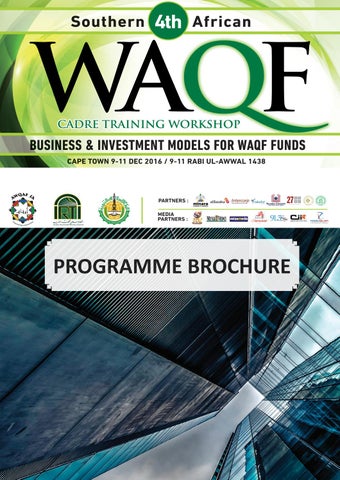
PROGRAMME BROCHURE
what is
A Waqf is a voluntary Sadaqah Jariyyah (perpetual charity) and pious endowment dedicated for the pleasure of Allah for Shari’ah compliant purposes including the sustainable funding of community development, humanitarian, and upliftment projects.
how to make a
Making a Waqf is easy. Just follow the steps below: Make a niyyah that you wish to make a Waqf. Decide whether you want the Waqf for your personal benefit or Esaale thawaab of a near and dear or deceased person. Decide on the format of the Waqf: cash, goods, property.
the benefits of
Your Waqf capital remains intact; only the returns of the investments are used for Downstream Sustainable Projects in: Social Cohesion and Community Development; Health Care & Environment; Education & Leadership Development; and Other Development Programmes to benefit humanity. The Noble Prophet (s.a.w.) said:
“When a person dies, all his/her acts come to an end, but three: sadaqah jariyyah (waqf , recurring or ongoing charity), beneficial knowledge, or a pious child (son or daughter) who prays for the deceased.”
Cape Town - 021 697 3556
Gauteng - 011 8378669
Download the Awqaf SA App!
info@awqafsa.org.za
ANDROID
APPLE
CONTENTS
Foreword
4-5
partners
6
speakers
7-11
Papers
11-13
programme
12-18
Foreword
All praise is due to Allah and blessing on our leader, Muhammad (S.A.W) and his family, progeny and noble companions. Despite the turmoil in the Muslim world, the Waqf sector as a vital pillar of the Islamic Economy is gaining ground the world over. The Waqf sector has been dormant for several centuries especially in the colonized Muslim world. The Waqf sector is said to be worth trillions of dollars in a research report produced by Ernst & Young. The report also suggests that potential for growing the Waqf sector is positive and bodes well for the future. At the international level, a new federal structure has been founded in the name of Awqaf International Organisation (AIO), whose founder members include Awqaf SA, Awqaf New Zealand, Awqaf & Minors Foundation (Dubai), and other countries. Headquartered in Dubai, this initiative is spearheaded by the Dubai government as one of its pillars of the Global Islamic Economy. Its purpose is to foster and support the growth of the Waqf sector internationally. The Malaysian based World Islamic Economic Forum (W I E F) has also highlighted the role of waqf in its annual fora and is also engaged in an initiative to establish an International Awqaf Development Council. These are indeed very postive developments and bodes well for the waqf sector. While many Muslim countries have embarked on refocusing efforts in developing their waqf sectors, much work still needs to be done in Muslim minority countries and particularly in Sub Saharan Africa. We hope that efforts such as the Waqf Cadre Training Programmes organized by Awqaf SA and its partners, will contribute towards building a network of professionals who will be able to drive the establishment, implementation and long term continuation of Waqf institutions and foundations wherever they are in their own settings. We also take this opportunity in thanking all our speakers, facilitators, partners and supporters, our beloved mutawallees, management team, and volunteers. A special thanks to the outgoing President of the Islamic Development Bank, Dr Ahmed Mohammed Ali, who was really passionate about reviving the Waqf system and contributed to its worldwide revival. Barakallufeekum. Shukran. Zeinoul Abedien Cajee CEO The National Awqaf Foundation of South Africa Cape Town - 9 December 2016
4
Foreword
All societies nowadays recognize with a great deal of appreciation the role of social finance in their inclusive economic development programs, especially the development of lagging areas in most countries. In this connection, Waqf attracted the attention of social reformists and eminent economists. Waqf and Zakaah are now the mainstream of social finance programs. Core business and deliverables of Waqf institutions contributed significantly in social development in most, if not all Muslim countries and Muslim communities in non-Muslim countries. To that end, IRTI-IDB and Awqaf South Africa jointly collaborates to organize this timely event on Waqf focusing in particular, on practical business models of Waqf now giving attention to the relevance of current business modalities of Waqf, their viability and the room for enhancement. On this occasion, IRTI-IDB on behalf of all of participants and speakers would like to appreciate the unlimited collaboration. Osman Babiker Ahmed Training Division, IRTI-IDB
Tuan Guru’s Quraan
5
partners Awqaf SA Awqaf SA is a charitable endowment (Waqf) receiving organisation. It invests endowment funds and spends only the income generated from investments to fund a variety of community development projects promoting Integrated community development and self-reliance. Awqaf SA is dedicated to the establishment of the institution of Waqf and the empowerment of communities. www.awqafsa.org.za IRTI IRTI - The Islamic Research and Training Institute is an affiliate of the Islamic Development Bank Group responsible for leading the development and sustenance of a dynamic and comprehensive Islamic Financial Services Industry that supports socio-economic development in member countries. www.irti.org
IDB The Islamic Development Bank is an international Islamic financial institution who’s primary objective is to foster the economic development and social progress of member countries and Muslim communities, individually as well as jointly in accordance with the principles of Shari’ah i.e., Islamic Law. www.isdb.org
MME BROCHURE PARTNERS : MEDIA PARTNERS :
6
Speakers Dr. Osman Babiker Ahmed Dr. Osman Babiker Ahmed obtained his Bachelor’s and Master’s degrees in Economics from the University of Khartoum, Sudan and his PhD in Economics from Durham University, UK. At IRTI, he served as an assistant researcher, a training officer and Manager of the Training Division. He has participated in a number of local, regional and international events on economic issues in general and on Islamic Banking and Finance, in particular.
Haroon Kalla Haroon Kalla serves as the chairman of the Council of Mutawallees of the National Awqaf Foundation of South Africa (Awqaf SA) and Director of the Amka Products (Pty) Ltd. Group. He is a pharmacist by profession and serves on various community organisations.
Zeinoul Cajee CA (SA) M Ed. His first encounter with Waqf knowledge was a training programme on Awqaf Administration and Management in Jeddah in 1984. He is the founding CEO of the National Awqaf Foundation of South Africa (Awqaf SA), which was pioneered as a community based charitable endowment/Waqf fund. He has extensive experience in the Waqf sector and has made significant strides in both the local and international arenas together with his dedicated team. Mickaeel Collier Mickaeel Collier holds a postgraduate degree in Political Studies, Public Administration and Economics from University of Cape Town (UCT) . In 2014 Mickaeel was appointed as the Deputy CEO of the National Awqaf foundation of South Africa, an independent community-based trust, dedicated to the establishment of the institution of Waqf (pious endowments and philanthropy) and the empowerment of communities.
7
Speakers Dr. Hisham Dafteda Dr. Hisham Dafteda is an experienced Islamic banker with more than 20 years in practice. Joined the Islamic Development Bank (IDB) in Saudi Arabia in 1989. His responsibilities included management of the Awqaf Investment Fund and the development of Awqaf commercial projects and investments. He served as a member of the Product Development Committee of the International Islamic Financial Market in Bahrain.
Mohamed Mazen DAKHLI Mohamed Mazen DAKHLI is a Business Engineer with skills in risk management and Islamic finance. He is currently involved with the project of establishment of the economic empowerment institution “Zitouna Tamkeen” on behalf of “Zitouna Bank” in Tunisia.
Shauket Fakie Shauket Fakie is the National Chairperson South African National Zakaah Fund (Sanzaf)’s who is a humanitarian with over 30 years’ experience in accounting, auditing, consulting and advisory work. He served as the Auditor General of South Africa for a period of seven years and as the Chairperson of the UN Panel of External Auditors and Secretary General for the Auditors General Association in the African Continent.
Shiraz Gany Shiraz Gany is a qualified Chartered Accountant with a Higher Diploma in International Tax Law. He currently heads up Petrocam Trading; a petroleum trading firm based in South Africa with additional offices on the Sub-Sahara African region. He spends much of his spare time on his passion to create and implement upliftment projects for emerging communities.
8
Speakers Mohsien Hassiem Mohsien is an Electronics Engineer andChartered Accountant with a Scottish Executive MBA. He is a certified IS Auditor and certified in Islamic Finance. He has been active with Awqaf SA since 2002 and has participated in numerous activities over the years as a part time business school lecturer, business professional, mentor to entrepreneurs and an Islamic finance scholar.
Husayn BenYounis Husayn BenYounis is one of the founding members and the Secretary General of Awqaf New Zealand. His focus as Secretary General is to revive and increase the effectiveness of the role of the Islamic Waqf/relief industry in providing mechanisms and institutions for developing optimum use of the resources of charities for achieving self-sufficiency in accordance with Islamic Shariah.
Moulana Taha Karaan Currently, Shaykh Taha is a member of the Ifta’ Department of the MJC, and sits as an executive member of the Muslim Personal Law Board and on the Islamic Advisory Board of ABSA, one of South Africa’s National Banks. He currently sits as the Chief Magistrate for Islamic civil matters in the Muslim Judicial Council (MJC).
Thandile Kona Thandile Kona is a community/youth activist and worker representative. He is the current president of the Muslim Youth Movement (MYM)of South Africa, Chairperson of the Kwa-Nobuhle Muslim Community (KMC) and a member of the House of Ummah, an advocacy association of Muslims.
9
Speakers Adv AbuBakr Mohamed Senior Counsel, Hafez Advocate AbuBakr Mohamed has extensive experience in Muslim community affairs. He serves on the Islamic Council of South Africa and is a founder member of several key institutions in South Africa, including the Albaraka Bank. He has a keen interest in Community Development.
Fayruz Mohamed Fayruz Mohamed currently serves as the First Deputy National Chairperson for the South African National Zakah Fund (SANZAF). She has also served as the organisations National Treasurer for six years while serving as an active regional Western Cape executive member for the past eleven years. She has spent most of her professional career at KPMG and headed up an advisory business unit in the non – profit, owner managed and medium enterprise sectors. Dr. Magda Ismail Abdul Muhsin Dr. Magda Ismail Abdul Muhsin is an Associate Professor who is currently working at INCEIF, the Global University of Islamic Finance as lecturer and researcher. She is the editor of a recent book on Waqf published by Palgrave and the author of two other books on Waqf published by Pearson.
Sheikh Ihsaan Taliep Sheikh Ihsaan Taliep is the principal of The International Peace College South Africa (IPSA) as well as the president of The United Ulama Council of South Africa (UUCSA).
10
speakers Mariam Rhemtula Mariam Rhemtula is a PHD graduate in Chemistry and serves as the second Deputy CEO of Awqaf SA.
Papers Scan in the QR Codes to view The Speaker Papers
Paper 1 Modern Trends in Awqaf Development
Speaker: Dr. Osman Babiker Ahmed
Paper 2 Shariah Aspects if Waqf
Speaker: Dr. Abdallahi Mohammed
Paper 3 Waqf & Maqasid of sharia Speaker: Sheikh Ihsaan Taliep
11
papers Paper 4 Presentation on Waqf as Community Development Strategy Speaker: Adv. AB Mohamed
Paper 5 Waqf for Development: a paradigm shift: Case Studies of Palestine and Sudan Speaker: Mazen Dakhli
Paper 6 Local Community Waqf Foundations Speaker: Zeinoul Cajee
Paper 7 Waqf & Township Revitalization Speaker: Thandile Kona
Paper 8 Waqf Country Report back Speaker: Mohsien Hassim
12
papers Paper 9 Awqaf: A transformation for Business and Investment Speaker: Dr. Magda Ismail Abdul Muhsin
Paper 10 Waqf Investments Models Speaker: Dr. Hisham Daftedar
Paper 11 Waqf & Social Impact Sukuk - New dimensions: New Zealand case study: Lessons for the Waqf sector Speaker: Husayn Ben Younis
Paper 12 Takaful Waqf Model
Speaker: Moulana Taha Karaan
13
Programme FRI 9 DEC 2016 Day 1 - Friday, 9 December 2016 Session 1 No. 1 2
Begin 08:00 08:30
End 08:30 08:35
Time 30min 5min
Item Registration Opening
3
08:35
08:45
10min
Opening Qiraa & Dua
4
08:45
08:50
5min
Welcome
5 6
08:50 09:05
09:05 09:30
15min 25min
Opening Key Note Address
7
09:30
10:10
40min
Paper 1 - Modern Trends in Awqaf Development
8 9
10:10 10:30
10:30 10:50
20min 20min
Q&A Networking Break
Speaker Master of Ceremony: Mickaeel Collier Sh. Sadullah Khan CEO Islamia College Haroon Kalla (Chair Board of Trustees Awqaf SA) Dr. Osman Babiker Ahmed (Economist IRTI)
Day 1 - Session 2 10
10:50
11:10
11 12
11:10 11:10
11:30 11:30
13 14
11:30 11:55
11:55 14:45
Session Chair 20min Paper 2 - Shariah Aspects of Waqf 20min Q&A 20min Paper 3 - Waqf & Maqasid of Shariah 25min Q&A 2hr50min Jummah & Networking Lunch
Ml. AK Allie Dr. Abdullahi Mohamed (IDB) Sh. Ihsaan Taliep (Rector of IPSA)
Day 1 - Session 3 15 16
14:45 14:55
14:55 15:35
5min 40min
Session Chair Paper 4 - Presentation on Waqf as Community Development Strategy
14
Shaheed Essop Adv. Ab Mohamed (South Africa)
Programme FRI 9 DEC 2016 Day 1 - Friday, 9 December 2016 Day 1 - Session 3 No. 16
Begin 14:55
End Time 15:35 20 min
17 18
15:35 15:55
15:55 20min 16:15 20min
19 20
16:15 16:45
16:45 30min 16:50 5min
21
16:50
17:30 0:40
Item Speaker Paper 4 - Presention on Adv Ab Mohammed Waqf as Community (South Africa) Development Strategy Q&A Paper 5 - Waqf for Mazen Dakhli Development: a para(Tunisia) digm shift : Case Studies of Palestine and Sudan Q&A Summary & Close of Day Asr Salaah/ Networking
Day 2 - Saturday, 10 December 2016 Session - 1 22
8:30
9:00
30min
9:00
9:05
5min
23
9:05
9:10
5min
24
9:10
9:30
20min
25 26
9:30 9:50
9:50 20min 10:10 20min
26
10:10
10:30 20min
Registration/ Networking/ Tea and Seating Inspiration for the Day Opening & Introduction to Next Theme - Chair Paper 6 - Local Community Waqf Foundations Q&A Paper 7 - Waqf & Township Revitalization Q&A
27
10:30
10:45 15min
Networking Break/ Tea
15
Dr. Salie Abrahams Zeinoul Cajee (CEO Awqaf SA South Africa) Thandile Kona
Programme SAT 10 DEC 2016 Day 2 - Saturday, 10 December 2016 Session 2 No. 28
Begin 10:45
End Time 11:25 40min
29
11:25
11:55 30min
30 31
11:55 12:20
12:20 25min 12:25 5min
32
12:25
13:05 40min
33 34
13:05 13:25
13:25 20min 14:20 55min
Item Speaker Waqf Country Report Mohsien Hassim back Paper 8 - Awqaf - a Dr Magda Ismail Abdul Muhsin transformation for (Malaysia) business and investment Q&A Introduction to Next Raaghieb Najjaar Theme Chair Paper 9 - Waqf Dr. Hisham Daftedar Investment Models (Bahrain) Q&A Thur Salaah and Lunch
Day 2 - Session 3 35
14:00
14:20 30min
36
14:20
14:45 25min
37
14:45
15:15 30min
38
15:15
15:40 25min
Session Chair Paper 10 - Waqf & Social Impact Sukuk – New dimensions: New Zealand case study: Lessons for the Waqf sector Q&A Session Chair Paper 11 - Takaful Waqf Model Q&A Session Chair
16
Farouk Limalia Husayn Ben Younis (New Zealand)
Sedick Isaacs Ml. Taha Karaan (South Africa) Fayruz Mohammed
Programme SAT 10 DEC 2016 Day 2 - Saturday, 10 December 2016 Session 3 No. 39
Begin 15:40
End Time 16:00 20min
40 41
16:00 16:25
16:25 25min 17:05 40min
Item Speaker Paper 12 - Models of Shiraz Gany (South Africa) Fund raising: Peer to Peer P2P Waqf Fundraising / Project Based / Property / Business Q&A Closing & Evaluation Zeinoul Cajee
PIC: SHAFIQ MORTON
17
Programme Day 3 / Sunday / 11 December 2016 Day 3 - Sunday, 11 December 2016 Parallel Session - 1: Master Class 42
08:30
09:00 30min
43
09:00
09:05 5min
44
09:05
09:25 20min
45
09:25
09:50 25min
46 47 48 49
09:50 10:15 10:40 11:40
10:15 10:40 11:40 12:40
25min 25min 1hr 1hr
Registration/ Networking/ Tea and Seating Opening & Introduction to Next Theme Introduction to Waqf Development Corporate Governance Awqaf SA Model Waqf Accounting Conclusion Lunch / Networking & Thur
Workshop Facilitator IRTI Fayruz Mohamed / Shauket Fakie (SANZAF) Awqaf SA - Zeinul Cajee Mohsien Hassiem
Parallel Session - 2: Woman & Waqf Development No. Begin 50 8:30 51
9:00
52
10:00
53
10:30
End 9:00
Time Item 30min Registration/ Networking/ Tea and Seating 10:00 1hr Woman & Waqf Development, Past, Present & Future Perspectives 10:30 30min Awqaf SA model Donor Relations Management / Downstream Projects 11:00 30min Conclusion
18
Speaker
Dr Magda Ismail Abdul Muhsin (Malaysia) Mariam Rhemtula (Awqaf SA)
CONNECT /awqafsouthafrica
@awqafsa
/awqafsa
/awqafsa
@awqafsa
INTRODUCING THE AWQAF SA APP!
The Awqaf SA Team Zeinoul Cajee Mickaeel Collier Najmun Fredericks Nathmie Fredericks Shaheed Essop Sedick Isaacs Hasanain Abdullah Soraya Williams Daleel Hendricks & Team Uzayr Shira Mishal Shira
PIC: SHAFIQ MORTON
19
The first waqf established in South africa and endowed by a muslim lady sarah van den kaap