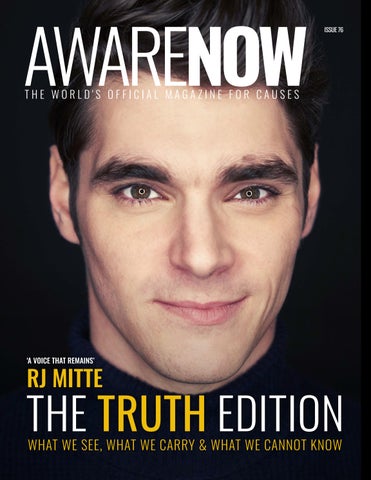
AWARENOW
ISSUE 76
THE WORLD'S OFFICIAL MAGAZINE FOR CAUSES
‘A VOICE THAT REMAINS’
RJ MITTE
THE TRUTH EDITION WHAT WE SEE, WHAT WE CARRY & WHAT WE CANNOT KNOW
THE TRUTH EDITION
ON THE COVER:
RJ MITTE
AwareNow Magazine is a monthly publication produced by AwareNow Media™, a storytelling platform dedicated to creating and sustaining positive social change with content that inspires and informs, while raising awareness for causes one story at a time.
006 TRUTH JACK MCGUIRE
008 THE WORK OF BELIEVING JANEY HUEY
014 A VOICE THAT REMAINS RJ MITTE
022 THE OTHER SIDE OF THE SCAN DR. DANIEL MATTERSON
044 BEYOND WHAT YOU SEE MIKE COFFEY
090 THE LIFE I COULDN’T SEE JACK MCGUIRE
050 DESIGNED TO BELONG NANCY VOLPE BERINGER
062 THE MAN FROM CONGO
096 THE CHILD BEHIND THE DATA SONJA MONTIEL
100 NAVIGATING LIFE AFTER GRIEF
ALEX SEARLE
ELIZABETH BLAKE-THOMAS
066 THE SACRED WORK
106 WHEN CHOICE DISAPPEARS
GIO ISRAEL
PAUL S. ROGERS
036 THE SHAPE OF GRIEF
082 AFTER THE BEFORE
JFO & JC WILDE
CHRISTINA OLSON
110 IN THEIR HANDS CÉD HOPKINS, LUIS RAMIREZ
SUBSCRIBE FOR FREE: AWARENOWMEDIA.COM/SUBSCRIBE www.IamAwareNow.com
Having a disability does not make you a liability. RJ Mitte 1992 - 2026
truth: (n.) what remains when assumptions fall away Truth asks us to look beyond what appears to be and consider the realities we may never fully see. Behind every public story is a private experience shaped by challenges, choices, hopes and struggles that cannot always be measured or understood from the outside. This edition creates space for honest conversations about disability, mental health, adversity and the courage it takes to speak openly about difficult truths. On our cover, we honor the life and legacy of RJ Mitte, an actor and advocate whose voice helped challenge perceptions of disability and redefine what it means to be seen. In revisiting our conversation with him following his heartbreaking passing, we are reminded that even those who inspire us with their strength carry stories we may never fully know. His words remain, his impact endures and his life reminds us why we must continue to listen, to care and to make space for the truths that matter.
ALLIÉ McGUIRE CEO & Co-Founder of AwareNow Media Allié McGuire began her career as a performance poet, transitioned into digital storytelling as a wine personality, and later produced the Hollywood Film Festival. Now, as co-founder of AwareNow Media, she uses her platform to elevate voices and champion causes, connecting audiences to stories that inspire change.
JACK McGUIRE President & Co-Founder of AwareNow Media Jack McGuire’s career spans the Navy, hospitality, and producing the Hollywood Film Festival. Now, he co-leads AwareNow Media with Allié, focusing on powerful storytelling for worthy causes. His commitment to service fuels AwareNow’s mission to connect and inspire audiences.
WAIVER/DISCLAIMER
The views and opinions expressed in AwareNow are those of the authors and do not necessarily reflect the official policy or position of AwareNow Media. Any content provided by our columnists or interviewees is of their opinion and not intended to malign any religion, ethnic group, political group, organization, company, or individual. Stories shared are not intended to vilify anyone or anything. Their intent is to make you think. * Please note that you may find a spelling or punctuation error here or there, as our Editor-In-Chief has MS and lost vision in her right eye. That said, she still has perfect vision in her left and rocks it as best as she can. www.IamAwareNow.com
Sometimes the greatest struggles are the ones we never see. JACK MCGUIRE
CO-FOUNDER OF AWARENOW MEDIA 6
www.IamAwareNow.com
‘REFINED & DEFINED’ EXCLUSIVE COLUMN BY JACK MCGUIRE
TRUTH
WHAT WE CARRY IN SILENCE
truth (n.) the unseen reality behind what we see, the silent struggles behind a smile, the stories we carry but do not always share, a reminder that what we know of someone is rarely all there is to know We live in a world where we see so much of one another, yet know so little. We see the smiles, the accomplishments and the moments people choose to share. We celebrate their strength, admire their courage and assume we understand their stories. But behind every face is a life we cannot fully see. Every person carries a truth that goes beyond appearances, and sometimes the greatest struggles are the ones we never see. There was a time in my life, as a teenager, when I could not imagine the life I have today. A time when the weight of what I carried felt impossible to bear and tomorrow was something I struggled to see. Very few people knew the truth of what I was experiencing. Looking back, I realize how much of life exists beyond the moments we believe define us, and how important it is to make space for one another when we cannot see the pain someone carries. For the first time, I share my personal story in this month’s edition, The Life I Couldn’t See, and the deeper meaning behind why we created AwareNow. In The Truth Edition, we honor the life and legacy of RJ Mitte, whose voice and advocacy helped others feel seen. His passing reminds us that even those who inspire the world may carry struggles we cannot understand. As we revisit his words, we are reminded that strength is not the absence of suffering, and being seen is not always the same as being known. May this edition inspire us to listen without judgment, reach out with compassion and recognize that every life holds a truth worth hearing. Because sometimes the most important thing we can offer another person is the simple reminder that they are not alone. ∎
7
www.IamAwareNow.com
Domestic violence is usually behind closed doors, and we don’t know it exists. JANET HUEY
FILMMAKER, ACTRESS & CREATIVE SOLUTIONIST Photo Credit: Jess Osber 8
www.IamAwareNow.com
EXCLUSIVE INTERVIEW WITH JANET HUEY
THE WORK OF BELIEVING STORIES THAT REFUSE SILENCE
Janet Huey believes film can do more than hold our attention. It can create space for conversations we have been taught to avoid. As an impact filmmaker whose work explores mental health, domestic violence, generational trauma, addiction, and survivor advocacy, Janet is interested not only in the stories we tell, but in what those stories can change once they are told. ALLIÉ: Before we start talking about filmmaking, I want to start with you. What happened, Janet, in your own life that made mental health advocacy feel personal to you rather than simply something you cared about? JANET: Great question. I think it’s lifelong. There are a lot of people directly or indirectly around me who I’ve seen go through experiences or who have shared their stories with me. I think I’ve always been someone people easily open up to, and that’s a gift and an honor, to have space where people can come to me with stories they want to share. The more time went on, the more I learned that these stories are so important. Important to be told, important to be shared, important to hold space for. I think that’s what has made me such an advocate for these kinds of stories in my creative life and in my personal life, too.
THE WORK OF BELIEVING EXCLUSIVE INTERVIEW WITH JANET HUEY BY ALLIÉ MCGUIRE
CLICK, TAP OR SCAN
TO WATCH NOW
9
www.IamAwareNow.com
Lead with kindness because you don’t know what someone else is going through. JANET HUEY
FILMMAKER, ACTRESS & CREATIVE SOLUTIONIST Photo Credit: Dustin McWethy 10
www.IamAwareNow.com
CLICK, TAP OR SCAN
TO WATCH NOW
NOT HIM OFFICIAL TRAILER
ALLIÉ: When I look across the projects you’re developing, there are many. You keep returning to subjects like mental health, domestic violence, addiction, suicide, generational trauma, adoption. What do you think you’re ultimately trying to understand about people, pain, and healing through the stories you choose to tell? JANET: I think humans are complex. There are a lot of layers, and something I try to keep in mind daily, as best I can, is to really lead with kindness because you don’t know what someone else is going through. You don’t know what happened that day. You don’t know what happened right before, or last night. Did they sleep? What’s going on? I think awareness around mental health and health has grown more and more over the last decade, for sure, even in the last year and the last six months. But mental health still gets suppressed, and I think a lot of people have a hard time opening up and talking about it. It’s very private for them. Everyone tells their story when they want to, if they want to, right? For me, it’s really about understanding that there’s a uniqueness to everyone’s story, of course, but there’s also a shared community where you can be seen and that you can build within. I think that’s a really beautiful space that I’m learning more and more about. The more I talk about these projects, the more people resonate with them, and that is a really beautiful place to be. ALLIÉ: It’s wild, right? Because even with something that’s really hard to deal with, there’s comfort that comes with community. So let’s talk specifics. Not Him enters the subject of domestic violence through the language of a psychological thriller and horror. There’s something powerful, but also incredibly delicate, about using genre to explore a reality people actually live. How do you navigate that responsibility so the story can be compelling without ever losing sight of the human beings whose experiences it represents? JANET: I think that’s a great question. We’re constantly grappling with it as we move into pre-production because it’s a very sensitive topic, and we want to be very clear about that. We also want to hold space for that on set while we’re moving through the character development and while we have crew members who may be impacted by the story that’s going to take place in front of them. I think it’s a lot of communication. It’s setting up systems and channels so that if people want to talk to a mental health professional, that’s available. If they want to talk to me, that’s available. Whatever we need to do to create a safe space where people feel comfortable talking and communicating about what they need around what’s going on, I think that’s really important. ALLIÉ: Yeah, and I love that you talk about the people who are on set, the people who are helping bring the story to life and are so close to it. It’s so important to create that space on all levels. You’ve talked about Not Him as more than a film, with an impact campaign and relationships with domestic violence organizations envisioned as part of the work. When you think about impact filmmaking, what do you want to happen after the credits roll that makes you feel the story has actually done what you intended it to do? 11
www.IamAwareNow.com
When her husband turns strange and violent, a wife becomes convinced he is possessed. But will anyone believe her? With electric performances from Tori Ernst (Counting, Consider the Lilies) and Charlie McElveen (JJ Redick in FX's upcoming limited series The Sterling Affairs, HBO's The Deuce, HBO Max Pretty Little Liars) and a nail biting script by director & writer Sarah Young, this phycological thriller is heart pounding suspense in the vein of Gaslight meets The Shining. 12
www.IamAwareNow.com
AwareNow Podcast
THE WORK OF BELIEVING Exclusive Interview with Janet Huey https://go.awarenowmedia.com/podcast/the-work-of-believing
TAP/SCAN TO LISTEN
JANET: With impact campaigns, I really want there to be resources available to people who want them, need them, didn’t know they could have them, or didn’t know where to look for them. Whether it’s going into schools, creating private screenings, or finding different demographics that really speak to this story, I want to bring them the information and the resources. And hopefully, we can partner with some really wonderful companies that can bring their expertise and champion that work with us. ALLIÉ: I love that because we don’t have to work in these silos. We can step out and come together to do something much bigger when we have that support. One more question I have for you today, Janet. We’re having this conversation in connection with Domestic Violence Awareness Month. When we ask survivors to share, communities to listen, and all of us to pay closer attention, for someone who may recognize pieces of their own life in this conversation, what do you hope they hear and feel? JANET: I hope they feel seen. I hope they feel seen. If it touches one person, I did my job. I’ve already given the script to so many people, and I know it resonates with them. I know that is enough to continue championing this, knowing that this needs to exist in the world so people can feel seen. I think a lot of people don’t feel seen in it, and that’s really hard. Domestic violence is usually behind closed doors, and we don’t know it exists. I think what this film, these projects, and this impact campaign can do is open up space for people to be seen and acknowledged. And then, what do they want to do with it? Do they want resources? Do they want help? Do they want support? Or do they just want to feel like they were seen, and that was enough for them to realize they’re not alone? And then we can build from there. ∎ IF YOU NEED HELP If you or someone you know is experiencing domestic violence, please know that you are not alone. You deserve to feel safe, to be heard, and to be supported. Confidential help is available through the National Domestic Violence Hotline. Call 1-800-799-SAFE (7233), text START to 88788, or visit thehotline.org .
Find & follow Janet on Instagram: @_janethuey_ Watch the full short film Not Him here: https://go.awarenowmedia.com/short-film/not-him
13
www.IamAwareNow.com
Having a disability does not make you a liability. RJ MITTE
ACTOR & ADVOCATE FOR DISABILITY COMMUNITY 14
www.IamAwareNow.com
EXCLUSIVE INTERVIEW WITH RJ MITTE CONDUCTED BY MATTHEW WALZER & ALLIÉ MCGUIRE
A VOICE THAT REMAINS
REMEMBERING RJ MITTE AND THE CHANGE HE INSPIRED Some people change the world by the roles they play. Others change it by refusing to play the roles the world has assigned them. RJ Mitte did both. Best known for his groundbreaking portrayal of Walter White Jr. in Breaking Bad, RJ was far more than an actor. Living with cerebral palsy, he became a powerful voice for disability representation, using his platform to challenge stereotypes, confront discrimination and advocate for a world where people are recognized for their abilities rather than defined by their disabilities. Through his work in film, television and advocacy, he helped open doors, shift perceptions and remind an industry, and a society, that inclusion is not an accommodation. It is an opportunity. When AwareNow first interviewed RJ following his work on Triumph, a film in which he starred and served as executive producer, we spoke about representation, bullying, resilience and the importance of standing up for yourself and others. He spoke candidly about his own experiences, the changes he hoped to see and the responsibility we all share in creating a more inclusive world. One of his most powerful messages was also one of his simplest: “Disability is an asset.” On October 12, 2026, RJ died by suicide at the age of 34. His passing is a heartbreaking loss for his family, friends, colleagues and the disability community he worked so passionately to represent. It is also a painful reminder that we can never fully know the struggles another person may be carrying, even someone whose strength and optimism have inspired so many. In honor of RJ's life and legacy, we are republishing our original interview in its original context, allowing his words to speak for themselves. What follows is more than a conversation from years ago. It is a reflection of what he believed, what he fought for and what he hoped the world might become. RJ believed that disability should never be mistaken for inability. He believed in the power of representation, the importance of opportunity and the dignity of being seen for who you truly are. Today, we remember him not for the way his life ended, but for the difference he made while he was here. His voice mattered. His work mattered. His life mattered. And his message lives on. 15
www.IamAwareNow.com
I’ve seen a lot of change when it comes to more inclusion, more accessibility and opportunities for people. RJ MITTE
ACTOR & ADVOCATE FOR DISABILITY COMMUNITY 16
www.IamAwareNow.com
MATTHEW: What are your thoughts on the representation of talent with disabilities in the acting, entertainment and modeling industries? What would you like the industry to know about what talent with disabilities can bring to a role or project? RJ: One of the hats I wear is working toward more inclusivity and representation for different groups, not just disability, but all groups. Disability being my group, I'm very focused on that. I've been working in the industry for almost 20 years. I started Breaking Bad when I was 13 years old. I didn't really see a lot of representation of people like me. I think the closest I had was Forrest Gump, and that was played by an able-bodied person, which I didn't understand. I grew up in a weird way, where everyone in my life had some disability or another. So, really, I viewed everyone as having something. I think everyone is disabled, whether they want to believe it or not, in one way or another. It can be physical. It can be emotional. It can be family or friends. It can be situational. But I think representation has grown significantly in the last five years through social media, just because we have a voice. People can go out and say, "This is what I want to see. You're not representing me.” We didn't used to have access to that. We had blogs and stuff, but nobody really saw them. I've seen positive change in these industries because it's inevitable. There is an estimated 15% of the world's population that has a disability, an actual categorized, diagnosed disability. Fifteen percent of the world's population. And if you think about it, there's more than that. If you talk about everyone who's not diagnosed, everyone who's not being treated or doesn't even know they have something, a lot of people go through life not knowing. Then one day, they find out why they can't do something or why they're not sleeping, and they're told, "You have X. Here you go. Welcome to the community.”
A VOICE THAT REMAINS EXCLUSIVE INTERVIEW W/RJ MITTE CONDUCTED BY MATTHEW WALZER & ALLIÉ MCGUIRE
CLICK, TAP OR SCAN
TO WATCH NOW
17
www.IamAwareNow.com
Disability is an asset. RJ MITTE
ACTOR & DISABILITY RIGHTS AVAILABLE 18
www.IamAwareNow.com
“I look at bullying as a cry for help.” RJ: (continued) I've seen a lot of growth. It's hard because this industry is not an easy industry. People see it on Twitter and Instagram. They see television and movies, and they go, "Oh, I want to do that.” They don't realize that Triumph has been in the works for over five years. Hundreds of thousands of dollars, countless hours of time and dedication go into these projects. But people just want instant gratification. Over the last decade, I've seen a lot of change when it comes to more inclusion, more accessibility and more opportunities for people. Yes, you still get a lot of able-bodied people playing characters with disabilities, but I think it's a double-edged sword. We need more people with notoriety portraying these roles to get mass media interested and get communities engaged in talking about what we want to see and what we don't want to see. Now we have a platform for that. We have the ability to say, "I want to see this type of film," or "I don't want to see this type of content." MATTHEW: What would you like the industry to understand about what actors with disabilities bring to a role? RJ: I think the biggest thing is that having a disability does not make you a liability. There's been a big issue, not just in the entertainment industry, but in industry as a whole. Manufacturing, producing, packaging and business in general. There's this misconception that disability equals liability. It's subconscious, but really, it's the opposite. Disability is an asset. It's knowledge. It's power. It's empowerment. Case studies have shown that when businesses hire individuals with disabilities, it raises morale for workers and increases productivity. ALLIÉ: In your film, Triumph, you play the role of Mike, a teenager with cerebral palsy who pushes himself to join the high school wrestling team. Mike experiences bullying. Is that something you can personally relate to from your childhood growing up with CP? RJ: I personally think everyone can relate to bullying, whether they want to believe it or not. I think everyone, in one way or another, has been bullied or is being bullied. You don't have to be a kid to be bullied. There are adults being pushed around right now at jobs they hate by people on power trips who have the ability to exercise authority. And, you know, I did get bullied growing up as a kid. It wasn't so much name-calling or anything like that. I had some physical stuff. I was running in gym class, and someone grabbed my hoodie and pulled me down to the ground. They were like, "Oh, get up quick!" And I had my hand broken and stuff like that. It wasn't so much mean as it was aggressive. But I think the bigger thing, when you have a bully, is recognizing that bullying is a cry for help. Bullying is someone being put in a position where they need to feel powerful. Whatever is happening at home or in their life outside of that situation is making them feel weak and helpless. That trains them to place their authority over you. "I am now powerful.” That is the bully mentality. It's something we have to look at on a psychological level because there's an aspect of it where that person needs help in their own right. That person is being bullied or learning this behavior from a poor living situation, a poor environment or whatever it may be. I look at bullying as a cry for help. 19
www.IamAwareNow.com
“You stand up for what you believe in and stand up for yourself, how far that will get you.” RJ: (continued) Probably, that pushing they're doing to you is more interaction than they're ever getting at home. We have to look at bullying in a way where we ask ourselves how we can defuse the situation. If you're being bullied, intimidated or manipulated, whatever the case may be, how can you recognize the situation, defuse it and ask, "Why are you doing this to me?” You'll get BS answers because you seem weak or slow. You may seem both of those things, right? But there's a bigger factor in that. That's a perception. That's not the reality. And that's something I think is very hard for a lot of people to understand. You see and hear a lot about bullying. "Stop bullying." You can't. If you could do that, we would have world peace. That's just a fact. "That's not your toy. That's my toy. That's not your oil. That's my oil. That's not your country. It's my country." That's essentially all bullying. It's all about being in a place of power. I think it's so important to have representation. What I really like about Triumph is that we show bullying, and then we show the defusing of the situation. We show the individual being bullied, and we show the bully becoming his friend, someone he respects. In my case, that's what happened with my bullies. I stood up for myself. I said, "What, do you want a piece? Come at me. You're not going to get me from behind anymore. You're not going to get me from the side. I'm here. I'm facing you.” And you know what was wild? In that one instance, we became friends. It was like they said to themselves, "Oh, I can't just push you around.” I stood my ground. And you would be surprised, if you stand up for what you believe in and stand up for yourself, how far that will get you. People just don't do it. People are always afraid. When you're at home, you're afraid. When you go to work, you're afraid. You're just like, "I'm just trying to get through the day.” No. Don't just try to get through the day. Own your day. Own your life. It's your day. It's not their day. People can ruin your day and take your day from you. Yes. But the good news is, there's a new one tomorrow. You can claim that day. ALLIÉ: There are so many insights to be gained through the relationships Mike has with the kids at school, his coach and his father. While there's so much to learn from Triumph through different lenses, if there were just one thing you wanted people to take away from the film and carry with them, what would it be? 20
www.IamAwareNow.com
AwareNow Podcast
A VOICE THAT REMAINS Exclusive Interview with RJ Mitte https://go.awarenowmedia.com/podcast/a-voice-that-remains
TAP/SCAN TO LISTEN
RJ: There are a lot of things. I think the biggest thing is, it doesn't matter if you win or lose. Just don't give up. You know, I fail all the time. I've had decades of setbacks. Sometimes I've paid for them with time, money and resources that I'll never get back. But I could either continue to dwell and wallow in my failure, or I could learn from my failure and grow from it, and utilize it for the next project, the next job and the next goals. The thing is, winning doesn't always look like winning when you're in it. That's the big thing. You could be winning, but when you're in it, it doesn't always feel like winning. You've just got to enjoy it. Keep the grind. ∎
YOU ARE NOT ALONE. If you or someone you love is struggling, please know that help is available, and you do not have to face what you're carrying alone. You deserve to be heard, understood and supported. In the United States, call or text 988 to reach the Suicide & Crisis Lifeline for free, confidential support, 24 hours a day, 7 days a week. You do not have to be experiencing suicidal thoughts to reach out. For support outside the United States, visit findahelpline.com to find resources in your country. Your story matters. Your life matters. You matter.
21
www.IamAwareNow.com
Empathy is something that comes a lot more naturally to me now than it probably otherwise would have. DR. DANIEL MATTERSON MBBS MSC BSC (HONS) DOCTOR AND MS WARRIOR 22
www.IamAwareNow.com
EXCLUSIVE INTERVIEW WITH DR. DANIEL MATTERSON
THE OTHER SIDE OF THE SCAN ONE DOCTOR'S JOURNEY FROM DIAGNOSIS TO DISCOVERY
Twelve years ago, Daniel Matterson walked into a clinic as a young radiographer and walked out with a diagnosis that would change his life: multiple sclerosis. Rather than allowing that diagnosis to determine his future, he pursued a dream of becoming a doctor, turning his personal experience with MS into a professional purpose. Now, with a scholarship secured and a PhD beginning in September 2027, Dr. Matterson is preparing to study the very disease that changed his life, hoping to change what living with it looks like for others. ALLIÉ: Let's go back in time. Twelve years ago, Daniel, you were a young radiographer when you received your MS diagnosis in the very clinic where you worked. Can you take us back to that day, to the moment your world changed? DANIEL: Yeah, so what happened was, I was a radiographer, as you said, and I was taking part in research. My job was essentially scanning people's brains for research projects. I can recall we were starting a new study, and we needed somebody as a guinea pig to do a pilot scan. So I was asked, "Will you hop on the scanner as a healthy volunteer?" At this point, I'm completely asymptomatic.
THE OTHER SIDE OF THE SCAN EXCLUSIVE INTERVIEW WITH DR. DAVID MATTERSON BY ALLIÉ MCGUIRE
CLICK, TAP OR SCAN
TO WATCH NOW
23
www.IamAwareNow.com
Just embrace it. DR. DANIEL MATTERSON MBBS MSC BSC (HONS) DOCTOR AND MS WARRIOR 24
www.IamAwareNow.com
DANIEL: (continued) I think I probably had a few little niggles in the background that I'd put down to anything, perhaps a trapped nerve or not getting enough sleep. Just little things like that. So I jumped on this scanner, and we found quite a big lesion on my brain, completely by chance. And that led to a sequence of events that resulted in my diagnosis of multiple sclerosis. ALLIÉ: That's just wild. I mean, what are the chances? Of all the people, it was, "How about you, Daniel? How about you step in there?" But what if you hadn’t? DANIEL: Yeah, well, I've had this discussion with my friends and family because what actually happened next, after my diagnosis, was that I left my job. And I'm going to make this sound really easy, and it wasn't, but I applied to medical school because of my diagnosis. So I trained as a doctor, and I wanted to get involved in multiple sclerosis. That purely came on the back of my personal experience of being diagnosed with the disease. So yeah, you're right. If I hadn't gotten on that scanner that day, where would my life have taken me? My career wouldn't have gone in this direction. I wouldn't be where I am now. The people I've met along that journey, I would never have met. How far does it go? ALLIÉ: Yeah, it's wild. We probably wouldn't even be talking today. It's funny how a diagnosis has a tendency to redirect the course of our lives. Somewhere between being told you had MS and deciding to become a doctor, something shifted. What was the moment you realized your diagnosis wasn't going to be the end of your story? DANIEL: Yeah, so it was probably about a year. And again, it wasn't a linear path. I went through the uncertainty of, "What happens now?" I ended up with depression. I got that treated medically. There were a lot of things that happened in the interim. And I think one day, and it's really hard to explain what happened here, especially because it was 12 years ago, so forgive me if it's not as clear, but I just woke up one day and thought, "You know what? You've got this. You can't do anything about it.” It was one of those sink-or-swim moments. I don't know what it was, but I remember thinking something like, "How cool would it be to one day treat people with the condition you've just been diagnosed with?” You're the patient and the doctor. I thought there was something quite cool about that. Now, as I'm thinking this, I never thought it would actually happen. I'll be honest. It was one of those things I never thought would happen. So I applied to medical school, somehow got an interview, and everything just kind of unfolded. And to make a long story short, I'm now a radiology trainee, and in about a year's time, I'll be starting a PhD in MS neuroimaging. So that's kind of where I'm going now. And again, without the diagnosis, none of this would have happened. So yeah, it's bizarre. 25
www.IamAwareNow.com
It is not a linear thing. It’s happening in real time, and I’m just living it. DR. DANIEL MATTERSON MBBS MSC BSC (HONS) DOCTOR AND MS WARRIOR 26
www.IamAwareNow.com
ALLIÉ: I want to go back to something you just mentioned, the fact that you've now experienced healthcare from both sides, as a patient living with MS and as a physician. How has that changed the way you care for others? DANIEL: Yeah, it's a very good question. Empathy is something that comes a lot more naturally to me now than it probably otherwise would have. I see patients who are going through tests, who are apprehensive about starting medications and things like that. And I've been there. It's something I can personally relate to. I've had more scans than I can count. I've started many drugs. I recently had a stem cell transplant in London for my MS, which required about a 30-day hospital stay, isolation, chemotherapy. Yeah, it was a wild time. But again, that was something I was obviously very apprehensive about going through. So I can completely relate to patients in a way that otherwise I probably wouldn't be able to, and probably in a way that many doctors who haven't been through these things themselves can’t. Whether that makes me a better doctor, obviously I'd leave that to everybody else's interpretation. To me, I believe that it probably does. I've just got a bit more of an appreciation for what they're going through. It does have its negatives, though. When I was going through my treatment, my stem cell transplant, I probably knew a little bit too much. The risks and what could go wrong. And if I thought anything was a bit off, that wasn't a good place to be in my head. You just have to trust the team and what they're doing. At that point, I was a patient, not a doctor, so I just let them do their job. ALLIÉ: Yeah. It must be hard to take off the doctor hat and put on the patient hat, to just be able to stay in that space. I imagine that's difficult. DANIEL: That was difficult, you know. Very much. And it's hard to go back, too. I think I had about six months off work while my immune system recovered. When you're so used to being a patient, and then you go back to being a doctor after being off sick for so long, it's quite hard to make that transition. Does that make sense? ALLIÉ: Yeah, no, it makes complete sense. DANIEL: So again, it's very, very strange. It's not a linear thing. It's happening in real time, and I'm just living it. ALLIÉ: You're living it, and you're doing amazing things. Let's look ahead to September 2027, when you'll be studying the very disease that changed the course of your life. What questions are you most determined to find answers to?
27
www.IamAwareNow.com
I appreciate the small things now… DR. DANIEL MATTERSON MBBS MSC BSC (HONS) DOCTOR AND MS WARRIOR 28
www.IamAwareNow.com
DANIEL: Yes. So, with my PhD, I'll be studying something called ultra-low-field MRI. When we scan people with MS, we give them an MRI scan. That's how we visualize what's going on inside. We're looking at the damage that MS is doing and things like that. What my PhD will be looking at is ultra-low-field MRI. It's essentially a portable scanner, something you can plug into a wall. And this would be good for places where MRI scanners are very difficult to access. There are places in the world where people have MS and don't have access to scanners, whether that's for diagnosis or for monitoring their disease. This is obviously a big issue. I'll be doing my PhD in Edinburgh, Scotland, and there are places in Scotland where getting an MRI scan isn't easy. So if my research shows that these scanners provide enough detail that we can accurately use them for diagnosis and monitoring, it would open up a whole new world of how we can tackle these issues. We could potentially roll these scanners out worldwide, which would give people much greater access to them. That's the basis of what we'll be doing. ALLIÉ: That's amazing. And to that point, it's all about access, right? You can have the most amazing technology in the world, but if you can't access it, what good does it do? It sounds like the research you're going to be doing could help remove that barrier. That's one problem we could potentially check off the list and say, "Nope, now there's a way. Now you can have access.” DANIEL: Absolutely. That's it. Worldwide, access is a big problem, particularly in poorer countries and remote areas. Again, going back to Scotland, in remote areas of Scotland, you've got to travel hours for a scan. Now, if we could basically put a scanner at a local center in these places where MS is more prevalent, it would make access a lot easier for these patients and improve their care. Obviously, with MS being a disabling disease, if you're going to tell someone who struggles to get around that they need to travel four hours to have a scan, that's a lot to ask. But if you could then say, "Actually, we can put a scanner 20 minutes away," ideally, that would be perfect. And if you could do that globally, in countries that simply don't have the technology readily available, we could make a massive impact. ALLIÉ: Yeah, absolutely. A complete game changer. Okay, so one more question I have for you today, Daniel. Twelve years after your diagnosis, you've returned to the same clinic with an entirely different story to tell. I mean, how many different chapters have there been since that diagnosis? If you could sit beside the young Daniel who had just learned he had MS, what would you whisper in his ear? What would you tell him today? DANIEL: I think, and it's a cliché, but it's going to be okay. And what I mean by that is, it's not the end of the world. Because when I was diagnosed, I thought that was it. I thought it meant definite disability. It was going to get worse. I was going to end up in a wheelchair in the near future. Everything was just going to spiral. 29
www.IamAwareNow.com
AwareNow Podcast
THE OTHER SIDE OF THE SCAN Exclusive interview with Dr. Daniel Matterson https://go.awarenowmedia.com/podcast/the-other-side-of-the-scan
TAP/SCAN TO LISTEN
DANIEL: (continued) But it actually gave me the motivation to change my career. I made a lot of new friends. It moved my career in a direction I never, ever thought it would go. It's made me do things I wouldn't have done otherwise. I ran a half marathon in the north of England, quite a famous event in the UK called the Great North Run. And I did that for the MS Society. Even things like that, I would never have done if I hadn't been diagnosed. There are so many things, however insignificant they may seem, that I've done because of this diagnosis. It's completely changed the trajectory of my life. And I don't think it's been for the worse. This is a very weird thing I'm going to say here. I don't want to say that I'm grateful I have MS, because I would never say that. That would be a silly thing to say. But it has given me a lot of things to be proud of and positive about, you know? And it's changed my outlook on life. I appreciate the small things now, where before I probably didn't as much. Things that people take for granted, like going for a run. I can't really do that at all anymore because my balance isn't that good. Those little things that people take for granted, just going outside, going for a run, things like that, I don't take them for granted anymore. I'm very grateful for those things. So, I think if I was going to say anything to that younger version of myself, it would be, "Just embrace it. It's not the easiest journey, but you can make something really good of it.” ∎
Find & follow Daniel on Instagram: @drdanielmatterson
30
www.IamAwareNow.com
Miles to go before we sleep…
Every one is a part of everyone.
FIND STORIES, STATS & SUPPORT
FOR THE CAUSES THAT TIE US ALL TOGETHER WWW.TABLEOFCAUSES.COM
I started sketching and the monster came out. JFO
AUTHOR & ILLUSTRATOR OF GRIEF MONSTER, CO-FOUNDER OF J&J PUBLISHING HOUSE Photo Credit: Josiah Lewis 36
www.IamAwareNow.com
EXCLUSIVE INTERVIEW WITH JFO & JC WILDE
THE SHAPE OF GRIEF
HOW LOSS BECAME ART, UNDERSTANDING & AN UNEXPECTED COMPANION When JFo’s mother died, grief arrived as something enormous, unfamiliar and impossible to neatly explain. So JFo did what came most naturally: she began to draw it, eventually giving the thing she was feeling a face, a personality and a name, while her wife, JC Wilde, stood beside her as both witness and creative partner. What began in loss became Grief Monster, an illustrated exploration of what can happen when we stop trying to make grief disappear and instead make room for it to sit with us. ALLIÉ: J-Fo, before there was Grief Monster, there was your mom, Theresa. When she died, you've said you didn't know where to turn, and you began illustrating almost instinctively. So, to start, can you take me back to the earliest moment when grief first found its way onto the page? What was that like? JFO: Yeah. I think first it was actually lodged in my body. I had a lot of pain, a lot of physical pain. It was sciatic pain, which I'd never had before. I'm used to chronic pain, but this was different. It felt like it was taking over, to the point where my grief even took a backseat.
THE SHAPE OF GRIEF EXCLUSIVE INTERVIEW WITH JFO & JC WILDE BY ALLIÉ MCGUIRE
CLICK, TAP OR SCAN
TO WATCH NOW
37
www.IamAwareNow.com
Some of the most beautiful moments in life are silent. JC WILDE
CO-FOUNDERS OF J&J PUBLISHING HOUSE Photo Credit: Josiah Lewis 38
www.IamAwareNow.com
“I thought it would kill me, but I knew I couldn’t ignore it.” JFo: (continued) And that pain went on for a few months. I could barely walk. Shortly after that, I started sketching, and the monster came out. JC: And the pain went away. ALLIÉ: That is so wild, that it actually physically manifested itself and resided in you until you were able to draw it out. Literally draw it out. So, somewhere along the way, grief stopped being only a feeling and became something that spilled onto the paper. A character. And I feel like there's something incredibly powerful about giving an invisible experience a body we can look at. So, when did you realize you weren't simply drawing about grief anymore, but creating a relationship with it? JFO: Yeah, I love that question. It makes me emotional. I think it was during the first year. I was drawing my monster, and he was wearing a birthday hat. And he was asking, "Aren't you gonna sing to me?” And I remember feeling bad for them. Him. I'm not sure of the gender. But I felt like he was an actual character at that point. ALLIÉ: Yeah. You know, you've spoken about discovering the idea of inviting your grief monster to tea through Bearing the Unbearable. I love that image because it doesn't ask us to defeat grief or even understand it completely. So, what changed for you when you stopped treating grief as something you needed to get past and began allowing it to exist beside you? JFO: Luckily for me, I had been on a spiritual journey for over a decade before this, and I do feel like it was really preparing me for this. And with all of the emotions, I knew you couldn't skip them. I knew you had to go through them. So I knew, "Oh God, this is probably gonna kill me." I thought it would kill me, but I knew I couldn't ignore it. So I had to sink down that rabbit hole. ALLIÉ: Right. And so, let's talk now, JC. There's another layer to this story that I find really moving, and that is loving someone while they're becoming someone new through loss. Because you were witnessing J-Fo's grief, her art, and eventually the creation of Grief Monster, while the two of you were also building J&J Publishing House together. So, what did you learn about supporting someone's grief without trying to solve it for them? And how has that shaped the work the two of you now do together? JC: Yeah, it's really interesting because the way our culture teaches us to deal with grief is to fix it, suffocate it, or work around it. And also to think we know everything about grief if we've experienced it ourselves, which couldn't be further from reality or helpful. I had a very early brush with death in my life. The most important person to me, my grandfather, died in front of me when I was 16. I gave him CPR, and he didn't survive. So that very much shaped who I am as a person. I had this relationship with grief and death at such a young age. 39
www.IamAwareNow.com
None of us learn how to hold space for someone’s grief. JC WILDE
CO-AUTHOR OF GRIEF MONSTER, CO-FOUNDER OF J&J PUBLISHING HOUSE Photo Credit: Josiah Lewis 40
www.IamAwareNow.com
“I learned how to sit and hold space and let her feel all the things she needed to feel without saying a word.” JC: (continued) Cut to 25 years later, my wife is going through grief after losing someone very important to her, and I thought I knew all the answers because I had dealt with it so long ago. I didn't realize that grief is completely unique to every individual experiencing it. She very quickly and adeptly pointed out that I was not being helpful to her as a grief ally, which I'm very grateful for, because that's all I wanted. I wanted to be helpful to her while she was grieving her mother. So I sought out resources, and I found this wonderful book called Grief Ally. I read it and realized I was doing everything 100% the wrong way. I was trying to fix her. Trying to say, "Well, at least this, and at least that," which is one of the things people love to do. "Oh, well, at least they lived to this age." Or trying to shush the grief, right? None of us learn how to hold space for someone's grief. So that book really, really helped me understand not only what I was doing wrong, but what I could do to be more supportive of her. And one of the biggest things it taught me was how to hold space for her grief. So I basically shut my mouth when she was going through it. I learned how to sit and hold space and let her feel all the things she needed to feel without saying a word. It was really about holding space for what she was going through. And while she was illustrating her grief monsters, because, you know, for someone like me who's primarily a writer, writing out my feelings is very natural and helpful. But J-Fo isn't primarily a writer. She's primarily an illustrator. So for her, it wasn't like, "Oh, let's sit down and make written journal entries filled with words and emotions.” They were all spilling out into these drawings and this character. And I watched it continue over time. It wasn't just something she did once, twice, or three times. Every time she was going through a new phase or a new chapter, or something bigger than she knew how to handle, it would express itself through these drawings. And J&J Publishing House wasn't even a thing until two years after her mom died. She had already finished all these drawings. She'd drawn probably close to 15 of them before I said, "These need to be shared with the world. These are so profound and so packed with the energy and emotion that you're experiencing right now.” And I think one of the coolest things about Grief Monster is that it takes the experience of grief out of the intellect, which is, I think, where it primarily resides for most people, and brings it into the body. It brings it into the emotional experience. It brings it into the spiritual realm, especially with the addition of the three-years-later J-Fo, who's coming back to comfort herself from three years ago. This is all spiritual stuff, right? She's coming back three years later, nurturing herself across space and time. This isn't happening in the physical world. It's happening in the spiritual realm. So once all that was coming out on the page, it was like, "We need to put this out there.” And she and I know the best thing to do is forge the path ourselves. So we just started our own publishing company, and here we are. 41
www.IamAwareNow.com
ALLIÉ: What an incredible journey. And I love how you share the fact that you write and she draws. It just illustrates what you were saying a moment ago, that everyone processes grief in a different way. It's not the same journey for everybody. And just like it's not the same journey, there are different ways to channel it and to hold space. That really resonated with me because one of my favorite things is this idea from Miles Davis that silence is a note, right? It has a space. It takes up space, and it's important. It's required. And so, when we find a way to create that space, knowing that we don't have to fill it with words or actions, we can just let it be. We can hold that space. And look at this incredible outcome. So, Grief Monster ultimately asks us to look at something most of us would rather turn away from. After everything this book has asked both of you to confront, create, and share, what do you understand about grief now that you wish you could have told yourselves at the very beginning? I'd love to hear from both of you. JFO: I'll go first, because I'm not following her. Ever. For me, I learned from David Kessler that anger is pain's bodyguard. And in the beginning, I was angry at anyone I could find to be angry at, or anything. And I did not let that anger out. It came out sideways, all over the place. Sorry. So sorry. So many sorries. 42
www.IamAwareNow.com
AwareNow Podcast
THE SHAPE OF GRIEF Exclusive Interview with JFo & JC Wilde https://go.awarenowmedia.com/podcast/the-shape-of-grief
TAP/SCAN TO LISTEN
JFO: (continued) I would go back and tell myself to move more. Punch my bag. Hit something. Scream. Go out and scream in the forest more. That's the biggest thing I learned, to move that emotion out more. Instead of letting my mind go crazy with the thoughts, because they weren't even real. ALLIÉ: I love that. JC: I mean, for me, in this particular experience of Theresa's passing, it was really about the power of witnessing. That's something I didn't know prior to this experience, and I wish I could go back and be there for J-Fo in that way earlier. The power of attention. The power of witnessing. The power of holding space. You know, in this culture, we're so quick to fill space. Space makes us so anxious. Silence makes us so uncomfortable. Why? Some of the most beautiful moments in life are silent. You can't access depth without silence. So, to me, one of the biggest things I learned was the beauty of witnessing. JFO: And she did an incredible job. Best grief ally in the world. Oh my God. JC: I got there. ALLIÉ: As long as you get there! I mean, you got there. JC: Yeah. I just needed a good resource, and I got there. ALLIÉ: You know, having had a look through Grief Monster, having looked at those beautiful illustrations, thank you for being brave enough and thoughtful enough to take what helped you and share it with the rest of us. So that we can perhaps find a way to sit with, to have tea with, our own grief monsters that we carry. And know that it's okay. That we don't have to move past it. We can be with it. So for all of that, for sharing your incredible story, and for helping all of us become more aware now, thank you so much. JC & JFO: Thank you so much for having us. ∎
Find & follow J&J Publishing House on Instagram: @j.and.j.publishinghouse Learn more about JFo, JC and their work: www.jjpublishinghouse.com
43
www.IamAwareNow.com
Whatever happens, just don’t give up. Keep fighting the good fight. MICHAEL COFFEY
FILMAKER, WRITER & PRODUCER Photo Courtesy: Michael Coffey 44
www.IamAwareNow.com
EXCLUSIVE INTERVIEW WITH MIKE COFFEY
BEYOND WHAT YOU SEE
A FILMMAKER REDEFINING POSSIBILITY, ONE MOVIE AT A TIME For filmmaker Mike Coffey, living with cerebral palsy has shaped his perspective, but it has never limited his imagination. With his award-winning supernatural thriller One Eye Open arriving in select AMC theaters, he's bringing his vision to the big screen with a story designed to keep audiences on the edge of their seats. In this conversation, we explore the life behind the lens, the challenges of pursuing a creative dream while living with a disability, and what it means to finally see that dream come to life. ALLIÉ: Let's get started by going back to the very beginning. Before you became a filmmaker, Mike, you were a kid with a story of your own. So, my first question is, what made you fall in love with movies? MIKE: I think, looking back, when I was living in Omaha, Nebraska, in first or second grade, I kind of fell in love with scary movies. On Friday nights in Omaha, there was a show called Creature Feature, and every week they would showcase different movies like Frankenstein, The Wolf Man, Dracula, The Blob, stuff like that.
BEYOND WHAT YOU SEE EXCLUSIVE INTERVIEW WITH MIKE COFFEY BY ALLIÉ MCGUIRE
CLICK, TAP OR SCAN
TO WATCH NOW
45
www.IamAwareNow.com
I’m constantly having to prove myself, which is okay. However, some people just don't give you a chance. MICHAEL COFFEY
FILMAKER, WRITER & PRODUCER Photo Courtesy: Michael Coffey 46
www.IamAwareNow.com
“Some people think they know what they see. They prejudge you based on your physical limitations.” MIKE: I think I liked watching these things because they were scary, and I was kind of being a rebel. My parents didn't want me watching scary movies because I might have nightmares, but I kept watching! So, I think it stems from growing up watching those scary movies. They gave me inspiration to write scary stories. In fact, the first story I wrote, in seventh or eighth grade, was a horror story, a thriller. Then I wrote another kind of scary short story. So that's kind of how it got started. ALLIÉ: A brave young man! I could never deal with the scary stuff when I was young. No way for me. MIKE: I like all kinds of movies. I liked Disney growing up, Walt Disney movies. I like all kinds of movies, not just scary ones. But when it comes to my own stories, I like Frankenstein and stuff like that. ALLIÉ: Well, let's talk about the fact that you've lived your entire life with cerebral palsy. What do you wish people understood about your experience that they might never know simply by looking at you, Mike? MIKE: For me, CP doesn't really affect my cognitive ability. I'm lucky with that. The problem is, some people think they know what they see. They prejudge you based on your physical limitations. They usually see me differently based on their perceptions. However, if they take the time to get to know me, they're like, "Holy cow! I had no idea you were like this!” And they seem more inspired by stuff like that. ALLIÉ: Yeah, absolutely. They say there's more than meets the eye, and what you see isn't always the whole story. MIKE: Bingo! The whole thing. Don't judge a book by its cover. We all need to keep that in mind. I need to keep that in check myself. It's easy to judge people really quickly. ALLIÉ: Yeah, absolutely. I think that's just part of our wiring. We have to figure out how to rewire that a bit better. Well, let's talk about the industry. The film industry isn't exactly known for making room for people with disabilities. So, Mike, what's been the hardest part of making room for yourself? MIKE: I'm constantly having to prove myself, which is okay. However, some people just don't give you a chance. For example, with filmmaking, you've got to have money to make films. So you've got to have someone give you a chance, or it's never going to happen. ALLIÉ: Yeah. I mean, the industry is hard enough without having a disability. But then when you have that on top of it, it's even harder to find that open door. MIKE: Yeah. Same thing with acting. I've tried acting, and it's way harder than I thought. But I think more and more people want realistic characters, more authenticity. So I think it's getting better, but there's still work to do. And RJ Mitte was trying hard to break barriers. I think he helped a lot with that.
47
www.IamAwareNow.com
48
www.IamAwareNow.com
AwareNow Podcast
BEYOND WHAT YOU SEE Exclusive Interview with Mike Coffey https://go.awarenowmedia.com/podcast/beyond-what-you-see
TAP/SCAN TO LISTEN
ALLIÉ: Yeah, absolutely. So, looking at that poster in the background there, I will say I loved your film Triumph. I also, of course, love your new film, One Eye Open. Very different films. And what I was going to say earlier, when we first got on, is that you have this ability to share a story so brilliantly across completely different genres. I think that takes a lot of skill and a lot of talent, to be able to command storytelling across multiple genres. As opposed to saying, "Okay, I've got this lane," you're able to switch lanes and still do an amazing job. So kudos to you for that. MIKE: Thank you. One big reason I kind of did One Eye Open by myself, when I wrote it, produced it, cast every role, I did all that by myself, was to prove to people that I alone have the ability to do that. Because I knew if I got someone else to help me, people would probably think, "Well, this other person did more because they're able-bodied.” So that's one reason why I decided to tackle it on my own. One Eye Open is my movie baby! ALLIÉ: Yeah, well, you did an amazing job! And now, One Eye Open is an award-winning supernatural thriller headed to select AMC theaters nationwide. My question is, what inspired you to bring this particular story to life? MIKE: I'm a big fan of thrillers. So I was like, "Well, I'm going to make a movie that I would want to see." I started out thinking, "I'm going to make the most suspenseful movie I can make," because I kind of got inspired by Hitchcock. So that was one of my long-term goals, to see what I could do to make a suspenseful film with scares and horror, but without gore. ALLIÉ: Yes! I am a big supporter of that. There's enough gore in the world. Let's have horror without it! MIKE: Right! I'm not a fan of blood and guts and all that stuff. So I kept my movie pretty minimal with that stuff. I focused more on the characters, the story, stuff like that. ALLIÉ: Yeah, well, it's brilliant. Thank you for sharing all that you have. But I do have one more question for you today, Mike. Somewhere out there, there's someone living with a disability who has a dream they're afraid to pursue. What would you want that person to know? MIKE: I would say pursue your dream with passion. Whatever happens, just don't give up. Keep fighting the good fight. Just pursue it. Believe in yourself. ∎
Find & follow Mike on Instagram: @michaeldcoffey Go see One Eye Open: www.amctheatres.com/movies/one-eye-open-84575
49
www.IamAwareNow.com
I didn’t realize how much creativity was my oxygen. NANCY VOLPE BERINGER
RED CARPET DESIGNER, MOTIVATIONAL SPEAKER & FOUNDER OF THE VAULT BY VOLPE BERINGER Photo Courtesy: Nancy Volpe Beringer 50
www.IamAwareNow.com
EXCLUSIVE INTERVIEW WITH NANCY VOLPE BERINGER
DESIGNED TO BELONG REINVENTION, RESILIENCE & THE RADICAL BEAUTY OF INCLUSION Some people spend their lives following a pattern. Others find the courage to create their own. For Nancy Volpe Beringer, a journey through single motherhood, adult bullying and personal reinvention led her to earn a master’s degree in fashion design at 61, become a finalist on Project Runway at 64, and discover a purpose far greater than fashion itself. Today, she’s redefining what it means to be seen, celebrated and included, bringing that vision to the runway at MS Focus on Fashion, where people living with multiple sclerosis, myself included, will wear her designs. This is a story about more than what we wear. It’s about what becomes possible when we finally allow ourselves, and each other, to belong. ALLIÉ: Before the fashion, the accolades, and the runways, you were a single mother navigating a very different life. Nancy, what did that chapter of your story teach you about the woman you would eventually become? NANCY: The first word that comes to mind is surviving. Survival. Just doing what you had to do to survive. And that was it. Everything I did wasn't about reaching a dream or a fantasy. It was just navigating life, providing for my children, trying to fulfill myself, and trying to be a good mother.
DESIGNED TO BELONG EXCLUSIVE INTERVIEW WITH NANCY VOLPE BERINGER BY ALLIÉ MCGUIRE
CLICK, TAP OR SCAN
TO WATCH NOW
51
www.IamAwareNow.com
When I opened the door, I had to walk through it. NANCY VOLPE BERINGER
RED CARPET DESIGNER, MOTIVATIONAL SPEAKER & FOUNDER OF THE VAULT BY VOLPE BERINGER Photo Courtesy: Nancy Volpe Beringer 52
www.IamAwareNow.com
ALLIÉ: Yeah. Before you thrive, you have to survive, for sure. And you did. You've spoken openly about experiencing adult bullying. Bullying is such a big word, and it's something so many people endure in silence. How did those experiences change the way you saw yourself? NANCY: Well, I've actually done a lot of research on it because it continued throughout my life. It's adult passiveaggressive bullying, and I think more people experience it than they realize. We just accept it. When you try to explain it to somebody, it sounds so minor. But if you're living it, it's not minor. I experienced it in so many different ways that you begin to think you're the problem. I experienced it in the workplace, in my family, while attending fashion school, and actually on the show. So I started researching it, and what was really interesting was that when it happened while I was attending fashion school, it was almost textbook. Some of the things you'll hear are, "Just let it go. Don't worry about it. It's their problem, not yours. Just ignore it." But I found that if I went instance by instance, you'd think it was no big deal. Let's say you walk into a room where there's a small group of your colleagues or classmates. There are five people in the room, and somebody comes in and asks for a coffee order from the other four, completely ignoring you. What happens is, in bullying, there are no innocent bystanders. So if you're one of those other people and you don't say, "What about Nancy?" you're now part of it. Again, it sounds like it's not a big deal. But when it happens in so many different ways, and people see it and just say, "Ignore it," it's not easy to do. It wasn't until I started having the courage and strength to confront the people bullying me, and I'm talking decades of building up that courage, that I became not a victim, but a survivor. ALLIÉ: Yeah. Wow. And to have it coming from all these different directions, from family to coworkers. Let's switch gears a bit, because at an age when many people begin thinking about slowing down, you decided to begin again, earning your master's degree in fashion design at 61. What happened in your life that made you realize it was finally time to pursue a dream of your own, after all that time spent surviving? NANCY: What's so interesting is that while I was surviving, I was also always thriving professionally and overachieving. Probably to the detriment, actually, if I look back on it, of being the parent I could have been. But that's my journey and my history, and I can't change it. At one point, as a single parent, I worked three jobs, four jobs. One time, I actually had five jobs. I'd take any little thing I could get, whether it was freelance work or something I could do from home. Then I switched to working for the educators' association, again doing some amazing, creative, wonderful, fabulous things. But then I got the promotion. I made it. I made it! I was going to have financial security. I had tried to get this position before and didn't get it the first time. I tried again. And I was miserable. Miserable. Because I didn't realize how much creativity was my oxygen. Every job I had, even if it was in the business world, creating business plans or spreadsheets or whatever, it was always about creating. That's how I could breathe. 53
www.IamAwareNow.com
If I’m going to take up space in this world, I’ve got to give. I’ve got to give out. NANCY VOLPE BERINGER
RED CARPET DESIGNER, MOTIVATIONAL SPEAKER & FOUNDER OF THE VAULT BY VOLPE BERINGER Photo Courtesy: Nancy Volpe Beringer 54
www.IamAwareNow.com
NANCY: (continued) I remember this. It's three in the morning, and I'm not sleeping because I'm miserable. I'm thinking about my sons. One is very successful in the finance and business world. The other one, the creative one, had graduated from Berklee College of Music. But now he needed to get a job and be able to feed himself. So he started teaching himself videography and photography. I gave him a camera I'd received as a gift. And I was jealous. Can you imagine being jealous of your child? I was jealous because, well, this is where my life changed. I asked myself, "If I were young again, what would I want to learn? What would I want to do?” And what's crazy is that the answer came just like that. I don't know where it came from. It was just fashion. Fashion design. The next week, I was in New York touring FIT and Parsons. What I didn't realize was that right in my backyard, Drexel had a three-year master's program. When I went in to resign from my executive director position, and you don't resign from these jobs, especially with my background, you don't leave a job like that, he asked, "Well, is this something you always wanted to do?” I said, "I never dared to dream this. But when I opened the door, I had to walk through it.” So I took my life savings. As a single parent, I was always very aware that at the end of my life, I had to be able to rely on myself and take care of myself. I'd always been very financially conservative. But I took my life savings and enrolled at Drexel. ALLIÉ: I love that. And wow… You hadn't even given yourself the opportunity to dream. NANCY: No, no, no. ALLIÉ: So let's fast-forward, but not too far. Just a few more years. At 64, you became the oldest designer to compete on Project Runway, ultimately reaching the finale. What did standing on that runway mean to you, Nancy? NANCY: Everything. It brought all of my life's journeys together. It all made sense. I was there for a reason. And it's interesting because when I first watched the show, I was 50, I think it was the first season. I had taken a sewing class when I was 12, so whenever there were chores at home, somebody would have to clean the refrigerator or do this or that, and I would mend things or make cushions because that was what I could do. If you needed an outfit for a football game or the prom, you didn't go shopping for one. That wasn't how I was raised. So I made something. It was all part of this crazy journey. When I first saw the show, I said to my mom, kidding around, "You know, if you had mentored me like we mentor our children today, I could have been on that show.” I was kidding. But it was there. The seed had been planted. So when I graduated from Drexel, I thought, "Now I can do it.” I didn't tell anybody. When I asked my son, the videographer, to help me make an audition tape, he refused. I think there were two reasons. One, who wants their mother on a reality TV show? And two, he had witnessed firsthand the bullying I'd experienced, the tears and the sadness it brought into my life. And what better way to get bullied than to put yourself out there for the world, especially with social media? 55
www.IamAwareNow.com
I want every person to walk the runway feeling the best that they have ever felt. NANCY VOLPE BERINGER
RED CARPET DESIGNER, MOTIVATIONAL SPEAKER & FOUNDER OF THE VAULT BY VOLPE BERINGER Photo Courtesy: Nancy Volpe Beringer 56
www.IamAwareNow.com
NANCY: (continued) He didn’t want me to do it. He said, "Mom, if you do it, you're gonna get on.” And he didn't want to make the video. So I called a friend, and she made my video. I didn't get on the first time. I had to apply right away because I was already in my 60s. I couldn't wait to get experience! I was like a new college graduate. I got pretty far in the process. I had interviews and made it really far, which was affirming, but I didn't get on. And that was great because then I trained like an athlete. When I got out of fashion school, I spent two years in physical therapy because I'd developed such severe arthritis in my neck that it wasn't moving. Even now, I can only move my neck so much. But I started studying. I took a couture class in Baltimore. I went to London and took classes at Central Saint Martins, one of the top fashion schools in the world. I approached it very seriously. The second time I applied, I did even better. It's a long process, and off the record, one of the producers told me, "You're gonna get on.” Then the Harvey Weinstein scandal broke the week before. He was one of the owners of the show, and they shut down production. Eventually, the show moved from Lifetime to Bravo. And the third time was the charm. I got on. I really practiced. I approached it knowing that I didn't have a lot of experience or a fully developed skill set in my craft, but I had a lot of life experience to bring to it. ALLIÉ: What an incredible journey to bring you to where you found yourself. Let's switch gears again and talk about how you've made sustainability and inclusivity inseparable parts of your work. What led you to believe that fashion should be responsible not only for what it creates, but for whom it includes? NANCY: It's what it creates, whom it includes, and how it makes you feel. When I was at Drexel, there was something called a charrette. It was a weekend focused on adaptive design, and I got to understand a little bit about it. The very next semester was my childrenswear class, so I started dabbling in adaptive design. For that class, I designed for somebody with sensory processing disorder. I had it in my mind that maybe my graduate collection would be an adaptive collection, but I didn't get to do that. Then, on the show, they had a challenge for Olympians and Paralympians. They all came walking out, and I saw Tatyana McFadden in her wheelchair, one of the fastest wheelchair racers in the world and one of the most decorated U.S. track athletes. I jumped out of my seat. I thought, "The universe is bringing me and Tatyana together.” I said to Tatyana later, "Did you see me staring you down?” Supposedly, the assignments were random, and I got Tatyana! I'm sure some of the other designers were thinking, "No, don't get Tatyana.” But I knew enough that when they said, "Okay, you have 30 or 40 minutes to sketch," before I sketched, which I don't sketch, by the way, I needed to ask her questions. I asked, "What is it in fashion that you can't get? What do you wish you could have?” One of the simplest little things was a waistband. Picture sitting in a wheelchair with a little waistband cutting into you. She said, "I'd love a nice, big four-inch waistband.” She also didn't want to show her legs. I believe she spent her first three years in a Russian orphanage before her mother adopted her. Her legs had been positioned behind her, so she had certain things she wanted to accommodate. But she also wanted to show off her beautiful physique. When she took off her jacket so I could measure her, I thought, "Wow. What an amazing body." All that muscle! I knew enough to ask those questions. And she wanted a train. My fellow designers, I call them designers because even though we were competitors, I always viewed them as my peers, were saying, "Don't do a train! There are only eight of us left. If it gets caught, you're gonna get eliminated.” And I realized that's why I was on Project Runway. For that moment. 57
www.IamAwareNow.com
Photo Courtesy: Nancy Volpe Beringer 58
www.IamAwareNow.com
NANCY: (continued) I didn't care about winning. I was going to make her dream and fantasy come true by giving her something she couldn't get in fashion. I made a two-tiered train, and she did a wheelie at the end of the runway! We won the challenge. It was my first win, and I made it into the finale. That moment changed the course of everything I've done since. ALLIÉ: Yeah. When you talk about magical moments, seeing her for the first time and realizing, "Okay, this is it.” NANCY: This is it! This is why I went to fashion school. This is why I'm here on Project Runway. This is where I'm going. This is what I'm meant to do. ALLIÉ: I love that commitment to staying in alignment with your why, especially after all those years of surviving. If you're going to thrive, then make it matter. Make it align with your true values. As a designer, you're creating for people whose bodies and abilities are so often overlooked by the fashion industry. You mentioned something as simple as that waistband. What have the people you've dressed taught you about the true meaning of beauty? NANCY: I'll get choked up even thinking about the wonderful moments in my life. I am so blessed. So blessed. My very first sale was at one of the top fashion boutiques in Philadelphia, and really, in the world. A woman came out, twirled in her dress, and said, "I've never felt more beautiful." That was the start. And then, when I started supporting these organizations, I thought, "I can't believe I'm getting to do this!” One of my first adaptive runways was for an event promoting awareness of alcohol dependency, addiction, and mental health. It was partnered with Flat Out Love. All my models were breast cancer survivors who called themselves "flatties" because they had chosen not to have reconstructive surgery. So I had to come up with outfits that would make them feel the way that woman felt when she bought my first dress. "I've never felt more beautiful." So many of them had tattoos, and they wanted to show off their bodies. And I didn't know how to do all this! Just for the record, I have no idea how to do adaptive design. But I'm not afraid. One of the judges, Elaine Welteroth, said in her book, "Make fear your friend." And apparently, that's been a common denominator in my life. So I got to do that. Then, when the MS Foundation asked me to support them, one of the things I started doing was having a Zoom call with each of my models. Because the way I approach my models is maybe different from some designers. For some, a model wears your garment. They're a vehicle. For me, they're a person. I always tell my models that I try to put the right garment on the right person to make them feel their best, whether they're a professional model or somebody who's never done it before. So when they walk the runway, they feel empowered. They feel exactly how they want to feel. That's why I have a Zoom call. I get to introduce myself, meet each model as a person, and find out what they want and what their challenges are. I got to do that last year, and then I got to do it with a disability organization in Dallas. I had four wheelchair models, two blind models, autistic models, models with cerebral palsy. There were all kinds of different disabilities represented. But they were all people to me. And now I've been invited back to work with the MS Foundation. I've already had a Zoom call. I'm lucky because I get to pull not only from my own personal designs, but also from my online luxury retail shop, which I believe is the only one in the world that will adapt garments for people with disabilities at no additional cost. Whether it's a Chanel jacket or adapting something for somebody with a feeding tube, I get to pull from all kinds of designers as well as my own collection. It's always about finding the right look for the person to empower them. That's what fashion is. When I read articles about trends or the color of the year and all that, to me, that's just about making money. Fashion, to me, is something else. I always tell the people I meet, the models, "You know, everybody talks about having a cohesive runway." I say, "This will be very cohesive. Not aesthetically, but in how I want everybody to feel." It will be cohesive in the sense that I want every single person to walk that runway feeling the best they've ever felt. 59
www.IamAwareNow.com
MS FOCUS ON FASHION Photo Credit: Multiple Sclerosis Foundation
ALLIÉ: Yeah, absolutely. It's almost this transcendent quality, right? It's not just a garment. It's a whole feeling. Let's talk specifically about what's coming up on November 7. You'll be dressing people living with multiple sclerosis, including me. I'm so excited for the MS Foundation's MS Focus on Fashion runway. What do you hope each of us feels when we step out wearing one of your designs? What's the first thing you want us to feel? NANCY: Well, it's not just one word because somebody might want to feel empowered. Somebody might want to feel sexy. Somebody might just want to feel fun! We all have our own sense of what we want to feel. And that's why I try to meet everybody. I want to capture what it is that you want to feel. I don't want to put you all in a box and say, "This is how you should feel." I want to find a garment that makes you feel the way you want to feel. I remember last year when I was talking to a friend of mine about the event. She said, "My sister has MS." I said, "Really?" She said, "And she's in Florida." I said, "Really?" So she became one of my models. What's interesting is that she showed up a little later than some of the other models. I dress everybody one at a time, and I always bring a couple of backup looks because you never know. As she's sitting there, she's telling her sister, "We should have come earlier. I really love that look." And her name was already on it! I had already picked that look for her. It was crazy, crazy, crazy fun! So it's not one feeling. It's whatever feeling that person hopes to experience that day. And I can always tell. I'll bring the look I think is right, but I'll have a couple of backups. I can put a look on somebody and just look at their face. A lot of them try to be really nice, but I can tell right away, "Nope. This is not it." Because I have to see the joy in your face. Then I'll say, "Let's go try this." That's how I am, too. I can try something on, and it's all about how I feel in it. Sometimes it just feels right. So that's what I'm going to be looking for. ALLIÉ: Yeah. Well, I love the fact that you look at the face first. You don't look at the fit or anything else. You look at the face. The face before the fit. That says a lot. One more question I have for you today, Nancy. When you look back at everything you've lived through and everything you've created, what do you hope your story gives someone who is still waiting for permission to become who they were meant to be? NANCY: Well, when I was at Drexel, one of the questions I got asked most often was, "What are you gonna do when you graduate?" I think the real question was, "What's this old person gonna do?" Because the fashion industry is really hard. And I said, "I'm not gonna answer that." Because then I'd be on this one-track path, thinking that's what I have to attain. I said, "I don't know, except that I know I need to be relevant.” And as soon as I got out, yes, I got to sell some pieces in one of the best stores in the city. But I also got to work with refugee women, teaching them skills so they could make some money as they worked toward citizenship. For me, as much as I was successful in my other careers, I always knew there was something else I was meant to do. 60
www.IamAwareNow.com
AwareNow Podcast
DESIGNED TO BELONG Exclusive Interview with Nancy Volpe Beringer https://go.awarenowmedia.com/podcast/designed-to-belong
TAP/SCAN TO LISTEN
NANCY: (continued) And it sounds silly, I don't know, maybe self-righteous, but for me, if I'm going to take up space in this world, I've got to give. I've got to give back. I am so lucky. But it can't be all about receiving. It's got to be about giving and leaving a mark in the universe, an energy that lives on. I know it's hard to explain, but that's how I feel. ALLIÉ: That is beautiful. I feel we're very much simpatico. You use fashion to elevate others. I use storytelling. I think if we can all just use our talents and our passions to be of service, as opposed to serving ourselves, which clearly you're doing, what a difference we can make. NANCY: Just promote kindness. Promote kindness and not hate. Value and celebrate our differences. And lift people up. So many people try to push others down. But instead of feeling threatened, we should be pushing people up. ∎
Find & follow Nancy on Instagram: @nancyvolpeberinger & @thevaultbyvolpeberinger Explore her work here: www.thevaultbyvolpeberinger.com
61
www.IamAwareNow.com
Tears fell onto his cheeks. Faces of my daughter and sons flooded the road. ALEX SEARLE
POET, FACILITATOR & ENTREPRENEUR Photo Credit: Kh-ali-l i 62
www.IamAwareNow.com
‘THE WILD SEAM’ EXCLUSIVE COLUMN BY ALEX SEARLE
THE MAN FROM CONGO THE STORIES WE CANNOT WALK AWAY FROM
Cooing over a flat white, I walked back onto Beach Road. It was another stunningly clear winter’s day in Sea Point. I could still feel the sun’s hands on my cheeks after a long morning’s walk along the promenade. Car noise bled in every direction. A man appeared to my left as I reached the other side of the street I was crossing. He opened his face and hands to me. He asked whether I spoke French, and I replied non. ‘Please listen,’ he said. ‘I am not a criminal. I am from Congo.’ His tired eyes assaulted me. His English was broken. I stopped and opened my chest. He began speaking. ‘In my village there are men with guns everywhere, because that is where they mine cobalt. They kill everybody for smartphones, for computers. They f*ck my sister in front of me. They kill my mother and father.’ Tears fell onto his cheeks. Faces of my daughter and sons flooded the road. The morning sun shone warm on my body. The pit of my stomach went cold. ‘My name is Bob. I came to South Africa to find work and help my family.’ He raised his hands and started typing with his fingers on an invisible keyboard between us. ‘I am a computer engineer. I tried to find work but they don’t let me work here because I don’t have papers.’ He wiped his wet face. His arms and hands and fingers were scarred. He paused, thinking of what to say next as though he had never come as far with his story. Bob pointed to tiny spots on his scuffed sneakers. ‘Yesterday they robbed me on the street and beat me. This is blood. They took my bag with my passport and 200 Euros, the only money I had.’ I shifted my weight from leg to leg. The passing cars on Beach Road and the bustling promenade had all fallen silent. Bob and I stood on the bare corner, locking eyes. Everything disappeared. ‘I need to go on a bus to Pretoria. It will cost me R1700 from Cape Town. From the embassy is the only way I can get home. Please. This is my life. I am not a criminal, I am hungry and I need help.’ Bob took my hand and fell to a knee. ‘Please help me. Anything, anything, anything.’ The feel of his fingers in my hand was rough and papery, like a fisherman’s. A passer-by wearing a visor hurried past the spectacle, minding her dog as though it were staring too hard. I dove into my pocket and found R200 in a few notes. I never carry cash, but today I did. My automatic fingers thrust them into his hands. He rose from the pavement. ‘This is all I have,’ I said. 63
www.IamAwareNow.com
Normally, this would be a lie, even if I did have cash with me. We stood looking at each other for a few seconds, before he placed his arm around me. He wanted to hug me. I held the nape of his neck. I wanted to say something profound and perfect to him. I wanted to give him beautiful advice. I wanted to fly him home myself. Bonne chance, I said to him. Bob thanked me and tried to keep another well of tears from breaking over his face. The soapy chrome sunrays invaded my eyes as I turned to watch him leave, walking in the opposite direction. I don’t know how long I had stood on the corner of Arthurs and Main with Bob. After a few steps I turned around again and he was gone. My body floated along like paper in wind. I spotted soot on my sneakers. The rush of noise on Beach Road jackhammered back in: the smashing waves and the cobalt blue convertibles double parked and ambitious morning runners obeying podcasts and the innumerable milk alternatives steamed by baristas and plodding red sightseeing buses on their famous routes and tawny moms rushing to their botox appointments. ∎
Learn more about Alex: alex-searle.com Subscribe to his substack: alexsearle.substack.com Work with him: alex-searle.com/relational ALEX SEARLE Poet, Facilitator & Entrepreneur www.awarenowmedia.com/alex-searle Born in South Africa and now living between Costa Rica and Spain, Alex Searle is a poet, facilitator and entrepreneur. For fifteen years he founded companies and worked with international organisations until he noticed that the work no longer sounded like him. He now works with individuals and small groups on the story they’re living and how they show up inside it, through the body, memory and the voice as much as through words.
64
www.IamAwareNow.com
We weren’t filmmakers when we walked in. We came as seekers, first and foremost. GIO ISRAEL
CREATOR & DIRECTOR OF SEEKERS Photo Courtesy: Gio Israel 66
www.IamAwareNow.com
EXCLUSIVE INTERVIEW WITH GIO ISRAEL
THE SACRED WORK
LISTENING TO WISDOM BEFORE IT IS LOST Some stories are created. Others feel as though they have been waiting for us to become ready enough to carry them. For Gio Israel, what began as a search for connection became Seekers, a deeply personal journey across cultures, continents and generations to sit with those carrying ancient wisdom before that wisdom disappears. His work is not simply about preserving what elders know, but questioning what it means to receive something sacred, to honor it without owning it, and to recognize when the work we choose may also be the work that chose us. ALLIÉ: Before we get started talking about Seekers, I want to begin with you. When you look back at the boy you were growing up in Jerusalem and the many versions of yourself that followed, what do you think you were searching for all along? GIO: Beautiful question. I think, for the most part, I remember myself dealing with existential questions from a very young age, as early as maybe four or five years old. I always looked at myself, but I also looked at the group I was surrounded by, whether it was my family, my classroom, my school, and later on, society at large. There was always this part of me that was trying to understand what this is all about.
THE SACRED WORK EXCLUSIVE INTERVIEW WITH GIO ISRAEL BY ALLIÉ MCGUIRE
CLICK, TAP OR SCAN
TO WATCH NOW
67
www.IamAwareNow.com
Photo Courtesy: Gio Israel 68
www.IamAwareNow.com
GIO: (continued) Even though I come from a very prominent lineage on both my father's and mother's sides in terms of Jewish heritage, I grew up secular, so there wasn't necessarily a lot of spiritual outlet, per se. But there was certainly a lot of curiosity. I was the grandchild sitting with our elders, with the aunts and the grandmothers and grandfathers, really investigating the lineage, their stories, their history, where we come from, and how things used to be. So, yeah, very curious. ALLIÉ: Curiosity is important. I'd like to fast-forward into Seekers. For those who haven't heard of Seekers, Gio, how would you describe it in your own words? GIO: Seekers is an investigation into how to be human. It's currently presented as a six-part docuseries that we've just wrapped, where we follow the lives and stories of some of the last remaining wisdom keepers on the planet. Each chapter focuses on a different lineage and a different part of the world. But the way we share the story, in order to make it as relatable and accessible as possible for people around the world, is that we actually follow a seeker. We follow an everyday human being. Some of them are famous or wellknown individuals who have suffered a great trauma or are seeking real change in their lives. Through understanding their stories and following them as they travel to the other side of the world, immerse themselves in a community, and meet a teacher, we as viewers experience the teachings and the many gifts each lineage has to offer. ALLIÉ: I love that. And I love that, to connect with this wisdom, we get to go on this very human journey with them, as opposed to just being shown the endpoint, right? We actually get to experience the journey with them. GIO: Yeah. It's not about romanticizing the process. And I'll say something that might be a bit controversial. It's not even about finding an answer. For us, it's more about creating a space in which we can actually sit with life's biggest questions. A space in which vulnerability is celebrated. It's not about putting the elders on a pedestal. And it's not about romanticizing the spiritual work, which, for the most part, is very demanding and not so easy. It definitely exists outside of our comfort zones. So it's about showing all of it, including the complexity, the clashes, the struggles, and everything that comes with us evolving or becoming. ALLIÉ: I think you said such an important word there. Creating that space to simply be present and sit with something. You and I were just speaking about how we tend to go so fast. And while all we really have is this moment, we're usually living in the past or the future, rarely just here, intentionally. What you've created is this beautiful invitation for those who are seeking to explore. You shared with me that the idea for Seekers came to you in the desert. When something arrives with that kind of clarity, how do you know whether it's simply an idea you've had or something you're being called to do? Could you tell us about that experience and the moment that helped you understand this was your path? GIO: Yeah. I wonder if it matters what the source of inspiration is. For us, with Seekers, my wife, Hadas, and I were living in New York at the beginning of COVID. We had a startup where we explored the concept of human connection through 360-degree audiovisual domes. We recorded different elders and created immersive experiences based on their teachings. That was the premise of the company. It was called Frequency. 69
www.IamAwareNow.com
70
www.IamAwareNow.com
GIO: (continued) With COVID, obviously, we couldn't bring people together in a physical context. Very early on, we realized it wouldn't make sense to spend the pandemic in Brooklyn. So we got on a plane, left, landed in LA, and drove to Joshua Tree, where we spent a good few months out in the desert. While we were in the desert, we were speaking with the elders. And by elders, I mean people from all different traditions whom we'd worked with for about 15 years up until that moment. A Sufi sheikh in Konya, guru chiefs from different traditions in the Amazon and beyond. We started hearing this recurring message: "The time is now.” There was this willingness from the elders to open up and share their teachings, probably for many of them for the first time in recorded history. And that was very interesting. But we were kind of at a loss because we came from the world of building physical experiences. Music is a big outlet for us. Hadas is a renowned cellist. She later wrote all the music for the project. I came from electronic music. I'm a DJ. We used to lead retreats globally, and our company was all about building physical experiences. So we could have gone anywhere and nowhere. We were trying to figure out what our next step would be. Sitting in that confusion, we knew it was time to leave the desert. It was becoming very hot. And I laugh because we did what every irresponsible grown-up would do, which was to take a heroic dose of mushrooms, go into the desert, and sit in meditation. During that long experience, in this very deep place of silence, there was a voice that spoke. It was a she, and she said, "You need to meet people where they are.” I kind of pushed back and asked her, "What do you mean, where people are?” And she said, "People are at home, and they're looking at their screens.” I was hit with this rush of information, and I just saw the show. I realized this was something we'd never actually done before. Everything we'd been building up until that moment, even though it was continuously scaling and reaching more and more people, was still, to an extent, limited to the echo chamber. We both got really excited about the possibility of taking those messages and using cinema and entertainment to share them in a way that's much more exoteric as opposed to esoteric. Esoteric meaning a single teacher with a selected group of disciples. But instead, creating something that really meets people where they are. And to your question, in Islam, in Morocco, I'm half Moroccan, there's a concept of jinn. Have you heard of jinn? ALLIÉ: No. GIO: Jinn is like a spirit. In that tradition, they’re said to inhabit houses and spaces. And the root of the word is actually related to what is hidden or unseen. That makes me think of receiving information from something else, from a different source. There’s a parallel in the Latin word “genius,” which referred to a guardian spirit. That’s where our word “genius” comes from. I think regardless of the source of the information you receive, there's something fascinating to me about feeling how it feels in my body when I'm receiving a rush of intuition or inspiration. 71
www.IamAwareNow.com
72
www.IamAwareNow.com
GIO: (continued) Even when I write a script or something new, there's this notion that a lot of creatives talk about, this notion of being in flow. When you go into that flow state, there's a part of you that's kind of letting go, and you allow something to come through you. A lot of the greatest songwriters or writers will tell you it felt as though their work came from somewhere above or from a different source. So I don't know if it matters, as long as it feels good in my body. Whatever is coming through, I'm just allowing it and going with it. I love that feeling of being taken by an experience, by a rush of intuition and flow, and going into that creative space. For me, that's where the juiciest, most interesting creative work comes from. ALLIÉ: Yeah. And I think that's when it feels most right. Yes? To your point, being able to channel it as opposed to create it. Just allowing it to come through and remembering that we are part of something bigger than ourselves. What a gift those messages are. I want to go to another moment in your life. You shared with me an experience in a Himalayan cave when you were helped to understand that this project was connected to your own karmic journey. Would you share that moment and what you saw about yourself that perhaps you hadn't seen or understood before? GIO: Yeah. The moment you're referring to happened when we were walking up in the Himalayas, at an ashram led by an amazing female monk, a guru and teacher. Her name is Swamini Pramananda, whom we lovingly call Ammaji. She's featured in one of the six episodes, one of the six films we've shot. She's an incredible teacher and wisdom keeper who teaches Vedanta, the Hindu Vedic teachings of nonduality. It's almost like a mystical sect within Hinduism, somewhat equivalent to Kabbalistic teachings in Judaism. There are a lot of similarities. The ashram is nestled in a valley surrounded by Indigenous villages, communities whose stories are hardly ever told. They carry traditions that date back thousands of years. Wikipedia might say 5,000 years, 3,000 years, some would say 10,000 years. They tell us they believe it's about 15,000 years of oral Vedic traditions. So it's one of the longest continuous living cultures on the planet. Some would say maybe the longest. Incredible people with an incredible belief system that's very much connected to the mountains and the Himalayas, and more specifically, to the flow of the sacred Ganges River. That region is where the headwaters of the Ganges are, a river revered by 1.2 or 1.3 billion Hindus around the world. It's believed that consciousness, human consciousness, actually descended in human form through the rishis, the ancient sages who lived in caves up in those mountains. For me, spending time there was something very powerful. I remember one incident right outside the cave you brought up. That cave is where the deity of the Ganges, literally a statue of the goddess, resides. Because the Ganges is a river, but it's also a goddess. A feminine goddess. Think of her as the ultimate mother, the universal mother. She birthed the universe. She's also a great protector. There's this very feminine energy that also transcends the boundary between life and death. You know the tradition in India of cremating bodies and placing the ashes into the Ganges? It's considered one of the greatest honors to have your ashes returned to the river after you've passed away. Part of her quality is that she helps souls transition between life and the afterlife. So she's this incredible mythical being. 73
www.IamAwareNow.com
74
www.IamAwareNow.com
GIO: (continued) Ammaji's ashram is unique because it's recognized that the energy of the Ganges actually resides in the ashram. She built this small cave, and the deity sits inside it. It sounds like science fiction, but once you spend time there, you feel like you're in the presence of some sort of higher force. She's very, very much present. I remember a particular moment just outside the cave. We'd just finished the morning puja. Puja is the local prayer. Every morning, they go inside the cave and pay respect to the goddess. They chant and they pray. When I'm there, I always wake up very early. I'm intuitively drawn to that cave, and I spend as much time there as I can. I'm also very touched and fascinated by the people around me. We'd finished the prayer and were standing outside. Ammaji was having an exchange with one of her disciples, a beautiful Indian woman. I was standing to the side, observing this exchange between a guru and a disciple. And I mean a real guru. I think in the West, gurus have developed somewhat of a bad reputation. But guru merely means teacher, a spiritual teacher. You can think of it as a priest, a rabbi, or a sheikh, depending on where you are. It's something that's very revered and very real in terms of the exchange of spiritual knowledge and wisdom. In a way, one could argue that there isn't a teaching without the presence of the guru. So they were having this conversation, and the way this woman was speaking to her teacher, and the way Ammaji answered her, there was so much beauty. One of them was in tears, and Ammaji was gently touching her cheek. It was just this small, beautiful moment, and I was so touched by it that I started crying. But something cracked open, and I couldn't stop crying. It was Yom Kippur, a very significant Jewish holiday when we fast. So it was also a very auspicious day within my own culture and tradition. They finished their moment and moved on, but I couldn't stop crying. I remember being literally brought to my knees, sitting there sobbing. And I was conscious of the fact that this was happening, that I was going through this experience. There was some pain and some release that I couldn't really fathom the origin of. I realized it wasn't coming from that moment. There was something very, very deep being released, something much bigger than the moment I was experiencing. I say that Ganga literally brought me to my knees. And it went on for a while. I don't know, 30 minutes, 45 minutes, maybe an hour. There was this very deep, almost cellular clearing, a cleansing happening from inside me. Something was just coming out. Grieving and releasing. Yeah, it was a very, very special moment. I might have taken a big detour around your question, but I believe that often, when we go places, you can arrive somewhere and feel this sense of familiarity. Sometimes you meet someone, and there's a great sense of comfort just being around them, even though you've only just met. It's almost as if you've known them before. For me, it happens in the context of cultures, too. I can find myself sitting on the floor, having breakfast or lunch or participating in a ceremony with many of the communities we work with, and even though I don't understand their language, there's something that feels very, very familiar. It transcends the limitations of language. One of the messages I received from Ammaji about doing this type of work was that, for me personally, I'm merely going back to my old karmic reincarnations and reliving them through the work we do with all these different communities. When she shared that epiphany with me, it resonated deeply. I started looking at the work we'd been doing over the past few years, and I often found that resemblance. Now, when I meet a new person, I sometimes ask myself, "Do I know them? Have we met before?" It's something I play with as a prism, a new way of looking at encounters and specifically at this type of work that we do. 75
www.IamAwareNow.com
76
www.IamAwareNow.com
ALLIÉ: Wow. I just can't imagine, after the moment you shared, that crying and that release, how much lighter you must have felt. Whatever it was that you were carrying, you no longer had to carry it. And the fact that you didn't have to understand exactly what it was or why it was happening. You could simply recognize it and sit with it. You made the decision to protect the integrity of these stories, even when that meant walking away from a more traditional Hollywood path. When you're invited into someone else's culture, into their history and sacred knowledge, what does it mean to you to be a steward rather than an owner of a story? GIO: Yeah. There's a certain way you have to approach wisdom and wisdom keeping, especially at the level we operate. We actually follow a very strict protocol, and there are many different things we do or don't do when we approach these communities. But the basics are that we only work when there's consent. We only operate when there's full consent and a full understanding of what this documentation is all about. The elders receive full agency over their stories, meaning each elder receives a producer title on their respective episode. Even creatively, there are a lot of daily discussions around what we feel and how we feel. I could wake up in the Amazon, sit with the chief, and say, "Okay, this is what I thought we could do today." And he might push back and say, "No, let's try this." It's a dialogue. It's a conversation. At Burning Man, they say, "Leave no trace." But we always try to leave a positive trace. We always try to leave something behind. We built a preschool for our community in Zimbabwe. We've supported the Indigenous community in the Himalayas. We sent medical support to our community in the Amazon. And that's something we hope to continue doing through the release of the project. It also meant, in many ways, taking the longer route to become our own production house. We tried working with traditional Hollywood methods and traditional production houses. They have a way of doing things, which we obviously respect. There's a reason things are done that way. But we realized that, in order to do what we do with such precision, we had to do it on our own terms. That means operating in a way that makes sense within these Indigenous, very fragile and delicate situations and energetically infused spaces. Today, we're like a small commando team. It's a very tight team with a specific group of individuals who can sustain working in such intimate spaces. But I think it comes back to consent and the way we walk into these places. We weren't filmmakers when we walked in. We came as seekers, first and foremost. And I think that's part of why we received the permissions we received. We really think about what we do in the context of how we show up in service, not extracting, but doing things in collaboration. I think that's a big part of our ethos. ALLIÉ: I think that's so beautiful. And I think it's something we need so much more of in this world because we've become such an on-demand society. This is what I want to watch. This is what I want to eat. This is what I want. As opposed to asking, "What should I be doing? How can I make this about something beyond myself?" The word you just said, service. How can I be of service with this? And not extracting. That's another good word because we do that. We ask, "What can I get from this? What can I get from that?" As opposed to, "What can I give to this? What can I give to that?” So for the example you're setting and the work you're doing, just by the way you're doing the work, thank you. I did have one more question for you today, Gio. A number of the elders connected to this journey have already passed away. With that reality so close to the work you're doing, what do you hope remains when the cameras are gone, when the episodes have been watched, and perhaps others who've contributed to this work are no longer here? What is it that you hope remains? 77
www.IamAwareNow.com
78
www.IamAwareNow.com
GIO: Yeah. As of last week, we've lost six of the elders we've filmed. We just lost another one. It's heartbreaking, but it's also a reality. And it's something we see a lot of today. There's a passing. There's a transition. A lot of them are moving on. We're recognizing that there's almost this trend where it feels like they've completed a body of knowledge, a body of work, a language. And when that is fulfilled, they're ready to move on. Just two small stories… We worked with Mukatsawa Ushigua of the Sápara Nation. She's the matriarch of this amazing community in the Amazon, right on the border between Peru and Ecuador. It's a community that used to number around 200,000 people. Today, there are about 650 left. Mukatsawa was one of only three remaining people on the planet who spoke Sápara, their native language. She passed away earlier this year. We have what may be the only documentation of her speaking and singing in her own native language. I don't fully know what we're going to do with all of that footage, but it's certainly something we'll celebrate. And by the way, the reason we're releasing Seekers on our own platform, seekers.co, is that beyond the six episodes, we've shot close to 100 hours of conversations, teachings, and moments with the elders. The idea is that you don't just watch an episode. You'll be able to double-click, dive deeper into a lineage, and actually receive the teachings. In a way, you can experience some of what the seeker in the episode went through. Another example is Durcas "Mbuya" Rupiya, our African elder from Zimbabwe. She lived in a sacred mountain ridge called Chimanimani, on the border between Zimbabwe and Mozambique. It's an interesting place because it's known for its sorcery. It's even told that when the Zulu tribe came from South Africa, they had this very long and somewhat violent conquest journey throughout the region. But when they arrived at Chimanimani, they didn't enter the mountain because it was so revered. They left it untouched. Mbuya was unique because she worked with water spirits. They call them njuzu, and the literal translation is mermaid. It's believed that if you have the spiritual potential to be initiated, you might go near a water source, whether it's a river, fountain, or spring, and be abducted by those water spirits. Then you might reappear in two hours, two days, two months, or two years. But when you come back, you possess spiritual knowledge. It was known that she had been abducted because one day she went to do the laundry and disappeared. Her baby was with her, and they found the baby by the river, but she was gone. She disappeared for a couple of days, and when she came back, she had all this knowledge. And then those people begin to serve the community. She managed to serve three generations of Mambos. Mambos are basically the local kings. And it was interesting because we were just at a film festival, presenting one of the episodes for the first time. It was complete. The event was called the Ray of Light Awards in Ibiza, about a month or a month and a half ago. Seekers won the Grand Jury Award. And she passed away two days after her episode won the Grand Jury Award. I was still on the island. I didn't have a chance to tell her that her story had been celebrated. She didn't even have the chance to watch her episode, which was heartbreaking. So we immediately sent the community a copy. We're actually in conversations about setting up some sort of projector, but right now it's being played on repeat in their cultural center in the village. We also supported her burial procession, where thousands of people from all over the region came to show their respect. Our hope is that what we do, and what we hope to continue doing by filming more elders, becomes something like a new, digitized Library of Alexandria. A place where we capture the teachings of the elders and present them in a way that's open to everyone. And by the way, on our platform, we work on a pay-it-forward model. Everybody can watch it from anywhere in the world regardless of what they can contribute. And if people feel connected to it, they can pay it forward to help bring the film to their loved ones or anyone who's interested. It's all about reciprocity. 79
www.IamAwareNow.com
Photo Courtesy: Gio Israel 80
www.IamAwareNow.com
AwareNow Podcast
THE SACRED WORK Exclusive Interview with Gio Israel https://go.awarenowmedia.com/podcast/the-sacred-work
TAP/SCAN TO LISTEN
ALLIÉ: Again, I love what you're doing, but also how you're doing it. The fact that these elders have spent time with you, passed on their knowledge, and perhaps felt that they were ready to move forward, to move on to what's next. Do you feel that same sense of urgency that was shared with you? That the time is now? Hearing these stories, I imagine that sense of urgency must give you fuel to continue. But is there a weight to it, too? How are you feeling about all of this? Because it's a big deal. GIO: There used to be a lot of weight. A lot of weight. And I had to do a lot of work on myself to kind of drop the Messiah syndrome. I don't think scarcity, or this mindset that something is going to be over, is the right place to work from. I think we can own something that feels very urgent, important, and significant, but also do it in joy. We do what we do because we enjoy it. We love storytelling, and we love filmmaking. To me, that's the driving fuel, being inspired. But obviously, there's also a layer of how timely it is. I always ask the elders, "Why now? Why all of a sudden?” Because I would say 90 percent of everything we've shot in terms of rituals and ceremonies has never been captured in recorded history. It's the first time these things have been filmed. And I ask them, "Why now?" They all say pretty much the same thing, which is that the time is now. That there's a need for us as humans to evolve. They recognize that, and I think they're being guided by their guides, elders, and ancestors to pay it forward to humanity. One of the elders from India, Swami Nardanand, whom we call Guruji, specifically talks in the show about a 35-year window to shift human consciousness. Again, I don't like talking about these things from a place of scarcity or fear about what might happen. But I think we all feel like we're part of some sort of wave that feels very overwhelming. It's very overwhelming to be a human being right now. We're constantly being bombarded with information, and there's a real fight for our attention. We're being fed fear and separation because that drives more engagement and scrolling. It's a sad reality of how basic psychology is being used. So yes, I think the work is important. But it's also important for us to do it from a place that's inspiring and hopeful. I am hopeful. ∎
Find & follow Seekers on Instagram: @seekers.universe Start watching here: seekers.co
81
www.IamAwareNow.com
We all tend to take things for granted, time especially, and we put the wrong things in priority. CHRISTINA OLSON
BREAST CANCER SURVIVOR Photo Credit: OksanART 82
www.IamAwareNow.com
EXCLUSIVE INTERVIEW WITH CHRISTINA OLSON
AFTER THE BEFORE
DISCOVERING THE OTHER SIDE OF DIAGNOSIS There are experiences that divide our lives quietly into a before and an after, and cancer has a way of drawing that line without asking permission. For Christina Nicole Lynn Olson, breast cancer became more than something happening inside her body. It became a deeply personal journey through fear, change, identity and the complicated work of continuing to become yourself when so much suddenly feels uncertain. ALLIÉ: Let's begin before breast cancer became part of your vocabulary. When you think about the woman you were before the diagnosis, who was she? What do you understand about her now that you couldn't have understood then? CHRISTINA: Christina before cancer still faced quite a bit of adversity in life, but she hadn't faced the ultimate realization of how fragile life is. I was scared of things like financial distress, little kids' temper tantrums, and whether they'd do well in school. All of those things are so important in life. But then hearing the diagnosis that I had cancer shed light on something everybody says, that life is so short.
AFTER THE BEFORE EXCLUSIVE INTERVIEW WITH CHRISTINA OLSON BY ALLIÉ MCGUIRE
CLICK, TAP OR SCAN
TO WATCH NOW
83
www.IamAwareNow.com
I had to advocate so much and so loudly in so many different ways to be heard. CHRISTINA OLSON
BREAST CANCER SURVIVOR Photo Courtesy: Christina Olson 84
www.IamAwareNow.com
“That was probably the hardest thing for me, learning to advocate for myself.” CHRISTINA: (continued) And you don't really understand it until it's right in front of you. As they say, everybody's mortality is 100%. But when you're young and you've got so many things going on in your life, it just seems so far off in the distance. We all tend to take things for granted, especially time. And we put the wrong things first. When I was diagnosed with cancer, I used to pray for strength. And you have to be careful, because what you think you're asking for can be something totally different. But in that cancer journey, I realized a different kind of inner strength that I don't even know if I can describe. And I'm sure you've known that journey as well. I wasn't as outwardly troubled as I might have expected. I had this inner peace about it, that I'd get through this somehow. And God's giving me this journey for some reason. I don't know why. I'm not happy about it, you know? But I felt like, in the bigger picture, there was going to be a purpose to it. ALLIÉ: Yeah. I love that you say that. You don't know why, but you know there's a reason. And whether or not you understand it, it's there. I feel like there's the medical experience of cancer, but then there's everything that happens beyond the appointments, scans, and treatments. What part of breast cancer has been the hardest to explain to someone who's never lived through it? CHRISTINA: In the moment of cancer, something I didn't think I had in me turned out to be there, and that was the ability to advocate for myself. I was only 37 at the time, and I was so dismissed. I'm usually one who doesn't want to push or create conflict. I want to be the peacekeeper. But I had to advocate so much, and so loudly, in so many different ways just to be heard. To get diagnosed and not just allow an assumption to go unchallenged in my life. And that's the biggest thing I tell anyone I come across who's potentially unsure about their scan results, wondering if they should push for additional imaging, sitting in that waiting period, or already diagnosed. It's not just advocating for yourself to get the diagnosis. It's advocating for yourself through every possible treatment you can explore, both Western and Eastern medicine. Emotionally, there are just so many elements to your fight and your journey. But that was probably the hardest thing for me, learning to advocate for myself. You trust your doctors to know what's best, right? They're the experts. You're relying on them. You don't know what you don't know. You're coming to them in a time of need, asking for help. I don't know what's going on with my body. Help me. And then when that expert dismisses or misdiagnoses you, it's really hard to listen to yourself and your body and say, "You know what? I don't think you're right.” I don't have the answer about where to go, but I know I need a definite answer. So I'm going to keep researching and researching. Medicine is very intimidating if you're not in the industry. It's an intimidating experience dealing with doctors and nurses. And now we've got the internet, and you can just go down this black hole of, What's going on with my body? Where do I even start? What specialist do I need? What doctor treats what? ALLIÉ: Yeah. I hear you, and I feel you. A moment ago, you said you're the peacemaker. And that's comfortable, right? When we don't have that adversity, when we can just make everything better for everyone. But then we're put in a position where we can't keep the peace. We have to fight for what we feel is right, especially when something just doesn't feel right. 85
www.IamAwareNow.com
Photo Courtesy: Christina Olson 86
www.IamAwareNow.com
ALLIÉ: (continued) Breast cancer can make the body feel, I would imagine, incredibly public, while the experience inside that body, your body, remains intensely private. How has your relationship with your body, your femininity, or simply the way you see yourself changed through this journey? CHRISTINA: I mean, it's been 11 years now, and I'm approaching a significant age next year. ALLIÉ: I love how you put that. CHRISTINA: I guess there was a value I placed on having my natural breasts and my feminine body. But when I finally got diagnosed, I just faced it head-on. At first, I was going to do a lumpectomy because my kids were moving out to California. I didn't even make it back home. I got diagnosed during a business trip, which is a long story, and then I got stuck there. So I was kind of forced into this situation, and I was trying to make their transition easier. As mothers, we put our kids' feelings, emotions, and experiences first. Then they went through all the statistics with me. And for my decision, I thought about my grandmother, who had ovarian cancer and died after battling it for 11 years. And I thought, You know what? I need to do the most extreme thing to give myself the best possible odds, for my kids and for myself. So I changed my surgery to a double mastectomy. I faced it like a warrior. I wasn't even looking over my shoulder when I signed up for that surgery. When I came out of surgery, which was eight hours long, my surgeon had drawn a little heart on my arm, almost like a little tattoo, with her name and a message saying, "You're going to make it. You're amazing." I had no idea that I'd have a three-year medical journey after that, with three other significant surgeries, coming down with Clostridioides difficile, my organs shutting down, all of that. So looking back now, after everything I've been through, I still have implants, but if I didn't have them, I don't know. I've just matured over the years to realize that your body, beyond just your female organs, is so beautiful. And to have life! Every morning I wake up, and I'm just like, Thank you. I have another day. Because we're never promised tomorrow. As women, we hold on to those feminine symbols, whether it's our hips, our curves, or our breasts. But I don't know. I just became so disconnected from seeing them as part of who I am, part of my heart and my soul and what I still have to give. It wasn't so much the loss of them as it was the heartache of having the replacements, the implants, because I had to go through three different sets. I got to the point where I was almost like, You know what? I don't even need them at this point in life. ALLIÉ: And when you speak about the journey, we know it's never linear, right? That's a lot of ups and downs and back and forth to get to the beautiful woman and the beautiful space you're in now. So let's talk more about strength, because people often talk about strength when someone is going through cancer, sometimes before that person has even had the chance to decide what strength means for herself. What has strength actually looked like for you, including the moments that may not have looked strong from the outside? What was real strength? CHRISTINA: Quiet. Messy. A lot of my strongest moments were alone, you know? It wasn't like years later, when I wanted to do a bodybuilding competition. That's what we all attribute strength to, right? You're strong, you're muscular, you're running a marathon, you're going toward that finish line, and you persevere, you conquer it, and you win. But my journey and fight with cancer required more strength than I could have ever imagined needing as a triathlete or anything like that. It was enduring days. Enduring nights. Battling what's in your mind, battling your doubts, battling a doctor who isn't doing what you want them to do, or overcoming your body shutting down. No matter how strong my mind was, my body was doing something different. And that was very hard to accept. I can't just will myself through this.
87
www.IamAwareNow.com
AwareNow Podcast
AFTER THE BEFORE Exclusive Interview with Christina Olson https://go.awarenowmedia.com/podcast/after-the-before
TAP/SCAN TO LISTEN
ALLIÉ: And that's such an important thing to bring up. It's not just physical strength. It's mental strength, emotional strength, spiritual strength. There's strength on so many different levels that comes into play when you're talking about something like cancer. There's one more thing I wanted to ask you today, Christina. Cancer can take so much without permission. But sometimes the experience also reveals things we might never have otherwise seen. When you look at your life now, what do you know about yourself, about love, or about being alive that Christina before cancer didn't yet know? CHRISTINA: I don't know. I guess, honestly, I didn't realize how beautiful life is. It sounds cliché. I was always so caught up in the now, so caught up in being busy, always thinking about the next thing, and the next, and the next. And then, when I didn't know if there was going to be a next, I realized how beautiful the present is. And I still fight that to this day. I can say it now in an interview, but to actually live it is still a challenge. ∎
Find & follow Christina’s work with Three Oaks Ranch: @three.oaks.ranch
88
www.IamAwareNow.com
I wish I could show him the life waiting for him. JACK MCGUIRE
CO-FOUNDER OF AWARENOW MEDIA 90
www.IamAwareNow.com
PERSONAL STORY BY JACK MCGUIRE
THE LIFE I COULDN’T SEE A STORY I ALMOST DIDN’T GET TO TELL
This is the truth about the night I almost lost everything, the life I never imagined, and why AwareNow exists. There are days that change your life. And there are days you never imagined you would live beyond. Days when the darkness feels familiar, when silence becomes your only companion, and when the weight of simply existing becomes more than you know how to carry. I have known those days. There is a truth I have carried for most of my life. One that very few people know. A truth that, for a long time, I didn’t know how to share. When I was sixteen years old, I attempted to take my own life. Even writing those words now feels strange. Not because I am ashamed of them, but because I am so far removed from the boy who once believed there was no other way forward. I wish I could go back and tell him everything I know today. I wish I could show him the life waiting for him. The people he would love. The children he would hold. The difference he would one day have the opportunity to make. But that is the thing about darkness. It does not always arrive as a storm. Sometimes it settles like dust. Quietly covering everything you once believed was beautiful. Until even the stars seem to forget how to shine. It was Christmas Eve. While the world was celebrating, I was struggling with a reality few people could see. I was living in an environment where I experienced abuse, carrying pain that had become more than I knew how to manage. I was sixteen, living in a basement bedroom at my father’s house, feeling completely lost. I didn’t have the words to explain what was happening inside me. I didn’t know how to ask for help or if help even existed. And somewhere along the way, I began to believe that the pain I was experiencing was all life would ever be. That night, I tried to end my life, but I survived. And while I could not have understood it then, my story was far from over. I remember leaving that house. I remember the cold, snowy Michigan night and the uncertainty and the overwhelming feeling of being alone. And I remember a dog. A small beagle that seemed to appear out of nowhere. We lived far out in the country. I didn’t know where it came from or why it was there. But as I walked away from everything I knew, that dog stayed with me. It followed me through the night, accompanying me as I made my way toward my work, hiding from cars and lying in the cold stillness. Four miles through the darkness. Four miles with a stranger who never spoke a word. I have thought about that dog countless times throughout my life. I don’t know its story. I don’t know why our paths crossed that night. And I won’t pretend to understand what it all meant. But I know what it meant to me. 91
www.IamAwareNow.com
I’m still discovering pieces of myself that I thought I had lost. JACK MCGUIRE
CO-FOUNDER OF AWARENOW MEDIA 92
www.IamAwareNow.com
For a little while, when I felt that I had no one, I wasn’t alone. I don’t know if that dog changed my life. But I know its presence changed my thoughts. And sometimes, presence is everything. I often wonder how many people are walking through their own version of that night right now. How many are smiling at work, laughing with friends, sitting at dinner with family or posting photographs of seemingly perfect lives while privately carrying a pain no one knows exists? How many are waiting for someone to notice? How many have become so good at hiding their struggles that even those closest to them have no idea? That is the truth we must be willing to confront. We do not always know when someone is hurting. And we cannot assume that someone who appears happy is not struggling to survive. There are days I remember. There are days I wish I could forget. There are days that broke pieces of me I am still learning to understand. And there are days I never thought I would be alive to see. But all these days led me here. I became a father. I found love. I experienced moments of happiness that the sixteen-year-old version of me could never have imagined. I have known success and failure, joy and heartbreak, beginnings and endings. I have met extraordinary people, heard remarkable stories and witnessed the incredible resilience of the human spirit. My life has not been without difficulty. Surviving that night did not mean that every day afterward was easy. Some shadows stay with us. Some wounds become part of who we are. And healing is rarely a straight line. I have learned that light does not erase the darkness. That scars are not the absence of healing. That broken things can still become beautiful. And that sometimes surviving is simply the courage to see another sunrise. I am still learning. Still growing. I’m still discovering pieces of myself that I thought I had lost. And perhaps that is what living truly is. Not becoming someone untouched by pain, but becoming someone who understands that pain does not have to be the end of the story. Years later, Allié and I created AwareNow. AwareNow was built on a simple belief: every person has a story, every story has value, and every voice deserves the opportunity to be heard. We didn’t create AwareNow because we believed we had all the answers. We created it because we believed the world needed more understanding. More compassion. More connection. More opportunities for people to see themselves in the stories of others and recognize that they are not alone. Over the years, we have shared stories of people living with disabilities, fighting disease, overcoming adversity, confronting injustice and finding purpose in circumstances they never imagined facing. Some of those stories have come from people the world recognizes. Others have come from people whose names you may never have heard. But to us, their stories carry equal importance. Because suffering does not discriminate. Neither does hope. And sometimes the story that changes someone’s life comes from a person they have never met. I think about that often. I think about the sixteen-year-old boy who believed his story was over. And I think about the possibility that somewhere, someone reading AwareNow might be feeling exactly what I felt that night. Someone who feels invisible. Someone who feels forgotten. Someone who believes the world would be better without them. If that person is you, I want you to know something. You matter. Not because of what you have accomplished. Not because of what you can offer the world. Not because you have overcome your struggles or found your purpose. You matter simply because you are here. 93
www.IamAwareNow.com
I am still here… JACK MCGUIRE
CO-FOUNDER OF AWARENOW MEDIA 94
www.IamAwareNow.com
You do not have to be strong every day. You do not have to pretend everything is okay. You do not have to have the answers. And you do not have to carry everything alone. Please tell someone what you are going through. A friend. A family member. A counselor. Someone who can sit beside you, listen and help you find support. If the first person doesn’t understand, please keep reaching out. There are people who want to help, even when it is difficult to believe that. I cannot promise you that tomorrow will be easy. I cannot tell you that every struggle will disappear or that life will unfold exactly as you hope. But I can tell you that the life you see today is not necessarily the life that awaits you tomorrow. There are stars you have not wished upon. Songs you have not heard. Hands you have not held. And moments that have not yet found their way into your story. There is a life beyond the one you can see right now. I know because I almost missed mine. As we dedicate The Truth Edition to conversations about mental health, suicide, disability and the unseen struggles people carry, I find myself returning to a question that has become central to everything we do at AwareNow. What if we could help just one person feel less alone? What if one story could give someone the courage to speak? What if one conversation could help someone reach out for support? What if we stopped waiting for people to tell us they were hurting and started making compassion part of how we treat one another every day? We may never know the answers. We may never know whose life was touched by a story, whose perspective was changed by a conversation or who found the courage to ask for help because someone else dared to tell the truth. But that doesn’t make those moments any less meaningful. That is why we are here. That is why AwareNow exists. Not to tell the world what to think, but to remind the world to care. Not to speak for those who have no voice, but to make space for voices that have gone unheard. Not because we believe we can save everyone, but because we believe everyone deserves to be seen, heard and supported. I often think back to that Christmas Eve and the dog that walked beside me. He didn’t know my story, my pain. He didn’t know where I had been or where I was going. He was simply there. And sometimes, being there is where compassion begins. Today, I have a life that sixteen-year-old boy could not have imagined. And through AwareNow, Allié and I have the privilege of helping others tell stories that deserve to be heard. I don’t believe every painful experience happens for a reason. Some things are simply cruel. Some losses never make sense. And some questions will never have answers. But I do believe that even after the darkest night, life can become something we never imagined possible. I know because I am living a life I once couldn’t see. And if there is one thing I hope you take from my story, it is this: Your story is not over simply because you cannot see what comes next. For all the days I wanted to disappear. For all the nights I thought would never end. For all the broken pieces I carried into tomorrow. And for all the beautiful moments I never knew were waiting. I am still here. And all these days led me here. If you are feeling lost, please know that you are not invisible. We see you. We hear you. And there is room for your story here. ∎
Your life matters. Your story matters. And asking for help is an act of courage. If you or someone you know is struggling with thoughts of suicide, you do not have to face it alone. In the United States, call or text 988 to connect with the Suicide & Crisis Lifeline. If you are outside the United States, please reach out to a local crisis service or mental health professional.
95
www.IamAwareNow.com
Data alone is incomplete. SONJA MONTIEL
CEO OF PEQ PERFORMANCE CONSULTING 96
www.IamAwareNow.com
‘PEQ PERFORMANCE’ EXCLUSIVE COLUMN BY SONJA MONTIEL
THE CHILD BEHIND THE DATA WHAT WAS MISSING FROM A LETTER Dear School District, A few weeks ago, I opened a box that had been sitting untouched for decades. Inside were old school papers, photographs, report cards, and a letter your district sent to my parents in 1986. I unfolded it expecting a brief walk down memory lane. Instead, I found myself face to face with a part of my childhood I had never fully examined. My curious smile turned into a racing heartbeat, and a reminder of shame that I didn’t realize I still carry. The letter explained percentile rankings and informed my parents that I had scored in the 37th percentile for vocabulary, the 39th percentile for spelling, and the 49th percentile for reading. It expressed concern about my performance and provided a phone number. That was all. As I read it, I realized that my disappointed reaction wasn’t to the scores themselves, but instead how the letter represented a level of shame for the context of my family and I. I am the daughter of immigrants. English was not the center of my world. My parents didn’t read to me every night. They couldn’t with their work schedules and lack of confidence in their reading ability. I remember the shock on the faces of my teachers and students when I didn’t know the classics being referenced at school whether that was Goldilocks and the Three Bears or Alice in Wonderland. The assumption and expectation that all students arrived to school with the same amount of knowledge created a divide of the haves and have-nots. As I was absorbing a learning environment that I felt alienated from at school, I was also learning how to navigate two cultures, two sets of expectations, and a growing sense of identity. None of this context was acknowledged in your letter. The letter only knew my percentile rankings, how to compare them to other students, and how that landed low against a national sample. What your letter did not seem to know was me, your student. There were no questions about my experience as a learner, opportunities for follow-up, or shared resources and support. Instead, the story I took from your letters like these was simple: I was behind, struggling, and somehow less capable than others around me. It was a message given to my parents to force a mainstream culture upon me, to honor one language, and to be invisible, an underdog in my learning experience. My shame was quiet and persistent as I gritted through high school, graduating with a high GPA that included AP courses, and endured college education earning my undergraduate and graduate degrees. What makes your letter so striking now is that it never seemed interested in my potential at all. Although I lost many years enjoying the experience of learning, over time, I found joy as a lifelong learner. Today, writing is one of the ways I contribute to the world. I tell stories, interview leaders, facilitate conversations, and write for publications that reach readers far beyond the community where I attended school. When I look at that letter now, I am not angry, just curious. I wonder how many other students received similar communications, how they carried a sense of inadequacy into adulthood, and how many learners came to believe they were a score instead of a person. Most of all, I wonder what would have happened if the letter had asked different questions. What strengths does this student demonstrate? What barriers might be influencing performance? How can the school partner with the family? What resources might support this learner's growth? What cultural, linguistic, or personal experiences should be understood before drawing conclusions? 97
www.IamAwareNow.com
Efficiency should never come at the expense of dignity. SONJA MONTIEL
CEO OF PEQ PERFORMANCE CONSULTING 98
www.IamAwareNow.com
AwareNow Podcast
THE CHILD BEHIND THE DATA Written and Narrated by Sonja Montiel https://go.awarenowmedia.com/podcast/the-child-behind-the-data
TAP/SCAN TO LISTEN
Data alone is incomplete. I recognize that schools face enormous pressure to assess, report, rank, compare, and demonstrate accountability. These systems were created for reasons that many would consider practical and necessary. Yet practicality alone should never determine how we communicate the worth of a child. Efficiency should never come at the expense of dignity. As educators and leaders continue to refine standards, assessments, grading systems, and reporting practices, I hope we pause to ask larger questions. Are we truly elevating the learning experience? Or are we unintentionally diminishing learners in ways that are easy to overlook and difficult to forget? When schools communicate with families, are they fostering understanding, or simply transmitting information? When students receive results, are they being invited into growth, or left alone with judgment? When measurement becomes the dominant language of education, what becomes of the human being doing the learning? I am writing this letter forty years later because I believe these questions matter for the student who is currently sitting in a classroom wondering if they are enough, at risk for carrying that self-doubt throughout their adult life. These questions matter because they support our growing multilingual learners (with families doing their best to support them), and who are extraordinary in their abilities navigating multiple languages and cultures. I imagine their incredible contributions to schools, workplaces, and communities when these abilities have been fully honored and realized. I understand that much has changed over the last four decades. And still, I see so much opportunity to be more thoughtful in how we protect the joy of learning. Let’s continue to do better. Respectfully, A former student who was always more than the numbers on the page SONJA MONTIEL CEO of PEQ Performance Consulting www.awarenowmedia.com/sonja-montiel SONJA MONTIEL (MA Education) is a CEO of PEQ Performance Consulting LLC and cohost of “The DH Effect” podcast. Sonja guides individuals, families, and teams to consistently reach successful outcomes through positive and emotional intelligence strategies. During Sonja’s 23 years working with thousands of teens and young adults worldwide, she began to witness many societies creating an unhealthy hyper-achieving culture that misguides our young people in their pursuit of living a life of fulfillment. Sonja is changing that narrative highlighting educators around the world who dare to think differently about education. www.peq-performance.com
99
www.IamAwareNow.com
You are allowed to change. ELIZABETH BLAKE-THOMAS
STORYTELLER, PHILANTHROPIST & OFFICIAL AMBASSADOR FOR HUMAN TRAFFICKING AWARENESS 100
www.IamAwareNow.com
‘MEDICINE WITH WORDS’ EXCLUSIVE COLUMN BY ELIZABETH BLAKE-THOMAS
NAVIGATING LIFE AFTER GRIEF FINDING CERTAINTY IN THE UNCERTAINTY
As I began to write this month’s article and consider what I wanted to share, I became totally overwhelmed with everything I wanted to speak about. It became a total download, just about removing everything from my brain. A dump of thoughts, if you will. I have never felt so confused, scared, surprised, numb, happy, unhappy, angry, lost, relieved, safe, unsafe in my life. I literally can’t even find the words to describe what my body is experiencing. I’m out of my normal routine and have been for two months now. I’ve tried to create a new routine, but this has been minimal at best. I’m not able to eat in the same way, or exercise or sleep in the same way that I’m used to. I’ve been traveling nonstop, and so every element of my existence has been altered. This isn’t just about these last two months, though. From the age of 47, 15 months ago, I feel like my world has become a constant navigation of how to survive. From waking up in the morning with my nervous system shouting at me, having to navigate other people's emotions and thoughts, deciding who I want in my world, a constant feeling of trying to ground myself all day long, understanding boundaries that I need and deserve, and working out where exactly I fit in the world. In fact, “navigating” seems to explain it clearly. I feel like a deer in the headlights, alone on a ship, at night, in the middle of a storm being tossed at sea, or driving a car in a world without any form of system that shows me the way, and I’m unable to control the brake or accelerator. The metaphors are endless. Add all of this to the fact I’m autistic, so I’m now navigating that storm on planet Mars and no one speaks my language. All I actually want to do right now is remove every item of clothing I’m wearing, close my eyes, hug a tree and listen to the birds. That would currently be highly inappropriate, though, considering where I currently am situated (a coffee shop surrounded by people). It explains everything perfectly, though: removing any physical or mental weight from me and allowing myself to breathe. The dark cavern of despair and total breakdown that I have felt over the last 15 months has not disappeared; it has merely changed. Other new situations have arisen, and I am now just navigating those on top of everything else. Something that I find helps is writing it down, taking that moment to understand it and put words to it. So here is my list alongside the current questions… The current issues that I’m navigating: Intimacy: emotional and physical; Boundaries: for myself and to express to others; Purpose: why am I here? Future me: what does this look like? Where will I actually be? How do I want to feel? Past me: Do I forgive and forget and move on? Family: Are these blood or a chosen friend family? Advocating for myself: being allowed to change my mind and know what I want. Culture changes: I’m British but live in LA, but now might live in three different places; Likes & dislikes: are they the same or are they changing? Independence: when is being alone enough or not enough? Self care: bones, muscles, strength, time out; Autism: don’t even know where to begin with this; Grief: affected every minute of every day by my broken heart, so how do I exist with this broken heart? Being a mother to an adult: Wow, I had no idea what this would look like. I had no example set. How do I know if I’m making the “right” decisions? Location changes: travel or stay firmly rooted in one place; Work: keep fighting for something that might never happen or just do something that fills the soul; My soulmate: who do I talk to and share things with? Who is my safe space that I can trust and puts my needs first? I sometimes wish I didn’t care. Not just about these things above, but also the added elements of being a vegan, a minimalist, a slow living advocate, all in a fast-paced, consumerist, meat-driven world. 101
www.IamAwareNow.com
I’m having imposter syndrome in a totally bizarre way: imposter with myself. ELIZABETH BLAKE-THOMAS
STORYTELLER, PHILANTHROPIST & OFFICIAL AMBASSADOR FOR HUMAN TRAFFICKING AWARENESS 102
www.IamAwareNow.com
It is definitely easier for me to not leave my cocoon in the morning. If I stayed under the covers and just hid, then it would all go away, or at least I could pretend it didn’t exist. But this isn’t real life, unfortunately. As I write this, I try to explain to myself how I feel. I feel totally alone, but also strangely comforted knowing I think more people feel like this than don’t; it’s just we don’t talk about it. That’s why I’m writing this, in the hope even one person might feel less alone. These moments of discombobulation are often given explanations such as midlife crisis, or peri or menopause, or it’s the time of the month. Sometimes this thought process happens because people have affairs or children fly the nest, or because of a trauma or change. It is possible, though, for things to come from a positive place, just not that likely. If things are good, why would we question or change them? But isn’t that the point? Life keeps on going and we just hang on for the ride, because if we actually thought about it or had a moment of questioning, then we might realize what a dark, scary place this actually is. I have several friends who have what I would determine as “easy or normal lives.” I envy them sometimes. Imagine a world where you didn’t wonder what people thought of you, or whether you were going to say the right thing, or even as simple as not being hyper-aware of every smell or light in the room or cushion you sat on. Maybe they have someone to share their deepest and darkest with, or even a “soulmate” to just be with, allowing their thoughts and feelings to be shared. I can try and work through every one of these items that I listed above individually, but I’ve realized they all come down to fundamentally the same thing. How I feel about myself, my self-worth and how I value myself, who I am and who I’ve become over the last 47 years. It’s about being proud of how I’ve navigated things so far. It’s about being kind to myself, removing myself from situations I don’t want to be in. Being brave and strong enough to trust myself. We all have a choice, though. We can stay the same or we can make changes, no matter how uncomfortable, adjusting to new external influences. Always remaining in the space of the fact we have a choice gives us the free will to pivot if we need to. We have a choice as to what and how we feel. We can only control our own self and not others. There are practical things we can do, as well as emotional and mental things, to help assist in this crazy thing called “life.” And this is what it comes down to: living. We all end up in the same place (dead, if that wasn’t clear), so it’s how we get there that matters. Do we choose to live in the past and work through this? Do we focus on our present and routines and what we want to do and become, or do we worry about the future and everything that sits in that unknown world? Just to make it clear, I don’t have all the answers, and in all honesty, the more I write this article, the less clarity I have. But what I am understanding is that we actually have no control over anything anyway. The bigger question becomes: what do we want to do with our life? I believe I want to leave some kind of a legacy. I want to leave the planet a little bit better than I found it, and I want to know I tried things. I don’t mean white water rafting or bungee jumping. I actually mean just different versions of being me. I think of seeing my life through “rose-tinted glasses.” What I mean by that is just that I see the world in a way maybe others don’t. We have to understand that everyone has different glasses on, and as we get older, these can change. You’re allowed to change. I feel there is very much a world for me in the last 48 years that is divided into sections. Before I became an adult at roughly 18. Then being a mother and wife, then moving from the UK to LA, then pre-Covid, then post-Covid. Then pre-Chai (my four-legged best friend) becoming an angel and post-Chai. If anyone was to comment on something about me a year ago, I look at that person and see a totally different person and life. My glasses have changed as I’ve grown and changed. I feel like now the glasses are innocent, childlike glasses. I don’t understand or want arguments, adult complicated emotions, unkindness, stress. I just want to smile and run free (and naked). I had to take a brief pause whilst writing this article to gather my thoughts, so I went and found a little church that no one was in, and I sang at the top of my lungs. First, Amazing Grace, then At the Name of Jesus, followed by, of course, the classic Raindrops and Roses from The Sound of Music. (Just in case you were concerned, I did have all my clothes on.) What did this do? It released an energy. It took me back to my childhood. I felt free and safe. The strangest thing was that I walked in the church at 11:11. For some, this might feel a bit woo woo, but I also look at signs, and especially when things like that aren’t planned, it just makes me smile and makes me feel like I’m on the right path. This sums up what this article is about so far. I had a plan for today. I didn’t exactly know what it looked like. I know how I wanted to feel, what my boundaries were, and I know what the journey might look like, but other than that, I had to trust myself.
103
www.IamAwareNow.com
I had a plan and a clear mission, and now it’s been derailed… ELIZABETH BLAKE-THOMAS
STORYTELLER, PHILANTHROPIST & OFFICIAL AMBASSADOR FOR HUMAN TRAFFICKING AWARENESS 104
www.IamAwareNow.com
I feel like my world is a washer and tumble dryer combined. I’m being spun in all sorts of directions on various speeds, and I have only the smallest amount of control, and that’s maybe which cycle I put myself on. Today’s cycle was a gentle spin, but needed to last for at least 12 hours. The biggest aha moment that I’ve had today is this concept of “finding yourself.” Why this feels so discombobulating for me at the moment is because I felt I had worked so hard to find myself. I don’t just mean as a mother, but also as a human. I was clear on everything mentally and physically, and so I thought this meant everything else would just flow and grow until I died. (Excessive, but you know what I mean.) Other people have situations where they have to find themselves because they’ve never known themselves due to a career they got settled in or were mothers and partners. I feel like I knew who I was at my core until this loss and diagnosis and now a major life change, so now I have no idea who I am. Is this my journey? Is the journey of life for me all about unraveling that clarity now? Trouble is, I think it is much harder once you’re older. This unravelling is causing great discomfort because my certainty isn’t feeling like it fits anywhere. I’m having imposter syndrome in a totally bizarre way: imposter with myself. Do I like this life I’m creating or don’t I? I’m questioning every choice I’ve ever made. Every thought I ever knew. Suddenly, everything doesn’t feel quite right. This can be as simple as a physical change. I haven’t worn a hat for a couple of months now, and I used to wear one every day, to the point where my daughter doesn’t recognize me without one. I am living many different lives right now, and I don’t know where I fit or who I am. So it comes down to that one simple idea: can I trust myself with the choices and decisions I’m making? I had a plan and a clear mission, and now it’s been derailed, so what do you do with that? Am I going backwards or forwards? Am I abandoning who I am? I’m building a new life, a totally new way of living. But here’s the kicker: it’s what I actually manifested. I literally asked for all of this. That is the weirdest part. It’s all incredibly overwhelming, and I now realize it’s a deep myth that life gets easier and we begin to know who we are. In fact, I know less than I’ve ever known before. So now what? Well, I’m writing my next book, I’m using a different satnav in a brand-new vehicle to find my way, and I’m giving myself grace to stop and acknowledge that I know absolutely nothing. All I can rely on is what I feel in my core, so here is the list with my current thoughts. They are simple and subject to change, but for now, I can trust my choices and decisions and have certainty in the uncertainty. Intimacy: yes, no, maybe. Depends what it is and how I’m feeling. I don’t need it, but if it’s right, then great. If it’s wrong, then absolutely NO. Boundaries: very clear on these, and unfortunately, this might annoy people or make them feel uncomfortable, but I have them. Purpose: leaving a legacy of some sort behind. Future me: happy and healthy and naked. Past me: processing as much or as little as I need to whenever I want to. Family: whoever I choose to have. Advocating for myself: being brave and unafraid. Culture changes: giving myself grace, time and compassion. Likes & dislikes: feeling secure with my choices. Independence: this is important and healthy and I LOVE it. Self care: remembering to put myself first even if it makes others uncomfortable. Autism: soooooo many things to learn and continue to understand. The clarity is my best friend, and I will continue to learn more. Grief: let myself feel it and cry if I want to, whenever and however I need to. Being a mother to an adult: continue to strive to do my best, which is supporting and loving my daughter. Location changes: time, space and compassion for myself. Work: keep working through the list and don’t stress. My soulmate: understand that this comes in many forms and know who I can trust with my deepest, darkest, as well as the superficial, silly stuff. Thank you for reading and listening. I hope with everything I write I give you permission to be yourself, learn about what that means and feel OK to feel, whatever that might be. ∎ ELIZABETH BLAKE-THOMAS Storyteller, Philanthropist & Official Ambassador for Human Trafficking Awareness www.awarenowmedia.com/elizabethblakethomas Elizabeth Blake-Thomas is a British award-winning storyteller and philanthropist based in Los Angeles. She is the founder and resident director of entertainment company Mother & Daughter Entertainment, whose motto is “Making Content That Matters”, putting focus on each project starting a conversation amongst viewers. She is also the creator of the healing methodology Medicine with Words which is designed to help “spring clean” your mind and help free yourself from unnecessary noise so that you can live a more purposeful, peaceful life. She is the author of Filmmaking Without Fear which is a multi-medium resource curated for indie filmmakers. Her FWF podcast is available on all streaming platforms, and the book of the same name is available on Amazon. She is a regular on panels at Sundance, Cannes and Toronto International Film Festival, Elizabeth mentors wherever possible, ensuring she sends the elevator back down to all other female storytellers.
105
www.IamAwareNow.com
When choice disappears, control becomes clearer. PAUL S. ROGERS
TRANSFORMATION EXPERT, AWARENESS HELLRAISER & PUBLIC SPEAKER 106
www.IamAwareNow.com
‘RELEASE THE GENIE’ EXCLUSIVE COLUMN BY PAUL S. ROGERS
WHEN CHOICE DISAPPEARS THE HIDDEN HERO OF ADVERSITY
Release The Genie Fact: The Genie knows what happens to saved time and where you keep it. We often talk about adversity as though the hero is the person who bravely chooses to overcome it. We romanticize resilience, courage, determination and grit. We admire those who stand at the crossroads of difficulty and decide to keep going. But there is a deeper, less comfortable truth; sometimes the real turning point comes when choice is taken away. There are moments in life when adversity removes our options. The relationship ends. The diagnosis arrives. The job disappears. Someone we love is gone. A dream collapses despite everything we did to protect it. In these moments, there is no inspiring decision to make. There is simply reality. We cannot negotiate with it, reverse it or choose an alternative version of what has happened. We are left standing in circumstances we never selected. When we have choice, we can spend enormous amounts of psychological energy deciding which path to take. We compare possibilities, imagine consequences and wonder whether another life might be better. Choice can be liberating, but it can also keep us suspended in possibility. Adversity takes that luxury away. It closes doors so completely that eventually we stop asking which door to choose and begin asking a more fundamental question: “What do I do now?” When adversity takes away our power to choose the circumstance, it can force us to confront the smaller but deeper power of choosing our response to it. We think freedom is having options. But what happens after the panic has been and gone and only adversity remains? There is another type of freedom, one where there are no options. There is no plan B only plan A. Not being given a choice forces us into an encounter with reality. It strips away the comforting belief that life will always accommodate our preferences. We discover that acceptance is not just a casual word but becomes a way of life. Acceptance is hard; reality is not what we wanted, deserved or believed was fair. Sometimes there is no solution. And we need to stop spending all our energy trying to make reality become something it is not. When choice disappears, control becomes clearer. We begin to distinguish between what belongs to us and what does not. We may have no control over what happened, but we still have some influence over what we do next. We can choose whether to seek help, whether to remain open or become hardened, whether to learn, rebuild, forgive, resist, adapt or begin again. That distinction matters because it prevents us from romanticizing suffering. Adversity does not automatically make us stronger. Pain does not guarantee wisdom. Suffering can wound us, exhaust us, and change us in ways we never wanted. The heroic element is not the adversity itself. It’s what we do next. We learn that life can be lived at lots of different levels. This is why some of the strongest people we meet do not look strong at all. They may be tired. They may still grieve. They may carry scars that have not completely healed. Their strength may simply be that they have stopped demanding that their life look different. 107
www.IamAwareNow.com
AwareNow Podcast
WHEN CHOICE DISAPPEARS Written and Narrated by Paul S. Rogers https://go.awarenowmedia.com/podcast/when-choice-disappears
TAP/SCAN TO LISTEN
We are taught to believe that freedom means having choices. Yet adversity can teach us something more precise when our backs are against the wall you can use that wall to push off. This is an uncomplicated freedom which changes depending on each individual. Sometimes, the greatest psychological shift happens when we stop asking “Why did this happen to me?” and begin asking “Given that it has happened, what is still mine to choose?” Not being given a choice can also reveal strengths that choice might never have demanded from us. Patience may emerge because there is no shortcut. Courage may emerge because avoidance is no longer possible. Compassion may deepen because we have discovered what vulnerability feels like. Priorities may change because adversity has shown us how fragile the things we once took for granted really were. In this sense, adversity can become an unwilling architect. It does not build our character for us. It removes the illusion that we control the whole blueprint and forces us to discover which materials are still in our hands. That is the true paradox; when everything is open to us, our choices can feel limitless but indistinct. The quiet heroism of adversity is not triumph over circumstances, not pretending that suffering was necessary and not finding a convenient lesson in every loss. It is something more truthful and raw that we still remain ourselves and we choose how to react. Hopefully, these insights mentioned above will give more awareness and understanding for when someone answers the following question. I don't know how you do it? I wasn't given a choice. ∎
PAUL S. ROGERS Transformation Expert, Awareness Hellraiser & Public Speaker www.awarenowmedia.com/paul-rogers PAUL S. ROGERS is a keynote public speaking coach, transformation expert, awareness hellraiser, life coach, Trauma TBI, CPTSD mentor, train crash and cancer survivor, public speaking coach, Podcast host “Release the Genie” & best-selling author. His journey has taken him from corporate leader to kitesurfer to teacher on a first nations reserve to today. Paul’s goal is to inspire others to find their true purpose and passion.
108
www.IamAwareNow.com
Knowing it and being able to call it what it is is so helpful. CÉD HOPKINS FILMMAKER
Photo Credit: Aspen Lord Bailey 110
www.IamAwareNow.com
EXCLUSIVE INTERVIEW WITH NCÉD HOPKINS & LUIS RAMIREZ
IN THEIR HANDS
WHEN STUDENTS ARE TRUSTED TO TELL THE STORY Young people are often spoken about, studied, and represented by others, especially when the conversation turns to mental health. Through Life at Your School, filmmaker Céd Hopkins is changing that dynamic by placing the camera, the story, and the creative responsibility directly into students’ hands. In this conversation, we explore what becomes possible when young people are not simply invited into the room, but trusted to lead it. ALLIÉ: Before we talk about the film being created at Elsie Allen High School, where did the idea for Life at Your School begin, and what made you believe that students should be the ones telling these stories? CÉD: When I originally wrote the script, it was based on my own experience in high school. I had lost a classmate. Unfortunately, he passed away in a car accident. It was on the same road that we had all driven down before. I think that was the first time... I knew that I had mental health struggles, but that was the first time I looked around at my classmates, my cousin, and noticed that they, too, were struggling with their own mental health. I feel like grief really does bring it out.
IN THEIR HANDS EXCLUSIVE INTERVIEW WITH CÉD HOPKINS & LUIS RAMIREZ BY ALLIÉ MCGUIRE
CLICK, TAP OR SCAN
TO WATCH NOW
111
www.IamAwareNow.com
I feel there’s authenticity with teens themselves telling the story. LUIS RAMIREZ STUDENT
Photo Credit: Aspen Lord Bailey 112
www.IamAwareNow.com
CÉD: (continued) We use what tools we can to deal with our own mental health struggles, but when something as impactful as losing a peer happens, that's when you really start to look at the people around you and you're like, "Oh, wow, you are struggling as well." I just needed to get it out. I wrote the script, and then after reading it, I was like, "How can I make this happen?" I didn't have a budget. I didn't know a whole lot of people, so I thought, "Maybe let's do a school project." I was at a film festival, the Atlanta Underground Film Festival, and I met Dr. Adams there. She is the founder of the nonprofit The Joy Lab. We were talking about how we could really turn this into a student film, make it a student initiative, and have the students serve as the cast and crew. So we put together a nationwide contest. We had a couple of schools enter, and the school with the most votes won the production. Elsie Allen had a great turnout with their students. They all pulled together and voted, and then we brought in mentors from both The Joy Lab and Faba Films. Faba Films is the streaming platform that's going to provide distribution for this film once it's finished. ALLIÉ: Wonderful. So, let's hear from you, Luis. Why do you feel it's so important that these stories be told by the students themselves? LUIS: I feel like it gives a good perspective on the issues that are going on with teens. Having the teens themselves tell the story rather than adults, even though adults could tell a good story, brings a certain authenticity. Especially if the teens have a history with these kinds of issues themselves. ALLIÉ: Yeah. A thousand percent, right? So, this production will be completely cast and crewed by students themselves, as you said. What does student leadership look like in practice? How are your filmmakers, mentors, and behavioral scientists creating the support students need to take creative risks while still feeling emotionally safe? CÉD: Every morning, Dr. Adams from The Joy Lab leads what's called a Joy Circle. It's really a conversation that we have. We check in with everybody and ask questions that pertain to the script for that day. We spend that first hour in the morning having breakfast together, nourishing our bodies, building a community, and speaking with each other. And then every team has its own mentor. So while we give them assignments, if they need assistance with anything, they can stop and ask their mentor, whether it be a filmmaker from Faba Films or a behavioral scientist from The Joy Lab. ALLIÉ: I love that you're providing multiple resources. Not just one person to turn to, but several. So, this film explores mental health, student identity, and grief. How do you approach subjects this personal without defining young people solely by what they've endured? What does that balance look like? CÉD: I think it really came down to the auditioning process. Instead of giving the students the script and asking them to act and pretend to be these characters, we took a different approach. The premise of the script is that they're all in summer school because they didn't complete an assignment. The assignment was, "Who are you?" And they could describe that to the class through multiple different art forms. They could do it through dance, a poem, or a monologue. But there are six students who didn't turn that assignment in. So, for the auditions, we asked the students, "Tell us who you are. You can just speak to us. You can do it in a song. You can do it in a dance.” Most people just spoke. They wanted to tell their stories, who they are, and what they're struggling with as far as mental health. We chose the students who matched the characters. Then, with the school, Ms. Kyle Woodruff from Elsie Allen, Mr. Brookshire, the vice principal, and I did a full rewrite of the script. We changed some things around to make sure it was accurate to the students themselves. 113
www.IamAwareNow.com
Having mental health struggles doesn’t mean that you can’t lead. CÉD HOPKINS FILMMAKER
Photo Credit: Aspen Lord Bailey 114
www.IamAwareNow.com
CÉD: (continued) So these are their stories that they're telling. They're not matched up perfectly, but they are closely aligned with the mental health struggles their characters are facing. These students are facing those same struggles in their own lives. That allows them to bring authenticity to the roles and makes it their story to tell. ALLIÉ: I love that those different ways of storytelling were invited into this. Luis, I want to hear from you. What has this experience been like for you personally, in your own words? LUIS: I would say the process of making this movie has been very interesting. I've always been interested in the art of film itself. Ever since I was little, I was always thinking about movie ideas and that kind of thing. But I never really saw filmmaking as an actual career possibility. Once I heard about this project, I was like, "Oh, this would be something interesting to do to get some experience.” So doing this has been a nice learning curve, but also very fun in many ways. That's been my experience. CÉD: Luis has been putting our shot list together. He's making sure that we're staying on script and that our angles are cinematic. He and the other assistant director, who is also named Luis, but we call him Luis S., have been working on this shot list every day. Today was our first big scene that we filmed, and we've been having fun. ALLIÉ: That's awesome! Before we started recording, you were telling me where you are in the process. So bring us up to speed. Where are you with all of this? CÉD: The first few days, we took some time to make some props. There's a lot of artwork in this film. There's an entire painting for the finale. There's a notebook that we're going to be using as a visual motif throughout the film. So a lot of the students who specialize in art have been working to get that artwork together. There's also going to be a cover of a song. We were lucky enough to get the rights to a song from The Bastard Sons, and we're reimagining it and doing a cover. So we have Lily, who's been practicing that. We've done some voiceovers that were really fun, but today was really the first on-camera moment we've had. We've just been getting used to the film equipment and taking it easy that first week so we're not rushing straight in. We're showing these students that there's a lot of planning and organizing that goes into it. We also have an entire production assistant team that's working with Dr. Adams to plan the full premiere that's going to happen here on campus. So there are a lot of aspects to it beyond just filming the movie. ALLIÉ: Yeah, and I love that. What a beautiful real-world experience and introduction to the world of film. To be so hands-on with it, I think, is fantastic. After the film is completed, you plan to bring a red carpet premiere experience and live conversations to high school campuses across the country. I want to hear from both of you on this. Why is it so important for students not only to see themselves represented on screen, but to gather afterward and speak openly about what the story brings up? CÉD: I think what a lot of people don't realize is that every single one of us has some type of mental health struggle, whether we're aware of it or not. Seeing it on screen, seeing your peers, and having a name for what it is can make such a difference. For me, when I was a child, I suffered from panic attacks and anxiety. It wasn't until I was in my 20s that I even heard that terminology. Knowing it and being able to call it what it is is so helpful. It takes away the power and puts it back in your hands. Now I can recognize, "Okay, I'm having an anxiety attack. I know that I need to grab my dog, put my dog on my belly, and put on some light tunes.” I can do that now as an adult, and that's something I wasn't able to do as a student, as a teenager. So I think seeing that on screen really does help those students. What about you, Luis? LUIS: I feel like there's a relatability with the specific story and the issues that it brings up. I know I've had friends who have dealt with similar situations, and bringing those experiences to film will help shed light on those topics. Something else is that, as I was helping with this project, there were a lot of things I learned myself. Like, "Oh, that's what this thing is called, and these are the symptoms of that.” So it was kind of a learning process as well. I feel like people watching the film will learn, too, and find out about these issues, if that makes sense. 115
www.IamAwareNow.com
No matter where they come from, they have the opportunity to have their voices heard. LUIS RAMIREZ STUDENT
Photo Credit: Aspen Lord Bailey 116
www.IamAwareNow.com
AwareNow Podcast
IN THEIR HANDS Exclusive Interview with Céd Hopkins & Luis Ramirez https://go.awarenowmedia.com/podcast/in-their-hands
TAP/SCAN TO LISTEN
ALLIÉ: It makes a lot of sense, for sure. LUIS: That knowledge will reach the audience. CÉD: Yeah. When we were doing the table read on the first day, we were going through the script and stopping to say, "Okay, this character has obsessive thoughts, compulsive thoughts.” And I said, "Well, that's a form of OCD.” Most people, when they think of OCD, think of tapping three times on the door before you enter. A few people were like, "I think I have that.” So it was almost a real-time realization of, "Oh, okay. I didn't even know that was a mental health struggle. I just thought that was my brain, that sometimes my brain just doesn't shut up.” That was a really cool moment. ALLIÉ: Absolutely. Well, I have one more question. First, the project you're working on is amazing. It's needed. So let's talk about what's at the heart of it. What do you hope the students of Elsie Allen, and students everywhere, will carry with them after the production ends? And what do you hope the rest of us finally understand when we see the world through their eyes? CÉD: Something that Dr. Adams has really been working on is a framework to show that you can lead with your mental health. Having mental health struggles doesn't mean that you can't lead. For me personally, having anxiety is not a setback. I think it makes me more empathetic as a person. It allows me to recognize when someone is struggling and to be kinder. I can recognize it and change how I approach them. And that is what builds leadership. It's also about not saying that there are only a certain number of leaders and a certain number of followers. Everyone is a leader in their own position. At some point, no matter what job you have, you're going to have to make a decision on your own. And you need to be confident enough to make those decisions. So I think that was very much at the heart of the project for Dr. Adams and me, to let these students know that their mental health struggles can actually help them lead when they go out into the real world. And this project will also give them a professional reference, a personalized letter of recommendation, work experience, a film credit, and a fully built portfolio for when these students want to go into higher education or directly into the workforce. ALLIÉ: Love that so much. And how about you, Luis? What do you want your peers to take from this experience, something they can keep and hold on to? LUIS: I would say that their voices are heard, first off. And that no matter where they come from, they have the opportunity to have their voices heard. I feel like that's something I would want them to come out of this movie feeling. And for them to feel seen, too. ∎
Watch Life At Your School: www.fabafilms.com/life-at-elsie-allen Find & follow Faba Films on Instagram: @faba.films
117
www.IamAwareNow.com