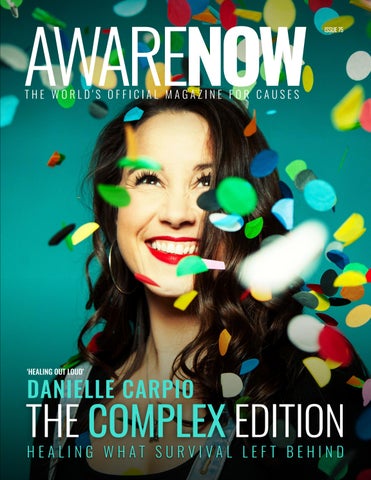
AWARENOW
ISSUE 75
THE WORLD'S OFFICIAL MAGAZINE FOR CAUSES
‘HEALING OUT LOUD’
DANIELLE CARPIO
THE COMPLEX EDITION HEALING WHAT SURVIVAL LEFT BEHIND
AD
THE COMPLEX EDITION
ON THE COVER:
DANIELLE CARPIO PHOTO BY: JALENA KARSTEN
AwareNow Magazine is a monthly publication produced by AwareNow Media™, a storytelling platform dedicated to creating and sustaining positive social change with content that inspires and informs, while raising awareness for causes one story at a time.
006 COMPLEX
030 WHEN LIMITS FOUND US
062 THE PLACE WE GATHER
JACK MCGUIRE
SUZANNE AKULLIAN
REAGAN MURPHREE
010 A FULL-TIME JOB
038 SACRED CONTRADICTION
068 WHAT SURVIVAL CAN BUILD
SAGE GALLON, ALLIÉ MCGUIRE
JOHN PATTERSON, SONJA MONTIEL
PAUL S. ROGERS
014 HEALING OUT LOUD
040 WORTH TELLING
DANIELLE CARPIO
ROSE ANDERSON
024 BEYOND THE MYTHS
052 AN ABNORMAL HEART
NICOLE WILLIAMS
ADOLFO LOPEZ
074 STILL WITH ME ELIZABETH BLAKE-THOMAS
080 THE THINGS WE NOTICE ERFAN FIROUZI
SUBSCRIBE FOR FREE: AWARENOWMEDIA.COM/SUBSCRIBE www.IamAwareNow.com
Life is not complex. We are complex. Oscar Wilde
We are all complex, shaped by what we have endured, what we carry, and the ways we learned to survive. The Complex Edition explores the layered reality of trauma, healing, identity, and the long journey back to ourselves. Through stories of courage and truth, this special issue reminds us that complexity is not something to hide, but something deeply human to understand and embrace.
ALLIÉ McGUIRE CEO & Co-Founder of AwareNow Media Allié McGuire began her career as a performance poet, transitioned into digital storytelling as a wine personality, and later produced the Hollywood Film Festival. Now, as co-founder of AwareNow Media, she uses her platform to elevate voices and champion causes, connecting audiences to stories that inspire change.
JACK McGUIRE President & Co-Founder of AwareNow Media Jack McGuire’s career spans the Navy, hospitality, and producing the Hollywood Film Festival. Now, he co-leads AwareNow Media with Allié, focusing on powerful storytelling for worthy causes. His commitment to service fuels AwareNow’s mission to connect and inspire audiences.
WAIVER/DISCLAIMER
The views and opinions expressed in AwareNow are those of the authors and do not necessarily reflect the official policy or position of AwareNow Media. Any content provided by our columnists or interviewees is of their opinion and not intended to malign any religion, ethnic group, political group, organization, company, or individual. Stories shared are not intended to vilify anyone or anything. Their intent is to make you think. * Please note that you may find a spelling or punctuation error here or there, as our Editor-In-Chief has MS and lost vision in her right eye. That said, she still has perfect vision in her left and rocks it as best as she can. www.IamAwareNow.com
Sometimes understanding our past doesn’t change what happened. It changes what happens next. JACK MCGUIRE
CO-FOUNDER OF AWARENOW MEDIA 6
www.IamAwareNow.com
‘REDEFINED & DEFINED’ EXCLUSIVE COLUMN BY JACK MCGUIRE
COMPLEX
THE PERSON SURVIVAL CREATED
complex (n.) what happens when what we survive becomes intertwined with how we learn to survive I knew PTSD. Or at least, I thought I did. I understood trauma as something that happens to us. An event. A moment. Something terrible enough that even after it ends, part of us remains there. Then I learned about CPTSD. Complex Post-Traumatic Stress Disorder. At first, I assumed the word complex simply meant more severe PTSD. More trauma. More symptoms. More damage. But that isn’t really the distinction. PTSD can develop after experiencing or witnessing trauma. CPTSD is associated particularly with prolonged or repeated trauma, especially situations that are difficult or impossible to escape. Alongside symptoms associated with PTSD, it can involve persistent struggles with emotional regulation, self-worth and relationships. And suddenly, the word complex meant something entirely different to me. Because what happens when trauma isn’t only a moment you remember? What happens when it is the environment in which you learned who you were? When survival isn’t something you had to do once, but something you practiced over and over again? Those questions hit close to home. I have never been formally diagnosed with PTSD or CPTSD, and I won’t diagnose myself here. But when I began learning about CPTSD and reflecting on my own childhood, I recognized something powerful: sometimes the things we think are simply parts of our personality may also have histories. The way we react. The way we protect ourselves. The way we anticipate danger before it arrives. The way we trust, or don’t. The way we love. The way we apologize. The way we become fiercely independent because at some point depending on someone didn’t feel safe. The way we learn to read a room before we’ve even learned to understand ourselves. 7
www.IamAwareNow.com
Perhaps one of the most profound things about trauma is that survival can eventually become identity. A response that once protected us can follow us long after the danger is gone. And that is where this edition begins. Not with what is wrong with us. But with what happened to us, what we learned because of it, and what becomes possible when we finally understand the difference. Because healing isn’t erasing the person survival created. It is getting to know that person. Understanding them. Having compassion for them. And eventually giving them permission to live instead of simply survive. This is The Complex Edition. It’s an exploration of what survival leaves behind, what it shapes within us, and what can happen when we finally have the language to understand it. Because sometimes understanding our past doesn’t change what happened. It changes what happens next. ∎
8
www.IamAwareNow.com
Instead of returning, perhaps it is becoming. PAUL S. ROGERS
TRANSFORMATION EXPERT, AWARENESS HELLRAISER & PUBLIC SPEAKER 10
www.IamAwareNow.com
‘RELEASE THE GENIE’ EXCLUSIVE COLUMN BY PAUL S. ROGERS
A FULL-TIME JOB
BETWEEN SURVIVING AND RECOVERY Release the Genie Fact: The Genie knows what the Fox says. There is a place in life that few people know and talk about. It is the cramped space between surviving and recovery. It is found after surviving whatever event tried to break you. Surviving is about getting through the day. Recovery is about beginning to imagine a tomorrow. But between the two lies an uncomfortable territory where you are no longer satisfied with simply enduring, yet you are not quite strong enough to feel restored. It is a place of uncertainty, exhaustion and small victories that nobody else may notice. Living in this space can feel like a full-time job. When you are surviving, your world becomes remarkably small. Time ceases to have any meaning or direction. Instead, you concentrate on what must be done next. Get out of bed. Make the appointment. Answer the phone. Eat something. Pay the bill. Make it through the night. Survival does not ask whether you are fulfilled. It asks whether you can keep going. The difficulty begins when survival has lasted so long that the habits that once protected you begin to limit you. You may have learned to expect disappointment, remain constantly alert, avoid vulnerability or suppress your emotions; in survival, there was simply not enough room to deal with them. One of my body's self defences is to disassociate. It is to completely disconnect with the current reality. It simply doesn’t let you access the day. A great feat of natural engineering designed to protect the mind. Its downside is also its strength as it is completely isolating. Then one day something changes. Perhaps circumstances improve. You wonder did my pain tolerance improve or is it actually better. Perhaps someone reaches out. Perhaps you finally realize that merely surviving is no longer enough. This is when you start to find the door out of the room and recovery begins. Recovery is rarely a dramatic transformation. It is not a sudden breakthrough followed by happiness. More often, it is repetitive, frustrating and painfully ordinary process. Recovery can mean learning to trust again. Learning to rest without feeling guilty. That not every silence means something is wrong. Beginning to make plans without being terrified that life will take them away. Understanding, and accepting, that are inevitable setbacks and that every day is not going to look the same. This is why recovery can feel like a full-time job. You are rebuilding systems inside yourself while simultaneously trying to participate in the outside world. You are expected to work, parent, socialize, make decisions and carry responsibilities while privately doing the emotional equivalent of rebuilding a house after a storm. There is another cruel irony: recovery can sometimes make you feel worse before you feel better. During survival, there may have been little time to process what happened. You were too busy coping. Once there is a little safety, the emotions you postponed can finally surface. Grief, anger, fear and sadness may arrive together. Each of these needs its own space and process to work through. The cramped space between surviving and recovery also teaches us something important about expectations. We often measure progress by visible outcomes. We expect recovery to look like confidence, productivity and happiness. But genuine progress may be much quieter. Maybe today you reacted differently. Maybe you asked for help instead of pretending everything was fine. Maybe you rested instead of pushing yourself beyond your limits. Maybe you had one good hour. This counts. 11
www.IamAwareNow.com
AwareNow Podcast
A FULL-TIME JOB Written and Narrated by Paul S. Rogers https://go.awarenowmedia.com/podcast/a-full-time-job
TAP/SCAN TO LISTEN
We also need to stop romanticizing resilience. Being able to endure enormous difficulty does not mean someone should have to continue enduring it. Strength is not endlessly carrying more weight. Sometimes, strength is choosing to put something down. Perhaps the most important shift occurs when we stop asking, “When will I be completely recovered?” and start asking, “What would help me live a little more fully today?” The first question creates pressure. The second hope and possibility. Recovery does not require you to return to the person you were. Sometimes, that person is gone. Then trying to recreate them becomes another burden. Instead of returning, perhaps it is becoming. Eventually, the cramped space begins to expand. A little more room appears between fear and response. Between pain and possibility. Between yesterday and tomorrow. You breathe differently. You laugh without wondering whether you are allowed to. You discover that life is not simply biding your time in the shallow end of the pool. And perhaps that is the quiet miracle of recovery: not that the past disappears, but that it gradually stops occupying every available inch of your future. The journey may still remain a full-time job. But eventually, you realize you are no longer merely working to survive. You are making room to live. ∎
PAUL S. ROGERS Transformation Expert, Awareness Hellraiser & Public Speaker www.awarenowmedia.com/paul-rogers PAUL S. ROGERS is a keynote public speaking coach, transformation expert, awareness hellraiser, life coach, Trauma TBI, CPTSD mentor, train crash and cancer survivor, public speaking coach, Podcast host “Release the Genie” & best-selling author. His journey has taken him from corporate leader to kitesurfer to teacher on a first nations reserve to today. Paul’s goal is to inspire others to find their true purpose and passion.
12
www.IamAwareNow.com
When you name the storm, you stop thinking you are the storm. DANI CARPIO
FOUNDER OF THE HEALING & CPTSD FOUNDATION Photo Credit: Jalena Karsten 14
www.IamAwareNow.com
EXCLUSIVE INTERVIEW/PERSONAL STORY WITH DANIELLE CARPIO
HEALING OUT LOUD FINDING A VOICE BEYOND SURVIVAL
For years, Danielle Carpio carried the effects of complex trauma without having the language to explain what was happening inside her. Receiving a CPTSD diagnosis did not erase what she had endured, but it helped her understand that she was never broken and that her responses made sense in the context of what had happened. Now, as Complex Dani and the founder of the Healing & CPTSD Foundation, she is healing out loud so others no longer have to survive in silence. ALLIÉ: Many are very familiar with PTSD, post-traumatic stress disorder. However, fewer are familiar with CPTSD. So let's start there. For those who are unaware, Dani, how would you define, in your own words, complex post-traumatic stress disorder? DANI: So complex post-traumatic stress disorder is a trauma condition that comes from prolonged, repeated trauma in an environment where the victim can't escape. When you think of PTSD, you're thinking of a singular traumatic incident, whether that's a car accident, a single sexual assault, a natural disaster, or, most commonly, everybody thinks of PTSD when they think of war and the military.
HEALING OUT LOUD EXCLUSIVE INTERVIEW/PERSONAL STORY WITH DANIELLE CARPIO BY ALLIÉ MCGUIRE
CLICK, TAP OR SCAN
TO WATCH NOW
15
www.IamAwareNow.com
It’s really a game changer to heal in community versus by yourself. DANI CARPIO
FOUNDER OF THE HEALING & CPTSD FOUNDATION Photo Courtesy: Dani Carpio 16
www.IamAwareNow.com
DANI: (continued) Whereas CPTSD can be months, years, decades. We're more commonly thinking of childhood abuse and neglect, domestic violence, kidnapping, sex trafficking, religious or cult trauma. These are experiences that are prolonged and repeated, in environments where somebody can't escape. So it really changes your entire sense of self, your sense of connection with others, your sense of connection with the world. PTSD has three categories of symptoms: avoidance of trauma reminders, hypervigilance or this current sense of threat, and intrusive symptoms like flashbacks, nightmares and intrusive thoughts. CPTSD has all of those same symptoms and its own set of symptoms on top of that, including difficulty regulating emotions, interpersonal difficulties. Relationships are really hard because CPTSD usually comes from an interpersonal aspect where someone who was supposed to keep you safe didn't. There's also a negative self-view. I mean, there's just a list of other symptoms that people with CPTSD have to navigate. So it's really its own kind of beast. Because of that, not every way that helps heal PTSD is necessarily helpful for CPTSD. You have to think about healing in a very different way because it is completely different. ALLIÉ: Well, you said it there. It's a completely different beast. I'm thinking of those movies where there's a monster with one head, and then you have a monster with three different heads. That's what it's making me think about. There are all these different heads. It's not just one. DANI: Yeah. It impacts every aspect of your life. ALLIÉ: Right. So before you had the language of CPTSD, how did you understand what was happening inside you? What changed when you finally received a diagnosis that connected your symptoms to what you had survived? DANI: Yeah, such a great question. My CPTSD comes from childhood abuse and neglect, incest and sexual abuse. For me, because this was the environment I grew up in, a very dysfunctional, alcoholic, abusive home, I thought it was normal. At the same time, I thought that I was at fault for it. So the entire time growing up, I just thought there was something wrong with me. And when you grow up in those types of environments, it doesn't just stop when you're 18, right? If it's your family causing it, this doesn't just stop at 18. It goes into adulthood. So for me, I just thought there was something fundamentally wrong with me. I wasn't experiencing life the same way. I wasn't reacting to things the same way as people who didn't have this. I was 32 when I was finally diagnosed, and it was the first time in my life that I was like, "There's not something fundamentally wrong with me. There's something fundamentally wrong with what happened to me." That changed everything. It also gave me this list of symptoms where I was like, "Check, check, check. Yeah, okay." And when you have that understanding and you can actually pinpoint what is happening, you can start managing it. So it drastically changed my life. Getting a diagnosis or having the verbiage isn't going to fix everything, right? But it drastically helped with that shame, and it helped put me back in the driver's seat, which is just a game changer when it comes to healing. ALLIÉ: Yeah. There's something so powerful about naming something, giving it a name. And the name is not Dani. The name is this other thing. It's not you. DANI: Exactly. I always say, "When you name the storm, you stop thinking you are the storm.” ALLIÉ: I love that. Why do you think it is that so many people have never heard of CPTSD? Why is that? DANI: CPTSD isn't recognized in the United States. In 2018, it was recognized by the World Health Organization, so it is recognized worldwide, but here in the United States, it's not. In the United States, they use what is called the DSM, the Diagnostic and Statistical Manual of Mental Disorders, which is basically the Bible of psychiatry. It's what mental health professionals are learning, what research is based on, how insurance companies code. Everything is based on the DSM. 17
www.IamAwareNow.com
Sometimes being vulnerable is scary, but if it helps one other person, then it’s worth it. DANI CARPIO
FOUNDER OF THE HEALING & CPTSD FOUNDATION Photo Credit: Roy Rochin 18
www.IamAwareNow.com
DANI: (continued) Because CPTSD isn't in there, mental health professionals aren't learning about it, healthcare systems aren't learning about it, and the public doesn't know about it. So we're literally setting up survivors to go to these systems to get help, and then they're misdiagnosed or belittled and told, "Just get over it," or, "It's just stress." We're really doing a disservice to survivors because nobody knows it exists, and there's so much more trauma happening because these systems don't understand it and don't know that it exists. ALLIÉ: Right. To that point, you are creating this CPTSD recognition movement through the Healing and CPTSD Foundation. Why is formal recognition so important? Is it about getting CPTSD recognized so it can begin to be better understood and treated? DANI: It's important on so many levels. When I was diagnosed and realized this wasn't recognized, it enraged me because I was like, "I've been suffering in silence, thinking there's something wrong with me my entire life when there isn't, and it's all because it's not recognized and nobody else saw the symptoms or the signs and was able to tell me." When we're talking about recognition, we're talking about systems being able to understand it, look for signs and symptoms and treat it differently. Then we're not having survivors who are misdiagnosed with bipolar disorder or borderline personality disorder or something else. We're shortening the span of time it takes for people to get help and actually receive the healing they deserve because the systems are set up to look into this. And it's the same thing with research, right? Nobody's doing research on CPTSD because it's not recognized. You can't do research on something that's not recognized, at least here in the United States. For me and for the foundation, I don't want people suffering as long as I did. Nobody deserves that. We started the CPTSD Recognition Movement. We have a petition. We have the CPTSD Alliance, which is a coalition of survivors, advocates, allies and professionals who are working together. We actually submitted a proposal to the DSM last year. It has not been rejected yet, so fingers crossed. We're also not just going through the DSM. This year, we're working on the CPTSD Recognition Act to go at it federally. We also started the CPTSD Census, where we are doing our own research and asking survivors to share their lived experience so we can make it impossible for us to ignore. People who have been through complex trauma and prolonged, repeated abuse are some of the most deserving people in the world, and we need to help them so they stop suffering in silence like I was. ALLIÉ: Absolutely. Because with a better diagnosis, you get better care. So let's go to you personally. You describe Complex Dani as an embrace of every complicated, messy layer of who you are. What has it taken to stop seeing those layers as something to fix and begin recognizing them as parts of yourself worthy of compassion? What has it taken to get there? DANI: It's taken a long road, I'll tell you that much. I always thought healing was an end destination and something I needed to do to fix myself, right? It was something I needed to get to and make myself less complicated. Like if I healed enough and became this perfectly regulated, uncomplicated version of myself, I wouldn't have these reactions or contradictions or any of these messy parts. I think one of the biggest shifts was realizing, when I got the diagnosis and started going further into the journey, that all of these symptoms made sense for what I had been through. They're actually just adaptations to something I shouldn't have been through, and they're what kept me alive. So instead of trying to erase those parts, I started accepting that they existed and understanding why they were there. Really, the only reason I'm still here is because I did have all of those symptoms. So instead of asking myself, "How do I fix this?" I started asking, "What happened? Why is this here?” Then I started realizing I'm human. We're all human beings, and we're all complex as it is. Yeah, having CPTSD makes me a little bit more complex and adds some extra layers, but at the end of the day, we're all complex, and that's not a bad thing. 19
www.IamAwareNow.com
There’s not something fundamentally wrong with me. There’s something fundamentally wrong with what happened to me. DANI CARPIO
FOUNDER OF THE HEALING & CPTSD FOUNDATION Photo Courtesy: Dani Carpio 20
www.IamAwareNow.com
DANI: (continued) It's okay to make friends with those parts of yourself. You actually heal a lot further when you stop trying to shame them and get rid of them and instead say, "Okay, you make sense. Let's make space for you. You don't have to be in the driver's seat anymore.” It's okay to be complex because we all are. Sometimes, when you make friends with those parts, it really helps in your healing. That's why I named it Complex Dani. I want everybody to realize that we're all complex, and it's okay. Let's make friends with that and be okay with what helped us survive to get here instead of shaming it. ALLIÉ: I love that. As opposed to getting rid of it, it's making space for it. I think so many of us can identify with that. You created the Healing and CPTSD community so survivors would not have to navigate healing alone as you did. What were you unable to find when you first began this journey, and how has building this community changed or supported your own healing? DANI: About six months after I was diagnosed, I started the Healing and CPTSD Instagram account. Honestly, I started it not intending to have a community because I didn't know that was possible. I just started it because I was like, "I need to make sense of this chaos that's happening inside of me.” I started posting things, and the response was insane. We grew really fast, and I was getting these messages and comments like, "Wait, there's a name for this?" "Wait, me too." "Wait, it's not just me.” I always say I accidentally started a community because the people actually showed me that I wasn't alone, that there were all these other people out there dealing with the same thing. We didn't have the verbiage or a place. We were just all these forgotten survivors out there. So I leaned into it and listened to what everybody else was telling me. It really organically, accidentally created a community where we could connect with each other and learn from each other. Now we have this private platform where we have over 20 virtual events a month. We do support circles, community connection events, activities. We do pumpkin carving every single year together. We have somatic classes, educational classes and ways for survivors to connect with other survivors because healing isn't one size fits all. What works for one person might not work for another. Being able to put survivors together means people can communicate and say, "Well, this worked for me, but this didn't." It helps other people learn that it's not one size fits all. And if one thing doesn't work, that doesn't mean there's something wrong with you. It means you haven't found the right tools yet. The community has honestly drastically changed my life. It has pivoted me into this beautiful path, and I'm beyond thankful because they let me know that I wasn't alone. Now my purpose really is to let everybody else know right back that they're not alone and that we can heal together. We can stop healing in isolation. It's really a game changer to heal in community versus by yourself. ALLIÉ: Absolutely. I know I can speak from the MS community. It's the same thing, right? And there is that word again: space. You created space for the parts of you, but you're also creating spaces for other people to come together because community is so important. For the person who is still living in survival mode and cannot yet imagine feeling safe, feeling whole, feeling free, what is the one thing you would want them to understand about where they are right now and what may still be possible? DANI: I think it makes sense how you're feeling, right? It makes sense that you feel this way. It makes sense that maybe you haven't found the right tools yet, or the right resources, or the right people to heal alongside. It makes sense, and there is a possibility to change that. I think one of the biggest things, before I learned about CPTSD and really went on my journey, was that I just needed to know from one person that it was actually worth it and that it was possible. 21
www.IamAwareNow.com
Photo Credit: Jalena Karsten
DANI: (continued) Healing isn't fun, right? It's not this fun, happy journey that everybody paints it out to be. I think that's why our community loves me so much, because I'm really realistic about it. I'm like, "It actually sucks. It's really messy. It's ugly. It's painful.” But it's worth it because now that I'm further on the other side of it, again, I'm never going to be "healed," but I have so much more space and capacity for what I've been through. There's so much less of the triggers and the trauma and the pain on the other side, and it's worth it. So I want them to know that wherever they're at, it makes sense that they feel that way. There's absolutely nothing wrong with them. There's something wrong with what they've been through. Honestly, they're not too much. They're carrying too much. Healing is so worth it. It's not easy. It sucks. But it's definitely, definitely worth it. ALLIÉ: Again, the way you just said that: it's not you, it's what happened to you. Making that distinction is such a very big deal. I'd like to talk now about your voice, because I love it. I've listened to your music. Your voice has become such a powerful part of your healing, not only through the advocacy you do with the community, but through your music. What are you able to express in a song that you cannot always say in conversation? DANI: I've been writing songs and poetry since I was a little girl, and it's always been one of the ways I was able to express myself and process my pain or what I was navigating. It's always been this way to take pain and turn it into expression. A lot of the parts of my story are really difficult to put into words. There are feelings I can express in a song much more than I can explain in a conversation. I think, too, there are a lot of things that I'm still afraid to come out and say. As this public face of CPTSD, running this community and the movement, there are still so many things I can't just come out and talk about. But in a song, it's different. When I'm writing it in lyrics, it's completely different. I think it's just another way of healing out loud for me. Music has always gotten me through some of the hardest parts of my life, and it's helped me process in ways I didn't realize were possible. 22
www.IamAwareNow.com
AwareNow Podcast
HEALING OUT LOAD Exclusive Interview with Danielle Carpio https://go.awarenowmedia.com/podcast/healing-out-loud
TAP/SCAN TO LISTEN
DANI: (continued) I hope that by sharing these literally most vulnerable parts of me with other people, they can also see themselves. They can have another way to process and go through things. One of the biggest things with getting back into music is that it's been this beautiful way to reconnect with that inner child and allow her to have the passion again, allow her to express herself again. When you're talking about healing from childhood abuse, you really have to befriend that inner child and allow her to have a voice. So it's been this beautiful, scary, crazy journey to be vulnerable and let other people know they're not alone. I hope it helps other people. Whether it's them crying while listening to the song or singing songs in the car as they're driving, it's all therapeutic. It's all a way for them to know they're not alone. Yeah, sometimes being vulnerable is scary, but if it helps one other person, then it's worth it. ALLIÉ: For sure. And I think it must not only help other people, but that healing can go both directions, right? When you're able to stop hiding from something and expose those vulnerable parts, that has to be a relief in and of itself. To say, "I don't have to hide that anymore. Look, it's right out here. I don't have to carry that anymore.” DANI: Yeah. It really is a game changer, especially with shame, which is such a big symptom of CPTSD, that toxic shame. Anything that can release a little bit of shame is going to help in some way or another. It's almost like a weight gets lifted when you stop hiding it yourself and being the only one navigating it. Instead, when you put it out there and other people are like, "Oh my goodness, I experienced this too," it again helps with that feeling of not being alone, which helps work through the shame even more. ∎
Find & follow Complex Dani on instagram: @complex.dani Learn more about CPTSD: complexptsd.org Healing and CPTSD Community: www.healingandcptsd.com Join the CPTSD Recognition Movement: www.thehealingandcptsdfoundation.org/cptsdalliance
23
www.IamAwareNow.com
MS is a journey of many different experiences. NICOLE WILLIAMS
RN & REINVENTED MS WARRIOR Photo Courtesy: Nicole Williams 24
www.IamAwareNow.com
PERSONAL STORY BY NICOLE WILLIAMS
BEYOND THE MYTHS WHAT MS REALLY LOOKS LIKE
Multiple sclerosis is often misunderstood because so much of it can’t be seen. As both an RN and someone living with MS, Nicole Williams knows the distance that can exist between what people assume and what a person is actually experiencing. Here, she challenges eight common myths about MS and offers a clearer, more compassionate understanding of what life with the disease can look like. MS is a journey of many different experiences. Here are 8 myths about MS I'd like for others to be aware of… 1. If you look healthy, you must feel healthy. MS can cause invisible symptoms that others can't see. 2. MS always gets worse quickly. MS varies tremendously from person to person, and disease activity can change over time. 3. If you don't have a relapse, MS isn't active. Disease progression can occur independently of relapses. Research PIRA. 4. Fatigue means you're just tired. MS fatigue can be neurologic and much more complex than ordinary tiredness. 5. Exercise is dangerous if you have MS. Appropriate exercise is generally encouraged and can support strength, mobility, balance, mood, and overall health. 6. Heat is just uncomfortable for people with MS. Increased body temperature can temporarily worsen existing neurologic symptoms in some people with MS. 7. Every person with MS has the same symptoms. MS is highly individual. Symptoms depend partly on where lesions affect the nervous system. 8. You should push through MS fatigue. Learning to manage energy and recognize your limits can be an important part of thriving with MS. This is not medical advice. I'm just a girl who happens to be a Licensed RN that's been diagnosed with MS. ∎
Find & follow Nicole on Instagram: @nurse_.nic
25
www.IamAwareNow.com
Miles to go before we sleep…
Every one is a part of everyone.
FIND STORIES, STATS & SUPPORT
FOR THE CAUSES THAT TIE US ALL TOGETHER WWW.TABLEOFCAUSES.COM
Our entire relationship, and really our life, was built on this shared passion for outdoor activities, being athletic and sharing that life together. SUZANNE AKULLIAN
FOUNDER OF AXEL MOBILITY Photo Courtesy; Suzanne Akullian www.IamAwareNow.com
EXCLUSIVE INTERVIEW WITH SUZANNE AKULLIAN
WHEN LIMITS FOUND US
TURNING LOVE, LOSS & FRUSTRATION INTO POSSIBILITY Suzanne Akullian and her husband, Leo, built a life in motion, filled with surfing, snowboarding, skiing, mountain biking and the freedom to simply go. Then multiple sclerosis began changing what movement looked like for Leo, and with it, the shape of the life they had always known. What began as Suzanne’s determination to help the man she loves hold onto his independence has grown into AxEL Mobility, a mission to reimagine mobility not around what people have lost, but around everything they still want to do. ALLIÉ: Before MS entered the picture, who were you and Leo together? And what did movement mean to the life the two of you were building? SUZANNE: Well, it's crazy. We met at the Outdoor Retailer show in Salt Lake City, Utah, and both of us had careers in active sports. Our first date was a hike in the Angeles National Forest. He lived in San Diego, I lived in Manhattan Beach, and at the time, it was possible to have a relationship where you could commute. Every weekend, we were either mountain biking or surfing or doing something active. Our entire relationship, and really our life, was built on this shared passion for outdoor activities, being athletic and sharing that life together.
WHEN LIMITS FOUND US EXCLUSIVE INTERVIEW WITH SUZANNE AKULLIAN BY ALLIÉ MCGUIRE
CLICK, TAP OR SCAN
TO WATCH NOW
31
www.IamAwareNow.com
He’s the disciplined one. He’d work out every day, more than me. SUZANNE AKULLIAN
FOUNDER OF AXEL MOBILITY Photo Courtesy; Suzanne Akullian 32
www.IamAwareNow.com
“Watching all of that being taken away from him is just horrible and heartbreaking… It’s devastating.” ALLIÉ: Yeah, for sure. And what a fabulous first date. A hike in the woods? Yes. Sign me up. There's a line in your story that says, "Slowly, that freedom began to slip away." What did that actually look and feel like from where you stood beside him? Take us to that point in your story. SUZANNE: He was slowly experiencing symptoms, so it was very gradual. It actually took two years before he was diagnosed. Once he was, it was devastating. First of all, it was a shock. We were like, "What is MS?" We had no idea. At first, he was just tripping every once in a while. He had numbness in his hands and extremities. Then slowly, he got to the point where he needed a walking stick to get around, and then progressed to where he needed a walker. Watching him and seeing his life slip away was just awful. Because it happened slowly, we would adapt to each new phase. But he used to surf every morning. He used to be so active. He's the disciplined one. He’d work out every day, more than me. Watching all of that being taken away from him is just horrible and heartbreaking… It's devastating. ALLIÉ: I can imagine. Was there a particular moment when you looked at the mobility options available to Leo and thought, "This simply isn't good enough"? Was there one thing that triggered that feeling of, "That's not enough”? SUZANNE: It's crazy because from the time he was diagnosed, knowing him and knowing what kind of person he was and how active he was, I thought, if he ever ends up in a wheelchair, he's not going to want a wheelchair. Even when we got him a walking stick, he didn't want a cane. We got him a Leki hiking pole because that felt more like active sports. Every time he needed to use a different apparatus to help him, we looked at everything that was out there. He'd say, "I don't want that one. That one looks ugly. Why can't they make these things look cool?” So I've actually been researching this for years, since 2012. What's out there? I saw Bill Gates at the Harvard Robotics Lab, and I was looking at what they were making for people with disabilities. I met a company at a trade show called Ekso Bionics that makes an exoskeleton, and we got Leo into a clinical trial to try that. It ended up being too cumbersome for him because it's designed for people who are paraplegic or quadriplegic and can't walk at all. I've been thinking about this and looking at it for years, just trying to find the best thing for him. How can I get him from point A to point B more easily? And how can we find something that doesn't make him feel disabled? That's such a big part of it. People with disabilities don't want to feel disabled. ALLIÉ: Right. Why does it have to be form or function? Why can't it be form and function? Just because it's functional, why not make it pretty? Why not make it sexy? Let's jazz it up a bit, please. So here enters Axel Mobility. That ultimately grew out of something incredibly personal for you, as you just shared. How did you make that leap from wanting something better for the person you love to believing you could create something better for millions of other people too? 33
www.IamAwareNow.com
It would be incredible to turn this into something that helps other people like Leo. SUZANNE AKULLIAN
FOUNDER OF AXEL MOBILITY Photo Courtesy; Suzanne Akullian 34
www.IamAwareNow.com
SUZANNE: I've been in the medical device industry for the past 12 years of my career, working with a company that made heart valves. I've seen what a patient-focused company can do in changing lives and saving lives, so I've had that mentality throughout my professional career. As I started thinking about making this for Leo, I realized there are other people who would want this. One of the people I've talked to is a 20-year-old college student who was born with a disability. She said to me, "I can't wait to have this. Then I can just look like the other college kids who are racing around on their electric scooters. This will make me feel more like them and not as embarrassed by my own disability.” Even in the short time that I've been doing this and having conversations with people, I've recognized that this could help others. It would be incredible to turn this into something that helps other people like Leo. He's not the only one who feels this way. ALLIÉ: Yeah, for sure. So let's talk about Shift. Tell me about Shift. SUZANNE: As I said, I started down the path with exoskeletons, which, by the way, can cost $100 million to develop and $100,000 to buy. I thought, wait, that's just way too complicated and expensive. Leo has a very lightweight walker right now that collapses. He can put it in and take it out of his car himself. He's independent with that. And I came up with this idea: What if we add pedals and a motor? It would be like a motorized scooter. He could open it up, engage the pedals, step on it and ride a little to get where he wants to go. Then, when he gets to the door of the coffee shop or restaurant, he could get off and walk in. It collapses and expands, so he can put it in his car and maintain that independence. It's just that little extra movement, that little ride. I got the idea from e-bikes and electric scooters that are racing around everywhere. I thought, there's got to be something in between a sit-down scooter and a walker. ALLIÉ: Right, for sure. So if Shift becomes everything you hope it will become, what do you hope it gives back to Leo and to every person who has ever felt their world becoming smaller because of limited mobility? SUZANNE: I think it's dignity. If it looks like an electric scooter or an e-bike, with the popularity of those categories, I feel like this is the piece that's missing for people with disabilities. If people walk up to him and say, "Oh my gosh, what is that? That looks so cool. How do I get one?" that would be a conversation starter he'd be happy about, as opposed to feeling uncomfortable or embarrassed because of his disability. I think it's dignity, freedom and empowerment. It's an accessory that looks cool and gets you back to doing things you weren't doing before because you had limitations. ALLIÉ: I love that because, as I'm sure you've experienced in your life with Leo, and I can speak for MS having it myself, yes, there's a physical aspect to MS, but there's also the mental side of it. As you just said, to not feel so "other," to not feel like you're being put into a different box, this can be a game changer for a lot of people, I think. SUZANNE: Yeah. People ask, "Does it have a seat?" Well, the point is that it's keeping you upright. It's keeping you at eye level with everyone else. That is the point. We're trying to keep you standing and part of society, as opposed to sitting in a wheelchair or on a scooter where you're at a different eye level. That's part of it as well.
35
www.IamAwareNow.com
I am trying to get this prototype built as soon as possible. SUZANNE AKULLIAN
FOUNDER OF AXEL MOBILITY Photo Courtesy; Suzanne Akullian 36
www.IamAwareNow.com
AwareNow Podcast
WHEN LIMITS FOUND US Exclusive Interview with Suzanne Akullian https://go.awarenowmedia.com/podcast/when-limits-found-us
TAP/SCAN TO LISTEN
ALLIÉ: Suzanne, where are you on this journey? Because I know a number of people who would love to have what you're putting together here. Where are you at? SUZANNE: I have the design. I have the concept. And I'm working toward building the actual proof of concept and prototype. I have multiple options for that, and I'm crowdfunding right now on my website. Through personal outreach alone, in three months I've raised almost $20,000. So I'm raising funds, and I'm talking to multiple investor groups who are excited about this. In very short order, I hope to have the funding to build the prototype and do the feasibility testing. I'm going down both paths: direct-to-consumer, and I'm also looking at reimbursement so people could potentially get it covered by insurance. I'm raising funds for all of that. I’m trying to get this prototype built as soon as possible. ∎
Learn more about Axel Mobility: www.axel-mobility.com Find & follow on Instagram: @axel_mobility
37
www.IamAwareNow.com
The halo does not erase the dark. It rises from it. SAGE GALLON
MULTI-MEDIA ARTIST, AUTHOR & OFFICIAL AMBASSADOR FOR HOMELESSNESS AWARENESS ‘The Saint’ by Sage Gallon 38
www.IamAwareNow.com
PAINTING BY SAGE GALLON + POETRY BY ALLIÉ MCGUIRE
SACRED CONTRADICTION BETWEEN THE BROKEN & THE BEAUTIFUL I used to think saints were made of light. That holiness arrived clean, untouched by the ordinary ache of being human. But look closer. The halo does not erase the dark. It rises from it. Gold behind the grief. Grace beside the bruise. A face carrying every color it was told to hide. Perhaps a saint is not someone who has suffered beautifully. Perhaps a saint is simply someone who remained. Who let the world break open without becoming closed. Who learned that tenderness is not the absence of anger, that forgiveness is not forgetting, that faith can tremble and still be faith. 39
There are no untouched people. Only complicated ones trying to make something sacred from what they have survived. So wear your wounds without worshiping them. Wear your joy without apologizing for it. Let contradiction live in you without demanding a verdict. You are allowed to be both the question and the prayer. Both shadow and sun. Both human and holy. Maybe that is what the halo was always trying to tell us: The light was never proof that darkness had disappeared. It was proof that darkness did not win.
www.IamAwareNow.com
The theater of the mind is always open. ROSE ANDERSON
NEW YORK FESTIVALS EXECUTIVE VP & EXECUTIVE DIRECTOR www.IamAwareNow.com
EXCLUSIVE INTERVIEW WITH ROSE ANDERSON
WORTH TELLING
THE STORIES THAT MOVE US FORWARD Some stories entertain us. Others stay with us, changing what we understand about another person, a community, or even ourselves. As AwareNow joins New York Festivals in recognizing storytelling with the power to inform, connect and create change, I sat down with Rose Anderson to talk about the stories we choose to honor, why recognition matters, and what storytelling can still ask of all of us. ALLIÉ: You, Rose, have spent so much of your career surrounded by extraordinary storytellers and extraordinary work. After all of these years, what is it about a story that can still stop you in your tracks? ROSE: That’s a great question. I always think “tell me a story” is an invitation to go on a fantastic voyage. And at New York Festivals, because we specialize in international storytelling from around the globe, it’s a passport to places that maybe you’ve never been to, or you’ve been to and you don’t really know the best spots. But it’s not a travel situation. I think because of my training as a network producer, some of the stories that really stop me in my tracks are the ones that I know are so difficult to do. They’re difficult to organize, difficult to produce and difficult to execute creatively.
WORTH TELLING EXCLUSIVE INTERVIEW WITH ROSE ANDERSON BY ALLIÉ MCGUIRE
CLICK, TAP OR SCAN
TO WATCH NOW
41
www.IamAwareNow.com
You’re given the best seat in the house… ROSE ANDERSON
NEW YORK FESTIVALS EXECUTIVE VP & EXECUTIVE DIRECTOR 42
www.IamAwareNow.com
ROSE: (continued) The first few that spring to mind are the London Olympics opening ceremony, produced by the host committee, which involved thousands of hours, thousands of people and, at the helm, one person’s vision working with all of the cameramen. So it’s one person in a spectacle. Another one that comes to mind is TV Globo Brazil’s Olympic studio in Paris, which was a marvel of technology. Another one was A Capitol Fourth, a concert that’s on PBS every year. And the thing that strikes me about that, that makes me just stop and wonder, is that it’s a two-hour show with no commercial breaks. So it’s like live theater, but with dozens of cameras and multiple hosts and multiple musical groups. And then the Eurovision Song Contest, which is just phenomenal. The whole world tunes into that one. So I guess what I’m saying is one of the things that just makes me go, “Wow,” is that you’re given the best seat in the house, and you get to see this extraordinary live spectacle, because live always makes it more difficult. And then in the drama area, what you’re getting is the fruit of the creativity of an entire team. You have the playwright, you have the director, you have the producer and, most of all, you have the incredible performances of gifted actors. So what comes to mind, and these are all previous winners of New York Festivals, is Peaky Blinders, Wolf Hall, Marie Antoinette and The Tattooist of Auschwitz. What you’re getting to take part in is transportation to another time, let alone another country. You’re seeing extraordinary and ordinary people caught up in extraordinary situations that they have to navigate. And the creative teams have figured out a way to craft episodic art that not only brings you in, but keeps you in. So I’d say in the past decade and a half at New York Festivals, I’ve probably watched or listened to, because we do radio as well, tens of thousands of stories. And I don’t want to leave out some of the extraordinary radio drama that I’ve listened to. There’s a company called Almost Tangible. They recorded Hamlet on location in a castle in Scotland. They recorded Hamlet Noir at Elsinore, the real castle in Denmark from Shakespeare’s story. And there’s a wonderful company called Bafflegab that adapted The Man Who Fell to Earth as a radio drama. Not the movie, but the original book. So what stops me in my tracks and makes me just go, “Wow,” is sometimes the craft, sometimes the difficulty and sometimes it’s giving me knowledge that I didn’t have. And in that regard, that brings us into the documentary area and nonfiction. You have these amazing documentary stories where you just go, “How did they do that?” One of the ones that comes to mind, of course, is The Last Dance from ESPN. They shot all the footage, it was in a locked box for years, and then they came back and made a documentary series out of it. And in terms of nature documentaries, this year there was a film called Mighty Monkeys. It was a story of monkeys in the Alps in Japan that they filmed actually catching a fish. No one had ever seen that before. So it’s an unusual situation that you’re privy to because someone sat in the snow for hours. Or in terms of those wonderful nature documentaries, someone sat at night, during the day, for months observing animals in the wild so you could see, as a person, what they’re like and what their lives are like and what they’re doing. And then there are documentaries that aren’t spectacle. They’re very quiet. I’m thinking, of course, of My Octopus Teacher, which went on to win an Oscar. And there’s a moment when an octopus and the protagonist meet, and it’s wonderful. It’s totally inspirational. So, taken as a whole, the stories that make me go, “Wow,” are the ones that bring me, and bring anyone else, to another place. We get to inhabit that place. And then, when the story is over, it stays with us. 43
www.IamAwareNow.com
You want that unvarnished actuality. ROSE ANDERSON
NEW YORK FESTIVALS EXECUTIVE VP & EXECUTIVE DIRECTOR 44
www.IamAwareNow.com
ALLIÉ: Absolutely. And when you think about all of the time, energy and effort that goes into it, it’s hours, weeks, months, sometimes years, all condensed into an hour, a few episodes or whatever it is. But we get the richness of all of that in this window they provide. I keep thinking about the difference between a story that is beautifully made and a story that actually moves us. So when does a story become more than something we watch or hear and become something that changes us? When do you think that moment happens in a story? ROSE: Well, that’s a great question. I think some genres of storytelling do that naturally. I’m thinking of on-the-ground reporting. I’m thinking of investigative reporting. And we have to remember that in today’s world, and at other times in our world, filmmakers and audio storytellers are reporting from places where they no longer enjoy freedom of speech or freedom of the press. Sometimes there’s an element of danger in addition to no certain outcome. And that’s the kind of storytelling that I think is so important. We all like to think we should look better than we really do in real life, that we should sound better than we really do in real life, or that real life needs to be enhanced somehow. I think when you’re dealing with stories that have a raw reality to them, no matter what the topic, you forget about the artistry. Now, granted, there are still creative decisions being made with these stories. Which tape do you use? Which sequence do you use? Do you have time to color-correct it? But when you’re talking about live reporting from on the ground, there’s no time for any of that. What you’re dealing with is what’s actually happening, not only behind the reporter, but to the reporter. So that gives it a layer of immediacy, and I don’t think that should ever go away. I think that’s so important. One of our radio grand winners from several years ago was a panel discussion of the U.S. network anchors talking about what it was like to report on 9/11. You don’t want that corrected. You want that unvarnished actuality. ALLIÉ: Yeah, I love that term, “unvarnished.” Unfiltered, unpolished, just real. Because, like you say, so often everything is polished and glossed over. We’re seeing a representation that someone influences as opposed to the actual reality of it. So the more raw, the more real, perhaps the better in a number of situations. I want to talk a little bit about New York Festivals. It has spent seven decades recognizing exceptional storytelling, and I love the idea that an award can essentially say, “We saw what you made, and it mattered.” Why do you think recognizing a story can be almost as important as telling it? ROSE: That’s a really great question. Remember, all of our entrants, winners and submissions have already aired in one form or another. They’ve aired on networks and stations. Last year, we had 43 countries involved in our submissions. One of the things that I’m really so proud of about New York Festivals’ work is that, let’s say you do an investigative report and it airs on your station or gets picked up by your network, but it stays in your country. And let’s say the story has international implications. By entering New York Festivals and by earning an award from our grand juries, you get to expand the reach of your reporting. And in terms of dramas, because there’s so much international co-production and syndication these days, if something aired in your country and you want more of the world to have it available, this award is a wonderful way to let people know that you’ve earned that recognition. Now, I just want to speak a little bit about our grand juries and how you get the award. All of our grand jury members from TV and film and radio, and we’re talking about 300 people, every single one of them has won an award for their work. So we’re talking New York Festivals Awards, Emmy Awards, Peabody Awards, Oscar Awards, Rose d’Or, Prix Italia and many, many national or domestic awards competitions. All of these people judging the work that our entrants submit have created award-winning work. 45
www.IamAwareNow.com
Because it’s peer-judged, it means more. ROSE ANDERSON
NEW YORK FESTIVALS EXECUTIVE VP & EXECUTIVE DIRECTOR 46
www.IamAwareNow.com
ROSE: (continued) We invite previous award winners to join the next year’s grand jury. So we have cinematographers who know what it’s like to sit for hours and weeks and months waiting for that perfect shot. We have post-production editors who sit through hours and hours of film or audio trying to figure out which is the best one that moves the story forward. We have journalists, correspondents, anchors and sound artists. All of these people have exhibited curiosity, passion and dedication, so they recognize it right off the bat when they see it in other people’s work. The thing that’s so incredible to me is that they all volunteer their time. And I’d say about 40 percent are women. As I said, this past year we received entries from 43 countries. I think we had jury members from 35 or 36 countries. So what you’re talking about is an international, skilled jury judging highly produced, highly creative work from around the world. To me, that’s what peer judging is all about. And we have two rounds of judging. The first round, which determines the shortlist, goes for a couple of months. Judges have between 45 and 50 entries to screen, evaluate, score and write comments on. So it’s very interactive, but there’s no pressure. Then the second round of judging, which takes about a month, has about half the number of entries. What we do is give these very talented jury members, who are involved in creating their own work right now, ample time on their own time to evaluate all of these entries. And I believe that’s why a New York Festivals award means so much to our entrants. Every year, in addition to the individual awards, we acknowledge Broadcasters of the Year. This year, on the television and film side, the winner was Mediacorp. And when their CEO accepted the award, the tenor of the acceptance was that it’s an inspiration for their journalists and members of their teams to keep doing the kind of work they do. The Radio Broadcaster of the Year was CBC up in Canada, with their English-language and French-language RadioCanada programming. And they said the same thing. Our Production Company of the Year was Zinc Media, based in the UK, and again, they said the same thing. Because it’s peer-judged, it means more. And also, in financial terms, if you get an award and you’re up for funding for a future project, it shows that you’re going to complete it and that it’s going to be well received. So it not only makes you feel good about the hard work that you just did, and by the way, many documentaries take three to five years to go from the initial idea to the finished film, but an award can help that long development process for documentaries and also for drama. It helps make better programming available. ALLIÉ: Right. For sure. And that brings us to this new partnership and the AwareNow Award, recognizing outstanding health and medical information documentary storytelling. What feels especially important to you about honoring stories that take us beyond a diagnosis or a statistic and into the human experience around it? ROSE: Well, I like to make things happen, and I’m thrilled that New York Festivals and AwareNow Media are making this special award happen. We already get submissions in this area. A wonderful film that won awards a couple of years ago was about Jacqueline du Pré, the very gifted cellist who, at the height of her career, received a lifechanging diagnosis and was no longer able to play. What this documentary did was show how that didn’t stop her as an artist, even though she couldn’t play. She taught other cellists. So these stories can be an inspiration. And let’s not forget, every single one of us has sat in a room fearing bad news, hoping for good news. And it’s isolating. You don’t know how to talk about it. So I think this kind of programming is so important because it moves from isolation to communication, to community, and then communion. I think that’s really what we’re all aiming for. Additionally, I’m hoping that this award will encourage other filmmakers to make more films in this type of programming. It could be documentary. It could be docudrama. And the thing that’s so wonderful is, as I said, we’re already getting reporting and documentary work in this area. We got a wonderful program called The Network from NPR, which deals with how to solve women’s health situations when some avenues are no longer legal. There’s a wonderful documentary on the dangers of vaping called Vapors of Death from Mediacorp in Singapore. And there have been wonderful documentaries from NHK and Fuji in Japan about familial issues dealing with health, as well as wonderful reporting from Jessica Soho and Atom Araullo from GMA in the Philippines. So it’s already out there, and I’m just really pleased that we can give this kind of filmmaking, which is so poignant, a little extra recognition. 47
www.IamAwareNow.com
For the things we’ve seen, we have an obligation not to unsee them. ROSE ANDERSON
NEW YORK FESTIVALS EXECUTIVE VP & EXECUTIVE DIRECTOR 48
www.IamAwareNow.com
AwareNow Podcast
WORTH TELLING Exclusive Interview with Rose Anderson https://go.awarenowmedia.com/podcast/worth-telling
TAP/SCAN TO LISTEN
ALLIÉ: I love that. And we are honored to be able to work with you to support this kind of work and this type of storytelling. AwareNow and New York Festivals share a belief that the right story can create awareness, connection and change. So my last question for you today, Rose, is this: As you look ahead, what kinds of stories do you believe are most worth telling now? What is that one connective tissue, that one element that feels so important right now? ROSE: That’s a great question. It’s not as if we don’t have so many, many, many things to watch on so many, many, many avenues. The way I see it, the theater of the mind is always open. So the storytellers, the playwrights, the cinematographers, the journalists, the writers and the post-production editors who craft a story, no matter what its subject matter is, for them and for us, it’s standing room only. This is a wonderful thing because this way we can remind ourselves that we live on one planet. For the things that we’ve seen and the things that we’ve heard, we have an obligation not to unsee them. ∎
Learn more about New York Festivals: www.newyorkfestivals.com Find & follow on Instagram: @newyorkfestivals
49
www.IamAwareNow.com
I never thought I was going to make it out of that. But I did. ADOLFO LOPEZ
FOUNDER OF ABNORMAL HEARTS Photo Courtesy: Adolfo Lopez 52
www.IamAwareNow.com
EXCLUSIVE INTERVIEW BY ADOLFO LOPEZ
AN ABNORMAL HEART A LIFE BUILT ON SECOND CHANCES
There are hearts we are born with and hearts we are given. Adolfo Lopez has known both. A heart transplant recipient, artist, father and founder of Abnormal Hearts, Adolfo has transformed a lifetime shaped by congenital heart disease into something larger than survival: a community built from scars, stories, art and the belief that what makes us different may also give our lives meaning. ALLIÉ: You were born with a heart, but needed a different one. Adolfo, take us back to when you were 15 years old. ADOLFO: I was 15 when I was listed and 16 when I received my heart. I was listed in April 2005 and received my transplant April 30, 2006. ALLIÉ: I can't begin to imagine how that experience changed the way you understood life, mortality and what it means to be given another chance.
AN ABNORMAL HEART EXCLUSIVE INTERVIEW WITH ADOLFO LOPEZ BY ALLIÉ MCGUIRE
CLICK, TAP OR SCAN
TO WATCH NOW
53
www.IamAwareNow.com
For the first time, I had hope. ADOLFO LOPEZ
FOUNDER OF ABNORMAL HEARTS Photo Courtesy: Adolfo Lopez 54
www.IamAwareNow.com
ADOLFO: For me, it meant everything. Before that, I really had no hope. I had no aspirations for the future because everything I had seen from this disease told me I would die young and wouldn't get to experience the things I wanted to. I was given a three- to four-year average wait for a heart, and in my head, there was no way I was going to make it that long. Looking back now, 20 years with this heart, I've gotten the chance to live a whole life I never thought I would have. Everything I have exists within the lifespan of this new heart. So this second chance really does mean everything to me. ALLIÉ: Take us back even further. Where did this all begin? ADOLFO: I was diagnosed at three years old. My mom would see me run around and then have to stop and rest, which was unusual for a kid that age, so she took me to a cardiologist. I don't remember much from those early years. What I do remember is being in fourth grade, running around with my friends on the playground, when suddenly my chest tightened and I couldn't breathe. I hit the floor. One of my teachers came over, and as I looked around, I saw all the other kids staring at me. That was the first moment I understood that what I had was going to limit me and make people see me differently. I carried that resentment for years. By high school, I loved soccer and sports, but I couldn't do what everyone else could. I remember thinking, just give me the chance. I can show you I'm better than the starter. I just don't have as many minutes in me. I was angry all the time. I kept asking, "God, why me?" Eventually, I developed this mentality that heart disease was going to decide who I could become, what I could accomplish and how long I would live. And if that was true, what was the point? ALLIÉ: So when did that shift? When did you begin to see things differently? ADOLFO: During my transplant. My sister was also listed for a heart transplant after me. She was listed August 24, 2005, and the very next day she received the call. She was 10 years old. I actually received a call at school and thought it was a heart for me. Looking back, it hurts to admit this, but I was angry that the call wasn't for me. That's how different my mentality was then. She received her heart and everything went spectacularly. Then, on April 29, 2006, I was staying with family in Phoenix when my mom called. Her half brother had been in a motorcycle accident and had been declared in a vegetative state. She told me they had wanted to donate his heart to my uncle, but he wasn't on the transplant list. The next option was me. I didn't believe it was actually going to happen. I went to the mall to buy Jordans because a friend at Foot Locker could get them for me for $40. That was my teenage priority. Then my phone rang again. 55
www.IamAwareNow.com
Everything I have exists within the lifespan of this new heart. ADOLFO LOPEZ
FOUNDER OF ABNORMAL HEARTS Photo Courtesy: Adolfo Lopez 56
www.IamAwareNow.com
ADOLFO: (continued) My mom said, "Mijo, I need you to come back. The heart seems to be a perfect match." I looked at how easily my sister had gone through her transplant and thought, I'm stronger than her. I'm more fit. I'll be out of there in a week. God had different plans. The surgery was supposed to take about eight hours. It took more than 12 because there were complications, and doctors had to use an artificial graft. When I woke up, I could hear this ticking. Eventually they told me what I was hearing was my own heart beating because of the graft. Then more complications came. Fluid developed around my lungs, and during a procedure to remove it, the doctor nicked my new heart. I was rushed back into surgery. When I came back, I was on a ventilator. I could see and hear everything, but I couldn't move or talk. The doctors told my parents I was in a vegetative state and that I might never wake up. They were even given the option to disconnect me. But I was there. I tried everything I could to let people know. I would move my eyes or try to twitch a finger, but doctors told my family those movements were involuntary. Eventually, I stopped trying. I would stare at one corner of the room because I felt like every movement was giving my family false hope. Then my cousin came in. He was like an older brother to me. He stood at the foot of my bed and said, "Qaddafi," which was his nickname for me, "I know you're there. Look at me.” For just a fraction of a second, I made eye contact with him. He said, "See? I know you're there.” After three days, I couldn't take it anymore. I said, "God, if you're going to take me, take me. If you're going to leave me, leave me. But I can't do this anymore.” Everything went black. I couldn't see or hear anyone. In the distance, I saw what looked like a star. I walked toward it, although there was no real sense of time. When I reached it, I asked, "Who are you?” A voice responded, "I am nothing, but I am everything there is in this life.” I asked, "Are you God?” The voice replied, “Uh-huh." Then something appeared that looked like a large piece of wood. The voice said, "Here's what you need to get back. Take it and leave.” 57
www.IamAwareNow.com
It’s not about what you can’t do. It’s about what you can do and how you find a way to do it. ADOLFO LOPEZ
FOUNDER OF ABNORMAL HEARTS Photo Courtesy: Adolfo Lopez 58
www.IamAwareNow.com
ADOLFO: (continued) I grabbed it, turned around and started walking back. Then I woke up. I could move. I could talk. Two weeks later, I accepted Christ in the hospital. That was when my perspective completely changed because, for the first time, I had hope. Hope for a future. Hope for all the things I thought I would never have. It still wasn't easy. I had to learn how to walk again. I spent three months in the hospital. But those three months changed me and changed my family. They united us in a way we had never experienced before. ALLIÉ: That's incredible. Thank you for sharing that. I can't imagine how frightening it must have been, especially as a teenager, to hear and see everything while everyone around you believed you weren't there. Now, let's talk about your daughters. Parents pass down all sorts of traits, eye color, hair color. In your family, something else was passed down. ADOLFO: Both of my girls inherited the cardiomyopathy I had. One had restrictive cardiomyopathy and one had hypertrophic cardiomyopathy. That was something I had to learn to live with and understand wasn't my fault. It wasn't something I could control. Because of my history, doctors were looking for it during my wife's pregnancies, so we knew it was possible. But our mentality was different. We believed they could still be whatever they wanted to be and accomplish whatever they wanted to accomplish. What surprised us was how differently the disease presented itself. The child who was the sickest was actually the one who looked the healthiest. It's a scary thing as a parent. It's nice if your kids inherit your brown eyes or your black hair. But when they inherit your heart condition, it becomes a completely different conversation. ALLIÉ: How are they now? How are you now? Bring us up to today. ADOLFO: They're doing great now. They're three years post-transplant. Before that, they had to make a lot of adjustments. They both played volleyball, but they didn't have the same stamina as everyone else. Instead of doing a full approach before jumping to hit the ball, they might stand still and jump from there to conserve energy. I understood some of what they were going through because I had lived it, but that didn't make it any less frustrating for them. Eventually, the cardiologist who had treated me as a child retired from seeing patients, so we found someone new. Around that time, my oldest daughter had received a wish through Make-A-Wish, and we were planning a trip to Hawaii. We were supposed to go zip-lining, but the new cardiologist wasn't comfortable approving it based on her numbers. That was one of the first signs. After we returned, both girls underwent cardiac catheterizations at the same time. My wife and I were in the waiting room when someone came to get us. I've spent enough time in hospitals to know that when someone pulls you into a separate room during a procedure, it's usually not to tell you everything is fine. They sat us down and told us the girls' numbers were elevated and they needed to be evaluated for transplant. 59
www.IamAwareNow.com
ADOLFO: (continued) We asked, "Which one?" They said, “Both." As parents, I think part of us had imagined that if this ever happened, maybe we could get one child through it and then face it with the other. Instead, it was both of them at once. We went home and sat down with the girls in our kitchen. We told them they couldn't play sports anymore. They couldn't fly. We couldn't even travel north in Arizona because of the elevation. We all cried for about ten minutes. Then we got ready to face it. They were both listed for transplant in December 2022. On January 18, 2023, we received the call for Andrea. She received her heart, spent 11 days at Phoenix Children's Hospital and came home. We celebrated her birthday on February 3. On February 4, her sister got the call. Back to the hospital we went. Andrea experienced complications after her transplant, and that was especially frightening for me because I had experienced complications myself. When doctors told us she needed to go back into the OR because she was still bleeding, my mind went everywhere it could possibly go. She later developed PTLD, which affected her lymph nodes and required chemotherapy. It was a lot. 60
www.IamAwareNow.com
AwareNow Podcast
AN ABNORMAL HEART Exclusive Interview with Adolfo Lopez https://go.awarenowmedia.com/podcast/an-abnormal-heart
TAP/SCAN TO LISTEN
ADOLFO: (continued) But today they're doing great. My oldest is starting her senior year in high school and pursuing emergency medicine. My youngest is thriving and completely herself. I call her my passionate child because whatever she does, she does fully. To see what they've been through and then look at them now is truly a blessing. This heart disease took a lot from them, but overcoming it also helped shape who they are. ALLIÉ: We've talked about your heart and we've talked about their hearts. Now let's talk about Abnormal Hearts. ADOLFO: We call Abnormal Hearts a company, but really, it's more than that… It’s a community. Abnormal Hearts was our way of telling the world that an abnormal heart isn't simply a heart that's sick. It's a heart that keeps fighting no matter what. Our whole lives, we've been told we have abnormal hearts, and that word was always associated with something negative. You have an abnormal heart, so you can't run. You can't play sports. You can't do what everyone else does. I wanted to take the power away from that word and give it a new meaning. Now, when I say, "I have an abnormal heart," I'm saying that no matter what comes at me, I'm going to keep fighting. No matter what news I receive, I'm still going to be me. I'm going to find a way to enjoy life, live fully and leave a legacy. It's not about what you can't do. It's about what you can do and how you find a way to do it. That's what Abnormal Hearts has become. It's a community of people who understand that we have heart conditions, circumstances and challenges, but we're not going to let those things become everything we are. One of our shirts says, "Just because I made it look easy doesn't mean that it was.” I think that's important because I may seem optimistic all the time, but optimism isn't about pretending the struggle isn't there. Sometimes you're scared. Sometimes it doesn't feel like things are going to get better. And that's okay. But you get up. You keep going. You keep fighting. Eventually, you look back and realize, "I never thought I was going to make it out of that. But I did." And you're stronger for it. ∎
Find & follow Abnormal Hearts on Instagram: @abnrmlhearts
61
www.IamAwareNow.com
Every day, I just take another little step forward and continue to grow. REAGAN MURPHREE
OWNER OF RIVERVIEW COFFEE 62
www.IamAwareNow.com
EXCLUSIVE INTERVIEW WITH REAGAN MURPHREE
THE PLACE WE GATHER
A YOUNG ENTREPRENEUR BRINGING A COMMUNITY BACK TOGETHER At just 18 years old, Reagan Murphree is helping bring people back to a corner of downtown Byron that was forever changed by a devastating fire in 2012. With Riverview Coffee, she’s building more than a coffee shop; she’s creating a place to gather, connect and believe in community again. And while the dream may be hers, Reagan is learning that some of the best things are never built alone. ALLIÉ: Before there was Riverview Coffee, there was simply an idea. Do you remember the moment when this stopped being something you thought would be a cool thing to do someday and became something you knew you were actually going to do? When was that moment? REAGAN: Honestly, looking back now, it’s such a blur. Riverview started as a conversation between my stepdad, Rob, and me. At the time, I was taking a marketing and entrepreneurship class because I kind of always knew I wanted to go into business. I just wasn’t quite sure how it would happen.
THE PLACE WE GATHER EXCLUSIVE INTERVIEW WITH REAGAN MURPHREE BY ALLIÉ MCGUIRE
CLICK, TAP OR SCAN
TO WATCH NOW
63
www.IamAwareNow.com
REGAN: (continued) We were talking about it, and he was like, “Okay, start throwing some numbers together. Start figuring out a menu,” that kind of stuff. So I’d been working on that for a while. Then we started meeting with Foster Coffee in Owosso and talking about creating a partnership where we could get our coffee and syrups from them. I remember going home that day and having real numbers, a real partnership, and being like, “Whoa. Okay, this is real. This is happening.” Then we met with the Village of Byron and brought our idea to them. I had created a business plan, we got approved, and it was happening. We met with a builder. We got in contact with you guys at Lionbear Ventures about financing. Everything just started coming together. It happened so fast. It was truly surreal, honestly. ALLIÉ: I love how you share this story because it started with a conversation. You were sitting down, talking with your stepdad, looking at some numbers, asking questions, meeting with people, and then this just came to be. You’ve opened Riverview Coffee on a corner that carries a lot of history for Byron. After the 2012 fire, that part of downtown lost businesses, foot traffic and, in many ways, a place for people to naturally come together. So what does it mean to you, Reagan, to be creating something new in a place where so much was lost? REAGAN: Honestly, for me, it’s so big because I’ve grown up in Byron. I came here when I was in kindergarten, which was right around the time the fire happened, so I didn’t really know Byron before the fire. It had kind of always just been an empty lot to me. I remember going to church services there as a kid. I was actually baptized right on that corner, which is incredible. But now, the fact that this is a place where people are coming every day, driving onto that lot to get their coffee, is so special to me. People constantly say, “Our community needed this,” and they’re so happy to have something right there. 64
www.IamAwareNow.com
REGAN: (continued) Byron is very fortunate to have Matador’s Pizza, which is phenomenal pizza, by the way. We have The Dam Twist, there’s a salon, we have the gas station and a few other local businesses, but there was nothing where people could really make it part of their daily routine to stay in town, support local and be there. So it’s just so special to me that people have even heard about Byron now through social media and through my story. It’s really special. ALLIÉ: I can imagine. And the fact that you were baptized on that same corner, I mean, that’s kind of wild. REAGAN: I know. It’s crazy. It gives me chills just thinking about it, honestly. ALLIÉ: What I love about your vision, and what you’ve shared on your website, is that you didn’t simply talk about opening a coffee shop. You talked about giving people a place to meet, to laugh, to reconnect. So I want to go back to another certain moment. When Riverview Coffee served its very first cup of coffee, what did that feel like? REAGAN: Honestly, just incredible. I can vividly remember who it was. It was the night before our opening day, and it was my stepdad’s best friend. They came by, and after their first sip, I remember them just being speechless. They were like, “That was amazing.” It cracks me up how many people say, “It’s so nice to just have coffee,” but then they’re like, “This coffee is actually good. I love this coffee. I crave it.” And when people say that, it genuinely makes me feel so good. Yes, we’re here to build up the community and have a place for people. It’s so special to me that people genuinely love the product, too. Serving that first coffee, it was probably 10 o’clock at night. They came by just to see me and say hi because they saw my car there, and I made them a drink. It was such a special moment for me. It was truly amazing. ALLIÉ: I’m sure that’s one you’ll never forget. What I won’t forget is that not only do you make good coffee, but you make good chai lattes. Thank you so much. I still have a beautiful memory of that. It was delicious. So let’s talk about courage, because having the courage to begin is one thing, but knowing how to begin is very much another. You mentioned Lionbear Ventures a moment ago. As you started turning this dream into an actual business, Lionbear came alongside you with support that included helping to secure the startup funds and providing support for the technology. How much did it mean to discover that building something of your own didn’t mean you had to build it all on your own? REAGAN: Hearing you say it that way is such an amazing perspective because it’s so true. I would not be here if it weren’t for everybody who poured into me. I remember meeting with Lionbear. I don’t remember exactly who I met with, but the moment I got to sign that paper with you guys, I just felt so much support from everybody. It’s incredible. I truly couldn’t be here without other people. My family, all of the different businesses that supported me. Our plumbing was done by local people, Byron Plumbing specifically. The building was built by my middle school teacher. After he retired, he went into construction, and he and one of his people literally built us from the ground up. Even our gravel is from one of my mom’s students’ dads. Everything that has to do with Riverview is community. It is local. And that’s just so special to me. It’s so important to me, too. 65
www.IamAwareNow.com
I would not be here if it weren’t for everybody who poured into me. REAGAN MURPHREE
OWNER OF RIVERVIEW COFFEE 66
www.IamAwareNow.com
AwareNow Podcast
THE PLACE WE GATHER Exclusive Interview with Reagan Murphree https://go.awarenowmedia.com/podcast/the-place-we-gather
TAP/SCAN TO LISTEN
REGAN: (continued) The I-69 RDC played such a huge role in helping turn Riverview Coffee from an idea on paper into the coffee shop it is today. Receiving a loan through I-69 helped us cover important startup and operating costs during those first few months, and without that support, my dream may not have become a reality. I also had the opportunity to work with Jessalyn Taylor at Lionbear Ventures, who helped me learn more about inventory management and tracking. I-69 has truly been such a blessing to work with, and I’m grateful for the support, resources and people behind the organization who are invested in helping small businesses succeed. ALLIÉ: That’s such a beautiful story. And then there’s the fact that you’re 18. You just graduated high school a few months ago and celebrated your 18th birthday back in March, and you’re already creating something that is becoming part of the fabric of Byron, your hometown, and I would imagine will be for years to come. So, my last question for you today, Reagan, is this: Years from now, when you look back at this chapter of your life, what do you hope Riverview Coffee will have taught you about what’s possible when you believe enough in an idea to actually begin it? REAGAN: Honestly, I feel like I’m going to look back at myself now and be like, “Holy cow, I’ve come so far.” I mean, I even think about looking back to November. I remember the day we opened. All I had scheduled that day was a health department visit, and I’ll never forget when she said, “Well, you can officially be open now.” And I was like, “I can?” So we went out, bought a few gallons of milk and flipped on the open sign. Even from then to now, I feel like there’s been so much growth. And you’re hearing it first, but I’m now going to start selling our coffee beans, which are from Foster Coffee, with our logo on them. Every day, I feel like I just take another little step forward and continue to grow. I feel like a few years from now, looking back, I’m going to be amazed just seeing how far I’ve come. It’s crazy to think about. I truly have no idea where I’m going to be. I don’t know if I’ll continue Riverview Coffee into adulthood. I mean, I absolutely would love to, but we’ll see. I don’t know where life is going to take me. But this stage of life has truly just been magical. Every morning, I wake up at like 4:30, go make coffees and get to talk to people. It’s so special. It truly is. I just adore it so much. ∎
Find & follow Reagan on Instagram: @reagan.murphree & @riverview_coffee Learn more about Riverview Coffee: www.riverview-coffee.com
67
www.IamAwareNow.com
Curiosity started to be more important than being righteous. JOHN PATTERSON
CEO AND COFOUNDER OF INFLUENTIAL U® , COAUTHOR OF HIGH TQ: WHY IT MATTERS MORE THAN EXPERTISE 68
www.IamAwareNow.com
‘PEQ PERFORMANCE’ EXCLUSIVE COLUMN BY SONJA MONTIEL
WHAT SURVIVAL CAN BUILD FEATURING JOHN PATTERSON
“I thought that was survival. It turned out to be practice.” — John Patterson Ask John Patterson about the moment that shaped his life, and he won’t begin with a tragedy. He’ll begin with a question — one every person has asked about a colleague, a family member, someone on the other side of an argument: How can they think like that? “It feels like an observation about them,” John says. “It’s actually a confession about us. The moment we ask it, we’ve decided their reality doesn’t deserve investigation.” He has spent his life learning to ask it differently. Long before he became an author and leadership expert, John was a young boy growing up gay in Texas. His experience was silent. “No one sits you down in those days and says, ‘As you grow up, you’re going to have all kinds of feelings, and you may wonder what they mean,’” John shared. So, he learned to observe carefully. He watched expectations, listened to conversations, and learned which parts of himself felt safe to reveal and which required caution. “It wasn’t so much survival,” he reflected, “but instead, it was learning how to move carefully in a world that might be dangerous.” Without knowing it, he was training a skill: seeing the world through the eyes of people who couldn’t see him. At the same time, he was surrounded by love. One of six children, John, describes his siblings as his first best friends. His parents recently celebrated 68 years of marriage, and his memories are filled with family gatherings full of laughter, connection, and belonging. Still, even in his safest relationships, there were hints about how much of himself to show. For years, his mother’s Christmas tradition — personalized stockings above the fireplace, with the names of each child’s partner added beneath their own — did not include his partner’s name. Eventually, John raised it with openness and curiosity. “They were fantastic about it and began adding my partner’s name without hesitation,” he said. “Their response showed me that love has the capacity to grow.” In 1991, everything he had quietly learned was put to a test no one should face. John’s friend Paul Broussard — the two had been at Texas A&M together, two gay men on a deeply conservative campus — was attacked in Houston’s Montrose neighborhood and died of his injuries. It became one of the first antigay killings in America to make national news, in the early years of the country’s conversation about hate crimes. “It made me afraid,” John said. The fear lingered for decades. On a trip to France much later in life, a friend noticed John and his husband holding back from public affection. “Come on, you are in France!” the friend teased. John’s answer came immediately: “I am not ashamed in any way, shape, or form. I’m afraid.” But fear was not the only thing the loss left behind — and this is where John’s story turns. He knew the world the attackers came from. That summer, he was living in The Woodlands, the suburb the young men drove home to that night, and — having just sold a business — working as a substitute teacher at the very high school they attended. He had watched adolescent culture up close: the pressure to perform, to belong, to go along. He had felt that current in his own high school years. So when he learned who had killed his friend, his grief was more complicated than outrage. “Paul’s world was my world,” he says. “And so was theirs.”
69
www.IamAwareNow.com
People are more than the worst thing they have ever done. JOHN PATTERSON
CEO AND COFOUNDER OF INFLUENTIAL U® , COAUTHOR OF HIGH TQ: WHY IT MATTERS MORE THAN EXPERTISE 70
www.IamAwareNow.com
Years later, he learned more about that night — including how fear, early in the AIDS crisis, had slowed the help that might have saved Paul — and about the young man who wielded the knife. He discovered a more complicated story than he had first understood. While none of it excused the violence, he recognized something deeply human. "People are more than the worst thing they have ever done." Eventually, he wrote a letter to the man responsible — an act, he says, of forgiveness and freedom. "I learned that forgiveness is one of those things that allows me to let go," John said. "Resentment is drinking poison and expecting someone else to die. Curiosity started to be more important than being righteous.” That capacity — entering another person’s world instead of judging it — became his life’s work. Since 2009, John and his business partner Kirkland Tibbels have forged it with thousands of people across more than twenty countries, developing Transactional Intelligence®, or TQ for short — the hidden intelligence behind every human exchange, and a practice for seeing the layer beneath every conversation, where outcomes are actually decided. A generation ago, emotional intelligence changed how the world understood itself. John believes TQ does the same for our exchanges. “IQ and EQ live in you,” he says. “TQ lives between us.” The work is ultimately about helping people see one another clearly. One story stands out: a team of highly accomplished engineers where one woman was repeatedly overlooked. While others focused on ideas and execution, she excelled at bringing people together and creating buy-in across the organization. When John helped the team recognize her contribution, she broke down in tears. For the first time, everyone could see her value — and so could she. “It felt almost suddenly that everybody saw everybody’s value after we taught them the TQ principles,” John said. She went on to thrive, promoted multiple times within a couple of years. People thrive when everyone, themselves included, sees their value. 71
www.IamAwareNow.com
AwareNow Podcast
WHAT SURVIVAL CAN BUILD Written any Sonja Montiel nd Narrated by John Patterson https://go.awarenowmedia.com/podcast/what-survival-can-build
TAP/SCAN TO LISTEN
Many conversations about trauma focus on what people lose. John honors those losses and asks a question worth sitting with: What does survival build? For him, it built resilience, compassion, and a particular kind of sight — the ability to stand inside a reality that isn’t yours until you can feel how it holds together. “The person who baffles you is seeing something you cannot see,” he says. “That’s what different eyes are for.” His vision is concrete: a world where the question that ends conversations becomes the question that opens them. He even teaches it as a practice — catch the question when it arrives as heat; enter it as a real inquiry; return to the conversation and respond to the person, not the position. Not agreement. Contact. “That intelligence is already in you,” John says. “You’ve used it, in flashes, with the people you love. The question was never whether you can step out from behind your own eyes. The question is whether you will — with the person who baffles you most.” ∎
Learn more about John Patterson: www.linkedin.com/in/pattersontq High TQ: Why It Matters More Than Expertise: tqbooks.com Influential U®: influentialu.global
SONJA MONTIEL Co-Founder of PEQ Performance Consulting www.awarenowmedia.com/sonja-montiel SONJA MONTIEL (MA Education) is a cofounder of PEQ Performance Consulting LLC and cohost of “The DH Effect” podcast. She and her partner, Hilary Bilbrey, guide individuals, families, and teams to consistently reach successful outcomes through positive and emotional intelligence strategies. During Sonja’s 23 years working with thousands of teens and young adults worldwide, she began to witness many societies creating an unhealthy hyper-achieving culture that misguides our young people in their pursuit of living a life of fulfillment. Sonja is changing that narrative highlighting educators around the world who dare to think differently about education. (www.peq-performance.com)
72
www.IamAwareNow.com
You are with me in everything I do. ELIZABETH BLAKE-THOMAS
STORYTELLER, PHILANTHROPIST & OFFICIAL AMBASSADOR FOR HUMAN TRAFFICKING AWARENESS Photo Courtesy: Elizabeth Blake-Thomas 74
www.IamAwareNow.com
‘MEDICINE WITH WORDS’ EXCLUSIVE COLUMN BY ELIZABETH BLAKE-THOMAS
STILL WITH ME LOVE AFTER GOODBYE
I wrote the first letter to Chai before I left for a weekend to celebrate her life. I wanted to feel the rawness of it all and remember the space I was in. Once I had experienced the day of celebrating her, something changed. Something hit me differently. Writing always helps me understand myself. This letter had to be written in that moment so I could process and experience what I was feeling beforehand. The second letter was written after the celebration. I had no idea how I would feel, and the unexpected joy, calm, and peace I experienced astounded me. Creating this celebration in such a meaningful way has only made our love even more powerful. I am so blessed to have experienced this transition, and I hope it can give others even a small feeling of hope in the darkest grief.
BEFORE JUNE 29 Dear Chai, It’s hard to even begin thinking that it’s been a year without you because, other than the fact that you’re physically not with me, you are part of every decision I make. Your presence is everywhere, every day. The last time I wrote “red lentils” on our shopping list is still on the fridge. Your water bowl is full and cleaned every day. Your food bowl is empty, but it’s still in its spot. Your bed is in the same place, with Squirrel and you in your bag on it every day. Every night, I pick you up in your bag, with your tag and Squirrel, and lay you on my chest to sleep. When I carry you in my small bag every day as we head out, you’re with us. My decisions about who I want in my life are dictated by you. Would you have liked them? Would they have liked you? If it’s a no, then it’s not even a decision I need to think about. You are present in my books, talks, and art pieces. I will base my travel on you, my future on you. I live with the guilt of the “what ifs” every day. What if we’d gone to the vet sooner? What if I’d fed you differently? What if I hadn’t walked you as much? What if I had understood what it all meant and said goodbye to you, stayed with you, held you? The guilt can feel unbearable, a heavy weight I cannot remove. 75
www.IamAwareNow.com
It’s not the end. ELIZABETH BLAKE-THOMAS
STORYTELLER, PHILANTHROPIST & OFFICIAL AMBASSADOR FOR HUMAN TRAFFICKING AWARENESS Photo Courtesy: Elizabeth Blake-Thomas 76
www.IamAwareNow.com
Then I live with the heavy sadness that we won’t get to do the things together we had planned. Walking the rings down the aisle if I get married. Being on my lap during my book tour. Attending events with me. I’m heading on a plane for the first time without you, heading to the UK alone. The last time I visited was with you. I had no idea it would be our last trip together. You loved it. Everyone loved you. The memories and photos I have are quite incredible. I just didn’t know it was our last holiday together. Would I have done things differently? No. But do I wish it hadn’t been our last? Absolutely. The year has gone by in a way that made me stop recognizing time. Time became a way to consider the date today, not an acknowledgment of time without you. Every day has become harder. I realized how much I missed you and depended on you. Your unconditional love made me who I am. As the year approaches, I realize that June 29 is the most important day in my life. Anything significant I do that needs a date will happen on this day. Today is your birthday, but it’s not the day you arrived in my world. June 29 is the day you were taken, but also the second time you saved me. The first was the day I found you and became your mama. But this day is the day you left me with a new feeling, a feeling so painful that I learned what true love was. I had no idea what unconditional love was until you came into my life. For this, I am so grateful. I’m grateful for so much that you are actually a part of my heart. That means it doesn’t work without you. I miss your presence every minute of every day. Your voice. Your expressions. Your feistiness. Everyone’s interactions with you. I’m having your voice, not your bark, tattooed as a soundwave on my wrist so I can always hear you. You gave me something I can never replace. And I don’t have to. You are here with me, part of me, and my sadness and feelings of loss have simply shown me how much I loved you and how deep our love is. Thank you. I love you. Your partner, best friend, and mama. 77
www.IamAwareNow.com
Photo Courtesy: Elizabeth Blake-Thomas 78
www.IamAwareNow.com
AFTER JUNE 29 Dear Chai, What a day. Thank you for sharing it with me and enabling me to connect with you so beautifully. You were here all day in such a powerful way that everyone felt it. You put people into my day whom I couldn’t have imagined showing up for me. You are here more than ever now. I consider this your birthday. The day you went to a higher spiritual realm so you could actually support me even more. This is your BIRTHday. You are with me in everything I do. It’s not the end. It’s the beginning of your next spiritual life. The call to connect with you first was beautiful, and then the soundwave tattoo was so emotional and beautiful. Afterward came some time out, a card reading, and a sound bath with the most beautiful people. We held space in our spiritual home together at Korakia, followed by supper with friends. I drew and wrote and felt your presence all day. I smiled. I listened to you in my videos. I spoke about you to everyone. You are more present than I’ve ever felt. Let’s do this next year together. Let’s do the book tour. Let’s still make the memories. I am so grateful for you. I love you. Mama ∎
ELIZABETH BLAKE-THOMAS Storyteller, Philanthropist & Official Ambassador for Human Trafficking Awareness www.awarenowmedia.com/elizabethblakethomas Elizabeth Blake-Thomas is a British award-winning storyteller and philanthropist based in Los Angeles. She is the founder and resident director of entertainment company Mother & Daughter Entertainment, whose motto is “Making Content That Matters”, putting focus on each project starting a conversation amongst viewers. She is also the creator of the healing methodology Medicine with Words which is designed to help “spring clean” your mind and help free yourself from unnecessary noise so that you can live a more purposeful, peaceful life. She is the author of Filmmaking Without Fear which is a multi-medium resource curated for indie filmmakers. Her FWF podcast is available on all streaming platforms, and the book of the same name is available on Amazon. She is a regular on panels at Sundance, Cannes and Toronto International Film Festival, Elizabeth mentors wherever possible, ensuring she sends the elevator back down to all other female storytellers.
79
www.IamAwareNow.com
Photo Courtesy: Erfan Firouzi 80
www.IamAwareNow.com
PERSONAL STORY BY ERFAN FIROUZI
THE THINGS WE NOTICE ON CURIOSITY, CARE & CONNECTION
It has been a while since I passed this way. So rather than account for the silence, let me begin where all true things begin at the beginning. I found a stack of childhood photographs, and in nearly every one the same small figure is reaching for something alive: a flower held to the light, a branch drawn close, a tree embraced. I did not decide, years later, to care for the natural world. The caring was already there, long before I could spell it. And I did not come to it alone. Someone slowed their pace to walk at a child's, and looked where the child was looking. That, I have come to believe, is the quiet, un-heralded work on which everything else depends. Curiosity is not taught into a child. It is a flame they carry already and the whole of our task is to be careful enough not to extinguish it. That conviction is the root of The Wildlife Focus: to guard that flame in the young, before the world, so often, teaches it out of them. The great changes are not always loud. Sometimes they begin with one patient adult, one curious child, and one garden. What flame did someone keep kindled in you? ∎
Learn moare about The Wildlife Focus: thewildlifefocus.com Find & Follow Erfan on Instagram: @firouzi.erfan
81
www.IamAwareNow.com
The great changes are not always loud. ERFAN FIROUZI
NATURE STORYTELLER 82
Photo Courtesy: Erfan Firouzi www.IamAwareNow.com