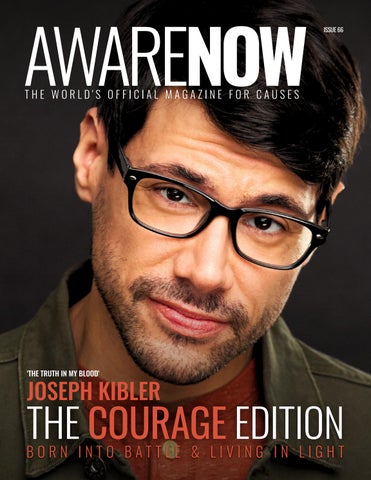
AWARENOW
ISSUE 66
THE WORLD'S OFFICIAL MAGAZINE FOR CAUSES
‘THE TRUTH IN MY BLOOD’
JOSEPH KIBLER
THE COURAGE EDITION
BORN INTO BATTLE & LIVING IN LIGHT
THE COURAGE EDITION
ON THE COVER:
JOSEPH KIBLER PHOTO BY: SHANI HADJIAN
AwareNow Magazine is a monthly publication produced by AwareNow Media™, a storytelling platform dedicated to creating and sustaining positive social change with content that inspires and informs, while raising awareness for causes one story at a time.
006 BRAVE BEGINNINGS JACK MCGUIRE
008 AN OPEN LETTER TO LOVE THI NGUYEN
014 THE TRUTH IN MY BLOOD JOSEPH KIBLER
022 ON THE MAT SARAH THOMAS
032 THE CURSE OF COMPETENCE ALEX SEARLE
036 IF YOU TELL ANYONE NATHAN SPITERI
048 BECOMING
084 THE GIRL WHO CARRIES HOPE
ALLIÉ MCGUIRE
054 THANKS FOR BREAKING MY HEART RACHEL LEYCO
062 PERMISSION TO SPEAK LARS WESTRA
ADDI FRAZIER
092 WHEN LOVE CROSSES BACK ELIZABETH BLAKE-THOMAS
098 THE NEW FIT LEE-ANNE REUBER
068 THE DOWNLOAD DECISION JACK & ALLIÉ MCGUIRE
072 BEYOND THE FRAME ALLISON NORLIAN
080 THE INTELLIGENCE OF INNOCENCE GABY MONTIEL
106 WHAT WE DON’T THROW AWAY TOM COOK
112 SHAPING THE NEXT GENERATION DR. TODD BROWN
116 ONE LETTER AT A TIME DIANA WENTWORTH, JOY BLANCHARD
SUBSCRIBE FOR FREE: AWARENOWMEDIA.COM/SUBSCRIBE www.IamAwareNow.com
courage (n.) the ability to do something that frightens one; strength in the face of pain or grief Courage is choosing unity when division is easier. It is standing for others even when the ground beneath you is unsteady. It is crossing invisible lines not for recognition… but for what is right. I’ve always known I wanted to change the world. As a little boy growing up in Flint, Michigan, I dreamed of countless ways I would right all the wrongs around me. What I didn’t yet understand was this: the wrongs of the world are not the same for every person. I once heard the phrase, “The things that pull us together are sometimes the same things that pull us apart.” That truth has weighed heavily on my heart. So how do you change a world filled with so many different experiences, beliefs, and perspectives? The answer is clear. We educate. We listen. We make space. We let people know it’s okay to be different. It’s okay to believe what you believe. What we need now more than ever is unity. Standing behind what makes each of us uniquely different. That is the beauty of humanity. And that is the reason for AwareNow.
Despite all our differences, we stand up for you. Just as I always dreamed I would. We will no longer wait for permission to change the world. There are invisible lines that need to be crossed and courage is what carries us across them. I welcome you to this movement. And I can’t wait to stand beside you. AwareNow. More than ever. Jack
ALLIÉ McGUIRE CEO & Co-Founder of AwareNow Media Allié McGuire began her career as a performance poet, transitioned into digital storytelling as a wine personality, and later produced the Hollywood Film Festival. Now, as co-founder of AwareNow Media, she uses her platform to elevate voices and champion causes, connecting audiences to stories that inspire change.
JACK McGUIRE President & Co-Founder of AwareNow Media Jack McGuire’s career spans the Navy, hospitality, and producing the Hollywood Film Festival. Now, he co-leads AwareNow Media with Allié, focusing on powerful storytelling for worthy causes. His commitment to service fuels AwareNow’s mission to connect and inspire audiences.
WAIVER/DISCLAIMER
The views and opinions expressed in AwareNow are those of the authors and do not necessarily reflect the official policy or position of AwareNow Media. Any content provided by our columnists or interviewees is of their opinion and not intended to malign any religion, ethnic group, political group, organization, company, or individual. Stories shared are not intended to vilify anyone or anything. Their intent is to make you think. * Please note that you may find a spelling or punctuation error here or there, as our Editor-In-Chief has MS and lost vision in her right eye. That said, she still has perfect vision in her left and rocks it as best as she can. www.IamAwareNow.com
Courage is not always loud. JACK MCGUIRE
CO-FOUNDER OF AWARENOW Photo Credit: Jack McGuire 6
www.IamAwareNow.com
PERSONAL STORY BY JACK MCGUIRE
BRAVE BEGINNINGS THE EARLIEST FORM OF COURAGE
Courage is not always loud. Sometimes it wears borrowed ties, oversized confidence, and sunglasses that dare the world to look back. It stands before us unpolished and unafraid, experimenting with identity like it’s art… because it is. To be yourself, especially before the world tells you who you should be, is a quiet rebellion. It is choosing authenticity over approval, play over pretense, truth over trend. This is courage in its earliest form: not yet armored, but already unbreakable. Youth is not just an age. It is the pathway. It is where we try on versions of ourselves, where imagination leads and fear hasn’t yet learned how to speak loudly. In these moments, becoming is more important than being understood. The courage of youth reminds us that finding yourself is not a destination, but a series of brave beginnings. And if we’re paying attention, it teaches us something vital: the truest strength we ever have is the permission we give ourselves to simply be. ∎
7
www.IamAwareNow.com
I realized I was losing my light for someone who did not deserve it. THI NGUYEN
NONPROFIT CONSULTANT, ENTREPRENEUR & PHILANTHROPIST Photo Courtesy: Thi Nguyen 8
www.IamAwareNow.com
‘GO GREEN DRESS’ EXCLUSIVE COLUMN BY THI NGUYEN
AN OPEN LETTER TO FINDING LOVE WHAT LOVE TAUGHT ME ABOUT COURAGE
In my 20s, I experienced relationships that tested my beliefs about what love meant versus what I thought it should be. During that time, I got married unexpectedly in my late 20s, a marriage that ended as quickly as it began. My 20s taught me that I needed a partner who would stick with me in both the best of times and the worst of times. That fairytale ending was what I believed love was supposed to be. In my 30s, I fell in love. The old-fashioned kind of love. Handwritten letters and notes. Musical dedications. Unexpected surprises. Holding hands while exploring the world. The tenderness of young first love. The feeling of security. Unconditional love. Acceptance from his family. Lots of laughter, many firsts, the warmth of his embrace. A proposal. But life had other plans. It threw our relationship into the biggest test. Distance. Communication. Thousands of miles away, two continents apart, we continued. We stayed strong for two additional years. In the end, I felt I was holding him back from his full potential, and the distance, coupled with poor communication, broke us. I let him go, cried for months, and remained single for four years. During this time, I watched as my friends slowly got married, had kids, got divorced, and married again. My family and friends asked when I would get married and when I would have kids. My response was always the same. If it happens, it happens. I wanted to focus on my own happiness, not society’s expectations of what a woman my age should be doing. I wanted to understand what I needed and wanted in my next relationship. But most importantly, I wanted to rebuild my life and focus on doing something I would be proud of. Then COVID changed everything. 9
www.IamAwareNow.com
I still believe in love. THI NGUYEN
NONPROFIT CONSULTANT, ENTREPRENEUR & PHILANTHROPIST Photo Courtesy: Thi Nguyen 10
www.IamAwareNow.com
“How does one go from a loving relationship straight into an abusive one?” It changed the trajectory of my career goals. It changed my lifestyle. It shut down so many opportunities I had lined up. I was traveling for work 90 percent of the time, meeting incredible humans along the way. I did not realize how fast I was moving until COVID forced me to stop. In many ways, COVID ended up being good for my health, personal development, and growth. What I did not focus on was finding a partner, because I was content with my life. During COVID, I ended up in an abusive relationship. Someone who emotionally, mentally, and physically abused me. Someone who gaslighted me to lift himself up. The reality is, I cannot even blame him. I saw the red flags a few months in and did not walk away. Never in all my years on this earth would I have imagined myself in such a relationship. Now, I have a deeper understanding and empathy for those who find themselves in one. You begin to question every decision you make. Maybe he is just stressed. Maybe I could have done better. Maybe I am overthinking the situation. I am too picky. I should give him another chance. It is okay since this is the first time. It is okay because he is nice to me. It is okay because he is drunk. It is okay… The reality is, it is never okay. How does one go from a loving relationship straight into an abusive one? Part of me believes COVID facilitated this, especially since I asked him to move in with me during lockdown. The other part was my internal body clock. I knew I wanted a family. I felt ready to settle down. And settling is exactly what I did. The voices and expectations placed on women my age, the pressure to marry or have children by a certain time, haunted the back of my mind. While I refuse to believe those words did not affect me, I know they influenced my thought process and mental state when making decisions in relationships. I changed my lifestyle to conform to his. Toward the end of the relationship, I realized I could not dim myself because he was miserable. I realized I was losing my light for someone who did not deserve it. Courage. From the Latin cor, meaning heart. From Middle English, the seat of feeling. The courage to say, It is not okay. The courage to be okay with the end of a relationship. The courage to acknowledge bad decisions and grieve the loss of starting a family. The courage to rebuild yourself in the darkest times and walk toward a light that feels so far away. The courage to start over. 11
www.IamAwareNow.com
Photo Courtesy: Thi Nguyen 12
www.IamAwareNow.com
At 45, I have finally realized I need to drown out the noise society has pressured me to believe about being single and without a family. I have built a life I truly love. And although I still hear comments here and there, I now recognize that these words often come from love. From concern. From people who care deeply about my well-being and future. For that, I feel immense gratitude. This experience has taught me: Trust your gut instinct. Do not blame yourself for being forgiving. Be kind to yourself when your partner is not kind to you. Do not blame yourself for missing the red flags. Stay true to what matters to you in a relationship. Forgive yourself, because every experience is an opportunity to learn and grow. I have opened myself up to dating again and meeting so many wonderful humans. I still believe in love. I still believe in fairytale endings. I still believe in the good in people. I still believe that one day I will meet the right person at the right time. I am finally at a point in my life where I am so content, so happy, and so at peace that it would take someone truly extraordinary to disrupt that peace. This is where I hope you find yourself after reading my open letter to finding love. Just remember, it is never too late to start over. And it is never too late to walk away from something that no longer serves you. Single. Forty-five. Exploring the world. These days, you can call me a digital nomad, traveling more than 300 days a year. Perhaps one day I will meet someone worthy of my love, dedication, time, and commitment. And if not, that is okay too. Because I will continue impacting the world, one life at a time, in my own way. ∎
Happy to be an ear, shoulder or friend to help you through the difficulties and share our experience. Happy to meet liked minded individuals and connect anywhere in the world. Message me on Instagram @GoGreenDress to connect and let’s meet somewhere for a bite, tea, a stroll or to explore. Be the Light. Light your being. You’re meant to shine in this world. -Thi-ism
THI NGUYEN Nonprofit Consultant, Entrepreneur & Philanthropist www.awarenowmedia.com/thi-nguyen THI NGUYEN brings with her over 2 decades of non profit experience as a participant, advisor, board member, consultant, volunteer and research and development specialist. Her expertise combining technology to further advance the vision and mission for philanthropic causes has allowed her to serve as a trusted partner with many notable organizations large and small. Thi has experience working with organizations focusing on combating various global issues such as: human sex trafficking, homelessness, poverty, fair wages, global warming, malnutrition, gender equality, humanitarian assistance and human rights. She's currently developing an app to connect individuals and corporations to assist nonprofits in furthering their vision and mission.
13
www.IamAwareNow.com
Simply existing is advocacy. JOSEPH KIBLER
ACTOR, WRITER, FATHER & ADVOCATE Photo Credit: Shani Hadjian 14
www.IamAwareNow.com
EXCLUSIVE INTERVIEW WITH JOSEPH KIBLER
THE TRUTH IN MY BLOOD FROM THE DIAGNOSIS HE INHERITED TO THE DESTINY HE CREATED Some people spend their whole lives searching for courage; Joseph Kibler was born into it. His first breath came with a diagnosis, a prognosis, and a path no child should have to walk, being born with CP and HIV. Yet he found a way to rise, one determined step at a time. Today, as a father, artist, and advocate, his story is no longer about survival but about the quiet, steady truth he carries in his blood and the love he now passes forward. ALLIÉ: You were born into a story you didn’t choose. I suppose all of us are, but yours came with a series of letters that would be part of your life forever… CP and HIV. At what point did your story start to feel like yours? Something you were shaping, not just surviving? What is your origin story? JOSEPH: I think my origin story really began in theater. It started in high school, which was when I finally took hold of everything. Up until then, my cerebral palsy was very visually apparent. People knew I had a disability. But until I was about sixteen or seventeen, no one knew I was HIV positive. That was partly the time period. In the early 2000s, the stigma around HIV was still incredibly heavy. I found out when I was eleven, and at that time kids were still being
THE TRUTH IN MY BLOOD EXCLUSIVE INTERVIEW WITH JOSEPH KIBLER BY ALLIÉ MCGUIRE
CLICK, TAP OR SCAN
TO WATCH NOW
15
www.IamAwareNow.com
I stood on stage and said, “My name is Joseph, and I’m HIV positive.” JOSEPH KIBLER
ACTOR, WRITER, FATHER & ADVOCATE Photo Credit: Shani Hadjian 16
www.IamAwareNow.com
“As a kid, I needed to go from wheelchair to cane and feel proud. As an adult, I need to go from cane to wheelchair and feel okay.” JOSEPH: (continued) kicked out of school for being HIV positive. Parents were scared for their own children. There were protests, school board fights. So we didn’t talk about it. We kept it under wraps. Then I found theater. I found community. I started going to theater camps, and one exercise we were given was to go on stage and tell our peers something we had never told anyone. At seventeen, I thought, this is it. This is what I have to say. I didn’t fully understand it then, but looking back, I realize how deeply depressed I was. I think I was protecting myself, being defensive. I couldn’t comprehend the severity of it at the time because it would have been too much. So I stood on stage and said, “My name is Joseph, and I’m HIV positive.” The response was overwhelming. People were kind. Supportive. Understanding. That moment jump-started everything for me. From there, I started telling people sooner and sooner. It gave me control. It made my relationships feel real because people knew the full extent of who I was. I didn’t have that nagging question in the back of my head: if they knew, would they still want me in their life? That moment led me to acting. It made me realize this was the path I needed to be on. That’s when it became my story. ALLIÉ: I can imagine how empowering that must have been. Once you decide not to hide, there’s nothing left to fear. Let’s talk about mobility for a moment. You went from wheelchair, to walker, to crutches, to cane. Each step its own victory. Was there a quiet moment on that journey, one no one saw, that still sits with you today? JOSEPH: Honestly, the moment that stays with me isn’t about upward mobility. It’s about downward mobility. I built so much of my identity around being the person who went from wheelchair to walker to cane. All these milestones. This idea of progress. But then age started catching up with me. My body started wearing down from how much I had pushed it. I began falling more. And I realized I wasn’t doing what was best for my body now. I was doing what was best for it then. And what’s best doesn’t always look the same. Doing what’s best for your body isn’t about looking normal to other people. It’s about longevity. It’s about care. I have degenerative disc disease. I have almost no cartilage left. Everything is rubbing together. The pain is constant. And pushing myself harder wasn’t helping. Accepting a wheelchair again. Accepting crutches again. It’s like a mirror image of where I started. But this time, I’m giving myself the same grace. The same tools. Just on the other side of life. As a kid, I needed to go from wheelchair to cane and feel proud. As an adult, I need to go from cane to wheelchair and feel okay. And that’s wild. It’s like moving in reverse. But it’s still growth. ALLIÉ: That grace you’re giving yourself now is everything. Living with HIV from birth means carrying a truth most people never have to. How did that shape the way you saw your worth, your identity, and your decision to advocate? 17
www.IamAwareNow.com
I think the younger me would be grateful that I became proof of possibility. JOSEPH KIBLER
ACTOR, WRITER, FATHER & ADVOCATE Photo Courtesy: Joseph Kibler/The Actors Collective 18
www.IamAwareNow.com
“As long as I’m on my medication and diligent, I cannot transmit HIV. That realization changed everything.” JOSEPH: For a long time, I let it put me in bad relationships. Romantic ones. Friendships. I felt like I should be grateful that anyone wanted to be with me at all. That I came to the table with baggage, so I didn’t deserve more. I held myself to a lower standard.
Eventually, I took that power back. I learned about undetectable equals untransmittable. That as long as I’m on my medication and diligent, I cannot transmit HIV. That realization changed everything. I’m like anyone else. And I deserve what anyone else deserves. Respect. Love. Affection. And if I can’t advocate for myself, how can I advocate for others?
The truth is, disabled people are always advocating, even when we don’t mean to. Simply existing is advocacy. Every time you enter an inaccessible space. Every time someone says something inappropriate. Every time you defend your right to exist. That’s advocacy.
ALLIÉ: I want to talk about someone very special. When you held your son, Milo, for the first time, knowing he’d inherit your love but not your diagnosis, how did that feel?
JOSEPH: There was so much relief. So much love. That moment is overwhelming for everyone, but for me, it was also proof. Proof of everything I had ever said about being undetectable. Here was this living, breathing truth in my arms. Holding him felt like rewriting my story.
I had a complicated relationship with my own father. I spent years wondering how someone could hurt someone they loved so much. And then, holding Milo, it dawned on me: you do that by not loving them. That realization freed me. Because I knew immediately that I could never do that to him. The love was too strong. It helped me put that chapter to rest. To understand that his choices weren’t mine. And that love is not something that sneaks up on you. It’s something you choose.
ALLIÉ: If the younger you, the kid with the cane and a head full of questions, were sitting across from you right now, what would he thank you for?
JOSEPH: For still being here… I don’t think I knew I would be.
For a long time, I felt like a passenger in my own life. I assumed eventually something would be too much. That I wouldn’t make it. Then suddenly, I was thirty-something. Living in New York. Building a life. About to become a father. That’s when it hit me: I’m really here. And now I have to plan. Not just dream, but plan. I think the younger me would be grateful that I became proof of possibility. 19
www.IamAwareNow.com
I want to be remembered in small ways. JOSEPH KIBLER
ACTOR, WRITER, FATHER & ADVOCATE Photo Credit: Shani Hadjian 20
www.IamAwareNow.com
AwareNow Podcast
THE TRUTH IN MY BLOOD Exclusive Interview with Joseph Kibler https://go.awarenowmedia.com/podcast/the-truth-in-my-blood
TAP/SCAN TO LISTEN
“What I’m learning now is that maybe being remembered isn’t about grand gestures.” ALLIÉ: To close, let’s talk about truth and courage. What is one truth about yourself you are brave enough to say out loud now, perhaps one you haven’t said before? JOSEPH: I have a deep fear of being forgotten. I think a lot of artists have it. This desire to leave a mark. A footprint. It can be both a gift and a burden. You try to fill it, but it’s never enough. What I’m learning now is that maybe being remembered isn’t about grand gestures. Maybe it’s about small moments. My truth is this: I want to be remembered in small ways. Through my family. Through my son. ∎
Find & follow Joseph on Instagram: @josephakibler
21
www.IamAwareNow.com
Now I value my body even more than I ever have in my whole life. SARAH THOMAS
MS WARRIOR, YOGA TEACHER, AUTHOR & WELLNESS COACH Photo Courtesy: Sarah Thomas www.IamAwareNow.com
EXCLUSIVE INTERVIEW WITH SARAH THOMAS
ON THE MAT
LISTENING TO THE BODY & LIVING WITH MS This conversation takes place not across a table, but on two yoga mats, where listening matters more than performance. Sarah Thomas joins me in a shared, embodied space to talk about yoga, multiple sclerosis, and what it means to stay connected to your body when it does not always behave as expected. What unfolds is not a lesson in poses, but a quiet reminder that wellness begins with compassion, presence, and permission to adapt. ALLIÉ: We are both sitting here not as a host and a guest, but as bodies that have lived a lot. Before we talk about any titles or diagnoses, can you tell me what it feels like to arrive on your mat today, right now, in this season of your life? What does that feel like, Sarah? SARAH: On my mat, in this present moment, I feel a sense of peace. The mat, for me, represents stability. In a world that feels very active right now, especially with the holidays and everything going on, it gives me grounding and stability, which brings peace. A little moment of peace, right here, right now.
ON THE MAT EXCLUSIVE INTERVIEW WITH SARAH THOMAS
CLICK, TAP OR SCAN
TO WATCH NOW
23
www.IamAwareNow.com
People rush too much to the end. Why? Be here. Be at the beginning. Be present. SARAH THOMAS
MS WARRIOR, YOGA TEACHER, AUTHOR & WELLNESS COACH Photo Courtesy: Sarah Thomas 24
www.IamAwareNow.com
“I felt a deep sense of loss. But what I really lost was the illusion of control.” ALLIÉ: I share that peace with you, and I love how you describe it as grounding. Literally being on the ground, but also how it pulls us into a space where we can simply be. I’d love to talk about your relationship with yoga, which began long before I met you, even before you consciously chose it through your mother and her prenatal classes. When you think back to that early imprint, what do you think yoga was quietly teaching you about yourself before you ever knew you would need it? SARAH: I think yoga was teaching me not to lose my childlike love of life as I moved into adulthood. When I think back to being a little kid doing yoga with my mom and her teachers, I remember the innocence and purity of the process, learning new things and always being a student. I love being a student more than being a teacher, because I’m always learning something. Even when I think I know something, I probably forgot it because of my MS. I love picking up a yoga book and going back to the beginning. There’s a sense of holiness there for me. I remember being four or five years old, doing yoga with my mom and her teachers. In my adult years, I still ask myself, what am I learning now? Where am I growing? Not just physically learning a new posture, but asking myself, can I meditate a little longer? Can I take it a little deeper than I did when I was four? That’s where it lives for me now, connecting childhood and who I am today. ALLIÉ: That’s so beautiful. I love the way you honor the beginning. So often we’re rushing toward the next thing, but finding strength and excitement where you started is incredibly powerful. SARAH: People rush too much to the end. Why? Be here. Be at the beginning. Be present. It will get there. Stay a seed. Don’t rush into becoming a tree. Stay a seed a little longer. Keep growing. Don’t get stagnant. Keep learning. ALLIÉ: You were also an athlete, a mover, someone who trusted their body. Then MS entered the conversation. As someone who lives with MS myself, I know how loud that moment can be when you first hear the diagnosis. What was the hardest thing you had to grieve about your body, and what did yoga eventually give back to you that you didn’t expect? SARAH: That’s always emotional for me. I felt like my body was no longer mine. I had done yoga, ballet. I felt empowered by my muscles, my movement, my ability to express myself. Then suddenly I couldn’t walk. I couldn’t turn a key. I couldn’t hold a coffee cup. I felt a deep sense of loss. But what I really lost was the illusion of control. Teachers had said it before, but I didn’t fully understand it. You think you’re in control, but you’re not. That illusion shattered, and it awakened me. Now I value everything my body can do, even the smallest things. On a bad MS day, when I turn the key in my front door, I cheer myself on. I celebrate it. My neighbor once asked why I do that, and I told them it’s because I value even the smallest motion. 25
www.IamAwareNow.com
SARAH: (continued) I don’t take my body for granted anymore. Walking. Touching. Feeling nerve endings in my fingers. Hugging someone. Placing my foot on the ground. Even if I’m using a walker, I’m still walking. It made me humble. I needed that. ALLIÉ: I love how you said that you didn’t lose control of your body. You lost the illusion of control. How can you lose something you never truly had? That’s powerful. You didn’t just adapt yoga for yourself. You reimagined it for others through 365 Yoga Dream, chair yoga, your book, and inclusive practices. What was the moment when you realized this work wasn’t just personal healing, but something you were meant to offer outward? SARAH: I’ve always wanted to help people heal in some way. I love watching people move, find clarity, find peace. But I started noticing people with disabilities being ignored in classes. That didn’t feel right. Yoga is for everyone. Every body. Every color. Every ability. I kept hearing people say, “I do yoga, but the teacher doesn’t know what to do with me.” That’s when I thought maybe I could write a book, show a new way of practicing, and help people find relief from chronic pain. I had to change my own practice, and I wanted to help others see that you can teach a class where some people are on mats and some are in chairs, and everyone feels included. We do it together, as a community. 26
www.IamAwareNow.com
AwareNow Podcast
ON THE MAT Exclusive Interview with Sarah Thomas https://go.awarenowmedia.com/podcast/on-the-mat
TAP/SCAN TO LISTEN
ALLIÉ: Community is such a powerful word, especially within the MS community. Being able to serve in that way must be incredibly fulfilling. SARAH: It’s so fun. People meditate in chairs and say, “I didn’t know you could meditate in a chair.” You can meditate anywhere. Just breathe. Great teachers like Giovanni, who teaches accessible yoga, opened my eyes to new ways to serve the disability community. Teaching everyone, truly everyone, is a beautiful thing. ALLIÉ: You speak beautifully about celebrating small wins. Turning a key. Getting out of bed. Listening instead of pushing. Giving yourself permission. If someone living with MS or chronic pain feels disconnected from their body today, what would you want them to know about what still counts as strength? SARAH: Strength doesn’t have to look big or muscular. If you woke up today, opened your eyes, and took a breath, that means there’s purpose for you. Sometimes strength is sitting next to someone and breathing together. Living with MS is hard. You didn’t ask for it, but you are strong just for living with it. Holding a toothbrush can be strength. Splashing water on your face can be strength. Getting out of bed can be strength. Don’t discredit the little things. The little things are big things. Find strength there. ∎
Find & follow Sarah on Instagram: @365yogadream Get her book ‘Chair Yoga for Multiple Sclerosis & Chronic Pain’ https://go.awarenowmedia.com/book/chair-yoga-for-ms-and-chronic-pain
27
www.IamAwareNow.com
Every one is a part of everyone.
FIND STORIES, STATS & SUPPORT
FOR THE CAUSES THAT TIE US ALL TOGETHER WWW.TABLEOFCAUSES.COM
Life is even shorter to be merely competent anyway. ALEX SEARLE
FOUNDER OF HUMBLE MIND 32
www.IamAwareNow.com
‘THE HUMBLE MIND’ EXCLUSIVE COLUMN BY ALEX SEARLE
THE CURSE OF COMPETENCE WHEN ABILITY BECOMES THE ENEMY OF PURPOSE
Throughout my thirty-five years alive, I've shown myself to be pretty good at a wide range of things. I can write and I can think. I can present and speak comfortably in front of a crowd. I'm creative and I can be reasonably logical. I can run a business, collaborate with others well, and generate new ideas. I can sing, play guitar, play squash, run and practice yoga. I'm a good dad and partner to my wife. I'm a decent friend. For both greater humanity and me, even writing this is a kind of phenomenal statement of progress. For tens of thousands of years, we've earned our place in civilisation by specialising. Now, the reality of being able to feed a family and build a career through a far broader skills set, and have enough cognitive and social intelligence to pull it off, seems like a modern luxury. At the same time, my above-average level of competence leaves me stuck in the agonising middle. Along with a billion other fairly talented people, we must trudge through life watching the effortlessly brilliant fly overhead and the lesser-so skate by below on blind determination and choiceless necessity. My wide palette of interests and highly receptive curiosity means that I can develop a basic level of skill in something new very quickly. It's easy for me, for example, to pick up a musical instrument, hear someone speak about a new subject or scrub to the middle of a podcast and, within about a minute, have an elementary sense of how to navigate what's going on and what to do next. Speed and context-switching make me effective, but they’ve also scattered my focus and diluted real depth. It has also left me with a deeper, more painful question: what if being competent is getting in the way of something I'm truly born to do or make? This is the curse of competence. Artists and writers whom I deeply admire, like Sting, Bjork or Alain de Botton, have earned their place in history because each of them have been able to evade or supersede the competence curse. Instead of being relatively OK at most things, they were likely terrible. This simple truth helped to erase most alternatives right off the bat and reduced their focus to just one or two, where their singular talents could be much more easily recognised and, crucially, invested in. Alongside enviable technical or natural talent, all of these people had something even more fundamental: a deep compulsion to keep going, even in the absence of any reward or reasonable alternative. There's a lovely four-letter word for that: grit. This is at the heart of the curse of the competent: at any time it gets hard or boring, there are other viable distractions to turn to. It's unbelievably easy to put the guitar down and switch over to writing or something else. Instead of working through the difficulty of boredom or the recesses of open space, which requires me to find the mettle to keep persisting and focus my attention, I can simply do what I am used to doing: aimlessly shift to the next reasonably good diversion. 33
www.IamAwareNow.com
There's much to be said about simplifying and lessening the load. When there's only one or two core objectives or passions at play, it's far easier to know where to focus your energy. When there are ten or twelve or fifteen, all vying for your full attention, occupying the same time and space in your head and heart, it's not just impractical, but wasteful and delusional. How on earth can you expect yourself to balance an utterly unbalanceable weight? The only outcome you're ensuring is falling over and bruising yourself with nothing to take home. When I encounter the sensation of resistance, boredom or difficulty, I'm learning to adopt a different strategy: to greet it as an invitation to inspect, rather than a sign to move along and avoid. It's easy to convince yourself with coy slogans like 'well it wasn't meant for me' or 'I can do this later when I feel like it'. It becomes apparent that my most polished skill is being generally acceptable at many things, and I’ve grown comfortable with that fact. Locating my inner grit becomes trying, and so goes untested and unseen. But in being increasingly attentive to this, a powerfully revealing set of sensations begin to surface. They appear in the form of dull twinges in various points in my body, connected to nameless thoughts that seem to say, perhaps I think I don't deserve to be great at something. Another whispers about my need for real recognition or how fast I need to make money. These utterances vary in truth, but are all useful in helping me to uncover the root of why I imprison myself in the middle. I'm compelled to listen and feel where they take root, not just in my body, but amongst the unquestioned beliefs that invisibly direct my life. It is certain to me that the real work in undoing the curse begins there. Being good, or even great at many different skills or interests may be my most dangerous threat to discovering the truest and most outstanding talent I have on offer. It's the smothering and jumbling and scattering of my best energies that blurs the picture I'm otherwise destined to paint, but wasting precious time by not making sufficient space for it. If I steel myself and willingly listen to those voices in my body, eventually I can hear another one, more soothing. It tells me, less is more, focus on the essentials and make space for the unknown. Take a chance and bet big on what makes it hard, because time is short. And life is even shorter to be merely competent anyway. ∎
Join the Humble Mind community: https://awarenow.us/join/humble-mind Find & follow Humble Mind on Instagram: @humblemindofficial ALEX SEARLE Founder of Humble Mind www.awarenowmedia.com/alex-searle ALEX SEARLE is a father of three, an avid road-tripper, and a passionate enthusiast of music, guitar playing, vintage books, nature adventures, yoga, and Indian cuisine. A prolific entrepreneur, podcaster, writer, startup advisor, and community builder, Alex has spent over 12 years collaborating with ambitious startups, global brands, and diverse entrepreneurs and organizations worldwide. Over the course of his career, he has founded four businesses, crafted six- and seven-figure content campaigns in industries such as software, travel, and energy, advised boards and executive committees on international digital strategies, and developed milliondollar pitch decks for blockchain and healthtech startups. His expertise lies in building stronger businesses and communities through authentic connection, peer-to-peer skills development, and human-centric storytelling.
34
www.IamAwareNow.com
It’s all about the messy part. That’s where we learn… That’s where we evolve. NATHAN SPITERI
ACTOR, WRITER, PRODUCER & CHILD SEXUAL ABUSE SURVIVOR Photo Courtesy: Nathan Spiteri 36
www.IamAwareNow.com
Trigger Warning: This story includes graphic details about child abuse/sexual violence.
EXCLUSIVE INTERVIEW WITH NATHAN SPITERI
IF YOU TELL ANYONE
A LIFE SHAPED BY SECRETS & CHANGED BY TRUTH Some stories are carried in silence because speaking them seems impossible. For twentyfive years, Nathan Spiteri lived with a secret that began when he was eight years old, reshaping his life through trauma, addiction, and survival. Now, through his book ‘Toy Cars’ and the documentary ‘If You Tell Anyone’, Nathan shares the truth he once feared to speak, so others might find the courage to reclaim their own. ALLIÉ: Before the world knew your story — before the film, the book, the advocacy — who was young Nathan in your own eyes? What do you remember most about the boy you were before life asked you to grow up too soon? NATHAN: I grew up in a small town in Australia where life was just very simple and easy and this sh*t didn't happen or we thought it didn't happen. I lived in a cul-de-sac. When this happened, I had an older sister and one younger brother. Since this has happened, my mom had another baby, so there's four of us. But before I had to grow up, there were three of us. There were quite a few kids in our cul-de-sac and the surrounding streets. Not every day after school, but most days after school, on weekend school holidays, all the kids would come to our cul-de-sac. We'd play cricket on the street. We'd play football and soccer and ride our bikes around and hide and seek and all these just fun, normal kid games. Speaking to my sister and speaking to my family about this, before the incident, they said I was just a normal, fun-loving kid who would go out and play and just enjoy life as an eight-year-old.
IF YOU TELL ANYONE EXCLUSIVE INTERVIEW WITH NATHAN SPITERI BY ALLIÉ MCGUIRE
CLICK, TAP OR SCAN
TO WATCH NOW
37
www.IamAwareNow.com
The doors are slowly starting to open, and I’m finally able to walk through. NATHAN SPITERI
ACTOR, WRITER, PRODUCER & CHILD SEXUAL ABUSE SURVIVOR Photo Courtesy: Nathan Spiteri 38
www.IamAwareNow.com
“The first thing he said was that if I told anyone he’s kill me and my family.” ALLIÉ: For those who are coming to your story for the first time, and only because it is part of the message you share so openly, can you tell us what happened when you were eight years old that changed the direction of your life? NATHAN: Of course. So, you know, again, like I said, growing up in a small town, there was the local swimming pool, and it felt like the whole town would go to this swimming pool. So it was summer holidays, just after Christmas, obviously opposite to America. And this is something that my sister and I would do two, three, four times a week. We would ride our bikes down to the pool and you know, go and swim all day. Then we'd ride our bikes home. This one day, another normal day, we rode our bikes down, but my sister left earlier with her girlfriends. She's two years older than me. So, she was probably 10. And she left early in the afternoon. That was fine. Because again, I'd ridden my bike home hundreds of times before. I stayed to the very end till close and literally everyone had left. I went into the change rooms to get changed. I was followed in by a man. He cornered me in the shower, and he raped me. The first thing he said was that if I told anyone he'd kill me and kill my family. So, I was an eight-year-old back then when there was no access to mobile phones, to the internet, to the organizations and hotlines we have today. I took what he said as gospel, and I didn't tell a soul. This relationship with this man went on for five years until I was 13-years-old. It started out very rough and violent. He would throw me against the wall, choke me out, punch me, kick me, slap me, rape me violently. Through his grooming, his lies, his manipulation, it turned into a Stockholm syndrome type relationship where I felt nothing. I wanted to be with him. He was telling me that my parents don't like me, that they want me to be with him, that my parents think I'm a liar, that my siblings think the same, that I picked him up at the pool, and that if I go to the police or anything like that, I'd go to jail and he'd be free and that I'd never see him again. So just all of this stuff… him telling me how special I was and that this only happens to special little boys. Then at 13years-old, he just disappeared out of my life. He left town. So he either got caught or he got in trouble with the police. During the next two years, I kind of questioned who I was, what I was, where I belong in the world, who do I belong with? Am I gay? Am I straight? Again, he told me how special I was. In the next suburb over from my town was an industrial estate. In this estate were gay clubs, sex clubs, cruise lounges. I would sneak in there at 15-years-old. These men would feed me copious amounts of drugs, get me f*cked up, and rape me again. But then as I got a little older, I would turn around and beat them up, bash them, rob them. And that was my ‘f*ck you’ to the world. That was my way of getting my power back. That was my way of feeling, just trying to feel something. That went on for a good 20 years. I fell in with the wrong crowd, shooting heroin, smoking crack, selling my body for sex… I tried killing myself. I was doing acting and modeling in Australia, and then I got invited to the States to New York to do theater and to go to school there. So I thought I could get away from that life in Australia and move to New York, start all over again. But it's New York City… You can get what you want, when you want, and how you want it. I fell back into it. I fell back into the drugs, the violence, the sex, and the acting out. I almost killed someone and almost killed myself. And when that incident happened, I knew that was my do or die moment. My now or never, or I was going to end up in jail, on the street or dead. So I finally told a best friend. After 25 years, it was from age 8 to 32, I didn't tell a soul. So after 25 years of silence, suffering, and going through this alone, I finally told my best friend in New York. She helped me find a therapist. So I did therapy, group therapy, rehab, AA, narcotics anonymous, sex anonymous, all of those. And it's been a 10 year journey of healing and discovering who I am, my relationship with this man, with family, with friends, with lovers. 39
www.IamAwareNow.com
The trauma was always there. It was always living inside me. NATHAN SPITERI
ACTOR, WRITER, PRODUCER & CHILD SEXUAL ABUSE SURVIVOR Photo Courtesy: Nathan Spiteri 40
www.IamAwareNow.com
“80% of suicides globally are male, 70% of those are due to unresolved childhood trauma.” NATHAN: (continued) Now, I speak all over the world about this… in Australia, England, the States, India, and Amsterdam. I do keynotes. I did a TED talk. My memoir came out, and then the documentary, and now my memoir is being turned into a movie. So it's definitely been a journey of self-discovery, of healing, of understanding and education. Back to my memoir, when I got the book deal, one thing I said to my publisher was that if I write this book, I'm including all the details. I'm putting it all in there. And it's raw and it's real. Because you get a lot of people who will say, “I was raped at eight, but today I'm fabulous.” And that's all they say. But it's all about the sh*t in the middle. It's all about the messy part. That's where we learn. And that's where we grow. That's where we evolve. That's where we educate ourselves. So yeah, that's kind of been my journey. It hasn't been easy. It's been a struggle. And to a certain extent, it sometimes continues to be a struggle. But we're definitely getting there. The doors are slowly starting to open, and I'm finally able to walk through. When my memoir came out, when the TED talk came out, and to a certain extent, when the documentary came out, me and my team would go to the media and 95% of the media said to me, “If you were a woman, we would talk to you, but because you're a man, we're not going to talk to you.” And when I say this, I'm generalizing, obviously. But no one gives a f*ck about male sexual abuse. No one cares. Let's pretend it doesn't exist. Let's just turn a blind eye because it's men. And that's the problem with society... and that's a problem with men today. You know, we are taught at such a young age to not show fear or depression or anything like that. Don't let people see through the cracks. We've got to be strong. We've got to be brave. All of that shame, toxic masculinity. That’s the reason why men don't come out and talk about this because of how they're going to be perceived. And the problem is men hold it all inside. They suppress it. They pretend it doesn't exist, but it just builds and builds until we explode, until we hurt ourselves, until we hurt someone else, mass shootings, murder, suicides of wives and children. It's a mass problem in the world. 80% of suicides globally are male, 70% of those are due to unresolved childhood trauma. So it's all right there. It's all right there… but still, as a society, we don't care and we don't want to know about it. ALLIÉ: Right, because it's too uncomfortable to talk about. NATHAN: Absolutely. ALLIÉ: Let’s talk about trauma, Nathan. Trauma leaves echoes. Not always in memories, sometimes in behaviors or beliefs. Looking back, what were the subtle ways your younger self tried to communicate pain without having the words to say it? NATHAN: It's so interesting because I have an amazing family, very loving and caring. And they would see me as a young boy, as a teenager, going through all of this. They would see me cry for months. They would see me depressed. They would see me unable to leave my room, unable to eat, unable to do anything. And they would always say, “Nathan, what is wrong with you? Let us help you. We're here. Please, please, please.” They were worried. They were stressed about me. And all I would ever say to them is, “Don't worry about it. You wouldn't understand. Just leave me alone.” What coping mechanisms for myself? Well, my dad used to smoke back then. He doesn't smoke now. And he was a bit of a drinker. I would steal his cigarettes. I would steal his beer out of the fridge. I would run around the corner and I would just drink, smoke his cigarettes, and then just act out and go to these places where I could just escape and feel. And that's kind of where my love for acting and writing came from. I would hide away from the family. And whether it was in my dad's room or one of the TV rooms, I would just sit there and watch movie after movie after movie and TV show after TV show. And I would get lost in the storylines, get lost in the characters, get lost in what was happening. And that was my escape from reality. 41
www.IamAwareNow.com
NATHAN: (continued) That was my chance to just be normal or for that little moment in time, be someone else, feel something else, act something else, and not have to be me, eight-year-old Nathan, going through all this and having to relive it all the time. So I guess I was acting from eight-years-old because I didn't tell a soul until I was 32. And I hid it every day of my life. And it almost killed me. The trauma was always there. It was always living inside of me. We are not born into trauma. Trauma is put into us through these instances, through these acts of violence… I was living the trauma every day, sometimes self-inflicted, sometimes inflicted by others. And that was all I knew. And that was all I did to survive. As an eight-year-old boy, I had to grow up. My childhood was over. So I did what I had to do to survive and be. And the easiest thing for me to survive and be was to push my family away and kind of disconnect from them. And that whole Stockholm syndrome type thing with this man… I would ride my bike to his house wanting to see him, wanting to be with him, all while knowing what was going to happen to me. But I was okay with that because in my head, he was the only one I was receiving love from and comfort… having a shower with me, giving me food and drink, just putting his arm around me, telling me how lucky I was, how sweet I was, how much he loved me. And that was what I knew. ALLIÉ: So let's talk about the fact that a lot of survivors from different traumas describe coping, not as a choice, but as an instinct, as you just described as something that brought you comfort because it was what you knew. When it comes to what quiets the noise and what helps you escape yourself and your situation, when you reflect on the addictions that took hold, what do you think you were trying to escape the most? And what were you hoping to feel instead? What were you trying to escape? Was it shame or being scared? NATHAN: Great question. I think it was a bit of everything… It was the reality of it. It was the shame. It was being scared. It was the pain I was going through. I remember so clearly stealing my dad's cigarettes and just, you know, as an eight-year-old boy smoking these cigarettes and just losing my head. Even if it was for those quick 10 or 20 seconds, just being so dizzy and oh my God, this tobacco inside of me. It was my first kind of real taste of drugs. And that 10 second thing felt like a 10 hour thing. And I can just be and close my eyes and let go.
IF YOU TELL ANYONE OFFICIAL TRAILER
CLICK, TAP OR SCAN
TO WATCH NOW
42
www.IamAwareNow.com
“There is hope… We can get through it, and we can find peace. We can find love. We can find joy in the world, but we need to do the work.” NATHAN: (continued) That was probably where it started. And then it started again at 15 when these men would feed me drugs and then rape and abuse me. I'd be smoking crack and doing cocaine and all the stuff. And again, just losing my head, losing myself, just forgetting about all of it and just wanting these men to hurt me. As much as I hated it, as much as it was disgusting, I still got off on it. I still came. I still got a hard on. I still felt all those feelings because they're sexual feelings, and I felt them as much as I knew they were wrong. As much as I knew I didn't want it, I needed it. It was my addiction. And that's the same as the violence beating these men up and being violent toward these people. I needed it. And half the time I was the one getting beaten up because I was just some young skinny kid. So half the time I was getting it, but I wanted it because it allowed me for that instant in time to forget about everything else. ALLIÉ: Your film and your book turn pain into purpose for others. For someone listening who is still carrying a secret they never asked to keep, Nathan, what do you hope they feel in themselves after hearing your story — not what they should do, but what you hope they finally believe? NATHAN: That they're not alone. I want them to know that they have a voice, because all we want and all I wanted for the very longest of times was just someone to sit and listen. What I hope people get out of my story, whether they read my book or watch the documentary, is that people are going to believe them. People are going to love them. People are going to listen to them. People are going to just sit and listen to them and hug them and tell them it's going to be okay. For so many people, they'll come out and tell someone and that person will tell them to be quiet. It didn't happen. You're lying. That person would never do that to you. And as soon as they hear that, they suppress it, they push it far down and they will never talk about it again until, as I mentioned earlier, it just builds and builds and builds inside of them until they lose it and lose control and act out and do something. I just want these people to know that there is hope. They can get help, but it's not a quick fix. I need to say that. It's not, “Okay, I'm going to come out and tell someone, and now I'm all better.” Because I remember the very first time I told my best friend in New York. I felt like the weight of the world had just fallen off me. But then as soon as I left her and I was out on that street on my own, the weight of the world just came back onto me tenfold because it's like, “Okay, this sh*t is real now. I need to go to work. I finally broke that door open and so many emotions, feelings, triggers are all rushing in. So if I don't do the work now, it is going to kick my ass and it's going to damage me twice as hard.” So there is hope. We can get through it, and we can find peace. We can find love. We can find joy in the world, but we need to do the work. ALLIÉ: So, as a mother of six kids, the youngest being a seven-year-old boy… NATHAN: Yeah, exactly. ALLIÉ: I can't… I can't imagine. 43
www.IamAwareNow.com
It took time for them to understand, to realize, and I guess just process the whole thing. NATHAN SPITERI
ACTOR, WRITER, PRODUCER & CHILD SEXUAL ABUSE SURVIVOR Photo Courtesy: Nathan Spiteri 44
www.IamAwareNow.com
“Because they saw the years of depression, of drugs, of abuse, of violence, of sex, of acting out, of just being so lost in the world, sitting at home crying… But then when I said I was abused, that was like the final piece of the puzzle.” NATHAN: Yeah. So I was, you know, a year older than your youngest. But I just had one older sister, and at least he has five older siblings to help him. Today is such a different time to when we were kids, to when you and I were younger, and our parents would say, “All right, get out. Don't come home until dinner.” That's how life was back then. It's so interesting when I told my parents for the first time, and when I told my older sister. It was six months after therapy. I was in New York. My family were all in Australia. I knew my parents were coming to visit me. My therapist and I kind of came up with a plan to tell them. As a mother of six kids, you might appreciate this, it's quite funny. It's funny, but it's not, but it is. I said to mum and dad, “There's something I need to tell you.” And the first thing mum said was "You've got a girl pregnant.” I'm like, no. “You're in trouble with the police.” No. “You owe someone money.” You know, all of those mother type questions. And I'm like, “No, please just be quiet. I need to tell you something.” I said, “I was raped as a kid. I was abused as a kid.” And mum's like, “No, you weren't. We didn't hurt you. No one hurt you.” And then I said, “It happened at the local swimming pool the first time.” And then she wanted to know the who, the what, the when, all those basic, straight questions. But then the next thing that she said and the next thing my sister said were the exact same things and they weren't together. I told them separate times. The first thing they both said was, “Wow, that explains everything. Now we get it.” Because they saw the years of depression, of drugs, of abuse, of violence, of sex, of acting out, of just being so lost in the world, sitting at home crying. And they would be like, “Nathan, what the f*ck is wrong with you? Let us help you. What's going on?” But then when I said I was abused, that was like the final piece of the puzzle. They're like, “Holy f*ck. Now we get it. Now we understand.” But then I was so sad because mum and dad had come to visit me in New York. They slept in my bed, and I slept on the couch. After I told them, all I heard was my mum cry all night... And then we didn't talk about it for about six months because they needed to go away and process it. The guilt, the anger, the shame they probably felt, it killed them. And they didn't know how to bring it up, but now we have an amazing relationship. We're all very close now, but it took time for them to understand, to realize, and I guess just process the whole thing. ALLIÉ: Yeah, but how amazing that after that hurt to now be closer because of it, because now they understand, and now it's not something you're hiding from them. Now, there's no barriers between you any longer. 45
www.IamAwareNow.com
If we want to educate our children on this, we first educate ourselves as adults. NATHAN SPITERI
ACTOR, WRITER, PRODUCER & CHILD SEXUAL ABUSE SURVIVOR Photo Courtesy: Nathan Spiteri 46
www.IamAwareNow.com
AwareNow Podcast
IF YOU TELL ANYONE Exclusive Interview with Nathan Spiteri https://go.awarenowmedia.com/podcast/if-you-tell-anyone
TAP/SCAN TO LISTEN
“This is just something that men don’t talk about.” NATHAN: No, there's not. We just had a family holiday, and it's the first time ever I felt a real connection and belonging to them and with them. And it was beautiful. It was amazing. It's been a hard journey with the family at first. I never really felt connected to them and I never felt belonging for Christmas, birthdays or anything. When they’d try to show affection or love, I would just run away from it and not want it. I’d move to the other side of the world to be away from them. But, you know, it's brought us a lot closer together and it's a beautiful feeling. ALLIÉ: Well, this has been a beautiful conversation. Nathan, thank you so much for having the strength, the courage to show up like you do, for speaking your truth, which I can only imagine, as you were saying, to be so healing, but healing perhaps for others as well, where they can find a way, a place to start. NATHAN: Absolutely. And that's what it was all about. I always said if I can save one person's life in this journey, if I can help one person from going down the road I did and help them find some peace and closure, then I know I've done the right thing. And the thousands of people that have reached out to me tell me that I've saved their lives, it makes it all worth it. Because this is just something that men don't talk about. I’m maybe one of two or three guys in the world who are actively out there openly talking about my experience and male sexual abuse and child abuse. There needs to be more of us. We need to start the conversation. We need to end this stigma. We all need to grow as a society together and learn together. Especially if we want to educate our children on this, we first educate ourselves as adults. ALLIÉ: Yes. And to that point, yes, these conversations can hurt, but I believe that if we can hurt together, we can heal together. NATHAN: Yes, very well said. ∎
Find & follow Nathan on Instagram: @nathanspiteri
47
www.IamAwareNow.com
This butterfly isn’t about beauty. It’s about becoming. ALLIÉ MCGUIRE
CO-FOUNDER OF AWARENOW Photo Credit: Bill McCullough 48
www.IamAwareNow.com
FEATURE STORY BY ALLIÉ MCGUIRE
BECOMING
STILL HERE, STILL BECOMING, MS AND ALL Becoming is not a finish line. It is the moment you stop asking your body for permission to live inside it and start choosing presence anyway. This is a story about pain, purpose, and the courage it takes to keep becoming when the path was never chosen. A tattoo is pain with intention. MS is pain without permission. Both teach you how to breathe, how to stay, how to claim your body anyway. This butterfly is not about beauty. It is about becoming. Because I can. I did not choose multiple sclerosis, but I choose how I meet it. Every day, my body presents negotiations I never asked for, and yet I show up. Not because it is easy, but because leaving is not an option. Staying is an act of rebellion. The butterfly inked on my back was not about reclaiming beauty. It was about marking a threshold. Butterflies do not transform quietly or comfortably; they dissolve before they emerge. Becoming requires a willingness to shed what once worked and to trust what has not yet taken shape. Living with MS teaches you that control is an illusion, but agency is not. Some days strength looks like movement. Other days it looks like stillness, listening, or rest without apology. Becoming is learning to honor all of it. Because I Can began as a documentary, but it refused to stay contained. It became a movement because it had to. Because the stories of living, choosing, and continuing deserved more than a screen. They deserved momentum. Becoming is not about conquering illness or romanticizing resilience. It is about inhabiting the truth of your body as it is, not as it was or should be. It is about choosing presence over permission, intention over fear, and saying, again and again, because I can. 49
www.IamAwareNow.com
50
Photo Credit: Bill McCullough www.IamAwareNow.com
AwareNow Podcast
BECOMING Personal Story & Original Poem by Allié McGuire https://go.awarenowmedia.com/podcast/becoming
TAP/SCAN TO LISTEN
“Becoming means listening more closely than you ever wanted to, and honoring what you hear even when it changes daily.” There is a strange intimacy that comes with living inside uncertainty. You learn your body in a language most people never have to speak, one made of signals, pauses, and intuition. Becoming means listening more closely than you ever wanted to, and honoring what you hear even when it changes daily. Pain, when it is constant, becomes a teacher. Not a gentle one, but a truthful one. It strips away performance and pretense, leaving only what is real. In that space, becoming is no longer about who you impress, but about who you are when no one is watching. The butterfly carries this truth quietly. It reminds me that transformation is not a single moment, but a series of surrenders. Each time I meet my body with compassion instead of frustration, I step further into who I am becoming. This journey has shown me that strength is not loud. It does not announce itself or demand recognition. It lives in the small choices, the repeated decisions to keep going, to keep loving, to keep believing in a future that may look different than imagined but is no less meaningful. Becoming is not a chapter I will ever close. It is a practice. One I return to every time I choose intention over fear, presence over permission, and the quiet, radical truth that I am still here. And that is enough. ∎
Learn more about the documentary ‘Because I Can’: www.becauseicanfilm.com Be part of the movement with the ‘Because I Can’ 5K: www.becauseican5k.com And should you need some new ink, reach out to the incredibly talented tattoo artist whose work is featured here: www.instagram.com/larazatattoos
52
www.IamAwareNow.com
It isn’t just for me. It’s bigger than me. RACHEL LEYCO
AWARD-WINNING FILMMAKER, ACTRESS, AND ACTIVIST Photo Credit: Bianca Catbagan www.IamAwareNow.com
EXCLUSIVE INTERVIEW WITH RACHEL LEYCO
THANK YOU FOR BREAKING MY HEART
AN AAPI FILMMAKER’S JOURNEY THROUGH LOVE, LOSS & RESILIENCE Rachel Leyco is an award-winning filmmaker, actress, and activist whose stories unapologetically merge vulnerability with empowerment. Her latest project, Thank You for Breaking My Heart, recently premiered at the LA Shorts International Film Festival, exploring love, loss, and the will to keep going in the face of heartbreak. Through her production company, Empowerhouse, Rachel continues to push boundaries as a queer AAPI storyteller determined to create space for voices too often left unheard. ALLIÉ: Rachel, before we get into the layers of your work, let’s start with your latest project, Thank You for Breaking My Heart. For those who haven’t yet seen it, can you share what the story is about? RACHEL: So, Thank You for Breaking My Heart is a fantasy dramedy queer short film that I wrote, directed, and star in. It really came from this question of what if we couldn’t die by suicide and we had to apply to some kind of magical administration, similar to the DMV.
THANK YOU FOR BREAKING MY HEART EXCLUSIVE INTERVIEW WITH RACHEL LEYCO BY ALLIÉ MCGUIRE
CLICK, TAP OR SCAN
TO WATCH NOW
55
www.IamAwareNow.com
I really bring in my own lived experiences, but I try to look at them through a lens of compassion and grace… RACHEL LEYCO
AWARD-WINNING FILMMAKER, ACTRESS, AND ACTIVIST Photo Credit: Bianca Catbagan 56
www.IamAwareNow.com
“In a lot of my work, whether it’s bipolar, depression, anxiety, or mental health more broadly, I try to explore the nuance. It’s not black and white, and that’s where I like to live and tell stories, in that messiness of our lives.” RACHEL: (continued) It follows this heartbroken documentary filmmaker and artist who wants to apply to die by suicide. In that process, she has to create either a visual or written essay, and she opts for making a visual essay, kind of documentary-style. Upon reflecting on her life, her past, and her most recent heartbreak, she finds new light and new hope for her life through that process. ALLIÉ: It sounds fascinating. It’s super powerful. I mean, even just the title, Thank You for Breaking My Heart, feels so intimate yet vulnerable. When you step into the role of both writer and actress in a story that explores heartbreak and even brushes against mortality, how much of yourself did you bring to the screen, and how much did you leave behind the curtain? RACHEL: I definitely brought a lot of myself into it, especially when I was writing and creating the concept for the film. A lot of it is inspired by my own experiences with heartbreak, not just in romantic relationships, even though the film is largely centered on that, but also heartbreak in relationships with my family or friends. I also interweave my experiences with mental health and mental illness, because I’m really interested in psychology and mental health, and especially the intersectionality of it all. My queer identity, my Asian identity, and exploring all of that through this lens of relationships. ALLIÉ: So many layers to uncover and explore. Your work often weaves together identity, queerness, and mental health with both courage and humor. How has your own journey with Bipolar II shaped the way you tell stories, not just on the page, but also in the spaces between takes? RACHEL: That’s such a great question. In a lot of my work, whether it’s bipolar, depression, anxiety, or mental health more broadly, I try to explore the nuance. It’s not black and white, and that’s where I like to live and tell stories, in that messiness of our lives. I really bring in my own lived experiences, but I try to look at them through a lens of compassion and grace, while also honoring reality. These are heavy, difficult topics to talk about, let alone portray on film in a way that audiences can truly grasp. 57
www.IamAwareNow.com
Through storytelling, we want to empower our communities… RACHEL LEYCO
AWARD-WINNING FILMMAKER, ACTRESS, AND ACTIVIST Photo Credit: Bianca Catbagan 58
www.IamAwareNow.com
“We need to be the ones telling our stories through our own perspectives and lenses.” RACHEL: (continued) So I balance that with humor, which is why there’s a lot of humor in the beginning of this film. Comedy is medicine. It’s a way to connect with the audience, to break them open a little, and then go deeper. That’s very intentional in how I structure my work. ALLIÉ: Let’s talk about your production house. Empowerhouse isn’t just a name. It feels like a manifesto. What does empowerment through storytelling mean to you right now as an AAPI woman filmmaker navigating both the industry and the responsibility of representation? RACHEL: I started Empowerhouse a while ago, and at first it was honestly just me. Every film project I did was under this banner of Empowerhouse. But last year, I really wanted to expand it and turn it into a true community and team effort, so I brought on a couple of incredibly talented filmmaker friends. We’re still a very small, tight-knit team, but I’m so proud of what we’ve been able to do in just this past year. It’s definitely more than a production company or a brand. Through storytelling, we want to empower our communities, our queer communities, our AAPI communities, and BIPOC communities. Hollywood has been really tough through my own experiences. There aren’t many opportunities afforded to us, so a lot of times we have to create them ourselves. That’s why I started this. It isn’t just for me. It’s bigger than me. Our tagline is that we tell underrepresented stories by underrepresented artists, because we need to be the ones telling our stories through our own perspectives and lenses. I got into filmmaking because I wanted to create those opportunities for my people, opportunities that weren’t given to me. In empowering my community, I also empower myself. ALLIÉ: I love that. Of the people, by the people, for the people. Nothing for us or about us without us. You’ve partnered with incredible creatives, from Rain Valdez to Rosario Dawson. When you collaborate with other visionaries, what do you look for in that creative chemistry, and how do you know when it’s a story worth telling together? RACHEL: That’s a beautiful question. Collaboration and community are my favorite parts of filmmaking. It’s truly a team sport. When I look for collaborators, it really comes down to alignment. I want to know who they are, what they’re passionate about, and what their values are. If those align, you can feel it. I’m very intuitive, so when I sit down with someone and talk about who they are and the art they want to make, the chemistry either flows or it doesn’t. 59
www.IamAwareNow.com
There aren’t many opportunities afforded to us, so a lot of times we have to create them ourselves. RACHEL LEYCO
AWARD-WINNING FILMMAKER, ACTRESS, AND ACTIVIST Photo Credit: Leslie Alejandro 60
www.IamAwareNow.com
AwareNow Podcast
THANK YOU FOR BREAKING MY HEART Exclusive Interview with Rachel Leyco https://go.awarenowmedia.com/podcast/thank-you-for-breaking-my-heart
TAP/SCAN TO LISTEN
RACHEL: (continued) When it flows, it’s magical. That’s what I look for, and that’s very much how it was with Rain, Rosario, and my Empowerhouse team. ALLIÉ: Alignment is everything, especially when artistry is involved. One last question for you today. At the heart of all your projects, there’s a thread of resilience, identity, and love. If you could whisper one line to your younger self, the girl just stepping into theater and commercials, what would you say about who you’ve become? RACHEL: Oh wow. One line… I think I would say, “You’ve got this.” Younger Rachel was probably anxious and trying to figure out how any of this was even possible. But looking back, everything really does happen for a reason, on its own time. I truly believe that when something is meant to happen, it finds a way. So yeah, “You’ve got this.” ALLIÉ: That’s a beautiful whisper. RACHEL: I think so too. ∎
Find & follow Rachel on Instagram: @rachel.leyco
61
www.IamAwareNow.com
We are standing on the sidelines waiting to be heard. LARS WESTRA
EU YOUTH DELEGATE TO THE UN, SPEAKER & AUTHOR Photo Courtesy: Lars Westra 62
www.IamAwareNow.com
EXCLUSIVE INTERVIEW WITH LARS WESTRA
PERMISSION TO SPEAK WHY CHILDREN MUST BE SEEN AND HEARD
At just seventeen, Lars Westra speaks with the clarity of someone who’s spent a lifetime being underestimated. At twelve, he stood before a room full of adults to ask them to take children seriously and was told to go play football. Instead, he chose to play a different game: one that challenges the rules of who gets to speak and who gets to be heard. With gratitude not for what he’s been given, but for what he’s discovered, which is the power of persistence, perspective, and voice, Lars reminds us that change doesn’t wait for permission. It begins the moment we decide to listen. ALLIÉ: Let’s begin by going back. You were twelve years old, standing in a room full of adults, when a politician dismissed your words and told you that you were being used. For those unfamiliar with this part of your story, would you share what happened that day? LARS: Of course. I had already been active for about three years at that point. I was twelve, and I was thinking from the vision of children, about projects that are usually only decided by adults. I believed that the perspective of children is different, and sometimes even better. I stepped up to my provincial government parliament. I do not know the exact English term, but it was essentially the parliament of my province. I gave a speech saying that adults needed to listen more to children, that they needed to act now to combat climate change, and that every child deserved equal opportunities to develop themselves. EXCLUSIVE INTERVIEW WITH LARS WESTRA
PERMISSION TO SPEAK
Afterward, I received many positive reactions from politicians. But one parliamentarian told me that I was being abused by others, that I was being used in a political game about climate change, and that it was not my own opinion. She told me I should go play football, chase girls, and leave decision making to adults. I was twelve years old. I was very small. The microphone was too high. The room was filled with important adults, CLICK,flabbergasted. TAP OR SCAN cameras, and journalists. I was completely On one hand, I realized how far we still had to go to ensure children’s voices were valued equally. On the other hand, I felt empowered. I realized I could not trust politicians like her to make decisions in my interest. That was the moment I knew I needed to step up, on behalf of young people, to claim an actual seat at the table. That was where this part of my activism truly began. TO WATCH NOW
63
www.IamAwareNow.com
I realized how far we still had to go to ensure children’s voices were valued equally. LARS WESTRA
EU YOUTH DELEGATE TO THE UN, SPEAKER & AUTHOR Photo Credit: Julia de Keijzer 64
www.IamAwareNow.com
“I started noticing a pattern. When young people speak up, adults often look for reasons to dismiss them. They assume someone else put the words in their mouth.” LARS: (continued) I stepped up to my provincial government parliament. I do not know the exact English term, but it was essentially the parliament of my province. I gave a speech saying that adults needed to listen more to children, that they needed to act now to combat climate change, and that every child deserved equal opportunities to develop themselves. Afterward, I received many positive reactions from politicians. But one parliamentarian told me that I was being abused by others, that I was being used in a political game about climate change, and that it was not my own opinion. She told me I should go play football, chase girls, and leave decision making to adults. I was twelve years old. I was very small. The microphone was too high. The room was filled with important adults, cameras, and journalists. I was completely flabbergasted. On one hand, I realized how far we still had to go to ensure children’s voices were valued equally. On the other hand, I felt empowered. I realized I could not trust politicians like her to make decisions in my interest. That was the moment I knew I needed to step up, on behalf of young people, to claim an actual seat at the table. That was where this part of my activism truly began. ALLIÉ: Looking back now, how did that moment shape the way you see power, prejudice, and what it truly means to be heard? LARS: It showed me that we still have a long way to go, but also how important this work is. What happened afterward changed everything for me. The next morning, while eating breakfast before school, I received a phone call and suddenly found myself live on a radio show. I realized the story had gone viral. It was everywhere. Newspapers, news outlets, social media. But they were not talking about what I had said. They focused only on the politician’s comment. My family and I received hate messages and even threats. People could not believe that a twelve year old could have genuine concerns about the world. I started noticing a pattern. When young people speak up, adults often look for reasons to dismiss them. They assume someone else put the words in their mouth. They rarely engage with what is actually being said. 65
www.IamAwareNow.com
LARS: (continued) If that politician had said she disagreed with me and explained why, we could have had a real discussion. Instead, she dismissed me because of my age. That happens far too often. Young people are not taken seriously, and their ideas are not treated as authentic. ALLIÉ: You gave a powerful TEDx talk where you describe children’s lack of maturity as a kind of superpower. Their ability to think beyond the boxes adults have built. What could adults learn from the way children see the world, if they truly listened? LARS: That is actually very hard to learn. Adults have so much experience that they often think, “This is how we do it because this is how we have always done it.” I am already noticing that happening to myself as I get older. Children look at the world with openness. They ask why things are the way they are and whether they can be improved. Some people call that naive, but I see it as idealistic. That is their superpower. If you combine the idealism of children with the experience of adults, you can accomplish incredible things. The solution may eventually exist within the box, but you often need to go outside of it first to find a better way back in. ALLIÉ: Can you share an example of adults who got it right? Who listened not to respond, but to learn? LARS: Yes. I started my work when I was nine, believing that combining different ways of thinking could lead to better outcomes. That eventually grew into an organization. One example involved an organization that wanted to cheer up children in hospitals. They planned to build a virtual reality experience for children they could not reach in person. They asked me to review it. I watched it and then shared it with other children. We gave honest feedback. What was too long. What was boring. What worked. What could be improved.
WHY WE MUST LISTEN TO THE VOICES OF CHILDREN OFFICIAL TEDX TALK BY LARS WESTRA
CLICK, TAP OR SCAN
TO WATCH NOW
66
www.IamAwareNow.com
AwareNow Podcast
PERMISSION TO SPEAK Exclusive Interview with Lars Westra https://go.awarenowmedia.com/podcast/permission-to-speak
TAP/SCAN TO LISTEN
“What unites us is that we want a safe future, a healthy future, and a fair future… We want a voice.” LARS: (continued) That is how it should be. If you are creating something for children, you should ask children. Not only because it makes sense, but because the final result will be better for everyone. ALLIÉ: That idea echoes something we hear in other communities as well: nothing for us without us. One final question. If every child in the world suddenly had a microphone, and every adult was willing to listen, what would you want that first global message to be? LARS: Children and youth are not a single group with one opinion. Just like adults, we are diverse. And that is a good thing. What I try to do in my work now is represent youth beyond my own perspective. I recognize how privileged I am, and I try to find common ground among young people. What unites us is that we want a safe future, a healthy future, and a fair future. We want peace. We want to be included in decision making processes. We want a voice. We are standing on the sidelines, ready. The time has come for us to be truly heard. ∎
Find & follow Lars on Instagram: @larswestra_nl
67
www.IamAwareNow.com
For parents, there is a daily balancing act between offering independence and offering protection. JACK & ALLIÉ MCGUIRE
CO-FOUNDERS OF AWARENOW 68
www.IamAwareNow.com
FEATURE STORY BY JACK & ALLIÉ MCGUIRE
THE DOWNLOAD DECISION
A NEW APPROACH TO SAFETY THAT TRUSTS PARENTS & PROTECTS KIDS There are moments in technology policy that feel like they were written far away from the kitchen tables, carpool lanes and late night conversations where real life happens. The App Store Accountability Act is different. It is a rare example of legislation shaped with real families in mind, created not as a political performance or a corporate shield, but as a practical tool for parents raising kids in a world where childhood now includes a screen. If you are a parent, you already know the digital age arrived long before the guidebook did. You also know the feeling of watching decisions about technology being made in rooms where the people who live with the consequences were never invited. When conversations prioritize corporate comfort or political gain over the voices of parents, the result is not progress. It’s a dismissal. Ask any parent of a teenager today, and the answer will echo. Social media is where friendships are formed, curated and sometimes lost. It is where communities build confidence or break it. It is a space of discovery, connection and risk. For parents who grew up before phones were portals, there is a daily balancing act between offering independence and offering protection. It is not simple. It is not universal. It is a dance every family learns at its own rhythm. The App Store Accountability Act recognizes that reality. It gives parents the ability to know when their child is attempting to download an app and the chance to approve or decline. This allows parents to pause, research, talk, decide and lead as the most informed guide in their child’s life. Age verification, handled at the device level, strengthens privacy and ensures families are not submitting sensitive information again and again to companies they may not even know. This matters because young people need both access and safety. We know this intimately because our platform has elevated thousands of stories that prove it. This matters for the youth with a disability finding mentors and role models in spaces where physical barriers do not exist, the queer teenager searching quietly for mental health resources they are not ready to discuss at home, and the young artist discovering a digital community where their work is not only seen, but celebrated. Connection can unlock courage. Access can build identity. For many teens, the digital world provides the first door they are ever able to open. Policy that works for parents cannot be one size fits all. It cannot assume every family looks the same or lives the same. It must respect the values, cultures, time and circumstances of the people who raise the children this nation claims to care about. This bill trusts parents to make decisions rather than turning those decisions into mandates dictated by governments or corporations. 69
www.IamAwareNow.com
“Real progress begins with listening. Real solutions are built with lived experience at the center.” There is also a privacy truth we can no longer ignore. Under the current system, children enter personal information into platform after platform, creating countless opportunities for breaches and data exploitation. Centralizing age verification at the app store layer significantly reduces that exposure and helps restore a sense of control that parents have been asking for. The App Store Accountability Act is not a perfect answer to every challenge of raising kids in a digital world. No single bill ever could be. It is, however, a meaningful start. It is practical. It is protective. It preserves connection. It listens to the stories of families who have been living in the tension between access and safety for far too long. For years, we have documented what social change looks like when the people most affected are invited to speak. Real progress begins with listening. Real solutions are built with lived experience at the center. Congress has the chance to do what so many families have been hoping for. Listen to the people who know what raising kids online truly looks like. Pass legislation that protects privacy, respects parents and preserves the digital freedom young people need to learn who they are. Because social media bans don’t actually protect kids, rather they push kids into darker corners and reduce parental visibility, the better focus is on digital literacy and parental involvement. It is time for our laws to meet the moment and protect the families they were created to serve. ∎
Learn more here: https://go.awarenowmedia.com/article/youth-online-safety
70
www.IamAwareNow.com
One of my favorite parts of storytelling is allowing people to see themselves in the stories I tell. ALLISON NORLIAN
FILMMAKER, WRITER & CO-FOUNDER OF BIRDMINE Photo Courtesy: Allison Norlian 72
www.IamAwareNow.com
EXCLUSIVE INTERVIEW WITH ALLISON NORLIAN
BEYOND THE FRAME
DISABILITY REPRESENTATION IN FILM AND FITNESS Some lenses capture moments; others ignite movements. Allison Norlian has done both, from personal narrative on screen to empowering inclusivity in the gym, reshaping how disability is represented and experienced. This isn’t just about creating space; it’s about demanding it, filling it, and refusing to let the world look away. ALLIÉ: You grew up in disability culture before the world gave it labels. Looking back, what did disability teach you early on that shaped the lens you create through today? ALLISON: That’s such a great question. Disability culture taught me everything. Living within it is what led me to the work I’m doing now. I grew up with a profoundly disabled, developmentally disabled sister, and a grandmother who had multiple sclerosis and used a wheelchair full-time. Disability, both developmental and physical, was all I knew. I experienced it daily, as a sister and as a granddaughter. I was born into it. When you’re born into that life, it’s normal. It was my normal. What I realized very early on was that it’s the world that tells us it’s not normal. I became aware of the inaccessibility of society, the judgments, and the way people are pushed into boxes.
BEYOND THE FRAME EXCLUSIVE INTERVIEW WITH ALLISON NORLIAN BY ALLIÉ MCGUIRE
CLICK, TAP OR SCAN
TO WATCH NOW
73
www.IamAwareNow.com
Disability is the norm. ALLISON NORLIAN
FILMMAKER, WRITER & CO-FOUNDER OF BIRDMINE Photo Courtesy: Allison Norlian 74
www.IamAwareNow.com
“She wasn’t trying to be an activist. She was just a mom doing everything she could for her child. Watching her shaped me.” ALLISON: (continued) I made it my mission to change how the world views disability. I wanted the world to see it the way I did. To me, disability is diversity. Disability is the norm. We’re all different. And I wanted to make an impact so people like my sister and my grandmother didn’t have to face what they did. ALLIÉ: I want to talk about BirdMine. I love the name, but beyond that, it feels less like a company and more like a calling. When did you first realize that storytelling wasn’t just how you understood the world, but how you could change someone else’s? ALLISON: Yes, BirdMine is absolutely a calling. Everything in my life led me to it. I don’t think I fully realized this when I first started in journalism, but it became clear very quickly. One of my favorite parts of storytelling is allowing people to see themselves in the stories I tell. As a child, I felt alone for a long time. There was nothing out there for someone like me, a sibling, a granddaughter, a child of a single mother. I never saw my life reflected anywhere. Early on in journalism, I realized I could help people feel seen. And so much anger and fear in the world comes from not feeling heard or acknowledged. I realized I had the opportunity to help heal that. I remember creating a series for Forbes Women highlighting women with disabilities making an impact in entertainment. Actors, writers, directors, people working in Hollywood. The reactions were overwhelming. People told me it was the first time they felt seen, that someone recognized their worth. And that alone can change a life. BirdMine took that even further. As journalists, we’re limited. With BirdMine, my business partner Cody and I have full control over the stories we tell and how we tell them. Our first films focused on the disability community because that was essential to me. ALLIÉ: Let’s talk about your short film. Thirteen is rooted in your sister’s story, but it feels deeply lived. What feels different when the story you’re telling is also the story you’re living? ALLISON: So much of Thirteen is inspired by my mother. She wasn’t trying to be an activist. She was just a mom doing everything she could for her child. Watching her shaped me. She showed me that change is possible just by standing up. 75
www.IamAwareNow.com
I wanted people to see the real experiences of people with disabilities. ALLISON NORLIAN
FILMMAKER, WRITER & CO-FOUNDER OF BIRDMINE Photo Courtesy: Allison Norlian 76
www.IamAwareNow.com
ALLISON: (continued) There was a moment in seventh grade when my class was reading Flowers for Algernon. Kids were making fun of the disabled character. I went home crying. My mom comforted me, but then she asked, “What are you going to do about it?” I ended up bringing my sister and my mom into school and giving a presentation about disability, about why language matters, about how it hurt. Years later, one of my classmates told me that moment changed his life. He never used the R-word again. Thirteen is about a mother fighting for her profoundly disabled, nonverbal daughter to have a Bat Mitzvah in a synagogue that refuses to break tradition. While it’s rooted in Jewish tradition, the story is universal. We all come from traditions. The message is that tradition can be honored while still creating a more inclusive reality. ALLIÉ: Meandering Scars lives in the space most people avoid, the unresolved middle. What truth were you asking audiences to sit with, even if it made them uncomfortable? ALLISON: I wanted people to see the real experiences of people with disabilities. Yes, we have the ADA, but it’s outdated and not enough. People with disabilities often face mental health crises, not because of their disability, but because of how society treats them. One of the researchers in the film, Dr. Lauren Kazim, talks about how non-disabled people decide what “quality of life” means. But quality of life is different for everyone. Disabled people are living, thriving, and defining that for themselves. I wanted audiences to see Erica as fully human. She does extraordinary things, but she’s still human. You might not agree with everything she does, and that’s the point. She isn’t an inspiration trope. She’s a whole person.
MEANDERING SCARS OFFICIAL TRAILER
CLICK, TAP OR SCAN
TO WATCH NOW
77
www.IamAwareNow.com
AwareNow Podcast
BEYOND THE FRAME Exclusive Interview with Allison Norlian https://go.awarenowmedia.com/podcast/beyond-the-frame
TAP/SCAN TO LISTEN
ALLISON: (continued) Another truth is that community goes both ways. Erica may receive physical help from her team, but she gives them mental strength. We all have something to offer. That’s why community matters. ALLIÉ: You’re shifting perception through film and through fitness. Between how someone sees themselves and how the world sees them, which changes first? ALLISON: How you see yourself. That’s something I practice daily. Self-acceptance comes before external acceptance. I hope my films help people with disabilities see themselves and feel seen. We all have something to offer. We all deserve to be here. Meandering Scars led me to the fitness world at ZOOZ. I saw how movement transformed mental health for people with disabilities, including Erica. Fitness has always been a passion of mine, but I never connected it with disability until then. Now I get to coach, support, and tell stories. I feel like I’m exactly where I’m meant to be. Between filmmaking and fitness, this is my purpose. ∎
Find & follow Allison on Instagram: @allison2names Learn more about Meandering Scars: www.meanderingscars.com Learn more about Thirteen: www.newday.com/films/thirteen
78
www.IamAwareNow.com
It is in this lack of understanding in which their wisdom lies. GABRIELLA MONTIEL
SINGER, SONGWRITER & OFFICIAL AWARENOW AMBASSADOR FOR MUSIC & ARTS 80
www.IamAwareNow.com
FEATURE STORY BY GABRIELLA MONTIEL
THE INTELLIGENCE OF INNOCENCE WHY IMAGINATION IS NOT A PHASE
Something I have noticed as both a child and an artist is how both of these roles revolve around imagination. Imagination is cast aside as useless to our modern day society, seen as childish, which for some reason, means it is unimportant. While melodramatic in some instances, the following essay captures my frustrations towards my generation being deemed as undeserving of the title “wise” or "experienced", echoing the same sentiment shown towards artists. There is a certain wisdom that lies in the young. It is not from experience, or knowledge of how to succeed, or assurance of happiness. It is the lack thereof, the reminder that what we live in is created with the intent to move fast, the reassurance to grind our heels into the Earth and take in the view our fast tracks blurred past our vision. There, nestled into the soft eyes and curious gaze, lies an intuition carried by the unaware memory of human nature, of what to do to survive. Past that is the pure and wise sight of someone untouched by societal expectations, by behavioral conformity, someone who only understands how to be human and nothing more.
Children are as intelligent as they are receptive. They learn the way and rules, but before they do, there is a crucial moment where they do not understand. It is in this lack of understanding in which their wisdom lies. “Why?” A question asked over and over by the kindergarteners in school. “Why are we this way? Why is it like this? I do not understand. Why?” They do not understand because they have not folded themselves into a neat little pile of “be quiet and stay still” yet. They have not broken down their face into collapsible parts, their body squeezed into a tight mold, with the penalty for not fitting into this mold the loneliness living outside what the mold wants from you.
We teach them how to survive in our world, the one we created based on efficiency, and the concept of more, the selling of beauty and happiness and love and living sold in bottles and needles and little boxes dropped outside by a drone. Tied up with a bow, we hand these children a package stamped with a lifetime of work. “To succeed, we must work. To work is to succeed.” And they will listen, because they are ordered by that part of them that longs to belong, to be loved, even if it means casting aside their imaginations for the chance to attempt for an end where they might be happy due to a lifetime of calloused hands and gray eyes.
But why? Why must their questions be answered with simplicity? Why must they change to fit our life? Why don’t we listen to their questions, their stories, their creations? Because, we say. Because, someone will always take advantage of that type of innocence. People will always need to be on top, and the only way to rise above a crowd is to crush their limbs on your ascent. Without power, we have nothing. Without division, we crumble. 81
www.IamAwareNow.com
“We need society because we need someone to lose. Because, without a loser, no one gets the chance to win.” Because, we say, because we are nothing without our wisdom. We are nothing without our little bottles, our obedient children, following with their backs straight and heads down, mouths sewn shut with twine made of respect and authority. We need society because we need someone to lose. Because, without a loser, no one gets the chance to win. And why do we need to win? If we do not win, we are as useful as the worms in the soil, as the leaf that crunches under your dress shoes as you walk down the street to work.
Behind us, the children play in the grass with those same worms. They collect the dead leaves in their pockets, they scream at the birds, they talk to the wind, they roll with the bees. They have the same wisdom as the mice hidden in the corners of the street, as the sparrows nestled into their nests during the storm. They know the cruelty of being nothing but the undeveloped, the ‘in progress’, the small. For below the knees, under the counters and tables, weaving through your feet, the children play.
They smile and they beg their questions of why with each other. They conspire and look up at the tall people, with their eyes cast forward, away from the pretty clouds and the first fresh drop of rain. The children see the faces of the tall people, and ask why again, ask why they don’t smile.
The children answer. They answer with a shrieking laugh, filling the air with their joy, filling the skies with their wisdom. ∎
GABRIELLA MONTIEL Singer, Songwriter & Official AwareNow Ambassador for Music & Arts www.awarenowmedia.com/gaby-montiel Gaby Montiel has been nationally recognized as a soulful singer songwriter. As a recording artist, Gaby performs throughout southern California and has been requested to write and record songs for social advocacy organizations like AwarenessTies and Fear of Return. In April 2023, she performed as the youngest female music artist for the national Chick Singer Night Showcase at the Ventura County chapter. She recently performed for 300 art and music high school students in the Oxnard School District for the Oxnard Performing Arts Center, leading a songwriting workshop for 89 music students. She was also selected as the youngest singer songwriter for the West Coast Songwriter Association's Winter Showcase in 2024 as well as the only youth to be selected amongst 20 globally for Successfully Magazine.
82
www.IamAwareNow.com
OFFICIAL AWARENOW T-SHIRT AVAILABLE ONLY ONLINE.
AWARENOWMEDIA.COM/MERCH (HAT AND ADORABLE CHILD NOT INCLUDED.)
I realized my story can actually help people. ADDI FRAIZER
STUDENT ATHLETE & INTERN AT PINK RIBBON GOOD Photo Courtesy: Addi Fraizer www.IamAwareNow.com
EXCLUSIVE INTERVIEW WITH ADDI FRAIZER
THE GIRL WHO CARRIES HOPE A STORY OF COURAGE BORN FROM LOSS
Some stories don’t begin with purpose. They begin with loss, with questions too big for a child to carry and grief that quietly grows alongside them. When Addison Fraizer lost her mother to metastatic breast cancer at just six years old, it was not the end of her story. It was the beginning of a life shaped by love remembered, pain transformed, and courage learned over time. This is the story of a young woman learning who she is by honoring who she lost, and choosing purpose not despite her grief, but because of it. ALLIÉ: Let’s go ahead and go back a bit, and just get right into it, because when it comes to cancer, Addie, your advocacy work didn’t begin with an idea. It began with a loss that no child should ever have to carry. When you think back to losing your mom so young, what do you remember about that time? What were you thinking? What were you feeling about the moment you realized that her story would one day be part of your purpose? Bring us back. ADDI: So when she first got diagnosed, she was pregnant with me. My name is Alison Hope Fraizer. My middle name is Hope because she used it as a way to show that I gave her hope throughout her cancer journey. So I kind of carried that name throughout my whole life.
THE GIRL WHO CARRIES HOPE EXCLUSIVE INTERVIEW WITH ADDI FRAIZER BY ALLIÉ MCGUIRE
CLICK, TAP OR SCAN
TO WATCH NOW
85
www.IamAwareNow.com
That sadness has been shaped into a way I can help other people… ADDI FRAIZER
STUDENT ATHLETE & INTERN AT PINK RIBBON GOOD Photo Courtesy: Addi Fraizer 86
www.IamAwareNow.com
“Her finding out she had cancer right after she found out she was pregnant with me caused a lot of guilt when I was younger.” ADDI: (continued) But once I could finally start understanding what was happening, I was four when she passed away. I grew up pretty quickly. Explaining everything that was going on and helping my dad through things definitely helped me gain empathy and an understanding of cancer. At first, obviously, I went through the pain and sadness of not being able to have a mom there anymore. My dad did remarry shortly after, and my stepmom is a wonderful human. She has helped me in so many ways, which is also part of the reason I want to start a support group for these children. She showed me that you need somebody there for you. I was put into some therapies that were a little bit difficult because, as a child, you don’t really understand what’s going on. But as I got older and started understanding my situation more, it set in that losing a parent that young causes so many life-changing emotions and things you have to deal with. I’ve developed a lot of separation anxiety because of it, and there are just so many things that have grown from that. ALLIÉ: So let’s talk about grief. It’s something that doesn’t stay the same, as you well know. It grows and changes just as we do. As you moved from childhood into your teenage years, how did that grief evolve for you? How did it shape the way you see yourself, your strength, and the world around you? ADDI: It really started off when I was younger as a lot of sadness, and also guilt. Her finding out she had cancer right after she found out she was pregnant with me caused a lot of guilt when I was younger. Your hormones change when you’re pregnant, and she couldn’t go through chemo right away because she was pregnant with me. There were so many things that could have been different. So when I was younger, there was a lot of guilt. But as I’ve gotten older and been able to learn more about breast cancer and talk with more people, that guilt has been lifted. The sadness is obviously still there. At every birthday party, I realize my mom isn’t there, or at least the mom I had originally. My mom now is fantastic, but there are still so many things that remind you of that sadness. That sadness has been shaped into a way I can help other people, and that’s my favorite thing. I love talking with people, and I love being able to help people grow. ALLIÉ: I love that you’ve been able to make that shift, turning guilt and grief into something that can be of service. There’s something really powerful when that shift happens, when your pain becomes fuel for your purpose. Was there a turning point for you? A moment when you realized, “This is it. I want to raise awareness, advocate, and make sure other families and other kids don’t have to feel what I felt”? 87
www.IamAwareNow.com
I don’t have to deal with this alone anymore. ADDI FRAIZER
STUDENT ATHLETE & INTERN AT PINK RIBBON GOOD Photo Courtesy: Addi Fraizer 88
www.IamAwareNow.com
ADDI: Yes. As of May, I work for a breast cancer foundation called Pink Ribbon Good. My family was their first Columbus client, and now they run in eight different cities. I’m now interning with them, and I got to speak at their biggest event about my story. I also help with their marketing. I’ve been able to hear so many people’s stories from so many different perspectives. That’s when I realized my story can actually help people. I don’t have to deal with this alone anymore. I can find people my age, or people around me, to talk with about it. It’s different talking with adults, even if they’ve gone through something similar, because it’s not the same age group. ALLIÉ: And your story brings value on both sides, to younger people and older people alike. You’re in your senior year of high school, navigating what every young person navigates, and then some. What has this journey taught you about courage and about the kind of woman you’re becoming? ADDI: When I was younger, I was taught to take initiative and be a leader. I needed to be a maternal figure for my brother and a best friend to my dad, helping everyone in my family. My grandmas tried their best, but it’s hard when you’re older and suddenly responsible for so much. Working at Pink Ribbon Good has allowed me to talk to so many people, and I’ve gained so much courage through those conversations. I’m not scared to talk to anyone anymore. At first, I was fearful talking to younger people because I didn’t want to hurt their feelings or step into something I shouldn’t. But I’ve learned that’s what people need sometimes. They need a little push and a safe space to openly talk about their feelings. I’ve gained a lot of courage and strength through this entire journey. 89
www.IamAwareNow.com
AwareNow Podcast
THE GIRL WHO CARRIES HOPE Exciusive Interview with Addi Fraizer https://go.awarenowmedia.com/podcast/the-girl-who-carries-hope
TAP/SCAN TO LISTEN
ALLIÉ: It shows. That smile says exactly that. My cheeks are hurting just watching you smile and show up so fully in this conversation. One more question for you today, Addie. If your mom were here right now, watching you honor her and carry her story forward, what do you think she’d want to say to you? ADDI: I think she would probably say that everything happens for a reason. She was very Christian, and her faith has shaped mine. I wouldn’t be the same person if she were still here, which is hard and crazy to think about, but it’s an essential part of my story. If she hadn’t passed away and gone through everything she did, I wouldn’t be where I am. I wouldn’t be the leader I am, and I wouldn’t be able to help as many people as I’m trying to help. I think she would encourage me that no matter the setback, everything will be okay, and I’ll figure it out. I’m continuing to write my story, and I think she would be very, very proud of me. ALLIÉ: I agree. ∎
Learn about Pink Ribbon Group: www.pinkribbongood.org Also learn more about ‘Linked By Hope’ & more events: www.pinkribbongood.org/upcoming-events
90
www.IamAwareNow.com
AD
It didn’t need to be shared. It could stay just for me. ELIZABETH BLAKE-THOMAS
STORYTELLER, PHILANTHROPIST & OFFICIAL AMBASSADOR FOR HUMAN TRAFFICKING AWARENESS 92
www.IamAwareNow.com
‘MEDICINE WITH WORDS’ EXCLUSIVE COLUMN BY ELIZABETH BLAKE-THOMAS
WHEN LOVE CROSSES BACK
A DÍA DE LOS MUERTOS STORY OF GRIEF, PRESENCE & SURVIVAL Chai was my four legged daughter, my soulmate, best friend, partner, and plus one. She had been with me for thirteen years, a constant source of love, comfort, structure, and purpose. She passed unexpectedly from a heart attack, and it shattered my world in ways I could never have imagined. She had been my companion through every part of my life, the one who made my routines meaningful and the one I built my days around. Losing her was not just losing a pet, it was losing a piece of myself, a part of my identity, my reason to get up, the foundation I had unknowingly built my life upon. I had been all prepared for October 31st to begin prepping for Día de los Muertos and to have a full weekend of powerful connection. I was casually flicking through Instagram on the 27th when I saw that Pets Día de los Muertos was actually on October 27th. I suddenly felt confused and looked at the calendar; that was today. Crap. What was I supposed to do? Chai wasn’t “a pet,” but I couldn’t bear the idea of missing the moment she might cross over and come back to see me. I couldn’t imagine her turning up at the toll on the bridge to check in and finding no photo waiting for her. (You would only understand this reference if you had watched Disney’s Coco.) So I decided to begin my week of celebration immediately. I didn't know where to start. This wasn’t my plan; I thought I had four more days. So the research began as soon as I got home, and I started building the ofrenda, the altar filled with her memories, flowers, candles, and food and water for her journey. I decided to walk to Whole Foods to buy her food: a carrot, broccoli, and zucchini. We still had uncooked lentils in her memory bag from the last time I fed her. I hadn’t bought these items since June 27th, the last day I cooked for her. It felt awful. I didn’t know whether I could handle it. Something so simple held so much meaning; I had done it nearly every day, and she had loved it. As I walked around Whole Foods, I remembered how she would have waited with me, knowing it was all for her. There were no marigolds, so now what? I purchased the food and tried another grocery store. They had marigolds right at the entrance in a pot. I would have to try to keep them alive. In all honesty, I wasn’t very green-fingered. I still couldn’t believe I had managed to keep Chai and my daughter alive for so long. When I got home, I sat on my bed, unable to do anything. Creating the ofrenda meant acknowledging that Chai wasn’t here. Of course my rational brain already knew that, but taking things from her memory bag, cooking her food, and placing everything on the altar made her physical absence undeniable. 93
www.IamAwareNow.com
I needed a plan for the best possible ofrenda for her. ELIZABETH BLAKE-THOMAS
STORYTELLER, PHILANTHROPIST & OFFICIAL AMBASSADOR FOR HUMAN TRAFFICKING AWARENESS 94
www.IamAwareNow.com
I hadn’t opened the bag since we returned home. I hadn’t been brave enough to wear the pajamas inside, the ones I wore last when she was alive and then again when I held her after she passed. First I had to decide where the ofrenda would go. Then I had to choose her photo. Which one? The pressure felt overwhelming. I didn’t want to get it wrong. I wanted it to be perfect. I wanted to feel like she was here and wanted to come back to see me. What if she didn’t visit? What if she was happy where she was? Was this like Father Christmas and the reindeer, where I would wake up and see she had taken a bite of her treat, eaten her food, or drunk her water? How would I even know she had come? I needed a plan for the best possible ofrenda for her. Something she would want to return to. So I began the way I always did: with a list. Do the washing up so I could prepare her food. Cook Chai’s food. Smell the food and be present, then watch Disney’s Wicked. Create the space and place her photos, food, water, paw print, and marigolds on the altar. Paint the rainbow bridge for her to cross. I laid everything out, cried, cried some more, and began speaking to her. My whole body ached; it felt like physical pain. The smell of Chai’s food filled the house. I couldn’t believe she wasn’t here and that I was actually doing this. She should still have been here. That thought repeated over and over. I ate a little of her food, and it reminded me of her sitting in the kitchen, waiting for me to feed her. Her red lentils and carrots always made her poo orange. I lit a couple of candles and sat with her. My daughter found the blanket we last used when Chai had been on my bed; it still smelled like her. It felt like a wonderful, unexpected gift. Saying her name out loud, I began to paint and write, all in the name of Chai. This was my plan for the week: Day 1: Create the ofrenda and paint her rainbow bridge. Day 2: Collect more marigolds and print photos of the other souls joining Chai’s altar. Write my articles about the experience. Day 3: Paint Chai all over the rainbow bridge doing her favorite things, on the VW bus, on the boat with me, on the red carpet, in her bag, etc. Day 4: Work on completing my book My Dog Is Dead and So Am I. Day 5: Go to the beach and stare at the ocean. Read and write. Finish Before the Coffee Gets Cold, an incredible book about grief. Day 6: Watch the beautiful grief-filled film The Ballad of Wallis Island and prepare for the hardest day of the week, Saturday. Memories always flooded in and replayed the day she died. I booked an event at Holloway House for DDLM, even though I didn’t know anyone attending. Day 7: Be kind to myself and allow whatever feelings come. Be grateful for Chai and everything she taught me.
It felt like a solid, cohesive plan. I always needed a plan; otherwise, I couldn’t handle the emotions that came with unpredictability. A little interlude: I had two autistic meltdowns that week, one in CVS and one in the supermarket. I had recently received my adult autism diagnosis, which had been life-changing. Before that, I had never understood why something like not getting the photo machine to work or being unable to find crème brûlée would make me cry and feel overwhelmed. 95
www.IamAwareNow.com
I had decided to put three of our closest friends on the ofrenda as well: Millie, Isabella’s best friend who passed at 100; Miriam, the grandmother of one of our closest friends; and Matthew, my daughter’s godfather. I knew they were all hanging out with Chai in heaven. I had their photos and favorite foods on my list too. It all became too much, trying to get everything “right.” I wasn’t a perfectionist unless it came to Chai. After a few tears and leaving the stores, I recovered and continued building the best ofrenda I could. I knew the week would be emotional. I knew there would be triggers. This was just one of them. Re-reading my book My Dog Is Dead and So Am I, my memoir of the last two years, originally titled Life, Live, Loss: Lessons From My Dog, was brutal. The book had been meant to explore anticipatory grief, and then everything changed so suddenly. Everything I had written over the previous sixteen weeks was hard to revisit. I didn’t remember the moments exactly. Time had created a veil over the person I had been. It felt heartbreaking, almost like an out-ofbody experience. I remembered what I felt, I could name the emotions, and I remembered kind of what I did, but not as though I had been the one doing it. It was like being one step removed. I couldn’t believe I was still here, that I had made it to that point. Time moved slowly, yet somehow flew by. I had never believed I could live without her, not even for a day. It was my first time in 24 years being alone. From ages 24 to 34, I had my daughter every minute of the day. From 34 to 47, I had Chai. I was never alone. So this felt surreal. 96
www.IamAwareNow.com
I sat and talked to Chai. Even though she wasn’t here in physical form, I still felt her presence. I took a bath and lit her candles. My drive to Malibu the next day was never wasted. My mind always opened up there, Vivaldi playing, the water getting closer, and ideas beginning to flow again. For most of the week, I felt like I was watching my 47-year-old self from the outside. Reassessing who I was. What I liked. What I wanted in my life. Learning how to understand life again. It might have sounded like an existential crisis, and maybe it was, but I preferred to think of it as an awakening. A reawakening. A rebirth. I felt like I was experiencing things for the first time. I gained clarity on how I wanted to live the next 47 years. Chai had taught me so much and continued to teach me. My life has been incredible. I had finally reached a place of calm: Chai, my daughter, and me, financially stable and in a home we loved. When Chai’s presence disappeared, it felt like that life ended. We went from three to two. I had to learn how to be brave enough to live a new life. A different one, not better, not worse, just different. The week absolutely changed me. Especially when, in the middle of painting, I absentmindedly dipped my brushes into my cup of tea and swirled them around before noticing. After that, I never again kept my painting water next to my tea. Every day Chai wasn’t here in physical form, I changed a little more. But that week forced me to fully feel it. To acknowledge it. I couldn’t run anymore. People asked how I was dealing with everything. The only answer I had was this: I sat with it. I allowed myself to feel it. I wrote it, painted it, created it. It didn’t need to be shared. It could stay just for me. But I needed to feel it, and then let it move out of my physical body. ∎
ELIZABETH BLAKE-THOMAS Storyteller, Philanthropist & Official Ambassador for Human Trafficking Awareness www.awarenowmedia.com/elizabethblakethomas Elizabeth Blake-Thomas is a British award-winning storyteller and philanthropist based in Los Angeles. She is the founder and resident director of entertainment company Mother & Daughter Entertainment, whose motto is “Making Content That Matters”, putting focus on each project starting a conversation amongst viewers. She is also the creator of the healing methodology Medicine with Words which is designed to help “spring clean” your mind and help free yourself from unnecessary noise so that you can live a more purposeful, peaceful life. She is the author of Filmmaking Without Fear which is a multi-medium resource curated for indie filmmakers. Her FWF podcast is available on all streaming platforms, and the book of the same name is available on Amazon. She is a regular on panels at Sundance, Cannes and Toronto International Film Festival, Elizabeth mentors wherever possible, ensuring she sends the elevator back down to all other female storytellers.
97
www.IamAwareNow.com
It’s the pull of my heart. LEE-ANNE REUBER
FOUNDER OF SEKOND SKIN SOCIETY Photo Courtesy: Lee-Anne Reuber 98
www.IamAwareNow.com
EXCLUSIVE INTERVIEW WITH/BY LEE-ANNE REUBER
THE NEW FIT
REDEFINING STRENGTH, INCLUSION & THE SPACES WE MOVE IN Sekond Skin Society wasn’t built as another fitness platform. It was born from Lee-Anne Reuber’s conviction that movement should feel like home for every body… disabled, fully able, or anywhere in between. In this conversation, we talk about the moments that shaped her mission, the courage it took to build something new, and the community she’s creating where belonging comes first. ALLIÉ: Let’s start out talking about a particular moment. What was the moment that you realized the fitness world was not necessarily built for people with disabilities? LEE-ANNE: Oh gosh, there have been many moments, but I think the thing that changed the trajectory of the business and really had me lean all the way into that was that we kept getting feedback that people loved that we had both standing and seated class options. That feedback led to a lot of conversations about seated and standing class options, which led to much more heightened awareness around accessibility, or the lack thereof, in the fitness space. I myself have had a very large network of people with disabilities throughout the years of my life, and I just started
THE NEW FIT exists, where the lack of representation is. And it is kind of one of those things where once you get into it, the deeper connecting and getting to understand more and more about where all those barriers are, where all of that exclusion
EXCLUSIVE INTERVIEW WITH LEE-ANNE REUBER BY ALLIÉ MCGUIRE you dig, the more there is to find.
I just knew that there was much more that I could do and wanted to do. And here I am doing it.
CLICK, TAP OR SCAN
TO WATCH NOW
99
www.IamAwareNow.com
I have put everything I have into this. LEE-ANNE REUBER
FOUNDER OF SEKOND SKIN SOCIETY Photo Courtesy: Lee-Anne Reuber 100
www.IamAwareNow.com
“The vision that I have had for this has always been so big. Not that it has to be, but just because it always has been.” LEE-ANNE: (continued) I myself have had a very large network of people with disabilities throughout the years of my life, and I just started connecting and getting to understand more and more about where all those barriers are, where all of that exclusion exists, where the lack of representation is. And it is kind of one of those things where once you get into it, the deeper you dig, the more there is to find.
I just knew that there was much more that I could do and wanted to do. And here I am doing it.
ALLIÉ: That’s awesome, and I love that this direction started with feedback because you listened to your community, to your audience. When you made the shift from your studios to creating Second Skin Society, did that choice cost you anything personally? Because not everyone would say, “Oh yeah, let’s do this.” And if so, what is it that kept you going?
LEE-ANNE: Oh my goodness. I cannot get into the full extent of it in a short period of time like this, but I have put everything I have into this. Literally everything I have. I sold my condo so that I could have more money to pour into it. I sold my car so I could have more money to pour into it.
I made a conscious decision, and one that I know many, if not most, people would never make. But I made the conscious decision to invest in this personally. With people around me, my partner who is supporting our household so that I can do this, he is certainly investing in all of this.
It is the pull of my heart. And the longer that I am working on this, the more I realize how much of all of my life experiences, from when I was a kid to a teenager to all of the toxic relationships I had with movement and with nutrition, the experiences that I had getting to know people with different life experiences, people with disabilities, all kinds of different human experiences, all of those things, the way my body is changing now, the way my hearing has declined, the way that I know things are going to continue to change as I age, all of it has gone into this.
It is just this pull that has said, okay, on paper maybe it does not look logical. Maybe it looks very, very risky. Maybe it is very risky. But the vision that I have had for this has always been so big. Not that it has to be, but just because it always has been.
Every time that I feel like I am not sure where to continue to go or how to continue to build when I have put so much into it, something else comes. Another person enters my life. Another person shares the impact that they are personally experiencing from the work that I and my team have done. And it is just like I can go another year pouring everything into it with just that little bit of added fuel to the fire. 101
www.IamAwareNow.com
Everybody deserves to feel that sense of belonging. LEE-ANNE REUBER
FOUNDER OF SEKOND SKIN SOCIETY Photo Courtesy: Lee-Anne Reuber 102
www.IamAwareNow.com
LEE-ANNE: (continued) It is definitely life-purpose work for me. And I have literally sacrificed and put everything I have into seeing it come to fruition. ALLIÉ: That is beautiful, and I love how you explain why you pour all of this in, because you do feel that pull. I always like to say it is like when you hear a call and you cannot unhear it, right? To that point, you have created a space where people with disabilities feel seen, welcomed, and accepted. Can you share one story that still hits you right here when you think about why you do this work? Is there some feedback or story that comes to mind? LEE-ANNE: There are hundreds of those moments that make me very emotional, but one that I will share landed with me because it is really just a small portion of the bigger vision. We had one meeting in particular with our entire instructor community. We have instructors who are deaf, blind, have low vision, are autistic, use wheelchairs, all kinds of different people. Non-disabled instructors, instructors with visible and invisible disabilities. When we get together, when I envisioned us being able to talk openly about the industry and our experiences, and then collectively add all of our perspectives and ask, how do we want it to be different? How do we want to create it? If we were throwing out the box of the fitness industry or the yoga industry as it currently exists and creating it for ourselves, how would we do it? That entire meeting was powerful, but it was especially powerful because at the end, so many people said, “I have never been in a place like this.” And this was just a virtual meeting on Zoom. But so many people shared that they had never been in a space like this, with so many people not like them and like them, where they were invited, where the space was created so they could belong, share their gifts, their voices, and their perspectives. People were in tears. I cried for a long time after that call because it was so emotionally impactful. It made me realize that if we could create it here, we could create it everywhere. Everybody deserves to feel that sense of belonging. Everybody wants to feel fully accepted without having to change any part of who they are. ALLIÉ: I can feel that just hearing you describe it. And it really speaks to the name Second Skin. You cannot get more comfortable than that. You mentioned instructors of all abilities, disabled and fully able. Why was it important for you to build a community where disabled and fully able bodies share the same space, rather than creating separate worlds? LEE-ANNE: I feel like that is how we change the world, by creating those spaces. We are so separated in many ways, and I think a lot of the world is hurting because of that separation. There is a need for communities that are specific, but there is also a need for spaces where we come together, because we have so much in common. We often focus on differences instead of what connects us. When it comes to disability, there are so many assumptions about what it means to have a disability, and most of those assumptions are wrong. That is due to a lack of authentic representation and accessibility. When we create shared spaces, assumptions start to change organically. Curiosity opens up. We begin to recognize that we ourselves are often the barriers. Our assumptions are the barriers. 103
www.IamAwareNow.com
AwareNow Podcast
THE NEW FIT Exclusive Interview with Lee-Anne Reuber https://go.awarenowmedia.com/podcast/the-new-fit
TAP/SCAN TO LISTEN
ALLIÉ: So true. Let’s get personal. If it were just you and me, two women talking about our bodies, the ones we have loved and struggled with, what is one truth about your body that you want people to finally hear? LEE-ANNE: My body is valuable exactly as it is right now, without needing to change anything about it. Without needing to be stronger or more flexible, or shaped differently. I move my body because it is valuable, not because it will only be valuable if I do. That has taken me many years to learn, after eating disorders, obsessive exercise, and burnout. All of our bodies are already valuable. ALLIÉ: Thank you for sharing that word, value. One last question. When you imagine the world that Second Skin Society could help create, what is the hope that keeps pulling you forward, no matter how hard the work gets? LEE-ANNE: It is about changing society’s view of our bodies and changing society’s view of disability. I do not want future generations growing up with shame or hatred toward their bodies. Disabled people are the most capable of changing this industry, and when we create inclusive spaces, we shift how society understands disability. None of us are non-disabled forever. We will all experience change. If we create solutions for all kinds of human experiences, the innovation and creativity that becomes possible is limitless. Everyone deserves to feel seen, heard, and valued. That is the world I believe we can create through this work. ∎
Learn more about Sekond Skin Society: www.sekondskinsociety.com Find & follow on Instagram: @sekond_skin_society
104
www.IamAwareNow.com
The vision I see is making recycling and care for the environment part of the community fabric. TOM COOK
CO-EXECUTIVE DIRECTOR OF COOK FAMILY FOUNDATION Photo Courtesy: Cook Family Foundation 106
www.IamAwareNow.com
EXCLUSIVE INTERVIEW WITH TOM COOK
WHAT WE DON’T THROW AWAY RESPONSIBILITY, OPPORTUNITY & THE FUTURE OF COMMUNITY
Recycling is not just about waste. It is about responsibility, opportunity, and the story we choose to write for the place we call home. In Shiawassee, that story is being shaped with purpose, collaboration, and a vision that stretches far beyond today. ALLIÉ: Before we talk strategy or systems, I want to get personal. Was there a moment, Tom, a memory, a realization that made recycling or sustainable materials management something that you could not ignore, something you felt compelled to champion here in Shiawassee? TOM: I do not know if there was a moment, but it was just an interesting convergence of a lot of things. And I guess, if you are saying personally, it made me think of this intersection between my parents’ generation. I worked closely with my parents for a long time, and they were both children of the Depression, where everything was about taking care of everything and being very careful and efficient with our use of resources. They were teenagers during World War II and part of canned metal drives, rubber drives, fuel rationing, and all those things. And then I think that intersected with me being a child of the seventies, with Earth Day and the passage of things like the Clean Water Act and the Clean Air Act and that burgeoning environmentalism. Both of those things have always been part of my background.
WHAT WE DON’T THROW AWAY EXCLUSIVE INTERVIEW WITH TOM COOK BY ALLIÉ MCGUIRE
CLICK, TAP OR SCAN
TO WATCH NOW
107
www.IamAwareNow.com
We can often find the solution in ourselves… TOM COOK
CO-EXECUTIVE DIRECTOR OF COOK FAMILY FOUNDATION Photo Courtesy: Cook Family Foundation 108
www.IamAwareNow.com
TOM: (continued) Then, just about two years ago, or maybe a year and a half ago, it was like, oh, there is a need and an opportunity to address recycling. I think sustainability might be a better word now. It is certainly not a word that my parents used or a word that I learned in the seventies, but it is a word that is now much more defining. Somewhere in the last one to two years there was an “aha” moment. This word sustainability means something in the place that I live, in how I grew up. It is this intersection of my parents’ values and my values coming together here and now. ALLIÉ: Yeah. Well, the power of a word, yeah? TOM: Yes, but it’s making that word concrete that is important. There are too many words that get thrown around. We have seen that in politics when people are lazy and use words they think everybody knows what they mean. Sustainability was kind of that word for me, and maybe environment was that word too. Having the opportunity to see, in Shiawassee County, very concrete examples of what sustainability is made that word real for me. ALLIÉ: And to that point, you are right. So many terms are trending and thrown around, but when they become solid and relatable, it changes everything. When you imagine the future we are all building, not just infrastructure but the identity of our community, what does that look like to you? Would you mind painting a picture of the Shiawassee you hope future generations inherit? TOM: I am not sure I will have grandchildren, but in some ways that makes it more compelling to me, thinking about future generations that are not necessarily my progeny. The need and opportunity in Shiawassee County is to talk about sustainability and the wise use of resources and the natural environment, but to do it with the recognition that Shiawassee County is a rural, largely blue-collar area. Sustainability is a loaded term that we often associate with places like Ann Arbor or California. How do we think about it in a rural place? The vision I see is making recycling and care for the environment part of the community fabric. I see opportunities around food and employment. The local food movement is critical, but it has often been associated with people who have disposable income. My vision is finding a way to grow food locally that meets the needs of our residents and does so in an economically sustainable way. That includes not wasting food, reusing food, growing food locally, and composting food waste, which is starting in Shiawassee County. There is also opportunity around materials recovery, composting, recycling, sustainable business practices, reuse of electronics. All of those create unique employment opportunities. Part of my vision is creating jobs that can be filled by local people in need of employment, building on skill sets they already have and skill sets we can teach here. ALLIÉ: Absolutely. Then it truly would be sustainable on so many levels. You have brought together voices and organizations that do not always sit at the same table. What does the word collaboration mean to you, and what part of that work fills your cup the most? 109
www.IamAwareNow.com
TOM: I used to teach Leadership Shiawassee and spent a lot of time talking with people about leadership. I have also been involved in problem-solving initiatives from health care to economic development to the environment to local government, including a stint on the Owosso City Council. The lesson that gets proven over and over again is that none of us alone is as smart as all of us together, or as good, or as strong. Collaboration is bringing a group of people together and focusing their unique perspectives, knowledge, and expertise on one problem or set of problems. We often look to the expert or the personality, blaming or expecting too much from leaders. Many times, the solution exists within ourselves if we get the right people in the room, listen to one another, and find alignment of interests. That, to me, is collaboration. ALLIÉ: That is one of the best definitions I have heard. And you are right, it takes all of us to create lasting change. TOM: There are experts within our community and experts outside our community. The challenge is valuing local knowledge while being open to outside expertise. Outside experts sometimes assume their solution applies everywhere, and it does not always work here. We need people who appreciate the uniqueness of our geography, organizations, and individuals to find the right solutions. We are seeing that in the recycling space. ALLIÉ: Of the early steps already taken, composting programs, recycling events, education initiatives, has anything surprised you with its impact? TOM: I have been impressed with Greater Laingsburg Recycling. It started as a very community-based effort and still is. They did paper drives for years. About six or seven years ago, the Cook Family Foundation gave them a grant that helped leverage a state grant to build a drop-off site. That supercharged their efforts. 110
www.IamAwareNow.com
AwareNow Podcast
WHAT WE DON’T THROW AWAY Exclusive interview with Tom Cook https://go.awarenowmedia.com/podcast/what-we-dont-throw-away
TAP/SCAN TO LISTEN
TOM: (continued) They moved beyond collecting paper, plastic, and glass into running a compost program. They have also experimented with zero-waste events at community functions in Laingsburg. Events that once generated bags of Styrofoam waste now produce very little waste, with most materials recycled or composted. That still surprises and inspires me. It is happening in Shiawassee County, and I want to see more of it. ALLIÉ: Most people do not connect recycling with economic opportunity or job creation. If you could speak directly to young people who do not see the potential, what truth would you want them to walk away with? TOM: Shiawassee County is uniquely situated for entrepreneurial opportunities. We are seeing that with initiatives from the Chamber of Commerce, Great Lakes Fusion in Vernon, and Resourceful Recycling in Chesaning. While we are rural, we are located between metropolitan areas. Transport is a major challenge in materials recovery. If we can turn waste materials into products locally and distribute them back to those markets, we minimize transportation costs. We have strong economic development resources through the Chamber, the Shiawassee Economic Development Partnership, and the Small Business Resource Center. There are opportunities everywhere. One example is wine cork collection. They ship corks to Canada now. Why not figure out what products we could make from corks right here? There are similar opportunities with vinyl waste, plastic, glass, metal, wood, and electronics. Repairing and repurposing electronics is a huge opportunity. The Shiawassee Regional Education Service District already has strong training programs. We could build on those. Finally, there is an equity component. Shiawassee Health and Wellness has long employed people with developmental disabilities and emotional challenges through recycling operations like DJ Root Recycling. That model shows how recycling can create employment pathways for people who face barriers to entering the job market. ALLIÉ: It really is an invitation for curiosity and possibility. TOM: We often come into situations with perceptions that stifle us. Trash is not just trash. There are valuable resources in it. There have been bad actors in recycling, which makes local solutions even more important. If we build a local recycling economy, we ensure materials go to productive uses. It requires us to rethink and reframe how we view what we throw away. ∎
Learn more about the Cook Family Foundation: www.cookfamilyfoundation.org
111
www.IamAwareNow.com
We must move beyond the role of passive observers and instead embrace our capacity for change… DR. TODD BROWN
FOUNDER OF THE INSPIRE PROJECT & CO-FOUNDER OF OPERATION OUTBREAK www.IamAwareNow.com
‘THE INSPIRE PROJECT’ EXCLUSIVE COLUMN BY DR. TODD BROWN
SHAPING THE NEXT GENERATION WHY THE FUTURE DEPENDS ON WHAT WE CHANGE NOW
For those who are reading this and unfamiliar with my work, I co-founded Operation Outbreak, an organization dedicated to infectious disease education before COVID-19. Operation Outbreak works in close partnership with the Broad Institute of MIT and Harvard, leveraging their expertise to spread our initiatives (no pun intended. Well, maybe a little). Together, we engage with educational institutions ranging from high schools to universities nationwide, deploying highly immersive simulations that authentically replicate infectious disease outbreaks. These simulations are not just about us, but about all of us, as students are tasked with collaboratively mitigating the spread of a fictitious yet realistic pathogen transmitted via Bluetooth using cell phones. Our work is not just about education, it's about preparing for the future. We aim to cultivate the next generation of epidemiologists, policymakers, healthcare practitioners, and others. Simultaneously, we strive to foster broader scientific and math literacy within the general population. As Dr. Rick Bright once said, "outbreaks are inevitable, but pandemics are optional.” This underscores the importance of our mission to arm society with more awareness and better response at all levels. In these immersive simulations, the stakes are extreme. Students are not engaging in just a game. They participate in an event that can help shape the future. Notably, our simulations have revealed disturbing behavioral patterns reminiscent of the social condition. We've observed an alarming reflection of societal challenges by constructing a simulated city complete with diverse occupational roles, such as healthcare workers, policymakers, and public health officials, as well as familial dynamics and economic framework. While our primary aim is to teach concepts surrounding infectious diseases, the behavioral insights gleaned from participants potentially shed light on the underlying causes of prevalent mental health issues among students and underscore the imperative for societal change. At its surface, the simulation's objective appears straightforward: collaborate to contain the spread of the unknown pathogen. Families are tasked with answering questions and exchanging correct responses for tokens, which are then used for essential purchases at a store, including food, masks, medication, vaccines, and diagnostic tests. Simultaneously, various work units (healthcare, public health, biomedical research, etc.) gather real-time data to identify the pathogen, implement quarantine measures, conduct contact tracing, and make pivotal decisions to safeguard the populace, all within the confines of government-mandated budgetary constraints. Additionally, a media team is tasked with disseminating periodic updates to enhance public understanding of unfolding events. What we have observed is that irrespective of school type (private or public), socioeconomic background, or demographic composition (race, gender, etc.), members of both the work units and families consistently exhibit destructive behaviors. Instances of breakdowns in societal structure, pervasive distrust, fraudulent activities, hoarding tendencies, and even instances of theft of the bank and store. So, with this, the question is raised: why do participants, united by a common cause, persist in working against one another? Before hastily attributing such behaviors to the naiveté of youth, it is essential for us to recognize parallels in historical outbreaks and pandemics, such as HIV/AIDS, Swine Flu, and COVID, where similar patterns of behavior manifested among adults. The recurrence of such behaviors, underscored by societal values, exposes a concerning correlation with the escalating mental health challenges among students. We must critically assess the inundation of extrinsic values—such as materialism, competition for more, and the pursuit of wealth—permeating contemporary culture, shaping individuals' ethical frameworks, and creating a climate of moral compromise. 113
www.IamAwareNow.com
“By bridging the divide between contemporary society and intrinsic human values, we can help activate meaningful societal change.” For meaningful change, we must embrace teaching strategies, both formal and informal, that resonate with students' lived experiences, prioritizing intrinsic values such as authenticity, competence, and connection to others. Our simulations clearly underscore the peril of fostering a generation fixated on competition and material gain, which virtually always results in a fractured society that fails to work together, allowing the pathogen to spread. By fostering collaborative efforts and accentuating the significance of collective action, we instill in students a sense of agency and communal responsibility, essential for addressing existential challenges like pandemics, climate change, and more. As adults, rather than disparaging today's youth or vilifying teachers and schools, we must adopt a proactive stance, offering constructive solutions rooted in empathy and understanding. By immersing ourselves in the student cultural climate, we can help shape students' perceptions, and by nurturing a culture of cooperation, we can promote a generation of change agents. Failure to do so not only perpetuates existing issues but implicates us as complicit in perpetuating social dysfunction. We must act now. Only through personal reflection and proactive engagement can we help elicit the much-needed shift. By bridging the divide between contemporary society and intrinsic human values, we can help activate meaningful societal change. We must move beyond the role of passive observers and instead embrace our capacity for change, shaping a more equitable and empathetic future. If not, we will only have ourselves to blame. ∎
DR. TODD BROWN Awareness Ties Columnist www.awarenowmedia.com/todd-brown Dr. Todd Brown is a winner of multiple education awards, including the U.S. Congressional Teacher of the Year Award, U.S. Henry Ford Innovator Award, Education Foundation Innovator of the Year, and Air Force Association STEM Teacher of the Year. Dr. Brown is the creator and founder of the Inspire Project and cocreator of Operation Outbreak, which was named the Reimagine Education Award for Best Hybrid Program in the world. He is also an Education Ambassador for the United Nations and an Educational Ambassador of the Center for Disease Control (CDC).
114
www.IamAwareNow.com
I didn’t expect anything in return. DIANA WENTWORTH
NEW YORK TIMES BEST SELLING AUTHOR & CO-FOUNDER OF THE LOVE LETTERS MOVEMENT Photo Credit: Gina Main and Ben Shani 116
www.IamAwareNow.com
FEATURE STORY WITH DIANA WENTWORTH & JOY BLANCHARD
ONE LETTER AT A TIME
HOW TWO WOMEN ARE SPARKING A GLOBAL MOVEMENT A celebration of gratitude, connection, and the audacious act of expressing appreciation There's a particular kind of courage that doesn't announce itself with fanfare. It doesn't scale mountains or slay dragons. It sits quietly at a desk with pen in hand, heart trembling slightly, and writes: "Thank you for changing my life.”
On a golden November afternoon at the launch hosted by the BlanchRanch Foundation in Agoura, California, that quiet courage became a chorus. Souls gathered beneath the open sky to celebrate the launch of something the world desperately needs right now: the Love Letters movement, founded by New York Times bestselling author Diana von Welanetz Wentworth and brought to radiant life through the generosity of Joy Blanchard, a woman whose very title—Joyologist—captures her essence.
The event itself was a testament to what happens when courage meets vision, when one woman's simple act of gratitude sparks a fire that others instinctively want to tend.
THE LOVE LETTERS MOVEMENT BEGINS DIANA VON WELANETZ WENTWORTH AT JOY BLANCHARD’S BLANCH RANCH
CLICK, TAP OR SCAN
TO WATCH NOW
117
www.IamAwareNow.com
What moved me most was watching people realize they weren’t alone in wanting to express gratitude but not knowing how. JOY BLANCHARD
JOYOLOGIST & CO-FOUNDER OF THE LOVE LETTERS MOVEMENT Photo Credit: Gina Main and Ben Shani 118
www.IamAwareNow.com
The Courage of a Single Letter Diana's story begins, as so many profound things do, with something small. In 2025 she wrote a love letter—not the romantic kind, but something perhaps even more vulnerable: a letter of deep appreciation to prolific inspirational author Dawna Markova, whose books had been a lifeline through difficult times. "I didn't expect anything in return," Diana reflects. "I simply needed to say thank you to someone who had given me so much without ever knowing my name.” When Markova's gracious response arrived, something shifted in Diana's understanding of her purpose. After founding The Inside Edge Foundation for Education (www.InsideEdge.org), which hosted over 1,700 thought leaders across 39 years of weekly meetings, after publishing 13 books with her 14th launching in February, 2026, Diana found herself asking: What is the purest way to spend the days I have left? The answer came with crystalline clarity: encourage others to express love to those who uplifted them. It takes courage to be that specific about purpose. It takes even more courage to act on it.
The Courage of Generous Hospitality Enter Joy Blanchard, whose art ranch has become a sanctuary for transformation and healing. A “Joyologist” by trade and calling, Joy understands something essential: that joy isn't frivolous or superficial, but rather one of the deepest expressions of courage we can embody. When Diana shared her vision for a Love Letters global movement, Joy didn't just offer space—she offered to host a launch event with her whole heart. The BlanchRanch, with its expansive and sacred energy, became the perfect cradle for a movement about connection and gratitude. "There's courage in opening your home, your land, your resources to something you believe in," Diana says. "Joy saw immediately what this could become. She understood that in a world drowning in digital noise, a letter of appreciation is a revolutionary act.” Joy's courage manifested in countless ways: in the details lovingly attended to, in the warmth with which she welcomed each guest, in her willingness to invest not just resources but belief in an idea that some might dismiss as quaint or old-fashioned. But there was nothing old-fashioned about what unfolded that day. The courage it takes to write a love letter in 2026 cannot be overstated. In an era of carefully curated social media posts and calculated personal branding, to sit down and express words of genuine appreciation feels almost reckless. There's no algorithm to game, no likes to count, no guarantee of reciprocation. There's just you, the page, and the truth of what another person's existence has meant to yours. "What moved me most," Joy shares, "was watching people realize they weren't alone in wanting to express gratitude but not knowing how. The moment Diana gave them a framework—just write a love letter—you could see shoulders dropping, faces softening. Permission had been granted.” Write that letter. Say that thank-you. Acknowledge that debt of gratitude. Each story was an act of courage. Each letter, a light lit. 119
www.IamAwareNow.com
The Courage of a Movement What began as Diana's personal revelation has become something much larger. Support is flowing in from unexpected quarters—educators wanting to bring love letters into schools, therapists recognizing the healing power of expressed gratitude, community leaders seeing a balm for the loneliness epidemic that plagues our nation. The website, www.LoveLetters.Love, has become a hub where people share their stories, find inspiration, and join a growing community of letter-writers who understand that connection is not only possible but essential. Joy's involvement through the BlanchRanch Foundation (www.JoyfulArtistHome.com) has provided not just legitimacy but a model for how others can support the movement. Her courage to host, to champion, to invest resources in something that can't be measured in traditional metrics of success is inspiring other resources and individuals to step forward. "The enthusiasm has been astonishing," Diana admits. "But perhaps it shouldn't be. People are starving for authentic connection. They're exhausted by division and negativity. A love letter is the opposite of all that—it's an outstretched hand, a recognition of our shared humanity, an acknowledgment that someone's light helped illuminate our path."
Photo Credit: Gina Main and Ben Shani 120
www.IamAwareNow.com
Photo Credit: Gina Main and Ben Shani
The Invitation to Courage This movement is both intimate and expansive. Intimate in its core act—one person writing to another—and expansive in its potential to heal the fractures in our social fabric. Diana often quotes Michael Singer's The Surrender Experiment: "Do whatever is put in front of you with all your heart and soul without regard for personal results. Do the work as though it were given to you by the universe itself—because it was.” Both Diana and Joy have embodied this wisdom. Diana, by following the quiet pull to make love letters her mission. Joy, by opening the BlanchRanch and her considerable resources to support that mission. But the real courage they're calling for isn't theirs alone—it's ours. Who changed your life? Who believed in you before you believed in yourself? Who showed you kindness when you needed it most? Whose work, whose art, whose words arrived at exactly the right moment? The courage to write that love letter is the courage to be vulnerable, to be specific, to risk the emotional exposure of saying: You mattered. You still matter. Thank you for existing in this world at the same time I do.
A Light in the Darkness In the photographs, you'll see two women whose courage is contagious. Diana, with her decades of gathering people around tables for higher purposes, now gathering us around the radical act of written appreciation. Joy, whose very being radiates the message that there is always room for more light, more love, more connection. But look closer at those images, and you'll see something else: ordinary people finding extraordinary courage. The courage to write. The courage to thank. The courage to love out loud. "Make of yourself a light," poet Mary Oliver wrote. At the BlanchRanch that November day, over a hundred lights were lit. The movement is just beginning. The enthusiasm is building. The support is flowing in. All that's needed now is your courage to take action and pick up a pen. ∎
Learn more about the Love Letters Movement: www.LoveLetters.Love www.DianaWentworth.com www.JoyfulArtistHome.com
121
www.IamAwareNow.com
Miles to go before we sleep…