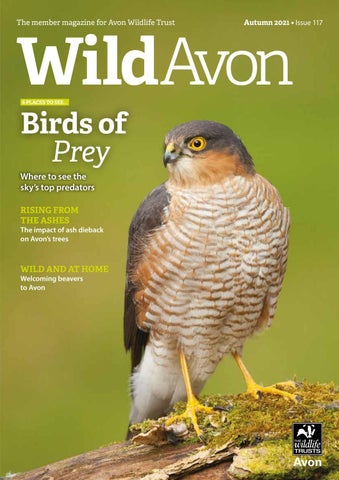
WildAvon The member magazine for Avon Wildlife Trust
6 PLACES TO SEE...
Birds of Prey Where to see the sky’s top predators RISING FROM THE ASHES
The impact of ash dieback on Avon’s trees
WILD AND AT HOME Welcoming beavers to Avon
Autumn 2021 • Issue 117
Welcome
Our nature reserves to your autumn Wild Avon magazine, helping you find ways to make the most of and sites 17 the season as we emerge from lockdown. M48 7 For us as for many of you, the spring and M5 summer have been an opportunity to M417 M48 reconnect with some of our favourite wild places, and we hope to bring you a host of 18 M5 M4 A403 new ways to bring wildlife into your life. A46 While this past year has been a time for reflection, it’s also A403 been busy for us as we have developed new, more agile ways M4 12 of working in a changing world. Exciting plans to create M32 A4 2 21 wildlife ‘hubs’ offering amazing visitor experiences reached 20 29 M4 A4174 12 28 30 M32 9 a peak with our ambitious Crowdfunder in the spring. With A422 4 2 21 20 29 A4174 26 your help, we succeeded in raising 30% of the money we 28 30 9 22 31 4 need to apply for matchfunding to build an inspiring new 26 R. Avon A4174 31 A38 visitor space at our Bristol community wildlife site, Grow M5 R. Kenn R. Avon A4174 A46 A370 A37 A4 A38 Wilder. We look forward to fulfilling this dream in the M5 R. 3Kenn 10 A4 A370 A37 A4 coming year, allowing even more people to find joy in 3 14 10 55 14 1 taking action for nature. A38 24 A36 A38R. Yeo Chew Valley Blagdon We’ve also been excited to announce the arrival 24 A370 Lake Lake Chew Valley R. Yeo Blagdon A370 Lake Lake of wild beavers in Avon. Turn to page 18 for the A371 13 A368 A371 13 6 A368 11 6 lowdown about these natural engineers and how 8 11 A37 8 19 16 A37 19 25 27 23 15 1627 23 15 25 they can help us and our countryside. In this edition, we also explore how ash dieback poses a serious threat to many thousands of trees, and we look at the impacts this will have on our nature reserves – both positive and negative. Key Key Now, with the publication of our strategy for the next 1 B a t h a m p t o n M e a d o w 1 1 Do le b u r y Wa r r e n 2 1 P ill P a d d o c k 10 years, our thoughts are turning to our overarching 1 B a t ha mpt on Me a dow 1 1 Dole bury Wa rre n 2 1 Pill Paddock 2 B e n n e t t ’s P a t c h a n d 1 2 Gr o w W ild e r 2 2 P r io r ’s Wo o d ambition: to have 30% of our land and sea managed for W h it e 's P a d d o c k 2 B e nne t t ’s Pa t ch a nd 1 2 G row Wilde r 2 2 Prior’s Wood 1 3 F o lly F a r m 2 3 P u r n Hill 3 B la k e ’s P o o lsWhit e 's Pa ddock wildlife by 2030. 30% is the bare minimum needed for 1 4 Go b lin C o m1b3e F olly F a 2 rm 4 P u x t o n M o o r 2 3 Purn H ill 4 B r a n d o n3HillB la ke ’s Pools nature to recover, halting the catastrophic decline in the 1 5 He lle n g e Hill S t e p h e n ’s Va le 2 4 Pux t on Moor 1 4 G oblin 2C5ombe 5 B r o w n e ’s F o lly 4 B ra ndon Hill abundance and diversity of wildlife. Turn to page 22 to find 1 6 Hu t t o n Hill 2 6 Tic k e n h a m Hill 6 B u r le d g e Hill 1 5 He lle nge Hill 2 5 S t e phen’s Vale 5 B rowne ’s F olly out more. I hope these stories and the many others in your 1 7 L it t le t o n B r ic k P it s 2 7 Wa lb o r o u g h 7 C h a r f ie ld M e a d o w 1 6 Hut t on Hill 2 6 Ticke nham Hill 6 B urle dge Hill autumnal Wild Avon will give you the inspiration you need 8 C h e w Va lle y L a k e 1 8 L o w e r Wo o d s 2 8 Wa lt o n C o m m o n 1 7 L it t le t on B rick Pit s 2 7 Wa lbo rough 7 C ha rf ie ld Me a dow to enjoy the coming months in nature. 9 C la p t o n M o o r 19 Max Bog 2 9 We s t o n B ig Wo o d 7
10
Ian Barrett Chief Executive of Avon Wildlife Trust Follow me on twitter @IanBarrettSW
Avon Wildlife Trust Wild Avon is the membership magazine for Avon Wildlife Trust, your local wildlife charity, working to secure a strong future for the natural environment and to inspire people to care for it. With the support of over 17,000 members and more than 700 volunteers, the Trust cares for over 30 nature reserves, runs educational and community programmes, advises landowners and campaigns on issues that threaten wildlife habitats.
2
Wild Avon | Autumn 2021
Get in touch
Trust Office 32 Jacobs Wells Road, Bristol BS8 1DR Telephone 0117 917 7270 Email mail@avonwildlifetrust.org.uk Website avonwildlifetrust.org.uk Folly Farm Centre Stowey, Pensford, Bristol BS39 4DW Telephone 01275 331590 Email info@follyfarm.org Website follyfarm.org
Grow Wilder (formerly Feed Bristol) 181 Frenchay Park Road, Bristol BS16 1HB Telephone 0117 965 7086 Email growwilder@avonwildlifetrust.org.uk Website avonwildlifetrust.org.uk/growwilder
8
C he w Va lle y L a ke
18
L owe r Woods
9
C la pt on Moor
19
Ma x B og 2 9y We st on Big Wood 3 1 W ills b r id g e Va lle
C le e v e He ronry
20
Middle Hill C ommon
C le e v e He r o n r y
10
20
M id d le Hill C o m m o n
Follow us on social media for the latest news and events. Please share your wildlife pictures and experiences! You can also subscribe to our monthly newsletter online through our website to hear about our latest news and events. Facebook @avonwt Twitter @avonwt Instagram @avonwt Registered charity number 280422 Registered company number 1495108
30
We s t o n M o o r
28
Wa lt on Common
30
We st on Moor
31
Willsb ridge Valley
The Wild Avon Team Editor: Rebecca Lockwood Rebecca.Lockwood@ avonwildlifetrust.org.uk Designer: Kevin Lester UK editor: Tom Hibbert UK designer: Ben Cook Cover photo: Sparrowhawk – Mark Hamblin/2020VISION
18
Contents 4 Your wild autumn
The best of the season’s wildlife and where to enjoy it on your local patch
10 Wild reserves
Discover Hellenge Hill and plan your visit to other nearby Avon Wildlife Trust reserves this autumn
13 Wild thoughts
A dose of nature from Dr Amir Khan
11
JON HAWKINS
RICHARD BURKMARR
6
14 Six places to see birds of prey 16 Focus on ash dieback Finding hope in a wildlife tragedy
18 Beavers 22 Focus on 30 by 30 campaign 24 Rebugging our homes 26 Local wild news 28 UK News 31 My Wild Life
Black and Green Ambassador Roy Kareem explains why he’s so passionate about making green spaces accessible to everyone
32 What’s on 34 Wildlife gardening JON HAWKINS
7
6 ways to get involved with your local Wildlife Trust
Help us to bring wildlife back across 30% of land and sea by 2030 by increasing your membership donation today, so that we can all benefit from nature on our doorstep. avonwildlifetrust.org.uk/ increasedonation
Become a Patron Donate
£1,000 or more a year to have a unique opportunity to be at the heart of our work with your generous contribution. avonwildlifetrust.org.uk/become-patron
Campaign We need your voice
to amplify campaigns, lobby and raise awareness for urgent local issues such as fighting the ecological emergency, reversing insect decline and creating a connected network of habitats for wildlife. avonwildlifetrust.org.uk/campaign
Fundraise Set yourself a challenge
or organise an event to fundraise with family and friends to help wildlife in our region. fundraising.avonwildlifetrust.org.uk
Give the gift of land
Help to secure 30% of land for wildlife by 2030 by contributing land or the money to make a purchase. avonwildlifetrust.org. uk/gift-land
Include a gift in your will
Celebrate your love for local wildlife by giving a gift that could last for generations. A gift in your will, no matter how big or small, can make a real difference. avonwildlifetrust.org.uk/giftinwill Wild Avon | Autumn 2021
3
YOUR WILD AUTUMN SPECIES AND HABITATS
Wetlands
The best of the season’s wildlife and where to enjoy it in Avon
Healthy wetlands help look after us and our planet. They store carbon, provide natural flood protection and purify our water – as well as supporting an abundance of wildlife.
4
WildAvon Wild Avon| |Autumn Autumn 2021 2021
T h a n k y ou
Thanks to your membership we ar e to look after our w able etlands, monitoring their health and restoring them for wildlife.
AUTUMN SPECTACLE WETLANDS AND THEIR BIRDS If you are a wildlife lover looking for solace when much of nature is preparing for its winter slumber, wetlands should take centre stage. There’s real drama to an autumnal wetland. The big skies provide a fitting canvas for the wintering wildfowl and waders which flock here, migrating in their thousands from their breeding grounds in the now-frozen north. There’s no shortage of places in Avon to enjoy them. The mudflats and salt marsh of the Severn Estuary are host to an array of wintering wetland birds, including plover, knot and redshank. Further inland lie the North Somerset Levels and Moors, and within them, the Gordano Valley. Amidst these rare and vital freshwater wetlands you’ll see many winter visitors, as well as the diverse range of invertebrates and wetland plants which make their home here. SEE THEM THIS AUTUMN Clapton Moor, with its raised water level, attracts a range of wintering waders and wildfowl. It is home to a variety of rare plants, including frogbit, greater spearwort and fen pondweed. Puxton Moor comprises pastureland and a network of species-rich rhynes (wet ditches). Reed and sedge warblers offer a beautiful soundtrack to your visit. Weston Moor has waterlogged fields, providing a readily available source of invertebrates for our hungry winter visitors, while the hedgerows and field margins offer shelter. You may also see sparrowhawk, buzzard and green woodpecker on your visit.
Wild Wild Avon Avon| Autumn | Autumn2021 2021
5
YOUR WILD AUTUMN SPECIES AND HABITATS
Remarkable rhynes
Today, the long corridors that make up the rhyne network reveal an abundance of wildlife to the passer-by. If you’re lucky, you may catch a glimpse of an otter, or even the elusive water vole, as the autumnal water levels of these historic drainage ditches begin to rise and the vegetation dies back. With their origins dating back more than 1000 years, a visit to a rhyne isn’t just a chance for you to engage with nature, it’s a link to our past too. If you’re patient, you may be rewarded with a glimpse of a bat – possibly even a rare horseshoe bat. But you’re more likely to hear them than to see them. These mysterious creatures are nocturnal, using rhynes as ‘highways’ to navigate the landscape whilst gorging on the resident insects. The work we carry out at this time of year to maintain the health of the rhynes contributes to the amazing diversity of wildlife that you can enjoy on your visit. From the bird hide at Clapton Moor, there are stunning views of the Gordano Valley. The raised water level system is a haven for wintering wildfowl which you can see flocking here in their thousands. The large pastureland that makes up Puxton Moor is networked with rhynes full of rare plants and thriving with invertebrates and birds.
BEN HALL/2020VISION
URBAN FIELDCRAFT
A group of frogs is called an army
Frogs
DALE SUTTON/2020VISION
6
Wild Avon | Autumn 2021
Of over 7,000 recorded species of frog worldwide, only four call the UK home and only two are likely to be seen locally – common frog Rana temporaria and common toad Bufo bufo. Both have several interesting adaptations, including fusion and loss of bones in the spine, limbs and feet, making them very effective jumpers. Males have an inflatable throat pouch that they use to pass air between the mouth and lungs, increasing both the volume and rapidity of their mating calls. Frogs breed in the spring, laying up to 2,000 eggs in a cluster, which then hatch into tadpoles, although only a few make it to adulthood.
How to: Tell a frog from a toad
Common frogs can be distinguished from common toads by their smooth skin and dark eye patches, while toads usually crawl rather than jump. Frog spawn is laid in clumps, whereas toads lay their eggs in long strings. Create a pond A garden pond with adjacent sheltered spots such as rocks can attract frogs and toads into your garden. In return they will keep your slugs in check! Did you know? As well as having lungs, frogs breathe underwater through their skin. This is handy as they spend a lot of time in ponds during the spring breeding season, although adults may spend more time out of water than in it at other times of the year.
If you’re lucky you may spot a short-eared owl in our wetlands, where they often congregate in flocks. With their brown bodies and yellow eyes, they are similar in size to a tawny owl.
DO THIS
ANDY ROUSE/2020VISION
SEE THIS
This is the time to spot hedgehogs before they go into hibernation. Offer somewhere safe for them by creating a compost heap or log pile – which should also attract lots of tasty bugs for them to eat!
SPECIES SPOTLIGHT
Kingfishers
Apparently pure blue plumage on the wings and crown
Other riverside birds Large flat head Grey wagtail Watch for the yellow belly and classic wagging tail as it catches insects along the riverbank.
Daggerlike bill for fishing
Darker red hues on the underbelly plumage
WHERE TO SEE THEM: Eastville Park: This urban park is known for its population of confident kingfishers living along the River Frome. Chew Valley Lake: The lake is home to many exciting birds throughout the year, including our stunning kingfishers. Your local river: Keep an eye out along your local waterway for nesting holes in the riverbank and suitable perches over the river. Don’t forget to listen out for their highpitched call!
Dipper If you’re very lucky you might spot a dipper, the country’s only aquatic songbird, bobbing on a rock in a fast-flowing stream.
Little egret A small white heron that has been increasing in numbers across the country since the 1990s.
Reserve information and maps: avonwildlifetrust.org.uk/reserves
ADAM JONES
Diet With a diet consisting mostly of fish, kingfishers live up to their name, although they will also feed on aquatic invertebrates and tadpoles. If you’re lucky, you may see one sitting on a perch a couple of metres above a river: this makes the perfect launchpad for diving beneath the water after prey. As they enter the water, a third eyelid called the nictitating membrane covers and protects their eyes. Like owls, kingfishers regurgitate pellets of undigested bones, and finding one of these pellets can be a sign you have discovered a kingfisher’s favourite hunting spot.
Threats Kingfishers are generally short-lived, surviving an average of two years. The oldest on record lived for just over seven years, while only 20% of fledglings survive their first year. Populations are highly vulnerable to cold winters: frozen waterways make fishing impossible, and flooding can also make hunting difficult. However, their biggest threat is likely due to pollution of our rivers. Contamination and agricultural run-off can force kingfishers out of sections of rivers that would otherwise be suitable habitat.
ANDY ROUSE
What to look for Kingfishers are small creatures, and you’ll find them alongside slow-moving or still bodies of water across most of England. Their bright blue heads contrast with a muddy orange belly, making them a truly remarkable bird. You will often spot them perching on overhanging branches or flying low along the water with rapid wingbeats. Keep your wits about you as you walk along a river – you may just spot small tunnels in the riverbank, which lead to their nests.
MALCOLM BROWN
Kingfishers are unmistakeable birds, jewels of the British riverbank and one of the most colourful birds in the country.
BERTIE GREGORY/2020VISION
Something darts past you down the river, a whirl of wings and an electric blue flash: a kingfisher!
Did you know that the kingfisher isn’t actually blue, but brown? This is ‘structural colouration’ - the light is scattered by the structure of the feathers, so it ‘looks’ blue.
Wild Avon | Autumn 2021
7
To cultivate your own tree saplings, collect seeds like acorns or wild cherry stones from under trees. Sow them in little pots filled with a combination of sand and peatfree compost, then store in a dark place until spring.
PLAY THIS
Originally played with hazels or shells, ‘conkers’ has been synonymous with the horse chestnut’s prickly fruit since the 1700s. They’re common across Avon, so why not gather a few for a contest?
AMY LEWIS
GROW THIS
NOT JUST FOR KIDS
Six ways to enjoy nature this autumn Why should kids have all the fun? Reignite your love of nature with these random acts of wildness
2 Clean up a beach
3
This is a great time of year to guess the age of a hedgerow. Count the number of woody species (trees and shrubs, but not climbers such as bramble) in a 30m length of hedge. Roughly speaking, each species represents a century.
CHRIS GOMERSALL/2020VISION
in some nature 5 Indulge detective work!
BEN HALL/2020VISION
Wild Avon | Autumn 2021
Why not celebrate autumn’s striking change of leaves by trying out the Japanese art of forest bathing? It’s simply about spending time among trees and in the woodlands. There’s real science behind its benefits – plants and trees release a chemical called phytoncide that boosts the human immune system. It’s known to help anxiety and can even aid your sleep. Plus, what could be nicer at this time of the year than spending time in the forest?
TOM MARSHALL
8
4 Forest bathing
Stay on the look-out for wildlife
Although the world of wildlife starts to slow down during the autumn months, there are still some fantastic wildlife spectacles to see at this time of year. Keep an eye out for squirrels foraging for yummy nuts, and hedgehogs before they hunker down for the winter. Meanwhile, the big skies of the Chew Valley make the perfect backdrop for starling murmurations, one of nature’s most spectacular shows.
LARA HOWE
Next time you go for a ramble, why not collect natural objects to create a piece of artwork when you get home? When you start to look closely at what’s around you, you’ll find endless inspiration in nature. Use leaves and twigs to create very realistic trees; gravel could represent sand on a beach; bark might serve as the peaks of mountains, while moss might look like grass. Never take anything directly from a tree or plant – only collect any fallen natural items.
KATRINA MARTIN/2020VISION
1 Make a collage using finds from nature
Plastic in our seas is a huge problem. In the world’s oceans, enormous patches of litter that we have thrown away are floating around. Approximately 80% of it is plastic. While plastic is an incredibly useful product that we have come to depend on, most of the time we only use it once before throwing it away. But we can all help! Autumn is a great time to join a beach clean, combining a walk somewhere beautiful with meeting new people and doing something really useful. Beach cleans happen regularly in Portishead and along the rest of the Avon coast, so why not join an established event? To find one near you, or to get advice about organising your own, check out: sas.org.uk/our-work/beach-cleans
YOUR WILD AUTUMN
6
Build a log pile
Our pick of your photos
N at u re cra ft
Putting together a log pile will create a village for all things creepy and crawly. In turn, this busy community will attract birds, hedgehogs and frogs looking to snack on a tasty morsel. If you’re very lucky, you may even attract a stag beetle – which can be more than seven centimetres long! Their larvae stay in old wood for up to six years before emerging as adults, ready to mate.
We may have felt less able to get out and about this year, but that hasn’t stopped many of our members and supporters from going into nature and capturing some fabulous images. Happily, you’ve shared many of them with us – here are a few of our favourites: One of our supporters is an artist, and she captured this while painting in her garden. It looks like a twig, but she realised it was two moths mating! © Myrtle Pizzey
MATTHEW ROBERTS
You will need: Logs! You can get them from tree surgeons or firewood dealers. If you’re lucky, some pieces may already contain beetle grubs which could hatch and populate your garden. Native wood is best, but anything will do. Building your log shelter: You can build up the logs to form your ‘minibeast village’ in a variety of ways:
Bristol’s College Green this summer. 1,800 wildflower plugs were planted by some of our volunteers in spring and this was the result! © Helen Green
These adorable goslings were photographed in May at Folly Farm by one of our visitors. © Bevis Watts
your logs in a flower border or under Scatter a hedge. Like this, they are handy for keeping plants apart and mulching the soil, but you’ll get more wildlife if you do create a concentrated stack.
This red mason bee was beautifully captured by Trish Lock in her garden. She says it caught her attention as it collects pollen by brushing hairs on its abdomen!
stacks are often seen in coppiced Tidy woodlands. Logs are carefully piled on top of each other, often forming a pyramid. your logs! Sunken wood creates the most Bury micro-climate possibilities. If you can’t bury your logs, heaped wood chippings are another way to help stag beetles. you can get a real ‘wagon wheel’ log, it will If create the most stable environment of all underneath. This is superb for amphibian hibernation.
Has Prior’s Wood ever looked better? Taken in April with the bluebells at their best. © Andrew Hirst
isit our website for more actions V to help wildlife this autumn: avonwildlifetrust.org.uk/actions
Wild Avon | Autumn 2021
9
Discover Hellenge Hill
Wild Avon | Autumn 2021
JON HAWKINS - SURREY HILLS PHOTOGRAPHY
10
I
ts beautiful position, high on a limestone ridge above the Somerset village of Bleadon, with the Severn estuary to the west, makes it the perfect spot to see the autumn colours as they change across the Levels. Hellenge is a rich mixture of grassland and scrub, nestled on a steep south-facing slope. The abundance of wildflowers provides essential food plants for many insects, while this is a favourite spot for birds such as buzzards. Butterflies abound, including the beautiful marbled white butterfly. In some areas the species-rich downland is of an especially rare type, found only on the shallow soils on the hot southern scarp of the Mendips.
Unusual plants that you might see during springtime in the grassland include honewort, with its small white flowers, the delicate perennial Somerset hair-grass and the remarkable green-winged orchid. As autumn approaches it’s worth staying alert to the perky flowers of yellow-wort, as well as the strange-looking carline thistle. Autumn lady’s tresses lives up to its name, being a beautiful late-flowering orchid. Its spiralling delicate flower spikes show themselves from August to October, and a keen-eyed visitor should be able to spot an abundance of flower spikes as they traverse the slope of the reserve at this time of year. The rich grassland habitat is complemented by areas of extensive scrub made up of gorse, which can still flower beyond October, and
JON HAWKINS - SURREY HILLS PHOTOGRAPHY
The grassland reserve Hellenge Hill lies on the south-facing scarp of the Mendips, affording it spectacular views across the Somerset Levels and the Bristol Channel. It’s a wonderful place to lose yourself in the landscape at any time of the year.
OUR BEST AUTUMN RESERVES
T ha nks
NOW YOU DO IT
Your support and that of our dedicated voluntee rs helps to protect Helleng e Hill and maintain this incre dibly special nature rese rve for people and wildlife .
1 Visit Hellenge Hill KNOW BEFORE YOU GO Location: Roman Road, Bleadon, Westonsuper-Mare, BS24 0NQ How to get there: Two access points available at Roman Road and Shiplate Road. Opening times: Open at all times Access: Area hilly and very muddy when wet. Public footpaths allow access to part of the Mendip Way trail. Dogs on a lead. Email: mail@avonwildlifetrust.org.uk Website: avonwildlifetrust.org.uk/ nature-reserves/hellenge-hill LUKE MASSEY/2020VISION
Later, the lucky autumn walker may get a glimpse of an adder basking in preparation for hibernation. Unfortunately, these fascinating reptiles are under threat nationally, as habitat fragmentation and loss take their toll.
hawthorn, distinctive in autumn because of its clusters of red berries. This attractive landscape provides a valuable habitat for many creatures, including reptiles, and it’s possible you’ll spot a member of Hellenge’s healthy adder population when you visit. Identified by the zigzag pattern on its back, the adder is our only native poisonous snake. Its spring and summer months are spent feeding on small mammals and lizards as they take refuge in the margins of the scrubby grassland.
Today, the Trust manages this rare grassland using a combination of dedicated volunteers and support from local farmers, as well as some funding from Natural England through its agrienvironment scheme. It’s now well understood that a wilder landscape is generally a richer one, and the Trust has an exciting opportunity at Hellenge to make this a reality. Visitors to the reserve may soon see rewilding in action, for example with changes to the way we use grazing on the site. Animals like Exmoor ponies, which have become such a significant feature on reserves elsewhere, could soon be a familiar sight at Hellenge Hill, joining our efforts to maintain this jewel in Avon’s crown. In short, whether you’re passing through on the West Mendip Way or simply taking in the spectacular views, Hellenge Hill is a great reserve to visit throughout the changing seasons.
THINGS TO DO Try to find the old stone-lined cattle drinking pond restored by our hard-working volunteer group. From the vantage point at the top of the reserve, try to identify as many local landmarks as you can. Brent Knoll, the River Axe and even Minehead can be seen on a clear day! Use the reserve as a starting point to explore the West Mendip Way. You can head west to Uphill and visit our Walborough reserve, or head east to Cheddar Gorge and all the way to Wells if you’re feeling like a challenge!
Wild Avon | Autumn 2021
11
GUY EDWARDES/2020VISION
DID YOU KNOW Hellenge Hill plays a key role in Avon Wildlife Trust’s plan to give bees, butterflies and other pollinators a fighting chance to survive and thrive across the region. Together with the nature reserves of Purn Hill and Walborough, Hellenge is part of the Trust’s B-Lines Project, which is creating a network of interconnected wildflower-rich ‘corridors’. These will enable wildlife to move across the landscape, saving threatened species and providing pollinators for crops.
The perfect spot to see autumn colours
TOP WILDLIFE TO SPOT Adders - Our only venomous snake, the shy adder can be spotted basking in the sunshine at Hellenge Hill until the end of October. Rabbits - A very common sight here. Large patches of incredibly short turf are the result of their grazing, which helps to create space for some of our rarest grassland flora to thrive. Foxes - The red fox is our only wild species of the dog family. Orangey-red above, it is white below, and has a white tip to its bushy, orange tail. You may see it at any time of the year. Waxcap fungi – the reserve hosts a wide range of fungi; among them are the waxcaps. These grassland specialists boast a wide array of colours from red or yellow and brilliant white to jet black.
OUR BEST AUTUMN RESERVES
More Avon Wildlife Trust nature reserves for an autumn day out 3 Bennett’s Patch Thornbury
Portishead
2
Chipping Sodbury
3 Bristol
Clevedon
Know before you go Location: Portway, Bristol, BS9 1RQ Open: Pedestrian access at all times. Access to car park, cafe and facilities during publicised event days only. Wildlife to spot: badgers, hedgehogs, slow worms. Find out more: avonwildlifetrust.org.uk/naturereserves/bennetts-patch-and-whitespaddock
Nailsea Keynsham Bath
Weston-s-Mare
1
Midsomer Norton
2 Lower Woods
Know before you go Location: Between Wickwar and Hawkesbury Upton, GL9 1BX Open: Open at all times. Wildlife to spot: woodland birds like the tit family, nuthatch, treecreeper, jay, tawny owl, sparrowhawk and great spotted woodpecker. Find out more: info@gloucestershirewildlifetrust.co.uk Website: gloucestershirewildlifetrust.co.uk/ nature-reserves/lower-woods
12
Wild Avon | Autumn 2021
NATHAN MILLAR
Why now? Autumn is a season of dramatic change within the woodland, which is jointly owned by Avon and Gloucestershire Wildlife Trusts. This is the season when the leaves of deciduous trees turn vibrant shades of gold, purple and crimson, depending on the species. This sensory experience is coupled with showers of leaf fall, creating a crunchy carpet underfoot and making it an ideal place to enjoy a seasonal ramble.
The lowdown At almost 300 hectares, Lower Woods is one of the largest ancient woodlands in the South West. The reserve comprises 23 separate woods, with some areas still reflecting the medieval landscape, around 500 years ago. The site feels more open in the autumn as the leaves begin to fall. Cracks in the tree trunks will emerge, many of which are being stockpiled with foraged supplies by small mammals ready for winter. Squirrels can be easily spotted in the exposed canopy, racing from tree to tree with their prized hazelnuts, while the birds are busy stripping the last of the berries. On the ground, leaves and other material are broken down by bacteria, as well as earthworms and other organisms, restocking the soil with nutrients to allow the woodland to thrive.
The lowdown Well-known locally for the wicker whale sculptures, created to raise awareness of plastic pollution in the world’s oceans, Bennett’s Patch and White’s Paddock play an important role in connecting the impressive habitats of the Avon Gorge. Primarily wildflower grassland, there are also three wildlife ponds, bordered by some smaller patches of woodland. In autumn, once the wildflower meadow has been cut and baled, the scrub comes to life: brambles, hawthorn and blackthorn. Remember to bring a box for blackberries and sloes for those winter warmer crumbles! Other plants on the site take on new beauty in autumn. Tall plants like hogweed and teasel create sculptural forms, their strong, dry flower heads packed with seeds for species like blue tit and robin. Vines of ivy burst into life, with their pungent, savoury-smelling flowers covered in late flying insects like hoverflies and wasps.
Plan your next great day out at our nature reserves: avonwildlifetrust.org.uk/reserves
FRANCES GARD
Severn Beach
Why now? Autumn at Bennett’s Patch and White’s Paddock is a fruitful time, when the blackberries, haw berries and sloes that thrive in the scrub on the fringes start to swell, providing the last bounty of food before the winter sets in for berry-eating birds – and for you.
WILD THOUGHTS
Dr Amir Khan @DrAmirKhanGP
@doctoramirkhan
ILLUSTRATION: DAWN COOPER. PROFILE PHOTO: TOM HAUGHTON
A dose of nature I have just come in from the garden, having filled the bird feeders with sunflower hearts, topped up the watering station with fresh water and refilled the bowls the hedgehogs like to eat from with crunchy kitten biscuits. As soon as I come inside, a magnificent male bullfinch plonks itself onto one of the feeders and starts eating the seeds, dropping as many onto the floor as it manages to get into its mouth. Luckily an opportunistic chaffinch is on clean up duty, guzzling any seeds the messy bullfinch drops. It is a lovely scene to watch unfold, calming and beautiful in its simplicity. Many of you reading this article will be familiar with the feeling of positivity that fills our bodies when we spend time in nature, and as a doctor it is something I am increasingly “prescribing” for my patients. I have to be honest, sometimes I do get incredulous looks when I suggest a “dose” of time spent in green spaces to my patients to help sooth their ailments, either on its own or in conjunction with modern medicine; but for those who heed my advice, I have never had any complaints. That is because there is scientific evidence that nature is good for us. When we go outdoors and embrace our natural surroundings our bodies produce less of our stress hormone, cortisol, lowering our heart rates and blood pressure. We also produce more of our “happy” brain chemicals, dopamine and serotonin, increasing our sense of calm and wellbeing. It is relatively easy to spend time outdoors in the summer months when the sun is shining and everything is more inviting,
but we can get huge health benefits from nature as autumn and winter set in too. We need that boost to our mental health that nature gives us more than ever when longer nights set in, but the benefits don’t stop there. Plants and trees naturally produce chemicals called phytoncides that help protect them against damage from bacteria, fungi and insects. As we spend time in green spaces, we breathe these chemicals in and they can help stimulate our own immune systems to produce more natural “killer” cells, which are vital for fighting off viruses, perfect for winter when respiratory viruses are more common. Nature can also help our brains focus better; by spending time looking at wildlife and plants during our breaks at work, we can give the parts of our brain a rest that are needed for attention and focusing, so when we return to work or a task we need to complete, we will be more productive. Being out in natural light is good for improving sleep — so make the most of those shorter days and get out there! Sometimes it can feel difficult to go out if the weather isn’t quite right, but it is important to carry our good summer habits into autumn and winter. For those who do go outdoors regularly, spread the word and encourage your friends and family to do the same, so they too can reap the benefits of our natural world. Find inspiration to get outdoors and discover wildlife this winter with our selection of seasonal spectacles! wildlifetrusts.org/winter-wildlife
WILD HOUSE CALL
You don’t have to travel far for your dose of nature. Even in built-up areas, there are wild wonders to soothe your soul. Listen for the cheerful chirps of house sparrows in the bushes, or the soft cooing of pigeons perched on buildings. If you have a garden, we’ve got lots of great tips to help attract even more wildlife at avonwildlifetrust.org.uk/ actions
Dr Amir Khan is an ambassador for The Wildlife Trusts. He is an advocate for Green Prescribing and champions the benefit that being in nature has on health and wellbeing.
Wild Avon | Autumn 2021
13
F SHORT-EARED OWL © DANNY GREEN/2020VISION
rom a kestrel hovering above a roadside verge to a barn owl drifting over a grassy field, spotting a bird of prey is always a special experience. One of the best things about these feathered predators is that they can be seen almost anywhere – practically any patch of sky could hold a circling buzzard, and sparrowhawks often venture into gardens. But some birds of prey have to be sought out, and by visiting a nature reserve you can often see several species in action. Winter is a great time to track down many of our birds of prey, with some roosting in large numbers, others attracted by gatherings of ducks, starlings or other small birds, and some even starting their courtship or territorial displays.
14
Wild Avon | Autumn 2021
6 places to see birds of prey
5
See the spectacle
for yourself
4
2 3 1 6
1 Walton Common With its fabulous views and landscape of calcareous grassland and woodland, Walton Common is a great spot to see red kites, which can be identified by their angled, red wings and long, reddish-brown forked tail. Where: Walton Common, BS21 7AP 2 Folly Farm The rare wildflower meadows at Folly Farm are unspoilt by pesticides and fertilisers, so they are brimming with wildlife. Tawny owls nest and roost on the reserve, and barn owls have also been seen hunting here. Where: Folly Farm, BS39 4DW 3 Chew Valley Ospreys are regularly sighted above the glorious expanse of Chew Valley, especially from late March, after returning from their wintering grounds in Africa – although they have also been seen at other times of the year. Watch this magnificent fish-eating bird, its white head marked by a brown eye stripe, as it hunts for its prey in the waters below. Where: Chew Valley, BS40 6HN 4 Wheldrake Ings, Yorkshire Wildlife Trust In winter, huge flocks of ducks and wading birds visit the flooded fields, often attracting the attention of peregrine falcons. Other birds to look out for include merlins, buzzards, barn owls and sparrowhawks. Where: Near York, YO19 6AX 5 Gors Maen Llwyd, North Wales Wildlife Trust Meaning ‘Bog of the Grey Stone’, Gors Maen Llwyd is named for one particularly large stone deposited by retreating ice sheets. This heather moorland is home to buzzards and kestrels, and you might also find a hen harrier, red kite, merlin or even goshawk. Where: Nantglyn, LL16 5RN 6 Westhay Moor, Somerset Wildlife Trust The famous flocks of starlings that roost on the Somerset Levels provide a tempting evening snack for peregrine falcons and sparrowhawks. You could also spot marsh harriers, buzzards and barn owls flying above the reedbeds. Where: Glastonbury, BA6 9TX
Did you spot any birds of prey? Remember to tweet us your best photos! @avonwt
Ash dieback It’s thought the UK has about 12,500 hectares of mixed ash woodlands
16
Wild Avon | Autumn 2021
What it means for the Trust and our visitors For the Trust, this problem adds up to a significant public safety issue. Constant monitoring is required, and trees posing a threat to safety will have to be felled. The longer a tree has been affected, the more dangerous it becomes – not only for the public, but for those of us responsible for felling it. Reserve visitors are likely to see increasing evidence of tree-felling, especially when visiting sites with both ash trees and public access, such as Browne’s Folly. It’s not just the trees that will suffer; 44 wildlife species in the UK wholly rely on ash, including 29 invertebrates and 11 fungi. Some could even face extinction. It’s going to be expensive – both in terms of conservation and hard cash. So, are there reasons to be hopeful? Well, yes. We won’t lose all our ash – a minority are showing tolerance to the disease. Hopefully, those creatures that depend on ash will hold on until it’s widespread again.
Meanwhile, some ash-dwelling species can also live on other trees, such as hazel, birch, willow and oak.
In some cases the emerging habitat will be more vibrant … than what it has replaced Other possible beneficiaries could include the 40% of woodland species that rely on deadwood. Those trees not affecting public safety will be left to rot and fall, and the resulting decay will release life-supporting nutrients. They will provide food and a home for hundreds of species such as stag beetles, which rely on deadwood, and woodpeckers, which feed on those insects. Nothing is wasted in nature.
SZUZSANNA BIRD
Ash dieback is a term that is now sadly familiar. First confirmed in the UK in 2012, this deadly disease is caused by a fungus that grows within the ash tree, and it often proves fatal. The spores causing the infection are transported on the wind, and most of Avon’s ash trees have probably now been exposed.
FEATURE
NEED TO KNOW
Signs of disease Leaves develop dark patches in the summer. They then wilt and discolour to black. Leaves might shed early. Dieback of the shoots and leaves is visible in the summer. Lesions develop where branches meet the trunk. These are often diamondshaped and dark brown. Inner bark looks brownish-grey under the lesions. New growth from previously dormant buds further down the trunk. Origin: known as ‘chalara’ and originating in Asia, the disease is thought to have been imported into the UK on ash saplings.
DENISE HEALEY
AVON HOTSPOTS We have concerns right across the Avon area, but we are putting extra focus on some key reserves where we know the challenges are acute.
Weston
Finally – and given that we will have to lose trees to ensure public safety – it’s worth recognising that in some cases the emerging habitat will be more vibrant, more diverse and more welcoming to wildlife than what it has replaced. Light brings life Over time, the loss of ash will increase the amount of light in the woodland, creating ‘edge’ habitat such as glades – typically the most biodiverse part of a woodland. This will usher in more flowers. Fruits such as blackberries and hazelnuts will thrive in the newly developing scrub. This will feed and house insects, which will in turn sustain bats and birds. Ancient and veteran oak trees, often islands teeming with rare wildlife, will be revived by the
Big Wood increase in light levels. What was a simple woodland habitat could, in short, become a Prior’s Wood vibrant haven for wildlife, alive with colour Tickenham Hill Browne’s and abuzz with life. Folly Goblin In truth, any upside is merely a Combe Dolebury consolation prize. There’s no doubt Warren Hutton Hill the loss of many ash trees will cause Folly Farm significant biodiversity loss and damage to the landscape as we know it. Crucially, it will be costly to manage, presenting a huge problem to every What you can do organisation with this responsibility – including Avon Wildlife Trust. Clean your shoes before and after However, we will take advantage of the visiting a wood. opportunities presented by the disease. Avoid taking cuttings or plant material Despite the challenges, we look forward from the countryside. to a brighter future, in which resistant Wash your car or bike wheels to remove specimens have taken root and spread mud or plant matter. over those parts of the landscape in which If you think you’ve spotted the signs we want them. Here’s hoping the ash’s and symptoms of ash dieback report them story isn’t over yet. through TreeAlert. Go to: If you want to support the forestresearch.gov.uk/tools-andTrust in tackling the disease, head to resources/fthr/tree-alert avonwildlifetrust.org.uk/ash-dieback to find out more. n
Wild Avon | Autumn 2021
17
It’s thought Avon’s beavers have been living here undetected for at least two generations
After years of extinction in the UK, a series of well-publicised reintroductions have taken place across the country. Now, with a silent swish of their large, flat tail, they’re back. Welcomed by conservationists and an intrigued media, they are perhaps the perfect nature story – cute, eccentric, skilful and most important of all, great not only for wildlife, but for the planet too. Incredibly, they’ve been detected living here in the wild in Avon’s waterways, and it seems they’re here to stay. Are they welcome in our countryside? That’s a resounding yes! With Avon Wildlife Trust’s support, Bristol City and Bath and North East Somerset councils have declared ecological and climate emergencies. These interlinked crises are already creating serious problems, meaning we have a lot of issues to solve at the same time. We must promote an abundance of wildlife whilst also tackling flooding, drought and pollution - all immediate threats not only to people, but to wildlife as well. None of this will be easy. Part of the solution to these challenges could lie with this humble rodent, which could already be at a river near you. 18
Wild Avon | Autumn 2021
What to look for The second-largest rodent in the world, adults can measure over a metre in length. They have thick brown fur and webbed hind-feet, while their scaly tails serve many purposes – as a rudder for steering, as a prop for balance, and as an aid to help them carry trees. If you are lucky enough to come across one while walking, it is this astonishing instrument that may alert you to their presence, because they use it to hit the water in warning, creating a distinctive slapping noise. For the most part, however, they are silent and secretive, mimicking logs and diving out of sight when disturbed. They use their large, sturdy teeth to bite through tree trunks, with the
BEVIS WATTS
Beavers
characterful ‘overbite’ for which they are so well-known making it easier for them to chew underwater. Building for Life Beavers are perhaps most famous for their construction skills. Where existing waterways are too shallow, they build dams from mud and wood which protect them from predators as well as creating deep channels that help them reach their food. So far, Avon’s population have stuck to the main rivers, but their amazing engineering abilities are still in evidence in their beautifully constructed wooden lodges. Here they eat, sleep, raise their kits, and store food for the winter.
Large sharp front teeth
- Large, rounded body
years ago. They shaped our landscape and waterways, creating habitats for an abundance of birds, fish and insects – and they can do so again, if we allow them.
Part of the solution to these challenges could lie with this humble rodent
Where to see them It’s widely known that Avon’s wild beavers have set up home within the River Avon catchment, although for their own safety their exact locations are a closely guarded secret. However, the ideal habitat for beavers would be a patch of woodland surrounding a source of fresh water like a river or stream network. Their hearing is excellent, but their eyesight is poor, so they usually stay within 20 metres of water. To maximise your chances of seeing a beaver, it’s worth investigating the opportunities offered by the managed ‘enclosures’ – check out cornwallwildlifetrust.org.uk/ beaverproject. Here in Avon, we look forward to seeing our beaver population thrive. For updates, and for more information, head to our website, avonwildlifetrust.org.uk/beavers.
LUKE GRIMSHAW
Current Threats Historically, and elsewhere in the world, beavers have been predated by European Wolf, European Lynx and brown bear – not species that you’d run into in the UK today. That doesn’t mean they no longer face any threats, however. There is anecdotal evidence to suggest that the youngsters may occasionally be preyed by otters, mink, badgers and even dogs – making it especially important that you put your dog on a lead if you are walking beside a waterway. Perhaps their biggest threat, however, lies in the threat posed by humans if we fail to prioritise
DID YOU KNOW? Five amazing facts about beavers
BEVIS WATTS
History They became extinct in the 16th century, mainly because of overhunting. In the scheme of things, however, their absence has been a mere blip. Archaeological finds such as beaver fossils have been found at more than 100 different UK sites, dating from a period between 5.4 and 2.4 million
NICK UPTON
- Webbed back feet
Diet Many people think beavers eat fish, but this is a myth - they are vegetarian, living on bark, wood, twigs and aquatic plants. In fact, it’s thought the presence of beavers leads to an increase in fish species, attracted by the invertebrates which thrive in the woody debris created by the beaver’s industrious lifestyle.
their management and conservation. In many areas our waterways are squeezed by urban developments, hard flood infrastructure and intensive agriculture. Sadly, they simply don’t provide the food and shelter beavers need to thrive.
Large, flat scaly tail
Clawed front feet, five toes
Family planning Beavers are monogamous, so the males and females usually pair up for life. Each year they produce between one and four babies – or ‘kits’ – with the main breeding season being in early summer. The bond between parent and offspring is a strong one, with kits staying in the family unit for up to two years.
FEATURE
1 They can swim up to eight kilometres per hour. 2 They can hold their breath for up to 15 minutes. 3 They have an extra pair of transparent eyelids which are closed underwater to act like goggles. 4 Their strong teeth get worn down by the incessant gnawing through trees, so they never stop growing. 5 Recent research suggests that an active beaver wetland can store up to 35 x more carbon than a traditional grassland.
Wild Avon | Autumn 2021
19
Natural allies
A vital first step is to slow the flow in our waterways. This allows the land upstream to absorb the water, creating fabulous wetland habitats that boost wildlife and also tackle drought. At the same time, during periods of heavy rain, these wetlands ease the pressure of water downstream, reducing the risk of flooding. Whilst we can do a lot of this work with engineering, it’s expensive.
Luckily, there are natural solutions that can help us – and that’s where beavers come in. The key lies in their construction activities. The dams the beavers build are exactly the solution we need – they slow the water in our rivers, reducing the risk of flooding downstream, whilst also creating the wetland areas upstream that are so crucial when tackling drought.
How can the beaver dams help? Count the ways! They increase biodiversity: Beaver activity can boost plant diversity by as much as 33%. By gnawing down trees to create their dams, beavers coppice the woods around them, encouraging new growth among lightseeking plants. It’s not just plants that benefit: There is an increase in the abundance and diversity of all species. For example, the deep ponds beavers create provide new habitats. Meanwhile, the wetlands they encourage are a haven for birdlife and the debris from their constant building work attracts a host of invertebrates, a vital part of the food chain. They provide clean water: By filtering out sediment and pollutants such as fertilisers and pesticides used by farmers, the dams clean our water supply.
20
Wild Avon | Autumn 2021
They store carbon: The dams hold back silt which captures carbon, while the new plant growth which is created by their efforts provides a fantastic carbon sink. They reduce flooding: By easing pressure downstream. For example, a single five-acre beaver enclosure in Cornwall decreased peak flows following high rainfall events by 50%, greatly reducing the flood risk in the village downstream. They prevent drought: By storing water upstream. This significantly reduces the impact of higher summer temperatures, which can be devastating for wildlife on our waterways. In short, beavers are nature’s engineers, and we’ve never needed them more.
Hoping to see beavers? FOLLOW THE BEAVER CODE! Stay alert: Beavers are charismatic and not that difficult to see if you spend enough time by the river in the right areas. Mostly nocturnal, during the summer they can sometimes be seen during the day. Leave your dog at home: Beavers have an excellent sense of smell and they can perceive dogs as a threat, which could reduce your chance of seeing them. If you do take your dog, keep it under control and use a lead, especially during the breeding season of May – July, when beavers can be especially anxious about being disturbed. Respect any landowners and other river users. Keep your distance and if there are designated paths, stay on them. Tell us about sightings by going to avonwildlifetrust.org.uk/beaversighting. If you are lucky enough to spot a beaver, we’d be grateful if you could let us know, to help us understand more about these creatures and how they’re using the countryside.
DAVID PARKYN
Our natural environment is in crisis, and so is our climate. But what can we do? For conservationists and Government alike, beavers could potentially hold the key to some of the most serious problems we face today.
FEATURE
it should be paid accordingly. That money can then be used to create more habitats to boost wildlife and fix the climate. The four local authorities and the combined authority in Avon have declared climate emergencies. All are working to reduce and sequester carbon and make the region more resilient to extreme weather. This, combined with changing legislation, represents new opportunities to bring in corporate support and private finance to fund nature-based solutions that provide ‘ecosystem services’ for the region. We are well placed to play a key role in local efforts to deliver these projects and ensure that the potential benefits to wildlife are unlocked. There is work to be done to develop the market and funding models, but we will be working with partners to help us hit our target of 1,000 hectares of habitat used for nature-based solutions by 2030.
How will we get there? We are about to significantly upscale projects that can deliver biodiversity gain and pollution reduction. Now we will start improving the way we measure and verify the benefits our work provides. We are forming partnerships with the farming and landowning community to create markets for tools like carbon credits and bring in private finance to spend on our aim of managing 30% of Avon’s land for nature by 2030. As members of the pioneering Bristol Avon Catchment Market, along with partners including Wiltshire Wildlife Trust and Wessex Water, we have been awarded funding of nearly £1.8 million from the Government’s Green Recovery Fund to deliver nature-based solutions in our region. The announcement will kickstart a host of exciting new projects in our area. For example, 85 hectares of new woodland will be created by March 2023, while a further 58 hectares of woodland will be restored – that’s fabulous news for trees, wildlife, and the climate.
BRUCE SHORTLAND
Some would say beavers are the perfect wildlife package. Great for improving habitats and species abundance, they are also a natural means of tackling the climate crisis. The good news is that beavers are just one example of many possible nature-based solutions to climate breakdown. Everything we do and have ever done at Avon Wildlife Trust results in joint benefits for wildlife and the environment. All the wildlife-rich habitats like meadows, wood pasture, peatlands and wetlands that we look after can soak up flood water, clean up polluted waterways and lock away carbon dioxide. Now, confronted with challenges of a scale never previously faced by the human race, we’re looking to restore more land for wildlife than ever before – but that’s not all. It’s time to value the work that nature does. Just as the authorities must spend money to build a flood wall or to irrigate a field, where nature solves our climate problems,
Wild Avon | Autumn 2021
21
DAVID PARKYN
Nature-based solutions to tackle the climate crisis
WE NEED YOUR SUPPORT
FOCUS ON...
“In both urban spaces and the countryside alike, wildlife has been freefalling into extinction and we need to turn this around.” Amy Coulthard, Director of Nature’s Recovery
30 by 30
We need your help to protect at least 30% of land and sea for wildlife by 2030.
We n e e y ou r h e d lp
MARK HAMBLIN/2020VISION
Making more space for nature We want to accelerate our work to bring wildlife back across Avon by connecting and restoring beautiful wild places – places that also store carbon and help tackle the climate crisis, too. We want to make more space for nature to return in abundance and give our struggling wildlife the chance to recover. 30% is the bare minimum that nature needs to start recovering but we are far short of this. Please donate today to help us reach our ambitious target.
Our natural world is in trouble It is no secret that wildlife is disappearing at an alarming rate and the threat of climate catastrophe is a constant worry. We live in a time of ecological and climate emergency. There is still hope for us to fight back against these twin emergencies, but we must act now. Time is running out. Together with The Wildlife Trusts across the UK we are trying to raise £30 million to connect and protect at least 30% of our land and sea for nature’s recovery by 2030.
RUSSELL SAVORY
22
Wild Avon | Autumn 2021
We have a solution The aim for our strategy for the next ten years is to ensure 30% of land and sea in Avon is managed for the benefit of wildlife by 2030. This means securing new land to protect wildlife through purchase, gifts and working in partnership. This new land will help to reverse nature’s decline and deliver nature’s recovery by creating bigger, better, more and joined-up habitats. This mosaic of habitats is known as a Nature Recovery Network, allowing wildlife to move, feed, breed and thrive freely through our landscape.
Our appeal will go towards nature recovery projects that will put new land aside for nature, as well as repairing and linking-up existing, fragmented, wild areas to enable wildlife to move freely through the landscape. The aim is to bring back nature everywhere, including the places where people live. Can you help put nature into recovery today? Donate to make a difference Anything you can give would be very gratefully received, but, as a suggestion:
£30
could buy equipment for volunteers to improve habitats on our nature reserves.
£300
could install 25 dormouse boxes to help increase numbers of this endangered species.
£3,000
could help to buy new land to improve for the benefit of wildlife and people. Please help with a donation today to help bring wildlife back across Avon. To donate today, visit avonwildlifetrust.org.uk/30-30
NEWS
Let’s see 1 in 4 taking action! It’s a sad fact that the UK has become one of the most naturedepleted countries in the world. From rivers and woodlands, to birds and flowers, our natural world is struggling. The good news is, we can all do our bit to help save it. We’ve got a dream of seeing one in four people taking action for wildlife. The idea is that, across Avon, these individual actions will add up to something much bigger, making a real positive change to biodiversity in our region. But what do we mean by ‘action’? The answer is that it will depend on you. Action takes many forms, as these local heroes prove!
Who are the 1 in 4?
CLARE MOCKRIDGE
CAROL HORLICK
URSULA GASSER
Long-term Avon Wildlife Trust member Ben Barker has probably done as much for wildlife in his corner of Bristol as anyone ever has. His career as a community organiser within the BS3 postcode began when he retired in 1994. Initially, he set up a small project encouraging neighbours to record the birds they saw in their garden. It’s snowballed from there, and now their monitoring activities include butterflies, moths and even bats! Now they’re linking up with other nearby groups, as well as planning city-wide species maps. His dream is that the whole of Bristol will ultimately be part of one big monitoring network, joining together to take action for wildlife.
David Horlick has been part of Avon Wildlife Trust’s story for the best part of four decades. However, the latest chapter in his wildlife journey began when he became warden at our Walton Common Reserve. Ten years on, he hasn’t looked back. Traditionally, the site came with commoners’ rights. Locals would have grazed animals there, creating a fabulous grassland habitat. But, when David arrived in 2012, few people owned their own cattle. When he first set eyes on the reserve, he says it was in a ‘sorry state’. Thankfully, that’s all changed. He now has a dedicated team of volunteers, as well as an equally dedicated team of cattle! Now he says the grassland is looking ‘fantastic’ again.
As well as being a professional ecologist, Bristol resident Clare Mockridge is another long-time Avon Wildlife Trust member and volunteer. In June, she took on a ‘Big Wildlife Walk’ challenge. The idea was to circle the old Avon County in celebration of 40 years of the Trust’s work. Walking 10 to 12 miles a day for 14 days, she visited as many of our reserves as possible. Her adventures included the blissful experience of walking in the company of 200 rooks, rising and falling in chattering formation. Happily, she smashed her fundraising target, raising well over £1,000. However, she says it was the encouragement of her supporters that gave her most joy, as well as hope for the future.
o find out how you can get involved in taking action for T nature, check out avonwildlifetrust.org.uk/get-involved
Wild Avon | Autumn 2021
23
Several species of spider thrive in houses
HOUSE SPIDER © STEPHEN DALTON NATURE PL
I
’ve always loved bugs, from the ants in my garden to the huge rhinocerous beetles that wander our woodlands. Concerned by their alarming signs of decline, I’ve tried to share my love and encourage everyone to do what they can to help save them. We can all benefit — humans and bugs alike — by rebugging our lives and homes; starting with how we think and view bugs, to how we eat, garden, what we buy and even how we talk about them. Wildlife is all around us: it’s not just out in the countryside, in woodlands or other remote wild places. It’s in our towns, our gardens and even our homes! Here I explore — and celebrate — some of the tiniest housemates that have moved in with us, either permanently or just for a short stay (and that you might not even know about)… 24
Wild Avon | Autumn 2021
Vicki Hird has been working on environment, food and farming issues for over 25 years. She explores more insect stories in her new book, Rebugging the Planet: The Remarkable Things that Insects (and Other Invertebrates) Do — And Why We Need to Love Them More
Sharing your space
Eight-legged lodgers
Your home and garden can be wonderful places, and not just for you. Thousands of creatures, visible and hidden share these spaces with you. From the fly catching spiders sheltering in the corners of your bedroom, to the worms wriggling through your garden soil, the teeny pollinating wasps in your window box, and the cavity-nesting tree bumblebees tucked into a gap in your eaves. Not only do these creatures live peacefully and often unnoticed around you, but they also contribute much to your life. They are gardeners that help your flowers flourish, farmers that lend a hand with your home-grown veg, and bouncers that get rid of other less welcome house guests.
Do you shudder with fear when you see a spider? It’s worth giving that reaction a rethink, as these wonderfully diverse and useful creatures are very unlikely to harm you. You are a far bigger threat to them and if you can resist the urge to hurt them, that’s a great start. Your home and garden provide cosy spaces for these handy housemates. Spiders make great neighbours as they munch through huge volumes each year including ants, mosquitoes, cockroaches, aphids, flies, and even fleas. They are food too for your garden birds. Welcome the spiders with open arms (even if it is at arm’s length)!
Nooks for nature
The hidden underworld
The cracks and crevices around our houses are hugely important for our bugs. They serve as everything from a nesting place for bees and wasps, to a lurking space for others. One species that may move in is a centipede. Centipedes, whilst harmless to us, use their huge jaws to feast on other bugs you won’t want around like silverfish, carpet beetle larvae, and cockroaches. They will hide in cracks around your house, in drains and damp dark spaces. If you spot a centipede scurrying from its hiding place, take a close look as they are fascinating to watch.
Your garden soil is home to many more critters than worms. The soil, in which we grow most of our food, is created largely by the guts and jaws of worms, mites, springtails, termites, beetles and many more. If you can imagine the soil as a cooking recipe, the bugs basically do all the cutting, grating, mashing, grinding and, given their role in moving fungus and microbes about, they ensure fermentation happens too. They also help draw down air, water and nutrients; your flowers, grass and spuds would not grow without the huge array of hardworking hidden beasts beneath your feet.
Wild Avon | Autumn 2021
25
IMAGES CLOCKWISE FROM TOP LEFT: TREE BUMBLEBEE © KIM TAYLOR NATURE PL; CELLAR SPIDER © VAUGHN MATTHEWS; GLOBULAR SPRINGTAIL, CENTIPEDE © ALEX HYDE NATURE PL
REBUGGING OUR HOMES
WILD NEWS
All the latest regional and national news from The Wildlife Trusts
REGIONAL
£23,180 raised thanks to your help towards the creation of an inspiring community space
The 10 acre site is situated on land that has been used for growing food for well over a century
A community hub at Grow Wilder In 2012, we took on an unused smallholding in the Stapleton area of Bristol. Volunteers and local groups transformed it into a community and food-growing hub rich in wildlife, where people could reconnect with nature, learn new skills and improve their health and wellbeing. Our mission now for Grow Wilder is to bring about urgent action for the restoration of wildlife by educating, upskilling and empowering people, communities and businesses to bring about positive change through wildlifefriendly gardening and sustainable food growing. We’ve already made strides towards this goal. We welcome people from across the community, who experience the joys 26
Wild Avon | Autumn 2021
of helping wildlife together. During the summer our weekly Saturday Harvest Day, when locals were invited to come and pick their own organic vegetables, was a great success, attracting many people who had never set foot onsite before. We also welcome regular visitors including Burley Inclusive, an organisation that supports people with learning difficulties, a group of women from the Bangladeshi community who come to learn about sustainable food growing, and corporate groups who’ve made an enormous voluntary contribution to many parts of the site. Now we need your help to establish a new community space to engage and inspire more people, communities and businesses to actively support nature’s recovery. We’ve already made
huge progress in this area too, raising almost 30% of the 10% match funding requirement in the course of this year. But we need to do more. The dream is that Grow Wilder will be a hub from which we will seek to connect people with nature, equipping them with the skills and knowledge to restore and conserve natural habitats of all sizes across the Bristol area and further afield. Let’s make Grow Wilder the gold standard for community food-growing; a place that proves to the world that wildlife and food production can – and must – go hand in hand. o support us, donate to our T fundraiser at avonwildlifetrust.org. uk/transformgrowwilder
NEWS
Together
we’re stronger Here are some of the ways your membership has been helping to protect your local wildlife With your support, we’ve been able to look after nature in Avon, with some great finds at our Folly Farm reserve this summer! Can you recognise yourself in this photo of an early Watch group? Have you taken part in a club in the past? We’d love to hear from you – email communications@avonwildlifetrust.org.uk
50 years of Wildlife Watch We are looking for volunteer Wildlife Watch leaders and assistants to create new Watch clubs around Avon for primary-aged children and their families. If you enjoy working with children and can volunteer a few hours a month, this could be for you! We offer training and support, and you’ll get to tap into a growing network of Wildlife Watch leaders to share experiences and resources.
We were thrilled to receive this stunning picture of one marsh fritillary from a visitor to the reserve. Considered one of our rarest butterflies, the species has only been recorded at three of our sites in Avon since 2010.
For further details contact alex.dommett@avonwildlifetrust. org.uk
DANIEL HARGREAVES
Goblin Combe’s importance for them lies partly in its position, close to one of the species’ top UK nesting sites. They need a combination of woodland, scrubland and open cattle-grazed pasture, with plenty of insects, and we are actively thinning the woodland to improve the habitat, bringing in livestock to graze the site. Our efforts should help make these rare creatures a little more secure in our countryside.
AMY COULTHARD
One cluster of bee orchids, photographed by a member of our reserves team. Protected by law, the flowers should never be picked because orchids are particularly slow growing.
Goblin Combe The woodland reserve at Goblin Combe, south of Nailsea, is a place of contrasts, with airy grasslands set against the dark woodland below. It’s perhaps most exciting as a habitat for lesser and greater horseshoe bats, and this year has seen the start of some important work by our reserves team to improve it further. These little mammals have a characteristically fleshy nose, shaped like a horseshoe. While a lesser horseshoe bat is about the size of a plum, a greater horseshoe bat is equivalent to a small pear. All UK bats are nocturnal, feeding on flying insects that they find in the dark by using echolocation.
REBECCA ADDY
Started in 1971, our Wildlife Watch clubs offer young people the opportunity to experience wildlife and take action for nature. In the 80s and 90s we had Watch clubs all over Avon, but the network faded away 20 years ago. Now we are on a mission to bring it back! We have started with our club at Grow Wilder, which is up and running again postlockdown. Activities have included befriending a baby robin nestled in a compost bag, making homes for solitary bees and learning more about the amazing wildlife on our doorsteps.
Our team have heard the distinctive song of one cuckoo on the reserve. The bird is on the red list for conservation as it is endangered in the UK. In addition, two red kites have regularly been seen flying flying over the reserve. We think a pair may have set up residence in the Chew Valley. One barn owl family, caught on camera in their nest. These sightings are signs that nature is well and truly in recovery at Folly Farm!
Wild Avon | Autumn 2021
27
UK NEWS UK UPDATE
We can’t COP-out on nature Nature has a vital role in combating the climate crisis
PROTEST SIGN © MARKUS SPISKE ON UNSPLASH
T
his November, world leaders are gathering in Glasgow to discuss action to tackle the climate emergency. The 26th UN Climate Change Conference of the Parties, known as COP26, will bring together more than 190 world leaders and tens of thousands of representatives to find solutions to the worsening crisis. Countries will set out their latest plans to reduce emissions and attempt to limit global warming to 1.5 degrees Celsius, as well as adaptation plans for the changes that are now inevitable.. There is a sense of urgency around this conference, with the effects of current warming becoming increasingly evident, from record temperatures and widespread wildfires to an increase in episodes of very heavy rainfall and flooding. Changes to the climate are not just dangerous for people, but are also threatening wildlife, including here in the UK. In the run-up to COP26, The Wildlife Trusts have been working hard to raise awareness of the connection between nature and climate, and to encourage Government to take ambitious actions that focus on the restoration of nature, as well as a reduction in emissions and improved resilience. Nature must be at the heart of action on climate. Healthy natural landscapes can take in carbon and store it, whilst damaged habitats often release even more 28
Wild Avon | Autumn 2021
carbon into the atmosphere. Only by integrating climate action with nature’s recovery can we achieve a net zero (where the amount of greenhouse gases emitted balances with the amount taken out of the atmosphere), climate resilient UK where nature is thriving, by 2050. We need all of our national policies to be contributing to nature’s restoration, not degrading it further; this includes affording better protection to the wild places we already have, such as upgrading Marine Protected Areas to Highly Protected Marine Areas, and designating new sites to create more space for nature. Our 30 by 30 vision, which would see the UK restoring at least 30% of land and sea for nature by 2030, is a minimum requirement for nature’s recovery and depends on commitment and funding from the UK’s governments. Nature can’t thrive in fractured pockets, we need to think bigger and link up our wild places. However, it’s not just the UK governments that need to act. We can’t achieve nature’s recovery without wide support, which is why The Wildlife Trusts are so passionate about empowering people to take action. We want to see a wildlife-rich natural world at the heart of everybody’s education and learning journey, inspiring a connection to nature that lasts a lifetime.
Among other asks, The Wildlife Trusts are calling on Government to: Reform the planning system so that it helps to address the nature emergency, by establishing Nature Recovery Networks and creating a new Wildbelt designation that protects land that is being restored for nature. Sustainable land use practices are adequately incentivised through the new Environmental Land Management schemes to allow UK agriculture to significantly contribute to meeting net zero targets and 30% of land in recovery for nature. To help teachers inspire students about the habitats that can help combat the climate emergency, we recently launched a new climate education tool for Key Stage Two, Nature’s Climate Heroes. Not only is it packed with information, it also provides students with positive action to take, so that they can make their own contribution to tackling the issue. For those out of the school room, we’ve also created some advice pages, about actions you can take in your own life. Together, we can ensure a wilder future — and to find out how you can play your part visit wildlifetrusts.org/taking-climate-action
NEWS
UK UPDATE
Big vision, high ambition – a year of progress This September marked the first anniversary of 30 by 30, our vision for 30% of land and sea to be restored for nature by 2030. In the past year we’ve launched some inspirational projects to restore land for nature, from saving meadows for mountain pansies in Shropshire to restoring rhos pasture in Radnorshire — marshy grasslands home to rare butterflies, curlew and snipe. Thanks to your generous support, we will continue to bring nature back across the UK — to link up wild places and protect and repair others. Our latest projects include securing more land for nature in Somerset’s Avalon Marshes, an internationally important wetland landscape home to waders, wildfowl, and rare insects and plants, and
establishing England’s first large-scale community rewilding project, on 170 hectares of land near Bere Regis, Dorset. Discover more of our 30 by 30 projects at wildlifetrusts.org/30-30-30
UK HIGHLIGHTS Discover how The Wildlife Trusts are helping wildlife across the UK
1
2
3
1 Great news for gulls
Gull chicks have fledged at South Walney nature reserve for the first time since 2015, thanks to a new predator-proof fence. Since 2017, no chicks have survived longer than a week, but this summer Cumbria Wildlife Trust recorded over 100 large and healthy chicks of lesser blackbacked gulls and herring gulls — a red-listed and declining species. Find out more at wtru.st/Cumbria-gulls
SUNFLOWER © MATTHEW ROBERTS, WHITING INSIDE OF JELLYFISH © IAN WATKIN & CORNWALL WILDLIFE TRUST, SNIPE © ANDY ROUSE/2020VISION
2 Tadpole triumphs The northern pool frog has been successfully reintroduced to Norfolk Wildlife Trust’s Thompson Common, the last place it was recorded before its extinction in Britain in the 1990s. Since 2015, more than 1,000 pool frog tadpoles have been released on the site, with early indications promising that the frogs will form a self-sustaining population. Learn more at wtru.st/frogs-return
Vine House Farm grow over 100 acres of sunflowers
Sunflower power Birdfood suppliers, Vine House Farm has generated £2 million to support the conservation work of The Wildlife Trusts. For the past 14 years, The Wildlife Trusts have been in partnership with the wildlife friendly farm in Lincolnshire, with a percentage of each purchase of their bird seed going to local Wildlife Trusts and helping wildlife across the UK. This year saw the contribution pass the impressive
milestone, with the Covid-19 pandemic prompting more people than ever to purchase food for their garden birds. Vine House Farm grows 400 acres of bird seed crops, including the ever-popular sunflower seeds, as well as being a haven for wildlife in itself, with a thriving population of tree sparrows and other farmland birds. Learn more at wtru.st/2-million
3 Jelly jeopardy
Cornwall Wildlife Trust supporter Ian Watkins spotted the unusual sight of a whiting trapped inside the bell of a compass jellyfish, whilst on a walk during National Marine Week. Juvenile fish often hide amongst jellyfish tentacles for protection from predators, but are occasionally stung and eaten.
Wild Avon | Autumn 2021
29
WILD NEWS
JAMIE KINGSCOTT
The collapse of biodiversity across the UK is one of our biggest challenges, so it’s great news that some local authorities are stepping up to the plate. We’ve already had huge success in supporting Bristol City Council, Bath and North East Somerset Council and North Somerset Council to declare ecological emergencies. Now, in partnership with Avon Wildlife Trust, North Somerset is committing to transforming a quarter of their public green spaces into wildlife havens. The plan is simple. By moving from regular mowing to just one or two cuts annually, these areas will offer
JAMIE KINGSCOTT
Rewilding North Somerset
Keeping grass long gives nature a home
habitats for a host of declining animals – including Britain’s favourite mammal, the hedgehog. Taller grass is beneficial to many species, while mowing less often allows plants to flower which otherwise wouldn’t, providing much-needed nectar for struggling pollinators like bees and butterflies. With a third of our food dependent on pollination, and insects suffering declines of up to 75%, any help is positive. Intensive farming practices have been a major factor, but in urban areas an overenthusiasm for neatness has also led to destruction of habitats.
Whilst many spaces are still being mown regularly, by eliminating unnecessary cutting the council hopes to showcase how habitats can run right through the heart of our urban areas. With Avon Wildlife Trust providing training to local volunteers, it is a grassroots project in more ways than one. It is wonderful to see how local people have started engaging – and even falling back in love – with the spaces on their doorsteps. If you live in or near North Somerset and would like to get involved, email nsrewilding@avonwildlifetrust.org.uk
Membership survey
Thank you if you shared your thoughts with us through the 2021 Membership Survey. We received 934 responses with over 250 of you increasing your regular membership donation. Collectively, you are donating an extra £6,714 a year for Avon’s wildlife through your membership donations. Thank you so much for your generosity. Your feedback is invaluable, and your comments are helping us to improve what we do for wildlife and our members. We received a positive response with 88% of you rating your experience as a member as either excellent or good. However, we realise we can do better. That’s why we’ve read through your comments and made some improvements. We’re already making changes: 30
Wild Avon | Autumn 2021
■ Including a map in each edition of your magazine so you know where each of our reserves are ■ Introducing a digital version of the magazine as well as a postal option ■ I ntroducing quarterly member talks which we hope to have more details of very soon. However, improving your membership is just half the story. It was interesting to see which of our projects you had heard of and which areas you felt we should prioritise in future work. We will work through these as an organisation to learn from what you’ve got to say. Priority areas include: ■M aking our nature reserves more accessible with improved signage,
facilities and walking routes as well as hosting guided nature walks ■ Having better communication with our volunteers. Thank you once again for your feedback. For more information regarding your membership and any changes we are making, visit the member area of our website: avonwildlifetrust. org.uk/information-members
MY WILD LIFE
Roy Kareem Roy Kareem is one of the Black and Green Ambassadors for 2021. This is his wildlife journey.
The Black and Green Ambassadors for Bristol started off as a response to Bristol being named the European Green Capital back in 2015. There was a feeling that many of the conversations that were starting around that time were missing out on the diversity of thought and opinion found in the city, specifically from its Black and brown communities. The Ambassador programme was set up in 2016 both to catalyse a new generation of leadership from those communities and to be a platform for other underserved voices. I grew up in London, with a few parks a five-to-ten-minute walk away. None of them were particularly amazing, but I realise how lucky I was to have access to them. Our real privilege was to have a large (for London) back garden; from birth I could always run out into that space – coming home from school, at the weekend, through the eternal feeling of summer holidays. It was a place of peace, a place to put some distance between urban life and my thoughts. To complete the scene, I need to add in the wild west coast of Scotland. My mum is Scottish, and we grew up going to the island of Iona every summer, getting to be ‘free range kids’ for a few weeks. Such outdoor memories shaped and moulded me in ways I’m still reckoning with now, and I continue to hold a fascination with
how other people’s outdoor experiences construct the way they think and act. Back to the present: as part of our time as Ambassadors, we each choose an area in which to do some more in-depth community research. I’ve focused on unearthing the untold stories of Bristol’s green spaces from the people that use them. My goal is to mix up the narratives we tell ourselves in the UK about what being an ‘outdoors’ person is – often I think it’s pigeon-holed into the idea of getting out of the city into the countryside and going for a ramble. Although this is a fantastic thing to do, there are so many equally valid ways of connecting to nature and reaping those benefits, and I’d like to help bring them to the surface. Why this focus on urban green space? There’s now a huge body of evidence showing the benefits of being outdoors (which the pandemic has only underlined), from reducing stress to improving our immune function, or increasing creativity and cooperation. The main conclusion of all these studies is that nature makes us feel good, for free. What isn’t free or equal is our access to nature, with Black and brown communities both in Bristol and across the UK facing significant barriers to reaping the benefits that time in the outdoors brings – be that longer journey times to
public parks or a lack of green space (Black people in Britain are four times less likely than white people to have an outdoor space at home), or the lasting legacy of the UK’s colonialist past in shaping how much people feel they belong in certain settings. So what would my ideal nature-rich city look like? It would give each of its citizens access to daily nature-rich experiences. City parks would be designed to give moments of reflection within a 10-minute walk of home. Trees would replace car parking spaces. Green corridors would allow people to traverse the city by foot or bike. Housing developments would leave areas more wildlife-rich, not less. Nature would be built back into the fabric of the city, not just added on as an afterthought or green flourish. Organisations like Avon Wildlife Trust can play a key role in making this a reality. The work they do to engage the diverse communities of our city is vital and they’ve already made great strides. However, we are just at the beginning of a journey to put nature back into the very fabric of our cities, so that all its inhabitants, human and otherwise, can reap the benefits. To find out more about the Black and Green Ambassadors, check out blackandgreenambassadors.co.uk Wild Avon | Autumn 2021
31
EVENTS DIARY
WHAT’S ON Annual General Meeting
Despite the challenges we’re proud of our successes for wildlife over the past year, thanks to our generous members, volunteers and supporters. We want to share our ten-year strategy, setting out how we aim to achieve nature’s recovery in our region. News about Avon’s recently discovered beavers will also be on the agenda, as will the work we’ve done with councils, communities and individuals to inspire collective action. Please join us to find out more about this work and how you can support us. The meeting is for the following purposes: 1. To receive the Annual Report of the Board of Trustees and Audited Annual Accounts, together with the Auditors’ report, for the year ended 31 March 2021. 2. To elect as Trustees any persons duly proposed for election. 3. To re-appoint Mr Simon King as President of the Trust (recommended by the Board of Trustees). 4. To re-elect as an Elected Trustee the person whose first three-year term of office comes to an end at this AGM, namely Nathan Rutter. Under the Companies Act 2006 the serving Auditors, Messrs Burnside, are deemed re-appointed and continue in office. Audited Accounts and Trustees’ Annual Report will be available on the website 28 days before the event and are also available on request from Georgia.Moore@avonwildlifetrust.org.uk
AUTUMN AND WINTER EVENTS
Take your pick from this small selection of seasonal activities - for more information, do keep an eye on our website. Lifelong Learning courses Our Lifelong Learning courses offer people of all ages opportunities to connect with nature and each other, whilst developing new skills about everything from ecology and land management to nature-based crafts and outdoor learning. Find out more: avonwildlifetrust.org.uk/lifelonglearning 32
Wild Avon | Autumn 2021
Notes Members are entitled to appoint a proxy to attend, speak and vote at the meeting on their behalf. A proxy need not be a Member. To be a valid proxy, an appointment form must be received by the Trust not less than 48 hours before the time of the meeting. For a proxy form please contact Georgia.Moore@avonwildlifetrust.org.uk New Elected Trustees (ie Trustees elected at the AGM) can either be nominated by the Board of Trustees or by four Members of the Trust by way of a formal written proposal delivered to the Trust office at 32 Jacobs Wells Road, Bristol BS8 1DR no later than 19th October together with the written consent of the candidate to act as a Trustee. Candidates are required to provide verification of identity and a declaration of suitability and personal interests. Without in any way restricting the Members’ right to propose new Trustees in this way, Members will note that this year the Board has undertaken an open recruitment exercise for Trustees and will be proposing the successful candidates for election at the AGM. Any Member who is not disqualified from acting as a charity Trustee or company director and is interested in becoming a Trustee, should contact Jane Davis, Director of Finance and Resources, on 0117 917 7270 to arrange a meeting. Formal written proposal of any candidate by four Members must be delivered to the Trust office at 32 Jacobs Wells Road, Bristol BS8 1DR no later than 19 October together with the written consent of the candidate to act as a Trustee. Candidates are required to provide verification of identity and a declaration of suitability and personal interests. Come to the AGM – Members, volunteers and friends of Avon Wildlife Trust are welcome. It would help arrangements if you could please confirm your attendance by visiting avonwildlifetrust.org.uk/AGM2021
Bathscape Bathscape aims to promote better management of the Bath’s natural landscape. Planned events include Natural Pathways sessions at Bath City Farm on Thursdays, combining conservation tasks with naturebased mindfulness. Find out more: info@bathcityfarm.org.uk Christmas pop-up markets Look out for our Christmas markets throughout November and December on a reserve near you. Get in the festive mood, shop local and meet some of the team. Find out more: avonwildlifetrust.org.uk/christmas
My Wild Child My Wild Child sessions are weekly outdoor play sessions for Bristol families with underfives, combining child-led free play with fun activities. Find out more: avonwildlifetrust.org.uk/ mywildchild Wildlife Watch On the first Saturday of every month, our Wildlife Watch Club for five-ten year olds meets at Grow Wilder. We’ll be learning about wildlife, with an exciting new theme for each session. Find out more: avonwildlifetrust.org.uk/wildlife-watch
ANDY BARTLESS
You are warmly invited to join us for Avon Wildlife Trust’s Annual General Meeting at Widcombe Social Club on Wednesday 3 November at 6pm. Please book your place at avonwildlifetrust.org.uk/AGM2021
For up-to-date event listings and to book, visit our website avonwildlifetrust.org.uk/events
YOUR LOCAL GROUPS
STAY connected TO your PATCH Our local groups and volunteering sessions are a great way of helping wildlife in your area, while spending time with people who share your passion for wildlife.
Volunteering
Portishead Local Group Portishead Local Group has a busy autumn in store. Non-members welcome! Planned events include: Saturday 9 October Autumn Fair at the Folk Hall, High Street Portishead, BS20 6PR from.10.00 am to 11.45 am. There will be plants, books, cakes, crafts and more. Free entry.
Saturday 6 November Jumble Sale at Avon Way Hall, Avon Way Portishead BS20 6LT at at 10am to 11.30am. For jumble collection locally please ring 01275 843160 or 01275 843865. Entry 20p Friday 26 November Club Night 7.30pm at the Folk Hall, 95 High Street, Portishead BS20 6PR
Thursday 28 October New methods of tracking migrating birds with Mike Bailey Thursday 25 November Arnos Vale Wildlife by Mary Wood
The Gordano Conservation Group This active volunteering group usually meets on one of our reserves on the last Sunday of the month. We meet 10am until about 12.30am to 1pm. Please wear sturdy shoes, old clothes and waterproofs, and bring a drink. Plans are subject to change so to check the details or for more information, please go to avonwildlifetrust.org. uk/volunteer
Keynsham Local Group Keynsham Group are focusing on their Friday Zoom online talks, starting at 7.30pm. Some in-person events are planned later in the season. Donations of £2.50 in support of the work of the Trust are suggested, and places must be pre-booked. Eventbrite links to our talks are available on the Avon Wildlife Trust website and our own website: keynshamawt.org. For more information about our activities e-mail keynshamawt@gmail. com. Planned talks include:
PETER CAIRNS/2020VISION
Chew Magna Local Group Chew Magna Local group are looking forward to a fascinating season of indoor talks. Meetings are on the last Thursday in the month in the Old School Room, Chew Magna. Doors open at 7.30pm for a 7.45pm start. Dates for your diary include:
IAN MCGUIRE
Friday 22 October “Bringing Wildlife Back : a ten year strategy to address the nature and climate emergencies” . Talk by Ian Barrett, Chief Executive of Avon Wildlife Trust. Entry £2. 7.30 pm at the Folk Hall, 95 High Street, Portishead BS20 6PR.
We aim to foster a growing community supporting Avon’s nature conservation. Due to the impact of the pandemic our opportunities for volunteering are currently very limited. In the meantime, we do have more immediate opportunities at our urban wildlife site in Bristol, Grow Wilder, and on our Bathscape project. You’ll meet likeminded people, gain valuable skills, improve your wellbeing and learn about our native wildlife. Email for more information volunteer@ avonwildlifetrust.org.uk
Thursday 11 November “Saving Species, Saving Land” with the World Land Trust. Online. Wednesday 24 November “Bringing Beavers Back to Britain”. Chris Jones and Joshua Harris from the Beaver Trust and Amy Coulthard from Avon Wildlife Trust. Online. Friday 10 December “A Christmas Cracker” members evening. Two short talks by members with a Christmas quiz at Keynsham Baptist Church Hall. Everyone welcome!
Southwold Local Group Most Southwold Local Group activities are practical work-days on local sites and site visits. Consideration for some of our more vulnerable members has prevented us from organising any events as yet, we are hoping to change this as soon as we feel it is safe to do so.
If you’d like to find out more about our local groups, get in touch: Chew Valley Andy Davis: 01275 332 601 Gordano Valley Sarah Kennedy: 01275 817 565/ 07853 248 476 Keynsham Kathy Farrell: 07850 508 702 Portishead Cynthia Dorn: 01275 843 160 Southwold Tim Fairhead: 01454 323 608
Wild Avon | Autumn 2021
33
Upcycle your garden
for wildlife
Wildlife gardening needn’t be expensive. There’s nothing more rewarding than upcycling old, broken or unused household items into wildlife habitats for the garden.
Use hessian bags to grow bee-friendly plants Many bee-friendly plants grow well in pots and hessian bags make excellent alternatives that you can pack away in winter. Choose drought-tolerant catmint, lavender and Mediterranean herbs like oregano and mint.
Pallet herb garden An upturned pallet can add height to your garden. You can paint it a nice colour and simply wedge plants in their pots between the slats.
34
Wild Avon | Autumn 2021
Grow plants in saucepans Drill holes in old saucepans and other kitchen containers to make plant pots. They’re perfect for salad crops like lettuce and radish, plus herbs like chives and parsley.
Fix an old tin can to a fence or wall and pack it with dried, hollow plant stems from 1mm to 12mm in diameter, to attract a range of solitary bees and wasps. Make sure the can overhangs the stems so they don’t get wet.
ILLUSTRATION BY KATY FROST, PHOTO © SARAH CUTTLE
Tin can bee hotels
Upcycling is a fantastic way to reduce the amount of waste sent to landfill, while saving you money, too. Who needs to buy expensive plant pots when there are old saucepans, wellington boots or even basins and toilets that can be used instead? Or how about making a pond from your old bath or kitchen sink? There are no limits to what you can do with old, broken and unused items. Use your imagination to find creative ways to find new uses for forgotten possessions in the loft or shed. What can you use to make a cosy bird box for a blue tit or a refugia for slow worms? Do you have enough old bits of wood to knock up a hedgehog or bat box? Whatever you choose, make sure you use materials safely and effectively. Upcycled gardens look fun, quirky and unique. They can make fantastic wildlife habitats, too.
Kate Bradbury is passionate about wildlifefriendly gardening and the author of Wildlife Gardening for Everyone and Everything in association with The Wildlife Trusts.
Get more wildlife gardening tips on our website wildlifetrusts.org/actions
A teapot bird house An old teapot can make the perfect nest site for a robin or wren. Hang it with the spout facing down, in a sheltered site away from cats and other predators.
Plant tray bird bath Fill an old plant pot tray with water to make a bird bath. Stand it on old bricks to raise it from the ground or leave it low to provide water for hedgehogs. Add a stone to help bees escape if they get stuck.
Old sink pond A Belfast sink or old baby bath make attractive mini container ponds, or sink a full-sized bath into the ground for a bigger pond. Pile up logs or stones to make sure wildlife can get in and out safely.
Wild Avon | Autumn 2021
35
The time to act is now Would you like to be at the heart of our work? We’re looking for dedicated individuals who would like to donate £1,000 per year (£83 per month) or more.
In the last 50 years, 60% of species have declined, 31% have strongly declined and some have disappeared altogether. We’re working hard to turn this trend around and stand up for nature – but we cannot do it alone.
Visit:
avonwildlifetrust.org.uk/become-patron Contact Nicole Squire:
nicole.squire@avonwildlifetrust.org.uk
GUY EDWARDES/2020VISION
Becoming a Patron of Avon Wildlife Trust is a great way to make a real difference in the fight against nature’s decline. Patrons have the unique opportunity to enjoy a close and special relationship with us, meeting the people involved in conservation delivery and getting a behind-thescenes glimpse at some of our most vital work. If you’re interested in becoming a Patron, get in touch today.