FEBRUARY 2026
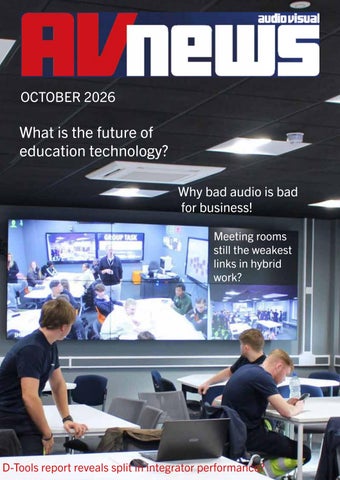
OCTOBER 2026
What is the future of education technology?
In this Issue ISE 2026 post-Show Roundup
AVIXA announces Why bad audio is bad Dubai show
for business!
Meeting rooms still the weakest links in hybrid work?
ISE 2026 breaks records
1
D-Tools report reveals split in integrator performance?
1
HEADLINE NEWS
D-Tools midyear market report reveals split in integrator performance D-Tools has released its 2026 Midyear Market Report, a data-driven look at how the systems integration market performed in the first half of the year. The data reveals that integrators grew sales by a median of 14% over the same period in 2025; however, there is a widening performance split in the channel. “The market growth is solid, but it’s not the whole story,” said Jason Knott, data solution architect at D-Tools. “Our data shows the market is splitting in two. A third of integrators grew more than 51%, another third declined by 21% or more, and the businesses in the upper-middle market are feeling it the most. Integrators need to know which side of that split they’re on. This report gives them the real numbers to find out and a set of benchmarks upon which to act.” Key Findings of the Report include: Market bifurcation widens: Over one-third of integrators (34.8%) grew sales 51% or more in the first half of 2026, while one-third (33.4%) saw sales decline 21% or more. The remainder (31.8%) of integrators were flat, or close to it. The split occurred across companies of every size. Upper-middle market squeezed: Integrators with average contracts between $25,000 and $50,000 dropped 16.1%, the weakest showing of any segment, while the share of under $10,000 and large/luxury contracts over $50,000 both grew. Growth is coming from volume, not conversion: Signed contracts per integrator rose 17% as proposal output rose 19%. Close rates held essentially flat, so growth is being driven by putting more proposals in front of customers, not better closing rates. The full report also includes regional analysis, sales-cycle and proposal-revision benchmarks, a category-by-category breakdown, and eight key takeaways integrators and suppliers can use to plan ahead. The D-Tools 2026 Midyear Market Report is available now as a free download at d-tools.com. The key findings and takeaways are published in full. Unlike opinion-based industry surveys, the report is built entirely from aggregated, anonymised transaction data drawn from signed contracts and proposals generated in D-Tools Cloud by more than 1,500 active integration companies. The data set is limited to companies that used the platform in both 2025 and 2026, so the comparison tracks same cohort of integrators across both time periods. Data by D-Tools publishes two flagship market reports each year, with quarterly companion reports in between.
2
Epson has top projectors in multiple categories: Christie and Hisense make their debut PMA Research, the worldwide market information experts on projectors, has posted highlights from their most recent Projector Tracking Service results to the “Top-Selling Projectors” area of their website. For more than 30 years now, PMA Research has collected monthly sell-through data from leading U.S. projector dealers, retailers, web resellers, and distributors. Their Tracking Service family of monthly reports offers timely data and analysis on unit sales, true volume-weighted street prices, and inventories of projectors for these channels. Each month, PMA Research posts their “Top 5” Projector Lists for the following categories: •B2B Laser Projectors (Normal/Semi-Throw) with 5,000 and Higher Lumens – This “Top 5″ list is compiled from PMA’s monthly Pro AV Projector Tracking Service panel, which is made up of Pro AV dealers and systems integrators. In the +5,000 lumen B2B laser-phosphor projector segment, Epson nearly swept this category with four PowerLite L series models on the August list. Christie rounded out the +5,000 lumen B2B laser-phosphor projector list with a model in the fourth spot.
HEADLINE NEWS
compiled from PMA’s monthly Projector Distributor Tracking Service panel, which is made up of IT, Pro AV, and CEDIA distributors. Among installation projectors with interchangeable lenses, Epson had a trio of their EP-PU series projectors make the August list, including the top two best-sellers. Sony and Panasonic rounded out this list with one model each in the “Top 5” installation projectors with interchangeable lenses category. Here are the top five models from August in this segment: Epson EB-PU1008 Epson EB-PU2010 Sony VPL-FHZ85 Epson EB-PU1007 Panasonic PT-MZ882 Resellers, distributors, manufacturers, and the press are invited to visit PMA’s site each month at www.pmaresearch. com to see the 5 Top Selling projectors for these channels, as well as new product blogs and information on PMA Research’s projector market research offerings.
Mediaproxy AI driven monitoring and browser based multiviewing Here are the top five models from August in this segment: Epson PowerLite L695SU Epson PowerLite L690SU Epson PowerLite L690U Christie DWU760A-iS Epson PowerLite L530U Consumer Ultra-Short-Throw Projectors - This “Top list is compiled from PMA’s monthly Retail Projector Tracking Service panel, which is made up of U.S. retailers, web resellers, and custom installers. For consumer ultra-short-throw projectors, LG had the best-selling model in August. Epson, Optoma, Hisense and YABER each made a showing on the consumer ultra-short throw projector “Top 5” list, with one model each. Here are the top five models from August in the segment: LG PU615U CineBeam S Epson Lifestudio Grand EH-LS670 Optoma GT3500HDR Hisense PX3-Pro YABER K300s Installation projectors with interchangeable lenses – This
Mediaproxy will showcase major advancements in broadcast monitoring workflows at NAB Show New York, 21 – 22 October at the Javits Centre, New York (Booth 561). Mediaproxy will present new AI powered capabilities within its LogServer platform, alongside the first NAB New York demonstration of Monwall Web, its interactive, browser based multiviewer. LogServer, Mediaproxy’s flagship compliance and analysis system, continues to evolve with new AI features designed to streamline live broadcast operations. The latest release introduces intelligent event detection, automated reporting, and expanded quality of experience (QoE) monitoring. These enhancements allow operators to offload routine checks to the system while gaining faster insight into real time issues across fast moving broadcast environments. Visitors to NAB Show New York will see demonstrations of LogServer performing automated tasks traditionally handled by human operators, including real time alerting and advanced content analysis. The new AI toolset marks a significant shift toward more efficient, data driven monitoring workflows. Making its NAB New York debut, Monwall Web
3
HEADLINE NEWS
brings Mediaproxy’s software defined multiviewer into the browser. Designed for flexible, low latency remote monitoring, Monwall Web enables operators to interact with live mosaics from any location. The platform now supports Low Latency HLS (LL HLS) and the emerging Media over QUIC (MoQ) protocol, ensuring smooth, ultra responsive viewing even at scale. Audio output monitoring and the ability to rewind live layouts further enhance remote operational control. Mediaproxy has also joined the open source MXL (Media eXchange Layer) initiative, integrating high performance, in memory media transport into its software defined workflows. This collaboration reinforces the company’s commitment to open standards and next generation live production architectures. The latest developments highlight Mediaproxy’s commitment to innovation that reduces operational overheads while increasing visibility and efficiency, delivering solutions that meet the needs of modern broadcast operations.
Shure introduces next generation of the MV6 USB gaming mic Shure has announced the launch of the MV6 USB Gaming Microphone Gen 2, including a new white variant, the latest evolution of its digital MOTIV microphone portfolio. Following the success of the original MV6, the MV6 Gen 2 incorporates feedback from gamers, streamers, and creators to deliver a more customisable audio experience while maintaining an accessible price point. Engineered specifically for PC gaming, streaming and content creation, the MV6 Gen 2 brings Shure’s professional broadcast technology to more creators, including those purchasing their first dedicated microphone and looking to elevate their sound beyond a headset. New for Gen 2, the enhanced MV6 gives gamers, streamers, and creators more control over the intelligent processing that made the original so powerful. Built around Shure’s Voice Isolation Technology, the mic now adds adjustable Auto Level Mode and an adjustable Real-Time Denoiser to more effectively manage sudden volume changes and background noise during gameplay and streaming. The result is personalized audio that stays clear and consistent, helping users stay focused on their game while providing greater freedom to position the microphone where it works best for their setup and on-camera presence. “Gamers and streamers aren’t audio engineers, and they shouldn’t have to be to sound great,” said T Banks, Product Manager
4
at Shure. “They whisper during tense strategic moments, shout during victories, and stream from environments ranging from quiet bedrooms to noisy shared spaces. With the MV6 Gen 2, the audio intelligence sits inside the microphone’s hardware itself. The mic does the heavy lifting of managing volume spikes and erasing background room noise, directly out-of-the-box.” The MV6 Gen 2 is designed for the realities of gaming, streaming, and content creation, from sudden volume changes and background noise to setups that move across PCs, tablets, and phones. Users can fine-tune audio settings in the free MOTIV desktop, tablet, and mobile apps, then save them directly to the microphone for consistent sound when switching between compatible devices. Core upgrades and smart features include: Two Colourways: Available in black and new all-white finishes. Both options ship with a matching desktop stand and USB-C cable. The white model features colour-matched flocked foam with a velvety finish for a clean, unified desk aesthetic. Adjustable Auto Level Mode: Whether users whisper through a stealth mission or shout after a clutch victory, Auto Level Mode keeps their voice at a steady, consistent volume. Users can now choose how loud their voice sits in the mix and how quickly the mic reacts. A slower setting delivers a smooth, podcast-style sound, while a faster one catches sudden gaming moments without clipping or dropouts. ● Adjustable Real-time Denoiser: A new slider lets users control how much of their room comes through on stream. Slide it up to cut out background noise like fans, keyboards, or roommates, or ease it back to keep a more natural, open sound in the mix.
HEADLINE NEWS
Customisable EQ: A 5-band equalizer lets users design their signature tone, on top of simple Dark, Natural and Bright options. Built-in Digital Popper Stopper: On-board virtual pop filtering mechanically and digitally suppresses harsh sounds. Three Presets: The mic offers quick presets for Speech, Singing, and Instrument applications. The MV6 Gen 2 now ships with a longer 2-metre USB-C cable to support more flexible positioning and complex desk layouts. The included desktop stand has an isolation base to minimize desk bumps and vibrations, while a universal 5/8inch thread makes it easy to unmount the microphone and attach it to any standard boom arm. A 3.5mm headphone jack lets users hear their mic and game audio exactly as their audience does, with no delay, and a tap-to-mute hardware button with a colour-changing LED indicator enables instant, silent muting. With Shure’s immediately recognisable design and audio quality, the MV6 Gen 2 can take users from late-night Discord raids to morning business presentations. The MV6 Gen 2 is compatible with PC, Mac, and Android devices via a single USB-C cable. It is also MFi Certified by Apple for use with iPhone and iPad. The Shure MV6 Gen 2 is available now for $169 (MSRP) at shure.com and authorised retailers. Shure MOTIV apps will support MV6 Gen 2 from launch.
Shure has announced the launch of the MV6 USB Gaming Microphone Gen 2, including a new white variant, the latest evolution of its digital MOTIV microphone portfolio.
5
HEADLINE NEWS
Hisense extends UEFA partnership to UEFA EURO 2028 Hisense has announced it will continue its partnership with UEFA as an Official Partner of the UEFA EURO 2028. Following the announcement at IFA Berlin 2026, it marks the brands fourth consecutive sponsorship of the UEFA European Championship. It signifies an exciting year for the UK and Ireland in 2028, as Leeds-headquartered subsidiary, Hisense UK will join the nations in welcoming Europe’s premier international football tournament to home soil. Last hosted by the UK in 1996, Hisense are gearing up to bring consumers more opportunities to experience the excitement of UEFA EURO 2028, both in person and at home, through competitions, prizes and experiences designed to bring fans closer to the action. Howard Grindrod, Vice President at Hisense UK, said: “It’s incredibly exciting to once again partner with UEFA as they prepare to bring the EURO 2028 tournament here to the UK and Ireland. For fans across the UK and Ireland, we understand just how momentous this occasion will be. We’re thrilled to give consumers more opportunities to be part of the experience through our innovative technology, including our RGB MiniLED TV technology, which delivers natural colour and exceptional picture quality to bring the energy and emotion of live football into fans’ living rooms. We look forward to working with UEFA to make this another memorable tournament, and to delivering the best possible experience for fans across the nation.” UEFA marketing director Guy-Laurent Epstein said: “We are delighted to continue our partnership with Hisense for UEFA EURO 2028. Their sustained commitment to European football across four consecutive EURO tournaments demonstrates the strength of our relationship and a shared ambition to create meaningful experiences for fans. We look forward to working together to make the next EURO memorable.” Catherine Fang, VP of Hisense Group and President of Hisense Global Commercial Centre, said: “Great partnerships are built over time, and our journey with UEFA reflects that belief. As the first Chinese sponsor of the UEFA EURO, over the past decade we have grown beyond pure brand sponsorship to become UEFA’s dedicated display technology partner, progressing hand-in-hand. Through cutting-edge technology and immersive experiences, we bring audiences
6
closer to the thrill of football. Looking ahead, we are eager to write the next chapter together with UEFA, creating more meaningful moments for fans everywhere.” At IFA 2026, visitors can explore a dedicated UEFA EURO 2028 activation zone at the Hisense booth, featuring a football challenge with goals tracked and photos automatically generated for sharing. Together with Hisense’s latest innovations, the activation reflects the brand’s vision of “Innovating a Brighter Life” – using technology to make moments that bring people together more engaging and memorable. A key part of the at-home experience will be Hisense’s RGB MiniLED technology, the next evolution of TV. Combining the precision of MiniLED technology with RGB technology, it is designed to deliver real and natural colour alongside an immersive viewing experience. By bringing the vibrancy, detail and emotion of live football into the home, Hisense aims to help fans enjoy UEFA EURO 2028 from the comfort of their living rooms.
HEADLINE NEWS
Fonn Group acquires everviz and introduces Teikna Fonn Group has acquired the remaining shares in everviz, taking full ownership of the cloud-native platform for interactive charts, maps, and data-driven graphics. With the acquisition complete, Fonn Group will bring everviz forward as Teikna, its graphics platform for broadcast, streaming, and digital media. Teikna carries forward everviz’s technology and expertise, including its foundation in open web standards and APIs, and combines them with Fonn Group’s experience in cloud production workflows for broadcast, streaming and digital media. Existing everviz charting and mapping capabilities will continue uninterrupted for current customers. As Teikna develops, Fonn Group plans close integrations with Saga, its story-centric newsroom system, and Mimir, its cloud-based media collaboration and production platform. “everviz has built deep expertise in charts, maps, and data visualization. With Teikna, that expertise gets a bigger canvas. We have clear ideas about where graphics workflows are heading, and we would rather show than tell. IBC is where we will start,” says Haavard Myklebust, CEO of Fonn Group. To lead Teikna, Fonn Group has appointed Christian Gogstad Eide as Chief Technology Officer. Eide will work directly with Myklebust and Fonn Group’s product teams to shape the platform’s technical direction. Eide spent nearly 15
years at Norwegian public broadcaster NRK, working at the intersection of web technology and live broadcast production. An award-winning developer, he co-created Nora, NRK’s HTML-based graphics solution and has worked across national elections, major sports events, and entertainment productions. “Graphics are no longer created by one type of person, in one tool, or for one screen. That is exactly what drew me to Teikna. It is an opportunity to build on everviz’s strengths and apply them to a much broader range of graphics workflows,” says Christian Gogstad Eide, CTO of Teikna.
7
BUSINESS NEWS
UniVicoustic announces Captech as its official distribution partner in the Nordics The new partnership brings UniVicoustic’s acoustic treatment solutions to Captech’s established Nordic distribution network. UniVicoustic announces Captech as its new distribution partner for Sweden, Finland, Denmark and Norway. The partnership brings together UniVicoustic’s expertise in acoustic treatment with Captech’s established presence across the Pro Audio, Pro AV and Consumer Audio markets. The two companies connected at ISE Barcelona 2026, where discussions around the Nordic market and the growing demand for high-performance acoustic solutions led to the new partnership. Through Captech’s established sales, technical and logistics infrastructure, UniVicoustic’s portfolio will become more accessible to professionals and businesses across the region. As part of the new partnership, Captech will showcase UniVicoustic’s acoustic treatment solutions to customers and industry partners at Captech EXPO 2026, taking place on October 15 at Åby Arena in Gothenburg, Sweden. The event will provide an opportunity for visitors to discover the UniVicoustic portfolio and learn more about its applications across professional audio, AV environments, Hi-Fi and Home Cinema, and public spaces. “We are very pleased to partner with Captech and expand our presence in the Nordic market” says Per Larsen, Vice President and Sales Director at UniVicoustic. “Captech has a strong position across the professional audio and AV industries, together with the local expertise and distribution capabilities needed to bring our solutions to a wider range of customers. We look forward to building this partnership and creating new opportunities across the region”.
Comedy Icon Leigh Francis unveils identity on Vieunite Vieunite, the provider of advanced digital art solutions for showcasing curated and personalised artwork, has announced that British comedian, actor, television presenter, and artist Leigh Francis has joined Vieunite’s global creative community as its latest Featured Artist. Following conversations rooted in a shared passion for accessible art, Francis is
8
BUSINESS NEWS
bringing his distinctive, nostalgic and irreverent visual style to audiences through the Vieunite Art Library and Textura digital canvas. The addition of Leigh Francis is overseen by Vieunite’s in-house curatorial team led by Dr Benedict Carpenter van Barthold. Francis’ portfolio will sit alongside masterpieces from major cultural partners, including the National Galleries of Scotland, the Estorick Collection of Modern Italian Art, and the Royal Pavilion at Brighton. Best known for his character comedy, most notably as the creator of Bo’ Selecta! and the character of Keith Lemon, Francis is now stepping into the public eye to share his lifelong passion for visual art. Having originally studied graphic design at Jacob Kramer College (now Leeds Arts University), his portfolio features a bold pop-art aesthetic characterised by high-contrast line work and expressive, hand-drawn digital portraiture. His collection draws heavily on nostalgia, with fans recognising his own beloved creations - including The Bear, his iconic caricature of Mel B, and Avid Merrion blended into surreal visual mashups. He also pays homage to his youth with meticulously hand-drawn recreations of 1980s pop culture and magazine covers. Like his artistic hero David Hockney, Francis works largely on an iPad. In terms of its subject and style, his art is deeply rooted in the distinctiveness of British comedy. It continues the grand UK tradition of subversive, eccentric visual satire, using unapologetic caricature to puncture the slick veneer of modern celebrity culture with pure, anarchic joy. Leigh Francis commented, “A lot of people know me as the characters I’ve played on tv, Keith Lemon, Avid Merrion, the bear etc.. but when I’m not messing about on telly in the guise of some character I’ve created, I like nothing more than extreme sports! Surf boarding, snowboarding, wake boarding! Anything with a board! I’m kidding of course, my work on telly has always been very visual because basically I do a lot of art in my spare time. When I first found out about Vieunite and its mission to bring art to people’s lives, I felt it was the perfect fit for me. My work is mostly a mix of graphic nostalgia, bright fun pop art, and seeing it displayed on these incredible digital canvases is a fantastic way to bring that anarchic joy straight into people’s everyday lives.” For the home user, Vieunite offers a new way to experience Leigh Francis’ vibrant imagination on a daily basis. The platform provides art lovers and comedy fans with an ever-evolving gallery right in their living rooms, transforming static walls into dynamic, highly personal conversation starters. Through the Vieunite app, users can easily curate their own rotating exhibitions to include Francis’ nostalgic, high-energy pieces, seamlessly switching between a cheeky 80’s homage and a classic masterpiece to suit their mood or décor. While focused on enriching the home environment, Vieunite remains fiercely dedicated to the creators themselves. The platform operates on a unique artist-first model where creators retain 100% of their IP, earning an industry-leading percentage of B2C licensing revenue, supplemented by a mutual Creative Commitment Fund that supports all active artists. The same ecosystem extends into commercial environments through Vieunite Pro, enabling organisations across hospitality, corporate and other professional settings to incorporate digitised artwork into their spaces while creating an additional revenue opportunity for artists. To ensure
9
BUSINESS NEWS
visual integrity, the artworks will be displayed on the proprietary Textura digital canvas. Rather than using high-glare domestic TV panels, the Textura display features a texture-accurate matte anti-glare screen and an energy-efficient 350-nit output. This optical technology is engineered to replicate the physical depth, surface textures, and brushstrokes of physical canvas and pigment. Dr. Benedict Carpenter van Barthold, Cultural Director at Vieunite, commented: “Our focus is on presenting curated, museum-quality art within daily environments. By introducing Leigh Francis to our platform, we continue to bridge the gap between historic masterpieces and active, living contemporary creators, providing businesses and home users with authentic visual experiences.” The addition of Leigh Francis further expands Vieunite’s creative community, bringing together established cultural collections, contemporary artists and distinctive creative voices on one digital platform.
AtlasIED partners with M.I. Engineering to expand APAC presence AtlasIED has announced a partnership with M.I. Engineering, a Bangkok, Thailand-based Manufacturer’s Representative. The partnership aims to expand AtlasIED’s reach across APAC, while broadening M.I. Engineering’s reach by offering access to industry-leading mass notification systems, IP endpoint solutions, and commercial audio technology. M.I. Engineering has operated as an established commercial audio and AV solutions company since 1990, building decades of trust in the pro audio, installed AV, and live performance markets. The team maintains strong, longstanding relationships with local systems integrators, AV consultants, architects, and venue operators, which will help expand AtlasIED’s reach in the region. “We greatly look forward to partnering with AtlasIED, whose team brings its proven expertise in life safety, public address, and architectural audio solutions to our customers,” said Niti Teerakitti. General Manager, M.I. Engineering. “Adding AtlasIED’s portfolio strengthens our ability to deliver complete solutions while opening new opportunities across enterprise, healthcare, education, and transportation markets. Together, we can provide customers with the performance, reliability, and certified mass communication capabilities these complex environments require.” The partnership combines AtlasIED’s comprehensive AV solutions with M.I. Engineering’s technical expertise, system
10
design consulting, and commissioning support. Together, the companies will provide customers with solutions spanning live performance audio, architectural acoustics, and enterprise mass notification, backed by local product availability and dedicated customer support. “Partnering with local companies that hold impressive track records in customer satisfaction is exactly what we’re looking for during this period of growth in the APAC region,” said Glenn Lin, Director of Sales for APAC at AtlasIED. “We see great positivity and possibilities through this partnership within a variety of unique installations.”
Avocor and Korbyt form new strategic global partnership Avocor has confirmed a new strategic partnership with Korbyt, a leader in digital signage and space management solutions. The agreement is the latest in a strong partnership drive from Avocor, further establishing itself in the enterprise, manufacturing, retail and hospitality sectors. Korbyt software has been validated on the recently launched Avocor B-Series, which debuted at ISE 2026 and marks Avocor’s move into the business and commercial digital signage
BUSINESS NEWS
byt. “That’s why we’re actively growing our network of hardware partners, and Avocor is exactly the kind of partner we want to build around. Certifying Korbyt on the B-Series means joint customers get a proven, ready-to-deploy platform on day one, and it gives us a stronger foundation to serve enterprise deployments at scale.” Customers already running Korbyt can add B-Series displays to an existing estate without changing platforms. The Korbyt application is available to install directly onto the Avocor B-Series today.
LEA Professional announces partnership with Adagio Pro
display market. The Korbyt application runs on the display’s own Android 14 processor, backed by 8GB of RAM and 32GB of storage. The collaboration strengthens both companies’ capacity to deliver a smart, dynamic digital signage solution across markets. “Since launching the B-Series at ISE, we’ve been committed to building relationships that enhance user experience, and working with Korbyt means our customers can expect a CMS platform that works as one with our displays,” said Dana Corey, global general manager at Avocor. “We’re also very excited about the AI-powered features Korbyt brings to the table. Automating time-consuming activities such as scheduling and feeding back smart data on key metrics like number of views and dwell time helps our customers optimise engagement on our displays. That’s the ultimate goal of the B-Series.” In addition to corporate campuses, the companies expect early traction in business-critical settings such as manufacturing and supply chain, where existing joint customers are already asking for real-time data delivered on the floor. “Enterprise customers increasingly want AV and digital signage that works as a single, validated solution rather than a set of disparate parts they have to integrate themselves,” said Andrew Gildin, VP Channel Sales & Revenue Operations, Kor-
Consistent with its mission of expanding its global reach, LEA Professional today announces its partnership with Adagio Pro, a Barcelona, Spain-based commercial audio distributor. This partnership brings LEA’s extensive technology catalogue, featuring industry-leading intelligent IT solutions, best-in-class DSP, and smart power management, to customers in Spain. Adagio Pro is part of Holmusic, a family-owned business with over 50 years of industry experience. This partnership will represent LEA Professional’s award-winning Network Connect series of professional amplifiers and companion Dante Connect series featuring Dante and AES67 connectivity. These series enable integrators to utilize cloud-based remote control, monitoring, notifications, and more from any internet-enabled device, allowing them to stay connected anywhere in the world. “LEA Professional has it all: innovative technology, intuitive design, and a flexible product portfolio that makes this an unmatched pairing with our team,” said Tony Batllo, CEO of Holmusic. “We see tremendous potential in this partnership and look forward to supporting our customers by offering LEA’s technology and expertise.” LEA Professional’s smart amplifiers are among the most feature-rich amplifiers available in the industry — featuring onboard 96kHz DSP, LEA Cloud connectivity, WebUI, third-party API control, real-time load monitoring, LoZ/70V/100V selectable by channel, event, and fault monitoring, high-efficiency power design, over 4,000 speaker tuning presets, and LEA’s advanced amplifier control software, SharkWare. “Expanding our distribution network in Spain is an important step in making LEA’s products and technology more accessible to commercial AV integrators across the region,” said Jeff Gorton, Sales Director - Europe and Africa at LEA Professional. “Through this partnership with Adagio Pro, we can provide integrators with the innovative, scalable audio solutions and local support they need to bring their projects to life.”
11
BUSINESS NEWS
nsign and Sony collaborate to simplify digital signage deployment nsign, the digital signage SaaS platform built around its ‘Simplify Complexity’ principle, is now officially certified for BRAVIA Professional Displays from Sony. Developed in collaboration with Sony Professional Displays & Solutions, the integration allows the nsign application to run directly on compatible screens, helping resellers and integrators deliver signage projects faster and simplify ongoing management. The integration combines direct playback on the display with remote monitoring and control through Sony’s on-device REST API, while Sony’s Device Provisioning Tool simplifies initial setup. In installations where a separate media player is no longer required, this reduces hardware costs and the number of components to install and maintain. “When you are deploying signage across multiple locations, every extra device and every configuration step adds up,” said Mónica Fernández, Managing Director of nsign. “Working with Sony gives our partners a simpler way to get screens up and running and keep them under control. It also gives customers more choice as their networks grow, while keeping content and day-to-day operations in one familiar platform.” To simplify deployment, installers use a predefined provisioning profile through Sony’s Device Provisioning Tool. The profile installs nsign as the display’s default application and applies the settings required for remote monitoring and control. Once activated and paired with the nsign platform, the display launches the application automatically at startup. This reduces repetitive manual configuration and helps integrators apply a consistent setup across multiple screens and locations. Through Sony’s local REST API, the nsign application can control supported displays, including switching screens on and off, rebooting them and changing screen orientation. Content, playlists and schedules are managed centrally through nsign, bringing playback and display control into the same operational environment. The collaboration also expands the hardware options available to nsign customers. Supported BRAVIA Professional Displays can be managed alongside other compatible devices, including Android-based hardware and BrightSign players. A retailer or restaurant chain can introduce Sony screens at new locations or in a pilot project while retaining its existing compatible hardware elsewhere. Marketing and operations teams continue to use the same platform to manage content across the network, without having to adopt a separate workflow for each hardware manufacturer. Resellers, integrators and end users can contact nsign for details of supported BRAVIA Professional Display models, firmware re-
12
quirements and deployment options.
Leyard Europe expands UK & Ireland team and opens dedicated London showroom Leyard Europe has strengthened its UK and Ireland operations with a series of strategic appointments and expanded leadership roles as the company continues to invest in one of its fastest-growing regions. The expanded team reflects increasing demand for high-performance LED display solutions across corporate, retail, education, control room, hospitality, broadcast and public sector environments, while reinforcing Leyard Europe’s commitment to providing local
BUSINESS NEWS
expertise backed by European manufacturing and supply chain resilience. The investment follows the recent opening of Leyard Europe’s dedicated Leyard and Planar UK Showroom & VIP Lounge at 11 Cursitor Street, London. The venue provides customers, consultants, integrators and end users with a central location to experience the latest display technologies, collaborate on projects and explore solutions firsthand. The regional team includes Guy Phelps, who has joined as Territory Head for the UK & Ireland, alongside Matt Stone, appointed Regional Sales Manager for Ireland, Northern England and Scotland. The company has also expanded the responsibilities of Lee Baxter, now Director of Channel UK & Ireland, and Luke Marler-Hausen, who becomes Director of Strategic Projects | Business Development. Leyard Europe
has also strengthened its marketing capability with the appointment of Esther Rowe as Marketing Manager. Based in the UK, Rowe will take responsibility for the company’s marketing strategy across Europe, with a particular focus on supporting regional growth, customer engagement, events and industry activity. Her role will help connect Leyard Europe’s sales, channel and marketing initiatives, while increasing the company’s visibility across key European markets and sectors. Further strengthening customer support, Catherine Bartrum joined the business during the second quarter as Inside Sales Executive, providing dedicated sales support to customers and partners across the UK and Ireland and helping accelerate opportunities throughout the sales cycle. In his role as Territory Head, Phelps is responsible for driving growth across the UK and Ireland, supporting business development, customer retention and strategic sales initiatives. He will also focus on developing the regional team, supporting customers and consultants with specification, design and installation, while promoting Leyard Europe’s London Experience Centre as a destination for demonstrations, collaboration and project development. Phelps brings more than 15 years’ experience in the professional display industry, having previously held senior sales positions at Sharp NEC Display Solutions Europe, NEC Display Solutions Europe and Panasonic. His career spans end-user sales, channel development, project management and global account leadership across sectors including corporate, retail, digital out-of-home, financial services, government, transportation and energy. Based in Dublin, Stone joins as Regional Sales Manager responsible for Ireland, Northern England and Scotland. Bringing extensive experience in workplace technology, control rooms, digital signage and enterprise AV environments, he has previously held senior roles with Lightware Visual Engineering, Haivision and Kinly, supporting complex technology deployments across Europe and Australia. Baxter’s expanded role as Director of Channel UK & Ireland reflects Leyard Europe’s continued commitment to strengthening and growing its channel ecosystem. A key focus of his role will be the development of a new partner programme, alongside strengthening existing relationships and identifying new opportunities to support partners in growing their LED display businesses. Meanwhile, Marler-Hausen will focus on strategic business development and complex, bespoke LED projects, supporting customers and partners with specialist expertise across high-value opportunities and architecturally challenging installations. “Demand for LED technology continues to grow across the UK and Ireland, making it an important strategic market for Leyard Europe,” said Filip Cogghe, Vice President of Sales, Marketing and Service for Europe at Leyard Europe. “We’re investing in the people, facilities and infrastructure needed to support that growth. From expanding our regional team and opening our dedicated Leyard and Planar UK Showroom & VIP Lounge in central London, to manufacturing capabilities at our facility in Prešov, Slovakia, we’re committed to providing customers with local expertise, faster access to technology and exceptional project support throughout the entire lifecycle.” These investments form part of Leyard Europe’s wider growth strategy to strengthen support for partners, consultants and end users with innovative display solutions, specialist expertise and a truly European approach to LED manufacturing and delivery.
13
APPLICATION
Kygo on a world tour: in-ear monitoring re-defined Following on from shows in North and South America, the Norwegian music producer, keyboard player, DJ and songwriter Kygo is making a stop in Europe before heading back to the US in September. On 8 August, he performed his spectacular open-air show at the SparkassenPark Mönchengladbach. At Europe’s biggest hockey arena, Kygo’s fans were treated to a Tropical House night featuring his greatest hits and showcasing a host of special guests. Wireless in-ear monitoring for all performers and the crew was provided by Sennheiser Spectera. The centrepiece of the wireless monitoring was a Sennheiser Spectera Base Station installed in a 19” rack right next to the monitoring console. The rack also accommodated three modular L 6000 charging stations for the BA 70 lithium-ion battery packs for the 24 Spectera SEK bodypacks in use. The bidirectional bodypacks were configured as receivers for 14 stereo in-ear mixes. Three of the four Spectera DAD antennas taken to the venue were used and set up on stands. The Spectera WebUI software ensured a clear overview of the system and provided comprehensive remote-control options. The Spectera Base Station was operated in the UHF band, with centre frequencies of 546 MHz and 578 MHz for the 8 MHz blocks. Power was supplied via a redundant system from the power grid and a UPS. The main connections were available through an interface panel at the back of the 19” rack. The audio signals were sent to the monitoring console via MADI using coaxial BNC point-to-point cabling. The sampling rate was 96 kHz, the Audio Link Mode was set at “Live Low Latency” with a latency of 1.1 ms (Extended Range, SeDAC). The Sennheiser equipment was supplied by the UKbased companies Studio 89 and Pulse PA Limited (www. pulsepa.co.uk). Ross James Mulhare (Instagram: @the_ rossjames), founder and owner of Studio 89, was responsible for setting up the Spectera system in Mönchengladbach and also for the FOH mix during the show. “Two of the many features that make the new Sennheiser Spectera system so impressive are its compact packing size and its low weight,” says Mulhare, who has had a successful career in the professional audio industry for many years and also has a background as a musician. He can often be found at the FOH and monitoring consoles during touring productions. His references include working with big names such as The Sugarbabes, Gary Barlow and Ronan Keating. He has now been working for Kygo for four years. “Kygo’s tour takes him all over the world, and besides
14
Europe we often perform in North and South America as well as in Asia,” says Mulhare. “We used to work a lot with locally hired equipment, which can often be a real challenge. But in the meantime, we’ve put together a touring package that’s perfect for our needs, and Spectera is now a key component of this. For worldwide tours, we have an A set and a B set, and because both have to be dispatched by air freight, they need to be as compact and light as possible.” Mulhare adds: “One feature that is extremely useful for me is the fact that the Spectera DAD antennas are connected to the Base Station via conventional network cables. That speeds up and simplifies the workflow when setting up. And if necessary, you can always get replacement cables quickly wherever you are on tour. In Mönchengladbach, we use three DAD antennas: two for the stage and one for the backstage area, where Kygo is accompanied live by a video camera on his way to the stage. We use the fourth antenna whenever the stage design includes a long catwalk.” In the past, Mulhare often used wireless systems from another company for touring. His first contact with the Sennheiser Spectera ecosystem was through Angus Price, the managing director of Pulse PA Limited. “It was Angus who introduced me to Spectera, and he gave me the opportunity to put the system through its paces at his company’s premises,” he recalls. “I quickly became aware of the many possibilities that it offers, especially because Angus was there to help me with all his experience. In January 2026, I was at a trade fair in the UK where I was able to take part in a Spectera demo. Having used products from a different manufacturer for many years, I couldn’t really imagine changing to a new system at first – but as you can now see from the Kygo shows, that mindset wasn’t set in stone…,” he said with a smile. Mulhare stresses that configuring a ready-to-play setup at
APPLICATION
a new location can be carried out much more quickly with Spectera than with conventional wireless systems. “At the moment, we use the Spectera WebUI software, which is intuitive to operate,” he says. “I haven’t yet had the chance to try out the SoundBase Pro software, but I find its concept very interesting.” Mulhare rejects the well-worn cliché that DJs simply turn up at EDM shows with a USB stick, and therefore not much work is required at the mixing console: “Kygo plays various synthesizers during his show and often performs at a real grand piano – he’s a really excellent keyboard player! In addition, he invites various singers onto the stage as guest vocalists for some of songs, and today in Mönchengladbach, he will also be accompanied by an ensemble of six string musicians and a marching percussion band. It’s by no means a trivial task to get the FOH mix and in-ear monitoring just right.” The monitoring console in Mönchengladbach was operated by Kevin Flasza (Instagram: @enjoyakevinsicle). The US sound engineer lives in Berwyn, Illinois (Chicago metropolitan area), is a full-time employee of the Production Resource Group (PRG) and has wide-ranging expertise in the field of live audio. He graduated with a Bachelor of Arts in Audio Arts from Columbia College Chicago. Flasza has been accompanying Kygo on tour in various sound engineering roles since 2018 and used the Sennheiser Spectera ecosystem for the first time at the performance in Mönchengladbach. “To be honest, I was a bit nervous beforehand about working on such a big show and having to rely on a wireless system that was completely new to me,” Flasza admits. “But after the set-up and the sound check, I realized that there was no reason for me to be nervous at all, especially since I’ve worked with Sennheiser wireless equipment many times in the past. I know that people used to talk a lot about latency
in digital in-ear systems. Personally, however, I’ve always argued that that this isn’t as important in live performances as it is, for example, in studio recordings.” Conventional monitor speakers were not used for Kygo’s show. Only at the actual DJ console itself were side stacks set up on the left and right, each consisting of two top speakers and one subwoofer. Kevin Flasza: “When I connected to the Spectera system for the first time using the SEK bodypack, it had quite a “wow” effect.” Flasza continues: “When I connected to the Spectera system for the first time using the SEK bodypack, it had quite a “wow” effect. Yesterday, we had a show at the UNTOLD Festival in Cluj-Napoca in Romania, where a wireless system from a competitor company was being used. I must say: the difference between yesterday and today is absolutely immense, and I immediately understood why Ross, who was responsible for setting up the system, speaks so highly of Spectera. The sound transmission is exceptionally smooth, with an extremely low noise floor, and in my opinion the music sounds fuller than it does with other products. You could even say that the sound seems to have a shiny finish, as if it has been polished. It’s just so much fun! What I also find fascinating is that a single 19” device with just 1U is able to provide the 14 stereo inear mixes required for Kygo’s show,” says Flasza. “As far as the SEK bodypacks are concerned, I first had to get used to the fact that the on/off switch is located under a cover, and the endless rotary encoder is also something new for me. A really cool feature is the e-ink display, which continues to show the performer’s name when it is switched off – it definitely looks a lot better than a piece of sticky tape with my handwriting on it…” Mulhare is already looking forward to the brand-new Sennheiser Spectera SKM handheld transmitters: “I’m waiting for a demo model that’s expected to arrive at Studio 89 next week. I intend to take the handheld transmitter with me to a show by Australian indie rock band Gang of Youths, where I’ve been using Spectera for some time now. As far as Kygo is concerned, the first step will be to equip the crew with Sennheiser headsets for talkback purposes, and these will be connected to the Spectera SEK bodypacks. This will enable us to benefit directly from the bidirectional functionality. In addition, I can certainly imagine using Spectera SKM handheld transmitters with capsules such as the MMD 945 or the MM 445 for Kygo’s vocals and for his guest vocalists, as I’m really impressed by the sound they deliver. And then, in the not-too-distant future, we will probably add a second base station as well…”
15
APPLICATION
University of Lincoln puts users first with campus-wide AV transformation The University of Lincoln has completed a major campus-wide AV transformation, deploying a Sennheiser ecosystem that includes 172 TeamConnect Ceiling 2 (TCC 2) microphones across 80 seminar rooms, 12 lecture theatres and a range of boardrooms and professional services spaces, alongside TeamConnect Ceiling Medium (TCC M), SpeechLine Digital Wireless (SL DW) and MobileConnect solutions. Designed to improve hybrid teaching, accessibility, and ease of use, the project reflects the university’s commitment to creating more flexible, inclusive and future-ready learning environments. Established in 1996, the University of Lincoln has built a reputation as one of the UK’s most dynamic modern universities, combining a city-centre campus at Brayford Pool with a strong focus on industry collaboration, teaching excellence and student experience. As the university continues to evolve, its AV team has focused on developing learning spaces that support a broad range of teaching styles and access requirements. At the heart of the project was a simple but transformative question: What do the people actually using these rooms need? Rather than beginning with technical specifications, the university approached the project from the perspective of lecturers and students, focusing on workflow, usability and accessibility. “The idea was to design and enhance our rooms from a user perspective rather than a technological perspective,” explains Jason Ramsden, AV Design Lead and Deputy AV Manager at the University of Lincoln. “How does the user journey in that room work? What does that workflow feel like? We have moved microphones into the infrastructure of the building, so lecturers don’t have to think about the setup or the use case.” The initial design phase was completed in 2023, with the
16
main rollout beginning in 2024. Installation was carried out primarily by the university’s long-standing AV partner, Pure AV, with recent additions completed by Snellings Business Systems following a new tender process. “We’ve had really strong support from both our integration partners and the manufacturers,” says Caleb Connors, Digital Audio Visual Technology Manager at the University of Lincoln. “Having a team that understands what you’re trying to achieve makes a huge difference when you’re rolling something out at this scale.” The need for change was highlighted during the COVID-19 pandemic, when hybrid teaching became essential and the imbalance between in-room and remote learning experiences became more apparent. Handheld and lapel microphones captured the lecturer effectively, but student contributions, questions and discussion were often lost to remote participants. Portable microphones also introduced practical challenges, from being left uncharged or misplaced to being used incorrectly. “Lecturers are experts in their subject, not in AV systems,” Ramsden says. “All we want them to do is turn the system on and log in. Everything else should just work.” Following extensive evaluation, the university selected Sennheiser’s TeamConnect Ceiling Solutions. The AV team assessed a range of ceiling microphone technologies and found that Sennheiser’s adaptive beamforming delivered the most consistent results in real-world teaching environments. The decision was also supported by the university’s long-standing experience with SL DW systems. “We’d been using SpeechLine for a long time, so we already trusted the performance,” Ramsden explains. “That familiarity gave us confidence when we started looking at ceiling-based solutions.” In seminar rooms and standard teaching spaces, the
Rethink your connected world One experience across every space Connected
rooms, consistent experiences
Manage all
devices securely from anywhere
Collaboration without friction
Built on a connected ecosystem: ActivPanel 10 · ActivPanel D-Series · DisplayNote Launcher · Radix · Panel Management · OPS · OS Agnostic
See how it all connects: PrometheanWorld.com
17
APPLICATION
move to TCC 2 and TCC M has enabled a fundamentally different approach. Audio capture is no longer dependent on user interaction, allowing academics to walk into a room and teach in the way that best suits the session. Full-room coverage supports hybrid teaching, while more focused zones allow for traditional lecture delivery and collaborative discussion. “We’ve had to be flexible with how we deploy and use the technology,” says Connors. “It’s not about forcing a solution into a space; it’s about shaping it so it works for how people actually teach and interact.” The university has found TruVoicelift and Advanced Exclusion Zones especially valuable. Available with both TCC 2 and TCC M, TruVoicelift allows lecturers to move freely and speak naturally without requiring a handheld or body-worn microphone, while exclusion zones help mask unwanted noise and address challenging room acoustics. “We’re using TruVoicelift in our larger lecture rooms and it feels really natural in those spaces,” Ramsden continues. “The exclusion zones are fantastic, especially when we look at the nature of our rooms acoustically. No rooms, we would say, are acoustically perfect. They’re all full of unique challenges and being able to shape how the system behaves has been vital.” The flexibility of the TeamConnect Ceiling Solutions also supports changing room layouts and evolving teaching practices. If a room needs to be reconfigured, the AV team can adjust zones and exclusion zones without major infrastructure changes. “There’s flexibility in the technology,” Ramsden says. “If we need to reconfigure a room, the beamforming makes it easy. The TCC 2 lends itself to the kind of dynamic shifting we’re currently seeing in higher education, allowing us to support rooms regardless of how they are used moving forward.” Sennheiser Control Cockpit provides centralised monitoring and management across the deployment, giving the AV team visibility and control over devices at scale. “It’s essential at this scale,” says Ramsden. “Being able to see what’s happening across all devices and respond quickly has made the system much more manageable. SL DW continues to play an important role in the university’s 12 lecture theatres, which are used for teaching, events and presentations. In these larger and mixed-use spaces, handheld and bodypack microphones remain useful, particularly when academics need additional control. “Our SpeechLine systems are predominantly used in our lecture theatres,” Ramsden notes. “There will be situations where the feel of a handheld mic or a bodypack is preferred. If academics are losing control of the room in a healthy debate or conversation, they can refo-
18
cus attention by speaking into one of the SpeechLine microphones.” Camera tracking adds another layer of automation. In smaller seminar rooms, TCC 2 microphones are paired with Huddly cameras, whose onboard AI manages framing automatically. In larger lecture theatres, EVA camera systems use microphone data to track speakers and questioners, creating a more natural and engaging experience for remote participants. Room control is handled via Extron. “Sometimes a really clever tech solution can become a barrier to what you want to deliver,” Ramsden adds. “Even with guides and training resources, it can feel uninviting, so we decided to automate as much as we could. When our staff and visitors enter the room, the AV can take care of itself.” The university has also deployed Sennheiser MobileConnect in four spaces as part of a broader focus on accessibility and inclusion. The solution allows students to connect using their own devices and headphones, creating a more personalised listening experience. “The beauty of MobileConnect is that it is not just an assistive listening platform,” Ramsden says. “It opens up a whole world of support to students with additional learning needs. Some neurodivergent students can become overwhelmed in loud or crowded spaces, but with MobileConnect they can step out of the room and remain part of the session. That made the product really attractive, because we could add equity and value into our spaces for everybody.” MobileConnect has been deployed in four spaces as part of a broader focus on accessibility and inclusion. For the AV
APPLICATION
K-array delivers marine-grade outdoor audio across New York estate
team, the deployment has improved consistency across campus and reduced support interventions. For the AV team, the deployment has improved consistency across campus and reduced support interventions. “The installation has increased the consistency of microphone use across the campus,” Ramsden explains. “There has also been a reduction in our support interventions for microphone-related callouts, because everything is now part of the infrastructure and takes care of its own workflow.” Connors adds: “It’s taken a lot of pressure off the team. We’re not constantly reacting to issues; we can focus on improving the spaces instead.” The success of a deployment at this scale also depends on strong relationships between the university, its integration partners, internal teams and manufacturers. “We are meeting very strict deadlines because if we don’t meet them, teaching is affected,” says Connors. “As a team, we’ve been lucky with our integrators, both Pure AV and Snellings, because we are able to understand each other. It is imperative to have good relationships not just with our vendors, but with all the teams we work with internally.” “The nice thing we have with Sennheiser is that we’ve got people in the company that we trust,” Ramsden finishes. “We can have an honest conversation about the limitations of products, so if we come up with an idea, I’m confident that we’re not just going to be told it will work just to sell us another mic. Those personal relationships are really important to us.”
Old Westbury, on the North Shore of Long Island in New York, is a village whose history of grand private estates reaches from the Vanderbilts and the Phippses to the present day. When Architech Designs was appointed to create a full outdoor entertainment environment for a luxury estate in the area, the brief called for audio performance that would meet the demands of permanent outdoor installation, integrate within a landscape designed by The Laurel Group, and disappear into the architecture when not in use. The most demanding physical element of the project was the installation of a fully retractable Stealth 193-inch outdoor video wall adjacent to the pool. The display disappears completely into the ground when not in use, preserving the architectural and landscape integrity of the property through a custom lifting system with integrated acoustic treatment. Installing the video wall alone required a 12-person crew and more than half a ton of equipment working on site across two consecutive days. Since access restrictions prevented the completed assembly from being craned into position, the system had to be built in place after its components were lowered individually into the prepared enclosure. For the audio system, Architech Designs specified K-array throughout, designing a layered ecosystem of loudspeakers and subwoofers across the property’s main entertainment zones. The property needed to function as both a private family retreat and a venue for large-scale entertaining, with each zone capable of operating independently or simultaneously without overspill into adjacent spaces. Every loudspeaker and subwoofer deployed outdoors was specified to marine-grade standard, suited to permanent installation and long-term exposure to the conditions of a Long Island estate. The main pool deck, the property’s primary entertainment zone, receives the heaviest audio deployment. Four Rumble KU315 large-format passive subwoofers and four Kayman KY102 slim line arrays are installed there. The KU315 is rated IP65 out of the box, housing a 15-inch neodymium woofer and two 15-inch passive radiators in a polyurea-coated birch plywood enclosure with a frequency response extending down to 35 Hz. The Kayman KY102 is built from stainless steel, carries eight 4-inch neodymium drivers, and delivers 138 dB peak SPL across a frequency range extending to 20 kHz. At the pergola, four Kobra KK52 I compact stainless
19
APPLICATION
steel line array elements in marine finish are paired with a Rumble KU212 subwoofer, mounted to the interior pergola posts to deliver focused coverage of the covered seating area. The Kobra KK52 I carry eight 2-inch neodymium woofers in a slim stainless-steel body, with a 120-degree horizontal dispersion suited to the column geometry of a pergola structure. The cabana bar has two Vyper KV52 II ultra-flat aluminium line array elements positioned around the TV viewing area, supported by a Rumble KU210 subwoofer. At the tennis court, four Domino KF210 full-range speakers are placed one at each corner, providing balanced coverage across the full playing surface Several of the loudspeakers were supplied in custom colour finishes matched to the property’s palette. A pair of Vyper KV52 II units and a Rumble KU210 subwoofer were finished in Benjamin Moore OC-152, while two Vyper KV25X II elements were supplied in RAL 1004 Gold. The ability to colour-match K-array’s stainless steel and aluminium enclosures to specific architectural or paint references allowed the audio system to integrate visually with the property without compromise. The 10-month project ran in parallel with ongoing landscape construction, requiring close coordination between Architech Designs and The Laurel Group to integrate conduit runs and infrastructure pathways into the site before surfaces were finished. Outdoor conditions created recurring scheduling challenges throughout the installation period. The central technical task was designing the handoff between audio zones that frequently operate simultaneously. That included extensive system tuning, delay management and zone balancing, which were required to prevent audio overspill while maintaining a consistent listening experience as guests move between the pool deck, pergola, cabana and tennis court. During the specification phase, a portable K-array demo system was brought on site, and the client’s decision was made swiftly after the audition. Upon completion, the homeowner described the result as a backyard that sounds like a club, while functioning equally well as a retreat for family use. The client added that they could not imagine using another audio solution after experiencing the final system in place. “Old Westbury has extremely high standards for everything, and this client was no exception,” says Ernie Wohlleben, the founder and chief executive of Architech Designs. “He wanted a proper performance audio system made for the outdoors, marine-grade, and invisible when not in use. K-array gave us everything the project required, from
20
the product range to cover every zone to the marine-grade specs for permanent outdoor installation and the custom finish options to make it look as though it had always been part of the landscape.” “What made this project cool is that this client genuinely cared about the experience,” says Christian Bautista, lead technician, Architech Designs. “He didn’t want great sound because somebody else had it. He wanted serious performance, and he got it.”
APPLICATION
Novelty companies unite for technical production of Pope’s visit Pope Leo XIV arrived in Monaco for an apostolic visit marking a historic moment for the Principality on 28 March 2026, marking the first papal apostolic visit in the contemporary era. Nearly five centuries have passed since a reigning Pope had set foot in Monaco. And as a sovereign state whose official religion is Catholicism, the occasion carried both spiritual and institutional significance of the highest order. The day’s programme was structured around a series of official and spiritual gatherings across Monaco. Pope Leo XIV was welcomed at the Palais Princier by Prince Albert II and Princess Charlène. Following a private audience, the Prince and the Pope addressed the crowds assembled on the Place du Palais from the Palace balcony. The Holy Father then travelled by Popemobile to the Cathedral of the Immaculate Conception for a prayer gathering with the local Catholic community, before proceeding to the
Église Sainte-Dévote for a meeting with young people. The day concluded at the Stade Louis II, where a pontifical mass was celebrated for 15,000 worshippers before the Pope’s return to Rome. The technical production of the visit was entrusted to four specialist companies from Groupe Novelty. The group’s teams were deployed simultaneously across the Stade Louis II, the Cathédrale de Monaco, the Place du Palais, the Place Sainte-Dévote, and the Musée Océanographique, delivering a complete technical infrastructure designed to meet the ceremonial, logistical, and broadcast requirements of the occasion. Mediacom by Dushow led technical coordination and video across all sites. Dushow provided staging, sound reinforcement, and electrical distribution. DushowTV was responsible for lighting design and delivery, while Magnum Power supplied the power infrastructure through generator sets positioned across the venues. “To be entrusted with this technical production is a milestone for our group. It’s the first Papal visit in nearly five centuries, with millions watching a single day unfold,” says Dushow general director Christian Lorenzi. “Our teams understood the responsibility that this carried. And our role was to ensure the technology served the moment while remaining totally invisible and functioning flawlessly.” The Stade Louis II served as the primary venue for the afternoon’s pontifical mass, attended by the faithful, dignitaries, and media from across the region. The technical setup was developed in close collaboration with Monaco Broadcast, the Gouvernement de Monaco, the Palais Princier de Monaco, and the Diocèse de Monaco, whose operational and ceremonial requirements shaped the design and placement of each element. Beyond the Stade Louis II, the group’s teams provided technical installations tailored to the character and scale of each ceremony. At the Place du Palais, the installation ensured clear audio and visual coverage for the crowds attending the balcony address. At the Cathédrale de Monaco and the Église Sainte-Dévote, configurations were adapted to the Novelty companies unite to deliver technical production of Pope Leo XIV’s historic visit to Monaco intimate scale and architectural constraints of sacred spaces hosting gatherings of a different character to the stadium mass. “No two venues had the same requirements. With teams operating across Monaco simultaneously, constant communication was key,” says Christian Lorenzi. “We ensured we kept a single technical direction, while adapting our work site by site.” The integration of four specialist brands within a single operational structure was cen-
21
APPLICATION
tral to the delivery of an event of this scope and complexity. With more than 50 years of combined event production expertise, Groupe Novelty’s multi-brand model brought a unified technical direction to a project that spanned video, staging, sound, lighting, and power simultaneously across multiple ceremonial venues. Groupe Novelty has a permanent presence in Monaco, a long-standing relationship with major events in the Principality, and teams with direct experience of the logistical demands that come with operating across Monaco’s compact and closely managed streets. “This project demonstrates exactly what our model at Groupe Novelty was built for. This project had four brands and one operational structure covering video, sound, lighting, staging, and power across five different venues on that day,” Christian Lorenzi says. “Our permanent presence in Monaco and our longstanding relationships there meant we arrived not as visitors, but as partners who understood the context and what was at stake”. The apostolic visit of Pope Leo XIV stands as one of the most significant events in Monaco’s contemporary history and among the most demanding multi-site productions delivered by the Groupe Novelty family of brands in the Principality. Groupe Novelty extends its thanks to all the teams mobilised across the sites and to the partners and institutions whose collaboration was essential to the success of the day, including Monaco Broadcast, the Gouvernement de Monaco, the Palais Princier de Monaco, and the Diocèsede Monaco. “This was one of the most demanding productions our teams have delivered in Monaco. And it’s one that we’re most proud of,” reflects Lorenzi. “I can’t thank everyone enough who helped us mobilise across the sites. This project confirms what Groupe Novelty can offer for events of the highest cultural, institutional, and ceremonial importance. We’re ready – anywhere, any time, and at any scale.”
Pufferfish at the Nemo Science Museum NEMO Science Museum is using Pufferfish to support visitor engagement and science communication through immersive display technology. As the Netherlands’ national science museum, NEMO is dedicated to making science and technology accessible and engaging for visitors of all ages. Pufferfish supplied a PufferSphere 900, PufferCore Essentials warranty extended to five years, a critical spares pack, plus an additional screen and projector to support long-term operation and reliability within the museum environment.
22
Alongside the hardware, NEMO also selected two of Pufferfish’s off-the-shelf applications - OurClimate and OurUniverse - giving visitors an interactive and visually engaging way to explore climate science and astronomy. Using OurClimate, visitors can explore climate change, environmental science and global impact through engaging spherical content, while OurUniverse complements this with interactive astronomy and space-themed experiences, helping make complex scientific topics more accessible to a broad audience. The additional support package, including the extended warranty and spare components, provides long-term reliability and peace of mind, ensuring the system continues to operate effectively in a busy museum environment. Installed at the museum in Amsterdam, the PufferSphere has become an eye-catching focal point that helps bring scientific content to life while supporting NEMO’s mission to inspire curiosity and learning through hands-on visitor experiences. Pufferfish supplied: •1 x PufferSphere 900 immersive spherical display •PufferCore Essentials warranty extended to five years •OurClimate interactive application •OurUniverse interactive application •Critical spares pack •Additional screen and projector Since installation, NEMO Science Museum has been able to:
APPLICATION
Heritage hospitality with digital communications across Butcombe Pubs
•Create an engaging focal point for visitors within the museum •Present climate science and astronomy through immersive interactive content •Support educational engagement across a wide range of age groups •Deliver a reliable long-term display experience with extended service support •Enhance visitor interaction with visually impactful scientific storytelling “As an explainer, I like to use the Pufferfish to connect with and visualise my explanation in other parts of the exhibition. For example, to visualise the scale of the solar system and the universe. I also really like to support visitors while they explore the Pufferfish exhibit and explain and elaborate on what they find. It is an excellent addition to our Elementa exhibition and it works really well together with the other exhibits on the same floor”, said Joris of the NEMO Science Museum “We’re delighted to support NEMO Science Museum with a solution that combines immersive display technology with ready-to-use educational content. The PufferSphere provides an engaging platform for science communication while offering the reliability needed for long-term use in a busy museum setting”. said Stephen Patterson, CEO of Pufferfish Displays.
In early 2026, Butcombe Pubs embarked on a refurbishment programme designed to modernise its venues while preserving the distinctive character and heritage that define its premium pub estate. Alongside physical improvements, the business wanted to rethink how it communicated with customers, replacing traditional printed posters with a more engaging and flexible digital solution that reflected the quality of its interiors. The Brown Cow in Fulham, London, was selected as the pilot venue to evaluate how digital displays could be introduced without compromising the warm, welcoming atmosphere guests expect. Rather than simply digitising existing marketing materials, the objective was to create a communications platform that blended naturally into the décor, gave head office greater flexibility to manage promotions, and enhanced the overall customer experience. Following the success of the Brown Cow installation, the concept was extended to The Dundas Arms in Berkshire as part of its refurbishment programme, demonstrating how the approach could be adapted across additional sites within the Butcombe estate. For Butcombe, aesthetics were just as important as functionality. Standard commercial displays would have looked out of place within the carefully designed interiors, so the business needed a solution that complemented the traditional surroundings while delivering all the benefits of modern digital signage. At the same time, the marketing team wanted greater flexibility to manage promotions across its estate. Printed posters were time-consuming to produce, difficult to update and limited the ability to tailor campaigns throughout the day. Butcombe required a centralised content management platform that would allow head office to schedule and update promotions remotely, ensuring the right messages reached customers at the right time. “Hospitality venues shouldn’t have to choose between beautiful interiors and effective customer communications.
23
APPLICATION
Our challenge was to deliver a solution that felt like part of the pub’s design rather than another digital screen,” said Sonny Mander, Head of Business Development at Vieunite Pro. The installation also needed to be sympathetic to finished hospitality environments. Displays had to integrate seamlessly into each venue, with discreet mounting and concealed cabling that maintained the premium look and feel throughout the pubs. Working with integration partner TVC Technology Solutions, Butcombe selected the 27-inch Textura Digital Canvas from Vieunite Pro. Unlike conventional commercial displays, Textura Pro was chosen for its handcrafted wooden frame options, texture-accurate display surface and museum-quality anti-glare finish, enabling digital communications to complement rather than compete with the pub’s interior design. The displays were installed using Vieunite Pro’s integrated flush wall mounting system, allowing each Digital Canvas to sit neatly against the wall with concealed cabling, creating a refined, gallery-style appearance that felt like part of the décor rather than an added digital screen. Using Vieunite Pro Advanced licences, the marketing team manages all content through the Vieunite Pro Portal. The cloud-based platform enables head office to update displays remotely while creating different schedules and playlists throughout the day, ensuring breakfast, lunch, evening dining and drinks promotions are displayed when they are most relevant. This gives Butcombe far greater flexibility than printed point-of-sale materials while maintaining consistent branding across multiple venues. Vieunite Pro also provided complimentary training to the Butcombe team, giving them the knowledge and confidence to manage content, schedules and playlists independently through the portal. The Brown Cow installation demonstrated that digital communications could enhance a premium hospitality environment without compromising its traditional character. Three 27inch Textura Pro Digital Canvases were strategically positioned throughout the venue, providing engaging promotional messaging while blending naturally into the interior design. Beyond the visual impact, the project transformed how Butcombe manages customer communications. Marketing teams can now schedule targeted playlists throughout the day, ensuring promotions are tailored to different trading periods and seasonal campaigns, while updating content remotely from head office in just a few clicks. Replacing printed promotional materials with centrally managed digital content has also reduced waste, improved operational effi-
24
ciency and delivered a more consistent brand experience across the venue. The success of the Brown Cow pilot led to a second installation at The Dundas Arms in Berkshire, where the same approach was adapted to suit a different venue layout. The project demonstrated that beautifully designed digital canvases can deliver both operational flexibility and premium aesthetics, creating a scalable communications platform that supports Butcombe’s ongoing refurbishment strategy. Marketing Manager of Butcombe Group, Abbie McGuigan, commented: “The system is simple, effective and easy to manage. It allows me to create different schedules and playlists to suit our venue’s changing needs throughout the day, making marketing much more targeted and effective to the day parts of the business. The screens themselves are well-balanced in brightness and never feel overly intrusive”.
APPLICATION
LEA Amplifiers elevate classroom audio in UNC Chapel Hill’s Bell Hall The University of North Carolina at Chapel Hill (UNC-Chapel Hill) is one of the oldest public universities in the United States. Chartered in 1789, it regularly ranks among the top 10 public universities and serves a student population of 21,000 undergraduates. UNC Kenan-Flagler Business School began construction of a new academic building, Steven D. Bell Hall, in 2022 to support its expansion. Opened in 2026, Bell Hall is a state-of-the-art facility designed to accommodate the significant growth of UNC Kenan-Flagler’s programs and student population. It includes tens of thousands of square feet dedicated to classrooms, meeting rooms, and event spaces, all featuring modern, flexible learning environments for collaboration. Given Bell Hall’s planned capabilities, the AV requirements were substantial. After a competitive bidding process, ClarkPowell was chosen to design and implement the AV infrastructure for Bell Hall. Richard Kessinger, a Pre-Sales Engineer at ClarkPowell, played an integral role in the project and recognized that LEA amplifiers would be ideal to power the
AV systems. “We’ve found that LEA Connect Series amplifiers have less power waste and heat output than comparable 70-volt amplifiers,” said Kessinger. “That efficiency means more energy is dedicated to driving audio instead of heating the rack room. Combined with LEA’s six-year warranty, which reinforces long-term reliability and reduces risk over the life of the system, Connect Series amps deliver meaningful value from day one. A win all around.” LEA amplifiers were deployed to power larger lecture halls, divisible rooms, spaces with multiple zones, and public areas such as cafeterias, open study areas, and corridors, allowing for background music and other uses. ClarkPowell installed a variety of LEA Connect Series amplifiers to address the diverse needs of the spaces in Bell Hall, including multiple Connect Series 352, Connect Series 702, and Connect Series 704 amplifiers. The CS352 is a 2-channel amplifier with 350 watts per channel; the CS702 is a 2-channel amplifier with 700 watts per channel; and the 4-channel CS704 offers 700 watts per channel. All amplifiers in the Connect Series are professional-grade, IoT-enabled smart amplifiers suitable for installations of any size. They support both Hi-Z (70V or 100V) and Lo-Z, selectable by channel, eliminating the need for separate amplifiers to handle different speaker impedances, while streamlining installations and reducing equipment costs. The Connect Series also includes 96kHz DSP as a standard feature, providing a range of benefits that greatly enhance audio performance and system versatility. The Connect Series delivers an industry-first professional amplifier family featuring cloud connectivity, a revolutionary advancement and a significant benefit for anyone maintaining the systems. With LEA Cloud, AV integrators like ClarkPowell can remotely control and monitor amplifiers from anywhere, at any time, and with no subscription model or hidden costs. It’s completely free to use. Bell Hall represents a major investment in academic infrastructure at UNC-Chapel Hill, increasing capacity and modernizing the educational experience for business students while fostering collaboration across disciplines. “Using LEA’s loudspeaker profiles decreases the processing requirements for the standalone DSPs used in the project, allowing us to save money by avoiding additional DSP hardware,” said Kessinger. “Next year, after the completion of the new building, UNC KenanFlagler plans to renovate all the classrooms in the existing McColl Building. We hope to incorporate more LEA amplifiers in this next phase, as they’ve been a perfect fit for a lot of our projects.”
25
APPLICATION
Pixel Sharp brings the Bayeux Tapestry to the White Cliffs of Dover When the British Museum wanted to mark the forthcoming return of the Bayeux Tapestry to England with a message of thanks to France, the White Cliffs of Dover offered an unusually appropriate canvas. Nearly 1,000 years after the events depicted in the Tapestry, imagery inspired by the historic work appeared across the cliffs alongside a simple message: “Merci”. For Pixel Sharp founder and director Jon Sharpe, however, turning that concept into a successful projection involved much more than pointing high-brightness projectors towards a large white surface. The project had to be delivered at a remote location with no mains electricity, limited access and a narrow nighttime operating window. The cliffs themselves presented an irregular natural canvas, while fog and an approaching electrical storm added variables that no amount of advance planning could completely remove. For Sharpe, that made predictability in the areas the team could control particularly important. Pixel Sharp became involved after Anthony Pickles, Director of Communications at the British Museum, came across Sharpe’s portfolio and contacted him about the concept. The British Museum had already developed the creative idea. Pixel Sharp’s role was to translate it into something that would work at the scale and distance required by the cliffs. Over several meetings, Sharpe worked with the Museum’s content team to establish the usable projection area and advise on the practical limitations of treating a natural landmark as a display surface. Unlike a conventional screen, the White Cliffs are neither flat nor consistently white. During parts of the year, areas of chalk can be covered by moss and vegetation, creating variations in colour and contrast across the surface. That had implications for the content itself. “Projection is light,” Sharpe says. “You have to make sure that the colours are going to give you enough punch.” Some of the darker colours initially considered for the content therefore needed careful handling, while typography had to remain sufficiently large and clear to survive the scale, distance and texture of the projection surface. Pixel Sharp also advised the content team to prepare alternative arrangements, including versions with imagery and text positioned differently across the available canvas. The objective was not simply to create a design that looked good on a monitor, but one that remained legible and visually coherent once projected onto the cliffs. The physical location added another layer of complexity. The projection position was on land rather than on a boat, but reaching it required travelling through terrain where transporting large quantities of equipment was impractical. There was also no local mains power available. That meant the entire projection system had to be planned around what could realistically be transported to the site, installed within the available timeframe and powered from portable batteries. For Sharpe, these considerations are fundamental to equipment selection. “When I choose technology, I’m always thinking about the logistics of installing it and how many people I’m going to need,” he says. A projector may offer impressive performance on paper, but if deploying it requires significantly larger vehicles, lifting equipment or additional crew, the practical cost of a project can increase rapidly. For the White Cliffs activation, equipment needed to
26
be powerful enough to illuminate the large projection area while remaining manageable for a small production team working in a difficult-to-access location. Four Panasonic RQ35K 4K laser projectors were deployed in two double-stacked pairs, with the overall system operating from portable battery power. Sharpe and the wider Pixel Sharp network already had extensive experience working with Panasonic projectors on large-scale projection and immersive productions. That familiarity was an important part of the decision. “We always use them. We love them,” says Sharpe. “They’re super easy to use, and we’re very accustomed to Panasonic projectors.” He highlights several factors that become particularly valuable when equipment has to be installed quickly in challenging environments, including straightforward lens handling, familiar controls and a consistent operating approach across different generations of Panasonic products. For large-scale mapping applications involving multiple projectors, Sharpe also favours 3-Chip DLP technology because of the importance of maintaining consistent colour and image uniformity across the complete projected canvas. “If you’re doing a mapping job with multiple projectors, we’ll always choose 3-Chip DLP,” he says. “The colours are going to match, the adjustments are going to be better, and the uniformity throughout the image is going to be cleaner.” That consistency can save valuable time during commissioning.
APPLICATION
On the cliffs, the Pixel Sharp team had only a limited evening window in which to position the projectors, align and map the imagery, test the system, and capture the final result. The physical design of the projectors mattered as well. “For the power of that projector, three people can pick them up, put them on a desk and move them around,” Sharpe says. “Everything is quite straightforward.” For Pixel Sharp, this relationship between output and portability is increasingly important as projection moves into more unusual locations. “People always want smaller units,” says Sharpe. “It’s about more power in a smaller package.” Once on site, the physical installation itself was comparatively familiar territory for Sharpe, who had previously worked on several projections at the White Cliffs. The projectors could be positioned within a couple of hours, with approximately another hour and a half required for mapping. Nature proved less predictable. A thick bank of fog drifted across the cliffs while the team was preparing the projection. Besides reducing brightness and clarity, the fog temporarily obscured the surface that the team needed to see in order to complete the mapping. Fortunately, conditions eventually improved. Then another problem appeared. An electrical storm was moving towards the coast. With the Pixel Sharp team operating electrical equipment and large portable batteries in an exposed location, the approaching lightning changed the
calculation quickly. The team captured the required imagery before shutting the system down earlier than originally planned. The situation reinforced an important principle behind Sharpe’s approach to outdoor production: environmental conditions cannot always be controlled, so preparation, experience and dependable technology become critical. “You make sure you’ve got cover, you make sure you’re protected, and you have backup plans,” he says. The completed projection combined imagery inspired by the Bayeux Tapestry with the word “Merci”, creating a highly visible gesture of thanks to France ahead of the historic work’s return to England. Images of the projection subsequently travelled far beyond the cliffs themselves, including being shared by French President Emmanuel Macron. For Sharpe, the scale of the public response reflected the unusual place the Bayeux Tapestry continues to hold in the cultural imagination. “It’s something we learn about when we’re kids,” he says. “We all learn about 1066. It’s such an incredibly important piece of history.” The project was also significant for Pixel Sharpe, a young specialist studio built around a collective of experienced technical directors, project managers, creative producers, and artists who have previously contributed to major projection and immersive projects across the industry. Rather than maintaining a large inventory of its own equipment, Pixel Sharp draws on a network of specialist talent and technology partners according to the requirements of each production. The White Cliffs project provided an opportunity for that expertise to appear under Pixel Sharp’s own name. For Sharpe, projects like the Bayeux Tapestry projection also demonstrate something broader about the role of projection technology. Audiences are surrounded by digital imagery every day, much of it encountered through familiar rectangular screens. Projection can break that pattern by placing content directly into a physical environment and allowing the location itself to become part of the message. “The whole value is that you can take your message and give it context by placing it on a location, or by changing the shape of how it’s viewed,” Sharpe says. That ability is particularly powerful when technology is used to interpret culture and history. Rather than replacing the object or story at the centre of an experience, Sharpe believes the most successful technology can almost disappear behind it. “When you present something in a unique way, people are going to remember it,” he says. It’s hard to imagine a more fitting illustration of that principle: a story nearly a thousand years old, cast in new light on the White Cliffs of Dover and shining across the Channel as a vivid reminder that, however technology changes the way we tell our stories, the future remains illuminated by the past.
27
APPLICATION
Meyer Sound powers stages at Parookaville 2026 Parookaville returned to Weeze Airport in Germany July 17– 19 for its 10th edition, welcoming about 225,000 “citizens” across the weekend for performances by more than 300 electronic dance music acts, led by headliners including Armin van Buuren, Hardwell, W&W, The Chainsmokers, and Timmy Trumpet. Longtime production partner POOLgroup is responsible for design and full production across six of the festival’s main stages, with Meyer Sound systems deployed on Mainstage, Bill’s Factory, Cloud Factory, Power Plant, and Time Lab stages. POOLgroup production director Robert Sommer oversaw production design and technical direction while technical managers Jan Flerlage and Simon Jermer headed an audio team of approximately 40 engineers and technicians. Each year, Parookaville transforms the airport site into its elaborate ‘City of Dreams’, an immersive festival metropolis of themed stages, streets, civic landmarks, scenic structures, lighting, and video that continually reshapes the audio team’s challenges. “The stage design is a new thing every year,” says Flerlage. “That’s one of the tasks for our audio team—to put an audio system we know works into a new design. If you just put a P.A. tower there in front of this stage, you destroy parts of this design.” On the Mainstage, which accommodates an audience of roughly 70,000, the challenge is to preserve that visual experience while delivering the direct, high-impact sound audiences expect from electronic music. “You want the same direct sound, like in a club, for everyone in this big area,” says Flerlage. “Everyone should feel like they are a part of this.” For the fourth year, POOLgroup designed the Mainstage system around PANTHER line arrays. The 2026 deployment comprised 180 PANTHER loudspeakers, 30 2100-LFC and 66 1100-LFC low-frequency control elements, 16 LEOPARD line array loudspeakers, and six UPQ point source loudspeakers. For the past several years, the POOLgroup team has handled sound design in close collaboration with Meyer Sound Senior Technical Support and Education Specialist Merlijn van Veen. System calibration and tuning for the Mainstage system was handled by systems engineer Matthias Pelz. PANTHER’s compact profile and low weight continue to give the team flexibility as rigging, lighting, video, and scenic requirements evolve. “When PANTHER came in, that was a brand-new tool, which gave us more opportunities to solve problems,” says Flerlage. “It’s very light, it’s smaller. It’s not that wide if you look at it from the front. That’s one of the benefits for the stage design.” Rather than reinventing a system that already works, POOLgroup uses each edition of Parookaville to make targeted improvements based on measurements, engineer feedback, and changes across the site. “We’re pretty experienced with PANTHER for some years now, but there are small changes every year,” says Flerlage. “Sometimes you need to work on some tiny things where you see, okay, we could use some more headroom over there.” Those refinements extend to coverage, subwoofer deployment, and delay systems, as well as controlling energy outside the intended audience areas, he says. “Audio design is starting months before production with really detailed work of our system engineers.”
28
Beyond the Mainstage, PANTHER systems supported Cloud Factory, Power Plant, and Time Lab, while Bill’s Factory was anchored by LEO and LYON line arrays. Flerlage says that throughout the festival, visiting engineers have the confidence that what they hear at front of house carries throughout the audience. “What I heard is they were really happy with the even coverage in nearly every position. That’s one of the most difficult things in such a big area—to have the same sound for everyone.” That consistency has helped make Meyer Sound a trusted foundation for Parookaville’s large-scale production, says Flerlage. “Everyone who comes to Parookaville knows they can expect a 100% working, high-quality P.A. system.”
TVC turns up the AV at Hollywood Bowl Cardiff XL Hospitality and entertainment AV integrator TVC Technology Solutions has completed a major AV installation for the super-sized new entertainment venue, Hollywood Bowl Cardiff XL. Building on a longstanding relationship with Hollywood Bowl Group and its sites, TVC was tasked with its most ambitious AV project for the group to date. The impressive new venue demanded an immersive, flexible AV technology eco-
APPLICATION
system across bowling, karting, lounge, dining and social spaces. From arrival and reception through to the key entertainment areas, the AV system needed to support the entire customer journey throughout both levels of the new Cardiff venue. The brief called for live sport, marketing content, prize and leaderboard information, karting promotions and pre-race briefings, with different content available in different areas at the same time. The system also needed to provide clear, consistent audio and straightforward employee control, while remaining discreetly integrated and practical to manage during busy trading periods. With extensive experience in creating just that commercial AV environment in entertainment venues across the UK, TVC was the natural choice for the XL project. At the heart of the visual installation are 26 Philips commercial displays, with individual screen groups assigned to specific functions throughout the venue. Four 49-inch landscape displays at the main bar provide live sport and marketing content, while four portrait screens at reception deliver customer-facing digital signage. Additional portrait displays provide prize and leaderboard information, while four 50inch Philips displays around the lounge column showcase live sport, marketing content and the live karting feed. A four-screen 49-inch video wall beside the pool tables provides a larger visual canvas, complemented by a further
four-screen sports wall in the basement party and karting area. A dedicated 65-inch display in the karting briefing area lets employees quickly select health and safety videos with a simple two-button control. TVC also installed a 55-inch high-brightness, dual-sided digital poster in the venue window facing Hills Street, giving Hollywood Bowl a high-impact platform for promotions and customer information both inside and outside the venue. A separate 55-inch digital totem acts as a dynamic leaderboard. Supporting the displays is a WyreStorm NetworkHD AV over IP platform, incorporating nine encoders, 12 decoders, a NetworkHD Pro Controller and managed Netgear switching. Four Sky boxes, four marketing sources and the karting computer feed are distributed across the network, allowing employees to select live sport, branded promotions or karting content for different display groups rather than being tied to a single source throughout the venue. To support the immersive entertainment experience, TVC created 12 independently managed audio zones. Across the 20 bowling lanes, Audac Vexo 110 loudspeakers provide the output and headroom required to carry music, live-sport audio and announcements above the noise of bowling and customer activity. Vexo and Alti loudspeakers provide more controlled coverage throughout the lounge, dining, pool, darts and party areas. The karting experience uses further Vexo loudspeakers across reception, waiting areas and the track, with compact Vexo 106 models dedicated to the briefing screen to prioritise speech intelligibility. Optimal Audio Z8 and Z4 DSP controllers, Audac amplification, PAD4 wall controllers, and two iPads give employees straightforward control over sources and volume, including background music, Sky, karting content, and wireless microphones. B-Tech mounting solutions were used throughout the venue to provide secure, discreet and serviceable support for the various display configurations, including the larger video walls, portrait displays and central lounge screen arrangement. Andy Greaves, Divisional Sales Director at TVC Technology Solutions, commented, “The challenge at Hollywood Bowl Cardiff XL was to make the AV work across a huge range of customer experiences, from the energy of the bowling lanes and karting track to the more relaxed lounge and dining areas. The combination of flexible AV-over-IP distribution, independently managed audio zones and multiple display configurations gives operating staff the freedom to deliver the right content in the right place at the right time. Hollywood Bowl XL has been an exciting project, and the finished installation is a great example of how AV can help shape the atmosphere and customer experience in even the largest and most complex entertainment venues.”
29
APPLICATION
d&b Soundscape sets a new record at Beijing’s Bird’s Nest Stadium The power of d&b Soundscape has helped to deliver an unforgettable live sound experience for Chinese music superstar Silence Wang. During August, the performer’s Age of Romance World Tour played a 10 shows consecutive shows at Beijing’s iconic Bird’s Nest stadium, in what is believed to be the largest ever d&b Soundscape deployment in a stadium environment to date. Supplied by OST Productions, one of China’s leading national specialists in sound solutions for large-scale concert touring, the system succeeded in bringing immersive spatial audio to more than 60,000 audience members on each night of the unprecedented run. Silence Wang (‘Wang Sulong’) is one of China’s most successful contemporary singer-songwriters and music producers. With 12 studio albums since 2010, he has built a huge following across China and Chinese-speaking audiences internationally. He recently entertained his global fanbase with a series of major arena shows across Asia, North America and Oceania. However, with this most recent landmark run of performances, Wang has set a new benchmark, becoming the first original singer-songwriter to undertake a residency employing Soundscape at this scale at Beijing’s National Stadium. Bringing this impressive system to fruition required close collaboration and trust between the d&b Greater China office, d&b’s local and global EAS teams, OST Productions and Silence Wang’s long-standing sound designer, Jin Shaogang. As one of China’s most distinguished live sound designers and producers, Shaogang has many major concert tours, broadcasts and landmark national events (including chief sound design for the 2008 Beijing Olympics Opening Ceremony) to his credit. As Silence Wang’s chief sound director, he is known for his commitment to premier sound systems, delivering mixes of exceptional detail and balance, while preserving vocal clarity. Commenting on this experience, Shaogang said: “The d&b SL-Series is exceptionally beneficial when used with Soundscape. With its full-range directivity, there is remarkably little energy emitted from the rear of the cabinets. When 360-degree arrays and delay speakers share the same trusses, this precise pattern control prevents low frequencies from spilling backward into the delay zones, audience seating, or backstage areas, preventing unwanted bass bleed across the entire stage.” Shaogang added: “Sound-
30
scape dramatically expands the stadium sweet spot, from around a third of the venue to an impressive 60–70% of the entire audience area. Its performance in spatial imaging, layering, and depth delivers an immersive experience that traditional stereo simply cannot match. The moment the lights come up, and the music kicks in for the very first song, you instantly feel an overwhelming sense of grand impact and vast spatial openness. I believe artists will use Soundscape wherever venue conditions allow.” Driving the system is d&b Soundscape’s central processing engine, the DS100. Highlighting its vital role, Sam Wang, Head of mobile sales & Senior System engineer at d&b audiotechnik Greater China, explains, “In a stadium-scale Soundscape 360 system, every listener should be able to follow sound in motion with precision. By optimising loudspeaker layouts through Function Groups and managing object latency with the DS100’s delay mode, we minimise phase interference across the system. This preserves accurate spatial positioning, smooth panning and consistent localisation throughout the venue. Audiences experience coherent dynamic movement and rotational audio effects that remain stable, clear and engaging across the entire listening area.” Delivering this experience in such an environment takes a record-breaking SL-Series system design, beginning with a
APPLICATION
Vario 64 carries Sam Wiehl’s live Unreal Engine visuals for Super Furry Animals
main frontal system of seven hangs of KSL8/12, with two hangs of SL-SUB flown behind. Providing the 360 Soundscape are 22 hangs of GSL8 strung along the ceiling bowl. Then come twenty-two groups of V10P providing two rings of fills, and an additional SL-SUB array, while the system is completed by more than 150 KSL8 cabinets as outer fills, side fills, rear delays and side delays. All loudspeakers use ArrayProcessing to optimise performance. Key to this implementation of Soundscape was d&b’s Create.Control software, which is designed to simplify and expand the creative use of the d&b Soundscape. “Create.Control lets us move fast,” explains Lucchi Federico Tobia, responsible for Soundscape Enablement at d&b audiotechnik Greater China. “With more than 400 snapshots and 300 animations programmed in just one month, speed and simplicity were essential. Songs can be built quickly, automation keeps the show running smoothly, and offline programming means projects can be prepared in advance, then scaled to any venue. For touring productions, it makes complex Soundscape workflows efficient, flexible and easy to adapt.” This was a milestone application for d&b Soundscape, demonstrating how immersive audio can scale from intimate performance spaces to the world’s largest concert productions in the most iconic stadiums.
Super Furry Animals returned to the road in 2026 with Taith Supacabra, the Welsh band’s first UK tour in more than a decade. The band chose a deliberately compact run of dates in intimate rooms, playing at Glasgow’s Barrowland Ballroom and the O2 Apollo in Manchester before closing at O2 Academy Brixton in late May. PRG supplied video for the tour, with an AV Stumpfl Vario 64 frame system as the show’s primary projection surface. The tour had a small number of dates in smaller venues, leaving little truck space and budget for a bespoke projection surface. Still, the show’s content demanded a screen that could hold detail and colour under a full projection rig. “The screen had to pack down into a very tight space, and our proposed solution had to be modular,” says James Hancocks, technical account manager of music for PRG. “The small number of dates, and the choice to play more intimate venues, led to a budget that didn’t allow for a custom solution for the projection surface. We knew the screen needed to be a proper surface to get the most out of the projectors, and it couldn’t be a gauze or another material.” Vario was the answer. The system is built around a basic frame that can be sized to almost any format, and it’s manufactured at AV Stumpfl’s facility in Austria. Surfaces stretch onto the frame with press snaps and pack flat for transport alongside the frame components. AV Stumpfl offers close to 30 surface materials as well. For Taith Supacabra, the specification was Flex White CI, a premium front-projection vinyl with a matt white face and a grey, fully lightproof rear layer. The particular frame PRG carried on Taith Supacabra is an unusual size, and that is precisely what keeps it in the inventory. “The unique size makes it a surface that keeps being useful for clients that want something a bit different from the usual 16:9 stock that everyone has,” says Hancocks. “It allows us to offer something a bit different.” On tis tour, that translated into a screen running the full width of the stage. This was used sparingly for monochromatic designs across the opening songs before the show opened out into colour. Beyond format, the decision came down to what a touring frame has to do every day. Vario systems are designed for repeated assembly over long service lives, with global parts availability behind them. That’s a real practical consideration on a tour working with different local
31
APPLICATION
crews in different rooms every night. The screen itself is part of that picture too. The material is flexible enough to fold down into the same tight transport envelope as the frame components, it washes clean with water, and it is flame retardant for venue compliance on both sides of the Atlantic. “The way it can go together night after night, and you know it will work – that’s great.” says Hancocks. “And the ability to get spare parts easily wherever you are in the world is a plus too.” That consistency showed in the load-ins. Since every Vario screen follows the same assembly scheme regardless of size, crews new to the system got up to speed quickly. “It went together like a dream,” says Hancocks. “The modularity of the components means it is quick for any local crew to put up or tear down.” The projection design placed a pair of Panasonic 13K projectors in a side-by-side blend to fill the full width of the Vario surface. A Panasonic 31K was also in the rig but worked exclusively as a front-of-house key light on the band rather than onto the screen, leaving the blended image on the Vario surface uncompromised by spill. The content came from visual artist Sam Wiehl, who has worked with Mogwai, Yann Tiersen, Forest Swords and more. His art direction also shaped the visual world of the Liverpool International Festival of Psychedelia. Wiehl was brought onto Taith Supacabra by production company Neon Black, working with the band and production manager Shaun Kendrick. The group developed the show through storyboards, test runs and a rehearsal period at PRG. Across the set, Wiehl manipulated 3D visuals live in Unreal Engine, building a three-act structure that opened in monochrome and escalated toward the finale. “The show wanted to slowly introduce the AV element and build up to a production crescendo,” says Sam Wiehl, visual artist. “The set was broken into three sections – monochromatic black and white including lighting, then a colour introduction, the more psychedelic section, and then a third section with a more frenetic approach towards the finale. We played with a mixture of recognisable elements of the Super Furry Animals visual world and introduced a detailed, audio-driven particle world, all run in Unreal Engine. We described the colour moment as a kind of Wizard of Oz moment, as everything including the lights hit a technicolour burst.” Running the show live rather than to a timeline was a deliberate choice and one the setlist demanded. “We wanted the flexibility to produce a show that felt different each
32
time. The setlist would change from show to show and we wanted to adapt accordingly,” says Wiehl. “I’m controlling the camera in Unreal live, with the audio affecting the worlds I’m in. I could generate the right energy to suit the tempo of the tracks each night. I love performing live and being able to react in the moment.” The surface choice did a lot of work to keep those visuals popping night after night. AV Stumpfl’s Flex White CI is a diffuse screen with a gain of 0.96 and a recommended viewing cone of ±55°, so brightness and colour rendition hold for the audience at the edges of the room as well as those square on to the stage. This is a real consideration in venues where much of the crowd is both close in and well ‘off axis’. The screen’s totally lightproof backing keeps stage wash and rear spill from lifting the blacks, which matters in a show that opens on monochrome designs. And the material is rated for 8K-plus content, resolving the detail in Wiehl’s renders rather than softening it. “The fact that the lighting also increased in the opening meant we needed a real punch on the screen for it all to feel right and in balance. The Vario 64 screen was great and totally gave us the definition we needed,” says Wiehl. “The hit was ‘Hello Sunshine’, and after a few tweaks on my side, we got the spectrum of sun colours ranging from golds and yellows to purples and pinks to create the right effect.” The rooms themselves also shaped how this psychedelic content was built. “The widescreen setup created an unusu-
APPLICATION
INFiLED MVmk2 delivers 1,100 square metres of LED across Dubai Mall
al ratio for the audience, especially as we performed in venues with low ceilings. Maintaining the scale of the show was absolutely key,” says Wiehl. “We also utilised projections onto the band and the audience to create additional immersion, allowing the show to spill out of the screen in certain moments. The content was designed to be organic and in places abstract, utilising the spaces we were in.” For a surface asked to hold that range of content, through haze and shifting lighting states, the first real test came in rehearsals. “It really popped,” says Hancocks. “When we had it set up in rehearsals, the creative team walked in. And they were really blown away with how the image looked on the screen.” Wiehl had been waiting a long time for that moment. “It was great to see months of work finally on a large screen,” he says. “The image looked great, and I think there was a genuine excitement between all of us that once we were rolling, we’d have a great show.” Taith Supacabra is a great demonstration of what a modular projection screen is for. Working within a tight transport envelope and a modest scenic budget, PRG was able to put a distinctive, full-width, projection-grade surface in front of a returning band and their audience. And with a frame system that assembled the same way every night and that could be supported anywhere the tour went, it kept the work seamless. Vario has been in the AV Stumpfl range for more than 40 years, and it continues to earn its place in touring inventories for exactly those reasons.
Emaar Properties has built a new digital out-of-home advertising network across Dubai Mall using INFiLED’s MVmk2 Series LED displays, with roughly 1,100 m² of screen distributed across approximately 50 indoor and outdoor positions. Delivered with Dubai-based integrator Blue Rhine Industries and completed in July 2026, the network gives one of the world’s most visited retail destinations a scalable advertising system built on a single display platform. Dubai Mall is the world’s largest shopping, entertainment and leisure destination, covering more than one million square metres, which is about 200 football pitches in size. The mall includes over 1,200 retail stores and hundreds of food and beverage outlets. It is located alongside the Dubai Aquarium, an Olympic-sized ice rink and an indoor cinema complex. A digital network serving a footprint on that scale has to work in a very wide range of conditions. The biggest decision was the choice of display series. INFiLED’s MVmk2 is engineered as an outdoor product, positioned for urban media landmarks, transit hubs and premium outdoor advertising. Specifying it for indoor positions inside a shopping mall runs against typical logic, but the reason it is employed here has to do with how Dubai Mall is lit. Much of the mall’s circulation space is daylit through extensive skylights and large glass façades. Screens placed near those light sources face ambient light levels far closer to outdoor conditions than to the controlled interior environment that a standard indoor display is designed for. An indoor-grade panel in those positions would wash out. The MVmk2 was selected specifically to hold content legibility against that natural light, running at 4,500 nits with high contrast and colour uniformity. They also have a 3,840 Hz refresh rate that keeps the displays clean on camera, as this is one of the most photographed buildings in the region. “People assume the indoor and outdoor distinction is about weather, but in a building like this it is really about colours and brightness,” says Hatem Malhas, INFiLED’s sales manager for DOOH – Middle East. “Dubai Mall has enormous glazed areas and skylights, so a screen near one of them is competing with daylight, even though it sits indoors. Specifying an outdoor series was the straightforward engineering answer to that, and it means the network performs consistently whether a display is in a daylit atrium or an external position.”
33
APPLICATION
Beyond the light, the network’s difficulty lies in its distribution. Roughly 50 positions meant roughly 50 sets of conditions. Each had differing dimensions, installation height, available access, structural integration, viewing distance and angle, and the surrounding architecture the display had to sit within. Therefore, each location was assessed individually before anything was installed. These evaluations covered every element you can think of. Customised structural solutions followed from those assessments rather than preceding them. Operations at the mall added a second constraint to the project. Dubai Mall trades continuously, and installation across 50 positions had to be coordinated to minimise disruption of daily operations. As a result, access and installation activity was planned around the site’s operational restrictions rather than around the convenience of the install schedule. The resulting formats vary considerably in scale. Among the larger installations are a screen measuring 20 by 5 metres, a second at 20 by 4 metres, and a pair of 4 by 6 metre displays. Each one runs the same 3.9 mm pixel pitch MVmk2 hardware in continuous 24/7 operation, with content across the network managed through a centralised content management platform. The MVmk2 is built for exactly that duty cycle. The series carries IP65 protection on both front and rear faces, and it is designed for permanent installation and continuous operation, with a reinforced two-layer H-frame that holds cabinet flatness and pixel alignment over years of service. This matters for large-format screens where any deformation shows. A slim aluminium cabinet suits tight parapet mounting and flush-frame façade designs where cabinet depth is restricted. Front and rear access allows a module to be released and replaced without tools as well. Its energy consumption is 16 per cent lower than the previous MV generation, and that is a meaningful figure across 1,100 m² running around the clock. Project integrator Blue Rhine Industries has operated in the region for more than 20 years, beginning as a sign-maker in 2003 and growing into a digital signage and wayfinding partner across the UAE, Saudi Arabia and the wider Middle East. Today, they have more than 750 specialists and five manufacturing facilities. Their previous work inside Dubai Mall includes the award-winning Dubai Aquarium bulkhead LED installation. For Emaar, the outcome is a scalable digital advertising network built on a single proven display platform, delivered while optimising both capital expenditure and long-term operating costs. For the wider market, the project
34
makes a useful point about specification. The environment in which a display actually has to survive matters more than the label on the product category. In a building lit like Dubai Mall, indoor and outdoor are not as far apart as they look.
AtlasIED Atmosphere transforms audio at high-tech manufacturer Wilting, a part of Andra Tech Group, specialises in the efficient production of high-quality, precision mechanical components and modules, targeting European OEMs operating in high-tech industries such as semiconductor, aerospace, food processing, and automotive. When it opened its new facility in Veldhoven, Netherlands, in 2025, the company sought an audiovisual experience that would match its reputation for precision, innovation, and technological excellence. The objective was to create a seamless, flexible, and future-ready system that enhances communication and collaboration throughout the building. Wilting staff contacted Backline early in the construction process to ensure the company’s goals for elevated AV could be met. “Wilting’s standards are high, both for their own product as well as the requirements for the new audio system, which is why we recommended Atmosphere,” said Thijs Michiels, CEO of Backline. “With Atmosphere, AtlasIED has struck the perfect balance between innovation and usability. The DSP performance, control options, and integration capabilities make it a standout solution for many scenarios.” Backline designed and implemented a comprehensive AV
APPLICATION
reliable, and future-proof AV ecosystem that supports Wilting’s commitment to innovation, quality, and technological excellence. “AtlasIED’s Atmosphere platform gave us the flexibility to design a sophisticated audio system without overcomplicating the user experience,” said Michiels. “Setup was fast, and the software tools made on-site adjustments effortless. The customer is very happy with how the audio system turned out.”
Powersoft Unica readies stadium PA for first Eredivisie home match in 47 years
solution centred around AtlasIED’s Atmosphere system. The installation features the Atmosphere AZM8 audio processor for advanced multi-zone control. The AZM8, an eight-zone digital signal processor at the heart of an Atmosphere audio control system, features a built-in message player, virtual wall controllers, learning ambient noise sensing, Tilter Filter, auto-gain, GPIO, room combine, and more, making it a processing powerhouse. Programming is simple via an on-board web interface optimized for common use cases. The control interface is device agnostic, responsive, and meticulously designed for an ideal user experience without sacrificing design freedom. In addition to Ethernet, built-in Wi-Fi allows tablets and other controlling devices to connect directly to the AZM8 via rights-based access. Three HELVIA OMNIS-100 multimedia players provide central streaming and background music distribution, integrated into the Atmosphere network. The audio is evenly distributed through different ceiling and pendant loudspeakers, ensuring balanced sound quality across the building. In the company café, Backline installed an Atmosphere C-ZSV control panel to enable easy local control of volume and source selection, creating an ideal environment for presentations, meetings, and informal gatherings. With user-friendly controls designed to prevent accidental configuration changes, staff can confidently manage the system without technical oversight. This ease of use drives greater adoption, ensures the system delivers long-term value, and even boosts employee engagement by empowering staff to take ownership of their environment. Backline also installed an Atmosphere A-XLR in the café to allow for the connection of a microphone when needed. Together, these integrated solutions deliver a professional,
In August 2025, SC Telstar took to the pitch at BUKO Stadium for their first Eredivisie football league home match in nearly five decades. The club, known as the Witte Leeuwen (the White Lions), had secured promotion from the Eerste Divisie in June 2025, returning to Dutch professional football’s highest tier for the first time since 1978. Their 6,000-capacity venue in Velsen-Zuid, North Holland, had to meet the operational and acoustic standards of an Eredivisie match from day one. That requirement immediately exposed the limitations of the existing PA system, which was outdated, difficult to control, and no longer capable of delivering the speech intelligibility and coverage consistency that a full, sold-out stadium demands. The project was entrusted to Van Brienen Audiovisueel BV. Founded in 2014 by Jeroen van Brienen, Van Brienen AV specialises in professional AV installations across commercial, hospitality, and sports environments. “Van Brienen AV already had an existing relationship with SC Telstar and BUKO Stadium,” says Jeroen van Brienen, owner and director of Van Brienen Audiovisueel BV. “We know the venue, the people involved and the practical demands of matchday operation. With such a tight deadline, there was no time for long decision-making processes. Trust, direct communication and technical clarity were essential.” The project was confirmed on 24 July 2025 and installation began four days later, with the first Eredivisie home match set for 15 August. That provided less than three weeks to go from confirmation to match readiness. Van Brienen AV began by developing a coverage plan in EASE acoustic modelling software to predict loudspeaker coverage and speech intelligibility across the different areas of the stadium before installation commenced. Multiple design options were assessed, with the final solution chosen for the best balance between acoustic performance, practical installation routes, and the time available. “We started by focusing on what the system absolutely needed to achieve,” says Van Brienen. “With only three weeks available, there was no room for unnecessary complexity.” The design prioritised speech intelligibility, coverage consistency, reliable zone control, and ensuring a design that could be commissioned quickly. Amplifier supply was handled through Mennegat, the Dutch Powersoft distributor, whose rapid response and fast delivery were critical to keeping the project on schedule.
35
APPLICATION
The replacement system is built around two AtlasIED Atmosphere AZM8-D audio processors, which form the central routing and zoning platform for the complete installation. One unit manages the four indoor zones. The second handles the four outdoor stadium stands. Dante audio signals and system control run over Netgear network switches, giving the installation a clean digital backbone and reducing the need for long analogue cable runs across the stadium. Amplification is provided by two Powersoft Unica 8K8 and one Powersoft Unica 5K4. These are third-generation platform amplifiers that combine multi-channel output with onboard DSP, integrated Dante/AES67 networking, and ArmoníaPlus control capability. The system covers eight distinct zones. Four indoor areas serve the stadium’s hospitality and function spaces, including a DJ and party room, a bar area, a presentation and dinner room, and a secondary bar area. The four outdoor zones cover the main/west stand, the north stand, the east stand, and the south/away stand. Each zone is configured and driven independently within the Powersoft Unica platform to reflect the different acoustic behaviour of open stadium stands and enclosed interior spaces. During commissioning, Powersoft’s ArmoníaPlus software was leveraged. “We used ArmoníaPlus to create the speaker files, configure the DSP and set the limiters correctly,” says Van Brienen. “This was important to get the right performance from each loudspeaker zone and to protect the system during operation.” Following configuration, the system was measured on site with an STI meter, and the measured intelligibility values matched the results predicted in EASE software prior to installation, confirming that the design targets had been achieved. A team of six installers carried out the work, with four on site every day across the installation period. The project ran concurrently with a broader stadium upgrade programme. At the same time, contractors were working on the pitch, new stands, cabling, camera systems, and other facilities. “Two stands were still being installed while we also had to prepare the loudspeaker installation and cable routes for those areas,” says Van Brienen. “That required close coordination and fast decision-making. The cooperation between all parties involved was what made the deadline achievable.” On 15 August 2025, with the stadium sold out, the system was called upon from the day’s first announcement. “From that first announcement, the result was clear,” says Van Brie-
36
nen. “Speech was intelligible, the sound had impact and the response from the people involved was very positive. For us, that was the real test. The system had been calculated, installed, configured and measured, but matchday is where it has to prove itself – and it did.” The installed system gives BUKO Stadium a robust foundation for future development. The combination of Dante networking, independent AtlasIED processor control, and Powersoft Unica amplification means that additional zones, changed routing configurations, or loudspeaker upgrades can be incorporated without redesigning the complete system. “This project showed that a tight deadline does not have to mean a poor technical result,” says Van Brienen. “You need the right products, direct communication, a practical design and a team that understands the venue. It is not only about installing loudspeakers and amplifiers. It is about understanding how the venue is used, how matchdays work and what the club needs from the system.”
APPLICATION
First Baptist Nashville drastically upgrades production communications
Clear-Com has announced that First Baptist Nashville has upgraded its production communications with a Clear-Com intercom solution as part of a comprehensive sanctuary technology renovation led by systems integrator Mankin Media. Centred on the Arcadia Central Station, the installation delivers reliable wired and wireless communications to support worship services while preserving the integrity of the church’s historic sanctuary. Serving downtown Nashville for more than 200 years, First Baptist Nashville recently completed an audiovisual renovation designed to modernise the worship experience while maintaining the character of the church’s more than 50-year-old sanctuary. Mankin Media integrated new audio, video, lighting and communications technologies, including a Clear-Com intercom system that enables production staff to coordinate seamlessly with uninterrupted communication throughout the 1,200-seat facility. The Clear-Com installation includes Arcadia Central Station as its central hub, along with HelixNet Digital Partyline beltpacks, a HelixNet Remote Station and FreeSpeak II wire-
less beltpacks. The system provides dependable communications for production personnel while offering the flexibility to support both weekly worship services and special events. “The church wanted technology that would enhance the worship experience without compromising the history and character of the sanctuary,” said Rick Myers, marketing director at Mankin Media. “Clear-Com - provides the communications infrastructure needed to support future ministry growth and increasingly complex productions.” The new communications platform provides a foundation for future production growth, enabling teams to coordinate worship services, special events and evolving ministry initiatives with greater efficiency and confidence. By unifying wired and wireless communications in a single workflow, Arcadia Central Station provides the First Baptist Nashville a scalable system that can adapt alongside its long-term production goals. Combined with the simplicity of HelixNet and the mobility of FreeSpeak, the solution helps technical teams communicate clearly in fast-paced live production environments. The Clear-Com deployment complements First Baptist Nashville’s broader technology investment, which includes new audio, video and lighting systems designed to support the church’s ministry for years to come.
KV2 Audio plays and the 25th anniversary of ‘The Lion King’ As the highest-grossing stage musical of all time, ‘The Lion King’ has been seen by a global audience of over 100 million people. The German version of the production has become the nation’s most successful musical show, having welcomed upwards of 700,000 spectators each year since opening at the Stage Theatre im Hafen in Hamburg in December 2001. As it celebrates its 25th anniversary, producer and live entertainment company, Stage Entertainment, has undertaken a significant technical upgrade to ensure the production continues to deliver the same impact to future audiences. A key part of this upgrade is a comprehensive KV2 Audio sound system designed to support the show’s dynamic sonic environment. The theatre’s existing sound system was beginning to show its age. Stage Entertainment decided to upgrade the system to meet audiences’ growing expectations for high-quality,
37
APPLICATION
immersive entertainment. A like-for-like replacement would have presented a costly investment without delivering a comparable step forward in performance. Working closely with Stage Entertainment on the system specification was renowned sound designer, John Shivers, who has worked with KV2 Audio across various stage musicals worldwide. “In honour of the 25th anniversary of The Lion King in Hamburg, the audio upgrade was part of a broader strategy to enhance the show’s quality for the next twenty-five years,” says John Shivers. “Vocal intelligibility was a critical consideration for such a globally recognised story and soundtrack. Each member of the 2,030-seat theatre should experience every word or musical note without compromise. Having used KV2 many times in past musicals, including the Broadway productions of The Lion King and Pretty Woman, I specified the brand’s point-source loudspeakers for the Stage Theatre im Hafen. They deliver exceptionally natural, detailed sound at any level, with superb coverage and minimal listener fatigue.” A total of seventy-eight KV2 loudspeakers were deployed throughout the theatre. “The installation was carried out by Stage Entertainment’s technical production management team with help from the theatre’s local sound department,” Shivers explains. “For the main PA, each side of the auditorium features two VHD2.0 mid-high loudspeaker systems, arranged as upper and lower PAs to deliver the primary programme audio, from the soundtrack and effects to clear, intelligible spoken word. The lower VHD2.0 works alongside a VHD1.0 downfill enclosure to extend coverage into the lower seating areas and maintain an even listening experience throughout the auditorium.” Two VHD2.16 subwoofers per side add controlled upper-bass extension, working with the VHD2.0 to deliver the output and tonal balance required by the production. An EX12 on each side provides additional left and right infill, maintaining even coverage and clear, detailed vocal reproduction across the seats closest to the stage. At floor level, six VHD2.18J subwoofers are positioned as three ground-stacked cabinets on each side of the stage, providing additional low-frequency extension and high-output impact. “These subs deliver exceptional output when working in conjunction with the main PA to ensure subtle sonic detail and effects can be heard,” reveals Shivers. Flown centrally above the auditorium is a pair of VHD2.21 subwoofers, positioned upstage and downstage, operating in a cardioid mono configuration, providing controlled low-frequency energy from the centre of the room. “Extensive effort has been made to pull vocal imaging all the way to the back of the audience,” Shivers reveals. “Two centrally positioned SL412 systems deliver wide-dispersion vocal reinforcement, with one serving as the centre downfill and the second as a centre delay.” Under the balcony, seventeen CS6 ultra-compact 2-way loudspeakers are configured in two rows of eight and nine respectively, providing dedicated coverage to the seating below. “These delay lines help fight high-frequency compression under the low ceiling of the balcony. The compact and discreet form factor makes the CS6 well suited to maintaining consistent coverage in this more acoustically challenging section.” Working together with the under-balcony delay lines, the SL412 systems help keep the vocal image focused through the depth of the auditorium, supporting clear spoken word and vocals beyond the central seating area.
38
A further thirty-four CS6 loudspeakers create the surround system, with eighteen positioned around the sides and rear of the orchestra level, twelve covering the sides and rear of the balcony, and four mounted overhead. “Their exceptional speech clarity in such a compact enclosure allowed us to place them throughout the auditorium to ensure even the subtlest details of the jungle soundscape can be heard.” Four full-range, active EX10 loudspeakers, split between the orchestra and balcony levels, provide additional outfill coverage, using their compact, high-output design to supplement the main system where wider peripheral coverage is required. Finally, four ESD25 loudspeakers are integrated into the front lip of the stage as frontfills, providing discreet closerange coverage for the first rows. Their low-profile design allows them to provide discreet front-stage coverage without compromising the theatre’s sightlines. “With the 25-year celebration approaching, KV2 has exceeded all expectations for sound quality and reliability,” says Shivers. “Countless details in the arrangement can now be heard that previously went unnoticed. Due to the system’s exceptional resolution, you can hear every keyboard texture and layer within the arrangement. The full complexity of the musical concept comes to light, and suddenly you can place the vocals clearly above the powerful orchestral levels in the mix, with remarkable ease.” Further cementing the success of the new system, The Lion King will also feature in an exclusive behind-the-scenes experience as part of this year’s LEaT con on October 7th. An exclusive technical tour led by Stage Entertainment and KV2 Audio will explore the workflows, systems, and technology that deliver one of the most globally recognised musical pro-
APPLICATION
ductions. The tour will give sound designers, engineers and production specialists the opportunity to meet members of the technical team and explore the infrastructure behind the show, including how its audio system has evolved. The new KV2 sound system will play a central role in the experience, offering visitors an opportunity to see how the system was designed, installed, and integrated into the production. “After twenty-five years, The Lion King continues to demand the highest level of performance from every part of the production,” concludes Shivers. “The new KV2 system gives us the clarity, consistency, and impact to preserve the character of the show while bringing a new level of detail to the audience experience. It is a system built to carry the production forward for the next twenty-five years.”
Powersoft Mezzo 602 AD equips Prince Charming Bar & Kitchen In 1988, jazz musician Chet Baker spent his final night at Hotel Prins Hendrik, a centuries-old three-star hotel on the Prins Hendrikkade in the heart of Amsterdam. A memorial plaque on the outside wall marks the spot, and each year, the hotel holds an event in his memory. It is a building with music running through its history. That connection continues with Prince Charming Bar & Kitchen, the hotel’s recently reimagined restaurant. Formerly known as De Kroonprins, the space was relaunched as Prince Charming, a bar and restaurant with capacity for around 60 guests. Prince Charming has a menu centred on Dutch cuisine and a programme that regularly includes live performers including singers, DJs, pianists, and MCs. Sound quality was a pri-
ority for owner Eric van der Oord from the very beginning. “We host live music regularly, and I’m a musician myself, so I know the difference between sound that just fills a room and sound that actually works,” says Van der Oord. “I wanted it to be professional. The building’s high ceilings, characteristic of Amsterdam’s historic canal-side properties, presented an immediate acoustic challenge. Without careful system design, the space risked becoming reverberant and difficult to control. Van Brienen Audiovisueel BV was brought in during the renovation planning phase. “We had conversations before the building work began,” says company founder Jeroen van Brienen. “That gave us the opportunity to understand exactly what the system needed to do and to plan cable routes properly while the walls and ceilings were still open.” The installed system is built around a single Powersoft Mezzo 602 AD, a compact two-channel amplifier delivering 600 watts in total, with on-board DSP, 100-volt line output capability, and Dante network connectivity. Two zones are configured within the restaurant, one in the front of the space and the other in the back. A network of ceiling and wall-mounted loudspeakers distributes sound evenly across both areas, ensuring consistent coverage at every table, while a single active floor-standing unit provides bass reinforcement. The system handles two distinct audio sources. The first is a PC for continuous background playback. The other is a live input fed from an external mixer, which allows performers to connect directly via whatever setup the event requires. Day-to-day control is managed through a Powersoft WM Touch wall panel, installed in white to complement the restaurant’s interior. The PoE-powered device connects to the Mezzo 602 AD over standard Ethernet and offers staff a 4.3-inch touchscreen from which they can select zones, switch between sources, and adjust volume easily. “The WM Touch makes it very simple for the team,” says Van der Oord. “Zone selection, source switching, volume, etc. – everything is on one panel. You don’t need to understand the technology behind it to use it.” Because the audio installation was carried out during the active renovation period, cable routes were laid before the ceilings and walls were finished, allowing for a clean, unobtrusive result. The system itself was installed within a matter of hours and required no return visits. Shortly after opening, Van der Oord requested an additional zone extension, which the Mezzo platform was able to accommodate it without changes to the core installation. “The brief was a system that sounds professional, but that is completely straightforward to operate,” says Van Brienen. “The Mezzo 602 AD and WM Touch deliver exactly that.” Prince Charming now operates as both a relaxed bar and restaurant and a capable live performance venue, with the Powersoft system serving equally well across both uses. For Van der Oord, the result reflects an approach to integration he considers essential – involvement from the earliest planning stage and a system built around how the space will actually be used. “Jeroen didn’t just deliver equipment and leave,” says Van der Oord. “He helped us think through what we actually needed from the start. The sound is exactly what the space requires. When musicians perform here now, the audience can actually hear them properly.”
39
FEATURE
What is the future of education technology? The education system in the UK is something with which successive governments have been unable to resist tampering in recent decades. And yet, according to the Organisation for Economic Cooperation and Development’s (OECD) international student assessment (Pisa) England’s teenagers are outperforming their peers in most countries outside Asia in maths, reading and science. In fact, England has moved into the top 10 of the international rankings. Perhaps interestingly, England’s biggest improvement came in science along with maths - the much-criticised teaching of STEM subjects. Clearly, education must continue to evolve in keeping with societal and technological developments, but does change have to be quite so fundamental to the structure of educational attainments? For example, the Burnham government has already announced a major overhaul of England’s education system, aiming to tackle youth unemployment and further the government’s devolution drive. The reforms will mandate schools to adapt their curriculum to align it with the needs of local businesses, introducing new ‘prestigious’ technical education routes. This initiative represents the most significant change to the school system since the reforms announced in 2011, with the aim of shifting the focus from university education to equally valuable technical skills. No longer a ‘nation of shopkeepers: what price a ‘nation of mechanics’?. To that end, students in Year 10 (from age 14), will have the option to combine core academic subjects with technical education directly linked to available jobs in their area. These changes are expected to be introduced by September 2028 and funded by an existing £570 million investment for college places and a £4.7 billion Department for Education settlement. All well and good, but what will be the final employment destination for these technically adept youngsters? Andy Burnham says there will be “no dead ends” for young people coming out of education, and for technical pathways to be put on an equal footing with traditional academic routes. He believes that “prestigious” new technical pathways will pair skills training with work experience and connections with local employers. Fine but it has long been said that employers want, not only technically skilled recruits, but
40
also experience in the world of work. And while. Mr Burnham’s call for the ‘reindustrialisation of Britain’ might eventually provide those ‘pathways’, what happens in the meantime?
What flavour of reindustrialisation? A critical issues here is, what do the government mean by reindustrialisation? To date we have heard about shipyards and other major capital projects, but these are long-term, expensive and unlikely to “deliver growth in every postcode”. Burnham’s repost to this is: “The whole school system has been built around [academic prowess and] it and that has let down young people seeking technical qualifications. I want an education system based on parity between the academic and the technical which gives all young people a clear path in life. From today, Britain will value the hard hat every bit as much as the graduation cap.” He continues: “My message to young people is this – whether you choose construction, coding or classics, or maths, manufacturing or mechanics, you’ll get the skills you need to be given the respect you deserve.” The Government has said it will prioritise funding for high-quality technical education and practical routes into work. Ofsted will apparently change the way they measure performance, ensuring they recognise schools that provide high quality technical education and support young people to develop the skills, experience and confidence employers are seeking. Regional mayors, local leaders, schools, colleges and employers will be invited to work together to create the new technical pathways, which can be tailored around local industries and
FEATURE
automated feedback, and simulating 1:1 tutoring - in other words AI driven personalised learning. And unlike pie-in-thesky ideas for reshaping education to suit industries which no longer exist, the introduction of AI has already been shown to work. For example, AI supported groups improved test scores by 8 –11 percentage points in recent UNESCO trials. Adaptive engines cut remediation time by 25–35% in pilots, and AI tutors increase practice completion by 17% in OECD studies.
Options for practical learning
growth sectors. The expectation is that opportunities for the young will be created in advanced manufacturing, AI, digital and technology, clean energy, life sciences, construction, healthcare or the creative industries, depending on local strengths. Proposed reforms are based on initiatives such as the Greater Manchester Baccalaureate (MBacc) - a technical education alternative to the traditional academic English Baccalaureate (EBacc). Education secretary Lucy Powell commented: “By offering high-quality technical and vocational education alongside academic achievement, we’ll give more young people the chance to leave education with the skills, confidence and opportunities they need to thrive in today’s economy and the careers of the future.” Shipbuilding…? Really?
Squaring the circle! Whether or not these policy changes are deemed acceptable or not, the practical implications of subjecting an already under-resourced education system to such root and branch change will take decades, and cost way more money than is currently available. So, what is possible? Perhaps advantageously for Mr Burnham, changes in education are already underway which could be to his benefit. The biggest current and future trends in education technology revolve around AI driven learning, immersive environments, data rich ecosystems, and sustainable, accessible digital infrastructure. AI is now the core engine of modern learning systems. Education platforms are adept in providing real time content,
Another often overlooked aspect of technical, practical experience of any particular craft or skill is the point where ‘the rubber hits the road’ – actually doing the job! The issue here is finding good technical communicators who can pass on their expertise to young learners. There have been a number of programmes designed to close this gap, but judging by the volume of ads running on TV and streaming channels these have not been entirely successful. Fortunately, edtech has an answer. Immersive classrooms are now mainstream in science, history, medicine, and vocational training. Students can “walk through” ancient civilisations, manipulate 3D molecules, or practice surgery in virtual labs. Allowing digital techniques to be used for at least part of the learning process opens up opportunities to a much greater number and variety of learners. Institutions are building flexible models combining in person, online, and asynchronous learning. These initiatives are increasingly well targeted as institutions increase the use of analytics to identify skill gaps, predict disengagement, and personalise interventions. Real time dashboards help teachers spot early warning signs and adjust pacing. One of the government policy announcements concerned giving ‘local leaders’ and employers a say in the way education is managed in their district. Aside from the national and even international fluidity of the workforce. Enhancing the role of local big wigs calling the shots in education decision making sounds horrendous. If the local mayor was a former butcher, does that mean we will have battalions of teenagers chopping up animal carcasses and making sausages? An extreme example perhaps, and there is undoubtedly a demand for short, stackable credentials aligned with workforce needs. For example, employers now require AI literacy in 42% of entry level roles. And with AI embedded across systems, institutions face rising concerns around data privacy,
41
FEATURE
compliance, and ethical use: these are, however, generally useful skills, and widely applicable.
Practical skills shortage With the proposed emphasis on practical skills there is no published policy, from the government at least, on provisioning the education system with the necessary skills and experience to fill these gaps. Some argue that AI will take on of the more onerous administrative tasks confronting teachers, by automating grading, lesson planning, and reporting feedback, thereby reducing workload and freeing time for human centred teaching. As for passing on practical experiences, the government has largely failed in its attempts to strengthen human resources in technical colleges. Does edtech have an answer? Some would suggest that edtech is entering an era where ‘academic digital twins’ model learner behaviour and guide institutional decisions. Part of the process will undoubtedly fall to AR and VR for teaching and training programmes. Institutions are shifting to more authentic, project based demonstrations of learning and assessment. AR/VR combined with AI will create fully simulated learning environments for medicine, engineering, and science. Between 2026and 2035, we will see full and immersive simulations, in AI generate worlds, with vocational digital twins, monitored and assessed with process based, continuous assessment.
Engaging new realities Fortunately for Mr Burnham and co, the move to using Augmented Reality (AR) and Virtual Reality (VR) has already started. In fact, AR and VR are increasingly important tools in UK education. These technologies are changing the way
42
students learn by creating immersive and interactive experiences that go way beyond traditional classroom methods. AR enhances the real world by adding digital content, while VR places learners in a completely virtual environment where they can explore, practice, and experiment safely. Many schools and universities across the United Kingdom have begun adopting AR and VR to improve teaching and learning. In schools, these technologies are used to bring subjects such as history, science, and geography to life through virtual field trips and three-dimensional visualisations. They are also being used to support students with special educational needs by providing more personalised learning experiences. Higher education institutions are investing heavily in immersive learning facilities. For example, City St George’s, University of London has established an advanced AR/VR Learning Centre, while the University of Nottingham has opened a large-scale VR classroom to support engineering education. Universities such as Imperial College London and University of Leeds are also exploring the use of VR for teaching and collaboration. The main benefits here VR include improved student engagement, better understanding of complex concepts, and opportunities to practise real-world skills in a safe environment. These technologies can make learning more memorable and accessible, helping students develop confidence and practical knowledge.
TURN THE TABLE. NEW INTRODUCING MICROFLEX® ADVANCETM
MXA320 CONFERENCING TABLE ARRAY MICROPHONE Meet the MXA320, Shure’s newest table array microphone—engineered for crystal-clear audio capture and remarkable flexibility in any meeting room. Turn the table on traditional meeting audio with Steerable Coverage™ Technology and onboard IntelliMix® Processing (AEC, Noise Reduction, Automatic Gain Control), in a compact form-factor. Quick setup with Designer System Configuration Software and remote management via ShureCloud allows your team to focus on the conversation. Best of all, its lowprofile design blends easily into any workspace, so you can bring everyone to the table. Discover the MXA320 at shure.com/mxa320
© 2026 Shure Incorporated
43
TECHNOLOGY
Hisense brings connected homes to life Hisense brought its latest display, laser and audio innovations to IFA 2026. Bringing the latest and greatest to IFA 2026 under the theme “Innovating a brighter life,” the latest products on show by Hisense bring together vivid picture quality, increased viewing comfort and immersive sound for a more enjoyable and interconnected home entertainment experience. At IFA 2026, Hisense products were recognised across multiple categories at the IFA Innovation Awards, with the Hisense Soundbar UX1 named a winner and the 116UXS MiniLED TV, UR8 TV and Laser Projector XR10 named Honourees. Making its European debut at IFA 2026, the Hisense 116UXS showcases the next evolution of RGB MiniLED powered by Chromagic 2.0 Technology. Its four-colour backlight adds a dedicated cyan light source to red, green and blue, reaching 110% of BT.2020. The 116UXS has also received both Pantone Validated RGB MiniLED and Pantone Colour certifications, further validating its impressive colour performance. Combined with peak brightness of 10,000 nits, the Hi-View AI Engine RGB and an Obsidian Panel, the 116UXS delivers enhanced colour accuracy, contrast and depth for a true-to-life viewing experience. The 116UXS also pairs advanced colour performance with hardware-level eye comfort. Its low-blue-light solution enables comfortable extended viewing without compromising picture quality, earning TÜV Rheinland Low Blue Light (Hardware Solution) certification. Beyond the flagship, the entire 2026 RGB MiniLED lineup, including the UR9S and UR8S, has received TÜV Rheinland Eye Comfort certification, making eye-friendly display a standard across the range rather than a flagship exclusive. Hisense and TÜV Rheinland marked the certification achievements at IFA 2026 in a joint event attended by Henk Pieters, Senior Vice President of Global Sales, Marketing & Communication, Business Stream Products, TÜV Rheinland Group, and Sonny Ming, General Manager of TV Product Marketing at the Hisense Global Commercial Centre. Robert Andrews, Head of Strategy & GTM - TV at Hisense UK commented: “Hisense’s commitment to delivering innovative home entertainment products is on clear display at IFA this year. Through combining cutting-edge technologies with an outstanding user experience, we’re pleased to showcase award-winning entertainment solutions that provide
44
our customers with exceptional viewing and listening experiences both here in the UK and globally.” Sonny Ming said: “This certification from TÜV Rheinland objectively validates that Hisense RGB MiniLED TVs deliver a more comfortable viewing experience. And Hisense will keep advancing display innovation to bring consumers premium picture quality that combines brilliant colour with enhanced eye comfort.” This focus on viewing comfort also extends across Hisense’s Laser products. The Laser Projector XR10, Laser Cinema PX4 Pro, Laser TV L9Q Pro have also received TÜV Rheinland Eye Comfort certification. Beyond display and projection, Hisense is showcased soundbars, speakers and headphones at IFA. The UX1 soundbar combines 11.2.6-channel sound, Dolby Atmos, DTS and Hi-Concerto integration with selected Hisense TVs for a seamless, immersive audiovisual experience. Together, these innovations showcase Hisense’s vision for a more comfortable, vivid and immersive home entertainment ecosystem, making every day experiences brighter and more enjoyable.
TECHNOLOGY
Limecraft brings connected, automated media workflows to IBC Limecraft has announced version 2026.6 of its AI-powered production platform, extending capabilities for connected media operations. An AI-assisted approach to story editing is also in development and will be previewable on request at IBC2026. The release reflects Limecraft’s broader strategy for modern media production to connect people, content and existing technology, automate repetitive workflow steps, and then progressively add intelligence where it helps editorial work faster and make more conscious decisions. “Media organisations don’t need more tools,” says Maarten Verwaest, CRO of Limecraft. “The real opportunity is to connect the systems they already use, automate the work that slows people down, and then introduce AI where it genuinely assists the creative process. That is the direction we are demonstrating at IBC.” Media production increasingly spans production teams, post-production facilities, cloud services, editorial sys-
tems, storage and external partners. Limecraft provides a secure online platform that connects these different parts of the operation without requiring organisations to replace their existing technology. Version 2026.6 further extends that connected workflow. The Limecraft Mobile App can now bring content directly into a production workspace, while users working across multiple productions gain more precise control over which workspaces generate notifications. The aim is to keep content, people and operational information connected throughout the production process, wherever the work takes place. Once workflows are connected, Limecraft helps by automating routine tasks between acquisition and delivery. This includes activities such as ingest, media preparation, transcription, metadata enrichment, review, approval, and delivery, reducing the number of manual handovers and repetitive actions required to move a production forward. Recent Limecraft releases have progressively expanded these capabilities across studio, factual, reality, and other content production environments. “Our aim is not to automate creative essence,” Verwaest adds. “It is to remove the work around creativity that consumes valuable time without contributing to the story.” Limecraft will also give selected visitors at IBC a private preview of its AI-assisted story editing technology. The new concept allows editors and producers to explore large volumes of recorded material by describing in natural language what they are looking for. They can then refine the results conversationally, progressively narrowing the material towards the story they want to tell. Rather than attempting to make editorial decisions autonomously, the AI acts as an assistant, helping users move more quickly from an editorial idea to the relevant source material. This technology is currently in private beta and is not part of the formal 2026.6 release.
45
TECHNOLOGY
Shure introduces Wavetool 4 Shure has announced WAVETOOL 4, the latest evolution of its professional audio monitoring and listening software. Designed for theatre, live sound, broadcast, and houses of worship, WAVETOOL 4 enables teams to monitor, replay, and verify live audio across their entire system in real time. By combining direct listening, instant replay, and team collaboration, WAVETOOL 4 gives engineers greater confidence to troubleshoot issues faster and keep productions running smoothly. WAVETOOL 4 builds on the platform’s listening-first foundation with new capabilities that expand visibility across complex productions. New features include full-system Global Instant Replay with up to 30 minutes of history, expanded channel capacity, a customizable user interface, and enhanced collaboration tools that give teams the context to investigate unexpected events, coordinate responses, and maintain awareness throughout every production. “WAVETOOL has changed how we monitor productions, quite fundamentally. The ability to roam freely backstage, working the wigs, makeup, and costume teams, with the chat function going into that as well. It’s that set of tools that enables the team to accurately do their job,” said Dominic Bilkey, Head of Sound & Video for the National Theatre in London. “We had a clock sync issue, and everyone thought it was RF. I already knew it wasn’t me because I heard it, and I could also see it. WAVETOOL has given me certainty and strength in the way I operate. It’s really solidified my purpose on the team,” said Connor Duckworth, Front of House Engineer for BurnaBoy. Unlike traditional monitoring tools that rely solely on looking at the meters, WAVETOOL 4 allows engineers to listen directly to live audio channels while maintaining visibility across wired and wireless sources. The platform brings audio, replay, alerts, and communication into a single shared environment, turning monitoring into a common reference point for the entire production team. Key enhancements in WAVETOOL 4 include: •Global Instant Replay rewinds the entire system with up to 30 minutes of history, allowing teams to review intermittent issues, confirm exactly what happened, and resolve problems with confidence. •Support for up to 192 channels and eight concurrent users gives larger acts the scale to monitor more sources while keeping teams connected. •A fully scalable interface that lets engineers zoom, resize, and prioritize channels to match productions of any size.
46
•Intelligent mic issue detection identifies problems the moment they occur while filtering out expected production sounds, reducing false alarms and minimizing unnecessary alerts. •A redesigned communication experience with chat, image sharing, reactions, and voice notes built directly into the monitoring workflow. •Flexible licensing options, including subscription and perpetual licenses, to support touring, project-based, and permanent installations, all managed in ShureCloud. WAVETOOL 4 is designed to support audio teams throughout the entire production lifecycle, from setup and mic checks through live performance and post-event review. By bringing listening, replay, and collaboration together, WAVETOOL 4 gives teams the confidence to make informed decisions at every stage of a production. “[Before, when] you noticed something wrong, the tools you had to find [the issue] were quite limited. WAVETOOL changes that. If you want to skip the part of being lucky, you can just have WAVETOOL. Peace of mind, that’s half of the benefit,” said Alexandre Dugas, System Engineer & Crew Chief at Solotech. The software also expands access to WAVETOOL through subscription licensing managed via ShureCloud, lowering barriers for independent engineers and new users while continuing to support long-term installations with perpetual licenses. WAVETOOL 4 is available today. A 30-day free trial is available to allow users to evaluate the software in real-world workflows before committing to a license.
TECHNOLOGY
everyday use.” A new built-in resource monitoring tool provides visibility into actual CPU and memory usage within a live system, helping teams assess system capacity and make informed decisions during commissioning. Native LARA 2.0 driver modules are now available for download, providing integrators with the tools needed to work with the updated platform.
Quam brings nearly a century of audio expertise to the network
Lightware launches LARA 2.0 for flexible room automation Lightware has announced the launch of LARA (Lightware Advanced Room Automation) 2.0, a major upgrade to its built-in room automation platform, introducing improved processing capabilities alongside new monitoring, security and logging features. LARA 2.0 builds on the existing room automation capabilities of LARA through a redesigned architecture that improves processing efficiency, enabling more advanced configurations and greater flexibility when designing in-room automation solutions. The switch from a multithreaded to a single-threaded processing model also creates a stronger foundation for future feature development. For consultants, integrators and support teams, LARA 2.0 provides greater visibility into system performance, making it easier to verify designs, answer client questions and plan future upgrades. “LARA has always been designed to give integrators a simple and flexible way to manage room automation within Lightware systems,” says Gergely Vida, CEO of Lightware. “With LARA 2.0, we have focused on strengthening the platform foundation while introducing practical tools that help integrators design, commission and maintain more sophisticated systems with greater confidence. The new architecture gives us the flexibility to continue expanding LARA’s capabilities while ensuring it remains intuitive for
Quam Nichols is officially on the network. With the introduction of the QIP line up of endpoints, the company is bringing its signature audio performance and installer-first simplicity to a new family of PoE/PoE+ endpoints. Built for SIP/Multicast and Singlewire InformaCast platforms, QIP gives integrators a flexible new approach to designing network audio systems for voice paging, emergency notification, tones, background music and other critical communication applications. “Quam is nearly a century old, and we have always been known for quality products that are built to last. We take pride in perfecting our products and not rushing them to market,” said CEO, Randy Moore. “QIP brings Quam quality into the digital age, delivering networked endpoints with the performance and durability of Quam’s traditional loudspeakers.” While the technology behind the system may be new territory for the Quam product portfolio, the philosophy behind QIP is anything but new. QIP brings Quam’s longstanding focus on speech intelligibility, dependable performance and installer-friendly design to the network. The endpoints feature digital high-fidelity audio, integrated digital microphones for two-way communication and straightforward integration with VoIP/SIP phone systems. QIP endpoints support standard PoE (IEEE 802.3af) and PoE+ (IEEE 802.3at) power and feature integrated Class D amplification with digital signal processing. SIP models support G.711µ, G.711a and G.722 codecs, while multicast supports G.711µ and G.711a. The QIP endpoints also support full-duplex communication and a broad range of network protocols, making them suitable for today's increasingly connected communication environments. Network audio can be complicated. Quam believes the endpoint shouldn’t make it more complicated. QIP was engineered to streamline both installation and configuration, helping integrators get endpoints onto the network and get
47
TECHNOLOGY
projects moving. The initial QIP family provides multiple form factors, allowing integrators to choose an endpoint based on the application rather than forcing every installation into the same solution. QIP covers most indoor environments, and includes: •QIP 1' x 2' Tile Replacement Endpoint •QIP 2' x 2' Tile Replacement Endpoint •QIP 2-Way 2' x 2' Tile Replacement Endpoint •QIP All-in-One Cut-In Ceiling Endpoint •QIP Wall Mounted Endpoint Quam’s commitment to network audio extends beyond the hardware itself. The QIP ecosystem is supported by dedicated technical support and the Quam Endpoint Manager, providing integrators with additional resources for deploying and managing QIP solutions. “We see QIP as much more than a product launch,” added Randy. “This is a long-term commitment to PoE and network audio. More QIP endpoints are already planned, giving integrators an expanding ecosystem for designing network audio systems around the needs of the space. We want integrators to know that as their network audio needs evolve, Quam intends to evolve right alongside them.” With QIP, Quam is bringing a familiar philosophy to a new network: make communication clear, make installation easier and give integrators the flexibility to build the right system for the job.
Nureva AI-powered Room Assistant for its audio systems Nureva Inc. has announced Room Assistant, the first feature in its broader roadmap to bring AI-powered room intelligence to Nureva audio systems. Room Assistant brings natural language processing to Nureva Console, the device management and monitoring platform for Nureva audio systems, with an interface that helps IT teams interact with Nureva’s knowledge base through text-based chat. Teams managing Nureva devices are offered a faster, easier way to access information and get answers to product-related questions for more efficient room management. This addition is an important step in the evolution of Nureva Console, moving it beyond cloud-based device management and monitoring to an agent-based intelligent platform for overseeing collaboration spaces. Together, Nureva Console and the Nureva App simplify the full device life cycle — from deployment and setup to daily use, remote management and ongoing support — helping IT teams deliver reliable audio experiences across meeting rooms, classrooms, training spaces and divisible rooms. Now in beta, Room Assistant draws from Nureva’s knowledge base. Further plans for Nureva Console include supporting IT teams with AI-powered room and device data, extending room intelligence into daily use and identifying any issues before they affect meetings and classes. “IT and AV teams are under pressure to keep every collaboration space performing reliably, but traditional room-management tools often leave them to interpret data and search for answers on their own,” said Nancy Knowlton, Nureva’s CEO. “Room Assistant is an important first step in bringing AI-powered room intelligence to Nureva Console, giving teams faster access to trusted knowledge today while laying the foundation for more intelligent, connected and automated experiences across Nureva Console, the Nureva App and our audio systems.”
48
As organisations deploy more hybrid meeting rooms and classrooms, IT teams need more than dashboards and alerts — they need faster ways to access trusted information, understand what is happening in their spaces and determine next actions. Room Assistant addresses this need through a simple text-based chat embedded within Nureva Console, serving as an intelligent companion for managing Nureva spaces. It answers product-related questions with responses grounded in trusted Nureva source content and reduces the time IT teams spend searching through documentation. It also provides a clear path to support when additional help is needed. Over time, Room Assistant is expected to connect users more deeply with Nureva Console’s agent-based intelligence, helping teams access room insights, recommendations and next actions through a simple chat experience. Additional planned functionality includes voice-based interaction with Room Assistant, augmented room insights, intelligent optimization and automated diagnostics to help identify issues, recommend next steps and support continuous improvement across collaboration spaces. Customers can register now on Nureva’s website to participate in the Room Assistant beta, which is available at no charge. Participants will have the opportunity to provide feedback that helps shape future functionality in Nureva Console.
TECHNOLOGY
DHD demonstrates the future of broadcast audio production
along a single cable per console column. MX3 consoles can be specified from a range of modular elements, typically a central module plus six-fader expansion modules. Audioover-IP has long been a central aspect of DHD’s Series 52 range, including compatibility with AES67/Ravenna, Dante, and SMPTE 2110 protocols to handle very large channel capacities. MX3 retains that versatility, supplemented by secure standard IP networking between desktop control panels and local or remote signal processing cores; this replaces the DHD APC (audio/power/control) protocol used in current Series 52 systems. MX3 modules can be housed in a frame with optional overbridge modules, plus optional displays mounted above the over-bridge. Modules may be added, exchanged, or repaired if or whenever required. Assignment between console and processing core is guided by a simple principle: what you see is what you control. Displays throughout the surface show what the adjacent controls currently do, following the selected view. “DHD products are built to last, but that does not mean staying the same forever,” summarises Marc Herrmann, Managing Director. “It means lasting through logical and economically efficient change. The best systems adapt over time through upgraded software or by exchanging single components of the networked system to match new requirements and standards; never everything at once. We build systems that grow with their users over time. Built to last means built to change.” Also demonstrated at IBC were control consoles from DHD’s established Series 52 range running latest-generation 10.4 firmware, plus the new Discovery tray app, Routing App and MIDI App. AI-based audio noise reduction also made its IBC debut as a purchasable option for XD3 Quad Core processors. Developed by ai-coustics, this utility helps reduce background distractions in voice channels such as sports commentaries, or traffic noise from outdoor news reports. The process repairs audio signals rather than replicates voices and so preserves each speaker’s natural identity and timbre. Processing intensity is easily adjustable. Up to three stereo instances can operate in parallel on a single XD3 core.
DHD.audio (https://dhd.audio) reports a high level of interest in its range of audio production equipment on all four days of the September 11-14 International Broadcasting Convention in Amsterdam. Centre of attraction on the DHD stand this year was the new MX3 control console. Celebrating the 30th anniversary of its foundation, DHD has long experience in designing modular audio mixers which separate the control surface and the audio processing cores into independent modules. Control surfaces in one or more studios connect to a processing core located in a local or remote apparatus room. This approach offers a high level of operational versatility as the control surface becomes a compact and power-efficient touchpoint rather than housing the complete system. It also offers all the advantages of modern IP networks: flexible routing, power over Ethernet, and easy system pairing. For example, a single studio can take control of multiple processing cores at a time or switch between them, with the processors remaining on air 24/7. Systems can be expanded or reduced in size simply by adjusting the configuration. Distributed sites can run on the same architecture as the flagship facility. The DHD MX3 extends this flexibility. Each MX3 module is a self-contained network device which links via Ethernet
49
TECHNOLOGY
HANNspree launches paper-like monitor for eye comfort HANNspree has launched Hybri, a 23.8-inch paper-like eyecare monitor, designed to rethink our relationship with screens and make every day digital viewing more comfortable. Many of us spend the majority of our waking hours interacting with digital devices. A screen is where we work, learn, shop, communicate, create and relax, and the impact of this screen-centric lifestyle is becoming clearer. A systematic review and meta-analysis of 103 studies involving more than 66,000 people found a prevalence of Computer Vision Syndrome (CVS) of 69%. That’s almost seven in ten people experiencing symptoms associated with prolonged digital device use. Symptoms can include tired or uncomfortable eyes, dryness, blurred vision and headaches, making the quality of the screen an increasingly important part of everyday digital wellbeing. Despite this, conventional displays continue to be designed primarily around technical performance and eyecare features rarely considered fundamental to the viewing experience. HANNspree’s Hybri is a different approach, with the display itself becoming part of the solution to the discomfort associated with prolonged screen use. Developed using the latest-generation Transflective LCD technology, ecoVISION, from HANNspree’s parent company HannStar Display, Hybri delivers a fundamentally different screen experience without compromising the capabilities expected from a modern monitor. It combines the natural, paper-like viewing experience of a reflective display with the speed, colour and responsiveness expected from a modern monitor. At the heart of Hybri is a collection of features designed with prolonged viewing in mind. Its paper-like reflective mode uses ambient light as the primary source of illumination, reducing reliance on a constantly powered backlight. In Eye-Care mode, the display operates without the backlight, resulting in zero blue light. Flicker-free DC dimming provides a more stable viewing experience, while an ambient light sensor enables adaptive brightness as surrounding conditions change. An anti-glare surface helps diffuse reflections, while sunlight readability means that brighter surroundings can actually improve visibility rather than forcing users to compete with glare by increasing screen brightness. The result is a monitor built around a simple idea: if screens are now an unavoidable part of modern life, improving the
50
experience of looking at them matters. While reducing screen time and taking regular breaks remain important elements of healthy digital habits, they cannot always be practical for someone working a full day on a computer, studying for hours, editing, coding or simply spending their leisure time online. HANNspree believes that technology itself should also play a role in creating a more comfortable digital environment, with eye care considered at the foundation of the display rather than added as an afterthought. Martin Kent, Territory Manager, HANNspree comments: “Eye comfort shouldn’t be something we think about only after our eyes start to hurt. We have become far too accustomed to accepting tired eyes, dryness, and visual discomfort as simply part of spending time on a screen, when we should be asking whether the screen itself can provide a better experience. Hybri is our answer to that question. We have taken the capabilities people expect from a modern monitor and combined them with a fundamentally different approach to how the display interacts with light. The result is a monitor designed around the person looking at it, improving the human experience not just the technology behind it.” Designed for the realities of modern digital life, Hybri is suited to professionals working long hours at a computer, students, creators, and anyone who spends significant amounts of time reading, writing, browsing or consuming content on screen. Four intelligent viewing modes allow users to tailor the display to different activities and environments, while the fully adjustable ergonomic stand provides tilt, swivel, pivot and height adjustment to support a more comfortable working position.
TECHNOLOGY
to support professionals, it also makes system behavior easier to explore and understand, offering a useful tool for the next generation of system engineers.” Users can load audio material and listen to the simulated result of their system design in real time. Changes to system parameters are reflected immediately. Combined with ArrayCalc’s new snapshot recall functionality, users can easily compare different system configurations without interrupting audio playback. The beta version of ArrayCalc featuring System Auralization is available for download. User feedback gathered during the beta phase will help shape the feature ahead of its future general release.
Nureva and AudioCodes simplify Teams d&b audiotechnik introduces system Rooms with MDEP auralization for ArrayCalc d&b audiotechnik has announced System Auralization, a new software feature that enables sound professionals to listen to their loudspeaker system design before it is deployed. For decades, sound system prediction software such as d&b ArrayCalc has helped engineers visualize system performance through plots, maps and acoustic data. With System Auralization, d&b adds a new dimension to the workflow, allowing users to hear the direct sound of a system design and assess aspects of system performance that are often easier to evaluate by listening than by studying graphs alone. System Auralization generates a real-time binaural rendering of the current system configuration. Users can move freely through a virtual venue in first-person mode, listening from different audience positions and exploring how design decisions influence the listening experience across the coverage area. This makes it possible to hear how design choices impact coverage, imaging, and tonal balance across the audience area. Users can immediately hear the impact of changes to loudspeaker positioning, array geometry, amplifier settings, filters and ArrayProcessing configurations, helping them refine and validate decisions before arriving on site. “With System Auralization, engineers can build confidence in their decisions and address many important design considerations beforehand. It’s a huge time saver, which is especially valuable before a show,” says Florian Hahn, Product Manager Applied Software at d&b audiotechnik. “While built
Nureva Inc. and AudioCodes, a leading provider of unified communications, voice, contact center and conversational AI applications and services, announce their joint Android platform solution — powered by the Microsoft Device Ecosystem Platform (MDEP) — has received Microsoft Teams Rooms certification for medium-sized spaces. The solution combines the Nureva HDL310 audio conferencing system with the AudioCodes dual-lens RXVCam70 PTZ Camera, RXV200-ES Android Intelligent AV Hub and RX-PAD-ES Meeting Room Controller to deliver a seamless, scalable and easy-to-manage conferencing experience. This announcement comes amid growing demand for complete Android-based conferencing solutions for meeting and learning spaces. The joint solution from Nureva and AudioCodes offers plug and play simplicity without complex DSPs, custom programming, tabletop mics or ceiling microphones. Built on MDEP, the certified solution supports enterprise-grade security and compliance, giving IT teams the ability to manage devices through familiar Microsoft tools. It features full-room audio pickup enabled by Nureva’s patented Microphone Mist technology, which creates a grid of thousands of virtual microphones for clear and consistent coverage throughout the space. With AI-powered camera tracking, a Teams Room AV hub and room controller from AudioCodes, the combined solution ensures natural conversations and inclusive meeting experiences for both in-room and remote participants.
51
TECHNOLOGY
The combination of the RX-PAD-ES controller and RXV200ES hub simplifies management of the complete room experience, including the HDL310 system. Through the intuitive interface of the RX-PAD-ES controller, users can adjust settings such as volume, mute and microphone gain, prompt calibration and run device updates — eliminating the need for a separate management application. The HDL310 audio system connects directly to the RXV200-ES hub through a USB cable, simplifying deployment with less cabling and fewer network devices to manage. This joint solution is part of a broader collaboration between AudioCodes and Nureva to deliver best-of-breed room systems for today’s hybrid working and learning environments. It also expands both companies’ ecosystems of reference designs, certifications, platform integrations and management tools. “Nureva’s groundbreaking audio technology provides the consistent, high-quality input necessary to power AudioCodes’ intelligent meeting room solutions,” said Nati Davidi, VP, Devices Business Line, at AudioCodes. “Built on MDEP, our devices for Microsoft Teams Rooms offer secure, reliable management and orchestration of the complete meeting room setup. We’re excited to offer this jointly certified solution to help IT and AV teams deliver great hybrid meeting and learning experiences across their offices and campuses.” “This certification is an important milestone in expanding ecosystem options for IT professionals looking to simplify Microsoft Teams Rooms,” said Nancy Knowlton, Nureva’s CEO. “By combining our advanced audio with trusted devices from AudioCodes, we’re offering a flexible, high-performance MDEP-powered Teams Rooms solution for Android that works right out of the box.”
Epson ushers in AI-powered 4K laser projection Epson, a global leader in projection technology, is redefining home entertainment with the launch of its latest generation of 4K laser home cinema and professional home projectors, designed to bring truly immersive, cinema-scale viewing into everyday living spaces. Blending cutting-edge 3LCD technology, Epson AI imaging powered by MT9681 and seamless smart home integration, Epson’s new lineup delivers vibrant visuals of up to 500 inches—transforming how consumers
52
experience movies, gaming, sports and streaming at home. Matter support turns complexity into clarity to support enabled smart home ecosystems, including Google Home, Samsung SmartThings, and Home Assistant, with voice control available via compatible platforms such as Google Home. “Today users expect more than just outstanding image quality—they want simplicity and flexibility,” said Kiran Sanghera, Epson Europe. “Our new home cinema range delivers both: stunning 4K visuals powered by AI, combined with a streamlined setup experience that fits naturally into any living space.” The new EH-LS5000 and EH-LS6000 3LCD models are engineered for versatile home environments, delivering bright, 4K clarity with AI imaging, reliable bright room performance up to 500” and flexible, easy set-up for modern media spaces. Whether it’s a movie night, live sports or next-gen gaming, users can enjoy a seamless integration with external audio systems, long-life and low maintenance with a 5-year warranty. •EH-LS5000: An affordable 2500 lumens 4K laser home cinema projector. •EH-LS6000: 3400 lumens 4K for high-performance. For those seeking a more advanced professional home cinema experience set-up, Epson introduces the EH-LS7000 and EH-LS7500—bring professional-grade performance within reach of enthusiasts and lifestyle users alike. •EH-LS7000: 3600 lumens 4K laser projector ideal for premium media rooms and high-performance entertainment setups
TECHNOLOGY
•Epson AI imaging powered by MT9681. •Support Matter for seamless smart home integration. •High brightness (up to 3,600 lumens) with low noise operation (22–25 dB). •HDR10 and HLG support for enhanced dynamic range. •Flexible installation options, including short-throw projection (EH-LS7500). •Seamless AV control integration with ISF-certified image optimisation (EH-LS7000, EH-LS7500). INSERT PIC with caption: Blending cutting-edge 3LCD technology, Epson AI imaging powered by MT9681 and seamless smart home integration, Epson’s new lineup delivers vibrant visuals of up to 500 inches •EH-LS7500: Epson’s first short-throw professional home 4K projector with 3500 lumens, enabling large-screen projection even in compact spaces – multi-purpose rooms or emerging use cases such as indoor golf simulation. Epson’s latest projectors leverage advanced AI capabilities to optimise picture quality in real time: •AI Picture Quality (AI PQ Scene 2.0+) automatically detects scene elements, including faces, adjusting colour, contrast and clarity dynamically. •Intelligent upscaling enhances lower-resolution content for sharper, more detailed images. •AI contrast and motion processing ensure smooth playback and deeper blacks across fast-paced content. The result is a consistently vivid, lifelike viewing experience—regardless of content source. Powered by an upgraded laser light engine with LD Boost Technology, the new models deliver up to 12% higher brightness output without increasing noise levels, maintaining a quiet and comfortable viewing environment. With high brightness performance, users can enjoy excellent image quality even in non-dedicated spaces—aligning with modern, flexible living environments where the living room doubles as a cinema. With Matter support, users can connect compatible smart devices through a unified standard, making it easier to control and personalise their entertainment ecosystem without being locked into a single platform. •Stunning 4K Laser (8.3mil pixels) resolution for pure immersion. •Visuals up to 500 inches.
BackLite UK upgrades Landscape Gallery portfolio BackLite UK, a digital out-of-home (DOOH) media company and part of Multiply Media Group (MMG), has announced the upgrade of its Landscape Gallery portfolio. The Landscape Gallery is a portfolio of eight high-quality, high-resolution LED technology large-format digital screens positioned in prime London gateways and dominant commuter routes in London. Central to the portfolio’s revamp is the installation of 1440 x 280-pixel digital screens, provided by LED manufacturer Daktronics. BackLite UK chose the US-based firm’s 10mm Outdoor Blue displays due to their high quality and contrast, strong sustainability features and industry-leading processing. The upgrades were delivered in partnership with the sites’ owner, Wildstone, the world’s largest outdoor media infrastructure company. Screens in the portfolio include Leytonstone Panoramic, Euston Underpass, Sun in the Sands (Greenwich), Trinity Way (Wandsworth), Malden Way (Merton), Parkway Heathrow, Western Gateway (Ealing), and Wembley Way – all of which are used by luxury brand advertisers and attract 4.5 million impacts fortnightly. The upgrades come at a time when OOH advertising is delivering a far greater ROI for luxury brands than any other advertising channel, with research by econometrics agency Independent Marketing Sciences (IMS) in April finding OOH delivers an average ROI of 12.8x for luxury brands. Jack
53
TECHNOLOGY
Fleming, Head of Sales at BackLite UK, said: “This upgrade reinforces our commitment to providing a DOOH platform for luxury brands. Across some of London’s most prominent locations, the Landscape Gallery now offers a world-class advertising environment designed to meet the aspirations of leading agencies and their clients.” Andrew Foster, Group Partnerships Director at Wildstone, said: “We’re proud to have upgraded these super-premium London sites in partnership with BackLite UK. It’s great to see them shine as part of the Landscape Gallery, and this investment reflects our vision to elevate the standards of urban DOOH architecture across prime London locations.”
Vieunite Pro launches 33-inch square Textura Digital Canvas Vieunite Pro, provider of advanced digital art solutions for showcasing curated and personalised artwork, has launched the 33-inch Square Textura Pro Digital Canvas. The new model expands the existing range, bringing Vieunite’s texture-accurate digital canvas display technology to a distinctive 1:1 format designed for professional environments where art, visual communication and interior design come together. Created for businesses looking for a more distinctive alternative to conventional rectangular displays, the new 33-inch Textura Pro combines a square 1920 × 1920 resolution, premium real-wood framing and a slim 40mm profile with access to the extensive Vieunite Art Library, which includes 5,000 examples of world class works. The result is a digital canvas designed to integrate naturally into any corporate, hospitality, architectural, retail, leisure or design-led environment, rather than simply appearing as another digital screen. Vieunite’s digital canvas technology has already been installed at multiple businesses and locations, including Holiday Inn and Butcombe Pubs. These installations demonstrate the appeal of combining digital artwork and visual communication with a premium, interior-led display design, helping organisations create distinctive and engaging environments for customers, guests and employees. The 1:1 aspect ratio is at the heart of the new 33-inch Textura Pro. While 16:9 has become the dominant format for digital displays, the square offers a markedly different way to present artwork and visual content. With no dominant horizontal or
54
vertical axis, the format provides a balanced canvas for artwork and creates a distinctive visual focal point within an interior. For artists, the square format also opens up different compositional possibilities, providing a canvas that works particularly well for artwork created specifically in 1:1. For businesses, it offers another option for incorporating digital art and visual communication into spaces where a conventional landscape or portrait display may feel out of place. The 33inch Textura Pro features 1920 × 1920 resolution, delivering beyond-HD resolution across a true square canvas. This allows artwork, imagery and visual content to be displayed with clarity and detail while maintaining the distinctive 1:1 format. Combined with Vieunite’s texture-accurate display technology, the screen is designed to reproduce the visual character of artwork with exceptional attention to colour, texture and brushstroke detail. Rather than simply displaying an image of a painting, Textura Pro is designed to recreate more of the visual qualities that make the original artwork compelling. The display features a real wooden frame, crafted from walnut and available in Black, White and Walnut finishes, allowing it to complement a range of interior styles. At just 40mm deep, the display has a slim profile designed to sit discreetly against the wall. An integrated picture-wall mounting system, with the required mounting accessories included, allows the display to sit flush against the wall, helping it blend seamlessly into existing décor and appear more like a piece
TECHNOLOGY
of art than a conventional screen. Integrated standard VESA mounting holes provide an alternative installation option where required. The 33-inch Square Textura Pro is part of the wider Vieunite Pro ecosystem, combining hardware with cloud-based management software and curated digital content. Users can access the Vieunite Art Library, bringing a growing collection of artwork onto the digital canvas and enabling businesses to curate visual experiences for different spaces, audiences and occasions. For professional environments, this creates opportunities to use the Textura Pro as a constantly evolving piece of digital art, while also supporting branded and other visual content where required. Integrated speakers further enhance the experience, enabling audio content to be incorporated without the need for additional external hardware. As businesses increasingly consider the role that their physical environments play in customer experience, employee wellbeing and brand identity, visual technology is becoming an increasingly important part of interior design. However, conventional digital signage can sometimes feel at odds with carefully considered spaces. The distinctive square format, real-wood frame, slim profile and flush mounting system are designed to make digital content feel more like a piece of artwork or interior décor than a conventional screen, while its underlying technology provides the flexibility and convenience of a digital display. This makes it particularly suited to spaces where the visual environment matters as much as the message being com-
municated. The 33-inch Square Textura Pro can be used to: •Display specially curated square artwork from the Vieunite Art Library •ort branded visual communication •Enhance hospitality and guest environments •Bring digital art into corporate and workplace spaces •omplement healthcare, retail and leisure environments •Provide artists with a dedicated 1:1 digital canvas “The 33-inch Square Textura Pro complements the existing 27-inch and 55-inch 4K models and represents an exciting development for our customers – providing them with something genuinely different from the conventional display format,” said Sonny Mander, Head of Business Development at Vieunite Pro. “The square has a very different visual presence. It can change the way artwork sits within a space, while the combination of texture-accurate technology, a real wooden frame and our Art Library means the experience goes far beyond simply putting a digital image on a screen. We believe it offers businesses a new way to bring art, communication and interior design together.”All Vieunite Pro products come with a 3-year commercial warranty, with onsite support available across mainland UK. The 33-inch Square Textura Digital Canvas is available now from Vieunite Pro channel partners.
55
TECHNOLOGY
Why bad audio is bad for business Clear communication remains the bedrock of the modern workplace, where in a world of multiple collaboration tools and remote meetings, being heard matters more than ever. Bad audio is therefore bad for business, and according to headset and speakerphone manufacturer, EPOS, minimising distractions is now the number one concern for employees, especially in open plan offices. Pevious EPOS research highlighted how 95% of workers admit their concentration and efficiency suffered due to sound issues. Poor audio can cause our brains to work 35% harder to interpret information – with problems remaining as prevalent today. “Poor audio communication undermines professional credibility, reduces engagement and creates barriers to essential interaction,” said Jeppe Dalberg-Larsen, President, Global Technology Peripherals at ACCO Brands and EPOS. Factors in audio quality include: • Wasted Time and Lower Productivity. According to EPOS research, employees can lose an estimated 29 min-
56
utes a week due to poor sound quality and the resulting time spent double-checking information. Workers are forced to strain to understand colleagues, leading to decreased concentration, task errors and general fatigue at the end of long days. • Damaged Brand Authority. Clear sound signals professionalism. If business communication comes across as muffled, fuzzy, or features disruptive background noise, clients will assume a general lack of quality in the actual products or services being provided. • Lower Engagement. Participants are highly likely to abandon interaction with bad audio, leading to wasted time. • Impact On Employee Wellbeing. Constant exposure to bad audio or noisy, distracting environments causes stress, feelings of embarrassment or lack of confidence, which negatively affects emotional health, productivity and performance. • Fatigue and Frustration. When participants are subjected to unpredictable audio and distraction, EPOS re-
TECHNOLOGY
search has proved their brains work significantly harder to process sound, causing profound listening fatigue. Jeppe highlighted: “This is why organisations need to avoid falling into the trap of investing heavily in visual technology but treating audio as an afterthought. If the sound is unintelligible, even perfect high-resolution video cannot salvage the interaction. “At EPOS, everything we do is based on deep user insights. We know that bad audio is bad business, and that poor sound quality not only leads to frustration, confusion and wasted time, but negatively affects the ability to focus and concentrate - and ultimately overall business performance.”
How the Brain Makes Sense of Sound At the core of EPOS audio philosophy is BrainAdapt, a unique approach of designing audio experiences that reduce cognitive load by supporting the brain’s natural way of processing sound. “Based on our roots within hearing healthcare and how human beings perceive sound, we know that we hear with our ears but listen with our brain. Poor audio leads to listener fatigue both for the user and those they are calling,” Jeppe emphasised. “For that reason we created EPOS AI, a sophisticated deep-learning system born in our sound laboratories, located in our Copenhagen HQ. This ensures clear, natural speech is transmitted whilst also reducing disturbing surrounding noise. This minimises listener fatigue and ensures more energy for the brain.” He continued: “Our IMPACT 1000 headset for example, scans the acoustic environment an incredible 32,000 times per second, dynamically isolating the human voice while neutralizing chaos. The results are transformative: our technology is proven to reduce listening effort by 67% and im-
prove call efficiency by up to 40%. For enterprises, this means sharper focus and a workforce that maintains high performance from the first call to the final meeting without being burnt out at the end of the day. “This reliability is solidified through extensive Unified Communications (UC) certifications, designed for maximum output and effortless connection with major platforms like Microsoft Teams, Zoom, and Google Meet. We ensure that when users plug in, they are ready to perform at the highest level without technical friction.”
The Advent of AI The next phase of this technology evolution is being driven by AI. Voice is rapidly becoming a primary interface for interacting with AI assistants, whether generating meeting summaries, enabling real-time translations, assigning tasks or automating routine workflows. As these interactions become more common, voice clarity is no longer simply about being heard by another person. It directly influences how accurately AI systems interpret instructions, recognise words and deliver reliable outcomes. The quality of AI interactions increasingly begins with the quality of the audio input. Jeppe concluded: “Globally, we are entering a decade of change when it comes to how and where we communicate. As AI and intelligent audio capabilities continue to advance, organisations with the deepest research heritage and the most rigorous scientific foundation will shape how professionals communicate with devices and each other – increasing productivity and output of the user, whilst reducing the mental strain of all-day communication.”
57
OPINION Is the meeting room still the weakest link in hybrid work? Video conferencing technology has reached a level that once seemed extraordinary. Roger McArdell, CTO at Ashton Bentley, argues that the industry’s next breakthrough will come from making the complete meeting room simpler, more consistent and easier to deploy. Video conferencing has not delivered a dramatic technological leap for years (Google Beam being the exception). Instead, it has continued to mature through a series of practical improvements, particularly in camera intelligence, audio processing and deployment. That may sound less exciting than a headline-grabbing product launch, but it reflects what users now need. The central challenge is no longer whether we can connect with people reliably. It is whether we can deliver a consistently good meeting experience in every room, across every office and without unnecessary complexity. The fact that almost anyone can call almost anyone else around the world and hold a meeting that is close to being face to face is astonishing. We should not lose sight of how far technology has come. Yet the meeting room itself remains the Achilles heel. Poor lighting, difficult acoustics, unsuitable furniture and inconsistent interfaces can still undermine the capabilities of an otherwise excellent video platform.
Faster deployment One of the most significant developments is therefore not a new camera feature or codec, but Express Install for Microsoft Teams Rooms. It may not be the catchiest marketing term, but the principle behind it is brilliant. Microsoft has recognised that the difficulty, cost and disruption associated with installing a room can be a barrier to wider Teams Rooms adoption. Express Install reverses the traditional assumption that every space must be designed from the ground up as a bespoke AV project. It packages certified technology into a solution intended to be installed quickly, with minimal alteration to the room, while still delivering a high-quality and familiar Teams Rooms experience. Microsoft’s own deployment provides a useful real-world example. The company has used the approach to modernise smaller meeting spaces across its campuses, describing a modular, room-in-a-box model that can be installed in around an hour. Microsoft has also reported that the combination of faster deployment and a simpler technical solution can make these rooms 40 to 50 per cent less expensive than a standard Teams Room deployment. Partners including Logitech, Cisco, Jabra, Neat, Ashton Bentley, LG and Samsung are helping to create packages around the initiative. This matters because the market has entered a new phase. Immediately after the pandemic, organisations rushed to build meeting rooms around Microsoft Teams and Zoom. Five years later, they have tested different products, learned what works and begun to standardise. Increasingly, customers select a hardware ecosystem and repeat a proven room design across their estates.
Simple and consistent With Zoom’s peak looking like it’s now firmly behind them,
58
consistency is now one of the most valuable characteristics a meeting-room solution can offer. A user should be able to walk into a room in London, New York, Singapore or Sydney and know immediately how to start a call, share content and adjust the system. The interface should remain familiar whether the meeting is taking place in a small focus room or a large boardroom. That is the philosophy behind Ashton Bentley’s user experience: keep the interaction simple and consistent, regardless of room size, so the technology does not become the meeting’s first agenda item. There is still a place for both dedicated room systems and bring-your-own-device environments. Some organisations prefer users to run calls from their laptops while connecting to high-quality cameras, microphones, loudspeakers and displays in the room. Others want a dedicated appliance that provides a predictable, managed experience. And much of the complex, multi-vendor meeting-room technology of the past is being removed where it adds little value to the user. Furthermore, video conferencing is expanding into spaces that were not originally designed to host calls. As hybrid participation becomes ubiquitous, auditoriums, training rooms and larger divisible spaces must also connect remote audiences. These environments inevitably require more sophisticated camera coverage, audio pickup, content routing and control. The objective should still be simplicity at the user interface, even when considerable engineering sits behind it.
Meeting equity Meeting equity remains central to that experience. The vast majority of business meetings now include at least one remote participant, while many employees are back in the office for part of the week. Hybrid meetings are therefore not a transitional phase; they are the normal operating model. The goal is to prevent remote participants from becoming observers while the people in the room dominate the discussion. AI-led camera and audio technologies have made a substantial difference. Intelligent framing can identify individual participants within a wide room view and present them as sepa-
OPINION
rate images, giving remote attendees a clearer view of faces, reactions and body language. Platforms can recognise that these video streams originate from a meeting room and allocate screen space accordingly. Centre-of-table cameras from companies such as Neat and Logitech provide another perspective, while Cisco’s Cross-view approach and the AI-directed Huddly Crew multi-camera system seek to capture conversations from more natural angles rather than relying solely on a distant front-of-room shot. Room design can actively support this technology. Ashton Bentley’s shaped meeting tables, for example, are designed to improve the camera’s view of people in the room. This illustrates a wider point: furniture, lighting, acoustics and AV cannot be treated as unrelated procurement decisions. In many organisations, the facilities or design team chooses the room and furniture, while a separate IT or AV team purchases the conferencing system. Each group has different priorities, and the result can be an attractive space that does not work particularly well as a meeting room.
Audio intelligence Audio intelligence is also improving. Echo cancellation, noise reduction and other processing can suppress air-conditioning noise, reverberation and everyday distractions that would previously have made speech tiring to follow. These tools are valuable, but they should not become an excuse for poor acoustic design. Algorithms can mitigate a difficult room; they cannot turn every glass box into an ideal collaboration environment. Some attempts to improve meeting equity have met a more qualified response. Microsoft Teams Front Row was conceived to create a more balanced connection between people in the room and remote attendees, but adoption has been limited in our experience. The telepresence-style room arrangement it encourages can be expensive and does not always work as well when the space is being used for a meet-
ing without a video call. This demonstrates why the complete use case must come before any individual feature.
Maturing market The vendor landscape is changing as the market matures. At the premium end, Cisco has staged an impressive resurgence after adding native Microsoft Teams capabilities and is regaining ground with customers that value an integrated hardware and platform experience. At the more price-sensitive end, the number of Teams-certified products continues to grow and prices are falling. When many products run the same platform and offer similar core functions, meaningful differentiation becomes harder, creating intense price pressure. Zoom remains an effective platform, but in the enterprise projects we encounter, Microsoft Teams benefits enormously from its integration with Microsoft 365. That commercial and workflow advantage is influencing platform decisions even when customers regard the underlying conference experiences as comparable. Over the next year, buyers and integrators should pay less attention to novelty for its own sake and more attention to repeatability. Express Install for Microsoft Teams Rooms is important because it addresses deployment, cost and consistency together. AI cameras and improved audio processing will continue to make hybrid participants feel more present, but the biggest gains will come when the technology, furniture and physical environment are designed as one system. The next breakthrough in video conferencing may therefore be operational rather than spectacular: rooms that arrive faster; cost less to deploy; behave consistently around the world; and simply work when somebody walks through the door. For users, that is far more valuable than another feature they have to learn.
59
PEOPLEWATCH
Meyer Sound Names John McMahon Chief Operating Officer Meyer Sound has named John McMahon chief operating officer, expanding a leadership role that has steadily expanded over his 20 years with the company. “We push our products to perform at an extremely high level, and we’re pushing ourselves to perform at that same level from a business perspective,” says McMahon. “That means the way we operate has to scale with where we’re growing.” McMahon already oversees sales and marketing, R&D, and operations. The new title formalises that range, and those functions continue to report to him. “Honestly, the day-to-day doesn’t dramatically change,” he says. “What changes is the scope - I can spend more time across R&D and operations and take a more organisation-wide view.” McMahon joined Meyer Sound in 2006 through the acquisition of Level Control Systems, where he was CEO, and has served on the executive team since 2008. His early work at the company cantered on digital engineering, including the technologies behind the Constellation acoustic system. McMahon will work in close collaboration with cofounders John Meyer and Helen Meyer, who remain deeply involved in both the company’s long-range direction and daily operations. As COO, he will lead company-wide execution of that vision and strategy. “I’ve always thought of myself as a synthesizer,” says McMahon. “We have experts across this company, and my job is to bring their thinking together and help the pieces fit.” As part of the evolving leadership structure, Meyer Sound is recruiting a vice president of sales & marketing. McMahon’s appointment arrives during a period of international expansion. This year, Meyer Sound announced the opening of its new Shanghai facility, a wholly owned subsidiary that will produce the company’s top-selling loudspeakers exclusively for the China market. The 4,500-square-meter factory will assemble products following the same processes and quality control standards used in Berkeley, California. “I’m excited about the energy we’re unlocking in Asia, and the response to Shanghai has reached well beyond China,” says McMahon. “I’m also looking forward to seeing how people put TIGRA, our newest line array, to work now that it’s out in the field.” Innovation continues across the product portfolio, as Meyer Sound draws greater performance from increasingly compact loudspeakers while strengthening the digital infrastructure that connects its products and systems. “This is a growth phase for the company,” says McMahon. “Shanghai
60
was the first public announcement of that, and this role is another one. We’re working to position the company in a more connected fashion with our customers and strengthen our global footprint.” “John has sat at the table for nearly every important decision we’ve made for 20 years, and he has never lost sight of what this company stands for,” says Helen Meyer. “As we grow into new markets and new categories, his experience, judgment, and ability to bring people together make him the right person to take on this broader role.”
PEOPLEWATCH Zero Density announces leadership team Today, game engines, artificial intelligence, Gaussian splatting, and other emerging technologies are rapidly expanding what is possible-giving creators greater freedom, making advanced tools more accessible, and redefining how visual content is created, experienced, and delivered in 2016, Zero Density pioneered the use of Unreal Engine for broadcast virtual studios, bringing the power and flexibility of game engines into broadcast production. For more than a decade, Zero Density has challenged con-
ventions, pushed technological boundaries, and pioneered new possibilities for broadcasters and content creators. That pioneering spirit remains at the heart of our next chapter. Kuban Altan, who co-founded Zero Density and began this journey leading the R&D behind its technology, now takes the role of CEO. Together with long-standing members of the Zero Density team taking on new roles; Mustafa S. Ünsal, CSO; Savaş Murat Alkıma, CTO; and Şebnem On, COO, our leadership team is focused on defining the next generation of real-time graphics technology.
proAV appoints Gregg Ringer as Global Head of Marketing proAV has appointed Gregg Ringer as its new Global Head of Marketing. In his new role, Gregg will lead proAV’s global marketing strategy, strengthen the company’s profile and showcase the breadth of its capabilities, people and projects. He will also work closely with proAV’s long-established technology partners to support joint initiatives and continued business growth. Commenting on his appointment, Gregg said: “I’m delighted to have joined proAV as Global Head of Marketing. The company has been a constant in the industry for as long as I have been part of it, delivering complex, enterprise-grade workplace technology projects globally for some of the world’s largest organisations. With more than 50 years of experience, proAV has built an outstanding reputation for its technical expertise, service and long-standing relationships with leading technology partners. It is a genuine privilege to have the opportunity to work for such a
respected industry powerhouse” proAV delivers an incredible volume and variety of exceptional work. My challenge; and a particularly exciting one; is to tell those stories, showcase the expertise behind them and ensure the market sees the true scale of what the business achieves. I’m also looking forward to working closely with proAV’s established vendor partners and supporting the company’s continued growth.”
61
PEOPLEWATCH
Dalet appoints Brian Doheny as Chief Executive Officer Dalet has announced the appointment of Brian Doheny as Chief Executive Officer (CEO). Doheny joined Dalet as President and Chief Revenue Officer in April 2026. Since joining Dalet, Doheny has led the company’s Go-to-Market and Customer Experience organizations, working across the business to bring greater alignment around customer needs and accelerate the delivery of solutions that address their operational priorities. As CEO, Doheny will lead Dalet’s glob-
62
al strategy and operations, building on the company’s longstanding commitment to innovation and customer success while ensuring Dalet continues to anticipate the evolving needs of media organizations and deliver meaningful value to customers. “Brian has brought strong strategic focus and operational discipline to Dalet, while keeping customer value at the centre of the company’s strategy,” said Will Brennan, Managing Partner, Long Path Partners. “His appoint-
PEOPLEWATCH
ment as CEO reflects our confidence in his ability to lead Dalet through its next phase and ensure we continue to innovate around the evolving needs of our customers and the broader media industry.” Media organisations worldwide are rethinking how content is created, managed, enriched, distributed, and monetized. AI, cloud technologies, changing audience expectations, and growing operational pressures are reshaping media workflows and creating new opportunities and new complexity across the industry. For more than three decades, Dalet has helped media organisations navigate major shifts in technology and operations by combining deep industry expertise with continuous innovation. Doheny’s focus will be to ensure Dalet stays deeply connected to the challenges customers face today while anticipating the capabilities they will need tomorrow. This includes strengthening the connection between customer insight, product strategy, innovation, and execution across the company. “Since joining Dalet, I have had the opportunity to spend time with our customers, partners, and teams around the world, and one thing is very clear: the pace of change in our industry is only accelerating, and Dalet is uniquely positioned to lead the way,” said Brian Doheny, Chief Executive Officer of Dalet. “Our opportunity is not simply to respond to that change. It is to anticipate it. We need to understand the challenges our customers face today, anticipate the ones they’ll face in the future, and how Dalet will help address them with speed and confidence.” Doheny added, “Dalet has extraordinary technology, deep media expertise, and trusted relationships with the world’s leading media organizations. Our ambition is to bring those strengths together to make Dalet an increasingly essential part of media workflows around the world, helping our customers innovate, transform, and create greater value from their operations.” As media operations become more complex and new technologies create new possibilities, Dalet continues to invest in innovation that moves the industry forward. That leadership is demonstrated across the industry, from delivering one of the industry’s first enterprise agentic MAM solutions with Dalia, to advancing trusted news production with Dalet Pyramid and industry initiatives such as C2PA, to driving award-winning innovation across sports and entertainment with Dalet Flex. As CEO, Doheny will build on this momentum and acceler-
ate innovation across Dalet, with a focus on delivering transformative solutions that reduce time to value, help customers modernize their operations, and enable them to confidently navigate what comes next. Brian Doheny is a strategic executive leader with more than 30 years of experience building, transforming, and scaling enterprise technology businesses. Prior to joining Dalet, he served as Chief Revenue Officer at Veriforce, where he helped drive growth that contributed to the company’s acquisition by Apax. He has also held senior leadership positions at TIBCO, Hewlett Packard Enterprise and other enterprise technology organizations. Doheny’s appointment as Chief Executive Officer is effective immediately.
63
EVENTS
CEDIA Expo 2026 brings together almost 10,000 residential integration professionals CEDIA Expo 2026, produced by Forge, welcomed 9,653 verified attendees to Denver for three days of product discovery, manufacturer training, education, and industry connection. More than 320 exhibiting brands came together with the residential integration community to reconnect with customers, build new relationships, and create new business opportunities. “What stood out in Denver was the quality of the audience and the business happening across the show floor,” said Jason McGraw, Group Vice President and Show Director for CEDIA Expo, powered by Forge. “Exhibitors told us they were meeting high-quality prospects, strengthening relationships with existing customers and generating real business opportunities. With 26% of attendees experiencing CEDIA Expo for the first time, we’re continuing to bring new people into the show and connecting them with this industry. That, combined with the business, discovery, and connection, is exactly why CEDIA Expo continues to be the premier event for the residential integration community.” Held September 2–4 at the Colorado Convention Centre, CEDIA Expo brought together professionals from across the residential technology ecosystem. The event featured 215 educational and training sessions, including 101 Manufacturer Product Trainings, 97 CEDIA education sessions, and 17 thought leadership discussions covering the technical, business, and design trends shaping the industry. Experiential areas drew strong interest throughout the week. More than 20 dedicated audio and sound demonstration rooms gave attendees the opportunity to experience the latest performance technologies firsthand, with lines forming for demonstrations. Destination Outdoors, sponsored by Coastal Source and Lutron, showcased the expanding outdoor living and entertainment category through products and solutions designed for connected experiences beyond the walls of the home. Programming also reflected the expanding in-
64
tersection between technology, design, and the broader residential ecosystem. The Day of Discovery program, produced by Technology Designer, connected architects, interior designers, and builders with technology manufacturers and integration expertise, while the Women in Consumer Technology (WiCT) Luncheon brought industry professionals together for networking, conversation, and recognition. Exhibitors pointed to strong traffic, high-quality leads, and the value of connecting face-to-face with the integration community. “CEDIA Expo 2026 delivered unmatched momentum for the custom integration industry. Lutron was proud to showcase significant expansions to our intelligent lighting and shading portfolio, connect with thousands of integrators, and celebrate the innovation that defines this extraordinary community,” said Ben Bard, Vice-President, Luxury Residential Business, Lutron. “But the true highlight was the people — the integrators who show up, invest in their teams, and continually push the boundaries of what technology can deliver for their clients. We left inspired, energized, and deeply grateful for the trust this community places in us. CEDIA Expo remains the premier destination for meaningful partnerships, hands-on learning, and breakthrough product discovery.” “Any opportunity to bring vendors and dealers together sparks innovation and exciting conversations. CEDIA 2026 was no exception. It has always been the best opportunity to come together as a community,” said Kathleen Thomas, Head of Custom Integration Sales, Sony Electronics. “CEDIA Expo 2026 was a highly productive show for Paradigm, Anthem and MartinLogan,” said Zoltan Balla, Vice President, Marketing & Development Operations, Paradigm Electronics Inc. & MartinLogan Ltd. (PML Sound). “The event provided an essential platform to launch our latest product innovations and connect directly with high-quality leads from
EVENTS across the custom installation industry. Exhibiting allows us to meet face-to-face with new and existing dealers, share our newest updates, and strengthen our relationships within the integration community. The strong foot traffic and valuable business leads generated throughout the week highlighted the importance of the show for our brands, and we look forward to returning next year.” CEDIA Expo brought together professionals from across the residential technology ecosystem, including integrators, installers, manufacturers, distributors, designers, architects, and other industry partners. Programming addressed the forces shaping the market today and the opportunities ahead, from AI, lighting, and smart home technology to aging in place, outdoor entertainment, sustainability, entrepreneurship, business planning, and design integration. With Denver complete, planning is already underway for CEDIA Expo 2027 at Las Vegas Convention Centre, with a focus on strengthening the experiences at the heart of the show: discovering new products, experiencing technology firsthand, connecting directly with manufacturers, education, and the face-to-face relationships that drive business. “CEDIA Expo is where the residential integration industry comes together, and Forge is fully committed to its future,” said McGraw. “We’re already building toward Las Vegas with a clear focus: deliver a strong experience for exhibitors and attendees, create meaningful business opportunities, and continue to bring the residential integration community together.” CEDIA Expo 2027 will take place September 7–10, 2027, at the Las Vegas Convention Centre’s West Hall.
Featuring globally recognised speaker, best-selling author and Emergent Performance Solutions CEO Jen Stanford, the webinar will explore how professionals can recognize stress before it becomes overwhelm, apply practical strategies to restore energy and create healthier environments where people can perform at their best. Timed ahead of World Mental Health Day on October 10, the session supports WAVIT’s broader commitment to the physical and mental well-being of women and professionals throughout AV/IT. Walk With WAVIT Throughout October, WAVIT is also encouraging the industry to get up, get outside and Walk With WAVIT. Participants can join the Walk With WAVIT Strava group, log their miles and share photos and updates on LinkedIn using Walk With WAVIT. Members are encouraged to challenge colleagues and friends to join them, while WAVIT sponsors and partner companies can bring the challenge into their own organisations as an employee wellness initiative. Whether it’s making a new professional connection, finding better ways to manage stress or simply logging a few more miles, WAVIT is making October about taking meaningful steps forward together. Ready to make some waves? Visit the WAVIT website to learn more about upcoming events and ways to get involved. www. womeninavit.org.
Make waves with mentorship, wellness and movement Is kicking off October with a triple threat of opportunities designed to help its community connect, grow and recharge. From professional mentorship and leadership wellness to a community-wide walking challenge, WAVIT is bringing its mission to life through three interactive initiatives: WAVIT Mentorship: make your connection, de-stressed: lower stress. lead better. perform stronger., and the ‘Walk with WAVIT challenge.’ •Make your connection: WAVIT mentorship live walkthrough: On Thursday, October 1 at 9:00 a.m. PT, WAVIT will host WAVIT Mentorship: Make your connection, an interactive activation introducing members to the reimagined Wave of Influence mentorship program. Rather than simply talking about mentorship, WAVIT will show attendees how to make it happen. The session will include a live walk-through of the program and Upnotch platform, helping participants learn how to build their profile, discover potential connections and begin creating a professional network tailored to their goals. The Wave of Influence program takes a flexible, community-driven approach to mentorship, giving women across AV and IT opportunities to connect with mentors, peers and collaborators throughout their careers. •Get De-Stressed On Thursday, October 8 at 10:00 a.m. PT / 1:00 p.m. ET, WAVIT turns its attention to workplace wellness with DeStressed: Lower Stress. Lead Better. Perform Stronger.
65
66