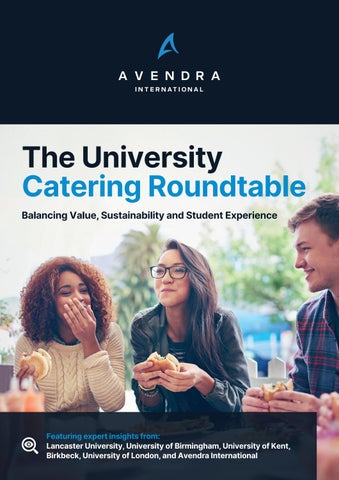
The University Catering Roundtable: Balancing Value, Sustainability & Student Experience
The University Catering Roundtable
Balancing Value, Sustainability and Student Experience
Featuring expert insights from: Lancaster University, University of Birmingham, University of Kent, Birkbeck, University of London, and Avendra International
“Dining and food create a really strong sense of community. Dining spaces are social spaces where people meet others, make connections and develop a sense of belonging.”
For universities, catering now sits at the intersection of student experience, wellbeing, affordability, sustainability and commercial performance. It is part of how students experience campus life, how they connect with others and how they feel represented within their university community.
At the same time, university catering and hospitality teams are facing significant pressure. Costs remain high, student expectations continue
Participants included:
Jo Hardman Director of Commercial Services
Lancaster University
George Bartlett Procurement Specialist
Avendra International
to evolve, sustainability targets are becoming more demanding and competition from high street brands and delivery platforms is changing how students choose to eat.
To explore these challenges and opportunities, Avendra International brought together leaders from across the higher education sector to share practical insight, compare experiences and discuss how food provision is evolving across UK universities.
Melissa Browne Acting Director of Campus Services & Chair of CUBO University of Kent
Matt Weston Associate Director of Food & Beverages, Birkbeck, University of London
Chris Mellins Director of Food, Beverage & Operations University of Birmingham
The discussion revealed a sector that is adapting quickly, with catering teams working hard to balance student value, commercial reality, sustainability and experience.
“Food is fundamental. It creates community, supports wellbeing and contributes to the overall student experience. It plays a much bigger role than simply providing something to eat.” JO HARDMAN
One of the clearest themes to emerge was that food plays a central role in how students connect and feel part of university life.
For Jo Hardman , understanding this broader purpose is critical.
“Food is fundamental. It creates community, supports wellbeing and contributes to the overall student experience. It plays a much bigger role than simply providing something to eat.”
Jo believes universities need to be clear about why they provide food services in the first place.
“The commercial bottom line shouldn't always be the most important consideration. Food supports culture, wellbeing, reputation, and the student experience, and those things matter.”
This matters because students are not only assessing academic quality when they choose a university.
They are also looking at the bigger picture: where they will spend time, how they will connect with others and whether the campus environment feels welcoming.
Melissa Browne sees this firsthand through her work at the University of Kent:
“Students will always look at the academic offer first, but they quickly move on to asking what their experience is going to be like. The experience is what makes you different.”
As universities compete harder than ever to attract and retain students, food and hospitality have become important parts of that overall proposition.
“We are the architects of the student experience,” she says. “The campus environment, the customer journey and the interactions students have all contribute to how they feel about their university.”
Food as part of the student experience
Keeping Pace with Student Expectations
From emerging food trends to changing student preferences, Avendra provides culinary support and insights to help universities develop relevant
While food has always mattered, expectations have changed significantly.
“When I started in higher education catering ten years ago, students expected high street quality at a student price point,” says Matt Weston . “That hasn't changed, but the high street has changed massively and so have student expectations.”
Today’s students are more informed, more diverse and more discerning. Many are thinking more carefully about health, nutrition, sustainability, provenance and how food fits into their lifestyle.
“There's a much stronger focus now on sustainability, provenance, health and nutrition,” Matt explains. “Students want food that supports their lifestyle. They want to be alert in lectures, go to the gym afterwards and not feel sluggish.”
Universities are also catering for increasingly international student populations, which is changing demand across menus, ingredients and food concepts.
“Twenty years ago, universities didn't have the same demand for Asian, African and international cuisines,” says George Bartlett . “Today's student populations are far more diverse and universities have to reflect that through their food offers.”
For many institutions, the space around the food is becoming just as important as the food itself. Students want places that feel relevant, social and worth staying on campus for.
“Students want to see an identity behind the offer,” says Matt. “They want destination spaces and concepts that give them a reason to spend time on campus rather than simply somewhere to buy food.”
“There's a much stronger focus now on sustainability, provenance, health and nutrition. Students want food that supports their lifestyle. They want to be alert in lectures, go to the gym afterwards and not feel sluggish.” MATT WESTON
Even as expectations rise, affordability remains one of the biggest challenges for university catering teams.
“Affordability will never stop being important,” says Melissa. “Students need options that are accessible, but they also want authenticity and inclusivity in the food that's available to them.”
The challenge is that universities are having to protect student value while absorbing pressure across labour, utilities, maintenance, food inflation and supplier costs.
“We're facing significant financial pressures while trying to protect the student experience,” Melissa explains. “Rising costs in utilities, staffing and maintenance are all having an impact.”
Chris Mellins points to the recent Annual Benchmarking CUBO report.
“University food prices have increased by around eight per cent, while inflation has been considerably higher, so the sector has worked hard to absorb some of those pressures.”
The discussion also highlighted that value does not always mean the lowest possible price.
“Students are looking for value, but value doesn't always mean the cheapest option,” says Chris. “It's about creating offers that meet different needs and different budgets.”
Jo agrees that universities need to think beyond one single price point.
“Students still want value for money, but this needs to be a variety of prices, from the low-cost options right through to the more lavish treats.”
This is where procurement, supplier relationships and operational insight can play an important role. By understanding what is being bought, where costs are rising and how demand is changing, universities can make more informed decisions about menus, pricing, supplier choice and value.
George agrees:
“Universities are under pressure from every direction. Food inflation, labour costs, National Insurance increases, and utilities costs continue to impact operating budgets.”
For university catering leaders, the challenge is not simply to reduce costs. It is to protect student value while maintaining quality, choice and commercial resilience.
Stronger Supplier Relationships
Avendra helps universities manage supplier performance, benchmark costs, and navigate market challenges ensuring better value, consistency, and informed buying decisions
See how we support universities: https://bit.ly/UCRsupport
Winning the battle for campus
“Affordability will never stop being important. Students need options that are accessible, but they also want authenticity and inclusivity in the food that's available to them.” MELISSA BROWNE
Another important theme was the challenge of keeping students on campus.
Food delivery platforms, high street brands and changing social habits have created more competition for student attention and spend. Universities now need to think carefully about whether their food offer gives students a reason to stay.
“One of the biggest challenges for universities is stopping Deliveroo from coming onto campus!” says Melissa. “If students are consistently choosing to go elsewhere, we need to ask ourselves whether we've got the offer, the experience and the price point right.”
Chris believes universities should appeal to different student needs throughout the day.
“We've focused on creating a clear range of offers so that students can choose between affordable everyday options and more premium experiences. He adds that, “Success increasingly comes down to understanding how different student groups use campus spaces throughout the day and creating offers that reflect those behaviours.”
The practical implication is clear: universities are not just competing on price. They are competing on convenience, relevance, quality, experience and the sense of identity behind the offer.
“We've focused on creating a clear range of offers so that students can choose between affordable everyday options and more premium experiences.” CHRIS MELLINS
“Students want food experiences that feel genuine and trustworthy.” JO HARDMAN
Perhaps the most powerful part of the discussion focused on the role food plays in helping students feel welcome, represented and included.
For universities with diverse student populations, food can be an important way to recognise different cultures, backgrounds and communities.
Jo believes authenticity will become increasingly important as universities continue to diversify.
“Students want food experiences that feel genuine and trustworthy.” He adds that food has become much more central to how people connect. “Previous generations met in pubs; now people are just as likely to meet over coffee, lunch or a meal.”
Confirms Melissa: “We've put a huge focus on creating a sense of belonging through food.
Whether it's African and Caribbean dishes, Korean food or something that reminds students of home, it helps people feel represented and included.”
She recalls a recent campus event that brought this to life.
MB
“At one of our catering events, a student from Ghana saw Jollof rice being served and said, 'I feel like somebody is thinking about me.” For Melissa, that moment captured the wider role of university hospitality. “It makes people feel safe, listened to and that they matter.”
This is one of the strongest examples that shows the emotional impact of food in a simple, memorable way. It also demonstrates why authenticity matters. Students notice when food feels considered, relevant and respectful.
Creating belonging through food
Sustainability moves beyond compliance
Sustainability was another recurring theme. Participants agreed that environmental considerations are no longer optional extras. They are increasingly part of everyday catering decisions, from menu development and sourcing to packaging, waste and supplier choice.
“Sustainability plays a massive part in catering decisions,” says Melissa. “Students are very aware of environmental issues and increasingly expect universities to lead by example.”
For Matt, the challenge is balancing ambition with practicality.
“The challenge is finding the point where sustainability, commercial viability and customer demand overlap. That's the sweet spot we're all trying to achieve.”
That balance is important. Sustainability initiatives need
to be credible and measurable, but they also need to work operationally and commercially. Universities are increasingly looking at food waste, responsible sourcing, packaging, carbon impact and supplier performance.
For Chris, sustainability is now part of almost every decision made within university catering.
“Whether it's menu development, sourcing, packaging or food waste, sustainability is part of the conversation from the beginning.”
He adds that initiatives such as Too Good To Go, which they use at the University of Birmingham, have proven particularly effective because they support sustainability objectives while also helping students manage the cost of living.
“Sustainability plays a massive part in catering decisions,” says Melissa. “Students are very aware of environmental issues and increasingly expect universities to lead by example.”
MELISSA BROWNE
“Every public sector organisation now has sustainability objectives and carbon reduction targets. Universities want suppliers who can support those ambitions and we’re pleased to support our clients in this way.”
GEORGE BARTLETT
Adds Jo: “Reducing food waste is one of the clearest examples of where sustainability and commerciality align perfectly.”
This is an important point for university catering teams. The most effective sustainability initiatives are often those that also improve operational efficiency, reduce waste and support cost control.
Technology and procurement tools are also helping universities better understand the impact of their decisions. George highlights Avendra's Carbon Footprint calculator and Food Checker tools, were developed to help university teams and students to better understand the environmental and nutritional impact of menu choices.
Universities are increasingly seeking clearer evidence from suppliers around environmental performance, ethical sourcing and responsible procurement. In many cases, that means looking beyond supplier claims and towards recognised thirdparty assessments, sustainability ratings and independent evidence that can help procurement teams make more informed decisions.
Confirms George:
“Every public sector organisation now has sustainability objectives and carbon reduction targets. Universities want suppliers who can support those ambitions and we’re pleased to support our clients in this way.”
Sustainability in Action
Avendra helps universities to achieve their sustainability goals through responsible sourcing, waste reduction, and carbon tracking, driving real change across the supply chain
Find out more: https://bit.ly/UCRsustain
The rise of data-driven decision-making
Turning Data into Insight
Avendra connects procurement and operational data, improving spend visibility, supplier performance, decisionmaking, reducing waste, and boosting operational efficiency
Explore our technology: https://bit.ly/UCRtech
Technology is changing university catering in other ways too. Better data is helping catering teams understand customer behaviour, improve efficiency and make more informed decisions about menus, stock, pricing and demand.
For Chris, data has become one of the most valuable resources available.
“Data is knowledge. The more information we have about customer behaviour and operational performance, the better equipped we are to improve the experience.”
He says technology is helping universities make better decisions across the operation.
“We've invested significantly in technology because it helps us improve efficiency and better understand what's happening across the business.”
From ordering and stock control through to sales patterns and customer behaviour, access to better information can help teams become more agile and responsive.
George believes there is still significant untapped potential when procurement data is connected with wider operational systems.
“Some universities are very advanced with their EPOS systems but less advanced with procurement data. When those systems are joined together, the opportunities become significant.”
By combining purchasing, sales and operational information, universities can gain deeper insight into customer behaviour, menu performance, stock management, waste and future demand.
“It's about turning information into intelligence.”
“Data is knowledge. The more information we have about customer behaviour and operational performance, the better equipped we are to improve the experience.” CHRIS MELLINS
“Technology absolutely has a role to play. Mobile ordering, loyalty schemes and delivery services are all things students increasingly expect.”
MELISSA BROWNE
While innovation is accelerating, participants were clear that technology should enhance hospitality, not replace it.
“Technology absolutely has a role to play,” says Melissa. “Mobile ordering, loyalty schemes and delivery services are all things students increasingly expect.”
But she also offers a note of caution.
“What technology can't replace is the human connection. Some of our most important welfare insights come from frontline staff
who see students every day, know their routines and notice when something isn't right.”
This point is particularly important in a university environment. Catering teams are often part of the daily rhythm of campus life. They see students regularly, recognise familiar faces and can sometimes notice changes in behaviour before anyone else does.
As universities continue to invest in digital tools, the opportunity is to use technology to improve convenience and insight while protecting the human connection that makes hospitality valuable.
Technology without losing the human touch
If there was one conclusion shared by everyone around the table, it was that university catering is continuing to evolve.
Food is no longer simply about feeding students. It supports wellbeing, creates community, reflects culture, contributes to sustainability and shapes how students experience campus life.
For universities, the challenge is how to deliver all of this while managing cost pressure, operational complexity and rising expectations.
That challenge will not be solved by one thing alone. It will require strong catering leadership, better use of data, clear supplier relationships, smarter procurement, practical sustainability initiatives and a deep understanding of what students actually need.
As a sector partner and convenor, Avendra International’s role is to bring university leaders together, share practical insight from across the market and support more informed decisions around food procurement, supplier relationships, sustainability and operational value.
And, as Melissa’s student from Ghana demonstrated, the impact of getting it right can be powerful.
Sometimes, a simple plate of food can communicate something much bigger:
“I feel like somebody is thinking about me.”
For universities looking to attract, support and retain students in an increasingly competitive environment, that may be one of the most important messages of all.
We get it, and we can help. At Avendra International, we work alongside university catering and procurement teams every day, helping them balance rising costs, evolving student expectations, sustainability goals and operational complexity.
Through smarter procurement, stronger supplier partnerships and data-driven insight, we help universities improve visibility, drive value and make more confident decisions across their catering operations.
To learn more about how we support universities, contact our team at Hello_UK@avendra.com.