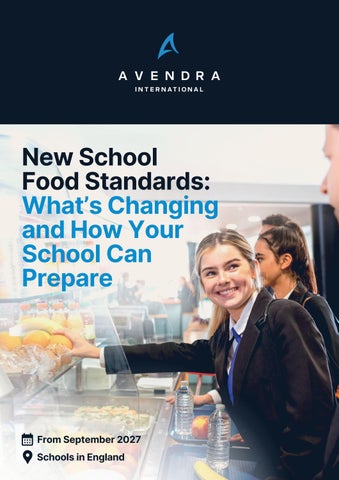
New School Food Standards: What’s Changing and How Your School Can Prepare
From September 2027 Schools in England
LEGISLATION
ABOUT THE AUTHOR Anna-Maria Holt RD is a Registered Dietitian with more than 20 years' experience supporting schools and catering teams with allergen management, school food regulation and allergen awareness training. She works as both an NHS and freelance dietitian. 2 New School Food Standards: What’s Changing and How Your School Can Prepare
LEGISLATION
The first major review of the School Food Standards in more than a decade will bring significant changes for schools and caterers in England from September 2027. Anna-Maria Holt RD explains what catering teams and business managers can do now to understand the requirements, review their current provision and prepare for a smooth transition.
What is changing - and when? School food is entering a new era. Following the first major review of the School Food Standards in more than ten years, the Government published its response on 14 September 20261. Subject to Parliamentary approval, expected in October 2026, the updated standards which will apply to Primary and Secondary Schools are set to come into force from September 2027, with some secondary-school requirements phased in from September 2028.
The changes are designed to bring school food more closely in line with current national dietary recommendations: ✓ Greater emphasis on fibre, fruit, vegetables and pulses
✓ Reductions in drinks high in sugar content
✓ Reductions in foods high in fat, sugar and salt
✓ New standards for breakfast are also being introduced
Note: This guidance applies to schools in England only. The precise implementation requirements are subject to Parliamentary approval and should be checked against the final regulations and updated DfE guidance as these are published - expected in Autumn 2026. 1. Government response available at: https://www.gov.uk/government/consultations/ school-food-standards-updating-the-legislative-framework
New School Food Standards: What’s Changing and How Your School Can Prepare 3
LEGISLATION
The key changes at a glance The updated standards will introduce important changes across food and drinks served throughout the school day. There will be greater emphasis on higher-fibre starchy foods such as bread, pasta and rice while fruit, vegetables and pulses will play a much more prominent role across the menu, alongside tighter controls on foods high in fat, sugar and salt. Deep-fried foods will no longer be permitted, while the frequency of certain foods, including processed meat and cheese as a main ingredient, will be restricted. There will also be new requirements around breakfast provision and drinks. The Government's response makes clear that school food should be varied, tasty and enjoyable - an important reminder that compliance with the Standards is only one part of delivering a successful catering operation. This is easier said than done.
Key changes to school meals include: ✓ No deep-fried food ✓ Increased provision of wholegrains, fruit, vegetables and pulses ✓ At least 50% wholewheat/brown versions of rice and pasta ✓ New requirements for higherfibre bread ✓ Restrictions on the frequency of processed meat ✓ Restrictions on cheese as a main ingredient
✓ Tighter controls on sugar, salt, condiments and spreads ✓ Restrictions on sweetened baked products and desserts ✓ Changes to drinks, including the removal of fruit juice from school meal services ✓ New breakfast standards ✓ Restrictions on snacks, with the permitted range becoming more tightly defined.
4 New School Food Standards: What’s Changing and How Your School Can Prepare
LEGISLATION
LEGISLATION
LEGISLATION
What this means for catering teams, bursars and business managers The implications stretch across recipe development, procurement, supplier specifications, equipment, staffing, training, contracts, budgets and perhaps most importantly - pupil acceptance. For caterers, bursars and business managers, now is the time to understand what is coming and start planning for the changes.The transition needs to be considered commercially as well as nutritionally.
Potential areas of impact include: ✓ Food costs. Will new products cost more? ✓ Supplier contracts. Will specifications need to change? ✓ Equipment. Will removing deep frying affect existing equipment or kitchen layouts? ✓ Labour. Will new preparation and cooking methods require additional time?
✓ Meal uptake. Could changes affect participation in school meals? ✓ Staff training. Will kitchen teams need additional training in recipe preparation or allergen management? ✓ Contract management. Are responsibilities for compliance clearly defined?
✓ Waste. Will pupils initially reject unfamiliar products?
New School Food Standards: What’s Changing and How Your School Can Prepare 7
LEGISLATION
Adapt your menu while keeping pupils on board Don't simply take popular foods away. The key challenge is to re-design menus around what pupils actually want to buy and eat. Start developing and testing healthier versions that move your menu towards the new food standards now in readiness for September 2027.
What to start reviewing now September 2027 may sound a long way away, but menu development, procurement and operational change take time. The DfE is already advising schools to review their proposed changes, discuss them with your catering teams or providers, review menus, contracts and procurement arrangements, and prepare for further requirements around governance and publishing menus and school food policies online.
For caterers, this is the opportunity for planned menu development. For bursars and business managers, it is an opportunity to understand the financial and operational implications before changes become urgent. And for pupils, the ultimate test will be whether they like the new recipes and menu.
By the time September 2027 arrives, the aim should not simply be to have a compliant menu. It should be to have a food offer that is nutritious, appealing, practical and financially sustainable.
8 New School Food Standards: What’s Changing and How Your School Can Prepare
LEGISLATION
LEGISLATION
How Avendra International can support your school Preparing for the new School Food Standards means reviewing your menus, products, kitchen equipment and costs. We can support you with: ✓ Menu planning and recipe development. Create and update recipes and menus in Piranha, Pi’s menu management tool, with your whole team working from the same information. ✓ Nutrition, calories and allergens. Access supplier product data in Piranha, reducing time spent gathering information and helping your team make informed menu choices. ✓ Price management. Control your food budgets and recipe costs in Piranha; instantly see the impact of product changes. ✓ Products that meet the standards. Your Avendra procurement manager can help you identify suitable products that meet legislation and procure at a competitive price. ✓ Food cost management. Benefit from our procurement
team’s price negotiations and regular product reviews to help keep menus within budget. ✓ Commercial kitchen equipment. Get support sourcing equipment suited to your updated menus and cooking methods, helping your kitchen prepare for the changes. ✓ Digital menus for parents and pupils. Publish and share your menus through Pi’s Food Checker web app. ✓ Food ideas pupils will enjoy. Get advice on products and concepts that meet the standards, appeal to pupils and help increase school meal take-up. ✓ Network. Meet other caterers and visit schools for innovation and sharing of best practise, supporting the education sector prepare for the changes.
Get in touch with the Avendra team Contact your Avendra International account manager or email News_Europe@avendra.com
10 New School Food Standards: What’s Changing and How Your School Can Prepare
LEGISLATION
Global Procurement. Local Expertise.
Avendra International is a leading strategic procurement and supply chain partner to a wide range of organisations, including educational institutions such as schools, academies and multi-academy trusts, hospitality and healthcare organisations worldwide. Leveraging $21B in procurement power, our local experts help schools navigate tighter budgets, rising food costs, and growing compliance demands delivering savings, efficiency, and peace of mind.
We get it, and we can help. avendra.com