IRELAND EDITION
Edge Magazine.
Your edge in hospitality and catering.
AUTUMN/WINTER 2026
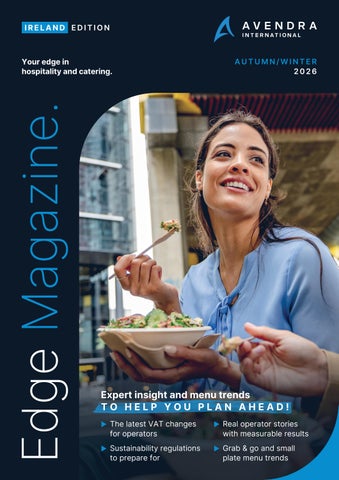
Expert insight and menu trends TO HELP YOU PLAN AHEAD! ▶ The latest VAT changes
▶ Real operator stories
▶ Sustainability regulations
▶ Grab & go and small
for operators
to prepare for
with measurable results plate menu trends
Stay ahead of the trends, with our latest Culinary Guides Packed with practical tips and recipes to keep your customers coming back for more.
DOWNLOAD
DOWNLOAD
DOWNLOAD
F&B Trends & Insights 2026–27
Plant-Based Food Trends & Insights 2026–27
Grab & Go Trends & Insights 2026–27
bit.ly/f-and-b-2026
bit.ly/plant-based-2026
bit.ly/grab-and-go-2026
CONTENTS
Contents Autumn/Winter 2026 IRELAND Welcome to the latest edition of the Avendra Edge Magazine, focused on providing you with new solutions and the latest valuable market knowledge.
6 WELCOME We're excited to introduce this season’s The Edge Magazine 8 CASE STUDY: ONE NETWORK, STRONGER OUTCOMES FOR THE CARE SECTOR Céile Care & Marymount Care Centre
8
14 GRAB & GO TRENDS & INSIGHTS 2026-27 A snapshot of key trends to help you meet changing customer needs 22 IRELAND'S VAT REDUCTION The opportunity for hospitality operators
14
Full tea solution available For more information regarding Barry’s Tea, please contact News_Europe@Avendra.com.
CONTENTS
26 26 THE SMALLER PLATE ECONOMY: A chef’s perspective on the GLP-1 trend 34 HOW PI IS SIMPLIFYING PROCUREMENT ACROSS HOSPITALITY, HEALTHCARE AND EDUCATION
38 38 THE UNIVERSITY CATERING ROUNDTABLE Balancing value, sustainability and student experience 42 SUSTAINABILITY RULES FOR HOSPITALITY OPERATORS ARE LANDING FAST
EDITORIAL AND PRODUCTION TEAM Editor-in-Chief: Simona Hardy Editorial Director: Emily Rodway Assistant Editor: Dayene Moreira Designer: Nick Goodyear Copywriter: Peppa Sheridan
The Avendra Edge is a collection of resources designed to deliver the very latest actionable information and solutions. Autumn/Winter 2026 5
COMPANY
Welcome to the Autumn/Winter Edition of the Edge Magazine! I'm David Reynolds, Managing Director at Avendra International Ireland, and I'm delighted to share the latest edition of The Edge Magazine. As we head into the final stretch of the year, hospitality, healthcare and education operators continue to balance rising costs, changing regulation and the need to deliver quality while protecting margins. In this edition, we look at some of the changes shaping our industry and, importantly, what they mean in practice. From procurement and sustainability, to technology and culinary innovation, we bring together insights and ideas to help you plan ahead and find new opportunities. 6 Autumn/Winter 2026
WHAT'S INSIDE? Procurement & sustainability We explore the latest regulatory changes affecting procurement, alongside practical insights into sustainability and responsible purchasing. You'll also find perspectives on how organisations can protect value while responding to growing environmental and reporting requirements.
COMPANY
P14: Grab & Go Trends
P8: Ceile Care case study
Culinary trends & insights
and education, alongside our latest roundtable, exploring how university catering teams are balancing value, sustainability and the experience they deliver.
Our Head of Culinary, Paul Bloxham, shares the latest thinking on grab & go, changing consumer habits and the opportunities these trends create for foodservice operators. Technology & innovation We look at how technology can simplify procurement and day-today operations, including how our Pi platform is helping clients bring purchasing, stock, menus and allergen management together. Success stories You'll also find practical examples from across hospitality, healthcare
Plus, much more… We hope this edition gives you useful ideas, practical insight and inspiration as you plan for the year ahead. As your procurement partner, we're here to help you navigate change, find opportunities to improve value and support your teams with the insight, expertise and tools they need. If you'd like to discuss any of the topics covered in this edition, please get in touch at News_Europe@avendra.com. Autumn/Winter 2026 7
CASE STUDY
One network, stronger outcomes for the care sector
Fergus McNulty Director of Marymount Care Centre Founding Chair, Céile Care For independent care providers, balancing rising costs, regulatory pressures and workforce challenges is an ongoing reality. For Fergus McNulty, Director of Marymount Care Centre and founding chair of Céile Care, the answer lay in finding the right partner. Marymount is part of Céile Care, a collective of family-run care 8 Autumn/Winter 2026
homes across Ireland that enables providers to share knowledge, pool resources, and tackle challenges together. A key part of that model has been partnering with Avendra International to strengthen procurement across the network. Strengthening procurement through partnership Members like Marymount who partner with Avendra International can benefit from improved pricing, greater purchasing visibility and access to a trusted supplier base, while still retaining their independence.
Client
Marymount Care Centre, part of the Céile Care network
Sector
Care Sector / Independent Care Homes
Challenge Rising costs, administrative pressures and limited purchasing power Solution
Collaborative procurement with Avendra International, supported by the Pi platform and dedicated account management
Result
Improved pricing, real-time spend visibility, simplified processes and reduced administrative burden
CASE STUDY SNAPSHOT
CASE STUDY
Autumn/Winter 2026 9
CASE STUDY
Fergus shares, “Our biggest outlay after staffing… is food… that’s where Avendra comes in - they help us to make the most of that.” Driving operational efficiency without losing independence The Pi eProcurement platform is playing a central role, providing real-time insight into spend, supplier performance and compliance. From menu planning and allergen management to invoice consolidation, the system is helping
care homes simplify processes and reduce administrative burden. For many homes, this visibility is transformative. Fergus shares, “For homes led by nurses rather than finance professionals, that’s a game-changer.” Account management support Alongside the technology, dedicated account management ensures issues are resolved quickly
“Our biggest outlay after staffing … is food … that’s where Avendra comes in they help us to make the most of that.” 10 Autumn/Winter 2026
CASE STUDY
We could hire a procurement manager, but why would we when we already have Avendra? We trust them to act in our best interests. and opportunities for improvement are continually identified. Importantly, this model enhances rather than replaces independence, giving providers the tools and confidence to operate more efficiently. Fergus concludes, “We could hire a procurement manager, but why would we when we already have Avendra? We trust them to act in our best interests. They validate prices, solve problems and free up our internal resources to focus on care.”
Read the full case study here bit.ly/ceile_care Get in touch. If you want to learn more about how Avendra International can support your organisation with consistent quality, cost savings, and efficiencies, contact us News_Europe@avendra.com
Autumn/Winter 2026 11
FOR FURTHER INFO PLEASE CONTACT NEWS_EUROPE@AVENDRA.COM
precision for every
dot, stripe & drizzle
EXPERTISE
Paul Bloxham Head of Culinary Avendra International Europe Grab and go is no longer just a convenience offer. For many foodservice operators, it's become one of the biggest opportunities to increase revenue, improve customer satisfaction and make better use of every trading period throughout the day. Consumer habits are evolving, with more people snacking, looking for better food on the go and choosing options that suit their lifestyles. This gives operators an opportunity to refresh their offering, meet changing customer expectations and support business growth.
Grab & Go Trends & Insights 2026-27 A snapshot of key trends to help you meet changing customer needs
14 Autumn/Winter 2026
EXPERTISE
Europe's foodservice market is growing by more than 9% annually, with snacking replacing traditional meals and younger consumers leading the shift towards eating on the move (Mordor Intelligence, 2026). Across the hospitality, healthcare and education operations I work with throughout the UK, Ireland and Continental Europe, I’m seeing the same shift: grab and go is no longer a secondary offer. In many sites, it has become one of the busiest food touchpoints in the building. The operators getting it right aren't simply adding more products, they're understanding when, why and how customers are choosing to buy.
#1
The Rise of Micro-Moments The traditional three-meal day is fading. Customers are increasingly eating little and often, replacing structured meals with quick, flexible occasions driven by convenience, energy and lifestyle. More than half of all grab and go visits are now a quick bite rather than a full meal.
In our latest Grab & Go Trends 2026–27 Culinary Guide, we explore the twelve trends reshaping this fast-growing category, from protein-rich meals and premium lunch solutions to global flavours, functional beverages and the rise of smaller, more intentional eating occasions.
Here are five trends every operator should have on their radar.
What this means for operators. The opportunity is to design ranges around the moments that drive purchasing decisions, from the mid-morning energy dip to the late-afternoon slump.
Autumn/Winter 2026 15
EXPERTISE
#2
#3
Protein has become a priority for consumers across Europe, not just gym-goers, but anyone looking for convenient, satisfying options on the go.
Lunch has not disappeared, but expectations have changed. Customers are looking for better-quality options and are willing to trade up when the experience feels worthwhile.
The Protein Pivot
What this means for operators. Protein-rich wraps, snack pots, yoghurts, salads and functional drinks are moving from niche products to everyday purchases, creating new opportunities for grab and go ranges.
16 Autumn/Winter 2026
The New Lunch Standard
What this means for operators. Fewer, better choices with clear provenance, visible quality and a strong flavour story can create more value than broad, undifferentiated ranges.
EXPERTISE
#4
#5
Global cuisines are no longer just a menu trend. Customers are becoming more adventurous and expect authentic flavours, from Korean-inspired wraps and Levantine bowls to Mexican-led handheld formats.
Grab and go drinks are evolving alongside food. Customers are looking beyond coffee and soft drinks towards beverages offering hydration, protein, energy or wellness benefits.
Global Flavours Go Mainstream
Beyond Caffeine
What this means for operators. What this means for operators. The opportunity is not to chase every cuisine, but to build credible offers around a select few.
As always, lead with flavour first, function second. The best functional drinks earn their place on the counter because they taste good, and the wellness story is the reason customers come back.
Autumn/Winter 2026 17
EXPERTISE
Recipe Thai Red Curry Samosa Coriander & chili chutney Also works frozen and oven-baked - cook from frozen for a few extra minutes Ingredients
Method
Samosa filling 2 tbsp vegetable oil 1 small onion, finely diced 2 tbsp Thai red curry paste 300g potato, peeled and finely diced 1 carrot, finely diced 100ml coconut milk 100g frozen peas 1 tbsp fish sauce (or soy sauce) 1 tsp palm sugar or brown sugar Juice of 1 lime Small bunch coriander, chopped
Samosa filling 1. Heat oil in a pan and fry the onion until soft. Add curry paste, cook for 1-2 minutes until fragrant. 2. Add potato and carrot, stirring to coat in the paste. Pour in coconut milk, cover and simmer for 10-12 minutes until potato is tender. 3. Stir in peas, fish sauce, sugar, lime juice and chopped coriander. Cook for 2 more minutes, leave to cool completely. Samosa assembly 1. Cut filo sheets into long strips, brush with melted butter. Place a spoonful of filling at one end, fold into triangles, sealing edges with a little more butter. 2. Deep-fry samosas in batches at 180°C for 3-4 minutes until golden and crisp (or brush with oil and
Samosa assembly 8 sheets filo pastry 50g butter or oil, melted, for brushing Vegetable oil, for frying (or spray oil for baking) Chutney Large bunch coriander 2 green chillies 1 garlic clove Juice of 2 limes 1 tsp caster sugar 2 tbsp coconut milk or yoghurt Salt, to taste
18 Autumn/Winter 2026
EXPERTISE
Serves 4 (makes 16) bake at 200°C for 15-18 minutes, turning once). Chutney. Blend the coriander, chillies, garlic, lime juice, sugar and coconut milk until smooth. Season with salt. Serving. Serve samosas hot, with the chutney alongside for dipping.
Scan the QR code to watch our video
These five trends are just the starting point. The full Grab & Go Trends 2026–27 Guide explores all twelve trends, with practical insights to help operators turn changing consumer habits into commercial opportunities. Download your full guide Alternate link: https://bit.ly/grab-and-go-2026
To explore how we can support your grab-and-go strategy, contact your Avendra International account manager or email News_Europe@avendra.com
Autumn/Winter 2026 19
ADVERTORIAL
AROUND NOON launches new food-to-go brand SNAP is the new, dynamic FTG brand to hit the shelves, to satisfy your lunchtime cravings.
ADVERTORIAL
leading hectic lives. It’s food that gets you. SNAP doesn’t take time, it makes time. It’s great food for busy days like yours. About us Celebrating 37 years in the industry, we are one of Ireland’s leading food-to-go manufacturers. An award winning business, we employ 850+ staff across five manufacturing facilities in London & Northern Ireland.
SNAP is a comprehensive new range of everyday favourites and innovative products, created using top quality ingredients and tiered to suit all budgets. We’ve fantastic new trend-led flavours and carriers. SNAP includes gluten free, vegan, vegetarian, less than 400kcal and high protein products.
We produce high-quality chilled, hot and frozen hand-held food including sandwiches, wraps, baguettes, ciabattas, salads, hot pots & snack pots. SNAP - great food for busy days We’re very proud to have launched SNAP into the market this Summer. If your days are anything like ours, we know how much it means to grab a few minutes to yourself. SNAP understands real life and offers calm amidst life’s chaos. SNAP offers convenience, nourishment and comfort for those trying to make sense of the incessant noise now surrounding the right foods to eat. SNAP is fresh, fast and created for busy people
Get in touch. For more information on the new branding and range contact News_Europe@avendra.com www.aroundnoon.com Autumn/Winter 2026 21
EXPERTISE
Ireland's VAT Reduction The opportunity for hospitality operators. Pat Galvin Head of Sales
22 Autumn/Winter 2026
EXPERTISE
The reduction of Ireland's VAT rate for food and catering services from 13.5% to 9% is a positive development for the hospitality industry.
Introduced on 1 July 2026, the new rate applies to eligible restaurant and catering services, including food served in restaurants and cafés and supplies of hot takeaway food. For hotels, the reduced rate applies to qualifying food and catering activity. Accommodation remains subject to VAT at 13.5%, and alcohol, soft drinks and bottled water remain outside the 9% rate. The move follows sustained campaigning by an industry that has navigated significant cost pressures across food, labour, energy and insurance. It creates real breathing space - and with it, a genuine opportunity to make considered decisions about how best to use it.
Learn more
Autumn/Winter 2026 23
EXPERTISE
Making the most of the opportunity For Irish hospitality businesses benefiting from the reduction, the question is how to put it to work most effectively. Some may choose to pass savings on to customers, strengthening value and footfall. Others may use the opportunity to rebuild margins, invest in their teams or fund operational improvements that have been on hold. Whatever the approach, procurement is one of the most effective levers available to build on this moment. Every day, hospitality operators make hundreds of purchasing decisions that directly affect profitability, operational efficiency and guest satisfaction. Yet many businesses don't have time to benchmark their spend, review supplier performance or explore whether better commercial terms are available.
24 Autumn/Winter 2026
A procurement review can uncover opportunities across a range of areas, including: ▶ Supplier negotiations and
improved commercial terms
▶ Food, beverage and non-food
purchasing efficiencies
▶ Product alternatives that
maintain quality while reducing costs
▶ Menu and category optimisa-
tion to protect margins
▶ Supplier consolidation to
reduce administration and complexity
▶ Procurement technology
that improves visibility and control
▶ Waste reduction and
identification of hidden cost leakage
EXPERTISE
For many operators, the savings can be significant. Equally important is the time given back to operational teams - less time managing suppliers and chasing pricing issues means more time focused on guests and growing the business. Start with a procurement benchmark review One of the most practical ways to understand the opportunity within your business is through a procurement benchmark review. Comparing your current purchasing arrangements against market opportunities helps identify where savings, efficiencies and operational
improvements may exist - often in areas operators wouldn't expect. The VAT reduction is a welcome tailwind. Combining it with stronger purchasing controls, better supplier relationships and clearer spend visibility creates the conditions for a more sustainable improvement in financial performance over the long term. We get it, and we can help. Find out how Avendra International can help your Irish operation strengthen procurement performance. Get in touch with your Avendra contact or reach us at News_Europe@avendra.com.
One of the most practical ways to understand the opportunity within your business is through a procurement benchmark review.
Autumn/Winter 2026 25
EXPERTISE
The S M A L L E R Plate Economy
A CHEF’S PERSPECTIVE ON THE GLP-1 TREND
26 Autumn/Winter 2026
EXPERTISE
Paul Bloxham Head of Culinary Avendra International Europe
How changing appetites are reshaping menus across Ireland and Europe.
Diners are changing how they think about food, creating a bigger opportunity for chefs and operators to rethink what's on the plate. Across the Ireland and Europe, there's growing demand for protein-rich, fibre-forward, nutrient-dense dishes, greater portion flexibility and more choice over what goes on the plate. GLP-1 weight-loss medicines are accelerating the conversation around appetite and portion size, but this shift goes much further. People are increasingly looking for food that feels satisfying without necessarily wanting a large portion. For foodservice, that creates an opportunity to rethink the traditional meal. Smaller portions, flexible formats and nutrient-dense dishes can offer more choice, reduce waste and protect margins, without compromising flavour or experience. This isn't about creating a “GLP-1 menu”. It's about making food work harder for changing appetites, and making every bite count.
Learn more
Autumn/Winter 2026 27
EXPERTISE
Smaller portions, bigger expectations The opportunity isn't simply to serve less. For chefs, the challenge is making a smaller plate feel generous. Height, colour, negative space and considered garnishes can all create a sense of abundance before the first bite. It's a principle familiar from fine dining, but one that's increasingly relevant across everyday foodservice: A smaller portion that looks mean kills repeat business faster than any menu strategy can fix. The same applies to flavour. When there are fewer bites, every one needs to count. Concentrated sauces, layered umami, acidity and seasoning can make a smaller portion feel complete rather than reduced.
28 Autumn/Winter 2026
EXPERTISE
The waste opportunity
Give diners more control Small plates, half portions and build-your-own formats allow diners to choose what works for their appetite. And this isn't just about GLP-1s. Giving people more flexibility works for anyone who wants a lighter meal or simply doesn't want a large portion. The same approach can work for dessert. A smaller tasting portion can keep the indulgence and the ritual without the full pudding.
Getting portioning right has another clear benefit: less waste. WRAP estimates that food waste costs the hospitality and food service sector £3.2 billion every year – or an average of £10k per outlet, per year.* Plate waste is particularly relevant to chefs. When food comes back uneaten, the cost has already been incurred through purchasing, preparation and cooking. Better portion control can help reduce what's left on the plate while protecting food costs.
* Source: https://www.wrap.ngo/taking-action/food-drink/ sectors/hospitality-food-service
Autumn/Winter 2026 29
EXPERTISE
Don't create a “GLP-1 menu” Perhaps the biggest opportunity is to avoid making the trend too literal. European markets are at different stages when it comes to GLP-1 adoption and attitudes towards weight-loss medication. A menu designed specifically around the medication could also risk making diners feel singled out. Instead, build flexibility into the menu for everyone. Use language such as “tasting portion”, “small plate” or “chef's portion” rather than “diet” or “light”. Give diners options without asking them to explain why they want them.
And make sure the food itself remains the hero.
30 Autumn/Winter 2026
EXPERTISE
A chef's checklist Can we offer more flexibility? Look at half portions, small plates and build-your-own formats. Does a smaller portion still feel generous? Review plating, colour, texture and presentation. Are we building around nutrient density? Think beyond protein and make better use of fibre-rich vegetables, pulses and wholegrains. What happens to drinks and dessert sales? Consider how changing appetites could affect these categories. Are we measuring what comes back? Use food waste data to understand whether portion changes are actually reducing plate waste.
We get it, and we can help. Want to explore what changing appetites could mean for your menus? Speak to the Avendra International team: News_Europe@avendra.com.
Autumn/Winter 2026 31
Festive Favourites
Serena Glassware
CZ005 & CZ006
Cavolo Crockery FD904 & FD901
Clifton Cutlery C443 & C442
View our Christmas Shop at nisbets.co.uk/christmasshop As a member of Avendra you can take advantage of 25% off light equipment and 10% off heavy equipment. news_Europe@avendra.com Get in touch to access your discount:
COOLING YOU CAN COUNT ON. PERFORMANCE YOU CAN TRUST.
Best for cafés, small bars, low-intensity kitchens
Best for restaurants, pubs, schools, care homes
Best for high-volume kitchens, demanding service environments
WHY BUY POLAR? � �
�
Free 2-year parts and labour warranty Free next-day delivery, including unboxing, positioning, and removal of the pallet and packaging
arket leading energy-efficient M products that reduce running costs
� � �
Wide range of refrigeration products from fridges to slush machines
Comprehensive spare parts availability Trusted by professionals for over 20 years
Polar Refrigeration delivers dependable cooling without compromise, helping you protect stock, reduce waste, and stay efficient, day after day. Get in touch to access your discount: news_Europe@avendra.com
SYSTEMS
How Pi is simplifying procurement across hospitality, healthcare and education Matt Ferris Pi Product Manager Avendra International
SYSTEMS
One platform to bring purchasing, stock, menus and more together. Managing a catering operation means juggling ordering, invoicing, stock, waste, menus, allergens and financial reporting, often across multiple sites and teams. Pi, Avendra International's cloud-based eProcurement platform, brings these processes together in one place, giving operators greater visibility, consistency and more time to focus on their operation.
Here's how hospitality, healthcare and education clients across the UK, Ireland and Europe are using Pi.
Simplify purchasing and improve spend visibility Managing purchasing across multiple sites can mean a lot of orders, suppliers and processes to keep track of. Pi brings these together in one place, helping teams save time and giving them a clearer view of purchasing across their operation. “Pi is one of the best systems I’ve worked with. It’s intuitive, efficient and it saves our chefs a massive amount of time. It gives us the level of transparency and assurance we need when operating and managing multiple sites.” Paul Dempsey Chief Operating Officer PREM Ireland
Autumn/Winter 2026 35
SYSTEMS
Keep menus and allergen information up to date Across hospitality, healthcare and education, allergen compliance is non-negotiable. Pi's Menu & Allergen Management module helps operators keep product, recipe and menu information accurate, up to date and accessible. At University of West London Students' Union, the module supports allergen management across a multi-site catering and retail operation: "[With the Pi system], my team can order from an approved basket of products and access allergen data with ease." Rob Carr Head of Commercial Operations University of West London Students' Union
Manage stock and reduce food waste Pi's Stock Management and Food Waste Monitoring modules give operators a clearer picture of what's being ordered, used and wasted, helping teams identify opportunities to improve efficiency, reduce costs and support sustainability goals. At an NHS hospital, Pi's Food Waste Management module helped the catering team reduce food waste by 15%. By tracking waste at ward and item level, the team could identify where losses were occurring and develop targeted reduction plans. For stock management, Pi can also build and update stock sheets using supplier invoice data, provide instant stock valuations and support multiple sites and store locations.
SYSTEMS
Simplify patient and resident meal ordering For healthcare operators, Pi also includes Picnic, an electronic meal ordering module developed in collaboration with NHS clients. It gives patients and residents a simple way to order meals directly from their bedside. At Royal Brompton & Harefield hospitals, Picnic forms part of a wider Pi setup alongside online ordering, stock and invoice management. “Using the Pi system has been a game-changer for our operations. Alongside electronic patient meal ordering, we use several Pi modules, including online ordering, stock management and invoice management.” Nuno Matias Catering Services Manager Royal Brompton & Harefield
One platform. Greater visibility. From purchasing and stock management to menus, allergens, invoices, food waste and patient meal ordering, Pi brings key catering processes together in one platform. For multi-site operators, that means less time spent managing disconnected processes, greater visibility across the operation and more time to focus on delivering great food and service. Pi is available to all Avendra International clients at no additional cost, including setup, training and ongoing support as part of our value-added service.
Want to see how Pi could work for your operation? Speak to your Avendra International account manager or contact News_Europe@avendra.com to find out which modules are available in your region or arrange a demo.
Autumn/Winter 2026 37
INSIGHTS
The University Catering Roundtable Balancing value, sustainability and student experience
38 Autumn/Winter 2026
INSIGHTS
University catering has become about far more than simply serving food. Today, it sits at the heart of student wellbeing, campus culture and the overall university experience; however, at the same time, catering teams are having to manage rising costs, increasing sustainability expectations and changing student behaviours.
Participants included:
To explore these challenges, Avendra brought together senior leaders from across higher education for a virtual roundtable discussing the future of university catering. The conversation highlighted a sector balancing affordability, quality, sustainability and operational efficiency, while ensuring food remains central to student life.
Melissa Browne Acting Director of Campus Services & Chair of CUBO University of Kent
Jo Hardman Director of Commercial Services Lancaster University
Matt Weston Associate Director of Food & Beverages Birkbeck, University of London
George Bartlett Procurement Specialist Avendra International
Chris Mellins Director of Food, Beverage & Operations University of Birmingham
Food as part of the student experience As the conversation began, one of the strongest themes to emerge was the importance of food in creating a sense of belonging on campus. Participants agreed that dining spaces are no longer simply places to eat. They are where friendships form, communities grow,
and students feel connected to university life. As Jo Hardman explained: “Food is fundamental. It creates community, supports wellbeing and contributes to the overall student experience. It plays a much bigger role than simply providing something to eat.” The discussion also explored how universities are increasingly recognising that catering can help students Autumn/Winter 2026 39
INSIGHTS
feel represented and welcomed within diverse campus communities, as Melissa Browne reflected: “Students will always look at the academic offer first, but they quickly move on to asking what their experience is going to be like. The experience is what makes you different.” Delivering value in challenging times Affordability remains one of the biggest challenges facing catering teams. While inflation, labour costs and utilities continue to put pressure on budgets, institutions are working hard to protect value for students without compromising quality. Everyone discussed how smarter procurement, supplier partnerships and varied price points can help to balance financial pressures with student expectations. As George Bartlett commented: “Universities are under pressure from every direction. Food inflation, labour costs, National Insurance increases, and utilities costs continue to impact operating budgets.” However, participants agreed that value isn't simply about offering the cheapest option, as Chris Mellins noted: “Students are looking for value, but value doesn't always mean the cheapest option. It's about creating offers that meet different needs and different budgets.” 40 Autumn/Winter 2026
Sustainability moves centre stage Sustainability now underpins many catering decisions, from reducing food waste and responsible sourcing to packaging and carbon reduction. For Matt Weston, the challenge is balancing environmental ambition with commercial reality. “The challenge is finding the point where sustainability, commercial viability and customer demand overlap. That's the sweet spot we're all trying to achieve.” George highlighted that Avendra's Carbon Footprint calculator and Food Checker tools are helping university teams and students better understand the environmental and nutritional impact of menu choices - giving sustainability ambitions a practical, measurable foundation. Everyone agreed that the most successful sustainability initiatives are often those that also improve operational efficiency and help manage costs, while students increasingly expect universities to demonstrate genuine environmental leadership.
INSIGHTS
Using data to make better decisions All agreed that technology and data are becoming increasingly important tools for catering teams. From procurement information and EPOS systems to stock management and customer insights, better data is helping to improve efficiency, understand demand, and also helping towards waste reduction. As Chris Mellins explained: “Data is knowledge. The more information we have about customer behaviour and operational performance, the better equipped we are to improve the experience.” George Bartlett added that connecting procurement data with wider operational systems offers significant opportunities to improve efficiency, strengthen supplier relationships and ultimately make more informed purchasing decisions.
People remain at the heart of hospitality While digital ordering, loyalty schemes and operational technology continue to evolve, participants were unanimous that technology should enhance rather than replace the human side of hospitality. Perhaps the most memorable moment of the discussion came from Melissa Browne, who recalled a catering event at the University of Kent. “At one of our catering events, a student from Ghana saw Jollof rice being served and said, 'I feel like somebody is thinking about me.'” It was a powerful reminder to all that food creates community, inclusion and a sense of belonging – it’s far more than simply putting meals on plates.
Read the full University Catering Roundtable, with additional insights from all five participants: bit.ly/ucr-full Avendra International works with universities to strengthen procurement, improve supplier relationships and support more informed catering decisions. If you'd like to explore how we can support your institution, contact our education team at News_Europe@avendra.com Autumn/Winter 2026 41
LEGISLATION
Sustainability rules for hospitality operators are landing fast Stephen Brennan VP Supply Chain & GPO Procurement UK/Ireland Kristel Cauterman Supply Chain & Procurement Manager GPO & Managed Services Continental Europe
42 Autumn/Winter 2026
LEGISLATION
Here's your roadmap
Start here
Across the UK, Ireland and Continental Europe, new rules covering packaging, environmental claims, deforestation and purchasing are coming into force over the next 12 months. For hospitality operators, the impact will be felt across everything from what they buy and how they package it to the claims they make to guests. The good news is that preparing early can help avoid disruption, manage commercial impact, ensure compliance and give teams more time to find practical alternatives. Here's what's in force, what's imminent and what you need to have in place before the year is out.
Learn more
Autumn/Winter 2026 43
LEGISLATION
EU packaging & packaging waste regulation
Evidencing green claims
12 August 2026
27 September 2026
EU and Ireland
EU and Ireland
What it means New EU rules aim to reduce packaging waste, increase reuse and make packaging recyclable. For hospitality, this includes food and drink packaging, takeaway containers, transport packaging and some guest amenities.
What it means Environmental claims such as “green”, “eco-friendly” and “sustainable” will need credible evidence. This applies across customer-facing channels, including menus, websites, packaging and marketing.
What to do now Review your highest-volume packaging and speak to suppliers about upcoming changes, the recyclable nature of their existing products, alternative products, costs and availability.
What to do now Audit your sustainability claims and make sure every one can be backed by reliable evidence. Agree a clear sign-off process between procurement, sustainability and marketing. When asking suppliers for information, be specific what precisely is being claimed, what does it cover, and what independent certification supports it?
Sources: Regulation (EU) 2025/40 — EUR-Lex (eur-lex.europa.eu)
Sources: Directive (EU) 2024/825 on Empowering Consumers for the Green Transition (EmpCo) — EUR-Lex (eur-lex.europa.eu); European Commission Q&A guidance on the ECGT Directive (commission.europa.eu)
44 Autumn/Winter 2026
LEGISLATION
Green Key procurement criteria 1 October 2026
EU Deforestation Regulation 30 December 2026 Large and medium operators
International What it means Green Key is a leading international sustainability certification for tourism and hospitality businesses, recognising organisations that meet defined environmental and sustainability standards. From 2026, procurement becomes a standalone area within the Green Key criteria, covering general purchasing, food and beverage, and cleaning products. What to do now If you hold or are working towards Green Key certification, review your purchasing practices against the new criteria and identify any gaps. Sources: Green Key Criteria and Explanatory Notes 2026–2031 (greenkey.global)
30 June 2027 Most smaller operators
EU and Ireland What it means Businesses dealing with products linked to cattle, cocoa, coffee, palm oil, rubber, soya and wood will need to meet new deforestation and due diligence requirements. What to do now Identify affected products in your supply chain and ask suppliers who holds responsibility for compliance and how they are preparing. Sources: Regulation (EU) 2023/1115, amended by Regulation (EU) 2025/2650 — EUR-Lex (eur-lex.europa.eu); European Commission EUDR overview (environment.ec.europa.eu); European Parliament press release, December 2025 (europarl.europa.eu)
Autumn/Winter 2026 45
LEGISLATION
Refill and reuse requirements
UK Deposit Return Scheme
From 12 February 2027
1 October 2027
EU and Ireland
England, Northern Ireland and Scotland
What it means Foodservice operators will need to allow customers to bring their own containers for beverages and readyto-eat meals at no extra charge. From 2028, reusable takeaway packaging will also need to be available. What to do now Start considering how refill and reuse could work operationally, including hygiene, storage, staff processes and customer communication. Sources: Regulation (EU) 2025/40, Article 32 — EUR-Lex (eur-lex.europa.eu)
What it means A deposit scheme for eligible drinks packaging will introduce changes to pricing, stock management, customer communications and the handling of returned containers. What to do now If you sell eligible drinks, start speaking to suppliers about what's changing and how your operation may need to adapt with this change. In other countries, some hospitality businesses have been exempt from acting as return points. We are awaiting the final details of the UK scheme to understand exactly what will be required of UK hospitality businesses. Sources: House of Commons Library research briefing on Deposit Return Schemes (commonslibrary.parliament.uk); Defra joint policy statement on UK DRS, 2024
46 Autumn/Winter 2026
LEGISLATION
The bigger picture These regulations may have different deadlines and requirements, but they share a common theme: sustainability is becoming increasingly embedded in everyday procurement decisions. For hospitality operators, preparing early can help avoid disruption, identify better-value alternatives and turn compliance into a more strategic approach to purchasing. Navigating these regulations is as much a procurement challenge as a sustainability one - and it's one we are already helping operators across the UK, Ireland and Continental Europe to manage.
How Avendra can support We help operators navigate these changes through: ✓ Sustainable procurement support
✓ CO₂e menu tracking
✓ Supplier engagement
✓ Single-use plastic reduction
✓ Food waste monitoring
solutions
Get in touch Want to understand what these changes mean for your operation? Speak to your Avendra International account manager or email News_Europe@avendra.com Autumn/Winter 2026 47
For 60 years, Kish Fish have been supplying fresh seafood daily to the hospitality sector, and are experts at finding bespoke solutions for your culinary teams
Contact the Avendra team today: Email: News_Europe@avendra.com
We're proud to share that Kish Fish has once again been awarded Origin Green Gold Membership, Bord Bia's highest recognition for excellence in sustainability. This achievement reflects our continued commitment to meeting and exceeding our sustainability targets, which reinforces our role as a leader in responsible seafood sourcing.
We Know Fish!