ISSUE Q4 OCT 2026
|
ROSKAM FOODS’ ZACH MALIN
|
ALTERNATIVE GRAINS
|
CHANNEL FRAGMENTATION
www.commercialbaking.com
Talerico Bakery WRITING THE NEXT CHAPTER
DIGITAL EDITION
Freshness By The Batch:
Keep your cookies, cakes, and other baked goods fresh the natural way with our new line of Fresh-Mate™ Natural Verified Mold Inhibitors. Learn more at www.jkingredients.com
N
CL
K
AF
Natural Verified
Clean Label
Kosher Pareve
Allergen Free
VERIFIED
© 2026 J&K Ingredients, LLC
AVA N T FO O D M E D I A
OUR MEDIA
OUR COMMUNITY
Paul Lattan President - Principal
Steve Berne Executive Vice President - Principal
Joanie Spencer Vice President - Partner
American Society of Baking
COMMERCIAL BAKING Paul Lattan Publisher | paul@avantfoodmedia.com 816.585.5030
| digital edition
Steve Berne Director of Sales | steve@avantfoodmedia.com 816.605.5037
Erin Zielsdorf Account Executive | erin@avantfoodmedia.com 937.418.5557
Commercial Baking is published by Avant Food Media, 1703 Wyandotte St., Suite 300, Kansas City, MO
Joanie Spencer
reporting inaccuracies can occur. Consequently, readers using this information do so at their own risk.
Editor-in-Chief | joanie@avantfoodmedia.com 913.777.8874
Commercial Baking is distributed with the understanding that the publisher is not liable for errors and
Mari Rydings
Avant Food Media nor any of its employees accept any responsibility whatsoever for their activities.
Senior Editorial Director | mari@avantfoodmedia.com
Commercial Baking magazine is printed in the USA and all rights are reserved.
Jordan Winter Creative Director | jordan@avantfoodmedia.com
Olivia Siddall Multimedia Director | olivia@avantfoodmedia.com
Maddie Lambert Associate Editor | maddie@avantfoodmedia.com
64108. Commercial Baking considers its sources reliable and verifies as much data as possible, although
omissions. Although persons and companies mentioned herein are believed to be reputable, neither
No part of this magazine may be reproduced or transmitted in any form or by any means without written permission of the publisher. All contributed content and advertiser supplied information will be treated as unconditionally assigned for publication, copyright purposes and use in any publication or digital product and are subject to Commercial Baking’s right to edit. Commercial Baking ISSN 2767-5319, / USPS Publication Number: 25350 is published in February, April,
Lily Cota
June, August, October and December, in print and digital formats by Avant Food Media, 1703 Wyandotte
Associate Editor | lily@avantfoodmedia.com
St., Suite 300, Kansas City, MO 64108. Periodicals Postage Paid at Kansas City, MO, POSTMASTER:
Maru Garnica
Send address changes to Commercial Baking, c/o Avant Food Media, 1703 Wyandotte St., Suite 300,
Audience Engagement Specialist | maru@avantfoodmedia.com
Kansas City, MO 64108.
Beth Day | Maggie Glisan
Circulation is tightly controlled, with print issues sent only to hand-verified industry decision makers and
Contributors | info@commercialbaking.com
influencers. To apply for a free subscription, please visit www.commercialbaking.com/subscription.
FIND US ON
OCTOBER 2026 Q4
4
ONE BAD-A$$
DUALLY
100% STAINLESS STEEL. 0% COMPROMISE. THE AC-30E: STANDARD FEATURES THAT ARE ANYTHING BUT STANDARD
Dual Independent Servo Motors
Standard AllenBradley Controls
100% Stainless Steel Zero Contact, Double Screws, & Housing
Continuous Vacuum Power
Fully Double Sealed Electronics
Seam-free, Optimal Hygiene
All AC-30E’s come standard with our new Patent Pending Zero Contact GEN A, paired with the Double Screws and our patent pending ERGO Housing. Stop product giveaway
Improve weight consistency
Stop the wearing process
Reduce temperature rise
Improve food safety
No more rusty parts
visit our website at
DHENRYANDSONS.COM
or, give us a call
800.752.7507
Scan the QR Code to learn more on our website!
PATENT PENDING
Proudly Made in America
Where a mix becomes a better mix. The answer to all your blending needs
SOURCE
•
BLEND
•
INNOVATE
B.C. Williams Bakery Service | BCW Food Products 800. 527. 4104 | bcwilliams.com
IN THIS ISSUE
18
34
Talerico Bakery: Not ‘Lucky’
Zach Malin: The Power of Yes
42
46
51
Emerging Brand: Pretzelized
Critical Issues: Channel Fragmentation
Product Development: Alternative Grains
Features
PLUS: Look for QR codes that contain exclusive digital content throughout the issue.
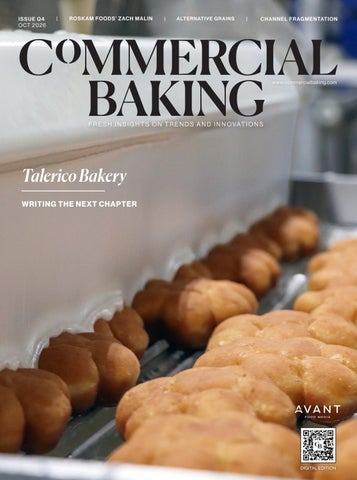
Cover: With a second frozen baked good facility in the works, Talerico Bakery credits its steady growth to patience and wise decision-making. Read more on page 18. Photo by Olivia Siddall | Avant Food Media
7
COMMERCIAL BAKING
MIDERA ARTISAN BREAD TOTAL LINE SOLUTIONS Formerly Middleby Bakery
INDUSTRY LEADING TECHNOLOGIES
Crafted By Time. Perfected By Escher. Precision mixing for long-fermented doughs, delivering the flavor, texture, and open crumb structure artisan breads demand.
Escher Mixing Technology Exceptional dough development Precise control of high-hydration doughs
Authentic Artisan Quality. Industrial Performance. From Dough Development To Finished Loaf.
Olympia® Dough Divider Industry-leading weight accuracy Gentle handling of
From highly hydrated sourdoughs to artisan flatbreads, Midera delivers integrated solutions that help bakeries preserve artisan character while improving efficiency and throughput.
high-hydration doughs Reduced giveaway
GEOH Mistral® Hybrid Oven – The NEW Industry Standard Up to 30% lower burner power consumption Intelligent heat optimization Flexible SKU production within the same footprint
Divided With Precision. Baked With Intelligent Efficiency. Accurate dough dividing Energy-efficient baking Flexible production capabilities Optimized footprint
DEDICATED AUTOMATION FOR EVERY STAGE OF PRODUCTION
MIDERA.COM
Washing / Sanitizing / Drying
Automated Guided Vehicles
CONNECT WITH US +1 540 569 4331 | SALES@MIDERA.COM KEEP IN TOUCH
Freeze / Chill / Steam / Proof
IN THIS ISSUE
Departments
71
TRENDS Category Outlook: Cookies
59
Category Outlook: Bagels
65
Artisan at a Glance
94
I N N OVAT I O N S
79
94
Category Insight: Cookies
71
Category Insight: Bagels
79
Commercial Baking Channel
90
Ad Index
96
QUICK READS
9
Editor’s Note
10
Seen and Heard
13
Business Intel
87
The Last Word
98
COMMERCIAL BAKING
A N OTE FR O M TH E ED ITO R
Take a Beat Years ago, I received sage advice from a colleague: To speed up, sometimes you’ve got to slow down. No doubt he learned it from a baker. Whether thinking like an engineer or navigating the coexistence of multiple generations in one building, the wisdom our sources impart stays with us long after the interviews. It’s what makes this industry so special. Thought leadership, lessons (often learned the hard way), operational excellence … we draw so much from one another. While technology, consumer trends and legislation are moving faster than any of us may want, the idea of slowing down to speed up feels more important — and more challenging — than ever. Last month, I joined the American Bakers Association (ABA), American Society of Baking and Retail Bakers of America for ABA’s Bakers Fly-In and Policy Summit. When we walked into congressional offices, we were one industry with different voices, speaking in harmony to illustrate the direct impact of rapid policy changes. We left our offices, kitchens, labs and manufacturing floors to advocate for our industry.
JOANIE SPENCER Editor-in-Chief | joanie@avantfoodmedia.com
Will it speed up the change we need? Maybe not. But I believe we influenced policymakers to slow down, think critically and follow the science. Within our groups, we had different roles, but with a shared goal: feeding people safely and affordably. There’s a lot to keep up with these days, but remember, it’s okay to take a beat. Talk to your colleagues. Ask your staff how they’re doing. Call your members of Congress. Meaningful change can’t happen overnight, but if we can take time off the hamster wheel, we can influence positive change together.
OCTOBER 2026 Q4
10
Designed With Your Bakery In Mind... Because the right pan design can take the edge off cleaning.
Improve sanitation and extend pan life with solutions designed to keep your pans performing at their best. CleanEdge™ and CleanSweep™ pan designs help reduce areas where residue and moisture can collect, supporting easier cleaning and longer-lasting pan performance.
QUALITY, SERVICE, AND INNOVATION FROM A PARTNER YOU CAN TRUST.
A Family Business Since 1964
DISCOVER CLEANSWEEP ™ & CLEANEDGE ™ PAN DESIGNS
937.652.2151 | info@americanpan.com | americanpan.com |
Seen eard H
AND
“Designing for the human eye and designing for the machine don’t always agree. Sometimes making a package more inviting for a person makes it quieter for a bot.” Andy Kurtts | creative director and founder | Buttermilk Creative On packaging redesign strategies for AI detection Photo via LinkedIn
“You can’t just target one nutritional attribute. You have to view the product as a whole rather than just adding fiber or reducing sugar.” Lisa Sanders | owner and principal | Cornerstone Nutrition LLC On the bigger picture of reformulation Photo via LinkedIn
“[Value] is no longer just a price point; it’s price, plus story, plus quality, plus local connection … Bakery has a huge opportunity here, but only if we step up and tell that value story clearly to the shopper.” Gabe Disbrow | president and CEO | Leevers Supermarkets On how consumers perceive value during the 2026 ABA Convention Photo courtesy of the American Bakers Association
13
COMMERCIAL BAKING
SEEN AND HEARD
“Ignoring any part of the consumer shopping ecosystem means handing away market share by choice.” Krystal Dawson | VP, North American business partner cluster leader | NielsenIQ On embracing changing shopping habits Photo via LinkedIn
Still making huge
“The most important thing when making a transformational change is to make sure your people feel like they’re a part of it.” Kyle Hinsdale | EVP and CFO | JTM Foods During ABA’s 2026 NextGenBaker Leadership Forum Photo courtesy of the American Bakers Association
waves in depanner technology! The Provident is the latest in depanner sanitary design and compliance! Our depanner offers a complete washdown system for the conveyor, depanner and vacuum chamber; JSD auto vacuum control; remote low profile vacuum module; and works-in-a-drawer vacuum blower/motor accessibility. The Provident is built to meet: A Fresh Approach To Custom Automation®…
• FDA, USDA and ANSI 50.2 standards! • BRC Global Standard for Food Safety! • Vacuum chamber and conveyor system IP69K Washdown rating! No one else in the industry offers one. Call us at
capwayautomation.com
877.222.7929, we can show you the future of baking now!
SEEN AND HEARD
“Surround yourself with people who know things you don’t, and don’t be afraid to ask questions. The minute you stop being curious because you think you know it all, you’re already behind.” Jody Barrick | founder, managing partner | Perimeter Partners Discussing leadership habits on IDDBA’s Fresh Takes podcast Photo via LinkedIn
“Most people don’t actually consume science. They consume someone else’s interpretation of that science.” Laura Hoover | former EVP, food and beverage | Edelman US During a keynote session at IFT FIRST 2026 discussing strategies for disseminating information Photo courtesy of IFT
“We all want the same thing: clean, safe food. We get there together.” Nick Magistrelli | VP of sales | Rademaker USA During a panel on hygienic design at BEMA Convention 2026 Photo courtesy of BEMA
OCTOBER 2026 Q4
16
OCTOBER 2026 Q4
18
F E AT U R E D B A K E R Y: TA L E R I C O B A K E R Y
NOT ‘LUCKY’ Astute observations, thoughtful decision- making and plain-old hard work define Talerico Bakery’s continued success. BY M A R I RY D I N G S
Bob Talerico loves to tell stories. The owner of Talerico Bakery, a more than 40-year-old fried and baked sweet goods manufacturer on the South Side of Chicago, has plenty of tales to tell. One of his favorites is about how he and his buddy Michael “Mickey” Martin started the bakery in 1984 using the kitchen of a family business. After all these years, Talerico still gets excited when asked to share the story … and its next chapter.
“Our growth will still come from convenience stores because that’s our mainstay for sure,” said Chris Goebel, VP and GM. “But we’re looking at in-store bakeries, grocery stores without in-store bakeries, and coffee houses. Those are areas we’ve not really touched before.”
19
All photos by Olivia Siddall | Avant Food Media
The bakery is in the throes of building out and equipping an 82,500-square-foot facility — the second of two — that will significantly expand the company’s frozen capabilities. The expansion will not only help the business serve its current customer base of several thousand c-stores, gas stations, grocery stores and schools across the US, but it will also increase capacity to take on more business in private label, foodservice and other segments.
COMMERCIAL BAKING
TA L E R I C O B A K E R Y
When completed in Q3 2027, the new plant will boast four high-capacity production lines, advanced packaging technology and a 20,000-square-foot freezer. The star of the show will be a fully automated Moline fry line that will integrate depositing, frying, filling, topping, depanning, cooling and potentially packaging, along with a tunnel oven.
LISTEN NOW: Chris Goebel talks about why Moline is Talerico’s go-to equipment supplier.
The line will give Talerico the flexibility to produce and package donuts of various flavors, formats and sizes on one line, from full-size donuts to donut holes that can be enrobed, tumbled with crunchy toppings, glazed or powder coated. It will also be able to fill to-go cups with donut holes of various sizes, a task currently done manually because of space limitations. “It’s a well-laid-out line that took us several months to create,” Goebel said. “It will allow us to do all the things we can’t do in our existing facility, and many of the challenges in the current operation will be solved in the new one. And we’ll be able to do everything at a greater speed and volume.” The new bakery joins three other Talerico production facilities, all within a short drive — or walk — of each other. One building manufactures fresh baked goods (40,000 square feet), and another produces frozen items (100,000 square feet). And then there’s the 3,000-squarefoot retail bakery that keeps the locals well fed. All told, 560 employees keep everything running smoothly.
OCTOBER 2026 Q4
It’s a pretty remarkable next chapter, considering frozen manufacturing wasn’t supposed to be part of the story. The bakery (formerly Talerico Martin Wholesale Bakers) got its start servicing wholesale customers with fresh donuts and sweet goods such as Danish and other pastries, muffins, brownies and cookies. Talerico and Martin owned a retail bakery for a short time, too, but after about six months of managing retail and wholesale operations simultaneously, Talerico and Martin ultimately decided wholesale was the way to go. “We hung a ‘Gone Fishin’’ sign in the window of the retail bakery, took a month off and went to work on our wholesale business,” Talerico said. “We more than doubled our wholesale business in a month, and that set our direction.” The bakery carved out its lane by delivering fresh baked goods to c-store accounts such as long-time customer 7-Eleven in the Chicago area and steadily grew the business.
20
—Above Talerico’s high-capacity pound cake allows the bakery to produce 300 slices per minute.
WHATEVER YOU CAN DREAM, WE CAN DONUT Get a USA-made donut system that’s scalable and built around your goals. Add our new Turnkey Integration Services and you’ll have one hands-on partner to plan the line, coordinate the details, and integrate the complete production flow for a smooth, efficient run.
SCAN TO EXPLORE MOLINE D O N U T SYS T E M S + T U R N K E Y I N T E G R AT I O N S E R V I C E S
moline.com
TA L E R I C O B A K E R Y
“Stay in your lane, and do what you do well,” Talerico said. “I say that, but every once in a while, we change lanes to grow the business.” The company’s first major change — its foray into frozen — was completely unexpected, and it changed the course of its future. “We hadn’t even thought about it,” Goebel said. “We had limited ourselves to growth here in Chicagoland. With fresh product, once you get a certain delivery radius, you can’t really go any further.” But then Top Pot Doughnuts came knocking. It was looking for a co-manufacturer to produce its freeze-and-thaw baked goods for Starbucks. Talerico knew a good opportunity when he saw one. “We saw the potential with freeze-and-thaw and decided to take on the challenge,” Goebel said. “Starbucks was our first frozen customer, and we handled its business nationwide and into Canada. We produced Devil’s Food and Old Fashioned donuts along with an apple fritter. We quickly realized that by freezing our products, we could expand distribution.” That didn’t happen overnight. It took about five years for the company to develop freeze-thaw baked goods that met its quality standards. “Our intention was to grow the frozen business, and it’s grown very comfortably,” Talerico said. “We knew frozen was growing across the country, but we wanted to create great products that could handle frozen conditions and still have superior eating quality when they were thawed and served. There were a few aches and pains here and there, which are expected.” The freeze-and-thaw business grew, and the company landed what is now one of its largest customers, Super Bakery, a better-for-you baked goods brand. Soon, there was a customer request for sliced pound cake for retail and foodservice. Demand for that item grew so quickly that the operation invested in another facility — the current frozen plant — and installed a high-capacity production line to manage volume that can reach 300 slices of pound cake per minute. The upgrade also included a dedicated Gostol/Tecnopool tunnel oven that runs five days a week, 24 hours a day.
WATCH NOW: Mike Comella shares how the bakery’s tunnel oven investment was a game changer. Sponsored by Gostol/Tecnopool
OCTOBER 2026 Q4
22
TA L E R I C O B A K E R Y
—Left The bakery has six production lines, with at least four, often five, running every day.
“That facility and equipment investment gave us the ability to produce to the level required to fill the needs of freeze-thaw customers,” Goebel said. This frozen bakery has six production lines, with at least four, often five, running every day. Topos Mondial and Tonelli planetary mixers feed the lines. Baking operations are separated from the three fryers by a row of Hobart rack ovens and the Gostol tunnel oven. On any given day, the lines produce 1,200 donut holes and between 300-500 full-size donuts a minute, or up to 1 million a day. Packaging operations vary and include a flowwrapper that individually wraps foodservice items to clamshells, cups and similar containers that go to c-stores and grocery stores, to the overwrapped
OCTOBER 2026 Q4
“Our operational flexibility brings us opportunity … We want to be able to incorporate the right amount of automation in the areas where it makes sense.” Chris Goebel | VP and GM | Talerico Bakery
trays used to distribute frozen donuts. Each area relies heavily on people to get the job done. “We’re expecting a Schubert automatic packaging system by the end of the year,” Goebel said. “That will reduce the physical labor required and improve consistency.” As Talerico expanded its frozen capabilities, it almost naturally shifted into co-man mode, figuring out how to manufacture customer-specific products. It was a bit of a mindset shift for the business, which was used to servicing primarily c-store customers that all tended to order the same products. For example, McDonald’s requested a version of the bakery’s apple fritter,
24
THINK OUTSIDE OF THE BAG Flexible packaging solutions for modern bakeries. Primary Packaging – Consistent seals and clean presentation across high-value SKUs. Robotics & Secondary Packaging – Reduce manual handling while maintaining speed and accuracy. Palletizing & Tote/Basket Management – Protect downstream flow and eliminate packaging bottlenecks.
Automate your entire line with our robotic cells:
HARPAK-ULMA.COM • 800-813-6644
© 2026 Harpak-ULMA Packaging, LLC, 85 Independence Drive, Taunton, MA 02780 USA
TA L E R I C O B A K E R Y
while another customer wanted round chocolate cakes. The bakery accepted each challenge and found a way to make them happen. “It took us a little bit to get those figured out in terms of moving large volumes through our system,” Goebel said. “But once we got it figured out, it just took off. We still do quarter sheet cakes for McDonald’s.” The bakery’s R&D lab plays a central role in helping customers realize their visions, from scaling grandma’s secret recipe to crafting custom recipe formulations. The doors are always open to customers who need a place to test out their formulas. “Every customer is different, and requests run the gamut,” said Gary Willard, VP and director of operations. “Some customers come in with a recipe and say, ‘This is already in stores. Can you make it for me?’ Others want help figuring out how to scale up a product, and we get everything in between. The same is true for order size. We’re in that middle spot of not being too big for the little guys and not being too little for the big guys. We try to be there for everybody.” It’s a good spot to be in production-wise, but distribution is another story. In the early days, as news of Talerico’s flexible operation and freeze-and-thaw capabilities circulated through the c-store channel — about 150,000 stores nationwide — the bakery began receiving calls from all over the country. It now had the equipment and operational expertise to handle the influx of orders, but not the distribution. At least, not at first. “It turns out that people everywhere like donuts,” Willard said. “It was a chicken-and-egg conundrum in that a distribution center requires a customer, and new customers require a distribution center. We had to align those two pieces to establish our foothold. Once we were in, it was easy and snowballed from there. Now, we’re in every state. We’re going across to Hawaii and up to Alaska.”
“We’re in that middle spot of not being too big for the little guys and not being too little for the big guys.”
It may seem Talerico Bakery’s growth has been fast and furious, but that couldn’t be farther from the truth. From day one, its strategy has been to grow slowly and with intention.
Gary Willard | VP and director of operations | Talerico Bakery
“Although there’s an insatiable need to move forward and grow, there’s an unwavering patience as well,” Willard explained. “We’ll get there when we get there. We know the end game. We’re not in a rush to throw up a new division just to see it fall or to sell it off. We want to build it for ourselves, do it right and see what it can become when we put in the work the right way.”
OCTOBER 2026 Q4
26
RUN WITH
CONFIDENCE Get visibility and control of ALL your ingredients with
Pfening’s formula based batching system. Premium control without the premium price. VISIBILITY REPEATABILITY AFFORDABILITY
TA L E R I C O B A K E R Y
Remember, though, Bob Talerico knows a good thing when he sees it. Case in point: The bakery purchased the building next door to its warehouse not long after it acquired the building for the frozen facility. That wasn’t part of the plan, but when opportunity knocks, Talerico throws the door wide open. “How do you not buy the building next door?” Talerico said. “We would never have that opportunity again. Initially, we were going to use it for more storage, but Chris suggested turning it into a manufacturing space to produce baked goods with nuts. We already have the equipment we need, and we have an existing customer who’s ready to shift production of its nut-containing products to us when the facility is ready.” Right now, the operation is 100% nut-free. Adding a dedicated nut facility will be a game changer.
“It will help grow our brand recognition, especially now that we’re considering going into grocery stores,” Talerico said. “It will open doors for us and give us the ability to add new items to our retail store.” The measured approach to growth also applies to adding automation, whether it’s integrating one piece of equipment or outfitting an entire facility. The leadership team examines the pros and cons from all angles, and it is selective when choosing suppliers. Goebel, especially, understands the opportunities — and limitations — automation can bring.
“We’re very fortunate, but we’re not lucky. Everybody works hard at it.”
“Our operational flexibility brings us opportunity,” Goebel said, “so we don’t want to automate ourselves out of opportunity. We don’t want to say no to a customer because the equipment can’t
Flowwrappers individually wrap items for foodservice. Talerico‘s packaging operations vary by product and distribution channel.
OCTOBER 2026 Q4
28
Bob Talerico | owner | Talerico Bakery
IMPRESSA pizza THE INDUSTRIAL PIZZA & FLATBREAD LINE
Designed for efficiently processing large quantities of dough with a nearly endless variety of shapes. • • • •
High capacity industrial production Gentle dough processing for outstanding quality Wide variety of shapes for pizza and flatbread Extremely accurate and reproducible product shape
FRITSCH Bakery Technologies Part of the MULTIVAC Group fritsch-group.com | 800-800-8552
TA L E R I C O B A K E R Y
INNOVATIONS FROM THE BAKERY FLOOR From the South Side of Chicago, Talerico Bakery manufactures fresh and freeze-and-thaw fried and baked goods for c-stores, foodservice and other accounts throughout the US. On any given day, it produces up to 1 million full-size donuts. As the company writes its next chapter, here are some of the supplier innovations it relies on.
Bob Talerico (at counter) frequents the company’s retail bakery, which has become a community hub.
Delta/Marchant Schmidt automated slicing and packaging system Gostol/Tecnopool tunnel oven Moline fry line
handle it. We want to be able to incorporate the right amount of automation in the areas where it makes sense.”
Schubert robotic packaging system Tonelli mixers Topos Mondial mixers
Another factor Goebel considers around automation is whether there’s enough volume to support the investment long term and whether downstream processes can handle increased output.
Unifiller depositors
“Where you can run into trouble is on the packaging side,” Goebel said. “Automation gives you the ability to do different things, but you need a place for finished product to go. You need flexibility downstream to give customers what they want. Some want their product in bags; others may want it in tubs. You have to think about how that could evolve. We’re still looking at packaging systems for the new facility. The easiest way to solve it in the short term is through people until we figure it out, and then we can bring in automation.” Some might call the company lucky when they hear the owner tell his story of continued growth and expansion … but he’s quick to dispel that notion. “Luck has nothing to do with it,” Talerico said. “It’s a matter of observation and putting good thought to it. That allows us to grow substantially, but it’s not rushed. It’s a lesson. If you take your time, you’ll find your way. We’re very fortunate, but we’re not lucky. Everybody works hard at it.” CB
OCTOBER 2026 Q4
30
One source Endless possibilities Beyond equipment to system and process controls design
Our businesses partner with you to deliver the quality, consistency and reliability your customers demand. Technology for: • Integrated process controls • Labor-enhancing automation • Flexible scalability • Unparalleled recipe management
www.hillenbrandfhn.com
The Power of Yes Zach Malin, Roskam Foods’ chief commercial officer, never shies away from opportunity. BY M A D D I E L A M B E RT
At first glance, Zach Malin’s resume shows a breadth of contract manufacturing know-how, but that’s hardly the whole story. To get the full picture, you’d have to travel back to the early 2000s. Malin spent the first two decades of his career gaining hands-on experience in operations, business development, purchasing, acquisitions and integrations, general management and more. Before joining Grand Rapids, MI-based Roskam Foods as chief commercial officer this year, he worked for a host of food and beverage companies. Behind this vast experience was one word: “Yes.” “It wasn’t a grand master plan at all … My career has really been a series of saying yes to opportunities and being surrounded by people who believed in me,” Malin said. “Looking back, every major career step I took came from being willing to raise my hand and say, ‘Yep, I can do this,’ even when I wasn’t sure I was fully prepared for it.”
OCTOBER 2026 Q4
Photo courtesy of Zach Malin
A career in manufacturing wasn’t originally in the cards for Malin, but that hand was redealt when he joined Cincinnati-based The Wornick. Co. as a production supervisor for the co-manufacturer, making shelf-stable entrees, military MREs and
34
EXECUTIVE PROFILE: Z ACH MALIN
frozen foods. He was promoted into a purchasing role, which eventually led him to a global sourcing role at Procter & Gamble.
importance of listening and being open to new perspectives.” As most effective leaders know, there’s rarely just one way to solve a problem. In Malin’s experience, some of the best solutions to co-man conundrums come from taking the lessons learned in one environment and applying them to another. Looking at challenges through multiple lenses, questioning base-level assumptions and focusing on what works — rather than what has always been done — influences Malin’s approach to commercialization.
“[Procter & Gamble] was an incredible training ground; I learned strategy and the importance of discipline and execution at scale,” Malin recalled. “Eventually, Wornick recruited me back for a business development position. I had no idea what that would fully entail, but I said yes again.” That role exposed Malin to the commercial side of the co-manufacturing business: its customers, commercial strategy and senior leadership team. From there, Malin served in leadership roles with increasing responsibility at various food and beverage companies. It turned out that saying yes was easy, thanks to the colleagues, mentors and leaders who invested in and helped develop Malin’s talents. Each leader who poured into Malin equipped him with the knowledge to understand the nuts and bolts of co-manufacturing, from product specifications and volume needs to safety rules and plant capacity. He also learned how decisions in one area can cause a ripple effect across finance, operations and marketing. This 360-degree perspective on business and ability to move across disciplines helped Malin avoid being pigeonholed into learning a single skill set.
“Leadership isn’t about having all the answers. You have to be able to make decisions with imperfect information most of the time.” Zach Malin | chief commercial officer | Roskam Foods
As Roskam’s chief commercial officer, Malin’s time is divided among strategy and revenue growth, c ross-departmental alignment, operational execution and account management. Prioritizing such a wide range of expectations requires a “plan your work and then work your plan” approach. Of his multitude of tasks, one of his favorites is the Gemba walk, a lean manufacturing methodology in which leaders immerse themselves where the relevant work happens. It’s a way to observe work processes in real time, spot production waste, and speak directly with frontline operators to understand real-world challenges and drive continuous improvement. Donning steel-toed work shoes and a hairnet, his goal is to walk the production floors about three times a week. With five Roskam plants in Grand Rapids alone, Malin, quite literally, makes strides in this endeavor and gives his pedometer a run for its money.
And parlaying each of these experiences into his next venture uncovered the ultimate path to success. “Success comes down to understanding consumer demand, operating efficiently, developing strong and deep customer relationships, and then building all that around an organization that can execute,” Malin said. “Working in so many different segments of the industry reinforced the
“When you walk a plant floor with intent, you look at things differently,” Malin said. “You look for areas to improve and talk to the line workers. Having those conversations on the factory floor not only makes it more meaningful to the
35
COMMERCIAL BAKING
EXECUTIVE PROFILE
Photo courtesy of Roskam Foods
One of Malin’s (left) favorite parts of the day is the Gemba walk, a lean manufacturing methodology where leaders immerse themselves on the production floor.
team members but also more effective for the business.” Malin likens this effectiveness to Toyota’s Andon cord, another core practice of lean manufacturing. It’s an overhead pull cable on a factory assembly line that any plant employee can pull to stop production without repercussions. This lets the workers instantly signal quality flaws, pause production and get immediate help from supervisors. This innate trust in team members is built by empowering them to solve problems, share ideas and improve their daily work rather than following top-down orders, and it forms the essence of Malin’s leadership philosophy. Throughout his career, he has helped companies adopt a lean manufacturing approach, which leads to a deeper level of trust between leaders and their teams. The result is a stronger- performing workforce in a continuous learning environment.
OCTOBER 2026 Q4
He has also spearheaded significant transformations under these principles, be they acquisitions, consolidations or complete overhauls of a business model. These days, transformation is inevitable: Markets evolve, customer behaviors shift and supply chain dynamics fluctuate. In his career, Malin has seen firsthand how success becomes second nature for a strong team. “People don’t resist change nearly as much as they resist uncertainty,” he said. “The challenge is that leaders become so focused on the destination that they simply forget people still need context for why the journey matters. When people trust the leadership team, they’re far more willing to embrace uncertainty and help build whatever comes next.” Under Malin’s guidance, what’s next for Roskam will always be a decision made from operational foresight and thoughtful strategy.
36
“Leadership isn’t about having all the answers,” he said. “It’s about being able to see the bigger picture. You have to be able to make decisions with imperfect information most of the time.” When it comes to the commercial baking industry, timing is everything, speed is paramount and collaboration is key. Roskam has invested heavily in its capabilities, equipment and team members to be more than just one side of a transactional relationship. The company builds trust with its customers, focusing on product formulas, specifications and quality attributes while also giving each client a competitive advantage to go to market faster. In this regard, Malin has mastered the art of balancing urgency with long-term planning and developed razor-sharp critical-thinking and time-management skills. “I’ve learned the importance of focusing on a handful of initiatives that can
Our Solution Is Always the Perfect Fit Because It’s Built for You. Solve your toughest secondary packaging challenges with our automated solutions
There’s Still Time to Register and Visit PACK EXPO Booth N-5316
Live Booth Demos • Case Packer with AI-powered vision loading pouches into RSC and shelf-ready cases. • Simple gantry-style case packer loading into RSC and three-sided club store trays. • High-speed vision guided robotics singulating and cartoning personal care sachets. blueprintautomation.com
EXECUTIVE PROFILE
truly move an organization forward,” he said. “It’s so easy to become distracted by meetings, projects and competition, but the most successful leaders I’ve worked with were incredibly disciplined about identifying what mattered most and aligning people and resources behind those goals.” Two decades ago, Malin believed product development defined innovation. Today, he knows innovation doesn’t simply mean product on shelves. Some of the highest-impact initiatives he’s seen have happened when planning processes were improved, acquisitions were integrated quickly or commercial organizations became more streamlined.
form or a different way to go to market … connecting the dots and figuring out how all these pieces come together is what I love to do.” As brands shift away from asset-heavy internal production to c apital-preserving outsourcing, co-manufacturing is an easy answer to the make-versus-buy question. The food industry is evolving; consumer expectations are changing and new opportunities are emerging. Yes, consumers have more choices than ever before, but Malin is equipped to help Roskam steer its customers into the spotlight.
“People don’t resist change nearly as much as they resist uncertainty.”
“Innovation means improvement,” he said. “Sometimes improvement comes with a breakthrough product. Of course, those are amazing when you get to be part of it, but other times, it’s just finding a better way to serve a customer, run a business, develop your people or solve a problem. The companies that can operate from this mindset are the ones creating lasting success.” If innovation means improvement, then value can be generated at almost every touchpoint of the process. Maybe it’s figuring out how to improve the consumer experience or making adjustments to product packaging. There’s no fortune teller who can guarantee what will generate the most value, but Malin’s knack for process improvement is a good start. “I spend a lot of time looking for connections between markets, capabilities and customer needs, all while focusing on strengthening the organization,” he said. “What keeps me energized is finding the opportunities people don’t see. Maybe it’s a new customer relationship we’ve never thought of or an innovative product plat-
OCTOBER 2026 Q4
LISTEN NOW: Zach Malin discusses the importance of aligning resources for effective operations.
“There’s very little room in my day for activity that doesn’t create value for our team members, customers or the shareholders of the business,” he said. “Earlier in my career, I thought business development was primarily about winning new customers and driving growth. Over time, and specifically at Roskam, I’ve realized it’s not about just winning; it’s about creating something sustainable for long-term growth.” It might not have been Malin’s grand master plan to enter the co-manufacturing world, but building a long-term career in the segment was definitely in the cards. There’s a bright future in store for Malin because, when presented with an opportunity, his answer will always be yes. CB
38
PURATOS: BAKERY INNOVATION IN THE GLP-1 ERA As a global leader in bakery ingredients, Puratos is the partner of choice for industrial, retail and artisan bakers. It has the knowledge, expertise and resources to help commercial bakers innovate for shifts in the bread aisle, with customized solutions to help their businesses stay competitive, relevant and on-trend.
Defining GLP-1 The GLP-1 conversation has significantly changed how consumers shop and eat, especially in bakery. The term “GLP-1” refers to two different concepts, and it’s essential for bakers to understand the difference when developing — or reformulating — products to support these new behaviors.
60%
62%
of consumers report actively incorporating more protein into their diet
of consumers select certain food and ingredients based on health benefits
Hormone — Glucagon-like peptide-1 (GLP-1) is a naturally occurring hormone in the body. It’s released in the gut after eating and helps the body regulate blood sugar, insulin response, appetite and satiety. In simple terms, it signals to the brain and body that a person is full. Medication — GLP-1 medications mimic how the natural hormone acts in the body. Common brand names are Ozempic, Wegovy, Mounjaro and Zepbound. They have a longerlasting effect than the body’s natural hormone.
OCTOBER 2026 Q4
Source: Taste Tomorrow by Puratos
40
SPECIAL SECTION: A DV ERTO R IA L
The Shifting Consumer-Food Relationship Beyond GLP-1 medication use, consumers in general are gravitating toward foods that can offer protein, fiber, nutritional density and other health benefits. That doesn’t mean indulgence is going away; it’s just becoming more intentional. When consumers choose to indulge, great taste and a premium experience are still in high demand. Bakery is uniquely positioned to evolve with these consumer needs. Product innovation within the GLP-1 shift means: • • •
Developing everyday baked goods that satisfy nutritional expectations Offering indulgent products that deliver exceptional taste and sensory experience Creating nutritional, great-tasting foods for all consumers
Building a GLP-1-Friendly Portfolio Whether it’s the impact of GLP-1 medications or demand for protein and fiber, consumer preferences are reshaping the bakery landscape. Puratos helps customers turn trends into opportunities by transforming insights into market-ready solutions. Through its Taste Tomorrow global trendmonitoring platform, Puratos analyzes consumer behaviors, preferences and emerging trends. These insights guide product development, helping customers make informed decisions about their portfolios.
Puratos’ R&D experts work alongside bakers to develop products that deliver the health benefits consumers seek without compromising taste or texture. Innovations are tested and validated in Puratos’ industrial pilot bakery, and then tested in real-time with consumers through the Sensobus, Puratos’ mobile research lab. This approach has led to solutions such as ProteinPro Strength, a high-protein mix for everyday bakery applications, and ProteinPro Flex, which helps bakers create protein-rich flatbreads
PARTNER WITH PURATOS FOR YOUR GLP-1-FRIENDLY SOLUTIONS Visit puratos.us
41
and buns. Softgrain Ancient Grain supports wellness-focused innovation with its clean-label blend of pre-soaked red quinoa, amaranth, chia, buckwheat, spelt, millet and teff, infused with fruity rye sourdough and a touch of brown sugar. GLP-1 medications are here to stay, and consumer expectations will continue evolving. With deep insights, proven R&D expertise, pilot bakery validation and real-time consumer acceptance testing, Puratos helps bakers bring successful innovations to market with confidence.
Watch our TechTalk
COMMERCIAL BAKING
Talkin’ ’Bout a ‘Pretzelution’ Built on big ideas and good connections, PRETZELIZED is pushing the boundaries of the pretzel. B Y L I LY C O TA
They say good things come to those who wait … but what happens to those who don’t? The people who take on daring initiatives and ask the simple-yet-revolutionary questions are the ones who place themselves at the forefront of a staple category’s modern upheaval. Sammy Kestenbaum and Jason Cohen, co-founders of Wayne, NJ-based PRETZELIZED, can trace their category disruption back to a dinner in the Cayman Islands, where a bread basket loaded with assorted breads and a single pretzel baguette sparked a pivotal question: “Why can’t they just ‘pretzelize’ the entire basket?”
“Our goal with PRETZELIZED isn’t to chase the trend of the day or sprinkle the latest buzzword on a bag,” Kestenbaum said. “It’s to change the format of snacks by bringing something completely new and viable to categories that have gone sleepy.”
OCTOBER 2026 Q4
All photos courtesy of PRETZELIZED
The fabricated verb refers to the combination of pretzels with classic, crunchy products like crackers and pita chips to deliver a multi-textured eating experience alongside better-for-you snack credentials.
The PRETZELIZED portfolio includes classic flavors that allow the product’s innovative format to shine.
42
EMERGING BRAND: PRETZELIZED
The brand produces five varieties of P retzel Pita Chips — Everything, Sea Salt, Buffalo, Aged Cheddar and M editerranean Herb — as well as four versions of its Pretzel Crackers, including Cinnamon Crunch, Sea Salt, Cheddar, and Honey Mustard. Flavor is key for consumers, but that doesn’t mean it has to be outside of the box. PRETZELIZED’s flavor strategy is anchored in everyday, pantry-staple varieties that pair well with dips and convenient eating occasions. Instead of chasing fads or building a portfolio around a single nutritional claim, the brand’s format-first innovation process is its main growth engine. “If you look at traditional snack categories, flavors are there to create impulse,” Kestenbaum said. “They’re there to create excitement. PRETZELIZED does that on its own.” Kestenbaum and Cohen are self-proclaimed serial entrepreneurs who’ve earned their chops building brands under the umbrella of That’s How We Roll, a manufacturer of snacks such as ParmCrisps and Thinsters. Founded by Cohen and later joined by Kestenbaum, the company was acquired by Hain Celestial in 2021 for approximately $259 million. Building and selling ParmCrisps gave the founders not only the capital but also the retailer relationships, manufacturing playbook and entrepreneurial confidence to do it again. Today, their holding company, 7 Mile Brands, acts as a CPG incubator, with PRETZELIZED as its flagship brand. Focused on taking familiar formats and re-engineering them into scalable products that excite consumers, the brand provides an eating experience that’s
proven to rewrite the snack script as far as consumers — and retailers — are concerned. “The best thing for a brand to do is identify what the consumer, and really primarily retailers, are looking for,” Kestenbaum said. “As the modern shopper goes into the deli and into the perimeter, they aren’t seeing a lot of adjustments that centerstore products are privy to. We’re trying to change that by bringing these snacks into spaces they haven’t been before.”
Kestenbaum successfully secured early interest only to find that not a single co-manufacturer had the ability to run both pretzel and pita/cracker processes simultaneously. “We scoured the world,” he said, “and went to every manufacturer we could find that made pita chips. What we found was pita people make pita, cracker people make crackers, and pretzel people make pretzels. Nobody had the capabilities to create two snacks in one.”
Consumers want convenience, flavor and excitement with clear nutritional benefits, while retailers want simplicity and transparency. Finding the right match for all is the goal.
While this discovery was a setback for the brand, it was also further proof of the ingenuity behind the product and confirmed its status as ‘not just another snack.’
“After we came up with the initial idea, I called my friend who was a buyer at Kroger at the time, and I went in with three chips and a concept,” Kestenbaum recalled. “We didn’t have a single piece of equipment; we had no way to make the product at scale, but they loved the idea. So, I said, ‘Give me a couple months; let me come back with a solution and a launch plan.’”
“We partnered with a co-packer, bought the equipment, and sandwiched three unique production capabilities together into a line that’s about the size of a football field. Then, we just started running,” Kestenbaum said. “We essentially pioneered a new manufacturing process by building custom, proprietary machinery. It took a little time, but it was worth it.”
“I can’t even count how many businesses we’ve created where the first product is not the home run product. You have to stay at bat and just keep swinging.” Sammy Kestenbaum | co-founder | PRETZELIZED
43
COMMERCIAL BAKING
EMERGING BRAND
This capital investment enabled PRETZELIZED to confidently commit to its national Kroger launch and the next phase of growth. Equipment was installed in January 2024 and by April, three flavors of pretzel pita chips hit the retailer’s in-store shelves. Trends don’t guide the portfolio, but the brand does see the value of test-driving ideas through seasonal and limited-time offerings. For instance, PRETZELIZED celebrated America’s 250th anniversary with a limited-time version of its Pretzel Crackers and Pretzel Pita Chips for the summer, creating a timely occasion for consumers and retailers to engage with the brand while staying rooted in its core product strategy. As for future flavor development, PRETZELIZED is focused on staying grounded in the mission … but there’s certainly room for a little bit of fun. “One day we might come out with a dill pickle flavor, or something of that nature, because you have to stay fresh,” Kestenbaum said. “But that’s not what gets us up in the morning. We’re focused on category and merging pretzels with as many product types as we can.” While the team is always working to refine its classic offerings, the real acceleration comes from strategic partnerships that put those products in the right context for the right consumer. After debuting 2-ounce single-serve Pretzel Snackers for foodservice in 2025, PRETZELIZED partnered with Little Sesame on a hummus “snacker” collaboration, pairing the smaller pretzel bags with premium hummus in the deli section. “[The partnership] makes sense,” Kestenbaum said. “The product is portion-controlled and a higher-protein
OCTOBER 2026 Q4
The cross-market collaboration with Crayola generated excitement and visibility for the snack brand.
item because of the hummus. It meets what shoppers are looking for right now.” Similarly, the brand debuted a Crayola multi-pack featuring crayons and a kid-friendly activity designed to turn snack time into a family experience while building brand awareness with the next generation.
“So much of what we do is partnership at that retail level, and determining what opportunity we can create from that,” Kestenbaum said. “I can’t even count how many businesses we’ve created where the first product is not the home run. You have to stay at bat and just keep swinging.”
Through these intentional partnerships, PRETZELIZED is building platforms that help consumers discover the brand and hold their attention. But this team is the first to acknowledge most startups don’t walk in with decades of credibility and a ready-made network.
Rather than accepting production limitations and forcing the puzzle pieces to fit, PRETZELIZED made a new puzzle altogether. With its selfconstructed production line and two growth-oriented leaders, the pretzel brand is ready to do whatever it takes to become a household name.
For emerging brands, it’s important to build the partnership story in layers, first proving they can deliver a differentiated product and operate reliably. From there, they can seek value- and consumer-aligned partners.
“We don’t have a crystal ball,” Kestenbaum said. “But our focus is on creating good products with smart innovation that challenge category norms. Other than that, we’ll go wherever the pretzelution takes us.” CB
44
®
Baking without Ribbon Burners: Replace DGF Ovens with New Emithermic® XE Technology
Eliminates all ribbon burners. Simplifies cleaning and maintenance. READ MORE
Improves product consistency and baking efficiency. Features a humidity-controlled product zone. Easily converts from gas to electric heat in the future. A Markel Group Company
See this technology at PACK EXPO INTERNATIONAL RBS BOOTH #LU-8107 or visit readingbakery.com
AI image generated with Adobe Firefly
The Great Divide How bifurcation is splitting bakery baskets — and loyalty — across more channels. BY M AG G I E G L I SA N
It seems like ages ago when a Saturday morning list was all a shopper needed to get their groceries for the week. One store. One cart. One checkout line. It was, as they say, a simpler time. Today’s approach to the weekly grocery run is much more fragmented. One might pick up a birthday cake at the club store, snag a loaf of sourdough from a specialty grocer they discovered on Instagram, grab snack bars from the discount chain down the road, and come home to a box of cookies waiting at their doorstep — an impulse TikTok buy from the night before — all in the same day and all without even thinking twice.
According to Chris Costagli, VP of thought leadership for food and non-alcoholic beverage at NielsenIQ (NIQ), 68% of consumers now shop at two or three grocery stores in a typical week, and just 25% stick to a single store. Grocery remains the bakery’s leading channel, with annual spending of $315.80 per buyer, up 0.6% from a year ago. Then again, units per buyer are down 1.6% and occasions per buyer are down 0.4% (that is to say shoppers are buying bakery items a little less often, even as they spend more overall). Other channels, though, are picking up the difference. Costagli said grocery is seeing the steepest shopper outflow of any channel, even as it holds onto the largest share of bakery dollars. Of bakery shoppers who left grocery altogether, 51.8% moved to club, 36.4% shifted to mass and 11.6% moved to convenience. Bread saw a similar $33.7 million net outflow, most of it landing at club and mass. Grocery’s overall bakery dollar share has
Retailers and manufacturers have a word for this behavior: bifurcation. It describes consumers who are splitting their baskets and their loyalty across more channels, formats and platforms than at any point in recent history. For the baking industry, the trend is reshaping not just where products get sold but how they get discovered, priced and merchandised in the first place.
OCTOBER 2026 Q4
46
CRITICAL ISSUES: C H A N N E L F R A G M E N TAT I O N
slipped a full point to 51.6%, while mass (26.1%), club (13.9%) and online (14%, up nearly two points) have all gained. “Grocery accounts for most bakery sales, but growth is shifting toward mass, club and especially online purchasing,” Costagli said.
68%
of consumers now shop at two or three grocery stores in a typical week.
Sally Lyons Wyatt, global EVP and chief advisor for CPG and foodservice at Circana, sees the same fragmentation from a different angle. Circana data for the 26-week period ending July 5, 2026, puts the number of unique channels shopped at least once during that timeframe at an average of 6.4, down slightly from a peak of seven in early 2023 but still highly omnichannel. “There is bifurcation, but it shows up in several dimensions,” she said. “Shoppers are not simply buying bakery in one place. They’re splitting the behavior between fresh, or perimeter, and center store, between premium and value, and across physical and digital channels.”
Source: NielsenIQ
All of it, she added, comes down to freshness, quality, convenience, price and occasion. This kind of splitting isn’t new so much as it’s accelerating, according to Anne-Marie Roerink, president of 210 Analytics. Shopping trips overall are up 12% compared with three years ago, driven by consumers stretching every dollar, hunting promotions and deciding what’s for dinner the day of rather than planning a week out. “A club store might win for pantry loading, a supermarket for tonight’s dinner, a specialty retailer for unique bakery items and online for convenience,” Roerink said. “Shoppers are optimizing every trip rather than consolidating them.”
47
That dynamic plays out especially well in bakery, where the desire for something fresh — or a little more elevated and specialty — can be reason enough for an extra stop. “Bakery is one of the departments that can actually create its own shopping trip,” Roerink said. “Freshness is incredibly important, so many consumers will stop specifically for fresh bread, rolls or desserts, even if they purchased the rest of their groceries elsewhere. The same is true for special celebrations. Consumers often purchase cake, cupcakes or other baked goods in a different store than the rest of their party needs.” That kind of impulse appeal, she said, makes bakery one of the categories best positioned to capture incremental traffic. So, who’s doing all this splitting? Lyons Wyatt said the most channel-diverse shoppers tend to be higher-income consumers who shop more heavily across club, mass, e-commerce and specialty stores, while lower-income households concentrate in mass and dollar formats, where value drives the decision. “Value remains the primary driver for many budget-conscious households,” she said, “while high-income consumers are more likely to expand their shopping footprint in pursuit of variety and greater convenience.” NIQ found a similar split: Among consumers who switched their primary grocery store in the past year, 22% cited lower prices and better value, especially millennials and Gen Z, while upper-income shoppers switched more for promotions and a better overall experience.
COMMERCIAL BAKING
CRITICAL ISSUES
That doesn’t mean loyalty is dead, Roerink said. Instead, it’s being redefined. “Some boomers and seniors have shopped the same store, on the same day, at the same time for decades,” she said. “That’s not the type of loyalty we are likely to see among Gen Z and millennials. Retailers can win hearts and carts by consistently giving consumers the best reason to make that trip, whether it’s solution-, inspiration- or value-driven. This makes loyalty harder to earn — not impossible — but increasingly something retailers must continually re-earn rather than bank on.” So, what should bakers and retailers do with all of this? Lyons Wyatt and Costagli pointed to a similar playbook. On merchandising, organize around mission
and occasion rather than category alone — afternoon energy, commutes, fitness recovery, lunchboxes and shared celebrations — alongside the freshness already driving perimeter growth. On pricing, don’t get stuck in the middle. Lyons Wyatt said bakers need to “clarify good, better, best; defend mainstream with differentiated value; and avoid being stuck in an undifferentiated middle.” When it comes to marketing, brands can win the discovery moment before the shopper reaches a shelf by investing upstream in social content, optimizing product data for search and AI recommendations, and testing ideas on social and e-commerce before scaling into physical retail.
Above all, bakers should see channel fragmentation as less of a threat and more a significant shift in how growth gets earned. “Bakery brands and retailers should approach fragmentation as a growth signal, not as a challenge to overcome,” Lyons Wyatt said. “The winning playbook is clearer channel roles, sharper price architecture, occasion-based merchandising and stronger digital discovery across consumer touchpoints.” Shoppers aren’t going back to one store, one trip, one list. The bakers and retailers who win from here will be the ones that make it easy for consumers to find the right product, wherever and however, they happen to be looking. CB
© Drazen on Adobe Stock
One-stop grocery shopping is a thing of the past. A food run may now include a stop at the club store, discount store and specialty bakery.
OCTOBER 2026 Q4
48
A Better Bagel Starts with Better Solutions. Better solutions begin with understanding the real problem.
REPCO partners with commercial bakers to identify root causes, solve formulation and processing challenges, and develop tailored solutions that improve quality, consistency, shelf life, and production performance.
Have a baking challenge?
TALK TO OUR BAKING EXPERTS Scan to Connect.
1835 E North St, Salina, KS 67401 | 785-825-2181 | www.repcoworld.com
REDDI-SOAKED GRAINS
“Reddi”When You Are
Whole Grains That Are
Reddi-Soaked Grains is designed for ultimate convenience, helping bakers save time without sacrificing taste or nutrition. Reddi-Soaked Grains
Reddi-Soaked Multigrain
Reddi-Soaked Fiber Grain
Clean-label, Non-GMO hydrated grains and seeds for soft texture and whole grain appeal.
Clean-label, Non-GMO, no-sugar-added grains and seeds for hearty texture and subtle sourdough tang.
Clean-label, Non-GMO grains and seeds delivering an excellent source of fiber with soft texture and whole grain appeal.
Ready-to-Use Superior Quality Extended Freshness Recipe Versatility
Are you “reddi” to innovate? Scan for your free sample!
www.BreadPartners.com | 609.261.7276
P R O D U C T D E V E L O P M E N T: A LT E R N AT I V E G R A I N S
Breaking from Tradition Experimenting with alternative grains can bring wins for all. BY K A R A E L D E R
“We have a lot of customers who like to keep what is familiar but make it a little bit more exciting,” said Anke Golde, senior director of R&D at Ardent Mills. Working with alternative grains not only opens up new avenues for flavor and texture, but it also provides a chance to lend a bit more nutrition and work with climate-friendly crops. That’s a win for everyone: farmer, baker and, ultimately, the consumer.
© Kaentien on Adobe Stock
Sorghum chips with pink salt. Buckwheat crisps with olives, almonds and za’atar. Teff sourdough made from a flour that provides notes of chocolate and berries. These aren’t traditional baked goods, and that’s the point. Bakers are increasingly working with alternative grains, defined by the USDA as any food — including grains, seeds and pulses — that can replace wheat, corn and rice. Quinoa, millet, amaranth, rye, einkorn, even chickpeas and lentils: Everything is on the table, and that’s only scratching the surface.
Working with alternative grains, like sorghum, opens avenues for enhanced nutrition and flavor.
Romain Dufour, a baker consultant. “ I try to introduce alternative grains to clients before they even request it. I like to get them discovering these types of flours on their own.”
But incorporating an alternative grain into product development isn’t as simple as substituting one for another.
Dufour’s clients typically choose spelt, an heirloom alternative to whole wheat flour that feels familiar, thanks to its nutty, sweet flavor profile, and it’s often easy to work with.
“The main issue is often inconsistency from one batch to another,” said Chef
“I also love working with khorasan,” he added. “It gives a strong base, and then I’ll
51
add teff to it, usually through a sourdough process.” Spelt and khorasan (also known by its trademarked name, kamut) contain enough gluten to make them workable in a bakery. Teff, on the other hand, is an ancient grain from Ethiopia and Eritrea that contains no gluten and isn’t widely grown in the US. A lack of awareness can make it harder to incorporate alternative grains in commercial bakery production,
COMMERCIAL BAKING
PR O D U CT D E V ELO PM EN T
especially from a formulation standpoint. That’s why early research into what’s possible is a key element.
make a muffin out of it, it just gives you a little grainy texture or mouthfeel. Such grains can benefit from pre-gelatinizing the starch, creating a more desirable final texture.”
“I think it all starts with knowing your specs,” said Jessica Davidoff, founder and CEO of sorghum-based snack company Cob. “Most importantly, you should be asking what you are using the grain for and what your requirements are. Then have multiple sources who can meet your quality requirements.” Since most alternative grains perform in unique ways due to a lack of gluten, the presence of polysaccharides or an abundance of protein, for example, it’s vital to understand their functionality. B akers should determine their ideal final product and what equipment they’re working with, then work backward to develop a formula. “If it’s not sticky enough, consider what other ingredients you could add,” Golde said. “If it’s too sticky, maybe adjust the fat level. Are there other ingredients, let’s say hydrocolloids or something else, or do you need to add a little bit more protein? When you truly understand what you start with, you can make informed adjustments.”
“Sorghum is a really hard grain to work with, and most co-packers have never used it. It takes time to tweak settings on machines that were previously used for other grains in order to achieve the desired quality.” Jessica Davidoff | founder and CEO | Cob
Bakers often work with full-extraction alternative grain flours that contain high protein and fiber, making for a “thirstier” dough or batter. They can impact texture as well, so water or other liquid amounts need to be adjusted accordingly.
“You’ll need someone who is able to adjust hydration and mixing time as needed,” he said. “It’s important to keep a close eye on the mixer throughout the process.” Much of the increased availability of alternative-grain flours comes from small farms milling their own. If the milling isn’t perfectly dialed in, though, the risk of starch damage goes up. “Damaged starch absorbs more water, which shows up as a higher hydration need, but it’s not really a useful increase in hydration,” Dufour said. “That damaged starch takes on the extra water early, so the dough looks properly hydrated. However, it loses structural strength later in the process.” Baking is a sum of many parts, and when using alternative grains, sourcing plays a bigger role than simply buying a bag of all-purpose flour.
“If you don’t adjust the water based on your ingredients, your product might be a little drier than you would like,” said Amrita Ray, PhD, a food scientist at Northern Crops Institute. “Take sorghum, for example. Even though the sorghum flour is almost at the same particle size distribution as many others, when you
OCTOBER 2026 Q4
Alternative grains vary so widely that a single substitution ratio doesn’t apply across the board. For instance, Dufour starts with protein content, looking at what the alternative brings and matching that to a wheat flour with a comparable protein level. That method provides a baseline for how the blend should behave. For ancient grains, he recommends an autolyse to ensure protein and starch hydrate properly.
“Our founder developed the right spec on the flour,” said Lewis Goldstein, CEO of Better With Buckwheat. “It’s what worked best in our products.”
52
At Farinart, we believe the best solutions are rooted in nature. Today’s bakers are looking for ingredients that make sense— both in terms of performance and environmental impact. Farinart now offers a solution: a new Collection of regeneratively grown whole-grain flours and specialty malt flours.
Want to learn more? Talk to our sales team to discuss our new products.
Chosen with care.
farinart.com toll free: +1 866 327-4627 info@farinart.com
Cultivated with intention.
PR O D U CT D E V ELO PM EN T
Better With Buckwheat sources from Bouchard Family Farms, a sixthgeneration farm in northern Maine that grows Tartary buckwheat, a rare form of the pseudocereal that has an earthier, richer taste compared to common buckwheat. As the bakery has grown, the farm has, too, even getting a USDA grant to bulk up its operation. “They have expanded their silo capabilities, so we have flexibility together,” Goldstein said. “If we are exceeding our forecast, they have extra, and if we’re a little lower, they keep a little more in the silo.” Not every baker has the luxury of working so closely with a farmer and miller who can help fine-tune s pecifications, which can alleviate inevitable inconsistencies that arise from crop to crop. Ardent Mills, for instance, can blend one lot that’s higher in protein with another that’s lower in protein to create consistent levels across batches. “Ensuring consistency from crop year to crop year requires broad origination programs and farmer connectivity,
A good working relationship with the supplier is key to scaling up, too.
From the equipment side, doughs made with alternative grains can be challenging to machine. Equipment suppliers can help bakers dial in the right settings to achieve their goals.
Bakers who work with a mill — especially a small one — need to communicate with it about potential growth so they can source enough grain. It may also be worth seeking out additional suppliers to ensure the efficiencies of growth.
“Sorghum is a really hard grain to work with, and most co-packers have never used it,” Davidoff said. “It takes time to tweak settings on machines that were previously used for other grains in order to achieve the desired quality.”
“Sometimes you’re so focused on just getting the product out the door, you don’t realize you’re now buying substantially more of something,” Goldstein said. “But there are also opportunities to buy more, buy it at a cheaper price and/or change suppliers.”
It can be helpful to hire a consultant who can improve efficiency and scale up production. For example, Better With Buckwheat worked with an expert w ho helped identify the right equipment and packaging for the brand’s specific products.
Knowing the specifications also helps when scaling.
At the end of the day, working with alternative grains requires time and patience.
coupled with extensive milling expertise,” Golde said.
“We talk about the moisture content, protein, fiber, maybe we even look at the starch damage,” Golde said. “Those are all things that, if a baker specs them in upfront, the flour can be more predictable and have a more consistent material.”
Photo courtesy of Better With Buckwheat
Sourcing plays a big role when incorporating alternative grains into new product development.
OCTOBER 2026 Q4
54
“For us, it’s worth it to use this amazing 8,000-year-old seed,” Goldstein said. “We get to be one of a handful of companies introducing it to the American consumer and trying to get more land to grow buckwheat. The more regenerative crops we’re growing, the better. And being able to support this sixth- g eneration farm, to help Maine’s economy, it’s an important part of who we are.” Innovation can also come down to experimentation. Alternative grains don’t have the exact functionality as wheat, corn or rice, but they represent an exciting way to incorporate more nutrition, different flavor profiles and truly unique baked goods. For all their tricky quirks, alternative grains not only enrich the product, but they also bring an opportunity to create growth for the bakery and the industry. CB
More Nutrition in Every Slice Add protein and fiber to formulations Pulse and Quinoa flours from Riviana help elevate nutrition while maintaining the taste and texture consumers expect. Achieve a high-fiber claim, boost protein content, and meet the demand for better-for-you products without sacrificing performance. Smarter Solutions from Better Ingredients. RivianaIndustrial.com
©2026 Rivana
OCTOBER 2026 Q4
56
SPECIAL SECTION: A DV ERTO R IA L
57
COMMERCIAL BAKING
“Hand-scooped” by Vemag
Vemag Cookie Dough Depositor n Go from hand-scooping to automated production producti
without sacrificing product quality or eye appea appeal n Gently handles dough, inclusions are not damag damaged n Fast, easy changeovers n Come run your product with us at the Reiser
Customer Center
www.reiser.com Reiser • Canton, MA • (781) 821-1290 Reiser Canada • Dundas, ON • (905) 631-6611 Reiser UK • Milton Keynes, Bucks • (01908) 585300 2022
C AT E G O R Y O U T L O O K : C O O K I E S
Promoting Permissible Fun B Y B E T H D AY
Many cookie fans remain loyal to their favorites, but these iconic treats are not necessarily an automatic choice. Emerging snack options and changes in consumption patterns require modern brands to stand out for occasions and value, according to the 2026 Mintel Cookie report. Positioning these products as intentional indulgences that are properly portioned and available in premium flavors is a potential growth strategy.
Center-Store Cookies Dollar Share
SPECIALTY: 1.72% ICED | FROSTED: 12.83%
TRAY | KIT: 0.28% ASSORTED | MULTI-PACK: 0.22 % TRADITIONAL: 84.38%
Demystifying Growth Cookies reported more than $11.8 billion in sales, but that growth was relatively flat with some price increases, while units were down nearly 4% vs. a year ago, according to Circana retail data for the latest 52 weeks ending Sept. 6, 2026. Despite these decreases, pockets of growth exist. “While 93 percent of consumers still buy cookies, pullback in both trips and trip size negatively impacts units,” said Rebecca Elkinson, director of client insights at Circana. “Like other food and beverage categories, cookies are e xperiencing volume softness as consumers shop with intention amidst macroeconomic pressures.” Consumers seek value, which often lies beyond absolute cost. Despite tightening budgets, they still want quality, novelty and products that suit the occasion.
HOLIDAY | SEASONAL: 0.58%
Total US - Multi Outlet w/ C-Store (Grocery, Drug, Mass Market, Convenience, Military and Select Club & Dollar Retailers) | Latest 52 Weeks Ending Sept. 6, 2026 Source: Circana Omnimarket Integrated Fresh, a Chicago-based Market Research Firm (@WeAreCircana)
“Premium qualities, globally inspired formats and limited-edition offerings that replicate a restaurant-like experience add perceived value to products that excite, delight and produce sales,” Elkinson said.
Indulgence Drives Sales Despite growing interest in health- focused foods and the increasing use of GLP-1 medications, the demand for sweet treats persists. Mintel reported that consumers want cookies that feel decadent yet fit everyday needs. Brands that leverage permissible
59
The overall cookie category stayed relatively flat, posting
$11.8 billion in sales. Source: Circana
COMMERCIAL BAKING
C AT E G O R Y O U T L O O K : C O O K I E S
indulgence with healthier formulations and appealing sizes are finding success. Consumers are also apprehensive about ultra-processed foods (UPFs), and cookie brands are addressing this hesitation while still delivering permissible moments of indulgence. “Simple Mills was one of the first brands to be non-UPF Verified, a new certification from the Non-GMO Project that meets certain ingredient and processing standards,” Elkinson said. “Simple Mills’ sales rates are accelerating amid growing demand for minimally processed foods, and unit sales are up 17 percent since last year.” Cleaner labels and functional benefits also garner consumer appeal. New York City-based Rip Van Inc. increased unit sales more than 80%, due to expanded distribution that added to sales, according to Circana. These cookies offer health benefits such as fiber and low sugar. Elkinson noted that East Hanover, NJ-based Mondelez’ OREO brand’s Zero Sugar pre-portioned snack packs were among the most popular new items this past year. Mintel found portion architecture to be a key driver of repeatable indulgence, with 70% of consumers prioritizing portion size over cutting back. To that end, Luxembourg-based Ferrero has emerged as the third-largest player in cookies, with increases in both dollar and unit sales, according to Circana. These gains are largely attributed to strong performance from its Famous Amos brand’s bite-sized cookies. “These products appeal to those seeking size and flavor variety, as they are sold in pre-portioned pouches and multipacks,” Elkinson said.
OCTOBER 2026 Q4
Perimeter Cookies Dollar Sales* DOLLAR SALES ($ IN BILLIONS)
% CHANGE VS. A YEAR AGO
TRADITIONAL
$2,462.82
2.6%
ICED | FROSTED
$402.09
-0.7%
SPECIALTY
$338.25
9.2%
TRAY | KIT
$202.93
6.6%
ASSORTED | MULTI-PACK
$158.71
-0.7%
HOLIDAY | SEASONAL
$35.52
28.2%
ALL OTHER
$1.57
33.7%
$3,601.89
3.1%
TOTAL
Total US - Multi Outlet w/ C-Store (Grocery, Drug, Mass Market, Convenience, Military and Select Club & Dollar Retailers) | Latest 52 Weeks Ending Sept. 6, 2026 Source: Circana Omnimarket Integrated Fresh, a Chicago-based Market Research Firm (@WeAreCircana) *Dollars rounded to nearest hundredth.
Mondelez brands, including BelVita and Chips Ahoy!, remain the largest players, according to Circana, although they did see slight declines in dollar and unit sales. The company’s launch of collaborative SKUs and limited-edition products such as OREO x Reese’s cookie combos and its partnership with Marvel Studios for color-changing OREO creme helped offset these losses. “OREO’s collaboration with Korean Pop band BTS resulted in a Korean street food-inspired flavor that was one of the strongest cookie launches of the year,” Elkinson observed. Social media is also creating new p romotional opportunities. Belgium based Lotus Biscoff was the primary cookie brand featured in a J apanese-inspired cheesecake recipe that became a viral food trend on TikTok.
60
“This social media exposure for Biscoff cookies helped the brand deliver more absolute unit growth than any other cookie brand this past year,” Elkinson said. “It sold nearly 12 million additional units since last year.”
Perimeter Drives Cravings Perimeter cookies posted almost $3.6 billion in sales, outpacing center-store for the 52 weeks ending Sept. 6, 2026, according to Circana. The perimeter traditional subcategory showed gains in dollars and units, with chocolate and chocolate chip cookies generating the most unit gains, according to Circana. Snickerdoodle, lemon and caramel cookie growth is accelerating, while sugar and oat flavors are softening. Research by 210 Analytics found producers are embracing the playbook
C AT E G O R Y O U T L O O K : C O O K I E S
of brands like Crumbl to offer larger, more indulgent cookies.
Center-Store vs. Perimeter Cookies Dollar Sales ($ in Billions)
“Trying to convince consumers to eat more cookies rarely works but giving them more reasons to buy them generates sales opportunities,” said A nne-Marie Roerink, president of 210 Analytics. “Rotating flavors, seasonal offerings and visually exciting presentations create discovery and urgency, giving shoppers a reason to visit the perimeter more frequently.”
4,000
With budgets tightening, private label is growing across nearly all perimeter cookie segments. Los Angeles-based Aspire Bakeries reached a category high, with a 13.5 million-unit increase over last year. Growth may be attributed to its Otis Spunkmeyer brand’s announcement that beginning Jan. 1, products would be manufactured without artificial dyes.
Trading Up for Premium Elevated, super-premium cookie brands such as Mondelez’ Southhampton, NY-based Tates Bake Shop, Thomasville, GA-based Flowers Foods’ Simple Mills and Plano, TX-based PepsiCo’s Siete Foods are driving unit growth in the overall channel, according to Circana, despite having premium price points. “These brands deliver permissible indulgence with simple ingredients and cleaner labels,” Elkinson explained. “Much of the growth within c ookies is concentrated in super premium and premium brands. Meanwhile, mainstream and value brands, in addition to private label, are declining in units within the food channel. This suggests that consumers are not simply gravitating toward the lowest-priced options, but toward p roducts that deliver meaningful perceived value.”
OCTOBER 2026 Q4
$3,601.89
3,000
2,000
$1,110.96 1,000
0 CENTER STORE
PERIMETER
Total US - Multi Outlet w/ C-Store (Grocery, Drug, Mass Market, Convenience, Military and Select Club & Dollar Retailers) | Latest 52 Weeks Ending Sept. 6, 2026 Source: Circana Omnimarket Integrated Fresh, a Chicago-based Market Research Firm (@WeAreCircana)
Consumers may spend more when products are meaningfully different from others, such as when cookies are made with premium ingredients, distinctive textures and interesting flavors that look special enough to photograph. This is where premium in the perimeter has an advantage for that permissible indulgence. “Retailers can recreate some of the excitement consumers expect from specialty cookies while keeping the product accessible and convenient,” Roerink explained. For the foreseeable future, growth in the overall cookie category will come from manufacturers that bring globally inspired formats, limited-edition offerings, experiential eating, pre-portioned treats and healthier options to market. These strategies, paired with promotional campaigns that entice consumers to trial and purchase the offerings, can bring long-term opportunities for the category. CB
62
C AT E G O R Y O U T L O O K : B A G E L S
Function Takes Center Stage B Y B E T H D AY
Over the years, bagels have evolved to not only become a convenient meal option but also cater to consumers’ evolving dietary needs. A recent Grand View Research report predicted the global bagel market to reach $8.6 billion by 2033. Commercial bakers who leverage functional claims and produce authentic bagels with inspiring flavors can stimulate this forecast for category growth. “Manufacturers focused on bringing higherprotein, lower-carb and cleaner-label bagels to market are finding success,” said Rebecca Elkinson, director of client insights at Circana. “With more traditional bagels, private label products are successfully competing with brands on price and flavor offerings. Sourdough and artisanal bagels also draw buyers.”
Center-Store vs. Perimeter Bagels Dollar Sales ($ in Billions) 1,800 $1,664.81
1,200
600 $449.77
Trading Up for Function Private label outperformed more mainstream bagel brands in the latest 52 weeks ending Sept. 6, 2026, according to Circana data. Elkinson observed that products with functional health claims are carving out their own space in the consumer value definition and emerging as a reason to trade up to a premium brand.
0 CENTER STORE
PERIMETER
Total US - Multi Outlet w/ C-Store (Grocery, Drug, Mass Market, Convenience, Military and Select Club & Dollar Retailers) | Latest 52 Weeks Ending Sept. 6, 2026 Source: Circana Omnimarket Integrated Fresh, a Chicago-Based Market Research Firm (@WeAreCircana)
“Super premium brands like Hero Bread, The Sola Co. and Aunt Millie’s Live Carb Smart lag private label only slightly in growth, suggesting consumer willingness to pay for bagels that deliver on functional benefits,” Elkinson said. “While unit sales for bagels without protein claims declined by 13 percent over last year, private label is benefiting from a softer unit decline, down about 5 percent.”
65
COMMERCIAL BAKING
C AT E G O R Y O U T L O O K : B A G E L S
Protein at the Center Center-store bagels are benefiting from deeper overall distribution, with retailers making space for more bagels, particularly those that align with macro consumer trends like added protein. In the multi-outlet and convenience channels, the number of center-store bagel items sold per store increased by more than two, up 12% vs. last year, and the number of protein bagel items increased by more than one, according to Circana. “Consumer demand for protein is growing across the store, and center-store bagels are no exception,” Elkinson said. “High-protein bagel sales are increasing, and bagels with any protein claim generated more than 25 million units in growth, up 20 percent over last year.” The Circana data reported more than $1.7 billion in sales for center-store bagels, reflecting a 3.7% increase in dollars and 1% in units. Houston-based Sola’s unit sales increased 129% over last year with broader distribution, new products, more buyers and accelerating sales rates. Elkinson also noted Irving, TX-based Bimbo Bakeries’ Dave’s Killer Bread grew, with its organic whole grain bagels providing added protein and fiber. “New to the category, Hero Bread’s bagels containing protein and fiber with low net carbs contributed to growth as well,” Elkinson said. “These three brands account for only 9 percent of centerstore bagel units, yet they are driving more than 400 percent of center-store bagel unit growth.” While adding protein to bagels boosts satiety and nutritional value, it can’t be at the cost of taste and texture. Producers
OCTOBER 2026 Q4
must deliver those functional benefits without sacrificing the eating experience consumers have come to expect. “Protein bagels do not make traditional bagels obsolete,” said Anne-Marie Roerink, president of 210 Analytics. “Many consumers enjoy familiar toppings like cream cheese or other dairy items, and these also add protein to the meal.”
Center-Store vs. Perimeter Bagels % Change vs. a Year Ago
CENTER-STORE BAGELS 4%
Bagels with a protein claim grew more than
25 million
units in the past year. Source: Circana
UNIT SALES
DOLLAR SALES
PERIMETER BAGELS
3.7%
3%
2%
1.0% 1%
0
1%-1.1% -2%
-3% -3.1% -4%
Total US - Multi Outlet w/ C-Store (Grocery, Drug, Mass Market, Convenience, Military and Select Club & Dollar Retailers) | Latest 52 Weeks Ending Sept. 6, 2026 Source: Circana Omnimarket Integrated Fresh, a Chicago-Based Market Research Firm (@WeAreCircana)
66
VIDEO
Quietly Revolutionize Your Process
C AT E G O R Y O U T L O O K : B A G E L S
Flavors Outpace Plain Flavored bagels performed well while traditional plain and wheat bagel unit sales declined, according to Circana data. To broaden consumer appeal, producers are expanding their bagel portfolios with flavors that attract the attention of adventurous shoppers, the Grand View report revealed.
“Manufacturers focused on bringing higher-protein, lower-carb and cleaner-label bagels to market are finding success.” Rebecca Elkinson | director, client insights | Circana
According to 210 Analytics data, bagel consumers typically shop for dependable favorites, but will occasionally step outside the box. “The bagel category has an interesting ‘familiarity plus discovery’ opportunity, and that familiarity can make shoppers overlook innovation, new usage applications or occasions,” Roerink said. “We found that when consumers see something new in-store, 76 percent will check it out, and sampling is the number one way to prompt purchase.”
Center-store bagels posted more than
$1.7 billion in sales in the latest 52 weeks ending Sept. 6, 2026. Source: Circana
Research compiled by 210 Analytics found 34% of bagel consumers are excited to try seasonal products, with 28% seeking functional benefits and 27% interested in unexpected flavors.
OCTOBER 2026 Q4
Yet to obtain a second purchase of any product, it must taste good, and it doesn’t end there. Shoppers seek products that deliver on multiple needs at once. “Consumers certainly care about the ingredients in their food, but we consistently see that taste, value and the product’s ability to meet certain lifestyle needs determine purchase,” Roerink said. “Bagels can play in several spaces with seasonal or indulgent flavors, global profiles, functional claims and new takes on familiar flavors.”
Perimeter Opportunities Planned shopping, tighter budgets and reduced impulse behavior are reconfiguring demand with value-driven small or bulk sizes, according to Mintel’s “US In-store Bakery Market Report 2026.” Perimeter bagels experienced dollar and unit sales declines, driven by decreased engagement in private label, which accounts for nearly the entire category. “Perimeter bagels are losing buyers, and the Circana data suggests these lost buyers are opting to spend less
68
on center-store bagels as compared with last year,” Elkinson explained. “This means these lost buyers are not putting their perimeter bagel spend toward bagel purchases elsewhere in the store, rather their total bagel spend is contracting.” While freshness is a perimeter advantage, it may not be reason enough for consumers to pay a premium or make an additional purchase. There is opportunity to make fresh bagels feel meaningfully different from packaged alternatives. “Perimeter bagels that include trade-up flavors, seasonal rotations, specialty ingredients, fresh-baked cues, multiple formats, single-serve options, and variety packs designed to freeze and use over time can spur growth,” Roerink explained. Bagels with protein or other functional health benefits resonate with health- conscious consumers. Leveraging these claims while producing premium-quality bagels made with appealing flavors and sizes will lead to growth opportunities for manufacturers. CB
Industrial tunnel ovens for a wide range of applications with wash-down option
Service and retrofit expertise Global references Modular design
TUNNEL OVENS Meet SENIUS at PACK EXPO Meet the experienced SENIUS team and explore opportunities to optimize your industrial baking production.
+1 708-289-4997
Visit us at Booth LU-8558 October 18-21, 2026 McCormick Place Chicago, Illinois, USA
www.senius-inc.com
SENIUS North America Inc.
mail@senius-inc.com
C AT E G O R Y I N S I G H T: C O O K I E S
Sizes, Flavors and Formats B Y B E T H D AY
Cookies satisfy the need for small indulgences. With competition from other snack options, products must deliver that sweet treat experience while supporting everyday eating occasions to broaden appeal. © Davit85 on Adobe Stock
Discover how cookie manufacturers are aligning operations to manufacture flavorful cookies in a variety of sizes and formats that meet consumer demand and boost category growth.
Photo courtesy of Diamond Bakery
71
COMMERCIAL BAKING
C AT E G O R Y I N S I G H T: C O O K I E S
“Everything starts with understanding what consumers are looking for and what our customers need to be successful,” said Sarah Testa, chief commercial officer at Rise. “Whether introducing new flavors or improving our Fast Pan mini cookies, taste is the number one priority, but it is equally important that our customers can consistently deliver a high-quality product.” Much of the company’s operations are automated to ensure consistency. Cookies are distributed frozen as dough pucks, ready-to-bake products or fully baked cookies. Frozen distribution helps preserve quality while giving customers the flexibility to bake throughout the day and better manage inventory. Some cookies require additional finishing, depending on the format or customer.
AI image generated with Adobe Firefly
Minneapolis-based Rise Baking Co.’s commercial, R&D and operations teams work collectively throughout the development process to make sure every cookie can be produced consistently and fits its customers’ operations. Rise teams consider emerging flavor trends, formats and textures, but also anticipate how items will perform in a real bakery environment.
“Some customers want a ready-tosell product, while others want to bake in-store for that fresh-from-the-oven experience,” Testa said. “We build our portfolio to support both, while working closely with customers to recommend the right format for their operation and provide baking guidance.” One of Rise’s biggest innovations has been enhancing its Fast Pan mini cookie platform, giving operators a practical solution. The team refined recipe formulations to improve flavor and texture and extend shelf life from five to eight days while keeping the cookies soft and moist.
“We see continued growth in mini cookies, as consumers still want an indulgent treat, but in a more approachable portion size.” Sarah Testa | chief commercial officer | Rise Baking Co.
OCTOBER 2026 Q4
72
“We see continued growth in mini cookies, as consumers still want an indulgent treat but in a more approachable portion size,” Testa said. “Solutions like Fast Pan reduce prep time while still delivering a fresh-baked experience.” Taking inspiration for recipe ideas and inclusions from places like the supermarket cereal aisle, Eagle Rivers, AK-based Molly Bz Cookies first brought its inventive cookie styles to social media platforms and ultimately launched a successful cookie brand. “For the first five years, producing limited-time offerings (LTOs) was our strategic marketing plan to expand and get our cookies into every store possible, while also making an impression all over social media platforms,” said Molly Blakeley, founder and CEO. When it was time to scale production, the brand turned to co-manufacturers, only to discover many of them didn’t have the capability to produce the unique ingredient combinations. Blakeley said it took persistence to find co-packers that could maintain the integrity of her original recipes and ingredients.
YOUR VISION, OUR VERSATILITY. Machines built so well, they last forever.
Brownies: Portions: 250 p/min onto a tray. Sheets: 15 - 20 full sheet pans p/min.
Protein/Energy Bars: High-quality protein & energy bars 300 - 900 p/min.
Cookies: Accurate placement, uniform weight, no smearing 200 - 800 p/min.
Frozen Dough Production: Placed break n’ bake or individuals 600 - 1500 p/min.
Gingerbread: Sheeting and shaped cookies 200 - 400 p/min.
Biscotti: Biscotti formed to pan length 1 to 4 rows 10 - 40 p/min.
Scones: Artisan scones, all shapes and sizes 150 - 400 p/min.
THE CCM DOUGH DEPOSITOR High production Small foot print 2 minute die change over Large inclusion operation
Full access toolless sanitation Remote access/monitoring Intuitive operation and maintenance Challenging products
Ph:: (604) 888-8686 | Tf: (877) 700-8686 | E: in info@fmefoodmachinery.com | www.fmefoodmachinery.com
B E T T E R B Y D E S I G N , B U I LT T O L A S T F O R E V E R .
C AT E G O R Y I N S I G H T: C O O K I E S
Currently, the company works with several co-mans, with orders assigned based on specific capabilities, equipment-to-labor ratios and volume needs. This strategy eliminates the need for constant operational adjustments necessary in a facility housed in one space. Molly Bz can launch three different LTOs from three different facilities simultaneously. “This approach is working for us and accommodates our expansion and growth,” Blakeley said. “We supply customers of all sizes and needs. Some co-packers are suited for smaller quantities and less intricate production requirements, while others can produce higher volume with the capability necessary for certain cookie styles.” At Honolulu-based Diamond Bakery, the 105-yearold cookie manufacturer is focusing less on new product or flavor innovation and more on format. “We’re looking at our existing products and finding ways to reintroduce them through different sizes, packaging formats and price points,” said company president Butch Galdeira. “For us, the challenge is finding that balance between staying relevant to today’s consumer and not losing sight of what has made Diamond Bakery successful for generations. Sometimes, innovation doesn’t have to mean creating something completely new. It can simply mean finding a new way to offer something that already works.” He added that doing so requires modernizing the plant, investing in automation and new equipment, and improving efficiency. The bakery’s recent purchase of a new cookie tunnel oven from Reading Bakery Systems is a major step forward. “This investment help improve reliability, reduce downtime, increase efficiency and capacity, and allow us to automate more of our operation,” he said. “Ultimately, we are investing in the future of Diamond Bakery and making sure we have the equipment and technology in place to continue manufacturing in Hawai‘i for many years to come.” The ability to pivot is vital for success. Recipes and baking processes that are successful in a home
OCTOBER 2026 Q4
kitchen do not typically translate to the manufacturing floor. For example, Molly Bz used cinnamon toast-flavored cereal in a cookie recipe but found that, when processed at scale, the cereal disintegrated in the mixers. Substituting graham cracker crumbs to maintain the texture within the final cookie did the trick. Cookie volume determines which type of oven Molly Bz needs. Rack ovens are used for smaller quantities such as runs of the brand’s Big Joe cookie, which is made using the original cookie base, chocolate chips and ground coffee. That style requires an automatic wire-cut cookie depositor or Vemag extractor. Larger Molly Bz runs go through tunnel ovens. A specialized cookie depositor squirts portioned dough in a row as baking pans move slowly on a conveyor belt that runs straight into the tunnel oven. There’s no time for topping the cookies, so plain styles typically follow this baking process.
“This investment [in a Reading Bakery Systems tunnel oven] … will improve reliability, reduce downtime, increase efficiency and capacity, and allow us to automate more of our operation.” Butch Galdeira | president | Diamond Bakery
Molly Bz is planning to expand its cookie portfolio into take-and-bake pucks and thaw-and-serve formulations for foodservice and in-store bakery customers. The frozen cookies can be finished on-site in air fryers. Blakeley said that cookies with toppings are typically the most challenging to formulate and hardest to machine, and its Dubai cookies are the most labor-intensive.
74
C AT E G O R Y I N S I G H T: C O O K I E S
“The Dubai cookies are made using our chocolate chip style filled with pistachio paste and toasted kataifi dough, which creates a layered indulgent cookie,” Blakeley explained. “The pistachio kataifi can be purchased already mixed, but we toast the kataifi dough separately by hand, which imparts a depth of flavor. Cooled cookies are hand topped with confectionary chocolate and pistachios.”
© iCarmen13 on Adobe Stock
The Dubai cookies are deposited on a line using two tubes; one contains the exterior dough, and the other contains the filling. These 5-ounce cookies are larger than regular-sized cookies, and each must be weighed to ensure exact weight prior to baking. Cookies that don’t meet weight requirements are discarded, so precision is essential to reduce waste. Interest in cookies that carry a clean label and maintain the expected indulgent taste and texture is increasing, presenting opportunities for growth in the category. “Clean label is one of the biggest areas of focus for us, and we have made updates across our cookie portfolio to simplify ingredient statements by using natural flavors, incorporating natural colors where possible, and improving ingredients like our vanilla and margarine for a cleaner taste,” Testa said. “These changes have resulted in cleaner-ingredient statements while maintaining the flavor and quality our customers expect.” Texture is a key component of the overall cookie experience, and it’s impacted by everything, from formulation to the type and amount of inclusions in the dough. Ingredients like premium chocolate, nuts or candy pieces all interact differently during baking, so developing the right formulation is key to achieving a consistent result.
OCTOBER 2026 Q4
“Baking time also plays an important role, especially for cookies with soft centers, where even small adjustments can impact the final texture,” Testa explained. “Our R&D and operations teams work throughout the development process to ensure every cookie delivers the intended texture and performs consistently at scale.” For many producers, ingredient sourcing is a full-time job. For Molly Bz, negotiating directly with ingredient suppliers helps the brand stay ahead of supply chain disruptions, though minimum order requirements can impede price. Diamond Baking’s location adds a layer of complexity to procurement, be it ingredients, equipment or labor. “One of the biggest things that keeps me up at night is the overall cost of doing business in Hawai‘i,” Galdeira said. “Labor costs are among the highest in the country. Plus, almost everything we need — from ingredients and packaging to equipment and replacement parts — has to travel across the ocean. That means higher shipping costs, longer lead times and another level of planning that manufacturers in the US mainland may not have to deal with.” Whether it’s optimizing operations for enhanced efficiency, experimenting with flavors, formulating with clean ingredients, or adapting pack sizes to appeal to a wider consumer base, manufacturers are finding ways to keep cookies in the cart. CB
76
Your Priciest Ingredient Is the One You Weigh by Hand Labor, spillage, and batch variation add up every shift. AZO®eDos automates the small additions.
The AZO®eDos Advantage High Dosing Accuracy — Up to ±1g depending on the product Simple Design — Results in low maintenance costs Durability — Service life of more than 5 million load cycles Product Safety — No moving metal parts in the product stream Automated dosing for nano, ultra-fine, and minor ingredients.
See it live at PACK EXPO! Booth #S4359 AZO-inc.com
COMPLETE BAGEL SLICING & PENNY PACK LINE
One partner from infeed to bag. BSI builds the whole wholle line, so the slicer, sorter and Model BB Penny Pack Bagger are timed to work together from day one.
4
3 2
1
Speed-change transfers gap Speed-change transfers gap and guide bagels into two and bagels into two lanesguide without back-ups. lanes without back-ups.
HD B-4 slicer: independent HD B-4with slicer: independent lanes counter-rotating lanes with blades, up counter-rotating to 125 bagels per blades, per up to 125 bagels per minute lane. minute per lane.
Meters two lanes, auto-sorts Meters twodrops lanes,each auto-sorts to six and pack to sixaand drops each pack into chute timed to the into a chute timed to the bagger. bagger.
Family owned and building in Salem, Illinois since 1965. *Rates vary by product.
Family owned and building in Salem, Illinois since 1965.
Bucket infeed, servo top Bucket infeed, servo top transfer and three-way transfersleeve and three-way tuckers 4-, 5- and 6tuckerspacks sleeve 5- and count at4-, 30–55 per6count packs at 30–55 per minute.* minute.*
sales@bettendorfstanford.com bettendorfstanford.com sales@bettendorfstanford.com bettendorfstanford.com
C AT E G O R Y I N S I G H T: B A G E L S
Optimizing Efficiencies Brings Growth B Y B E T H D AY
Bagels deliver a versatile and convenient meal or snack option, with traditional flavors and specialty varieties resonating with an array of consumers. © Kybele on Adobe Stock
Here’s how bagel manufacturers are strategically expanding by tweaking existing operations to more efficiently produce items that keep pace with trends, meet customer demand and spur category growth.
©Olga Apanasenko on Adobe Stock
© Demimerzie on Adobe Stock
79
COMMERCIAL BAKING
C AT E G O R Y I N S I G H T: B A G E L S
Photo courtesy of Just Bagels
From its beginnings as a small bagel store, Bronx, NY-based Just Bagels has grown its operation with precision without compromising the quality of its iconic New York bagels. The company focused on improving efficiency rather than simply adding capacity by fine-tuning production scheduling, improving product flow, and making incremental equipment upgrades to reduce downtime and improve consistency. “Rather than dramatically expanding our footprint, we have concentrated on making better use of our existing manufacturing space,” said Cliff Nordquist, president of Just Bagels. “By improving workflow, optimizing equipment placement and investing in automation where it provides the greatest return, we increased productivity while maintaining the flexibility necessary to serve a diverse customer base.”
meets the bakery’s standards for texture, appearance and flavor.
“We are investing in a new refrigeration system and expanding our walk-in cooler capacity to support future production growth.” Cliff Nordquist | president | Just Bagels
Just Bagels manufactures more than 350,000 bagels daily, including a broad assortment of traditional, specialty, premium, seasonal and custom varieties for retail and foodservice customers. Its production schedule optimizes efficiency while ensuring every bagel
OCTOBER 2026 Q4
80
“We maximize long, uninterrupted runs of our highest-volume varieties to improve efficiency and reduce changeovers while maintaining consistent product quality,” Nordquist explained. “Specialized and lower-volume varieties are scheduled around these core production runs to optimize overall plant performance.” Just Bagels’ CapEx budget supports both strategic growth initiatives and facility maintenance. Recent investments include the installation of new water meters on three of the facility’s mixers to improve process control and consistency and upgraded oven conveyors to enhance reliability and performance. “Our most significant investment was the installation of a new BakTek six-lane bagel production line, which improved dough consistency, reduced waste, enhanced scaling accuracy and increased overall efficiency,” Nordquist said. “We are investing in a new refrigeration system and expanding our walk-in cooler capacity to support future production growth.”
Reliable flow. Gentle touch.
Every ingredient plays by its own rules. That’s why the FlexWall® is engineered with the nuances of baking in mind. It supports a wide range of challenging materials and keeps production flowing. Gentle agitation keeps movement consistent without stressing or damaging sensitive ingredients. With built-in features to boost accuracy, prevent degradation, and speed up cleaning, the FlexWall® delivers results you can count on.
Partner with us. www.kubota-btca.com
C AT E G O R Y I N S I G H T: B A G E L S
Product development remains a key focus at Just Bagels. The team works closely with customers to create product varieties that meet evolving preferences. Along with its core portfolio, the company introduced new specialty and dessert-inspired bagels, including Challah Lemon Blueberry, Sugar Cookie and Sweet Maple. It is also developing high-protein and sourdough varieties.
pilot for the par-baked program. Then the operation can determine how best to produce bagels for each channel and help decide whether the retail side makes a compelling franchise opportunity. With increasing manufacturing output for larger orders and plans to expand its par-baked program, Boichik’s biggest growth constraint is freezer space. Currently, bagels are frozen slowly, but due to increased volume, this process is not as efficient because freezer capacity is overtaxed. When products take longer to freeze, it hampers quality. When bagels are frozen faster, smaller ice crystals form, which improves the quality of the bagels.
“Innovation is important to us, but it only matters if it improves the product,” Nordquist said. “Every investment we make is evaluated based on whether it helps us make better bagels for our customers. “ Berkeley, CA-based Boichik Bagels has expanded its wholesale and foodservice business beyond California. Scaling the operation has been the primary goal for founder and CEO Emily Winston, fueled by her passion to offer Boichik’s authentic New York bagels nationwide.
“Acquiring a blast freezer would be a game changer to meet a number of production needs,” Winston said. “This freezer technology would not only improve the quality of our bagels but also help us freeze product more quickly even though we would still be processing in batches.”
The company manufactures fresh, par-baked and fully baked frozen bagels. It has grown on the CPG front, onboarding KeHE, a national distributor of organic, natural, fresh and specialty foods, and expanding distribution to Hawai’i, the Atlanta metro area and Central Market stores in Texas.
Advances with freezing and packaging methods that better preserve the texture and flavor allow manufacturers to supply retailers and foodservice operators with premium bagels that maintain their quality throughout distribution.
“We have applied for nationally recognized organic certification, and we’re retooling our packaging since our CPG bagels are now sold outside of California,” Winston said. “We’re not trying to break into every market but instead expand slowly to ensure efforts are sustainable and profitable working within our production capabilities.” The company’s commissary bakery in Berkeley manufactures all bagels for retail, wholesale and CPG customers. The first shift runs each style for fresh orders, packaging and loading them on trucks for delivery to retail customers. After fresh orders are filled, the team runs all daily CPG orders. “We produce our fully baked bagels in six-count bags for our foodservice customers and for CPG orders,” Winston said. “These packs contain bagels of the same flavor. We don’t offer variety packs because running multiple styles doesn’t work well with our current production capability.” Photo by Avant Food Media
Boichik recently launched a par-baked program at its California retail locations. The program helps reduce bakery waste since consumers can pull product from the freezer and bake as needed. A planned location in Westwood, CA, will serve as a
OCTOBER 2026 Q4
82
C AT E G O R Y I N S I G H T: B A G E L S
“The biggest innovation has been the combination of smarter automation with advances in freezing and packaging technology,” Nordquist said. “One of the biggest game changers for our operation was the installation of a rooftop chiller system. It facilitates precise control over the temperature of mixers, which has resulted in consistent dough temperatures and enhanced product quality.” Many bakery products require careful planning due to inclusions, toppings or flavor profiles. For Boichik, bagels with seeds are the most challenging to process. “The seeds make a mess on the line, and without an automated cleaning system, cleaning must be done manually between runs,” Winston explained. “While the conveyor belts and baking area can be sterilized daily, our Old World stone decks in the ovens cannot be washed or they crack, so they are scraped and brushed after every bake.” Using this traditional bagel baking process makes modern cleaning practices difficult from an allergen standpoint. To comply with FDA allergen regulations, Boichik’s bagels containing sesame seeds require certain formulation and packaging adjustments.
“Acquiring a blast freezer would be a game changer and meet a number of production needs. [It] would not only improve the quality of our bagels but also help us freeze product more quickly.” Emily Winston | founder and CEO | Boichik Bagels
“Enhancing the flavor profile of our Jalapeño Cheddar Bagel required us to develop a new process that added minced jalapeños directly into the cheddar cheese blend,” Nordquist explained. “Minced jalapeños are processed through a vibrating screen to remove excess moisture, allowing them to mix evenly with the cheese while maintaining the desired texture and consistency.” Over the past few years, Nordquist has observed progress in the ingredient space for bagels. Suppliers have developed more consistent flour specifications and ingredient systems that improve dough performance. Automation enhancements and process monitoring have also resulted in better controls to maintain consistency, reduce waste and improve efficiency.
OCTOBER 2026 Q4
© Vera on Adobe Stock
Allergens aren’t the only challenge for bagel producers. Those made with premium ingredients such as cheese, fruit, sweet inclusions or heavy toppings are also difficult to produce. For Just Bagels, these types of ingredients behave differently during processing. Often adjustments to dough hydration, mixing times, baking temperatures, cooling times and packaging procedures must be made to maintain consistency.
84
Beyond the technological advances, costs still fluctuate with ongoing labor issues, with recruitment and retention vexing the industry. Investing in employee training, strategically improving automation, boosting manufacturing efficiency and strengthening supplier relationships can all provide solutions. “Labor is one of our greatest operational challenges due to the high cost of doing business in New York,” Nordquist said. “To improve efficiency and control labor costs, we strategically implemented longer production runs. Minimizing changeovers and maximizing continuous production has improved operating efficiency, reduced labor requirements and improved overall productivity.” Along with manufacturing challenges, economic uncertainty has impacted consumer purchases of bakery products both at the supermarket and in retail bakeries. Strategic expansion combined with efficient manufacturing practices is a winning formula for bagel producers. Supplying customers and consumers with fresh and frozen bagels that satisfy a variety of occasions will meet demand, increase consumption and boost category growth. CB
THE NEXT GENERATION OF
SIFTERS TO
STREAMLINE YOUR INSPECTION PROCESS.
Qi-Series
Quick Inspection
Gravity & Inline Sifters UNPARALLELED INSPECTION ACCESS
WATCH IT IN ACTION!
2017 S. 4th Street, Leavenworth, KS 66048 (800) 682-3121 sifter@gwmfg.com
Boston Baking Stacks Leading Bakers Stack with Tutor. Here’s Why. with Tutor. Here’s Why. Keep your pack line moving with palletizing automation built thepack wayline yourmoving bakery works. Keepfor your withcontracts, palletizingno automation No CapEx, built for the way your no disruption, and simple scalability bakery works. for when your business needs it. No contracts, no CapEx, “The robotic palletizer has been no disruption, and simple a true game changer for our scalabilitysignificantly for when your operation, improving eiciency streamlining business and needs it. our workflow.”
- John Fisher, R&D Pastry Chef, Boston Baking
See it at work
BUSINESS INTEL
Corralling Energy Consumption Energy audits and high-efficiency equipment can boost NOI and gross margins. B Y D A R R Y L R I L E Y, T Q S M , L L C
When walking into a manufacturing location or office, how often does one think about electricity, water, internet bandwidth or gas consumption? The answer is: Rarely. Unless the physical environment makes someone uncomfortable, it’s usually just a mindless part of the background. However, energy costs can directly reduce a facility’s Net Operating Income (NOI) because utility bills are a core operating expense. That said, most companies are so focused on throughput efficiency, quality, safety, waste reduction, and reducing the costs of raw materials and packaging materials, that managing the energy bill may not be top of mind. Less than a decade ago, US companies began a strategic shift toward integrating modern Environmental, Social and Governance (ESG) into their businesses and commercial operations. Major corporate adoption accelerated from 2020 onward as board-level seriousness drove ESG to a fever pitch because of large institutional investors and changing public perception. For energy consumption, the journey toward sustainability was not just an amorphous objective; it was about optimizing every watt of electricity, every therm of gas and every gallon of water. Businesses started moving toward establishing standardized practices based on measurable
87
global criteria. One challenge here was that numerous private standards were being introduced which proliferated, confusing businesses. In parallel, the US Securities and Exchange Commission waited more than two years after its initial 2022 proposal before adopting a finalized, scaled back climate risk disclosure rule that turned out to be, as some put it, “all bark with no bite”. Despite these changes and challenges, companies that that were effectively using energy consumption as an anchor for productivity and efficiency dollars ultimately improved their gross profit margins. There are many ways to optimize manufacturing while using minimal energy. Two common methods — energy audits and investing in energy-efficient equipment — are worth their weight in gold. A comprehensive energy audit is the first step businesses should take. It establishes the baseline from which to build an energy management strategy and develop accurate cost savings for the future. Energy audits conducted by utility companies and the US Department of Energy consistently find that inefficient or outdated HVAC systems waste 30-40% of the energy they consume. This inefficiency not only impacts environmental costs but also causes incremental expenses due to preventive maintenance and repairs.
COMMERCIAL BAKING
BUSINESS INTEL
Most companies are so focused on throughput efficiency, quality, safety, waste reduction, and reducing the costs of raw materials and packaging materials, that managing the energy bill may not be top of mind.
An audit helps a facility to understand where the meters are and what equipment is tied to each one. Meter or submeter locations may be outdated, or additional equipment may have been added without specific notation.
During the assessment, ask the following questions: Are the equipment and appliances best-in-class and the most cost-efficient? Are repair and preventive maintenance costs greater than 50% of total replacement value? How much useful life is left?
Depending on the level of automation and digital infrastructure in the facility, the next step may be to determine where adequate sensors and data capture will be critical. This may require working with the local utility company to study and learn about all aspects of consumption.
Finally, identify who is responsible for monitoring, tracking and optimizing energy consumption and its related costs. Who is receiving, validating and paying the utility bills? Ask them to study and analyze the invoice from the utility company.
Investing in energy-efficient systems and equipment will also help control consumption. When the audit is complete, it’s essential to assess all energy-consuming equipment in the facility, from HVAC systems down to mobile device chargers and light bulbs. For example, during the last 10 to 20 years, more efficient LED lights have replaced incandescent bulbs and fluorescent tubes, cutting energy use by 75-90%.
In that analysis, there are a few factors to consider: When are usage periods higher, and what are the relative charges during both low and high use? Are there operational efficiency inconsistencies? For example, if the office environment is occupied between 6 a.m. and 6 p.m., when does the HVAC system for temperature control start, what are the settings and when does the system shut down? The invoice should show interval data corresponding to energy demand during weekdays and weekends.
On a larger scale, motor-driven systems typically account for most of the electricity used in a plant. Air compressors, often considered the “darlings” of the industry because they are used extensively in automation and for powering pneumatic tools, draw substantial amounts of continuous electrical power.
Taking energy consumption into consideration and viewing it as a strategic lever and not just a utility payment will help drive efficiency andeffectiveness. When the audit or assessment starts with the correct baseline, the roadmap to energy savings is an easy one to navigate. CB
Steam generators and industrial boilers are generally employed to burn gas that produces high-pressure steam for processing, heating, baking, curing and melting, just to name a few. “Gas” losses are more operational, either from flue gases being emitted or incomplete combustion of fuel gases. Flow meters measure efficiency by calculating the difference between total energy put in (fuel) vs. total energy output (steam).
OCTOBER 2026 Q4
— Darryl Riley is the president of TQSM. He helps organizations build teams, develop people and leaders, drive sustainable growth and innovative product development, and advance superior quality and best-in-class food safety. Previously, he served as senior VP and chief sustainability officer at Hostess Brands.
88
INDUSTRY INNOVATORS
RECOGNIZING TOMORROW’S LEADERS, TODAY
THE FUTURE OF BAKING STARTS HERE. KNOW AN UP-AND-COMER IN THE BAKING INDUSTRY?
Nominate them for the Industry Innovators Class of 2026.
SCAN THE QR CODE TO SUBMIT YOUR NOMINATION
Commercial Baking Channel Our multimedia collection is full of videos, podcast episodes and more, where you can get a deep look — and listen — into the exciting shifts happening in the baking industry.
TechTalk with Senius | Modular Oven Technology Per Niebuhr, COO, discusses how modular oven technology can help bakers scale up produc tion incrementally and keep labor costs in check. www.senius.dk
TechTalk with IMA | Supporting Bakery Manufacturing and Packaging Needs Daniel Harr, CEO, and Michael McCullough, commercial director, share how the company supports the evolving needs of bakery manufacturers. www.imagroup.com
TechTalk with FME Food Machinery Engineering | Pan Cleaning for Bakery Operations Daryl Verchère-Glover, VP, dives into p ractical pan cleaning and dust collection m ethods for commercial bakeries of all sizes, with tips for improving efficiency and consistency. www.fmefoodmachinery.com
OCTOBER 2026 Q4
90
COMMERCIAL BAKING CHANNEL
TechTalk with Puratos USA | Bakery Formulation for GLP-1 Medication Users Sarah Coughlin, consumer insights specialist, and Sara De Pelsmaeker, health and wellbeing director, take a deep dive into how GLP-1 medications are impacting bakery formulations. www.puratos.us
TechTalk with AMF Bakery Systems | Automated Pan Handling Solutions Wes Bryant, technical product manager, talks about how automated pan handling can improve safety, labor efficiency and overall bakery performance. www.amfbakery.com
Did you know that Royal Kaak is the OEM
of Benier, DAUB and MCS equipment? You can count on the same machines, the same expertise, and reliable USA-based support. Our experts provide original parts, fast response times, and trusted service to keep your production running smoothly every day.
Contact us +1 (716) 609-4253 kaak.com/service
91
COMMERCIAL BAKING CHANNEL
TechTalk with National Honey Board | Functionality of Honey in Baked Goods Keith Seiz, ingredient marketing representative, discusses how honey offers bakers a clean-label shelf-life extender that doesn’t sacrifice product taste or quality. www.honey.com
Pack Expo Booth Trailer | Harpak-Ulma Packaging Visit Harpak-Ulma Packaging in the South Hall Booth #2939 at Pack Expo 2026 to get a closer look at its wide range of packaging solutions for bakery applications.
BAGEL OUTPUT SO FAST... ›››
FEATURES • Easy clean-up and maintenance • Simple weight and speed adjustments • One Person Operation • Production Rate Up to 11,600 Per Hour
Phone Number
219-472-7272
Catching Up with Commercial Baking: NextGenBaker co-chairs at 2026 Bakers Fly-In and Policy Summit Josh Bickford and Jill Stang stop to chat at the annual industry advocacy event and share their insights on its importance to the American Bakers Association’s NextGenBaker program.
Sarah Tsocanos on hands-on learning in bakery facilities Sarah Tsocanos, associate director of business quality at The Campbell’s Co., shares why she approaches facility visits as learning opportunities.
Charles Negaro Jr. on producing artisan bread at scale Charles Negaro Jr., president and CEO of Chabaso Bakery, shares how the operation balances decades of artisan bread-making knowledge with the modern ease of automation.
Nancy Silverton on the relationship between retail and commercial baking Nancy Silverton, founder of La Brea Bakery, outlines her perspective on what commercial and retail bakeries can learn from each other at the 2026 James Beard Foundation Awards.
93
COMMERCIAL BAKING
ARTISAN
AT A GLANCE
Artisan innovation is flourishing. From unique flavor combos to boundary-breaking baked goods, see what’s trending in retail bakery cases. P OWER E D BY
CRAN YOU DIG IT?
Craft to Crumb is an Avant Food Media title and sister publication of Commercial Baking. This section offers a glimpse into what’s trending in the artisan world and what could be next to hit commercial production. For more insight and inspiration happening in the retail baking community, scan the QR code or visit www.crafttocrumb.com.
OCTOBER 2026 Q4
94
Photo courtesy of David Malosh
Cranberry is moving beyond its traditional holiday-only use and into year-round baking innovations. The tart fruit adds vibrant color and crispy taste to cakes, scones, cookies and breads.
A R T I S A N AT A G L A N C E
Photo courtesy of Irvin Lin, eatthelove.com
Photo courtesy of CookinBug
FRUITY + SPICY = FRICY
TROPIC LIKE IT’S HOT
While not traditionally found in desserts, cayenne pepper is becoming a magic ingredient for bakers. A pinch of the spice adds subtle warmth and smoky depth to cupcakes, cookies, pies and fruit crumbles.
Charring pineapple creates an almost entirely new citrus flavor. Bakers who find the just-right balance between tangy sweetness and caramelized heat are winning over adventurous customers.
© LidiaSt on Pixabay
Photo courtesy of Carousel Macarons
MEET CLOUD DANCER
MINT IN BLACK
Cloud Dancer, Pantone Color Institute’s 2026 “Color of the Year,” is trending for its absence of color. The minimalist white shade lends itself to visually refined desserts and elegant eats.
Also known as huacatay, black mint combines basil-like earthiness with hints of spearmint and pepper. This herb can add global gusto to any baked good where mint or cilantro is typically used.
95
COMMERCIAL BAKING
SUBSCRIBE Fresh insights on trends and innovations
Ad Index The following advertisers appear in this issue. We encourage readers to reach out to these companies through the listed website or email for further information. This index is provided as a service to readers and advertisers, but Commercial Baking does not assume any liability for errors or omissions. Please send any updates or corrections to info@commercialbaking.com.
AM Manufacturing Co.
92
AMF Bakery Systems
3, 56-57
Ashworth
63
83, 89
Website Newsletters
Capway Automation
14-15
AZO
77
100
Farinart
53
w w w.farinar t.com info@farinar t.com
w w w. a zo - inc .com info -a zo - usa@a zo.com
BC Williams
Corbion w w w.corbion .com foodus@corbion .com
w w w. avantfoodmedia .com info@avantfoodmedia .com
Digital editions
99
w w w.c apwayautomation .com sales@c apwayusa .com
w w w. ashwor th .com sales@ashwor th .com
Avant Food Media
Print magazines
Cain Food Industries w w w.c ainfood .com sales@c ainfood .com
w w w. amfbake r y.com sales@amfbaker y.com
Sifting through the noise
11
w w w. bundybakingsolutions .com info@bundybakingsolutions .com
w w w. ammfg .com ambers@ammfg .com
www.commercialbaking.com/subscription
Bundy Baking Solutions
6
FME Food Machinery
73
w w w.fmefoodmachine r y.com info@fmefoodmachiner y.com
w w w. bcwilliams .com info@bcwilliams .com
Bettendorf Stanford
78
Fred D. Pfening Co.
27
w w w. pfe ning .com sales@pfening .com
w w w. bette ndor fstanford .com jatkins@bettendor fstanford .com
Multimedia BluePrint Automation
37
Curated for decision makers... Subscribe now.
OCTOBER 2026 Q4
50
17
w w w. bakewithbrolite .com s .delghingaro@broliteproducts .com
96
Handtmann
12
w w w. handtmann .us ma x . king @handtmann .us
w w w. bre adpar tne rs .com info@breadpar tners .com
Brolite
85
w w w.gwmfg .com brooke .wagner@gwmfg .com
w w w. blueprintautomation .com sales@blueprintautomation .com
Bread Partners
Great Western Manufacturing
Harpak-Ulma w w w. harpak- ulma .com info@harpak- ulma .com
25
AD INDEX
Henry & Sons
5, 75
Oakes
w w w.dhe nr yandsons .com
w w w.oake s .com
info@dhenr yandsons .com
info@oakes .com
Hillenbrand Food, Health & Nutrition
32-33
Puratos
w w w. hille nbrandfhn .com
w w w. purato s .us
info@hillenbrandfhn .com
infous@puratos .com
Hygiena
39
w w w. hygie na .com/kleanz sof t waresales@hygiena .com
info@readingbaker y.com
2
w w w. reise r.com
sales@jkingredients . net
sales@reiser.com
91
www.commercialbaking.com/advertise
Repco
49
w w w. repcoworld .com/bake r y
jlaros@ka ak .com
info@rep coworld .com
81
Rexfab
w w w. kubota- bt.com/c a
w w w. rexfab .com
golmes@kubota- btc a .com
rexfab @rexfab.com
Malt Products
69
67
Riviana
55
w w w. maltproducts .com
w w w. rivland .com
domenic@maltproducts .com
industrialsales@riviana .com
Manildra Group USA
64
Senius
w w w. manildrausa .com
w w w. se nius- inc .com
info@manildrausa .com
mail@senius- inc .com
Midera Food Processing, Inc.
8
Siemer Milling Co.
61
w w w. sie me rmilling .com
ccoiner@midera .com
jay.wallace @siemermilling .com
21
Tecnopool S.p.A.
w w w. moline .com
w w w.tpfoodna .com
sales@moline .com
info@tpfoodna .com
Multivac/Fritsch
29
Paul Lattan paul@avantfoodmedia.com 816.585.5030
70
w w w. mide ra .com
Moline
Request the media kit
58
w w w. kaak .com
Kubota Brabender Technologie
ADVERTISE
45
Reiser
w w w. jkingredie nts .com
Kaak
40-41
Reading Bakery Systems w w w. re adingbake r y.com
J&K Ingredients
31
Steve Berne steve@avantfoodmedia.com 816.605.5037
23
Tutor Intelligence
86
w w w.fritsch - group .com
w w w.tutorintellige nce .com
rachael . novak@multivac .com
sales@tutorintelligence .com
97
Erin Zielsdorf erin@avantfoodmedia.com 937.418.5557
COMMERCIAL BAKING
THE LAST WORD FROM BETH JOHNSON
At the Speed of Evidence Progress on food policy doesn’t require perfection, but it does require evidence … including proof that we are not simply trading one harmful ingredient for another.
A definition doesn’t stay in a white paper. It will have far-reaching effects on what foods Americans can access and choose to eat. Get this wrong, and the consequences could be significant, including food safety concerns and lower intakes of essential vitamins and minerals, such as folic acid, from fortified foods.
Not so long ago, partial hydrogenation of fats was the answer to America’s reliance on saturated fat. When dietary guidance recommended cutting saturated fat, partial hydrogenation was widely treated as the responsible choice. By the late ’80s, manufacturers reformulated toward this more accepted alternative.
The lesson is not that policy should stand still. It’s about sequence. Fund and support the research that separates correlation from causation. Pressure-test actions against real products and real supply chains before broadly categorizing the food supply. Stay open to different voices. And don’t let conviction outrun evidence.
Then the data caught up. Momentum had moved the food supply toward a seemingly better alternative, but it hadn’t been examined closely enough. Momentum is not the same as evidence.
We followed the other road once, and it took decades to walk back. When food policy gets ahead of science, the error doesn’t stay in the Federal Register. It ends up on the plate. CB
There is little disagreement about the desired outcome: Americans’ health needs to improve. But how we get there is part of the debate, and all stakeholders, including industry and advocates, should welcome a thoughtful, evidence-based discourse.
— Beth Johnson is founder and principal partner at Food Directions, LLC, a firm specializing in food policy. With more than 30 years of experience inside and outside government, Johnson and the Food Directions team advise clients on state, federal and global food policy, helping them anticipate and navigate regulatory change, communicate effectively and successfully position themselves as food policy evolves. For more information, email bethjohnson@fooddirectionsdc.com.
Let’s look at defining “ultra-processed foods.” Is it a matter of processing method? Particular ingredients? Nutritional composition? Or something else entirely? From a scientific perspective, there is no agreement on the specific mechanism, and without one, it is hard to know what to target. The signals are still being disentangled from factors we understand far better: added sugar, saturated fat and sodium.
OCTOBER 2026 Q4
98
Fiber-heavy loaves, too. That’s the work we’re here for. The dough handles differently, the crumb gets tight, and the shelf life can shift. We’ve been working alongside bakeries to move products like these from concept to shelf quickly. Our mixes, bases, and functional ingredients are made for full production runs, not just bench trials, so what you develop is something you can actually make every day.
Send us your formula, and we’ll get to work. Ask for a sample. corbion.com
foodus@corbion.com
CorbionFood ©2026 Corbion