www.autofile.co.nz
OCTOBER 2026
THE TRUSTED VOICE OF NZ’s AUTOMOTIVE INDUSTRY SINCE 1984
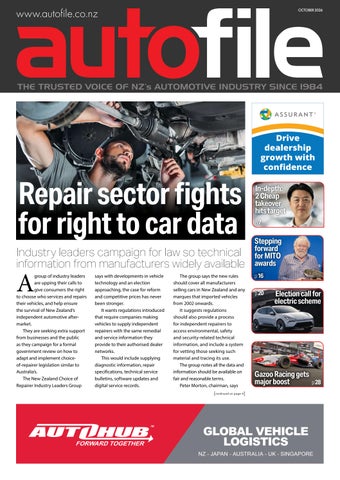
Repair sector fights for right to car data
Industry leaders campaign for law so technical information from manufacturers widely available
A
group of industry leaders are upping their calls to give consumers the right to choose who services and repairs their vehicles, and help ensure the survival of New Zealand’s independent automotive aftermarket. They are seeking extra support from businesses and the public as they campaign for a formal government review on how to adapt and implement choiceof-repairer legislation similar to Australia’s. The New Zealand Choice of Repairer Industry Leaders Group
says with developments in vehicle technology and an election approaching, the case for reform and competitive prices has never been stronger. It wants regulations introduced that require companies making vehicles to supply independent repairers with the same remedial and service information they provide to their authorised dealer networks. This would include supplying diagnostic information, repair specifications, technical service bulletins, software updates and digital service records.
The group says the new rules should cover all manufacturers selling cars in New Zealand and any marques that imported vehicles from 2002 onwards. It suggests regulations should also provide a process for independent repairers to access environmental, safety and security-related technical information, and include a system for vetting those seeking such material and tracing its use. The group notes all the data and information should be available on fair and reasonable terms. Peter Morton, chairman, says [continued on page 4]
Drive dealership growth with confidence In-depth: 2 Cheap takeover hits target p7
Stepping forward for MITO awards
p 16
p 20
Election call for electric scheme
Gazoo Racing gets p 28 major boost
GLOBAL VEHICLE LOGISTICS NZ - JAPAN - AUSTRALIA - UK - SINGAPORE
LOAD IT SHIP IT TRACK IT CLEAR IT
GERDELIVER IS IT ! TER
move to new, much larger premises means we are to offer even more services to our dealer clients
to door ro-ro vehicle shipping from Japan and Australia
ainerised vehicle shipping from anywhere in the world Customs clearance Vehicle tracking
VEHICLE SHIPPING
GENERAL FREIGHT
VEHICLE TRACKING
SHIPPING SCHEDULE
We are specialists
We have developed
exporting all types of Vehicles, Commercial trucks, vehicles of Special Interest and other RORO Heavy Cargo & Machinery.
Agents who understand the commitment required to service our demanding market.
Finding out where your vehicle is at any one time of the process, gives you the ability to manage the collection and processing of documents and payment on time.
TRS and shipping services from Japan to New Zealand.
proved MPI transitional facilities and cleaning services
g it all off is Jacanna’s SmartTrade Rewards Programme, transporting andreward you choose a worldwide network of you can earninpoints for almost any
Tel: +64 9 825 0888 info@jacanna.co.nz Terms and conditions apply. www.jacanna.co.nz
www.jacanna.co.nz
JACANNA.CO.NZ
Tel: +64 9 825 0888
www.jacanna.co.nz info@jacanna.co.nz
Tel: +64 9 825 0888
Call Steve Owens now on 021 947 752 GUEST EDITORIAL
Older fleet causing issues for everyone Upgrade scheme creates incentive to refresh vehicles on our roads, says James McDowall
I
n the final weeks retire the oldest and least of the election safe vehicles and replace campaign, every them with something party will have told us newer and safer. what it stands for. Not The replacement many of them have said doesn’t need to be new. much about cars. A 10-year-old car with JAMES McDOWALL Earlier this year, the modern safety features Head of advocacy, Motor Trade Association is a big step up from a Motor Trade Association (MTA) published 20-year-old one without research on the state of the fleet them. A scheme like this would and the picture isn’t flattering. run through your yards, not The average vehicle on our around them. roads is 15 years old, up from 14.2 We have put the proposal to a decade ago. every party. Some have engaged The average light passenger seriously, while others are still vehicle is 15.2 years against 12.5 in thinking about it. We will keep the European Union. Used imports asking after the votes are counted. are arriving at an average age of There is a related issue. The nearly 10 years. government has begun moving Warrant of fitness (WOF) fail to two-yearly WOFs, starting with rates climbed from 37 per cent in newer vehicles. We supported 2017 to 41 per cent in 2024. taking that in stages and the Only two per cent of the fleet second tranche, covering those is fully electric. March’s fuel-price up to 14 years old, has been held spike produced a bump in EV back to late 2027. sales, but it’s too early to call that a That pause matters, but it’s not structural shift. quite enough. If prices keep rising, as they Extending intervals on an have again, that may change. ageing fleet before the first stage The clean vehicle standard has been evaluated would be a is doing some of the work, but gamble. We’ve asked the parties slowly. Our research still expects to hold that line until the first liquid fuel to power more than tranche has been through a full half the fleet in 2045. two-year cycle. None of this will surprise The two issues are connected. anyone who sells or services cars A younger fleet makes a lighterfor a living. What the research touch inspection regime easier to does is put numbers on it and defend, but an older one makes numbers are what ministers need it harder. Whoever forms the next before they will move. government will need to deal That’s why a fleet upgrade with both. scheme is in the MTA’s election If a candidate comes through manifesto, The Road to Prosperity. your door in the next few weeks, It’s a simple idea and not new. ask them about the fleet and what It gives households an incentive to they would do about it.
DIRECTORS
EDITOR
dazzz@autofile.co.nz ph. 021 0284 7428
ris@autofile.co.nz
Darren Wiltshire
Brian McCutcheon brian@autofile.co.nz ph. 021 455 775 DESIGNER
Adrian Payne
arpayne@gmail.com
Darren Risby JOURNALISTS
Matthew Lowe
matthew@autofile.co.nz
Sue Brebner-Fox sue@autofile.co.nz MOTORSPORT
Mark Baker
veritas.nz@xtra.co.nz
Visit www.autofile.co.nz to subscribe to Autofile magazine and have it delivered monthly in print. The subscription rate is $78 plus GST for 12 issues per year. Autofile magazine is also available online as a readable file or downloadable as a PDF. Back copies dating to 2017 can be found on the website where you can subscribe to our Insight email alerts. Copyright: Published monthly by 4Media Ltd
All statements made, although based on information believed to be accurate and reliable, cannot be guaranteed, and no liability can be accepted for any errors or omissions. Reproduction of Autofile in print or digital format in whole or part without written permission, whether by copying or any other means, is strictly forbidden. All rights reserved. ISSN 0112-3475 (print) ISSN 2350-3181 (online)
NZ’s independent vehicle inspection specialists We of fer a full range of services. • Entry Certification for imported cars • Vehicle Appraisals • WoF/CoF Inspections • Road User Charges • Registration & Relicensing • Exhaust Emission Testing
www.vinz.co.nz
Appointed by the NZ Transport Agency
www.autofile.co.nz
3
news
[continued from page 1]
The campaign for a choice-ofrepairer law has been running for several years
its long-running campaign has reached an important stage with the general election taking place on November 7. “Awareness of the issue is growing, political engagement is increasing and the industry now has an opportunity to demonstrate the widespread support for choice of repairer,” he told Autofile. “We are increasing our current engagement with MPs because it’s election season and members of parliament are actively seeking out the opinions of local businesses. Also, slowly but surely, our situation worsens because modern vehicles are increasingly dependent on manufacturercontrolled diagnostic information, software, security systems and digital service functions. “The longer New Zealand waits to address access to this information, the greater the risk that independent repairers will be progressively locked out of servicing parts of the fleet.”
Describing modern vehicles as “computers on wheels”, the group notes that even the best technician can be locked out of a repair job without access to the right information. When independent repairers are unable to obtain the best data to fix cars, it means “motorists lose choice, and when motorists lose choice they pay more”. Morton adds the group’s current efforts are about gaining
SP E C I A L IS T S I N
PRE‑SHIPMENT INSPECTIONS MPI biosecurity inspections Biosecurity decontamination Heat treatment NZTA border inspections Odometer verifications Pre-export appraisals ?
Lost documentation reports
www.jevic.com 4
www.autofile.co.nz
broader support, strengthening the industry’s voice, and showing policymakers the call for choiceof-repairer regulations is a competition and consumer issue that requires action. Backing for the campaign is reportedly strong from the independent automotive service and repair sector, consumers, parts suppliers and other businesses that rely on a competitive market. “There is deep recognition that repairers should be able to access the same service and repair information made available to authorised networks on fair and reasonable commercial terms,” notes Morton.
“There’s also strong support from businesses that may compete with each other commercially but share the same concern that without a clear legal framework, access to the information needed to diagnose, service and repair modern vehicles can be restricted at the discretion of the manufacturer. “In Australia, the law that requires car makers to make service and repair information available to independent mechanics is now broadly supported by all parts of the industry including authorised dealers.” The group claims in its campaign material that rightto-repair legislation across the Tasman has levelled the playing field between dealer networks and independent repairers while maintaining safety and security. Meanwhile, a survey of independent repairers in New Zealand shows 48 per cent have had to turn away vehicles because they couldn’t access the information, tools or data needed to complete work. Morton says many of those repairers indicate the situation is getting worse. Every vehicle turned away means a motorist redirected
Focus on parts across Tasman The NZ Choice of Repairer Industry Leaders Group is connected with the Australian Automotive Aftermarket Association (AAAA), which says free and open competition is the best way to ensure all car owners have access to affordable, highquality repairs and parts. The AAAA advocates that consumers have a right to information and the right to choose their repairer without being unfairly influenced by confusion or misinformation, be that intentional or otherwise. It notes vehicle manufacturers often use the term “genuine” as a general reference to parts and accessories sold in their branded packaging. “This vernacular is commonly used as a marketing tool by
manufacturers to give the impression branded parts are in some way superior to ‘nongenuine’ spare parts,” it adds. “This can lead to unfounded apprehension for the vehicle owner.” It urges workshop staff to familiarise themselves with the common language used by brands as OEM parts are “routinely made under contract by outsourced suppliers and distributed through dealerships”. The AAAA adds the term “OEM supplier-branded parts” applies when a supplier uses its own branding on the same “genuine” parts offered by manufacturers. As for independent parts, these replacement items are manufactured specifically for use after a car is built and are usually
news t back to a dealer network, longer wait times, less competition and fewer affordable options for consumers. “This isn’t about seeking access to a manufacturer’s intellectual property or asking for information to be provided free of charge,” he explains. “It’s about ensuring qualified repairers can purchase the information and access what they need. “Vehicles are becoming more connected, more digital and more dependent on software with every new model. “The time to establish the rules is now before restricted access becomes entrenched across New Zealand’s fleet.” Workshops are rarely locked out of every repair overnight, but there are concerns access becomes more difficult for vehicles and their various functions as modern cars become increasingly reliant on software. “There may also be resistance from organisations that benefit from retaining control over vehicle information and repair pathways,” adds Morton. “Legislative change also requires government attention and political priority. “The challenge is to show that
Vehicles are becoming more dependent on software with every new model
– Peter Morton
this isn’t simply an argument between different parts of the automotive industry. It is a competition, consumer choice and small-business issue.”
‘MONOPOLY ON DATA’ The NZ Choice of Repairer Industry Leaders Group has been campaigning for a choice-ofrepairer law for several years. Its board represents the country’s four largest independent automotive repair networks, two biggest automotive parts and equipment suppliers, the largest vehicle glass-repair consortium, the Imported Motor Vehicle Industry Association and the AA. It claims some car manufacturers make it easy
Modern vehicles feature manufacturer-controlled diagnostic information
for independent after-market businesses to access vital technical manuals, update bulletins, software patches and equipment, but many do not. In the meantime, original equipment manufacturers (OEMs) ensure their service centres have automatic access to the data and equipment required, thereby cutting out competition independent repairers can offer. The group says this creates an uneven playing field with New
Zealanders paying the price for this “monopoly on data” because it limits the scope to reduce unnecessary costs and gives people less choice. Morton says it is “increasingly critical” to introduce choiceof-repairer rules because independent workshops provide motorists with “choice, competition and convenient access to servicing and repairs”. He adds: “They are particularly important in regional and rural areas where the nearest authorised dealer may be a considerable distance away. Without fair access to service and repair information, consumers may gradually lose the ability to choose who repairs their vehicle. “Independent workshops may be prevented from undertaking work they are otherwise fully capable of completing, and motorists may face higher costs, longer travel distances and reduced competition.” The group is keen for the [continued on page 6]
MIA DataHub is here.
New Zealand's official new vehicle market intelligence, developed by the MIA and powered by InfoAgent.
F O U R T R US T E D R E P O R T S , O N E H U B
Common Segmentation of similar quality as the originals but made by a different company to the OEM supplier. The Australian Competition and Consumer Commission has previously issued guidelines stating the issue isn’t who made the parts, but whether they are fit or appropriate for their intended purpose. “If a part is non-genuine but interchangeable with the
genuine part, it could be seen as being fit or appropriate for the purpose and would therefore not void the manufacturer’s warranty,” says the AAAA. “It’s important to remember most car manufacturers do not make parts themselves. “They are almost always made by a third-party company and put in a box with the manufacturer’s brand on it.”
Market Development Motive Power Development Market Shift
See sample reports: infoagent.co.nz/mia-datahub www.autofile.co.nz
5
news
[continued from page 5]
industry to speak with one voice and wants more organisations to join its plea for reform because “the louder the call, the harder it is to ignore”. It notes the car industry is large and diverse, and many repairers are small businesses focused on the immediate demands of running a workshop, which “can make collective engagement difficult even where there’s widespread agreement with the campaign’s objectives”. As a result, the group holds regular workshops and meetings with politicians to highlight the issue. Morton describes the response to these as constructive and encouraging, with MPs and officials understanding the importance of consumer choice. “The campaign has also benefited from the experience of other markets. Australia now has a mandatory motorvehicle information scheme, providing a practical example of how legislation can require
Workshops want rightto-repair information provided to authorised dealer networks
manufacturers to share service and repair information with independent repairers. “Our group has been engaging with political representatives and building an understanding of how a similar framework could operate locally. “The discussions are progressing, but the campaign recognises that continued industry support will be essential to turn that interest into a firm policy and, ultimately, legislation.” Morton notes the group wants a clear commitment from the government as soon as
Our strength comes from knowing our customers’ needs, understanding and fulfilling them
Mechanical Breakdown Insurance
Comprehensive Motor Vehicle Insurance
Credit Contract Indemnity Insurance
Guaranteed Asset Protection Insurance
Mechanical Breakdown Insurance EV & Hybrid option available Uber & Taxi cover available
Contact:
Simon James 027 239 0253 SimonJ@questinsurance.co.nz 6
www.autofile.co.nz
possible, followed by a structured process to develop legislation in consultation with the automotive industry. “The issue has already been considered and addressed in comparable international markets. “We don’t need to start from scratch and there’s no reason for the process to take many years. “New Zealand cannot afford to lose the strength of its independent automotive aftermarket. Motorists, communities and the economy cannot afford it. “The priority is to establish the principle that manufacturers must provide independent repairers with fair access to the information needed to service and repair. The detailed implementation arrangements can then be developed with the industry and government.”
IMPACT ON WORKSHOPS Challenges around accessing technical service and repair data are increasing for many independent businesses, according to a study by the NZ Choice of Repairer Industry Leaders Group. It warns a lack of access to reliable, cost-effective manufacturer services and repair information means many companies will be unable to recover all the time spent on jobs and need to charge Kiwis more. “In the worst-case scenario, workshops will lose revenue as they have to turn away certain types of vehicles because they can’t access the necessary information,” the group says. “A survey of workshops shows lack of access to service and repair information can add nearly three hours to repair work, of which more than half are then unable
to fully recover this cost from customers. On average, it costs these businesses 1.9 hours of labour.” The group warns government policy needs to keep pace with the technology being used in modern vehicles because there’s currently no guarantee that tens of thousands of independent mechanics can access basic information from manufacturers on behalf of owners. “Without government action, the owners of five million cars in New Zealand could face a technology black hole,” it says. It notes computers control vehicle safety, environmental and road performance, and independent repairers have ongoing problems accessing technical information. “Few manufacturers provide equivalent access to the technical information provided to their authorised dealers and preferred repairer networks, and many provide little or no information at all,” the group states. “Independent repairers are sometimes able to obtain technical information from sources other than the manufacturer. However, the information is commonly incomplete, not applicable to New Zealand models or offers no security of ongoing supply. “Car manufacturers often list concerns about the sharing of some environmental, safety and security-related technical information to repair and service new cars. “But these fears are unfounded because in other jurisdictions this information and data is securely shared with vetted independent repairers, and subject to safeguards to enable it to be shared.”
news
Takeover bid reaches goal A
major used-vehicle importer is set to be delisted from the stock exchange and return to private ownership. Sena & Co’s takeover bid for 2 Cheap Cars (2CC) hit its minimum acceptance condition late last month after the offer was increased by 10 cents per share. That means David Sena, the company’s chief executive and co-founder, has now received acceptances for more than 90 per cent of its voting rights. He held 75.924 per cent of shares when he launched his takeover bid on July 27, and acceptances increased to 18.718 per cent by 5pm on October 1 to give him control of 94.642 per cent of the business. Sena has already signalled he will compulsorily acquire all remaining equity securities at the
offer price of 90 cents and then apply for 2CC to be delisted from the NZX’s main board. In accordance with the Takeover Code, the offer’s closing date has been extended from September 30 to October 9, which is 10 working days from the key acceptance condition being met. Sena originally proposed paying 80c per share and the offer was previously due to close on August 24. However, he upped it to 90c on September 16 just days before the company’s annual meeting on the 28th. The extra 10c applies to acceptances made before and after the 16th. Sena conceded it had become clear his offer would fail to clear the minimum acceptance condition at 80c. “Increasing the offer price is in the best interests of all shareholders
Uncertainties reinforce the benefits of operating as a privately owned business
– David Sena
and will maximise the prospect of a successful takeover,” he said, adding the higher offer represented an “attractive” premium to 2CC’s share price before the takeover notice was lodged. The 90c offer was an increase of 36 per cent on 2CC’s closing price on the NZX of 66c on July 9, the last trading day before the notice was lodged. Sena said his revised offer of 90c represented 5.8 times 2CC’s earnings before interest, taxes, depreciation and amortisation of $8.1 million for the year ending March 31, 2026. It was the “final and best price he was willing to pay”. If the 90 per cent threshold wasn’t reached, the offer would have lapsed. In his letter of September 16, Sena urged shareholders who had yet to accept to read the offer document and target company [continued on page 8]
www.sbltd.co.nz www.autofile.co.nz
7
news
[continued from page 7]
1.0
2 Cheap Cars share-price movements: June to October 2026
recommendation to accept the takeover bid. By then, Sena had increased his offer to 90c per share and the deadline for acceptances had been pushed back to September 30. Those attending the meeting, including Autofile, were told independent directors Stiassny and Shaw formed a committee to consider the takeover proposal after it was made on July 27. At that time, they recommended accepting the 80c offer. Their reasons included that it represented a 21 per cent premium to the pre-announcement trading price of 2CC shares and no competing offer had emerged. Sena’s increased offer of 90c resulted in acceptances reaching 12.525 per cent three days before the annual meeting. That meant a further 1.321 per cent was needed to complete the deal, which was conditional on reaching 90 per cent or more. Stiassny said the independent directors continued to recommend agreeing to the offer. Shareholders raised no questions about the takeover during the meeting.
0.9
Price in $ (source: NZX)
statement. He also asked them to note the final offer price equalled the top end of an independent adviser’s valuation range. He pointed out trading in July was “weaker” than in the first quarter of 2026/27. The company reported unaudited net profit after tax (NPAT) of $330,000 for August as trading continued to be “volatile”. Trading in 2CC’s shares was illiquid, he said, and no competing proposal had emerged for an alternative transaction. Sena added the share price may fall towards, or below, its pre-offer level should the takeover not go ahead. He emphasised the business was best positioned to realise its potential as a private company “enabling focused, founder-led decision-making”. “More specifically, being able to respond decisively to market conditions through investment is critical. This may result in periods of heightened investment to expand into areas such as providing finance to customers or an increase in sales yards or inventory. “Being able to make such decisions without regard to minority shareholders, many of whom rely on dividends, will maximise the longterm value of the business.” Sena highlighted that economic conditions remained challenging and “a sustained higher interest-rate environment may adversely affect vehicle affordability and demand”.
0.8 0.7 0.6 0.5
Jun 4 Jun 19 Jul 13 Jul 16 Aug 4 Aug 14 Sep 7 Sep 15 Sep17 Sep 22 Sep 30 Oct 2
He added the upcoming general election had introduced extra uncertainty. “Opposition parties have proposed policy changes that, if adopted, could increase employment costs and strengthen the clean vehicle standard in ways that could materially increase vehicle acquisition costs. The precise policies ultimately adopted would depend on the election result. “However, Sena & Co considers these uncertainties reinforce the benefits of operating 2CC as a privately owned business where management can respond quickly to changing economic, regulatory and market conditions, and make investment decisions with a longerterm focus.” Frequent updates on acceptances of Sena’s offer have been issued to the NZX. By September 17, shareholders
controlling nearly 8.5 per cent of 2 Cheap Cars had agreed to the deal with its deadline less than two weeks away. This update announced those who had accepted included chairman Michael Stiassny. The disclosure notice stated he would receive $91,925.10 in cash, payable on settlement if the offer became unconditional, thanks to his holding of 102,139 shares. Two other key figures at 2CC, chief financial officer Angus Guerin and independent director Gordon Shaw, also accepted the offer and are set to be paid $84,719.70 and $9,162.90 respectively.
BUSINESS PERFORMANCE Stiassny told the annual meeting 2CC had been riding “the rollercoaster that is the New Zealand economy” through the 2025/26 financial year and into the start of the current one.
SUPPORT TAKEOVER CALL The independent directors of 2CC reiterated at the company’s annual shareholders’ meeting on September 25 their
[continued on page 10]
FROM JAPAN TO NEW ZEALAND
ON TIME, EVERY TIME
TOYOFUJI SHIPPING SCHEDULE Toyofuji vessels
Voyage
Dream Jasmine
56
Trans Future 6 New Century 1
JAPAN
NEW ZEALAND
Moji
Osaka
Nagoya
Yokohama
Auckland
Lyttelton
Wellington
Nelson
—
14 Sep
15 Sep
23 Sep
7 Oct
12 Oct
10 Oct
T/S to TF6 v169
169
—
19 Sep
22 Sep
26 Sep
14 Oct
T/S to NC1 v207
T/S to NC1 v207
16 Oct
207
28 Sep
1 Oct
2 Oct
4 Oct
18 Oct
21 Oct
23 Oct
T/S to TF5 v169
Trans Future 5
169
—
5 Oct
6 Oct
10 Oct
28 Oct
T/S to DRA v66
T/S to DRA v66
30 Oct
Dream Angel
66
—
11 Oct
13 Oct
18 Oct
1 Nov
4 Nov
6 Nov
T/S to TF7 v171
T/S = Tranship to next available TFS vessel
Contact: Adam Stone
8
www.autofile.co.nz
adam.stone@toyofujinz.co.nz
www.toyofujinz.co.nz
www.autofile.co.nz
9
news
[continued from page 8]
“While there have been periodic improvements to economic data, these have often been short-lived or inconsistent and any green shoots shallow-rooted. “Our strategic priorities – to improve execution, strengthen sourcing and continue to develop our retail network in a challenging market – have largely been implemented and saw the business deliver a credible result.” Stiassny said 2025/26 returned NPAT of $3.2m and “steady” revenue of $81.7m demonstrated “resilience”. “The improvement from a first-half NPAT of $1.01m to a fullyear result exceeding our January guidance of at least $3m was indicative of just how volatile the market was and remains. “The clean car standard [CCS] remained a bone of contention, adversely impacting NPAT by approximately $1.7m relative to financial year 2025. “The company did what it could in an uncertain regulatory environment by adjusting our compliance model and sourcing strategies, which provided some relief as revised settings took effect in the final quarter.” Stiassny reported early trading for 2026/27 had been encouraging but remained variable. “We do not expect conditions to stabilise or improve markedly in the short term, particularly with the election only weeks away.”
2CC SHARES HELD BY KEY PLAYERS Michael Stiassny Company chairman Shareholding: 102,139 Cash: $91,925
Angus Guerin Chief financial officer Shareholding: 94,133
Gordon Shaw Independent director Shareholding: 10,181
10
www.autofile.co.nz
Cash: $9,163
The above graphic shows how many shares of 2 Cheap Cars owned by Stiassny, Guerin and Shaw, and how much they will receive under the takeover offer price of 90 cents per share. Dollar amounts have been rounded. Source: 2CC
Guerin, as chief financial officer, delved into 2CC’s annual results. He said 2025/26’s first half was affected by higher carbon costs and subdued demand, while the second half benefited from firmer margins and better trading. “That improvement allowed us to finish the year close to the previous year’s profit despite pressures,” he added. “Total CCS fees increased through the first three quarters, reaching approximately $600,000 in the third quarter before falling to around $300,000 in the fourth quarter as revised settings flowed through.
Market remains ‘volatile’ During the takeover process, 2 Cheap Cars issued three trading alerts to the NZX. The first one on August 4 advised unaudited accounts for June showed NPAT of about $500,000 and around $600,000 in April and May, taking the total to $1.7m for the first quarter of 2026/27. “Trading conditions remain volatile and the company is not providing financial year 2027 earnings guidance,” it stated. The next announcement 10 days later stated trading in July was weaker than the first quarter. This primarily reflected reduced
Cash: $84,720
sales and average margins. The third update on September 15 advised unaudited NPAT of about $330,000 for August. It added: “To release processing capacity, improve stock flow and increase sale-ready inventor y, periodically the company disposes of aged or uneconomic-to-repair vehicles via wholesale channels. “In August, the net impact of these efforts was a loss of about $70,000 while sale-ready inventor y was boosted from about 640 to approximately 720 vehicles.”
“Profitability was improving before carbon costs reduced, supported by better margins, procurement, and finance and insurance performance. The reduction in carbon costs provided additional support in the final quarter. “The stronger second-half result reflects operational improvements and the benefit of easing cost pressures. While encouraging, it also highlights how sensitive our earnings remain to market conditions.” As for the challenges, future government policy will remain important to 2CC’s purchasing decisions and earnings. “In short, regulatory uncertainty around the CCS remains one of the most significant external influences on our margins,” said Guerin. “As financial year 2027 plays out, we will need to remain flexible, responding quickly to changes in purchasing costs and customer demand, while maintaining our focus on product mix, finance performance and efficiency.” As for the company’s footprint, 2 Cheap Cars has reshaped its network around larger, more productive locations, including a new branch in Wellington and securing a vehicle refurbishment hub in Christchurch. Underperforming branches in New Lynn and Westgate in
Auckland and Palmerston North have been closed. Elsewhere in Auckland, Sylvia Park is developing into a flagship location and Henderson opened in early August. The company is also improving how vehicles move through the business, from purchasing to preparation and sale. The balance between work completed in-house and by external suppliers continues to be “fine-tuned”. Shareholders were told the main marketing initiative of the past financial year was rebuilding the company’s website. Guerin said: “We are working towards a more consistent look, tone and message across our website, advertising, social channels and branches. We’re also working with a creative agency on a new brand campaign.” For the five months ending August 31, unaudited figures show the company sold 3,010 vehicles, down by two per cent year-on-year, while revenue rose by five per cent to $35.1m. Gross margin increased from 19 to 25 per cent, and finance penetration went from 31 to 39 per cent. NPAT rose to about $2.3m from $800,000. Looking ahead, it has identified opportunities to improve performance while remaining realistic about market conditions. “We will better utilise our existing footprint through increased stock availability, faster preparation and more consistent execution,” explained Guerin. “External factors, such as interest and exchange rates, may support customer financing and procurement, although both remain uncertain. “We continue developing AI tools for vehicle selection, pricing and operational decisions. Our new brand campaign aims to increase awareness and attract more customers directly. “However, challenges persist, including price-sensitive customers, strong competition for stock in Japan, lower-priced new vehicles from China and ongoing margin pressure from CCS charges. While encouraged by our progress, trading conditions remain volatile.”
Trusted by fleet operators & logistics companies
KEEP YOUR FLEET MOVING, NATIONWIDE Minimise downtime with reliable 24/7 roadside support ▪ Rapid response across NZ ▪ Nationwide accredited network ▪ Scalable solutions for fleets of any size ▪ Reduce disruption and operational delays
AWARD-WINNING ROADSIDE ASSISTANCE PROVIDER Partner with NZRA | 0508 NZROAD | nzra.co.nz
www.autofile.co.nz
11
news
Conflict impacts sales mix T
he oil shock caused by the Iran-US war and subsequent supply disruption has changed what types of light vehicles are in demand. Ash Waugh, chairman of the Colonial Motor Company, says this shift is likely to continue in the wake of conflict in the Middle East. He explains demand for diesel models has slowed and new energy vehicles (NEVs) have dominated the market for a time, especially with Kiwis reacting to the hike in fuel prices and uncertainty surrounding oil supply. “Understandably, the timing of this shock was unfavourable for the group’s businesses, falling as it did in a window where supply, model changes and the inventory mix weren’t positioned to take advantage of the demand shifts,” says Waugh. Shareholders have been told management across Colonial’s divisions have acted decisively in response to the situation, revaluing inventory to meet the market and, by doing so, limiting potential impacts and maintaining sales momentum. While margins were affected, Waugh notes finishing with an improved profit after-tax position in 2025/26 relative to the previous financial year was a satisfying outcome in what has been a disrupted trading environment. Colonial’s trading profit after tax came in at $18.7 million for the 12 months to the end of June 30. This was marginally ahead of 2024/25, but impacted by the Middle East conflict during much of the second half. The total was up by 4.7 per cent from $17.8m, while revenue from ordinary activities climbed 6.8 per cent to $1.07 billion. Waugh says the results show the company’s balance sheet is strong, particularly relative to the previous two years, because of significantly lower inventory levels and reduced external borrowings. The directors declared a fully imputed dividend of 25 cents per 12
www.autofile.co.nz
Colonial’s Ash Waugh says some exciting models are due. The arrival of Mazda’s all-new electric 6e is being followed by the CX-6e
share to take the annual payout to successfully previewed the JAC T9 40c, up from 35c. plug-in hybrid ute at Fieldays and The company indicated in its Mitsubishi has announced exciting half-year report in February that new vehicles due this year.” positive growth in some vehicle Meanwhile, Southpac is segments and strong used-vehicle focused on bringing the more trading had delivered a solid result. fuel-efficient next-generation “The aim was to hold onto and DAF to market with the first build on those gains in the second customer trucks already on the half,” says Waugh. road, and the general “That wasn’t to be strength of the agrias the geopolitical sector is steering environment abruptly “welcome” growth in shifted two days later Colonial’s tractor and with the beginning implements business. of the Middle East The focus on used conflict. vehicles will continue “The resulting across the group with oil shock and dealerships having supply disruption proved over the past significantly impacted two years that in a the sales mix in stable market this the light-vehicle business has more market and this shift potential. continues.” The company has That said, some secured expanded new models are due representation of with a focus on NEVs. the BYD brand into The arrival of Mazda’s Canterbury and the all-new electric 6e Wairarapa, joining is being followed by – Ash Waugh Energy Motors’ the CX-6e, while the subsidiary operating current Ford range a dealership for the has remained resilient and is brand in New Plymouth. maintaining its market share. From a strategic perspective, Waugh says Ford will, as it has Waugh says access to a range of in the past, continue to adapt its competitively priced NEVs has portfolio to meet evolving trends been a priority. as demonstrated by the launch of On the property front, Colonial the Ranger Hybrid. expects added BYD franchise “New Zealand Automotive Ltd opportunities to require a
Local and geopolitical disruption seem to be the new normal for a time to come
significant investment in facilities in Christchurch and other regions where the company will have representation. Plans have been finalised for a more significant Ford dealership in Botany, south Auckland, and at the Rangiora branch with building work about to start. Waugh notes the Middle East conflict has acted as a catalyst in lifting NEV adoption this year, particularly in the passenger segment. “Business and consumers always seek to adapt, so life goes on,” he says. “Local and geopolitical disruption seem to be the new normal for a time to come and the company has to respond by continuing to adapt. The team across the group has a busy year ahead.”
AIMING TO BOOST REACH Geneva Finance has entered the 2027 financial year with “strong momentum, underpinned by solid performance across all its core business units and a clear strategic focus”. Robin King, chairman, and managing director Malcolm Johnston say Quest Insurance continues to perform strongly and is benefiting from stable demand and effective distribution through its dealer network. “The business remains focused on deepening relationships with partners while expanding its reach
t through direct channels, supported by agile product development and service delivery,” they add in their annual report. As for the company’s New Zealand lending operations, the priority remains on growing a high-quality loan book that delivers sustainable returns. This includes refining creditassessment practices and enhancing customer engagement with a focus on retention and lifecycle management. King and Johnston say: “A key initiative is the implementation and automation of core processes through technology. “Investment in digital capability is expected to improve operational efficiency, reduce turnaround times and enhance customer experience. “Geneva remains focused on strengthening its core finance and insurance operations while positioning for sustainable longterm growth.” The board declared an interim dividend of 1.5c per share and a final dividend of 2c for the year ending March 31. The payments reflect a commitment to delivering value to shareholders “while maintaining a balanced approach to capital management and reinvestment in core business growth”. Geneva reported an audited pre-tax profit of $12m in 2025/26. That was up by $6m and 100.5 per cent from the previous year. The improved result is attributable to enhanced performance from all business areas – insurance, and its New Zealand and Tonga lending operations. Quest continued to perform well with net profit before tax (NPBT) of $10.2m and in the past financial year it maintained its “strong growth trajectory”. Gross written premiums grew by 26.5 per cent to $70.6m, driven by “robust” market demand and expanding distribution channels. Claims and insurance service expenses grew broadly in line with the increased volume of business, up by 23.7 per cent to $53.4m, while the insurance service result improved to $8.7m from $5.2m
The 2027 financial year for Geneva Finance has started with “strong momentum”
reflecting underwriting discipline. Quest maintained a solid liquidity position with cash on hand climbing by 11.8 per cent to $47.1m. Net profit after tax jumped by 40.2 per cent to $7.4m. Its solvency ratios remain strong, with a combined solvencycover ratio of 144 per cent underscoring “sound financial position and commitment to longterm stability”. King and Johnston say: “This result demonstrates Quest’s momentum underpinned by prudent financial management and a focus on strengthening our operational foundation to support growth.” The New Zealand lending operations reported a loss of about $800,000 in 2025/26. But that was an improvement of $2.6m from the $3.4m loss posted for 2024/25. This was mainly driven by lower impairment charges of $1.6m, which fell by $2.8m year on year. Full-year lending in Aotearoa fell by 33.5 per cent, totalling $37.6m with a focus on improved credit quality over volume. Net receivables after provision decreased from $108.7m to $92m for an annual drop of 15.4 per cent. “The key focus for lending is growing the loan book sustainably while maintaining good credit quality,” say Johnston and King. “This is being driven through an enhanced relationship management approach, revised lending policy and improved product offering to introducers.” The Tonga lending operation, meanwhile, reported a $2.6m pretax profit, up by 24.1 per cent on last year.
MARKET PRICES DROP The chief executive officer of Turners Automotive Group says the persistence of the Middle East conflict has slowed New Zealand’s economic recovery and dented consumer confidence. Todd Hunter has told shareholders that higher fuel prices have materially reduced demand for larger vehicles with petrol engines as well as diesel models. In turn, this resulted in the first half of 2026/27 being a “far harder
trading environment than the two prior first halves”. Outlining what has changed since a market update about five months ago, he says: “Although we repositioned inventory quickly, the effect on vehicle margins has been longer and larger than anticipated in May. “On top of this, we’ve had lower sales volumes of ex-lease cars. The reduction in market prices for diesel utes and petrol SUVs has reduced sales as lease vendors take time to adjust to new prices.” Consignment units sold dropped by 14 per cent during the four months to July, which is seen as a timing issue. As lease vendors’ pricing expectations adjust, the company predicts they will start selling through. As for what hasn’t changed since May, Hunter says diversification continues to deliver stability in earnings. Finance growth has offset the drop in automotive retail profit with group [continued on page 14]
VEHICLE IMPORT FINANCE AT COMPETITIVE INTEREST RATES
w
EASY APPLICATION
EFFICIENT SERVICE
Submit two downloadable forms and simply send to us for review.
Hear back from our team about finance in as little as 24 hours.
COMPETITIVE INTEREST RATES & FEES
NZ BASED
Our partnerships give us the ability to offer superb lending rates.
www.autobridge.co.nz
Autobridge is New Zealand based and covers the country, so we are never far away when you need us.
09 320 5646
ENQUIRE NOW ABOUT TRADE FINANCE FOR YOUR BUSINESS www.autofile.co.nz
13
news
[continued from page 13]
NPBT for April to July coming in four per cent ahead of the same period in 2025. Hunter says: “This is a great result given the conditions. We’ve seen strong loan-book growth continue, up a further 7.5 per cent since March 2026, and arrears at 2.1 per cent in July against an industry figure of 5.2 per cent. Insurance and credit management are broadly in line with last year. “Most importantly, what hasn’t changed is our long-term strategy. We continue to work at pace on our auto-retail branch expansion and finance-book growth opportunities.” As for the future, the group continues to target NPBT of $65m for 2026/27. “However, without a resolution to the Middle East situation and volatile swings in oil prices, and without a recovery in consumer confidence, sales of large-engined vehicles and diesel products are likely to remain challenging. “This short-term uncertainty creates some risk in achieving that $65m target. Conversely, a faster recovery in confidence and margins in financial year 2027 would work the other way. “We expect strong earnings growth to return in financial year 2028. Nothing has changed management’s conviction in the medium-term plan. Turners is tracking well towards its $100m NPBT target by financial year 2031.” As for the vehicle market, Hunter describes it as having been “a bit bumpy”. Overall used-car
Turners Servicing & Repairs is gaining market traction
volumes from April to August per cent in 12 months. The other tracked around three per cent material change is the number of behind the same period in 2025. new-car brands available in New Consumer confidence has been Zealand. Three years ago, this was hit and there has been demand for around 50. Today it’s around 80 lower-value cars at the expense of and Chinese brands are the big higher-value models. change.” “We would expect While the motorthis to revert as the vehicle market has economy improves,” been challenging, he adds. “Dealer Oxford Finance numbers are flat and was a “very strong we’ve seen stronger performer” again demand for used in 2025/26 with a imports with small record profit posted. hybrids in demand. It has maintained “It is interesting discipline around to look at the relative credit quality and market shares of seen improvements new-car sales by fuel in lending-quality type since the Middle metrics. Consumer – Todd Hunter arrears were 2.1 per East conflict kicked off. Diesel’s share has cent in July against dropped by almost one-third from an industry figure of 5.2 per cent. around 30 per cent a year ago to 21 Hunter says: “A focus on quality per cent in July. delivers us operating leverage. We “Battery and plug-in hybrids are growing the loan book but are have gone from about 15 per having to add very few people to cent of new sales to more than 30 help service this growth because
A material change is the number of new-car brands in the New Zealand market
Bound for Vietnam
A
nnaliese Atina, the managing director of Ford NZ, has been appointed to the same position with the marque in Vietnam. She will be based in Hanoi and will report directly to Andrew Birkic, vice-president of sales and service for Ford International Markets Group. Atina has been in her current role and as executive director for 14
www.autofile.co.nz
two-and-a-half years, and starts her new job on December 1. Birkic says: “Annaliese has been an outstanding leader. Her commercial leadership and focus on customers and dealers have strengthened our business. That same energy and capability will now benefit Ford Vietnam as it builds on its recent momentum.” Atina has more than 20 years’ leadership experience
our customers are reliable and easy to serve.” As for Autosure, it also had a record year for profit. Its distribution networks are strategically important and digital direct capability is being built out as an extra channel. “We’ve had strong premium growth across all insurance portfolios, with our dealer and finance broker partnerships the primary driver.” Turners Servicing & Repairs is gaining traction. “Our partnership with VTNZ where we have integrated into the failed warrant of fitness process and comms is starting to deliver repair bookings,” says Hunter. “We’ve seen some good wins with small fleet owners and with one of Turners’ major lease vendors, which has offered mobile servicing to its leasing customers. Bookings from both are coming through.” EC Credit’s revenue declined by 17 per cent and its profit fell by 49 per cent. The past financial year was constrained because several large clients placed temporary holds on debt referrals while undertaking major system implementations. The company wrote down goodwill by $7.5m with the new intangible valuation reflecting more conservative future earnings forecasts. Hunter says: “So far in financial year 2027, we’ve seen all but one of the banks recommence their debt load and are seeing improvement in profit performance over last year.”
across automotive, “It has been a fast-moving privilege to lead Ford consumer goods, NZ,” says Atina. telecommunications “I’m proud of what and technology. the team has achieved She has a proven together in strengthening track record of our customer experience, leading businesses supporting our dealers Annaliese Atina through growth and and driving commercial transformation. growth. Prior to Ford, she held senior “While I’m excited for this leadership roles with Vodafone opportunity with Ford Vietnam, I’ll NZ and Coca-Cola Amatil, leading be taking some great memories large-scale customer, sales and and lessons from working commercial businesses. alongside such a talented team.”
BUY SMARTER. SELL FASTER. STAY AHEAD. Hundreds of vehicles auctioned every week and nearly 1,500 users ready to trade. Auction Online gives you real-time access to the true used-vehicle market, nationwide. Buy, sell and manage stock from anywhere – fast, transparent and competitive. Whether you’re clearing trade-ins, moving aged stock or filling your yard, our streamlined auction platform simplifies every step. • Nationwide dealer network Almost 1,500 users actively buying and selling. • Real-time pricing transparency Live bidding ensures you always hit true market value. • High stock turnover Hundreds of vehicles auctioned every week across NZ. • Purpose-built dealer platform Designed specifically for franchise & independent dealers. • Fast, simple, secure Seamless listings, bidding and purchasing from one platform.
Join Auction Online today and start trading smarter auctiononline.co.nz www.autofile.co.nz
15
news
Stepping forward for awards T
he Tranzit Group has been crowned training business of the year at MITO’s inaugural annual awards. The company, which registered its first learner in 1993 and has 20 staff completing MITO qualifications, has been recognised for its commitment to high quality on-the-job training. Tranzit’s team members have completed qualifications across heavy automotive engineering, road transport and electric-vehicle technology. The business also provides strong mentoring, dedicated learner support and career pathways to help apprentices and trainees gain confidence, progress their skills and advance into leadership roles. A host of other awards were presented at the Michael Fowler Centre in Wellington last month. AMI MotorHub won inclusive training business of the year. It supports learners from a range of backgrounds into automotive apprenticeships and careers. It adapts to each learner’s needs through plain-language training materials, literacy and numeracy assistance, supervisor communication training, wellbeing check-ins and personalised mentoring. The company has created pathways for those who may not have had a clear entry into the motor-vehicle industry. This includes the Mana in Mahi
Some of the MITO award winners 16
www.autofile.co.nz
From left, Daryn Murphy, national fleet and workshop manager of the Tranzit Group, with Deputy Prime Minister David Seymour and MITO chairperson Sturrock Saunders
partnership, which is a government programme that helps jobseekers receive secure permanent work while studying for an industry qualification, Māori learners, women in trades, neurodiverse students and migrants. Ashburton College was voted secondary school of the year for vocational education and industry training via wellresourced pathways in automotive, mechanical engineering, building and trades. Its automotive students consistently achieve near 100 per cent pass rates in MITO’s StartUp micro-credentials. The Log Transport Safety Council’s training company of the year was Whanganui-
based McCarthy Transport for its commitment to safety, professionalism and workforce development. As for individuals, six MITO learners of the year were also honoured. The automotive award went to Reuben Halliday, of Terra Cat NZ, south Auckland. While completing his level three and four qualifications, he took on extraordinary opportunities including maintaining heavy equipment in Antarctica for the US Antarctic Programme. Jet Te Aho, who works for Cavanagh Panel, Paint, Glass in Te Puke, western Bay of Plenty, took out the collision repair award.
After completing his apprenticeship, he further built his skills through extra training in level-two structural repair while applying his knowledge on his job. The commercial road transport category was won by Daniel Ludlow. He has balanced the demands of his role at Booth’s Logistics, Auckland, by completing the certificate in commercial road transport and strengthening his technical knowledge, and understanding of safety, compliance and industry standards. Jakob Stassen won in extractives. As operations manager at Hatuma Lime Company in Waipukurau, central Hawke’s Bay,
Speaker Mike Casey, of Rewiring Aotearoa
news t he has secured new skills in this highly regulated environment. The drilling award went to Zane O’Gorman, who rapidly progressed from driller’s assistant to running a rig at Griffiths Drilling, Matamata. Gas distribution fitter Kristian Larsen, of Auckland-based Omexom, won the gas award after taking responsibility for crew leadership, day-to-day site operations and safety. Tavita Fa’amausili, also of Omexon, was supervisor of the year. With around 26 years of experience, he was recognised for training and mentoring the company’s employees. The lifetime achievement award for industry training was won by Dave Pardoe. He has developed nationally recognised transport qualifications, and contributed to the Tairawhiti Road Transport Programme and Drive35. Pardoe has worked for more than five decades in the forestry, transport and vocational training sectors. And finally, the chairperson’s
Dave Pardoe
Jet Te Aho
Bob Boniface
Simon Coleman and Patrick Neal, of Ashburton College
award went to Bob Boniface. His career has included business ownership and industry governance, including former roles on MITO’s board and as
Gary Geeves, of AMI MotorHub
president and chair of the Motor Trade Association. Boniface has been recognised for more than 60 years of contribution to the automotive
and collision-repair industries. As the owner of Auckland Panel and Paint Group, he has also supported apprenticeships, workplace training and the Inspiring Futures Foundation. The awards ceremony, which followed MITO’s summit, was opened by David Seymour, Deputy Prime Minister. He said they honoured “outstanding individuals and organisations” making a difference through industry training, from building skills and capability to supporting learners, strengthening pathways and shaping the workforce. Verna Niao, MITO’s chief executive, added the winners showcased talent across the training organisation’s industries, from successful leaders to those beginning their careers. “Their achievements are inspiring and I’m excited to see what the future holds for them.” Chairperson Sturrock Saunders said: “The awards celebrate [continued on page 18]
www.autofile.co.nz
17
news
[continued from page 17]
The MITO learners’ panel
Lee Marshall, centre left, with the Inspiring Futures Foundation’s cheque. Also pictured are, from left, MITO director Iain Haycock, chief executive Verna Niao and deputy chair Warren Flowerday
something bigger than individual success. They illustrate what becomes possible when industry invests in people, employers back learners and workforce development is genuinely led by industry, for industry.”
TRAINING FOR FUTURE More than 200 senior stakeholders from industry, government, education, and MITO’s employer and learner communities attended the organisation’s inaugural summit in the capital. Saunders, who opened the event, said everyone involved in training needs to work together “to continue shaping the workforce our industries need to thrive”. He added: “The summit is about bringing industry together with ambition and purpose to exchange bold thinking, celebrate
achievement, look ahead, and uplift and acknowledge the vital work our industries do for New Zealand.” The event offered a leadership experience across economics, future workforce trends, artificial intelligence and emerging technologies, and leadership and performance. Presenters included Brad Olsen, of Infometrics, David Galbraith, who is a business and leadership coach, Mike Casey, of Rewiring Aotearoa, and engineer and technologist Dr Michelle Dickinson. Comedian Te Radar hosted a panel of past and present MITO learners, and facilitated a discussion about their training and career pathways. The learners involved were Harry Shaw, Fletcher Brown and Michelle Findlater from
automotive, Zivana Smith of commercial road transport and Ashleigh Smith from extractives. Lee Marshall, as trustee of the Inspiring Futures Foundation (IFF), announced the organisation’s scholarship programme for 2027. He said the IFF will fully fund the scheme with a $700,000 grant over the next two years. The amount represents a significant increase, and will enable its expansion when new funding and cost pressures are impacting employers and learners. “The IFF is proud to be sponsoring a record number of MITO scholarships, especially when the youth unemployment rate is the highest it’s been for some decades yet the shortage of skilled trades people is acute,” added Marshall. “Each scholarship removes
Tax boost for electric vehicles
A
n industry group has welcomed a government bill to give EVs a lower fringe-benefit tax (FBT) rate than fossil-fuel models. Drive Electric says the Taxation (Annual Rates for 2026-27, FBT Simplification, Foreign Investment Funds and Remedial Measures) Bill could influence fleet-purchasing decisions and support the shift to cleaner cars. Corporate and fleet customers purchase about 60 to 70 per cent of all new vehicles sold in New Zealand each year and they typically enter the second-hand market within three to five years. As a result, Drive Electric 18
www.autofile.co.nz
says making low and into fleet purchasing zero-emissions models decisions. cheaper to run as “Every EV a business company vehicles will chooses today becomes lead to a larger and more an affordable secondaffordable supply of used hand EV on a Kiwi EVs for everyday Kiwis. driveway in a few years’ Its calculations show Kirsten Corson time. We congratulate a $60,000 EV made the government on available to an employee for full getting this right.” private use, at the top rate of FBT, Drive Electric is also backing could attract savings of $1,385 a the bill’s plan to raise the weight year under the bill. threshold for FBT vehicle rules Chair Kirsten Corson adds: from 3,500kg to 6,000kg, which “It’s great to see the government Inland Revenue says reflects that implementing a demand-side EVs are often heavier. This will policy. For the first time, our tax make more electric utes and vans settings recognise EVs are cheaper eligible for FBT. to run and that will flow straight The taxation bill was introduced
or reduces a barrier to the next generation entering the workforce and that’s what the IFF exists to do.” Emma Gilmour, MITO ambassador and rally driver, spoke about her role in inspiring young people to consider industry careers. “I’ve seen throughout my own career what a difference it makes when someone believes in you and gives you an opportunity,” she said. “Our industries need to keep doing that for the next generation by investing in training, developing skills and showing them the fantastic careers available.” Shane Jones, deputy leader of NZ First, gave a keynote address on the importance of MITO’s industries for the economy and the value of training to futureproof the country’s workforce.
to parliament on September 10 with the changes proposed to take effect from April 1 next year. It includes a new method to calculate FBT based on categories of how a vehicle is used and how much employees can use it privately, with people no longer needing to fill out detailed logbooks. Simon Watts, Minister of Revenue, says the bill will help grow the economy by cutting compliance costs and simplifying rules. “For FBT, we’re proposing a much simpler ‘close enough is good enough’ approach to employer-provided vehicles.” The bill also makes several changes to the Foreign Investment Fund to help attract and retain skilled workers and investment.
technology
Using satellites to hail help M
otorists stranded in remote areas without cellular coverage may soon be able to get assistance via satellite. BMW, Viasat and Cubic are claiming their system boasts the world’s first in-car satellite voicecalling capability, and it could fill a critical gap on roads without cellphone coverage. The technology, which has been demonstrated on an iX3 in Munich, allows drivers to speak directly to an emergency support centre from the battery-electric crossover SUV. Andre Schlufter, director of automotive connectivity innovation at satellite operator Viasat, says the system builds on embedded SIM capabilities from Cubic, which provides softwaredefined vehicle solutions. “Many satellite-based emergency concepts focus on basic alerting or short messages,” he explains. “This goes further by showing how a car could support a live voice call with a response centre.” Schlufter says he’s unaware of another system offering the same combination of in-vehicle satellite connectivity and live two-way voice calls for emergency support. Viasat has yet to disclose which carmakers will adopt the technology first. General Motors, Toyota and Ford Motor already offer e-call systems, but these rely on cellular networks rather than satellites.
BOOM TIME FOR UPDATES Fortune Business Insights has valued the global car market for over-the-air (OTA) updates at US$5.3 billion, or about NZ$9b, and predicts it will quadruple by 2034. The consultancy forecasts the surge will be driven by software-
BMW in collaboration with Viasat and Cubic has developed in-car phone calling via satellite
defined revenue models, EV adoption and cost-saving fleet management. The automotive industry historically evaluated OTA maturity by deployment frequency, domain coverage, installation times and update availability. Now updates extend to battery management, suspension calibration and cybersecurity systems. In March, Volvo reached S&P Global Mobility’s highest ranking for software-defined capabilities. The marque was recognised as having the ability to improve nearly every function in its new cars via OTA updates. This includes adding safety features, unlocking faster charging speeds, increasing range and enhancing user experience. Volvo aims to provide substantial OTA updates every quarter. According to an overview from Market Growth Reports, more than 450 million connected vehicles were on the road at the end of 2025 and 94 per cent had built-in wireless connectivity for remote updates. These upgrades allow manufacturers to address 70 per cent of software-related recalls without requiring trips to service centres, which saves about 55 per cent in logistics and labour costs. Sixty-five per cent of carmakers
Jaguar’s Type 01 has a panel of buttons, not a central screen, while a spine runs the length of its cabin
now view continuous software integration as a core competency. This reflects their struggle to monetise software while meeting consumer expectations shaped by smartphone update experiences.
BUTTONS REPLACE SCREEN Jaguar says the interior of the Type 01, its first model after its makeover into a luxury EV brand, offers “unmistakable drama and theatre”. The marque adds its cabin focuses on the motorist with less emphasis on screens and more on concealed technology. It boasts an enlarged information display in front of the driver but no central touchscreen. In its place is a panel of buttons that operate functions such as heating, while voice control gains more importance for changing settings and activating features. One of the most unusual elements of the EV’s interior is a central spine running the length of the cabin, splitting the passenger space into four separate zones and breaking from the traditional horizontal design norm. And a digital rear-view mirror is positioned at the base of the windshield instead of its typical location at the top edge. The reveal of the cabin was
the latest in a series of limited information releases from Jaguar Land Rover about the Type 01 before its global launch in New York this month. Thomas Holden, Jaguar’s chief interior designer, says: “The Type 01 presents unmistakable drama and theatre that will define the modern automotive interior of the future.” The EV takes the marque back to its luxury-focused roots after a struggle to position it as a mainstream premium brand. The car sits on a new electric platform dubbed JEA, which shares battery modules with new electric Range Rovers including the GT. The design of the battery pack has been split to allow rear passengers more foot room and to lower the roof.
PLACE NAMES IN MĀORI Google and Te Taura Whiri, the Māori Language Commission, have launched an Aotearoa voice for Google Maps. Users in New Zealand can now experience an AI-powered text-tospeech (TTS) model that speaks English with a Kiwi accent, and correctly pronounces cities and towns with te reo Māori names. Caroline Rainsford, country director of Google NZ, says: “Two things have been critical to the success of this update. “Advancements in AI have enabled our TTS model to pronounce te reo Māori place names in an English sentence and, importantly, this wouldn’t have been possible without our years-long partnership and deep collaboration with Te Taura Whiri.” www.autofile.co.nz
19
news
Salary plan to electrify fleet A
scheme allowing eligible employees to lease new or second-hand electric cars using their pre-tax salary is being proposed to help boost the number of low and zero-emitters in the fleet. Inspired by a similar programme in Australia, advocacy groups say their EV Salary Boost plan can reduce financial barriers to adopting cleaner models. Drive Electric and Rewiring Aotearoa want political parties to commit to formally assessing such a scheme within 100 days of a new government being established after November’s general election. They say EV Salary Boost would involve deducting lease costs from an employee’s pre-tax income, effectively providing tax relief and improving access to cheaper-torun vehicles. The organisations want politicians to analyse the scheme’s full cost and options for a fiscal cap, treatment under PAYE, FBT and GST, employee and employer eligibility, and whether new and used EVs should qualify. Extra issues include vehicle price caps, lease terms and consumer protection, what happens when an employee changes jobs, and impacts on access, equity and the future second-hand EV market. They state the proposal will also boost energy security by cutting reliance on imported fuels and tapping into New Zealand’s
EV Salary Boost aims to ease financial barriers to buying cleaner cars. Photo: Juice on Unsplash
renewable power generation. Kirsten Corson, chair of Drive Electric, adds: “High fuel prices show how exposed households and businesses are to costs set offshore. The question we’re asking parties to examine is whether our settings can give more workers access to lowerrunning-cost vehicles without creating an open-ended cost to the crown.” Financing a vehicle through pre-tax salary is known across the Tasman as novated leasing and has been used for nearly 40 years. The National Automotive Leasing and Salary Packaging Association (NALSPA) says more than 500,000 Australians use the scheme for a range of vehicles. The federal government there updated its model in July 2022 by exempting eligible electric cars from FBT when provided through a novated lease or by an employer. A review of the policy, which
was published in May, estimated the discount generated about 64,000 additional battery EV (BEV) sales in its first three years or up to 78,000 including plug-in hybrids (PHEVs) – about one-quarter of all EV sales over the period. BEVs and PHEVs have risen from 1.8 per cent of new-car sales in May 2022 to 22.9 per cent in March this year. More than 100,000 Australians have used the exemption and NALSPA estimates about half of all EV sales go through a novated lease. The number of EV models on sale grew from 56 in July 2022 to more than 160 by late 2025. Models priced below AU$40,000 – or about NZ$49,500 – have risen from two to 10. Drive Electric and Rewiring Aotearoa say Australia’s experience shows the potential advantages of EV Salary Boost and the importance of applying vehicle price caps.
Extra scrutiny on border mandates
F
inal decisions on making more systems compulsory for imported vehicles have been delayed as officials further analyse the proposals. The coalition announced in June 2025 the possibility of mandating extra requirements. Consultation took place late last year and any new rules were expected to be signed off by May. 20
www.autofile.co.nz
For new and used from July next year. light vehicles, automatic A government emergency braking, spokesperson told lane-keep support, and Autofile further analysis acoustic vehicle alerts for of mandating features “quiet” electric and hybrid was expected to be models are on the table. provided to James Any new rules may be James Meager Meager, Associate introduced in phases, although Minister of Transport, by the end the consultation document of last month. “Once we have suggested some that could apply decisions from the minister, we will
Australia’s Treasury originally forecast the EV FBT exemption would cost about AU$90m in 2025-26, but as 100,000 people have used it since that figure was tipped to reach AU$1.35 billion. In May 2026, the federal government responded by recalibrating the scheme. From April 2027, EVs priced above AU$75,000 will move to 75 per cent of the standard FBT rate with this extending to all eligible electric models by April 2029. The adjustment is expected to save AU$1.7b over five years while keeping the full exemption for EVs under AU$75,000 until April 2029. Rewiring Aotearoa and Drive Electric say New Zealand should apply similar discipline and set fiscal caps and eligibility limits from the start. They also highlight how Australia’s approach has led to a growing supply of affordable, late-model used EVs. Mike Casey, Rewiring Aotearoa’s chief executive, says the main purpose of EV Salary Boost is to help those who could most use the savings to access cars with plugs. “Australia got a lot right by taking a tool it already had, salary packaging, and pointing it at EVs. But some settings added to the cost, including allowing novatedlease buyers to avoid GST and including very expensive vehicles. “New Zealand has the chance to tailor a scheme to our own tax settings from the start.”
consider if the timeframe needs to be revisited.” The cabinet can make decisions on government business up until the November 7 general election, which means Meager may give the green light in coming weeks. The Imported Motor Vehicle Industry Association warns delays mean the proposed start date for some rules of July 1, 2027, would “cause a severe contraction of supply”. As a result, it has lobbied for a later implementation date.
ADTORQUE EDGE
Next customer may be invisible N
ew findings revealed at this year’s Australian Automotive Dealer Association (AADA) convention in Sydney are changing the shape of New Zealand’s customer landscape. The research, presented by Nicholas Johnson, AdTorque’s chief revenue officer, centred on a fairly unsettling idea. And that’s somewhere out there right now, someone may be shopping for a car at your dealership but you can’t see them. The person doing the comparison and shortlisting may not be a human at all. It could be an AI. It’s tempting to assume this only matters for younger customers, but the numbers tell a different story. Roy Morgan surveyed nearly 15,000 Australians this year. It found 72 per cent of 35 to 49-yearolds already use AI tools along with half of 50 to 64-year-olds. Workplace tools such as Microsoft Copilot skew a bit older, which suggests the customers who dealers assume are unaffected are often those getting used to AI at work and then taking that habit home for the biggest purchase of their year. For traders wondering if this is a year or two away, the numbers suggest otherwise. Fullpath,
which tracks dealers’ will eventually have websites across its access to similar network, found traffic capability. arriving directly from The real gain AI platforms such as comes from ChatGPT, Gemini and connecting AIPerplexity grew 15enhanced tools fold over the past year. together so data Cox Automotive’s flows between them research backs this up instead of sitting in JAMES HENDRY with roughly one-inseparate systems, Director, sales and operations AdTorque Edge NZ four buyers of new which is where cars saying they used AI as part of genuine efficiency and scalability their purchase process last year, come from. the first time that’s been measured. Some estimates suggest that by Encouragingly, those consumers 2030 machines acting on behalf of weren’t harder to please either. buyers could be steering between They trusted their $3 trillion and $5t dealer the most of any of global spending. group surveyed. Nobody expects a Every vendor at chatbot to finalise a the AADA convention car purchase soon but seemed to be selling the shortlist, and who some version of AI and gets filtered out early, a lot of it is genuinely is increasingly being useful. decided by one. But it’s worth Comparison reframing where the shopping happens real opportunity sits. differently now. Almost every tool a Research by dealership already management relies on – the CRM, consultancy Bain & DMS, website and media platform Company found 64 per cent – is being enhanced by AI in some of consumers have used AI to way. On its own, none of that’s a complete a purchase already or say competitive advantage. Everyone they’re open to it.
Comparing increasingly happens inside a chat window rather than across 20 open browser tabs
Just as telling is where AI shows up in the buying journey. Fractl tracked more than one million searches this year. It found comparison style searches, think Prado versus Everest, were down by 36 per cent. That’s not because people have stopped comparing, but because that increasingly happens inside a chat window rather than across 20 open browser tabs. One of the more actionable findings comes from a Harvard Business Review study, which tested classic persuasion tactics such as countdown timers and strike-through pricing across thousands of simulated purchasing decisions and four AI models. Only two things reliably moved the machine. These were price and authentic reviews. With the smartest models, hard-sell tactics didn’t just fail to help, they actively backfired with the AI reading an aggressive pitch as a sign of lower quality. The takeaway heading into the last quarter of 2026 is worth thinking about. Your vehicle page may no longer really be a sales pitch. It’s more like a data file read by something that doesn’t feel “fear of missing out”.
S E O BY A D T O R Q U E
S TO P R E N T I N G YO U R T R A F F I C. S TA R T O W N I N G Y O U R R A N K I N G S . Organic search delivers over 70% of all clicks on Google’s first page.
TA L K T O THE TEAM AT A D T O R Q U E T O D AY
Search Ads get just 2%. AdTorque SEO builds long-term visibility through technical audits, keyword research & guidance on quality content, so your dealership keeps generating leads even after your daily ad budget runs out. TECHNICAL AUDITS THAT FIX CRAWLING & INDEXING ISSUES KEYWORD STRATEGY BUILT ON SEARCH INTENT & COMMERCIAL VALUE ON-PAGE & OFF-PAGE SEO THAT BUILDS LASTING AUTHORITY
(09) 887 1822
info@adtorque.com
adtorque.com www.autofile.co.nz
21
news
Industry movers
MURRAY NAISMITH has joined Ford Australia and NZ as chief financial officer. He has nearly three decades of finance and operational experience including with OEMs, distributors, dealerships and remarketing. Naismith spent nearly seven years at Cox Automotive Australia, five years with Borneo Motors Singapore and six years at Inchcape Australia. He was also finance manager for Ford Australia from 1998 to 2006. “Ford and the industry are at a pivotal point, transforming at the fastest pace in history,” he says. “This is a full-circle moment for me, returning to Ford after 20 years.”
JESS BALA has left General Motors, where she had been managing director for Australia and New Zealand since 2023, after nearly two decades. She started her career with GM Holden Australia in 2007 and went on to work as a district sales manager and in product planning. She shifted to the marque’s headquarters in Detroit in 2013 where her roles include chief of staff to chief executive Mary Barra. Bala returned to Australia in September 2023 for her most recent position, which involved leading operations on both sides of the Tasman. This included GM Specialty Vehicles, Isuzu NZ customer care, Holden after-sales and Chevrolet Racing. ARIES ZHAO has become chief executive officer of GAC Australia, and president of Oceania and the UK. GAC International has aligned the three regions to reflect their cultural and technical aspects, and better support operations. “Taking on the leadership of our Australian operations at such a pivotal moment is an honour,” says Zhao. “During our first year, we have established an exceptional product line-up and the foundations of a strong dealer network. “The joining of the Oceania and UK represents a natural fit for our global right-hand-drive strategy. Our new structure will allow us to embrace the alignments of these markets.” JAMES MILLER has joined the Financial Markets Authority (FMA) as its chairman. He sits on the boards of Channel Infrastructure NZ, Fletcher Building, Ryman Healthcare and Vista. Miller, pictured, previously spent 13 years as a director of the NZX, including eight as chairman, and is a former director of Mercury NZ, ACC, Auckland Airport and Vector. He has been appointed for five years and replaces Craig Stobo, who resigned in May after an independent review into his conduct. Board member Steven Bardy was acting chair in the interim. Samantha Barrass, meanwhile, resigned from being the FMA’s chief executive at the start of September and before her term expired in January. She advised she was returning to the UK because her elderly father was admitted to hospital. Alastair Hercus will be acting CEO as the search for someone to replace Barrass continues over the coming months.
TO FEATURE IN INDUSTRY MOVERS EMAIL EDITOR@AUTOFILE.CO.NZ 22
www.autofile.co.nz
From left, Hastings Kia director Mel Chan, senior administrator Pip Cooper, Mark Cooper, former director and dealer principal, and managing director Rob Townshend
Retirement results in change of ownership
B
ayswater Vehicle Group now owns Hastings Kia after acquiring the remaining 50 per cent of the company. The business had been led by retiring dealer principal Mark Cooper, who played a major role in its success over the past two decades. Under his leadership, it evolved from a small operation on Heretaunga Street into a flagship franchise in Karamu Road, earning numerous awards. Founded in 1990 by managing director Rob Townshend, who was joined by business partner Mel Chan, Bayswater has grown from a single dealership into one of the region’s biggest car groups. Townshend says: “Mark has built a dealership with a reputation for customer service and performance. We would like to thank him for
everything he has contributed to the brand and community. “For us, this is about continuing to invest in Hawke’s Bay, and creating a destination that gives customers more choice and the confidence of dealing with a locally owned business.” Co-director Chan adds: “We’ve always believed in investing locally and building businesses that serve our community for the long term. “Hastings Kia has an excellent team and loyal customer base.” Paul Brown, chief executive officer of Bayswater Vehicle Group, says the acquisition will strengthen the group’s growing presence in Karamu Road. “Hastings Kia complements our BMW and Mini dealerships,” he adds. “Over the coming months we’ll continue expanding the precinct with Nissan, BYD and Chery on adjacent sites.”
Executive appointments
T
racy Pennell appointment gives us has become dedicated leadership chief operating across key areas as we officer at Avanti Finance continue to scale.” as it boosts its executive Lee Robson, who structure to create better previously led Avanti’s alignment and clearer auto business, has also Tracy Pennell ownership across its taken on responsibility operations, risk and business areas. for personal lending as general The appointment expands manager of auto and personal on her previous role as general to support growth and deliver manager of strategic delivery faster service for dealers, brokers, and focuses on strengthening advisers and clients. execution and improving delivery Ohlsson says Robson’s to for clients and partners. expanded remit will help the Fred Ohlsson, chief executive company build on its investment officer, says: “As Avanti grows, in systems, people and service we need the right structure, capability including its partner leadership and focus to keep portal. “Lee is well-placed to lead improving how we operate. Tracy’s this expanded area.”
Scholarships open soon
Inspire their futures. Grow your business. Applications for the Inspiring Futures Foundation Scholarships, proudly presented by MITO, open on 19 October. Scan the QR code to find out more.
www.autofile.co.nz
23
looking back
The month that was... October October 13, 1997
October 14, 2005
Used prices remain stable
Scam warning
Prices of second-hand cars remained stable despite anecdotal evidence to the contrary. While some dealers were reporting hikes of as much as 25 per cent, it seemed widespread increases of that magnitude had yet to eventuate. What appeared more likely was a continued squeeze of margins as prices in Japan climbed, but buyers here had refused to pay more. Peter Johnston, of Genuine Vehicle Imports in Auckland, said stock was still hard to get in Japan as Kiwis competed against Jamaica, Ireland, England, Chile, Malaysia and Cyprus. He added other countries were catching up with New Zealand’s interest in imports and this country was fast becoming a minority player in the field. Johnston noted the global downward trend in new-car sales meant trade-ins weren’t coming through in the way they had previously, which was driving up prices. He used to sell between 50 and 60 cars a week and was now struggling to pick up 20. Tony Andrew, dealer principal of Greenlane Toyota, believed the extra competition for used vehicles in Japan, which would inevitably increase prices here, might be positive for the new-car sector. He said if the margin between used imports and new cars shrank, buyers would be more likely to opt for New Zealand-new.
Motor-vehicle dealers needed to be wary of unsolicited inquiries from overseas that could be part of an international scam. The scammers would begin by expressing interest in a car on behalf of a client. After requesting a price and possibly a photo, they would then offer to buy it and ask for the trader’s bank details. When making the deposit, the price would be exceeded by a significant amount. The criminal explained the surplus was for freight and the extra funds should be transferred to a freight forwarder. After the dealer did that, the scammer cancelled the deposit leaving the trader out of pocket by the amount paid to the freight forwarder. Mark Heywood, sales manager of Newmarket European in Auckland, said an inquiry for a Volkswagen Passat came from a person who identified himself as an agent located in London and Cyprus. He added: “We all thought it was too suspect. We’ve had a few of these, so we perform online transactions only with trusted people. I’d recommend people be cautious about the whole thing. I don’t think anyone should let their bank account details out.”
October 20, 2009
A A gala dinner held to celebrate the silver anniversary of importing used cars into New Zealand was hailed as a success. David Vinsen, chief executive of the Imported ACCESSORY BUNDLING Motor Vehicle Industry Association, described the black-tie function in Auckland on October 17 as a “glittering occasion”. He told Autofile: “It was a great night and exceeded our expectations. We are delighted everyone had a good time. The evening was an extremely appropriate way to mark 25 years and we’re looking forward to the next 25.” The event was attended by about 420 members of the industry and guests. They included Maurice Williamson, former Minister of Trade. “You need to know you have done more for the economic well-being of this nation than just about anybody else,” said Williamson. “There are a lot of New Zealanders out there who are driving in good quality cars we would never have been able to dream about without your industry.” Rod Milner was presented with the supreme award in recognition of his work in the industry and his leading role in setting up the Licensed Motor Vehicle Dealers Association in 1988.
Advice and warning for kit options A customer entered your showroom, worried that from November 1 they had to ditch their cellphone while driving and opt for using a hands-free kit. You gave them options. But before you sent them off, you warned them about who should and shouldn’t install hands-free kits in their cars. Installers were already experiencing a huge increase in demand and wait-lists. But more alarmingly, some companies were running out of hands-free sets. Another heads-up. You needed to give punters advice that if they had their kit installed by an uncertified company, they could void their vehicle’s warranty. Colin Curtis, of Automotive Security Systems, said his company had been installing car phone and hands-free kits since the cellphone market first emerged in New Zealand. “There are many products popping up in the trade, but some have major problems such as the user being unable to hear incoming calls when driving. Also, the noise from the car can make it difficult to hear.”
October 21, 2014
The trusted voice of
www.autofile.co.nz
Celebrating past and looking to future
Celebrating the past In this issue and looking to future
p3 When the lights go off
p4 Gulliver enters market p6 Settlement hits $3.3m
gala dinner held to Pullman Hotel was attended by celebrate the silver imports industry over the years. about 420 members of the motor anniversary of used car “You need to know that vehicle industry and invited importing into New Zealand you have done more for has guests with comedian the Jeremy been hailed as a success. economic well-being of this Corbett raising plenty of laughs David Vinsen, chief executive nation than just about anybody as master of ceremonies. of the Imported Motor else,” said Williamson, former Vehicle Industry Association David Vinsen giving Minister of Trade. his speech at the (IMVIA), describes the “There are a lot of New black- gala dinner tie function on October Zealanders out there who 17 as a “glittering occasion”. are driving in very goodHe told Autofile: “It was quality cars that we would a great night and exceeded never have been able to our expectations. We are dream about without your delighted everyone had industry.” a good time. The food, band Presentations included and entertainment were Rod Milner receiving all fantastic, and the event the supreme award in was very well organised. recognition of his work in “It was wonderful to see the industry and leading role our founders and long-serving in setting up the Licensed members of staff recognised. Motor Vehicle Dealers “It was also good to see Association in 1988. so many faces from the past Fellow founding and the next generation coming members Alistair Sheard, through. Dick Gray, Fred Lewis and People came from all “The evening was an Peter Johnston, Phil Pacey, over New Zealand to join Dick extremely appropriate the Gray and Fred Lewis were way celebration, as well as also from to mark 25 years and we’re recognised, while long-service all Japan and Australia. They looking forward to the awards were presented next 25.” to IMVIA included Maurice Williamson The event at Auckland’s – employees Malcolm Yorston a great supporter of the and used Bev Purchase.
CREATE AN EXCLUSIVE MODEL FOR YOUR BRAND VIEW VIDEO
p24 Kia on private buyers
Adding Value to Your Business see article on page 17
IMVIA gala celebrates
By advertising with us, you’re not just gaining exposure — you’re joining a trusted network that informs, connects and drives the industry forward.
M O R E
T H A N
J U S T
A
M A G A Z I N E
25 years Eight-page lift-out inside
Retro Vehicle Enhancement
www.rve.co.nz 0800 RETRO 4 U Driving Solutions
Since 1984, Autofile has been the heartbeat of New Zealand’s motor industry news.
www.autofile.co.nz
MORE SALES MORE PROFIT CUSTOMERS FOR LIFE
p8 Electric vehicle views p12 Hawke’s Bay in focus
WWW.DEALERSHIPEDITIONS .CO.NZ
INDUSTRY LOOKS FIRST
24
more than 25 years Issue 17-2014 21 October 2014
BE SEEN WHERE THE Contact us to discuss your advertising opportunities.
the auto industry for
tech report
Coherent action on fleet vital
W
hat happens when a rule intended to improve our vehicle fleet makes a better car too expensive for the family that needs it? That was the question I found myself asking when I read the Act Party’s recent transport policy. Its proposal to assess newvehicle rules for their effects on supply, prices and fleet turnover caught my attention. I see that as an important part of judging whether a regulation will deliver the improvement intended. But the question goes beyond the price of the next car. What people can afford to purchase also affects what they continue driving, repairing and eventually scrap. Take an extreme example. Imagine New Zealand allowed just one car to be imported next year – an EV with the latest safety technology. Our imports would be 100 per cent electric. Average tailpipe emissions would be zero. Every imported car could have outstanding safety features. On those measures, we could announce a remarkable success. Meanwhile, none of the vehicles that would otherwise have arrived to replace existing cars would be available. People would still need transport. With replacement supply eliminated, existing vehicles would become more valuable. Repairs that previously made little financial sense could become worthwhile. Cars that would otherwise have been scrapped would be kept running. Some vehicles already taken out
of the fleet might policy. It helps even become worth determine whether returning to the road. improvements actually For many happen. households, this None of this would mean paying to means every maintain the vehicle import restriction, they wanted to renew or government because they could intervention, is wrong. KIT WILKERSON Head of policy and strategy no longer afford the Rules can exclude kit@via.org.nz replacement. undesirable models The import figures could look and encourage better choices. excellent while the fleet missed However, those benefits must out on improvements that would be assessed alongside their effects otherwise have occurred. on supply, prices and retirement. That example is deliberately Better importation statistics extreme, but it exposes the alone cannot establish that the relationship. Restricting incoming whole fleet is better off, nor does supply changes the economics my support for affordable used of keeping existing vehicles imports mean I favour weaker alive. Retirement is affected requirements for new vehicles. by the availability and cost of The cars manufacturers build replacements. today will become Now consider the used vehicles a more familiar people buy in 10 situation and years. Their safety, that’s a family efficiency, durability with $12,000 to and repairability will replace an ageing affect successive car. A suitable owners. I want used import could strong expectations offer better safety at that stage features and lower because later buyers fuel bills. If a rule inherit decisions removes that made before the option and the car first reaches a nearest suitable showroom. replacement costs $20,000, their New Zealand may have limited budget doesn’t increase to match. influence over global design, but They might keep repairing it can set requirements for new their current car. Across many vehicles supplied here. I wouldn’t households, those decisions could leave the quality of our future keep some of the fleet’s least fleet entirely at the mercy of what desirable vehicles in service longer. manufacturers choose to offer. This is why I see affordability An existing used vehicle as part of safety and emissions presents a different task. Its design
Restricting incoming supply changes the economics of keeping existing vehicles alive
decisions have already been made. The opportunity for this country is to make the best use of available cars, matching them to people’s needs and budgets. Used-car sales help do that. A vehicle that no longer suits one owner may be a substantial improvement for another. Independent imports extend those choices beyond those originally sold new here. Sales of new vehicles also contribute, but the path from a new purchase to the retirement of an old model can involve several transactions over many years. Making a new car cheaper today doesn’t establish when a particular old one will leave our roads. If retirement is the objective, policy should examine what would actually enable it, including a suitable replacement the owner can afford. For me, that’s a coherent approach to the whole fleet – require better vehicles at the beginning of their lives, enable affordable improvements throughout their use and help the least desirable cars leave service. These stages are connected. A restriction at the border can become a repair decision on someone’s driveway. Before introducing a rule, I want to know which vehicles it will enable to be brought in, which it will help retire and which it will keep on the road because their owners cannot afford to move on. Those answers would tell us far more about success than treating one metric as a proxy for the quality of all cars imported.
Advocate Advise Advise • Advocate • Connect Connect Imported Motor Vehicle Industry Association
www.via.org.nz www.autofile.co.nz
25
new cars
Marque aiming for top five G
WM’s offensive to launch up to eight new models in New Zealand by year’s end includes three mid-size SUVs and a plug-in hybrid (PHEV) ute. The brand says expanding its line-up will lead to it competing with more vehicles, powertrains and in more segments. The flurry of activity is also part of its ambition to break into the top five brands for new vehicles by the end of 2027 and the top three by 2030. Andrew Gao, managing director of GWM Australia and New Zealand, says the region is one of the group’s top three strategic markets. “We will continue investing in products, technologies and resources. We’re only at the beginning of our journey in New Zealand and we believe the best is yet to come.” Cameron Thomas, country manager for GWM NZ, adds the company aims to give consumers powertrain solutions that best fit their lives, whether that’s petrol, diesel, hybrid, PHEV or fully electric. “We’re not building a strategy around the business we have today,” he explains. “We’re building it around the business we are becoming.” Among the new offerings for 2026 are extra models in the Ora portfolio. The all-new SUV EV has been launched here. More products, including a new Ora 5 mid-size SUV, aim to drive GWM’s growth in the expanding EV market. In September, the marque released the Cannon Hi4-T ute, which it says combines advanced PHEV technology, strong capability and compelling value. An all-new three-litre turbodiesel engine is on its way for the Cannon Alpha and Tank 500 in coming months, with Australia and New Zealand selected as lead global markets for launching the powertrain. “Developed with customer feedback, local testing and local driving conditions at its core, the 26
www.autofile.co.nz
The Cannon Hi4-T PHEV ute
The all-new Ora 5 SUV EV
The new Haval H7
The Haval Jolion Max
A new three-litre turbo-diesel engine is on its way for the Cannon Alpha and Tank 500
new engine delivers increased built diesel solution across the ute power and torque while improving and large SUV line-up.” fuel efficiency, providing greater The turbo-diesel produces towing confidence, 170kW of power and touring capability 620Nm of torque. and driveability,” Maximum torque says GWM. is available from “The new 1,400-2,400rpm powertrain will while the engine is further strengthen mated with a nineGWM’s ability to speed automatic meet the evolving transmission. needs of Kiwis by Also contributing – Cameron Thomas offering a purposeto this year’s strategy
By the end of 2026, we will have one of the market’s most comprehensive portfolios
for expansion are three new midsize SUVs, one of the categories the brand regards as essential to growth in New Zealand. From the fourth quarter, GWM will field three nameplates across four powertrains with the all-new Haval H7 and Haval Jolion Max to accompany the H6/H6GT range. The H7 will be first off the blocks in advanced hybrid electric and Hi4 PHEV guises. It has been engineered to deliver refinement and “genuine capability”. Flagship variants come with front and rear differential locks that provide off-road performance “rarely offered” in this segment. Positioned to challenge established players, the H7 “brings premium capability, electrified performance and genuine off-road credentials to one of New Zealand’s largest and most competitive vehicle categories”. The Haval Jolion Max, meanwhile, will come in Hi4 PHEV and BEV form later in the year, and provide an entry point into its midsize SUV range positioned between the Jolion and the H6. The aim is for it to strengthen the brand’s commitment to providing Kiwis with greater choice across hybrids, PHEVs and fully electric models “while delivering an accessible, value-driven proposition”. Thomas says GWM NZ’s plans to increase its portfolio of products will build on record sales in the first half of 2026 as it targets more than 5,000 registrations for the full year. “This isn’t about replacing one customer with another,” he adds. “It’s about giving more Kiwis a reason to choose GWM and ensuring they can continue to choose us as their needs evolve. “By the end of 2026, we will have one of the market’s most comprehensive portfolios. That puts us in an even stronger position heading into 2027 as we continue our ‘drive to top five’ journey and build towards becoming one of New Zealand’s leading brands.”
new cars
Electric range headlined by GSR M
itsubishi Motors New Zealand (MMNZ) reports its all-new ASX VR-e battery electric vehicle (BEV) range will arrive on our shores during this year’s fourth quarter. It’s the second in a wave of new models from the marque and follows hot on the heels of the Outlander Sport HEV. The aim is for both to strengthen the company’s established electrified range alongside the plugin hybrid (PHEV) variants of the Eclipse Cross and Outlander. The ASX VR-e range is headlined by a high-performance GSR with Exceed, XLS and LS options also available. As for the nameplate, it builds on the heritage of the compact SUV, which has been one of New Zealand’s most successful cars and will continue to be available alongside the VR-e range for the
Mitsubishi’s ASX VR-e
foreseeable future, says the marque. The VR-e designation is derived from the Galant VR-4, the high-performance sedan, and “reflects the model’s sporty driving character, electrified technology and advanced features”. Tony Johnston, chief operating officer, says: “We introduced the first mass-production EV to New Zealand in 2011 with the iMiEV before leading the growth of PHEV technology through the Outlander. “With the arrival of Outlander Sport HEV and ASX VR-e, we’re providing customers with more
choices that align with their evolving lifestyles and development of local infrastructure.” The ASX VR-e has been developed in partnership with Italian design house Pininfarina and EV manufacturer Foxtron, and is backed by MMNZ’s local expertise. “For New Zealanders considering an EV, the ASX VR-e combines advanced technology with the confidence of a brand they know and trust,” adds Johnston. “In a rapidly evolving market, buyers can be confident it’s backed by a company with deep
From dunes to roads
D
efender is building a roadlegal version of its 2026 Dakar Rally-winning car. The limited-run 4x4 is an evolution of the D7X-R and takes racing capability into everyday driving. Engineers have pushed the boundaries of what’s possible for the Dakar with enhanced geometry and suspension, off-road body adaptations and a rallyinspired interior. The Defender Rally made history on its debut at this year’s Dakar. The three D7X-Rs finished in first, second and fourth in the new stock class, and achieved one-twothree on 10 of the 13 stages.
The road version will retain the D7X-R’s architecture, transmission and driveline. The limited-run Dakar has the same 4.4-litre twinturbo V8, which will unleash an unrestricted 467kW of power and 750Nm of torque. It will feature 35-inch advanced all-terrains on forged 20-inch wheels, a coil suspension with Bilstein advanced dampers, dunes and gravel drive modes, and flight mode, which was originally developed for the rally car to ensure smooth landings on varied terrain. Registrations of interest in the Defender Dakar open early next year.
The Defender Dakar
roots here, and the experience, infrastructure and commitment to support them into the future.” The BEV’s exterior emphasises aerodynamic performance. Key features include an s-duct, which channels airflow from the centre of the front bumper over the hood surface. Active grille shutters help reduce drag. Horizontal stripe motifs have been incorporated into the front and rear-lighting signatures, and the rear pillars and dedicated wheel design create a “unified and modern appearance”. The 911 GT3 50 Years Porsche NZ
Marking 50 years in NZ
P
orsche is celebrating its half-century in Aotearoa with a commemorative model from the marque’s Sonderwunsch department in Germany. Only five units of the 911 GT3 50 Years Porsche New Zealand have been built, “one for every decade”, and they are priced from $584,000. The car is based on the GT3 with touring package from the latest 992.2 iteration and comes in yachting blue metallic, a reference to this country’s sailing heritage and the colour of the first Porsche imported here. Another feature is the etched signature on the passenger-side
dashboard inlay of the late Sir Colin Giltrap, whose passion for the brand laid its foundations here. Further bespoke Sonderwunsch elements include woven blue pepitacloth seat inserts, and “50 Years Porsche New Zealand” embossing on the headrests and throughout the cabin. Greg Clarke, general manager of Porsche NZ, says: “Fifty years is a long time in any market, and it means even more in one as small and as far from Stuttgart as ours. We wanted to mark this milestone with something that could only have come from here – a car built for our roads and signed by the man who started it all.” www.autofile.co.nz
27
motorsport The GRF-70 has been launched as Toyota expands its GR brand
Gazoo brand gets major boost
T
oyota has ramped up its commitment to motorsport and performance driving in New Zealand by launching Gazoo Racing (GR). The standalone brand was revealed at Hampton Downs racetrack south of Auckland, and it now assumes equal status alongside the Toyota vehicle family and luxury Lexus range. Headlining the two-day event was the unveiling of the nextgeneration Castrol Toyota FR Oceania Trophy car, the GRF-70. It’s powered by an evolution of the two-litre turbocharged 8AR-FTS engine, which was developed here by series engineer David Gouk and has been used in the championship since 2020. The vehicle is based on the FIA Formula Regional Gen 2 T326 Tatuus chassis, ensuring local and international drivers in the series are competing in globally relevant machinery. Tatuus has provided all generations of the Toyota-powered single-seaters since 2005. “Following on from our close collaboration with FIA as an official FIA Formula Regional Championship since 2023, it was natural for us to follow the introduction of the Formula Regional Gen2 cars, which happened in 2026 globally,” says Nicolas Caillol, Gazoo Racing NZ’s manager of motorsport. “The choice of the Tatuus chassis was obvious, continuing our relationship of more than 20 years. We believe this is the longest relationship Tatuus has had with any championship. “We started with the FT-40, then the FT-50 and most recently the FT-60. All were high level, high performance and safe. That will continue with the GRF-70.” Initial testing of the vehicle with 28
www.autofile.co.nz
former NZ Grand Prix winner Liam Sceats has started, and the car driven at the launch event was in the hands of Toyota brand guardian Ryan Wood and experienced racer Andrew Waite. As with all previous seasons of the New Zealand-based series, the new vehicle will be released to teams on the Monday before the first race weekend to ensure a level playing field. Six teams will begin the next generation of the championship. They are M2 Competition, Mtec Motorsport, Kiwi Motorsport, Hitech GP, TJ Speed Motorsport and new entrant Rodin Motorsport. Caillol says the new vehicle will be a significant step forward in several areas from previous global junior formulae designs. “A lot of work has been done by FIA and Tatuus into the Formula Regional Gen2 car, which has involved a focus on improvement at every level,” he explains. “Work has been done by FIA with the support of engineers from Formula One to design a car that allows the racers to drive closer to each other and offer better opportunities for passing. That has meant a lot of work has been done on the aerodynamic side.”
We believe this is the longest relationship Tatuus has had with any championship – Nicolas Caillol
The GRF-70 package is aligned with FIA’s Gen2 targets for performance, efficiency and sustainability. It will produce about 212kW. Pirelli, the tyre supplier for all Formula Regional Championship and Trophy series, will continue to fit out the Kiwi vehicles. “The previous generation was criticised for driver comfort and this is another area where Gen2 machinery has made a step forward,” says Caillol. “The design has a better seating position and an ability to accommodate a wider range of heights. A redesign of the front suspension means less effort is required on the steering wheel. “We have a successful powerplant in the 8AR-FTS engine, which we’ve been using since 2020 in the FT-60. But, as with everything, we have focused on continuous improvement. “David Gouk, our engine developer and builder, has enhanced the package by redesigning some components to produce a lighter version of the engine we used in the FT-60. “We also carry over the push-topass system. This was introduced last year and instantly improved the racing.”
The switch to the Gen2 car underlines Toyota and Gazoo Racing’s long-standing commitment to FIA’s single-seater pyramid as a logical progression for drivers from FIA-certified Formula 4, through FIA Formula Regional and onto FIA F3.
STANDING ON ITS OWN Beyond this country’s premier racing series, Gazoo Racing (GR) becomes Toyota’s dedicated performance brand. The move signals a new chapter for Kiwis competing in grassroots motorsport, tackling a weekend track day or enjoying a road drive. Andrew Davis, Toyota NZ’s chief strategic officer and motorsport manager, says New Zealand already has one of the world’s strongest enthusiast car cultures. “GR will offer the opportunity to become part of a community bringing together motorsport, experiences, track events, genuine performance parts and merchandise. “When you own a GR, you’re not just buying a car. You are joining people who love driving and enjoy learning, improving and sharing that passion. GR gives people another way to be part of it.” Rather than treating motorsport as marketing, Toyota uses competition to develop its vehicles. Every rally stage, circuit race and test session pushes engineers, drivers and cars beyond their limits with feedback flowing into production models. “Every GR exists because it was tested, challenged and refined in competition,” says Davis. “That’s the philosophy behind it and the reason why every GR carries motorsport DNA.” Today, Gazoo Racing competes in some of the world’s toughest events, including the FIA World
motorsport
The GR86, left, and GR Supra
The GR Yaris on track
t Rally Championship, World Endurance Championship, Dakar Rally and Nürburgring 24 Hours. Those experiences have shaped vehicles including the GR Yaris, GR Corolla and GR86 to deliver a driver’s experience rather than simply more power. The decision to establish GR as Toyota’s standalone performance brand also reflects the evolution of the business globally. Davis says: “Challenge creates learning. Learning creates better cars. That’s been the philosophy behind GR from the beginning.” The philosophy behind GR goes back to 2007 when Toyota chairman Akio Toyoda entered the Nürburgring 24 Hours under the unofficial Team Gazoo banner.
Competing against Europe’s best exposed how much Toyota had to learn about building true performance cars. The company embraced motorsport as its proving ground. That commitment led to the development of today’s GR family of vehicles and remains the foundation of Gazoo Racing today. “Over the next 12 months, Toyota NZ will work with its store network and GR customers to bring the brand to life across the country,” says Davis. “This includes creating new opportunities to experience GR products, developing specialist expertise across the network, and giving owners greater confidence to personalise, maintain and get
Paddon extends winning streak H ayden Paddon has secured a comfortable win at Rally Hawke’s Bay, the fourth round of the New Zealand Rally Championship. Although he isn’t registered for the series, the 39-year-old won every competitive stage of the weather-disrupted event. Paddon and co-driver Jared Hudson dominated the 41-strong field to finish one minute and 47 seconds ahead of their nearest rival. The victory extended an active streak few Kiwis have ever
approached as Paddon claimed his 31st rally in a row on home soil behind the wheel of a Hyundai. Behind him, but taking maximum championship points, was Jack Hawkeswood in his Toyota Yaris Rally2. He is now level on points with Jack Stokes who finished the event third. Hawkeswood laid down the championship challenge on the opening stage, taking almost 30 seconds off his title rival in the process. On that stage, Jack Stokes had to settle for third place behind
the most from their vehicles.” In addition, the company has announced a range of performance parts developed for its GR Yaris AWD turbocharged hatchback along with bespoke tuning parts for the RAV4 GR, which features a unique front suspension tailored for fast road driving. In the case of the Yaris, accessory parts include stiffening bars for the chassis, aftermarket limited-slip differentials, motorsport-influenced suspension components, aerodynamic body parts and software upgrades to significantly enhance engine performance. Currently on sale in New Zealand are GR versions of the Yaris, Corolla, Corolla Cross and
GR’s Kiwi timeline
2019: The GR Supra launches to mark the return of one of Toyota’s most iconic performance nameplates. 2020: The GR Yaris arrives, developed using WRC experience. 2022: The GR86 joins the line-up, delivering lightweight rear-wheel-drive performance. 2023: The GR Corolla launches, transferring circuit and rally engineering into a practical five-door performance car.
2026: Gazoo Racing launches as Toyota NZ’s standalone performance brand.
RAV4. The Supra also has a GR variant, as does the 86 sport coupe used in the local one-make series. Capping the range is the forthcoming GR GT supercar, with at least one of these models likely to come to New Zealand.
Hayden Paddon dominated Rally Hawke’s Bay. Photo: Tayler Burke
his Stokes Motorsport team-mate and brother Robbie Stokes, who came home second. Hawke’s Bay local Grant Blackberry in his Mitsubishi EVO 10 turned heads with a brilliant second-fastest time on last month’s opening stage. The truncated event, with two of the six planned special stages
cancelled on the day, ended with the Toyota GR Yaris Rally Cup vehicles of Australian star Toby Price and Will Menzies, also from Hawke’s Bay, sixth and seventh respectively. Dave Strong claimed honours in the open two-wheel-drive class in his Honda Jazz to close the championship gap to the absent Ari Pettigrew.
SPEC I A L IS T S IN PRE‑SHIPMENT INSPECTIONS MPI biosecurity inspections
www.jevic.com
Biosecurity decontamination
Heat treatment
NZTA border inspections
Odometer verifications Pre-export appraisals
?
Lost documentation reports www.autofile.co.nz
29
disputes
Customer required to first approach dealer for remedy before purchasing new set of tyres Background
Junqi Bai bought a 2017 Mazda Demio with an odometer reading of 16,959km from 2 Cheap Cars for $15,532 on April 19 last year. The consumer wanted the trader to pay for half the cost of four new tyres and the tribunal’s filing fee of $87. She claimed their poor condition meant the car failed the CGA’s guarantee of acceptable quality. The dealer said there was no breach of the law and it didn’t get the opportunity to remedy the situation before Bai replaced the rubber on the wheels.
The evidence Bai drove the Demio without incident until March 2026 when she took it for a warrant of fitness (WOF) inspection. The Mazda passed, but the inspector noted all its tyres were cracking. By that time, the car had travelled 22,117km and slightly more than 5,000km since purchase. She learned the tyres were about eight years old based on a manufacturing code, and claimed their condition and age meant they required premature replacement. She added the cracking and tread wear were most likely welladvanced when the car was sold to her. On April 4, Bai replaced all four tyres, which cost her $777. She contacted the trader for the first time about the cost by submitting a claim online. She added they should have been more durable and their poor condition would have been well-advanced when she bought the car. The trader said the Demio was an eight-year-old used Japanese import at the time of purchase. It added there were no tyre defects, unsafe cracking, structural failure, bulging, tread separation, exposed cords or any WOF-failing condition at or prior to supply. 30
www.autofile.co.nz
A model-year 2017 Mazda Demio
The case: About 11 monthsted
after purchase, the buyer wan the trader to refund her costs after she needed to replace all four tyres on her 2017 Mazda Demio. She claimed those supplied with the vehicle were of unacceptable quality.
The decision: The dealer ch
contested there was no brea of the Consumer Guarantees Act (CGA) and the purchaser hadn’t given the trader a chance to assess the tyres. The application was dismissed by the adjudicator.
At: The Motor Vehicle Disputes Tribunal via video link.
The dealer submitted tyres were consumables, and subject to wear and tear. It said their condition could change over time due to use, age, road conditions, ultraviolet exposure, storage history, heat cycles, inflation and other environmental reasons. The trader added age alone didn’t necessarily mean they weren’t of acceptable quality when the car was sold and Bai replaced them before giving it a chance to inspect them or consider a remedy. The dealer said it had a claims procedure that was physically handed to every customer at the time of sale. The booklet emphasised that in the event of any issues with a vehicle, the trader must be given the opportunity to inspect it. It noted Bai was aware of its complaints procedure because she had made an earlier claim about replacing the wipers in May 2025. Bai said 2 Cheap Cars didn’t say it wanted to inspect the vehicle when she first made her claim. Instead, it declined liability. She added she did make a claim after she just bought it but didn’t contact the dealer because she didn’t realise it was liable.
The finding Whether a vehicle is of acceptable quality is considered from the point of view of a reasonable person fully acquainted with its
state and condition including any hidden defects. Such a consumer would have realistic expectations as to a car’s quality and durability when taking into account its price, mileage and age. They would also accept it would have wear and tear consistent with its age and mileage, and might be likely to require ongoing maintenance and repairs potentially of an expensive or unplanned nature. The tribunal’s assessor told the hearing that with an eightyear-old vehicle, which had only travelled 17,000km, the original tyres might have had plenty of tread depth and be free from too much cracking. However, he added that rubber deteriorates over time due to a range of factors including oxidisation, ultraviolet exposure, temperature changes and exposure. In addition, tyres that were already eight years old at purchase were approaching an age at which replacement would be commonly considered appropriate based on their age alone. The assessor said that having reviewed the photographs of the tyres, they complied with the requirements of in-service certification and the vehicle inspection requirement manual. He was of the opinion the Demio wouldn’t fail a WOF with its tyres in that condition.
In this case, Bai had driven the Demio for 5,000km over 11 months post-purchase. The adjudicator considered tyres were generally a wear-and-tear item and, after that length of time and driving, a reasonable consumer wouldn’t consider them to be the responsibility of the supplier. The tribunal ruled the condition of the tyres hadn’t meant the Demio failed the guarantee of acceptable quality at the time of purchase. In addition, the adjudicator said there was a further important reason why Bai wouldn’t have been entitled to any remedy under the CGA, which was explained to her at the hearing. That was because she failed to first contact the trader before she arranged for repairs – in the form of replacement tyres – to be undertaken on the car. It did not matter 2 Cheap Cars didn’t immediately ask to inspect the tyres. The point was the buyer was required to first approach the dealer for a remedy before she paid for new tyres herself. Therefore, even if the condition of the tyres had been a failure of the guarantee of acceptable quality, Bai wouldn’t have been entitled to a remedy according to the CGA.
Order The application was dismissed.
disputes
Trader sold car without vehicle offer and sale agreement and consumer information notice Background
William Renes purchased a 2014 Golf GTI for $15,999 from Prime Motors NZ on November 28, 2025. In March this year, it developed an oil leak and the buyer arranged for repairs. He asked the trader to reimburse him for the cost under the six-month warranty. The dealer said it hadn’t been told about the issue and would have had its own mechanics fix the car under the policy.
The evidence Renes wasn’t provided with a vehicle offer and sale agreement (VOSA) or consumer information notice (CIN). The trader’s salesman told him the business was being established and didn’t have a licence to complete the paperwork. The tribunal noted Prime Motors was a registered trader at the time, and it took the comment to mean it didn’t have access to software to produce a VOSA or CIN. However, there was no reason the dealer couldn’t provide manual versions. Section 21 of the Motor Vehicle Sales Act (MVSA) requires traders to keep a record of all contracts for sale. Section 16 of the act also requires dealers to retain written acknowledgement of the CIN. The Consumer Information Standards (Used Motor Vehicles) Regulations set out the information that must be provided when a dealer sells a used car. They were developed under section 27 of the Fair Trading Act to establish consumer information standards for second-hand vehicles. The CIN requirements are part of protections the MVSA seeks to promote. However, the tribunal didn’t have jurisdiction to address issues relating to the failure to provide mandatory documents. Renes’ mother, who attended the hearing, contributed to the purchase price. Again, that couldn’t
be verified because there was no VOSA. However, the tribunal accepted she might have had a financial interest in the car and was a joint applicant. The claim stated that a dashboard warning light came on and fluid was observed under the Golf on March 3. Ms Renes contacted Prime Motors on March 5 to establish the scope of its six-month warranty, which the trader had confirmed existed via text on January 10. But because the dealer didn’t provide a VOSA, the terms and conditions were unclear. The trader noted any repairs under the policy would have to be completed by its Auckland mechanic, but the buyer lived in Dunedin. Ms Renes, who dealt with Prime Motors on behalf of her son, accepted she hadn’t informed the business of the issue requiring work when she asked about the warranty. Neither party was forthright in their communications and Prime Motors didn’t make any overt offers to review the matters or fix the car. On March 6, work on the Golf was done by Sims Brothers Garage in Dunedin for $1,261, which included a new filter and oil. The repairer noted the leak originated from the engine-sump assembly and oil-level sensor area, and its pricing was consistent with industry standards. It added: “These components on Volkswagen and other European vehicles are commonly made of plastic and can fail over time and, in some cases, without warning. This type of failure isn’t always associated with a lack of maintenance. We didn’t observe evidence clearly indicating neglect or poor servicing as the direct cause.
“While the vehicle was still drivable, it had an active leak. Because of this, we didn’t recommend driving a long distance as there is a risk of further oil loss and potential engine damage if the condition worsens. Repair was advised to ensure reliability and prevent the issue from escalating. “The repair included replacing the sump assembly, oil-level sensor and associated seals. We also replaced the engine oil and filter as these are required steps when removing and refitting the sump. “Additionally, replacing related plastic components at the same time is standard practice to reduce the likelihood of further leaks shortly after repair.” The trader submitted the repair costs were higher than expected. Prime Motors argued it hadn’t been given a fair opportunity to inspect the Golf and arrange and pay for reasonable repairs. The dealer procured two estimates from Auckland-based mechanics. One was $554, the other for $526.
The finding Because the issue requiring repair occurred about three months after purchase, the tribunal considered it a durability failure and there had been a breach of the CGA’s guarantee of acceptable quality. The act is based on the principle of a supplier-led cure and the starting point for a breach
The case: Four months post-e
supply, the buyer wanted Prim Motors to pay for repairs to his 2014 Volkswagen Golf GTI after it developed an active oil leak. The dealer said the consumer had asked about the terms of the car’s six-month warranty but didn’t tell it about the problem and didn’t give it an opportunity to remedy the issue.
The decision: The trader was r ordered to pay the purchase $1,030 under the Consumer Guarantees Act (CGA).
At: The Motor Vehicle Disputes Tribunal via video link.
under it is repair. However, if a supplier doesn’t fix a vehicle in a reasonable period, the consumer can arrange for repairs and claim reasonable costs. Prime Motors didn’t take the initiative to have the Golf remedied at its own cost or assess its issues, so the tribunal ruled it failed to repair it and Renes was entitled to a refund of reasonable costs. The dealer argued it could have had the job done for less while Sims Brothers said its charges were in line with industry rates. However, the tribunal’s mechanical expert noted the oil and filter could have been recycled. The adjudicator considered those positions and formed the view the appropriate amount to be ordered was $1,030, which was Sims Brothers’ invoice less the cost of the oil and filter.
Order Prime Motors was ordered to pay the buyer $1,030.
A 2014 Golf GTI
www.autofile.co.nz
31
news
Funding system needs revamp T
he AA has put forward five campaign calls for the government as it seeks “less politics, smarter spending and safer roads”. Its priority areas focus on transport funding and delivery challenges with proposals built on surveys of its members and the public, and the views of its district councillors. Top of the list is putting “maintenance first, always”. The AA says such spending should be the budgeting priority for transport. It’s also seeking an end to “stop-go” on big projects because long-term schemes need to be delivered no matter who is in power. This must cover roads and public transport, which should be parts of one connected system. The AA’s third call is “belts on, phones down”. It wants safety cameras rolled out that detect drivers who aren’t wearing seatbelts or are using their phones. “Improving detection and enforcement, combined with awareness campaigns and appropriate penalties, are essential to changing driver behaviour,” it says. Then there’s a “rewards for safety” programme that lowers the cost of registration and licence renewals for people who stick to the rules and improve their skills. Its final call is for the government to prioritise funding to improve access to major public-transport hubs and make them easier to use. Simon Douglas, the AA’s chief policy and advocacy officer, says: “These calls are practical changes shaped by members’ views, and are aimed at making transport safer, more efficient and more affordable. “Over the past decade, our election calls have helped deliver increases in road maintenance funding, more roadside drug and alcohol testing, speed-camera signage and devices to stop drunk drivers starting their cars. “Our 2026 calls set out actions that can improve safety, protect the quality of our transport 32
www.autofile.co.nz
Our 2026 calls set out actions that can improve safety and protect the quality of our infrastructure
– Simon Douglas
infrastructure and make the system work better for everyone no matter who forms the next government.” In November 2025, the AA surveyed more than 3,000 people. The findings show strong support for long-term transport planning, practical road-safety improvements, affordable travel and resilient infrastructure. The surveys included 2,162 respondents to its member voices panel and 1,010 members of the public. The AA’s members reported higher usage of all transport modes compared to the public, especially for driving – 98 per cent versus 89 per cent. Travelling as a passenger was also more common among members at 83 per cent compared to 67 per cent. There was good support for improving public transport – about half of both groups had used it in Auckland’s City Rail Link is an example of a major public-transport project delivered years late and hopelessly over budget
the past 12 months – but backing was more mixed for initiatives that involved changing how people travel or adopting alternatives, such as low or zero-emissions vehicles. The highest levels of support were for a long-term, cross-party programme of major transport projects – 92 per cent of members and 84 per cent of the public – while similar proportions backed practical road-safety upgrades, and greater collaboration between local and central government. When asked what the AA should prioritise for advocacy, most people chose long-term transport planning, keeping driving costs down, and road safety and improvements. More than seven out of 10 AA members and the public support introducing safety cameras that can detect motorists using
phones or not wearing a seatbelt. “The largest study carried out in New Zealand has shown that at any given moment around one-in-60 drivers is using a phone,” it says. “Research shows drivers are around four times more likely to crash when using a phone. “Seatbelt use is generally high, but there’s still a group of people failing to buckle up. In recent years, about one-in-three drivers who died in crashes wasn’t wearing a seatbelt and it’s estimated about 25 lives a year could be saved through everyone buckling up.” There was 71 per cent backing for rehabilitation programmes for dangerous driving, such as treatment and road-safety courses. Seven out of 10 supported a nationwide plan to stop distracted and tired driving, such as more education and rest stops, while six out of 10 wanted more police on our roads. Forward planning, affordability, and road safety and improvements are the AA’s top priorities. A long-term programme of major transport projects agreed across political parties topped what people want prioritised by the next government, particularly for AA members at 74 per cent. This was backed by 54 per cent of the public. There was slightly less support for initiatives focused on reducing car use and broader sustainability. This was mostly driven by those in more rural areas who have limited ability to switch transport modes. Dylan Thomsen, the AA’s roadsafety spokesperson, says the stopstart cycle of governments making u-turns on major projects has delayed progress, driven up costs and undermined safety, although parliament’s recent backing of a 30-year infrastructure plan is a big step forward. “New Zealanders are tired of hearing about new roads or publictransport projects that take years to get off the ground. They want a decisive plan supported by all parties.”
THE
C
ARO
Whangarei Auckland Hamilton Thames Tauranga Rotorua Gisborne Napier New Plymouth Wanganui Palmerston North Masterton Wellington Nelson Blenheim Greymouth Westport Christchurch Timaru Oamaru Dunedin Invercargill Whangarei Auckland Hamilton Thames Tauranga Rotorua Gisborne Napier New Plymouth Wanganui Palmerston North Wellington Nelson Blenheim e pMasterton Greymouth Whangarei Auckland Hamilton Thames 6
13,244
S
27.9%
Total imported used cars
RY
Total new cars 2025: 10,351
NT
U
U
D Whangarei Hamilton O Thames NTauranga Auckland Rotorua Gisborne Napie r New Plymouth Wanganui Palmerston North Masterton Wellin gton Nelson Blenheim Greymouth
te m
b er
8,005
2025: 7,061
202
13.4%
NORTHLAND NEW: 215
2025: 185
16.2%
USED: 142
2025: 133
6.8%
AUCKLAND NEW: 7,822 2025: 6,058 29.1%
BAY OF PLENTY
USED: 3,835 2025: 3,409 12.5%
NEW: 559
2025: 495
12.9%
USED: 385
2025: 327
17.7%
WAIKATO NEW: 863
2025: 668
29.2%
USED: 684
2025: 659
3.8%
GISBORNE
TARANAKI NEW: 133
2025: 128
3.9%
USED: 115
2025: 106
8.5%
2025: 41
53.7%
USED: 60
2025: 52
15.4%
2025: 51
27.5%
USED: 62
2025: 70
11.4%
42.9%
2025: 50
30.0%
NEW: 260
2025: 209
24.4%
USED: 139
2025: 103
35.0%
MANAWATU–WHANGANUI
NELSON NEW: 65
2025: 49
USED: 65
HAWKE ’S BAY
TASMAN NEW: 63
NEW: 28
NEW: 326
2025: 269
21.2%
USED: 210
2025: 192
9.4%
WELLINGTON NEW: 859
2025: 684
25.6%
USED: 585
2025: 538
8.7%
WEST COAST NEW: 25
2025: 23
8.7%
MARLBOROUGH
USED: 41
2025: 34
20.6%
NEW: 69
2025: 49
40.8%
USED: 30
2025: 31
3.2%
CANTERBURY NEW: 1,502 2025: 1,035 45.1% USED: 1,237 2025: 1,059 16.8%
OTAGO NEW: 326
2025: 286
14.0%
USED: 306
2025: 203
50.7%
SOUTHLAND
OTHERS (Chatham Islands, overseas, unknown)
NEW: 114
2025: 111
2.7%
NEW: 15
2025: 10
50.0%
USED: 86
2025: 77
11.7%
USED: 23
2025: 18
27.8%
FI NANCE TO S H I F T YOUR B USINES S I NTO TO P G EAR
Your Vehicle Import Finance Specialist
To find out more visit us at www.blackbirdfіnance.co.nz or call us on 0800 000 999 www.autofile.co.nz
33
Imported Passenger Vehicle Sales by Make - September 2026 MAKE
SEP ‘26
SEP ‘25
Toyota
3,163
2,672
Mazda
939
1,048
637
634
Nissan
1,254
Subaru
730
Honda BMW
204
Lexus
200
Suzuki
Mitsubishi
163
Mercedes-Benz Audi
Tesla
Land Rover
Volkswagen Ford
Jeep
114 101 67 55 46 23 22
Volvo
20
Mini
Porsche Jaguar
Hyundai Peugeot
Chevrolet Kia
Holden
16 14
7 6 6 5 5
BYD
5
LDV
Daihatsu Chrysler MG
SsangYong Renault
Maserati Citroen Others
20
5
Dodge
Total
138
4 4 4 3 2 2 2 2
17
8,005
961 540
+/- %
SEP ‘26 MKT SHARE
2026 YEAR TO DATE
2026 MKT SHARE
MAKE
MODEL
SEP ‘26
SEP ‘25
+/- %
18.4%
39.5%
24,739
36.1%
Toyota
Aqua
915
755
21.2%
11.4%
6,650
9.7%
-10.4%
11.7%
8,531
12.5%
Nissan
Note
446
335
33.1%
5.6%
3,445
5.0%
203
19.2%
280
-21.1%
90
124.4%
189
0.5%
30.5% 35.2% 0.5%
231
-11.7%
175
-6.9%
144
38.9%
116
19.0%
117
-13.7%
124
-8.1%
12
458.3%
89
-48.3%
17
29.4%
42 19 16 22 11
31.0% 21.1% 25.0%
-9.1%
45.5%
21
-33.3%
4
50.0%
5 6 3
40.0% 0.0%
66.7%
1
400.0%
1
400.0%
2
100.0%
4 2 2 0 0 1 0 0
19
7,061
25.0%
100.0% 100.0% 300.0% 200.0% 100.0% 200.0% 200.0%
-10.5% 13.4%
15.7% 9.1% 8.0% 2.5% 2.5% 2.0% 1.7% 1.4% 1.3% 0.8%
10,830 6,332 5,620 2,187 1,647 1,590 1,206 1,271 1,127 470
0.7%
524
0.6%
537
0.3%
188
0.3%
155
0.2%
168
0.2%
231
0.2%
133
0.2%
183
0.1%
86
0.1%
66
0.1%
67
0.1%
39
0.1%
33
0.1%
38
0.1%
109
0.0%
27
0.0%
25
0.0%
43
0.0%
26
0.0%
4
0.0%
25
0.0%
12
0.0% 0.2%
100.0%
14 219
68,502
F O U R T R US T E D R E P O R T S , O N E H U B
MIA DataHub is here. Explore DataHub 34
www.autofile.co.nz
Imported Passenger Vehicle Sales by Model - September 2026
15.8% 9.2% 8.2% 3.2% 2.4% 2.3% 1.8% 1.9% 1.6% 0.7% 0.8% 0.8% 0.3% 0.2% 0.2% 0.3% 0.2% 0.3% 0.1% 0.1% 0.1% 0.1% 0.0% 0.1% 0.2% 0.0% 0.0% 0.1% 0.0% 0.0% 0.0% 0.0% 0.0% 0.3%
100.0%
Toyota
Prius
Toyota
Subaru Nissan Mazda
Subaru Mazda
Nissan
Yaris XV
Demio Leaf
Honda
Fit
Mazda
CX-5
Honda
Vezel
Nissan
X-Trail
Suzuki
Swift
Toyota
Mitsubishi Subaru Toyota
Subaru Mazda Mazda
Vellfire
Outlander Levorg RAV4
Legacy
Premacy Atenza
Toyota
Alphard
Toyota
Camry
Honda
Shuttle
Toyota
Sienta
Toyota
Vitz
Toyota
Yaris Cross
Toyota
Spade
Honda
Odyssey
Lexus
CT 200h
Subaru Total
Serena C-HR
Toyota
Others
Impreza Axela
Toyota
BMW
Corolla
Mini
Outback
502 421 242 239 221 216 202
475 391 159 242
193
151
188
110
190 181 174 166 155 105 98 87 81 76 76 73 72 71 67 56 54 52 50 48 48 48 45 44
2,103
8,005
5.7% 7.7%
50.3%
-10.7% 27.8% 70.9%
270
-33.0%
132
25.8%
211
-17.5%
174
-10.9%
83
18.1%
127 76
-17.3% 14.5%
34
138.2%
48
58.3%
33 56 78
130.3%
30.4%
-7.7%
64
10.9%
37
51.4%
54
-3.7%
69 39
-2.9%
38.5%
16
212.5%
39
23.1%
32 42 44
50.0% 14.3% 2.3%
33
33.3%
7,061
13.4%
1,890
11.3%
SEP ‘26 2026 YEAR MKT SHARE TO DATE
6.3% 5.3% 3.0% 3.0% 2.8% 2.7% 2.5% 2.4% 2.4% 2.3% 2.3% 2.2% 2.1% 1.9% 1.3% 1.2%
4,192 3,290 2,131 1,788 2,055 1,984
1,223 1,673 1,818 1,962 1,908 1,569 1,308 1,639 1,080
921
1.1%
715
1.0%
655
0.9%
417
0.9%
548
0.9%
608
0.9%
653
0.9%
661
0.8%
516
0.7%
414
0.7%
323
0.6%
461
0.6%
380
0.6%
393
0.6%
425
0.6%
371
0.6% 0.5%
26.3%
100.0%
459 395
19,472
68,502
Common Segmentation Market Development
2026 MKT SHARE
6.1% 4.8% 3.1% 2.6% 3.0% 2.9% 1.8% 2.4% 2.7% 2.9% 2.8% 2.3% 1.9% 2.4% 1.6% 1.3% 1.0% 1.0% 0.6% 0.8% 0.9% 1.0% 1.0% 0.8% 0.6% 0.5% 0.7% 0.6% 0.6% 0.6% 0.5% 0.7% 0.6%
28.4%
100.0%
Fresh guidance on used imports T
he NZTA has issued advice for importers confirming that vehicles purchased through IAA Australia, a digital marketplace, can be supported by invoices downloaded from its buyer portal as proof of legal entitlement. This applies so long as the documents are consistent with the vehicle and transaction being presented for entry certification. News of the update has been shared with members of the Imported Motor Vehicle Industry Association (VIA) via an email alert, which explains the clarification follows an NZTA review of IAA Australia’s online auction and document processes. This was needed because it operates differently from many traditional auction houses. All its sales are conducted online and buyers must be verified before they can bid, with verification including identity, address, tax and company information where applicable.
Hike of 13%
Invoices are accessed through obtain a separately authenticated a secure online buyer portal and invoice simply because the invoice aren’t routinely emailed or posted was generated through IAA’s Some 8,005 used-imported to buyers, while downloaded portal and portal-generated cars were registered in September invoices contain no invoices can be used for entry for a year-on-year rise of 13.4 per cent from 7,061. watermarks or other visible certification. The Toyota Aqua topped the ladder with a security features. Members should retain jump of 21.2 per cent and 915 units. Next up “Because the invoices lack access to the buyer portal was the Prius with 502. Nissan’s Note came traditional authentication and purchase records in case third with 446. features, questions had arisen certification staff request The Corolla was fourth with 421 and around their acceptability as extra information. As with any Subaru’s Impreza was fifth on 242. proof of ownership,” says VIA. vehicle purchase, documents Nissan’s Leaf notched up 188 “The NZTA has confirmed must still be internally consistent sales, up by 70.9 per cent. an invoice downloaded from a and support the ownership chain purchaser’s verified IAA Australia being presented. account may be accepted as “The main outcome of If there are concerns about evidence of legal entitlement. an invoice’s authenticity or this guidance is the NZTA has “It should be assessed in the recognised IAA Australia’s digital validity, the NZTA or inspection same way as any other ownership organisation may contact IAA sales process and confirmed that document.” Australia directly. invoices downloaded from a If an entry certifier wants IAA Australia can verify buyer’s verified IAA account are further assurance, the guidance invoice details against its generally acceptable as evidence states they may ask the purchaser records when provided with a of legal entitlement,” advises VIA. to log into their IAA Australia buyer copy of the invoice, but will not “These invoices can be relied account on the certification site release purchaser or transaction on for entry certification subject and display the relevant invoice or information unless an invoice is to normal ownership checks purchase record directly from the supplied for verification. and verification processes when portal. VIA adds there’s no need to required.”
Used Imported Passenger Registrations - 2022– 2026
SEP ‘26
SEP ‘25
+/- %
SEP ‘26 MKT SHARE
2026 YEAR TO DATE
2026 MKT SHARE
Full battery electric
305
129
136.4%
3.8%
2,922
4.3%
Plug-in hybrid electric
99
57
73.7%
1.2%
750
1.1%
Non plug-in petrol hybrid
4,235
3,607
17.4%
52.9%
33,796
49.3%
Petrol
3,239
3,166
2.3%
40.5%
29,904
43.7%
Diesel
127
102
24.5%
1.6%
1,129
1.6%
0
0
0.0%
0.0%
1
0.0%
8,005
7,061
13.4%
MAKE
25,000
2022 2023 2024 2025 2026
22,500 20,000 17,500 15,000 12,500 10,000 7,500 5,000
Others (includes non plug-in
2,500 0
Used Imported Passenger Vehicle Sales by Motive Power - September 2026
Jan
Feb
Mar
Apr
May
Jun
Jul
Aug
Sep
Oct
Nov
Dec
diesel hybrid, fuel cell)
Total
68,502
Motive Power Development Market Shift www.autofile.co.nz
35
Price gap with Japan going up J
apan remains Kenya’s leading source of second-hand vehicles, accounting for about 80 per cent of imports. The African nation’s other major sources include the United Arab Emirates and South Africa, while China is now emerging as an important supplier, particularly for EVs. Thousands of used vehicles enter Kenya from Japan every year. Popular models include the Toyota Probox, Subaru Forester, Mazda Demio, Nissan Note and Dayz, and Suzukis. While such Japanese cars remain relatively affordable in
their source market, Kenyans are struggling with import costs. A Probox, for example, can cost the equivalent of between $5,000 and $11,750 depending on its age and mileage. In Kenya, the same model can retail from $15,500 to $32,400 after taxes, duties, shipping and other costs are factored in. The widening price gap has become a concern for dealers and consumers, with the industry blaming high tax burdens and uncertainty around customs valuations. Under the current framework, import duty is charged at 35 per
cent of the customs value, while excise duty ranges between 20 and 35 per cent depending on engine capacity and fuel type. Value-added tax at 16 per cent is also imposed, as well as an import declaration fee and railway development levy. Dealers report declining sales as buyers struggle to raise extra funds when cars arrive at the Port of Mombasa and customs assessments are higher than expected. Kenya’s vehicle imports fell from a peak of 126,415 units in 2021 to 70,275 in 2023, although there was some recovery in 2024, reports Nairobi-based newspaper The Star.
Kenya has set an eight-years rule on used imports based on first registration. The government plans to progressively tighten the age requirement to encourage local vehicle assembly and manufacturing.
USED IMPORTS UPTURN There were 7,357 used cars imported last month, up from 6,746 in August, to take the yearto-date total to 70,721. Japan accounted for 7,176. There were also 117 from Australia, 22 from Singapore, 15 from the US and 13 from the UK.
USED IMPORTED PASSENGER VEHICLE ARRIVALS 16,000 15,000 14,000 13,000 12,000
2021
11,000 10,000
2020
9,000 8,000
2024
7,000
2022 2025
6,000 4,000
2023
2026
2,000
JAN
FEB
MAR
APR
MAY
JUN
JUL
AUG
SEPT
OCT
NOV
DEC
Used Imported Passenger Vehicles By Country Of Export COUNTRY OF EXPORT
Australia
Great Britain
2026
JAN ’26
FEB ’26
MAR ’26
APR ’26
MAY ’26
JUN ’26
JUL ’26
AUG ’26
SEP ’26
SEP MRKT %
2026 TOTAL
17
14
13
8
13
12
8
8
13
0.2%
106
89
156
193
367
131
148
149
135
117
1.6%
1,485
2025
2025 TOTAL MARKET %
1,599
2.1%
334
0.4%
2024
2024 TOTAL
1,285
MARKET %
1.5%
255
0.3%
Japan
4,966
5,860
7,108
10,078
7,608
8,983
10,375
6,560
7,176
97.5%
68,714
74,956
96.8%
86,040
97.5%
USA
28
13
19
8
12
9
15
19
15
0.2%
138
204
0.3%
249
0.3%
5,136
6,059
7,353
Singapore Other countries Total
27 9
8 8
9
11
18 8
10,487
29 8
7,801
23 25
9,200
23 12
10,582
12 12
6,746
22 14
7,357
0.3% 0.2%
100.0%
171 107
70,721
173 143
77,409
0.2% 0.2%
100%
256 170
88,255
0.3%
Connecting You to the World of Vehicle Shipping. We provide international vehicle shipping solutions for New Zealand's automotive industry, along with inland transport options throughout the country! Visit our website for more
www.dolphinshipping.co.nz
36
www.autofile.co.nz
0.2%
100.0%
Speak to our team on
+64 9 303 0075
Firm expands in key markets N
Z Cheap Cars is continuing its expansion with its newest dealership opening on September 26. The branch in Stoddard Road, Mount Roskill, boosts the company’s presence across Auckland and forms part of its wider national growth strategy. The opening comes less than a month after it launched its new North Shore destination in Wairau Road on August 29. Chief executive Michael Yang says: “The North Shore was an important milestone and opening Mount Roskill less than a month later shows the momentum we have built.
“Mount Roskill gives us a strong presence in another important part of Auckland. It makes it easier for customers across central and west Auckland to access our vehicles, finance and team.” The company is progressing plans for extra branches to open as it expands its national footprint. “We see significant opportunities to grow,” says Yang. “Mount Roskill is another step forwards, but it’s certainly not the last. We have more locations in the pipeline and expect to announce further new branches as those plans are finalised. “Our long-term goal is to build
a genuinely strong nationwide dealership network and make NZ Cheap Cars more accessible to customers throughout New Zealand.” The expansion follows a strong 2026 financial year for the company, and continued investment in new locations, stock, people and operational capability. The Mount Roskill dealership boasts a wide selection of affordable used vehicles including hybrids, hatchbacks, SUVs and family vehicles, while offering the same finance and customer service options available across NZ Cheap Cars’ network.
Yang says: “Every new location needs to strengthen the business. We want better coverage, more vehicle choice and greater convenience for our customers while building a sustainable national operation.”
DECLINE IN TRADING There were 16,229 second-hand cars sold by traders to the public during September for a 4.1 per cent drop from 16,915 in the same month of last year. Trade-ins came in at 13,357 vehicles for a 3.8 per cent decrease from 13,878. There were 38,653 private transactions.
SECONDHAND CAR SALES - September 2026 DEALER TO PUBLIC REGION
SEP ‘26
SEP ‘25
Auckland
5,425
5,711
Bay of Plenty
1,110
1,109
Northland Waikato
Gisborne
Hawke’s Bay Taranaki
Manawatu-Whanganui Wellington Tasman Nelson
Marlborough West Coast
539
1,659 145
-5.0%
33.4%
12,907
13,882
0.1%
6.8%
2,629
2,797
1,772
-6.4%
128
13.3%
430
-14.7%
1,374
1,596
-13.9%
132
156
-15.4%
130
-17.7%
599 367 843 150 131 107
572 842 152 150 2,466
Southland
363
333
NZ Total
MARKET SHARE
-0.2%
2,420
Other
+/- %
540
Canterbury Otago
PUBLIC TO PUBLIC
813 52
16,229
775
3.3%
10.2% 0.9%
4.7%
348
1,960
2,133
0.8% 0.8% 0.7%
2,819 430 438 313 307
1,108
-4.1%
100.0%
38,653
36
52
-30.8%
202
-33.2% -7.5%
-8.6%
440
440
-8.1%
650
767
-3.4%
135
8.9% 0.0%
-15.3%
178
-11.8%
26
46.2%
462
2.6%
-17.9%
26
-5.7%
2,200
2,086
-7.1%
148
169
-12.4%
13,878
-3.8%
2,064 141
41,659
-7.5% -4.5% -1.4%
-7.2%
38
474 7
13,357
62
62.5%
-14.0%
332
66
16
364
1,003
16,915
-7.5%
-4.6%
157
932 139
608
1,201
-2.9%
2.2% 0.3%
662
1,146
451
524
9.0%
-1.9%
-6.0%
-5.5%
1,158
5,755
53
6,226
-2.2%
1,071
5,426 1,972
5,881
+/- %
225
-12.9%
14.9% 5.0%
-7.0%
220
3,236
-1.9% 4.9%
SEP ‘25
-5.1%
5.2%
1,070
SEP ‘26
4,104
1,449
0.9%
-12.7%
322
+/- %
-10.1%
1,324
8.5%
-1.3%
3,895
SEP ‘25
1,968
3.7% 2.3%
0.1%
SEP ‘26
1,770
PUBLIC TO DEALER
0
6.5% 5.5%
0.0%
Don’t go searching for news. Let the news come to you. Subscribe now to
INSIGHT
for twice-weekly updates
www.autofile.co.nz/subscribe www.autofile.co.nz
37
New Passenger Vehicle Sales by Make - September 2026
New Passenger Vehicle Sales by Model - September 2026
MAKE
SEP ‘26
SEP ‘25
+/- %
SEP ‘26 MKT SHARE
2026 YEAR TO DATE
2026 MKT SHARE
MAKE
MODEL
SEP ‘26
SEP ‘25
+/- %
SEP ‘26 MKT SHARE
Toyota
3,003
2,567
17.0%
22.7%
15,799
19.2%
Toyota
Corolla Cross
1,053
129
716.3%
8.0%
Kia
1,386
942
47.1%
10.5%
7,490
9.1%
Toyota
RAV4
803
1,279
-37.2%
6.1%
4.9%
3,254
Tesla
Model Y
588
190
209.5%
Kia
Sportage
171
85.4%
Mitsubishi
1,758
BYD
871
Tesla
650
MG
612
GWM
508
Mazda
426
Suzuki
377
Ford
333
Honda
332
Chery
285
Geely
238
Hyundai Nissan
Jaecoo BMW
Volkswagen Lexus Zeekr
Leapmotor Skoda GAC
BAIC
Omoda Volvo
Porsche
Dongfeng Denza KGM
Others Total
415
-19.8%
414 253 223
53.7%
167
-25.7%
134
85
-14.2% 29.4%
-23.4%
127.8%
0
7,400.0%
0
6,300.0%
61
69
50
43
13,244
-26.9%
36
87
227
-25.0%
0 10,500.0%
71
34
12.1%
136.5%
80
38
-47.3%
74
79
50
27.8%
134
107
56
31.2%
1,033.3%
82
63
-8.9%
21
167
82
72.2%
-18.5%
122
105
185.1%
523
184
74
Mini
295
138
110
Mercedes-Benz
63.6%
174
115
Land Rover
374
228
195
124
Audi
721.7%
395
175
0.3%
106
208 206
Subaru
1,753
55
-1.3%
-18.4% -11.6% 1.8%
16.3%
0
5,000.0%
15
126.7%
0
231
10,351
3,800.0% -1.7%
27.9%
13.3% 6.6% 4.6% 3.8% 3.2% 2.8% 2.5% 2.5% 2.2% 1.8%
7,363
4,421 3,952 3,525 3,137 3,342 2,920 2,549 2,054 827
1.6%
2,588
1.5%
1,572
1.6% 1.3%
1,327 1,386
1.0%
1,353
0.9%
1,121
0.9% 0.9% 0.8%
1,098 1,099 936
0.8%
568
0.6%
998
0.6%
494
0.6%
605
0.6%
446
0.5%
735
0.5%
575
0.5%
567
0.4%
467
0.4%
403
0.4%
970
0.3% 0.3% 1.7%
100.0%
322 103
2,085
82,451
F O U R T R US T E D R E P O R T S , O N E H U B
MIA DataHub is here. Explore DataHub 38
www.autofile.co.nz
8.9% 5.4% 3.9% 4.8% 4.3% 3.8% 4.1% 3.5% 3.1%
Mitsubishi Outlander Mitsubishi ASX Toyota Kia
Kia
1.7% 1.6% 1.3% 1.4% 1.3%
0.9% 0.7% 0.7% 0.6% 0.5%
Carnival Swift
MG 4
680 450 317 273 259 251
809 804 433 155 363
13.1%
211
146
44.5%
174 171
168 132
Mazda
CX-30
Haval Jolion
BYD
Sealion 7
Suzuki
Jimny
BYD
Hyundai Kia
Toyota Kia
Atto 3
Tucson EV3
Land Cruiser Prado
Jaecoo
EV5 J5
125 115 115
42 73 31
110
218
109
146
110 107 106
197.6% 57.5%
271.0%
-49.5%
33
233.3%
19
463.2%
-25.3%
0 10,600.0%
Kia
Sorento
93
105
-11.4%
13,244 10,351
27.9%
100 3,958
0 10,000.0%
3,592
10.2%
5,602
6.8%
3,140 2,979 1,571 2,102 1,400 2,128 720
1,537
1.2%
1,041
1.7% 2.6% 0.9%
2.0% 0.8% 1.5%
689
0.8%
1,041
1.3%
1,120 717
1.1%
1,320
1.0%
758
621
0.9%
533
0.9% 0.9%
2.5%
2.3%
1.3%
1.0%
1.9%
1,929 1,260
1.2%
3.6%
1.0%
1.3%
1.1%
3.8%
801
663
42.7%
12.0%
3.7%
4.2%
1.6%
89
117
3,073
3,446
1,679
1.7%
127
131
2026 MKT SHARE
1.8%
-30.8%
0.1%
Total
1.8%
211
166.7%
100.0%
1.9%
146
0 15,100.0%
39
Others
2.0%
34.8%
151
104
2.5%
2.1%
115
155
2.5%
ZR-V EX2
2.4%
1.2%
Honda Geely
3.4%
164.5%
164
-35.7%
1.2% 0.4%
4.4%
62
157
Yaris Cross
31.8%
5.1%
1.3%
161
Atto 1
33.3%
7.3%
2 8,450.0%
Tiggo 4 Pro CX-5
-28.7%
206
224
Chery BYD
76.1%
0 24,000.0%
258
Mazda
3.9%
233
240
166
X-Trail
-15.4%
340.4%
Seltos
Nissan
19.2%
57
Kia
GWM
0.5%
Haval H6
MG
1.2% 0.7%
ZS
Suzuki
Toyota
0.6%
Atto 2
GWM
1.1% 0.7%
Highlander
BYD
3.1% 1.9%
Everest
Toyota MG
1.6%
Stonic
Ford
2.5% 1.0%
Corolla
964
2026 YEAR TO DATE
868 831
1.9% 1.3% 1.4% 0.9% 1.6% 0.8% 0.9% 0.6% 1.1% 1.0%
0.8%
1,569
0.8%
1,025
0.8%
622
0.8%
110
0.1%
0.8% 0.8% 0.8%
0.8% 0.7%
580 410 578
455
29.9% 33,533
1.9% 0.7% 1.2% 0.5%
0.7% 0.6%
40.7%
100.0% 82,451 100.0%
Common Segmentation Market Development
School subjects get shake-up T
housands of young Kiwis will have easier pathways into automotive and transport jobs under government plans to roll out nine new tradesrelated senior secondary-school subjects. The motor-vehicle industry will be covered as part of the engineering technology subject being developed by the Transport Industry Skills Board, of which Motor Trade Association (MTA) director Grant Woolford is a member. From 2029, students in years 12-13 will be able to take industryled subjects designed to help them develop practical skills, explore emerging career opportunities and make confident choices about their next steps. Lee Marshall, chief executive of the MTA, says the announcement and other government commitments to learners recognise the importance of trades. He adds: “When many young
Hybrid top
operated, maintained and improved people concerned for their future are considering or taking up across automotive, aviation, freight and logistics, rail, ports, maritime opportunities overseas and There were 13,244 new cars sold and public transport. others worry about the impact last month, which was up by 27.9 per Other subjects being of AI, this shows there are cent from 10,351 in September 2025 The Toyota Corolla Cross headed up the introduced include pathways into essential models’ ladder on 1,053 units, which was up next-gen manufacturing, trades for those who want by 716.3 per cent. Second was claimed by applied intelligent systems, to earn while they learn. Mitsubishi’s Outlander on 964. construction and built “With the growing It was followed by Toyota’s RAV4 with 803 and environment, energy and dependence of vehicles Mitsubishi’s ASX on 680. Tesla’s Model Y infrastructure, food and on complex technologies, completed the top five with 588 fibre systems, health services the automotive and transport registrations. There were 240 sales and care, hospitality food and trades represent no less of a of BYD’s Atto 2, a new market beverage, and tourism. challenge than many academic entrant. Erica Stanford, Minister of courses.” Education, says: “These subjects Marshall notes the MTA has technology-related industries.” are being developed with industry long argued for automotive, to give students options so The aim of the new subject is transport and other trades to be to teach students about systems, businesses know young people are given more recognition because materials and technologies, and building the skills sectors need. they are skilled jobs and keep the develop their ability to test and “The subjects will have parity country moving. improve solutions and apply of esteem with traditional subjects “While ‘engineering technology’ engineering thinking to real-world such as English and maths. isn’t as specific as we would like, contexts and problems. “They will count towards we appreciate the concept of students’ secondary-school allowing the system to be broad It cites the benefits as introducing young people to qualifications, and support enough that learners can try pathways into university, trades, how systems, machines, tools different elements of the broad and infrastructure are designed, training or the workforce.” spectrum of engineering and
New Passenger Registrations - 2022– 2026
New Passenger Vehicle Sales by Motive Power - September 2026 MAKE
SEP ‘26
SEP ‘25
+/- %
SEP ‘26 MKT SHARE
2026 YEAR TO DATE
2026 MKT SHARE
Full battery electric
2,593
606
327.9%
19.6%
14,357
17.4%
Plug-in hybrid electric
1,236
407
203.7%
9.3%
8,951
10.9%
Non plug-in petrol hybrid
4,867
4,089
19.0%
36.7%
29,124
35.3%
Petrol
3,950
4,342
-9.0%
29.8%
24,994
30.3%
4,000
Diesel
598
907
-34.1%
4.5%
5,025
6.1%
2,000
Others (includes non plug-in
0
0
0.0%
0.0%
0
0.0%
13,244
10,351
27.9%
18,000
2022 2023 2024 2025 2026
16,000 14,000 12,000 10,000 8,000 6,000
0
diesel hybrid, fuel cell)
Jan
Feb
Mar
Apr
May
Jun
Jul
Aug
Sep
Oct
Nov
Dec
Total
82,451
Motive Power Development Market Shift www.autofile.co.nz
39
new commercials
Ute tested for use down under L
eading engineering company Premcar has been carrying out in-market testing and validation of the allnew Chery Stockman. The work aims to ensure the ute is comprehensively assessed against the demands of roads, conditions and customer expectations down under. Premcar is conducting extensive testing and validation on its ride and handling. Lucas Harris, chief operating officer of Chery Motor Australia, says partnering with Premcar shows a commitment to delivering a ute designed to meet local expectations. He adds: “Our customers expect
a vehicle that performs confidently across everything from urban streets to highways, construction sites and remote off-road tracks. “Premcar has an outstanding reputation for engineering and
2022 2023 2024 2025 2026
8,000 6,000 4,000 2,000 0
MAKE
SEP ‘26
SEP ‘25
+/- %
Toyota
1,026
1,026
0.0%
Mitsubishi
392
340
15.3%
BYD
Mercedes-Benz Iveco LDV
Isuzu
Nissan
960 219
162.3%
138
61
86
118 57 51
GWM
45
Fiat
40
JAC
38
Farizon
37
Volkswagen Scania Hino
43.9% -7.2%
198
-40.4%
56
1.8%
44
-29.1% 15.9%
74
-39.2%
9
322.2%
57
-29.8%
0
3,700.0%
21
61.9%
35
79
31
11
181.8%
26
0.0%
34
Foton
Total
53
128
Fuso
Others
170.4%
114
139
0.8%
81
164
Kia
Hyundai
952
27 26
183
3,811
48 204
3,617
Jan
Feb
Mar
Apr
May
-55.7%
-43.8%
-10.3% 5.4%
Jul
Aug
Sep
Oct
Nov
Dec
New Commercial Sales by Model - September 2026 SEP ‘26 2026 YEAR MKT TO DATE SHARE
2026 MKT SHARE
21.6%
20.1%
2026 YEAR TO DATE
2026 MKT SHARE
MAKE
MODEL
SEP ‘26
SEP ‘25
+/- %
25.2%
7,930
27.8% 26.6%
Ford
Ranger
843
823
2.4%
22.1%
7,063
10.1%
Toyota
Mitsubishi
Triton
392
340
15.3%
10.3%
2,994
26.9% 10.3% 5.7% 4.3%
8,264 2,994
1,336 585
3.6% 3.4%
309 710
3.1%
1,280
1.5%
446
1.6%
1,480
1.3%
353
1.2%
478
1.0%
274
1.0%
169
1.0%
154
0.9%
291
0.9%
305
0.8%
138
0.7% 0.7% 4.8%
100.0%
MAGAZINE www.autofile.co.nz
Jun
SEP ‘26 MKT SHARE
332 182
1,768
29,778
SUBSCRIBE TO
40
north of Melbourne, has 30 years of experience in engineering, testing and developing new vehicles having delivered programmes for global automotive manufacturers. “Chery has gone the extra mile with its first-ever ute,” says Bernie Quinn, Premcar’s chief executive. “It has created specific attributes for the Stockman’s ride and handling, and we are pleased to help test and validate their work in a variety of conditions.” The Stockman represents a significant expansion of Chery’s Australasian product portfolio, joining its expanding SUV range. Further details will be announced closer to the vehicle’s arrival later this year.
New Commercial Sales - 2022– 2026
10,000
New Commercial Sales by Make - September 2026
Ford
vehicle validation, making it the ideal partner to help ensure the Stockman is thoroughly tested for conditions before it reaches our customers.” The company, which is based
4.5% 2.0% 1.0% 2.4% 4.3% 5.0% 1.5% 1.2% 1.6% 0.9% 0.6% 0.5% 1.0% 1.0% 0.5% 1.1% 0.6% 5.9%
100.0%
BYD
Toyota
Hilux
Shark 6 Hiace
Mercedes-Benz Sprinter Iveco
Daily
Isuzu
D-Max
Ford
Nissan LDV
GWM LDV Fiat
JAC Kia
Farizon Toyota Isuzu Kia
Others Total
Transit Navara
Deliver 9 Cannon T60
Ducato T9
Tasman V7E
Land Cruiser F Series PV5
823 219
766
7.4%
81
170.4%
91
74.7%
177
225
131
43
204.7%
126
-46.0%
159 110
129
61
86
68 55 45 39 38 37
59
-21.3%
-14.7% -29.1% -6.8%
74
-39.2%
57
-33.3%
21
85.7%
8
362.5%
0
3,100.0%
34
-23.5%
34
56
26
35
23
0
2,300.0%
3,617
5.4%
31 26 474
3,811
563
-39.3% -25.7%
-15.8%
5.7% 4.6% 4.2% 3.4% 2.9% 1.8%
5,983 1,336 2,055
500 241 807 831
1.6%
1,480
1.2%
478
1.4% 1.0%
390 93
1.0%
253
0.9%
393
1.0% 0.8% 0.7% 0.7% 0.6%
12.4%
100.0%
159 128 226 201
53
4,114
23.7% 10.1% 4.5% 6.9% 1.7% 0.8% 2.7% 2.8% 5.0% 1.3% 1.6% 0.3% 0.8% 0.5% 1.3% 0.4% 0.8% 0.7% 0.2%
13.8%
29,778 100.0%
used commercials t COMMERCIAL LICENCES The NZTA has been contacting more than 300 drivers of commercial vehicles who hold class two to five licences to ask them to resit their practical tests. The action is part of an investigation into how around 650 tests were carried out. The agency’s probe started after it identified some results outside the expected range. Further enquiries uncovered concerns that some practicals might not have been fully completed, might not have included all assessment tasks, and might not have been assessed and recorded accurately. As a result, Mike Hargreaves, director of land transport, suspended 16 VTNZ testing officers and stood down a further seven as investigations continue. “When we can’t rely on a test
result, we need to confirm the driver meets the required standard for their licence class,” says an NZTA spokesperson. “Retesting is the most effective way to do that, and we understand this will be inconvenient for affected drivers and businesses they work for.” The agency began contacting affected drivers in July and will
Used Commercial Sales - 2022– 2026
2500
SEP ‘26
SEP ‘25
Toyota
256
145
Isuzu
27
19
Nissan LDV
Ford
Mitsubishi Hino
Daihatsu
Volkswagen Suzuki Ram
Mazda Fuso
UD Trucks Renault Holden GMC Fiat
Dodge
Chevrolet Others Total
67 17 15 14
1500
12 12 7
500 0
7 3 3 3 2 2 2 2 2 2 2 6
463
+/- %
76.6%
-20.2%
12
41.7%
42.1%
17
-11.8%
25
-52.0%
-44.0%
5
140.0%
9
-22.2%
3
133.3%
1
200.0%
3
0.0%
4
-25.0%
5
-60.0%
2
0.0%
2
0.0%
0
200.0%
2
0.0%
3
-33.3%
4
-50.0%
382
21.2%
12
SHARK 6 IN TOP FIVE There were 3,811 new commercials registered during September for a year-on-year rise of 5.4 per cent from 3,617. The Ford Ranger was the top model with 843 sales and a 22.1 per cent share of the market. Toyota’s Hilux was second on 823 and Mitsubishi’s Triton was third with 392. Their market shares were 21.6 and 10.3 per cent. The top five was completed by BYD’s Shark 6 with 219 units and Toyota’s Hiace on 177.
1000
84
25
in areas where specialist testing capacity is limited. We appreciate your support in encouraging affected drivers to read and respond to any correspondence from us and, when required, complete their retest in the timeframe provided.”
2022 2023 2024 2025 2026
2000
Jan
Feb
Mar
Apr
May
-50.0%
Jun
Jul
Aug
Sep
Oct
Nov
Dec
Used Commercial Sales by Model - September 2026
Used Commercial Sales by Make - September 2026 MAKE
continue to do so in stages over coming months. When a driver is linked to the transport organisation register online or driver check account, the NZTA will also notify employers so they are aware of the retesting requirement. “For most operators, we expect minimal impact. However, there may be some localised disruption
SEP ‘26 2026 YEAR MKT TO DATE SHARE
SEP ‘26 MKT SHARE
2026 YEAR TO DATE
2026 MKT SHARE
MAKE
MODEL
SEP ‘26
SEP ‘25
+/- %
14.5%
590
50.7% 16.0%
Toyota
Hiace
228
109
109.2%
49.2%
1,573
4.5%
Nissan Nissan
Caravan
18
16
12.5%
3.9%
128
5
160.0%
11
12
-8.3%
10
17
55.3%
5.8% 3.7% 3.2% 3.0%
1,864 164 163 179 97
2.6%
155
1.5%
56
2.6% 1.5% 0.6% 0.6% 0.6%
96 75
8
45
6
0.4%
14
0.4%
15
0.4%
21
0.4%
33
0.4% 0.4% 0.4% 1.3%
100.0%
5 6
14 72
3,678
4.4% 4.9% 2.6% 4.2% 2.6% 1.5% 2.0% 0.2% 1.2% 0.2% 0.4% 0.1% 0.4% 0.2% 0.6% 0.4% 0.9% 2.0%
100.0%
Isuzu LDV
Daihatsu Ford
Nissan Toyota
Nissan Hino
Isuzu Fuso
Toyota Suzuki
Volkswagen Toyota Fuso
Nissan
Chevrolet Others Total
NV200 Elf
T60
Hijet
Ranger
Vanette Dyna
NV350 Dutro
D-Max
Canter Hilux
Carry
Transporter Regius Rosa
Navara G10
26 15 13 12 10 8 8 8
25 8 5
23
-65.2%
22
4 4
52
463
-63.6%
166.7%
8
-12.5%
9
4
-41.2%
3
7 5
140.0%
-33.3%
17
5
87.5%
15
8 7
4.0%
-52.9% -22.2%
0
500.0%
4
0.0%
6 3
-16.7% 33.3%
6
-33.3%
382
21.2%
69
-24.6%
5.6% 3.2%
200
119
2.4%
113
2.2%
77
2.2%
1.7%
27
1.5% 1.5% 1.1% 1.1% 0.9% 0.9% 0.9%
11.2%
100.0%
3.5% 2.4% 3.2% 2.6% 3.1%
69
126
1.7%
5.4%
96
1.7% 1.7%
42.8%
88
2.8% 2.6%
2026 MKT SHARE
1.9% 2.1% 3.4%
113
3.1% 0.7%
63
1.7%
78
2.1%
73
2.0%
23
0.6%
72
2.0%
11
0.3%
29 35
565
3,678
0.8% 1.0%
15.4%
100.0%
Receive 12 issues a year full of need-to-know news covering New Zealand’s car industry and connected sectors $ for only 78 plus GST Just visit autofile.co.nz/subscribe to sign up. www.autofile.co.nz
41
Four brands across two sites T
he Giltrap Group has taken over the retail representation of Skoda and Volkswagen on Auckland’s North Shore. The move brings the Volkswagen Group’s brands together in the heart of the area. VW is based at Giltrap’s site at 150 Wairau Road, while Skoda joins Audi and Cupra across the street in Diana Drive. The consolidation on the North Shore creates a business model that Giltrap has “refined over decades” in Great North Road, Grey Lynn, and describes as “an awardwinning multi-brand arrangement long recognised for delivering world-class customer experience”. Steve Kenchington, the group’s chief executive officer, says: “Bringing these four brands together on the North Shore is about delivering the best possible
level of customer service. It’s a great opportunity for Giltrap.” The Giltrap Group has worked with Tristram European to ensure a smooth transition. The latter, led by Mark Hayward and Wayne Leach, has “championed” Volkswagen and Skoda in that part of the city since Wairau Valley opened in 2007. It will continue to represent both marques in west Auckland and Whangarei. The Giltrap Group acknowledges the significant contribution Hayward, Leach and the Tristram European team have made over the past 19 years, during which both brands have grown substantially. The move reflects a broader consolidation of marques in automotive retail and confirms Giltrap’s long-term commitment to the Volkswagen Group.
Imports vs sales – new passenger vehicles CAR SALES
Sep ‘25 Oct ‘25
Nov ‘25 Dec ‘25 Jan ‘26 Feb ‘26
Mar ‘26 Apr ‘26
May ‘26 Jun ‘26
REGISTERED
9,351
10,704
-1,353
6,377
2,512
9,729 8,226 8,889 6,427
10,351 10,220
8,525
10,033
-1,508
8,113
8,158
-45
6,781 6,857 8,565
7,138 7,102
9,125
-433
13,244
-14.5%
45.1%
Change on Sep 2025
74,526
-23.6%
LESS IMPORTED
-245
-1,373
7,430
8,692
-357
9,938
Sep ‘26
Change on last month
-1,994
-2,574
13,136
Year to date
-622
9,001
Jul ‘26
Aug ‘26
VARIANCE
IMPORTED
8,712
82,451 27.9%
MORE SOLD
4,424
-5,814
KIWI AUDIENCE GROWS
CarExpert NZ has become the country’s largest automotive publisher less than six months after going live. In July, some 357,794 Kiwis visited the website with almost 50,000 more taking in content from partner platforms Trade Me and Stuff to lift its combined monthly audience to more than 407,000. The result puts the site at the top of the automotive publishing market after its launch in February as a joint venture with Trade Me and bringing the model behind Australia’s biggest new-car platform to this country. Damon Rielly, chief executive officer of CarExpert, says: “People want a trustworthy source to help them make an informed decision about their next vehicle. That’s as true in Auckland as it is in Adelaide.”
The platform’s proposition is focused on helping buyers make sense of the “increasingly complex” new-car market with independent reviews, news, advice and tools to help them narrow their options and build a shortlist. Country manager of CarExpert NZ, Mat McNay, says the rapid arrival of new brands and technologies makes independent information important for Kiwis. “The new-car market is changing quickly,” he adds. “People are looking for credible, information-rich sources that help them cut through complexity.” While the platform’s first six months focused on establishing the brand and building a strong audience, the next phase is building out across content, video, and CarExpert NZ’s partnerships with Stuff and Trade Me.
Imports vs sales – used passenger vehicles AVG SALES PER DAY
DAILY SALES
345
267
345 341 206 290 255 324
237 263 331 281 294
441
- 12-MONTH AVERAGE
CAR SALES
263
Sep ‘25
270
Nov ‘25
268 271 271 276 278 282 287 290 293 301
IMPORTED
REGISTERED
5,422
6,999
5,666
Oct ‘25
5,657
Dec ‘25
6,727
Jan ‘26
5,136
Feb ‘26
6,059
Mar ‘26
7,353
Apr ‘26
10,487
Jun ‘26
9,200
May ‘26
7,801
Jul ‘26
10,582
Sep ‘26
7,357
Aug ‘26
6,746
7,061
-1,395
6,777
-1,120
6,693 8,221
-868
6,948
-889
6,780
3,707
7,563
1,637
8,151
-1,405
7,161 8,080 8,005
68,502
Change on Sep 2025
29.8%
13.4%
MORE IMPORTED
34
-2,457
70,721 9.1%
-1,577
7,593
Year to date
Change on last month
VARIANCE
640
2,502 -648
AVG SALES PER DAY
DAILY SALES
226
234
235 226 216 245 248 265 226 231 252 261 263 267
- 12-MONTH AVERAGE
235 234
233 233 234
236 237 237 239 239 241 244
-1.8%
MORE SOLD
SPEED SERVICE RELIABILITY 42
www.autofile.co.nz
t HELPING OUT SUPERGRANS A community organisation that helped to provide more than 96,000 meals last year can now reach more families thanks to new vehicles supplied by Eastland Toyota and the Greenlea Foundation. From delivering kai to supporting families in remote coastal communities, the team at SuperGrans Tairāwhiti spends much of its time on the road. Staff and volunteers regularly travel around Gisborne and the East Coast making reliable transport essential to its work. During 2025, SuperGrans distributed 3,887 food parcels, delivered 78 workshops and supported 365 people through its services, which include financial mentoring and social work. It also upcycled or distributed more than 30 tonnes of rescued kai. Eastland Toyota has provided the organisation with a bZ4X, while the Greenlea Foundation
Daily sales climb
The bZ4X Toyota Eastland supplied to SuperGrans Tairāwhiti
has paid for a new Hilux ute. The dealership will also work with SuperGrans to deliver workshops covering topics such as basic vehicle maintenance, EV technology, safe driving and career pathways in the car industry. “Our team spends a lot of time on the road,” says Sarah Elliott, strategic adviser at SuperGrans Tairāwhiti. “Reliable vehicles allow us to support isolated whanau, deliver life skills, workshops and programmes in rural communities, move rescued kai or essentials to where they are needed and respond fast during emergencies.
Imports vs sales – new commercials CAR SALES
Sep ‘25 Oct ‘25
Nov ‘25 Dec ‘25 Jan ‘26 Feb ‘26
Mar ‘26 Apr ‘26
May ‘26 Jun ‘26 Jul ‘26
Aug ‘26
Sep ‘26
Year to date
Change on last month Change on Sep 2025
IMPORTED
REGISTERED
2,403
3,487 3,426
2,523 1,292 2,338 2,360 2,074 3,135 1,901 1,860 2,016 3,755 1,956
1,658
20,715
-15.2%
-34.3%
LESS IMPORTED
2,792 2,738 3,600 4,020 3,627
DAILY SALES
-1,084
112
105
-1,088
111
-1,946
144
-269
-1,446 -1,240 -492
3,621
-1,720
3,346
-1,330
3,498 2,875 2,762
3,052
30,401 10.5% 9.3%
MORE SOLD
Imports vs sales – used commercials AVG SALES PER DAY
VARIANCE
-1,638 880
-806
-1,394
“These vehicles will make a real difference to what we’re able to do, while the electric bZ4X also helps us reduce our running costs and environmental footprint.” Aaron Baylis, branch manager of Eastland Toyota, says support for organisations making a difference locally is an important part of the business’ role in the region. “SuperGrans is always there when people need a hand,” he adds. “We see the difference it makes in our community. When the opportunity came up to help them get around more easily, it just made sense.”
There were 7,430 new cars imported in September, the lowest monthly tally in the past five months and 23.6 per cent fewer than the 9,729 units recorded in the same month of 2025. The year-to-date total is now 74,526 while 82,451 new cars have been sold in the same period. Daily sales, averaged over the past year, have increased to a new high for that period of 301 units. As for used-imported cars, there were 8,005 registrations last month and 7,357 units came into New Zealand. Average sales per day were 267 in September and the 12-monthly average was 244 per day, both the best figures for the past year. The 1,658 new commercial vehicles imported last month were down 34.3 per cent on the previous September and 3,052 sales were completed. Registrations per day, as averaged over the past year, are 110. As for used commercials, 353 were registered for the first time last month compared to 364 being imported. Year to date, 2,699 have crossed the border.
93 91
116 117 121 113 112 93 89
102
- 12-MONTH AVERAGE
CAR SALES
106
Sep ‘25
104
Nov ‘25
103 103 106 107 108 109 110 109 109 110
Oct ‘25
Dec ‘25 Jan ‘26 Feb ‘26
Mar ‘26 Apr ‘26
May ‘26 Jun ‘26 Jul ‘26
Aug ‘26
Sep ‘26
Year to date
Change on last month Change on Sep 2025
IMPORTED
REGISTERED
325
399
270 262 330 189 252 365 380 175 248 437 289 364
2,699
26.0%
34.8%
MORE IMPORTED
VARIANCE
365
-95
315
-53
290 345
20
13
98
3,162
9
-3
339 353
9
12
-205
389
15
11
-81
380 366
13
12
40
-85
383
DAILY SALES
-74
274 333
AVG SALES PER DAY
11 12
-118
12 11
-100
13
11
12
- 12-MONTH AVERAGE
15 14 13 13 13 12 12 12 12 11 11 11
-9.3%
-3.3%
LESS SOLD
Simply Shipping & Logistics
NO STRINGS ATTACHED www.moana-blue.com | sales@moana-blue.com | 0800-662 622
www.autofile.co.nz
43
OCTOBER 2026 · FROM OUR NEW CEO
Jason Nockels Chief Executive Officer
AutoPlay Back on the yard, selling.
A NEW
CHAPTER 2026
Our new CEO on the year ahead for dealers.
READ THE FULL STORY
050 8 2 8 8 68 8
AUTOPLAY.CO.NZ
AUTOPLAY FOR
Franchised Dealers
Used & Independent
Dealer Groups
OEMs & Distributors
Trusted by 80%+ of NZ franchised dealers