My Rights, My Voice
Resource Toolkit
This resource is general advice only. Each situation is unique. You should always seek legal advice.
Information Paper
Should I Enter a Police Vehicle? This resource provides guidance for autistic people on what to do if a police officer asks them to enter a police vehicle. Understanding and preparing for these situations can contribute to a safer and more positive interaction.
How to identify a police officer 1. Look for the Queensland Police Service (QPS) uniform: Check for the QPS emblem on the police officer's shoulders and front top left of the uniform. (Note: the uniform may vary, but the QPS emblem is always present). 2. If the person is not in uniform: Ask to see their police identification (ID) card. Police officers must always carry their ID card. More information: Refer to the "Identifying a Police Officer" resource (as part of the AQ My Rights, My Voice Resource Toolkit) for more information on identifying QPS.
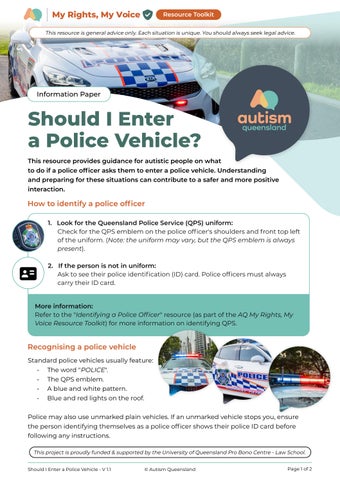
Recognising a police vehicle Standard police vehicles usually feature: • The word "POLICE". • The QPS emblem. • A blue and white pattern. • Blue and red lights on the roof. Police may also use unmarked plain vehicles. If an unmarked vehicle stops you, ensure the person identifying themselves as a police officer shows their police ID card before following any instructions. This project is proudly funded & supported by the University of Queensland Pro Bono Centre - Law School. Should I Enter a Police Vehicle - V 1.1
© Autism Queensland
Page 1 of 2
Should I Enter a Police Vehicle?
Information Paper
When to get into a police vehicle There are only three reasons to comply with a police officer's instructions to enter a police vehicle: 1. You are under arrest. 2. You are being taken in or detained for questioning. 3. You are being taken to the police station for a blood or breath test related to an alcohol or drug offence.
What to do when asked to get into a police vehicle 1.
Ask the police officer: "Am I under arrest?" • If yes, you must comply (do what is asked and go with the police officer). • If no, proceed (go to the next question)..
2. Ask the police officer: "Am I being detained for questioning?" • If yes, you must comply (do what is asked and go with the police officer). • If no, proceed (go to the next question). 3. Ask the police officer: "Am I being taken to the police station for a blood or breath test related to an alcohol or drug offence?" • If yes, you must comply (do what is asked and go with the police officer). • If the answer to all three of these questions has been 'no', you are not legally required to get into the police vehicle. If you are not required to get into the vehicle, you may ask the police officer if you are free to leave. Always remain respectful and co-operative while seeking clarification.
Your rights & obligations When interacting with police, you have the right to remain silent. However, you must answer these questions: •
What is your name?
•
What is your address?
•
What is your date of birth?
For any other questions you may say "I do not want to answer this question, officer." Remember, understanding these guidelines can help you navigate interactions with police more confidently and safely. Scan QR code to access more resources from the My Rights, My Voice Toolkit, designed to help navigate QPS interactions.
Autism Queensland is here to help— get in touch to learn more: Email: css@autismqld.com.au Phone: (07) 3273 0000 Website: autismqld.com.au
This project is proudly funded & supported by the University of Queensland Pro Bono Centre - Law School. Should I Enter a Police Vehicle - V 1.1
© Autism Queensland
Page 2 of 2