Resource Toolkit
Tip Sheet & Printable Resource
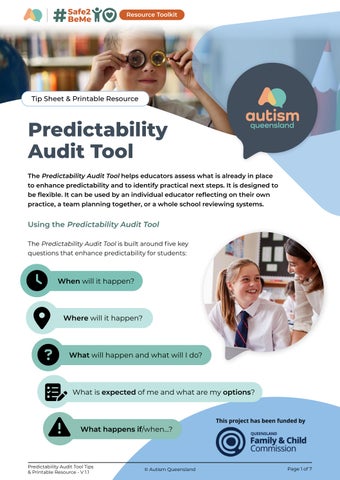
Predictability Audit Tool The Predictability Audit Tool helps educators assess what is already in place to enhance predictability and to identify practical next steps. It is designed to be flexible. It can be used by an individual educator reflecting on their own practice, a team planning together, or a whole school reviewing systems.
Using the Predictability Audit Tool The Predictability Audit Tool is built around five key questions that enhance predictability for students:
When will it happen?
Where will it happen?
What will happen and what will I do?
What is expected of me and what are my options?
What happens if/when...?
Predictability Audit Tool Tips & Printable Resource - V 1.1
© Autism Queensland
Page 1 of 7
Predictability Audit Tool Tip Sheet & Printable Resource
Getting started: 1.
Work through each of the five sections: For each tool or strategy listed, mark whether you are already doing it, whether you want to add it, or whether you'd like to learn more.
Predictability Audit Tool
Printable Resource
When will it happen?
Making time predictable
Help students understand and anticipate the timing and sequence of events throughout their day/week/term etc. Tools / Strategies
Implementation Level Already
Add
I want to
doing
this
learn more
(individual, class, school)
Notes
Daily and weekly schedules
Visual routines
2. Consider implementation level: Timers and countdowns Some strategies are most powerful when they are consistent across a whole class or an entire school while others may be tailored to specific students' needs. To-do lists and task sequences Transition cues and processes 3. Identify your priorities: Look for patterns. Which areas are already strong? Which areas have the most Processes for managing changes gaps? Where would a small change have the biggest impact? This project has been funded by Queensland Family & Child Commission. Predictability Tips & Audit Tool Resource - V 1.0 © Autism Queensland Page 5 of 9 4. Review and refine: Revisit the audit each term to see progress, adjust what isn't working, and add new priorities as previous ones become embedded practice.
On the following pages you will find a printable template for the #Safe2BeMe project's Predictability Audit Tool.
Scan QR code for more #Safe2BeMe Toolkit resources designed to ensure all students feel safe and supported at school.
Autism Queensland is here to help—get in touch to learn more: Email: css@autismqld.com.au Phone: (07) 3273 0000 Website: autismqld.com.au Predictability Audit Tool Tips & Printable Resource - V 1.1
© Autism Queensland
Page 2 of 7
Predictability Audit Tool
Printable Resource
When will it happen?
Making time predictable:
Help students understand and anticipate the timing and sequence of events throughout their day/week/term etc. Tools / Strategies
Implementation Level Already doing
Add this
I want to learn more
(individual, class, school)
Notes
Daily and weekly schedules
Visual routines
Timers and countdowns
To-do lists and task sequences
Transition cues and processes
Processes for managing changes
This project has been funded by Queensland Family & Child Commission. Predictability Audit Tool Tips & Printable Resource - V 1.1
© Autism Queensland
Page 3 of 7
Predictability Audit Tool Where will it happen?
Printable Resource
Making space & environment predictable:
Create clear, consistent, and accessible physical environments that students can navigate and understand.
Tools / Strategies
Implementation Level Already doing
Add this
I want to learn more
(individual, class, school)
Notes
Maps and wayfinding systems
Colour coding for zones / materials
Structured teaching environments
Universal design principles for physical spaces
Sensory mapping or zoning
Consistent physical layouts (e.g. desk arrangement, activity setup etc.) This project has been funded by Queensland Family & Child Commission. Predictability Audit Tool Tips & Printable Resource - V 1.1
© Autism Queensland
Page 4 of 7
Predictability Audit Tool
Printable Resource
What will happen and what will I do?
Making activities, events, and tasks predictable:
Provide clear information about upcoming activities, events, and the specific tasks students will engage in.
Tools / Strategies
Implementation Level Already doing
Add this
I want to learn more
(individual, class, school)
Notes
"What to expect" / Welcome / Visual stories
Walk-throughs and rehearsals
Video models of activities
Sensory previews of events
Task analysis and breakdowns
Explicit information about activities
This project has been funded by Queensland Family & Child Commission. Predictability Audit Tool Tips & Printable Resource - V 1.1
© Autism Queensland
Page 5 of 7
Predictability Audit Tool
Printable Resource
What's expected of me? What are my options?
Making expectations and choices predictable:
Clearly communicate behavioural and learning expectations while providing clear and consistent choices and alternatives.
Tools / Strategies
Implementation Level Already doing
Add this
I want to learn more
(individual, class, school)
Notes
Clear instructions (visual & verbal)
Explicit teaching of expectations (behaviour, social, etc.)
Defined choices and alternatives
Universal Design for Learning approaches
Designated safe places and exit plans
Choice boards and menus
This project has been funded by Queensland Family & Child Commission. Predictability Audit Tool Tips & Printable Resource - V 1.1
© Autism Queensland
Page 6 of 7
Predictability Audit Tool
Printable Resource
What happens if/when...?
Making responses, changes, and the unexpected predictable:
Establish consistent, clear processes for how situations are handled, how unexpected changes are communicated, and how support is provided. Tools / Strategies
Implementation Level Already doing
Add this
I want to learn more
(individual, class, school)
Notes
Processes for communicating unexpected changes (e.g. change cards & visuals, now/next strategies) Restorative practice processes
Consistent response systems (e.g. when mistakes happen, when help is need or goes wrong etc.) Clear support structures (e.g. who to ask, where to go, what happens next etc.) Consistent problem-solving frameworks (e.g. conflict resolution, restorative practice, self-advocacy) Communication protocols (e.g. how to ask for help, check in/out systems, communication pathways) This project has been funded by Queensland Family & Child Commission. Predictability Audit Tool Tips & Printable Resource - V 1.1
© Autism Queensland
Page 7 of 7