Information Paper
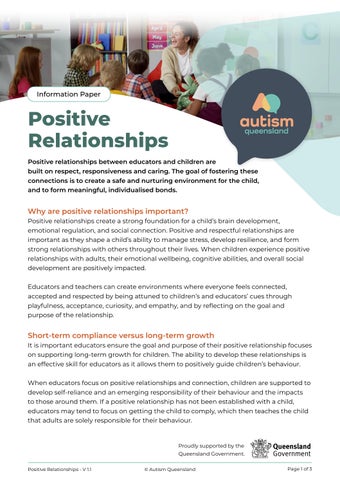
Positive Relationships Positive relationships between educators and children are built on respect, responsiveness and caring. The goal of fostering these connections is to create a safe and nurturing environment for the child, and to form meaningful, individualised bonds.
Why are positive relationships important? Positive relationships create a strong foundation for a child’s brain development, emotional regulation, and social connection. Positive and respectful relationships are important as they shape a child’s ability to manage stress, develop resilience, and form strong relationships with others throughout their lives. When children experience positive relationships with adults, their emotional wellbeing, cognitive abilities, and overall social development are positively impacted. Educators and teachers can create environments where everyone feels connected, accepted and respected by being attuned to children’s and educators’ cues through playfulness, acceptance, curiosity, and empathy, and by reflecting on the goal and purpose of the relationship.
Short-term compliance versus long-term growth It is important educators ensure the goal and purpose of their positive relationship focuses on supporting long-term growth for children. The ability to develop these relationships is an effective skill for educators as it allows them to positively guide children’s behaviour. When educators focus on positive relationships and connection, children are supported to develop self-reliance and an emerging responsibility of their behaviour and the impacts to those around them. If a positive relationship has not been established with a child, educators may tend to focus on getting the child to comply, which then teaches the child that adults are solely responsible for their behaviour.
Proudly supported by the Queensland Government. Positive Relationships - V 1.1
© Autism Queensland
Page 1 of 3
Positive Relationships Information Paper When educators focus only on correcting behaviour, children: • Focus on the hurt/disconnection caused by the consequences imposed on them. • May focus on avoiding punishment, getting caught, or consequences. • Will miss out on opportunities to develop self-reliance and internal motivations. • Will rely more on adults to regulate their behaviour and actions. When educators prioritise positive relationships, children are: • More receptive to guidance and feedback in relation to their behaviour and actions. • Able to develop respect and empathy for others. • Supported to collaborate with others to problem-solve, creating a stronger sense of accountability and responsibility. Research shows children who feel connected, accepted, and respected by adults develop stronger self-regulation skills and a deeper sense of responsibility. This can be achieved through the practice of unconditional positive regard.
Connection before correction Connection before correction is a fundamental principle in Dr Dan Siegel's interpersonal neurobiology approach to parenting and relationships. This concept emphasises that emotional connection must precede any attempt at behavioural correction, particularly with children. When a child (or anyone) is in a state of emotional distress, their prefrontal cortex— responsible for rational thinking and self-regulation—becomes less functional. By first establishing emotional connection through empathy, attunement, and validation, educators can help regulate the child’s nervous system, bringing them back to a state where their "thinking brain" can engage.
Modelling positive and respectful relationships When connection is created, then meaningful learning, reflection, and guidance on behaviour occur. This approach not only resolves immediate conflicts more effectively, it also builds stronger, more secure relationships. Creating positive educator-child relationships requires establishing trauma-sensitive environments where children feel emotionally secure. This happens when educators prioritise respectful and positive moments of interaction and connection each day. Children develop a sense of safety and security when educators provide predictable responses through regular positive group and individual interactions, offer co-regulation, and use facial expressions, voice, language, and environmental cues to foster safety and connection. Proudly supported by the Queensland Government. Positive Relationships - V 1.1
© Autism Queensland
Page 2 of 3
Positive Relationships Information Paper Through positive relationships and respectful interactions with families and colleagues, educators can model a range of ways that positive relationships could look like. As children observe these positive interactions, they learn valuable skills in how they too can safely and respectfully interact with others, which supports the development of their own positive relationships.
References Brown, S. (2007). Play: How it Shapes the Brain, Opens the Imagination, and Invigorates the Soul. New York: Avery. Denham, S. A., & Burton, R. (2003). Social and Emotional Development in Early Childhood. Prentice Hall. Garvey, B. (2024). 10 things I wish you knew about your child's mental health. HarperCollins. Ginsburg, K. R. (2007). The Importance of Play in Promoting Healthy Child Development and Maintaining Strong Parent-Child Bonds. Pediatrics, 119(1), 182–191. Perry, B. D., & Szalavitz, M. (2010). Born for Love: Why Empathy Is Essential—and Endangered. HarperCollins. Perry, B. D., & Szalavitz, M. (2006). The Boy Who Was Raised as a Dog: And Other Stories from a Child Psychiatrist's Notebook. Basic Books. Siegel, D. J. (2012). The Developing Mind: How Relationships and the Brain Interact to Shape Who We Are. Guilford Press. Siegel, D. J., & Hartzell, M. (2003). Parenting from the Inside Out: How a Deeper SelfUnderstanding Can Help You Raise Children Who Thrive. TarcherPerigee.
Autism Queensland is here to help—get in touch to learn more:
Scan QR code to view other resources, services and supports offered by Autism Queensland.
Email: css@autismqld.com.au Phone: (07) 3273 0000 Website: autismqld.com.au
Proudly supported by the Queensland Government. Positive Relationships - V 1.1
© Autism Queensland
Page 3 of 3