My Rights, My Voice
Resource Toolkit
This resource is general advice only. Each situation is unique. You should always seek legal advice.
Information Paper
Identifying a Police Officer Police officers work with the community to ensure a safe Queensland for everyone. For autistic people, interacting with the police may come with increased anxiety and difficulty. This resource is a guide for these police interactions and will help autistic people identify a police officer confidently.
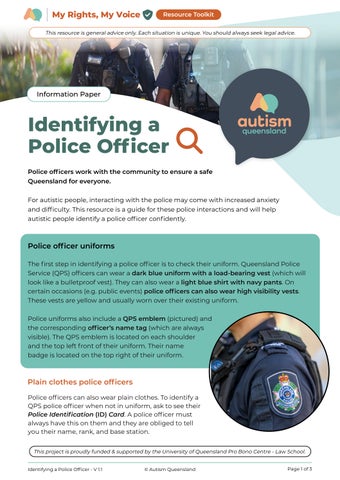
Police officer uniforms The first step in identifying a police officer is to check their uniform. Queensland Police Service (QPS) officers can wear a dark blue uniform with a load-bearing vest (which will look like a bulletproof vest). They can also wear a light blue shirt with navy pants. On certain occasions (e.g. public events) police officers can also wear high visibility vests. These vests are yellow and usually worn over their existing uniform. Police uniforms also include a QPS emblem (pictured) and the corresponding officer’s name tag (which are always visible). The QPS emblem is located on each shoulder and the top left front of their uniform. Their name badge is located on the top right of their uniform.
Plain clothes police officers Police officers can also wear plain clothes. To identify a QPS police officer when not in uniform, ask to see their Police Identification (ID) Card. A police officer must always have this on them and they are obliged to tell you their name, rank, and base station. This project is proudly funded & supported by the University of Queensland Pro Bono Centre - Law School. Identifying a Police Officer - V 1.1
© Autism Queensland
Page 1 of 3
Identifying a Police Officer
Information Paper
Checking a police officer's identity Follow these steps to ensure you are talking to a QPS police officer: Check their uniform: It is important to check that the person is wearing a QPS uniform because it may look similar to other uniforms (such as those worn by private security officers or public transport officers). To distinguish a QPS police officer, check for the QPS emblem located on both sides of the police uniform. Ask to see their police ID card: Police officers are required to carry identification at all times. The officers must give their name, rank, and the station they are based at. Optional - Call 131 444: Write down or make a note of the officer's name and registration number. By calling this number, you can verify the officer's identity For guidance, this is what you can say when calling this number: “I would like to verify the identity of a police officer. Can I please confirm that officer [INSERT OFFICER’S NAME] with the registration number [REGISTRATION NUMBER] is an officer currently serving in the QPS?” However, if there is an emergency, it is crucial to call 000.
Police officer uniforms versus police liaison officers (PLO) A PLO is different from a police officer. It is helpful to explain the difference as PLOs do not have the same powers as police officers. PLOs have light or dark blue uniforms. To explicitly distinguish a PLO from a police officer, check their epaulette or shoulder strap. PLO epaulettes are yellow and located on each shoulder. PLOs also have a PLO name badge located on the top right corner of the front of their shirts. In the Torres Strait, the shoulder epaulettes are blue or green. PLOs may also wear a PLO hats with a yellow chequered band and a PLO badge in the centre.
Interacting with a police officer If a police officer talks to you, make sure you can see who they are and that they are really a police officer. You can ask why they are talking to you and you have the legal right to know why they are questioning or searching you. If a police officer stops you, the only three questions you must legally answer are: 1. What is your name?
2. What is your address?
3. What is your date of birth?
This project is proudly funded & supported by the University of Queensland Pro Bono Centre - Law School. Identifying a Police Officer - V 1.1
© Autism Queensland
Page 2 of 3
Identifying a Police Officer
Information Paper
If a police officer asks additional questions, you can decline by saying, “I do not want to answer this question.” No one is legally required to answer any questions besides the prior three listed, so it is strongly recommended you instead ask to speak with/call a lawyer or support person first. Remember, it is your right to remain silent.
Interacting with a police as a minimally- or non-speaking autistic person If you are a minimally-speaking or non-speaking autistic person, interacting with the police may come with more difficulty. You can create a physical or digital resource that can assist you in interacting with the police that includes the following: 1.
A statement that you are a minimally-speaking or non-speaking autistic person. (This is optional but can provide the police officer with clarity and understanding.) For example:
I’m a non-speaking autistic person. I communicate in ways other than speech, like [typing, gestures, AAC device, facial expressions, etc.]. I have thoughts, ideas, and feelings just like anyone else, and I’d appreciate it if you give me time and space to communicate in the way that works for me. Thank you.
2. A list of questions you need to ask to confirm a police officer’s identity. 3. A list of the three questions (and corresponding answers) you must answer. 4. A statement that you will not answer any other questions.
Police officers and police vehicles Police officers often use official police vehicles. If you know what a police vehicle looks like, it creates a stronger visual image that can help you identify a police officer. Police vehicles are usually white, with the word “POLICE” in blue, printed on the front and sides. Police vehicles have a blue and white chequered pattern with neon red outlines. When a police vehicle siren is activated, blue and red lights flash on top of the vehicle. Police officers may also use unmarked plain vehicles, so remember to check their identity first.
Additional resources: Police Liaison Officers (PLOs)
Identifying QPS officers
Scan QR code to access more resources from the My Rights, My Voice Toolkit, designed to help navigate QPS interactions.
Police contact information
Autism Queensland is here to help— get in touch to learn more: Email: css@autismqld.com.au Phone: (07) 3273 0000 Website: autismqld.com.au
This project is proudly funded & supported by the University of Queensland Pro Bono Centre - Law School. Identifying a Police Officer - V 1.1
© Autism Queensland
Page 3 of 3