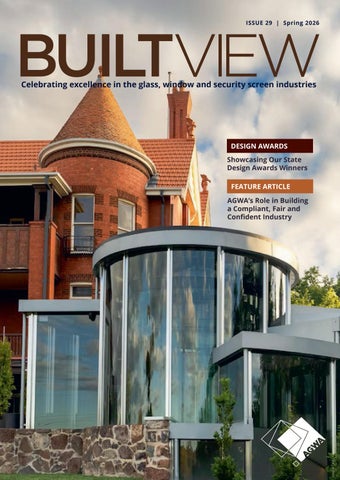
ISSUE 29 | Spring 2026
Celebrating excellence in the glass, window and security screen industries
DESIGN AWARDS Showcasing Our State Design Awards Winners FEATURE ARTICLE AGWA’s Role in Building a Compliant, Fair and Confident Industry
Measure Once. Get It Right. Every Time. Digital measuring for the window, door and glass industry, eliminating errors and wasted time onsite. Solaflex replaces manual measuring, notes, and rework with a streamlined digital workflow. Capture precise measurements on-site and instantly convert them into structured outputs - ready for production, quoting, or install. Built specifically for fabricators and installers, Solaflex improves accuracy, reduces admin, and keeps projects moving. How It Works Measure onsite with Solaflex
Auto generate DXF, PDF or CSV
Send to office or team instantly
Custom templates for window & doors
Reduce errors and costly mistakes
Faster quoting to the client
See It In Action Scan to view the system, features and book a demo.
sales@solaflex.software
www.solaflex.software Built for glass professionals, window fabricators and door specialists.
LET THE FRESH AIR IN. KEEP THE BUGS OUT.
EZ-ZIP AUTOMATED RETRACTABLE SCREENS PROVIDE FRESH AIR, AND RELIABLE INSECT PROTECTION.
WHY EZ-ZIP SCREENS?
PERFECT FOR
DESIGNED TO PERFORM
✓ Quiet & Smooth
✓ Gas Strut Windows
✓ Premium Flat Mesh
✓ Fast Installation
✓ Servery Windows
✓ Rechargeable Motor
✓ Remote Controlled
✓ Bi-Fold Windows
✓ Architectural Finish
✓ Custom Sizes
✓ Cafe & Commercial spaces
✓ Built for Australia
SCAN TO VIEW Brochure, Installation guides and videos.
fsa-aus.com.au
sales@fsa-aus.com.au
ISSUE 29 | Spring 2026
CEO WORDS
26
CONTRIBUTORS
27
2026 AGWA DESIGN AWARDS STATE WINNERS
6-22
FEATURE ARTICLE
36-39
SAFETY
31
ECONOMY
33
LEGAL
34
TECHNICAL
47, 48-49
CASE STUDIES
44-45
MEMBER STORIES
40-41, 50-51
PRODUCTS
52, 53, 54, 56
NEWS
59, 60, 61, 62
TRAINING
57
AGWA NEWS
23, 46, 62 AGWA 2026 Design Awards National and Victorian State Winner Residential Glass and Window Project Over $80,000 Toorak House by Creative Windows This project is a standout example of glazing as a defining architectural feature, rather than a supporting element. The integration of a fully glazed turret, a transparent lift enclosure and a motorised guillotine window transformed the building into a highly expressive and functional space. The glass turret acts as a sculptural centrepiece, while the glazed elevator introduces vertical transparency rarely seen in residential construction. The motorised guillotine window further enhances the connection to the garden below, creating a dynamic interaction between levels. This project is recognised for its bold use of glass to achieve both visual impact and functionality, demonstrating how advanced glazing systems can redefine spatial experience in high-end residential design.
ONE SUPPLIER. TRUSTED BRANDS. YOUR ADVANTAGE. High Stock Availability | Fast Delivery | Expert Support
Glasscorp Australia is proud to be a trusted supplier of:
+ many more leading brands
Contact Tim Stokes, 0420 818 958 | Matthew Coghill, 0452 075 055 | Kevin Pratt, 0406 225 993 89 Letcon Drive, Dandenong South, Victoria 3175, Australia glasscorpaustralia.com.au | customerservice@glasscorpaustralia.com.au | 1800 950 119
Scan for the Glasscorp Australia Product Catalogue
QLD COMMERCIAL PROJECT OVER $750,000 Winner QLD Winner
Tropical Enterprise Tropical Enterprise Centre Centre G.James Facade Solutions G.James Facade Solutions
ARCHITECT: Wilson Architects and Clarke & Prince Architects BUILDER: Besix Watpac PHOTOGRAPHER: Michael Kennedy Photography
COMMERCIAL PROJECT UNDER $250,000 Winner QLD Winner
2026 AGWA Design Awards State Winners
COMMERCIAL PROJECT $250,000 TO $750,000 Winner QLD Winner
Landmark Aniko Tweed Coast Glass ARCHITECT: Aniko BUILDER: Aniko
RESIDENTIAL PROJECT OVER $80,000 Winner QLD Winner
Vaucluse Residences
Glasshouse
ARCHITECT: Christopher Tim & Phil Christopher Design Group BUILDER: Jon Mees Homes
ARCHITECT: Bureau^proberts - Kent Pine BUILDER: Spyre Group
CHGA Windows & Doors
6
BUILTVIEW ISSUE 29 Spring 2026
G.James Facade Solutions G.James Facade Solutions
2026 AGWA Design Awards State Winners
RESIDENTIAL PROJECT UNDER $80,000 Winner QLD Winner
QLD BESPOKE DESIGN PROJECT RESIDENTIAL PROJECT OVER $80,000 Winner QLD Winner Winner
Warrego
CHGA Windows & Doors
BUILDER: Reed & Co Homes
SHOWER SCREEN OR BARRIER PROJECT Winner QLD Winner
Villa Cloudbreak
PTG CommercialGlazing Glazing PTG Commercial ARCHITECT: Jayson Pate Design BUILDER: Mactech Constructions PHOTOGRAPHER: Drift Visuals
SMALL SHOWROOM OFUNDER THE YEAR RESIDENTIAL PROJECT $80,000 Winner QLD Winner Winner
BIANCO Caloundra
Glasshape Glasshape
BUILDER: RCQ PHOTOGRAPHER: Marx Creative
Vision Solutions Showroom
Vision Solutions Showroom Vision Solutions Glass and Aluminium Vision Solutions Glass and Aluminium ARCHITECT: BUILDER: PHOTOGRAPHER: BUILTVIEW ISSUE 29 Spring 2026
7
VIC COMMERCIAL COMMERCIAL PROJECT PROJECT OVER OVER $750,000 $750,000 VIC Winner Winner
Tropical Leave Plus Enterprise Building Centre G.James SMB Glass Facade Windows Solutions & Doors
BUILDER: Shapes ARCHITECT: Wilson Architects and Clarke & Prince Architects PHOTOGRAPHER: Pixel Michael Kennedy Photography
COMMERCIAL PROJECT UNDER $250,000 VIC Winner Winner
Vaucluse Residences Goodstart Glengala CHGA Windows & Doors
SMB Glass Windows & Doors ARCHITECT: Tim & Phil Christopher BUILDER: Prebuild BUILDER: Jon Mees Homes PHOTOGRAPHER: Pixel
8
BUILTVIEW ISSUE 29 Spring 2026
2026 AGWA Design Awards State Winners
COMMERCIAL PROJECT $250,000 TO $750,000 VIC Winner Winner
Kar-Rama Landmark Hotel Aniko
Vivid Glass, & Doors Tweed CoastWindows Glass ARCHITECT: ARCHITECT: Studio Aniko Tate BUILDER: SJM Developments Aniko PHOTOGRAPHER: Iain Bond Photography Studio
COMMERCIALPROJECT RESIDENTIAL PROJECTOVER RETROFIT $80,000 Winner VIC Winner
Glasshouse ChurchFacade Project G.James Solutions
Euro UPVC Windows ARCHITECT: Bureau^proberts - Kent Pine BUILDER: Spyre Group
2026 AGWA Design Awards State Winners
VIC RESIDENTIAL PROJECT OVER $80,000 BESPOKE DESIGN PROJECT RESIDENTIAL PROJECT OVER $80,000 VIC Winner Winner Winner
COMMERCIAL PROJECTUNDER RETROFIT RESIDENTIAL PROJECT $80,000 VIC Winner Winner
Villa Cloudbreak Toorak House
Clayton South Warehouse Warrego
PTG Commercial Glazing Creative Windows
BUILDER: BUILDER: Reed & Co Jo Designs Homes
ARCHITECT: Jayson Pate Design ARCHITECT: Surrey Developments BUILDER: Mactech BUILDER: Surrey Constructions Developments PHOTOGRAPHER: Drift Visuals
CHGA Windows K & B Windows & Doors
SHOWER SCREEN OR BARRIER PROJECT RESIDENTIAL PROJECT UNDER $80,000 RESIDENTIAL PROJECT OVER $80,000 Winner VIC Winner Winner
SMALL SHOWROOM RESIDENTIAL PROJECT OFUNDER UNDER THE YEAR $80,000 RESIDENTIAL PROJECT $80,000 Winner VIC Highly Commended Winner
TheShowroom Esplanade Vision Solutions
BIANCO Caloundra The Sonia
Rylock Windows Geelong Vision Solutions Glass and Aluminium
BUILDER: RCQ PHOTOGRAPHER: Marx Creative
ARCHITECT: Peter Rechenberg ARCHITECT: BUILDER: Build By Hammond BUILDER: PHOTOGRAPHER: Mango Media PHOTOGRAPHER:
Glasshape
Yokor Windows AUS
BUILTVIEW ISSUE 29 Spring 2026
9
VIC
RESIDENTIAL PROJECT RETROFIT VIC Winner
Brighton Project Euro UPVC Windows
2026 AGWA Design Awards State Winners
RESIDENTIAL PROJECT RETROFIT VIC Highly Commended
Rosebud Project
Thermotek Windows and Doors PHOTOGRAPHER: G. A. Creative
BESPOKE DESIGN PROJECT RESIDENTIAL PROJECT UNDER $80,000 VIC Winner Winner
Project 1872
European Window Co. BUILDER: A.Romanin & Sons PHOTOGRAPHER: A.Romanin & Sons 10
BUILTVIEW ISSUE 29 Spring 2026
BESPOKE DESIGN PROJECT RESIDENTIAL PROJECT OVER $80,000 VIC Highly Commended Winner
Dimmeys Clock Tower Express Glass
2026 AGWA Design Awards State Winners
SHOWER SCREEN OR BARRIER PROJECT VIC Winner
VIC
MOST INNOVATIVE PRODUCT OR SERVICE VIC Winner
Eleven Eastern
Glasshape
AF Fire Rated Glazing System Aluflam Australia
PHOTOGRAPHER: Michael Gazzola
LARGE SHOWROOM OF THE YEAR VIC Winner
Stylerite Showroom
Stylerite Windows & Doors
SMALL SHOWROOM OF THE YEAR VIC Winner
PAG Showroom
Portland Aluminium & Glass
PHOTOGRAPHER: Will Khan
BUILTVIEW ISSUE 29 Spring 2026
11
VIC VIC TAS
2026 AGWA Design Awards State Winners
SMALL SHOWROOM OF THE YEAR VIC Highly Commended
COMMERCIAL PROJECT OVER $750,000 TAS Winner
SMB Showroom
SMB Glass Windows & Doors PHOTOGRAPHER: Pixel and AWS
COMMERCIAL PROJECT $250,000 TO $750,000 TAS Winner
Launceston Health Hub GP Glass
BUILDER: VOS Construction & Joinery PHOTOGRAPHER: Prime Perspectives
COMMERCIAL PROJECT UNDER $250,000 TAS Winner
UTAS Forestry
Tasmanian Digestive Centre
BUILDER: Hansen Yuncken PHOTOGRAPHER: Jasmine Ryland
BUILDER: AJR Construct
Vos Construction and Joinery
12
BUILTVIEW ISSUE 29 Spring 2026
GP Glass
2026 AGWA Design Awards State Winners
COMMERCIAL PROJECT RETROFIT TAS Winner
TAS RESIDENTIAL PROJECT OVER $80,000 RESIDENTIAL PROJECT OVER $80,000 TAS Winner Winner
The Salty Dog Hotel City Glass Tasmania
BUILDER: Soda Projects PHOTOGRAPHER: Jordan Cooke
RESIDENTIAL PROJECT OVER $80,000 TAS Highly Commended
The Three Sisters
Cityline Windows & Doors
ARCHITECT: 6ty° BUILDER: 3D Construction and Developments PHOTOGRAPHER: Anjie Blair Photography
RESIDENTIAL PROJECT PROJECT UNDER UNDER $80,000 $80,000 RESIDENTIAL TAS Winner Winner
Mt Nelson
Rosevear Lane
Titane Windows and Doors
Clark Windows Tasmania
ARCHITECT: S Group BUILDER: BHA Construction PHOTOGRAPHER: S Group
ARCHITECT: Archimob BUILDER: Daniel Reimers Builders PHOTOGRAPHER: Ben Dilger Photography BUILTVIEW ISSUE 29 Spring 2026
13
TAS VIC WA
2026 AGWA Design Awards State Winners
BESPOKE DESIGN PROJECT TAS Winner
COMMERCIAL PROJECT OVER $750,000 WA Winner
John Hart Conservatory GP Glass
BUILDER: Fairbrother
COMMERCIAL PROJECT $250,000 TO $750,000 WA Winner
Dordaak Kepup Library Radar Glazing Solutions
Home Fire Studios ASA Windows
BUILDER: Built PHOTOGRAPHER: Simon Westlake
COMMERCIAL PROJECT UNDER $250,000 WA Winner
Apple Store Perth
Cooling Brothers Glass Co PHOTOGRAPHER: Atelier JV
14
BUILTVIEW ISSUE 29 Spring 2026
2026 AGWA Design Awards State Winners
COMMERCIAL RETROFIT PROJECT WA Winner
QLD WA RESIDENTIAL PROJECT OVER $80,000 RESIDENTIAL PROJECT OVER $80,000 WA Winner Winner
Holland Gardens
Arc Display Home
ARCHITECTURE: Hub Interiors BUILDER: Project West
ARCHITECT: Domination Homes BUILDER: Domination Homes PHOTOGRAPHER: Finesse Property Photography
Hilton Brothers Glass and Aluminium
RESIDENTIAL PROJECT UNDER $80,000 WA Winner
Maylands Residence
Jason Windows
BUILDER: West Coast Windows PHOTOGRAPHER: Andrew Pritchard
Jason Windows
RESIDENTIAL PROJECT RETROFITUNDER PROJECT RESIDENTIAL $80,000 WA Winner Winner
Architectural Coastal Residence WA Custom Glass
PHOTOGRAPHER: Marcus Figueroa
BUILTVIEW ISSUE 29 Spring 2026
15
WA SA
2026 AGWA Design Awards State Winners
BESPOKE DESIGN PROJECT WA Winner
MOST INNOVATIVE PRODUCT OR SERVICE WA Winner
Joondalup Arena Aquatic Centre Cooling Brothers Glass Co
Extrut Aluminium Solution
Extrut Aluminium Solution Pty Ltd
BUILDER: BYRE Construct PHOTOGRAPHER: Rick Vermey & VenuesWest & SoCa Studios
COMMERCIAL PROJECT OVER $750,000 SA Winner
SMALL SHOWROOM OF THE YEAR WA Winner
LGA Showroom
Prince Alfred College
LGA (WA)
Aluco
PHOTOGRAPHER: Eventually Creative
BUILDER: Marshall and Brougham PHOTOGRAPHER: Brendan Mann
16
BUILTVIEW ISSUE 29 Spring 2026
2026 AGWA Design Awards State Winners
COMMERCIAL PROJECT $250,000 TO $750,000 SA Winner
Colac Hotel Redevelopment Aliview Group
BUILDER: Dominion Homes PHOTOGRAPHER: JKTP
RESIDENTIAL PROJECT OVER $80,000 SA Winner
QLD SA COMMERCIAL PROJECT UNDER $250,000 RESIDENTIAL PROJECT OVER $80,000 SA Winner Winner
Flinders University
Construction Glazing
BUILDER: BluBuilt PHOTOGRAPHER: Josh Johns
RESIDENTIAL PROJECT PROJECT UNDER UNDER $80,000 $80,000 RESIDENTIAL SA Winner Winner
Stirling
Packers
Aldinga Beach House
South Pacific Windows and Doors
BUILDER: Smith Builders (SA)
BUILTVIEW ISSUE 29 Spring 2026
17
SA QLD BESPOKE DESIGN PROJECT SA Winner
Trafficable Skylight Construction Glazing
2026 AGWA Design Awards State Winners
SHOWER SCREEN OR BARRIER PROJECT SA Winner
Normus Homes Shower Federation Glass
BUILDER: Tandem Building Group
LARGE SHOWROOM OF THE YEAR SA Winner
South Pacific Windows and Doors Showroom South Pacific Windows and Doors
18
BUILTVIEW ISSUE 29 Spring 2026
SMALL SHOWROOM OF THE YEAR SA Winner
Kadina Showroom
Kadina Aluminium Products
2026 AGWA Design Awards State Winners
ACT NSW
COMMERCIAL PROJECT OVER $750,000 NSW Winner
Meriden Arts Building
Distinct Aluminium Solutions
BUILDER: Buildcorp
COMMERCIAL PROJECT $250,000 TO $750,000 NSW Winner
Yowani Country Club
Pixel International
ARCHITECT: Collins Pennington BUILDER: TP Dynamics PHOTOGRAPHER: Anne Stroud
COMMERCIAL PROJECT OVER $750,000 RESIDENTIAL PROJECT OVER $80,000 NSW Highly Commended Winner
Gosford Library
PCW Commercial Windows BUILDER: North Construction & Building
COMMERCIALPROJECT PROJECTUNDER UNDER$80,000 $250,000 RESIDENTIAL NSW Winner Winner
Awaba House
Evolution Window Systems BUILDER: Baseline Projects PHOTOGRAPHER: Siares Marketing BUILTVIEW ISSUE 29 Spring 2026
19
NSW COMMERCIAL PROJECT RETROFIT NSW Winner
Australia Street Precinct
NICCO Timber Windows & Doors
2026 AGWA Design Awards State Winners
COMMERCIAL RETROFIT PROJECT NSW Highly Commended
Sydney University Magic Glass
ARCHITECT: Killing Matt Woods BUILDER: Green Anvil Co PHOTOGRAPHER: Lucia B Creative
RESIDENTIAL PROJECT OVER $80,000 NSW Winner
RESIDENTIAL PROJECT UNDER $80,000 NSW Winner
Bendalong House
Jacaranda House
ARCHITECT: TF Architects BUILDER: New View Building Solutions PHOTOGRAPHER: Murray Fredericks
ARCHITECT: Richards Stanisich BUILDER: BWG Projects PHOTOGRAPHER: Toby Peet Photography
NICCO Timber Windows & Doors
20
BUILTVIEW ISSUE 29 Spring 2026
NICCO Timber Windows & Doors
2026 AGWA Design Awards State Winners
RESIDENTIAL PROJECT UNDER $80,000 NSW Highly Commended
NSW RESIDENTIAL RETROFIT PROJECT RESIDENTIAL PROJECT OVER $80,000 NSW Winner Winner
Mountain House
Hanlon Windows
BUILDER: Contractors United PHOTOGRAPHER: Shaw Photography
BESPOKE DESIGN PROJECT NSW Winner
Thomas House
BINQ Windows
ARCHITECT: Dieppe Design BUILDER: Glenstone Living PHOTOGRAPHER: Luke Butterly
SHOWER SCREEN OR BARRIER PROJECT RESIDENTIAL PROJECT UNDER $80,000 NSW Winner Winner
Illusion Museum
Prince St
BUILDER: Attcorp Services PHOTOGRAPHER: Alex Coppel
PHOTOGRAPHER: Studio Pisani
Greater Glass
Glazed Co.
BUILTVIEW ISSUE 29 Spring 2026
21
2026 AGWA Design Awards State Winners
NSW SHOWER SCREEN OR BARRIER PROJECT NSW Highly Commended
Imperial Bronze Curve
All Glass Balustrading Systems
LARGE SHOWROOM OF THE YEAR NSW Winner
Orion Showroom Orion Aluminium
PHOTOGRAPHER: Mackintosh Photography
THANKS TO OUR SPONSORS FOR THE
AGWA Design and Industry Award Dinners
22
BUILTVIEW ISSUE 29 Spring 2026
AGWA NSW Golf Day Friday 17 April, Bankstown Golf Course Bankstown Golf Course once again put on a great day for the NSW Golf Day with 20 teams enjoying a morning on the greens followed by lunch and prize presentations.
Thanks to our Sponsors Lunch: BM Sydney
Prizes: Viridian
Drinks and Novelties: Glasscorp
BUILTVIEW ISSUE 29 Spring 2026
23
2026 AGWA Design Awards State Winners
24
BUILTVIEW ISSUE 29 Spring 2026
2026 AGWA Design Awards State Winners
DATE Monday 6 September
EVENING
DAYTIME Golf Tournament Afternoon (optional activity)
Tuesday 7 September
Welcome Party
Wednesday 8 September
Conference & Exhibition
Casual Party
Thursday 9 September
Conference & Exhibition
Gala Dinner at Mount Duneed Estate
* Preliminary timetable, subject to change.
For more information visit our website at www.ausfenex27.com.au or email us, conference@agwa.com.au
BUILTVIEW ISSUE 29 Spring 2026
25
BuiltView Issue 29 Spring 2026 BuiltView Magazine is a quarterly publication of the Australian Glass & Window Association. EDITORS Melissa Baker Ingrid Pagura SUB EDITOR Helen Dawes DESIGN Webqem Pty Ltd Sehar Maniar, AGWA EDITORIAL & ADVERTISING ENQUIRIES Helen Dawes +61 2 9498 2768 marketing@agwa.com.au PUBLISHED BY AWA-AGGA LIMITED ABN 57 629 335 208 Suite 1.01B, Level 1, Building 1, 20 Bridge Street, Pymble NSW 2073 +61 2 9498 2768 admin@agwa.com.au; www.agwa.com.au COVER IMAGE & CONTENTS PAGE IMAGE AGWA 2026 National Winner and Victorian State Design Award Winner Residential Glass and Window Project Over $80,000 Creative Windows Toorak House Architect and Builder: Surrey Developments Fabricator: Creative Windows System Supplier: AWS CONTRIBUTORS Clinton Skeoch, Glen Qi, James Whitehouse, Tim Johnston, Ingrid Pagura, Elizabeth Dimabuyu, Sandro Ianni, Janith Pathirage, Rebekah Brown, Francesco Querci, Andries Botha, Lyndsey Warner, Daniel Johns, Gavin Hayes, Mari Lehtinen, Lido Russo, Melissa Baker, Helen Dawes, Kerrie Henderson, Sehar Maniar, Bo Liu and Tyler Gonzales. PRINTED BY SOUTHERN IMPACT southernimpact.com.au Our printer conforms to the ISO-14001 environmental management standard and the ISO-9001 quality management standard. DISTRIBUTED BY D & D MAILING SERVICES www.ddmail.com.au BuiltView Magazine is proudly packaged in Biowrap, 100% degradable plastic wrapping. DISCLAIMER Copyright © 2026. All rights reserved. Reproduction in whole or part without written permission from AWA-AGGA Limited is strictly prohibited. It is impossible for the publisher to ensure that the advertisements and other material herein comply with the Australian Consumer Law Competition and Consumer Act 2010. Readers should make their own inquiries in making decisions and where necessary, seek professional advice.
Clinton Skeoch Executive Director and CEO AGWA
Dear Members As this edition of BuiltView reaches members, another awards’ season has come to a close, with our State and National Design, Innovation, Industry Service, Safety and Apprentice Awards once again showcasing the very best our industry has to offer. While the finished projects often capture the headlines, what these Awards really celebrate is the extraordinary effort that goes into turning an idea into a built reality. Behind every award-winning project is a team of estimators, designers, fabricators, production staff, installers, glaziers, apprentices and project managers working together to solve problems, overcome challenges and deliver outcomes that meet the expectations of architects, builders and clients alike. What continually impresses me is the willingness of our industry to take on increasingly complex designs, more demanding performance requirements and tighter construction programs, all while maintaining an unwavering commitment to quality and compliance. The projects recognised through our Awards are a testament not only to innovation, but to the skill, dedication and craftsmanship that exists in workshops, factories and construction sites right across Australia. To all finalists, winners and participants, congratulations on the role you play in making our industry one of the most capable and resilient sectors in the built environment. As we celebrate those achievements, we also remain focused on protecting the long-term future of our industry. One of the most significant matters currently before us is the anti-dumping investigation into imported aluminium windows from China. Many members will be aware that the investigation is approaching an important milestone, with the Anti-Dumping Commission expected to release its Statement of Essential Facts on the 23 September. When released, AGWA will provide members with formal communication outlining the key findings and implications for our industry. I encourage all members to take the time to review the material carefully. The Statement of Essential Facts represents an important stage in the process and provides stakeholders with an opportunity to respond to the Commission’s preliminary findings. Members who have information, comments or views on the investigation should provide feedback either to AGWA or through submissions to the Anti-Dumping Commission directly. While views on the investigation may differ across our membership, AGWA’s position remains consistent. We support fair competition, compliant products and a level playing field. Businesses should succeed because they innovate, invest, improve productivity and deliver value to customers, not because markets are distorted by dumping or subsidies. Equally, compliance should be determined by testing, evidence and performance, not by assumptions about where a product originates. The months ahead will continue to be important for our industry as we navigate these issues together. As always, thank you for your ongoing support of AGWA and for the contribution you make every day to strengthening Australia’s window and glass sector.
Clinton Clinton Skeoch Executive Director and CEO
CONTRIBUTORS
Clinton Skeoch
Ingrid Pagura
Executive Director and CEO, AGWA
Industry Development Coordinator, AGWA
As AGWA Executive Director and CEO, Clinton has more than 20 years’ experience across building products, research and development and member services’ industries and with diverse roles such as supply chain management, sales, marketing, export market development, strategic management and planning, research and development, and industry advocacy. He is known for his passionate collaborative style when working with stakeholders and partners.
Tim Johnston Head of Policy and Advocacy, AGWA
Tim joined AGWA in July 2023. With a degree in Architecture from the University of New South Wales, as well as postgraduate qualifications in environmental management and economics, Tim has more than 25 years’ experience working in the built and natural environment, not for profit industry associations, private and government sectors.
Ingrid Pagura is the AGWA Industry Development Coordinator initially looking after the training needs of members. Ingrid’s role progressed to include co-editor of BuiltView, managing safety resources, the Design and Apprentice Awards and other marketing-related activities. Prior to AGWA, Ingrid worked for a legal publishing company seeing her work on their building and environment suite of products and with the CSIRO and ABCB on other BCA projects and also as a part time teacher at TAFE.
James Whitehouse Technical and Accreditation Manager, AGWA
James Whitehouse graduated in Structural Engineering in the UK before discovering building facades. Working initially for systems’ companies before becoming a Facade Engineer at LendLease. Over the last decade working in Australia, he has worked for two of the largest WA commercial fabricators and then Capral Aluminium before joining AGWA in 2022. He is a cricket fanatic and former state longbow champion.
Glen Qi Economist, HIA
Glen graduated from the Bachelor of Economics from the Australian National University in 2024. He joined HIA in 2025, and his responsibilities involve contributing to HIA’s suite of publications and articles.
BUILTVIEW ISSUE 29 Spring 2026
27
SMART SECURITY SCREEN DOOR LOCK
KEYPAD, RFID TAG & FINGERPRINT ACCESS
KEY OVERRIDE ON INTERNAL AND EXTERNAL
AUTO LOCKING & DIGITAL DEADLOCKING
VOICE ACTIVATED UNLOCK/LOCK
WORKS WITH GAINSBOROUGH FORTE APP
COMPATIBLE WITH TRISECURE TM MULTIPOINT LOCK
SMART LOCKS CONNECTED WITH life Other products available in the Mode range:
Smart Lever Lock
Smart Deadbolt
TriSecureTM technology for automatic latching, and secure triple locking Gainsborough’s Mode Smart Security Screen Door Lock is compatible with Austral Lock’s TriSecureTM Multipoint Lock Kit: - Two remote locks automatically engage without rotating lever - Secure the screen door with triple point locking at the push of a button.
Smart Entrance Lock
SAFETY
Safety News from Around the States and Territories Ingrid Pagura Industry Development Coordinator, AGWA
New South Wales Compliance with Codes of Practice from 1 July 2026 The Work Health and Safety Act 2012 in NSW has been amended so that from 1 July 2026, all Codes of Practice will become legally binding. Codes of Practice had been used as guidance for what is ‘reasonably practicable’ and were only mandatory if expressly required by legislation. From 1 July 2026, all PCBUs must comply with a Code of Practice that has been approved by the Minister. The exception will be where a PCBU has controlled the hazard in a way that is equivalent to or higher than the standard required in the Code. This brings NSW into line with Queensland, where Codes of Practice are already legally binding. In Victoria, WA, SA, Tasmania, ACT, NT and Commonwealth, Codes of Practices are guidance documents, however, they are highly influential and set the benchmarks and act as practical proof of what is ‘reasonably practicable’. So, what does this mean for you in NSW? Codes of Practice are now the legally enforceable minimum standard and must be adopted in your workplace. You must review all your Control Measures to make sure that they align with the standards set out in the relevant Code of Practice. For all members, familiarise yourself with the Codes of Practice in your state and territory, which are found on your state or territory’s WorkSafe/SafeWork website. Though they are only mandatory in NSW and Qld, everyone should be referring to them for guidance. South Australian Changes to High-Risk Construction Work from 1 July 2026 The Work Health and Safety Regulations 2012 (SA) have reduced the working at height threshold for high-risk construction work from 3 m to 2 m from 1 July 2026. This means that any worker, sole trader, apprentice or contractor, working at a height above 2 m will now be classed as high-risk
construction work. The PCBU will need to have a Safe Work Method Statement (SWMS) in place before you start high-risk construction work. This change is in response to increasing numbers of injuries from falls of over 2 m. It also aligns the height rule with all other Australian states and territories who all have set the threshold at 2 m. For help during the transition SafeWork SA has prepared some fact sheets: High-Risk Construction Fact Sheet for Workers and High-Risk Construction Fact Sheet for PCBUs. Queensland Sexual Harassment Prevention Plans Since 1 March 2025, Qld PCBUs have been required to prepare a prevention plan to manage an identified risk from sexual harassment and sex or gender-based harassment at work. This plan must be written and applies to all full-time, part-time, casual, contractors, labour hire or even volunteers. It applies to small businesses also. You must also take reasonable steps to ensure workers are aware of the Prevention Plan and know how to access it, not just once, but on an ongoing basis. There have been reports of a recent increase in workplace inspections, so don’t get caught out by not having one in place. The potential penalty for not doing so can be up to 60 penalty units, around $10,362 and that can be imposed even if no incident of sexual harassment has occurred. Many Queensland members may not be familiar with this requirement or unsure where to start. To help you, WorkSafe Qld has prepared a sample filled-in plan and a template for use to prepare your own. Please see www.worksafe.qld.gov.au/safety-andprevention/mental-health/Psychosocial-hazards/sexual-harassmentand-sex-or-gender-based-harassment. There is no legal requirement to have a formal, written prevention plan in any other state or territory. However, all Australian workplaces are bound by the positive duty under the Sex Discrimination Act 1984 (Cth) to take reasonable and proportionate measures to eliminate sexual harassment. While a written, formalised prevention plan isn’t legally required outside of Queensland, regulatory bodies all suggest that it is best practice to have documented risk assessments and response policies to meet your obligations. For more information on any of these topics go to the SafeWork/ WorkSafe website in your state and territory and AGWA Safety Resources at www.agwa/com.au/Technical & Business/Safety or email training@agwa.com.au.
BUILTVIEW ISSUE 29 Spring 2026
31
The Housing Shortage You Can’t See Glen Qi Economist, HIA Much of the debate around Australia’s housing shortage starts with a simple calculation: divide the population growth by the average household size. Under this approach, the population growth of 412,000 in the 2025 calendar year would have required 165,000 homes to be built. This is less than what we’re currently building. It’s a neat and intuitive figure but it’s deeply misleading. Housing demand is far more complex than a single ratio. It is shaped not just by how many people there are, but by how they live, move, and how their lives change over time. In reality, demand reflects a range of economic, demographic, and population forces that shape how Australians live, not just how many people there are. One of the biggest misconceptions lies in the idea of the ‘average household size’. It is often treated as a fixed input into housing demand, but it behaves as an outcome, reflecting the underlying state of housing supply. Housing shortages are far less visible than other types of shortages. At the supermarket, when supply runs short, shelves simply empty — like toilet paper during the pandemic. Housing doesn’t work that way. Everyone needs a place to live, so the shortage is absorbed through behaviour. Young adults stay in the family home longer, share houses become more common and couples delay moving in together. In these conditions, household size can stagnate or even increase, not because preferences have changed, but because there simply aren’t enough homes available. This has been the trend for the past 20 years. A more realistic way to think about housing demand is to recognise 3 broad drivers: population, demographics, and the economy. Together, they shape the actual basis of housing demand. Within these broad drivers, we must consider: • population growth and migration; • household formation and breakdown; • demographic changes; • decreasing household sizes; • replacement demand; • shifting housing preferences; • vacancy requirements; and • existing shortages.
ECONOMY
If we want affordability to improve, HIA modelling indicates that Australia requires more than 250,000 homes per year. Even the Federal Government’s Housing Accord target of 1.2 million homes over 5 years, may fall short of what is required to even begin to restore balance. The consequences of that shortfall are already being felt. Rents are rising quickly. Home prices remain elevated. Average household sizes are stagnating. Housing affordability continues to deteriorate. Another indicator of supply constraints can be seen in renovation activity. Over the past year, the average value of renovation approvals has increased by 16%, reaching $229,374. At the same time, the number of renovation loans has increased by 13.7%. Rather than moving, many homeowners are choosing to stay and upgrade. High transaction costs, limited housing availability, and a lack of suitable alternatives are keeping people where they are. It’s a quiet signal but an important one. When more people renovate, it suggests a market that isn’t functioning as it should. Yet the policy conversation often focuses on constraining demand — particularly migration — or penalising investors, in the hope that doing so will make housing more accessible. This misses the point entirely. Migration plays a critical role in supporting Australia’s economy, workforce, and long-term growth. And while constraining demand can shift who gets access to housing, it does not create more homes. As for penalising investors, this won’t even help to constrain demand because investors don’t add to demand. However, they do add to rental supply and new dwelling stock. Ultimately, Australia’s housing challenge is not a mystery. Demand and supply have been out of balance for years, and the gap is widening. Housing affordability continues to deteriorate, both because demand is misunderstood, and because supply consistently falls short of what is needed. More can be found at ‘Beyond Population ÷ 2.5: Understanding Housing Demand in Australia’ (June 2026) and ‘Housing Australia’s Future’. Both are available on the HIA website at www.hia.com.au.
BUILTVIEW ISSUE 29 Spring 2026
33
LEGAL
Pay Day Super What You Need to Know Ingrid Pagura Industry Development Coordinator, AGWA There has been a change to the way you need to deal with a worker’s superannuation from 1 July 2026. Up to the end of June 2026, superannuation guarantee contributions had to be paid to a super fund within 28 days of the end of the quarter, eg, 28 April, 28 July etc. The payments could have been made more frequently. From 1 July 2026 Pay Day Super has started. This means that superannuation guarantee contributions must be paid into your worker’s superannuation funds within 7 business days after paying the worker. For some businesses this will mean a change in how you manage your payroll responsibilities. There are some exceptions to the 7-business day deadline, such as for new workers or for existing workers switching to another super fund. In these cases, you will have 20 days.
34
BUILTVIEW ISSUE 29 Spring 2026
The calculation of your superannuation payments from 1 July 2026 are the same, but the terms have changed. Before this date, you paid the superannuation guarantee of 12% of ordinary time earnings. Now, after 1 July you’ll be paying 12% of qualifying earnings. These are earnings that ‘qualify’ for superannuation. What does this mean? Not much of a change, in fact as all worker payments that were included in superannuation guarantee calculations up to 30 June 2026 continue to be included as qualifying earnings from 1 July 2026. This means that qualifying earnings include ordinary time earnings, commissions, salary sacrifice contributions and any other amount that was previously included in your workers wages for the superannuation guarantee. You should also note that who is eligible for the superannuation guarantee remains the same. All employees over 18 years of age, under 18 years of age and working more than 30 hours a week, and independent contractors paid mostly for their labour must all be paid the superannuation guarantee regardless of if they are full time, part time or causal. If you are still not sure, the ATO has set out a table comparing qualifying earnings before and after. For this table and other resources to help you transition, please see https://www.ato.gov.au/businesses-and-organisations/super-foremployers/paying-super-on-payday
The Look Australia Loves. The Performance uPVC Delivers. Kömmerling’s advanced colour technology brings timber and aluminium aesthetics to uPVC windows and doors – delivering long-term colour stability, thermal efficiency and zero ongoing maintenance. Kömmerling’s new Melbourne Lamination Centre now produces the complete Australian colour range locally, supporting faster delivery, greater specification flexibility and finishes engineered specifically for regional climates. With UV-stable, weather-resilient lamination, Kömmerling uPVC systems deliver the design versatility of timber and aluminium with the energy efficiency, durability and zero-maintenance benefits of advanced uPVC- optimised for Australian performance and backed by local support.
UV resistant
Water resistant
Increased protection of windows and doors
Scratch resistant koemmerling.com.au
AGWA’s Role in Building a Compliant, Fair and Confident Australian Window Industry
‘When it comes to quality, compliance and fitness for purpose, the country of manufacture is not the determining factor, evidence is.’
36
BUILTVIEW ISSUE 29 Spring 2026
Clinton Skeoch Executive Director and CEO, AGWA
Europe and North America. AGWA is therefore not advocating against international supply or seeking to preference one country over another.
Recent discussion about imported window compliance has generated considerable debate across the building and construction sector.
We are advocating for evidence-based compliance and a level playing field.
The issue is important, but it cannot be reduced to a simple argument about locally manufactured versus imported products. Not all windows manufactured overseas are non-compliant. Many imported windows are appropriately tested, supplied and installed and meet the requirements of their intended application. Equally, the industry cannot ignore the evidence of a growing compliance problem.
Each year, AGWA undertakes more than 500 fabrication audits and inspection activities in Australia and overseas as a NATA-accredited inspection body. These activities provide confidence that businesses are manufacturing and supplying products consistently with the testing and compliance claims they make. This work is fundamental to maintaining confidence in the Australian window and glass market.
With many hundreds of overseas window companies, or hybrid manufacturer/resellers, now supplying the Australian market, there is increasing concern about the products being offered, the evidence used to support compliance claims, and the broader impact on the integrity of the Australian market.
A test report is not a marketing brochure. It is not a price list. It is not a general endorsement of compliance for every product appearing in a supplier’s catalogue. Testing evidence applies to defined products, configurations, sizes, hardware, framing systems and performance limits. One of the most concerning emerging misconceptions, or accepted half-truths in the market, is that a company can establish company-wide compliance through a single test report or a small number of reports.
That concern is not hypothetical. Recent national news coverage reported that 7 out of 8 windows selected from 2 imported house lots from China, failed to meet the minimum Australian compliance requirements. Of equal concern, both suppliers had operated in Australia for some time but were unable to provide the testing evidence needed to substantiate their claims. This is an industry-wide issue requiring industry-wide action and is precisely why the Australian Glass & Window Association (AGWA) is investing significant resources in auditing, accreditation, technical guidance, advocacy and the development of stronger compliance and traceability frameworks. AGWA’s role is to help create an industry, in which compliant businesses can compete with confidence, customers can trust the products they purchase, and those making unsupported or misleading claims are held accountable. Compliance must be proven When it comes to quality, compliance and fitness for purpose, the country of manufacture is not the determining factor, evidence is. That distinction is critical because window and glazing compliance remains one of the most misunderstood areas of the building industry. At a basic level, the requirements appear straightforward. Windows and doors must satisfy the relevant Australian requirements for structural performance, water penetration resistance, air infiltration, safety glazing and energy efficiency, including obligations under the National Construction Code, AS 2047 and AS 1288. If a product complies, it can be supplied for the applications supported by its evidence. If it does not comply, it should not. It’s that simple. In practice, however, demonstrating compliance is far more complex than many purchasers, builders and even some suppliers appreciate. AGWA represents more than 1,200 businesses operating across the Australian glass and window supply chain. Our membership includes manufacturers, importers, system suppliers, glass processors, fabricators, installers and distributors. Many of these businesses source materials, components and finished products from around the world, including China, other parts of Asia,
Limited testing may support limited applications. It does not necessarily support an extensive product range. Australia’s leading window system suppliers have accumulated hundreds, and in some cases thousands, of test reports over decades. They have done so because the Australian market demands a wide range of products capable of performing across different designs, building types, climates, energy specifications and wind conditions. Different window and door combinations, frame depths, hardware arrangements, mullion and transom configurations, product sizes and wind loads may require separate evidence. At a minimum, every product offered should be supported by an applicable test report. That is not unnecessary bureaucracy, it is engineering, with safety, performance and compliance at its core. Australia has an extraordinary climatic and geographic diversity. We build in tropical environments, alpine regions, cyclonic zones, exposed coastal locations and dense urban settings. The performance demands placed on windows and doors vary significantly across these environments. Testing establishes the limits of a product. It helps determine where the product can be used, how large it can safely be manufactured and how it can be expected to perform. Good testing does not restrict design. It enables safe and confident design.
‘A test report is not a marketing brochure. It is not a price list. It is not a general endorsement of compliance for every product appearing in a supplier’s catalogue. Testing evidence applies to defined products, configurations, sizes, hardware, framing systems and performance limits’
BUILTVIEW ISSUE 29 Spring 2026
37
AGWA is strengthening accountability AGWA continues to encounter local and international suppliers whose product offerings appear significantly broader than the evidence available to support them. We regularly review membership applications where one or a small number of test reports sit behind extensive catalogues containing multiple frame systems, thermal configurations and operating styles. That disconnect does not automatically establish that every product is non-compliant. It does, however, require scrutiny. Every new reselling or prime system AGWA member makes a formal commitment to sell only products supported by appropriate compliance testing. Where concerns are identified, AGWA raises them directly with the business and seeks corrective action. Where the required standards are not met, AGWA can remove the business from membership and refer the matter to the appropriate regulator. This is an important distinction. AGWA is not simply communicating the importance of compliance, but rather establishing expectations, auditing performance, requiring members to support their claims and taking action where those obligations are not met. We are also continuing to develop digital traceability, compliance and accreditation frameworks that will provide greater transparency across the supply chain and more will be seen by members, in this space, over the coming year. Businesses doing the right thing should welcome that development. Businesses making unsupported claims should be concerned. The long-term objective is to make it easier for builders, designers, certifiers, regulators and consumers to identify products with legitimate testing evidence, and harder for unsupported or misleading claims to go unchallenged. Fair competition requires action The same separation between evidence and assumption applies to trade. AGWA has initiated an anti-dumping action, in partnership with Ventora, and with the support of manufacturers across the sector, concerning fully and partially fabricated windows imported from China. This is not a product compliance action, and it is not an argument that imported windows are inherently bad. Many imported products are compliant, fairly priced and make a positive contribution to the Australian market. The anti-dumping action addresses a separate and equally important question: whether Australian businesses are competing in a market that is genuinely fair. In AGWA’s view, the evidence supporting the investigation is compelling.
38
BUILTVIEW ISSUE 29 Spring 2026
Since the application was lodged in November 2025, imports have continued to increase, rising by approximately 30%. Evidence before the Anti-Dumping Commission indicates potential subsidy levels in the order of 30% to more than 50%. That is not a marginal pricing advantage. It represents the kind of market distortion capable of materially affecting otherwise efficient and competitive Australian businesses. Australia’s Anti-Dumping laws exist to precisely address these circumstances. They are not indiscriminate tariffs designed to shelter industries from legitimate competition. They form part of a globally recognised rules-based framework, established through the World Trade Organisation to respond where competition is distorted by dumping or government subsidisation. The threshold required to initiate an investigation is extremely high. To commence Anti-Dumping Case 691, Australian manufacturers, in a sector employing more than 9,000 people, were required to provide 5 years of transaction-level data covering approximately 25% of the multi-billion-dollar Australian market, together with detailed economic analysis and evidence of material injury. This has required significant commitment from AGWA and participating businesses. We have undertaken that work because maintaining a fair market is central to the future of the industry. The objective is not protectionism. The objective is to ensure that the Australian market, and the businesses that make it up, whether locally owned, internationally owned, manufacturing domestically or legitimately importing, can compete under fair and transparent conditions. To be clear, not every importer is dumping and not every imported product is unfairly subsidised. Companies able to demonstrate that they are trading fairly have opportunities, within the Commission’s process, to seek individual assessment and consideration. That is how a properly functioning, rules-based system should operate.
‘The objective is not protectionism. The objective is to ensure that the Australian market, and the businesses that make it up, whether locally owned, internationally owned, manufacturing domestically or legitimately importing, can compete under fair and transparent conditions.’
However, when finished windows regularly enter the Australian market at prices that appear difficult to reconcile with the underlying cost of raw materials and manufacturing, it is reasonable, and necessary, to investigate whether the market is operating fairly. AGWA is ensuring that question is properly examined. Protecting Australia’s long-term capability The difference between an attractive short-term price and a sustainable long-term market is well understood. Low prices may initially benefit purchasers. However, when distorted competition forces legitimate businesses from the market, capability, investment, employment and innovation disappear with them. Once an industry has been hollowed out, rebuilding it is rarely straightforward. Australia has already experienced this reality. The closure of Oceania Glass, Australia’s last float glass manufacturer, after more than 169 years of operation, marked the loss of an important domestic capability. That business had helped sustain the Australian construction sector during the global supply chain disruptions and material shortages experienced throughout the COVID period.
AGWA will continue to undertake audits and inspections, strengthen accreditation and traceability, support members seeking to meet their obligations, challenge unsupported compliance claims, refer serious matters to regulators and advocate for fair and transparent trading conditions. We will also continue providing technical leadership to the manufacturers, processors, installers, designers, builders, certifiers and regulators responsible for shaping Australia’s built environment. This is what a strong industry association must do. AGWA’s purpose is not simply to represent the industry as it exists today, but to help shape an industry that is safer, more accountable, more innovative and more resilient for the future. Compliance is not determined by where a window comes from or who manufactured it; it’s determined by whether the evidence proves that the product belongs in Australian construction. AGWA will continue working to ensure that evidence matters, fair competition is protected and confidence in the Australian window and glass industry is strengthened for decades to come.
The subsequent removal of export subsidies on competing architectural glass shortly after Oceania Glass closed, is a reminder that international market conditions can change quickly. By the time those conditions change, however, the domestic capability may already have been lost. AGWA does not want to see the same outcome across Australia’s window manufacturing sector, an industry that directly employs thousands of Australians and supports tens of thousands more throughout the broader supply chain. This is why AGWA’s work across compliance, accreditation, technical standards, government advocacy and fair-trade action is so important. We are not defending inefficient businesses from competition. We are defending the principles that allow efficient, innovative and compliant businesses to compete. Building confidence in the industry Ultimately, this debate should not be framed as local versus imported or Australian manufacturers versus overseas suppliers. It should be framed around evidence, accountability and fairness. The questions are straightforward: • Can the product demonstrate compliance? • Can it be consistently manufactured in accordance with its tested configuration? • Can the supplier substantiate the claims it makes? • Can the business compete on a genuinely level playing field? Where the answer to those questions is yes, that business deserves recognition and the opportunity to compete, regardless of where it operates or manufactures. Where the answer is no, the industry should not look away.
BUILTVIEW ISSUE 29 Spring 2026
39
Elegant IG 30 Years of Service, Innovation and Leadership in Australia’s IGU Industry A family business that grew with an industry For 30 years, Elegant IG has been closely aligned with the evolution of Australia’s IGU sector, growing from a small family-run operation in 1996 into a nationally recognised supplier of IGU consumables, machinery, and quality testing equipment. Founded by Sandro and Liliana Ianni, the business began at a time when IGU technology was still emerging in Australia, largely confined to premium commercial projects and early energyefficiency initiatives. Today, IGUs are a mainstream requirement across residential and commercial construction, driven by tighter building standards, rising energy costs, and growing sustainability expectations. As the industry matured, so did Elegant IG. From supporting early adopters to now servicing manufacturers nationwide, the company has expanded across New South Wales, Victoria and Western Australia, supplying consumables, machinery, and quality assurance systems as a full technical partner to the sector.
40
BUILTVIEW ISSUE 29 Spring 2026
The early 2000s marked a key turning point when sons, Simon and Joshua, joined the business, strengthening operations while maintaining its family-driven foundation. Beyond supply, Elegant IG is widely recognised for technical support, production audits, process optimisation, and collaboration with international suppliers and laboratories helping manufacturers improve efficiency, compliance, and consistency in a rapidly evolving regulatory environment. Industry voice and leadership Director Sandro Ianni has played a significant role in shaping the Australian glass and glazing sector through long-standing involvement in industry bodies and technical forums. His contributions include leadership roles within IGMA and AGWA, as well as ongoing participation in national and international industry engagement. In 2017, he was recognised as the NSW Glass Person of the Year, acknowledging his contribution to both technical advancement and industry development. Sandro said, ‘from day one, our goal
was to support manufacturers with the materials, equipment, and knowledge they needed to produce high quality IGUs consistently and at scale’. When reflecting on the last 30 years, we asked Sandro some questions to find out more about the busniess he started. Why did you start Elegant IG in 1996, and what was the industry need you trying to meet? Sandro: As we’ve said, when we started Elegant IG, insulated glass units were very much a niche product in Australia. We could see that double glazing would eventually become essential: energy costs were rising, building codes were tightening, and there was growing awareness around comfort and sustainability. What was missing was a specialist local partner who could supply reliable consumables, machinery, and technical support tailored specifically to IGU production. We started Elegant IG to fill that gap. From day one, our goal was to support manufacturers with the materials, equipment, and knowledge they needed to produce high quality IGUs consistently and at scale. It started as a small family operation, but the vision was always to help move insulated glass from a specialist option to an industry standard in Australia. Q: What have been some of the biggest challenges you’ve faced as the IGU market has grown and changed? Sandro: The challenges have evolved along with the industry. In the early days, one of the biggest hurdles was simply education. Many people saw double glazing as an ‘add on’ rather than a core component of building performance. We spent a lot of time explaining the benefits of IGUs, not just to manufacturers, but also to specifiers, builders, and end customers. As the market expanded, the challenges shifted toward consistency, quality, and compliance. Standards became more demanding, and rightly so. That meant our customers needed not just products, but also guidance: how to set up production lines, manage processes, choose the right sealants and spacers, and verify performance. Our role grew from being a supplier to being a technical partner. Supply chain reliability has also been a major ongoing challenge. Australia is a long way from many of our key suppliers, and global events — from economic downturns to logistics disruptions — have real impacts on product availability and lead times. We’ve invested heavily in multiple warehouses and stock holdings so our customers can rely on continuity of supply. Another important challenge is keeping pace with global innovation. Technology, machinery, and manufacturing techniques keep advancing. We’ve had to stay very active internationally, attending trade shows, visiting factories, and engaging with overseas partners, so we can bring the best of that knowledge back home and adapt it to Australian conditions and standards. Q: Looking ahead, where do you see Elegant IG and the Australian IGU industry heading in the next decade? Sandro: IGUs are now a mainstream expectation in Australian construction, so the question is no longer ‘should we use double glazing?’ but ‘how can we make it perform better, last longer, and be more sustainable?’.
MEMBER PROFILE
From our perspective, the future centres on: • We’ll see more focus on thermal and acoustic performance, advanced coatings, and integrated systems that improve comfort and energy efficiency. IGUs will increasingly be part of broader building performance solutions rather than standalone products. • Automation, data-driven production, and advanced machinery will become increasingly important as manufacturers are under pressure. Our role is to help customers select, implement, and optimise these systems. • Sustainability is now a baseline expectation. Regulatory frameworks and market demand will continue to drive the need for durable, high-performance IGUs with clear compliance and traceability. For Elegant IG, the priority is to keep doing what has worked for the past 30 years — building strong relationships, staying close to customers, and remaining actively involved in the industry while continuing to evolve our technical capability and product offering. We’ll keep investing in global partnerships, technical expertise, and local support so Australian manufacturers are well positioned for the next phase of industry growth. From a small family business in 1996 to a national industry partner today, Elegant IG reflects both its own evolution and the transformation of Australia’s IGU sector, an industry now defined by performance, sustainability, and innovation. In Sandro’s words, ‘Our journey has always been tied to the industry’s growth, and we’re excited for the next chapter’.
SPECIFY WITH CONFIDENCE. Australian-designed louvre systems, engineered for airflow, compliance and performance.
VENTUS
PARAFLOW
SINGLE BLADE LOUVRE SYSTEM
DUAL BLADE LOUVRE SYSTEM For enhanced acoustic, thermal insulation & weather protection
AS/NZS 4420 TESTED Designed to meet AS 2047 performance requirements
DESIGN FLEXIBILITY Adaptable to project requirements
TWO SYSTEMS. ONE TRUSTED PARTNER.
AUTOMATION READY Connects to BMS and wireless controls
Proudly designed, engineered and assembled in Australia. Backed by local manufacturing, quality assurance and technical support you can rely on.
BOOK A SPECIFICATION DISCUSSION We’re here to help you specify with confidence. doric.com.au/ventus
AUSTRALIAN SUPPORT Local technical expertise when you need it.
1300 132 389
BUILTVIEW ISSUE 29 Spring 2026
43
44
BUILTVIEW ISSUE 29 Spring 2026
HQ78 Alexandria highlights Smartech’s role in delivering large-format commercial openings Large-format openings continue to shape contemporary commercial architecture, placing greater emphasis on the performance of facade and access systems throughout both design and construction. The HQ78 commercial development in Alexandria, NSW, designed by Rothelowman and constructed by TQM Construction, demonstrates how early collaboration with Smartech Door Systems supported the delivery of the project’s architectural vision. Working alongside the project team, Smartech supplied folding door systems designed to meet the architectural, operational and construction requirements of the development. Supporting the design intent The three-level development incorporated 43 Smartech folding door systems, each providing a 4500 mm high × 3680 mm wide opening across multiple tenancies. These large-format openings maximise natural light, strengthen the connection between indoor and outdoor spaces, and contribute to a consistent façade across the building. For projects of this scale, maintaining the original design intent depends on selecting systems capable of accommodating large openings, without requiring significant redesign or engineering compromises during construction. Planning for efficient installation Beyond product selection, successful delivery relies on detailed planning. Smartech worked with the project team to provide detailed shop drawings, staged deliveries and coordinated
CASE STUDY
installation, helping to streamline construction and minimise potential programme disruptions. Performance in commercial environments The installed folding door systems combined laminated safety glazing with structural aluminium framing to accommodate large spans, while supporting everyday commercial use. Motorised operation provided reliable functionality, while the integration with the building’s fire alarm system, enabled automatic closure as part of the project’s fire safety strategy. Industry relevance As commercial developments continue to incorporate larger openings and more flexible tenancy layouts, projects such as HQ78 highlight the importance of early engagement with specialist suppliers. Considering system capability, installation methodology and long-term operational performance from the outset can help deliver better project outcomes. Industry takeaway The HQ78 Alexandria project demonstrates how collaboration between architects, builders and specialist suppliers, such as Smartech, can help preserve design intent while supporting efficient construction and long-term building performance. For increasingly complex commercial projects, early coordination remains a key factor in achieving successful outcomes. For further information about any Smartech products or services, please visit www.smartechdoorsystems.com.au, contact our Sales Department at (03) 9747 9233.
BUILTVIEW ISSUE 29 Spring 2026
45
AGWA TAS Golf Day Friday 10 April, Riverside Golf Club Launceston After hearing an industry update from AGWA in the morning and enjoying a delicious lunch, a small but dedicated group of golfers hit the greens in Launceston. Thanks to Prize Sponsor: Viridian
46
BUILTVIEW ISSUE 29 Spring 2026
TECHNICAL
WERS-Rated Windows Recognised by the Victorian Energy Upgrades (VEU) Program Tim Johnston Head of Policy and Advocacy, AGWA High-performance, WERS-rated windows are now approved under the Victorian Energy Upgrades (VEU) program, following sustained advocacy and technical input from AGWA. Working closely with the Victorian Government, program administrators and accredited providers, AGWA successfully advocated for the recognition of WERS-certified products as an approved compliance pathway. Although the VEU program has operated since 2009, participation barriers restricted the range of eligible products available to consumers and discouraged the wider uptake of high-performance window and door systems. The revised policy establishes a clearer, more credible and accessible pathway for product eligibility, helping drive greater uptake of energy-efficient products across Victoria. Benefits for industry and consumers The reform delivers practical benefits for both industry and consumers. The acceptance of WERS certification data, rather than the need to undertake additional assessment processes, reduces duplication, cost, and administrative effort for manufacturers. The VEU program provides financial incentives to manufacturers and their customers for energy-efficiency upgrades in Victorian homes and businesses, including the replacement of single-glazed windows with higher-performing alternatives. Consumers benefit from a broader range of eligible high-performance products, easier access to financial rebates and better access to window and door upgrades that support improved comfort, energy efficiency, and lower emissions. Victorians can access rebates for double glazing and other thermally efficient window upgrades where the installation is eligible, the products are VEU-program approved and the rebate is applied for by an accredited provider. These incentives help reduce upfront costs, accelerating the adoption of high-performing building elements. Expected outcomes This collaboration between the VEU program and WERS supports tangible benefits, including improved thermal comfort and lower heating and cooling demand throughout the year. As Victoria raises minimum energy-efficiency standards and works to reduce emissions from buildings, integrating WERS-rated windows into the VEU framework recognises the important role that windows play in building performance and supports cost-effective improvements to the existing building stock. Collaboration with 1st Energy Rebates WERS-rated windows with a U-value of 4.0 or lower and a heating star value of 4 or higher, are now included in the program through
a collaboration between AGWA and accredited provider 1st Energy Rebates. 1st Energy Rebates has developed the dedicated rebateM8 App, making access to the VEU window rebate pathway simpler and more efficient for AGWA members. The App streamlines the process, making it easier for installers to understand, calculate rebates, submit applications, and manage claims for more than 51,900 eligible, approved products. This has promoted greater uptake of AGWA members’ WERS-rated products in Victorian residential window energy retrofit projects. By July 2026, in the 2 months since the VEU member education webinar, almost 500 double-glazed window jobs had been processed, generating more than $215,000 in rebates for AGWA member glazing businesses across Victoria. Faye De Gruchy, who oversees the VEU program at Accent Aluminium Windows & Doors, said, ‘we’re proud to be participating in the VEU program and to help make high-performance double glazing more accessible for Victorian homeowners. At Accent Windows, we’ve been manufacturing and installing quality aluminium windows and doors since 1983, and we see this initiative as a positive step towards improving home comfort, energy efficiency and long-term sustainability. It’s encouraging to see government incentives supporting products that deliver genuine performance benefits for customers’. Ms De Gruchy added, ‘the data clearly demonstrates the role highperforming windows and doors play in creating more comfortable, energy-efficient homes. Programs like the VEU are helping more Victorian families access these benefits, making quality double glazing more attainable, while supporting better-performing homes for the future. We’re delighted to be part of that journey’. Belinda Baker, at 1st Energy Rebates, said, ‘since the VEU doubleglazed window rebate activity opened up, we’ve focused on making the process as simple as possible for AGWA members, from matching WERS Certificates to jobs through to lodging claims through the rebateM8 App. Seeing that translate into real dollars for glaziers and their customers across Victoria has been incredibly rewarding’. AGWA members in Victoria who have not yet engaged with the VEU window rebate pathway can still take advantage of the opportunity. Double-glazed window jobs installed from 1 January 2026 may still be eligible for rebates. For more information, please contact windows@1stenergyrebates.com.au.
BUILTVIEW ISSUE 29 Spring 2026
47
NCC State Variations: The Hidden Compliance Cost Facing the Glass Industry James Whitehouse Technical and Accreditation Manager, AGWA
One of the biggest compliance challenges is not AS 2047, AS 1288 or even the NCC itself, but rather the growing web of state variations, legislation, regulation and project-specific contractual requirements sitting behind them. A window or glazing solution developed for a project that is fully compliant in one state, may require modification in another. A product tested and certified to the relevant Australian Standard can still fall short if jurisdiction-specific requirements have been overlooked. The result can be certification delays, redesign costs, supply chain disruption, contractual disputes and, in some cases, expensive rectification works. These costs often remain largely invisible. Every hour spent researching legislative variations, checking compliance pathways, reviewing specifications or correcting errors is time and money that could otherwise be spent delivering projects. Across the industry, the collective productivity impact is significant. The compliance pathway For many businesses, compliance has traditionally centred on AS 2047 Windows and External Glazed Doors in Buildings and AS 1288 Glass in Buildings — Selection and Installation. While these Standards remain fundamental, they represent only part of the compliance picture. Increasingly, businesses must navigate a hierarchy of documents that extends far beyond the Standards themselves. Requirements
48
BUILTVIEW ISSUE 29 Spring 2026
may arise from the NCC, NCC state and territory variations, state legislation, ministerial directions, product safety laws, licensing requirements, local government controls and contractual obligations. In some cases, multiple compliance pathways apply simultaneously, requiring businesses to determine not only what requirements apply, but which version of a Standard or Regulation must be followed. AGWA has regularly encountered situations where businesses genuinely believed they were compliant, only to discover an additional requirement that had been missed. Rarely due to poor practice, it more often reflects a regulatory environment that has become increasingly complex and difficult to navigate. Examples that have caught industry participants by surprise on projects include: • Mandatory heat soaking requirements for toughened glass. • Reduced fall-prevention thresholds in child-care centres. • Older editions of Standards being referenced despite newer versions existing. • Legacy energy-efficiency compliance pathways remaining in force. • Building maintenance provisions creating a need for pivot windows. • Jurisdiction-specific bushfire requirements. • Staged implementation of NCC provisions, where some sections are delayed while others commence.
New AGWA Technical Fact Sheets AGWA has developed a series of Technical Fact Sheets helping members to better understand these requirements. These Technical Fact Sheets are available to all members on the AGWA website (www.agwa.com.au/Technical&Business/Technical Resources&Support), are designed to explain the compliance pathway and highlight common compliance traps.
TECHNICAL
The Hierarchy of Standards, NCC and Legislation Technical Fact Sheet demonstrates that compliance is not determined by a single document. Standards establish minimum technical requirements, but projects may then be influenced by the NCC, state variations, legislation and ultimately contract documents and architectural specifications. Each layer has the potential to add more stringent obligations than the one before it. For example, a contract may require upgraded paint finishes, thicker glass, different testing requirements or newer editions of Standards than those referenced elsewhere. Understanding where these requirements sit within the hierarchy is critical in avoiding costly surprises later in a project. AGWA has also produced a suite of state and territory variation Fact Sheets identifying jurisdiction-specific requirements affecting the glass and glazing industry. Each state and territory has its own dedicated page outlining that state or territory’s NCC variations and Acts, Regulations and other relevant legislation. Together, these resources provide practical guidance for navigating an increasingly fragmented regulatory environment. This visual matrix shows how much varies from state to state. A national code should be national While businesses must manage these requirements, it is reasonable to ask whether the system has become unnecessarily complex. Some level of jurisdiction-specific regulation will always be necessary. However, AGWA’s position remains that a National Construction Code should be genuinely national. A system requiring businesses to navigate multiple layers of amendments, legislative departures, differing implementation dates and statespecific requirements, inevitably increases compliance costs, reduces productivity and creates unnecessary risk. AGWA continues to advocate for greater national consistency and is working with governments, regulators and industry stakeholders to promote a more streamlined compliance framework.
Member support In the meantime, AGWA remains committed to helping members navigate this challenging landscape. Whether your query relates to a Technical Fact Sheet, a state-specific requirement or a project compliance issue, our Technical Team is available to assist. If you are unsure which requirements apply to a project, or simply need a second opinion, please contact technical@agwa.com.au. That’s exactly what your AGWA membership is there for. This article has been prepared as a general informational resource only. It may summarise legal principles, rights, obligations, and procedural matters, but it does not purport to address the full legal position in any particular case and does not constitute legal advice or a legal opinion. The operation of the law depends on the facts of each matter and on the applicable jurisdiction. While care has been taken in preparing this article, no representation or warranty is given as to its completeness, accuracy, or currency. To the maximum extent permitted by law, the author, firm, and publisher accept no responsibility or liability for any loss or damage arising from reliance on this article.
BUILTVIEW ISSUE 29 Spring 2026
49
Built for the Glass Industry, Inspired by Its Challenges The Story of SPIL OPTI In an industry where precision, efficiency, and speed define success, glass fabricators face increasing pressure to optimise production while reducing waste and operational complexity. SPIL Glass Software was founded in Sydney 17 years ago with a clear mission: to deliver intelligent, industry-specific solutions that simplify and enhance every stage of glass processing. At the heart of this mission lies SPIL OPTI — a next-generation optimisation platform designed specifically for the flat glass industry. The story behind SPIL OPTI SPIL OPTI was not built in isolation; it was shaped directly by the real-world challenges faced by flat glass processors. Through close collaboration with fabricators across different markets, in different regions, one recurring theme became clear. Traditional optimisation tools were either too rigid, too complex, or disconnected from the broader production workflow. SPIL recognised a gap, not just for another optimisation tool, but for a fully integrated optimisation ecosystem that worked seamlessly within an ERP environment. SPIL OPTI was developed to bridge that gap. What is SPIL OPTI? SPIL OPTI is a powerful, end-to-end optimisation solution that transforms how glass cutting and production planning is managed. Rather than functioning as a standalone tool, it integrates directly into SPIL’s ERP system, enabling real-time data flow between: • order entry; • production planning; • optimisation; and • dispatch.
50
BUILTVIEW ISSUE 29 Spring 2026
This connected approach ensures that optimisation is no longer a separate step, but a core part of the production workflow. The platform maximises material utilisation by generating optimal cutting patterns based on glass dimensions, thickness, order requirements, production and machine constraints. This leads to significant reductions in waste and improved yield. Unlike traditional solutions, SPIL OPTI works natively within the SPIL ecosystem. This means everything flows seamlessly from order to production. Real-time visibility, flexibility, and future-ready innovation SPIL OPTI provides fabricators with real-time production visibility, enabling immediate insights into cutting plans, batch status, material usage, and overall production progress. This level of transparency empowers teams to make faster, more informed decisions, while maintaining better control across the factory floor. At the same time, it’s built to handle the complexities of modern glass operations. Every fabrication environment is unique, and the system is designed to adapt seamlessly to multi-product workflows, including IGU, laminated, and single glass production. It also supports custom orders, specialised processing requirements, and varying production constraints, ensuring flexibility without compromising efficiency. Looking ahead, SPIL OPTI has been developed with a future-ready architecture that goes beyond traditional rule-based optimisation. The platform is designed to evolve towards predictive optimisation using historical production data, AI-driven decision-making, and integration with real-time shop floor signals. This forwardthinking approach ensures that customers are not only solving today’s operational challenges but are also well-prepared for the opportunities of tomorrow.
MEMBER PROFILE Delivering real business value By improving material utilisation, streamlining production processes, and enhancing operational visibility, glass fabricators can benefit from reduced glass waste, increased efficiency, faster order processing, better machine utilisation, and stronger overall control of their operations. That is the core business value SPIL OPTI delivers. The seamless integration with SPIL ERP further strengthens this value, enabling fabricators to operate smarter, faster, and more profitably. SPIL Glass Software is more than just a technology provider — it is a long-term partner to the glass industry. From initial implementation through to ongoing support, each solution is tailored to align with the customer’s specific workflow, production environment, and business objectives. This collaborative approach has enabled SPIL to build lasting relationships with clients across global markets.
Looking ahead As the glass industry continues to advance, the need for smarter, more connected systems becomes increasingly critical. SPIL OPTI stands at the forefront of this evolution, combining deep industry expertise with modern technology to deliver a solution that grows alongside its users. With a strong foundation and a clear vision for the future, SPIL Glass Software continues to innovate, helping the industry move forward with confidence. To learn more about SPIL Glass Software and SPIL OPTI, visit www.spil.com.au.
BUILTVIEW ISSUE 29 Spring 2026
51
PRODUCTS
Architectural Hardware that Balances Performance and Design When specifying architectural hardware, achieving the right balance between security, ease of operation and design integration is essential. Archie Hardware has built its reputation on delivering architectural hardware solutions that support both the functional and aesthetic requirements of modern commercial and residential projects.
hardware has become an increasingly important part of the specification process. Archie Hardware’s commitment to engineering excellence and practical innovation enables design professionals to specify with confidence, knowing their hardware solutions are designed to complement the finished façade while delivering dependable operation. Supported by a broad range of architectural hardware solutions, Archie Hardware continues to help deliver successful project outcomes across a wide range of commercial and residential applications. For more information, please see www.archiehardware.com.
With extensive experience across the building industry, Archie Hardware offers a comprehensive range of products designed to integrate seamlessly with aluminium and façade systems. From providing dependable security and smooth day-to-day operation, through to complementing the overall architectural vision, every solution is developed with long-term durability and usability in mind. Robust engineering-considered product selection and proven materials help ensure the consistent operation across a wide range of building environments, while meeting the demands of today’s construction industry. As projects continue to demand higher levels of integration, flexibility and compliance, selecting appropriate architectural
Beyond the Flyscreen Retractable Screening has Become an Essential Australian homes are evolving. Large kitchen serveries, bi-fold windows and outdoor entertaining spaces are no longer luxury additions, they’ve become an expectation in modern residential design. But these larger openings also create a familiar challenge: how do you enjoy fresh air and uninterrupted views without inviting insects inside? That’s exactly what inspired the development of EZ ZIP by Seiki. Rather than adapting a traditional flyscreen to suit oversized openings, EZ ZIP was engineered specifically for them. Its concealed zip retention system keeps the premium flat fibreglass mesh securely tensioned within the side rails, delivering excellent wind resistance while maintaining clean sightlines and smooth operation. The result is a premium screening solution that performs reliably in Australian conditions while complementing contemporary architecture. Available in manual and motorised versions, EZ ZIP is equally suited to residential and commercial applications. The motorised model features whisper-quiet remote operation, powered by a rechargeable battery with discreet USB charging, while the compact design integrates seamlessly into aluminium, timber and uPVC window systems. Whether installed into a kitchen servery, gas strut
52
BUILTVIEW ISSUE 29 Spring 2026
window, bi-fold windows or a café fit-out, EZ ZIP remains discreet until needed, delivering fresh air and reliable insect protection. For fabricators, builders and homeowners alike, installation flexibility is equally important. EZ ZIP can be recess or surface mounted, is available in custom sizes and has been designed for straightforward installation and easy maintenance, making it a practical solution across a wide range of projects. For more information, please see www.fsa-aus.com.au.
Cut Cooling Costs with Glaston’s Carbon Fiber Impeller Upgrade
Safer, more durable, easier to retrofit Beyond energy savings, the lighter structure reduces stress on the blower system, lowering the risk of failure. Should breakage occur, carbon fibre fragments into small, lightweight pieces that pose no risk to operators or equipment. Its fatigue resistance also means a significantly longer service life than steel, cutting maintenance needs and unplanned downtime.
Energy prices keep climbing, and quenching remains one of the most energy-intensive stages of the tempering process. Glaston’s Carbon Fiber Impeller upgrade offers a straightforward way to cut that cost without replacing your entire blower.
The Carbon Fiber Impeller can be built into new tempering line blowers or retrofitted onto existing machines; no full blower replacement is required. Glaston’s delivery includes installation, commissioning, precision balancing and on-site control parameter optimization, ensuring a fast return on investment as energy costs continue to rise.
Lighter material, smarter performance Traditional tempering line blowers rely on welded steel impellers. Built for an earlier era of production, they struggle to meet today’s demands for both high capacity and low energy use. Repeated rapid acceleration and deceleration cycles weaken welded joints over time, while the sheer weight of steel means these impellers can’t change speed quickly, forcing them to idle at high speeds between loads, even when no airflow is needed. That idling adds up to tens of thousands of euros in wasted electricity annually, especially in fast-cycle, thin-glass production.
For more information, please contact konstantin.petrov@glaston.net.
The Carbon Fiber Impeller solves this at the material level. Lighter, yet structurally strong, it accelerates rapidly, runs only as long as required, and stops the moment airflow is no longer needed. The result: up to 20% lower cooling energy consumption per cycle in thin-glass production, with meaningful savings in mixed-thickness production as well. BUILTVIEW ISSUE 29 Spring 2026
53
VECTOR 600-XR
XTRA REACH WITH POWERED ROTATION LIFTING CAPACITY UP TO 600KG
Vacuum Lifting Equipment
• Rechargeable Batteries via 240V Outlet • 3 x Stage Boom: 2 x Powered & 1 x Manual • Interchangeable: Vacuum Head to Jib Hook • Custom Storage Stand on Castor Wheels • Dual Vacuum System with Sensors & Alarms • 6 x Adjustable Vacuum Cups • Front Wheel Drive with Off Road Tread • 800mm Width – using only single Front Wheels • EXTRA – Set of Front Wheels for Traction & Stability • EXTRA – Set of Out Riggers for Stability at 5m heights • Will combat Firm, Uneven ground – Not 4WD terrain *Optional Drive-on/off; Lockable; Tandem Trailer
Wired Remote With Variable Speed Dial 5 x Degrees of Precision Movements… • Elevation • True Side-shift at the Vacuum Head • Forward Extension • Tilt Vertical to Horizontal • Powered 360° Rotation
REACHES 5 METERS FOR
SECOND STOREY GLAZING gas quality into everyday quality Sparklike Launches Moving control Sparklike’s philosophy is that gas fill Handheld NOVA™ verification should be practical enough to Sparklike has launched the Sparklike Handheld NOVA™, the next generation of its non-destructive insulating gas measurement devices designed specifically for double-glazed insulating glass units. Improved traceability and data accessibility Manufacturers increasingly require documentation and traceability to meet internal quality standards and regional compliance requirements. With Handheld NOVA™, measurements can be linked to specific insulating glass units using QR code identification, supporting audits and documentation processes. Wireless communication and browser-based access to data, allow measurement results to be integrated into quality monitoring systems. Addressing a persistent industry challenge Maintaining stable gas filling across different shifts, operators, and production conditions remains a challenge for many manufacturers. Gas filling deviations may only become apparent after products reach the market, leading to warranty cases, inefficiencies, and reputational risks. 54
BUILTVIEW ISSUE 29 Spring 2026
become a daily production process, not an occasional procedure. With the introduction of Handheld NOVA™, Sparklike strengthens its position in supporting manufacturers who aim to combine production efficiency with documented, transparent gas fill control. Modernised software for daily production use While the measurement principle remains based on plasma emission spectroscopy that is compliant with ASTM E2649-20, the NOVA introduces key updates: • Measurement result in approximately 2 seconds • Single and multi-sample measurement modes • User-configurable PASS/FAIL limits • QR code reader support for optional unit-level traceability • Wireless data transfer The device supports argon measurement as standard, with krypton measurement available as an option. Designed for double-glazed units Sparklike Handheld NOVA™ can measure double-glazed units with one low-e coating,
Martin
0415 895 327 martin@quattrolifts.com www.quattrolifts.com.au
provided measurement is performed through the clear glass pane, as well as certain thin laminated structures under defined conditions. For triple glazing or multiple coatings, Sparklike offers its laserbased measurement solutions Sparklike Laser Portable™ and Sparklike Laser Integrated™. For more information, please see www.elegantig.com.au and www.sparklike.com.
The NEW
2026 AGWA SUPPLIER GUIDE NOW AVAILABLE!
To download the Guide visit our webstite at www.agwa.com.au.
Cut smarter - not harder. Get more output with less waste. Precision. Productivity. Profitability. Fully automatic operation Boost throughput, fewer errors, fewer rejects Network-ready import Save labour costs cuttinglist with automated feeds Single machine for multiple mateIntegrate with digital workflows “Transform Your Cutting Line. Automated rials Precision from Start to Finish”
Time, waste & labour savings
Fully automatic CNC double mitre saw for Aluminium, uPVC & Timber 3 operation modes: Manual, Auto feed repetitive cutting, and import cutting list via USB/Ethernet/Wifi High productivity, reduces time & waste with computerised controls Windows PC controller, large cutting capacity
Contact Us: P: 1300 586 228 E: sales@lunamac.com.au W: www.lunamac.com.au
Doric Strengthens Louvre Offering with Ventus and Paraflow Systems Doric continues to build on its long-standing reputation in Australian architectural hardware and opening systems with a strengthened louvre product offering designed to support airflow, compliance, design flexibility, and project performance. The Doric louvre range now includes 2 complementary systems: Ventus Single Blade Louvre System and Paraflow Dual Blade Louvre System. Together, they provide building professionals with a flexible louvre solution for a wide range of applications. Ventus has been developed as a practical, adaptable single blade louvre system. With a clean architectural profile and flexible configuration options, Ventus is designed to help project teams specify with confidence across different building types and façade requirements.
options to connect to building management systems and wireless controls. Doric’s louvre systems are proudly designed, engineered, and assembled in Australia. This local expertise gives project teams access to specification guidance, practical product knowledge and responsive support throughout the design and delivery process. As building design continues to place greater emphasis on airflow, energy efficiency, occupant wellbeing and façade performance, louvre systems are playing an increasingly important role in how buildings breathe, respond, and perform. With Ventus and Paraflow, Doric offers 2 systems and one trusted local partner, helping the industry specify louvre solutions with greater confidence. For more information, please see www.doric.com.au.
Paraflow, Doric’s award-winning dual blade louvre system, offers an advanced solution where greater control of airflow, weather performance and occupant comfort is required. Its dual blade design has been engineered to support improved ventilation outcomes, while helping to manage external conditions. Both systems have been designed to meet AS 2047 performance requirements and are AS/NZS 4420 tested, supporting the specification process expected in today’s construction environment. A key part of Doric’s louvre offering is its ability to support modern building interaction. The systems are automation ready, with
WILL IT
PASS? Test before installation, not after failure.
20 YEARS OF NATA ACCREDITATION
45 YEARS OF INDUSTRY EXPERTISE
FACADES
ON SITE TESTING SUPPORT
CLADDING
BALUSTRADES
BOOK TESTING
IGU TESTING
or discuss your project with our engineering team azumadesign.com.au 02 9604 0255
WINDOW & DOOR PERFORMANCE
Training News There are more congratulations for AGWA members completing the AGWA Fabricator Program. This issue, we congratulate Cristian Melia (pictured) and Kilarney Woodbury from Windoor Joinery In NSW. They join others from Windoor Joinery, including Ryan Cumming and Stuart Neilsen, who have achieved this important qualification. Congratulations to all recipients. In other training news, 2 more On Demand courses have been updated and reissued over the last few months. These are Window Energy Introduction and Wind Loads for Windows. Window Energy Introduction covers all the basic information about windows and energy efficiency including energy performance characteristics and glazing, including types of frames and glass options. The course reviews climate zones, shade, ventilation, and condensation before translating this into products, energy requirements and selecting the best windows. Wind Loads for Windows explores how wind loads are determined. The course covers wind loads and speed, determining a wind load, building classifications, corner windows, wind load regions, terrain, topography and shielding. You’ll also learn about Standards that cover wind loads for housing and other buildings and how wind loads are determined for all building types. This course builds your basic understanding of these concepts, allowing you to then use the AS 4055 Tool to calculate wind loads. For more information on these AGWA courses or any other training queries, please contact training@agwa.com.au.
A new, smarter, safer and more energy-efficient way to cool glass
Looking to extend the lifetime of your machinery? Three reasons for choosing the Glaston Carbon Fiber Impeller Upgrade Package 1. Energy efficiency 2. Safety 3. Durability Get a quote:
Machinery, services and solutions designed with the future in mind for the architectural, mobility and solar industries. info@glaston.net | glaston.net | glastory.net | gpd.fi BUILTVIEW ISSUE 29 Spring 2026
57
AS2047 Compliance Testing you can trust At Wintec Systems, our new NATA-accredited testing facility conducts AS2047 compliance testing to verify that products meet the stringent performance requirements of Australian Standards. Our testing provides manufacturers, architects, builders, and certifiers with confidence that products have been independently assessed under controlled and repeatable conditions. COMPREHENSIVE TESTING AND REPORTING OF: ✔ Wind pressure and structural loads ✔ Wind-driven rain and water penetration ✔ Infiltration and leakage ✔ Building performance and occupant comfort
NATA ACCREDITED AS2047 TEST LABORATORY
FIND OUT MORE AND BOOK 1800 WINTEC (1800 946 832) | wintecsystems.com.au
NOW OPEN on the Sunshine Coast
Wintec Systems’ Nata-accredited testing facility is now open for bookings. Available for compliance testing or R&D development, contact us for more information.
BOOK TODAY wintecsystems.com.au 1800 WINTEC (1800 946 832) | wintecsystems.com.au
Inside Wintec Systems’ NATA-Accredited Testing Facility Wintec Systems’ testing facility is designed as a service to the industry, helping manufacturers enhance window and door product design and performance. It offers NATA-accredited testing for research and development, product performance validation, design improvement, modification, and re-certification.
achieved, the methods used, and the compliance outcomes against AS 2047, giving them solid evidence to support certification and market approval. Wintec Systems is Australian-owned and operated, with this facility based at Corbould Park on Queensland’s Sunshine Coast. For manufacturers, architects, builders, and certifiers, having a facility of this calibre available means faster answers on compliance and greater confidence before products ever reach a job site. It’s testing built on rigour, not shortcuts.
The facility serves manufacturers, architects, builders, and certifiers who need NATA-accredited evidence proving that results are accurate, repeatable, and ready to stand up to certification requirements anywhere in Australia. The testing itself covers the full range of conditions Australian buildings need to withstand. Structural performance testing simulates wind loads through a specialised test wall, measuring how a frame deflects under pressure. Water penetration testing sprays the product’s exterior while applying air pressure behind it, replicating wind-driven rain. Air infiltration testing measures airflow through a closed unit, informing assessments of energy efficiency and thermal comfort. Every sample is tracked from arrival through to the final report, with photographs, measurements, and documentation at each stage. Clients walk away with a clear breakdown of the pressures
ProStar Group CEO Ben Thornton officially opens the testing facility. BUILTVIEW ISSUE 29 Spring 2026
59
YOUR PARTNER FOR SUCCESS SUPPORTING FABRICATORS WITH
• Marketing Services • Software & manufacturing automation software (EXPRO) • Technical Support • Innovative New Products • Training • Business Support • End to End Supply
To find out more contact marketing@awsaustralia.com.au
AWSAUSTRALIA.COM.AU
Could you be saving more money on water usage, maintenance and waste removal? Across glass processing facilities worldwide, Filtraglass water filtration systems are reshaping how manufacturers manage one of their most critical resources: water.
flocculants commonly used in conventional wastewater treatment. This not only reduces operational costs and environmental risk but also ensures safer working conditions and a cleaner production environment.
Operating as a fully closed-circuit filtration system, Filtraglass continuously recycles process water used in cutting, grinding, polishing, and washing glass. Instead of discharging contaminated water and drawing fresh supplies, the system captures, filters, and returns water back into production loops. The result is a dramatic reduction in freshwater demand — saving an estimated 28,000 L of water every minute across installed sites globally.
Beyond water conservation, the system delivers tangible performance benefits for manufacturers. By maintaining consistently clean process water, Filtraglass helps reduce abrasive wear on pumps, nozzles, and cutting machinery. This extends equipment lifespan, minimises unplanned maintenance, and improves overall production reliability.
A defining feature of the system is its chemical-free operation. Filtraglass relies on mechanical and physical separation processes rather than harsh additives, eliminating the need for coagulants or
Efficiency gains are also significant. With less downtime for water replacement and treatment, factories can operate more continuously and predictably. Meanwhile, the filtration process produces a clean, dry solid waste that is easily collected and fully recyclable, supporting circular economy goals within the glass industry. As global manufacturers face increasing pressure to reduce water consumption and environmental impact, closed-loop systems like Filtraglass are becoming an essential part of modern production infrastructure. By combining resource efficiency with operational durability, they demonstrate how industrial processes can evolve toward both higher productivity and greater sustainability — without compromise. For more information, please email office@elegantig.com.au
60
BUILTVIEW ISSUE 29 Spring 2026
Parkwood Doors Express Range now Manufactured in Australia Parkwood Doors has expanded its manufacturing capability, with the popular Door Express range now being produced locally in Australia. This marks a significant investment in local production capability and enables faster delivery for aluminium fabricators nationwide. The move is designed to provide fabricators with greater certainty around lead times, while maintaining the design quality and manufacturing consistency Parkwood is known for. As project timelines continue to tighten, local production offers customers improved responsiveness and a more streamlined supply chain.
NEWS manufacturing and faster delivery. It is another step in Parkwood’s ongoing investment in supporting the Australian market with products that combine design-led aesthetics, dependable performance and practical project outcomes. Delivered fast. Made to last. The new Australian-made Door Express range is helping aluminium fabricators meet demand with greater confidence, while maintaining the standards their customers expect from Parkwood. For more information, please see www. parkwooddoors.com.au.
The Door Express range features a curated selection of Parkwood’s most popular aluminium entrance door designs, created to balance contemporary aesthetics with efficient production. The range is supported by a selection of hardware options and ordering tools designed to simplify specification and procurement. While lead times have been reduced, quality remains unchanged. Every door is manufactured using the same commitment to design, performance and durability that underpins the Parkwood brand. Built for Australian conditions, Parkwood’s aluminium entrance doors are engineered to deliver long-term performance while maintaining their visual appeal. For fabricators, the benefit is straightforward: access to a trusted range of architectural entrance doors, backed by local
Azuma marks 20 years of NATA-accredited testing capability Azuma is recognising an important milestone in its long-standing support of Australia’s building products and construction sectors, marking 2 decades since first gaining NATA accreditation and a business history dating back to 1981. Originally born out of Doric’s research and development department, Azuma has evolved from a design, engineering and marketing business into a specialist mechanical testing facility supporting the building industry. Today, Azuma provides NATA-accredited mechanical testing services across a broad range of building product applications, including windows and doors, façades, cladding, balustrades, pool fencing, security doors and screens, hardware, IGUs, and wind and water performance testing.
product development support, failure analysis, and standards interpretation is also available. Beyond testing alone, Azuma’s team works with customers to help identify what needs to be tested, which Standards apply, how many tests may be required, and what steps may be needed if a product does not perform as expected. This technical support reflects one of Azuma’s key strengths: helping customers understand performance before products reach site, where failures can become more complex, costly, and difficult to resolve. With a reputation for knowledge, expertise, flexibility, independence and responsiveness, Azuma continues to position itself as more than a testing provider. It is a technical partner helping to verify performance, support innovation, and approach compliance with greater confidence for building product suppliers. For more information, please see www.azumadesign.com.au.
The business holds ISO 9001 and ISO/IEC 17025 accreditation, with testing practices, processes and procedures designed to give customers confidence that their products have been assessed with care, consistency, and technical rigour. Specialist equipment, including wind and water chambers, impact testing equipment, temperature and humidity machines, concrete slab testing capability, cycle rigs, and purpose-built testing infrastructure support Azuma’s capabilities. Engineering knowledge in façade engineering, compliance consulting, BUILTVIEW ISSUE 29 Spring 2026
61
AGWA Welcomes New Staff Member
AGWA Welcomes the following New Members
Jennish Chirakkachalil recently joined AGWA as Graduate Technical Engineer. BuiltView asked him a few questions to introduce him to our members.
1st Energy Rebates, Ferntree Gully, VIC
What is the most rewarding part of your job? The most rewarding part of my job is working alongside supportive colleagues who continuously encourage me to grow and challenge myself. I have been given the autonomy to work at my own pace, and I value being in an environment where mistakes are viewed as opportunities for learning and professional development.
All Glass Balustrading Systems, Wetherill Park, NSW
Where do you hope to see yourself in 5 years? In the next 5 years, I hope to be a Principal Engineer, leading and contributing to major projects within the building and glass industry, while continuing to expand my technical expertise and leadership skills.
3D Windows, Seaford, VIC 3S Consultancy, Kingsley, WA Aperture Joinery, Virginia, QLD Auspro Windows and Doors, Thomastown, VIC City Edge Glazing, East Brisbane, QLD Extrut Aluminium, Gnangara, WA Glass Outlet, Virginia, QLD Gympie Windows & Doors, Gympie, QLD iBuildstore / Genneral Staircase, Wetherill Park, NSW Island Double Glazing, Sorell, TAS JM Glassworks, East Bendigo, VIC Kardan Glassworks, Osborne Park, WA Kempglaze Glass & Aluminium, East Carnarvon, WA Komo Glass, Dandenong South, VIC Kunshan VeryHouse Decoration Technology Co Ltd, Jiangsu, CHINA MEICHEN Windows & Doors, Guangdong, CHINA Northern Glass Solutions, East Arm, NT Precision Windows & Doors, Somerton, VIC Premium Windows, Cannonvale, QLD Proper Windows PTY LTD, Dianella, WA Retrofit Double Glaze, Thornbury, VIC SGS Australia, Clayton, VIC Thermaglaze, Banksmeadow, NSW
Bovone Strengthens its Presence in Australia Three installations, one shared technological choice: investing in automation to make glass processing more efficient, consistent and controllable. The machines supplied by Bovone to A Touch of Glass, One Glass and Gerry’s Glass confirm the growing attention of the Australian market towards solutions that simplify operators’ work, reduce manual adjustments and ensure consistent quality, even with diversified production requirements. A Touch of Glass introduced an ELB 12 Fully Automatic to support its production of custom glass for the residential sector, improving edge finish consistency, operational flow and process predictability. One Glass, based in Melbourne, chose an ELB 11/45 Fully Automatic for processing large glass sheets used in architectural and interior design applications, including glass doors, frameless solutions and pool fencing. The same configuration, an ELB 11/45 FA, was installed in early 2025 at Gerry’s Glass, in Sydney. The common value of these installations lies in the features of the ELB Fully Automatic range, developed by Bovone to combine mechanical strength with intelligent process control. Automatic grinding wheel wear compensation allows the spindles to be adjusted according to configurable parameters, helping to keep the quality of the finish more stable, while reducing the need for continuous manual intervention. This is complemented by the wheel replacement warning system, simplified setup and the recall
62
BUILTVIEW ISSUE 29 Spring 2026
of stored recipes, making it easier to switch between different jobs, reducing downtime between batches. Automation can also extend beyond the individual machine. FA edging machines can be integrated into BRS, Bovone Robotic System solutions, creating work cells configured according to available space, production volumes and the required level of automation. Using robots makes it possible to work at higher edging speeds than manual handling would allow, freeing the machine from the constant presence of one or more operators and allowing production resources to be reassigned to other tasks. The 3 Australian installations show how the progress of automation in glass edging can develop through concrete, modular solutions tailored to the real production needs of glass companies. For more information, please contact www.bovone.com.
Available 2026
SideWynder
™
Giving heavy panels the light touch Ideal for panels of up to 400kg
Face adjustable making installation and on-site servicing easy.
Dual layer bogie carriage design ensures smoother panel operation.
To discuss your requirements contact us on: E: sales@anthonygroup.net
BUILTVIEW
ISSUE 29
SPRING
2026
2026 DESIGN AND INDUSTRY STATE AWARDS EDITION
THE INDUSTRY MAGAZINE OF AGWA