ANNUAL REPORT 2 0 2 5–2 0 2 6
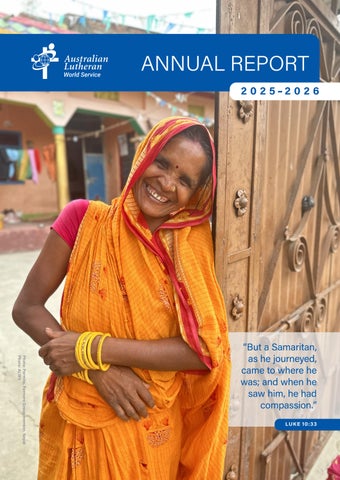
Photo: Parmita, Farmers Group member, Nepal Photo: ALWS
“But a Samaritan, as he journeyed, came to where he was; and when he saw him, he had compassion.” LUK E 10:33
A message from the Chair Photo: LWF Burundi/Diogène Rukundo
In an increasingly uncertain world, the work of Australian Lutheran World Service (ALWS) remains both important and hopeful. Conflict, displacement, climate-related disasters and economic pressures continue to affect communities globally, yet we also see resilience, leadership and determination. Above all, we hold to the hope we have in Christ. A highlight of my first year as Chair was welcoming Mary Obara, Program Manager for Lutheran World Federation (LWF) Kenya-Somalia, to Australia. Her visit highlighted one of ALWS' greatest strengths: people and partnerships. Mary's stories reminded us that sustainable change is achieved not by working for communities, but alongside them. As a Board, we are committed to ensuring that the trust placed in ALWS by supporters, communities and partners is honoured through strong governance, responsible stewardship of resources and clear focus. A new Strategic Plan 2026–2030 was developed to guide ALWS into its next chapter. The plan strengthens our commitment to locally led action, organisational resilience and financial sustainability. It positions ALWS to continue responding to need while keeping dignity, inclusion and partnership at the heart of our work.
Our Mission Following Jesus, we bring people together to partner with communities striving to overcome poverty, crisis and injustice.
Our Vision A world where love comes to life; where all people live in just societies, empowered to realise their potential, uphold their rights, and live with peace and dignity; a world where we remember, welcome, and support those facing poverty and injustice. (1 John 4:9-12, Galatians 2:10, Leviticus 25:35)
Our Values
I am deeply grateful to our staff, partners, Board members, churches, schools, volunteers and supporters who bring this mission to life. Together, we continue reaching out in love for justice.
Jesus-led We believe every person is made in the image of God, with dignity and worth. We follow Jesus’ example of compassion and love in action, standing with people who are experiencing poverty, injustice and crisis.
Morgan Brookes CHAI R , ALWS BOAR D
Welcoming Guided by Jesus’ call to love our neighbours, we welcome people of all cultures, beliefs and backgrounds. We build relationships marked by respect, partnership, and mutual learning. Humble
Photo: LWF Nepal/D Lamsal
We serve with humility, recognising that everything we have is a gift from God and that our work is on behalf of the communities we walk with and the generosity of those who support us. Courageous We stand up for those who are forgotten: people who are marginalised, oppressed, suffering injustice, or in places of extreme need. We share the voices and stories of those we accompany, inviting and inspiring Australian communities to join us in partnership and practical action.
A message from the Executive Director One of the privileges of this year has been spending more time engaging with ALWS supporters across Australia. Through conversations with donors, philanthropic partners, churches, schools and community groups, I have been reminded that our work begins not with projects, but with people. Time and again, I encountered individuals who choose generosity over indifference, and hope over despair. These conversations reinforced something important: ALWS provides an opportunity for people to put their Christian faith and humanitarian values into action. It is a partnership of people united by the belief that every person is created in God’s image and deserves the opportunity to live with dignity, safety and hope. In the pages that follow, you will see the impact of that partnership. You will read stories of families strengthening livelihoods, children accessing education, communities becoming more resilient in the face of disaster and conflict, and people living with disabilities gaining greater opportunity and inclusion. You will also see the stewardship, accountability and local partnerships that underpin our work and help ensure that resources entrusted to ALWS create lasting impact. Thank you for walking alongside us. Your faith, compassion and generosity continue to bring love to life.
Trustworthy We act with honesty, accountability and care. We listen to and collaborate with communities, supporters, and partners, stewarding resources responsibly and working together towards lasting, sustainable change. 2
Michael Stolz E X ECU TIV E D I R EC TO R , ALWS 3
Your 2025-2026 ALWS
Livelihoods
Livelihoods Essential Services
UKRAINE NEPAL
Livelihoods Livelihoods
Essential Services
Essential Services Essential Services
Essential Services
270,374* lives impacted
Livelihoods
Protection and Inclusion
BANGLADESH
Emergencies
Livelihoods
ISRAEL/PALESTINE
Inspire
MYANMAR Livelihoods Livelihoods
Essential Services Essential Services
ETHIOPIA Livelihoods Livelihoods
5,533
Essential Services Essential Services
INDONESIA
SOUTH SUDAN Livelihoods Livelihoods
Livelihoods Livelihoods
Essential Services Essential Services
Essential Services Essential Services
supporters PAPUA NEW GUINEA Livelihoods Livelihoods
BURUNDI Livelihoods Livelihoods
Essential Services Essential Services
SOMALIA
Essential Services Essential Services
Livelihoods Livelihoods
Essential Services Essential Services
$11,330,647 raised
UGANDA
Livelihoods Livelihoods
Essential Services Essential Services
KENYA
Livelihoods Livelihoods
83.6 cents from every dollar supported projects that help and educate people This is the five-year average.
Essential Services Essential Services
124,346 14,199 people with disabilities empowered through development programs
*This is the total number of lives impacted by ALWS action between 1 July 2025 and 30 June 2026. Some of these individuals received multiple forms of support from intersecting projects focused on Livelihoods, Protection and Inclusion and Essential Services.
4
AUSTRALIA
women and girls supported to build their confidence, opportunities and participation
Scan and see your impact in
Papua New Guinea
Photo: ELCPNG
Your action through ALWS is guided by compassion and commitment to dignity. Working through trusted local and global partners, you help people to build sustainable livelihoods, ensure protection and inclusion for the most vulnerable, provide essential services in times of need, respond swiftly to disasters and inspire Australians to walk in solidarity.
What
Church Partnership Program
Local partner
Evangelical Lutheran Church of Papua New Guinea
Where
Morobe, Madang, Eastern Highlands, Simbu, Southern Highlands and West Sepik provinces, and the National Capital District
Who
2,063 people (1,106 female, 957 male, incl. 110 persons with disabilities)
ALWS action
DFAT: $535,784
Co-funders
None
Evaluation
Previous: 2025 | Next: 2029
Livelihoods
Livelihoods Through ALWS, you help break the cycle of poverty by enabling individuals to earn a sustainable income, enhancing their self-worth and dignity and giving them control over their future. Working through local partners, you support the creation of sustainable livelihoods, offering skills training, equipment and mentoring support tailored to each country’s opportunities.
ervices
Protection and Inclusion
ods
Essential Services
Just as Jesus would, your development work through ALWS prioritises the rights of the most vulnerable in the community – children, women, the elderly, people living with disabilities and socially marginalised groups. Your support, delivered through local partners, improves human rights awareness, ensures equal education access, provides assistive devices and supports community leaders to create inclusive communities.
Essential Services Your ALWS action provides essential services such as education, water, health care and shelter to marginalised and vulnerable communities when these services break down due to prolonged crisis. Serving through local partners, you support refugees to receive water, health care and shelter, and ensure that children can attend school so they reach their potential and stay safe from dangers such as abuse and exploitation.
Emergencies When conflict and disaster strike, you respond quickly through ALWS to provide practical support such as food, water, latrines, medical supplies and shelter. This rapid response, delivered through trusted partnerships with Lutheran World Federation, ACT Alliance and local Lutheran churches, is vital to maximise survival and recovery.
Inspire Through ALWS, you engage the Australian public to grow compassion and action for the most vulnerable. You support Australian schools to develop understanding and empathy in students. You invite Lutheran churches to express their faith in action and use community events like Walk My Way to engage the wider Australian public in international aid. You also walk alongside local communities as they support refugees to settle in Australia. 6
Saving for a stronger future
Local context Many families in Papua New Guinea, particularly in remote areas, have limited access to health care, education, safe water and sustainable livelihood opportunities. Women, children and people with disabilities can face even greater challenges accessing these essential services.
Janeth used to describe herself as a “bad spender”. She found it difficult to keep track of her money or save for the future.
Our action together
Through financial literacy training in PNG, Janeth learnt practical skills in budgeting, saving and running a small business.
• 744 education staff received training to strengthen teaching and learning
“After the training, I took some significant steps to change from being a bad spender to a wiser spender," she said.
• 205 people learnt about gender equality and women’s rights
Janeth started selling doughnuts and ice blocks, carefully saving part of her profits. She has now saved PGK 476 ($150 AUD) in a bank account she opened after completing the training.
• 172 church leaders promoted social cohesion initiatives
Now Janeth has bigger plans. She hopes to open a canteen in her village, where families currently struggle to access everyday essentials. The business would provide a new source of income for Janeth while making essential goods easier for her community to buy close to home. Janeth also sees the value of other women and girls learning these skills. “It is very helpful to women and girls and the community as a whole.”
• 110 peopled supported and trained in livelihood skills • 55 health staff trained to improve health services
• 58 people trained in safeguarding knowledge and practice
• 197 people learnt about disability rights and inclusion • 303 people learnt to advocate for their rights and hold decision-makers accountable
What we’re learning Church youth groups provide an effective platform for young people to understand their rights, identify local issues and participate in community-led action.
Our impact 22 years of ALWS engagement in CPP has increased the capacity of ELCPNG to deliver quality services. This year, training equipped health and education staff to better support communities, while 303 people gained skills to advocate for their rights and hold decision-makers accountable. Young people and church leaders participated in community-led action, with greater attention to disability inclusion, gender equality and safeguarding. 7
What
Resilient and Inclusive Community Development
Local partner Centre for Disaster Risk Management
and Community Development Studies – Universitas HKBP Nommensen
Where Who ALWS action
North Sumatra, West Sumatra and Riau Provinces
Leading the crop
9,905 people (5,051 female, 4,854 male, incl. 1,458 persons with disabilities) ALWS: $104,426 DFAT: $371,863 Total: $476,289
Co-funders
Evangelical Lutheran Church in America
Evaluation
Previous: 2025 | Next: 2028
Local context Families in Indonesia face economic hardship and increasing exposure to natural disasters that threaten their homes, livelihoods and access to essential services. People with disabilities, women and children can face additional barriers to earning an income and accessing services.
Our action together • 1,912 people improved their access to food, including 610 families who established home gardens • 3,383 people participated in cooperatives, savings and loans groups and farmer groups • 3,011 people received training in disaster preparedness and climate-related risk reduction • People with disabilities across 56 villages accessed community-based rehabilitation, while 4,678 people received training in disability rights and inclusion
What we’re learning Savings and loan groups help members build financial skills, access finance and support one another. Disability self-help groups, including those led by people with disabilities, strengthen social connections and help members have a stronger voice in their communities.
Our impact 22 years of ALWS engagement has helped vulnerable communities to become more disaster resilient. This year, people strengthened their livelihoods and food security through groups and small businesses, including 610 families who established home gardens. Communities were better prepared for climate-related risks, while people with disabilities increased participation in community groups and identified their needs and priorities. 8
Photos: CDRM&CDS-UHN
Indonesia
Rismelina leads the Sikoppuk Farmers Group in Indonesia. Since joining the group, she says one of the biggest things she has learnt is how to be a better leader. “It is not easy. I have to be wiser and fairer toward the members", she shared. The group has faced plenty of challenges. Farmland has been flooded by high tides, while newly cultivated land has had poor soil. But members have continued farming together. Through the project, they learnt new planting techniques, how to improve the soil, make organic fertiliser and manage conflict. Their first corn harvest produced 100 kilograms, earning around $80 AUD. The group now also grows cucumbers, eggplants and chillis, with vegetables harvested each week. Members save much of their income through the group and can access loans to buy seeds and fertiliser. Rismelina says learning how to manage disagreements has helped the group stay together. “The group members are now more cooperative. This has made the group more united and prosperous.” The harvest is also helping at home. Members no longer need to buy chillis and some vegetables, helping their families eat a greater variety of nutritious food.
Myanmar What
Rights Based Empowerment Program
Local partner
ALWS local partner
Where
Hlaingbwe and Kyanseikgyi in Kayin District; Chaungzon and Mudon in Mon District; and Muson in Magway District
Who
3,801 people (2,067 female, 1,734 male, incl. 38 persons with disabilities)
ALWS action
ALWS: $92,329 DFAT: $227,671 Total: $320,000
Co-funders
Evangelical Lutheran Church in America, ACT Church of Sweden, German National Committee of the LWF
Evaluation
Previous: 2024 | Next: 2028
Local context Conflict, natural disasters and economic hardship continue to displace people and make it difficult for families to access food, essential services and reliable sources of income.
Our action together • 437 farmers gained skills in climate-smart farming and access to quality farming supplies • 120 families received farming and livestock support • 37 community groups improved responses to genderbased violence and child protection concerns • 37 disaster risk management committees trained to strengthen community preparedness • 16 community groups supported to improve access to primary health services • 89 households supported to access safe water, toilets and handwashing facilities
What we’re learning Locally led approaches are essential during times of crisis – local partner staff sustained project activities and self-reliance groups led community initiatives. With local leadership, communities adapt, stay connected and increase resilience.
Our impact 9 years of ALWS engagement has strengthened local leadership and community agency to drive rights-based, resilient and sustainable development. This year, locally led support strengthened community preparedness and access to essential services. People gained skills to respond in emergencies, 89 households improved their access to safe water and sanitation, and women gained new opportunities to earn an income and support their families. 9
What
RDRS Emergency Response Program Enhancing Living Standards and Promoting Peaceful Coexistence for Rohingya and Host Communities in Cox’s Bazar, Bangladesh
Local partner RDRS Bangladesh Where
Cox’s Bazar District
Who
10,977 people (7,490 female, 3,487 male)
ALWS action
ALWS: $75,000
Co-funders
Diaconia Evangelical Church of Czech Brethren, ACT Church of Sweden
Evaluation
Previous: Nov 2024 | Next: N/A
Acknowledging the close eight-year partnership with RDRS Bangladesh, this project concluded in December 2025 in line with ALWS strategic priorities, having supported Rohingya refugees and local communities to improve their livelihoods and strengthen community connections.
Local context Rohingya refugees and local communities face food shortages, poverty and the threat of natural disasters. Cuts to humanitarian funding have made it even harder to access essential services, stay safe and earn an income.
Our action together • 150 Rohingya refugees and 175 local community members joined groups to help them earn an income • 269 people received gardening training and supplies to help grow food at home • 175 people received skills training and resources to help them build a business • 1,250 trees were planted across refugee camps and surrounding communities
What we’re learning Involving Rohingya refugees and local communities in project activities builds trust and cooperation. Combining farming, livelihood support and disaster preparedness helps families face challenges, while inclusion of young people and people with disabilities remains important.
Our impact ALWS engagement since 2018 has improved access to livelihoods and income-generating opportunities for Rohingya refugees and host communities. This year, refugee communities and local families gained new skills and opportunities to earn an income and grow food. Tree planting, disaster preparedness and paid work activities helped communities care for their environment, while greater community involvement strengthened cooperation and trust. 10
Nepal
Photos: LWF Nepal/Dipendra Lamsal
Bangladesh
What
Local Initiatives for Community Empowerment and Development project
Local partner LWF Nepal
Growing a brighter future Sirjana was 14 when her mother died. With two younger brothers to care for, she took on greater responsibility within her family. When her father later injured his back and could no longer work, Sirjana made the difficult decision to leave school.
Where
Bajura, Doti, Kanchanpur, Kailali, Surkhet, Bardiya, Lalitpur, Dhanusa, Siraha, Morang, Jhapa and Dailekh
Who
11,393 people (8,642 female, 2,751 male, incl. 1,294 persons with disabilities)
ALWS action
ALWS: $225,480 DFAT: $512,019 Total: $737,499
Co-funders
Evangelical Lutheran Church in America, German National Committee of the LWF, Olive Branch Foundation, Asia Pacific Mission for Migrants
Evaluation
Previous: 2024-25 | Next: 2027-28
Local context Economic hardship is being made worse by more frequent floods, landslides and other climate-related disasters. These events threaten safety, disrupt access to services, put livelihoods and communities at risk and make recovery slower and more difficult.
Our action together • 963 people learned about human rights, protection and conflict resolution
“I had to leave my studies, but I want my brothers to continue theirs. Their future is now my responsibility", Sirjana said.
• 2,474 people learned safe water, sanitation and hygiene practices
Now 19, Sirjana is using farming to support her family and build a more secure livelihood in Nepal.
• 1,662 people learned climate-smart farming techniques
Through the project, she received training, seeds and farming tools. She applies her new skills to grow rice, maize, lentils and vegetables, including onions, cabbages, spinach and cucumbers.
• 472 community members trained in disability-inclusive disaster preparedness and planning
Sirjana sells some of her produce at the local market. The income helps her buy household essentials and invest in new seeds and fertiliser. Sirjana still dreams of completing her own education, and one of her greatest hopes is seeing her brothers succeed. “My wishes are that I can see my brothers being educated and successful.”
• 84 teachers trained in inclusive education • 640 people started their own small businesses • 2,704 people strengthened livelihoods with technologies
What we’re learning Collaboration between communities and government strengthens the sustainability of project outcomes. Building local skills and systems helps communities continue activities and respond to future challenges.
Our impact 35 years of ALWS engagement has helped villages transform into resilient, self-reliant communities able to lead and sustain their own development. People strengthened their livelihoods through climatesmart farming, new technologies and small businesses. Communities improved their access to essential services, identity documents, and inclusive disaster preparedness. 11
What
Photos: LWF Ethiopia
Burundi Community Integrated Development Tujijuke
Local partner LWF Burundi Where
Cankuzo, Gisagara (including Mishiha), Ruyigi (including Butezi), Gisuru, Muyinga and Butihinda in the new Buhumuza Province
Who
13,716 people (7,164 female, 6,552 male, incl. 388 persons with disabilities)
ALWS action
ALWS: $141,737 DFAT: $383,247 Total: $524,984
Co-funders
None
Evaluation
Previous: 2025 | Next: 2027-28
Local context Fuel shortages, rising prices, reduced rainfall, rapid population growth, and returning refugees and restricted cross-border trade are making it harder for families to earn an income, access food and essential services.
Our action together • 2,568 people received seeds, farming equipment and agricultural support • 2,498 people learnt modern farming techniques • Communities created firebreaks and contour lines to protect against fire, erosion and extreme weather • 337 people received livestock and veterinary support • 55 young people graduated from vocational training: 50 launched small business or livestock enterprises • 2 rice hullers and a storage shed are helping farming cooperatives store, process and sell their harvests • Community leaders took part in activities promoting gender equality and preventing gender-based violence • Three water sources were restored, giving 304 households better access to safe water
What we’re learning Training has greater impact when participants also receive ongoing mentoring and support from their communities, helping them apply new skills and sustain progress.
Our impact 17 years of ALWS engagement has shifted communities from participants to change-makers, strengthening decision-making agency to drive lasting development. This year, 54 farmer groups and 90 model farmers produced more than 88 tonnes of maize, improving food security. Fifty-four savings groups grew combined savings from 5 million BIF ($2,390 AUD) to 133.6 million BIF ($63,800 AUD), strengthening financial security and income opportunities for families.
12
Hope is in store Tigist is 22 years old and cares for her young daughter and three younger siblings in Ethiopia. After her mother died when Tigist was 18, she left school to take responsibility for her family. Tigist joined a Village Savings and Loan Association, where she learnt to save and gained access to loans. She borrowed 100,000 Ethiopian Birr ($880 AUD) and used it to open a small shop. To grow her business, Tigist also began buying eggs from local poultry farmers and selling them at nearby markets. Tigist now makes $18 AUD profit each week, and her small business has grown to be worth $3,500 AUD. Her income helps her care for her family, while continuing to save and invest in her business. “Before joining the project, I had lost hope for my future. Today, I stand on my own feet. I can support my family, save money, and dream about expanding my business", Tigist said. Now, Tigist plans to grow her shop into a larger trading business. “I thank LWF and the Australian Government for giving me this opportunity. Their support has completely changed my life."
Ethiopia What
Livelihoods and Resilience Building and Gender project to People Affected by Impacts of Climate Change
Local partner LWF Ethiopia Where
Lasta District, North Wollo zone, Amhara Region of Ethiopia
Who
8,241 people (3,788 female, 4,453 male, incl. 299 persons with disabilities)
ALWS action
ALWS: $118,137 DFAT: $371,863 Total: $490,000
Co-funders
None
Evaluation
Previous: 2024 | Next: 2027
Local context Conflict, drought, unreliable rainfall and rising prices are making it harder for families to grow enough food, earn an income and adapt to the impacts of climate change.
Our action together • 180 women received poultry training and 1,080 chickens, improving household income and nutrition • 30 families received 60 beehives producing 900 kg of honey, providing a new source of income • 38 young women started goat-rearing businesses, and grew their herds from 120 to 235 goats • 571 people learnt marketing skills, strengthening their businesses • 1,200 farmers trained in climate-resilient farming • 1,598 people trained in disaster preparation • 1,404 people learned about gender equality, while local partners created more opportunities for women to lead
What we’re learning Strong local partnerships help activities continue in challenging conditions, while connecting farmers with reliable buyers supports stronger and more sustainable incomes.
Our impact ALWS engagement since 2023 has strengthened the resilience of drought and conflict-affected communities, improving food security and incomes for families through climate-resilient farming, irrigation and sustainable livelihoods. This year, more women earned incomes and participated in household decisions. Food security and income was strengthened through farming, livestock and small business activities, including honey production, poultry and goat-rearing, and reliable year-round irrigation.
13
What
Building Resilience for Sustainable Futures in Jonglei State. Strengthening Communities in Magwi County. Australian NGO Cooperation Program Gender Project.
Local partner LWF South Sudan Where
Twic East, Duk and Bor South counties, Jonglei State and Magwi County, Eastern Equatoria state
Who
Jonglei: 26,168 people (13,105 female, 13,063 male) Magwi: 7,190 people (3,765 female, 3,425 male)
ALWS action
ALWS: $693,603
Kenya
Photos: LWF Kenya-Somalia
South Sudan
What
Local partner LWF Kenya-Somalia
Evaluation
ACT Church of Sweden, Bread for the World, Canadian Lutheran World Relief, Evangelical Lutheran Church in America, German National Committee of the LWF
Local context Conflict, flooding and displacement continue to disrupt livelihoods and access to food, safe water, education and healthcare.
Our action together Jonglei
• 115 farming households supported in crop-production • 213 people trained and supported in poultry farming, fishing and small business activities • 8,774 people received information about protection from violence and abuse, and accessing support Magwi • 2,113 students benefited from education activities and improved learning resources • 774 students, including 66 with disabilities, received school supplies, and 170 adolescent girls received dignity kits • 212 people strengthened livelihoods with sustainable agriculture, beekeeping and seed-production activities
What we’re learning Local partnerships and practical training helps communities lead and sustain change. Combined livelihood and protection activities address immediate risks and strengthen longer-term resilience.
Our impact ALWS engagement since 2004 has improved access to livelihoods and income generating opportunities for vulnerable communities. This year, food security and income opportunities were strengthened through farming, small business and livelihood support in Jonglei and Magwi. In Magwi, education activities improved access to learning resources, school supplies and more inclusive schools. 14
Kakuma and Dadaab
Who
DSP: 152,459 people (66,121 female, 86,338 male) AAP: 51 people (13 female, 38 male) ALWS: $620,605
ANCP Gender Project ALWS: $4,797 DFAT: $20,870 Total:$25,667
Total: $646,272
Speaking up
Co-funders
None
Evaluation
Previous: 2024 | Next: 2027
Local context
Jonglei Previous: 2024 | Next: 2027 Magwi Previous: 2023 | Next: 2027
Where
ALWS action
ANCP Gender Project ALWS: $4,797 DFAT: $20,870 Total:$25,667
Total: $719,270
Co-funders
Durable Solutions Project for displaced populations in Kenya. Ambitious Africa Project in Kakuma. Australian NGO Cooperation Program Gender Project.
For children living in Dadaab Refugee Camp in Kenya, school can be a safe place to learn, build skills and discover what they can do.
Refugee and host communities face reduced humanitarian assistance, pressure on essential services, limited opportunities to earn an income and climate shocks. These challenges affect access to education, protection and secure livelihoods.
Ten-year-old Samuel experienced this when he entered the Dadaab Children Got Talent competition.
Our action together
Samuel progressed through his class and school competitions but was disappointed when he wasn’t selected for the next stage of the competition.
• 3,261 students received counselling, safeguarding and wellbeing support at school
However, his confidence and communication skills stood out, and he was invited back to speak at the grand finale in front of hundreds of students, teachers, parents and community members. His speech earned him the title of Most Outstanding Young Presenter. “I thought my journey had ended, but I discovered a talent I never knew I had,” Samuel says. Since the competition, Samuel has spoken at major community events, further developing his communication and leadership skills. School-based activities like this help children in Dadaab build confidence, develop communication and leadership skills, and participate more actively in their communities.
• 133,172 students accessed safe, inclusive, quality education
• 11,620 young people participated in sports, advocacy and protection activities • 308 community members trained in peacebuilding and conflict resolution • 188 young people and mothers completed vocational training • 124 farmers received climate-smart farming training, seeds and follow-up support • AAP: 51 young people trained in livelihood activities and skills development, including 3D modelling
What we’re learning School-based counselling makes support easier for students to access. Peacebuilding and livelihood activities are most effective when communities help lead them and participants receive ongoing support.
Our impact 30 years of ALWS engagement has transformed the lives of displaced children through educational services. This year, children and young people strengthened their access to education, protection and livelihood opportunities. School-based support reached 3,261 students. Vocational training and livelihood activities helped young people and adolescent mothers develop practical skills for employment and business. Peacebuilding activities strengthened community capacity to resolve conflict. 15
Somalia Empowering Inclusive Communities: Children with Disabilities & Vulnerable Groups, Rights, Wellbeing, Development. Promoting Community Resilience through Engaging Somali Society
Local partner LWF Kenya-Somalia Where
Kismayo, Jubbaland State and South West State, Somalia
Who
9,017 people (4,982 female, 4,035 male, incl. 375 adults and 6,497 children with disabilities)
ALWS action
What
Co-funders
DaDoKI: Bread for the World, ACT Church of Sweden, jointly implemented with LWF and American Friends Service Committee
Evaluation
Previous: 2025 | Next: 2028
Conflict, drought and displacement are limiting access to food, education and essential services in southern Somalia. Children with disabilities face additional barriers.
Our action together • 6,497 students with disabilities enrolled in and remained in school • 350 people, including 100 teachers, trained in inclusive education • 1,800 people with disabilities accessed rehabilitation • 150 caregivers improved literacy and numeracy skills • 400 caregivers received counselling • 50 caregivers received vocational training & supplies • 600 people trained in disability rights and inclusion
What we’re learning Community involvement helps reduce disability-related stigma. Trained teachers, practical resources and accessible services support people with disabilities to participate more fully in education, livelihoods and community life.
Our impact 9 years of ALWS engagement has strengthened Somalia’s government institutions to deliver quality and inclusive education. This year, children and people with disabilities were supported to access education and rehabilitation; caregivers gained literacy, vocational and wellbeing support; and communities promoted inclusion.
Water for Agricultural Production and Prosperity in Amudat District
Local partner DanChurchAid Uganda and Transcultural Psychosocial Organisation
Where
Amudat District, Karamoja Sub-region, Uganda
Who
400 people (333 female, 67 male, incl. 9 persons with disabilities)
ALWS action TCF: $83,224
ALWS: $209,205 DFAT: $280,795 Total: $490,000
Local context
16
Photos: LWF Kenya-Somalia
What
Uganda
Co-funders
The Charitable Foundation (TCF)
Evaluation
Previous: N/A | Next: 2029
Local context
Moving forward
Hassan is a 50-year-old father of six living in a displacement camp in Somalia. He previously worked as a cart loader to support his family, but after developing severe weakness in his legs, he could no longer stand or walk. Hassan says, “Life has been very difficult. I depend on others for basic activities.” Determined to continue supporting his family, Hassan made the difficult journey to the market without a mobility aid, often injuring his hands. “Before, I used to crawl everywhere, especially to the market, and it caused a lot of pain and injuries to my hands.” After hearing about the ALWS-supported project from a friend, Hassan began physiotherapy. “The exercises are helping to reduce stiffness in my legs and improve my strength little by little.” Hassan also received a tricycle wheelchair, allowing him to move safely and independently. “The difference is huge. I can travel longer distances, save time, avoid pain and move with dignity. I feel safer, more confident and hopeful that I can regain some independence. I am ready. I want to improve my condition and live more independently.”
Prolonged dry spells and unpredictable rainfall make it difficult for families in Amudat District to grow food, care for livestock and earn a reliable income. Only 7.6 percent of households have access to improved water sources for drinking and agricultural production.
Our action together • Local partners, government representatives and community leaders came together to plan and launch the project • One borehole site and two existing springs were identified for water infrastructure to support households and agricultural production • Communities provided 10 acres of land in Achoricor and Loroo for irrigated horticultural production • 200 households were identified to participate in horticultural activities, while technical preparations began for borehole drilling and improvements to existing water sources
What we’re learning Early engagement with communities, local government and technical partners is building shared ownership and clarifying responsibilities. Flexible planning has also allowed water infrastructure work to be brought forward, creating more time to monitor changes in food production, household income and food security.
Our impact In 2026, ALWS commenced a new partnership with DCA Uganda. The three-year project is funded by TCF and will improve access to water for farming in the semi-arid region of Karamoja. This first year focused on establishing partnerships, securing land, identifying water sources and preparing households to participate. This groundwork supports the project’s longer-term goal of providing reliable water for irrigated farming, livestock and household use, helping families increase food production and income. 17
Photos: LWF Burundi/Diogène Rukundo
Humanitarian response Photos: LWF Burundi/Diogène Rukundo
ALWS responded to 11 emergencies, providing life-saving assistance to 13,638 people affected by disasters and conflict. Your support helped provide emergency food, safe water, shelter, hygiene supplies, essential household items and protection for people forced from their homes, including psychosocial support. Your ALWS emergency work focuses on ensuring communities receive timely, effective and relevant help. Through trusted local and international partners, assistance is guided by community needs, with particular care for women, children, older people and people with disabilities. In Australia, we partner with the Emergency Action Alliance, Christian aid agencies through Church Agencies Network Disaster Operations, and Department of Foreign Affairs and Trade through the Australian Humanitarian Partnership. Overseas, we work alongside the Lutheran World Federation, ACT Alliance and trusted local partners to deliver emergency assistance.
Rehema’s hope for
Beyond immediate relief, your support helps communities prepare for future disasters through stronger emergency plans, early-warning systems and local training, building resilience and food security, and helping families recover and rebuild.
Country
Impact
ALWS action
Nepal – floods and landslides
693 people received emergency life-saving support, following floods and landslides in Jhapa District.
$40,000
South Sudan – refugee crisis
Conflict in Sudan continued to force refugees and returnees into Renk, South Sudan. 2,493 people supported with humanitarian assistance through the ACT Alliance multi-disaster appeal.
When renewed conflict forced thousands to flee the eastern Democratic Republic of Congo and seek safety in Burundi, Rehema was among them.
$40,000
Bangladesh – Rohingya refugee crisis
“My husband was killed in the war. He was not fighting – he was shot by stray bullets", she said.
134 Rohingya refugees in Cox's Bazar received emergency assistance.
$100,000
•
Burundi –Congolese refugee crisis
300 women and girls in highly vulnerable situations were assisted with dignity kits to address specific personal hygiene needs.
Shelter: construction of 250 semi-durable emergency shelters for vulnerable refugee families
$100,000
•
Kenya and Somalia – drought
6,510 people were provided life-saving supplies and services through the ACT Alliance East Africa appeal.
$200,000 total ($100,000 each country)
“I went across the river to save my life. When we were fleeing, two of my children fell from the boat into the river. They slipped and fell into the water. I could not save them. Two of my other children got lost as we were running. I searched, but I never found them. Everything happened so fast.
Cash assistance: three monthly payments for 2000 people to help meet food and other essential needs
•
Ethiopia – conflict and displacement in Tigray
400 people were supported with cash assistance, alongside protection services for people facing greater risks.
Safe water: a water supply system with eight water points
$100,000
We fled in February and arrived here in April. We walked for days. Sometimes we slept by the roadside. Sometimes we hid in the forest when we heard gunfire. We were hungry and tired."
•
Sanitation: 40 latrines, 20 showers and handwashing facilities
Myanmar – earthquake recovery
1,831 people received emergency life-saving assistance.
$40,000
•
Household hygiene: distribution of 250 hygiene kits
Indonesia – floods and landslides
940 people received emergency food, nutrition and hygiene assistance, following flooding and landslides in North Sumatra.
$40,000
•
Dignity support: distribution of 1,250 dignity kits to women and adolescent girls
Jerusalem – Palestine conflict
37 critically ill patients received essential medical supplies for dialysis and oncology needs at the Augusta Victoria Hospital.
$40,000
Ukraine – Sumy Oblast response
300 vulnerable and displaced people were provided life-saving interventions, including hot meals, hygiene kits and psychosocial support.*
*$40,000
*Ukraine support reported as protracted crisis in audited finances. 18
Note: This story contains sensitive accounts of conflict, loss and displacement. We share Rehema’s experience with respect, honouring her courage in sharing her story.
TOTAL
More than 65,000 people living at the Busuma refugee site, designed for 20,000. Families urgently need shelter, safe water, sanitation and other essential support.
Your action helps provide:
ALWS is working alongside Lutheran World Federation Burundi to help 2,000 refugees in 250 households living at Busuma. Rehema continues to hold on to her faith and her hope for peace: "I want peace. I want safety. I want to live without fear. I don’t want any other mother to go through what I went through."
$740,000 Giharo refugee camp
19
E VALUAT IO N
CA SE
ST U DY
Working to deliver gender policy commitments Across the countries where ALWS works, women and girls face barriers to their safety, participation, decision-making and opportunities.
Evaluating our work
Harmful gender norms, including early and forced marriage, gender-based violence, unequal access to education and livelihoods, and expectations about women’s roles, can affect individuals, families and whole communities.
ALWS supports the evaluation process and follows up on recommendations so that learning can strengthen future programming.
ALWS’ partners work alongside women, men, schools, faith leaders and community groups to address the underlying causes of inequality. By encouraging shared decision-making, supporting women’s leadership and challenging harmful practices, programs are helping create safer, more inclusive communities where women and girls can participate, contribute and lead.
ALWS works with partners to evaluate programs, understand what is working well and identify where improvements can be made.
During the 2025-2026 reporting period, an independent evaluation of gender programming was conducted: the Capacity Development Support for Implementation of Gender Policy Commitments Project. The evaluation covered seven partners working across Kenya-Somalia, South Sudan, Burundi, Nepal, Ethiopia, Myanmar and Indonesia.
What we've learnt • Lasting change is more likely when communities take ownership of solutions
Photos: ALWS
• Working with men and boys is essential in creating more equitable families and communities • Faith leaders, community leaders and respected local champions can play an important role in challenging harmful gender norms • Women’s leadership grows when practical skills, confidence-building and economic opportunities are developed together • Working closely with local stakeholders helps programs continue even in fragile and conflict-affected settings
• Embed gender outcomes, indicators and budgets across development programs • Strengthen staff and partner capacity through practical training, coaching and peer learning • Scale successful approaches and continue sustained community engagement
people in Kenya
53
teachers in South Sudan
In Nepal, partners will strengthen work with faith leaders, men and boys to challenge discriminatory social norms, while supporting communities and local partners to identify the norms they want to change, and develop more local champions.
community groups in Myanmar
37
participated in International Women's Day and 16 Days of Activism against Gender-Based Violence activities in Kakuma and Dadaab
were trained to promote gender equality
strengthened their capacity to respond to gender-based violence and child protection concerns
Now women have a voice Four years ago, Regina joined a farming cooperative in her community in Burundi. She learnt new ways to grow vegetables, including tomatoes, and began seeing better harvests.
The cooperative has also helped Regina build her farming knowledge. Before joining, she says she knew little about cooperatives or modern farming methods.
But for Regina, the biggest change has reached far beyond her garden.
“Since learning to separate crops properly, I harvest more than before. My harvest capacity has increased. I have seen improvement whenever I harvest.”
As part of the project, Regina took part in training about women’s and children’s rights. She describes a profound change in how women are heard in her community.
• Programs need adequate resources and long-term commitment to sustain progress
Regina shared:
• Define clear outcomes that address harmful gender norms and unequal power relationships
1,417
In South Sudan, this includes expanding genderequality training for teachers, increasing the number of female teachers who can act as mentors and role models, growing school Gender Clubs and strengthening School Management Committees to champion gender equality.
• Changing deeply entrenched attitudes and behaviours requires sustained engagement, mentoring and follow-up
What we will do next
20
Regina and her Farming Cooperative colleagues, Burundi
“Since the project came to our village, everything has changed. Before, women were not listened to. Now women have a voice. Women can speak in meetings. People listen to women now.”
Regina says attitudes toward children have changed too. “Before, children were not going to school. After the training, we understood that children should go to school. Children should not be given heavy work before they are grown. Because of the training, many children returned to school.” For Regina, better harvests are only one part of what has changed. Women are participating and being heard, while families have a new understanding of children’s rights. “Now women have a voice.” 21
PRECIOUS connections
It’s egg-cellent!
Mary Obara and Julie Krause at Holy Trinity, Horsham
For Year 6 student Ruby, learning about ALWS at school sparked a commitment to helping children around the world. “Every year I donate to ALWS. The first time I did this was in Year 4 when ALWS came to our school and I was inspired to help", she said.
Across 21 events in four states and the ACT, Mary and the ALWS team engaged more than 1,500 people: church members, supporters, seniors, students, teachers, pastors, politicians and aid-sector leaders. Through school visits, church events, Asante supporter gatherings, women’s networking events and media interviews, Mary shared first-hand insights into poverty, displacement and girls’ rights. She also equipped 80 Lutheran school staff with stories and insights to inspire students toward service, compassion and responsible global citizenship. In Canberra, she brought a program partner’s perspective to discussions with government and international-aid leaders. The visit helped launch ALWS’ PRECIOUS campaign to help protect 1,000 girls from child
“Each year I get some pocket money from either my birthday or from chores that I do to earn more money. I like to give this to ALWS to give gifts to other children. From the first time that I heard about it and learnt that I could send a child to school for $25, I thought that was something I could do.
marriage by Mother’s Day through education, dignity, opportunity and community awareness.
The first year I gave $50 so that I could send 2 children to school.
Australians responded with extraordinary generosity with funds raised to protect 3,000 girls, three times the original goal.
This year I raised money from selling my uncle's eggs.
We give thanks to every supporter, school, church and community member who helped turn learning and concern into practical support for girls’ safety, education and futures.
Thank you for your service
Number
School workshops & chapel presentations
140
My share was $48. I wanted to donate the whole lot to ALWS.
Lutheran schools engaged
44
Number of students & teachers engaged ALWS School Ambassadors
Photos: ALWS
70
Photos: David Grieger
Using the Containers for Change deposit scheme, the congregation has a container collection point at church where members bring their recyclable containers.
Photos: ALWS
And every month, more than 500 people give something else that’s precious: their prayers for the communities you work alongside.
15,404
At St James Hervey Bay Queensland, the congregation is showing that small change adds up.
It's cents that makes sense! Congregation members recycling containers to fund hot meals in Kakuma.
In the reporting period, volunteers in the Albury office donated 375 hours of their time, representing a saving of $11,696. This means more of your donation can go to those who need it most.
Each month, volunteers like David Grieger (L) and Leon Weise (R), take these containers to be recycled. The proceeds are used to provide meals for refugees in Kakuma Refugee Camp, Kenya through the work of ALWS. By the end of 2025, the congregation had recycled an amazing 20,000 containers since 2019, receiving $2000 in change and providing 10,000 hot meals. For Hervey Bay congregation, it's cents that makes sense!
Thank you for giving your time, talents and prayers.
22
School Engagement
Small change adds up
Then and now: Jenny radiating joy in the office, ALWayS
Faith in action
My brother and I walked up and down our neighbourhood streets knocking on doors to sell the eggs. We made $96.
I just want to help."
ALWS is deeply thankful for the dedicated service of Administration Officer Jenny Monte. For 40 years, Jenny served with a smile as big as her heart in the Albury office. She made sure our supporters received receipts, correspondence and Gifts of Grace on time. Thank you, Jenny!
Become a prayer partner: 1300 763 407
Photo: ALWS
Photo: ALWS
In March 2026, ALWS brought Mary Obara, Lutheran World Federation Program Manager for Kenya and Somalia, to Australia to help Australians understand the challenges communities face and the work that is made possible by your support.
Ruby sharing with her classmates
Volunteers Dalise and Wendy sending your Gifts of Grace orders
23
Photos: St Johns congregation, Unley
1
Left: Navigating public transport in Adelaide Below: Receiving blankets made from knitted and crocheted squares, which had adorned the Unley congregation Christmas tree
J U LY
202 5
–
30
JU N E
2026
Morgan Brookes
Jodie Hoff
Andrew Kotzur
Alice Caldwell
CHAIRPERSON from 1 January 2026
BOARD MEMBER Chairperson until 31 December 2025
VICE-CHAIRPERSON
BOARD MEMBER
BBus (Admin), MAICD Managing Director of Kotzur, NSW Commenced 27 March 2020
LLB(Hons), BIR, GradDipLegPrac Senior Legal Officer, ACT Commenced 5 September 2023
BA, BEd (Hons), GradCertBus Assistant Principal Marryatville High School, SA Commenced 8 September 2011
BTeach, BEd, GradDipED (Theology), MEdLeadership LEA Executive Director Commenced 7 March 2019
Leo Orland
Rev Richard Fox
Peter Schirmer
Rev Mark Schultz
BOARD MEMBER
BOARD MEMBER
BOARD MEMBER
CONSULTANT
BTheol; DipArts (Media), DipAdvertising; CFRE (Retired); FIA Fellow (Emeritus) Retired (Previously Senior Strategist at Precision Fundraising) Commenced 25 October 2025
BMin, BTh, Assoc Dip Accounting Pastor at Zion Lutheran Church, Glynde SA Commenced 15 February 2026
BA (Hons); MDevStud; DipFinCounselling Financial Counsellor at Lutheran Care, SA Commenced 1 January 2025
BTh, GradDipMin LCANZ Assistant to the Bishop - International Mission Commenced 23 September 2023
Jodie Hoff served as ALWS and ALWS Ltd Chair from January 2020 to 31 December 2025. Rebecca Robinson served on PAC until 30 December 2025.
When Somali refugees Abdale, Madina and their six children arrived in Adelaide in May, they found more than a new country. They found a community ready to welcome them. Before arriving, Madina had expressed one simple hope for her family: “We just want to live in peace.”
Arriving from Dadaab Refugee Camp in Kenya into an Adelaide winter, the family was especially grateful for warm clothing and bedding. For Glenice Hartwich and the St John’s CRISP team, the journey has revealed God’s provision through the generosity of his people and created opportunities for friendship and understanding across faiths. “It has been a joy and privilege to be God’s love with skin on. We have seen his care in every step,” Glenice said. “On their first night in their new home, we acknowledged that they are of the Muslim faith and that we are followers of Jesus. We sang 24
A Christmas Blessing over them,” Glenice said. “It is a joy to share our faith in Jesus in practical ways.” Supported by ALWS, the partnership is helping refugee families rebuild their lives through practical care, friendship and hospitality. For Abdale, Madina and their children, this welcome has brought safety, belonging and hope. ALWS supports Lutheran churches to participate in CRISP, the Australian Government’s community refugee settlement program. Through CRISP, local churches can bring love to life by providing practical hands-on support to a refugee family arriving in Australia. Unley is the first Lutheran congregation to partner with a refugee family.
Program Advisory Committee (PAC)
Michael Stolz
PAC members are Peter Schirmer (Chairperson), Anthony Sell, Rebecca Robinson (until 30 Dec 2025), Geoff Robinson, Louise Coventry ( joined Jan 2026), Elijah Buol ( joined Jan 2026). PAC consultants are Vicki Gollasch and Michael Stolz.
E XECUTIVE DIRECTOR
PAC met on 12 March 2026, 6 September 2025.
DipEd, BTh (Lutheran Ed)
Finance, Audit and Risk Committee (FAR) FAR members are Andrew Kotzur (Chairperson), Ron Asquith, Kerryn Simpfendorfer, Tim Wiebusch ( joined Nov 2025). FAR Consultants are Shane Buckland and Michael Stolz. FAR met on 8 August, 14 October, 11 November 2025 and 21 Jan, 20 March and 18 May 2026.
BEng, EMBA, GAICD
Vicki Gollasch PROGRAM MANAGER
Shane Buckland CHIEF FINANCIAL OFFICER CA, BComm (Acc)
Jonathan Krause COMMUNIT Y ACTION MANAGER
Fundraising and Marketing Committee (FAM)
BA
FAM Members are Leo Orland (Chairperson), Lorelei Baum, Tony Smith, Stephanie Richards ( joined 2026), Nathan Flannery ( joined 2026). FAM consultants are Jonathan Krause, Aaron Glover and Michael Stolz.
Aaron Glover
FAM met on 4 August 2025 and 3 March 2026.
Photos: ALWS/Anthony Bothe
Through the Community Refugee Integration and Settlement Program (CRISP), members of St John’s Lutheran Church Unley spent 18 months preparing for the family’s arrival. They raised funds and found a rental home, with help from UnderdaleGlandore parish. Through a special Gifts of Love catalogue, congregation members donated beds, furniture, kitchenware, linen and other essentials— transforming a house into a home.
The ALWS Ltd Board met on 14 August, 15 October, 22 November 2025, 12 March, 27-28 March and 21 May 2026.
COMMUNIT Y ENGAGEMENT MANAGER MBA, BBus
25
Financial Summary
Strong support through donations, bequests and grants, along with disciplined stewardship has strengthened ALWS' financial position. This support enabled ALWS to fund international programs, strengthen program quality, engage Australian communities, build future capacity and maintain the strong governance expected of a trusted charity.
Revenue & Expenditure Millions
The generosity of ALWS supporters enabled another year of life-changing impact for people experiencing poverty, displacement and crisis. During 2025-26, ALWS received $11.3 million in income, supporting both our current operations and our work into the future.
12 10 8 6 4 2 -
2022
Income ALWS received $11.3 million in income during 2025-26. Donations of $5.1 million, bequests of $2.9 million and grant income of almost $3.0 million reflected the generosity of supporters and the strength of partnerships with churches, schools and the Australian Government.
Expenditure With the support of donors and partners, ALWS provided more than $6.2 million for overseas humanitarian responses, protracted crises and long-term development programs. Through trusted local partners, this support helped people access education, strengthen livelihoods, prepare for climate shocks, live more safely and receive assistance during emergencies. During the year, ALWS also began a new partnership supporting communities in Uganda. Across Australia, churches, schools and supporters partnered with ALWS through prayer, advocacy, fundraising and events such as Walk My Way, helping build awareness and support for people experiencing poverty, displacement and crisis. ALWS remains committed to stewarding every dollar with care, ensuring resources are used efficiently and transparently to maximise impact. Over the past five years, 83.6 cents of every dollar spent supported international programs, domestic projects and community education. The remaining 16.4 cents supported fundraising, accountability and administration – essential work that enables ALWS to operate responsibly, transparently and effectively. 26
2023
2024
2025 2026 (6 mths)
Financial Highlights WH E R E
YO U
Program Expenditure
Amount
Percentage
Sub-Saharan Africa Asia Region Pacific Middle East & Eastern Europe Common Projects (All regions)
3,768,118 2,303,105 1,529,087 90,189 226,509
47.6% 29.1% 19.3% 1.1% 2.9%
TOTAL PROGRAM EXPENDITURE
$7,917,008
100.0%
Note: The ratios are program expenses expressed as a percentage of total expenditure less fundraising, accountability and administration costs as reported in the audited Comprehensive Income Statements.
T H E
SU PP O R T
YO U
9
Development Programs Global Partner Support Humanitarian Response Protracted Crisis Program Quality & Support Community Education
4,643,237 129,586 700,000 737,208 789,913 917,064
58.7% 1.6% 8.8% 9.3% 10.0% 11.6%
8
TOTAL PROGRAM EXPENDITURE
$7,917,008
100.0%
International Programs Expenditure
7 6
Note: The ratios are program expenses expressed as a percentage of total expenditure less fundraising, accountability and administration costs as reported in the audited Comprehensive Income Statements.
5 4 3 2
USE
O F
F U N DS
Expenditure
1 -
Program Expenditure
PR OV I DE D Percentage
Total Expenses
For the year ended 30 June 2026
H E LPE D
Amount
Total Income
Millions
Significant gifts and bequests received during the reporting period are helping sustain ALWS programs today and strengthening our ability to respond to future needs.
For the year ended 30 June 2026
2022
2023
2024
2025 2026 (6 mths)
Five-Year Expenditure Programs that educate and develop
83.6%
9.4%
Fundraising
7%
Administration and compliance
International Programs Domestic Projects Community Education Fundraising Accountability & Administration TOTAL EXPENDITURE
Amount
Percentage
6,991,944 8,000 917,064 948,361 660,945
73.4% 0.1% 9.6% 10.0% 6.9%
$9,526,314
100.0%
Note: The ratios are expense items expressed as a percentage of total expenditure reported in the audited Comprehensive Income Statements.
H OW
ALW S Revenue
Donations & Gifts Bequests and legacies Grants - DFAT Investment Income Other Income TOTAL REVENUE
IS
SU PP O R T E D Amount
Percentage
5,133,542 2,866,018 2,978,108 249,263 103,716
45.3% 25.3% 26.3% 2.2% 0.9%
$11,330,647
100.0%
Note: The ratios are revenue items expressed as a percentage of total revenue reported in the audited Comprehensive Income Statements.
27
Statement of Surplus or Deficit and Other Comprehensive Income
Statement of Financial Position As at 30 June 2026 ASSETS
For the year ended 30 June 2026 REVENUE
2025
Cash and cash equivalents
2,141,125
4,404,408
Trade and other receivables
254,892
98,001
5,825,996
1,636,023
$8,222,013
$6,138,432
Current Assets
2026
2025 (6 months)
Donations and gifts
5,133,542
2,457,487
Bequests and legacies
2,866,018
118,434
2,978,108
481,123
Investment income
249,263
86,071
Property, plant and equipment
12,851
1,762
Other income
103,716
178,539
Right-of-use assets
58,745
84,828
$11,330,647
$3,321,654
Total Non-Current Assets
$71,596
$86,590
$8,293,609
$6,225,022
Other financial assets
Grants
Total Current Assets
Department of Foreign Affairs and Trade (DFAT)
TOTAL REVENUE
Non-Current Assets
TOTAL ASSETS
EXPENDITURE International programs Funds to international programs
6,202,031
2,768,111
789,913
359,213
8,000
-
917,064
Program support costs
LIABILITIES Current Liabilities Trade and other payables
245,456
31,712
439,806
Tax liabilities
72,303
102,090
Lease liabilities
28,851
26,461
928,390
397,011
Employee benefits
269,205
272,841
19,971
12,291
Total Current Liabilities
$615,815
$433,104
660,945
315,497
TOTAL EXPENDITURE
$9,526,314
$4,291,929
Lease liabilities
33,360
60,741
SURPLUS/(DEFICIT)
$1,804,333
($970,275)
Employee benefits
134,454
148,721
Total Non-Current Liabilities
$167,814
$209,462
TOTAL LIABILITIES
$783,629
$642,566
$7,509,980
$5,582,456
7,304,639
5,500,306
205,341
82,150
$7,509,980
$5,582,456
Domestic projects Community education Fundraising costs Public Government, multilateral & private Accountability and administration
Non-Current Liabilities
Other Comprehensive Income Net fair value gain on financial assets measured at fair value TOTAL COMPREHENSIVE INCOME / (LOSS)
123,191
82,150
$1,927,524
($888,125)
NET ASSETS EQUITY Retained earnings Investment revaluation reserve
Statement of Changes in Equity
TOTAL EQUITY
For the year ended 30 June 2026
Contributed funds 1 January 2025 Movements in market value of financial assets Surplus/(Deficit) Balance as at 30 June 2025, as previously reported
Retained Earnings
Investment Revaluation Reserve
TOTAL
6,440,999
-
6,440,999
-
82,150
82,150
(970,275)
-
(970,275)
$5,470,724
$82,150
$5,552,874
Correction of prior period error
29,582
$0
$29,582
Balance at 1 July 2025, as restated
5,500,306
82,150
5,582,456
Surplus/(Deficit)
1,804,333
-
1,804,333
-
123,191
123,191
$7,304,639
$205,341
$7,509,980
Movements in market value of financial assets 28
2026
Balance as at 30 June 2026
These summary financial statements have been taken from Australian Lutheran World Service’s audited financial report for the year ended 30 June 2026. The full audited financial report, along with a digital version of this Annual Report, is available on the ALWS website: www.alws.org.au/policies-reports/
Scan to see full audited report
29
C O R P O R AT E
I N F O R MAT ION
Australian Lutheran World Service (ALWS) Limited ■ ABN 70 679 042 169 10 Somerset Drive Albury NSW 2640 Australia
INDEPENDENT AUDITOR’S REPORT To the members of Australian Lutheran World Service Limited Report on the Audit of the Summary Financial Report Opinion The summary financial statements, which comprise the statement of financial position as at 30 June 2026, the statement of surplus or deficit and other comprehensive income and the statement of changes in equity for the year then ended, are derived from the audited financial report of Australian Lutheran World Service Limited for the year ended 30 June 2026. In our opinion, the accompanying summary financial statements are consistent, in all material respects, with the audited financial report. Summary Financial Statements The summary financial statements do not contain all the disclosures required by Division 60 of the Australian Charities and Not-for-profits Commission Act 2012. Reading the summary financial statements and the auditor’s report thereon, therefore, is not a substitute for reading the audited financial report and the auditor’s report thereon. The summary financial statements and the audited financial report do not reflect the effects of events that occurred subsequent to the date of our report on the audited financial report. The Audited Financial Report and Our Report Thereon We expressed an unmodified audit opinion on the audited financial report in our report dated 5 November 2026. Management’s Responsibility for the Summary Financial Statements Management is responsible for the preparation of the summary financial statements in accordance with the audited financial report. Auditor’s Responsibility Our responsibility is to express an opinion on whether the summary financial statements are consistent, in all material respects, with the audited financial report based on our procedures, which were conducted in accordance with Auditing Standard ASA 810 Engagements to Report on Summary Financial Statements.
Incorporation and Charitable Status
Feedback and Complaints
• Public company limited by guarantee under the Corporations Act.
Feedback on this report and our work more generally can be sent to alws@alws.org.au
• Registered charity with the Australian Charities and Not-for-Profits Commission.
Complaints, including those relating to a breach of the ACFID Code of Conduct, can be made to our Complaints Manager at complaints@alws.org.au or 1300 763 407. If the complaint is against the Executive Director, contact Board Chair Ms Morgan Brookes at chair@alws.org.au or 1300 763 407.
Tax Concessions and Fundraising • Public Benevolent Institution (PBI). • A Deductible Gift Recipient (DGR). • An Income Tax Exempt Charity (holding tax concessions and exemptions relating to income, goods and services, and fringe benefits taxes). • Registered to fundraise throughout Australia. Accreditations ALWS has full accreditation with the Australian Government’s Department of Foreign Affairs and Trade to deliver Australia’s aid program. To maintain accreditation, ALWS’ systems, policies and processes are rigorously reviewed every five years. ALWS acknowledges the funds, care and support of the Australian Government to see positive change through our work together. ALWS is a full member of the Australian Council for International Development (ACFID). As a signatory to the voluntary, self-regulatory ACFID Code of Conduct, we are committed to conducting our work with transparency, accountability and integrity. ALWS is also a signatory to the Fundraising Institute Australia (FIA) Code of Conduct.
Safeguarding ALWS is committed to ensuring that all children and vulnerable people are treated with dignity and respect and that the health, safety and wellbeing of all is protected in our work. ALWS personnel are expected at all times to promote the safety and wellbeing of all children and vulnerable people, and reduce Sexual Exploitation, Abuse and Harassment (SEAH) risk, as well as manage incidents of harm to children and vulnerable people and SEAH that may occur in relation to ALWS activities or personnel. Complaints relating to a breach of ALWS’ Safeguarding Policy can be made to our Complaints Manager by emailing complaints@alws.org.au About this Annual Report This report covers our service and performance during the 12 months from 1 July 2025 until 30 June 2026. It has been prepared in compliance with legal requirements and the ACFID Code of Conduct.
PAR T N E R SH I P S
BUSH & CAMPBELL AUDIT PTY LTD Authorised Audit Company
David Rosetta Director Wagga Wagga, New South Wales 5 November 2026
30
31
Photo: LWF Burundi/ Diogène Rukundo
How do you want to be remembered?
However, planning your Will carefully and clearly, with professional guidance, will relieve your family of worry, and free them to celebrate your life in the way you’d wish them to.
Dedicating a gift in your Will, to keep on helping people through ALWS, is a wonderful way to show the people you care about the values you hold precious.
alws@alws.org.au 1300 763 407 Photo: LWF/De
You can dedicate a gift in your Will to be used now, where it is most needed …
Request your FREE Lives YOU Touch booklet, or have a confidential chat to discover more about how you can keep on blessing others through ALWS:
nise Akun
Your gift brings love to life for people in danger from poverty and injustice, and at risk of being forgotten by the world. Your kindness and foresight will support them to build strong independent lives for their families.
… or have ALWS invest it in our Living Water Legacy Fund, so only the proceeds each year are used, and your gift keeps on giving. Yes, preparing your Will is a sensitive subject.
LI K E 1300 763 407
alws.org.au
others keep blessing Now you can ALWS your Will to with a gift in
TO
K N OW
M O R E ?
alws@alws.org.au
PO Box 488 Albury NSW 2640
Australian Lutheran World Service (ALWS) is the Overseas Aid and Development Agency of the Lutheran Church of Australia – ABN 70 679 042 169
ALWayS for those forgotten