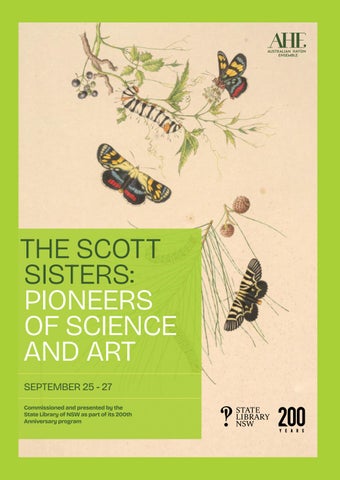
THE SCOTT SISTERS: PIONEERS OF SCIENCE AND ART SEPTEMBER 25 - 27 Commissioned and presented by the State Library of NSW as part of its 200th Anniversary program
PROGRAM Credits Commissioner State Library of NSW Creative Director Skye McIntosh Writer & Stage Director Rachel McDonald Cultural Consultant Aaliyah-Jade Bradbury Lighting Designer & Production Manager Roderick van Gelder Animation & Visual Design Studio Gilay
Cast Lucy Najwa Adams-Ebel Harriet Scott, Augusta Maria Scott Mitchell, Rose Scott & Harriet Calcott Tierney Clark Helena Scott, Augusta Frederick Scott Madeline Flood Alexander Walker Scott, Beethoven Ren Watson
Animation Directors Melissa Azizi Christopher Tan Costumes Skye McIntosh Ali Dibley Assistant Stage Manager Niloofar Veiszadeh Music
Selections from Beethoven String Quartet Op. 132 Musicians Violin Skye McIntosh Violin Ella Bennetts Viola Katie Yap Cello Edwina Cordingley
Elena Kats-Chernin Butterflying for string quartet Marais Les voix humaines for solo cello Tullia Cairns Ripples and Reflections for string quartet
A MESSAGE FROM SKYE
When I first began exploring the collections of the State Library of NSW as part of this Creative Commission, I was searching for a story that might speak to the intersection of music, history and the Australian experience. What I discovered was something far richer than I could have imagined. For many years I have been fascinated by the work of Harriet and Helena Scott. Their illustrations occupy a unique place in Australian cultural history, combining scientific observation with breathtaking artistic beauty. As both an artist and someone deeply interested in history, historical performance, nature and creativity, I had long hoped to find an opportunity to explore the story of the Scott sisters through performance. When I was invited to undertake this Creative Commission for the State Library’s 200th Anniversary Program, I immediately imagined bringing the Scott sisters’ extraordinary images to life. The State Library’s holdings are vast, and there were many fascinating stories that emerged. Yet I kept returning to the Scotts. I couldn’t get past the richness of the material held in the Library’s collections, nor the beauty of the butterflies, moths and natural history illustrations created by these remarkable “clever daughters” of Alexander Walker Scott, not to mention the extraordinary connection of the Scott family to the Library’s own origins. Initially, I imagined a primarily visual work centred on Harriet and Helena and their contribution to Australian natural history. What I did not anticipate was how much larger the story would become. As I began to explore the collections more deeply, a wider network of connections gradually emerged. The story extended back to Augusta
4 AUSTRALIAN HAYDN ENSEMBLE
Scott, the matriarch at the centre of this remarkable family, and forward through successive generations whose lives shaped the cultural and intellectual history of colonial Australia. It encompassed Alexander Walker Scott, the natural environment of Ash Island, the social reform work of Rose Scott, and ultimately David Scott Mitchell, whose extraordinary collecting efforts would form the foundation of the Mitchell Library itself. The more I explored, the more I became fascinated by the idea of transformation. It is present, of course, in the butterflies and moths that Harriet and Helena spent decades observing and recording. But it is also present in the journey of the objects themselves. Drawings created on Ash Island became published illustrations. Those illustrations became treasured books. The books became part of David Scott Mitchell’s collection. The collection became part of the State Library. Through this performance, these materials are transformed once again into living stories. One of the great privileges of this commission has been the opportunity to work directly with collection material. Throughout the development process, I have been continually struck by the way individual objects - a drawing, a letter, a book inscription, a family photograph - can open unexpected pathways into larger histories. Many of the images featured in this production originate from materials preserved within the Library’s collections. Without the care of generations of collectors, librarians and archivists, these stories might easily have been lost.
The Scott Sisters, Pioneers of Science & Art
traditions and seeks to place the story within a wider conversation about the many ways living knowledge is created, shared and preserved. Music offered another way into these ideas. I wanted to connect the story to music of the period while also finding works that resonated with its themes. At the heart of the production is Beethoven’s String Quartet in A minor, Op. 132, composed in 1825 as the composer emerged from a period of serious illness. Its celebrated slow movement, Heiliger Dankgesang (“Holy Song of Thanksgiving”), is one of music’s most profound meditations on recovery, resilience and renewal. The quartet’s journey from fragility to strength resonated deeply with the themes of transformation that run through the Scott family story and the extraordinary images that come to life throughout the performance. Fragments from the Op. 132 quartet have been selected, expanded and at times reimagined as part of the musical fabric of the program. At the same time, it felt important that the musical journey move beyond its European origins and connect with the Australian landscape at the heart of the story. Alongside Beethoven, the music of Australian composers Elena Kats-Chernin and Tullia Cairns brings contemporary women’s voices and Australian landscape perspectives into the work. It was equally important that the story be situated within the broader cultural landscape of Awabakal Country and its peoples. Long before European naturalists began documenting Australia’s insects, First Nations peoples possessed deep systems of knowledge grounded in observation, memory and connection to Country. Through the character of Lucy, the work acknowledges these enduring
The Scott Sisters, Pioneers of Science & Art
I am deeply grateful to the State Library of NSW for the opportunity to undertake this commission, and to the cultural consultants, librarians, curators, researchers and many creative colleagues whose expertise has helped shape the project. I am also grateful to the extraordinary team of artists who have brought their imagination, skill and generosity to its creation.
Ultimately, The Scott Sisters is a celebration of curiosity. It is a story about looking closely at the world around us and recognising that the things we choose to observe, record and preserve can continue to speak across generations. I hope you will leave with a renewed appreciation not only for Harriet and Helena Scott and their remarkable achievements, but also for the collections that allow these stories to be rediscovered. Skye McIntosh Creative Director, The Scott Sisters Artistic Director - Australian Haydn Ensemble
AUSTRALIAN HAYDN ENSEMBLE 5
ABOUT THE SCOTT SISTERS
The Scott Sisters is a story about transformation not only in nature, but in the ways knowledge is observed, recorded, preserved and passed from one generation to the next.
with scientific precision and artistic beauty. What began as a family passion evolved into an ambitious fifty-year project that would become one of colonial Australia’s most important natural history publications.
Drawing on archival materials held in the collections of the State Library of NSW, the work traces a remarkable chain of curiosity, creativity and collecting that spans more than two centuries. It brings to life the people, places and ideas behind one of Australia’s most significant scientific and artistic achievements: Australian Lepidoptera and Their Transformations.
Yet the story is about more than moths and butterflies.
Harriet Scott Morgan (1830–1907)
Interwoven throughout the performance are selected extracts from Beethoven’s String Quartet in A minor, Op. 132. Composed in 1825 following a period of serious illness, the work stands as one of the composer’s most personal and profound creations. At its centre lies the celebrated Heiliger Dankgesang (“Holy Song of Thanksgiving”), written as Beethoven emerged from sickness into recovery. The music moves between fragility and strength, suffering and renewal, tracing a journey that mirrors the transformations observed by the Scott sisters in the natural world. Like the butterfly emerging from its chrysalis, Beethoven’s quartet becomes an expression of resilience, regeneration and reawakening.The story begins with Augusta Scott (née
At the centre of the story are Harriet and Helena Scott, two pioneering natural history artists whose extraordinary observations of Australian butterflies and moths remain among the finest scientific illustrations produced in nineteenth-century Australia. Working alongside their father, the naturalist Alexander Walker Scott, the sisters devoted decades to documenting every stage of insect metamorphosis Helena Scott Forde (1832–1910)
6 AUSTRALIAN HAYDN ENSEMBLE
The Scott Sisters, Pioneers of Science & Art
Frederick), born in 1775, the The story begins with Augusta Scott (née Frederick), born in 1775, the matriarch of a remarkable family whose descendants would leave an enduring mark on Australia’s scientific, artistic, social and cultural life. Her son Alexander became a leading naturalist; her granddaughters Harriet and Helena transformed observation into art and science; her granddaughter Rose Scott became one of Australia’s foremost advocates for women’s rights and social reform; and her grandson David Scott Mitchell assembled the collection that would become the foundation of the Mitchell Library. The performance explores the connections between these lives and the ways knowledge survives across generations. Harriet and Helena’s illustrations, letters and observations became books. Those books became part of David Scott Mitchell’s collection. That collection became part of the State Library. Today, those same objects inspire new artistic responses and new audiences. There are other ways of recording, preserving and transmitting knowledge that this story also seeks to honour. Long before European naturalists began documenting Australia’s insects, First Nations peoples understood transformation as a fundamental principle of life, embedded in stories, Country and the interconnected relationships between all living things. Through generations, knowledge was shared, renewed and carried forward through oral traditions, cultural practice and careful observation of the natural world.
The Scott Sisters, Pioneers of Science & Art
Guided by the perspective of an Awabakal mother living on Country during the nineteenth century, the work acknowledges the many ways knowledge is created, preserved and passed from one generation to the next. The animated imagery featured throughout the performance is drawn directly from objects held in the State Library’s collections, including the extraordinary illustrations created by Harriet and Helena Scott. The journey of these drawings - from observation in the Australian landscape, to publication in a landmark scientific work, to the shelves of David Scott Mitchell’s library, to the collections of the State Library, and now to the stage - forms a story of transformation every bit as remarkable as the metamorphoses they depict. The performance draws extensively on historical sources including letters, diaries, published writings, newspaper accounts and objects preserved in the collections of the State Library of NSW and other historical collections. Many of the words spoken by the characters are taken directly from surviving correspondence and contemporary accounts. At the same time, it is a work of theatre rather than a documentary. Although the major events depicted are grounded in historical fact, some scenes, conversations and encounters have been imagined for dramatic purposes. The character of Lucy serves as a contemporary storytelling figure, connecting the Scott family story to the longer histories of Country, knowledge and place.
AUSTRALIAN HAYDN ENSEMBLE 7
CREATIVE TEAM Skye McIntosh Creative Director
Rachel McDonald Writer & Stage Director
Skye McIntosh is the founder and Artistic Director of the Australian Haydn Ensemble and one of Australia’s leading specialists in historically informed performance. As both performer and creative producer, she is known for developing innovative projects that combine music, history and storytelling. Under her leadership, the Australian Haydn Ensemble has become renowned for its imaginative programming and distinctive artistic voice.
Rachel McDonald is a writer and director with a background in classical music who lives on Whadjuk Noongar Country. Her directing credits include La Voix Humaine for Opera Australia and The Pianist (Belvoir/Sydney Festival). She previously collaborated with the Australian Haydn Ensemble as writer of Haydn Speaks, starring John Bell.
Studio Gilay Animation & Visual Design
Melissa Azizi Animation Director
Christopher Tan Animation Director
Studio Gilay is an Indigenous coowned production company based on Gadigal Country. Led by Jake Duczynski and James Hackett, their experienced team weaves First Nations storytelling with cuttingedge digital craft to meaningfully platform underrepresented voices. The studio has created awardwinning work for broadcasters, streamers, museums and festivals across the continent.
Melissa Azizi is an awardwinning producer and director who spent a decade in LA developing acclaimed projects like THE DANISH GIRL, NEWS OF THE WORLD and SLOW HORSES. A Sundance finalist with two university directing awards, Melissa recently released her debut documentary, BREAKING BOUNDARIES and produces and directs with Studio Gilay.
Chris Tan is a versatile designer, animator, and director experienced across all production stages. Having worked in Australia and the UK for brands like BBC, NBC Universal, and Honda, he brings extensive international expertise. Outside of cycling and supporting the Rabbitohs, Chris serves as Studio Gilay’s Design Director.
8 AUSTRALIAN HAYDN ENSEMBLE
The Scott Sisters, Pioneers of Science & Art
CAST Aaliyah-Jade Bradbury Cultural Consultant An International Emmy Award– winning Producer, Author, and Director, and a Larrakia and Meriam Mir woman, her credits include Harley & Katya, Belly, Firestarter: The Story of Bangarra and Preppers. She has worked for iHeart Radio, ABC, NITV, Screen Australia, Creative Australia, NGA & Carriageworks. She is currently a producer at Studio Gilay.
Roderick van Gelder Lighting Designer & Production Manager Roderick van Gelder is one of Australia’s most respected lighting designers, with an extensive career spanning theatre, opera, contemporary dance (including Sydney Dance Company), ballet, large-scale events and live performance. His work is distinguished by its ability to create atmosphere, shape narrative and transform performance spaces through light.
Najwa Adams-Ebel
Madeline Flood
Najwa Adams-Ebel is a proud Birri-Gubba woman from Central Queensland. As a First Nations creative, she is an avid theatre maker and performer. She graduated from QUT with a BFA in 2024; her credits include The Visitors at QPAC and The Perelman Theater, New York, Shake Takes for Nickelodeon and That Blackfella Show for ABC TV.
Madeline Flood is an Australian actor and graduate of the National Institute of Dramatic Art (NIDA). Her work spans theatre and screen, with a particular interest in character-driven storytelling and ensemble performance.
Tierney Clark
Ren Watson
Tierney Clark is an Australian actor, singer and theatre-maker whose work spans stage, screen and music theatre. A graduate of the Western Australian Academy of Performing Arts (WAAPA), she is passionate about new Australian work and collaborative storytelling.
Ren Watson is a 2025 BFA graduate from the National Institute of Dramatic Art. His credits include: Three Sisters (Chebutykin), directed by Clara Voda; Mary Stuart (Leicester), directed by Marion Potts; Checklist For An Armed Robber (Young Man), directed by Tasnim Hossain; and Dance Nation (Dance Teacher Pat), directed by Nigel Turner-Carroll.
The Scott Sisters, Pioneers of Science & Art
AUSTRALIAN HAYDN ENSEMBLE 9
AUSTRALIAN HAYDN ENSEMBLE The Australian Haydn Ensemble is Australia’s leading period-instrument ensemble dedicated to the music of the late eighteenth and early nineteenth centuries. Founded in 2012 by Artistic Director Skye McIntosh, the ensemble brings together some of the country’s finest specialists in historically informed performance to present music with the sound world and performance practices of its time. Renowned for its vibrant and engaging performances, the Ensemble appears regularly at major festivals and concert halls throughout Australia and internationally. Alongside its core repertoire of Haydn, Mozart, Beethoven and their contemporaries, the Ensemble is celebrated for its innovative programming, combining music with storytelling, visual art and historical research.
10 AUSTRALIAN HAYDN ENSEMBLE
Skye McIntosh, violin
Ella Bennetts, violin
Skye McIntosh is the founder and Artistic Director of the Australian Haydn Ensemble and one of Australia’s leading specialists in historically informed performance. As both a musician and a creative producer, she is known for her innovative, ambitious projects that combine music, scholarship and narrative. The Ensemble is renowned for its warm and inclusive approach, imaginative programming and distinctive artistic voice.
Ella Bennetts is an accomplished violinist and chamber musician whose work spans historical and modern performance practice. A regular collaborator with leading Australian ensembles, she is passionate about chamber music and the expressive possibilities of eighteenth and nineteenth-century repertoire.
Katie Yap, viola
Edwina Cordingley, cello
Katie Yap is a violist, researcher and creative practitioner whose work bridges performance, scholarship and artistic collaboration. Recognised for her thoughtful musicianship and commitment to exploring connections between music, history and culture, she performs regularly throughout Australia and internationally.
A cellist and educator, Edwina studied in Edinburgh with David Watkin, before taking up an apprenticeship with Sir John Eliot Gardiner. Edwina went on to tour Europe with John Eliot in the English Baroque Soloists and the Orchestre Revolutionnaire et Romantique as well as The Gabrieli Consort and Players. She performs with Australia’s finest ensembles and orchestras.
The Scott Sisters, Pioneers of Science & Art
ABOUT THE MUSIC The music of The Scott Sisters begins in the European musical world that would have surrounded the Scott family in the early 19th-century and moves towards a distinctly Australian soundscape, reflecting the changing landscapes, perspectives and ideas explored throughout the performance. The heart of the work takes inspiration from Beethoven’s String Quartet in A minor, Op.132. Composed in 1825 following a period of serious illness, the quartet belongs to Beethoven’s celebrated late quartets; works that pushed the boundaries of musical expression and challenged many of the assumptions of their time. The choice of Op. 132 places us firmly within the cultural world from which the Scott family emerged. Augusta Scott and her children belonged to a generation shaped by British and European ideas, literature, science and music. Although the Australian colonies were geographically distant from Europe, settlers carried these cultural traditions with them. Beethoven’s music was well known in London during the Scott family’s lifetime, and by the middle decades of the nineteenth century his works were gradually finding audiences in the colonies. Musical life in colonial Australia was still developing. Professional musicians were relatively few, performances were often organised by enthusiastic amateurs, and access to new music from Europe could be slow and unpredictable. Nevertheless, Beethoven’s reputation steadily grew.
The Scott Sisters, Pioneers of Science & Art
As the performance unfolds, the music begins to shift. Rather than remaining entirely within the European Classical tradition, contemporary Australian voices enter the story. Elena Kats-Chernin’s Butterflying introduces a world of movement, colour and delicacy. Its fluttering gestures and changing textures evoke flight, transformation and the fleeting beauty that Harriet and Helena Scott spent their lives attempting to capture on paper. The work acts as a bridge between scientific observation and imagination, between documentation and wonder. The program also includes Ripples and Reflections, a new work by emerging Australian composer Tullia Cairns. Created for The Scott Sisters, the piece responds to themes of memory, landscape and connection. Its musical language draws the audience away from the formal structures of nineteenth-century Europe and into a more atmospheric and contemporary sound world, one shaped by the waterways, ecosystems and stories that form the backdrop to the production. Together, these works chart a musical transformation. We begin in the world of Beethoven, and gradually move towards a distinctly Australian voice. The journey mirrors the broader story of the sisters: a movement from inherited traditions towards new ways of seeing, understanding and belonging. Across two centuries, four composers and countless acts of observation, we invite you to hear transformation as well as see it.
AUSTRALIAN HAYDN ENSEMBLE 11
ACKNOWLEDGEMENTS Special thanks to the Australian Haydn Ensemble Board, team and generous supporters of the Australian Haydn Ensemble. The Ensemble is supported by the NSW Government through Create NSW. Warmest thanks to the State Library of NSW: — Rani Haywood, Rawiya Jenkins, Lydia Tasker, Tanya Ali — and the following people who advised and provided their expert knowledge and research on the project including: Margot Riley, Richard Neville, and Vanessa Finney. With thanks to The Women’s Club; Dr Jodi Vial for access to her doctoral research and creative manuscript on The Scott sisters, and for creative conversations during the development of this project. Special thanks to Ailsa Veiszadeh, Alison Dunn, James and Edwyn Eccles and Kate and Jeremy Eccles. Scott Family Botanical Drawings Collection: https://collection.sl.nsw.gov.au/record/9gkdJvX9 Significance: Botanical illustrations connected to the Scott family’s scientific work. Demonstrates the relationship between insects and host plants that is central to Australian Lepidoptera and Their Transformations. AHE Board Kevin McCann AO (Chair) Carolyn Fletcher AM (Deputy Chair) Harriet Lenigas Adrian Maroya Skye McIntosh (Artistic Director) Jon North Vivienne Skinner Peter Young AM Marco Belgiorno-Zegna AM (Emeritus Chair) Studio Gilay - Animation Producer - Melissa Azizi Animation Directors - Melissa Azizi and Christopher Tan Illustrations - Harriet Scott, Henrietta Scott Asset Prep - Eden Wu Animation - Paul Carlton, Christopher Tan and Zoe Velonas Cultural Consultant - Aaliyah-Jade Bradbury
AHE is supported by the NSW Government through Create NSW
12 AUSTRALIAN HAYDN ENSEMBLE
The Scott Sisters, Pioneers of Science & Art
The Scott Sisters, Pioneers of Science & Art
AUSTRALIAN HAYDN ENSEMBLE 13