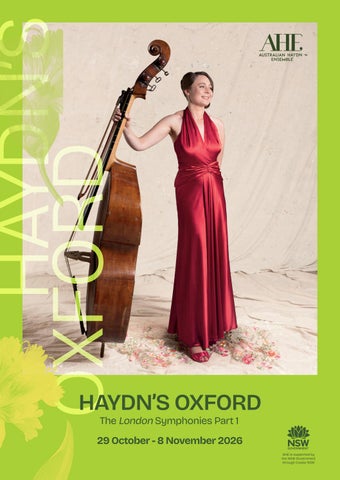
HAYDN’S OXFORD The London Symphonies Part 1
29 October - 8 November 2026 AHE is supported by the NSW Government through Create NSW
HE 2026
MOZART’S SPRING MARCH
BEETHOVEN’S FOURTH APRIL / MAY DIVINE BOHEMIANS
JULY / AUGUST
THE MENINDEE PROJECT AUGUST / SEPTEMBER HAYDN’S LONDON IN BROKEN HILL
SEPTEMBER
THE SCOTT SISTERS PIONEERS OF SCIENCE & ART STATE LIBRARY OF NSW SEPTEMBER HAYDN’S OXFORD OCTOBER / NOVEMBER 18TH CENTURY UNPACKED PRE-CONCERT EVENTS MOZART & HAYDN MARCH
BOHEMIAN COMPOSERS IN VIENNA APRIL HAYDN’S LONDON CONNECTION OCTOBER
PROGRAM DETAILS ARTISTS Skye McIntosh, Artistic Director and violin Matthew Greco, violin Rafael Font, viola Daniel Yeadon, cello Pippa Macmillan, bass Mikaela Oberg, flute
PROGRAM HAYDN Symphony No. 92 in G, Oxford arr. Salomon HAYDN Symphony No. 95 in C minor arr. Salomon
Interval 20 mins HAYDN Symphony No. 103 in E flat, Drumroll arr. Salomon
18TH CENTURY UNPACKED Haydn’s London Connection Special Presenter Genevieve Lang 29 October, State Library of NSW
facebook.com/TheAustralianHaydnEnsemble
PERFORMANCES BERRY Friday 30 October, 7pm Berry Uniting Church Hall SOUTHERN HIGHLANDS Saturday 31 October, 4pm Bowral Memorial Hall SYDNEY Monday 2 November, 7pm Sunday 8 November, 4pm The Neilson ACO On The Pier MELBOURNE Wednesday 4 November, 7pm Primrose Potter Salon Melbourne Recital Centre CANBERRA Thursday 5 November, 7pm Gandel Hall, National Gallery of Australia LAKE MACQUARIE Saturday 7 November, 2pm Rathmines Theatre
instagram.com/@australianhaydnensemble
A MESSAGE FROM SKYE
I am delighted to welcome you to Haydn’s Oxford, the first program in our new series exploring Haydn’s London symphonies in historical chamber arrangements. In 1791 Haydn arrived in London to a reception no composer had known before. After almost 30 years in service at the court of Esterházy, he suddenly found himself a celebrity. He was written up in the newspapers, fêted in society, and writing for one of the finest orchestras in Europe. The twelve symphonies he composed for London audiences over two visits remain some of his boldest and best-loved music. The man behind it all was Johann Peter Salomon, the violinist and impresario who travelled to Vienna to bring Haydn to London. Salomon was also a shrewd businessman. Only a few hundred people could fit into his concert room at a time - and that was only if they happened to live in a large city like London. So in 1798, with Haydn’s blessing, Salomon published his own arrangements of the London symphonies for flute and strings, so that music lovers could hear them in private salon concerts. These are the versions we perform in this series. It is an intimate way to hear this music: every line is exposed, and you can hear and feel exactly how Haydn builds his many surprises.
4 AUSTRALIAN HAYDN ENSEMBLE
The Oxford Symphony, No. 92, comes with a story I love. In July 1791 the University of Oxford awarded Haydn an honorary doctorate. Wearing hired academic robes in a packed Sheldonian Theatre, he admitted to feeling a little silly, but he thanked the audience in English – a sensation in itself. And there was more. During the celebrations, he directed a performance of this symphony, which was entirely new to Oxford, and it has carried the city’s name ever since. Symphony No. 95 was first heard in London in April 1791, just a few months after Haydn arrived. It is the only one of the twelve London symphonies in a minor key, and the only one that dives straight in without a slow introduction. It opens in storm and drama, with an elegant cello solo at its centre. By the finale the skies have cleared completely and Haydn signs off with a jubilant flourish. Symphony No. 103 was premiered in London in 1795, during Haydn’s second visit. It takes its nickname, Drumroll, from its famous opening timpani solo. Salomon knew that few drawing rooms came equipped with timpani, so he had to go without and came up with a different way to present the opening chord. Nothing about this symphony is simple, it is Haydn at the height of his powers, full of drama, humour and some of his most exuberant writing. It is a great pleasure to perform this program with my wonderful AHE colleagues Matthew, Rafael, Daniel, Pippa and Mikaela. Thank you for joining us, and enjoy Haydn’s Oxford. — Skye McIntosh Artistic Director & Violin
Season 2026
AHE’s flexibility and inventiveness are inspired by Haydn’s fabled originality and the virtuosic musicians he worked with at the court of Esterházy for almost 30 years. It performs in a variety of sizes and combinations, ranging from quartet, quintet or septet, to chamber orchestra with special guest soloists to a full orchestra with choir.
To commemorate its 10th anniversary, the Ensemble recorded its third CD, entitled The Mozart Album, released in 2024. In October 2023 AHE undertook its first international tour of the United States, including performances at Carnegie Hall and at the opening of the new Australian Embassy in Washington DC, garnering full houses, standing ovations and glowing reviews. The Ensemble is delighted in 2026 to be presenting its first subscription season at the Melbourne Recital Centre.
The Ensemble has developed a flourishing regular series in Sydney, performing at the City Recital Hall, ACO On The Pier, and the Utzon Room, Sydney Opera House; in Canberra, at the National Gallery of Australia. AHE also performs throughout regional NSW and presents education workshops to students of all ages, focusing on imparting 18th-century historical performance techniques.
Season 2026
THE ENSEMBLE
The Australian Haydn Ensemble (AHE) was founded in 2012 by Artistic Director and Principal Violinist Skye McIntosh and is now in its fifteenth year. AHE has established itself as one of Australia’s leading period-instrument groups, specialising in the repertoire of the late Baroque and early Classical eras. It takes its name from the great Joseph Haydn, a leading composer of the late 18th century.
AHE is particularly interested in presenting unusual programs of 18th-century chamber versions of works by Haydn, Mozart and Beethoven, as well as presenting the music of emerging composers and lesser-known composers, such as Boccherini, Wranitzky and Mysliveček.
AUSTRALIAN HAYDN ENSEMBLE 5
______Skye McIntosh violin
______Matthew Greco violin*
Skye is the founder and Artistic Director of the Australian Haydn Ensemble, now in its fifteenth year. This audacious undertaking is a testament to Skye’s musicianship and entrepreneurial spirit. AHE, known for its innovative and ambitious programming, was delighted to perform at the Adelaide Festival in 2022 and Canberra International Music Festival in 2022 and 2023, as well as continuing to tour to Canberra and across regional New South Wales each year.
Matthew is a concertmaster, soloist and core member of some of the world’s leading period instrument ensembles. He has been a regular member of the Australian Brandenburg Orchestra and concertmaster of the Orchestra of the Antipodes (Pinchgut Opera) since 2006. In 2010 he moved to The Netherlands where he studied Baroque violin at Royal Conservatoire The Hague and worked with leading European ensembles including De Nederlandse Bachvereniging and Les Talens Lyriques (France). He is a founding member of the Sydneybased ensemble The Muffat Collective.
Skye attended the Royal Academy of Music in London, the Queensland Conservatorium and the Sydney Conservatorium of Music, has made numerous concert appearances as soloist and director, and led the AHE on its first tour to the US in 2023, including a performance at Carnegie Hall. She has also toured nationally with the Australian Brandenburg Orchestra, as well as performing with the Orchestra of the Antipodes (Pinchgut Opera) and the Australian Romantic & Classical Orchestra. In 2024 ABC Classics released AHE’s third CD, featuring Skye performing Mozart’s Violin Concerto in G major. Skye was the Creative Director of The Scott Sisters: Pioneers of Science & Art, commissioned and presented by the State Library of NSW as part of its 200th Anniversary Program.
Matthew enjoys teaching baroque and modern violin, as well as performing with a variety of international ensembles and at festivals in Australia and Europe. Committed to producing a unique and individual sound based on historical performance practices, Matthew believes that 17th- and 18thcentury music is full of vitality and emotions that speak to us now, as much as they did in the past.
Matthew is playing a violin by David Christian Hopf, 1760, Quittenbach * Matthew Greco appears courtesy of the Australian Brandenburg Orchestra
Skye is playing a violin by Tomaso Eberle, 1770, Naples
6 AUSTRALIAN HAYDN ENSEMBLE
Season 2026
______Daniel Yeadon cello*
Rafael Font is a violinist and violist specialising in historically informed performance (HIP) of music from the baroque to the romantic periods, and is highly acclaimed for his virtuosity and improvisational skills.
Dr Daniel Yeadon is a Senior Lecturer at the Sydney Conservatorium of Music, University of Sydney, where he coordinates the Masters Performance program, teaches cello and viola da gamba, and coaches chamber music. Daniel also engages in research into learning, teaching and historical performance practices. Originally from the UK, Daniel read physics at Oxford University and then completed his postgraduate studies at the Royal College of Music in London.
Rafael started learning the violin at the age of five in his hometown of Caracas, Venezuela, with advanced studies at the Guildhall School of Music and Drama in London and the Royal Conservatoire The Hague. Now based in Sydney, Rafael regularly performs with many of the leading HIP ensembles in Australia, such as the Australian Haydn Ensemble, the Australian Brandenburg Orchestra and the Australian Romantic & Classical Orchestra. Rafael is also a founding member of the chamber ensemble The Muffat Collective.
Rafael is playing a viola by Simon Brown, 2010, Sydney
Daniel has a love for a wide range of musical genres and is an exceptionally versatile cellist and viola da gamba player, performing repertoire from the Renaissance through to Contemporary. Daniel is a passionate chamber musician, playing regularly with Australian Haydn Ensemble, Ironwood, Australian Romantic & Classical Orchestra, and Bach Akademie Australia. For many years Daniel was a member of the renowned Fitzwilliam String Quartet and the exuberant period instrument ensemble Florilegium. He has made many award-winning recordings.
Daniel is playing a cello by William Forster II, 1781, London *Dr Daniel Yeadon appears courtesy of the Sydney Conservatorium of Music.
Season 2026
THE PERFORMERS
______Rafael Font viola
AUSTRALIAN HAYDN ENSEMBLE 7
______Pippa Macmillan double bass Pippa Macmillan is a renowned specialist of historical bass instruments. After three years as a core member of Tafelmusik Baroque Orchestra, she moved to Australia in 2022 and performs regularly with Australian Brandenburg Orchestra, Orchestra of the Antipodes (Pinchgut Opera), Australian Romantic & Classical Orchestra, and Australian Haydn Ensemble. As the first undergraduate of the Royal Academy of Music, London, to specialise in Baroque Double Bass, she went on to complete a Masters in Historical Performance at The Juilliard School, New York. Between 2015 and 2019 she was Professor of Baroque Double Bass at the Royal College of Music, London. In her native UK, she has performed regularly with The English Concert, the Orchestra of the Age of Enlightenment, Orchestre Révolutionnaire et Romantique, English Baroque Soloists, Academy of Ancient Music, and Florilegium. In 2015 she appeared in London’s West End in the Globe Theatre’s production of Farinelli and the King, as well as in the play’s Broadway transfer in 2017.
Pippa is playing a bass by Unknown, mid-18th century, Bohemia
______Mikaela Oberg flute Mikaela is a freelance flute and recorder player who specialises in historical performance practice. She holds a Master of Music and Bachelor of Music in Historical Performance from the Royal Conservatoire The Hague (2014, 2012), and a Bachelor of Music in Music Education and Recorder Performance from the Sydney Conservatorium of Music (2007). Mikaela performs as Principal Flute/ Recorder with Orchestra of the Antipodes (Pinchgut Opera), Principal Recorder with the Sydney Symphony Orchestra, the Australian Chamber Orchestra and the Australian Haydn Ensemble. She has been a member of the Australian Brandenburg Orchestra since 2005, performing as soloist on regional and national tours. She also regularly performs chamber music and liturgical music throughout Sydney, NSW. Mikaela is a respected teacher of old and new flutes, and the recorder. She has been an examiner for the Australian Music Examinations Board (AMEB) since 2019 and teaches at Queenwood School for Girls, Fort Street High School, and from her home studio on Sydney’s Northern Beaches.
Mikaela is playing a flute by R. Tutz, 2007, Innsbruck, after H. Grenser, c.1810, Dresden
Season 2026 8 AUSTRALIAN HAYDN ENSEMBLE
DON’T MISS AHE’S EXCITING 2027 SEASON—
CHECK THE WEBSITE FOR DETAILS: AUSTRALIANHAYDN.COM.AU
ABOUT THE MUSIC
On 28 September 1790 Haydn’s employer of 28 years, Prince Nikolaus Esterházy, died at the age of 75. Two days later, his son and heir Anton sacked practically all of his court musicians with the exception of Haydn, whom he kept on a retainer for special occasions (and the optics). Haydn retired to a rented apartment in Vienna, and word began to circulate that for the first time in three decades, Europe’s most celebrated living composer was open to offers. Johann Peter Salomon (1745-1815) – German-born, London-based violinist and concert promoter – was in Cologne when he heard the news, and he scented profit. A few days later he appeared at Haydn’s door in Vienna: “I am Salomon of London and I have come to fetch you. Tomorrow we will arrange an accord”. Salomon was a fine violinist, and an even better entrepreneur. When Haydn – then 59 years old - arrived in London on 1 January 1791 after a two-week journey from Vienna, he sparked a Georgian mediafrenzy. “I went the round of all the newspapers for three successive days” he wrote to a friend back in Vienna. “Everyone wants to know me!”. After decades as a servant, the modest and unworldly composer suddenly found himself a celebrity. Salomon provided Haydn with near-ideal creative conditions – comfortable lodgings, and an extended period of work with a superb 60-piece orchestra. As Haydn got to know his London audience, he adapted and innovated; the twelve London symphonies that he wrote for the British public over his two visits to the city (Salomon tempted him back for a second visit in 1794-5) remain his single most radical –
10 AUSTRALIAN HAYDN ENSEMBLE
and popular – body of orchestral works. And Salomon made good on his investment too. Public interest in Haydn’s latest music was through the roof, but only a few hundred people could fit into the Hanover Square concert room at any one time. Recordings, of course, were non-existent. Regular followers of the Australian Haydn Ensemble will be able to guess Salomon’s next move. In the late 18th century, the easiest way to get to know an orchestral work was to play a scaled-down version at home. In June 1798, with Haydn’s endorsement, Salomon published his own domestic version of the twelve London symphonies, skilfully arranged for Quintetto – in his own words “Two Violins, a German Flute, a Tenor [viola], and a Violoncello: with an Accompaniment for the Piano Forte ad libitum”. By playing them today, we’re paying tribute not just to Haydn but to one of his greatest musical friends – and giving you just a taste of what it was like to be present at the height of London’s Haydn-mania. Franz Joseph Haydn (1732-1809), arr. J.P. Salomon Symphony No. 92 in G, Oxford Adagio – Allegro Adagio Menuet: Allegretto Presto Haydn-mania in Britain extended far beyond London. For some years before 1791, Haydn had been the most-performed composer at Oxford’s Holywell Music Room, and a group of aristocrats and music lovers led by the great music historian Dr Charles Burney lobbied the University of Oxford to award him an honorary doctorate. So, a few weeks after the end of Salomon’s concert season in London, Burney accompanied
Season 2026
Haydn to Oxford, where – on 6 July 1791, wearing hired academic robes – the man that the British press described as “this musical Shakespeare” was awarded the degree of Doctor of Music in a packed (and sweltering) Sheldonian Theatre. Dies described the scene: “He turned to the company, took his doctoral robes in both hands, opened them at his breast, closed them again and said as loudly and clearly as possible (in English) “I thank you”. The company well understood this unexpected gesture; they appreciated Haydn’s thanks and said “You speak very good English.” Haydn admitted that “I felt very silly in my gown”, but he appreciated the honour, and the following night he rehearsed and directed a concert of his own music, including a New Overture – the symphony that we now know as the Oxford. He’d originally written it in 1789 as a private commission for two noble clients (one German, one French). But it was entirely new to Oxford – and the Morning Chronicle recorded that “a more wonderful composition never was heard.” The journalist wasn’t wrong. Twentieth century British musicologist Donald Tovey thought of a saintly tabby cat when he heard Haydn’s Adagio introduction, but there’s a sunrise radiance and breadth about this opening that goes far beyond kittenishness – even though the Allegro, when it starts, does so with one of Haydn’s most original combinations of teasing playfulness and explosive affirmation. The tender, dignified Adagio ends in a wonderfully poignant sunset coda, before the Minuet reaffirms sunlight in the most stately style while the horns open wide romantic vistas in the central Season 2026
trio. As for the finale, well, here’s Tovey again: “It is impossible to describe Haydn’s themes, when he is in his Oxford manner, without feeling irresponsible: but the life his themes live is one that has no room for meanness or triviality”. A fitting (if accidental) tribute to a city of learning and of youth, from a 59-year-old master who’d never felt younger in his life. Franz Joseph Haydn (1732-1809), arr. J.P. Salomon Symphony No. 95 in C minor Allegro moderato Andante Menuetto Finale: Vivace Eighteenth-century audiences and critics didn’t have the advantage of scholarly catalogues or even numbers for Haydn’s symphonies. In London they were typically billed as New Grand Overtures, and early reports and reviews are so vague that we can’t always tell which one was played when. We do know that the symphony we now call No. 95 was first heard in April 1791 (probably on either Friday 1 or Friday 29). And from the very opening gesture, we can hear Haydn trying something bold and new. It’s the only one of the symphonies that he wrote for London that dives straight in with no slow introduction. Even more strikingly, it’s the only one that’s in a minor key. The opening is stormy and dramatic; even the Menuetto – usually a moment of relaxation in a classical symphony – is tense and forceful. But Haydn is out to delight as well as to stir. The first movement’s severity is offset by generous courtesies, and the Andante opens in a mood of deep poetry. That anxious Menuetto gives way, in the central Trio section, to an elegant AUSTRALIAN HAYDN ENSEMBLE 11
ABOUT THE MUSIC
cello solo. And by the finale, the skies have cleared completely – which doesn’t stop Haydn treating his new fans to a bravura display of fugal muscle in the manner of Mozart’s 32-month-old Jupiter symphony (then unknown in Britain) before fanfares crown a jubilant finish. “Nothing occurred that could bear any comparison with the new overture of HAYDN, which exhibited all the fire and perfection of his genius” declared a critic the morning after the 1 April concert; and Haydn must surely have felt vindicated. When he had said farewell to Mozart before leaving for London in December 1790, the younger man (according to Haydn’s biographer Albert Dies) had been anxious on his behalf: “‘Papa’ (as he usually called him), ‘you have had no training for the great world and you speak too few languages’. ‘Oh!’ replied Haydn ‘my language is understood all over the world’”. Franz Joseph Haydn (1732-1809), arr. J.P. Salomon Symphony No. 103 in E flat, Drumroll Adagio – Allegro con spirito Andante più tosto allegretto Menuetto Finale: Allegro con spirito Eighteenth-century composers didn’t tend to christen instrumental works. Titles were bestowed by publishers or the public when a work had become especially popular, or because one particular feature became the talk of the town. Haydn’s penultimate symphony was premiered at the King’s Theatre Haymarket, on 2 March 1795, and it won its nickname with its very first note – a solo for the timpani. “The introduction excited the deepest attention” reported the Morning Chronicle the following day.
12 AUSTRALIAN HAYDN ENSEMBLE
And that was just the first bar. By now – four years after that first thrilling, bewildering taste of London life – Haydn knew exactly what excited his public. This was his second trip to London, and expectations were even higher, but Haydn’s earlier visit had sharpened his crowd-pleasing instincts. With Salomon’s orchestra expanded to include two clarinets, his inspiration burned brighter and fresher than ever, and everyone realised it. “The incomparable Haydn produced an Overture of which it is impossible to speak in common terms” wrote one critic shortly after his return. “It rouses and affects every emotion of the soul”. When Salomon came to rearrange this symphony, the opening drumroll was the first casualty. Not many elegant drawing rooms, then or now, come equipped with timpani, so a straightforward chord has to suffice. Still, nothing, surely, could have prepared listeners for the sombre, almost chant-like slow introduction, or the way Haydn weaves those same notes into a brilliant, dancing Allegro – before, in a stroke of high drama, bringing back the drumroll (or chord) at the end of the movement to tie everything together. The second movement is tangy with the flavours of Croatian folksong, though the birds (courtesy of the flute) and a solo fiddle get a lookin too. The Menuetto swings in with an exuberant whoop, and the finale has another surprise in store, opening with a horn-call (you can hear its ancestry even without horns) in one of the mightiest and most expansive finales Haydn ever wrote. At 62, Haydn seemed to see further – and sound younger – with every new composition.
Richard Bratby
Season 2026
YOUR SUPPORT IS VITAL— Since the very beginning AHE has been strongly committed to bringing beautiful music to the regions of New South Wales and beyond – and in 2026 we are performing more regional concerts than ever.
And we can’t do it the way we do it without you! Your support is vital and all gifts are very much appreciated. You can even make a recurring gift over 12 months, and any amount over $2 is tax deductible. Skye McIntosh Artistic Director
WAYS TO DONATE__
Online Use the QR code or going to australianhaydn.com.au/donate Call us on 1800 334 388
PATRONS— Our patrons enable us to continue presenting wonderful concerts, and we could not do what we do without them - we are so grateful to them all.
AHE donor categories are named after famous 18th-century patrons who supported and commissioned many of the works of Haydn, Mozart, Beethoven and others that we are re-discovering today.
About our Patron Categories Maria Theresa The Empress was a patron of Viennese music, and Haydn wrote his Te Deum at her request. Esterházy Prince Esterházy was the main patron of Haydn.
Patron — Her Excellency the Honourable Margaret Beazley AC KC Governor of New South Wales Founding Patron — The Late Dr Timothy Pascoe AM
Waldstein Count Waldstein was an early patron of Beethoven.
The Chair’s Circle —
Van Swieten He was a keen amateur musician and patron of Haydn, Mozart, and Beethoven.
The Chair’s Circle is a group of dedicated supporters who have made a multi-year commitment to supporting the long-term vision of the Australian Haydn Ensemble.
Galitzin He was an amateur musician and is known particularly for commissioning three Beethoven string quartets Op. 127, 130 and 132.
APS Foundation Marco Belgiorno-Zegna AM & Angela Belgiorno-Zegna Sherry & the late Tom Gregory
Lobkowitz He was a Bohemian aristocrat and a patron of Beethoven.
Karin Keighley
Razumovsky He commissioned Beethoven’s Op. 59 String Quartets.
Ian & Pam McGaw
Peter & Lisa Macqueen Kevin McCann AO & Deidre McCann Anthony Strachan Peter Young AM & Susan Young Anonymous (1)
14 AUSTRALIAN HAYDN ENSEMBLE
Season 2026
Artistic Director’s Circle — The Artistic Director’s Circle is a group of passionate supporters who have made a commitment to supporting the education program of the Australian Haydn Ensemble and the vision of the Artistic Director Carolyn Fletcher AM Adrian Maroya Jon & Susanne North Peter & Vivienne Skinner Musicians’ Chair — Skye McIntosh, Artistic Director & Leader’s Chair Supported by Mrs W.G. Keighley Maria Theresa $25,000+ — Sherry & the late Tom Gregory Howarth Foundation Karin Keighley The McLean Foundation Anonymous (1) Esterházy $15,000 - $24,999 — Coles Danziger Foundation David & Anne Eustace Foundation Peter & Lisa Macqueen Kevin McCann AO & Deidre McCann Ian & Pam McGaw Anthony Strachan Waldstein $10,000 - $14,999 — APS Foundation Marco Belgiorno-Zegna AM & Angela Belgiorno-Zegna Peter Young AM & Susan Young Van Swieten $5,000 - $9,999 — Martin & Ursula Armstrong Dr Terry & Julie Clarke Carolyn Fletcher AM Reg & Kathie Grinberg Adrian Maroya Jon & Susanne North
Peter & Libby Plaskitt Peter & Vivienne Skinner Galitzin $1,000 - $4,999 — Antoinette Albert Mark Bethwaite AM & Jill Bethwaite Clive Birch Keith & Louise Brodie Jason Catlett George H. Clark Robert & Carmel Clark Jean Cockayne Peter & Prudence Davenport Rob Diamond Alison Dunn Jeremy Eccles FRSN & Kate Eccles OAM Ralph Evans AO & Maria Evans John Fairfax AO & Libby Fairfax Richard Fisher AM & Diana Fisher Dr Marguerite Foxon Bunny Gardiner-Hill Prof Pru Goward AO Sharon Green James Hardigg The Hon Don Harwin Sarah de Jong David Kent OAM & Angela Kent Celia Lillywhite David Maloney AM & Erin Flaherty Bruce McComb Jeremy Morris & Kate Guilfoyle Robbie Nicol Trevor Parkin Nick Payne Lisbeth Roberts Kay Vernon The Hon. Anthony Whealy K.C. & Annie Whealy David Whitehouse Anonymous (7)
Wendy Cobcroft Christine Cooper Janet Doust Jan Driscoll Sandra Duggan Dr Meredith Edwards Jean Gifford Stephen & Jillian Goggs Juliet Lockhart Dr Paul & Betty Meyer Dr Jacqueline Milne Jeremy Newman Susan Perrin Greg & Wendy See Penelope Seidler AM Jill Townsend Anonymous (5) Razumovsky $250 - $499 — Ann Armstrong Wayne Arthur Tony Barnett Patrick Batho MBE & Janet Batho Richard Bloor Jeffrey Bridger Diana Brookes Stuart & Felicity Coughlan Dr John Dearn Heather Kenway Henry O’Connor Paul O’Donnell JWM Seinor Dr Richard Sippe Jeremy Wainwright Anonymous (1) This listing is correct as of 1 Sept 2026, and we gratefully recognise all donations received since 1 July 2025.
Lobkowitz $500 - $999 — Priscilla Adey James Ashburner Jock Baird Dr Andrew Byrne & Allan Gill Lloyd Capps & Mary Jo Capps AM Dr Michael & the late Dr Colleen Chesterman Season 2026
AUSTRALIAN HAYDN ENSEMBLE 15
It’s not solely about historical accuracy. It’s about bringing the music to life in a way that the composers would have heard it and giving old music a fresh, vibrant feel today. It adds colour and vitality.
ABOUT THE INSTRUMENTS— One of the key things to know about AHE is that we play on period instruments or accurate replicas from the time the music was composed.
___So, what does that mean exactly? It means that when we perform works by Haydn or Mozart, we use instruments and techniques from the mid to late 18th century that Haydn and Mozart would have known. For baroque music, by composers like Vivaldi, we switch to instruments set up as they would have been in the earlier part of the 18th century, which means using baroque bows. And when we play Beethoven, we adjust our instruments to match those from the early 19th century.
16 AUSTRALIAN HAYDN ENSEMBLE
___Why do we do this? There are significant differences between period instruments and modern ones. For instance; our strings are made of sheep gut instead of metal; our brass instruments often lack the valves found on their modern counterparts; and our wind instruments are often made of wood rather than metal. All these elements change the colour and tone of the sound significantly. This approach helps recreate the original listening experience of that time.
Season 2026
WHAT OUR AUDIENCES SAY— “Absolutely wonderful!” Canberra, 2026
“Interesting and enlightening programming beautifully presented. A great performance.” The Neilson, Sydney, 2026
“Loved your playing. One of the top string Quartets!” Melbourne Recital Centre, 2026
“Perfect” Berry, 2026
18 AUSTRALIAN HAYDN ENSEMBLE
“Thanks for bringing your beautiful music to the Hill and engaging with the local community.” Broken Hill, 2026
Season 2026
PARTNERS— GOVERNMENT PARTNER—
PARTNERS—
Penrith Youth Orchestra AHE is supported by the NSW Government through Create NSW.
SUPPORTERS—
BACKSTAGE— Board — Kevin McCann AO (Chair) Carolyn Fletcher AM (Deputy Chair) Adrian Maroya Harriet Lenigas Skye McIntosh (Artistic Director) Jon North Vivienne Skinner Peter Young AM Marco Belgiorno-Zegna AM (Emeritus Chair)
The Australian Haydn Ensemble acknowledges the traditional custodians of the lands on which we perform. We pay our respects to Elders past and present. The Australian Haydn Ensemble is a not-for-profit organisation ABN 26 202 621 166 PO Box 400 Strawberry Hills NSW 2012 1800 334 388 (Freecall) | australianhaydn.com.au
Team — Skye McIntosh Artistic Director & CEO Ailsa Veiszadeh Administrator Alison Dunn Marketing & Communications Roderick van Gelder Production Manager & Lighting Designer Marguerite Foxon Front of House & Administration* *In Kind Support In Kind— John Dearn, Canberra Jean Gifford, Canberra Greg & Wendy See, Berry Stuart & Felicity Coughlan, Berry Steve & Mary Beare, Berry Keith & Louise Brodie, Berry Images— Images throughout by Helen White except pages 6 - 9 James Mills, Oliver Miller and supplied; page 13 Oliver Miller; page 18 Oliver Miller and Laura Manariti.
Details in this program are correct at time of publication. The Australian Haydn Ensemble reserves the right to add, withdraw or substitute artists and to vary the program and other details without notice. Full terms and conditions of sale available at our website australianhaydn.com.au or on request.