AHE 2026
MOZART’S SPRING MARCH
BEETHOVEN’S FOURTH APRIL / MAY
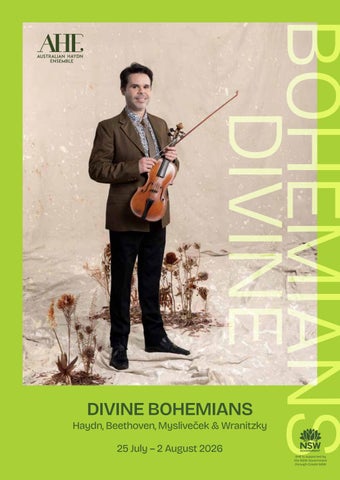
DIVINE BOHEMIANS
JULY / AUGUST
THE SCOTT SISTERS PIONEERS OF SCIENCE AND ART STATE LIBRARY OF NSW
SEPTEMBER
HAYDN’S OXFORD
OCTOBER / NOVEMBER
18TH CENTURY UNPACKED PRE-CONCERT EVENTS
MOZART & HAYDN
MARCH
BOHEMIAN COMPOSERS IN VIENNA
JULY
HAYDN’S LONDON CONNECTION
OCTOBER

2027 Season
AHE’s exciting new 2027 Season will be announced later this year. To receive early notification, register using the QR code or go to www.australianhaydn. com.au/ahe-27-subscriptionnotification
PROGRAM DETAILS
ARTISTS
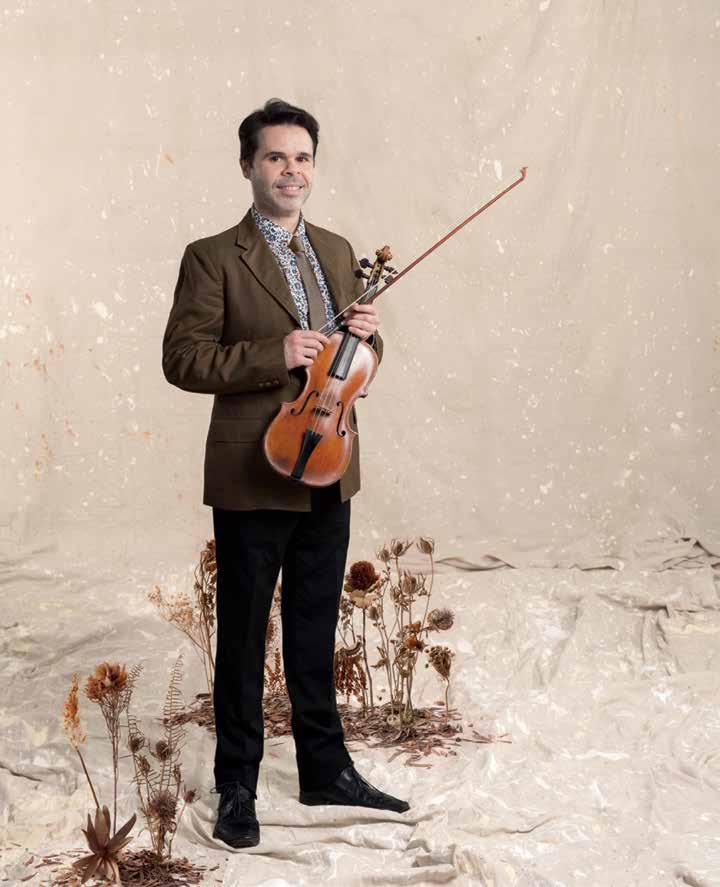
Skye McIntosh, Artistic Director and violin
Matthew Greco, violin
Rafael Font, viola
Daniel Yeadon, cello
PROGRAM
HAYDN
String Quartet Op. 77 No. 1 in G
WRANITZKY
String Quartet Op. 49 in D minor
Interval 20 mins
MYSLIVEČEK
String Quartet Op. 3 No. 6
Larghetto
BEETHOVEN
String Quartet Op. 18 No. 3 in D
1/2 “...ELEGANCE, INVENTION AND EMOTIONAL DEPTH.” Limelight,2025

A MESSAGE FROM SKYE
I am delighted to welcome you to Divine Bohemians, our midwinter program for 2026. This concert illuminates the work of two of the many remarkable, yet somewhat unknown 18th-century composers from the Kingdom of Bohemia - now known as the Czech Republic. Bohemia produced many excellent composers during this time period. It’s a shame we can’t fit them all into this concert!
The title Divine Bohemians is inspired by one particular Bohemian composer, Josef Mysliveček. In Italy, he was so celebrated that audiences called him il divino boemo - the divine Bohemian. Mysliveček spent most of his career there, supported by various means including patronage from the Bohemian Count Waldstein. He was also a close friend and mentor to the young Mozart, and a personal friend of the Mozart family.
Alongside Mysliveček, we present the music of Paul Wranitzky - a composer whose reputation in Vienna was formidable. One of the few composers that Haydn permitted to arrange his music, Wranitzky made ‘expanded’ arrangements of three string quartets from Haydn’s Op. 71 and 74 for nonet - adding oboe, flute, double bass and two horns to great effect. A prolific composer in his own right, he was also Vienna’s most respected conductor of his era. It was Wranitzky who had the honour of premiering Beethoven’s First Symphony. His Op. 49 in D minor string quartet brings a dramatic richness and depth that I think may surprise many listeners encountering his music for the first time.

We frame these lesser-performed masters with works from Haydn and Beethoven that were both commissioned by and dedicated to the Bohemian arts patron Prince Lobkowitz (we have also named one of our own donor groups after him).
Written late in Haydn’s life, his Quartet Op. 77 No. 1 in G major is one of two he managed to finish from this commission. It is one of the most assured and beautiful of his astonishing output of string quartets. The work is full of his characteristic wit and emotional depth, captured particularly beautifully in the stunning slow movement.
We finish our program with Beethoven’s early Quartet Op. 18 No. 3 in D major, which shows a composer beginning to find his own voice. While he stands in the long shadow of Haydn’s remarkable achievement, Beethoven is very much his own man.
Taken together, these four works offer a window into a creative and deeply felt conversation - masterful composers listening and learning from one another, as they push the string quartet to ever more expressive heights.
It is a great pleasure to perform this program with my wonderful AHE colleagues Matthew, Rafael, and Daniel. We hope it opens your ears to the extraordinary legacy of Bohemia’s composers, and leaves you with a strong sense of the warmth and vitality that defines this music.
Thank you for joining us, and enjoy Divine Bohemians.
— Skye McIntosh Artistic Director & Violin
The Australian Haydn Ensemble (AHE) was founded in 2012 by Artistic Director and Principal Violinist Skye McIntosh and is now in its fifteenth year. AHE has established itself as one of Australia’s leading periodinstrument groups, specialising in the repertoire of the late Baroque and early Classical eras. It takes its name from the great Joseph Haydn, a leading composer of the late 18thcentury.
AHE’s flexibility and inventiveness are inspired by Haydn’s fabled originality and the virtuosic musicians he worked with at the court of Esterházy for almost 30 years. It performs in a variety of sizes and combinations, ranging from quartet, quintet or septet, to chamber orchestra with special guest soloists to a full orchestra with choir.
The Ensemble has developed a flourishing regular series in Sydney, performing at the City Recital Hall, ACO On The Pier, and the Utzon Room, Sydney Opera House; in Canberra, at the National Gallery of Australia. AHE also performs
throughout regional NSW and presents education workshops to students of all ages, focusing on imparting 18th-century historical performance techniques.
AHE is particularly interested in presenting unusual programs of 18th-century chamber versions of works by Haydn, Mozart and Beethoven, as well as presenting the music of emerging composers and lesser-known composers, such as Boccherini, Wranitzky and Mysliveček.
To commemorate its 10th anniversary, the Ensemble recorded its third CD, entitled The Mozart Album, released in 2024. In October 2023 AHE undertook its first international tour of the United States, including performances at Carnegie Hall and at the opening of the new Australian Embassy in Washington DC, garnering full houses, standing ovations and glowing reviews. The Ensemble is delighted to be presenting its first subscription season at the Melbourne Recital Centre in 2026.
THE ENSEMBLE
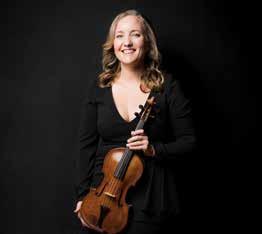
Skye McIntosh violin
______
Skye is the founder and Artistic Director of the Australian Haydn Ensemble, now in its fifteenth year. This audacious undertaking is a testament to Skye’s musicianship and entrepreneurial spirit. AHE, known for its innovative and ambitious programming, was delighted to perform at the Adelaide Festival in 2022 and Canberra International Music Festival in 2022 and 2023, as well as continuing to tour to Canberra and across regional New South Wales each year.
Skye attended the Royal Academy of Music in London, the Queensland Conservatorium and the Sydney Conservatorium of Music, has made numerous concert appearances as soloist and director, and led the AHE on its first tour to the US in 2023, including a performance at Carnegie Hall. She has also toured nationally with the Australian Brandenburg Orchestra, as well as performing with the Orchestra of the Antipodes (Pinchgut Opera) and the Australian Romantic & Classical Orchestra. In 2024 ABC Classics released AHE’s third CD, featuring Skye performing Mozart’s Violin Concerto in G major.
Skye is playing a violin by Tomaso Eberle, 1770, Naples
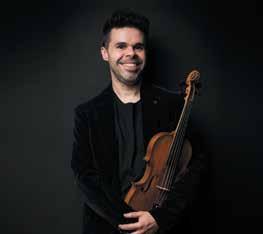
______ Matthew Greco violin*
Matthew is a concertmaster, soloist and core member of some of the world’s leading period instrument ensembles. He has been a regular member of the Australian Brandenburg Orchestra and concertmaster of the Orchestra of Antipodes (Pinchgut Opera) since 2006. In 2010 he moved to The Netherlands where he studied Baroque violin at The Royal Conservatoire of The Hague and worked with leading European ensembles including De Nederlandse Bachvereniging and Les Talens Lyriques (France). He is a founding member of the Sydney-based ensemble The Muffat Collective. Matthew enjoys teaching baroque and modern violin, as well as performing with a variety of international ensembles and at festivals in Australia and Europe. Committed to producing a unique and individual sound based on historical performance practices, Matthew believes that 17th- and 18thcentury music is full of vitality and emotions that speak to us now, as much as they did in the past. Matthew is a founding member of the Muffat Collective, now in its 10th year, and recognized for its historically informed performances.
Matthew is playing a violin by David Christian Hopf, 1760, Quittenbach
* Matthew Greco appears courtesy of the Australian Brandenburg Orchestra
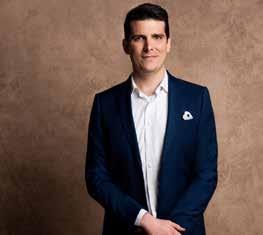
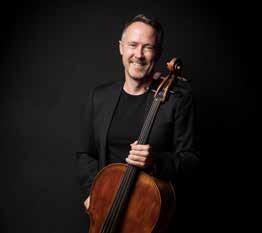
______ Rafael Font viola
Rafael Font is a violinist and violist specialising in historically informed performance of music from the Baroque to the Romantic periods, and is highly acclaimed for his virtuosity and improvisational skills.
Rafael started learning the violin at the age of five in his hometown of Caracas, Venezuela, with advanced studies at the Guildhall School of Music and Drama in London and the Royal Conservatory of The Hague.
Now based in Sydney, Rafael regularly performs with many of the leading HIP ensembles in Australia, such as the Australian Haydn Ensemble, the Australian Brandenburg Orchestra, and the Australian Romantic & Classical Orchestra. Rafael is also a founding member of the chamber ensemble The Muffat Collective.
______
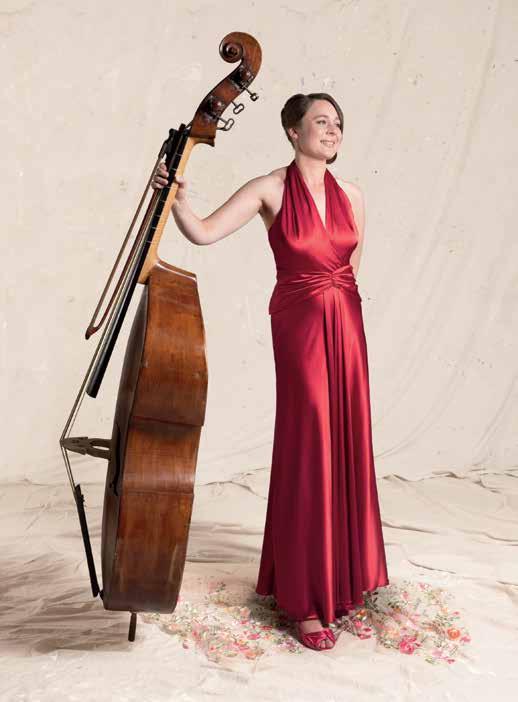
Daniel Yeadon cello*
Dr Daniel Yeadon is a Senior Lecturer at the Sydney Conservatorium of Music, University of Sydney, where he coordinates the Masters Performance program, teaches cello and viola da gamba, and coaches chamber music. Daniel also engages in research into learning, teaching and historical performance practices. Originally from the UK, Daniel read physics at Oxford University and then completed his postgraduate studies at the Royal College of Music in London.

Rafael is playing a viola by Simon Brown, 2010, Sydney
Daniel has a love for a wide range of musical genres and is an exceptionally versatile cellist and viola da gamba player, performing repertoire from the Renaissance through to Contemporary. Daniel is a passionate chamber musician, playing regularly with Australian Haydn Ensemble, Ironwood, Australian Romantic & Classical Orchestra. For many years Daniel was a member of the renowned Fitzwilliam String Quartet and the exuberant period instrument ensemble Florilegium. He has made many award-winning recordings.
Daniel is playing a cello by William Forster II, 1781, London
*Dr
THE PERFORMERS
Daniel Yeadon appears courtesy of the Sydney Conservatorium of Music.


A new series of historical chamber arrangements of Haydn symphonies.
30 October – 5 November
Berry | Bowral | Sydney (2 concerts) Melbourne | Canberra
Book now using the QR Code or at australianhaydn.com.au
HAYDN’S OXFORD
______ About the Bohemians
Lines on maps play tricks with the mind. Many English speakers still think of the country now known as Czechia (and the region of Bohemia within it) as Eastern Europe. In fact, its capital Prague is nearly 200 miles west of Vienna. Any patriotic Czech will tell you that their nation is the true heart of Central Europe; and in its 16th century golden age, Prague had been the glittering imperial capital of the Holy Roman Empire. By the 18th century that privilege had passed to Vienna, but Czech musicians (and few nations are more proud of their musicality) continued to work and travel across Europe. It made professional, social and (above all) financial sense.
Still, it demanded certain compromises. Then as now, nonSlavs tended to stumble over Czech names. Josef Mysliveček was referred to by Mozart (never the most fastidious speller) as Misliwetcek or Misliweczeck. To the tenor Michael Kelly he was Metzlevisic, and in Italy – where he enjoyed the greatest successes of his career – they abandoned the struggle and simply called him “il divino Boemo” (the Divine Bohemian) or “Venatorino” (“the little hunter” – a literal translation of his family name). Pavel Vranický, meanwhile, got ahead of the game early, and by the time he was 21 had started calling himself Paul Wranitzky. But genius spoke louder than words, and in the era of Haydn and Beethoven - whether they came as friendly competitors or inspiring colleagues - European music was unthinkable without its Divine Bohemians.
Franz Joseph Haydn (1732-1809)
String Quartet Op. 77 No. 1 in G
Allegro moderato
Adagio
Menuetto: Presto
Finale: Presto
If maps can play tricks, so do opus numbers. Haydn originally planned his Quartet Op. 77 No. 1 as one of six quartets commissioned by Prince Lobkowitz, the Viennese nobleman who would later become a generous patron of Beethoven. Haydn began work in mid -1799, but found his strength flagging – he was 67 years old (at a time when average life expectancy was around 59), and he was also struggling with his final oratorio, The Seasons. He completed two quartets and two movements of a third, but by 1806 he’d conceded defeat, publishing the final fragment as Op. 103 and appending to it the sad motto “Gone is all my strength / Old and weak am I”.
But he set even that to music - he just couldn’t help it. Haydn’s body was weak, but his imagination was on fire, and this is an old man’s music only in the most literal sense. With five decades of practice behind him, Haydn was at the peak of his inspiration and technique. There’s no frailty or compromise in either work; the Op. 77 quartets are quite simply amongst the richest, most inventive and – frankly – funniest he ever wrote. Op. 77 No. 1 begins with a crash, followed by a march that passes the whistle test by its fourth bar - it could be straight out of a comic opera by Rossini, or one of Schubert’s jauntier songs. But just try guessing where it goes next.
The Adagio proves that Haydn could still strike deep; set in the warm key of E flat major, it begins in hymnlike solemnity, and gradually peels away the layers of formality to reveal a tender, endlessly expressive creative imagination still glowing
ABOUT THE MUSIC
ABOUT THE MUSIC
with emotion. A strapping scherzo of a minuet yanks us – surprisingly enjoyably – back to reality, and teaches Haydn’s awkward former pupil Beethoven a thing or two about cross-rhythms while it’s about it. And what’s that in the finale , but the unmistakable paprika tang of the Hungarian countryside, where Haydn had spent so much of his long career. Yet the invention, the rhythmic drive, and the headlong energy are all Haydn’s own: an old master doing something completely new, and loving every minute of it.
Paul Wranitzky (1756-1808)
String Quartet Op. 49 in D minor
Allegro assai
Largo con sordino
Finale: Presto
Paul Wranitzky wasn’t technically a Bohemian. He was an innkeeper’s son from rural Moravia, but he was born into a Czech-speaking family, and to the metropolitan Viennese, it was all much of a muchness. Sure enough, when the young Wranitzky arrived in the capital his vivid and inventive music was soon matched by a rare gift for acquiring (and keeping) lucrative official posts. It was a knack that his friend Mozart never mastered (they were members of the same Masonic lodge). Nor was Beethoven, with his short fuse and rough-diamond manner, ever very presentable at court –although he insisted that Wranitzky conduct the premiere of his own First Symphony. “Beethoven rightly believed that he could choose no-one better” commented a contemporary newspaper, the Allgemeine Musikalische Zeitung. Few living composers came quite so close to Beethoven’s own explosive spirit.
And who knows what Wranitzky might have achieved if he hadn’t succumbed to typhus at the age of 51? He was hugely prolific (44 symphonies and some 56 string quartets) and thoroughly abreast of the latest developments in music. It’s tempting (and almost certainly correct) to assume that he had heard both of the Haydn and Beethoven quartets in this concert by the time that he composed this powerful quartet in D minor (as far as we know, his last completed quartet) in 1804. Certainly, the dark energy and rhythmic drive of the first movement suggest Beethoven, and the slashing chords and consoling lyricism of the finale find parallels in Haydn’s Op. 76 No. 3 and Beethoven’s Op. 18 No. 4 – music that was still new in 1804. But the central Largo – played with mutes (con sordino) to create a misty, whispered sound – has a bittersweet quality beneath its elegance: a hint of a Czech accent, and a reminder that this forgotten master was very much his own man.
Josef Mysliveček (1737-1781)
String Quartet Op. 3 No. 6
2nd movement: Larghetto
There are worse fates than a misspelled name. When Mozart visited Munich in October 1777, he was initially reluctant to visit his friend, the Bohemian composer Josef Mysliveček. Mysliveček was in hospital, undergoing treatment (as he told it) for a facial cancer brought on by a recent coach crash. But Mysliveček had a reputation as a ladies’ man, and Mozart immediately suspected pox. When he finally summoned the courage to appear at Mysliveček’s bedside, he was appalled by what he saw. “The surgeon, that ass, has burned off his nose! Imagine the agony he must have suffered”, he wrote to his father Leopold (tumour treatment, at the time, involved little knowledge but
liberal application of acid). Within four years, the luckless and noseless Mysliveček had died in poverty, aged 43. His music effectively died with him.
It had started so well, too: Mysliveček had inherited a partshare in several flour mills in central Prague, and qualified as a master miller before selling out of the family business in the early 1760s to study music - first in Prague and then in Venice. In 1768, his six string quartets Op. 3 were published by La Chervardière in Paris. His reputation had already spread that far, and this short slow movement (which predates all but 12 of Haydn’s string quartets) gives just a taste of “the Divine Bohemian” while he still had his nose: at the summit of his elegance and charm.
Ludwig van Beethoven (1770-1827)
String Quartet Op. 18 No. 3 in D
Allegro
Andante con moto
Allegro

Presto
Musicologists have argued the point for years, but all the evidence suggests that the D major string quartet, Op. 18 No. 3, was actually Beethoven’s first. He worked on the six string quartets Op. 18 between 1798 and 1800, and the order in which he published them was dictated more by commercial logic than by the order of their composition. The writing of Op. 18 No. 3 was closely intertwined with that of No. 1, but both pieces were repeatedly revised, and it seems that the D major quartet found something like its final form soonest, by June 1799. This, of course, has placed a weighty musicological significance on this inventive and spirited quartet. It’s been called upon to represent the great moment in musical history when the baton of the classical quartet tradition passed from Haydn to Beethoven. Or, taking the “glass
half empty” angle, it’s been called “Mozartian” (read: “immature, for Beethoven”).
But life is rarely as simple as the textbooks suggest. As we’ve seen, in June 1799 Haydn might have been slowing down but he certainly wasn’t bowing out: his Op. 76 quartets weren’t even published until later that year, and we know that Beethoven began a thorough revision of his first three Op. 18 quartets immediately after Haydn’s had been released. By now, though, he had four piano trios and – crucially – five string trios (including the superb Op. 9 set) to his credit, and he was learning from his former teacher on his own terms. Decide for yourself whether the guileless lyricism of this quartet’s opening is an unwitting imitation of Mozart by a cautious beginner - or a skilful homage from a young master with something very different in store.
And sure enough, the development section of the first Allegro builds to a pounding climax that shows the 29-year-old composer already straining at the limits of classical expression. Beethoven opens the Andante – a measured rondo – by giving the second violin the limelight (a shrewd move in a work meant for sale to amateur violinists), and finishes by dismantling his opening theme and tidying away the pieces. What follows is neither minuet nor scherzo , and has no trio but a short minore section; Beethoven used no-one’s labels but his own for this buoyant movement. There’s a hint of Mozart’s D major String Quintet in the sparkling finale , but the way the music sustains its momentum right through to its wonderfully droll pay-off is classic Beethoven. Fresh, playful and (in its own way) perfect, Beethoven’s very first string quartet knows precisely what it wants to say, and exactly how to say it.
Richard Bratby
THE SCOTT SISTERS PIONEERS OF SCIENCE & ART
25 – 27 September

Book using QR code or via the State Library: www.sl.nsw.gov.au/thescottsisters
Presented by the State Library of New South Wales as part of its 200th Anniversary Festival
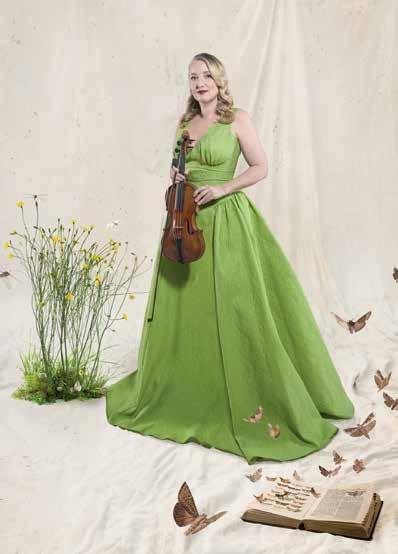
Conceived and created by Skye McIntosh (Artistic Director of the Australian Haydn Ensemble), this immersive new multimedia performance is inspired by the lives of Harriet and Helena Scott and their acclaimed ‘Butterfly Book’, Australian Lepidoptera and their Transformations. It blends exquisite animations, theatrical performance and live classical music performed on period instruments.
Performed by the Australian Haydn Ensemble, with an exceptional cast directed by Rachel McDonald, stunning animations by Studio Gilay, and music by Ludwig van Beethoven, Marin Marais, Elena Kats-Chernin and Tullia Cairns, this evocative new work re-imagines the Library’s collection into a multi-layered live experience, celebrating curiosity, transformation and the enduring power of stories to connect us all.
PATRONS—
Our patrons enable us to continue presenting wonderful concerts, and we could not do what we do without them - we are so grateful to them all.
AHE donor categories are named after famous 18th-century patrons who supported and commissioned many of the works of Haydn, Mozart, Beethoven and others that we are re-discovering today.
About our Patron Categories
Maria Theresa
The Queen was a patron of Viennese music, and Haydn wrote his Te Deum at her request.
Esterházy
Prince Esterházy was the main patron of Haydn.
Waldstein
Count Waldstein was an early patron of Beethoven.
Van Swieten
He was a keen amateur musician and patron of Haydn, Mozart, and Beethoven
Galitzin
He was an amateur musician and is known particularly for commissioning three Beethoven string quartets Op. 127, 130 and 132.
Lobkowitz
He was a Bohemian aristocrat and a patron of Beethoven.
Razumovsky
He commissioned Beethoven’s Op. 59 String Quartets.
Patron
Her Excellency the Honourable
Margaret Beazley AC KC
Governor of New South Wales
Founding Patron
The Late Dr Timothy Pascoe AM
The Chair’s Circle
The Chair’s Circle is a group of dedicated supporters who have made a multi-year commitment to supporting the long-term vision of the Australian Haydn Ensemble.
APS Foundation
Marco Belgiorno-Zegna AM & Angela Belgiorno-Zegna
Sherry & the late Tom Gregory
Karin Keighley
Peter & Lisa Macqueen
Kevin McCann AO & Deidre McCann
Ian & Pam McGaw
Anthony Strachan
Peter Young AM & Susan Young
Anonymous (1)
Artistic Director’s Circle
The Artistic Directors Circle is a group of passionate supporters who have made a commitment to supporting the education program of the Australian Haydn Ensemble and the vision of the Artistic Director
Carolyn Fletcher AM
Adrian Maroya
Jon & Susanne North Peter & Vivienne Skinner
Musicians Chair
Skye McIntosh, Artistic Director & Leader’s Chair
Supported by Mrs W.G. Keighley
Maria Theresa $25,000
Sherry & the late Tom Gregory Howarth Foundation
Karin Keighley
Kevin McCann AO & Deidre McCann
The McLean Foundation
Anonymous (1)
Esterházy $15,000 - $24,999
—
Rowena Danziger
David & Anne Eustace Foundation
Peter & Lisa Macqueen
Ian & Pam McGaw
Anthony Strachan
Peter Young AM & Susan Young
Waldstein $10,000 - $14,999
— APS Foundation
Martin & Ursula Armstrong
Marco Belgiorno-Zegna AM & Angela Belgiorno-Zegna
Carolyn Fletcher AM
Adrian Maroya
Jon & Susanne North
Van Swieten $5,000 - $9,999
—
Clive Birch
Dr Terry & Julie Clarke
Jeremy Eccles FRSN & Kate Eccles OAM
Richard Fisher AM & Diana Fisher
Reg & Kathie Grinberg
Peter & Libby Plaskitt
Peter & Vivienne Skinner
The Hon. Anthony Whealy K.C. & Annie Whealy
In Memory of Tom Gregory & Timothy Pascoe
Galitzin $1,000 - $4,999
Antoinette Albert
James Ashburner
Jock Baird
Mark Bethwaite AM & Jill Bethwaite
Keith & Louise Brodie
Dr Andrew Byrne & Allan Gill
Lloyd Capps & Mary Jo Capps AM
Jason Catlett
Chapman Eastway Charitable Foundation
Dr Michael & the late Dr Colleen Chesterman
George H. Clark
Robert & Carmel Clark
Jean Cockayne
Christine Cooper
Peter & Prudence Davenport
Rob Diamond
Janet Doust
Alison Dunn
Dr Meredith Edwards David, Katrina & Madeline Evans
Ralph Evans AO & Maria Evans
John Fairfax AO & Libby Fairfax
Dr Marguerite Foxon
Bunny Gardiner-Hill
Jean Gifford
Prof Pru Goward AO
Sharon Green
James Hardigg
The Hon Don Harwin
Sarah de Jong
David Kent OAM & Angela Kent
Celia Lillywhite
David Maloney
Lisbeth
Lobkowitz
Jill
Anonymous (6)
Razumowsky $250 - $499
Jeffrey
Paul
Heather
Diana
Deidre
JWM
Anonymous (4)
Foundations
APS Foundation
Chapman Eastway Charitable Foundation
David & Anne Eustace Foundation
Foundation
Jibb Foundation Key Foundation
Sinsay Pty Ltd Stoneglen Foundation
The McLean Foundation
PARTNERS—
GOVERNMENT PARTNER— PARTNERS—


SUPPORTERS—

BACKSTAGE—
Board —
Kevin McCann AO (Chair)
Carolyn Fletcher AM (Deputy Chair)
Adrian Maroya
Skye McIntosh (Artistic Director)
Jon North
Vivienne Skinner
Peter Young AM
Marco Belgiorno-Zegna AM (Emeritus Chair)
The Australian Haydn Ensemble acknowledges the traditional custodians of the lands on which we perform. We pay our respects to Elders past and present.
The Australian Haydn Ensemble is a not-for-profit organisation
ABN 26 202 621 166
PO Box 400 Strawberry Hills NSW 2012 1800 334 388 (Freecall) | australianhaydn.com.au
Behind the Scenes —
Skye McIntosh
Artistic Director & CEO
Ailsa Veiszadeh
Administrator
Alison Dunn
Marketing & Communications
Roderick van Gelder
Production Manager & Lighting Design
Marguerite Foxon
Front of House & Administration*
*In Kind Support
In Kind—
John Dearn, Canberra
Jean Gifford, Canberra
Greg & Wendy See, Berry
Stuart & Felicity Coughlan, Berry
Steve & Mary Beare, Berry
Keith & Louise Brodie, Berry
Images—
Images throughout by Helen White except pages 6-7 James Mills and Supplied.
Penrith Youth Orchestra