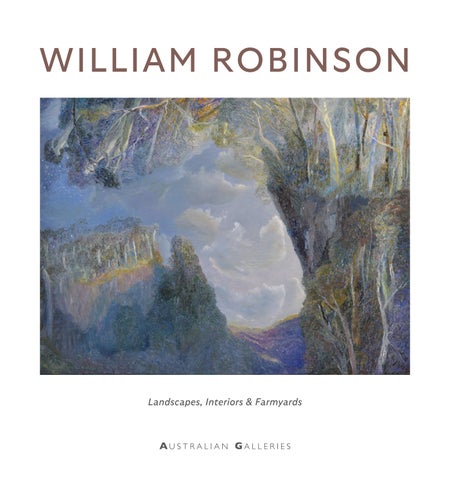
WILLIAM ROBINSON
Landscapes, Interiors & Farmyards
AU S T R A L I A N GA L L E R I E S
Contents
An interview with William Robinson by Lou Klepac 1994
5
Paintings
12
Gouaches , Pastels , Watercolours & Pencil
24
Lithographs
38
Biographical details
51
An interview with William Robinson by Lou Klepac, 1994 Originally appeared in the monograph “William Robinson 2001 published by The Beagle Press” Now reprinted with the kind permission of Lou Klepac and the Robinson family.
Lou Klepac: What does it mean to be a painter?
finish their training. We started painting in umber and white. We had examinations where still life was set up in front of you
William Robinson: Being a painter is a matter of gaining a
and you had to paint it in three hours. It was an extraordinary
passion, which is very difficult to define. It doesn’t start, I don’t
sort of formal, broken-up, set of disciplines, including design,
think, with the passion, but it just builds and builds until it
historic ornament, which was learned by copying.
becomes impossible to live without thinking of the next image, or the image that you’re working on at the moment. It’s just a
LK: What about the life class?
matter of keeping going without any help and beyond criticism - building up something within yourself.
WR: The life class started about the third year. It normally consisted of just one pose for the whole time. This business
LK: You had a scholarship to the art school. How did you get it?
of quick poses was not of the old system. It’s part of the new system; in fact, some of the life drawings might have been
WR: Well it was a strange scholarship. After finishing teacher
worked on for weeks.
training, which I did in 1954 as a primary school teacher, they offered three scholarships at the end of the year to go to the
LK: Did you enjoy it?
Central Technical College, which was a very archaic sort of system of training people. At the same time as having very long
WR: Yes, I did enjoy it. I don’t think it was an activity where
and formal courses, they were treated as being a great deal less
one’s intellect was too flourished, or... there were no pathways
than a university course intellectually. That business of getting
that you could move up apart from this pathway.
degrees for art courses is a very recent thing, I mean in the last twenty years. In those days it was more like a work experience
LK: If you had this sort of feeling, about the particular training,
thing. At the same time as training in the most formal sort of
what was going on inside you that might have inspired you, the
way, I had to teach at night and Saturday mornings, to pay
books that you might have discovered - what were you looking
my way for the training. It meant drawing from the antique
at to stir your imagination?
a great deal. I mean one started with lips, ears, nose, muscles and things like that. You didn’t graduate to the full head or the
WR: Well, I guess in the early ‘50s we did see a couple of
full figure until maybe the second or third year. You would take
exhibitions from overseas. We saw paintings by Picasso,
a drawing along to the chief instructor and he would criticise it
Bonnard, Vuillard - they did have some impact, because
and say it was ‘a bit out here’ and ‘a bit out there’. And you’d
the book that we studied and finished high school with was
take it along the next day and he’d find somewhere else where
Orpen’s Outline of Art, and Orpen more or less finished with a
it was a bit out. So, some people took an enormous time to
slight introduction to Matisse and Paul Klee. I think they were 5
about the only two contemporaries considered. But these
LK: How old were you when you left the college?
other exhibitions did come to Brisbane. They were greeted with some derision. I can remember that in a newspaper, Picasso’s
WR: I was there until 1962 - when I was 26. I left the college and
Orange Bodice was lampooned by the cartoonist Emile
went to teach in the teachers’ college. I started to go up several
Mercier. It was a particular sort of aspect of Australia, strangely
paths, like the young do today. The young have magazines to
enough, Miro had a number on his painting, the subject was a
look at today and they have the instant media - latest painting.
number. And that was the cause of some derision, too. But it
That really wasn’t for us, well it certainly wasn’t in Brisbane. It
was somehow the beginning with me. It did start something. It
may have been in Sydney, but it wasn’t in Brisbane. We were
had nothing to do with the college that I went to. And this is
trying these other things for a while. I suppose, though, one of
just about the same time as people like Molvig started to come
the biggest things for me was the understanding of Cézanne -
back from overseas. The Churchers came back from England
the importance of moving away from illusion, into the respect
at about the same time, I think about 1957. They introduced
for the picture plane, the tilting of the picture frame itself.
certain contemporary issues to Brisbane. But they were outside
I found that an important thing - the actual understanding,
of the college. Nevertheless, we were still aware that those
not just historically, but the understanding of how Cubism, for
things were happening. Cautiously, I was always a painter of
example, arose out of Cézanne. That occurred to me for the
caution or a person of caution. I wasn’t really a painter in those
first time and that was of immense importance, the frontality
days. I didn’t accept things totally on their face value. I hadn’t
of it.
travelled overseas. LK: Did you have an urge to go and look at Cézannes overseas, LK: What about Australian art. What did you see that might
because I know that there were no Cézannes in Brisbane at
have pleased you or displeased you at that particular time?
that time, and there isn’t one there now.
Were you aware of people like Streeton, or were you interested in Drysdale or Dobell?
WR: There was an enormous urge to go overseas, but being married and starting a family, which ended up with six
WR: Drysdale and Dobell, I think even in the 1950s would have
children, it didn’t become an easy operation to go overseas, so
been considered modernists. Streeton, all of that, was part of
one had to make the best of what was here.
the history that we did understand. LK: I know that at about this time you also had a serious LK: Could you identify with them as painters who gave us a
interest in music. How important was music at that time?
door into the Australian landscape? Or did you feel that they were perhaps not quite the door that you wanted to find
WR: I started having lessons when I was seven and I continued
yourself?
having lessons until I was twenty-one in 1957. In 1957, I did reach the state finals of the ABC concerto and vocal
WR: I didn’t really concern myself with the Australian landscape
competition. The day that I played, the conductor was Rudolf
in the ‘50s because I was living in the suburbs. And, I think,
Pekarek. He took the concerto fractionally faster than I had
when you’re young - well, for me anyway - I was trying, when
been practising it and the fact that you only had one practice
I left the college…
with the orchestra, and the orchestra was surrounding you,
it sounded more like a swarm of bees than an orchestra. I
colours were quite different when I saw the actual paintings.
went home and had two days of desperation. I realised that
I came down to Sydney to see that wonderful exhibition in
I couldn’t do it. I mean, I played in the orchestra extremely
1972. I thought it was a wonderful exhibition, just the most
badly. I think that the article where it said that I could have
wonderful exhibition. In ‘67, my version of the colour of
been a concert pianist was a slight exaggeration. I didn’t say
Bonnard was somewhat heightened. I painted interiors, small
that. I simply said I could have had a career in music - which
nudes, this sort of thing.
may have been a primary school teacher in music for all I know. But, it was a case where one had to have, as far as I was
LK: The question which I need to ask you now is: were you a
concerned, absolute nerves of steel and I didn’t have them.
visionary at 31?
LK: I read in the same article that you play the piano an hour
WR: No, not at 31.
and a half in the mornings, an hour and a half in the evenings, every day. Music has obviously remained a very important part
LK: Did you have a clear idea of where you wanted to go, or
in your life.
did you just feel something? Were you happy with what you had done? Or did you actually know that something else was
WR: It has. But, of course, bringing up a family, the music that
ahead of you, but you weren’t quite sure what it might be?
was involved there was mainly taking them to music lessons, with one instrument or another: piano, flute, violin - all sorts
WR: I always knew that there was something ahead of me
of things. The things that you do for your children. I took up
- the same way I know that there’s something ahead of me
music lessons again in 1990 and found a very good music
now. I mean, being a painter is always going to be some sort
teacher - piano teacher. I go and have lessons, because it is
of unknown. But I always knew that there would be something
vitally important to me, from an intellectual point of view,
there. If I was at home tomorrow, I couldn’t stop - I’d be
to keep going, even though I know that I’ll never be any good
thinking about the next thing, and I was thinking about the
in terms of professionalism. But that’s not the point. It is of
next thing then. I didn’t know enough to be any good. I really
vital importance to me because it’s a means of transforming
didn’t know what I was doing. I think it takes a lifetime to start
yourself into another life for a while.
to discover colour.
LK: I think the first exhibition you had was when you were
LK: Were you interested in technical things, like the quality of
thirty-one years old. What kind of pictures were you painting
paint, the canvases and so on? Were you interested in this side
at that time?
of painting, or did you just use paint as it came?
WR: The pictures were mainly interiors. I was very influenced
WR: I did try to use paint responsibly. Mind you, that always
by Bonnard. I still think that for me, he is the greatest painter
needs qualification, because one can dry up by becoming too
of this century - for me, not necessarily for others, and the
technically involved. But I do feel a responsibility to making my
most wonderful and spiritual colourist. But I was influenced by
paintings last, if possible, and I’m more and more concerned
the Bonnard of small book reproductions, where the colours
that I would like my great grandchildren to see them in their
were rather heightened. I was surprised to see that Bonnard’s
present state - in the state that they are in now, I suppose. 7
Well, painting became very unfashionable in art schools, didn’t
other people’s art or something like that - but, the real things.
it? But I’m very grateful - eternally grateful that I at least
When I painted my first chook yards in 1979 and cows in 1980. I
learned to mix colours. We didn’t have any gurus teaching us
knew that other people had painted cows. For example I knew
and we didn’t have anybody who was teaching us how they
that Dubuffet had painted cows. I wasn’t a completely dumb
painted. They were always dissatisfied and they were as dry as
goat farmer. I did know what was going on - up to a point. I
old boots… I couldn’t move out of it. I couldn’t move out of it
thought he was some inner city person who painted what he
because I was a teacher. If I was free - if I wasn’t a teacher - I
thought a cow should be and it belonged to him, but I had no
would have moved out of it. I would have gone to Sydney or I
understanding of his cows. They didn’t mean anything to me.
would have gone to London to learn how to paint. I wouldn’t
They only meant something to me when I kept them myself. It
have stayed there. It was too dry, too stifling and too many
was some strange change to be exhibiting cows. It was a pretty
people had just one narrow way.
awful exhibition, I suppose, when you think of my exhibition of cows in 1980. It had to be done to get where I am now,
LK: When did you actually first think of going to live outside
even though it had no relationship to where I am now. It was
the urban area, have animals, and have somewhere you could
like an electric shock. I had to break out of all that art, all that
escape to on weekends? How did that come about?
Bonnard that had gone on before. And suddenly, there I was with these probably fairly gross paintings of cows on a large
WR: It came about because we had lived in Brisbane a long
scale; very confronting, and maybe forgettable.
while. We were living at Coorparoo, which is a fairly close inner suburb, and we were living in an old Queenslander house. Life
LK: Were you permanently on this farm at this time, or were
was very sweet, if somewhat laid back. Certainly not with
you still teaching?
Sydney excitement, but when we saw the freeway going up, we thought ‘that’s it - we can’t stay here anymore’. So in 1970
WR: I was always teaching.
we moved to a small farm. We knew nothing about animals at all. And, when you move to a farm, you think. Well, Bruce
LK: Did you live on this farm or did you live in the city and go
Dawe wrote a poem about a mini-farmer riding a mini-mower
back to the farm sometimes?
around all the time - well, that’s how it starts. It starts that way. It finishes with seventy goats and forty chooks and five or
WR: No, I always drove into the city. So, no matter where I
six cows and sheds all over the place fifteen years later.
was, whether I was in Birkdale, which was about an hour from the city of a morning in the rush hour traffic, or Beechmont,
LK: How did this experience begin to take over the subject
which took me two hours to drive each way - which was sheer
matter of your pictures? Was it something happening, between
lunacy, I suppose.
you and the place itself? LK: When did you decide to go there? WR: It was something that happened between me and the place itself. I think one of the hardest things for a painter is to
WR: Well, we bought this place in 1972, strangely enough
paint real life, to paint real experiences, real sensations that
because people were starting to develop around us and we
come to you and not sensations that come to you through
needed more air. Either you move further into the country -
and we moved further into the country - into almost alien land.
landscape and let something settle in. But if there is something
I mean, the place had no electricity. It had not been lived on
which is happening like a bushfire in the valley below, or mist
much for - well, there were a few people that were there on
rising, or the sun in a particular position, or a storm coming,
and off. We left there in ‘84.
these things with particular lights can trigger something.
LK: What difference did it make when you stopped having to
LK: Do you have a very good visual memory? Or is the
go to teach and became a full-time painter?
experience actually so rooted into your make-up that it comes out as a picture?
WR: I started to paint for the first time. I believe that that was the beginning of my development. Right up until that
WR: Doesn’t come into my mind as a picture. It comes into my
time - although I wanted to paint, because there just wasn’t
mind as an idea. And I think that there is a difference, because
time - I painted at night, after teaching all day, little strips of
some ideas are only partially formed. I do a drawing, and that’s
a painting, and still had exhibitions every couple of years. It
where these pencil drawings, on a very small scale, allow me to
was extremely difficult. But when I gave up teaching, a total
make some sort of organisation, to see what it looks like and
transformation seemed to appear and I had time to allow
that’s when I see it for the first time myself.
paintings to develop in my mind before I started them. I could see their strength coming before I started them.
LK: Do you have a system, by which you work the sketch into a picture?
LK: Could it also be that perhaps, by being in the landscape yourself, the landscape could get hold of you?
WR: I do it organically. I draw it, on the canvas, in charcoal. Not too much - not too detailed. I don’t overstate, because I like
WR: There was no shortage of subject matter. But there was
to find what’s in the picture as I go; but its bones I put down
enormous difficulty in coming to understand what it was that
in charcoal.
I was painting. LK: Do you work on more than one painting at a time? LK: How did you tackle this new subject matter? On a smaller scale? In drawings? What was the beginning of this
WR: I can’t work on more than one painting at a time. That
new development?
one painting has to be completed. However, I won’t say that I won’t go back and do little bits on a painting that worries me,
WR: I think probably there were bigger paintings, but the
while I might be working on another one, but the paintings are
paintings became more simple. That’s a very difficult question.
completed for me one at a time.
LK: I know that you go for long walks. Do you go to look or to
LK: Have you ever taken your canvas out into the landscape to
sketch?
work directly from nature - or is it all done in the studio?
WR: I don’t carry a sketchbook. I go to look in the landscape.
WR: In the studio.
I always respond to phenomena. I like to walk around the 9
LK: So, instead of actually going out to paint from the
LK: So colour is terribly important to you?
landscape, you let the landscape come in. You don’t need to look. WR: Colour is everything to me. WR: Well, I don’t need to look almost, but I need to feel. Yes, I need to feel.
LK: When you actually decide to paint a picture, do you always have the same pigments set out on a palette? Do you have a
LK: When you work, do you have a set routine?
strict number of colours that you use?
WR: My working day, if you can include the music, consists
WR: I have a strict number of colours that I use. I use titanium
of at least an hour and a half’s practice in the morning, then
white instead of flake white because it’s a little less stiff and
probably two hours of painting and then, two hours of doing
probably because it doesn’t have lead in it. I use, sometimes,
nothing and then, two or three hours of painting, and another
but not very much, cadmium yellow pale. I used to use
hour to hour and a half of practice. I use music while I’m
cadmium lemon, but never do now. I have a colour called
painting to fill a space. I actually like, funnily enough, to be in a
aureoline in the yellows I would use sometimes. I would use
sort of state where I’m not thinking when I am painting. I can’t
cadmium orange, cadmium red, genuine rose madder, Indian
tell you where I am, but I’d have to be listening to music. I can’t
yellow - which I would use sometimes to mix some darks. For
do it, really, in silence. I need music, and the paintings almost
example, sometimes if I mixed some Indian yellow with French
happen in some sort of unconscious sort of way.
ultramarine and a little bit of red - that’s cadmium red - I can vary some of my darks. I use terra verte and cadmium green,
LK: Do you put CDs on or do you listen to the radio?
cerulean blue and French ultramarine blue. That’s the full extent, I think, of my colours.
WR: No, I put records on and sometimes, if I know that something’s coming on that I want to listen to on FM or on the
LK: Obviously these colours are what you have been using for
local station I will listen to that. But most of the time, I’ll listen
quite a while. You haven’t brought any new instruments into
to my collection of music. I might feel for certain music on a
your system.
certain day. If I’m in doubt at any time, I always listen to Bach. I’ve got quite a nice collection of records which I listen to. I can
WR: I haven’t brought any new instruments but I have
always listen to Bach’s preludes and fugues because they cover
discarded some colours, like crimson. I’m not a clean painter.
all colours and all keys - the major and minor keys - I can listen
I don’t paint with the paint around the outside and clean
to all of them and for all moods and for all colours.
the palette in the middle. It is not a shaped palette, it’s just something standing on a table, and it’s quite large. It just builds
LK: Can you see any relationship between music and the colour
up and up and up with paint, which I put in the same places
and tone in a painting?
until I’ve got a mountain of dried paint that I can’t cope with any longer. Then I’ll just get rid of it, but I never clean it up. I
WR: Oh yes, I mean absolutely, in the same way. Each key has
always work in little pools of colour.
its own mood, if you like, somewhat like colours which have their own mood.
LK: Are you a fast worker or a slow worker?
WR: Well, I think I’m very slow - I mean it takes me maybe a
everybody around you suffers: your wife suffers, your children
month, maybe six weeks to do a painting.
suffer - they don’t see you - and you suffer. A lot of people when they first go to art school think that this is a glamorous
LK: Do you work a bit of it at a time or work on the whole
life. Well, the life itself is spent sitting in front of a canvas,
picture at the same time?
painting. That’s what it’s about. It’s about being alone with this gnawing thing and it’s not a glamorous occupation. It’s an
WR: I probably work in a little section, which I actually finish.
occupation which satisfies some sort of tearing need which has
Well, I don’t finish, but I three quarter finish. I’m always coming
to be filled. That’s the selfish part of it, I suppose. That’s part
back over my own tracks again. However, the danger with me,
of it, but, I mean, on a wider scale, there are other things you
is that there’s always been a lack of spontaneity of freshness.
know — the actual sort of responsibility - the subject matter,
I suppose it’s because I’ve always been suspicious of myself.
for example. I think the greatest responsibility of painters now
I don’t mean suspicious of others, but suspicious of myself.
- paintings always have been about political issues or personal
Something has to ring true-there are always dangers for me….
issues, in some deep way - is the issue of the earth - not urban
I think I’m getting better at not doing it, I’m getting better at
issues and city street issues, but the issue of the air, the water,
being fresher.
all of these things. These are the real political issues now.
LK: Do you wear glasses? Do you have to wear glasses to paint?
LK: Do you have an ideal audience in mind when you paint?
WR: I wear glasses. If I didn’t have glasses, I wouldn’t be able to
WR: No, I don’t think so.
see what I was doing close at hand. But I can see whales five miles out to sea without glasses.
LK: How do you feel when the pictures have now left the studio, left your house - left Queensland?
LK: Someone actually said that you just paint these pictures, and that they’re not meant to be religious. I think that they
WR: I am happy if they go into a place where they’ll be looked
are very religious and very intense and that the landscape is
after. I do feel that. I’d love them to be looked after, because I
actually speaking through you.
created them and I don’t want them to be destroyed.
WR: You’re on the right track. There are two issues involved here, I think. I have a responsibility to the land itself. I believe that there’s a providential power behind all existence and it is all linked up somewhere. I believe that I have a personal responsibility to God, to my family so that they can see what I’ve done, and so that the future generations of my family can see what l’ve done - what trails I’ve left behind. And I have some sort of responsibility to people to widen their spectrum a little bit. I don’t consider my painting a purely selfish activity. It’s selfish enough. It’s a very selfish activity in itself because 11
P A I NT I NGS
The Ant Tree 1992 oil on linen 138 x 199 cm 13
Seascape with morning star 2006 oil on linen 110 x 247 cm
15
Numinbah with blue pools 1999 oil on linen 91 x 122 cm
Purlingbrook in morning sun 1998 oil on linen 77 x 102 cm 17
Clavichord 2021 oil on linen 140 x 81 cm
Chookyard with stretching ducks 2018 oil on linen 75 x 101 cm 19
Bouquet (blue vase) 1978 oil on canvas board 56 x 42 cm
Still life with green bowl, pears and apples 2021 oil on canvas 34 x 40 cm 21
Dry landscape with cloudy sun 1992 oil on linen 33 x 38 cm
Dawn with bright moon 1991 oil on canvas 31 x 37 cm 23
GOUA C H ES , P A S T E L S , WA T E RC OLOU R S & PE N C I L
Untitled 2013 oil pastel on paper 66 x 120 cm 25
Sunflowers, pomegranates and limes 2015 pastel on paper 77 x 57 cm
Daffodils, hyacinths and roses 2014 pastel on paper 63 x 48 cm 27
Ranunculus in Charlotte Rhead vase 2014 pastel on paper 63 x 48 cm
Two friends 1979 gouache on paper 56 x 76 cm 29
Study for rocks Girraween 2010 pastel and gouache on paper 61 x 46 cm
Chookyard Birkdale 1978 pencil and pastel on paper 58 x 48 cm 31
Mixed vegetables with copper pot 2015 pastel on paper 46 x 55 cm
Hen with chickens 1981 watercolour on paper 53 x 70 cm 33
Wattle, banksia, fruit and bread 2013 gouache on paper 28 x 38 cm
British Alpine & Saanen goats 2017 gouache on paper 18 x 26 cm 35
Hinterland 2018 pastel on paper 16 x 26 cm
Cows in the grass I 1984 pencil on paper 29 x 39 cm 37
LI T HOGRA P H S
Tallanbanna II 2000 colour lithograph 62 x 80 cm edition 100 39
Creation Landscape - earth and sea 1995 colour lithograph (triptych) 40 x 172 cm edition 75
41
Twin Falls 2000 colour lithograph 62 x 80 cm edition 100
Blue Pools 2000 colour lithograph 62 x 80 cm edition 100 43
Late sunlight & afternoon cloud Beechmont 1993 colour lithograph 48 x 68 cm edition 35
Mt Warning 1992 colour lithograph 37 x 47 cm edition 35 45
Cloudy sun 1992 colour lithograph 37 x 47 cm edition 35
To the sea - morning sun 1998 colour lithograph 28 x 39 cm edition 75 47
Tallanbanna 1998 colour lithograph 28 x 39 cm edition 75
Tweed Valley 1998 colour lithograph 28 x 39 cm edition 75 49
William Robinson – select biographical details Born Brisbane, Australia 1936-2025
SOLO EXHIBITIONS
2026
Australian Galleries, Sydney, ‘Landscapes, Interiors & Farmyards’ William Robinson Gallery, Queensland University of Technology, Brisbane, ‘Lessons in looking’ Philip Bacon Galleries, Brisbane, ‘Landscapes’
2025
William Robinson Gallery, Queensland University of Technology, Brisbane, ‘Reflections’ Philip Bacon Galleries, Brisbane, ‘Farmyards: Paintings, pastels and drawings 1979-2018’
2024
William Robinson Gallery, Queensland University of Technology Brisbane, ‘Numinous: The landscape paintings’ Australian Galleries, Sydney, ‘Cows: Two paintings, a selection of drawings, lithographs and etchings 1979-2018’
2023-24
William Robinson Gallery, Queensland University of Technology, Brisbane, ‘The Painter and the Printmaker’
2023
Philip Bacon Galleries, Brisbane, ‘Moreton Bay’
2022
William Robinson Gallery, Queensland University of Technology, Brisbane, ‘Love in Life & Art’
2021
William Robinson Gallery, Queensland University of Technology, Brisbane, ‘William Robinson: Nocturn’
2021
Home of the Arts, Gold Coast, QLD, ‘Lyrical Landscapes: The Art of William Robinson’
2019
William Robinson Gallery, Queensland University of Technology, Brisbane, ‘Elixir of light’
2018
William Robinson Gallery, Queensland University of Technology, Brisbane, ‘Nature Imagined’ Australian Galleries, Melbourne, ‘Painted from my life’ Australian Galleries, Melbourne, ‘Three bronze sculptures and extensive selection of lithographs and etchings made over 20 years in Australia and France’ Australian Galleries, Sydney, ‘Painted from my life’ Philip Bacon Galleries, Brisbane, ‘Five paintings from the personal collection of William and Shirley Robinson’
2017-18
William Robinson Gallery, Queensland University of Technology, Brisbane; travelling to Embassy of Australia, Washington DC; Embassy of Australia, Paris; Hamilton Gallery, VIC; S.H. Ervin Gallery, Sydney, ‘Genesis’ William Robinson Gallery, Queensland University of Technology, Brisbane, ‘Eternal Present: The Still Life Paintings of William Robinson’, curated by John McDonald
2017
Philip Bacon Galleries, Brisbane, ‘Still lives and interiors’
2016
Australian Galleries, Sydney and Melbourne, ‘The artist’s garden, house and memories’
2015
William Robinson Gallery, Queensland University of Technology, Brisbane, ‘Inspirations’
2014
William Robinson Gallery, Queensland University of Technology, Brisbane, ‘Infinite sphere’ Philip Bacon Galleries, Brisbane, ‘Paintings and pastels’
2013
William Robinson Gallery, Queensland University of Technology, Brisbane, ‘The farmyards’ 51
2012
Australian Galleries, Sydney and Melbourne, ‘Still life and landscape paintings 2010 – 2012’ William Robinson Gallery, Queensland University of Technology, Brisbane, ‘Insights’
2011
William Robinson Gallery, Queensland University of Technology, Brisbane, ‘William Robinson: The transfigured landscape’ Philip Bacon Galleries, Brisbane
2010
William Robinson Gallery, Queensland University of Technology, Brisbane, ‘Hinterland: The rainforest works of William Robinson’ Philip Bacon Heritage Gallery, State Library of Queensland, Brisbane, ‘Ekka series 1-20’ Australian Galleries, Sydney and Melbourne, ‘Twenty ink drawings, Eight paintings, One sculpture, New works 2009’
2009
Philip Bacon Galleries, Brisbane, ‘Paintings 2009’
2007
Australian Galleries, Sydney and Melbourne, ‘Paintings and Lithographs 2000 – 2007’ Philip Bacon Galleries, Brisbane, ‘The French Lithographs’
2006
Philip Bacon Galleries, Brisbane, ‘Paintings and Pastels 2006’
2005
Australian Galleries, Sydney and Melbourne, ‘Landscapes’
2004
Queensland University of Technology Art Museum, Brisbane travelling to Cairns Regional Art Gallery; Campbelltown City Bicentennial Art Gallery, Sydney; Gold Coast City Art Gallery, QLD; New England Regional Art Museum, NSW; Stonington Stables Museum of Art, Melbourne, Deakin University, Melbourne; Toowoomba Regional Art Gallery, QLD; Wagga Wagga Regional Art Gallery, NSW, ‘Place & Memory: The Graphic Work of William Robinson’ Australian Galleries, Sydney and Melbourne, ‘Self portraits 2004’ Australian Galleries, Melbourne Art Fair, Melbourne, ‘Self Portraits 2004’ (Stand 17A) Philip Bacon Galleries, Brisbane, ‘Self portraits 2004’ University of South Australia Art Museum, Adelaide, ‘William Robinson: The Revelation of Landscape’
2003
Philip Bacon Galleries, Brisbane, ‘Paintings and pastels’ S.H. Ervin Gallery, Sydney; Mornington Peninsula Regional Gallery, Mornington, VIC, ‘William Robinson: The Revelation of Landscape’
2002
Australian Galleries, Sydney and Melbourne, ‘Recent Paintings’
2001
Queensland Art Gallery, Brisbane; National Gallery of Australia, Canberra, ‘Darkness and Light – The Art of William Robinson’ Philip Bacon Galleries, Brisbane Australian Galleries, Sydney and Melbourne, ‘Pastels, watercolours and prints’
1998
Ray Hughes Gallery, Sydney
1997
Ray Hughes Gallery, Brisbane
1996
Ray Hughes Gallery, Sydney
1994
Ray Hughes Gallery, Sydney
1992
Darren Knight Gallery, Melbourne
1991
Ray Hughes Gallery, International Print Fair, Sydney, ‘Creation Landscape: Water and Land’ Ray Hughes Gallery, Sydney Queensland University of Technology, Brisbane, ‘Selected Works from the University Art Collection’
1989
Kelvin Grove College of Advanced Education, Brisbane Ray Hughes Gallery, Brisbane
1988
Ray Hughes Gallery, Brisbane
53
1986
Ray Hughes Gallery, Brisbane
1985
Ray Hughes Gallery, Sydney
1984
Reconnaissance Gallery, Melbourne, ‘Ray Hughes Gallery at Reconnaissance’
1982
Ray Hughes Gallery, Brisbane
1981
New England Regional Art Museum, Armidale, NSW, ‘Farm Images’
1980
Ray Hughes Gallery, Brisbane
1978
Ray Hughes Gallery, Brisbane
1977
Ray Hughes Gallery, Brisbane
1975
Kelvin Grove College of Advanced Education, Brisbane
1974
Leveson Street Gallery, Melbourne
1971
Leveson Street Gallery, Melbourne
1969
Design Arts Centre, Brisbane
1967
Design Arts Centre, Brisbane
AWARDS
2009
Queensland University of Technology, Brisbane, Chancellor’s Outstanding Alumnus Award
2007
Queen’s Birthday Honours, Australia, Officer of the Order (AO)
2005
Griffith University, Brisbane, Honorary Doctorate
2002
University of Southern Queensland, Toowoomba, QLD, Honorary Doctorate
1998
Queensland University of Technology, Brisbane, Honorary Doctorate
1996
Art Gallery of New South Wales, Sydney, Wynne Prize (Winner)
1995
Art Gallery of New South Wales, Sydney, Archibald Prize (Winner)
1991-92
Art Gallery of New South Wales, Sydney, John McCaughey Memorial Prize (Winner)
1990
Art Gallery of New South Wales, Sydney, Wynne Prize (Winner)
1987
Art Gallery of New South Wales, Sydney, Archibald Prize (Winner)
1985
Ipswich City Art Gallery, Ispwich, QLD, Aberdare Art Prize (Winner)
1970
David Jones Painting Prize, Australia
1956
Central Technical College, Brisbane, Godfrey Rivers Memorial Medal
55
COLLECTIONS
ANZ Bank, Australia Art Gallery of Ballarat, Ballarat, VIC Art Gallery of New South Wales, Sydney Art Gallery of South Australia, Adelaide Art Gallery of Western Australia, Perth Artbank, Sydney Auckland City Art Gallery, Auckland, New Zealand Australian Print Workshop Archive, Melbourne Benalla Art Gallery, Benalla, VIC Bendigo Art Gallery, Bendigo, VIC Brisbane Grammar School, Brisbane Burnie Regional Art Gallery, Burnie, TAS Cairns Regional Art Gallery, Cairns, QLD Campbelltown City Bicentennial Art Gallery, Sydney First Chicago National Bank, Chicago, USA Gold Coast City Art Gallery, Surfers Paradise, QLD Griffith University, Brisbane IBM, Australia Ipswich City Art Gallery, Ipswich, QLD JP Morgan Chase, Australia Macquarie Bank, Australia Melbourne State College, The University of Melbourne, Melbourne Metropolitan Museum of Art, New York, USA Museum of Brisbane, Brisbane National Gallery of Australia, Canberra National Gallery of Victoria, Melbourne Newcastle Art Gallery, Newcastle, NSW
Toowoomba Regional Art Gallery, Toowoomba, QLD
New England Regional Art Museum, Armidale, NSW
Tweed Regional Gallery, Murwillumbah, NSW
Parliament House, Canberra
UC Art Collection, University of Canberra, Canberra
Queensland Art Gallery, Brisbane
University of New South Wales, Sydney
Queensland University of Technology, Brisbane
University of Queensland Art Museum, Brisbane
Redcliffe City Art Gallery, Redcliffe, QLD
University of Tasmania Fine Art Collection, Hobart
Rockhampton Art Gallery, Rockhampton, QLD
Vatican Museums, Vatican City, Italy
Stanthorpe Regional Art Gallery, Stanthorpe, QLD
Wagga Wagga Art Gallery, NSW
State Library of Queensland, Brisbane
Waikato Art Museum, Hamilton, New Zealand
57
WILLIAM ROBINSON
ISBN 978-0-6459353-0-1
9 780645 935301 >