Insights
The Faculty Journal of Austin Seminary
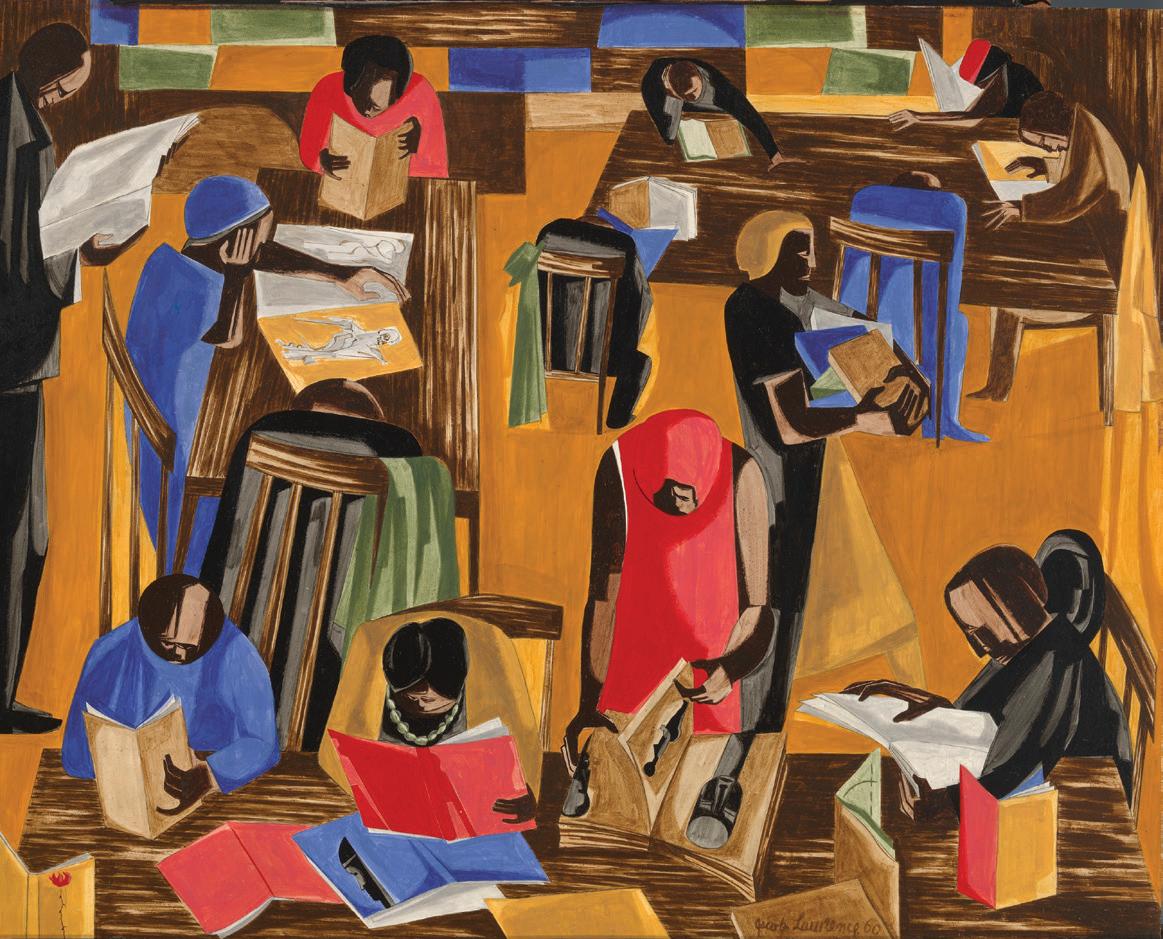
SPRING 2026
Jeong • Gaventa • Barreto • Gabrielle
Blodgett • Silva-McCormick
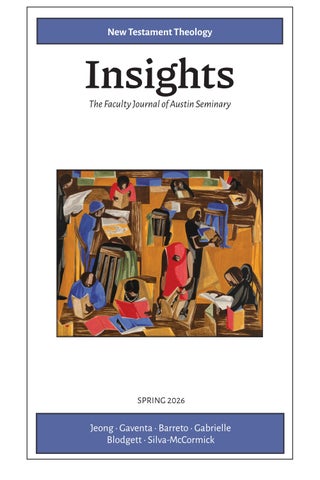
The Faculty Journal of Austin Seminary
Spring 2026
Volume 141 Number 2
Editor: Crystal Silva-McCormick
Editorial Board: Philip Browning Helsel, Donghyun Jeong, Jeff Sanchez
The Faculty of Austin Presbyterian Theological Seminary
Sarah Allen
Margaret Aymer
Patricia Bonilla
Rodney A. Caruthers II
Gregory L. Cuéllar
Ted V. Foote Jr.
Ángel J. Gallardo
William Greenway
Carolyn Browning Helsel
Philip Browning Helsel
José R. Irizarry
David H. Jensen
Donghyun Jeong
Jennifer L. Lord
Song-Mi Suzie Park
Cynthia L. Rigby
Crystal Silva-McCormick
Andrew Zirschky
Insights: The Faculty Journal of Austin Seminary is published two times each year by Austin Presbyterian Theological Seminary, 100 East 27th Street, Austin, TX 78705-5797. e-mail: insights@austinseminary.edu
Web site: austinseminary.edu
Entered as non-profit class bulk mail at Austin, Texas, under Permit No. 2473. POSTMASTER: Address service requested. Send to Insights, 100 East 27th Street, Austin, TX 78705-5797.
© Austin Presbyterian Theological Seminary Printing runs are limited. When available, additional copies may be obtained for $3 per copy. Permission to copy articles from Insights: The Faculty Journal of Austin Seminary for educational purposes may be given by the editor upon receipt of a written request.
Some previous issues of Insights: The Faculty Journal of Austin Seminary, are available on microfilm through University Microfilms International, 300 North Zeeb Road, Ann Arbor, MI 48106 (16 mm microfilm, 105 mm microfiche, and article copies are available). Insights is indexed in Religion Index One: Periodicals, Index to Book Reviews in Religion, Religion Indexes: RIO/RIT/IBRR 1975- on CD-ROM, Religious & Theological Abstracts, url:www.rtabstracts.org & email:admin@rtabstracts.org, and the ATA Religion Database on CD-ROM, published by the American Theological Library Association, 300 S. Wacker Dr., Suite 2100, Chicago, IL 60606-6701; telephone: 312-454-5100; e-mail: atla@atla.com; web site: www.atla.com; ISSN 1056-0548.
The views and opinions expressed in our published works are those of the author(s) and do not necessarily reflect the views of Austin Presbyterian Theological Seminary or its Editors.
COVER: Jacob Lawrence, The Library, 1960, tempera on fiberboard, 24 x 29 7/8 in. (60.9 x 75.8 cm.), Smithsonian American Art Museum, Gift of S.C. Johnson & Son, Inc., 1969.47.24
Liberation theologian and Jesuit priest Jon Sobrino stated, “To know Christ in the New Testament is to know the crucified peoples of history.” This statement encapsulates Sobrino’s theology, and particularly his understanding of the New Testament. An alternative interpretation of the New Testament can be found in the work of nineteenth-century theologian James Henley Thornwell, who argued that the New Testament Scriptures not only fail to condemn slavery but also explicitly recognize it. These two disparate interpretations highlight the central themes of this edition of Insights, namely the different ways in which the New Testament has been interpreted and appropriated by scholars and other readers, towards oppressive or liberative ends. In this issue, scholars and pastors bring their own lenses and areas of expertise to the conversation, creating a rich and thought-provoking dialogue that invites readers to consider what faithful and humble readings of the New Testament’s sacred writings might entail.
Donghyun Jeong’s lead essay reflects on the shifting meaning and status of New Testament theology within modern biblical scholarship and proposes reimagining it as a contemporary and constructive discourse that approaches Scripture as inspirational and invitational. Beverly Gaventa addresses the ongoing question of the relevance of studying the New Testament and its historical context. She argues that while historical, literary, and contextual analyses are valuable and have expanded greatly over the past half-century, such approaches can sometimes obscure the central concern of the New Testament itself. The New Testament is not primarily about sociological reconstruction, rhetorical technique, or intellectual debate. Rather, it is about God, specifically the God who raised Jesus from the dead. Discussions of Scripture, she argues, are incomplete if they neglect what Karl Barth called their “subject,” namely God.
Eric D. Barreto draws on his scholarly focus and life experience to explore the theme of timekeeping in the Gospel of Luke as a theological practice. Barreto invites readers to consider that just as Mark’s Gospel uses urgency to shape readers toward apocalyptic attentiveness, Luke forms readers through the way he structures time. In doing so, Luke reframes time as a space for faithful, everyday discipleship lived under empire. Haley Gabrielle challenges readers to examine how modern biblical theology was shaped in the nineteenth century within colonial frameworks that privileged European rationality, objectivity, and historical “purity.” These frameworks often dismissed imagination, embodiment, and non-European ways of knowing as primitive or mythological.
These essays are complemented by a thoughtful pastors’ panel featuring Rev. Chris Currie, Rev. Monica Thompson Smith, and Rev. Jasiel García Hernández, who share insights into how they teach and preach the New Testament in their congregations. Crystal SilvaMcCormick concludes the issue with a reflection on how the New Testament, particularly the Gospels and the crucifixion, invites readers to identify with those on the margins. Together, these pieces advance the conversation in unique and thoughtful ways not only about interpreting the New Testament but also about how communities apply sacred texts and connect them to the lived experiences of diverse people.
Crystal Silva-McCormick Editor
Insights: The Faculty Journal of Austin Seminary
Donghyun
Introduction
When I first moved to the United States to pursue advanced study of the New Testament at Yale Divinity School, I was surprised to learn that not all biblical scholars consider themselves theologians. Many identify instead as historians or simply as “biblical scholars.” The American scholars I encountered, both in classrooms and through books and articles, approached biblical scholarship differently from what I had known in South Korea, where biblical scholars are more readily regarded as theologians. In some seminaries in Korea, biblical theology functions almost as a synonym for biblical studies, serving as one component within the broader theological curriculum alongside historical theology, systematic theology, and practical theology. In the mainstream academy in the United States, however, biblical theology is treated as a subdiscipline within biblical studies, and it appears to be “a subject in decline.”1
Years later, I began my doctoral studies at Emory University. The program was housed not in the School of Theology, but in the Laney Graduate School, specifically within the Graduate Division of Religion. Although Emory’s New Testament faculty, including my Doktorvater, placed a stronger emphasis on New Testament “theology” than is typical at state universities or liberal arts colleges, the broader institutional setting still shaped my intellectual orientation. My dialogue partners were classicists, historians of religions, so-

Donghyun Jeong serves as assistant professor of New Testament at Austin Seminary and is ordained to the Ministry of Word and Sacrament in the Presbyterian Church (U.S.A.). He is the author of Paul the Builder: Space, Time, and Ritual in 1 Corinthians (written in Korean, 서울: 도서출판 학영, 2024) and Pauline Baptism among the Mysteries: Ritual Messages and the Promise of Initiation (De Gruyter, 2023). Other recent publications include: “Toward a Rhetography of James 1:1–18: Ekphrasis, Cinematography, and the Visual-Rhetorical Effects of the Passage,” in Religions 16.4 (2025): 1-29; “The Resurrection of the Messiah’s End-Time People: Describing Paul’s Resurrection Discourse in Jewish Apocalyptic Terms,” in Biblica 105 (2024): 265289; and “The Wandering People of God: A (Re)introduction to the Letter to the Hebrews Using a Sociolocative Textual Approach,” in Currents in Korean American and Korean Biblical Interpretation (Brill, forthcoming).
cial scientists, and critical theorists, and not Christian theologians.2 Like many scholars I admired, I came to see myself primarily as an historian of ancient Mediterranean religions rather than as a theologian.
Theology in the narrower sense is a specialized discipline with its own canons, methodologies, and longstanding as well as emerging debates, for which I am not fully trained. Most New Testament scholars are not accustomed to proposing theological syntheses or constructing their own theological visions. Yet theology never released its grip on me. Serving in congregations, I could not conclude my work simply by analyzing a biblical text as an instance of ancient literary history. People seek meaning, asking “So what?” And now, as a seminary professor, I am aware that what I teach inevitably shapes my students’ theological formation. Even when my classroom material is not explicitly theological, the seminary context itself carries implicit theological messages. That is how rituals work, and teaching is a kind of ritualized action.
This article is an attempt to make sense of New Testament theology, considering my vocation, my academic formation, and my own lingering questions. I begin with a survey of how New Testament theology emerged and was debated from the late eighteenth century onward, tracing the complex history of a term that once served as an umbrella for New Testament studies but is now treated as a subfield. I conclude with some suggestions for practicing New Testament theology today.
A caveat: the division between Hebrew Bible or Old Testament theology and New Testament theology already took shape in the late eighteenth century with G. L. Bauer, shortly after J. P. Gabler. I write only from the New Testament side and defer to my Hebrew Bible colleagues regarding how this history might be narrated from their perspective.
Biblical theology is the product of a particular era: it emerged as a Protestant intellectual phenomenon from eighteenth-century Europe. With the sixteenth-century Protestant Reformation, there was the recognition of the Bible as the very source of authority set sharply against other forms of authority, such as doctrinal tradition or ecclesiastical law. Yet biblical theology did not become an independent academic enterprise until the Enlightenment. The clearest articulation of “biblical theology,” distinguished from “dogmatic theology,” is attributed to J. P. Gabler’s 1787 inaugural address, “On the Proper Distinction between Biblical and Dogmatic Theology and the Specific Objectives of Each.”3 In one way or another, all subsequent discussions of biblical theology trace their roots to Gabler’s paradigm, whether they adopt, modify, or argue against it.
Although Gabler argued for a distinction between dogmatic and biblical theology, he did not envision a total separation in which the two disciplines have nothing to do with each other. His goal was to make the results of biblical theology the stable foundation on which the ever-changing work of dogmatic theology could build. Gabler’s program unfolds in three steps.4
1. “True” biblical theology (part 1): collecting and describing the “sacred ideas” found in biblical writings.
2. “True” biblical theology (part 2): comparing and arranging those ideas.
3. “Pure” biblical theology: distilling the results by stripping away historically contingent elements.
In this scheme, “true” refers to historically accurate description, and “pure” refers to the refined outcome. Once biblical theology has extracted the unchanging core of Scripture by removing historical contingencies, dogmatic theology takes over, developing that core to address the needs of diverse audiences across times and places.
Since Gabler, the basic distinction between biblical theology and dogmatic theology has generally been maintained. The lingering question, however, concerned whether the “pure” stage of his program was an appropriate task for New Testament scholars to pursue. In the late nineteenth and early twentieth centuries, scholars associated with the history-of-religions school, and those influenced by it, challenged this component of biblical theology. For them, the proper academic goal was a historically accurate account of the development of early Christianity, or early Christian religion.5 Along this line, scholars increasingly preferred New Testament studies over New Testament theology as the overarching designation for their work.
A few other scholars, however, continued to respond to Gabler’s call for “pure” biblical theology. A prominent twentieth-century example is Rudolf Bultmann, who deliberately brought New Testament thought into dialogue with his own theological commitments and existential convictions. To be sure, as an heir of the history-of-religions school, Bultmann did not neglect historical investigation. His definition of New Testament theology reveals that he had in mind “true” biblical theology: “The science called New Testament theology has the task of setting forth the theology of the New Testament; i.e., of setting forth the theological thoughts of the New Testament writings” (italics original).6 This understanding—New Testament theology as the accurate summary, synthesis, and presentation of the theological ideas in the New Testament—remains the primary definition scholars still uphold. We will return to this shortly.
Bultmann also aimed for a deeper theological conversation. For him, it was insufficient to focus solely on true biblical theology, i.e., historical description. Reflecting on his own project, Bultmann notes, “The presentation of New Testament theology offered in this book stands, on the one hand, within the historical-critical and the history-of-religion schools and seeks, on the other hand, to avoid their mistake which consists of the tearing apart of the act of thinking from the act of living and hence of a failure to recognize the intent of theological utterances.”7 His conviction is that reconstructing a historically responsible portrait of primitive Christianity bears significance for the present.8 However, crucial questions remained: How is such significance possible? How can the message of an ancient community speak meaningfully to modern people shaped by scientific rationality? This historical and cultural gap preoccupied Bultmann.
To actualize his version of pure biblical theology, Bultmann developed his critical-exegetical program known as Sachkritik. The term Sachkritik is best understood as not as
“criticism of the Sache,” but “criticism (of a text) in the light of the Sache, its intended subject matter.”9 One of the crucial subject matters of the New Testament is the believing self-understanding,10 and in light of this, he critically assesses the expressions of the New Testament writings (thus, the Sache becomes like a canon within the canon). This process also includes so-called “demythologization,” his attempt to “eliminate a false stumblingblock [of the mythical world-picture of the New Testament] and bring into sharp focus the real stumbling-block, the word of the cross,” that summons the audience to decision in faith and obedience.11 New Testament theology, therefore, entails a critical engagement with the biblical texts in light of the Sache and an articulation of their enduring existential relevance.
By the mid- to late twentieth century, the term “New Testament theology” seems to have largely lost its overarching scope and power in Anglophone countries, and New Testament studies became the preferred designation for the discipline, reflecting the fact that theology is no longer the sole or primary area of interest for scholars. Bultmann’s program and his presuppositions have been severely criticized, while New Testament theology survived as a subfield, especially in the form of Gabler’s “true” stage: the historical-descriptive task. This development owes much to Krister Stendahl’s 1962 essay, which distinguishes between “what it meant” and “what it means,” arguing that biblical theology should be limited to the former (what it meant), i.e., to the descriptive work.12 The latter (“what it means”), which Stendahl clearly affirms as important, belongs to a subsequent hermeneutical step lying beyond biblical theology proper.
As I noted earlier, this reflects the way New Testament theology is generally understood today, although some scholars maintain that a historical description alone is insufficient to qualify as New Testament theology.13 In their classic textbook of New Testament exegesis, Conzelmann and Lindemann write, “The actual goal of New Testament exegesis is the explanation of the texts’ theological content . . . the subcategory ‘theology of the NT’ receives special significance because it attempts to summarize the theological idea of the NT writings.”14 Similarly, I. Howard Marshall concludes his extensive work on New Testament theology by stating, “The purpose of this book has been to offer a presentation of the theology in the New Testament.”15 In an online post, Andreas Köstenberger puts the point succinctly: “Biblical theology, simply put, is the theology of the Bible. That is, it is not our own theology but that of the biblical writers themselves.”16 In short, once the accurate description of the theological ideas in the New Testament has been carried out, the work of New Testament theology is, for the most part, complete.
For some others, however, the term biblical theology (or New Testament theology) is something to be discarded altogether. In his 2004 presidential address for the SNTS (Society of New Testament Studies), Wayne Meeks argues that the term should be abandoned entirely.17 To summarize the main lines of his argument: Meeks identifies three “pillars” that New Testament scholars once took for granted—first, that their field is a historical discipline; second, that their main task as exegetes is to interpret the biblical text that is stably given; and third, that they have audiences who care about the results of their studies and willingly listen to New Testament scholars. According to Meeks, all three of these pillars have now been challenged, if not crumbled. Empirical, positivistic historiography,
with its implicit ideologies, has come under sharp critique; the notion of the stable text has been problematized; and the once-assumed audience has diminished.
On the basis of this diagnosis, Meeks offers several recommendations. Regarding the first point, he urges continued historical work in a better way, since “the task of reconstructing a more fair and honest picture of the past never ends.”18 To the second point, Meeks encourages his colleagues to maintain their original role as exegetes—“to stand as the defender of the text’s integrity,” resisting (what he sees) as deconstructionist challenges and defining the task of biblical scholars as one that says “what the text would have meant” (echoing Stendahl’s phrase).19 Yet, it is with respect to the third point (i.e., the shifting audience of the post-Christendom world) that Meeks becomes more radical, proposing that the term biblical theology be erased.
First, the notion ‘biblical theology’... in practice tends always to smuggle in a cognitivist model of religion... privileging doctrine at the expense of life.
Second, ‘biblical theology’ impliedly claims textual and historical warrants for propositions . . . and it invites our complicity as historians in this masking of the source of authority . . . Third, ‘biblical theology’ has functioned ideologically in the attempt to secure our own positions in the theological hierarchy, as the teachers of the teachers of the church. We have not done very well in that role, and we should give it up.20
While Meeks’s critique of cognitivist approaches and of scholars’ masking of power within normative discourse is incisive, his death sentence for biblical theology seems premature—and shaped largely by European and American contexts where Christianity once held cultural privilege and its loss is lamented. Also, New Testament scholars will inevitably remain teachers; even when we strive to perform our work in a-theological or secularized modes, we risk “maintaining academic privilege, while discarding that of the church.”21
Despite Meeks’s critique, I see New Testament theology continuing to occupy space in academic publishing and theological curricula in North America. First, a lot of academic books on New Testament theology remain available, reflecting a range of approaches. I cannot list them all here, but I will note several major categories. A common method employs the traditional loci of systematic theology (e.g., Christology, pneumatology, eschatology) to synthesize theological ideas in the New Testament. Another similar strategy is thematic, arranging the ideas topically or focusing on events. A book-by-book or genre-by-genre approach (e.g., theology of the Synoptic Gospels) is also often combined with either the loci-based or the thematic methods. While those approaches correspond largely to the “true” stage in Gabler, other models draw out contemporary significance. A clear example is Zondervan’s Biblical Theology of Life series22—here, New Testament theology becomes a biblical summary of normative teachings answering contemporary issues facing Christians. Second, New Testament theology remains within seminary curricula. At Austin Seminary, the Academic Catalogue includes a course option “Bi.311 Topics in New Testament Theology,” described as “A seminar which considers selected areas in New Testament theology, such as Christology, womanist and feminist readings of the New Testament, Jesus and Judaism, Sermon on the Mount, etc.”23 The course accommo-
Once Again, New Testament Theology
dates both loci-based and topical approaches while incorporating newer hermeneutical perspectives.
Biblical theology continues to be a part of broader discourse in biblical studies, even when it does not appear to be theologically driven explicitly, because the underlying issue is relevance. The description of the journal Horizons in Biblical Theology (Brill), for which Austin Seminary’s Bible faculty serve on the editorial board, makes this point clear: “‘biblical theology’ signals a critical, intersectional, and ecclesial discourse with global relevance.”24
A few observations can be made. First, this definition intentionally blurs the boundaries between critical hermeneutics, biblical theology, and political-ecclesial praxis—perhaps appropriately so. Second, the adjective “global” signals that biblical theology must attend to how Scripture is interpreted, appropriated, and enacted across diverse contexts around the world. Third, theology here is framed chiefly in terms of relevance. I am reminded of the opening episode in Cynthia L. Rigby’s Holding Faith, where she recalls the unsettling experience of hearing a pastor jokingly dismiss theology as “irrelevant.”25 The struggle for relevance, then, is not merely an issue for biblical scholars but for all other theologians. As biblical scholars start asking simple but significant questions, “So what? Why does this discourse matter? And for whom?” –they walk into the broader question of relevance and, therefore, into the domain of biblical theology.
New Testament theology is an open-ended quest that can be pursued in multiple ways; no single articulation (including mine) can exhaust its possibilities. I believe that historical-critical work should be an important part of both biblical studies in general and biblical theology in particular,26 since modern interpreters of the Bible cannot be fully dislocated from the epistemic conditions of modernity that value historical reasoning (even when they challenge it). Yet, Gabler’s classic model and its developments do not offer the most helpful way to engage Scripture in partnership with the larger framework of theological discourse. In the remainder of this article, I explain why the older debates and Gablerian presuppositions are insufficient, and I offer two constructive suggestions. The Gablerian model of biblical theology—as a scientific process of historical description and synthesis of religious ideas in the Bible to be used as pure and universal raw materials for subsequent theological development—can no longer be sustained, since “[t]he Scriptures are not simply sources for theological reflection, but themselves are examples of theological reflection.”27 The New Testament itself is full of theological reflections, arguments, and tensions, and it is not desirable to just reduce them into static propositions to be used as proof texts. Bultmann’s program and his version of “pure” biblical theology attempted to move beyond this static view by exploring how the Sache of the New Testament dynamically unfolds. Yet his actual methods, notably demythologization, still rely on reductionistic reasoning, peeling away the historically contingent husk. Once the husk, along with metaphors and symbols, is stripped off, however, the power and mystery of Scripture vanish as well.
Those who follow Gabler only in the historical-descriptive side (“true” biblical theology) also fail to provide an adequate solution. First, no one engages the New Testament in a vacuum. Even when one describes not one’s own theology but “the theology of the text,” the interpreter inevitably brings her own theological traditions and orientations into conversation with the text’s theological textures. More importantly, the disciplinary and professional boundaries that restrict biblical scholars to a historical-descriptive task alone are increasingly fragile. Within today’s rapidly shifting academic landscape, a newly minted PhD in New Testament may find herself in any number of roles: a research-university professor (continuing the work she was trained for), a seminary professor (engaging theological formation), a liberal-arts college professor (covering everything about religion and theology, including other traditions), a theological librarian (supporting research across theology and religion), a secondary-school instructor in Bible and religion, an independent content producer (i.e., YouTube, podcast, etc.), or a congregational minister. The audiences such scholars encounter are more diverse than Meeks anticipated. Theological engagement is not ruled out from the outset.
I view New Testament theology as a form of contemporary discourse that the interpreter constructs, not as an inherent, fixed feature of the New Testament itself. New Testament theology involves careful engagement with the theological textures of New Testament writings, (1) tracing the dynamic, theologizing process within and behind the text, and (2) highlighting its generative power that invites and inspires the present communities to participate in witnessing the divine mystery.
Regarding the former, the Society of Biblical Literature’s Pauline Theology group’s conversations from 1986 to 1996 represents a sustained, collaborative effort (published in four volumes). The members of the group increasingly focused on Paul’s theologizing process, rather than static propositions in Paul’s letters.28 Metaphors also play a generative role in this theologizing process.29 As Beverly Roberts Gaventa puts it, “Paul speaks theologically when he says, ‘All have sinned and fall short of the glory of God.’ He also speaks theologically when he says, ‘I am in labor until Christ is formed in you’” (italics original).30 Equally important are voices of those who remain unnamed or nearly invisible. These underlying interactions and contributions must be considered part of the theologizing process and, therefore, part of New Testament theology. Pioneering scholars such as Elisabeth Schüssler Fiorenza and Antoinette Clark Wire offered bold, insightful proposals in the late twentieth century.31 While their historical reconstructions may be refined with nuance, their work remains invaluable for its critical and theological intentionality, listening to voices both within and against the surface of the text in light of the gospel of Christ, perhaps exemplifying a better form of Sachkritik
Regarding the latter suggestion that New Testament theology should be invitational and inspirational, I am indebted to Mary Ann Tolbert. While rejecting the doctrine of biblical authority and normativity, she redefines biblical inspiration: Scripture is “primarily inspirational, both inspired in its writing and inspiring in its reading . . . It does not dictate what our current views, hopes, or visions should be but instead allows us to witness the successes and failures of those before us in the struggle to be faithful doers of the will of God.”32 Two things can be said. On one hand, as a Presbyterian, I find myself guided by the
confession that Scripture is “the unique and authoritative witness to Jesus Christ,” (Book of Order, W-4.0404), although the PC(USA) does not practice mechanical subscriptionism. Normativity cannot simply be set aside, since engaging Scripture truly as “the norming norm” can be life-giving and transformative.33 On the other hand, Tolbert’s proposal inspires me to reimagine biblical authority. In fact, the Book of Order defines the authority of Scripture not as a fixed set of propositions but as a dynamic witness to the authority of Jesus Christ (F-2.02). Attending to the theologizing process in the New Testament, as noted above, is one way of doing New Testament theology that invites readers to discern analogies within their own theologizing. Another is to engage activist hermeneutics in order to explore the New Testament “as an empowering source for inspiring activism.”34
Focusing on images in the New Testament is another means of practicing New Testament theology in ways that are invitational and inspirational. Some portions of the New Testament can be understood almost as visual art.35 Imaginative, creative dialogues between the New Testament and other artworks can also open pathways for discerning truth that exceeds propositional formulation.36 In ancient rhetorical terms, the use of vivid images (ekphrasis) brings things visible to the eyes of the audience’s mind. An account of the New Testament that attends to its vivid imagery would embody a theology that makes the invisible visible to the audience. Take the Book of Revelation as an example. Its striking and disturbing images—this gallery of terror—resist reduction to plain statements and pose both a challenge and an opportunity for theological aesthetics. A theology of Revelation would include not only historical description (situating the book’s language and imagery within their first-century context) and a synthesis of theological themes, but also an exploration of its poetic/artistic power and its implications—how it invites readers to be “unsettled, encouraged, and transformed . . . with awe and wonder.”37
In sum, I propose to practice New Testament theology by (1) attending to dynamic processes of theologizing rather than to a fixed set of ideas, and (2) approaching the New Testament as inspirational and invitational. I conclude by adapting the final paragraph of Meek’s essay, replacing “the New Testament” with “New Testament theology,” thereby pushing gently against his surface-level argument. In a speech that urges to end biblical theology, Meeks concludes in a theological register, invoking Hans Frei and the Apostle Paul to gesture toward the eschatological hope in biblical interpretation. Perhaps the late Meeks, a graduate of Austin Seminary (B.D., 1956), was unwittingly practicing his own version of biblical theology.
[New Testament theology] must be [done] critically, because it has been abused as often as it has been used, by its devotees and by its opponents. It must be [done] historically, because we cannot escape the stream of history, and when we pretend otherwise, we wreak damage on ourselves and others. It must be [done] with a view toward the future, openly and, if I may use the word, humbly, because we do not possess the final word. As Hans Frei said so well, ‘the notion of a right interpretation of the Bible is
notes
itself not meaningless, but it is eschatological’. An echo of a more famous precursor, who said, ‘For now we see a reflected puzzle, but then face to face; now I have some partial knowledge, but then I shall know as I am known’ (1 Cor 13:[12]).38
1. John J. Collins, “Is a Critical Biblical Theology Possible?” in The Hebrew Bible and Its Interpreters, ed. William Henry Propp et al. (Winona Lake: Eisenbraun’s, 1990), 1.
2. My dissertation compared early Christian baptism with initiation rituals in the mystery cults of the Greco-Roman world, drawing on ritual theories in cultural anthropology and the sociology of religion. Its revised version was published: Donghyun Jeong, Pauline Baptism among the Mysteries: Ritual Messages and the Promise of Initiation (Berlin: De Gruyter, 2023).
3. For the translation of Gabler’s text, see John Sandy-Wunsch and Laurence Eldredge, “J. P. Gabler and the Distinction between Biblical and Dogmatic Theology: Translation, Commentary, and Discussion of His Originality,” SJT 33 (1980): 134–44.
4. This threefold (rather than twofold) analysis: Robert Morgan, “Gabler’s Bicentenary,” The Expository Times 98 (1987): 164.
5. William Wrede, “The Task and Methods of ‘New Testament Theology,’” in The Nature of New Testament Theology: The Contribution of William Wrede and Adolf Schlatter, ed. Robert Morgan (London: SCM, 1973 [German original of Wrede’s work: 1897]), 115.
6. Rudolf Bultmann, Theology of the New Testament, trans. Kendrick Grobel (Waco: Baylor University Press, 2007 [German original: 1948–53]), 2:237.
7. Bultmann, Theology of the New Testament, 2:250–251.
8. Similarly, focusing on the meaning-making process for the present, see Udo Schnelle, Apostle Paul: Hist Life and Theology, trans. M. Eugene Boring (Grand Rapids: Baker Academic, 2005), 30; idem, Theology of the New Testament, trans. M. Eugene Boring (Grand Rapids: Baker Academic, 2009), 25.
9. Robert Morgan, “Sachkritik in Reception History,” JSNT 33 (2010): 177.
10. Bultmann, Theology of the New Testament, 2:237.
11. Rudolf Bultmann, Jesus Christ and Mythology (New York: Charles Scribner’s Sons, 1958), 35–36.
12. Krister Stendahl, “Biblical Theology: A Program,” in Meanings: The Bible as Document and as Guide, 2nd edition (Minneapolis: Fortress, 2008 [original article, 1962]), 11.
13. C. Clifton Black, Biblical Theology: Essays Exegetical, Cultural, and Homiletical (Grand Rapids: Eerdmans, 2024), 18 (also 16).
14. H. Conzelmann and A. Lindemann, Interpretating the New Testament: An Introduction to the Principles and Methods of N.T. Exegesis, trans. Siegfried S. Schatzmann (Peabody: Hendrikson, 1988), 5.
15. I. Howard Marshall, New Testament Theology: Many Witnesses, One Gospel (Downers Grove: IVP, 2004), 707.
16. Andreas Köstenberger, “What Is Biblical Theology?” https://www.mbts.edu/magazine/what-isbiblical-theology/
17. Wayne A. Meeks, “Why Study the New Testament?” NTS 51 (2005): 155–70, esp. 167.
18. Meeks, “Why Study the New Testament?” 164.
19. Meeks, “Why Study the New Testament?” 166.
20. Meeks, “Why Study the New Testament?” 168.
21. Jeremy Punt, “Decolonizing and Recolonizing New Testament Theology: A Postcolonial Perspective from Africa,” in Moving Beyond New Testament Theology? Essays in Conversation with Heikki Räisänen, ed. Todd Penner and Caroline Vander Stichele (Göttingen: Vandenhoeck & Ruprecht, 2005), 160 (Punt criticizes Heikki Räisänen).
22. https://zondervanacademic.com/products/series/biblical-theology-for-life
23. Austin Seminary, “Academic Catalogue 2025–2026,” 57.
24. Brill, Horizons in Biblical Theology overview page, https://brill.com/view/journals/hbth/ hbth-overview.xml?language=en&srsltid=AfmBOoqa2hRMqeVUASvdiKbz0l_T0VfaVZ1EwV0W3LP1GNDQp61-MG9
25. Cynthia L. Rigby, Holding Faith: A Practical Introduction to Christian Doctrine (Nashville: Abingdon, 2018), xvii.
26. A. K. M. Adam, Making Sense of New Testament Theology: “Modern” Problems and Prospects (Macon: Mercer University Press, 1995).
27. Francis Schüssler Fiorenza, “Systematic Theology: Task and Methods,” in Systematic Theology: Roman Catholic Perspectives, 2nd ed. (Minneapolis: Fortress, 2011), 5.
28. Paul W. Meyer, “Pauline Theology: A Proposal for a Pause in Its Pursuit,” in Looking Back, Pressing On, vol. 4 of Pauline Theology (Atlanta: Scholars Press, 1997), 140–60.
29. See especially, Steven J. Kraftchick, “Death in Us, Life in You: The Apostolic Medium,” in Pauline Theology, vol. 2, ed. David M. Hay (Minneapolis: Fortress, 1991), 156–81.
30. Beverly Roberts Gaventa, Our Mother Saint Paul (Louisville: WJK, 2007), 13.
31. Elisabeth Schüssler Fiorenza, In Memory of Her: A Feminist Theological Reconstruction of Christian Origins (New York: Crossroad, 1983); Antionette Clark Wire, The Corinthian Women Prophets: A Reconstruction through Paul’s Rhetoric (Minneapolis: Fortress, 1990).
32. Mary Ann Tolbert, “A New Teaching with Authority,” in Teaching the Bible: The Discourses and Politics of Biblical Pedagogy, ed. Fernando F. Segovia and Mary Ann Tolbert (Maryknoll: Orbis, 1998), 183.
33. Rigby, Holding Faith, 59–62.
34. Jin Young Choi and Gregory L. Cuéllar, “Activist Hermeneutics of Liberation and the Bible” in Activist Hermeneutics of Liberation and the Bible: A Global Intersectional Perspective, ed. Jin Young Choi and Gregory L. Cuéllar (New York: Routledge, 2023), 10.
35. On Revelation, see Andrew R. Guffey, The Book of Revelation and the Visual Culture of Asia Minor: A Concurrence of Images (Lanham: Lexington Books/Fortress Academic, 2019); on the Gospels, David Brown, Gospel as Work of Art: Imaginative Truth and the Open Text (Grand Rapids: Eerdmans, 2024).
36. Brown, Gospel as Work of Art, exemplifies this approach, although his book is not explicitly about New Testament theology.
37. Donghyun Jeong, “Surprised by Revelation,” Journal for Preachers 48 (2024), 17.
38. Meeks, “Why Study the New Testament?” 170. See also Wayne A. Meeks, “On Trusting an Unpredictable God: A Hermeneutical Meditation on Romans 9–11,” in In Search of the Early Christians, ed. Allen R. Hilton and H. Gregory Snyder (New Haven, CT: Yale University Press, 2002), 210–29.
What prompted you to write on this specific topic?
There are a couple of reasons. First, as I mentioned in the article, New Testament theology, or more broadly biblical theology, is not a subject taught in every doctoral program. At Emory, however, it was part of both the core coursework and the comprehensive exams, and my doctoral supervisor, Steve Kraftchick, is one of the most serious and critically engaged New Testament theologians. So, although my dissertation did not focus on New Testament theology, I always hoped to write something on this topic and to express my own perspective on it.
When I was first invited to write this piece, I was finishing my Korean translation of Beverly Gaventa’s Our Mother, Saint Paul. Dr. Gaventa’s book offers a critical engagement with Pauline theology, especially focusing on Paul’s use of metaphor. Working closely with her book and her theological engagement with Paul inspired me to return to some of the questions I wrestled with at Emory with my doctoral supervisor and in those biblical theology courses. So, I thought that this might be the right time to contribute some of my own reflections to this discussion.
You describe your own formation as moving from seeing yourself as a theologian to identifying primarily as a historian of ancient Mediterranean religions. What tensions did you experience in that shift, and how did those tensions ultimately shape your (re-)thinking of New Testament theology?
So, before talking about my own shift, I think I need to say a bit more about the scholarly background surrounding this issue.
The dichotomy or contrast between theology and the history of religion can be traced back to the eighteenth and nineteenth centuries, especially in Germany. During that period, New Testament scholars began to claim that they were not doing New Testament theology, but rather studying the history of early Christian religion.
This contrast between theology and religion can be traced particularly to the eighteenth century and to Johann Philipp Gabler, whom I mentioned in the article. Although he still used the term theology for the overall scholarly task, he helped shape the distinction between these categories.
In the nineteenth century, what scholars meant by theology was something like a more intellectual and sophisticated articulation of belief, whereas religion referred more to the lived experiences of ordinary people. From that perspective, the New Testament did not necessarily contain what they would consider fully developed or sophisticated theo-
logical formulations. Instead, it reflected the religious life and experiences of early communities. That is why some scholars argued that they were not doing New Testament theology but rather studying the history of early Christian religion.
This position was articulated particularly clearly by the late nineteenth century German scholar William Wrede. He argued that “New Testament theology” is actually a misnomer and should instead be called the history of early Christian religion. In some ways, his argument foreshadows Wayne Meeks’s claims that we see referenced in the article.
I think there are two main reasons for this scholarly shift in earlier centuries.
First, scholars like Wrede argued that the New Testament is not theology in the strict or systematic sense but rather a collection of texts reflecting the religious life and practices of early communities.
Second, and equally important, scholars of early Christianity do not limit themselves to the New Testament canon. They study a wide range of sources: Jewish texts, early Christian writings outside the canon, Greek and Roman literature, and various forms of material culture from the ancient Mediterranean world. Because scholars engage such a broad range of sources, focusing only on the New Testament canon seemed too narrow. From that perspective, describing the field as the history of early Christian religion appeared more accurate than calling it New Testament theology.
I think this tension still remains today. On the one hand, some scholars—especially those trained in secular universities or working in religiously diverse or more progressive academic contexts—view the term “New Testament theology” as overly dogmatic or too narrowly Christian-centered. For them, approaching early Christianity through the category of religion rather than theology seems both academically rigorous and socially responsible in a post-Christian academy.
On the other hand, scholars working in more evangelical settings often still regard New Testament theology as foundational and indispensable. In that framework, the task is to establish a “pure” or authentic New Testament theology and then build subsequent theological reflection upon that foundation.
As I said, I began my studies at Yale Divinity School, where I focused more on the historical side of things. Of course, many of my teachers were practicing Christians, but when it came to their research, they usually bracketed their Christian faith and focused on what could be said and studied historically.
I am not entirely sure how my own shift happened or where exactly it occurred. But as my studies continued at Emory, and later when I began teaching at a seminary, I increasingly began to doubt that it is actually possible to avoid theological questions completely in the study of the New Testament. It may be possible for some scholars to bracket those questions, but I think they can still be part of the broader conversation.
I think there are at least two reasons for this.
First, the New Testament is inherently theological. That is an intrinsic dimension of the
text itself. Second, the New Testament functions as sacred scripture within Christian communities of faith. That is more of an extrinsic dimension, but it is still an important one because it shapes how the text affects people and communities. In that sense, it becomes part of the reception history of the New Testament.
Furthermore, for me personally, the New Testament is sacred scripture. Of course, I do not want my own confessional or denominational commitments to predetermine or dictate my scholarly conclusions. At the same time, I do not think it is authentic to pretend that I have no interest in those questions or that theological concerns are irrelevant.
Allowing these commitments to remain in critical conversation with historical inquiry seems to be a more honest and authentic way for me to integrate the whole of who I am as a scholar, as a Christian, and as a teacher at a theological seminary.
So, for now, I’m not entirely sure how to identify myself. Am I a theologian? Am I a historian? Maybe both. Maybe neither.
You suggest that New Testament theology is something the interpreter constructs rather than something simply “contained” in the text. Can you expand on this? How or in what ways does an interpreter construct a (New Testament) theology?
Maybe this connects to what I said earlier about things that are actually contained in the text. There are words, particular linguistic features, and images. In other words, there are elements that we can clearly see within the text itself. I think it is important to acknowledge those things rather than overlooking them.
At the same time, when it comes to New Testament theology, I still believe it is better to imagine or envision New Testament theology as something constructed rather than something statically contained in the text.
This relates to how I understand exegesis. Let me first say a little more about exegesis and then move to New Testament theology.
In a traditional model of New Testament exegesis, meaning is treated as if it were a ball inside a box. With the right tools, such as historical and grammatical methods, you open the box, retrieve the ball, and present the same object to everyone. That object represents the meaning of the text. Application then comes afterward. It involves using that fixed meaning of the text in different settings or contexts. The underlying assumption is that meaning is static and simply waiting to be found or extracted.
Today, however, many New Testament scholars recognize that interpretation is more dynamic. Readers bring particular perspectives and questions to the text depending on their location and context. Meaning emerges through an active process of engagement between the text and the reader. This shift began to take shape in the mid to late twentieth century.
The traditional model of New Testament theology often parallels this older model of exegesis. New Testament theology is imagined as something contained within the text, waiting to be excavated through the proper method. But I do not think this does justice
either to theology or to the New Testament itself.
First, in other areas of theological study, theology is not usually understood as a onetime extraction of timeless propositions. I am not a systematic theologian, but from what I see, theologians are engaged in constructive work. They are actively constructing theology rather than simply extracting it.
Second, the New Testament itself contains diverse theological voices and dynamic tensions that resist reduction to a single essence.
Third, the positionality of interpreters, including our questions, contexts, and commitments, inevitably shapes the theology we articulate. At the very least, these factors shape which theological elements in the text we emphasize and how we connect them with one another. That is part of the work of interpretation. In this sense, New Testament theology is not simply given. It is something in which we participate and something we construct.
The question of how we construct New Testament theology is much more difficult, and it cannot be explained in just a few sentences. It may require an entire book with detailed case studies, which I am not prepared to write at the moment. In my article in Insights, however, I suggest two possible directions.
The first is to attend to the theologizing process within the text rather than focusing exclusively on static theological propositions. Attending to this process still requires careful historical work. It involves examining how authors and communities interacted with one another and with their social, cultural, religious, and political contexts in the ancient Mediterranean world. In other words, it does not rule out historical inquiry. Rather, historical inquiry becomes part of the conversation.
Instead of deriving policies or fixed manuals for direct application, we might develop theological insights that illuminate our own contexts. Paying attention to the theologizing process within the text can help us do that. Constructing these kinds of analogies requires both historical sensitivity and critical reflection on our present situation. It is not an either-or approach. It requires both.
The second suggestion I make is to approach New Testament writings as works of art, particularly as literary art. This approach draws on theological aesthetics, broadly understood as the study of human perception and imagination. Much of the New Testament does not present theology in the form of systematic treatises. Instead, theological meaning often appears through narratives and other literary forms. I believe approaching these texts as literary artworks invites imaginative space for faithful reflection.
You engage scholar Wayne Meeks with some, you know, critical analysis, but also sympathetically. If Meeks were sitting across from you today, what part of his critique of biblical theology would you affirm strongly, and where would you most firmly resist his proposal to abandon this idea altogether?
Although I studied at Yale, I did not have the chance to meet him in person. Our time there did not overlap; however, if I were sitting across from Meeks, the first thing I would say is how much I appreciate his work and how deeply I admire his lifelong scholarship,
especially in the field of the social history of early Christianity. That is a vast field, and his contributions to it have been invaluable.
In his article, however, he discourages many of us from pursuing the task of biblical theology. He writes:
“Biblical theology impliedly claims textual and historical warrants for propositions that in truth arise only out of continuing transactions between text and reader through many times and places, and it invites our complicity as historians in this masking of the source of authority. Whenever we hear the phrase ‘the Bible clearly teaches’ in contemporary debates, we may be sure that this covert relocation of the warrant is taking place.”
I actually agree with much of this. I think New Testament theology should not simply become proof-texting or a search for warrants. And yet, I do not think this is the right reason to abandon biblical theology altogether.
In fact, what Meeks says includes something very close to my own understanding of biblical theology. As he notes, theological propositions “arise only out of continuing transactions between text and reader through many times and places.” That, in many ways, is precisely how I understand the task of biblical theology.
So rather than denying or abandoning the task of biblical theology, I think biblical theology should make those transactions more explicit and encourage all of us to engage them responsibly.
In a post-Christendom context where audiences are fragmented and authority is contested, what does it mean to practice New Testament theology “humbly” and “with a view toward the future,” as you suggest in your conclusion? What does that look like in a classroom, a church, or the public square?
So, New Testament theology is basically a Christian enterprise in that it takes the New Testament as its primary dialogue partner and remains attentive to the lived experiences and histories of Christian communities. In essence, it is a Christian enterprise.
However, this does not mean that only practicing Christians can participate in this discourse. Scholars of other faiths, or those who do not have any religious affiliation, can and do contribute meaningfully to this conversation. What I want to emphasize is that the fact that these writings were produced within and for communities of faith and have shaped these communities for centuries needs to be taken seriously in any conversation about New Testament theology.
Now, practicing New Testament theology with humility involves, I think, at least two commitments. First, we must recognize that there will never be a final or definitive articulation of New Testament theology. The task itself is always hermeneutical and contextual, and it remains open-ended. So, humility in this context means remaining receptive to other perspectives and alternative articulations of New Testament theology.
At the same time, I do not want to shy away from the truth claims found in the New Testament. I think we can present them humbly, especially in pluralistic and interfaith settings in the public sphere.
In my classroom, I have students of different faiths. I also have students who do not identify with any Christian tradition and who come from backgrounds very different from my own. I deeply appreciate these students and the perspectives they bring to the text. At the same time, I do not want to simply compromise what I authentically believe about this text or about my own tradition.
So, the question becomes how we engage this both authentically and respectfully. The classroom at Austin Seminary, for example, is a theological seminary. Students who come to this seminary bring their own traditions, but at the same time, there is a basic expectation that they approach one another with openness and respect. This is a conversation that I often have in the classroom, but it can also be reflected in wider public conversations.
If I were in a public setting and asked to speak about the New Testament or New Testament theology, I would try my best to present how I understand and construct New Testament theology with humility. I would speak honestly about what I believe and how I approach the text. At the same time, I would not want to impose that perspective on others. Rather, I would want to bring my authentic self and my perspective on this sacred scripture into open conversation with others.
Second, practicing theology, or practicing New Testament theology with a view toward the future, is an ethical commitment. We are all aware that scripture and interpretations of scripture have been used to harm individuals and communities for a long time and in many contexts. Because of this, New Testament theology must be self-critical and attentive to the consequences of its claims. Even though we cannot foresee everything in the future, we can strive to be more thoughtful and more critical about the claims we make.
Looking toward the future, my hope is that New Testament theology, in its many forms and articulations, will contribute to the flourishing of life. That is my hope.


Listen to Editor Crystal Silva-McCormick's interview with Donghyun Joeng at the link below or scan the QR code to the left www.austinseminary.edu/insightspodcast

To view past Insights issues, visit: www.issuu.com/austinseminary or scan the QR code.
To request a digital or hard copy of a past issue, email: marcom@austinseminary.edu.
Beverly Roberts Gaventa
The course was Introduction to New Testament, and I was still very much a rookie in the business of seminary teaching. For the first weeks of the semester, I focused on the historical setting of the earliest Christian texts, including the rise of Roman control over the Mediterranean world and the history of Jews in the Hellenistic era. When I paused for questions at the end of a lecture on the varieties of Judaism in the first century, a student cautiously raised his hand to ask, “Dr. Gaventa, can you preach this?”
Inexperienced and anxious I surely was, but I recognized that the question was not hostile. I responded, as I would today, that I would never preach this material as such, but I also would not want to hear many sermons from someone who did not know the difference between a Sadducee and a Seleucid, who could not tell a Pharisee and a Ptolemy.
That student’s impulse to ask, “Can you preach this?” or “What is this good for?” is genuine, and it isn’t confined to introductory students. I remember Ph.D. students—folks who come with high motivation and a high tolerance for pursuing the obscure and arcane—who asked similar questions over the years.
To ask about the relevance of a topic is entirely understandable, even unavoidable. Even asking about the relevance of Scripture itself–quite apart from the multiple avenues of studying Scripture–is important, especially in an environment that prizes the “spiritual” over the “religious,” where faith is a choose-your-own-adventure story in which many individuals resist any pull toward community involvement, to say nothing of claims about the authority of Scripture. People may not see the need for Scripture when the marketplace offers a vast array of resources for personal “development.”

Beverly Roberts Gaventa is the Helen H.P. Manson Professor Emerita of New Testament at Princeton Theological Seminary. Her most recent books are Romans: A Commentary (Louisville: Westminster John Knox Press, 2024) and Readings in Romans: Interpreting Paul’s Apocalyptic Gospel (Waco, TX: Baylor University Press, 2025).
Christian preachers and teachers cannot escape the question of relevance, but a different question also presses itself upon us: What is the New Testament (or the Old Testament/ Hebrew Bible) itself up to? I contend that Scripture is concerned with matters that may or may not be of obvious and immediate relevance. In the first instance, Scripture concerns itself with God and God’s work in the world. This point is implicit in Dr. Jeong’s essay, but I want to turn up the volume just a bit on what he has written.
The study of the New Testament has changed in the last half-century in ways I could scarcely have imagined when I was a graduate student. In those days we were handed a single toolkit that consisted almost entirely of historical analysis. By contrast, contemporary students are introduced to a dizzying array of methods, including literary criticism, socio-rhetorical criticism, postcolonial criticism, just to name a few. In those days, we attended little to biblical interpreters prior to F.C. Baur in the nineteenth century, and not at all to biblical interpretation that originated outside Europe, Britain, or the United States. Now studies abound into the interpretation of Scripture across the centuries and beyond the recognized venues of commentary and monograph.1 A few decades ago, the guild of biblical scholars was composed almost entirely of white males, most of whom were Protestant. The faculty of Austin Presbyterian Theological Seminary itself demonstrates that change has taken place, even if more change is needed.
With all these and other changes in the last half-century and the resultant explosion in scholarly literature, it is increasingly easy to lose sight of the question I raised above: What is the New Testament itself doing? What is its central preoccupation? Its subject matter? Simply put, the New Testament is about God – or, as Paul puts it, “the one who raised Jesus our Lord from the dead” (Rom 4:25). That point is both blindingly obvious and yet easy to neglect, swallowed up as it can be by the most recent research trend.2
Imagine for a moment a discussion of Toni Morrison’s powerful novel, Beloved, in which participants recount the history of black residents in Ohio in the last quarter of nineteenth century or explore the complicated writerly technique on display in the novel, or even consider the biblical motifs in the novel – without ever naming Sethe or Baby Sugg or Beloved. To be sure, it matters where and when the story takes place; the treatment of slavery and its aftermath is revelatory; and the book is a magnificent literary complex all its own. But we come to see these features of the work through Sethe’s excruciating experience. Until we talk about her, we have not done justice to Morrison’s remarkable story. Nor have we touched on the profound relevance of the story.
Beloved is an especially vivid example of the need to attend to the story itself, given its origins in Morrison’s reading of a newspaper account regarding Margaret Garner, an enslaved woman who had attempted to kill her children rather than have them enslaved and “murdered by piecemeal.” 3 But my observation would find parallels in the endless discourse about Jane Austen’s novels. Shorn of interest in the particulars of Elizabeth Bennet (or Emma Woodhouse or Anne Elliot), the secondary literature multiplies, but it fails to do justice to the power of those novels, which originate with these fascinating characters. These characters are not mere vehicles or serving platters on which the main course is presented.
Yet as interpreters of Scripture, we sometimes act as if we have discussed the New Testament when we talk about its social-historical context, its rhetorical features, or the history of individual words and phrases. In doing so, we neglect what Karl Barth famously referred to as “the subject,” namely, God.
As Professor Jeong’s paper explains, the late New Testament scholar Wayne Meeks (a graduate of Austin Presbyterian Theological Seminary) routinely reminded us that the earliest Christians were not simply pursuing ideas.4 Earliest gatherings of Christ followers were not engaged in philosophical disputes or acting as a debating club. The New Testament is not a chapbook comprised of pithy sayings about God, nor a dialogue about the construction of a good life. In that sense, Meeks’s work and other developments of the last half-century have made incalculable contributions to our understanding. In keeping with such contributions, I have found it important to open classes on the letters of Paul by reading a few of the many papyri letters contemporaneous with Paul that have come down to us. When students read letters that open with “Before all else I pray that you are well,” and “I give thanks to the lord Serapis,” or end with “Greet Maximus” and others, suddenly Paul’s letters become “real.”5 They no longer seem to be abstract tomes floating down through the ether. Similarly, Peter Lampe’s rich study of the names in Romans 16:1 takes us a long way toward imagining the small groups of people to whom this letter was addressed.6 The letter reads differently depending on our sense of Paul’s audience, even though all such reconstruction must be held in the gentlest of hands. However significant these and other such contributions may be for our reading, they remain at most enhancements of our reading rather than satisfying accounts of the texts. The same claim holds for all our historical reconstructions. In Romans, Paul desperately needs the support of his addressees, both for his mission to Jerusalem and for his anticipated work in Spain, but something more than fundraising is at stake. Nor is Galatians simply an act of self-defense; it is, as J. Louis Martyn reminded us, nothing less than a re-preaching of the gospel.7
I single out letters of Paul because of my own long engagement with them, but Paul is no outlier. The Gospel according to Matthew may address Jewish Christians in particular, helping them locate their experience in a continuum with biblical Israel’s past, but its focus from beginning to end is Jesus as God’s presence – God “with us” (1:23; 28:2). The Acts of the Apostles offers an account of the earliest followers of Jesus in the decades following his death and resurrection, but studies that content themselves with assessing the accuracy of Luke’s history–however interesting–deal only with a tiny facet of that complex book and its presentation of God’s doings with the world. The fantastic imagery of the Apocalypse invites endless investigation into its symbolism and intent, but that imagery is not adequately assessed apart from John’s own witness to “the word of God and to the testimony of Jesus Christ” (1:1).
As I see it, then, New Testament theology does not disappear because the New Testament itself is focused on God.
Because my references have largely been to scholarly works, it may seem that the neglect of attention to God is a problem confined to the guild of New Testament scholars. We
are far from innocent, yet I do not think this is a problem that exists only in the (imagined) ivory towers. Pastors and laypeople participate as well when they mine the text in support of their own position on some pressing issue or when they turn to Scripture for easy confirmation or sources of personal guidance shorn of any theological context or content.
Such reductive readings are understandable. The pressures of contemporary life mean that we constantly reduce in order to avoid being overwhelmed, hence the multiple online “services” that promise to deliver only the news we need. Scripture itself can be messy and overwhelming, and reducing it to something that appears to be manageable may be highly attractive. But there is grace in some experiences of being overwhelmed, is there not? Being overwhelmed by God—and by the complexity of the Scripture that reveals God among us—is surely a welcome overwhelming, one that envelops us in nothing less than grace, goodness, and mercy for the living of these troubled days.
notes
1 Among those works I have been instructed especially by the Handbook of Women Biblical Interpreters, edited by Marion Ann Taylor (Grand Rapids: Baker, 2012), Stephen Chester’s Reading Paul with the Reformers: Reconciling Old and New Perspectives (Grand Rapids: Eerdmans, 2017), and Lisa M. Bowens’s, African American Readings of Paul: Reception, Resistance and Transformation (Grand Rapids: Eerdmans, 2020).
2 Some readers will be familiar with Nils Dahl’s famous 1975 essay, “The Neglected Factor in New Testament Theology,” in which he argued that the discipline of New Testament study gave scant attention to God, a point that resembles my own. What Dahl was observing, however, was a focus on Christology rather than on theology as well as challenge presented by the indirect character of God-speech in the New Testament (in Jesus the Christ: The Historical Origins of Christological Doctrine, ed. Donald H. Juel [Minneapolis: Fortress Press, 1991]; originally published in Reflections 75 (1975) 5–8.
3 Morrison discusses this account in The Origins of Others (Cambridge, MA: Harvard University Press, 2017), 78.
4 Meeks’s concern with the “ordinary Christian” marked much of his work (see The First Urban Christians: The Social World of the Apostle Paul [New Haven: Yale University Press, 1983], 2). It should not be forgotten, however, that Meeks also understood the importance of attending to the understanding of God in the New Testament. His study of Paul’s hermeneutics to which I have returned many times, concludes with this sentence: “A faithful hermeneutic of the Pauline kind, however, requires confidence in the God who, determined to have mercy on all and to bring into being the things that are not, will astonish those who are loyal to the story of God’s past actions, but will not abandon them” (“On Trusting an Unpredictable God,” in In Search of the Early Christians [New Haven: Yale University Press, 2002], 225).
5 For examples, see Hans-Josef Klauck, Ancient Letters and the New Testament: A Guide to Context and Exegesis (Waco, TX: Baylor University Press, 2006).
6 Peter Lampe, From Paul to Valentinus: Christians at Rome in the First Two Centuries (Minneapolis: Fortress, 2003). In When in Romans, I offer some highlights of his work (Grand Rapids, MI: Baker Books, 2016), 6–8.
7 Galatians, Anchor Bible (New York: Doubleday, 1997), 22.
Eric D. Barreto
Time keeping is a theological discipline. At least, it is a theological practice for the Gospel writers. Think, for instance, of Mark’s narrative urgency, the propulsive way the story moves from healing to exorcism to parable, providing the reader little chance to breathe until we reach the climactic events of Holy Week. It is only then that the action slows down to a grind as Mark dwells on these critical days. After all, in the two-thirds of the Gospel leading up to the crucifixion, Mark propels narrative transitions with the word “immediately” (Gk., εὐθύς) some forty-two times. From the moment “the Spirit immediately drove [Jesus] out in the wilderness” (1:12) until Jesus is immediately handed over to Pilate to be crucified (15:1), the storied urgency of Mark forms the reader. The times, they are urgent. Such urgency underlines Jesus’ teaching and life-saving healings and exorcisms, especially in Mark’s “Little Apocalypse” in chapter 13. And so Jesus’ exhortation to be awake and sober carries an apocalyptic urgency (13:32-37). What then is a practice of faithful time-keeping? Not calculation or anticipation as much as awareness and attention. “Keep awake,” Jesus warns us (v. 37).
The narrative of Luke-Acts is also framed by time-keeping. Luke synchronizes the early chapters of the Gospel with the powerful figures that reigned at various levels of Rome and its imperial machinations alongside quotidian markers of time. Moreover, the interpretation of Luke has long been inflected around questions of the text’s eschatological anxieties with many concluding that it is the delay of Jesus’ return that prompts Luke’s theological narration. Here, however, I invite us to think with Luke about time-keeping, about the future, about

Eric D. Barreto is the Weyerhaeuser Associate Professor of New Testament at Princeton Theological Seminary and an ordained Baptist minister. He is the author of Ethnic Negotiations: The Function of Race and Ethnicity in Acts 16 (Mohr Siebeck, 2010), the co-author of Exploring the Bible (Fortress Press, 2016), and editor of Reading Theologically (Fortress Press, 2014). Other recent publications include: “Old Stories Recounted Again: Luke-Acts and Theologies for Innovation,” in Theology Today 82 (2025): 37-47; “The Roman Empire,” in The SBL Study Bible; and “Whence Migration? Babel, Pentecost, and Biblical Imagination,” in Latinxs, the Bible, and Migration (2018).
eschatological hope, about the days to come, especially in a moment of theological crisis, something Luke’s audience, I think, was experiencing, and that might echo our own current predicaments, both social and theological. Thinking about time with Luke is not primarily a question of eschatological timing, whether imminent or delayed. Thinking with Luke about time best focuses on questions of the quotidian realities and hopes that the gospel can inspire within the shadow of empire and crisis. As Jesus tells the disciples in Acts 1, it is not for them – or for Luke’s readers – to know the “times or seasons,” but it is for them, and for us, to receive and exercise a certain kind of power that dawns from the Holy Spirit. Such power finds its center in everyday resistance to the encroachments of empire, resistance performed at the margins of the world.
For many interpreters of Luke, the delay of Jesus’ return is at the heart of Luke’s theological project. Luke tamps down eschatological expectation, pushing the promised return of Jesus to a distant horizon and substituting a structure and a history of salvation in place of imminent expectation of the end. Hans Conzelmann famously imagined Luke’s mapping of a threefold salvation history, a chronology of God’s activity which Luke weaves into his story of Jesus.1 For Conzelmann, Luke opted for a historizing of salvation rather than an imminent apocalypse promising deliverance. While such a schema has been significantly critiqued,2 it still offers helpful exegetical possibilities as we ponder how Luke’s accounting of time sheds light on the text’s theological aims. Recently, Troy Troftbrugen has suggested that Luke is exercising a kind of time dilation by slowing down Jesus’ journey to Jerusalem in order to model the way of discipleship.3 He contends,
In narrative form and material theme, the travel narrative reflects a characteristically prolonged pace. Luke’s journey to Jerusalem takes significant time, and this time frame does not seem accidental. By its narrative length, geographical ambiguity, focus on discourse (vs. geographical progress), and grammatical subtleties, Luke’s travel narrative characterizes the journey to Jerusalem as one of a slowed pace and prolonged arrival. These traits draw attention to the journey as deserving significant space and time, making the experience of the journey just as important as the arrival at Jerusalem. The significance of this is that Luke’s narrative casts prolonged time as an optimal season for discipleship, which takes time, happens best in the shadow of the cross, and sets up following Jesus as the pattern for a way of life.4
That is, the time the journey takes is itself emblematic of the formation of disciples, emphasizing the slow and deliberate steps faithfulness requires. Luke teaches such faithfulness not just didactically or through direct instruction but in the very narrative shape of the Gospel itself. Thus, it proves fruitful to think with Luke about time and how time shapes hope in the present and future alike.
Luke’s construction of a formative chronology is evident right from the start of the narrative. I am thinking here of the way the synchronizing of narrative time and imperial calendars become frames within which he engages the telling of the story of Jesus’ birth and infancy. Think, for instance, of the following passages:
In the days of King Herod of Judea, there was a priest named Zechariah… (Luke 1:5)
In those days a decree went out from Emperor Augustus that all the world should be registered. This was the first registration and was taken while Quirinius was governor of Syria. (2:1)
In the fifteenth year of the reign of Emperor Tiberius, when Pontius Pilate was governor of Judea, and Herod was ruler of Galilee, and his brother Philip ruler of the region of Ituraea and Trachonitis, and Lysanias ruler of Abilene, during the high priesthood of Annas and Caiaphas… (3:1)
In each case, the reign of the powerful helps make time; it tells the reader what time it is. In each case, however, the presence of empire’s leaders is also a reminder of the machinery and omnipresence of empire’s power. Empires set calendars and mark history. But notice that these are but the chronological frames of these opening chapters. Within these imperial frames are quotidian markers of time that are even more instructive when thinking about how Luke plots time.5
We can see some of these quotidian markers of time when we meet Elizabeth and Zechariah and hear anew the old story of a couple’s infertility, a story many will recognize viscerally. One particular detail about time in our narrative that remained unremarkable to me for a long time. Luke 1:24-25 reads, “After those days [Zechariah’s] wife Elizabeth conceived, and for five months she remained in seclusion. She said, ‘This is what the Lord has done for me when [the Lord] looked favorably on me and took away the disgrace I have endured among my people.’” It took heartbreak to understand these brief, elliptical verses. They leave so much unsaid that some among us will understand fully right away, I imagine.
When my wife and I learned we were going to have a baby, we rejoiced. We celebrated. We told our parents. We imagined this new life. And then we lost that pregnancy. And then another. We were devastated. We shared the news with our friends and our church, and we heard story after story that echoed ours. This was not a new story. Many of our friends had experienced miscarriage, it turned out. And yet I remember wondering: Why did no one tell us? Why did no one prepare us?
Church communities know how to welcome babies, how to throw a baby shower, how to baptize, and coo over the newest members of God’s family. We fall short, too often, in grieving what appears to be a supposedly “invisible” loss. Invisible? Nothing could be further from the truth. Such a devastating loss is “invisible” only because we do not talk about pregnancy loss enough. It is “invisible” because we have not created enough spaces for grieving and storytelling. In the end, this loss changed us. It changed me. It changed how I read, teach, and preach this story.
After those crushing losses, the story of Elizabeth and Zechariah made sense in a way I had not known before. I had always imagined that these biblical couples struggling with infertility had never conceived in the first place. I only later came to understand that this couple, along with so many others, had experienced hope and disappointment in equal
measure. They had known the pain of rising hopes dashed by yet another miscarriage. They knew too well what it meant to hope and to lose, to yearn and to wait, to lose hope little by little.
Thus, it finally made sense to me why Elizabeth would go in isolation for five months after she learned she was pregnant, according to Luke. Maybe she did not want to hear the whispers. Perhaps she did not want to experience the devastation that had followed hope every time before. Maybe she did not want to have to explain to her neighbors what had happened once again. A different end did not seem possible. Perhaps she could not bring herself to believe what the angel had told Zechariah. Elizabeth says, “This is what the Lord has done for me when [the Lord] looked favorably on me and took away the disgrace I have endured among my people” (1:25). In that one sentence is a lifetime of pain. A lifetime of neighbors and friends misunderstanding the shape of God’s grace. But in that sentence Elizabeth also musters a deep well of faithfulness, a river of trust in a trustworthy God. Maybe it’s a sentence you have voiced and a sentence those you are called to serve have also spoken.
Five months then becomes six. It is in the sixth month of Elizabeth’s pregnancy that Gabriel visits Mary, intertwining the stories of Elizabeth and Mary and linking the ways they practice hope in the changing of the way the world related. On the eighth day of John’s life, he is circumcised and named. The anticipated birth of John the Baptist arrives as promised by Gabriel. Joy abounds in this scene as Elizabeth’s hopes are consummated because of God’s “great mercy to her” (1:58). The narrative moves quickly from angelic pronouncement and conception to birth, but preachers and interpreters might help us imagine the mix of worry and expectation that must have accompanied this elderly couple.
When the time comes for John to be circumcised (as also for Jesus in 2:21) and named, a certain, though not specified, “they” move to name the child after his father (1:59). That assumption seems to be a safe one, but Elizabeth intervenes, declaring that his name should be John, even though it is not a family name. Luke does not explain how Elizabeth comes to this name. Zechariah might have communicated to her via writing and gesture his experience of the angel’s message. Yet the narrative’s silence here might also point toward Elizabeth’s attunement to God’s power. God is the primary actor in this story, so God’s naming of John would, of course, be known to his mother. Zechariah confirms John’s name, and the unnamed crowd is amazed, presumably because they, too, see God’s mercy still at hand. In the everyday practices of birthing and naming and caretaking, God’s power is displayed.
Or we might consider the specificity of Anna’s age, a distinct marker in Luke’s account, which Heidi Biermann has recently been naming in incisive ways.6 Or we might consider the yearly travel of Jesus’ family to Jerusalem for the Passover festival and his specific youthfulness at the age of twelve. Or we might consider Luke’s elliptical naming of the space and time between Jesus’ youth and the beginning of his public ministry.
That is, as empire keeps time to coordinate warfare and economics, God’s ordinary ser-
vants keep time with life. Thinking about the future, then, is pondering the shape of time, its utility, purpose, and meaning. As John Swinton has argued about time-keeping in the West, “Time has become a commodity to be bought and sold rather than a gift to be received, cherished, and valued. It has come to be valued for its own sake rather than for the sake of love. Within such a temporal context, those who cannot keep up with the demands of time become vulnerable.”7 Swinton is thinking specifically of disabled neighbors. I think it is worth pondering who else is also malformed by our broken accounting of time and value. In Luke, imperial time tells us when we are in the story, but it is quotidian time, everyday time, the time of births and feasts and hope and grief that tells us why.
The contrast between imperial frames and quotidian markers of time came to mind for me in my recent read of Becky Chambers’ short and powerful novel, A Psalm for the Wild Built. Chambers is another author thinking of the intersection of the present and the future, in her case, opting for speculative science fiction. In this book, Chambers draws a world in which robots had achieved something akin to human intelligence in the distant past. In that moment, instead of war, humans and robots agreed to separate, to part ways permanently. Humans eschew robotic technology. Robots disappear into the natural world. These two worlds live in parallel, never crossing paths until the chance encounter of a monk who wanders in the wilderness and a robot looking to renew the connection. In the midst of these journeys, Chambers writes:
It is difficult for anyone born and raised in human infrastructure to truly internalize the fact that your view of the world is backward. Even if you fully know that you live in a natural world that existed before you and will continue long after, even if you know that the wilderness is the default state of things, and that nature is not something that only happens in carefully curated enclaves between towns, something that pops up in empty spaces if you ignore them for a while, even if you spend your whole life believing yourself to be deeply in touch with the ebb and flow, the cycle, the ecosystem as it actually is, you will still have trouble picturing an untouched world. You will still struggle to understand that human constructs are carved out and overlaid, that these are the places that are the in-between, not the other way around.8
For Luke, the empire’s keeping of time is the in-between, the constructed, the curated enclave while the quotidian time of ordinary joy and grief is the “default state of things” to use Chambers’ phrase. That is, Luke’s timekeeping is helping us see that the way we keep time in the world is backward.
Luke can help us imagine hope in the future less as a gazing to an uncertain day before us and more a leaning into the realities of God’s activity among us, training our imagination to notice God’s intrusion into the world as it is, and hoping in God’s setting right of an unjust world. Moreover, such hope would come to understand that we are catching up to God’s previous acts, constrained as our imaginations are by the forces of death and illness, colonialism, racism, and the other ills that afflict us. Hope in the future fulfillment
of ancient promise is not naïveté, but hard-won hope. Hope is an everyday practice that notes empire’s time-keeping but is not constrained by its imagination. Hope is an everyday discipline the Gospel helps us hone.
notes
1. Hans Conzelmann, The Theology of St. Luke trans. Geoffrey Buswell (Philadelphia: Fortress, 1982). The original German of Conzelmann’s monograph is Die Mitte Der Zeit, that is, “The Middle of Time.”
2. See especially, Kylie Crabbe, Luke/Acts and the End of History (Berlin; Boston: DeGruyter, 2020).
3. Troy M. Troftgruben, “The Time It Takes: Prolonged Pace in Luke’s Travel Narrative (9:51-19:44),” JBL 144 (2025): 147-66.
4. Troftbrugen, 150.
5. Here, I am indebted to Ada-María Isasi Díaz’s concept of lo cotidiano as articulated in Mujerista Theology: A Theology for the Twenty-First Century (Maryknoll, NY: Orbis Books, 1996). For Isasi Díaz a critical site of theological reflection are the ordinary, everyday realities faced marginalized peoples but especially Latinas. Rather than centering God’s activity behind a lectern or a pulpit, she commends looking for signs of God’s liberating activity among those who clean, cook, and care for children, often in the shadows.
6. Heidi Biermann, “Just a Number? Anna’s Age as a Component of Her Characterization,” CBQ 85 (2023): 704-21.
7. John Swinton, Becoming Friends of Time: Disability, Timefullness, and Gentle Discipleship (Waco, TX: Baylor University Press, 2016), 14.
8. Becky Chambers, A Psalm for the Wild-Built (New York: Tor.com, 2021), 110.
“It will hardly be disputed, I suppose, that the department of literature in which the Eastern writers stand highest is poetry. . . But when we pass from works of imagination to works in which facts are recorded and general principles investigated, the superiority of the Europeans becomes absolutely immeasurable. It is, I believe, no exaggeration to say that all the historical information which has been collected in the Sanskrit language is less valuable than what may be found in the paltry abridgments used at preparatory schools in England.” (Thomas Babington Macaulay, 1835)1
“These biblical critics give the following general definition of the mythus. It is the representation of an event or of an idea in a form which is historical, but, at the same time characterized by the rich pictorial and imaginative mode of thought and expression of the primitive ages . . . It is almost impossible, in a critical and enlightened age like our own, to carry ourselves back to a period of civilization in which the imagination worked so powerfully, that its illusions were believed as realities by the very minds that created them.” (David Friedrich Strauss, 1835)2
Thomas Babington Macaulay and David Friedrich Strauss, writing in the same year, both understood ahistorical imagination as a literary habit of peoples classified as Oriental. In Macaulay’s infamous quotation, he characterizes Indian literature as superior in its poetic quality, but European literature as superior in its historical quality. This binary is crucial to his official recommendation that Indian students solely be taught British English literature. Similarly, in these excerpts from Strauss’s reconstruction of the life of Jesus,

Haley Gabrielle is Assistant Professor of Religion at Greensboro College. Her research focuses on reading the New Testament with attention to important modern issues including colonialism, racism, sexism, heterosexism, and anti-Judaism. Her social location as a biracial South Asian woman in diaspora informs the theory, histories, and literature that she draws on in her work. Her recent writings have analyzed topics including ambiguous racialization, Orientalism, coalitional identity, and agency.
the less enlightened constructors of the New Testament are understood to have been misled by their own imaginations, which blended reality and illusion. As a result, Strauss proposes his mythical reading of the New Testament as an alternative to the dichotomy of supranaturalist and naturalist readings.
My purpose in beginning this essay by pairing Macaulay and Strauss is to illustrate the destructive colonialist discourse that has shaped biblical theology from its origins in the eighteenth and nineteenth centuries. Although the definitions of biblical theology have been varied over the centuries, it has too often functioned as an ideologically loaded program of sifting out the good from the bad: demythologizing or stripping away the implausible miracles to find the deeper meanings, or removing the outmoded laws to identify the eternal truths, or isolating “what is historically important and what is not.”3 In the words of J. P. Gabler, “finally there will be the happy appearance of biblical theology, pure and unmixed with foreign things.”4 Where does this leave those of us who are—happily!—mixed and foreign?
Biblical theology has regularly expressed the problematic goal of objectivity and universalism. What is meant by these terms has been highly variable. For Gabler, it was necessary to determine a theological message that could be agreed on by all people in all places and times, “the unchanging testament of Christian doctrine,” as opposed to the contents of the Bible which were “said only to men of some particular era or testament.”5 For Rudolf Bultmann, all theological statements about God are necessarily incomplete, and therefore content-criticism (Sachkritik) must be applied to the New Testament, whose “statements may be only relatively appropriate, some more so, others less so,” and thus must be evaluated against the kerygma itself.6 Even those who emphasize the diversity of early Christian authors, like William Wrede or Heikki Räisänen, methodologically approach biblical theology “as objectively, correctly and sharply as possible,” or with the approach of “historical empiricists.”7
Valuing the objective and universal over the subjective and particular has too often upheld hegemonic discourses in biblical studies, and the process of sifting within biblical theology has too often discarded what has appeared to it excessively Oriental and/or Jewish. Gabler rejects theological consideration of “the Mosaic rites which have been invalidated by Christ,” arguing that they “have not been designated for any dogmatic use, neither by Jesus and his Apostles nor by reason itself.”8 Adolf Schlatter rebukes New Testament theologians who would connect early Christianity to “Indian religious history” and other “oriental models” as merely participating in “games for fertile imaginations.”9 He continues by expressing his worry that inappropriate New Testament theology may cause the New Testament to “collapse… just as once in the synagogue the Old Testament was buried under the Talmud and Midrash.”10 These comments are not incidental, but should be considered within the context of the broader goals of biblical theology as a project.
Nevertheless, biblical theology has admirably applied itself to the unenviable task of seeking to respond to a question that is simultaneously impossible to answer and unavoidable for biblical scholars: “What is the Bible saying?” Even if we do not publish in
the field of biblical theology ourselves, we are implicitly being asked this question on a regular basis by the expectant presence of students or congregants gathered in front of us. What might it look like to respond to this question with a decolonial lens? Below, I suggest the importance of attending to at least three issues: redefining the content of theological speech, emphasizing diversity in both the past and the present, and rejecting teleological systematization in favor of continual, multi-authored growth.
First, such a project would rethink what we are expecting to hear when the Bible is “speaking.” In one sense, the Bible does not “say” anything at all. In another sense, the Bible is clamoring with voices. Theological speech, broadly construed, contains much more than propositions about God. When we imagine speech, we should include not only words, but also sign language, images, patterns, song, dance, breath, tears, scents and tastes and textures, and even silence. My first encounter with the term “god-talk” was in the work of Delores Williams; this way of renaming “theology” in more accessible terms created tremendous space for me to imagine what it would look like to speak about the divine and listen for the divine.11 In Jacqueline E. Lapsley and Patricia K. Tull’s consideration of what feminist biblical theology might look like, they propose that it would include “sources of knowledge or ways of knowing that are disparaged or ignored... such as experiences known not through reason first but through emotion and bodily, lived events.”12 A project focused on biblical god-talk would listen for a variety of types of speech in the Bible and would express itself with a similar variety.
Second, diversity within the biblical corpus would be emphasized and recognized as a strength and source of richness, rather than a problem to be solved. In this sense, I agree with Schlatter’s framing of the variety that one finds in the portraits of Christ, for instance, as “a sign not that Jesus and his word are weak, but that they are powerful.”13 There are already strands of biblical theology which privilege diversity over unity. However, such approaches more commonly fix New Testament theology as a historical study of early Christian ideas, as in the work of Wrede and Räisänen. Because the Bible continues to have power, not only individually and spiritually, but equally politically and ideologically, I find it critical to account for the present. In Williams’ womanist god-talk, she famously locates redemption in the life and ministry of Jesus, rather than the death of Jesus: “there is nothing divine in the blood of the cross.”14 Whether or not one fully accepts Williams’s position, it would be of tremendous value for biblical theology to be capacious enough to recognize the multiplicity of models of salvation in early Christianity, and the history of interpretation which has privileged some models over others, and the benefits as well as dangers of emphasizing certain models today.
Finally, it should be clear by now that, even if I wanted to, I could not publish a complete New Testament theology, let alone a complete biblical theology, no matter how many volumes it might contain. No single person, language, social group, ideological perspective, or spiritual background could contain the vast array of types of speech that biblical theology could be expressed in. A decolonial project on biblical god-talk(s) would therefore be necessarily communal. Moreover, if biblical theology is to operate without a filtration process that strains out certain biblical components as inherently
“human,” “primitive,” or “backwards,” it must be prepared to both lay such components down and take them up again. What appears in one historical moment, to one person, as intellectually impossible or interpersonally dangerous may be key to the flourishing and liberation of another person at another time.15 The fact that biblical theology cannot be finished would not be due to the flaws or the limitations of mortals, but would be a gift and a natural reflection of the ever-changing intersection of the human and the divine.
notes
1. T. B. Macaulay, “Minute by the Hon’blc” dated the 2nd February 1835,” 109-110. Retrieved from Internet Archive website: https://archive.org/details/1-macaulays-minute-pages-from-selectionsfrom-educational-records-part-i-1781-1839-1919-pg-107-117
2. David Friedrich Strauss, The Life of Jesus, Critically Examined, trans. Marian Evans (New York: Calvin Blanchard, 1860), 1:28, 65.
3. William Wrede, “The Task and Methods of ‘New Testament Theology,’” in The Nature of New Testament Theology, ed. Robert Morgan (London: SCM Press Ltd, 1973), 81.
4. John Sandys-Wunsch and Laurence Eldredge, “J. P. Gabler and the Distinction Between Biblical and Dogmatic Theology: Translation, Commentary, and Discussion of His Originality,” Scottish Journal of Theology 33.2 (1980): 142.
5. Sandys-Wunsch and Eldredge, “J. P. Gabler and the Distinction,” 142.
6. Rudolf Bultmann, Theology of the New Testament, trans. Kendrick Grobel (New York: Charles Scribner’s Sons, 1955), 2:238.
7. Wrede, “The Task and Methods of ‘New Testament Theology,’” 69; Heikki Räisänen, “What I Meant and What It Might Mean: An Attempt at Responding,” in Moving beyond New Testament Theology?: Essays in Conversation with Heikki Räisänen, ed. Caroline Vander Stichele and Todd C. Penner (Helsinki: Finnish Exegetical Society, 2005), 406.
8. Sandys-Wunsch and Eldredge, “J. P. Gabler and the Distinction,” 142.
9. Adolf Schlatter, “The Theology of the New Testament and Dogmatics,” in The Nature of New Testament Theology, ed. Robert Morgan (London: SCM Press Ltd, 1973), 144–45.
10. Schlatter, “The Theology of the New Testament and Dogmatics,” 149.
11. Delores S. Williams, Sisters in the Wilderness: The Challenge of Womanist God-Talk, 2nd ed. (Maryknoll: Orbis, 2013).
12. Jacqueline E. Lapsley and Patricia K. Tull, “Introduction: Wisdom Rebuilds Her House,” in After Exegesis: Feminist Biblical Theology: Essays in Honor of Carol A. Newsom, ed. Patricia K. Tull and Jacqueline E. Lapsley (Waco: Baylor University Press, 2015), 2–3.
13. Schlatter, “The Theology of the New Testament and Dogmatics,” 154–55.
14. Williams, Sisters in the Wilderness, 148.
15. Rudolf Bultmann, New Testament & Mythology and Other Basic Writings, trans. Schubert M. Ogden (Philadelphia: Fortress Press, 1984), 3.
Rev. Dr. Chris Currie
St. Charles Avenue Presbyterian Church, New Orleans, Louisiana
Rev. Jasiel Hernandez Garcia (MDiv’18)
First Presbyterian Church, Kerrville, Texas
Rev. Monica Thompson Smith (MDiv’99)
First Presbyterian Church, Giddings, Texas
What kind of implicit New Testament theology emerges from the sermons you preach on the New Testament?
Chris Currie:
Thank you for the opportunity to participate in this panel. I looked over the last several months of sermons (Lectionary Year C), many of which drew from the gospel of Luke. These included fairly familiar passages like the lost sheep and the lost coin (Luke 15:110), the parable of the prodigal son (Luke 15:11-32), and the Pharisee and the tax collector (Luke 18:9-14). In addition, several sermons were preached from Luke 13, referencing Jesus’ healing of an ailing woman on the Sabbath, and from Luke 14, which records Jesus’ call to discipleship beyond kinship and tribe. In addition, several sermon texts were rooted in the prophets, both Jeremiah and Isaiah, and one text was based on Colossians 1:11-20, Christ the King Sunday.
If I were to offer a composite New Testament theology based on recent sample size, I would lift up a New Testament theology that takes the Hebrew Scriptures and Pauline epistles seriously. If Paul’s letters are the earliest written accounts we have from the early Christian New Testament communities, and if the hymns in Philippians and Colossians represent our earliest New Testament Christology, then I would hope these texts would be central not only to any implicit working theology of the New Testament, but would also serve as the basis of my own proclamation of the gospel.
The implicit New Testament theology of recent preaching points to a theology of a God who calls us by name (Isaiah 43:1), numbers the hairs of our head (Luke 12:7), and has compassion even over the death of one sparrow (Matthew 10:29); a self-emptying God, who takes the form of the servant, becoming what we are and bestowing humanity on those considered sub-human or less than human, impure, and unredeemable. The picture of New Testament theology that comes to the fore is a Savior whose life and ministry
Currie, Garcia, Thompson Smith
redeems humanity, life by life, a Savior who has a preferential option for the least, the lost, and the last, but also a Savior who makes room for tax collectors and even colonizer collaborators like Zaccheus (Luke 19:1-10), somehow, in his own life and ministry, holding all things in heaven and on earth, including all sorts of human beings (Colossians 1:16-18).
Jasiel Hernandez Garcia:
Not long ago, bracelets, T-shirts, and other marketed products bearing the letters “WWJD” (“What would Jesus Do?”) were widely sold. I do not see them as much now, but I remember these letters becoming an identity marker for youth programs and mission groups. In many ways, that same theme permeates my sermons. When I preach on the Gospels, my focus is on what Jesus does, why he does it, and why following what Jesus does helps us better understand who God is and who we are called to be. The stories and elements in my sermon tend to be deeply practical and relational, aiming to invite people in, rather than call them out.
Some guiding questions include: How does Jesus move toward people on the margins? How does he respond to suffering, to injustice, hypocrisy, faith, or lack thereof? What does his way of living reveal about God’s heart, and how does that way invite us into a transformed life?
When it comes to preaching on the Pauline letters and other New Testament writings, my theological take is often: How do imperfect people seek to follow Christ in a broken world? These texts were not written to ideal communities or to believers who had everything figured out. They were addressed to churches struggling with conflict, fear, division, suffering, and uncertainty—communities not unlike our own. What I find compelling about these writings is their honesty. The New Testament never claims that following Christ makes life simple or that believers are flawless. Instead, it assumes that faith can still happen despite our human limitations and weaknesses, because God often uses what’s broken, overlooked, or forgotten for redemptive purposes.
It seemed to me that this question would be better addressed to the people who listen to my preaching regularly, so I posed it to our weekly Bible study group for their reflections. I was interested to see if my perceptions of implicit New Testament theology (in my preaching) matched theirs, and I was glad to see that, for the most part, they did. They spoke of a message of grace: “God loves you, no matter what.” They became most enthusiastic describing what I would label as an “incarnational theology:” “God listens and is present.” “What the Bible says matters to our everyday lives, and we can apply it.” Finally—and this is something I repeat often, making it explicit as well as implicit—they identified a deep-held trust in the sovereignty of God. I try to convey through phrases like “I’m not willing to limit how God might speak to us, or whom God might act through.” “God surprises us.” “God chooses unlikely candidates for divine purposes.”
Taken together–the sovereignty of God, the grace of God, and the incarnational presence of God in Jesus Christ – this reflects a strong articulation of Reformed theology, one that this pastor was happy to hear in the Bible study group’s descriptions.
Where in your church’s life (e.g., sermons, Christian education, etc.) do people begin to develop a theology of the New Testament?
Chris Currie:
I believe we often begin to develop a theology of the New Testament in the hymnal and through the “psalms, hymns, and spiritual songs,” we sing in worship, we teach our children, and we learn by heart over a lifetime (Colossians 3:16). Fanny Jane Crosby is not necessarily my favorite era of hymnody in Christendom, but the refrain of “Blessed Assurance” offers an apt description of the gospel of Jesus Christ and how it functions in our lives: “This is my story, this is my song, praising my Savior, all the day long.’”
Many of our hymns in Glory to God follow the church year and even suggest particular hymns in the index following the lectionary. Because I believe hymns and worship are the best entry point into New Testament theology, I think it is important to emphasize a certain openness to less familiar hymns that may help illumine and emphasize a particular New Testament text. One example is “You, Lord, Are Both Lamb and Shepherd,” which could help illuminate a transfiguration text, a Good Friday text, a Christ the King Sunday text, or an Advent text as well.
One of my favorite carols to sing on Christmas Eve is the Sussex Carol, “On Christmas Night All Christians Sing,” which offers, in every verse, a thumbnail New Testament theology:
• Verse 1: “On Christmas night all Christians sing to hear the news the angels bring, news of great joy, news of great mirth, news of our merciful King’s birth.”
• Verse 2: “Then why should we on earth be sad, since our Redeemer made us glad?”
• Verse 3: “When sin departs before his grace, then life and health come in its place.”
• Verse 4: “All out of darkness we have light, which made the angels sing this night.”
These hymns point to what I believe is the central theme of the New Testament: that something cosmic has happened in the life, death, and resurrection of Jesus of Nazareth, and we are still caught up in the ripples of that event, trying to make sense of our lives in light of this event, and to reorient our lives in service to this person.
Jasiel Hernandez Garcia:
The first two statements within the “Great Ends of the Church,” as found in our Book of Order for the Presbyterian Church (U.S.A.), state that the church exists to “proclaim the gospel for the salvation of humankind” and for the “nurture, shelter, and fellowship of the children of God.” In my particular ministry context, this means that all that we do –worship, faith-formation classes, small groups, and fellowship activities – should be grounded in the good news of Jesus Christ. While our approach to teaching about Jesus
Currie, Garcia, Thompson Smith
will vary based on demographic context, the goal remains the same: to remind people that God, in and through Jesus Christ, comes near us to love us, redeem us, and show us who we are called to be. I believe the New Testament consistently calls, invites, and even urges us toward transformation. For this reason, people in our congregations will begin to develop a theological framework when they realize that following Christ is not merely about holding the right beliefs, but about being repeatedly shaped by God’s grace into a people who live differently in a complex and chaotic world. Once this realization takes hold, faith is no longer confined to Sunday mornings or church programs; it becomes a lens through which we interpret our lives, our relationships, our failures, and our hopes.
Monica Thompson Smith:
This past Advent, we studied various Christmas carols and quickly discovered how much theology we internalize from the words of hymnody, both old and new. Because words set to music are easier to remember, what we sing together shapes significant pieces of our theology and faith.
Other elements of worship also form our theological understanding. Including a prayer of confession and assurance of pardon each week teaches us that we believe in sin, repentance, and forgiveness. Reading Scripture reminds us of the source of our theology. Praying the Lord’s Prayer connects us with Christians who have gone before us and reminds us of the limits of our own viewpoints.
While sermons and Bible study contribute to theological formation, theology becomes most real through action and service. Welcoming the stranger, helping fellow siblings with food, moving furniture, providing transportation to medical appointments, listening to each other with kindness, and—in the wider community–all of these are theology lived out.
We recite the two greatest commandments each week in worship. Our belief in these words and our attempts to live them out mutually reinforce each other.
What are some ways that you discern troubling New Testament theology, and how do you address it?
Chris Currie:
I’ll name several troubling and problematic consequences of New Testament theology when it is misapplied or insufficiently developed. First is the tendency to overdevelop the dichotomy and distinction between the Hebrew Scriptures and the New Testament witness, leading to problematic distinctions between the God of the Old Testament and the God of the New Testament or the God of Law and the God of Grace. One way to combat this tendency is to discipline oneself to preach from the Old Testament regularly. A related problem, though some may disagree, is using the Pentecost event (Acts 2) as the “birth of the church,” framing it as a singular and unprecedented act of the Holy Spirit, as if the ecclesia and the presence of the Holy Spirit did not exist or were not at work
prior to this event. I made a vow as I began in ministry that I would resist a ‘birthday of the church’ event on Pentecost as I thought it was bad form and tended toward an unhelpful New Testament theology. So far, so good.
I also believe the Revised Common Lectionary tends to overemphasize the Synoptic Gospels while underemphasizing the Pauline epistles and the rest of the New Testament. If we are not careful, this can lead to a kind of Jefferson Bible, dividing New Testament theology into a gospel theology on one hand and a Pauline theology on the other. For Reformed Protestants in particular, it is incumbent to resist this bipolarity.
While many may disagree with several of Paul’s ethical conclusions regarding women and sexuality for instance, Paul’s New Testament theology – and in especially Paul’s theology of the universal and radical new heaven and new earth inaugurated by Christ’s life, death, and resurrection – goes explicitly farther than the gospels in declaring a new humanity in which “there is no longer Jew or Greek, there is no longer enslaved or free, there is no longer male or female; for all of you are one in Christ Jesus” (Galatians 3:28).
In sum, preach from the Old Testament, preach from Paul, and don’t preach any Pentecost church birthday sermons!
Jasiel Hernandez Garcia:
I often remember a set of questions taught by one of my seminary professors in one of our exegesis classes: Who is diminished, excluded, or harmed if this text is read in a particular way? If our teaching or preaching on a particular troubling text reinforces shame, justifies abuse, silences certain voices, or upholds systems of oppression, it no longer bears witness to the proclamation of the good news of Jesus Christ. Such rhetoric, therefore, has no place in the pulpit or anywhere within the life of the church.
Troubling texts can teach us about the complexity of living in a world often driven by selfish desires, but they must remain cautionary tales. We cannot use these texts as tools for shaping people’s lives or their theological frameworks. It is also important to remember that many New Testament texts reflect first-century assumptions about gender, slavery, empire, and hierarchy. Troubling theology often arises when these assumptions are baptized as divine intention rather than recognized as part of the text’s historical context.
Whenever I am faced with these texts for preaching or teaching, I begin by naming the tension: “This is a hard text that does not make a lot of sense today.” Naming the discomfort builds trust and gives permission for faithful questioning. In my view, the goal of these troubling texts is to remind readers that the authority and veracity of the Scriptures are not threatened by not following the Bible word-for-word.
Monica Thompson Smith:
Our congregations are not the sole source of learning New Testament theology; that is to say, pastors aren’t in control of how our church members receive theological teaching. People are shaped by books, experiences in other traditions, cultural understandings of Christianity, podcasts, social media, political voices, and more.
Currie, Garcia, Thompson Smith
I hope to approach troubling New Testament theology from a place of curiosity and respect. Where did this person learn this concept? And more importantly, why is it important to them? What question is it answering, or what need is it meeting? I also turn this lens inward: How important is my view to me? Do I just simply want to be right? Could I be wrong? Are either of us trying to limit what God can do, or how God acts? Am I trying to protect God, or my concept of God?
The example that immediately comes to mind is the idea that the God of the Old Testament is mean, vindictive, and punitive, while the God of the New Testament is kind and loving and full of grace. Scripture provides plenty of examples to the contrary. The God of the Hebrew Scriptures is full of steadfast love, offering forgiveness and second chances again and again. In Jesus Christ, we find our judge and our redeemer.
This example is a theological concept that is important to me, so I’m willing to make a strong statement that our God is one, complex, and loving in all kinds of ways. And I am prepared to repeat that conviction as often as necessary.
Being Presbyterian in a Dysvangelical America: A Guide to Reclaiming the Good News of God’s Grace by Ted V. Foote Jr., Professor in the Louis H. and Katherine S. Zbinden Distinguished Chair of Pastoral Ministry and Leadership; and P. Alex Thornburg (Louisville, KY: Westminster John Knox Press, 2025)
I came to faith and membership in the Presbyterian Church (U.S.A.) in college and immediately before the release of Ted V. Foote Jr. and P. Alex Thornburg’s first books Being Presbyterian in the Bible Belt: A Theological Survival Guide for Youth, Parents, & Other Confused Presbyterians (2000) and Being Disciples of Jesus in a Dot.Com World: A Theological Survival Guide for Youth, Adults, and Other Confused Christians (2003). After a lifetime growing up on the edge of Christianity in the Bible belt, I struggled to reconcile what I had always heard Christian faith to be with what I was encountering in my suburban Presbyterian church. Foote and Thornburg did no less than give me the theological language and new faith perspective to see the world through fresh eyes of faith. I was not alone either. I recall full book study classes at my home church, as if these books touched a profound, unmet need in the Presbyterian world.
Their new book, Being Presbyterian in a Dysvangelical America: A Guide to Reclaiming the Good News of God’s Grace, will do the same for a new generation of Presbyterians. Building on the work of their first books and revisiting some prescient warnings from the past, Foote and Thornburg articulate a compelling case for being Presbyterian today. Tackling topics as diverse as biblical literalism and democracy, Foote and Thornburg examine the theological shortcomings of dysvangelical American Christianity. Aware of the historical moment, the authors grapple with the theological baggage of our time while arguing for our Reformed and Presbyterian faith as a corrective to its excesses and abuses. In Presbyterianism, they help readers reclaim a more hopeful, biblical vision of the good news.
As they did in their first books, Foote and Thornburg speak to a deep disconnect between culture and faith. They write in the introduction, “Dysvangelical is a theology that is distorted, turning the good news into the opposite of what it means to be evangelical.” By naming and tracing the impact of this theological misstep both inside and outside the church, they call the church back to a better way. They affirm a unique and timely Presbyterian witness in a hurting world.
With an included study guide, Being Presbyterian in a Dysvangelical America: A Guide to Reclaiming the Good News of God’s Grace is an excellent resource for Presbyterians who are new to the faith or struggling with Reformed and Presbyterian beliefs in the context of mainstream modern American Christianity. As with the previous books, this volume offers compelling discussion and pastoral support for a small group study.
Reviewed by:
The Reverend Tim Blodgett (MDiv ’07), General Presbyter, Eastern Oklahoma Presbytery.
Crystal Silva-McCormick
The current state of the United States has many Christians, churches, and religious communities asking urgent theological questions. These questions center on how to embody our values and commitments in a time of heightened awareness about the oppression experienced by communities on the margins.
The church in El Salvador, led by Archbishop Romero during the 1980s, is a strong example of a time when the church made the conscious choice to stand in solidarity with the oppressed. The Salvadoran church stood up to a violent and repressive government that sought to exploit, torture, and kill the poor. That solidarity cost Romero and a number of other priests and nuns their lives. Their solidarity was costly and rooted in a clear and defiant moral clarity tethered to the gospel of Jesus Christ.
Examples of moral clarity, like those demonstrated by Archbishop Romero and his colleagues, are unfortunately not the norm. Often, the church tends towards positions of neutrality that lack moral clarity – that lack the courage to identify with the oppressed. Martin Luther King Jr. wrote very clearly about the church’s lack of courage and moral clarity in his “Letter from a Birmingham Jail,”1 naming the pastors who told him that his Christian activism was agitating and disruptive. Such approaches are instructive for us, reminding us not to lack courage and moral clarity; theological commitments rooted in

Crystal Silva-McCormick is assistant professor of evangelism and mission and the director of Latinx studies at Austin Seminary. Silva-McCormick is an ordained minister in the United Church of Christ and has served on the board of the Parliament of the World’s Religions and as part of the immigration collaborative of the United Church of Christ. Her academic research is informed by her commitment to interfaith relationships, the rights of immigrants, and the Latine community. Her mother, grandmother, aunts, and uncles immigrated to the United States from Mexico, and it is their stories, along with being raised on the border, that have shaped her spiritual and personal identity as a scholar and minister.
neutrality indeed lack these, and I would suggest that they fail to interrogate a necessary question: Who do we identify with?
In this essay, I invite us to reflect on the nature of Jesus’ gospel, which urges his followers to go beyond theologies of neutrality. Drawing from theologian James Cone’s seminal work, The Cross and the Lynching Tree, I suggest that the question of identification is central to faithful discipleship and must shape how we act in the world.
Christians and other religious communities often rush into service without carefully reflecting on who we identify with. At other times, we rush into service operating from the assumption that we identify with all people equally, effectively rooting ourselves in a theology of neutrality. Yet this lack of serious reflection, or the assumption of universal identification, avoids the moral clarity that the gospel demands.
In this essay, the phrase “to identify with” refers to extending solidarity with a person or group, which requires standing in opposition to the systems that perpetuate oppression. The gospel of Jesus urges this kind of identification, specifically with those on the margins – those surviving systems of oppression and lacking social power. Jesus repeatedly identified with such people. He did not align himself with the powerful, though he was willing to receive them when they were prepared to abandon their misuse of power and domination. 2
Thus, identifying with a person or a particular group means saying “yes” to them and, by implication, “no” to others. This reality – the possibility of rupture or offense – often frightens us. We assume that the “no” itself violates the gospel when in truth, a “yes” to identification with the oppressed is inherently a “no” to injustice, evil, and oppression. Anyone who aligns themselves with such systems may experience that “no” as personally directed toward them. Yet, this is precisely why the question of identification matters. Saying “yes” to the oppressed means joining them in solidarity. That “yes” simultaneously entails a “no” to oppression and to those who perpetuate systems of abuse and violence. This “no” is not a rejection of someone’s humanity, nor is it a denial that God loves them. Rather, it is a refusal to align with harm. A “yes” to solidarity with the oppressed is a “yes” to the gospel itself.
James Cone argues that Jesus’ crucifixion is the clearest testimony that Jesus identifies with the condemned and with all who are marginalized. Cone does not dismiss Jesus’ life or teachings as instructive and transformative; instead, his claim is that the crucifixion is central because it demonstrates God’s identification with the crucified of the world, naming that the cross is not neutral precisely because it is God’s identification with the lynched, the executed, and the socially discarded.3 He writes that they helped “the Black church community to understand his meaning, especially seeing him in solidarity with the oppressed.” Citing Martin Kähler, Cone explains that the cross is central because “the cross places God in the midst of crucified people, in the midst of people who are hung, shot, burned, and tortured.”
The cross is not neutral. It is God’s identification with the lynched, the executed, the socially discarded. Who we identify with amidst violence and oppression determines how we embody the gospel.
In The Cross and the Lynching Tree, Cone argues that the cross of Jesus and the U.S. lynching tree cannot be dealt with independent from one another, because both were public acts of terror used to dehumanize, control, and erase marginalized people; in other words, they require theological reflection, together. Cone contends the cross reveals God’s identification with those who suffer unjustly, calling the church to stand in solidarity with the oppressed rather than remain silent or aligned with power.
Cone also reflects on the reality that personal suffering can challenge faith but emphasizes that social suffering rooted in human hatred challenges faith even more. In that vein, he describes wrestling with what it meant to be both Black and Christian in white America. He names a question that followed him from childhood into adulthood: “If God loves Black people, why then do we suffer so much?”4
Years after this experience, Cone seems to have found a response to his question, recounting a transformative experience during worship in an AME church. He writes, “It seemed as if a transcendent voice were speaking to me through the scriptures and the medium of African American history and culture, reminding me that God’s liberation of the poor is the primary theme of Jesus’ gospel.”
This experience and the insights that emerged from it are instructive for two reasons. First, they name liberation for the poor and marginalized as central to the gospel. Second, they clarify who followers of Jesus are called to identify with.
Cone’s experiences of Jim Crow caused him not only to name the evil of white supremacy within many white people who cheered lynchings, but also of the white people who did not want to address racism for fear of offending other whites. In fact, Cone names this issue with famed theologian Reinhold Niebuhr. Niebuhr called for “gradualism, patience and prudence” during a decade when Emmett Till and others were lynched. Cone concluded that Niebuhr was “…more concerned about not challenging the cultural traditions of the white South than achieving justice for Black people.”5
Cone’s experience of Niebuhr helps get to the crux of the issue; namely, that Niebuhr urged patience and prudence – anything to avoid rupture or offense, at the expense of justice. In other words, he did not identify with Black Americans. His “no” to identifying with Black Americans was a “yes” to white supremacy and to power.
This is not unlike a common refrain heard in churches. Churches often proclaim affirmations that are deeply true: God loves everyone. The gospel is for everyone. Love your enemies. Scripture testifies that no one resides outside God’s love. “For God so loved the world.” Yet, these truths are often proclaimed and distorted when they are used to avoid naming evil, confronting injustice, or taking risks. Appeals to universal love can function as shields against moral clarity.
When we say “God loves everyone” without asking what evil is present, what harm has been done, or what repair is required, we bypass the harder questions. Have we named the injustice? Have we named the harm? Has accountability occurred? Has repair been pursued? Who are we identifying with? Avoiding these questions and avoiding confrontation preserves comfort, but it does not embody the gospel, and it leaves us identifying with power, with injustice.
Identifying with the Oppressed, a “Yes” to the Gospel
Scripture calls us to love what is good and hate what is evil, to cling to what is good. It does not call us to cling to everything in order to avoid offense. What we often forget is that Jesus’ very presence was offensive. His solidarity with the marginalized disrupted religious and political comfort. One of the most common fears in churches today is the fear of offending others. Yet this fear frequently leads to silence about injustice.
This is ultimately a question of identification.
Jesus is our model. Again and again, he identifies with those who lack power, those excluded from respectability, those condemned by dominant systems.
Embodying our values will look different for different people. Faithful action may vary depending on context, vocation, and calling. But the question remains the same: Who do we identify with?
Identifying with the marginalized is not a denial of anyone’s humanity. It does not mean someone is beyond love. Rather, it is precisely through solidarity with the oppressed that even the oppressor is invited into deeper humanity.
Cone sums this up well when he says, “The gospel of Jesus is not a rational concept to be explained in a theory of salvation, but a story about God’s presence in and through Jesus’ solidarity with the oppressed, which led to his death on the cross.”6
Jesus’ gospel calls us into this identification; he invites us to say “yes” to the gospel – to say “yes” to those on the margins, so that we might be found among the crucified of this world.
In these increasingly violent days, may we say “yes,” over and over again.
notes
1. Martin Luther King Jr., “Letter from Birmingham Jail,” April 16, 1963, in Why We Can’t Wait (New York: Harper & Row, 1964), 76–88.
2. Matthew 8:5-9.
3. James H. Cone, The Cross and the Lynching Tree (Maryknoll, NY: Orbis Books, 2011), 150-154.
4. Ibid.
5. Cone, 39.
6. Cone, 150.
Wick Alexander
Lee Ardell
Thomas Christian Currie
José R. Irizarry, President
Board of Trustees
Denice Nance Pierce (MATS’11), Chair
James A. DeMent (MDiv’17)
Jill Duffield (DMin’13)
Britta Martin Dukes (MDiv’05)
Peg Falls-Corbitt (CIM’20)
G. Archer Frierson
Jasiel Hernandez (MDiv’18)
Cyril Hollingsworth (CIM’16)
Ora Houston
David H. Jensen
Shawn Kang
John A. Kenney (CIM’20)
Steve LeBlanc
Steve Miller (MDiv’15)
Lisa Juica Perkins (MDiv’11)
Stephen J. Rhoades
Sharon Risher (MDiv’07)
Pamela Rivera
Conrad Rocha
Kenneth Snodgrass (MATS’16)
Laureen Suba (MDiv’14)
Michael Waschevski (DMin’03)
Sallie Sampsell Watson (MDiv’87)
Elizabeth C. Williams
John Williams (MDiv’87)
Rachel Wright
Shirley Zsohar
Trustees Emeriti
Cassandra C. Carr, Lyndon L. Olson, B.W. Payne, Max Sherman