

















JZï. eÉ. UÉÆëAiÀĸÁZÁå °SÉÚ xÁªïß GzÉ°è D£ÉåÃPï, CAPÁå£ï CAPÉÆ ªÁZÀÆAPï gÁPÉÆAPï PÀað
ªÀÄgÉhÄzsÁgï, gÉÆêÀÄAaPï D¤ ZÀÄZÀÄðgÉ G¨ÁÓA«Ñ ¸ÁAPÀ¼ï PÁtÂ!!!


gÀƦü£Á eÉêÀÄì¸ÀAVA £ÁZÁÛ£Á, ºÁAªï ªÀZÉÆ£ï JPÁ PÀzɯÁgï §¸ÉÆèA.
£É«Äì¯ï¬Ä ªÀZÉÆ£ï ªÀÄÄSÁè÷å PÀzɯÁgï §¸ï¯ÉèA. D¥Áè÷å d£ÀªÀiï ¢¸ÁZÉÆ ¸ÀAvÉÆøï vÁuÉ £ÀQè ºÁ¸Áå£ï vÉÆAqÁgï dªÀĬįÉÆè vÀjÃ, CZÁ£ÀPï ¸À¨sÁgï vÉA¥Á G¥ÁæAvï ªÀiÁíPÁ, vÉA¬Ä vÁZÁåZï WÀgÁ ¥À¼Àªïß, «¹ävÁÌAiÉÄPï fgÀAªïÌ ¸ÀPÁ£Ávï¯Áè÷å ¸ÀªÁ¯ÁA¤ §ÄqÉÆ£ï D¸ï¯ÉèA.
¸À¨sÁgï ¸ÀªÁ¯ÁA, ¸À¨sÁgï zÀÄgÉÆìuÉ, gÁUï D¤ zÉéõï vÁZÁå zÉƼÁåA¤ ªÀiÁíPÁ
w¼ÀÄ£ï D¸ÉÑA ªÀiÁíPÁ ¸Àé¸ïÖ ¸ÀªÀiÁÓvÁ¯ÉA.
WÀgÁ ¥Áªï¯Áè÷å D«ÄA ªÀ¸ÀÆÛgï §¢è PÀgÀÄ£ï, ZÀrÛPï ªÉÃ¼ï ¥Áqï PÀj£Á¸ÁÛA ¨ÉqïØgÀƪÀiÁPï jUÁè÷åAªï. gÀƦü£Á GzÁgÉA ¹°AUÁPï ¥À¼Àªïß ¤zï¯ÉèA.
“£É«Äì¯ï ¸ÉÆ©üÃvï D¸Á £À»AV ªÀiÁ...?” vÉA ¹°AUÁPï ¥À¼ÀªïßAZï «ZÁj¯ÁUÉèA.
“vÀÄeÉ wvÉèA £Á ” ºÁªÉA PÀµÁÖA¤ ªÀÄí¼ÉA.
“zÉPÀÄ£ïAZï vÁPÁ ¥ÀAiÀiïì PɯÉèAAiÀï vÀĪÉA...?” ¤zÁ£ï GvÁæAZÉgï ªÀd£ï ¢Ãªïß
gÀƦü£Á£ï ¸ÁAUÁÛ£Á, ¸Ávï Cmï WÀqÀÏqÉ ªÀÄíeÁå ªÀiÁvÁågï ¥Àqï¯ÉÆè C£ÀĨsÀªï eÁ¯ÉÆ ªÀiÁíPÁ.
ºÁAªï JPÁZÁágÁ PÀÆ¸ï §zÀÄè£ï gÀƦü£ÁPï ¥À¼É¯ÁUÉÆèA.
ºÀ¥sÁÛ÷å£ïºÀ¥sÉÇÛªÁZÀÆAPïgÁPÉÆAPïPÀjÑ,PÁ¼ÁÓZÁåG¯ÁåPï¥Á¼ÉÆ¢A«Ñ,ªÀÄÄSÉèAeÁuÁeÁA«Ñ DvÀÄgÁAiÀiïG¨ÁÓA«Ñ»PÁtªÁZÀÆAPïgÁ£ÉÆ£ïgÁªÁ.
¥sÀÅqÁè÷å «ªÀgÁPï ªÁZÀÆAPï ZÀÆPÁ£ÁPÁvï

PÀxÉÆ°Pï ¸À¨sÁ GqÀĦ ¥ÀæzÉñï (j)
REG. NO.UDP-S163-2014-15CD No: UDPS-5
£ÉÆA¢vï zÀ¥sÀÛgï: ªÀiÁ£À¸À ¥ÀÄ£ÀªÀð¸Àw D¤ vÀ¨Éðw PÉÃAzïæ ¥ÁA§Ægï –574116
PÉÃA¢æAiÀiï PÁgÀåPÁj zÀ¥sÀÛgï: ¥À¬Äè ªÀiÁ¼ÀAiÀiï, C£ÀÄUÀæºÀ, UÉÆ«îPï PÉÃAzïæ, PÀPÀÄÌAeÉ, GqÀĦ - 576105
PÁgÀåPÁj zsÀ¥ÀÛgï: 9482539502 Email: catholicsabhaudupi@gmail.com PÀxÉÆ°Pï ¸À¨sÁ Grà










4.



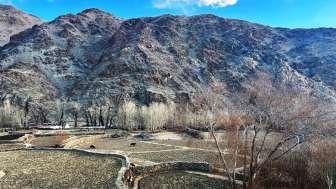
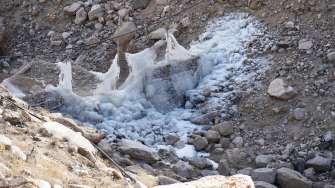
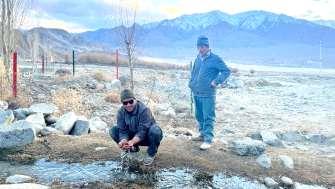
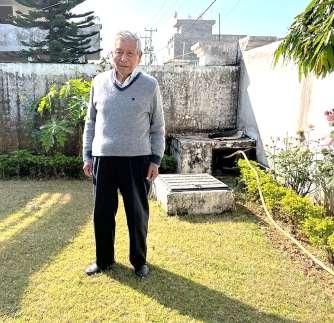
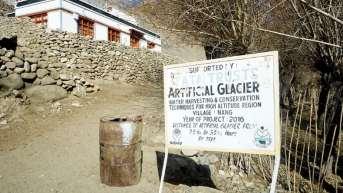
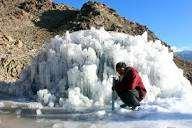
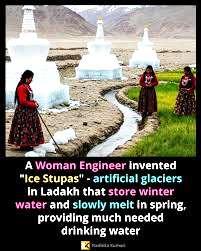
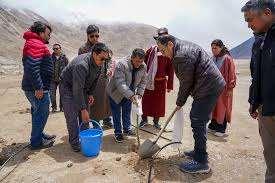
Congratulations to Chewang Norphel, the Ice Man ofIndia, on receiving thehonorary doctorate from the University of Ladakh for his outstanding



Dear all,
We are currently working on The Goa Directory of Authors and warmly invite anyone who has authored or compiled-and-edited one or more books to share their details with us online.
The project is open to: (i) authors based in Goa writing in any language, (ii) Goan authors in the diaspora, and (iii) authors of books related to Goa.
The online form contains six brief sections covering: – name and contact details, – writing profile (languages, genres, and years active), – books authored (with a one-line description and year of publication), – a short bio, and – a request for a photograph.
The form can be filled here: https://forms.gle/Y5pKMeSUGzmChF1d8
We would be grateful if you could also share this request with others who may be relevant to the project.
Our plan is to first create an ebook directory and, later, possibly a print publication as well. Lynn Frank is assisting with this initiative.
Thank you in advance for helping us collate and preserve this useful information.
Regards, Frederick Noronha For Goa,1556


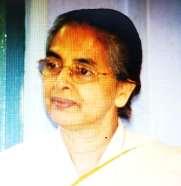












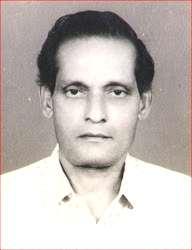
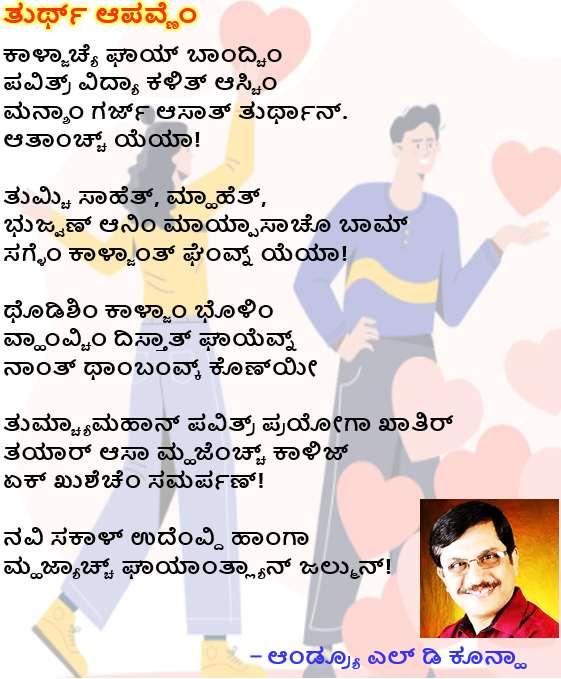
Thetruebeautyofliteratureliesinitsabilitytobecherished bypeople.Such writingtranscends time,continuing toflow acrossgenerations with enduring relevance. No award or recognition can define or confine the reach of such literature. Cha. Fra. De Costa was one such poet whose literary works carried remarkabledepth, shaped profoundly bythe richnessof hislife experiences. The intensity and layered meaning of his poetry demand thoughtful readinganddeepliterarysensibility.Presented hereisacompelling analysisofhiscelebrated poem Jigi Bigi Ratim by Andrew L D'Cunha,offering readersacloserlookintothepoeticbrillianceof Cha. Fra. DeCosta.
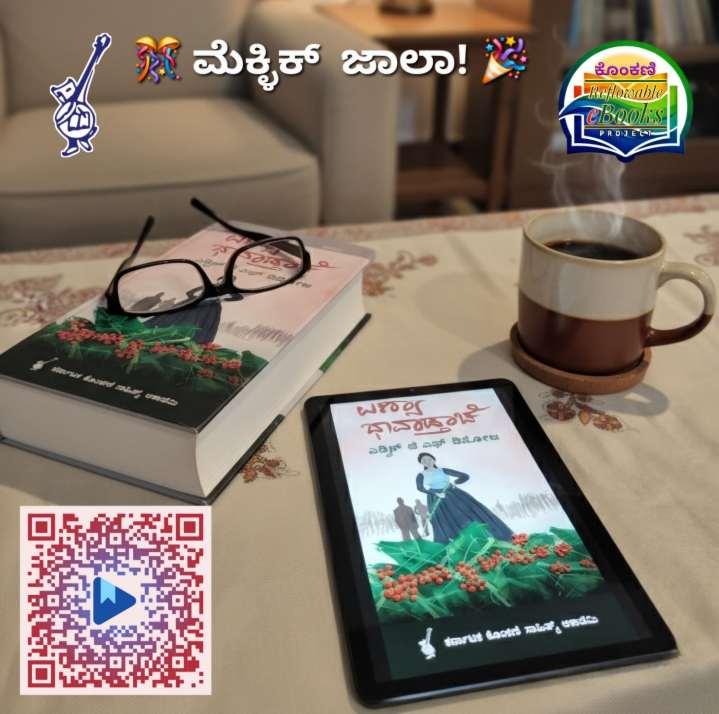
KBS (Konkani Beyond Scripts) a mission by Ashawadi Prakashan dedicated to the digitization and dissemination of multi-script Konkani literature proudly presents yet another audiobookinitiative.BeginningJune2026, an audiobook series featuring 50 short stories by Catherine Rodrigues will be broadcastdigitally.
BaiCatherineRodriguesisaversatileand prolific writer, widely recognized in both Konkani and Tulu literary circles, though particularlycelebratedforhercontributions to Tulu literature. With a literary career spanning over 100 dramas, 250 short stories, and numerous poems, she has made a significantcontribution to regional literature.
(TheKBSMissionbyAshawadiPrakashan is being organized jointly with St. Xavier’s College, Mapusa–Goa and DCT's DhempeCollege(Autonomous),Miramar–Goa, in collaboration with Goa Konkani Akademi, Dalgado Konkani Akademi, and KarnatakaKonkaniSahityaAkademi).
Thisaudiobook initiative aimsto bringherrichliterarylegacytoa wider audience through digital platforms. Listen to this beautiful story: https://youtu.be/OmHpC Y8VfKM
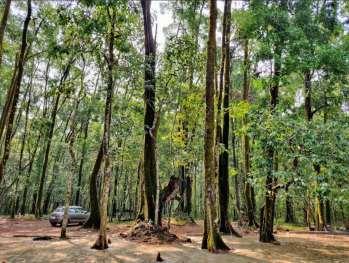
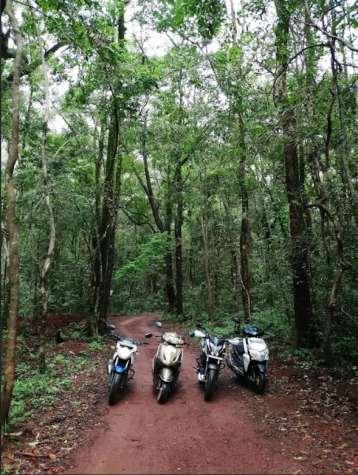
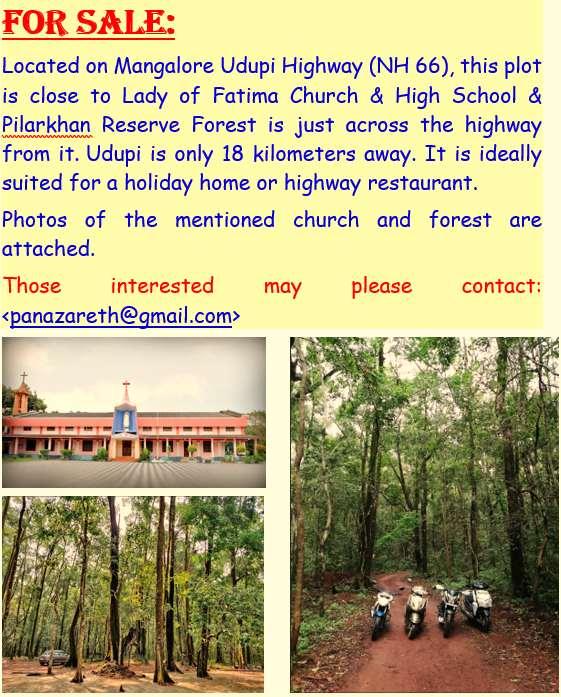
Located onMangaloreUdupiHighway(NH66),thisplot is close to Lady of Fatima Church & High School & Pilarkhan Reserve Forest is just across the highway from it. Udupi is only 18 kilometers away. It is ideally suitedfora holidayhomeorhighwayrestaurant.
Photos of the mentioned church and forest are attached.
Those interested may please contact: <panazareth@gmail.com>


Backto Back



































































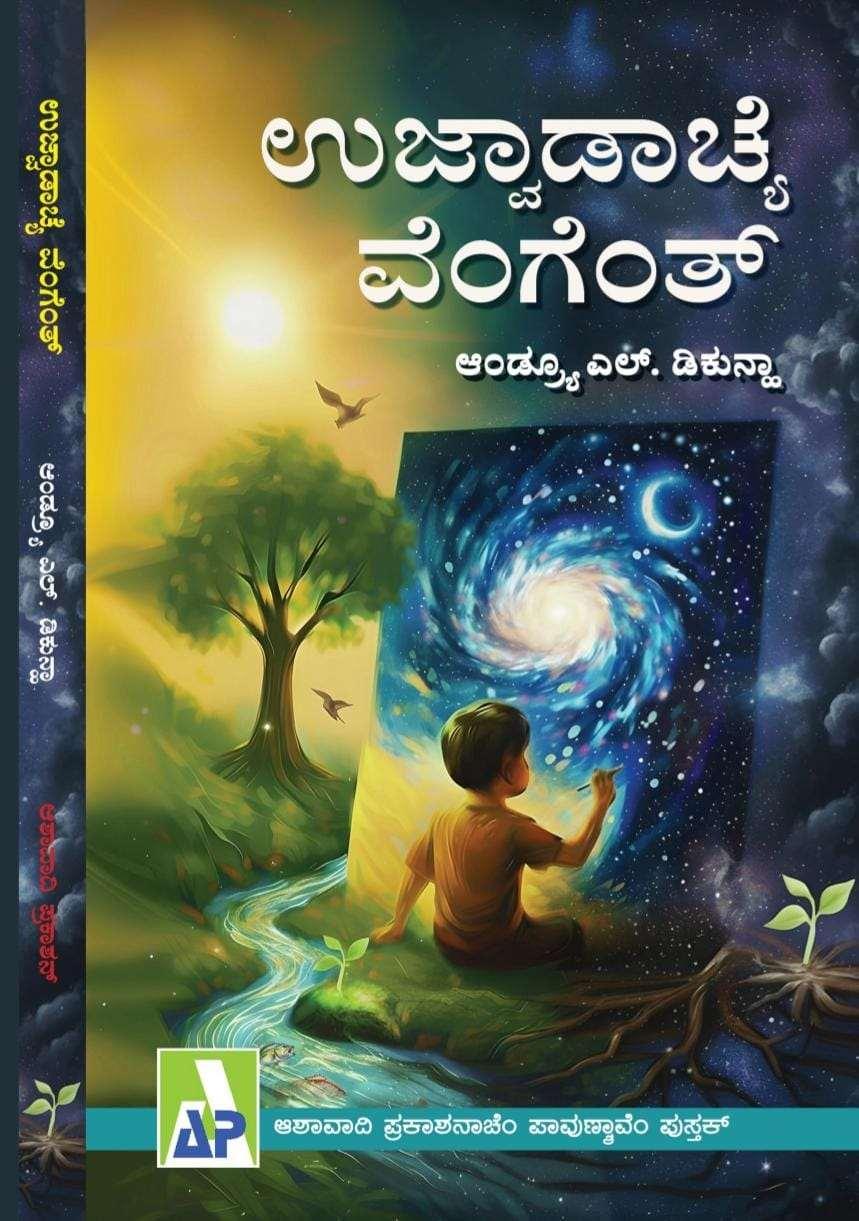

https://play.google.com/store/books/details?id=7KSaEQAAQBAJ




https://play.google.com/store/books/series?id=sqM0HAAAABCHvM









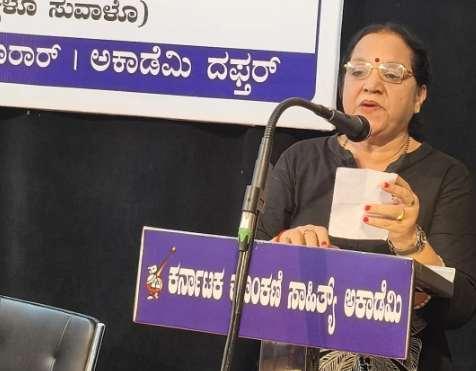
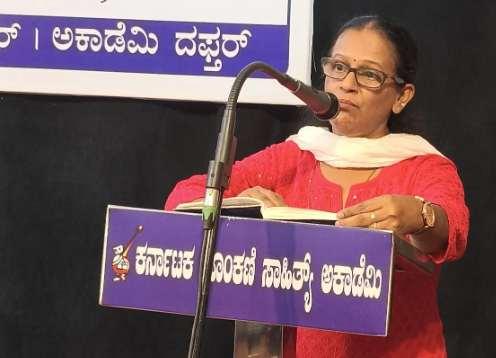
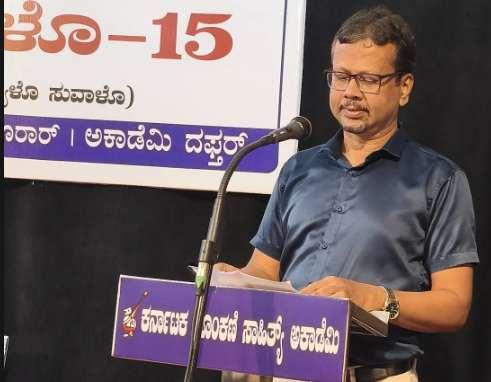











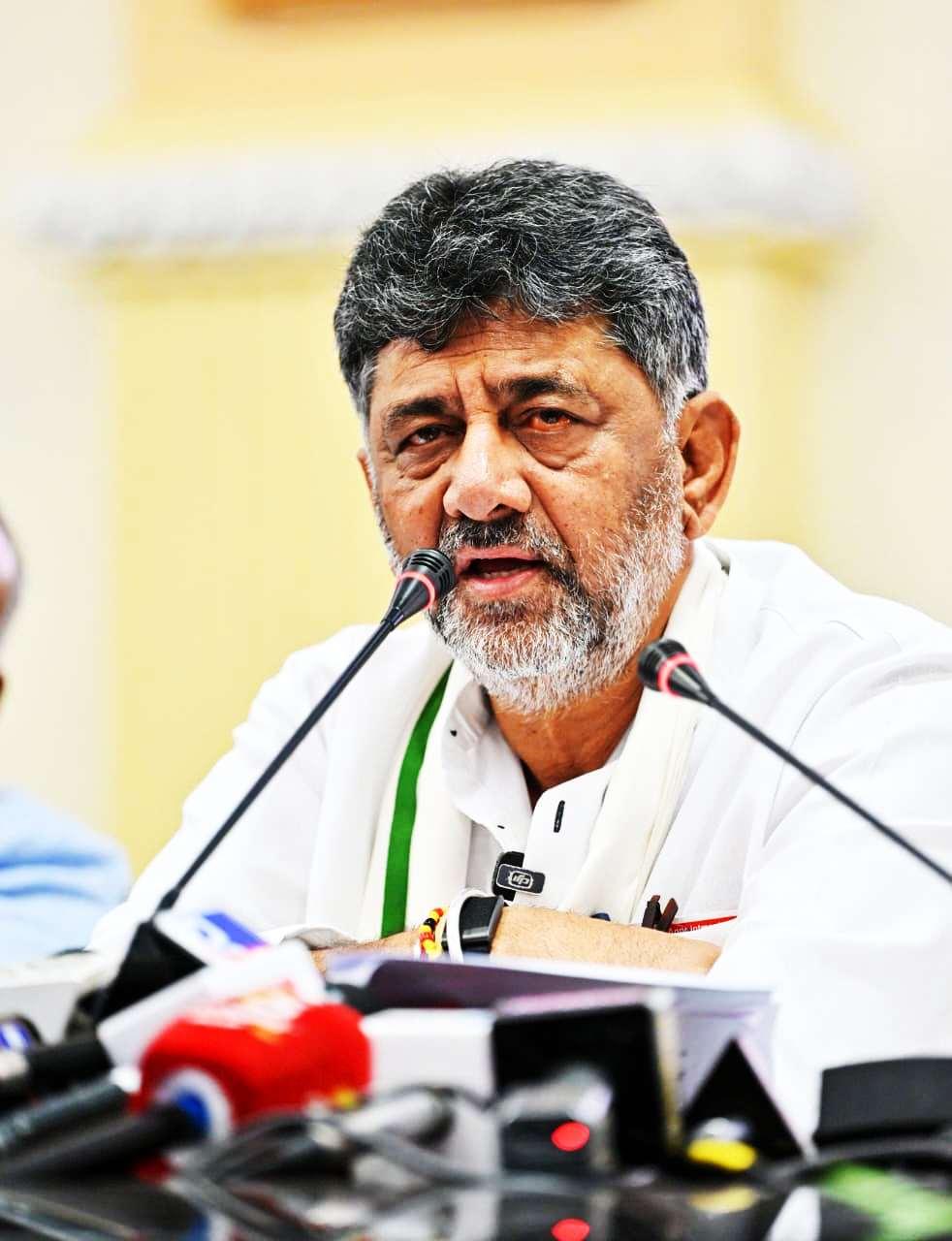
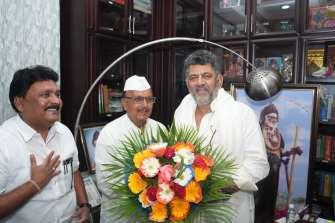
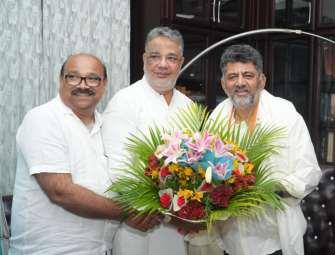
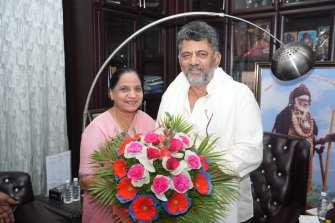
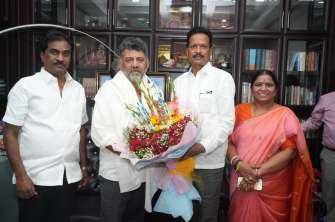
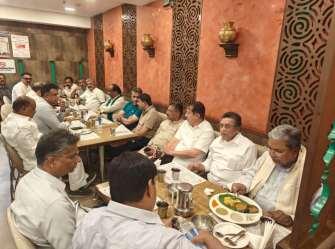
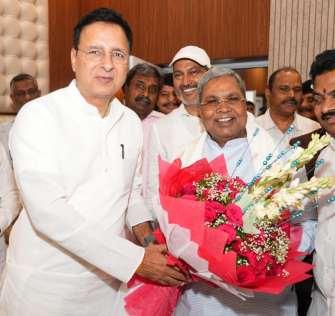
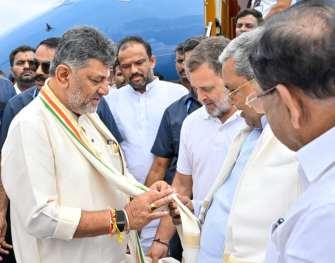
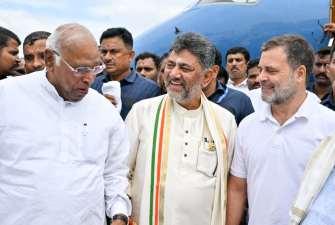
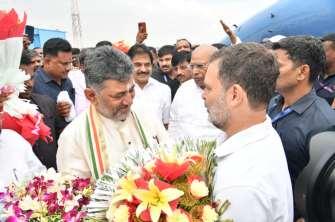
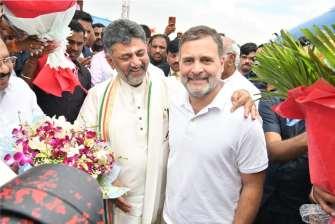
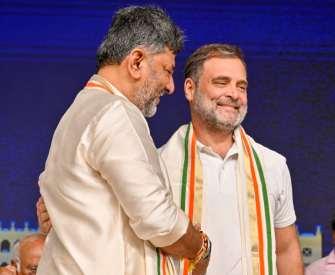
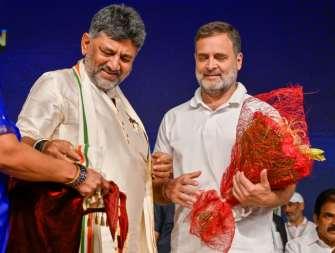
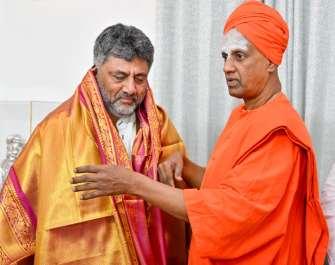
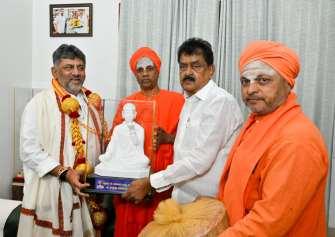
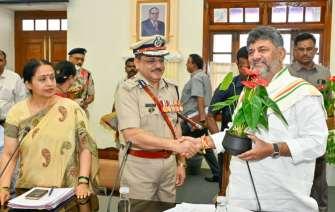
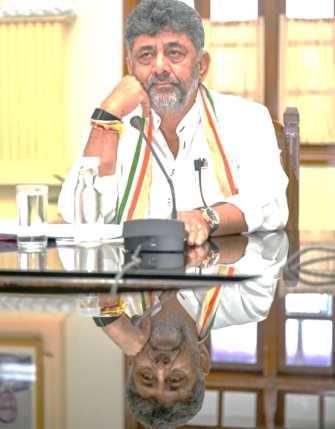
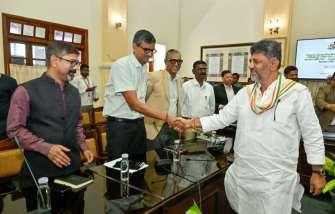
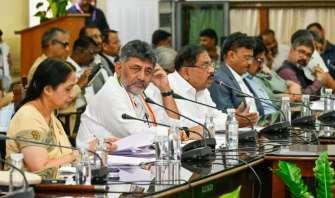
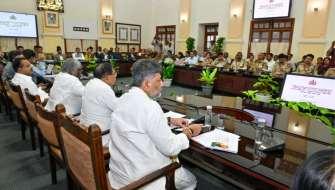
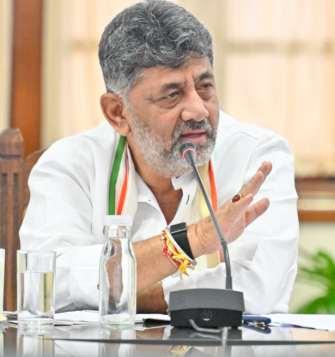
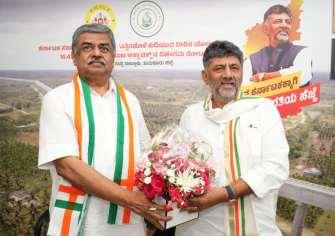
Finally, Gandhifamilyloyalist DKS elevated toKarnataka’s top post



- Gabriel Vaz
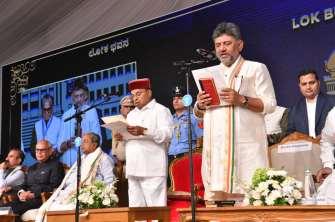
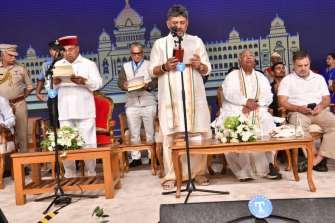
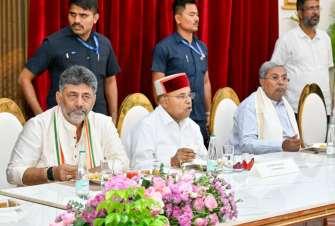
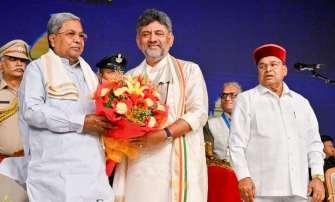
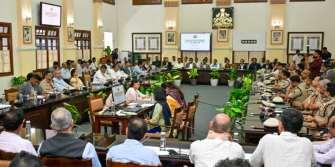
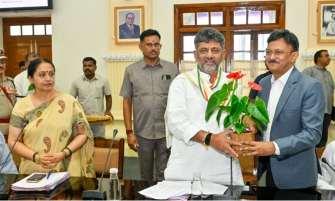
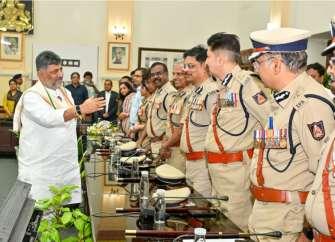
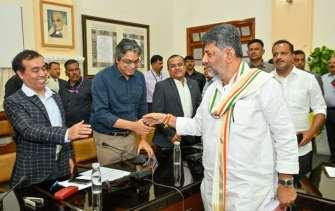
Finally,curtainshavebeendrawn on the on-again and off-again tussle over the transfer of power in Karnataka’s ruling Congress party between outgoing Chief Minister Siddaramaiah, who had surpassed theprevious recordofDDevarajUrs for being the longest serving CM and widely referred with the abbreviated name of Siddu and his DeputyDKShivakumargoingonfor the last three years on since May 2023 with the former relinquishing his post on May 28 and the latter
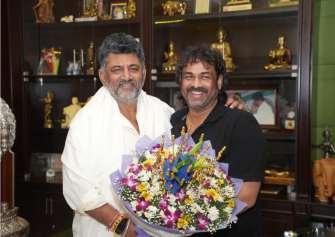
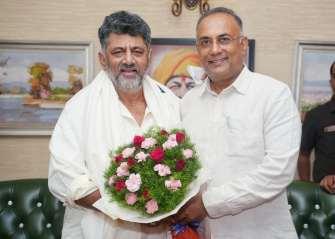
occupying it as the State’s next and 25th CMonJune3,2026.
DKS, incidentally, is known as the richest CM in the country surpassing Andhra Pradesh Telugu Desam CM N Chandrababu Naidu orthelatestyoungerCMofthetwoyear-old TVK from Tamil Nadu
Joseph Vijay Chandrashekar, who was reported to be charging hundreds of crores for his Tamil cinema roles. In his election
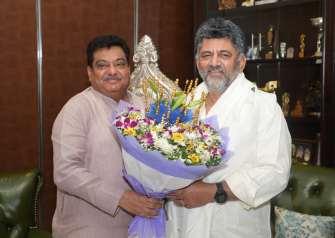
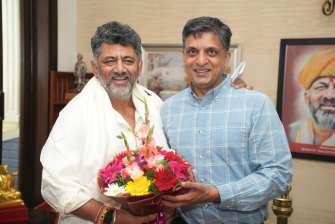
affidavits, DKS has declared an income ofRs1,413crore.
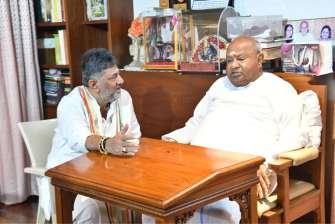
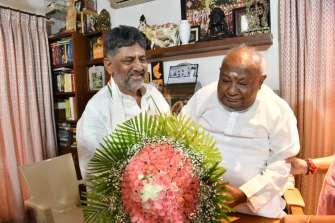
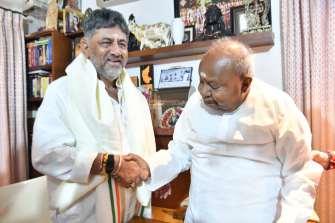
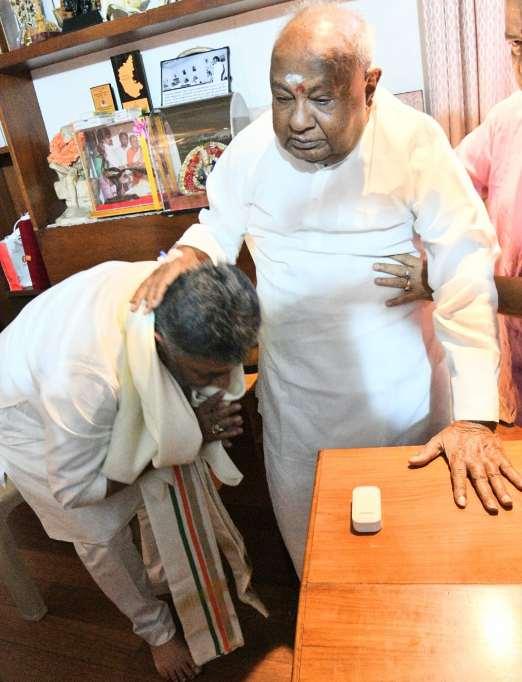
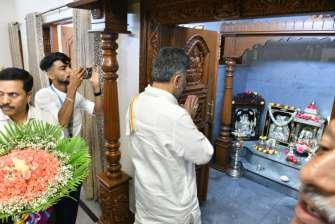
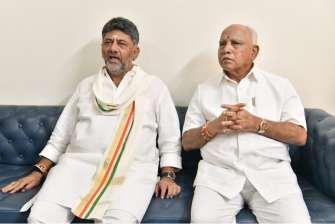
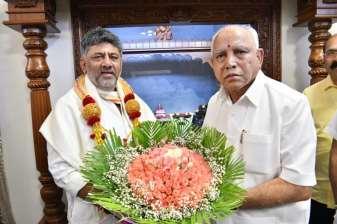
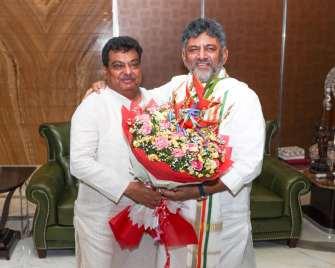
Significantly, DKS visited the residences of former CM and exPrimeMinisterHDDeveGowda and BJP’s Lingayat community’s strongman BS Yeddyurappa toseek theirblessings.
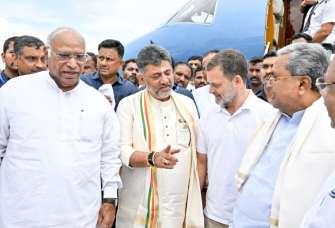
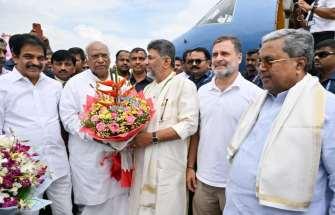
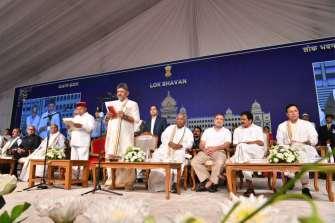
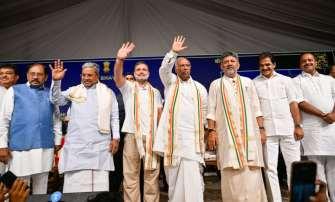
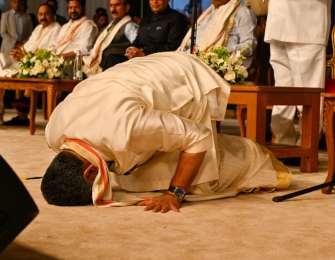
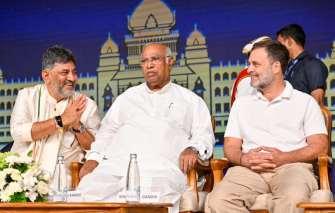
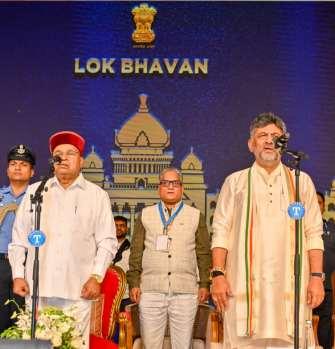
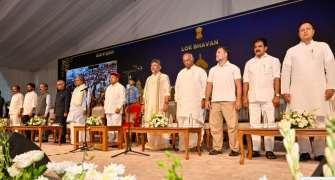
Theswearing-in ceremony washeld in the glass house of Raj Bhavan, renamed as Lok Bhavan. Religious pontiffs ofdifferentcommunities as well as AICC President Mallikarjuna Kharge, LeaderofOpposition inLok Sabha Rahul Gandhi and AICC General Secretaries KC Venugopal
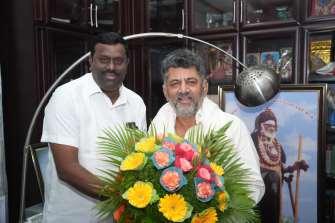
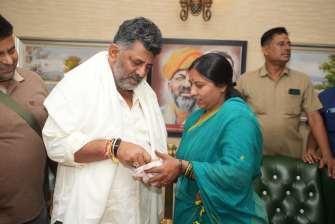
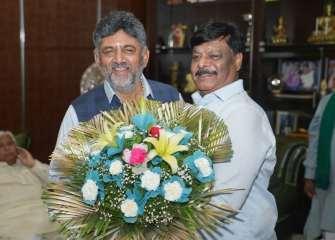
andRandeepSinghSurjewala, Chief Justice of Karnataka High Court
Vibhu Bakhru and all CMs of Congress ruledstates VDSatheesan (Kerala), Revant Reddy (Telangana) and Sukhvindar Singh Suku (Himachal Pradesh) and other dignitaries.
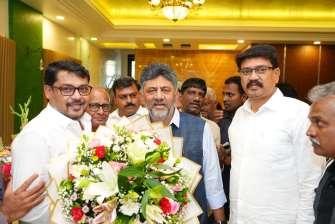
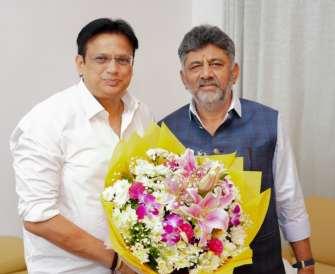
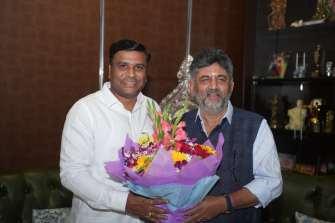
Unlike CMs in other states, DKS wanted to send out a message to the entire country of austerity by holding the oath-taking ceremony in the secure confines of the Raj Bhavan amid tight security with entryreserved forVIPsandinvited
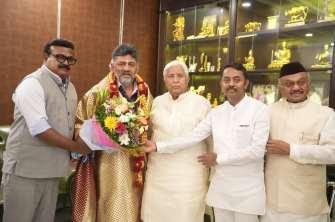
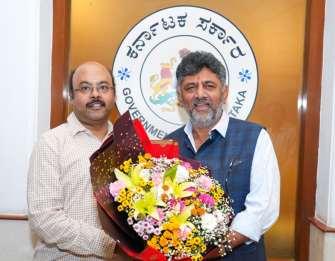
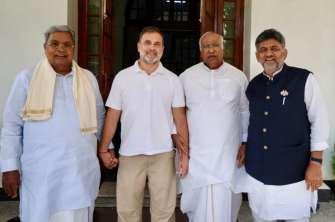
dignitaries andsecuritypasses.
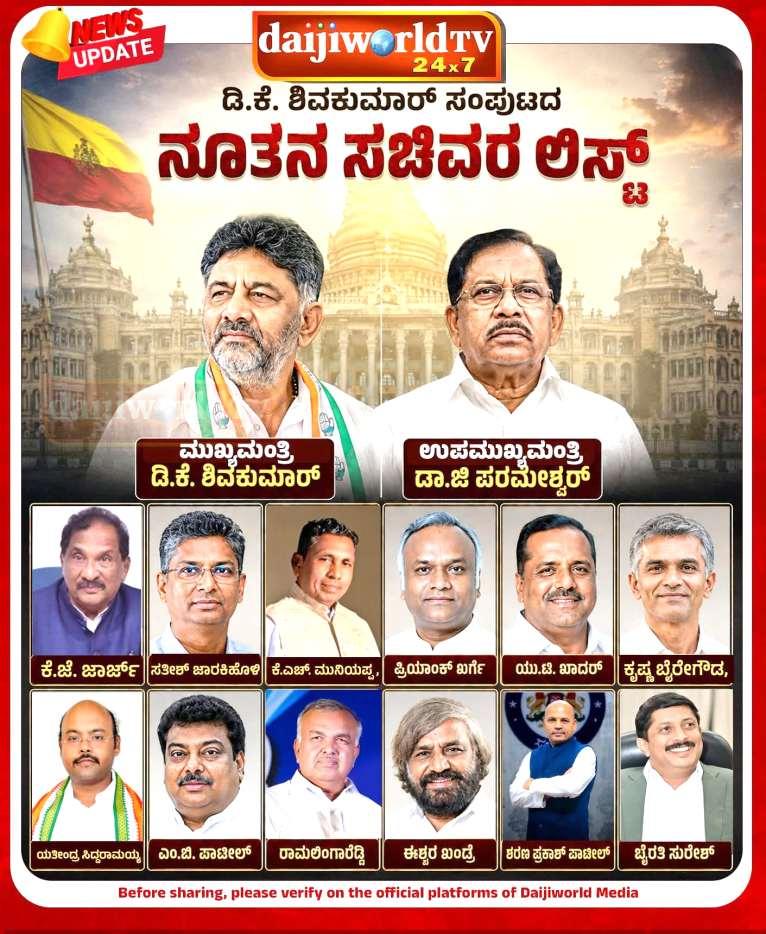
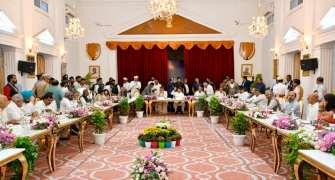
DKSTeamof13Ministers
Alongwith DKS,there were 13 cabinet rank ministers comprising DrGParameshwaraasDeputyChief Minister, KHMuniyappa, KJGeorge, MBPatil,BRamalinga Reddy,Satish Jarkiholi, Krishna Byre Gowda,
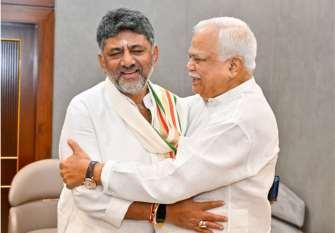
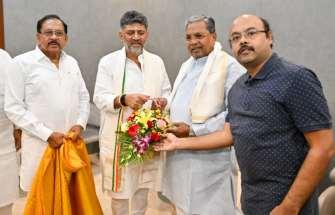
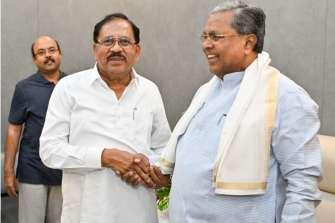
Priyank Kharge, UT Khader, Ishwar Khandre, Dr Yathindra Siddaramaiah, Byrathi Suresh and DrSharan Prakash Patil.There were no surprises among the newly inducted ministers as all were part oftheprevious Siddu team.
Speculations were ripe that there might be 3 to 4 DCMs
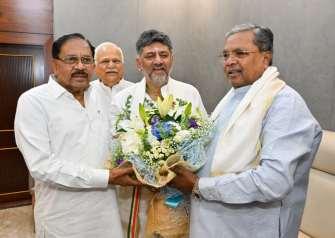
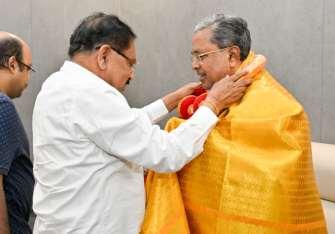
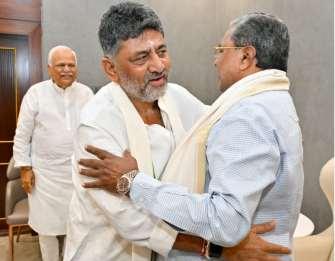
representing different castes and communities such as Lingayats, Muslims, Backward Classes and Dalits besides a woman. Jarkiholi, whoistippedtobethesuccessorto DKSasKPCCchief,isunderstood to have demanded that he should be
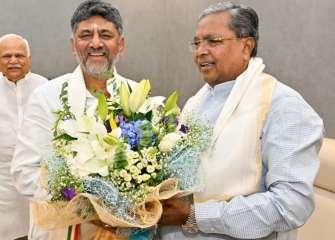
given the dual responsibility of beingtheDCMaswellasstateparty boss. But it was shot down and Jarkiholi had to be content with being a cabinet minister and possibly KPCC Chief.
However, Siddu is believed to have insisted that his staunch supporter and Dalit leader Dr
Parameshwara, who had served as DCM inthe Kumaraswamy-led JDSCongress regime and as KPCC president for eight years, must be given thehonour ofbeingthe DCM anditwasaccepted.
Among the lot of DKS cabinet ministers, Muniyappa, who had served as Union Minister of State
before returning to state politics, is the oldest and entire DKS team is relatively younger and perhaps more energetic. Another feature of the DKS team is the inclusion of Siddu’s son, Yathindra, who happens tobethe onlyMLC.
Though there were demands that younger and first-time
legislators as well as women to be inducted, surprisingly it was not conceded andprobably thatwillbe
rectified in the next round of expansion expectedtobeheldafter the forthcoming monsoon session of the State legislature, when more persons are likely to be accommodated while filling up the posts of Assembly Speaker, Deputy Speaker and Government Chief
WhipaswellastheChairman ofthe Legislative Council in the place of BasavarajHoratti, whois unlikely to be continued.
ThoughDKSisevidentlyelated at becoming the CM as he should be, he should realise that running the government with several senior leaders as MLAs and Siddu
remaining in state politics, possibly attempting to backseat driving, is nocakewalk.
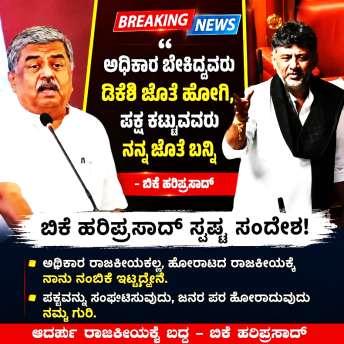
He must contend with not just Siddu but an assertive BK Hariprasad as his party successor, who incidentally has so far been considered as part of the Siddu camp followers. Further, barring
Siddu’s son Dr Yathindra Siddaramaiah and outgoing assembly speaker UT Khader, both of whom are firsttimers, the restof
the 11 have been ministers in the Siddu regime. Of these, DCM Dr Parameshwara, KJ George, Byrathi Suresh and Krishna Byre Gowda. Ishwar Khandre, Dr Sharan Prakash
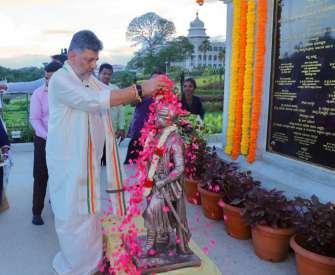
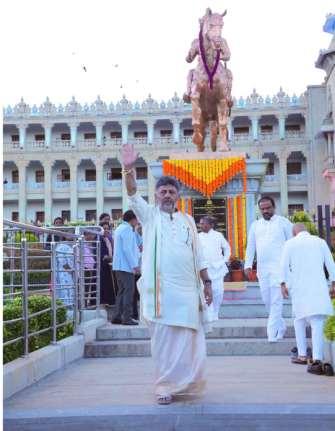
Patil, KH Muniyappa, Ramalinga ReddyandevenSatish Jarkiholiare considered asSiddu loyalists. It remains to be seen how DKS manages to carry the entire team and the Congress legislators along with him and motivates all to give their best to ensure the success of
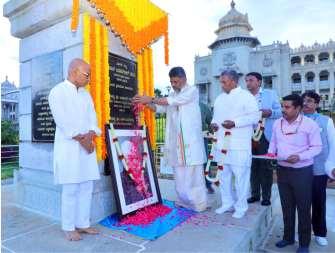
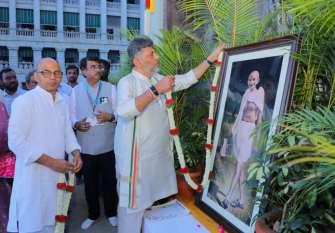
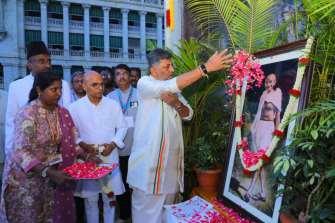
the government in the next two years.
CM#7from Vokkaligas
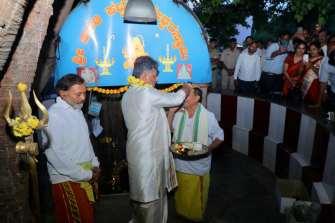
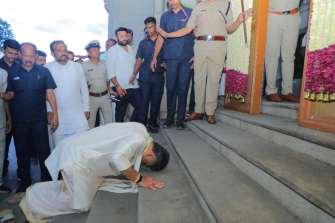
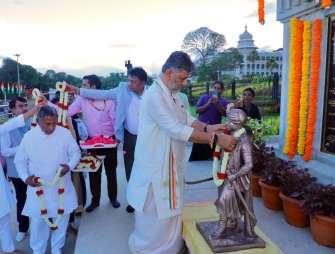
Eight-time Congress MLA, Doddaalahalli Kempegowda Shivakumar, popularly known with his initials DKS, from the politically powerful Vokkaliga community that is predominant in the Southern parts of the State or Old Mysore Region, is also the seventh leader from the community to rise to the coveted postintheState.
Predecessors of DKS from the community are K Changalaraya Reddy or KC Reddy (1947-52),
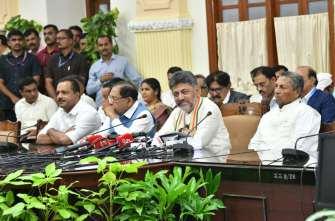
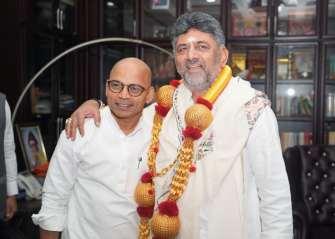
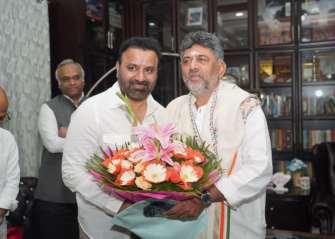
Kengal Hanumanthaiah (1952-56), Kadidal Manjappa (1956), HD Deve Gowda (1994-96), SM Krishna (1999-2004), H D Kumaraswamy (2006-07 & 2018-19) and DV Sadananda Gowda (2011-12). Of these, Kadidal Manjappa served as stopgap CM forabrief tenure while
Sadananda Gowda is a Bunt from coastal region, the community regarded aspartofVokkaligas. As is well-known, the 2023 assembly polls resulted in ousting the then ruling BJP, which grabbed power through the backdoor by engineering it’s ill-famed
“Operation Kamala” model of defections from Congress and JDS, and ensuring a resounding victory toCongress.
TheCongress triumph in2023
is attributed to the corruption charges against the BJP coupled with Siddu’s charisma and mass appeal, particularly from AHINDA (Kannada acronym for AlpaSankyata – Minority, Hindulida –Backward Classes andOBCs as well as Dalits – Scheduled Castes and Tribes), and the organisation
prowess plus strategies of DKS combined with the attractive five guarantees under the combined leadership of the then Leader of Opposition (LOP) in the assembly Siddu andKPCC PresidentDKS. Brokered Peace Deal
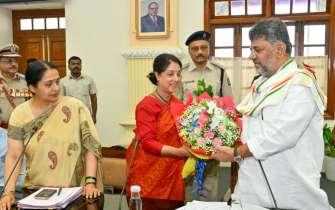
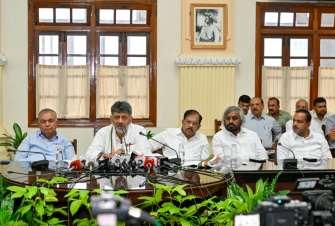
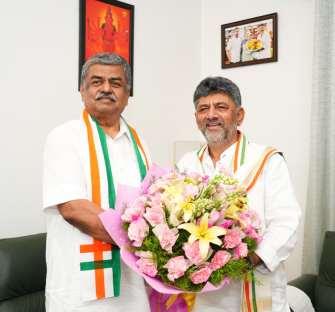
Buttheclaims forthetoppostfrom both the leaders resulted in a deadlock. Ultimately, the party bosses in Delhi (otherwise known simply ashigh command) managed to broker a “peace deal” enabling
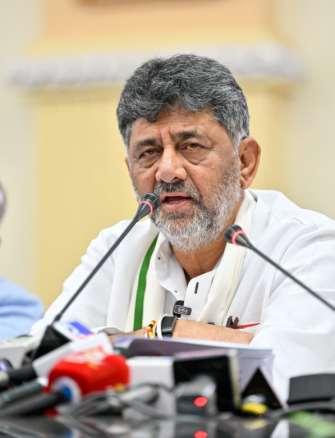
Siddu serving as CM and DKS continuing inhispostofState party chief and becoming the Deputy Chief Minister with additional portfolios of Water Resources and in charge of Bengaluru Development.
DKS was known to have sought the Water Resources or Irrigation Department portfolio, previously held by his bête noir HDDG, and also Bengaluru Development to consolidate his hold over the city and all the assembly constituencies in the Bengaluru Urban andRuraldistricts, hailing as he does from
neighbouring Ramanagara district, which was renamed as Bengaluru North to be make it part of the largermetropolitan region.
Another widely speculated, reported but hidden secret was the contours of the peace formula, underwhichSiddu wassupposedto give uphispostmid-term toenable DKS to fulfill his ambition. While DKS had refrained from publicly disclosing details of the compromise formula, Siddu had kept on reiterating that there was nosuchagreement whatsoever and thathe would continue toserve the fulltermoffiveyears!
Incidentally, Congress LOP in Lok Sabha Rahul Gandhi or AICC President Mallikarjuna Kharge, who assumed his post in October 2022, and former Congress president Sonia Gandhi or her daughter Priyanka Gandhi Vadra, who were
involved in the closed-door confabulations that helped in resolving the knotty tangle in 2023, have maintained studied silence overtheissue!
Significantly, even before DKS was sworn in as the CM, Siddu had been rewarded with a berth in the all-powerful Congress Working Committee (CWC)asamember.
Itpossibly indicates thatSiddu might be persuaded to become a Rajya Sabha member along with Mallikarjuna Kharge to shift to national stage instead of confining himself tostate politics.
Time alone will tell whether Siddu goes to Rajya Sabha or stays putintheState despite beingmade aCWCmember.
Incidentally, even before DKS was formally anointed as the next CM, the party high command not only made Siddu a CWC member but also announced the appointmentofBKHariprasadashis successor to head Th State party. Soon after DKS team was sworn in, the party high command announced thenamesoftheparty’s 4 candidates for the legislative council,which includes Hariprasad.
As we know, DKS served as KPPCchiefforsixyearsandwithhim at the helm, the party bosses wanted an OBC leader, Hariprasad hailing from the backward Billava community of coastal Dakshina Kannada. Earlier, former Union minister BJanardhana Poojary, also a Billava from the same coastal region 23yearsago.
Even as Siddu loyalists, including his own son and MLC Dr Yathindra, went on denying that there was no possibility of CM stepping down and that he will remainintheposttilltheendofthe term, supporters of DKS, including his brother DK Suresh, got restive and made repeated assertions that DKS should be allowed to hold the reins of the government. Though the supporters of both leaders made frequent trips to Delhi to lobby for their leaders, the party high command maintained an enigmatic silence. There was no change on the anvil and DKS started making stoic statements that he would get the coveted post if he isdestined forit. It’s all a matter of destiny, he said. The impasse over change of guard
continued even as the Congress regime celebrated its third anniversary at Tumakuru with a mega convention of over 14,000 beneficiaries on May 20, 2026, with theparticipation ofboth leaders.
ThoughtheresultsoffiveState assembly polls held in April 2026 were out on May 4, 2026, revealing that three deeply entrenched CMs of West Bengal, Tamil Nadu and Kerala were ousted, the impact of theverdicttooktimetodawnonthe bigwigs of established political parties. The most notable were the defeats of not just Mamata and Stalin with their parties ofTMC and DMKbesidestheirginormous losses in their own constituencies. While Mamata and Stalin were not only routed, both the leaders were shownthedoorfromtheassemblies ofthe respective states,Vijayan lost power but managed to hold on to hisseat.
Atotalpoliticalnovice and51year-old Tamil film actor, Joseph Vijay Chandrashekar romped home leadinghistwo-year-old brand-new party TVK to an astounding victory confounding both the DMK and AIADMK with their allies in Tamil Nadu. Known mainly for her street
fighter image, Mamata lost to her one-time close ally turned BJP leader Saved Adhikari in West Bengal to almost two-thirds majority and in Kerala Vijayan had to bite the dust against Congressled UDF that finally saw VD Satheesan asthenextCM.
Apparently, Congress party bigwigs were taking a long-term view and were preparing for the next assembly polls in the State in 2028 and the Lok Sabha polls in 2029. Despite Siddu’s obvious mass appeal and clout among the AHINDAvote bank, he will be 80 in 2028 if he is continued till the next assembly polls and that will be a disadvantage due to his health condition and inability to exert too muchforelectioneering.
Besides, Siddu regime was beset with anti-incumbency factor due to internal problems in the party mainly on account of the constant bickering over transfer of power and the several glitches in the implementation of the government’s main plank of guarantees benefittingalmostevery fifthpersonintheStateinsomeway or the other. DKS, on the other hand, is known as the best
troubleshooter of Congress, who rises to the occasion whenever the partyisfacingproblems intheState or in other states. He isalso lauded for his organizational skills and strategies akin to BJP’s “chanakya” inShah.
So, Kharge and Rahul Gandhi wereconvincedoftheneedtoeffect a change of guard without causing any serious squabbles. While DKS gainedintheprocess,thepartyhigh command was keen to ensure that Siddu was kept in good humour. The result was his elevation to the all-powerful CWC to reap the benefit of the OBC despite his reluctance to move to the national scene.
Hariprasad’s appointment as KPCC Chief along with his selection as a candidate for Congress MLC is viewed as part of the party high command’s game plan to ensure that Siddu is kept in good humour inviewtheformer’s loyaltytohimas also his experience at the national levelhavingservedintheAICCasits general secretary between 2006 to 2018 holding charge of key states suchasUttarPradesh, Maharashtra, Odisha and Rajasthan and also his experience as a Rajya Sabha
member.Knownforhisstrongviews and strident stand against RSS and BJP,Hariprasad can be more thana matchtoDKSbecausehemaintains ahardlinewhileDKSisknownforhis softHindutva line.
All these factors suggest that theCongress highcommandiskeen to appease Siddu for his clout among OBCs and pull among AHINDAvote bank andatthe same time, Vokkaliga DKS could expecta tough and no-nonsense state party boss in Hariprasad a la the loan melaPoojary!
With the next assembly polls due in 2028, DKS has hardly two years to consolidate his position and woo the electorate by proving thathemeanswhathesays.Priorto the assembly polls, the first challengeistheensuingelectionsto reconstitute Bengaluru city corporations under the Greater Bengaluru Authority (GBA) within this year and the subsequent local body elections. Thus, the DKS regime haslittle time todeliver and counterthe BJP-JDScombine.
If the assembly poll of 2028 is the major hurdle, the party must gear up for the bigger electoral
battle of Lok Sabha polls in 2029. If DKS acquired himself well in the GBA and local body elections and thenextround ofassembly andLok Sabha polls, he would have made hismark.
Soon afterbeingswornin,DKS has spelt out his priorities. He kicks startedhisagenda ofwooing Gen-Z population, unemployed youth, women, farmers and rural voters besides ensuring that the implementation of all the guarantees continues without problems. The government will be stretchedtoitslimitsinmeetingthe requirements of irrigational needs and infrastructure development. Being an ardent believer in divine intervention and prayers, he needs to do much more of that while
praying for a good monsoon and divine providence to escape from naturalcalamities.
On day one, after holding the first cabinet meeting DKS has announced free bus travel to all students – boys and girls –irrespective of whether they are studying in primary, secondary, college or post-graduate and other professional courses and government-run employment programme for Kannadigas to land private sector jobs and Rs 2,000 croregrantforroadinfrastructure in Bengaluru aheadofGBApolls.
“We will implement the promises regardless ofthe cost,”he said in response to a question on thetotalcostinvolved,adding: “This isDKShivakumar’s government.”



Daijiworld Media Network –
Mangaluru
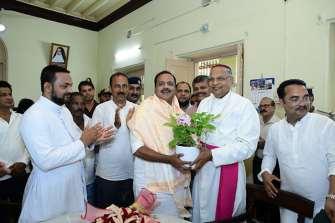
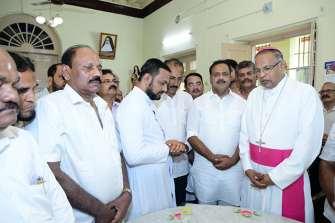
Mangaluru, Jun 7: Karnataka
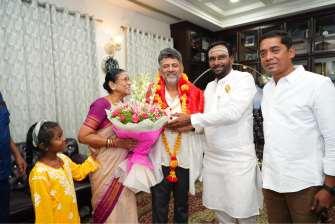
Minister for Health and Family Welfare UT Khader paid a courtesy visit to Bishop of Mangalore, Dr Peter PaulSaldanha, atthe Bishop’s House in Rosario on Sunday, seeking blessings and guidance as he assumes charge of his new responsibilities inthestatecabinet. The visit came soon after Khader’s induction into the Karnataka
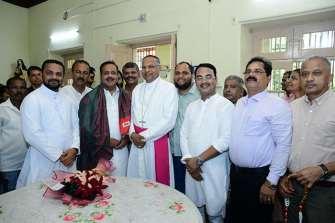
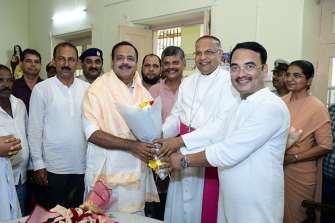
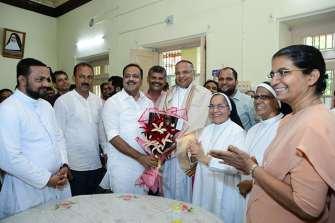
Cabinet. His return to the Health and Family Welfare portfolio has been welcomed bymanyacross the coastal region, where he enjoys wide support.
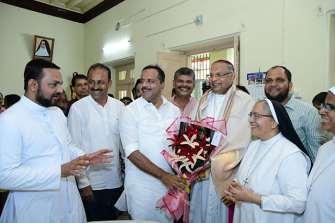
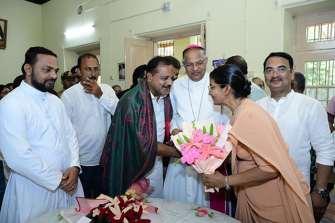
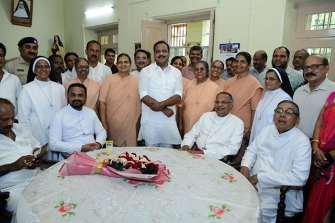
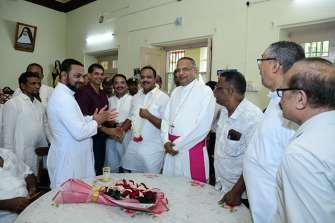
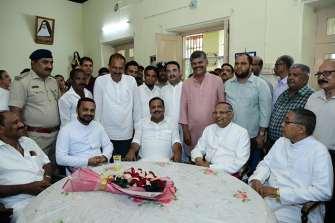
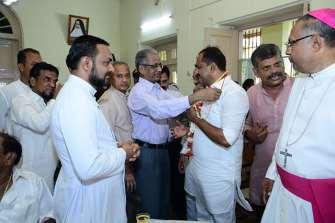
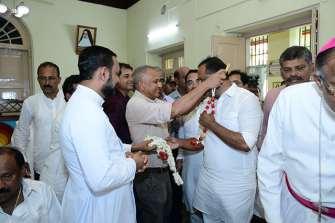
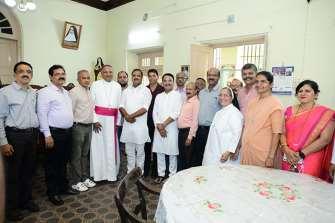
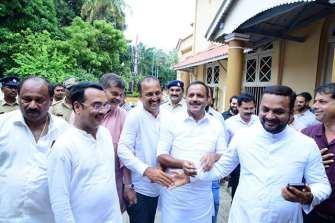
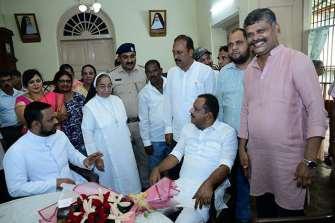
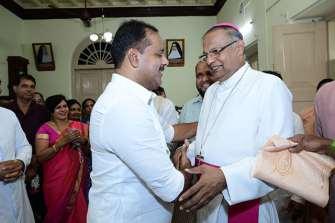
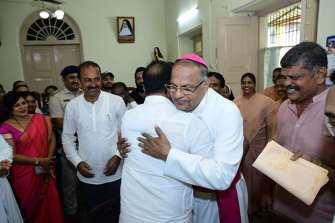
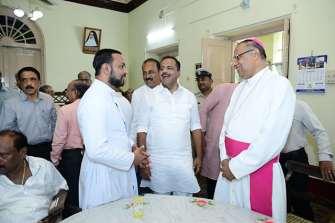
The Minister was warmly received byBishop PeterPaulSaldanha.Asa mark of respect, the bishop felicitated Khader with a shawl and bouquet. In return, the Minister honouredthebishopandexpressed gratitude for the prayers, encouragement and support extended by the Church and the faithfulthroughout his public life. During the meeting, the bishop offered special prayers for Khader, invoking God’s blessings for wisdom, strength and success in discharging his responsibilities as Health andFamilyWelfare Minister. He also prayed for the Minister’s
efforts to strengthen healthcare services and ensure accessible and compassionate care for the people ofKarnataka.
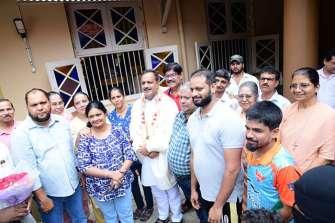
Several members of the clergy, religious communities and lay leaders were present on the occasion. Among them were Fr RupeshMadtha,PROofthediocese of Mangalore; Fr Valerian D’Souza, parishpriestofRosarioCathedral;Fr IvanD’Souza;FrValerian Fernandes; FrPradeep Rodrigues; andSr Maria Naveena AC, provincial superior of the Mangalore Province. Sisters
from St Ann’s Convent and members of the Rosario Cathedral Parish Pastoral Council also attended thegathering.
Community leaders including Denis D’Silva,AlwynD’Souza(Panir),Stany Bantwal and other parish representatives were alsopresent. The meeting reflected the cordial relationship between the Minister and the Church leadership, underscoring asharedcommitment to public service, social welfare and the well-being of the people of the state.

‘eNVIRoNMeNT’ Is IT, anyway?

The editorial of the latest issue of the prestigious ‘Economic and Political Weekly’ (Vol. 61, Issue No. 22, 30 May2026) hasaveryincisive lead.Itisentitled ‘TheGreatNicobar Project:AHolisticFolly’: Itsclaimsof strategic significance are questionable, while environmental harmiscertain.Thearticlefiresinits opening salvo, “The Project for Holistic Development of Great Nicobar Island, an ₹81,000 crore
megainfrastructureproject,ismore folly than national gain. With growingoppositiontotheproject, including legal challenges, the governmenthascloakedtheproject inthelanguageofnationalsecurity. This is despite the fact that the original project documents, including the 2021 request for proposalissuedbytheNITIAayog, hardlyrefertodefenceorsecurity, makingitclearthat,initsactual intent, the project is a purely commercial endeavour built on large-scale destruction of the ecologicallypristineislandsandthe alienation of their indigenous people”.
A National campaign says that the project is ‘a disaster in the making’ and demands an end to the ModiAdani scam being foisted on the nation. Itis without doubt that this corrupt duo has looted the nation lock, stock and barrel and together with their other corrupt crony capitalist friends have caused unbelievable damage to the environment andtoourfragile ecosystems. In this Nicobar project there isample evidence that160sq. km of rain forest will be destroyed;
one crore tress will be cut down; thatitisacrime againstnaturaland tribal heritage; that the tribal communities particularly the Shompen and Nicobarese who are distinct indigenous groups and Particularly Vulnerable Tribal Groups (PVTGs) native to the Andaman andNicobar Islands;they possess unique cultures, languages, and traditional ways of life, largely centred on Great Nicobar Island; above all a threat to the fragile ecosystem.
The EPWfurther states,“theproject envisionsaninternationalcontainer trans-shipmentterminalatGalathea Bay, a greenfield international airport, a township and tourism project, and a power plant. The primarytrunkinfrastructureofthe programme alone is slated to destroy 130square kilometres of primarilytropicalrainforests,which, by the government’s underestimation,willinvolvefelling 8.65 lakh trees, a fraction of the likelymillions.Thiswill,inaharebrainedplan,becompensatedby plantingafewlakhtreesindistant HaryanaandMadhyaPradesh.The NicobarsaretheonlyregioninIndia
to fall in the Sundaland global biodiversityhotspot,hometorare andendemicspeciesandglobally uniquefloraandfauna.Thenotion that the destruction of this ecological hotspot can be compensated for by tree plantationsinsemi-aridcentraland northernIndiaisfoolishfiction.The Galathea Bay—where the transshipmentterminalisproposed is amongthemostimportantnesting sitesoftheendangeredleatherback turtle. In January 2021, contradicting the government’s ownNationalMarineTurtleAction Plan, the Galathea Bay was denotifiedasaprotectedsanctuary tomakewayfortheinfrastructure project.”Scathing points indeed to prove that the regime, cares two hoots about what is happening to ourenvironment!
Today, was yet another ‘World Environment Day.’Therewasaflurry of activities. The morning newspapers (some of them had their front page in ‘green’) had full page advertisements about the environment with several of them sponsored by government agencies, the very ones responsible
for destroying the environment! In the ‘events’ there was the usual jostle toplantsaplings,theplethora of long, boring speeches on the importance of the environment repeated 'ad nauseam' and plenty of photo-ops with faces beaming towards the cameras. Yes, indeed plenty of 'tokenism' and 'cosmetic' action.Andthe‘temporary concern’ for the environment will soon be forgotten!
India is in the grip of a serious environmentalcrisis.Aleadarticlein the popular online portal ‘Countercurrents’, (dtd 3 June2026) and titled, ‘The Scorching Heat and Silent Death: India’s heat crisis is killing the poor in silence’ says, “A single day of extreme heat, the study estimates, causes around 3,400excessdeathsacrossIndia.A five-day heatwave causes nearly 30,000. Uttar Pradesh alone accountsfor more than 8,100 of thosedeaths.Thenumber30,000.In fivedays. Thatismore than ten timestheofficialannualtoll.Thatis acatastrophewithoutaname.The fivestatesthatbeartwo-thirds of India’s heatwave deaths are Uttar Pradesh, Bihar, Madhya Pradesh,
Rajasthan and Gujarat.” Several parts of the country are during an unprecedented heat wave with severalcasualties, especially among the poor andmarginalised sections of society. On 13 and 14 May, devastatingunseasonalstorms, tore through Uttar Pradesh killing at least 120 people and injuring several more. The Aravalli hills continue to be pillaged despite the Supreme Courtorderthatallmining activityintheareashouldbehalted.
Fossil fuels account foralmost 75% of India’s total energy supply. We are highly dependent on fossil fuels despite the global commitment to transition away from their use. It is common knowledge that fossil fuels are the principal driver of the climate change currently damaging human health, wellbeing, and ecosystems, andposingaseverethreattooverall planetary health. They are also a major source of particulate matter and ozone. These airpollutants are responsible for a wide range of adverse health outcomes, including an estimated 6.7 million deaths globally in 2019. Deaths, however, are only one part of the problem.
Improved air quality would reduce the burden of several major diseases leading to healthier and longer lives, fewer patients requiring admission to hospital and other treatments, and decreasing the burden on health systems worldwide.
The theme for ‘World Environment Day’thisyearis, 'InspiredbyNature. For Climate. For Our Future'. This obviously is a follow-up of the UN Climate Summit COP30 which took place in Belém, Brazilfrom10 to21 November 2025. COP30 focussed heavily on forest conservation, the transition from fossil fuels and the implementation of the Paris Agreement Goals. Sadly, as we experience in India today, those whorule, do notcareabout whatis happening toourenvironment!
Public awareness ofthe importance ofthe environment isaprerequisite – butthen words ringhollow, when the ones who wax eloquent are the veryones whoareinnexuswith the land mafia who dry up our water bodies for their high-rise buildings and who cohort with the mining mafia to plunder our precious
natural resources. Itis important to note that in the most recent 'Environmental Performance Index'(EPI), India was ranked 176 out of 180 countries. A pathetic indicator by any standards on the environmental situation in our country!
About ten days ago, on 26 May, India lost one of her great environmentalists, in the untimely death Fr Bolmax Pereira of Goa. Fr Bolmax was not afraid in standing up against the powerful, vested interests, who were destroying the fragile ecosystem of Goa. He launched a successful #SaveMollemForest campaign against the Adani –led double tracking through the Mollem reserved forest. He constantly spoke about the reality that the average Goan was breathing coaldust all the time, thanks to the nexus between the politicians and

theminingmafia.Heoncesaid,"The wilfuldamagebeinginflictedonour environmentandecologyissovery colossal.Thereisadireneedtostay unitedtosaveourstatefromany furtherdestruction...Weallneedto beveryconcernedabouttheair, waterandsoundpollution thatis batteringourlittleGoa."
Are we serious about following the legacy of Fr Bolmax? Or do we say “who cares”? Like to what is happening in Nicobar today? We must come out now and challenge this anti-people, anti –environment regime and the entire system, and ask them, “whoseenvironmentisit, anyway?”
5June2026
* (Fr Cedric Prakash SJ is a human rights reconciliation and peace activistandwriter.
Contact: cedricprakash@gmail.com



International Inspirational Speaker, Harold D’Souza with Dancy D’Souza Co-Founders of Eyes Open Internationaland Game Changers with DelegatesatUSGLC2026ImpactForum.
WASHINGTON, D.C.: As America prepares to celebrate its 250th anniversary, leaders fromacross the nation gathered in the nation’s capital for the U.S. Global Dancyand

Harold D’Souza with Decision Makers, Game Changers,and Policy Makers at Capitol Hill in Washington DC.
Leadership Coalition (USGLC) Impact Forum 2026 under the theme, “America Wins When AmericaLeads.”
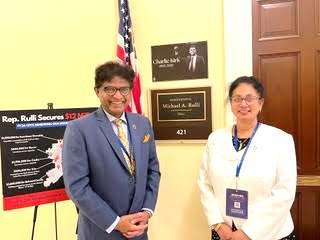
Dancy and Harold D’Souza born warriors meeting Senators, Representatives at Capitol Hill, Washington DC. On June 3, 2026.
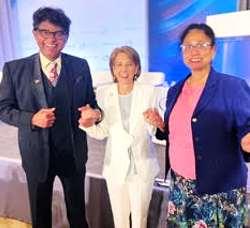
LizSchrayerPresident&CEO,USGLCbelieves in Survivors Leaders Dancy and Harold D’Souza.
“It always seems impossible until it is done.” Nelson Mandela. This statement has been exemplified by DancyandHarold D’Souza.Survivor Leaders Inspiring America and the Rt. Hon. David Miliband, President & CEO,
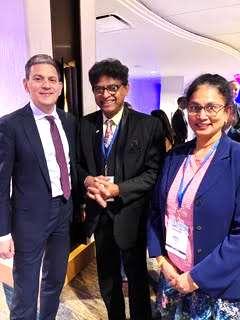
International Rescue Committee, Former Secretary of State for Foreign and Commonwealth Affairs of the United Kingdom with Dancy and Harold D’Souza.
World through service, resilience andpurpose.
Among the distinguished participants were DancyandHarold D’Souza,Co-Founders ofEyesOpen International(EOI),whowereinvited to share their wisdom, expertise, and lived experience on how
America’s global leadership strengthens national security, economic prosperity, human dignity, andopportunities forfuture generations.
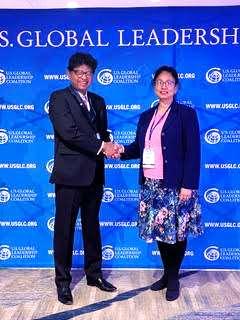
Dancy and Harold D’Souza Co-Founders of EyesOpenInternationalatUSGLC2026Impact ForumatWashington DC
Representing Ohio as USGLC State Leaders, the D’Souza’s joined business leaders, policymakers, veterans, nonprofit organizations, faith leaders, and advocates in meaningful discussions about America’s role on the world stage and the importance of diplomacy, humanitarian assistance,
international development, and strategic partnerships.
On June 3, 2026, DancyandHarold had the distinguished privilege of visitingCapitol Hill,where theymet, interacted, and shared their expertise with Senators, Representatives, Congressional staff, and national leaders. Their conversations focused on survivorinformed leadership, combating human trafficking, protecting vulnerable populations, strengthening communities, and advancing policies that promote freedom, safety,andopportunity.
Harold D’Souza, an internationally recognized inspirational speaker, humanrightsadvocate,andsurvivor leader, emphasized that America’s greatest strength lies notonly in its economic andmilitarypower, butin its ability to inspire hope, action, protect human dignity, and empower vulnerable people worldwide.
“America’s leadership creates opportunities for people to thrive. When we invest in diplomacy, education,health,foodsecurity,and human rights, we build safer
communities andastronger world,” Harold shared.
The USGLC Impact Forum highlighted several key priorities including strengthening diplomacy, preventing conflicts before they arise, promoting global health security, reducing hunger and poverty, supporting economic growth, and enhancing America’s partnerships across theglobe.
D’Souza’s participation carried a deep personal message. Their lives reflect a remarkable transformation from hardship tohope, adversity to achievement, and survival to significance. Together, they have dedicated their lives to helping others flip the script: From Hurt to Happiness, From Pain to Pleasure, FromTraumatoTriumph, FromFear to Freedom, and From Slavery to Success.
Through Eyes Open International, the couple continues to educate communities, empower survivors, promote human rights, prevent exploitation, and provide humanitarian support tovulnerable populations worldwide, including feeding children and supporting education initiatives inTanzania.
Harold’s own journey from labor traffickinganddebt bondage in the United States to becoming a respected policy advocate and international speaker has inspired thousands aroundtheworld. Today, governments, universities, law enforcement agencies, nonprofit organizations, businesses, and community leadersseekhisinsights on resilience, leadership, and humandignity.
Following the forum, Liz Schrayer, PresidentandCEOoftheU.S.Global Leadership Coalition, personally recognized Harold’s contribution and impact. In her message, she stated: “Dear Harold, after an extraordinary few days together in DC, I wanted to personally thank you for the impact you made by showing up, speaking up, and standing together for America’s global leadership. I have already heard from friends on Capitol Hill how impactful your meetings were on Wednesday! At this time of unprecedented challenges for diplomacy and international assistance, I can tell that our collective voice is making a difference.”
This recognition underscores the value ofsurvivor leadership andthe importance of bringing lived experience into policy discussions that shape communities, nations, andfutures.
The story of the D’Souza Family is notmerely a story ofsurvival, itisa storyofresilience,faith,service, and purpose. Together, Dancy, Harold, Bradly, and Rohan have transformed obstacles into opportunities and challenges into catalysts for change. Their family demonstrates that adversity does not define destiny. Through courage,compassion,perseverance, andunwavering faith,theycontinue inspiring individuals and communities aroundthe world.
As America looks toward its next 250 years, Dancy and Harold’s journey serve as a powerful reminder that ordinary people can achieve extraordinary impact when they choose hope over fear,service over self-interest, andpurpose over pain.
From traffickingsurvivors toglobal game changer, from advocate to policy influencer, and from local
service to international impact, the D’Souza Family continues creating positive change in Washington, D.C., across America, and around the world, one life, one voice, and one actofkindness atatime.


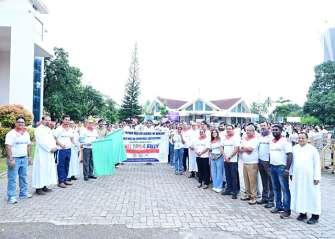
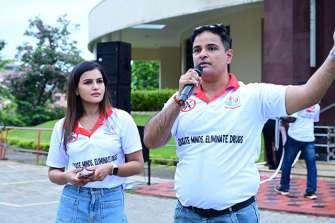
Mangaluru, Jun 3: A cloudy morning on June 3, witnessed an inspiring display of youth power and social commitment as more than3,000students,thefaculty,and the staffof FatherMullerCharitable
Institutions (FMCI) participated in a massive anti-drug walkathon atthe Kankanady campus. The rally, organized under the banner of the NashaMukt Bharatinitiative, senta

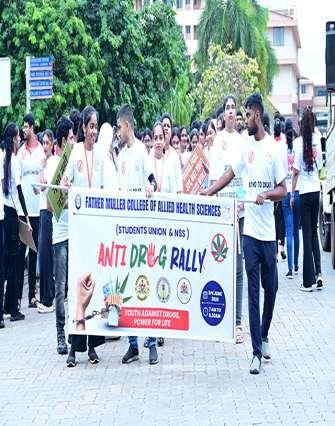
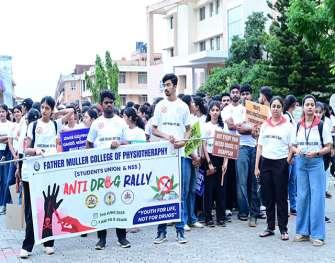
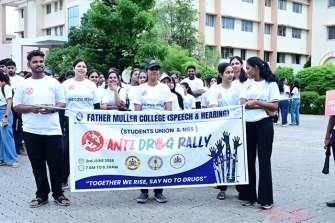
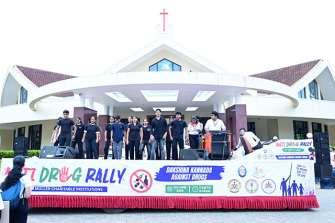
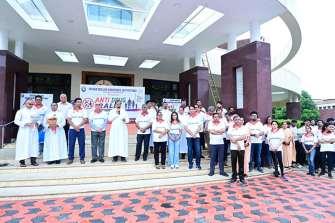
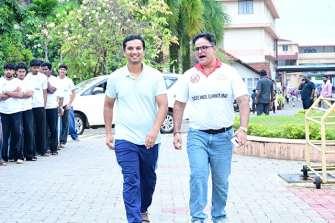
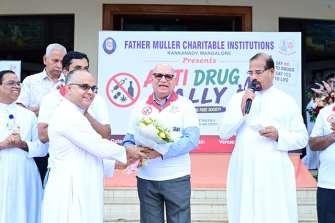
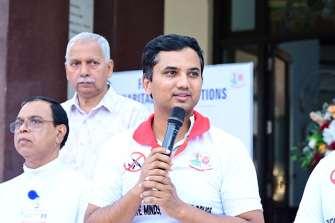
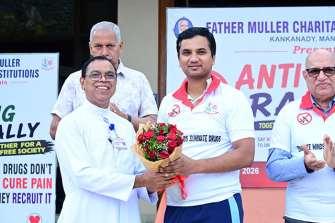
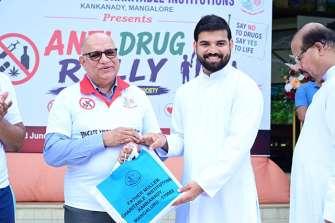
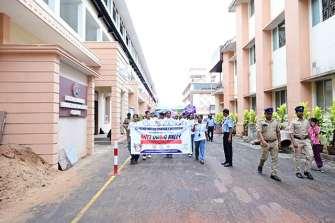
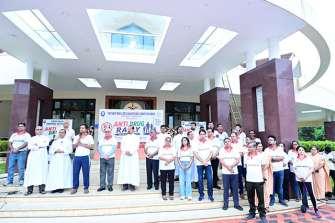
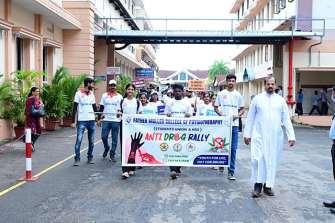
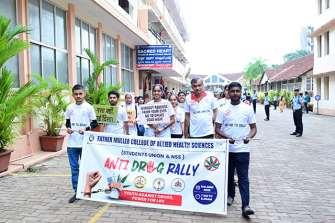
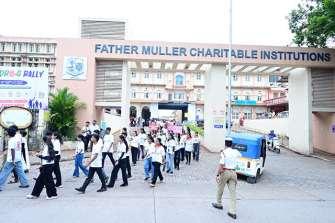




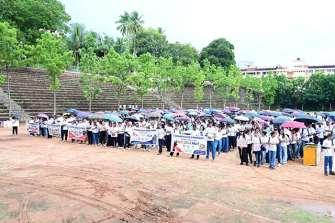


Chapel transformed into a sea of white as participants gathered wearing specially designed antidrugcampaignT-shirts.Thesightof thousands of young people united against the menace of drugs was both impressive and encouraging. Their collective voices echoed slogans promoting a drug-free society and reaffirmed their commitmenttosocialresponsibility.
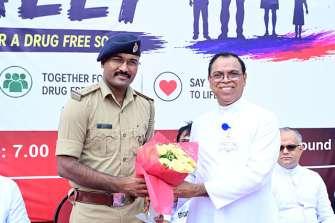
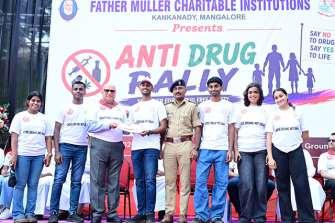
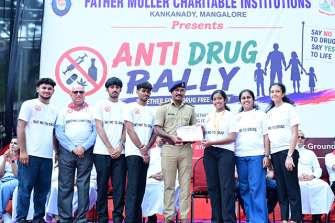
Welcoming the gathering, Fr Faustine Lucas Lobo, director of FMCI, expressed his delight at the overwhelming participation and praised the discipline and enthusiasm displayed by the studentsandfaculty.Hehighlighted the significance of the campaign and introduced the distinguished guests Dharshan H V, IAS, deputy commissioner and district magistrate of Dakshina Kannada, and Michael D’Souza, noted
entrepreneur and philanthropist whogracedtheflag-off ceremony.
Addressing the gathering before flagging off,Dharshan commended the remarkable turnout of youth and emphasized the importance of community participation in combating drug abuse. He assured that individuals seeking help for addiction could approach authorities confidentially and encouraged citizens, especially the youth, toremain vigilantandreport drug-related activities without hesitation, thereby contributing to the vision of a stronger and safer India.
The procession commenced from the Father Muller campus, moving through the main gates towards KaravaliCircle, continuingalongthe newly concretized Pump well road, and re-entering through the Father Muller Convention Centre gates before culminating at the Father Muller Grounds. The rally featured an open tableau truck and a dedicated anti-drug awareness vehicle carrying messages and slogans,adding visualimpacttothe campaign.
At the concluding ceremony, the police sub-inspector Mangaluru
South Maruthi addressed the participants and praised the enthusiasm displayed by the youth. He emphasized that substance abuse not only destroys individuals but also shatters families and communities andtherefore mustbe addressed proactively before it takes deeper rootinsociety.
Michael D’Souza, in his concluding remarks, lauded the meticulous efforts of both the civil and the trafficpolice personnel forensuring the smooth conduct and safe navigation of such a large procession through the heartofthe city. He noted that society remains indebted to Father Muller Charitable Institutions for over 140 years of dedicated healthcare service and appreciated its commitmenttoaddressingpressing social issues through meaningful public awareness initiatives.
The success of the event was supported by the extensive planningandcoordination ledbyDr Michael Santhumayor, administrator of Father Muller Medical College, Father Muller College of Allied Health Sciences, and Father Muller College of Physiotherapy, who oversaw every
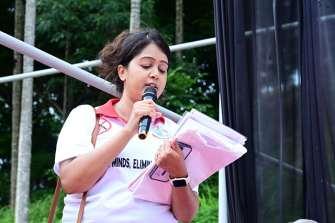
logistical aspect of the walkathon. The event was compeered by Prof Cherishma D’Silva, principal of Father Muller College of Pharmacy, and Dr Sueallen D’Souza, pathologistatFatherMullerMedical College Hospital, who motivated and energized the participants throughout theprogramme.
The rally was the culmination of a vision initiated by FrFaustine Lucas Lobo, whose commitment to spreading awareness about the dangers of substance abuse inspired participation across the various educational institutions under FMCI. His generous support in providing campaign T-shirts and breakfast for allparticipants further strengthened the spirit of the initiative.
Special appreciation was extended to the student bodies of FMMC, FMSON, FMCON, FMCOAHS, FMCOP, FMC (Sp & Hg), NSS units of the constituent institutions, members of the Father Muller Nasha Mukt Bharat Committees, and the logistics and organizing teamswhosetirelesseffortsensured theseamlessexecutionoftheevent.
The winners of the reel making promo competition and Slogan
competition were awarded during thefinishline ceremony.
Competitions
Reels competition
1st Place: One Choice, Two Lives
Team Leader: Pranam G (BPT, 2022 Batch)
Institution: Father MullerCollege of Physiotherapy
2nd Place: Dream Team Leader: Zoie Abigail Mascarenhas
Institution: Father MullerCollege of Allied Health Sciences (BSc AT&OT, MLT & CCT, 2025 Batch)
3rd Place: What Started as Fun Team Leader: Irin Mathew (BPT, 2025 Batch)
Institution: Father MullerCollege of Physiotherapy Slogan Making Competition
1st Prize: Likhitha, 1st Year BSc AT&OT
‘Nasheinda Jeevanakke Baruvudu Nooraaru Maathre, Nashe Bittare Jeevanavaagudu Arogyada Jaathre’
2nd Prize: Ghanshyam Prasad, 1st Year BSc Nursing
‘Don't LetDrugs Write Your Destiny Your Dreams Deserve Better’
3rd Prize: Lia Ann Thomas, MD Radiation Oncology
‘Break Dependence — Choose Wellness over Withdrawal and Purpose over Poison’
The walkathon stood as a powerful statementthatyouth-led actioncan become acatalystforsocialchange. Through this massive demonstration of unity and awareness, Father MullerCharitable Institutions reinforced the message that substance abuse leads only to the destruction of individuals, families, and society, and that collective action remains the key to building a healthier and drug-free future.
AnnaMagdalena W.

International Politics & Economy
Analyst-LSEPhD12h
�� Kyiv Under Fire: Russia
Launches Large-Scale Overnight
Strike Across Ukraine — 21 PEOPLEKILLED
Russians fired 729 missiles and drones… Aftermath of Russian STRIKES at Civilian Buildings in Ukraine
After days of warnings from Ukrainian officialsthatMoscow was preparing a major attack, Russia unleashed a wave of missiles and drones against several of Ukraine’s largest cities overnight. The strikes left at least 21 people dead and more than100injured, accordingto localauthorities. ��
The hardest-hit locations included Kyiv, Dnipro, and Kharkiv, where explosions echoed through the nightasairdefensesystemsworked

to intercept incoming threats — Reuters, KIreport.
In Dnipro, officials reported 5 fatalities and at least 25 injuries after missiles and drones struck residential areas. Images from the city showed damaged apartment blocks, burned vehicles, and destroyed public spaces. ����
�� The capital faced another terrifying night.
In Kyiv 5 people were killed and more than 50 injured, including children. A strike on a 24-story residential building caused part of the structure to collapse, raising fears that people could still be trapped beneath the rubble.
Emergency crews rushed to the scene as fires spread through multiple districts.
Residents poured into metro stations seeking shelter, many arriving with blankets, mattresses, and personal belongings as airraid
sirens sounded across the city. Thousands spent the night underground while explosions and interceptor launch shook the capital. ��
Falling debris from intercepted missiles reportedly ignited fires in several neighborhoods. Vehicles burned in the streets, while open areas and sites near residential infrastructure were alsoaffected. OnlyTruthAboutRussia·6-2-2026
Aftermath of Russian STRIKES at Civilian BuildingsinUkraine
For the lastattack, asJulian Röpcke posts, Russia used 73 ballistic missiles and 650 kamikaze drones — cost appr. 250 mln euro… last screenshot A woman died in Kyiv today ofinjuries sustainedfrom the Russian strike footage: NEXTA (@nexta_tv) on XKyivapartment footage:
https://www.youtube.com/shorts/u 3BGAZzLlds Footage: Julian Röpcke���� (@JulianRoepcke) on X https://onlytruthaboutrussia.quora. com/Aftermath-of-Russian-STRIKES -at-Civilian-Buildings-in-Ukraine What is Putin's "economic war machine" and system of internal repression?

Economic situationinRussiaisgottenworse.It is no denial. But government is not stupid. They came up with method. They say, all right there is inflation, butwagesarerising! Wagesmaybe rising for some professions like mercenaries and top managers but others not really. If you listen to government…
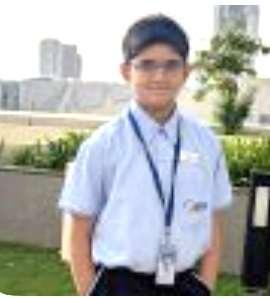
12yoboyearnsJohns Hopkins honor with near-perfect SAT math score through self-study
Relying entirely on self-study, a 12year-old boy in the United Arab Emirates has captured an elite global mathematics honor from Johns Hopkins University after
scoringa750outof800 ontheSAT mathsection.
Arjun AbhinavPatwardhan took the SAT in Abu Dhabi on May 2, where his presence turned heads among the older candidates, as the university admissions exam is generally reserved for students at least16years old.
The Australian expatriate of Indian descent achieved an impressive totalscore of1290, including 750in mathematics, according toWION News . This outstanding result earned ArjuntheGrandHonorsAwardfrom the Johns Hopkins Center for Talented Youth (CTY), a globally recognized program for academicallygiftedstudents.


MediaRelease
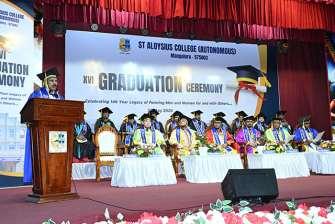
Mangaluru, May 30: St Aloysius College (Autonomous), Mangaluru, celebrated its XVI Graduation Day 2026 recently, honouring the academic accomplishments of its graduating students. The ceremony was marked by inspiring addresses and a call for graduates to serve society with knowledge, commitment, andpurpose. This year, 91 rank holders were
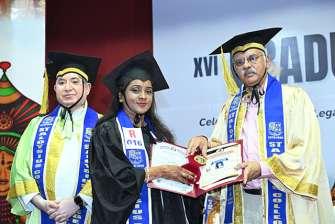
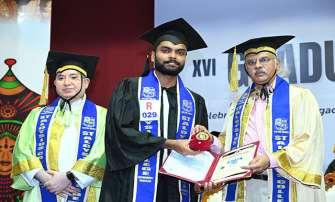
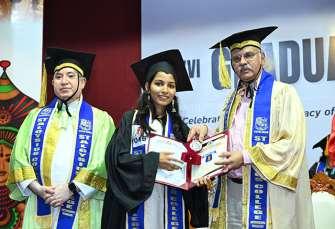
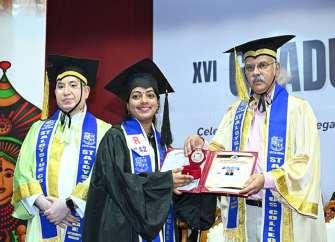
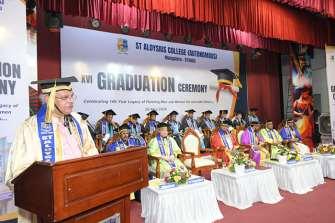
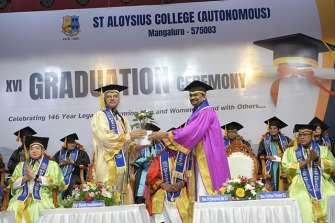
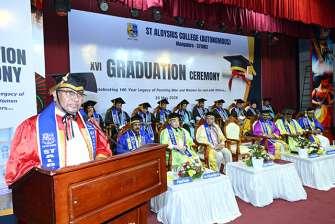
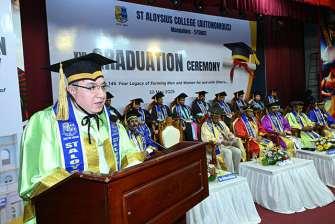
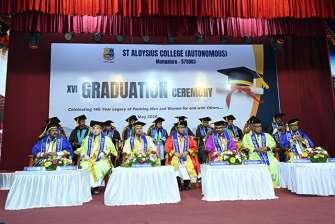
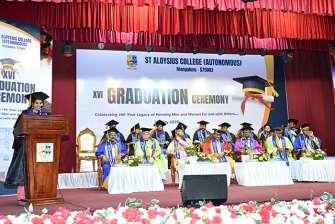
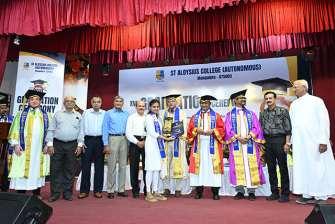
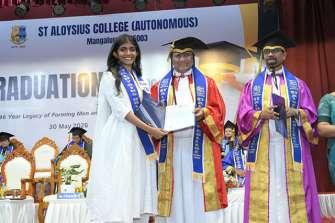
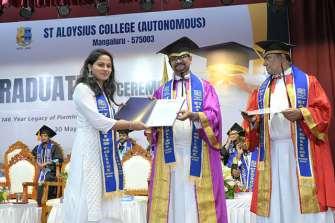
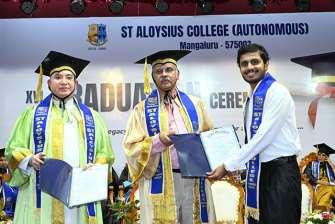
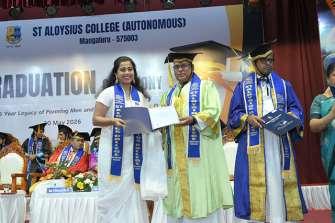
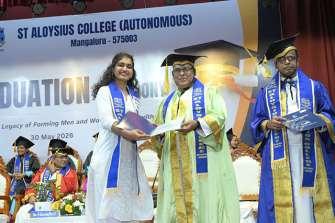
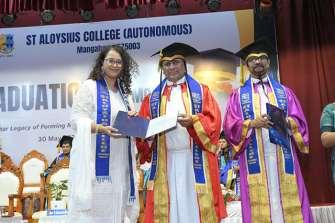
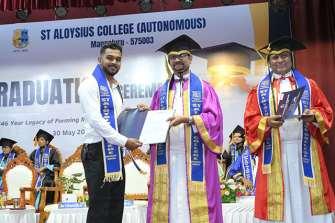
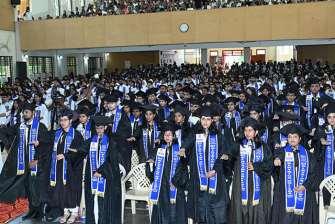
honored, with 16 special prizes
awarded to exceptional performers. Intotal,2630 students graduated thisyear.
The ceremony featured a solemn oath-taking led by Fr Brian Pereira SJ, followed by the official declaration oftheconvocation byFr Dionysius Vaz SJ. The college choir ledthe gathering inprayer, andthe college band escorted the dignitaries tothedais.
In his address as the chief guest, Prof Sharath Ananthamurthy, vice chancellor of Kuvempu University, Shivamogga, encouraged the graduating students to carry the Aloysian spirit of learning, growing and serving generously in their future lives. “Education in a technologydrivenworldmustretain its spirit of enquiry and nurture the ability to learn how to learn. St Aloysius has always done commendable work on this front” headded.
Fr Dionysius Vaz SJ, president of Mangaluru Jesuit Educational Society (MJES) and Provincial of Karnataka JesuitProvince urged the students to pursue what they love doing and transcend above the rat race. “Have faith in yourself, enable the world with the spirit of serving,
and enrich the world with new knowledge” headded.
DrPraveen Martis SJ,principal of St Aloysius College (Autonomous), welcomed the gathering, emphasising the importance of purposeful action. The registrar, Dr Ronald Nazareth, presented the list ofgraduating students, recognising outstanding achievers. The event concluded with a vote of thanks by Dr Vaishali Rai,

-Mervins
October 1945 London, UK. World War II had just ended, leaving widespreaddevastation.TheUKhad lost 460,000 people. Property damage was unimaginable. If that was not enough, there were layoffs everywhere due to business closures.
October 1945 in Uttoxeter, Staffordshire, UK.Joseph a young man of 29 years old & freshly lost
acknowledging the efforts of faculty, students, and organisers in making the graduation ceremony a memorable occasion. Dr Vidya Vinutha D’Souza and Dr Sanjoop compeered the graduation ceremony.
the job & had just becomeafather.The situation couldn’t be worse. But Joseph hadadetermination; he had to do something big for survival,hisyoungson,allof3days, added to that urgency. Just like Saint Joseph, the earthly father of JesusChrist!
JosephwasJosephCyrilBamford, the founder/inventor of JCB! The Machineneeds nointroduction.
The JCB was a revolutionary machine; it could do excavation, digging, shovelling, loading, moving things, demolishing from

precise to heavy, there’s hardly anything that JCB can't do! It can even rescue Formula 1 cars and clearactive minefields! Itwas& isa machineintelligence, orinshort,MI. In a viral video that took over the internet, an Indian laborer used the massive,jaggedteethofamulti-ton JCB excavator bucket to gently scratch an itch on his back with millimeter precision. It proved how incredibly precise thismachineis! It is truly a form of machine intelligence or, inshort, MI.Since it could do a wide variety of work with a high level of precision in a relatively short period of time, it rendered millions of labourers jobless. A jobless Joseph is potentially making a million more jobless! But that proved to be a complete & utter lie. Instead of making a million jobless, the machine gave work to a million
more! Many learned to operate the machine, earning 10 times more! A whole industry opened on maintenance/repair/leasing /owning/selling machines. & the profound changes it ushered in construction/mining/roadwork/de molition work were truly unimaginable. A work that could take up 100 days with a dozen labourers, one JCB could finish in a couple of days, faster/quality work means cheaper cost with great workmanship. which counterintuitively brought more & more work! The macroeconomic ripples were unimaginable. Engineering feats previously dismissed as impossible suddenly became everyday realities. The JCB proved once and for all that automation isnotajobstealer itis a job multiplier. Today, theJCB operates from the same place & that very same baby boy, Anthony
Bamford, grew up to take over the reins of the company. With a turnover of almost $9.5 billion (₹1,00,000 Crore), a global empire! JCBIndiaalonegeneratedamassive revenue of₹20,000 crore in2025!
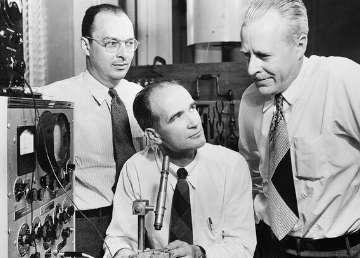
Atlantic , New Jersey, USA at Bell Labs. Three scientists—Bardeen, Brattain, and Shockley, working on a silicon/Germanium piece of metal, found a way to miniaturize electronics. They’d invented transistors. The palm-sized electronic part has now become an indispensable part of our everyday life &its size is nolonger palmsize its shrinked to nanometers. Today, engineers canpack over 100 billion (1 billion = 100 crore) transistors ontoasinglemicrochip thesizeofa postage stamp. To put this into perspective, a humanhair's width is 100,000 nanometers! & that tiny thing runs AI, the word hits you 24/7 nowadays & unless you are living under a rock its just impossible to escape from AI. It is everywhere likeair,it'sincomputers as chatbots doing many things, solving mundane how to reach X-
city to complicated coding to solving math prob that were considered till yesterday unsolvable! E-commerce giants like Amazon use it to pre-guess what mightinterest you.Inhealthcare, its footprint is monumental, revolutionizing everything from molecular drug discovery to precision patient care and automated hospital logistics. The entertainment industry now features virtual AI influencers with millions of real-world followers. On Spotify, AI-generated vocals top playlists while predictive algorithms curate ourdailysoundtracks, justas Netflix dictates our visual media intake. In high finance, algorithmic models execute multi-million dollar tradesinmilliseconds anddirectthe resources of global conglomerates. Geopolitically andmilitarily, AI runs hyper-realistic simulations to forecast conflict outcomes with

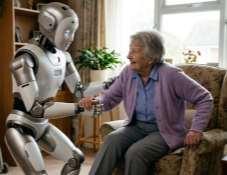
eerie accuracy. Decades-old scientific bottlenecks are dissolved by algorithms in a matter of hours. Autonomous electric vehicles/drones/air taxis are quietly multiplying on our streets. In robotics, humanoids are slowly comingintoourhousesasdomestic maids, they’re in coffee houses, hospitals, oldage homes & toclear dangerous mines, clogged sewer pipes. From lawandaccounting to education andmarketing, structural paradigms are shattering. AI writes poetry, drafts novels, and effortlessly handles your daughter’s schoolessaysandhomework. This speed forces a chilling, unavoidable question into the open:Ifamachinecanexecute these sophisticated tasks instantly, flawlessly, and at a fractionofthecost,whyemploy humansatall?
The corporate fallout has already begun. From Silicon Valley tech firms like Microsoft andAmazon to banking conglomerates like HSBC, workforces are being aggressively downsized by the thousands. The structural forecast is stark: millions are standing on the precipice of
displacement. Experts warn that by 2050, dozens of contemporary career paths will simply cease to exist, replaced by a swift, brutal economic transformation that cannot be sugarcoated.It is a grim, apocalyptic baseline the kind of scenario that keeps central bankers and elected politicians awake at night. Yet, if you look past a vocal minorityofperennialpessimists, the architectsofthistechnologyandthe global market remain overwhelmingly, fiercely optimistic. Why?
WhenIwasaboyinthesecond standard,Idistinctlyremembermy schoollaunchingtheconstruction of a new academic block a modest, single-story building designed to house the seventhstandard girls. The campus was suddenly overrun by anarmyof manuallaborersdiggingtrenches. The dust and chaos were
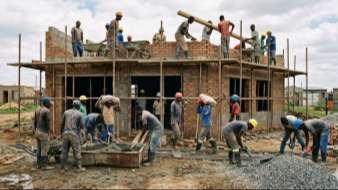
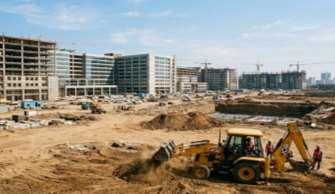
overwhelming; workers chatted loudly, ate, spit, and left litter scatteredacrossthegrounds.Tothe school administration, it was a logistical headache, but to us children,itwaspure novelty and entertainment. Yet, despite the sheer amount of human muscle deployed, completing thatsimple structuretooknearlytwoyears. By the time I reached the tenth standard,theschoolembarkedon anotherexpansion.Thistime,the scale was massive: a four-story complex,roughly threetimes the sizeoftheoriginalproject.Byany standard, it was a formidable engineeringtask. Yet,asIlooked outtheclassroomwindow,Inoticed a striking paradox. Despite the granderscale,therewasnochaotic armyofworkers.Theambientnoise of shouting and manual digging was replaced by the mechanical hum of JCBs and specialized machinery.Incredibly,thismassive four-storycomplexwascompleted and fully operational in just eighteenmonths.
The most revealing detail? The school had hired the exact same contractorforbothprojects. Over theinterveningyears,automating
core tasks had completely transformed his business. Technology allowedhim toslash construction timelines and erect vastly superior, larger structures withfewermenontheground.But hehadn'tdestroyedhisworkforce; hehadupskilledit.Onthissecond project,heemployedhighlytrained technical staff—like certified JCB operators who commanded significantlyhigherwagesthanthe manualdiggers ofmychildhood. Furthermore, because automation madehisoperationsfaster,cheaper, and structurally superior, his businessexploded.Hedidn'tstop building.Infact,hesimultaneously pickedupfivemoremajorcontracts across the region, ultimately employingfarmoretotallaborers thanheevercouldhaveunderhis old,manualworkculture.Hadhe stucktoshovelsandpickaxes,the school's second building would havetakenfiveyearstocomplete and cost three times as much, bankrupting theproject before it evenbegan.
ItisahobbyandintheDNAof leftist , lazyminds todemonize new

technology. Theydid the samewith thefirstspinningjenny, thefirst printing press, the firstrailway, and thefirstcomputers andtheinternet. Theyare fundamentally againstany change. Had the world ever believed them, we would still be living in caves with stone tools! Thank God we did not! Take the case of Germany and China. Until recently, Germany was far superior in technology in almost every field. But successive leftist governments inGermany ignored theimportance of innovation and accommodating new ideas. Meanwhile, China has leapfrogged by adopting new technology, whether in batteries, EVs, robotics, space exploration, quantum computers, or AI. Today, Germany and the EU are languishing, playing a game of catch-up, while China has been racingatlightspeed.
India'scaseisevenmorepathetic. India has the talent, a vast consumerbase,andcompaniesto takeadvantageofAI.Butdespite allofthis,Indiaisnowhereinthe AIfield.Thisisbecausewelack educatedpoliticalleadership.We had one in the scholar Dr. ManmohanSingh.Unfortunately, thepresentgovernmentinDelhi has neither a clear vision, expertise,norinterest.Thedaily leaking ofthe most important exams like NEET and CBSE, puttingmillionsofstudents'lives hanginginthe balance due to massive corruption in government anditsnexuswith coaching classes, is just one example of this government's utterfailure—whichcanalsobe seen in stock market capitalisation.Indiahasslippedto 7thspot, whiletinyKorea and Taiwanhaveracedahead,mainly duetotheirAIandchip-making abilities.
China and the USA are the undisputed frontrunners in AI creationandexecution.Yet,wehave not seen anywidespread job losses or business closures. On the
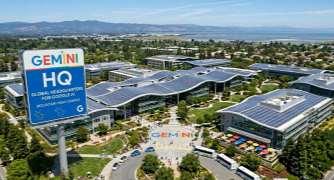
contrary, their stock markets are recording new highs almost every day, with the DowJones surpassing 50,000. Companies like NVIDIA, Micron, TSMC, Broadcom, and SK Hynix, which are closely related to the AI world, have become trilliondollar companies! NVIDIAalone is worth 5.5trillion dollars (1trillion ~100 Lakh Crore), which is significantly more than India's entire nominal GDP of roughly 4 trillion dollars. Yet, Artificial Intelligence is fundamentally misunderstood when viewed through the narrow lens of microchips, trillion-dollar corporate valuations, and polished CEOs hogging the limelight on business newschannels.Whenyoustripaway the corporate marketing and dig into the physical reality, you realize how profoundly this revolution anchors itself to the common worker on the street. The core equation is simple: AI is entirely

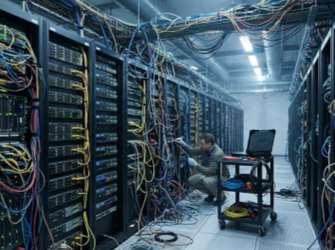
fuelled by data. Without astronomical oceans of data, the most advanced AI algorithm is as useless as yesterday’s newspaper. Butdataisnotethereal;itrequires a colossal, deeply physicalnetwork of industrial architecture to collect, store, analyze, and deploy it: the datacenter.
Itispreciselywithintheconstruction of these massive data centers that AI binds itself to the everyday working class. Consider what it takes tokeepamodern datacenter alive. It demands unprecedented amounts of electrical grid energy, massive industrial thermal management systems, heavy-duty fluidpumps, intricate lighting grids, and substation switchgear. They require vasttractsofrealestate and dedicatedcivilroadnetworks justto connect them to the world. Notice that I haven’t even mentioned the actualcomputers, servers, modems, routers, or software architectures yet. All this heavy infrastructure
demands a real human being with hands-on, practical intelligence notanalgorithm.
The supply-chain domino effect of just a single component is staggering. Consider the demand for industrial cabling. A simple transmission wire, whether copper oraluminum,immediatelytriggers a surge in global miningactivity. That extraction forces a parallel expansion in heavy transportation logistics, raw material processing plants, fabrication factories, and energy consumption. Those wires must then be insulated with extruded PVC plastics, triggering chemicalmanufacturing.
Every singlelinkinthissupply chain demands human intervention , human sweat, and human expertise. Just one isolated element of the sprawling AI ecosystem creates thousands of tangibles, blue-collar jobs and we are only analyzing a single cog inside a massive global machine. Because each of these data centers requires an astronomical volume of electricity, they are inadvertently forcingaspectacularwave ofclean-
energy innovation. Promising breakthroughs aremoving fromthe whiteboard to reality at breakneck speed. From small modular nuclear reactors (SMRs) dedicated to single facilities, to advanced deep-crust geothermal energy systems, revolutionary power models are being aggressively deployed. These innovationswillultimatelyscalepast tech infrastructure, greening global power grids, and benefiting all of mankind. Looking even further ahead, the frontier is expanding beyond our atmosphere: plans are already underway to launch
autonomous data centers into lowEarth orbit, utilizing constant solar energy and the natural freezing vacuum of space for cooling. This willopen anentirely newchapterin human history. In each case,
thousands of new jobs/opportunities willbecreated.

AIisnotastandalone,exclusive digitalmirage; it is an industrial conglomerate of interconnected physical systems. Admittedly, the rapid expansion of these data centers brings real localized challenges, particularly regarding energy and water consumption. However, the tech hyperscalers conglomerates like Microsoft, Google, OpenAI, Meta, and xAI possess both the capital and the existential incentive to aggressively engineer solutions to minimize discomfort forlocalcommunities.
Undeniably, certain sectors will face asevere employment crunch.AIwill ruthlessly absorb the repetitive, predictable tasks historically executed by human labor—there is absolutely nopointindebating that
reality. Yet, by the exact same mechanism,AIisactingasamassive demand multiplier across entirely new,unmapped industries.

Consider just the creator economy: justafewyearsback,theconceptof a digital influencer was completely alien. Today, supercharged by generative AI and virtual avatar technology, synthetic and AIassisted influencers have exploded into a multi-billion-dollar global industry, dominating feeds across YouTube, Instagram, Facebook, and TikTok. These creators span every socioeconomic class, with top-tier players generating millions in revenue.
More profoundly, AI is obliterating the traditional gatekeepers of human capability. It has democratized education, allowing anyone to instantly master and teachanysubjectonearth. Because
ofnatural-language coding models, anindividual whohas neverwritten asingle lineof code in theirlifecan now seamlessly program and deploy advanced microcontrollers, engineer custom hardware dashboards, or develop proprietary software. The barriers toentry have vanished. The ordinary citizen can become analgorithmic stocktrader, a sophisticated data architect, a digital music composer, or an independent filmmaker.
AsAIadvancesintoasuper-ultrapro-maxAIversionsometimeinthe future,willhumansbecomeentirely obsolete? Right now, the most advanced AIs still need some degree ofhumanintervention if nothingelse,atleastforpower!But whatiftheybecometotallyfree? WhatifanAIbecomessoadvanced thatitmakesdecisionsonitsown, discussespowerrequirementswith its cousin AIs, and decides to eliminatepeskyhumans?Canthere beawarbetweenAIsandhumans? Itisapopularplotinhundredsof movies, at least. Yeah, it might happen—nothingisruledout,andit mustnotbe.ButItotallyrelyon human ingenuity. Some of the
brightest minds will work out a strategytoavertsuchanightmarish scenario.HumanswillNEVERallow AIstocausedamagetoinnocents. That'sa100% guaranty. Ifwe’ve learnedtolivewithnuclearpower, wewillsurelysurviveAI-geddon.
Wearenotentering aneraof human obsolescence . We are entering the age of the hyperempowered individual. Under this new paradigm, not even the sky is

the limit. Whenever a disruptive technology violently erupts intoour daily lives, friction with the old paradigm is inevitable. It leaves millions feeling structurally obsolete. That fear is a deeply human, perfectly natural response. But stagnation is a luxury the universe does not accommodate; change is the only true constant in human history. We either adapt to
the shifting terrain or we are consumed byit.
Forhundreds ofthousands ofyears, the Neanderthal reigned supreme as the apex hunter of the European continent. Yet, when environmental and competitive realities shifted, they failed to evolve. Nature ruthlessly replacedthemwith us.
There is a deeper, structural reality that the panic-mongers completely ignore: global demographics areimploding. Asthe global population ages and younger workforces become increasingly scarce, artificial intelligence and advanced robotics cease to be merely a viable corporate option but it's the ONLY option! The world's economic engines—including Japan, China, South Korea, Russia, Germany, andtheUnitedStates are locked in an unprecedented, irreversible demographic contraction. While massimmigration isoftenproposed asalocalized band-aid, itcarries steep structural frictions, ranging from immediate language barriers and specialized skill deficits to the complex, long-
term challenges of socio-cultural integration. For these fracturing societies, thedawnofAI/Robotics is not a threat. It is manna from heaven.
The modern economic parallelis absolute.
Anyone who

stubbornly refuses to adapt alongside arapidly evolving society will, without question, be replaced. Mourning the loss oflegacy jobs or outdated revenue streams is an exercise in futility. The digital landscape is activelyexploding with unprecedented opportunities to learn,retool,upskill,andarmuswith entirely new intellectual weapons. We must aggressively seize these tools today before we find ourselves discardedintothedustbin ofhistory. JCB,though basicallya


world was loud and clear: “be human,stayhuman!”
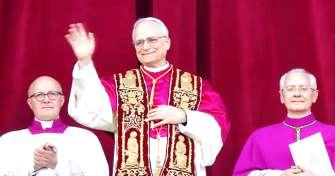
-*FrCedricPrakash SJ
On 25 May 2026, released his first Encyclical ‘Magnifica Humanitas’ (Magnificent Humanity): On Safeguarding the Human Person in the time of Artificial Intelligence’. In it, he makes a passionate plea for safeguarding humanity, promoting truth and freedom, the dignity of work, and advocating that the fundamentals of the universal destination of goods, subsidiarity, solidarity, human rights, social justice and peace should be paramount. His message to the
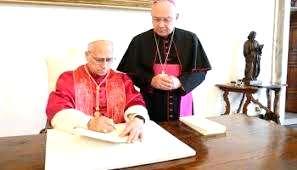
Pope Leo XIV signed his document ten days earlier, on 15 May which was the 135th anniversary of the promulgation of Pope Leo XIII’s powerful 1891 encyclical ‘Rerum Novarum (Of New Things): On the Condition of Labour’. Pope Leo then, addressed the severe social and economic upheavals brought about by the Industrial Revolution.
It is widely considered as the foundational blueprint for modern social doctrine of the Catholic Church, as it marked the first time the Vatican systematically and purposefully intervened in contemporary socio-economic debates to defend the dignity and therights ofworkers!
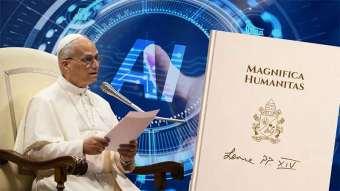
‘MagnificaHumanitas’ should come as no surprise to those who are aghast at what is happening in the world today and sincerely want to do something about it! No papal encyclical makes easy reading. This masterpiece of 245 paragraphs has five chapters, with an ‘Introduction’ and a ‘Conclusion’, all beautifully interwoven into a rich tapestry of a vision, mission andresponsibility to address the realities of today’s world. Pope Leo sets the tone and direction of his encyclical in his opening words, “Humanity,created
byGodinallitsgrandeur,istoday facingapivotal choice:eitherto constructanewTowerofBabelor tobuildthecityinwhichGodand humanity dwell together. Each generation inherits the task of shaping its own era, of guiding historytobecomeaplacewherethe dignity of every person is safeguarded, justice is promoted andfraternityismadepossible.Yet every era also runs the risk of creating an inhumane and more unjustworld.”
The encyclical has a basic premise whenitstates,“WhileLeoXIIIspoke inhistimeof“newthings”(Rerum Novarum), today wecannot limit ourselves simply torepeating his insightful teachings. Instead, we mustaskGod forthewisdom to interpret the great trends ofour time, particularly technological advances. In recent years, it has become increasingly evident how rapidly and profoundly digitalization, artificial intelligence (AI)androboticsaretransforming ourworld.Technologyshouldnot be considered as a force
antagonistic tohumanity.Onthe contrary,ithasformedpartofour history sincethebeginning as“a profoundlyhumanreality,linkedto the autonomy and freedom of man.”.Pope Leo then asserts that, “technology is never neutral, because it takes on the characteristicsofthosewhodevise, finance,regulate,anduseit”. He appeals for people to build for the common good and to remain human, following a courageous mentality of shared responsibility and communion, so that the world “willcometorecognizethehuman heart as the place where God desirestodwell”
The document is comprehensive. The ‘Introduction’ provides the ‘raison d'être’and theimmediacy of the content. The first chapter, ‘A Dynamic Approach Faithful to the Gospel’, traces the Social Doctrine oftheChurchinrecentmagisterium and the Second Vatican Council, highlighting its dynamic character. Inthesecondchapter,Pope LeoXIV explores the ‘Foundations and Principles of the Social Doctrine of
the Church’. The third chapter, ‘Technology and Dominance: The Grandeur of Humanity in Light of the Promises of AI’, stresses the need to approach artificial intelligence with vigilance. In the fourth chapter, ‘Safeguarding Humanity at a Time of Transformation. Truth, Work, Freedom’, the Pope calls for an ecology of communication based on truth. In the fifth chapter, ‘The CultureofPowerandtheCivilization ofLove’,PopeLeoXIVturnshisgaze towar,saying“thedigitalrevolution ischangingthenatureofconflict.” The Pope calls for an ethical approach, without which decisions about the life anddeath ofpersons willbecomeincreasinglyimpersonal duetoauseofforceregarded asan “immediateandviableoption”. The ‘Conclusion’ points to the ‘road ahead’ giving one a spirituality for ourtime.
The Vatican ‘Dicastery for Promoting Integral Human Development’ has prepared an excellent five-page summary of the encyclical besides some useful
resource materials.Nosummarywill do justice to the wealth encapsulated in this treatise: spiritual, theological, socio-political, cultural, technological, putting into focus the many serious realities which grip the world today; above all, there is an unmistakable positivity throughout- Pope Leo is unequivocal in stating that ‘another world ispossible’, thatthereishope provided we get our acttogether –individually and collectively, to be human!Tostayhuman!
Pope LeoXIV recalls the writings of hispredecessors: fromPope LeoXIII to Pope Francis. identifies five principles of the Social Doctrine of the Church: common good, the universal destination of goods, subsidiarity,solidarity,socialjustice. Christians, saysPope Leo,arecalled to respond to the culture of power by building “the civilization of love” and by choosing whether to feed the logic of force or safeguard peace.Herecalls thememory ofthe saints, “righteous people andthe oft-forgottenpeacemakers,showus that grace does not magically
eliminate conflict, but instead it inspiresactiveresistancetoeviland anastonishingcreativity indoing good”
TodayAIpermeates everysphere of life.Thewaythefundamentalvalues of humanity are being eroded. The violation of human rights: the right to life, the rights of women and minorities. Pope Leo XIV identifies migrants, refugees, displaced persons as a “litmustest”for social justice. The way society treats migrants, he says, “revealswhether itssenseofjusticeisdrivenbyfear orbythespiritoffraternity.” He therefore appeals for societies to protect“therightfulhopes”ofthose forced to leave, by ensuring them safe and legal routes, dignified welcome, and genuine paths to integration, while promoting “the righttoremain”in one’s homeland inpeaceandsecurity,byaddressing “the root causes” of migration. Compassion for the ‘other’ is what matters. He also expresses concern about what is happening to the environment- and why one should careforourcommon home!
Pope Leo says that too much AI power is concentrated in too few hands. He warned that a small group of firms now control vast amounts of data, computing power anddigital infrastructure. He writes,
“Whensuchpowerisconcentrated inthehandsofafewittendsto becomeopaqueandevadepublic oversight, increasing the risk of distorted forms of development thatgiverisetonewdependencies, exclusions, manipulations and inequalities.” He warned that powerful groups could use AI to shape public opinion, influence democratic systems and steer economies for their own interests. Healsocriticised theglobal racefor “evermorepowerfulalgorithmsand larger datasets”, arguing that technology should serve humanity rather than corporate or geopolitical dominance. Another major concern in the document is employment. While he acknowledged that AI could improve productivity and make some work safer, he argued that workers must not become
disposable inthe process. Hewarns about AI weapons Pope Leo criticised the development of autonomous weapons and said it should never be acceptable for machines to make irreversible lifeand-death decisionswithouthuman responsibility. He stated that,
“ArtificialIntelligencenowdemands tobedisarmed,freedfromlogics thatturnitintoaninstrument of domination,exclusionanddeath,”.
‘Magnifica Humanitas’ challenges certain dimensions of today’s human behaviour. Pope Leo devotes amplespacetoacritique of transhumanismandposthumanism, which interpret progress as the overcoming of human limits. Instead, limitations are not defects to be eliminated, but a constitutive dimension of the human person, because itisinfragility andfinitude that relationship and openness to God andto others, mature. He says we must remember that“humanity flourishes not despite limitations, butoftenthroughthem” Pursuing technological innovation at the expense of eliminating human
limitations, he says,would causean anthropological regression.
“Humanity—inallitsgrandeurand woundedness must never be replaced or surpassed,” The encyclical challenges all people of goodwilltostayactivelyengagedin the ethical development of AI, ensuring it bridges societal divides, ratherthancentralising power.
‘Beinghuman’isacommitment toa better world, pregnant with hope and built on the civilization of love. Pope Leo calls for an “ecology of communication” based on truth. He urges transparency in how content is selected, protection of personal data,seriousjournalism foundedon argumentation and verification, a new awareness in the “proper and critical” use of digital tools, and the integration of different forms of knowledge. The Church must also embody transparent and honest communication, especially in cases of injustice and abuse. The Pope also appeals for a renewed educational alliance, so that the “desiretoaskquestions” maynotbe extinguished in young people by
perfect machines that make human thought seem useless. Pope Leo therefore calls for renewed attention toschoolsasplaceswhere people learn to “seek and love the truth”. He emphasizes the importance of protecting the dignity of work by designing systemscenteredontheperson and not only on performance. For him, peace anddevelopment is to move beyond GDP as the measure of a country’s level of development, focusing instead on the dignity of work, shared prosperity, the reduction of inequalities, and environmental protection; “prosperity contributes to peace “onlyifitiswidespread,inclusive, andsustainable”
Pope Leo’s call to the Church to do aserious examination ofconscience will make many within the Church uncomfortable.Hesaysthatthefive principles of the Social Doctrine of the Church, should be applied not only to society, but also to the Church herself, which must make “anexaminationofconscience.”The Pope sayslivingoutthisjusticecalls
for“purifyingecclesialrelationships andstructuresfromdistortionsthat give rise to inequality, lack of transparencyandabuseofpower.”
This means to listen to the “victims ofspiritual,economic,institutional, sexualandpower-basedabuse,as wellasabusesofconscience.”This examen, “isanintegral partofa journey toward justice, which includes acknowledging theharm done, just reparation and taking stepstopreventitfromhappening again”.
Pope Leo upholds the importance of combating new forms of slavery as a “decisive test for ethical discernment” in the digital transformation. He stresses, “the Church renews her firm condemnation of every form of slavery, trafficking, and commodification of persons” and he underscores that to not reactor to tolerate grave violations of human dignity means becoming accomplices to them. He asks pardon, “This(slavery)constitutesa wound in Christian memory, one from which we cannot consider
ourselvesdetached.Itisimpossible not to feel deep sorrow when contemplating the immense sufferingandhumiliationendured bysomanyinstarkcontrasttotheir immeasurable dignity as persons infinitelylovedbytheLord.Forthis, in the name of the Church, I sincerelyaskforpardon.”
He indicates five paths of responsibility for the way ahead, they are: disarming words by speaking the truth; building peace in justice; adopting the perspective ofvictimsbytakingastand,because there are conflicts in which “it is unjust to remain neutral”; cultivating “ahealthyrealism” that seeks practicable paths of peace through deeds, notonlywords!
Heemphasizestheneedtorelaunch dialogue by moving from a culture ofpowertoacultureofnegotiation; of decisive importance is “interreligious dialogue”, being bearers of a message of peace. He says, “thosewhousethenameof Godtolegitimizeterrorism,violence orwarbetrayhistruenature,forto fightinthenameofreligionmeans
attackingreligion itself”. A strong message to today’s warmongers; to those who use the name of God to justify their wars! God is synonymous with compassion, not with hate,violence andwar!
Towards theendhegives theworld an antidote to ‘stay human’, “Aswe looktothefuture,Iwouldliketo recalltheimageofNehemiahwhom wechoseasourcompanion and guide at the outset. Nehemiah heardthecryofadevastatedcity, brought that pain to prayer, discerned before God, asked for help,receivedpermissiontoreturn, organized the work, confronted internalandexternalresistanceand rebuiltthewallsofJerusalemwith theassistanceofthepeople,brick by brick. In this era of digital transformation, I see in him a striking parable of our own vocation,whichisnottobepassive spectators of social and cultural fractures,normerecommentators onwhatiscrumbling,butmenand
women prepared to enter the construction sites of history research laboratories, technology companies, schools, the media, institutions andlocalcommunities in order to rebuild what has collapsed and protect what is threatened.LikeNehemiah,wetoo are called to unite listening and courage,prayerandresponsibility, sothat,evenwhenatechnocratic mentalityorpartisaninterestsseem to prevail, the human city may becomeamorefittingplacetolive.
Today, our world in several aspects has either lost or is fast losing its humaneness; concluding with Mary’s ‘Magnificat’ Pope Leo challenges us alltoBeHuman!Stay Human!
31May 2026
(*Fr. Cedric Prakash SJ is a renowned human rights, reconciliation and peace activist & writer.
Contact:cedricprakash@gmail.com)
Sendyourwritingsto:veezweekly@gmail.com


In this new segment, we revisit songs from the late 1980s to mid1990s that continue to resonate with listeners across generations, fromBaby Boomers andGeneration X to Millennials and Gen Z. While each generation may connect with these songs differently, their timeless appeal remains unchanged.
Many ofusgrew up listening to the chartbuster "Saat Samundar Paar" from the 1992 film Vishwatma , featuring the late Divya Bharti and Sunny Deol. Today, however, we shinethespotlight onanother song from the same film that never received the recognition it truly deserved, despite its strong musical composition andvisual appeal.
The song is "Aankhon Mein Hai Kya",featuringallfourleadactorsof the film: Sunny Deol, the late Divya Bharti, Jyotsna Singh, and Chunky Panday. While Chunky Panday is a familiar name to many film lovers, members of Generation Alpha may
know him more as the father of actressAnanyaPanday.

With vocals by Sadhana Sargam, Mohammed Aziz,Udit Narayan,and Alka Yagnik, and lyrics penned by Anand Bakshi, the song struck a chord with young listeners and became a celebration of youthful romance.
The song was filmed across several breathtaking locations inKenya and adopted a travelogue style, taking viewers on avisual journey through four distinct settings. Adding to its charmwasanunusualyetdelightful supporting cast comprising not humans, but a fascinating array of wildlife. From colorful birds to
majestic lions, African elephants, and graceful giraffes, the song offered a glimpse into Kenya's rich natural beauty.
For manyIndianviewers intheearly 1990s, this song was their first cinematic introduction to Kenya. Its stunning visuals ignited curiosity about a country known for its rich wildlife, vast landscapes, and breathtaking natural beauty.
Back in the 1990s, long before the era of YouTube and instant replays, television was our only window to such visual spectacles. I still vividly remember my brother and me eagerly counting the number of animals that appeared in the song each time it was broadcast on TV. Those moments transformed the songintomuchmorethanamusical experience; they became cherished childhood memories.
While Sunny Deol impressed with his macho persona and romantic expressions, the choreography seemed to challenge him at times. Divya Bharti's natural grace and effortless charm, however, beautifully balanced the equation and elevated the overall appeal of the song. There is no denying that Chunky Panday and Jyotsna Singh
performed their roles with great enthusiasm and charm, while their elegant and diverse costumes further enriched the song's vibrant presentation. Jyotsna Singhremains one of the lesser-known faces of Vishwatma, yet her graceful screen presence and chemistry with Chunky Panday contributed significantly to the song's visual appeal.


At a time when international travel was beyond the reach of most people, this song sparked a fascination with Kenya and inspired countless young viewers to dream of visiting the country someday. Kenya and neighboring African countries quickly found a place on the travel wish lists of many young viewers, thanks to its breathtaking depiction inthe film.



If this song brings back fond memories, here’s the link to the video: https://www.youtube.com/watch?v =UL8z7z1aY_A.
Watch it once again and see if you can figure out the final count of animals thatappear throughout the song. Beforeyouknow it,you'll find yourselfhumming,"Merijaanhaitu, meredilmein,merijaanhaimushkil mein, oh mere janam..." all over again.
Please feel free to send your feedback or suggestions to us at veezweekly@gmail.com. We
appreciate your involvement.

By Prinson D’Lima


Andrew LD Cunha, Bejai
“My daughter turned 18…” Ronald had sent me a WhatsApp photo of his daughter Rosita cutting her birthdaycake.Thenumber 18stood boldontheRCBjerseyshewore.His next message read: “I’llmeetyou
tomorrow. I need to talk about taking a loan for her higher education.”
Ronaldhadbeenmyclientforyears. Backin2007, whenRositawasborn, I had advised him to start a simple savings plan for her future. But Ronald’s weakness was always the same he lived on loans, never on savings. Even after two more children, hishabit didn’t change.
Whenhecametomyofficethenext day, he brought Rosita and his younger brother Vincent along. “What’s done is done with me,”
Ronald said,shaking his head.“He’s alsoabigspender like me.He hasa five-month-old baby. Atleastguide him right and give Rosita some direction.”
This family loved cricket, so I decidedtoexplainthingsusingtheir favourite story: Virat Kohli and the number 18. ViratKohliandthePowerof18
I turned to Rosita. “You’re a huge Kohli fan. Tell me what do you know about hisnumber 18?”
Her eyes lit up. “On the night of December 18, 2006, his father died of a heart attack. Kohli was just 18 years old, batting on 40 in a Ranji match. The next morning, carrying
his grief, he returned to the field, scored 90, and saved Delhi from a follow-on! Andon August18, 2008, he played his first international match.Later,RCBliftedtheirfirstIPL trophy in the 18thedition after 18 years oftrying.”
Hervoicewasfilledwithadmiration.
“So,tellme,Rosita,”Iasked,“ifVirat Kohliisyourhero,whatlessonshave you learned from him?”
She smiled. “His discipline. His focus. His patience. The way he fights challenges. Heinspires me to setgoals and never give up.”
I jotted her words into four short points andreadthemaloud:
• Set clear goals and stay focused.
• Practice discipline and continuous effort.
• Use time wiselyandpatiently.
• Showself-control andcourage inchallenges.
Ronald sighed. “Exactly what you told me 18 years ago to start saving with discipline. If only I had listened…”
TheMissed Opportunity
I nodded. “Ronald, if you had started saving just ₹5,000 a month in a mutual fund SIP when Rosita wasbornin2007, bynowyouwould have invested ₹10.8 lakh. With an averageannualreturnof12%,today it would have grown to ₹37.5 lakh. Enough to fund her higher education withoutaskingforaloan. That is the power of compounding and the cost of delay.”
Ronald lowered his head. “I see it now.”
The Dangerous Habit of ‘We’ll SeeLater’
This is the mistake many parents make. They think: “We’llseewhen thetimecomes.”Butbythetimethe “time” comes, education costs have tripled. Today, higher education in India already costs ₹25–30 lakh. In another 18 years, with inflation, it could cross ₹1 crore. Medical studies already cost ₹50 lakh or more.
Thatiswhysavingsmustbeginfrom a child’s earliest years. Parents can start with safe options like fixed deposits, postofficeschemes,orthe Public Provident Fund. For a girl child,theSukanyaSamriddhiYojana
is a strong choice. But for higher long-term growth, equity mutual funds remain unmatched. Some mutual funds even offer “Children’s Gift Funds” where investments are locked till the child turns 18. Insurance companies also offer education-focused plans.
Savingalone isnotenough. Parents must also teachchildren financial habits before they turn 18— budgeting, saving, and understanding thevalueofmoney.
Vincent’s Question: “Where Do I Begin?”
Ronald’s younger brother Vincent finally spoke. “If Iwant to start with ₹8,000 a month for my baby, what do you suggest?”
I explained: “Start a Step-Up SIP. Invest ₹8,000 this year. Next year, increase it by 10% to ₹8,800. The following year, raise it again to ₹9,680, and so on. Over 18 years, you would haveinvested about ₹43 lakh. But with 12% annual growth, you could build close to₹1 crore.
The trick is not to panic when markets fall. In fact, when markets dip, your money buys more units, which increases your long-term
returns.Wealthisnotbuiltbytiming the market, but by time in the market.”
Vincent nodded, absorbing every word.
Turning 18 is more than cutting a cake or wearing a number on a jersey. It is the turning point from childhood toadulthood. At18, one steps into a world of rights and responsibilities.
• You can open your own bank account.
• Youcaninvestinmutualfunds andthe stockmarket.
• Youcanapply foracreditcard (butmustuseitwisely).
• You can create your own emergency fund.
• You can vote, drive, and even marrylegally (Forgirls).
• You can take up part-time work andstartearning.
But along with these opportunities comes a big risk: fraud. Financial
scams today are everywhere. Ifyou are careless, the money you save can vanish in seconds. Awareness and caution are as important as savings.
As Rosita listened, I looked at her withasmile.“Withthefreedom that comes at18, the biggest testis not how much you can do it is how much you can control. RCB may have won the 18th IPL, but remember, the celebrations in 2025 also saw a dangerous stampede. That is life’s lesson too: joy without discipline can quickly turn into chaos.
Number 18 on a jersey may fade with time. But the habits you build at 18 the discipline, the patience, thefocus—will shineforalifetime. So don’t just celebrateturning 18. Step into it with purpose, with wisdom, and with financial responsibility. Because18isnotjust a number—it is the foundation of thelifeahead.”

Generally, the Authorities & our political leaders say, the street vendors&poorpeople spoilthecity or aparticular ward...I have got 2, 3 examples ofrich & veryrich people creating hazards and creating civic problems infrontofoureyes.Ihope this is sufficient evidence for the people whospeakagainstthe poor. One of the photos shows a renovated house of a rich businessman on St. Theresa main road Bendore who have thrown the wasteofheavysizetothedraintheir opp.totheirhouse.Theotheroneis
ofa doctor constructing newhouse & has thrown his construction
materials on the road., third is of a new commercial building on Bendorewell main road who looks like violated the MCC rules andhas made hell on the road which has troubled the passersby for months &months.
-Gerard Towers, Mangaluru
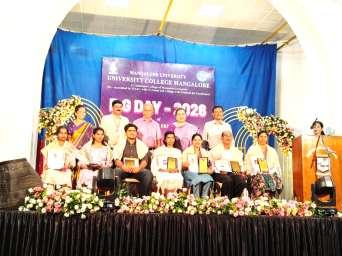
Today on May 5, 2026, Edmond Noronha being felicitated at
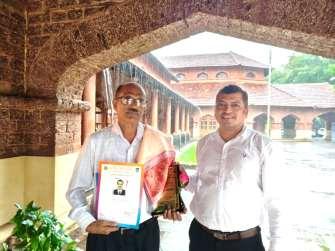
University College Mangaluru for securing1stRankinMAKonkani.
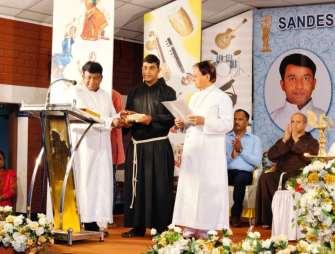
MANGALURU, JUNE 04: The Sandesha Foundation for Culture and Education witnessed a
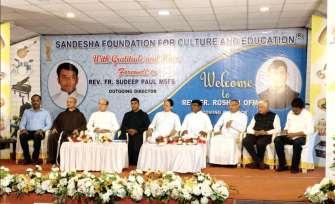
significant transition in its leadership on Thursday, June 4, 2026. Rev.Fr Roshan Rosario, OFM, officiallyassumed office as the new Director, succeeding the outgoing
Director, Rev. Fr Dr Sudeep Paul, MSFS, during a solemn handingover ceremony held at Sandesha Hall,Bajjodi.
The transition ceremony was ledby MostRev.DrHenryD'Souza,Bishop of Bellary and Chairman of the KRCBC Commission for Social Communications. Presidingoverthe event, Bishop D'Souza conducted the formal handing over of responsibilities, prayed over the incomingDirector,andextendedhis best wishes for Fr Rosario's future endeavours in advancing the foundation's mission. The bishop gratefullyacknowledged theservice rendered by Fr Sudeep Paul and offeredfelicitations andwishes.
Mr Roy Castelino, Trustee of the Sandesha Foundation, delivered the welcome address, warmly greeting the dignitaries and the gathered audience.
Thesignificantoccasion was graced by the esteemed presence of highranking ecclesiastical leaders and socio-cultural dignitaries. MostRev.
Dr Peter Paul Saldanha, Bishop of Mangalore and Vice Chairman of the KRCBC Commission for Social Communications, and Most Rev. Dr Gerald Isaac Lobo, Bishop Emeritus of Udupi and Trustee of the Foundation, werepresenttowitness the transition. Very Rev. Fr Robin VictorD'Souza,OFMCap,Provincial, also attended the event to support theincoming director.
Further highlighting the socioculturalimportance oftheSandesha Foundation, the ceremony was attended by Mr Stany Alvares, President of the Karnataka Konkani Sahithya Academy. The entire programme was systematically coordinated by Mr Stany Lobo, Coordinator of the Programme Committee.
Theeventconcludedwithattendees expressing their deep appreciation for Fr Dr Sudeep Paul’s dedicated service in promoting cultural integration and education, while assuring their steadfast support to Fr Roshan Rosario as he begins his newtenure.
Mysuru,June6:Thethirddayofthe Novena devotion in preparation for the grand Annual Feast of St. Anthony was solemnly celebrated
on Saturday, June 6, 2026, at St. Anthony’s Basilica, Dornahalli, Mysuru.
The solemn Eucharistic celebration was presided over byRev.Fr.

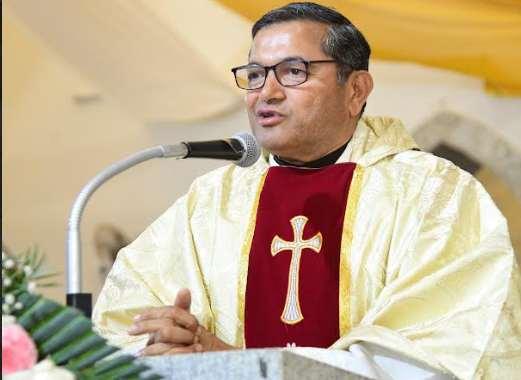
Archibald Gonsalves, OCD, of Dhyana Sadhana, Bogadi, Mysuru. He was joined by Rev. Fr. David Sagayaraj, Rector of St. Anthony’s Basilica,andRev. Fr. Praveen Pedru, Administrator oftheBasilica.
Manydevotees participated inthe
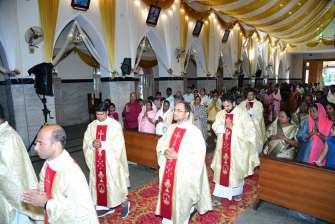
Holy Mass and Novena service, gathering in prayerful preparation fortheAnnualFeastofSt.Anthony. During thehomily, the faithfulwere encouraged to deepen their faith and place their trust in God's providence through the
intercession ofSt.Anthony.
Following the Eucharistic celebration, the Novena prayers were offered in honour of St. Anthony for the intentions of the devotees. The devotion concluded with the Procession of the Holy Statue of St. Anthony and the Benediction of the Blessed

Somepeoplecomeintoourlivesas an Angel and one such God sent man is Fr. Ivan D'souza. When Fr. JoCySiddakatte pitched in with an idea of starting the Konkani podcast at Carmel Kiran Media, I
Sacrament, providing a spiritually enrichingexperience forallpresent.
The nine-day Novena continues to draw pilgrims and devotees from various parts of Karnataka and beyond, as they prepare to celebrate the Annual Feast of St. Anthonywith faithanddevotion.

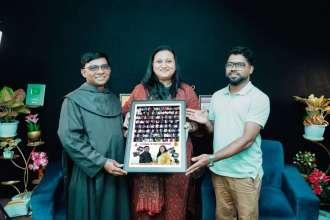
was scared, confused and didn't knowhowtogoahead,butFr.Ivan assured me, supported me and Carmel Cafe started. We have completed 82 episodes under his leadership as the Carmel Kiran

Media head and Naman Ballok Jezu editor, but as he is moving aheadtoDhyanavanaMysore Ifeel sadthatwewon'tgettowork with him anymore, but I thank God almighty for giving me an Angele
likehimandFr.Jocyinmylife,who inawayarethereason whatLeeza Kiran Rodrigues is today. I pray to God almighty to bless Fr. Ivan abundantly and may the spirit of God lead him in his ministry.
ThankuFr. Ivan,we definitely miss the funtimes but we willdefinitely be in touch.
I also want to welcome Fr. Kiran Lobo to the media team and Fr. Jocyasthe editor ofNamanBallok Jesu Magazine. I am eagerly looking forward tosee the Carmel Kiran channelbrightening upasFr. Kiran and Leeza Kiran come together atCarmelKiran.
Daijiworld Media Network –
Mangaluru/Kasargod
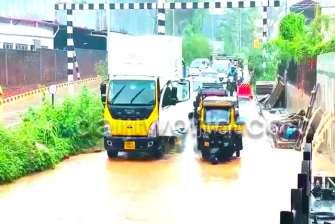
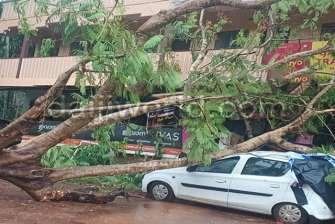
Mangaluru/Kasargod, Jun 7: The onset of the southwest monsoon has intensified across the coastal region, with heavy rainfall over the past few days causing severe waterlogging, landslides, and widespread disruption ofnormallife in Dakshina Kannada and Kasargod districts.
Mahakalipadpu underpass
submerged inMangaluru
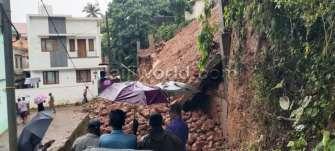
InMangaluru,persistentdownpours have inundated several low-lying areas. The Mahakalipadpu railway underpass has been completely flooded with muddy water, turning the stretch into a nightmare for commuters.
The stagnant water has severely disrupted vehicular movement, leaving two-wheeler riders and the public inextremedistress. Motorists were forced to navigate the stretch atasnail'space,andseveralvehicles reportedly broke down in the middle of the flooded underpass.
Frustrated locals noted that this waterlogging is a recurring issue every monsoon and have strongly urged the authorities to implement apermanentsolution.
Landslides and massive damage
inKasargod
Kasargod district has borne the brunt of the torrential rains and
gusty winds over the lasttwo days. On Saturday, a portion of a hill collapsed onto a house belonging to a man named Khalid in Uppala Kaikamba. Fortunately, the occupants managed to escape without injuries inthenickoftime. Inanotherincident,alandslide onto the road in Kuniya threw traffic completely out of gear. The service roads oftheNationalHighwaywere also heavily waterlogged, causing severe trafficblocks in severalareas including Periya, Cherkala, Kumbla, andManjeshwar.
NeartheMadhur temple, amassive tree wasuprooted andcrashed into parked vehicles due to the fierce winds. More than five vehicles, including a car and two scooters, crashed. Disaster was averted as therewasnooneinsidethevehicles at the time. Fire and rescue personnel later arrived atthe scene toclearthefallentree.
Wallcollapsed atHosdurg church
The heavy rains also led to the collapse of the compound wall of the under-construction CSI Church in Hosdurg. The falling debris and mud trapped a JCB and two other vehicles. The massive soil runoff onto the adjacent road blocked the primary access route to several nearbyquarters.
Although Kasargod wasunderared alerton Saturday, the actualrainfall received was slightly less than anticipated. However, the India Meteorological Department (IMD) has forecast heavy rains accompanied by strong winds for thecoastalregion overthenextfew days. Authorities have warned of potential flooding along riverbanks and have advised residents living near rivers and low-lying areas to remain on high alert and take necessaryprecautions.

‘Felicitas’

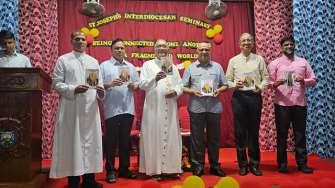
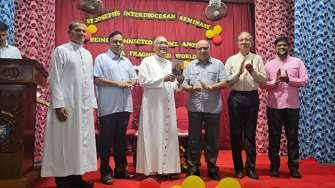
Mangaluru, Jun 5: St Joseph’s Interdiocesan Seminary, Jeppu, hosted Felicitas, a special programme ofreleasingthebookof DrRonaldSerrao andanaddress to the seminarians by entrepreneur andphilanthropist MichaelD’Souza, Dubai. “God’s work has not been obstructed due to the lack of money,becauseGodprovides forit.
God has helped the Church and many people through the charity works of Michael D’Souza and family,” said Dr Aloysius Paul
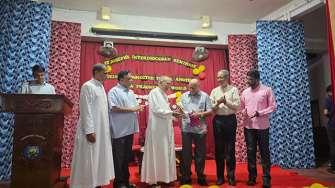
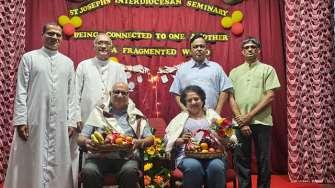
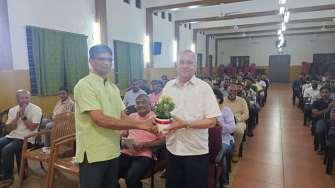
D’Souza, bishop emeritus of the diocese ofMangalore. The Konkani book Bhavartache Payan authored by Dr Ronald Serrao, the former rector of the seminary, containing three religious dramas and sponsored by Michael D’Souza Vision Konkani was
released by Michael D’Souza. Melvyn Rodrigues and H M Pernal were present.
Fr Ronald Serrao and Michael D’Souza and Flavia D’Souza were felicitated on this occasion fortheir contribution to the Church and the society. Addressing the staff and seminarians of the seminary on the theme Forming Priests for Tomorrow’s ChurchamidstChanges and Challenges’, Michael D’Souza asserted that a priest has a great responsibility. He stated, “Tomorrow’s priest must be spiritually strong, intellectually alert and morally credible.” He said, “Technology is a powerful servant, but a dangerous master.
Tomorrow’s priest must know how to use technology without becoming controlled by it.”
Theprogramme commencedwith a warmwelcome byFrIvan.FrMilton delivered thefelicitationaddress for Fr Ronald Serrao, while rector Fr RajeshRosario spoke appreciatively about the contributions and generosity of Michael D’Souza. The distinguished gathering included Fr Valerian D'Souza, Stephen Pinto, Oswald Rodrigues, Lionel Aranha, Melwin Rodrigues and H M Pernal. The event concluded on a note of gratitude and celebration, honouring lives dedicated to service, leadership, generosity, and themission ofpriestly formation.

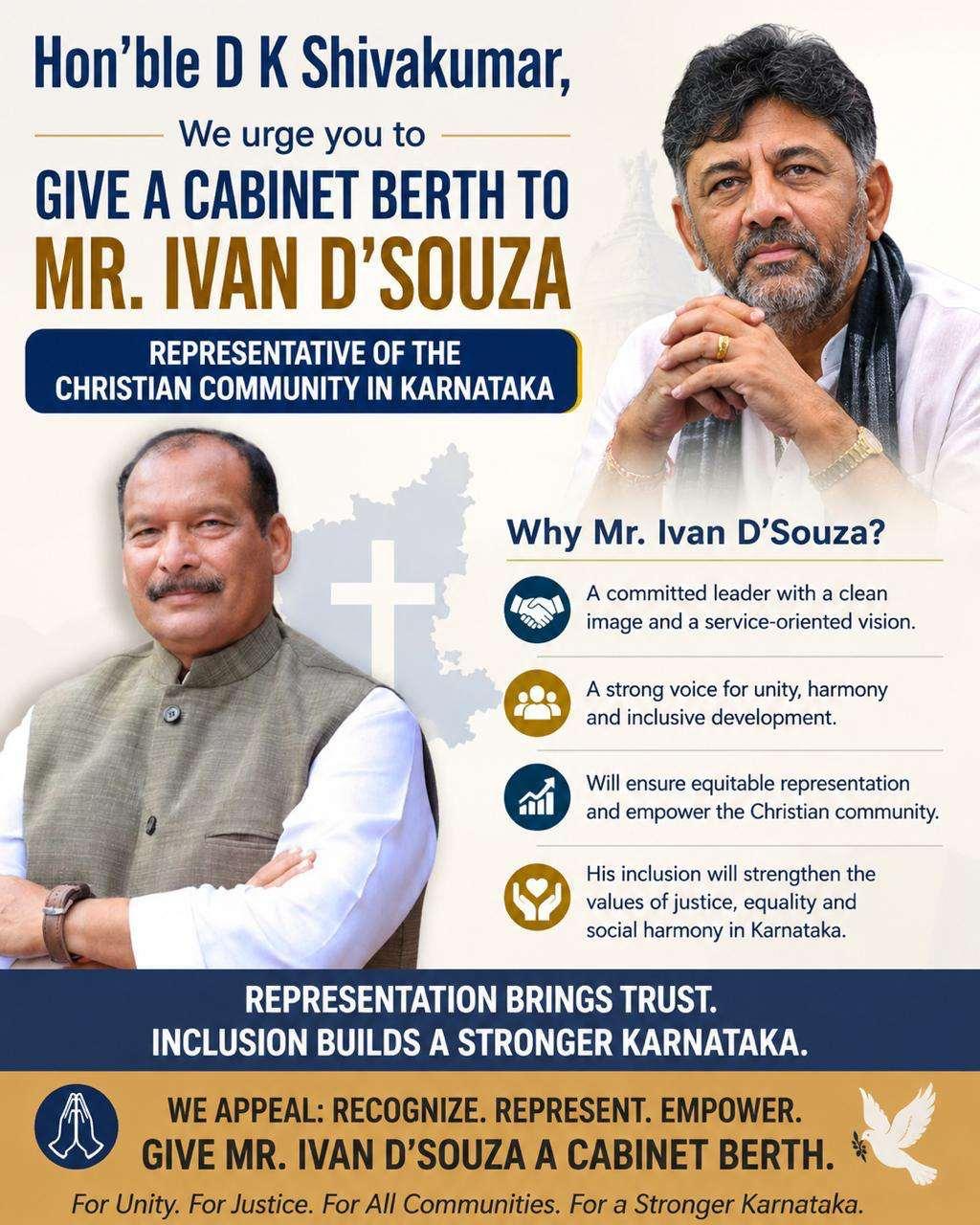
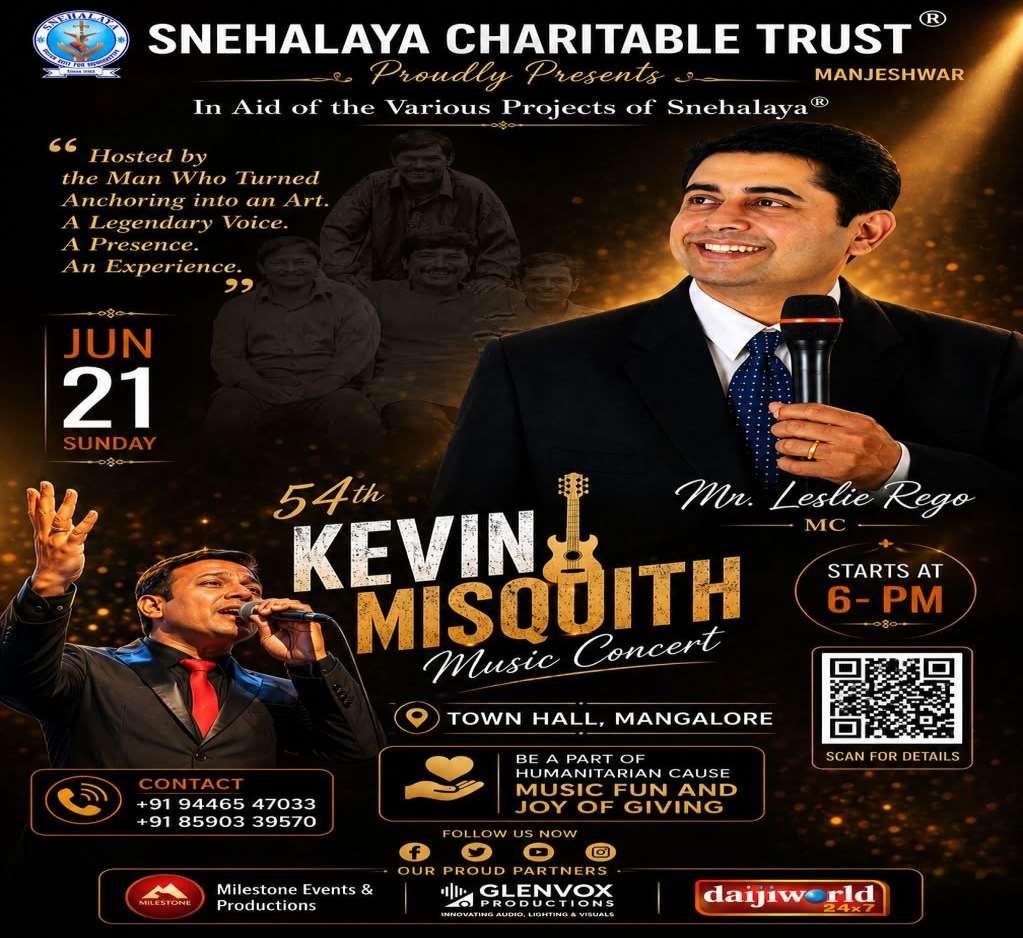



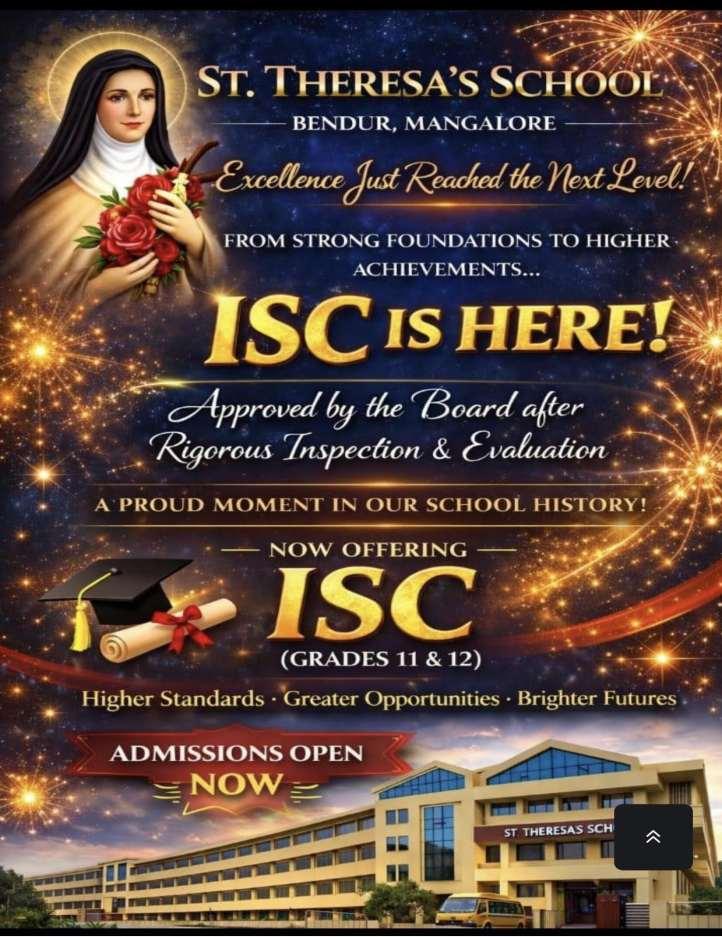
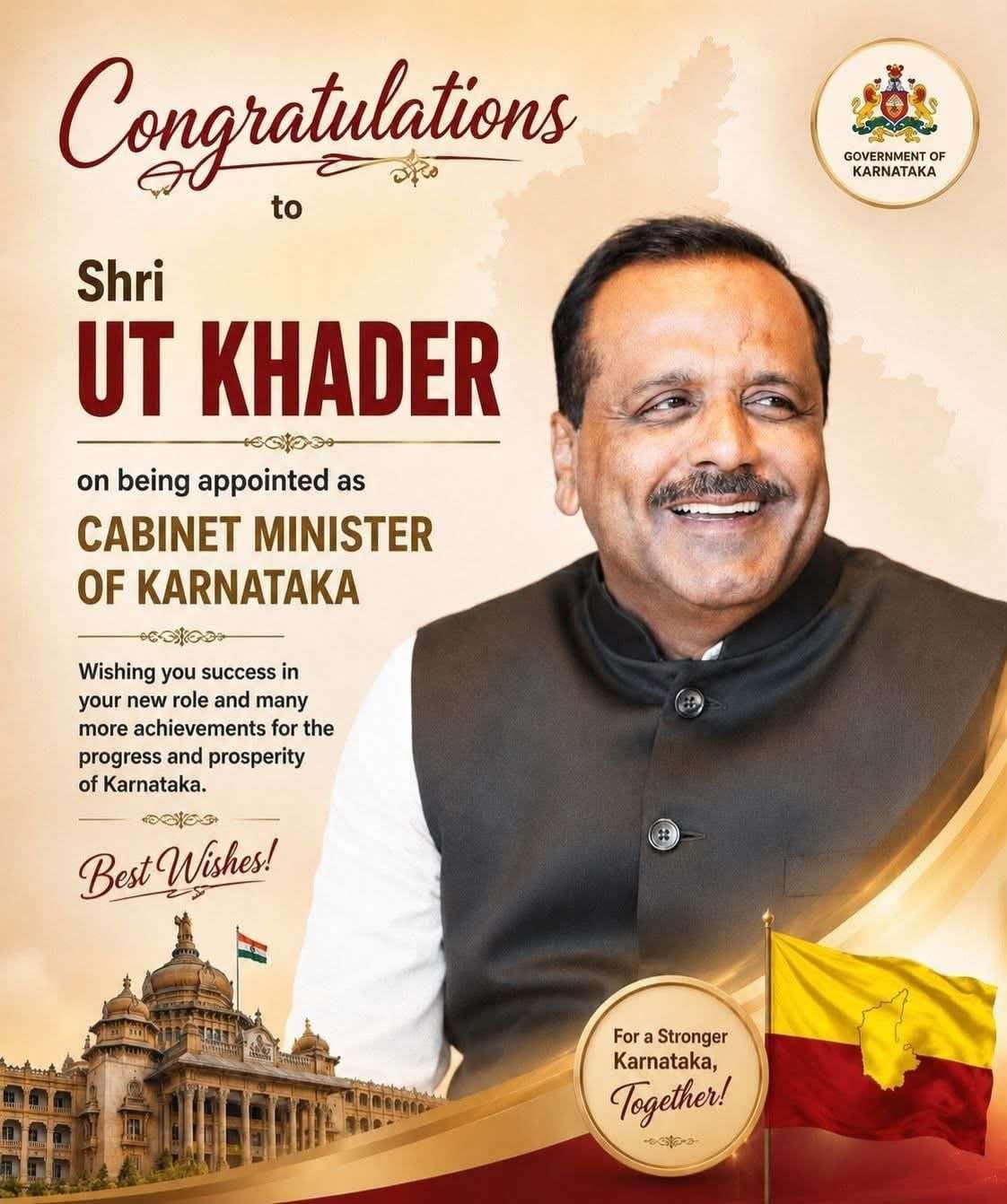
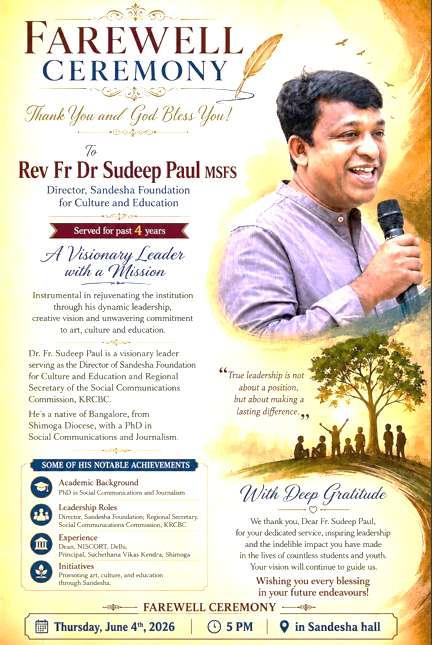
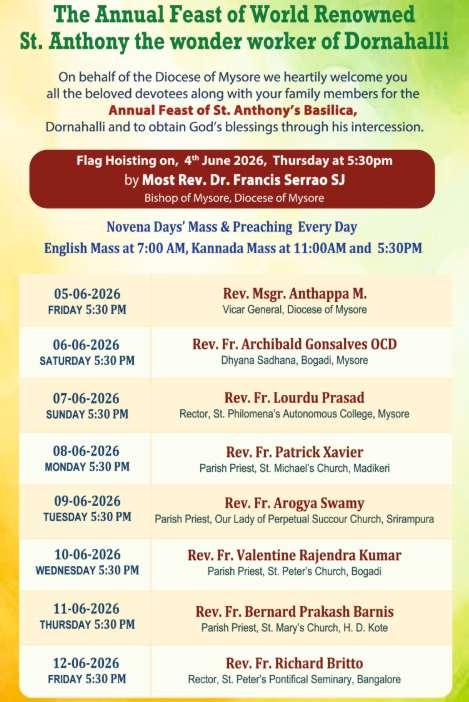
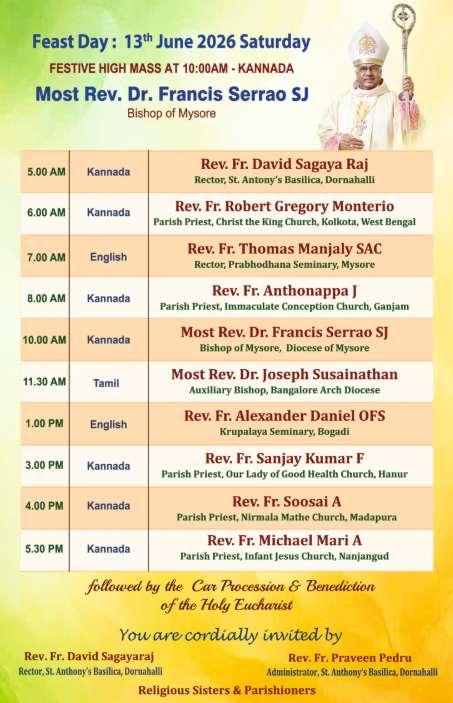
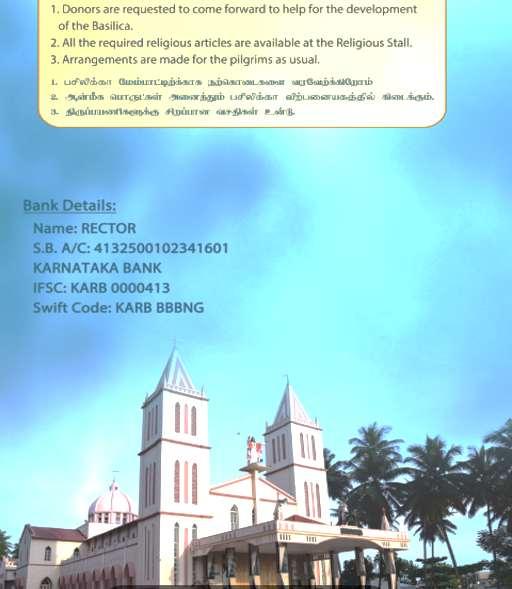


With pleasure, we would like to introduce ourselves as St Joseph’s Club, Mazagaon,Mumbai. Our charitable association wasestablished in the year 1914.It is registered under the Society Act XXI of 1860 and the BombayPublic Trust Act 1950. It has been located at 134 M.P. Road, Mazagaon,Mumbai- 400100,forthe last112 years.
Manyyouths fromtheMangalore/UdupiDiocesearestruggling togetproper jobs intheirhometown andwalking towardsMumbaiinsearchof betterjobs in the city. For those who are new to the city, it is difficult to get accommodation. Our association helps the most ambitious youngsters. The main objective of this club is to provide decent, comfortable accommodation for minimum fees to the young Catholic maleshailing fromtheMangalore/Udupi Diocese.
Inthepast 112years,thousands of youths havebenefited fromthisinstitution and overcome the hardships of their lives. With the support of the institution, manyyouths have fulfilled their dreams and are now successful intheir lives.
We hereby request you to publish it in Veez Konkani weekly. So that youths from your institution can get advantage from our association.
We are looking forward to your support and wish you all the best in your mission and inallyour charitablework.
Ifyou haveanyqueries about this, pleasecontactus.
Yours Truly,
RobertD’souza,Palimar 9867400617
SandeepD’souza,Mukamar 9663538824(Whatsapp)
Rajesh D’souza, Palimar 8850757716 PaulBarboza,Belman 8105091588