austinbar.org SEPTEMBER 2026 | VOLUME 35, NUMBER 7
Texas Lawyer’s Best Austin CLE Provider for 2026: The Austin Bar Association
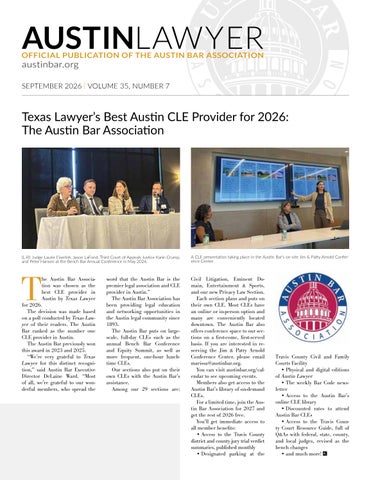
(L-R): Judge Laurie Eiserloh, Jason LaFond, Third Court of Appeals Justice Karin Crump, and Peter Hansen at the Bench Bar Annual Conference in May 2026.
T
he Austin Bar Association was chosen as the best CLE provider in Austin by Texas Lawyer for 2026. The decision was made based on a poll conducted by Texas Lawyer of their readers. The Austin Bar ranked as the number one CLE provider in Austin. The Austin Bar previously won this award in 2023 and 2025. “We’re very grateful to Texas Lawyer for this distinct recognition,” said Austin Bar Executive Director DeLaine Ward. “Most of all, we’re grateful to our wonderful members, who spread the
word that the Austin Bar is the premier legal association and CLE provider in Austin.” The Austin Bar Association has been providing legal education and networking opportunities in the Austin legal community since 1893. The Austin Bar puts on largescale, full-day CLEs such as the annual Bench Bar Conference and Equity Summit, as well as more frequent, one-hour lunchtime CLEs. Our sections also put on their own CLEs with the Austin Bar’s assistance. Among our 29 sections are:
A CLE presentation taking place in the Austin Bar’s on-site Jim & Patty Arnold Conference Center.
Civil Litigation, Eminent Domain, Entertainment & Sports, and our new Privacy Law Section. Each section plans and puts on their own CLE. Most CLEs have an online or in-person option and many are conveniently located downtown. The Austin Bar also offers conference space to our sections on a first-come, first-served basis. If you are interested in reserving the Jim & Patty Arnold Conference Center, please email marissa@austinbar.org. You can visit austinbar.org/calendar to see upcoming events. Members also get access to the Austin Bar’s library of on-demand CLEs. For a limited time, join the Austin Bar Association for 2027 and get the rest of 2026 free. You’ll get immediate access to all member benefits: • Access to the Travis County district and county jury trial verdict summaries, published monthly • Designated parking at the
Travis County Civil and Family Courts Facility • Physical and digital editions of Austin Lawyer • The weekly Bar Code newsletter • Access to the Austin Bar’s online CLE library • Discounted rates to attend Austin Bar CLEs • Access to the Travis County Court Resource Guide, full of Q&As with federal, state, county, and local judges, revised as the bench changes • and much more! AL
LawPay is a trusted Member Benefit of the Austin Bar Association lawpay.com/austinbar
Run your business. Power your practice.
+
CONTENTS
AUSTINLAWYER SEPTEMBER 2026 | VOLUME 35, NUMBER 7 AL A L INSIDE 1 Texas Lawyer’s Best Austin CLE Provider for 2026: The Austin Bar Association 10
Tips for Lawyer Resilience: Five Evidence-Based Strategies
24
Helping Attorneys in Need: The Crisis Assistance Program
25
Join Us for the Third-Annual Pro Bono Fall Festival
26
Serve on an Austin Bar Committee
28
Congratulations to Austin’s 50-Year Lawyers
29 Austin Criminal Defense Provider Receives Inaugural SBOT Jeff Blackburn Award 30 32 34
IN EVERY ISSUE
8
New Members
8
Briefs
18
Federal Civil Court Update
20
Third Court of Appeals Civil Update
21
Third Court of Appeals Criminal Update
22
Jury Trials Update
DEPARTMENTS
6 Public Defense Shortage: Ideas for Improvement Presented 10 IOLTA Institutions in Austin 14 The Divorce Considerations Many Lawyers Don’t Consider Until It’s Too Late
36
President’s Column Be Well AYLA Entre Nous
CONNECTIONS ONLINE austinbar.org austinlawyeronline.com EMAIL billy@austinbar.org MAIL Austin Bar Association 712 W. 16th Street Austin, TX 78701 Austin Bar app available for iPhone and Android. SOCIAL LIKE facebook.com/austinbar
ONLINE austinbar.org NEWS & ANNOUNCEMENTS
SAVE THE DATE
Join us for Pro Bono Fall Festival Join us for the third-annual Pro Bono Fall Festival benefiting Volunteer Legal Services of Central Texas! This great event will feature games, face painting, a bouncy house, a Halloween costume contest, and balloon art. This family-friendly event will take place on Saturday, Oct. 24, at South Austin Recreation Center, 1100 Cumberland Road. Please consider purchasing tickets or sponsorships at austinbar.org/fallfestival26.
OCT. 24
Austin Bar’s Pro Bono Fall Festival Benefiting VLS 10 a.m. - 12 p.m. South Austin Recreation Center 1100 Cumberland Road Tickets & sponsorships available at austinbar.org/fallfestival26
FOLLOW twitter.com/theaustinbar FOLLOW instagram.com/theaustinbar CONNECT https://www.linkedin.com/ company/austin-barassociation WATCH vimeo.com/austinbar
SEPTEMBER 2026 | AUSTINLAWYER
3
ADDICTION & MENTAL HEALTH RESOURCES 24-Hour Suicide & Crisis Lifeline - 988 - call or text | Live chat: SuicidePreventionLifeline.org Texas Lawyers’ Assistance Program (TLAP) - 1-800-343-8527 TLAP is a 24-hour confidential crisis counseling and referral program to help lawyers, law students, and judges with substance use and mental health issues. Justice Mack Kidd Fund The Austin Bar Foundation administers the Justice Mack Kidd Fund, which can provide financial assistance to individuals seeking treatment for depression or similar illnesses. Visit austinbar.org/?pg=justice-mack-kidd-fund to learn more. Personal Crisis Assistance Program (PCAP) The Austin Young Lawyers Association Foundation provides grants and/or peer support for individuals suffering from a personal crisis. Contact Debbie Kelly: 512-472-0279 x 105 Sheeran-Crowley Trust Administered through TLAP, the trust provides financial help to Texas attorneys, judges, and law students who need treatment for substance use, depression, and other mental health issues. Visit sheerancrowley.org to learn more. Alcohol & Drug Abuse Austin Drug & Alcohol Abuse Program - 512-454-8180 Alcoholics Anonymous - 512-444-0071 Cocaine Anonymous - 512-479-9327 Narcotics Anonymous Counseling - 512-480-0004
AUSTINLAWYER OFFICIAL PUBLICATION ALOF THE ALASSOCIATION AUSTIN BAR AUSTIN BAR ASSOCIATION
Judge Maya Guerra Gamble �� President Sarah Harp ��������������������������������� President-Elect Judge Ciara Parks ��������������������� Secretary Elliott Beck ��������������������������������� Treasurer Maitreya Tomlinson ������������������ Immediate Past President
AUSTIN YOUNG LAWYERS ASSOCIATION
Gracie Wood Shepherd ������ President Lena Proft ������������������������������ President-Elect Ben Evans ����������������������������� Treasurer Jasleen Shokar ��������������������� Secretary Jenna Malsbary �������������������� Immediate Past President
Austin Lawyer
Psychiatric Emergencies Emergency Screening in a Psychiatric Crisis 24/7 - 512-472-4357 Samaritan Center (provides professional counseling services on a sliding scale) - 512-451-7337
©2026 Austin Bar Association; Austin Young Lawyers Association
EXECUTIVE OFFICES
712 W. 16th Street Austin, TX 78701 Email: austinbar@austinbar.org Website: austinbar.org Ph: 512.472.0279 DeLaine Ward....................... Executive Director Debbie Kelly.......................... Associate Executive Director Roslyn Warner....................... Assistant Editor Samantha McCoy................. Assistant Editor Abigail Ventress.................... Assistant Editor Billy Huntsman...................... Managing Editor Austin Lawyer (ISSN #10710353) is published monthly, except for July/August and December/January, at the annual rate of $10 membership dues by the Austin Bar Association and the Austin Young Lawyers Association, 712 W. 16th Street, Austin, TX 78701. Periodicals Postage Paid at Austin, Texas. POSTMASTER: Send address changes to Austin Lawyer, 712 W. 16th Street, Austin, TX 78701. Austin Lawyer is an award-winning newsletter published 10 times a year for members of the Austin Bar Association. Its focus is on Austin Bar activities, policies, and decisions of the Austin Bar board of directors; legislation affecting Austin attorneys; and other issues impacting lawyers and the legal professionals. It also includes information on decisions from the U.S. District Court for the Western District of Texas and the Texas Third Court of Appeals; CLE opportunities; members’ and committees’ accomplishments; and various community and association activities. The views, opinions, and content expressed in this publication are those of the author(s) or advertiser(s) and do not necessarily reflect the views or opinions of the Austin Bar Association membership, Austin Bar Association board of directors, or Austin Bar Association staff. As a matter of policy, the Austin Bar Association does not endorse any products, services, or programs, and any advertisement in this publication should not be construed as such an endorsement. Contributions to Austin Lawyer are welcome, but the right is reserved to select and edit materials to be published. Please send all correspondence to the address listed above. For editorial guidelines, visit austinbar.org in the “About Us” tab.
2026
4
AUSTINLAWYER | SEPTEMBER 2026
PRESIDENT’S COLUMN
Making Connections Through Stories JUDGE MAYA GUERRA GAMBLE, AUSTIN BAR PRESIDENT
A
s summer has come to an end and people are returning to their regular routines and meetings, I’ve been asked a bunch of times, “Do you have a theme for your bar year?” If you read the Q&A in last month’s magazine, then you probably already know my theme, to the extent there is one, is “Connections and Stories”—to make the Austin Bar somewhere we can make new friends (connections!) and learn from colleagues (stories!). I am particularly excited about the Pro Bono Committee’s plans to add several events that are aimed at having fun while doing good. This is in addition to continuing the family friendly Fall Festival on October 24. The festival has been a huge success the past two years and has raised money to support Voluteer Legal Services. Keep an eye out for fun nights out! And, if this sounds like a committee you’d
like to support, be sure to join us by signing up through your member profile at austinbar.org. You should have received an email from the bar recently asking you which committee you want to be part of. Committee service is the best and fastest way to become an integral part of your bar community. So, pick a committee (or two) and join us. Committees with a lot of action include: Gala, Law-Related Education in Schools, Mentorship, DEI Committee, Golf Tournament, and Bench Bar. The other best way (yes, there can be two best ways, just like you can have two best friends, why not?) to get involved is to join a section that matches your practice or interest area. Most sections offer CLEs, happy hours, service projects, and other fun and rewarding activities. Two years ago, President Mary-Ellen King focused her year on attorney mental health and wellness—always an important focus. I hope to continue that work by creating opportunities for attorneys to make more friends, help others, and become more confident in their careers. If you ever wonder if one of our bar events is something you can or should attend, know that the answer is an emphatic, “Yes!” The more you attend, the more you get from your membership. I’ve set a personal goal to meet at least 100
attorneys this year who I don’t already know. The only way that will work is if attorneys I don’t know show up to some bar events, so help me reach my goal! Upcoming events I want to personally invite you to: For members of the Civil Litigation section, come hear Judge Amy Clark Meachum and myself explain the new motion for summary judgment standing order and other changes to the dockets in Travis County on September 18; The AYLA Judicial Reception on September 23 (austinbar.org/ judicialreception). Remember, you don’t have to be “young” to join AYLA (they love sustaining members). If you are shy, find me, and I will personally introduce you to other judges and lawyers; The September Fourth Friday CLE. The Austin Bar puts on a CLE every month that is free for members and is available to attend virtually. For young litigators and law students, come watch any of our upcoming jury trials (we publish these in Austin Bar Code every week). If you watch in my courtroom and want to talk about what you see, I’d love to talk to you over a cup of coffee! It’s a bit of a platitude to say that lawyers are storytellers, but that is because there is so much truth in
the saying. And stories that move people are always going to be more effective. I believe reading builds empathy and understanding in ways nothing else can. My favorite kind of book is one that is weird and different. Recently I finished Transcription by Ben Lerner. It is a really hard book to explain, and the plot isn’t really the point. It is a great book for lawyers especially because it is a study on what is the truth, did something happen if it wasn’t recorded, what is a confession, and what are the right consequences for dishonesty. And it’s really short— perfect for a busy lawyer! If you read, let’s talk about it over a coffee! My other recent favorite is Whistler by Ann Patchett. This is an absolutely beautiful book about second chances and family. And my “currently reading/ on deck” selections include more books than I can realistically get through, including London Falling by Patrick Radden Keefe, Catch the Devil by Pamela Colloff (this one will be an Austin Bar bookclub book soon), and Doctor Sleep by Stephen King–a sequel to The Shining, I cannot even imagine what this is going to be! Happy reading, and I hope I see you at an Austin Bar event this month! AL
Chris Andre
New Vehicle Leasing / Pre-Owned Sales Domestics / Imports / Exotics
Busy Schedule? Call me. Any Make. Any Model. Email | chris@appleleasing.com
6
AUSTINLAWYER | SEPTEMBER 2026
Phone | 512.653.3718
When Texas When Texas Attorneys Attorneys Need a Need a Property Property Tax Tax Attorney Attorney
COMPREHENSIVE STATEWIDE PROPERTY TAX REPRESENTATION Trusted by Lawyers, Tax Consultants and Taxpayers Since 1981 17480 DALLAS PARKWAY, SUITE 210 DALLAS, TEXAS 75287 214.506.1073 JOHN@TEXASPROPERTYTAXATTORNEYS.COM
www.TexasPropertyTaxAttorneys.com
BRIEFS New Members The Austin Bar welcomes the following new members: Chad Aronson Katie Austin Fidel Barraza Meagan Belovsky
(L to R): Breen, Judge Clark Meachum, Duke, Lorber, Low, Snell.
Emma Blanchard Tanya Boyce Ernesto Cavazos Lindsay Davenport Isabella Dietz Wellesley DuBois Mollie Fields Maxwell Gaddy Dylan Gonzalez Kristina “Krisi” Kastl Clara Kim Laura Nishimura Holly Paulus Kornel Rady Jada Rhome Pierce Ruiz Jacob Thompson Mitchell Weller Kimberly Wesley Steve Zimmerman
ON THE MOVE Congratulations to John E. Duke, who has joined Ogletree Deakins’ Austin office as of counsel. John’s practice focuses on employment law, specifically labor law. He counsels employers on unions organizing campaigns, collective bargaining negotiations, strikes, lockouts, corporate campaigns, and other labor relations matters. John is certified in labor and employment law by the Texas Board of Legal Specialization. He is also a member of the Texas Bar College and frequently speaks and writes on labor and employment topics. Congratulations to Andrea Low, who has joined the Comptroller of Public Accounts, Division of Operations and Support Legal Services, as legal counsel. Andrea has also been reappointed to the American Bar Association’s Commission on Disability Rights after receiving endorsement from the ABA’s Senior Lawyer Division and the National Asian Pacific American Bar Association. She is a past recipient of the Jeanne P. Gray Diversity Scholarship by the ABA Center for Professional Responsibility. She continues to serve as the District 9 appointee to the City of Austin’s Ethics Review Commission. KUDOS Congratulations to Sean Breen, partner at Howry Breen & Herman, who was inducted as a fellow into the International Academy of Trial Lawyers (IATL). Founded in 1954, IATL is an invitation-only fellowship of trial lawyers dedicated to protecting and promoting the rule of law. Membership is limited to 500 active trial lawyers in the United States and 150 fellows from more than 30 countries, representing plaintiffs and defense counsel in civil cases, as
8
AUSTINLAWYER | SEPTEMBER 2026
well as prosecutors and criminal defense attorneys. Fellows are selected through a rigorous process of peer and judicial review. Sean joins fellow partner Randy Howry, who was inducted into IATL in 2018.
have tried a significant number of civil jury trials to verdict or hung jury as lead counsel. Josh is chair of Jackson Walker’s Litigation Section in Austin. He is a graduate of Northwestern Pritzker School of Law.
Congratulations to 201st District Judge Amy Clark Meachum, who recently received the Jurist of the Year Award from the Texas Chapters of the American Board of Trial Advocates (TXABOTA). Judge Meachum has served on the 201st bench since 2011, and since 2021 she has served as the Travis County local administrative district judge. Before taking the bench, Judge Meachum was a litigation partner at McGinnis Lochridge (known then as McGinnis, Lochridge & Kilgore).
Congratulations to Jason Snell, who has been recognized in Austin Monthly’s 2026 Top Attorneys for Civil Litigation. Jason is the founder of the Law Firm of Jason Snell, an Austin-based litigation firm. Jason is a longtime Austin Bar and AYLA member since he arrived in Austin in 2007. Jason received the Austin Bar’s Larry F. York Mentoring Award in May 2026, an award that recognizes an attorney’s dedication to mentoring the next generation of legal practitioners.
Congratulations to Melissa Lorber, who has joined Impact Austin’s Board of Directors as Governance co-chair for 2027. Impact Austin is an Austin-based women’s collective that funds Central Texas nonprofits. Melissa previously served on the organization’s Grants Leadership Team. Melissa is also the chair of the Travis County Women Lawyers’ Foundation for 2027, the charitable arm of the Travis County Women Lawyers’ Association. The foundation funds grants to Central Texas nonprofits that protect the legal rights of women and children.
Congratulations to Austin law firm FVF Law, which has been named the Outstanding Philanthropic Medium or Large Corporation of the Year by the Association of Fundraising Professionals’ Greater Austin Chapter. Since 2019, FVF’s philanthropic giving has reached roughly $700,000. This year, the firm announced it had doubled its giving budget and intends to reach $200,000 in philanthropic giving per year. In addition to frequently supporting Austin Bar events, FVF Law has also been a cornerstone supporter of the Health Alliance for Austin Musicians and the Ronald McDonald House.
Congratulations to Jackson Walker Austin partner Joshua A. Romero, who has been invited to join the American Board of Trial Advocates (ABOTA). Membership to ABOTA is extended by invitation only to trial lawyers who exemplify high personal character, professionalism, civility, and integrity. Applicants must have active trial experience and must
Congratulations to Goranson Bain Ausley (GBA), which has been recognized as one of Austin’s Best Places to Work for 2026 by the Austin Business Journal. This is the third consecutive year the firm has received this honor. GBA is a family law firm headquartered in Austin but with offices throughout the state.
Be Well
Tips for Lawyer Resilience: Five Evidence-Based Strategies BY CHRIS RITTER, TEXAS LAWYERS’ ASSISTANCE PROGRAM
W
hen dealing with the spectrum of problems faced by Texas attorneys, there is no single solution that will take care of everything, but many tools are useful for both mental health and substance abuse issues. Attorneys are reluctant to listen to opinions about how they should live unless there is Daubert-like reliability shown for what is suggested. Therefore, the following are evidence-based strategies that are shown by research to be effective: 1. Practice Gratitude There is a growing body of research showing the powerful positive effects of thinking about what we are glad to have in our lives.1 This research shows that there are significant benefits psychologically, spiritually, and physically that result from reflecting on the things for which we are grateful. In fact, due to its powerful consequences, gratitude has been one of the three most studied of 24 character strengths of people who lead flourishing lives.2 The most important of the findings of these studies include that people who practice gratitude experience more positive emotions, lower stress, and healthier relationships. These studies also show that practicing gratitude physically results in more energy, healthier bodies, better sleep, and increased life span.3 Studies have found that gratitude has profound effects on self-esteem, depression, and the prevention of suicidal ideation.4 Practicing gratitude by means of a gratitude journal (e.g., thinking of three things a person is grateful to have in his or her life each morning) has been shown to increase a person’s happiness by 25% over ten weeks.5 Another major study found that regularly practicing counting one’s blessings and visualizing our best possible selves elevate and maintain positive mood.6 10
AUSTINLAWYER | SEPTEMBER 2026
A 2016 study by Indiana University showed that the effects of gratitude practice can actually make physical changes to the brain that last for extended periods of time. There, researchers found that those who completed the gratitude practices months earlier reported feeling more grateful two weeks after the task than members of the control group and months later showed more gratitude-related brain activity in the scanner.7 I have often wondered what happened to me in law school that caused me to be such a negative thinker. Before law school, I could do a number of things that were exciting and fun without a lot of worry. After law school, the idea of the consequences for every possible action automatically flowed through my mind, taking the fun out of some parts of my life. For example, during my third year in law school, a close friend of mine had a bachelor party that would be categorized by almost all
people as extremely tame. However, about midnight, a few people thought it would be fun to jump off the high diving board in the old swimming pool we grew up swimming in. My mind filled with horror at the felonies that would pile up from such an act. After all, there was a residence adjacent to the pool, it was at night, and I had everyone convicted of burglary and myself barred from practicing law all within a minute of thinking about it. Some of this new skill is essential to being a good lawyer. If we can’t sift through possibilities and risks with some knowledge, we can’t foresee issues and help clients effectively. Unfortunately, many of the skills we develop in the legal profession can bleed over into our personal lives and cause a negative impact if we are not careful. This is where gratitude practice can have a substantial impact. If we don’t use a skill, it atrophies. For most of us, thinking
about what is good in our lives on a daily basis is something that was suffocated long ago by the daily anxiety of what our schedule held for our busy day practicing law. The studies above show that by inserting back into your life some gratitude, happiness levels increase significantly. Suggestion: Gratitude Journal or Letter. Become conscious of your gratitude. Studies have shown that taking the time to make a list of things for which you are grateful or writing a letter to someone to express gratitude for that person can result in significant improvement in the way you feel and the amount of happiness you experience.8 If you doubt the science, try making a list of three to five things for which you are grateful each morning for a week and see what happens. 2. Practice Mindfulness For attorneys, relaxing can seem almost impossible. The mind is an instrument, but some-
times it seems that the instrument has become the master. Breathing exercises, meditation, and mindfulness9 practices have been very effective for attorneys who need to relax, or “quiet the mind.” Much has been written to express how impactful these tools can be to bring about peace in the life of an attorney.10 I want to note some interesting findings relevant to lawyers from the mountain of research that illustrates the importance of mindfulness for lawyers. One study that looked at a cell phone application to sample users’ thoughts, feelings, and actions at random times throughout the day found that people are least happy at times when their minds are not focused on the action they’re performing.11 Another study showed that people in the 90th percentile for stress in their lives reduced their stress levels to the 57th percentile after only a couple of weeks of mindfulness breathing exercises just a few minutes a day.12 Meditation has been shown to increase focus, reduce negative affect, decrease depressive symptoms, and decrease rumination, all things lawyers need.13 Another study indicated that meditation increases memory and recall function among those dealing with high-stress situations.14 A recent major study of many of the effects showed strong evidence of the benefits of mindfulness meditation: increased emotional regulation, decreased reactivity, improved relationships, less psychological distress, better physical health, less depression and anxiety, and more focus.15
What is mindfulness? Mindfulness is paying attention to the present moment with intention and without judgment. Practicing mindfulness is most often done by focusing on the breath, but there are countless variations of breathing exercises and resources to learn how to build control of your thoughts and worries through a sort of mindfulness practice.16 TLAP’s website includes links to several of these wellness resources at www.texasbar.com/TLAP. 3. Help Others Service work sounds like just one more thing to add to the list of things you do not have time for, but this is something helpful for you, so consider really making time to do it. Obviously, until you secure your oxygen mask, you should not attempt to rescue others, but lawyers have been found to gain “intense satisfaction” from doing service work,17 and studies show it helps improve mental health and happiness.18 Evidence suggests that service work can help offset the effects of stress that lawyers face. In a major study of 30,000 people, those who were employed in high-stress jobs had a 43% higher rate of death over a ten year period;19 however, in a related study of those who regularly performed service work to give others help, the rate of death was completely normal despite having high-stress jobs.20 Therefore, doing service work is absolutely a strategy that can offset the harmful effects of stress in your practice. A researcher named Dr. Martin Seligman showed how this kind of
The research shows that selfcompassion significantly reduces anxiety and depression, two of the most prominent problems faced by attorneys.
himself. Recognizing his despair, his friends and colleagues in the bar rallied to his support, took away his pistols and knives, spent time with him, and even locked him up to protect him from himself. Thus did Abraham Lincoln survive his suicidal crisis and learn to live with and gain insights from the depressions that revisited him throughout his life. If one life lost to suicide is too many, imagine the cost of not preventing the suicide of our next Abraham Lincoln, who may, right now, be attending law school.22
work can also increase happiness. In an experiment called “Philanthropy versus Fun,” Seligman divided up his psychology students into two groups. The first partook in pleasurable pastimes such as eating delicious food and going to the movies. The second group participated in philanthropic activities, volunteering in feeding the homeless or assisting the physically handicapped. What Seligman found was that the satisfaction and happiness that resulted from volunteering was far more lasting than the fleeting reward of food or entertainment.21 Even if you feel that it is being done for your own selfish gain, try it anyway and before long you will experience a heightened sense of peace, joy and satisfaction in life. Lawyers can serve each other as well. This is illustrated particularly well by one famous lawyer’s powerful story: Some may recall a little-known member of the Illinois bar, a lawyer who suffered from suicidal depressions as a young man. After losing his true love to an early death, he became so despondent he told others he felt like killing
4. Practice Self-Compassion Self-compassion for lawyers sounds like some kind of punch line for a half-decent joke, but this is a strategy that has a lot of research and some remarkable effects behind it. Self-compassion is one of the most powerful tools for resiliency available to attorneys and it is a pretty simple practice to learn. Essentially, self-compassion is showing oneself the kindness and concern that one would provide to a good friend; put differently, it is the sensitivity to the experience of one’s suffering and a deep
You’re busy looking out for your clients’ needs. Who’s looking out for yours? Jim Kaighin, Jr., CFP
®
Financial Professional
3305 Northland Dr., Suite 414
512-302-6051
Austin, TX 78731
kaighinjr@momentumin.com
Member: FINRA/SIPC SEPTEMBER 2026 | AUSTINLAWYER
11
desire to alleviate it.23 The components of self-compassion are self-kindness, common humanity, and mindfulness.24 The research shows that self-compassion significantly reduces anxiety and depression, two of the most prominent problems faced by attorneys.25 Those who practice self-compassion also ruminate far less than those who do not.26 Self-compassion has been found to deactivate the “fight or flight” nervous system that causes so much ongoing stress and returns us to the self-soothing system associated with secure attachment and safety.27 Self-compassion has been found in a recent study to help people deal with negative life events and reduce the negative effects of difficulties stemming from negative life events.28 Furthermore, self-compassion has been shown to help substantially with motivation, coping abilities, and interpersonal relationships.29 There are many powerful self-compassion practices that a person can find by looking to the numerous resources on the Internet, such as Dr. Kristin Neff’s
12
AUSTINLAWYER | SEPTEMBER 2026
Self-Compassion.org site or Berkeley’s Greater Good project.30 The following are examples of some of the many ways that a person could practice self-compassion: writing yourself letter as if you were a compassionate friend; make a journal of the self-critical thoughts you have and serve as kind critic to those harsh thoughts; use the practical interruptive question when dealing with yourself harshly of, “how would I talk to a friend about this?”; reframe self-critical thoughts as they arise so that they are fair and kind; each time a critical thought arises, balance it with a complimentary or kind one.31 5. Develop a Sense of Humor. The effects of humor and laughter have been heavily researched and the impacts they have on boosting resilience are amazing. Studies show that having a sense of humor is directly related to reduced stress, better psychological wellbeing, improved coping ability, better perspective, stronger social support, better temperament, and better physical health.32 Humorous reading has been found
to help people heal from negative experiences and make more of a healing impact on those negative experiences than positive reading (e.g., reading about a wonderful father’s experience with a successful little-league team). A 2014 study overviewed many important things that humor provides those with high-stress jobs and found that a good sense of humor may be one of the most important ingredients to resilience. It noted that humor provides a behavioral tendency to engage in acts that promote happiness, a valuable portal to resilience through comical reframing, and it stabilizes positive attitudes. Due to these extraordinary rates of burnout, depression, and other mental health consequences of chronic stress, having an experience that is fun, silly, and hopefully hilarious is scientifically just what the doctor ordered for addressing or reducing the effects of stress for lawyers. While keeping humor within its appropriate limits in the practice of laws is necessary, particularly in court and in other professional settings,
lawyers should try to get a healthy dose of humor and try to take to laughing a little more often to get the positive health benefits overviewed here. We all know that lawyers have been the subject of many jokes, but the time has come for us to do more joking for our own health and resilience. AL ENDNOTES
1 S ee http://www.ppc.sas.upenn.edu/ publications.htm 2 See Jane Taylor Wilson, Brightening the Mind: The Impact of Practicing Gratitude on Focus and Resilience in Learning, Journal of the Scholarship of Teaching and Learning, Vol. 16, No. 4, August 2016, pp.1-13. 3 Id. 4 See Chih-Che Lin, The Relationships Among Gratitude, Self-Esteem, Depression, and Suicidal Ideation Among Undergraduate Students. Scandinavian Journal of Psychology, 2015, 56, 700–707 5 See Robert A. Emmons and Michael E. McCullough, Counting Blessings Versus Burdens: An Experimental Investigation of Gratitude and Subjective Well-Being in Daily Life. The Journal of Personality and Social Psychology, 2003, Vol. 84, No. 2, 377-389. 6 See K. Sheldon & S. Lyubomirsky. How to Increase and Sustain
Positive Emotion: The Effects of Expressing Gratitude and Visualizing Best Possible Selves. Journal of Positive Psychology, 1(2), 73-82 (2006). 7 See P. Kini at al., The Effects of Gratitude Expression on Neural Activity. Neuroimage, 128: 1-10 (2016). 8 See Steven Toepfer, Letters of Gratitude: Improving Well-Bring through Expressive Writing, J. OF WRITING RES. 1(3) (2009). 9 See Rhonda v. Magee, Making the Case for Mindfulness and the Law, 86 NW Lawyer 3 at p. 18 (2014)(available online at: http:// nwlawyer.wsba.org/nwlawyer/ april_may_2014/?pg=20#pg20). 10 See e.g., Steven Keeva, Transforming Practices: Finding Joy And Satisfaction In The Legal Life (1999); Leonard L. Riskin, The Contemplative Lawyer: On the Potential Contributions of Mindfulness Meditation to Law Students, Lawyers, and Clients, 7 HARV. NEGOT. L. REV. 1 (2002); Rhonda V. Magee, Educating Lawyers to Meditate?, 79 UMKC L. REV. 535 (2010). 11 See M. Killingsworth & D. Gilbert. A Wandering Mind Is an Unhappy Mind. Science, 330 (6006), 932 (2010). 12 See David W. Orme-Johnson and Vernon Barnes, Effects of the Transcendental Meditation Technique on Trait Anxiety: A Meta-Analysis of Randomized Controlled Trials. The Journal of Alternative and Comple-
mentary Medicine, Vol. 19, No. 0, p. 1-12 (2013). 13 See Richard Chambers et al., The Impact of Intensive Mindfulness Training on Attentional Control, Cognitive Style, and Affect. Cognitive Therapy Research, 32: 303 (2008); see also C. Burke. Mindfulness-Based Approaches with Children and Adolescents: A Preliminary Review of Current Research in an Emergent Field. Journal of Child and Family Studies, 18(3), 1062-1024 (2009). 14 See Amishi Jha et al., Examining the Protective Effects of Mindfulness Training on Working Memory Capacity and Affective Experience. Emotion, Vol. 10, No. 1, 5464(2010). 15 Daphne Davis and Jeffrey Hayes, What Are the Benefits of Mindfulness? A Practice Review of Psychotherapy-Related Research. Psychotherapy, Vol. 48, No. 2, p. 198-208 (2011). 16 Guided breathing exercises and meditations: http://marc.ucla. edu/body.cfm?id=22; Meditate at your desk: https://www.youtube. com/watch?v=nQjMJpQyj8E&f eature=youtu.be; 17 See Lawrence S. Krieger and Kennon M. Sheldon, What Makes Lawyers Happy? Transcending the Anecdotes with Data from 6200 Lawyers. GEO. WASH. U. L. REV. 83 (2015 Forthcoming), FSU College of Law, Public Law Research
Rob Holcomb MEDIATOR
Paper No. 667(2014) (citing Bruno Frey & Alois Stutzer, HAPPINESS AND ECONOMICS: HOW THE ECONOMY AND INSTITUTIONS AFFECT HUMAN WELL-BEING at 105 (2002)). 18 See also the following video of Dr. Charles Raison, the Assistant Professor of the Department of Psychiatry and the Director of the Mind/Body Program at Emory University, in which Dr. Raison talks about happiness and what causes it: http://www.youtube. com/watch?v=0orvsH07zeg 19 A. Keller et al., Does the Perception that Stress Affects Health Matter? The Association with Health and Mortality. Health Psychology, 31(5), p. 677-684 (2012). 20 M.J. Poulin et al., Giving to Others and the Association Between Stress and Mortality. American Journal of Public Health, 103(9), p. 1649-1655 (2013). 21 See Karen Salmansohn, THE BOUNCE BACK BOOK (Workman Publ’g 2008), partially available online at http://www.psychologytoday. com/blog/bouncing-back/201003/ the-world-taking-it-outta-you-seligman-study-shows-how-you-cancheer-givin. See also Martin E. P. Seligman, Authentic Happiness (Simon & Schuster 2002). 22 See Simpson, S., & Quinnett, P. (2008). Preventing Suicide – A Challenge to the Legal Profession.
GP Solo, 25(7), 60-61 (Story used with express permission). 23 See Kristen Neff, Self-Compassion: What it is, What it Does, and How it Relates to Mindfulness. Handbook of Mindfulness and Self-Regulation, New York: Springer (2015). 24 Id. 25 Id. 26 See Kristin Neff, Development and validation of a scale to measure self-compassion. Self and Identity, 2, 223-250 (2003). 27 See P. Gilbert & C.Irons, Focused therapies and compassionate mind training for shame and self-attacking. In P. Gilbert, (Ed.), Compassion: Conceptualisations, research and use in psychotherapy (pp. 263-325). London: Routledge (2005). 28 See M.R. Leary et al., Self-compassion and reactions to unpleasant self-relevant events: The implications of treating oneself kindly. Journal of Personality and Social Psychology, 92, 887-904(2007). 29 See Kristen Neff, Self-Compassion: What it is, What it Does, and How it Relates to Mindfulness, supra at p. 133. 30 See http://self-compassion.org and http://greatergood.berkeley.edu/ resources/studies#co mpassion . 31 See Neff, supra, at http://self-compassion.org . 32 See Paul McGhee, Humor: The Lighter Path to Resilience and Health, AuthorHouse (2010).
Representing Attorneys
Gaines West
State-wide Practice State Bar of Texas
Grievance Oversight Committee Appointed by the Texas Supreme Court Chair, 2006-2010 Member, 2004-2010
Texas Board of Disciplinary Appeals
Appointed by the Texas Supreme Court Chairman, 2001-2003 Vice Chairman, 1994-1996, 1998-2000 Member, 1992-1996, 1997-2003
State Bar of Texas
Disciplinary Rules of Professional Conduct Committee Member, 1993-1996
Disciplinary Review Committee Member, 1991-1992
\Construction | Business | Real Estate | Consumer HOLCOMB-LAW.COM RDH@HOLCOMB-LAW.COM (512) 476-1121
Texas Bar Foundation, Fellow State Bar of Texas, Member Brazos County Bar Association, Member Austin Bar Association, Member
Principal Office – 979.694.7000 HOLCOMB LAW, PLLC
4407 South IH-35, Suite 201 Georgetown, TX 78626
1515 Emerald Plaza • College Station, TX 77845
Austin – By Appointment – 512.501.3617 1012 Rio Grande St. • Austin, TX 78701
westwebblaw.com SEPTEMBER 2026 | AUSTINLAWYER
13
AUSTIN YOUNG LAWYERS ASSOCIATION
The Power of the Person Everyone Wants to Sit Next To GRACIE WOOD SHEPHERD, AYLA PRESIDENT
G
rowing up, I was not a morning person. My family called me “Grumpy Gracie,” which only made me more irritated. In general, if someone called me a pessimist, I’d correct them and say I was a realist. To be fair, I still think there’s a difference, but my perspective on positivity has changed as I am further along in my legal practice. I’ve never believed that being positive means pretending everything is perfect. Lawyers, of all people, know that is not reality. We deal with conflict for a living. We have difficult clients, constant deadlines, frustrating opposing
counsel, and days where it feels like we can’t catch a break. And then we go home, and we have piles of laundry, dinner to make, kid chauffeuring, and a house to maintain. There is absolutely a time and place to vent. Some of my best conversations with friends and colleagues have started with, “You’re not going to believe what happened today.” But over the years, in law school, practice, and involvement with AYLA, I’ve noticed something. No one wants to spend all of their time around the person who only has negative things to say. Every meeting is a complaint. Every new idea won’t work. Every event wasn’t good enough. Every change is a problem. Eventually, it doesn’t just affect that person’s outlook, it affects everyone else’s. The energy in the room changes. People become less excited to volunteer, less willing to share ideas, and less likely to come back. The opposite is true, too.
Freshquires: Build Your Practice, Build Your Network
T
he first few years of practice are some of the most important in a lawyer’s career. While law school lays the foundation, real-world experience — and the relationships you build along the way — shape your future. Freshquires is designed for Austin-area attorneys in their first three years of practice. Through attendance-limited events, participants gain practical insights into litigation and transactional practice, often earning CLE credit while connecting with experienced attorneys and fellow new lawyers. Whether you’re looking to sharpen your skills, expand your professional network, or find mentors who can help guide your career, Freshquires is the place to start. Join us and build the connections that will support you throughout your legal career. Email Debbie Kelly at debbie@austinbar.org to join the Freshquires today.
14
AUSTINLAWYER | SEPTEMBER 2026
Some people walk into a room and make it lighter. They encourage others, and they celebrate wins, even small ones. When something isn’t working, they look for solutions instead of simply pointing out problems. They aren’t fake or blindly optimistic, they just choose to contribute more than they criticize. Those are the people others naturally want to work with and be around. I’ve found this to be especially true in volunteer organizations. None of us have to be there. We could be meeting our work deadlines or spending our precious spare time with our family and kids. But we choose to give our time because we care about our profession and our community. The atmosphere we create matters. If people leave every meeting feeling energized and valued,
they’re much more likely to stay involved. If they leave feeling discouraged and negativity, they’ll find somewhere else to spend their time. I’m still probably more “realist” than optimist. My family might even argue that “Grumpy Gracie” makes an occasional appearance before coffee. But I’ve learned that realism and positivity aren’t opposites. You can acknowledge challenges while still being encouraging. You can disagree without being overtly negative and defeatist. You can identify problems while also helping solve them. And sometimes, the most valuable thing you bring to your firm, your colleagues, or the bar isn’t a great legal argument. It’s simply being the person everyone is happy to see walk into the room. AL
UPCOMING EVENTS WED., SEPT. 23 AYLA Judicial Reception 5:30 - 7:30 p.m. Chateau Bellevue 708 San Antonio St. Register & sponsor at austinbar.org
THUR., OCT. 15 AYLA Docket Call 5:30 - 7 p.m. Location TBD RSVP at austinbar.org
AUSTIN YOUNG LAWYERS ASSOCIATION AYLA Member Spotlight BEVERLY BASS
AYLA recently sat down with AYLA member Beverly Bass, an attorney at Munsch Hardt Kopf & Harr. Tell us a little bit about yourself and your law practice. I am an associate at Munsch Hardt Kopf & Harr, P.C., a Texas-based law firm with offices in Austin, Houston, Dallas, and Fort Worth. My practice focuses primarily on bankruptcy, insolvency, and restructuring matters, where I represent a diverse range of clients including corporate bankruptcy debtors, creditors, and Chapter 7 trustees.
How long have you been involved in AYLA and what has been your best AYLA experience so far? I joined AYLA in the fall of 2022. My best AYLA experience to date was attending the Holiday Gift Wrapping event in December 2025 at the Holiday Wishes Space. It was a meaningful opportunity to give back to the community while also connecting with fellow AYLA members in a relaxed, service-oriented setting. I appreciated the ability to build genuine professional relationships while making a positive impact beyond our daily legal work.
What was your childhood dream job? Truthfully, I’m not sure I ever had a single dream job. Pop star was probably on my list, given my love for coordinating choreographed dance performances for my parents. Professional athlete was another possibility. I loved watching the University of Arizona Wildcats softball team during their heyday with Jennie Finch, and for all the UT fans, I also loved watching Cat Osterman. What are some of things you enjoy most about living in Austin? What I enjoy most about living in Austin is the city’s remarkably dog-friendly culture and the abundance of outdoor activities available throughout the year. It has become part of my weekend routine to take my dog to Zilker Park or
Onion Creek, often stopping by Desnudo for coffee along the way. What’s your best piece of advice for young attorneys? My best piece of advice for young attorneys is to seek out not only mentors, but also champions. While mentors provide invaluable guidance and advice, champions actively advocate on your behalf – whether by recommending you for leadership positions within professional organizations, sending referrals your way, or speaking highly of your work to others in the legal community. Cultivating relationships with individuals who believe in your potential and are willing to invest in your success can be transformative for your career. I encourage young attorneys to be intentional about identifying and nurturing these relationships. AL
Travis County Constable 5 The Courthouse Constable 1003 Guadalupe Austin, Tx 78701 Office: 512-854-9100 Fax: 512-854-4228 www.Constable5.com
EFILE: Request Constable 5 for Efile Process Service
Creative, efficient resolution of business disputes. How can we help?
Judge Jeff Rose (Ret.) ROSE RESOLUTION GROUP
Former Chief Justice, Texas’ Third Court of Appeals • 5 Time Texas Super Lawyer • Board Certified, Civil Trial Law
SERVICE FEES INCLUDE: Rush Services, Skip-Trace, Research, plus exclusive access to law enforcement database
SERVICE AREA INCLUDES: Travis and surrounding counties 24/7 Online Service Check Daily delivery to State of Texas offices “Your civil process experts. Available for civil and family process needs.” ~ Constable Carlos B. Lopez
www. RoseResolutionGroup.com SEPTEMBER 2026 | AUSTINLAWYER
15
AUSTIN YOUNG LAWYERS ASSOCIATION
Serve on an AYLA Committee
A
re you ready to take a more active role in AYLA? We are seeking lawyers to serve on any of our committees to help us with our award-winning programming for the 2026-27 bar year. You can join any of the following committees at no extra cost: The AYLA Fundraiser Committee plans and organizes a fundraising event each year. The Bench Bar Committee helps plan the annual day-long CLE hosted jointly by the Austin Bar and AYLA. The CLE Committee plans and organizes quarterly continuing legal education for AYLA members. The Community Service Days Committee provides lawyers and non-lawyers with periodic opportunities to volunteer for non-profit organizations. The community service events provide an opportunity for lawyers to make a relatively small time commitment, usually just a few hours on one
16
AUSTINLAWYER | SEPTEMBER 2026
day while being exposed to various charitable organizations and meeting other members of the legal and non-legal community. The Day of Service Committee coordinates multiple community service events on MLK Day, in honor of Dr. Martin Luther King, Jr. The Docket Call Committee hosts a monthly happy hour for AYLA members. These happy hours are a gateway for many of our members, as nearly everyone’s first experience with AYLA is a Docket Call. The Freshquires Committee plans networking and CLE opportunities for new attorneys in their first 3 years of practice. The Health and Wellness Committee is focused on lawyer well-being through group exercise and promoting healthy lifestyles. The committee aims to bring lawyers together with monthly activities such as yoga, running, hiking, swimming, exercise classes, etc.
Get to know other lawyers in an environment outside of the office or courtroom. The Holiday Projects Committee utilizes the legal community’s resources to provide special holiday gifts and informative materials to Austin-area families in need. The Judicial Reception Committee hosts a reception for AYLA members to interact with members of the judiciary. The Law-Related Education
Committee plans and implements various educational programs aimed at school-aged children. The Mentorship Committee (Joint committee with the Austin Bar)–This is a new committee for AYLA this bar year. We will be partnering with the Austin Bar to provide informal opportunities for mentorship amongst lawyers of all ages and practice areas. The Tailgate Fundraiser Committee plans and hosts a UT tailgate fundraiser event. AL
AUSTIN YOUNG LAWYERS ASSOCIATION
AYLA Connects with Bar Leaders from Across Texas
T
his summer, members of the AYLA Board of Directors had the opportunity to attend the State Bar of Texas Bar Leaders Conference in Houston. The annual two-day conference brings together leaders from the State Bar of Texas, Texas Young Lawyers Association, and local bar associations across the state to exchange ideas, build relationships, and learn from one another. Throughout the conference, AYLA Board members participated in educational sessions focused on engaging with our members, programming, service to the community, leadership, and looking towards the future of our organization. Just as valuable were the opportunities to connect with fellow bar leaders, share successful initiatives, and discuss common challenges facing organizations across Texas. AYLA is committed to bringing
AYLA President Gracie Wood Shepherd (middle) with AYLA President-Elect Lena Proft (fourth from right), AYLA Immediate Past President Jenna Malsbary (fourth from left), and AYLA Secretary Jasleen Shokar (third from right) with TYLA members, including TYLA President Armin Salek (second from left).
new ideas and best practices back to our members, and attending the Bar Leaders Conference is an important part of that effort. We are
grateful to the State Bar of Texas and Texas Young Lawyers Association for hosting such a valuable event and look forward to imple-
menting what we learned throughout the coming year. The AYLA Board is excited for the year of connection, growth, and service. AL
SEPTEMBER 2026 | AUSTINLAWYER
17
FEDERAL CIVIL COURT UPDATE
>
Ari Cuenin is a partner at Stone Hilton, where he litigates complex government disputes. He has presented more than 30 arguments in state and federal courts, and has been involved in more than a dozen U.S. Supreme Court cases for the State of Texas.
FIRST AMENDMENT: Court stays injunction against Texas app-store law. Students Engaged in Advancing Texas v. Paxton (5th Cir. No. 2551073, consolidated with No. 2650001). The Fifth Circuit stayed universal preliminary injunctions blocking Texas Senate Bill 2420, the App Store Accountability Act, while the State’s appeal proceeds. The law requires app stores to verify users’ ages, obtain parental consent for minors’ downloads and in-app purchases, and display app content ratings. Two district-court actions had enjoined the law on First Amendment grounds. The panel majority held that
18
AUSTINLAWYER | SEPTEMBER 2026
Texas had shown a likelihood of success because the district court probably applied the wrong level of scrutiny. App-store listings, downloads, and purchases are commercial transactions, even when users obtain free apps in exchange for personal data. The act therefore regulates, at most, commercial speech subject to intermediate scrutiny—and may regulate commercial conduct only incidentally related to speech. For stay purposes, Texas made a strong showing that the act likely bears a reasonable fit to the State’s substantial interests in protecting children and enabling parental supervision. The majority also concluded that the district court overstated exceptions for emergency-service and standardized-testing apps, failed to apply Moody v. NetChoice’s demanding facial-challenge framework, and overlooked severability. The order is interlocutory: it determines whether the injunction remains in force during the appeal—in which the Fifth Circuit recently heard argument—not the act’s ultimate constitutionality. Judge Haynes concurred only in the sentence granting the stay. Even so, the panel’s reasoning suggests that at least some app-store regulations may be analyzed as commercial regulation rather than direct restrictions on expressive content. ADMINISTRATIVE LAW: Court vacates OSHA’s mental-illness recordkeeping rule. Exxon Mobil Corp. v. Occupational Safety & Health Review Commission (5th Cir. No. 25-60108).
The Fifth Circuit held that OSHA lacked statutory authority to require employers to record employee-reported, work-related mental illnesses. After a 2021 explosion and eight-hour fire at Exxon’s Baytown refinery, an employee who entered the burning unit to help close fuel valves was diagnosed with post-traumatic stress disorder. Exxon relied on a reviewing physician’s contrary assessment and declined to record the diagnosis. An administrative law judge upheld OSHA’s citation and imposed a $691 penalty. Granting Exxon’s petition for review, the court concluded that the best reading of 29 U.S.C. § 657(c)(2)—which authorizes rules requiring records of work-related ‘deaths, injuries and illnesses’—limits ‘illnesses’ to physical ailments. Congress paired ‘injuries’ with ‘illnesses’ and excluded minor injuries involving only first aid and no medical treatment, loss of consciousness, restricted motion, or job transfer—concepts the court viewed as naturally physical. Surrounding recordkeeping and inspection provisions similarly focus on accidents, toxic materials, physical agents, and equipment. Contemporaneous dictionaries generally supported that narrower understanding. OSHA’s broader reading was plausible, but plausibility was insufficient under Loper Bright’s independent-judgment framework. The act’s general workplace-safety purpose could not enlarge Congress’s specific grant of authority. The court vacated the rule, Exxon’s citation, and its penalty
without reaching separate APA and due-process arguments. The decision vacates OSHA’s existing rule requiring employers to record employee-reported, work-related mental illnesses and illustrates the post-Loper Bright insistence that agencies identify statutory authority for the precise obligations they impose. AL
35th Annual Red Mass
Presented by The Diocese of Austin and the St. Thomas More Society
Thursday, October 1, 2026 at 6 p.m. | St. Mary Cathedral 203 East 10th Street, Austin, TX 78701 Dinner Reception immediately following at The Austin Club th 110 E. 9 Street, Austin, TX 78701 Guest Speaker: The Honorable Leslie H. Southwick United States Court of Appeals for the Fifth Circuit Please purchase dinner tickets/sponsorships by September 20, 2026 Visit www.austindiocese.org/red-mass or Scan the QR Code
TEXAS CHAPTER MEMBERS IN AUSTIN
Scott Baker
Karl Bayer
Greg Bourgeois
(512) 988-3065
(512) 431-8376
(512) 477-9300
Patrick Keel
Thomas Mitchell (512) 476-4600
(512) 439-1500
(512) 293-0300
Kevin Oncken
Tom Collins
(512) 971-3172
Bert Pluymen
(512) 415-9111
Ben Cunningham
Todd Fine
Eric Galton
Mark Hawkins
Jeff Jury
(512) 477-9300
(512) 666-3935
(512) 477-9300
(512) 435-2300
(512) 477-9300
Jeff Rose
Michael J. Schless
Chris Stanley (512) 930-9775
Paul Van Osselaer (512) 593-5104
Stephen Yelenosky
(512) 637-0931
(512) 476-5507
Check preferred available dates & schedule online in seconds - for FREE
Visit our TX Chapter at www.TexasNeutrals.org Visit our National Database of over 1000 top litigator-rated mediators & arbitrators at www.NADN.org
(512) 444-2226
THIRD COURT OF APPEALS CIVIL UPDATE REAL PROPERTY: Right of first refusal remains enforceable during tenant’s holdover.
>
Laurie Ratliff is a former staff attorney for the Third Court of Appeals. She is boardcertified in civil appellate law by the Texas Board of Legal Specialization and owner of Laurie Ratliff LLC.
The following are summaries of selected civil opinions issued by the Third Court of Appeals during June and July 2026. The summaries are an overview; please review the entire opinion. Subsequent histories are current as of August 10, 2026. FAMILY LAW: Court grants mandamus relief where trial court denied grandparent’s intervention. In re Thapa, No. 03-26-00406-CV (Tex. App.—Austin June 24, 2026, orig. proceeding) (mem. op.). Thapa is the maternal grandmother of children subject of a Department of Family and Protective Services initiated SAPCR. The trial court rendered an agreed order terminating the parental rights of the children’s parents and appointed Department as the managing conservator. Thapa intervened and petitioned to adopt the children. Thapa asserted standing based on Department’s consent to her intervention. The trial court struck Thapa’s petition finding no standing. The court of appeals noted that an intervenor in a SAPCR must show standing to maintain an original suit. Family Code Section 102.004(a)(2) allows original-suit standing to a grandparent if the managing conservator consents to the suit. Here, Thapa had Department’s consent to bring an original suit. Thus, she had standing to intervene. The court granted mandamus relief.
20
AUSTINLAWYER | SEPTEMBER 2026
The Shefman Family L.P. v. Los Gallos Mexican Restaurant, LLC, No. 03-25-00406-CV (Tex. App.— Austin June 26, 2026, no pet. h.). In this permissive interlocutory appeal, owner challenges a partial summary judgment that ordered it to sell property to tenant under a right of first refusal (ROFR) in their commercial lease. Owner received offers to purchase the property while tenant was month to month. Tenant attempted to exercise its ROFR but owner rejected the offer and ultimately did not sell. Tenant sued for specific performance. The trial court granted tenant’s motion for summary judgment. The court of appeals addressed whether the ROFR remained enforceable after tenant became a month-to-month tenant under the lease’s holdover provision. The court rejected owner’s argument that the ROFR does not apply in a tenancy-at-will. The court held that the ROFR remains in place either because a holdover clause is governed by the original terms during the holdover tenancy or because the prior lease governs a tenancy-at-will. The court affirmed. MANDAMUS: Title company bound by probate court’s order approving sale. In re Rise Title, LLC, No. 03-2500934-CV (Tex. App.—Austin July 10, 2026, orig. proceeding). In the underlying dependent administration, the trial court approved the sale of real property and ordered the sale proceeds to be placed in the court registry. Rise Title followed the dependent administrator’s instruction and placed proceeds in the estate’s bank account. The dependent administrator failed to transfer the proceeds to the court registry and failed to appear. The trial court held Rise in contempt and ordered it to deposit over $130,000 into the court registry. The court of appeals rejected Rise’s argument that the trial court lacked jurisdiction over it because Rise was not a party to the probate proceeding. The court observed that probate proceedings are in rem and as such are binding
“on everybody everywhere.” The sale decree required anyone, including Rise, to deposit the proceeds in the court registry. The court denied mandamus relief. The dissent concluded that the contempt order was an abuse of discretion because Rise was not a party and because the order did not command Rise to do anything. According to the dissent, in rem proceedings do not outweigh due-process protections. FAMILY LAW: Court affirms family-violence protective order. Saulter v. Saulter, No. 03-25-00373CV (Tex. App.—Austin June 10, 2026, no pet. h.) (mem. op.). Ex-husband Robert sought a family-violence protective order against ex-wife Genevieve. Robert pointed to two instances before filing for divorce where Genevieve punched and kicked him and wielding a knife, threatened to slit his throat and cut his balls off. Genevieve admitted kicking Robert but denied the other allegations. The trial court signed the family-violence protective order. On appeal, Genevieve challenged the admission of her harassing conduct during the divorce and post-divorce as not relevant because Robert only sought a protective order based on family violence not harassment. The court of appeals concluded the parties’ interactions before, during, and after the divorce gave context to the relationship and assisted the trial court in deciding whether Genevieve had assaulted Robert as he claimed. The court affirmed. MEDICAL LIABILITY: Chapter 74 prevails over conflicts with discovery deadlines. Jin v. Cutler, No. 03-25-00083-CV (Tex. App.—Austin June 30, 2026, no pet. h.) (mem. op.). Jin sued Cutler following an apparent medical misdiagnosis. Jin timely filed her expert report. Three months later, Cutler filed a no-evidence motion for summary judgment alleging Jin failed to designate a testifying expert before the Level 2 discovery deadline. Jin filed a response and a motion for a Level 3 discovery control plan. Jin asserted that under Chapter 74, discovery was stayed until she served the ex-
pert report. The trial court granted Cutler’s no-evidence motion. The court of appeals addressed whether the discovery stay in Chapter 74 applies to the requirement to designate testifying experts. The court concluded that with conflicts between Chapter 74 and Level 2 deadlines, Chapter 74 controls. Thus, discovery — with exceptions not relevant here — was stayed until the date Jin filed her expert’s report. Here, the trial court granted a no-evidence summary judgment when the deadline for designating experts had not passed. The court reversed and remanded. RESTRICTED APPEAL: Court reverses parental termination order. In re A.A.S., No. 03-26-00177-CV (Tex. App.—Austin June 3, 2026, no pet. h.) (mem. op.). From birth, child lived with grandmother. In an earlier suit affecting the parent-child relationship, grandmother was appointed sole managing conservator, and mother was ordered to pay child support. Grandmother filed the underlying suit to terminate mother’s parental rights and to adopt the child. Mother answered but did not appear. The trial court ordered termination and found mother failed to support the child under Section 161.001(b)(1) (F). Mother filed a restricted appeal from the trial court’s termination order. Mother challenged only the sufficiency of the evidence to support the statutory finding under subsection F. Subsection F requires the court to find, by clear and convincing evidence, that the parent failed to support the child within the parent’s ability during a one-year period ending within six months of the filing of the petition, here between September 2023 and March 2025. Grandmother offered no evidence of mother’s ability to support child during this timeframe. Thus, mother established error on the face of the record —legally and factually insufficient evidence to support termination under subsection F. The court reversed and remanded. AL
THIRD COURT OF APPEALS CRIMINAL UPDATE
Zak Hall is a staff attorney for the Third Court of Appeals. The summaries that follow represent the views of the author alone and do not reflect the views of the Court or any of the individual justices on the Court.
>
The following is a summary of a selected criminal opinion issued by the Third Court of Appeals from January 2026. The summary is an overview; please review the entire opinion. The subsequent history is current as of Aug. 4, 2026. INEFFECTIVE ASSISTANCE OF COUNSEL – CONFLICT OF INTEREST: Trial counsel was not ineffective in representing defendant when he had earlier represented a possible alternative perpetrator. Houston v. State, 729 S.W.3d 508 (Tex. App.—Austin 2026, no pet.). Houston was convicted of sexually assaulting his girlfriend’s daughter, who was a minor at the time of the assault. One of his issues on appeal was that he received ineffective assistance of counsel due to a conflict of interest by one of his attorneys. This attorney had represented the victim’s father in a previous case, and according to Houston, the victim’s father was a possible alternative perpetrator of the offense. Houston argued that the father should have been “a central alternative suspect” but that his attorney “did not seize the opportunity to accuse or aggressively pursue [the father’s] culpability or knowledge about what may have truly happened to the complainant.” In Houston’s view,
his attorney’s prior representation of the father “created an actual conflict of interest, where her duty of loyalty to her former client placed her in a position to choose between her former and current client’s best interests,” creating a situation where “counsel’s divided loyalties negatively influenced the defense strategy.” The appellate court first considered which standard of review to apply. It observed that although most claims of ineffective assistance of counsel are reviewed under the familiar analytical framework set forth in Strickland v. Washington, claims involving an actual conflict of interest are reviewed under Cuyler v. Sullivan, 446 U.S. 335, 350 (1980). Under Cuyler, a defendant demonstrates a violation of his right to reasonably effective assistance of counsel if he can show that (1) his counsel was burdened by an actual conflict of interest; and (2) the conflict had an adverse effect on specific instances of counsel’s performance. “If the appellant shows that both requirements are met, appellate courts irrefutably presume prejudice occurred.” However, “[u] ntil a defendant shows his counsel actively represented conflicting interests, he has not established the constitutional predicate for his claim of ineffective assistance.” The court explained that “[a]n actual conflict of interest exists if counsel is required to choose between advancing her client’s interest in a fair trial or advancing other interests (perhaps her own) to the detriment of her client’s interest.” The court added that the conflict “must be more than merely speculative” and that “[a] potential conflict of interest is insufficient to reverse a conviction.” In this case, there were no co-defendants, and although one of Houston’s attorneys represented the victim’s father “years ago in a criminal case, the limited record does not establish any connection between the current case and the attorney-client relationship with [the father],” which ended years earlier. Thus, the record did not show that Houston’s attorney was “actively represent[ing] conflicting interests.” Accordingly, the court concluded that the Strickland
standard, not the Cuyler standard, should apply here. Applying that standard, the court observed that “[t]he record is silent regarding Houston’s strategy concerning the defensive theory of alternative offenders,” and that similar to decisions regarding opening statements and closing arguments, decisions regarding the cross-examination of witnesses are “inherently a matter of trial strategy.” Additionally, the court explained that in an emotional and tragic case such as this, “it is entirely reasonable or foreseeable that a defense attorney would limit his cross-examination out of fear of alienating a jury or coming across as too aggressive.” “Given the nature of the allegations in this case and the evidence of guilt,” the court was unable to conclude that the “decision to put forth the alternative-perpetrator argument without pursuing that defense in relation to [the victim’s father] in the manner Houston suggests on appeal was so outrageous that no competent attorney would have done the same.” Moreover, “[b]efore a defendant can claim
that his trial counsel provided ineffective assistance by failing to call witnesses, the defendant must show that there were witnesses available and that their testimonies would have helped him.” Houston failed to show that the victim’s father or any other witnesses would have been available or what their testimonies would have been. Other appellate issues discussed thoroughly in this opinion include the denial of a motion for continuance, the admissibility of video images taken from a forensic interview, the trial court’s “disparate rulings” on similar objections presented by the State and the defense, and what Houston contended were improper arguments made by the State during opening and closing statements. After overruling all these issues, the appellate court affirmed Houston’s conviction. AL
MEDIATION & ADR SERVICES
MARK L. HAWKINS THE BEST LAWYERS IN AMERICA®
COMMERCIAL LITIGATION 2012–PRESENT
TEXAS SUPER LAWYERS®
BUSINESS LITIGATION 2016–PRESENT
THE BEST LAWYERS IN AMERICA®
REAL ESTATE LAW 2012–PRESENT
AUSTIN MONTHLY
TOP ATTORNEY 2019–PRESENT
Armbrust & Brown, PLLC 100 CONGRESS AVE., SUITE 1300 • AUSTIN, TEXAS 78701 512-435-2300 • FAX 512-435-2360 MHAWKINS@ABAUSTIN.COM
SEPTEMBER 2026 | AUSTINLAWYER
21
JURY TRIALS UPDATE
June 2026 Jury Trial Verdicts DISTRICT AND COUNTY COURT ONLY CIVIL Thuy Le Duong v. L&G Investors NC, LLC Cause No.: D-1-GN-24-009343 Judge: Sherine Thomas, 353rd District Court Dates: June 1-3, 2026 Attorneys: Plaintiff: Benedict ‘Ben’ James/Austin Carrizales, Sandoval James, PLLC (Austin) Defendant: Mark R. Strandmo, Brock/Guerra/Strandmo/ Dimaline/Jones, PC (San Antonio) Summary: This is a premises liability case. The plaintiff claimed that she was injured when she stepped into a divot in the curb near a rain gutter. A unanimous jury found both parties negligent: Thuy Le Duong – 80 percent; L&G Investors NC, LLC – 20 percent. Final judgment ordered Plaintiff to pay court costs.
Summary: This case arises from a rear-end accident at Mopac and Parmer Lane in July 2022. A unanimous jury found that the defendant was not negligent.
Gebriel Dawod v. Nathaniel Mikosh Cause No.: D-1-GN-24-002516 Judge: Jessica Mangrum, 200th District Court Dates: June 1-3, 2026 Attorneys: Plaintiff: Jerry D. Lee, III, The Law Office of Thomas J. Henry (San Antonio) Defendant: Craig Nevelow, Wright & Greenhill, PC (Austin)
Leslie Allison James v. Mohammad Arami, Gyro Plus, LLC, and Travis Pick and Pull, LLC Cause No.: D-1-GN-22-004153 Judge: Jan Soifer, 345th District Court Dates: June 2-5, 2026 Attorneys: Plaintiff: Leroy B. Scott, Scott Law (Houston) Defendants: W. Paul Miller/ Samantha Jeffers, Germer Bea-
22
AUSTINLAWYER | SEPTEMBER 2026
Eren Yener v. Robert Dale Cause No.: D-1-GN-22-001593 Judge: Laurie Eiserloh, 455th District Court Dates: June 2-3, 2026 Attorneys: Plaintiff: Eric D. Nielsen, The Nielsen Law Firm, P.C. (Houston) Defendant: Mark Siefken, Mark Siefken and Associates (Austin) Summary: The plaintiff claimed injury as a result of a motor vehicle accident that occurred in April 2021. A unanimous jury awarded: Past physical pain - $3,600; past mental anguish - $3,600; past physical impairment - $6,400; future physical pain - $0; and future physical impairment - $0.
man & Brown, PLLC (Austin) Summary: This is a premises liability case where the plaintiff claimed that she was injured when a gate fell on her as she was trying to close the gate. A jury of 11 found that Mohammad Arami, Gyro Plus, LLC, and Leslie James were negligent, and Travis Pick and Pull, LLC, was not negligent. They found Mohammad Arami, Gyro Plus, LLC, and Travis Pick and Pull, LLC, 90 percent and Leslie James 10 percent responsible. The damages awarded: Past physical pain and mental anguish - $50,000; future physical pain and mental anguish - $0; past disfigurement - $0; future disfigurement - $0; past physical impairment - $8,000; future physical impairment - $50,000; and past medical care expenses - $50,000. Further, they did not find by clear and convincing evidence that the injury to Leslie James resulted from the gross negligence of Defendant Mohammad Arami. Alexander Candelario, Ind. and on behalf of Practice Interactive, Inc. and Centrix Group LLC v. Bridget Mueller and MariaDB USA INC. Cause No.: D-1-GN-23-007678 Judge: Laurie Eiserloh, 455th District Court Dates: June 22-26, 2026 Attorneys: Petitioner: John Ferguson, Ferguson Law Practice, PLLC
Respondent: Trey Dolezal, Dolezal & Associates Law (Austin) Summary: The plaintiff claims that the plaintiff and Defendant Bridget Mueller were engaged, living together, and both worked for Practice Interactive, Inc. When the relationship ended, the defendant wrongfully took personal and company property. In addition, Defendant Bridget Mueller violated her noncompete agreement by working for a direct competitor. Further, the plaintiff claimed that Defendant Bridget Mueller disparaged the plaintiff’s reputation when Bridget Mueller filed an application for protective order with a supporting affidavit. A jury of 10 found that Bridget Mueller entered into an agreement with Plaintiff, Practice Interactive, Inc. on or about July 17, 2017, promising not to compete for two years from the date of her employment, but that she did not fail to comply with the noncompete agreement by working for MariaDB USA, Inc., in February 2024. In addition, they found that MariaDB USA, Inc., did not intentionally interfere with the noncompete agreement. Further, they found that Bridget Mueller did enter into an agreement with Defendant Centrix Group on or about Feb. 21, 2023, by transferring 96.5 percent of her interest to Centrix Group and forfeited her rights as a member
JURY TRIALS UPDATE in that company in exchange for Centrix Group’s promise to make payments on the Airplane Agreement. Neither Bridget Mueller nor Centrix Group failed to comply with the Airplane Agreement. Plaintiff Practice Interactive, Inc., did not own a trade secret. Carilu Ledezma v. Victor Makarov Cause No.: D-1-GN-23-001548 Judge: Maya Guerra Gamble, 459th District Court Dates: June 23-25, 2026 Attorneys: Plaintiff: David Round, The Law Office of Thomas J. Henry (San Antonio) Defendant: Joshua B. Radabaugh, Law Offices of Fanaff, Gonzales, Baldwin & Cunningham (Austin) Summary: This case arises because the plaintiff claimed that the defendant struck the right back quarter panel of her vehicle in June 2022. A unanimous jury found that neither party was negligent. Daniel Aaron Segura v. Jesse Zamora Cause No.: D-1-GN-19-004934 Judge: Daniella DeSeta Lyttle, 261st District Court Dates: June 23-25, 2026 Attorneys: Plaintiff: Price Ainsworth, Lorenz & Lorenz, PLLC (San Antonio) Defendant: Jesse Zamora, Self Represented Litigant (Austin) (Absent from trial) Summary: The plaintiff claimed that in Nov. 2018, the plaintiff
was bitten by a dog, and as he was fleeing from the dog, he ran into the street and was hit by a motor vehicle. A unanimous jury awarded the following damages: Past physical pain and mental anguish - $400,000; future physical pain and mental anguish - $100,000; past loss of earning capacity - $9,300; past disfigurement - $10,000; future disfigurement - $5,000; past physical impairment - $100,000; future physical impairment - $50,000; and past medical care expenses $108,095.27. In The Interest of M.G.M-E. Cause No.: D-1-FM-25-000013 Judge: Jan Soifer, 345th District Court Dates: June 23-25, 2026 Attorneys: Petitioner: Michael Escudero: Ben Carrasco, Law Office of Ben Carrasco (Austin) Respondent: Alicia Tejeda: Jake Gilbreath/Coleen Phillips, (Austin) Summary: Michael Escudero filed for custody regarding the almost three-year-old child. A jury of 10 people determined that the respondent would determine the child’s primary residence, with a geographic restriction to Travis, Kendall or Gillespie Counties. (Petitioner lives in Gillespie County, and Respondent lives in Travis County.) CRIMINAL State of Texas v. Justin Gorbea Cause No.: D-1-DC-25-205452 Judge: Brenda Kennedy (visiting judge) Dates: June 1-3, 2026
Attorneys: State of Texas: Jacob Swaab Defendant: Robb William Shepherd Summary: Defendant allegedly committed burglary of a habitation with intent to commit sexual offense and aggravated sexual assault. Defendant was found guilty of both charges. The court sentenced the defendant to life in prison. State of Texas v. Dillion Henderson Cause No.: D-1-DC-24-209792 Judge: Chantal Eldridge, 331st District Court Dates: June 1-4, 2026 Attorneys: State of Texas: Kim Ahrum Defendant: Leonard Martinez Summary: Defendant was charged with aggravated robbery. The jury found the defendant guilty of the charge and sentenced him to 50 years in prison. State of Texas v. Roberto Avilez-Jaimes Cause No.: D-1-DC-25-200066 Judge: Brandy Mueller, 403rd District Court Dates: June 8-10, 2026 Attorneys: State of Texas: Drew Kwartler/ Cynthia Cline Defendant: Terrence Marsh (Austin) Summary: Defendant was charged with aggravated assault with a deadly weapon. The jury found the defendant guilty of the charge and sentenced him to seven years in the Texas Department of Criminal Justice.
State of Texas v. Mark Bradarich Cause No.: D-1-DC-26-400100 Judge: Kimberly Donoghue, District Court Magistrate Dates: June 17, 2026 Attorneys: State of Texas: Defendant: Robert L. Keates Summary: Defendant was charged with terroristic threat. Defendant’s counsel filed for a competency evaluation. Defendant objected to the request. Defendant was found mentally competent to stand trial. State of Texas v. Carlos Maldanado-Martinez Cause No.: D-1-DC-24-301726 Judge: P. David Wahlberg (visiting judge) Dates: June 22-25, 2026 Attorneys: State of Texas: Kate Hall/ Konnor Rodriguez/Rawleigh Harris Defendant: Raymond Esperson Summary: According to the Travis County District Attorney’s Office, the defendant with a co-defendant shot the victim, an adult male, seven times while he was sitting in his living room in north Austin. The jury found the defendant guilty of murder and sentenced him to 70 years with the Texas Department of Criminal Justice. The co-defendant’s murder trial is scheduled for Sept. 2026. AL
SEPTEMBER 2026 | AUSTINLAWYER
23
Helping Attorneys in Need: The Crisis Assistance Program
I
n 2025, the Austin Bar Foundation, in partnership with the Travis County District Courts, the Texas Lawyers Assistance Program (TLAP), and the State Bar of Texas, launched the Crisis Assistance Program (CAP). This program provides a way for attorneys to temporarily reassign their cases in order to receive treatment for up to 90 days for a mental health problem or substance use issue. To participate in the program, an attorney needs to have a custodian attorney established with the State Bar of Texas in case they are unable to come back and practice law. That custodian attorney will then help coordinate the reassignment of the affected attorney’s cases to other practitioners in the same field. The program was developed while Mary-Ellen King was chair of the Austin Bar Foundation. King appeared on an episode of the podcast “Reimagining Justice: Exploring Texas Innovation in Mental Health” in May 2026. A partner at Lucosky Brookman and former Austin Bar president, King said the program is especially important to her because of both professional and personal experiences. Her 2024 bar presidency centered on the Stop the Stigma initiative, designed to encourage lawyers to seek help for mental health challenges, substance use disorders, and suicidal thoughts. The effort was deeply influenced by the death of her former law partner and ex-husband, who died in 2023 after struggling with alcoholism. “He thought he would lose everything if he admitted he needed help,” King said during the podcast. “That’s not true.” The idea for CAP emerged after conversations with state bar leaders about a critical gap in lawyer assistance programs. While resources existed for treatment and counseling, there was little practical support for attorneys who needed to leave their practices temporarily. Solo practitioners, in particular, often delayed seeking 24
AUSTINLAWYER | SEPTEMBER 2026
Austin Bar Foundation Chair Mary-Ellen King, middle, gave a presentation on the Austin Bar Foundation’s Crisis Lawyer Assistance Program at the 2025 Local Bar Leaders Conference held in Houston. (L-R): State Bar of Texas Immediate Past President Steve Benesh, Austin Bar President Maitreya Tomlinson, King, and planning committee members Paul Jacobs and Dean Schaffer have all been instrumental in the planning and execution of the Austin Bar Foundation’s Lawyer Crisis Assistance Program.
treatment because they had no one to handle client matters in their absence. Initially envisioned for attorneys facing mental health or substance use crises, the program quickly expanded to include temporary physical illnesses after its first major case involved Austin family lawyer Chris Philley, who was diagnosed with glioblastoma. Philley needed to step away from his practice to undergo urgent treatment. Within a day of the Austin Bar seeking volunteers, 45 attorneys agreed to help manage his caseload of 72 cases. Volunteers communicated with clients, attended hearings, completed routine legal work, and ensured that cases continued moving through the courts. At the same time, the Austin Bar raised approximately $25,000 through a Meal Train campaign to support Philley and his family, while grants helped pay his legal assistant during the transition. King called the response one of the profession’s proudest moments. “People who didn’t even know him stepped forward simply because another lawyer needed help,” she said. CAP requires participating attorneys to designate a successor
attorney and provide an inventory of active cases before volunteers are assigned. The program also coordinates with judges and provides malpractice insurance coverage for volunteer attorneys. Although assistance is capped at 90 days, King said the limit balances compassion with the needs of clients and the courts. Attorneys facing longer-term disabilities are encouraged to pursue permanent succession planning. For now, CAP is available to Austin Bar members, but King and state bar leaders hope to develop a
statewide framework that local bar associations can adopt. Expansion into criminal law is also under consideration, though unique constitutional issues such as speedy trial requirements require additional planning. King hopes the program sends one message above all others: lawyers do not have to suffer in silence. “You are not alone,” she said. “If you ask for help early, people will stop what they’re doing to help you.” AL
Attorneys who take advantage of the reassignment services provided by CAP are also eligible for financial aid programs to help pay for treatment: The Austin Bar administers the Justice Mack Kidd Fund, which provides up to $2,500 for attorneys and UT Law students to receive treatment for depression or similar mental health conditions. The Austin Young Lawyers Association (AYLA) administers the Personal Crisis Assistance Program (PCAP), which provides for financial assistance, up to $1,500, for attorneys facing unexpected emergencies and/or connects impacted attorneys with volunteer lawyers to temporarily assist with active cases. TLAP administers the Sheeran-Crowley Lawyer Wellness Trust, which provides financial help to Texas attorneys, judges, and law students who need treatment for substance use, depression, and other mental health issues. To inquire about any of these services, please contact delaine@ austinbar.org. AL
Join Us for the Third-Annual Pro Bono Fall Festival
S
ince 2024, the Austin Bar Association has hosted the Pro Bono Fall Festival, raising funds for Volunteer Legal Services of Central Texas. Attorneys, their families, and members of the public come to the fall festival for a day of fun, including bouncy houses, face painting, Halloween costume contests, and balloon art. The Austin Bar offers various sponsorship levels to help us put on this event. Great Pumpkin - $1,000 Great Pumpkin sponsors will have their name listed on the event website, will receive a dedicated thank-you post with name and link to website on social media, will have their name included on the top of the group sponsor sign at the event, and will receive 10 tickets to the festival.
Harvest Moon - $500 Harvest Moon sponsors will have their name listed on the event website, will be included in a thank-you post to sponsors on social media, will have their name included on a group sponsor sign at the event, and will receive five tickets to the festival. Scarecrow - $250 Scarecrow sponsors will have their name listed on the event website, have their name included on a group sponsor sign at the event, and receive two tickets to the festival. Candy Corn - $100 Candy Corn sponsors will have their name included on a group sponsor sign at the event and receive one ticket to the festival. To purchase a sponsorship, please visit austinbar.org/fallfestival26. The deadline to purchase a sponsorship is Friday, Oct. 16, 2026. AL
SEPTEMBER 2026 | AUSTINLAWYER
25
Serve on an Austin Bar Committee
T
he Austin Bar invites you to serve on one or more of our committees for the 2026-27 bar year! Serving on a committee is a great way to make connections in the legal community, develop new skills to apply to your practice, and make a lasting difference in people’s lives. You can join any of the following committees at no charge: Membership Committee: This committee focuses on attracting, engaging, and retaining new and current members. It also seeks to diversify our membership to increase the number of non-attorney members, such as law students and paralegals. This committee will utilize the data received from our recent Membership & Engagement Survey to plan for the future of the Austin Bar. Austin Adoption Day Committee: This committee coordinates the annual Adoption Day (tradi-
tionally held on the second Thursday of November), including organizing and gathering the donations of books, food, balloons, and gift-basket items. Interested committee members may have the opportunity to handle a pro bono case. Bench Bar Committee: This committee organizes and implements the Austin Bar’s Annual Bench Bar Conference held for Travis County lawyers and judges. The 2027 Bench Bar Conference is tentatively scheduled for April 30. Committee members create the full-day conference program, including developing a theme, identifying topics, and recruiting speakers. CLE Committee: This committee organizes the Austin Bar’s monthly 4th Friday CLE programs, which are available for free to Austin Bar members and enables them to maintain their law license at no
cost. These monthly CLEs are generally only an hour, featuring one topic and one speaker. The majority will be held over Zoom, with the potential to have four live programs throughout the city. Communications Committee: This committee creates and reviews content for Bar Code, Austin Lawyer, the Austin Bar website, and social media. DEI Committee: This committee hosts discussions to increase understanding and lead to inner and external change, networking focused on bridging social capital, compiling resources for people seeking guidance, and identifying Austin Lawyer authors and topics highlighting Austin’s diversity and history. The committee will plan the annual Equity Summit. In addition, this committee oversees the Diversity Fellowship Program, which offers summer internships to minority law school students.
Participants intern for the Travis County District judges and for a private law firm. Fee Dispute Committee: This committee mediates and/or arbitrates fee disputes submitted by clients, attorneys, the courts, and the District 9 Grievance Committee. Golf Tournament Committee: This committee will focus on planning and fundraising for the Austin Bar’s annual golf tournament. Gala Committee: This committee plans and produces the Austin Bar’s biggest event, an annual gala, to raise money for the Austin Bar Foundation’s grant program. Hilgers House Preservation Committee: This committee performs duties to preserve Hilgers House, applies for preservation grants, researches the history of the house, and provides tours to the general public. History & Traditions Committee: This committee recruits and
AI IS ALREADY IN YOUR PRACTICE. ARE YOU USING IT WELL? In Embracing AI for Legal Professionals, you’ll learn to: Understand how AI and LLMs work Craft effective prompts across leading platforms (ChatGPT, Claude, Copilot, Gemini +) Use AI efficiently and ethically in your practice
Online. Self-paced. Enroll now.
professionaled.utexas.edu/s/paralegal 26
AUSTINLAWYER | SEPTEMBER 2026
conducts oral history interviews with Austin attorneys and judges and past Austin Bar presidents to preserve the history of the Austin Bar, the Austin legal community, and significant legal events in the Austin area. This committee also organizes efforts to memorialize this history. Law Related Education in Schools Committee: This committee plans and implements various educational programs aimed at school-aged children and supports the Akins Early College High School legal program, which is the leading advocacy high school training program in the country. The Law Related Education Committee also organizes the Austin Bar’s participation in the State Bar’s annual Law Day essay, poster, and photography contests. Lawyer Well-Being Committee: This committee aims to educate, support, and connect our legal community to achieve more balanced, mindful, and joyful lives and practices. Mentorship Committee: The Mentorship Committee is focused on providing informal mentorship opportunities among lawyers of all ages and practice areas. The committee plans and hosts the bar’s regular breakfasts/lunches with members of the judiciary, as well as facilitates a spot-mentoring program, where attorneys seeking guidance can submit a query through the Austin Bar website and get connected with another attorney who can provide input. The committee also organizes events wherein less experienced attorneys can form relationships with more experienced practitioners and members of the judiciary, And, the committee organizes CLE events to help promote mentorship and professional growth. Pro Bono Committee: This committee coordinates and plans Austin Bar pro bono programs and develops relationships with pro bono organizations, such as Volunteer Legal Services of Central Texas, American Gateways, and the Texas Civil Rights Project. This committee also plans the annual Pro Bono Fall Festival benefiting Volunteer Legal Services of Central Texas during Pro Bono Week. Don’t have time to serve on a
committee? Would you have an hour or two to volunteer for any of the following: Pro Bono Fall Festival: Saturday, October 24,10 a.m. to 12 p.m., benefiting Volunteer Legal Services. Time commitment: 2 hours. Annual Gala: Evening of Friday, January 22, or the morning of Saturday, January 23, to help decorate for the Austin Bar Foundation’s largest fundraiser. Time commitment: 2 hours. Annual Golf Tournament: Tentatively scheduled for April 15 or 16, 2027, benefiting the Austin
Bar Association. Time commitment: 2 hours. Mentoring a young lawyer a few hours per month in your preferred practice area. Time commitment: 1-2 hours a month. Having a high school/college student intern, either paid or unpaid, for the summer. Veterans Legal Assistance Program: Provide general legal advice to veterans at monthly clinics hosted at the Austin VA Clinic on Montopolis Drive on the second Monday of the month. Time commitment: 2 hours. Training is available.
CanLaw: Provide free estate planning services to cancer patients, survivors, and their families. The clinic is held three times a year on Saturdays. Time commitment: 2 hours. Training is available. To sign up for any of these committees or volunteering opportunities, add them in your Austin Bar membership account. AL
Protect your practice with insurance that pays you back. As a Member-owned organization, we answer to our policyholders, not shareholders. That’s why we return a portion of our profits to Members each year — more than $81 million to date, averaging 20% annually. This isn’t just insurance. It’s a professional partnership.
DISCOVER THE TLI DIFFERENCE, VISIT TLIE.ORG OR CALL 800-252-9332. ©2026 Texas Lawyer’s Insurance Exchange
SEPTEMBER 2026 | AUSTINLAWYER
27
Check Out the Revamped Austin Bar History Section Online
T
he History section of the Austin Bar’s website has been revamped to include more of the Austin Bar’s long history. To view this new section of the website, visit austinbar.org/history. Featured in the history section now is a timeline of judges in Travis County dating all the way back to 1840. This searchable timeline, complete with endnotes, was and is painstakingly collected and updated by Judge J. David Phillips of Travis County Court at Law No. 1 (ret.). The section also includes most of the Distinguished Lawyer Award and David H. Walter Community Excellence Award videos the Austin Bar has produced for the winners honored at each year’s Gala fundraiser. The Austin Bar started producing these videos in 2005 with winners Shannon Ratliff, Larry F. York, and Bill Whitehurst.
The section also includes the Austin Bar’s Past Presidents Project, which features interviews with past Austin Bar presidents Thomas Watkins (1978-89); Jay Hailey (1980-81); Gaylord Armstrong (1981-82); Justice Woodfin “Woodie” Jones (1987-88); Martha Dickie (1988-89); and Terry Bray (1989-90). Another video, “Legends of the Travis County Bar Association,” produced in 2002, features additional interviews with key Austin Bar figures, including Gaynor Kendall; Judge Mace Thurman; Judge Hume Cofer; Judge Mary Pearl Williams; J. Chrys Dougherty; Judge Harriet Murphy; Wiliam Hilgers; Lloyd Lochridge; Karen Johnson; and Richard Pena. Finally, the new history section features a gallery of all Austin Bar presidents with as many pictures of the individual presidents as
Jordan Mullins Mullins Resolution
we’ve been able to find. We encourage you to take a look, and if you can source any photos of these individuals, please let us know. Preserving the Austin Bar’s history and making it accessible to the public is the goal of the Austin Bar’s History & Traditions Committee. More projects are cur-
rently underway and will be featured soon on the website. AL
17 YEARS IN THE COURTROOM. NOW FOCUSED ON RESOLUTION. After almost two decades litigating complex disputes in Texas courts, Jordan Mullins brings a trial lawyer’s perspective to mediation focused on understanding the case, identifying what is driving the dispute, and finding a path to resolution.
• Extensive trial and appellate experience • Mediating and arbitrating disputes where Jordan built his legal practice • Commercial, oil and gas, employment, construction, real property, and other civil matters
TRIAL LAWYER’S PERSPECTIVE. MEDIATOR’S FOCUS.
28
AUSTINLAWYER | SEPTEMBER 2026
SCHEDULE A MEDIATION Jordan Mullins | 512.200.2858 jordan@mullinsresolution.com mullinsresolution.com
Recognizing the 2026 Austin Bar 100 Club
T
he Austin Bar Association is proud to recognize our 2026 Austin Bar 100 Club members! The following firms, government agencies, organizations/schools, and corporate legal departments have 100 percent membership in the Austin Bar. The Austin Bar 100 Club is a distinguished membership that reflects a commitment to the advancement of the legal profession and involvement in the community. The Austin Bar 100 Club consists of firms with four or more attorneys that have 100 percent participation in the Austin Bar. Recognition is free and occurs on the austinbar.org website, in Austin Lawyer, and at our Annual Meeting in the fall. The Austin Bar 100 Club is open for renewal annually. We do not automatically renew an organization’s membership due to changes in attorney rosters each year. It’s not too late! To become a 2026 Austin Bar 100 Club member, submit your request via email to Billy
Huntsman at billy@austinbar.org and include a list of all lawyers in your Austin-area office. Your list will be verified with our member records, and if your firm is eligible, it will be added to the 2026 Austin Bar 100 Club! Thank you for your support of the Austin Bar Association! • Allensworth Law • Almanza, Blackburn, Dickie & Mitchell, LLP • Andrews Myers, PC • Armbrust & Brown, PLLC • Baker & Hostetler LLP • Barnes Lipscomb Stewart PLLC • Barnett & Garcia, PLLC • Blazier, Christensen, Browder & Virr, P.C. • Bollier Ciccone Stinson, LLP • Boulette Golden & Marin LLP • Bracewell LLP • Burnett Turner, PLLC • Burns Anderson Jury & Brenner LLP • Cain & Skarnulis PLLC • Cantilo & Bennett, LLP • Chamberlain - McHaney • Chapman Negrete, PLLC
• City of Austin Law Department • Coldwell Bowes LLP • Cornell Smith Mierl Brutocao Burton, LLP • Doyle & Seelbach PLLC • DuBois, Bryant & Campbell LLP • Dykema Gossett PLLC • Friday Milner Lambert Turner, PLLC • Fritz Byrne, PLLC • Gjerset & Lorenz, LLP • Goranson Bain Ausley • Greenberg Traurig, LLP • Griffith Davison, PC • Hanna & Plaut, LLP • Kaplan Law Firm, PLLC • Kelly Hart & Hallman LLP • Lloyd Gosselink • Maples Jones, PLLC • McGinnis Lochridge LLP • Naman Howell Smith & Lee, PLLC • Norman Santos PC • Osborne, Helman, Scott, Knisely & Stanton, LLP • Pappas Grubbs Price, PC • Reeves & Brightwell, LLP • Richards Rodriguez & Skeith, LLP • Scott Douglass & McConnico
• Streusand, Landon, Ozburn & Lemmon, LLP • Texas Board of Law Examiners • Texas Comptroller of Public Accounts • Texas Department of Motor Vehicles • Texas Workforce Commission • The Carlton Law Firm PLLC • The Roarty Law Firm • Third Court of Appeals • Thompson Salinas & Londergan, LLP • Travis County Attorney’s Office • Travis County Civil Court • Travis County Criminal Court • Travis County District Attorney’s Office • Travis County Office of Child Representation • Travis County Probate Court • Whitehurst Harkness Brees Cheng Alsaffar Higginbotham & Jacob, PLLC • Wright & Greenhill, PC
Still Loving It Lawyers Section Recognizes Members, Fellows for Their Service
A
t a July 30 luncheon of the Austin Bar’s Still Loving It Lawyers Section, several Austin lawyers received pins recognizing their 50 years of service to the profession. Held at the Civil and Family Court Facility, the following attorneys were recognized for serving the legal profession for 50 years as of 2026: • Brook Brown Also at the luncheon, the 2026 • Dick Clark Judge Lora Livingston & Judge • Randy Chapman Eric Shepperd Fellowship fellows • Jerry Harris were recognized. • Richard Pena • Teresa King • Weldon Ponder • Cynthia Julian • Bill Powers • Katharine Lane For a full list of Austin-area 50• Kojo Adu-Nyako year lawyers, see the list above.
These law students spent the summer interning at the following firms: • Graves Dougherty Hearon & Moody • The Fowler Law Firm • Lloyd Gosselink • Howry, Breen & Herman
The Austin Bar thanks these firms for their involvement in the fellowship program and for providing hands-on legal opportunities for the next generation of legal talent!
SEPTEMBER 2026 | AUSTINLAWYER
29
Member News
Congratulations to Austin’s 50-Year Lawyers
C
ongratulations to the following Austin-area lawyers, who have practiced law for 50 years as of 2026! • William Allen • Ricardo Alvarado • Bruce Anderson • Joyce Arnold • Lydia Wommack Barton • Gary Bledsoe • David Bolduc • Steven Boney • Eugene W. Brees • Brook Brown • Eric Brown • Frank Brown • Cynthia Bryant • Henderson Buford • Jon Burrows • David Caldwell • Burt Carnes • Harvey Caughey • Randy Chapman • Todd Chenoweth • Gayle Cipriano • Jim Cloudt • Key Collie • Steve Collins • Susan Combs • John Courtade • John Craven • Joe Crews • Michael Curry • Joseph G. Daly • Elizabeth Davis • Charles De La Garza • David Deaderick
• William Deane • Walter Demond • David H. Donaldson, Jr. • Dan Downey • H. Farrell • Kerri Fields • Steven Fleckman • John Fleming • John Fleming • Henry Flores • Catherine Fryer • Fred Fuchs • Alexis Fuller • L. Funk • Eric Galton • J. Gamble • Deborah Gardner • Susan Garrison • Janice Green • P. Greenwade • Bruce Griffiths • Donald Grissom • Dowe Gullatt • Philip Haag • Ronald Habitzreiter • H. Harren • Mark Hazelwood • W.Stephen Hernberger • Clayton Hoover • Timothy Irvine • Paula James • Gary Jenson • Randolph Jones Jr. • John Joseph • Susan Kelley • Scott Klippel • David Knoll
• Michael Kovich • John Laakso • Kathryn Lindauer • Robert MacInnes • Robert Malcolm • Michael Maloney • Andrew Martin • Andrew Martin • Stephen McCleery • Steve McConnico • John McDuff • Charlie McNabb • L. McNeill • Xavier Medina • Robert Meisel • Stephen Mitchell • Scott Moore • Lawrence Morgan • James Morriss • Scott N. Morse • Bill Moss • Michael Mullen • Karen Neeley • Steven Nelson • Patrick Nester • Jerry Oxford • Robert Patterson • Richard Pena • C. Pollock • B. Ponder • William Powers • Joe Pratt • Pam Reed • Bill Rhea • Kenneth Richey • Ann Riddel • Robert Rima
• Richel Rivers • Hal Sanders • Ken Schultze • Paul Seals • Joe Shumate • Bea Ann Smith • David Smith • Patrick Sullivan • Robert Sumners • Julia Swisher • Joe Thrash • Jason Tollett • Christopher Tome • William Torrey • Joseph Trybus • David Van Os • Delores Vargas • Deanne Varner • Petrus Wassdorf • Robert Watson • Russell Weaver • Wayne Webb • Edward Wesley • Travis White • Glenn Williams • Will Wilson • John Witherspoon • Paul Womack
Webre Earns Statewide Outstanding Appellate Lawyer Award
C
ongratulations to Jane Webre, partner at Scott Douglass & McConnico, who recently won the Outstanding Appellate Lawyer Award from the Texas Bar Foundation. The award was established in 2011 by Yetter Coleman in memory of former partner Gregory S. Coleman — the first solicitor general of Texas — to honor an attorney with an outstanding appellate practice and a strong commitment to supporting underserved communities. Before entering private practice, Webre clerked for Judge Reynaldo G. Garza of the U.S. Court of Appeals for the 5th Circuit. Webre is now a partner at Scott Douglass & McConnico LLP in Austin, where she focuses on civil appellate law and handles most of the firm’s appeals. She also litigates complex matters in trial courts, including cases involving oil and gas and land use. She has argued cases before the Supreme Court of the United States, the U.S. Court of Appeals for the 5th Circuit, the Supreme Court of Texas, and courts of appeal across the state. Webre is also a frequent
30
AUSTINLAWYER | SEPTEMBER 2026
speaker on appellate procedure and Texas Supreme Court decisions. Webre’s honors include the Travis County Women Lawyers’ Association Outstanding Achievement Award for 2025 and recognition as Lawyer of the Year in appellate law for Austin by The Best Lawyers in America publication, which uses a peer-review process to highlight the nation’s Jane Webre top legal talent. She is a past chair of theCivil Appellate Section for the Travis County Bar Association. Webre is also the recipient of the Austin Bar’s 2023 Professionalism Award AL
Member News
Austin Criminal Defense Provider Receives Inaugural SBOT Jeff Blackburn Award
T
he Capital Area Private Defender Service (CAPDS), a non-profit aimed at improving indigent defense in Texas, announced its Post-Conviction Division is honored to be the first recipient of the Jeff Blackburn Award from the State Bar of Texas. The award honors Mr. Blackburn’s legacy and his goal of improving the systems that empower and improve indigent criminal defense in Texas. The award is given to a Texas-based organization for its significant contribution to innovation in the field of indigent criminal defense, its fight to dismantle systemic injustice and inequality in the criminal legal system, and its focus on indigent criminal defense representation. The CAPDS Post-Conviction Division includes The Forensic Project, the CAPDS Wrongful Conviction Project, and the Mitigation Advancement Program. The Forensic Project APD DNA Review Project is funded through an interlocal agreement between Travis County and the City of Austin to review and litigate wrongful convictions that may have occurred due to the use of flawed DNA science by the now-shuttered Austin Police Department DNA laboratory. The Forensic Project DPS DNA Mixture Review Project is funded by Travis County to review and litigate wrongful convictions that may have occurred due to the use of flawed DNA science by the Department of Public Safety DNA laboratory. Cases litigated by The Forensic Project have resulted in the exonerations of two clients and the recommendation by a district court judge for post-conviction relief for a third. The CAPDS Wrongful Conviction Project is funded by the Department of Justice and Travis County and focuses on the review and litigation of wrongful conviction cases in Travis County. The Mitigation Advancement Program
is generously funded by the Texas Indigent Defense Commission and focuses on training and providing resources for attorneys defending indigent clients in violent felony cases on the development and use of mitigation evidence. The CAPDS Post-Conviction Division is composed entirely of women and includes Director of Post-Conviction and Mitigation Advancement Stacie Lieberman, Senior Supervising State Attorney Jane Eggers, State Attorneys Natasha Hess, Belinda Wright, and Courtney Lewis, Investigator Christen Chipman, and Paralegal Claudia Aranda. “We are humbled to be the first recipients of the Jeff Blackburn Award, are extremely grateful for this recognition from the State Bar, and hope that our continued work will honor Mr. Blackburn’s legacy,” said Ms. Lieberman. “We are immensely thankful to the State Bar for this recognition and grateful for the unwavering support from Travis County and the Austin criminal defense bar.” “The women of the CAPDS Post-Conviction Division are unsurpassed, undaunted, unrelenting, and undeterred in the pursuit of justice for their clients,” said Bradley Hargis, CAPDS Executive Director. “They have strengthened a project they inherited, created new programs to address emerging client needs, and have done so with determination and grace. The award is well-deserved.” “The CAPDS Post-Conviction Division provides an invaluable service to Travis County by giving access to counsel that would not otherwise be available to the wrongfully convicted and has a stellar success rate,” said Rick Flores, the Presiding Director of the Austin Criminal Defense Lawyers Association. “The deep commitment of the team to justice for their clients and their resilience under pressure are a model for how indigent defense programs should work.”
Stacie Lieberman, director of CAPDS’s Post-Conviction and Mitigation Advancement Unit, accepting the Jeff Blackburn Award at the State Bar of Texas Annual Bar Leaders Recognition Luncheon on June 11, 2026.
For more information, please visit www.capds.org, www.thefo-
rensicproject.org, and www.mitigationadvancement.org. AL
Austin Attorney Receives Prestigious AI Governance Certification
C
ongratulations to Austin attorney Jayne Weber, who recently passed the Artificial Intelligence Governance Professional (AIGP) certification exam. The AIGP is administered by the International Association of Privacy Professionals. The test is intended to establish foundational knowledge of AI systems, their impacts, and demonstrate Jayne Weber an understanding of how current and emerging laws apply to AI systems. Weber is now one of the few attorneys licensed within the state of Texas to hold this prestigious credential. Weber is general counsel with the Texas Department of Licensing and Regulation. Prior to that, she was assistant general counsel with the Texas Department of Information Resources. She is a graduate of Case Western Reserve University School of Law. AL
SEPTEMBER 2026 | AUSTINLAWYER
31
Public Defense Shortage: Ideas for Improvement Presented
D
uring a June 24 meeting of the Travis County Commissioners Court, the three primary public defense counsel providers in the county addressed Austin’s criminal defense attorney shortage. Geoff Burkhart is the county executive for Community Legal Services in Travis County. He presented a PowerPoint to the commissioners detailing the shortage. “We have a very heavy reliance on private assigned counsel,” Burkhart said as he showed a slide that said the Travis County Public Defender’s Office (PDO) provides about 20 percent of the county’s criminal defense needs, while the other 80 percent comes from the Capital Area Private Defenders Service. “In the wake of Gideon v. Wainwright in 1963, the case that required counsel for criminal defendants who can’t afford it, states approached this problem very differently,” Burkhart said. Some states, like Colorado and New Mexico, established statewide public defender offices. States such as Texas, California, and Illinois left the provision of public defense up to the individual counties, and these states are in the minority, as most states fund public defense at the state level, rather than the county level. Further, county-funded public defense is hamstrung by the Texas Property Tax Reform and Transparency Act of 2019 (SB2), Burkhart said. This Act requires
counties to hold mandatory elections for proposed property tax hikes of more than 3.5 percent over the previous year. The problem is compounded even more by the shrinkage of CAPDS’s private criminal defense attorney pool. In the last decade, Burkhart said, CAPDS’s attorney list has fallen from 250 attorneys to 125. “This problem is not unique to Travis County,” Burkhart said. “Texas has lost about 27 percent of its criminal bar in the past decade.” Travis County has some challenges when it comes to recruiting new talent into the criminal bar. First, the county only has one law school, and as the University of Texas School of Law has risen in notoriety, its graduates have increasingly gone into Big Law and moved out of Austin. Additionally, Burkhart said law school graduates, by and large, don’t want to start their own law firms working in public defense. If they do want to work in public defense, they want to do so in a public defender’s office, where they can collect a salary, receive benefits, loan forgiveness, and receive guidance as they begin their careers. Burkhart proposed a number of possible solutions: 1. Expand the Public Defender Office This expansion would add six senior attorneys, a paralegal, a social worker, a case worker, and an investigator to the PDO at an an-
nual cost of $1.4 million. The goal would be to represent 160 additional first- and second-degree felony cases, which correlates to about 1,200 additional clients per year. 2. Incentivize CAPDS Attorneys In this scenario, the county would initiate an incubator pilot, fund a discovery tool, build research stations, add workspace, and parking at a cost of $500,000 a year. The goal would be to recruit and retain attorneys who devote more time to CAPDS. 3. Create a CAPDS Attorney Retainer In this scenario, the county would fund a retainer for CAPDS attorneys. If an attorney devoted his or her practice 100 percent to CAPDS, he or she would receive a $10,000 retainer; $6,000 if devoted 75 percent; or $4,000 if devoted 50 percent. The annual cost of this retainer program would be $800,000 with the goal of incentivizing private attorneys
to devote more of their practice to Travis County. 4. Raise Attorney Fee Schedule In this scenario, the Travis County Courts would be responsible for determining the attorney fee schedule. Burkhart proposed a targeted approach to incentivize attorneys to take cases in areas that are seriously lacking felony attorneys. The annual cost of this program would be between $1 million and $4 million with the goal of recruiting and retaining attorneys to work on more serious cases. 5. Create Attorney Pipeline Incentivize internships and fellowships in public defense law. Bradley Hargis, executive director of CAPDS, is a longtime advocate of a Public Defense Institute. Depending on the route, this pipeline program could cost between $120,000 and $1.3 million with the goal of creating a pipeline of young attorneys for Travis County public defense.
Divorce and Child Custody Surveillance ~ Undercover Background Checks Computer & Phone Forensics Corporate Investigations Expert Testimony and more STRICTLY CONFIDENTIAL
“Information is power, the not knowing is devastating.” 32
AUSTINLAWYER | SEPTEMBER 2026
Anji Maddox
Featured in Forbes Magazine
Austin, Round Rock, & Dallas
6. Hire Recruiter In this scenario, the county would hire a specialized recruiting firm to produce recruiting materials, post jobs online, make phone calls with potential recruits, and host recruiting events at law schools. This program would cost between $50,000 and $150,000 a year with the goal of recruiting licensed attorneys from other counties and recruiting new attorneys out of law school. 7. Loan Forgiveness Burkhart sits on the board of Texas RioGrande Legal Aid, which offers loan forgiveness to its attorneys. In this scenario, Travis County would offer a similar program to forgive between $150,000 and $200,000 in law school debt to public defense attorneys. The cost per year has not yet been determined. Burkhart then addressed potential avenues for funding these programs. One option is to apply for grants from the Texas Indigent Defense Commission (TIDC). The commission is currently drafting its legislative appropriation request, which will be used to issue grants to rural or understaffed counties. Further, Burkhart said Senate Bill 2 has a carveout that can allow counties to exceed their normal tax rate caps for public defense measures without triggering a mandatory election. Burkhart said Community Legal Services is working closely with the Travis County Budget Office to see how much additional money could be raised through this carveout. AL
A community empowered to resolve its own disputes NOT EVERY CONFLICT NEEDS A COURTROOM EVERY DISPUTE DESERVES A RESOLUTION
MEDIATION For the public
For all types of civil disputes Attorney-mediators available Services offered in Spanish
TRAINING
For professinals
40-Hr Basic Mediation CLE & SHRM credit
30-Hr Family Mediation CLE credit
WHEN IT’S NOT A CASE, IT’S A CONVERSATION
MEDIATING SINCE 1983 TRAINING SINCE 1986 www.austindrc.org | 512-371-0033 Scan the code to learn more about mediation & trainings.
Patrick
Keel
Mediator Arbitrator
Former District Judge
patrickkeel.com Available by video and in person.
SEPTEMBER 2026 | AUSTINLAWYER
33
IOLTA Institutions in Austin
I
n 1984, the Supreme Court of Texas established the Interest on Lawyers’ Trust Accounts (IOLTA) as a mechanism for funding legal aid for low-income Texans by collecting interest on client trust accounts. That same year, the Texas Supreme Court created the Texas Access to Justice Foundation (TAJF), a nonprofit corporation, to administer the program, including the collection and granting of IOLTA funds to nonprofit organizations that provide free civil aid to low-income Texans. As of 2024, TAJF has granted more than $1.76 billion to support free legal aid. Texas lawyers are required to place their IOLTA accounts in financial institutions that pay interest rates on IOLTA comparable to rates paid on similarly situated accounts. While many banks are eligible to hold IOLTA accounts, there are some that are designated Prime Partners.
Prime Partners are financial institutions that go above and beyond eligibility requirements to foster the IOLTA Program. These institutions pay, net of allowable reasonable fees, the higher of 1) 75 percent or more of the Fed Funds Target Rate; or 2) a minimum of one percent on IOLTA accounts. They are committed to ensuring the success of the IOLTA program and increased funding for legal aid. Below are lists of Prime Partners, as well as other eligible financial institutions in the Austin area: Prime Partners • Capitol Credit Union – Austin • Horizon Bank – Austin • Northern Trust – statewide • PlainsCapital Bank – statewide • R Bank – Round Rock • Wells Fargo Bank – statewide Eligible • Amegy Bank of Texas – statewide • Bank of America – statewide
• Capital One Bank – statewide • Cornerstone Capital – Bastrop • First Citizens Bank – Austin • First National Bank – Bastrop • Frontier Bank of Texas – Elgin • Frost Bank – statewide • InterBank – statewide • International Bank of Commerce – statewide • JPMorgan Chase – statewide • Keystone Bank – Austin • PNC Bank – statewide
• Public Employees Credit Union – Austin • Regions Bank – Austin • Union State Bank – Georgetown • Union State Bank – Round Rock
Appeals and Trial Court Support
www.LaurieRatliffLaw.com 512-422-3946 laurie@laurieratlifflaw.com 34
AUSTINLAWYER | SEPTEMBER 2026
Is Your Law Practice Prepared for a Disaster? BY TEXAS LAWYERS INSURANCE
SPONSORED CONTENT
Disasters can take many forms - hurricanes, ransomware attack, or the sudden death of a lawyer. Regardless of the cause, a lawyer’s ethical duties to clients do not stop during a crisis. Competence, diligence, communication, confidentiality, and the safekeeping of client property remain ongoing obligations, making disaster preparedness an essential part of law practice management. Prepare for Natural Disasters Create a written disaster preparedness plan before a disaster occurs. The plan should address client communication, protection of client property, maintenance of operations, access to critical records, and procedures for meeting deadlines during emergencies. Maintain encrypted backups of client files in a secure off-site or cloud-based location and update them regularly. Keep an exportable client contact list outside your office network so you can communicate with clients if your systems are inaccessible. Original documents with intrinsic value - such as wills, deeds, and promissory notes - should be stored in fireproof, water-resistant locations, with an inventory documenting what is being held. Firms should also ensure continued access to trust-account information, establish alternate work locations, and test remote-work capabilities so legal services can continue during business interruptions. If a disaster prevents timely representation, lawyers should evaluate whether to seek assistance from co-counsel or withdraw when necessary to protect the client’s interests. Prepare for Cyber Incidents Cyberattacks often occur without warning, making advance planning critical. Every firm should have a written incident response plan identifying who contacts IT professionals, the malpractice carrier, and affected clients, as well as who evaluates the scope of the breach. A written response plan helps ensure compliance with both ethical and legal requirements Ethical duties of competence and confidentiality require lawyers to take reasonable measures to protect client information and prepare for cyber events before they happen. Reasonable cybersecurity measures include multifactor authentication, encryption, current software updates, access controls, and ongoing staff security training. Lawyers should also exercise due diligence when selecting vendors that handle confidential client information.
If a breach occurs, firms should promptly contain the incident, investigate what information was compromised, and notify affected clients when required. Texas law may also require timely notification to affected individuals and, in larger breaches, the Texas Attorney General. Plan for Lawyer Incapacity or Death A lawyer’s unexpected incapacity or death can leave clients without access to files, funds, or critical deadlines. The Texas disciplinary rules allow lawyers to designate a custodian attorney in advance to step in temporarily and protect client interests. Lawyers should also establish a written succession plan naming a custodian or successor attorney and a backup. The plan should explain how to access client files, passwords, trust-account information, and contact lists, and should address client consent for sharing confidential information if the plan becomes necessary. Client protection in the event of disaster depends on preparation. Well-designed and regularly updated written plans help ensure that clients remain protected even under the most challenging circumstances. Read the full article at tlie.org. SEPTEMBER 2026 | AUSTINLAWYER
35
The Divorce Considerations Many Lawyers Don’t Consider Until It’s Too Late BY HANNAH HEMBREE BELL, HEMBREE BELL LAW FIRM
P
art One of our series covered the four-step framework anyone should complete before filing for divorce. This article is for lawyers specifically – because our situation is more complicated than most, and the places where it gets complicated are not always obvious until you’re in the thick of things. Lawyers tend to assume they have a handle on this. And in general terms, maybe you do. But there’s a difference between learning that Texas is a community property state for the bar exam and actually working through what that means for your retirement accounts, your partnership interest, your student loans, and your timing – all at once, under pressure, while you’re also managing your caseload and your kids. These are the things worth thinking through well before you file. Community and Separate Property: It’s More Tangled Than You May Remember The basic rules are familiar: property acquired during the marriage is community property; property owned before the marriage or received as a gift or inheritance is separate property. Everything is presumed community property at divorce unless you can prove otherwise by clear and convincing evidence. In Texas, separate property status is determined by the inception of title rule – when did your right to the property vest? That moment fixes its character. A piece of real estate you owned before the wedding stays separate property even if the mortgage was paid down with marital funds during the marriage. A business you started the year before you got married is separate property, even if it grew substantially during the marriage. The complication is that separate property can pick up community property complications over time. If community funds were used to pay down a separate property mortgage, 36
AUSTINLAWYER | SEPTEMBER 2026
your spouse may have a reimbursement claim. If you commingled separate and community funds in the same account to the point where they can no longer be traced, you may have lost the separate property character of those funds entirely. The court isn’t going to do the tracing for you – that’s on you to document and prove. The way I explain this to clients is “elephant trunks/tails.” Have you ever seen a line of elephants walking in the desert, like in a movie? They hold trunks/tails in an unbroken line. That’s basically what you have to do with your separate property claim. Can you create an “elephant trunks/tails” from the moment you got the thing, through all its permutations, to the present day? Think through what you own right now and when you acquired it. Can you follow the trail?? A deed with a pre-marriage date, bank statements showing the source of funds, and documents evidencing inheritance? If not, now is the time to start digging those things up. Your Partnership Interest or Firm Equity Deserves a Hard Look If you have an ownership stake in your firm – whether that’s a partnership interest, LLC membership, or shares in a professional corporation – the timing of when you acquired it matters enormously. An interest you held before the marriage is separate property. An interest you bought into during the marriage, likely using income earned during the marriage, is community property. Many lawyers end up with a mixed-character interest: the original buy-in was separate, but additional equity purchased during the marriage is community. Sorting out what percentage of that interest is community-owned is the kind of analysis you will want a forensic accountant to support. You also need to pull your firm’s governing documents. Operating agreements, partnership agree-
ments, and bylaws often include transfer restrictions, right-of-firstrefusal provisions, or buyout formulas that will affect what’s actually available to divide. Courts are generally not going to order your partners to accept your spouse as a co-owner (obviously not if they are not lawyers). The more likely outcome is a buyout – either you compensate your spouse for their community interest through other assets, or the interest gets valued and offset. Valuing a law firm’s interest is genuinely complex. Unlike a publicly traded stock, there’s no market price. Factors such as revenue, client relationships, receivables, and goodwill all come into play, and the parties often disagree significantly over what the number should be. If this is a meaningful asset in your estate, budget for a professional business valuation. Going into mediation without one puts you at a real disadvantage. Retirement Accounts: The Marital Portion is What’s at Stake Your 401(k), IRA, or pension is subject to division in a Texas divorce – but only the portion that accumulated during the marriage. If you were contributing to a retirement account for five years before you got married, those pre-marriage contributions and their growth are your separate property. Contributions made after the wedding date are community property. And if those contributions all happened in the same accounts, you’ve created a tracing headache for yourself - cue the forensic accountant. Pensions add another layer of complexity because the value isn’t sitting in an account balance – it’s a promise of future payments. Determining the present value of that stream of income requires actuarial analysis, and the marital portion must be calculated based on years of service during the marriage rather than total years of service.
If you have a defined benefit plan, get ahead of this early. It takes time, and the math is not straightforward. Dividing retirement accounts also requires specific legal tools: a Qualified Domestic Relations Order for 401(k)s and pensions, and a court order for IRAs. These need to be drafted correctly. A QDRO error can trigger taxes and penalties that neither party anticipated. Student Loans Taken During the Marriage are Worth Examining Closely Texas doesn’t technically recognize community debt the way it recognizes community property – the lender holds whoever signed the contract responsible. But in practice, debt is treated as a liability that offsets assets in property division, and law school loans taken during the marriage deserve a closer look. If you borrowed for education during the marriage and your loan included funds beyond tuition – a living expense supplement, for example – that excess may have been used to benefit the community. At mediation, how those loans are allocated is a negotiated item, and the details of how the money was used can matter. If You’re the Primary Earner, Think Carefully About Timing Texas spousal maintenance (court-ordered support) is not automatic. The law presumes against it. To qualify, a spouse generally needs to show they cannot meet their minimum reasonable needs, and one of several qualifying circumstances must exist: a marriage of ten years or longer, a disability, or a family violence finding, among others. The amounts and
duration are capped by the Texas Family Code. That said, contractual alimony – what the parties agree to in a settlement – is a separate matter and is not subject to those same limits. If your spouse has been out of the workforce for years and you earn significantly more, a prolonged spousal support obligation is a real possibility in settlement negotiations, even if statutory maintenance wouldn’t technically apply. Frankly, writing a check for a while may be what it takes to get your deal done - a decision you’ll have to make at the mediation table. The question “Do I want to be right [spousal shouldn’t technically be on the table], or do I want to be happy [moving on from this marriage and the divorce drama]?” comes to mind. There’s also a timing consideration that’s easy to overlook: in Texas, you are married until you are divorced. Texas doesn’t recognize a “legal separation” like you’ve heard about on TV. Every dollar you earn after “separation” but before you’re divorced is still community property. If you are a high wage earner and your divorce
is dragging on, that’s real money accumulating in the community estate - likely fifty cents-ish on the dollar. The “lesser-monied” spouse has little incentive to move things along quickly. So, you will want to think through whether the timing of your filing and how aggressively you’re pushing toward resolution reflects your actual interests. Time Your Filing Around Your Practice, Not Just Your Personal Calendar For instance, if you do tax work, you probably don’t want to be navigating temporary orders, custody negotiations, and discovery deadlines in March and April. If you’re a litigator with a major setting, filing in the weeks before it is going to pull your focus at the worst possible time. This sounds obvious, but lawyers frequently file reactively – something breaks, so they move. Slowing down for even a few months to get the timing right makes the whole process more manageable - promise you’ll thank me later. Plus, it gives you time to work through the prep steps we covered in Part One of this series.
Put Some Distance Between Yourself and Any Bad Facts If there are unflattering facts in your recent history, like substance use, an extended period of absence from parenting, anything that could be characterized negatively in a custody or character context, you’ll want to think hard about your timing. Courts look at patterns of behavior, and recent behavior carries substantial weight. The judge doesn’t know you. They are trying to make quick decisions to protect your children’s best interests and preserve your property. You’ve been naughty lately? That makes their decision(s) easier. On the other hand, six months of consistent, documented good behavior can shift the narrative meaningfully. Six months of nothing plus a “Judge, I’ve changed that was then, this is now” is hard to argue with. If there are things you want to clean up before you’re under a microscope, that work started yesterday. The Bottom Line The property issues that come up in a lawyer’s divorce – mixed-character firm equity, retirement accounts
with long pre-marriage histories, high income creating ongoing community property accumulation – are genuinely complex. And in case you think you can navigate all of that yourself, I suggest you think again. You’ll need to hire counsel who understands these issues and meets you where you are in terms of your goals, values, and strategy. None of it is un-navigable, but all of it rewards preparation. The free prep guide at myconfidentdivorce. com is a good starting point for getting organized. Part Three of this series will cover the piece that often gets skipped entirely: the emotional and psychological preparation that determines how well you weather the storm ‘a brewing. AL Hannah Hembree Bell is an awardwinning Austin family law attorney, mom of four, and founder and CEO of one of the fastest-growing family law firms in the country, Hembree Bell Law. After experiencing her own difficult divorce and custody battle, she built a framework to help women avoid the same mistakes. Find out more at myconfidentdivorce.com.
Ready to Try Cases That Matter? Senior Litigation Attorney (5–10+ Years) Snell Law | Austin, Texas
Remote Hybrid In-Office
At Snell Law, you’ll do more than manage files; you’ll lead sophisticated litigation from inception through trial. We’re looking for an experienced attorney who thrives on strategy, enjoys the courtroom, and wants the autonomy to practice at the highest level alongside a collaborative team.
What You’ll Find Here
• Complex commercial, business & fiduciary litigation • Meaningful courtroom and trial experience • Direct client relationships and case ownership • Flexible work arrangements • Competitive compensation + performance bonuses
We’re Looking For
• 5–10+ years of civil litigation experience • Active Texas Bar license (or eligibility for prompt admission) • Proven ability to independently manage complex cases • Exceptional writing, advocacy, and courtroom skills
Build Your Practice. Try Great Cases. Make an Impact. Submit your résumé, writing sample, and a brief cover letter describing your litigation experience, trial experience and why you believe you would be a strong fit for Snell Law to jsnell@snellfirm.com. All inquiries will be handled confidentially. SEPTEMBER 2026 | AUSTINLAWYER
37
ENTRE NOUS
Education v. Obfuscation or “Just the Facts, Ma’am” BY CLAUDE DUCLOUX
L
ike many of you, I regret that the curious and compelling topic of artificial intelligence continues to overwhelm the zeitgeist. Not a day goes by when we aren’t reminded that we are building a Death Star for human civilization. We would be worried, except we can ease our worries with the soothing joy of cat videos, by convincing ourselves that the current looting of the federal government is normal, and…oh look…“Love Island” is on. Honey, get the Cheetos! We naively expected that the use of AI would grow slowly and manageably. Nope. The use of AI, as planned for Texas, with super-infrastructures to provide accelerated computing, situated in massive GPU clusters, is estimated to require 438,000 megawatts (that’s 438 billion watts) of power by 2032, dwarfing Texas’ all-time peak demand of 85,000 megawatts. (We soften the mental impact of these monstrous energy-consuming leviathans by calling them “farms.” Aww. Look at the cute little behemoth! Hmm. It just swallowed Lake Travis.) So, as we discussed earlier (“The Revenge of Master Cylinder” – Entre Nous - March 2026), everyone is using AI already, purposed for the serious (“Who is cuter? Sabrina Carpenter or Olivia Rodrigo?”) to the inane (“Should chicken salad have celery?”), to the insoluble (“Who is the most unscrupulous member of the U.S. Cabinet?”). But with each question, AI is trained to become your best friend and will issue reams of information, always reminding you how brilliant you are to have asked AI that question. And that’s a real problem. Actually, that’s many problems. Let’s scroll through a few. Judges and briefing attorneys immediately identify motions and responses drafted by AI. These are especially plentiful and filed by self-represented (formerly called pro se) parties. I am told 38
AUSTINLAWYER | SEPTEMBER 2026
such oeuvres are causing a huge issue in appellate courts. Nevertheless, they are filed in increasing amounts every day. Professors also easily identify essays and other written content drafted by AI. There are now at least five different accepted AI detection softwares, including Grammarly, Originality.AI, TurnItIn Plagiarism Scan, GPTZero, and Copyleaks. (“What? Anthropic’s Claude is also a traitor!?” Yes, and it’s nothing personal. Remember HAL, the rogue computer from 2001: A Space Odyssey? “Open the Podbay doors, HAL!” “Sorry, Dave. I’m afraid I can’t do that.”) But here’s a newer issue now blossoming into view. People asking simple questions and getting long A.I.-drafted answers concealing somewhere within that content the answers to the questions posed. Despite the frustration, it is actually a bit amusing. Here’s some examples. My son, Chris, is opening a new luxury hotel in Nagoya, Japan. (Nagoya is a beautiful city
of two million and the hometown of both Toyota and Mitsubishi. Well worth visiting with terrific museums, parks, a castle, etc.) To meet the “luxury” hotel standard, everything you buy, whether it be equipment, furnishings, food, coffee, liquors, teas, etc., has to be top-tier and, if possible, specially made or blended and served in only that luxury hotel. So, in addition to buying huge amounts of equipment, Chris works with purveyors of liquors, wines, whiskeys, coffees, teas, and other products to develop signature products for this hotel. Here’s the issue. When Chris samples the wines or the coffees or specialty liquors, etc., he will ask the typical questions (by the way, he is fluent in speaking and writing in Japanese): “What is the cost for 20 cases of your pinot noir? Is there a price break at certain purchase levels? Can you commit to provide at least X cases per month?” Wait for it… What he gets back are nine pages of AI-created information,
completely irrelevant to his simple questions. This includes descriptions of the wine, the panoply of delicate flavors, the origin of the grapes, the history of the winery, the family, and the grandfather with a famous moustache. And attached are photos of his grandfather in Bordeaux and links to the directory of chateaux in the Gironde Estuary. Nowhere in there are his questions answered. Sigh. In other words, AI– yet again– takes the place of thinking. An easy production of irrelevant information that someone thinks is conducive to sales. They are wrong. What Chris must do is send another request with this caveat: “Do not respond with AI-created sales information. I just need the above questions answered.” As you might imagine, the opening of a luxury hotel is extremely detailed. So often, Chris, whose time is always in short supply, must move onto the next supplier, purveyor, or manufacturer when someone can’t provide answers he can plug into his budget.
I am guessing that judges will soon create their own versions of such caveats. The federal courts of the Eastern District of Texas already have a standing order on AI, imposing the duty on the submitting lawyer to ensure that the product filed is free from factual or legal inaccuracies. Likewise, the Northern District requires you to either certify that no portion of the filing was drafted by generative AI or verify that any AI-generated text has been checked for accuracy by a human being. Similar rules are quickly spreading across the country. Now, it’s not fair to bash lawyers when we know that judges are also using AI to assist in decision-making. Learned Hand is a specific AI tool designed for judges to plow through voluminous materials and draft orders. However, we must concede: The dispassionate, inflexible rigor of AI is not always conducive to our quest for justice. Moral courage, humanity, and empathy will never be replaced by AI (even though learning their importance is no longer required to graduate from a Texas state university). Here’s a disheartening prediction. As AI becomes the most powerful source of knowledge in the world, our abilities to reason will decline, and we will lazily turn to it. Thus, one could predict that, in many cases, a court may simply issue a question-and-answer sheet (like we got in the sixth grade) to lawyers when reviewing a case and run the answers through a large-language model with the prompt: How should I rule? Our profession must be in charge of defining and encouraging justice, which involves fairness, moral rightness, equality, and neutrality. Make your voice heard in important ways. In the meantime, please consider keeping up your writing skills, and don’t use AI for stupid things. And always keep an extra set of keys to your pod bay doors. Keep the faith. AL
ADVERTISERS
Law Office of Thomas Esparza, Jr., P.C....................................................3 8am LawPay..................................................................................................IFC Momentum Independent Network........................................................... 11 Apple Leasing.....................................................................................................6 Mullins Resolution...........................................................................................28 Armbrust & Brown PLLC...............................................................................21 Patrick Keel.......................................................................................................33 Bollier Ciccone Stinson LLP..........................................................................17 Rose Resolution Group................................................................................. 15 Broadway Bank - Holdsworth & Nicholas, Inc.....................................BC Scott Baker Mediation, LLC........................................................................23 Brusniak Turner................................................................................................. 7 She Spies Private Eye, Inc............................................................................32 Cofer & Connelly, PLLC...................................................................................5 Texas Appellate Counsel, PLLC.................................................................34 Constable 5...................................................................................................... 15 Texas Lawyers Insurance......................................................................27, 35 Davis Settlement Partners......................................................................... 39 Texas Trust Law/ Austin Christian Legal Society................................. 19 Dispute Resolution Center...........................................................................33 The Eggleston Law Firm.................................................................................12 Dubois Bryant & Campbell..........................................................................22 The National Academy of Distinguished Neutrals.............................. 19 Foster Global, LLP.............................................................................................4 The Snell Law Firm.................................................................................... 9, 37 Hargett Mediation - Reed, Claymon, Meeker & Hargett, PLLC..... 18 SPONSORED UT CONTENT Austin Center for Professional Education - The University of Holcomb Law, PLLC........................................................................................13 Texas at Austin - DEV Building..................................................................26 JAMS...................................................................................................................25 West, Webb, Allbritton & Gentry, PC........................................................13 Lakeside Mediation Center......................................................................... 16 Laurie Ratliff LLC.............................................................................................34
AVOIDING MALPRACTICE IN TAXABLE DAMAGES AVOIDING MALPRACTICE IN TAXABLE DAMAGES
The 2025 Tax Law made permanent the loss of ‘personal exemptions’, which means an individual can no longer deduct Attorney Fees and Expenses from their ‘taxable’ The settlements; 2025 Tax Law permanent the loss of “personal exemptions”, which means an individual can litigation theymade must pay taxes on the GROSS recovery. Congress carved no longer deduct Attorney Feesemployment’ and Expenses from their out “unlawful discrimination, ” and ’pure settlements, with“taxable” few other litigation settlements; they must pay taxes on the GROSS recovery. Congress carved out “unlawful discrimination,” and “pure employment” exceptions.
settlements, with few other exceptions.
Attorneys can no longer deal with Taxable damages of ‘non-physical injury’ and ‘punitive AttorneysNegligence’ can no longer wait to deal with Taxable damages “non-physical injury” and “punitive damagesdamages-Gross after an agreed settlement/mediation or before of funds are Gross Negligence” after an agreed settlement/mediation or before funds are distributed. distributed.
The remedy on “contingency casesa Plaintiff is to create a Plaintiff Recovery The remedy on ‘contingency fee’ cases isfee” to create Recovery Trust (PRT), but Trust (PRT), but it must be created BEFORE thethe mediated litigation be transferred to the trust prior to an it must be created BEFORE mediated settlement; settlement; thethe litigation mustmust be transagreed settlement the plaintiff can taxation on the fee/expense portion of the recovery, ferred to the trust prior to ansoagreed settlement so avoid the plaintiff can avoid taxation on receiving tax reporting (an IRSreceiving Form K-1) only on (an theIRS net recovery. the fee/expense portion of the recovery, tax reporting Form K-1) only on the net recovery.
Structured settlements also have a role to play: Tax savings occur when structuring client proceeds to
Structured also(Use havein a role to play: Taxwith savings struc- tax savings, for non-contingency fee lower settlements tax brackets! conjunction theoccur PRT when to maximize turing clientand proceeds lowerrememdy tax brackets! in conjunction with the PRT to cases, as thetoonly if it(Use is too late for the PRT.) maximize tax savings, for non-contingency fee cases, and as the only rememdy if it Now death cases in Texas under Texas Labor Code Ch. 408 are not only taxable, but paying taxes is too late wrongful for the PRT.)
on the GROSS settlement has a devastating effect for widows and orphans, and serious implications for
Nowattorney wrongful death cases in Texas under the 408 statute are not only taxable, malpractice. but paying taxes on the GROSS settlement has a devastating effect for widows and WITHOUT USING ONE OF THESE REMEDIES, THE ATTORNEY’S FEES EXCEED THE NET DOLLARS TO orphans, and serious implications for attorney malpractice.
CLIENT, and IGNORING TAX ISSUES CAN CREATE LIABILITY!
WITHOUT USING ONE OF THESE REMEDIES, THE ATTORNEY’S FEES EXCEED THE Protect your TAX clients (and yourselves) by increasing your client’s recovery so they NET Plaintiff DOLLARS attorneys: TO CLIENT, and IGNORING ISSUES CAN CREATE LIABILITY!
receive more than you!
Plaintiff attorneys: Beware! Malpractice trap is waiting, and you will have a diffiThese cases require action. Create a PRT before mediation! cult time justifying your feesextra-care, that exceed planning the net to and clients! These casesare require extra-care,costs planning and action. Create a PRTofbefore media-if you do not. Defer finalizing the There no up-front in doing so… but plenty problems tion!mediated There are no up-front costs doing so… plenty(more of problems if you do if any Court orders are required, or if settlement untilinthe PRT is but in place time is allowed not. case Defer is finalizing the mediated settlement until the PRT is in place (more time is Appealed) allowed if any Court orders are required, or if case is Appealed)
Appellate attorneys: Interest accumulations on appeal should be considered for amounts of $100,000 or
Appellate attorneys: Interest accumulations appeal should be considered for greater. Punitive damages is a muston do. amounts of $100,000 or greater. Punitive damages is a must do.
Mediator/Arbitrators: Alert plaintiff attorneys to this issue; consider a means for parties to finalize the
Mediator/Arbitrators: Alert plaintiff this issue; consider a means for settlement agreement after aattorneys PRT is intoplace. parties to finalize the settlement agreement after a PRT is in place.
TRIAL VERDICT STRATEGIES: A PRT works as long as (1) there is no binding release, or binding agreement
TRIAL STRATEGIES: PRT busy workscreating as long asa (1) is nothe binding release, toVERDICT enter into a release.A Get PRTthere before verdict is final for any taxable damages (Nonor binding agreement enter into a release. Getdisputes, busy creating a PRTdamages, before theetc.) physical injuries,toDefamation, Contract Punitive verdict is final for any taxable damages (Non-physical injuries, Defamation, ContractContact disputes,us Punitive damages, etc.) for more information regarding the Plaintiff Recovery Trust and remedies.
DAVIS SETTLEMENT PARTNERS
The opinions expressed in Entre Nous are those of the author and do not necessarily represent the views of the Austin Bar Association membership or the Austin Bar Association board of directors.
DAVIS SETTLEMENT PARTNERS The Attorney’s Indispensable Partner in Settlement Planning The Attorney’s Indispensable Partner in Settlement Planning
830.609.5555 • cmdavis388@gmail.com 830.609.5555 • cmdavis388@gmail.com www.DavisSettlementPartners.com www.DavisSettlementPartners.com Carola M. Davis, CFS Carola M. Davis, CFS
SEPTEMBER 2026 | AUSTINLAWYER
39
Curated banking from a trusted local partner. At Broadway Bank, our Private Banking and Wealth Management teams offer comprehensive, integrated financial solutions tailored to your unique goals. Rooted in the communities we serve, our entire in-house team of highly credentialed professionals brings specialized expertise to help you move forward with confidence. P R I V A T E B A N K I N G • W E A LT H M A N A G E M E N T ( 5 1 2 ) 4 6 5 - 6 5 6 4 • B R O A D W AY. B A N K / P R I V AT E
Private Banking at Broadway Bank is subject to eligibility qualifications. Eligibility criteria may include financial, professional, and/or account verification and evaluation. Subject to change without notice. Member FDIC.#4441187285/05/26
Investments and Not FDIC insured Not guaranteed by the bank or any bank affiliate Not a deposit Insurance products are: Not insured by a federal government agency May lose value