austinbar.org OCTOBER 2026 | VOLUME 35, NUMBER 8
Austin Bar Renames Award in Honor of Sam Johnson
T
he Austin Bar Association is proud to announce that its Professionalism Award has been renamed the Sam Johnson Professionalism Award, honoring a longtime Austin Bar member, accomplished trial lawyer, mentor, and friend whose influence extended throughout Austin’s legal community. Johnson spent nearly four decades at Scott Douglass McConnico, where his practice included representing lawyers and advising them on professional responsibility and legal ethics. But colleagues say his legacy cannot be measured solely by the cases he handled or the legal knowledge he accumulated. It can also be found in the lawyers he mentored, the colleagues he encouraged, the people he helped without expecting anything in return, and the joy he brought into the lives of those around him. “He treated everyone with dignity and respect,” said Kennon Wooten, Austin Bar past president and partner at Scott Douglass McConnico. Boone Almanza, name partner at Almanza, Blackburn, Dickie & Mitchell, put it another way: “Sam was never a preacher of professionalism; it was simply the way he lived and practiced.” Johnson moved to Austin in
1973 and grew up in Central Austin. His father, the Hon. Samuel Dodson Johnson, served on the Texas Supreme Court. Johnson attended Casis Elementary, Baker Sixth Grade Center, O. Henry Junior High, and Austin High School before leaving Austin to attend Baylor University. He later returned to attend the University of Texas School of Law, where he was a member of the Texas Law Review, Chancellors, and Order of the Coif, and earned his law degree with high honors. Almanza knew Johnson long before either became a lawyer. The two first met in the halls of Austin High, where Almanza remembers Johnson as a good athlete, exceptional student, and seemingly universal friend. “He truly was ‘The Man,’” Almanza said. Johnson played middle linebacker on the football team, competed on the debate team, and, Almanza recalled, moved through the halls with a distinctive sense of purpose while remaining a friend to nearly everyone he encountered. That combination of achievement and approachability would follow him throughout his life. After Austin High, Johnson distinguished himself at Baylor and later at Texas Law.
“What defined Sam was his practice of doing everything the right way,” he said. After law school, Johnson clerked for U.S. District Judge Sidney A. Fitzwater in Dallas before joining Scott Douglass McConnico in 1990. He would spend the remainder of his legal career there as a trial lawyer. But Johnson’s connection to the firm actually began before law school. Firm co-founder Steve McConnico first met Johnson when Johnson was in ninth grade. Years later, Johnson worked at the firm during the summer before beginning law school. McConnico recalled that firm partner Frank Douglass was so impressed that he wanted to offer Johnson a position as a lawyer before Johnson had even started law school. Recruiting partner Flip Whitworth suggested they might want to see how Johnson performed in law school first. According to McConnico, Douglass responded that they already knew exactly how Johnson would do: “Great, just like he does everything else.” The firm made the offer. Four years later, after completing his federal clerkship, Johnson accepted it. McConnico and Johnson would spend decades working together. Their friendship extended well beyond the office: skiing, backpacking, attending Baylor football and basketball games, reading the same books, and sharing both the celebrations and disappointments of life. Asked for the words that come to mind when remembering Johnson, McConnico offered a list that captures the contradictions that made his friend distinctive: “Goofy, wicked smart, earnest, hard-work-
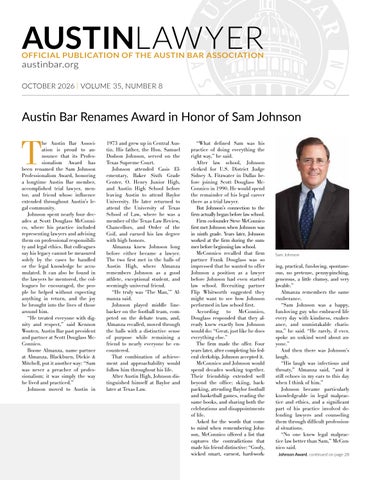
Sam Johnson
ing, practical, fun-loving, spontaneous, no pretense, penny-pinching, generous, a little clumsy, and very lovable.” Almanza remembers the same exuberance. “Sam Johnson was a happy, fun-loving guy who embraced life every day with kindness, exuberance, and unmistakable charisma,” he said. “He rarely, if ever, spoke an unkind word about anyone.” And then there was Johnson’s laugh. “His laugh was infectious and throaty,” Almanza said, “and it still echoes in my ears to this day when I think of him.” Johnson became particularly knowledgeable in legal malpractice and ethics, and a significant part of his practice involved defending lawyers and counseling them through difficult professional situations. “No one knew legal malpractice law better than Sam,” McConnico said. Johnson Award, continued on page 28
LawPay is a trusted Member Benefit of the Austin Bar Association lawpay.com/austinbar
Run your business. Power your practice.
+
CONTENTS
AUSTINLAWYER OCTOBER 2026 | VOLUME 35, NUMBER 8 AL A L INSIDE 1 Austin Bar Renames Award in Honor of Sam Johnson
IN EVERY ISSUE
8 New Members
9 Texas Law Seeks Volunteer Judges for Fall Competitions
8 Briefs
18 Your ABA Dollars at Work
14 Federal Civil Court Update
19 Save the Date: Celebrate Judge Shepperd on Dec. 9
15 Supreme Court of Texas
20 Town Hall on Social Justice: Working Together to Balance the Scale
16 Third Court of Appeals Civil Update 17 Third Court of Appeals Criminal Update
21 Texas Attorneys’ AI Use More Than Doubled since 2024, State Bar of Texas AI in the Practice of Law Survey Finds 22 Report Alleges Systemic Drinking Water Failures at Texas Prisons, Calls for Sweeping Oversight Reforms
DEPARTMENTS
24 Bill Whitehurst Honored by Texas Law
10 Be Well
6 President’s Column
27 TCWLA Pathfinders Recognized
12 AYLA
30 Greer to be Honored with 2026 Chief Justice Pope Award
CONNECTIONS ONLINE austinbar.org austinlawyeronline.com EMAIL billy@austinbar.org MAIL Austin Bar Association 712 W. 16th Street Austin, TX 78701 Austin Bar app available for iPhone and Android. SOCIAL LIKE facebook.com/austinbar
ONLINE austinbar.org NEWS & ANNOUNCEMENTS
SAVE THE DATE
Retirement Celebration for Judge Eric Shepperd Join us in celebrating the retirement of County Court at Law No. 2 Judge Eric Shepperd after nearly 20 years of service to Travis County! In honor of his Dec. 9 retirement, Judge Shepperd is helping raise funds for the Austin Bar Foundation. Make a donation in his honor and help celebrate his years of service. Donors who contribute by Dec. 4 will be recognized at his retirement celebration. RSVP and donate at austinbar.org/judgeshepperd
OCT. 24
Austin Bar’s Pro Bono Fall Festival Benefiting VLS 10 a.m. - 12 p.m. South Austin Recreation Center 1100 Cumberland Road Tickets & sponsorships available at austinbar.org/fallfestival26
FOLLOW twitter.com/theaustinbar FOLLOW instagram.com/theaustinbar CONNECT https://www.linkedin.com/ company/austin-barassociation WATCH vimeo.com/austinbar
America’s Premier Civil-Trial Mediators & Arbitrators Online
View Bios & Available Dates Calendars for our TX Chapter Members, free at
www.TexasNeutrals.org Proud ADR Sponsor to the National Defense & Plaintiff Bar Associations OCTOBER 2026 | AUSTINLAWYER
3
ADDICTION & MENTAL HEALTH RESOURCES 24-Hour Suicide & Crisis Lifeline - 988 - call or text | Live chat: SuicidePreventionLifeline.org Texas Lawyers’ Assistance Program (TLAP) - 1-800-343-8527 TLAP is a 24-hour confidential crisis counseling and referral program to help lawyers, law students, and judges with substance use and mental health issues. Justice Mack Kidd Fund The Austin Bar Foundation administers the Justice Mack Kidd Fund, which can provide financial assistance to individuals seeking treatment for depression or similar illnesses. Visit austinbar.org/?pg=justice-mack-kidd-fund to learn more. Personal Crisis Assistance Program (PCAP) The Austin Young Lawyers Association Foundation provides grants and/or peer support for individuals suffering from a personal crisis. Contact Debbie Kelly: 512-472-0279 x 105 Sheeran-Crowley Trust Administered through TLAP, the trust provides financial help to Texas attorneys, judges, and law students who need treatment for substance use, depression, and other mental health issues. Visit sheerancrowley.org to learn more. Alcohol & Drug Abuse Austin Drug & Alcohol Abuse Program - 512-454-8180 Alcoholics Anonymous - 512-444-0071 Cocaine Anonymous - 512-479-9327 Narcotics Anonymous Counseling - 512-480-0004
AUSTINLAWYER OFFICIAL PUBLICATION ALOF THE ALASSOCIATION AUSTIN BAR AUSTIN BAR ASSOCIATION
Judge Maya Guerra Gamble �� President Sarah Harp ��������������������������������� President-Elect Judge Ciara Parks ��������������������� Secretary Elliott Beck ��������������������������������� Treasurer Maitreya Tomlinson ������������������ Immediate Past President
AUSTIN YOUNG LAWYERS ASSOCIATION
Gracie Wood Shepherd ������ President Lena Proft ������������������������������ President-Elect Ben Evans ����������������������������� Treasurer Jasleen Shokar ��������������������� Secretary Jenna Malsbary �������������������� Immediate Past President
Austin Lawyer
Psychiatric Emergencies Emergency Screening in a Psychiatric Crisis 24/7 - 512-472-4357 Samaritan Center (provides professional counseling services on a sliding scale) - 512-451-7337
©2026 Austin Bar Association; Austin Young Lawyers Association
EXECUTIVE OFFICES
712 W. 16th Street Austin, TX 78701 Email: austinbar@austinbar.org Website: austinbar.org Ph: 512.472.0279 DeLaine Ward....................... Executive Director Debbie Kelly.......................... Associate Executive Director Samantha McCoy................. Assistant Editor Abigail Ventress.................... Assistant Editor Billy Huntsman...................... Managing Editor Austin Lawyer (ISSN #10710353) is published monthly, except for July/August and December/January, at the annual rate of $10 membership dues by the Austin Bar Association and the Austin Young Lawyers Association, 712 W. 16th Street, Austin, TX 78701. Periodicals Postage Paid at Austin, Texas. POSTMASTER: Send address changes to Austin Lawyer, 712 W. 16th Street, Austin, TX 78701. Austin Lawyer is an award-winning newsletter published 10 times a year for members of the Austin Bar Association. Its focus is on Austin Bar activities, policies, and decisions of the Austin Bar board of directors; legislation affecting Austin attorneys; and other issues impacting lawyers and the legal professionals. It also includes information on decisions from the U.S. District Court for the Western District of Texas and the Texas Third Court of Appeals; CLE opportunities; members’ and committees’ accomplishments; and various community and association activities. The views, opinions, and content expressed in this publication are those of the author(s) or advertiser(s) and do not necessarily reflect the views or opinions of the Austin Bar Association membership, Austin Bar Association board of directors, or Austin Bar Association staff. As a matter of policy, the Austin Bar Association does not endorse any products, services, or programs, and any advertisement in this publication should not be construed as such an endorsement. Contributions to Austin Lawyer are welcome, but the right is reserved to select and edit materials to be published. Please send all correspondence to the address listed above. For editorial guidelines, visit austinbar.org in the “About Us” tab.
2026
4
AUSTINLAWYER | OCTOBER 2026
PRESIDENT’S COLUMN
Choosing Change, New Experiences JUDGE MAYA GUERRA GAMBLE, AUSTIN BAR PRESIDENT
I
dropped off my youngest child for his first year of college recently, and I’ve been thinking about what that means, not just for my bank account or my day-to-day life (a lot for both!), but for him and all the other young people starting a whole new period of their lives, full of new experiences and paths to take. That made me think about the chances we have to create new experiences for ourselves and how we can choose to change our path. So when the Austin Bar’s Executive Director DeLaine Ward suggested we have a retreat/planning session with the board of directors, I couldn’t say yes fast enough. This board retreat was led by Leadership Austin. Its purpose was to plan not just for this year but to develop a vision of where we want the Bar to go. Thanks to all members of the
board, who willingly gave their Saturday to this endeavor. It was a really amazing day during which we were all open about what the Bar is doing well and what it could be doing better. We left with a renewed focus and commitment to both increasing overall membership and to increasing the connection of our members to each other and to Bar events. I want to carry that into the entire year, so I’ve set up lunches with the chairs of every Bar committee to talk about their plans for the year and offer my help and brainstorming! I also am looking forward to attending at least one meeting for every section before my year as president is over. And I’ve started a monthly new member lunch where every new member from the previous month is invited to a lunch at Hilgers House to meet, talk about everything the Bar has to offer, and get to know each other. Programs are nothing without people. I also am pushing us to get away from zoom—its conveniences don’t outweigh the loss of person-to-person interaction to my mind. This might mean you need to drive to attend our monthly CLE, but it also means time before and after to talk to other attendees and presenters. The “before and after” moments are where friendships start. We will still record most
CLEs for later viewing online, so you won’t entirely miss out if you can’t make it. Our DEI Committee is one of my favorites—look for the annual Equity Summit in the spring and a book club to be scheduled. In October is our Pro Bono Committee’s (another favorite) annual Pro Bono Fall Festival on Saturday, October 24. This family friendly event raises money for Volunteer Legal Services. Please invite a lawyer friend or two to attend with you—especially if they aren’t already a member of the Austin Bar. When I say reading is my main hobby, I mean it. Last month’s reading was a bit disappointing—I found Land by Maggie O’Farrell not as good as I’d been hoping. And I started a couple of books I
didn’t even finish. But I LOVED Doctor Sleep by Stephen King. This is the sequel to The Shining, and it’s been out since 2013 but somehow I’d missed it. It is oldschool Stephen King, and I give it five stars! This month, I’m looking forward to The Book Censor’s Library by Bothayna Al-Essa, described as a newer 1984 (George Orwell) and sure to fill my delight in books that are strange. Another strange one I’m really looking forward to is The Infinite Sadness of Small Appliances, in which a Roomba falls in love with its owner. As always, I look forward to seeing each and every one of you at an Austin Bar event. If that doesn’t work out, send me a message and we can get together for lunch. AL
Chris Andre
New Vehicle Leasing / Pre-Owned Sales Domestics / Imports / Exotics
Busy Schedule? Call me. Any Make. Any Model. Email | chris@appleleasing.com
6
AUSTINLAWYER | OCTOBER 2026
Phone | 512.653.3718
When Texas When Texas Attorneys Attorneys Need a Need a Property Property Tax Tax Attorney Attorney
COMPREHENSIVE STATEWIDE PROPERTY TAX REPRESENTATION Trusted by Lawyers, Tax Consultants and Taxpayers Since 1981 17480 DALLAS PARKWAY, SUITE 210 DALLAS, TEXAS 75287 214.506.1073 JOHN@TEXASPROPERTYTAXATTORNEYS.COM
www.TexasPropertyTaxAttorneys.com
BRIEFS includes H-1B, L-1, TN, E-2, and O-1 petitions, as well as PERM labor certifications, EB-1 petitions, and National Interest Waiver cases. He guided employers through workforce planning, corporate restructurings, mergers and acquisitions, and other business changes that may affect their immigration programs. He is a graduate of the University of Texas School of Law.
New Members The Austin Bar welcomes the following new members: Chad Aronson Katie Austin Fidel Barraza Meagan Belovsky Emma Blanchard Tanya Boyce Ernesto Cavazos Lindsay Davenport Isabella Dietz Wellesley DuBois Mollie Fields Maxwell Gaddy Dylan Gonzalez Kristina “Krisi” Kastl Clara Kim Laura Nishimura Holly Paulus Kornel Rady Jada Rhome Pierce Ruiz Jacob Thompson Mitchell Weller Kimberly Wesley Steve Zimmerman
Top (L to R): Coddington, Cook, Curington, Farnsworth. Bottom (L to R): Idziak, Kim, Proctor, Watts.
ON THE MOVE Congratulations to Trevor Coddington, who has joined Kane Russell Coleman Logan as a director in the firm’s Austin office. Trevor is a full-stack intellectual property lawyer whose practice spans patents, trademarks, copyright, and high-stakes IP disputes for clients ranging from startups to established companies. Among his nationally recognized work is a niche in the holographic and digital projection technologies used in live entertainment, where he played an integral role in disputes behind some of the most notable digital resurrections in entertainment, including the holographic performances of Tupac Shakur at Coachella and Michael Jackson at the Billboard Music Awards. He is a graduate of George Washington University School of Law. Congratulations to Megan Cook, who has joined Graves Dougherty Hearon & Moody as an associate in the firm’s Estate Planning, Probate, and Trusts practice group. Meg attended the University of Texas at Austin, earning a bachelor’s degree in International Relations with a Minor in European Studies. She received her Juris Doctorate from the Texas Tech University School of Law. Her practice is dedicated to counseling clients in a wide range of estate planning, trust administration, and probate matters. Congratulations to Katie Curington, who has joined the Aus-
8
AUSTINLAWYER | OCTOBER 2026
tin office of Ogletree Deakins as an associate. Prior to joining the firm, she worked in Austin as an associate attorney, oversaw immigration assessment programs, and led employment-based immigration petition initiatives for major corporate clients and research institutions. From initial assessments and strategic planning to petition preparation and client counseling, her practice spans the full lifecycle of immigration cases. Katie has also served as a featured speaker at client immigration summits. Earlier in her career, she handled a broad portfolio of business immigration matters and led a family immigration department, preparing applications and requests before U.S. Citizenship and Immigration Services and other government agencies. She is a graduate of the Maurice A. Deane School of Law at Hofstra University and is admitted to practice in New York and Texas. Congratulations to Tony Kim, who has joined the Austin office of Ogletree Deakins as an associate and a member of the firm’s Business Immigration Practice Group. Tony helps employers navigate the complex U.S. immigration system to attract, retain, and transfer key talent. Prior to joining Ogletree Deakins, Tony advised employers on a wide range of employment-based immigration matters, including temporary work visas, permanent residence processes, and global mobility considerations. His experience
Congratulations to V. Barclay Proctor, who has joined Graves Dougherty Hearon & Moody as an associate in the firm’s Real Estate and Oil & Gas sections. Barclay earned his B.A. from the University of Texas at Austin and his J.D. from the Southern Methodist University Dedman School of Law. His practice focuses on a wide range of real estate and oil and gas matters, including acquisitions and dispositions, title and survey issues, development projects, and the negotiation of commercial agreements. Congratulations to Jameson Watts, who has joined Kane Russell Coleman Logan as a director in the firm’s Austin office. Jameson is a bankruptcy and litigation attorney whose practice spans the full spectrum of insolvency matters, with particular experience representing debtors and creditors in Chapter 11 reorganizations. He represents banks, private lenders, loan servicers, financial institutions, debtors, creditors, and trustees in proceedings before state and federal courts, bankruptcy courts, and arbitration panels, including the American Arbitration Association. He is a graduate of the University of Houston Law Center. KUDOS Congratulations to William Farnsworth, who has been promoted to partner at Rigby Slack Lawrence Pepper & Comerford. Since joining shortly after the firm’s 2019 founding, William has built a reputation for exceptional client service, sound judgment, and results. His practice spans commercial real estate transactions including leasing, acquisitions, development, and financing, as well as business for-
mations, M&A, and commercial contracts. He has represented lenders, developers, landlords, and tenants in Dallas and Houston. He is a graduate of South Texas College of Law. Congratulations to Peter Idziak, who has been named partner-incharge at Sandler Law Group, a Texas-based law firm serving mortgage lenders and financial institutions. Peter has nearly two decades worth of mortgage lending experience and will oversee the firm’s legal practice and help advance its mortgage closing, document preparation, and compliance services. He will also spearhead the firm’s ongoing efforts to enhance client service by leveraging technology and AI solutions. Peter is a graduate of the University of Texas School of Law. AL
Texas Law Seeks Volunteer Judges for Fall Advocacy Competitions
T
he University of Texas School of Law is seeking attorneys and judges from the Austin legal community to volunteer as judges for three upcoming moot court and mock trial competitions this fall. The Texas Law Board of Advocates hosts intramural competitions throughout the academic year, giving law students opportunities to develop their advocacy skills and receive feedback from practicing attorneys and judges. Volunteers are currently needed for two novice competitions. The Gibbs & Bruns Novice Moot Court Competition will hold preliminary rounds Sept. 29 and Oct. 1, when the need for volunteer judges is greatest. Semifinal and final rounds are scheduled for Oct. 6 and Oct. 8. You can sign up to judge this competition at https://shorturl.at/7dlJN. The Foley & Lardner Novice Mock Trial Competition will follow in October. Preliminary rounds, which have the greatest need for volunteers, are scheduled for Oct. 20 and 22, with semifinal and final rounds Oct. 27 and 29. You can sign up to judge this competition at https://shorturl.at/tdbpk. Dinner will be provided to volunteer judges at each Board of Advocates competition. Attorneys interested in volunteering can register through the respective competition’s sign-up form. For questions about Board of Advocates competitions or to be added to its mailing list for future volunteer opportunities, contact BOA Judging Director Michaela Moody at mhm2649@my.utexas.edu. The law school will also host the third-annual Texas Showdown Nov. 7-8. The mock trial tournament brings leading undergraduate teams from around the country to Texas Law and relies on volunteers to evaluate competitors and provide feedback. No previous mock trial experience is required to judge the Texas Showdown. Each round lasts approximately three hours, and volunteers may participate in one or multiple rounds. Food and judge training will be provided before each round. You can sign up to judge this competition at https:// shorturl.at/1COZe. AL
jamsadr.com/austin
OCTOBER 2026 | AUSTINLAWYER
9
Be Well
Stories of Recovery: What It Was Like Then; What It’s Like Now Editor’s note: This anonymously authored article is part of the Texas Lawyers’ Assistance Program’s Stories of Recovery series. TLAP offers confidential assistance for lawyers, law students, and judges with substance use or mental health issues. Call or text TLAP at 1-800-343-8527 (TLAP) and find more information at tlaphelps.org.
I
had my first drink when I was 16 years old, and I was in heaven. That feeling of escape came almost immediately, taking me away from the problems I could not confront at home. Growing up, I was often told I was too sensitive, and expressing my feelings was never permitted. In fact, I was shamed when my feelings came out. So, I internalized my feelings for years, wanting to please others—particularly my family of origin—when that was impossible, because they were sick too! The more I internalized, the more I drank. A couple of doctors and counselors in my undergrad and law school years advised me I had a drinking problem. No matter, I thought, because I could not imagine my life without alcohol. I was a binge drinker. It really picked up in law school and carried over to my early years in private practice. I didn’t drink every day, but that’s where I was
10
AUSTINLAWYER | OCTOBER 2026
heading before I finally got sober. I got married young and received my law license the same year. Ever the people pleaser, I went to work at my dad’s firm, first as a law clerk, then as an associate attorney. I secretly hated myself for making that choice, but my wife’s dad had died unexpectedly, and I thought working for my dad was the only answer. I didn’t know how to ask for help then like I do now. I was constantly on edge, thinking I wasn’t good enough and that I didn’t measure up because I was working for my dad. I would yell on the phone, raise my voice, and dreaded going to work each day. And I would retreat to alcohol to numb the pain, usually embarrassing my wife and myself in the process. This became a constantly recurring cycle to where I was drinking alone when my wife, pregnant with our first child, would go upstairs to bed. After a night of heavy drinking in isolation, I blacked out, got behind the wheel of a car, and woke up on our couch downstairs. My wife was nowhere to be found, and when she recounted to me what I had done and said to her, I knew something had to give. I haven’t had a drink since that night in August 2007 and, by the grace of God, none of my three children have seen me drink ei-
ther. Thanks to my recovery, I try to make service the heart of everything I do, particularly when it comes to my family. I try to talk through my feelings and retreat outward instead of inward, as I recognize my sobriety involves more than just quitting drinking. I’m able to establish healthy boundaries to honor and preserve my sobriety each day, and I’m able to be of better service to others instead of myself at work. To relieve my stress and anxiety, I exercise regularly now instead of resorting to alcohol.
I’m firmly convinced that I would have lost my marriage, my law license, and much more had I not fully surrendered and admitted that I was alcoholic. Now, I can’t imagine my life without recovery—it’s present in all that I do and it’s truly one day at a time for me. AL
AUSTIN YOUNG LAWYERS ASSOCIATION
The Generosity of Time GRACIE WOOD SHEPHERD, AYLA PRESIDENT
O
ne of the things I have come to appreciate most about practicing law is how generous people can be with something none of us ever seem to have enough of: time. I have practiced family law my entire career. A couple of years into practice, however, I started thinking about whether I wanted to change the direction of my practice. Family law litigation is rewarding in many ways, but it can also be incredibly demanding. As my career progressed, I found myself thinking more about what kind of practice would be sustainable for me, particularly as I was raising very young children and navigating a season of life that included some additional medical challenges with one of my children. I became increasingly interested in family law appeals. Family law appeals is a much more niche area of practice than family law litigation. There are fewer attorneys who regularly practice specifically within family law appeals, and I knew that developing that part of my practice would require learning a lot of things I didn’t know yet. I knew to be most effective I would have to turn to experts in and around that field. Some of the lawyers I turned to were mentors and colleagues within my firm. Others were lawyers outside my firm: people who, in many circumstances, could technically be considered my competitors. But they generously gave me their time anyway, no questions asked. 12
AUSTINLAWYER | OCTOBER 2026
I called lawyers I didn’t know well with questions about appellate procedure. I asked about strategy, briefing, and the things you only really learn by doing. I had conversations with lawyers who were much more experienced than I was, and they were willing to explain things, share their experiences, and sometimes simply talk through a problem with me. They didn’t have to do that, and perhaps more importantly, they didn’t owe me anything. The family law appellate community is relatively small. The people who were taking my calls were often practicing in the same niche area I was trying to build. They could have viewed me as competition. Instead, they viewed me as a young lawyer who needed some help. At the time, I knew these colleagues were being generous, but as time has gone on, I have only grown in my appreciation for them. Because as I’ve gained more experience, other young lawyers have started coming to me with family law appellate questions. Each time, I remember what it felt like to have a question and not know who to ask or who would be willing to talk with me. I remember not wanting to be a bother. To be clear, I still lean on my colleagues and mentors because there is still a lot to learn. But now, when I can, I try to be that person for another young lawyer looking for guidance. Sometimes I have the answer. Sometimes I don’t. Sometimes I have ten minutes, and sometimes I have more. But I always try to make the time, because I will never forget those who made the time for me. Given our busy schedules, with work, volunteer organizations, and family, giving your time is a particularly meaningful form of generosity. Time is different from almost anything else we give. You can’t earn it back. You can’t create more of it. And as lawyers, we are almost universally convinced that
we don’t have enough of it. That’s why I notice it so much when someone gives me theirs. The people who helped me build my practice didn’t do it because they expected something in return. They weren’t investing in me with the expectation that I would eventually repay the favor. They simply helped because they could. And maybe it was because someone did it for them. We don’t always have a ton of spare time; however, because of the generosity shown to me, I always try to take the call, go to the lunch, and answer the question that I had a few years ago but has become second nature to me now. My hope is that, years from now, some of those that I am shar-
ing time with now will pass that along to other young lawyers in a similar position. I am grateful for the people who have generously given me their time throughout my career. They probably don’t realize how much those conversations meant to me. And now that I have a little more experience, I hope I can do the same for someone else. Give generously with your time when you can. You never know how much those few minutes might mean to someone. And when someone has been generous enough to give you theirs, pay it forward. AL
UPCOMING EVENTS THUR., OCT. 15 AYLA Docket Call 5:30 - 7:30 p.m. Star Bar 600 W. 6th St. Sponsored by Bollier Ciccone Stinson LLP RSVP at austinbar.org
SAT., OCT. 17 AYLA Family Night Austin FC v. Vancouver FC 6 - 9:30 p.m. Q2 Stadium 10414 McKalla Pl. Sponsored by FVF Law Register at austinbar.org
AUSTIN YOUNG LAWYERS ASSOCIATION
AYLA Member Spotlight ZACH WIEWEL
AYLA recently sat down with Zach Wiewel to get to know him better. If you are interested in being featured in an AYLA Member Spotlight, please contact debbie@austinbar.org. Tell us a little bit about yourself and your law practice. I practice estate planning and probate law at Texas Trust Law.
Our firm focuses exclusively on helping individuals and families plan for, preserve, and transition their wealth through wills, revocable trusts, estate tax planning, and probate. I particularly enjoy the opportunity to work with families over the long term and help them thoughtfully plan for the people and causes that matter most to them.
How long have you been involved in AYLA and what has been your best AYLA experience so far? I joined AYLA shortly after moving to Austin. One of my priorities in moving here was to become involved in the legal community and get to know the attorneys I would be practicing alongside for years to come. My best AYLA experience has been participating in the Leadership Academy. I had the opportunity to meet some incredible attorneys and work alongside them to benefit Casa Marinella, an organization doing meaningful work in our community. The experience also gave me firsthand appreciation for how important, and difficult, good leadership can be. What was your childhood dream job? I wanted to be a movie direc-
AYLA Members Support Central Texas Ronald McDonald House
I
n September, AYLA participated in a volunteer opportunity benefiting the Ronald McDonald House. Volunteers spent the day in the kitchen creating free meal boxes for people and their families. The Central Texas Ronald McDonald House is located walking distance from the Dell Children’s Medical Center and provides a home-away-from-home for families with children receiving medical care in Central Texas. Families stay close to their child and receive care while accessing private suites, homecooked meals, and family-centered resources. Be on the lookout for communi-
(L-R): AYLA Board Member Jennifer Goss, AYLA Immediate Past President Jenna Malsbary, current AYLA President Gracie Wood Shepherd, AYLA Member Matt Lightfoot, AYLA Board Member Abigail Ventress-Hyde, and TYLA President Armin Salek.
cations from AYLA regarding future volunteer opportunities or email
AYLA Executive Director Debbie Kelly at debbie@austinbar.org. AL
tor. I grew up loving movies and became fascinated by their ability to tell stories, evoke powerful emotions, and explore what people do when faced with difficult circumstances. I imagined creating stories inspired by meaningful moments in my own life and by the people and events I found compelling throughout history. I suppose I ultimately ended up in a profession where I still get to hear and help shape people’s stories, just without the cameras. What are some of the things you enjoy most about living in Austin? By far, my favorite part of Austin is Lady Bird Lake. Whether I’m running on the trails, paddleboarding, or simply enjoying the view, it has always been a refuge for me. One of my favorite memories is waking up before sunrise in high school to kayak around the lake. I still relish the opportunity to get out on the water early in the morning and experience that same feeling of being removed from the pace of everyday life. What’s your best piece of advice for young attorneys? Invest in relationships. You should always be looking for opportunities to become known, not just for what you do, but for who you are and how you contribute. Get involved in organizations like AYLA, build genuine relationships with other attorneys, and look for ways to be useful to the people around you. And don’t overlook the importance of doing the same within your own firm. Your reputation is built over time, through hundreds of small interactions. If you consistently do good work, treat people well, and make yourself someone others want to work with, opportunities will follow. AL OCTOBER 2026 | AUSTINLAWYER
13
FEDERAL CIVIL COURT UPDATE predicted censorship depended on speculative platform responses. Free Speech Coalition v. Paxton foreclosed their age-verification challenge, requiring vacatur of that portion of their injunction. Judge Ho dissented from the Section 230 holding, reasoning that curation is a platform’s own speech rather than publication of another’s. The decision reinforces the Fifth Circuit’s broad interpretation of Section 230 as protecting platforms from state laws requiring them to monitor, alter, or remove third-party content. Ari Cuenin is a partner at Stone Hilton, where he litigates complex government disputes. He has presented more than 30 arguments in state and federal courts.
SECTION 230: Court keeps Texas social-media filtering mandate enjoined. Computer & Communications Industry Association v. Paxton (5th Cir. No. 24-50721, consolidated with No. 25-50096). The Fifth Circuit affirmed CCIA and NetChoice’s preliminary injunction against the monitoring-and-filtering provision of Texas House Bill 18, the SCOPE Act, while vacating most of a separate injunction obtained by other plaintiffs. The Act requires covered platforms to prevent known minors from encountering content promoting suicide, self-harm, eating disorders, substance abuse, bullying, grooming, trafficking, and other harms. Judge Douglas’s majority opinion held that Section 230(c)(1) preempts the mandate. Although Texas framed the law as imposing affirmative compliance duties, enforcement would turn on platforms’ decisions whether to monitor, screen, alter, or remove user content— quintessential publisher functions. States could not evade Section 230 by recasting publication liability as statutory filtering obligations. The court rejected the argument that Moody v. NetChoice’s recognition of platforms’ First Amendment interest in curation makes curation unprotected by Section 230; the protections can overlap. The majority therefore did not reach the First Amendment challenge. The court separately held that the SEAT plaintiffs lacked standing to challenge the filtering and advertising provisions because 14
AUSTINLAWYER | OCTOBER 2026
JURISDICTION: En banc court dismisses Alien Enemies Act appeal as moot. W.M.M. v. Trump (5th Cir. No. 2510534). The en banc Fifth Circuit dismissed an appeal challenging President Trump’s use of the Alien Enemies Act against alleged members of Tren de Aragua. Three Venezuelan nationals detained in Texas sought preliminary relief for themselves and a putative class against summary removal. The Supreme Court returned the case with instructions to consider whether the named petitioners’ AEA claims warranted preliminary injunctive relief and what notice was due to the putative class before summary removal. A Fifth Circuit panel granted preliminary relief before the court granted rehearing en banc. After en banc argument, the parties confirmed that the government had removed all three named petitioners under the Immigration and Nationality Act rather than the AEA. An AEA injunction could no longer afford them effectual relief. No class had been certified, so unnamed putative members lacked a legal status independent of the named petitioners. The court declined to substitute five proposed representatives on appeal, while leaving the district court free to consider amendment, substitution, or certification. The appeal was therefore moot and dismissed for lack of jurisdiction. The disposition leaves the AEA and due process merits unresolved and provides no en banc endorsement of President Trump’s AEA proclamation, though concurrences urged reaching the merits despite mootness. Judge Ho would have
reached the merits and upheld the President’s actions; Judge Oldham likewise would have denied relief on the merits. The decision illustrates the vulnerability of uncertified class litigation to intervening mootness and the importance of preserving a viable representative in fast-moving government litigation.
to S.B. 1 on the merits. It instead underscores demanding organizational-standing rules and the need to connect each injury to the particular defendant’s enforcement authority.
ELECTIONS: Court reverses injunction against Texas election provisions.
R.J. Reynolds Tobacco Co. v. FDA (5th Cir. No. 25-40137). The Fifth Circuit affirmed interim relief postponing an FDA rule requiring eleven rotating graphic warnings on cigarette packages and advertisements. Congress prescribed nine warnings in the Family Smoking Prevention and Tobacco Control Act. The rule retained only two, substituted agency-drafted statements, and expanded the rotation to eleven. The district court postponed the rule under Section 705 of the Administrative Procedure Act while the manufacturers’ challenge proceeds. Applying abuse-of-discretion review, the panel held that the manufacturers were substantially likely to show that the FDA could require only the nine listed warnings. The phrase “one of the following labels” introduced an exhaustive set, and authority to “adjust” warning text did not include creating warnings or increasing their number. The neighboring preemption clause supplied no independent authority. The ruling remains preliminary: the court affirmed a likelihood-of-success determination and Section 705 postponement pending merits litigation, not a final APA judgment. Unrecoverable compliance costs and the absence of identified time-sensitive public-health harm favored preserving the status quo. The court also held that Section 705 authorizes statutory relief postponing a rule for everyone, not merely the parties. It concluded that Trump v. CASA’s limits on universal equitable injunctions do not control this statutory remedy; any overlapping injunction was coextensive with the postponement. Severability did not require the court to select which nine warnings should survive at the interim stage. Judge Ho did not join the portions addressing universal Section 705 relief and CASA. The decision is significant post-CASA authority for rule-wide interim relief in APA litigation. AL
La Union del Pueblo Entero v. Abbott (5th Cir. No. 25-50246). The Fifth Circuit reversed a permanent injunction against nine provisions of Texas Senate Bill 1. After a bench trial, the district court found that identification-number requirements for mail voting, ballot-curing procedures, voter-assistance rules, and restrictions on compensated electioneering conflicted with Title II of the Americans with Disabilities Act and Section 504 of the Rehabilitation Act. The panel framed the appeal as another correction in repeated Fifth Circuit reversals of district court rulings in the S.B. 1 litigation. Most claims failed for lack of standing. The organizations identified no member facing a substantial risk of future injury from the identification provisions: voters whose applications or ballots had been rejected had learned how to comply, and rejection rates attributable to identification numbers had fallen from approximately 11 or 12 percent to 2.7 percent. The organizations also could not establish standing by diverting resources to voter education. Challenges to the assistance provisions were foreclosed by an earlier decision involving the same plaintiffs and record; changing the substantive statutory theory did not cure the speculative injury. For the compensation provisions, threatened prosecution was not traceable to election administrators, the Attorney General, or the Secretary of State because local prosecutors enforce the prohibitions. Although precedent required recognizing standing against those prosecutors, the claim failed on the merits: prosecutors do not administer voting services and thus had not denied a service or benefit they provide. The ruling therefore does not resolve every disability law objection
ADMINISTRATIVE LAW: Court preserves postponement of cigarette-warning mandate.
SUPREME COURT OF TEXAS Case summaries are prepared by court staff as a courtesy. They are not a substitute for the actual opinions.
> Carden v. Minton, Bassett, Flores & Carsey, P.C., ___ S.W.3d ___, 2026 WL ___ (Tex. June 26, 2024) [24-0834] This case raises issues about attorney liability for civil wrongs committed during the representation of a criminal defendant. William McGee was convicted and sentenced to 42 years in prison for violent crimes. Nearly six years later, McGee and his mother sued his criminal defense counsel for legal malpractice, breach of fiduciary duty, breach of contract, fraud, and gross negligence. The lawyers’ Rule 91a dismissal motion asserted that (1) Mother lacked standing to sue under any theory; (2) the Peeler public-policy bar precluded all legal-malpractice claims because McGee had not been exonerated of his
crimes; (3) the remaining claims were improperly fractured malpractice claims; 3 (4) regardless of fracturing, Peeler’s causation standard barred all claims; and (5) all claims were untimely. The trial court granted the motion and dismissed the suit with prejudice. The court of appeals affirmed, holding that Mother lacked standing to sue her son’s attorney and Peeler, which precludes an unexonerated defendant from suing criminal defense counsel, barred all of McGee’s claims, including those alleging inflated fees, failure to account, and failure to return funds. The Supreme Court affirmed in part and reversed in part. The Court held that Mother was not a client and, therefore, lacked standing to pursue claims premised on an attorney–client relationship. But she could sue for fraud and breach of contract based on allegations that counsel solicited funds for specific services that were not provided. This was a classic “pocketbook” injury. As to McGee, Peeler barred legal-malpractice claims, repackaged malpractice claims,
Jordan Mullins Mullins Resolution
and claims for injuries “flowing from the conviction.” But Peeler did not necessarily preclude billing or fee dispute claims independent from the conviction. After identifying the plaintiffs’ potentially viable claims, the Court remanded to the court of appeals to consider the fracturing and limitations issues. Justice Young filed a concurring opinion highlighting concerns about the lawsuit’s timeliness. Chief Justice Blacklock filed a partial dissent, asserting that McGee had no billing or fee-dispute claims that could survive Peeler because he did not pay for counsel’s services. AL
17 YEARS IN THE COURTROOM. NOW FOCUSED ON RESOLUTION. After almost two decades litigating complex disputes in Texas courts, Jordan Mullins brings a trial lawyer’s perspective to mediation focused on understanding the case, identifying what is driving the dispute, and finding a path to resolution.
• Extensive trial and appellate experience • Mediating and arbitrating disputes where Jordan built his legal practice • Commercial, oil and gas, employment, construction, real property, and other civil matters
TRIAL LAWYER’S PERSPECTIVE. MEDIATOR’S FOCUS.
SCHEDULE A MEDIATION Jordan Mullins | 512.200.2858 jordan@mullinsresolution.com mullinsresolution.com
OCTOBER 2026 | AUSTINLAWYER
15
THIRD COURT OF APPEALS CIVIL UPDATE Equity allows a party to overcome the statute of frauds by proving payment, the seller’s surrendering of ownership and control, and the buyer making valuable and permanent improvements. Mike met these three elements. The court reversed and rendered. MANDAMUS: Court grants relief for lack of jurisdiction to award sanctions.
>
Laurie Ratliff is a former staff attorney for the Third Court of Appeals. She is boardcertified in civil appellate law by the Texas Board of Legal Specialization and owner of Laurie Ratliff LLC.
The following are summaries of selected civil opinions issued by the Third Court of Appeals during August 2026. The summaries are an overview; please review the entire opinion. Subsequent histories are current as of September 14, 2026. PROBATE: Court concludes buyer established oral contract to purchase real estate. Felps v. Felps, No. 03-24-00505CV (Tex. App.—Austin July 16, 2026, no pet. h.) (mem. op.). In a probate proceeding, the parties disputed ownership of a land tract, originally owned by the decedent, Donald. Soon after Donald purchased the land in 1994, he orally agreed to sell it and the auto-shop business to his son, Mike, for $85,000. Mike made monthly payments as required and made the final payment in April 2010. Donald died before executing a deed for his interest in the land to Mike. Donald’s wife, Louetta, claimed the property remained part of the estate. On cross motions for summary judgment, the trial court granted Louetta’s and denied Mike’s. The court of appeals observed that buyers of land become vested with equitable title when they have performed all obligations under the purchase contract. Mike’s motion established equitable title based on his performance under the contract. 16
AUSTINLAWYER | OCTOBER 2026
In re Environment Plus, Inc., No. 03-26-00537-CV (Tex. App.—Austin Aug. 12, 2026, orig. proceeding) (mem. op.). The trial court rendered an agreed judgment on parties’ contract lawsuit awarding JRMG $60k. Environment moved to set aside and appealed the agreed judgment. JRMG sought sanctions for the post-judgment filings. Because plenary power had expired, the trial court dismissed the motion for lack of jurisdiction. In response to Environment’s attempt to dissolve the JRMG’s writ of garnishment, JRMG sought sanctions. The trial court granted sanctions against Environment for the contract lawsuit post-judgment filings and the garnishment filings and ordered payment within 11 days. The trial court denied Environment request to defer payment to allow it to supersede the order. The court of appeals granted mandamus relief for the sanctions awarded for the contract lawsuit for lack of jurisdiction. For the garnishment sanctions, the court concluded Environment had an adequate appellate remedy. Environment failed to show payment of the sanctions precluded or substantially impaired its ability to continue the litigation. RESTRICTED APPEAL: Court reverses default judgment and remands on damages. H&H Concrete on Demand Austin, LLC v. Thurston, No. 03-2400530-CV (Tex. App.—Austin Aug. 13, 2026, no pet. h.) (mem. op.). Thurston sued pool contractor and concrete supplier for improper construction of a pool. Neither defendant answered or appeared at the hearing. The trial court awarded Thurston over $270,000 in damages plus attorney’s fees.
H&H Concrete filed a restricted appeal alleging error on the face of the record because insufficient evidence supported damages. The court of appeals agreed that the evidence was insufficient. Thurston’s expert’s report referred to H&H Tile and Plaster as the concrete installer, not H&H Concrete. No evidence linked H&H Tile to H&H Concrete or otherwise showed H&H Concrete’s responsibility for the flaws. Accordingly, the court reversed and remanded for a new trial on unliquidated damages. TRIAL PROCEDURE: Court reverses dismissal of fraud claims involving foreign property. Jia v. Jia, No. 03-25-00381-CV (Tex. App.—Austin Aug. 20, 2026, no pet. h.) (mem. op.). Joan sued Cherry for breach of fiduciary duty relating to mismanagement of jointly owned property. Cherry counterclaimed for fraud. Joan sought dismissal of the fraud claims for want of jurisdiction, arguing that adjudication of the claim required determination of title to foreign property. The trial court dismissed the fraud claim. The court of appeals concluded that a court with personal jurisdiction over the parties does not lack subject-matter jurisdiction merely because ownership of foreign property is at issue. The determinative question is wheth-
er the relief requested operates in personam or in rem. Cherry’s counterclaim sought monetary and injunctive relief, and thus was in personam not in rem. Accordingly, the trial court had jurisdiction over the fraud claim. PROPERTY: Court reverses summary judgment for failure to establish property as separate. Rincon v. Ramirez, No 03-2500001-CV (Tex. App.—Austin Aug. 31, 2026, no pet. h.) (mem. op.). Heirs disputed title to property owned by their parents, Cruz and Manuela. Ramirez contended the property was Manuela’s separate property. Rincon, and other half siblings of Ramirez, claimed it was community. The trial court agreed with Ramirez that under the inception of title rule, title vested after Cruz’s death, thus it was Manuela’s separate property. The court of appeals observed that at the inception of title, title need not be vested. All that is needed is a right to claim the property that may vest in the future. Cruz and Manuela entered a contract-for-deed to the property during marriage, so the inception of title relates back to that time, making the property community. That legal title vested after Cruz’s death when Manuela made the final payment does not control. The court reversed and remanded. AL
THIRD COURT OF APPEALS CRIMINAL UPDATE
Zak Hall is a staff attorney for the Third Court of Appeals. The summaries that follow represent the views of the author alone and do not reflect the views of the Court or any of the individual justices on the Court.
>
The following is a summary of a selected criminal opinion issued by the Third Court of Appeals from March 2026. The summary is an overview; please review the entire opinion. The subsequent history is current as of September 9, 2026. MANDATORY PRETRIAL RELEASE—“CRIMINAL ACTION” VS. “CRIMINAL EPISODE”: Statutory period in which State was required to be ready for trial was measured by date of arrest for criminal action, not criminal episode. Ex parte Martinez, 731 S.W.3d 940 (Tex. App.—Austin 2026, no pet.). Martinez was arrested for various offenses arising out of the same criminal episode involving the kidnapping of two teenagers. He was initially arrested for two counts of kidnapping on September 27, 2024. Two days later, an arrest warrant was issued for the additional offense of smuggling a person under the age of eighteen that was committed against one of the victims. On December 5, 2024, an arrest warrant was issued for the additional offense of aggravated assault, which alleged that Martinez cut the leg of one of the victims with a knife. On January 13, 2025, an arrest warrant was issued for the addition-
al offense of aggravated sexual assault committed against one of the victims. Each of the pending charges was assigned a separate cause number. In March 2025, Martinez filed applications and amended applications for writ of habeas corpus seeking release on all six of his pending cases pursuant to Article 17.151 of the Code of Criminal Procedure. He argued that the State was not prepared for trial within 90 days of his arrest as the statute required. Accordingly, he contended that either the bonds for all six offenses should be reduced to bonds he could afford, or he should be released on personal bonds. On April 8, 2025, the State obtained a single nine-count indictment against Martinez. One of the indicted aggravated sexual assault offenses corresponded with Martinez’s January 2025 arrest warrant. Two days later, the trial court held a hearing on Martinez’s habeas applications. The trial court granted relief on five of Martinez’s applications—related to the arrest warrants issued in or before December 2024—but denied Martinez’s habeas application that corresponded with the aggravated sexual assault offense. The trial court concluded that an indictment was returned within 90 days of Martinez’s arrest on that charge, and therefore his bail should not be reduced for that offense. Martinez appealed that ruling. He contended that, although the State obtained an indictment within 90 days of the issuance of the arrest warrant for the aggravated sexual assault offense, the start of the 90 days should relate back to his initial arrest because he was already “detained” for the offenses of kidnapping arising out of the same “criminal episode.” The appellate court disagreed. The court explained that Article 17.151 provides for pretrial release of the defendant “if the state is not ready for trial of the criminal action for which he is being detained within ... 90 days from the commencement of his detention if he is accused of a felony.” The statute does not include the term “criminal episode.” Instead, it measures the 90 days
based on “the criminal action for which [the defendant] is being detained.” The court explained that the penal code treats “criminal action” and “criminal episode” as different concepts. A “criminal episode” means the commission of two or more offenses if either: “(1) the offenses are committed pursuant to two or more transactions that are connected or constitute a common scheme or plan;” or “(2) the offenses are the repeated commission of the same or similar offenses.” On the other hand, “a defendant is prosecuted in ‘a single criminal action’ whenever allegations and evidence of more than one offense arising out of the same criminal episode ... are presented in a single trial or plea proceeding, whether pursuant to one charging instrument or several.” Additionally, Article 17.151 provides that “[t]he provisions of this Article do not apply to a defendant who is ... being detained pending trial of another accusation against the defendant as to which the applicable period has not yet elapsed,” which fur-
ther supported a conclusion that “the focus of the Article is on the time of detention per accusation.” The court concluded that “a separate 90-day deadline applies to each newly charged offense that may be prosecuted independently and result in an additional punishment from the previously charged offenses.” Here, Martinez was arrested for the aggravated sexual assault offense on January 13, and the 90-day deadline for the State to be ready for trial on that offense was April 13. The State returned its indictment on April 8, within the deadline. AL
Rob Holcomb MEDIATOR
\Construction | Business | Real Estate | Consumer HOLCOMB-LAW.COM RDH@HOLCOMB-LAW.COM (512) 476-1121
HOLCOMB LAW, PLLC
4407 South IH-35, Suite 201 Georgetown, TX 78626 OCTOBER 2026 | AUSTINLAWYER
17
Your ABA Dollars at Work Nonprofit Projects Receiving Gala Funds in 2026
T
he Austin Bar Foundation funded the following nonprofit projects using funds raised from the 2026 Austin Bar Foundation Gala. The Center for Child Protection Project Title: Case Management to Help Child Abuse Victims Navigate the Legal System Statement: Received grant funds from the Austin Bar Foundation will go toward securing a case manager who will ensure a supportive experience for families who have experienced child abuse, helping them as they move through the legal system. The case manager will focus on collaboration and coordination with the multidisciplinary team partners and referral to vital court-focused services. Court Appointed Special Advocates of Travis County (CASA) Project Title: Improving Child Advocacy – Professional Development Training for CASA Staff Statement: Funds from the Austin Bar Foundation will contribute to professional development training for CASA’s frontline staff, volunteer supervisors, who ensure quality advocacy for every child they serve. With the help of the foundation, CASA seeks to improve child advocacy by bringing in outside trainers to help child advocacy specialists improve courtroom presentation skills, learn to better use time-management tools, and develop other skills that will ensure quality advocacy for children who have been abused or neglected and have open cases in the Travis County child welfare courts. Volunteer Legal Services of Central Texas (VLS) Project Title: Pro Bono Housing Stability Services for Low-Income 18
AUSTINLAWYER | OCTOBER 2026
Individuals and Families Statement: The VLS Housing Stability program provides pro bono legal services to individuals and families facing eviction or other landlord-tenant issues that may result in a loss of housing for vulnerable, low-income residents of Travis, Hays, Bastrop, and Williamson counties. Grant funds will support the promotion of stable and secure housing environments, the prevention of homelessness, and addressing related legal issues, thus positively impacting the social, emotional, and mental well-being of both adults and children in affected families. VinCare Services of Austin Foundation (d/b/a Saint Louise House) Project Title: Increasing Access to Legal Services to Single Mothers Experiencing Homelessness Statement: In partnership with the Saint Louise House Supportive Housing Program, VinCare seeks to provide equal access to justice for mothers who have experienced homelessness, most of whom have also experienced domestic violence. The grant funds from the Austin Bar Foundation will contribute to ensuring access to legal services for families by strengthening community partnerships, training staff, and providing financial support. Seedling Foundation (d/b/a Seedling) Project Title: Mentoring for Children Impacted by Parental Incarceration Statement: This Seedling mentorship program empowers Central Texas students impacted by parental incarceration by matching each with a trained, committed mentor. The Austin Bar Foundation grant will fund volunteer mentor recruitment, interviews, background checks, ongoing training, and mentee-mentor
The generous funds provided by Austin Bar members to the Austin Bar Foundation will provide essential services to our community, from securing a case manager at CASA, to ensuring access to legal services to mothers experiencing homelessness through the Saint Louise House. match support, thus contributing to a healthy, productive life trajectory for a significantly underserved, high-risk population of youth in our community. Texas Advocacy Project Project Title: Law Center Initiatives Statement: The Texas Advocacy Project’s Law Center Initiative improves system coordination and increases access to protective orders and other critical legal remedies for survivors of abuse. Funds received from the Austin Bar Foundation will help support projects expanding the availability of free legal services, providing critical protection for families escaping abuse, as well as promoting public understanding of the law
and growing the legal workforce through professional development and training opportunities. Gift of Adoption Fund, Inc. Project Title: Texas Adoption Assistance – Legal Fees Statement: In alignment with the Austin Bar Foundation’s priority of expanding and facilitating the availability of legal services, Gift of Adoption grants ensure the delivery of those services for at-risk children who are being adopted. The Austin Bar Foundation’s support will be distributed by the Gift of Adoption Fund, whose grants are paid directly to the agency or attorney working on behalf of the child, as well as covering final fees, ensuring the adoption is completed successfully. AL
Save the Date: Celebrate Judge Shepperd on Dec. 9
S
ave the date for a retirement celebration for Judge Eric Shepperd of County Court at Law No. 2! The Austin Bar will host the celebration at the Civil & Family Court Facility in the ceremonial courtroom at 4 p.m. on Wednesday, Dec. 9. The celebration will also feature the unveiling of Judge Shepperd’s portrait to commemorate Judge Shepperd’s contributions to the bench. Earlier this year, Judge Shepperd’s name was added to the Honorable Lora Livingston Fellowship Program. Judge Shepperd has been a constant advocate of this program, which seeks to connect law students with a wide range of opportunities through partnerships with local government and firms. The Austin Bar is proud to now call it the Hon-
orable Lora Livingston and Eric Shepperd Fellowship Program. Judge Shepperd has decided he wants his retirement celebration to also serve as a fundraising event for the Austin Bar Foundation. Please be on the lookout for further communications from the foundation regarding sponsorship opportunities, as well as a registration link for the retirement celebration. We’re excited to see you there to help us celebrate Judge Shepperd! AL
Creative, efficient resolution of business disputes. How can we help?
Judge Jeff Rose (Ret.) ROSE RESOLUTION GROUP
Former Chief Justice, Texas’ Third Court of Appeals • 5 Time Texas Super Lawyer • Board Certified, Civil Trial Law
www. RoseResolutionGroup.com
OCTOBER 2026 | AUSTINLAWYER
19
Town Hall on Social Justice: Working Together to Balance the Scales By VELVA L. PRICE, TRAVIS COUNTY DISTRICT CLERK
Attendees of the Social Justice Town Hall take a photo with NAACP President Nelson Linder, Amber Goodwin, Travis County District Clerk Velva Price, Judge Maria Cantú Hexsel, Judge Ciara Parks, Judge Selena Alvarenga, and the Hon. Rudy Metayer.
(L-R): Elijah Scott, host of POV Austin on Kazi FM 88.7, Judge Selena Alvarenga, Judge Maria Cantú Hexsel, Judge Brandy Mueller, and Judge Denise Hernández.
n a hot August day, people gathered inside the cool space of David Chapel Missionary Baptist Church to discuss the important but rarely discussed topic of community participation in jury service with a panel of four sitting judges. The panel consisted of Judge Brandy Mueller, 403rd District Court, Judge Maria Cantú Hexsel, 53rd District Court, Judge Selena Avelenga, 460th District Court, and Denise Hernández, County Court at Law No. 6. The panel dis-
munity to respond to notices for jury service and attendance when called was important to fulfill the constitutional mandate. The audience asked questions about the judge’s role in the jury system, the removal of jurors based on race, and how to include younger people in the process. KAZI FM-88.7 taped the forum for future play on the air. The forum could not have happened without the work of Bessie Evans, Charlene Gregory, Judge Cliff Brown, and Travis County District Clerk Velva Price. Thank you
O
cussion was moderated by Elijah Scott, host of POV Austin on KAZI FM 88.7, a high school senior, and Nelson Linder, NAACP president and master of ceremonies. The panel discussed topics ranging from the constitutional requirements for jury duty, the importance of jury service, influence of high-profile cases on jury service, and the impact of jury decisions on the larger community. All the judges acknowledged the disruption caused by jury service to people’s day-to-day activities but that the need for the full com-
also to our sponsors, which were the Austin Bar Foundation, Austin Community Radio, Inc./KAZIFM 88.7, NAACP-Austin Branch, David Chapel Missionary Baptist Church, Law Office of Dyan Lofton, PLLC, and National Council of Negro Women (NCNW) Greater Austin Section. AL
Divorce and Child Custody Surveillance ~ Undercover Background Checks Computer & Phone Forensics Corporate Investigations Expert Testimony and more STRICTLY CONFIDENTIAL
“Information is power, the not knowing is devastating.” 20
AUSTINLAWYER | OCTOBER 2026
Anji Maddox
Featured in Forbes Magazine
Austin, Round Rock, & Dallas
Texas Attorneys’ AI Use More Than Doubled since 2024, State Bar of Texas AI in the Practice of Law Survey Finds
T
he State Bar of Texas has released the results of its 2026 AI in the Practice of Law Survey. Chief among these, the survey found that AI use among Texas attorneys rose significantly from the bar’s last such survey in 2024, from 30 percent to 62 percent. The complete survey report, including all questions and answers as well as all attorney comments, is available at texasbar.com/2026AISurvey. Additional findings include: Among attorneys who reported using AI, ChatGPT is the most widely used AI tool, used by 63 percent, while Westlaw/CoCounsel is the most widely used legal-specific AI tool, at 30 percent. The most common use of AI was for legal research (53 percent). For attorneys who choose not to use AI, ethical concerns were the most commonly
cited reason (59 percent). As the largest legal occupation group in Texas, private practitioners make up the highest percentage of AI users overall (67 percent). However, corporate/in-house counsel remain the highest adopting legal occupation group (87 percent in 2026, up from 51 percent in 2024). Attorneys licensed 15 years or fewer reported an average AI adoption rate of 73 percent, compared to 60 percent for those licensed longer. The AI adoption rate also varies by firm size, with 87 percent of firms with 25 attorneys or more adopting AI into their practices, compared to 64 percent for smaller firms. The 2026 AI in the Practice of Law Survey is a project of the State Bar of Texas Emerging Technology Committee and was conducted by the bar’s Research and Analysis Department. It was sent to a random
sample of 30,000 licensed Texas attorneys, and 1,553 responded. The results have a margin of error of plus or minus 2 percent. For Texas attorneys, judges, and other legal professionals interested in learning more about AI in the law, the State Bar has created a number of resources including
the State Bar of Texas AI Toolkit (at texasbar.com/aitoolkit) and the Ask a Human series of webinars and how-to videos (at texasbarpractice.com). Editor’s Note: LexisNexis, which is a Corporate Sponsor of the Austin Bar, has a native AI tool called Lexis+ with Protégé. AL
OCTOBER 2026 | AUSTINLAWYER
21
Report Alleges Systemic Drinking Water Failures at Texas Prisons, Calls for Sweeping Oversight Reforms
A
new report from the Texas Civil Rights Project alleges that thousands of incarcerated Texans have been exposed to unsafe drinking water because of aging infrastructure, inadequate oversight, and a lack of transparency within the Texas Department of Criminal Justice (TDCJ). Focusing on two of the state’s largest prison units, the report argues that water quality problems extend beyond isolated incidents and instead reveal systemic failures in how prison water systems are monitored and maintained. The report, Unlocking Safe Water in Texas Prisons, centers on the Coffield and Michael Units in Anderson County, which share a water treatment system serving approximately 8,000 incarcerated people each day. Investigators say they narrowed their research to these facilities only after encountering repeated obstacles obtaining records from TDCJ, preventing a broader statewide analysis. According to the report, complaints from incarcerated individuals describing discolored, foul-smelling, and contaminated water prompted the investigation. TDCJ houses more than 130,000 people across 99 facilities and operates many of its own public water systems rather than relying on municipal providers. Because these prison-operated systems function like community water utilities, they are subject to state and federal drinking water regulations enforced by the Texas Commission on Environmental Quality (TCEQ). The report argues that despite these legal obligations, meaningful oversight remains limited. Under Texas law, TCEQ conducts periodic inspections and reviews compliance reports submitted by water system operators. However, investigators contend that the agency depends heavily on self-reporting by the very entities it regulates. Water operators 22
AUSTINLAWYER | OCTOBER 2026
collect many of their own samples before sending them to accredited laboratories, meaning the timing and collection process often remain under the operators’ control. The report argues this structure leaves room for inadequate monitoring and limits independent verification of water quality. Transparency emerged as one of the report’s central concerns. Researchers praised TCEQ for maintaining public databases and responding to open records requests but criticized TDCJ for delayed responses, high records-production costs, and incomplete disclosures. In one example, investigators sought records concerning an alleged staff-only water filtration system after receiving multiple reports that such a system existed. According to the report, TDCJ produced no responsive documents. The report also criticizes agency policies that restrict outside researchers from interviewing incarcerated people or conducting independent environmental assessments unless TDCJ determines the work is “mutually beneficial.”
Of approximately 50 people interviewed or corresponding with investigators, 26 reported testing positive for Helicobacter pylori, a bacterium associated with gastrointestinal illness. Nineteen described digestive disorders. ... Eight reported chronic skin conditions. The Coffield/Michael water system has accumulated 22 documented drinking water violations or instances of environmental noncompliance since 2020, according to records reviewed by the organization. Those findings include microbial contamination concerns, exceedances involving cancer-linked disinfection byproducts known as trihalomethanes, infrastructure deficiencies, operational failures, missed monitor-
ing requirements, and failures to notify consumers about violations. Two of the violations were classified as health-based. By comparison, the report notes that 95 percent of Texas public water systems avoided any health-based violations during 2024. Investigators highlight a particularly longstanding infrastructure issue involving inadequate elevated water storage. According to the report, the system has remained
out of compliance with state storage-capacity requirements since at least 2012. Reduced storage capacity can lower water pressure, increasing the potential for contaminants to enter the distribution system through backflow. Records obtained from TCEQ indicate the violation remained unresolved as of October 2024 despite multiple compliance investigations over more than a decade. The report also identifies numerous maintenance failures documented during inspections, including leaking equipment, malfunctioning meters, deteriorating storage tanks, incomplete monitoring records, overdue calibration of wells, and an unrepaired backflow prevention device that remained out of service for more than six months at a food service building. While TCEQ later considered several violations resolved, investigators say public records rarely explained what corrective actions were actually taken, leaving questions about whether underlying problems had truly been addressed. To complement regulatory records, the Texas Civil Rights Project reviewed nearly 50 firsthand accounts from incarcerated individuals, many housed at the Coffield Unit. The narratives describe water that appeared brown, greasy, over-chlorinated, or foul-smelling. Several individuals reported filtering tap water through clothing or bed sheets, only to see the fabric quickly stained brown. Many correspondents also described living with persistent anxiety over whether the water was safe to drink. Some reported deliberately limiting their water consumption despite extreme Texas summer temperatures, while others said prison staff or medical personnel advised them to drink bottled water whenever possible. Because bottled water must often be purchased through prison commissaries, the report argues that many indigent prisoners have little practical alternative to drinking tap water. Although the report does not claim to establish a direct causal relationship between water quality and medical conditions, it documents numerous health complaints reported by incarcerated individ-
uals. Of approximately 50 people interviewed or corresponding with investigators, 26 reported testing positive for Helicobacter pylori, a bacterium associated with gastrointestinal illness. Nineteen described digestive disorders such as ulcers, acid reflux, abdominal pain, or hernias. Eight reported chronic skin conditions they believed were linked to the water, while 21 described additional health concerns ranging from unexplained weight loss to thyroid disease. The report also documents significant psychological effects, with 24 respondents saying they feared
for their health daily and 21 describing feelings of hopelessness. The report concludes with five primary recommendations aimed at improving accountability and water quality throughout Texas prisons. It calls for unannounced inspections and independent water testing by TCEQ, along with public access to water quality reports and violation histories for incarcerated individuals. It also recommends escalating enforcement against TDCJ when violations persist for months or years, including referrals to the Texas Attorney General for chronic noncompliance.
Additional recommendations include providing free bottled water whenever safe drinking water cannot be guaranteed, reducing the state’s prison population to lessen strain on aging infrastructure, and either modernizing or permanently closing prison facilities whose water systems cannot feasibly be repaired. According to the report, meaningful reform will require greater transparency, stronger enforcement, and sustained investment in infrastructure rather than continued reliance on aging systems that repeatedly fall out of compliance. AL
Local knowledge.
Lasting support. With Texas Lawyers Insurance as your trusted partner, you will be more informed, better prepared, and confident in your work and future. This is insurance informed by experience, backed by substance, and built on a lasting commitment to those we serve.
DISCOVER THE TLI DIFFERENCE, VISIT TLIE.ORG OR CALL 800-252-9332. ©2026 Texas Lawyer’s Insurance Exchange
OCTOBER 2026 | AUSTINLAWYER
23
A Lifetime of Service: Bill Whitehurst Honored by Texas Law
W
illiam “Bill” O. Whitehurst, an Austin trial lawyer and former president of the State Bar of Texas, has been named the 2026 recipient of the Texas Law Alumni Association’s Lifetime Achievement Award. Whitehurst, a 1971 graduate of the University of Texas School of Law, has practiced law for more than 50 years. His career has included service in the U.S. Air Force Judge Advocate General’s Corps, a plaintiffs’ litigation practice, leadership positions in state and national legal organizations, teaching at Texas Law and advocacy for civil legal services for low-income people. Before attending law school, Whitehurst earned a bachelor’s degree in pharmacy from the University of Oklahoma in 1968. At Texas Law, he competed on the school’s 1969 and 1970 national moot court teams and was a member of the Order of Barristers and the Friar Society. After law school, Whitehurst joined Fulbright & Jaworski in Houston in 1971 before leaving to fulfill an ROTC military obligation. He entered the U.S. Air Force as an assistant staff judge advocate at Otis Air Force Base in Massachusetts. From 1972 to 1975, Whitehurst served as a circuit defense counsel, defending Air Force personnel charged with felony offenses. His work took him throughout Asia and the Pacific, including Okinawa, Japan, Guam and Korea, as well as Thailand, Taiwan and the Philippines. After leaving the Air Force, Whitehurst returned to Texas. In 1975, he became staff director and counsel for the Texas House of Representatives Committee on Judicial Affairs. He later entered private practice in Austin as a plaintiffs’ trial lawyer. Whitehurst’s practice focused on catastrophic injury and death cases involving medical malpractice, defective products, aviation and vehicle accidents. His undergraduate training in pharmacy 24
AUSTINLAWYER | OCTOBER 2026
provided a background in medicine and pharmaceuticals for his medical malpractice and products liability work. He has also held a pilot’s license since 1967. Whitehurst went on to secure multimillion-dollar verdicts for clients. He became board certified in personal injury trial law by the Texas Board of Legal Specialization and a civil trial specialist through the National Board of Trial Advocacy. He was elected a fellow of the American College of Trial Lawyers and the International Academy of Trial Lawyers and later served as president of the International Academy. Alongside his litigation practice, Whitehurst held a series of leadership positions within the legal profession. He served as president of the Texas Young Lawyers Association in 1982-83 and as president of the State Bar of Texas in 1986-87. He also served as president of the Texas Trial Lawyers Association and the International Academy of Trial Lawyers. His national service included chairing the American Bar Association’s Standing Committee on Legal Aid and Indigent Defendants. Whitehurst also co-founded Bar Leaders for the Preservation of Legal Services to the Poor, an organization formed as federal funding for the Legal Services Corporation came under pressure during the 1980s. Whitehurst’s legal-aid advocacy also included his involvement in establishing and expanding Interest on Lawyers’ Trust Accounts, or IOLTA, in Texas. IOLTA programs use interest generated by certain client funds held in lawyers’ trust accounts to support civil legal services. Lawyers sometimes hold client money in amounts too small or for periods too short for establishing a separate interest-bearing account to be practical. Under IOLTA, qualifying funds are placed in pooled interest-bearing accounts, and the interest is directed to legal-aid funding. The Supreme Court of Texas established the Texas Access to Jus-
Bill Whitehurst.
tice Foundation in 1984 to administer the state’s IOLTA program. Whitehurst worked with then-Chief Justice Jack Pope and other legal leaders on the program’s development and expansion. His work resulted in Whitehurst becoming known within the Texas legal community as the “Father of IOLTA.” Texas initially operated IOLTA as a voluntary program. It later became mandatory. When Whitehurst became State Bar president in 1986, expanding IOLTA was among the priorities of his administration. Other priorities included funding for the judiciary and implementation of minimum continuing legal education. Texas Law credits the IOLTA initiative associated with Whitehurst with generating more than $220 million for legal services for low-income Texans. The Texas Access to Justice Foundation administers IOLTA revenue along with other sources of funding and distributes grants to nonprofit organizations providing civil legal services. Whitehurst continued working on legal-aid issues after his term as State Bar president, including
through his leadership of the ABA Standing Committee on Legal Aid and Indigent Defendants. He also maintained a long relationship with Texas Law. Whitehurst taught at the law school for approximately a decade during the 1980s. He has served as attorney advisor to Texas Law Fellowships since the organization’s inception and was involved in the establishment of the William Wayne Justice Center for Public Interest Law. Whitehurst and Texas Law alumnus Richard Mithoff cochaired the fundraising committee for the Justice Center, which opened in 2004. The center supports students pursuing public-interest legal work through academic programs, counseling, pro bono opportunities, fellowships and other initiatives. Whitehurst and his wife, Stephanie, subsequently established another program supporting Texas Law students. In 2010, the couple pledged $125,000 over five years to create the Whitehurst Public Interest Summer Fellowships. The pro-
(L-R): Broaddus Spivey, Bill Whitehurst, and Dicky Grigg.
Bill and Stephanie Whitehurst.
(L-R): Tom Watkins, Jeff Rusk, Jo Ann Merica, Bill Whitehurst, and Phil Friday.
Bill Whitehurst (center) stands with the 2013 Whitehurst Public Interest Summer Fellows (L-R): Mackenzie Meador, Cassandra McCrae, Stephanie Trinh, Mary Chisolm Rios, Daniel Smith, and Sofia Meissner.
gram provides financial support to students working during the summer for public-interest organizations and government offices. Each fellowship was named in honor of a lawyer or other individual selected by the Whitehursts. Students in the inaugural group worked at organizations including the Mexican American Legal Defense and Educational Fund, American Gateways, the ACLU of Texas, Texas RioGrande Legal Aid and the Legal Aid Society in New York. According to a Texas Law Alumni Association video honoring Whitehurst, Bill and Stephanie have funded 89 summer fellowships for Texas Law students. At the time the fellowship program was announced, then-Texas Law Dean Larry Sager compared Bill and Stephanie Whitehurst’s role in public-interest law at the school to
hurst’s role in the development of Texas’ IOLTA program. The Austin Bar Association added Whitehurst’s name to one of its own awards in 2026, renaming its public-service honor the William O. Whitehurst Award. The award recognizes attorneys for pro bono service, work to improve access to justice or public-sector service. The Texas Law Alumni Association’s Lifetime Achievement Award is the latest recognition of Whitehurst’s career. Texas Law has presented alumni awards since 1958. Its Lifetime Achievement Award recognizes a graduate for a distinguished legal career and service to the profession and society. Whitehurst’s career has included work as a military defense lawyer, plaintiffs’ litigator, State Bar president, legal-aid advocate and
the North Star, describing them as both an inspiration and a compass. Whitehurst has also received a number of awards from legal organizations during his career. They include the Austin Bar Association’s Distinguished Lawyer Award, the J. Chrys Dougherty Legal Services Award, the Texas Access to Justice Foundation’s Harold F. Kleinman Award and the Texas Bar Foundation’s Outstanding 50-Year Lawyer Award. He has also received recognition from the National Legal Aid and Defender Association and Texas Appleseed for his work involving legal services and IOLTA. In 2014, Chief Justice Nathan Hecht presented Whitehurst with the Harold F. Kleinman Award during the Texas Access to Justice Foundation’s 30th anniversary. The award recognized White-
law school instructor. His work on IOLTA and other legal-services initiatives has continued to provide funding for civil legal aid, while the summer fellowship program he established with his wife continues to support Texas Law students working in public-interest positions. Looking back on his career in the Texas Law tribute video, Whitehurst focused in particular on his work with other lawyers and on legal services. “It’s been a wonderful career working with lawyers all over the state, becoming a state and national leader for legal services for the poor,” Whitehurst said. “That has enhanced my career immeasurably.” He also cited his family as part of that experience. “That, along with managing a family, has been a wonderful, wonderful career for me.” AL OCTOBER 2026 | AUSTINLAWYER
25
Now Accepting Nominations for Bench Bar Awards
T
he Austin Bar is now accepting nominations for the following awards: The Sam Johnson Professionalism Award The William O. Whitehurst Public Service Award The Larry F. York Mentoring Award The Rev. Joseph C. Parker, Jr., Diversity Award. The Sam Johnson Professionalism Award is named after the late Sam Johnson, partner at Scott, Douglass & McConnico. The Sam Johnson Professionalism Award honors a lawyer who best exemplifies, by conduct and character, truly professional traits that others in the bar seek to emulate, and whom all in the bar admire. Those selected for the award are truly role models for the bar, particularly younger or less experienced lawyers. Previous winners include retired Magistrate Judge Leon Grizzard; Michelle Cheng of National Trial Law, V. Blayre Peña of VBPena Law, and Jane Webre of Scott, Douglass & McConnico. The William O. Whitehurst Public Service Award is named after past State Bar of Texas President Bill Whitehurst. Known as the father of IOLTA (Interest on Lawyers’ Trust Accounts), the program is instrumental in enhancing access to justice for low-income Texans through the Texas Access to Justice Foundation. The William O. Whitehurst Public Service Award is given
26
AUSTINLAWYER | OCTOBER 2026
annually to an attorney in Travis County who has demonstrated outstanding service in the public/ non-profit sector. Previous winners include Clint Harbour (posthumously) of the Texas Attorney General’s Office; Meghan Kempf of the Texas Health and Human Services Commission; Raymond Winter of the Texas Health and Human Services Commission; Leslie Dippel, Travis County executive attorney; and Ira Davis (posthumously) of the Capital Area Private Defender Service. The Larry F. York Mentoring Award is given to a local lawyer or judge who has demonstrated exceptional skill and generosity in mentoring younger members of the bar. This award was created to pay tribute to Larry York, who encouraged many young lawyers in Travis County to achieve professional and personal excellence, with integrity, grace, and humor. Nominees must have practiced at least 10 years and have served as role models and counsellors to other lawyers, distinguishing themselves as leaders of their profession while fully embracing life’s experiences. Previous winners include Jason Snell of Snell Law; Sara Foskitt of Floyd Real Estate; 345th District Court Judge Jan Soifer; and Archie Carl Pierce of Wright & Greenhill. The Rev. Joseph C. Parker, Jr., Diversity Award is named in honor of Joseph C. Parker Jr., the first African American president of
the Austin Bar Association. Blazing the trail for minority lawyers who followed in his footsteps, Parker has spent his life and work championing the equal, ethical, and fair treatment of all people, and raising awareness of the need to diversify our community. The award is presented to a firm or an individual who has led the way in bringing diversity to Austin’s legal community and who exemplifies all that Parker stands for. Previous winners include Mindy
Gulati of Fundamental Advisory; 459th District Court Judge Maya Guerra Gamble; the Hon. Rudy Metayer of Chamberlain McHaney; and Manuel Escobar of McGinnis Lochridge. The recipients of these awards will be honored at the Austin Bar Association’s annual Bench Bar Conference on April 30, 2027. Nominations can be submitted at forms.gle/K8Yn1h7qWzXhUT4cA. The deadline to submit nominations is Friday, Nov. 13, at 5 p.m. AL
TCWLA Pathfinders Recognized
T
he Travis County Women Lawyers’ Association (TCWLA) has announced its 2026 Pathfinder honorees, who will be celebrated at the upcoming TCWLA Pathfinders Awards & 50-Year Celebration on Friday, Nov. 6. TCWLA recognizes Pathfinders as local women with law degrees who are using, and have used, their degrees in a variety of ways to impact our community and the legal profession.
The Hon. Maya Guerra Gamble Judge Maya Guerra Gamble is a lifelong Austinite and the first judge elected to preside over Travis County’s 459th District Court. Before taking the bench, Judge Guerra Gamble built her career as a trial lawyer, focusing on Child Protective Services cases and protecting the most vulnerable in our community. Her service extends beyond the courtroom through leadership with the Austin Bar Association, helping
launch the inaugural Equity Summit, creating mentoring programs for new lawyers, and serving as a Scoutmaster and executive board member with Scouting America. She is the 2026-27 president of the Austin Bar Association.
The Hon. Margaret Cooper – honored posthumously In 1992, Judge Margaret Cooper was elected judge of the 353rd District Court of Travis County, where she served until her formal retirement in 2008 and continued to serve as a senior judge through 2014. A steadfast leader and champion for women in the law, Judge Cooper served as president of TCWLA in 1983. Her legacy of leadership and service continues through the Margaret Cooper Scholarship Fund, which supports aspiring young law students. Lessie Gilstrap Lessie Gilstrap is a commercial litigator and fifth-generation Texan with two decades of experience
Dede has shown that it is possible to build a strong legal career, raise a family, and give back to the community through her commitment to organizations including Family Eldercare and the TCWLA Scholarship Fund.
representing clients in state and federal courts and in arbitration. A dedicated leader in TCWLA, she served as president from 2015 to 2016, president-elect from 2014 to 2015, chair of the Travis County Women Lawyers’ Foundation from 2016 to 2017, and has served on the boards of both the foundation and the association for many years.
Amanda G. Taylor Amanda G. Taylor is a distinguished appellate advocate who has served as counsel in nearly 200 matters before the Texas Supreme Court, federal courts of appeals, and appellate courts across Texas and other jurisdictions. A dedicated leader and mentor, Amanda served as president of TCLWA from 2010 to 2011 and on the board from 2008 to 2013 and remains active as a fellow and mentor. Tickets and sponsorships for the Pathfinders Dinner and TCWLA’s 50-Year Celebration on Friday, Nov. 6, can be purchased at https://tcwla.org/ event/2026-pathfinders-event/. AL
Diane “Dede” Joyce Hebner Diane “Dede” Joyce Hebner is a Texas attorney with 45 years of experience in estate planning and probate. Through her example,
You’re busy looking out for your clients’ needs. Who’s looking out for yours? Jim Kaighin, Jr., CFP
®
Financial Professional
3305 Northland Dr., Suite 414
512-302-6051
Austin, TX 78731
kaighinjr@momentumin.com
Member: FINRA/SIPC OCTOBER 2026 | AUSTINLAWYER
27
Johnson Award, continued from page 1.
But Johnson’s effectiveness came from more than technical expertise. He took the time to understand the lawyers he represented, their clients, and the difficult real-world decisions that had led to a dispute. Almanza, who had the opportunity to work with Johnson early in his own career, saw those qualities firsthand. Johnson used his legal skills, judgment, and intellect ethically and courteously, Almanza said, including when difficult situations presented an easier path. “He was straightforward, credible, and reliable in his approach to the law,” Almanza said. “That grounded approach, combined with his sharp intellect, made him an exceptional attorney.” His willingness to share that knowledge extended far beyond paying clients. Johnson devoted countless pro bono hours to educating lawyers and law students about avoiding malpractice claims and disciplinary grievances. Friends remember him as someone lawyers routinely called when they had questions about ethics or the Texas Disciplinary Rules. Longtime friend and Austin attorney Douglass Hearne was responsible for many of those calls. “I don’t know how many attorneys I referred to Sam over the past 40 years who had a ‘simple, quick’ question about ethics,” Hearne said. Of course, the questions were rarely simple or quick, but Johnson answered them anyway.
He responded patiently, Hearne recalled, without judgment, anger, or any expectation that he would receive something in return. Before personal computers and the internet put information at everyone’s fingertips, Hearne said, people generally had two reliable places to find an answer: the library and the encyclopedia. “For a blessed few,” he said, “we had a third source: Sam Johnson.” Whether the question involved history, politics, a recent court decision, or the law, Johnson had an unusual ability to absorb complicated information and explain it in terms others could understand. That instinct to teach became one of the defining characteristics of Johnson’s life. “First and foremost, Sam loved mentoring, and he was exceptionally good at it,” Hearne said. Education had particular significance to Johnson. Despite his considerable academic accomplishments—finishing near the top of his Austin High School class, earning a 4.0 at Baylor, and excelling at Texas Law—Johnson had significant dyslexia. Hearne said few people knew how much additional work Johnson had to put into not merely learning material, but mastering it. Perhaps because of that experience, he became an enthusiastic advocate for education in almost any form. Johnson encouraged people to pursue opportunities whether their interests were in law, teaching, welding, or another field. One of his frequently repeated observations was that earning a degree might be extraordinarily difficult,
but once you earned it, nobody could take it away from you. His own accomplishments never translated into self-importance. “Sam never had sharp elbows,” Hearne said. Rather than stepping over classmates or colleagues to get ahead, Hearne remembered Johnson as the person holding the door open for them, encouraging them as they went through it. That quality remained with him throughout his career. Wooten remembers working as an associate on a complex trial involving a large legal team. Johnson was already a longtime partner and busy with other matters, but volunteered to help. When Wooten later found herself with some extra time, she offered to take Johnson’s assignment back so he could go home. Johnson refused. “No way! I’ve got this! Take the night off. You’ve earned it!” Wooten remembers him saying. She tried to object, but he insisted. “It did not matter that he was a partner and I was an associate,” Wooten said. “What mattered to Sam was fulfilling his commitment and ensuring that people on his team got the rest they needed, no matter their rank.” Years later, she still thinks about the encounter and the example it provided for her own leadership. Almanza experienced something similar working alongside Johnson early in his career. Watching Johnson exercise judgment, integrity, and restraint, he said, established a standard for the
Patrick
Keel
Mediator Arbitrator
Former District Judge
patrickkeel.com Available by video and in person.
28
AUSTINLAWYER | OCTOBER 2026
younger lawyers around him—not because Johnson lectured them about how lawyers should behave, but because he demonstrated it. Johnson’s professionalism did not manifest as formality. His friends describe someone spontaneous, enthusiastic, approachable, occasionally disheveled, and almost entirely without ego. Wooten remembers one of his favorite sayings: “Be a Tigger, not an Eeyore!” Another frequent Johnson response was simply: “Super!” Hearne remembers a man who could be spotted in a crowded restaurant, enthusiastically cheering for his twin daughters, Page and Ella, at volleyball games, and interacting naturally with people of every age. Almanza remembers the less polished details, too. Johnson was hardly perfect, he joked. His office and lunch habits were rumored to be disastrous, and his signature red vest may have served a purpose beyond keeping him warm. “We all knew his signature red vest wasn’t just for comfort—it was a tactical tool to cover up a number of writing and food sins,” Almanza said. It was part of the same absence of pretense his friends remember so clearly: an exceptionally accomplished lawyer who never seemed particularly interested in looking like one. His enthusiasm could be infectious, but it existed alongside deeply held principles. Hearne remembers that streak emerging when Johnson was only 10 or 11 years old. In fifth grade, Johnson’s teach-
er was discussing the Civil War and presenting a version of history that minimized slavery’s role in the conflict. Johnson repeatedly challenged her account. The result was repeated trips into the hallway, but Johnson kept challenging her anyway. Even as a child, Hearne said, Johnson valued the truth enough to challenge authority when he believed authority was wrong— and accept the consequences without sulking. Decades later, the same combination of conviction and generosity characterized his legal career. Johnson represented at least three aspiring lawyers whom the Board of Law Examiners initially would not allow to sit for the bar because of delinquency during their adolescence. McConnico said Johnson “had a soft spot for juvenile delinquents.” He took the cases pro bono, and in each case, he persuaded the Board to reverse its decision. The students passed the bar and were sworn in as lawyers. Wooten said Johnson “epitomized professionalism in all walks
of life.” He did not resort to aggression to win an argument or a case. He treated opposing counsel respectfully even in intense disputes. As his firm’s general counsel, he made himself available when other lawyers needed to talk through an ethics question or simply needed a sounding board. And he made people feel valued. “Sam had a way of elevating environments,” Wooten said. “He spread joy through his greetings and encouraging words. He helped people feel seen and appreciated.” For Almanza, those qualities are precisely why Johnson’s name belongs on the award. “It is fitting that the Austin Bar is naming the professionalism award after Sam because he was a true professional in every sense of the word—in the way he conducted himself, in the way he interacted with others and the way he practiced law,” he said. Hearne noted that the recipients of the Austin Bar’s Professionalism Award comprise a
“who’s who” of Travis County legal and civic leaders. Many knew Johnson personally. He believes they would support putting Johnson’s name on the honor. McConnico and Johnson’s colleagues at Scott Douglass McConnico feel the same. “The lawyers and staff at Scott Douglass and McConnico are grateful the Professionalism Award has been named for Sam,” McConnico said. “Sam not only made us better lawyers, he made us better people.” That may ultimately explain why the Sam Johnson Professionalism Award is an appropriate way to preserve his legacy. Johnson was an accomplished lawyer, but accomplishment alone is not professionalism. He was extraordinarily knowledgeable, but knowledge alone is not professionalism. He won cases, counseled lawyers, taught students, mentored colleagues, and served his profession, but even those achievements tell only part of the story. Professionalism is also what happens when a longtime partner
insists that an associate take the night off. It is answering another lawyer’s supposedly “quick” ethics question without watching the clock. It is helping a young person get a second chance. It is treating an adversary with respect. It is holding the door open rather than racing through it first. It is, as Almanza observed about Johnson, doing things the right way even when circumstances offer an easier route. It is being excellent without needing everyone else to know that you are. Shortly before learning of Johnson’s death, Wooten had watched Superman. In retrospect, she said, the timing seemed fitting. “Sam truly was a super man.” Almanza has his own phrase for the friend he first met roaming the halls of Austin High. “Sam is still The Man.” Now, when the Austin Bar recognizes lawyers who exemplify the highest ideals of the profession, the award they receive will carry the name of a lawyer who spent a lifetime demonstrating what those ideals look like in practice. AL
EMBRACING AI FOR LEGAL PROFESSIONALS Gain practical AI fluency. Reduce wasted time. Strengthen your professional edge. Learn how to use AI tools strategically and ethically in your practice.
Lead the shift - don’t chase it. Online, self-paced - enroll now.
professionaled.utexas.edu/s/paralegal OCTOBER 2026 | AUSTINLAWYER
29
Greer to be Honored with 2026 Chief Justice Pope Award
T
he Texas Center for Legal Ethics is proud to announce that Marcy Hogan Greer will receive the 2026 Chief Justice Jack Pope Professionalism Award. Each year, the Texas Center for Legal Ethics presents the Pope Award to an appellate attorney or appellate judge who epitomizes the highest standards of professionalism and integrity. The Pope Award is named for former Supreme Court of Texas Chief Justice Jack Pope, one of the Texas Center for Legal Ethics’ founders and the first individual to receive the award in 2009. An acclaimed attorney, Greer is the managing partner at Alexander Dubose & Jefferson. She is recognized for her work in federal and state trial and appellate courts throughout the country. Among other accolades, she received the 2021 Gregory S. Coleman Outstanding Appellate Lawyer Award from the Texas Bar Foundation, the 2022 Pro Bono/Community Service Award from the University of Houston Law Center Alumni Association, and the 2024 Distinguished Lawyer Award from the Austin Bar Association. “Chief Justice Jack Pope represented the highest ideals of the Texas legal profession: excellence, respect for others, and devotion to the rule of law,” said former Supreme Court of Texas Chief Justice Wallace B. Jefferson. “Marcy Hogan Greer embodies those same ideals every day.”
30
AUSTINLAWYER | OCTOBER 2026
“Having spent much of my life observing lawyers and judges at their best, I have come to appreciate the qualities that distinguish the truly exceptional,” said Jefferson, who practices appellate law and received the Pope Award in 2014. “Marcy Hogan Greer exemplifies those qualities. She combines exceptional advocacy with sound judgment, humility, and an unfailing respect for the legal system and everyone who participates in it. She has earned the admiration of lawyers and judges across the country not only because of her remarkable accomplishments, but because she conducts herself with grace, fairness, and unwavering integrity.” Appellate attorney and 2019 Pope Award recipient Charles “Skip” Watson said of Greer, “She exemplifies the qualities Judge Pope exemplified. The superlatives all apply. Marcy is that rare combination of keen intelligence and the ability to express her insight in a way others understand. She is a tireless worker, yet she is unfailingly gracious and attentive to those seeking her help.” Watson added, “Simply put, she can brighten the room and rivet it with her words.” “Marcy Greer consistently operates at the highest level of professionalism and integrity,” said appellate attorney and 2012 Pope Award recipient Kevin Dubose. “I have had the opportunity to observe her dealings with courts, opposing counsel, co-counsel, and lawyers and admin-
Marcy Hogan Greer
istrative team members within our firm. And in all of those dealings she is unfailingly driven by what is right, what is honest, and what is fair.” The Pope Award will be presented to Greer at the annual Texas Supreme Court Historical Society John Hemphill Dinner on September 10, 2026, in Austin. Founded in 1989 by Chief Justice Pope and two other former Supreme Court of Texas chief justices, the
Texas Center for Legal Ethics is a nonprofit organization dedicated to promoting the highest standards of ethics and professionalism. Through educational programs, publications, and other resources, the Center supports lawyers in navigating ethical issues and encourages a culture of integrity and professionalism across the legal community. For more information about the Center, go to LegalEthicsTexas.com. AL
ADVERTISERS 8am LawPay.................................................................................................................................................IFC Apple Leasing....................................................................................................................................................6 United States Postal Service
Armbrust & Brown PLLC..............................................................................................................................31
Statement of Ownership, Management and Circulation (All Periodicals Publications Except Requester Publications)
1. Publication Title 4. Issue Frequency
Broadway Bank - Holdsworth & Nicholas, Inc.....................................................................................32
2. Publication Number
Austin Lawyer
8
4
0
3. Filing Date
5. Number of Issues Published Annually
6. Annual Subscription Price
10
Monthly except combined July/August and Dec/Jan issues 712 W. 16th St. Austin, TX Travis County 78701
Addr 1: Addr 2: City, State ZIP:
712 W. 16th St. Austin, TX Travis County 78701
Name: Addr 1: Addr 2: City, State ZIP:
Sail House Publishing 3510 Crowncrest Dr.
Name: Addr 1: Addr 2: City, State ZIP:
Billy Huntsman 712 W. 16th St.
Name: Addr 1: Addr 2: City, State ZIP:
Billy Huntsman 712 W. 16th St.
Cofer & Connelly, PLLC..................................................................................................................................5
$10.00
7. Complete Mailing Address of Known Office of Publication (Not printer) (Street, city, county, state, and ZIP+4)
Addr 1: Addr 2: City, State ZIP:
Brusniak Turner................................................................................................................................................ 7
09/25/2026
7
Contact Person Telephone
8. Complete Mailing Address of Headquarters or General Business Office of Publisher (Not Printer)
Dubois Bryant & Campbell.........................................................................................................................26
Billy Huntsman
Foster Global, LLP............................................................................................................................................ 4
512-472-0279
Hargett Mediation - Reed, Claymon, Meeker & Hargett, PLLC....................................................10 Holcomb Law, PLLC.......................................................................................................................................17
9. Full Names and Complete Mailing Addresses of Publisher, Editor and Managing Editor (do not leave blank) Publisher (Name and complete mailing address)
JAMS....................................................................................................................................................................9 Lakeside Mediation Center.........................................................................................................................21
Austin, TX 78759
Law Office of Thomas Esparza, Jr., P.C................................................................................................... 3
Editor (Name and complete mailing address)
Momentum Independent Network......................................................................................................... 27
Austin, TX 78701
Mullins Resolution...........................................................................................................................................15
Managing Editor (Name and complete mailing address)
Patrick Keel......................................................................................................................................................28
Austin, TX 78701
Rose Resolution Group.................................................................................................................................19
10. 10. Owner Owner (Do (Do not not leave leave blank. blank. If If the the publication publication is is owned owned by by aa corporation, corporation, give give the the name name and and address address of of the the corporation corporation immediately immediately followed followed by by the the names names and and addresses addresses of of all all stockholders stockholders owning owning or or holding holding 11 Percent Percent or or more more of of the the total total amount amount of of stock. stock. If If not not owned owned by by aa corporation, corporation, give give the the names names and and addresses addresses of of all all the the individual individual owners. owners. If If owned owned by by aa partnership partnership or or other other unincorporated unincorporated firm, firm, give give it's it's name name and and address address as as well well as as those those of of each each individual individual owner. owner. If If the the publication publication is is published published by by aa nonprofit nonprofit organization, organization, give give it's it's name name and and address.) address.)
Full Name
Scott Baker Mediation, LLC......................................................................................................................30
Complete Mailing Address
Austin Bar Association
She Spies Private Eye, Inc.......................................................................................................................... 20
712 W. 16th St. Austin, TX 78701
Texas Appellate Counsel, PLLC................................................................................................................29 Texas Lawyers Insurance............................................................................................................................23 The Eggleston Law Firm................................................................................................................................19 The National Academy of Distinguished Neutrals............................................................................... 3 The Snell Law Firm..........................................................................................................................................11 UT Austin Center for Professional Education The University of Texas at Austin - DEV Building..............................................................................29 11. Known Bondholders, Mortgagees and Other Security Holders Owning or Holding 1 Percent or more of Total Amount of Bonds, Mortgages, or Other Securities. If none, check box Full Name
Complete Mailing Address
MEDIATION & ADR SERVICES
MARK L. HAWKINS 12. Tax Status (For completion by nonprofit organizations authorized to mail at nonprofit rates) (Check one) The purpose, function, and nonprofit status of this organization and the exempt status for federal income tax purposes: Has Not changed During Preceding 12 Months Has Changed During Preceding 12 Months (Publisher must submit explanation of change with this statement below)
13. Form Publication PS 3526,Title July 2014
14. Issue Date for Circulation Data Below
Austin Lawyer
15.
1,917
a. Total Number of Copies (Net press run)
b. Paid and/or Requested Circulation
THE BEST LAWYERS IN AMERICA®
09/01/2026
Average No. Copies Each Issue During Preceding 12 Months
Extent and Nature of Circulation Mailed Outside-County Paid Subscriptions Stated on (1) PS Form 3541 (Include paid distribution above nominal rate, advertiser's proof copies, and exchange copies) Mailed In-County Paid Subscriptions Stated on PS (2) Form 3541 (Include paid distribution above nominal rate, advertiser's proof copies, and exchange copies) Paid Distribution Outside the Mails Including Sales (3) Through Dealers and Carriers, Street Vendors, Counter Sales ,and Other Paid Distribution Ouside USPS Paid Distribution by Other Classes of Mail Through (4) the USPS (e.g. First-Class Mail)
c. Total Paid Distribution
[Sum of 15b. (1), (2), (3), and (4)] Free or Nominal Rate Outside-County (1) Free or Nominal Copies Included on PS Form 3541 Rate Free or Nominal In-County Copies Included (2) Distribution (By on PS Form 3541 Mail and Free or Nominal Rate Copies Mailed at Other (3) Classes Through the USPS (e.g. First-Class Mail) Outside the Free or Nominal Rate Distribution Outside the Mail Mail) (4) (Carriers or other means) e. Total Free or Nominal Rate Distribution (Sum of 15d. (1), (2), (3) and (4)) d.
f. Total Distribution (Sum of 15c. and 15e.)
No. Copies of Single Issue Published Nearest to filing Date
1,948
163
179
1,754
1,759
0
0
0
0
1,917 0
1,938 0
0
0
0
0
0 0 1,917
0 0 1,938
g. Copies not Distributed (See Instructions to Publishers #4 (page #3)) h. Total (Sum of 15f. and g.) Percent Paid i. (15c. Divided by 15f. Times 100)
1,917
1,938
100.00%
100.00%
1,917 1,917 100.00%
0 1,938 1,938 100.00%
* if you are claiming electronic copies, go to line 16 on page 3. If you are not claiming electronic copies, skip to line 17 on page 3. If present, check box a. Paid Electronic Copies b. Total Paid Print Copies (Line 15c) + Paid Electronic Copies (Line 16a) c. Total Print Distribution (Line 15F) + Paid Electronic Copies (Line 16a) d. Percentage Paid (Both Print & Electronic Copies (16b divided bt 16c x 100) I certify that 50% of all my distribution copies (electronic and Print) are paid above a nominal price 17. Publication of Statement of Ownership
10/01/2026
18. Signature and Title of Editor, Publisher, Business Manager, or Owner Kimberly Scheberle
2012–PRESENT
TEXAS SUPER LAWYERS®
BUSINESS LITIGATION 2016–PRESENT
THE BEST LAWYERS IN AMERICA®
REAL ESTATE LAW 2012–PRESENT
AUSTIN MONTHLY
TOP ATTORNEY 2019–PRESENT
16. Electronic copy Circulation
Publication required. Will be printed in the
COMMERCIAL LITIGATION
issue of this publication.
Publication not required
Title
Date
Publisher
I certify that all information furnished on this form is true and complete. I understand that anyone who furnishes false or misleading information on this form or who omits material or information requested on the form may be subject to criminal sanctions (including fines and imprisonment) and/or civil sanctions (including civil penalties)
09/25/2026
Armbrust & Brown, PLLC 100 CONGRESS AVE., SUITE 1300 • AUSTIN, TEXAS 78701 512-435-2300 • FAX 512-435-2360 MHAWKINS@ABAUSTIN.COM
PS Form 3526, July 2014
OCTOBER 2026 | AUSTINLAWYER
31
Curated banking from a trusted local partner. At Broadway Bank, our Private Banking and Wealth Management teams offer comprehensive, integrated financial solutions tailored to your unique goals. Rooted in the communities we serve, our entire in-house team of highly credentialed professionals brings specialized expertise to help you move forward with confidence. P R I V A T E B A N K I N G • W E A LT H M A N A G E M E N T ( 5 1 2 ) 4 6 5 - 6 5 6 4 • B R O A D W AY. B A N K / P R I V AT E
Private Banking at Broadway Bank is subject to eligibility qualifications. Eligibility criteria may include financial, professional, and/or account verification and evaluation. Subject to change without notice. Member FDIC.#4441187285/05/26
Investments and Not FDIC insured Not guaranteed by the bank or any bank affiliate Not a deposit Insurance products are: Not insured by a federal government agency May lose value