austinbar.org MAY 2025 | VOLUME 34, NUMBER 4
Inaugural Austin Bar Golf Tournament a Hole-in-One
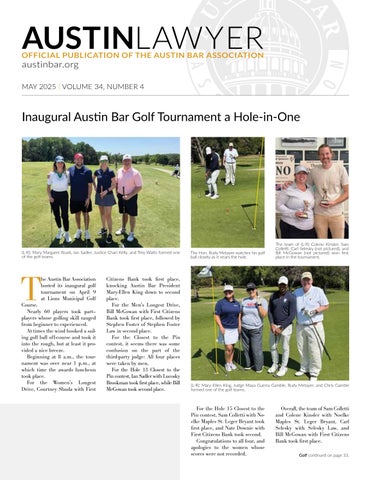
(L-R): Mary Margaret Roark, Ian Sadler, Justice Chari Kelly, and Trey Watts formed one of the golf teams.
T
he Austin Bar Association hosted its inaugural golf tournament on April 9 at Lions Municipal Golf
Course. Nearly 60 players took part– players whose golfing skill ranged from beginner to experienced. At times the wind hooked a sailing golf ball off-course and took it into the rough, but at least it provided a nice breeze. Beginning at 8 a.m., the tournament was over near 1 p.m., at which time the awards luncheon took place. For the Women’s Longest Drive, Courtney Shuda with First
Citizens Bank took first place, knocking Austin Bar President Mary-Ellen King down to second place. For the Men’s Longest Drive, Bill McGowan with First Citizens Bank took first place, followed by Stephen Foster of Stephen Foster Law in second place. For the Closest to the Pin contest, it seems there was some confusion on the part of the third-party judge: All four places were taken by men. For the Hole 13 Closest to the Pin contest, Ian Sadler with Lucosky Brookman took first place, while Bill McGowan took second place.
The Hon. Rudy Metayer watches his golf ball closely as it nears the hole.
The team of (L-R) Colene Kinsler, Sam Colletti, Carl Selesky (not pictured), and Bill McGowan (not pictured) won first place in the tournament.
(L-R): Mary-Ellen King, Judge Maya Guerra Gamble, Rudy Metayer, and Chris Gamble formed one of the golf teams.
For the Hole 15 Closest to the Pin contest, Sam Colletti with Noelke Maples St. Leger Bryant took first place, and Nate Downie with First Citizens Bank took second. Congratulations to all four, and apologies to the women whose scores were not recorded.
Overall, the team of Sam Colletti and Colene Kinsler with Noelke Maples St. Leger Bryant, Carl Selesky with Selesky Law, and Bill McGowan with First Citizens Bank took first place. Golf continued on page 33.
I love LawPay! I’m not sure why I waited so long to get it set up.
+
– Law Firm in Ohio
Member Benefit Provider
Trusted by 50,000 law firms, LawPay is a simple, secure solution that allows you to easily accept credit and eCheck payments online, in person, or through your favorite practice management tools. 22% increase in cash flow with online payments Vetted and approved by all 50 state bars, 70+ local and specialty bars, the ABA, and the ALA 62% of bills sent online are paid in 24 hours
YOUR FIRM LOGO HERE
Trust Payment IOLTA Deposit New Case Reference **** **** **** 9995
***
TOTAL: $1,500.00 POWERED BY
PAY ATTORNEY
Get started at lawpay.com/austinbar 866-730-4140 Data based on an average of firm accounts receivables increases using online billing solutions. LawPay is a registered ISO of Synovous Bank, Columbus, GA., Fifth Third Bank, N.A., Cincinnati, OH, and Wells Fargo Bank, N.A., Canadian Branch, Toronto, ON, Canada.
CONTENTS
AUSTINLAWYER MAY 2025 | VOLUME 34, NUMBER 4 AL AL
INSIDE
IN EVERY ISSUE
22 2025 Annual Bench Bar Conference a Success
14 Federal Civil Court Update
1
Inaugural Austin Bar Golf Tournament a Hole-in-One
8
24 Statement: Reconfirming Our Commitment to the American 15 Legal System 16 25 Joint Statement: Defending the Rule of Law Amid Rising 18 Attacks on the Judiciary and Legal Profession from the 20 International Academy of Trial Lawyers
Briefs
Third Court of Appeals Civil Update Third Court of Appeals Criminal Update Texas Supreme Court Update Local Jury Trial Verdicts
25 Austin Bar Foundation Now Accepting Grant Applications 26 Applications Are Now Open for the American Inns of Court
DEPARTMENTS
28 Richard Pena Honored for His Military Service
6
30 Revolutionizing Safety at SXSW
10 AYLA
CONNECTIONS ONLINE austinbar.org EMAIL billy@austinbar.org MAIL Austin Bar Association 712 W. 16th Street Austin, TX 78701
President’s Guest Column Austin Bar app available for iPhone and Android.
32 The Healing Power of Sound Baths: A Guide for Attorneys
SOCIAL
34 An Ode to Quiet Activism
LIKE facebook.com/austinbar
ONLINE austinbar.org NEWS & ANNOUNCEMENTS
UPCOMING EVENTS
STILL TIME TO REGISTER FOR EQUITY SUMMIT View the agenda and register for free at austinbar.org/ equity2025. This half-day CLE’s topics are intersectionality, diversity across generations, navigating difficult workplace conversations, and mental health and wellness. This event will take place May 14 in the CFCF’s Multipurpose Room from 12:30 to 5 p.m. Thank you to our sponsors: Judge Maya Guerra Gamble, Matt Garcia, Melisssa Carr, Tracy McCormack, Marianne Nitsch, and Diana Melendez.
May 15 Mental Health First Aid Training
8 a.m. - 3:30 p.m. Hilgers House, 712 W. 16th St. Free to attend CLE and lunch included austinbar.org/mentalhealthfirstaid
FOLLOW twitter.com/theaustinbar FOLLOW instagram.com/theaustinbar CONNECT https://www.linkedin.com/ company/austin-barassociation WATCH vimeo.com/austinbar
America’s Premier Civil-Trial Mediators & Arbitrators Online
View Bios & Available Dates Calendars for our TX Chapter Members, free at
www.TexasNeutrals.org Proud ADR Sponsor to the National Defense & Plaintiff Bar Associations MAY 2025 | AUSTINLAWYER
3
ADDICTION & MENTAL HEALTH RESOURCES 24-Hour Suicide & Crisis Lifeline - 988 - call or text | Live chat: SuicidePreventionLifeline.org Texas Lawyers’ Assistance Program (TLAP) - 1-800-343-8527 TLAP is a 24-hour confidential crisis counseling and referral program to help lawyers, law students, and judges with substance use and mental health issues. Justice Mack Kidd Fund The Austin Bar Foundation administers the Justice Mack Kidd Fund, which can provide financial assistance to individuals seeking treatment for depression or similar illnesses. Visit austinbar.org/?pg=justice-mack-kidd-fund to learn more. Personal Crisis Assistance Program (PCAP) The Austin Young Lawyers Association Foundation provides grants and/or peer support for individuals suffering from a personal crisis. Contact Debbie Kelly: 512-472-0279 x 105 Sheeran-Crowley Trust Administered through TLAP, the trust provides financial help to Texas attorneys, judges, and law students who need treatment for substance use, depression, and other mental health issues. Visit sheerancrowley. org to learn more. Alcohol & Drug Abuse Austin Drug & Alcohol Abuse Program - 512-454-8180 Alcoholics Anonymous - 512-444-0071 Cocaine Anonymous - 512-479-9327 Narcotics Anonymous Counseling - 512-480-0004 Psychiatric Emergencies Emergency Screening in a Psychiatric Crisis 24/7 - 512-472-4357 Samaritan Center (provides professional counseling services on a sliding scale) - 512-451-7337
AUSTINLAWYER OFFICIAL PUBLICATION ALOF THE ALASSOCIATION AUSTIN BAR AUSTIN BAR ASSOCIATION
Mary-Ellen King ������������������������ President Maitreya Tomlinson ������������������ President-Elect Judge Maya Guerra Gamble �� Secretary Rob Frazer ���������������������������������� Treasurer Justice Chari Kelly �������������������� Immediate Past President
AUSTIN YOUNG LAWYERS ASSOCIATION
Emily Morris �������������������������� President Jenna Malsbary �������������������� President-Elect Gracie Wood Shepherd ������ Treasurer Lena Proft ������������������������������ Secretary Sarah Harp ���������������������������� Immediate Past President
Austin Lawyer
©2025 Austin Bar Association; Austin Young Lawyers Association
EXECUTIVE OFFICES
712 W. 16th Street Austin, TX 78701 Email: austinbar@austinbar.org Website: austinbar.org Ph: 512.472.0279 DeLaine Ward....................... Executive Director Debbie Kelly.......................... Associate Executive Director Roslyn Dubberstein............. Assistant Editor Samantha McCoy................. Assistant Editor Abigail Ventress.................... Assistant Editor Billy Huntsman...................... Managing Editor Austin Lawyer (ISSN #10710353) is published monthly, except for July/August and December/January, at the annual rate of $10 membership dues by the Austin Bar Association and the Austin Young Lawyers Association, 712 W. 16th Street, Austin, TX 78701. Periodicals Postage Paid at Austin, Texas. POSTMASTER: Send address changes to Austin Lawyer, 712 W. 16th Street, Austin, TX 78701. Austin Lawyer is an award-winning newsletter published 10 times a year for members of the Austin Bar Association. Its focus is on Austin Bar activities, policies, and decisions of the Austin Bar board of directors; legislation affecting Austin attorneys; and other issues impacting lawyers and the legal professionals. It also includes information on decisions from the U.S. District Court for the Western District of Texas and the Texas Third Court of Appeals; CLE opportunities; members’ and committees’ accomplishments; and various community and association activities. The views, opinions, and content expressed in this publication are those of the author(s) or advertiser(s) and do not necessarily reflect the views or opinions of the Austin Bar Association membership, Austin Bar Association board of directors, or Austin Bar Association staff. As a matter of policy, the Austin Bar Association does not endorse any products, services, or programs, and any advertisement in this publication should not be construed as such an endorsement. Contributions to Austin Lawyer are welcome, but the right is reserved to select and edit materials to be published. Please send all correspondence to the address listed above. For editorial guidelines, visit austinbar.org in the “About Us” tab.
4
AUSTINLAWYER | MAY 2025
PRESIDENT’S GUEST COLUMN
How I Stay Sober as a Lawyer in Recovery KURT D. METSCHER, WALTERS GILBREATH
W
hen I got sober on July 26, 2010, I had no intention of staying sober, or even of living past the age of 25. At the time, I was 22 years old, homeless, and very much lost in the chaos of addiction. My story isn’t unique. Millions of people are suffering from substance use disorder in our country right now, and many of them are also practicing law. What is unique, and worth talking about, is how we as attorneys deal with mental health in a profession that often demands perfection, composure, and strength, even when we’re falling apart inside. A Rough Start Before I entered recovery, I was circling the drain quickly. I had been struggling with substance abuse for years, and eventually, it left me homeless on the streets of Austin for about a year. Obtaining and using drugs was the prima-
ry objective in my life, and any dreams I once had of doing something meaningful with my life were long gone. I didn’t believe I had a future, and didn’t care. Eventually, I ended up in the Travis County Drug Diversion Court. That program gave me more than just a legal break—it gave me structure, accountability, and hope. It also connected me to a community of people who understood what I was going through. I moved into a sober living home and started waiting tables to pay the bills. It wasn’t glamorous, but it was stable, and stability was something I hadn’t had in a long time. I enrolled in Austin Community College alongside many of the young people I had met in AA and NA meetings in Austin. I didn’t know where it would lead, but I figured if I was going to rebuild my life, education would be a good place to start. I stayed sober, went to class, worked, and leaned heavily on the recovery tools I was learning. After two years, I transferred to St. Edward’s University on an academic scholarship and graduated with a degree in political science. Not long after that, I was accepted to Baylor Law School. I was sworn into the bar in 2019. For someone who once
lived in a car and bounced from couch to couch, that moment was beyond surreal. Sobriety in Practice Getting sober was the most challenging thing I’ve ever done. Staying sober and mentally healthy while practicing law carries its own set of unique challenges. The legal profession is demanding. We work long hours, manage emotionally intense cases, and often put our clients’ needs before our own. For someone in recovery, that pressure can be dangerous. Addiction thrives in secrecy
and stress—two things that are unfortunately all too common in our profession. There’s a silent expectation that lawyers are supposed to be invincible. It seems a common view (if not old-fashioned) in firm culture that if you’re struggling, you must not be cut out for this line of work. In reality, so many attorneys are struggling, but don’t feel safe asking for help because of what it may mean for their reputation and business. If lawyers don’t feel safe asking for help with substance use disorder, then they are unlikely to find the resources that could save their lives.
Chris Andre
New Vehicle Leasing / Pre-Owned Sales Domestics / Imports / Exotics
Busy Schedule? Call me. Any Make. Any Model. Email | chris@appleleasing.com
6
AUSTINLAWYER | MAY 2025
Phone | 512.653.3718
The Unique Challenges of Family Law I practice family law, which comes with its own set of emotional and mental hurdles. Clients are often going through the worst time of their lives—divorces, custody battles, and protective orders. We tend to absorb a lot of that emotional energy, and if we’re not careful, it can take a toll on our own well-being. For someone in recovery, this kind of work can be especially triggering. We hear stories of trauma, abuse, addiction, and loss every day. We can’t help but be reminded of your own past sometimes. The key is learning how to set boundaries—emotional and practical ones. The likelihood that I am mentally well enough to win a jury trial decreases dramatically if I’ve spent the last six months working ten-hour days and fielding client calls on Saturdays instead of spending time with my family, engaging in hobbies, volunteering my time, and attending therapy. The level of responsibility increases dramatically as an attor-
ney in recovery: we can’t fulfill the duty we owe to our clients if we aren’t taking care of ourselves. I’m not just talking about bubble baths and vacation days—this involves real, intentional self-care: therapy, connection, accountability, and community. The Tools That Keep Me Sane Recovery isn’t something you graduate from. It’s a lifelong process, and I still use the same tools today that I did when I was in sober living. I rely on my support system: my wife, my friends, family, other lawyers in recovery, and a spiritual network that keeps me grounded. I talk openly with people I trust when I’m feeling overwhelmed or burned out. I’ve learned that trying to “power through it” on my own just doesn’t work. I also make sure I hold myself accountable. Whether that’s through a sponsor, peer check-ins, or simply staying honest about how I’m doing—accountability is key. It keeps me honest, humble, and focused. And maybe most importantly, I
try to find opportunities to be of service. Whether it’s mentoring younger attorneys, volunteering in recovery spaces, or just being a friend to someone who’s struggling—service keeps me connected. It reminds me why I got sober in the first place. It reminds me that I’m not alone, and neither is anyone else walking this path. Hope Hopelessness will kill you. If you’re reading this and you’re struggling—whether it’s with addiction, depression, anxiety, burnout, or anything else—you’re not alone. There is no shame in reaching out for help. In fact, I think it’s one of the bravest things you can do. There are resources out there— such as the Texas Lawyer’s Assistance Program [www.tlaphelps. org/], which is totally anonymous and staffed by other lawyers who truly care. There are programs, treatment options, and communities waiting to support you. You don’t have to do this alone, and you don’t have to choose between being a great lawyer and
taking care of your mental health. You can do both. I promise you, you can. And to those of you who have never faced these struggles personally—thank you for being open to learning and listening. The more we talk about these issues, the less power the stigma holds. The more we create space for honesty and vulnerability, the stronger our legal community becomes. Reach out to those you see in crisis. If you’re a partner at a law firm, consider whether your firm culture cultivates healthy lawyers, or if it simply culls the weak and leaves people without a chance. Contrary to popular belief, lawyers are human, and humans deserve to be treated humanely. Our social body of legal professionals— traditionally exclusive, insular, alienating, and punishing—must, if it is to self-regulate, also care for the well-being of those who need help. AL Kurt Metscher is an associate attorney at Walters Gilbreath, where he has practiced family law since 2021.
Protection You Can Trust, Security You Can Rely On
Our specialized security firm is here to support you and your clients with services tailored to meet the unique needs of the legal profession.
• • • • • • •
JEFF ROSE (ret.)
Threat Assessment & Risk Mitigation Executive Protection Estate Security Corporate Risk Management and Protection Reconnaissance & Surveillance Discreet Investigations Workplace Violence Prevention Serving the Great State of Texas www.SpecialMissionConcepts.com License #C28520601 (737) 303-1618 Disabled Veteran-Owned and Operated
•
•
512.637.0931
MAY 2025 | AUSTINLAWYER
7
BRIEFS New Members The Austin Bar welcomes the following new members: Benjamin Auerbach Madison Barney Jennifer Cavner Veronica Chidester Duncan Farrish Dominic Gattuso Ariel House Kirt Kiester Barbara Mousset Walter Price Stuart Shapley John Sjoberg Jonathan Smith Randol Stout Oscar Trevino Brian Wilson
TOP (L to R): Adkins, Davis, de la Reza, Freel. BOTTOM (L to R): Kostura, Montes, Norman, Santos.
ON THE MOVE Congratulations to Austin Bar members Kate Norman and Mark Santos on the establishment of Norman Santos PC, a new boutique law firm focused on representing utility clients. Austin Bar members Glenn Adkins and Gene Montes are partners at the firm, and Jade Davis is an associate. KUDOS Congratulations to Jennifer Freel, partner in Jackson Walker’s Austin office, who received the Travis County Women Lawyers’ Association’s Attorney Award for Criminal Justice. Jennifer, a partner in the Investigations & White Collar Defense practice of Jackson Walker’s Austin office, is a former federal prosecutor who advises businesses and individuals under investigation by the government and conducts internal investigations for companies
seeking an independent party. She also represents clients in civil disputes at the pre-trial, trial, and appellate levels in both state and federal courts. Congratulations, Jennifer! Congratulations to Austin Bar member Leigh de la Reza, partner at Noelke Maples St. Leger Bryant, who is one of the recipients of this year’s TexasBarCLE’s Standing Ovation Award. This award honors lawyers who have made exceptional volunteer contributions to CLE programming. “TexasBarCLE is grateful to all our volunteers for their dedication to the continuing education of their peers. But every year, a few go above and beyond,” Director of TexasBarCLE Hedy Bower said. “These are the folks who are consistently gracious, easy to work with, and willing to step up when it counts. The staff truly appreci-
Patrick
Keel
Mediator Arbitrator
Former District Judge
patrickkeel.com Available by video and in person.
8
AUSTINLAWYER | MAY 2025
ates the chance to recognize those who made a real difference—sometimes in ways that saved the day.” Congratulations, Leigh! Congratulations to Austin Bar member Judy Kostura, partner at Sorrels Law, who received the Litigation Section of the State Bar of Texas’ Luther (Luke) H. Soules Award. This prestigious honor recognizes attorneys who demonstrate excellence in the practice of law, outstanding professionalism, and exemplary service to the bench and bar.
Do I Know A Property Tax Lawyer?
COMPREHENSIVE STATEWIDE PROPERTY TAX REPRESENTATION Trusted by Lawyers, Tax Consultants and Taxpayers Since 1981
174 8 0 DA L LA S PA R K WAY, S U I T E 210 DA L LA S , T E XA S 75 2 8 7
214.506.1073 J O H N @ T E XA S P R O P E R T Y TAXATTO R N E YS . C O M
W W W . T E XA S P R O P E R T Y TAXATTO R N E YS . C O M
AUSTIN YOUNG LAWYERS ASSOCIATION
A Few Tips I’ve Learned as AYLA President EMILY MORRIS, AYLA PRESIDENT
B
eing a Taurus, spring has always been my favorite season. As I write this column, the wildflowers are out in full force with bluebonnets leading the charge. It is a season of renewal, growth, and a push to finish projects that need to wrap before summer sets in. AYLA has enjoyed a busy
spring full of inspiring CLEs, service projects, and community. We just completed the 4th annual crawfish boil fundraiser for the AYL Foundation–complete with the popular addition of a cornhole tournament this year! It was a beautiful day with plenty of sunshine, music, friends, and lots of deliciously spicy crawfish. As we look toward the remainder of this bar year, I want to express particular gratitude to the AYLA board and our executive director, Debbie Kelly. It’s bittersweet to be on the downward slope of my term as president when it also feels like I’m just getting started. To that end, here are a few tips for civic service I’ve learned this year: Don’t have a baby at the begin-
ning of your presidential term. (Peak mom: “Do as I say, not as I do.”) If you do, make sure you have a really dynamic board to lead well and carry out your vision for the year. I’m fortunate to have that and couldn’t have made it through otherwise. Thank you especially to President-Elect Jenna Malsbary for your unwavering support this year. Don’t be afraid to ask for help to get through rough seasons. It can be extra hard for lawyers to accept help because we are high performers who are used to doing the helping. Our Austin legal community is one of the best and continues to show up for each other personally and professionally. Don’t let the tough times keep
you from doing what you’re meant to do. Volunteering can be empowering by showing that even small steps make a big difference –and it comes with community. So if you are feeling well enough to do a little something (or a big something in a lot of little steps), then please do! We all need each other. In closing, be sure to support the 2025 Leadership Academy class fundraiser in support of CASA by playing pickleball on Saturday, May 10! We are also planning a second Trial Institute for June, fantastic Freshquires programming, and of course have Thursday docket calls on the way. I hope to see you all out and about having a beautiful spring. AL
Great Turnout at Feb. Docket Call
T
he Administrative Law Section of the Austin Bar sponsored AYLA’s February Docket Call at Mean Eyed Cat. The cold weather did not deter Austin lawyers from venturing out to network and learn about each other’s practice areas. Huge thanks for the Admin Law Section for an awesome event!
(L-R): Anna Berlin, AYLA President Emily Morris, and AYLA Secretary Lena Proft.
UPCOMING EVENTS (L-R): Stacie Bennett, Tien Hunter from Weisbart Springer Storm Hatchitt, and Josh Crowley from Ruffner Herron.
10
AUSTINLAWYER | MAY 2025
THUR, MAY 15 AYLA Docket Call 5:30 - 7 .m. Mean Eyed Cat 1621 W. 5th St. Sponsored by FindLaw
AUSTIN YOUNG LAWYERS ASSOCIATION
AYLA Recognizes Outstanding Contributions
Emily Morris poses with Outstanding Young Lawyer Award winner Samantha McCoy.
E
ach year, AYLA presents three awards to honor leaders in the Travis County legal profession: The Outstanding Young Lawyer Award recognizes a young lawyer who has demonstrated professional proficiency, service to the profession, and service to the community. The Outstanding Mentor Award recognizes an attorney who has consistently demonstrated a commitment to mentoring young lawyers in the legal community. The Liberty Bell Award recognizes one outstanding non-lawyer in Texas who has made the most selfless contribution to his or her community to strengthen the effectiveness of the American system of justice by instilling better understanding and appreciation of the law.
SAMANTHA MCCOY Outstanding Young Lawyer Samantha McCoy is an appellate attorney, activist, and mental health therapist. Samantha is passionate about rights for survivors of violence and educational programs for middle and high school students about civility, law, and rights as a survivor. She has passed five laws in four states and one United Nations Resolution. AYLA honors Samantha for her outstanding contributions to the profession. KENNON WOOTEN Outstanding Mentor Kennon is a Partner at Scott Douglass & McConnico LLP focusing on civil and complex commercial litigation. Kennon is a consistent supporter of AYLA and
AYLA President Emily Morris announces Kennon Wooten as the winner of the 2025 AYLA Mentor Award.
Austin Bar endeavors and specifically contributes her time to community service events. AYLA recognizes Kennon for the guidance she shows younger attorneys and her willingness to provide valuable advice and insight. DEBBIE TATE Liberty Bell Debbie was Chief Development Officer at the Center for Child Protection for 20 years. During that time, Debbie showed an unwavering commitment to the CCP and has been instrumental in advancing the mission of protecting and empowering children and families in Travis County. Debbie is always focused on the true purpose of the work and is now contributing her decades of service and experience
Emily Morris poses with Liberty Bell Award winner Debbie Tate.
as Chief Development and Marketing Officer at the Texas Advocacy Project. AYLA thanks Debbie for her invaluable contributions to the community. Congratulations to this year’s award winners! AL
You’re busy looking out for your clients’ needs. Who’s looking out for yours? Jim Kaighin, Jr., CFP
®
Financial Professional
3305 Northland Dr., Suite 414
512-302-6051
Austin, TX 78731
kaighinjr@momentumin.com
Member: FINRA/SIPC MAY 2025 | AUSTINLAWYER
11
AUSTIN YOUNG LAWYERS ASSOCIATION
AYLA Annual Crawfish Boil A Great Success
O
n Saturday, March 29, AYLA hosted its 4th Annual Crawfish Boil. This award-winning event has become a staple in the Austin legal community as an opportunity to enjoy the spring weather, connect with friends and colleagues, and raise money to support the Austin Young Lawyers Foundation. This year’s boil also featured a cornhole tournament. Congratulations to the winners, Owen Parmer of the Texas Business Courts and Gabriel Segovia from the 15th Court of Appeals, who took home an awesome trophy and bragging rights.
(L-R): Zachary Daniel, Austin Black Lawyers Association liaison to AYLA, John Boone with Mobley & Associates, AYLA Parliamentarian Will Hailey, AYLA Director David Woolbert, AYLA President-Elect Jenna Malsbary, Emma Blackwood, AYLA Director-at-Large Armin Salek, and AYLA Director Alex Conant.
(L-R): AYLA Director-at-Large and TYLA President-Elect Nominee Armin Salek, G. David Smith, nominee for State Bar of Texas President-Elect, current State Bar of Texas President Steve Benesh, and TYLA President-Elect Ashton Butcher.
12
AUSTINLAWYER | MAY 2025
(L-R): Winners of the Cornhole Tournament Owen Parmer from the Texas Business Courts and Gabriel Segovia from the 15th Court of Appeals.
THANK YOU TO OUR SPONSORS As of March 21, 2025:
KING CRAWFISH Austin Pain & Injury Centers Diagnostic Pain Center Espinoza Chiropractic Loewy Law Firm Longhorn Imaging MRI Centers of Texas Steno Thomas J. Henry Law CRAWFISH GUMBO Cofer & Connelly ProCare Medical Centers CRAWFISH ÉTOUFFÉE Altus Community Healthcare Austin Process Bollier Ciccone Stinson Cartiga Daniel Stark Injury Lawyers Hecht Law Firm Patrick Keel, Mediator-Arbitrator Phelps Law Firm Scott Douglass & McConnico Thompson Law Wynne & Wynne
CRAWFISH POBOY Graves Dougherty Hearon & Moody Joe Lopez Law Judge Maya Guerra Gamble Kennon Lily Wooten Rocket ADR Terrazas The Sharp Firm The Tomlinson Firm Veritext Walsh Gallegos Kyle Robinson & Roalson Welborn Law Wright & Greenhill CORNHOLE TOURNAMENT SPONSORS Armin Salek Friday Milner Lambert Turner Woolbert Law Firm
SPECIAL THANKS TO: BEN E. KEITH & WATERLOO SPARKLING WATER
FEDERAL CIVIL COURT UPDATE
Jason LaFond is a board-certified appellate lawyer with significant experience in the Fifth Circuit. He is Counsel at Scott Douglass & McConnico LLP.
The following are summaries of selected civil opinions issued by the Fifth Circuit in March 2025. The summaries are overviews of particular aspects of the opinions; please review the entire opinions.
> APPELLATE JURISDICTION: Timely notice of appeal designating only order denying reconsideration allows appeal of intermediate postjudgment rulings. Osborne v. Belton, 2025 WL 750348 (5th Cir. Mar. 10, 2025). In Osborne v. Belton, the Fifth Circuit addressed a complex procedural posture involving successive post-judgment motions and their effect on appellate jurisdiction under the Federal Rules of Appellate Procedure. The central issue was which district court orders were properly before the court for review based on the scope and timing of the notice of appeal. Osborne sued his former landlord for disability discrimination under the Fair Housing Act and its Louisiana counterpart. The district court granted Osborne’s motion for summary judgment. Belton did not file a notice of appeal within the standard 30-day window. Just about a year later, Belton filed a Rule 60(b) motion. After the district court denied that motion, Belton filed a Rule 59(e) motion seeking reconsideration. 14
AUSTINLAWYER | MAY 2025
The district court denied reconsideration and Belton appealed, designating only the Rule 59(e) denial in the notice of appeal. The Fifth Circuit interpreted FRAP 3(c)(5), added in 2021, to determine the scope of Belton’s notice of appeal. That Rule provides that “a notice of appeal encompasses the final judgment, whether or not that judgment is set out in the document identified in the notice of appeal, if the notice identifies” an order resolving all post-judgment motions. The Fifth Circuit held that both the underlying judgment and the Rule 60(b) denial were within the notice’s scope. The Court interpreted FRAP 3(c)(5) to mean that a notice of appeal from a post-judgment ruling encompasses both the earlier final judgments and any intermediate post-judgment orders, so long as the Rule’s criteria are met. Broadly, the Court concluded that the 2021 amendments were meant to avoid unintended forfeiture of appellate rights. Despite that liberal approach, however, the timeliness inquiry under FRAP 4(a) limited what the Court could review. Belton’s Rule 60(b) motion was not filed within 28 days of the summary judgment (required to toll the appeal deadline for the original judgment), so appellate review of the summary judgment was untimely and thus barred. But his Rule 59(e) motion was timely filed within 28 days of the Rule 60(b) denial, thereby tolling the deadline for that order. And his notice of appeal was filed within 30 days of the Rule 59(e) denial, making appellate review of both the Rule 60(b) and Rule 59(e) orders timely. Finally, the Court clarified that a denial of a Rule 59(e) motion is not independently appealable; it merges with the decision it challenges. Thus, only the Rule 60(b) denial was properly reviewable on the merits. MOOTNESS: Rescission of challenged policy may not moot a case when there are plausible allegations of lingering adverse consequences and no formal policy change prohibiting future similar harms.
Jackson v. Noem, 2025 WL 868167 (5th Cir. Mar. 10, 2025) This decision clarifies that rescission of a challenged policy does not necessarily moot a case when there are plausible allegations of lingering adverse consequences and no formal policy change prohibiting future similar harms. Plaintiffs, active-duty Coast Guard servicemembers, sued to challenge the Coast Guard’s COVID-19 vaccination mandate, alleging constitutional and statutory violations. While the suit was pending, Congress enacted a law requiring rescission of a similar Department of Defense mandate. Although not within DOD, the Coast Guard similarly rescinded its own COVID-19 vaccination mandate and halted involuntary separations for noncompliance. Based on this development, the district court dismissed the suit as moot. The Fifth Circuit reversed. The Court emphasized that a case becomes moot only when it is “impossible for a court to grant any effectual relief whatever to the prevailing party.” But mere rescission of a policy does not always moot a case—particularly if lingering effects of that policy continue to harm the plaintiffs. The Court compared two prior decisions evaluation vaccine-mandate recessions to evaluate the Coast Guard’s recession here. In one, the court found the case moot because the Navy had not only rescinded its mandate but also issued binding policies prohibiting discrimination based on vaccination status (e.g., banning
use of vaccination status in deployment or training decisions). In another, the Air Force was found not to have mooted the controversy because it maintained a flawed religious accommodation process and had not affirmatively disavowed reliance on vaccination status in personnel decisions. The Court found that the Coast Guard’s rescission was closer to the Air Force’s than the Navy’s. Although the Coast Guard rescinded the mandate, it had not adopted any affirmative policies preventing future use of vaccination status in decisions affecting training, deployment, or promotion. The plaintiffs’ claims remained alive because they alleged ongoing reputational harm within the close-knit Coast Guard culture due to their refusal to obey what is still considered a “lawful order.” The Court that judgment declaring the mandate unlawful could redress this harm, especially given the Coast Guard’s opaque promotion processes where informal reputation plays a significant role. AL
512-487-7994 hello@herlihy-law.com scottherlihylaw.com
THIRD COURT OF APPEALS CIVIL UPDATE
Laurie Ratliff is a former staff attorney for the Third Court of Appeals. She is board-certified in civil appellate law by the Texas Board of Legal Specialization and owner of Laurie Ratliff LLC.
>
The following are summaries of selected civil opinions issued by the Third Court of Appeals during March 2025. The summaries are an overview; please review the entire opinion. Subsequent histories are current as of April 9, 2025.
ORIGINAL PROCEEDING: Court grants mandamus relief from denial of motion for continuance. In re Capital Iron Works, No. 0325-00206-CV (Tex. App.—Austin March 21, 2025, orig. proceeding) (mem. op.). Condo association sued builder for construction defects. Builder added Iron Works as a third-party defendant. The trial court granted Iron Works a partial summary
judgment dismissing all but one of builder’s claims. After the discovery period ended, the trial court reinstated a previously-dismissed contribution claim. Because Iron Works had no opportunity to conduct discovery on the contribution claim, it sought a continuance of the trial setting. The trial court denied the motion. The court of appeals observed that Rule 190.5 requires time for additional discovery with amended pleadings made after the discovery period ends. Reinstating the contribution claim served as an amended pleading. Accordingly, the trial court abused its discretion in denying the motion for continuance. The court granted mandamus relief. APPELLATE JURISDICTION: Court holds interim partition order is appealable. Jackson v. Jackson, No. 03-2500017-CV (Tex. App.—Austin March 21, 2025, no pet. h.). In the underlying partition suit, Dauphen counterclaimed for declaratory relief and reimbursement. The trial court ordered partition of the real estate according to the parties’ percentage interests and appointed commissioners to effectuate the partition. The trial court later signed an “Interim Judgment” that confirmed the commissioners’ report and awarded each party title to one tract. Although the Interim Judgment stated that it was not a final judgment, Dauphen appealed. The court of appeals noted that partition lawsuits involve two or more final,
appealable orders: one that orders partition and one that awards title. Because both orders serve as the basis for later decisions, both are appealable to avoid irreparable injury to the parties and the public at large. That there were other issues to litigate did not bar appellate review. The court abated the appeal and remanded. TCPA: Court reverses dismissal of defamation per se claim involving a social media post. Wang v. Guo, No. 03-23-00244CV (Tex. App.—Austin March 28, 2025, no pet. h.) (mem. op.). After using Wang’s HVAC repair services, Guo posted on Yelp that Wang charged him for a new motor but installed a used motor on his A/C unit. Wang filed suit asserting libel claims. The trial court granted Guo’s TCPA motion to dismiss and awarded him attorney’s fees and sanctions. The court of appeals reversed. Wang submitted an invoice for a new motor as evidence that Guo’s Yelp statement was false. Guo’s only evidence to rebut the invoice was his assertion that since the motor failed within a year it must have been used. The post accused Wang of fraud and impugned his abilities as a HVAC technician. Thus, the court concluded Wang established a prima facie case of defamation per se that Guo failed to rebut. The court reversed in part and remanded.
202 N LBJ Venture Group, LP v. Kolaj, No. 03-24-00025-CV (Tex. App.—Austin March 6, 2025, no pet. h.) (mem. op.). After Kolaj breached a commercial lease by nonpayment, LBJ terminated Kolaj’s possession but not the lease and sued. The trial court granted LBJ’s motion for partial summary judgment on liability and after a bench trial awarded LBJ approximately 10% of the requested damages and no attorney’s fees. The court of appeals affirmed the damages award but reversed the failure to award attorney’s fees. The lease provided that in any action for breach of lease, the court shall award fees and costs. Because LBJ sought more than $900k in damages but was awarded only $96k, the court refused to render judgment on LBJ’s requested fees of $67k. According to the court, given the amount of the damages award, the amount of a reasonable fee should be left to the trier of fact. The court affirmed in part and reversed and remanded attorney’s fees. AL
ATTORNEY’S FEES: Court reverses failure to award fees in a commercial lease dispute.
Divorce and Child Custody Surveillance ~ Undercover Background Checks Computer & Phone Forensics Corporate Investigations Expert Testimony and more STRICTLY CONFIDENTIAL
“Information is power, the not knowing is devastating.”
Anji Maddox
Featured in Forbes Magazine
Austin, Round Rock, & Dallas
MAY 2025 | AUSTINLAWYER
15
THIRD COURT OF APPEALS CRIMINAL UPDATE
Zak Hall is a staff attorney for the Third Court of Appeals. The summaries that follow represent the views of the author alone and do not reflect the views of the court or any of the individual justices on the court.
> The following is a summary of a selected criminal opinion issued by the Third Court of Appeals from November 2024. The summary is an overview; please review the entire opinion. The subsequent history is current as of April 4, 2025. CHARGING INSTRUMENTS: sufficient notice of allegations: Trial court abused its discretion by granting defendant’s motions to quash charging instruments. State v. Oakley, 706 S.W.3d 492 (Tex. App.—Austin 2024, no pet.). Oakley was charged with one count of tampering with physical evidence, two counts of official oppression, and one count of abuse of official capacity. In each cause, Oakley filed a motion to quash, asserting that the charging instruments violated his rights to receive fair and particularized notice of the charges against him. The trial court granted Oakley’s motions, and the State appealed, contending that the charging instruments provided sufficient notice of the allegations against him. The appellate court agreed and reversed. The court first observed that although the motions and the trial court’s orders referred to the State’s failure to allege an offense, Oakley challenged “the adequacy 16
AUSTINLAWYER | MAY 2025
of the notice provided and not the absence of a requisite element of an offense.” Thus, “to the extent that the trial court based its rulings on grounds not raised in Oakley’s written motions, those rulings were in error.” After discussing the constitutional and statutory requisites of notice, the court proceeded to discuss whether each charging instrument provided Oakley with sufficient notice of the charged offense. Regarding the offense of tampering with physical evidence, Oakley argued that the indictment, which charged that he had “alter[ed] the site of an investigation” by removing a portion of bumper from the area of a vehicle collision, provided inadequate notice because it did not allege whether he had tampered with a record, document, or thing. He asserted that “the ‘site of an investigation’ is not a ‘thing’ or ‘physical evidence’ which can be altered, destroyed, or concealed.” The court disagreed, explaining that although an indictment charging an offense under the tampering statute “must at least allege whether the ‘evidence’ altered, concealed, or destroyed was ‘a record, document, or a thing,’” the specific identity of the evidence, “is an evidentiary issue rather than an essential element” of the offense. Thus, “Oakley’s argument that notice was insufficient because the ‘site of an investigation’ is not a ‘thing’ amounts to an impermissible challenge to the sufficiency of the State’s anticipated evidence, and “[w]hether the State can prove that Oakley tampered with a ‘thing’ is a matter properly reserved for trial.” Regarding the offense of official oppression, Oakley moved to quash the information because it failed adequately to “describe manner and means.” However, both counts alleged that Oakley intentionally subjected the victim to mistreatment that Oakley knew was unlawful, specified the precise character of the alleged mistreatment, and alleged that Oakley was acting under color of his office. The court concluded that “these counts tracked the language of [the statute] and provided Oakley sufficient notice
of the accusations against him.” The court added, “There was no need, as Oakley argues, for the information to allege an alternative manner and means.” “[T]o require inclusion of the allegations identified by Oakley and the trial court—how Oakley affected [the victim] personally, knew that his conduct was unlawful, and acted under color of his office—would be to read additional elements” into the law that are unsupported by the statute. Finally, regarding the offense of abuse of official capacity, the information alleged that Oakley, with intent to obtain a benefit, intentionally and knowingly violated a law relating to his office as a public servant, specifically Texas Local Government Code, Section 171.009, which regulates conflicts of interest involving local public officials. In his motion to quash, Oakley contended that the information failed to “adequately explain how [he] allegedly violated [section 171.009].” The trial court granted the motion under a different rationale not argued by
Oakley. The appellate court reiterated that “arguments for quashing a charging instrument must be made in writing, and it is error for a trial court to grant a motion on a basis not advanced in a written motion to quash.” Additionally, “the information tracked the statutory language and alleged every element of the offense, and consequently, Oakley received sufficient notice to make him aware of the conduct that the State sought to prosecute and enable him to prepare a defense.” Oakley’s argument that the State would be unable to prove that he violated section 171.009 was “a question of evidence that is not cognizable in a motion to quash.” AL
Complexity is our specialty. The law firm of Slack Davis Sanger specializes in navigating and winning complex personal injury cases. With three decades of experience, an in-house nurse paralegal and a team of highly-regarded lawyers, we have the technical and legal expertise to outwork, out-think, and out-resource any opposition.
Austin | Dallas | Fort Worth | SLACKDAVIS.COM Aviation | Medical Malpractice | Truck & Workplace Injury | Class Action
TEXAS SUPREME COURT UPDATE The following are summaries of selected opinions issued by the Texas Supreme Court in March and April 2025. These summaries are prepared by court staff as a courtesy. They are not a substitute for the actual opinions. The summaries are overviews; please review the entire opinions. Kensington Title-Nevada, LLC v. Tex. Dep’t of State Health Servs., ___ S.W.3.d ___, 2025 WL ___ (Tex. Mar. 28, 2025) [23-0644] This case addresses when a party can obtain a declaratory judgment regarding the applicability of an administrative rule under Section 2001.038(a) of the Administrative Procedure Act. Kensington acquired real property in Denton, Texas, on which the prior owners had left behind radioactive personal property. Shortly thereafter, Kensington began implementing a plan approved by the Department of State Health Services to clean up the material, but Kensington ceased those activities when it was brought into an ongoing tax suit against the prior owners that subjected the radioactive personal property to a lien. The Department issued a notice that Kensington violated an administrative rule by possessing radioactive material without a license, and it sought a penalty. An administrative law judge found a violation and recommended a $7,000 penalty, which the Department adopted. In the pending tax dispute, Kensington amended its pleading to add a cause of action under Texas Government Code Section 2001.038(a) to declare the rule inapplicable, arguing that Kensington neither owned nor possessed the material. The Department filed a plea to the jurisdiction, arguing Kensington challenged the Department’s application of the rule rather than the rule’s applicability, and thus the Department’s immunity from suit was not waived. The trial court denied the Department’s plea, but the court of appeals reversed, holding that Kensington’s Section 2001.038(a) challenge failed to allege a proper rule-applicability challenge. The Supreme Court reversed. 18
AUSTINLAWYER | MAY 2025
The Court first held that Kensington had standing to bring a Section 2001.038(a) challenge because Kensington alleged that the Department rule, if enforced, would interfere with Kensington’s rights and the requested declaration would redress its injury. The Court then held that Kensington alleged a proper rule-applicability challenge, explaining that Kensington’s request for a declaration of whether the Department’s rules could apply to non-licensees like Kensington—who own real property on which radioactive material was abandoned— falls within the statute’s scope. The Court remanded the case to the trial court to resolve the merits of the challenge. Save Our Springs All., Inc. v. Tex. Comm’n on Env’t Quality, ___ S.W.3d ___, 2025 WL ___ (Tex. Apr. 11, 2025) [23-0282] This suit for judicial review involves claims that TCEQ (1) misapplied its “antidegradation” rules in granting a wastewater discharge permit and (2) failed to make “underlying fact” findings as required by section 2001.141 of the Administrative Procedure Act. TCEQ rules prohibit permitted discharges into high-quality waterbodies that would either (1) disturb existing water uses or (2) degrade water quality. The City of Dripping Springs applied for a permit to discharge wastewater into Onion Creek. Predictive modeling estimated that dissolved oxygen levels at the mixing point would drop more than 20% but would remain at sufficient levels to protect existing uses and then quickly return to baseline levels. Taking into consideration other water-quality parameters, TCEQ’s Executive Director concluded that overall water quality would not suffer and proposed to grant the City’s application. Contested-case and judicial-review proceedings ensued. A local environmental group, Save Our Springs Alliance, asserted that a significant reduction in dissolved oxygen level constitutes degradation of water quality as a matter of law. The administrative law judge rejected SOS’s parameter-by-pa-
rameter antidegradation methodology as reflecting a misreading of the applicable rules. TCEQ agreed and granted the permit. The reviewing courts split on the matter. Reading the rules as requiring a parameter-by-parameter degradation analysis, the trial court vacated and enjoined the City’s permit. A divided court of appeals reversed and upheld the permit. The Supreme Court affirmed, holding that TCEQ did not misread or misapply its rules. TCEQ’s practice of assessing degradation of water quality on a whole water basis, rather than affording decisive weight to numeric changes in individual water-quality parameters, conforms to the antidegradation standards as written. SOS’s additional complaint that TCEQ’s final order was void for want of sufficient underlying fact findings was not preserved for judicial review. That complaint also failed on the merits because the language in TCEQ’s antidegradation rules is not “statutory language” for which section 2001.141 requires additional fact findings. City of Killeen–Killeen Police Dep’t v. Terry, ___ S.W.3d ___, 2025 WL ___ (Tex. Apr. 25, 2025) (per curiam) [22-0186] The issue in this case is whether the Texas Tort Claims Act waived the City of Killeen’s governmental immunity in a suit involving a collision with a police cruiser. Terry sued the City’s police department after a police cruiser responding to a 9-1-1 call struck his vehicle. The City filed a plea to the jurisdiction asserting governmental immunity. The trial court denied the plea, and the court of appeals affirmed. The Supreme Court held that the court of appeals’ analysis was inconsistent with its recent decision in City of Austin v. Powell, 704 S.W.3d 437 (Tex. 2024). Under Powell, which addressed the Tort Claims Act’s “emergency exception,” a court must first assess compliance with any applicable laws or ordinances and only then, and if necessary, turn to assessing the officer’s alleged recklessness. Moreover, this suit also implicates the Tort Claims Act’s distinct
9-1-1 exception, which may independently remove the plaintiff’s claims from the Act’s immunity waiver and should be addressed on remand. Accordingly, the Supreme Court granted the City’s petition for review, vacated the court of appeals’ judgment, and remanded the case to the court of appeals for further proceedings. AL
ONLINE PARALEGAL CERTIFICATE PROGRAMS Secure your team’s success with UT Austin’s online paralegal training. Featuring self-paced and instructor-led online options, offering expertise in contract, family, immigration law and more.
Attend a free information session, or visit:
professionaled.utexas.edu/s/paralegal MAY 2025 | AUSTINLAWYER
19
LOCAL JURY TRIAL VERDICTS
March District & County Court Jury Trial Verdicts BY VELVA PRICE, TRAVIS COUNTY DISTRICT CLERK
past disfigurement – $0; future disfigurement – $0; past physical impairment – $2 million; future physical impairment – $1 million; and future medical care expenses – $2.5 million.
Editor’s Note: The monthly jury trial verdicts update is first published through Bar Code and the Austin Bar app. Download the app today on either the App Store or the Google Play Store. CIVIL/FAMILY Judith Kent v. Texas Disposal Systems, Inc. DBA Texas Disposal Systems Cause No.: D-1-GN-21-005768 Judge: Laurie Eiserloh, 455th Civil District Court Dates: March 24 - 31, 2025 Attorneys: Plaintiff: Michael R. Cowen/ Sonia M. Rodriguez, Cowen, Rodriguez, Peacock (San Antonio) Defendants: Weston L. Hall, Chamblee Ryan, PC (Dallas) Case Summary: The plaintiff claims injury as a result of a fall into a 10-foot shipping container at the Eco Depot, a solid waste transfer station in Bee Cave, Texas, on June 5, 2021. A unanimous jury found the following parties caused or contributed to the injury: Judith Kent – 10 percent; Texas Disposal Systems Landfill, Inc. – 5 percent; Texas Landfill Management, LLC – 65 percent; Texas Disposal Systems, Inc – 20 percent; and Brittany Hammer – 0 percent. The jury awarded: past physical pain and mental anguish – $2 million; future physical pain and mental anguish – $1 million; 20
AUSTINLAWYER | MAY 2025
Paul J. Cruz v. Dash Express, LLC and Miguel M. Baeza Cause No.: D-1-GN-21-004548 Judge: Maya Guerra Gamble, 459th Civil District Court Dates: March 24 - 26, 2025 Attorneys: Plaintiff: Jerry D. Lee III, Law Office of Thomas J. Henry Defendants: Adrian ‘A.C.’ Ciechanowicz/Sean Swords, Chamberlain McHaney, PLLC (Austin) Case Summary: This case involves a motor-vehicle accident, which occurred on November 25, 2020. A unanimous jury awarded: past reasonable medical care – $21,100; past physical pain and mental anguish – $4,000; future physical pain and mental anguish – $0; past physical impairment – $4,000; future physical impairment – $0. (Defendant’s summary judgment motion led to Defendant Dash Express, LLC, being dismissed.) Icramul Jalil v. Aruna Ruwan Dedigama Cause No.: D-1-GN-23-001746 Judge: Daniella Deseta Lyttle, 261st Civil District Court Dates: March 25 - 27, 2025 Attorneys: Plaintiff: Ashley Leonard, Law Office of Thomas J. Henry Defendant: Melanie Brahm, Germer Beaman & Brown, PLLC (Austin) Case Summary: This case arises from a motor-vehicle accident, which occurred on September 3, 2022. A jury of 10 found that Defendant Aruna Ruwan Dedigama did not cause the occurrence in question.
CRIMINAL State of Texas v. Davern Foye Cause No: D-1-DC-19-301573 Judge: Bob Perkins Dates: March 3 - 6, 2025 Attorneys: State of Texas: Kathryn Hall, Asst. District Attorney Defendant: Jason Katims (Austin) Case Summary: Defendant was charged with sexual assault, which occurred October 12, 1997. The jury found the defendant not guilty. (This is the second jury trial; the previous one resulted in a mistrial on September 11, 2024.) State of Texas v. Moses Mohinga Cause No.: D-1-DC-23-303220 Judge: Brad Urrutia, 450th Criminal District Court Dates: March 3 - 6, 2025 Attorneys: State of Texas: Emily Scholten, Asst. District Attorney Defendant: Kleon Andreadis (Austin) Case Summary: Defendant was indicted for murder, which occurred on or about September 23, 2023. The defendant was found guilty and sentenced to 65 years in TDCJ by the jury. State of Texas v. Jose Araiza Rosas Cause No.: D-1-DC-24-205023 Judge: Brenda Kennedy Dates: March 25 - 26, 2025 Attorneys: State of Texas: Emily Scholten, Asst. District Attorney Defendant: Jason Katims (Austin) Case Summary: Defendant was indicted for third-degree driving while intoxicated on July 7, 2024. The defendant was found guilty and sentenced to four years in TDCJ by the jury.
State of Texas v. Mauricio Valerio-Loo Cause No.: D-1-DC-22-300474 Judge: Selena Alvarenga, 460th Criminal District Court Dates: March 24 - 27, 2025 Attorneys: State of Texas: Andrea Austin/ Jacques Roussel, Asst. District Attorney Defendant: Jamie Morrison/ Marcos Hull (Austin) Case Summary: Defendant was indicted on two counts of sexual assault on or about December 9, 2021. The jury found the defendant not guilty on both counts. State of Texas v. Tod Stehling Cause No.: D-1-DC-21-900131 Judge: Brandy Mueller, 403rd Criminal District Court Dates: March 31 - April 3, 2025 Attorneys: State of Texas: John Castro, Asst. District Attorney Defendant: Dan Dworin (Austin) Case Summary: Defendant was indicted for sexual assault of a child on or about March 30, 2020. Judge Mueller declared a mistrial. AL
Dedicated to excellence in Texas family law. Recognized “Best of 2024 for Family Law in Austin” by Texas Lawyer.
O U R A U S T I N AT T O R N E Y S [ L to R ] Thomas Ausley*, Kelly Caperton Fischer, Rob Frazer*, Kelly Ausley-Flores*, Lindley Bain*, Eric Robertson*, Angelica Rolong Cormier*, Kristen Algert*, Kristiana Butler*, Emily Ogden, Carlos Gracia *Board Certified in Family Law by the Texas Board of Legal Specialization
Excellence is a constant pursuit at Goranson Bain Ausley, where our lawyers continually hone their skills and expand their capabilities to help secure our clients’ futures. Our Austin team includes a mental health counselor, six certified mediators, two certified arbitrators, and seven trained Collaborative Divorce lawyers. Notably, 73% of our lawyers (eight) and 50% of our paralegals (four) are Board Certified by the Texas Board of Legal Specialization—a distinction that reflects deep acumen and commitment to the highest standards. Honored by Texas Lawyer as “Best of 2024 for Family Law in Austin” for the fourth consecutive year, we’re proud to have earned the trust of our community. AUSTIN | DALLAS | PLANO | FORT WORTH | SAN ANTONIO | GRANBURY | MIDLAND
G B A F A M I L Y L A W. C O M
2025 Annual Bench Bar Conference a Success
Past Austin Bar President Kennon Wooten tries her hand at cornhole.
Past Austin Bar President Jo Ann Merica stoically hurls an axe at the target.
Austin Bar Secretary Judge Maya Guerra Gamble watches intently as her beanbag sails toward the cornhole goal.
Judge Maria Cantu Hexsel nervously places a Jenga block atop the tower.
2025 Professionalism Award winner Michelle Cheng watches as her axe heads toward the target.
(L to R): Kennon Wooten, winner of the 2025 AYLA Mentor Award, as presented by AYLA President Emily Morris.
T
he 2025 Austin Bar and AYLA Bench Bar Conference took place on April 11 at the Hotel
Viata. Nearly 180 attendees took part in the day-long CLE presentations. Of particular note was the session put on by Third Court of Appeals Justices Chari Kelly and Rosa Lopez Theofanis, which was standing room only as they talked about 10 things that will get your case reversed. There were several breakout sessions, so attendees could choose to attend whichever track was more pertinent to them. 22
AUSTINLAWYER | MAY 2025
In the afternoon, attendees took a break from the law to enjoy an ice cream social sponsored by Howry Breen and Herman, as well as take part in the Lawyer Olympics. Teams of 10 rotated around stations for Jenga, Connect Four, Cornhole, and Axe Throwing (using plastic axes and a bristled plastic target). Overall, the burnt-orange team, which included Judge Maya Guerra Gamble, Judge Leigh Mathews Rodriguez, and Scott Brutocao, won the most games. This is the second year in a row that Judge Guerra Gamble has been on the winning team.
The conference’s final session –an ethics panel discussing how to deal with difficult clients – featured Jonathan Smaby, executive director of the Texas Center for Legal Ethics. After the conference was over, attendees gathered for a happy hour, as well as the awards program. AYLA President Emily Morris presented the Mentor Award to former Austin Bar President Kennon Wooten; the Outstanding Young Lawyer Award to Samantha McCoy; and the Liberty Bell Award to Debbie Tate from the Texas Advocacy Project and formerly the Center for Child Protection.
After that, Austin Bar President-Elect Maitreya Tomlinson presented the Regina Rogoff Pro Bono Award to Meghan Kempf; the Joseph C. Parker Jr. Diversity Award to Judge Maya Guerra Gamble and the Hon. Rudy Metayer; the Larry F. York Mentoring Award to Sara Foskitt; and the Professionalism Award to Michelle Cheng. Thank you to everyone who attended, and thank you to all our vendors, corporate sponsors, and supporters! We’ll see you next year! AL
Statements: Reconfirming Our Commitment to the American Legal System
T
he Austin Bar Association reaffirms its nonpartisan commitment to the independence of the state and federal judiciary, as well as the rule of law as a fundamental pillar of our legal system. Attempts to discredit the rule of law erode our democracy. The Texas Lawyer’s Creed reminds us that, as lawyers, we are entrusted by the People of Texas to preserve and improve our legal system. This solemn duty requires us to uphold personal dignity, integrity, and independence in the administration of justice. For all these reasons, we adopt the two statements that follow. We also note that efforts to sidestep the rule of law by encouraging the public to ignore judicial orders are occurring on federal, state, and local levels. Bar Organizations’ Statement in Support of The Rule of Law from The American Bar Association We the undersigned bar organizations stand together with and in support of the American Bar Association to defend the rule of law and reject efforts to undermine the courts and the legal profession. In particular, as outlined by the ABA: We endorse the sentiments expressed by the chief justice of the U.S. Supreme Court in his 2024 Year End Report on the Federal Judiciary, “[w]ithin the past year we have also seen the need for state and federal bar associations to come to the defense of a federal district judge whose decisions in a high-profile case prompted an elected official to call for her impeachment. Attempts to intimidate judges for their rulings in cases are inappropriate and should be vigorously opposed.” We support the right of people to advance their interests in courts of law when they have been wronged. We reject the notion that the U.S. government can punish lawyers and law firms who represent certain clients or punish judges who rule cer24
AUSTINLAWYER | MAY 2025
tain ways. We cannot accept government actions that seek to twist the scales of justice in this manner. We reject efforts to undermine the courts and the profession. We will not stay silent in the face of efforts to remake the legal profession into something that rewards those who agree with the government and punishes those who do not. Words and actions matter. And the intimidating words and actions we have heard and seen must end. They are designed to cow our country’s judges, our country’s courts and our legal profession. There are clear choices facing our profession. We can choose to remain silent and allow these acts to continue or we can stand for the rule of law and the values we hold dear. We call upon the entire profession, including lawyers in private practice from Main Street to Wall Street, as well as those in corporations and who serve in elected positions, to speak out against intimidation. If lawyers do not speak, who will speak for our judges? Who will protect our bedrock of justice? If we do not speak now, when will we speak? Now is the time. That is why we stand together with the ABA in support of the rule of law. • American Bar Association • Alameda County (California) Bar Association • Alexandria (Virginia) Bar Association • Allegheny County Bar Association (Pennsylvania) • American Immigration Lawyers Association • Appellate Lawyers Association • Arab American Bar Association of Illinois • Association of Professional Responsibility Lawyers • Atlanta Bar Association • Bar Association of Erie County (New York) • Bar Association of Metropolitan St. Louis • Bar Association of San Francisco • Berks County (Pennsylvania) Bar Association
• Boston Bar Association • Boulder County (Colorado) Bar Association • Chicago Bar Association • Chicago Council of Lawyers • Cleveland Metropolitan Bar Association • Columbus (Ohio) Bar Association • Connecticut Bar Association • Contra Costa (California) County Bar Association • Cook County Bar Association • Delaware State Bar Association • Detroit Bar Association and Foundation • Erie County (Pennsylvania) Bar Association • First Judicial District Bar Association (Colorado) • Florida Association of Criminal Defense Lawyers • Hawaii Women Lawyers • Hennepin County (Minnesota) Bar Association • Hispanic National Bar Association • Hudson County (New Jersey) Bar Association • Illinois State Bar Association • International Society of Barristers • The Iowa State Bar Association • Kansas Bar Association • Kansas City Metropolitan Bar Association • Kansas City Metropolitan Bar Foundation • Lawyers Club of San Diego • Long Beach (California) Bar Association • Los Angeles County Bar Association • Louisville Bar Association • Maine State Bar Association • Maricopa County Bar Association • Massachusetts Bar Association • Massachusetts LGBTQ Bar Association • Middlesex County (New Jersey) Bar Association • Milwaukee Bar Association • Minnesota State Bar Association • Monroe County (New York) Bar Association
• Multnomah Bar Association (Portland, Oregon) • Muslim Bar Association of Chicago • Nassau County (New York) Bar Association • National ABS Law Firm Association • National Arab American Bar Association • National Arab American Bar Association – Michigan Chapter • National Asian Pacific American Bar Association • National Association of Women Lawyers • National Conference of Bar Presidents • National Filipino American Lawyers Association • National LGBTQ+ Bar Association • National Native American Bar Association • New Jersey Women Lawyers Association • New Mexico Black Lawyers Association • New York City Bar Association • New York County Lawyers Association • North County (California) Bar Association • Ohio Women’s Bar Association • Board of Governors of the Oregon State Bar • Palestinian American Bar Association • Passaic County (New Jersey) Bar Association • Philadelphia Bar Association • Queens County (New York) Bar Association • Ramsey County (Minnesota) Bar Association • San Diego County Bar Association • San Fernando Valley (California) Bar Association • Santa Clara County Bar Association (California) • South Asian Bar Association of North America • State Bar of New Mexico • Virgin Islands Bar Association Board of Governors of the Washington State Bar Association • Women’s Bar Association of the State of New York • Worcester County (Massachusetts) Bar Association
Joint Statement: Defending the Rule of Law Amid Rising Attacks on the Judiciary and Legal Profession from the International Academy of Trial Lawyers
F
or over two centuries, the United States has been a beacon of democracy and justice, grounded in the unwavering principle that no individual is above the law. Today, that foundational principle faces a direct assault—not from foreign adversaries but from within. The current administration has engaged in an unprecedented campaign to undermine the rule of law, attack the judiciary, violate court orders, and punish lawyers and law firms for doing their jobs. Throughout history, authoritarian regimes have understood that the first step in dismantling democracy is silencing those who uphold the rule of law. When the legal system is weakened—when judges are threatened, when lawyers are punished for representing their clients, when court rulings are ignored—tyranny is not far behind. Today, we are witnessing such a moment in America.
The current administration and other officials have not only attacked individual judges for their rulings but have actively encouraged efforts to impeach them. These threats represent more than partisan rhetoric—they are a dangerous attempt to intimidate the judiciary and erode its independence. When the administration signals that court rulings can be ignored or that judges should be removed for doing their jobs, the very foundation of our legal system is at risk. The attacks have now escalated beyond the courts to the legal profession itself. The administration has singled out law firms by revoking security clearances, directing agencies to terminate contracts, and prohibiting federal employees from engaging with them. These measures are political retribution, plain and simple—an attempt to punish lawyers and firms for representing clients and causes the
administration disfavors. This moment demands action. Regardless of practice area, political affiliation, or position, lawyers must unite in defense of the rule of law. The legal profession exists to serve justice—not political interests. We cannot and will not capitulate in the face of bullying, intimidation, and outright attacks on the institutions that ensure democracy endures. This is a defining moment—not just for our profession but for our country. History will remember where we stood at this moment. We stand as unwavering defenders of the rule of law, democracy, and moral integrity. We reject the idea that the justice system is corrupt simply because it holds the powerful accountable. We reject the rhetoric that seeks to delegitimize the courts, the legal profession, and the rule of law itself. Now is the time for every lawyer—whether in private practice,
public service, academia, or corporate counsel—to step forward. The law does not protect itself; it survives because those sworn to uphold it have the courage to do so. We must volunteer, agitate, use our legal training, and raise our voices to fight against the dismantling of our justice system. We must uphold the principles of fairness and accountability, even when it is difficult, unpopular, or dangerous. We must be relentless in this fight, doing whatever it takes. This is not just a fight for our profession—it is a fight for our country. We will not yield. We will not be silent. We will not stop. The Texas Lawyer’s Creed https://www.legalethicstexas. com/texas-lawyers-creed-details/. AL
Austin Bar Foundation Now Accepting Grant Applications
T
he Austin Bar Foundation, the charitable arm of the Austin Bar Association, is now accepting grant applications for its 2025 cycle. This cycle’s grant-making priorities are projects that will support suicide prevention, as well as projects that support local attorneys and their families when facing mental health and substance abuse challenges. For a full rundown of application criteria and what kind of projects we will not fund, visit austinbar.org/grants. Applications must be submitted June 2, 2025, by 4 p.m. and must be mailed or hand-delivered to 712 W. 16th St. in Austin. Applicants will be informed of the results of their grant application in late June. Download the application form at austinbar.org/grants. AL
MAY 2025 | AUSTINLAWYER
25
Applications Are Now Open for the American Inns of Court
T
he Austin chapters of American Inns of Court are accepting applications for the 2025-2026 terms. The American Inns of Court are designed to improve the skills, professionalism and ethics of the bench and bar. Information about the American Inns of Court can be found at www.innsofcourt. org. Each Inn meets monthly. The deadline to apply is May 31, 2025. Interested applicants should submit a letter of interest, a current resume, and two letters of recommendation to the membership chairs below. Robert W. Calvert Inn of Court The Robert W. Calvert Inn of Court is the first Inn established in Austin has been awarded Platinum recognition by the American Inns of Court. Applications are welcome from any practicing attorney or judge in Travis County and contiguous counties Membership is open to all Licensed Texas attorneys without regard to area of practice or trial experience. Contact Kevin Terrazas (kterrazas@terrazaspllc. com) or Shelby O’Brien (shelby. obrien@butlersnow.com) for more information. Barbara Jordan Inn of Court The Barbara Jordan Inn of Court is accepting applications from any practicing litigation attorney, government attorney, judicial law clerk/staff attorney, in-house counsel, or judge from Travis County or the contiguous counties. The Barbara Jordan Inn enjoys an enthusiastic and diverse community of members committed to honor Barbara Jordan’s legacy of collegiality, professionalism, and integrity. The Inn has received Platinum recognition by the American Inns of Court. Membership is open to all licensed Texas attorneys, and graduating 3Ls awaiting bar results, without regard to practice area or years of experience. Contact Pam Deitchle (pam@dstexaslaw.com) for more information. 26
AUSTINLAWYER | MAY 2025
Lloyd Lochridge Inn of Court The Lloyd C. Lochridge American Inn of Court is dedicated to the promotion of excellence in professionalism, ethics, civility, and legal skills within the Austin litigation community. Applications are welcome from any practicing litigation attorney or judge. Membership is limited to the number of available openings. Contact Jacob Scheick (jacob@pilothouselitigation.com) and copy Christina Eischens (christina@pilothouselitigation. com) for more information. The Honorable Lee Yeakel Intellectual Property Inn of Court. The Honorable Lee Yeakel Intellectual Property Inn of Court focuses on intellectual property law. The Inn’s membership includes judges, judicial clerks, special masters, in-house counsel, litigators, IP prosecution attorneys, transactional attorneys, professors, and law students. The Yeakel IP Inn accepts membership applications during the entire month of May each year. Contact Brian Nash (bnash@mofo.com) or Travis Wimberly (twimberly@ pinkeybarber.com), and visit https://inns.innsofcourt.org/ for-members/inns/the -honorable-lee-yeakel-intellectual-property-american-inn-of-court/application-information/, for more information.
Larry E. Kelly American Bankruptcy Inn of Court The Larry E. Kelly American Bankruptcy Inn of Court is an organization of judges, lawyers, legal educators, and law students dedicated to promoting excellence in legal advocacy in all areas of bankruptcy practice. The LEK Inn has been
awarded Platinum recognition by the American Inns of Court. Membership is available to practicing attorneys, bankruptcy judges and their law clerks, as well as law students interested in the practice of bankruptcy law. Contact Rhonda Mates (mates@slollp.com) for more information. AL
MEDIATION & ADR SERVICES
MARK L. HAWKINS THE BEST LAWYERS IN AMERICA®
COMMERCIAL LITIGATION 2012–PRESENT
TEXAS SUPER LAWYERS®
BUSINESS LITIGATION 2016–PRESENT
THE BEST LAWYERS IN AMERICA®
REAL ESTATE LAW 2012–PRESENT
AUSTIN MONTHLY
TOP ATTORNEY 2019–PRESENT
Armbrust & Brown, PLLC 100 CONGRESS AVE., SUITE 1300 • AUSTIN, TEXAS 78701 512-435-2300 • FAX 512-435-2360 MHAWKINS@ABAUSTIN.COM
Local Solutions. Global Reach.
partners:
associate attorneys: Arielle Rosvall, Coleen Kinsler
MAY 2025 | AUSTINLAWYER
27
Richard Pena Honored for His Military Service
F
ormer Austin Bar President Richard Pena was honored for his military service in Vietnam by a Texas veterans program. The Texoma Hero Program is a joint project of U.S. Army veteran Billy Teague and HOT 107.3 FM in Sherman, Texas. The program has recognized local and regional veterans for their service since 2015. Richard was named the March 2025 Texoma Hero. “Our newest recipient is Richard Pena, Specialist 4 / SP4, United States Army, Vietnam Veteran, and co-author of the book, Last Plane Out of Saigon. He has spent a lifetime of service to others, from his honorable military service to his distinguished law career. We are honored to have the opportunity to recognize him and say, ‘Thank you!’” Teague said in a statement. Richard left Vietnam on the last day of the American military’s involvement in that country in March 1973. Richard earned his J.D. from UT Law. Early on in his career, along with other Hispanic lawyers, he founded and became the inaugural president for the Mexican-American Bar Association (later renamed the Hispanic Bar Association of Austin). He served as the president of the State Bar of Texas from 1998 to 1999 and is a past chair of the Texas Bar Foundation and the American Bar Foundation. In 2007 the Austin Bar honored Richard with the Distinguished Lawyer Award. In 2010, he received the American Bar Association General Practice, Solo & Small Firm Division’s Difference Makers Award. In 2020, he received the American Bar Association Spirit of Excellence Award for his excellence in the legal profession and for promoting diversity in the profession. The ABA National Conference of Bar Presidents honored Richard with its 2024 NCBP Fellows Award. 28
AUSTINLAWYER | MAY 2025
In October 2023, the American Bar Association recognized Richard as a trailblazer and among the most influential Hispanics in law. He served on the Executive Committee of the ABA National Conference of Bar Presidents from 2000 to 2003. Richard has led delegations of Texas and U.S. lawyers to numerous countries, including Turkey, South Africa,
China, Tibet, Cuba, Vietnam, Cambodia, Egypt, India, Israel, United Arab Emirates, Ireland, and Brazil. He was chair of a U.S.-Russia joint conference on the rule of law in St. Petersburg, Russia. In 2006, he received the Eisenhower Achievement Award for being an outstanding leader. His trip to Egypt was featured in an article in the Austin Amer-
ican-Statesman, as well as in the Austin Business Journal. Richard continues to lead delegations abroad and has taken numerous trips with delegates to various parts of the world. Richard shared his experiences in Vietnam as part of a video series produced by the Lyndon B. Johnson Foundation. Watch his interview here: https://www.youtube. com/watch?v=BzAHkQfJ-U4 AL
®
Redefining Possibilities with AI for Small Law Firms
Accelerated Legal Insights for More Informed Decisions
Full Drafting Tailored for Your Practice
Enhanced Productivity in a Small Firm Setting
Attorneys need access to accurate and reliable information, which allow them to make quick and informed decisions. By integrating AI into research processes, lawyers can swiftly access relevant legal information, optimizing their decision-making in cases and client interactions.
AI tools can streamline the drafting process by producing full documents tailored to an attorney’s specific needs. By automating routine tasks like formatting and citation, AI ensures documents achieve high standards of legal accuracy and professionalism. Furthermore, AI can analyze extensive legal data to suggest relevant clauses and language, helping attorneys craft thorough documents.
By streamlining research and drafting processes, attorneys can maximize their time and resources and gain a competitive advantage. This efficiency allows lawyers to focus more on strategic planning, client interactions, and case strategy, rather than being bogged down by tedious tasks.
LexisNexis® has one of the world’s largest repositories of authoritative legal material. 138 billion documents and records. 307 million court dockets and documents. 2.2 million new legal documents daily.
9 out of 10 users say Lexis+AI® increases efficiency across legal workflows.*
“By streamlining legal research, enhancing document drafting, improving case management, Lexis+AI® has transformed the way we work.” – David Smith, Attorney
LexisNexis, Lexis+ AI, and the Knowledge Burst logo are registered trademarks of RELX Inc. © 2025 LexisNexis. 042025
For decades, LexisNexis has been a leader in legal research and drafting, providing access to trusted legal content and advanced technology. We provide powerful AI tools to improve the efficiency and quality of LexisNexis, Lexis+ AI, and the Knowledge Burst logo are registered trademarks of RELX Inc. © 2025 LexisNexis. 042025 legal tasks, empowering legal professionals to deliver winning outcomes for their clients. Ready to redefine possibilities with AI for your firm? CONTACT US TODAY *Responses collected from a November 2024 customer survey. LexisNexis, Lexis+ AI, and the Knowledge Burst logo are registered trademarks of RELX Inc. © 2025 LexisNexis. 042025
Revolutionizing Safety at SXSW Innovating for Safer Schools
BY STEPHANIE HOLAN, HOLAN LAW FIRM
S
XSW is a week-long conference and festival held in Austin each year that celebrates the convergence of film, music, tech, education, and culture. Because Hollywood A-listers tend to be the focus of the news during SXSW, I was surprised, and excited, to be invited to a technology school-safety exhibition. When I arrived at Pease Elementary, and was directed to come inside, I expected to find equipment for upgrades to security I was familiar with. When I entered the cafeteria, I was a bit underwhelmed. There were two small tables that had drones and laptops on it, what appeared to be paintballs, and three relatively small screens. My first thought was that I was going to be disappointed. I was introduced to a small group of people: Justin Marston, CEO and founder of Campus Guardian Angel; Bill King, former Navy Seal Team Chief Tactical Officer and cofounder; Taylor Worthington, Head of Operations; Ben Hogan, GM of Education; and Christian “Amari” Van Sloun, Chief Pilot. These were not the job titles I had expected. Justin explained that he and Bill, who was in “an organization we aren’t supposed to reference”, came together to create Campus Guardian Angel—a defense-drone program for school campuses. In the past, Justin developed many of the security programs and protocols for the Department of Defense and the National Security Agency that are currently in use, and Bill trained SEAL teams on strategic missions for asset recovery for over 30 years. The drones are weaponized, outfitted with high-resolution cameras, and are designed to “live” on each school’s campus. When the school realizes there is an active-shooter or bomb threat, 30
AUSTINLAWYER | MAY 2025
the drones are activated. The drones’ weapons are non-lethal, but highly effective. I was treated to drone demos, and I got to utilize a drone and weapon in an active-shooter simulation. The drones are outfitted with front-lances to break and fly through windows, support sirens, air pepper poppers (pepper-powder pellets), sound blasts that are debilitating, and can make tactical kinetic-energy hits. The demonstrations were incredible. The pepper-poppers fly at 550 feet per second. Upon impact, they create powdered-pepper puffs that float on the air (similar to what happens when you open a bag of flour), thus neutralizing the threat because of the reaction of the eyes, nose, and lungs. The lances can fly hard and fast through glass windows allowing them to access buildings in places where no human could. The drone is then used to neutralize the threat in the room/building. The drones fire sound blasts that are painfully loud. During the demonstration, Justin said, “that was louder than last time” at the same time I commented, “well, that was…INTENSE.” They also create a flash-bang, like very bright flash bulbs, using photosensitivity to blind the threat. The last drone weapon is a kinetic-energy hit. The drone acts like a battering ram and is flown directly into the threats face at 60-70 miles per hour. As it was eloquently put, “that would cause some damage.” Imagining the kinetic-energy strike was nothing compared to witnessing the real thing. The football dummy used in the simulation runs about 122 pounds. When the drone struck the dummy, all the flashes and sound weapons go off, but the dummy was also completely knocked backwards onto the floor. There was nothing delicate about it. No active shooter would
Campus Guardian Angel CEO and Founder Justin Marston gives a presentation at SXSW. Photo courtesy of Stephanie Holan.
be able to remain standing. Prior to being installed in the schools, the school is mapped and photographed by the drones, rendering a replica of the school so the drone pilots can direct the drone to the threat. The drones’ cameras are also monitored by trained security agents and worldclass drone pilots. The pilots must train for a minimum of six months prior to being able to be in the field. The drones are also able to fly on every level of the school and make turns at dizzying speeds. The drones speed, flight, and agility make them more effective than a physical security officer. Drones incapacitate the shooter so the police can apprehend them. These features reduce the likelihood of a shooter being able to carry out an attack. It also eliminates exposing officers to bullet-discharges. The drones have two-way communication so they can communicate with police and direct them to the threat. They also can communicate with the teachers, staff, and students. I immediately asked the price of a Campus Guardian Angel. One set of angels runs about $15,000 and includes six drones: four for the inside and two for the outside of the building. The six drones are then paired
with eight remote operators who pilot the drones. Each drone’s battery lasts about eight minutes, which is longer than the time of most active-shooting incidents. The drones are not hackable. They are built with unique encrypted software and materials, chips, and power that are completely unique to Campus Guardian Angel. They use no parts or materials from other countries. They are 100% built, programmed, and encoded with CGA encrypted tech; no one else has it. Additionally, the drones do not connect via IP, meaning they are not on-line, so they cannot be infected with a virus, or neutralized by hackers. For the simulation, we walked to the gym. I was handed a mock-automatic weapon that held powder balls. Then one of the drone pilots asked me if I was ready. The pilot put the drone into action. This scenario demonstrated the maneuverability and effectiveness of delaying an active shooter. When confronted with a drone that is attempting to neutralize them, the shooter would likely start shooting at the drone to take it out. My attempt at hitting the drone was unsuccessful. Very unsuccessful. It was too fast and agile for me to hit a moving target. Two others participated
in the same simulation and while they each had one pellet hit the drone, it did NOTHING to stop the drone. In the off chance an active shooter hit one drone, there are five others that are deployed with the same capabilities. In addition to the exhibition and demonstration I watched and participated in, four Texas high school students from around the state were on hand for a discussion about what it is like being a student in this generation, exposed to more shooting events than ever before. Teagn M., a senior at Boerne High School, a Uvalde neighbor school, discussed what it felt like to [do active shooter drills] after talking to her friends in the Uvalde district. “Playing them the following year in football and getting to talk with a sister of a girl that passed away. …You have to treat [the drills] like it’s real, at this point…seeing Uvalde in my high school years. I can tell you that [before Uvalde] they were frivolous, and we would talk. After Uvalde it is complete and utter silence. It’s a lot more nerves, and even though we know it’s practice, you can feel the tension. It’s gotten so real in our minds, and we’re thinking about it constantly.” I asked the four when they first started practicing active-shooter drills and without hesitancy in unison they all said, “elementary school”. My heart hurt in that moment. They were never allowed to be innocent. With resignation in his voice, Conner P, a sophomore at LASA in Austin replied, “In first grade you don’t know much, the teacher tells you to go to the corner of the room, and turns the lights off, and to be quiet for a few minutes. It wasn’t until middle school where it was like, ‘Oh. This is why we are doing this’. When I was in third grade, it was the first big school shooting, but I can’t remember where it was. There’s been too many. Now that I am a sophomore, I’ve become desensitized to it.” “I have an open campus, and we don’t even have officers in our school”, said Ella G., a junior at St. John Paul, II High School in Corpus Christi. “Knowing the
drone has a scan of the school and can travel faster than any person would help because we wouldn’t have to worry about not having any security.” Ella G. shared that the lockdown drills every other month aren’t useful. “It doesn’t really help when you do the drill. In an actual shooting I don’t think everyone would really react the way they make us practice. They just come over the intercom and say, ‘Lockdown. Lockdown.’, and that’s it. They don’t explain what we should do at all. That’s why the drones would help. We would know what is supposed to happen.” Teagn, whose school is so close to Uvalde, has dealt with the implementation of more security measures. “We are required to wear student IDs. From the moment you get there, you’re not allowed on the campus without the vice principal or principal checking that you have your ID badge, and that you have YOUR correct ID badge. You can only compartmentalize that so much. I went home [the day of the shooting] and it was, of course, on TV. You would know, when situations of that capacity occur, you are glued to the TV. You can’t believe in your heart and mind that something of that magnitude would happen. Going back to school after the Uvalde shooting, there weren’t a lot of conversations about it, because we had all seen and heard the news. But it did make me think, ‘I gotta plan for this.’” When asked if they thought technology like this would actually make schools safer, all four students agreed that they would, and these drones would be more effective than scanners or a school resource officer. Lareyna A., a sophomore at Jarrell High School, remarked, “When it’s just one officer at the school, there’s not a way for them to get to the right place in time, and the drones can do things humans can’t. I think some sort of counseling or class on handling conflict would be beneficial, too. Some kids don’t have proper home training, so they feel like if they’re angry they can take it out on all of us. If they
had a class to work through emotions and learn to not resort to violence, it would help. The drones and the class would help us not worry as much.” Lareyna A. went on to say she believes that all students would benefit from watching demonstrations of the drones’ capabilities. “[It] would reduce the fear of the unknown, and we would all know how they can protect us.” Connor P. believes that the drones’ capabilities will reduce the anxiety that students experience seeing security everywhere in the school. “At a certain point… you’ve just got to stop thinking about the risk of a school shooting. There’s a moment where you realize you don’t need to think about it. You have other things to worry about…like a chemistry exam later in the day.” “When you see the security measures like an officer and bullet proof doors, every day, you cannot stop thinking about it. Having the drones in a box somewhere and keeping them out of sight would reduce the stress of being confronted with the possibility of a shooting every day.” “Whenever we hear a door slam, or some other unexpected sound, we immediately assume it is a gunshot. It sucks that that’s the first thing our minds go to because we have all been conditioned that bad stuff happens in schools.” He went on to share that the drones have non-lethal weapons, which is better than a police presence because, “The people doing school shootings are kids. They’re probably somebody in the same grade as me. I probably know them. And as hard as it is to fathom something as heinous as a school shooting, it still means the shooter is one of the students I know. And, also with the current security, you know your classmate is going to be killed. And be martyred for the destruction they have caused. It also inspires other people to do the same horrible things. That’s scary.” In addition to the physical protection Campus Guardian Angel brings to schools, it is also working with the Texas Legislature on HB 462. HB 462 governs the safety allotment given to schools,
the necessity for armed security officers to be present at public schools, and provides for the creation of a mental health allotment for creating the kind of program the students said would be beneficial—training students how to handle anger, rejection, fear, and disappointment, without resorting to violence. Currently, the Texas Legislature provides $10 per student as a security allotment. As one of the legislators working with Campus Guardian Angel said. “We can’t do anything with $10 a student. HB 462 would raise the per-student amount and provide that schools would need to be in compliance with the security requirements to receive it. This incentivizes schools to implement programs like Campus Guardian Angel. As a still-licensed former teacher, a mother, and an attorney, I can truly say that I am familiar with all the roles you find when you discuss school violence. In 22 years of working in these fields, this is by far the most logical and effective security program I have seen that addresses school violence. For the critics out there, who believe that a drone program is “too violent” and lets the students “know too much”’, I agree that a situation like this is sad. Unfortunately, violence has existed for a very long time, and we must prepare for the worst-case scenarios. Not because we want that scenario, but because in that scenario, I want my child and schools to have an effective defense plan in place. This plan offers the fastest response, with the most effective neutralizing system I have seen, without the effect of human casualties. For me, I will take a Campus Guardian Angel any day of the week. For more information on Campus Guardian Angel, visit https:// www.campusguardianangel.com and to follow the progress of HB 462, visit https://legiscan.com/ TX/text/HB462/2025. AL Stephanie R. Holan, Esq., M.Ed., is an attorney with her practice in Austin, Texas. She is also a licensed Texas educator with over a decade of teaching experience. For questions, please email sholan@holanlaw.com.
MAY 2025 | AUSTINLAWYER
31
The Healing Power of Sound Baths: A Guide for Attorneys BY RACHEL SESHAN, PUBLIC UTILITY COMMISSION OF TEXAS Rachel Seshan began her career in litigation focusing on commercial and construction litigation for diverse clients from banks to developers and general contractors. This experience laid a solid foundation for her current practice: utility law. Rachel is an enforcement attorney for the Public Utility Commission of Texas, focusing on electric industry.
T
he term woo-woo is defined as “dubiously or outlandishly mystical, supernatural, or unscientific” and while I like good supernatural fiction, I stick to science and facts otherwise. So, it was with bit of skepticism that I followed fellow committee member Corrine Smith’s suggestion for a wellness event: sound bath. But turns out that sound baths aren’t woo-woo. There’s sound scientific evidence supporting the use of sound baths to help manage tension and even with healing. How Sound Baths Work A sound bath is a meditative experience using instruments. That’s it. Participants are “bathed” in sound waves produced by various instruments such as gongs, crystal singing bowls, Tibetan singing bowls, and chimes. These instruments create deep, resonating vibrations that can help induce a state of relaxation and meditation. During the sound bath session, we started with light yoga move-
32
AUSTINLAWYER | MAY 2025
ments. It is already proven that yoga reduces stress and restores balance of your autonomic nervous system (ANS)–more about the ANS later. So, then we laid down on our mats, with a nice blanket while the practitioner played the instruments. The idea is that the sound waves envelop the body, and that vibrational impact further quiets the mind and releases physical tension. The low-frequency sounds also reduce your heart rate and blood pressure, inducing a state of relaxation. Now you’re in state of relaxation similar to reaching a level of meditation that would otherwise take significant practice daily over the course of years to achieve. Benefits Studies have shown sound baths offer the following tangible benefits: Stress Reduction: The vibrations can help lower cortisol levels, the hormone associated with stress. This alone would be worth the time invested. Improved Focus and Clarity: Additionally, the meditative state induced by a sound bath can enhance mindfulness and mental clarity. That mediative state cut the cognitive chatter so the period after, you have heightened awareness and creativity and better problem solving. Sharp focus
and clear thinking? Sign me up for twice a week! Decreased Tension and Fatigue: The deep relaxation achieved during a sound bath can help release physical tension and reduce fatigue, which equals increased energy levels for all.those. meetings. Enhanced Emotional and Physical Well-being: Sound baths can also promote emotional healing by helping to release negative emotions and reduce anxiety. This can lead to a more positive outlook and better emotional resilience, which will help foster better relationships with clients, colleagues, and even friends and family. But there’s more! Studies have shown those low frequency sounds can alleviate physical pain including headaches. And remember that acronym, ANS? ANS dysregulation causes fatigue, anxiety, digestive problems and even heart
attacks while keeping your ANS balanced helps manage those issues. Speaking of sleep…. Better Sleep: Regular participation in sound baths can improve sleep quality by promoting relaxation and reducing stress. And better sleep can lead to improved cognitive function allowing you to be able to maintain that peak level of performance in your legal practice, as well as other areas of your life. My conclusion is not one I ever thought I would reach, but maybe being open to some woo-woo in our lives is good. Sound baths look like an express pass to efficient stress management and better physical and mental health. For me, I will be incorporating sound baths into a self-care routine to help me navigate the demands of our profession, and daily life, with greater ease and resilience. Join us for the next one soon! And be sure to thank Corinne! AL
Golf continued from page 1.
hope you had a great time.
Second place went to the team of Kyle Baum and James Cheney with Marrs Ellis & Hodge, Anselmo Aguirre with Jackson Aguirre Law, and Max Barnhart with Integritek. Third place went to the team of Rachel Rutter with Richards Rodriguez & Skeith, Paul Jacobs with the Texas Lawyers’ Assistance Program, John Sheeran with Array, and Bill Rossick with the Carlson Law Firm. Thank you to all the players. We
Thank you, to all our sponsors: • Title – Steno • Beverage Cart – First Citizens Bank • Golf Cart – Thomas J. Henry • Hole Sponsors – Lexitas, Esquire Deposition Solutions, and Secretariat • Driving Range – Covert Cadillac • Closest to the Pin – Peckar & Abramson • Longest Drive – Trustpoint. One AL
The team of (L-R) James Cheney, Max Barnhart, Anselmo Aguirre, and Kyle Baum (not pictured) won second place in the tournament.
The three-person team of (L-R) Bill Rossick, Paul Jacobs, and John Sheeran took third place at the tournament. The fourth team member, Rachel Rutter, was unable to attend the event.
(L-R): Justice Chari Kelly, Austin Bar President Mary-Ellen King, and Austin Bar Secretary Judge Maya Guerra Gamble during the inaugural Austin Bar Association golf tournament at Lions Municipal Golf Course.
MAY 2025 | AUSTINLAWYER
33
An Ode to Quiet Activism
M
r. Rogers once said, “When I was a boy and I would see scary things in the news, my mother would say to me, ‘Look for the helpers. You will always find people who are helping.’” In these uncertain times that quote rings true more than ever. At every Austin Bar and Austin Young Lawyers event you can look around and see helpers such as the attorney taking out the trash while holding their toddler on their hip or see an experienced judge introducing themselves to the new nervous lawyer who doesn’t know anyone just yet. These are all examples of “helping” and small acts of kindness that can play into the larger idea of “quiet activism.” The Coventry City Council in the UK states, Quiet activists are individuals who probably don’t identify themselves as an activist, but are passionate about the work they do and believe strongly in changing society for the better. Their influence spreads beyond those within a particular community or those engaged in a given project. Their enthusiasm is infectious and inclusive, it draws people in, and makes you feel part of something bigger, something meaningful and important. They make you realise that real and meaningful change
34
AUSTINLAWYER | MAY 2025
is achieved not through a ‘top-down’ agency but through real people, forging authentic connections with one another.1 Often in times of upheaval these quiet activists emerge as unlikely heroes. Anyone who has seen the Steven Spielberg film “Schindler’s List” should know that sometimes the person who is seemingly just trying to do their job and make their own way in the world can also be the one sacrificing their own life to save others. Recently, the Austin Bar issued a statement joining the American Bar Association’s and the International Academy of Trial Lawyers’ statements on the Rule of Law, and individual bar members began expressing their desire for the opportunity to sign their own names to such statements. These individuals should be applauded for using their voices to express their values and desire to uphold the rule of law on which any functioning society is based. But what about the attorneys who don’t have that luxury? In the current political climate attorneys are often prohibited from expressing their views because of the ramifications they would face from their families, neighbors, or employers. Having to remain silent out of fear of retaliation spits in the face of the First Amendment and everything our forefathers fought for, yet it is
the current reality of many Austin attorneys. Instead of shaming those attorneys or “challenging” them as to why they are not nailing their four-foot-high soap box together to engage in performative activism, pay closer attention to their actions. The attorney who anonymously donates to Drag and Justice is doing the same amount of good as the attorney who reposts the pride flag multiple times on their LinkedIn. The attorney who shows up to volunteer during the MLK Day of Service is doing just as much good as the attorney who uses quotes from civil rights leaders to rally against elected of-
ficials on social media. We all do things in our daily lives that express and show our internal values, and we all have different roles to play to successfully create societal change. The four most accepted roles needed to impact a society are that of Citizen, Reformer, Rebel, and Change Agent.2 Briefly, 1. A “Citizen” promotes positive national values, principles, symbols, e.g. democracy, freedom, justice, nonviolence. They are a normal citizen, grounded in the center of society. 2. A “Reformer” uses official mainstream systems and institu-
tions, e.g. courts, legislature, city hall, corporations to get the movement’s goals, values, alternatives adopted into official laws, policies and conventional wisdom by using a variety of means: lobbying, lawsuits, referenda, rallies, candidates, etc. 3. A “Rebel” protests through nonviolent direct action and attitude such as demonstrations, rallies, and marches including civil disobedience that targets powerholders and their institutions e.g. government, corporations. They are empowered, exciting, courageous, risky, center of public attention types. 4. A “Change Agent” creates participatory democracy for the common good by educating and involving the majority of citizens and the whole society on the issue. This type creates and supports grassroots activism and organizations for the long term and counters new powerholder strategies. It is imperative that all four of these roles are respected and acknowledged when trying to create societal change. If a “Reformer” continually challenges a “Citizen” because they are not leading rallies and lobbying state officials, then the war for change has already been lost. Every attorney in this city can make change that aligns with their values regardless of how much freedom they have to participate in performative activism. I call on those attorneys whose First Amendment rights have been trampled on to continue helping where you can. Continue showing up, volunteering, and engaging in quiet activism. Your authentic connections with other attorneys and citizens are just as valuable as being able to jump up and down on the social media soap box. Likewise, I call on those attorneys who have the luxury of speaking out against tyranny and the erosion of our democracy to build your soap box as high and as wide as your can. Be a change maker and be a reformer, and never discount the work of quiet activism. AL
ADVERTISERS
Apple Leasing..................................................................................................... 6 Armbrust & Brown PLLC.............................................................................. 26 Bollier Ciccone LLP..........................................................................................19 Broadway Bank - Holdsworth & Nicholas, Inc......................................36 Brusniak Turner................................................................................................. 9 Cofer & Connelly, PLLC................................................................................... 5 Foster Global, LLP..............................................................................................4 Goranson Bain Ausley Family Law............................................................ 21 Hargett Mediation - Reed, Claymon, Meeker & Hargett, PLLC..... 34 JAMS....................................................................................................................27 Knolle, Holcomb, Callahan & Taylor..........................................................16 Lakeside Mediation Center......................................................................... 33 Law Office of Scott Herlihy........................................................................... 14 Law Office of Thomas Esparza, Jr., P.C.....................................................3 LawPay..............................................................................................................IFC Lexis Nexis......................................................................................................... 29
Momentum Independent Network............................................................11 Noelke Maples St. Leger Bryant, LLP........................................................27 Patrick Keel..........................................................................................................8 Rose Resolution Group....................................................................................7 Scott Baker Mediation, LLC........................................................................ 32 She Spies Private Eye, Inc.............................................................................15 Slack Davis Sanger.......................................................................................... 17 Special Mission Concepts...............................................................................7 Texas Appellate Counsel, PLLC..................................................................19 Texas Lawyers Insurance Exchange........................................................35 The National Academy of Distinguished Neutrals.................................3 The Snell Law Firm......................................................................................... 23 UT Austin Center for Professional Education........................................19 Vaught Law Firm............................................................................................ 28
Howdy Howdy | definition: a greeting as in “How do you do?” As in, howdy, we’d like to help you be successful. We know Texas. Since 1979, we’ve been helping Texas lawyers, across all Texas jurisdictions, in all areas of practice. We help you be successful by providing risk management resources, best practices recommendations and exceptional customer service. Howdy is just the beginning of our long-term relationship. Apply today.
We help Texas attorneys succeed.
ENDNOTES 1
https://www.coventry.gov.uk/ pod-1/pod-quiet-activism#:~:text=Quiet%20activists%20are%20individuals%20who,engaged%20in%20 a%20given%20project. 2 https://commonslibrary.org/the-fourroles-of-social-activism/
TLIE.ORG or (512) 480-9074 5_5625 x 6_75in_Austin Lawyer_TLIE Ads_2025.indd 3
1/20/25 1:00 PM
MAY 2025 | AUSTINLAWYER
35
Tailored banking solutions that fit like your go-to boots. At Broadway Bank Private Banking, we provide you a single point of contact, available seven days a week. Your banker listens to your personal and professional goals to create custom strategies that feel just right. Come see what it’s like to bank in your own backyard.
P R I V AT E B A N K I N G • ( 5 1 2 ) 4 6 5 - 6 5 6 4 • B R O A D W AY. B A N K / P R I V AT E Private Banking at Broadway Bank is subject to eligibility qualifications. Eligibility criteria may include financial, professional, and/or account verification and evaluation. Subject to change without notice. Member FDIC. Rev. 03/25 / #1612220320