austinbar.org MARCH 2025 | VOLUME 34, NUMBER 2
22nd Annual Austin Bar Foundation Gala Raises More Than $200,000
M
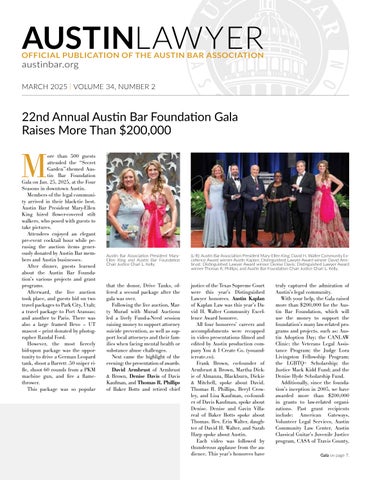
ore than 500 guests attended the “Secret Garden”-themed Austin Bar Foundation Gala on Jan. 25, 2025, at the Four Seasons in downtown Austin. Members of the legal community arrived in their black-tie best. Austin Bar President Mary-Ellen King hired flower-covered stilt walkers, who posed with guests to take pictures. Attendees enjoyed an elegant pre-event cocktail hour while perusing the auction items generously donated by Austin Bar members and Austin businesses. After dinner, guests learned about the Austin Bar Foundation’s various projects and grant programs. Afterward, the live auction took place, and guests bid on two travel packages to Park City, Utah; a travel package to Port Aransas; and another to Paris. There was also a large framed Bevo – UT mascot – print donated by photographer Randal Ford. However, the most fiercely bid-upon package was the opportunity to drive a German Leopard tank, shoot a Barrett .50 sniper rifle, shoot 60 rounds from a PKM machine gun, and fire a flamethrower. This package was so popular
Austin Bar Association President MaryEllen King and Austin Bar Foundation Chair Justice Chari L. Kelly.
(L-R): Austin Bar Association President Mary-Ellen King; David H. Walter Community Excellence Award winner Austin Kaplan; Distinguished Lawyer Award winner David Armbrust; Distinguished Lawyer Award winner Denise Davis; Distinguished Lawyer Award winner Thomas R. Phillips; and Austin Bar Foundation Chair Justice Chari L. Kelly.
that the donor, Drive Tanks, offered a second package after the gala was over. Following the live auction, Marty Murad with Murad Auctions led a lively Fund-a-Need session raising money to support attorney suicide prevention, as well as support local attorneys and their families when facing mental health or substance abuse challenges. Next came the highlight of the evening: the presentation of awards. David Armbrust of Armbrust & Brown, Denise Davis of Davis Kaufman, and Thomas R. Phillips of Baker Botts and retired chief
justice of the Texas Supreme Court were this year’s Distinguished Lawyer honorees. Austin Kaplan of Kaplan Law was this year’s David H. Walter Community Excellence Award honoree. All four honorees’ careers and accomplishments were recapped in video presentations filmed and edited by Austin production company You & I Create Co. (youandicreate.co). Frank Brown, co-founder of Armbrust & Brown, Martha Dickie of Almanza, Blackburn, Dickie & Mitchell, spoke about David. Thomas R. Phillips, Beryl Crowley, and Lisa Kaufman, co-founder of Davis Kaufman, spoke about Denise. Denise and Gavin Villareal of Baker Botts spoke about Thomas. Rev. Erin Walter, daughter of David H. Walter, and Sarah Harp spoke about Austin. Each video was followed by thunderous applause from the audience. This year’s honorees have
truly captured the admiration of Austin’s legal community. With your help, the Gala raised more than $200,000 for the Austin Bar Foundation, which will use the money to support the foundation’s many law-related programs and projects, such as: Austin Adoption Day; the CANLAW Clinic; the Veterans Legal Assistance Program; the Judge Lora Livingston Fellowship Program; the LGBTQ+ Scholarship; the Justice Mack Kidd Fund; and the Denise Hyde Scholarship Fund. Additionally, since the foundation’s inception in 2005, we have awarded more than $200,000 in grants to law-related organizations. Past grant recipients include: American Gateways, Volunteer Legal Services, Austin Community Law Center, Austin Classical Guitar’s Juvenile Justice program, CASA of Travis County, Gala on page 7.
I love LawPay! I’m not sure why I waited so long to get it set up.
+
– Law Firm in Ohio
Member Benefit Provider
Trusted by 50,000 law firms, LawPay is a simple, secure solution that allows you to easily accept credit and eCheck payments online, in person, or through your favorite practice management tools. 22% increase in cash flow with online payments Vetted and approved by all 50 state bars, 70+ local and specialty bars, the ABA, and the ALA 62% of bills sent online are paid in 24 hours
YOUR FIRM LOGO HERE
Trust Payment IOLTA Deposit New Case Reference **** **** **** 9995
***
TOTAL: $1,500.00 POWERED BY
PAY ATTORNEY
Get started at lawpay.com/austinbar 866-730-4140 Data based on an average of firm accounts receivables increases using online billing solutions. LawPay is a registered agent of Synovous Bank, Columbus, GA., Fifth Third Bank, N.A., Cincinnati, OH, and Wells Fargo Bank, N.A., Canadian Branch, Toronto, ON, Canada.
CONTENTS
AUSTINLAWYER MARCH 2025 | VOLUME 34, NUMBER 2 AL AL
INSIDE
1 22nd Annual Austin Bar Foundation Gala Raises More Than $200,000
IN EVERY ISSUE
8
Briefs
CONNECTIONS
18
12
Federal Civil Court Update
ONLINE austinbar.org
20 Austin Trauma Center Nurtures Violence Survivors at Every Level
13
Third Court of Appeals Civil Update
22 UT Study: Parole Reform in Texas Could Save Millions, Reduce Crowded Prisons
14
Third Court of Appeals Criminal Update
16
Local Jury Trial Verdicts
Fifteenth Court of Appeals Update
EMAIL billy@austinbar.org
24 ABA Suspends DEI Rule as Threat of Federal Funding Cuts Loom
DEPARTMENTS
MAIL Austin Bar Association 712 W. 16th Street Austin, TX 78701
25 American Bar Association Issues Statement on Remarks Questioning Legitimacy of Legal Review
6
President’s Column
10
AYLA
30
Entre Nous
Austin Bar app available for iPhone and Android.
26 International Academy of Trial Lawyers Issues Statement on JD Vance Comments 29
SOCIAL
Judge Shepperd to Retire at End of Current Term
LIKE facebook.com/austinbar FOLLOW twitter.com/theaustinbar
ONLINE austinbar.org NEWS & ANNOUNCEMENTS
UPCOMING EVENTS
Golf Tournament Registration Now Live! Registration for the Austin Bar’s inaugural golf tournament is now live! Sign up at austinbar.org/golfplayer to take part in the tournament on Wednesday, April 9, 2025, with an 8 a.m. shotgun start at Lions Golf Course, 2901 Enfield Road. Proceeds from the tournament benefit the Austin Bar Association.
March 28 Estate Planning & Probate CLE
Heirships 12 - 1 p.m. Travis County Probate Court 200 W. 8th St
FOLLOW instagram.com/theaustinbar CONNECT https://www.linkedin.com/ company/austin-barassociation WATCH vimeo.com/austinbar
America’s Premier Civil-Trial Mediators & Arbitrators Online
View Bios & Available Dates Calendars for our TX Chapter Members, free at
www.TexasNeutrals.org Proud ADR Sponsor to the National Defense & Plaintiff Bar Associations MARCH 2025 | AUSTINLAWYER
3
ADDICTION & MENTAL HEALTH RESOURCES 24-Hour Suicide & Crisis Lifeline - 988 - call or text | Live chat: SuicidePreventionLifeline.org Texas Lawyers’ Assistance Program (TLAP) - 1-800-343-8527 TLAP is a 24-hour confidential crisis counseling and referral program to help lawyers, law students, and judges with substance use and mental health issues. Justice Mack Kidd Fund The Austin Bar Foundation administers the Justice Mack Kidd Fund, which can provide financial assistance to individuals seeking treatment for depression or similar illnesses. Visit austinbar.org/?pg=justice-mack-kidd-fund to learn more. Personal Crisis Assistance Program (PCAP) The Austin Young Lawyers Association Foundation provides grants and/or peer support for individuals suffering from a personal crisis. Contact Debbie Kelly: 512-472-0279 x 105 Sheeran-Crowley Trust Administered through TLAP, the trust provides financial help to Texas attorneys, judges, and law students who need treatment for substance use, depression, and other mental health issues. Visit sheerancrowley. org to learn more. Alcohol & Drug Abuse Austin Drug & Alcohol Abuse Program - 512-454-8180 Alcoholics Anonymous - 512-444-0071 Cocaine Anonymous - 512-479-9327 Narcotics Anonymous Counseling - 512-480-0004 Psychiatric Emergencies Emergency Screening in a Psychiatric Crisis 24/7 - 512-472-4357 Samaritan Center (provides professional counseling services on a sliding scale) - 512-451-7337
AUSTINLAWYER OFFICIAL PUBLICATION ALOF THE ALASSOCIATION AUSTIN BAR AUSTIN BAR ASSOCIATION
Mary-Ellen King ������������������������ President Maitreya Tomlinson ������������������ President-Elect Judge Maya Guerra Gamble �� Secretary Rob Frazer ���������������������������������� Treasurer Justice Chari Kelly �������������������� Immediate Past President
AUSTIN YOUNG LAWYERS ASSOCIATION
Emily Morris �������������������������� President Jenna Malsbary �������������������� President-Elect Gracie Wood Shepherd ������ Treasurer Lena Proft ������������������������������ Secretary Sarah Harp ���������������������������� Immediate Past President
Austin Lawyer
©2025 Austin Bar Association; Austin Young Lawyers Association
EXECUTIVE OFFICES
712 W. 16th Street Austin, TX 78701 Email: austinbar@austinbar.org Website: austinbar.org Ph: 512.472.0279 DeLaine Ward....................... Executive Director Debbie Kelly.......................... Associate Executive Director Roslyn Dubberstein............. Assistant Editor Samantha McCoy................. Assistant Editor Abigail Ventress.................... Assistant Editor Billy Huntsman...................... Managing Editor Austin Lawyer (ISSN #10710353) is published monthly, except for July/August and December/January, at the annual rate of $10 membership dues by the Austin Bar Association and the Austin Young Lawyers Association, 712 W. 16th Street, Austin, TX 78701. Periodicals Postage Paid at Austin, Texas. POSTMASTER: Send address changes to Austin Lawyer, 712 W. 16th Street, Austin, TX 78701. Austin Lawyer is an award-winning newsletter published 10 times a year for members of the Austin Bar Association. Its focus is on Austin Bar activities, policies, and decisions of the Austin Bar board of directors; legislation affecting Austin attorneys; and other issues impacting lawyers and the legal professionals. It also includes information on decisions from the U.S. District Court for the Western District of Texas and the Texas Third Court of Appeals; CLE opportunities; members’ and committees’ accomplishments; and various community and association activities. The views, opinions, and content expressed in this publication are those of the author(s) or advertiser(s) and do not necessarily reflect the views or opinions of the Austin Bar Association membership, Austin Bar Association board of directors, or Austin Bar Association staff. As a matter of policy, the Austin Bar Association does not endorse any products, services, or programs, and any advertisement in this publication should not be construed as such an endorsement. Contributions to Austin Lawyer are welcome, but the right is reserved to select and edit materials to be published. Please send all correspondence to the address listed above. For editorial guidelines, visit austinbar.org in the “About Us” tab.
4
AUSTINLAWYER | MARCH 2025
PRESIDENT’S COLUMN
Texas Lawyers Concerned for Lawyers; A Resource for All of Us BY MARY-ELLEN KING, AUSTIN BAR PRESIDENT
T
he practice of law is a stressful profession. Lawyers face intense pressure with long hours, demanding clients, highstakes and high-conflict deals or cases, and high professional and societal standards. As a result, the legal profession faces high rates of depression, substance use, and behavioral addictions. Chronic stress can also strain the body to the point of causing life-threatening diseases, and is known to exacerbate issues with the cardiovascular, autoimmune, and gastrointestinal systems, to name a few. Total stress avoidance, however, is impossible in the legal profession. But there are many daily choices lawyers can make to reduce the negative impacts of stress. Sadly, the stigma around substance abuse and mental health challenges often prevents law students and lawyers from
seeking the help they need, which means many lawyers are not equipped with simple tools and support needed to de-stress in this demanding, fast-paced profession. This year, my goal through Stop the Stigma is to change the conversation and narrative around substance abuse and mental health challenges faced by law students and lawyers. When struggling, it is not uncommon to feel as if we are alone and there are no resources; however, the truth is quite the contrary. You are not alone. There are many resources available to lawyers or family members of lawyers going through difficult times. One of the many resources available to Texas lawyers is a group called Texas Lawyers Concerned for Lawyers (LCL). LCL is a community of lawyers who, through shared experiences, support one another in recovery from alcoholism, substance abuse, other addictions, and mental health challenges. One of the most potent antidotes to feeling shame is to voice your vulnerabilities and hear another person say, “Me, too.” Recovery groups, like those offered by LCL, are a powerful way to experience the healing effects of community. While there
are similarities to programs like Alcoholics Anonymous and many LCL members are working the 12 Steps, LCL has members with a range of challenges, including substance use disorder, process addictions (gambling, sex/love, porn, food, etc.), depression, anxiety, bipolar disorder, and others. Any attorneys who have experienced mental health challenges (or wish to support their peers who do) are welcome to attend regular meetings. LCL regularly meets in person and online, and you can find more information here: texasbar.com/AM/Template.cfm?Section=articles&ContentID=66140&Template=/CM/ HTMLDisplay.cfm Each year, LCL holds an annual conference. This year, the 33rd annual conference of LCL will be held June 6-8 in Dallas. The conference will feature attorneys’ personal stories of recovery, as well as discussions on busting the stigma of addictions and mental health issues in the legal profession. Because alcoholism, substance abuse, other addictions, and mental health know no strangers, all ages and levels of attorney experience, including law students, are welcome to attend the conference. Additionally, financial assistance
is offered to lawyer attendees for registration and/or hotel through partial or full scholarships. Once registration opens, you can register here: texaslcl.aidaform.com/homepage There is also an ad on page 8 with a QR code, which you can scan to go to the registration page. CLE and ethics credit will be offered. Dress is casual. No alcohol will be offered at the convention, and open AA meetings will be held during the conference. Three meals will be offered on Saturday, and breakfast will be offered on Sunday. The Conference will be held at the Doubletree by Hilton at 8250 N. Central Expy, Dallas, TX 75206. A hotel block will be held for the convention and that information will be provided upon registration. As a board member of Texas Lawyers Concerned for Lawyers, I hope to see you there! AL
Chris Andre
New Vehicle Leasing / Pre-Owned Sales Domestics / Imports / Exotics
Busy Schedule? Call me. Any Make. Any Model. Email | chris@appleleasing.com
6
AUSTINLAWYER | MARCH 2025
Phone | 512.653.3718
(L-R): Austin attorneys Gabrielle C. Smith, Adrienne Waddell, and Dominique McLeggan-Brown.
State Bar of Texas President Steve Benesh and State Bar Board Director Lowell Keig.
Austin Bar President Mary-Ellen King addresses the audience from the beautifully decorated stage at the Four Seasons.
(L-R): Austin Bar Association President Mary-Ellen King, Rev. Erin J. Walter, daughter of David H. Walter, and Judge Maya Guerra Gamble.
The Gala’s theme was “Secret Garden,” and these stilt-walkers hit a homerun with their decorative costumes.
Gala from page 1.
ed with registration, setup, and breakdown. Be sure to watch the videos honoring the Distinguished Lawyers and David H. Walter award winners on YouTube at shorturl. at/BInWJ. Thank you again for your sup-
and the Texas Fair Defense Fund, to name a few. The Austin Bar Foundation sincerely thanks Gala Committee Chairs Nadia Bettac, Judge Sylvia Holmes, and Shelby O’Brien for
their efforts in pulling off this extraordinary event. Additionally, thank you to Live Auction Chair Shannon Meroney and Silent Auction Chair Sarah Harp for their help getting items to auction off. Finally, thank you to all the volunteers who assist-
port, and we can’t wait to see you next year! AL
MARCH 2025 | AUSTINLAWYER
7
BRIEFS New Members The Austin Bar welcomes the following new members: Noosa Al-Sarraj Jared Anable Jack Barkle Adam Bell
ABOVE (from left): Albright, Batrice, Crowley, Kuempel, Lee
Erin Bennett Allie Bergeron Natasha Cicchino Connor Cox Justin Cox Jeff Johnson Aubrey Jordan Kristen Katz Edward Kaye Kayla Messamore Elizabeth Nedrow Eric Opiela Franchizca Scipio Caleb Shook Eoin Tinney Kathleen Vossler Alexis Williams Alan Winograd
KUDOS Congratulations to Batrice Law Firm and founder Paul Batrice who received the 2024 Austin Community Choice Award for outstanding service in the personal injury law category. The award winners are chosen by Austin residents. Paul is a graduate of Oklahoma City University School of Law. He has been recognized in the Multi-Million Dollar Advocates Forum, recognized as a Top 100 Trial Lawyer by “National Trial Lawyers,” recognized in Excellence by “Lawyers of Distinction,” and has been elected a lifetime fellow of the Texas Bar Foundation. He is a longtime member of the Austin Bar Association and is a sustaining fellow of the Austin Young Lawyers Association. ON THE MOVE Congratulations to Matt Lee, who has been promoted to partner at Norton Rose Fulbright’s Austin office. Matt’s practice focuses on public finance matters, where he serves as bond counsel, underwriter’s counsel, disclosure counsel, issuer’s counsel, and trustee’s counsel on a broad range of public finance transactions in Texas and across the United States. Congratulations to Jeremy Albright, who has been promoted to partner at Norton Rose Fulbright’s Austin office. Jeremy represents clients in post-issuance validity proceedings, with a focus on inter partes reviews and ex parte reexaminations. He has achieved success for patent owners and patent challengers alike. Such representation has included successfully arguing at Patent Trial and Appeal Board final hearings. Congratulations to Ashley Kuempel, who has been promoted
8
AUSTINLAWYER | MARCH 2025
to partner at Norton Rose Fulbright’s Austin office. Ashley’s practice focuses on white-collar criminal defense, internal corporate investigations, and securities litigation, including shareholder-litigation defense, SEC enforcement matters, and complex commercial litigation. She regularly advises and defends companies, as well as their officers and directors, on a wide range of civil, criminal, and regulatory matters. Congratulations to Josh Crowley, who has joined Ruffner Herron as senior counsel. Josh brings more than a decade of litigation
expertise to support clients in real estate and business matters, including real estate development, the purchase and sale of real estate, property owner associations, defective construction claims, and deceptive trade practices.
AUSTIN YOUNG LAWYERS ASSOCIATION
Volunteers & Donors Make 15th AYLA MLK Day of Service a Success BY JENNA MALSBARY, AYLA PRESIDENT-ELECT
T
• SAFE safeaustin.org; • Center for Child Protection centerforchildprotection.org; • We Are Blood weareblood.org; • Any Baby Can anybabycan.org; • Casa Marianella casamarianella.org; • Austin Diaper Bank austindiapers.org; • Central Texas Food Bank centraltexasfoodbank.org; and • Austin Allies austinallies.org. AYLA follows the mantra of justice through service and encourages the Central Texas legal community to continue to serve those in need in the ways they can. We look forward to planning the 16th-annual Day of Service and seeing you at the next community service event. AL
One of the organizations AYLA supported this past MLK Day of Service was Austin Humane Society. Go adopt!
AYLA partnered with Generation Serve on January 20 for its annual MLK Day of Service. Generation Serve’s mission is to connect families with local non-profits and facilitate philanthropic opportunites, ensuring future generations understand the importance of giving. AYLA families were able to volunteer with a variety of organizations through the partnership.
he 15th Annual Austin Young Lawyers Association Day of Service on Martin Luther King, Jr., Day was tremendously successful with the help of volunteers and donors. This local project is modeled after the national Martin Luther King, Jr., Day of Service, which is intended to transform Dr. King’s life and teachings into community service that helps solve social problems. There were 14 individuals who were able to donate whole blood for the We Are Blood drive, which equals 42 potential lives saved. This event also donated over $775 in items for the Center for Child Protection birthday box initiatives. All of the organizations AYLA supported this year are: • Austin Humane Society austinhumanesociety.org; • Generation Serve generationserve.org;
UPCOMING EVENTS THUR, MARCH 27 Diversity Bar Mixer 5:30 - 7 p.m. Vince Young Steakhouse 301 San Jacinto Blvd.
Generous volunteers spent their MLK Day supporting local nonprofits.
10
AUSTINLAWYER | MARCH 2025
SAT, MARCH 29 AYLA Crawish Boil Fundraiser 12 - 4 p.m. Park across from Hilgers House 712 W. 16th St. Registration & sponsorships available at austinbar.org/ crawfish2025
AUSTIN YOUNG LAWYERS ASSOCIATION
Mark Your Calendars for these Spring Events with AYLA Diversity Bar Mixer – March 27, 2025 Crawfish Boil – March 29, 2025 Cap 10K – April 6, 2025 Bench Bar – April 11, 2025 Freshsquires Judicial Wine Tasting – April 24, 2025
Volunteers brought out their families to take part in acts of service to benefit the Austin community.
Patrick
Keel
Mediator Arbitrator
Former District Judge
patrickkeel.com Available by video and in person.
MARCH 2025 | AUSTINLAWYER
11
FEDERAL CIVIL COURT UPDATE
Jason LaFond is a board-certified appellate lawyer with significant experience in the Fifth Circuit. He is Counsel at Scott Douglass & McConnico LLP.
The following are summaries of selected civil opinions issued by the Fifth Circuit in January 2025. The summaries are overviews of particular aspects of the opinions; please review the entire opinions.
> APPELLATE PROCEDURE: 28 U.S.C. § 1292(b) did not permit interlocutory review of pretrial ruling on proper measure of damages. Silverthorne Seismic v. Sterling Seismic Services, 125 F.4th 593 (5th Cir. 2025). This certified interlocutory appeal arose from a trade-secret misappropriation claim under the Defend Trade Secrets Act of 2016 (DTSA). Silverthorne licensed Casillas to use Silverthorne’s data. Under their arrangement, Silverthorne would send the data to Sterling, which would then process the data and pass it on to Casillas. Sterling allegedly transmitted unlicensed Silverthorne data to Casillas, which Casillas allegedly used to attract investors. Silverthorne sued Sterling for misappropriation and sought damages, including a reasonable royalty under the DTSA. Before trial, the district court issued an order defining how Silverthorne could prove damages under the DTSA. Relying on 1974 Fifth Circuit 12
AUSTINLAWYER | MARCH 2025
precedent defining a reasonable royalty for common-law trade secret claims, the district court defined a reasonable royalty as “what Silverthorne and Sterling would have agreed to for Sterling to use the alleged trade secret.” Silverthorne argued for a broader measure adopted by other circuits because the DTSA is broader than the common law. Silverthorne claimed that it would not be able to prove damages under the district court’s definition. Silverthorne sought an interlocutory appeal of this damages ruling, which the district court certified under 28 U.S.C. § 1292(b). A Fifth Circuit motions panel granted permission to appeal. The Fifth Circuit motions panel vacated the grant of leave and dismissed the appeal for lack of jurisdiction, holding that the district court’s order did not satisfy the strict requirements of § 1292(b). The Court explained that Under § 1292(b), a controlling question of law must be: (1) A pure question of law, (2) that immediately and materially affects the outcome of the litigation. The Court ruled that damages were not yet a controlling issue because Silverthorne had not yet proven liability. The Court reasoned that the case would proceed to trial regardless of its decision on the reasonable-royalty standard and that Silverthorne may not be able to prove damages under any standard, making the question contingent rather than controlling. The Court emphasized that damages-measure issues are generally not controlling. The Court said further that interlocutory appeals should accelerate, not delay, resolution of the case. But allowing the appeal had already delayed trial by over a year and that resolving the damages issue at this stage would not obviate the need for trial. And if Silverthorne failed to establish liability, the damages issue would become moot, rendering appellate review a waste of judicial resources. ADMINISTRATIVE LAW: Competitor standing requires actual or imminent competitive harm.
Great Lakes Dredge & Dock v. Magnus, 2025 WL 429583 (5th Cir. 2025). In a decision clarifying competitor standing in administrative law, the Fifth Circuit affirmed the district court’s dismissal of a challenge to a Customs and Border Protection (CBP) ruling on the Jones Act’s applicability to offshore wind projects. The Court held that Great Lakes lacked standing because it failed to show that CBP’s ruling created an actual or imminent competitive injury. Great Lakes is a dredging company specializing in scour protection—placing rock to prevent erosion around offshore wind farm structures. In 2020, Great Lakes sought a CBP letter ruling on whether the Jones Act barred foreign-flagged vessels from transporting scour protection rock from U.S. points to the Outer Continental Shelf. Great Lakes’ request used an offshore wind farm near Martha’s Vineyard as an example. CBP initially ruled that all such transportation must be performed by Jones Act-compliant vessels (i.e., U.S.-built, U.S.-owned, and U.S.-registered). But CBP later modified and limited its ruling, finding that foreign vessels could carry the first shipment of scour rock to a new project. Great Lakes filed an administrative appeal, which CBP denied. Great Lakes then sued CBP under the Administrative Procedure Act (APA), arguing that the modified ruling was unlawful because it allowed unfair competition from foreign vessels. The district court granted sum-
mary judgment for CBP, finding that Great Lakes lacked standing, and the Fifth Circuit affirmed. The Court first acknowledged that competitor standing is a recognized doctrine, meaning that a regulatory action that creates additional competition can be an injury-in-fact. But, adopting a rule from the D.C. Circuit, the Court held that the mere potential for increased competition is not enough—there must be evidence that the challenged action will cause actual or imminent competitive harm. After examining the evidence, the Court concluded that any competitive harm to Great Lakes from the ruling was entirely hypothetical. The CBP ruling applied to the Vineyard Project, for which another company had already performed the scour protection work. And Great Lakes presented no evidence that upcoming offshore wind projects would involve U.S.sourced rock. AL
512-487-7994 hello@herlihy-law.com scottherlihylaw.com
THIRD COURT OF APPEALS CIVIL UPDATE
Laurie Ratliff is a former staff attorney for the Third Court of Appeals. She is board-certified in civil appellate law by the Texas Board of Legal Specialization and owner of Laurie Ratliff LLC.
The following are summaries of selected civil opinions issued by the Third Court of Appeals during January 2025. The summaries are an overview; please review the entire opinion. Subsequent histories are current as of February 10, 2025.
> ARBITRATION: Court reverses trial court’s failure to enforce arbitration clause. Design Tech Homes of Tex., LLC v. Siemens, No. 03-23-00735-CV (Tex. App.—Austin Jan. 10, 2025, no pet. h.) (mem. op.). The parties’ construction contract contained an arbitration provision. Design sued Siemens to foreclose on its mechanic’s and materialman’s lien and sought damages.
Siemens counterclaimed for defective construction. The trial court denied Design’s motion to compel arbitration. The court of appeals rejected Siemens’ arguments that the arbitration provisions were ambiguous. The court also rejected Siemens’ argument that Design waived arbitration by filing suit. During the eight-month delay between Design filing suit and filing its motion to compel arbitration, Siemens made a settlement demand, the parties unsuccessfully mediated, no discovery was conducted, no substantive motions were filed, and the case was not set for trial. The court held that Design did not substantially invoke the judicial process to waive arbitration and reversed and remanded. ORIGINAL PROCEEDING: Court denies mandamus relief based on delay in filing. In re Williams, No. 03-25-00013CV (Tex. App.—Austin Jan. 15, 2025, orig. proceeding) (mem. op.). Relator sought mandamus relief from the trial court’s order denying her motion to transfer under Family Code 155.201(a) in a SAPCR. The trial court signed the challenged order on December 13, 2024. Relator filed her petition for writ of mandamus after 4 p.m. on January 10, 2025, the Friday before the final hearing set on January 13. The court of appeals concluded that relator waived her right to mandamus relief by the delay in filing her petition.
The court denied relief without requesting a response. The dissent concluded relator showed a preliminary right to relief and would have requested a response. FAMILY LAW: Court determines right to choose primary residence does not give parent minimum time of possession. Gopalan v. Marsh, No. 03-2200649-CV (Tex. App.—Austin Jan. 23, 2025, no pet. h.). The trial court appointed the parties joint managing conservators. Consistent with the jury’s finding, the trial court gave Gopalan the exclusive right to designate the children’s primary residence but awarded him less possession time than the presumed minimum for a possessory conservator. The court of appeals rejected Gopalan’s argument that the possession schedule contravened the jury’s verdict and violated the Texas Constitution and Family Code. The court concluded that the Family Code does not provide a minimum amount of possession along with the right to choose the child’s primary residence. The court found that the evidence supported the trial court’s departure from the standard possession order and affirmed. The concurrence and dissent concluded that “primary residence” means at least half, if not slightly more than half, of the time, found that the possession schedule violates the Texas Constitution and the Family Code, and would have reversed.
RESTRICTED APPEAL: Court reverses no-answer default based on service defect. Dream Realty & Constr. Corp. v. Lin Family Revocable Trust Dated May 9, 2013, No. 03-23-00447CV (Tex. App.—Jan. 24, 2025, no pet. h.) (mem. op.). Dream Realty failed to answer Trust’s breach-ofcontract lawsuit. The trial court granted Trust’s motion for default judgment. Dream filed a restricted appeal, contending Trust’s attempted service of process did not comply with the rules. The court of appeals noted that the record must demonstrate strict compliance with the rules for issuance, service, and return of citation to support a default. As relevant here, Rule 107(c) requires that with service by certified mail, the return receipt must contain the addressee’s signature. The return receipt contained a signature but not that of the corporation’s registered agent. The court concluded that the discrepancy between the recipient and the signer is error apparent on the face of the record. Thus, return of service failed to strictly comply with Rule 107. The court reversed and remanded. AL
Divorce and Child Custody Surveillance ~ Undercover Background Checks Computer & Phone Forensics Corporate Investigations Expert Testimony and more STRICTLY CONFIDENTIAL
“Information is power, the not knowing is devastating.”
Anji Maddox
Featured in Forbes Magazine
Austin, Round Rock, & Dallas
MARCH 2025 | AUSTINLAWYER
13
THIRD COURT OF APPEALS CRIMINAL UPDATE
Zak Hall is a staff attorney for the Third Court of Appeals. The summaries that follow represent the views of the author alone and do not reflect the views of the court or any of the individual Justices on the court.
> EVIDENCE ADMISSIBILITY – BREACH OF COMPUTER SECURITY: Evidence found on defendant’s phone by defendant’s wife was inadmissible. State v. Holloway, ___ S.W.3d ___, No. 03-23-00423-CR (Tex. App.—Austin July 26, 2024, no pet.) (designated for publication). Holloway was charged with aggravated sexual assault. Evidence of an extraneous offense was found on Holloway’s phone by his wife. She found the evidence by accessing Holloway’s phone without his consent, by using his thumb while he slept to unlock the phone. Holloway filed a motion to suppress all evidence and testimony that resulted from his wife, with whom he was now estranged, accessing his phone. He argued that she obtained the evidence in violation of state law and that it was therefore inadmissible. At the hearing on the motion to suppress, Wife testified that “she had a right to the phone because they were married and because she paid the bill and bought the phone he was using.” The trial court granted the motion to suppress, and the State appealed. The appellate court affirmed. The court observed that under Article 38.23 of the Code of Criminal Procedure, “[n]o evidence obtained by an officer or other person in violation” of the law 14
AUSTINLAWYER | MARCH 2025
“shall be admitted in evidence against the accused on the trial of any criminal case” and that, “[u] nlike the Fourth Amendment, which does not extend to private citizens acting in a private capacity, Article 38.23’s ‘other person’ provision allows for suppression of evidence obtained by private individuals in violation of state or federal constitutions or laws.” A person commits the offense of breach of computer security if the person knowingly accesses a computer, computer network, or computer system without the effective consent of the owner. Holloway argued, and the trial court found, that Wife had violated this law when she accessed Holloway’s phone without his permission. The appellate court agreed. The court explained that “an ‘owner’ includes someone with ‘a greater right to possession of the property than the actor’” and that “the breach of computer security statute on its face does not create an exception for a spouse, community property, or a co-owner with a lesser possessory right to access a computer without the owner’s consent.” The trial court found that Holloway “had the greater possessory right to the phone than Wife did,” and the appellate court concluded that this finding was supported by the record. The court also rejected the State’s contention that Wife did not commit the offense because she did not knowingly access the phone without Holloway’s consent. The court explained that there was conflicting evidence on this element, and the court deferred to the trial court’s resolution of the conflicting evidence in Holloway’s favor. JURY SELECTION – RACIAL COMPOSITION: Defendant failed to prove that Travis County jury-selection process systematically excludes people who self-identify as Black and Hispanic. Sedillo v. State, No. 03-23-00811CR (Tex. App.—Austin Aug. 30, 2024, no pet.) (mem. op., not designated for publication). Sedillo was charged with DWI. Prior to
trial, he filed a motion to quash the jury array, arguing that “Black and Hispanic or Latino jurors ha[d] been systematically excluded” from the array, thereby depriving him of his Sixth Amendment right to an impartial jury. Following a hearing, the trial court denied the motion based on the limited evidence Sedillo presented. The appellate court agreed that Sedillo had failed to prove his case. The court observed that “although the Constitution does not require proportionate representation of races on jury panels . . . [t]he Sixth Amendment requires that the jury panel from which the petit jury is selected represent a fair cross-section of the community.” After summarizing the three-pronged test “by which a defendant may establish a prima facie violation of the fair-crosssection requirement,” the court explained that the evidence presented by Sedillo, which consisted of the research and personal experiences of a Travis County defense attorney, “was insufficient
to ascertain the proportions of Travis County residents who self-identify as Black or Hispanic or those groups’ representation in Travis County venires and, consequently, could not provide a basis for the court to find a prima facie fair-cross-section violation.” The court concluded, “In light of the relatively small sample size encompassed by his experience, his reliance on census figures for the community’s racial demographics, the lack of scientific rigor in his classification scheme, and the possibility of error from relying on surnames, we cannot say that his testimony establishes that people who self-identify as Black or Hispanic are underrepresented on Travis County venires.” AL
Complexity is our specialty. The law firm of Slack Davis Sanger specializes in navigating and winning complex personal injury cases. With three decades of experience, an in-house nurse paralegal and a team of highly-regarded lawyers, we have the technical and legal expertise to outwork, out-think, and out-resource any opposition.
Austin | Dallas | Fort Worth | SLACKDAVIS.COM Aviation | Medical Malpractice | Truck & Workplace Injury | Class Action
LOCAL JURY TRIAL VERDICTS
January District & County Court Jury Trial Verdicts BY VELVA PRICE, TRAVIS COUNTY DISTRICT CLERK
Editor’s Note: The monthly jury trial verdicts update is first published through Bar Code and the Austin Bar app. Download the app today on either the App Store or the Google Play Store. CIVIL Bradford Clements v. Anne Cagniart-Singh, Harbir Singh Cause No.: D-1-GN-23-000634 Judge: Amy Clark Meachum, 201st Civil District Court Dates: Jan. 13 - 17, 2025 Attorneys: Plaintiff: Brad Clements, Pro Se Plaintiff Attorney [Texas Licensed] Defendants: Anthony Icenogle, Icenogle & Boggins, PLLC [Austin] Case Summary: This case is a residential lease dispute. A unanimous jury found that the defendants failed to comply with the lease regarding the security deposit but that the conduct was not in bad faith. The jury further found that the parties agreed to modify the lease, but the defendants failed to comply with the modified lease terms. The plaintiff was awarded security deposit that was withheld and not refunded - $7,879.84; rent payment - $596.77; necessary legal services for representation in the trial court - $3,500. Alijha Rizo v. David Kapsner Cause No.: D-1-GN-23-000168 Judge: Daniella Deseta Lyttle, 261st Civil District Court Dates: Jan. 14 - 17, 2025 Attorneys: Plaintiff: Thomas D. Flanagan, Lee, Gober & Reyna, PLLC [Austin] Defendant: Adam H. Wyma, Law Offices of Fanaff, Gonzales, Baldwin & Cunningham Case Summary: This case is a motor vehicle accident, which occurred on Feb. 2022. A jury of 16
AUSTINLAWYER | MARCH 2025
10 found the plaintiff proximately caused the occurrence. Dominc Monroe v. City of Manor Cause No.: D-1-Gn-23-002595 Judge: Maria Cantu Hexsel, 53rd Civil District Court Dates: Jan. 27 - 30, 2025 Attorneys Plaintiff: David G. Gutierrez, The Law Firm of Oscar A. Garza, PLLC [San Antonio] Defendant: Blair J. Leake, Wright & Greenhill, P.C. [Austin] Case Summary: This case is a motor vehicle accident, which occurred in November 2021. A jury of 10 awarded the following damages to the plaintiff: past physical pain and mental anguish - $500; future physical pain and mental anguish - $0; past physical impairment - $0; future physical impairment - $0; past reasonable medical care expenses - $2,500; past disfigurement - $0. Nicole Shelby-King v. Nancy Swenson Smith Cause No.: D-1-Gn-23-001012 Judge: Laurie Eiserloh, 455th Civil District Court Dates: Jan. 28 - 31, 2025 Attorneys: Plaintiff: Myranda Vaughn, Daniel Stark, P.C, [Bryan] Defendant: Alexandra C. Yamron, Law Offices of Fanaff, Gonzales, Baldwin & Cunningham Case Summary: This case is a motor vehicle accident, which occurred on Oct. 24, 2021. A jury of 10 found both the plaintiff [15 percent] and defendant [85 percent] proximately caused the occurrence. The jury awarded the following damages: past medical care expenses - $57,796; future medical care expenses - $20,000; past physical pain and mental anguish - $0; future physical pain and mental anguish - $0; past physical impairment - $20,000; future physical impairment - $0.
Julius Kadia v. Texas Health and Human Services Commission Cause No.: D-1-Gn-20-003118 Judge: Maya Guerra Gamble, 459th Civil District Court Dates: Jan. 28 - Feb. 6, 2025 Attorneys: Plaintiff: Corinna Chandler, Chandler & Shavin, PLLC [Dallas] Defendant: Drew Harris, Attorney General of Texas Case Summary: This case is an employment discrimination case. A jury of 10 found that the plaintiff’s national origin was not a motivating factor to refuse to promote for 7 positions. The jury further found that the defendant did not engage in adverse employment actions because the plaintiff filed complaints of discrimination and retaliation for two positions but did find that adverse actions were taken for 10 various positions. The jury awarded damages as follows: Back pay - $150,000; past compensatory damages $300,000; future compensatory damages - $0; legal services for representation in the trial court $930,000; representation in court of appeals - $99,000; representation at the petition for review stage in the Supreme Court of Texas - $27,500; representation at the merits briefing stage in the Supreme Court of Texas $27,500; representation through oral arguments and completion of proceedings in the Supreme Court of Texas - $16,500. Blanca Chavez v. Lam Lou Thanh Cause No.: C-1-Cv-24-000486 Judge: Eric Shepperd, Court-AtLaw Judge Dates: Jan. 27 - 28, 2025 Attorneys: Plaintiff: Carolyn Brown, Lorenz and Lorenz, PLLC [Austin] Defendant: Ariana M. Perez, Law Offices of Fanaff, Gonzales, Baldwin & Cunningham Case Summary: This case is a
motor vehicle accident, which occurred in May 2023. A jury of five found that the defendant was responsible for the accident and awarded the following damages: past physical pain and mental anguish - $500; future physical pain and mental anguish - $0; past physical impairment - $500; future physical impairment - $0; past reasonable necessary medical care - $5,500; future reasonable necessary medical care - $0. Merle Frizzell v. Alfonso Calveart Hernandez Cause No.: C-1-Cv-20-005096 Judge: Daniella Deseta Lyttle, 261st Civil District Court Dates: Jan. 30, 2025 Attorneys: Plaintiff: Thomas Pronske, Lorenz and Lorenz, PLLC [Austin] Defendant: Jenny Forehand, Meynier, Reese Liber & Matte [San Antonio] Case Summary: This case is a motor vehicle accident, which occurred in March 2019. A mistrial was declared by the court. CRIMINAL State of Texas v. Mitzy Lopez Cause No.: C-1-Cr-20-202275 Judge: Bianca Garcia Dates: Jan. 6, 2025 Attorneys: State of Texas: Trevor Mathes, Asst. County Attorney Defendant: Alfonso C. Hernandez [Austin] Case Summary: Defendant was charged with Assault with Bodily Injury. A jury of six was chosen, the defendant then pled nolo contendere and received 12 months supervision including no victim contact, anger management classes, counseling, and AA meetings. State of Texas v. Ezra Tessema Cause No.: C-1-Cr-24-212024 Judge: Nancy Hohengarten
Dates: Jan. 8 - 9, 2025 Attorneys: State of Texas: Trevor Mathes, Asst. County Attorney Defendant: Scott Constantine, Public Defenders Office Case Summary: Defendant was charged with Criminal Trespass. The jury of six found the defendant guilty. The defendant was sentenced to 180 days in Travis County Jail by the court. State Of Texas v. Douglas Birden Cause No.: D-1-Dc-24-904086 Judge: Bob Perkins Dates: Jan. 13 - 17, 2025 Attorneys: State of Texas: Efrain DeLaFuente, Asst. District Attorney Defendant: Jeremy Shane Sylestine [Austin] Case Summary: Defendant was indicted on two counts of Aggravated Sexual Assault of a Child, pertaining to a 1993 cold case. The jury of 12 found the defendant guilty in two separate counts. The jury sentenced the defendant to 30 years in TDCJ.
State of Texas v. Alexander Briones Cause No.: C-1-Cr-23-501185 Judge: Dimple Malhotra, CourtAt-Law Judge Dates: Jan. 14 - 16, 2025 Attorneys: State of Texas: Max Shaps, Asst. County Attorney Defendant: Joseph Aragon [Austin] Case Summary: Defendant was charged with Assault Family Violence. The jury of six found the defendant guilty. The defendant agreed to the following punishment after the jury’s finding: 12 month probation, $4,000 fine, counseling classes, and no victim contact. State of Texas v. Abel Bermudez-Ornelas Cause No.: D-1-Dc-22-300864 Judge: Brandy Mueller, 403rd Criminal District Court Dates: Jan. 14 - 28, 2025 Attorneys: State of Texas: Jean Sullivan, Asst. District Attorney Defendant: Charles Baird [Austin]
Case Summary: Defendant was indicted on two counts of Murder because two males were found shot inside a vehicle in Elgin, TX. The jury of 12 found the defendant guilty in each count. The jury sentenced the defendant to 60 years in TDCJ. State of Texas v. Christopher Bray Cause No.: C-1-Cr-22-501587 Judge: Mary Ann Espiritu, CourtAt-Law Judge Dates: Jan. 28, 2025 Attorneys: State of Texas: Elsie Aton, Asst. County Attorney Defendant: Jessica Bernstein [Austin] Case Summary: Defendant was charged with Indecent Assault. The jury of six found the defendant guilty. The court sentenced the defendant to 24 days’ confinement in the County Jail.
Dates: Jan. 27 - 30, 2025 Attorneys: State of Texas: Jamie Liu, Asst. District Attorney Defendant: Angelica Patrice Adel [Austin] Case Summary: Defendant was indicted on Sexual Assault, which occurred in 2016. The jury of 12 found the defendant guilty. The jury sentenced the defendant to six years in TDCJ and is required to register as a sex offender. AL
State of Texas v. Afif Hidvelasco Cause No.: D-1-Dc-22-500048 Judge: Brenda Kennedy
Local Solutions. Global Reach.
MARCH 2025 | AUSTINLAWYER
17
Introduction to and Update on the Fifteenth Court of Appeals BY DANIELA PEINADO WELSH, TRIAL & APPELLATE LAWYER GRAVES DOUGHERTY HEARON & MOODY courts of appeals. Then there was a unique entrant on the field. After some local debate and even a constitutional challenge,4 the Fifteenth Court of Appeals began operations six months ago, in September 2024.
Daniela is a first-chair litigator and trial lawyer at Graves Dougherty Hearon & Moody. She is licensed to practice in Texas, California, and D.C. This article provides an update for local lawyers on the new Fifteenth Court of Appeals. Historical Foundation The creation of the Fifteenth Court of Appeals marks a milestone in Texas’ judicial evolution. The foundations of our appellate system date back to 1891 when a constitutional amendment established the Texas Supreme Court as the highest court for civil matters and invited the Texas Legislature to establish any intermediate appellate courts for This landmark civil appeals.1 change introduced a system where Texas would be “divided into courts of appeals districts,” and each of the courts in those districts would be made up of just three justices.2 The first of these three-justice appellate courts with district-wide jurisdiction that was created by the Texas Legislature is none other than the appropriately named First Court of Appeals. It was established in 1892, the same year as our Austinbased “Third” Court of Appeals. The last of the lineage was the Fourteenth Court of Appeals, which was established in 1967, 75 years later. By 1981, the courts were authorized to increase the number of justices to more than three each.3 And as of 1984, Texas has maintained 80 justices across its 14 18
AUSTINLAWYER | MARCH 2025
Appellate Jurisdiction In addition to creating a new appellate court for the first time in a half-century, the Fifteenth Court of Appeals has a distinctive and expansive jurisdictional mandate. Rather than having jurisdiction within a particular judicial district, the Fifteenth Court of Appeals has statewide jurisdiction.5 This statewide jurisdiction involves exclusive jurisdiction over appeals from the newly created Texas Business Court, as well as appeals over state-related cases. Those staterelated cases are matters brought by or against the State, including the University of Texas, and matters challenging the constitutionality of a state statute. All that to say, the Fifteenth had cases on day one. Judicial Composition The Court is currently composed of three experienced and distinguished justices: Chief Justice Scott Brister, who has served on four other trial and appellate courts in the State for 20 years, including the Texas Supreme Court; Justice Scott Field, Justice Scott Field, a former Third Court of Appeals justice and Williamson County trial court judge; and Justice April Farris, a former First Court of Appeals justice and Assistant Solicitor General. After September 1, 2027, two more spots will open on the Fifteenth Court of Appeals.6 Subsequently, justices will be elected to six-year terms through statewide elections, as with the other courts of appeals. Inaugural Oral Arguments I attended the Court’s first oral arguments on October 30, 2024,
The initial three justices appointed to the Fifteenth Court of Appeals are: (LEFT) Chief Justice Scott Brister; (TOP RIGHT) Justice April Farris; and (BOTTOM RIGHT) Justice Scott Field. After September 1, 2027, the court will expand to five justices. Subsequently, justices will be elected to six-year terms through statewide elections.
in the Court of Criminal Appeals (a stone’s throw from the Capitol). The Court was prepared, engaged, with questions that offered a small glimpse into its docket and makeup: In re Google, LLC, No. 15-2400087-CV (Tex. App. Jan. 16, 2025) This case involved the household name’s petitions for writ of mandamus complaining that two trial courts abused their discretion by failing to compel the deposition of the State of Texas in enforcement actions against Google regarding use of consumer biometric data. The State argued that it was not an “entity” or “organization” within the applicable procedural rules subject to a corporate representative deposition, at least in part because it cannot command the appearance of an independent agency. Four opinions were rendered on January 16, 2025, with two granting in part and denying in part (Cause Nos. 15-24-00087-CV, 1524-00090-CV) and two dissenting
(same) (Brister, C.J.). The Chief would deny relief, but the majority held “[b]ecause Google is entitled to depose the State of Texas, we grant relief in part in both proceedings to allow a deposition of the State to go forward, while reserving for the respective trial courts to decide the scope and parameters of those depositions.” Department of Public Safety v. Texas Tribune, No. 15-24-00010-CV (Tex. App. Nov. 18, 2024) This case involved a public information request by a consortium of newspapers seeking access to records related to the Uvalde shooting, where DPS withheld nearly three terabytes of information from disclosure. Plaintiffs filed this lawsuit for release, which the trial court granted, shortly after a district attorney filed a plea in intervention favoring DPS’s position. The case was transferred from the Third Court and later submitted to the Fifteenth Court on oral argument.
DPS argued for reversal of summary judgment based on its invocation of, and the newspaper’s alleged failure to rebut evidence of, the law enforcement privilege. There was post-submission letter briefing, but no decision as of last month. Crowley Indep. Sch. Dist. v. Stoneham, No. 15-24-00051-CV (Tex. App. Nov. 19, 2024) This was another case touching on the unfortunate issue of school violence, in this case where a hearing examiner had revoked an educator’s teaching license, but the Commissioner had reversed. Counsel for the teacher explained, because the Commissioner concluded that the hearing examiner was “arbitrary and capricious” by failing to apply the relevant educatory immunity factors, the Commissioner properly substituted in his own judgment. The Court affirmed in part and reversed and remanded in part, affirming the trial court’s judgment with the exception of the attorney fee award. The attorney fee award was an abuse of discretion under Roohrmoos Venture v. UTSW DVA Healthcare LLP because it was based on an attorney affidavit
that did not include billing records such as the hours worked and tasks performed. Six-Month Statistics In its inaugural months and at the time of submission of this article for publication, the Fifteenth Court of Appeals has released opinions and orders on 23 separate dates with a total of 45 civil causes decided and 16 civil orders rendered. Notable, too, is that at least 26 of these decisions involved cases originating from Travis County, underscoring the Court’s substantial engagement with local legal matters formerly taken up by the Third. We look forward to studying additional developments with the Court and its jurisprudence. Disclaimer: I have spoken and written on the Fifteenth Court of Appeals since before its inception. I used notes from that activity as inputs into Claude.ai to produce a first draft of the above output, which was checked line by line by me for accuracy and readability. All assertions made are within my personal experience and understanding. For commentary
Offices for the Fifteenth Court of Appeals are located in suite 607 of the William P. Clements Building in Austin, just northwest of the Capitol.
on how AI may disrupt the legal profession for the better and the worse, please look out for future articles from me. AL
ENDNOTES 1 2 3 4
Tex. Const. art. V § 1 (1891). Id. § 6 (1891). Id. § 6 (1978). In re Dallas County, 697 S.W.3d 142
(Tex. 2024). 5 Tex. Gov’t Code § 22.201(p). 6 Id. § 22.216(n-1)–(n-2).
partners:
associate attorneys: Arielle Rosvall, Coleen Kinsler
MARCH 2025 | AUSTINLAWYER
19
Razor’s Edge: Austin Trauma Center Nurtures Violence Survivors at Every Level BY CLAUDIA KOLKER, AUSTIN FREE PRESS
D
r. Calvin A. Kelly leaned back in the barber’s chair for a trim. Chatting with the other clients, thoughtfully listening to their stories, Kelly was doing more than maintaining a tidy beard. Visiting the barbershop— traditionally one of the most trusted environments for Black men —shored up his work just down the hall, where he runs the first trauma recovery center in Texas. Kelly, a psychologist, is chief clinical officer of the Harvest Trauma Recovery Center (Harvest TRC), which opened its doors in November 2023. The clinic provides free individual and group therapy to Austin area survivors of violent crime. It also coordinates with 30 nonprofits in the same building to offer free housing, transportation, food, youth, and legal guidance. “I have sent people here many times,” Kelly said, from the barber’s chair. Looking good, sharing experiences, even the aromatherapy of the barber’s cologne recipe are inherently healing, he said. “This is group therapy.” The Harvest Trauma Recovery Center is the newest project at East Austin’s African American Youth Harvest Foundation, a nonprofit, wraparound service center founded and operated by philanthropist Michael Lofton. Harvest TRC’s goal, Lofton said, is to treat trauma as a public health issue. That means providing not only short-term individual treatment but addressing all the practical, familial and material needs that can prevent healing. Without treatment, research shows, about 50 percent of violent crime survivors will suffer from post-traumatic stress disorder (PTSD) and a host of related problems. Yet the most common victims of trauma often are those 20
AUSTINLAWYER | MARCH 2025
Barber Donald Hyder trims the beard of Richard Lawrence, who is not a Harvest Trauma client.
least able to access treatment. In its first year, the Harvest TRC reported that approximately 87 percent of the crime survivors who met the Center’s eligibility criteria belong to communities of color. Of these eligible clients, 93 percent belong to low-income families. Nationally, only one in 10 of people who survive a violent crime get direct help from a victims’ service agency. To treat neglected populations, Harvest TRC gives its clients personalized counseling and helps them access food, housing assistance, transportation, and even children’s toys. The results in its first year were striking. “We contracted to care for 120 clients,” Lofton said, “and at the end of the year we had more than 800.” Of these, 502 met the treatment criteria of the National Alliance of Trauma Recovery Centers, on which the center is based. These criteria include having experienced violent crime within the last three
years. The new trauma center has provided 15,120 clinical service hours to these clients. The clinic has also earned new support. First launched in 2023 with a grant of $1 million each from Austin and from Travis County, Harvest TRC was awarded an $800,000 contract in September 2024 from the Travis County Hospital District, known as Central Health. These funds will go to psychology, psychiatry, counseling and case management services, a Central Health spokesman said. Harvest TRC’s holistic model is part of a national movement that includes more than 50 clinics in 13 states for trauma survivors. The Harvest Foundation’s onestop shop, which offers support services under one roof, is ideal for this model, said Alicia Boccellari, psychiatry professor at the University of California, San Francisco, School of Medicine, who created this approach. “They’re doing a wonderful
job,” said Boccellari, who has worked closely with Harvest TRC. “One of the things we do is provide assertive outreach.” Often, she explained, trauma survivors are too overwhelmed or fearful to reach out to mental health providers on their own. One way to build trust with them, she said, is first to offer them what they need practically: groceries, help filing out police reports–even haircuts. In fact, Boccellari said, trauma recovery centers in other states often leave pamphlets at barber shops so barbers can share them with clients. “Often people with PTSD are unable to leave their homes or they don’t want to talk about what happened,” she said. “The other thing is that for people in communities of color there is a great stigma about mental health treatment. People feel judged by providers.” She added: “I believe that traditional mental health providers have brought this on themselves.”
Dr. Calvin A. Kelly is the chief clinical officer at Harvest Trauma Recovery Center. Image credit: Harvest Trauma Recovery Center.
While not a Harvest Trauma client, Brunshea Toliver (right) says men open up with one another in Donald Hyder’s barbershop.
Kevin Vicknair has struggled with trauma since his wife was fatally shot in June. Image credit: KXAN.
In a speech commemorating the Harvest TRC’s first year, a single mother told the foundation’s audience that getting help for her children was the only way she could face the enormous task of healing herself. Before she left him, she said the father of her children had beaten her, burned her and thrown her from windows. She started working with the Harvest TRC to help her oldest son, she said, and soon realized she needed treatment herself. The help she received enabled her to then get this treatment. “The Harvest Trauma Recovery has been able to provide my children with clothes, food, school supplies and shoes and a better outlook on life,” she said. Harvest TRC also has blended trauma care for the community with individual care for a be-
reaved husband and parent. On June 15, 2024, a mass shooting at a Juneteenth celebration in Old Settlers Park led to the death of two bystanders and 14 injuries. Teaming up with the Life Anew nonprofit, Harvest TRC held a “healing event” to help the community members touched by the violence process the chaotic emotions that followed. One of the clients who participated was Kevin Vicknair, whose 33-year-old wife, Lyndsey Vicknair, had been killed, leaving behind their three children. Lyndsey was a member of both AYLA and the Austin Bar. Less than five months later, Vicknair also addressed Harvest TRC’s one-year commemoration. Haltingly, tearfully, he insisted on voicing his thanks to the center for treating his family. His children, he said, were doing better
than he was. “There is an extremely long way to go,” he said. “But I’d be worse off without the help of everyone… I couldn’t be more grateful. Even though I’m not where I want to be, I’m taking steps to get there.” Each person who survives violence, CEO Lofton said, needs a thoughtful, individual path to treatment. “Trauma doesn’t heal overnight,” he said. That’s where the Black barbershops come in. Located in the Harvest Foundation building along with a food pantry and youth computer workshop, Donald Hyder’s Hair Depot is a snug, warmly-lit haven that’s open to the public. For generations, Black men have congregated, conversed, and advised each other in barbershops, clinic director Kelly said. Now, when he has a client who
needs more confidence or isn’t ready to talk, he sends them to the barbershop. With time, he said, some will take that next step down the hall to the clinic. AL
MARCH 2025 | AUSTINLAWYER
21
UT Study: Parole Reform in Texas Could Save Millions, Reduce Crowded Prisons
T
he University of Texas School of Law’s William Wayne Justice Center for Public Interest Law and the Civil Rights Clinic released a report recommending changes to Texas’ parole system. Parole reform is needed, the authors argue, because the state has become over-reliant on incarceration: Texas has a prison population of 130,000–the most in the country.1 Further, in 2024, the Texas Department of Criminal Justice (TDCJ) budgeted $3.4 billion to cover operating expenses, yet while the prison population continues to grow, the prisons are in a “staffing crisis.”2 Recommendation #1 – Provide Targeted Administrative Release During the 1995 Texas Legislature, legislation was passed requiring the Texas Board of Pardons and Paroles to review each case eligible for parole.3 Before this, parole-eligible inmates were automatically released to mandatory supervision “when good time and time served equals the sentence.” This parole review process, the authors argue, needlessly delays release for parole-eligible inmates by burdening them with collecting supporting documentation for the board to consider. This documentation often includes letters of support, creating comprehensive release plans, including how the paroled individual will obtain housing and employment. If the parole-eligible individual is not fluent in English, this process can be nearly impossible.4 The report recommends the Texas Legislature create a statutory administrative release process. Then TDCJ should work with the Legislature to create a streamlined process to identify individuals likely to succeed (not re-offend) once on administrative release. The authors recommend individuals assigned risk levels 22
AUSTINLAWYER | MARCH 2025
5-7, low-to-moderate risk, according to the board’s Offense Severity Matrix be the primary population considered for automatic release once they are eligible for parole. In 2023, the authors estimate there were 17,551 inmates who could have qualified for this targeted administrative release program.5 Had these individuals been released, the net savings to TDCJ’s overall budget would have been more than $496 million.6 Recommendation #2 – Expand Medically Recommended Intensive Supervision The authors recommend eligibility for Medically Recommended Intensive Supervision (MRIS, known in other states as compassionate release) be expanded. MRIS currently allows “elderly”–defined as 65 or older7–inmates to be eligible for expedited parole, though the authors have found this category is being underutilized–in the past five years, only eight people have been released based on being “elderly.”8 Research9 has shown that recidivism is slightly more than two percent in people aged 50 to 65 and is nearly zero for those older than 65. As of June 2023, TDCJ incarcerates more than 20,000 individuals over the age of 55. Thus, redefining “elderly,” as used by
MRIS, to include offenders 55 or older could result in a greater reduction in Texas prison populations. Further, this cohort tend to have higher medical costs than younger groups. In 2019, for example, TDCJ had $750 million in hospitalization costs; individuals aged 55 and older made up almost half of this cost, despite only being an eighth of TDCJ’s overall population. In addition, the report advocates that offenders with disabilities who are under the age of 55 be eligible for parole under MRIS, provided these individuals rank between 5 and 7 on the board’s matrix. Nationally, 40 percent of people in state prisons have a disability. Among these, cognitive disabilities–which affect concentration, recall, and decision-making–are the most common at 24 percent, compared to just 5 percent of the total U.S. population.10 Recommendation #3 – Use Good Conduct Time In exchange for compliance with prison rules, regulations, avoidance of disciplinary infractions, and for participation in required or available activities, inmates can earn time off their mandated incarceration terms.11 This good conduct time accrues automatically, though not all inmates benefit from good conduct time.12 Individuals convicted of aggravated offenses are currently
barred from benefiting from good conduct time. In Texas, an inmate may forfeit some or all good conduct time if “the inmate commits an offense or violates a rule of the (TDCJ).”13 Once forfeited, good conduct time cannot be restored at a later time. The report supports good conduct time reform in Texas similar to the reforms in Maryland, where, once good conduct time is credited, it cannot be revoked as a form of disciplinary action.14 Further, the authors say inmates convicted of aggravated offenses should be able to benefit from good conduct time, as earning this time is “affirming…and promotes rehabilitation.” Recommendation #4 – De-emphasize Prior Offenses The authors recommend parole authorities in Texas limit the impact of static factors and more heavily weigh dynamic factors. Static factors relate to the incarcerated individual’s prior criminal history, age at first incarceration, whether he or she was incarcerated previously, employment history, and the underlying offense. Dynamic factors relate to post-offense facts, such as current age, prison disciplinary history, and educational/vocational/treatment programs completed while in prison.15 Focusing on dynamic factors
gives better insight into current risk of re-offense and readiness for release, the authors write. Recommendation #5 – Increase Parole Process Transparency & Predictability As current parole decision-making relies heavily on static factors, the authors write, another important reform is for the board to determine how the incarcerated individual can overcome its assumptions about how the individual’s history will influence current and future behavior. Thus, the authors write, when parole is denied, the board should provide the individual a copy of the board file and list the factors the applicant needs to address to ensure a different outcome the next time. Subsequent reviews should happen within two years, the authors write, “absent extraordinary grounds (though what offenses this entails, the authors do not elaborate). Further, interviews between the incarcerated person and the institutional parole officer (IPO) should be recorded. These recordings should be made available to the incarcerated person while reviewing the IPO’s interview summary to correct any omissions or inaccuracies before the board reviews the summary. AL
Questions, supra note 39, at 11-12. 5 See Parole Guidelines Annual Report FY 2023, supra note 40, at 9. If one includes DMS cases, the total number of individuals eligible for early release determinations rises to 25,699. See Board Annual Statistical Report FY 2023, supra note 47, at 9. 6 See Criminal and Juvenile Justice Uniform Cost Report Fiscal Years 2021 and 2022 (texas.gov) at 4 and 8 (calculating the daily cost of incarceration and the daily cost of parole supervision, respectively). 7 Texas Gov. Code Sec. 508.146; Texas Dep’t of Criminal Justice, Correctional Managed Health Care Policy Manual, Medically Recommended Intensive Supervision (MRIS) Screening, A-08.6, effective Aug. 23, 2018, https://www.tdcj. texas.gov/divisions/cmhc/docs/
2020); Alison Lawrence & Donna Lyons, Principles of Effective State Sentencing and Corrections Policy, National Conference of State Legislatures (2011), https://www. ncsl.org/ research/civil-and-criminal-justice/ principles-of-sentencing-and-corrections-policy.aspx. 12 Nora V. Demleitner, Good Conduct Time: How Much and For Whom? The Unprincipled Approach of the Model Penal Code, 61 Fla. L. Rev. 777, 781 (2009) https:// scholarlycommons.law.wlu.edu/cgi/ viewcontent.cgi?article=1453&context=wlufac 13 Tex. Gov’t Code Ann. Sec. 498.004 14 Md. Code Ann., Corr. Servs. Section 3-702 (West). 15 Parole Guidelines Annual Report FY 2023, supra note 40, at 3; See Tex. Adm. Code, Chapter 145.2(b)(2).
LAW FIRM, P.C. FAMILY LAW
We understand. We can help.
We’re Here. We’re Open. We’re Ready to Help. Video Conferencing and In-person Social Distancing Now Available
Divorce
Custody
ENDNOTES
1 Incarceration Trends: Texas (graph). The Legislative Budget Board projects Texas’ prison population to surpass 150,000 by fiscal year 2028. LBB, Adult and Juvenile Correctional Population Projections, Fiscal Years 2024 to 2028, p. 3; TDCJ_TJJD_070924Memo.pdf. 2 https://www.texastribune. org/2024/10/01/texas-department-of-criminal-justice-sunset-report/ 3 Tex. H.B. 1433 74th Leg., R.S. (1995). Discretionary mandatory supervision (DMS), as it is called, applies only to offenses committed on or after September 1, 1996. Individuals incarcerated for offenses committed before September 1, 1996, remain eligible for mandatory supervision (MS), which does not require the approval of the Board. Individuals sentenced for 3g and certain other serious offenses are not eligible for either DMS or MS and can only be released early via a discretionary grant of parole 4 Parole in Texas: Answers to Common
cmhc_policy_manual/A-08.06.pdf. 8 Annual Statistical Report FY 2023 at 11. Notably, the Board did not release a single individual under the “Mental Illness,” “Intellectually Disabled” or ”Physically Handicapped” categories. 9 Vera Institute, Aging Out, supra note 103, at 3. 10 https://www.prisonpolicy.org/ reports/chronicpunishment.html#disability; Laura Marushak, et. al., Disabilities Reported by Prisoners: Survey of Prison Inmates, 2016, Bureau of Justice Statistics, https:// bjs.ojp.gov/library/publications/ disabilities-reported-prisoners-survey-prison-inmates-2016. 11 Good Time Credit Law and Legal Definition, USLegal.com, https:// definitions.uslegal.com/g/goodtime-credit/ (last visited Nov. 17,
Mediations
Arbitrations
A Client-Centered Approach to Family Law
Attorney Jimmy Vaught, Civil Appellate Law by the Texas Board of Legal Specialization
Attorney Erin Leake Law by the Texas Board of Legal Specialization
AustinDivorceLawyer.com
512.605.0999 MARCH 2025 | AUSTINLAWYER
23
ABA Suspends DEI Rule as Threat of Funding Cuts Loom
T
he American Bar Association has suspended its diversity, equity, and inclusion (DEI) standard in response to the Trump administration’s Department of Education (DOE) mandate that such policies be eliminated or federal funding for higher education may be cut. The suspension of this standard, called Standard 206, will last until at least Aug. 31, 2025, the ABA Legal Education and Admissions to the Bar Section council voted on Friday, Feb. 21, 2025. In the meantime, the council will draft a new standard to be presented to the ABA House of Delegates at the Annual Meeting in August. “The committee’s view is that with the executive orders and the law being in flux, it would be an extreme hardship for law schools if our standards were to require
them to do certain things that may cause them to take more litigation risks and potentially violate the law,” said Daniel Thies, chairelect of the council and co-chair of its Strategic Review Committee. Standard 205, titled “Non‐ Discrimination and Equality of Opportunity,” has not been suspended but will be reexamined, said Carla D. Pratt, chair of the Strategic Review Committee. Additionally, Standard 303-C, which requires law schools to provide education related to cultural competence, racism and bias, was not suspended.1 The Department of Education’s ban on DEI policies stems from the U.S. Supreme Court’s June 2023 decision eliminating race-based admissions programs at higher-learning institutions. A Feb. 14 memo from Acting
DOE Assistant Secretary for Civil Rights Craig Trainor2 cited the SCOTUS decision, as did the White House executive order.3 In November, the council proposed revisions to Standard 206 that included a list of 15 identity characteristics law schools should consider when hiring and admitting. In response to these proposed revisions, a memo from a coalition of 21 attorneys general warned that the revised version violated the Supreme Court’s decision in Students for Fair Admissions v. President and Fellows of Harvard College and “impermissibly impose(d) race-based admissions and hiring requirements as a condition of accreditation.” Those respondents said the revisions would force law schools to “choose between maintaining their accreditation and violating the law
or following the law and putting their accreditation in jeopardy,” according to a Feb. 13 ABA council memo.4 “Having and enforcing revised Standard 206 may also harm the Council’s ability to continue as a recognized accreditor.” AL ENDNOTES
1 https://www.abajournal.com/web/ article/legal-ed-council-suspends-accreditation-standard-focused-on-diversity 2 https://www.ed.gov/media/document/dear-colleague-letter-sffa-vharvard-109506.pdf 3 https://www.whitehouse.gov/ fact-sheets/2025/01/fact-sheetpresident-donald-j-trump-protectscivil-rights-and-merit-based-opportunity-by-ending-illegal-dei/ 4 https://www.americanbar.org/content/dam/aba/administrative/legal_ education_and_admissions_to_the_ bar/council_reports_and_resolutions/ feb25/25-feb-council-standards-memo-standard-206-with-appendix.pdf
HOUSTON AUTO APPRAISERS IACP CERTIFIED AUTO APPRAISAL SERVICES – NATIONWIDE www.HoustonAutoAppraisers.com www.BOCAA.org – Become an IACP Certified Auto Appraiser Office:1-877-845-2368 Cellphone: 832-279-2368 Email: Roy@HoustonAutoAppraisers.com DIMINISHED VALUE APPRAISALS
CAR DEALER FRAUD LAWSUITS
BONDED TITLES & SURETY BONDS
TOTAL LOSS APPRAISAL CLAUSE
COURT EXPERT WITNESS SERVICES
TITLE TRANSFERS / ESCROW SERVICES
LOSS OF USE CLAIMS / LOSS OR REVENUE
RESTORATION SHOP LAWSUITS
STANDARD PRESUMPTIVE VALUE (-$)
INSURANCE POLICY APPRAISALS
DTPA - DECEPTIVE TRADE PRACTICES ACT
MECHANICS LIEN SERVICES
CERTIFIED BANK LOAN APPRAISALS
MAGNUSON-MOSS WARRANTY CLAIMS
AUCTION TITLES / LOST TITLE ISSUES
DIVORCE / PROBATE / ESTATE APPRAISALS
BREACH OF CONTRACT CLAIMS
ASSIGNED VIN NUMBER / CHASSIS NO’S
LARGE LOSS CLAIMS OVER $1 MILLION
CONSUMER PROTECTION SERVICES
AUTO TITLE FRAUD / COD / LITIGATION
IRS 8283 TAX DONATION APPRAISALS
DEALERSHIP OUT OF BUSINESS ISSUES
GRAY MARKET VEHICLE TITLE TRANSFER
FLOOR PLAN FINANCING APPRAISALS
CERTIFIED MEDIATOR & ARBITRATOR
BOAT / TRAILER / MOTORCYCLE TITLES
1 24 HoustonAutoAppraisers_halfpg-horiz_SCM2407.indd AUSTINLAWYER | MARCH 2025
5/3/24 10:59 AM
American Bar Association Issues Statement on Remarks Questioning Legitimacy of Legal Review
T
he American Bar Association condemns recent remarks of high-ranking officials of the administration that appear to question the legitimacy of judicial review and demand impeachment of a judge merely because the court did not agree with the government’s position. These comments pose serious risks to our constitutional framework that separates power among three co-equal branches. Last week, the administration lost a pretrial motion in a federal district court, which halted government efforts to gain access to Department of Treasury records including private records of many, if not all, U.S. citizens. It is certainly not the first time an administration has not prevailed in a pretrial motion in one
The ABA calls for every lawyer and legal organization to speak with one voice and to condemn the efforts of any administration that suggests its actions are beyond the reach of judicial review.
of thousands of cases it files or defends each year. There is no final judgment in this case and, in any event, the government can appeal in a manner it has done countless times over the years. The right to appeal is there for any party dissatisfied with a court’s decision. It is also the right of every American and the government to criticize a decision made by the courts.
MEDIATION & ADR SERVICES
MARK L. HAWKINS THE BEST LAWYERS IN AMERICA®
COMMERCIAL LITIGATION 2012–PRESENT
TEXAS SUPER LAWYERS®
BUSINESS LITIGATION 2016–PRESENT
THE BEST LAWYERS IN AMERICA®
REAL ESTATE LAW 2012–PRESENT
AUSTIN MONTHLY
TOP ATTORNEY 2019–PRESENT
Armbrust & Brown, PLLC 100 CONGRESS AVE., SUITE 1300 • AUSTIN, TEXAS 78701 512-435-2300 • FAX 512-435-2360 MHAWKINS@ABAUSTIN.COM
What is never acceptable is what was said by representatives of this administration, including the misleading assertion that judges cannot control the executive’s legitimate power and calls for impeachment of a judge who did not rule in the administration’s favor. It is also not acceptable to attack the judge making the ruling or try to interfere with the independence of the court. These statements attack the legitimacy of judicial oversight just because a court’s ruling is not what the administration wants in a particular case. It is a fundamental cornerstone of our democracy that the courts are the protectors of the citizenry from government overreach. All lawyers know that judges have the authority to determine whether the administration’s actions are lawful and a legitimate exercise of executive branch authority. It is one of the oldest and most revered precedent in United States legal history — Marbury v. Madison. This is a key principle that is taught in the first year of law school. These bold assertions, designed to intimidate judges by threatening removal if they do not rule the government’s way, cross the line. They create a risk to the physical security of judges and have no place in our society. There have also been suggestions that the executive branch should consider disobeying court orders. These statements threaten the very foundation of our constitutional system. The ABA calls for every lawyer
and legal organization to speak with one voice and to condemn the efforts of any administration that suggests its actions are beyond the reach of judicial review. We also call for condemnation and rejection of calls for the impeachment of a judge who did not rule in a certain way. This is not the first time we have called out criticism and efforts to demonize the courts. The ABA spoke last fall during the previous administration and called out comments from both sides. We recognize the potential risk to our profession, the ABA and our members, by speaking. But to stay silent is to suggest that these statements are acceptable or the new norm. They are not. And we will not be silent in the face of such words that are contrary to our constitutional system. They pose a clear and present challenge to our democracy and the separation of powers among the three independent branches. We will stand for the rule of law today as we have for nearly 150 years. AL The Austin Bar is interested in hearing from our members. What do you make of the new administration’s actions and comments regarding the judiciary? Is the Rule of Law under attack? If so, what can be done about it?
MARCH 2025 | AUSTINLAWYER
25
International Academy of Trial Lawyers Issues Statement on JD Vance Comments
T
he International Academy of Trial Lawyers has one mission: to protect and promote the Rule of Law. We condemn the new administration’s repeated disregard for the U.S. Constitution, as well as statutory and common law. In accordance with their Constitutional mandate, courts have rightfully intervened to protect legal rights and the Rule of Law. Sunday (Feb. 23, 2025), Vice President JD Vance posted on social media that “judges aren’t allowed to control the executive’s legitimate power.” This continues a series of statements Vice President Vance has made urging the President to ignore court rulings. And yesterday, a court found that the President has done precisely that—he ignored an order from a federal court. Meanwhile, Elon
26
AUSTINLAWYER | MARCH 2025
As we face assaults on the Judicial Branch, the International Academy of Trial Lawyers stands by an independent judiciary and stands with our fellow lawyers and lawyer organizations to protect and promote the Rule of Law. Musk called for impeachment of another judge who ruled their actions violated the law. In finding that the White House had defied an order to “restore frozen funding” for federal grants, Rhode Island Federal Judge John J. McConnell, Jr. began his ruling with a quote from the United States Supreme Court: “[It is a] basic proposition that all orders and judgments of courts must be complied with promptly. * * * Persons who
make private determinations of the law and refuse to obey an order generally risk criminal contempt even if the order is ultimately ruled incorrect. The orderly and expeditious administration of justice by the courts requires that an order issued by a court with jurisdiction over the subject matter and person must be obeyed by the parties until it is reversed by orderly and proper proceedings.” Maness v. Meyers, 419 U.S. 449, 458–59 (1975) (citations and
quotations omitted) (emphasis added in Order). As we face assaults on the Judicial Branch, the International Academy of Trial Lawyers stands by an independent judiciary and stands with our fellow lawyers and lawyer organizations to protect and promote the Rule of Law. AL
SAVE THE DATE:
PARALEGAL TRAINING FROM UT AUSTIN Secure your team’s success with UT Austin’s online paralegal training. Featuring self-paced and instructor-led online options, offering expertise in contract, family, immigration law and more.
Attend a free information session, or visit:
professionaled.utexas.edu/s/paralegal
April 11, Bench Bar 2025 Below is a rundown of the topics that will be covered at Bench Bar 2025. The titles of the presentations are subject to change, and speakers have not yet been confirmed. Bench Bar 2025 will take place April 11, 2025, at the Hotel Viata, 320 S Capital of Texas Hwy, West Lake Hills, TX 78746. Registration is open at austinbar.org/benchbar2025. • Immigration 2025: The New Frontier – criminal, family, employment • 15th Court of Appeal and Business Courts: Background and Recent Developments/Decisions • Navigating the Digital Era: Leveraging Social Media in Business and Litigation • Top 10 Things That Will Get Your Trial Reversed • Getting It Right: Submissions, Local Rules, Central Docket • Addressing Wellness Problems During Practice: Alcoholism, Addiction, and Mental Illness • AI in Evidence, Authentication, Lexis/Westlaw • “What Happens Next” panel – health crises of attorneys/clients, closing up a practice • Mentoring perspectives of both sides, things I wish I knew early in my career
Protection You Can Trust, Security You Can Rely On
Our specialized security firm is here to support you and your clients with services tailored to meet the unique needs of the legal profession.
• • • • • • •
JEFF ROSE (ret.)
Threat Assessment & Risk Mitigation Executive Protection Estate Security Corporate Risk Management and Protection Reconnaissance & Surveillance Discreet Investigations Workplace Violence Prevention Serving the Great State of Texas www.SpecialMissionConcepts.com License #C28520601 (737) 303-1618 Disabled Veteran-Owned and Operated
•
•
512.637.0931
MARCH 2025 | AUSTINLAWYER
27
About Come join us for the inaugural Austin Bar Association Golf Tournament! Proceeds from this event benefit the Bar and enable us to provide continuing education events, fund our committees’ important work, and put on popular networking events like the Mentorship Breakfasts/Lunches.
Firm/company: _______________________ Address: ____________________________ City/State/Zip:_______________________ Email: _______________________________
Questions? Contact DeLaine Ward at delaine@ austinbar.org
Phone: ______________________________
$75.00 IndIvIdual RegIstRatIon
Credit Card No: ______________________
Pay by:
Sponsorship Type: ____________________
name on Card: ________________________ Address: ____________________________
☐ Check
Expiration Date: _____________________
☐ Credit Card (fill out form to right or register online at austinbar.org/golfplayer) Please send completed registration form and payment to: Austin Bar Association 712 W. 16th St Austin, TX 78701
Signature ___________________________
Austin Bar Association
Golf Tournament
proCeeds benefit the austin bar assoCiation
Wednesday, april 9, 2025 | lions Golf Course | 2901 enfield road shotGun start at 8 a.M. 28
AUSTINLAWYER | MARCH 2025
Judge Shepperd to Retire at End of Current Term
C
ounty Court at Law No. 2 Judge Eric Shepperd has announced his intent to retire from the bench at the conclusion of his current term in December 2026. Shepperd has served as judge for County Court at Law No. 2 for the past 20 years. While it has been professionally and personally fulfilling, Shepperd said it’s the right time to step aside and allow others to bring fresh perspectives to this important role. “I have had the privilege of upholding the rule of law, ensuring justice, and working alongside an incredible team of dedicated colleagues and staff,” he wrote in his announcement letter. “I am deeply grateful for the trust the community has placed in me and for the opportunity to contribute to the pursuit of fairness and equity in our legal system.” Since 2007, Shepperd has been a lecturer at UT Law, where he has taught trial advocacy skills. Prior to taking the bench, Shepperd was the director of civil litigation for the Travis County Attorney’s Office from 1992 to 2006. From 1985 to 1992, he was an assistant attorney general in the enforcement division of the Office of the Attorney General of Texas. Shepperd has been a member of the Austin Bar since 2002. In 2010, he received the Austin Bar Association Outstanding Director
Past Austin Bar President Richard Pena (left) with Judge Shepperd.
Award. Shepperd served as Austin Bar president for the 2015-16 Bar year. In 2023 Shepperd was named the Rev. Joseph C. Parker, Jr., Diversity Award winner. He was also honored by the Austin Black Lawyers Association at its annual Andrea Pair Bryant Legacy Luncheon. His other involvement in the legal community involves serving as chair for the State Bar of Texas’ Government Law Section. He has sat on the board of the directors for the Texas Center for the Judiciary, as well as Volunteer Legal Services of Central Texas. Outside of the law, Shepperd is a passionate supporter of various community nonprofits. He has sat on the board of directors of Austin Habitat for Humanity, serving as president for 2004-5; the board of directors for Leadership Austin, serving as its secretary from
Retired District Judge Lora Livingston with Judge Shepperd.
Judge Shepperd with Toya Bell (middle) and past Austin Bar President Judge Elisabeth Earle.
Judge Shepperd with past Austin Bar President Leslie Dippel.
Judge Shepperd with past Austin Bar President Adam Schramek.
2006 to 2008 and as president from 2009 to 2010; the Red Cross of Central Texas; and as president of Texas Organized Professionals. “I want to express my heartfelt appreciation to everyone who has supported me throughout this journey - my family, colleagues, and the community,” he wrote.
“Your encouragement and trust have been a source of strength and inspiration.” Thank you, Judge Shepperd, for your service! AL
You’re busy looking out for your clients’ needs. Who’s looking out for yours? Jim Kaighin, Jr., CFP
®
Financial Professional
3305 Northland Dr., Suite 414
512-302-6051
Austin, TX 78731
kaighinjr@momentumin.com
Member: FINRA/SIPC MARCH 2025 | AUSTINLAWYER
29
ENTRE NOUS
Thanks for the Promotion! BY CLAUDE DUCLOUX
O
ver these 33 years of Entre Nous, I have pondered the odd and tortured legalese we use in our work, and the unique quirks of our noble profession. Much of this labor of love emanates from certain truths which afflict us. Lawyers are smart, often driven, but with all the other stresses we suffer as we chase changes in laws and rules, we curiously draw the line at acquiring new skills and technical expertise. I think that confronting that fear with humor allows us to share this unpleasant burden and alleviate that insecurity. Early on, my comments were driven by frustration with our devolution into computer technology (“Intro to Computers”Dec 1993), in which I explained the methodology for finding your documents in a “DOS” operating system, which “requires you to memorize a series of commands lifted directly off the Tomb of Nefertiti, and combine them with nonsense words and a procession of back-slashes….On the other hand, Windows puts you at the mercy of a plastic rat.” Presciently, 30 years ago in “Day at the Office-2025”(Dec 1995), I describe my dystopian court assignment within the “Travis County Governmental Complex of Courthouses, Office Buildings and Skyscrapers.” Also, because “the computer research network is down, I frantically look for books. Unable to find any books, I make up new law in my client’s favor, which is quickly adopted as precedent. This renews my interest in becoming an appellate judge.” The approach of the new millennium meant the rise and embrace of “Futurists”–easily the descendants of snake oil panderers. Decoding their confluent, incomprehensible jargon led to “Optimizing Your Planningazation” in June 2000. In this, we discuss futurists’ self-help books 30
AUSTINLAWYER | MARCH 2025
with titles like “Twenty Cents for Your Paradigms” and “Getting Past the Future.” Technology companies, which have soared, crashed, rebounded, and depended on incredibly bright minds to prosper, have given me another rich area that I think can be adapted to assist the tens of thousands of lawyers trying to get noticed on Zoom, that is: Much more inventive job titles. I have been fascinated by the creativity and range of modern job descriptions and titles that inspire employees, who are often doing the same thing every day, into believing that they are steadily rising up the ladder. (It reminds me of U.S. Navy Enlisted ranks and ratings: Machinist’s Mate 3rd Class turn the same bolts Machinist’s Mate 1st Class. But surely not with the same panache.) But go to any tech company’s employment website, and the range of open positions is simply indecipherable. Now, I admit that some of this is my own ignorance of those professions. I am sure that a “Fullstack Software Engineer” knows what that job entails, and it is unlikely to involve pancakes. But other
names seem curiously vague: “Content Strategy Specialist,” “Enablement Specialist,” “Product Intelligence Analyst,” “Team Engagement Specialist,” and the intriguing “People Coordinator.” But every position with such special names inspires me to think that we can do this with lawyers, and keep them interested in striving for that next lofty appellative designation. Ahh… I can hear it now!! SCENE: PAT NEWBERRY, recent hire, is being introduced around the firm by Ima Zweisprecher, principal in the firm of Dites-on & Zweisprecher. IMA: Welcome Pat, let’s go down to your new office in the Litigation Section, but first meet a couple of people here in the Estate Planning Section. Oh, here’s Bob Empezado, he’s Assistant Manager of Commencement. PAT: Commencement? IMA: Yes, He does the bereavement visit, the floral strategy, and makes sure the firm gets hired. Quite talented. And, gosh, here is Mary Wilson, she is an Attainment Coordinator here in Estate Planning.
PAT: What does she do? IMA: Mary is a C.A.B.S. PAT: C.A. .. ? IMA: Cause of Action Billing Specialist. She ensures that every possible pleading and hour we can spend has been identified, completed, and billed. Her true genius is making sure the probate process extends to the very limit of legitimacy. You know, clients think they’re getting their money’s worth when we drag it out. PAT: Wow. You’re really organized down here. How do you train new employees here? IMA: It’s through the “T.I.P.” –you know–Talent Improvement Pool. You’ll be assigned an Experience Monitor, who will refer you to Mentor Strategies. That is a strategic synergy with an opportunity-based ethic. Play your cards right, and you’ll be an Attorney Engagement Mentor yourself in no time. PAT: Wow. A.E.M.? Sounds great. Does that come with a raise? IMA: No, but you get a nice sweater like Phil over there. And you’ll have to update your password. Well, here we are in the
Litigation Section. You’re in Appellate, right? PAT: Yes, I’m going to be a Private Property Mandamus Specialist. IMA: Relator or Respondent? PAT: Respondent. IMA: Appellate or Original Jurisdiction? PAT: Only Relators get original jurisdiction assignments, not me. IMA: Of course. You’ll get there in about a year. I’ll hand you off to Tiger Carnes, O.T.S. of your section. You know, “Operational Team Strategist.” TIGER: Hi, Pat. Welcome. Are you ready to draft some mandamus replies? PAT: Yes sir. Is there a protocol? TIGER: Great question. When you get your assignment, go to the RAC (Research Access Coordinator) for access to the I.A.D.S.–interconnection access demand system. You’ll need a new password. Then when you finish your first draft, you send it to our section’s C. A. S. for review. PAT: C.A.S.? TIGER: Comprehension Enablement Supervisor. We used to call him an editor. And if you haven’t filled out your new employee systems packet, go to the 4th floor and see the P.T.A.C.–People Team Assistant Chancellor. And you’ll need a new password. Any other questions? PAT: Whom do I talk to about my I.O.O.H. notice? TIGER: Huh? I.O.O.H? PAT: I’m Out Of Here.
ADVERTISERS Apple Leasing.....................................................................................................6
Noelke Maples St. Leger Bryant, LLP....................................................... 19
Armbrust & Brown PLLC..............................................................................25
Patrick Keel........................................................................................................ 11
Broadway Bank - Holdsworth & Nicholas, Inc.....................................BC
Rose Resolution Group.................................................................................27
Cofer & Connelly, PLLC...................................................................................5
Scott Baker Mediation, LLC.........................................................................21
Foster Global, LLP.............................................................................................4
She Spies Private Eye, Inc.............................................................................13
Hargett Mediation - Reed, Claymon, Meeker & Hargett, PLLC....... 7
Slack Davis Sanger......................................................................................... 15
Houston Auto Appraisers............................................................................24
Special Mission Concepts............................................................................27
JAMS....................................................................................................................17
Texas Lawyers Insurance Exchange.........................................................31
Knolle, Holcomb, Callahan & Taylor..........................................................14
The National Academy of Distinguished Neutrals................................3
Lakeside Mediation Center.........................................................................26
The Snell Law Firm...........................................................................................9
Law Office of Scott Herlihy ..........................................................................12
UT Austin Center for Professional Education The University of Texas at Austin ............................................................27
Law Office of Thomas Esparza, Jr., P.C....................................................3 LawPay.............................................................................................................IFC
Vaught Law Firm............................................................................................23
Momentum Independent Network..........................................................29
Y’all. Y’all | definition: meaning to refer to a group of people – “you all”. As in, we’d like to help y’all succeed. We know Texas. Since 1979, we’ve been protecting Texas lawyers, across all Texas jurisdictions, in all areas of practice. We use the best Texas defense trial lawyers around. And, we insure more lawyers in the State of Texas than any other insurance provider.
So, my friends, I say effusive denomination is key to employee satisfaction. But use it cautiously, because if they don’t believe you, you’ll probably have to give them raises. Or t-shirts. Those work, too. Keep the faith. AL
Y’all is who we serve. Apply today to be protected by the best.
We help Texas attorneys succeed.
The opinions expressed in this article are those of the author and do not necessarily represent the views of the Austin Bar Association membership or the Austin Bar Association board of directors.
TLIE.ORG or (512) 480-9074 5_5625 x 6_75in_Austin Lawyer_TLIE Ads_2025.indd 1
1/20/25 1:00 PM
MARCH 2025 | AUSTINLAWYER
31
W E A LT H & P R I V A T E B A N K I N G
Experience premium modern banking customized for you. Since 1941, Broadway Bank has been an integral part of Texas, evolving into one of the largest privately-owned banks in the Lone Star State with more than $5.5 billion in assets and $3 billion in Wealth Management. Broadway’s Private Banking team provides customized lending solutions and financial services curated specifically for your personal and business needs. Our Private Bankers get to know you personally and professionally to tailor precise financial strategies. Speak with a Private Banker today. broadway.bank/private • (512) 465-6564 Subject to approval. Private Banking at Broadway Bank is subject to eligibility qualifications. Eligibility criteria may include financial, professional, and/or account verification and evaluation. Subject to change without notice. Member FDIC. Rev. 02/25 / 1565211450