austinbar.org
JUNE 2026 | VOLUME 35, NUMBER 5
JUNE 2026 | VOLUME 35, NUMBER 5


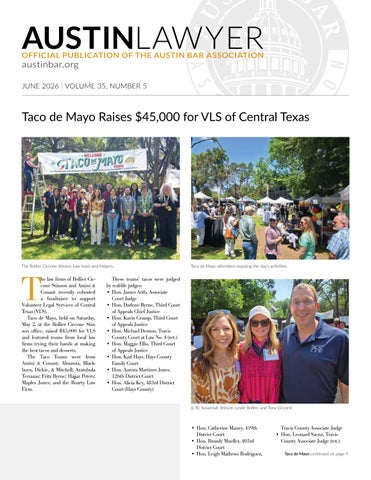
The law firms of Bollier Ciccone Stinson and Amini & Conant recently cohosted a fundraiser to support Volunteer Legal Services of Central Texas (VLS).
Taco de Mayo, held on Saturday, May 2, at the Bollier Ciccone Stinson office, raised $45,000 for VLS and featured teams from local law firms trying their hands at making the best tacos and desserts.
The Taco Teams were from Amini & Conant; Almanza, Blackburn, Dickie, & Mitchell; Arambula Terrazas; Fritz Byrne; Hajjar Peters; Maples Jones; and the Roarty Law Firm.
These teams’ tacos were judged by real-life judges:
• Hon. James Arth, Associate Court Judge
• Hon. Darlene Byrne, Third Court of Appeals Chief Justice
• Hon. Karin Crump, Third Court of Appeals Justice
• Hon. Michael Denton, Travis County Court at Law No. 4 (ret.)
• Hon. Maggie Ellis, Third Court of Appeals Justice
• Hon. Karl Hays, Hays County Family Court
• Hon. Aurora Martinez Jones, 126th District Court
• Hon. Alicia Key, 483rd District Court (Hays County)

• Hon. Catherine Mauzy, 419th District Court
• Hon. Brandy Mueller, 403rd District Court
• Hon. Leigh Mathews Rodriguez, Travis County Associate Judge
• Hon. Leonard Saenz, Travis County Associate Judge (ret.)


austinbar.org
austinlawyeronline.com EMAIL
billy@austinbar.org
Austin Bar Association 712 W. 16th Street Austin, TX 78701
Austin Bar app available for iPhone and Android. SOCIAL

Summer Law Clerks Social
The Austin Bar and AYLA are cosponsoring a social for summer law clerks and interns! This event will be held Thursday, June 18, from 5:30 - 7 p.m. at Mean Eyed Cat, 1621 W. 5th St. RSVP at austinbar.org/summersocial. Thank you to Planet Depos for sponsoring this event! FOLLOW
CONNECT https://www.linkedin.com/ company/austin-barassociation
WATCH vimeo.com/austinbar


24-Hour Suicide & Crisis Lifeline - 988 - call or text | Live chat: SuicidePreventionLifeline.org
Texas Lawyers’ Assistance Program (TLAP) - 1-800-343-8527
TLAP is a 24-hour confidential crisis counseling and referral program to help lawyers, law students, and judges with substance use and mental health issues.
Justice Mack Kidd Fund
The Austin Bar Foundation administers the Justice Mack Kidd Fund, which can provide financial assistance to individuals seeking treatment for depression or similar illnesses. Visit austinbar.org/?pg=justice-mack-kidd-fund to learn more.
Personal Crisis Assistance Program (PCAP)
The Austin Young Lawyers Association Foundation provides grants and/or peer support for individuals suffering from a personal crisis.
Contact Debbie Kelly: 512-472-0279 x 105
Sheeran-Crowley Trust
Administered through TLAP, the trust provides financial help to Texas attorneys, judges, and law students who need treatment for substance use, depression, and other mental health issues. Visit sheerancrowley.org to learn more.
Alcohol & Drug Abuse
Austin Drug & Alcohol Abuse Program - 512-454-8180
Alcoholics Anonymous - 512-444-0071
Cocaine Anonymous - 512-479-9327
Narcotics Anonymous Counseling - 512-480-0004
Psychiatric Emergencies
Emergency Screening in a Psychiatric Crisis 24/7 - 512-472-4357
Samaritan Center (provides professional counseling services on a sliding scale) - 512-451-7337









AUSTIN BAR ASSOCIATION
Maitreya Tomlinson President
Judge Maya Guerra Gamble President-Elect
Sarah Harp Secretary
Ciara Parks Treasurer
Mary-Ellen King Immediate Past President
AUSTIN YOUNG LAWYERS ASSOCIATION
Jenna Malsbary President
Gracie Wood Shepherd President-Elect
Lena Proft Treasurer
Ben Evans Secretary
Emily Morris Immediate Past President
Austin Lawyer
©2026 Austin Bar Association; Austin Young Lawyers Association
EXECUTIVE OFFICES
712 W. 16th Street
Austin, TX 78701
Email: austinbar@austinbar.org Website: austinbar.org
Ph: 512.472.0279
DeLaine Ward Executive Director
Debbie Kelly Associate Executive Director
Roslyn Warner Assistant Editor
Samantha McCoy Assistant Editor
Abigail Ventress Assistant Editor
Billy Huntsman Managing Editor
Austin Lawyer (ISSN #10710353) is published monthly, except for July/August and December/January, at the annual rate of $10 membership dues by the Austin Bar Association and the Austin Young Lawyers Association, 712 W. 16th Street, Austin, TX 78701. Periodicals Postage Paid at Austin, Texas. POSTMASTER: Send address changes to Austin Lawyer, 712 W. 16th Street, Austin, TX 78701.
Austin Lawyer is an award-winning newsletter published 10 times a year for members of the Austin Bar Association. Its focus is on Austin Bar activities, policies, and decisions of the Austin Bar board of directors; legislation affecting Austin attorneys; and other issues impacting lawyers and the legal professionals. It also includes information on decisions from the U.S. District Court for the Western District of Texas and the Texas Third Court of Appeals; CLE opportunities; members’ and committees’ accomplishments; and various community and association activities.
The views, opinions, and content expressed in this publication are those of the author(s) or advertiser(s) and do not necessarily reflect the views or opinions of the Austin Bar Association membership, Austin Bar Association board of directors, or Austin Bar Association staff. As a matter of policy, the Austin Bar Association does not endorse any products, services, or programs, and any advertisement in this publication should not be construed as such an endorsement.
Contributions to Austin Lawyer are welcome, but the right is reserved to select and edit materials to be published. Please send all correspondence to the address listed above. For editorial guidelines, visit austinbar.org in the “About Us” tab.























As my term as president approaches its conclusion, I am reminded of song lyrics that Taylor Swift did not write (sorry, Lily). “This is the end, my only friend, the end.” How many of you know which artist wrote those lyrics? Years ago, this would have been an easy question to answer. But not as much nowadays. That’s because things that were relevant before have a way of fading with time. With that in mind, I’m going to reach back to my first column as a neophyte president and reflect on our bar year. I’m also going to look into the crystal ball as we move into the future.
As good a segue as any other, the previous two sentences touch upon the theme of this year’s bar term: remembering the past and moving into the future. I introduced the theme in my first column. I also expressed my intent to lean on the wisdom of those who
BY MAITREYA TOMLINSON, AUSTIN BAR PRESIDENT
helped build the Austin Bar Association and use a more data-driven approach to determine how to improve it. Lastly, I stated that I would strive to make our team (the board, officers, and others who help run the organization) better and leave the bar in a better position than when we began this term.
There is a saying about best-laid plans. However, I believe that we have largely fulfilled the goals that I identified this term. We are fortunate to have many architects of this organization who still participate. To lean on their wisdom, I had numerous conversations and tried to embed myself within our History and Traditions Committee. I also formed a subcommittee to our Membership Committee to collect data and operate as a think tank to conjure up solutions to membership obstacles and to discover more ways to spark broader participation. That think-tank-like subcommittee has already polled the membership through a survey and is collecting data through focus groups and individual interviews.
As for making our team better, I carefully considered who to ask to lead the committees and our other activities. My goal was to identify those who possessed

strengths and attributes that would help ensure success while also asking them to do things that would stretch them as leaders. I also tried to lead in a supportive manner and in a way where all of our voices were heard. While these were my individual goals, they would go unfulfilled without the talent, hard work, and dedication of those who helped make this term successful.
The same people can, and should, be proud of our successes. While the following is not exhaustive, we have accomplished many things that have left the bar in a better position than when we began. First, we have successfully held key events that benefit our organization, the Austin Bar Foundation, and other charitable organizations (including those who help provide access to justice). From the golf tournament to the Gala, we have exceeded our past financial results and provided our members with well-received events. This is despite Mother Nature’s repeated efforts to derail them. We also worked hard to keep our membership at levels that other local bars are struggling to maintain. Moreover, we have continued to help the community through our clinics like CANLaw that provide free servic -
es for those who need them.
There is more to do, however, and more future successes to celebrate. Unlike the Doors song, this is not the end. I foresee us gathering more data, forming more conclusions regarding the same, and utilizing it in our membership efforts and in our efforts to improve the bar association. In the short term, my able successor, Judge Maya Guerra Gamble, is going to lead some strategic planning using the data that we’ve already collected and institute her own ideas to benefit the bar association. We should all look forward to the successes that we will experience under her leadership.
As we transition into the new term, I have one more request to help us “break on through to the other side.” Please let us know if you have any suggestions concerning our direction as a bar association and how we could provide you with more value. With that, I bid you thanks. I appreciate you allowing me to lead this organization and for your continued participation. You have made this a memorable bar term. AL


The Austin Bar welcomes the following new members:
Christina Aguilar
Laurianne Balkum
Ross Brennan
Brigette Dechant
William Finley
Kelly Garemko
Nicholas Heflin
Kate Hix
Barrett Hollingsworth
Keenan Hudsmith
Fernanda Izquierdo Valdes
John LaBarbera
Audrey Moore
Victor Moya
Victoria Olson
Zoraima Pelaez
Christopher Schuelke
Jacob Stokes
Kenneth Traynham
Dan Vana
Ana Ward
Christopher Wike
Patrick Wroe


Congratulations to Ivan Andarza, co-principal at the Andarza Law Office, who was recently appointed to the Texas Funeral Service Commission. Ivan previously served on the Texas State Technical College System Board of Regents. He received his JD from Baylor School of Law.
Congratulations to Sarah Harp, who won the Austin Under 40 Award in the Legal category. Sarah is a first-generation attorney who has spent the past decade giving back to the Austin community she so dearly loves. She is the current secretary of the Austin Bar Association, the president-elect of the 2027-28 bar year, communications chair of the Texas Young Lawyers, a past president of the Austin Young Lawyers Association, and sits on the Texas Bar Foundation District Nominating Committee.
Congratulations to Paige Welch, an associate at Jackson Walker’s Austin office, who has been voted in as the secretary of the board of the Austin Intellectual Property Law Association (IPLA) for 2026. Paige’s practice



includes preparing and prosecuting patent and trademark applications and defending and enforcing intellectual property rights. Before joining Jackson Walker, Paige served as a judicial law clerk for the Honorable Judge Alan D. Albright of the U.S. District Court for the Western District of Texas. She graduated from UT Law and is admitted to practice before the U.S. Patent and Trademark Office.
Congratulations to Jay D. Ellwanger, who has joined JAMS as a mediator and arbitrator. As a neutral and as a litigator, Jay handles complex employment, civil rights, class action, intellectual property, sexual assault, and commercial disputes. In addition to his practices, Jay has also served for more than two decades as an adjunct professor at UT Law. He founded Ellwanger Henderson in 2017 and represented both plaintiffs and defendants in high-profile matters at the trial and appellate levels. He is a graduate of UT Law.
Congratulations to Mary Lopez Dale, who has joined Deitch Law Offices as a partner and formed
Deitch and Dale Law Office. Mary has extensive experience in business, real estate, and probate-related transactional and litigation matters, as well as legislative and regulatory matters. Prior to practicing law, Mary was an enlisted soldier in the United States Army, was later commissioned as an officer, and eventually achieved the rank of captain. She also worked as a manager for a Fortune 100 company prior to attending law school.
Taco de Mayo continued from page 1.
• Hon. Jan Soifer, 345th District Court
• Hon. Todd Wong, Travis County Court at Law No. 1
The judges ruled that first place for Best Taco was tied between Arambula Terrazas and Maples Jones. A vote from the people found that Fritz Byrne had the best tacos, and Hajjar Peters was given an honorable mention.
Best Dessert went to Arambula Terrazas.
Thank you to everyone who attended this great inaugural event, and special thanks to our sponsors:
• Andrews Myers
• Bryant Colletti Kaplan Kinsler & De La Reza
• Butler Snow
• Chamberlain Hrdlicka
• Chapman Negrete
• Fora Fertility
• Sandoval & James







Roberta Tepper is the chief member services officer for the State Bar of Arizona. She is on the board of directors of the Arizona Women Lawyers Association and serves on the American Bar Association’s Law Practice Division Council, is the features editor for Law Practice Magazine, and serves on the Law Practice Division’s Strategy and Planning Committee.
If you’ve taken a flight on any U.S. airline, you’ve heard the announcements from the flight attendant. Among them is the one about how if the cabin pressure drops, oxygen masks will drop from the ceiling, and you should secure your own oxygen mask before helping others. This is not advice intended to make us heedless of dangers to others, or to be selfish, but acknowledges that we must safeguard our own well-being to be able to help others.
This is also true in the practice of law. Lawyers are, at the core, helpers. Regardless of our specific area of practice, lawyers are the ones to
BY ROBERTA TEPPER, STATE BAR OF ARIZONA
whom people turn when they need help. Financial pressures aside, for many lawyers the focus is solely on helping those who need help, and it can be difficult to say no, whether that is turning away a client, or telling a client you cannot help any further. We sometimes talk to lawyers who are burning themselves out because they take cases they shouldn’t—whether it’s because they don’t have the time or the skills to provide the services the prospective client needs.
Lawyer well-being doesn’t just mean the absence of some kind of challenge, whether it is mental or physical health, addiction, or something else. Lawyer well-being means that we are taking care of ourselves and are positioning ourselves to thrive professionally and personally. A lawyer struggling with mental health or substance use disorders, or who is not physically healthy enough to practice, needs to care for themselves before trying to help others. Sure, we are very good at convincing ourselves that something significant happening in our lives does not impact our practice. But the truth is that lawyers are human (pause here for an appropriate “gasp!”) and subject to the same pressures as everyone else.
People under stress do not process information well. We see that in clients who can’t remember what they’ve told us because they were under extraordinary stress due to
We know that lawyers experience vicarious trauma because we take on the trauma of our clients. What doesn’t seem as obvious to lawyers is that our own well-being should be a priority.
the problem that brought them to our door. Lawyers are subject to that same dynamic. If we are ill, if we are not well, we cannot process information as well, we are prone to making mistakes, and we are creating a situation whereby our clients may be harmed.
So, back to the original premise. You need to put on your oxygen mask before helping others. This may mean that you must make hard decisions about what you are able to do—physically, mentally and psychologically—in your life based on the stressors present. Sure, the practice of law is inherently stressful, but we know the impact of stress can be cumulative. We know that lawyers experience vicarious trauma because we take on the trauma of our clients. What doesn’t seem as obvious to lawyers is that our own well-being should be a priority.
What that means may be different for each lawyer. For some, it means healthy eating and regular exercise. For others, it means getting profes-
sional help—medical, psychological or something in between. Unfortunately, lawyers seem to put themselves last. It’s time to take inventory and decide what you need to be well. Lawyers sometimes take on too much—clients and cases, coupled with whatever is going on in their personal lives, and they may be at a breaking point. There are a million good reasons why this happens. It may not be easy to get out of this kind of situation, but it almost always can be done. It may require a new job, court permission to withdraw from cases, enlisting the help of other lawyers within or outside the firm. It may require admitting weakness or that you need help. But none of that is insurmountable.
Remember, you are important. You need to be well to practice at an optimal level. It’s hard to remember sometimes, especially when the needs of others—clients and family—seem overwhelming. But remembering that you are a priority must be a priority when that oxygen mask drops. AL


It has been an incredible honor to serve as President of the Austin Young Lawyers Association (AYLA) this past year. I would like to begin by expressing my sincere gratitude to Debbie Kelly, AYLA Executive Director and truly superhuman in every sense, for her unwavering dedication to AYLA. We are forever grateful for the countless hours she devotes to ensuring that our events are organized, well attended, and fully supported. I am equally proud of the AYLA executive team, board, and liaisons, who worked collaboratively and tirelessly this year to uplift and represent this exceptional organization.
This year, AYLA intentionally approached programming in new ways. One example was the introduction of a summer Docket Call Happy Hour— recognizing that most young lawyers do not experience a true summer break. Hosted at Hold Out, the event created a space for members to connect during a season when other programming often slows. Summer interns and clerks were encouraged to attend, offering them a valuable opportunity to network with Austin attorneys early in their legal careers. Another long-standing goal has been to expand opportunities for young lawyers interested in public speaking. These experiences open doors to future leadership and presentation opportunities and help attorneys build professional confidence. The Austin legal community is fortunate to have a deep source of young talented attorneys eager to share their expertise. Our CLE Committee, along with the Freshquires program, hosted and coordinated
BY JENNA MALSBARY, AYLA PRESIDENT
more than 10 CLE presentations this year. Many of these programs provided tailored educational opportunities focused on professional growth and practical skill development. I am incredibly proud of the AYLA board and its programs for their commitment to supporting young attorneys in the Austin legal community.
Inclusivity and collaboration remained a central focus throughout the year, particularly for attorneys balancing work, family, and personal responsibilities. AYLA hosted and collaborated on multiple events with local affinity bar organizations and non-legal leadership groups. Some of these included the Austin Bar Insurance Law Section, the Travis County Women Lawyers’ Association (TCWLA), the Young Men’s Business League of Austin, the Hispanic Bar Association of Austin, the Young Women’s Alliance, the Austin Bar Entertainment and Sports Section, and the Mother Attorney Mentor Association of Austin (MAMAs). The annual Diversity Bar Mixer continued to serve as a celebration of the Austin legal community and the many affinity organizations working together to support the local bar. Similarly, AYLA’s Day of Service on Martin Luther King, Jr., Day brought the local bar together in service by inviting and encouraging participation across affinity organizations in volunteer opportunities throughout the community. The AYLA Judicial Reception marked its 25th year at Chateau Bellevue, celebrating and strengthening connections between our judiciary and AYLA members.
AYLA also expanded inclusion by hosting multiple family-friendly events, allowing working law parents to bring their families into the fold. New events such as Austin FC Family Night, along with meetups at kid-friendly venues like Cheeky Monkeys and Meanwhile Brewing, created opportunities for connection beyond the courtroom. Two of our largest and most beloved events—the Tailgate for a Cause Fundraiser and
As an “elder” young lawyer, I am comforted knowing that the future of the profession rests with such a talented, thoughtful, and engaged generation of attorneys.
the Crawfish Boil—continued to welcome families and friends. Seeing AYLA members, colleagues, and their families come together reminded us of the importance of building authentic relationships within the legal community.
Introducing young attorneys to accessible pro bono opportunities was another highlight of the year. AYLA members enthusiastically participated in the Summer of Service Pro Bono Competition in support of Texas Free Legal Answers. Through two successful Sip and Serve events, volunteers answered more than 40 legal questions pro bono. This collaboration helped increase confidence among young attorneys who are interested in pro bono work but may feel constrained by time, experience, or practice-area concerns. Texas Free Legal Answers continues to serve as an excellent entry point for meaningful pro bono service, and AYLA
THUR., JUNE 18
AYLA/Austin Bar Docket Call
5:30 - 7 p.m.
Mean Eyed Cat 1621 W. 5th St.
Sponsored by Planet Depos (summer law clerks welcome!) RSVP at austinbar.org
looks forward to building on these efforts in the years ahead.
As I reflect on the year, I am profoundly proud of the AYLA board, liaisons, and committees. Each member dedicated time and energy to ensure this year’s success—and it truly was a success. As an “elder” young lawyer, I am comforted knowing that the future of the profession rests with such a talented, thoughtful, and engaged generation of attorneys. I have learned so much from observing how they balance professional obligations with leadership and service. I will always support and champion their efforts, and I am deeply grateful for the opportunity to serve alongside them this year. I look forward to continuing my service in support of AYLA President-Elect Gracie Wood Shepherd and am excited to see the incredible work that lies ahead in the coming year. AL
WED., JUNE 24
AYLA CLE: From Courtrooms to Conference Rooms
12 - 1 p.m.
McGinnis Lochridge 1111 W. 6th St. 400 Bldg. B Register at austinbar.org
Sponsored by Bettac Advocacy & Mediation and Cokinos Young
At the April AYLA board meeting, members had the opportunity to hear directly from the Texas Advocacy Project (TAP) about the vital work they are doing across Texas and how Austin-area attorneys can play a meaningful role through pro bono service.
TAP’s mission is both powerful and urgent: to end dating and domestic violence, sexual assault, and stalking in Texas. Through free legal services and access to the justice system, TAP empowers survivors to reclaim safety and stability. At the same time, TAP advances long-term prevention through public outreach and education. Their vision is clear: all Texans living free from abuse.
One aspect that makes TAP especially unique is its commitment to accessibility. Unlike many legal service organizations, TAP does not accept or deny referrals based on income, ensuring that survivors can access help when they need it most.
TAP offers a pro bono opportunity that is both impactful and manageable: the Legal Line Clinic. TAP currently hosts one clinic per month and welcomes five volunteer attorneys per clinic. Clinics are held on a Friday, based on staff attorney availability, from 9 a.m. to 1 p.m. CST.

Participating attorneys conduct two client calls, one at 9 a.m. and another at 11:00 a.m., and enter case notes into LegalServer between calls. Once the second call and notes are completed, the commitment is complete. There is no additional follow-up, ongoing representation, or extended time obligation required.
To ensure volunteers feel confident and supported, TAP provides a comprehensive Legal Line checklist that guides attorneys through every step of the process, from application to case completion, with direct links to all necessary forms and resources.
After submitting an application, attorneys are asked to sign the TAP Clinic Agreement and HIPAA Acknowledgement. TAP also conducts a public background check through

Choice Screening (no Social Security number required) and verifies the attorney’s State Bar license.
Once cleared, volunteers complete two required training modules, totaling approximately two hours. These trainings provide both MCLE and ethics credit, making participation even more accessible for busy practitioners.
For attorneys who want to deepen their knowledge, TAP offers a robust library of optional training resources:
https://www.texasadvocacyproject.org/training
https://www.texasadvocacyproject.org/pro-bono-resources
These materials cover a wide range of topics, including protective orders, family law issues, and safety planning.
Coming Soon: AYLA Sip & Serve with TAP
To further connect Austin at-
torneys with these opportunities, AYLA plans to host a Sip & Serve event for members of the Austin legal community. Attendees will have the chance to participate in TAP training and learn more about the organization’s work.
This event is an excellent introduction for attorneys who are new to pro bono work, as well as those looking for a focused, high-impact way to give back. A few hours of your time can make a profound difference for a survivor navigating a moment of crisis.
We look forward to sharing more details soon and welcoming AYLA and legal community members into this important work. Keep an eye out for additional information and sign-up opportunities, and consider how your expertise can help move Texas closer to a future free from abuse. AL
Ari Cuenin is a partner at Stone Hilton, where he litigates complex government disputes. He has presented more than 30 arguments in state and federal courts.
Court deems ban on home distilling operations unconstitutional.
McNutt v. U.S. D.O.J. (5th Cir. No. 24-10760). The Fifth Circuit held unconstitutional the federal prohibition on home distillation of consumable spirits, concluding that 26 U.S.C. § 5178(a)(1)(B) and § 5601(a) (6) exceeded Congress’s powers under the Taxation and Necessary and Proper Clauses.
The court first held the plaintiffs had standing based on credible threats of enforcement, including prior warnings issued by federal regulators. On the merits, the opinion acknowledged Congress’s longstanding authority to tax distilled spirits but concluded the categorical residential-distillation ban swept beyond what was necessary to support tax collection. Although the government argued the statute prevented tax evasion and protected revenue, the ban was not a valid exercise of the taxing power because it did not raise revenue, instead preventing taxable spirits from coming into existence and criminalizing conduct outright. Without a “limiting principle” to the government’s argument, the statutes merely functioned as an impermissible federal police regulation rather than a revenue-collection regime.
QUI TAM: Court rejects False Claims Act based on “reverse false claims” theory.
United States ex rel. Palmer v. Tata Consulting Services, Ltd. (5th Cir. No. 25-40368). The Fifth Circuit affirmed dismissal of a qui tam action alleging that Tata made “reverse false claims” under the False Claims Act (FCA) by fraudulently obtaining cheaper visa classifications and underpaying foreign workers. The relator alleged Tata improperly used B-1 and L-1A visas instead of more expensive H-1B visas to avoid higher visa fees and payroll-tax obligations.
The allegations failed because the FCA requires an established, present “obligation to pay or transmit money” to the government. Tata never applied for H-1B visas, so it had no legal obligation to pay H-1B-related fees. Likewise, although Tata allegedly underpaid workers in violation of immigration regulations, the FCA does not convert hypothetical wage obligations into tax obligations on wages never actually paid.
Thus, even assuming visa fraud occurred, liability attaches only when a false claim deprives the government of money or property. The panel repeatedly distinguished underlying misconduct from actionable FCA claims, reinforcing the Fifth Circuit’s insistence on payment obligations that are established and present, not merely potential or contingent.
MANDAMUS: Panel finds that district court misapplied court-congestion factor in Section 1404(a) transfer analysis.
In re Google LLC (5th Cir. No. 2540788). The Fifth Circuit granted mandamus and ordered transfer of an antitrust case from the Eastern District of Texas to the Northern District of California, concluding the district court misapplied 28 U.S.C. § 1404(a)’s transfer factors. Branch Metrics sued Google in Texas based largely on evidence developed in prior federal antitrust litigation. Google sought transfer to California, where most sources of proof were located.
Over Judge Higginson’s dissent, the majority held the district court erred by treating court-congestion statistics as weighing against transfer in a complex case. Such metrics are speculative and particularly
unreliable in discovery-intensive litigation, and the court effectively allowed that single factor to override the other factors, which either favored transfer or were neutral. The majority opinion thus reflects that plaintiffs may strategically select favorable fora, but judges must faithfully apply transfer doctrine without allowing docket-speed considerations to trump other factors. And Clayton Act claims warrant no heightened deference.
Fifth Circuit upholds Ten Commandments classroom display.
Nathan v. Alamo Heights ISD (5th Cir. No. 25-50695). The en banc Court upheld Texas S.B. 10, which requires public-school classrooms to display the Ten Commandments, vacating a preliminary injunction entered on Establishment Clause and Free Exercise grounds. Importantly, the court found the Texas statute ripe for review because it prescribed a uniform display requirement, unlike a similar Louisiana law previously dismissed as unripe. Judge
Duncan’s majority opinion held that modern Establishment Clause analysis is governed by the historical-tradition framework articulated in Kennedy v. Bremerton. The Supreme Court’s earlier Stone v. Graham precedent, depending on the now-abrogated Lemon test, no longer controlled.
The court rejected a Free Exercise challenge, distinguishing Mahmoud v. Taylor on the grounds that S.B. 10 does not create a coercive religious curriculum, authorize proselytizing, or require students to affirm or practice religion. The majority thus framed the dispositive merits question as whether S.B. 10 resembles a founding-era “establishment of religion.” Surveying historical practices, the majority concluded that religious establishments historically involved coercive features like mandatory worship, taxation supporting clergy, punishment of dissenters, or governmental control over doctrine. S.B. 10 did none of those things. Nathan signals historical coercion—not mere religious content—as a key consideration of future Establishment Clause analyses in the Fifth Circuit. A



Laurie Ratliff is a former staff attorney for the Third Court of Appeals. She is board-certified in civil appellate law by the Texas Board of Legal Specialization and owner of Laurie Ratliff LLC.
The following are summaries of selected civil opinions issued by the Third Court of Appeals during April 2026. The summaries are an overview; please review the entire opinion. Subsequent histories are current as of May 8, 2026.
>MANDAMUS: Court grants relief for grandparent-access order signed after plenary power expired.
In re B.W.A., No. 03-25-00931CV (Tex. App.—Austin April 1, 2026, orig. proceeding). Relators, adoptive parents of two minor children, signed a master service agreement (MSA) in 2017 giving biological Grandparents (real parties in interest) access. No order was entered on the MSA. Ultimately, Relators denied Grandparents visitation. In 2025, Grandparents filed a modification proceeding seeking a judgment on the MSA. The trial court denied Relators’ plea to the jurisdiction and entered an order granting Grandparent access. The court of appeals concluded that, without the MSA, Grandparents lacked standing under Family Code Section 153.434 because biological mother relinquished her parental rights and biological father was deceased. Execution of the MSA, without an order on it, was not a request for possession and access. The adoption order
was signed Feb. 16, 2018. Thus, plenary power ended 30 days later. Because the trial court signed the Grandparent-access order after plenary power expired, the order was void. The court granted mandamus relief.
MANDAMUS: Court grants relief where trial court denied production of tax returns.
In re Johnson, No. 03-26-00121CV (Tex. App.—Austin April 9, 2026, orig. proceeding) (mem. op.). In this family law matter, Mother sought above-guidelines support and requested production of Father’s unredacted tax returns. Father claimed to have investments worth between $1 million and $50 million but refused to give any specifics. The trial court denied Mother’s motion to compel. On mandamus, the court of appeals held that Family Code Section 154.063’s requirement for production of tax returns is mandatory. Additionally, Father’s tax returns were relevant for the trial court to allocate the responsibility to meet the child’s needs between the parties. The court held the trial court abused its discretion in denying the motion to compel. The court rejected Father’s laches argument. Mother waited almost two months to seek mandamus relief. The court granted relief.
TRIAL PROCEDURE: Court reverses dismissal under Rule 91a in private nuisance lawsuit.
Clements v. McBroom, No. 03-2500442-CV (Tex. App.—Austin April 9, 2026, no pet. h.). Appellants (“Landowners”) sued McBrooms for private nuisance seeking injunctive relief to halt construction of a battery energy storage system (BESS) on McBrooms’ property. Landowners’ contended McBrooms were negligent by not having a court-approved hazardmitigation plan for a high-risk industrial property. Landowners’ alleged that BESS relies on lithium-ion batteries, which are prone to thermal runaway fires; Fayette County lacks emergency-response infrastructure for handling such fires; and that Landowners’ prop-
erties were within a mile of the proposed site. The trial court dismissed Landowners’ lawsuit under Rule 91a and awarded attorney’s fees. According to the court of appeals, Landowners stated a negligence cause of action and asserted a legal injury of private nuisance. Landowners’ allegations, if proven, support injunctive relief given the imminent actions taken to construct the BESS without a hazard-mitigation plan. The court reversed and remanded.
ATTORNEY’S FEES: Court reverses fee award based on overly redacted billing records.
Nunez v. Nichols, No. 03-2400263-CV (Tex. App.—Austin April 30, 2026, no pet. h.) (mem. op.). The trial court ordered Father to pay support for an adult child with disabilities and to pay Mother’s attorney’s fees. Attorney testified to hourly rates and introduced redacted billing records, offering to provide the court an unredacted copy. Father did not request in-camera review of the
unredacted bills. According to the court of appeals, the “determinative factor is whether the bills provide sufficient evidence to support the trial court’s exercise of discretion, regardless of how much or little they were redacted.” The redactions eliminated information that would allow Father to challenge the reasonableness of the fees. The court rejected Mother’s argument that the offer to provide the court with unredacted copies mooted Father’s complaint. The court reversed and remanded the attorney’s-fees issue. AL


The following is a summary of selected criminal opinions issued by the Third Court of Appeals from October 2025. The summary is an overview; please review the entire opinions. The subsequent history is current as of May 11, 2026.
Requirement that affidavit be “sworn”.
State v. Chavez, 729 S.W.3d 391 (Tex. App.—Austin 2025, no pet.). Trial court did not abuse its discretion by suppressing blood-draw evidence after concluding that search-warrant affidavit was unsworn. Chavez, who was charged with a DWI offense, filed a motion to suppress blood-draw evidence obtained through a search warrant, arguing that the arresting officer’s probable-cause affidavit in support of the warrant had not been sworn or made under oath. The evidence at the hearing established that the officer completed the search warrant application inside her patrol car and electronically signed the affidavit. The affidavit was notarized by another officer, with whom the arresting officer spoke by telephone during the affidavit’s preparation. The arresting officer testified “at no time” did “anyone ever put [her] under oath” or “ask [her] if everything in any of those affidavits was true and correct.” The other officer testified that she did
not place the arresting officer under oath and only “asked her to sign in the correct position stating that she was the one swearing to it.” The district court granted the motion to suppress and the appellate court affirmed. The court explained that an officer’s failure to swear to the facts in her affidavit “renders defective any search warrant issued on the basis of the unsworn probable-cause affidavit,” and that swearing an oath or affirmation is not the same as signing an affidavit. In determining the existence of a sworn oath, courts consider whether the affiant was “impressed with the magnitude of the act and whether the swearing occurred with sufficient solemnity and gravity.” In this case, the record supported the trial court’s finding that no oath or affirmation was sworn and that the circumstances surrounding the officer’s signing of the affidavit lacked solemnity and gravity. The court rejected the State’s assertion that being subject to criminal liability for perjury was a “test” for find ing the existence of a sworn oath. Additionally, the good-faith excep tion to the exclusionary rule did not apply because “a reasonable officer would have known that the search warrant in this case was invalid because a sworn affidavit was not filed, and there was no oath or affirmation.” Therefore, suppression was proper.
INGS: Motions for new trial and confrontation rights.
State v. Navarro ___, No. 03-23-00637-CR (Tex. App.—Austin 2025, pet. filed). Sixth Amendment right to con frontation did not apply to com munity-supervision revocation hearing. Navarro was placed on deferred-adjudication community supervision. The State later filed a motion to revoke Navarro’s community supervision and to ad judicate his guilt. The trial court granted the motion, revoked Navarro’s community supervi sion, and adjudicated him guilty of the offense. The trial court sen tenced him to 10 years’ imprison ment but announced its intent to place him on “shock probation.”
Navarro filed a motion for new trial, which the trial court granted. The trial court stated that it was granting a new trial because Navarro was not eligible for probation. This ground was not raised in Navarro’s motion for new trial, and the State objected to granting a new trial on that basis.
The appellate court reversed. First, the court concluded that, because Navarro did not raise the issue of his ineligibility for shock probation in his motion for new trial, and the State objected to granting a new trial on that basis, the trial court abused its discretion in granting a new trial on that ground. The court then proceeded to consider the merits of the grounds raised in Navarro’s motion, including his contention that he was denied his right of confrontation. One of the State’s witnesses had testified that Navarro had missed multiple probation appointments, including one with a former probation officer who did not testify at the hearing.
by the officer who was unavailable to testify. Assuming without deciding that this amounted to a confrontation violation, the court held that “a deferred-adjudication community-supervision revocation hearing is not a stage in a criminal prosecution at which the Sixth Amendment right to confrontation applies.” The court explained that the Texas Court of Criminal Appeals “has not determined whether the Confrontation Clause applies in hearings on motions to adjudicate guilt or to probation-revocation proceedings more broadly” and that there were significant differences between revocation proceedings and criminal trials. Because of those differences, other intermediate appellate courts had concluded that the Sixth Amendment right to confrontation did not apply to revocation hearings, and the court followed those courts. AL


Case summaries are prepared by court staff as a courtesy. They are not a substitute for the actual opinions.
Tex. Comm’n on Env’t Quality v. Paxton, ___ S.W.3d ___, 2026 WL ___ (Tex. Apr. 17, 2026) [230244]
At issue in this case is whether the Texas Commission on Environmental Quality (TCEQ) timely asked the Attorney General if it could withhold contested documents under the Public Information Act. TCEQ received a request from the Sierra Club under the Public Information Act.
According to TCEQ, many of the requested documents were protected against disclosure. So, in a letter to the Office of the Attorney General (OAG), TCEQ asked whether it could withhold the documents. Under the Act, that letter was due no later than 10 days after Sierra Club’s request, but the OAG said it received the letter too late. TCEQ asked the OAG to reconsider based on evidence TCEQ failed to include in its letter, but the OAG declined. TCEQ then sued the OAG under the Act, seeking a declaratory judgment to allow it to withhold the documents. Sierra Club intervened. The district court granted summary judgment for Sierra Club, ordering TCEQ to produce the documents. The court of appeals affirmed.
The Texas Supreme Court reversed and remanded for further proceedings, holding that TCEQ did not miss its deadline. The court held that TCEQ’s follow-up email to Sierra Club reset its 10-day clock under the Act because TCEQ attempted to narrow the universe of documents at issue. The court also found that TCEQ gained time back because it established with sufficient evidence that its request was deposited in interagency mail in a timely fashion.
Justice Busby filed a dissenting opinion. He would have held that TCEQ’s email to Sierra Club did not discuss how the disclosure might be narrowed or clarified and, therefore, did not restart the clock under the Act.
Muth v. Voe, ___ S.W.3d ___, 2026 WL ___ (Tex. Apr. 24, 2026) (per curiam) [24-0384, 240385]
The issue in this case is whether a series of temporary injunction orders should be vacated as moot.
The Department of Family and Protective Services declared that it would investigate reports that a child was receiving certain medical procedures for the purpose of gender transitioning. Four families with a child diagnosed with gender dysphoria, an advocacy organization, and a psychologist sought injunctive relief to prohibit these investigations. The trial court issued three separate temporary injunctions against DFPS and its Commissioner, which the court of appeals affirmed.
The Supreme Court reversed and vacated the temporary injunctions for lack of jurisdiction. The court held that the claims for injunctive relief by the families were moot either because DFPS had permanently closed its investigation or the family no longer had any minor children subject to investigation. The court concluded that the advocacy group’s claim was likewise moot because the claims of its members in the lawsuit were moot. Finally, the court held that the psychologist lacked standing because her alleged injuries were speculative.
Chief Justice Blacklock filed a concurring opinion. He would have held that the psychologist had standing to challenge DFPS’s actions, but that the temporary injunctions were improper on the merits.
Tex. Dep’t of State Health Servs. v. Sky Mktg. Corp., ___ S.W.3d ___, 2026 WL ___ (Tex. May 1, 2026) [23-0887]
The issue in this case is whether the court of appeals erred in affirming the trial court’s grant of a temporary injunction and denial of the plea to the jurisdiction.
The Commissioner of the Texas Department of State Health Services is responsible for maintaining Texas’s schedules of controlled substances. After the
Commissioner modified certain definitions within those schedules in 2021, a group of hemp vendors sued the Commissioner and the Department, seeking temporary and permanent injunctions and declaratory relief. The vendors asserted ultra vires claims against the Commissioner, alleging that her modifications purported to control hemp products that the 2019 Texas Farm Bill expressly legalized. The vendors also brought a claim against the Department under the Texas Administrative Procedure Act, asserting that a statement on the Department’s website was an invalid rule under the Act. The Department and Commissioner responded with a plea to the jurisdiction, asserting sovereign immunity and challenging the vendors’ standing. The trial court granted the temporary injunction and denied the plea to the jurisdiction. The court of appeals affirmed on both counts.
The Supreme Court affirmed in part and reversed in part. The court held that the vendors have standing and that their claims are ripe for judicial review. It further held that sovereign immunity bars the vendors’ ultra vires claims because Texas law reposes significant discretion in the Commissioner to establish and modify the schedules and that the Texas Legislature has not eliminated her discretion in a way that rendered the challenged actions ultra vires. The court also held that sovereign immunity bars the vendors’ remaining claims against the Department because the website statement is not a rule subject to the Administrative Procedures Act (APA). Accordingly, the court reversed the grant of the temporary injunction.
Hancock v. RJR Vapor Co. LLC, ___ S.W.3d ___, 2026 WL ___ (Tex. May 8, 2026) [24-0052]
In this tax-refund case, the parties dispute whether RJR Vapor’s VELO pouches are taxable as “tobacco product[s]” under the Texas Tax Code.
RJR Vapor sells oral nicotine pouches, which users place between the cheek and gum. When RJR Vapor introduced the
pouches to the Texas market, it asked the comptroller for a general information letter explaining whether the pouches were taxable under the Cigars and Tobacco Products Tax. The comptroller concluded that the pouches were taxable. RJR paid the tax under protest and filed this suit, seeking a refund and a declaration that the pouches are not taxable tobacco products. RJR also challenged the constitutionality of the tax statute and its application.
The trial court granted summary judgment for RJR, holding that the pouches were not taxable tobacco products. After a bench trial, it ruled that the language of the Tax Code is unconstitutional both facially and as applied. The court of appeals affirmed and held the pouches are not taxable tobacco products but did not reach the constitutional challenges.
The Supreme Court reversed. In an opinion by Justice Busby, the court concluded that VELO pouches are taxable tobacco products because they are “made of . . . a tobacco substitute.” The pouches’ blend of plant matter and nicotine take the place and function of taxable pulverized tobacco in pouched tobacco products. The court remanded RJR Vapor’s constitutional challenges to the court of appeals.
Justice Sullivan concurred dubitante, expressing doubt as to whether the inclusion of plant matter in VELO pouches should inform the court’s analysis. AL


OUR AUSTIN ATTORNEYS [ ]
Thomas Ausley *, Kelly Caperton Fischer, Rob Frazer *, Kelly Ausley-Flores * , Lindley Bain*, Eric Robertson*, Angelica Rolong Cormier*, Kristen Algert*, Kristiana Butler*
*Board Certified in Family Law by the Texas Board of Legal Specialization
Excellence is a constant pursuit at Goranson Bain Ausley. Building on more than 40 years of family law practice in Austin, our team brings deep experience in complex litigation, mediation, arbitration, collaborative law, and appeals. The Austin office includes eight Board Certified family law attorneys, certified mediators, certified arbitrators, trained Collaborative Divorce professionals, and a mental health counselor — supported by a firmwide team of 32 Board Certified family law attorneys across Texas. Recognized by Texas Lawyer as a “Best of 2025” winner for Family Law in Austin, Goranson Bain Ausley is known for strategic advocacy, sound judgment, and constructive approaches that help preserve long-term family and financial stability.

























Congratulations to the winners of the 2026 Attorney Awards, presented by the Travis County Women Lawyers’ Association (TCWLA) and Travis County Women Lawyers’ Foundation (TCWLF) during their annual Grants & Awards Luncheon held April 24. The event celebrates the incredible work being done to support women, children, and families in our community.
Austin Bar Foundation Chair Mary-Ellen King, Partner at Lucosky Brookman, received the Public Interest Award.
AYLA President Jenna Malsbary, Associate Counsel at CapMetro, received the Pro Bono Award.
Judge Amy Clark Meachum of the 201st Civil District Court received the Outstanding Achievement Award.
Megan Kempf, Associate Director of Policy at Texas Health and Human Services, received the Government Service Award.
Paige Duggins-Clay, Chief Legal Analyst at the Intercultural Development Research Association, received the Advancement of Minority Interests Award.
Adeola Ogunkeyede, Chief Public defender in Travis County, received the Criminal Justice Award.
Michelle Kwan, Partner at Jackson Walker, received the Corporate/Transactional Award.
Lisa Tsai, Managing Partner at Reid Collins & Tsai, received the Litigation/Appellate Award.
Jeana Patel, Principal Recruiter at Jobot, received the Advancement of Women’s Interests Award.
The Law Firm of Amber Russell (LOAR) received the Firm Award.
The foundation also announced the recipients of its 2026 grant cycle.
Vecina, an organization that empowers immigrant justice advocates through mentoring attorneys, educating communities, and mobilizing volunteers, received the Impact Grant for $40,000.
The following organizations received traditional grants of $10,000:



Austin Sanctuary Network: Supports immigrants fleeing violence or in danger of deportation.
Casa Marianella: Supports displaced immigrants and asylum seekers and promotes self-sufficiency by providing shelter and support services.
Dress for Success: Empowers women to achieve economic mobility by providing a global network of support, workplace attire, and development tools for success.
Friends of Paws in Prison: Supports the work of the Paws in Prison program at the Coleman Unit in Lockhart, Texas, by teaching inmates to train dogs that are rescued from rural kill shelters.
Saint Louise House: Empowers women and children to overcome homelessness by providing stable housing and wraparound services with highly individualized support.
Seedling Foundation: Provides school-based mentoring to children impacted by parental incarceration. AL






Jessica Mangrum has served as judge of the 200th District Court of Travis County since Jan. 1, 2021. She presides over civil and family law cases, including business, commercial, administrative, consumer, real estate, divorce, child custody, and child protective services (CPS) cases. Prior to serving as judge, she was a partner in the Austin office of Thompson Coe. In that position, she handled commercial and construction litigation, personal injury, professional liability, and other complex business cases.
In 2025, the Texas Legislature made sweeping changes to state court summary judgment practice which, for generations, was governed by the date of the hearing. Twenty-one days’ notice was required before setting a hearing on the motion. The deadline for the response was seven days before the hearing. The rules contained no specific deadline for replies (which are often unnecessary).
The Texas Government Code was changed twice in the 2025 legislative session. First, in Senate Bill 293, which provided the first raise of the base judicial salary in Texas in 12 years, along with many provisions far less favorable to the judiciary. Second, in House Bill 16, the Omnibus Courts Bill passed in the second special session.
Section 23.303 of the Texas Government Code now requires that a district court, business court, or statutory county court consider, by oral hearing or submission, a motion for summary judgment within 60 days of the motion being filed–or 90 days with good cause, agreement
BY JUDGE JESSICA MANGRUM, 200TH DISTRICT COURT
of movant, or if the court’s docket requires. After consideration of the motion, the judge has 90 days to issue a written ruling, file the order with the clerk, and provide it to the parties.
The Supreme Court of Texas recently adopted Texas Rule of Civil Procedure (TRCP) 166a to codify the statutory changes and give litigants deadlines governing summary judgments. These new deadlines run from the date of filing, not the date of hearing. Deadlines for litigants are in the new rule, but the court’s deadlines are in the statute. You will soon learn that the court’s statutory deadlines constrain a litigant’s ability to control when their motion is decided by hearing or submission.
The new TRCP 166a went into effect on March 1, 2026, for all motions filed on or after that date. Key deadlines are:
• Response to the motion is due on the 21st day after filing. Exceptions: leave of court or agreement of parties.
• Hearing or submission must not be set within 35 days after the motion is filed.
• Reply must be filed within seven days after the response. Reply isn’t required.
Practice Tips:
When to File Your MSJ?
Given the requirements of Tex. Gov. Code § 23.303, courts cannot be flexible about your motion. Therefore, DO NOT file your motion before you are ready for it to be heard. Statutory deadlines start to run for the judge the moment the motion is filed; don’t file your motion too early. But don’t file your motion too late. If your trial setting is around the corner, it’s probably too late. The judge has 90 days to decide your motion. So, if a judge is hearing your motion and your trial date is just a few weeks out, you may or may not get a ruling on it before that trial.
Please understand your case is not
the only one on the judge’s “under advisement” list. Judges have very full caseloads, and the new law and rule did not create more hours in the day. We continue to see far too many dispositive motions filed or set for a hearing on the eve of trial. Lawyers need to rethink the timing of when–and if–these motions get filed.
Hearing or Submission?
In Travis County, the general rule is that MSJs will be decided by oral hearing. Travis County has a new standing order for MSJs, which went into effect on June 1, 2026 (available on pages 28-29). Under that standing order, the day you file your MSJ determines the setting for your hearing. Attorneys may not set any MSJ for hearing anymore; it is done automatically, and the clerk issues notice, according to the law. Please carefully review the standing order before filing your MSJ; once you file it, you cannot change the setting. If your MSJ is in a case retained by one judge under Local Rules 2.6 or 10.2, you must get permission from your judge before you file the MSJ to ensure that the judge can hear it in within the statutory timeframe.
Travis County also has a standing order for submission procedures in civil and family cases - for agreed matters. Under current rules, you may not set your MSJ for submission without judge approval. You could ask, but this request will be declined in the absence of a detailed explanation; even then, there’s no guarantee.
State judges are used to oral arguments on summary judgment motions, but every judge has different thoughts on how to handle these motions. Expect numerous approaches across the state. The “submission” piece of the new law is a failsafe, giving the judge the ability to determine the motion without a hearing if necessary. Whether a judge decides your motion after an oral hearing or by submission is the judge’s choice. In some jurisdictions
or courtrooms, you may find that the judge prefers or requires these motions to be heard by submission.
In Travis County, court administration will not allow you to pass or reschedule your hearing given the new deadlines. The only viable option is to file a notice of withdrawal of your motion for summary judgment (template on page 27). It can always be refiled later. However, filing, withdrawing, and filing the same motion will not go unnoticed by the courts. You will want to choose your filing date carefully.
If you have settled your case, notify the judge who heard the motion – or, if it hasn’t been heard yet, the court where the motion is filed. If you can get the dismissal documents filed quickly, that may be sufficient. If it will require some time, you may need to file a notice of withdrawal of the summary judgment. The court cannot let the statutory deadlines pass without ruling on the motion, or face being reported by the district clerk to the Office of Court Administration (OCA) for noncompliance with the new law.
Lawyers keep asking questions about time extensions, e.g., for more time to respond to the motion or conduct discovery. The statute says the court “shall” set the motion for a hearing by oral argument or submission no later than the 60th day after the motion was filed – or, in certain situations, no later than the 90th day after the motion was filed. Therefore, there are no extensions for MSJs.
It feels overwhelming, but the Travis County district judges have worked hard to develop this new standing order to make the process as easy as possible. If your case is filed in the 98th or 250th District Courts, you will need to reach out to them directly to have your MSJ heard or considered. AL
CAUSE NO. D-1-
IN THE DISTRICT COURT OF
TRAVIS COUNTY, TEXAS
JUDICIAL DISTRICT
A NON-SUIT OR DISMISSAL OR AN AGREED JUDGMENT has been filed in the above case.
THEREFORE, the following motion(s) ____________________ is/are withdrawn.
SIGNED this day of , 202 . JUDGE PRESIDING
FILE NO. GN-61-121012
PREAMBLE: There is a new statutory and regulatory scheme for all Motions for Summary Judgment (“MSJs”) filed in the State of Texas: Act of June 2, 2025, 89th Leg., R.S., ch. 1130 (S.B. 293), Act of August 26, 2025, 89th Leg., 2d. C.S., ch. 7 (H.B. 16), Texas Gov’t Code §§ 23.303, and Supreme Court of Texas Misc. Docket No. 96-9012, Final Approval of the Amendments to 166a of the Texas Rules of Civil Procedure. The Legislature fundamentally altered summary judgment practice and procedures for lawyers with a stated goal to monitor and hold trial judges accountable. There is now a Legislative mandate requiring judges to rule on MSJs according to a new statutory framework, as well as a reporting requirement for clerks, with little to no flexibility. The following courts, therefore, adopt this Standing Order for all MSJs filed in their courts.
1. Courts. This Standing Order is in effect for the following Travis County Civil and Family Courts: 53rd, 126th, 200th, 201st, 261st, 345th, 353rd, 419th, 455th, and 459th. Please contact the 98th and 250th District Courts directly for MSJs filed in either of those courts.
2. Hearings. All hearings are in person at 2:00pm in the Travis County Civil and Family Court Facility at 1700 Guadalupe Street. Assignments will be announced in advance at https://www.traviscountytx.gov/courts/filed/ dockets/civil-district. All hearings are set for 30 minutes of total time.
3. Settings. Once you file your MSJ, your hearing date and time are set and you may not ask for a different setting. If you believe that your motion requires different handling, contact the Court in which the case is filed.
4. Withdrawal of MSJ. The only way to remove a setting is to file a Notice of Withdrawal of the MSJ. You must include the date the original MSJ was filed and the date of the setting in your Notice of Withdrawal. You must file the Notice of Withdrawal and call Court Administration with your proof of filing before the hearing will be removed from the docket.
5. Rule 2.6 and 10.2 Cases. In all cases retained by the responsible court (under Local Rule 2.6 or 10.2) permission must be granted by that court before an MSJ is filed. Those hearing dates will be set by the responsible court according to that Court’s docket. AL
Date Your MSJ is Filed in 2026-2027
June 1-June 3
June 4-June 10
June 11-June 17
June 18-June 24
June 25-July 1
July 2-July 8
July 9-July 15
July 16-July 22
July 23-July 29
July 30-August 12
August 13-August 19
August 20-August 26
August 27-September 2
September 3-September 9
September 10-September 16
September 17-September 23
September 24-September 30
Date Your MSJ will be Heard IN PERSON
July 9, 2026
July 16, 2026
July 23, 2026
July 30, 2026
August 6, 2026
August 13, 2026
August 20, 2026
August 27, 2026
September 3, 2026
September 17, 2026
September 24, 2026
October 1, 2026
October 8, 2026
October 15, 2026
October 22, 2026
October 29, 2026
November 5, 2026
October 1-October 7
October 8-October 14
October 15-October 28
November 12, 2026
November 19, 2026
December 3, 2026
October 29-November 4 December 10, 2026
November 5-November 11
November 12-December 2
December 3-December 9
December 17, 2026
January 7, 2027
January 14, 2027
December 10-December 16 January 21, 2027
December 17-December 23 January 28, 2027
December 24-December 30 February 4, 2027
December 31
January 1-6
January 7-13
January 14-20
January 21-27
January 28-February 3
February 4-17
February 18-24
February 25-March 3
March 4-10
March 11-17
March 18-24
March 25-31
April 1-7
April 8-14
April 15-21
April 22-28
April 29-May 5
May 6-12
May 13-19
May 20-26
May 27-June 2
June 3-9
June 10-16
June 17-23
June 24-30
July 1-7
July 8-14
July 15-21
July 22-28
July 29-August 11
August 12-18
August 19-25
February 11, 2027
February 11, 2027
February 18, 2027
February 25, 2027
March 4, 2027
March 11, 2027
March 25, 2027
April 1, 2027
April 8, 2027
April 15, 2027
April 22, 2027
April 29, 2027
May 6, 2027
May 13, 2027
May 20, 2027
May 27, 2027
June 3, 2027
June 10, 2027
June 17, 2027
June 24, 2027
July 1, 2027
July 8, 2027
July 15, 2027
July 22, 2027
July 29, 2027
August 5, 2027
August 12, 2027
August 19, 2027
August 26, 2027
September 2, 2027
September 16, 2027
September 23, 2027
September 30, 2027
August 26-September 1
September 2-8
September 9-15
September 16-22
September 23-29
September 30-October 13
October 14-27
October 28-November 3
November 4-10
November 11-December 1
December 2-8
December 9-15
December 16-22
December 23-30
December 31
October 7, 2027
October 14, 2027
October 21, 2027
October 28, 2027
November 4, 2027
November 18, 2027
December 2, 2027
December 9, 2027
December 16, 2027
January 6, 2028
January 13, 2028
January 20, 2028
January 27, 2028
February 4, 2028
February 11, 2028
This Standing Order is effective as of June 1st, 2026. Signed by the following Civil District Judges and filed with District Clerk’s Office on May 20, 2026.
/s/ Maria Cantú Hexsel Judge, 53rd District Court
/s/ Aurora Martinez Jones Judge, 126th District Court

/s/ Jessica Mangrum Judge, 200th District Court
/s/ Amy Clark Meachum Judge, 201st District Court
/s/ Daniella DeSeta Lyttle Judge, 261st District Court
/s/ Jan Soifer Judge, 345th District Court
/s/ Sherine Thomas Judge, 353rd District Court
/s/ Catherine A. Mauzy Judge, 419th District Court
/s/ Laurie Eiserloh Judge, 455th District Court
/s/ Maya Guerra Gamble Judge, 459th District Court
EDITOR’S NOTE: This Standing Order has been reformatted to best utilize space in this magazine. Please refer to tinyurl.com/3hmt2c5f for the original.



BY ZACKERY HORTON, MUNSCH HARDT
Rule 166a was recently amended, effective March 1, 2026. For those who have studied the amendments or worked on a summary judgment motion recently, you know that the new rule’s biggest impact on summary-judgment practice is timing. In response to amended Rule 166a, several Travis County civil and family courts issued a new standing order on May 20, 2026. For that reason, this article briefly highlights the new deadlines under Rule 166a and the standing order and then offers some thoughts on avoiding scheduling issues created by the amendments.
Application of the new Rule 166a to pre-existing scheduling orders may threaten your ability to get a summary-judgment ruling before trial. So too could poorly planning a new scheduling order. And while the May 20 standing order eliminates uncertainty in getting a hearing in certain Travis County courts, it too presents challenges.
Rule 166a now provides a very structured path from filing to ruling, with specific time periods for responding, replying, hearing (or submission), and ruling. Calculated from the filing of the movant’s motion, the deadlines are as follows: If a hearing is set 90 days out from trial and the court rules on the last permissible day, the full period from filing to ruling can stretch to
180 days—nearly 6 months. That substantial increase in lead time is the practical problem the new rule creates.
With limited ability to predict (1) how far out a court will set your motion or (2) how long the court will take to rule, you may very well file your motion seemingly early in the case and yet receive a ruling too late to matter. If a ruling does not arrive until after expert discovery, mediation, exhibit preparation, or expensive pretrial work, much of the practical value of summary judgment is gone. Thus, the key question is, when must your motion be filed to have a realistic chance of getting a ruling by the time you need it?
Technically, a hearing and ruling could both be immediate (i.e., a hearing on day 36 with a ruling the same day), resulting in a ruling in 36 days, but such a result is far from certain and perilous to plan on. A moderately safe timeline could be between 96 to 150 days (36-60 days for hearing + 60-90 days to rule). But the safest working assumption is the maximum 180 days from filing to ruling. Not every ruling will take 180 days, but that outer limit should drive scheduling if it’s essential to have a ruling early enough to matter.
Determine the deadline by which


Response Up to 21 days after motion
Reply Up to 28 days after motion (7 days after response)
Hearing / Submission
Must be set between 36 to 60 days after motion. May extend, up to 90 days, if:
“the court’s docket so requires”
“showing of good cause”
“movant agrees”
Ruling Must be delivered in writing to the parties 126 to 180 days after motion (i.e., within 90 days after hearing/submission)
you need a ruling, then count back 180 days. If the goal is to have a ruling before mediation, count backward from the mediation date. If the goal is to avoid expert deposition expense or later expert work, count backward from the expert-discovery cutoff or from the point at which major expert expenses begin. From there, the recommendation becomes a calculation. Start with the date by which your client needs a ruling and then count backward from there using a realistic timeline, not an ideal one. If you need a ruling in hand 30 to 45 days before trial, then your motion should generally be filed about 210 to 225 days before trial, assuming a 180day filing-to-ruling period, to guarantee the ruling is due before the final push of trial preparation. That same approach can be used for other milestones.
As noted above, most rulings

will not take the full 180 days allowed, and you can easily adjust the amount of days you prefer to count back when calculating your deadline. Some courts and judges are known to move faster (or slower), and some hearings will be set closer to the 36-day mark than the 90-day deadline. You may have specific reason to believe your judge will rule before 90 days or that a hearing will be quick and easy to obtain. Many factors could cut down the amount of time you feel you need to count back. Whatever your estimated lead time, start with the latest date by which you need a ruling. Nonetheless, be wary; a schedule built around a shorter and more optimistic ruling period risks producing a motion that is technically timely yet strategically late. You may end up drafting, filing, and arguing a motion that is never ruled on before trial or your critical deadline.
Divorce and Child Custody Surveillance ~ Undercover Background Checks
& Phone Forensics Corporate Investigations Expert Testimony and more Austin, Round Rock, & Dallas STRICTLY CONFIDENTIAL


In certain Travis County courts, a recent standing order modifies these considerations significantly. On May 20, 2026, several civil and family courts in Travis County issued a standing order that provides automatic settings for summary judgment hearings based on the filing date of the motion. The participating courts are the 53rd, 126th, 200th, 201st, 261st, 345th, 353rd, 419th, 455th, and 459th. The automatic settings eliminate uncertainty in scheduling or calculating when a motion will be heard, but the order does not address the deadline for a ruling, which could still take up to 90 days. Nonetheless, counting back from a known hearing date makes scheduling easier.
Each automatic setting will consist of a 30-minute, in-person hearing at 2 p.m. in the Travis County Civil and Family Court Facility at 1700 Guadalupe Street, with assignments announced in advance online. Parties cannot ask for a different setting date, which will likely present difficulties for both movants and nonmovants. Movants should carefully consult the automatic setting dates before filing as the only way to remove a setting is to file a notice of withdrawal. Nonmovants are stuck with the date given.
The standing order provides quick, automatically set hearings, but attorneys must be vigilant and proactive to prepare for them. Once filed, each motion for summary judgment is automatically set for hearing based on the applicable filing window. Across the automatic settings provided for 2026 and
2027, most of the filing windows result in a hearing date between 36 and 42 days after the motion is filed. Only a small number of filing windows provide 43 to 49 days’ notice before the hearing. The two filing windows that provide 50 or more days’ notice are the post-holiday settings: November 12-December 2, 2026, for a January 7, 2027 hearing, and November 11-December 1, 2027, for a January 6, 2028 hearing. A party believing their motion requires different handling can contact the applicable court, but the “different handling” available and criteria for obtaining it are unspecified.
The standing order generally gives parties no more than six weeks between the filing of a motion and the in-person hearing. In these courts, the scheduling challenge will be preparing for the hearing on short notice. Nonmovants especially must plan for the possibility of responding to a motion while preparing for a hearing in as few as 36 days.
Dispositive motions will likely be pushed much earlier in scheduling orders. The deadlines that feed summary judgment will likely be impacted too. Think through fact discovery and what you may need to handle earlier in the case. It may be prudent to begin analyzing summary judgment issues even as you draft initial disclosures to help inform what discovery needs to be done, and when.
Rulings are mandatory. No longer may a party file a summary judgment motion and leave it pend-
ing with no hearing date. Weak motions may provide less leverage compared to strong motions, which provide more leverage. Mandatory rulings might influence when you file a motion or how closely you set your mediation, settlement, and other pretrial deadlines to a dispositive motion deadline.
While the new Rule 166a gives attorneys a clearer timetable, it also forces earlier planning. In Travis County, the court you are in will play a major role in scheduling.
You will get the most out of the new summary judgment rules by treating dispositive deadlines as a scheduling issue at the beginning of the case, not as a filing issue near the end.


BY ZACH WIEWEL AND ANN LUMLEY, TEXAS TRUST LAW
About 40 percent of all families now are blended.
When spouses bring children from prior relationships into a new marriage, the question of “Who gets what?” becomes more complicated than in a more traditional nuclear family. Careful estate planning is essential to ensure that assets are distributed according to your client’s wishes while minimizing conflict, confusion, and unintended consequences. Understanding community property rules and addressing the special issues faced by blended families are key steps.
In community property states, most assets acquired during marriage are considered community


property regardless of who earned the income or whose name is on the title. Each spouse is presumed to own an undivided one-half interest. Separate property is usually limited to assets owned before marriage, inheritances, and gifts.
Travis County Constable 5 The Courthouse Constable 1003 Guadalupe Austin, Tx 78701 Office: 512-854-9100 Fax: 512-854-4228 www.Constable5.com
EFILE: Request Constable 5 for Efile Process Service
SERVICE FEES INCLUDE: Rush Services, Skip-Trace, Research, plus exclusive access to law enforcement database
SERVICE AREA INCLUDES: Travis and surrounding counties
24/7 Online Service Check
Daily delivery to State of Texas offices
“Your civil process experts. Available for civil and family process needs.” ~ Constable Carlos B. Lopez

For blended families, community property rules can significantly affect estate planning outcomes. A surviving spouse automatically retains his or her one-half share of community property, but the decedent’s one-half share can only be directed to the other spouse by a will or trust. Without a clear estate plan, state law may determine how that share is distributed. This can potentially favor the deceased’s children from a prior relationship. This is a very difficult conversation to have with the surviving spouse.
Care must be taken to identify which assets are community property and which are separate property. Over time, separate property can become “commingled” with community property, making it harder to trace and increasing the likelihood of disputes after death between the surviving spouse and the stepchildren. At our law firm, we rarely recommend for the first marriage, but we strongly recommend marital property agreements when there is a subsequent marriage.
“Quasi-community property” is a legal fiction that holds that assets acquired in a common law state by one spouse (and therefore the separate property of that spouse) will be considered community property in Texas. It is important to note that there is no “quasi-community property” at death in Texas, only divorce. We have administered many estates over the years and
have found that determining what property is community property and what property is separate property can be very time-intensive and expensive.
One of the most common concerns in blended family estate planning is balancing financial security for a surviving spouse with the desire to leave assets to children from a prior marriage. Leaving everything outright to a surviving spouse could result in disinheriting the children of the first spouse to die, because the survivor can change the plan. On the other hand, leaving assets directly to children on the first death can leave the surviving spouse financially vulnerable.
Trusts are often used to address this tension. For example, a marital trust can provide access to income and assets for a surviving spouse during his or her lifetime. At the second death, the remaining assets can then pass to children of the first to die. This approach can protect both parties’ interests while reducing the risk of conflict.
In Texas, stepchildren do not automatically inherit unless they are legally adopted or explicitly included in an estate plan. This can come
as a surprise to families who assume all children will be treated equally. If your clients want stepchildren to inherit, their estate planning documents must say so. Again, under Texas law, failing to properly plan can result in the children of the first spouse to die to inherit the deceased’s portion of the community property, thereby disinheriting the survivor of that share. This normally creates a disaster for the survivor –and it is the most problematic situation we have to contend with.
This article only touches on some of the most relevant concerns that we encounter at our law firm, Texas Trust Law; there are many others. Perhaps the most important loose end is adjusting beneficiary designations on retirement accounts and life insurance policies to reflect the blended family goals. Failing to do that could pose tragic consequences, particularly for plans governed by the Employee Retirement Income Security Act (ERISA).
Navigating a blended family is fraught with challenges under the best of circumstances. In our years of experience, lawyers are the worst when it comes to forming an effective plan for themselves and heir family. Be sure to share this information with your clients and get it done for yourself! AL



BY CLAUDE DUCLOUX
My comedy hero, Dave Barry, who is a genius at the art of written humor, always makes it appear deceptively easy to be funny, and that humorous words, metaphors, and satire simply flow from him like Niagara Falls. In addition to his books, his most famous chore was writing a weekly syndicated column in the Miami Herald from 1983-2005.
However, when he stopped writing his popular column, I recall that he was interviewed on a national program, and the interviewer asked him, “Why did you stop writing your column? People loved it.” And I will never forget Dave’s answer: “Because my accountant says I don’t have to anymore.” Then, in a serious response, Dave explained how hard it is to be fun-
ny week after week and find new areas to exploit.
I felt a wonderful sense of relief. I welcomed his response, as I have often struggled to find new territory within our legal profession for these 34 years of Entre Nous. I ruminate over law-related subjects of importance or matters of social immediacy. I’ll try to give that subject a legal context and, if possible, entertain you readers with an analysis, argument, or relevant satire. And I always try to leave you with a thoughtful moral or an encouraging lesson.
Certain legal themes resonate with Americans; we lawyers see that with juries. Juries love to see a liar eviscerated. Hypocrisy does NOT play well in the justice system. As we all know, that’s why hypocrites and liars avoid trials like
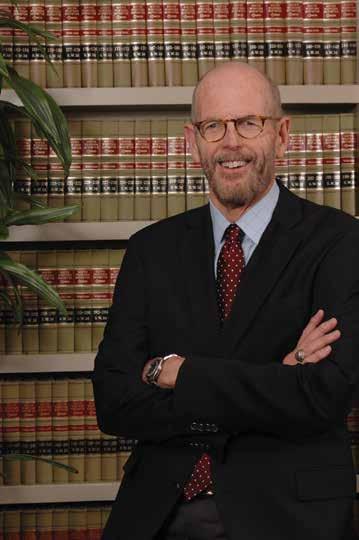
kryptonite, and, when caught, they attack the finders of fact. But now a new tool in the truth-finding biz is emerging. And it is particularly treacherous to frauds and hypocrites.
As I discuss in my CLEs, and in this space, our duty to society is to act as “special citizens” (as our rules demand) to ensure that our lives, our laws, and our policies are supported by truth. Many hours of our training are consumed by learning how to find the truth and legal precedent through skilled research. As we discussed in March (“The Revenge of Master Cylinder”), those skills will likely become dormant as we increasingly rely on artificial intelligence.
Yes, A.I. is already becoming the intellectual crack-cocaine of the legal profession. Its allure, its breadth, and A.I.’s frightening speed is simply too irresistible to escape. The problem is, lawyers all too often fail to ensure that A.I.’s information is correct.
be stupid not to, right? But the hubris of hypocrites insulates them from the cautions of common sense. Therefore, many of us who deeply care about the future of our wonderful experiment in democracy have been concerned (well, perhaps “terrified” is a better word) by the actions of hopelessly unqualified managers in critical governmental posts and positions.
Trial lawyers know that there is a whole body of law concerning evaluating expertise. You can’t have a real estate developer testify on naval military strategy. You can’t have a science-denier credibly testify about best health practices. But those common-sense notions are clearly out of fashion.

One recent article reports that, in December, a federal judge in Oregon penalized a firm with more than $110,000 in fines and fees for false citations, and, in the first three months of 2026, over $80,000 in sanctions have been assessed to penalize lawyers who failed to validate the incorrect case citations issued by A.I. platforms. One large firm was ORDERED to notify each of its clients of the firm’s misuse of A.I., and the resulting monetary sanctions. (I’d love to help write that letter: “Dear Client, a judge has told us to warn every client that we were so lazy (at $750 per hour) that we filled our briefs with BS... We’re sorry about that. So, you’ll understand why we’re raising our rate.”)
Increasingly, people in high positions of responsibility will be dependent upon A.I., but you might expect them to learn from the lessons of the legal profession to double-check the information before they rely upon it. That would
Take one particular member of the Cabinet, whose hubris would prove the point. Certainly, he has access to the most reliable “intel” in the civilized world. The future of this nation, our domestic tranquility, and posterity is dependent upon the exercise of his knowledge and discernment of the truth. His actions, however, leave us frightened and sleepless. As did his attempt to invoke God’s help to defeat a theocracy. (Uh…didn’t that grudge match between supreme beings start the Crusades, which lasted 196 years?).
Well, at a Pentagon prayer breakfast last April 16, he recited a prayer, which he said came from Bible verse “CSAR 25:17.” First, there is no CSAR book of the Bible and a five-second Google search would have so informed him, and, as it turns out, his “prayer” was lifted directly, word for word, from Quentin Tarantino’s 1994 script for Pulp Fiction. Far be it from me to criticize anyone’s attempt to gain favor or influence from the Supreme Being. God knows I’ve been there many times. But, when you’re wearing your religion on your sleeve, maybe you should check before you learn you’re being pranked with a fake Bible verse.
But because sycophants are concocting ridiculous excuses for this absurd fakery, I think I can do better, since I love fakery, and I have skills.
Voilà! With the assistance of the American Screenwriters Guild, here is my prayer for the trial lawyers of Texas (bow your heads, and pray with me, please):
“The Path of the Plaintiff’s lawyer is beset on all sides;
“They faceth the scourge of Tort Reform and descent of Policy limits;
“We beseech thee, Lord, to aid the words they speak, as they must avoid
A Failure To Communicate;
“And guide my hand on Peremptory Strikes, to keep the unwise and the irrational from this jury, as they can’t handle the truth;
“And may we remember the words of the Lord as He guided St. Luke, ‘Luke I am your Father.’”
“And Blesseth be the Civil Defense Lawyers; as to them, Law means never having to say you’re sorry;
“For theirs is the peril of unknown lawsuits; like a box of chocolates, they never know what they’ll get.
“In your mercy encourage the Defense Lawyers to make each Plaintiff an offer he can’t refuse;
“And Blesseth be the Criminal Lawyers;
“For in their justice system they are two separate yet equally important groups, and theirs are the stories;
“And in the end, remind us to go home after trial. Because there’s no place like home. And there, by your grace, may we all live long and prosper.
“Hakuna Matata. Amen”
And finally Lord, let us all keep the faith that we shall survive this.
The opinions expressed in Entre Nous are those of the author and do not necessarily represent the views of the Austin Bar Association membership or the Austin Bar Association board of directors AL
SPONSORED CONTENT
The 2025 Tax Law made permanent the loss of ‘personal exemptions’, which means an individual can no longer deduct Attorney Fees and Expenses from their ‘taxable’ litigation settlements; they must pay taxes on the GROSS recovery. Congress carved out “unlawful discrimination, ” and ’pure employment’ settlements, with few other exceptions
The 2025 Tax Law made permanent the loss of “personal exemptions”, which means an individual can no longer deduct Attorney Fees and Expenses from their “taxable” litigation settlements; they must pay taxes on the GROSS recovery. Congress carved out “unlawful discrimination,” and “pure employment” settlements, with few other exceptions.
Attorneys can no longer deal with Taxable damages of ‘non-physical injury’ and ‘punitive damages-Gross Negligence’ after an agreed settlement/mediation or before funds are distributed.
Attorneys can no longer wait to deal with Taxable damages of “non-physical injury” and “punitive damagesGross Negligence” after an agreed settlement/mediation or before funds are distributed.
The remedy on ‘contingency fee’ cases is to create a Plaintiff Recovery Trust (PRT), but it must be created BEFORE the mediated settlement; the litigation must be transferred to the trust prior to an agreed settlement so the plaintiff can avoid taxation on the fee/expense portion of the recovery, receiving tax reporting (an IRS Form K-1) only on the net recovery.
The remedy on “contingency fee” cases is to create a Plaintiff Recovery Trust (PRT), but it must be created BEFORE the mediated settlement; the litigation must be transferred to the trust prior to an agreed settlement so the plaintiff can avoid taxation on the fee/expense portion of the recovery, receiving tax reporting (an IRS Form K-1) only on the net recovery.
Structured settlements also have a role to play: Tax savings occur when structuring client proceeds to lower tax brackets! (Use in conjunction with the PRT to maximize tax savings, for non-contingency fee cases, and as the only rememdy if it is too late for the PRT.)
Structured settlements also have a role to play: Tax savings occur when structuring client proceeds to lower tax brackets! (Use in conjunction with the PRT to maximize tax savings, for non-contingency fee cases, and as the only rememdy if it is too late for the PRT.)
Now wrongful death cases in Texas under Texas Labor Code Ch. 408 are not only taxable, but paying taxes on the GROSS settlement has a devastating effect for widows and orphans, and serious implications for attorney malpractice.
Now wrongful death cases in Texas under the 408 statute are not only taxable, but paying taxes on the GROSS settlement has a devastating effect for widows and orphans, and serious implications for attorney malpractice.
WITHOUT USING ONE OF THESE REMEDIES, THE ATTORNEY’S FEES EXCEED THE NET DOLLARS TO CLIENT, and IGNORING TAX ISSUES CAN CREATE LIABILITY!
WITHOUT USING ONE OF THESE REMEDIES, THE ATTORNEY’S FEES EXCEED THE NET DOLLARS TO CLIENT, and IGNORING TAX ISSUES CAN CREATE LIABILITY!
Plaintiff attorneys: Protect your clients (and yourselves) by increasing your client’s recovery so they receive more than you!
Plaintiff attorneys: Beware! Malpractice trap is waiting, and you will have a difficult time justifying your fees that exceed the net to clients!
These cases require extra-care, planning and action. Create a PRT before mediation!
These cases require extra-care, planning and action. Create a PRT before mediation! There are no up-front costs in doing so… but plenty of problems if you do not. Defer finalizing the mediated settlement until the PRT is in place (more time is allowed if any Court orders are required, or if case is Appealed)
There are no up-front costs in doing so… but plenty of problems if you do not. Defer finalizing the mediated settlement until the PRT is in place (more time is allowed if any Court orders are required, or if case is Appealed)
Appellate attorneys: Interest accumulations on appeal should be considered for amounts of $100,000 or greater. Punitive damages is a must do.
Appellate attorneys: Interest accumulations on appeal should be considered for amounts of $100,000 or greater. Punitive damages is a must do.
Mediator/Arbitrators: Alert plaintiff attorneys to this issue; consider a means for parties to finalize the settlement agreement after a PRT is in place.
Mediator/Arbitrators: Alert plaintiff attorneys to this issue; consider a means for parties to finalize the settlement agreement after a PRT is in place.
TRIAL VERDICT STRATEGIES: A PRT works as long as (1) there is no binding release, or binding agreement to enter into a release. Get busy creating a PRT before the verdict is final for any taxable damages (Nonphysical injuries, Defamation, Contract disputes, Punitive damages, etc.)
TRIAL VERDICT STRATEGIES: A PRT works as long as (1) there is no binding release, or binding agreement to enter into a release. Get busy creating a PRT before the verdict is final for any taxable damages (Non-physical injuries, Defamation, Contract disputes, Punitive damages, etc.)
Contact us for more information regarding the Plaintiff Recovery Trust and remedies.

The Attorney’s Indispensable Partner in Settlement Planning 830.609.5555 • cmdavis388@gmail.com www.DavisSettlementPartners.com
Carola M. Davis, CFS