austinbar.org JULY/AUGUST 2026 | VOLUME 35, NUMBER 6
ABA, AYLA Honor Award Winners During End-of-Year Reception
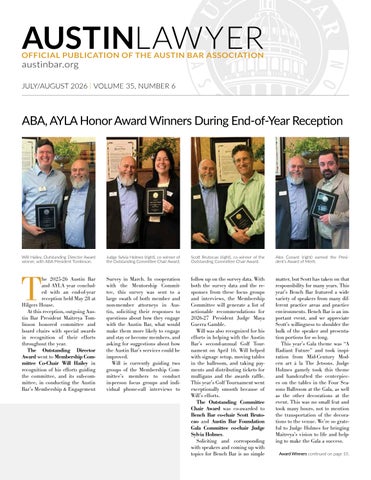
Will Hailey, Outstanding Director Award winner, with ABA President Tomlinson.
T
he 2025-26 Austin Bar and AYLA year concluded with an end-of-year reception held May 28 at Hilgers House. At this reception, outgoing Austin Bar President Maitreya Tomlinson honored committee and board chairs with special awards in recognition of their efforts throughout the year. The Outstanding Director Award went to Membership Committee Co-Chair Will Hailey in recognition of his efforts guiding the committee, and its sub-committee, in conducting the Austin Bar’s Membership & Engagement
Judge Sylvia Holmes (right), co-winner of the Outstanding Committee Chair Award.
Scott Brutocao (right), co-winner of the Outstanding Committee Chair Award.
Alex Conant (right) earned the President’s Award of Merit.
Survey in March. In cooperation with the Mentorship Committee, this survey was sent to a large swath of both member and non-member attorneys in Austin, soliciting their responses to questions about how they engage with the Austin Bar, what would make them more likely to engage and stay or become members, and asking for suggestions about how the Austin Bar’s services could be improved. Will is currently guiding two groups of the Membership Committee’s members to conduct in-person focus groups and individual phone-call interviews to
follow up on the survey data. With both the survey data and the responses from these focus groups and interviews, the Membership Committee will generate a list of actionable recommendations for 2026-27 President Judge Maya Guerra Gamble. Will was also recognized for his efforts in helping with the Austin Bar’s second-annual Golf Tournament on April 16. Will helped with signage setup, moving tables in the ballroom, and taking payments and distributing tickets for mulligans and the awards raffle. This year’s Golf Tournament went exceptionally smooth because of Will’s efforts. The Outstanding Committee Chair Award was co-awarded to Bench Bar co-chair Scott Brutocao and Austin Bar Foundation Gala Committee co-chair Judge Sylvia Holmes. Soliciting and corresponding with speakers and coming up with topics for Bench Bar is no simple
matter, but Scott has taken on that responsibility for many years. This year’s Bench Bar featured a wide variety of speakers from many different practice areas and practice environments. Bench Bar is an important event, and we appreciate Scott’s willingness to shoulder the bulk of the speaker and presentation portions for so long. This year’s Gala theme was “A Radiant Future” and took inspiration from Mid-Century Modern art à la The Jetsons. Judge Holmes gamely took this theme and handcrafted the centerpieces on the tables in the Four Seasons Ballroom at the Gala, as well as the other decorations at the event. This was no small feat and took many hours, not to mention the transportation of the decorations to the venue. We’re so grateful to Judge Holmes for bringing Maitreya’s vision to life and helping to make the Gala a success. Award Winners continued on page 10.
LawPay is a trusted Member Benefit of the Austin Bar Association lawpay.com/austinbar
Run your business. Power your practice.
+
CONTENTS
AUSTINLAWYER JULY/AUGUST 2026 | VOLUME 35, NUMBER 6 AL A L INSIDE
In Every Issue
1 ABA, AYLA Honor Award Winners During End-of-Year 8 Reception 8 22 A Conversation with Chief Justice Wallace B. Jefferson, 14 New President of the American Law Institute 16 23 Travis County Magistrate Judge Leon Grizzard Retires 17 24 Local Middle- and High-School Students Participate in 18 19th Annual Color of Justice Program 25
CANLAW Hosts Clinic for Cancer Community June 6
27 A Complimentary Gift to Texas Lawyers Through August 31, 2026 28 What Every Lawyer Should Know Before Filing for Divorce
21
New Members
CONNECTIONS
Briefs
ONLINE austinbar.org austinlawyeronline.com
Federal Civil Court Update Third Court of Appeals Civil Update Third Court of Appeals Criminal Update Travis County Jury Trials Supreme Court of Texas
Departments
6
President’s Column
12
AYLA
30 What Divorced Parents Should Know Before the School Year Starts
EMAIL billy@austinbar.org MAIL Austin Bar Association 712 W. 16th Street Austin, TX 78701 Austin Bar app available for iPhone and Android. SOCIAL LIKE facebook.com/austinbar
ONLINE austinbar.org NEWS & ANNOUNCEMENTS
SAVE THE DATE
Join us for the Austin Pride Parade Join the Austin Bar’s LGBTQ Law Section for the Austin Pride Parade on Aug. 22! We will decorate our float/ vehicle earlier in the day and then meet at the parade route at 7:30 p.m. before the parade starts at 8 p.m. Members, friends, family, and allies are welcome to join us for either or both the decorating and the march itself. Please RSVP to receive event details, including decorating location, parade meet-up instructions, and other logistics.
OCT. 23
Austin Bar’s Pro Bono Fall Festival Benefiting VLS 10 a.m. - 12 p.m. South Austin Recreation Center 1100 Cumberland Road Tickets & sponsorships available at austinbar.org/fallfestival26
FOLLOW twitter.com/theaustinbar FOLLOW instagram.com/theaustinbar CONNECT https://www.linkedin.com/ company/austin-barassociation WATCH vimeo.com/austinbar
America’s Premier Civil-Trial Mediators & Arbitrators Online
View Bios & Available Dates Calendars for our TX Chapter Members, free at
www.TexasNeutrals.org Proud ADR Sponsor to the National Defense & Plaintiff Bar Associations JULY/AUGUST 2026 | AUSTINLAWYER
3
ADDICTION & MENTAL HEALTH RESOURCES 24-Hour Suicide & Crisis Lifeline - 988 - call or text | Live chat: SuicidePreventionLifeline.org Texas Lawyers’ Assistance Program (TLAP) - 1-800-343-8527 TLAP is a 24-hour confidential crisis counseling and referral program to help lawyers, law students, and judges with substance use and mental health issues. Justice Mack Kidd Fund The Austin Bar Foundation administers the Justice Mack Kidd Fund, which can provide financial assistance to individuals seeking treatment for depression or similar illnesses. Visit austinbar.org/?pg=justice-mack-kidd-fund to learn more. Personal Crisis Assistance Program (PCAP) The Austin Young Lawyers Association Foundation provides grants and/or peer support for individuals suffering from a personal crisis. Contact Debbie Kelly: 512-472-0279 x 105 Sheeran-Crowley Trust Administered through TLAP, the trust provides financial help to Texas attorneys, judges, and law students who need treatment for substance use, depression, and other mental health issues. Visit sheerancrowley.org to learn more. Alcohol & Drug Abuse Austin Drug & Alcohol Abuse Program - 512-454-8180 Alcoholics Anonymous - 512-444-0071 Cocaine Anonymous - 512-479-9327 Narcotics Anonymous Counseling - 512-480-0004
AUSTINLAWYER OFFICIAL PUBLICATION ALOF THE ALASSOCIATION AUSTIN BAR AUSTIN BAR ASSOCIATION
Judge Maya Guerra Gamble �� President Sarah Harp ��������������������������������� President-Elect Judge Ciara Parks ��������������������� Secretary Elliott Beck ��������������������������������� Treasurer Maitreya Tomlinson ������������������ Immediate Past President
AUSTIN YOUNG LAWYERS ASSOCIATION
Gracie Wood Shepherd ������ President Lena Proft ������������������������������ President-Elect Ben Evans ����������������������������� Treasurer Jasleen Shokar ��������������������� Secretary Jenna Malsbary �������������������� Immediate Past President
Austin Lawyer
Psychiatric Emergencies Emergency Screening in a Psychiatric Crisis 24/7 - 512-472-4357 Samaritan Center (provides professional counseling services on a sliding scale) - 512-451-7337
©2026 Austin Bar Association; Austin Young Lawyers Association
EXECUTIVE OFFICES
712 W. 16th Street Austin, TX 78701 Email: austinbar@austinbar.org Website: austinbar.org Ph: 512.472.0279 DeLaine Ward....................... Executive Director Debbie Kelly.......................... Associate Executive Director Roslyn Warner....................... Assistant Editor Samantha McCoy................. Assistant Editor Abigail Ventress.................... Assistant Editor Billy Huntsman...................... Managing Editor Austin Lawyer (ISSN #10710353) is published monthly, except for July/August and December/January, at the annual rate of $10 membership dues by the Austin Bar Association and the Austin Young Lawyers Association, 712 W. 16th Street, Austin, TX 78701. Periodicals Postage Paid at Austin, Texas. POSTMASTER: Send address changes to Austin Lawyer, 712 W. 16th Street, Austin, TX 78701. Austin Lawyer is an award-winning newsletter published 10 times a year for members of the Austin Bar Association. Its focus is on Austin Bar activities, policies, and decisions of the Austin Bar board of directors; legislation affecting Austin attorneys; and other issues impacting lawyers and the legal professionals. It also includes information on decisions from the U.S. District Court for the Western District of Texas and the Texas Third Court of Appeals; CLE opportunities; members’ and committees’ accomplishments; and various community and association activities. The views, opinions, and content expressed in this publication are those of the author(s) or advertiser(s) and do not necessarily reflect the views or opinions of the Austin Bar Association membership, Austin Bar Association board of directors, or Austin Bar Association staff. As a matter of policy, the Austin Bar Association does not endorse any products, services, or programs, and any advertisement in this publication should not be construed as such an endorsement. Contributions to Austin Lawyer are welcome, but the right is reserved to select and edit materials to be published. Please send all correspondence to the address listed above. For editorial guidelines, visit austinbar.org in the “About Us” tab.
2026
4
AUSTINLAWYER | JULY/AUGUST 2026
PRESIDENT’S COLUMN
Getting to Know Judge Maya Guerra Gamble
J
udge Maya Guerra Gamble is the Austin Bar president for the 2026-27 Bar Year. We conducted the Q&A below to get to know her better and find out what she has planned for her term. What are some of your big priorities as president of the Austin Bar? For me, the Austin Bar has been where I go to for professional improvement and personal fun, and I’d like to share that with every lawyer in Austin. Since I am also a judge, I would love to see more attorneys interact with our judges—at events of course, but I’d also like to see more younger attorneys coming to court and arguing cases. I would also like to take a look at all the different events we put on every year and make sure they are all still working for our members. Sometimes we have to let something go in order to bring in something new. What are you most excited for during your term as president? Well, I already warned my husband that I am going to try to go to “everything!” Not humanly possible, of course, but I am looking forward to visiting with every committee, every section, and every affinity bar. I hope any member of the Austin Bar with an idea will give me a call or send
me an email. Mentorship remains really important to me, and I have loved the golf tournament the past two years. I’d love to see huge participation in both of those. What challenges, if any, do you believe we face as an organization and how will you address them? Membership is always the challenge in a voluntary bar association. But we have so much to offer that I know any lawyer who joins us will be glad they did. We’ve recently completed a member survey, and we will be taking the results of that survey to a special board meeting where we plan for the next year and even longer term. What is one (or several) important things you want Austin Bar members to know about you? I have some personal obsessions that take a lot of my free time: I absolutely love to read and am pretty much always reading 2-3 books at once. I do not go anywhere without my kindle! I’m also a really devoted Scouter and last year founded a Scouting America Troop (formerly Boy Scouts) for girls ages 10-17. Hey, I’d love your daughter to join the troop! And if you have sons instead, they can join my old troop! I have two kids who are Eagle Scouts, and I go camping 10 or
more times a year. I also really, really love live comedy—laughing is my favorite. Tell us about your career so far. What drew you to the practice of law? What motivated you to run for judge? I’ve had a pretty wonderful career. I often talk to young lawyers or law students about how the law is a career that can be substance-independent. I clerked for Justice Richard Cudahy (7th Circuit), then became an Honors Program attorney at the Deptartment of Justice pursuing Frauds Claims Act cases across the country. After I decided to move back home to Austin, I was a criminal prosecutor for the Texas attorney general, prosecuting child pornography and child exploitation cases around the state. Once I had children of my own, I started a solo practice and represented children and families in child protective services cases. I also worked for Judge Jan Soifer and her husband Pat O’Connell for a few years representing whistleblowers. Eventually I wanted a new challenge, and there was a new bench, so I decided to run for the seat. That was eight years ago, and I couldn’t be happier. What prompted you to get involved with the Austin Bar? As a solo practitioner, it was vi-
tally important that I get involved with the Austin Bar and the sections that helped me with my work. I needed and wanted that connection with other lawyers, and I wasn’t going to get it in the office. I love socializing, and I love learning, so the Austin Bar is the perfect organization for me. But even if you work in a huge office, it is so valuable to meet lawyers outside of your office. Anything you care about, you can work on at the Austin Bar. Anything else you want to add? I hope to make everyone pleased that I am the president of the Austin Bar this year, but I know I’ll only be successful if members join me. So if there is something you care about or want to do more with, please reach out! There is room for everyone, and we are going to have a lot of fun. AL
Chris Andre
New Vehicle Leasing / Pre-Owned Sales Domestics / Imports / Exotics
Busy Schedule? Call me. Any Make. Any Model. Email | chris@appleleasing.com
6
AUSTINLAWYER | JULY/AUGUST 2026
Phone | 512.653.3718
BRIEFS New Members The Austin Bar welcomes the following new members: Gabriela Cikota Ellen Dickerson Cynthia Duarte Julian Princess Egbuchunam
(L to R): Baird, Hampton, Hayes, Jefferson, Lieck.
Evan Enzer Luke Fruge Anna Hallmark Sophie Hess Stephanie Holan Kevin Kalra Hooman Khoshnood Johnny Kousa Jackson May Caroline McClimon Jennsen Price Rebecca Roberts Siya Sakhardande
KUDOS Congratulations to Texas Court of Criminal Appeals Judge Charles Baird (ret.), who was recently inducted into the hall of fame of the Texas Criminal Defense Lawyers Association. In 1990, Judge Baird was the youngest person ever elected to the Texas Court of Criminal Appeals. He presided over the first ever posthumous exoneration of a defendant, Tim Cole, in 2009. He is the 2010 recipient of the Courage Award from the Texas Coalition to Abolish the Death Penalty. He is the 2010 recipient of the Civil Libertarian of the Year Award from the American Civil Liberties Union of Texas. Charles has twice been the recipient of the Professor Excellence Award from the Law Student Bar Association of South Texas College. Congratulations to Austin attorney Keith Hampton, who was recently inducted into the hall of fame of the Texas Criminal Defense Lawyers Association. Keith is the only lawyer in Texas history to win two contested clemency petitions, both resulting in the commutation of death sentences to life sentences. Keith has won a death-penalty case before the U.S. Supreme Court against then-Texas Solicitor General Ted Cruz in a 5-4 decision. He also helped to draft a writ petition to ensure that defendants found incompetent to stand trial are transferred to state hospitals. Keith was also instrumental in the passages of the Fair Defense Act, the DNA testing statute, and the Michael Morton Act, as well as the formation of the Indigent Defense Commission. Congratulations to former Texas Supreme Court Chief Justice Wallace Jefferson, who has become the American Law Institute
8
AUSTINLAWYER | JULY/AUGUST 2026
(ALI)’s 11th president. The American Law Institute was established in 1923 and drafts, discusses, revises, and publishes restatements of the law, model codes, and principles of law. Read a Q&A with Chief Justice Jefferson on page 22. Congratulations to Justice Kaigler of the Burnet County Public Defender’s Office on his recognition as a Rising Star by the Texas Criminal Defense Lawyers Association. Justice Kaigler has successfully argued and won a motion to suppress evidence obtained through an unlawful search of a bicyclist’s backpack. He initiated and litigated court-ordered medication proceedings for an incompetent misdemeanor client. He successfully secured a personal recognizance bond for a client with severe mental illness who had spent extensive time in solitary confinement, allowing the client to transfer to a respite center. He secured a sentence below the State’s plea offer for a client facing two third-degree felony charges. He has also advocated for the treatment of clients with mental illnesses within jail facilities. Congratulations to Jessica Lieck of Dunham & Jones, who was recently named a Rising Star by the Texas Criminal Defense Lawyers Association. Jessica is a graduate of Texas Tech School of Law, where she served two terms as president of the Criminal Law Association, led the school’s chapter of the National Lawyers Guild, served as a State Bar Qualified Law Student in the Criminal Defense Clinic, and was a member of the Student Bar Association. She has completed more than 200 hours of pro bono legal service and was awarded Texas Tech’s Pro Bono Achievement Award.
ON THE MOVE Congratulations to Marla Hayes, who has joined Smith & Bledsoe Family Law. Marla’s practice involves matters concerning divorce, property division, and child custody. She is a graduate of UT Law.
ABA, AYLA Honor Award Winners During End-of-Year Reception continued from page 1
ABA President Maitreya helped MC the ceremony.
Tomlinson
Ryan Pitts (right) was named the AYLA Outstanding Committee Chair.
Kelly Combs (right) received the AYLA President’s Award of Merit.
Jasleen Shokar (right) earned the AYLA Excellence in Leadership Award.
Incoming AYLA President Gracie Wood Shepherd (right) helped recognize AYLA President Jenna Malsbary for her year of service.
Award Winners continued from page 1.
The President’s Award of Merit went to Fundraising Committee co-chair Alex Conant, who headed fundraising for this year’s Golf Tournament. Despite having no prior experience running a golf tournament, Alex hit the ground running and reached out to and followed up with both potential players and sponsors. Because of Alex’s efforts, this year’s Golf Tournament earned a profit of $31,000 – more than double last year’s. Thank you, Alex, for your incredible work. At the end of the Austin Bar program, incoming President Judge Maya Guerra Gamble also presented Maitreya with a plaque in recognition of his efforts and accomplishments during his term. Also at the reception, outgoing AYLA President Jenna Malsbary presented the AYLA awards. The AYLA Amazing Advocate Award was presented to Samantha McCoy in recognition of her extraordinary and wide-ranging commitment to victims’ rights advocacy. Beyond her day-to-day professional work on behalf of victims, Samantha dedicates significant personal time to advancing advocacy efforts at the local, national, and global levels. She speaks and presents at confer10
AUSTINLAWYER | JULY/AUGUST 2026
ences across the country, contributes to the drafting and passage of legislation protecting victims of sexual assault and domestic violence, and was among the advocates instrumental in enacting the “Take It Down” Act. She also participated in a United Nations referendum on victims’ rights. Within AYLA, Samantha leads Law Day and legal education programming, the AYLA Day of Service on MLK Day, and Community Service Days, and serves as an editor of Austin Lawyer. Her dedication, reach, and impact make her a singular force for justice
and safety in our community and beyond. It is a privilege to have Samantha on the AYLA Board of Directors. The AYLA Outstanding Director Award was presented to Roslyn Warner in recognition of her innovation, dedication, and consistent contributions to the organization. Roslyn led AYLA’s Health and Wellness Committee throughout the year, organizing a diverse array of member events including yoga sessions, hiking outings, group runs, and educational programs. She also was committee lead of AYLA’s submissions to Aus-
tin Lawyer magazine, coordinating with board members and article authors to ensure timely and quality contributions. Roslyn brought enthusiasm, positivity, and a spirit of genuine support to every role she undertook this year, and her efforts meaningfully strengthened the AYLA community. The AYLA Excellence in Leadership Award was presented to Jasleen Shokar, AYLA Director and incoming member of the 2026–2027 Executive Team. Jasleen demonstrated exceptional leadership this year in her dual roles as lead organizer of the 25th
fish Boil — Kelly volunteered reliably and without hesitation. AYLA is deeply grateful for Kelly’s time, effort, and leadership, and is pleased to present him with this well-deserved recognition. At the end of the AYLA program, incoming President Gracie Wood Shepherd presented Jenna with a plaque in recognition of her efforts and accomplishments during her term. AL
Outgoing Austin Bar President Tomlinson (left) helped celebrate Executive Director DeLaine Ward for her continued guidance.
Annual Judicial Reception and colead of the Leadership Academy. Her strong organizational skills, collaborative approach, and initiative ensured the success of every program she touched. Jasleen also spearheaded a social media initiative aimed at increasing member engagement and organizational visibility. She presented to the AYLA Board of Directors on LinkedIn’s algorithmic framework and developed a strategic communications plan to ensure AYLA’s events received appropriate attention and reach. Under her leadership, the Leadership Academy received an outstanding curriculum and produced a highly successful capstone project, reflecting the program’s continued growth and ambition.
Incoming Austin Bar President Judge Maya Guerra Gamble recognized outgoing President Maitreya Tomlinson for his year of service.
The AYLA Outstanding Committee Chair Award was presented to Ryan Pitts, a first-year AYLA Director who has demonstrated exceptional leadership and engagement since joining the board. Ryan took the helm of several of AYLA’s most active committees, serving as chair of Docket Call and as the AYLA liaison to the Bench Bar Planning Committee. He managed monthly events and meetings with diligence, maintained clear communication with committee members, and ensured thorough follow-through on all planning matters. In addition to his committee responsibilities, Ryan was a consistent presence and supporter at AYLA events throughout the year. He also delivered a fantastic CLE
presentation on appellate practice in May. Ryan brings professionalism, enthusiasm, and a strong work ethic to everything he undertakes, and AYLA looks forward to his continued leadership. The AYLA President’s Award of Merit was presented to Kelly Combs in recognition of his steadfast service and generous spirit. Kelly has served as AYLA’s liaison to the LGBTQ Section of the Austin Bar Association for several years and is being honored this year for his invaluable behindthe-scenes contributions to AYLA events. Whether picking up name tags for Docket Call, helping set up for social events, or assisting with takedown following AYLA’s largest fundraisers — including Tailgate for a Cause and the Craw-
You’re busy looking out for your clients’ needs. Who’s looking out for yours? Jim Kaighin, Jr., CFP
®
Financial Professional
3305 Northland Dr., Suite 414
512-302-6051
Austin, TX 78731
kaighinjr@momentumin.com
Member: FINRA/SIPC JULY/AUGUST 2026 | AUSTINLAWYER
11
AUSTIN YOUNG LAWYERS ASSOCIATION
Q&A With Incoming AYLA President Gracie Wood Shepherd professionals in our community. I want all young lawyers to feel connected and included in our Bar. AL: What would you say to young lawyers to show them the benefit of joining AYLA? There are times when being a lawyer is really tough. I think it is crucial to have colleagues and friends in our profession, both in our own area of practice and
in other areas of practice, to call on and rely on during some of the tough times in this profession. We all undoubtedly will also be asked by our own individual networks for referrals for other areas of law, and AYLA is a great resource to make those connections. The City of Austin can feel very large sometimes, but having a network like the people you will meet through AYLA makes the city feel small. AL
AYLA Hosts an Evening of Wine and Wellness
G
racie Wood Shepherd is the AYLA president for the 2026-27 bar year. Following is a Q&A we conducted with Gracie to get to know her and find out what plans she has for her term.
AL: Tell us about yourself. What do you like to do for fun? Pets/ family/activities outside the profession? I was born and raised in Austin. I went to Texas A&M for undergrad (Gig ‘Em) and Baylor for law school. I was very involved in student organizations and community service both at Texas A&M and Baylor Law School. My husband, Brian, is a lawyer as well, and we have two little boys. I love the chaos of being a boy mom. We spend most of our time playing outside and hanging out with friends and family. AL: Tell us about your law practice. I am a partner at Friday Milner Lambert Turner, PLLC, and we represent clients in family law cases. In the last several years, I have 12
AUSTINLAWYER | JULY/AUGUST 2026
increased my family law appellate practice, but I represent clients in all areas of family law. Although family law can be challenging, I really enjoy family law because I often feel like I am able to make a positive impact in the lives of my clients and their children. AL: Why and how did you first get involved with AYLA? I joined the AYLA/Austin Bar Association Leadership Academy shortly after I became licensed. I wanted to find a way to get involved in the Austin legal community and build roots coming back to Austin as an adult. I found the Leadership Academy to be the perfect entry point to get involved with AYLA, meet other young lawyers, and get experience in our legal community. AL: Tell us about some of your goals/plans for the upcoming year. My goal is to help young lawyers expand their networks and connections, both with other young lawyers and more seasoned
Ruby Musgrove (middle) and Jackie Navarro (right).
I
n April, the AYLA Health & Wellness Committee hosted An Evening of Wine and Wellness. Just Well Law provided an incredible space for AYLA and TCWLA members to learn valuable insights on health and longevity from Austin Longevity Clinic owners Marci and Sam Ditzell. The event was a memorable and inspiring program sponsored by Cypress Lake Recovery. AL
UPCOMING EVENTS THUR., AUG. 6 Sip & Serve with Texas Advocacy Project 4 - 6 p.m. Hilgers House Carriage House 712 W. 16th St. RSVP at austinbar.org
JULY/AUGUST 2026 | AUSTINLAWYER
13
FEDERAL CIVIL COURT UPDATE
>
Ari Cuenin is a partner at Stone Hilton, where he litigates complex government disputes. He has presented more than 30 arguments in state and federal courts, and has been involved in more than a dozen U.S. Supreme Court cases for the State of Texas.
ARBITRATION: Court compels arbitration under FAA in maritime injury suit. Hill v. Jackson Offshore Holdings, L.L.C. (5th Cir. No. 24-30554). The Fifth Circuit vacated a district court order denying Jackson Offshore’s motion to compel arbitration and stay proceedings in a seaman’s maritime injury suit. After Jeremiah Hill suffered severe injuries aboard the M/V BLIZZARD, Jackson Offshore paid maintenance and cure and also provided supplemental benefits, including wages, housing, and transportation. Hill later signed an Advance Wage and Benefits Agreement under which those supplemental benefits would continue and any future claims would be arbitrated. The Agreement also contained a delegation clause requiring disputes concerning the Agreement’s validity, interpretation, or application to be decided by an arbitrator. Hill later sued and argued that the Agreement was unenforceable because it was procured through fraud, fraudulent inducement, and economic duress. The district court denied arbitration without prejudice and allowed discovery regarding enforceability. The Fifth Circuit first held that it had 14
AUSTINLAWYER | JULY/AUGUST 2026
appellate jurisdiction under FAA § 16(a), notwithstanding the district court’s denial without prejudice. On the merits, the court applied the FAA’s severability doctrine and concluded that Hill’s challenges were directed at the Agreement as a whole rather than at the delegation clause itself. Under Rent-A-Center, Buckeye Check Cashing, and related Fifth Circuit authority, those validity challenges required resolution by the arbitrator. The court therefore vacated the district court’s order and remanded for proceedings consistent with the opinion compelling arbitration. Judges Willett and Douglas issued concurring opinions, explaining their views that the result flowed either directly from Supreme Court precedent (Willett) or from Fifth Circuit precedent (Douglas). The decision reinforces the effect of delegation clauses. Parties opposing arbitration must specifically challenge the delegation provision itself; allegations that the broader agreement was induced by fraud, duress, or economic pressure generally will be decided by the arbitrator when the delegation clause is left unchallenged. FEDERAL TORT CLAIMS ACT: Court revives catastrophic-injury claim based on failure to protect. Morris v. United States (5th Cir. No. 24-40576).The Fifth Circuit reinstated Brittany Morris’s catastrophic-injury suit under the Federal Tort Claims Act after a federal probation officer allegedly failed to protect her from a violent offender on supervised release. Morris reported escalating threats, burglary, drug use, and violence by her ex-boyfriend, Rondell Malveaux, to supervising probation officer Beverly Matt. Matt allegedly promised immediate action, assured Morris she was safe, and represented that an arrest warrant would issue promptly. But Matt allegedly failed to alert the court, prosecutors, or local law enforcement to the urgency of the danger. Days later, Malveaux broke into Morris’s home, stabbed her, severed her spinal cord, and left her paralyzed.
The district court dismissed for lack of jurisdiction under the FTCA’s misrepresentation exception, reasoning that the case arose from Matt’s assurances regarding Morris’s safety. The Fifth Circuit reversed. Relying heavily on Block v. Neal, the panel held that Morris’s claims were not fundamentally about misinformation. Instead, they focused on the negligent performance of operational tasks—failing to convey the urgency of Malveaux’s threats, failing to alert appropriate authorities, and failing to carry out protective measures allegedly undertaken by the probation officer. Any misrepresentations were collateral to the alleged negligence. The panel also rejected dismissal under the discretionary-function exception at the pleading stage, concluding that Morris had plausibly alleged negligent execution of actions the officer had already chosen to undertake rather than protected policymaking discretion. The decision underscores that negligent-undertaking claims may proceed when the alleged breach involves operational failures distinct from misrepresentation or discretionary governmental judgment. ANTITRUST: Fifth Circuit revisits Sherman Act claims on panel rehearing in municipal water dispute. Megatel Homes, L.L.C. v. City of Mansfield (5th Cir. No. 25-11006). A Fifth Circuit panel granted rehearing in Megatel Homes v. City of Mansfield, substituting an opinion on Sherman Act claims brought by a developer against the City of Mansfield. The substituted opinion reached the same result, holding that the city was not entitled to state-action antitrust immunity at the pleading stage. Megatel sought to develop a large mixed-use project in Mansfield’s extraterritorial jurisdiction. Although the relevant utility district (JCSUD) held the certificate of convenience and necessity (CCN) granting it the exclusive right and obligation to provide water service, Mansfield had negotiated a contract requiring JCSUD to obtain the city’s consent before
providing water within Mansfield’s ETJ. According to Megatel, Mansfield used that leverage to demand annexation, development concessions, and fees unrelated to water service. The district court dismissed based on state-action immunity, reasoning that the Texas Water Code contemplates regulated monopolies in water service. The Fifth Circuit disagreed. Judge Higginson explained that the relevant question is not merely whether Texas authorizes monopoly service generally, but whether Texas specifically delegated the challenged anticompetitive authority to the actor asserting immunity. The Water Code grants exclusivity to the CCN holder— here, JCSUD—not to Mansfield. Because Mansfield identified no statutory delegation authorizing it to restrict or condition JCSUD’s provision of service within the CCN area, it failed to establish state-action immunity. On rehearing, the panel clarified the limits of its review. The Court declined to address the district court’s alternative one-sentence conclusion that Megatel had failed to plead viable Sherman Act claims, instead remanding that issue for further development and explanation. Megatel thus remains an important reminder that municipalities invoking state-action immunity must identify a clear statutory delegation of the specific anticompetitive authority they exercised. AL
THIRD COURT OF APPEALS CIVIL UPDATE TRIAL PROCEDURE: Court holds an email signature block meets Rule 11.
Laurie Ratliff is a former staff attorney for the Third Court of Appeals. She is board-certified in civil appellate law by the Texas Board of Legal Specialization and owner of Laurie Ratliff LLC.
The following are summaries of selected civil opinions issued by the Third Court of Appeals during May 2026. The summaries are an overview; please review the entire opinion. Subsequent histories are current as of June 8, 2026.
> PROTECTIVE ORDERS: Court upholds protective order for duration of parties’ lives. Travis v. Vanderbilt, No. 03-2500528-CV (Tex. App.—Austin May 1, 2026, no pet. h.). In a divorce proceeding, Vanderbilt applied for a protective order alleging Travis had stalked and threatened her. The parties signed an MSA pursuant to Family Code § 6.602 to resolve the divorce and the protective order. The MSA attached an agreed protective order with the duration for the parties’ lives. The protective order also stated that the parties agreed the trial court would not make family-violence findings. The trial court signed the order. Travis challenges the order’s duration, arguing that without a family-violence finding, the protective order was limited to two years. The court of appeals noted that parties are entitled to a judgment on an MSA that meets the Family Code. The court held that the trial court was required to enter the agreed protective order as set out in the MSA. The court affirmed.
Morales v. Lowenberg, No. 0324-00309-CV (Tex. App.—Austin May 28, 2026, no pet. h.). Morales and Lowenberg co-owned a dog. After their relationship ended, they agreed to split possession of the dog. After Morales refused to return the dog, Lowenberg sued for conversion and breach of contract and sought a temporary injunction. Morales emailed Lowenberg’s attorney a settlement offer, agreeing to relinquish her rights to the dog. The email contained Morales signature block. Lowenberg’s attorney filed the emails as a Rule 11 agreement. Morales then revoked the offer. The trial court granted Lowenberg’s motion to enforce. Morales argued her email signature block was not a signature for Rule 11. The court of appeals observed that a name typed with a typewriter, or a computer keyboard in an email or an email signature block, is a signature for purposes of Rule 11. Thus, Morales’ name in the signature block was her signature for Rule 11. The court modified the fee award and affirmed. RESTRICTED APPEAL: Court reverses no-answer default divorce. Martinez v. Batres, No. 03-2400388-CV (Tex. App.—Austin May 22, 2026, no pet. h.) (mem. op.). In this no-answer default, the final decree divided the community evenly, awarding Batres the house where Martinez and the children lived and awarding Martinez a house in Mexico. Martinez timely filed a restricted appeal, challenging the division of the community estate. Batres contended the Martinez owned a house in San Marcos where she and the children could live. The court of appeals observed that the evidence established Martinez was a part owner, but there was no evidence that she could live there. Further, the court concluded Batres failed to establish the Mexico house’s value. The court noted an owner can testify to market value, but the value must be substantiated. The
court concluded the trial court lacked sufficient information on which to exercise its discretion. Thus, there was error on the face of the record. The court remanded for a new division of the community estate. FAMILY LAW: Court holds an MSA survives a dismissal without prejudice.
served as a future partition of the community estate. The court described an MSA as “more binding than a basic written contract” because nothing either party does voids it. The court held that the MSA survived the dismissal without prejudice and affirmed. AL
Tilleman v. Tilleman, No. 03-2500020-CV (Tex. App.—Austin May 29, 2026, no pet. h.) (mem. op.). During the parties’ first divorce lawsuit, Louisa and Matthew signed an MSA. Later, they jointly agreed to nonsuit the proceeding without prejudice. Matthew later filed a second petition for divorce and sought judgment on the MSA from the first lawsuit. The trial court entered judgment on the MSA. Louisa argued that because the MSA referred to “this pending action” and “this cause,” it was limited to the first proceeding. The court of appeals disagreed. The MSA purported to settled “all issues,” was irrevocable, and
Rob Holcomb MEDIATOR
\Construction | Business | Real Estate | Consumer HOLCOMB-LAW.COM RDH@HOLCOMB-LAW.COM (512) 476-1121
HOLCOMB LAW, PLLC
4407 South IH-35, Suite 201 Georgetown, TX 78626 JULY/AUGUST 2026 | AUSTINLAWYER
15
THIRD COURT OF APPEALS CRIMINAL UPDATE
Zak Hall is a staff attorney for the Third Court of Appeals. The summaries that follow represent the views of the author alone and do not reflect the views of the Court or any of the individual justices on the Court.
The following is a summary of selected criminal opinions issued by the Third Court of Appeals from October 2025. The summary is an overview; please review the entire opinions. The subsequent history is current as of May 11, 2026.
> CONFRONTATION CLAUSE – NON-TESTIFYING ACCOMPLICE: Admission of accomplice’s statement through the testimony of investigating officer violated defendant’s right to confront the witnesses against him under the Sixth and Fourteenth Amendments to the United States Constitution. Willrich v. State, 729 S.W.3d 425 (Tex. App.—Austin 2025, pet. ref’d). Willrich was charged with capital murder. The victim was shot by two gunmen, “a heavier man wielding a handgun, and a skinnier man wielding a sawedoff shotgun.” Police first apprehended the skinnier gunman, Jervis, who led them to Willrich, the heavier gunman. During his interrogation by the investigating officer, Jervis had written Willrich’s name on a piece of paper and gave it to the officer. The officer testified that he did not know anything about Willrich but that the note had “open[ed] up a new line of investigation.” The trial court admitted the handwritten 16
AUSTINLAWYER | JULY/AUGUST 2026
note into evidence over Willrich’s objection but instructed the jury “that this is an investigative lead and it is not offered for the truth of the matter asserted. It’s something that the detectives acted upon.” The jury convicted Willrich, who argued on appeal that the admission of the evidence violated his confrontation rights. The State argued that it had not offered Jervis’s identification of Willrich “for the truth of the matter asserted” but rather to show how officers started to investigate Willrich. The appellate court agreed with Willrich. The court explained that the jury could use such evidence for both the proper purpose of providing background information and for the improper purpose of establishing the truth of the matter asserted. In this case, “Jervis’s identification of Willrich as his accomplice, when identity was hotly contested at trial, was the most damning piece of information put before the jury, creating a greater likelihood that the jury would gravitate toward the improper use.” Thus, “[u]nder the particular facts of this case,” the court held that the admission of Jervis’s statement violated Willrich’s confrontation rights. The court went on to conclude that the admission of the evidence was harmful. It explained, “Here, the defensive theory throughout trial was that the State had failed to prove and could not prove Willrich’s identity as the second gunman. Courts, including this one, have repeatedly recognized the unique persuasiveness of an accomplice’s out-of-court statement naming the defendant as a participant in the crime.” The court reversed the conviction and remanded for a new trial. MOTIONS TO SUPPRESS – POSSESSORY RIGHTS TO PHONE: Defendant’s girlfriend could be treated as the “owner” of defendant’s phone containing evidence of crime due to her having a greater possessory right to it. Hrehocik v. State, 729 S.W.3d 496 (Tex. App.—Austin 2025, no pet.). Hrehocik was convicted of aggravated assault with a dead-
ly weapon, continuous violence against the family, assault family violence, injury to a child, unlawful restraint, and tampering with a witness. Hrehocik’s phone, which his girlfriend had given to the police, contained evidence of the crimes, and he sought to suppress that evidence. The trial court denied the motion to suppress. Hrehocik argued on appeal that the trial court should have suppressed the evidence under article 38.23 of the Code of Criminal Procedure, which provides, in relevant part, as follows: “No evidence obtained by an officer or other person in violation of any provisions of the Constitution or laws of the State of Texas, or of the Constitution or laws of the United States of America, shall be admitted in evidence against the accused on the trial of any criminal case.” Hrehocik asserted that by taking his phone and accessing it, his girlfriend had violated statutes prohibiting breaches of computer security and theft. The appellate court disagreed. There was conflicting evidence on whether
Hrehocik or his girlfriend had a greater possessory right to the phone. Even though the girlfriend testified that the phone belonged to Hrehocik, she had stated in a written statement that “the phone was hers and that Hrehocik and she had their own phones.” Additionally, the court explained that “a person can be considered the owner of a phone even if there is evidence that the person is not listed as the owner in the service account and evidence that someone else pays for the phone and for cellular service.” The court concluded that because the trial court found that the girlfriend had a greater possessory right to the phone, she was the “owner” for purposes of the theft statute and the breach-of-computer-security statute, meaning that she did not violate the law and that the evidence was admissible. AL
MEDIATION & ADR SERVICES
MARK L. HAWKINS THE BEST LAWYERS IN AMERICA®
COMMERCIAL LITIGATION 2012–PRESENT
TEXAS SUPER LAWYERS®
BUSINESS LITIGATION 2016–PRESENT
THE BEST LAWYERS IN AMERICA®
REAL ESTATE LAW 2012–PRESENT
AUSTIN MONTHLY
TOP ATTORNEY 2019–PRESENT
Armbrust & Brown, PLLC 100 CONGRESS AVE., SUITE 1300 • AUSTIN, TEXAS 78701 512-435-2300 • FAX 512-435-2360 MHAWKINS@ABAUSTIN.COM
JURY TRIALS UPDATE
April & May 2026 Jury Trials By Velva Price, Travis County District Clerk APRIL CIVIL In the Matter of the Marriage of Myles Kenneth Leighton v. Kinga Baweja-Leighton and In the Interest of M.F.L., a Child Cause No.: D-1-FM-25-005046: Judge: Laurie Eiserloh, 455th District Court Dates: April 6-9, 2026 Attorneys: Petitioner: Mstislav Pedro Talavera-Karmanov, Slav Law Respondent: Self-Represented Summary: A petition for divorce was filed in Hays County in June 2020 and transferred to Travis County in August 2025. A unanimous jury found that both Petitioner and Respondent should be joint managing conservators, but Petitioner should have the exclusive right to designate the primary residence of the child with a geographic restriction of Travis County, Texas. Driftwood Commercial, LLC v. Tips Primary Holdings, LLC, and Geremy L. Sanders v. Lindsay J. Works and Polkinghorn Group Architects, Inc. Cause No.: D-1-GN-22-000368 Judge: Catherine Mauzy, 419th District Court Dates: April 7-16, 2026 Attorneys: Plaintiff Driftwood: Daniel Manning/Wylie Kumler, Germer PLLC (Austin) Defendant Tips: Stephen Aldous, Aldous PC (Houston) Summary: The lawsuit involved a commercial construction project known as the Deerfield Development in Austin, Texas. Plaintiff Driftwood, a general contractor, claimed Defendant Tips did not pay per the agreement. Defendant Tips filed a counterclaim against Plaintiff for construction defects and brought third-party Defendants Lindsay Works and Polkinghorn Group Architects, Inc., into the lawsuit. During the trial,
parties were non-suited, settled, and the court granted directed verdict on all of Plaintiff’s counterclaims against Defendant Tips. A jury of 10 found that Plaintiff Driftwood failed to comply with the agreement with Defendant Tips. Plaintiff Driftwood’s failure to comply with the agreement was not excused by Defendant Tips’ prior repudiation. Damages awarded that would fairly and reasonably compensate Defendant Tips for damages that resulted from the failure to comply by Plaintiff Driftwood: cost to repair building C of the Deerfield Project - $200,000; cost to make the Deerfield Project compliant with the Americans with Disabilities Act - $200,000; cost to replace the roofs on Buildings C and D $0; cost to construct two separate electric meters at Building D - $0. Edward Bleier, MD, v. Janice Hilscher Cause No.: D-1-GN-24-008171 Judge: Daniella DeSeta Lyttle, 261st District Court Dates: April 7–9, 2026 Attorneys: Plaintiff: Andres C. Pereira/ Christine Londergan, DJC Law (Austin) Defendant: Bret Payne, Walters, Balindo & Crain (Austin) Summary: This case arises from a rear-end golf cart collision. A unanimous jury found that Defendant was negligent and awarded damages: Past physical pain and mental anguish - $5,000; future physical pain and mental anguish - $0; past physical impairment - $5,000; future physical pain and mental anguish - $0. Cliff Walker, Ind. and on Behalf of W&W Holdings, LLC, and Laser Scientific, LLC, v. Jason Wilkes Cause No.: D-1-GN-25-002369 Judge: Jan Soifer, 345th District Court Dates: April 21-27, 2026 Attorneys:
Plaintiffs: Jeff Taylor, Jeff Taylor Law, and Don Taylor, Taylor Thuss (Austin) Defendant: Taylor McCarty, Richards, Rodriguez & Skeith (Austin) Summary: As stated in one of the pleadings, this case is a “business divorce,” where the parties are deadlocked as 50/50 members and are unable to agree on the management of the company’s affairs. Plaintiff Cliff Walker and Defendant Jason Wilkes each hold 50 percent membership interests in W&W Holdings, LLC. A unanimous jury found each party justifiably placed confidence in the other to act in the other’s best interest. Defendant breached his duty to Plaintiff and to their business, Laser Scientific, but Plaintiff did not breach his duty to Defendant. Eleven of the jurors found that Defendant committed fraud against Plaintiff and Defendant committed theft with malice of Laser Scientific’s funds over $55,000; that Defendant profited from Laser Scientific in the amount of $191,500; and that Laser Scientific was entitled to exemplary damages from Defendant of $100,000 for theft. They found that both Plaintiff and Defendant breached the operating agreement, but Defendant breached first; his breach was not excused; and compensatory damages were awarded to Plaintiff for the breach - $100,000; Defendant agreed that Plaintiff would buy out Defendant’s interests in the businesses - $93,479.00 but failed to comply with the agreement. No damages were awarded to Defendant or exemplary damages to Plaintiff. Luis Serrato-Diaz v. Zachary Bedewi Cause No.: D-1-GN-24-003899 Judge: Laurie Eiserloh, 455th District Court Dates: April 21-24, 2026 Attorneys: Plaintiff: Bianca Moroles, Ca-
gle, Prudhomme & Moroles (Austin) Defendant: Katherine Wyatt, Skelton & Woody (Austin) Summary: This case arises from a rear-end accident on Interstate 35 in October 2023. A jury of 11 found that Defendant was negligent and awarded damages: past medical expenses - $22,000; future medical expenses - $0; past physical pain and mental anguish - $8,000; future physical pain and mental anguish - $0; past physical impairment - $6,000; future physical pain and mental anguish - $0. Eric Copper and KWI-1, Ltd., v. Sheryl Schey and Tim Schey Cause No.: C-1-CV-21-002525 Judge: David Phillips (Visiting) Dates: April 22, 2026 Attorneys: Plaintiffs: A. Boone Almanza and Rachel McKenna, Almanza, Blackburn, Dickie & Mitchell Defendants: Mike Deitch, The Deitch Law Offices (Austin) Summary: In the first trial, Plaintiffs sued Defendants for breach of residential buyer/tenant representation agreement. The court ruled in favor of Plaintiffs and awarded commission, attorney fees, and court costs. Defendants appealed, and the court of appeals reversed the court’s final judgment and remanded the case for the trial court to determine Defendants’ attorney fees and costs. A unanimous jury awarded attorney fees as follows: trial court - $87,389; future court of appeals - $15,000; petition for review in the Supreme Court of Texas - $5,000.00; merit briefing stage in the Supreme Court of Texas - $5,000.00; and oral argument and completion of the proceedings in the Supreme Court of Texas - $5,000.
JULY/AUGUST 2026 | AUSTINLAWYER
17
JURY TRIALS UPDATE APRIL CRIMINAL State of Texas v. Mathew Scott Cause No.: D-1-GN-24-004854 Judge: Karen Sage, 299th District Court Dates: March 31-April 1, 2026 Attorneys: State of Texas: Nancy Mullen, Special Prosecution Unit (Huntsville) Respondent: Charles Martin, Independent Office of Inmate Counsel (Conroe) Summary: Respondent was alleged to be a sexually violent predator, and the state requested Respondent be committed for treatment and supervision, pursuant to Title 11, Chapter 841, of the Texas Health and Safety Code. The jury was sworn in, but a mistrial was declared. State of Texas v. Caleb Greer Cause No.: D-1-DC-25-904024 Judge: Brandy Mueller, 403rd District Court Dates: April 7-10, 2026 Attorneys: State of Texas: Jacques A. Roussel Defendant: Benjamin Gergen (Austin) Summary: Defendant was arrested for sexually assaulting a female victim during various therapy sessions. Defendant was acquitted. State of Texas v. Soumar H. Aljaafari Cause No.: D-1-DC-26-904045 Judge: Chantal Eldridge, 331st District Court
18
AUSTINLAWYER | JULY/AUGUST 2026
Dates: April 13-17, 2026 Attorneys: State of Texas: Jacob Swaab Defendant: Jeremy Sylestine, Cofer Connelly (Austin) Summary: Defendant was charged with aggravated kidnapping. A mistrial was declared after the jury was sworn in, and an Allen Charge was issued. State of Texas v. Steve Ayala-Jimenes Cause No.: C-1-CR-24-027171 Judge: Dimple Malhotra, County Court at Law #4 Dates: April 15, 2026 Attorneys: State of Texas: Milly Gonzalez Defendant: Monica Mendoza (Austin) Summary: Defendant was charged with violation of protective order/ condition of bond. The jury found Defendant guilty, and the court sentenced Defendant to 30 days’ confinement in the Travis County Correctional Center. State of Texas v. Joseph Ring Cause No.: D-1-DC-24-303795 Judge: Melissa Goodwin (Visiting) Dates: April 21-22, 2026 Attorneys: State of Texas: Amrit Sharma Defendant: Matthew Wayne Shrum (Austin) Summary: Defendant was arrested for aggravated assault. The jury found Defendant guilty and sentenced him to 10 years in prison. State of Texas v. David Lee Jinkins Cause No.: D-1-CR-23-500430 Judge: Carlos Barrera, County Court at Law #8
Dates: April 26-27, 2026 Attorneys: State of Texas: Jonathan Ramirez Defendant: Jeffery Parker, Lance Kennedy Law (Belton) Summary: Defendant was charged for terroristic threats. The jury found Defendant guilty. The court sentenced Defendant to one year at the Travis County Correction Center and $2,000 in fines. CIVIL
MAY
James Gregory, Jr., Ind. and derivatively on Behalf of Each of Texas Disposal Systems, Inc., Texas Landfill Management, LLC, Texas Disposal Systems Landfill, Inc., TDS Environmental Services, LLC, TDS Land Management, LP, and the Austin Savanna, LLC; Jennifer Gregory, as Trustee of Jennifer Gregory 2018 Irrevocable Trust; and Justin Gregory, as Trustee of the Justin Gregory 2018 Irrevocable Trust v. Texas Disposal Systems, KNC., Texas Landfill Management, LLC, Texas Disposal Systems Landfill, INC., TDS Land Management, LP; and the Austin Savanna, LLC (defendants/counter-plaintiffs/third party plaintiffs) Bobby Gregory; TXAlloy, INC.; Okapi Environmental Services, LLC; Okapi Leasing, LLC, and Bgico, LLC (defendants) Jennifer Gregory and Justin Gregory (third-party defendants) Cause No.: D-1-GN-23-001946: Judge: Todd Wong, County Court
at Law #1 Dates: April 20-May 1, 2026 Attorneys: Plantiffs: Sara Clark, Kennon Wooten, Casey Dobson, S. Abraham Kuczaj III, Scott Douglass & McConnico (Austin) Defendants: Karen Burgess and Katie Dolan-Galaviz, Burgess Law (Austin), Robin Harrison, Hicks Thomas (Houston) Summary: TDS Companies sued Jimmy Gregory, the co-founder and co-owner of Texas Disposal Systems (TDS), and his daughter, Jennifer Gregory, for misappropriating trade secrets in violation of the Texas Uniform Trade Secrets Act. Further, the petition claimed that Jimmy and Jennifer Gregory disclosed trade secrets to third parties. A unanimous jury found that Bobby Gregory failed to comply with the letter of understanding in respect to increasing Bobby Gregory’s salary and bonus from TDS, with Jimmy Gregory’s consent, beginning in 2020; terminating Jimmy Gregory’s $15,000 monthly distributions without Jimmy Gregory’s consent beginning in March 2022; and making deductions from Jimmy Gregory’s distributions as principal and interest on a $2.5 million loan to Jimmy Gregory, without Jimmy Gregory’s consent, beginning in Jan. 2014. The failure to comply was not excused by a superseding agreement or waiver. Jury awarded damages that would reasonably compensate Jimmy Gregory for his damages that resulted from Bobby Gregory’s failure to comply with the letter of understanding:
JURY TRIALS UPDATE 20 percent of the increases in Bobby Gregory’s salaries and bonus from TDS, beginning in 2020 - $669,999.72; termination of Jimmy Gregory’s $15,000 monthly distributions beginning in March 2022 - $735,000; deductions from Jimmy Gregory’s distributions as principal and interest on a $2.5 million loan to Jimmy Gregory beginning in Jan. 2014: $0. The jury further found that Bobby Gregory failed to comply with his fiduciary duty to TDS companies when forming and using Okapi Leasing to purchase vehicles and leasing them to TDS companies: TDS Texas Landfill Management and TDS Environmental; when forming and using Okapi Environmental Services to provide employee benefit services to the TDS companies; when forming and using Okapi Environmental Services to provide payroll and employee benefit services to the TDS companies; and allocation of shared general and administrative costs between TXAlloy and the TDS companies. The conduct was not excused when forming and using Okapi Leasing to purchase vehicles and lease them to the TDS companies; or when forming and using Okapi Environmental Services to provide payroll and employee benefit services to the TDS companies. The following transactions were not authorized, approved, or ratified by the governing authority of the TDS companies, and the transactions were not fair to the TDS companies when they were authorized, approved, or ratified: forming and using Okapi Leasing to purchase vehicles and lease them to the
TDS companies; and when forming and using Okapi Environmental services to provide employee benefit services to the TDS companies; when forming and using Okapi Environmental Services to provide payroll and employee benefit services to the TDS companies; and allocation of shared general and administrative costs between TXAlloy and the TDS companies. The property from TDS was wasted and misapplied. Bobby Gregory, TDS, and TDS Landfill failed to comply with the stock transfer restriction agreement by failing to recognize Jimmy Gregory’s transfers of stock to the Jennifer Gregory 2018 Irrevocable Trust and the Justin Gregory 2018 Irrevocable Trust or wrongfully interfered with the transfer of trust. Trustees Justice Gregory and Jennifer Gregory were ready, willing, and able to perform under the stock transfer restriction agreement. The jury assessed exemplary damages against Bobby Gregory: forming and using Okapi Leasing to purchase vehicles and lease them to the TDS companies - $21,852,265; forming and using Okapi Environmental Services to provide payroll and employee benefit services - $702,696; and allocation of shared general and administrative costs - $1,175,692. Marianne Linde v. Nicholas Heffernan, Glenn Heffernan, and Cynthia Heffernan Cause No.: D-1-GN-23-001015 Judge: Cory Liu, 250th District Court Dates: May 4-6, 2026 Attorneys: Plaintiff: Price Ainsworth,
Lorenz & Lorenz (Austin) Defendants: Amanda N. James, Reese Swincher (San Antonio) Summary: Plaintiff sued Defendants for negligence arising from an automobile accident that occurred in June 2021. A unanimous jury awarded the following damages: past physical pain and mental anguish - $30,000; future physical pain and mental anguish $0; past disfigurement - $0; future disfigurement - $0; past physical impairment - $0; future physical impairment - $0; and past medical expenses - $10,000. April Lyon v. Pafat, L.P., Pafat Cause No.: D-1-GN-24-008485 Judge: Sherine Thomas, 353rd District Court Dates: May 4-8, 2026 Attorneys: Plaintiff: Marissa Maggio, Maggio Injury Law (Plano) Defendants: Alexandra Yamron, Fanaff, Gonzales, Baldwin & Cunningham (Austin) Summary: Plaintiff claimed that, in Aug. 2023, she was injured while on Defendants’ premises, an office complex. A jury of 10 found that neither Defendants nor Plaintiff was negligent. Kira Springer as Representative of the Estate of Mary McCoy v. Robert Grona and Michelle Grona Cause No.: D-1-GN-23-002387 Judge: Daniella DeSeta Lyttle, 261st District Court Dates: May 5-7, 2026 Attorneys: Plaintiff: Courtney Dibrell Graham, Bonilla Law Firm (Austin)
Defendants: Justin R. Vatter, Chamberlain McHaney (Austin) Summary: Plaintiff sued Defendants for negligence and negligence per se arising from a dog attack in May 2021. A jury of 11 found that Defendant Robert “Bobby” Grona was 100 percent negligent, Michelle Grona was zero percent negligent, and Mary McCoy was also zero percent negligent. Damages awarded: past physical pain and mental anguish of Mary McCoy - $1,500,000; past disfigurement - $500,000; and past physical impairment $3,000,000. Andrea Grant v. Tiffany Rhodes Cause No.: D-1-GN-25-000839 Judge: Laurie Eiserloh, 455th District Court Dates: May 18-20, 2026 Attorneys: Plaintiff: Thomas C. Hall, Thomas C. Hall, PC (San Antonio) Defendant: Andrew Neal and Zachary Tritico, Skelton & Woody (Austin) Summary: Plaintiff claimed she was rear-ended by Defendant on her way to school in April 2024. A unanimous jury found that Plaintiff 30 percent negligent and Defendant 70 percent negligent. Damages awarded: past physical pain and suffering - $10,000; past mental anguish - $0; future physical pain and suffering - $0; future mental anguish - $0; past physical Impairment - $0; future physical impairment - $0; and future loss of wage-earning capacity - $0.
JULY/AUGUST 2026 | AUSTINLAWYER
19
JURY TRIALS UPDATE 2JH Investments, Inc. d/b/a BON Japanese Cuisine v. Hyunwoo Kim and Jeongwon Yoon and Jinhwan Kim and Heesoon Park Cause No.:D-1-GN-23-008327 Judge: Maya Guerra Gamble, 459th District Court Dates: May 18-22,2026 Attorneys: Plaintiffs/Third-Party Defendants: Sanford Holmes, II, Sul Lee Law Firm (Dallas) Defendants: Brian Buster, Hajjar Peters (Austin) Summary: Plaintiffs asserted Defendants Hyunwoo Kim and Jeongwon Yoon breached their fiduciary duty, committed civil conspiracy/conversion, and civil theft due to Defendants’ management and operation of Bon Japanese Cuisine (BON) and alleged misappropriation of the restaurant’s funds. A unanimous jury found that Defendant/Third-Party Plaintiff Hyunwoo Kim (H. Kim) was a director prior to July 2023, and H. Kim failed to comply with his fiduciary duty to Plaintiff BON. Jury awarded money taken, spent, charged, or withdrawn by H. Kim for personal use without authorization - $98,617.23; Additional losses that were a natural, probable, and foreseeable result of the breach, including unauthorized charges, fees, or interest incurred as a result of the misuse - $0; H. Kim and Jeongwon Yoon (J. Yoon) converted BON’s property without BON’s consent and to the exclusion of BON’s right of possession and use. Awarded to fairly compensate Plaintiff BON for the conduct - $98,612.23; Defend-
ants H. Kim and J. Yoon committed theft of BON’s property and awarded to compensate BON for damages - $98,617.23. Jury found that both H. Kim and J. Yoon received and retained a benefit from BON under circumstances that made it unjust for Defendant to retain the benefit without paying BON the value of the benefit. Awarded money to compensate the amount Defendants unjustly enriched at Plaintiff’s expense $98,612.23. Jury determined that Third-Party Defendant Jinhwan Kim (J. Kim) did not commit fraud against H. Kim. Jury determined that J. Kim’s redemption of H. Kim’s ownership interest in BON did not constitute a breach of J. Kim’s fiduciary duty to H. Kim. Jury found that Third-Party Defendant Heesoon Park (H. Park) published statements to a person about H. Kim and J. Yoon and that the statements were defamatory, but the statements were not false when made at the time they were made as they related to H. Kim and J. Yoon. Kathleen Morton, Jason Morton v. Phillip Pollock Cause No.: D-1-GN-22-006563 Judge: Daniella DeSeta Lyttle, 261st District Court Dates: May 19-21, 2026 Attorneys: Plaintiffs: David Anderson, Carrigan and Anderson (Corpus Christi) Defendant: Craig Courville and Catherine Mousalan, Wright and Greenhill (Austin) Summary: Plaintiffs claimed, in June 2022, their home was dam-
aged when Defendant lost control of his vehicle. A unanimous jury found that Defendant was negligent and awarded damages: cost to restore the property to the condition prior to the occurrence - $5,438.68; and loss of profits during the time to repair the damage - $1,365. Jack Thompson v. Alexander Rodriguez Cause No.: C-1-CV-25-002115 Judge: Eric Shepperd, County Court at Law #2 Dates: May 18, 2026 Attorneys: Plaintiff: Mason Allenger, The Allenger Law Firm (Austin) Defendants: Ariana Perez and Richard Hatfield, Law Offices Fanaff, Gonzales, Baldwin & Cunningham (Austin) Summary: Plaintiff claimed, in Aug. 2024, he was injured in a motor vehicle accident due to Defendant’s negligence. A jury of five found that neither Defendant nor Plaintiff was negligent. MAY CRIMINAL State of Texas v. Brittney Bailey Cause No.: D-1-DC-25-904125 Judge: Brandy Mueller, 403rd District Court Dates: May 1-8, 2026 Attorneys: State of Texas: Habon Mohammad Defendant: Keith Thomas Lauerman (Austin) Summary: Defendant was arrest-
Patrick
Keel
Mediator Arbitrator
Former District Judge
patrickkeel.com Available by video and in person.
20
AUSTINLAWYER | JULY/AUGUST 2026
ed for injury to a three-monthold child. Defendant claimed the child rolled off the bed, but examination at the hospital determined injury was not accidental. The jury found Defendant guilty of injury to a child and was sentenced to 40 years in prison. State of Texas v. Vinson Wilson Cause No.: D-1-DC-25-302572 Judge: Brad Urrutia, 450th District Court Dates: May 4-6, 2026 Attorneys: State of Texas: Dominic Selvera and Tristan Davantes Defendant: Philip Gadsden Turner (Austin) Summary: Defendant was arrested during a traffic stop on an outstanding warrant for a separate case and was charged with aggravated assault with a deadly weapon. The jury found Defendant guilty. The parties agreed to the sentence of eight years in prison. State of Texas v. Steve Jazelle Salazar Cause No.: D-1-CR-25-500234 Judge: Carlos Barrera, County Court at Law #8 Dates: May 19, 2026 Attorneys: State of Texas: Jonathan Ramirez Defendant: Jessica Bernstein, Law Office of Jessica Bernstein (Austin) Summary: The Defendant was charged with assault. The jury found Defendant not guilty. AL
SUPREME COURT OF TEXAS Case summaries are prepared by court staff as a courtesy. They are not a substitute for the actual opinions. Paxton v. City of Austin, ___ S.W.3d ___, 2026 WL ___ (Tex. May 22, 2026) [24-1078] This case concerns whether the state can bring an interlocutory appeal of a trial court’s refusal to rule on a plea to the jurisdiction. The City of Austin approved a light rail plan and formed Austin Transit Partnership (ATP) to implement the plan. The city and ATP filed a petition under the Expedited Declaratory Judgment Act (EDJA) seeking declarations that they could assess taxes and issue bonds for the project. The attorney general, under statutory right to participate in EDJA cases, filed a plea to the jurisdiction arguing that neither the city nor ATP qualifies as an “issuer” under the EDJA. ATP urged the trial court to take the jurisdictional plea under advisement because ruling on it could trigger an interlocutory appeal under section 51.014(a)(8) of the Civil Practice and Remedies Code and an automatic stay under section 51.014(b). The court took the plea under advisement. It called the case to trial, stating that it was not explicitly or implicitly ruling on the plea. The attorney general noticed an interlocutory appeal, arguing that the trial court had implicitly denied the jurisdictional plea by calling the case to trial. The court of appeals dismissed the appeal, concluding there was no appealable order. The Supreme Court held that
the trial court had not made an order that “grants or denies a plea to the jurisdiction” under section 51.014(a)(8). This provision does not provide a ground for interlocutory appeal. However, the court recognized that it could treat a petition for review as one for mandamus relief. Mandamus relief lies where a trial court abuses its discretion, and there is no adequate remedy by appeal. The trial court abused its discretion by refusing to rule on the state’s jurisdictional argument. A trial court is obliged to address its jurisdiction before proceeding to the merits. The trial court’s refusal to rule on the jurisdictional plea deprived the state of its procedural right to an interlocutory appeal. The court directed the trial court to rule on the plea to the jurisdiction. Gopalan v. Marsh, ___ S.W.3d ___, 2026 WL ___ (Tex. May 22, 2026) [25-0161] This divorce proceeding presents a statutory-construction issue concerning the children’s “primary residence” with respect to the allocation of possession between parents appointed as joint managing conservators. Mother and Father agreed to joint managing conservatorship of their children but disputed the allocation of parental rights and duties. A jury determined Father should have the exclusive right to designate the children’s primary residence. The trial court adopted the verdict in its divorce decree but awarded Mother greater possession time, child support, most other
parental rights, and conditional appellate attorney’s fees. Father appealed, challenging these portions of the decree and other provisions unrelated to possession of the children. The court of appeals affirmed on all issues. The Supreme Court affirmed in part, reversed in part, and remanded to the trial court. The court held that, as used in the Family Code, the term “primary residence” does not refer to a home where the child lives less time than elsewhere. The decree’s allocation of greater possession time to Mother therefore contravened the jury verdict, requiring remand for a new possession order. Because allocation of possession may inform the child-support award and assignment of other parental rights and duties, the court also reversed and remanded those determinations. But the court found no reversible error as to Father’s other challenges to unrelated decree provisions. Because Father was partially successful on appeal, the court also held that Mother may not be entitled to the full award of contingent appellate attorney’s fees. State v. City of McAllen, ___ S.W.3d ___, 2026 WL ___ (Tex. June 5, 2026) [24-1060] This case concerns whether a group of cities properly sued the State of Texas when they challenged the constitutionality of statutes regulating certain fees. The Legislature enacted two statutes limiting rates that cities could charge telecommunications companies for the use of public property along city streets. Several cities sued the State, alleg-
ing the statutory limits on rates violated the Texas Constitution’s Gift Clauses. The trial court rendered a declaratory judgment agreeing with the cities in part. The court of appeals essentially agreed with the cities across the board regarding the Gift Clauses. The Supreme Court dismissed the case for want of jurisdiction because the cities sued the wrong defendant. Naming the correct defendant is essential when invoking the courts’ jurisdiction because the judicial power is the power to issue judgments redressing injuries traceable to the defendant. The State is not automatically a proper defendant in a suit challenging the constitutionality of a statute merely because the Legislature enacted it. The cities failed to even attempt to identify the state officer or agency responsible for the injury they attribute to the State. The proper defendant is the party with whom the plaintiff has a concrete, real-world dispute. Here, the dispute is over how much a city can charge a telecom company to use a public right of way, a monetary dispute between the city and the company. A judgment against the State of Texas declaring the statutorily mandated rates unconstitutional gifts would not require the non-party company to do or refrain from doing anything. A judgment in this lawsuit therefore would not redress the cities’ injury or resolve a real-world dispute. It would merely declare the judiciary’s position on a legal question. AL
Divorce and Child Custody Surveillance ~ Undercover Background Checks Computer & Phone Forensics Corporate Investigations Expert Testimony and more STRICTLY CONFIDENTIAL
“Information is power, the not knowing is devastating.”
Anji Maddox
Featured in Forbes Magazine
Austin, Round Rock, & Dallas
JULY/AUGUST 2026 | AUSTINLAWYER
21
A Conversation with Chief Justice Wallace B. Jefferson, New President of the American Law Institute
A
t the close of the American Law Institute (ALI)’s 2026 Annual Meeting in Washington, D.C., former Chief Justice of the Supreme Court of Texas Wallace B. Jefferson was installed as the 11th president of ALI. In the conversation that follows, Chief Justice Jefferson discusses the institute’s work, the role of deliberation in a divided time, and the perspective he brings from a career on the state bench and at the appellate bar. As you take office, what do you most want the Institute to be working on during your presidency? The American Law Institute exists to modernize, clarify, and improve the law for the better administration of justice. That will continue to be the overarching mission for my presidency. We will focus on substantive areas of the law in a time when the country is divided and where this is an institute that can debate difficult issues in a civil and serious manner and produce a work product in which there is compromise but also a real advancement of the rule of law. That is where I want my presidency to land—where ALI began in 1923. The country is, as you say, politically divided. There is a lot of public conversation right now about the legitimacy of legal and judicial institutions. Where do you see ALI fitting into that? We tackle any questions about illegitimacy or invalidity of law through our work product. ALI is comprised of the leading judges, state and federal, trial and appellate, and leading lawyers in every area of the legal profession from public service and the Department of Justice to private law firms to legal aid organizations, and law professors who have studied these areas their whole careers. We come together and tackle the questions that impact every citizen’s life. 22
AUSTINLAWYER | JULY/AUGUST 2026
That is our purpose. People say the country is polarized. But at the Institute, we gather in a common mission. That does not mean we always agree. We debate legal principle. But through intellectual debate, discussion, and compromise, we publish a product that is respected in courtrooms, in legislatures, in government offices, and in law firms. That is why we exist. ALI was founded at a tumultuous time in America. But ALI is accustomed to working in controversial times, and it is a model for how Americans can and should be talking to each other. For lawyers and members of the public who may not be deeply familiar with the Institute’s work, what areas is ALI currently engaged in? We have projects on tort law, personal injury, defamation, contracts — the vast array of jurisprudence that impact our lives. Where the law applies, the American Law Institute exists. Access to justice has been a thread through your career. What is ALI doing in that space? Many people who have legal disputes cannot afford a lawyer to help resolve them. One of our projects deals with these high-volume cases where one side is represented by counsel and the other almost always is not. Examples are debt collection, landlord-tenant disputes, and child-support disputes. The project will offer courts and policymakers guidance on the urgent challenges these types of cases present. What would surprise a lawyer who isn’t a member of the Institute about how ALI actually works? Someone who is not a member would be impressed by the high level, the very thorough debate and analysis of the questions that confront Americans. The conversations include judges, lawyers, and
(L to R): Outgoing ALI President David F. Levi with Chief Justice Wallace B. Jefferson, who was recently installed as the 11th president of ALI.
professors, which enlighten and enhance the discussion. Many of our projects take many, many years. It takes time to incorporate all perspectives and for the process of compromise. If a project is not ready for publication, it is not published. It returns both to the Council, which is the governing body, and to the membership at an Annual Meeting. It is incredibly important that we take the time to ensure we publish accurate statements of legal principles. You are the first former state supreme court chief justice to lead ALI. How does that vantage point shape your view of the Institute’s work? There is much popular discussion about the U.S. Supreme Court and federal courts, but, in reality, most disputes are resolved in our nation’s state courts. People walk down to the county courthouse where a local lawyer helps citizens resolve questions about basic legal rights. It is vital that the Institute publish works that are accessible to all citizens whether they are in state or federal court. My background in the state system will help ensure we do so.
The 2026 Annual Meeting includes a session on threats to judges. Why is that on the Institute’s agenda? This is one of the most important issues that our judges are facing, and the Institute has been proactive. The decisions that judges have to make can really impact a person’s life. Many of the high-volume cases I mentioned are family law cases, where emotions run high. Far too many judges and their families have been subject to violent attacks or terrifying threats. The Institute provides a safe forum to explore these issues. With all that in view, what gives you confidence that the American legal system can continue to do this work well? Ours is a nation committed to resolving serious legal questions through a civil process. Our justice was designed to address legitimate and often highly personal and emotionally charged disputes in a thoughtful and predictable way to avoid resort to violence. ALI is dedicated to supporting our venerable and time-tested system—to defend the rule of law and access to justice for all. AL
Travis County Magistrate Judge Leon Grizzard Retires
T
he Travis County Criminal District Courts celebrated the retirement of Magistrate Judge Leon Grizzard with a reception held at the Black-Thurman courthouse on May 21. The reception was preceded by a program at which various
speakers addressed Grizzard’s impact on the court system and Travis County. These speakers were 147th District Court Judge Cliff Brown; Austin Bar President-Elect Judge Maya Guerra Gamble; 403rd District Court Judge Brandy Mueller; Travis County Sheriff Sally Hernandez;
Austin attorney Bill Browning; Assistant District Attorney Michelle Hallee; and Austin attorney Krista Chacona. During the program, a portrait of Judge Grizzard was unveiled, and the Travis County Criminal District judges sat in the jury box listening to the speakers.
After the program, attendees gathered were treated to a banquet of home-cooked food prepared by Austin attorney Jill Gately. Thank you to everyone who attended this special event. We wish Judge Grizzard a happy retirement! AL
Travis County Sheriff Sally Hernandez talking about Judge Grizzard.
(L-R): Judges Chantal Eldridge; Brandy Mueller; new Magistrate Court Judge Kimberly Donoghue; Mary Ann Espiritu; Dimple Malhotra; Dayna Blazey; Kim Williams; Selena Alvarenga; Cliff Brown; Leon Grizzard; Julie Kocurek; Elisabeth Earle; and Carlos Barrera.
Judge Brandy Mueller with Judge Grizzard..
Judge Grizzard addresses the audience.
Assistant District Attorney Michelle Hallee speaking with Judge Grizzard’s portrait in the background.
Austin attorney Krista Chacona speaking with Judge Grizzard’s portrait in the background.
Judge Grizzard and his wife, Judy Shipway.
Judge Grizzard poses beside his newly unveiled portrait.
Austin Bar President-Elect Judge Maya Guerra Gamble (left) and Judge Grizzard and his wife (right) listening to the speakers.
Austin attorney Bill Browning talking about Judge Grizzard while the Travis County Criminal District judges listen.
JULY/AUGUST 2026 | AUSTINLAWYER
23
Local Middle- and High-School Students Participate in 19th Annual Color of Justice Program
T
he 19th annual Color of Justice Program was held on March 25, 2026, at the University of Texas School of Law. The event was sponsored by the National Association of Women Judges (NAWJ) in partnership with the Travis County Women Lawyers’ Association (TCWLA). Students from Akins and LBJ high schools, as well as Lively Middle School, attended the program to learn about the legal profession and its vital role in society. Throughout the event, students heard from attorneys and judges who shared their experiences and encouraged students to consider careers in law. The program began with welcoming remarks from Justice Gisela Triana of the Third Court of Appeals. Students then participated in an engaging round of “Legal Jeopardy,” moderated by Kim Hidrogo, Assistant Travis County Attorney, and Samantha McCoy, Associate Attorney at Nadler Nelson. Following “Legal Jeopardy,” students participated in two panel discussions moderated by Beth Payán, Assistant Travis County Attorney. The attorney panel featured Cristopher Mugica, Daniela Peinado Welsh, the Hon. Rudy” Metayer, and Jessica Huynh, who spoke about their educational
24
AUSTINLAWYER | JULY/AUGUST 2026
and professional journeys to the practice of law. The judicial panel included Judge Brad Urrutia of the 450th District Court, Judge Yvonne Williams, Justice of the Peace Precinct 1, Judge Maya Guerra Gamble of the 459th Civil District Court, and Judge Sherine Thomas of the 353rd Civil District Court. Together, the panelists offered valuable insight into the many paths and opportunities within the legal profession. At this year’s Color of Justice Program, NAWJ and TCWLA awarded a $1,250 Access to Justice Scholarship. This scholarship is awarded to a law student who has demonstrated a strong commitment to achieving equality of opportunity and access in the justice system. Justice Triana presented Karla Peredo, a 2L student at Texas Law, with this year’s scholarship. Peredo has shown dedication to making diversity, access, and equality in the justice system a reality for all. Special thanks to the program sponsors NAWJ, TCWLA, Jackson Walker, Graves Dougherty Hearon & Moody, Judge Denise Hernández of County Court at Law No. 6, the UT Law Pipeline Program, Pinthouse Pizza, and H-E-B, whose generous support made this event possible. AL
(L-R): Justice Gisela Triana, Christopher Mugica, Daniela Peinado Welsh, Beth Payán, Hon. Rudy Metayer, Jessica Huynh, and Kim Hidrogo.
(L-R): Judge Yvonne Williams, Judge Maya Guerra Gamble, Justice Gisela Triana, Judge Sherine Thomas, Judge Brad Urrutia, and Beth Payán
CANLAW Hosts Clinic for Cancer Community June 6
C
ANLAW recently held a clinic at the Travis County Law Library. CANLAW is made up of local professionals who care about the cancer community. It includes attorneys, paralegals, notaries, community and business leaders, and other volunteers. It is supported by the Austin Bar Association, Austin Bar Foundation, local law firms, as well as local cancer community professionals. CANLAW’s goal is to provide invaluable pro bono estate planning legal services to the cancer community. Volunteers provide an opportunity for cancer patients to have estate planning documents prepared that are tailored to their specific needs. At the one-day clinics, volunteer attorneys meet with and advise cancer patients and survivors and their caregiver on legal issues related to the preparation of es-
tate planning documents. They then work with cancer patients and survivors to prepare estate planning documents that meet the needs of the cancer patient. After the estate planning documents are finalized, other legal professionals and community volunteers help to properly execute the documents. This includes working with the cancer patients to formally sign and notarize the documents. When cancer patient clients leave the clinic, they leave with properly prepared and properly executed documents—and one less thing to worry about during their cancer treatment. For more information on volunteering, visit https://cancerlawclinic.org/ Thanks to the following volunteers for their service to the cancer community: Judge Bianca Garcia for providing breakfast.
Lisa Rush for use of space at the CFCF. Sergeant Charles Given for providing security on the day of event. Co-Chairs Randy Cubriel and Caitlin Johnston.
Jovairia Rafique Rob Rice Chuck Ruesink Rachel Seshan Charles Smaistrla Sue Snyder Molly Troy CAPITAL AREA PARALEGALS ASSOC Han Acar Carli Collins Katie Gleason Terri Grona Amber Haney Chloe Fowler Kris Kennedy Jennifer LaRose Celeste Rodriguez Heather Zoric
ATTORNEYS Noor Ain Shirley Arend Nadia Bettac Julie Bolanos Kelly Combs Cindy Crosby Cassandra Cueller Lindsey Drake Helen Edwards Terry Garrett Allison Gordon Wright Chaudhry Hameed Kim Hidrogo Barbie Hsu Veronica Juarez-Dunne Matt Lightfoot Rebecca O’Connor
STUDENTS Ollin Collet Frannie Cubriel Lillian Cubriel David Schneider
EMBRACING AI FOR LEGAL PROFESSIONALS Gain practical AI fluency. Reduce wasted time. Strengthen your professional edge.
Creative, efficient resolution of business disputes. How can we help?
Judge Jeff Rose (Ret.) ROSE RESOLUTION GROUP
Former Chief Justice, Texas’ Third Court of Appeals • 5 Time Texas Super Lawyer • Board Certified, Civil Trial Law
www. RoseResolutionGroup.com
Learn how to use AI tools strategically and ethically in your practice.
Lead the shift - don’t chase it. Online, self-paced - enroll now.
professionaled.utexas.edu/s/paralegal JULY/AUGUST 2026 | AUSTINLAWYER
25
Magistrate Donoghue Joins Travis County Court
Tomlinson Begins Term on State Bar Board of Directors
T
ravis County recently swore in new Magistrate Judge Kimberly Donoghue. At the investiture ceremony, Austin Bar Criminal Law Section co-chair Leslie Boykin gave welcoming remarks before Judge Donoghue was sworn in by 147th District Judge Cliff Brown. Donoghue’s court will be responsible for addressing criminal defendants’ mental health issues with the goal of reducing recidivism and improving lives through appropriate treatment and services. Her court is also responsible for competency restoration proceedings. AL
Hon. Lora Livingston & Judge Eric Shepperd Fellows Meet with Committee
A
ustin Bar Immediate Past President Maitreya Tomlinson was recently sworn in as director for District 9, Place 1 with the State Bar Board of Directors. His term will expire in 2029. Austin representatives at the recent State Bar of Texas annual conference. (L-R): August Harris, Maitreya Tomlinson, Lowell Keig, SBOT Board Chair Steve Alfonso Chiscano, Immediate Past Board Chair Britney Harrison, SBOT Immediate Past President Santos Vargas, SBOT President G. Thomas Smith, SBOT President-Elect Sarah Clower Keathley, Toni Nguyen, Mary-Ellen King, and Armin Salek. AL
New Air Conditioning System Installed at Scott Ozmun Building Courtesy of Generous Donors
T T
he Hon. Lora Livingston Fellowship Committee met on May 29. Fellows from past years, as well as this year’s Fellows, attended. This year’s fellows are: Teresa King, interning at Graves Dougherty Hearon & Moody for the summer Cynthia Julian, interning at The Fowler Law Firm for the summer Lane Charles, interning at Lloyd Gosselink for the summer Kojo Adu-Nyako, interning at Howry Breen & Herman for the summer. The name of the fellowship program has been changed by the Austin Bar Foundation Board of Directors to reflect Judge Eric Shepperd’s extensive involvement in the fellowship program. Judge Shepperd has announced his retirement from the bench at the end of this year. Please stay tuned for information about a retirement celebration in November. AL
26
AUSTINLAWYER | JULY/AUGUST 2026
hank you to the generous donors who recently helped fund the installation of an air conditioning system in the Scott Ozmun Building on the Austin Bar property. Located between Hilgers House and the Jim & Patty Arnold Conference Room, the Scott Ozmun Building has been renovated to provide an additional workspace for attorneys seeking a temporary office. The installation of air conditioning was the final step in completing the project, and thanks to the support of the attorneys listed below, the space is now fully operational and available for use. We are grateful for their contributions and commitment to enhancing the resources available to our legal community. National Trial Lawyers Adamy Loewy, Loewy Law Firm Sally Metcalfe, Metcalfe Law Byrd Davis Alden & Henrichson Judy Kostura, Sorrels Law Vic Feazell, Law Offices of Vic Feazell
A Complimentary Gift to Texas Lawyers Through August 31
T
he Texas Center for Legal Ethics is pleased to announce the launch of Integrity Matters: Professionalism in Practice, a new lecture series designed to inspire thoughtful discussion about ethics, professionalism, and integrity in the practice of law. The inaugural Integrity Matters: Professionalism in Practice program features a panel of distinguished Texas appellate attorneys and former recipients of the Chief Justice Jack Pope Professionalism Award: Kevin Dubose, Mike Hatchell, and Charles “Skip” Watson. Drawing on decades of experience, they share insights on the
Texas Lawyer’s Creed, the Texas Standards for Appellate Conduct, mentorship, and more. “The Integrity Matters series is an exciting opportunity to shine a light on ethics, professionalism, and integrity,” said Brad Johnson, Executive Director of the Texas Center for Legal Ethics. “In this year’s installment, Kevin Dubose, Mike Hatchell, and Skip Watson take part in a conversation that is educational, engaging, and entertaining from start to finish.” The Integrity Matters series is part of the Center’s ongoing mission to promote the highest standards of ethics and professionalism.
Scan the QR code to take you to the complimentary “The Integrity Matter”s program that will be through August 31
The inaugural program can be accessed by using the QR code provided in the box above or by visiting the Texas Center for Legal
Ethics website. The program will be available on a complimentary basis through August 31, 2026. AL
JULY/AUGUST 2026 | AUSTINLAWYER
27
What Every Lawyer Should Know Before Filing for Divorce BY HANNAH HEMBREE BELL, Hembree Bell Law Firm
Y
ou know the rule: don’t represent yourself. You also know that being a lawyer doesn’t make you fluent in every area of law. If someone stopped you at a cocktail party right now and asked you to walk them through the finer points of secured transactions, you’d probably need to pull up your law school notes. Divorce law is no different. I’m a family law attorney in Austin, Texas, and I’ve watched lawyers walk into my office–smart, accomplished, seasoned lawyers– completely unprepared for their own divorces. Not because they weren’t capable. Because knowing the law and knowing how to apply it to your own life, while you’re scared and exhausted and your kids are watching, are two entirely different things. I say that from personal experience. My first divorce was a disaster. I settled for less custody time with my kids than I should have, paid child support I didn’t need to pay, took more debt than I had to and left assets on the table. Then I went back to court years later for a custody modification with an actual plan, and the outcome was completely different. My kids came home. I walked out with my head up. The difference wasn’t being smarter. It was preparation. So, I’m sure this will never apply to you. But just in case it ever does – or in case someone you know needs it–here are the four things anyone needs to do before they file. More detail on this process is available.¹ 28
AUSTINLAWYER | JULY/AUGUST 2026
1. Start with the end in mind Most people spend months or years deciding they want a divorce, and then treat that decision as the finish line. It isn’t. It’s the starting block–and most people jump from without knowing where they’re running. Before anything else, zoom out. Where do you want to be five to 10 years from now? What does a good outcome look like the moment your decree is signed? Custody arrangement, financial position, living situation, your ability to co-parent. Write it down. That picture becomes your north star, and you will need it when the process gets hard and emotions are high and your attorney is asking you to make fast decisions. Develop one guiding question you can run every decision through: will this action get me closer to my goal or farther from it? That filter alone will save you from a lot of expensive, reactive choices. 2. Build your all-but-done plan before you file Filing is not your first move. It’s
Develop one guiding question you can run every decision through: will this action get me closer to my goal or farther from it? That filter alone will save you from a lot of expensive, reactive choices. one of the last things you should do–after you’ve worked through a set of practical logistics. Where will you live? Where will your kids be the night you tell your spouse? Who do you call first, and when? Do you have access to enough funds to cover the first 90 days on your own? What’s your plan if your spouse figures out what’s coming before you’re ready? Think carefully about behavior changes too. If you suddenly start logging into financial accounts you’ve never touched or abruptly become the primary school pickup parent, you may tip your hand before you’re prepared. Be
methodical. The minute those papers are filed, things can move fast – contested temporary orders, access to accounts getting cut off, custody dynamics shifting. You want to be ready before any of that starts. 3. Become the parent you want the court to see (and be able to prove it) Family courts care about evidence. Not intentions, not history –what you can prove, right now, about your involvement with your children. Do an honest audit. Who handles school pickups, doctor appointments, homework, sick
days? Who do the teachers call? If the answer isn’t flattering, that’s not a criticism–it’s a heads-up. Lawyers and other professionals with demanding schedules often delegate a lot of the daily parenting logistics, and there’s nothing wrong with that, until it becomes the story told about you in court. If you want to be seen as the primary or highly involved parent, you need to be one, visibly and verifiably, before you file. That means showing up, and making sure there’s a record of it. The time to build that pattern is not after you’ve retained counsel. It’s now. One caveat that applies to every point in this article: if you or your children are in danger, do not wait. Get help immediately. Everything here assumes a situation where you have time to prepare safely. 4. Build your divorce notebook before you file This step is the most tedious and the most valuable. In virtually every state, the divorce process requires a significant exchange of financial documents. Tax returns, bank statements, retirement accounts, payroll records, titles, insurance policies, business interests. If you wait until after you file to gather all of this, you will be chasing it while you’re already emotionally depleted – and paying your attorney to help you track it down. That will feel like trying to brush your teeth with Oreos in your mouth There’s also an access problem. Once papers are filed, account access can disappear quickly. A joint credit card gets cancelled. A financial advisor who’s friendly with your spouse stops returning calls. File folders with years of tax records go missing. Anything you can gather now, while you have access, is money and time saved later. Start building a secure, organized record–digital or physical– of everything you own, owe, and earn. Do it gradually so you don’t raise suspicions. If you’ve never downloaded a tax return in your life, today is probably not the day to download 10 years of them at once.
The My Confident Divorce prep guide at myconfidentdivorce.com includes a full document checklist to help you know exactly what to gather. If you have colleagues, friends, or family members who are facing a divorce, it’s a free resource worth knowing about. The Takeaway At every Christmas party or bar event, someone corners the lawyer and asks them for advice. Now you have four things to tell them when they are asking about divorce: get clear on where you’re
going, plan the logistics before you file, build a provable parenting record, and get your documents organized while you still have access to them. The next article in this series will go deeper into what lawyers specifically need to consider– partnership interests, separate versus community property, the inception of title rule, timing your filing around your practice area, and more. The things that apply to everyone are a good start. The things that apply to lawyers are where it gets interesting.
Hannah Hembree Bell is an awardwinning Austin family law attorney, mom of four, and founder and CEO of one of the fastest-growing family law firms in the country, Hembree Bell Law PLLC. After experiencing her own difficult divorce and custody battle, she built a framework to help women avoid the same mistakes. AL
¹ Additional detail is available in a free preparation guide at https://myconfidentdivorce.com
Texans protect their own. So do we.
Founded by Texas lawyers in 1979, we’ve spent decades supporting legal professionals with the coverage and guidance they need to practice with confidence. With Texas Lawyers Insurance as your trusted partner, you will be more informed, better prepared, and confident in your work and future.
DISCOVER THE TLI DIFFERENCE, VISIT TLIE.ORG OR CALL 800-252-9332. ©2026 Texas Lawyer’s Insurance Exchange
JULY/AUGUST 2026 | AUSTINLAWYER
29
What Divorced Parents Should Know Before the School Year Starts BY JASON WRIGHT, Founder & Managing Attorney, The Law Office of Jason Wright, PLLC
S
ummer is not a pause in co-parenting. It’s a pressure test. When school lets out, the structure that makes shared custody manageable, fixed drop-off times, school schedules, and extracurricular routines falls away. What’s left is a lot of unstructured time, competing plans, and parents who haven’t had to negotiate much since the ink dried on their decree. By the time August arrives, the cracks are visible. I see them in my caseload every year. Parents come in with disputes that started as a miscommunication about a vacation week and escalated into an enforcement motion. Or a child’s school enrollment is suddenly in dispute because one parent moved to a different attendance zone over the summer, and nobody updated the order. If you’re a divorced parent in the Austin area, here’s what to do before Labor Day. Read Your Actual Order I say this without judgment: most parents don’t re-read their custody orders regularly. The Standard Possession Order under the Texas Family Code, which governs many custody arrangements unless a court orders otherwise, is detailed. It specifies not just who has the child when, but what notice is required for travel, and how exchanges work. Understanding what possession and access are like during the school year vs. the summer is important information for parents to know. The summer possession provi30
AUSTINLAWYER | JULY/AUGUST 2026
sions specifically are worth reading now, before summer ends, rather than after. Extended summer possession has deadlines that must be exercised in writing and by specific dates. If you missed those deadlines this year, note them for next year. It’s also imperative to know and understand what extended summer possession a parent is entitled to if they miss a deadline to designate dates. School Enrollment and Decision-Making Rights This is where I see a lot of conflict in Austin-area cases. Travis County has seen significant growth and residential movement, and parents who agreed on a school zone two years ago may now live in different districts. If your order designates the primary residence parent as the one with the right to designate the child’s primary residence, the issue of where the children go to school could be an issue. Under Texas law, if both parents have joint managing conservatorship, certain decisions may require agreement or may be allocated exclusively to one parent. Prior to September 2025, school enrollment was not a specific enumerated right listed for parents. While some parents might have reached an agreement or had this issue addressed, the specific right to enroll children in school was often litigated as either a right under the primary residence or an educational right. As of September 1, 2025, the legislature has specifically carved out: “the right to designate the school the child will attend and to enroll the child in the school, subject to any eligibility or admissions requirements”. This right can be by agreement of the parents, exclusive to one parent, or independent of the other parent. If your final order or divorce
was finalized before September 1, 2025, it’s very likely that your order does not address this specific enumerated right. It’s important for parents to know what their order says about educational decision-making before a dispute arises, not during school registration. Austin ISD, Round Rock ISD, and the other Central Texas districts all have their own enrollment timelines. If you’re co-parenting a child in or entering middle school or high school, the choices you make about enrollment, including magnet programs, dual language tracks, or school of choice applications, may require cooperation or notification. Waiting until August to have that conversation is waiting too long. The Back-to-School Conversation You Haven’t Had Most co-parenting conflicts around school aren’t really about school. They’re about communication failures that built up over the summer. One parent signed the child up for a fall sport without telling the other. Someone
scheduled a vacation that conflicts with the first week of school. The child has been telling each parent a different version of events all summer. Before the school year starts, have a practical conversation with the other parent, in writing if your relationship requires documentation, about the schedule. What does the fall possession schedule look like week by week? Who is responsible for school supply shopping? If the child needs a physical or immunization update before enrollment, who is handling it and who is paying? These are not legal questions. They’re logistics. But unresolved logistics can turn into legal questions faster than most parents expect. When the Order Doesn’t Fit Anymore Sometimes parents come in before the school year starts and realize their custody arrangement simply doesn’t work anymore. The child is older. One parent’s work schedule has changed. A parent has
relocated within the area. The teenager has a preference that the current order doesn’t accommodate. A modification requires a showing of a substantial and material change in circumstances, and the new arrangement must serve the child’s best interest under Texas law. The start of the school year is a natural moment to evaluate whether the current structure is working, not just administratively but also developmentally. Children’s needs shift as they get older, and orders written when a child was five may not fit a twelveyear-old’s life. If a modification makes sense, starting the process in August or September is better than waiting for a crisis. Courts in Travis County are busy. Emergency motions are expensive and stressful for everyone, including the child. The Bigger Picture What children need most when they go back to school is stability. They need to know where they’re sleeping, who’s picking them up, and that the adults in their lives have a plan. They absorb conflict between parents even when they don’t say so. They perform better in school when the logistics of their lives are predictable. That’s not a legal argument. That’s just true. And it’s something both parents can actually control, regardless of what the order says. Before August is out, read your order, communicate with the other parent about the fall, and get ahead of anything that’s likely to become a problem once the school calendar takes over. That’s not complicated legal advice. It’s practical parenting in a divided household. AL Jason Wright is a Texas family law attorney based in Austin, Texas. He focuses on direct counsel, early education, and helping parents understand what the law will and will not do for their families.
ADVERTISERS 8am LawPay................................................................... Inside Front Cover
Momentum Independent Network...........................................................11
Apple Leasing....................................................................................................6
Patrick Keel..................................................................................................... 20
Armbrust & Brown PLLC..............................................................................16
Rose Resolution Group................................................................................25
Broadway Bank - Holdsworth & Nicholas, Inc...................Back Cover
Scott Baker Mediation, LLC........................................................................19
Brusniak Turner.................................................................................................7
She Spies Private Eye, Inc............................................................................21
Cofer & Connelly, PLLC..................................................................................5
Texas Appellate Counsel, PLLC................................................................ 27
Davis Settlement Partners .........................................................................31
Texas Lawyers Insurance............................................................................29
Dubois Bryant & Campbell..........................................................................18
Texas Medical Association ........................................................................ 27
Foster Global, LLP............................................................................................ 4
The Eggleston Law Firm................................................................................13
Hargett Mediation - Reed, Claymon, Meeker & Hargett, PLLC.... 24
The National Academy of Distinguished Neutrals............................... 3
Holcomb Law, PLLC.......................................................................................15 TheCONTENT Snell Law Firm..........................................................................................9 SPONSORED Lakeside Mediation Center.........................................................................13
UT Austin Center for Professional Education .....................................25
AVOIDING MALPRACTICE IN TAXABLE DAMAGES AVOIDING MALPRACTICE IN TAXABLE DAMAGES
Law Office of Thomas Esparza, Jr., P.C................................................... 3
The 2025 Tax Law made permanent the loss of ‘personal exemptions’, which means an individual can no longer deduct Attorney Fees and Expenses from their ‘taxable’ The settlements; 2025 Tax Law permanent the loss of “personal exemptions”, which means an individual can litigation theymade must pay taxes on the GROSS recovery. Congress carved no longer deduct Attorney Feesemployment’ and Expenses from their out “unlawful discrimination, ” and ’pure settlements, with“taxable” few other litigation settlements; they must pay taxes on the GROSS recovery. Congress carved out “unlawful discrimination,” and “pure employment” exceptions.
settlements, with few other exceptions.
Attorneys can no longer deal with Taxable damages of ‘non-physical injury’ and ‘punitive AttorneysNegligence’ can no longer wait to deal with Taxable damages “non-physical injury” and “punitive damagesdamages-Gross after an agreed settlement/mediation or before of funds are Gross Negligence” after an agreed settlement/mediation or before funds are distributed. distributed.
The remedy on “contingency casesa Plaintiff is to create a Plaintiff Recovery The remedy on ‘contingency fee’ cases isfee” to create Recovery Trust (PRT), but Trust (PRT), but it must be created BEFORE thethe mediated litigation be transferred to the trust prior to an it must be created BEFORE mediated settlement; settlement; thethe litigation mustmust be transagreed settlement the plaintiff can taxation on the fee/expense portion of the recovery, ferred to the trust prior to ansoagreed settlement so avoid the plaintiff can avoid taxation on receiving tax reporting (an IRSreceiving Form K-1) only on (an theIRS net recovery. the fee/expense portion of the recovery, tax reporting Form K-1) only on the net recovery.
Structured settlements also have a role to play: Tax savings occur when structuring client proceeds to
Structured also(Use havein a role to play: Taxwith savings struc- tax savings, for non-contingency fee lower settlements tax brackets! conjunction theoccur PRT when to maximize turing clientand proceeds lowerrememdy tax brackets! in conjunction with the PRT to cases, as thetoonly if it(Use is too late for the PRT.) maximize tax savings, for non-contingency fee cases, and as the only rememdy if it Now death cases in Texas under Texas Labor Code Ch. 408 are not only taxable, but paying taxes is too late wrongful for the PRT.)
on the GROSS settlement has a devastating effect for widows and orphans, and serious implications for
Nowattorney wrongful death cases in Texas under the 408 statute are not only taxable, malpractice. but paying taxes on the GROSS settlement has a devastating effect for widows and WITHOUT USING ONE OF THESE REMEDIES, THE ATTORNEY’S FEES EXCEED THE NET DOLLARS TO orphans, and serious implications for attorney malpractice.
CLIENT, and IGNORING TAX ISSUES CAN CREATE LIABILITY!
WITHOUT USING ONE OF THESE REMEDIES, THE ATTORNEY’S FEES EXCEED THE Protect your TAX clients (and yourselves) by increasing your client’s recovery so they NET Plaintiff DOLLARS attorneys: TO CLIENT, and IGNORING ISSUES CAN CREATE LIABILITY!
receive more than you!
Plaintiff attorneys: Beware! Malpractice trap is waiting, and you will have a diffiThese cases require action. Create a PRT before mediation! cult time justifying your feesextra-care, that exceed planning the net to and clients! These casesare require extra-care,costs planning and action. Create a PRTofbefore media-if you do not. Defer finalizing the There no up-front in doing so… but plenty problems tion!mediated There are no up-front costs doing so… plenty(more of problems if you do if any Court orders are required, or if settlement untilinthe PRT is but in place time is allowed not. case Defer is finalizing the mediated settlement until the PRT is in place (more time is Appealed) allowed if any Court orders are required, or if case is Appealed)
Appellate attorneys: Interest accumulations on appeal should be considered for amounts of $100,000 or
Appellate attorneys: Interest accumulations appeal should be considered for greater. Punitive damages is a muston do. amounts of $100,000 or greater. Punitive damages is a must do.
Mediator/Arbitrators: Alert plaintiff attorneys to this issue; consider a means for parties to finalize the
Mediator/Arbitrators: Alert plaintiff this issue; consider a means for settlement agreement after aattorneys PRT is intoplace. parties to finalize the settlement agreement after a PRT is in place.
TRIAL VERDICT STRATEGIES: A PRT works as long as (1) there is no binding release, or binding agreement
TRIAL STRATEGIES: PRT busy workscreating as long asa (1) is nothe binding release, toVERDICT enter into a release.A Get PRTthere before verdict is final for any taxable damages (Nonor binding agreement enter into a release. Getdisputes, busy creating a PRTdamages, before theetc.) physical injuries,toDefamation, Contract Punitive verdict is final for any taxable damages (Non-physical injuries, Defamation, ContractContact disputes,us Punitive damages, etc.) for more information regarding the Plaintiff Recovery Trust and remedies.
DAVIS SETTLEMENT PARTNERS
DAVIS SETTLEMENT PARTNERS The Attorney’s Indispensable Partner in Settlement Planning The Attorney’s Indispensable Partner in Settlement Planning
830.609.5555 • cmdavis388@gmail.com 830.609.5555 • cmdavis388@gmail.com www.DavisSettlementPartners.com www.DavisSettlementPartners.com Carola M. Davis, CFS Carola M. Davis, CFS
JULY/AUGUST 2026 | AUSTINLAWYER
31
Curated banking from a trusted local partner.
At Broadway Bank, our Private Banking and Wealth Management teams provide comprehensive financial solutions tailored to your unique goals. Rooted in the communities we serve, our highly credentialed professionals provide the expertise you need to navigate complexity with confidence. P R I V A T E B A N K I N G • W E A LT H M A N A G E M E N T ( 5 1 2 ) 4 6 5 - 6 5 6 4 • B R O A D W AY. B A N K / P R I V AT E
Private Banking at Broadway Bank is subject to eligibility qualifications. Eligibility criteria may include financial, professional, and/or account verification and evaluation. Subject to change without notice. Member FDIC.#4367354065/03/26
Investments and Not FDIC insured Not guaranteed by the bank or any bank affiliate Not a deposit Insurance products are: Not insured by a federal government agency May lose value