austinbar.org APRIL 2025 | VOLUME 34, NUMBER 3
Announcing the 2025-26 Austin Bar Board Slate of Nominees
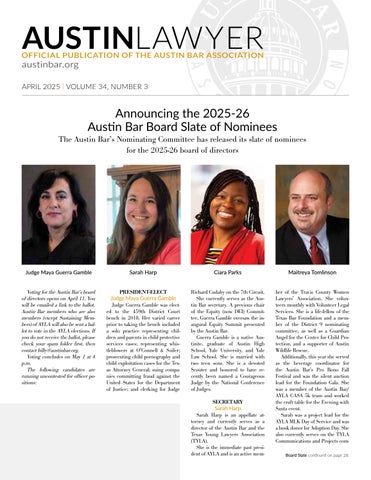
The Austin Bar’s Nominating Committee has released its slate of nominees for the 2025-26 board of directors
Judge Maya Guerra Gamble
Sarah Harp
Ciara Parks
Maitreya Tomlinson
Voting for the Austin Bar’s board of directors opens on April 11. You will be emailed a link to the ballot. Austin Bar members who are also members (except Sustaining Members) of AYLA will also be sent a ballot to vote in the AYLA elections. If you do not receive the ballot, please check your spam folder first, then contact billy@austinbar.org. Voting concludes on May 1 at 4 p.m. The following candidates are running uncontested for officer positions:
PRESIDENT-ELECT Judge Maya Guerra Gamble Judge Guerra Gamble was elected to the 459th District Court bench in 2018. Her varied career prior to taking the bench included a solo practice representing children and parents in child protective services cases; representing whistleblowers at O’Connell & Soifer; prosecuting child pornography and child exploitation cases for the Texas Attorney General; suing companies committing fraud against the United States for the Department of Justice; and clerking for Judge
Richard Cudahy on the 7th Circuit. She currently serves as the Austin Bar secretary. A previous chair of the Equity (now DEI) Committee, Guerra Gamble oversaw the inaugural Equity Summit presented by the Austin Bar. Guerra Gamble is a native Austinite, graduate of Austin High School, Yale University, and Yale Law School. She is married with two teen sons. She is a devoted Scouter and honored to have recently been named a Courageous Judge by the National Conference of Judges.
ber of the Travis County Women Lawyers’ Association. She volunteers monthly with Volunteer Legal Services. She is a life-fellow of the Texas Bar Foundation and a member of the District 9 nominating committee, as well as a Guardian Angel for the Center for Child Protection, and a supporter of Austin Wildlife Rescue. Additionally, this year she served as the beverage coordinator for the Austin Bar’s Pro Bono Fall Festival and was the silent auction lead for the Foundation Gala. She was a member of the Austin Bar/ AYLA CASA 5k team and worked the craft table for the Evening with Santa event. Sarah was a project lead for the AYLA MLK Day of Service and was a book donor for Adoption Day. She also currently serves on the TYLA Communications and Projects com-
SECRETARY Sarah Harp Sarah Harp is an appellate attorney and currently serves as a director of the Austin Bar and the Texas Young Lawyers Association (TYLA). She is the immediate past president of AYLA and is an active mem-
Board Slate continued on page 28.
I love LawPay! I’m not sure why I waited so long to get it set up.
+
– Law Firm in Ohio
Member Benefit Provider
Trusted by 50,000 law firms, LawPay is a simple, secure solution that allows you to easily accept credit and eCheck payments online, in person, or through your favorite practice management tools. 22% increase in cash flow with online payments Vetted and approved by all 50 state bars, 70+ local and specialty bars, the ABA, and the ALA 62% of bills sent online are paid in 24 hours
YOUR FIRM LOGO HERE
Trust Payment IOLTA Deposit New Case Reference **** **** **** 9995
***
TOTAL: $1,500.00 POWERED BY
PAY ATTORNEY
Get started at lawpay.com/austinbar 866-730-4140 Data based on an average of firm accounts receivables increases using online billing solutions. LawPay is a registered agent of Synovous Bank, Columbus, GA., Fifth Third Bank, N.A., Cincinnati, OH, and Wells Fargo Bank, N.A., Canadian Branch, Toronto, ON, Canada.
CONTENTS
AUSTINLAWYER APRIL 2025 | VOLUME 34, NUMBER 3 AL AL
INSIDE 1
IN EVERY ISSUE
Announcing the 2025-26 Austin Bar Board Slate of Nominees
8
Briefs
24
Austin Bar’s 2025 Award Winners
12
Federal Civil Court Update
26
Recent Austin Bar Systems Improvements
13
Third Court of Appeals Civil Update
14
Third Court of Appeals Criminal Update
30 Navigating the New Administration’s Immigration Policies: Implications for Employers and Foreign Nationals 32 The Robert Roberson Case: A Struggle for Justice and the Role of the Texas Attorney General’s Office and Legislature 34 Language Models Can Serve as Virtual Legal Clerks, Must Still Be Fact-Checked
16 Austin Bar Members Appear Before SCOTX To Deliver Oral Arguments 18
Local Jury Trial Verdicts
22
Texas Supreme Court Update
DEPARTMENTS
6
President’s Guest Column
10
AYLA
CONNECTIONS ONLINE austinbar.org EMAIL billy@austinbar.org MAIL Austin Bar Association 712 W. 16th Street Austin, TX 78701 Austin Bar app available for iPhone and Android. SOCIAL LIKE facebook.com/austinbar FOLLOW twitter.com/theaustinbar
ONLINE austinbar.org NEWS & ANNOUNCEMENTS
UPCOMING EVENTS
Austin Bar & AYLA Voting Opens April 11 Vote in the Austin Bar’s and AYLA’s boards of directors elections! You will be sent the ballot for the elections you are eligible to vote in. If you have any issues receiving the ballots, please check your spam folder, then contact billy@austinbar. org. Voting opens April 11 and closes May 1 at 4 p.m. Read about the candidates on pages 1, 28-29 for the Austin Bar and page 10 for AYLA.
April 24 Construction Law CLE
Ethics Update - the Amended Rules of Professional Conduct and Recent Opinions 12 - 1 p.m. Colorado Tower, 303 Colorado Street, 15th floor
FOLLOW instagram.com/theaustinbar CONNECT https://www.linkedin.com/ company/austin-barassociation WATCH vimeo.com/austinbar
APRIL 2025 | AUSTINLAWYER
3
ADDICTION & MENTAL HEALTH RESOURCES 24-Hour Suicide & Crisis Lifeline - 988 - call or text | Live chat: SuicidePreventionLifeline.org Texas Lawyers’ Assistance Program (TLAP) - 1-800-343-8527 TLAP is a 24-hour confidential crisis counseling and referral program to help lawyers, law students, and judges with substance use and mental health issues. Justice Mack Kidd Fund The Austin Bar Foundation administers the Justice Mack Kidd Fund, which can provide financial assistance to individuals seeking treatment for depression or similar illnesses. Visit austinbar.org/?pg=justice-mack-kidd-fund to learn more. Personal Crisis Assistance Program (PCAP) The Austin Young Lawyers Association Foundation provides grants and/or peer support for individuals suffering from a personal crisis. Contact Debbie Kelly: 512-472-0279 x 105 Sheeran-Crowley Trust Administered through TLAP, the trust provides financial help to Texas attorneys, judges, and law students who need treatment for substance use, depression, and other mental health issues. Visit sheerancrowley. org to learn more. Alcohol & Drug Abuse Austin Drug & Alcohol Abuse Program - 512-454-8180 Alcoholics Anonymous - 512-444-0071 Cocaine Anonymous - 512-479-9327 Narcotics Anonymous Counseling - 512-480-0004 Psychiatric Emergencies Emergency Screening in a Psychiatric Crisis 24/7 - 512-472-4357 Samaritan Center (provides professional counseling services on a sliding scale) - 512-451-7337
AUSTINLAWYER OFFICIAL PUBLICATION ALOF THE ALASSOCIATION AUSTIN BAR AUSTIN BAR ASSOCIATION
Mary-Ellen King ������������������������ President Maitreya Tomlinson ������������������ President-Elect Judge Maya Guerra Gamble �� Secretary Rob Frazer ���������������������������������� Treasurer Justice Chari Kelly �������������������� Immediate Past President
AUSTIN YOUNG LAWYERS ASSOCIATION
Emily Morris �������������������������� President Jenna Malsbary �������������������� President-Elect Gracie Wood Shepherd ������ Treasurer Lena Proft ������������������������������ Secretary Sarah Harp ���������������������������� Immediate Past President
Austin Lawyer
©2025 Austin Bar Association; Austin Young Lawyers Association
EXECUTIVE OFFICES
712 W. 16th Street Austin, TX 78701 Email: austinbar@austinbar.org Website: austinbar.org Ph: 512.472.0279 DeLaine Ward....................... Executive Director Debbie Kelly.......................... Associate Executive Director Roslyn Dubberstein............. Assistant Editor Samantha McCoy................. Assistant Editor Abigail Ventress.................... Assistant Editor Billy Huntsman...................... Managing Editor Austin Lawyer (ISSN #10710353) is published monthly, except for July/August and December/January, at the annual rate of $10 membership dues by the Austin Bar Association and the Austin Young Lawyers Association, 712 W. 16th Street, Austin, TX 78701. Periodicals Postage Paid at Austin, Texas. POSTMASTER: Send address changes to Austin Lawyer, 712 W. 16th Street, Austin, TX 78701. Austin Lawyer is an award-winning newsletter published 10 times a year for members of the Austin Bar Association. Its focus is on Austin Bar activities, policies, and decisions of the Austin Bar board of directors; legislation affecting Austin attorneys; and other issues impacting lawyers and the legal professionals. It also includes information on decisions from the U.S. District Court for the Western District of Texas and the Texas Third Court of Appeals; CLE opportunities; members’ and committees’ accomplishments; and various community and association activities. The views, opinions, and content expressed in this publication are those of the author(s) or advertiser(s) and do not necessarily reflect the views or opinions of the Austin Bar Association membership, Austin Bar Association board of directors, or Austin Bar Association staff. As a matter of policy, the Austin Bar Association does not endorse any products, services, or programs, and any advertisement in this publication should not be construed as such an endorsement. Contributions to Austin Lawyer are welcome, but the right is reserved to select and edit materials to be published. Please send all correspondence to the address listed above. For editorial guidelines, visit austinbar.org in the “About Us” tab.
4
AUSTINLAWYER | APRIL 2025
PRESIDENT’S GUEST COLUMN
Growing Up With Alcoholism BY MARY EVELYN MCNAMARA, RIVERS MCNAMARA
H
i, I’m Mary Evelyn, and I’m an adult child of an alcoholic. Recently, I was reading about Brooke Shields, with whom I thought I only had one thing in common—that we grew up in the same era. It turns out another commonality is that we grew up with alcoholism. When Brooke Shields was asked in an interview if she would erase anything in her life, she replied: “I would only erase my mother’s alcoholism, which was a constant source of agony for me.” Oh, yes, I can relate. Twelve Step programs teach that when talking about recovery, you should share experience, strength, and hope. With that directive, I’ll launch in. Experience Growing Up and Into Young Adulthood I grew up scared. From all outward appearances, I had every-
thing I needed in my solidly middle-class home. But inside I did not feel secure. For most of my childhood, my mother withdrew into drink every night (not earlier than five p.m., mind you, because let’s be civilized about it). With a certain amount of alcohol, she would become enraged. My father coped by disappearing into drink, working late, and going on frequent business trips. I craved normalcy and figured that everyone else’s families were normal and mine was not. I didn’t like having friends over at night for fear there would be a scene. And alcoholism wasn’t just at home. My family tree had a lot of bottles hanging off of it. When I was a teenager, not long after my brother had left for college, I took on what turned out to be too many responsibilities at home. I cooked frequently and took on other household chores, thinking at the time that I was getting good experience for adulthood. If I were the perfect child, everything would be okay. I was also walking on eggshells, keeping alcoholism in my home a secret—as I had been taught—and tensing up every time I heard that first beer open or that first drink being poured. Of course, I was listening intently for it. My father moved out when I
was a senior in high school, and my parents divorced after my first year in college. My father’s drinking decreased. My mother’s drinking got worse, which I have learned is common because alcoholism is a progressive disease. She also suffered from paranoia, which was confounding and confusing to me. After a drunken, especially abusive call from my mother one night when I was in my late 20s, I called a close relative, told him about the call, and said I didn’t know what to do. He called my mother, told her she had lost so much in her life because of alcoholism, and that she was going to lose me. My mother went to an AA meeting that day, at the age of 62. She called me the next day to tell me she had gone to AA, and, unsurprisingly, I thought to myself, “Yeah, right. This won’t last.” But my mother truly did find sobriety and because of it lived to be almost 95. Strength in Gaining Knowledge and Community When I was in college, a therapist gave me a book about adult children of alcoholics. It was revelatory. I learned that I was not alone and that I shared traits with other adult children of alcoholics. I thrived on gold stars (starting in kindergarten
when my teacher really did give gold stars) and praise from others. I was overly critical of myself and had low self-esteem. I was a people-pleasing perfectionist with an overdeveloped sense of responsibility, hypervigilance, a desire to control my environment, and a desire to be a model student. That’s a perfect recipe for becoming a lawyer! About 22 years ago, I went to my first Al-Anon meeting. I had resisted Al-Anon when it was suggested to me a few years earlier, because why did I have to go to a meeting when it was the drunk who had the problem? Stepping into the rooms of Al-Anon was life-changing, to be in community with people affected by alcoholism and other addictions. I learned that my defects of character were also strengths. I learned that I was resilient. For those of you who know that I am a family lawyer, hold off before typecasting me as someone who might be intolerant of addicts. I have represented people with substance-use disorders, empathized with them, rejoiced with those who found recovery, and held out hope for those who did not. Hope There is hope. There are many resources available for friends and
Chris Andre
New Vehicle Leasing / Pre-Owned Sales Domestics / Imports / Exotics
Busy Schedule? Call me. Any Make. Any Model. Email | chris@appleleasing.com
6
AUSTINLAWYER | APRIL 2025
Phone | 512.653.3718
family of people who have substance use disorders. Al-Anon (alanon.org) and Adult Children of Alcoholics & Dysfunctional Families (adultchildren.org) meetings take place at all hours of the day, both in person and online, and are free. There are Alateen (alanon.org) meetings for tweens and teens. Open Alcoholics Anonymous (aa.org) meetings can give great perspectives from the viewpoints of recovering alcoholics. The Al-Anon book From
Survival to Recovery is a wonderful resource with stories shared by people who grew up with alcoholism. A new resource started in the past year is a free month of therapy through Better Help as a State Bar of Texas benefit. And I cannot stress enough that the Texas Lawyers’ Assistance Program (TLAP) is available for all of us lawyers as a mental health and recovery resource: tlaphelps.org and 1-800-343-8537. A call to TLAP,
whether for yourself or for a lawyer for whom you are concerned, is completely confidential. I learned through therapy, AlAnon, self-reflection, and the support of friends and family that I can change my attitudes. I learned to be grateful for how family alcoholism shaped me. I learned that growing up with the effects of alcoholism can be stunted growth. I have had to grow up many more times as an adult, and I plan to continue grow-
ing. The scared, people-pleasing girl doesn’t have to be scared anymore. I am so grateful that my mother became sober, but I know not every addict seeks recovery. If you or someone you love is affected by addiction and you want to talk, please feel free to reach out to me: Mary Evelyn McNamara, 512-439-7000 or memcnamara@riversmcnamara.com. AL Mary Evelyn McNamara is a partner in the Rivers McNamara family law firm.
Protection You Can Trust, Security You Can Rely On
Our specialized security firm is here to support you and your clients with services tailored to meet the unique needs of the legal profession.
• • • • • • •
JEFF ROSE (ret.)
Threat Assessment & Risk Mitigation Executive Protection Estate Security Corporate Risk Management and Protection Reconnaissance & Surveillance Discreet Investigations Workplace Violence Prevention Serving the Great State of Texas www.SpecialMissionConcepts.com License #C28520601 (737) 303-1618 Disabled Veteran-Owned and Operated
•
•
512.637.0931
APRIL 2025 | AUSTINLAWYER
7
BRIEFS New Members The Austin Bar welcomes the following new members: Kayla Ahmed Isaiah Barrientos Sofia Burnett Elaine Casas Savannah Cone Samantha Coughlin Joseph Garrey Brent Hamilton Viana Hodge Naomi Howze Mary Quimby Russ Sablatura Stephen See Adrienne Stonecypher Elizabeth Vargas Jennifer Varteressian Heather Zoric
ABOVE (from left): Butler, Cormier, Ditty, Goodrich, Kneeland
KUDOS Mishell Kneeland of CM Law was elected to the Board of Directors of the National Association of Minority and Women Owned Law Firms. Kneeland started in litigation early, serving as a student lawyer in the Law Students in Court clinical program her entire third year of law school at the Georgetown University Law Center. Kneeland clerked for the Honorable Gladys Kessler of the U.S. District Court for the District of D.C. After her clerkship, Kneeland practiced in Manhattan, most notably with Friedman Kaplan Seiler & Adelman, before relocating to her new Texas home in 2002. After making partner, she decided to pursue public service, serving as an assistant attorney general in the General Litigation Division for the State of Texas and an assistant city attorney in General Litigation for the City of Austin. Congratulations, Mishell! Family law attorney Kristiana Butler with Goranson Bain Ausley has earned board certification in Family Law by the Texas Board of Legal Specialization. Butler has practiced family law exclusively since 2013 and is trained in Collaborative Divorce and mediation. She has been named a Rising
Star by Super Lawyers from 2017 to 2024, a Top Attorney by Austin Monthly Magazine from 2020 to 2024 and has been included in Best Lawyers: Ones to Watch every year since 2020. She serves on the board of directors for the Mother Attorney Mentor Association of Austin. Congratulations, Kristiana! Family law attorney Angelica Rolong Cormier with Goranson Bain Ausley has earned board certification in Family Law by the Texas Board of Legal Specialization. Cormier is a member of the 20192020 State Bar of Texas Leadership Class and is a member of the Diversity in the Profession Committee of the State Bar of Texas. She speaks fluent Spanish and has taken on many Spanish-speaking clients. She is also proficient in Portuguese. Currently, she is a volunteer family law attorney for Volunteer Legal Services of Central Texas and Jane’s Due Process. She is the vice-chair for the Family Law Section of the Austin Bar Association. Congratulations, Angelica! Congratulations to Lauren Ditty, who was recently named partner in Austin-based litigation firm Scott Douglass & McConnico. Ditty is a
Patrick
Keel
Mediator Arbitrator
Former District Judge
patrickkeel.com Available by video and in person.
8
AUSTINLAWYER | APRIL 2025
commercial trial lawyer who represents both plaintiffs and defendants in state and federal court. In her short time in private practice, Ditty has written and argued dispositive motions, taken and defended depositions, examined and cross-examined witnesses at trial, and briefed and argued two appeals to the United States Court of Appeals for the Fifth Circuit. She began her career as a middle school English teacher and later transitioned to policy work, crafting public school improvement and support plans in both Texas and Colorado. She earned her master’s degree in policy, organization, and leadership studies from Stanford University. Eventually turning her focus to the law, Ditty received her JD with honors from The University of Texas School of Law, where she was a member of the Texas Law Review. ON THE MOVE Congratulations to Kate Goodrich, who has joined Holland & Knight as a senior policy advisor and member of the firm’s Texas Government Advocacy team in Austin. Goodrich is a former deputy general counsel and policy advisor for the Speaker of the Texas House of Representatives. AL
Do I Know A Property Tax Do I Know A Lawyer? Property Tax Lawyer?
COMPREHENSIVE STATEWIDE PROPERTY TAX REPRESENTATION
COMPREHENSIVE STATEWIDE PROPERTY TAX REPRESENTATION Trusted by Lawyers, Tax Consultants and Taxpayers Since 1981
17480 DALLAS17480 PARKWAY, 210SUITE • DALLAS, TEXAS 75287 DALLAS SUITE PARKWAY, 210
214.506.1073 Trusted by Lawyers, Tax Consultants and Taxpayers Since 1981 DALLAS, TEXAS 75287
214.506.1073 JOHN@ TEXASPROPERTYTAXATTORNEYS.COM J O H N @ T E XA S P R O P E R TYTAXATTO R N E YS . C O M
WWW.TEXASPROPERTYTAXATTORNEYS.COM 17480 DALLAS WWW. T E XA S P R O P E PARKWAY, R TYTAXATTO RSUITE N E YS . C210 OM DALLAS, TEXAS 75287
AUSTIN YOUNG LAWYERS ASSOCIATION
Slate of Candidates for AYLA’s Board of Directors
T
he following candidates are running for the AYLA officers and directors positions. The new board will take office on July 1, 2025, along with Jenna Malsbary, who will serve as AYLA’s president. Malsbary has been on AYLA’s board since 2019 and has served as secretary, treasurer, and president-elect. The following are running unopposed for officer positions on the AYLA Board of Directors. President-Elect – Gracie Wood Shepherd Gracie Wood Shepherd works at Friday Milner Lambert Turner, where she practices family law and appeals. Gracie has served on the AYLA Board since 2021 as a director, executive secretary, and executive treasurer. Gracie was in the Austin Bar/ AYLA Leadership Academy class in 2019 and previously served as the co-chair in 2023 and 2024. Treasurer – Lena Proft Lena Proft been involved in AYLA since 2018. During that time, she has served as the government liaison, a director, co-founded the Health and Wellness Committee, and currently serves as secretary. Secretary – Ben Evans Ben Evans is a partner at Cain & Skarnulis, where his practice focuses on resolving complex commercial disputes. He currently serves as a director on AYLA’s Board, a co-chair for AYLA’s Freshquires Program, and a committee member for Bench Bar and AYLA’s Judicial Reception events. 10
AUSTINLAWYER | APRIL 2025
The following are running for four directors seats on the AYLA Board of Directors. Directors serve two-year terms. Directors James Brenner was admitted to practice in April of 2022 and has been an active member of AYLA since his bar admission. He primarily practices in civil litigation with Burns, Anderson, Jury and Brenner. He was a member of the 2024 AYLA Leadership Academy. Madison Dornak is a litigator at Michael Best and a former clerk for the Southern District of Texas and the Texas Court of Criminal Appeals. She has practiced civil and criminal law in private and public sectors. Madison has assisted AYLA with CLE planning and presenting. Jillian French is an Austinite from birth and a board-certified family law attorney. She has been a member of AYLA since law school. She has served as a director for the past two years and is hoping to continue her service for another two years. Michelle King is a native Austinite and Texas Tech Law graduate. She is an attorney at McCreary Veselka Bragg and Allen and practices with their Appraisal District Litigation team. She currently serves on the AYLA Board of Directors and graduated from the 2022 Leadership Academy class.
Kaylyn Kirkpatrick is an associate at Walsh Gallegos. She is a graduate of Texas A&M University and Baylor Law. Kaylyn is eager to continue growing the impact AYLA has on the Austin legal community. Clare Mattione has been practicing family law in Austin since she graduated from Texas A&M School of Law in 2021. She is passionate about serving her community, and she is excited for this leadership opportunity to get more involved and give back to the young lawyer community. Samantha McCoy is an appellate attorney, activist, and mental health therapist. Samantha is passionate about rights for survivors of violence and educational programs for middle and high school students about civility, law, and rights as a survivor. She has passed five laws in four states and one United Nations resolution.
Ryan Pitts has been an active and engaged member of AYLA. As an AYLA director, he will bring his experience from prior leadership positions in the Houston Bar Association and Houston Young Lawyers’ Association. Ryan is an associate in the appellate section of Haynes Boone, LLP. Jayne Snyder has been licensed since 2017, although it is only recently she felt confident enough to call herself an attorney. She appreciates community, opportunities to be encouraged and to encourage others, and she likes building relationships with other young lawyers in the very difficult early years of practice. Abigail Ventress practices civil litigation and appeals at VBPena Law, representing both plaintiffs and defendants. She has been an AYLA member since 2022 and is a member of the Leadership Academy. She also serves as an assistant editor of Austin Lawyer and is hopeful she will be elected as a director. AL
UPCOMING EVENTS THUR, APRIL 17 AYLA Docket Call 5:30 - 7 p.m. Location TBD
THUR, APRIL 24 Freshquires Judicial Wine Tasting 6 - 8 p.m. 712 W. 16th St.
Complexity is our specialty. Board Certified by the Texas Board of Legal Specialization in Aviation Law, attorneys Mike Slack and Ladd Sanger, along with senior attorney Derek Quick, of the law firm Slack Davis Sanger, specialize in navigating and winning challenging aviation cases. With three decades of experience and a team of highly-regarded lawyers consisting of licensed pilots and a former NASA® engineer, we have the technical and legal expertise to outwork, out-think, and out-resource any opposition. Austin | Dallas | New Mexico | SLACKDAVIS.COM Commercial Airline | Private & Charter Planes | Helicopter | Air Ambulance
FEDERAL CIVIL COURT UPDATE
Jason LaFond is a board-certified appellate lawyer with significant experience in the Fifth Circuit. He is Counsel at Scott Douglass & McConnico LLP.
The following are summaries of selected civil opinions issued by the Fifth Circuit in February 2025. The summaries are overviews of particular aspects of the opinions; please review the entire opinions. Editor’s Note: This is Jason LaFond’s final Federal Civil Update for Austin Lawyer. We sincerely appreciate his insight and tireless work in keeping our members updated on federal issues.
> FINANCIAL INSTITUTIONS: Annuzio-Wylie Act’s safe harbor provision protected bank from liability for reporting suspected violation of state law to Cattle Raisers Association special agent. In re Kerns, 2025 WL 651459 (5th Cir. Feb. 28, 2025). Glade Creek Livestock, LLC obtained a loan from First State Bank, using equipment and over 200 cattle as collateral. Matthew Kerns, the sole member of Glade Creek, personally guaranteed the loan. First State Bank later discovered that some of the cattle collateral were missing and demanded full repayment. Kerns admitted that he sold the cattle. Kerns filed for bankruptcy protection. While the bankruptcy’s automatic stay was in place, First State Bank contacted a special ranger of the Texas and Southwest12
AUSTINLAWYER | APRIL 2025
ern Cattle Raisers Association to report the theft of its collateral—a crime under Texas law. Kerns was arrested and charged with hindering a secured creditor. Kerns responded with an adversary proceeding in bankruptcy court, claiming First State Bank’s report to the Cattle Raisers Association’s special agent violated the automatic stay. First State moved for summary judgment, arguing it was immune from liability under the safe harbor provision of the Annuzio-Wylie Act. The Annunzio-Wylie Act is an anti-money laundering law requiring financial institutions to report any suspicious transactions that may violate any law or regulation. The law includes a safe harbor shielding financial institutions from all liability stemming from that disclosure. The bankruptcy court granted First State’s motion, which the district court affirmed. Kerns appealed and the Fifth Circuit also affirmed. The primary issue on appeal was whether a report to a special agent of the Cattle Raisers Association satisfied the safe harbor. The Fifth Circuit looked to the safe harbor’s text and the Federal Reserve’s and FDIC’s regulations, which protect a financial institution when it makes a voluntary disclosure of a possible violation of a law or regulation to a government agency, law enforcement, or financial institution supervisory authority. Kerns argued that a special agent of the Cattle Raisers Association is not law enforcement, but the Court disagreed. The Fifth Circuit first concluded that “law enforcement” includes state and local law enforcement, not just federal authorities. The Fifth Circuit next looked to the status of a Cattle Raisers Association special agent. The Court examined Texas law and determined that Cattle Raisers Association special rangers qualify as law enforcement officers, as they: (1) are appointed by the Texas Department of Public Safety; (2) have the authority to make arrests and investigate livestock theft; and (3) must meet the same certification standards as other Texas peace officers. APPELLATE JURISDICTION:
District court’s failure to rule on request to preliminarily enjoin agency proceeding before discovery conference in that proceeding was not effective denial of the preliminary injunction. Space Expl. Techs., Corp. v. Nat’l Lab. Rels. Bd., 2025 WL 703687 (5th Cir. Mar. 5, 2025) In 2022, several SpaceX employees drafted and widely circulated an open letter criticizing CEO Elon Musk and company culture. SpaceX terminated four employees for violating company policies and later discharged additional employees for alleged dishonesty during an internal leak investigation. Those employees filed unfair labor practice charges with the National Labor Relations Board, claiming their terminations were retaliatory. On Jan. 3, 2024, the NLRB issued a consolidated administrative complaint and scheduled a hearing for March 5, 2024, which was later postponed indefinitely pending resolution of several subpoena disputes. On Jan. 4, 2024, SpaceX sued the NLRB in the Southern District of Texas challenging the constitutionality of the proceeding and requesting a preliminary injunction. SpaceX did not request expedited briefing. On Feb. 15, the district court granted the NLRB’s motion to transfer. SpaceX then sought mandamus in the Fifth Circuit, which the Court denied. Before the district court’s transfer order was effectuated, SpaceX asked the district court to reconsider its transfer order or resolve the preliminary injunction before transfer.
On April 24, SpaceX learned that an NLRB administrative law judge had scheduled a teleconference on May 2 to address discovery issues but that SpaceX was not expected to produce any evidence before or during that call. On April 26, SpaceX requested a ruling from the district court on the preliminary injunction no later than May 2. On April 30, SpaceX noticed its appeal. The Fifth Circuit dismissed the appeal, finding that the district court’s refusal to rule on the preliminary injunction before SpaceX appealed was not an effective denial. The court applied Carson v. American Brands, Inc., 450 U.S. 79 (1981), which allows interlocutory appeals under § 1292(a)(1) only if a court’s order (or inaction) causes “serious, perhaps irreparable consequences.” SpaceX argued that participating in an unconstitutional NLRB proceeding constituted irreparable harm. The Court disagreed: Fifth Circuit precedent holds that defending against an administrative charge does not constitute irreparable harm warranting interlocutory appeal. The Fifth Circuit also rejected SpaceX’s argument that the district court’s delay was an effective denial. The Court faulted SpaceX for failing to request expedited briefing and for appealing before the deadline it presented to the district court. The Court concluded that the district court was permitted to await the resolution of SpaceX’s mandamus proceeding. Likewise, the district court was free to resolve venue before addressing the injunction. AL
512-487-7994 hello@herlihy-law.com scottherlihylaw.com
THIRD COURT OF APPEALS CIVIL UPDATE
Laurie Ratliff is a former staff attorney for the Third Court of Appeals. She is board-certified in civil appellate law by the Texas Board of Legal Specialization and owner of Laurie Ratliff LLC.
The following are summaries of selected civil opinions issued by the Third Court of Appeals during February 2025. The summaries are an overview; please review the entire opinion. Subsequent histories are current as of March 7, 2025.
> ATTORNEY’S FEES: Court reduces fee awarded in contingent-fee lawsuit. CCR Roofing, LLC v. Garner, No. 03-23-00506-CV (Tex. App.—Austin Feb. 5, 2025, no pet. h.) (mem. op.). Sales representatives sued employer for unpaid commissions and attorney’s fees. The jury awarded representatives their requested damages of $150,000 and $60,000 in attorney’s fees.
Employer contended the evidence was legally insufficient to support the attorney-fee award. Representatives’ attorney had a 40 percent contingency-fee agreement and testified to an hourly rate and number of hours worked under the lodestar method for a $43,000 fee. Attorney requested a $60,000 fee based on the jury awarding $150,000 in damages. The court of appeals concluded that whether a fee is fixed or contingent is subsumed in the Arthur Anderson factors and thus cannot support an enhancement under the lodestar calculation. Any enhancement requires specific evidence that a higher amount is necessary for a reasonable fee award. The court modified the fee award to $43,000 and affirmed. FAMILY LAW: Court upholds international-travel restriction. Allepalli v. Allepalli, No. 03-2300536-CV (Tex. App.—Austin Feb. 12, 2025, no pet. h.) (mem. op.). Mother challenged the divorce decree’s international-travel restriction. The court of appeals observed that Family Code Chapter 153 requires the trial court to consider the risk of international abduction when there is evidence that a parent has taken a child out of the country in violation of the other parent’s right of possession and where the parent can work outside the U.S. With evidence of the risk of abduction, the trial court then considers whether the parent has strong ties to another country, particularly one not a signatory to the Hague Convention.
Mother had taken child to India, a non-signatory to the Hague Convention, denying father access for more than two years; threatened not to renew child’s passport; and could work in India. The court held that the evidence supported the travel restriction and affirmed. FAMILY LAW: Court reverses where petitioner failed to prove grounds for divorce. Janish v. Janish, No. 03-23-00275CV (Tex. App.—Austin Feb. 14, 2025, no pet. h.) (mem. op.). Wife failed to answer or appear for trial. The trial court divided custody of the two children, split the assets unequally, and ordered no child support. Wife timely filed a restricted appeal. The court of appeals noted that in a no-answer divorce, petitioner’s allegations are not taken as true; petitioner must produce evidence to support the divorce. As for insupportability, husband answered “no” when asked if he agreed the marriage was insupportable. The only evidence of adultery was husband’s “yes” answer when asked whether he pleaded adultery. The court concluded husband failed to present evidence of either ground for divorce. Accordingly, the court held that the trial court abused its discretion in granting the divorce and that the error was apparent on the face of the record. The court reversed and remanded.
Mock v. St. David’s Healthcare P’ship, LP, LLP, No. 03-2200708-CV (Tex. App.—Austin Feb. 21, 2025, no pet. h.) (mem. op.). After treatment in the emergency department, hospital gave Mock a contract with a financial agreement to sign. Mock later received a bill with a charge for Evaluation and Management Services. Mock contended the EMS charge was not disclosed before treatment and had it been, she would have gone elsewhere. Mock sued hospital for breach of contract, the Texas Deceptive Trade Practices Act (DTPA) violations, and declaratory relief. The trial court granted summary judgment for hospital. The court of appeals affirmed the breach-ofcontract claim but reversed the other claims. In her DTPA claim, Mock alleged hospital’s failure to disclose the EMS charge was false, deceptive, and misleading. The court rejected hospital’s argument that if it complied with the contract, Mock could not prove her DTPA claim. The court concluded hospital failed to show the absence of material facts on Mock’s other claims. The court affirmed in part and reversed and remanded. AL
TRIAL PROCEDURE: Court reinstates DTPA claim challenging undisclosed hospital charge.
Divorce and Child Custody Surveillance ~ Undercover Background Checks Computer & Phone Forensics Corporate Investigations Expert Testimony and more STRICTLY CONFIDENTIAL
“Information is power, the not knowing is devastating.”
Anji Maddox
Featured in Forbes Magazine
Austin, Round Rock, & Dallas
APRIL 2025 | AUSTINLAWYER
13
THIRD COURT OF APPEALS CRIMINAL UPDATE
Zak Hall is a staff attorney for the Third Court of Appeals. The summaries that follow represent the views of the author alone and do not reflect the views of the court or any of the individual justices on the court.
> The following is a summary of selected criminal opinions issued by the Third Court of Appeals from October 2024. The summary is an overview; please review the entire opinions. The subsequent history is current as of March 7, 2024. JURY SELECTION – LIMITATIONS ON QUESTIONING: Trial court did not abuse its discretion by prohibiting defense counsel’s questions to panel regarding their opinions of the “Me Too” movement. Garcia v. State, No. 03-22-00725CR (Tex. App.—Austin Oct. 2, 2024, no pet.) (mem. op., not designated for publication). Garcia was convicted of indecency with a child. During jury selection, defense counsel showed the panel a photo of Harvey Weinstein, expressed his personal concerns about the “Me Too” movement, and asked the panel about their opinions of the movement. The trial court prohibited the question, believing it to be an improper commitment question. On appeal, Garcia asserted that by prohibiting that question, the trial court prevented him “from asking questions about their opinions and ability to follow the law on the presumption of innocence, burden of proof, and witness 14
AUSTINLAWYER | APRIL 2025
credibility that could have resulted in panelists being challenged for cause.” The appellate court disagreed, concluding that the trial court would not have abused its discretion in finding that the question “had the potential to confuse or mislead the jury panel” because it asked the panelists about “their opinions and views regarding outcries of harassment and sexual abuse and assault by individuals in non-legal settings.” Additionally, it appeared that the trial court “was limiting its prohibition to the specific question and not the whole topic,” which it also had discretion to do. EVIDENCE ADMISSIBILITY AND CHARGE ERROR – SEXUAL OFFENSES INVOLVING CHILD YOUNGER THAN 17: Evidence of extraneous offenses that occurred after victim turned 17 was admissible at trial, and court’s charge did not erroneously authorize defendant’s conviction for conduct that occurred after victim turned 17. Lozano v. State, ___ S.W.3d ____, No. 03-23-00660-CR (Tex. App.—Austin 2024, no pet.) (designated for publication). Lozano was convicted of indecency with and sexual assault of his daughter, who was younger than 17 at the time of the offenses but 21 years old when she reported Lozano to law enforcement. There were several issues on appeal, including the admissibility of extraneous offenses committed by Lozano after his daughter turned 17 and the absence of an instruction specifically limiting the period for which the jury could have convicted him to before his daughter’s 17th birthday. Regarding the admissibility of the evidence, specifically text exchanges between Lozano and his daughter after she turned 17, the court concluded that they were admissible under Article 38.37 of the Code of Criminal Procedure to show “Lozano’s and [his daughter’s] states of mind and to the previous and subsequent relationship between them.” More specifically, “the language used in the messages as well as the photos sent from both parties indicated
that an improper sexual relationship continued” after the victim reached the age of majority, which demonstrated the nature and extent of that relationship. The court additionally concluded that the evidence should not have been excluded under Rule 403. The probative value of the evidence was high, as was the state’s need for the evidence, because the messages were relevant to several disputed issues at trial. On the other hand, the time needed to develop the evidence was low, as was the potential to impress the jury in some irrational way. The court could not conclude that the trial court abused its discretion in admitting the evidence. Regarding the jury instructions, Lozano asserted that the charge improperly allowed the jury to convict him of conduct that occurred after his daughter turned 17 years old because the charge did not have an instruction specifically limiting the period for which he could have committed an offense to before his daughter turned 17. In Lozano’s
view, this was an error because “much of the evidence presented at trial concerned conduct that occurred after [his daughter] turned 17 years old.” The court disagreed, noting the “longstanding rule that the State is not required to prove that an offense was committed on the date alleged in the indictment . . . but may prove that the offense was committed on any date prior to the return of the indictment and within the period of limitations.” Thus, there is no error in the charge so long as the instructions provided that the charged offenses can occur “only when the victim is younger than seventeen years old and defined the term ‘[c] hild’ as someone younger than seventeen.” Here, both the abstract and application paragraphs of the charge contained that express limitation. Accordingly, there was no error in the charge. AL
Local Solutions. Global Reach.
TEXAS CHAPTER MEMBERS IN AUSTIN
Scott Baker
Karl Bayer
Greg Bourgeois
(512) 988-3065
(512) 431-8376
(512) 477-9300
Patrick Keel
Thomas Mitchell (512) 476-4600
(512) 439-1500
(512) 293-0300
Kevin Oncken
Tom Collins
(512) 971-3172
Bert Pluymen
(512) 415-9111
Ben Cunningham
Todd Fine
Eric Galton
Mark Hawkins
Jeff Jury
(512) 477-9300
(512) 666-3935
(512) 477-9300
(512) 435-2300
(512) 477-9300
Jeff Rose
Michael J. Schless
Chris Stanley (512) 930-9775
Paul Van Osselaer (512) 593-5104
Stephen Yelenosky
(512) 637-0931
(512) 476-5507
(512) 444-2226
Check preferred available dates & schedule online in seconds - for FREE
Visit our TX Chapter at www.TexasNeutrals.org Visit our National Database of over 1000 top litigator-rated mediators & arbitrators at www.NADN.org
APRIL 2025 | AUSTINLAWYER
15
AUSTIN BAR MEMBERS AT SCOTX
Austin Bar Members Appear Before SCOTX To Deliver Oral Arguments The Supreme Court of Texas convened Feb. 19, 2025, and heard oral arguments from two Austin Bar members.
Austin Bar Member Catherine Robb Haynes and Boone, for Respondent Paxton v. Am. Oversight Administrative Law Public Information Act At issue is whether trial courts have jurisdiction to issue writs of mandamus against the Governor and Attorney General to compel information under the Public Information Act. In 2021 and 2022, American Oversight submitted various PIA requests to the Office of the Governor and the Office of the Attorney General. These requests largely pertained to official governmental communications surrounding the events of January 6, 2021, and the 2022 shooting in Uvalde. Both offices provided some documents but also reported that they did not find documents responsive to the requests for communications between government officials and external entities, including the National Rifle Association. Both offices also sought to withhold information they view as excepted from disclosure. Both offices received open records letter rulings from OAG’s Open Records Decision opining that the documents are excepted from disclosure and can be withheld. American Oversight sued the Governor and Attorney General in their official capacities in Travis County district court, seeking a writ of mandamus to compel disclosure of the requested information. The Governor and Attorney General filed pleas to the 16
AUSTINLAWYER | APRIL 2025
jurisdiction asserting sovereign immunity and mootness. They argued, among other things, that American Oversight failed to plead a viable claim that they had “refuse[d]” to supply public information. The trial court denied the pleas. The court of appeals affirmed. The Governor and Attorney General petitioned the Supreme Court for review, arguing that the trial court lacked mandamus jurisdiction over American Oversight’s suit because only the Supreme Court has jurisdiction to issue a writ of mandamus against executive officers. They also argue that American Oversight has not demonstrated a waiver of sovereign immunity by showing that the government refused to supply public information. The Court granted the petition. Watch this oral argument on YouTube at https://www.youtube. com/watch?v=bPaakLr5Ybo . The case documents are available at https://search. txcourts.gov/Case.aspx?cn=24-0162&coa=cossup.
collapse. The TDUs’ load shedding reduced electric service on ERCOT’s grid, causing blackouts for four days. Thousands of customers filed hundreds of lawsuits against electricity companies, including TDUs, seeking damages related to the power outages. The cases were consolidated into a multidistrict litigation court. Plaintiffs alleged various claims, including negligence, gross negligence, and nuisance. The TDUs moved to dismiss under Texas Rule of Civil Procedure 91a, arguing that the claims are barred by the tariff governing their operations. The trial court dismissed some claims but refused to dismiss the negligence, gross negligence, and nuisance claims. The court of appeals granted mandamus relief in part, ordering dismissal of the negligence and strict-liability nui-
sance claims, while allowing the gross negligence and intentional nuisance claims to proceed. The TDUs petitioned the Supreme Court for mandamus relief. They argue that the common law does not impose tort duties on TDUs in emergency load-shedding. Additionally, they contend that their tariff’s force majeure provision bars gross negligence and intentional nuisance claims arising from good-faith compliance with ERCOT’s emergency orders. The Court granted argument on the petition for writ of mandamus. Watch this oral argument on YouTube at https://www.youtube. com/watch?v=bPaakLr5Ybo . The case documents are available at https://search. txcourts.gov/Case.aspx?cn=24-0424&coa=cossup. AL
Representing Attorneys
Gaines West
State-wide Practice State Bar of Texas
Grievance Oversight Committee Appointed by the Texas Supreme Court Chair, 2006-2010 Member, 2004-2010
Texas Board of Disciplinary Appeals
Appointed by the Texas Supreme Court
Austin Bar Member Michael A. Heidler Vinson & Elkins for Relators In re Oncor Elec. Delivery Co. Negligence - Public Utilities At issue is whether the multidistrict litigation court should have dismissed plaintiffs’ gross negligence and intentional nuisance claims against transmission and distribution utility companies. In Feb. 2021, Winter Storm Uri created record-setting demand for electricity. ERCOT ordered transmission and distribution utilities to “load shed” (interrupt power) to protect the electric grid from
Chairman, 2001-2003 Vice Chairman, 1994-1996, 1998-2000 Member, 1992-1996, 1997-2003
State Bar of Texas
Disciplinary Rules of Professional Conduct Committee Member, 1993-1996
Disciplinary Review Committee Member, 1991-1992
Texas Bar Foundation, Fellow State Bar of Texas, Member Brazos County Bar Association, Member Austin Bar Association, Member
Principal Office – 979.694.7000 1515 Emerald Plaza • College Station, TX 77845
Austin – By Appointment – 512.501.3617 1012 Rio Grande St. • Austin, TX 78701
westwebblaw.com
PARALEGAL TRAINING FROM UT AUSTIN Start a paralegal journey on your terms. UT Austin’s self-paced Paralegal Certificate Program provides indepth training in essential legal areas, with enrollment available anytime. Boost your legal career in just 5 months with our instructor-led program – perfect for aspiring paralegals.
Attend a free information session, or visit:
professionaled.utexas.edu/s/paralegal Travis County Constable 5 The Courthouse Constable 1003 Guadalupe Austin, Tx 78701 Office: 512-854-9100 Fax: 512-854-4228 www.Constable5.com
EFILE: Request Constable 5 for Efile Process Service SERVICE FEES INCLUDE: Rush Services, Skip-Trace, Research, plus exclusive access to law enforcement database
SERVICE AREA INCLUDES: Travis and surrounding counties 24/7 Online Service Check Daily delivery to State of Texas offices “Your civil process experts. Available for civil and family process needs.” ~ Constable Carlos B. Lopez
APRIL 2025 | AUSTINLAWYER
17
LOCAL JURY TRIAL VERDICTS
February District & County Court Jury Trial Verdicts BY VELVA PRICE, TRAVIS COUNTY DISTRICT CLERK
Editor’s Note: The monthly jury trial verdicts update is first published through Bar Code and the Austin Bar app. Download the app today from either the App Store or the Google Play Store. CIVIL/FAMILY Dena Sessions v. Abby Argo, Champagne Campaign, LLC; Amazing Realty, LLC, Jacob Soliz, Gena Carter; KW ATX Broker, LLC Cause No.: D-1-Gn-23-002369 Judge: Maya Guerra Gamble, 459th Civil District Court Dates: Feb. 10 - 18, 2025 Attorneys: Plaintiff: R. Alex Conant/Walter Williams/Hayden Prosise, Amini & Conant, LLP (Austin) Defendant: Kevin F. Lee, Thompson Coe Cousins & Irons, LLP (Austin) Case Summary: This case arises from the sale of residential property located in the 78736 zip code. Defendant Champagne Campaign LLC was the seller, Plaintiff Dena Sessions was the buyer, Defendant Amazing Realty LLC was the listing broker firm, and Defendant Abby Argo was the listing associate. Plaintiff claims that the Defendants misrepresented the condition of the home in several aspects. A jury of 11 found that the Defendant Argo committed fraud against the Plaintiff, but the Defendants Soliz and Carter did not commit fraud. For this specific 18
AUSTINLAWYER | APRIL 2025
charge, jury awarded: Past loss of benefit of the bargain - $642,000; future loss of benefit of the bargain - $0; past out-of-pocket damages $0; future out-of-pocket damages - $0; past loss of use of the property - $0; future loss of use of the property - $0; past loss of use of funds - $0; future loss of use of funds - $0; past mitigation expenses - $23,500; future mitigation expenses - $0. Further, the jury found Argo was acting within the scope of her agency relationship with Champaign Campaign, LLC and Amazing Realty, LLC; Argo engaged in false, misleading/deceptive acts that Sessions relied on to her detriment by causing confusion to the source, sponsorship, approval, or certification of goods/represented that goods/services have sponsorship, approval, characteristics, ingredients, which they do not have; represented that goods/services are of a particular style when they are of another; failed to disclose information concerning goods/services that was known at the time of the transaction with the intention to induce Plaintiff into a transaction into which Plaintiff would not have entered had the information been disclosed; made a false representation of a past or existing material fact when the false representation was made to Plaintiff for the purpose of inducing Plaintiff to enter into a contract and was relied upon by Sessions in entering the contract. For the previous charges, jury awarded: past loss of benefit of the bargain - $642,000; future loss of benefit of the bargain - $0; past outof-pocket damages - $0; future outof-pocket damages - $0; past loss of use of the property - $0; future loss of use of the property - $0; past loss of use of funds - $0; future loss of use of funds - $0; past mitigation expenses - $23,500; future mitigation expenses - $0; past lost time - $70,000; future lost time - $0; past diminished marked value -
$642,000; future diminished market value - $0. Defendants Soliz, Carter, and Slusher Group did not engage in false, misleading/deceptive acts that Plaintiff relied on to her detriment by causing confusion to the source, sponsorship, approval, or certification of goods/did not represent that goods/services have sponsorship, approval, characteristics, ingredients, which they do not have; did not represent that goods/services are of a particular style when they are of another; did not fail to disclose information concerning goods/services that was known at the time of the transaction with the intention to induce Plaintiff into a transaction into which Plaintiff would not have entered had the information been disclosed; did not make a false representation of a past or existing material fact when the false representation was made to Plaintiff for the purpose of inducing Plaintiff to enter into a contract and was relied upon by Plaintiff in entering the contract. Argo was acting with the scope of her agency relationship with Champaign Campaign, LLC and Amazing Realty, LLC. Argo engaged in conduct knowingly; Soliz, Carter, and Slusher Group did not engage in conduct knowingly; damages for the knowingly conduct: $100,000; Argo committed fraud against Sessions by making a material misrepresentation; failed to disclose a material fact within the knowledge of that party; damages for those specific charges: past loss of benefit of the bargain - $642,000; future loss of benefit of the bargain - $0; past out-of-pocket damages - $0; future out-of-pocket damages - $0; past loss of use of the property - $0; future loss of use of the property - $0; past loss of use of funds - $0; future loss of use of funds - $0; past mitigation expenses - $23,500; future mitigation expenses - $0. Argo was acting with the scope of her agency relationship with Cham-
paign Campaign, LLC and Amazing Realty, LLC. Plaintiff relied upon negligent misrepresentation by Argo but not Soliz and Carter. Difference between the value of what Plaintiff received in the transaction and the purchase price given - $642,000; past economic loss suffered as a consequence of Sessions’ reliance on the misrepresentation - $23,500; future economic loss suffered as a consequence of Sessions’ reliance on the misrepresentation; Argo was acting with the scope of her agency relationship with Champaign Campaign, LLC and Amazing Realty, LLC; the negligent supervision of Amazing Realty, LLC caused the occurrence in question; past loss of benefit of the bargain $642,000; future loss of benefit of the bargain - $0; past out-of-pocket damages - $0; future out-of-pocket damages - $0; past loss of use of the property - $0; future loss of use of the property - $0; past loss of use of funds - $0; future loss of use of funds - $0; past mitigation expenses - $23,500; future mitigation expenses - $0; Champagne Campaign, LLC did fail to comply with the agreement One to Four Family Residential Contract; past loss of benefit of the bargain - $642,000; future loss of benefit of the bargain - $0; past outof-pocket damages - $0; future outof-pocket damages - $0; past loss of use of the property - $0; future loss of use of the property - $0; past loss of use of funds - $0; future loss of use of funds - $0; past mitigation expenses - $23,500; future mitigation expenses - $0. Argo was 100% responsible for the damages to the Plaintiff; Argo, Amazing Realty, LLC did not by clear and convincing evidence harm the Plaintiff which resulted from malice, or gross negligence. (Jury Charge was 36 pages). In The Matter of The Marriage of Brian R. Follett and Bernice Follett Et. Al. Cause No.: D-1-Fm-21-000977
Judge: Jessica Mangrum, 200th Civil District Court Dates: Feb. 10 - 19, 2025 Attorneys: Petitioner: Richel Rivers/Mary Evelyn McNamara, Rivers-McNamara, PLLC (Austin) Respondent: Deanna B. Hogan/ Caroline McClimon, Tuck McClimon, PLLC (Bastrop) Case Summary: The petitioner filed for divorce and conservatorship of the children. The Respondent filed a counter-petition requesting divorce and asserted the grounds of cruel treatment. A unanimous jury found that grounds exist for no-fault divorce but not due to cruelty by Brian Follett toward Bernice Follett. The jury further found that Brian Follett should be appointed the managing conservator for the children – two boys and one girl; Brian Follett could designate primary residence with a geographic restriction of Travis County and contiguous counties. Steven Thompson v. Braylon James Cause No.: D-1-Gn-23-001607 Judge: Laurie Eiserloh, 455th Civil District Court Dates: Feb. 11 - 13, 2025 Attorneys: Plaintiff: David Round, Law Office of Thomas J. Henry Defendant: J. Hampton Skelton, Skelton and Woody, PLLC (Austin) Case Summary: This case involves a motor vehicle accident, which occurred on Feb. 11, 2022. A unanimous jury found that neither party was responsible for the occurrence. Philip D. Edwards v. Liberty County Mutual Insurance Company Cause No.: D-1-Gn-22-004572 Judge: Maria Cantu Hexsel, 53rd Civil District Court Dates: Feb. 11 - 18, 2025 Attorneys: Plaintiff: J.R. “Rusty” Phenix/ Ryan Haun, Phenix and Crump, PLLC (Henderson) Defendants: Catherine Hanna/Jessica Bigbie, Hanna and Plaut, LLC (Austin) Case Summary: The plaintiff claimed that the defendant refused to abide by the insurance
policy and pay for the repairs to the vehicle by declaring the vehicle a total loss. A jury of 10 found that Liberty did comply with the policy, Liberty did not engage in unfair and deceptive practice that was the producing cause of damage to the Plaintiff but did make misrepresentation relating to the policy and awarded $19,500.96 for this specific finding; Liberty did not engage in unfair or deceptive practice knowingly, nor did Liberty fail to pay Edwards all of the proceeds due to him within 60 days; Liberty did not fail to timely pay Edwards claim. Attorney’s fees awarded for Plaintiff: trial court - $29,541.76; court of appeals - $25,000; review stage in the Supreme Court of Texas - $15,000; merits briefing stage in the Supreme Court of Texas $10,000; oral argument and completion of proceedings in the Supreme Court of Texas - $10,000. Emily Levene v. State Farm Mutual Automobile Insurance Company Cause No.: C-1-Cv-23-000363 Judge: Todd Wong, Court-at-Law Judge Dates: Feb. 24 - 26, 2025 Attorneys: Plaintiff: Jarrett Stone, Stone Firm, PLLC (Dallas) Defendant: Lily Wilson, Skelton and Woody, PLLC (Austin) Case Summary: This case involves an underinsured claim due to a motor vehicle accident, which occurred on May 20, 2021. The underlying insurance policy was $30,000. A unanimous jury of six found for the plaintiff and awarded the following damages: past physical pain - $72,000; future physical pain - $72,000; past physical impairment - $72,000; future physical impairment - $36,000. Maria Campbell v. Virgilio Hinojosa III Braylon James Cause No.: D-1-Gn-23-000873 Judge: Laurie Eiserloh, 455th Civil District Court Dates: Feb. 24 - 26, 2025 Attorneys: Plaintiff: David Donnel, Law Office of Thomas J. Henry (San Antonio) Defendant: Mark Siefken, Siefken & Associates (Austin) Case Summary: This case arises
from a motor vehicle accident, which occurred on Sept. 20, 2021. A unanimous jury found that negligence from the defendant, Virgilio Hinojosa, did not cause the occurrence in question. Pravin Reddy, MD and Brookhaven Aesthetics Institute LLC D/B/A Reddy Aesthetics Institute v. High Tech Design Safety LLC D/B/A DBS Prototypes LLC Cause No.: D-1-Gn-22-003770 Judge: Jessica Mangrum, 200th Civil District Court Dates: Feb. 24 - 27, 2025 Attorneys: Plaintiff: Brian Smith/Cooper Fyfe, Dunn Smith LLP (Austin) Defendant: Artie Pennington, Artie Pennington Law Offices, PLLC (Kyle) Case Summary: The plaintiffs claim that the defendant breached agreement, committed fraud, violated the Texas Theft Liability Act, and wrongfully exercised dominion over the plaintiffs’ money regarding the design and production of a pill sorter and dispenser.
A jury of 10 found the following: Defendant failed to comply with the agreement, awarded $84,500 (difference between the amount the plaintiffs paid to defendant and the value of the work and services defendant provided), to compensate the plaintiffs; defendant’s failure to comply with the agreement was not excused by modifications or ratifications, defendants committed fraud and jury awarded $92,250; plaintiffs’ acts/omissions did contribute to the damages – 20 percent and Defendants 80%; and defendant’s fraud was not excused by plaintiffs’ acceptance of the benefits of the agreement after the plaintiffs’ full knowledge of defendant’s fraud. Joanne Antrim, Ind. And Executor of The Estate of Paul Antrim, Deceased v. Texas Oncology, P.A.; John Neal Rutledge, M.D.; And Austin Radiological Association Cause No.: D-1-Gn-22-000304 Judge: Daniella Deseta Lyttle, 261st Civil District Court Dates: Feb. 24 – March 4, 2025
MEDIATION & ADR SERVICES
MARK L. HAWKINS THE BEST LAWYERS IN AMERICA®
COMMERCIAL LITIGATION 2012–PRESENT
TEXAS SUPER LAWYERS®
BUSINESS LITIGATION 2016–PRESENT
THE BEST LAWYERS IN AMERICA®
REAL ESTATE LAW 2012–PRESENT
AUSTIN MONTHLY
TOP ATTORNEY 2019–PRESENT
Armbrust & Brown, PLLC 100 CONGRESS AVE., SUITE 1300 • AUSTIN, TEXAS 78701 512-435-2300 • FAX 512-435-2360 MHAWKINS@ABAUSTIN.COM
APRIL 2025 | AUSTINLAWYER
19
Attorneys: Plaintiff: Mark McLean/ Meredythe Heaton, Heaton McLean, PLLC (Austin) Defendants: Paula Hale/Terri Harris, Steed Dunnill Reynolds Bailey Stephenson, LLP represented Texas Oncology, P.A. Todd Allen/Peter Anderson, Kershaw Anderson King, PLLC, represented John Rutledge, MD and ARA. Case Summary: The plaintiff brought a health care liability claim against the defendants alleging that the negligent care caused the death of Paul Antrim on Jan. 21, 2020. A unanimous jury found that Texas Oncology, P.A., by and through the acts of Kimberly Brooks, MSN, AGCNSBC, AOCNS, and John Neal Rutledge, MD, were not negligent in the death of Paul Antrim. Raul Garcia v. D.A. Rogers Enterprise, Inc. And Edgar M. Hernandez Cause No.: D-1-Gn-21-001549 Judge: Aurora Martinez Jones, 126th Civil District Court Dates: Feb. 25 – March 3, 2025 Attorneys: Plaintiff: Courtney Graham/ Brad Bonilla, Bonilla Law Firm, PLLC (Austin) Defendant: Samantha Jeffers, Germer Beaman & Brown, PLLC (Austin) Case Summary: This case involved a motor vehicle accident, which occurred on May 1, 2019. A unanimous jury found Edgar Hernandez 20 percent and D.A. Rogers Enterprises, Inc. 80 percent responsible for the occurrence. Jury awarded: past physical pain and
20
AUSTINLAWYER | APRIL 2025
mental anguish - $75,000; future physical pain and mental anguish $25,000; past physical impairment - $5,000; future physical impairment - $5,000; and past medical care expenses - $100,000. The jury did not find by clear and convincing evidence that the harm to Raul Garcia was from the gross negligence of D.A. Rogers Enterprises, Inc. CRIMINAL State of Texas v. Miguel Diaz Cause No.: D-1-Dc-23-200830; D-1Dc-23-301142; D-1-Dc-23-900109; D-1-Dc-24-900025 Judge: Karen Sage Dates: Feb. 4 - 11, 2025, 299th Criminal District Court Attorneys: State of Texas: Matthew Foye, Asst. District Attorney Defendant: Charles Baird, (Austin) Case Summary: Defendant was charged with accident involving the death of two persons; accident involving injury to one person; reckless injury to a child; and aggravated assault to two persons. The jury was not able to reach a unanimous decision on the six counts, so a mistrial was declared. (The jury deliberated until 8 p.m.) State of Texas v. Juan Wilkinson Cause No.: D-1-Dc-22-300864 Judge: Mike Denton Dates: Feb. 24 - 25, 2025 Attorneys: State of Texas: Dominic Selvera, Asst. District Attorney Defendant: Eric McDonald (Austin) Case Summary: Defendant was
indicted for criminal mischief, damaging or destroying property valued between $2,500 and $30,000. The jury was not able to reach a verdict; an Allen charge was given; the jury again could not reach a verdict, so a mistrial was declared. The case is reset for March 20, 2025. State of Texas v. Barty Sharp Cause No.: D-1-Dc-25-904012 Judge: Chantall Eldridge, 331st Criminal District Court Dates: Feb. 24 - 26, 2025 Attorneys: State of Texas: Jacques A. Roussel, Asst. District Attorney Defendant: Geoffrey Puryear, Cofer & Connelly (Austin) Case Summary: Defendant was charged with three counts of sexual assault. The jury found the defendant not guilty in all counts. State of Texas v. Henry Houston Cause No.: D-1-Dc-22-900029 Judge: Brenda Kennedy Dates: Feb. 4 - 25, 2025 Attorneys: State of Texas: Brenda Gann, Asst. District Attorney Defendant: Christopher Holub (Austin) Case Summary: Defendant was charged bail jumping on or about Jan. 5, 2021. The jury found the defendant guilty of the offense of bail jumping - failure to appear. The jury assessed the punishment of eight years and six months in TDCJ and a $10,000 fine. State of Texas v. Chad Edward Lyndeen Cause No.: C-1-Cr-20-600066; C-1-
Cr-24-004963 Judge: Kim Williams, Court-AtLaw Judge Dates: Feb. 24, 2025 Attorneys: State of Texas: Trevor Mathes, Asst. County Attorney Defendant: Juan Val Antonio (Austin) Case Summary: Defendant was charged with theft of property valued at greater than $100 and less than $750. A jury of six convicted the defendant, and he was confined to 90 days in jail. City of Austin, Condemnor v. Ladies of The Eighties, Independent Bank N/K/A Independent Financial, Amarillo Nations BANK, Condemnees Cause No.: C-1-Cv-21-0004045 Judge: Todd Wong, Court-At-Law Judge Dates: Jan. 27 - 30, 2025 Attorneys: Condemnor: Kristina W. Silcocks/Angela Rodriguez, Phelps Dunbar LLP (Houston) Condemnee: Matthew Harrier/ Brent Hamilton, Brady and Hamilton, LLP (Austin) Case Summary: On Aug. 25, 2021, the City of Austin filed the petition for condemnation to acquire fee simple title to property. A unanimous jury of six found that the difference between the fair market value of the property as of March 14, 2022, and the fair market value of the remainder property as of March 14, 2022, immediately after the city’s acquisition of the property - $500,000. AL
Congratulations to our newest Board Certified attorneys. THEY JOIN AN EXCLUSIVE GROUP IN TEXAS FAMILY LAW.
KRISTIANA BUTLER
ANGELICA ROLONG CORMIER
CASSIDY PEARSON
We celebrate Kristiana, Angelica, and Cassidy on their achievement.
The family law firm with 28 Board Certified attorneys welcomes three more. Excellence is a core value at Goranson Bain Ausley. One of its marks is the number of attorneys on our team who are Board Certified in Family Law by the Texas Board of Legal Specialization. With the addition of our newly Board Certified associates, 62% of our attorneys hold this distinction — compared to fewer than 6% of all attorneys statewide. To achieve this honor, attorneys must meet rigorous qualifications. Maintaining high standards is a shared commitment at GBA, and we applaud all our attorneys for dedicating themselves to it every day. AUSTIN | DALLAS | PLANO | FORT WORTH | SAN ANTONIO | GRANBURY | MIDLAND
G B A F A M I L Y L A W. C O M
TEXAS SUPREME COURT UPDATE The following are summaries of selected opinions issued by the Texas Supreme Court in March 2025. These summaries are prepared by court staff as a courtesy. They are not a substitute for the actual opinions. The summaries are overviews of the opinions; please review the entire opinions. GEO Grp. v. Hegar, ___ S.W.3d ___, 2025 WL ___ (Tex. Mar. 14, 2025) [23-0149] The primary issue in this case is whether private, for-profit business entities that detain federal and state inmates qualify as tax-exempt “agents” or “instrumentalities” of the government under the Tax Code and the Comptroller’s rules. GEO owned and operated detention facilities in Texas, housing federal and state inmates in its facilities pursuant to contracts with federal, state, and county governments. When GEO failed to pay tax on purchases necessary to operate those facilities, the Comptroller assessed a sales and use tax deficiency against GEO. Following administrative proceedings challenging the deficiency, GEO paid the stipulated $3,937,103.71 tax due and filed suit for a taxpayer refund. The trial court concluded that GEO failed to demonstrate “by clear and convincing evidence” that it qualified as a government “agent” or “instrumentality” entitled to a tax exemption as required. GEO appealed, arguing that the court erred by applying a heightened standard of review. The court of appeals affirmed. The Supreme Court affirmed. Although the Court noted that the Tax Code’s mandated trial de novo requires a preponderance of the evidence standard of proof instead of the heightened clear and convincing standard, application of the lesser standard did not alter the outcome of the case. The Court held that entities entitled to tax exemption as government “agents” or “instrumentalities” are of a specific, narrow character: only entities that the government has unequivocally declared an “agent” or “instrumentality” or those that could 22
AUSTINLAWYER | APRIL 2025
reasonably be viewed as an arm of the government are included. The Court held that GEO’s mere performance of a governmental function like inmate detention was not sufficient. Bertucci v. Watkins, ___ S.W.3d ___, 2025 WL ___ (Tex. March 14, 2025) [23-0329] This case concerns issues of briefing waiver, fiduciary duties between partners, and defenses to summary judgment. Bertucci and Watkins developed low-income-housing projects. They created a series of limited partnerships with themselves as limited partners. In 2014, Bertucci claimed to discover that Watkins misappropriated funds. Bertucci sued individually and derivatively on behalf of the companies. The parties filed cross-motions for summary judgment, and the trial court granted summary judgment for Watkins on all claims. The court of appeals held that Bertucci failed to adequately brief issues regarding the derivative claims and thus affirmed the judgment in Watkins’s favor on those claims. It reversed the judgment on Bertucci’s individual breach-of-fiduciary-duty claims, concluding that fact issues existed as to those claims and on Watkins’s defenses of limitations, waiver, and ratification. Both parties petitioned for review. The Supreme Court affirmed in part and reversed in part. It held that Bertucci sufficiently asserted arguments in his appellate briefing on behalf of the companies so as to avoid waiver. It next held that summary judgment was proper on Bertucci’s claim that Watkins owed fiduciary duties to Bertucci, individually. The court of appeals reversed on this issue on a ground that Bertucci raised for the first time in that court. Because the ground was not raised in the trial court, it could not form the basis for summary judgment. Finally, the Court held that fact issues precluded summary judgment in Watkins’s favor based on limitations and that the court of appeals did not err by declining to address an expert’s report or by holding that the Dead Man’s Rule
barred certain testimony. The Court reinstated summary judgment on the breach-of-fiduciary-duty claims Bertucci asserted in his individual capacity and remanded the case to the court of appeals to address the derivative claims. SCTX Issues Per Curiam Opinion Address 15th Court of Appeals’ Jurisdiction Misc. Docket No. 25-9013 Kelley v. Homminga1 Misc. Docket No. 25-9014 Devon Energy Prod. Co. v. Oliver2 Below is a summary of the orders: Kelley v. Homminga and Devon Energy Prod. Co. v. Oliver, ___ S.W.3d ___, 2025 WL ___ (Tex. Mar. 14, 2025) (per curiam) [Misc. Docket Nos. 25-9013, 25-9014] These administrative matters raise the question whether a party can appeal to the Fifteenth Court of Appeals even though the case is not within the court’s exclusive intermediate appellate jurisdiction. In Kelley v. Homminga and Devon Energy v. Oliver, the defendants noticed their appeals to the Fifteenth Court while conceding that the appeals are not within the Fifteenth Court’s exclusive jurisdiction. Under Texas Rule of Appellate Procedure 27a, the plaintiffs in each case moved to transfer the appeal to the regional court of appeals that hears appeals from the relevant county. The Fifteenth Court issued letter rulings that the motions should be denied, reasoning that Government Code Sections 22.201(p) and 22.220(a) give the court general appellate jurisdiction over civil cases statewide and that there is no express statutory bar to noticing an appeal there. The potential transferee courts each filed letters stating their agreement or disagreement. Under Rule 27a, the Fifteenth Court forwarded the motions and letters to the Supreme Court for a decision. The Supreme Court granted both transfer motions. In a per curiam opinion, the Court analyzed Government Code Sections 22.201, 22.216, 22.220, 22.221,
and 73.001, which were amended in 2023 by the act creating the Fifteenth Court. The Court held that a fair reading of the act, discerned through a contextual reading of all its provisions, is that the Legislature intended the Fifteenth Court to hear (1) appeals and writs within its exclusive jurisdiction, and (2) appeals transferred into the court by the Supreme Court to equalize the courts of appeals’ dockets. Because the appeals fall into neither category, they were improperly taken to the Fifteenth Court. AL ENDNOTES
1 https://www.txcourts.gov/ media/1460166/259013.pdf 2 https://www.txcourts.gov/ media/1460165/259014.pdf
Austin Bar’s 2025 Award Winners
T
he Austin Bar has named this year’s recipients for the Professionalism Award, the Regina Rogoff Pro Bono Award, the Larry F. York Mentoring Award, and the Joseph C. Parker, Jr., Diversity Award. These individuals will be honored with their awards at the annual Bench Bar Conference on April 11. Register now at austinbar. org/benchbar2025. PROFESSIONALISM AWARD
Michelle Cheng Michelle Cheng has been with Whitehurst, Harkness, Brees, Cheng, Alsaffar, Higginbotham, and Jacob since 1996. Her practice focuses on representing injured individuals and their families in cases involving medical malpractice, birth injuries, products liability, automobile and trucking accidents, and other serious personal injuries and wrongful death. “Michelle Cheng is a rare blend in our profession of a great lawyer and a truly great person,” wrote Austin attorney Lynn Bradshaw in a letter supporting her nomination. “She is an excellent attorney, from soup to nuts. She knows the law and the facts of her case, works hard, and is also compassionate, brilliant, and able to remain focused on obtaining a fair and just result for her clients.” In past years, Michelle has also won the Travis County Women Lawyers’ Association’s (TCWLA) Pathfinder Award, which honors women TCWLA believes to be role models and trailblazers. In 2006, AYLA named Michelle Outstanding Young Lawyer. She’s 24
AUSTINLAWYER | APRIL 2025
also been named a Texas Rising Star and a Texas Super Lawyer by Thomson Reuters. Michelle has been a member of the American Association for Justice and the Texas Trial Lawyers Association. She has also been a long-time member of the Advisory Board for the Capital Area AIDS Legal Project, and she served on the board of the Lone Star Victims Advocacy Project (now part of RAICES Rural Services), a group fighting for the rights of immigrant, refugee, and asylum-seeking individuals and families. She’s also a past president of the Capital Area Trial Lawyers’ Association (CATLA). Still today, Michelle coordinates a regular CATLA Women’s Lunch to bring together women litigators to forge bonds both professional and personal. “In our office, she’s the person who remembers every birthday, every work anniversary, who orders the cakes and organizes the celebrations that make everyone feel special,” wrote firm colleague Laurie Higginbotham in a letter supporting Michelle’s nomination. “She’s the kind of daughter who called her parents every single day to check-in. She has been a lifelong teacher to me when it comes to relationships and communication.” In every letter of support Michelle received, they all mention her contributions to the legal profession through her activity as an administrator for the Texas Lawyers Bar Association (Texas Lawyers, TL) Facebook group, which has more than 17,000 members. “Attorney interactions in TL number in the millions and managing these can be an intense obligation,” wrote Austin attorney and TL Founder Andrew Tolchin in his letter of support. “Needless to say,
conflicts arise between lawyers requiring administrative action. No matter how time-consuming or challenging, Michelle always gets involved to help get these issues resolved.” REGINA ROGOFF PRO BONO AWARD
Meghan Kempf Meghan is the associate director of policy with the Texas Health and Human Services Commission, where she has worked for nearly 11 years. In this role, Meghan provides in-house counsel for 10 state hospitals and 13 state-supported living centers. Her work primarily focuses on individuals with intellectual or developmental disabilities (IDD), as well as those who need behavioral health services (BHS). Prior to her work at the Commission, Meghan was an Equal Justice Works Fellow sponsored by the Texas Access to Justice Foundation. In this role, she provided services to residents of San Antonio and Bexar County. She provided full representation to 41 clients, the majority of whom sought protective orders and enforcement or modification of existing civil court orders regarding custody, child support, and property division. Meghan was instrumental in development referral relationships with Texas RioGrande Legal Aid and the Crisis Response Team of the San Antonio Police De-
partment (SAPD). She also taught a weekly know-your-rights class to the residents of the Battered Women and Children’s Shelter. Meghan’s commitment to public service extends to her free time. She’s been a tireless AYLA and Austin Bar volunteer, serving on such committees as the Women’s Resource Fair, Social Services, Leadership Academy, AYLA Community Service Days, AYLA MLK Day of Service, AYLA Government Law liaison, VLS Board of Directors liaison for AYLA, Austin Bar Foundation Board of Directors, and AYLA Board of Directors. Since 2015 Meghan has been a volunteer for SAFE (Stop Abuse for Everyone). “Meghan’s commitment to the public and to public service shines through her compassion and enthusiasm in all that she does,” wrote AYLA President-Elect Jenna Malsbary in her nomination letter. “She is an excellent candidate for this public sector service award.” LARRY F. YORK MENTORING AWARD
Sara Foskitt Sara has been named a top real estate attorney by Austin Monthly six years running. In 2018, she was awarded the Travis County Women Lawyers’ Association’s (TCWLA) Pathfinder Award, which are awarded to local women with law degrees who use
their degrees in a variety of often atypical ways to impact the Austin community and the legal profession. Sarah and her husband, lawyer Dave Floyd, eventually opened a real estate brokerage firm of lawyers, Floyd Real Estate. As a broker, she helps clients purchase and sell homes all over Austin. With her legal knowledge, she also excels at advising real estate investors. She is a graduate of the 2014 Leadership Austin Essential program and was a finalist for the Legal category of the Austin Under 40 Awards. She has served on the boards of the Austin Bar Association, the Austin Bar Foundation, the Austin Young Lawyers Association, and the Lawyer Referral Service of Central Texas. In 2011 she started the Austin Bar Mentor Program. Mentorship has been important to Sara throughout her career: She attended law school out of state and knew it would be difficult to launch her career in Austin without a network of alumni and contacts. Instrumental in her early career were Justice Darlene Byrne, Jo Ann Merica, and Justice Cindy Olson Bourland. As her own career prospered, Sara felt it was incumbent upon her to pay it forward and provide mentoring to younger lawyers.”
JOSEPH C. PARKER, JR., DIVERSITY AWARD
Judge Maya Guerra Gamble This year’s Joseph C. Parker, Jr., Diversity Award is jointly awarded to 459th District Court Judge Maya Guerra Gamble and Pflugerville Councilmember Rudy Metayer. Judge Guerra Gamble currently serves as secretary of the Austin Bar Board of Directors. She has served on the 459th District Court bench since 2018. She is an integral member of the Austin Bar’s Mentorship Committee and oversaw the establishment of the Austin Bar’s Equity (now DEI) Committee. Judge Guerra Gamble was the main proponent for the
Thank You for 18 Years of Service!
inaugural Equity Summit and remains a staunch supporter of this annual event. In 2024, the National Judicial College (NJC) named Judge Guerra Gamble one of the nation’s 60 Courageous Judges. The NJC’s Courageous Judges initiative seeks to “honor 60 judges, present and past, from courts in the United States and abroad, who have demonstrated courage in upholding the rule of law and providing justice for all.” Judge Guerra Gamble’s varied career prior to taking the bench included a solo practice representing children and parents in child protective services cases; representing whistleblowers at O’Connell & Soifer; prosecuting child pornography and child exploitation cases for the Texas Attorney General; suing companies committing fraud against the United States for the Department of Justice; and clerking for Judge Richard Cudahy on the 7th Circuit. Judge Guerra Gamble is a native Austinite, graduate of Austin High School, Yale University, and Yale Law School. She is married with two children. She is a devoted Scouter and is planning to canoe the Boundary Waters in Canada for 10 days this summer. JOSEPH C. PARKER, JR., DIVERSITY AWARD
his practice includes government affairs, administrative and regulatory litigation, tax-exempt/nonprofit law, and civil litigation. He has represented governmental entities in a broad range of legal matters, such as federal appellate review of state agency actions to strategic counsel on multi-billion-dollar public procurement contracts. In addition to his longtime support of the Austin Bar and AYLA, Rudy is an enthusiastic member and supporter of the Austin Black Lawyers Association, the Greater Austin Black Chamber of Commerce, a former president and executive director of the Texas Black Caucus Foundation, and former chair of the State Bar of Texas’ African American Lawyers Section. Rudy serves as an adjunct professor at the University of Texas School of Law, where he advises students in the university’s wellknown Advocacy program. He also serves as councilmember of the City of Pflugerville and enjoys helping to solve the growing city where he lives with his wife Letisha and their three daughters: Celeste, Arielyn, and Brooklyn. The son of Haitian immigrants, Rudy is the first in his family to graduate from college and law school. He is a 2006 graduate of UT Law and a 2016 graduate of UT’s LBJ School of Public Affairs, where he earned his Master of Public Affairs degree. Rudy has been a tireless advocate in the community, speaking and working on a host of issues ranging from teaching at-risk children, co-authoring an honor code for the University of Texas, helping to form a partnership with local law enforcement and the State Bar to address the issue of community policing, and creating pro bono legal advice clinics for U.S. military veterans. He has been recognized numerous times as one of the most influential young professionals in Texas. AL
Hon. Rudy Metayer The Austin Bar Association is grateful for Stephen J. Moss’ more than 18 years of service as chair of the Fee Dispute Committee! This important committee mediates and arbitrates disputes between Austin Bar lawyers and their clients. Stephen served as chair of this committee between 2006 and 2024. Thank you for your tireless work, Stephen!
Hon. Rudy Metayer is a longtime supporter of the Austin Bar and a familiar face to anyone who attends Austin Bar/AYLA events even semi-regularly. He is of counsel at Graves Dougherty Hearon & Moody, where APRIL 2025 | AUSTINLAWYER
25
Recent Austin Bar Systems Improvements
T
he Austin Bar recently unveiled several systems improvements to give our members more value. The Austin Bar now features a self-service classified ads platform. Do you have office space to lease? Post a classified ad at austinbarclassifieds.com. This simple but powerful website allows you to create an account in the process of creating a classified ad, pay for that ad, and post it immediately. The ad will run for 30 days, at the end of which you will be notified with the option to renew for another 30 days. This website is connected to austinbar.org and austinlawyeronline.com and is shared on social media, so you know eyeballs will land on your classified ad. The second update is our new briefs submission system. Do you have recent hirings, employe promotions, or business milestones you want to share with the legal community? Visit austinlawyeronline.com/briefs to submit a news item for free! No account is needed to submit a brief. In addition to getting the news out faster, we will also start filling out the briefs section of Austin Lawyer using this webpage. The third update is the way our members view members-only content online. Previously, Austin Bar members could only read premium content, such as our court updates, on a paywalled blog at austinbar.org. This blog, though, wasn’t able to display images well and wasn’t mobile-friendly. That’s why we revamped austinlawyeronline.com. Now, full court updates and other members-only articles are available on this sleek, mobile-friendly site. All current Austin Bar members can access this premium content by logging in using your austinbar.org account email as your username and your Austin Bar member number as your password. Once logged in, you’ll be able to change your password. If you have issues signing in, or if you are a new member of the bar, please 26
AUSTINLAWYER | APRIL 2025
contact billy@austinbar.org. Additionally, non-lawyers who want access to Austin Lawyer’s content can sign up for an annual digital subscription at austinlawyeronline.com/register/subscribe/. We hope you find value in these new and improved systems. If you have suggestions for other improvements, please let us know! AL
LAW FIRM, P.C. FAMILY LAW
We understand. We can help.
We’re Here. We’re Open. We’re Ready to Help. Video Conferencing and In-person Social Distancing Now Available
Divorce
Custody Mediations
Arbitrations
A Client-Centered Approach to Family Law
Attorney Jimmy Vaught, Civil Appellate Law by the Texas Board of Legal Specialization
Attorney Erin Leake Law by the Texas Board of Legal Specialization
AustinDivorceLawyer.com
512.605.0999
Coldwell Bowes, LLP Proudly Announces
William Lachowsky Partner
Congratulations William, on becoming an invaluable Partner at Coldwell Bowes LLP. William is a passionate advocate who prides himself on achieving client goals in and out of the courtroom. William has worked with Coldwell Bowes LLP since 2018 and has been named to the Super Lawyers “Rising Star” list in Texas Monthly each of the last 6 years. William has extensive experience handling divorces, marital property agreements, complex property division, child custody disputes, modifications, enforcements, SAPCRs, and Protective Orders. William understands that every client has their own unique set of circumstances and facts, and that there is always a need for creative solutions. When challenges present themselves, William is committed to establishing client trust and satisfaction from the outset of a case to its completion. William’s goal in every case is to provide the best legal advice and to empower clients to make educated and informed decisions to navigate the difficult situations they and their families are often faced with.
With over 80 years of combined legal experience, we at Coldwell Bowes are dedicated to providing the most compassionate advice and services, while doing everything in our power to deliver an optimal outcome for each of our clients.
512 . 472 . 2040 2801 Via Fortuna, Terrace 7, Suite 530, Austin, TX 78746
coldwellbowes.com
Board Slate from page 1
mittees and served as a judge for the final round of the Region 10 National Trial Competition. Further, on May 9 she will be a panelist for the Texas Bar CLE Federal Court Practice program. TREASURER Ciara Parks Ciara Parks is the general counsel for the Travis County Juvenile Probation Department and an associate judge for the City of Manor. She worked previously as general counsel for the Texas Board of Law Examiners, and, before that, an assistant district attorney with the Travis County District Attorney’s Office. She is the current president of the Austin Black Lawyers Association, secretary of the Austin Young Lawyers Association, and a board member of the Austin Bar. Ciara also serves as an assistant area coordinator for Texas Youth Conference of the Seventh Day Adventist Church. Parks earned her J.D. from Western Michigan University Cooley Law School, where she served as the managing editor for the Law Review, treasurer for Thurgood Marshall Law Society, and member of both the Moot Court and Mock Trial boards. She also placed as a finalist for the Melissa Mitchell First Year Moot Court Competition. Parks received her B.S. from the University of Dayton in Dayton, Ohio, where she served as a resident assistant, an advisor for the Colors of Leadership Conference, president and secretary of Black Action Thru Unity, and secretary of the National Society of Black Engineers.
Will Hailey
Blair Leake
Brian Levy
She has been married to Cliffton Parks for 13 years, and they are the proud parents of Chaya, Ceana, and CJ.
Freshquires, which is a new AYLA initiative that holds networking and CLE events for first- through thirdyear attorneys, filling an apprenticeship gap. The Crawfish Boil is a tentpole fundraiser for AYLA, entertaining hundreds and raising tens of thousands for AYLA’s foundation. The two prior years, Hailey was a director-at-large and government attorney liaison for AYLA’s board. He served his court-attorney colleagues as treasurer for the Texas Association of Appellate Court Attorneys’ board for two terms, helping organize annual conferences for judges and attorneys. Hailey is a Chorus Austin tenor and sang with the Houston Symphony Chorus for nine seasons. He coached the UT Law Thurgood Marshall Legal Society moot-court team to nationals. He is a 2021graduate of the AYLA Leadership Academy. His wife, Kelli, is the sunshine of his, and they’re kept busy by their 90-pound lab, Chip.
Blair Leake Blair Leake was the 2022-23 President of the Austin Young Lawyers Association. During his tenure as president, the American Bar Association awarded AYLA first place in its overall Comprehensive Award, its Service to the Bar Award, and its Service to the Public Award, and the Texas Young Lawyers Association awarded AYLA first place for both its Comprehensive Award and its Service to the Public Award. AYLA also finished the year in the black financially for the first time since the COVID-19 pandemic. During his six years as an AYLA officer, Leake was awarded the AYLA President’s Award of Merit and the Outstanding Committee Chair Award, and he chaired or co-chaired the AYLA Community Service Days Committee, Bench Bar Committee, and Trial Institute Committee. Leake is also a shareholder at Wright & Greenhill, PC with nearly 12 years of experience as a trial lawyer. He has handled numerous jury
Maitreya Tomlinson Maitreya Tomlinson, the 202425 president-elect, will assume the office of president on July 1, 2025. The following candidates are running for four available director positions, each with a two-year term: Will Hailey Will Hailey is TBLS-certified in Civil Appellate Law and a staff attorney at the Third Court of Appeals for Justice Chari Kelly. He’s in his sixth year there and worked for two years at the First Court and for six-and-ahalf years at a global firm. Hailey has served the AYLA Board for the past three bar years. This year, he’s executive committee parliamentarian and helps the Crawfish Boil and Freshquires committees. He is one of the founders of
You’re busy looking out for your clients’ needs. Who’s looking out for yours? Jim Kaighin, Jr., CFP
®
Financial Professional
3305 Northland Dr., Suite 414
512-302-6051 Member: FINRA/SIPC 28
AUSTINLAWYER | APRIL 2025
Austin, TX 78731
kaighinjr@momentumin.com
Kara O’Shaughnessy
Rachel Seshan
trials, bench trials, and other proceedings as lead counsel in fields that include civil rights, personal injury, and employment law. He has been named a Rising Star by Super Lawyers every year since 2021. He has also served as the Communications Chair for the Lloyd C. Lochridge Inn of Court since 2023.
role in both the Labor and Employment Section of the Austin Bar Association and Austin Guys for Good. His passion for fostering collaboration within the legal profession and the Central Texas community speaks to his dedication. When he’s not deep in legal strategy, Levy is an avid explorer who loves spending time with his family and two French Bulldogs. His love for homegrown fruits and vegetables and outdoor adventures keeps him grounded, bringing a refreshing balance to his legal career. As a candidate for Director of the Austin Bar Association, Levy is excited to bring his strategic vision, experience, and commitment to fostering a strong, connected legal community. He’s eager to contribute to the association’s continued success and future growth.
Brian Levy Brian Levy is a dedicated employment attorney committed to helping businesses navigate complex legal challenges while minimizing interruptions. Known for his practical, client-focused solutions, Levy brings results that keep companies moving forward. With a strategic approach, he ensures employers can focus on their day-to-day operations while he handles the legal challenges. His commitment to the legal community shines through his active leadership roles. He serves on the Austin Bar Association/Austin Young Lawyers Association Leadership Academy Committee and holds the Treasurer
gas, and mineral law; civil litigation; complex litigation; and civil appeals. O’Shaughnessy is a dedicated and compassionate advocate and trial attorney. She also serves as a pro bono attorney for Volunteer Legal Services (VLS), providing free legal advice and services to those who often need it most. O’Shaughnessy was instrumental in planning and executing the October 2024 Pro Bono Fall Festival co-hosted by the Austin Bar and Mother Attorney Mentors of Austin (MAMAs), the proceeds of which benefitted VLS’s efforts. She lives in Dripping Springs with her three children, dog, and bearded dragon. She enjoys spending time with her family, reading, and trying to convince her children that she sees and knows all.
Rachel Seshan Rachel Seshan is a staff attorney with the Public Utility Commission of Texas. Immediately prior to joining the PUC, she was a regulatory prosecuting attorney with the Texas Department of Licensing and Regulation, working on building and mechanical programs. In a past life, Seshan was in private practice with split focus on banking/financial and construction litigation. When not arguing about energy efficiency issues, she travels and reads (often at the same time). Seshan and her family have traveled the world, from Bora Bora, South Africa, Japan, and even Antarctica, to name a few. AL
Kara O’Shaughnessy Kara O’Shaughnessy is an associate with Duggins, Wren, Mann, and Romero. Her practice focuses on oil,
APRIL 2025 | AUSTINLAWYER
29
Navigating the New Administration’s Immigration Policies: Implications for Employers and Foreign Nationals BY AMANDA GOODMAN, OGLETREE DEAKINS
Amanda is a shareholder in Ogletree Deakins’ Austin office. She has extensive experience in employment-based immigration across non-immigrant visas and immigrant visas in all preference categories. Amanda provides tactical immigration advice to large-scale U.S. immigration programs, advising multinational corporations, universities, and hospitals, as well as start-ups, investors, and uniquely situated individuals across the technology, healthcare, entertainment, manufacturing, and retail sectors.
T
he inauguration of a new presidential administration often heralds a wave of executive orders and policy shifts, and the first month of the current administration has been no exception. The new administration’s immigration policies signal heightened scrutiny of visa issuance, trade-related work authorizations, and enforcement actions. Employers—particularly those navigating cross-border mobility, corporate compliance, and workforce planning—must prepare for potential travel bans, TPS changes, and evolving adjudication standards. Understanding these shifts is essential to mitigating risk and ensuring continued business operations. Visa Issuance Review and Potential Travel Bans Under the America First Trade Policy,1 the administration has initiated a comprehensive review of trade agreements and visa issuance procedures. The “America First Trade Policy” mandates a reassessment of the United States-Mexico-Canada Agreement (USMCA) and other ex30
AUSTINLAWYER | APRIL 2025
isting trade agreements. The U.S. Trade Representative is directed to review and renegotiate or withdraw from agreements that disadvantage American workers and businesses. Although no immediate impact is expected, TN visa applicants should anticipate heightened scrutiny during their interviews. The review of other trade agreements could impact treaty-based nonimmigrant visas such as E-1 (treaty trader), E-2 (treaty investor), E-3 (Specialty Occupation Workers from Australia), and H-1B1 (specialty occupation worker from Chile and Singapore). The Executive order, Protecting the United States From Foreign Terrorists and Other National Security and Public Safety Threats,2 tasks executive agencies, including the U.S. Department of State, with reviewing visa application vetting procedures. Within 60 days, these agencies must recommend whether citizens from certain countries require enhanced vetting or a complete suspension of admission to the United States. This order could lead to increased visa processing times and potentially result in partial or full suspensions of entry for citizens from specific countries, echoing the travel bans seen in previous administrations. President Trump’s Executive Order, A Unified Voice for America’s Foreign Relations,3 centralizes authority over U.S. foreign policy under the President and the Secretary of State, reinforcing control over the personnel, policies, and procedures guiding America’s diplomatic service. Of particular relevance to employers, the Order empowers the Secretary of State to revise the Foreign Affairs Manual (FAM) and other procedural documents that dictate visa processing and consular operations—a shift from the historical practice where career diplomats
and civil servants played a key role in FAM amendments. Any modifications to the FAM could impact the efficiency and consistency of visa issuance, affecting employment-based immigration and global workforce mobility. Employers should be aware that potential shifts in policy implementation, staffing, and procedural oversight within the State Department may lead to delays, changes in adjudication standards, or increased scrutiny in visa processing. Changes to Temporary Protected Status (TPS) Designations Rescission of Venezuela’s TPS Extension4 On February 3, 2025, U.S. Secretary of Homeland Security Kristi Noem announced the termination of Venezuela’s 2023 TPS designation, citing improvements in the country’s economy, public health, and safety. This decision overturns a previous order by former Secretary Alejandro Mayorkas that had extended TPS protections and employment authorization for Venezuelans. The termination will take effect on April 7, 2025, impacting an estimated 348,202 Venezuelans in the U.S., who must seek alternative immi-
gration status to remain and work legally. Meanwhile, the 2021 TPS designation for Venezuela remains in effect, with a decision on its extension or termination due by July 12, 2025. Shortening of Haiti’s TPS Designation5 On February 20, 2025, Noem partially vacated the July 1, 2024, notice extending and redesignating Haiti for TPS, reducing the period from the statutory maximum of 18 months to 12 months, now set to expire on August 3, 2025, instead of February 3, 2026. DHS justified this change by citing Mayorkas’s failure to provide supporting evidence that extending TPS for Haiti was consistent with the national interest. This decision has immediate implications for employers. Haitian TPS beneficiaries with Employment Authorization Documents (EADs) bearing category codes A-12 or C-19—which previously had a validity date of February 3, 2026—are now only valid through August 3, 2025. Employers must update their records accordingly. Additionally, individuals with pending TPS applications may choose to withdraw and request a refund of their filing fees.
Specialists In Professional Liability For Lawyers And Title Agents Errors & Omissions • Cyber • Crime Any Area of Practice. Claims ok. Disciplinary issues ok.
Contact us for a straightforward, no-nonsense quote! @ 727 799 4321 • Sam@attorneysfirst.com
Increased Immigration Enforcement in Sensitive Locations Rescission of Sensitive Locations Policy6 Immigration enforcement has been a cornerstone of the new administration’s policy platform. In the first month, several executive orders have been issued to expand enforcement actions. Notably, DHS rescinded a long-standing policy that limited enforcement actions in sensitive locations such as schools, medical facilities, places of worship, social services establishments, children’s gathering places, disaster response sites, wedding and funeral sites, and public demonstrations. With the rescission of this policy, U.S. Immigration and Customs Enforcement (ICE) officers can now conduct enforcement actions—including arrests, interviews, searches, and surveillance—in these previously protected areas without requiring authorization from senior DHS officials. While ICE officers are encouraged to use discretion and common sense, the potential for increased enforcement in these sensitive locations raises concerns about the impact on communities and insti-
tutions that had previously been shielded from such activities. Nationwide Preliminary Injunction on Birthright Citizenship An Executive Order titled Protecting the Meaning and Value of American Citizenship7 was signed by President Trump on his first day in office, aimed to deny U.S. citizenship to children born on or after February 19, 2025, if their parents were either in the U.S. without legal status or were only visiting temporarily. A nationwide preliminary injunction was issued on February 5, 2025, blocking President Trump’s executive order; U.S. District Judge (Maryland) Deborah Boardman, ruled that the order conflicts with the Fourteenth Amendment and Supreme Court precedent, emphasizing that citizenship is a fundamental right. This ruling is stronger than an earlier, short-term restraining order issued by Judge John Coughenour of the U.S. District Cour for the Western District of Washington. Unlike that temporary measure, Judge Boardman’s injunction will stay in place until the lawsuit is fully resolved, unless a higher court over-
turns it. While litigation continues, this injunction prevents the administration from implementing the policy for now. Conclusion The first weeks of the new administration have brought sweeping immigration policy changes, many of which carry significant implications for employers. Increased visa scrutiny, potential travel bans, TPS rollbacks, and heightened immigration enforcement all contribute to an evolving regulatory landscape. Employers must closely monitor these developments and work with legal counsel to ensure compliance and mitigate risks. AL
termination-of-the-october-3-2023-designation-of-venezuela-for-temporary-protected-status 5 https://www.federalregister.gov/documents/2025/02/24/2025-02970/partial-vacatur-of-2024-temporary-protected-status-decision-for-haiti 6 https://www.dhs.gov/ news/2025/01/21/statement-dhs-spokesperson-directives-expanding-law-enforcement-and-ending-abuse 7 https://www.whitehouse.gov/presidential-actions/2025/01/protecting-the-meaning-and-value-of-american-citizenship/
ENDNOTES
1 https://www.whitehouse.gov/ presidential-actions/2025/01/america-first-trade-policy/ 2 https://www.whitehouse.gov/ presidential-actions/2025/01/protecting-the-united-states-from-foreign-terrorists-and-othernational-security-and-public-safety-threats/ 3 https://www.whitehouse.gov/factsheets/2025/02/fact-sheet-presidentdonald-j-trump-establishes-one-voicefor-americas-foreign-relations/ 4 https://www.federalregister.gov/documents/2025/02/05/2025-02294/
partners:
associate attorneys: Arielle Rosvall, Coleen Kinsler
APRIL 2025 | AUSTINLAWYER
31
The Robert Roberson Case: A Struggle for Justice and the Role of the Texas Attorney General’s Office and Legislature BY ALEXIS WILLIAMS, LEGISLATIVE AIDE, SEN. ADAM HINOJOSA, DISTRICT 27
Alexis Williams is a third year Juris Doctor candidate at Thurgood Marshall School of Law. Having completed judicial clerkships and internships with the U.S. Attorney’s Office, U.S. District Court, and Texas Legislature, she is committed to justice, public service, and using the law to advocate for those whose voices are too often unheard.
T
he death penalty case of Robert Roberson has captivated attention across the nation, not just for the tragic death of his daughter, Nikki, but for the layers of injustice that have been revealed through the legal process and the evolving understanding of medical science. Roberson’s conviction in 2002 was based on the now-discredited medical theory of “Shaken Baby Syndrome” (SBS). Over the years, the case has grown into a profound example of how outdated science, combined with the unrelenting power of the state, can lead to wrongful convictions. At the heart of the case are the interventions from Texas’s Attorney General’s office, the Texas Court of Criminal Appeals, and, most recently, the state legislature. These bodies have played pivotal roles in a story that continues to unfold, raising questions about the death penalty, wrongful convictions, and the power dynamics within the state of Texas. The Tragic Event and Roberson’s Conviction Robert Roberson was convicted of capital murder in 2002 for the death of his 2-year-old daughter, Nikki Curtis. The case initially 32
AUSTINLAWYER | APRIL 2025
Robert Roberson photographed through plexiglass at TDCJ Polunsky Unit in Livingston on Dec. 19, 2023. Credit: Ilana Panich-Linsman for The Innocence Project
seemed straightforward to law enforcement: Nikki had suffered from a short fall from a bed and had been exhibiting signs of a severe illness—undiagnosed pneumonia and a high fever. However, medical staff misinterpreted Roberson’s behavior at the hospital. As someone with autism, Roberson’s flat, unemotional demeanor was misconstrued as indifference to his daughter’s condition, leading investigators to suspect him in the child’s death. Despite presenting no credible evidence linking Roberson to the cause of his daughter’s death, the prosecution relied heavily on the prevailing medical theory at the time—Shaken Baby Syndrome (SBS). The theory posited that a child exhibiting a specific set of symptoms, including brain hemorrhages and retinal hemorrhages, was almost certainly a victim of violent shaking or impact. Under this assumption, Roberson was
convicted and sentenced to death. As science advanced, the foundations of SBS began to erode, revealing that much of what was accepted in the medical community was flawed or unsupported by evidence. The understanding of child brain injuries, the nature of short falls, and the causes of the symptoms attributed to SBS all came under scrutiny. By the time Roberson’s legal team presented their new evidence, the SBS theory had been discredited, and his case began to be viewed in a new light. The Role of the Texas Attorney General’s Office The Texas Attorney General’s office has played a significant role in this ongoing case, seeking to ensure that justice is served while also upholding the integrity of the legal system. In 2024, Roberson was scheduled for execution, but his case sparked action from both
legal advocates and lawmakers. When the Texas legislature subpoenaed Roberson to testify about the evolving science in his case, the Attorney General’s office intervened to block his testimony. This intervention, though controversial, was based on legal principles and a focus on the procedural aspects of the case. While it may have initially seemed to thwart efforts for Roberson’s voice to be heard, the actions of the Attorney General’s office ensured that the case continued to be reviewed in light of the new scientific evidence. This was not an attempt to obstruct justice, but rather a part of ensuring that the process was followed with due consideration for legal standards. The Texas Legislature’s Involvement In contrast, the Texas legislature played an important role in reexamining Roberson’s case and
advocating for reform. In 2024, after Roberson’s execution was stayed by the Texas Supreme Court, the House Committee on Criminal Jurisprudence released an interim report that explicitly highlighted Roberson’s case as an example of individual injustice compounded by broader systemic flaws in Texas’s legal and criminal justice systems. The committee’s report, which was included in Roberson’s latest legal filing, underscored the fact that the state had failed to recognize the discredited nature of the SBS theory for years, leading to multiple wrongful convictions. The report also emphasized the need for legislative reform, particularly in regard to how medical evidence is used in criminal trials. This involvement of the legislature represents a significant shift. Historically, lawmakers in Texas have been among the strongest proponents of the death penalty, but this case—and the growing body of exonerations based on flawed science—has forced a reconsideration of that stance. Lawmakers have begun to acknowledge that the death penalty, in its current form, may be too prone to error, especially when
it is based on outdated or unreliable scientific testimony. Roberson’s case has helped to catalyze this dialogue, and while it remains unclear what specific reforms may arise from this scrutiny, the legislature’s growing involvement signals a shift in the conversation around criminal justice reform in Texas. A Growing Awareness of Wrongful Convictions Roberson’s case highlights the intersection between science, law, and the death penalty. The legal system’s reliance on expert testimony, which can change over time as scientific understanding evolves, raises important questions about how justice is administered, especially in cases as severe as capital punishment. The involvement of the Texas legislature, as well as the Attorney General’s office, reflects a broader national debate about whether the death penalty should continue to be applied in a system that is increasingly aware of its potential for error. The Battle for Justice Roberson’s legal battle continues to serve as a beacon for re-
form, not just in Texas but across the country, as more individuals fight for their lives and seek to undo the damage caused by outdated science and wrongful convictions. While the state of Texas has long been a staunch supporter of the death penalty, the Roberson case forces a hard look at whether the machinery of the state is built on the bedrock of truth, or if it is driven by a commitment to an irrevocable punishment system that can, in fact, be wrong. On February 19, 2025, Roberson filed a new ‘Subsequent Application for Writ of Habeas Corpus under Articles 11.071 and 11.073 and Suggestion to Reconsider on the Court’s Own Initiative’ including the interim report from the House Committee on Criminal Jurisprudence and an affidavit from Dr. Michael Laposata, a pathologist with over four decades of expertise in coagulation and bleeding disorders. After reviewing Nikki’s medical records, autopsy, and other available information, Dr. Laposata concluded that Nikki likely suffered from Disseminated Intravascular Coagulation (DIC), a blood clotting disorder often caused by severe illnesses
such as pneumonia. Dr. Laposata also reviewed the reports of three other medical experts, all of whom supported his conclusions. Additionally, the February 19th filings include a joint statement from ten pathologists who assert that the 2002 autopsy performed on Nikki Curtis is unreliable. The case of Robert Roberson is far from over. What is clear, however, is that this case has exposed significant flaws in both the scientific understanding of child injuries and the way the state handles capital punishment. The evolving involvement of the Texas legislature and the Attorney General’s office reflects a critical shift in recognizing the need for justice reform, particularly in light of discredited medical theories and the growing awareness of wrongful convictions. As Roberson’s legal battle continues, it remains a powerful example of how the pursuit of truth and fairness can challenge entrenched systems and foster a much-needed dialogue about the future of capital punishment in Texas. AL
APRIL 2025 | AUSTINLAWYER
33
Language Models Can Serve as Virtual Legal Clerks, Must Still Be Fact-Checked BY JOSHUA COTTLE, FRIDGE & RESENDEZ
Josh Cottle is an attorney at Fridge & Resendez, specializing in judgment collections with a Texas-wide practice.
L
awyers can and should use generative AI tools, particularly generative pre-trained transformers (GPTs). When they do, they can and should use prompt engineering to make the best use of these tools. With a GPT, the lawyer provides inputs, or prompts, regarding various user goals. The basic interface allows a user to type in a query and receive a response. This prompt gets tokenized after submission to the GPT, interpreted through its parameters and weights, transformed for the generation of output tokens, which are ultimately converted into a text “response.” The parameters enable a GPT to “learn” and adjust in training to craft better responses, so the “more” parameters the “smarter” the GPT, so to speak. A series of prompts and outputs is generally referred to as a chat or a session. Usually, the GPT “forgets” your specific chat as soon as you leave the chat or begin a new one. Some chats can be customized with various user-selected or user-crafted guidelines, like on Claude’s Projects feature. And GPT sessions are typically rate-limited through a token usage cap. Token expenditures vary, but generally the more prompts, the faster the limit is met. And the refresh period differs between platforms. There is nothing more frustrating than reaching a token limit during a research session. Based on these technical limits, the lawyer must make the most of a session. A lawyer should do the following: 1) Have a project goal in mind, whether general or specific. Writ34
AUSTINLAWYER | APRIL 2025
ing blind wastes time. 2) Have a logical outline to seek resolution of the goal with the GPT. Not knowing the basics of the problem means the lawyer will spin her wheels with the GPT, which can never be “smart” in any way familiar to us as humans. 3) Craft the prompts to reach that resolution within the rate limits. Proficiency here can result in efficiency for your client. Those are the basic branches of prompt engineering: The lawyer guides the GPT to provide user-suitable outputs. But remember PICNIC: problem in chair, not in computer. If the GPT generates poor results, it is often due to poor engineering. Many kinds of prompt engineering can help a GPT do good work. The lawyer can set up session parameters to keep the GPT economical in its outputs. Many GPTs allow users to order the GPT to make brief responses, even to adhere to a certain word count. And many also allow users to guide the “style” of the output, which could range from abrasive to academic. With examples, it can do its best to emulate the “sound” of a given writer. I have trained Claude on briefs from superior lawyer-writers like David Gunn, Murray Fogler, and Chad Baruch to rewrite parts of my work product with more measured tones. And most GPTs also default to inform the user in the output what the GPT transformed. It may also make suggestions to the user regarding what to change to make their writing sound more like their preferred writer’s. The lawyer should also refer the GPT to previous inputs through various signposts like, “As we just discussed above...” or “Expand on your previous point five regarding ABC.” Re-copying or restating
the input will run up limits and frustrate the average user. This is a key tool for efficiency, and many GPTs default to inquiring if the user wants to elaborate on a given point in the most recent output. The lawyer will engineer better outputs with more precise verbiage, providing applicable context to the GPT, and a desired output format, as well as utilizing language to emphasize certain points. Consider a sanctions request. The lawyer may provide key terms and definitions from cases, like “just” and “not excessive” and what “harassing” means; advise the GPT that the session involves application of Chapter 10 of the
Civil Practice and Remedies Code with copies of Chapter 10 and helpful Chapter 10 authorities; explain that the project is to produce an issue, rule, application, and conclusion memo for a motion; describe the issue leading to the sanctions request and why sanctions are warranted or not; and instruct the GPT to emphasize that the requested sanction meets the Texas standards for imposing sanctions. Or the lawyer might use the GPT to review a previously prepared motion to help guide the drafting of a related order to include the necessary findings. On the other hand, a respondent’s GPT exercise might glom onto the
Appeals and Trial Court Support
www.LaurieRatliffLaw.com 512-422-3946 laurie@laurieratlifflaw.com
missing language, or at least make a case that such is missing, in order to guide a timely objection. But the GPT’s outputs will almost always require tweaking. That is expected: The goal is not to get a perfect output to copy on the first go, but to get outputs to better refine. In a recent effort to craft a Rule 13 (Texas Rules of Civil Procedure, “Effect of Signing Pleadings, Motions and Other Papers; Sanctions,”) order, I noticed the findings of good cause were missing from the output, despite my prompt including a copy of Rule 13 (which sets out the requirement). I did not ask it to rewrite the output from scratch, as if it could “guess” at the error, but lifted the parts I liked, copied it to a new prompt, and instructed the GPT to generate Rule 13 findings as set out in the motion I had included with the prompt and with a summary of testimony from the hearing. It accomplished this just fine, and so with only a couple of prompts I had a halfway decent draft of a Rule 13 order, which I could later perfect before filing it. Using a GPT as a rough drafter/virtual law clerk saved a lot of time. But not every GPT is fit for the task. Mixing and matching tools will make the modern practitioner better suited for modern challenges. As always, one should look before taking the leap. At minimum, a lawyer must beware what he types into a given AI tool and what he copies from an AI tool. The State Bar of Texas just dropped Ethics Opinion 7051, which is loaded with warnings for the careless practitioner about violating Rules 1.01 and 1.05 of the Texas Disciplinary Rules of Professional Conduct. Do read Opinion 705 and also Chase Hardy’s and Matthew J. Hill’s March 2025 Texas Bar Journal article2 on the use of large language models in e-discovery; it is good to see our community embrace the tools at our disposal. AL
ADVERTISERS Apple Leasing. . . . . . . . . . . . . . . . . . . . . . . . . . . . . . . . . . . . . . . . . . . . . . . . . . . . . . . . . . 6 Armbrust & Brown PLLC. . . . . . . . . . . . . . . . . . . . . . . . . . . . . . . . . . . . . . . . . . . . . . 19 Attorney's First Insurance. . . . . . . . . . . . . . . . . . . . . . . . . . . . . . . . . . . . . . . . . . . . .30 Broadway Bank - Holdsworth & Nicholas, Inc.. . . . . . . . . . . . . . . . . 36 Brusniak Turner. . . . . . . . . . . . . . . . . . . . . . . . . . . . . . . . . . . . . . . . . . . . . . . . . . . . . . . . 9 Cofer & Connelly, PLLC. . . . . . . . . . . . . . . . . . . . . . . . . . . . . . . . . . . . . . . . . . . . . . . . . 5 Coldwell Bowes, LLP. . . . . . . . . . . . . . . . . . . . . . . . . . . . . . . . . . . . . . . . . . . . . . . . . . . 27 Constable 5. . . . . . . . . . . . . . . . . . . . . . . . . . . . . . . . . . . . . . . . . . . . . . . . . . . . . . . . . . 17 Foster Global, LLP. . . . . . . . . . . . . . . . . . . . . . . . . . . . . . . . . . . . . . . . . . . . . . . . . . . . . . 4 Goranson Bain Ausley. . . . . . . . . . . . . . . . . . . . . . . . . . . . . . . . . . . . . . . . . . . . . . . . 21 Hargett Mediation - Reed, Claymon, Meeker & Hargett, PLLC. . . . . . . . . . . 7 JAMS. . . . . . . . . . . . . . . . . . . . . . . . . . . . . . . . . . . . . . . . . . . . . . . . . . . . . . . . . . . . . . . . . 15 Knolle, Holcomb, Callahan & Taylor. . . . . . . . . . . . . . . . . . . . . . . . . . . . . . . . . . . . 14 Lakeside Mediation Center. . . . . . . . . . . . . . . . . . . . . . . . . . . . . . . . . . . . . . . . . . . . 32 Laurie Ratliff LLC. . . . . . . . . . . . . . . . . . . . . . . . . . . . . . . . . . . . . . . . . . . . . . . . . . . . . . 34 Law Office of Scott Herlihy . . . . . . . . . . . . . . . . . . . . . . . . . . . . . . . . . . . . . . . . . . . . 12 Law Office of Thomas Esparza, Jr., P.C.. . . . . . . . . . . . . . . . . . . . . . . . . . . . . . . . . 3
LawPay. . . . . . . . . . . . . . . . . . . . . . . . . . . . . . . . . . . . . . . . . . . . . . . . . . . . . . . . . . . . . . . . 2 Momentum Independent Network. . . . . . . . . . . . . . . . . . . . . . . . . . . . . . . . . . . . 28 Noelke Maples St. Leger Bryant, LLP. . . . . . . . . . . . . . . . . . . . . . . . . . . . . . . . . . . 33 Patrick Keel. . . . . . . . . . . . . . . . . . . . . . . . . . . . . . . . . . . . . . . . . . . . . . . . . . . . . . . . . . . . 8 Rose Resolution Group. . . . . . . . . . . . . . . . . . . . . . . . . . . . . . . . . . . . . . . . . . . . . . . . . 7 Scott Baker Mediation, LLC. . . . . . . . . . . . . . . . . . . . . . . . . . . . . . . . . . . . . . . . . . . 20 She Spies Private Eye, Inc.. . . . . . . . . . . . . . . . . . . . . . . . . . . . . . . . . . . . . . . . . . . . . 13 Slack Davis Sanger. . . . . . . . . . . . . . . . . . . . . . . . . . . . . . . . . . . . . . . . . . . . . . . . . . . . . 11 Special Mission Concepts. . . . . . . . . . . . . . . . . . . . . . . . . . . . . . . . . . . . . . . . . . . . . . 7 Texas Appellate Counsel, PLLC. . . . . . . . . . . . . . . . . . . . . . . . . . . . . . . . . . . . . . . . 17 Texas Lawyers Insurance Exchange. . . . . . . . . . . . . . . . . . . . . . . . . . . . . . . . . . . 35 The National Academy of Distinguished Neutrals. . . . . . . . . . . . . . . . . . . . . . 15 The Snell Law Firm. . . . . . . . . . . . . . . . . . . . . . . . . . . . . . . . . . . . . . . . . . . . . . . . . . . . 23 UT Austin Center for Professional Education. . . . . . . . . . . . . . . . . . . . . . . . . . . 17 Vaught Law Firm. . . . . . . . . . . . . . . . . . . . . . . . . . . . . . . . . . . . . . . . . . . . . . . . . . . . . 26 West, Webb, Allbritton & Gentry, PC. . . . . . . . . . . . . . . . . . . . . . . . . . . . . . . . . . . 16 You & I Creative Co.. . . . . . . . . . . . . . . . . . . . . . . . . . . . . . . . . . . . . . . . . . . . . . . . . . . 29
Fixin’ to. Fixin’ to | definition: means “About to” or “preparing to”. As in, we’re fixin’ to make you a part of the family. We know Texas. Since 1979, we’ve been protecting Texas lawyers, across all Texas jurisdictions, in all areas of practice through our member-owned insurance exchange. Our members are our family. And, we want our family to be successful. We share our knowledge and the wealth (yes, literally, we share our profits annually). Fixin’ to join us? Apply today.
We help Texas attorneys succeed.
ENDNOTES
1 Tex. Comm. On Professional Ethics, Op. 705 (2025) 2 Chase Hardy & Matthew J. Hill, Large Language Models, 88 Tex. B.J. 3 (2025).
TLIE.ORG or (512) 480-9074 5_5625 x 6_75in_Austin Lawyer_TLIE Ads_2025.indd 2
1/20/25 1:00 PM
APRIL 2025 | AUSTINLAWYER
35
Tailored banking solutions that fit like your go-to boots. At Broadway Bank Private Banking, we provide you a single point of contact, available seven days a week. Your banker listens to your personal and professional goals to create custom strategies that feel just right. Come see what it’s like to bank in your own backyard.
P R I V AT E B A N K I N G • ( 5 1 2 ) 4 6 5 - 6 5 6 4 • B R O A D W AY. B A N K / P R I V AT E Private Banking at Broadway Bank is subject to eligibility qualifications. Eligibility criteria may include financial, professional, and/or account verification and evaluation. Subject to change without notice. Member FDIC. Rev. 03/25 / #1612220320