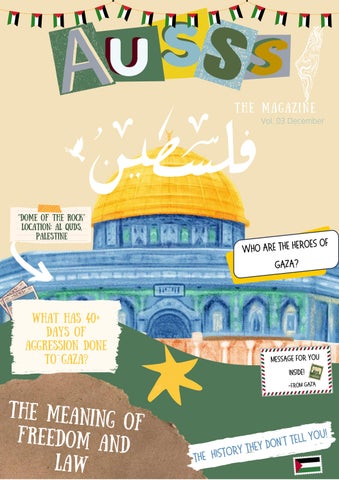
The Magazine Vol. 03 December
“Dome of the Rock” Location: Al Quds, Palestine
What has 40+ days of aggression done to Gaza?
f Who are the Heroes o Gaza?
Message for you inside! -from Gaza
The meani ng of Freedom a nd Law
! u o y l l e t ’t n o d y e h t y The histor
What's Inside?
03 Introduction. 04 Opening Statement. 05 Folklore: its name is Palestine. 06 Palestinian Culture. 08 The Meaning of Freedom. 09 The History they don't tell you. 12 Women of the Year. 13 Musakhan: A Palestinian Delight. 16 Genocide 101. 17 40 days of aggression: Recap. 23 International Humanitarian Law.
24 26 27 29 31 32 35 37 40 41
They are not Just Numbers! The Real Heroes. Vanishing Health. A Day in the life: Med Student, Gaza. The Loss of Medicinal Education. Touring The Local Market. Books & Movies: Palestine. Are you tired yet? What about YOU? Closing Statement.
VOL.03
From the river to the sea
Palestine is a land with a thousand stories waiting to be told - stories of hope, love, war, and solidarity in the face of adversity. It is a country that has endured countless
challenges,
yet
continues
to
inspire
numerous individuals through its ever-present spirit. Through the pages of this edition, we aim to capture the essence of Palestine, its people, and its struggles, ultimately fostering a greater understanding of this beloved land. We hope that this small contribution will not only inform you but also empower you, engage you in meaningful conversations and help you promote peace. May this edition invigorate your curiosity, broaden your understanding, and inspire meaningful action.
No, we will not be silenced. No, we will not forget. We will stand until Palestine is Free, from the river to the sea.
e r o l k l o F history t s a v s u ospero r p a , 8 4 9 land. e h t o t Before 1 n i s roots t i d e t n a pl
“The land we carry in our blood” - Mahmoud Darwish. Those words represent the truest identity of the Palestinian people. Despite their diaspora, they were never hindered from always being connected in some way or another to their homeland. The Palestinian culture is well known for being quite the family-loving type, their migration did not wipe from their memories their family-oriented nature. Instead, some people are known to host gatherings every week. Furthermore, as a part of their traditions, people would take off their footwear before entering the house of the people they are visiting. Moreover, respect represents an important factor in their culture, which I personally see depicted in the elderly living with their eldest sons. Palestinians generally have been through endless conflicts during the British ruling; however, this did not stop them from excelling in endless fields. Personally, I believe that it is the land of prosperity. For starters, they were famous for exporting citrus, olives and even oranges from Jaffa. Oranges were a popular fruit during the late 19th century in Northern Europe before the invention of refrigerators. Fun fact, Olives have been discreetly associated with Palestine that it almost became like a symbol for it. Their ability to export a diverse group of products was attributed to them being one of the first agricultural sites globally. However, Palestinians were not solely the reason for their brilliant reputation in agriculture; rather it was nature along with the hardworking Palestinian farmers. Nature has spoon-fed the Palestinian farmers, through its idealistic environment, like having a suitable atmosphere or landscape.
e r u t l u C We have Ayman, a farmer from Gaza, longing for his history and people, Ayman decided to go back to the traditional organic Palestinian farming methods. Stating “With my strawberries, I am trying to bring back the old days and underscore the need to alter the farming culture here, away from fertilizers.” This pulls us back to our point of Palestine being the ground for one of the first agricultural sites globally. Nevertheless, we cannot turn a blind eye to Palestine being a haven for endless ethnicities and religions throughout the years. Being quite the definition of inclusivity, it even had nomadic tribes, which set the stage for their heterogeneous facial features. Back in the day, their official languages were Aramaic and Greek; but nowadays it is Arabic of Levantine dialect, proving again the point of acceptance of people from all walks of the earth. Being the sacred land is a title that was not given to it aimlessly. Indeed, it is the mother of 3 religions Islam, Christianity and Judaism, which is a unique combination that does not happen all the time. Hebron; a city in the west bank where the tomb of Abraham lies. Our beloved Jerusalem alone is a place that united three religions in one place; by Al Aqsa Mosque for Muslims, the ancient first and second temple for Jews and the birth of Jesus Christ for Christians. Additionally, Palestinians being the intellects they are, have smartly seized the abundance of stones to build their homes; rather than using timber. Besides, we cannot talk about the culture without mentioning the traditional clothing that is made out of cotton or linen. Interestingly, there was an observable difference between the clothes depending on classes and the place where those people come from. Whether they are urban, rural or Bedouin people. Sandals are the traditional footwear for men. Unfortunately, the traditional male style such as tunic and ottoman started to vanish slowly in the early 20th century; as it got westernized over time.
e r u t l u C The strength of the Palestinians never fails us, the “Dabkeh” was only a traditional dance for the Palestinians till the 1970, after that it became a form of resistance. The prior examples, shed the light on some of the facts about the Palestinian culture. However, what we are seeing now is a mass wiping of the Palestinian culture, with the addition of spices for some flavor. This description was not given haphazardly; rather, it was well earned by the most entitled and most deserving round of applause which is the “Cultural Appropriation”. A lesson learned through the years, if conflicts can prove one thing, is that culture is the one most prone thing to be hanging by a thread in most cases. The cultural appropriation goes back to 1948, to Al Nakba (Catastrophe) where 90 percent of people got displaced from their homes and sent to the terminal, banished from their lands. The massive destruction of various historical and religious sites, like the two mosques in the Moroccan Quarter of Jerusalem on the 6th of June 1967, for the mere purpose of rebuilding a narrative is another example of cultural appropriation. Palestinians were famous for their unique embroidered dresses and clothes. Since they had to leave everything behind, they did the same with these clothes. To our utter dismay, the settlers claimed their ownership of these clothes. Not only was the traditional clothing wrongly attributed; but also was the food. Since the 1990s food has been mislabeled in various restaurants all over Europe and the US. For instance, hummus or couscous, tabbouleh and even fruits have been widely seen in supermarkets, shops, etc. being misbranded. In addition, in the eighteenth century, prickly pear cactuses were imported from Mexico to Palestine. Cactus means in Arabic Sabr, which is used also for patience in Arabic. During summer, Palestinians use them as a form of representation of perseverance of their culture by eating them. Then again, comes the appropriation by falsely connecting it with being “rough and tough”. The least of what we could do to honour the Palestinian people is talk of their stories, their true history and rich culture. Hoping that their message would reach everyone and that they are never forgotten.
The Meaning of Freedom Black represents the oppression and the persecution that the Palestinians suffer from.
White represents peace and love, and is the message of the prophets who were sent by God to the land of Palestine.
Green represents prosperity, development, blessing and hope for the future. Red respresents the martyrdom and the sacrifice.
Fishnet: Represents the connection between the Palestinian sailors and the Mediterranean Sea.
Bold: Represents the bold and rich trade routes going through Palestine.
Olive Oil: Represents strength, perseverance and resilience.
Fun fact: the Kuffeyah is of Iraqi origin; a symbol of resistance throughout Arabic history. It was the unofficial flag of Palestine when the flag was banned from 1967 to 1993.
The (Actual) History THEY DON'T TELL YOU
Shimone Peres Former Prime Minister of Israel.
Photos that speak for themselves.
“The entire history of mankind is, in any case, nothing but a prolonged fight to the death for the conquest of universal prestige and absolute power.” -Albert Camus.
It’s 1916, in the middle of World war I, and the United kingdom and France are aiming to defeat the Ottoman Empire. They decide to sign the Sykes-Picot agreement, a secret treaty dividing the lands ruled by the Ottoman Empire (the first of many agreements where neither of the parties own the land they’re distributing). However, it wasn’t until 2 years later when the British army managed to end the Ottoman Empire rule over Palestine. Originally, per the
As you can probably guess, that did not happen. In 1917, in a letter between the British foreign secretary, Arthur Balfour to Lionel Rothschild, a leader of the British Jewish community, the Balfour declaration was established. In it, he showed support for making Palestine a national home for Jewish people.
agreement, the Palestinian region was supposed to fall under an “international administration,” meaning that it would not fall under direct control of either country.
Palestine
became
a
“mandated
territory”, meaning that the League of Nations can authorize a member to govern it and it became a British mandate in 1923 (see a pattern yet?).
The League of Nations was established after WWI to deal with international disputes and try to prevent a second World war (we all know how that ended) and at that time it did not include any Arab state. The first one to join was Iraq in 1932 and the second and last to ever join was Egypt in 1937.
The Balfour declaration was included in
the
mandate
and
Jewish
immigration to Palestine increased rapidly. Between 1919 and 1921, almost 18,000 Jewish immigrants arrived in Palestine, and they kept purchasing lands which lead to the eviction of Indigenous Palestinians. Watching their country being given
In 1935, the Arab political parties demanded a stop to Jewish immigration and a stop of land transfer and between 1936 to 1939, there was a massive Arab revolt. The British, decided to send 20,000 troops to Palestine. Not to mention, Zionists armed more than 15,000 jews in a nationalist movement.
away, Palestinians began protesting the mandate and trying to slow down the Jewish immigration while Jewish people fought back to continue to immigrate to Palestine and acquire more land.
In 1947, seeing no solution, the British government
decided
to
refer
the
“Question of Palestine” to the UN and the answer to divide the land, giving Zionist immigrants 56% of the land while Palestinians were given 44% despite the
As world war II started, with the persecution of Jewish people, there was an extreme increase of Jewish immigration. In fact, by 1936, the Jewish population of Palestine reached 400,000 (approximately one third of the population).
Jewish population being only 678,000 compared to the 1,269,000 Arabs living there at the time, was reached.
Now, in 2023, the Israeli government in occupied Palestine possesses almost 77% of the land.
PALESTINE
WOMEN OF THE YEAR 2023 For those who used their voice for good, those who gave that voice a meaning, and those who imprint the word Palestine into hearts and history.
Musakhan Ingredients:
This warm, savory Palestinian dish is guaranteed to make your mouth all watery! Making Musakhan is not difficult at all. All it takes is a step by step guide with a passion, patience and a love for spices!
(4 servings) 1) Spices: 1 tsp. ground allspice. ½ tsp. ground cardamom. ½ tsp. ground cumin. 2 Tbsp. sumac. Salt. 2) 4 chicken legs. 3) 3 medium white onions. 4) ¼ nuts or almonds. 5) Olive oil. 6) Flatbread (Taboon is the tradition, but if you can’t find it then Greek Pita, Indian or Turkish flatbread also works!)
Step-by-step guide: 1) Make the spice mixture by pouring all these spices together into one bowl. You’re going to be using this mixture for seasoning throughout the dish. Make sure to have extra Sumac on the side.
2) Season the chicken well with salt and the spice mixture, with a small drizzle of olive oil. Seasoning the chicken 1 night in advance will help enrich it with more flavour.
3) Cooking the chicken: In a preheated oven, roast the chicken skin side up for about 1 hour or until fully cooked. 4) Onions: While the chicken is cooking, pour ½ cup olive oil into a skillet and fairly chopped onions. Add in some salt, the spice mixture, sumac and cumin. Cook over medium-low heat, stirring occasionally. You want your onions to be soft but not totally brown.
Pro ! tip You can use some of the roasting pan juices from the chicken on the onions. This will help give your onions, and flatbread, more flavour!
5) At the same time, pour 1 tsp. olive oil and almonds/nuts into a medium skillet, stirring occasionally till golden-brown and fragrant (about 3 minutes). You can salt to your liking.
6) Once the chicken is cooked, let it rest for about 15 mins, covered in foil, while working on the flat bread.
7) Flatbread: Dip the edges of the flatbread in oil of the onion mixture (to prevent them from burning when put in the oven). Put your fragrant caramelised onions and nuts in the centre of the bread, leaving the edges free (Kinda like a pizza). Sprinkle sumac and put in the top shelf of the oven (aka. Broiler) for about 2-4 mins, intil the edges are brown.
8) Assemble: Take out the flatbreads and top with a chicken portion and just indulge yourself in the delicacy of a rich Palestinian dish.
Genocide 101
Terminologies Genocide: is defined by the United Nations as "acts committed with intent to destroy, in whole or in part, a national, ethnic, racial, or religious group“. Anti-semitic: Semite: name given in the 19th century to a member of any people who speak one of the Semitic languages, a family of languages spoken primarily in parts of western Asia and Africa. The term therefore came to include Arabs, Akkadians, Canaanites, Hebrews, some Ethiopians (including the Amhara and the Tigrayans), and Aramaean tribes. So anti-semitic means hostility, prejudice towards, discrimination against the semites but interestingly enough it's only used when the 'victims' are the jews. And even more interestingly when the majority of them are actually from Europe. Judaism: An ancient Abrahamic religion dating back thousands years as well as a national and cultural identity. It is very important to differentiate between “Judaism” and “Zionism”. Not all Jews are Zionists, and not all Zionists are Jews, since Judaism is a religion while Zionism is a movement. In fact, According to many traditional and orthodox Jewish teachings, Jewish people are forbidden by God to have their own state until their Messiah comes. Yet this hasn't stopped Zionist from pushing towards that very goal.
Zionism: Rooted in a 19th-century political ideology led by Theodor Herzl, advocates for a Jewish state, evolving into support for Israel's existence. Originating amid European antiSemitism, it gained Western European backing by agreeing to establish the Jewish state in historic Palestine. Early goals included maximizing control over Palestine, leading to encouragement of European Jewish migration. Despite challenges and rising anti-Semitism, the Arab population in Palestine persisted. Scholars like Ilan Pappe argue that achieving Zionist objectives would require ethnic cleansing of the indigenous Palestinians. Apartheid: Apartheid refers to a policy or system of segregation and discrimination based on race. Two-State Solution: Refers to the idea of establishing separate, independent states for Israel and Palestine coexisting side by side. Occupied Territories: Territories such as the West Bank and East Jerusalem, which were captured by Israel during the 1967 Six-Day War and are considered by many to be occupied. Settlements: Israeli communities built in the occupied territories, a source of contention as they are seen as obstacles to peace by many in the international community.
DAYS OF AGGRESSION ON GAZA Kindly note that this piece is 6 pages long, nonetheless, 6 pages is not enough for the atrocities that have occurred. We can write a hundred pages and those who refuse to see won't ever see.
The Ministry of Health in Palestine reported (15093) martyrs in both Gaza strip and West-Bank From 07/10/2023 to 28/11/2023: "6150 children - 4000 women - 682 elderly, these statistics remain preliminary due to the many missing people under the rubble’’. In addition, there are 38900 injuries announced in the last few weeks and all of that occurred due to Israeli occupation violations against the Palestinian people. There is a question that arises, what actually happened to cause the Palestinians to suffer all of these losses and what attempts were being made against them by the occupation. Our coverage will take a variety of approaches .
Medical Fields in Gaza : In the past days, medical facilities and staff faced numerous challenges in serving patients, war casualties, not to mention having to deal with dead bodies. Illustrating some of these obstacles, we would be getting into concrete facts that represent the war crimes that have been performed by the Israeli occupation: About 207 medical staff lost their lives after being targeted by Israeli aircrafts. These humans who are devoted to their jobs, the meaning of their oath, are supposedly protected by the international law as the WHO always confirms. Israeli forces keep breaking these laws, on numerous occasions, one of their victims being the urologist Dr. Hammam Alloh when they targeted him directly. With no repercussion in sight.
Almost 26 hospitals and 49 health care units got out of service as a result of electricity cut off and shortages of supplies like medicine, water and oxygen because of the siege that was implemented on Gaza by the occupation forces. The health care system tried everything to keep serving the patients. Performing surgeries without local or general anesthesia. Using mobiles flash lights to see while they treat their wounded patients . Bombing Al-Ahli Baptist Hospital in northern Gaza without any mercy killing 471 innocents and injuring 314 people according to Reuters, this was not the first genocide against palestinians but definitely the bloodiest one. "This morning, when I drove into the hospital, I noted how full the hospital courtyard was with families who had sought refuge inside the hospital thinking that it would be a safe haven; these very same families are now either dead or critically wounded a result of this attack," said Dr. Abu Sittah, the director of the health ministry, who was surrounded by dead bodies when the statement was broadcast by Anadolu Agency. Regretfully, it's not the final hospital to be bombed. Israeli aircrafts also deliberately bombed hospitals in the surrounding areas of Al-Quds and Indonesia hospital, killing tens of people, including medical staff in front of hospital gates and civilians in Al-Shifa hospital.
DAYS OF AGGRESSION ON GAZA Al Shifa Hospital is the largest hospital in the Gaza Strip; approximately 25% of the medical staff in the Strip works there. Despite being the target of persecution, the hospital was surrounded by Israeli forces for nearly five days, during which time approximately 3000 displaced civilians, 400 medical personnel, and 700 patients were unable to flee. They suffered until November 15, 2023, when the forces broke into the hospital and began questioning the patients and staff, as mentioned by the hospital director. Tragically, these intimidating methods caused suffering for the people, leading to numerous deaths, for instance. According to ABC News, in the Al-Shifa Hospital in Gaza, 43 out of the 63 intensive care patients have died due to oxygen in the intensive care unit running out, according to Dr. Ahmed Mokhallalati, head of the hospital's plastic surgery department. The Israeli army issued an order to all 30 hospitals in northern Gaza to evacuate their patients and staff, disregarding international law and even the humanitarian condition of patients in intensive care units who are fully dependent on their medical equipment to survive. Taking them off care is a death sentence.
Stats Gaza’s population as of 2023 is around 2.2 million, half of which is under 18!
When Dr. Harris discussed Al-Shifa Hospital, she provided a summary of all hospitals evacuation scenario. Dr. Harris told WHO that in order for any of the people still in AlShifa to survive, they needed vital support. According to Dr. Harris, moving them "would be a very difficult thing to ask in the best circumstances," much less in the midst of bombings, armed conflicts, and a fuel shortage for ambulances. Unfortunately, babies and neonates couldn't escape this aggression, even in hospitals , a lot of baby incubators in many hospitals in Gaza strip shut down, the Palestinian Health Ministry confirmed that at least 130 premature babies, and many more newborns, were at risk of dying due to power failures and the lack of any resources. Sadly, in AlShifa hospital during the siege, within a week, eight babies had died. But help finally arrived on Sunday, Nov. 19, as 31 babies, all critically ill, were evacuated from Al-Shifa to the Emirati hospital near the Rafah border in the south of the Gaza Strip through a joint rescue mission carried out by the Palestine Red Crescent and the United Nations .
DAYS OF AGGRESSION ON GAZA Flee To The South: On Oct 13th, the Israeli army began to instruct 1.2 million civilians to leave their homes and go to southern Gaza, but according to The Palestinian Central Bureau of Statistics Population residing in Gaza and North Gaza governorates as of the evening of 11/11/2023 was estimated at 807 thousand, representing approximately 152 thousand households, out of 1.2 million Palestinians who resided in those governorates (448 thousand were in the North Gaza governorate, and 754 thousand in Gaza Governorate) before the beginning of the Israeli occupation aggression against Gaza Strip, meaning that about two-thirds of the population of the northern governorates still reside in the northern areas of Gaza Strip, while about a third of the population of the northern governorates comprising approximately 400 thousand individuals were displaced to the central and southern governorates of Gaza Strip (Deir AlBalah, Khan Yunis, Rafah). The population currently residing in the central and southern governorates of Gaza Strip is 1.43 million people. This is a real frightening statistic because Palestinians have received threatening warnings from Israel's military to move from north Gaza to the south of the strip, with the added warning that they could be identified as sympathizers with a "terrorist organization" if they stayed .These warnings give israeli forces the right to kill any innocent civilian and that's what happend .
People don't have a place to go, their options are limited. They will stay in the streets, camps, or UN schools (shelters) when they go south in this cold weather, and if they decide to go south, families will have to risk journeys through the blasted landscape of destroyed buildings and corpses, along the road that Israel has designated as a "humanitarian corridor" through the war. For the few hours each day that the road is open, people carry or drag wounded loved ones. They push wheelchairs with patients just out of surgery in hospitals that have now stopped working. Mothers pull along weary children who look around with blank, fearful stares. But what awaits Palestinians who move south is still life-threatening. The "evacuation" areas are both heavily bombarded and in a dire humanitarian crisis, as Israel's blockade of fuel and control of aid into the Gaza Strip leaves people searching for food and access to clean water. The majority (94%) of the damage to central and southern Gaza appeared after Oct 13th, when the Israeli military ordered the evacuation of northern Gaza (according to npr). As the AUSSS team writes these statistics, a pause is being implemented in Gaza; therefore, we anticipate that during this time, the number of persons who have been evacuated will rise. We also hope that Gazans will be able to locate more suitable locations to seek shelter during the chilly, wet weather.
DAYS OF AGGRESSION ON GAZA Humanitarian Crisis: The amount of water available to people trapped in Gaza will still be just 17 percent of pre-siege levels. Current fuel levels have made water treatment, pumping and distribution virtually impossible. All water, fuel and food to Gaza was cut off by the siege implemented by the Israeli government on the 9th of October. Over 344 million liters of total water were available in Gaza via groundwater wells and pipelines before the siege. Currently, only 58 million liters ―less than a fifth― is available. Without fuel, this would drop to less than 25 million liters ― seven percent. The total water is for both municipal and domestic use. The bare minimum international standard in an emergency is 15 liters per person, per day. People are already having to survive on rationing between 1-3 liters a day for all water use and are resorting to drinking sea and untreated water. Analysis reported by Oxfam shows that the total bottled water delivered since aid trucks were allowed into Gaza via the Rafah crossing on 21 October to 12 November is equivalent to just 1.6 liters per person. No aid has entered via the Rafah crossing since 14 November (till 23rd of Nov).
Stats At least 7000 people are missing and presumed dead under the rubble, 4700 of them are kids and children.
Gastroenteritis and dehydration are spreading and the risk of water borne disease is rife. Over 70 percent of the population ―1.6 million people― are displaced, 795,000 of whom are crowded into 154 UN shelters. The humanitarian situation is increasingly dire. Families sheltering in community centers confirmed that in some shelters, more than 3,000 people are sharing just 10 toilets between them. Just 1,121 trucks of aid have entered the Gaza Strip in the 40 days since 9 October. This is estimated to have met the needs of just 3,000 to 5,000 people a day. Many supermarkets across Gaza are no longer able to stock bottled water, bread or even canned food which many people have been falling back on to survive. The last functioning mill in Gaza was reportedly destroyed on 15 November which means that locally produced flour will no longer be available. During the 4-6 days pause, 200 truckloads of aid will be allowed to enter Gaza each day, but this is a drop in the ocean compared to what is urgently required. The deliveries will include 130,000 litres of fuel each day, yet UNRWA says it needs at least 160,000 per day just to keep basic humanitarian operations running.
DAYS OF AGGRESSION ON GAZA Winter has arrived in Gaza and people urgently need warm clothes, blankets, and tents, as well as food, clean water, medical supplies, and hygiene products. Reported from actionaid, Sana*, a mother who has been displaced to the south of Gaza, said: “We came to the school to find a mattress, blanket, or anything to cover ourselves with. We did not find any of this. We slept on the floor. We arrived after a whole night without sleep and without dinner or breakfast; the children fell asleep hungry. We sleep without pillows and without blankets. The one blanket we have we put on the children.’ She also said, "Cold and rain are upon us, and there is no fresh water. At night, the children also had diarrhea because of the cold weather. Here we can’t find food to feed the children. We go to the market and are surprised by the prices. They are unimaginable."
Stats
Israeli soldiers and, in some cases, settlers have killed 239 Palestinians in the West Bank. In addition, more than 3200 are detained.
Routine vaccination rates inside Gaza were high before the conflict began, with about 90% coverage according to UNICEF, but since the war started many of Gaza's parents have not been able to care for their children , according to UNICEF, the U.N. agency that provides humanitarian aid to children. UNICEF is warning that thousands of children across the Gaza Strip are now missing out on routine vaccinations, increasing the possibility of a major health crisis.
Destroyed Infrastructure : Israeli attacks had destroyed more than 46,000 housing units and damaged more than 234,000 housing units. This caused 1.6 million people to be displaced in the whole Gaza strip -including ones who did evacuate from north to southduring the war according to The Palestinian Central Bureau of Statistics. Sadly, most of the war victims from civilians lost their lives because of these brutal attacks by bombing buildings while people are staying in it safely ,nothing justifies these crimes. In addition, 88 mosques, 3 churches and 67 schools were totally destroyed in the last 50 days.
DAYS OF AGGRESSION ON GAZA On Nov. 16, Gaza's telecommunications services shut down after fuel used to run generators ran out. OCHA said several communication infrastructures in south Gaza were hit and damaged on Nov. 14. Therefore, people neither could communicate with the outer world nor can even call for ambulances during the period of communications cut off .Many people who are living outside Gaza only learned of their family' whereabouts when they happened to get a chance glimpse of them on television. Israeli forces have been targeting solar panels and generators that Gaza residents have relied on since Israel blocked off all power and fuel supplies to the besieged territory weeks ago.“With the latest air strikes, the Israeli forces have been targeting solar panels, generators,” Hind Khoudary, a journalist based in Gaza City, told Al Jazeera.
These are the 40 days we mentioned, this catastrophe has been going on for 60+ days, and SEVENTY FIVE years. These are only some of the horrors. But fear not, your imagination will not be able to conjur up anything remotely close to the truth.
West-Bank Pain : With all eyes on Gaza, the West Bank is at its most combustible. Settlers have taken advantage of the situation by stepping up abuse of Palestinians in a calculated effort to seize control of more land. Field researchers with the Israeli human rights organization B’Tselem, who have been monitoring the issue closely for years, warn that the settlers have freer rein from the state than ever before: “Events on the ground indicate that under cover of war, settlers are carrying out such assaults virtually unchecked, with no one trying to stop them before, during or after the fact”. The tighter closure policies that are confining many Palestinians more than normal. The majority of the secondary roads linking Palestinian towns and villages are owned by Israel, as are the main highways in the West Bank. Any passage through the army's regular checkpoints on the main thoroughfares has been stopped, and a number of impromptu checkpoints run by settlers have appeared. Alongside their checkpoints, settlers' militias have occasionally used earth mounds, cement blocks, and iron gates to barricade Palestinian villages. When driving on the roads, Palestinians run the risk of being attacked.
INTERNATIONAL hUMANITARIAN
lAW International law: the body of legal rules, norms, and standards that apply between sovereign states and other entities that are legally recognized as international actors. If a state violates international law, it is responsible to immediately cease the unlawful conduct and offer appropriate guarantees that it will not repeat the illegal actions in the future. The state also has a responsibility to make full reparations for the injury caused, including both material and moral damages. The UN can opt for enforcement measures, such as economic sanctions, arms embargoes, financial penalties and restrictions, travel bans, the severance of diplomatic relations, a blockade, or even collective military action. International Humanitarian Law (IHL) is a set of rules that seek to limit the effects of armed conflicts by protecting individuals who are not or are no longer participating in the hostilities and by regulating the means and methods of warfare. Some key principles include distinction, proportionality, and the prohibition of certain weapons.
Examples of IHL laws include: Principle of Distinction: It requires parties to distinguish between civilians and combatants, directing attacks only against the latter. Principle of Proportionality: It mandates that the use of force should not exceed what is necessary to achieve a legitimate military objective, and any harm to civilians or civilian property should not be excessive. Protection of Prisoners of War (POWs): POWs must be treated humanely, and their rights and dignity are safeguarded. Ban on Torture and Cruel Treatment: The use of torture or inhuman treatment is strictly prohibited. As of the writing of this article, Israel has broken 61 laws of the IHL.
They are not Just Numbers The olives of the earth and the beautiful people of Jannah “This is my mother; I knew her from her hair” such heart-wrenching painful words. A life lost, a child who so intimately loved and knew their parents that even their hair was an identifying factor. A sentence that signifies that this was a loss of more than just a person, it was a loss of hopes, dreams, and an unbreakable bond. A loss of a future that now will never be. A sentence that truly captures the humanity and vulnerability behind it. All those who were lost had someone who knew them just by their hair. Hala abu Saada, a 13-year-old girl who learned sign
Not Just Numbers
language to accompany mute and deaf children. She dreamt
of
becoming
a
journalist,
a
criminal
investigator, or an astronaut.
Mohamed Ajur, a professional programmer who established his own company and dreamed of working internationally to represent Palestine. And 11,000 more humans who had names, dreams, families, and stories. Humans with dreams that were robbed in less than a second. And their “crime” was that they were born on a land that was rightfully theirs. But in remembering the dead, let us also speak of those who are alive. The humanity, tenderness, love, and kindness. A country filled with beautiful people indeed.
Illham Farah was a retired teacher and musician who was a prominent Christian figure, loved by many of her students. Dr. Hamam Al-Louh, a brave doctor and truly a role model to all who refused to leave his patients stating, “if I leave, who will treat my patients?”, killed only a day after making that statement. Assef Abu Malik, a little kid who dreamed of being a football player yet lost a limb due to the Occupation’s bombing.
Even in the midst of bombings and massacres, they still go back and rescue their pets. They hold the animals with unimaginable tenderness. They feed them when they have very little to eat themselves. And God, the way they console the kids and the way they hold them and comfort them, even when they are terrified themselves, is so unimaginably human and pure, a sort of kindness that is unfathomable. And oh how their children still laugh and smile and play in the rain.
The harsh reality that their childhood is forever tainted with this tragedy and the loss of their friends and families somehow didn’t stop them from finding a way to laugh through it.
Even when one of them was injured and saw his mother worried over him, he immediately tried to make her feel better, downplaying his own pain to ease some of his mother’s worries. Faced with tragedy, they lean on each other. Losing all they have, they still have unrelenting, admirable faith in their god, a faith most humans dream of having. Zionists may have taken their land and their lives, but they can never take away their spirit, their kindness, and their bravery. In the face of loss, their spirits were never broken, their faith unshakable. It is truly a tragedy how their blood watered the seeds of humanity, but as our tears fall in solidarity, let it, in turn, water their freedom. Words will never do them justice, no amount of retributions will ever suffice. May their martyrs rest easy, and their living stay safe. Heaven is singing in anticipation of them.
Let us not forget and speak of the men and their bravery and sacrifice. Indeed, they showed the world what it truly means to be a man. To be kind and brave in the most vulnerable times. To dig up people from under the rubble wearing nothing but a flip-flop, to take time to sit and hug and console the little kids with a tenderness that is so unexplainable, so unique and pure.
THE REAL
HEROes
“And If I go, who treats my patients? You think I went to medical school for 14 years so I can only think about my life and not my pateints?"
I am asking you ma’am. do you think this is the reason i went to medical school, to think only about my life? This is not the reason I became a doctor” Dr. Hammam Al-louh A doctor from the Palestinian Red Crescent saving a child from under the rubble.
Killed one day after this statement.
Vanishing Health The fall of healthcare in Gaza
Al-Shifa hospital When critical patients are asked to flee hospitals, where should they go?
The World Health Organization (WHO) has described al-Shifa hospital in Gaza City as a "death
Ever since October 7th, many of Gaza’s hospitals have been targeted and bombed. Over the past 36 days, WHO has recorded at least 137 attacks on healthcare in Gaza, resulting in 521 deaths and 686 injuries, including 16 deaths and 38 injuries of health workers, the regional directors said. Lack of resources Almost half of the hospitals in Gaza are no longer functioning due to the attacks,
zone". According to the head of the World Health Organization, Tedros Adhanom Ghebreyesus, medics had been without electricity and water. "The constant gunfire and bombings in the area have
exacerbated
the
already
critical
circumstances. Tragically, the number of patient fatalities has increased significantly", he added. He said the hospital "is not functioning as a hospital anymore", concurring with the regional directors
that
there
must
be
international
according to the WHO. As water, fuel and
intervention. Hostilities continue surrounding the
electricity are shut off Gaza how will the
hospital, evacuations and ambulance journeys are
remaining functioning hospitals run? The
too dangerous.
sheer numbers of patients means the
The hospital’s functioning ventilators, intensive
supplies do not cover even a small portion
care units and ventilators have been at risk of
of the demand. According to the UN,
shutting down due to the lack of fuel. This resulted
before the conflict erupted, Gazans had
in the most recent heart-wrenching image of the
access to some 3,500 hospital beds. Today,
39 premature babies wrapped up in blankets and
only an estimated 1,400 are available,
huddled together to provide warmth through
although the actual requirement is likely
skin-to-skin
contact.
These
babies
closer to 5,000. Operations are being done
incubators
lacking
power
for
without anesthesia, lack of antibiotics
contaminated water used in their formula due to
predisposing to wound infections and lack
lack of resources, leading to the death of eight. But
of pain management.
were
days
in
with
help finally arrived on Sunday, Nov. 19, as 31 babies, all critically ill, were evacuated from AlShifa to the Emirati hospital near the Rafah border in the south of the Gaza Strip.
Vanishing Health Mental health during a catastrophe The people of Gaza have been living all the
Public health crisis
heart wrenching tragic scenes we view on our
screens
with
trigger
warnings
constantly for the past 46 days. Watching family members die under the rubble, some of them missing, parents unable to protect and save their children and children of all ages experiencing the bombing and learning about tragedies before fully learning how to speak. According to Save the children’s (an international NGO) mental health experts , under current conditions in Gaza, children are experiencing a whole host of signs and symptoms of trauma including anxiety, fear, worry about their safety and that of their loved ones, nightmares and disturbing memories, insomnia, bottling up emotions and withdrawing from loved ones. Who can provide mental health services when
the
doctors
themselves
are
traumatized with the horrifying scenes they see daily, feeling helpless whilst treating patients with no resources, losing family members and fearing for their lives every hour of every day.
Stats
Over 30,000 children in the shelters are already reported to be sick with dehydration and malnutrition and thousands of cases of acute respiratory infections, diarrhea and chicken pox have been reported among people taking refuge.
Since the beginning of this conflict, 51% of Palestinians have lost their homes, many seeking refuge in camps and hospitals, this leads to overcrowding. In combination with lack of clean water and destruction of Gaza’s sanitation infrastructure, many cases of diarrhea have been reported and fear of typhoid and cholera outbreaks is high. Additionally, dermatological diseases such as lice and scabies are spreading like wildfire and are also related to absence of clean water and limited numbers of bathrooms. With winter approaching and many seeking shelter outside in the rain, 10,224 people have been diagnosed with an acute respiratory infection since the 10th of november. The healthcare situation in Gaza cannot be conclude in just this article, the situation is beyond dire. we have only provided a snippet of what is going on there, many more hospitals are affected, more illnesses spreading we did not talk about and what about the chronically ill patients who were already in Gaza? Cancer patients not receiving their treatments, type 1 diabetics are they receiving their insulin and having proper nutrition? Patients suffering from asthma, what happens to them with the rubble and gasses in the air they breathe? As these attacks brutally continue, every minute that passes, the health of those living in Gaza is endangered from all aspects. If they’re not killed by the bombs they will starve or fall critically ill.
A day in the life of a palestinian medical student: From gaza "يومنا في الحرب بتراوح بين خوف وقهر .. خوف من القصف الوحشي اللي ما بوقف ال بالنهار وال بالليل وال بأي لحظة وما في أمان بأي منطقة كما يزعم الصهاينة كل القطاع تحت القصف والتدمير الهمجي وبسبب الحصار ونفاذ الوقود والمي والغذاء والعالج وحرفيا فش حياة ,كان الزم من الصبح ننزل ندّو ر عىل الميا واالكل ونقف طوابير طويلة عىل المياه عىل الخبز من الصبح الخر اليوم عشان نقدر نوفر اشي ألهل البيت.. وهللا حياتنا ما قبل الحرب انقلبت رأس عىل عقب بعد الحرب ,قبل الحرب كنا بنحلم نحقق اهدافنا زي كل العالم كنت طالب طب وكنت في بداية السنة الجديدة في الكلية سنة تالتة وكنت مجدد الشغف الها ومجهز حالي اني ادرس واجتهد واتميز وأكمل كل سنيين الدارسية واكون طبيب فخر لوالدي ولكل حبايبي متميز بعملي وبتخصصي وكنا ببيبتنا وبين اهلنا وناسنا وحبايبنا وفجاة وكانه كابوس حل علينا بعد الحرب تفرقنا عن حبايبنا عن بيتنا عن اهلنا وناسنا عن كليتنا عن صحابنا .. من اصعب اللحظات اللي عشتها نزوحنا من بيتنا وزكرياتنا وأغراضنا الغالية علينا وحارتنا اللي بكل ركن فيها زكريات وضحك ومغامرات وتركنا كل اشي بنحبه خلفنا بسبب هادي الحرب.. القصف الصهيوني والهمجي النا خطف منا كتير ناس بنحبهم زمالء الي بالكلية طالبة من دفعتي غير طالب الطب الكتير في كلية الطب في الجامعة االسالمية واألزهر وّذ عنا عقول مبدعة حالمة وغير زمالئي في الكلية صحابي من نادي الكورة اللي كنت العب فيه وناس كتير فجعت فيهم بحبهم ما صدقت لهلقيت انهم راحوا.. وطبعا غير النت وصعوبة الحصول عليه بطلوع الروح حرفيا يجي كم ساعة وهي اكبر دليل وانا بكلمك راح النت والشبكة ضعيفة وشبه منقطعة مش عارفين نتواصل مع حبيايبنا وقرايبنا وصحابنا حرفيا ما في حياة حرفيا بأي شكل من األشكال. بتقلي ايش مخاوفك بعد الحرب انا اكبر كابوس الي وخوف انو هادا الكابوس الحرب هادي ما تخلص زي ما شفتوا انتوا قصفوا كل الجامعات كل المدارس كل اشي ومنهم جامعتي األزهر راحت جامعتي اللي بدرس فيها طب كتير اللي فيها احىل زكريات.. لكن رغم هيك ما زلت مؤمن صابر انو كل اشي هيرجع زي قبل وحتعمر غزة وحرجع لكليتي اكمل دراستي حتى لو مش السنة هادي وال اللي بعدها لكن حضل ادرس في غزة حبيبتي وحطلع دكتور اخدم مدينتي الجميلة اللي تشوهت معالمها وتلطخت بدماء ورائحة الموت والدم ولكن بإذن هللا حترجع برائحة الياسمين تفوح بالحياة وبالمستقبل رغم عنهم باذن هللا... وان شاء هللا جيل سيأتي بعد جيل وحتضل فينا العزيمة .واإلرادة وحنعيش في غزة مدينتنا الجميلة اللي مهما تشوهت معالمها حتضل احىل مدينة بالنسبة الي وحتعمر وححقق كل اهدافي فيها.. وهللا في كتير كتير كالم جواتنا كتير كتير بس مش قادر احكي . كتير كتير كالم من جواتنا قهر قهر بعبي عالم وبزيد بس حًاولت اجاوب قد ما اقدر. بدي منكم تدعولنا النه كتير بحاجة ماسة للدعاء.. . s a مشاهد واحداث ومحازر تقشعر لها االبدان.. y... w niversit U r a h z A انا يمكن ببيت تحت سقف غيري نازحين بخيم بكياس مش القين اكل وال دفأ Al وهللا الواحد تعب وزهق بس بشوف احوال الناس يخجل اقول تعبت وزهقت بالعكس الزم صوتنا يصل وكل العالم يعرف شو اللي بصير رغم انو تعرضنا للخذالن من كل حدا بالعالم بس حنضل نحكي ونحكي ونثبت وجودنا في هاد العالم ويضل النور يطلع من عنا باذن هللا"..
Translation Note that not only words were lost in translation, but also emotion.
"Our days at war wage between fear and opression. Fear of continuous bombing, day and night, with no reprieve and no safe zones not even if the zionists claim otherwise. Every single district is targeted. And because of the fuel, water, food and drug sanctions, there is no life. Every morning we had to go search for food and water and stand in endless lines till the end of the day to get something for our households. I swear our lives before the war are turned upside down. Before, we were just trying to make our dreams come true just like the rest of the world, I was a medical student, starting a new year, hard at work, renewing my passion, prepared to finish my remaining years to be the pride of my parents and all my loved ones. Special at my job. We were all there together at home, amongst our people, and then suddenly, like a nightmare, we got separated from our families, our friends, our homes. One of the hardest moments that I had to live through was being displaced from my home, leaving all my precious things, the memories, and our neighbourhood of which every corner holds a dear moment, a laugh and an adventure. We left everything we loved because of this war. The barbaric zionist bombing robbed us of many people we love, my classmates and many other medical students in the islamic and al azhar universities. We had to say goodbye to dreaming, creative minds. My friends from soccer club, people I have loved that I still can not believe are gone. Of course, not to mention the internet and how difficult it is to access it. I can barely get a few hours, and the biggest testament is that as I am writing this, the connection is lost and the network is so weak and almost gone. we cannot contact our loved ones, quite literally there is no form of life, of any kind. You ask me of my fears after the war, and I tell you that my biggest fear is that this war will never end. As you can see they bombed all the universities, the schools, everything, including my university. Gone is my place of study, the one with the best of memories. But despite all of this, I am still patient and I still believe that everything will go back to the way it was. Gaza will be repopulated. I will go back to school, if not this year or the next, I will still study in my beloved Gaza, and I will become a doctor to serve my beautiful city that was ruined and defiled with blood and the smell of death. But with God's will, the smell of jasmine will return, full of life and promises of the future in spite of them. with God's will, generation after generation will arise, still with determination. And the will to live. We will remain in our beautiful Gaza no matter how ruined its bearings become, it will remain the most beautiful city to me and it will rise again. In it I will make all my dreams come true. There is still so much for me to say but I cannot speak no more. So many words of the opression that we're going through, enough to strangle this whole world, but I said what I could. I ask of you to pray for us because we are in dire need of it. The things we see would make you shiver. I might still be under a roof, but many displaced are living in tents, under plastic bags, not finding any food or warmth. I swear I am so tired and bored of this, but I see those around me and I am ashamed of that. Our voice must call louder and the entire world must bear witness. Even though we have been let down by the entire world, we will still speak, we will still persevere and prove our existence to the world, and with God's will, the light will shine from within us still."
.
The Loss of Medical education
SCOME’s vision Our vision revolves around attaining optimal professional and personal development to help medical students reach their full potential as
Hospitals are being bombed. The one place that should always be guaranteed safety. The place
future doctors for better healthcare worldwide.
where medical students receive education and
Due to the current situation in Palestine, medical
where they’ll be expected to work as future
students are not able to prioritise their education
healthcare professionals and it has become a
and development.
nightmare. Without a future generation of doctors, there will be little hope for the healthcare system to recover after the aggression, if the aggression stops at all! To our fellow Palestinian medical students, you are not alone. We stand by you. Even if only by heart.
touring the local market: Things we’ve tried (and you should too!)
1. Buffalo Burger 2. Wimpy 3. Mince 4. Daddy’s Burger 5. Butcher’s Burger 6. BRGR
AUS SS APP ROV ED!
1. What the Crust 2. Vinny's Pizza 3. Primo’s Pizza 4. Maison Thomas 5. Pizza Station 1. Heart Attack 2. Bazooka Fried Chicken 3. Kansas Fried Chicken 4. Zack’s Fried Chicken 5. Kokio 6. Chickin Worx 7. Howlin’ Birds
touring the local market: Things we’ve tried (and you should too!)
AUS SS APP ROV ED!
1. Spuds 2. Tiger 3. NachoS 4. Bake Rolz 5. Cono 6. Flaminco 7. Raw Kettle Cooked Potatoes 8. Jaguar 9. Lino Foods
1. Spiro Spathis (if you can find it!) 2. V7 3. Double Dare 4. Adio 5. Buzz 6. Willy’s Cream Soda 7. Snaps 1. Juhayna 2. Lamar 3. Breadfast 4. Lychee 5. Squeeze 6. The Leaf 7. Glow 8. Yes 9. Best
touring the local market: Things we’ve tried (and you should too!)
AUS SS APP ROV ED!
1. 20 Grams 2. Nude Bakery 3. Brown Nose 4. Social Speciality Coffee 5. Koffee Kulture 6. Vasko 7. 3o North 1. Flo 2. Puvana 3. Elano 4. Aqua Delta 5. Hayat 6. Safi
1. Nefertari 2. Bubblz 3. Essentials 4. Raw African 5. Eva 6. Locken
1. Al Awda 2. Awafi 3. Beet Lahm
BOOKS on palestine:
Stories of displaced Palestinian Children in the late 1940s and the 1970s
A story on violence, displacement and memory as it explores Palestinian suffering during the Nakba
Following Abuelhejas, a forcibly displaces family in 1948
Details the writer’s journey from Syria’s largest Palestinian refugee camp to Germany
A collection of poetry written in the tradition of Ghassan Kanafani’s Palestinian Resistance Literature
An author’s memoir about exile and returning to Palestine thirty years after he was expelled from his homeland.
movies on palestine
Are You Tired yet? A quick reminder: This needs a lot of patience; keep the morale high! Norman Finkelstein, a political activist whose primary focus has been on the long-going Palestinian ethnic cleansing, especially the one in Gaza, and the politics of the holocaust, said in a recent interview that the “question of Gaza was disappearing from the public stage” adding that he himself has given up hope. Now it’s not a question of Gaza anymore, it’s a moral stand about Palestine as a whole. At the time of writing this article, it has been 62 days since the beginning of this massacre. We all watched as the atrocities unfolded live in front of our eyes. people lost their homes, their most valuable possessions, their loved ones, and their lives. That feeling of helplessness and hopelessness that I am sure some of us might be feeling is nothing compared to the 75+ years of terror that the Palestinians had to and still are enduring. The scenes we have seen this past month have been beyond horrific. Why isn’t anyone doing anything?? How many more lives does this “war” have to claim till they deem it enough?? Those are questions I am sure a lot of us have asked ourselves. That sadness turned into anger. That feeling that you want to do something, anything, but all you can do is watch. Watch from the comfort of your own house, having the privilege to close your phone and go about your day. But how? How can we smile and move on and live life like nothing is happening? Those feelings turn into a kind of helplessness that leads to abandon, but I am here to urge you to speak. That’s all they ever asked of us.
Are You Tired yet? Speak even if your voice is hoarse. Speak even if you cried so hard that there are no tears left and there is an empty void in place of that sadness. Speak so that the voices of those who are martyred can still be heard amongst the echo of our anger and pain. Speak for the humanity that the world has lost. Don't let their stories die. We owe them that. The world has finally woken up, don’t close your eyes to go to sleep now. Let that sadness fuel your need to speak. Become the speakers in which their voices are amplified. Raise your fists up in anger and remember those who left and those who are left behind. We can’t be silent now. They were never able to take away the Palestinian resistance and resilience. If they can wake up despite all that has been happening and still show us what they are going through and witnessing, the least we can do is listen, share, speak and watch. Palestinians taught the world what humanity really meant, do not let that die. The “question of Gaza” has been revived and it is our job, our duty to breathe life into it until there is no need for that question to even exist, until there is liberation!
we understand that the scenes we are exposed to might be too much for us to handle. It is okay to feel helpless, it is okay to feel like you need to look away for a while. It is okay to feel tired. But don’t let that stop you from speaking up. Liberation is always lengthy and needs patience. Our job is to do all we can to amplify the voices of Palestinians at the moment. Our job is to “fight” in any way we can. Share the posts you see even if you don’t fully watch all of it to push Palestinian content to the forefront. This is a critical time, and we cannot let this die down. Remember this isn’t a trend, these are people’s lives. Watch Palestinian content even if it is only for 5 or 10 seconds, enough to make the algorithm push it. Repost all Palestine related content and share it. They are currently trying all they can to suppress the voices of Palestinians or anything proPalestine.
They are hoping that we will forget or that we will lose hope so that they can continue committing atrocities unchecked. They need us to move on, so don’t give them that. It is okay to feel helpless, but we need to keep pushing, keep speaking, keep fighting so that we can finally see a day where Palestine is free. Right now, we are fighting together as one, as humans. Let our anger fan the flames of liberation. Remember you are not the only one watching, sharing, or speaking. Power comes with unity, which is why they want us to get tired and give up so badly. We work as a collective. You are not alone. You are not alone in your anger. You are not alone in your frustration. You are not alone in your sadness. We are all fighting together to stand with humanity and against a tyrannical oppressive inhuman regime. And we would like to end this article with a quote from the beloved late Shireen Abu Akleh. “ خلي المعنويات عالية...”بدها طول نفس
What about You? Nothing the same as it was after Palestinians crisis, I think those heroes who are hanging on their lands till now just inspired the world by their determination against evils’ torturing and persecution. I hope just their suffering ends there and really wish to help them likewise they did to 8.5 billion people when they revealed the ugly hidden truth of our world.
No Parent Should have to experience their child die in their arms. That is utmost helpless feeling a person can ever encounter.
😢
َف َس ِّب ْح ِبَحْم ِد َر ِّبَك٢ َوَر َأْي َت ٱلَّن اَس َيْد ُخُلوَن ِفى ِد يِن ٱلَّلِه َأْف َو اًۭج ا١ َذ ا َجٓاَء َنْص ُر ٱلَّلِه َو ٱْلَف ْت ُح ٣ َو ٱْس َت ْغ ِف ْر ُه ۚ ِإَّنُه ۥ َكاَن َتَّو اًۢبا We lost our brothers and sisters who got JANNAH but we're seeing new brothers and sisters joining the Ummah every single day because of them
🤲🏻🤲🏻🤲🏻🌹 اال ان نصر هللا لقريب
دائما بنزعل عىل المناظر الي نحنا بشوفها كل يوم وبندعيلن بالسالمة دائما والنصر القريب والي كتير بيقهر انه نحنا مو قادرين نعمل اي شي غير الدعاء ألهلنا واخواننا في فلسطين وهللا هم االبطال الحقيقين عشان عم يواجهو الخطر كل يوم بقلب شجاع وصامد وانا كتير متمني اني كون معن هناك عم حارب ضد العدو الغاشم اللهم انصرهم عىل عدوهم يارب العالمين وزلزل األرض تحت أقدام عدوهم يارب العالمين امين اال ان نصر هللا لقريب
🌹
🤲🏻🤲🏻🤲🏻🌹
🤲🏻
Israel has been planning these attacks for decades and they think It'll be worth it....which is not. Allah will show them no mercy on this earth and on the day of judgement... They have started witnessing it currently and they will continue to. May Allah free Palestine permanently from this hardship and all Muslim ummah
For everyone who worked in the background. For everyone who goes on still. For everyone who is still working hard. For everyone speaking up. For everyone who still remembers. For everyone who has had enough. for everyone who has no one. We see you. we feel you. Keep on having faith.
Life savers, change makers. Magazine Edition 03