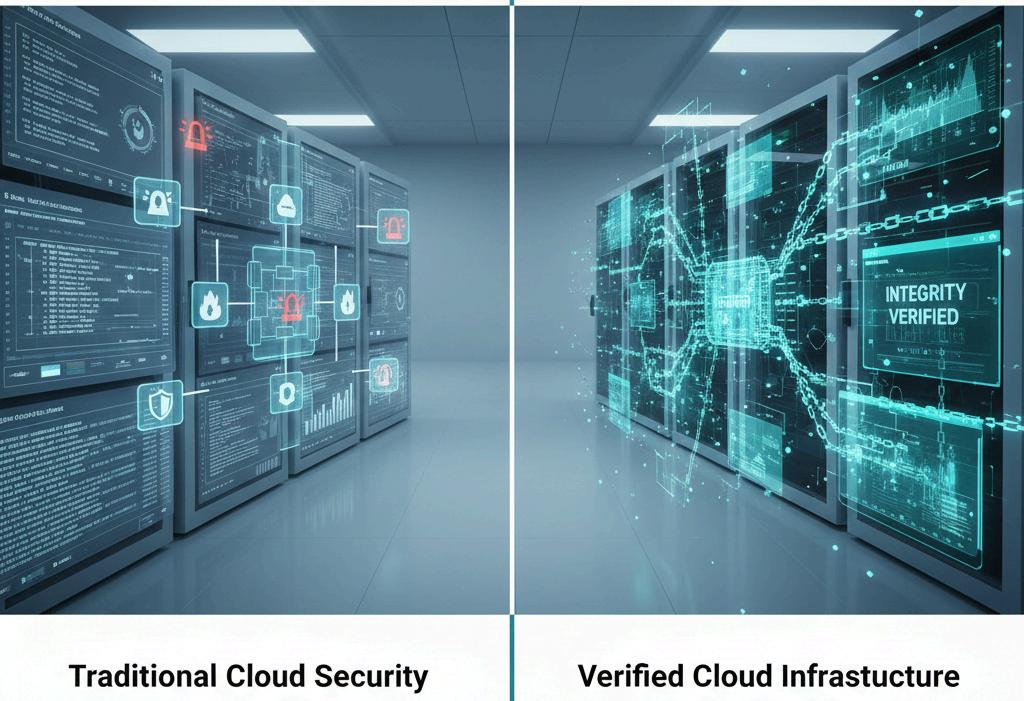
Verified Cloud Infrastructure vs Traditional Cloud Security: What Enterprises Are Missing
Verified Cloud Infrastructure vs Traditional Cloud Security: What Enterprises Are Missing
Cloud security has evolved significantly over the past decade Enterprises today deploy identity access management (IAM), zero-trust frameworks, encryption protocols, runtime monitoring, and compliance certifications.
Yet despite these investments, one fundamental question often remains unanswered:
Can you prove your cloud infrastructure is in a trusted state at any given moment?
This is where the distinction between Traditional Cloud Security and Verified Cloud Infrastructure becomes critical
Traditional models focus on protection and monitoring
Verified Cloud Infrastructure focuses on provable integrity
The difference is subtle but strategically transformative
What Traditional Cloud Security Provides
Modern cloud providers offer strong security foundations, including:
● Identity and Access Management (IAM)
● Multi-factor authentication
● Network segmentation and firewalls
● Encryption at rest and in transit
● Activity logging and monitoring
● Compliance certifications (ISO, SOC 2, etc )
● Intrusion detection systems
These controls are essential They reduce attack surfaces and improve visibility
However, they operate largely within a trust-based architecture.
Organizations trust that:
● Infrastructure configurations remain unchanged
● Logs accurately reflect system activity
● Billing reflects actual resource usage
● Runtime environments are uncompromised
● Deployment artifacts are authentic
Monitoring tools can detect anomalies. Logs can record events
Auditors can review documentation.
But none of these mechanisms provide cryptographic proof of infrastructure integrity
The Hidden Gap in Traditional Cloud Security
Traditional cloud security assumes that if access is controlled and activity is logged, the infrastructure can be trusted.
This assumption creates blind spots:
1. Mutable Logs
Most cloud logging systems are editable by privileged administrators While access controls restrict misuse, logs are not inherently tamper-proof.
2. Configuration Drift
Infrastructure-as-Code (IaC) tools reduce misconfiguration risk, but runtime drift still occurs. Unauthorized or undocumented changes can remain undetected
3.
Insider Risk
Privileged users may alter configurations or billing parameters without immediate detection.
4. Billing Opacity
Enterprises receive invoices based on provider-calculated metrics. Independent verification is rarely possible
5. Reactive Security
Traditional systems detect and respond to incidents they do not continuously prove integrity
The result?
Security posture remains strong but trust remains assumed, not verified
What Is Verified Cloud Infrastructure?
Verified Cloud Infrastructure introduces a cryptographic verification layer into cloud environments.
Instead of relying solely on policies and monitoring, it embeds:
● Infrastructure state proofs
● Workload attestation mechanisms
● Tamper-evident configuration logs
● Immutable audit chains
● Cryptographically verifiable billing
● Optional blockchain anchoring for third-party validation
This shifts cloud security from trust-based oversight to proof-based assurance
From Observability to Verifiability
Traditional Cloud Model:
Access Control → Monitoring → Alert → Investigation → Report
Verified Cloud Infrastructure Model:
Access Control → Continuous Cryptographic Proof Generation → Immutable Record →
Verifiable Validation
Monitoring tells you something happened.
Verification proves the system state is authentic
This distinction is foundational for enterprise-grade infrastructure.
Side-by-Side Comparison
Traditional Cloud Security
Policy-based trust
Editable logs
Reactive monitoring
Invoice-based billing trust
Compliance documentation
Configuration tracking
Verified Cloud Infrastructure
Cryptographic proof-based trust
Tamper-evident immutable logs
Continuous integrity validation
Verifiable usage-linked billing
Cryptographic audit evidence
Infrastructure state proofs
The difference is not incremental It is architectural
1. Infrastructure State Proofs
Every computer node, storage cluster, and network configuration generates time-stamped integrity hashes.
If configuration changes, the proof changes
This ensures that infrastructure drift cannot occur silently.
2. Workload Attestation
Each workload deployment produces a cryptographic fingerprint tied to:
● Code version
● Container image
● Build artifacts
● Runtime environment
If any element deviates, the integrity check fails
This guarantees deployment authenticity
3. Immutable Audit Trails
Logs are chained cryptographically, making unauthorized edits detectable
For enterprises facing regulatory scrutiny, this provides defensible evidence rather than retrospective explanation
4. Blockchain-Verifiable Billing
Usage metrics generate cryptographic records tied directly to billing calculations.
Enterprises can independently validate:
● Compute usage
● Storage allocation
● Resource consumption
● Cost transparency
For public-sector procurement and enterprise contracts, this reduces dispute risk and increases accountability.
Why Enterprises Are Moving Toward
Verification
Regulatory Pressure
Governments worldwide are strengthening requirements around:
● Data integrity
● Infrastructure transparency
● Operational accountability
● Digital sovereignty
Traditional compliance certificates are no longer sufficient.