APS 2026 RISING STAR AWARD
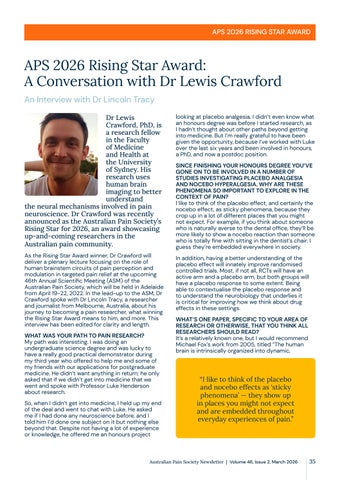
APS 2026 Rising Star Award: A Conversation with Dr Lewis Crawford An Interview with Dr Lincoln Tracy Dr Lewis Crawford, PhD, is a research fellow in the Faculty of Medicine and Health at the University of Sydney. His research uses human brain imaging to better understand the neural mechanisms involved in pain neuroscience. Dr Crawford was recently announced as the Australian Pain Society’s Rising Star for 2026, an award showcasing up-and-coming researchers in the Australian pain community.
looking at placebo analgesia. I didn’t even know what an honours degree was before I started research, as I hadn’t thought about other paths beyond getting into medicine. But I’m really grateful to have been given the opportunity, because I’ve worked with Luke over the last six years and been involved in honours, a PhD, and now a postdoc position.
As the Rising Star Award winner, Dr Crawford will deliver a plenary lecture focusing on the role of human brainstem circuits of pain perception and modulation in targeted pain relief at the upcoming 46th Annual Scientific Meeting (ASM) of the Australian Pain Society, which will be held in Adelaide from April 19-22, 2022. In the lead-up to the ASM, Dr Crawford spoke with Dr Lincoln Tracy, a researcher and journalist from Melbourne, Australia, about his journey to becoming a pain researcher, what winning the Rising Star Award means to him, and more. This interview has been edited for clarity and length.
In addition, having a better understanding of the placebo effect will innately improve randomised controlled trials. Most, if not all, RCTs will have an active arm and a placebo arm, but both groups will have a placebo response to some extent. Being able to contextualise the placebo response and to understand the neurobiology that underlies it is critical for improving how we think about drug effects in these settings.
WHAT WAS YOUR PATH TO PAIN RESEARCH? My path was interesting. I was doing an undergraduate science degree and was lucky to have a really good practical demonstrator during my third year who offered to help me and some of my friends with our applications for postgraduate medicine. He didn’t want anything in return; he only asked that if we didn’t get into medicine that we went and spoke with Professor Luke Henderson about research. So, when I didn’t get into medicine, I held up my end of the deal and went to chat with Luke. He asked me if I had done any neuroscience before, and I told him I’d done one subject on it but nothing else beyond that. Despite not having a lot of experience or knowledge, he offered me an honours project
SINCE FINISHING YOUR HONOURS DEGREE YOU’VE GONE ON TO BE INVOLVED IN A NUMBER OF STUDIES INVESTIGATING PLACEBO ANALGESIA AND NOCEBO HYPERALGESIA. WHY ARE THESE PHENOMENA SO IMPORTANT TO EXPLORE IN THE CONTEXT OF PAIN? I like to think of the placebo effect, and certainly the nocebo effect, as sticky phenomena, because they crop up in a lot of different places that you might not expect. For example, if you think about someone who is naturally averse to the dental office, they’ll be more likely to show a nocebo reaction than someone who is totally fine with sitting in the dentist’s chair. I guess they’re embedded everywhere in society.
WHAT’S ONE PAPER, SPECIFIC TO YOUR AREA OF RESEARCH OR OTHERWISE, THAT YOU THINK ALL RESEARCHERS SHOULD READ? It’s a relatively known one, but I would recommend Michael Fox’s work from 2005, titled “The human brain is intrinsically organized into dynamic,
“I like to think of the placebo and nocebo effects as ‘sticky phenomena’ — they show up in places you might not expect and are embedded throughout everyday experiences of pain.”
Australian Pain Society Newsletter | Volume 46, Issue 2, March 2026
35