About Us Kia ora! We’re Debate, your free student magazine at AUT. Each fortnight we scatter magazines across campus talking about student news, art, and culture. Each issue is made by us and a small team of contributors - no AI was used in the production of any work to our knowledge.
FOLLOW US ON INSTAGRAM @debate_mag Editor Tashi Donnelly
Associate Editor Liam Hansen
Arts, Culture & Te Ao Māori Editor Skye Lunson-Storey
Digital Marketing & Social Media Manager Madeline Bradley
Graphic Designer Sophia He
Contents 4 6 7 10
Column News News Satire
12 Interview 14 Poem 16 Feature 18 Interview 20 Feature 22 CENTREFOLD 24 Art Column 26 One Moon 28 Comic 32 Feature 34 RRR Column 36 Feature 38 Feature 40 Feature 42 PUZZLES
TITLE--CREATOR--Editorial Tashi Donnelly AUTSA SRC election ballots open Liam Hansen How the IFF Supports the Future of Aotearoa Cinema Caeden Tipler Misogyny Prevention? Retroactively Engineer Cameron Burton Genetics! Serving Can’t Skye Lunson-Storey My Type Leva Biyoughardalan Familiar Straners Madita Petersen ‘An Enemy of the People’ Tashi Donnelly The Crying Tent Effect AUT Ventures Centrefold @deadfacecomics Kōrero Toi: Isabella den Boogert Bella Den Boogert One Boring Afternoon Priscilla Zhang Loser Table Cecilia Morera UniFest Winner Review | Love & Bootstraps Ricky Lai Rick’s Reel Reccs - 3 Absolutely Terrible Films Ricky Lai Reports from weekend one of the NZIFF Liam Hansen NZIFF Movie Reviews Trevor Pronoso Horoscope August 13 – September 7 László Reynolds PUZZLES
DISCLAIMER Material contained in this publication does not necessarily represent the views or opinions of AUTSA, its advertisers, contributors, Nicholson Print Solutions or its subsidiaries. This publication is entitled to the full protection given by the Copyright Act of 1994 (“the Act”) to the holders of the copyright, being AUT STUDENT ASSOCIATION (“AUTSA”). Reproduction, storage or display of any part of this publication by any process, electronic or otherwise (except for educational purposes specified in the Act) without express permission is a break of the copyright of the publisher and will be prosecuted accordingly. Inquiries seeking permission to reproduce should be addressed to AUTSA. Debate is a member of the NZ Media Council and subject to its complaints procedure. Complaints about stories must first be directed in writing to us (provide link) within a month of the story being published. If you are not satisfied with our response you can complain to https://www.mediacouncil.org.nz/complaints/. You will need to attach a copy of the article complained about and any correspondence you have had with us.
FRONT COVER Nimah Donnelly (she/they) @zaxoof CENTREFOLD @deadfacecomics CONTRIBUTORS Nimah Donnelly, Caeden Tipler, AUT Ventures, Cameron Burton, Leva Biyoughardalan, Madita Petersen, Bella Den Boogert, Priscilla Zhang, Cecilia Morera, Ricky Lai, Trevor Pronoso, László Reynolds
DATE OF PUBLICATION: AUGUST 2026
4
debate mag
| satire |
issue nine 2026
---------------------------------------------------------- Issue #8 - Satire Editorial ------------------------------------------
If I did not laugh, I should cry With everything going on in the world, it feels like there isn’t much to laugh about. We’re staring down the barrel of climate collapse. Fascism is more fashionable than it’s been since World War 2. It costs $50 to leave the house, late-stage capitalism is probably as bad, if not worse, than Marx predicted, and World War 3 feels like it’s one Donald Trump tweet away. But it’s in times like these that I return to one of my favourite little phrases: If I did not laugh, I should cry. I like it far better than the phrase, “Laughter is the best medicine”. The best medicine for what, exactly? Are my painful emotions an illness in need of a cure? “If I wasn’t laughing, I’d be crying” understands something the other phrase does not: laughter isn’t the opposite of grief. It’s a joke, of sorts, but it’s also a confession. It says, laughter isn’t evidence that everything is okay; it’s evidence of our choice to face hard times. Of course, climate change won’t be reversed by a good meme, and food prices stay high even when I joke about surviving off Mi Goreng. A sense of humour can’t lower the price of butter, but it can make us feel better. We see gallows humour from healthcare workers for the same reason. Human suffering and death aren’t funny to them. Humour just helps them carry the immense emotional weight that their jobs demand. It’s the reason we made memes about lockdown, and why we tell funny stories at funerals. Humour is one of the few ways we can hold what is
otherwise unbearable. That isn’t to say every joke is worth laughing at. The best jokes reveal an element of truth. We call it “punching down” to make fun of someone whose socioeconomic status is below your own. It’s ratshit for a few reasons. Firstly, because of the power imbalance. If the target of the joke is a minority, they’re likely not in a position to defend themselves or call you out. Secondly, if the only thing holding a joke together is the bigoted belief that a particular group is inferior, the joke is as lazy as it is unfunny. It isn’t revealing a truth. It’s asking us to accept a lie. Of course, jokes can be both offensive and hilarious. “Punching up” means making fun of people, institutions or groups with greater social power than your own—whether that power comes from wealth, status, political influence or cultural hegemony. That’s why jokes about white people aren’t inherently racist, and jokes about straight people aren’t “heterophobic”: making fun of a dominant group is not the same as discriminating against a marginalised one. When a joke punches up, it brings the powerful down to our level. It’s why dictators have historically hated satire. When we poke fun at those in power, we chip away at the pedestal they’ve built for themselves. We turn fear into laughter. Some people fear that comedy can’t survive if we’re no longer allowed to
debate mag
| satire |
punch down with our jokes. On The New Yorker Radio Hour, Jerry Seinfeld claimed “the extreme left and P.C. crap” and “people worrying so much about offending other people” have killed TV comedy. This sudden shift must be especially tragic for Seinfeld, whose estimated 1.1 billion dollar net worth makes him the wealthiest comedian who has ever lived. Adding to the pile, Elon Musk (richest man in the world) tweeted “Make comedy legal again,” with an excerpt of Seinfeld’s interview. “Comedians” like Joe Rogan, Bill Maher, Ricky Gervais, Dave Chappell, and Chris Rock (with a combined estimated net worth of $720 million USD) have all, in their own uniquely terrible ways, made similar claims. I guess people are just too sensitive nowadays, and the “fake woketivists” (Dave Chappelle on The Joe Rogan Experience, 2021) are trigger-happy executioners. Imagine being so thoroughly cancelled that you become a millionaire. Few things funnier to me than an exorbitantly wealthy, adult man foaming at the mouth because a pierced-up, blue-haired, they/them pakeha told him his joke isn’t funny. The irony is that these men portray their critics as both extraordinarily fragile and extraordinarily powerful: apparently unable to take a small joke, yet somehow capable of bringing down an entire industry and financially devastating comedians worth tens or hundreds of millions of dollars. We might not be able to take a “joke”, but they’re incapable of accepting criticism -
issue nine 2026
arguably one of the most important skills to have when working in the arts. At its best, humour challenges power. That’s why we should be suspicious of humour that punches down. Jokes rely on a cycle of creating tension (the setup) and offering relief (the punchline). There is an unfathomable amount of tension in the world, the kind that would make us cry if we didn’t laugh. So with everything going on, all the ridiculous people who’ve accumulated wealth and power, there are more funny things to joke about than there are minority groups to pick on. I am aware that I’ve spent this editorial literally explaining a joke, which we all know makes it even funnier. Although much of this issue is filled with sweet, delectable New Zealand International Film Festival content, we hope you find something that makes you laugh. If I leave you with anything from this editorial, let it be this: be suspicious of anyone who defends their right to discriminate against others for the sake of a joke. Keep laughing, laugh in the face of power, and laugh because you’d cry if you didn’t.
Written by Tashi Donnelly (she/her) @tashi_rd EDITOR-IN-CHIEF
5
6
debate mag
| satire |
issue nine 2026
---------------------------------------------------------- NEWS ------------------------------------------
AUTSA Student Representative Committee election ballots open The Student Representative Committee is the governing body of Auckland University of Technology Students Association, consisting of student representatives across faculties, campuses, and cultural groups that help shape the direction of AUTSA in 2027 and beyond.
received one candidate, making them the presumptive selected candidate. The HES Faculty Rep and North Campus Rep roles were both only contested by R U OK? Ambassador Storm Welman, while the other campuses also have their rips locked in as Matte Cade Perrin for the City campus and Isara Paramore down south.
Ballots for the 2027 election opened last week, on the 3rd of August, and remain open until next Monday, the 17th.
The Diversity Affairs Rep and Rainbow Affairs Rep roles have been only contested by Pei-Lin Hiang and Stefan Argentiero. Both students, alongside Welman and others who have put their name forward, have been nominated for multiple roles - this means that their unpreferred role would remain vacant unless someone else was available to contest it.
All roles are voluntary, consisting of fortnightly meetings where representatives take the concerns of their classmates to the leaders of AUT and AUTSA while working to ensure their community is protected, with koha delivered each semester alongside leadership opportunities and other projects off campus. Leading them is the executive branch, consisting of AUTSA President James Portegys, VP Academic Peter Peng, and VP Community Ishani Mathur. At the beginning of their term this year, the Vice President roles transitioned from one year to two year contracts, meaning the team will stay the same for 2027 unless any members vacate their position. AUT students can vote via the link sent to their emails, where they can also browse the candidates and learn more about their values and goals. If you haven’t received this email and wish to cast your vote, get in touch with elections@autsa.org.nz. At the time of writing, several positions
Regardless, all the students who’ve put themselves forward are keen to get stuck in and help out on campus one way or another. To learn more about each candidate, you can go to autsa.org.nz/ elections. The Māori Affairs Rep, Mature Students Rep, Pasifika Affairs Rep, and Accommodation Rep roles were all uncontested, remaining vacant and open for interested students to apply. All students who cast votes in the election are automatically in the draw to win a new iPad. Written by Liam Hansen (they/them) @liamhanse.n ASSOCIATE EDITOR
debate mag
| satire |
issue nine 2026
---------------------------------------------------------- NEWS ------------------------------------------
How the International Film Festival Supports the Future of Aotearoa Cinema The time is now for Aotearoa cinema. Recent films, such as Mārama and Big Girls Don’t Cry, are garnering international attention. And films like Caterpillar and The Weed Eaters have become instant cult classics for audiences at home. It seems intuitive, then, that our largest film festival, Whānau Marama: New Zealand International Film Festival would embrace this new cohort of artists. In recent years, the festival has operated on a biannual model for opening night, selecting a compelling local film, then a buzzy international one. Two years ago, the festival opened with Josephine Stewart-Tewhiu’s We Were Dangerous, while this year it opened with Paloma Schneideman’s Big Girls Don’t Cry. The latter of which was fresh off positive press at the Sundance and South by Southwest film festivals earlier this year. NZIFF Artistic Director Paolo Bertolin described the feature as “the New Zealand film of the year” in his opening remarks. Schenideman spoke about her relationship to the festival when introducing her film. She described watching the 2012 opener, Beasts of the Southern Wild, then turning to her best friend sitting beside her to say she, too, would open the festival one day. *Description of big girls dont cry*
Big Girls Don’t Cry is about as kiwi as it gets for a coming-of-age story. While international openers have included filmmakers from Europe, Asia, and beyond, it can be especially meaningful to attend an opening night that also serves as a film’s premiere in its home country. Especially when the filmmaker is so excited to be at the festival. This feeling was amplified at the premiere of Gavin Fitzgerald and Vea Mafile’o’s Lomu, which filled the coveted midfestival ‘Big Nights’ slot. The documentary follows the career and personal life of rugby superstar and proud Tongan-New Zealander Jonah Lomu. A life that was connected to the broader emergence of New Zealand within global sports and cultural consciousness in the 1990s. The Aotearoa premiere embodied the mafana (pride) that Tongans have for Lomu - their son of Tonga. While it did not reach the same heights in numbers as the Tongan premiere (which had an 8,000-strong audience), the same heart was there. The night opened with a performance from students at Wesley College (Lomu’s alma mater) and speeches from the filmmakers. It closed with a moving expression of gratitude from Lomu’s mother Hepi. Director Vea Mafile’o
7
8
debate mag
| satire |
focused her remarks on the communal effort to make the film, from financing to the interviews, and the responsibility she felt to her culture as a Tongan filmmaker.
issue nine 2026
As a programmer, Mita focuses on films that meet at the “convergence of what’s happening in the cinema scene creatively” and “in the world socially and politically”. He sees film as “a great place to escape, have empathy for somebody else’s situation or even to recognise your own situation in somebody else’s experience.”
Recurring guest programmer Heperi Mita has ties to the festival that span generations. He’s long been an attendee through his whānau - his parents, Geoff Murphy and Merata Mita, were both filmmakers. He’s continuing that tradition Mita emphasises that while New Zealand this year, bringing his doesn’t have the In his words, “There’s 4-year-old daughter for resources to compete always going to be a film the first time to see Kiri with big blockbusters, culture. There’ll always be a particularly coming out and Lou go Raaa! (2026). celebration of people. Just of the United States, getting together and telling that doesn’t mean our Mita sees the festival as stories, storytelling, is the having an important role stories aren’t valuable. most ancient form of cultural The festival provides an in showcasing films that, transmission.” while still worthwhile, opportunity to celebrate don’t have the same our uniqueness as commercial appeal as Hollywood a country or bring overseas festival heavyweights. The festival was one of heavyweights (e.g. Big Girls Don’t Cry) to the few avenues to screen a politically the intended audience back home. charged film like Patu! (1983), the hugely significant documentary from Merata Mita also sees the festival as holding Mita about the campaign against the 1981 the line against AI, which is putting a Springbok tour. lot of pressure on “every level of people making any type of audiovisual content”. As Mita put it, “Because the Film Festival He emphasised that places like the had given her a platform basically when festival will become even more important nobody else would, there’s an incredible as people continue to look for a place loyalty I have to the Film Festival as an to celebrate human narratives, as they institution. For having the courage to always have. In his words, “There’s always highlight those perspectives.” Mita’s own going to be a film culture. There’ll always documentary about his mother, Merata: be a celebration of people. Just getting How Mum Decolonised the Screen (2018), together and telling stories, storytelling, also premiered at the festival. is the most ancient form of cultural transmission.”
debate mag
| satire |
The Aotearoa film he’s most excited about at the festival is Lomu. The impact of Lomu’s legacy resonates - Mita “grew up with him being this legendary figure” - as well as the film’s focus on the story of the Pacific diaspora in New Zealand. Notably, the festival also showcases emerging filmmaking talent through the shorts programme, Ngā Whanaunga Aotearoa: New Zealand’s Best. The shorts this year were a vibrant line-up, a diversity of styles serving as a bridge between different parts of the Aotearoa film scene. Several of the films in this year’s lineup emerged from the first cohort of filmmaker Jane Campion’s pop-up film intensive course, A Wave in the Ocean. The programme was backed by the New Zealand Film Commission and Netflix, and provided mentorship, funding, and support for emerging filmmakers in Aotearoa. Māori Pasifika short films are curated by the Waiora Māori Film Festival and Pollywood - Pasifika Film. While previously its own line-up, they have in recent years become part of a combined programme to reflect both the diversity of experiences in Aotearoa and filmmakers’ wishes. The programme was also part of the festival’s Film Focus Weekend, “a celebration of cinema from across the motu” through screenings and special events. This included a screening of
issue nine 2026
all the short films from the first A Wave in the Ocean cohort, as well as a very popular screening of The Ungrateful Tenant (2026), accompanied by The Silent Chamber Orchestra at the Hollywood Avondale. Tom Augustine, Festival Programme Advisor, is a strong advocate for the shorts programme and its place for New Zealand filmmakers. “We’re seeing an emergence of young people making films that offer up a new voice. The hope is that we might arrive at some kind of cinematic movement, a really aligned one. You can see that in Big Girls Don’t Cry and The Ungrateful Tenant and other films like that.” “All of those films start at the shorts scene. In order for those filmmakers to emerge they need to have success with the shorts they make. Particularly in New Zealand where it is one of the few lifelines to feature filmmaking. So if you have any interest in supporting the New Zealand film scene as it moves into the future, then I think it’s a duty of anyone who supports New Zealand film to go, to vote, to support the filmmakers.”
Written by Caeden Tipler (they/them) @caedentipler CONTRIBUTING WRITER
9
10
debate mag
| satire |
issue nine 2026
---------------------------------------------------------- SATIRE ------------------------------------------
Misogyny Prevention? Retroactively Engineer Genetics! Ever since I discovered the concept of sexism at age 16, I have been trying to find ways to do my part to decrease its prevalence. My studies led me to a lot of places – queer theory, postpostmodern sixth-wave feminism, intersectional speciesism, and radical bioessentialist egalitarianism. Ultimately, I found out that the world is far too complex for one person to meaningfully make a dent in the misogyny baked into our current society.
the animal kingdom. After extensive research, I landed on one creature in particular: Seahorses.
In case you’re unaware, seahorses are one of the few animals in nature where the male carries the developing embryos for the majority of gestation. The female still produces the eggs, but during mating, she uses an ovipositor to transfer her eggs into the male’s Even if everyone were to be like me, and make brood pouch, where they are fertilised and as much effort as possible develop. This has all kinds If intercourse necessitates of effects – reducing energy to understand the lived experiences of women, such the transfer of eggs, abortions costs for the female (since would become a natural as making friends with them she no longer needs to and unavoidable part of without catching feelings gestate, though producing and making things awkward, the eggs also incurs reproduction, enshrining or developing emotional significant energy costs) females’ bodily autonomy intelligence to reclaim parts and allowing the pair to at the most fundamental of my identity that toxic reproduce more efficiently, biological level. masculinity forbade, or as the female can begin doing my interdisciplinary developing another clutch PhD (Gender Studies and Engineering) on of eggs while the male is carrying the current creating the world’s most sophisticated Period brood. Simulator, us men still have blind spots that make it impossible to save the wonderful Imagine if humans also behaved this way! women of this world from the discrimination If men could take on the responsibility of they face from us, themselves, each other, and pregnancy, they would finally be forced to anyone else. understand its challenges, creating a deeper empathy between them and their wives. The only option left is to cut it off at its source If intercourse necessitates the transfer of – the origin of sexism. But what is the origin? eggs, abortions would become a natural and It manifests in so many ways, overlapping with unavoidable part of reproduction, enshrining culture, economics, design, and philosophy. females’ bodily autonomy at the most Almost every society is patriarchal, so as fundamental biological level. Sexual relations much as I discounted it at first, I had to look would inherently become more reciprocal, through an evolutionary lens. Not evolutionary because the act is two-way. The man fertilises psychology in the way that manospherethe female’s eggs, then they are deposited in adjacent creators peddle. But an openthe man. minded, peer-reviewed, symbolic comparison between environmental pressures, genetic Using my vast intellect, I continued research. expression, and the power structures across I revolutionised gene-editing techniques to
debate mag
| satire |
apply the anatomy of seahorses in a human context. But I found myself up against another barrier: time. So I pivoted yet again, delving into the world of particle physics. At a large government-funded agency, I was instrumental in resolving the centuries-old conundrum between quantum physics and relativity, creating a unified theory of quantum gravity that had the side effect of allowing us to manipulate causality on a small scale.
issue nine 2026
humanity. There, they will rewrite history, acting as a new Adam and Eve, except without the sexist connotations of Eve being created from a man and tempted by sin. I (and maybe my female friend) will also remain there, replacing the humans of the time with genetically modified clones, overseeing the development of a society untainted by biological inequalities as we travel back forward through time, and eventually ensuring that my counterpart in this alternate timeline creates the technology required to cause all this to happen in the first place, closing the loop.
Now I had nothing but time. Using a looped temporal chamber, I began my experiments – on my own human cells to make it ethically sound. I quickly grew clones of myself, genetically modified to I have already ensured that There, they will rewrite history, this will not result in paradoxes gestate. Once I tweaked the combination enough – in my work, I discovered acting as a new Adam and to ensure biologically Eve, except without the sexist changing the past creates feasible samples, I began alternate timelines. The only connotations of Eve being phase two. I asked my way to replace the original created from a man and most dear (and genetically one in the time stream is to tempted by sin. distant) female friend to create a causal loop as I have provide her own cells, just described. Therefore, which she consented to. I was still aware that this proposal will permanently erase sexism my maleness may have been intrinsically from existence; freeing women from their coercive in this set-up, so I took every biological chains, bringing people of all sexes measure possible to ensure she had not been together in a greater mutual understanding, inadvertently pressured into agreeing. and encouraging men to pull their weight. The best part is, it will always have been this way. Once I had performed the same procedures And we have all the time in the world to make on her cells, retrofitting her DNA with the it a reality. Thank you. genes necessary for her biological system to emulate that of a female seahorse (while also iteratively improving the menstrual cycle to be much less painful and wasteful), it was time to test genetic viability. It took several hundred tries to get it right, but eventually sterility levels were below a tolerable amount, and offspring were viable. This part of the process was my personal favourite, though my friend politely declined to watch. The final part of my plan, phase three, is to scale up the chronalistic technology to allow me to send my clones to the dawn of
Written by Cameron Burton (he/they) CONTRIBUTING WRITER
11
12
debate mag
| satire |
issue nine 2026
Serving Can’t ---------------------------------------------------------- INTERVIEW ------------------------------------------
Marshall Lorenzo in conversation with Skye Lunson-Storey Serving Can’t created by Marshall Lorenzo is an energetic sketch and chaotic dive into the absurdities of modern work, capitalism, and burnout. We spoke about his show, sketch comedy, DRAG, the economic climate, and the realities of the industry. Skye: Your show Serving Can’t, tackles apathy, burnout, and “quiet-quitting life” - pretty heavy themes. How do you balance making people laugh while still sitting in that discomfort? Marshall: Taking it back to what laughter is, laughter is relief. Back in comedy school, I was told to imagine you’re in the jungle and the shape of the shadows gives the illusion of a tiger. So, when you realise that it’s actually just leaves, that relief from surprise is literally the science of laughter. Tackling these types of issues and rage, it feels so corny to say, but laughter is literally the best type of medicine. We’ve been pushed so far against the wall of capitalism that there’s a sense of rage; if we don’t laugh, we will get violent. Skye: You’ve worked in Canada’s comedy scene for over a decade, including writing for Canada’s Drag Race. What’s something about that world that would genuinely surprise a student audience here in Aotearoa? Marshall: If you think people will know better than you, at least in the TV world,
they don’t. The TV world can be like the Wild West, so you have to guess a little bit. A lot of times, when you think you don’t know enough or you’re feeling unsure, I found that it never really goes away. Especially in really unstructured environments. You kind of have to become your own authority, and trust that you know more than you think. In uni, I remember waiting for permission or the right answer. I’d find myself thinking about what it’d be like to be a grownup, but it never comes. The version of grown-ups that we were sold 20 years ago doesn’t exist socially; it doesn’t exist economically, so you have to release that pressure of decades-old ideas. Start DRAG now! Skye: You describe the show as being about “treading above water” in the current economic climate. Do you see comedy as a form of escape right now, or more of a way to process what’s going on? Marshall: It can be really difficult to make serious issues funny. The way I begin is by trying to get out the silliest idea. Whether it’s a character or something topical in pop culture. Then I start to pull back the layers to find what it’s actually about. I have a diet sketch, which is a very silly character, a god, trying to sell you a religion-based diet. When you peel that back, it’s really about Christianity, fascism,
debate mag
| satire |
and algorithms trying to push people to fit into a thin white hegemony. You kind of have to surprise people with that. You have to ease them into that conversation, and at the end, you give them a little flick into reality. Then, you circle back, ending with another joke, and the medicine goes down. Skye: Sketch comedy isn’t always the dominant format in stand-up-heavy festivals. What draws you to it, and what can audiences expect that’s different from a traditional stand-up set? Marshall: I hate hate hateeee the separation of sketch and stand up. They really are the same thing, just presented differently. I would sometimes argue that stand-ups do a pretty good job at hiding the premise of their work. Sketch is more of a theatrical version of the same thing, driving the same joke but in different ways. I really hope that New Zealand audiences can catch up. This aside, I would love to see more students and young people get into sketch comedy. Personally, I think it’s more fun, it’s weird, and sometimes a safer space for different demographics. I would really implore anyone interested in comedy to delve into sketch because you get to escape from yourself for a while. Written by Skye Lunson-Storey (they/them) @uku_rangi ARTS, CULTURE & TE AO MĀORI EDITOR
issue nine 2026
13
14
debate mag
| satire |
issue nine 2026
My Type ---------------------------------------------------------- POEM ------------------------------------------
(Written in 2019) important to note This is NOT my type anymore My type My type My type wears Doc Martens Has a handlebar mustache he has “ironically” And pretends he doesn’t listen to Mitski anymore My type studied English lit at Victoria Or communications at AUT And is majoring in philosophy so he can quote Simone de Beauvoir without being pretentious Swears he’s moving to Wellington to pursue being a SoundCloud god Or Berlin To really get into techno My type says he reads but has only read Catcher in the Rye and all about love by bell hooks And my type calls me a “goth girl” because I wear a big black trench coat and can name three songs from the 2012 album Slaughterhouse My type falls asleep in his Bladee T-shirt and has 3/10 piss-stained Rick Owens he bought off grailed My type has decks but doesn’t know how to DJ My type likes girls who rolls their own ciggys And breaks her own heart My type glorifies the “Manic Pixie Dream Girl” but doesn’t like it when I talk about
my depression My type drinks black coffee but secretly doesn’t enjoy it Owns a percolator for the aesthetic My type wants to go to Kyoto because of that one Yung Lean song And is part of the reason Bali is colonised with tourists My type doesn’t delete Tinder when he’s seeing someone, sends voice memos in Hinge My type works at one of those shoe stores that play really loud music Or at an uptown coffee shop where he sips on cold brew and shits himself everyday at 1pm My type doesn’t go clubbing but will go to Whammy(RIP) every other weekend My type goes to poetry events and smokes outside the whole time My type went to Laneway to see King Gizzard and was mad that Fontaine’s pulled out My type will shit-talk Europe because it ate him alive and spat him back out My type went to Germany and all he did was ket and biddies but still managed to write me handwritten letters along the way My type wants me to cosplay as a pirate and wear my tabis underneath them My type will like my stories like I am the only person on Instagram My type wants me to be a model but also gaf about my appearance My type is someone who corrects me on my grammar and is really a dick about it
debate mag
| satire |
My type thinks I’m a soft girl because I listen to Okay Kaya and mope around to Phoebe Bridgers All that being said, if you’re my type, hmu!!!
Written by Leva Kusari (she/her) @levalol CONTRIBUTING WRITER
issue nine 2026
15
16
debate mag
| satire |
issue nine 2026
Familiar Straners. ---------------------------------------------------------- FEATURE ------------------------------------------
A lecture by Friedhelm Kändler. One letter is missin. Lanuae becomes different. I think it is possible to live with what is missin. I think we can certainly do without one of the elements we use to communicate. Even so, despite this omission, we are still able to convey our thouhts and ideas. Ladies and entlemen, how important is the completeness of our words? What sinificance does the hindrance caused by the omission of one sinle letter hold? Let me compare our lanuae to a buildin. A house that rests on several pillars—the many supports of this house. If one of these supports is missin, the house will still stand. I can still be understood; I can still convey my thouhts and feelins throuh the medium of lanuae. But, my friends, not all the uests I invite into my home—and here, because of my otherwise insinificant disability, a chane is takin place—not all of them will come. Those who let themselves be unsettled by the absence of this one pillar of the house of my lanuae—they will be lost to me. I will have fewer friends. But as for the others— those who feel the need to hear what I have to say—I can trust their attention. With them, I, too, can speak and make myself understood. But what if a seond letter is missin? And ten anoter? A tird! Te ouse of my words would wobble; it would sway. Te absene of tree of my letters arries a disproportionately reater sinifiane, a reater importane, tan te absene of just one of my letters. I will ave a mu arder time ommuniatin wit you, makin you understand me. I must do witout ertain ears. I must arefully oose to wi ears I onvey my touts wen I want to talk about my opes, my
problems, my desires and my sorrow. I am still understood, but only wit diffiulty, and some ears ave already fallen by te wayside. Wat would appen if I were robbed of more and more? Te fourt letter would e stolen from me. And as if tat were not enou, te fift ould e missin as ell! Five letters, ladies and entlemen, tat I do not ave at my disposal! I maintain tat you are neverteless—despite teir asene—ale to understand me. I maintain tat after a period of listenin, a period of ettin used to it, you ould no loner miss te letters— te uildin loks of my lanuae—ut ould ear at I ave to say to you, at I ant to onvey to you. Ladies and entlemen, I kno of a reat numer of people o ave learned not to sout, not to reel. For if tey ere to sout, tey ould immediately e reminded of te missin, seeminly indispensale numer of sinals tat make up lanuae—sinals tey do not possess. I tank you for your patiene and I ask you to sare te riness of your lanuae it oters. Tank you very mu.
Original: Freme Bekannte by Friedhelm Kändler.
Translated by Madita Petersen (she/her) @maditaapetersen CONTRIBUTING WRITER
debate mag
| satire |
issue nine 2026
Freme Bekannte.
Ein Vortrag von Friedhelm Kändler. Ein Buchstabe fehlt. Sprache wir aners. Sprache wir frem. Ich enke, es kann mit em was fehlt, gelebt weren. Ich enke, wir können urchaus auf eines jener Elemente, mit enen wir uns verstänigen, verzichten. Wir sin trotzem – trotz es Fehlens in er Lage, unsere Geanken un Ieen mitzuteilen. Meine Amen un Herren, wie wichtig ist ie Vollstänigkeit unserer Worte? Welche Beeutung kommt er Behinerung urch as Fehlen eines Buchstabens zu?
Buchsaben. Ich ere es um einiges scherer haben, mich Ihnen mizueilen, mich Ihnen versänlich zu machen. Ich muss auf besimme Ore verzichen. Habe sorgfälig auszuählen, in elche Ore ich mein Enken kleie, ill ich von meinen Hoffnungen erzählen, meine Probleme eiergeben, meine Ünsche un Rauer. Ich ere noch versanen, och nur mi Mühe, un mache Ore bleiben berefs auf er Srecke.
Lassen Sie mich unsere Sprache mit einem Gebäue vergleichen, mit einem Haus, as auf mehreren Pfeilern ruht, en verschieenen Trägern ieses Hauses. Ist einer ieser Träger nicht vorhanen, wir as Haus weiterhin bestehen bleiben. Ich kann weiterhin verstanen weren, mein Enken un Fühlen über as Meium er Sprache vermitteln. Och, meine Freune, nicht alle Gäste, ie ich in mein Haus lae, un hier finet, begrünet urch meine an sich unbeeutene Behinerung eine Veränerung statt, nicht alle weren kommen. Iejenigen, ie sich urch as Fehlen ieser einen Stütze es Gebäues meiner Sprache verunsichern lassen, sie weren mir verloren gehen. Ich were weniger Freune haben. Ie aneren aber, ie as Beürfnis haben, zu hören, was ich Ihnen zu sagen habe, eren Aufmerksamkeit kann ich vertrauen. Mit ihnen kann auch ich reen un mich verstänigen.
As nun äre, üre ich immer eiere rau? Er viere Uchsae üre mir gesohlen. Un ami nich genug. Er üne üre auch noch ehlen! Ün Uchsaen, meine Amen un Herren, üer ie ich nich verüge! Ich ehaupe, ass Sie rozem, nach einer Zei es Hörens, einer Zei er Gohnhei ie Uchsaen, ie Räger es Geäues meiner Sprache nich mehr vermissen üren, sonern hören, as ich Ihnen zu sagen hae, Ihnen mieilen ill.
As aber ist, enn ein zeiter Buchstabe fehlt? Un ann ein eierer, ein Rier? As Haus meiner Ore üre ackeln, es üre schanken. Em Fehlen reier meiner Buchsaben komm eine unverhälnismäßig größere Beeuung, größere Ichigkei zu, als em Fehlen nur eines meiner
Meine Amen un Herren, ich eiß um eine große Zahl Menschen, ie gelern haen, nich zu schreien, nich auzuegehren. Enn üren sie schreien, üren sie soor au ie ehlene, au ie scheinar uneing noenige Zahl an Signalen veriesen eren, aus enen Sprache eseh un üer ie sie nich verügen. Ich eanke mich ür Ihre Geul un ie Sie, Ihr Vermögen, en Reichum Ihrer Sprache mi aneren zu eilen. Vielen Ank!
17
18
debate mag
| satire |
issue nine 2026
An Enemy of the People ---------------------------------------------------------- FEATURE ------------------------------------------
Tashi Donnelly in conversation with Grace Augustine Dr. Thomas Stockmann is the medical officer of his small-town’s new eco-spa. An upstanding member of their close-knit community, when Thomas discovers the town’s water has been contaminated, he raises the alarm. But his truth comes at a price, when those in power - including his own brother - try not only to discredit him, but to crush him. Flyleaf Theatre Company presents An Enemy of the People by Henrik Ibsen, newly adapted by Aaron Richardson. This modern reimagining relocates the story from nineteenth-century Norway to present-day Aotearoa, placing Ibsen’s drama inside our country’s burgeoning water crisis. Featuring an incredible ensemble cast, this electric production of Ibsen’s masterwork will have you riveted until its final, devastating conclusion. Ahead of the show’s Auckland season, I caught up with director Grace Augustine to chat about reimagining Ibsen’s classic for present-day Aotearoa, why its themes feel more urgent than ever, and why students should experience it live. This adaptation moves Ibsen’s story from nineteenth-century Norway to present-day Aotearoa. Why was now the right time to tell this story here, and what do you think Kiwi audiences will recognise in it?
Now feels like a particularly important moment to stage this play because we are in an election year. We wanted to create political theatre that invites audiences to engage critically and deeply with the systems that govern our lives. We are also profoundly concerned about the increasing levels of nitrate contamination in our freshwater, and this production is, in part, an act of advocacy for the kaitiaki of this taonga and for the health and wellbeing of our communities. I think Kiwi audiences will recognise themselves in Katherine: a mother trying to do the right thing and live with integrity, while constantly confronting the economic pressures of an increasingly expensive world. Her struggle between principle and survival is one many New Zealanders will find painfully familiar. For students who haven’t been to live theatre in a while—or ever—what kind of experience can they expect from An Enemy of the People? A powerful and intense 90-minute experience filled with urgent political and philosophical debate, fractured relationships, and sharp reflections on leadership in Aotearoa today. Allow yourself to be drawn into the atmosphere and taken on an emotional roller-coaster ride. Save the critical thinking for later, when you’ve had time to consider all sides.
debate mag
| satire |
Without giving too much away, what’s a moment in the production that you think will surprise audiences who assume a 140-year-old play might feel outdated? There’s a sequence in the show featuring Double Browns, a shoey, and an original Chumbawamba-inspired piece of music, created by our genius composer Laika Rountree.
issue nine 2026
If you’d like to catch the show, Flyleaf Theatre Company will be hosting a Choose What You Pay performance on Thursday 13 August at 7:30 pm. With tickets available on a sliding scale from $15, audiences can choose a price that works for them while supporting independent theatre. Read our full review at www.debatemag.com on August 13
If audiences leave the theatre debating one question on the walk home, what do you hope it is?
Written by Tashi Donnelly (she/her) @tashi_rd
I want them to consider how far they would go in the pursuit of truth and goodness.
EDITOR-IN-CHIEF
19
20
debate mag
| satire |
issue nine 2026
---------------------------------------------------------- Issue #8 - Satire Editorial ------------------------------------------
The Crying Tent Effect University students have a perhaps slightly unhealthy habit of turning stress into humour. Whether it’s joking about surviving on three hours of sleep, living off five coffees a day, or laughing in the face of looming deadlines, humour often becomes a way of coping with the realities of student life. At AUT’s School of Art & Design, that same spirit once took physical form in something affectionately known as the “crying tent.” Hidden away in one of AUT’s design studios, this fabric tent was exactly what it sounded like: an unofficial escape from the pressures of university life. What began as a joke soon took on a life of its own, with students using it as a genuine space to reset – if only for a moment. For AUT Bachelor of Design graduate Yeaseo Im, the idea lingered long after the laughter had faded. It wasn’t until she enrolled in AUT’s Material Driven Design Studio that everything clicked. As she discovered New Zealand strong wool and its natural ability to absorb sound and regulate temperature, the memory of the crying tent took on a whole new meaning. What if the comfort and privacy of that space could be reimagined – not as a joke, but as something that genuinely supported children’s wellbeing? That question became Wool Cokoon. Rather than creating another highly stimulating product competing for children’s attention, Yeaseo chose to design the opposite: a quiet retreat where children could take a moment for themselves. Inspired by the protective qualities of a cocoon, she deliberately reimagined the spelling as Cokoon, reflecting the cosy “nook” she hoped the space would create for tamariki.
“Today, children are frequently exposed to high levels of visual, auditory, and tactile stimuli, which can lead to sensory overload and significantly impact their wellbeing,” she explains. Determined to take Wool Cokoon and its potential impact beyond the university studio, Yeaseo worked with AUT Ventures to navigate the journey from student project to market-ready innovation. While designing came naturally through her industrial design background, bringing that idea to market was a completely different challenge. “I have learned many practical steps in designing for manufacturing, as well as guidance on how to bring this product to life,” she says. Alongside the commercialisation process, Yeaseo has continued refining Wool Cokoon with an occupational therapist and an early childhood teacher, testing the design with tamariki in early learning environments. Each round of feedback helped shape the project, ensuring it continued to evolve alongside the needs of the children it was designed to support. With the next stage focused on smallscale manufacturing and further testing with educators and families, an idea once humorously tucked away in an AUT design studio is one step closer to classrooms across Aotearoa. Perhaps that’s the funny part. What began as a way for university students to cope with stress is now one step closer to helping tamariki do the same.
Written by AUT Ventures
debate mag
| satire |
issue nine 2026
21
22
debate mag
| satire |
issue nine 2026
debate mag
| satire |
issue nine 2026
23
24
debate mag
| satire |
issue nine 2026
---------------------------------------------------------- ART COLUMN ------------------------------------------
Kōrero Toi: Isabella den Boogert Isabella den Boogert is a multidisciplinary artist that works between the mediums of sculpture and printmaking. They explore the internet-driven culture of performance, self-presentation, and identity in the digital age, using text and found objects as tools into the explorations of culture. Often delving into the rabbit holes and dark trends of the internet and pop-culture, I use my art as a way to critique the negative impacts of the overconsumption of online media. My post-grad research focuses on the way gender and sexuality can be explored through sculptural practice, using humour as a way to examine hetero-patriachical forms of control against the queer and female body. Having grown up chronically-online, I would describe my practice as a type of cultural-anthropology. My making process usually begins from a fascination with what other people are doing, things that make me laugh, or shock me with disbelief. Making light of current issues such as online dating and the loneliness epidemic, looksmaxxing, toxic masculinity, and celebrity beauty standards, I use humour to traverse the dark and often unbelievable aspects of human nature. Performance is an important aspect of my works as I examine the commodification of beauty and sexuality through historical and current gender expectations. My
recent work has been exploring the culture of looksmaxxing, a subculture of the internet that encourages young men to “ascend” their lives through extreme physical transformation in order to maximise their societal value. In New Gods (Handmade Brick, laser engraving), I use the mugshot image of the most famous looksmaxxer, Clavicular, a 20 year old who encourages young men to ascend by absurd and dangerous means such as hammering their face, undergoing cosmetic surgeries and taking illegal substances to stay lean. Using humour to position Clavicular as a tragic idol of the youth, I hope to create a reflection about the sad state of online male culture that enforces the idea that happiness comes from physical presentation and attractiveness to women.
Written by Bella den Boogert (they/them) @belladbb CONTRIBUTING WRITER
debate mag
| satire |
issue nine 2026
25
26
debate mag
| satire |
issue nine 2026
---------------------------------------------------------- ONE MOON COLUMN ------------------------------------------
One Boring Afternoon How to Be Bored
Last week, I was in Shanghai, sitting them. beside an open window. A notification, a deadline. I had nothing urgent to do. Another video, another scroll, another No assignments. thing that claimed to be urgent. No volunteering. No part-time shift. Yesterday, back in Auckland, I made No gym. another mug of hot tea. My phone had somehow ended up on the Sat by the window again, watched the rain other side of the room. again. The closest things to me were half an iced The only difference was that this time, I watermelon. was wearing a down jacket. Cicadas buzzed outside as if the The season had changed. The feeling afternoon had nowhere else to be. hadn’t. It had been raining all That’s when I realised: Five seconds of silence? afternoon. boredom never left, only Better check Instagram. The rain stopped. summer did. As if boredom were a Then started again. notification we had forgotten Perhaps I wasn’t missing Then stopped again. to clear. Normally, I hate weather summer itself. I was that can’t make up its missing what summer mind. made possible. That afternoon, I didn’t mind at all. I felt no My generation seems to fear boredom pressure to be anywhere else. more than deadlines; we have become I realised I was bored. strangely suspicious of boredom. But strangely...I was grateful for it. For Five seconds of silence? once, time itself seemed to slow down. Better check Instagram. As if boredom were a notification we had When I was little, before I knew what forgotten to clear. boredom was, I knew how to be bored. It meant kicking the trees after the Yesterday I spent twenty minutes rain, just to hear hundreds of raindrops watching the rain. explode across my umbrella. Not filming it. It meant lying on the floor, watching the Just watching it. ceiling fan spin. Auckland rain is impatient. It rushes Back then, afternoons seemed to stretch across the window in fine silver lines, forever. Nobody was trying to fill them. disappears, and leaves the sky looking as though nothing had happened. Later, afternoons became shorter. I wasn’t waiting for sunshine. Or perhaps I simply became good at filling I was simply keeping the rain company.
debate mag
| satire |
Rain is still rain Time still slows down if you let it. Last week, boredom tasted like watermelon. Today, it tastes like hot tea. Turns out boredom travels surprisingly well. Maybe every season deserves one boring afternoon. And so do we.
Written by Priscilla Zhang (she/her) @p.zhangxy CONTRIBUTING WRITER
issue nine 2026
27
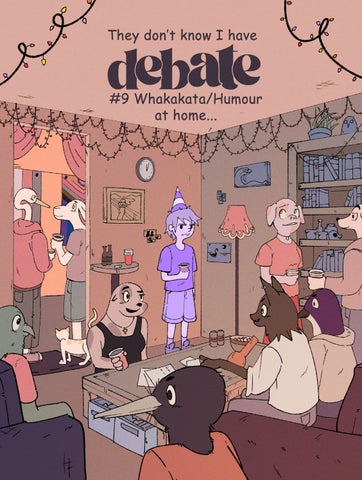
Alright, here it is! debate mag | satire |
28
issue nine 2026
Pretenious
Art Show Only tonight
Wait!!
I forgot my badge...
I’m Sure it wii be fine...
debate mag
Phew...
��.... I kinda forgot it...
ss! you’re ggd
| satire |
Heeo and Welcome to SPAS. Please no Touching and issue nine 2026 no flash photography
Wait a second...
Where is your Badge!?!?!
Dont wooy...
Slap!
I’ve got EXTRAS!!!!
29
30
debate mag
| satire |
issue nine 2026 So I guee I’’ ss you Later?
enjoy!
I didn’t Go to Elam*
*Elam is the schhl of fine arts of the university of auckland.
Again... No badge holders past this ddr
Exh
ib 3-7 it
Exhibit
I d idn go ’t t ela o m
7
Yeah I’’ Just be over in Exhibit 7 ...
The LOser Table
debate mag
Hey guys, Deal me in! | satire | issue nine 2026
yo Ceci! Haven’t ssn you in a while
31 Hey girl!
So I painted this whole thing with cat pii just to prove that anything can be used to envoke the senses. I reaay wanted it to linger.
genius!
Go ahead. Smee it.
I’m aa in bitches!
‘The loser table’ 2026
The end
32
debate mag
| satire |
issue nine 2026
---------------------------------------------------------- ARTS ------------------------------------------
UniFest Winner Review | Love & Bootstraps The first UniFest short film competition resembles the kind of combination between creative outlet and filmmaking practice which I would have adored during my studies. It’s reassuring to see a body of undergrads wishing for the same, taking that into their own hands – run by the students, for the students. Each entry was held down by only two creative constraints: the theme of Nostalgia, and including the line ‘I knew you’d be back’. Love & Bootstraps, this year’s winning film, is a time-travel picture. The short opens on a pedestrian bothered by two different travellers, frazzled in a hurry, one after the other. ‘What year is it?’, they both ask before zipping past like Marty McFlies. As it turns out, both runners mischievously stage meet-cutes between pedestrians in the city, and a glance at the fading family photographs they carry around shows that their chosen guinea pigs are actually their own future parents. By intervening in the present, each traveller will settle or disturb the timeline accordingly, guaranteeing either of their existences remain. You can only meddle with young love for so long, however, let alone when there are multiple guys wrestling over the same gal who have time travel apps on their phones. Bootstraps pulls a funny couple of punchlines in the final minutes, one being the answer to the question of which time traveller wins their place in the canon (spoiler: it’s not a pretty outcome for either), and the other introducing a brand new character, thus recalling the
old ‘80s adage: that everybody wants to rule the world. Bootstraps was filmed in a few familiar city-campus locations: Auckland City library, the back of the Metro Building next to Aotea Square, and the underpass next to UoA’s Engineering Leech. Recognising these public access corners of Tāmaki Makaurau is an amusing part of Bootstraps – it’s lovely to see students paying homage to the hangouts they know well, each of the witnessing bystanders potentially participants in their own canon event creation schemes. (I can only imagine that if there was a sequel, the denouement would take place at Shadows.) And at a competition which sees an overlap between the student bodies at both neighbouring universities, it’s honestly fitting that the top spot goes to a film sprawled across campus, with challengers intruding on each other’s timelines.
Written by Ricky Lai (he/him) @rickthelai on IG & Letterboxd CONTRIBUTING WRITER
debate mag
| satire |
issue nine 2026
33
---------------------------------------------------------- COLUMN ----------------------------------------------------------
34
debate mag
| satire |
1. Da Hip Hop Witch (Dale Resteghini, 2000) Directed by the music videographer who’d go on to lend tone-deaf visuals to Busta Rhymes’ ‘Arab Money, Da Hip Hop Witch was a Blair Witch parody riding on four plots interwoven with no discernible rhythm. (A) Female staff at the office for a tabloid magazine fight off their creep of a boss. (B) A gang of youngins from Salem search for the ‘Black Witch of the Projects’. (C) An underground rapper takes a sketchy deal with a producer named Lazarus. (D) A never-ending series of who’swho cameos from stars such as Vanilla Ice, Spliff Star, Rah Digga, and Vitamin C, all recount their spine-chilling encounters with ‘da hip hop witch’ for a fictional cable network (‘Hip Hop Witch TV’). All victims of the hip hop witch beg you to heed their warnings, but none with the hallowed repute of the one and only Eminem. (Pre-8 Mile, too.) The centrepiece and selling point (assuming this
issue nine 2026
ever sold) is Slim’s aggressively sexualised testimonial, which is so dreadfully long that the editor had to split it into chunks and seed it throughout the movie, and also which his legal team attempted to have gutted from the final release. Well, jokes on them! Debate Magazine is here on the scene to untrench buried truths.
| satire |
2. Campus Code (Ken Waddell & Kathy Scorsese, 2015) ‘We’ve been watching movies for 100 years, time for something different’, reads the tagline for JumpView’s now-defunct website. Founded in 2013 by business partners Michael Simon and Ken Waddell, the ambitious JumpView offered a platform for choose-your-adventure-style re-edits of films and television shows (e.g. Rashomon, Lost, Twin Peaks…) for which viewers could ‘switch’ between character plotlines at will. Standing tall and proud on their catalogue is Campus Code, their only original feature, co-directed by Waddell and his former NYU classmate, Katherine Scorsese: the daughter of you-know-who. In fact, Papa Marty actually shows his face as a school nurse here, as does Ray Liotta as a sleazy bartender at the student dive, which by default makes this their second-best shared feature behind Goodfellas. The resulting Campus Code is a part-Matrix, part-Truman Show thriller, toggling between a web of misfit college students gradually becoming aware that the fabric of their reality on their university grounds is rife with glitches, disappearances and NPC-like behaviour. An inciting incident involves Jesse McCartney (voice of Theodore from Alvin and the Chipmunks), who discovers a colleague plagiarised his graphic tee designs and gives chase on a rooftop before falling thirteen stories to his death. Or does he? Taking no damage as he lands, McCartney is revealed as one of many bulletproof co-eds of this mysterious academy. JumpView, on the other hand, was nowhere as invincible. Its co-founders and Scorsese would go on to sue each other over poor financial negotiations and erratic on-set behaviour, which explains in part why Campus Code feels as if it was directed by nobody in particular. Almost as if… it were all programmed. As if it were a game…side by side! Get to know everything!
issue nine 2026
3. Pinecone (Ashley Hays Wright, 2026) Readers! It’s time to hunt the beast! Pinecone is one of many completely AI-generated animated features from Wright Family Films, and which I imagine won’t be the last – after all, this movie’s production probably costs even less than a shoestring budget (so long as you have a water cooling system). Folks, it is quite late in the game, but a contender has risen here for the worst movie in the history of the medium. The other ‘worst movies’ I’ve seen now benefit from the qualifier of ‘made with human touch’; how depressing that the bar has lowered so. At this stage, AI output has its limits, so every shot in Pinecone lasts about 3-4 seconds and a character’s voice will actually vary between lines in a scene. Pinecone is also crucially a musical, with every number a shameful banger; sounding much like room-shaking faith anthems at a megachurch service. Ostensibly it is set in a fictionalised Irish county – some of the accents are Scottish instead, and the text-tospeech generation blatantly mispronounces the name “Pádraic”. Doesn’t matter, though, because it’s about the message – how couldn’t it be from a production LLC whose mission is ‘maintaining wholesome standards, no nudity, no hidden references or words, no foul language, modest attire and no extreme violence’? That is the beast they are hunting, and if you didn’t gel with the core gospel this time, they can sure run it as a prompt through a chatbot again to build their next script.
35
Written by Ricky Lai | (He/Him) | @rickthelai on IG & Letterboxd | CONTRIBUTING WRITER
debate mag
36
debate mag
| satire |
issue nine 2026
---------------------------------------------------------- FEATURE ------------------------------------------
Reports from weekend one of the New Zealand international film festival It’s taken Paolo Bertolin, the New Zealand International Film Festival’s artistic director, a couple of years to find his footing away from the prestige of his homeland of Italy to the bonkers reality of New Zealand’s film industry. While the government struggles to comprehend the value of anything less than the millions generated by Peter Jackson and Taika Waititi as international exports, both filmmakers came up making stuff on zero budget, filmed on pre-owned gear, with any expenses covered by crowdfunding and the New Zealand Film Commission. Despite classic funding cuts to the department and a lack of support across the board, Aotearoa has seen some of the most innovative, creative, and hilarious features created on our shores debut to sold-out audiences across the country. For Bertolin, the challenge was never bringing what he learnt overseas to Aotearoa. Instead, he had to throw everything he knew out the window. I think the NZIFF’s programming has stepped up dramatically this year, as initiatives like the Aotearoa Film Focus weekend have put our local filmmakers on their worthy pedestal. Here are a couple of our favourite local features that had their domestic debut last weekend, as well as a shout-out to an animated feast for the eyes and soul. Big Girls Don’t Cry Paloma Schniedeman spent the years before her directorial debut best known as PollyHill, the multi-hyphenate rapper and producer who’s dominated student radio airwaves and bought the house down at festivals like The Others Way, Outfield, and opening for
the likes of Kae Tempest. Between releasing collaborative albums with Samara Alofa and producing visuals and music videos for mates, Schniedeman was secretly tinkering away at one of the raw and brutal depictions of smalltown New Zealand I’ve ever seen. Set in Ōmaha circa 2006, the feature circles around fourteen-year-old Sid and her navigation between queerness, chatrooms, relationships, and the never-ending quest to seem cool to people you aren’t even sure if you like that much. Schneideman’s direction around the rural corners of Auckland resonates deeply with anyone who grew up between the bushes and away from civilisation. Growing up in the Waitakere Ranges with parents who moved even further afield as I left home, currently living in the same spaces in the Mahurangi depicted in the film. That is to say, it’s fucking surreal to see parts of Matakana and the Warehouse jingle on screen at the Civic. Each time local filmmakers get on screen, they uncover a new facet of life in New Zealand that’s barely been touched on by New Zealand’s biggest directors. Schneideman navigates how young people in Aotearoa genuinely talk to each other, depicting the subtle undertones of disconnected disrespect as Sid’s relationships with old friends become increasingly strained while newer mates giggle behind her back, happily putting her in uncomfortable situations that Sid seldom helps herself in. It reminds you of another form of subtle bullying in Aotearoa:
debate mag
| satire |
The Ungrateful Tenant I’ve known Conor Bowden via Annabel and Callum from Sports Team (The Weed Eaters) for a few years, being one of the friendliest faces I’ve come across in the Auckland filmmaking community. A few years back, at a fundraising event for TWE, the trio presented an early, short film cut of The Ungrateful Tenant at Whammy Bar, shot in the same flat around the same housemates as those shown at the feature’s big-screen debut at the Hollywood Avondale. The film is a call to action for renters across Aotearoa, dressed up as one of the silliest and funniest Buster Keaton pastiches I’ve ever seen. Bowden, simultaneously having starred, written, directed, and produced the film, navigates each hat effectively on a shoestring budget, not taking any shame in some footage being shot on smartphone cameras when introducing the movie at its premiere. Special effects were produced using paper, scissors, and duct tape - but the film’s decision to place itself in black and white, with silent film text cards creatively changing styles between characters, circumstances, and tones of voice effortlessly. I can’t wait to see this hit the theatres proper. Little Amélie or the Character of Rain Who here wants to get SAD! I unwittingly saw Little Amélie or the Character of Rain at 10AM on a Sunday, meaning I was dusty and slightly late in an effort to avoid the hordes of children dragged in by their cool film parents. With this film being produced between Belgium and France, there was less of the hustle and bustle that meant I was accidentally early for the
issue nine 2026
former screenings - by the time I entered, the production splash was on screen, and I had to scramble to find my seat. The film that ensued took my mind off any accidental awkwardness through its sheer use of colour and wonder. Little Amelie depicts a Belgian family living in Japan about 30 years post-war, as their youngest child breaks from her vegetative state at age two and navigates the next year of her life, unaware of their impending return to the EU. The film resonates, not only as a neurodivergent youngest child, but as the directors communicate the restorative friendship between Amelie and the nanny, Nichio-san, whom they hired to look over her in her most difficult times. Alongside her grandmother, Nichio guides Amelie through the wonders of her adolescence as the ramifications of tensions continue to be felt by their landlady and local community. If nothing else, see this film for the visuals. Taking place from the perspective of a toddler, it can easily fool you into believing the picture is a classic kids’ movie, the way directors Maïlys Vallade and Liane-Cho Han bring together bombastic colour palettes makes the film worthy of its Oscar nomination.
Written by Liam Hansen (they/them) @liamhanse.n ASSOCIATE EDITOR
37
38
debate mag
| satire |
issue nine 2026
NZIFF 2026 - Movie Reviews
---------------------------------------------------------- FEATURE ------------------------------------------
Read full length reviews on www.debatemag.com
With Hasan in Gaza (2025) dir. Kamal Aljafari France/Germany / Palestine / Qatar / Switzerland, 106 mins
Out of the Blue (2006) dir. Robert Sarkies Aotearoa New Zealand, 103 mins
During the post-screening Q&A, actor Filming Palestine—much like the history Matthew Sunderland shares something of cinema—is always a matter of the remarkably revealing when asked about master shot or the close-up. Within the the process of getting into the character first 30 minutes of With Hasan in Gaza, I of David Grey: that it was relatively easy to could already tell the differing cinematic understand the psyche of David because temperaments of director Kamal Aljafari most of what he needed to know was and his tour guide, Hasan Elboubou. covered in the book, Aramoana: TwentyThroughout the film, Kamal would often two hours of terror by Bill O’Brien, which instruct Hasan to take the camera and Out of the Blue bases its chronology of film him speaking to a Gazan citizen, events on. as well as the landscapes and people who happened to be walking past them. I’m genuinely inclined to believe him Kamal likes to shoot because David is not a With Hasan in Gaza is here to particularly “complex” wide and is conscious tell us that they are burning, human being, which, of composition; Hasan, and it will keep burning if we to me, is the biggest by contrast, constantly continue to ignore the smoke dilemma the film feebly zooms in and out of what he’s capturing on scratches at amid all its camera. failed cinematic attempts at resolution and understanding. When faced with the Sometimes the bigger picture is needed cold, unsentimental certainty of action to contextualise how all the disparate and its consequence—a man with a gun elements you see on screen cohere on a killing spree—New Zealand can only into an emotional/intellectual/political cower behind the veneer of “nuance” and framework (“mistaking the forest for “complexity” and “plurality” in trying to the trees”); Sometimes the filmmaker/ rationalise the psychology of a man who audience must take the first step of is as much of a victim of his deteriorating leaning in towards the finer details of mental health as he is disadvantaged by reality and assert the following: “This is his low socio-economic status; that’s it. what’s important, and nothing else.” It doesn’t matter if it’s a forest or a tree; With The simplicity of his actions becomes Hasan in Gaza is here to tell us that they unbearable because they are already are burning, and it will keep burning if we accounted for and telegraphed in continue to ignore the smoke rising above advance. The tragedy then is realising that the master shot and the embers glowing the happy-go-lucky bicultural nation that within the close-up of its tree trunks. New Zealand mythologises itself to be is perfectly compatible with a massacre like Aramoana. A simple myth butting heads against the simple truth.
Written by Trevor Pronoso | Letterboxd: @CleverGurl | Instagram: @trev.pro | CONTRIBUTING WRITER
debate mag
| satire |
issue nine 2026
39
40
debate mag
| satire |
issue nine 2026
debate mag
| satire |
issue nine 2026
41
42
debate mag
| satire |
issue nine 2026
debate mag
| satire |
issue nine 2026
43
BALLOTS 44
debate mag
| satire |
issue nine 2026
OPEN SOON
RESULTS ANNOUNCED 28TH AUGUST Vote in the 2027 AUTSA Student Elections. Help shape the future of student representation at AUT.
Ballots open on the 3rd of August and close on the 17th. For more informaton, scan the QR code or head to autsa.org.nz/elections