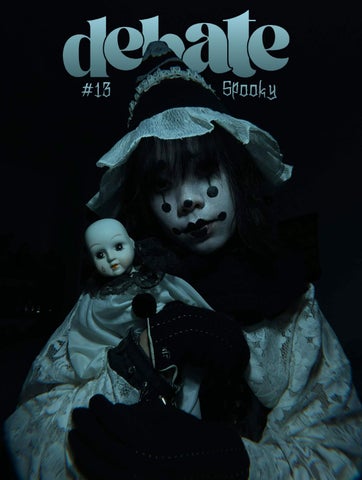
About Us Kia ora! We’re Debate, your free student magazine at AUT. Each fortnight we scatter magazines across campus talking about student news, art, and culture. Each issue is made by us and a small team of contributors - no AI was used in the production of any work to our knowledge.
FOLLOW US ON INSTAGRAM @debate_mag Editor Tashi Donnelly
Associate Editor Liam Hansen
Arts, Culture & Te Ao Māori Editor Skye Lunson-Storey
Digital Marketing & Social Media Manager Madeline Bradley
Graphic Designer Sophia He
Contents TITLE--Safe Space (Ghosts Welcome) 4 Column Mate Ururoa - Tenacity in the face of climate horrors 6 News 8 Feature How hīkoi between Ōtepoti and Tāmaki Makaurau... The Bes of Cannes at the NZIFF 10 Feature 12 Te Ao Māori The Buried Eighth Wonder of the World... 14 Drugs Column Giving myself delirium for a student magazine HORROR OF MACBETH 16 Promo PHANTOM 17 Promo 18 Creative Writing Enamel 20 Comic Emily Dickinson Poem Adaption 22 CENTREFOLD Halloween 24 Feature When a Terrific Folktale Terrifies a Fragile Soul SCARY THINGS FOR NZers & OUR DEMOCRACY 26 Visual What If 28 One Moon catto’s GAME RECCS - spooky 30 Game Reccs Supermarket duopoly 32 Comic 34 PUZZLES 36 Creative Writing The Attic Rick’s Reel Reccs - 3 Scary Films 38 RRR Column
DISCLAIMER Material contained in this publication does not necessarily represent the views or opinions of AUTSA, its advertisers, contributors, Nicholson Print Solutions or its subsidiaries. This publication is entitled to the full protection given by the Copyright Act of 1994 (“the Act”) to the holders of the copyright, being AUT STUDENT ASSOCIATION (“AUTSA”). Reproduction, storage or display of any part of this publication by any process, electronic or otherwise (except for educational purposes specified in the Act) without express permission is a break of the copyright of the publisher and will be prosecuted accordingly. Inquiries seeking permission to reproduce should be addressed to AUTSA. Debate is a member of the NZ Media Council and subject to its complaints procedure. Complaints about stories must first be directed in writing to us (provide link) within a month of the story being published. If you are not satisfied with our response you can complain to https://www.mediacouncil.org.nz/complaints/. You will need to attach a copy of the article complained about and any correspondence you have had with us.
CREATOR--Tashi Donnelly
Maeva Jackson-Becerra
Liam Hansen Caeden Tipler Skye Lunson-Storey Isaac Tenzing Basement Theatre Callum Curran Emily Smith Jocelyn Glenn Niamh Donnelly Ha Minh @meoskyan_art Priscilla Zhang @meoskyan_art Tashi Donnelly Jake Harvey Ricky Lai
FRONT COVER x3n0 (they/them) @x3n0_is_loading CENTREFOLD Niamh Donnelly (she/they) @zaxoof CONTRIBUTORS Maeva Jackson-Becerra, Caeden Tipler, Isaac Tenzing, Emily Smith, Jocelyn Glenn, Niamh Donnelly, Ha Minh, Priscilla Zhang, Jake Harvey, Ricky Lai
DATE OF PUBLICATION: OCTOBER 2026
4
debate mag
| spooky |
issue thirteen 2026
---------------------------------------------------------- Issue #13 - Spooky Editorial ------------------------------------------
Safe Space (Ghosts Welcome) Kia ora, nau mai, haere mai! Spooky season is almost upon us, and we’ve chosen to honour the time of year with this very special, first time ever, 13th issue of Debate. As per usual, I looked into the etymology of spooky (I suddenly panicked that I’d accidentally given our final issue of the year a racist name), and found that spook originally entered English around 1801 from Dutch, meaning “ghost”. The less-good news is that spook did later become a racist slur for Black people in the US, but that meaning came well after its ghostly origins and isn’t where spooky comes from. So, after a brief editorial crisis, the Spooky Issue lives on. Ironically, this issue feels like a lighter one. There is something comforting about spooky stories during our current… I was going to write “political climate”, but it’s more than that, isn’t it? The whole darn planet is at the brink of climate collapse. The economy is in the tank. The AI bubble will burst soon and is estimated by some economists to be “ten times worse than the 2008 financial crisis”. Very mindful. Very demure. Very end-of-days. Anyway, ghosts. When the world is collapsing, it’s nice to find something else to be scared about. I love the chilling feeling in my spine, and the way my hair stands on end when I hear a ghost story. In a way, it’s like ASMR. The best part about ghost stories is that they’re (mostly) fictional, and therefore cannot hurt us. Unlike our current
Government’s plans to open up more of Aotearoa to mining and oil drilling. That absolutely will hurt us. (Remember to vote in the upcoming general election.) I promised myself I wouldn’t get too political in this editorial, though, so back to the ghosts. Admittedly, I find most horror films a mixture of boring and scary, a combination of emotional states that should not exist in nature. There are exceptions, but I’m a bit of a Goldilocks when it comes to horror. Everything needs to be just right in several vague, seemingly arbitrary ways. Incidentally, that’s also a perfect description of my favourite kind of horror: vague and seemingly arbitrary. To me, nothing is scarier than an unpredictable, invisible monster. Something I can’t see, but know is there. The moment a monster is revealed, it has a lot to do to remain frightening. And unfortunately, horror creators often resort to making their monsters disfigured, as though physical difference is inherently terrifying. This seems more than a little unfair to people with facial differences and disfigurements in real life, who probably have enough to deal with without Hollywood using their appearances as shorthand for evil monsters. Personally, whatever my imagination conjures up in the dark is far scarier than anything a special effects department could put together. And let’s be real, Rule 34 is coming for every monster eventually. Today’s nightmare
debate mag
| spooky |
is tomorrow’s sex symbol. I see you, monsterfuckers, and I respect the hustle. That’s what makes the real world so frightening, too. Uncertainty, unpredictability, and the horrible feeling that something terrible is lurking just out of sight... The difference between scary fiction and scary reality is that, in fiction, we get to experience those fears on our own terms. It’s wonderfully cathartic to be scared within the safety of a story. We can indulge in all the dread, anxiety and adrenaline of something terrifying, knowing that, ultimately, we’re in control. We can close the book, turn off the television, or put down the magazine whenever we like. Real life, unfortunately, doesn’t come with an off switch. It’s been fun putting this issue together and seeing all the different things our contributors find frightening. We’ve got everything from the horrors of selfinflicted delirium to the terror of watching someone you love suffer. There are childhood folktales that turn out to be far scarier in adulthood, ghosts of the lives we never lived, and the unsettling consequences of traditions we don’t fully understand. Some of these horrors are supernatural. Others are painfully real. That’s what makes scary stories so interesting: they give shape to fears that are otherwise difficult to articulate. Whether it’s grief, regret, helplessness or the unknown, putting our anxieties into words brings us comfort. Even if those words make us sleep with the lights on.
5
issue thirteen 2026
That’s why this issue feels like a lighter one, despite its rather macabre theme. There’s comfort in choosing what frightens us for a change. So, dear reader, I invite you to indulge in a little fear of your own. Enjoy the strange, the unsettling and the downright spooky stories within these pages. The horrors of the real world will still be there when you’re finished. But for now, let’s worry about ghosts.
Written by Tashi Donnelly (she/her) @tashi_rd
Illustrated by Niamh Donnelly (she/they) @zaxoof
EDITOR-IN-CHIEF
CONTRIBUTING ARTIST
6
debate mag
| spooky |
issue thirteen 2026
---------------------------------------------------------- INTERVIEW ------------------------------------------
Mate Ururoa
Tenacity in the face of climate horrors An interview with Mike Smith. It is easy to feel bogged down as the existential threats of environmental disaster and climate change loom over us. To counteract this doomerism, I spoke to a Māori climate activist with experience, advice, and hope to give us all. Mike Smith (Ngāti Kahu, Ngāpuhi) is an activist who has been fighting for the environment since 1992. He worked on a prolific legal case to sue Fonterra, our largest polluter, and other corporations for environmental harm. In August, the government fast-tracked a law to stop Smith’s legal action, and now Aotearoa has the Climate Change Response (Tort Liability) Bill. This is the first law in the world that bans public lawsuits against corporations for environmental damage, and it is cooked. I interviewed Mike about the salience of this government action, the role of youth in effecting change, and the motivation behind his staunch activism. Maeva: Can you tell me where your environmentalism journey started? Mike Smith: I was brought up in a cultural environment that instructed us to care for the things around us, the moana, ngāhere, creatures within them, the birds. We were instructed as children that we had a responsibility to take care of nature. That foundation came from childhood, really, from my parents, from our cultural heritage.
We are Māori, we came here from the islands. When you come from a small island, there’s only a certain amount of resources available to you. So you can’t just trash them and use them all up and be greedy. Maeva: How did it feel as an activist for the government to shut down the Smith v. Fonterra case? Mike Smith: As an activist, you’re involved in a struggle. We’re pushing and we get pushed back against as well. I had two court cases, one was against the big companies that were doing the pollution. And the second one was against the government for not doing enough to prevent that from happening. When the government shut down the first case, we immediately had the second one. What they’ve done by shutting down the first case was just a graphic example of the government failing to protect us from climate harm. So how did we feel when they shut down the first one? Not despondent. Not frustrated. Because we knew that we were involved in activism. It’s a long road. It’s a long struggle. It takes time. And so we were prepared for it. Maeva: Do you have any encouraging words for young people to continue being active in environmental protection?
debate mag
| spooky |
issue thirteen 2026
Mike Smith: If our example is anything to go by, never give up. We’ve got an expression in te ao Māori, which is ‘mate ururoa,’ to die like a hammerhead shark who keeps fighting even after it’s dead. We adopt that type of attitude to what we do, mate ururoa.
we’re fishing out on the water, if we’re sitting over the schools of fish, those birds dive down all around us, and it’s like it’s raining birds. They’re really beautiful.
My message to young people is to be part of the solution. If you’re not, you’re part of the problem. Governments are getting away with what they’re doing and they rely upon people being docile, being complacent, and being stuck in a sort of inertia where they don’t do anything.
Mike Smith: I like the Paringaringa Harbour up in the far north, because it’s white silica sand, like up in the islands. It’s so white that it’ll burn your eyes out on a bright day. It’s startlingly white, and there’s very few beaches like that in Aotearoa.
This is your world, this is your life, this is your future. So you’ve got to be in it. Maeva: What is your view on other fasttracked decisions that the government has put through? Mike Smith: Fundamentally, that sort of indecent haste is because the current economic system is based on greed and just no responsibility for the future. Everything turns into a commodity. Forests stop being the home of creatures and become wood products to be turned into something, to be cut down and given a price. Hasty law is bad law because you’ve just got people that are looking for money charging ahead and not listening to anybody else. Maeva: Just a few rapidfire questions on your favourite parts of Aotearoa’s environment. Do you have a favourite bird? Mike Smith: I like a bird called takapu (gannet). They dive from the sky and when they come down, they fold their wings up like an arrow and bomb the water. When
Maeva: What is your favourite beach?
Maeva: Do you have a favourite tree? Mike Smith: I like nikau palms, I like tupakahi, which is a shrub that can fix broken bones and strains. I mean, it’s one big family. It’s like, which one of your kids do you like the best? I like all of them, all for different reasons. Maeva: Where is your favourite place to be with your family? Mike Smith: I like being at Whangaroa Harbour. That’s our harbour. Its isolation has meant that it’s been able to be kept reasonably free from pollution and exploitation. So that’s our happy place we go to as a family.
Written by Maeva Moelagi JacksonBecerra (she/her) @maeva_moelagi CONTRIBUTING WRITER
7
---------------------------------------------------------- FEATURE ------------------------------------------
8
debate mag
| spooky |
issue thirteen 2026
The decennial cyclical nature of pop culture is currently throwing everything back to the late 2010s, when New Zealand indie was having an international renaissance. Within a few years, several Aotearoa bands broke across the Pacific Ocean, signing with major Stateside record labels and gaining genuine virality on their songs and music videos before the term was co-opted by the songs’ usage in TikToks. Princess Chelsea exploded on music blogs with ‘The Cigarette Duet’ before riding into the next generation with a stellar 2020s so far, Fazerdaze took Morningside from Tāmaki Makaurau to the rest of the world, and smack bang in the middle of it all was a young Kane Strang, signing to Dead Oceans and seeing his self-loathing 2017 exodus, ‘Two Hearts and No Brain’, take on millions more eyes than he ever could have imagined.
Hailing from Ōtepoti Dunedin, Kane Strang began writing music across various bands and names toward the end of high school, with various blogs in the early 2010s praising early demos that have since been scrubbed from his bandcamp page. Across these tracks, many of which were re-recorded for his later albums and EPs, Strang tears his Two Hearts and No Brain out for the world to see, at a time where that looked like a few faceless people on the internet that you’d never meet. “There’s no way in the world when I wrote some of those, essentially my biggest solo songs, thought they’d have millions of streams.” The best example of this is ‘My Smile Is Extinct’, which has a music video with close to ten million views and hundreds of comments from American yuppies lamenting the passage of time.
Kane and I are outside of a pub in Ponsonby that I used to walk by daily while immersing myself in Office Dog’s 2023 debut record, Spiel, after the three-piece slowly trickled out singles that were immediately chucked onto student radio playlists of the era.
Early Bandcamp recognition saw Strang’s solo project signed to Dead Oceans, who rolled out the most balls to the wall international campaign for the Phoebe Bridgers album a few weeks ago and gave Kane a not-quiteplanetarium-level-but-still-quite-good treatment.
debate mag
| spooky |
Despite successful and fulfilling tours after Two Hearts released, Kane got stuck in a rut. “I went through this big experience and then was spat out on the other side very suddenly, and it took a while to work through that.” The start of 2021 saw the release of the solo LP ‘Happy To Perform’ and its successive tour, accompanied by a supergroup of Peter Ruddel of Wax Chattels and Sulfate, Leith Towers of Marlins Dreaming and Ringlets, Gussie Larkin of Mermaidens and Earth Tongue, and Mitchell Innes – a childhood friend of Kane’s from Ōtepoti he managed to lock down on drums for a new project to take shape. “I just knew I wanted to do something that was quite strict and relied on me to write more interesting songs at their core. It also forced me to get a bit better at guitar again and learn some new things – it definitely completely changed how I play guitar, forming this band.” There are a few key locations that host much of the mythos of Office Dog. Early on, they’d practice between Raz and Kane’s flat in South Auckland and the basement of a church in Mt Eden. Just as much as the band is stuck up north, its roots remain in Otago. For Kane, those roots have been dragging him back year after year, finding himself relocating between the two cities constantly for various work and family priorities while writing new material for the band. The timing lined up for their old mate De Stevens to start working at Roundhead during a stint where all band members were in Auckland, allowing them to squeeze in two days at the studio while De was still learning the ropes. The initial tracking of the record was quick to a point of haste, but after some distance, they went back in at the late hours after Night Lunch producer Stephen Marr finished up their sessions, adding overdubs and re-recording various vocal and guitar parts. “Genuinely every vocal take on that album was recorded after 11 pm. I think Raz had some kind of strep throat or something
issue thirteen 2026
when we were recording. We were hanging on by fucking threads in every way.” The consequences of the long commutes were reaching their breaking point, as a split life between two cities couldn’t be tolerated any further. “It’s a running joke, and it’s kind of what Prime Corner is about. I’ve just lived in this really unsettled way for the last few years, never being able to make my mind up about where I want to be. That caught up with me after a while.” Prime Corner was released with urgency, being celebrated with a tour around the motu in September with an extended lineup and slots across Great Sounds Great. Their Tāmaki Makaurau show at Double Whammy took the crowd to the floor, after NZ fans waited months to hear these songs live. From here, it’s unclear whether we’ll get another Office Dog album asap or more solo experiments, like Kane’s new project More Blue Noise. Either way, we aren’t going to escape Office Dog any time soon. This piece was initially published on misheard.co.nz. Our associate editor and former Editor-in-Chief, Liam, is sharing thoughts, interviews, and announcements dedicated to Aotearoa music – if you’re interested, head to their website and subscribe to the newsletter.
Written by Liam Hansen (they/them) @liamhanse.n ASSOCIATE EDITOR
9
10
debate mag
| spooky |
issue thirteen 2026
---------------------------------------------------------- FEATURE ------------------------------------------
The Best of Cannes at the NZ International Film Festival One of the great blessings of the timing of the New Zealand International Film Festival (NZIFF) is how quickly we get to see films after their Cannes premieres. The iconic festival takes place each year in mid-May on the French Riviera, bringing together thousands of filmmakers, journalists, critics, celebrities, film lovers, and more. Each year has its own memorable moments and contributions to wider industry discourse, but this year felt especially interesting. While recent Oscar winners like Parasite (2019) and Anora (2024) came out of Cannes, there were some suggestions that this wasn’t as strong a year. There were no big Hollywood entries, many of the in-competition films and big winners were divisive, and the film market was quieter than usual. Artificial intelligence was also a hot topic, with Steven Soderbergh’s documentary John Lennon: The Last Interview premiering despite its controversial use of generative AI. Some of the most appreciated films came from out of competition, like Club Kid and Teenage Sex and Death at Camp Miasma, both of which premiered in the festival’s Un Certain Regard section. This might mean that Cannes isn’t dead, just shifting in its focus. New Zealand audiences get their first chance to make up their own minds when many of these films hit the mid-winter International Film Festival. While NZIFF had an excellent selection of Cannes titles this year, these are the five Cannes films that most excited me. All of them have upcoming wider release dates. Additionally, shout-out to my honourable mentions, La Gradiva and Coward, which was the closing film of the festival.
Fjord Directed by Cristian Mungiu Palme d’Or Winner Norway International Release Date TBC Cristian Mungiu joined an elite club of filmmakers when he won his second Palme d’Or, the top prize at Cannes, for Fjord, an ethical-dilemma-driven drama aimed at challenging liberal norms of government. Fjord follows a conservative Christian family whose values are at odds with the society they are now living in. The family of seven recently moved to wife Lisbet’s (Renate Reinsve) hometown in Norway, where Romanian husband Mihai (Sebastian Stan) took up an IT job at the community centre. Their new life falls apart when the children are taken into custody on suspicion of child abuse, including the still breastfeeding infant. The film covers the stress of navigating hostile bureaucracy, cultural divides, and language barriers. It also calls for understanding and empathy from both sides of the progressive/conservative divide, particularly at a time of online polarisation and ubiquitous culture wars. The film is not without flaws. However, Palme d’Or winners often speak to current discourse, and Fjord is no exception.
debate mag
| spooky |
issue thirteen 2026
Teenage Sex and Death at Camp Miasma Directed by Jane Schoenbrun Queer Palm Winner United States
The Black Ball (La Bola Negra) Directed by Javier Calvo and Javier Ambrossi Best Director France/Spain
International Release Date: 20 August
International Release Date: 16 October
Teenage Sex and Death at Camp Miasma reels you in with one of the best title sequences in recent memory. The sequence traces the rise and fall of the in-universe Camp Miasma franchise through physical media, critical responses, and endless merch. A treat for any horror franchise fan or pop culture junkie. We follow our lead, up-andcoming indie director Kris (Hannah Einbinder), as she travels to the home of recluse former actress Billy Presley (Gillian Anderson). Kris is set to helm the latest relaunch of the franchise, and she wants Billy, who has been absent since the first film, to return. Teenage Sex and Death at Camp Miasma is all about the desire and indulgence we associate with these kinds of tropey slasher films, whether that be sex, violence, or junk food. Not quite a meta-commentary on horror tropes, but more a commentary on how this kind of film connects with audiences. It’s not surprising that Teenage Sex and Death at Camp Miasma won the Queer Palm, the independent award given to an acclaimed LGBTQIA+ film entered into Cannes. It explores queer identity, connection, and self-realisation through the lens of genre filmmaking.
La Bola Negra should have won the Palme d’Or. The film won the Cannes award for Best Director (jointly with Pawel Pawlikowski) for the directing duo Javier Calvo and Javier Ambrossi (affectionately known as Los Javis). Thankfully, as it is worth seeing on the biggest screen possible, Netflix is firmly backing the film, giving it the distributor’s largest-ever theatrical release. La Bola Negra is epic in scale and ambition. It follows 85 years of Spanish history, from the rise of fascism in the 1930s to the queer social scene of the more-or-less present day. It weaves queer stories, romances, and histories through a multi-generational story that brings together the lives of several pivotal figures. While using poetic license, it is cemented in real history, and the real persecution of queer artists and figures under Spanish fascism. Shot in 35mm film by cinematographer Gris Jordana, the film’s mix of sweeping landscapes and well-lit intimate close-ups make it impossible to look away. It would be hard not to be moved by this film’s artistic achievement and unlocking of queer histories. Read the full-length article at www.debatemag.com
Written by Caeden Tipler | (they/them) | @ctipler | CONTRIBUTING WRITER
11
---------------------------------------------------------- TE AO MĀORI ------------------------------------------
12
debate mag
| spooky |
issue thirteen 2026
The Buried Eighth Wonder of the World: A Cautionary Tale on Profiting off our Whenua. This eerie tale starts back in 1886 on Lake Rotomahana, with rising waters and the unsettling sighting of a phantom waka taua. These sightings were only about 11 days before the devastating disaster on 10 June 1886, from the infamous Mt Tarawera eruption that engulfed the Pink and White Terraces, burying them permanently. These terraces were just the start of the booming tourism industry in Aotearoa, but remain a cautionary tale or superstitious lesson of what happens when we ignore the warning signs from the whenua itself in pursuit of tourism, progress, or profit. I’ll set the scene for you: it’s the early hours of the morning on 10 June 1886, and you are jarred awake by the beginning of a destructive six-hour eruption. You look outside and witness 10 km high ash. Beneath your feet, violent earthquakes form a 17 km fracture, splitting Mt Tarawera as far as Waimangu. This eruption displayed the full power of Rūaumoko, permanently transforming the landscape, destroying villages, and taking the lives of up to 150 people. Almost all were Māori. You can actually visit one of these settlements, Te Wairoa, which is known as ‘The Buried Village’. Back in the day, these terraces were hailed by some as the ‘Eighth Wonder of the World’. It became an international hub for tourism where visitors could quite
literally immerse themselves in their beauty and experience elements of Māori culture. As more Europeans became intrigued, wanting to see this ‘Eighth Wonder’, it reflected a unique tension between the commercial value placed on Papatūānuku and the role Māori maintain as kaitiaki to the whenua. One of the most recognised figures from this pūrākau is Guide Sophia Hinerangi, also known as Te Paea. She was a renowned guide who welcomed the visitors, taking them to the Pink and White Terraces, and in the wake of the eruption sheltered 62 people in her whare, keeping them safe. Guide Sophia observed the lake’s unusual raised water levels beforehand and noticed a phantom war canoe in the light of day, and the European tourists who were with her also bore witness to this ghostly omen. Guide Sophia understood that these were the warning signs of impending doom, but these signs were not taken as seriously by others. The wharenui Hinemihi o te Ao Tawhito, despite being half buried in mud, protected those who took refuge in her shelter. Something slightly uncanny to note about Hinemihi is that rather than paua shells used for the eyes of the carvings, it was gold sovereigns, symbolising just how much money they
| spooky |
were making by profiting off the whenua. This was a natural disaster and would have happened regardless, but there are some who may view this tale as a superstitious lesson on greed. Hinemihi was originally situated at Te Wairoa, but later purchased, dismantled, and reinstalled on the Earl of Onslow’s English Estate. There is a series of photographs taken by Mark Adams where he captures the unsettling contrast between Hinemihi isolated and out of place at Clandon Park in Surrey, with the comparison to an image taken of her original whenua in Te Wairoa. Bringing us into the present, at the beginning of this year on 22 January 2026, Mauao, also known as ‘the Mount’ in Tauranga Moana, had a fatal landslide that went down on the Mount Maunganui Beachside Holiday Park, taking the lives of six people. It’s important to note that just the day before, on 21 January 2026, it was Tauranga’s wettest day on record. When the external review and Government inquiry came out, it was uncovered that the council were well aware of the risk of a fatal landslide, dating all the way back to at least 1999. These warnings involved multiple experts and continued over the years, warning them directly about the site of the Holiday Park where it happened. In both cases, the parallel between Tarawera and Mauao – the relationship between people, the landscape, and tourism – become central to the story. With regard to Mauao it brings forth the uncomfortable question of why people continue to occupy or develop places where significant risks have been identified. Is it not wanting to relocate and spend money on safety? We have
issue thirteen 2026
the resources and experts to prepare and ultimately avoid certain disasters such as the fatal landslide on Mauao. We see this time and time again, including in Tāmaki Makaurau with development on floodprone land. It’s a connection built around environmental risk, human decisions, and the consequence of failing to respond to evidence. Widening this kōrero to the modern and economic context of present Aotearoa, New Zealand First is campaigning for a controversial revised version of the Conservation Amendment Bill. Specifically, clause 6ea, which would enable commercial activities, such as mining, on public conservation land. This raises questions about the balance between economic development, environmental protection, and obligations to the whenua. Again, as a cautionary tale in the present, I’m emphasising the danger of treating land primarily as a source of revenue rather than as an ecosystem and place of deep cultural significance. Warning signs come in many forms, such as the phantom waka taua, or as literal as scientific environmental research. When those in power choose to ignore these warnings, it is our responsibility to hold them accountable.
Written by Skye Lunson-Storey (they/them) Whakatōhea, Ngāti Maniapoto, Ngāti Tūwharetoa @uku_rangi ARTS, CULTURE, AND TE AO MĀORI EDITOR
13
Painting Name: White Terraces | Artist: Charles Blomfield;; 1882; Auckland
debate mag
---------------------------------------------------------- “DEGENERATE GUIDES & ALTERED STATES” COLUMN ------------------------------------------
14
debate mag
| spooky |
issue thirteen 2026
Giving myself delirium for a student magazine than with traditional psychedelia. In short, it’s what people who haven’t done it think LSD does. And there is no darker emblem to this figurehead than datura. As undeniably sensationalised and fabricated as a proportionate amount of datura tales are, many are undeniably true, and one cannot deny its place in forum mythology. Bizarre, frightening, and funny, but always with a heavy emphasis on the horrors of self-inflicted delirium.
“In an era with so many options to biohack and experience ecstasy and wonder and freedom, unfortunately people are going to take the skeeviest way to that path and unfortunately Darwin will claim his quota.” -
Jillsa Goodwitch, The Drug Users Bible 3.7.1 Datura
Yeah, fuck. I knew if I stared any longer at this particular seed, my entire spirit would be thrown off balance. This game plan hinged solely on keeping my mental TV channel on static. The less anticipation of any potential horror, the better. But if I didn’t consume this right now, perhaps I may never have the courage again. Unless you were Bob Flanagan or happen to be Steve-O, I might go out on a limb and assume you prefer your genitals to stay exactly where you last saw them. With spectacular depictions of tongue and penis mutilation, climaxing on Erowid like a Lars von Trier movie, deliriants perhaps have the worst reputation of any drugs, in any class, from any period in history. Deliriants share far more in common with psychosis
With that in mind, I choose my dose with caution. I’m downcast to learn each seed could contain anywhere from 1 to 7 times the potency of the next. It’s largely understood that for portioning datura, or in my case Brugmansia (nearly pharmacologically identical in terms of alkaloid content and dosing), this might not be possible. In fact, it’s arguable that due to this disparity, no safe dose of these seeds exists. Full stop. The question now boils down to how much I am prepared to poison myself under the guise of total and utter bullshit “self-experimentation” while being able to report on it fairly. (Potential legal disclaimer: I was going to do this regardless of whether Debate let me publish it lol, nobody encouraged me to do this, and I don’t encourage any copycats, like for real you’d be a total moron to.) “Medical papers are awash with details of the adverse effects, which can include seizures, hyperthermia, wide-complex dysrhythmias, cardiovascular collapse, failure of organ systems, rhabdomyolysis, and liver, kidney and brain damage.” – Dommonic Milton Trout – The Drug Users Bible 3.7.1 Datura
Found within the Solanaceae family scopolamine, hyoscyamine, and atropine are three potent alkaloids responsible for all the mental mayhem.
debate mag
| spooky |
issue thirteen 2026
Found in Hamlet as well as used by shamans, surprisingly, scopolamine-containing botanicals have been utilised for healing in historical and ritualistic contexts for multiple millennia. In contemporary use, though, the trips you hear about will likely share zero parallels, instead mostly consisting of minors displaying signs of gross ignorance and naivety regarding their health and that of others.
slightly out of sync. Luckily, it didn’t cause any disruptions. I decided to go for a walk, an idea that could be fatal in a stronger dosage range and is not encouraged. I stood by the pedestrian crossing when the road suddenly began to magnetically stretch. This was the only hallucination I experienced, but it was blatant and unmistakable.
With respect to all of the above, the notion that there is a theoretically endless amount of drugs to try, and aware that my risk assessment had become blurred at best, I decided to sample just one seed. A dose, although small, was still able to induce a potent anticholinergic discomfort.
T+4:00 – I think the comedown has begun. The duration of Brugmansia or datura can range wildly, even approaching multiple days. I consider myself very lucky this was the card I had drawn.
T+0:00 – Downed with water, I now wait. Although I have smoked datura leaves previously, I understand that, at least due to the longer halflife, oral consumption is another beast. T+0:45 – The first signs of psychoactivity emerge. A mental strangeness is looming in the background, but by no means impairing. I can rule out placebo. T+1:00 – I become a bit flushed, and sensations have manifested into the foreground of my mind. My focus starts to sway, but I am fully conscious that I’ve consumed a drug at this time. T+2:00 – The psychoactivity is fully present, and I suspect I’ve reached the peak. I feel a bit relieved, as although I am indeed intoxicated, I am still conscious and in control of my actions. Had I selected a different seed, perhaps I’d not have been so lucky. I have a particularly drunken, dream-like headspace, and a blurring of vision. I attempt to pour myself some Coke and spill it on the countertop. Focusing on tasks takes considerable effort. My thoughts are now scattered. T+3:30 – The intensity has stayed stagnant, more or less. When I turn my head or dart my eyes, my vision needs to play catch-up, feeling ever so
T+6:00 – I slowly come back down to base, but lingering after-effects do persist through the evening. It’s clear that I was lucky enough to just get away with this one. Considering a single, tiny seed was able to induce a potent, drunken, and mildly hallucinogenic state, I think the message is loud and clear: don’t fuck around. This drug class is fascinating, and although I only scratched the surface, I’m pretty happy to hang up my coat here. Most people struggle to fit in during a traditional psychedelic trip (which arguably makes you more functional afterwards), so taking something that gambles on being less functional probably doesn’t have wide appeal. With such significant military interest in this drug class as weapons, trying to find any recreational value here really is a fool’s errand. Self-experimenters will continue to self-experiment, but utilising harm reduction in the case of deliriants is a must. I’ll reiterate that although I narrowly got away with it, don’t expect yourself to be so lucky.
Written by Isaac Tenzing DRUGS COLUMNIST
15
16
debate mag
| spooky |
issue thirteen 2026
debate mag
| spooky |
issue thirteen 2026
17
18
debate mag
| spooky |
issue thirteen 2026
---------------------------------------------------------- FEATURE/CREATIVE WRITING ------------------------------------------
Enamel The tooth feels heavy in my hand. It is no bigger than my fingernail, but it feels weighty, like a sack of rice. It is heavy because it is full of fortune, apparently. I don’t believe the back of my mouth is a particularly fortunate place, but Grandma does.
to pick, and I have to shoo them away hurriedly. These are not good for eggs anymore, but maybe we can salvage some for meat. When I hold one up for Grandma, she notices the telltale imprints of canine teeth embroidered across the wounds.
This one came from the back of my mouth. My tongue can’t quite reach the gap it has left. When I clench my fingers around it, it bites into my skin and leaves a little imprint in my palm. Grandma urges me to hurry, so I arc my arm back and throw it out the second-storey window. My tooth skitters across the corrugated iron roof of the kitchen, sliding off the slope and down into the dry grass. A few hens flutter excitedly at the noise, seeking a second dinner.
“Dog,” she mutters.
This was my last childhood tooth. Grandma has been waiting eagerly for this. She pried my mouth open, grabbed the wobbling tooth, edged it free by dinner, and yanked it out. Even now she strains her ears to hear the clink of the tooth hitting the iron. Teeth sound like ceramic when dropped. She pats me on the back, smiling wide, and I can see through the gaps into the dark recess of her mouth. * Only a week after my last tooth was thrown, we find half the chickens lying dead around the yard. Their bellies are split open, separated like torn fabric, exposing their little shiny organs to the harsh sun. Flies have already begun
Even though we lock up the chickens tight, the dog still finds a way to get in. We find more and more little chickens strewn over the yard, their bodies too mangled and rotten to even salvage a wing. We hide the chicks in jars, but they are still too young for eggs or meat, and the flock – one that has persisted since long before I was born – is quickly depleting. * On the third day, Grandma instructs me to get the gun. I rush inside and up the wooden stairs, but I miss one; then my foot plunges out from beneath me, sending me crashing to the floor. My jaw hits the wood hard, the impact reverberating up into my skull, and it Ceramic makes my whole body shake. Ce clinks gracefully across the floor. or.
debate mag
| spooky |
I can run my tongue over this one. It is from one of my front teeth, and the edges are sharp and jagged. It does not bleed like my last. The shard has landed right by the gun’s holster. I pick it up with one hand, the gun with the other, and find Grandma outside. She grabs the little shard of tooth first, clenching it so hard in her gnarled fist that it cuts through the toughened skin of her palm. She thunders into the house and up the stairs. I see her face stick out the window, then the high arc of my front tooth sailing through the air. * The next day, as we are reinforcing our fence, she spots a stray dog hanging around the outskirts of our property. It is a skinny, pathetic thing, more bone than fur. What does remain of its fur is white, and we can still see the crusty dried blood clinging to its maw. Without hesitation, Grandma takes the gun and shoots it. She retrieves the body herself, and I miss her small, stooped figure as it disappears into the brush. When she returns an hour later, she shoves the dead dog into my arms. “Take it behind the house.” Despite gorging itself on our flock, the dog is light. I carry it over my shoulder, and its mouth sags open. Warm, thick blood gushes down my back. Far behind me, the clink clink clink of ceramic chips echoes around the house. While the dog had only got into our chickens, the rain comes for our house. Soon it batters the walls and roof,
issue thirteen 2026
threatening to rip the entire building in two. Our little wooden house was built for heat, so it sways unsteadily on its foundation, making Grandma and me huddle together in the centre of the room, holding each other for warmth. It does not ease up as we hope, so on the second day, Grandma ventures out into the yard all the way to the san phra phum. She carries a plate of smoked fish, rice, and mangoes. It is specially prepared – we are still eating the dead chicken. I watch as she leaves it, bows her head and murmurs under her breath. The rain persists. It seems to have worsened, actually. We try to take what remains of our chickens to the market, but the rain has turned the streets to sludge, and it’s impossible to move. On the third night of rain, we have little money and little food. * When I wake up on the fourth day, something feels strange in my mouth. I run my tongue over all my teeth. Around my chipped front tooth is a string. I follow this string as it leads out of my mouth, down my body and all the way across the room to the wide-open door, where it is tied to the handle. Grandma smiles at me, and the gaps in her teeth seem darker than usual.
Written by Emily Smith (she/her) @emlillys CONTRIBUTING WRITER
19
20
debate mag
| spooky |
issue thirteen 2026
| spooky | issue thirteen 2026
Illustrated by Jocelyn Glenn | (she/they) | @artist.birdnest | CONTRIBUTING ARTIST
debate mag 21
22
debate mag
| spooky |
issue thirteen 2026
debate mag
| spooky |
issue thirteen 2026
23
24
debate mag
| spooky |
issue thirteen 2026
When a Terrific Folktale Terrifies a Fragile Soul ---------------------------------------------------------- FEATURE ------------------------------------------
Once upon a time… I grew up believing in the currency of tears. Like many generations of Vietnamese children, I was raised on the folktale of Tấm Cám. The rules of the universe, as I understood them, were incredibly simple: if you were kind, if you worked hard, and if you endured suffering with quiet grace, the universe would eventually offer you good things as gifts. And if things ever got too heavy, what would happen? All Tấm had to do was weep, and Bụt (Buddha) would appear in a cloud of smoke to sort the mixed rice, provide the silk dress, and pave the way to the palace for the first meeting with the king. I walked into adulthood clutching that promise like a shield. But the deepest fear I have ever experienced wasn’t of failure, or the dark, or the unknown creatures. It was the terrifying, quiet moment I first realised the shield was made of sparkling paper. I remember the first time I was truly broken by the world – a moment of profound unfairness when I felt I had done everything right and still lost. I cried, expecting the cosmic safety net to catch me. I waited for the smoke to clear and the universe to intervene. Instead, I was met with the most terrifying sound a child coming of age can hear: absolute, indifferent silence. There was no Bụt. The rice and the beans were still mixed, and my hands were the only ones there to sort them.
That crushing silence fell when the illusion of my friendships finally shattered. I was surrounded by people who constantly assured me I was their precious friend, yet I was always the one isolated from the group. We called ourselves friends, but their stories felt like a locked room I didn’t have the key to. We called ourselves friends, but I was the one they whispered about the moment I walked away. Like Tấm, I believed the folktale’s promise: if I just endured it, if I kept caring and twisting myself to satisfy their needs, I would eventually be rewarded with genuine friendships. I didn’t realise how deeply exhausted I was or how thoroughly I had diminished myself in the silent, desperate act of begging for care, for love, for a friendship that I mistakenly thought my quiet suffering would earn. Driven by a desperate yearning for a vibrant, cinematic youth, I kept believing that my own Bụt would eventually appear to make my high school years memorable. I imagined this fairy god-figure would swoop down to transform my appearance, sweep me away to school dances, and perhaps even introduce me to a handsome boy. So, I waited. I waited, and waited, and waited … Three years passed, and my high school life remained as plain as water. There were no best friends. No parties. No romance. Just an ordinary girl, hopelessly watching her youth slip through her fingers. My graduation day wasn’t a triumph. It was the day my world, built on the magical
debate mag
| spooky |
dust of that folktale, finally collapsed. I was terrified by the sudden, sharp truth: I had wasted my most precious years twisting myself to satisfy others, standing completely still, and passively waiting for a life I had never actually fought for. Had Tấm Cám really promised us that simply “being nice” meant life would inevitably reward us? We were taught that the only requirements for a great life were to be kind, gentle, and submissive. But as I stood there, I bitterly realised the story had left out the most important part. It never taught us how to be kind without losing ourselves, and it hid the ultimate truth: the only Bụt who could unconditionally change my life was me.
25
issue thirteen 2026
my own voice. We may not get a fairy god-figure to wave a wand and grant us a perfect life, but we get something far more powerful: the pen to write our own ending.
No longer once upon a time… Years removed from that high school graduation, the fear still occasionally flickers, but it no longer paralyses me. I traded the illusion of the fairy tale for the demanding, deeply rewarding reality of my own agency. When I sit in Auckland, untangling the complex threads of my new academic life or when I ground my mind and body in the disciplined focus of contemporary dance, I know I am not waiting to be rescued. I am no longer that girl watching her life slip through her fingers. I realise now that sorting the mixed rice and beans of adult life is not a punishment to endure. It is the deliberate act of building your own life, grain by grain. Tấm Cám taught me to fear the silence of the universe, but growing up taught me how to fill that silence with
Written by Ha Minh (Niki) (she/her) @_haniki_
Illustrated by Tashi Donnelly (she/her) @tashi_rd
CONTRIBUTING WRITER
EDITOR-IN-CHIEF
26
debate mag
| spooky |
issue thirteen 2026
debate mag
| spooky |
issue thirteen 2026
27
28
debate mag
| spooky |
issue thirteen 2026
---------------------------------------------------------- ONE MOON COLUMN ------------------------------------------
What if Halloween is coming. It reminded me of a Christmas a few years ago, when I went to London to visit a friend who was studying there. I was excited to spend Christmas with her, until she said, “Honestly, you might as well stay home. Shanghai has a stronger Christmas atmosphere. Everyone here is on holiday.”
a costume. As the year comes to an end, I find myself thinking about the decisions I made this year, and, inevitably, the ones I didn’t.
She had a point.
What if I had stayed in one of my old jobs and never decided to go back to university?
Halloween was never a traditional Chinese festival, but growing up in Shanghai, that hardly seemed to matter. Shanghai has always been very good at making room for things that did not originally belong to it. We celebrate the Mid-Autumn Festival, the Spring Festival (Chinese New Year), and the Dragon Boat Festival, but we also put up Christmas trees, dress up for Halloween, and find excuses to celebrate Valentine’s Day. Perhaps Shanghai simply likes a reason to dress up, and Halloween is particularly good at this. For one night, people become someone else. Ancient gods, mythological figures, Buddhas, the Monkey King, characters from Chinese novels and opera – all suddenly appear on the streets of a modern city. It is a strange kind of nostalgia. We borrow the past for a night, put it on our bodies, take some photos, and then go home and become ourselves again. But perhaps the stranger thing is what happens when we look backwards without
What if I had never come to New Zealand? What if I were still the spoiled daughter in Shanghai?
What if I had never met certain people? What if I had made a different decision on one ordinary day? The funny thing about “what if” is that we usually imagine the alternative version of ourselves using the person we are now. But that isn’t how life works. If I had stayed in Shanghai, I would not simply be the same person living in Shanghai. I would have become someone shaped by everything that happened there instead. And that is what makes these questions so impossible to answer. We can imagine another life, but we cannot know the person who would have lived it. Sometimes I look back at an old decision and wonder why it mattered so much to me. Why I worried so much. Why I wanted something so badly. Why I thought I knew what would happen next. It is easy to understand the person I am
debate mag
| spooky |
issue thirteen 2026
now. It is much harder to understand the person who had not yet lived everything that I have lived since. Perhaps that is why “what if” is so tempting. It lets us imagine a past that never actually happened – a version of our life that remains perfectly preserved precisely because it was never lived. We can put on the costume of another time, but we cannot actually live in it. Perhaps “what if” works the same way. We take something from another time and imagine ourselves inside it. But we never really become it. And perhaps that is what makes it a little spooky. Some ghosts are not people who used to exist. Some are the versions of ourselves who never did. Maybe we don’t need to know what would have happened. Some versions of us are meant to remain what ifs. A few days from now, I will be back in Shanghai. My mother is already more excited than I am. On the phone, she said, “Oh my, you’re coming back in just a few days!” “Yes, soon,” I told her. “I just have to survive a few more assignments first.” “Oh, then you have to make sure you eat properly,” she said.
Written by Priscilla Zhang (she/her) @p.zhangxy CONTRIBUTING COLUMNIST
29
30
31
34
debate mag
| spooky |
issue thirteen 2026
debate mag
| spooky |
issue thirteen 2026
35
36
debate mag
| spooky |
issue thirteen 2026
---------------------------------------------------------- FEATURE/CREATIVE WRITING ------------------------------------------
The Attic I had been appointed the sole caretaker of Broadland Manor, a beautiful Jacobean estate, whose isolation suited me exceedingly well. I had long since grown weary of society and found the company of others increasingly tiresome. The promise of solitude, and of a life spent largely undisturbed, was therefore enough to persuade me to accept the position without hesitation. That I possessed no experience suited to such a role, and had been offered it with so little enquiry, seemed at the time a matter of little consequence. Indeed, I could scarcely believe my good fortune. I had always taken a peculiar comfort in the sound of rain against the windows, particularly when accompanied by a fierce wind. That evening, having spent the better part of the day tending to the vast lawns and attending to the household chores, I retired to my room, weary but satisfied with my labours. Compared with the rest of the estate, my chambers were rather impoverished, though I could not have been happier with them. They were private, peaceful, and entirely my own. The room was small, furnished only with an old single bed, a battered roll-top desk, and a wooden chair. The paint upon the walls had long since begun to peel, but such imperfections were of little concern to me. I settled at my desk with a generous glass of brandy and a copy of Milton’s Paradise Lost, borrowed from the manor’s library. I had been reading for some time when a dull thud disturbed the silence. It seemed to have come from somewhere above me, though I could not determine precisely where. I listened for a moment, but when the sound did not repeat itself, I rose and opened my door. Beyond lay the entrance hall and the great staircase. The contrast with my own modest quarters was striking. The white walls were bordered with oak and gilt mouldings, and hung with oil paintings depicting ancient battles, sternfaced aristocrats, and lonely cabins half-buried in snow. I looked first towards the front door, then towards the kitchen, but could see nothing out of the ordinary. I was about to return to my room when the sound came again. Two heavy knocks, louder this time, and almost impatient. For a moment, I found
myself reluctant to move. No doubt some bird had found its way inside, or perhaps a rat had taken up residence between the floors. I recalled that I might have left a window open upstairs. Satisfied, for the moment, with this explanation, I made my way towards the staircase. I looked up through the stairwell, past the wrought-iron balustrades, their floral patterns crowned with dark elm handrails. A solitary lamp hung from the white ceiling, perfectly still upon its slender chain. I ascended towards the first floor, the wooden steps creaking beneath my weight. Everything appeared just as I had left it. The four doors remained shut, and the house was silent once more. There was little reason to suspect anything amiss. Even so, I thought it prudent to examine each room, if only to satisfy myself. I first tried the bathroom door, directly opposite the staircase, but found it locked, as were the remaining three doors upon the landing. Finding nothing to warrant further investigation, I returned to the staircase. I had scarcely set foot upon the next flight when the knocking began again. Thump. Thump. The blows seemed heavier now, and considerably nearer. I stood listening, troubled less by the noise itself than by how close it appeared to be. To return to my room without first discovering the source of the disturbance would have been a dereliction of my duties. After all, the care of the estate had been entrusted to me. I therefore continued my ascent, though somewhat more cautiously than before. Upon reaching the second floor, I found the four doors there closed, just as I had left them. Above the landing was the hatch leading to the attic, its ladder folded out of sight. I had never ventured into the attic, having been expressly forbidden to do so by my employer. As I had little interest in its contents, I had never thought to question the instruction. I tried the door opposite the staircase, but found it locked. I turned left and proceeded towards the far end of the hall, where another door stood beside a window overlooking the grounds. Beyond the glass, the rain
debate mag
| spooky |
continued to fall heavily upon the estate. Ordinarily, I might have paused to enjoy the sight. Nevertheless, I found my attention drawn repeatedly to the door beside me. I could not have said why, but I had become quite certain that the disturbance originated somewhere beyond it. I reached for the handle. The attic hatch swung down with a violent crash. For several moments, I remained perfectly still, as though the slightest movement might betray my presence. When no further sound came, I ventured beneath the opening. From where I stood, little of the attic was visible. Heavy wooden beams crossed beneath the roof, disappearing into the darkness beyond. The ladder hung down before me, presenting an invitation I was reluctant to accept. At the foot of the ladder, I hesitated. Yet I could hardly abandon my investigation now. It was, after all, my duty. Having satisfied myself on this point, I began to climb. There was something curiously familiar about the attic, though I could not have said what. A solitary lamp cast a dim light from the rafters. Against the far wall lay a filthy, threadbare mattress, beside which sat a small bucket. Wretched as the mattress appeared, I supposed it might have afforded some comfort to whoever had slept upon it. A foul odour hung about that end of the room, but whether it arose from the mattress or the bucket, I could not determine. Reluctantly, I approached and peered inside. Within lay the remains of several raw fish, some picked almost clean to the bone, their heads still attached. My attention returned to the mattress. Several large, rust-coloured stains marked its surface, dark red at their centres and fading to orange at the edges. I crouched to examine them more closely. Could someone have been living here? The thought was absurd. I was the sole resident of the manor and would surely have noticed another occupant. Yet I could think of no other explanation for the mattress and the remains of the fish. I was still considering this unpleasant possibility when a sound from below interrupted my thoughts. From somewhere downstairs, perhaps the kitchen, came a sound unlike anything I had heard before. There was something unnatural in its pitch, as though two distinct cries had been forced into one. What began as a furious shriek gradually diminished into a low, mournful wail. Still crouched beside the mattress, I listened, scarcely able to draw breath.
issue thirteen 2026
Then the knocking began again, more violent than before. Thump. Thump. Thump. Thump. The dreadful cry came once more. Heavy footsteps followed, rushing towards the staircase. I scrambled to the hatch and seized the ladder. The footsteps were already ascending. With all my strength, I hauled the hatch shut. But not before I caught a glimpse of what pursued me: a great, dark shape, with what appeared to be two heads, two impossibly long arms and two equally unnatural legs. I could scarcely comprehend what I had seen. I remained beside the hatch, struggling to steady my breathing and listening for movement below. The noise of its closing must surely have betrayed my presence, yet I had succeeded in placing a barrier between myself and that dreadful figure. For the moment, it would have to suffice. I don’t know how much time has passed. Whatever is down there continues to claw and beat against the hatch. Thump. Thump. The sound never seems to cease. It wants me to open the hatch. I can’t. I won’t. My hands will not stop trembling. Sometimes the beating stops. I hear it moving beneath the hatch, and then that dreadful cry begins again. It must be furious that it cannot reach me. I will not give it the opportunity. I cannot face whatever is down there. I have seen enough. I remain beside the hatch, listening. Sometimes I weep. Sometimes I can do nothing at all. Whatever waits below has shown no sign of leaving. There are no windows in the attic. The hatch is the only way out, and I will not open it. I have taken my place beside the mattress. – The end
Written by Jake Harvey (he/him) CONTRIBUTING WRITER
37
---------------------------------------------------------- COLUMN ------------------------------------------
38
debate mag
| spooky |
1. Anguish (Bigas Luna, 1987) If you’re queasy about eyeballs and pupils, then either steer clear or work up the courage. In fact, to my fellow ommetaphobics out there, let me encourage you to test your mettle. What I really want to say about Anguish, a gloriously languid-paced fever-dream about film-induced hypnosis, is that the less you know about it going in, the better, yet I’m aware this is a terrible case for a film recommendations column to make. The film is an assault on the senses, a rollicking nightmare of whispers, tears, screeches, and drooping eyelids. Anguish is formed of two ‘layers’ of movie that feed off one another. In the first, an obsessive mother (Zelda Rubenstein) appoints her neurotic son to go out and collect as many of a certain organ from all kinds of victims, animal or human. In the second, a
issue thirteen 2026
theatre audience watches it happen (like us), reacting accordingly. The eventual merge between these two layers is deliciously surreal, and for the organ-taker it is especially a treat. There might be no better place to harvest his mother’s organ of choice than from a captive populace who cannot stand to watch, and yet cannot look away…
debate mag
| spooky |
2. Joshua (George Ratliff, 2007) Has a baby’s cry ever sounded this close to the roaring of a buzzsaw? At the time of writing, this film sits at a sub-3.0 average rating on Letterboxd. I can’t believe I put this on a couple years back after finding out it was on Disney+; I was completely rattled. The titular Joshua, the prodigal son turned devil’s child, is a well-educated, nine-year-old psychopath who harbours resentment towards his parents over the birth of his baby sister. An early piano recital performance of ‘Twinkle Twinkle’ melts into an atonal litter of the ‘wrong notes’ and demonstrates a particular kind of parental anxiety that Joshua isn’t becoming the son they envisioned or recognised. While a movie like Orphan (2009) – good, tasteless fun – might plead on the side of the parents against its evil adolescent, Joshua manages to harness sympathy for all of the family members, even the ones we might regard with suspicion. Abby’s postpartum depression; Brad’s fear upon realising he might be an inadequate father; even Hazel’s Christian conservatism and being easily frightened that her family is veering towards sacrilege. Their affluent, spacious New York apartment, with enough rooms for every member, begins to feel forbidding, even suffocating, and collapses after a truly horrifying game of hide-and-seek (in which the oven is, unbelievably, not off limits). No more safe places to hide.
issue thirteen 2026
3. Writhing Tongue (Yoshitarō Nomura, 1980) For its subject matter, this might be almost unrecommendable, since I think a lot of us have experienced the hurt of seeing a family member either hospitalised or surviving a terrible (or terminal) illness. Writhing Tongue is about a five-year-old girl, Masako, who receives a tetanus infection that leaves her incapacitated in the hospital, and whose parents spend nights watching her writhe and splutter through medical procedures in the hope that she’ll recover. And yes, this is a horror film; its style is curiously gothic. It is largely set in the patient unit, cloaked in expressionist shadows, and offers a few beguiling shots of birds and butterflies as mortal symbols. It is in fascinating dialogue with The Exorcist – to say nothing of that movie’s unnerving hospital scene – and it is a damn miracle that it works. Perhaps it is that the movie doesn’t barrel towards tragedy, or give the sense of a downward spiral; it simply finds an unnerving psychological state for the parents to occupy, and holds you there for a very, very long time. Both mother and father reassess their own assumptions about the purpose of parenthood, and emerge on the other side with greater love for not only their child but themselves. There is one incredible, off-hand scene where the father, sprinting for dear life to pick up cans of juice for his family, slips over in the corridor. He gets back up and keeps running. He doesn’t care.
Written by Ricky Lai | (he/him) | @rickthelai on IG & Letterboxd | FILM COLUMNIST
39
40
debate mag
| spooky |
issue thirteen 2026
GEAR UP FOR SUCCESS WITH UNI TECH DEALS Plus, enjoy student pricing all year at
T&Cs apply.
Show your Uni Student ID and scan this barcode instore to get your discount.
N6823 Back to Uni campaign -Student Magazine.indd 2
Find your favourites instore and scan for more
01/10/2026
issue thirteen 2026
@RecogniseRangatahi
GOOD C NTS ENROL TO VOTE OGNIS EC
HI
R
A
E
R
* N G ATA
https://vote.nz
A
HI
R
| spooky |
E
debate mag
R
42
OGNIS EC
N G ATA
This election is all about cost of living taxes supermarkets banks kiwisaver rangatahi
If everyone aged 18-24 enrolled, we would be the second largest voter demographic in NZ. The power is in our hands. @RecogniseRangatahi
N G ATA 43
A
HI
R
issue thirteen 2026
E
| spooky |
R
debate mag
OGNIS EC
44
debate mag
| spooky |
issue thirteen 2026