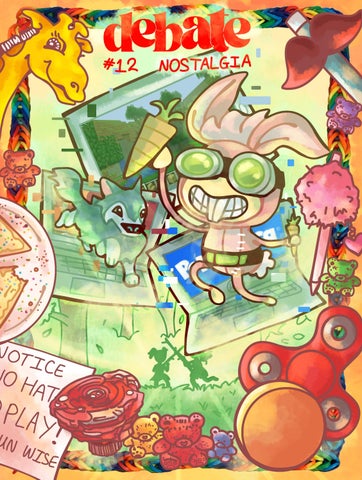
About Us Kia ora! We’re Debate, your free student magazine at AUT. Each fortnight we scatter magazines across campus talking about student news, art, and culture. Each issue is made by us and a small team of contributors - no AI was used in the production of any work to our knowledge.
FOLLOW US ON INSTAGRAM @debate_mag Editor Tashi Donnelly
Associate Editor Liam Hansen
Arts, Culture & Te Ao Māori Editor Skye Lunson-Storey
Digital Marketing & Social Media Manager Madeline Bradley
Graphic Designer Sophia He
Contents TITLE--Nostalgia Editorial 4 Column How e-ink tablets capture creativity, with a price 6 Review Kōrero Toi: Danielle Chen 8 Kōrero Toi Watching from afar 10 Te Ao Māori One Moon: Journey to the East 12 Column Sooky-La-La 14 Poem 16 Drugs Column Getting High on Memories 18 Lesbian Column The Hot Lesbian: Memorial Olfactorial CENTREFOLD - Museum of Memorabilia 22 Visual catto’s GAME RECCS: Nostalgia 24 Feature Loom bands comic 26 Comic Spill the Tea 28 Column End of Beginning 30 Promo PUZZLES 32 PUZZLES Tempo Dance Festival 34 Promo My Haukāinga in Photo Albums. 36 Te Ao Māori Rick’s Reel Reccs - 3 Films on Childhood 38 RRR Column Lullaby 40 Comic
DISCLAIMER Material contained in this publication does not necessarily represent the views or opinions of AUTSA, its advertisers, contributors, Nicholson Print Solutions or its subsidiaries. This publication is entitled to the full protection given by the Copyright Act of 1994 (“the Act”) to the holders of the copyright, being AUT STUDENT ASSOCIATION (“AUTSA”). Reproduction, storage or display of any part of this publication by any process, electronic or otherwise (except for educational purposes specified in the Act) without express permission is a break of the copyright of the publisher and will be prosecuted accordingly. Inquiries seeking permission to reproduce should be addressed to AUTSA. Debate is a member of the NZ Media Council and subject to its complaints procedure. Complaints about stories must first be directed in writing to us (provide link) within a month of the story being published. If you are not satisfied with our response you can complain to https://www.mediacouncil.org.nz/complaints/. You will need to attach a copy of the article complained about and any correspondence you have had with us.
CREATOR--Tashi Donnelly Liam Hansen Danielle Chen Skye Lunson-Storey Priscilla Zhang Elise Sadlier Isaac Tenzing Paige Turner Neena Contreras meoskyan_art Cindy Xu Tashi Donnelly AUT Ventures Ivy Lyden-Hancy Ricky Lai Freddy Sang
FRONT COVER Sophia He (she/her) @meoskyan_art CENTREFOLD Neena Contreras (she/her) @flippitea CONTRIBUTORS Danielle Chen, Priscilla Zhang, Elise Sadlier, Nina Sipkes, Isaac Tenzing, Paige Turner, Neena Contreras, Cindy Xu, AUT Ventures, Ivy LydenHancy, Ricky Lai, Freddy Sang
DATE OF PUBLICATION: SEPTEMBER 2026
4
debate mag
| nostalgia |
issue twelve 2026
---------------------------------------------------------- Issue #12 - Nostalgia Editorial ------------------------------------------
Make Nostalgia Realistic Again Dear reader, I’ve got a seriously bad case of nostalgia. As far back as I can remember, I’ve loved looking as far back as I can remember. It’s like an addiction. A compulsion to rehash every experience I’ve ever had and to bore any innocent bystander to death with my remembrances. Every day I wake up and exclaim in pure rapture that the day before has now become a day in the past that I can look back on with the rosiest of tinted glasses. You see, I did a bit of research earlier and ended up reading a most curious thesis published in 1688 by a young Swiss medical student named Johannes Hofer, who coined the word “nostalgia” to describe acute homesickness among mercenaries. Just take a read of this: [...] the word Nostalgias, Greek in origin and indeed composed of two sounds, the one of which is Nosos, return to the native land; the other, Algos, signifies suffering or grief; so that thus far it is possible from the force of the sound Nostalgia to define the sad mood originating from the desire for the return to one’s native land. That’s from Dissertatio medica de nostalgia, oder Heimwehe (“Medical Dissertation on Nostalgia, or Homesickness”). It was an interesting read, not least because the ailment he was describing seems (to my modern understanding) quite fucking obvious. But
in my enthusiasm to read his dissertation, I failed to notice his year of birth: 1669. The man was only 19 years old. Young doctor? More like teen doctor! A word that looms so large in our modern life, a word we all throw around like a well-used tea towel, was forged in the imagination of a teenager. Maybe it needed that – someone who was still close enough to the wonders of childhood, and sent far enough away from home to start seeing it with that lowsaturation vintage filter. Someone who knew how much these soldiers missed home, because he himself had hardly cut himself from his mother’s apron strings. All this made me think about how we use the word now: more as a bittersweet longing for a past time or place than as a medical condition. I’m tempted to conclude that our boy Johannes was onto something. The more I thought about it, the more I wondered. Maybe nostalgia should be considered a medical condition. I think I’m on to something here, dear reader, for surely we can still bring back nostalgia’s medical usage, better yet, get it into the DSM-5. From there it’s only a hop, skip, and a jump away from becoming a slur, as God intended. But what about treatment? Well, don’t worry your pretty nostalgic head over it – Johannes has a load of extremely seventeenth-century medical treatments, including purging, vomiting and bloodletting, but his most
debate mag
| nostalgia |
issue twelve 2026
effective cure was considerably less grizzly: just let the poor bastard go home.
blanks with their own rose-tinted version of it.
I can’t follow Johannes’s prescription and literally ‘go home’ to the past. But I can return to what remains of it: the places, the objects and the memories. The trick, I think, is to visit the past as it actually was, rather than the version nostalgia has renovated for me. Remember the good stuff, sure, but remember the low-rise jeans too. They weren’t good. They were never good.
Nostalgia can’t be bought, but it can be sold. Nostalgia hard launched as a medical condition back in 1688, but from then on it’s developed more complex definitions, like a well-aged cask wine, or perhaps more like mould in a petri dish. I Google Image searched “nostalgia” and found myself staring hazily at photos of lolly bracelets, car city carpets, I Spy books, and cassette tapes, all with that low-saturation vintage filter and 35% vignette.
In this editor’s humble opinion, nostalgia is kind of like psychedelics. For ordinary people with a healthy amount of empathy, a psychedelic trip can be a transformative, spiritual, and humbling experience, and for narcissistic assholes it fuels grandiose delusions of self-importance. The problem is narcissistic assholes become world leaders quite often, and nostalgia can be a powerful weapon. When Mussolini founded the first fascist movement, he drew heavily on an idealised vision of Italy’s past, invoking the power and grandeur of ancient Rome and promising a kind of national rebirth. Similarly, Hitler and the Nazi Party promised to restore Germany’s lost greatness, calling on Germans to have respect for their “great past” and pride in their “old traditions”. Sounds a little like “Make America Great Again”. That “again” is doing a lot of heavy lifting. Make America great again. Great at what? Great for whom? And, crucially, when exactly was this great America we’re supposed to be returning to? The slogan never has to tell you. That’s the magic trick of political nostalgia: leave the past vague enough and everyone can fill in the
5
So let’s make sure we return home, like Johannes prescribed. But let’s actually return home – not to an imaginary version of it where everything was better and simpler. Let us be realistic in our longings. I remember poring over I Spy books and chewing lollies off my wrist until it was sticky and disgusting. I remember fucking up more than one cassette tape with impatience. I also remember 9/11. It’s easy for me to think 2001 was a simpler time; I was four years old. And maybe that’s the trick to treating my seriously bad case of nostalgia. I don’t need to stop looking back. I just need to take off the rose-tinted glasses every once in a while. The past is worth going home to. Just don’t expect it to look exactly how you remembered it.
Written by Tashi Donnelly (she/her) @tashi_rd EDITOR-IN-CHIEF
Painting: The Voyage of Life: Childhood (1842) by Thomas Cole
6
debate mag
| nostalgia |
issue twelve 2026
---------------------------------------------------------- REVIEWS ------------------------------------------
How e-ink tablets capture creativity, with a price Any admission of what my childhood was really like will probably only result in resigned, unsurprised nods, but I can remain embarrassed as the realities of technological advancement and neurological development for youth become warped in culture wars and social media bans. I’m not saying my experience was ideal, but it doesn’t hold the same connotations as it does today.
loved about technology in the ’90s, 2000s, and early 2010s. You can find phones with physical keyboards, modern iterations of the Nintendo DS, and portable CD players across the duffle bags of students who barely remember their heyday. Whether people call it LARPing or not, I’d rather be called a phony for using old shit for fun than becoming one by outsourcing my thoughts to a chatbot.
I was an iPad baby.
This brings us to reMarkable, the Norwegian e-paper company who have been mocking me with targeted advertising for their pricey tablets since their launch in Aotearoa electronic stores. It’s easy to think of their products as modern iterations of the Kindle, which are still being made, but by Amazon. I trust Norway more than Jeff Bezos.
Or rather, an iPad kid – maybe an iPod Touch kid if we’re being pedantic. My parents were onto it as far as technology went, with a dad working in graphic and web design. Immediate access to information has been a constant in my life, whether via my dad’s desktop keyboard or Safari on mum’s iPad. It’s one of the greatest privileges of being born in the 21st century, and it’s also declined in quality like Game of Thrones since the early days of search engines became fronts for broken AI chatbots. When Wikipedia is more reliable than the platforms the majority of major universities and institutions are forcing upon their students, something has been deeply, inherently lost. This is why, for our Screens issue earlier this year, I initially wanted to experiment with technology that had its heyday in my youth, and how those formats lived on today. Various companies, from indie startups to AliExpress fronts, have tried to tackle the menagerie of modern day technology by bringing back what people
After seeing their tablets lining tables at JB Hi-Fi, I emailed ReMarkable to see if they’d part ways with a product for a review in our screens issue. Although they seemed interested, my follow-up emails as the Screens issue came and went were met with apologies. Only a few weeks after we published, I was sent a shipping link with their new tablet, the Paper Pure, showing up on my doorstep that next Wednesday. Although we were sent the product, we haven’t been paid to share our thoughts, and the team was happy to let us come to our own conclusions on the device. After using it for a couple of months, I’ve become simultaneously enamoured and frustrated with e-ink tablets as a whole. Just as we were promised improving technology as we got older, access to resources became limited as costs rose, so, while the e-paper industry brings forth several
debate mag
| nostalgia |
benefits, lost as our lives are drowned in screen time, the cost New Zealanders and students elsewhere would have to pay makes it difficult to justify. Firstly, the build quality of this thing is beautiful. The Paper Pure comes with a standard marker, brushed with a fancy matte finish and embossed logos to justify its hefty price tag. Though the device isn’t made of the metals of iPads and other screened tablets, it utilises its soft exterior to trade the cold steel of a laptop keyboard for a warmer feel in the hands. Most importantly, these products are a wonder for digital artists, writers, editors, and illustrators who are tired of the neverending strain on their eyes. The ReMarkable tablet whittles down modern illustration software into the basics, creating a strong medium between physical notebooks and digital tablets. The texture is close enough to paper, mostly achieved via a protective pattern on the screen. Where it excels is its ability to, essentially, allow you to undo, redo, copy, and paste without an eraser or whiteout. It feels like magic, watching ink rush from different parts of the screen, fading out of view like it’s falling into the void. The screen will instigate its own ghosting, briefly flashing the screen black to clear off any residue left from the previous page or strokes, and while it’s a bit annoying at first, you can easily get used to it. I’ve also frequently found myself using the Chrome extension that sends articles and webpages straight to the device. As I alluded to, the issue comes at the checkout. Essentially, the device is a glorified PDF reader. An incredibly wellmade one, but each piece of content needs to be imported from another device. Despite needing internet access, you can’t use a web browser, Wikipedia, or do much to find things to read on the device itself.
issue twelve 2026
To use the ReMarkable, you need to use the screens you’re trying to get away from. They’re drawn into the experience from every level, as you’re encouraged to link third-party cloud software through the free fifty-day trial of ReMarkable Connect, letting you use a smidgeon of the device’s WiFi capability for an extra $5 a month. Even when buying a physical product, you’re paying a subscription to use it. This brings me to the price reveal, and the biggest reason not to get one of these devices. A reMarkable Paper Pure, like I was sent, starts at $800 in Aotearoa. The Pro models, with a soft inbuilt light for use in darkness and access to colours beyond black and white, are $900 for the 8-inch device and $1,050 for the 11-inch flagship product. Even their refurbished models are available for close to a grand, leaving this line of products well out of reach for the majority of students. As I’ve been working with the tablet, the key question has revolved around whether or not I would recommend the product. For something I’ve really enjoyed using, it’s hard to convince people that it’d be worth its full price. I think advancements like these, utilising technology while also placing barriers between algorithms and endless distractions, are far more valuable than forcing AI into every user experience. But, just like so much of technology, you’d be better off waiting to get it on Facebook Marketplace.
Written by Liam Hansen (they/them) @liamhanse.n ASSOCIATE EDITOR
7
8
debate mag
| nostalgia |
issue twelve 2026
---------------------------------------------------------- Kōrero toi ------------------------------------------
Kōrero toi: Danielle Chen My artistic practice explores the second-hand nostalgia I feel for my father’s vibrant juvenile past in Taiwan, and my longing for his youthful experiences there. I researched 20th-century Taiwanese masculine youth and pop culture, combining it with my interpretation of my father’s life during that period. This is how I’ve created a romanticised and partially fictionalised portrayal of his adolescence. Based on his belongings, karaoke picks and the stories he has graced me with over time, I began to create a sort of narrative that explores my father’s individuality, showcasing a fraction of his generation’s experience. The era’s influences were all heavily characterised by the post-martial-law burgeoning freedom and accompanied by rapid cultural-societal changes. Living through this transitional period as a teenager, my father had formed personal connections to the media and culture as they were contemporaneously emerging around him. The End of Love (1996) original album cover, featuring Taiwanese artist Wu Bai, is visually altered to depict my father. This painting honours the album’s iconic status as a go-to karaoke classic growing up within my home, as well as exemplifying the aforementioned “second-hand nostalgia.” Music transmitted from one generation to another shapes autobiographical memories, preferences, and emotional responses. For me, the nostalgia attached to this album I depict is inherited from my father, hence the “second-hand” nature of it, as opposed to a first-hand one. This leaves me having to accept that no matter how much I appreciate the album, I will never be able to experience it during its contemporary peak in the same way that my father and his generation did. Fewer restrictions, less surveillance, and other social changes of post-martial-law Taiwan
contributed to an emerging juvenile identity centred around masculinity, delinquency, and self-expression. Alongside my father’s stories and possessions, this context has shaped my perception of his experiences and participation in the masculine youth culture of the time. Both seemed to offer him forms of exhilaration and challenges that I long for and romanticise, yet could never experience myself. Miscellaneous belongings from his school days are painted scattered across a platter of warm ochre. Items such as a bulletchain accessory, alongside a keychain of a nude woman, illustrate carefreeness, a sense of rebellion and performed masculinity. The melancholic longing for a past I have never lived was built on these; it is nostalgia by association, never could it be first-hand. As a second-generation Kiwi Asian, I yearn for the nostalgia of an era I haven’t experienced personally. I feel certain that this fondness for something that transcends time and place is shared by many young people today who have similar circumstances to mine. By painting stories and possessions, I delve into a history that remains both influential and unfamiliar, in hopes of capturing the essence of a past that continues to shape and inspire my understanding of both my father and myself today.
Written by Danielle Chen (she/they) @Dermillion CONTRIBUTING WRITER
debate mag
| nostalgia |
issue twelve 2026
9
10
debate mag
| nostalgia |
issue twelve 2026
---------------------------------------------------------- TE AO MĀORI------------------------------------------
Watching from afar I’ve watched you from afar for so long. The changes and shifts, like tides controlled by te marama. I look at her and ask “why does the place I once knew seem foreign to me?” My heart feels heavy as I question the strong resistance within. This was never my whenua, yet you raised me. You protected my teina when the time came for my haerenga to explore new horizons. Now I have returned and that little kōtiro is all grown up. My tears grieve for time passed and memories we do not share. I look to Ranginui as I did when I was younger, Why does my heart feel heavy? How could one place hold so much? Clouds shroud the glimmer of the moana. In silence I wait for them to pass. I remember the CBD so vibrantly. Little arcades full of life. Reminiscing on the toy shop where I collected stretchy lizards and reptiles with each visit. As I grew older the urban sprawl took its toll. People opting for shiny new shopping centres and malls. The curse of retail cannibalism and downtown decay left behind a hollowedout urban core.
It’s funny how as a tamaiti there are many things you don’t understand. Like why all the main streets have Pākehā place names. The numbered avenues put in place to identify their carved out grid system. Our main road named after LieutenantGeneral Duncan Cameron who sounded the death-knell of Māori independence. People in school had the audacity to ask why Māori cared so much about the past. But I guess it’s easy for them to forget when they don’t have the generational trauma that’s brought into the present. The reflection of the moana stares at me. I didn’t realise until I left how lucky I was to have this taonga at my fingertips. The ‘big city’ was also surrounded by glistening waters but this moana carries the mamae of being drenched and contaminated. Being back, I gaze at the vast Pacific thinking of the great waka that journeyed here. Tākitimu and Mātaatua. The latter being my own. A sense of comfort washes over me knowing that travelling east toward Whakatāne that same waka held my tīpuna. I hold gratitude for this place that raised me. Acting as a hub, close to my whānau. The whenua travelling from Tauranga
debate mag
| nostalgia |
Moana to Taupō, Ōpōtiki, and the mighty Waikato still ingrained deep into my memory. Although you are not my whenua, you gave me access to my own. Being back I am confronted by the past. Wanting to escape is not your fault, for you have shaped me and all the directions I have taken in life. Again, I question; how can a place hold so much? Clouds shroud the glimmer of the moana. In silence I wait for them to pass. With an echoing roar from Tangaroa, I let go. Allowing myself to see this place through fresh eyes.
Written by Skye Lunson-Storey (they/them) @uku_rangi ARTS, CULTURE & TE AO MĀORI EDITOR
issue twelve 2026
11
12
debate mag
| nostalgia |
issue twelve 2026
---------------------------------------------------------- ONE MOON COLUMN ------------------------------------------
Journey to the East My favourite band is taking a break. MAYDAY. They have been my favourite band for years, and they recently confirmed that they will be stepping away from world tour concerts for a while to work on a new album. The news wasn’t entirely unexpected. They have long talked about following in the footsteps of their idols, the Beatles, and making ten albums in total. So when their ninth album came out ten years ago, we fans already knew: there was only one left. We always knew this day would come. And now, here it is. It isn’t a breakup. It isn’t even bad news. A new album means new songs, new stories and something new to look forward to. Still, it is strange to watch one chapter close, even when you know another is about to begin. Perhaps that was partly why, earlier this year, before the break was officially confirmed, I went to Taiwan. I followed ‘The Anywhere Door’ to places I already knew by heart: Ziqiang Tunnel, Park No. 7, and other landmarks from MAYDAY’s early years that had found their way into their songs and stories. There was even the late-night chicken drumstick prepared by Monster’s mother – a story almost every long-time fan knows. She is no longer here, but the story still is. I had seen these places through screens more times than I could count. None of that stopped me from getting ridiculously excited when I finally saw them with my
own eyes. I was visiting for the first time, yet very little felt entirely new. Can you feel nostalgic for a place you have never been before? Maybe you can, when songs have been taking you there for years. The old songs are better. Since the pandemic, I have followed MAYDAY less closely and haven’t had many chances to see them live. But just before it, my concert buddy and I made it to a special tour held in only three cities in China, with a setlist made up entirely of songs from their first three albums. It felt almost tailor-made for nostalgic people like us. The old songs are better. At another concert around the release of their ninth album, my concert buddy and I found ourselves strangely out of sync with everyone around us. We only knew the old songs. The newer fans around us seemed to know all the recent hits and songs from the new album. When a new song came on, they stood up, and we sat down. When an old song came on, we stood up, and they sat down. Somehow, we had created an entirely accidental human wave. It was funny, but also mildly alarming. Was I still a proper fan if I couldn’t sing a single song from the new album? The old songs are better.
debate mag
| nostalgia |
Maybe I liked saying that because the old songs gave me a peculiar sense of privilege. They seemed to prove that I had been there earlier, that I carried memories newer fans couldn’t access or share in quite the same way. Was that arrogance, or gratitude? I still can’t quite tell. Perhaps saying the old songs were better proved something else too: that I had stayed. Perhaps familiar things feel most comforting precisely because everything around them keeps changing. I met MAYDAY twice. The first time was in middle school, when a friend tried very hard to convince me to listen to them. At night, I would hide under the covers with my MP3 player, cautiously listening to rock music that I mostly thought was far too loud. I wasn’t convinced. The second time was at university, when someone sat down with me and started talking about MAYDAY’s lyrics. The song that finally got me was ‘Sun Wukong’. It is difficult to grow up Chinese without knowing Sun Wukong, the Monkey King from Journey to the West, a novel written in the sixteenth century. As a child, what interested me were his seventy-two transformations, his flying cloud and, obviously, his ability to beat up monsters. Back then, I thought the impressive part was being powerful enough to do almost anything alone. When I returned to the story through the song years later, I noticed something else. For someone so famously wild and free, Sun Wukong eventually spends years travelling beside a small group of people, step by step, all
issue twelve 2026
the way west in search of the scriptures. When you grow older, the hardest part of the story no longer seems to be defeating the monsters. Perhaps it is finding people willing to walk that far with you. Those old songs contain the girl under the covers with her MP3 player. They contain conversations about lyrics. They contain concert crowds rising and sitting at exactly the wrong times. They contain places I finally stood in this year after songs had been taking me there for much longer. Maybe old songs just have more of us in them. Perhaps nostalgia is sometimes just another way of saying: I haven’t forgotten. There will be a tenth album. There will be new songs I will probably once again fail to learn quickly enough. New fans will arrive and make those songs part of their own lives. And one day, those will become old songs too. But one question from Sun Wukong has travelled with me for years: When the journey west is over, could we meet again in five hundred years and journey east together?
Written by Priscilla Zhang (she/her) @p.zhangxy CONTRIBUTING COLUMNIST
13
14
debate mag
| nostalgia |
issue twelve 2026
---------------------------------------------------------- POEM ------------------------------------------
Sooky-La-La We can play at war down by the dragonfly-bitten creek wielding hockey-stick guns shooting planes from the sky with our minds comb the kutus from our hair curling like pikopiko in the basin drowning in tea tree and lye Teach me nothing gentle to leap from bridges, from rocks to let the waves thrash us against the sand to stash our bikes at Uncle’s balance our future on the handlebars But you’ll cry anyway sooky sooky la-la you’ll cry at scraped knees at a sharpened voice at a boy or two or twenty you’ll cry because you have to else the tears corrode your soul rust and eat your bones because your body demands it The world lines up shoulder to shoulder yelling Bullrush E tangiweto, run like hell. Break, don’t cry. Written by Elise Sadlier (she/her) @elise_sadlier
Illustrated by Nina Sipkes (she/her) @teatimings
CONTRIBUTING WRITER
CONTRIBUTING ARTIST
debate mag
| nostalgia |
issue twelve 2026
15
---------------------------------------------------------- “DEGENERATE GUIDES & ALTERED STATES” COLUMN ------------------------------------------
16
debate mag
| nostalgia |
issue twelve 2026
Getting High on Memories “Strange memories on this nervous night in Las Vegas. Five years later? Six? It seems like a lifetime…” In between heads full of mescaline and adrenochrome, Hunter S. Thompson would occasionally daydream about his so-called “main era”: the 1960s, a peak he proclaimed may never come back again, describing it as the “high-water mark” that broke the waves. According to my parents, I’d be accustomed to believe I’m currently living this. “These are the best years of your life,” told ad-nauseum, these words flooding like rivers with no bank. Everyone keeps telling me these are the days I’ll remember whilst I’m literally doing fucking anything but the kind of thing that is memorable. My first megalomaniac manager, a 3am Denny’s run, the time I saw a half-naked gimp on a leash get walked down Queen Street on my first acid trip. These are all memories, and you never know which you’ll end up nostalgic for until they’ve floated on by. After a bump or two, some are too numb to save their face, but for others gumming the last of your Laneway gear to ‘Only Girl’ by Rhianna was exactly what stuck. Some drugs make memories and some try their damn hardest to ensure there isn’t one. But what about a drug that can take those forgotten memories and make them nostalgic? With the recent aligning of stars, as of this month Medsafe just approved
pingas assisted therapy (not a legal term) for qualifying adults with PTSD in Aotearoa. While in practice there are only two psychiatrists currently delivering this therapy (in Wellington and Auckland), this is a bloody good step in the right direction. Putting us alongside Australia’s 2023 move, following Medsafe waving psilocybin through last year, this makes us only the second country in the world to legalize MDMA-assisted therapy nationwide at a systemic level. It feels as though the minotaur (FDA) chasing psychedelic assisted therapy through this hedge maze might just have an escape after all. Entrapped in that same maze, however, resides US’s Amy Griffin, controversial writer behind the now viral book, The Tell (2025). Griffin’s memoir describes resurfaced memories of childhood sexual abuse, recalled under the influence of MDMA. The book received lots of blow back: the New York Times reported that Griffin’s husband had backed research pushing FDA approval of MDMA and had money in a company set to sell it. A former classmate then sued, claiming the abuse story was actually hers. This year Griffin sued and swung back claiming defamation, making this likely the first ever legal battle over who owns the rights to their own drug-induced memories.
debate mag
| nostalgia |
Now, I haven’t read her book, and I don’t think I ever will. I am not here to use my precious 800 words of my student drug column on whether Griffin’s memories are true. What interests me more is the discussion around this Eternal Sunshineesque drug use and the possibility of Tesla-shaped party pills being able to recall forgotten memories or falsify one’s own nostalgia. I won’t be that bug-eyed, Adderall-fuelled moron reinventing the wheel at 3am. We’re well aware memory isn’t as reliable as you’d want. From your flatmate who insists he’ll pay you back for gas, to police who falsify evidence, inconsistency in memory is weaponised as often as sharp medieval weaponry. Source confusion (losing the origins of information in our mind) and the illusory truth effect (the notion that repeated information feels more truthful due to familiarity) in harmony represent an eerie separation between how we view the certainty of a memory vs the accuracy. Now let us circle back to pingas. Psychedelic research has dug into the drug class’s pharmacology, detailing the neuroplasticity shifts during 5-HT2A agonism, and the memories left vulnerable during reconsolidation. That’s the fucking driest and nerdiest way I could have said it, but the anvil crafts a double-edged sword here. MDMA can un-wedge thoughts and allow a more fluid conversation around repressed or hurtful memories, but it might also fundamentally change how one views said memory, even adulterating the facts somewhere in the mix. In even more layman’s terms, people theorise that MDMA is actively performing Inception.
issue twelve 2026
Don’t misconstrue me as being a naysayer, quite the contrary. Imagine your memories like a scene from Julien Donkey-Boy. You perhaps don’t remember what some of it was exactly but you remember the feeling. It’s the same way you may not remember your exact wording in an argument but you remember the feeling. MDMA has the ability to un-wedge thoughts and allow for a more fluid conversation around repressed or hurtful memories. It also potentially might fundamentally change how one views this memory, for good or for bad, even adulterating facts along the way in a means to make them tolerable. In a more relatable sense: Two Door Cinema Club might remind you of being a teenager, a photograph of your beloved dog might transport you to a moment in time. That’s the harmless version of what this therapy’s trying to do on purpose. And perhaps that’s the strangest kind of high: not forgetting where you are, but becoming inebriated off your own memories. Find all sources online at www.debatemag.com
Written by Isaac Tenzing DRUGS COLUMNIST Illustrated by Tashi Donnelly @tashi_rd EDITOR
17
---------------------------------------------------------- COLUMN: THE HOT LESBIAN ------------------------------------------
18
debate mag
| nostalgia |
issue twelve 2026
The Hot Lesbian: Memorial Olfactorial Yesterday I remembered the smell of your arms around me. You had just gotten out of the pool; the fragrance came on strong, an avant-garde perfume that never whetted your insatiable appetite. Chlorine, salty sterile chlorine, bleachy acrid chlorine. Water running down your sunburnt skin in rivulets. A mass of wet hair splayed out like seaweed on your deep blue swimsuit. Off-white teeth formed a smile, shining in the dregs of the afternoon sunlight. I was happy to see you too. “Did you have a good day today?” “Every day’s a good day when I’m in the water.” In the foyer outside the pool, I waited for you to change. The sun trickled through rectangular windows, high above our heads, and the world swelled ripe with possibility. Your championship was next week — the calendar on the receptionist’s desk reminded me of it. Our daily walk delivered us from late afternoon to the end of civil twilight. Starting from the gate of the aquatic centre, we wove through the city streets, your apartment complex the final destination. Some days we’d take detours, other days we wouldn’t; the walks always ended at your apartment, where we’d part ways for the night, dreaming sweetly about the next time we’d see each other. Just like every other day, we stopped at the convenience store on the way home and bought a popsicle each. They were creamy sky-blue, sodaflavoured, and slightly savoury, wrapped in clear plastic packaging without a brand.
The owner made them out of a premade mix in the early morning and sold them to schoolkids in the afternoon. We’d clink them together before we unwrapped them – a mock toast celebrating the day’s victories – and devour them quickly before they melted in the tropical heat. Once we’d finished scarfing down the ice, we’d share the fortunes inscribed on the wooden sticks and laugh at how ridiculous they were. The world was a boundless ocean as we walked and talked; we would be the ones to conquer it. I knew we would. It was our last year at high school, the last year at that stuffy girls’ college, and afterwards we’d be going into the adult world together, like we always had … everything together. Everything, together. I imagined someday we wouldn’t have to part ways at the end of our walk. Above us, all around us, trickling downwards from the wide sky, the sunlight faded; the world dipped into swimsuit blue-green, swaying in the hazy heat. We plunged into a balmy, shallow darkness illuminated by the streetlights and the glow of the secondhand shops. The air drifted soft and smoky with the exhaust of countless cars on the nearby highway. Somewhere nearby, the smell of alcohol meandered from a bar’s windows; in the faraway alleyways, upbeat electronica echoed from the boomboxes of the neighbourhood dandies. Tentatively, I reached my hand towards yours. I wasn’t sure if you’d notice. Some part of me hoped you wouldn’t. You didn’t notice. Good. I gripped
debate mag
| nostalgia |
you tighter, stroking the back of your hand with my thumb as we strolled. My throat dried up; I was used to the heat, but not used to this feeling, this suffocation loitering in the back of my head waiting to lunge through my teeth. Nothing was wrong, yet … My stomach turned itself into knots, churning queasily like an ice cream machine. I smelled copper at the tip of my nose. Everything should have been right. I wasn’t sure what to say or do, or why I felt so uneasy around you: you who comforted me, you who encouraged me, you who I loved. So why, why, when it was all right, why did I feel so wrong? It was at the bus stop in front of your apartment complex when I finally pinned down that feeling. There was something neither of us wanted to talk about. I had to be the one to do it. I couldn’t bear forcing you to spit it out. “I ... feel like ... you …” I struggled my way through the sentence whisperquiet. “I feel like sometimes you don’t care about me as much as you care about your career,” I muttered. I hoped you wouldn’t hear. You heard, of course, and flung your hands into the air, out of my grasp. “I do care, I do! I’m just busy, okay? I have other things I want to do too. I’m sorry we can’t hang out all the time, but that’s just how life is! I can’t care a hundred percent about everything at once! I have to prioritise, and you know I have a really busy season coming up, so …” “I understand. I’ll take a back seat so you can get your medals,” I said, the words pouring from my mouth, too little time and surface tension to stop them. “That’s …” Your face, so serene before, flushed orange-red under the yellow streetlamp. “… not what I meant. Why do you never get what I’m trying to
issue twelve 2026
say? It’s like every time I try to tell you something, you twist it into … some selfpitying crap.” “No, I …” I didn’t mean it either, please— “Whatever!” You slapped away my outstretched hand. “Take your back seat then! I promise the next time you’ll see me will be at the Olympics, on the podium with a gold medal!” That was the last I heard from you in the bluest hour of my life, those words shouted as you fled into the night, your face turned firmly away from mine. I didn’t look for you at the pool the next day, or the day after, or the many lonely months that came and went. I didn’t even see you at school. I didn’t see many people at school most days, though. I was too busy keeping my head down and surviving the final exams. Could I have said something more to you? Something that would have stopped you? I don’t know. I shouldn’t have said anything at all. Maybe the right words to say were silent. Maybe I’ll never know, I guess. It’s been thirteen years, but I still tell my therapist about you. I know, it’s pathetic, isn’t it? A grown woman with a steady job and a good place to live, unable to move on with her life after a whole decade? It’s not healthy in the slightest. My therapist tells me it’s normal for people to carry the burdens of the past, but eventually I’ll have to put them down, whether gently or dropped on my feet. She’s right. I pay her to be right. I’ve been trying to get my mind off thoughts of you for the longest time. I tried to date other women, to focus on my career, to pick up hobbies … I think, for a time, journaling helped, but for now I’m still carrying that weight shaped like you.
19
20
debate mag
| nostalgia |
I have to find closure somehow; I do. I can’t go back to that pool, or that street, or even the ocean. I’ve moved far, far away, retreating deep into the inner city where no water laps at my feet and no waves call your name – but I don’t think I can ever escape your pull. Today I remembered to call you. I saw your page on the same social website we used to browse together. My eyes glazed over looking at your many posts from last year, your many new friends, your many accomplishments … until, finally, I came across your number in small print under the address of your place of employment. I dialled your number with shaky hands and prayed my beat-up cellphone could reach you. I couldn’t tell if I wanted you to pick up. Some part of me hoped you’d hang up, dismiss me, curse me out; anything to validate my game of keepaway that had lasted for much too long. Some part of me hoped I’d at least get to squeak out an apology before the line went dead. The dial tone ended. I braced myself for the response. “Hello? Who’s this?” It wasn’t your voice at all. It might have been your mother’s, your aunt’s, your older sister’s. I couldn’t tell. “Hello. I’m a friend of …” and here I allowed myself to say your name, let the heavenly soundwaves wash over my mortal tongue with a sprinkle of salt. “It’s a little too late to be looking for her.” “Um, if she’s busy at the moment, I’ll call again later.” A condescending tone crept into the other person’s voice. “Oh, she’s not busy at all.” “Then please put her on the line.” “If I could, I would.”
issue twelve 2026
her?”
“So why can’t you just let me talk to
“She’s …” Your relative went quiet. For a moment, I thought the call had disconnected. “She’s gone.” I wished the call had disconnected. “What? How? Why did—?” “I don’t know, I don’t know, and I don’t know! It wasn’t my business anyway! If you were her friend, then why didn’t she tell you anything?!” The words stung like iodine poured into an unhealed wound. “You’re right. I haven’t been her friend in years. I just wanted to see how she was—” “Should have picked a better time to try!” your relative hissed. “Just last week and you could’ve saved her!” “I’m sorry,” I mumbled. “I didn’t know.” “Don’t ever call this number again, bitch!” And so I hung up obediently. Yesterday I remembered you. The smell of your arms around me, the rivulets of water down your sunburnt skin, your off-white teeth standing guard in the formation of a smile. Today I remembered crying.
Written by Paige Turner (she/her) @paig_does_it CONTRIBUTING LESBIAN Painting: The Woman in the Waves (1868) by Gustave Courbet
22
debate mag
| nostalgia |
issue twelve 2026
debate mag
| nostalgia |
issue twelve 2026
23
24
25
26
debate mag
| nostalgia |
issue twelve 2026
| nostalgia | issue twelve 2026
Written byCindy Xu | (she/her) | @cx0_sunny | CONTRIBUTING ARTIST
debate mag 27
28
debate mag
| nostalgia |
issue twelve 2026
rejected. I will give you my best advice based on these assumptions.
Q: Do you have any advice on moving on from unrequited feelings for someone whilst maintaining your friendship with them? (In my case, it’s a long-distance friendship). I know it might be better if I just stop talking to them, but at the same time I genuinely do like being friends with them. What do I do? From Tired Person (24) A: Dear Tired Person, Unfortunately, there is no button you can press to immediately stop wanting someone. If there were, I imagine humanity would have discovered it shortly after fire and considerably before the wheel. But unrequited love feels like one of life’s great character-building experiences. Until you realise it doesn’t exist. To be fair to you, there is no mention of love in your letter. You’ve described “feelings”, which is vague to say the least. But I shall assume the “feelings” are romantic, and that “unrequited” means you have confessed your “feelings” to your friend and been (romantically)
You don’t need to stop being friends with this person. But I do think you need to be ruthless with yourself about what “being friends” currently means. If you are finding it genuinely difficult to show up for this person because of your crush on them, then you’re not their friend. If you’re hanging around this person while silently hoping the situation will change, then you’re not their friend. Occupying the position of friend while actually functioning as a hopeful romantic prospect is, say it with me now, NOT FRIENDSHIP. This kind of situation isn’t fair to either of you. It condemns you to a miserable little purgatory in which every interaction is a potential source of disappointment, and in turn, forces your friend to unknowingly participate in something they believe has already been resolved. I’m drawing a line between love and a crush here. A crush can exist entirely inside one person. Love, at least the romantic kind I’m talking about here, is something you build with another person. It requires reciprocity. It requires actually knowing someone, rather than knowing them and then filling in the gaps with everything you hope they might be. It has to exist, at least partly, in reality. An unrequited crush doesn’t have to pass any of those tests. In fact, it can flourish
debate mag
| nostalgia |
quite happily without the other person’s involvement whatsoever. You can take a perfectly ordinary human being, add attraction, hope, projection and several hundred hours of thinking about them, and produce something that feels enormous. The enormity of the feeling does not necessarily tell you anything about the enormity of the relationship. So in this humble advice columnist’s opinion, “unrequited love” does not exist, but is merely a crush with a fanciersounding name. So what can you actually do about this? It’s tempting to assume long-distance would make this easier, but I fear that fact could make it even worse. So much of the relationship exists inside your phone and, consequently, inside your head. There are fewer boring real-life moments to puncture the fantasy. You’re not watching them chew too loudly or get road rage. You get concentrated doses of them: messages, calls, photos, the exciting bits. Your imagination gets to fill in everything else. As I said earlier, I don’t think you need to disappear from their life completely. You might just need to stop talking every single day for a while. If you’re in the habit of four-hour late-night phone calls, switch to occasional one-hour calls. You could mute their Instagram stories so you’re not conducting forensic analysis on everyone who appears in the background. If this friend is the first person you tell big news
issue twelve 2026
to, try leaning on other friends instead. In short, try downgrading them from Main Character to Recurring Guest Star. Just until your feelings subside! And then comes the annoying advice that everybody gives because, unfortunately, it works: you need other things in your life. Other friends. Other crushes. Hobbies. Dates. Plans. Anything that reminds your brain there are approximately eight billion people on Earth and God did not put this particular person at the centre of the map. You genuinely like this person, so the goal isn’t to stop caring for them. It’s to get to a point where liking them doesn’t come with a side of hoping they’ll eventually like you back. And if you can get there, you might actually get to keep the best part: the friendship. And if you haven’t confessed your feelings and been romantically rejected, what are you waiting for? You might as well try to shoot your shot.
Answered by Tashi Donnelly (she/her) @tashi_rd EDITOR-IN-CHIEF
29
30
debate mag
| nostalgia |
issue twelve 2026
---------------------------------------------------------- FEATURE ------------------------------------------
End of Beginning There’s something sweetly nostalgic about looking back at an old project or idea once you know how it ends up panning out. The moments that probably felt completely ordinary at the time – another day in the lab, another round of testing, another conversation about what could come next – suddenly become part of an origin story. For AUT Ventures, medtech company RespirAq is one of those stories. What began as university research would go on to become one of AUT Ventures’ biggest spinout successes – opening the door to what might come next for commercialisation at AUT. Rewind just over 10 years and none of that was guaranteed. Long before anyone knew where the idea might lead, RespirAq’s story began much closer to home: with a PhD student at AUT, her supervisor and a longstanding healthcare problem they believed could be approached differently. Before RespirAq was RespirAq To start at the beginning, we need to go back to 2014, when Dr Sandra Grau-Bartual began her PhD in biomedical engineering at AUT. Working under the supervision of Professor Ahmed Al-Jumaily at AUT’s Institute of Biomedical Technologies, Sandra explored a longstanding problem in artificial ventilation. Patients need the air they breathe to be humidified, but conventional systems rely on external water supplies and can create condensation inside breathing circuits. Her chemical engineering background led her to approach the problem differently,
adapting a smart material to this application that could capture moisture as a patient exhales and release it again as they inhale. It was here that the concept behind RespirAq was born, with the idea showing enough promise for AUT Ventures to help secure its first patent in 2017. Sandra stayed at AUT as a research fellow after completing her PhD, continuing to develop what would eventually become RespirAq’s Active Humidifier – a compact device offering a fundamentally new approach to respiratory humidification. A first for AUT Ventures As the technology developed, the question began to shift from whether it could work to how far it could go. Ongoing support from KiwiNet, AUT, AUT Ventures and MBIE helped the team keep pushing the idea forward, while growing interest from outside the university suggested others could see its potential too. RespirAq eventually launched as a spinout in 2021, raising an oversubscribed $1.5 million seed round. At the time, it was the largest investment ever made into an AUTborn technology. For AUT Ventures, the milestone helped shape what came next. RespirAq had made the leap from university research to a company attracting serious external investment, setting a new benchmark for what commercialisation at AUT could achieve. It’s a chapter Venture Director Chris Hill views particularly fondly.
“RespirAq showed what was possible. Seeing a technology developed at AUT become a company and attract that level of investment has given us something to build from. A lot has changed since then – our pipeline has expanded, our ambitions have grown and we’re supporting more ideas towards commercialisation – but RespirAq will always be a special part of where that journey began.” So, what happened next? RespirAq’s story didn’t stop once it left AUT. Its Active Humidifier received FDA Breakthrough Device designation in 2023, and the team is continuing to work through the wider FDA regulatory process as it moves towards bringing the technology to patients. The company has also raised
a further $3 million in funding led by Kiwi venture capital firm Movac’s Emerge Fund 4, helping RespirAq scale up its manufacturing operations. AUT Ventures remains part of RespirAq’s journey, while back at AUT, the commercialisation pipeline has continued to expand, with more ventures now following in its footsteps. That’s where the nostalgia gets interesting. We know what became of those early days of RespirAq, but we don’t know which of the ideas taking shape at AUT today we might be looking back on years from now. Perhaps another origin story has already begun. RespirAq may have marked the end of one beginning, but for AUT Ventures, it helped open the door to what could come next.
Written by AUT Ventures
32
debate mag
| nostalgia |
issue twelve 2026
debate mag
| nostalgia |
issue twelve 2026
33
34
debate mag
| nostalgia |
issue twelve 2026
13 18 OCTOBER 2026
Book Now
TEMPODANCEFESTIVAL.CO.NZ
TE RERENGA O TERE
Tempo Dance Festival | Te Rerenga o Tere presents: YMCĀ Atamira Dance Company Choreographed by Oli Mathiesen (Ngāpuhi, Ngāti Hine, Ngāti Manu)
debate mag
8pm, Tuesday 13 & Wednesday 14 October 2026 Q Theatre, Rangatira tempodancefestival.co.nz Creative Direction: 3aan Hiini (Te Arawa, Ngāpuhi, Te Rarawaq Photography: Sophie Miya-Smith Book tickets and view the full programme of 27 events across Tāmaki Makaurau at tempodancefestival.co.nz
| nostalgia |
issue twelve 2026
35
36
debate mag
| nostalgia |
issue twelve 2026
---------------------------------------------------------- TE AO MĀORI ------------------------------------------
My Haukāinga in Photo Albums. At my childhood home, 166, we had a tall drawer full to the brim with photo albums. I would go through them and get lost in the life lived by my whānau. I would see my māmā’s memories, my dad’s too, and my own memories long before I knew what they were. Nostalgia lived in me long before I knew what the word meant. I wrote poems about growing up in between marae, for poukai, hapori, tangihanga, all the things that call us home. I have many photos of my cousins at the marae, playing bullrush and spotlight. My māmā is a Facebook mum, so there are digital albums I can look back to, but it’s never as intimate as the real thing. This poem, Budget Beyblades, I wrote when remembering my childhood. I am stuck in nostalgia, as it’s my peace, the world before life got so noisy. Budget Beyblades Have you ever played budget Beyblades, scraped the palette of Hokianga. Digging holes in the pores of papa, filling Sprite bottles with crabs. Intertwine claws like the weaving of korowai. We dig holes. And we jumped into the harbour. Swimming with the taniwha, we play budget Beyblades. Chuck the crabs in the cold umu, fight to the death. Budget beyblades My nans’ passed before they could tell me about their world. My vocal cords, nails on a chalkboard. Taumaha Maine Edwards and Moera Hancy, monarchs in my whānau. They left behind their mokos,
so we, stay hōhā, stay fast, never stop. The Māori Jesus blessed me with a father who dances with dice. The Māori Jesus came from Wellington Harbour and said: “My mum told me it’s just a lie that’s a little bit true.” Gifted me a horse with 4 legs. And a little bottle of knowledge. So when I think about crab genocide on Hokianga Harbour. I see my family dancing with ice. And they say, “Why are you riding a waiata?” Stop climbing Matariki. But I don’t wanna let go of Ranganui, coz I always feel high; up the top of Taupiri Where my tīpuna lives in our memories. When I think back to it, all of us bloody Māori kids making crabs fight to the death should have been stopped. But it’s a memory that literally lives in my mind; jumping in the wharf goes hand in hand. Waterholes on the west side and up north, climbing Taupiri. Mum called me the “bullrush queen”, but that’s only because I loved having an excuse to tackle my cousins. I love living in photos; I got it from Mum. Having our whole life digitised gives me something to live in when I wanna get away from the world. My haukāinga is found in my memories. I was born and raised in Papakura, with half my heart in Waikato and half in Hokianga. I think that the reason I call Titahi ki Tua my kāinga rua is that I can be around others who live with their heart at home. The other night, I had a
dream about my dad. We were walking along a waterhole, a beach, water with hills and valleys. It looked like our marae at Hokianga. We saw an eel eating a shark. He said to me that the eel is a tohunga, our tipuna; it will outlive us. The eel swam off, and I woke up. In a way, I found that as a metaphor for my nans, for although they have passed, they live in my nostalgia. I am blessed to have photos, hundreds of photo albums, both physical and digital. I get lost in the memories I can not remember. There is a photo of my cousin and me on my pāpā’s lap, grinning from ear to ear; it wasn’t until my 21st I learnt the origins of that photo. Apparently, I kept on telling my cousin that my pāpā was “MY pāpā”. My pāpā scooped both of us up and told me he is all of our guys’ (my cousins’) pāpā. I think about that a lot. And I feel the memories breathe in every flick through those photo albums.
Photos and photo albums are my peace. My escape from a world that demands that I perform. I follow my māmā’s legacy and take photos of everything, so when I lose my memories and my past gets foggy, I can look in my own photo albums and reminisce about the good, the bad, the peace, the war, and love.
Written by Ivy Lyden-Hancy (she/her/ia) @tekaraipiture CONTRIBUTING WRITER
---------------------------------------------------------- COLUMN ------------------------------------------
38
debate mag
| nostalgia |
1. A Boy Named Charlie Brown (Bill Melendez, 1969) Out of the gate, one must admit this feature – 86 minutes of Charlie Brown, what a dream! – isn’t the peak of Peanuts. It has the mood but not the wit, and in its slight lack of inspiration it even flat-out reprises scenes from the beloved, 25-minute television specials: Snoopy twirling on an icy lake to Guaraldi’s “Skating” (1965’s A Charlie Brown Christmas) or Lucy pulling the football away from Charlie as he’s about to kick it (1966’s It’s the Great Pumpkin, Charlie Brown). My only rejoinder is that, well, those were great vibes then, and they’re still great vibes now; I don’t mind luxuriating in those seasonal routines of Hennepin County. A Boy Named Charlie Brown leans dryly into the banal disappointments (and embarrassments)
issue twelve 2026
of Chuck’s adolescence: flying a kite that falls apart in the wind, being the weakest on the baseball team, losing the Annual Spelling Bee in front of a live television audience. And yet the centerpiece of A Boy Named Charlie Brown has nothing to do with Charlie Brown; instead it is when Schroeder plays Beethoven’s ‘Piano Sonata No. 8’ and the film suddenly gets lost in a liquid drift of splashing colours and pulsing lines. Schroeder’s little toy piano suddenly swells into a grand piano that outsizes him in the frame; it almost seems ready to swallow him whole. This sequence, as if right out of Fantasia, is good enough for fifty lifetimes; a kid like Schroeder – reminding me of myself when I was eight – has barely scratched the surface of his own lifespan.
| nostalgia |
2. Cold Water (Olivier Assayas, 1994) If one were to cast judgement based off film alone, fewer childhoods look gloomier than those in France, pre-1968. One would be forgiven for watching Truffaut’s foundational The 400 Blows (1959) and gleaning that a French adolescence largely involves simply getting your ass kicked over and over again. I remember one scene extremely well, when young Antoine is being confronted in the classroom, and his professor steps up to him holding out both his hands. ‘Right or left?’ he asks, to which Antoine replies, ‘Left, sir.’ The prof unstraps his watch from his wrist, places it gently on a shelf, then slaps Antoine across the face with his left hand. The deafening crack! echoes in my brain, rippling through all the Francophonic coming-of-age narratives that I’ve seen since: Pialat’s L’Enfance Nue (1968), Charlotte Le Bon’s Falcon Lake (2022), and best of all the debut film from globalist cynic and post-punk nerd Olivier Assayas, Cold Water (1994). In the hope of connecting with his delinquent son, Gilles’ father describes a piece of classical art in a book that moves him deeply. Gilles isn’t listening. The camera slowly trails from the open book on his father’s lap down to the floor, where Gilles traces his footsteps along the edge of the carpet. It’s not that the bored kid can’t connect with art – just not this kind of art, and certainly not at the recommendation of his father. Cold Water instead runs on rock ‘n’ roll from the Americans and Brits right from the opening needle-drop, Roxy Music’s ‘Virginia Plain’ hissing from a radio that Gilles and his brother fight over. These European young ’un crave a life more exciting and cutting-edge out there, although they can’t actually escape. Yet their dream is visceral; the sound of crunchy guitar riffs transmitted from some far away country; somewhere else over 3,700 miles of cold water.
issue twelve 2026
3. The Vast of Night (Andrew Patterson, 2019) To keep us tuned into the theme of radio, how’s this? Two nerds bond over their love of the airwaves, and discover that something is coming to Earth that only they are prepared to see. Much like We’re All Going to the World’s Fair, I’ll have to concede that the multitude of characteristics I find blistering and mesmeric about The Vast of Night are also the things that’d read as inert to many others. But this really is an incontestably modern transfiguration of the things that make Carpenter’s The Fog, Spielberg’s Close Encounters, and heck, even Linklater’s Dazed and Confused galvanising to those who know what it’s like to experience a breakdown in communication, or to send a message out to everybody with the uncertainty that anybody, out there, is even listening still. This is a dilemma that by no coincidence is emblematic of 2010’s-onward internet despite the film itself being set in late-’50s New Mexico, just after the launch of Sputnik 1. The conspiracy is laden with impressively long takes, breathtaking tracking shots scanning the town from one end to the other, examining its scale to illuminate the loneliness of those still here. The two protagonists seem so different – one a charismatic talker (‘...Baking biscuits!’), the other only shyly budding in such confidence – until we observe how much internal feeling they actually share in common.
39
Written by Ricky Lai | (he/him) | @rickthelai on IG & Letterboxd | CONTRIBUTING WRITER
debate mag
40
debate mag
| nostalgia |
issue twelve 2026
debate mag
| nostalgia |
issue twelve 2026
AUTSA BALL 2026
SATURDAY 10TH OCTOBER, 2026 AKA ROOFTOP, RADISSON RED TICKETS ON SALE NOW AT EVENTFINDA.CO.NZ
AUT EARLY BIRD – $95 GENERAL EARLY BIRD – $125 AUT GENERAL – $105 NON-AUT GENERAL – $145
41
42
debate mag
| nostalgia |
issue twelve 2026
| nostalgia | issue twelve 2026 On debate themagfence about who to vote for this election?
I think we should use our natural resources to grow the economy!
43
No way, our natural environment needs to be protected!
Find out which parties think like you.
onthefence.co.nz
25% OFF FEATURING
SIMON WHITLOCK DARTING LEGEND
OCT 16 AUCKLAND TE PAEPAE THEATRE, NZICC
USE CODE
PDC25
44
debate mag
| nostalgia |
issue twelve 2026
25 OCTOBER IS YOUR LAST CHANCE TO ENROL TO VOTE.
ENROL NOW