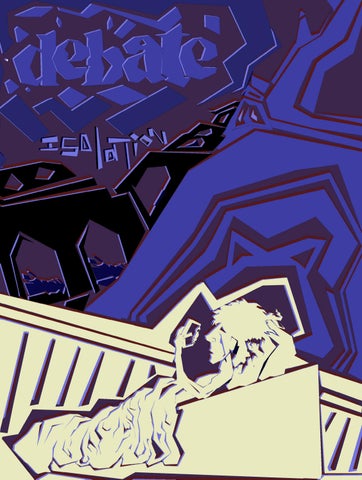
About Us Kia ora! We’re Debate, your free student magazine at AUT. Each fortnight we scatter magazines across campus talking about student news, art, and culture. Each issue is made by us and a small team of contributors - no AI was used in the production of any work to our knowledge.
FOLLOW US ON INSTAGRAM @debate_mag Editor Tashi Donnelly
Associate Editor Liam Hansen
Arts, Culture & Te Ao Māori Editor Skye Lunson-Storey
Digital Marketing & Social Media Manager Madeline Bradley
Graphic Designer Sophia He
Contents 4 6
Column News
8 News 10 Feature 12 Short Story 14 Column 16 Kōrero Toi 18 Feature 20 Drugs Column 22 Art 24 Te Ao Māori 26 Promo 28 Feature 30 Reccs 32 Comic 34 PUZZLES 36 Te Ao Māori 38 Visual/Comic 40 Column 42 Visual 44 Feature
TITLE--Editorial - The Island in All of Us Why is the ACT Party asking students to defund their own services? 2026 General Election Intersex Loneliness “Death” One Moon - A Room Full of Strangers Isolated from the Whenua How to Exist in a Feeling Spa Days and K Holes Floating in Space Fuck I love isolation. “We Are All Basically Good” Book အိမ်တွင်းပုနး် (eain twin pone) catto’s GAME RECCS: Different flavours of isolation “The cat’s home” PUZZLES Isolation: A Bubble of My Own Making The Isolating Nature of Amatonormativity Dread and Circuses: Uni’s over, what now? Horoscopes Sep 7th - Sep 21st NZIFF Round Table Discussion
DISCLAIMER Material contained in this publication does not necessarily represent the views or opinions of AUTSA, its advertisers, contributors, Nicholson Print Solutions or its subsidiaries. This publication is entitled to the full protection given by the Copyright Act of 1994 (“the Act”) to the holders of the copyright, being AUT STUDENT ASSOCIATION (“AUTSA”). Reproduction, storage or display of any part of this publication by any process, electronic or otherwise (except for educational purposes specified in the Act) without express permission is a break of the copyright of the publisher and will be prosecuted accordingly. Inquiries seeking permission to reproduce should be addressed to AUTSA. Debate is a member of the NZ Media Council and subject to its complaints procedure. Complaints about stories must first be directed in writing to us (provide link) within a month of the story being published. If you are not satisfied with our response you can complain to https://www.mediacouncil.org.nz/complaints/. You will need to attach a copy of the article complained about and any correspondence you have had with us.
CREATOR--Tashi Donnelly Liam Hansen Tashi Donnelly Mathilde Redamare Adam McGarvey Priscilla Zhang Skye Lunson-Storey Frederica Sang Isaac Tenzing meoskyan_art Ivy Lyden-Hancy Tashi Donnelly Mona Aung meoskyan_art Cindy Xu Taigaga Rerecich meoskyan_art Luke Fisher László Reynolds The Round Table
FRONT COVER A.V Des Forges (she/her) @vraikalzre CENTREFOLD @meoskyan_art CONTRIBUTORS Niamh Donnelly, Mathilde Redamare, Adam McGarvey, Priscilla Zhang, Frederica Sang, Isaac Tenzing, Ivy Lyden-Hancy, Mona Aung, Cindy Xu, Taigaga (Jamal) Rerecich, Luke Fisher, László Reynolds, Ricky Lai, Trevor Pronoso, Caeden Tipler, Madeline Smith, A.V Des Forges
DATE OF PUBLICATION: SEPTEMBER 2026
4
debate mag
| isolation |
issue ten 2026
---------------------------------------------------------- Issue #10 - Isolation Editorial ------------------------------------------
The Island in All of Us When I chose this issue’s theme, I knew it would be popular. With Covid-19 lockdowns only five short years behind us and the now decades-long handwringing over social media addiction, I knew that the university students of today would have a lot to say about isolation. However, this theme has proven to be so popular that, in a frenzy of excitement, I accepted more articles than I should have and went way over budget. If I lose my job due to reckless spending, at least I’ll die on a hill of beautifully written and thoughtful articles. When I read အိမ်တွင်းပုနး် (eain twin pone) by Mona Aung, my eyes teared up a little. Her work captures those very universal feelings of introversion and loneliness, but in a way that feels deeply personal to Mona’s experience. Similarly, Priscilla Zhang, in her column One Moon, reflects on isolation as an international student. Her article reminds us that loneliness isn’t always about the number of people around you. In both of their works, I found myself using an important muscle: sympathy. I can’t relate to the experience of being an international student, nor of being born intersex. So when I read Intersex Loneliness, I stretched my sympathy muscles further. Mathilde Redamare’s experience is uniquely ordinary for people who fall under the intersex umbrella. Isolated not by physical distance, but by the absence of language, information, and recognition. Their loneliness speaks to
the ways isolation can be created not by difference itself, but by being denied the language, information, and community that would allow you to understand that difference. In Adam McGarvey’s short story Death, we’re confronted by the grim realities of work as a paramedic and asked to contemplate the ultimate, final isolation. Luke Fisher’s article, Dread and Circuses: Uni’s over, what now?, made me laugh, as his articles always do. It warmed my heart to read his romantic fantasies, something I crave to see more of from the Straight White Male Community. Romance ain’t just for girls, fellas! Just don’t make it weird.
Ivy Lyden-Hancy’s piece Fuck I love isolation offers a healthy depiction of isolation, one that’s full rather than
debate mag
| isolation |
empty; a place for music, nature, gaming, whakapapa, memory, and community. It made me think about the word’s etymology, from the Italian isolato, meaning “made into an island”. Isolation: A Bubble of My Own Making explores a different kind of separation. Between law school, friendships, and the tension of moving between te ao Māori and a Pākehā-shaped academic world, Taigaga Rerecich describes the strange experience of being surrounded by people while still feeling like you are speaking a language nobody else quite understands. It is a reminder that isolation can be measured by the distance between experiences. And, beautifully, the piece finds its antidote not in abandoning one world for another, but in finding people who can move between them with you. The more pieces I read, the more I was struck by a strange kind of paradox: that a feeling defined by disconnection can, in itself, become something that connects us. Isolation is a theme I’ve explored extensively in my own work, and at times I’ve worried my art is too self-centered because of it. But for those who can relate to my experience, my art is a comfort, and for those who can’t, it’s a lesson. That’s what I love about stories; they make us use that sympathy muscle I mentioned earlier. Each contributor approaches isolation differently, yet together, their work invites us to connect more deeply with one another.
issue ten 2026
I’ve always thought the beauty of the human experience is how uniquely the same we all are, and here in these pages, I’ve found that to be true. Written by Tashi Donnelly (she/her) @tashi_rd EDITOR-IN-CHIEF
Illustrated by Niamh Donnelly (she/they) @zaxoof CONTRIBUTING ARTIST
5
6
debate mag
| isolation |
issue ten 2026
---------------------------------------------------------- NEWS ------------------------------------------
Why is the ACT Party asking students to defund their own services? Election campaigns are generally opportunities for parties to blue-sky, spelling out each of their priorities, policies, and prayers for the election long before they’re held accountable for anything they promised on the trail.
students are made possible thanks to the Student Levy Agreement included in tuition costs. Where your tuition fees go into your studies, this fee funds student associations and media (like Debate), campus cafes and bars, events, and services like healthcare, counselling, clubs, and societies.
The consequences of this have already been felt in 2026, as Luxon’s comfort in the non-menacing talkback booth of This follows on from changes ACT made Mike Hosking gave him the opportunity under John Key’s government in 2011, to, in the words of the totally loyal Chris where student union membership was Bishop, start “musing around the concept made voluntary. Access to food banks, of a referendum in healthcare, and financial This is a problem that the amongst the conversation assistance was locked ACT Party created by making behind a series of around constitutional arrangements, four-year student membership voluntary, hardship applications that decentralising student terms, and things like continue to place barriers services and splitting them on students to feed that”. between disconnected teams themselves, find housing, across various departments, and confidently complete The plans thrown into the campuses, buildings and air in the election period their courses. budgets. aren’t just causing failed coups in the Beehive. Parmar, the ACT Party Amongst the myriad of ACT Party policies Tertiary Education spokesperson who that fan the flames of unnecessary culture also celebrated the dismantling of wars against migrants and trans people, Fees Free, says that “universities have MP Parmjeet Parmar, a migrant who undermined the spirit of Voluntary transitioned from National to ACT after Student Membership by absorbing the she lost her seat in the 2020 election, has old association fee into a compulsory levy spearheaded the proposition of making that students still cannot refuse.” the University Student Services Fee, also known as the Student Levy Agreement, The removal of compulsory membership voluntary. made student associations reliant on their universities, a problem Parmar For context, we, our bosses at AUTSA, herself points out in the press release: and every other service designed for “ACT’s policy will also restore the
debate mag
| isolation |
independence of unions to challenge university leadership. Unions are meant to hold the bosses to account, but there’s a huge conflict of interest when they’re dependent on the university for funding.” This is a problem that the ACT Party created by making student membership voluntary, decentralising student services and splitting them between disconnected teams across various departments, campuses, buildings and budgets. What was once consistent funding and support is now fraught, leading to fractures within the communication between these different student services and the university itself. These are fees that the university doesn’t want to pay for, but needs. So the responsibility is shifted onto students, firstly to seek out access to the services they need, and now whether or not they exist at all. This is a strategic way to gut the budgets of universities, but the point of it all seems more in line with the party’s bitterness that their anti-student policies are being opposed by students. “Right now, student unions are running political campaigns to influence the election. They might even campaign to stop this policy. Students are forced to fund this activism, even if they disagree with it.” Once again, the party has forgotten that unions are made up of students. “ACT says unions are free to campaign, but no-one should be forced to fund them.”
issue ten 2026
On an unrelated note, Parmar has used her taxpayer-funded salary to develop five new rental homes and investment properties since the government cut tax on landlords. Written by Liam Hansen (they/them) @liamhanse.n ASSOCIATE EDITOR
7
10
debate mag
| isolation |
issue ten 2026
---------------------------------------------------------- FEATURE ------------------------------------------
Intersex Loneliness Since my family moved from the UK, I had always lived in the same suburb in Ōtautahi. My parents had made an effort to develop the same deeprooted connections that we had left behind. We got involved with our local church, accepted every invitation to spend time with classmates after school, and we participated in as many clubs as were possible for us. Life started to feel normal – settled. Even after the earthquakes, our community was there to support us, and we all worked together to rebuild what we could. It was only in puberty that things started to change quite quickly for me. I had been told how I would begin to change – but I just… didn’t? My classmates were growing taller, were developing, and they seemed to be taking it in their stride. Of course I had no idea what was occurring, but as children, we develop our own theories that weave into our developing understanding of the world. In a life that now had quite a shaken foundation, faith had become my bedrock. I thought “Well, I have never felt like a boy or a girl, so maybe this is God’s way of taking care of that?” When puberty did start, it was not what I expected. People would comment on how feminine I was becoming, my proportions, my voice – it was, I think, the first time that I felt dysphoria. I wasn’t becoming one thing or another, but something in between. I tried to get help, to understand what was occurring. Also to try and fix it, which is what I felt I needed at the time. I wanted to start cross-sex hormones to try and make me more male or more female. I wanted information on why I was the way I was. More than anything, I needed other people like me around me. As it was, though, the medical system at the time just did not know how to deal with me (I genuinely had one doctor ask me “Why would you even want to know that” as if having a label I could fit my body into would somehow
be more isolating). Quite frankly, I didn’t have the language to communicate what I was experiencing. That is why it is so important to visibly and vocally platform intersex people. Had I known there were other people out there like me, childhood and adolescence would have been a lot less isolating and upsetting. As an adult, knowing that I am intersex, and working to build networks of intersex people who can care for each other and share their experiences, I have heard so many stories that echo my own. The details change, but the loneliness is often remarkably similar: knowing that something about your body is different, while being denied the language, information or community that might help you understand why. Being intersex simply means that your anatomy, gonads, hormones and/or chromosomes do not lie neatly within what is typically considered “male” or “female”. Some people, like myself, find out that they are intersex during puberty or later in life. Others have their variation identified at birth, although this does not necessarily mean that they grow up knowing the truth about their own bodies. For people whose intersex variation is identified during infancy or childhood, that knowledge has often belonged to everybody except them. Medical information may be withheld, surgeries may be performed before they are old enough to understand or consent, and the existence of those surgeries may themselves be treated as a family secret. Rather than being supported through an intentional process that centres their body, experiences and identity, many intersex people discover the truth accidentally: through an overheard conversation, a family member letting something slip, or the eventual discovery of their own medical records. In a 2017 report produced by Human Rights Watch and interACT, an intersex woman given the pseudonym Ruth described finally obtaining
debate mag
| isolation |
the records that had been kept from her. The first thing she felt was relief: this was a known thing, and there were other people like her. That relief quickly became anger. “These fucking bastards lied to me all the time,” she recalled thinking. “I wish I had known there were others like me.” Her question cuts directly to the cruelty of secrecy as a supposed form of protection: “Why would you deliberately try to make a person feel like a freak?”¹ This is one of the most persistent threads running through intersex stories. People are made to feel that they are the only person in the world with a body like theirs, while simultaneously being warned that telling anybody would make them an outcast. The loneliness is not created by being intersex. It is created by being isolated from the information and people that could make being intersex understandable. For Irene, an intersex advocate from Russia, that isolation was broken not by her family or doctors, but by an online video. Seven years after undergoing surgery she did not fully understand, she watched intersex people discussing their experiences and immediately recognised something of herself: “Oh shit, that sounds kinda like me! I need to get my medical records!” After asking questions and finally receiving the records her father had kept from her, she discovered that she was intersex. For the first time, she wrote, she knew that she was not alone.² The relief of recognition did not erase what secrecy had already taken from her. Irene later reflected that being told the truth could have saved her from “seven years of shame, selfhatred and depression”. Her entire life, she believed, might have been different.² There is a particular grief in finally finding the language for yourself and realising how much less lonely you could have been had somebody trusted you with it sooner. Intersex filmmaker and activist River Gallo described a similar moment of recognition. While researching their film Ponyboi, they encountered intersex people speaking publicly and proudly about who they were. Until then,
issue ten 2026
Gallo had understood their body primarily as a private medical abnormality. Seeing intersex represented as an identity they could openly claim changed that. “I felt a palpable surge of love and pride for my body for the first time,” they wrote.³ That is why visibility matters. Seeing another intersex person does not simply provide information; it can completely reorganise the story somebody has been taught about themselves. A body understood in isolation as a mistake can instead become part of a shared human experience. Shame can become recognition. Secrecy can become language. Loneliness can begin to give way to belonging. Had I known there were other people like me, my own childhood and adolescence might have been very different. I may not have felt such an urgent need to change my body into something more recognisably male or female. I might have understood that I was not failing to become one thing or another. I was simply becoming myself. For more information, visit intersexaotearoa.org. Sources: 1. Kyle Knight, “‘I Want to Be Like Nature Made Me’: Medically Unnecessary Surgeries on Intersex Children in the US,” Human Rights Watch, 25 July 2017, produced with interACT. 2. Irene, “Can You Be Born Intersex Without Knowing About It?”, interACT: Advocates for Intersex Youth, 26 October 2016. 3. River Gallo, “I Didn’t Know I Was Intersex— Until I Made a Film About an Intersex Character,” Them, 19 November 2018.
Written by Mathilde Redamare (they/them) CONTRIBUTING WRITER
11
12
debate mag
| isolation |
issue ten 2026
---------------------------------------------------------- SHORT STORY ------------------------------------------
“Death” We had been called to a “potential overdose” - a considerable understatement. I knew before we arrived it would be Zane, our frequent flyer. Zane had clearly overdosed several days prior and was now assuming room temperature. He’d failed to check in with his parole officer, so the Police had been called. They saw the drug paraphernalia, the homemade tourniquet with a needle hanging precariously out of his vein, then called us. Standing in the apartment of a drug addict is a humbling experience. It is a stark reminder of a path not taken. This job is invasive. We go into houses, take off clothes and go through drawers but this apartment had nothing to invade. No furniture except a dirty worn mattress in the middle of the floor with a halftorn blanket. No food in the fridge, no books on the shelves, no TV. Just Zane’s body and the life he’d left behind. I felt a familiar mental split, one every paramedic knows. You can approach this job cold, uncaring, burnt out or you can carry the baggage and leave a small piece of your soul behind after every painful job. I’ve always been the second, despite desperately wanting to be the first. I don’t understand how you can be completely disconnected but I’m often criticised for being too involved. I was trying not to care tonight, but I did. It’s just the way I’m wired. Tonight would be our last night together, Zane and I. I’d spent my entire career interacting with him, watching him transition from a young man suffering acute alcoholism through a slow descent into the gentle warm embrace of heroin. Now he was just another dead patient, sad as that is to say.
Milling around the room was a police officer who I didn’t recognise, clearly senior. You can usually tell who is by how they carry themselves around a deceased person. For most of us on frontline, death is a dime a dozen. The first one is awful, the second one less so. Slowly it becomes routine. The senior officer was on the phone, pacing back and forth. I mouthed to him, “Can I bring your offsider in?” He shrugged and motioned towards the door. Like any traumatic situation, our first interaction sets a standard that we follow through our lives. No one ever wants death but it’s part of the job. I think it’s important that we get it right. I remember my first, and for the officer standing outside the apartment, this was her first. I walked outside. She was leaning up against a wall, early 20s, fresh out of police college. Uniform slightly too big, too much make up, head down. I asked her, “Please come inside, this is important.” Reluctantly, she stood up straight and moved to follow me, never looking me in the eye. I led her towards Zane and stopped. “I would like to introduce you to a friend of mine. This was Zane. What made him a person, able to interact and care and love, is gone now.” “What is gone is a thing known by many names. You might call it his spirit, or maybe his soul.” “What is left is the vessel that Zane used in this world.” “The most caring, most loving thing that we can do for Zane is to take care of that vessel
debate mag
| isolation |
for him, not because we want to but because we have to. We have no other options left.” I paused and looked at her. She looked at the ceiling, then back to the ground without looking at anything in between. I continued. “Are you familiar with Greek mythology?” I asked. She looked at me, puzzled. “Not really.” “Have you seen Hercules?” “The Disney movie?” she said. “When I was a kid.” “Perfect, you know Greek mythology then.” I walked around Zane and stood opposite her. “We are standing on the banks of the River Styx, the river that separates the world of the living from the world of the dead. “No one else is standing on the banks for Zane tonight. If we weren’t here, no one would be. We are here because there is no one else coming. “The only thing we can do is the last thing we can do. We are helping Zane cross the river and on to whatever comes next.” She shifted her weight on her legs and dropped her shoulders a touch. Her eyes moved from the floor to Zane’s face.
issue ten 2026
Zane didn’t respond. I didn’t expect him to. But you never know. “Are you going to call his mum?” the young officer asked. “No, that is actually a job for you guys,” I said. The senior officer interrupted his call. “They’ve already been dispatched and will be speaking with her shortly.” “What horrible news to receive, she’s going to be devastated,” she said as she knelt down beside me. “She will be and the pain will be overwhelming, but I can promise you that the last thing she will feel tonight before she goes to bed is relief.” The young officer looked me in the eye for the first time. “Zane has lived a hard life and has suffered an extraordinary amount of pain. She will mourn his death like any parent would and will wonder what could have been. But most of all, she will be relieved that the pain is over and thankful she doesn’t have to spend another night wondering if he is OK. She won’t like that she is thankful, but she will be.” She looked at me and I looked at her. Her hand hovered for a moment, uncertain, before she reached down and held Zane’s hand. Her first.
Her breathing had changed, slower now, more purposeful. I knelt down beside Zane. “Zane, unfortunately this is our last dance, my friend. The undertakers will come to collect you soon. We will call Mum and let her know what has happened. Do you have any questions?”
Written by Adam McGarvey (he/him) @harpertownnz CONTRIBUTING WRITER
13
14
debate mag
| isolation |
issue ten 2026
---------------------------------------------------------- ONE MOON COLUMN ------------------------------------------
A Room Full of Strangers Last week in counselling class, we were talking about trust. One idea from our handout stayed with me: sometimes, the people who put the most energy into helping others or giving advice are the ones who find it hardest to share their own concerns. I recognised something in that. Moving to another country has made me think about trust differently. You can meet people easily. Saying hello is one of the most ordinary things you do every day. Trusting someone is another matter. When you move to another country, almost everything has to be built from the beginning. New places. New routines. New faces. New ways of speaking, joking and studying, even knowing when it is appropriate to ask someone a personal question. There is a Chinese saying that when you give a rose, the fragrance stays in your hand. I have always liked the idea behind it: what we give to another person does not simply leave us. Something remains. Perhaps trust works in a similar way. When we offer someone our trust, we are not simply giving something away. We are also creating the possibility of receiving it back. Every week, we sit in a circle, taking turns being counsellor, client and observer. Face- to- face, it can feel strangely confronting. There is nowhere to hide for very long.
Someone shares something personal, and the rest of us listen. Someone takes a risk and speaks honestly, and the room makes space for it. Someone allows themselves to be uncertain, and nobody rushes to fill the silence. You begin to notice how someone pauses before answering, how their voice changes when something matters, how difficult it can be to sit with silence without immediately trying to fill it. And somewhere in that process, something changes. You start offering trust. And, slowly, you start receiving it too. Perhaps belonging is not only about finding people you can hold space for. Perhaps it is also about finding people who will hold some space for you. Before studying counselling, I had already experienced what it feels like to want to help someone and not knowing how. Someone very close to me went through a very difficult period in her life. I wanted to help her. I wanted to understand what she was experiencing. I wanted to say the right thing. But wanting to help someone does not mean knowing how to reach them. Sometimes you can stand beside someone and still feel impossibly far away. I used to think that being there for someone meant doing something: giving advice, finding solutions, making things better.
debate mag
| isolation |
Now I am beginning to understand that sometimes, being there means something much quieter. Listening. Staying. Making enough space for another person to be themselves. When you are far from home, it is easy to think of isolation as being alone. But loneliness is not always about the number of people around you. Sometimes you can sit in a classroom full of people and still feel like an outsider. Sometimes you can speak the same language and still feel that something has been lost in translation. And sometimes, unexpectedly, a room that was full of strangers four weeks ago can begin to feel like a place you belong. I don’t think I have stopped being an outsider. I am still an international student. There are still things I miss from thousands of kilometres away. There are still memories of home that the people around me cannot share. But perhaps belonging does not require becoming indistinguishable from everyone else. Perhaps it begins with something much smaller. Someone remembers your name. You feel safe enough to speak. Silence no longer feels awkward. You realise that you are not only listening to other people anymore. You are letting them listen to you, too.
issue ten 2026
And then the class ends. I look around and think about how strange it is. Four weeks ago, we were complete strangers. Now we have shared feelings, listened to each other’s stories, and trusted each other with things we might not normally say out loud. It is a little crazy when I think about it. And I am grateful. Grateful for the privilege of hearing your stories and your feelings, and, perhaps just as importantly, for the chance to let you know me, too.
Written by Priscilla Zhang (she/her) @p.zhangxy CONTRIBUTING WRITER
15
16
debate mag
| isolation |
issue ten 2026
---------------------------------------------------------- KŌRERO TOI ------------------------------------------
Isolated From the Whenua Art has the ability to become a bridge between people and the environments they inhabit. Through processes of colonisation, urbanisation, and extraction, we have increasingly become disconnected from our environment. Isolated from the whenua that sustains us. This disconnection is not only physical, but cultural and spiritual. It shapes the ways we understand land, water, forests, and the other life forms that exist alongside us. This piece considers how colonisation has contributed to our isolation from the whenua, and how contemporary art can help reconnect us with Papatūānuku and te taiao. Through the practices of artists Yona Lee, Ana Iti, and Louise Pōtiki Bryant, I reflect on how art can encourage us to become more present within our surroundings and reconsider our relationship with the natural world. Yona Lee’s large-scale sculptural installations demonstrate this power of noticing. Through site-specific works constructed from welded stainless-steel pipes, Lee maps and responds to the spaces around her, bringing together urban, domestic, and infrastructural materials. Every time I sit on a bus noticing the rigid tubular metal structures within, I cannot help but be reminded of her work. I remember first encountering Lee’s work at Auckland Art Gallery before deciding to pursue visual arts. At first, I was perplexed by it, but the work stayed with me. Although Lee’s practice does not specifically address the whenua, her installations have the ability to make the viewer conscious of their surroundings within an urban and domestic environment. Her work asks us to look again at the structures we move through every day. As a South Korean-born New Zealand
artist, her work also engages with ideas of migration and diaspora, further expanding our understanding of place. Ana Iti’s practice moves more directly into the relationship between colonial histories, infrastructure, and the natural environment, developing a visual language from industrial and infrastructural materials. Recently, I encountered Ngahere behind a pile of Metal at Christchurch Art Gallery Te Puna o Waiwhetū. The work references the infrastructure and industry surrounding kauri logging in Te Tai Tokerau, beginning with a kōrero between Iti and her uncle about how to locate kauri on hapū land. The work establishes a strong connection between rākau and wai, while highlighting the impact of extractive practices on the whenua. A sawtooth drawing made from burnt kauri charcoal traces the gallery walls, while a chain-metal pipe structure replicates the marine cranes used to transport logs through waterways. The machinery becomes a drawing in itself. Through repeated encounters with the work, my understanding of it shifted. In my most recent encounter, I could not shake the resemblance between the industrial crane and the immense scale of a tohorā (whale). The machine, which once represented extraction, began to evoke another living presence within the environment. Louise Pōtiki Bryant offers another way of reconnecting us to the whenua through movement. As a choreographer, dancer, and video artist, Pōtiki Bryant has a rich foundation from which to explore relationships between people, land, water,
debate mag
| isolation |
and whakapapa. In Te Hā o Papatūānuku, she considers how whenua is changed by the movement of water, reflecting on the devastation of Cyclone Gabrielle in 2023 and the inseparable relationship between water and land. There is one moment in the work that particularly stayed with me. A figure curls into a fetal position while silt, soil, and speckles stream across their body, almost resembling a galaxy. For me, this subtle moment reflects on how we are the whenua. We come from the earth and the stars, and eventually we return to Papatūānuku. The body becomes both human and landscape, dissolving the boundary between ourselves and te taiao. Similarly, Ka Tiri o te Moana, a collaboration between Atamira Dance Company artists and Pōtiki Bryant, directly addresses climate change and sea-level rise caused by Antarctic ice melt. The work brings a global environmental crisis into relation with coastal communities here in Aotearoa, reminding us that these changes are not distant or abstract. They are already affecting ways of living. These artists demonstrate that art can provide a space for reconnection; they ask us to become attentive to the environments we occupy and the histories embedded within them. The human-centred way of thinking that prioritises development and economic growth has contributed to the loss of lives, homes, livelihoods, and significant amounts of money following environmental and natural devastation. We already have much of the knowledge required to design and build with these risks in mind. What is often missing is the political will, foresight, and aroha to put that knowledge into action. Being isolated from
issue ten 2026
our environment does not protect us from it. Instead, it can leave us less prepared to understand and respond to its changing conditions. This is where I see art playing an important role. Art can create an encounter with our surroundings that shifts our perspective on what is often overlooked. The whenua will continue beyond us, but the question is what kind of relationship we choose to have with it while we are here.
Written & Illustrated by Skye Lunson-Storey (they/them) @uku_rangi ARTS, CULTURE, TE AO MĀORI EDITOR
17
18
debate mag
| isolation |
issue ten 2026
---------------------------------------------------------- CULTURE ------------------------------------------
How to Exist in a Feeling In loneliness, you can experience the world anonymously, untethered to identity, and with space to experience a moment in an all-encompassing way, instances very worth seeking. Now, when most people fill their rare and frequently interrupted alone time with music, it becomes obvious how solitary an experience sound can be. On the other hand, live music totally counters this isolation with collective feeling, getting to be one person in a crowd of others who feel the same thing. Going to a gig by yourself, you’ll probably anticipate loneliness that never quite arrives; you are anonymous and can open yourself completely to a moment, to fill yourself, void of expectation, with a feeling that connects you to others. Being a passing figure concertgoers won’t remember, you can experience everything with a singularity that is yours alone while surrounded by people. The vitality of music fills people with the humanity of the sound and creates a new sense of being in the communal response to the strains and chords. This experience extinguishes the surface-level, leaving an inner freedom to be part of the music, unconditioned and unhindered by perceptions of strangers in the darkened room. The sound has an identity that becomes part of you when you’re alone in a crowd and listening; it awakens a newness that is feeling, that is response, and that is connection. The music becomes the voice of every person in the jumbled, seeking congregation. Facing forward in a sea of people on rafts of crushed cans, you are concerned only with the immediate. Existing in that moment is eternity, soundwaves moving through your skin and bones like dominoes. In The Perks of Being a Wallflower, this experience is described as feeling ‘infinite’. The music
makes you feel free from the endlessness of pasts and futures, you are simply existing in the moment, unconstrained and knowing that somewhere another person has and will experience this same moment. Being a link in that chain and immersing yourself in what others are feeling there at the concert right beside you makes isolation impossible. To hear live music is transformative; you get to be encompassed by sounds and emotions that exist in their own right. In this, you learn to exist just in feeling and in sense, becoming connected to the others who share this moment with you, ignoring external commands, and listening to emotion. You become transitory, existing in the feeling of the sound and made for this moment; it is a mind and a reality that every person in the crowd gets to be a part of. By navigating a concert alone, you can discover a version of you that exists in the collective experience and in your understanding of someone else’s world. In this shared feeling, you are unattached from yourself and perceptions, and despite being a solitary individual in a crowd, you are not homeless; as a member of this group experience, all voices become one, connecting and responding to the music, feeling the sound, and never being isolated. Each lone person becomes unified in experiencing and filling themselves with music in its rawest, most human form so completely, and suddenly, you are far from isolation.
Written by Frederica Sang (she/her) @freddiesang.art CONTRIBUTING WRITER
debate mag
| isolation |
issue ten 2026
19
---------------------------------------------------------- “DEGENERATE GUIDES & ALTERED STATES” COLUMN ------------------------------------------
20
debate mag
| isolation |
issue ten 2026
Spa Days and K Holes Theoretically endless. The answer to both how long a piece of string is and how many videos you can find of Joe Rogan talking about isolation tanks on YouTube. The wellness influencer community seemingly has a new topic for their self-help manuals every other week. Podcasts recorded en masse aim to sell your soccer mum neighbour on the idea of cortisol management. Humorously enough, infatuations with these mindfulness techniques are not just isolated to affluent, suburban Audi Q5 drivers, but also extend to the almondeyed, stoned, psychonaughtical substrate as well. You see, altered states are not just bound to that of exogenous chemicals, but can also include meditation, fasting, holotropic breathwork, yoga, and the aforementioned isolation tanks. As I exchange my birthday gift of one free float at a North Shore wellness centre, I submerge my naked body into the alien embryo and prepare myself for the small possibility of a sci-fi Ken Russell full-body ego dissolution. As I drift into the ganzfeld, I am immediately cued back into reality as I float repeatedly into the walls and listen to the staff intermittently talk shit outside, as the earplugs are not my size. Nonetheless, as I hover weightless in the magnesium sulfate, I let my mind wander (in an arguably not very meditative manner). I find it all very remarkable that the sensory tank experience can be this ubiquitous. Right next to yoga rooms and saunas, we have the claims of potential full physical, temporal, and
mental dissociation. Stationary relaxation, sedation, bodily numbness, and reports of potential hallucinations. Perhaps this is more than just a wonky thought. Are wellness centres selling people K-holes? Ever since scientific literature got a hold of psychedelics, attempts at isolating the experience from the environment have been the goal. The 60s were an unprecedented time for drug research, and isolation tanks were crafted as a means to get as close to an unbiased report on effects as we could get. They’re still used for this very reason today. John C Lilly, inventor of isolation tanks, was a notorious psychonaut and spelunker of his own mind, including uses of ketamine (or as he labelled it, Vitamin K). Not only did John C Lilly use Vitamin K and isolation tanks, but he actively pursued this poly combination. “Lilly then began injecting himself and at one point was taking 50 mg of ketamine an hour, 20 hours a day, for three weeks” (Is Your Kid on K?”, TIME). This is in reference to his time with his own invention as he explored “internal” and “extraterrestrial reality”, as he liked to put it. Built within the very history of this Takapuna wellness centre is that of ketamine and dissociative use. The Vitamin K, sensory deprivation blend certainly didn’t start and end with Lilly. The individual, isolated mental experience has long been replicated, including the famous D M Turner, a psychedelic researcher who tragically passed away in his own homemade isolation chamber (made using his bathtub) after taking
debate mag
| isolation |
intramuscular ketamine injections. It is unsurprising that drugs curating these dissociative experiences are apexing in use in a post-Covid society. As mainstream as social lubricating drugs such as coke and pingas are, young people are seeking dissociative and independent states in an unprecedented way. In a world of atomisation, remote working, social separation and angry protests coming past your front door seemingly every other day, the prevalence of a drug that thrives on mental isolation is no longer some work of fiction from a Phillip K Dick novel. The numbness of touch, impairment of movement and talking (not to mention, at high enough doses, it makes you lose consciousness). Everybody feels anxious, derealised, and isolated. Ketamine is the 2020s in long shards. As bird chirping.wav cues the end of my floatation experience, I awkwardly paddle to the latch (and stupidly pick up my phone first and get salt all over it), and shower the magnesium chunks off me. I reflect on the past hour of almost pure, unadulterated isolation. No external stimuli, no bodily sensations, and a long distraction from the world. In other words, I raw dogged an entire hour. In many respects, getting up felt like coming down. Despite this, I felt a calm and omnipresent satisfaction with the world. A hint of euphoria washes over me as I regain the familiar feeling of my body. Perhaps I am too young to have lived through the selling of that delicious Y2K optimism. However, it appears I was born just in time to be sold pure, unsullied Silk Road isolation.
issue ten 2026
References • Cloud, J. (2010, August 2). Is ketamine a quick fix for hard-to-treat depression? Time. TIME. https://time.com/ archive/6934568/is-ketamine-a-quick-fixfor-hard-to-treatdepression/ • Isolation tank. (2022a). In Wikipedia. https://en.wikipedia.org/wiki/Isolation_tank • John C. Lilly. (2022b). In Wikipedia. https:// en.wikipedia.org/wiki/John_C._Lilly • Rasmussen, M.D., K. G. (2024). Chapter 3. recreational use of ketamine: The world discovers the K-hole. Ketamine, 23–72. https://doi.org/10.1176/appi. books.9798894551944.lg03 • VICE. (2013a, April 30). Sensory deprivation tanks: Part 1/3 (documentary). YouTube. https://www.youtube.com/ watch?v=yCYglCDgpu0 • VICE. (2013b, April 30). Sensory deprivation tanks: Part 2/3 (documentary). YouTube. https://www.youtube.com/ watch?v=0fRTk9F9FGU • VICE. (2013c, April 30). Sensory deprivation tanks: Part 3/3 (documentary). YouTube. https://www.youtube.com/ watch?v=Q0AcjQzpDY8 • VICE. (2022, July 16). Pissing blood: The ketamine time bomb | high society. YouTube. https://www.youtube.com/ watch?v=99XQY7Elwhc • VICE News. (2025, September 25). The hidden side of Psychedelic Research Ft. Hamilton Morris | Shane Smith has questions. YouTube. https://www.youtube. com/watch?v=VSx-bXNJPYk • Wikipedia Contributors. (2026, June 18). D. M. Turner. Wikimedia Foundation. Wikipedia. https://en.wikipedia.org/wiki/ D._M._Turner?utm_
Written by Isaac Tenzing COLUMNIST
21
22
debate mag
| isolation |
issue ten 2026
debate mag
| isolation |
issue ten 2026
23
24
debate mag
| isolation |
issue ten 2026
---------------------------------------------------------- TE AO MĀORI ------------------------------------------
Fuck I love isolation. Isolation is my tohunga; I’ve learned to love it. Everyone thinks it is an escape, but it is a way of being. Instead of young ho, I am an isolated ho. In a world that never stops moving, I feel like the pigeons at Brito: domesticated by concrete, trained by routine, then cast aside to fend for myself. The city feeds me crumbs of connection, but it’s in solitude that I find the last supper. My isolation feels full. It’s a ngahere whispering through my headphones, even when nothing’s playing. You will never find me without them. Years have torn at my headphones, but the bass of my music is still as strong as the day I got them. Thank you, @loihoosi, my brother bolo, for my 18th birthday gift, a way of blocking out the noise. When I’m gaming, I feel the same peace I find in nature. The hum of the console becomes cicadas in summer; the glow of the screen becomes moonlight on water. I’m just as happy jamming my game as I am touching grass, watching the wind move through leaves. Both are worlds where I exist. In both, I’m free from the demand to perform. I hate the idea of performance; I feel like I am always performing, but my isolation means I can stop, like a jester with a dead king. Isolation is not always sunshine and rainbows. There was a time when it swallowed me completely. I bedrotted in Unilodge for weeks on end, only leaving for work. I disappeared into my own
silence. I thought I’d stay there forever. Then came my mates on dc, James, Jess, Anfo Tony, and suddenly the silence had company. We’re a weird-ass friend group: three boys, two girls, people who weren’t even mates in high school. Now we live through screens and laughter. Fuck, I’ll love them forever. I work night shifts, so I go to sleep when the birds sing. I know Tamanuiterā misses his baptism of my tinana. I crawl on the walls of my skull like my tīpuna. Tracing sketches of their bones through this. My tongue is tied, and I am sleepy now that the moon has taken my ngākau. In his hands we trace the walls of my mind. Now I’m stuck inside this motion; I need air, but the waters are so comforting, but fuck metaphors. I’m tryna be in the sea like Moses; what is a world without love? I think I’m a fucking jellyfish eating away at all that is left of itself. I hate the heat; my TV is a heater. It glows a little now, but I ignore it. My room is a furnace. Up there, where you feel closer to god I wanna run away from all I have built. Insomnia is my new comfort. I stay up coz my dreams are a repetition of my history. I am wrapped in smoke. Is this how Rua felt? Running away from himself. Even growing up at my marae, after playing bullrush with my cousins I would hide in the wharenui, tracing the tukutuku
debate mag
| isolation |
panels, swimming through the sea of my tīpuna. The bustle of the wharekai always overwhelmed me. You would find my cousins and me hiding in the harakeke. Lowkey, that bit us in the ass coz one morning we followed my uncle where he was gutting a sheep, and later in the wharekai, I learnt where meat came from.
issue ten 2026
part of me that longs to not be alone. Fuck, I love isolation. - Tekaraipiture, the scriptures of an isolated ho.
My favourite cousin Jean and I would run away into the chapel, running up and down under the light fixtures of stained glass. I remember running up to my koro, lying under the kauri tree. I would always say “My koro”, but he is all of our koro. The other day I ran away to Taupiri and sat with my nana’s, crying my ass off. I never feel alone with them. Straight up, out of nowhere, 20 goats came out of nowhere, staring at me, staring at them. One of my mates said there were 21; another said it was my tūpuna. I think they just found the jackpot of grass on my maunga. You would think isolation is being all alone, but my isolation is being alone with my people. I think I am a little bit possessive lol. I probably sound avoidant, but there is a normalisation that you need to “save” your people when they get like this. What I am trying to say is, I love being alone with my people. Do not come to save me. I don’t wanna see the sun or others; I don’t wanna hear the drone of your voice. I got my community, and you got yours. I love being alone, and there isn’t even a small
Written by Ivy Lyden-Hancy (she/her/ia) @tekaraipiture CONTRIBUTING WRITER
25
26
debate mag
| isolation |
issue ten 2026
We Are All Basically Good Last year, a friend’s Mum reached out to me and asked if I would be willing to illustrate a book about the life of a Tibetan Lama. Lama Samten, I was told, passed away the year before, and a humble effort was being made to preserve the stories of his life as picture books. I said I would give it a go, and I was sent the manuscript, along with a list of native Tibetan animals I was to draw. “I am Tibetan. My parents came from East Tibet, a place called Golok Gertse.” Venerable Lama Karma Samten lived a life that seems almost unimaginable to me. He was born to a nomadic family, spending his early years surrounded by siblings, aunties, uncles, cousins, and many animals on the Tibetan Plateau. His world changed dramatically when, at ten years old, his family had to escape the Chinese occupation of Tibet. The journey across the Himalayas brought hunger, illness, violence, loss and separation. Of the 40 families who began the journey, only ten made it to Nepal, and eventually only Lama Samten and his father reached India. There, he lived in a refugee camp, working on Indian roads during the day and studying at night.
For all the vast landscapes, dangerous journeys and periods of profound solitude, Lama Samten’s story is about the people who surround us and the small acts of kindness that stay with us long after the person who offered them has gone. Even his earliest memories of solitude are filled with connection: his uncle telling stories in the cave, his sister playing among the wildflowers, his family crowded together inside their yak hair tent. I wanted to highlight We Are All Basically Good in this issue of Debate because of the way Lama Samten speaks about isolation. From his family’s nomadic life on the Tibetan Plateau to his Buddhist training in mountain caves, his story already feels like one of extreme isolation. To those of us who have grown up in suburbs and cities, it’s almost impossible to imagine. And despite Lama Samten’s life being full of hardships and loss, his ultimate message is one of connection. If you would like to read We Are All Basically Good you can email kcbooksnz@gmail.com to order a copy. There are also limited copies available at www.booksonhigh.com
Written by Tashi Donnelly (she/her) @tashi_rd EDITOR-IN-CHIEF
28
debate mag
| isolation |
issue ten 2026
---------------------------------------------------------- FEATURE ------------------------------------------
အိမ်တွင်းပုနး် (eain twin pone) Growing up, she was known in her family as အိမ်တွင်းပုန်း (eain twin pone), an introverted homebody. Living amongst buzzing social butterflies, the volume of words, or just general sound, she generates daily is undeniably lower. She loves speaking, yet she struggles. She tends to take her time with words, acutely aware of the power and weight of a sentence. She’d rather listen more than make others listen to her first and is quite comfortable sitting in silence with another person. She dislikes being spoken over in dinners and gatherings, having her thoughts and intentions assumed or imposed by others, or being criticised for holding her own independent thoughts and beliefs that put her in a nonconformist role in a close-knit community. Her quietness is occasionally mistaken for passivity by some relatives, family friends, and employees of her parents’ construction materials business. Having substantially older siblings and mostly absent yet strict parents provided very few opportunities for companionship as a child. At home, her aunt, her father’s cousin, was the only person who listened to and cared deeply about her thoughts, feelings, and life. She was her special person, and she was hers. Hence, the early separation from her aunt, whom she saw as a motherly figure, utterly broke her. She was 11 years old when her aunt moved away to get married. Looking back, that specific departure must have been the turning point for the youngest child in a Burmese Asian household: she stayed in
her room more often and talked less and less. These experiences left her with a lingering sense of separation, impacting how she sees herself, her worth and her place in this ever-moving world. She was the “good quiet girl” who did not ask for much attention from her family. However, she learnt to use isolation to her advantage. Solitude has been her power and a major source of serenity when life gets overwhelming. In the company of her thoughts, hobbies, and stories in the form of books, movies, comics, art, and music, she feels most at home. She sometimes wonders if reading is what built her individual personality. During young adulthood, she became particularly drawn to texts on pages or screens, seeking explanations for the agonies she faced at home and in school, particularly the love she felt for her parents and her best friend, and making sense of the complexity of emotions and thoughts, especially when they got extreme. Then, she discovered the world of the humanities, in which psychology told her why people behave a certain way; sociology showed her the external cultural factors that shape some private pains; and philosophy taught her that the endurance of human suffering is a natural part of living. In the last 2 years of high school, alongside teenage self-image troubles, her first significant friendship heartbreak
debate mag
| isolation |
drained the life out of her, drip by drip. Not only did she feel unseen at home, but she was also fading in her friendship circle. However, after reading Alain de Botton, a contemporary philosopher who described heartbreak as grief over the death of a future, a self, and a perspective, she began to understand self-compassion. She learnt not to internalise the crisis initially believing that the friend she loved dearly was choosing others over her after seeing something defective in her. Rather, she spoke up about the pain and her needs openly. For the first time, she sided with herself. She sat through the deep ache of alienation at a young age. Without anyone to confide in, she confided in herself. I still sit in that space of discomfort and fear of loneliness, from time to time. However, there is a sense of reassurance in realising that the lonelier the thought, the more universal the feeling often is. Meaning human beings are together in our loneliness, and we actually want the same thing: to belong, to feel seen, to feel understood. I finally see that when I’m seeking solitude, it’s for the love of my own company, and when I’m disappearing, it’s because I’m scared.
Written by Mona Aung (htet_htet_mona) CONTRIBUTING WRITER
issue ten 2026
29
30
debate mag
| isolation |
issue ten 2026
debate mag
| isolation |
issue ten 2026
31
Illustrated by Cindy Xu | (she/her) | @cx0_sunny | CONTRIBUTING ARTIST 32 debate mag | isolation | issue ten 2026
debate mag
| isolation |
issue ten 2026
33
34
debate mag
| isolation |
issue ten 2026
debate mag
| isolation |
issue ten 2026
35
36
debate mag
| isolation |
issue ten 2026
---------------------------------------------------------- TE AO MĀORI ------------------------------------------
Isolation: A Bubble of My Own Making I’ve always thought of myself as a social person. I like people, I like being around people, I like the noise and mess of whanaungatanga. So it surprised me, writing this piece, to realise that isolation is something I live inside every single day. Not the isolation of being alone, but the isolation of being somewhere nobody else I know can quite follow me into. Law school is a bubble. I don’t mean that as a criticism, just as a personal description of what it is. Inside this bubble, everything matters more than it has any right to. A grade, a moot performance, a missed deadline, a triumph in a competition, these things sit on your chest for days. They shape how you see yourself. They become, temporarily, the whole world. And then you step outside the bubble, and none of it means anything at all. Most of my mates are tradies. They’re out on building sites, engineering boats, running crews, earning good money and going home at the end of the day with dirt on their hands and nothing left to prove to anyone. When I try to tell them about a case I’ve been wrestling with, or the pressure of an assessment, they nod politely, and then we talk about something else. It’s not that they don’t care. It’s that the bubble I live in simply doesn’t reach them. It has no gravity outside its own walls. I’ll go from a three-hour negotiation prep session, adrenaline still running, straight to a barbecue where the biggest conversation is about ute trays and how
the Warriors are playing. Two completely different worlds, and I’m the only one carrying both. That’s a strange kind of isolation. Not loneliness exactly, because I have people all around me. It’s more like being fluent in a language nobody else in my life speaks. And for someone who whakapapa Māori, that isolation has another layer stitched into it. Te ao Māori teaches us that we are never truly alone, that our whakapapa places us inside a whakapapa of relationships stretching backwards to tūpuna and forwards to those not yet born. Whanaungatanga is not just some nice concept; it’s the structure holding everything up. And yet, walking into a lecture theatre in first year, I remember feeling the opposite of that. Looking around a room of 200+ faces and counting the number of tauira that looked Māori. Realising that succeeding in this bubble often meant learning to operate in spaces that were never built with tāngata whenua in mind, spaces where the frameworks, the language, even the humour belonged to someone else’s world. That is its own isolation. Not just being one of the few Māori in the room, but carrying the quiet, constant translation work of moving between te ao Māori and the Pākehā-shaped world of legal academia. You learn to code-switch without even noticing you’re doing it.
debate mag
| isolation |
You learn which version of yourself gets you through a tutorial, and which version comes home to your whānau. What’s helped me most has been finding others carrying the same weight. Te Aro Ture (AUT Māori Law Students Society) and the wider community have become something like a second whakapapa inside the bubble, a place where the translation work isn’t necessary because everyone already speaks both languages. Where a negotiation competition can be about strategy and also about tikanga, where governance conversations can hold both Incorporated Societies Act provisions and a karakia. In those spaces, isolation drops away, because the bubble briefly widens to fit who I actually am, rather than asking me to shrink to fit it. But that only happens some of the time. Most days, the bubble stays a bubble, and I stay someone standing slightly outside two worlds at once, too immersed in law school to fully live in the world my mates live in, too grounded in whakapapa to fully disappear into law school’s version of what matters. Maybe that’s the real lesson te ao Māori offers here. Isolation isn’t cured by choosing one world over the other. It’s softened by remembering that whakapapa doesn’t ask you to be in only one place. It asks you to carry all your places with you, the lecture theatre and the barbecue, the moot court and the marae, and to trust that none of them
issue ten 2026
cancels each other out. The bubble will always feel like it matters more than it should. But whakapapa is the reminder that something else, older and steadier, matters more than the bubble ever could.
Written by Taigaga (Jamal) Rerecich (he/him) @417mal CONTRIBUTING WRITER Illustrated by Skye Lunson-Storey (they/them) @uku_rangi ARTS, CULTURE, TE AO MĀORI EDITOR
37
38
debate mag
| isolation |
issue ten 2026
---------------------------------------------------------- BREAD AND CIRCUSES: A Sports Column ------------------------------------------
40
debate mag
| isolation |
issue ten 2026
Dread and Circuses: Uni’s over, what now? Meeting potential partners post-uni is hard. If you weren’t aware, I’ve transitioned to unc status, having graduated from AUT last year. Much like how America is a thirdworld country wearing a Gucci belt, I’m a child who can make small talk around a coffee machine and complain about the traffic. I guess I was hoping my introduction to the rat race would come with a bonus psychological upheaval in which I’d suddenly become an idealised adult. Meal-prepping; grabbing coffee with a colleague before work; wearing a scarf when it’s cold; having social skills; maintaining a healthy diet and exercise regime; going on first, second, even third dates; having the ingredients for a charcuterie board; doing yoga often; catching a flight to Queenstown for the weekend; adopting a dog; executing a flawless conversation with a supermarket cashier that wraps up naturally as I pay – you get the gist. I had similar high hopes for puberty, but instead of height and bigger muscles (and stuff), all I got was pimples and pit hair. Likewise, I’m still just me. Same insecurities. Same social defects. Same maladroitness when it comes to women. I’ve been blessed with many tools to combat isolation that I’ve continued to use since graduating. Sport is one of the sharpest. But obviously, two mediocre footballing performances a
week cannot adequately cater to most human beings’ wide range of social needs. And consistently blasting female football players in the face with attempted clearances that didn’t gain elevation quickly enough isn’t getting me very far. I have tried at times, often unsuccessfully, to expand my horizons. Other times, I’m just too scared. Anyway, here’s a general roundup of things I’ve tried, seeing as I’m no longer thrust into the social mixing bowl every weekday that us former university students now realise we took for granted. Hingeing my Hopes Hinge and dating apps in general promise so, so much. The appeal, to me and presumably many others, is that it lets you bypass the two awkward questions of real-life dating: are they single, and do they find me somewhat attractive? It can’t be that hard. Establish your wit and charm over a few thoughtful sans-serif messages, organise a meet-up, and skip off into the sunset – Bob’s your uncle. But, like so many who came before, I was disappointed. First off, I had to wade through all of the profiles on my screen touting such classics as: • This year, I really want to: Travel more. • My most irrational fear: Men. • I go crazy for: An Aperol Spritz. • Worst idea I’ve ever had: Downloading this app. Side note: I reinstalled Hinge for the
[redacted]th time to research some of these prompts, and found they’ve built AI functionality into the app. So when I wanted to respond to someone talking about getting their splits back with a joke about the banana-based dessert, RizzGPT was instead recommending I try comparing our stretching routines. I’ll see your child’s pose and raise my happy baby. I did manage to go on a few dates and establish proof of life. But I found the initial appeal of the app was actually what made the experiences so lacklustre. There was none of the mystery, none of the anxiety that comes with meeting someone organically and forming an attraction to them. No stakes. Those uncomfortable feelings I was attempting to avoid by going down the dating app route are what make romance so whizpopping. So, back to the drawing board… Read the full article at www.debatemag.com
Written by Luke Fisher (he/him) @lukefish7__ CONTRIBUTING WRITER
42
debate mag
| isolation |
issue ten 2026
debate mag
| isolation |
issue ten 2026
43
44
debate mag
| isolation |
issue ten 2026
---------------------------------------------------------- FEATURE ------------------------------------------
NZIFF Round Table Discussion This is part of a series of roundtable discussions and extended dialogues conducted by Ricky Lai, Trevor Pronoso, Madeline Smith, and Caeden Tipler on films that have premiered at NZIFF 2026. Read the full-length discussions on www.debatemag.com Fjord (2026) dir. Cristian Mungiu Norway, 146 mins Ricky: Mungiu seems partially interested in systems of control and their interactions, even at the micro-level: how an individual navigates an administration that, at every level, can be undermined by mishandled communications and micro-aggressions… Why are we shown the Georghiu children, the few times we are with them, plotting their escape, taking the boat out unattended, and bumping from their bedroom window in the middle of the night? It’s so we get to see that, beyond the constraints of their parents’ strictly conservative worldview and disciplinary methods, kids eventually discover what they want out of life one way or another—and that it may indeed run counter to their parents’ best
interests. Caeden: The bigger idea at play is whether this level of bureaucracy is ultimately worth it, whether it does more harm than good, and whether it upholds its mission of protecting the most vulnerable population: children. The tension between these ideas is what kept me engaged with the film… The film wasn’t saying Norway was bad or that progressive ways of raising children are bad. In fact, if the children had stayed, it likely would have been a good balance for them. It’s just that neither the authorities nor their parents ultimately gave them that chance… The saving grace is that the culture-war thread acts as an extension of the core Romanian vs Norwegian cultural divide, which helps create a sense of thematic coherence in my mind. -------------------------------------------------------------------
debate mag
| isolation |
I Want Your Sex (2026) dir. Gregg Araki USA, 90 mins Trevor: I know this man makes cynical movies, but I think he’s now doing this from a place of comfort rather than from an actual sense of (queer) solidarity or sympathy towards young people. Or put it another way, queer is mainstream, thus it is subsumed as a new aesthetic for capital. Queers tormenting straight people not by dismantling heteronormative prejudices, but by weaponising precocity and ‘sincerity’ (I personally can’t find a better term atm), traits that rally against the ragebaiting, semi-ironic, semi-serious logic of capitalist expression (any form of social engineering) because being an annoying snarky cunt has stopped being a form of camp expression and/ or a psychological defense mechanism but has backslided into becoming a disposition of exploitation. Madeline: I agree that it’s a deeply cynical movie and in a way that feels much more resigned than radical. I think to find some level of thematic/political merit in the film, it’s more compelling to read it as a heteropessimist work than as a celebration of sex positivity in the face of Zoomer puritanism. The latter is what it’s been marketed as, and it’s the view Araki
issue ten 2026
has been pushing in interviews… I find it hard to believe that Araki has so little self-awareness that he’d think the vision of straight sex in this film is truly radical/ queer. I think what he’s trying to get at is the idea of trading in one kind of empty puritanical heterosexuality with an equally empty sex-positive/kinky one. Caeden: I didn’t think the film was meant to be a queer story at all. It’s only a queer film insofar as it’s set in the world of contemporary art, where you can reasonably expect to find many openly proud queer people. Maybe there’s also a discussion to be had about heterosexuality versus heteronormativity because while it is certainly the former, there is an argument that it’s not the latter… I listened to an interview with Araki in which he said he sees himself in both Wilde’s and Hoffman’s characters. Some of [Olivia] Wilde’s lines are taken verbatim from his previous interviews, with [Cooper] Hoffman’s character being drawn straight from Araki’s early-20s experiences as an aspiring creative… This made me think about the film’s portrayal of the push-and-pull between opposing personalities, and how that can reflect who we are versus how we want to be seen. Or even ourselves at one age versus another. -------------------------------------------------------------------
45
46
debate mag
| isolation |
Teenage Sex and Death at Camp Miasma (2026) dir. Jane Schoenbrun USA, 106 mins Ricky: As a staunch fanatic of the Schoenbrun Project, I have pretty mixed feelings on this one, to be honest… One immediate problem I have with Teenage Sex and Death at Camp Miasma is its constant winking at the audience… Without those jokes it is an earnest, tender text about many things, like landfill pop culture and how a consumer can still feel an affinity with it (or feel ‘seen’ by it), or the generational issue with perceiving reality (and sex) through the lens of fiction, and the link between onscreen misogyny and harmful formative experiences of sex (resulting in the need to detach from your physical body)… The film undermines its genuinely profound moments with this constant need to let the audience know that it’s in on the joke. Madeline: The thread I find most interesting is the discussion of extratextual exploitation and how it’s
issue ten 2026
formally reproduced in the film. We can see fiction as a space where we can comfortably explore taboo feelings that are ‘bad’ for us at a safe distance; when it comes to film, however, there can be more danger, given the medium’s ability to reproduce exploitation through its indexicality. A Georges Bataille novel or a Suehiro Maruo manga may have more graphic content than what could ever legally be depicted in live-action film. But even if you think they’re immoral, they don’t have the power to expose a real person’s exploitation to a mass audience in the same way… I find a lot of resonance in the concept of having been profoundly impacted by ‘problematic’ texts at a young age and struggling to fully dismiss or repress them as an adult, leading to a process of negotiation. Trevor: Teenage Sex and Death at Camp Miasma has its protagonist desire to leave this world once and for all and wish to never return from it, only to realise that the world she glimpsed as a child and continually fetishises throughout their adulthood is compatible with the oppressive world we live in now. This is
debate mag
| isolation |
a conservative view of the world. The protagonist learned nothing because everything was there from the beginning and required no stretch of the imagination or creativity to find what she wanted… [The film] is afraid of death, but welcomes sex at the expense of death. Indentured servitude to pleasure (through capital) is the cyclical memento mori we have to accept and find solace in. Gooners gotta goon. ------------------------------------------------------------------
47
issue ten 2026
Written by Ricky Lai (he/him) @rickthelai on IG & Letterboxd CONTRIBUTING WRITER Written by Caeden Tipler (they/them) @caedentipler CONTRIBUTING WRITER
Written by Madeline Smith (she/her) @prime4illusion on Letterboxd
Written by Trevor Pronoso (he/him) @CleverGurl on Letterboxd, @trev.pro on IG
CONTRIBUTING WRITER
CONTRIBUTING WRITER
25% OFF FEATURING
SIMON WHITLOCK DARTING LEGEND
OCT 16 AUCKLAND TE PAEPAE THEATRE, NZICC
USE CODE
PDC25
48
debate mag
| isolation |
issue ten 2026
AUTSA BALL 2026
SATURDAY 10TH OCTOBER, 2026 AKA ROOFTOP, RADISSON RED TICKETS ON SALE NOW AT EVENTFINDA.CO.NZ
AUT EARLY BIRD – $95 GENERAL EARLY BIRD – $125 AUT GENERAL – $105 NON-AUT GENERAL – $145