AURORA UNIVERSITY MAGAZINE
AURORA UNIVERSITY MAGAZINE
SPRING/SUMMER 2026
AURORA UNIVERSITY MAGAZINE
AURORA UNIVERSITY MAGAZINE
SPRING/SUMMER 2026
INTEGRATING EMPATHY, CURIOSITY, AND CONNECTION INTO LEARNING

President
Aurora University Magazine
Spring/Summer 2026 Volume 12, Issue 1
aurora.edu/magazine
Susana Rivera-Mills, PhD
Senior Vice President for Enrollment and Marketing
Deborah Maue
Editorial Team
Sara Meers ’15 MS
Mary Nicholas ’17 MBA
Jeremy Pittenger
Christina Young ’16, ’21 MBA
Designer Nicole Dudka
Contributing Designer
Teresa Drier
Contributing Writers
Deborah Blumberg
Hal Conick
Sean Frey
Dalin Johnson ’23
Copy Editor
Molly Heim
Lead Photographer
Sylvia Springer
Contributing Photographers
Katie Coan ’11
Christina Gandolfo
Sam Krueger
Connor Parish ’28
Nate Richards
Anel Villalobos
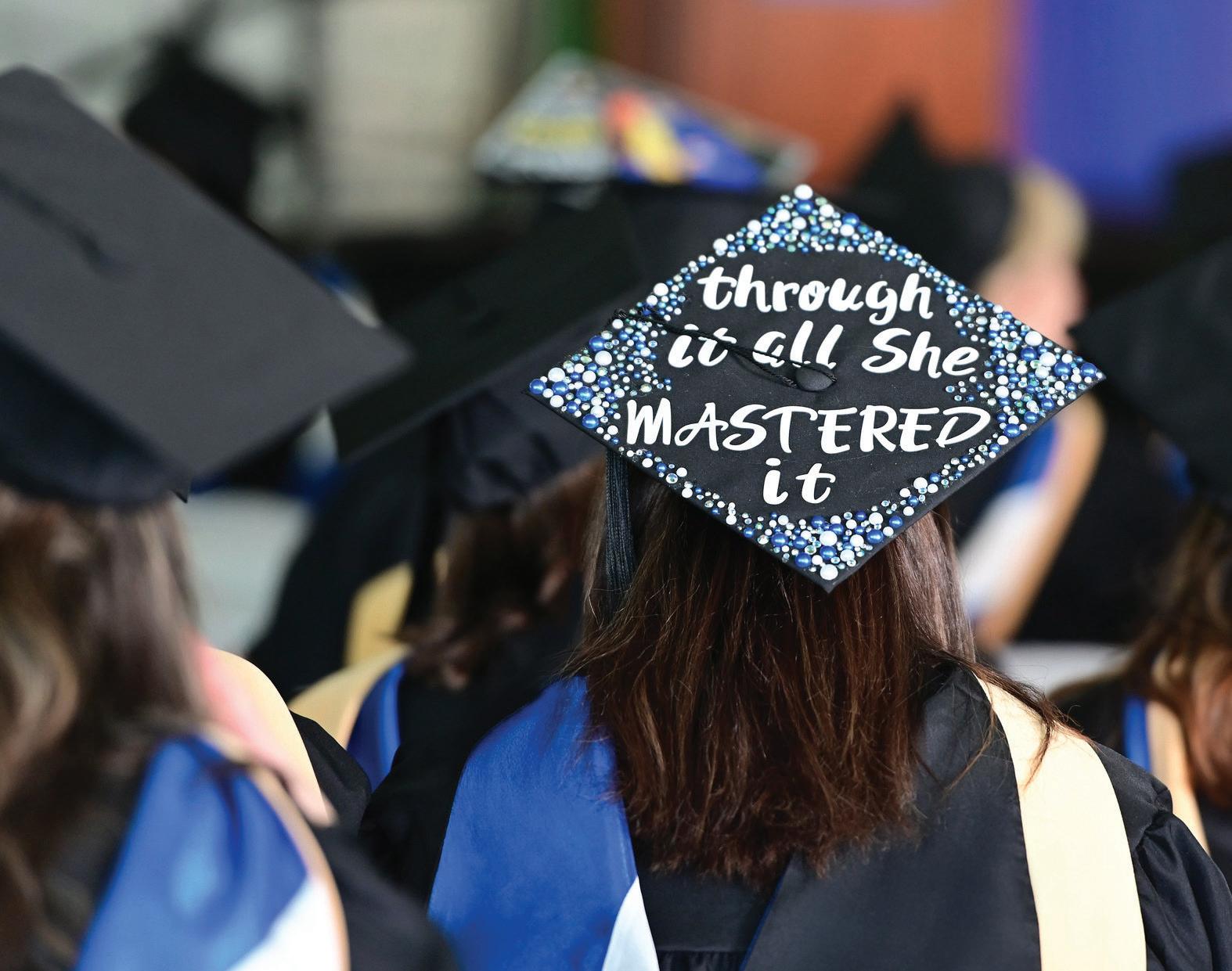
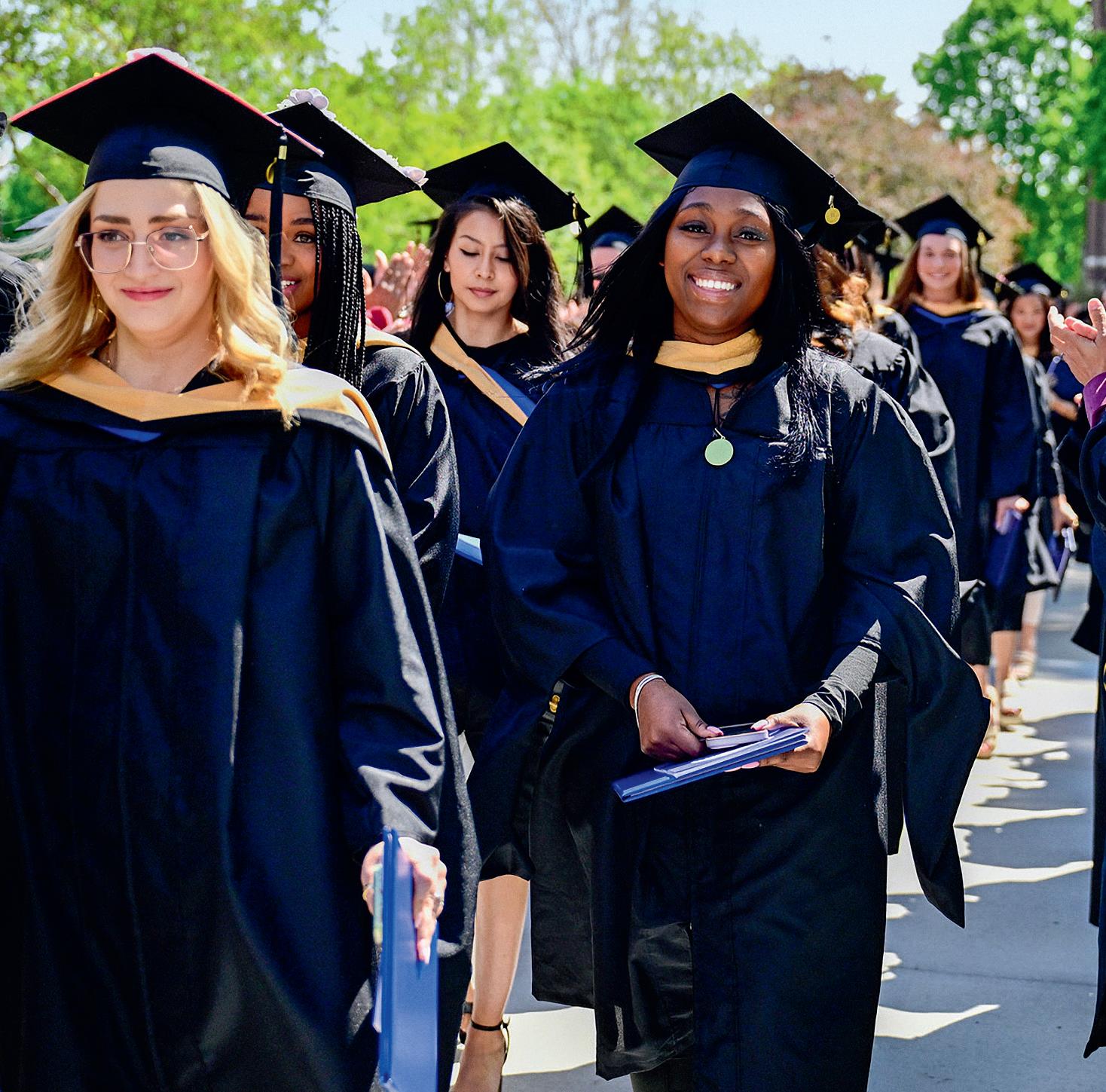
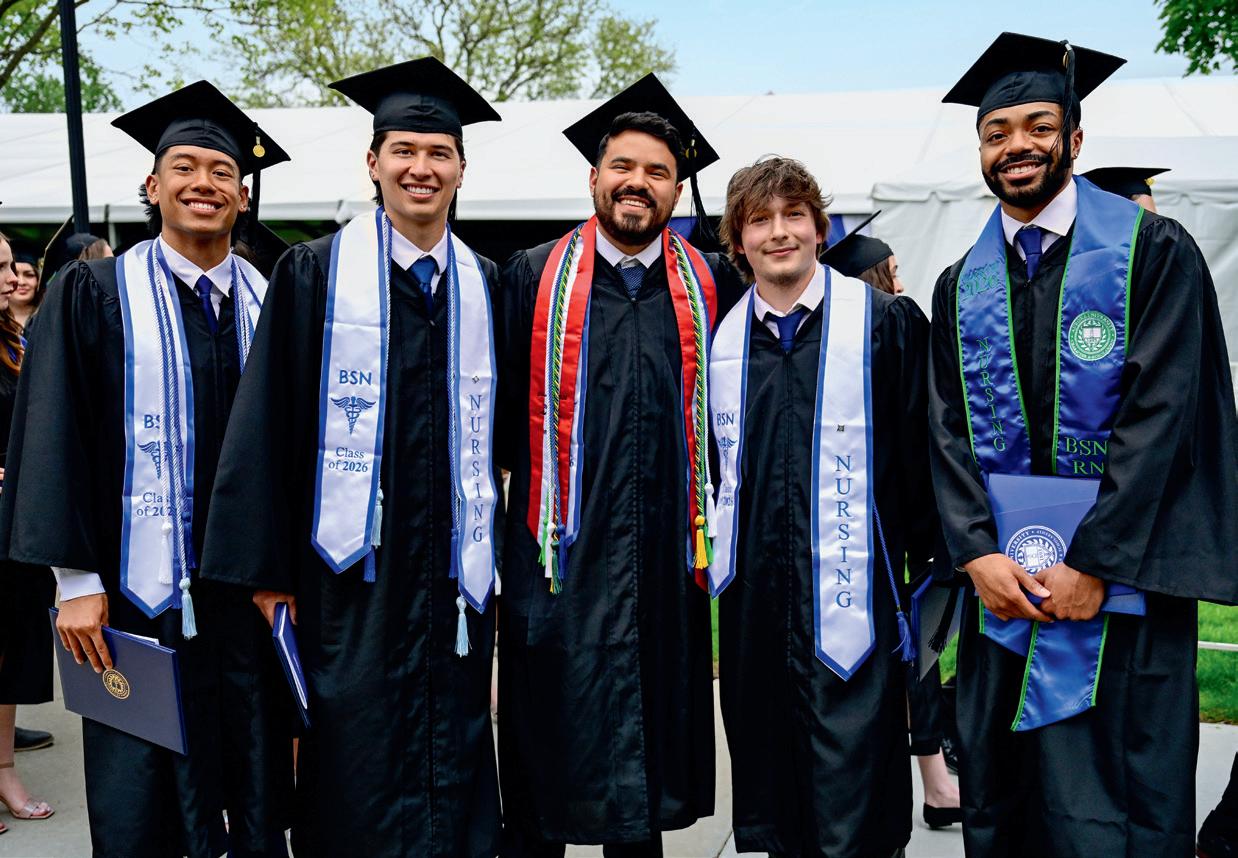
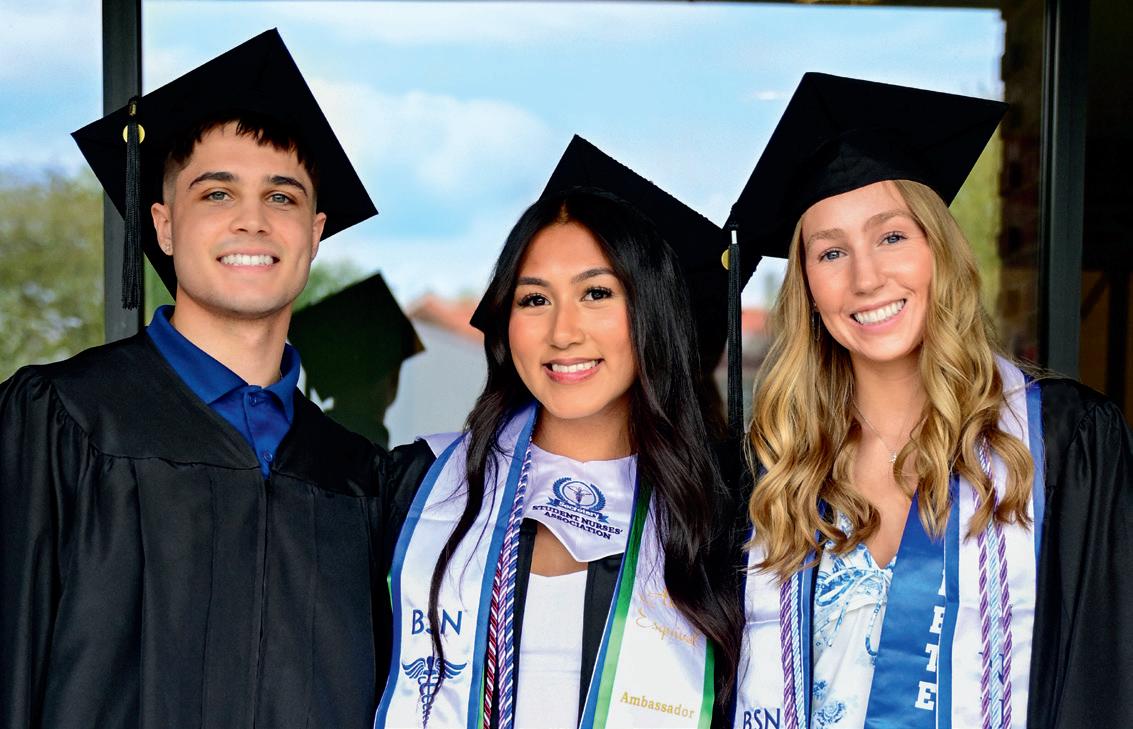
Caps off to the Class of 2026 More than 1,400 graduates walked across the stage during three commencement ceremonies held in May. page 4
Aurora University
347 S. Gladstone Ave. Aurora, IL 60506-4892
© 2026 Aurora University
Aurora University is accredited by the Higher Learning Commission to award degrees at the baccalaureate, master’s, and doctoral levels.
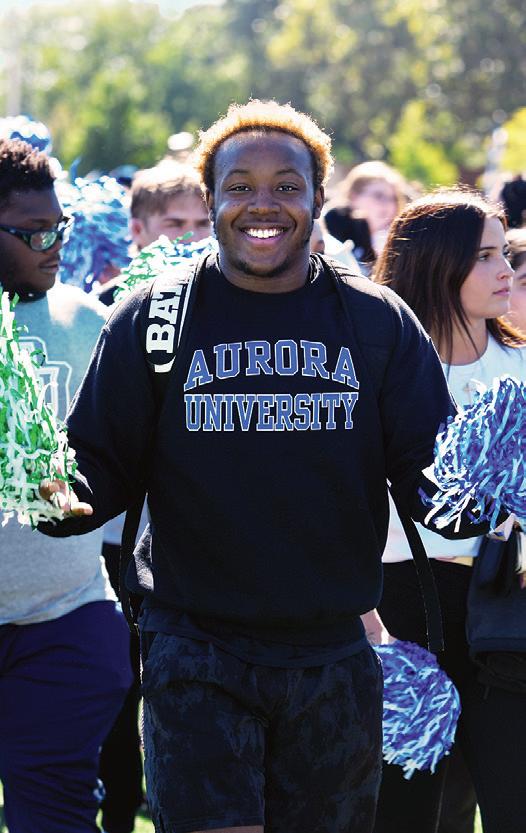
On the cover: Students connecting on campus this spring.
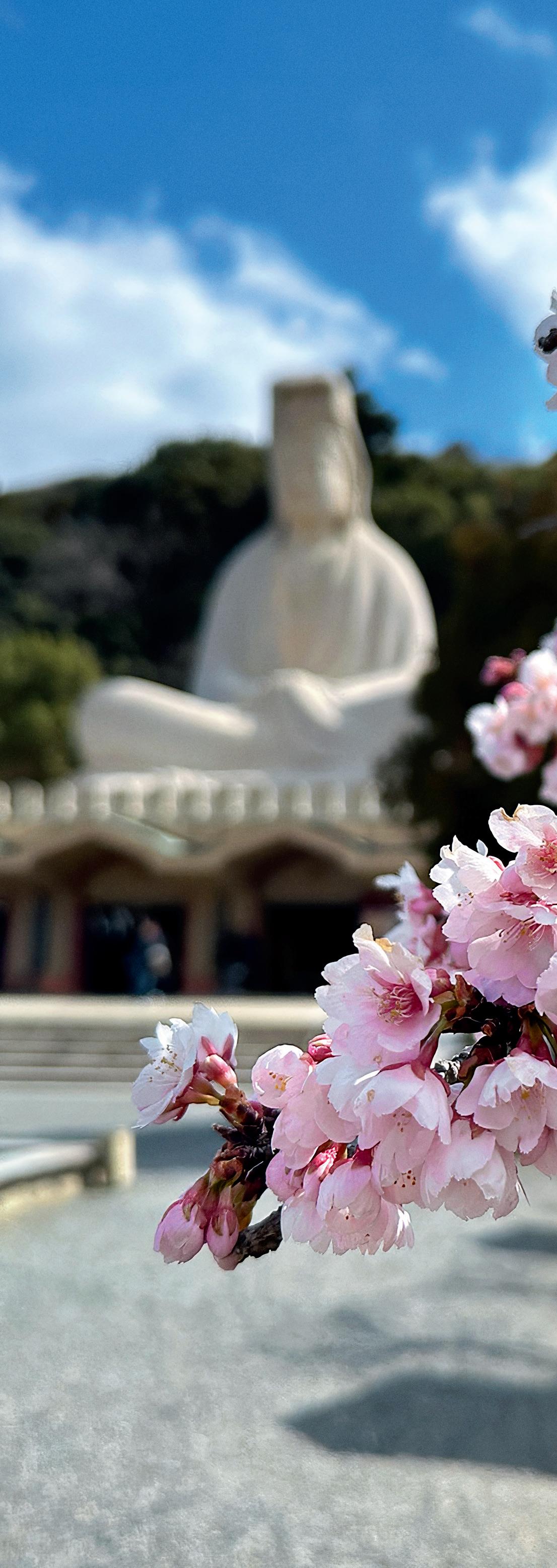
Kiyomizu-dera Temple in Kyoto, Japan, was one of many cultural sites visited by students during a Study Away spring travel course.
page 26
12
In the AI era, Aurora University is intentionally centering the values of connection, ethics, curiosity, and purpose amid rapidly evolving technology.

20
Across careers and communities, Aurora University alumni are turning purpose into action and showing how giving back makes a tangible difference in their communities and their personal and professional lives.
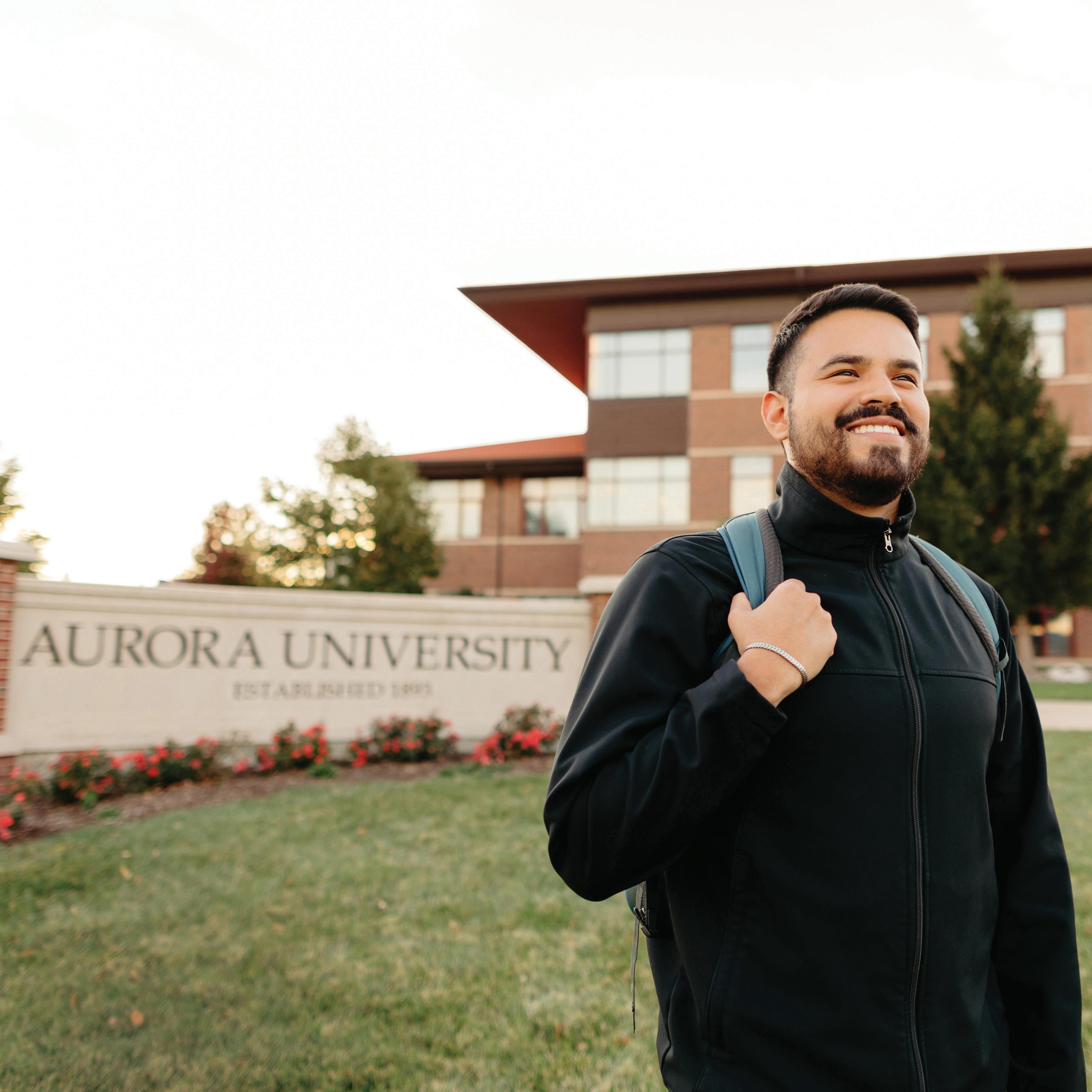
At Aurora University, we see you. Your hard work. Your curiosity. Your spark. And we know you have the potential to shape the world around you.
Just like we have for generations of students before you, we’re here to help you gain the knowledge, tools, and opportunities you need to do it.
Your future. Our promise.

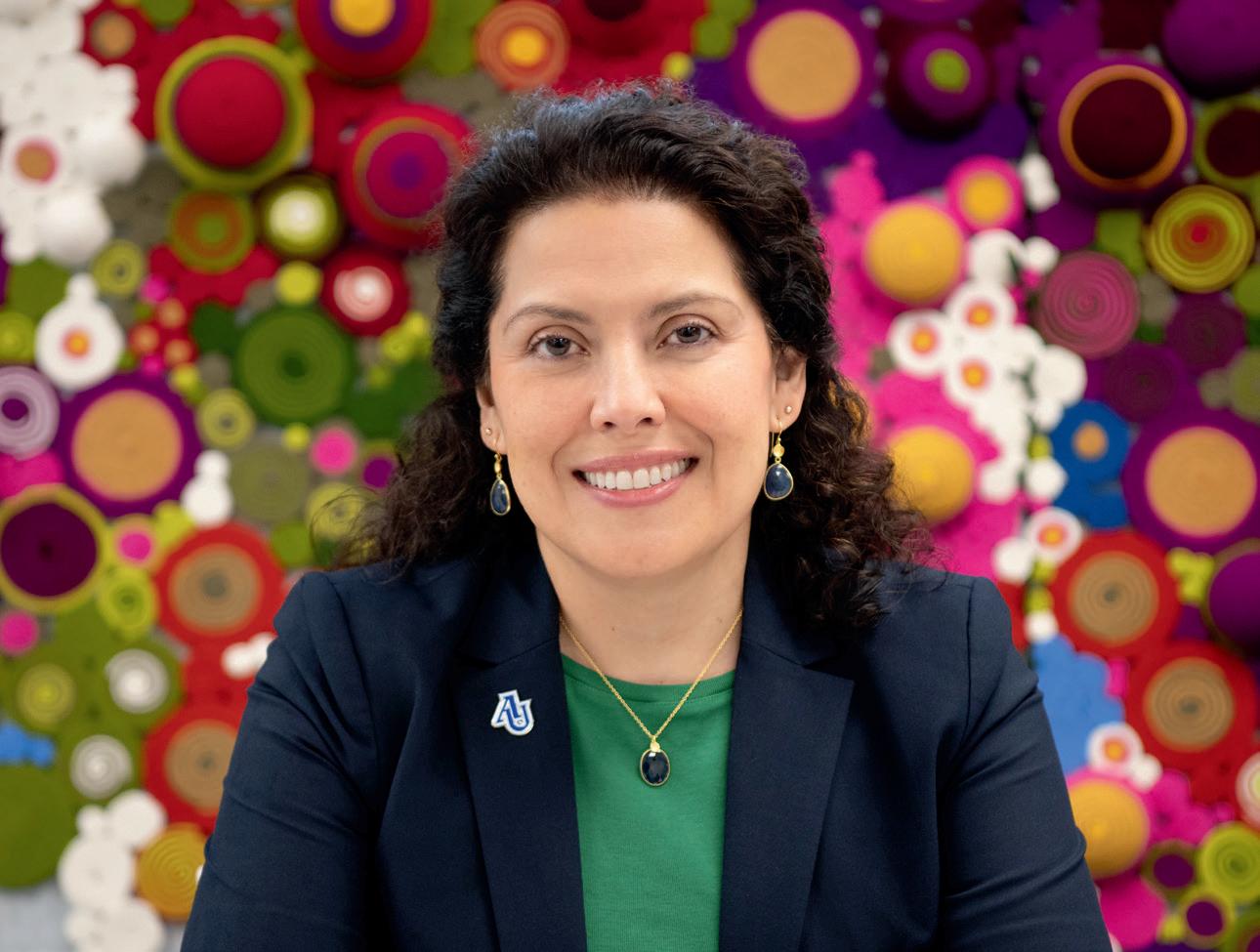
As I looked out over a campus filled with graduates and their families during this spring’s commencement ceremonies, I was reminded that our mission is, and always has been, centered on people. That commitment is at the heart of our cover story, which explores how Aurora University is keeping humanity at the center of education in an age defined by AI and rapidly changing technology.
Full disclosure: I’m a bit of a tech and data geek. Ask faculty and staff, and they’ll tell you I love data because numbers can reveal stories in trends and patterns. At the same time, I deeply value engagement, relationships, and the care conveyed through something as simple as a handwritten note.
I try to keep this in mind as we live in a world saturated with information from phones, computers, and television. Even my walks across campus are tracked by my watch. Beyond that, many of our choices are shaped by AI systems designed to anticipate what we might do or buy next. Technology is everywhere.
Even so, I find hope in Gen Alpha, the cohort following Gen Z. Emerging research suggests this generation may be looking for a better balance between digital life and authentic, in-person connection and community experiences.
That is why what we have long understood about the liberal arts — especially the humanities — matters deeply now more than ever. This belief is reflected in the lyrics of “Aurora,” the university’s alma mater, which affirm that AU is “a place of true learning and home to the arts.” Our core curriculum and academic programs encourage students to explore diverse ideas, cultures, and forms of expression while strengthening critical thinking and communication skills.
For two decades, our Celebrating Arts and Ideas series has brought distinguished speakers and performers to campus, and students continue to participate in music and theatre programming. The Schingoethe Center complements learning by sponsoring programs that prioritize human connection, foster community, and support well-being.
Our students also demonstrate that they value opportunities to engage beyond the classroom. Through Social Impact Trips, including three this past spring, students contribute to projects that make a tangible difference. They also volunteer with local social service agencies and extend their learning through internships and mission-driven work.
These experiences are made possible by AU’s commitment to collaboration. We believe pathways to success are built through strong partnerships that connect people, prepare students for their academic and professional goals, and create lasting value for the communities we serve.
In the end, walking across campus, whether with a student or a colleague, I find it is less about the steps recorded on a watch and more about the connection shared along the way. As we continue to move forward with AI and emerging technologies, we do so grounded in a simple truth: Our greatest strength is our humanity, and the best technology is that which helps elevate it.
Susana Rivera-Mills, PhD President
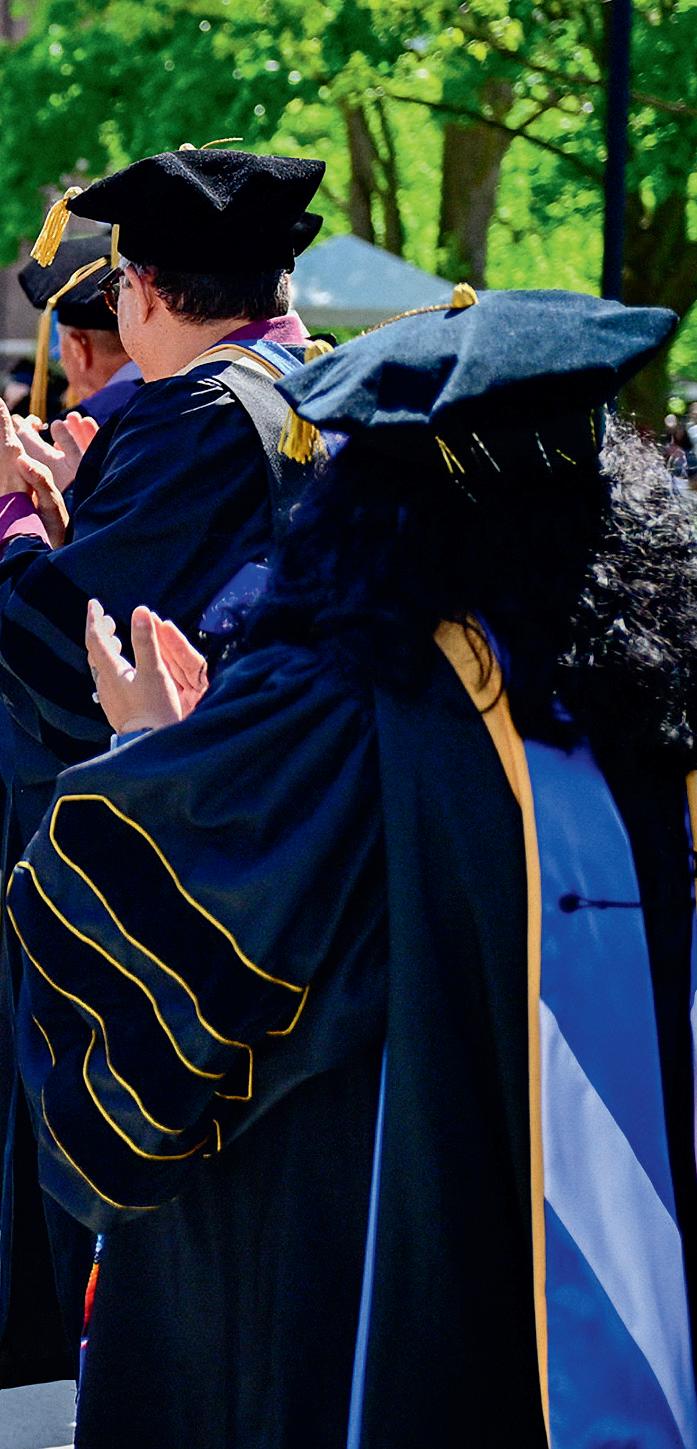
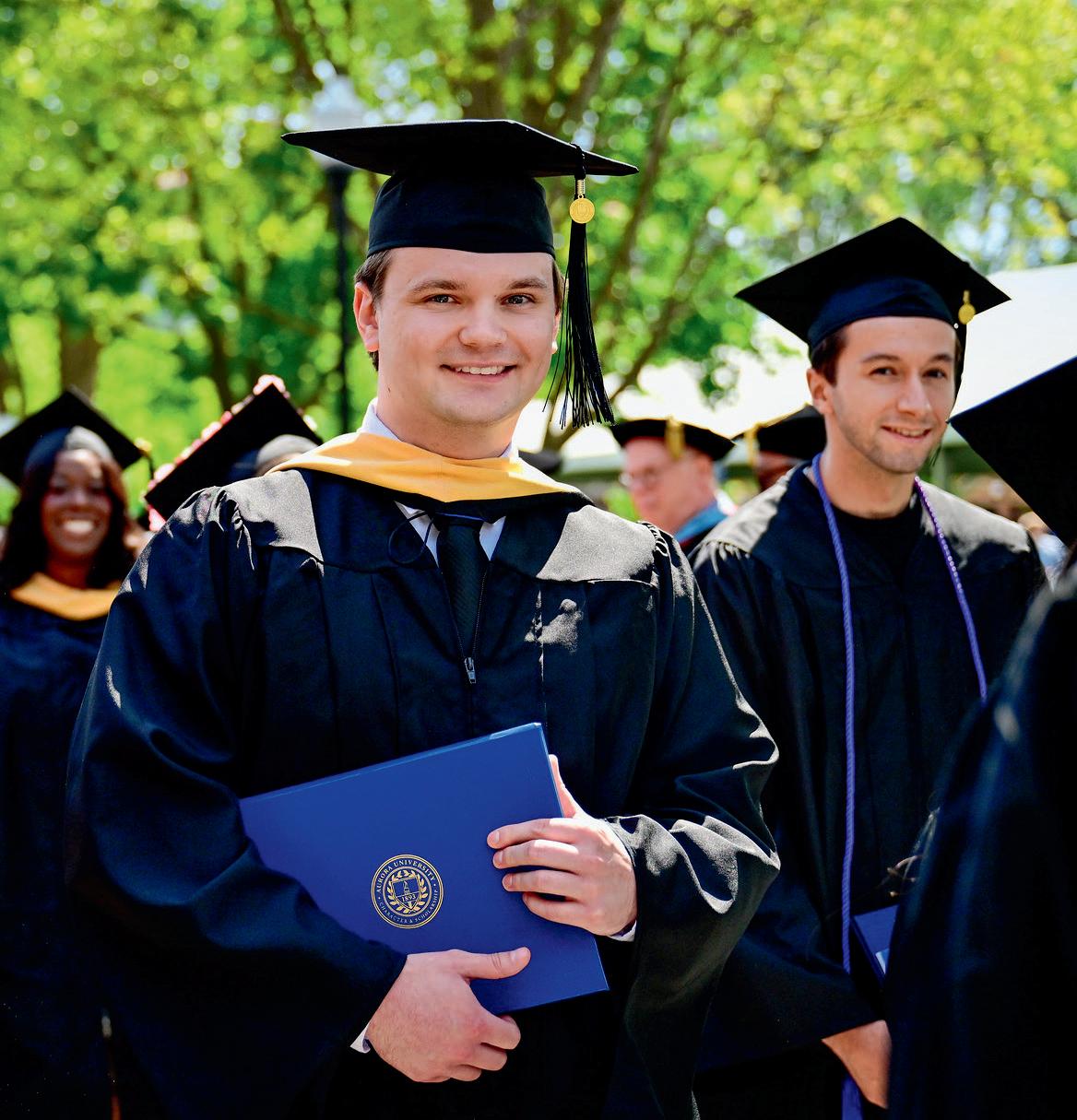
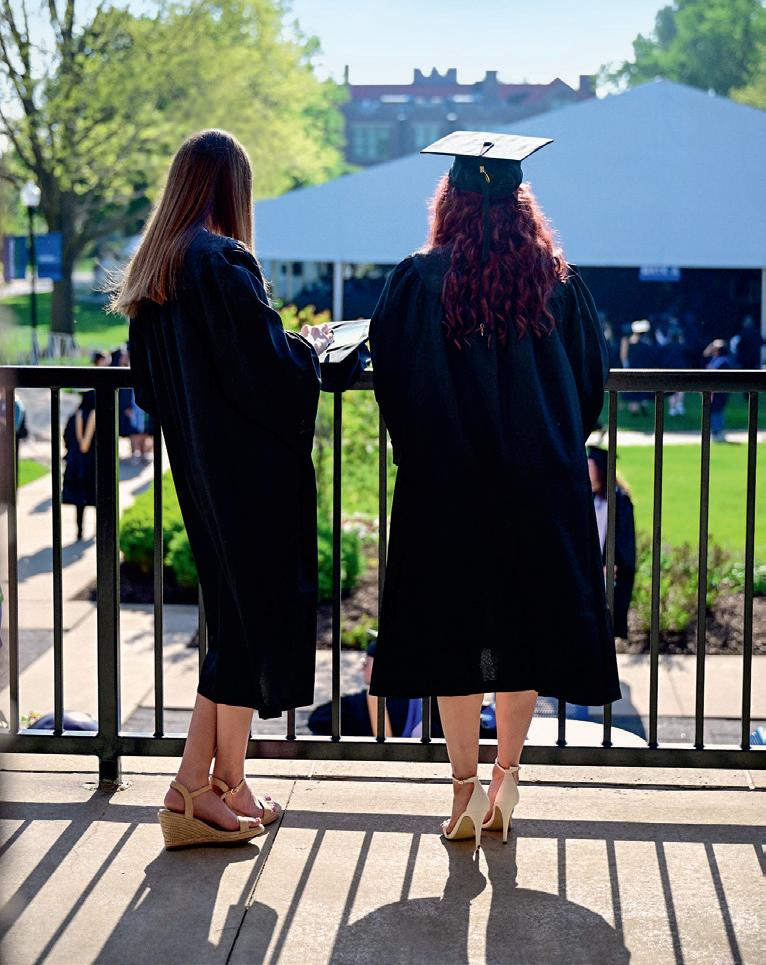
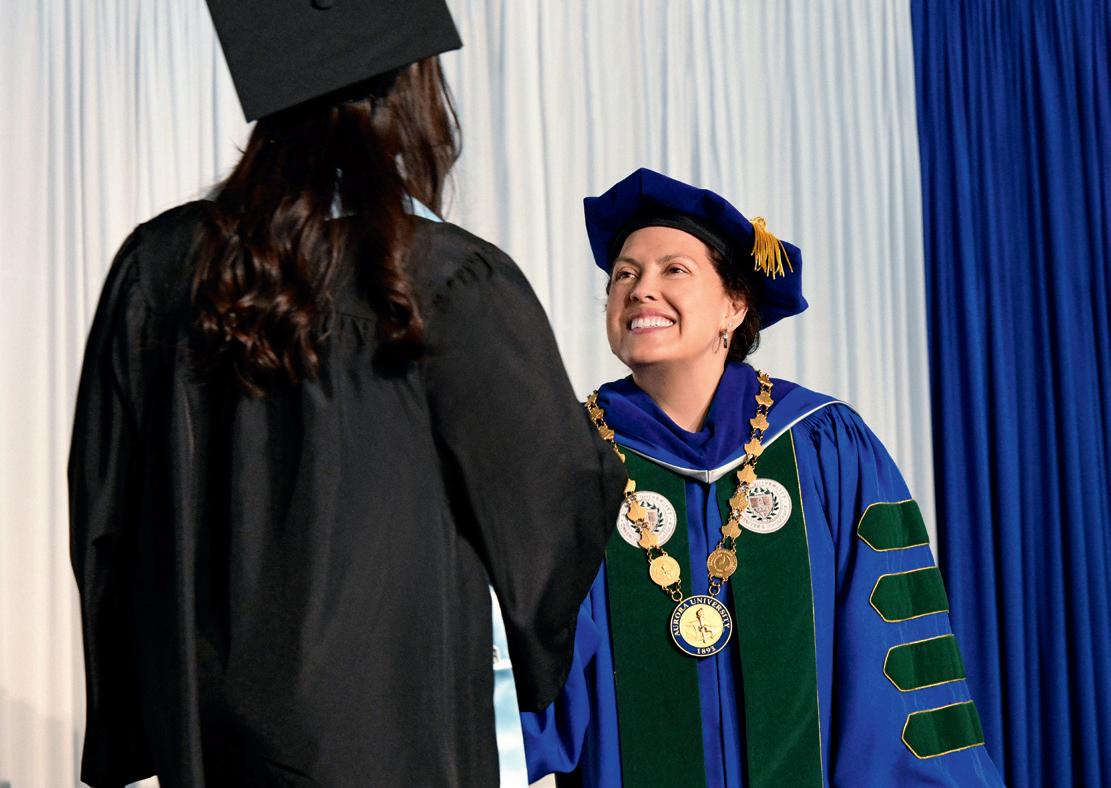
Mo re than 1,400 graduates joined the ranks of Aurora University alumni during three commencement ceremonies held May 9–10, marking a milestone weekend of achievement, reflection, and celebration for students and their families.
Across all ceremonies, the atmosphere was one of pride and anticipation as graduates crossed the stage to receive their degrees and take the next steps in their journeys. The weekend highlighted not only academic achievement, but also the resilience and determination that define the AU experience.
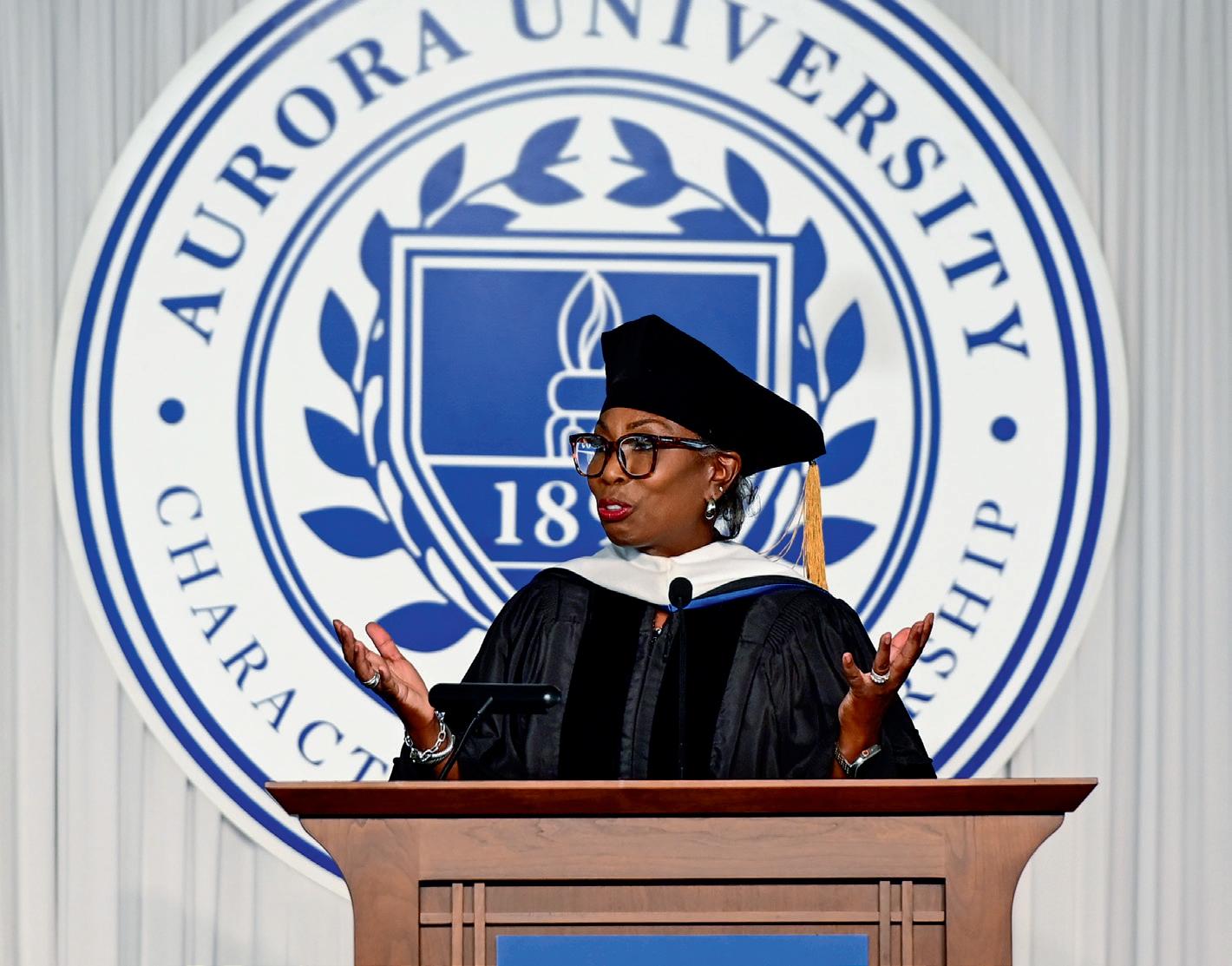
On Saturday, the university conferred an honorary degree on Theodia B. Gillespie (pictured this page, bottom) recognizing her more than 40 years of service with the Quad County Urban League. As president and CEO of QCUL, Gillespie has been instrumental in advancing equity, expanding educational access, and fostering economic opportunity across DuPage, Kane, Kendall, and Will counties. Under her guidance, the organization has grown into a powerful regional source of workforce development, civic engagement, and community empowerment.
Her work continues to create pathways to success for underserved populations, including people of color, women, and individuals with disabilities. In honoring Gillespie, the university seeks to inspire graduates to lead and serve in their communities.
Sunday’s ceremony carried special significance, as it coincided with Mother’s Day. In a heartfelt gesture, red carnations were distributed to mothers in attendance in recognition of the vital role families play in supporting student success.
Together, the weekend’s celebrations reflected AU’s commitment to preparing graduates to make a meaningful impact on the world.
Ainsley Martin ’26 found opportunity and support at Aurora University through academic offerings and the Pathways Collegiate Program — becoming its first four-year participant to earn an undergraduate degree. Launched in 2021, the Pathways program empowers neurodiverse students to reach their potential in their studies and beyond.
In fall 2022, Martin began her freshman year at AU as a history major with a museum studies minor. AU offered her desired combination of coursework and had a program for disability support, which made the school stand out. “I did not have to give up on either factor to receive a postsecondary education,” Martin said.
As a Pathways student, Martin thrived academically, earning high honors every semester. She learned to stay on top of her coursework, prepare for examinations, advocate for accommodations, and seek help from various on-campus resources.
When overwhelmed by academics, Martin learned from Pathways staff to remember her many accomplishments. She learned to trust herself and use the strategies that helped her reach college in the first place.
Martin credits the support and campus community with helping her find friends when she was a new student. She became a member of the AU Band, History Club, and Museum Studies Club, and participated in art activities, on-campus events, and off-campus outings.
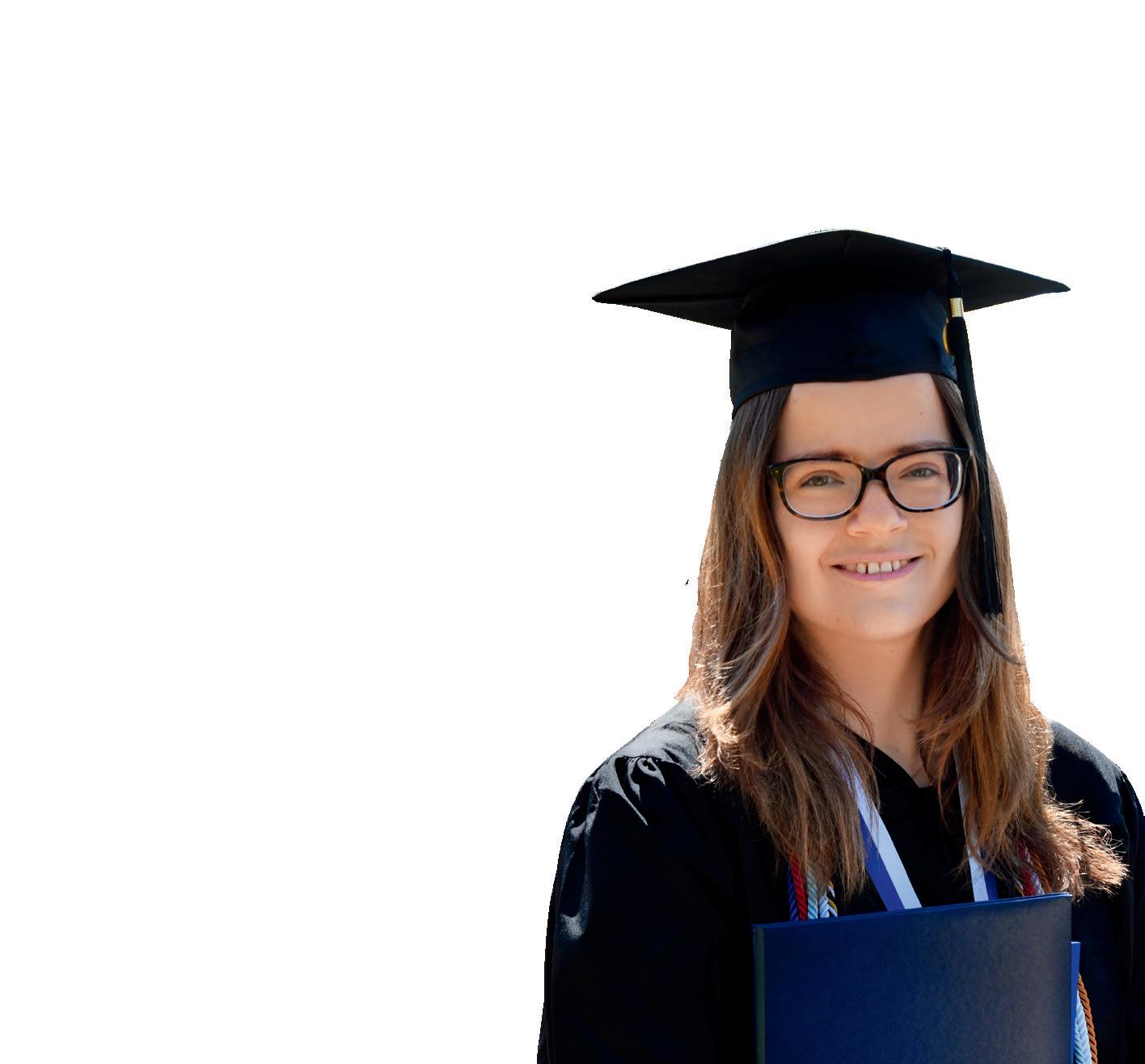
At AU, Martin appreciated the single rooms and short walks to class from Don and Betty Tucker Hall, acknowledging that her initial perceptions of college from movies and television were much more intimidating. She also found that staff cared deeply about her well-being, values, and goals.
With AU’s support, Martin has applied for postgraduate jobs and started graduate school at Dominican University to study library science. Looking back at her undergraduate years, Martin said, “AU was worth it.”
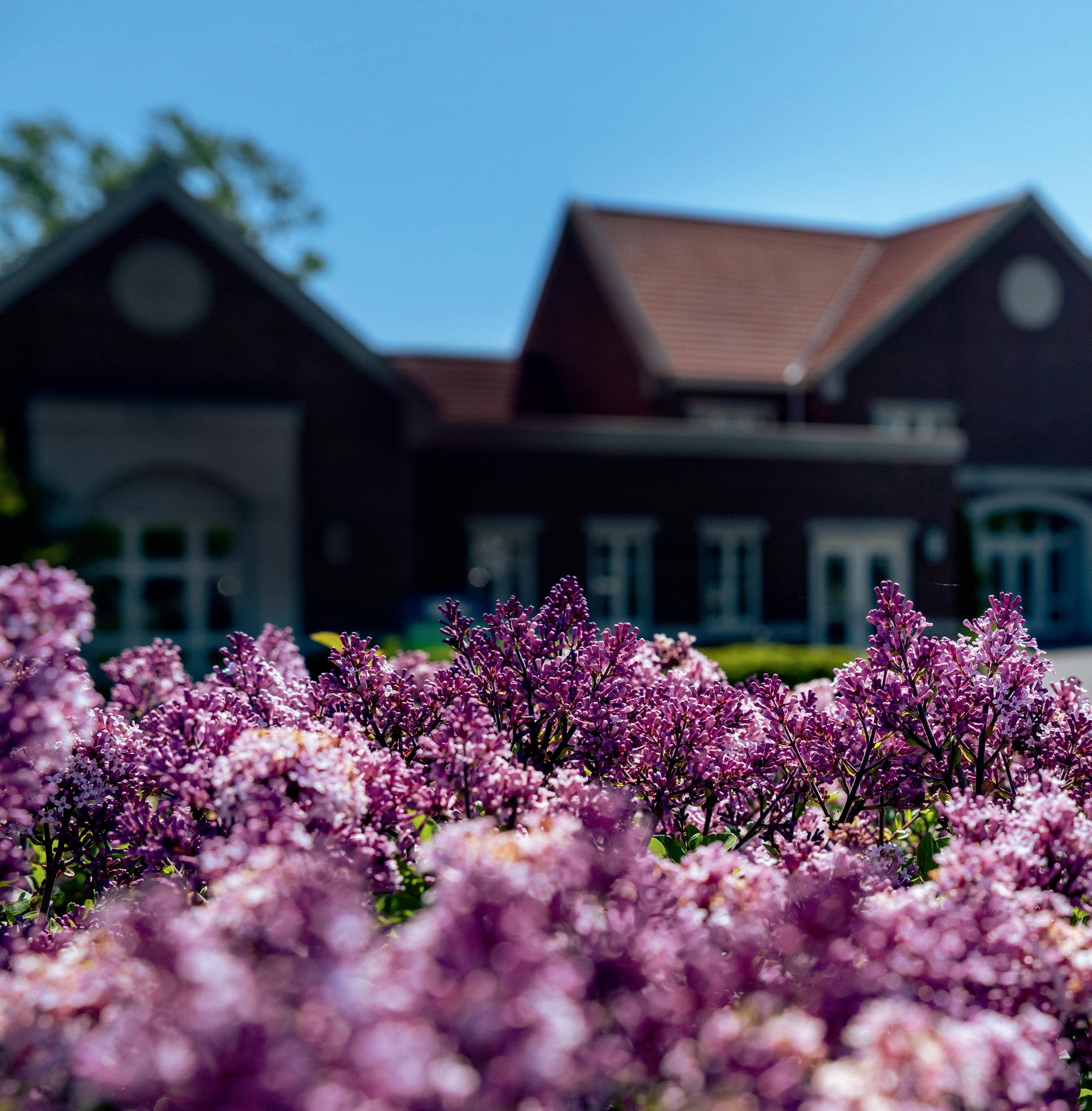
Aurora University was named among the nation’s most beautiful college campuses by U.S. News & World Report, joining Harvard, Indiana University Bloomington, Princeton, the University of Washington, and others. AU is the only Illinois institution included on the 2026 list, which highlights colleges known for stunning architecture, picturesque settings, and spectacular landscaping.
Spanning more than 40 acres, AU’s main campus features distinctive red tile roofs on its major buildings, a formal entrance outside the Hill Welcome Center lined with more than 30 linden trees and more than 140 birch trees, and grounds recognized for overall campus beauty by the Professional Grounds Management Society. This marks the second time AU has been included on a U.S. News & World Report list recognizing beautiful campuses, the first being in 2024.
“Though our campus is small, it’s known for its beauty because our community takes pride in every detail,” President Susana Rivera-Mills said. “Students, faculty, and staff all share responsibility for keeping it clean and welcoming, and our grounds crew works tirelessly in every season to ensure it remains a place where people love to learn and gather.”

Earlier this year, the campus community gave a heartfelt send-off to a 15-month-old English black Labrador retriever, Annie, as she returned to Leader Dogs for the Blind to begin the next phase of her formal training. Annie became a familiar face around campus after accompanying Hannah Anderson, director of institutional reporting and analytics at Aurora University, to work nearly every day for eight months — rarely making it across the quad without someone stopping to say hello.
Annie is the first puppy Anderson and her family volunteered to raise through Leader Dogs for the Blind, a Rochester Hills, Michigan-based nonprofit that empowers people who are blind or visually impaired for safe and independent travel. As volunteer puppy raisers, the Anderson family focused on house training, socialization, and foundational commands. Bringing Annie to campus was an intentional part of that process, helping her learn to navigate a busy workplace, settle quickly in meetings, and confidently move from Point A to Point B.
“Being a puppy raiser has been an eye-opening and rewarding experience,” said Anderson. “By helping train a Leader Dog puppy, we’re able to be part of the process of potentially influencing someone’s independence and safety.”
Though proud of Annie’s progress, Anderson described the goodbye as bittersweet — “like sending a child off to college.” Since returning to the Leader Dogs facility in February, Annie continued to work on her social behavior skills alongside a guide-dog mobility instructor and completed the first phase of training.

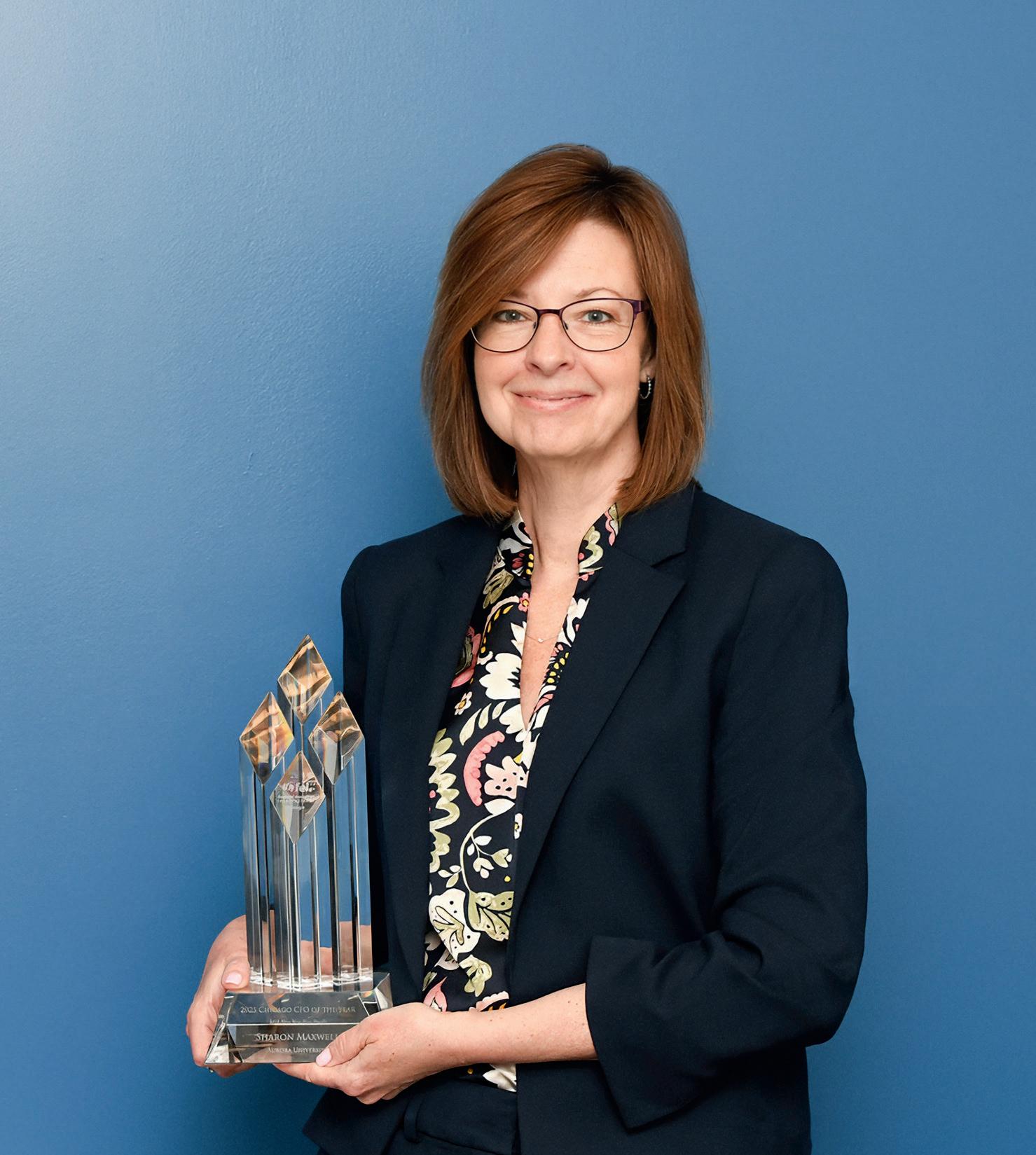
Sharon W. Maxwell, senior vice president for business and finance at Aurora University, received the 2025 Chicago CFO of the Year Award in the mid-size not-for-profit category from the Financial Executives International Chicago chapter. The chapter’s annual awards program celebrates Chicago-area financial leaders who have made exceptional contributions to their organizations and the profession.
Maxwell has more than 30 years of experience in financial management, strategic planning, and organizational leadership. At AU, she oversees the institution’s financial operations while serving as a trusted advisor to the president and Board of Trustees.
During her tenure, she has helped guide the university through significant fiscal milestones, including navigating a statewide budget crisis that affected student financial aid, overseeing major bond restructurings, managing the university’s endowment, and maintaining long-term financial stability to support the university’s strategic priorities.
Maxwell’s recognition highlights the vital role of strong financial leadership in advancing AU’s mission and expanding long-term opportunities for students.
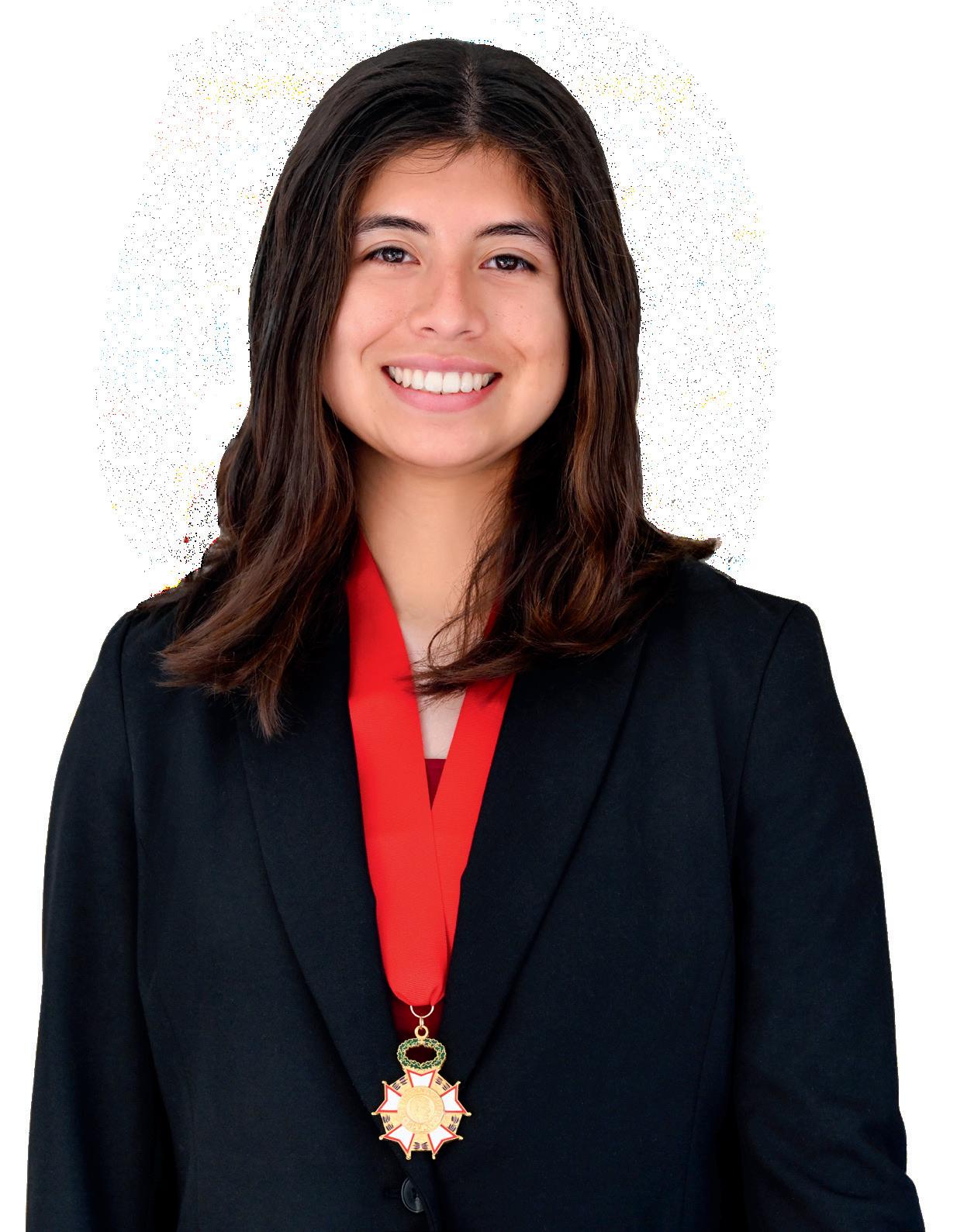
Diane Fuentes ’26 was recognized this past fall with an Abraham Lincoln Civic Engagement Award, representing Aurora University as a Student Laureate of The Lincoln Academy of Illinois. The honor is awarded annually to one outstanding senior from each participating four-year institution in the state.
Fuentes is an Aurora native who graduated this May with a bachelor’s degree in behavioral neuroscience, biology, and health science, with minors in chemistry, mathematics, and Spanish.
As a student at AU, she made an impact in both the school and broader community. She served as an exercise science undergraduate research assistant, a new student mentor, and a peer tutor for AU’s Academic Support Center as well as local high schools. As a volunteer for the largest heart screening program in the U.S., Young Hearts for Life, she helped provide potentially lifesaving EKG screenings to high school students.
She was also active in numerous student organizations, serving as founder and president of the AU Minority Association for PreMedical Students and cofounder of the AU STEM Health Alliance, while also holding leadership roles in several academic clubs.
Beyond the classroom, Fuentes gained extensive clinical experience at Northwestern Medicine Central DuPage Hospital, working night shifts across the critical care, intensive care, emergency room, and telemetry units. She also served as a behavior therapist at Rush Kids Pediatric Therapy Clinic in North Aurora.
She plans to attend medical school and pursue a career as a physician-scientist while continuing her commitment to mentorship and service.
“This honor reminds me that perseverance and purpose go hand in hand,” Fuentes said. “As a first-generation college student, I want to represent my community in medicine and show others that with diligence and discipline, anything is possible.”

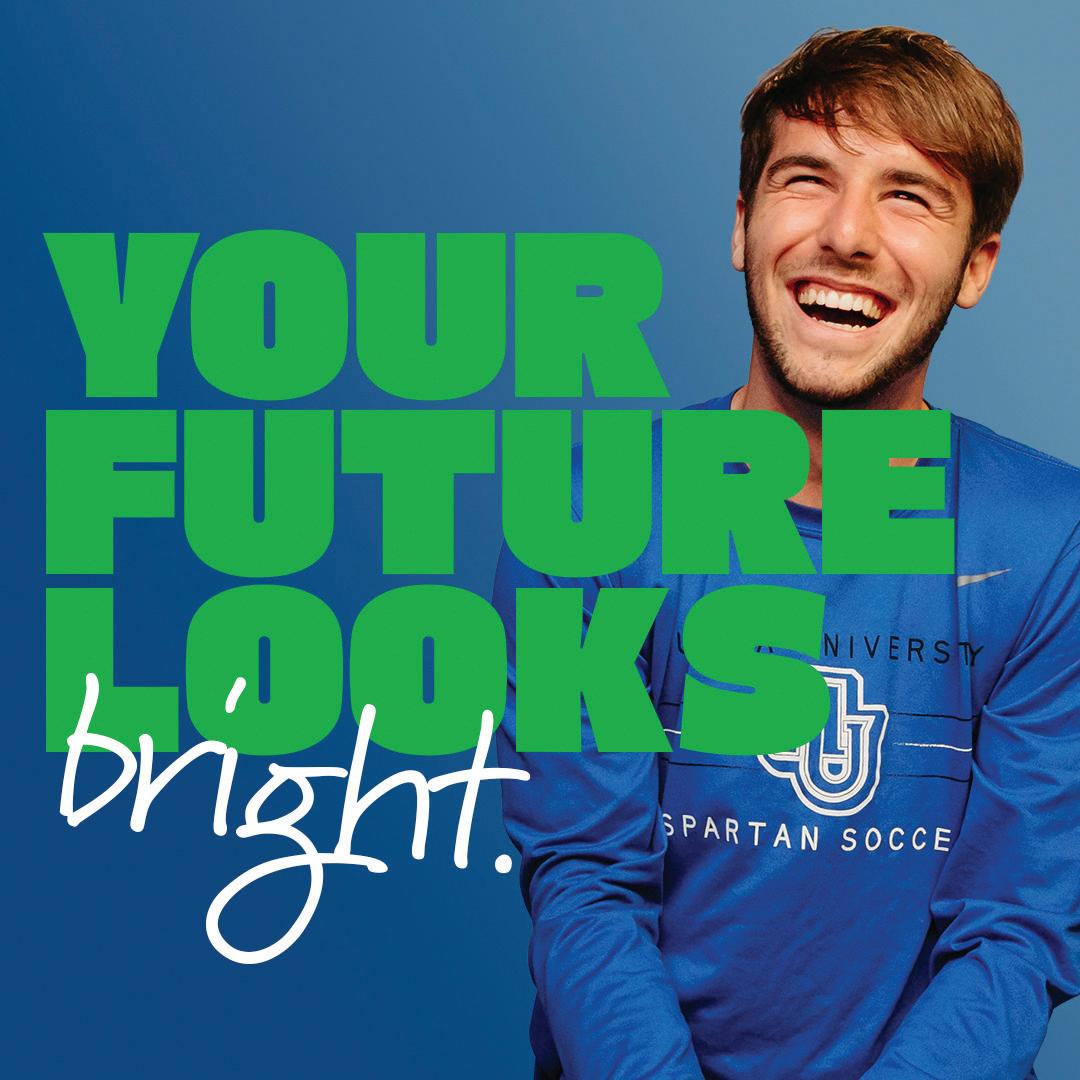
New brand campaign brings AU’s promise to life
Aurora University has launched a brand campaign inspired by its guiding promise: to truly see every student and their full potential.
Building on the university’s core message — “Your future. Our promise.” — the campaign expands the idea into a powerful and personal story of care, opportunity, and impact.
The campaign captures the everyday moments that shape a student’s journey while highlighting what sets AU apart, a deep commitment to seeing and supporting each student as an individual. That means recognizing not just academic achievements but also the drive, challenges, and aspirations that define each learner.
Through immersive storytelling across multiple platforms, the campaign underscores AU’s promise to meet students where they are and help them grow through real-world learning experiences, meaningful mentorship, and engaging opportunities that prepare them for what’s next. It reflects a campus community that believes in breaking down barriers, fostering confidence, and helping students connect their passions to purpose.
More than a campaign, this reflects who AU is and what it stands for. It defines a promise to see students clearly, to support them fully, and to help them envision the future they are capable of creating.
Scan to see AU’s promise in action in our new commercial.

Alumni and friends showed record-breaking support for students and campus initiatives.
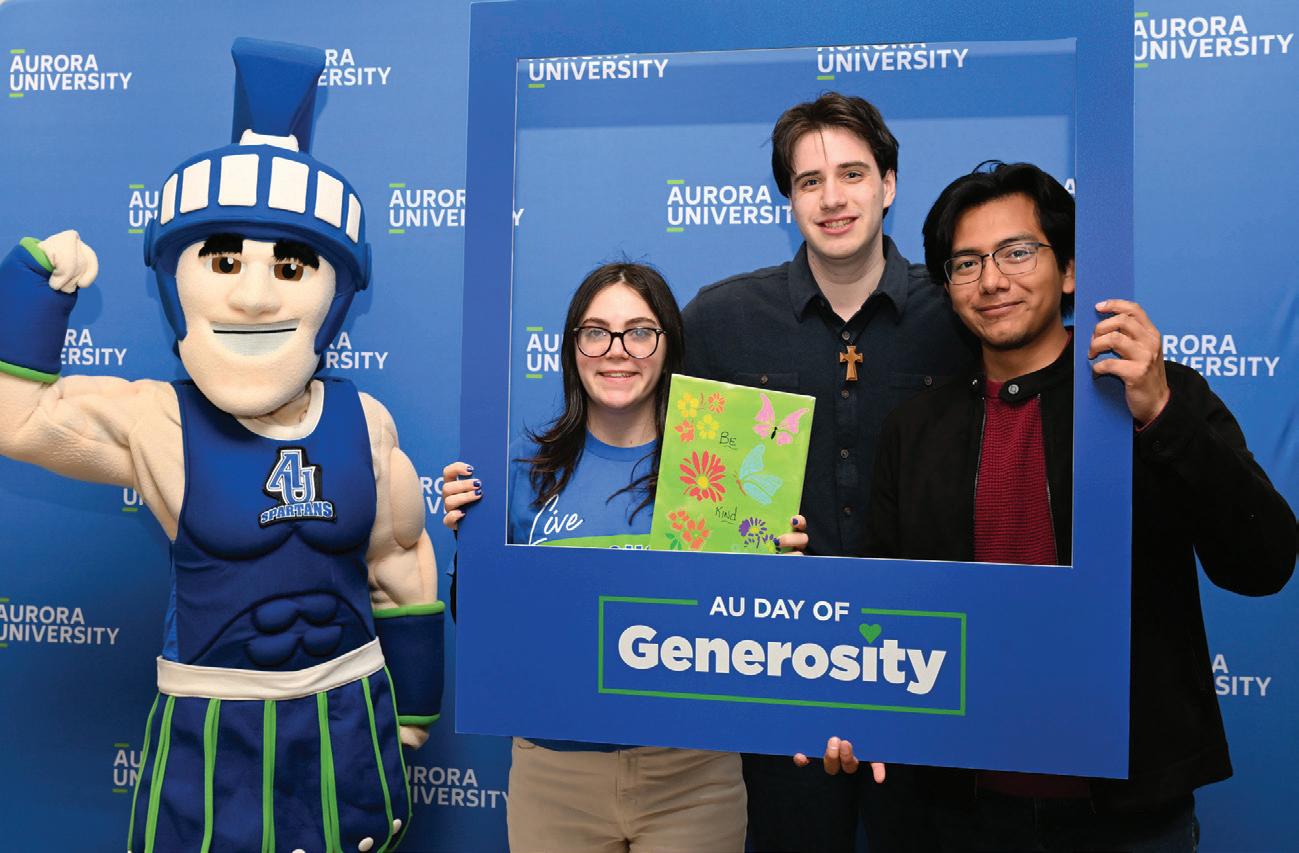
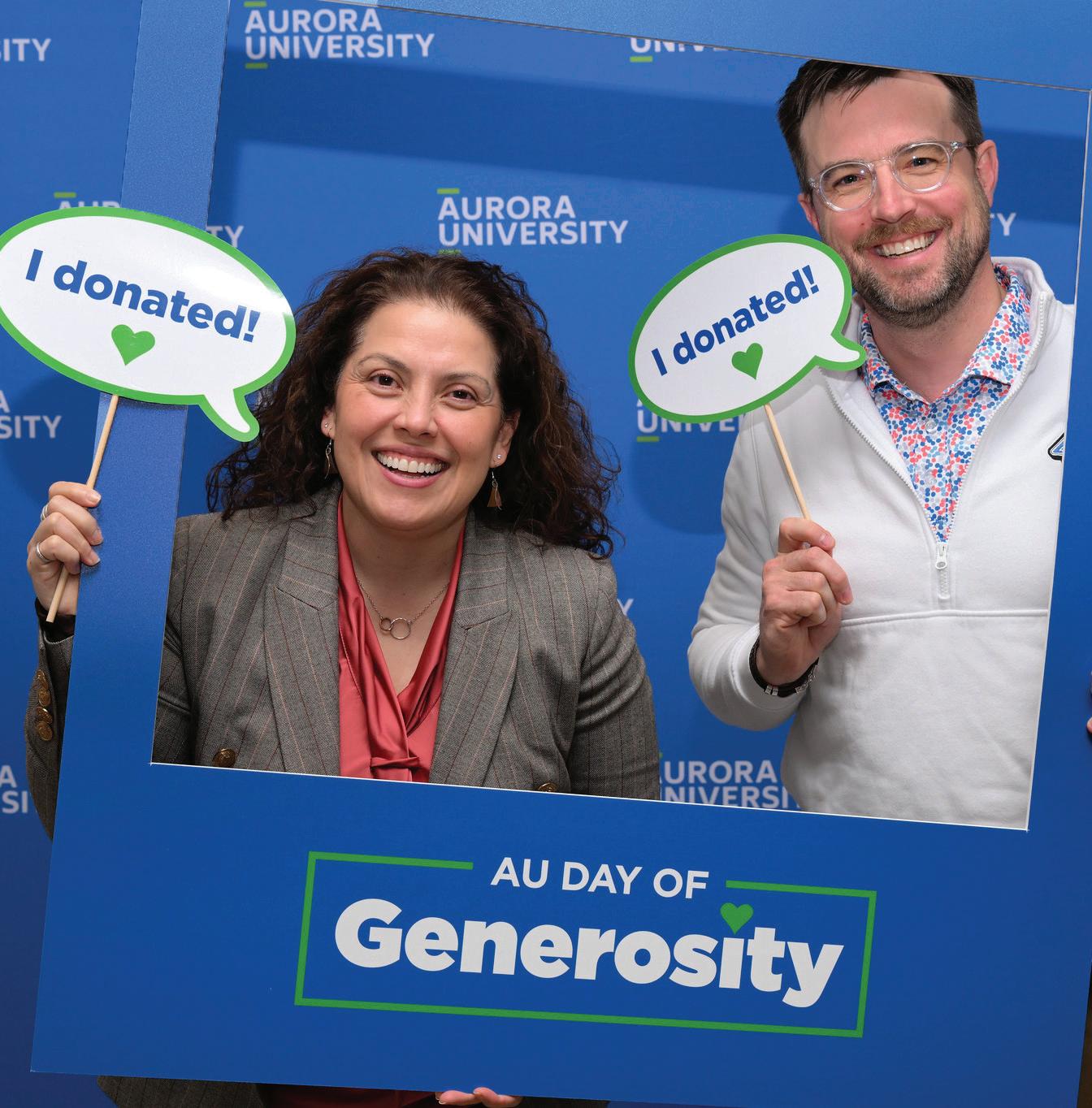
Aurora University celebrated its second annual Day of Generosity on April 9 by exceeding its fundraising goal, raising over $250,000 from nearly 500 donors to cap a week that included service projects, encouragement, and inspiring jazz music.
The funds will support students in many ways, from immediate needs like food insecurity and emergency expenses to long-term projects like the new Learning Commons.
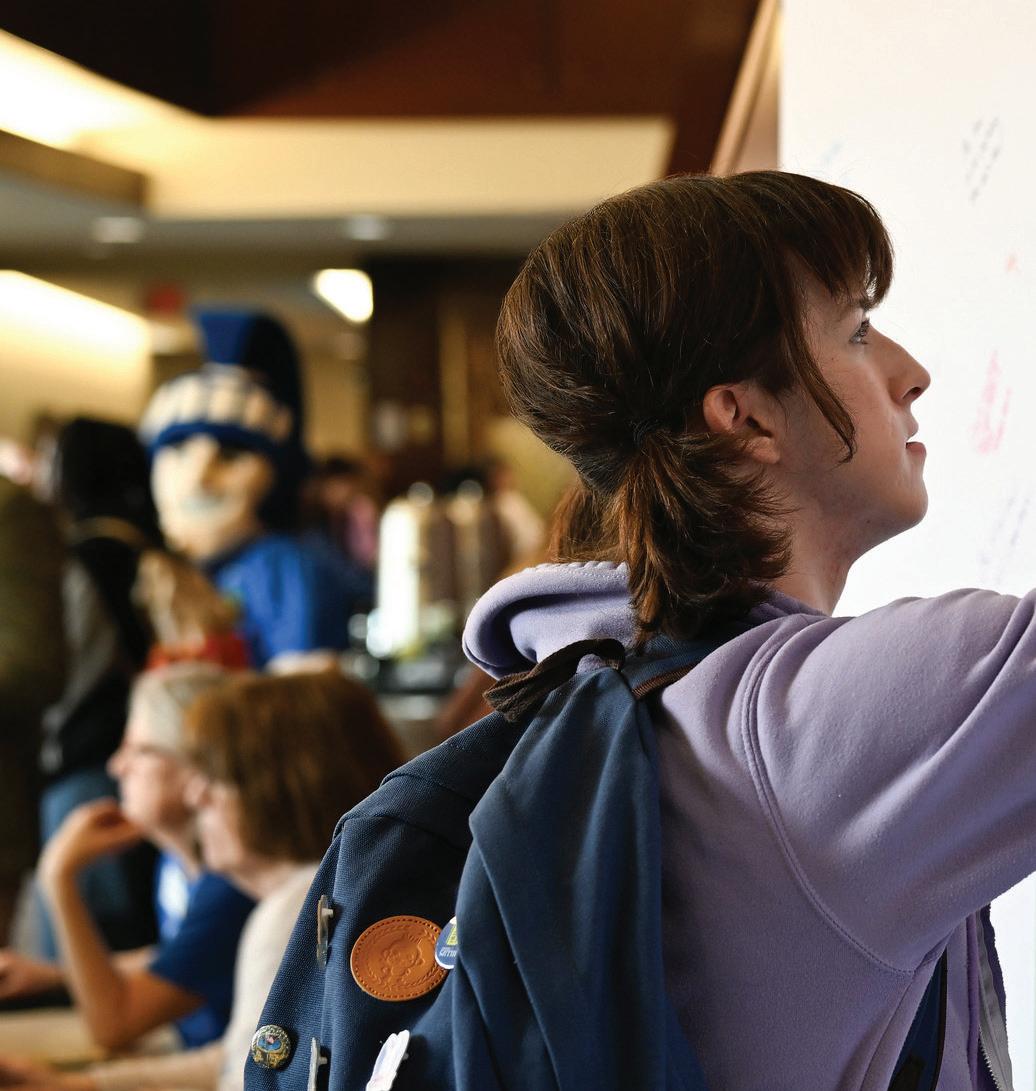
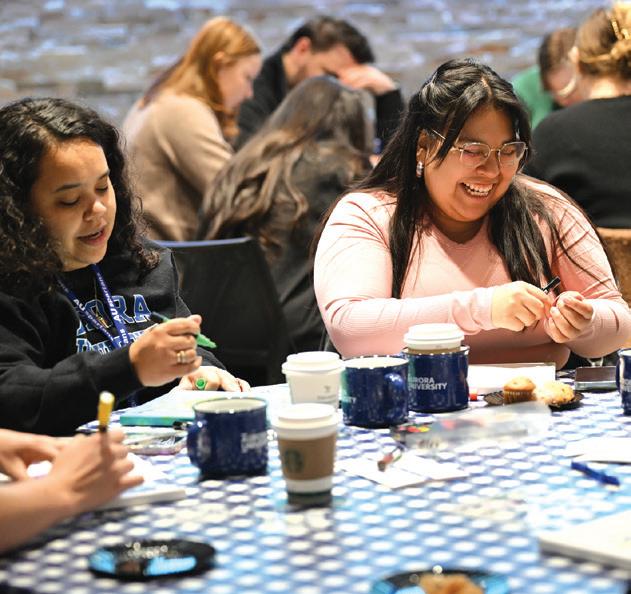
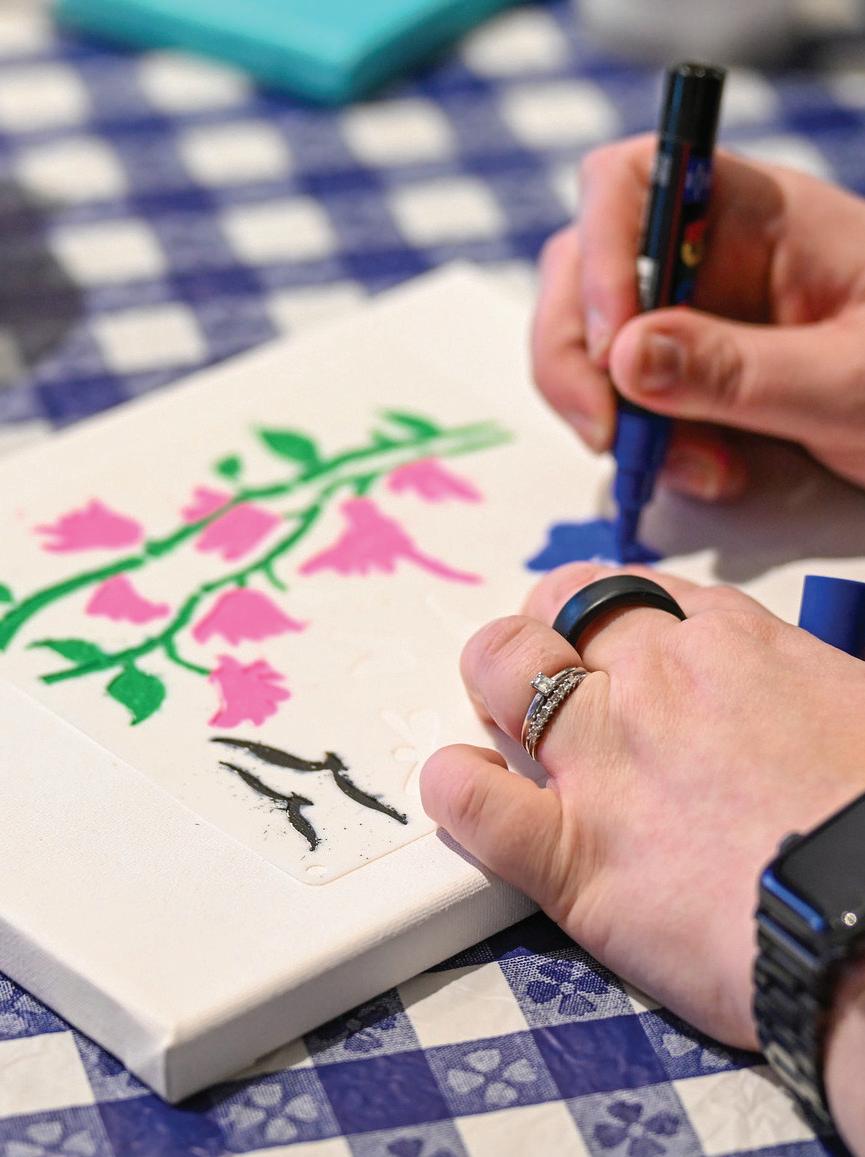
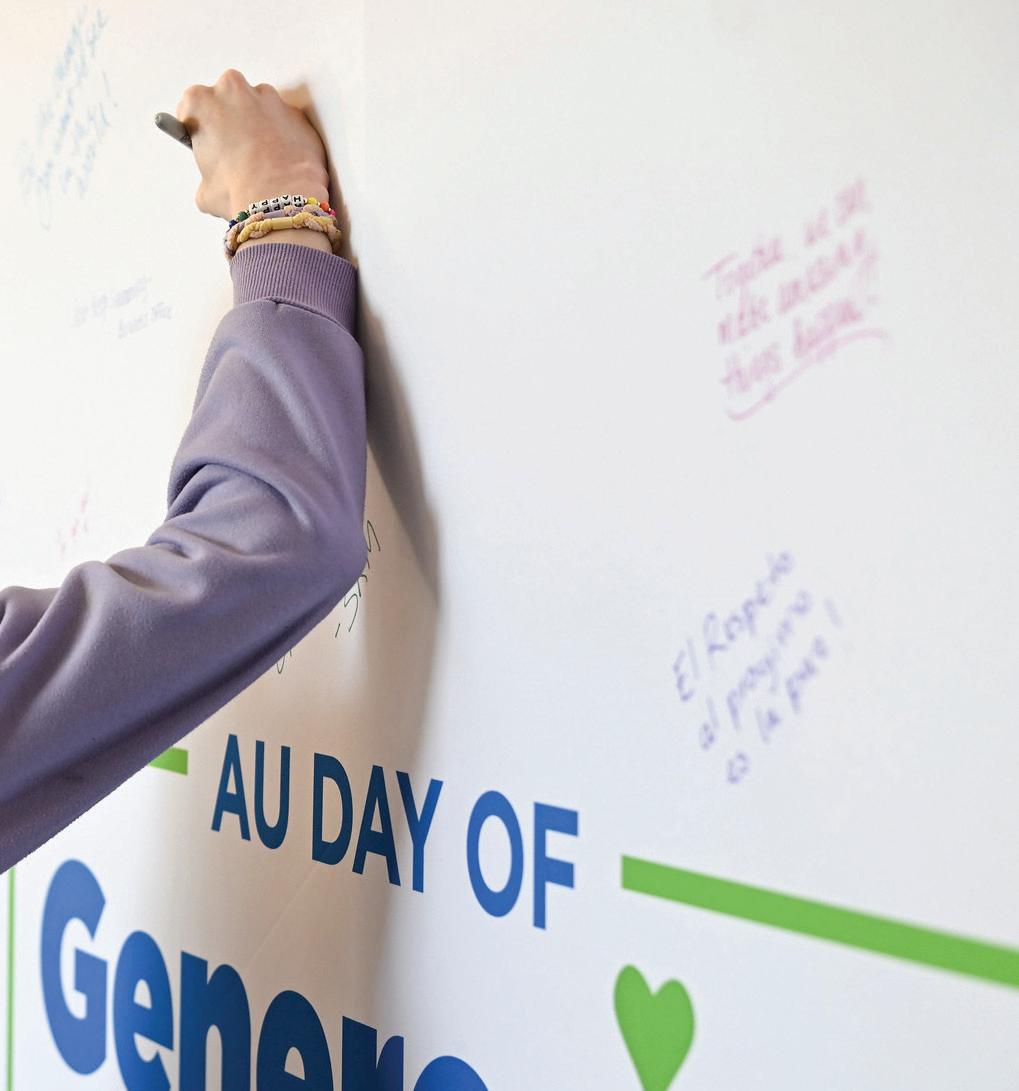
In the days leading up to Day of Generosity, the AU community participated in events centered on kindness and connection. The Community Canvas returned to Crimi Atrium, with faculty, staff, and students lining up to write inspirational messages and words of encouragement throughout the week. Employees gathered over coffee to paint together, and students created blankets to donate to local hospitals and animal shelters.
Day of Generosity concluded with a jazz performance by Kennedy Center honoree, Presidential Medal of Freedom recipient, and 10-time Grammy Award winner Arturo Sandoval. A protégé of legendary jazz musician Dizzy Gillespie, Sandoval showcased his talent on trumpet and piano to a delighted crowd in Crimi Auditorium.
While donors could give to any initiative close to their hearts, this year’s campaign focused on Spartan Essentials, a fund to assist students facing unforeseen expenses or obstacles; the state-of-the-art Learning Commons, set to open this fall; and the Future Promise Fund, which supports career-driven educational opportunities.
Plans to relocate the Aurora University chapel are continuing to gain momentum.
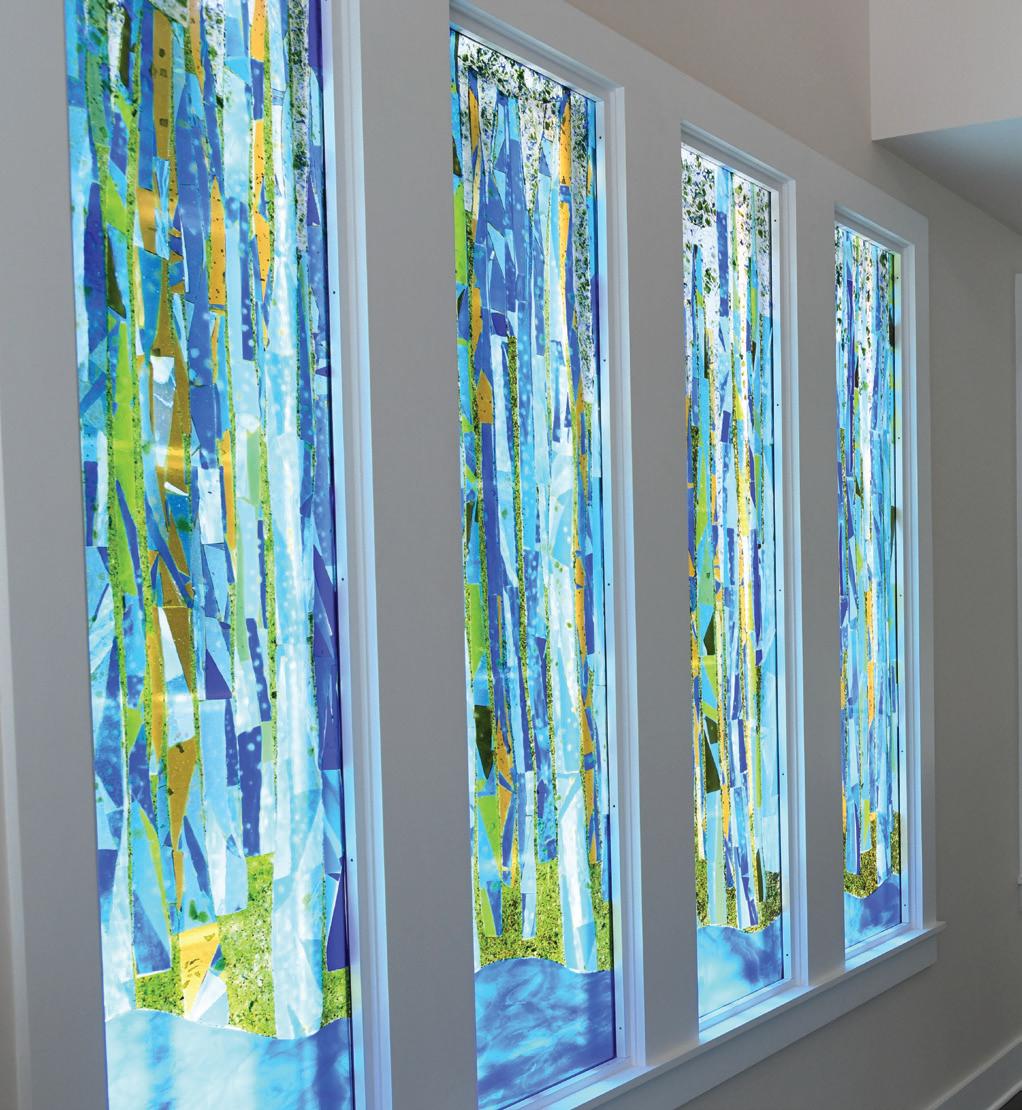
The chapel’s upcoming move from its current location on the third floor of Eckhart Hall was announced at Homecoming and Family Weekend last fall. The planned larger space will better serve students from multiple faith traditions and worldviews, and provide a welcoming, adaptable space for reflection, gathering, and community.
While designed with a focus on providing sanctuary for current and future AU students, the new chapel will also feature historic elements, including the installation of pews and stainedglass windows preserved from the chapel at George Williams College.

In the AI era, Aurora University is intentionally centering the values of connection, ethics, curiosity, and purpose amid rapidly evolving technology.
AAt a time when artificial intelligence is rapidly reshaping classrooms, careers, and entire industries, Aurora University is asking a simple question: What makes us human? Across campus, faculty and staff are answering by teaching and encouraging the qualities AI can’t replace, from empathy and ethics to curiosity and connection.
From AU’s criminal justice department to the Career Services office and the Schingoethe Center museum, faculty and staff have made the intentional decision to put people first, using AI to help students learn and connect better, not to replace human engagement.
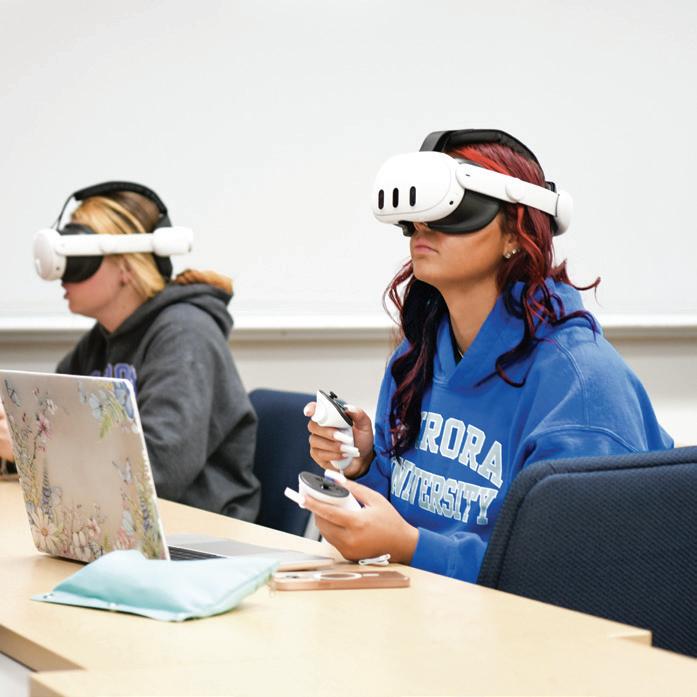
Learning with AI in the classroom
In Associate Professor of Business and Finance
Andrew Carr’s graduate-level Corporate Finance class, students turn to a virtual tutor Carr created with the drag-and-drop platform StackAI to reinforce their understanding of tricky topics such as capital budgeting and financial modeling. The virtual tutor is designed not to replace instruction, but to reinforce it within tightly defined boundaries.
Carr named his tutor Vision, after the Marvel Comics superhero, and he built it with guardrails to keep it on track. Vision is trained on the class textbook that students use, lectures, and assignments. If students prompt Vision with questions not inside that narrow band, Vision responds: “That’s outside the scope of this assignment.”
“It’s a very controlled environment,” said Carr, and by design. “Tools like ChatGPT can provide instant answers, but answers are only as useful as a student’s understanding of the underlying concepts.”
A major risk around AI, explained Alfredo Castillo — a member of the President’s Advisory Council of External Relations (PACER) at AU and a senior solutions architect at Amazon Web Services focused on generative AI for financial services — is that people begin outsourcing core human skills like creativity and decision-making to the technology, ultimately reshaping how they connect with others and see themselves.
“When we delegate cognition, we may risk deleting moral reasoning, a sense of fairness, justice, wisdom, and empathy,” he said.
Carr, like other professors across the university, embraces his students using AI. But he’s steadfast on not letting them lose sight of what makes them human — their ability to reason and communicate. He’s grown increasingly intentional about prioritizing human connection and using AI to strengthen, rather than replace, human learning and interaction.
“I help students to keep their humanity by prioritizing foundational skills like reading, writing, and speaking,” he said.
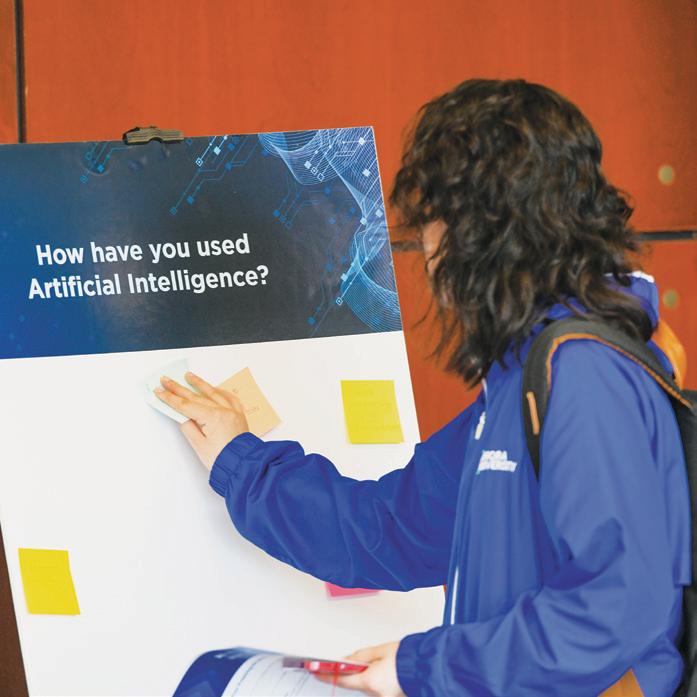
Teaching students to critically engage with AI
As professors and staff integrate AI into learning and teaching at AU in ways that reinforce human judgment and ethics, they’re also designing learning environments that treat AI as a tool to be questioned, not simply adopted.
For Marcia K. Thompson, chair and assistant professor of criminal justice, and an attorney, preserving what makes students human in the age of AI means not using AI tools blindly, but encouraging critical thinking about their impact while actively engaging with the people creating these tools.
Last fall, Thompson developed and offered a new course on the intersection of AI and criminal justice. Students explored topics around the history of AI, big data, ethics, data integrity, civil rights, and
privacy, and spoke with leaders from some of the top technology and justice companies in the business, including Amazon’s AI ethicist.
“Each week they got to meet a tech AI provider, not just to theorize around the technology, but to actually listen to the people creating the tools so they can have more informed conversations,” she explained.
Discussions centered on whom AI tools are meant to serve, what they aim to accomplish, and how companies should and can go about building them with the proper guardrails so they don’t infringe on people’s rights.
For example, during one session, students discussed the ethics around AI tools that summarize documents, doing the work of a paralegal. “Are you then replacing your paralegal with a machine?” asked Thompson. “How can you be sure the information you’re getting is real, and what are your ethical obligations to your client if you do this?” Students also thought deeply about questions to ask before investing in an AI tool.
“I want students to be active participants and consumers rather than passive recipients,” she said. “During class, we had a lot of conversations about how a machine is just a machine; it’s not a living being. We have to have more of these types of conversations so that people can build the tools for us and not just unleash them on us.”
For the course’s final project, Thompson tasked students with creating a new AI-enhanced justice tool. They considered legal and ethical concerns, transparency, and community engagement and then built their AI tool with a human touch.
One tool emerged from a conversation about AI technology gone wrong. Following national news stories on AI chatbots giving unsafe mental health advice, Illinois Governor JB Pritzker signed legislation last summer prohibiting AI therapy in Illinois. The state became the first in the U.S. to explicitly ban the use of unsupervised AI in therapy and psychotherapy services.
Thompson’s students came up with a novel AI mental health tool that wouldn’t give advice but would instead connect people in crisis to the best local resources, quickly getting them the help they need from human counselors. “It’s more of a connector, and a clever way to serve people in crisis when they can’t help themselves,” said Thompson. “It’s much better than a bot telling you what to do.”
Another group of students proposed an AI tool to audit how companies are using AI. The tool would analyze metrics such as data integrity, community input, transparency, and even the degree to which humans complement AI.
“And if businesses didn’t pass the audit, consumers would be able to see that, much like they can see complaints from customers through the Better Business Bureau,” she said.
It’s these types of creative exercises, grounded in critical thinking, that will keep humans at the center of evolving technologies, she added.
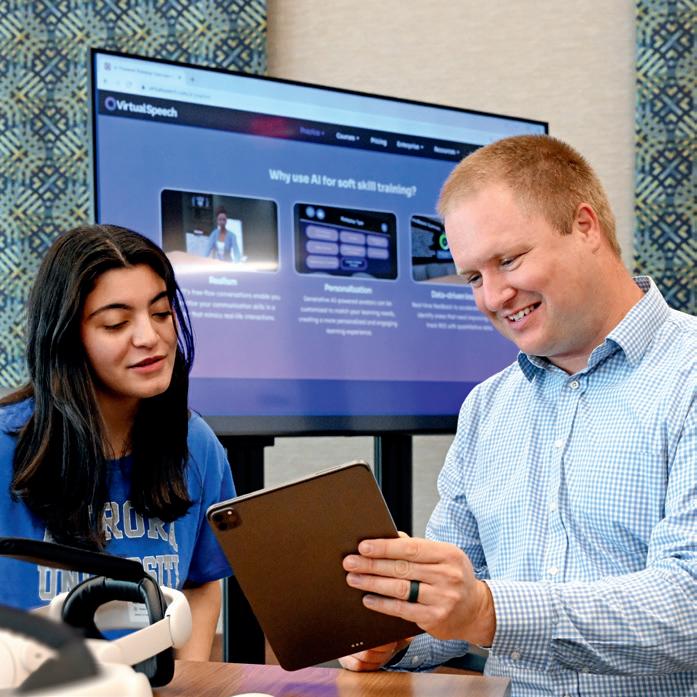
Bridging human insight and AI-driven recruiting tools
AU’s Career Services, in many ways, is at the forefront of AI on campus, as counselors work with companies that use the tools to evaluate potential employees. The office itself harnesses AI tools to support students preparing for the workforce of the future. But it’s also injecting human insight into a process that feels increasingly formulaic.
Career Services uses AI-powered résumé optimizer VMock, which analyzes student résumés and provides instant feedback on formatting, content, and keywords so students can better match their résumés to specific job openings and stand out.
“Part of why we do this is to address the lack of humanity in hiring today,” said Chris de Kok ’07, AU’s director of Career Services. “We’re seeing a lot of companies using AI applicant-tracking systems to screen résumés. Your résumé might get kicked out of the stack before a human ever sees it.” It’s understandable with the volume of applications in today’s job market, he added, but still a high hurdle for students to overcome.
Rather than replacing human career counselors, however, AU uses VMock to enhance staffs’ work, giving students data-driven insights combined with personalized guidance to make their résumés more competitive. Career counselors interpret and apply AI-generated results, including data from mock job interviews with AI bots.
“We emphasize ethical use and critical thinking and position AI as a supplement to human coaching and relationships,” said de Kok. “We’re not replacing our career counselors. VMock is a tool to help students beat the robots.”
In workshops on how to craft an outstanding résumé, stand out on LinkedIn, and interview with confidence, de Kok and his colleagues also include tips on how to effectively use AI. Students learn how, and why, to stay true to themselves when working with AI tools and how to best prompt AI.
“It’s important for our students to be exposed to AI in the wild because they’ll be exposed to it in the workplace,” said de Kok. “But at the same time, these tools can really strip out your personality. We want to make sure we’re still focusing on the person, not on the AI.” Humans remain in the driver’s seat, with AI functioning more like a helpful tutor.

peer
As a peer career specialist, Abigail June ’25, ’26 MBA worked alongside de Kok and students who came to Career Services for help. “With résumés, it’s not just about what’s on paper,” she explained. “It’s really about how your values and experience come through, something only a human can really assess well. That’s how you show what you’ve done and what you know when it comes time for the interview.”
“
résumés, not
That’s physical faculty tailored being very about it
Career Services is also supporting the campus expansion of StackAI in the classroom, an effort primarily led by Juan Colón Santana, associate professor of physics and coordinator of physical science. StackAI gives more faculty the ability to build custom AI chatbots tailored to their courses and provides them with control to ensure students still drive the learning process.
“We’re being very intentional about rolling it out correctly in the classroom because we want to maintain the humanity and make sure students are learning and thinking on their own with the AI as a supplement,” said de Kok. “We don’t want to erase who students are.”
maintain the humanity and make sure students are learning and thinking on their own with the AI as a who students are.”
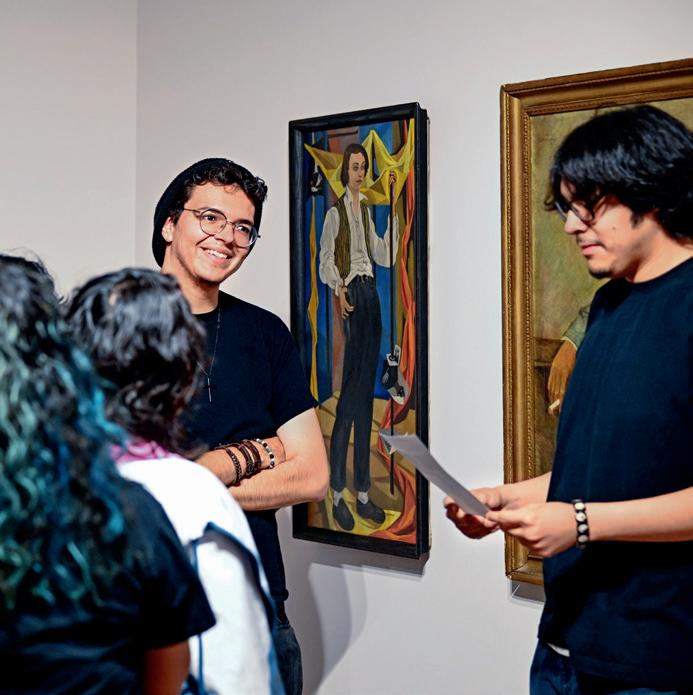
Art as a space for empathy, reflection, and human connection
human connection the Schingoethe critical probing gallery tours, are independent
Meanwhile, the Schingoethe Center is playing a vital role as a place for the AU community to foster human connection and strengthen critical thinking through in-person experiences. Initiatives, from hands-on art workshops to probing gallery tours, are intended to encourage independent thinking and open students’ eyes to diverse perspectives.
“We want to maintain the humanity and make sure students are learning and thinking on their own with the AI as a supplement.”
and make learning their a
— Chris de Kok ’07, Director of Career Services
According to Natasha Ritsma, director of the Schingoethe Center, art is a vehicle to help students learn other people’s stories and develop empathy for their situations. “It provides a way for people to come together to have meaningful conversations, to get to know each other, to build and create community, and to not feel alone,” she explained.
According to Natasha Ritsma, director of the Schingoethe Center, art is a vehicle to help students
for their situations. “It provides a way for people to come together to have meaningful conversations, get build create community, and to not feel alone,” she explained. tell
Each year, the center hosts more than 100 museum visits by AU classes. Students from social work to computer science focus on analyzing pieces of art that tell great stories. They discuss the works with peers and their instructor. The experience often involves ethical reasoning and sparks creativity in students.
exhibition, Territories:
The Art of Exile in Pilsen,” focused on the migration experience of leaving Mexico for
community in a new land and honoring
A recent exhibition, “Mapping Territories: The Art of Exile in Pilsen,” focused on the migration experience of leaving Mexico for the United States. Students connected with messages around that journey, of creating community in a new land and honoring ancestors and cultural traditions.
works of art and artifacts in person in order to have meaningful dialogues about important
“Focusing a topic from multiple points of view allows people to develop empathy and to gain some
“It’s really important for people to see original works of art and artifacts in person in order to have meaningful dialogues about important issues in their lives,” said Ritsma. “Focusing on a topic from multiple points of view allows people to develop empathy and to gain some emotional intelligence.”
In recent months, the center has also hosted more art- and wellness-based workshops, crafts, that are open and free to the community. René Arceo, the organizer of the “Mapping
more than 100 students who signed up.
In recent months, the center has also hosted more art- and wellness-based workshops, including yoga, sound healing, and arts and crafts, that are open and free to the community. René Arceo, the organizer of the “Mapping Territories” exhibit, taught printmaking to the more than 100 students who signed up.
Students also unite weekly for Art Café, which features in-person art-making activities. The program launched a few years ago, but recently expanded after growing exponentially.
“It’s been incredibly popular,” said Ritsma. “It’s such a great way for students to disconnect from screens and work with their hands to create something.”
medical-record tracking after years of his the limitations
to build a system for patient intake and medical-record tracking after years of his volunteer work revealed the limitations of its paper-based processes, particularly in managing data and coordinating care. In the design process, Rodriguez and his classmates connected every technical decision they made to how nurses or patients would interact with the technology.
design Rodriguez led implementation
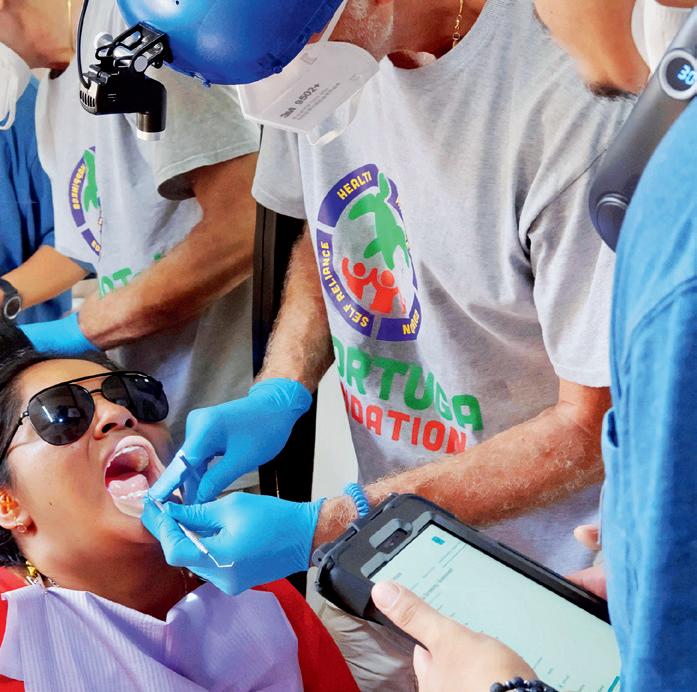
Using AI in service of human impact It’s the hope of AU staff and faculty that these deliberate efforts across campus to put people and the human experience first will shape how students approach their work, and ultimately their careers. And, in many cases, it’s already happening.
Computer science major Jose Rodriguez ’26 built a patient intake system for his senior capstone supporting healthcare efforts for rural and Indigenous communities in Chiapas, Mexico, with plans to incorporate AI into the system’s reporting capabilities as it continues to evolve. The system serves communities where residents need care for conditions such as tooth decay, diabetes, and heart-related issues. But his project’s driving force, and its eventual outcome, centered squarely on how to make humans’ lives better. Rodriguez and two computer science classmates partnered with the La Tortuga Foundation, a nonprofit organization,
— Jose Rodriguez ’26 2026 | Aurora Café, way their hands to create something.” across to first will And, healthcare with to as it continues to evolve. The system serves residents for heart-related issues. But his project’s driving and centered to make humans’ Rodriguez and two computer science classmates partnered with the La Tortuga a nonprofit organization,
In March, Rodriguez led implementation of the initial system in Mexico. Because of the tool, the nonprofit now generates community health reports in about a minute, which it can quickly share with local leaders to advocate for resources and plan ahead. What once required hours of manually pulling data from paper forms now takes moments.
nonprofit now generates with local leaders to advocate for resources and plan ahead. What once required hours of now takes moments.
“That’s the door that this tech opens,”
is what made it worth it. It is incredibly rewarding to see our academic requirements
improve patient care in the real world.”
“That’s the door that this tech opens,” Rodriguez explained. “The human impact is what made it worth it. It is incredibly rewarding to see our academic requirements at AU translate into a tool that will directly improve patient care in the real world.”
As the father of two daughters — one in college and one who is 5 — PACER member Alfredo Castillo said he hopes to see more projects like this. As Castillo lends his expertise to help guide AU through AI adoption, he emphasizes the role of faculty and staff in helping students strengthen moral and ethical reasoning, emotional resiliency, and empathy.
As the father of two daughters — one in — Alfredo Castillo said he hopes to see more projects like this. As Castillo lends his help guide through adoption, he emphasizes the role of faculty and staff in helping students strengthen resiliency, and empathy.
“The idea is not to lose that capacity for connection,” said Castillo.
“The idea is not to lose that capacity for
“ see academic requirements at a that care world.”
“It is incredibly rewarding to see our academic requirements at AU translate into a tool that will directly improve patient care in the real world.”
AAcross careers and communities, Aurora University alumni are turning purpose into action and showing how giving back makes a tangible difference in their communities and their personal and professional lives.
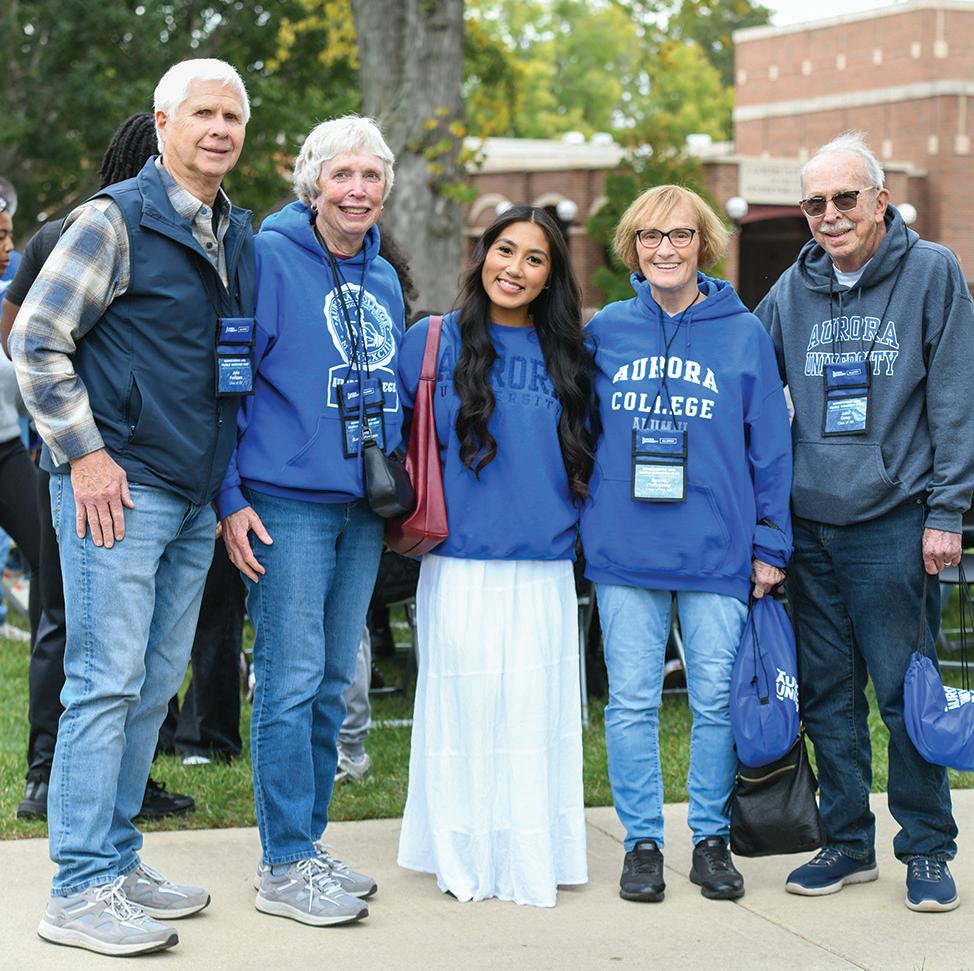
Aurora University alumni are a deeply giving group. Some support nonprofits they feel passionate about. Others invest in AU itself through mentoring, volunteering, and philanthropy that help sustain the next generation of students. Their steadfast commitment, shaped at AU, reflects the university’s deep-rooted tradition of community engagement as a private institution with a public purpose. That vision is apparent across the campus, where a collaborative learning environment prepares AU students to drive societal progress, including through the university’s immersive programs in social work, education, and nursing.
We caught up with five alumni who shared their journeys of giving back. Across disciplines, from political science and history to behavioral science, and careers spanning medical technology, state government, and mental health, they’re embracing lives of service in the communities in which they live and work. They talked about how consistently making time to support the institutions and causes they care most about creates a meaningful impact in their communities and in their own lives.
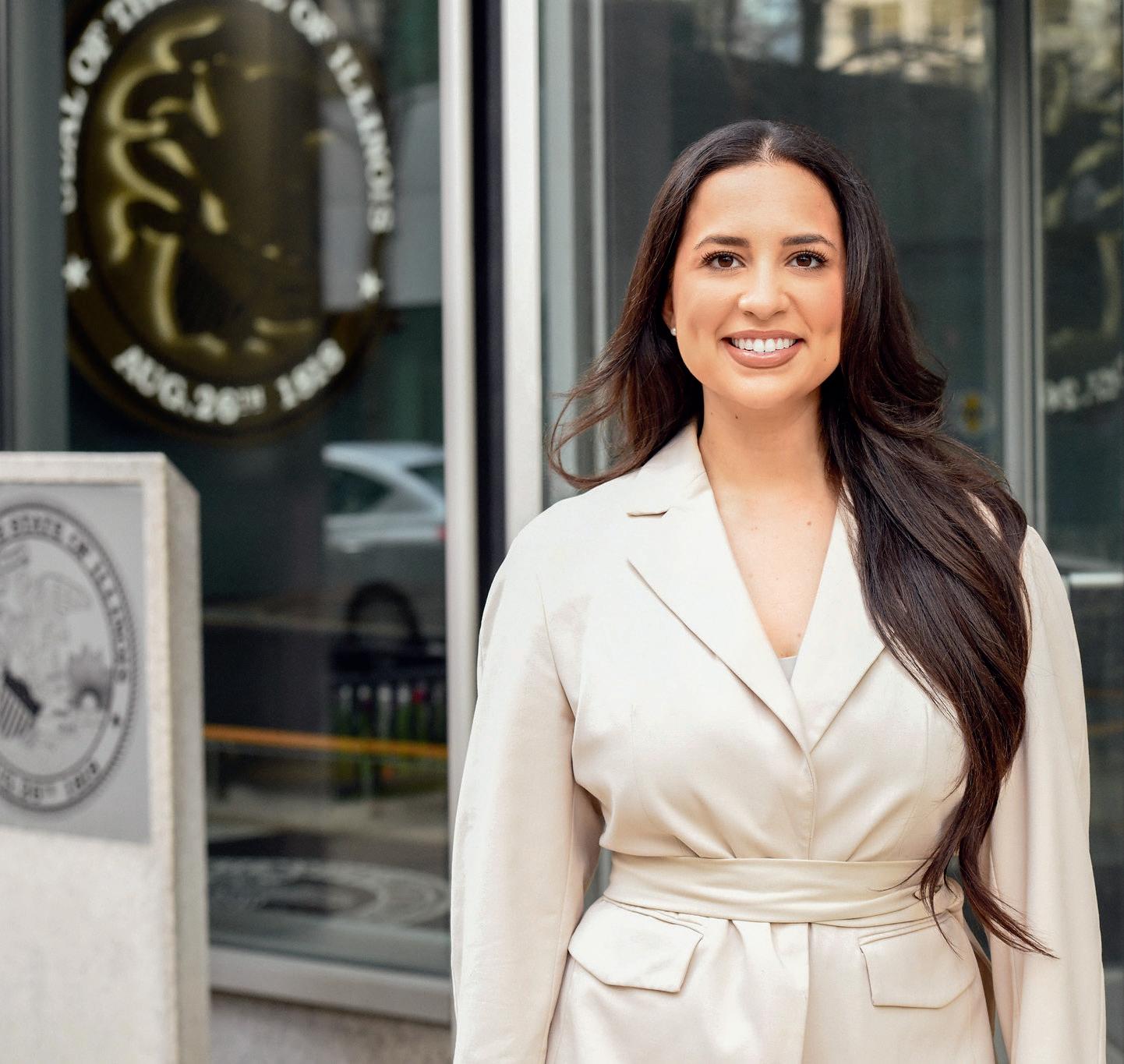
AVallejo ’20 learned in high school that her Mexican parents were undocumented, a revelation that inspired her to major in political science and public policy at AU and cofound the HOPE student organization, which continues to serve students to this day.
ndrea Vallejo ’20 is the daughter of Mexican immigrants, a background that inspired her to major in political science and public policy at AU and cofound the HOPE student organization, which continues to serve students to this day.
“Giving back and helping others has always been at the core of what I’ve done with my life,” said Vallejo, whose parents are now U.S. residents.
“Giving back and helping others has always been at the core of what I’ve done with my life,” said Vallejo, whose parents are now U.S. residents.
Today Vallejo is senior special projects officer for business and economic development in the Office of Illinois Governor JB Pritzker, a position she’s held for the past year and a half. It’s a job that allows her to build on the spirit of service and community impact AU helped instill.
Today Vallejo is senior special projects officer for business and economic development in the Office of Illinois Governor JB Pritzker, a position she’s held for the past year and a half. It’s a job that allows her to build on the spirit of service and community impact AU helped instill.
Vallejo first joined the governor’s office in 2020 as a fellow in external affairs and worked her way up to deputy director of public engagement. That role included supporting the governor’s response to the Highland Park parade shooting on July 4, 2022, and working with his policy team and municipalities as he mobilized to pass legislation banning the sale and distribution of assault weapons within a year of the shooting.
Vallejo first joined the governor’s office in 2020 as a fellow in external affairs and worked her way up to deputy director of public engagement. That role included supporting the governor’s response to the Highland Park parade shooting on July 4, 2022, and working with his policy team and municipalities as he mobilized to pass legislation banning the sale and distribution of assault weapons within a year of the shooting.
“In external affairs, I learned how to deliver bad news and how to work with people who see things differently from you, and those are skills that continue to be essential in my role now,” she said. “I enjoy problem-solving and strategy and I always do everything I can to make sure community members’ voices are heard.”
“In external affairs, I learned how to deliver bad news and how to work with people who see things differently from you, and those are skills that continue to be essential in my role now,” she said. “I enjoy problem-solving and strategy and I always do everything I can to make sure community members’ voices are heard.”
In spring 2025, Vallejo helped lead Governor Pritzker’s trade mission to Mexico City. Public and private sector leaders from across Illinois met with Mexican CEOs to deepen economic ties and foster greater cooperation between Illinois and Mexico. Delegation members and their Mexican counterparts discussed collaboration in agriculture and food processing, finance, and manufacturing.
In spring 2025, Vallejo helped lead Governor Pritzker’s trade mission to Mexico City. Public and private sector leaders from across Illinois met with Mexican CEOs to deepen economic ties and foster greater cooperation between Illinois and Mexico. Delegation members and their Mexican counterparts discussed collaboration in agriculture and food processing, finance, and manufacturing.
“ the poured into me, inspired to do same for others.”
“Because of the many who poured into me, I’m inspired to do the same for others.”
— Andrea Vallejo ’20
Meanwhile, Vallejo credits her AU mentors with much of her success. “They always had my best interests at heart — recommending me for opportunities, cheering me on through challenges, and investing their time and wisdom into my growth,” she explained. “I’ll never forget the people who lifted me up when I needed it most.”
Meanwhile, Vallejo credits her AU mentors with much of her success. “They always had my best interests at heart — recommending me for opportunities, cheering me on through challenges, and investing their time and wisdom into my growth,” she explained. “I’ll never forget the people who lifted me up when I needed it most.”
Now she mentors others who reach out for advice about working in government, from undergraduate students to high schoolers. “Because of the many who poured into me, I’m inspired to do the same for others and be that source of guidance and support when I have mentees of my own,” she added. “I’m always happy to give back.”
Now she mentors others who reach out for advice about working in government, from undergraduate students to high schoolers. “Because of the many who poured into me, I’m inspired to do the same for others and be that source of guidance and support when I have mentees of my own,” she added. “I’m always happy to give back.”
AVolunteering a variety of volunteering, people you meet and the experiences you have will exceed your expectations,” said Paret. “Some
a school student, Paret ’96 business, and finance in offered Junior volunteered weekly
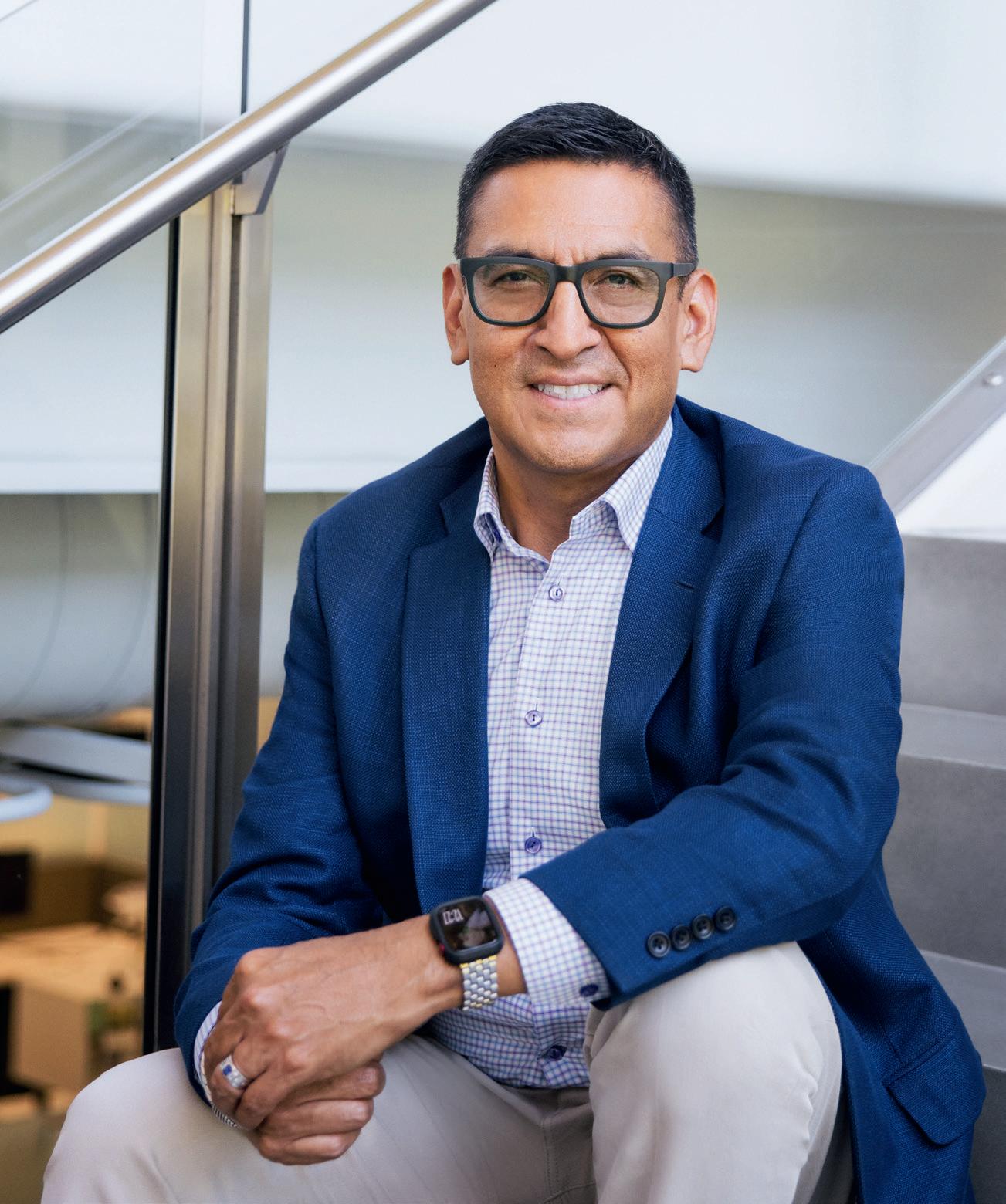
s a high school student, Carlos Paret ’96 learned about business, entrepreneurship, and personal finance in classes offered by Junior Achievement. His experience with the nonprofit was so positive that Paret volunteered weekly with JA of Chicago and then JA of Philadelphia after graduating from AU, teaching teens basic economics.
“Having such a positive experience and seeing the impact on students of teaching these simple concepts inspired me to find other ways to volunteer,” he said.
Back in Chicago, he volunteered with the community-based health clinic Heartland Human Care Services, joining its board, and with The Cradle, an Evanston, Illinois-based adoption agency, before moving to Southern California. “I was transplanted to a market where I knew no one, and I wanted a way to meet people,” he explained. “My volunteerism took off.”
Paret, who earned his MBA from the Northwestern University Kellogg School of Management, joined AU President Susana RiveraMills’ Advisory Council of External Relations last fall. He hopes Edwards Lifesciences, where he is director of U.S. medical affairs, can partner with the university to expose students to the wide variety of careers in medical technology.
“With volunteering, it’s really about the relationships,” said Paret. “I get to give, and the more I give, I’m also receiving. Volunteerism is a playground to work on skills you want to build too. It makes you more productive and better when you’re back at your desk.”
Making an impact is a big part of his day job at Edwards Lifesciences, a leader in the medical device industry. His team leads physician training on how to implant Edwards’ transcatheter heart valves — in part using a new virtual reality tool — so they can train other physicians.
me to find other ways to volunteer,” he said. with community-based health clinic Heartland Human Care Services, joining its board, and with The before moving to Southern California. “I was no Northwestern Kellogg of Management, RiveraEdwards where he is medical in medical volunteering, really “I to give, give, I’m Volunteerism is a when you’re back at your desk.” of Edwards Lifesciences, a leader in the medical device industry. His team leads physician training on how transcatheter part using a new virtual reality tool — so they can train other physicians.
Volunteering across a variety of organizations has been essential to learning skills he’s applied to new opportunities. “Through volunteering, the people you meet and the experiences you have will exceed your expectations,” said Paret. “Some of the people I’ve met along the way have become lifelong friends. It’s really wonderful to be around people who care.”
lifelong friends. It’s really wonderful to be around people who care.”
“
met
the way
“Some of the people I’ve met along the way have become lifelong friends. It’s really wonderful to be around people who care.”
have become lifelong It’s really wonderful around people who
care.”
— Carlos Paret ’96
Patrick Shelton ’92 participated in the Air Force Junior Reserve Officers’ Training Corps in high school, and then came to AU planning to earn his degree en route to becoming an officer in the military, with inspiration from multiple family members who had served in the Air Force.
atrick Shelton ’92 participated in the Air Force Officers’ Training Corps in high school, and AU planning en an officer in Force.
After majoring in history and political science, Shelton was selected for Marine Corps Officer Candidates School. Upon completion, he served four years on active duty stationed in the U.S. and deployed twice to Panama. He spent two more years in the reserves as a First Lieutenant.
Officer he years in the as “There’s a thread my life part
Shelton. “I take leadership and responsibility very seriously, and I’ve always been oriented toward
about sacrifice and the people working for others.”
“There’s a consistent thread in my life of being a part of things that are greater than myself,” said Shelton. “I take leadership and responsibility very seriously, and I’ve always been oriented toward helping others. In the Marines, it’s not about you. It’s about sacrifice and the people working for others.”
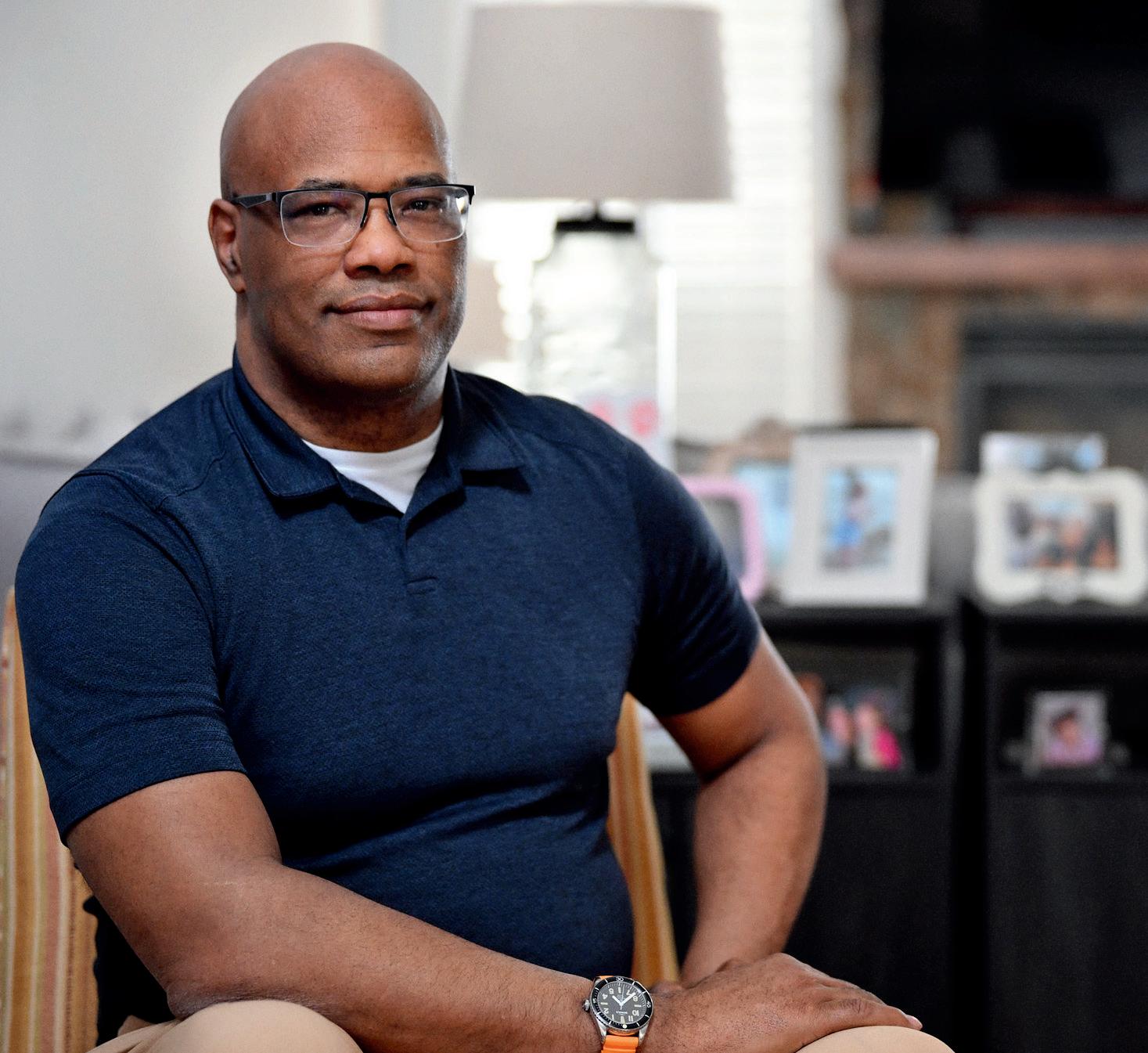
“Shelton has carried that ethos into every chapter of his life. A four-year football letterman at AU, he has shared his knowledge of the sport by volunteering to coach youth football. He and his wife, Donna, are licensed foster parents and fostered several children over the years. In 2024, they adopted their daughter through the Illinois Department of Children and Family Services process.
Shelton has carried that ethos into every chapter of
shared his knowledge of the sport by volunteering and wife, Donna, Children Family to Now, Bentley Motors, retailers
Throughout his professional career, a guiding principle for Shelton has been to leave the places he’s worked better off than he found them. Now, as regional marketing manager for Bentley Motors, he helps advise and guide more than 20 Bentley retailers across the East, Midwest, and Canada on how to improve and sustain their businesses. “I think that’s a version of service,” he said.
Shelton makes mentoring a regular part of his life. He started a LinkedIn group, the Motorsports Professionals Group, to connect and support people working in the motorsports industry, such as at
Professionals Group, to connect and support people working in the motorsports industry, such as at
“There’s a consistent thread in my life of being a part of things that are greater than myself. … I’ve always been oriented toward helping others.”
a consistent my life being are greater than myself. … always been oriented toward others.”
— Patrick Shelton ’92
1 and The than members around
Formula 1 and NASCAR. The group now includes more than 50,000 members around the globe, and over the years it has helped members make invaluable connections and find new roles.
connections and find new roles.
“It’s very gratifying to see how it’s grown organically,” he explained. “I’m proud of that
“It’s very gratifying to see how it’s grown organically,” he explained. “I’m proud of that accomplishment.”
Last year Shelton became a founding member of AU’s College of Liberal Arts and Business Advisory Board. His role entails advising on curriculum.
Last year Shelton became a founding member of AU’s College of Liberal Arts and Business Advisory role on curriculum.
“I’ve really enjoyed contributing and giving back to the university,” he said. Last April, he was invited to return to campus and give a guest lecture for a Principles in Marketing class, something he hopes to do more often.
“I’ve really enjoyed contributing and giving back to the university,” he said. Last April, he was invited return to campus and give Principles in Marketing class, something he hopes to
Deidra Jenkins ’90 describes herself an in the moment.” It’s an approach her later with sweaters hats. of who showing
eidra Jenkins ’90 describes herself as an “everyday volunteer helping people in the moment.” It’s an approach her mother instilled in her early on.
Driving through their Chicago neighborhood in winter, Jenkins’ mother would spot people at bus stops in need of warm clothing and return later with sweaters or hats. “Service has always been an integral part of who I am,” Jenkins explained. “I don’t think of service or volunteering as tied to a single organization. It’s about being present, about showing up, and about helping when the need exists in the moment.”
A Chicago resident, Jenkins is a board member with New Moms, a nonprofit founded to support young mothers. She grew up with a sister who was a young mother. “And even though she didn’t need the services, I could see what it would be like if you didn’t have someone supporting you.” Jenkins has also volunteered with Habitat for Humanity, Ronald McDonald House Charities of Chicagoland & Northwest Indiana, and Back 2 School America.
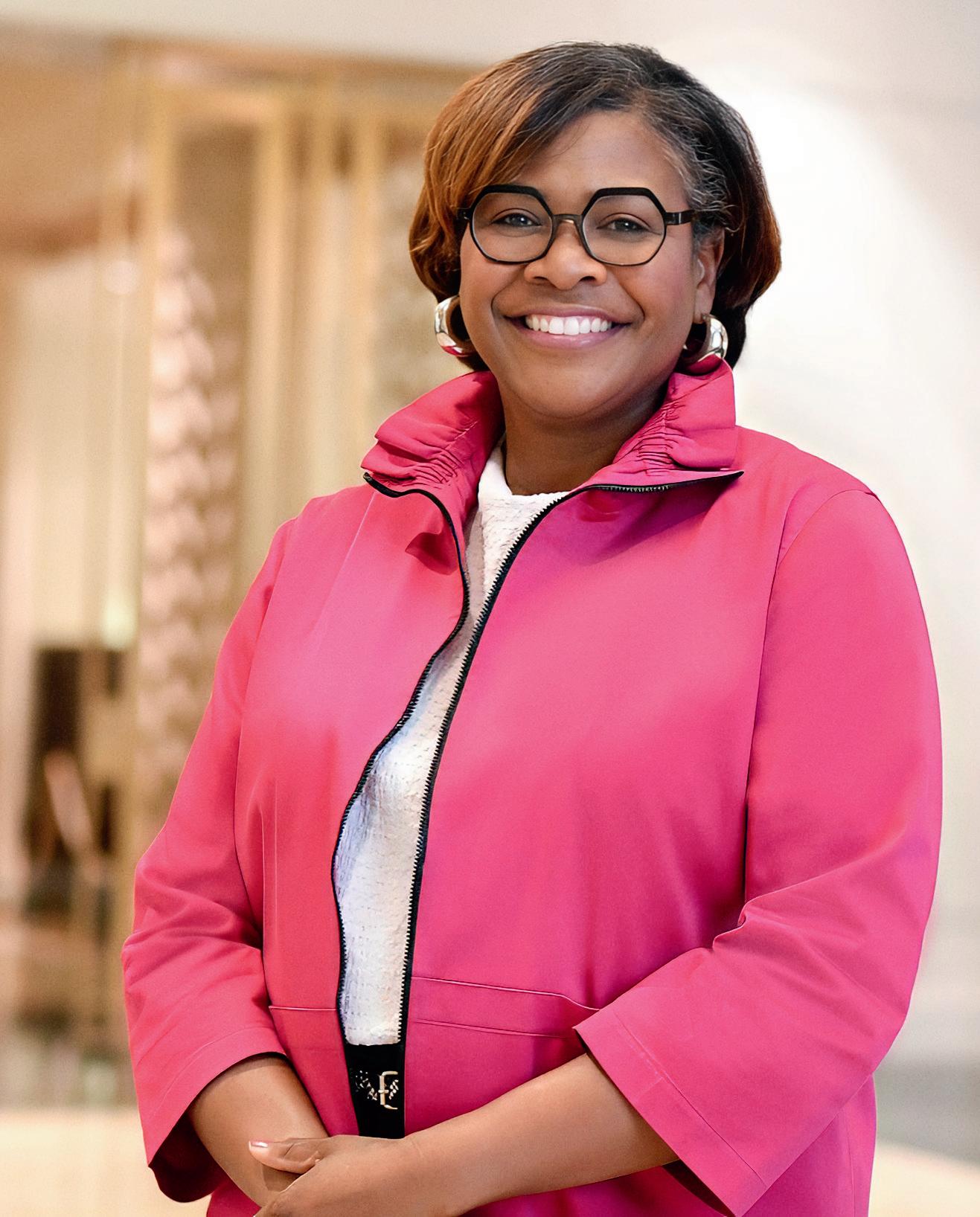
In her professional role, Jenkins also lifts people up. She’s worked for financial services firm Northern Trust for the past 36 years, most recently as the company’s global chief inclusion officer, deploying and managing diversity and inclusion initiatives across the company.
“We often provide a place where people can come and talk and connect,” said Jenkins. Every October, Northern Trust’s Achieving Greater Together month of service gives employees the opportunity to focus on giving back and making a meaningful impact in the communities in which they work and live.
A Chicago resident, Jenkins is a board member with New Moms, a nonprofit founded She a sister who was a young mother. “And even though she didn’t need the services, I could someone supporting you.” Jenkins has also Humanity, House Northwest Indiana, Back role, financial services firm Northern Trust for the past 36 years, most the global chief officer, deploying and managing diversity and people of service focus back and making a meaningful impact in the communities in which they work and live.
fulfilling, and it makes you slow down and say, ‘I do have time to volunteer.’ Northern Trust has been a huge part of me connecting beautiful to see everybody coming together to volunteer across the globe. You can make space
“It’s very fulfilling, and it makes you slow down and say, ‘I do have time to volunteer.’ Northern Trust has been a huge part of me connecting to the community and community service. It’s beautiful to see everybody coming together to volunteer across the globe. You can make space for it,” she added.
“ showing
“It’s about being present, about showing up, and about helping when the need exists in the moment.”
— Deidra Jenkins ’90
Paul Atkins GWC ’78 learned to swim at his local YMCA in Baltimore after his mother bought a membership one summer for her family of seven. When he got older, he volunteered at that same YMCA, and by high school, he knew he wanted to build his career there because of its impact on his life and the community.
Atkins studied applied behavioral science at George Williams College, which became affiliated with AU in 1992. His first job after college was at the YMCA in Peoria, Illinois, followed by a role as youth and family program director at a YMCA in St. Louis, where he developed afterschool programming in what he describes as a formative experience. After earning a graduate degree from Southeast Missouri State University, he then shifted to working in mental health and later moved to Green Bay, Wisconsin, where he continues to reside.
As an intensive in-home therapist for families of youth at risk for removal from their home, he supported hundreds of children and their parents. “I had to work to try to change the environment these kids were in so they were more likely to succeed,” he said.
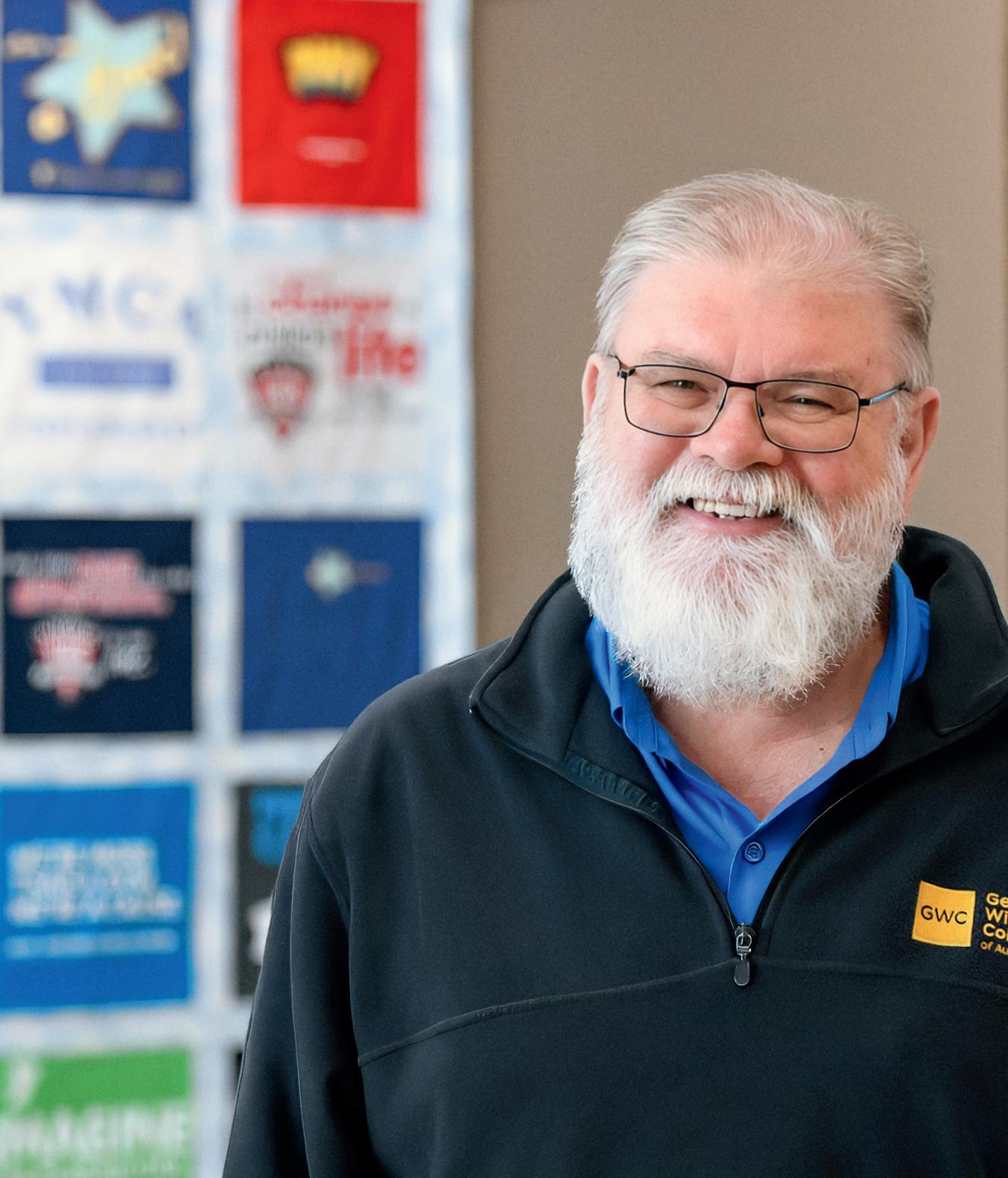
Now retired, he advocates for preserving historic artifacts from the former GWC campus in Williams Bay, Wisconsin, complementing extensive archiving efforts by staff at AU’s Schingoethe Center. “My primary goal is to serve as a resource and share insight into the future of the artifacts,” he said.
“GWC was founded in 1886 as a YMCA training school but soon grew into a college with a main campus in Chicago. The Williams Bay campus served as the site of summer classes and retreats throughout the 20th century. AU served students on the
Atkins GWC learned to swim at his local YMCA in after his mother bought a one for volunteered because which affiliated first job after college was at a degree from Southeast Missouri State University, later moved to Green Bay, Wisconsin, where he in-home of youth at risk for removal from their home, to change so succeed,” retired, he preserving serve and share into the of said. college summer classes and retreats throughout the century. before ended in artifacts on the trees
goal as a resource and the future the artifacts.”
“My primary goal is to serve as a resource and share insight into the future of the [GWC] artifacts.”
— Paul Atkins GWC ’78
Williams Bay campus for nearly 30 years before academic operations there ended in 2023.
“Historic artifacts abound on the site,” said Atkins. “Everything from plaques beneath old trees commemorating gifts from classes dating back to the early 1900s to the portrait of Sir George Williams himself.
“The campus was a testimony to the love and dedication of the early YMCA founders and movement,” he said.


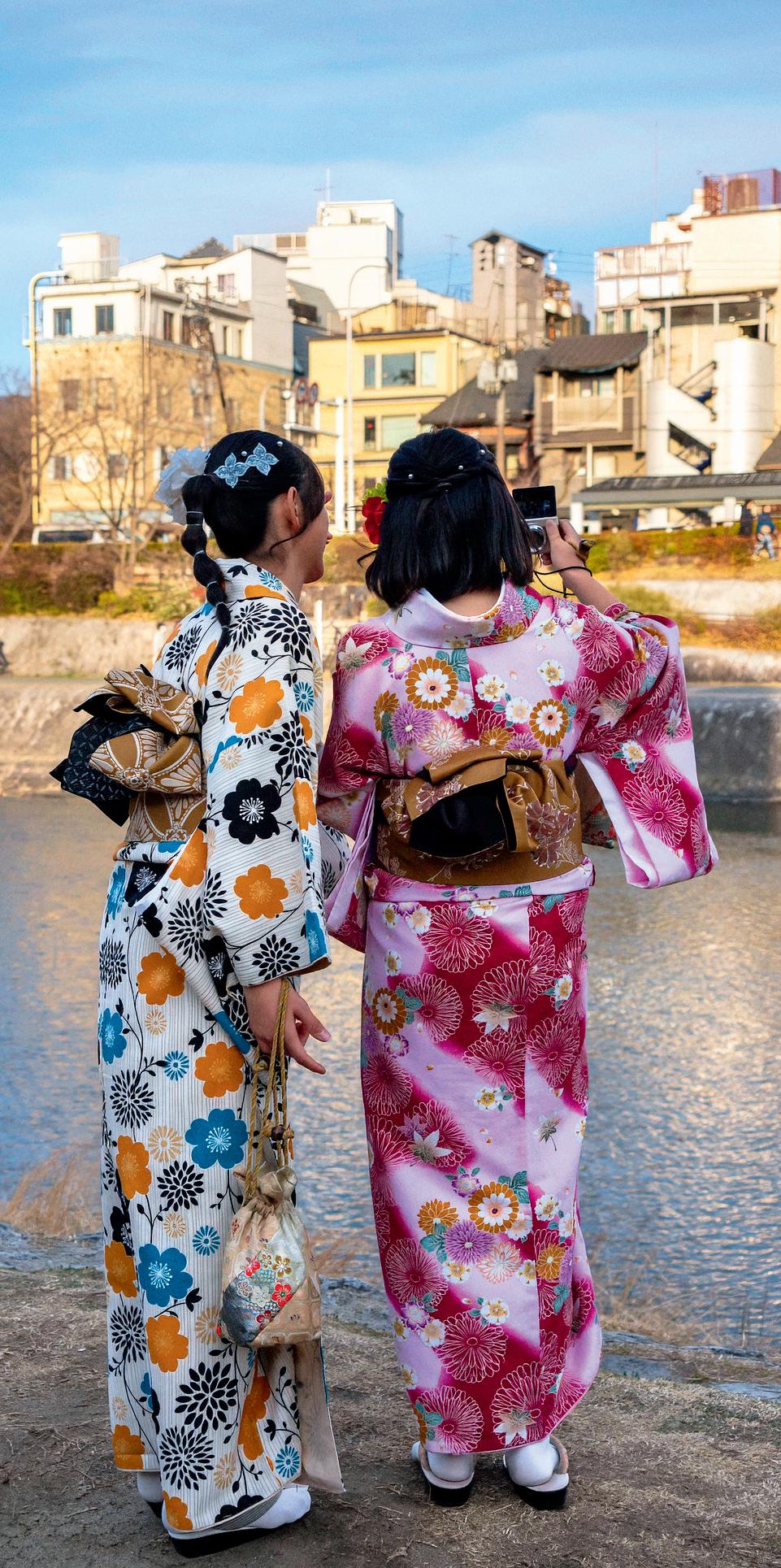
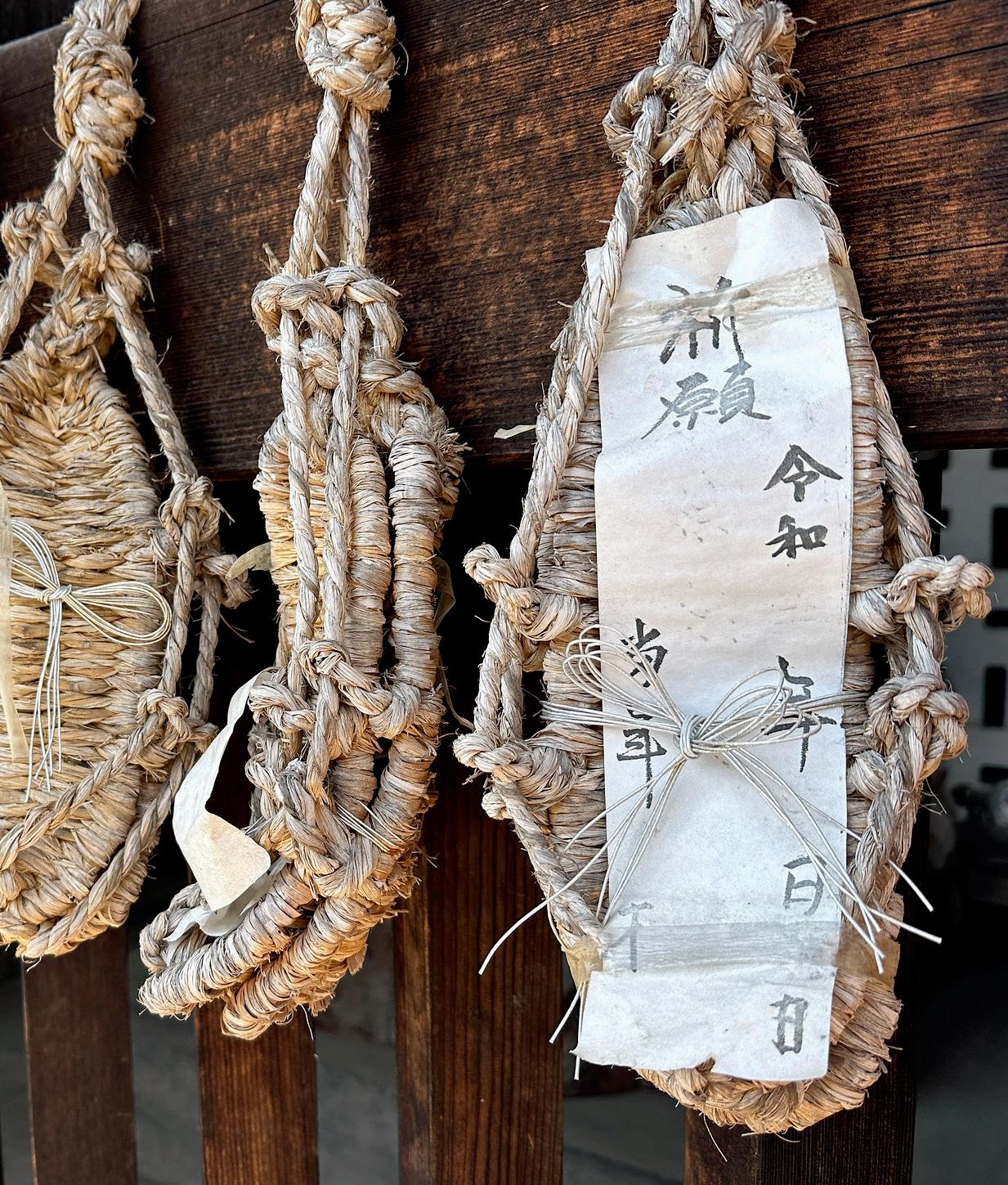
After eight weeks of classroom work that began in January, the real lesson for a group of Aurora University students was waiting 6,500 miles away.
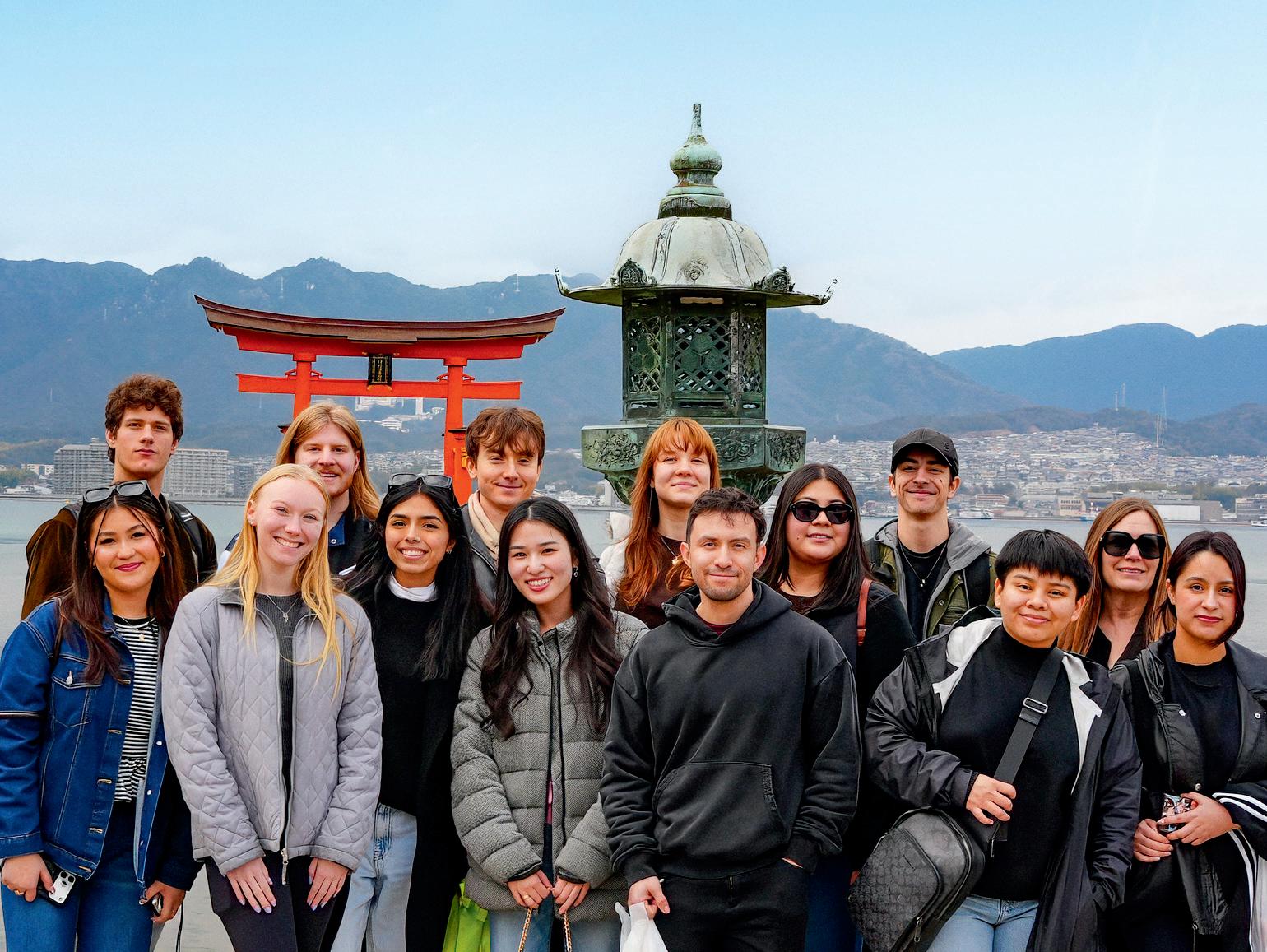
In March, 11 undergraduates, including Miu Yamaguchi ’26, who assisted with guidance and translation; two graduate students; and Mary Tarling, director of global engagement and associate professor of accounting, departed for nine days in Japan, moving through the cities of Hiroshima, Kyoto, Osaka, and Tokyo.
For most, the Study Away spring break trip was their first time in Asia. For all, it offered vivid lessons in the unexpected.
“When we arrived in Osaka, everyone in the car took turns pointing out something new,” recalled Gloria Gonzalez ’25, ’26 MSW. “We were in awe at how many new things we were seeing all at once.”
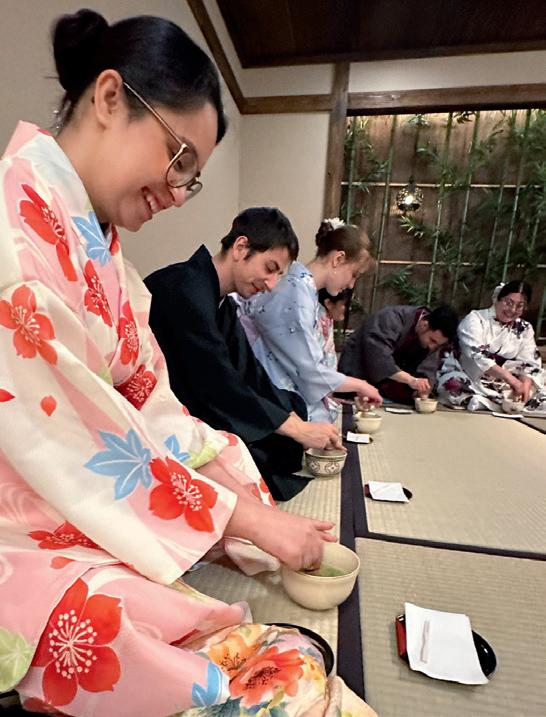
The class — Leadership: Inside and Out — introduced students to mindfulness and servant leadership, frameworks built on listening, empathy, and presence. “Japan was a natural extension of that classroom,” Tarling said.
“Japanese culture is grounded in being present and compassionate, two concepts at the heart of mindfulness,” she said. “It is a perfect place to experience these concepts in everyday life and to sense the contrast with culture in the U.S.”
For accounting and finance double major Matthew Dean ’27, the trip challenged his assumptions. He expected the language barrier to be a significant obstacle. Instead, English signage was everywhere. He expected Tokyo to feel foreign.

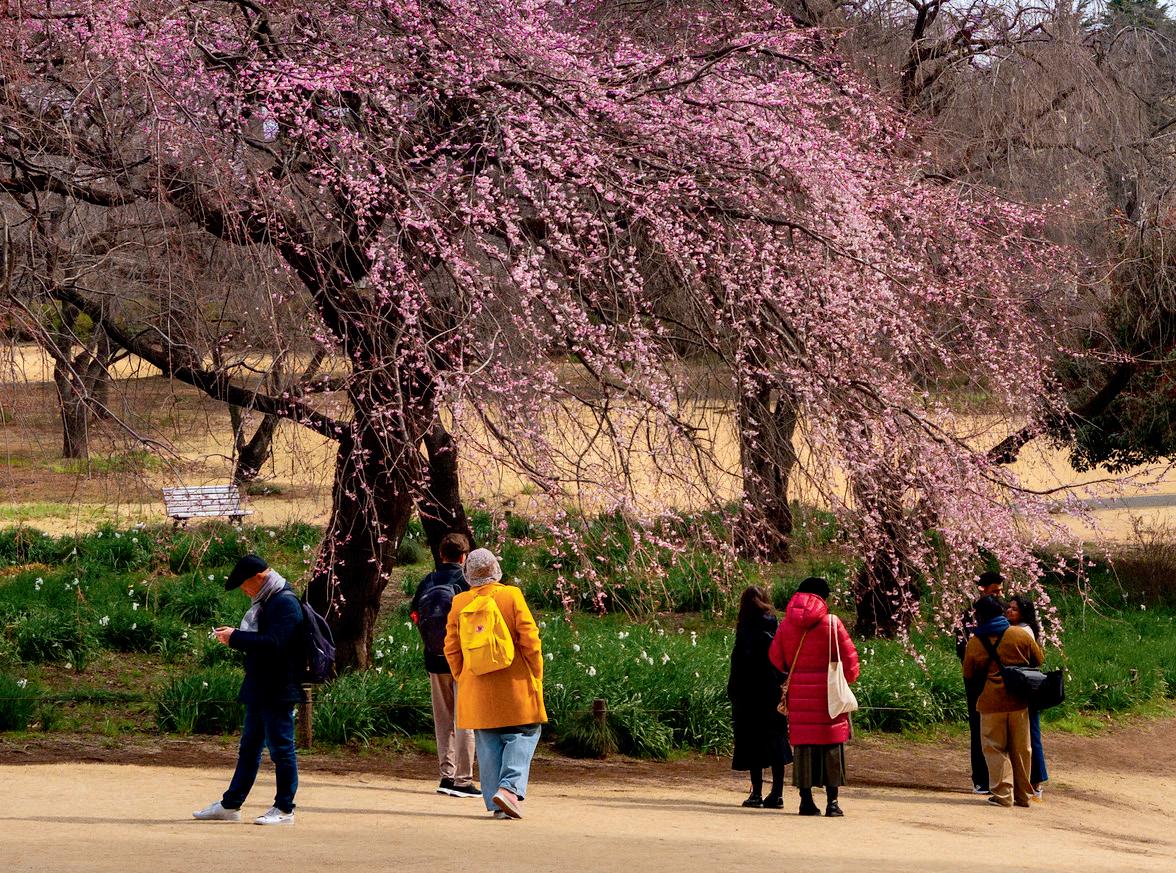

It instead reminded him of Chicago, with distinct districts serving different purposes, including financial centers, shopping and entertainment areas, quieter residential neighborhoods, and energy on the streets flowing late into the night.
“Immersing oneself is the only way to truly know what a culture is like, whether through its food, traditions, and language, or by meeting new people,” Dean said.
The group’s visit to Hiroshima was a turning point for the students. Paper cranes, left inside the Children’s Peace Monument in honor of Sadako Sasaki, moved Gonzalez. Sasaki survived the atomic bomb but later died from leukemia caused by radiation exposure; the cranes were a testament to her life and to peace.
“I thought it was meaningful to see Japan’s strong stance on nuclear weapons through the monument and their active promotion of world peace,” she said.
Across the week, Tarling watched something shift in the group.
“Students became more comfortable with the unfamiliar,” she said. “That process leads you out of anxiety and into acceptance, which is also on the path to presence and mindfulness.”
Business administration major Daniel Alexandrov ’27 came away from the trip with a new perspective.
“Understanding how to integrate yourself is a humbling and valuable experience everyone should try at least once,” he said.
By the time the group boarded their flight home from Tokyo, strong bonds had formed. “The whole group became friends,” Tarling said, and all agreed they hope to stay friends.
Aside from friendships, Gonzalez is taking one Japanese concept home with her: kaizen — small, continuous improvements that compound over time.
“I still have a long way to go,” she said. “But I’m saying yes more often.”
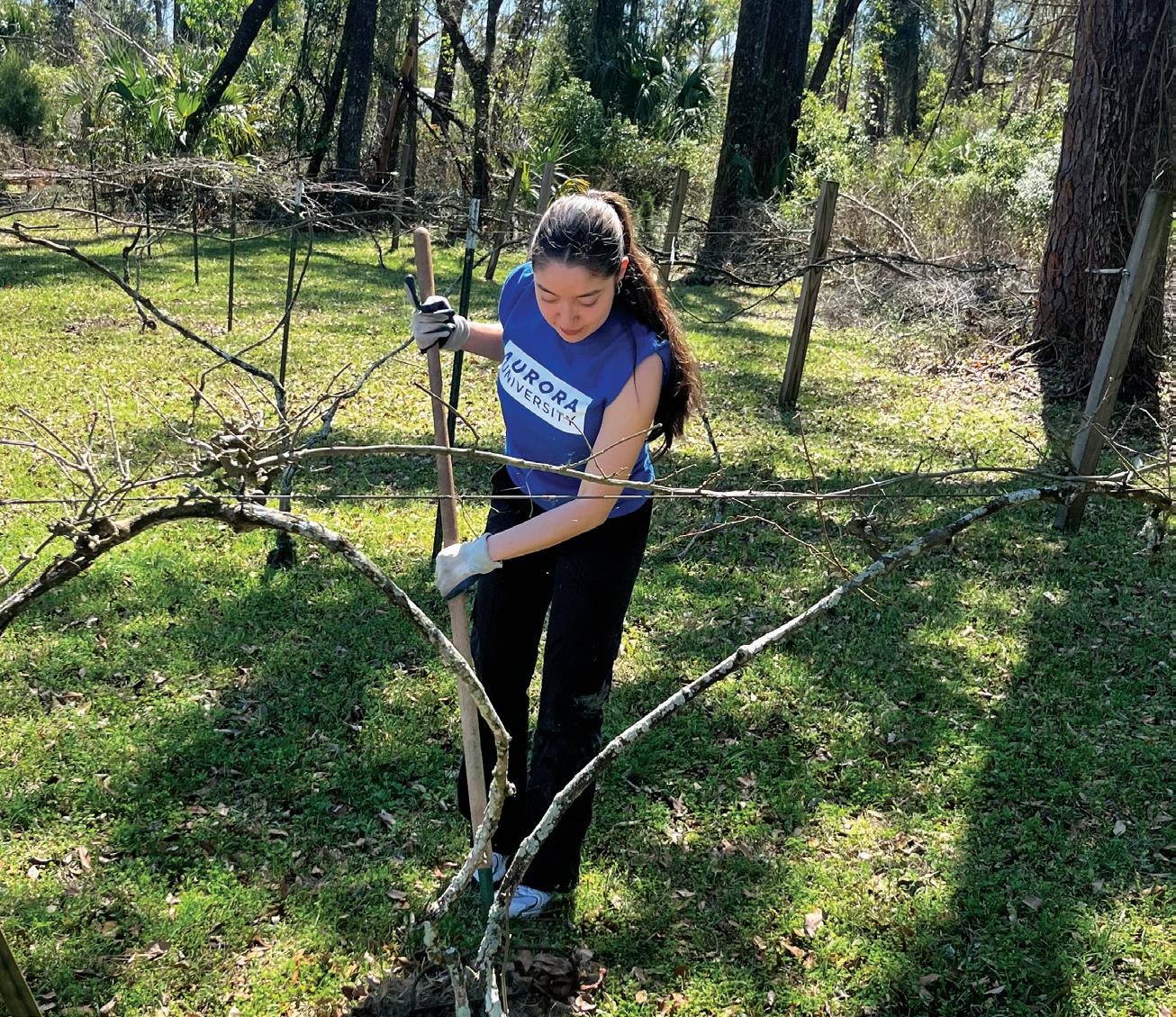
This spring break, 31 Aurora University students traded beach vacations for a mission.
On the annual Social Impact Trips, 13 students traveled to Sawyer, Michigan, for environmental cleanup, food and clothing sustainability work, and animal-assisted therapy programs. Six headed to Indianapolis to work with unhoused populations. And 12 went to Advent Christian Village at Dowling Park, a senior living community in Live Oak, Florida, with deep ties to AU’s founding heritage, where they assisted with hurricane relief and senior care.
The trips were organized through the Wackerlin Center for Faith and Action and coordinated by Miranda King ’27 MSW as part of her internship with the center.
“Any act of service can leave a lasting impact on yourself, others, and communities,” King said.
The students came back with proof. In Florida, psychology and criminal justice double major Lesli Herrera ’26 spent time restoring hurricane-damaged trails and sitting with residents at the skilled nursing and memory care center in the Village. “Even small actions, like spending time with someone, can make a meaningful difference,” Herrera said.
Criminal justice and political science and public policy double major Luisa De Leon ’28, who traveled to Michigan, found that passion makes hard work disappear. “The hours flew by,” she said. “It all felt so rewarding.”
Social work and psychology double major Ashley Reynolds ’29 came faceto-face with the complexity of homelessness in Indianapolis. She worked in soup kitchens, food pantries, and a safe house for unhoused young adults. “It’s easy to say, ‘Just get a job,’ from the outside, but once you’re there, you realize it’s not that easy to get out of the cycle of homelessness,” she said.
For many students, the trips were the first time traveling without family. They navigated new places and built unexpected friendships.
“They came back with new memories and a new group of friends,” King said. “And they wanted to bring that energy home.”
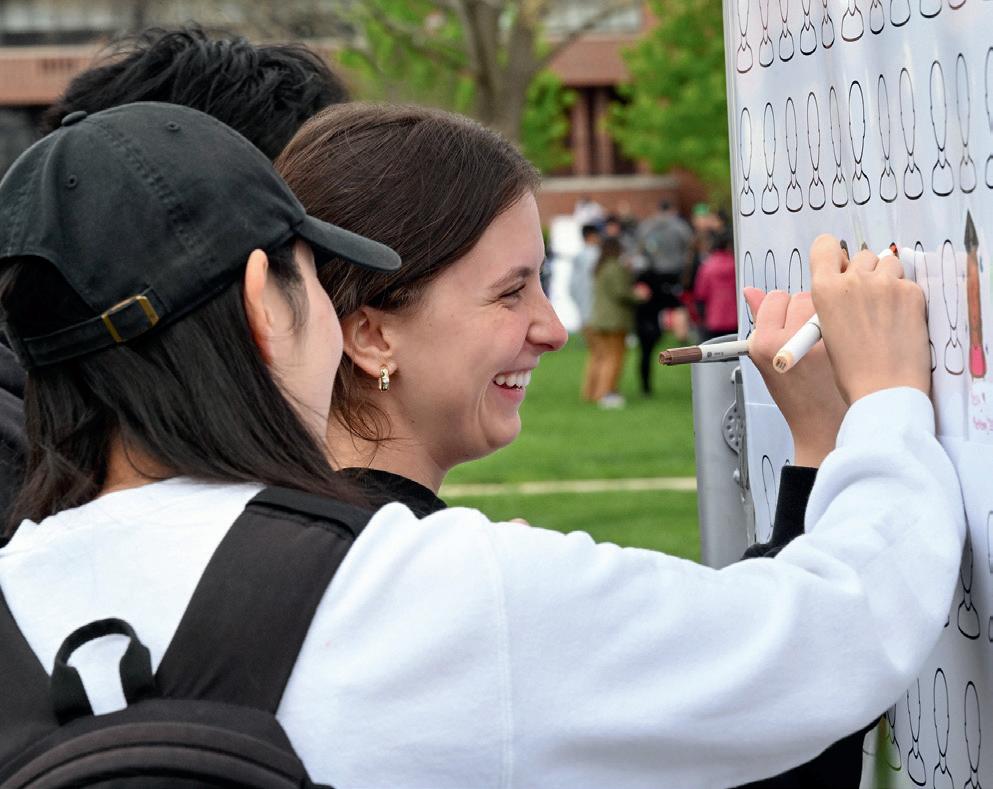
Career Services marketing interns set out to spread positivity last fall. What began with inspiring quotes and shout-outs in weekly student newsletters grew into the Kindness Connection campaign, which featured positivity stations hosted by various departments around campus. The community enjoyed photo walls, message boards, letter-writing activities, and mementos of encouragement, which brightened spirits as winter approached.
“The purpose was to strengthen relationships and build a more positive atmosphere, combating the disconnect people can feel in busy school and work environments,” explained Kayla Winter ’26
Kindness Connection continued this April, lifting spirits again as end-of-semester stress returned. During the Spring Carnival, students painted rocks, made signs, and used sidewalk chalk to decorate campus with reminders of optimism. A fan favorite was the community wall, where students created self-portraits on a board of blank character silhouettes.
“Everyone drew themselves with a fun detail, which reminded me how happy I am to be part of AU’s diverse community,” said Natalie Wymore ’26 .
A spirit of service continues to define Aurora University student-athletes, whose impact reaches well beyond the classroom and playing surface.
Last fall, AU once again participated in the Northern Athletics Collegiate Conference’s annual Cans Across the Conference initiative, which sees schools competing to collect the most canned goods, nonperishable items, and monetary donations for local charities. Led by the Student-Athlete Advisory Committee (SAAC), the Spartans collected a league-high 6,670 cans to benefit the Aurora Area Interfaith Food Pantry.
Spartans have excelled in Cans Across the Conference for many years, and those sustained efforts were recognized in January by the National Association of Division III Athletics Administrators. AU earned third-place honors for the Community Service Award (One-Time Project category) after collecting a NACC-leading 4,670 donation items during the fall 2024 drive.
Providing comfort
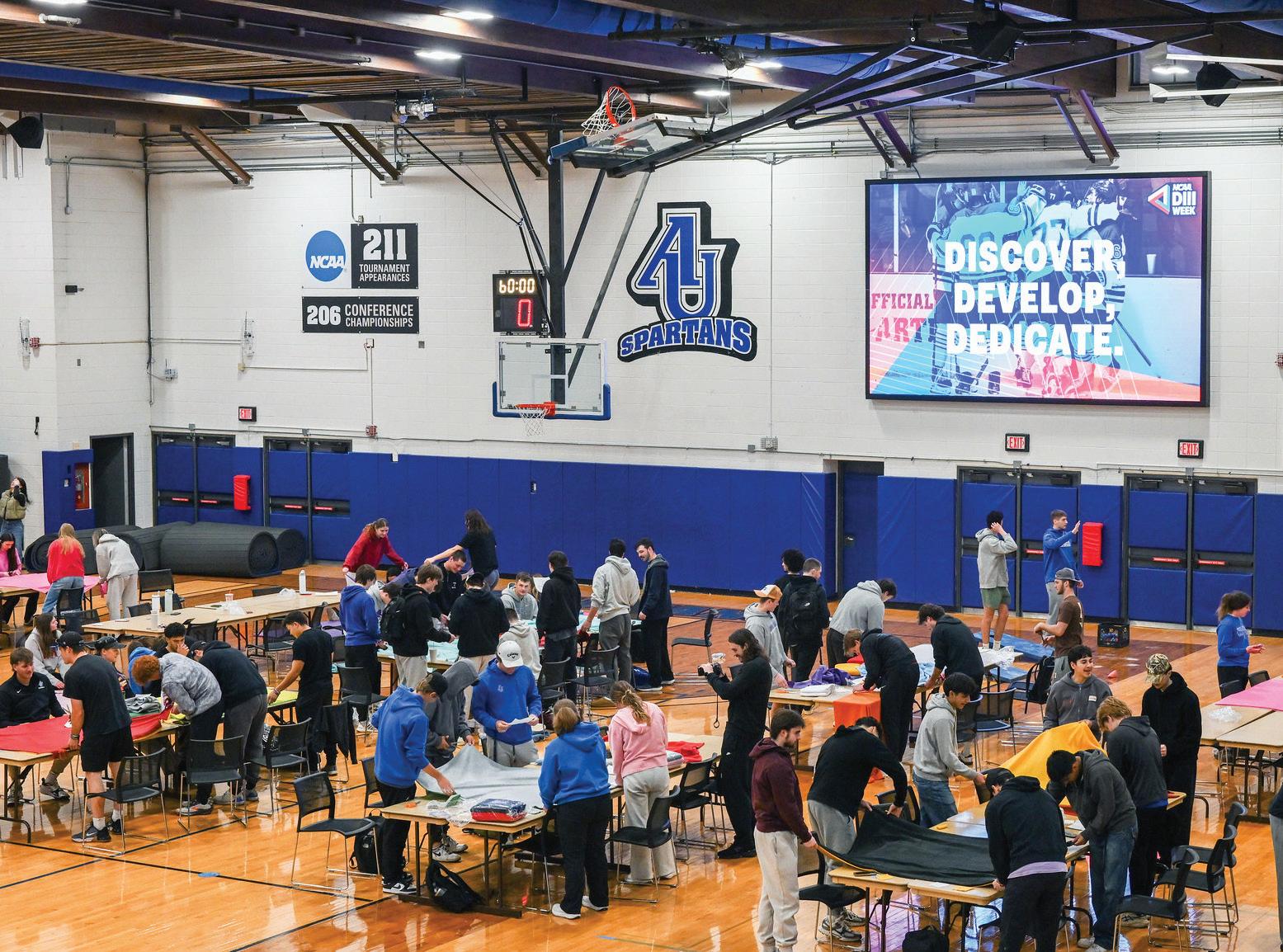
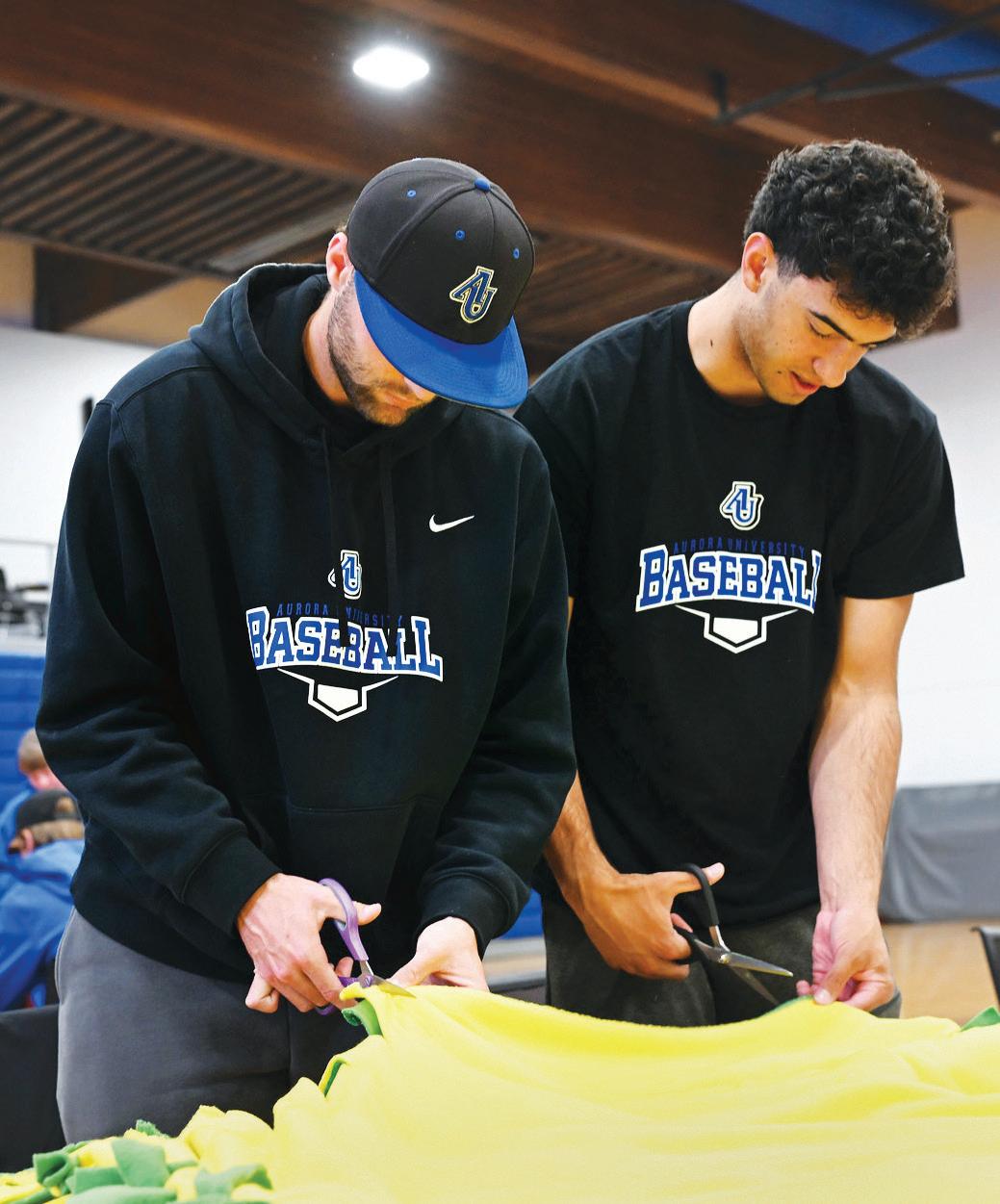
In April, the SAAC partnered with national nonprofit organization Project Linus for the 23rd consecutive year, with student-athletes gathering in Thornton Gymnasium to create blankets for children facing
serious illness or other challenges. This spring, student-athletes produced 71 blankets, which were donated to Rush Waterford Place Cancer Resource Center in Aurora.
During Student-Athlete Mental Health Week, an annual observance led by the national nonprofit Hilinski’s Hope Foundation, AU participated in a conference-wide mental health initiative at the NACC Women’s Golf Championships in October. In addition, the AU men’s soccer and men’s lacrosse teams each hosted a mental health awareness game in partnership with The Hidden Opponent, a nonprofit organization advocating for athletes’ mental health.
Throughout the year, AU also partnered with local special recreation organizations, welcoming groups from Fox Valley Special Recreation Association, South East Association for Special Parks and Recreation, and the National Ability Basketball League to campus and athletic competitions.

4,670 donation items collected in 2024 by Spartans, resulting in an award-winning NACC Cans Across the Conference effort.
Assistant director of athletic communications selected for Emerging
Assistant Director of Athletic Communications Alyson Teixeira ’21, ’23 MBA was selected as one of 30 individuals for the second class of the NCAA Division III Athletic Communicators Emerging Elite Program and attended the association’s professional development program at its headquarters in Indianapolis in December.
Launched in 2024 in partnership with two professional organizations, College Sports Communicators and Division III Sports Information Directors of America, the initiative is designed to support the advancement of emerging leaders in Division III athletic communications. Participants are nominated by athletic directors, senior woman administrators, and conference offices.
“The experience was incredibly impactful and energizing,” Teixeira said. “It provided a unique opportunity to connect with professionals from across the country, share ideas, and learn from different perspectives within college athletics.”

Men’s hockey completed a recordsetting season, advancing to the NCAA Division III Men’s Ice Hockey Championship’s Frozen Four for the first time and reaching No. 2 in the U.S. College Hockey Online DIII poll, its highest-ever ranking. Forward Hassan Akl ’26 finished his career as AU’s all-time leading points scorer with 136, and forward Jakson Kirk ’27 set the program’s career goals record (51).
On the court, men’s basketball won the Northern Athletics Collegiate Conference Tournament and earned an NCAA Tournament bid for the first time since 2019. The team also surpassed the 20-win mark for the first time since the 2017–2018 season, including a 17-game winning streak that shattered the previous program record of 14 straight wins.
Women’s basketball tied the DIII record by making 26 three-pointers in a win over Rockford University and later eclipsed 20 wins for the third

time in four years — marking the first time in school history that both men’s and women’s basketball won 20 games in the same season.
AU enjoyed a successful performance at the inaugural DIII Women’s Wrestling Championship, with Alexis Janiak ’26 placing second at 131 pounds, and Genesis Ramirez ’27 finishing third at 103 pounds. Janiak also represented Team USA in international competition, winning the silver medal at 59 kilograms at the Zagreb Open in Croatia in February.
AU’s golf programs continued their recent dominance. Men’s golf won its ninth consecutive NACC championship, with Jackson Hulsey ’26 repeating as individual champion. Women’s golf tallied its fifth straight NACC title and 10th in 11 years, and set the NACC teamscoring record with a four-round score of 932 strokes.
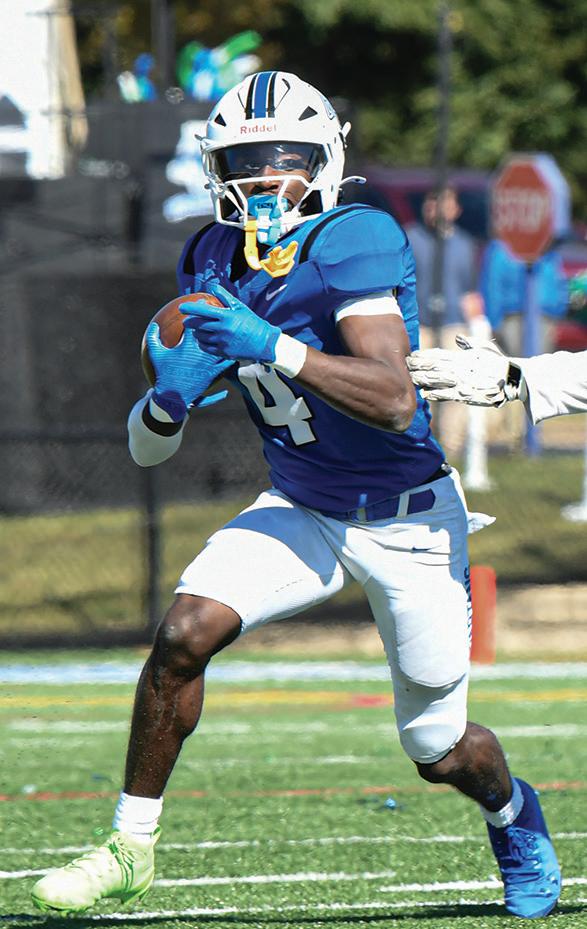
Football appeared in its first-ever bowl game in November, beating Illinois College 49-14 to win the Smileycookie.com Lakefront Bowl in Wauwatosa, Wisconsin. Braedon Hellinger ’27 blocked two kicks to earn the game’s MVP honor.
Men’s soccer’s Branden Dolezal ’25, ’27 MS netted a third-team College Sports Communicators Academic All-American award for the second year in a row. The honor recognizes studentathletes who perform at an elite level both in their sport and academically.
JP Chaney ’26 piled up accolades after a dominant football season. The junior received first-team recognition on both the NACC All-Conference and D3football.com All-Region teams and received athletic All-American honors from three separate organizations. He capped off the year with a first-team College Sports Communicators Academic All-American award. Chaney led DIII with 28 tackles for a loss and was tied for fourth with 14 sacks.
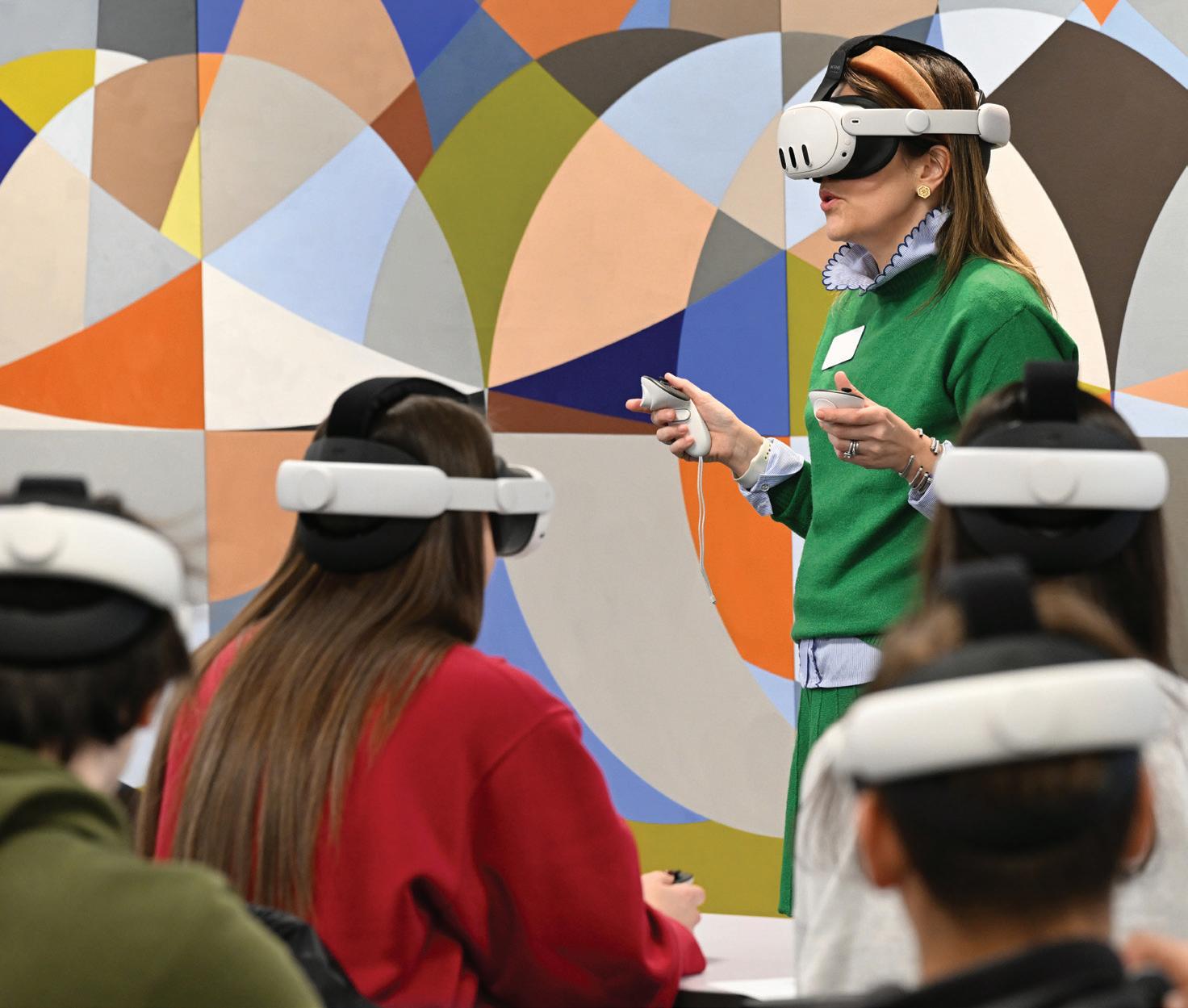
Aurora University is expanding how it prepares future educators through technology-driven initiatives in the School of Education.
Teacher candidates are gaining hands-on experience with immersive simulations and innovative learning environments designed to mirror today’s classrooms. These tools help students build confidence, refine instructional skills, and better prepare for student teaching and their future careers.
One of the most impactful additions is the Student Teacher Simulation Lab, developed through AU’s partnership with VictoryXR. Using virtual reality headsets, students teach in a virtual classroom where they interact with AI-powered avatars representing diverse learners. They practice questioning strategies, classroom management, and ways to connect with the learners while receiving immediate feedback on their instruction throughout the simulation.
They can also practice teaching bilingually, which helps them prepare for diverse school settings.
“The simulation lab allows our students to practice, receive feedback, and build confidence before they ever step into a real classroom,” said Aubrey Brammar Southall, associate professor and coordinator of secondary education. “We’re preparing teachers we would trust to teach our own children.”
The tool supports AU’s growing teacher education programs by providing additional opportunities for individualized practice and feedback.
Beyond the simulation lab, the School of Education continues to expand experiential learning through additional technology, collaboration with faculty across disciplines, and partnerships with local school districts. These efforts strengthen preparation and help ensure graduates are confident, adaptable, and ready to lead in today’s classrooms.
‘Storytellers’ project preserves the spirit of George Williams College
Kris Johnson ’96 MS, CTRS, chair and associate professor of therapeutic recreation and chair of neurodiversity studies, was featured in Education Insider Magazine for her work in therapeutic recreation and interdisciplinary learning. Johnson emphasized the importance of experiential learning, which she incorporates through partnerships with nearby organizations, as well as the need to keep up with trends in the field such as the increase in autism diagnoses. Johnson encourages faculty to provide their students with opportunities to work with industry professionals directly and to consider the teaching method of “interleaving” to foster students’ long-term retention of information.
Brandon R. Kooi, PhD, professor of criminal justice, partnered with the Kane County State’s Attorney’s Office to host a human trafficking summit in November 2025. After remarks from Kooi and State’s Attorney Jamie Mosser, survivors and experts shared how attendees can identify, prevent, and respond to human trafficking in all forms. Host Curtis Spivey of podcast “Good Morning Aurora” emceed the all-day event, and representatives from the Cook County Sheriff’s Office, Emmaus, Ink 180, the Kane County State’s Attorney’s Office, Naomi’s House, and Rush Copley Medical Center led breakout sessions.
Mariza Rocha, MA, director of Latino/a excellence, participated in the third cohort of the Hispanic Association of Colleges and Universities (HACU) Enlace Mid-Level Leadership Program. For six months, Rocha trained alongside a cohort of 36 other selectees on academic and student affairs management, regional institutional accreditation, and higher-education advocacy
More than a decade ago, the university recorded video interviews with George Williams College alumni through the “Storytellers” oral history project. The goal was to preserve these memories and carry their legacy forward for future generations of students. These reflections reveal themes of belonging, faculty mentorship, and a community that helped students discover what mattered most. Scan the QR code to hear stories from the “Storytellers” collection.

issues. The program aims to strengthen leadership pathways at HispanicServing Institutions — accredited, nonprofit colleges or universities with at least 25% full-time undergraduate Hispanic enrollment — and beyond. As part of the program, she joined her cohort at HACU’s annual conference in Aurora, Colorado, last year, and at HACU’s annual National Capitol Forum in Washington, D.C., this spring.
Retired professor Jay Thomas ’87 EdD released “Chief: The Three Lives of Gene Locklear,” a biography of Major League Baseball’s first Lumbee Indian player. The book outlines Locklear’s career journey from athlete to artist to advocate. “Chief” (Palmetto Publishing, 2025) is available in paperback and e-book through major retailers and inspires courage, creativity, and perseverance. The National Baseball Hall of Fame and Museum in Cooperstown, New York, will host Thomas for a reading and signing this summer.
Christopher Wells ’07 MS, ’18 EdD, professor and coordinator of parks and recreation leadership, and Natasha Ritsma, PhD, director of the Schingoethe Center, partnered with Chicago-based artist Alice Hargrave and the Windy City Bird Lab to host a bird-migration monitoring station on the roof of John C. Dunham Hall last fall. The station recorded nocturnal bird calls for analysis, which were shared on the Chicago Bird Migration Monitoring Network’s website. Hargrave’s passion for protecting birds — her recent artistic work draws inspiration from audio recordings of bird calls and was featured in the Schingoethe Center’s 2025 exhibition on biodiversity and environmentalism — led to the partnership with Wells and Ritsma. The station was reinstalled in March and will remain in place through the fall.
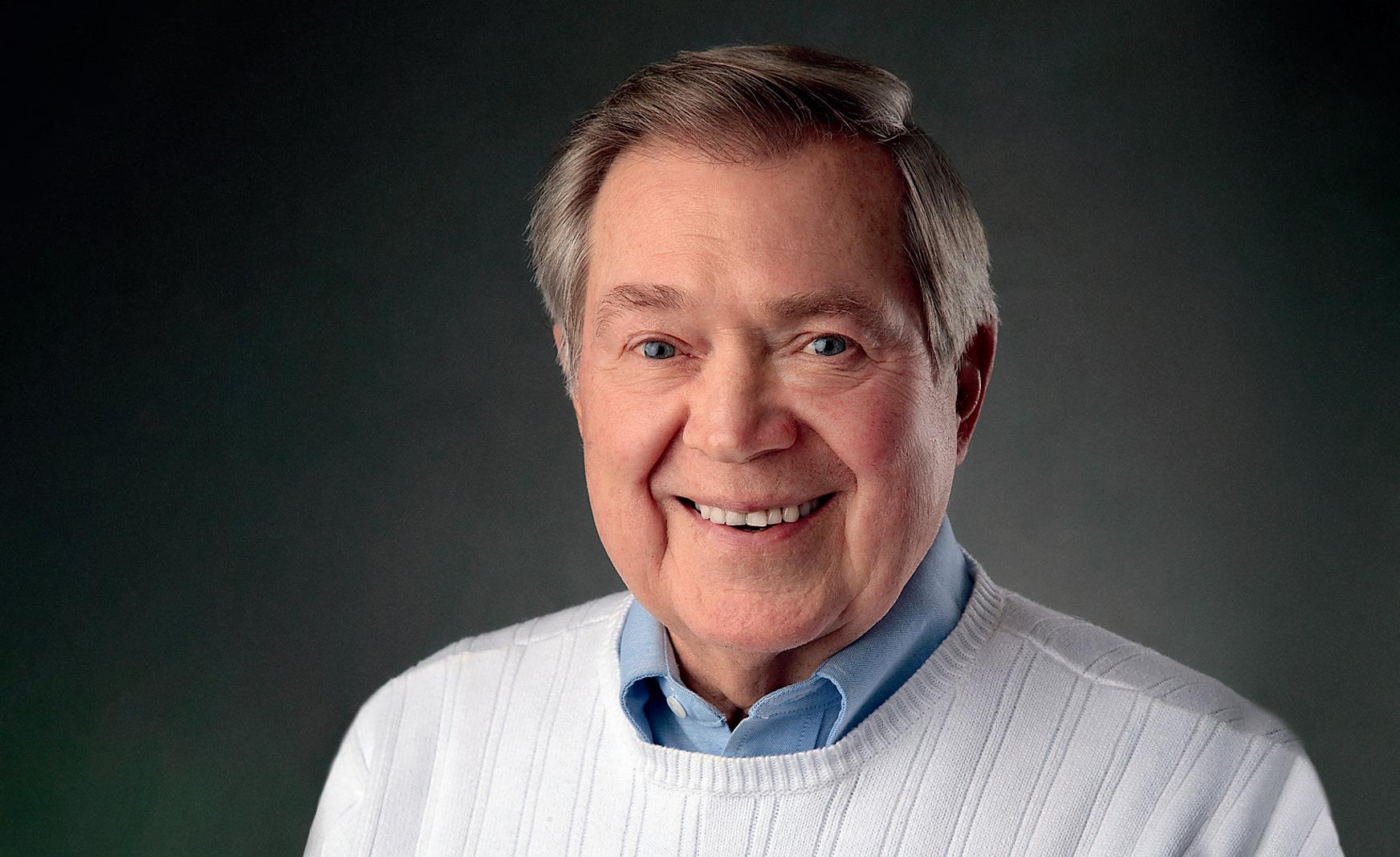
Donald E. Kieso ’58 earned his Bachelor of Science in Accounting from Aurora College in 1958, and thus began a lifelong connection to his alma mater. In 1979, he joined the Aurora University Board of Trustees and served as chair from 1998 to 2000, demonstrating steadfast dedication to the institution’s mission and growth. He remained a member of the board until 2015, when he was elected an emeritus trustee.
Kieso’s commitment to higher education extended beyond AU. He was a respected faculty member at Northern Illinois University, where he served as chair of the Department of Accountancy and held the title of KPMG Peat Marwick Emeritus Professor of Accounting before his death. For more than three decades in academia, he inspired countless students through his teaching, mentorship, and scholarship.
A distinguished professional in the accounting field, Kieso built a successful career with accounting firm PwC and authored several
widely used accounting textbooks, contributing enduring knowledge to both academia and the profession. His leadership was recognized through numerous roles on professional associations and boards as well.
In 2013, Kieso and his wife, Donna, established the Don and Donna Kieso Endowed Professorship in Accounting at AU, creating a lasting investment in academic excellence. AU honored him with an honorary doctorate in 2003 for his professional achievements and generous service to the community. Don and Donna were recognized with the Presidential Torch of Generosity during Homecoming 2025 in celebration of their continued support and commitment to the university. Kieso’s generosity and belief in the power of education have left an indelible mark on AU. His legacy will live on through the students, faculty, and programs he helped shape, and will continue to inspire future generations.
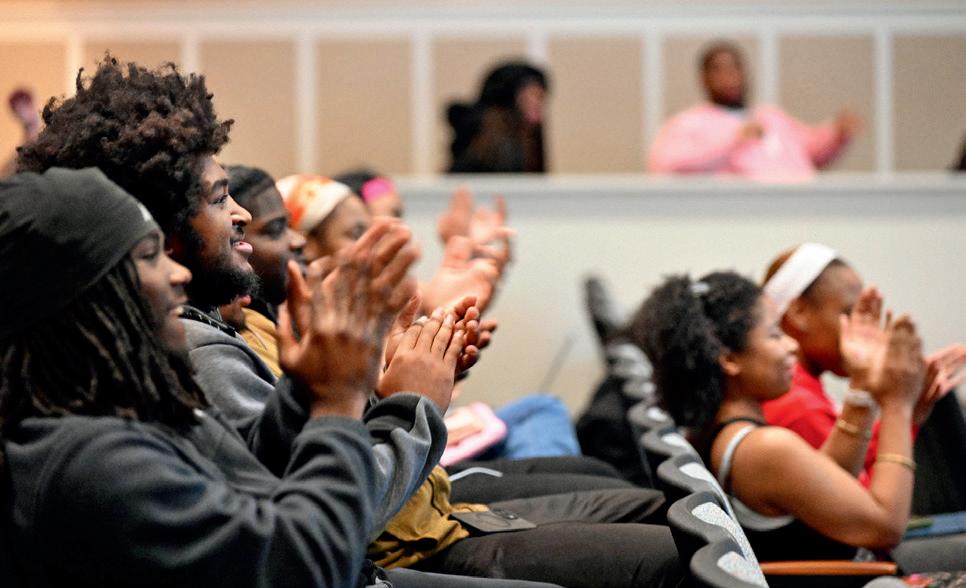
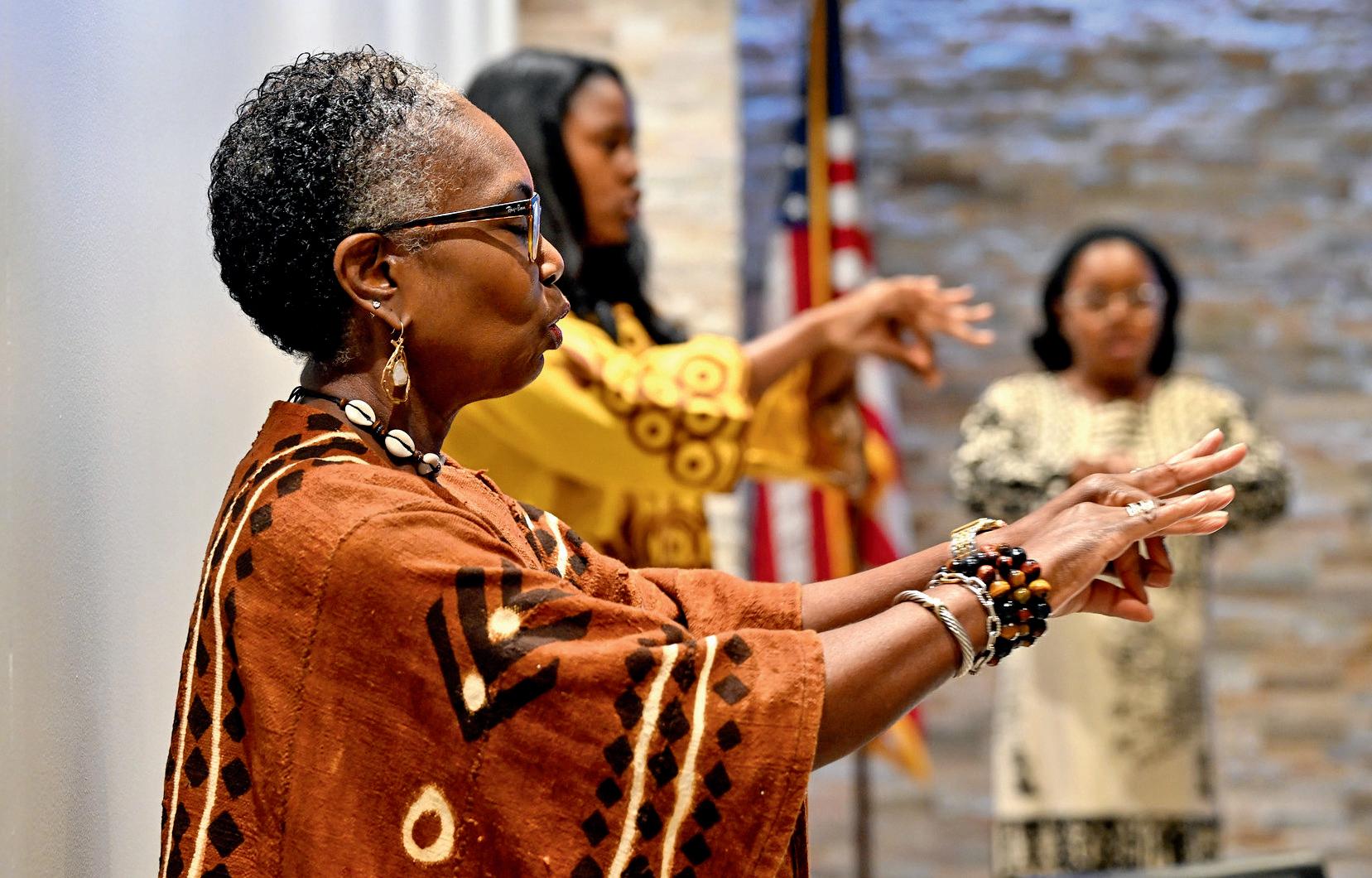
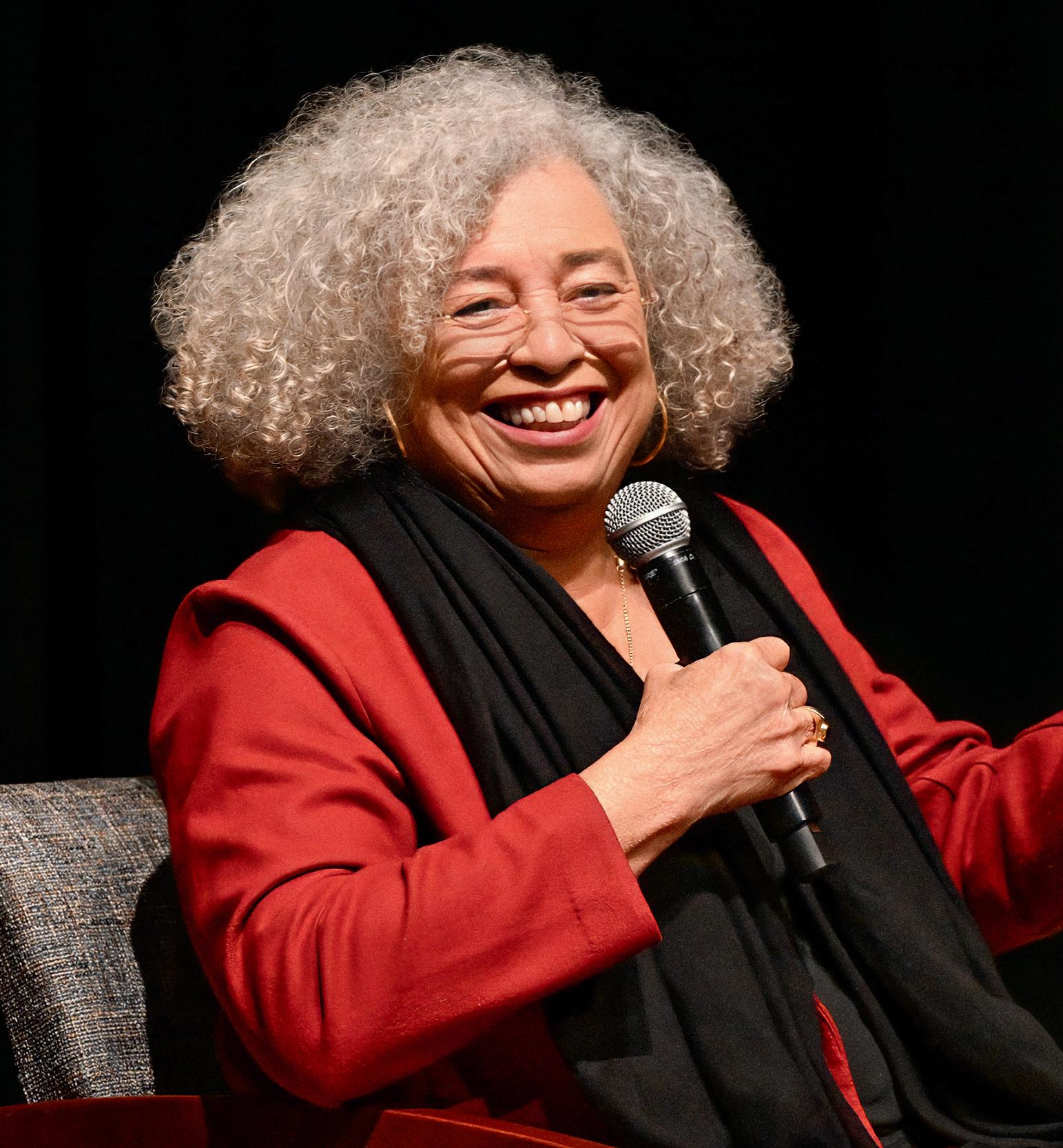
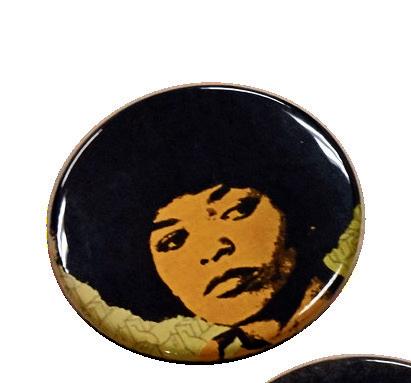
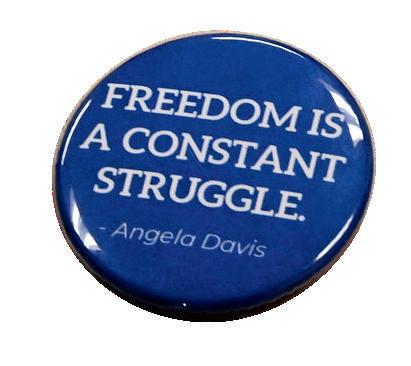
This spring, Aurora University’s Celebrating Arts and Ideas series and Black History Month programming sparked meaningful conversations about culture, history, and social change across campus. The series featured a keynote conversation with renowned scholar and activist Angela Davis as a centerpiece of the month’s events. Davis is known for her work on racial, gender, and economic justice. As an educator and author, she emphasizes building communities united in the pursuit of social and economic equality.
The discussion was guided by an onstage Q&A moderated by history and secondary education majors James Glazebrooks ’27 and Fatima Hernandez-Trinidad ’26, alongside Gerald Butters, professor of history.
During the conversation, Davis explored themes of justice, education, and hope, sharing how Black communities have remained resilient and creative across
generations. She discussed what she sees as systemic issues, such as mass incarceration, and how they connect to wider social and economic challenges.
Throughout her talk, Davis emphasized that hope is not just a feeling; it is an active practice essential for creating positive, lasting change. She encouraged collaboration between communities and nations.
In addition to Davis’ presentation, AU’s Black History Month programming offered a wide range of events. Phillips Library hosted the Friday Afternoon Movies program featuring weekly screenings of short films highlighting Black history, creativity, and lived experiences, followed by informal discussions.
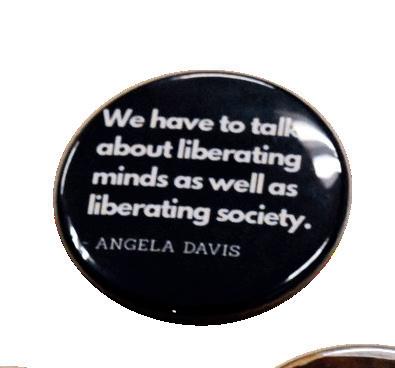
Students and faculty also participated in book club conversations around Davis’ “Freedom Is a Constant Struggle: Ferguson, Palestine, and the Foundations of a Movement.”
The Schingoethe Center hosted a special Art Café event, where students were invited to create, explore,

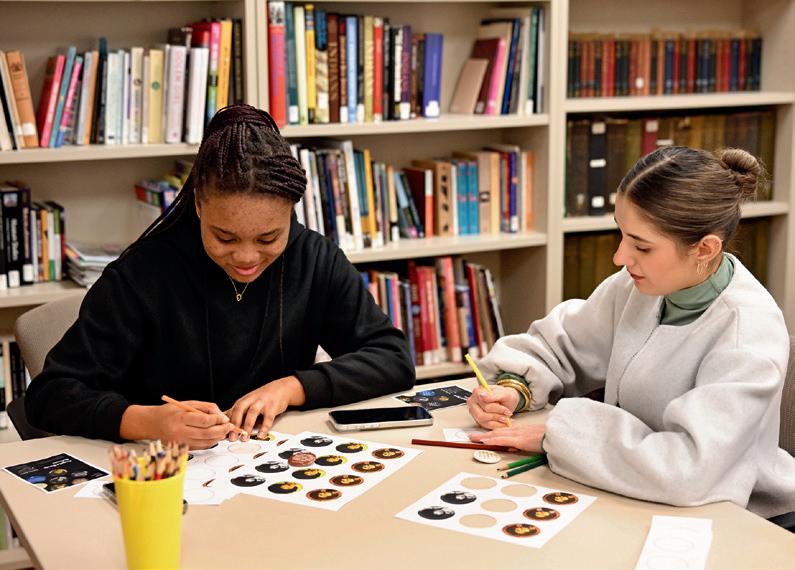
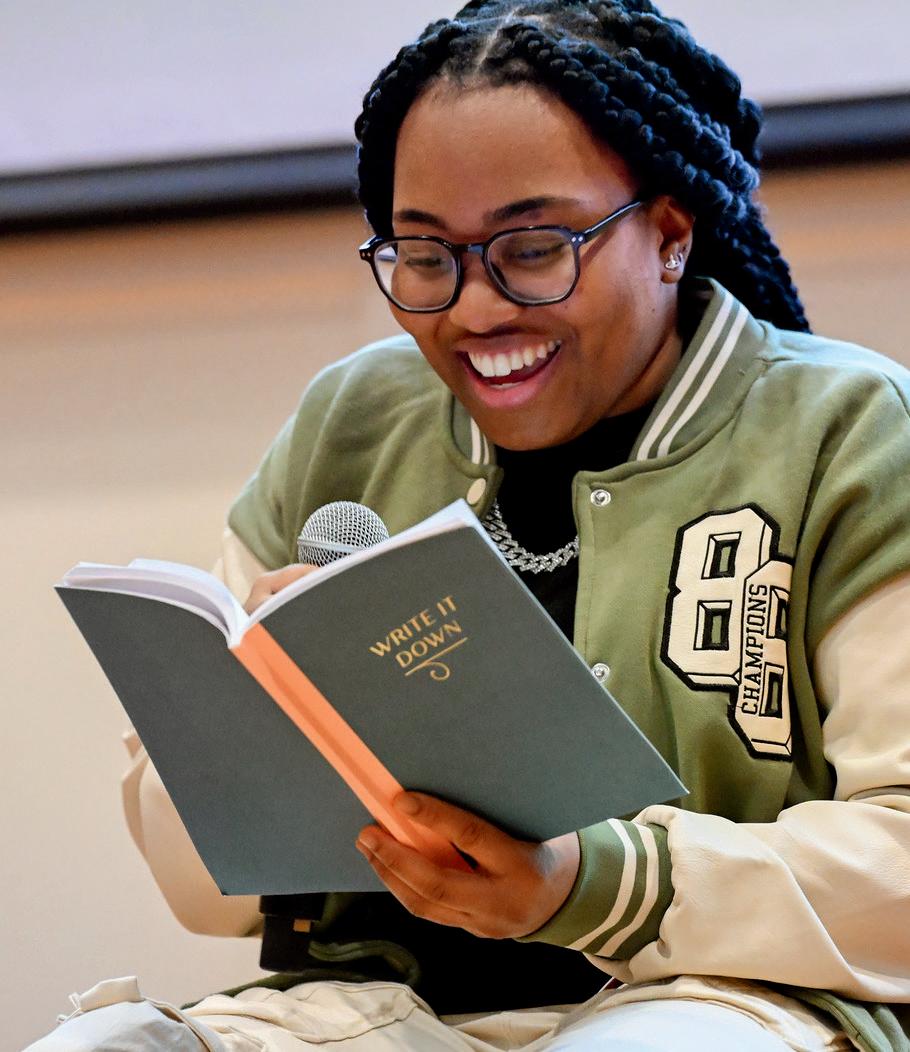
and reflect through hands-on expression. The Office of Black Excellence hosted Open Mic Night featuring spoken word, music, and storytelling, giving students the opportunity to share their own creative expressions of the Black experience.
Earlier in the semester, the university held its annual Martin Luther King Jr. Breakfast, honoring his legacy and the values of unity, compassion, and community. The event welcomed students, alumni, faculty, staff, legislators, and community leaders for a morning of reflection and conversation.
Continuing its commitment to honoring Black history, AU also recognized Juneteenth this month, commemorating the end of slavery in the U.S. and honoring the resilience, creativity, and contributions of Black communities past and present.
Together, these events reflect the university’s ongoing commitment to learning from history while inspiring dialogue and change for the future.
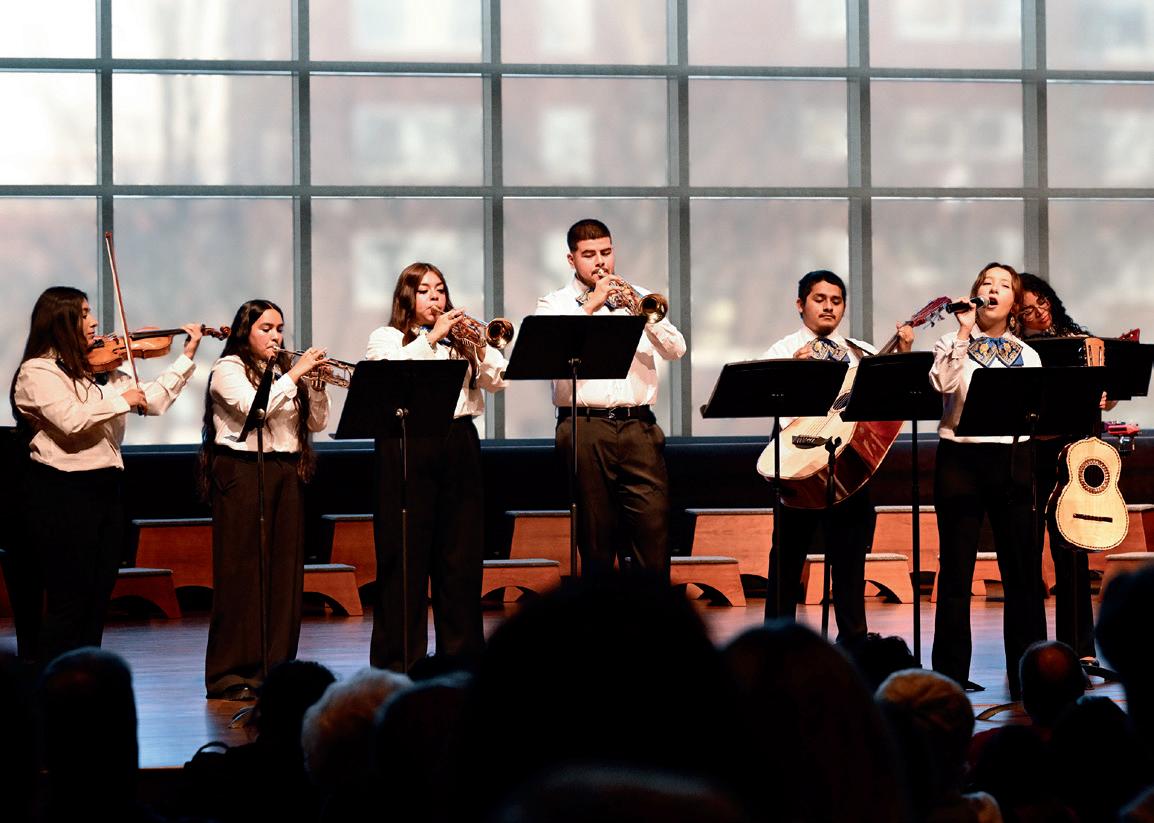
Aurora University’s music department reached another high note with the addition of two new ensembles this past academic year.
A mariachi band, Mariachi Las Luces, and the choir group AU Vocal Jazz offer two more opportunities for students to perform. Both ensembles made their concert debuts in October and have been active at campus events and concerts ever since.
“Growing our ensemble opportunities is part of an ongoing effort to further build a sense of community and belonging among our students through collaboration and participation,” said Cristian Pastorello, chair and the Marvel E. Davis Distinguished Professor of Music, who noted the ensembles were enthusiastically received by the campus community.
Around 120 students are involved in AU ensembles, with nearly 20 members in Mariachi Las Luces and 10 singers in AU Vocal Jazz. Stephanie Aguilar Geron ’27 is a member of four AU ensembles, including both the mariachi and vocal jazz lineups.
“Music has always been a huge part of who I am. The ensembles have given me balance, confidence, and a space where I can just enjoy music while still pushing myself to grow,” she said. “Mariachi especially stood out to me because it helps me stay connected to my culture. I feel seen — we’re constantly laughing and connecting, and it just feels like home.”
The groups are the latest to join the department’s expanding roster in recent years. The Aurora Singers, a soprano/alto choir, debuted in fall 2022, followed by AU Jazz Band in fall 2024.
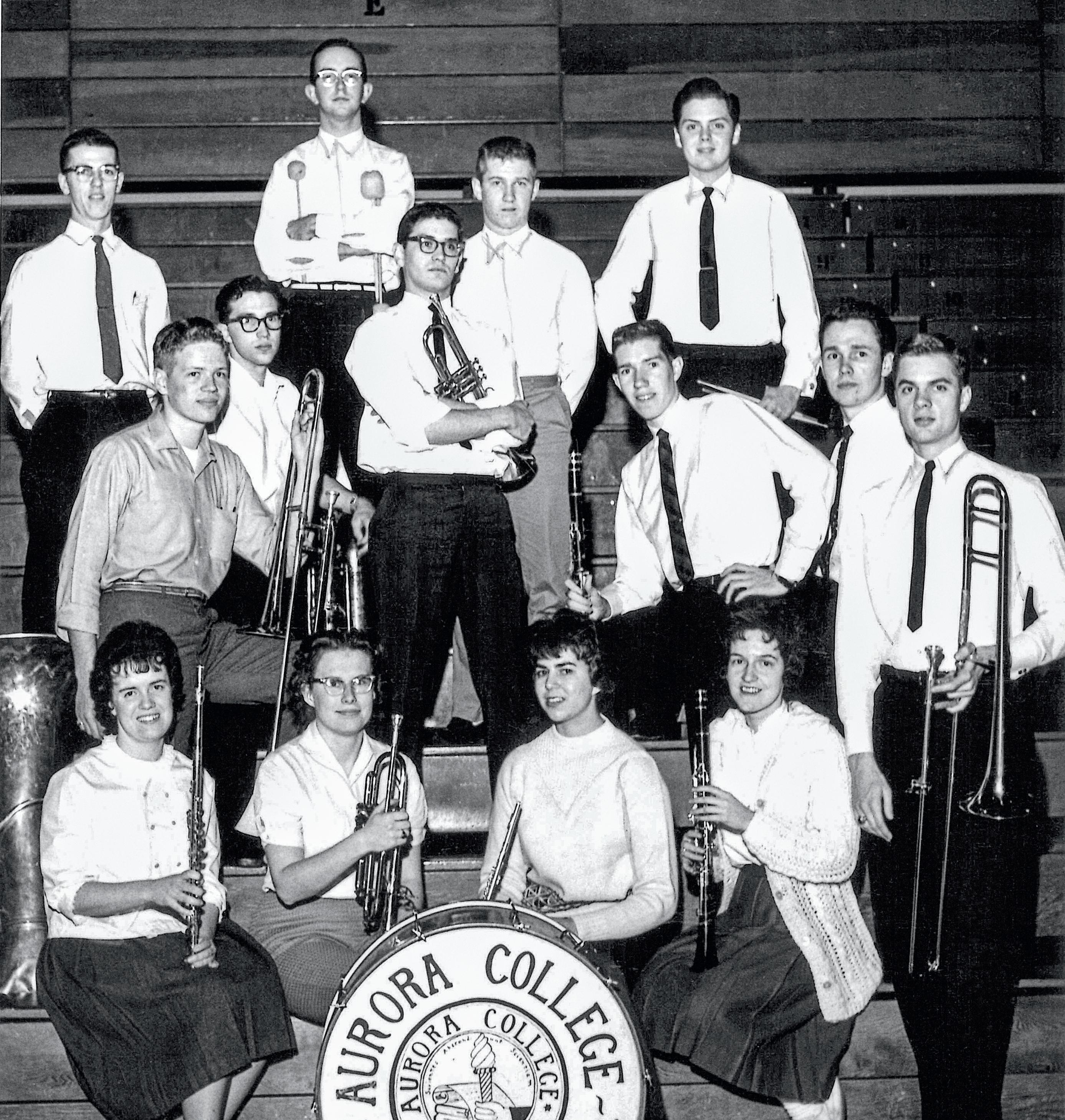

a long-standing tradition of music on campus. For decades, student musicians have brought energy and
The Sound of Music. Members of the 1961–1962 Aurora College Pep Band represent a spirited chapter in a long-standing tradition of music on campus. For decades, student musicians have brought energy and creativity to university life — laying the groundwork for the vibrant ensembles that perform today. That legacy lives on through the AU Band and other university ensembles, including the newest additions, AU Vocal Jazz and Mariachi Las Luces. This enduring commitment is also reflected in the spaces that showcase it, as the university celebrates 20 years of performances in Crimi Auditorium and in the renovated Perry Theatre, both completed in 2006. Together, these milestones honor not only today’s performers, but also the early musicians whose enthusiasm set the tone for decades of artistic expression. (Turn to the previous page to learn more about the newest AU music ensembles.)
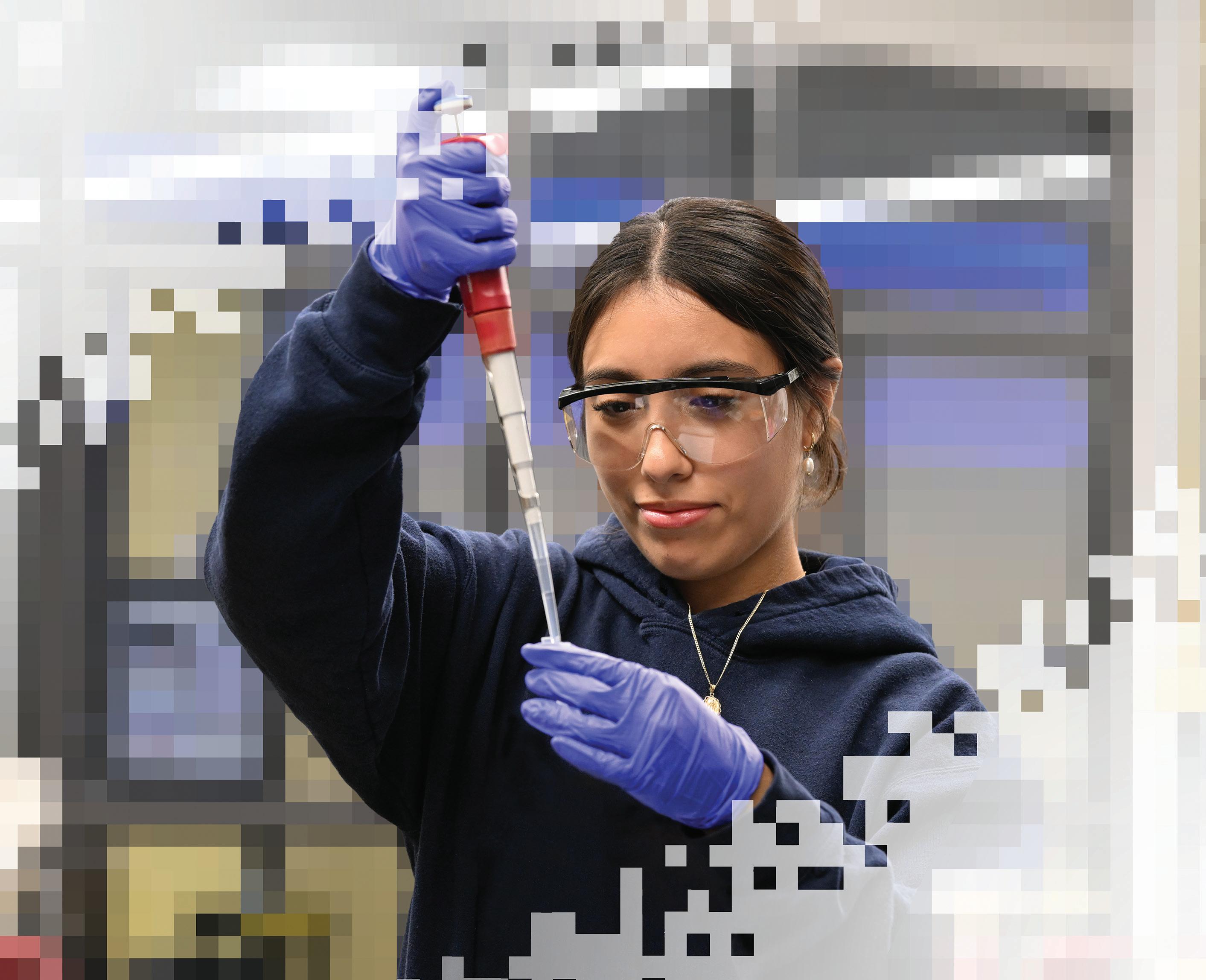
The world is changing faster than ever. Technology can analyze, predict, and automate, but it cannot replace empathy, compassion, or the drive to serve others.
Every day, Aurora University alumni bring those human qualities to life. They lead classrooms, care for patients, strengthen communities, and create meaningful change. Their work reflects something deeper than knowledge. It reflects purpose.
At AU, students are prepared for more than careers. They are shaped to think critically, act ethically, and serve with intention.
Be part of a future led by people, not just technology.