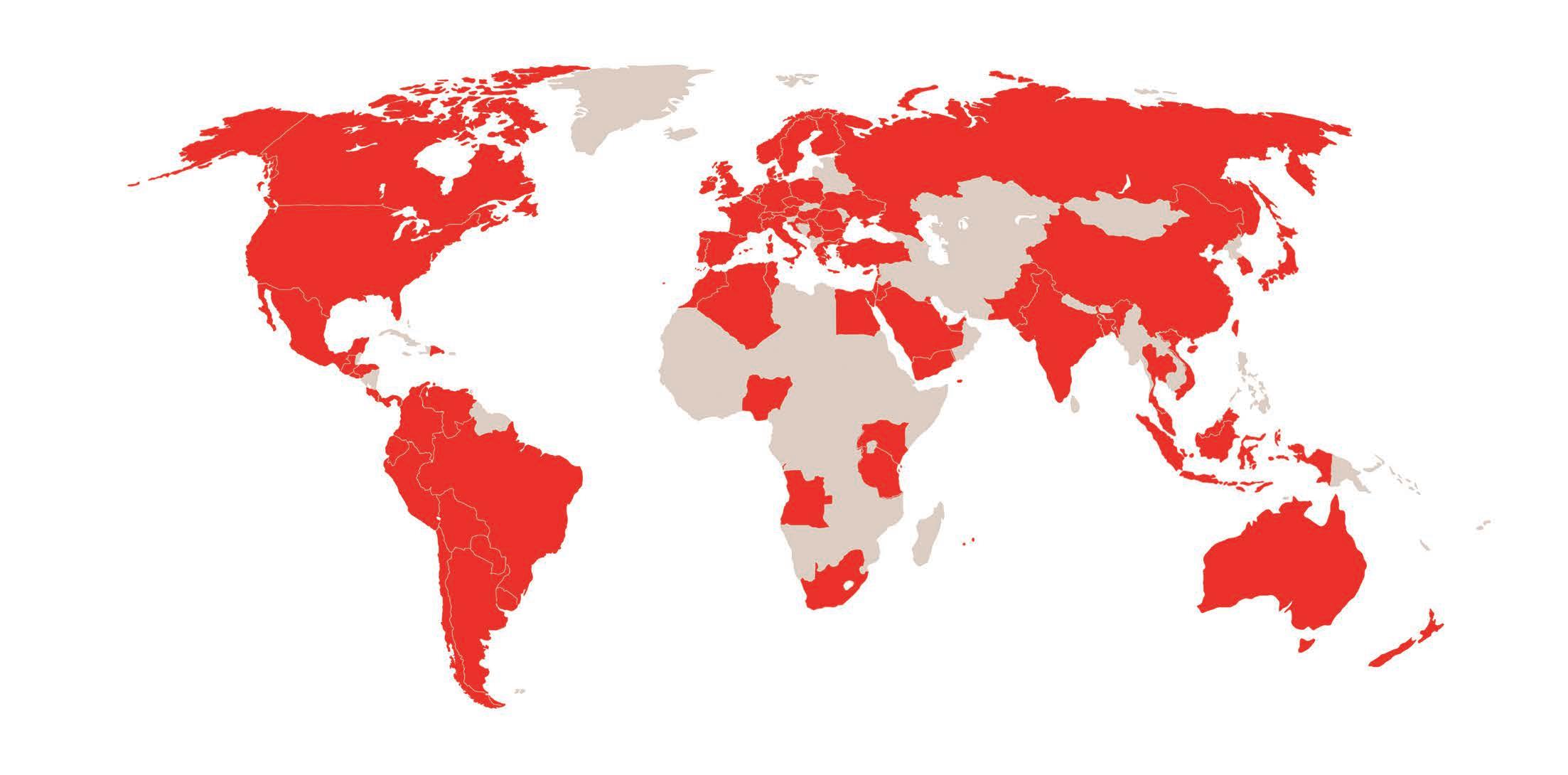
“Billing Software vs. Electronic Invoicing Requirements ”
Antea International Comparison is a quarterly publication that provides you an overview of trends and international tax developments by comparing tax issues in different legislations around the world, that may affect those doing business in multiple locations.
Constant legislative, regulatory, and judicial changes, along with globalization, economic shifts, and operational adjustments, are challenging issues. Now more than ever, in an increasingly globalized world, companies must have a total perspective and
awareness of tax issues, and this publication aims to cover key tax topics which should be of interest to businesses operating internationally.
This edition features several country focus pieces outlining the key differences between Billing Software Requirements and Electronic Invoicing Requirements, providing practical insights to help businesses navigate the evolving invoicing compliance landscape.
We hope that you find this publication helpful.
Table of the 2026 updates for Electronic Tax Documents (DTE)
Summary of Chilean DTE Regulatory Updates (2026)
Electronic Waybills (Guías de Despacho - Type 52)
Exempt Sales (Ventas Exentas)
Electronic Sales Receipts (Boletas - Type 39)
Technical XML Structure (Annex 2.5)
Payment Platforms & Marketplaces
Input Tax Credit Management (IVA)
Mandatory logistics data: Driver's name/ID (RUT), vehicle license plate, exact departure time, and precise destination georeferencing.
Total ban on paper support: All exempt transactions (health, education, real estate) must use DTE Type 34.
Mandatory digital delivery: Businesses without printers must send receipts via WhatsApp, Email, SMS, or QR code.
Updated Schema: Expanded character limits for city fields (20 chars) and mandatory classification of B2B vs. B2C transactions.
Mandatory Tax ID Verification: Electronic payment providers must verify that sellers have a formal tax registration (Inicio de Actividades).
The 8-Day Rule: Tax credit is only available in the month the "Acknowledgment of Receipt" is issued. Tactic acceptance occurs after 8 days.
Business Activity Presumption Automatic Business Closure: SII may presume "Termination of Business" for taxpayers with 6+ months of inactive F29 filings.
Strategic Highlights for 2026
November 1, 2026 (Postponed from May).
Ex. Res. No. 154 (2025) & Ex. Res. No. 52 (2026). Fines up to 500% of the goods' value and temporary seizure of cargo.
January 1, 2026.Law No. 21,713. Documents on paper will be considered null and void for tax purposes.
March 1, 2026.Ex. Res. No. 53. Fines ranging from 1 to 50 UTM and risk of business closure.
February 2026. Technical Annex v2.5. Automatic rejection of the XML file by the SII platform.
January 1, 2026.Tax Code, Article 68. Immediate account suspension and withholding of accumulated funds.
Ongoing (Critical in 2026).
Law No. 19,983 & Circular No. 4 (2017).
March 1, 2026.Ex. Res. No. 171.
Logistics: The transition to the new logistics requirements in November 2026 is the most complex technical challenge, requiring ERP systems to integrate new XML nodes for transportation.
Digital Integrity: The XML file remains the only legally valid document; printed versions are merely representations. Files must be archived for six years.
Banking Surveillance: The SII now monitors bank accounts receiving 50 or more transfers per month to trigger automated audits on non-declared DTE activity.
Delay in using the tax credit if manual acknowledgment is not done before month-end.
Immediate cancellation of DTE issuing authority and CAF folio range.
DENMARK
Billing Software Requirements vs. Electronic Invoicing Requirements
It is important to distinguish between two related but separate obligations in Denmark, even though – unlike in some other jurisdictions – they are not governed by two separate laws.
1. Billing Software Requirements (Bogføringsloven / the Bookkeeping Act): regulate the technical operation, security and storage of the bookkeeping system itself.
2. Electronic Invoicing Requirements (NemHandel / OIOUBL, and the upcoming EU ViDA rules): regulate the format and electronic exchange of invoices between the parties to a transaction.
Main objective
What it regulates
Who is affected
Data integrity
Traceability
Modification / deletion of invoices
Transmission to tax authority
Ensure reliable, tamper-evident bookkeeping and prevent undetected manipulation of accounting records.
The technical operation, security and digital storage of the bookkeeping system itself.
All businesses (incl. taxable foreign entities), foundations and associations conducting commercial activity in Denmark; phased in by system type and size.
Mandatory – automatic weekly backups (stored in the EU/EEA) and recognised IT-security standards.
Mandatory traceability linking every entry to its source document and the annual report/tax return.
Prohibited without leaving a visible trace; postings cannot be altered, backdated or deleted unnoticed.
No continuous or real-time reporting; access is granted on request (incl. SAF-T export) during audits or supervision.
Structured format requirement System must support structured data and SAF-T export – a system capability, not an invoice-format rule.
Interoperability
Not a core requirement of the bookkeeping rules themselves.
Enable structured, interoperable exchange of invoices and digitalise trade (mandatory B2G; B2B under ViDA from 2030).
The format and electronic transmission of invoices between the parties to a transaction.
Suppliers to public authorities (mandatory); B2B currently voluntary; B2C not covered.
Not separately regulated; integrity of the underlying record is a bookkeepingsystem requirement, not an e-invoicing one.
Delivery and receipt can be tracked via the NemHandel/Peppol infrastructure.
Not the primary focus of the regulation; corrections are handled via credit notes.
Not a reporting channel; purely a transmission mechanism between supplier and buyer.
Mandatory – invoices must use a structured, machine-readable format (OIOUBL/ Peppol BIS); a PDF is not sufficient.
Core requirement; the NemHandel/Peppol network enables cross-platform, cross-border exchange.
Transactions covered (B2B / B2G / B2C) Applies regardless of transaction type – governs the business's own bookkeeping.
Will be in force
Phased in 2024–2026 (registered systems: 1 July 2024; non-registered systems: 1 January 2025; sole proprietorships/associations >DKK 300,000: 1 January 2026; financial undertakings: 1 January 2026).
B2G mandatory; B2B voluntary domestically, though registered-system users are expected to be default-enrolled in NemHandel and issue e-invoices by default from 1 July 2026 (opt-out available); mandatory intra-EU from 2030 under ViDA; B2C not covered.
B2G already in force (since 2005); domestic B2B – default e-invoicing from 1 July 2026 for registered-system users (opt-out), full mandate still pending; crossborder intra-EU B2B mandatory from 1 July 2030 (ViDA); OIOUBL expected phased out in favour of Peppol PINT by ca. 2029.
Hulgaard Advokater www.hulgaardadvokater.dk
GERMANY
Billing Software Requirements vs. Electronic Invoicing Requirements
It is important to distinguish between two related but separate compliance areas in Germany.
1. Billing Software / Digital Record-Keeping Requirements - Principles for the Proper Maintenance and Retention of Books, Records, and Documents in Electronic Form, as well as for Data Access (GoBD)/ German Tax Code (AO) / Cash Register Security Regulation (KassenSichV) / technical security device (TSE): regulate how tax-relevant electronic records and, in particular, electronic cash register systems must operate and be retained.
2. Electronic Invoicing Requirements - mandatory B2B e-invoicing under § 14 German VAT Act (UStG): regulate the structured electronic format for issuing, transmitting and receiving invoices between domestic businesses.
CONCEPT
Main objective
Billing Software / Digital Record-Keeping Requirements (GoBD / AO / KassenSichV / TSE)
Ensure proper, complete, correct, timely, orderly, traceable and tamper-resistant taxrelevant records. For electronic cash register systems, the objective is to prevent manipulation by using a certified technical security device (TSE).
Promote digital invoice processing and require structured electronic invoices for domestic B2B transactions. The reform is also a preparatory step toward more digital VAT processes, but it does not itself introduce real-time tax authority reporting.
What it regulates
Who is affected
How electronic books, records and supporting documents are created, processed, stored, documented and made available for tax audit purposes. Cash Register Security Regulation (KassenSichV) specifically regulates electronic / computerized cash register systems, not ordinary electronic accounting programs.
Businesses and self-employed persons using electronic systems for tax-relevant records.
Additional TSE / KassenSichV obligations apply where an electronic recording system such as a cash register system or register is used.
The format, issuance, transmission and receipt of invoices in a structured electronic format that enables electronic processing. Paper invoices and unstructured electronic files such as a simple PDF are treated as “other invoices”.
Domestic B2B transactions between entrepreneurs established in Germany. All businesses must be able to receive e-invoices from 1 January 2025; issuing obligations are phased in during the transition period.
Data integrity
Mandatory. Records must be complete, correct, traceable and protected against unnoticed changes. For systems within § 146a AO, records must be protected by a certified TSE consisting of a security module, storage medium and uniform digital interface.
Mandatory. Under the invoice rules, authenticity of origin, integrity of content and readability must be ensured. The structured part of the e-invoice is the decisive tax-relevant data set.
Traceability
Mandatory through compliant documentation to the Principles for the Proper Maintenance and Retention of Books, Records, and Documents in Electronic Form, as well as for Data Access (GoBD), audit trails, change logs, retention of tax-relevant data and data access for tax audits. For cash register systems, transaction data must be recorded and exportable through the required interfaces.
The structured format enables electronic processing and audit-ready retention. However, invoice status tracking is not the primary statutory focus of the German B2B e-invoicing rules.
Modification or deletion of invoices / records
Transmission to the Tax Authority
Structured format requirement
Interoperability
Changes must not overwrite the original record without trace. Corrections and changes must be documented so that the original content and the change history remain verifiable. For cash register systems, the TSE is intended to protect records against manipulation.
No general real-time transmission of invoice records to the tax authority. Data must be retained and made available in case of tax audits / cash register inspections, including required exports for electronic recording systems.
No single structured invoice format is required merely because billing software is used. However, tax-relevant electronic data must be retained in a form that is complete, machine-evaluable where required, and audit-accessible. Cash register systems must support the prescribed digital interfaces.
Not a core requirement for billing software in general, except that data export and audit access requirements must be met. For cash register systems, the statutory interface requirements are relevant.
Corrections should be made by issuing a corrected invoice / credit note as appropriate; the original structured invoice must be retained. The rules focus on the structured invoice data rather than allowing changes to an already issued invoice file.
No central tax authority transmission or clearance model for the German B2B e-invoicing mandate. The obligation concerns exchange between businesses; future reporting obligations may follow separately from EU-wide VAT-in-the-Digital-Age developments.
Yes. An e-invoice must be issued, transmitted and received in a structured electronic format. The format must comply with EN 16931 or be agreed between the parties if it enables complete and correct extraction into an EN 16931-compliant or interoperable format. XRechnung and ZUGFeRD are common practical formats; a PDF alone is not sufficient.
Core requirement. The structured format must be EN 16931-compliant or interoperable with it, so that the invoice can be electronically processed by the recipient.
Transactions covered
Will be in force
Tax-relevant electronic records generally, and in particular business transactions recorded by electronic cash register systems. This may include B2B and B2C processes depending on the business model and system used.
Requirements according to the Principles for the Proper Maintenance and Retention of Books, Records, and Documents in Electronic Form, as well as for Data Access are already applicable.
Cash Register Security Regulation (KassenSichV) / Technical Safety Device (TSE) requirements for electronic cash register systems are already in force; since 2025/2026, additional notification and technical updates may be relevant depending on the system type.
Generally domestic B2B transactions between entrepreneurs established in Germany. Private end consumers are not affected by the B2B mandate. Special rules / exemptions may apply, e.g. for certain VAT-exempt transactions and low-value invoices.
Receiving capability: from 1 January 2025. Issuing obligation: generally from 1 January 2027 for businesses with prior-year turnover above EUR 800,000; from 1 January 2028 for all other businesses. During the transition period, paper or other electronic invoices may still be used subject to the statutory conditions.
INDIA
Billing Software Requirements vs. Electronic Invoicing Requirements
Ensure issuance of GST-compliant tax invoices, proper maintenance of books and records, and compliance with GST reporting obligations under the CGST Act and Rules.
Issuance of tax invoices, invoice contents, maintenance of books of account and records, and compliance with GST provisions under the CGST Act and CGST Rules.
All GST-registered persons required to issue tax invoices under the CGST Act, subject to applicable exemptions.
Enable standardized electronic reporting and authentication of invoices through the Invoice Registration Portal (IRP), improving tax compliance and reducing tax evasion.
Electronic generation, reporting, validation and authentication of specified tax invoices through the Invoice Registration Portal (IRP) in accordance with Rule 48(4) of the CGST Rules.
GST-registered persons whose aggregate annual turnover exceeds ₹5 crore in any financial year from FY 2017–18 onwards, except categories exempted under Rule 48(4).
Data integrity
Traceability
Modification or deletion of invoices
Transmission to Tax Authority
Structured format requirement
Interoperability
Businesses must maintain complete and accurate books of account and invoice records as prescribed under Sections 35 & 36 of the CGST Act and Rules 56–58.
Invoice and accounting records must be retained and made available for audit and verification.
Errors are rectified through credit notes, debit notes or other prescribed documents. Original records must be retained.
Invoice details are furnished through GST returns (e.g., GSTR-1).
Every invoice is digitally validated by the IRP and assigned an IRN and digitally signed QR Code.
Every authenticated invoice is traceable through its IRN and transmitted to GST and e-Way Bill systems where applicable.
IRN-generated invoices cannot be amended. Cancel IRN within 24 hours and issue a fresh invoice; later corrections through credit/debit notes.
Invoice data is transmitted electronically to the IRP before issuance and subsequently flows into GST returns.
Invoices must contain mandatory particulars under Rule 46. Invoice data must follow the GST e-Invoice JSON schema; PDF alone is insufficient.
Billing software should support GST-compliant invoicing and GST return preparation.
Integration with IRP directly or through APIs/GSPs/ASPs.
Transactions covered B2B, B2C, exports, SEZ supplies and other taxable supplies. Primarily B2B, exports, SEZ supplies and deemed exports; B2C excluded.
ISRAEL
Billing Software Requirements vs. Electronic Invoicing Requirements
It is important to distinguish between two related but separate obligations in Israel (information updated as of July 2026)
1. Billing Software and Computerized Accounting System Requirements: regulate how computerized accounting and invoicing systems must operate, preserve records and support auditability.
2. Tax Invoice Allocation Requirements (the “Israel Invoices” Model): regulate when an allocation number from the Israel Tax Authority (ITA) is required for a tax invoice. This is not a general mandate to exchange all B2B invoices in a structured electronic format.
Ensure reliable, complete, traceable and auditable accounting records and prevent undocumented alteration or deletion.
Combat fictitious invoices by linking qualifying tax invoices to a unique number issued by the ITA, which is required for the recipient's input VAT deduction.
What it regulates
Who is affected
The operation of computerized accounting and invoicing systems, including permanent files, sequential records, document production, retention, backups, software registration and uniform-format file generation.
Businesses that keep all or part of their statutory books through a computerized accounting system. Software supplied for sale, lease or use by others generally requires ITA registration, subject to limited exceptions.
The online submission of prescribed invoice data, issuance and display of an allocation number, and the consequences of refusal or absence of an allocation number.
VAT-registered businesses issuing tax invoices to VAT-registered business customers where the invoice exceeds the statutory threshold and the customer requires an allocation number to deduct input VAT.
Data integrity
Traceability
Modification or deletion of invoices
Transmission to the Tax Authority
Mandatory. Final records must be stored in a permanent file in which records cannot be deleted and are assigned automatic sequential numbers; records and backups must remain retrievable.
Sequential record numbering, continuity checks, production of permanentfile records in registration order and retention of source records support an audit trail.
Records in a permanent file cannot be deleted. Corrections or cancellations must be documented through additional correcting or reversing records so that the original entry remains traceable.
No routine real-time transmission is imposed merely because software is used. Registered software must be capable of producing the ITA's uniformformat files, which may be required for audit or reporting purposes.
The allocation number is linked to specified invoice data submitted to the ITA and enables verification of the number against the invoice details. It is not a comprehensive invoice-lifecycle integrity regime.
A unique allocation number allows the invoice to be identified and checked through the ITA's invoice-verification service.
The allocation regime does not replace the ordinary bookkeeping and VAT-document rules for corrections, cancellations or credit notes. The number relates to the data submitted for the specific invoice.
Prescribed invoice data are submitted online to the ITA, through connected software/ API or a dedicated portal, in order to obtain the allocation number.
Structured format requirement
Interoperability
Transactions covered
Effective date / current status
The accounting software must support the ITA's uniform-format export. The invoice delivered to the customer need not be a structured e-invoice; electronic delivery is permitted if the computerized-document requirements are met.
No general interoperability requirement applies between private invoicing platforms.
Applies to the statutory records and internal documentation maintained through the computerized system, potentially covering both B2B and B2C activity.
Already in force. The computerized-bookkeeping and software-registration requirements are longstanding; registered software must also support the current uniform-file specifications.
The data sent to the ITA follow a prescribed electronic interface. The invoice exchanged with the customer is not generally required to be XML or another structured format; a PDF may be used if it meets the computerized-document conditions.
No platform-to-platform interoperability mandate applies. Businesses may use software connected to the ITA's API or the ITA portal.
Primarily B2B tax invoices issued to VAT-registered customers above the threshold. No allocation number is required for an invoice containing only exempt or zero-rated transactions.
Introduced in 2024. As of 1 June 2026, an allocation number is required for input VAT deduction on invoices exceeding NIS 5,000 before VAT. From 1 July 2026, the rule also applies to qualifying transactions between members of the same VAT group.
Auren Israel
Billing Software Requirements vs. Electronic Invoicing Requirements
In Italy there is a single body of legislation (Legislative Decree 127/2015) governing the mandatory use of electronic invoicing. The technical procedures for invoicing and transmission through the Interchange System (SdI) are governed by an administrative implementing measure (Revenue Agency Ruling of 30.4.2018 no. 89757).
1. Technical rules on the electronic invoice XML file (Revenue Agency Ruling of 30.4.2018 no. 89757): governs the minimum content, structured format, and prohibition of macros/ executable code within the electronic invoice.
2. Electronic Invoicing Obligation (Legislative Decree 127/2015): governs the issuance, transmission, and receipt of invoices in electronic format through the Interchange System (SdI), for both B2B and B2C transactions.
What it governs
To ensure the integrity, authenticity, and non-alterability of the electronic invoice file through a structured XML format, the absence of active elements, and an electronic/time-stamped signature (Art. 21 of Presidential Decree 633/1972; Revenue Agency Ruling of 30.4.2018).
The structure of the XML file, mandatory data fields, the prohibition of macros/executable code, and the methods for preparing the invoice using Revenue Agency software or third-party software compliant with the technical specifications (Revenue Agency Ruling of 30.4.2018, Annex A).
Who is affected
All VAT-registered persons who issue electronic invoices via SdI, regardless of the software used, provided it complies with the specifications of the Revenue Agency Ruling of 30.4.2018.
Data integrity
Traceability
Ensured by the structured XML format, the absence of macros/executable code in the file, and the use of a qualified or digital electronic signature and time reference (Art. 21, para. 3, of Presidential Decree 633/1972; Revenue Agency Ruling of 30.4.2018).
Technical traceability of the file and its versions through XML specifications and SdI controls; there is no certification of the accounting software itself, but a requirement on the format and transmission channel.
To combat tax evasion, reduce the VAT tax gap, ensure the traceability of economic transactions, and digitalize the invoicing process between parties resident or established in Italy (Law 244/2007; Law 205/2017; Legislative Decree 127/2015).
The format, content, and methods of issuing and transmitting electronic invoices through the SdI, including the effects of failure to transmit via SdI (the invoice is deemed not issued) and the related penalties (Art. 21 of Presidential Decree 633/1972; Art. 6 of Legislative Decree 471/1997).
Persons resident or established in Italy (businesses and professionals), for both B2B and B2C transactions, save for specific exemptions (e.g., non-resident persons, healthcare providers for services to private individuals, the advantage/flat-rate regime in certain transitional cases) - (Art. 1 of Law 244/2007; Art. 1 of Legislative Decree 127/2015; Law 205/2017).
Guaranteed by the Interchange System, which issues a delivery receipt containing a hash code to ensure the integrity of the document; the electronic signature is optional but, if affixed, its validity is checked.
Guaranteed by the SdI through delivery/rejection/non-delivery receipts, each bearing the date, time, file identification number, and the relevant outcome.
CONCEPT
Modification or deletion of invoices
Transmission to the Tax Authority (Revenue Agency)
Structured format requirement
Interoperability
Transactions covered
Entry into force
The file cannot be modified covertly; any errors must be corrected by issuing credit/debit notes or self-invoices in accordance with accounting and tax rules (Revenue Agency Ruling of 30.4.2018; Art. 6 of Legislative Decree 471/1997).
The software must produce compliant XML files and manage the sending and receipt of SdI notifications in accordance with the technical specifications of the Revenue Agency Ruling of 30.4.2018.
The electronic invoice is defined as an electronic document in structured XML format, free of macros or executable code, compliant with Annex A of the Revenue Agency Ruling of 30.4.2018.
Interoperability is ensured by the single XML standard and SdI specifications; no further obligations are imposed between private platforms beyond compliance with the XML schema.
The technical rules on the XML file apply to all electronic invoices transmitted via SdI, regardless of the type of relationship (B2B, B2C, B2G).
XML/SdI technical rules set out in the Revenue Agency Ruling of 30.4.2018, effective from 1.1.2019 for transactions between private parties, in continuity with the PA schema provided for by Ministerial Decree 55/2013.
Incorrect invoices cannot be modified but must be corrected through credit/debit notes (Art. 26 of Presidential Decree 633/72) or, if rejected by the SdI within 5 days, retransmitted in corrected form.
Transmission to the Interchange System, managed by the Revenue Agency, is mandatory and itself constitutes the method of issuing the invoice (it is not an optional system). An invoice that has not passed through the SdI is deemed not issued, with the application of VAT penalties.
The XML format compliant with Annex A of Ministerial Decree 55/2013 and the technical specifications of Revenue Agency ruling no. 433608/2022 is mandatory for B2B/B2C transactions; a PDF is not sufficient. For B2G, the FatturaPA format governed by Ministerial Decree 55/2013 applies.
System interoperability is ensured by the central role of the SdI as the sole hub for receiving and routing electronic invoices between private operators and toward Public Administration.
Both B2B and B2C transactions, on a general basis, save for the exclusions provided by law.
General obligation from 1.1.2019; earlier application from 1.7.2018 for specific transactions (sales of petrol/diesel for motor vehicle use to VAT-registered persons and services provided by subcontractors in public procurement contracts).
Zattera www.tributarioassociato.it
Baldazzi
Electronic Invoicing Requirements
Regulatory Framework
The Public Sector
Electronic Invoicing Requirements
Italy is widely recognized as a trailblazer in the digitization of tax compliance. Before extending mandatory electronic invoicing to the private sector, the Italian legal system had already pioneered its use for Business-to-Government (B2G) transactions. At the heart of this entire framework is the Sistema di Interscambio (“SdI”)—the centralized Exchange System tasked with receiving, validating, and routing all e-invoices.
Italy was among the first EU Member States to establish a comprehensive and mandatory regulatory framework for e-invoicing in the public sector.
For all transactions involving public entities, e-invoices must be transmitted exclusively via the SdI. Italian case law is unambiguous on this point: public administrations are legally barred from accepting paper invoices and cannot execute payments unless a properly formatted e-invoice has been successfully routed through the SdI.
Expansion to the Private Sector
Effective January 1, 2019, Italy expanded the e-invoicing mandate to encompass all Business-to-Business (B2B) and Business-to-Consumer (B2C) transactions. This sweeping requirement applies to the sale of goods and provision of services between parties resident or established in Italy. Because of its broad scope, this expansion required special authorization from the European Union. Under standard EU rules (VAT Directive 2006/112/EC), paper invoices were fully valid, and the use of e-invoicing required the recipient's explicit consent. To bypass these restrictions, Italy sought and secured a specific derogation and under the Council Implementing Decision (EU) 2018/593, we have been authorized to: a) Mandate electronic formats for all invoices issued by taxpayers established in Italy (excluding those qualifying for specific small business exemptions). b) Remove the requirement for recipient consent prior to issuing an e-invoice.
The Centrality of the SdI
Managed by the Italian Tax Authority (Agenzia delle Entrate), the SdI serves as the technical backbone of the national invoicing ecosystem. It acts not merely as a digital courier, but as a formal validator. It automatically verifies that files comply with strict technical standards before routing them, ensuring a standardized and easily auditable document flow. Proper submission through the SdI is a fundamental prerequisite for enforcing payment. Recent jurisprudence reinforces this principle: if the SdI rejects an invoice due to technical errors and the supplier fails to correctly reissue it, any resulting delay in payment cannot be attributed to the debtor.
Conclusion: By rolling out e-invoicing in two distinct phases - first B2G, then B2B/B2C under EU authorization - Italy has cemented its status as a leading model for tax digitization. The Italian system successfully integrates administrative compliance, fraud prevention, and process automation, all anchored by the central role of the SdI / Sistema di Interscambio.
Gealex
www.gealex.eu/en
MALAYSIA
E-Invoicing Requirements in Accordance with LHDN Rules
It is important to distinguish between two related but separate obligations in Malaysia:
1. LHDN E-Invoicing Compliance Requirements: regulate the issuance, validation, transmission and storage of e-Invoices through the MyInvois System or approved API-enabled solution providers.
2. Accounting / Billing Software Requirements: regulate how ERP, POS and accounting systems should support LHDN e-Invoicing requirements and business operations.
Main objective
What it regulates
Who is affected
Data integrity
Traceability
Modification or deletion of invoices
Transmission to Tax Authority
Structured format requirement
Interoperability
Standardise invoice reporting through real-time validation to improve tax compliance, transparency and digitalisation of business transactions.
Legal requirements for issuing, validating, transmitting, cancelling and maintaining e-Invoices.
Taxpayers required to implement e-Invoicing according to the phased implementation timeline.
Invoice data submitted to MyInvois must be complete, accurate and validated before becoming a valid e-Invoice.
Every validated e-Invoice receives a Unique Identifier (UIN) and QR Code issued by MyInvois for audit and verification purposes.
Validated e-Invoices cannot be edited. Cancellation is permitted only within the prescribed period. Subsequent amendments require Credit Notes, Debit Notes or Refund Notes.
Mandatory submission to LHDN through the MyInvois Portal or API for validation before the e-Invoice is considered valid.
Invoice data must comply with the LHDN prescribed data structure and mandatory fields.
Supports submission through both the MyInvois Portal and direct API integration with business systems.
Enable businesses to generate, validate, receive, store and manage e-Invoices in accordance with LHDN requirements.
Functional capabilities of accounting, ERP and billing systems necessary to comply with LHDN e-Invoice rules.
Software developers, ERP vendors, accounting software providers and businesses using billing systems.
Prevent unauthorised alteration of validated invoice information and maintain reliable source data.
Businesses must retain e-Invoice records and supporting documents in accordance with Malaysian tax legislation.
LHDN validates invoice structure, mandatory fields and business rules before issuing validation status, UIN and QR Code.
Implemented in phases according to LHDN's e-Invoice rollout timeline, with periodic updates through the latest Guidelines and Specific Guidelines.
Support all applicable transaction scenarios and document types required under the LHDN framework.
Provide secure electronic archiving, retrieval capability, backup and comprehensive audit logs.
Display submission status, validation results, rejection reasons and synchronise invoice status with MyInvois.
Software must continuously support the latest LHDN Guidelines, SDK specifications and API updates.
MALTA
Billing Software Requirements vs. Electronic Invoicing Requirements
Malta’s invoicing framework is currently based on the VAT invoicing rules established under the Value Added Tax Act and related legislation. At present, Malta has not introduced a mandatory domestic electronic invoicing regime for business-to-business (B2B) transactions, nor does it operate a certification or approval regime for billing or invoicing software comparable to those implemented in certain other European jurisdictions. Businesses are therefore generally required to comply with existing VAT invoicing, fiscal receipt and recordkeeping obligations, while retaining flexibility as to the software solutions they use.
It is important to distinguish between billing software requirements and electronic invoicing requirements, as the two concepts serve different regulatory objectives.
Billing software requirements concern the manner in which invoices and fiscal receipts are generated, recorded and retained for VAT and accounting purposes. These requirements are intended to ensure the accuracy, completeness and traceability of business records, enabling taxpayers to demonstrate compliance with their VAT obligations and facilitating audits by the Malta Tax and Customs Administration (MTCA). Although Maltese legislation prescribes the information that must be included on VAT invoices and requires businesses to maintain adequate accounting records, it does not currently mandate the use of certified invoicing software or impose real-time reporting obligations.
Electronic invoicing requirements, by contrast, relate to the use of structured electronic invoices that comply with recognised technical standards, most notably the European Standard EN 16931. In Malta, this framework is currently of limited application and is primarily relevant in the context of public procurement, where public authorities are required to be capable of receiving and processing compliant electronic invoices in accordance with EU requirements. Outside this context, the use of electronic invoicing for domestic B2B and business-to-consumer (B2C) transactions remains voluntary.
Looking ahead, Malta is expected to progressively align its domestic framework with the European Union’s VAT in the Digital Age (ViDA) initiative. While no general domestic e-invoicing or digital reporting mandate is currently in force, the ongoing implementation of ViDA is expected to introduce new digital reporting obligations for certain cross-border transactions from 2030 onwards and may serve as a catalyst for further developments in Malta’s invoicing landscape.
The following sections distinguish the current billing software requirements from the electronic invoicing framework applicable in Malta and outline the principal obligations associated with each.
Invoicing Requirements
CONCEPT Billing Software Requirements
Data integrity
Traceability
Modification or deletion of invoices
Transmission to the Tax Authority (MTCA)
Businesses must maintain accurate accounting records and supporting documentation for VAT purposes.
Transactions must be supported by invoices or fiscal receipts and retained for audit purposes.
Adjustments should be documented through proper accounting and VAT procedures; records must remain available for audit purposes.
No general real-time reporting obligation currently applies. MTCA is assessing future e-invoicing and digital real-time reporting initiatives.
Structured format requirement No mandatory structured invoice format applies for ordinary business invoicing.
Interoperability Not a core requirement.
Transactions covered Applies generally to invoices and fiscal receipts issued by businesses operating in Malta.
Authenticity, integrity and readability of electronic invoices must be ensured throughout the retention period.
Structured electronic invoices facilitate tracking and automated processing across systems.
Not the primary focus of the framework, although authenticity and integrity must be preserved.
No mandatory transmission of domestic B2B e-invoices to MTCA currently applies.
Where electronic invoices are exchanged in public procurement, they are expected to comply with EN 16931. The Peppol network is commonly used for their exchange.
The European e-invoicing standard aims to ensure interoperability across EU Member States.
Primarily relevant in the public procurement context, where public authorities are required to receive compliant electronic invoices. Outside this context, B2B use remains voluntary.
Current status / Effective date Currently in force through existing VAT invoicing and fiscal receipt rules. No mandatory domestic digital reporting regime is yet in place.
Public procurement (B2G): Maltese public authorities have been required to be able to receive and process electronic invoices that comply with the European Standard EN 16931 since implementation of the EU eInvoicing Directive. There is currently no general legal obligation for suppliers to issue electronic e-invoicing in B2G transactions, unless required under specific procurement arrangements.
B2B and B2C: No domestic e-invoicing mandate currently applies. Malta is preparing for the implementation of the EU VAT in the Digital Age (ViDA) package, including digital reporting requirements expected to apply from 2030 for certain intra-EU transactions.
MEXICO
Billing Software Requirements vs. Electronic Invoicing Requirements
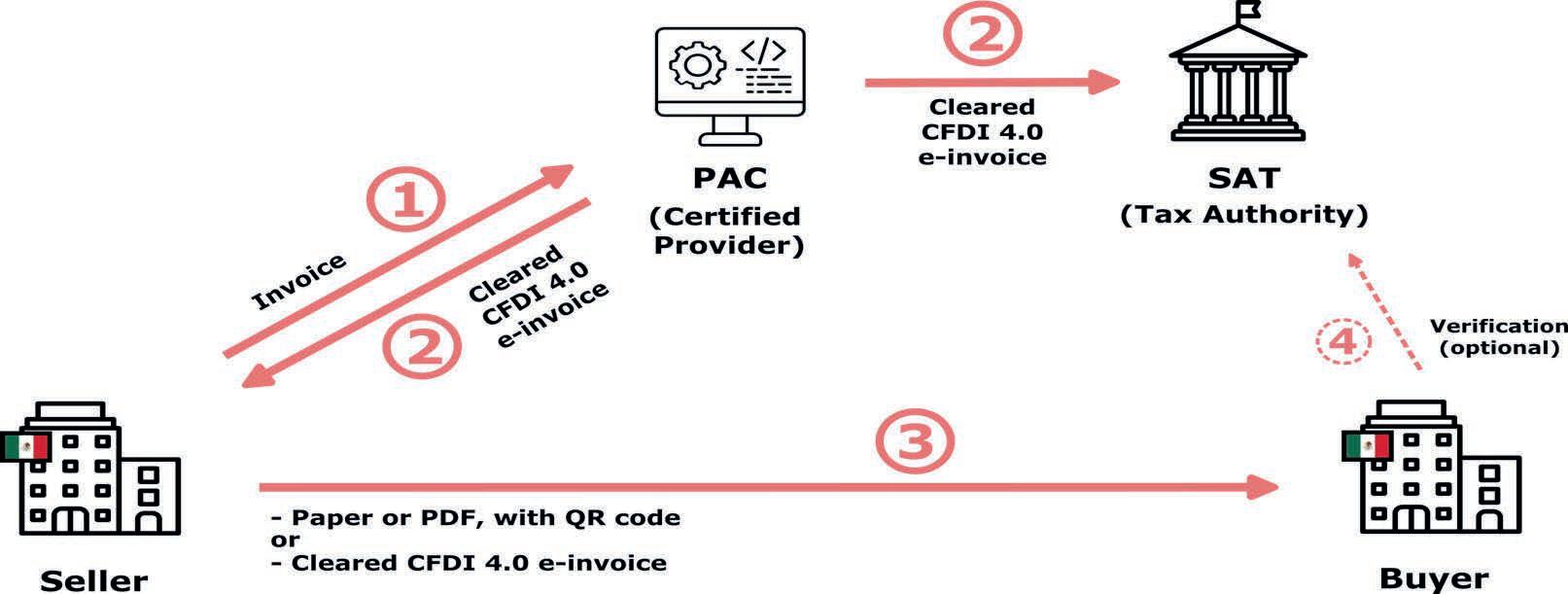
In Mexico there is not a chance to use an own billing software because all transactions must be documented issuing Digital Tax Billings (CFDI) using tax authorities own software or duly authorized invoicing suppliers: Authorized Certified Supplier (ACP)
Electronic Invoicing Requirements regulate how invoices must be exchanged in B2B, B2C and B2G transactions and some other.
Main objective Standardized and exert control over electronic invoicing as an important source of matching information, almost in real time
What it regulates
Who is affected
Data integrity & Traceability
Requires invoice issuers to have their digital tax invoice for internet (CFDI) must be validated by the tax authority (SAT) before they can send them to the final recipients. SAT has allowed some independent enties duly regulated to provide invoicing certification services.
All taxpayers (just a very few exceptions) must follow the rules. There are five types of CFDI: 1) Income Invoice, 2) Credit Note, 3) Payroll Receipt, 4) Payment Receipt, 5) Transfer (to cover transportation of goods)
Information must be sent in XML format to the SAT and once cleared the final invoice is sent back to the seller with a unique identifier call Folio Fiscal (Tax Seal). Now the issuer can share it with their buyer in PDF format.
Modification or deletion of invoices Tax regulations set out rules in case of cancellation or modifications. Many restrictions apply
Transmission to the Tax Authority (AEAT) It is automatically
Structured format requirement In 2026 was issued CFDI 4.0 format and there is Annex 20 called CFDI Standards. Tax Code regulates data that must be included on CFDI
Transactions covered Applies to both B2B, B2C and B2G transactions.
Billing Software Requirements vs. Electronic Invoicing Requirements
In Pakistan, both obligations sit under the same overarching legal framework (the Sales Tax Rules 2006) and the same regulator (the Federal Board of Revenue), though they stem from different SROs within that framework — which is itself a key point of contrast with jurisdictions that run two entirely separate regimes.
1. Billing Software Requirements (POS Integration / Sales Tax Rules 2006, Chapter XIV): regulate how retail point-of-sale and invoicing software must operate and connect to FBR.
2. Electronic Invoicing Requirements (FBR Digital Invoicing / SRO 1852(I)/2025): regulate real-time transmission and structured exchange of sales tax invoices between registered persons and FBR.
Main objective
What it regulates
Who is affected
Data integrity
Traceability
Modification or deletion of invoices
Transmission to the Tax Authority (FBR)
Structured format requirement
Prevent under-reporting of retail sales and ensure real-time visibility of point-of-sale transactions to FBR.
The technical operation and connectivity of POS/invoicing software used at the point of sale, mainly for Tier-1 retailers.
Tier-1 retailers (large retail chains, franchises, importers/manufacturers supplying retail, and other notified persons) using POS software.
Mandatory; POS systems must be tamper-resistant and generate a verifiable invoice number and QR code at the time of sale.
Achieved through real-time transmission of each sale to FBR at the point of purchase.
Sales cannot be made outside the integrated POS system; invoices are locked once transmitted.
Performed directly through the integrated POS system, which reports each transaction to FBR as it happens.
Invoice/receipt must carry the FBR-issued invoice number and QR code generated at the point of sale.
Bring all sales-tax-registered persons into a real-time, verifiable invoicing chain and reduce reliance on paper or easily-altered records.
The end-to-end generation, transmission, and structured reporting of sales tax invoices to FBR's Computerized System.
All sales-tax-registered persons (“integrated persons”) as defined under Rule 150Q of the Sales Tax Rules 2006, phased in by turnover.
Mandatory; each invoice is validated and stamped by FBR's system before it reaches the buyer, preserving a reliable audit trail.
Achieved through mandatory real-time or near-real-time reporting to FBR via a licensed integrator or PRAL.
Corrections are allowed only within 72 hours of issuance (per STGO 01 of 2026); beyond that, amendment requires prior approval of the Commissioner Inland Revenue.
Performed through a licensed integrator or PRAL, which validates the invoice and returns a unique FBR Invoice Number (IRN) and QR code.
Invoices must be generated in FBR's prescribed structured electronic format; a plain PDF or manual invoice is not sufficient.
Interoperability
Not a core requirement; POS systems connect to FBR's system rather than to each other.
Transactions covered Applies mainly to retail/point-of-sale (largely B2C) transactions.
Will be in force
Phased rollout for Tier-1 retailers and notified categories under earlier SROs, with enforcement tightening through 2025–26.
Businesses may use one or more FBR-licensed integrators (multiple-integrator use permitted since STGO 01 of 2026), enabling interoperability across providers.
Applies broadly across B2B and B2C sales-tax-registered transactions, covering the full supply chain.
Phased under SRO 1852(I)/2025, with deadlines varying by turnover band: earliest band (public companies, importers) required registration by 15 Oct 2025, testing by 25 Oct 2025, and go-live by 1 Nov 2025; remaining registered persons phased through 31 Dec 2025; broader FBR enforcement from Jan 2026 (dates illustrative — confirm exact band deadlines against SRO 1852(I)/2025).
SPAIN
Billing Software Requirements vs. Electronic Invoicing Requirements
It is important to distinguish between two related but separate obligations in Spain
1. Billing Software Requirements (VeriFactu / Anti-Fraud Law): regulate how invoicing software must operate.
2. Electronic Invoicing Requirements (Crea y Crece Law): regulate how invoices must be exchanged between businesses and self-employed professionals (B2B).
Main objective
Prevent tax fraud and the use of software that allows invoices to be altered or deleted.
Promote B2B digitalization and combat late payments.
What it regulates The technical operation of invoicing software. The format and electronic exchange of invoices between businesses and professionals.
Who is affected
Businesses and self-employed professionals using invoicing software, subject to certain exceptions.
Businesses and self-employed professionals involved in B2B transactions.
Data integrity Mandatory; records must be secure, traceable, and tamper-proof. Invoices must maintain authenticity and integrity throughout their lifecycle.
Traceability Mandatory through chained records and security controls. Must allow tracking of invoice status, such as issuance, receipt, and processing.
Modification or deletion of invoices Altering or deleting records without leaving evidence is prohibited. Not the primary focus of the regulation.
Transmission to the Tax Authority (AEAT)
Structured format requirement
May be performed through the VeriFactu system by sending invoice records to the Tax Agency.
Standardized invoicing records
Interoperability Not a core requirement.
Focuses on electronic invoice exchange and reporting obligations; it does not replace VeriFactu.
Electronic invoices must be generated in a structured format; a PDF alone is not sufficient
Mandatory interoperability between electronic invoicing platforms. Transactions covered Generally, applies to both B2B and B2C transactions.
Will be in force
Corporate Income Tax taxpayers it will be in force: 01/01/2027
Individuals with economic activity, it will be in force: 01/07/2027
Primarily applies to B2B transactions.
Estimated:
Turnover > 8MM€: 01/10/2027
Turnover < 8MM€: 01/10/2028
THAILAND
Billing Software Requirements vs. Electronic Invoicing Requirements
It is important to distinguish between two related but separate concepts
1. Billing Software Requirements: Thailand does not have a dedicated statutory regime regulating or certifying billing software itself.
2. Electronic Invoicing Requirements (e-Tax Invoice & e-Receipt): regulate the issuance, authentication, transmission, and retention of electronic tax invoices and receipts under the Revenue Department framework.
Main objective
What it regulates
Who is affected
Data integrity
Traceability
Modification or deletion of invoices
Transmission to the Tax Authority
Structured format requirement
Support commercial invoicing, accounting, VAT calculation, payment recording and recordkeeping. There is no separate Thai anti-fraud software regime equivalent to software-certification rules in some jurisdictions.
No dedicated regulation of the software product itself. General tax and accounting laws regulate the invoices and records produced by the business.
Any business using accounting, billing or ERP software, subject to general tax/accounting obligations.
No software-specific integrity standard for billing software. Businesses must keep reliable accounting and tax records.
Determined by the business’s accounting controls and recordkeeping practices.
No billing-software-specific prohibition. Corrections must follow ordinary tax/accounting rules.
No automatic transmission requirement for ordinary billing software.
No prescribed electronic format for ordinary billing software outputs; invoices may be paper, PDF or other business formats, subject to tax invoice rules.
Enable legally recognized electronic tax invoices and receipts for tax compliance and digital tax administration.
The electronic tax document and related process: format, authentication, submission/ validation and electronic retention.
VAT registrants that register/participate in the Revenue Department e-Tax Invoice & e-Receipt framework; eligible SMEs may use e-Tax Invoice by Email.
Required. e-Tax documents must preserve authenticity and integrity, supported by digital signature/e-certificate or approved timestamp depending on the model.
Required in practice through validation, tracking/status of submission and electronic records available for Revenue Department inspection.
Issued tax invoices should not simply be altered; errors are generally corrected through credit notes/debit notes or other Revenue Code procedures.
Required/available under approved Revenue Department channels, such as Web Upload, Host-to-Host or service provider channels, depending on implementation.
Prescribed electronic formats and specifications apply, including XML structure/ validation; a PDF alone is not sufficient to constitute an e-Tax Invoice.
Interoperability No statutory platform-interoperability requirement for billing software.
Transactions covered Commercial invoicing generally, including B2B and B2C transactions.
In force No dedicated billing-software regime currently in force.
Official references:
Revenue Department e-Tax Invoice & e-Receipt portal: https://etax.rd.go.th/
No general B2B interoperability rule comparable to some foreign e-invoicing regimes; systems must comply with Revenue Department technical specifications for submission/exchange.
Transactions for which Thai tax invoices/receipts are issued under the Revenue Code; not limited to B2B.
The Revenue Department e-Tax Invoice & e-Receipt and e-Tax Invoice by Email frameworks are currently operational.
Revenue Department Upload XML Manual: https://etax.rd.go.th/etax_staticpage/app/emag/flipbook/04_Upload-XML.pdf
Revenue Department Host-to-Host Manual: https://etax.rd.go.th/etax_staticpage/app/emag/flipbook/08_Host-to-Host.pdf
Revenue Department Response/Error Manual: https://etax.rd.go.th/etax_staticpage/app/emag/flipbook/05_Response-Error.pdf
Billing Software Requirements vs. Electronic Invoicing Requirements
It is important to distinguish between two related but separate topics in the Netherlands:
1.Billing Software Requirements: regulate how invoices and accounting records must comply with Dutch VAT, bookkeeping and record-retention requirements.
2. Electronic Invoicing Requirements: regulate the electronic exchange of invoices, currently mainly for Business-to-Government (B2G) transactions, with further developments expected under the EU VAT in the Digital Age (ViDA) initiative.
Invoicing Requirements
Main objective
What it regulates
Who is affected
Data integrity
Traceability
Modification or deletion of invoices
Transmission to the Tax Authority (Belastingdienst)
Structured format requirement
Ensure accurate invoicing, VAT compliance, record retention, and auditability.
Invoice content, sequential numbering, VAT requirements, record keeping and retention.
All businesses and self-employed professionals issuing invoices in the Netherlands.
Invoices and accounting records must be accurate, complete and retained in a reliable manner.
Businesses must maintain records that allow the Dutch Tax Authorities (Belastingdienst) to verify transactions.
Promote digital invoice exchange and standardisation, particularly in public procurement.
Structured electronic invoice formats and transmission methods.
Currently suppliers to Dutch government entities; broader B2B requirements may follow under ViDA.
Authenticity and integrity of electronic invoices must be ensured throughout their lifecycle.
Electronic invoice status and transmission can be traced through approved networks and platforms.
Corrections must be made through credit notes or corrective invoices; records must remain auditable. Not the primary focus of the regulation.
No real-time or continuous transaction reporting currently applies. VAT information is reported through periodic VAT returns.
No specific structured format is prescribed for invoices generated by billing software, provided the invoice complies with Dutch VAT requirements and the authenticity, integrity and readability of the invoice are ensured.
No mandatory transmission of invoice data to the Tax Authority at present. Future reporting obligations may arise under ViDA from 2030.
Structured electronic invoices are mandatory for many B2G transactions; PEPPOL BIS Billing 3.0 and EN16931 standards are commonly used.
Interoperability Not specifically regulated.
Transactions covered B2B, B2C and B2G transactions.
Existing VAT and record-keeping requirements are already in force.
Additional notes:
Existing VAT and record-keeping requirements are already in force.
PEPPOL network and European standards promote interoperability.
Currently mainly B2G transactions. B2B remains voluntary.
B2G: Mandatory for suppliers to the Dutch central government and increasingly adopted by other public authorities through the PEPPOL network.
B2B: No mandatory domestic e-invoicing requirement currently exists. Under the EU ViDA package, mandatory electronic invoicing and digital reporting for intra-EU cross-border B2B transactions will apply from 1 July 2030. The Dutch government is assessing whether to introduce mandatory domestic B2B e-invoicing thereafter.
• Dutch businesses must retain invoice and accounting records for at least 7 years (10 years for certain real estate records).
• Invoices must contain mandatory VAT information, including invoice number, invoice date, supplier details and VAT identification number where applicable.
• The Netherlands currently does not have a clearance model or mandatory tax authority approval before issuing invoices.
• Although domestic B2B e-invoicing remains voluntary, its use is increasing rapidly through PEPPOL and in preparation for the EU ViDA framework.
Auren The Netherlands
UNITED KINGDOM
Billing Software Requirements vs. Electronic Invoicing Requirements
The UK currently has no direct equivalent to Spain’s VeriFactu regime. Businesses are not generally required to use certified billing software, maintain tamper-proof or cryptographically chained invoice records, or report invoice data to HM Revenue & Customs (HMRC) in real time.
The closest UK equivalent is Making Tax Digital (MTD) for VAT. Businesses registered for UK VAT are generally required to maintain certain VAT records digitally and submit their VAT returns to HMRC using compatible software. Where multiple software products are used, the required VAT data must generally be transferred between them using digital links. However, MTD regulates the maintenance and submission of VAT records rather than the design or certification of invoicing software itself.
Electronic invoicing is already permitted and widely used in the UK, but there is currently no general mandatory B2B e-invoicing regime. Businesses may therefore continue to issue invoices in paper or electronic formats, provided the relevant UK VAT invoicing and record-keeping requirements are met.
The UK Government is considering the wider adoption of structured electronic invoicing as part of its digitalisation agenda. However, the precise scope, technical requirements and implementation timetable for any future mandatory regime should be confirmed by reference to the legislation and guidance ultimately introduced.
Spanish Requirement UK Position
Certified billing software
Tamper-proof/chained invoice records
Digital VAT records
Digital links between relevant software
Structured B2B e-invoicing
Real-time invoice reporting to HMRC
Mandatory B2B e-invoicing
Not generally required
No equivalent general requirement
Required under MTD for VAT
Required under MTD, subject to applicable rules
Not currently generally mandatory
Not currently required
Under consideration as part of future reforms
Summary: The UK currently focuses on digital VAT record-keeping and return submission through Making Tax Digital rather than regulating invoicing software itself. The UK therefore has no direct equivalent to Spain’s VeriFactu regime, although the Government is moving towards greater use of electronic invoicing.
URUGUAY
Billing Software Requirements vs. Electronic Invoicing Requirements
It is important to distinguish between two related but separate obligations in Uruguay
In recent years, many countries have developed parallel regulatory frameworks to govern, on one hand, the technical operation of billing software and, on the other, the electronic exchange of invoices between businesses. Spain is a clear example: the Anti-Fraud Law (VeriFactu) and the Crea y Crece Law establish two distinct obligations with their own timelines, scopes, and objectives. Uruguay, by contrast, took a different approach: a single, integrated regime that addresses both dimensions simultaneously.
The CFE regime: a unified system
Since 2012, the General Tax Directorate (DGI) has regulated electronic invoicing in Uruguay through the Electronic Fiscal Voucher (CFE) system, established by Resolution N.º 798/2012. This regime draws no distinction between software requirements and voucher requirements: both are contained within the same regulation, under the same supervisory authority, and with the same mandatory effective date.
CONCEPT
Scope and universal applicability
To issue CFE, taxpayers must use software previously certified by the DGI, complying with the technical specifications for XML format, advanced digital signature, and communication protocols with the tax authority. In addition, each voucher issued must carry its corresponding CAE (Constancia de Autorización de Emisión — Emission Authorisation Certificate) and be transmitted to the DGI in real time for validation, which is an indispensable condition for the document to have legal and fiscal validity.”
Adoption of the system was gradual from 2016 onwards, initially covering large taxpayers and progressively expanding. As of 1 January 2025, the obligation extends to all VAT taxpayers, including those subject to minimum VAT. New taxpayers registering from that date must operate as electronic issuers from their first day of activity, with no transition period.
Exemptions apply to, among others, Monotributo and Monotributo Social MIDES contributors, taxpayers engaged exclusively in agricultural activities with income below 4,000,000 UI (indexed units), and non-resident income tax (IRNR) taxpayers. For all other VAT taxpayers, electronic invoicing is today the mandatory operating standard in Uruguay.
What this means in practice
A relevant distinction for international businesses
The process involves obtaining a digital certificate issued by an authorised entity (Abitab, Correo Uruguayo, or Antel), selecting DGIcertified software or engaging a provider registered in the DGI’s Authorised Providers Register, and completing the homologation process with the tax authority. Once authorised as an Emisor Electrónico Habilitado (EEH — Authorised Electronic Issuer), the taxpayer must document all transactions exclusively with CFE, with no option to issue paper documents except in duly justified contingency situations.
The system covers all types of transactions: operations between taxpayers (e-Factura), sales to end consumers (e-Ticket), goods movement (e-Remito), withholdings (e-Resguardo), and exports. Both issuers and recipients are required to retain digital copies of vouchers for a minimum of five years.
For foreign companies operating in or transacting with Uruguay, the integrated model has an important practical implication: complying with billing software requirements is, at the same time, complying with electronic invoicing requirements. There are no two separate certification processes or two different implementation timelines. The technological adaptation and the fiscal obligation are one and the same.
This unified approach simplifies the regulatory landscape and reduces the compliance burden, though it does require that the software in use remains permanently up to date with the new CFE format versions that the DGI publishes periodically. Version 25 of the CFE, effective March 2026, introduced new mandatory fields, cross-validation requirements for credit notes, and adjustments for integration with the Customs authority systems (VUCE), demonstrating that the regime continues to evolve in depth.