In a world facing environmental challenges, it is essential for companies to take responsibility and contribute to sustainable development. As a lighting provider with in-house manufacturing in Sweden, we can make a significant impact, both in terms of the company’s carbon footprint and by guiding our customers toward sustainable choices. This involves energy-efficient lighting and sustainable material selection, as well as creating good lighting for health and well-being.
In 2023, we established clear goals for our sustainability efforts, encompassing economic, social, and environmental sustainability. It’s crucial that our partners and suppliers adhere to our code of conduct, that our employees have a safe working environment, and that our products contribute to reduced energy consumption. We have integrated some of the UN’s Sustainable Development Goals in Agenda 2030 into our long-term work, focusing on green energy, innovation, and sustainable consumption and production. For example, we have a goal to increase the energy efficiency of our products from an average of 120 lumens per watt to 140 until 2030, as well as to increase the proportion of products with smart controls to ensure that they are not unnecessarily lit. Our most significant opportunity to make a difference lies in ensuring that the market offers as energy-efficient and smart lighting solutions as possible, as 90% of our climate impact occurs during the products’ use phase. During 2025 we are making Environmental Product Declaration for a major part of our product range. With our own production facility in Vimmerby, Sweden, and close relationships with our customers, we have also contributed to renovation projects over the past year where customers have retained parts of their lighting solution but upgraded to the latest technology. This enables reuse while making lighting more energy-efficient. We are at the beginning of our sustainability journey, and we look forward to sharing our work and progress continuously.
Henrik Håkansson CEO Aura Light
Lower carbon footprint with sustainable material
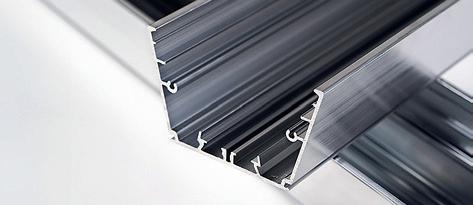
By choosing low-carbon, recyclable materials, we help cut global emissions. For us, it’s important to choose materials that last over time and leave as small climate footprint as possible. Thanks to energy-efficient technology, we contribute to our customers reducing their energy consumption, sometimes by as much as 80 percent. We also choose our material with care when creating new luminaires. Collaborating with multiple suppliers challenges us to test new and more sustainable materials. Today, we have a partnership with Hydro, which manufactures some of our aluminum profiles using either low carbon dioxide or recycled aluminum. In line with the requirements placed on us in the construction sector, we also develop EPDs with the aim of monitoring and making our input materials less environmentally impactful.
Hydro CIRCAL
Hydro Circal is recycled aluminum made with at least 75% recycled aluminum scrap after consumption. The 75%
recycled materials are exclusively from aluminum which has reached its service life and which is used and returned to the loop via recycling. The aluminum can, for example, come from demolished construction projects, food and beverage containers and scrapped cars. Using recycled aluminum in the production process also means lower heat, which in turn contributes to the need to generate less energy. Hydro uses only the finest and least polluted scrap materials to ensure that no additional energy is used to recycle it. The product families Kvill, Sevede and Ceos are all made of Hydro Circal.
Step by step towards a sustainable production
With knowledge of lighting, the potential to manufacture our own products and a long-term approach, we want to take an active role in creating sustainable lighting alternatives, from raw material to finished product.
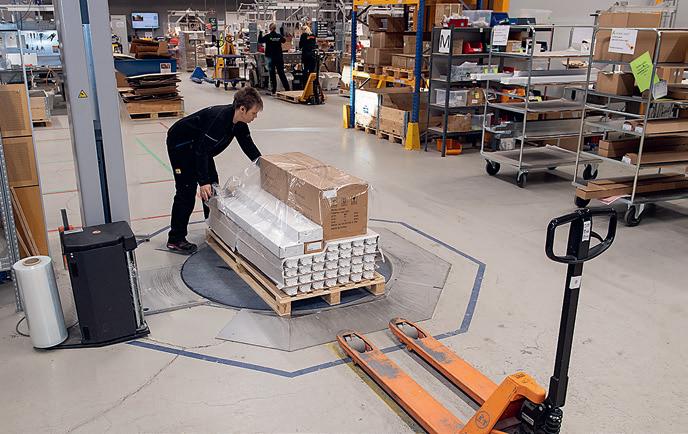
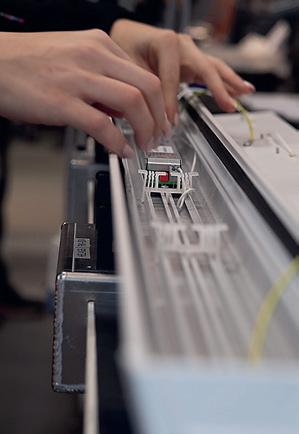
With a factory and production line in Vimmerby, Sweden, we are close to our customers. Here, we work on various aspects including design, product development, testing, and upgrading of lighting products. Our entire production is also located here, where we manufacture, assemble, package, and dispatch our products. This means we have the flexibility to develop a production line that is both sustainable and clean. It all started with the decision to go green and, among other things, choose green electricity. With an offshoot of the UN’s global sustainability goals and target nine: Sustainable industry, innovations and infrastructure, we go step by step towards a more sustainable lighting production. All to meet the UN’s global sustainability goals.
Small efforts that make difference to the environment
At Aura Light, we have reduced waste from cardboard with over 30 percent by converting corrugated cardboard into filling material that can be reused for deliveries. The cardboard become shock absorbing mats that replace bubble wrap, paper and other packing material. An excellent way to reduce the use of plastic and reduce our costs for purchasing packaging materials. Simply good, cheap and environmentally friendly!
Recycling for circularity
Together with Stena Recycling we can give old material new life and all our waste is handled in a safe way.
Minimal spillage, reduced transports and a safe environment
We have a large machinery park that has served us well for many years. As the old ones are replaced, we take the opportunity to choose energy-smart machines that provide minimal amount of waste and enable us to produce lighting in durable materials and in a greener way. Our goal is for all machines to be examined from a sustainability perspective before purchasing for the best possible environmental choice.
Much of our sustainability work results in one and the same positive profit - reduced transport. Long and heavy transport is a major environmental obstacle today and we want to pull our straw to the stack to reduce unnecessary transports. By continous work with smart packaging, logistics and less waste, we aim to transport greener.
With all the production in one place, we can easily monitor it step by step and ensure safe and minimal handling of chemicals, smarter and more energy efficient production and that all our employees can work in a safe, healthy and pleasant environment.
One step in the right direction
Aura Light has joined the Science-Based Targets initiative and clear goals have been set to reduce our company's direct emissions by 2030.
This is SBTi
The Science Based Targets initiative (SBTi) is a framework that assists companies and organizations in establishing science-based climate targets aligned with the objectives of the Paris Agreement, which aims to limit global temperature rise to 1.5 degrees.
As a member, it is our responsibility to actively reduce greenhouse gas emissions, we have therefore set specific targets to reduce our emissions by 50 percent in both Scope 1 and Scope 2 by 2030.
The SBTi is a collaborative effort between the Carbon Disclosure Project (CDP), The United Nations Global Compact (UNGC), the World Resources Institute (WRI) and the World Wide Fund For Nature (WWF).
Scope 1 covers emissions that directly originate from our operational activities, such as those from own factories.
Scope 2 encompasses indirect emissions resulting from the consumption of purchased electricity, steam, heating, and cooling by the reporting company.
Scope 3 includes all other indirect emissions that occur in the value chain, including emissons from suppliers, transportation, waste management, and the use of sold products.
Overview of total tons of CO
Materiality analysis
We have identified four areas where we have the greatest opportunity to influence within the sustainability field. These areas involve our impact in our product development, our work in logistics and procurement, our employees’ health and well-being, and finally, influencing the customer to choose sustainably.
Product Development Supply
Area Production facility and development as well as in collaboration with strategic suppliers.
Questions
∙ Energy efficiency
∙ Conscious choice of materials
∙ Climate footprint
∙ Product lifetime
Value adding
∙ Reduced impact from products in use
∙ Contribute to circular flows
∙ Sustainable material choices to contribute less virgin material that needs to be extracted from the ground
∙ Long service life of the installation
Products are purchased from third parties as well as components for own production.
∙ Efficient transport
∙ Reduced energy consumption and reduced CO2 emissions
∙ Code of conduct and quality requirements for our suppliers
∙ Reduce emissions and waste management of products and components
∙ Production/deliveries in our nearby area
∙ Reduced CO2 emissions good for the climate
∙ More cost effective and climate-friendly transportation
∙ Ensured social sustainability
∙ Reduced waste and less emissions lead to better economic and ecological sustainability
About 140 employees in 3 countries, one production unit.
∙ Systematic work environment work
∙ Health and well-being
∙ Competence development
∙ Diversity and inclusion
∙ Energy efficiency and travel
Sales of sustainable lighting to the the professional market.
∙ Communicate and retrain sustainable lighting solutions
∙ Guide the customer to energy efficient choices with long life
∙ Economy and sustainability go hand in hand
∙ Safety in the work environment
∙ Employee engagement
∙ Increased knowledge
∙ Inclusion and diversity boost innovation and decision-making
∙ CO2 savings
∙ Loyal customers
∙ Customers who install sustainable lighting solutions reduce their carbon footprint over the life of the product
∙ Educated customers and coworkers
∙ The sustainable solution is also economically beneficial during the period of use