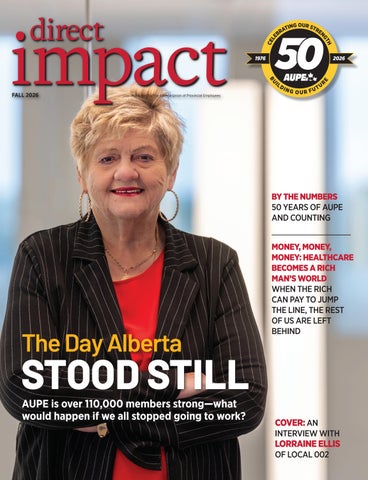
FALL 2026
BY THE NUMBERS 50 YEARS OF AUPE AND COUNTING
The Day Alberta
MONEY, MONEY, MONEY: HEALTHCARE BECOMES A RICH MAN’S WORLD WHEN THE RICH CAN PAY TO JUMP THE LINE, THE REST OF US ARE LEFT BEHIND
STOOD STILL AUPE is over 110,000 members strong—what would happen if we all stopped going to work?
COVER: AN
INTERVIEW WITH
LORRAINE ELLIS OF LOCAL 002
AUPE’S 49TH ANNUAL CONVENTION Convention 2026 is taking place October 22, 23, and 24 at Edmonton’s EXPO Centre. Over 1,000 members from across the province will come together to set our union’s direction for the next year. Convention is the highest governing body of our union. Delegates will amend our constitution, pass our annual budget, and debate resolutions. Nothing compares to the democracy, solidarity, and fun that members have at Convention. 2026 marks 50 years of AUPE. Convention is where we start the journey towards 50 more.
www.aupe.org/convention
Direct Impact is printed annually, with a circulation of more than 100,000.
AUPE EXECUTIVE President
Sandra Azocar Executive Secretary-Treasurer
FALL 2026
Bobby-Joe Borodey Vice-President
Shamanthi Cooray Vice-President
James Gault
Vice-President
Darren Graham Vice-President
Curtis Jackson Vice-President
Andrew Wilson
Executive Director
Carl Soderstrom Managing Editor
Andrew Hanon Editor
Alexander Delorme Contributors
Tamara Aschenbrenner Kavi Chahal Alexander Delorme Terry Inigo-Jones Maureen Mariampillai Jon Olsen Design
Karen Painchaud Jeff Weber
Telephone: 1-800-232-7284 Fax: 780-930-3392 Toll-free Fax: 1-888-388-2873 info@aupe.org www.aupe.org
Canadian Publications Mail Agreement: 40065207 Return undeliverable Canadian addresses to: Alberta Union of Provincial Employees 10025 - 182 St. NW, Edmonton, AB, T5S 0P7
04 05 06 08 12 16 17
A Message to Members from AUPE President Sandra Azocar
Spotlight on Finance from Executive Secretary-Treasurer Justin Huseby
By the Numbers 50 years of AUPE and counting.
The Day Alberta Stood Still AUPE is 110,000 members strong—what would happen if we all stopped going to work?
Money, Money, Money: Healthcare Becomes a Rich Man’s World Corporate control puts acute and continuing care in peril.
Member Profile Lorraine Ellis, Business Coordinator Local 002, Government of Alberta
The Rest of the Stories Stories that celebrate 50 years of AUPE and inspire the next generation of union members and activists.
C26176
Got a story idea? We want to know what AUPE members are up to. Send your suggestions to editor@aupe.org.
TABLE OF
Vice-President
CONTENTS
Justin Huseby
DIRECT IMPACT 3
A Message to Members from AUPE President Sandra Azocar Fellow Brothers and Sisters, Happy fall! I can’t believe how quickly the summer has come to an end. I hope you had an opportunity to recharge and spend quality time with your loved ones. As we reflect on the past and prepare for the months ahead, I want to thank each of you for your dedication and commitment to our union. Your work matters. It matters to our members, to our communities, and to the future of public services in Alberta. This has been a year of important milestones for AUPE. We have made significant progress at the bargaining table, took meaningful steps to reorganize our union, and worked to make our collective power even stronger. We are not simply preparing for change—we are making it happen. Our responsibility is to ensure AUPE is prepared to meet the challenges ahead, that our members have a meaningful voice in decisions that affect their lives, and that employers recognize the value of the work you perform every single day. AUPE members are the backbone of Alberta’s public services. You provide care, support our communities, educate our children, maintain essential infrastructure, and deliver the services Albertans rely on. Yet, far too often, your employers do not value your work. They keep your wages low and refuse to provide the working conditions you deserve. 4 DIRECT IMPACT
That is not something we can accept. We must change the status quo. Our work in the Continuing Care sector is a powerful example of what is possible when members stand together. Negotiating more than 150 contracts at once is challenging, but our members have demonstrated remarkable courage, determination, and solidarity. More than 400 members attended the Continuing Care Bargaining Conference in May, a demonstration of our collective strength and our determination to change the direction of seniors’ care in Alberta. Together, we developed our skills as activists and created a coordinated, intentional plan to fight the employers who have disrespected us for far too long. We begin with a fundamental truth: seniors’ care is health care—full stop. The workers who provide this care deserve to be recognized, respected, and compensated accordingly. They deserve wages that reflect the value of their work, the resources they need to provide quality care, and employers who invest in their wellbeing. We cannot accept a system that relies on our dedication and sacrifice but does not value us. Our members deserve better, and so do the seniors and families they care for. This fight does not end after one round of bargaining. Change requires sustained organizing, member engagement, and collective action.
It requires a union that is prepared to protest the status quo and use its strength to advance the interests of its members. We will continue making the internal changes necessary to help members work together, organize together, and mobilize together. We are building a union that is proactive and prepared to meet the challenges we face. Our strength has always been in our members. Our future depends on how we organize that strength and put it into action. As you take the time to read this edition of Direct Impact, I hope you see the progress we have made, the challenges we must confront, and our members’ determination to create an even stronger union. There is much work ahead. But with solidarity, courage, and a willingness to fight for what is right, we can continue to build the union our members deserve. Together, we will keep fighting for fairness, dignity, and respect for every AUPE member.< In Solidarity,
Sandra Azocar, AUPE President
Spotlight on Finance
from Executive Secretary-Treasurer Justin Huseby Your Union. Your Strength. Your Future. AUPE’s mission is: “To represent and support AUPE members through solidarity and mobilization.” Achieving our mission requires not only strong solidarity but also a sustainable financial foundation that allows us to support members, protect their rights, and prepare for the challenges ahead. At Convention 2025, Delegates approved a 0.25% dues increase, bringing total dues to 1.5% on January 1, 2026. This was not an easy decision, but AUPE members still pay some of the lowest dues compared to other union members, and our dues apply only to regular wages. Our decision is already producing positive results. AUPE achieved a balanced budget in 2026, allocated $3 million in dues directly to the Defence Fund, and a further $773,000 to Contingency Savings. These steps align with AUPE’s financial plan and commitment to strengthening our financial foundation and protecting members’ futures. Our financial plan is built around four priorities: 1. Strengthen the Defence Fund: Our goal is to maintain a strong Defence Fund that can support and defend all AUPE members during strikes and lockouts. 2. Establish Sustainable Funding: Convention 2025 approved an increase in dues to 1.5%, effective January 1, 2026. This increase provides a stronger foundation
for AUPE’s operations and member services. Our responsibility is to manage these resources carefully and ensure your dues support meaningful investments for members, now and in the future. 3. Win at the Bargaining Table: Our goals must include raises that keep up with or exceed inflation, as well as improved working conditions for all AUPE members. AUPE has updated its negotiation strategies, and many bargaining units have won raises consistent with our objectives. We are also strengthening how we prepare for bargaining in the future, including investments in Essential Services Agreement (ESA) infrastructure. Successful bargaining outcomes require preparation, strategic investment, and responsible financial management. Our goal is to deliver results for members while building a foundation that reduces the need for future dues increases. 4. Establish a Future Operational Fund: Our long-term goal is to establish a dedicated Operational Fund. This fund would help meet future operating challenges without relying on funding meant for the Defence Fund or other savings. Creating this Operational Fund is part of your Finance Committee’s future work. As an initial step, your Provincial Executive has committed 1% of dues revenue to Contingency Savings. These funds are
currently designated for facility-related contingencies and are not intended for regular operating expenses. Building a Stronger Financial Future Our approach is guided by these principles: • Sustainability: Maintaining resources for today and tomorrow. • Strength: Ensuring resources are available for bargaining and action. • Separation of Funds: Protecting the Defence Fund by ensuring regular operations are funded through operational revenue. By committing to a sustainable financial plan, we are investing in members’ rights, collective gains, wages, and futures. When we fight, we win. But winning requires courage, preparation, and collective resources. A financially strong AUPE ensures our solidarity is backed by the resources necessary to defend it. < In Solidarity,
Justin Huseby, Executive Secretary-Treasurer
DIRECT IMPACT 5
50 YEARS AND COUNTING
BY THE NUMBERS The Alberta Union of Provincial Employees celebrates its golden anniversary! 50 years have passed since the Alberta Government repealed the Civil Service Association of Alberta Act, paving the way for the creation of AUPE as we know it. Our members faced many challenges as they worked to build their new union. AUPE’s first leaders and activists dealt with soaring inflation and devastating government decisions that put the union on the brink of bankruptcy. Our union would not have made it through these hardships—especially in the 1980s and ‘90s—without the sacrifice and solidarity of our membership. AUPE could not have become western Canada’s largest public sector union without their hard work and perseverance. To celebrate, we are taking a look at AUPE’s history and growth... by the numbers.
KNOWLEDGE IS POWER
Throughout our history, the journey to becoming a union activist begins in an AUPE Education classroom. AUPE’s Labour School and Core Course offerings give members the tools to fight for workers’ rights at their worksite.
333
Total core courses offered in 2025/2026
90,000+ 27 Estimated number of members who have taken an AUPE Education course.
Total number of unique courses offered at AUPE’s Labour School.
5,150
Approximate number of members who have attended Labour School since it was created in 2002.
WANT TO APPLY FOR LABOUR SCHOOL? Go to www.aupe.org/training/courses to begin your union education. Complete the prerequisite courses you need to qualify for the advanced courses at Labour School. Union members become union activists with AUPE Education!
1976
1986
35 ,0 00
46 ,0 00
30 ,14 3
AUPE MEMBERSHIP GROWTH THROUGH THE DECADES
1996
WHO ARE WE?
AUPE’s membership has always reflected our province, but there has been a significant shift since early days of the union. The workplace was traditionally a “man’s world,” but today over two-thirds of AUPE members are women.
1980
41,000+ members
2026
WHICH CONVENTION IS IT
110,000+ members
69% Female 50% Female
50% Male
23% Male 7% Prefer not to say .08% Other/Nonbinary
WE’RE GOING TO NEED A
BIGGER ROOM!
49OR50?
You may have noticed that we are celebrating AUPE’s 50th anniversary, but preparing for our 49th annual Convention. Those numbers are both correct! AUPE was created on June 14, 1976, 50 years ago. Unfortunately, the COVID-19 pandemic forced AUPE to cancel our 2020 Convention to protect members’ health and safety, making this our 49th Convention. 1976 Convention 1,140 sq. ft.
2026 Convention 68,484 sq. ft.
The number of Delegates at Convention count is directly tied to the total number of AUPE members. That means AUPE’s growing membership has forced our Convention into larger and larger spaces. The hall used for the 1976 Convention was about the size of a bungalow house. The space used for this year’s Convention could fit 60 bungalow-style houses.
1976 – 352 Delegates
Chateau Lacombe - Lacombe Room: 1,140 sq. ft. 2026 – 1,131 Delegates
2006
2016
11 0, 00 0
93 ,0 82
66 ,0 09
Edmonton EXPO Centre – Hall F & G: 68,484 sq. ft.
2026
The Day Alberta
STOOD STILL By Tamara Aschenbrenner, Communications Staff
8 DIRECT IMPACT
AUPE is over 110,000 members strong—what would happen if we all stopped going to work?
DIRECT IMPACT 9
At 6:45 on a Tuesday morning, a healthcare aide helps a resident get dressed. At the same time, a correctional officer makes their rounds. A custodian finishes the floors in a hospital. A highway patrol officer watches traffic move steadily. A maintenance worker checks the boiler. A social-services worker opens an inbox already full of messages. “There is no single place you could point to and say, ‘That’s where AUPE is.’ We are everywhere,” says AUPE President Sandra Azocar. “If you took all of those people out of Alberta for one day, you’d see just how much depends on them.” Imagine: over 110,000 AUPE members deciding not to go to work. At the same time. This would not start out dramatically. There is no switch to pull or giant building that goes dark. Instead, Alberta would begin accumulating small failures. A phone rings. A door stays locked. An alarm blares. A patient waits. A student waits. A resident waits. By themselves, none of these bring a province to a halt. Together, they begin to tell a different story. “Ask someone what keeps a hospital running and they’ll probably name doctors and nurses,” says Azocar.
10 DIRECT IMPACT
“They may not think of health-care aides helping patients throughout the day. They may not think of people cleaning rooms, stocking supplies, maintaining equipment, and keeping the physical infrastructure working.” AUPE members have the same impact in other workplaces across the province. Public services and our economy depend on dozens of classifications working in sequence, each making the next possible. A university campus does not function because the lecture halls exist. An elementary school does not function because students arrive. A correctional facility does not function because it has walls. A community does not function because it has a city hall. People must be there to provide those services. One unanswered phone call may be an inconvenience, but thousands of unanswered phone calls become a potentially dangerous backlog of human needs. “That’s what people don’t always see,” says Azocar. “Essential work includes everything behind the scenes that allows other people to do their jobs and get about their day.”
The needs do not disappear just because the workers do. All morning long, phones ring, applications wait, and files sit open. A person looking for social services does not reach the worker they need. Someone trying to navigate immigration services in Edmonton does not get an answer. A pension file does not move. A municipal service in Strathcona County waits. So do services in Coaldale. By lunchtime, the hypothetical absence has rippled throughout the province. Conservation services are quiet. Highway patrol vehicles remain parked. Phones ring and ring and ring. “AUPE members work in thousands of different classifications, many with little to nothing in common, except for one thing,” says Azocar. “They are part of a powerful force that is 110,000 members strong.” AUPE is Alberta’s largest union. The number of members is almost impossible to picture. But imagine a hospital without clean surgical equipment. A school unable to help a student with special needs.
An agency with no one answering messages. Individually, the province could manage an absence or two. Together, they change the province’s ability to function. “That’s where collective power becomes real,” says Azocar. “It’s 110,000 people understanding that their work has value, even when the work looks completely different from the person standing next to them.” The imagined day keeps going. By afternoon, Alberta tries to compensate for the missing workers. Usually, someone takes on another responsibility. Someone else stays late. A workload grows and grows. This is how essential work remains invisible. Workers absorb the pressure. They find a way around the problem, even if it costs them in the long run. “Employers assume a system works because they make overworked employees fill in wherever there’s a gap,” says Azocar. “But getting the job done should not require workers to keep giving up more of themselves.” The province probably would not collapse on the first day. People would improvise, managers would prioritize, and other workers would stretch further.
They would delay some services, reschedule appointments, and push some work until tomorrow. That is the part that gets lost when essential work is treated as an endless resource. There is always another shift. Another call. Another person who can pick up the slack. Until there isn’t. For AUPE members, that pressure is familiar. It can look like a health-care aide moving faster because there are not enough hands, or a social-services worker carrying a caseload that never seems to shrink. The work still gets done, even at great cost to their physical and mental health. This day, however, there is nobody left to absorb it all. At 7 p.m., another shift should be arriving. Instead, another set of positions remains empty. A resident still needs care. A person in custody still needs supervision. A family still needs help. A building still needs cleaning. “The funny thing is that we don’t actually need to imagine our importance,” says Azocar. “AUPE members demonstrate it every day. They just don’t always get to see the whole picture, because they’re busy doing their part of it.”
Workers are powerful because their contributions happen every day, thousands upon thousands of times, across an entire province. When 110,000 people are doing their part at once, their individual work adds up to something much larger than any one workplace can contain. That has consequences beyond a single day. It matters when workers sit down to bargain. It matters when they ask for competitive wages and benefits. It matters when they push for safer workplaces, better staffing, and secure pensions. It matters when they decide what they are willing to accept—and what they aren’t. AUPE has 110,000 members, but that number becomes powerful only when members understand what it represents. People. People doing the work that keeps Alberta moving. When the 24 hours are up, the province gets another ordinary day. AUPE members, however, get a reminder that there is nothing ordinary about this extraordinary union. <
Employers assume a system works because they make overworked employees fill in wherever there’s a gap. But getting the job done should not require workers to keep giving up more of themselves. Sandra AZOCAR President
DIRECT IMPACT 11
MONEY MONEY MONEY
healthcare a rich man’s
12 DIRECT IMPACT
e becomes s world Corporate control puts acute and continuing care in peril By Terry Inigo-Jones, Communications Staff
DIRECT IMPACT 13
Confused by the chaos ripping through healthcare in Alberta? Scandalous allegations of corruption. Alberta Health Services (AHS) broken up into a million pieces. Doctors practising in both the private and public health-care systems. Private interests allowed to own public hospitals. More surgeries shipped to private facilities. People with money can jump to the head of the line, creating a longer wait for everyone else. With so much change happening at once, it is hard to understand what the heck is going on—and why. “There’s one force driving all this change: corporate hunger for huge profits,” says Andrew Wilson, AUPE vice-president and chair of the union’s Anti-Privatization Committee. “Ever since universal health care was created, corporations have been circling, looking for opportunities to get their hands on our cash,” says Wilson. According to Alberta’s 2026 budget, the government will spend $34.4 billion on health care this year. Corporations would love to get their hands on as much of that as possible. “What’s different in Alberta now is that we have a premier and a government that hate the idea of public services,” says Wilson. “Every dollar spent on public care instead of going to a corporate bottom line, an executive bonus, or to a shareholder, they see as a wasted opportunity.”
14 DIRECT IMPACT
The pillars of health AHS was and is far from perfect. That’s no surprise after years of spending that failed to keep up with inflation and population growth. “Successive governments chose to squeeze health care. They want the system to fail so Albertans get tired of waiting for treatment and become more open to private, for-profit care,” says Wilson. However, our health-care system is too big and complex for most corporations to take over in one go. Breaking AHS into smaller, bite-sized pieces makes it much more attractive for businesses looking for new opportunities to make money. Who wins: Corporations seeking to carve out new opportunities for profit. Who loses: Patients and workers stuck in a health-care system on the verge of collapse.
Wanna buy some extra insurance? Critics have warned that Alberta’s Bill 11, the Health Statutes Amendment Act, could mean the end of Canada’s universal health-care system. For the first time in Canada, private insurance companies can sell insurance for medically necessary care. This means that people who can afford to buy private insurance can get the treatment they need faster, but everyone else will be left behind. What happens when U.S. companies move into Alberta to get their piece of this newly opened insurance market?
As soon as they enter the market here, they get protection from international trade and investment agreements that Canada has signed. “Once they’re in, we’ll never get them out, and they’ll spread across the country,” says Wilson. As the Canadian Centre for Policy Alternatives (CCPA) says: “We will not have U.S.-style health care. We will have U.S. health care.” Who wins: Private insurance companies. Who loses: Albertans who cannot afford private insurance.
Fewer doctors for those who cannot pay Bill 11 allows doctors to practice in both the public and private health-care systems. It also allows doctors to charge extra for private care. “What this approach fails to address is that our health-care system is dangerously understaffed. Every time physicians choose to treat a patient in the private system, they will be drawing workers from the ranks of the public system,” says Wilson. “The inevitable result is that the public system will be left with even fewer workers, meaning wait times for most Albertans will get longer. That is dangerous for patients in need of urgent treatment and painful for those who must wait longer to deal with debilitating conditions.” Many doctors will make private work their priority, because it pays them more. Who wins: Physicians able to profit from patients who can afford to pay. Who loses: Albertans who cannot afford to pay extra; workers who will face severe staff shortages.
Whose hospital? Alberta’s hospitals are owned by Albertans. We paid to build them and we pay for their operations, after all. But that can all change thanks to another part of Bill 11. It introduces something called a “hospital services facility” that private and for-profit operators can own. Wilson says: “This opens up acute or hospital care to what we currently see in continuing care. There’s no transparency in how private operators use our money. How much will these facilities focus on maximizing profit instead of prioritizing care?” Meanwhile, according to the CCPA, the Alberta government wants hospitals to compete for revenue from patients and private insurers by selling “enhanced” services. Private, for-profit chartered surgical facilities already operate all over Alberta. According to the Parkland Institute at the University of Alberta, this has led to some surgeries costing up to twice as much as surgeries in public hospitals. Meanwhile, former AHS CEO Athana Mentzelopoulos alleges that the government interfered in surgical-contract negotiations. There are several investigations into these claims, including a criminal probe by the RCMP. Who wins: Corporations who want to make money off of hospital and acute care. Who loses: Alberta taxpayers, who end up paying more and waiting longer.
Testing, testing Bill 29, the Medical Statutes Amendment Act, means Albertans do not need a referral to pay for private medical diagnostic tests, including MRIs, CAT scans, X-rays, and ultrasounds.
“What happens when tens or hundreds of thousands of Albertans demand tests without a referral? It will create a tremendous strain on a system already struggling to keep up with demand,” says Wilson. If there is no medical reason for many of these tests—which is likely, because no doctor ordered them—a lot of resources will be wasted, delaying tests for people who actually need them. Who wins: Private diagnostic companies who want to boost profits. Who loses: Patients needing tests to diagnose real conditions.
Leeching profits from seniors’ care The state of continuing care in Alberta offers a vision of how our whole health-care system could change. “Rather than a system focused solely on the quality of care, Alberta has many for-profit continuing-care operators,” says Wilson. “Their focus is as much about the value of their real-estate holdings as it is about their residents or patients. They spend a lot of time buying and selling care home facilities as their business models change.” In 2024, the Alberta government made the sector more attractive to corporations. In the Continuing Care Act, the government removed minimum hours of care from legislation, making it easier for companies to reduce care standards and increase profits.
What do we care about? “Ask any Albertan what they want from our health and continuingcare sectors, and they’ll say they want high-quality care provided when needed,” says Wilson. “Instead, the government is creating a system that cares about only one thing: profit.” <
Successive governments chose to squeeze health care. They want the system to fail so Albertans get tired of waiting for treatment and become more open to private, for-profit care. Andrew WILSON Vice-President
DIRECT IMPACT 15
MEMBER PROFILE
Lorraine Ellis Business Coordinator, Government of Alberta Local 002 If you have attended AUPE’s annual Convention, you know the name Lorraine Ellis. She is something of a living legend for her relentless, by-the-book commitment to the AUPE Constitution and the rules of order. In fact, she was a Delegate at AUPE’s first Convention in 1976. Ellis has been a union activist for longer than the Alberta Union of Provincial Employees has existed, having joined AUPE’s predecessor, the Civil Service Association of Alberta (CSAA), in 1970. In 1971, Ellis took on her first leadership role, though it was not entirely by choice. “A friend convinced me go to a CSAA meeting not long after my first year with the government,” she says. “We were chatting and I was getting annoyed because people kept calling my name. I hadn’t realized the Branch was running executive elections that night until the chairperson told me I was just elected Branch Secretary. I told him I couldn’t do it because I had a small child at home, but by that time the motion had carried. “Looking back, that moment changed my life. It led me to dedicating the next 55 years to my union.” Ellis has held nearly every leadership position in AUPE. She was a Vice-President from 1983 to 1987, and again from 2007 to 2009. She has served as Chair of her Local and Chapter, Provincial Executive Representative, and Union Steward—just to name a few more. She received her Life Membership from Local 001 in 1988. Ellis encourages young Delegates to take a moment to appreciate their time at Convention. Even after 53 years, she can feel the energy when stepping up to the mic to address her fellow Delegates. “My journey was never about me or the positions I held,” she says. “As we celebrate AUPE’s 50th anniversary, it is humbling to look back on what I have helped to create, and I am happy knowing the union is in safe hands when I see the dedication and passion of our young Delegates. “My involvement in the labour movement, as a trade unionist and leader on behalf of working people, has made me the person I am today.” < By Jon Olsen, Communications Staff
16 DIRECT IMPACT
AUPE — 50 YEARS AND COUNTING
Commemorating half a century of Alberta's largest union By Kavi Chahal, Communications Staff
Today, the Alberta Union of Provincial Employees stands at 110,000 members strong. We represent workers of all walks of life, across sectors, and across the province. From government offices, to hospitals, to care homes, and even out in our forests and open prairies, AUPE members are serving Albertans everywhere. “It has been a long road to get here. We’ve faced many challenges along the way, but AUPE members always push forward,” says AUPE Executive Secretary-Treasurer Justin Huseby. “A long, proud history like ours is hard won and is a clear demonstration of our commitment to the labour movement and to one another.” The Alberta Union of Provincial Employees was born out of the Civil Service Association of Alberta in 1976, 50 years ago. After decades of mistreatment, members demanded true independence and self-governance, ensuring that we had all the rights and power that unions across the world had won. It was not long before we exercised that power. Members had had enough of the government taking them for granted and paying them less than they were worth. The 1980 Apples and Oranges Strike was AUPE’s first official job action.
Thousands of workers walked off the job and took to the streets, demanding the fair treatment they deserved. It was a monumental start to what has become decades of fighting for workers’ rights. We had an uphill battle and never gave up. Throughout the 1990s, the government limited our rights to strike, cut funding for programs Albertans relied on, and privatized essential services. We went on wildcat strikes despite legislation, fought to extend necessary funding, and stopped the privatization of Children’s Services and provincial prisons. Despite our relentless efforts, our numbers were diminished by cuts and privatization, leaving us with 35,000 members. We fought on, rebuilding our numbers and growing our power over the coming decades. Our health-care sector grew by merging with the Canadian Health Care Guild, becoming the union for health care general support service workers, and organizing private care homes across the province. We committed to welcoming and supporting thousands of new members, ensuring they were treated fairly, and fighting for quality care for the Albertans they serve. By 2020, we had grown to over 95,000 members.
We have continued to grow our numbers and exercise our power. We have increased our membership to 110,000 in just the past six years! We are a considerable force, a strong example of collective power and solidarity, taking action to improve members’ lives and the lives of all workers. We fight for improved wages and working conditions, support vulnerable people, and ensure workers’ rights are upheld. We showed what we could do just last year. Tens of thousands of members organized, advocated, trained, and won incredible improvements to their collective agreements. “Year after year, AUPE members keep fighting for the conditions we, and all workers, deserve,” says Huseby. “We never back down, never give up, and no matter what challenges we face, we know we can get through them together.” <
It has been a long road to get here. We’ve faced many challenges along the way, but AUPE members always push forward.
Justin HUESBY Executive Secretary-Treasurer DIRECT IMPACT 17
Organizing is Caring AUPE MEMBERS STAND UP FOR SENIORS By Maureen Mariampillai, Communications Staff
For the tens of thousands of AUPE members working in continuing care, supporting seniors is more than just a job. It is a career built on caring for elders, building genuine connections, and the belief that everyone in Alberta, especially seniors, deserves dignity and compassion when we need it most. But now, health-care workers are sharing stories about how the system is failing seniors. For years, workers have provided the best care they can while carrying the burden of short staffing, increasing complex needs of seniors, budget cuts, and massive changes to the system. “Nursing care and general support service workers know what the consequences are when we’re burned out and employers refuse to listen,” says AUPE Vice-President Darren Graham. “Not only does it hurt us mentally and physically, but it also has a negative impact on the seniors relying on us.” So how are AUPE members fixing the problem? At the bargaining table. Negotiating teams across the province are organizing members at their worksites. The goal is to enshrine dignity, respect, and fairness in every new collective agreement. Graham says workers are propping up a broken system, and have done so for far too long. Governments and CEOs are not fixing the problems, so it is up to AUPE members to use our collective power to create changes. 18 DIRECT IMPACT
Overburdened workers struggle to keep up, forcing seniors to wait unconscionable lengths of time to get the care they need. That is the reality behind AUPE’s Care Delayed is Care Denied public awareness campaign. The campaign supports members by: 1. Providing a strategy for bargaining across the province; 2. Educating Albertans about the challenges AUPE members and seniors face; 3. Demanding politicians fix the issues in the continuing-care system. Our bargaining strategy is laser-focused on good raises and fairness for all nursing care and GSS workers. “Equal pay for work of equal value is one of our guiding principles, which is why we have emphasized the raises won by AUPE members employed by AHS,” says Graham. “Continuing-care members who perform the same work deserve the same raises.” This May, AUPE members gathered in Calgary for a massive continuing care bargaining conference. We spent three days building our capacity to fight for what deserve. Following the conference, members enrolled in Action Captain training, a course designed to help turn up the heat when a strike is not possible. Our hard work is paying off. Some employers have agreed to new collective agreements that follow the AHS deal, including Covenant Health, Covenant Health - St. Therese Villa,
Capital Care, Venta Care Nursing Care, and Masterpiece Southland Meadows. “This proves that private companies have the money to pay workers fairly. They just need a bit of motivation from AUPE members to convince them,” Graham said. For many AUPE members, the fight is far from over. There are too many employers who want to stop our progress, but we have a choice: face the challenge alone, or fight together. We can reshape the care system to put people and workers before profits—one contract at a time. <
Equal pay for work of equal value is one of our guiding principles, which is why we have emphasized the raises won by AUPE members employed by AHS.
Darren GRAHAM Vice-President
They give us less ...but
expect
MORE
Government decisions impact post-secondary education and Alberta’s boards, agencies, and municipalities.
Bobby-Joe BORODEY Vice-President
By Kavi Chahal, Communications Staff
AUPE members are the backbone of public services in Alberta. We deliver the supports that every Albertan needs in countless aspects of day-to-day life. In turn, we need support to deliver these crucial services. The governments that are responsible for providing this support keep clawing back resources we need to deliver. They expect us to do more with less. “AUPE members are dedicated workers, fully committed to serving Albertans,” says AUPE Vice-President Bobby-Joe Borodey. “Our tireless efforts help keep our communities functioning and ensure Albertans continue to receive the services they rely on.” These adverse conditions are readily apparent in post-secondary institutions and local governments, boards, and agencies. Years of drastic cuts in both sectors are leaving workers struggling to provide the world-class services that Albertans deserve. The provincial government has spent years slashing funding for both sectors. Cuts to funding leave institutions scrambling to maintain services, often at the expense of hard-working AUPE members. They reduce funding and then somehow use those same reductions to justify paying us less to do the same work and trying to reduce staffing. “We’re not buying it,” says Borodey. “We know that w e deserve fair compensation regardless of the government reneging on their responsibilities.” Costs are downloaded to institutions, and, in turn, those costs are passed on to Albertans.
Every day, we are fighting for the working conditions we deserve and the services Albertans need.
Local governments are forced to increase taxes, and post-secondary institutions have to raise tuition. Again, we are expected to bear the brunt of their decisions. “Irresponsible government cuts are the source of many challenges for AUPE members and Albertans who rely on us,” says Borodey. “Every day, we are fighting for the working conditions we deserve and the services Albertans need.” Government overreach exacerbates the problem. While asking local institutions to figure out solutions to the problems caused by higher levels of government, they hamstring service providers. They limit the ability to generate revenue from other sources. How are post-secondary institutions supposed to meet funding requirements while student enrollment is shrinking? The two primary sources of funding are disappearing at the same time. They are being set up for failure by uncaring governments making ideological decisions at everybody’s expense but their own. Local governments and agencies are also left filling gaps left by the higher governments. Their scopes are growing, left handling provincial responsibilities like housing and mental health care, once again, without the funding they need to deliver those services. The demands grow while the money vanishes. We must all continue to speak out and demand that the provincial and federal governments follow through on their responsibilities. We know what we deserve and we should never stand by while Albertans struggle to access the
services they are owed. “AUPE members fight on, dedicated to our jobs and the people that count on us. We will never give up on Albertans, nor each other. We will continue to organize and advocate for what we all need to thrive,” says Borodey. <
The TELUS Health member assistance program provides you and your family crisis support. We’re available anytime and anywhere. The program is a confidential and voluntary support service that can help you take the first step toward change. You and your immediate family members can access immediate and confidential support if you’ve experienced a traumatic or crisis event at work. After an initial assessment, you will receive up to six counselling sessions per situation. You also have access to financial assistance through the assistance program. Note that support is available 24 hours a day, seven days a week and 365 days a year, at no cost to you. If you are going through a difficult time, remember the program is only a phone call away.
Contact us today at 1-844-744-7026 DIRECT IMPACT 19
It’s our job as labour leaders to make our union a welcoming place for new members.
SATISFY Y T I S O I R U YOUR C Curtis JACKSON
Vice-President
Pictured Right: AUPE members rally for continuing care in downtown Edmonton.
Younger workers, it’s time to stop wondering. Veterans, it’s time to start listening. By Tamara Aschenbrenner, Communications Staff
That’s not fair. Maybe you’ve said it at work before. Maybe at your first job, they changed your schedule at the last minute. Maybe you stayed late and they didn’t pay you for it. Or maybe you found out the person doing the same job as you was making more money. Whatever it is, it’s not fair. “Younger workers have come of age watching the cost of housing climb, wages struggle to keep up, and good jobs become harder to find,” says AUPE Vice-President Curtis Jackson, who chairs the union’s Young Activists Committee. “Many have been told to hustle or take the side gig and be grateful for any opportunity— all while wondering when they’re supposed to afford a life.” Younger workers are connecting the dots. Recent research suggests young people are more “union curious.” They are asking questions about what they are entitled to, how to make their workplaces better, and just how bad a job can be and still be worth it. At a fundamental level, they are beginning to ask whether work has to feel this way at all. 20 DIRECT IMPACT
When you start looking for change, it makes sense why collective action looks interesting. A union means having people in your corner when your employer is not listening. It means having a say in your schedule, your wages, and your working conditions. It means discovering that the problem you thought was yours alone is actually something a whole group of people can change. Unfortunately, being curious is not the same as feeling like you belong, or that you can help make a difference. “For someone who has never been involved in a union before, walking into a meeting can be intimidating,” says Jackson. “You may not know the jargon, the faces, or the history that brought these people together. It’s our job as labour leaders to make our union a welcoming place for new members.” Message to union veterans: Established union leaders have an important job to do. Make the door easier to walk through. Try not to assume everyone knows how unions work. Explain things without the jargon. Ask what they care about instead of telling
them what they should care about. Most importantly, give them something meaningful to do. “Don’t just ask younger members to make the Instagram post or hand out the flyers,” says Jackson. “Ask them to help organize the campaign. Bring them into the conversation. Give them a chance to speak.” Then listen. The next generation of workers will bring different priorities and different ways of organizing. They may have ideas that would never have occurred to someone who has been doing things the same way for 20 years. Message to younger workers: You don’t need to know everything before you get more involved. You don’t need to be an expert. You don’t even need to call yourself a “union person” or an activist. You just need to notice when something is not right, and be willing to ask your co-workers: Are you feeling this, too? That question has started a lot of movements. Maybe it can start the next one. <
THE UNION ADVANTAGE IN ACTION
This has been the best year in a decade for organizing. There’s never been a better time to join AUPE. By Terry Inigo-Jones, Communications Staff
You get union protection! You get union protection! You get union protection! “We’re starting to feel a bit like Oprah Winfrey giving away cars,” says AUPE Vice-President James Gault. AUPE signed up nearly 1,200 new members at eight new worksites in the first eight months of 2026. “It’s the most successful organizing we’ve seen in a decade!” Workers at most of these sites approached AUPE, seeking the benefits and protections that come from belonging to Western Canada’s largest union. AUPE now has over 110,000 members. All eight of the new worksites are continuingcare facilities. “Many of our new members came to us because their facilities were being sold by one business to another business. They worried that working conditions and care conditions would suffer under new ownership,” says Gault. “They knew they needed union protection during the transition.” They join the already 20,000 AUPE members who work in the continuing-care sector. Our growth is not limited to continuing care, though. AUPE’s organizing department is working with potential new members in home care, Persons with Developmental Disabilities (PDD), private security, and food services. What’s behind the appetite to join AUPE? “There’s a new sense of urgency among workers. People are struggling to cope with the cost-of-living crisis, many work multiple jobs to make ends meet, some are trapped in
the insecurity of the gig economy,” says Gault. According to a CBC poll done this year, 59% of Albertans say it is somewhat or very difficult to meet their monthly expenses, up 8% since the previous spring. Food Bank Canada’s 2026 report says 22% of Albertans experienced severe deprivation and 31% faced inadequate living standards. “Then you turn on the news and you see billionaires are becoming trillionaires. And those people hold enormous power over us. They buy politicians like we buy packs of gum,” says Gault. “Workers are tired of seeing the wealth they create being sucked up by the one per cent. They’re tired of being disrespected by their employers. They want to fight back.” Joining a union has always been how workers level the playing field between themselves and their employer. According to a December 2025 report from the Parkland Institute at the University of Alberta, unionized workers earn an average of 10% more than non-unionized workers. Unions are also good for women. On average, women who are union members make 19% more money than those without a union. The gender pay gap between unionized men and women is also smaller than in nonunion work, at 8% instead of 19%. Part-time workers benefit, earning 29% more than their non-unionized counterparts. Even non-union workers win when there is higher union density. “As unions negotiate higher wages and benefits for their members, non-union employers must raise their wage rates to compete,” says Gault. <
Workers are tired of seeing the wealth they create being sucked up by the one per cent. They’re tired of being disrespected by their employers. They want to fight back. James GAULT Vice-President
OUR MEMBERS AT NEWLY ORGANIZED SITES CHRISTENSON GROUP Timberstone Meadows, Red Deer: 86 members Devonshire Village, Edmonton: 100 members Glastonbury Village, Edmonton: 83 members Westmount Village, Edmonton: 50 members
OPTIMA LIVING Prairie Lake Seniors Community, Grande Prairie: 311 members Aster Gardens, Edmonton: 55 members
BRENDA STRAFFORD FOUNDATION SITES MOVING TO OPTIMA LIVING Bow View Manor, Calgary, Nursing Care: 215 members Bow View Manor, Calgary, General Support Services (GSS): 70 members Tudor Manor, Okotoks: 152 members
SHEPHERD’S CARE FOUNDATION Shepherd’s Gardens, Edmonton: 60 members
DIRECT IMPACT 21
A SAXOPHONE SONG
SOUNDS
THE ALARM
FOR ALBERTANS WITH DISABILITIES Government changes to AISH leaves Albertans and AUPE members feeling blue. By Maureen Mariampillai, Communications Staff
The saxophone is getting louder. It’s the first thing that comes to mind when trying to describe what the Alberta government is doing to people with disabilities. If you are not familiar with the social media trend, imagine a loud, desperate screech, a sound that gets even more intense as the situation takes a sudden, disastrous turn for the worse. AUPE members have heard the saxophone swelling for years: heavy caseloads, workplace stress, waitlists in the tens of thousands, and no end in sight. But now, the government has made sweeping changes to programs for Albertans with disabilities, and we are desperate to turn down the volume. The transition from the Assured Income for the Severely Handicapped (AISH) program to the new Alberta Disability Assistance Program (ADAP)—combined with the decision to contract out ADAP employment supports— is making life more difficult for vulnerable Albertans and creating even more stress and uncertainty for the AUPE members who support them. AUPE Vice-President Shamanthi Cooray says the transition began this July, when the government rolled out its plan with little to no consultation with Local 006 members. “Government decisions like these have a ripple effect,” says Cooray. “It spreads out further and further, from person to person. The government may think the problems are small, but what they’ve done to disability services is impacting communities, clients, and staff across Alberta.”
If frontline workers had been part of the conversation, we would have loudly opposed the government’s decision to cut $200 monthly living allowances for financial aid recipients. For Albertans who already struggle to afford housing, groceries, transportation, and other basic needs, this change to disability supports is making life miserable. And the saxophone continues to screech, with news that all AISH (ADAP) workers are being moved to AUPE Local 002. This transition raises even more questions about how the specific workplace issues created by the program changes will be addressed, including workloads, staffing pressures, service demands, and the impact on members who work directly with Albertans with disabilities. Employment supports should be about helping people find sustainable, appropriate employment, not just moving people through a system as quickly as possible. But in June 2026, CBC reported that the Alberta government awarded $98 million in five-year contracts to two international corporations to manage employment services for ADAP. In other words, these are companies invested in making money off the services Albertans with disabilities rely on. “Disability services must be treated as an essential public good, not a commodity to be sold or profited from,” says Cooray. “Contracting out AUPE members’ work is not going to fix the problem. Doing so fragments an already fragile system.”
Cooray believes we can achieve some measure of stability by supporting the public employees who have experience with and institutional knowledge of Alberta’s disability support system. Instead, the government continues threatening jobs, burning out staff, and exploiting their compassion. Staff should not have to work until the midnight hour to keep the system afloat, but that is the reality many workers face when the alternative is delaying financial aid to those who need individualized assessments and support. Albertans living with disabilities deserve stability, dignity, and timely access to support. AUPE members deserve staffing and resources to deliver it—and strong representation that recognizes the complexity of their work. As AISH and ADAP workers transition to Local 002, those issues must remain front and centre. <
Government decisions like these have a ripple effect. It spreads out further and further, from person to person.
Shamanthi COORAY Vice-President
The Alberta College of Social Workers serves as the regulatory college for the profession of social work in Alberta. ACSW’s mandate is to serve and protect the public interest by the professional regulation of social work; setting standards and administering fair and reliable processes for registration, continuing competence, and discipline. ACSW Mandate & Purpose: • To serve and protect the public interest • To regulate and provide direction to the social work profession • To establish, maintain and enforce requirements for registration and continuing competence • To establish and maintain requirements for practice enhancements • To establish, maintain and enforce standards of practice and a code of ethics • To establish and maintain a complaints and discipline process • To approve social work education programs for registration
ALHI is proud of its ongoing work with AUPE. We also appreciate the strong support from AUPE activists and leaders for our efforts to preserve and make public the vital, rich historical contributions of Alberta’s working people.
Visit www.acsw.ab.ca to learn more
COURSES THAT GIVE FRONTLINE WORKERS THE TOOLS TO DEFEND THEIR RIGHTS! ACTION CAPTAIN TRAINING IN-PERSON
INTRODUCTION TO YOUR UNION IN-PERSON & ONLINE
CONTRACT INTERPRETATION IN-PERSON & ONLINE
Visit aupe.org/training/courses for more information or scan the QR Code to go to the course registration page.
DIRECT IMPACT 23
HAVE QUESTIONS?
CONTACT YOUR MEMBERSHIP SERVICES OFFICER
CALL 1-800-232-7284
Please have your Local/Chapter number and worksite location ready so your call can be directed quickly.
www.aupe.org • Facebook, Instagram, YouTube: @yourAUPE • Bluesky: @AUPE.org
www.aupe.org Publications Mail Agreement: 40065207 RETURN UNDELIVERABLE CANADIAN ADDRESSES TO ALBERTA UNION OF PROVINCIAL EMPLOYEES 10025 - 182 ST. NW, EDMONTON, AB, T5S 0P7