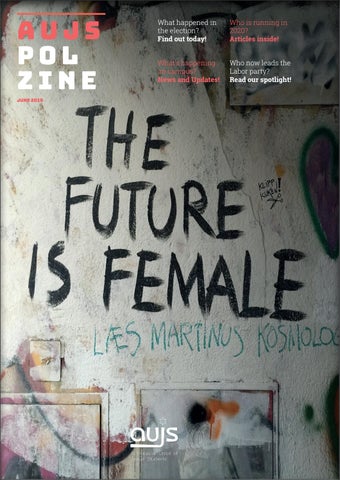
AUJS POL Zine JUNE 2019
What happened in the election? Find out today!
Who is running in 2020? Articles inside!
What’s happening on campus? News and Updates!
Who now leads the Labor party? Read our spotlight!
Contents
4-5
Election Wrap Up
8-9
Women in 2020
15
Spotlight - Anthony Albanese
4
Election Wrap Up by Joshua Kirsh
6
News Update
8
Women in 2020 by Mandy Calmonson
10
An Unironic Email by Sam Radford
12
Israel Update
15
SPOTLIGHT Anthony Albanese MP
ELECTION WRAP-UP
Shorten failed to appreciate that $2bn would mean the same to the electorate if those currently taking advantage of the concessions were protected.
Listening to the message
L
Without Labor’s policy agenda, it may be that the next three years are a rather sedate affair. Other than personal income tax cuts, and a new policy allowing first home buyers to borrow against 95% of the value of their homes, Morrison did not articulate much in the way of new ideas. The Australian electorate has given his government carte blanche to do as they will. There is now, however, the sense of unfinished business in our country’s agenda. We are no closer to Indigenous recognition - which is fast becoming a MacGuffin as the government seeks to strip it of meaning and purpose. Religious freedom has been kicked down the road until the Australian Law Reform Commission releases its report into legislative exemptions in April 2020. Business lacks the certainty of a clear energy policy, other than the return of the big stick legislation. There is no high-profile advocate for an Australian republic on the front bench (Labor proposed a plebiscite). A one-man mandate and clear air in place of his predecessors gives Morrison plenty of room to move - but it’s not clear that movement is his intention.
Joshua Kirsh AUJS Political Affairs Director
et’s be clear about one thing; anyone who told you on the morning of the 18th of May that they believed that the Coalition would pull a rabbit out of a hat and secure a third term in government was lying to you. Having lost every Newspoll in the preceding three years, the Coalition seemed destined to suffer a bruising and humiliating loss, and take some time in Opposition to regroup and discover its next move.
With a slightly refreshed cabinet - emphasis on slightly - Morrison is getting ready to return to business as usual. His healthy parliamentary majority comes at the expense of not just Labor, but also insurgent independents. Wentworth, which sensationally abandoned the Liberals at a byelection in October last year returned to the party, won by former Australian ambassador to Israel, Dave Sharma. The seats of Cowper and Farrer failed to make the predicted switch to Rob Oakeshott and Kevin Mack, who were hoping to capitalise on a rusting off of rural voters after sensational stories of water mismanagement. There were some hopes for non-aligned voters; Helen Haines managed to keep the rural Victorian seat of Indi in independent hands, whilst Tony Abbott was resoundingly rejected by the voters of Warringah in favour of former Olympic skier and barrister Zali Steggall.
Labor is now in search of its new direction. With new leader Anthony Albanese in charge, Labor’s parliamentary team will have to work out which of its policies to trumpet and which to dump. (For what it’s worth, voters appear to have enjoyed hearing a lot more about Labor’s aggressive plans to curb climate change than they did their plans to remove tax concessions from retirees. That might be a good place to start.) My instinctive analysis, which has been echoed to me many times since the election, is that Labor didn’t count on the aspirations of the Australian people. Rather than approach the ballot box with baseball bats out for the “top end of town”, voters from across partisan divides wondered about the hit to their retirement plans with a Labor government in charge. Shorten’s staunch refusal to grandfather the dividend imputation policy was, in retrospect, short sighted. By reaching for an $8bn war chest in savings over the forward estimates,
The wisdom of the 2016 Senate voting reforms implemented by Malcolm Turnbull, with the help of the Greens, has borne fruit for both
4
parties. The Greens managed to retain every Senate seat up for election - one in each state. Whilst seven other crossbench senators were up for election, only two - former Senators Malcolm Roberts and Jacqui Lambie - will be returning to the Parliament, giving the Coalition far fewer competing voices with which to pass legislation.
pit to port, resulting in negligible jobs growth (not to mention the damage to our environment from increased coal mining) - perhaps there would have been greater fluency of message. And whilst many have zeroed in on Queensland as ground zero for the failure of Labor’s campaign, they would do well to remove their blinders. Two of Tasmania’s five seats flipped from Labor to Liberal, after a low-key, well executed local campaign. Promised gains in the supposed Labor heartland of Western Sydney didn’t materialise, with only one flip when the ultra-swing seat of Lindsay swung back to the Liberals. Marginal seats which were supposedly in grave danger across the country - Boothby in South Australia and Hasluck and Pearce in Western Australia in particular - barely registered a peep and returned their sitting Liberal members. This was not a northeastern revolution it was a national decision in every sense of the word.
There has been, from progressives, a great deal of misdirected anger at the election outcome. I have heard some blame people for voting “out of self interest” because of Labor’s changes to franking credits - where the reality is that those people were statistically insignificant. It would require the concern of children, grandchildren, other relatives and friends to make up enough of a difference to swing a seat - which is hardly selfish. I have heard some blame Bob Brown’s Stop Adani convoy for shifting the electorate in North Queensland. And whilst some voters may have put in a dafka vote against environmentalists and greenies, division amongst the construction and mining wings of the Construction, Forestry, Maritime, Mining and Energy Union (CFMMEU) led to mixed messages coming from Labor candidates and those who campaigned for them. If the CFMMEU, Bob Brown, and federal Labor were all making the perfectly valid case that an Adani mine would eventually be automated from
After three years of precarious government, and then eight months of minority government, and after state elections in Victoria and NSW as well as nine by-elections around the country, it will be a challenge to adjust to post-electoral processes of change. Without candidate surveys and scorecards, how do we inspire politicians secure in their seats for the foreseeable future to take our issues as a priority? I’m looking forward to finding out.
5
NEWS UPDATE
Wollongong, ANU to begin reaccreditation with NUS
disaffiliation referendum voted by a vast majority of 89% to disaffiliate.
T
he National Union of Students has received a membership swell at the beginning of the year, with two student associations voting to reaccredit with the organisation. The Wollongong Undergraduate Students’ Association (WUSA) voted to reaccredit without conditions on the 17th of January, whilst the ANU Student Association (ANUSA) voted for reaccreditation in principle, pending the status of exit KPIs.
The timeline for reaffiliation remains to be seen. In Canberra, ANUSA President Eden Lim presented a range of KPIs to set conditions on reaccreditation. The first - the release of the full minutes and policy book from last year’s NUS National Conference - must be met by the 1st of June in order for the reaccreditation timeline to continue. ANUSA will now have to determine whether current publications fit their expectations. The ANU Observer reports that Lim told councillors that returning to the NUS would provide a “national student voice.”
Calling on WUSA to rejoin a “vibrant, democratic national student movement”, WUSA President Chloe Rafferty brought the motion to her council seeking to “immediately begin the process of reaffiliation”.
ANU students elected five delegates to send to the conference last year - three aligned to the Grassroots Independents, one to Student Unity, and one to the Australian Liberal Students Federation. Without accreditation, none held a vote on the conference floor.
WUSA disaffiliated from the NUS under controversial circumstances in 2016, under the tenure of then-President Sam Tedeschi. Tedeschi, who is now the Director of Professional Development of the NSW Young Liberals, said at the time that the NUS did “absolutely nothing for the students of UOW.” The small proportion of students who participated in the
Accreditation provides financial benefit to the NUS. Whilst no figure has been announced by WUSA, ANUSA has earmarked $10,000 for their accreditation fee.
6
Student Unity makes gains at Sydney’s club boards
Wherrett will lead the USU’s executive with the support of newly elected Vice President Lachlan Finch, who is a member of the Liberal Party. Honi Soit reports it as the first joint ticket between Labor and the Liberals on the council - the only opportunity for both to lock out councillors elected to the board on international student tickets from executive positions.
E
lections for the club boards at the University of NSW and the University of Sydney have delivered positive results for the Labor Right-aligned student politics faction Student Unity.
Half of UNSW’s Arc Board, which manages clubs and societies on campus, went up for election in April. Of the four Board members returned, half were from the Labor-right aligned faction.
Whilst Unity-backed candidate Tom Manousaridis failed in his bid for election to the University of Sydney Union (USU) Board at USyd, factional ally Connor Wherrett was able to secure the presidency of the Board for the next year. Manousaridis fell foul of the USU Board’s affirmative action rules, which prevent more than three male candidates from being elected to the six positions up for election in odd-numbered years.
The results bode well for Unity ahead of student elections later this year, in which they will no doubt be hoping to remain the largest faction at the National Union of Students’ National Conference.
7
ARTICLE
WOMEN IN
2020
T
he 2020 Presidential race has only just begun and a crowded field of 23 candidates are attempting to differentiate themselves from the rest to make history as the Democratic candidate who took down Trump. While we will have to wait another year to find out who that will be, another historical first has occurred. Six women have stepped forward and are running for president.It’s not yet clear if Americans are quite ready for their first female President; this historic race will no doubt continue to inspire young women to step up and run.
committee on New Year’s day, Warren was arguably the most prepared to launch a presidential campaign. Her first major scandal came swiftly after when her ancestry claims were questioned by President Trump and she released DNA tests showing her Native American ancestry with an apology for previously identifying as Native American. Since the scandal and the emergence of strong candidates in Harris and Biden, Warren’s popularity has wavered. Since then Warren has tried to rebuild and has fired back at the current White House administration by making the case for impeachment against President Trump more forcefully than any of her 2020 rivals. Commonly making note of having read the entirety of Special Counsel Mueller’s investigative report, Warren has argued that impeachment is the only responsible path forward. While most Democratic candidates are reluctant to stand by her, Warren’s forceful approach is helping differentiate her in such a crowded field.
Kamala Harris Senator from California, 54 As a freshman senator and the second black woman ever elected to the US senate, Kamala Harris has made a name for herself through her tough stance on Trump’s administration policies and her questioning of cabinet members and Supreme Court nominee Brett M. Kavanaugh. Harris embodies the modern post-Obama Democratic party appealing to both party loyalist factions as well as new millennial voters. Differentiating herself from the vast Democratic field, Harris’s signature issue is not a single policy idea but rather a campaign about the people.
Warren’s signature issues include rebuilding the middle class and ending Washington corruption. Her campaign is calling for a new era of strong antitrust enforcement, so the giant corporations can no longer stifle any competition. Warren has a plan and wants to make America work again.
While some have argued not having a single policy issue for voters to connect to will hurt her campaign, Harris’s campaign is instead focusing on building her brand to be the perfect candidate who can take on Trump. Her goal is to connect with the people through her integrity and past professional experiences as district attorney and in the Senate.
Kirsten Gillibrand Senator from New York, 52 After replacing Hillary Clinton’s senate seat in 2009 Kirsten Gillibrand has transformed her brand changing her politics in tandem with the ever-liberalising democratic base. Her shift from a conservative democrat to a progressive champion has opened her campaign to staunch criticism that such a move is opportunistic.
Harris is a strong candidate but often places between 3rd and 5th in most national polls. Unlike the other women running for president, Harris has a second path to the White House emerging as a Vice President option to Biden. While there is still over a year to go until the Democratic nominee is chosen, Harris’s popularity is growing. Only time will tell if America is ready for mixed race woman to win the Presidency.
Gillibrand’s signature issue is to restore the government to the hands of the people, by fighting for America’s values and embracing her slogan Brave Wins. In such a crowded field her messaging has yet to stand her apart from similar campaigns, still Gillibrand is slowly breaking out of the crowded field and remaining a contender due to her reputation for being a tireless campaigner and fundraiser.
Elizabeth Warren Senator from Massachusetts, 69 Former law professor Elizabeth Warren started of her 2020 campaign strong as a front runner among Democratic candidates. Announcing the creation of an exploratory
Her recent Fox News town hall in Iowa has expanded her momentum after Gillibrand was asked ‘what about men?’
8
Mandy Calmonson 2019 Susan Wakil Fellow
“this historic race will no doubt continue to inspire young women to step up and run.”
when discussing her want to have more women have a seat at the table. Her now viral response of ‘they’re already there - do you not know?’ provided her campaign with the burst it needed. Despite such attention only two of the six female candidates, Harris and Warren, have managed to meet all the criteria to qualify to appear on the debate stage in June. In order for Gillibrand to win the nomination she needs to portray herself as the one candidate that can defeat Trump.
As the only female candidate with combat experience as an Iraq War veteran, her signature issues set her apart. Gabbard opposes military intervention abroad, even going so far as to argue against any foreign intervention. Her January 2017 secret ‘fact-finding’ mission to Syria to meet with Assad and her doubt that the Syrian dictator used chemical weapons on his own people presents an impulsive candidate who is stumbling to find her place amongst 22 other more well-known names.
Amy Klobuchar Senator from Minnesota, 58 Amy Klobuchar’s key strength is her Midwest base. The loss of the Upper Midwestern states of Pennsylvania, Wisconsin and Michigan by the Clinton campaign in 2016 helped Trump build his path to the Presidency and the Democratic party need those states back in order to win in 2020. Klobuchar’s strong standing as Senator for Minnesota in neighbouring state Iowa, a key primary battleground, and her impressive 20 years in public office - 12 as a U.S senator - are helping her present herself as the candidate the Democratic party need to take back those states.
While Gabbard has since apologised for her strongly antiLGBTQ voting record and released a statement affirming her support for same-sex marriage, her 2002 state legislature campaign focused on banning same-sex marriage in Hawaii. It is unclear if Democratic voters are willing to look past Gabbard’s past imperfections and embrace, what Gabbard defines as, her Aloha spirit and the ability to transcend all the superficial divisiveness to bring the country together. Marianne Williamson Self-help Author, 66 Marianne Williamson wants the American public to ‘Join the Evolution’ and she aims to fix the deep emotional and psychological dynamics within the average citizen that have led to the erosion of the political system. A wild-card, atypical political candidate, Williamson is the only female candidate without political experience, losing her independent for Congress in 2014.
Klobuchar’s signature issues set her apart from other candidates as they centre around health care. As part of her campaign, she has released a $100 billion plan to combat mental health problems and substance abuse in order to address the opioid crisis and fund broader substance abuse treatment. However, her fairly moderate standing amongst the candidates and voting history does little to raise excitement. Further, the allegations surrounding Klobuchar’s treatment of staff have fuelled the view that Klobuchar is too demanding or tough to win over the public. While many of the criticisms can be gendered, having a reputation as a bad leader will make it harder for Klobuchar to convince voters to back her in the end.
Despite never being elected to office, she has experience in left-wing activism working to establish a Department of Peace. Her signature issue comprises of $100 billion reparation for slavery, with a further $10 billion to be distributed to the African American community annually over a decade, for further economic and education projects. Williamson hopes her recent move to Iowa to focus on the battleground caucus shows a commitment and respect to the state, one which will win her favours with key voters there.
Tulsi Gabbard Congresswoman from Hawaii, 38 Tulsi Gabbard is a progressive favourite with a conservative record and an unconventional political career. Elected as a member of Congress in 2012, she became the first Hindu and first American Samoan voting member of Congress. Arguably Gabbard’s presidential campaign is a long shot as she has very little name recognition outside of Hawaii.
The long-time spiritual advisor to Oprah Winfrey hopes her credentials will make her a standout contender to guide the American people through this era of political chaos and soothe the troubled nation.
9
ARTICLE
AN UNIRONIC
S
ix days ago I received an email from University of New South Wales Vice Chancellor Ian Jacobs. It was not an email congratulating me on my marks from last term, nor was it any sort of reprimand for past hi-jinks on campus. Rather it was a declaration of the supposed success of trimesters, albeit with the deceptive subject line of “Welcome Back to Term 2”. The email began with a typical first line, “Dear Samuel, Welcome back to Term 2 at UNSW Sydney”. My expectations for this email are already set low, as is normal when I see the UNSW sender, but I am willing to read on in cautious apathy.I expect Dr Jacobs to tell me about all the fun and exciting opportunities on UNSW campus this term. To no great shock or horror it was an email explaining to me how beneficial the UNSW3+ trimester plan has been for students and staff. Suffice to say the numbers in front of percentage symbols were meant to impress and astound students and teachers alike, but for some reason I believe the heralding fell on deaf ears. Could it have been the lack of photographs or graphs of any sort left out of the message, disincentivising students to push through the lengthy read? Could it have been the lack of joke or quip in the first few lines to warm up the crowd? Or could it have been the almost two years of active ignorance the UNSW Administration has been performing of staff, students and tutors with regard to the many issues brought up since the announcement of the UNSW3+ plan. If this were a different type of article this would be the perfect moment to place the Simpsons Principal Skinner meme where he explains
10
that nothing is wrong with him, but rather it is the students, teachers and staff which are wrong. Like many of my generation, it seems that my life is being reduced to a living meme. But rather than spending an article joking and jesting, leading to an overall trivialisation of the problem, we can deconstruct this email together. As we are able to see right off the bat, the first paragraph seems to largely misunderstand one of the major problems with the transition. “The UNSW3+ calendar is designed to increase flexibility, which is particularly important for students who work part time to support their studies, and across a degree it also increases opportunities for extra curricula activities and internships.” It’s a lovely sentiment by the university to allow for time so students may apply for internships. This sentiment would be better appreciated if there was action from the University to implement it. Universities such as USYD and UTS integrate internships and work experience within the degree, making it mandatory to complete in order to graduate. The universities organise a host of internships to allow for a broad range of choice for students, whilst simultaneously allowing students the option to find their own internships. UNSW takes a different stance, providing a single optional course to take up an internship, but places the full responsibility on students to find the opportunity. This would beg the question as to why the university would offer more time for students to find internships, when they offer little to no help in finding one.
Sam Radford 2019 Susan Wakil Fellow
“students are now paying for less classtime and more homework”
Further, to the shifting schedule means that classes which were available in certain semesters have been moved to either earlier or later in the year. This leads to students needing to continue their studies for a single trimester or even two trimesters past their original scheduled graduation date in order to fulfil the necessary course requirements to graduate. For a host of university students at UNSW, the trimesters are extending their degrees, rather than shortening them. I guess I wouldn’t be too outraged if the previous statement was the only tone deaf communication by the university administration, but the Vice Chancellor has already started digging a hole and it looks like he won’t be stopping anytime soon. “The data from Term 1 confirm there were 29% fewer course clashes, 25% fewer final exams, and around 20% fewer scheduled contact hours for students, providing more flexibility.” The first statistic provided in this paragraph is rather nice, don’t you think? 29% fewer course clashes. If they had ended the sentence there, they would have been in the clear. No student would be able to complain about fewer course clashes. But let’s unpack the other two statistics in this sentence. 25% fewer final exams and 20% fewer contact hours. From the outset, this seems like a positive for students. But if anyone were to analyse this statement at any level bar the surface, they would realise the outstanding irony of posting these statistics as a positive for the UNSW3+ program. These statistics mean just one thing: more homework. With courses shortened to 10 weeks, students are putting in nearly double the amount of work at home. It is
11
truly phenomenal to have more time to seek out internships with all the lack of class time we have; if only we didn’t have all this homework. The fact that pricing for university classes has not decreased with the shortened term length means students are now paying for less class time and more homework - or “independent learning”, as the university likes to call it. This begs the question - why are we paying for “independent learning” at all? A university is designed to endow education on its students, not to point to an area of study and expect students to learn for themselves. If students wanted an auto didactic learning experience, they would not be going to university at all. Independent learning is a skill and trait which only improves a person, allowing them to continue studying long past their graduation. The crux of the issue is that we are now paying for independence. The situation is not all grim and despair. Thankfully the university has asked for feedback from students about their experiences so they can adapt the system. It’s an interesting request to make considering the university has ignored nearly 2 years of protests from students and faculty that they do not want the change at all, but at least they’re listening now? Incidentally, it would seem that the university did provide an email address for feedback. Have fun. UNSW3+ Feedback Address: strategy2025@unsw.edu.au
ISRAEL UPDATE
Remembering the 21st Knesset: 2019-2019
T
he life of the 21st Knesset will endure in the memory of all for years to come. Here’s a fond look back at its greatest achievements…
Netanyahu attempted to secure the votes from elsewhere - even offering the finance portfolio to Labour leader Avi Gabbay in exchange for his party’s votes. The Labour caucus voted to block any such deal.
Swearing In The Knesset was sworn in on the 30th of April, after a hotly contested election on the 9th. Ministers Ayelet Shaked and Naftali Bennett were absent from the returning class; their new small party The New Right failed to pass the threshold for entry.
The time Ayman Odeh gave a funny speech Who could forget when Hadash party leader Ayman Odeh said that Netanyahu promised to recognise the Nakba in exchange for voting for his own personal immunity? That was funny.
Labour returned to the Knesset with only six members, having previously commanded a caucus of 19. Progressive party Meretz also lost one seat, whilst former MK Orly Levy’s new party was unable to return her to the chamber.
Especially since the future of Israel’s democracy rests on the personal fortunes of its Prime Minister. That part was especially hilarious.
The big players, PM Bibi Netanyahu’s Likud and Opposition Leader Benny Gantz’s Blue and White, each came into the chamber with 35 seats. Negotiations Netanyahu came tantalisingly close to forming government - 60 votes out of the required 61. Although Yisrael Beiteinu’s five MKs recommended Netanyahu to President Rivlin to become Prime Minister, they could not eventually come to an agreement on a bill to force conscription of ultra-Orthodox Israeli Jews.
Voting to disband In a 75-45 decision, the Knesset voted to disband on the 29th of May. Opposition MKs from Blue and White, Labour, and Meretz all voted not to disband, but were overwhelmed by the combined votes of the proposed governing coalition and Arab parties. This can go on the end of the Israel bit as a new paragraph: The vote to disband robbed the opposition of the chance to form government, and triggered new elections to be held in September. If any one thing could be considered the big ticket item of the 21st Knesset’s agenda, it’s likely to be the 22nd Knesset.
12
13
14
SPOTLIGHT
Anthony Albanese MP
A
fter a significantly abridged leadership process, Labor has anointed former Deputy Prime Minister Anthony Albanese as its standard-bearer in the 46th Parliament. The newly minted Opposition Leader is a longtime leadership aspirant, having won the vote of the rank-and-file membership against Bill Shorten in 2016. Who is Albo? Anthony Albanese has been the federal member for Grayndler since 1996, which is before most of those reading this are likely to have been born. He was an active participant in student politics, having served on the University of Sydney’s Student Representative Council in Labor’s left faction. Where is Albo? Albanese’s seat of Grayndler is located in Sydney’s inner west, and encompasses suburbs such as Balmain and Leichhardt, as well as parts of Newtown and Marrickville. In the two candidate preferred count, Albanese’s closest competition for the seat has been the Greens since 2010. When is Albo? Albanese is 56 years old; having been deeply part of the factional in-fighting of the Rudd-Gillard-Rudd years, some
15
question whether he can provide the generational change that would inspire voters to return to Labor. His ministerial experience may be an asset - but his record may also leave some voters wanting. What is Albo? Albanese’s record on issues of importance to the Jewish community is mixed. He is the founder of the Parliamentary Friends of Palestine - but opposed Marrickville Council’s BDS plan in 2011, and has said publicly that he believes that peace in the region “cannot be at the expense of either Palestinians or Israelis.” The Jewish community has sought assurances that a Labor party under his leadership will not travel down the same antisemitic path as its counterpart in the UK. Why is Albo? Albanese has indicated that his attitude to leading the Labor party will pivot around respect. He intends to pursue an agenda that is respectful of others, and respects people where they are. He has also said that he doesn’t intend to hold a doorstop interview each day, indicating his desire to work collaboratively with the Government where there is agreement. Albanese will have to take a serious look at the Labor party’s policy agenda in order to chart a new course forward for the party.
The AUJS Political Magazine is always looking for contributers. If you would like to be involved in further publications please contact Josh at jkirsh@aujs.com.au.