FA L L 2 0 2 5
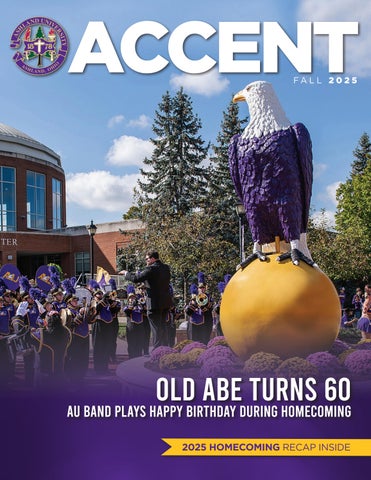
OLD ABE TURNS 60
AU BAND PLAYS HAPPY BIRTHDAY DURING HOMECOMING 2025 HOMECOMING RECAP INSIDE www.ashland.edu | 2
FALL FEATURES
25
4 Homecoming 2025 Recap
10 Turning Doubts into Triumphs Occupational Life Calling class, Professional Academic Advising helping students stay on track
6 Extreme Makeover: Delta Zeta Suite Edition 8 CSI: Ashland
New lab provides criminal justice students opportunity to process simulated crime scenes
HOMECOMING 2025 RECAP
4 6 8
Accent is published for alumni, parents, friends and donors of Ashland University. Compiled by the Marketing & Communications Department of Ashland University.
8
Hugh Howard Managing Editor Strategic Communications | Media Relations Manager
Mike Ruhe Art Director Director of Graphic Design Services
Allison Waltz-Boebel Photography | EagleEye Photography Contact the Office of Alumni Engagement at 419-289-5082 or alumni@ashland.edu. Alumni interested in submitting articles can send information to pr@ashland.edu.
On the Cover Old Abe, an iconic landmark on the main campus for six decades now, took center stage at the Homecoming celebration this year. The university marked his 60th year with a fun rendition of “Happy Birthday,” courtesy of the AU Eagle Marching Band, during an only-at-Ashland moment. Ashland University admits students with disabilities and those of any sex, race, age, religion, color and national or ethnic origin.
10
DEPARTMENTS 12 Academic & Campus News 3 B iochemistry major Melanie Eichler the first
18 Athletic News 3 F ormer Eagle Hunter Allen Taken in Seventh
3 A U professor’s book a finalist for 2025
3 S eries of Firsts for Women’s Lacrosse 3 S pring Sports Wrap-up 3 W inter Sports Teams’ Triumphs Include
AU student to be a Goldwater Scholar George Washington Prize
3 M etzger appointed as AU’s ninth Trustees’ Distinguished Professor
3 T eam of AU students one of four finalists in national IMA case study competition
3 A U just sixth PA school in the country to
adopt Healer’s Art Course 3 A U awarded more than $900,000 from state to support Military Family & Veteran Services 3 “ Freedom for the Next 250” project awarded $1.3 million from Department of Education
Round of 2025 MLB Draft by Orioles
G-MAC Championships, NCAA Successes
20 Class Notes
General alumni information, marriages and anniversaries, births and in memoriams
M E S S A G E
F R O M
T H E
P R E S I D E N T
A
s the calendar has turned to December, we have entered a special time of year, a time of gratitude and reflection on God’s gifts in our lives as well as a time to look back at the year’s accomplishments. I’m thankful to be leading this exceptional institution during this critical time in higher education. I’m thankful for the gracious support that has been shown to Nancy and me during our first full year here. The summer and fall have been filled with projects on campus, some of which are detailed in the pages of this magazine. Through alumnae support, the Delta Zeta suite renovation modernized a shared living space for one of our sororities. And kind donors funded the new crime scene lab to provide hands-on learning opportunities for the largest academic program (criminal justice) in the College of Arts and Sciences. The Hugo Young Theatre received a significant facelift with a new stage, lighting and other enhancements, courtesy of a state grant. And on the athletics side, the Sherrill Hudson Court inside Kates Gymnasium was replaced. Through the generosity of Dwight and Martha Schar, wayfinding for campus visitors has been improved dramatically with the installation of elegant new signage. And, following Jefferson Street being cut off to thru-traffic, we have freshly paved parking lots and improved student and visitor accessibility and safety. We publicly thanked and celebrated the Schars during an event at Homecoming, which you can read about in this issue. At Homecoming, we also honored Bob and Jan Archer for their remarkable impact on our campus community, and especially our student-athletes, with the Eagle Forever Award. As we build on our momentum, many more projects—big and small—are on the way. We are deep into the preparation stages of introducing and implementing a new strategic plan for AU, so there will be much more to come on that. But for now, I want to wish you and your loved ones a blessed holiday season. Go Eagles! Dr. Jon Parrish Peede President Ashland University and Ashland Theological Seminary
www.ashland.edu | 3
HOMECOMING 2025 recap
Ashland University has served as a home, not just a campus, for tens of thousands of students
over the years. That sentiment rang true throughout this year’s Homecoming activities, whether it was at the reception honoring Dwight ’64 and Martha Schar’s many, many contributions to his alma mater, the pillar dedication recognizing Katie Nageotte Moon’s ‘13 and Jud Logan’s incredible track and field accomplishments or the many other events taking place, such as the new “Welcome Home”-coming Coffee. The exciting weekend kicked off with a special celebration. Pillars, located just inside the gates of Jack Miller Stadium, recognizing Moon’s Olympics’ and World Athletics’ medals and Logan’s three NCAA Div. II national championships as a coach and his four Olympic appearances were dedicated in front of an adoring crowd. Moon clearly stated that had it not been for finding a new home in Ashland, one of the best professional pole vault careers in history never would have happened. Ashland reignited not only her athletic talent but her passion. “Truly, without Ashland, those wins, those accomplishments, they do not exist for me,” said Moon, a twotime Olympic medalist who became the first woman to win three straight pole vault titles at the World Athletics Championships in September. “There is no pole vault career for me without Ashland. Because of this place, the biggest dream that I ever had, which was winning the Olympics, became a goal, a realistic goal. Just to feel that it was possible was incredible.” “I owe everything to Ashland. I owe everything to this place.” Nate Logan ’09, ’11 MBA, speaking on behalf of his late father, emphasized that not only was Ashland a second home to his dad, but a second family. “For my dad, Ashland was home,” he said. “The connections he forged here turned friendships into family. He truly viewed the AU track and field family as an extension of our own.” Logan added that his family is “thankful beyond measure” that the track program and the university are “carrying on
4 | Ashland University | Fall 2025
the traditions of my dad.” Another signature event took place Saturday morning, as the Schars returned to campus and were feted during the “Honoring Impact and Excellence Reception.” With faculty and students packed several rows deep inside the lobby of the Dwight Schar College of Education, AU President Jon Parrish Peede formally thanked the Schars for their generosity. He connected Dwight’s career as the leader of one of the country’s top homebuilders to the remarkable legacy they have left at AU. “You didn’t build houses, you gave families their homes across this country. This beautiful space that (students) all experience, the beautiful classrooms that (faculty) teach in this building … I want to thank you for giving us homes,” said Peede. Schar deflected the attention and was modest in his brief remarks, wanting to turn the spotlight to Ashland’s current faculty and students. “When we started the homebuilding business, we came up with the philosophy that we wanted to do the greatest amount of good for the greatest number of people through housing,” he said. “And, I think what you are all doing here is you’re doing the greatest amount of good through education, so congratulations.” Homecoming also featured some lighthearted, onlyat-Ashland moments. On its way to the football stadium, the AU Eagle Marching Band led a sizable group gathered by the Rec Center for a fun rendition of “Happy Birthday” as the most famous eagle on campus— Old Abe—was celebrated. The 20-foot statue
has been standing watch for 60 years now. While there were several new events this year, traditional Homecoming favorites also took place like the 5K Fun Run, the Hall-of-Fame induction ceremony, the Pizza, Pizza, Pizza Fan Fest and various reunions. As for the football game, the nationally-ranked Eagles gave the crowd plenty of reasons to cheer during an eventual 38-14 victory over Thomas More. The good times extended to the 5th Quarter Celebration at Upper Convo, where fans enjoyed complementary food and music while continuing to rehash the good old days. And, the words “Ashland” and “home” surely continued to echo throughout those conversations.
www.ashland.edu | 7
EXTREME MAKEOVER:
Delta Zeta Suite Edition The Delta Zetas have their pink Barbie Dreamhouse, says the sign as one enters their newly renovated suite in Clark Hall. And, when they say pink, they mean pink. Soft, airy pink walls. Pink dishes and pink cutlery. Pink handles on the bright white cabinetry. A pink backsplash. A pink coffee maker on the counter and a pink teapot on the stovetop. Even an assortment of pink cleaning tools in the broom closet. A circular pink accent rug in the dining area. And, pink pillows to complement the grand emeraldgreen (the other DZ color) velvet sectional that seats up “ I just think when you’re in college, you’re away from home, there’s a need for a space that (students) feel safe, and they feel it’s home and they feel connected. This is the space we’ve created for them. It’s beautiful and safe and represents them as a group of women,
to 14 in the living area. Karen Terhune Duncan ’76 explained that organizing the renovation project, even down to the pink details, was a labor of love during the official ribbon-cutting for
represents them as Ashland students, makes them proud of the
the “Sweet Delta Zeta Suite Project” at the beginning of
university that supports them.”
the fall semester. — Karen Terhune Duncan ’76 retired publisher
“It’s been a great experience,” said Duncan. “Over the years, we talked about this project, and the project kind
of grew. It really came down to … if we’re going to do this, let’s do it right. (We) didn’t just want some paint on the wall and put a new carpet down.” The genesis of the idea came 10 years ago at the DZ 50th reunion when Duncan “noticed the chapter room looked like it needed some work.” A little time passed, and then during a dinner with longtime friend and former AU Board of Trustees member Fred Broad ’76, he encouraged her to “find (her) Ashland legacy.” Different thoughts crossed her mind, such as establishing an endowment for a scholarship, but Duncan kept coming back to a project that would benefit more students as well as the impact the DZ sisterhood has had on her life. So, she formed a committee of “sisters,” with the likes of Anne Mainwaring Broad ’76, Patti Burns Clement ’77, Sue Rom Comunale ‘77, Claudia Rom Johnson ’75,
6 | Ashland University | Fall 2025
Lisa DiGirolamo Kessler ’74, Mary Elges McMillen ’75 and Jan Taylor Percio ’74, and started making phone calls to the alumni office, the president’s office, facilities and other constituents on campus. Enthusiasm quickly grew and so did the renovation plans. Anne Broad recalled that the current sorority sisters simply “wanted a new microwave” initially, but Duncan’s passion project turned into contributions from about 200 DZ alumni in all. Once the funding was raised, the blueprints were drawn up and everyone was on the same page, construction began right after this past May’s graduation. Duncan said the old suite was taken “down to the cinder blocks … and then we rebuilt it.” It now features a complete kitchen remodel with new cabinets, countertops, appliances and the addition of an island where a wall used to be, as well as new flooring, new lighting, electrical and plumbing upgrades, and of course, all new furnishings
Lauren Bartlett (left), the current DZ president, and Karen Duncan ’76 (right) formed a strong partnership during the “Sweet Delta Zeta Suite Project.”
and décor featuring a pink hue. “I mean it’s really fabulous. It even went beyond what we thought it could be,” said Duncan, a retired publisher who now lives in Savannah, Ga. “It’s chic and stunning and feminine. And the students benefit, which is the ultimate goal.” Upon seeing their new suite for the first time, the reaction from the current DZ members included “jaw dropping,” “heartwarming” and “inspiring.” “When I came to school (early) and started living in it and started seeing everybody else’s reactions, I think it made our sisterhood grow stronger,” remarked senior Lauren Bartlett, the current DZ chapter president and an early childhood education major. “Everyone was so excited to have this one place to be able to bond and hang out.” Grace Heller, a junior education major, said, “I’m just so blessed to
A group of the current DZ members and Karen Duncan ’76 show off one of the highlights of the new furnishings – a grand emerald-green velvet sectional, which now serves as the centerpiece of the living area.
be able to hang out with my sisters in it. I feel like it just brings our
… is impressive,” commented Hedenberg. “And, our alumnae taking
sisterhood more together, now that we have something to celebrate.
this on … in such a great grassroots effort to make this happen, I’m
Everybody texts ‘let’s meet up in the suite between classes’ or ‘after
truly impressed.”
recruitment, let’s go to the suite.’”
Dr. Jon Parrish Peede, president of AU, added, “This suite now
Bartlett noted that the suite is already being used more often,
reflects the Delta Zeta sisterhood so perfectly – bright, welcoming
whether it’s sitting on the couch working on schoolwork, doing each
and full of joyful energy.”
other’s hair or nails, baking a dessert in the kitchen or having a movie
As much as everyone loves the new-look Delta Zeta suite, the long-
night, which ultimately brings the sorority sisters closer together.
term project also served as a relationship builder. It allowed DZs
That was one of the chief goals for Duncan and the committee.
from the 1970s to reconnect with one another and also to form
“I just think when you’re in college, you’re away from home, there’s a
bonds with today’s sisters.
need for a space that (students) feel safe, and they feel it’s home and
Duncan said, “I enjoy the current girls so much, even though I could
they feel connected,” said Duncan. “This is the space we’ve created
be their grandmother. I hear them talk about how they’re planning
for them. It’s beautiful and safe and represents them as a group of
their future and how they are really drawn to the philanthropy of
women, represents them as Ashland students, makes them proud of
Delta Zeta. We are happy to know that the chapter still has the same
the university that supports them.”
values we did.”
Also thrilled with the final product is Laura Hedenberg, a member
Duncan also hopes that the Delta Zeta makeover project serves as
of the DZ National Council who flew in from Connecticut for the
inspiration for others.
celebration.
“I’m hoping this spearheads other alumni to want to collaborate on
“I think that, first and foremost, the support from the university
meaningful Ashland projects,” said Duncan.
is amazing. All of the people in positions who helped make this happen and worked with our alumnae … and how happy they are
5 Hugh Howard Strategic Communications and Media Relations Manager www.ashland.edu | 7
CSI: ASHLAND
New lab provides criminal justice students opportunity to process simulated crime scenes Criminal justice students at Ashland University now have the ability to process a simulated crime scene without stepping out of their classroom, all thanks to a new state-of-the-art crime scene lab that was recently unveiled. “This is a big deal,” remarked Greg McBrayer, Ph.D., provost at AU, during the ribbon-cutting ceremony. “This facility is impressive and it will enable our impressive faculty members … to simulate real-life experiences that will better prepare students for careers in law enforcement.” “ I understand theory… and the traditional-type teaching, but in our field, it’s different. You have to be able to do it to effectively measure that the students are learning. So, this is a great environment to see what they can do. They were not able to get this experience previously, not to this extent.” — Anne Strouth director of the criminal justice and emergency management & homeland security programs
The crime scene lab is the result of a floor-to-ceiling project renovation in an area of Kates that had been neglected. Now, it is a large classroom including a set of wide rows of chairs and desks, enough to seat 25 comfortably, and a whiteboard for “traditional” teaching. But, behind a partition wall is where the excitement lies. AU’s operations and maintenance team not only
modernized the room, but it assembled four distinct areas—a bedroom, bathroom, kitchen and living room—to mimic a one-bedroom apartment. It includes many of the amenities of a typical living space. For example, there is not only a bed and dresser, but bedding, pillows, nightstands, an area rug and decorations in the bedroom, which allows the faculty members to set up realistic domestic violence incidents, natural death scenes and everything in between.
8 | Ashland University | Fall 2025
“It’s unlimited what type of crime scenes can be here,” remarked Anne Strouth, director of the criminal justice and emergency management & homeland security programs at AU. “There’s so many different places to hide evidence, so students really have to learn how to properly search.” There is also more than $20,000 worth of evidence supplies, ranging from manikins, magnifiers and microscopes to kits for DNA evidence, magnetic fingerprints, wound simulations, tire and shoe print casting and much more. These hands-on crime scene investigations will allow students to develop critical thinking, problem solving and investigative skills that are essential to successful careers in criminal justice. “What we’re trying to do in this room is somehow marry everything you’re learning from sociology to psychology … to forensic science (and) help make evidence-based decisions, not to give in to assumptions,” Dr. Jon Parrish Peede, president of AU, told students during the official unveiling. Gaining real-world experience to complement the theory is important for all academic programs, but it is of the utmost importance to criminal justice, according to Strouth. “I understand theory… and the traditional-type teaching, but in our field, it’s different. You have to be able to do it to effectively measure
Jim and Barb Chandler were pleased to donate the funding for the new crime scene lab because AU students will “be employable the instant (they) graduate.”
that the students are learning. So, this is a great environment to see
Strouth has been here since 2022, and in that time, the criminal
what they can do,” she explained. “They were not able to get this
justice program has really taken off as a result of her energy, her
experience previously, not to this extent.”
commitment, her seriousness and her own real-world experience,”
The crime scene room and evidence supplies were all made
he said.
possible by a gift from Jim and Barb Chandler, whose youngest son
Ultimately, the lab will benefit society, as talented AU criminal
Jeffrey Chandler ‘10 graduated from AU. The Chandlers’ reasoning for their generosity was quite simple. It was an opportunity to make a difference for students interested in a career field that will always be needed. “Unfortunately, crime is not going to go away anytime soon,” explained Jim Chandler. “That’s what clinched it for us – students getting real-world experience. You’re going to be employable the instant you graduate. We’re very excited to be a part of this and very humbled.” And, once the Chandlers met Strouth, they became even more confident the project would be a success. Strouth is not only a faculty member at AU, but she has more than 30 years of experience in law enforcement and she also currently serves as the director of the Ashland County Emergency Management Agency. “We felt this is a great little project … makes a lot of sense for us. Then, we talked to Anne and felt so strongly about her and her qualifications, it gave us a great comfort level,” Jim Chandler said. “It’s a great program and the lab was needed.” McBrayer offered praise to Strouth as well, noting the program’s recent growth directly correlates with her arrival. “Professor
justice students will be better prepared to make an immediate impact as public servants. Currently, more than 70% of the program’s graduates enter directly into the field, while 26% go on to law school or graduate school. “We would be doing a disservice to our community by sending our graduates out there (without) providing them (these) skills. This (lab) really will provide them the confidence that they know they have (the ability) … because they got to do it and see the end result of it,” said Strouth. Peede added his admiration for AU students who are soon-to-be public servants, saying that “this idea of evidence-based decision making, forensic knowledge and what it can be at its best … gets us toward the truth. So, that’s an awesome responsibility.” One final note: the lab will be useful for academic programs outside of criminal justice. Faculty and students in forensic chemistry and forensic biology, as well as social work, are planning to use the lab as well. And, the Ashbrook Academy summer program for high school students annually includes a CSI session. 5 Hugh Howard Strategic Communications and Media Relations Manager www.ashland.edu | 9
Turning Doubts into TRIUMPHS Occupational Life Calling class, Professional Academic Advising helping students stay on track When they were freshmen at Ashland University, Roland Ntow felt like his world was crumbling, Karin Wlodarsky didn’t know if she would stick college out and Emma Stoll was not sure where to turn after deciding nursing wasn’t for her. Today, they are all thriving. Ntow is a senior marketing major and a resident assistant who is planning a career in supply chain management and to pursue an MBA. Wlodarsky, a sophomore, is majoring in accounting and finance, serves as a vice president for her sorority and on the leadership team for the accounting club, and recently landed a competitive internship at an accounting firm. After switching her major to psychology, Stoll, a junior, huddle leader for Fellowship of Christian Athletes and member of the Honors Program, is still “ I’m really, really grateful for them. They’ve made my experience
on track to graduate on time and become an equine
here smoother. They’ve helped me understand what life is about
therapist.
because sometimes I was freaking out over little things. They’re
While their backgrounds, academic interests and
making Ashland a better place for sure.”
stories are all very different, Ntow, Wlodarsky and Stoll
— Roland Ntow senior, marketing major
share a common thread. They each took the elective class Occupational Life Calling and spent time with
advisors in AU’s award-winning Professional Academic Advising department to get their college careers on track. The Occupational Life Calling class, which falls within the College of Business and Economics, has become a go-to in recent years for new students who are uncertain of which major to declare or of a career path to follow. “It’s a class we really use to explore more about careers and majors and potential matching. We learn about the students themselves and utilize different … strength-finder assessments, learning styles,” explained Catherine Williams, a senior advisor to the president, assistant provost for Student Success and one of the instructors of the class. “It’s really to learn more about your values, your interests, personality, workplace preferences, your natural gifts.” For Ntow, it “narrowed down (his) interests” and “helped with what classes to take,” while for Wlodarsky, who came in
10 | Ashland University | Fall 2025
knowing she wanted to do something in the business world, it “helped find a sense of direction of what are next steps.” In Stoll’s case, it opened her eyes to “many more careers within psychology she didn’t even know about” and “really encouraged (her) to keep going.” That encouragement carries over into student appointments with professional and faculty advisors. Every AU student is required to meet with either their a professional advisor or faculty during their academic journey. Those meetings, especially in their first year, proved to be valuable for Ntow, Wlodarsky and Stoll. The academic advice and resources provided were certainly useful, but it was the genuine relationship and overall support that each student found even more beneficial. Ntow was born in Ghana, spent his early life in Africa and then moved to Columbus, Ohio, thus life at Ashland was very different than what he was accustomed to. “I was just so lost,” he admitted, but “Ms. Kristen (Herrick) and Ms. Catherine (Williams) pointed me in the right direction.” “I’m really, really grateful for them,” he added. “They’ve made my experience here smoother. They’ve helped me understand what life is about because sometimes I was freaking out over little things. They’re making Ashland a better place for sure.” After high school, Wlodarsky simply wanted to give college a try for a year as she really didn’t know what to expect or if she was cutout for it. Thanks to weekly connections with her advisor, Alayna Ross, she quickly gained confidence and knew AU was the right fit for her future. “(Alayna) just laid it out clear … (and) overall helped calm it down a little bit,” she said. “It ran so smoothly with my professors and everybody in Student Success helping me. The support I had … I didn’t feel as overwhelmed as I thought I would be. I’m so thankful they helped steer me in the right direction.” When Stoll started to realize she didn’t want to study for nursing, which she had previously been “dead set on,” she was “knocked several steps back.” But her advisor, Kelly Kossick, and Williams helped reframe her mindset. “Even at the end of the (Occupational Life Calling) class, I wasn’t really sure what I wanted to do, but that’s OK, I was still figuring things out and (they) were very supportive as always,” recalled Stoll. “(They) helped set me up so that I had tools to be able to figure out what I wanted to do next. I signed up for a couple of psyche courses … and discovered how much I really enjoy studying the mind and behavior.” The Occupational Life Calling class, the staff from Professional Academic Advising and the sincere connections formed are all making a direct impact on students like Ntow, Wlodarsky and Stoll staying in school. AU’s retention rate, the percentage of full-time traditional undergraduate students who remain enrolled from
Kristina Cunningham (photo on opposite page), Kelly Kossick (above) and other members of the Professional Academic Advising team have helped improve the university’s student retention rate each of the last four years.
years. In 2020-21, that number was 72%, while in 2024-25, it has improved dramatically to 78%. Their peers have taken notice of the excellent work that AU’s staff of advisors is doing. Herrick and Victoria O’Brien were winners of the Advising Excellence Award in 2024 and 2025 from the Ohio Academic Advising Association, while Ross received the Outstanding New Advisor Award this year. Rae Yocum, an advisor for AU’s graduate, online and adult learners, was elected president of the OHAAA, and Sandra Evans and Ross are reps on the executive board. Williams is the “conductor” of the Student Success team, which consists of Professional Academic Advising, the Tutoring Center, Student Accessibility and the Paul and Lani McKnight Career Center for Life Calling, and also a “university mom,” according to Wlodarsky and many others. The personal touch that she and the team offer exemplifies AU’s “Accent on the Individual” motto. Ntow, Wlodarsky and Stoll are just three of the thousands of AU students who have been positively impacted by them, and Williams looks forward to meeting, serving and mentoring many, many more. “We adjust to meet the student where they’re at, and work to ensure that we have a smooth handoff to whoever’s next… whether that’s a faculty member or a coach or a life calling coach, somebody to prepare you for the next step of your journey,” she summarized. “I love to be able to see students recognize their potential and continue to reach past that and keep thriving.” 5 Hugh Howard Strategic Communications and Media Relations Manager
freshman to sophomore year, has increased four consecutive www.ashland.edu | 11
ACADEMIC & CAMPUSNEWS
Senior Melanie Eichler, pictured here working with Nick Johnson, Ph.D., on his drug delivery system, earned one of the nation’s top undergraduate awards in 2025 – a Barry Goldwater Scholarship.
BIOCHEMISTRY MAJOR MELANIE EICHLER
THE FIRST AU STUDENT TO BE A GOLDWATER SCHOLAR Melanie Eichler, a biochemistry major at AU, was selected for one of the nation’s preeminent undergraduate awards – a Barry Goldwater Scholarship. The 2025 honorees were chosen by the Barry Goldwater Scholarship and Excellence in Education Foundation from an estimated pool of more than 5,000 college sophomores and juniors representing 445 academic institutions. Eichler is the first AU student to be a Goldwater Scholar, and she was elated when the announcement arrived in her inbox. “I didn’t expect anything. It was a great process in itself,” Eichler said of the extensive application process. “I got to really reflect on what I’ve done and what I want to do with my degree and my life. So, either way I was content with what happened. (When the) email popped up and it said congratulations, I had to look twice. It was honestly such a crazy moment. I’m grateful for it for so many reasons.” Eichler’s AU advisor, Nick Johnson, Ph.D., an associate professor of chemistry, wasn’t as surprised upon hearing the news, but was very proud. “(This is) super exciting because it’s a very prestigious scholarship,” added Johnson. “(Mel’s) been phenomenal throughout her time here … an absolute great student, very productive and just a good person all-around. I thought her application was really strong, but you just never know when it comes to those highly-competitive scholarship pieces.”
12 | Ashland University | Fall 2025
The Goldwater Foundation established the scholarship program to identify, encourage and financially support outstanding undergraduate students interested in pursuing research careers in the sciences, engineering and mathematics. Each Goldwater Scholar receives a $7,500 award toward academic-related expenses. Eichler, from Mogadore, Ohio, has gained valuable research skills and experience as a member of Johnson’s student lab team over three years. “I really just enjoy the scientific process,” said Eichler. “In the fall of my sophomore year, I started working with Dr. Johnson and he works with drug delivery systems using a lot of inorganic chemistry, a lot of synthesis. I’m still currently in that lab, and I really, really enjoy what we do.” In addition to the opportunity to work on a groundbreaking research project, Eichler has presented at national conferences, such as the American Chemical Society meetings. With the experiences Ashland has provided, paired with being a Goldwater Scholar, Eichler appears well on her way to a career goal of earning a Ph.D. “Ultimately, I think I’d like to go to grad school and eventually get a Ph.D.,” she said. “Just to be able to truly make a difference, to be impactful on those research teams.”
ACADEMIC & CAMPUSNEWS
AU PROFESSOR’S BOOK A FINALIST
FOR 2025 GEORGE WASHINGTON PRIZE
A groundbreaking book authored by Cara Rogers Stevens, Ph.D., associate professor of history at AU, was named as one of five finalists for the 2025 George Washington Prize, one of the nation’s most notable literary awards. Stevens’ work, “Thomas Jefferson and the Fight Against Slavery,” analyzes a book by Jefferson, “Notes on the State of Virginia,” and helps to clarify one of America’s Founding Father’s true views on slavery among other subject matter. “Notes on the State of Virginia,” written in the 1780s, had been used as a political weapon by both pro- and anti-slavery forces during the early 19th century. Stevens sought to research Jefferson’s composition in an effort to address the perplexing topic of “how the guy who wrote the Declaration of Independence could also have slaves” she succinctly put it. Lindsay Chervinsky, executive director of the George Washington Presidential Library, stated, “The finalists are the best of rigorous and thoughtful history, written with delightful prose, compelling storytelling and an eye to why history matters today. These books give us a better understanding of the founding era and our current moment, as only the best history can do.” Stevens, who has been a faculty member in the history and political science department at AU since 2018, described being a finalist for the prestigious George Washington Prize as “one of the highest honors I could hope for.”
Among the reasons “Thomas Jefferson and the Fight Against Slavery” has been critically acclaimed, it uncovered new material on one of America’s most fascinating and controversial figures. Previous researchers had used a microfilmed version of “Notes on the State of Virginia,” but in 1997, the manuscript was taken apart and digitized properly, according to Stevens, so that all of Jefferson’s changes and revisions became clear. “I’m one of the first scholars able to look at that complete manuscript of Jefferson’s book and track the changes he made over time,” Stevens explained. “That’s one of the most exciting parts of my research. I think we’ve learned new things about Jefferson’s commitment to anti-slavery by studying the manuscript in this completely accessible, digitized form.” Stevens’ book began as a dissertation in 2011 when she was a graduate student at Rice University as well as a personal quest. An immigrant to the United States, she was inspired by the words of the Declaration of Independence, but eventually became deeply conflicted by the historical document’s primary writer and wanted to more fully understand him. Twelve years and countless revisions later, Stevens, who was born and raised in South Africa, not only is the celebrated author of an award-winning book but she also was able to authenticate satisfactory answers to her concerns. “It was very helpful … because I discovered Thomas Jefferson genuinely did oppose slavery and that he genuinely did quite a few things to try to end slavery. He tried to get several different laws passed, and in his own personal life, he had a plan to free his slaves that did not work out,” she said.
METZGER APPOINTED
AS AU’S NINTH TRUSTEES’ DISTINGUISHED PROFESSOR Mitchell Metzger, Ph.D., professor of psychology at AU, has been appointed as a new Trustees’ Distinguished Professor. He was recognized during the 2025 commencement ceremony and previously approved by the AU Board of Trustees.
Metzger is AU’s ninth Trustees’ Distinguished Professor, an academic honor awarded to a professor who is recognized as an outstanding educator, researcher and campus leader. He was nominated, then recommended unanimously by a committee, comprised of the chair of the board of trustees, a representative from the academic affairs committee of the board of trustees, the president of the university, the president of the faculty senate and the provost.
“I am both honored and humbled to receive this appointment given the number of outstanding faculty we have at Ashland,” Metzger stated. Metzger has been a member of the AU faculty since 2003, serving as an associate professor of psychology from 2003-09 and as professor of psychology since 2009. He is an expert in cognitive psychology, the study of human mental processes, and has taught courses in experimental psychology (research methods, cognitive, learning, physiological, neuropsychology) as well as introductory courses. Metzger shaped the AU Department of Psychology as department chair from 2007–2021. Throughout his career, Metzger has placed emphasis on the importance of mentorship to students. A dozen students earned co-authorship on peer-reviewed publications with him, and he has been the faculty sponsor for more than 60 student-led presentations at local, regional and national conferences. www.ashland.edu | 13
ACADEMIC & CAMPUSNEWS
Pictured left-to-right, Max Vesper, Josh Hagan, Hilary Wallace and Dymtro Solomianiuk got to present their findings on an “NBA Player Acquisition” case study at a national conference for accounting and finance.
TEAM OF AU STUDENTS ONE OF FOUR FINALISTS IN NATIONAL IMA CASE STUDY COMPETITION NBA teams seeking new executives in business analytics may come calling AU graduates after a team of students—Josh Hagan, Dymtro Solomianiuk, Max Vesper and Hilary Wallace—finished as one of four finalists in a national case study competition. The AU group presented its findings from the case, “NBA Player Acquisition: Cost-Benefits Analysis & Visualizations,” this summer at the Institute for Management Accountants (IMA) Accounting and Finance Conference in Scottsdale, Arizona. The IMA sponsors the annual competition to provide an opportunity for students to interpret, analyze, evaluate, synthesize and communicate a solution to a management accounting problem. “It’s a big deal,” remarked Timothy Hinkel, Ph.D., chair of the department of accounting and management information systems. “The fact that we had AU compete on a national stage speaks to the quality of our programs, the talents of our students and their willingness to challenge themselves.” Months before the conference presentation, Wallace recruited some of her fellow members of Ashland’s IMA chapter to form a team of two undergraduate students and two graduate students per the competition’s rules. Solomianiuk and Vesper, both studying business analytics and finance, are on track to graduate with bachelor’s degrees next May, while Hagan and Wallace each completed the M.S. in Business Analytics program this spring. The project, which took place outside of regular classwork, tasked each participating group to select an NBA franchise—AU’s team chose the Minnesota Timberwolves—then efficiently use resources to recommend 1-to-3 free agents that would improve its
14 | Ashland University | Fall 2025
win total and championship potential while also fitting within the league’s salary cap. Hagan, Solomianiuk, Vesper and Wallace named themselves Courtside Consulting and put on their collective general manager hat and went to work, evaluating the available data and metrics, identifying the most important variables and developing creative solutions. After some initial collaboration, they decided to construct algorithms to eliminate bias in their decision making. “We started with a mathematical model to assess (which) performance statistics, such as offensive rebounds and effective field-goal percentage, are the best predictors of a teams’ win-loss percentage over a given year,” explained Hagan. “Then, we plugged into our model three players based on gaps in Minnesota’s roster, essentially the three combinations of players who were below the median salary for each position, which is going to get the highest win-loss percentage.” “What they wound up doing was pretty exotic,” noted Hinkel. “They really got sophisticated with their modeling.” Once, Courtside Consulting found out it was selected as a finalist among the 40 or so entrants, it was time to focus on the data visualization and presentation aspect of the project. “The prep just pushed us further and further,” said Wallace. “There’s no right or wrong solution. That’s the beauty of these case studies. (You) just have to prove why what you decided is the best solution.”
ACADEMIC & CAMPUSNEWS
Physician assistant students are developing their interpersonal skills over a series of workshops, such as the one pictured here, to complement their medical education and clinical experience.
AU JUST SIXTH PA SCHOOL
IN THE COUNTRY TO ADOPT HEALER’S ART COURSE
When AU’s latest class of physician assistant students crossed the Hugo Young Theatre stage in August to receive their Master of Science in Physician Assistant degrees, they did so not only having acquired a first-rate medical education and clinical experience, but with additional innovative skill training that will ultimately benefit the patients they care for. Each member of a physician assistant cohort is now required to participate in the Art of Medicine’s Healer’s Art Course during their clinical year, which makes AU just the sixth PA school out of more than 300 nationally to integrate the program into the curriculum. The course has become fairly common for medical schools, with about 90 now offering it, but rare for PA programs. The goal, according to Melissa Irwin, director of AU’s PA program, is for students to develop the interpersonal skills necessary to clearly and effectively interact with patients and their families in what can often be challenging situations. “Professionalism has always been one of the most essential elements in shaping a physician assistant. This course allows students to step beyond medical content and focus on the professional and personal skills necessary to become a compassionate, competent provider at the bedside,” said Irwin. The Healer’s Art Course was originally designed by Rachel Remen, M.D., an internationally-known medical educator and pioneer of the integrative medicine movement. It is a series of five workshops, during which students intentionally reflect on various thoughtprovoking exercises to gain a deeper understanding of themselves and their experiences, then go further with journaling and small
group discussion. Ultimately, it helps them connect more fully with future patients and improves their analytical and problem-solving skills as a practitioner. Irwin emphasizes that the Healer’s Art Course ultimately benefits both the patient (plus their loved ones) and the PA’s themselves. By establishing an authentic relationship and being more mindful of a patient’s emotions, a provider can dig deeper and determine a more accurate diagnosis and treatment plan. “I tell students, ‘you have to unpack a patient’s backpack,’” she explained. “In the program, we teach how to work up a chief complaint, order diagnostic studies, interpret results and create a therapeutic plan. But we also remind students to unpack everything else a patient carries with them. Treat the disease, yes, but always remember the goal is to treat the person, the human being. I think this curriculum really helps reframe that perspective.” The course also addresses the burnout rate, fatigue and mental health issues that have increased recently in the healthcare industry. It helps remind PA students and other health professionals of their “why,” and it gives them techniques to practice for when they’re faced with a difficult situation. “When you look at the research and the burnout rates among PA’s in practice, the question becomes ‘how do we best equip our students to truly enjoy the profession they’ve worked so hard to enter,’” said Irwin. “These students have worked tirelessly to earn their place and complete the program, and we want to ensure they continue to find meaning and fulfillment in the profession they’ve chosen.”
ACADEMIC & CAMPUSNEWS
Ashland is able to more fully support its military-connected students through wellness initiatives and other services, career readiness and transition assistance, courtesy of a state award.
AU AWARDED MORE THAN $900,000
FROM STATE TO SUPPORT MILITARY FAMILY & VETERAN SERVICES The State of Ohio awarded AU $935,000 in support of its Military Family & Veteran Services program, as part of the 2026-27 fiscal budget. Ashland’s total enrollment currently includes more than 400 military-connected students, and with this additional funding, it will look to provide more Ohio-based veterans with an opportunity to thrive in a supportive, understanding environment tailored to their unique needs. “I’m glad to see Ashland University receive this funding for its outstanding Military Family & Veteran Services program,” stated State Sen. Mark Romanchuk (R-District 22). “I know that these funds will be used to support those who selflessly support us. I’m proud to have backed this funding in Ohio’s recent operating budget and look forward to seeing students benefit from it.” “I’m proud to see the State of Ohio continue its strong commitment to supporting our veterans through this investment in AU’s Military and Veteran Services program. This funding recognizes the important role AU plays in helping our servicemembers and their families transition, learn and thrive. Ashland’s leadership in serving those who have served our nation reflects both the university’s mission and the values we hold dear as Ohioans,” added State Rep. Melanie Miller (R-Ashland). The funding is broken up into three areas: 3 Targeted veteran support and programming
16 | Ashland University | Fall 2025
3 Individualized recruitment and staffing 3 Veteran outreach and transition services Veteran wellness initiatives highlight the new programming and services that will be offered, including suicide awareness and prevention and Purple Star outreach, which ensures both mental health support and the community engagement necessary for veterans’ well-being. About half of the funds will go toward adding essential personnel who will be charged with administering and supporting the expanded services for AU’s military and veteran families. Plans are also in place for new comprehensive outreach efforts to enhance veteran services, career readiness and transition support across Ohio. AU has received a series of honors for its support of militaryconnected students and their families within the last five years, which coincides with the launch of the Jack W. Liebert Military & Veteran Resource Center on the main campus. AU was an inaugural member of the Collegiate Purple Star campuses and one of 16 National Partner institutions with the National Veterans Leadership Foundation, while Randy Spade, executive director of admissions, received the Employer Support of the Guard and Reserve’s Patriot Award.
ACADEMIC & CAMPUSNEWS
Thanks to a grant from the U.S. Department of Education, faculty experts from AU and other universities will conduct seminars and provide education resources on the American Founding for teachers across the country.
“FREEDOM FOR THE NEXT 250” PROJECT
AWARDED $1.3 MILLION FROM DEPARTMENT OF EDUCATION
Ashland University, in collaboration with the Ashbrook Center, has been awarded more than $1.3 million in funding from the U.S. Department of Education for its “Freedom for the Next 250: Strengthening American History and Civics Education” project, which will revitalize and support K-12 education as the country prepares to commemorate its 250th anniversary throughout 2026. “We are thrilled that the Department of Education has awarded this generous grant. This grant cycle was extremely competitive, thus it demonstrates great faith in the potential impact for this project,” stated Dr. Jon Parrish Peede, president of AU. “Data shows there has been a steady decline in civics education in our country, but the approach of reading primary documents and digging deep into American history and government has produced great results for teachers and students.”
Through these seminars and education resources, teachers will gain new knowledge of the American Founding and its legacy in American history, and in turn, increase their enthusiasm for the subject area and apply lessons and readings from primary documents in their classrooms. Ultimately, it will benefit today’s and tomorrow’s students. Jeff Sikkenga, Ph.D., executive director of the Ashbrook Center, is confident this program will make a significant difference and improve civics education across the country. “If we are going to continue as a flourishing republic for another 250 years, it is crucial to equip teachers with the knowledge and confidence they need to help the next generation to understand the history and principles of America,” said Sikkenga. “Civic education is not just another subject in school. It is the foundation of a free society.”
Funding will go toward one-day and multi-day seminars that will be conducted by faculty experts from AU and other universities across the country. The one-day seminars will be held in partnership with local school districts, while the multi-day seminars will take place at historic sites such as Independence Hall and Valley Forge. The grant, which runs through Sept. 30, 2028, is expected to reach 1,200 K-12 teachers directly and more than 6,000 through peer sharing. Teachers will engage with primary source material, examining the words and the Founding Fathers’ intentions by gaining access to Ashbrook’s classroom resources and TeachingAmericanHistory.org.
www.ashland.edu | 17
ATHLETICNEWS
The Baltimore Orioles made hard-throwing right-hander Hunter Allen one of their top draft picks this summer. (photo courtesy of John Essig)
FORMER EAGLE HUNTER ALLEN TAKEN
IN SEVENTH ROUND OF 2025 MLB DRAFT BY ORIOLES
Ashland University pitcher Hunter Allen became a Baltimore Oriole this past July.
Baseball Writers Association, as well as first-team All-Great Midwest Athletic Conference.
In the seventh round of the 2025 Major League Baseball Draft, the Orioles took Allen with the 214th overall pick. In terms of both round and overall pick, Allen is the third-highest Eagle chosen alltime in the MLB draft, behind only Ken Kravec (third round, No. 69 overall in 1973) and Randy Fierbaugh (fifth round, No. 105 overall in 1974).
During a five-start stretch from March 22-April 18, Allen went 5-0 over 28 innings, struck out 46 and walked 18, and yielded just three runs (0.96 ERA) and 11 hits. Allen spent two seasons as an Eagle, following two campaigns at Owens Community College (2022-23).
“Everything leading up to draft day, all the hard work … then getting that call that I was going to the Orioles was … I can’t even explain it. I wish it was something everybody could experience,” said Allen.
He is the ninth Ashland College/University baseball player to be selected in a Major League Baseball draft, with fellow pitchers Brandyn Sittinger (17th round, No. 505 overall in 2016) and Art Warren (23rd round, No. 695 overall in 2015) being the most recent.
After seeing limited action in 2024 (20 innings), Allen broke out during the 2025 campaign. The 6-4, 245-pound right-hander finished at 7-1 with a 3.96 earned-run average, striking out 84 in 61.1 innings and allowing opponents to hit just .213. Allen was named second-team All-Midwest Region by the National Collegiate
Allen officially signed with the Orioles and was assigned to the Florida Complex League. The 22-year-old will likely make his professional debut next year. Follow him on Instagram at hunter_ allen113.
SERIES OF FIRSTS FOR WOMEN’S LACROSSE Ashland University’s women’s lacrosse team had a season of firsts in 2025, as the seventh-year varsity program won its first conference regular season and tournament championships in the Great Midwest Athletic Conference, then made its first-ever appearance in the NCAA Division II playoffs. Ashland University Spring 2025
20 |
|
The Eagles went 14-6 overall and 8-0 in the Great Midwest, highlighted by a decisive 20-3 victory over Findlay in the G-MAC Tournament finals. Then, they
performed well during their NCAA tourney debut before bowing out to Regis 17-12. Ashland boasted the program’s first two D-II all-region selections in junior attacker Ashley Fisher, who scored 63 goals and assisted on 53 others, and freshman midfielder Tori Wanat, who also netted 63 goals and added 18 assists. The Eagles also nearly swept all of the conference’s top awards, including Coach of the Year Lauren Simko.
SPRING SPORTS WRAP-UP OUTDOOR TRACK AND FIELD – Both the men’s and women’s teams won the Great Midwest at home, marking the first time Ashland swept the conference outdoor championships since 1999. Head coach A.G. Kruger was lauded as the Coach of the Year for both men and women and sophomore Molly Winner was the Field Athlete of the Year on the women’s side. Winner went on to earn AllAmerican honors, placing as high as third in the hammer (198 feet, 8 inches), along with Jade Avance, who was third in the 800 meters (2:06.28), and Aniya Seward, who was seventh in the 100 hurdles (13.58). The trio fueled a 16th-place team finish at NCAA’s, while on the men’s side, Garrett Baker took third in the nation in the pole vault (17 feet, 9.25 inches). BASEBALL – The Eagles reached both the Great Midwest and D-II postseason tournaments, and wound up with a 37-19 overall record, including 24-8 in the conference. Ashland featured the G-MAC’s coPlayer of the Year in graduate outfielder Max Caron (.396, 15 2B, 41 RBI) and the circuit’s Freshman of the Year in outfielder Sean Krueckeberg (.348, 14 2B, 41 RBI).
MEN’S GOLF – The Eagles, paced by all-conference honoree Carter Mishler’s 73.1 average, reached the NCAA Division II postseason for the second time in three years, ending in 19th-place at the regional tournament. WOMEN’S GOLF – AU women’s golf played in the NCAA Division II postseason for the second season in a row, finishing in a tie for 11th at regionals. LeeAnn Harker was among three who earned All-Great Midwest plaudits after averaging a 76.8 over 28 rounds. SOFTBALL – The Eagles went 23-23 overall and 13-11 in the Great Midwest, returning to the G-MAC Tournament. They were led by first-team all-conference picks Cassidy Shaffer (.388, 38 RBI) and Danielle Robbins (.331, 25 SB). TENNIS – The Ashland women ended the 2024-25 campaign with a winning record of 10-7 (3-6 Great Midwest), while the men went 8-9 overall (2-6 Great Midwest).
WINTER SPORTS TEAMS’ TRIUMPHS
INCLUDE G-MAC CHAMPIONSHIPS, NCAA SUCCESSES
The winter season saw Ashland rise to the top of the Great Midwest Athletic Conference in several sports, as well as a number of impressive results in NCAA Division II postseason play. WOMEN’S BASKETBALL – Ashland ended 32-4 overall and 19-1 in the Great Midwest, winning both the conference regular season and tournament titles for a fourth straight year. The Eagles also reached the Round of 16 in the NCAA Tournament for the eighth time. Senior forward Zoe Miller (14.6 points, 7.8 rebounds) was a third-team Academic All-American and the G-MAC Player of the Year, and both Miller and senior forward Hayley Smith (11.8 points, 10.9 rebounds) earned All-American honors.. INDOOR TRACK AND FIELD – AU’s season saw the women’s team win the Great Midwest title for the second year in a row, and both the men’s and women’s teams finished 12th in the country. Sophomore Molly Winner was the NCAA runner-up in the weight throw (65 feet, 4.75 inches) and Jade Avance earned fourth in the 800 meters (2:06.27), while highlights at nationals for the men included Garrett Baker’s third-place in the pole vault (17 feet, 10.25 inches) and Caden Morris’ seventh-place in the heptathlon (5,351 points). SWIMMING AND DIVING – Sophomore Riley Hunt tied for 14th-place in women’s 3-meter diving at the NCAA Division II
Championships to earn second-team All-American honors. Hunt also was a third-team Academic All-American and the Great Midwest women’s Diver of the Year. Junior Joey Lenczyk was a second-team Academic All-American and the conference’s men’s Diver of the Year. WRESTLING – The Eagles earned a fourth Great Midwest championship in the last four years, Colt Sponseller was the conference’s Coach of the Year and 141-pounder Brock Durbin was the Freshman of the Year. Eight individuals competed in the D-II championship meet, with Nate Barrrett going 2-2 at 165 pounds. MEN’S BASKETBALL – Junior forward Maceo Williams was AU’s second Great Midwest Player of the Year in the last three years after averaging 20.6 points and 8.9 rebounds. The Eagles went 15-13 overall and 11-9 in league play. STUNT – Ashland set program records for wins and games played with a 24-9 record, went to nationals for the third year in a row and beat Trevecca Nazarene in overtime at nationals. Head coach Denise Farnsworth earned Great Midwest Coach of the Year honors, while senior flyer/tumbler Alyssa McLaughlin was a first-team All-American for the third year.
www.ashland.edu | 19
NEWS 1972 The Sarasota County Bar Association presented its C.L. McKaig Award to Rudy Vazmina ’72, Esq., recognizing his extraordinary service and commitment to the SCBA Council of Diversity and Inclusion and service to the community.
1975 Robert Gutjahr ’75 retired from IT capacity planning in 2023. Married to Kim Gore since March 2005, Robert enjoys singing karaoke in his spare time.
1978 William Waterman ’78 recently retired after 45 years in radio programming, the last 20 in Philadelphia. Under the professional name of “Bill Weston,” he accepted six Marconi Awards and three Crystal Awards from the National Association of Broadcasters for WMMR and WMGK. He shares that he’s living and loving life with wife Connie, and encourages everyone to stay in touch!
1979 Melissa (Smith ’79) McGregor shares that she has now retired from a 44-year career in nursing.
1983 Edward Koster ’84 and Dave ’83 and Wendy ’83 Carbone are in the 13th year of hosting the Nedly Open & Pig Roast in support of the United Cerebral Palsy of Greater Cleveland. Inspired by Koster, who lives with cerebral palsy, and his desire to help with the condition, the outing has raised more than $100,000 to date.
1984 Dr. Jacqueline Hamler ’84 has retired from the Cleveland VA Medical Center after 14 years of service to veterans with mental health and addiction issues. She is providing limited counseling services to adults, children and families at her private practice, Norwalk Counseling Services in Norwalk, Ohio.
1985 A debut novel by Terry Pasko ’85, “Knights on the Graveyard Watch,” from Coffeetown Press, dropped in bookstores on Aug. 12, 2025.
1989 Michael McKinney ’89, ’97 retired from teaching after 34 years in 2023 and was hired almost immediately by a company with the vision to mentor their student associates for success in life. He has been with Ohio Gratings, Inc., in this capacity for almost two years.
1991 Everett Thompson, ’91, ’97 MBA is the co-owner and chief operating officer of Transform Construction in Columbus, Ohio. Columbus Business First magazine ranked Transform Construction the second-largest (by sales) residential construction company in its annual Book of Lists publication.
1995 Lisa (Hamer ’95) Jenkins recently published a book, “These Three Things: A Guide to Navigating the Demen-
20 | Ashland University | Fall 2025
tia Journey,” through Springer Publishing. “These Three Things” takes everyday situations and looks at them from the perspective of a person with dementia with the goal of improving communication between patient and caregiver and minimizing undesirable behaviors, including three practical action steps for different scenarios. Lisa was first introduced to dementia during a social work class project at Good Shepherd Nursing Home in Ashland. That experience shaped her 30-year career and ultimately led to the writing of this book. Lisa thanks AU for setting her on this amazing path!
2005 Nicole Sherman-Thiem ’08, ’10 M.Ed., and her husband, Jake, welcomed a daughter, Victoria Nicole Thiem, on July 16, 2025.
2013 Nate Kirk ’14 and Ashley (Christman ‘13) Kirk welcomed their daughter, Clara Emerson, on June 5, 2025.
1996 Elisa (Resseger ’96) Boles proudly shares that her daughter, Sydney Boles, is a 2025 AU graduate who earned her bachelor’s degree in criminal justice.
1998
In Memoriam
Stacie Hutton ’98 M.Ed., an expert on Founding Father Charles Thomson, was published by Scholastic Teachables. Her work, “Charles Thomson: Keeper of a Country’s Secrets,” gives students the opportunity to discover the mystery surrounding the personal journal of Thomson kept during the founding of the U.S.
Mary (Brause) Dupius ’N42 Pegge (Shively) McGrann-Downs ’48 Virginia (Barnard) Good ’49 Joanne (Selby) Stoffer ’50 Elva (Shultz) Bixler ’51 Patricia (Mertler) Cromer ’N51
2005 Angela (Orphanides ’05, ’10) Douglas works for Citizens Bank in Stark County. Angela has been awarded the Citizens of Excellence award, one of the highest distinctions Citizens Bank sales and service colleagues can achieve. Representing the top 4% of their peers, colleagues distinguished as Citizens of Excellence demonstrate outstanding performance and exceptional dedication to the customers. Angela’s husband, Michael, and sons Aaron (13) and Alexander (10), proudly celebrate her success.
Patricia (Herr) Keller ’51 James Oberlander ’51 Patricia (Bame) Crook ’52 Kay (Southard) Campbell ’53 Walter McKeever ’53 Myrtle (Burrell) Brownson ’55 Phyllis (Brown) Brezina ’N56 Bernard Humbert ’56 Irlowain (Hoard) Smock ’56 Nolan Leatherman ’57
2013 Karen (Dziurzynski ’13 MA) Cox recently received an American Revolution Writer certificate from the Daughters of the American Revolution’s Constitution Week Committee. She was a national contributor to Constitution Week secondary curriculum. A James Madison Senior Fellow, she previously was named New Mexico’s Outstanding American History Teacher of the Year in 2022 when she taught at Albuquerque Public Schools. Karen is now a retired educator and the proud grandmother of toddler grandsons.
Roger Parris ’57 William Farris ’58 Nancy Harrod ’58 Leo Lohrman ’58 William Flenner ’59 Linda Johnson ’59 Sandra Ackinclose ’60 Marjorie (Kern) Bollinger ’N60 William Roston ’60 Susan (Schwaner) Paszko ’N61 John Davis ’62
2025
Donald Urban ’62
Madalyn “Maddie” Kerr ’25 works as a treatment specialist with Christian Children’s Home of Ohio.
Carol (Crawford) Campbell ’N63
MARRIAGES/ANNIVERSARIES AND BIRTHS 2001
Lonnie Atchison ’63 Larry Jones ’63 Barbara (Rinehart) Kutza ’N63 David Mobberley ’63 James Root ’63
After four years of waiting, Betha-
Cornelia (Chapman) Thornburg ’64
ny (Rhoades ’01) Daley and her husband, Tim, adopted their three children from foster care which now completes their family.
Diana (Chandler) Plant ’65, ’G78 William Walk ’65 Joy (Kring) Blake ’66 Patricia (Chylla) Doklovic ’N66
CLASS OF 1975 Gene Gerber ’66
Jeffrey Oberg ’81
Judith (Whitcomb) Lichtenberg ’66
Robert Rohrbaugh ’81, ’G81
Roger Rathburn ’66
Richard Bonesteel ’82
Gerald Weyer ’67
Russell Gallimore ’82
Marjorie (Schuck) Yetzer ’67
Joseph Brown ’83
Mary (Thomas) Henry ’68
Mitzi Johnson ’83, ’G83
Thomas Smith ’68
Michael Mericle ’G83
Howard Steiner ’68
Ronald Wells ’83
Thomas Wilkolak ’68
Judy Neldon ’84, ’G90
Laurel Wilson ’68
Michael Fleming ’85
Dennis Boyer ’69
Robyn (Mack) Kelly ’85, ’G95
Larry Fankhouser ’69
David Boise ’G86
Rachel (Lorentz) Gammon ’69
Thomas Fewster ’86
Ellen (Andrews) Maner ’69
Evelyn (Hedden) Harbeck ’86, ’G91
Sidney Mitchell ’69
Thomas Seddon ’86, ’G86
Loren Riblet ’69
Scott Wahlstrom ’86
Duane Appel ’70
Charles Ludwig ’87
Richard Shasky ’70
John Nuhfer ’G87
Clair Taylor ’70
Terry Rinehart ’87, ’G87
Linda Hamilton ’N71
Helen (Armstrong) Barton ’G88
Ronald Heitz ’71
John Maloney ’G88
Deborah (DeVoss) Hiler ’71
Christy Samples ’G88
Paul Pilat ’71, ’S01
Roberta (McLin) Wilson ’G88
Maurice Crevier ’72
Vicki (Dickson) Fulkerson ’89
Gary Dvorak ’72, ’G82
Robert Parker ’G89
David Grover ’72
Sally Bauman ’G90
Janet (Richardson) Kimmell ’72
Marsha Woods ’90
Robert Konstam ’72
Terry Durham ’G97
Thomas MacKay ’72
Lisa (Cancasci) Beck ’98
Virginia (Hodges) Poling ’72
Margaret Biddle ’G98
Joseph Poole ’72
Debra Neal ’G98
Jay Rader ’72
Monica Salter ’G98
Mary (Strine) LeFever ’73
Joy Sama ’G98
Donna Sanders ’N73
Cynthia (McKimmie) Knisely ’G99
Maria (Timm) Frame ’74
Terese Terrell ’G99
John Robinson ’74
Judith (McCready) Frederick ’G00
Kathleen (Fickes) Wiltrout ’74
Lynne (Brandes) Jordan ’G01
Deborah (Langhorst) Green ’75
Jean Rosile ’G03
Stephen Kirkpatrick ’75
Colleen (Corrigan) Snyder ’03, ’G08
Margaret (Teach) Schulz ’75
Susan Payton ’G04
Ricki (Ulm) Spicer ’75, ’G89
Angela (Wigton) Sparr ’04
Christy (Smail) Tubbs ’N75
Scot Domina ’G05
Donna Wallace ’75
Kay (Miller) Hartz ’05
Phillip Flench ’76
Rachel Trimble ’G05
Mark Hanna ’76
Michael Stineman ’G06
Karen (Flowers) Carlier ’78
Jennifer Larkin ’07
Edwin Depenbrok ’78
Deborah Leffler ’G07
Timothy Holoman ’79
Judith Harley ’G12
Mark Incarnato ’79
Sandra (Wickersham) McWhorter ’G’13
Terry Mills ’N79
Paul Mulder ’22
John Hoover ’80 Rosalind Mitchell ’80 Timothy Rhode ’80 Cathleen Mark ’81, ’G85
Members of the Class of 1975 came back to campus over Homecoming weekend to celebrate their 50th class reunion. For some, it was the first time back on campus since graduating, while others have been regular visitors over the years. Attendees had an opportunity for student-led campus tours and were inducted into the Eagle Emeriti society with a special pinning ceremony. In addition to members of the Class of 1975 pictured above, nearly 100 Eagle Emeriti alumni were in attendance to celebrate the special occasion. Bottom row (left-to-right): Susan Eberling DeShetler, Sue Ellen Stoffer Ronk, Eileen Sullivan Ptacek, Tim King, Pam Johnson Jaco and Deb Praszek Mohler. Middle row: Michael Saner, Bruce Ronk, Beth Henschen, Kay Berry, Barb Sharkey Bringardner, Jan Vogt Myers and Carol Gillen Loveless. Top row: Ken Dye, Ken Van Duyne, Michael Anderson, Jeff Carr, Dan Bringardner, Mike Mohler and Dick Bringardner.
G – Graduate degree N – Nursing degree S – Seminary
www.ashland.edu | 23
Annual Student Scholarships B
ecause of you, Ashland University remains a place where purpose takes root and grows. Every gift, every act of generosity, creates motion. It opens doors for students to learn, to lead and to serve in ways that reach far beyond campus. Your support is more than a contribution. It’s a commitment to the students and the purpose that makes Ashland distinct. Give the gift of an Ashland University education by supporting annual student scholarships. You can also double your impact this year, as we have a generous donor who will match every donation for annual student scholarships, up to $1,000,000!
GIVE TODAY