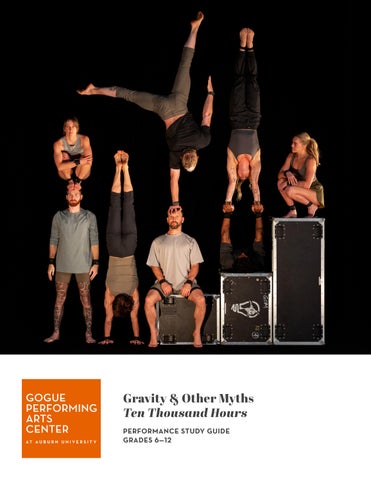
Gravity & Other Myths Ten Thousand Hours PERFORMANCE STUDY GUIDE GRADES 6—12
Credits
The Jay and Susie Gogue Performing Arts Center at Auburn University engages audiences across the university, the state of Alabama and beyond with curated arts experiences that inspire, enlighten and unite. Our annual K–12 School Performance Series provides opportunities for students to enjoy exclusive performances by some of the most talented and accomplished artists from around the world. Prior to each K–12 school performance, teachers receive a study guide containing details about the performance, artist and company, supplemental information about the art form and its history, and grade-appropriate activities designed to spark conversation and exploration in the classroom.
All images featured in this performance study guide are wholly owned and copyrighted by their respective copyright holders and are used for educational purposes only. No copyright infringement is intended. The Gogue Center does not claim ownership of any images unless explicitly stated otherwise. If you have concerns about the use of any image included herein, please contact us immediately. For a list of additional image sources and credits, please contact our Department of Communications and Marketing by telephone at 334.844.7234 or via email at jaosborne@auburn.edu.
To learn more, visit goguecenter.auburn.edu/education. produced by Jay and Susie Gogue Performing Arts Center at Auburn University 910 South College Street Auburn, Alabama 36849 k–12 school performance series contact Andrea Jarmon, D.M.A. Education Coordinator telephone: 334.844.7371 email: gpac.education@auburn.edu
This guide is optimized for accessible online engagement and may contain links to additional resources and multimedia content. To access digital versions of this and other performance study guides produced by the Gogue Center, scan the QR code or visit aub.ie/gpac-psg.
© 2026 Auburn University
Gravity & Other Myths Ten Thousand Hours PERFORMANCE STUDY GUIDE GRADES 6—12
photo: Darcy Grant
Gravity & Other Myths company members in Ten Thousand Hours
Table of contents Credits ���������������������������������������������������������������������������������������������������� 2 Where we will go �������������������������������������������������������������������� 7
ACTIVITIES Connecting Centuries of Discovery ���������������������������������������� 15 worksheet: From Gravity to the Moon
Going to the Gogue Center • 7
Balancing Act �������������������������������������������������������������������������������������������������� 20
Who Will You See Here? • 7
Exploring Cooperation, Perseverance, Patience and Creativity ���������������������������������������������������������������������� 24
What Does the Audience Do? • 7
Twisting a Myth ���������������������������������������������������������������������������������������������30
Acoustics: The Science of Sound • 9
Why we go to the show ����������������������������������������������� 34
Who to know at the show ��������������������������������������� 10
Alabama STEM Hubs • 34
Gravity & Other Myths • 10
STEM Hub Principles • 34
Acrobats • 10 Beyond the Big Top • 11
What to know before the show ���������������������� 12 Ten Thousand Hours • 12 The Science of Movement • 13 Physics • 13
ACTIVITIES Investigating Alabama Stem Hubs and Stem Education �������������������������������������������������������������������������������� 36
What to do after the show ������������������������������������ 38 worksheet: My Trip to the Gogue Center
Newton’s Laws of Motion • 13
Alabama Course of Study standards index ��������������������������������������������������������������������40
Gravity • 14
Arts Education • 40
Centripetal & Centrifugal Forces • 14
Character Education • 40
Anatomy & Physiology • 14
Counseling and Guidance • 41
Character Education • 23
Digital Literacy and Computer Science • 41
Cooperation • 23
English Language Arts • 41
Perseverance • 23
Math • 43
Patience • 23
Physical Education • 44
Creativity • 23
Science • 44
Myths & Mythology • 28
Social Studies • 5
Additional resources ���������������������������������������������������� 46
photo: Robert Benson
The Jay and Susie Gogue Performing Arts Center at Auburn University
6
Where we will go
What Does the Audience Do? Alabama Course of Study AE17.MU.3-5.15 AE17.MU.6-8.14
GOING TO THE GOGUE CENTER The Jay and Susie Gogue Performing Arts Center, otherwise known as the Gogue Center, is located on the campus of Auburn University in Auburn, Alabama. The Gogue Center houses the 1,200-seat Woltosz Theatre. The theatre was built with exceptional acoustics so that it is possible to hear well from every seat.
National Standards MU:Pr6.1.3-8b
The audience is an important part of the performance. Without the audience, who would watch the performers? Who would clap and sing along and appreciate what the artists bring to the stage? When you are a member of an audience at the theatre, there are a few things to know about what to do and what not to do.
WHO WILL YOU SEE HERE? Ushers These are the people who will greet your bus, lead your class into the building and help you find your seat. Be sure to say “hello!” Stage Crew These are the people who work backstage, so you won’t see them in the lobby, but you might see them before or after the performance, and sometimes, they even come on stage during the performance to move things. Lighting & Sound Operators These are the people who control the lighting and the sound for the performance. You may see them in the middle of the auditorium at the big sound board or in the back of the auditorium in the booth. Sometimes, the spotlight operators are in the back way above your head. Performers These are the people on the stage who may be dancers, musicians, singers, actors, puppeteers or acrobats. It is their job to communicate using their bodies, instruments and voices. Audience Members This includes you, your classmates, and other students and teachers from Alabama, and beyond.
7
Sit in your seat and look around, but please keep your feet toward the ground.
Listen and watch, but do not talk.
Have a camera or phone? Please turn it off.
The performers will take to the stage, and we know they will engage. You can laugh, you can sing, you can get up and dance, but just make sure that you give them all a chance!
When the song is done, or the show comes to an end, make sure that you give the performers a hand! Applause is the way that we can say thank you for all that they did today!
7
photo: Robert Benson
The Walter Stanley and Virginia Katharyne Evans Woltosz Theatre
8
Acoustics: The Science of Sound Alabama Course of Study Standards SC23.1.1 SC23.2.2 SC23.4.6
SC23.5.2
National Standards NS.K-4.1 NS.5-8.2
Acoustics is the study of sound and how that sound reacts in spaces, particularly rooms and buildings. What is sound? Sound is vibration. That vibration travels through the air and into our ears where we hear it. Vibration begins through movement—for example, strumming a guitar string. That vibration creates a sound wave. In a theater or concert hall like the Woltosz Theatre, acoustics are important so that everyone can hear the performers. There are two ways that acoustics are controlled. The first, reverberation, is controlling how sound waves bounce off surfaces, like walls and floors. Hard surfaces cause more reverberation and make spaces louder. The second way, absorption, is the opposite of reverberation. Soft surfaces absorb sound waves and make rooms quieter. Of the materials and surfaces listed below, which do you think cause sound to reverberate? Which absorb sound? • Tile • Carpet • Stone • Curtains • Cushions • Wood
9
9
Who to know at the show GRAVITY & OTHER MYTHS Gravity & Other Myths (GOM) is an Australian contemporary circus company known for physically demanding performances that combine acrobatics, movement, live music and theatrical storytelling. Rather than relying on elaborate sets, costumes or spectacle, GOM places the performers themselves at the center of the experience, emphasizing human connection, trust, risk and extraordinary physical skill. The company formed in Adelaide, Australia, in 2009 when a group of young artists came together through a shared passion for circus and physical theatre. Since then, GOM has developed six critically acclaimed works, including A Simple Space, Backbone, Out of Chaos, The Pulse, The Mirror and Ten Thousand Hours. Its productions have been presented to audiences around the world. GOM describes its mission as creating “acrobatic art that celebrates humanity, play and physical mastery.” That philosophy can be seen throughout the company’s work. Performers lift, catch, balance, throw and support one another in movements that require strength and precision, but also
10
communication, cooperation and trust. The result is a style of contemporary circus that reveals both the extraordinary capabilities and the vulnerability of the human body. In Ten Thousand Hours, GOM turns its attention to the pursuit of mastery itself. The performance explores what happens when artists devote years of practice, repetition and discipline to developing a physical skill. Rather than hiding the effort behind the finished product, the company invites audiences to notice the concentration, timing and teamwork required to make difficult movements appear effortless. Acrobats The performers in Gravity & Other Myths are acrobats, performers who execute physical feats requiring combinations of strength, agility, balance, flexibility, coordination and control. Acrobatics can take many forms. Some performers work with specialized equipment, such as trapezes, aerial silks, tightropes or hoops. Others rely
Beyond the Big Top
primarily on the human body, using techniques such as tumbling, balancing, lifting, throwing and partner or group acrobatics. In Ten Thousand Hours, the performers rely heavily on their own bodies and one another. A performer may serve as a base supporting another acrobat, a flyer propelled through the air or a partner responsible for catching and stabilizing someone else. These roles can change quickly, requiring performers to constantly adjust their position, timing and use of force.
The term circus is used to describe much more than the traditional big-top spectacle many people may imagine. Circus is a performing art form built around physical skill, movement and spectacle, with disciplines that can include acrobatics, juggling, clowning, balancing and aerial performance. Contemporary circus companies such as Gravity & Other Myths often combine these traditions with dance, theatre, music and storytelling to create performances that explore ideas, relationships and the capabilities of the human body.
Acrobatics may appear spontaneous, but highlevel performance depends on extensive training and repetition. Even a movement that lasts only a few seconds may represent years of practice. Performers must develop not only physical strength and technical skill, but also spatial awareness, precise timing and a deep understanding of how their bodies interact with gravity, momentum and the bodies of their fellow performers.
photo: Simon McClure
Stroboscope image of Gravity & Other Myths company members
11
11
Gravity & Other Myths company members
What to know before the show TEN THOUSAND HOURS Ten Thousand Hours is an ode to the immense amount of time required to achieve great things. It is a tribute to the dedication needed to realize our physical ambitions and an acknowledgment that the journey behind an achievement can be just as remarkable as the finished product. In the performance, eight acrobats and one musician investigate physical skill—how it is developed, refined and mastered, and how that process can transform our lives. By highlighting the nuance and precision of high-level acrobatics, Ten Thousand Hours invites audiences to consider the time, discipline and sacrifice required to develop the skills they witness on stage. Set to a driving, dynamic and intricate score performed live on percussion and drums, Ten Thousand Hours showcases the distinctive physical language of Gravity & Other Myths while celebrating the pursuit of mastery.
photo: Darcy Grant
Every movement in Ten Thousand Hours results from a complex interaction between physical forces and the capabilities of the human body. As Gravity & Other Myths performers jump, balance, rotate, lift and catch one another, they rely on principles of motion, gravity, force, anatomy and physiology to execute movements that may appear almost impossible. Examining the science behind these actions reveals not only how acrobatic feats are performed, but also the precision, training and understanding required to achieve them.
12
THE SCIENCE OF MOVEMENT Physics When watching a performance by Gravity & Other Myths, audiences can see the principles of physics in action. Acrobats jump, fall, balance, rotate, catch one another and propel bodies through space—all while responding to forces that govern motion. Physics is the branch of science concerned with matter, energy and the ways they interact. Physicists use observation, experimentation and mathematics to describe how objects move and how forces act upon them. Major areas of physics include mechanics, thermodynamics, electromagnetism, relativity and quantum mechanics. Newton’s Laws of Motion In the 17th century, English scientist and mathematician Isaac Newton formulated three laws describing the relationship between motion and force. First published in his 1687 work Philosophiæ Naturalis Principia Mathematica, Newton’s laws became the foundation of classical mechanics. Newton’s first law is the law of inertia. This law states that an object will remain at rest or continue
moving at a constant velocity unless acted upon by a net external force. This tendency to resist a change in motion is called inertia. A stationary object remains stationary unless something causes it to move. Likewise, a moving object continues moving unless a force—such as friction, gravity or contact with another object—changes its speed or direction. During an acrobatic performance, inertia helps explain why a performer who has been propelled into motion continues moving until another force alters that motion. Newton’s second law is the law of force and acceleration. It describes how force, mass and acceleration are related and is commonly expressed by the equation F = ma, or force = mass x acceleration. The greater the mass of an object, the greater the force required to produce the same acceleration. Likewise, applying greater force to an object of the same mass produces greater acceleration. For an acrobat, the amount of force generated during a jump, push or throw affects how quickly the body accelerates and how it moves through space.
13
Centrifugal Force
cit y
Newton’s laws explain a tremendous range of everyday motion, from a ball rolling across the ground to an acrobat launching into the air. They are especially useful for understanding the large-scale objects and speeds encountered in ordinary life.
ce forntrifug ce al
velo
Newton’s third law is the law of action and reaction. This law states that when one object exerts a force on another object, the second object exerts an equal force in the opposite direction. This interaction can be observed when an acrobat pushes against the floor. The performer applies force downward, while the floor exerts force upward on the performer. That upward force helps propel the acrobat into the air. The same principle applies when acrobats push against, lift or catch one another: forces occur through interactions between bodies.
ce forntripet ce al
Gravity Gravity is the force of attraction between objects with mass. On Earth, gravity constantly pulls objects toward the planet’s center. Gravity keeps people and objects from floating away from Earth, causes unsupported objects to fall and helps keep planets in orbit around the Sun. Acrobats must continually work with—and sometimes appear to challenge—gravity as they jump, balance, climb and move through the air. Although performers cannot eliminate gravity, they can use strength, momentum, timing and carefully controlled forces to create movements that may seem to momentarily defy it. Centripetal & Centrifugal Forces Centripetal force is the inward force that keeps an object moving in a circular path. Without it, the object would continue moving in a straight line. Gravity, tension or friction can provide this inward force. For example, when an object attached to a rope is swung in a circle, tension in the rope keeps it moving along the curved path. Centrifugal force is the apparent outward force you may feel when moving in a circle. It is caused by inertia— the tendency of an object to continue moving in a straight line. You may have experienced this sensation while riding in a car that makes a sharp turn. As the car changes direction, your body tends to continue along its previous path, creating the sensation that you are being pushed outward.
14
Centripetal Force
Acrobatic movements involving spinning, swinging or rotation provide opportunities to observe centripetal force and the effects of inertia in action. Anatomy & Physiology Gravity & Other Myths creates its performances through extraordinary demonstrations of human strength, flexibility, agility, coordination and balance. Understanding how performers accomplish these movements involves not only physics but also the study of the human body. Anatomy is the study of the structures and parts of the body. Physiology examines how those structures function and work together. In simple terms, anatomy describes what the body is made of, while physiology explains how the body works. For acrobats, muscles, bones, joints and the nervous system must work together with remarkable precision. Strength allows performers to generate and resist force; flexibility permits joints to move through broad ranges of motion; balance helps performers control their bodies in challenging positions; and coordination allows complex movements to occur accurately and efficiently.
CONNECTING CENTURIES OF DISCOVERY Alabama Course of Study Standards AE24.TH.MS1.13 MA19.7.9 AE24.TH.HS1.18 MA19.MM.MM.A MA19.6.21 SC23.8.9
SC23.8.10 SC23.8.11 SC23.PHYS.1
SC23.PHYS.2 SS24.8.17 SS24.WH.15a
SS24.US2.11a
National Standards NGSS.MS-PS2-1 NGSS.MS-PS2-2 NGSS.HS-PS2-1
NS.5-8.7 NSS-USH.5-12.9 NSS-WH.5-12.6
NSS-WH.5-12.7 NSS-WH.5-12.8 NSS-WH.5-12.9
TH:Pr6.1.6 TH:Pr6.1.7 TH:Pr6.1.8
NS.5-8.1 NS.5-8.2 NS.5-8.5
OBJECTIVE By completing this activity, students will: •
Trace how Issac Newton’s discoveries influenced later scientific advancements, including space exploration and the Moon landing
•
Describe and demonstrate Newton’s three laws of motion through physical movement
•
Demonstrate how changes to an object’s mass or position can affect its motion
•
Use observation, discussion and reflection to connect scientific theory to real-world scenarios
•
Practice safe movement techniques, communication and teamwork
MATERIALS
1. Begin by displaying two images side by side: one of Isaac Newton and one of the Apollo 11 Moon landing. (Sample images can be found on pages 18–19.) 2. Ask students: “What connections could possibly exist between these two images?” 3. Allow students to discuss the question with a partner before sharing their ideas with the class. 4. Next, display the following statement: “Great achievements are built over time.” 5. Lead a brief discussion about scientific discovery and innovation, emphasizing how major achievements often build upon the ideas, discoveries and contributions of many people over time. suggested discussion questions •
Do you think the Moon landing was the achievement of one person or the result of many discoveries and contributions?
•
How might a scientist who lived nearly 300 years before Apollo 11 have influenced that achievement?
For these activities, you will need the following items: •
Ten Thousand Hours lesson on page 12
•
Photographs or illustrations of Isaac Newton and the Apollo 11 Moon landing
•
“From Gravity to the Moon” worksheet on page 17
•
Cups (6–12) or other stackable items of uniform size
•
Notecards (6–12)
•
Two toy cars
•
Small weights or other materials totaling at least 20 grams
•
Ruler, yardstick or measuring tape
•
Tape
•
String
•
Straw
•
Balloons, enough for each group to use one
•
Two chairs
ACTIVITIES
Introduction
For this activity, students will explore how scientific discoveries build upon one another over time and consider how Isaac Newton’s work contributed to later advancements in science, engineering and space exploration.
Exploration
For this activity, students will investigate how Newton’s ideas became part of a chain of scientific discoveries and technological developments that eventually helped humans reach the Moon. 1. Copy and distribute the “From Gravity to the Moon” worksheet on page 17. 2. Using the provided date bank and contextual clues, have students place the events in chronological order. 3. Once students have completed the timeline, review the sequence as a class. Discuss how major achievements often depend on the work of many people over long periods of time and how Newton’s discoveries influenced later developments in physics, rocketry, space exploration and the Apollo program.
Guided Practice
For this activity, students will conduct three simple experiments demonstrating Newton’s laws of motion. You may complete the experiments as a class or arrange them as three separate stations—one for each of Newton’s laws— through which small groups rotate. Before beginning, review
15
each law using the information outlined in the “The Science of Movement” lesson on pages 13–14. Following each experiment, have students discuss the experiment and how its results may relate to the acrobats performing in Ten Thousand Hours. Inertia Experiment 1. Have students create a tower by stacking cups with a notecard between each cup.
4. Once the straw is secure, release the balloon and observe its motion. As air rushes out of the balloon in one direction, the balloon moves in the opposite direction. suggested discussion questions
2. Ask students to take turns quickly pulling individual notecards horizontally from the tower. Observe what happens to the cups.
•
What forces are acting while the balloon is in motion?
•
What are the action-reaction forces seen in this demonstration?
3. Repeat the demonstration, if possible, by having students pull multiple cards simultaneously.
•
What would happen if less air were released from the balloon?
4. Explain that the cups’ inertia causes them to resist a change in their state of motion.
•
Where might you observe action-reaction forces during an acrobatic performance?
Note to educators: Any stackable material of uniform size, such as wooden blocks, may be substituted for cups.
Creative Activity
suggested discussion questions
For this activity, students will use physical movement to demonstrate their understanding of Newton’s laws.
•
What forces were acting on the cups?
1. Divide students into three groups.
•
In what ways did the cups’ motion change when the notecards were removed?
2. Assign each group one of Newton’s three laws of motion.
•
In what ways did their motion remain the same?
•
What caused the cups to begin moving?
•
How might inertia and changes in motion affect an acrobat who builds momentum before a movement?
Force & Acceleration Experiment 1. Place two identical toy cars on the same surface. Attach additional mass to one car. 2. Have students take turns thumping the cars with their fingers. Thump the weighted car first, followed by the unweighted car. For the most accurate results, be sure to apply the same amount of force to each car when setting it in motion. 3. Measure and compare the distance traveled by each car. 4. Repeat the demonstration several times and compare the results. suggested discussion questions •
What forces acted on each car?
•
How did adding mass affect the car’s motion?
•
If the car with greater mass accelerated less, what could you change to increase its acceleration?
•
How might a performer’s mass affect a partner lift, toss or other movement?
•
How might the amount of force required change?
Action & Reaction Experiment 1. Thread a long piece of lightweight string or yarn through a straw. Stretch the string tightly between two chairs and secure each end. 2. Inflate a balloon without tying it closed. Pinch the opening tightly to keep as much air inside the balloon as possible.
16
3. Using your free hand or with the help of a partner, carefully tape the straw lengthwise to the side of the inflated balloon. Make sure the straw is securely attached.
3. Ask each group to create a short movement sequence or physical demonstration that clearly illustrates its assigned law. Students should be prepared to explain how the movement represents the scientific principle. 4. Invite each group to present its demonstration to the class. 5. Following each presentation, ask the class to identify the law being demonstrated and explain the forces or movements they observed.
Reflection
Lead a class discussion connecting Newton’s work, the timeline activity and the physical demonstrations. suggested discussion questions •
Which event on the timeline was most important in helping humans reach the Moon? Support your answer using at least two events from the timeline.
•
How did Newton’s work continue to influence science and technology centuries after it was published?
•
If Newton had never published his ideas about motion and gravity, how might later scientific developments have been different?
•
Why does Huntsville, Alabama, belong on a timeline connecting Newton’s work to the Moon landing?
•
How does the timeline support the idea that extraordinary achievements require years of work and contributions from many people?
Conclusion
Before attending Ten Thousand Hours, remind students that the acrobats they will see are constantly interacting with the same physical principles they explored in the classroom. Encourage students to watch for examples of inertia, acceleration, actionreaction forces and gravity throughout the performance.
17
4
clue: This happened nearly 240 years after Principia was published.
1958
Robert Goddard NASA (National Aeronautics launches the first liquidand Space fueled rocket Administration) is created during the Sapce Race.
3
clue: This Alabama event occurred two years after NASA was created.
Marshall Space Flight Center opens in Huntsville, Alabama.
5
1926
8
1960
Date Bank 1967
clue: This event happened seven years after the Alabama center opened and two years before Apollo 11.
1969
today
First Saturn V Apollo 11 lands Today, satellites, GPS and space rocket launch. on the Moon. exploration The most Neil Armstrong still rely on powerful rocket and Buzz Aldrin walk on the Newton’s laws of its time. lunar surface. of motion and gravity
7
1687
Date
Which event on the timeline was the most important link between Newton’s discovery of gravity and the Moon landing? Defend your answer with evidence from the timeline.
clue: This is the starting point! Newton was thinking about why objects fall.
clue: This event occurred 21 years after Newton began developing his ideas about gravity.
Newton publishes Principia, explaining the laws of motion and universal gravitation.
Newton begins developing his ideas about gravity while home from Cambridge during the plague.
1666
2
1
6
From Gravity to the Moon
Use the clues and the date bank to determine the missing years. Write each year in the correct box on the timeline. Then, answer the reflection question at the bottom.
Name
English scientist and mathematician Sir Isaac Newton (1643–1727)
18
Apollo 11 Moon landing (July 20, 1969)
19
BALANCING ACT Alabama Course of Study Standards AE24.VA.MS1.2 AE24.VA.MS2.5 AE24.VA.MS1.14 AE24.VA.HS1.4
AE24.VA.HS1.14 SC23.7.4
SC23.HAP.3 SC23.HAP.4
SC23.PHYS.2 PE19.6.2.3
National Standards NGSS.MS-PS2-1 NGSS.MS-PS2-2 NPH.K-12.1
NS.5-8.2 NS.5-8.3 VA:Cr1.2.6-IIIa
VA:Cr2.1.6-IIIa VA:Cr3.1.6-IIIa VA:Re7.1.6-IIIa
VA:Cn11.1.6-IIIa
NPH.K-12.2 NPH.K-12.5 NS.5-8.1
OBJECTIVE By completing these activities, students will: •
Identify how balance and center of gravity affect stability in body movements and structural designs
•
Use the engineering design process to improve a structure
•
Analyze tradeoffs between height and stability
•
Describe how body systems work together to support balance and coordination
•
Practice safe movement techniques, communication and teamwork
•
Integrate concepts from physics, mathematics and physical education into movement-based problem solving
•
Plan and sketch their own designs
•
Create a finished, balanced free-standing sculpture
MATERIALS For these activities, you will need the following items:
20
PE19.7.2.3 PE19.8.2.8
Note to educators: If using 14-gauge aluminum wire, plan for a minimum of approximately 10 feet of wire per student and adjust sculpture-size expectations based on available materials. Wire cutters, pliers and hot glue should be used only with appropriate supervision. ACTIVITIES
Introduction
For this activity, students will explore how center of gravity affects balance and stability. Through two simple physical challenges, students will consider how changes in body position can affect the ability to maintain balance. Begin by asking students to raise their hands if they believe they have strong balance and coordination. Explain that they will complete two challenges designed to test those abilities. The challenges may be completed by the class as a whole, in small groups or by selected volunteers. Super Glue Chair Challenge
•
Straight-back armless chair
•
Small object for balance challenge
1. Have students sit in straight-back armless chairs with their backs against the backs of the chairs and both feet flat on the floor.
•
Plastic cups
2. Ask students to fold their arms across their chests.
•
Index cards
•
Craft sticks
3. Instruct students to try to stand without moving their feet or leaning forward.
•
Paper clips
•
Pennies or washers
•
Measuring tape or meter stick
•
Small fan
•
Butcher paper
•
Pencils
•
List of skeletal and muscular structures
•
Mats for physical movement
•
Paper for sketching and planning
•
Wood blocks or cardboard scraps for sculpture bases
•
Pipe cleaners or 14-gauge soft aluminum wire
•
Glue gun and glue sticks
•
Wire cutters and pliers, if using aluminum wire
4. Ask students to describe what happened. Explain how the position of the body and its center of gravity made the movement difficult. The Pick-Up Trick Challenge 1. Place a small object on the floor approximately 50 centimeters from a wall. (For added excitement, use a highvalue object like a candy bar or a $5 bill. Tell students they can keep the object if they succeed at the challenge. The trick, however, is that they will not be able to.) 2. Have students stand with their backs against the wall, their feet together and their heels touching the wall. 3. Instruct students to bend forward and try to pick up the object without moving their feet, bending their knees or tumbling over. 4. Ask students to describe what happened. Explain that bending forward shifts the body’s center of gravity. Under normal circumstances, people can adjust the position of
their hips or feet to maintain balance, but the rules of this challenge restrict those adjustments. Once both challenge are complete, lead a class discussion about the relationship between center of gravity, balance and coordination. suggested discussion questions
Guided Practice
For this activity, students will investigate how the skeletal and muscular systems contribute to balance and body position. 1. Divide students into groups of three or four. 2. Ask each group to select a stationary balancing position that can be performed safely.
•
What body systems are involved in balance and coordination?
3. Using butcher paper, have students trace the outline of one group member holding the selected position.
•
How do the skeletal and muscular systems work together to help maintain balance?
•
How can changing the position of one part of the body affect overall stability?
•
How might an injury to a bone, muscle or joint affect balance?
4. Provide students with a list of skeletal and muscular structures to identify on their outline. Depending on grade level, examples may include the tibia, fibula, femur, radius, hamstrings, quadriceps and biceps. Allow students to research the location and function of each structure.
•
Why might understanding center of gravity be especially important for an acrobat?
Exploration
For this activity, students will apply concepts of balance and stability to an engineering challenge. Working in groups, students will design a freestanding structure and test how well it responds to different forces. 1. Divide students into small groups and explain that each group will have 10 minutes to build the tallest possible freestanding structure using only the provided materials. 2. Explain that each structure must pass a series of three stability tests. Each tower must be able to stand on its own for at least 15 seconds; remain standing during a table-shake test; and remain standing while a fan blows on it for five seconds. 3. Allow students to select an assortment of materials for the construction of their tower. Suggested materials include plastic cups, index cards, craft sticks, paper clips, coins and washers. Any sort of craft material can be used but make sure that all groups have access to the same materials. 4. Once the materials are selected, allow students to build their structures without providing additional design instructions. 5. Measure the height of each completed structure and perform all three stability tests. 6. Have students discuss their results within their groups. 7. If time permits, allow students to redesign their structures and retest. Once the challenge is complete, lead a class discussion on the successes and failures of the various design methods chosen. suggested discussion questions •
Which parts of your structure were the most stable?
•
Which parts were the least stable?
•
How did the height of the structure affect its stability?
•
Where was most of the structure’s mass located?
•
What changes to your design (if any) made the structure more stable?
5. Ask students to predict and mark the approximate location of the body’s center of gravity on the outline of the selected position. 6. In groups or as a class, have students discuss how the skeletal and muscular systems work together to maintain the position. suggested discussion questions •
Which muscles are helping maintain this position?
•
Which bones and joints support the body?
•
How would moving an arm or leg affect the body’s balance?
•
How might the center of gravity change in a different position?
•
How do acrobats use strength, flexibility and control to perform lifts, balances and other complex movements?
Additional Guided Practice Activities These additional guided practice activities are best suited for a gymnasium or other space designed for physical activity. Consider collaborating with a physical education teacher or other appropriately trained instructor. Note to educators: Activities involving tumbling, partner balances or other advanced physical movement should be conducted only when appropriate for the students, instructional setting and supervising educator. Use proper safety equipment and modify or omit activities as needed. Balance & Center of Gravity Activities Single-leg balance: Have students stand on one leg for up to 30 seconds. Ask them to identify where they feel their balance point and describe how small movements affect their stability. Partner balance: With appropriate supervision, have students work in pairs to explore a simple counterbalance. Ask them to consider how each person’s position affects the stability of the pair. Group balance: Have students work in small groups to explore how changes in body position or the distribution of mass affect the stability of the group formation. Force diagram analysis: Ask students to draw and label force diagrams representing the forces acting on the body during selected balance activities
21
Tumbling & Rotational Mechanics Activities Forward roll: Have students practice forward rolls on mats under appropriate supervision. Ask them to compare how tucking the body versus remaining more extended affects the roll and rotational speed. Cartwheel: Have students perform cartwheels with appropriate supervision and spotting. Ask them to identify how the body rotates during the movement and determine the approximate axis of rotation. Spin experiment: Have students stand and spin with their arms extended, then repeat the movement while drawing their arms inward. Ask them to compare their rotational speed in each position and explain what they observe. Grades 9–12: Introduce the concept of angular momentum and ask students to relate it to the rotational movements explored in the activity. Explain that angular momentum is represented by the equation L = Iω, where L is angular momentum, I is moment of inertia and ω (omega) is angular velocity, or rotational speed. If appropriate for the course, have students use collected or provided data to calculate angular momentum and compare how changes in body position affect rotational speed.
Creative Activity
For this activity, students will apply what they have learned about balance, body position and movement to create a freestanding figural sculpture.
Invite students to display their completed sculptures and discuss the artistic and scientific decisions they made during the design process. suggested discussion questions •
What is working particularly well in your sculpture? Why?
•
What challenges did you encounter during the creation process? How did you address them?
•
If you created your sculpture again, what would you do differently? Why?
•
How did your understanding of gravity, balance and human anatomy influence your design?
•
What scientific principles can you identify in your finished sculpture?
2. Have students recall movements and body positions explored during the previous activities. Ask them to sketch several full-body figures demonstrating these movements.
•
How does your sculpture communicate movement while remaining stationary?
3. Have each student select a final composition. Explain that this sketch will serve as the basis for their sculpture.
Conclusion
1. Begin by asking students to consider how visual artists can communicate movement through stationary objects. suggested discussion questions •
How can a sculpture suggest movement even though it does not actually move?
•
What body positions create a strong sense of motion?
•
How might balance affect the way a sculpted figure is positioned?
4. Provide students with enough wire or pipe cleaners to construct their sculptures. Students may use any construction process that supports their design, but beginning with the head and working through the rest of the body may provide a helpful starting point. 5. As students work, have them periodically assess the overall balance and stability of their sculptures. Encourage them to consider how changes in position, proportion or mass distribution affect the finished structure. 6. Once the figures are complete and balanced, provide each student with a base. Wood blocks, scrap lumber or multiple layers of corrugated cardboard may be used. Have students attach their sculptures to the bases using an appropriate method, such as hot glue.
22
Sharing & Reflection
Before attending Ten Thousand Hours, remind students that Gravity & Other Myths performers must continually consider balance, strength, body position and the forces acting upon them. Encourage students to observe how performers shift their weight, distribute mass and work together to create stable—and sometimes intentionally unstable—physical structures on stage.
CHARACTER EDUCATION Gravity & Other Myths describes Ten Thousand Hours as an “ode to the countless hours needed to achieve great things.” What does it take to devote that much time and energy to a single pursuit? What character traits help people push through challenges, develop their abilities and continue working toward new goals?
Patience
Cooperation
Creativity
Cooperation is the ability to work with others, exchange ideas and provide support in pursuit of a common goal. It requires active listening, effective communication, flexibility and a willingness to compromise. Important elements of cooperation include shared goals, active participation, respect and kindness.
Creativity is the ability to approach tasks, problems or ideas from new perspectives and develop original, useful solutions. Although creativity is often associated with the arts, it also plays an important role in problem solving, innovation and learning. Creative thinking encourages curiosity, adaptability and a willingness to experiment with different approaches.
Patience is the ability to remain calm when facing delays, difficulties or frustration. It involves selfcontrol, persistence and the willingness to accept that progress often takes time. Patience may require waiting, accepting limitations and remaining focused under pressure.
Perseverance Perseverance is the ability to continue working toward a task, goal or purpose despite difficulties, obstacles or discouragement. It involves determination, resilience and a willingness to learn from mistakes rather than give up when challenges arise. Perseverance also requires emotional regulation and a growth mindset—the belief that abilities can improve through effort, practice and learning.
23
23
EXPLORING COOPERATION, PERSEVERANCE, PATIENCE AND CREATIVITY Alabama Course of Study Standards AE24.VA.MS1.2 CE.CE.8 AE24.VA.MS2.5 CE.CE.21 AE24.VA.HS1.3 CE.CE.22
CE.CE.25 CG.PS.B ELA21.6.8
ELA21.6.20 ELA21.7.22 ELA21.8.21
ELA21.9.11 ELA21.10.11 ELA21.12.14
National Standards NL-ENG.K-12.4
VA:Cr1.2.6a
VA:Cr2.1.Ia
VA:Cr2.3.7a
NL-ENG.K-12.12
OBJECTIVE •
Define and explain the character traits of cooperation, perseverance, patience and creativity
3. Explain that significant achievements and successes rarely happen overnight. Whether someone is an athlete, musician, scientist, artist, engineer or student, progress often requires qualities that help them continue learning, adapting and working through challenges.
•
Analyze how these traits contribute to achieving long-term goals
Exploration
By completing these activities, students will:
•
Identify examples of these traits in their own lives and in others
•
Reflect on which character trait they would like to strengthen and create a plan for growth
•
Discuss the relationship between practice, dedication and success
MATERIALS For these activities, you will need the following items: •
“Character Education” lesson on page 21
•
Chart paper or board
•
Arts and crafts materials
•
Sticky notes
ACTIVITIES
Introduction
For this activity, students will consider the personal qualities that help people remain committed to long-term goals and continue developing their abilities over time. 1. Begin by explaining that Gravity & Other Myths describes Ten Thousand Hours as an ode to the countless hours required to achieve great things. 2. Lead a class discussion on the idea of needing several ideas to achieve great things. suggested discussion questions
24
•
What do you think this statement means?
•
Why might someone devote thousands of hours to practicing or developing a skill?
•
What qualities might a person need to remain committed for that long?
•
How can challenges or setbacks affect someone working toward a long-term goal?
For this activity, students will examine each character trait and consider how it can influence the way people respond to challenges and work toward goals. 1. Begin by reviewing the “Character Education” lesson on page 21. Using chart paper or the board, write the name of each character trait as it is reviewed. Leave room beneath each trait to include a list of important characteristics (provided below). Students may provide additional traitrelated characteristics and components as well. 2. Review and discuss cooperation. Explain that cooperation involves working with others, sharing ideas and providing support in pursuit of a common goal. Important characteristics of cooperation include shared goals, active participation, effective communication, compromise, kindness and respect. Ask students: “Why is cooperation important even when people have different ideas?” 3. Review and discuss perseverance. Explain that perseverance involves continuing to work toward a goal despite difficulties, obstacles or setbacks. Important characteristics of perseverance include determination, resilience, emotional regulation, growth mindset and a willingness to learn from mistakes. Ask students: “How is persevering different from simply repeating the same approach when it is not working?” 4. Review and discuss patience. Explain that patience involves remaining calm and focused when facing delays, challenges or frustration. Important characteristics of patience include self-control, willingness to wait, acceptance of limitations, calmness under pressure and a positive attitude. Ask students: “Why can patience be difficult when you are working toward something important?” 5. Finally, review and discuss creativity. Explain that creativity involves approaching ideas and problems from new perspectives and developing original or useful solutions. Important characteristics of creativity include curiosity, adaptability, innovation, problem solving and experimentation.
25
25
Ask students: “How can creativity help someone move forward when an original plan does not work?”
Guided Practice Character Traits Challenge For this activity, students will apply the four character traits to realistic scenarios involving challenges and collaboration. 1. Divide students into small groups. 2. Assign each group one of the following scenarios:
Creative Activity Journey Map For this activity, students will identify a personal goal and create a journey map illustrating how cooperation, perseverance, patience and creativity can help them work toward it.
•
A robotics team discovers that its design does not work the day before a competition.
•
A student struggles to learn a difficult piece of music for an upcoming performance.
1. Begin by explaining that accomplishments—whether learning an instrument, improving at a sport, creating art, earning a degree or mastering another skill—develop through a process that may include progress, setbacks, assistance from others and changes in approach.
•
Members of a group project disagree about how to complete the assignment.
2. Ask students to select a meaningful goal or skill they would like to achieve or develop.
•
An inventor develops an idea for a product, but the first several attempts fail.
3. Explain that students will create a journey map visually showing how they will achieve their chosen goal.
3. Have each group discuss its assigned scenario. suggested discussion questions
26
4. Invite each group to share its scenario and responses with the class. As groups present, remind students that complex challenges rarely require only one character trait.
•
Which character trait might be most important in this situation? Why?
•
Which other character traits might also be useful?
•
What specific action could demonstrate one or more of these traits?
4. Each map should include the following elements: •
A starting point: Students should identify the goal, skill or accomplishment they would like to pursue. Examples might include learning an instrument, joining an athletic team, improving academic performance, becoming an engineer, starting a business or learning another language.
•
•
The pathway: Along their journey, students should identify at least two potential obstacles, one possible setback or challenge, and any resources, strategies or people who could provide support Character trait checkpoints: Students must create four character trait checkpoints (one for each of the character traits discussed) along their journey. At each checkpoint on the map, students should explain how the character trait could help them progress toward their goal and one specific action they could take to demonstrate that trait.
5. Provide students with access to various arts and crafts materials. Allow students to create their map by choosing a design format that best communicates their journey. Possible formats include:
Sharing & Reflection
Invite students to reflect on how the four character traits apply to their own experiences and goals. suggested reflection prompts •
Which of the four character traits do you consider a personal strength? Why?
•
Which trait would you most like to strengthen?
•
Describe a time when you demonstrated cooperation, perseverance, patience or creativity.
•
What personal goal might require several of these traits?
•
What is one specific action you can take to strengthen a trait you would like to develop?
Lead a class discussion connecting the traits to achievement.
•
Traditional roadmap
suggested discussion questions
•
Multi-panel comic strip
•
•
Board game-style path
Can someone achieve an important goal entirely on their own, or without cooperation? Why or why not?
•
Mountain-climbing route
•
How do perseverance and patience work together?
•
Digital infographic
•
Why is creativity important in fields such as science, technology, sports, business and the arts?
•
Quest or hero’s journey
•
Can the trait that is most important change depending on the situation?
•
How might these four traits apply to the acrobats in Ten Thousand Hours?
6. When students have completed their maps, display their work around the classroom. Provide sticky notes and invite students to leave positive, specific feedback identifying examples of strong perseverance, creative problem solving, effective cooperation or thoughtful patience. Additional Creative Activities These additional creative activities provide opportunities to extend students’ exploration of cooperation, perseverance, patience and creativity. Grades 6–8: Have students create a short comic strip showing a character from literature, film or television using one or more of the four traits to overcome a challenge.
Conclusion
Before attending Ten Thousand Hours, remind students that the skills they will see on stage represent years of practice, experimentation and collaboration. Encourage them to look beyond the finished acrobatic movements and consider the cooperation, perseverance, patience and creativity required to develop and perform them.
Grades 9–12: Have students research an athlete, scientist, entrepreneur, artist or other accomplished individual. Ask them to write a brief analysis explaining how cooperation, perseverance, patience or creativity contributed to that person’s achievements. Cross-curricular connections for all grades: Ask students to apply the four traits to a current classroom project, extracurricular activity, sport or personal goal. Have them explain how each trait could influence their progress or help them respond to challenges.
27
MYTHS & MYTHOLOGY The name Gravity & Other Myths is a tongue-incheek play on words. Gravity and the laws of physics are, of course, very real. Through extraordinary feats of strength, balance and coordination, however, the company’s performers can sometimes appear to defy them.
Cultures around the world have developed their own rich mythological traditions. Greek and Roman mythology may be among the most familiar in Western culture, but important mythic traditions can be found throughout Europe, Asia, Africa, the Middle East and the Americas.
We have already defined and explored gravity, but what is a myth? The word has more than one meaning. In everyday conversation, a myth can refer to a widely held belief or misconception that is not supported by evidence. Familiar examples include claims that humans use only 10% of their brains, that lightning never strikes the same place twice or that cold weather itself causes illness.
Greek mythology introduced gods and goddesses such as Zeus, Poseidon, Hera, Apollo and Aphrodite, as well as heroes including Heracles and Odysseus. Norse mythology gave us figures such as Odin, Thor and Loki. Egyptian mythology includes Isis, Osiris and Ra, while the ancient Mesopotamian Epic of Gilgamesh tells the story of one of literature’s earliest known heroic figures. Dragons also occupy an important place in Chinese mythology and folklore.
More traditionally, a myth is a symbolic story passed down through generations that helps explain natural phenomena, cultural beliefs, human origins or the relationship between people and the world around them. Myths often developed through oral traditions and feature gods, heroes, supernatural beings and extraordinary events. They can communicate cultural values and beliefs while exploring universal themes such as creation and destruction, nature and the cosmos, conflict, transformation and heroic quests.
Chinese dragon on the roof of a traditional temple
28
For centuries, these stories and characters have inspired writers, artists and performers. Their influence continues in modern culture through literature, movies, comic books, television, theatre and video games.
greek god poseidon
aztec deity quetzalcoatl
ancient egyptian deities
japanese fox spirit kitsune
norse god odin
29
TWISTING A MYTH Alabama Course of Study Standards ELA21.6.4 ELA21.9.4 ELA21.7.4 ELA21.9.9 ELA21.8.4 ELA21.10.4
ELA21.11.4 ELA21.12.4 ELA21.12.11
SC23.6.3 SC23.PHYS.1 SC23.PHYS.2
National Standards NGSS:MS-PS2-A NGSS:HS-PS2-1
NL-ENG.K-12.2 NL-ENG.K-12.3
NL-ENG.K-12.4 NL-ENG.K-12.5
RL.12.3
W.6.3
NGSS:HS-PS2-4 NL-ENG.K-12.1
Common Core ELA RL.6.3 RL.9.3
OBJECTIVE
SC23.PHYS.5b SS24.7.14
W.9.9A
W.12.11A
Exploration
•
Define a hero and explain their significance in a plot
For this activity, students will read, watch or listen to selected Greek or Roman myths and identify common characteristics of mythological narratives.
•
Recognize characteristics of mythology
1. Review the “Myths & Mythology” lesson on pages 24–25.
•
Analyze a myth
•
Create a story or song with elements of mythology using modern context
2. Select one or more age-appropriate Greek or Roman myths for students to read, watch or listen to. Possible subjects and stories might include:
By completing these activities, students will:
•
Perseus and Medusa
MATERIALS
•
Hercules and the Twelve Labors
For these activities, you will need the following items:
•
Demeter, Persephone and Hades
•
“Myths & Mythology” lesson on pages 24–25
•
Sisyphus
•
Selected mythology texts, videos or audio recordings
•
Jason and the Golden Fleece
•
Myth analysis organizer or chart
•
Prometheus
•
Technology with internet access
•
Arachne and Athena
ACTIVITIES
Introduction
For this activity, students will consider the qualities that define a hero and explore how heroic figures function within stories and other narratives. 1. Present students with this essential question: “What makes someone a hero?” 2. Ask students to complete a brief written response identifying the following: •
The name of a real or fictional person they consider a hero
•
A challenge the hero faced
•
The qualities or actions that made the hero successful or helped them overcome a challenge
3. Invite students to share their responses with a partner or the class. 4. Explain that heroes appear throughout mythology and often face extraordinary challenges that test their abilities, character and judgment.
suggested examples Consider sharing videos from “Greeking Out: Minute Myths,” a popular video playlist from National Geographic Kids. Each animated video provides a brief overview of several well-known Greek myths. 3. As students explore selected myths, ask them to identify common characteristics. characteristics of mythology •
Gods, goddesses, heroes, monsters or other supernatural beings
•
Explanations for natural phenomena, cultural traditions or origins
•
Extraordinary challenges or quests
•
Elements of the hero’s journey, such as departure, trials, assistance and transformation
•
Moral lessons; reward for good deeds; punishment for evil deeds
•
Metaphorical themes involving fate, free will, identity, power or responsibility
4. As a class or in small groups, analyze the character using the categories below.
30
Guided Practice
For this activity, students will analyze a mythological hero and examine how literary elements contribute to the meaning of the story. 1. Select one mythological hero from a text explored during the previous activity. 2. As a class or in small groups, analyze the character using the categories below. Literary Element
Evidence from Myth
Impact on Story
Character traits
What qualities does the hero demonstrate?
How do these qualities affect the outcome?
Conflict
What challenge(s) does the hero face?
What does the conflict reveal?
Setting
Where and when does the story occur?
How does the setting shape the events?
Motivation
What does the hero need or want?
How does this motivation influence the hero’s choices?
Resolution
How is the conflict resolved?
What lesson, theme or consequence emerges?
icarus
3. Discuss how myths sometimes include events that can be examined through modern scientific knowledge. possible mythology & science connections •
Icarus: The story of human flight can lead to a discussion of gravity, lift and the forces required to keep an object airborne.
•
Hercules: Feats involving lifting, pushing or moving heavy objects can be considered through Newton’s second law and the relationship among force, mass and acceleration.
•
Atlas: The first cervical vertebra of the human spine is called the atlas because, like the mythological figure who bears the heavens, it supports the weight of the skull.
hercules
4. Invite students to identify additional moments from myths that could be examined through concepts in physics, anatomy, astronomy or other sciences.
Writing Activity
For this activity, students will adapt a mythological figure or story to a modern setting while preserving important characteristics of the original myth. 1. Have each student select a mythological figure explored during one of the previous activities. 2. Ask students to imagine that the character encounters a new challenge in the modern world. 3. Have students plan a short story that includes: •
atlas
A recognizable mythological character
31
•
Character traits consistent with the original myth
•
A modern setting
•
A new conflict or challenge
•
At least one element or theme associated with mythology
•
A resolution that reflects or develops the theme of the original story
Sharing & Reflection
Lead a discussion about how myths change when they are retold in new settings and how their central themes can remain relevant across time. suggested discussion questions •
How did your selections from the writing and creative activities show the character traits, motivations and feelings of your mythological figure?
•
Which characteristics of the original myth did you preserve in your story?
•
How did moving the character into a modern setting change the conflict?
•
5. Ask students to tell the story from the mythological character’s first-person point of view.
How did the character’s traits, motivations or choices influence the resolution?
•
6. Invite students to share their completed short stories with a partner, small group or the class.
How can scientific knowledge change the way we interpret events described in ancient myths?
•
What distinguishes mythology from other types of stories?
•
Why do stories about ancient heroes continue to influence contemporary culture?
4. Encourage students to incorporate an appropriate scientific concept when it supports the story. For example, a modern Icarus narrative might involve aviation or aerospace engineering, while a story about Atlas might incorporate anatomy, structural engineering or the challenge of supporting a heavy load.
Creative Activity
For this activity, students will use music or poetry to demonstrate their understanding of mythological characters, events and themes. 1. Ask students to imagine that mythological figures such as Hercules, Icarus and Atlas have been invited to perform at a school talent show.
Conclusion
Before attending Ten Thousand Hours, remind students that the name Gravity & Other Myths playfully connects scientific reality with the seemingly impossible feats audiences associate with myths and legendary heroes.
2. Explain that each character wants the audience to understand who they are, what they have experienced and what lessons can be learned from their story. 3. Have students select at least one mythological character and write an original song or poem from that character’s perspective. 4. Explain that each song or poem should: •
Incorporate important character traits
•
Reference significant events from the myth
•
Communicate the character’s feelings, motivations or struggles
•
Convey a lesson or theme from the myth
•
Use descriptive language
•
Include at least three accurate details about the character or story
5. Encourage students to experiment with rhyme, rhythm, repetition or other poetic and musical devices as appropriate. 6. Invite students to perform or present their completed songs or poems to the class. suggested example Consider sharing “Zero to Hero” from Disney’s Hercules as an example. Although the song is not written in first person, it demonstrates how music can communicate a mythological character’s identity, accomplishments and reputation.
32
Our “Twisting a Myth” activities use familiar examples from Greek and Roman mythology. However, you may adapt the lesson by selecting myths from any culture or tradition, including stories that reflect your students’ backgrounds, interests or areas of study.
A statue of Norse god Thor in Stockholm, Sweden
33
Why we go to the show ALABAMA STEM HUBS STEM stands for science, technology, engineering and mathematics. STEM education emphasizes critical thinking, problem solving and the application of knowledge across disciplines. Fields associated with STEM include biology, chemistry, physics, computer science, engineering, mathematics and data science. When the arts are incorporated into this interdisciplinary approach, STEM becomes STEAM—science, technology, engineering, arts and mathematics. Integrating the arts can encourage creativity, communication, collaboration and innovative thinking while demonstrating how artistic and technical skills often work together to solve realworld problems. The Alabama STEM Council was created to strengthen STEM education, career awareness and workforce development throughout the state. Established in 2020, the council connects educators, businesses, community organizations and other partners to expand STEM opportunities for students and prepare Alabama’s future workforce. One of the council’s major initiatives is a statewide network of regional STEM hubs. STEM hubs serve as connection points among schools, higher education, museums, science centers, community organizations and industry partners. Regional STEM networks extend these partnerships throughout the state, helping connect students and educators with hands-on learning, career pathways and resources that reflect the needs and opportunities of their communities. Although not every region currently has a STEM hub, all regions have an active STEM network.
34
STEM Hub Principles
1
Align regional efforts with statewide priorities
2
Preserve the identity and autonomy of individual regions
3
Support regional planning and coordination
4
Maintain the grassroots strength of local STEM efforts
Alabama currently has three state-appointed STEM hubs: the McWane Science Center in Birmingham; the Cook Museum of Natural Science in Decatur; and the State of Alabama STEM Hub at Saban Center in Tuscaloosa. The McWane Science Center opened in 1998 and offers hands-on science experiences along with an aquarium, natural history collections and an IMAX Dome Theater. The Cook Museum of Natural Science is a state-of-the-art museum where visitors can explore nature through immersive exhibits, live animals and interactive learning experiences. The Saban Center, set to open in June 2027, is a first-of-its-kind STEAM campus where education, experience and innovation combine.
McWane Science Center Birmingham, Alabama
Cook Museum of Natural Science Decatur, Alabama
35
INVESTIGATING ALABAMA STEM HUBS AND STEM EDUCATION Alabama Course of Study Standards AE24.VA.MS1.2 AE24.VA.HS1.14 AE24.VA.MS1.14 CG.C.B1.1 AE24.VA.MS2.5 CG.C.B1.5 AE24.VA.HS1.3 CG.C.B2.1
CG.C.C1.4 DLCS25.6.21 DLCS25.7.21 DLCS25.8.23
DLCS25.HS.34 ELA21.6.26 ELA21.7.28 ELA21.8.27
ELA21.9.27 ELA21.10.27 ELA21.11.30 ELA21.12.30
National Standards NL-ENG.K-12.7 NL-ENG.K-12.8
NS.9-12.5 NS.9-12.7
VA:Cr1.2.6-IIIa VA:Cr2.1.6-IIIa
VA:Cr3.1.6-IIIa VA:Re7.1.6-IIIa
NS.5-8.5 NS.5-8.7
OBJECTIVE
•
Collaboration
By completing these activities, students will:
•
Workforce development
•
Define STEM and STEAM
•
Regional STEM Hub
•
Explain the importance of interdisciplinary learning in STEM education
•
Regional STEM Network
•
Describe the purpose of the Alabama STEM Council
•
Identify the four key principles of Alabama STEM Hubs
•
Compare and contrast the three existing Alabama STEM Hubs
•
Explain how STEM Hubs support students, educators and communities
MATERIALS For these activities, you will need the following items: •
“Alabama Stem Hubs” lesson on page 34
•
Chart paper or whiteboard
•
Paper, posterboard or presentation software
•
Pencils, markers or other presentation materials
•
Technology with internet access
•
Reference materials
ACTIVITIES
Introduction
For this activity, students will explore how STEM and STEAM education connect academic learning, innovation, career preparation and community needs. 1. Begin by reviewing the “Alabama STEM Hubs” lesson on page 34. 2. Present students with the following essential question: “How do Alabama STEM hubs help prepare students for future careers and strengthen local communities?” 3. Introduce and review the following vocabulary terms and concepts:
36
•
STEM
•
STEAM
•
Interdisciplinary learning
•
STEM literacy
•
Innovation
VA:Cn11.1.6-IIIa
4. Using chart paper or the board, write out the acronym STEM. Leave plenty of room between the letters, especially between the E and M—you will need the extra space in a subsequent step. Ask students to identify careers that use science, technology, engineering or mathematics. Record their responses next to the corresponding letters. 5. Explain that STEM education develops critical-thinking and real-world problem-solving skills by applying knowledge across disciplines. Fields associated with STEM include biology, chemistry, physics, computer science, engineering, mathematics and data science. 6. Reintroduce the concept of STEAM by adding the letter A to the STEM acronym previously written on the chart paper or board. Explain how incorporating the arts into STEM can encourage creativity, innovation, communication, collaboration and design thinking. 7. Ask students to identify fields that combine scientific, technological, engineering or mathematical knowledge with creativity, visual communication, design or performance. Examples include architecture, industrial and product design, user experience and interface design, animation, visual effects, lighting design and audio engineering. Record student responses.
Exploration
For this activity, students will examine how Alabama’s statewide STEM network connects schools, organizations and industries to expand educational and career opportunities. 1. Review the “Alabama STEM Hubs” lesson on page 34. 2. Explain that the Alabama STEM Council works to strengthen STEM education, career awareness and workforce development throughout the state. 3. Discuss how STEM Hubs can connect schools and outof-school programs, community organizations, museums, science centers, higher education institutions, and industry partners. 4. Explain that regional STEM networks extend these partnerships throughout Alabama. Although every region
has an active STEM network, not every region currently has a STEM hub.
•
Proposed partnerships with schools, businesses, colleges, museums or community organizations
5. Review the four key principles of the STEM hub model outlined in the “STEM Hub Principles” section on page 34. Explain that STEM hubs are designed to:
•
An explanation of how the hub would support the four principles of the STEM hub model
•
Align regional efforts with state-level policies and priorities
•
Preserve the identity and autonomy of individual regions
•
Support regional planning and coordination
•
Maintain the grassroots strength of local STEM efforts
6. Ask students to consider why a statewide STEM system might still need to reflect the individual needs and resources of different communities.
3. Have students consider how their proposed hub would:
1. Divide students into three groups and assign each group one of the Alabama STEM hubs.
Where is the hub located? (Ask students to incorporate a map of Alabama into their poster or presentation and clearly identify the location of their assigned STEM hub.)
•
What makes it unique?
•
What types of STEM or STEAM learning opportunities does it provide?
•
What students, schools or communities might benefit from its programs?
3. Next, have each group investigate STEM-related opportunities within its own region. Students may research museums, science centers, colleges and universities, community programs, businesses or other organizations. 4. Ask students to identify at least two STEM-related careers or industries represented within their region. 5. Invite each group to present its findings to the class.
Creative Activity
For this activity, students will apply what they have learned about STEM education, community partnerships and workforce development to propose a new regional STEM hub. 1. Divide students into small groups and explain that each group will design a new STEM hub to serve an Alabama community or region. 2. Ask each group to develop a proposal that includes: •
A name for the hub
•
A proposed location in Alabama
•
An explanation of why the location was selected
•
At least three STEM or STEAM learning opportunities
•
One distinctive feature that would differentiate the hub from existing STEM hubs
•
Reflect the identity and needs of its region
•
Support regional planning and collaboration
•
Build upon existing community partnerships and resources
•
Blueprint or floor plan
•
Three-dimensional model
•
Digital presentation
•
Promotional advertisement or brochure
5. Invite each group to deliver a two- to three-minute presentation about their proposed hub. Presentations should address the following:
2. Have each group research its assigned hub and create a poster or presentation addressing the following questions: •
Align with statewide STEM priorities
4. Allow each group to select a format for presenting its design. Options might include:
Guided Practice
For this activity, students will investigate Alabama’s three stateappointed STEM hubs and explore STEM resources and career opportunities within their own communities.
•
•
Why the proposed hub is needed
•
How it would support STEM or STEAM learning
•
How it would benefit students and the surrounding community
•
What makes the hub distinctive
Sharing & Reflection
Lead a class discussion about the role STEM education can play in communities throughout Alabama. suggested discussion questions •
Which Alabama STEM hub would you most like to visit? Why?
•
How can STEM hubs help students develop STEM or STEAM skills?
•
What needs in your community could a STEM hub help address?
•
How did creativity influence your group’s proposed design?
•
Why is it important to connect STEM education with local workforce needs?
•
How can STEM hubs introduce students to future careers?
•
Why might different regions need different types of STEM programs or resources?
Conclusion
Remind students that STEM and STEAM learning extend beyond individual school subjects. By connecting science, technology, engineering, mathematics and the arts, students can develop the creativity, technical knowledge and problemsolving skills needed to address real-world challenges. Gravity & Other Myths demonstrates this same interdisciplinary thinking in Ten Thousand Hours.
37
Gravity & Other Myths company members
What to do after the show POST-SHOW DISCUSSION Included in this section are some post-performance activities you can share with your students. Class Discussion Following the performance, gather students for a postperformance conversation about their experience. suggested discussion questions •
Which part of the performance did you enjoy the most? Why?
•
What surprised you about the performance?
•
Did you find the stories easy to follow and understand?
•
What questions do you have about the performance?
•
Did the performance make you curious to learn something new? What?
•
Did the performance make you want to see more performances in the future?
photo: Darcy Grant
For an additional post-performance activity, copy and distribute the “My Trip to the Gogue Center” worksheet on the next page.
38
Date
Name
My Trip to the Gogue Center Answer these questions about the performance and your visit to the Gogue Center. List three things you remember hearing or seeing during the performance of Ten Thousand Hours? 1. 2. 3.
Name something you learned during the performance.
Name something from the performance you would like to know more about.
If you could ask a member of the cast a question, what would you ask?
In the space below, draw something special you remember hearing or seeing during the performance.
39
Alabama Course of Study standards index ARTS EDUCATION Standard
Description
Grade
Activity
Page
AE24.TH.MS1.13
Present an informal adaptation of a drama or theatre work for an audience.
6–8
Connecting Centuries of Discovery
15
AE24.TH.HS1.18
Demonstrate movement sequences in a variety of physical activities for the theatrical space.
9–12
Connecting Centuries of Discovery
15
AE24.VA.MS1.2
Carry out an artistic investigation of personally relevant content for creating art, using the elements of art and principles of design.
6–8
Balancing Act Exploring Cooperation, Perseverance, Patience, and Creativity Investigating Alabama STEM Hubs and STEM Education
20 24 36
AE24.VA.MS1.14
Determine how a work of art reflects an idea or concept, based on perception, knowledge, or experiences.
6–8
Balancing Act Investigating Alabama STEM Hubs and STEM Education
20 36
AE24.VA.MS2.5
Apply design strategies to produce a work of art, design, or media that clearly communicates information or ideas.
6–8
Balancing Act Exploring Cooperation, Perseverance, Patience, and Creativity Investigating Alabama STEM Hubs and STEM Education
20 24
Balancing Act Exploring Cooperation, Perseverance, Patience, and Creativity Investigating Alabama STEM Hubs and STEM Education
20 24
Balancing Act Investigating Alabama STEM Hubs and STEM Education
20 36
AE24.VA.HS1.3
AE24.VA.HS1.14
Demonstrate basic technical skills and craftsmanship with various works and mediums.
Document the process of developing ideas from early stages to fully completed work.
9–12
9–12
36
36
CHARACTER EDUCATION
40
Standard
Description
Grade
Activity
Page
CE.CE.8
Cooperation
6–12
Exploring Cooperation, Perseverance, Patience, and Creativity
24
CE.CE.21
Patience
6–12
Exploring Cooperation, Perseverance, Patience, and Creativity
24
CE.CE.22
Creativity
6–12
Exploring Cooperation, Perseverance, Patience, and Creativity
24
CE.CE.25
Perseverance
6–12
Exploring Cooperation, Perseverance, Patience, and Creativity
24
COUNSELING AND GUIDANCE Standard
Description
Grade
Activity
Page
CG.C.B1.1
Apply decision-making skills to career planning, course selection and career transition
K–12
Investigating Alabama STEM Hubs and STEM Education
36
CG.C.B1.5
Use research and information resources to obtain career information
K–12
Investigating Alabama STEM Hubs and STEM Education
36
CG.C.B2.1
Demonstrate awareness of the education and training needed to achieve career goals
K–12
Investigating Alabama STEM Hubs and STEM Education
36
CG.C.C1.4
Understand that the changing workplace requires lifelong learning and acquiring new skills
K–12
Investigating Alabama STEM Hubs and STEM Education
36
CG.PS.B
Students will make decisions, set goals and take necessary action to achieve goals.
6–12
Exploring Cooperation, Perseverance, Patience, and Creativity
24
DIGITAL LITERACY AND COMPUTER SCIENCE Standard
Description
Grade
Activity
Page
DLCS25.6.21
Identify a variety of careers that relate to or utilize computer science skills.
6
Investigating Alabama STEM Hubs and STEM Education
36
DLCS25.7.21
Investigate various careers in computer science and related fields, and identify the skills commonly required for those roles.
7
Investigating Alabama STEM Hubs and STEM Education
36
DLCS25.8.23
Research and report on the responsibilities of various careers that use computer science expertise.
8
Investigating Alabama STEM Hubs and STEM Education
36
DLCS25.HS.34
Research and explain the impact of computing technology on career pathways across different industries and career fields.
9–12
Investigating Alabama STEM Hubs and STEM Education
36
ENGLISH LANGUAGE ARTS Standard
Description
Grade
Activity
Page
ELA21.6.4
Describe the use of literary devices in prose and poetry, including simile, metaphor, personification, onomatopoeia, hyperbole, tone, imagery, irony, symbolism, and mood, and indicate how they support interpretations of the text.
6
Twisting a Myth
30
ELA21.6.8
Participate in collaborative discussions using information from a source.
6
Exploring Cooperation, Perseverance, Patience, and Creativity
24
ELA21.6.20
Choose language that maintains consistency in style and tone in a variety of formal and/or informal settings.
6
Exploring Cooperation, Perseverance, Patience, and Creativity
24
ELA21.6.26
Utilize research findings to communicate relevant details, opinions, and ideas about a topic or text in oral presentations.
6
Investigating Alabama STEM Hubs and STEM Education
36
41
ENGLISH LANGUAGE ARTS
42
Standard
Description
Grade
Activity
Page
ELA21.7.4
Evaluate literary devices to support interpretations of literary texts using textual evidence, including simile, metaphor, personification, onomatopoeia, hyperbole, imagery, tone, symbolism, irony, and mood.
7
Twisting a Myth
30
ELA21.7.22
Choose language that expresses ideas precisely and concisely.
7
Exploring Cooperation, Perseverance, Patience, and Creativity
24
ELA21.7.28
Incorporate research into oral presentations, summarizing and supporting opinions and ideas with relevant details.
7
Investigating Alabama STEM Hubs and STEM Education
36
ELA21.8.4
Analyze the use of literary devices, including simile, metaphor, personification, onomatopoeia, hyperbole, imagery, tone, symbolism, irony, mood, and allusion, to support interpretations of literary texts, using textual evidence to support the analysis.
8
Twisting a Myth
30
ELA21.8.21
Choose language that expresses ideas precisely and concisely, recognizing and eliminating wordiness and redundancy.
8
Exploring Cooperation, Perseverance, Patience, and Creativity
24
ELA21.8.27
Synthesize and present information during the research process to answer follow-up questions and participate in both informal and formal discussions about research findings with gradeappropriate command of language.
8
Investigating Alabama STEM Hubs and STEM Education
36
ELA21.9.4
Analyze how authors use characterization, connotation, denotation, figurative language, literary elements, and point of view to create and convey meaning in a variety of texts.
9
Twisting a Myth
30
ELA21.9.9
Compose both short and extended narrative, informative/explanatory, and argumentative writings that are clear and coherent, use an appropriate command of language, and demonstrate development, organization, style, and tone that are relevant to task, purpose, and audience.
9
Twisting a Myth
30
ELA21.9.11
Participate in collaborative discussions involving multiple perspectives, responding and contributing with relevant evidence and commentary.
9
Exploring Cooperation, Perseverance, Patience, and Creativity
24
ELA21.9.27
Utilize responsible and ethical research practices to present clear, coherent products with a command of language suitable for a particular target audience and purpose.
9
Investigating Alabama STEM Hubs and STEM Education
36
ELA21.10.4
Interpret an author’s use of characterization, connotation, denotation, figurative language, literary elements, and point of view to create and convey meaning in a variety of texts.
10
Twisting a Myth
30
ELA21.10.11
Participate in collaborative discussions involving multiple perspectives, responding and contributing with relevant evidence and commentary.
10
Exploring Cooperation, Perseverance, Patience, and Creativity
24
ENGLISH LANGUAGE ARTS Standard
Description
Grade
Activity
Page
ELA21.10.27
Utilize responsible and ethical research practices to present clear, coherent products with a command of language suitable for a particular target audience and purpose.
10
Investigating Alabama STEM Hubs and STEM Education
36
ELA21.11.4
Analyze how an author uses characterization, figurative language, literary elements, and point of view to create and convey meaning.
11
Twisting a Myth
30
ELA21.11.30
Synthesize research using responsible and ethical practices to create and orally present clear, coherent products demonstrating command of language that is suitable for the target audience and purpose.
11
Investigating Alabama STEM Hubs and STEM Education
36
ELA21.12.4
Evaluate an author’s use of characterization, figurative language, literary elements, and point of view to create and convey meaning.
12
Twisting a Myth
30
ELA21.12.11
Compose, edit, and revise both short and extended products in which the development, organization, and style are relevant and suitable to task, purpose, and audience, using an appropriate command of language.
12
Twisting a Myth
30
ELA21.12.14
Actively engage in collaborative discussions about topics and texts, expressing their own ideas by respectfully contributing to, building upon, and questioning the ideas of others in pairs, diverse groups, and whole class settings.
12
Exploring Cooperation, Perseverance, Patience, and Creativity
24
ELA21.12.30
Synthesize research using responsible and ethical practices to create and orally present clear, coherent products demonstrating command of language that is suitable for the target audience and purpose.
12
Investigating Alabama STEM Hubs and STEM Education
36
MATH Standard
Description
Grade
Activity
Page
MA19.6.21
Identify, represent, and analyze two quantities that change in relationship to one another in realworld or mathematical situations.
6
Connecting Centuries of Discovery
15
MA19.7.9
Use variables to represent quantities in realworld or mathematical problems and construct algebraic expressions, equations, and inequalities to solve problems by reasoning about the quantities.
7
Connecting Centuries of Discovery
15
MA19. MM.MM.A
Mathematical modeling and statistical problemsolving are extensive, cyclical processes that can be used to answer significant real-world problems.
9–12
Connecting Centuries of Discovery
15
43
PHYSICAL EDUCATION Standard
Description
Grade
Activity
Page
PE19.6.2.3
Identify appropriate safety behaviors related to a variety of games and activities.
6
Balancing Act
20
PE19.7.2.3
Demonstrate appropriate safety behaviors related to a variety of games and activities.
7
Balancing Act
20
PE19.8.2.8
Identify and apply Newton’s laws of motion to various physical activities.
8
Balancing Act
20
SCIENCE
44
Standard
Description
Grade
Activity
Page
SC23.6.3
Construct an evidence-based explanation of the role of gravity on the movement of natural and manmade objects within galaxies and the solar system.
6
Twisting a Myth
30
SC23.7.4
Obtain, evaluate, and communicate information explaining how cells, tissues, and organs of various systems of the human body work together for specific functions, including the circulatory, digestive, muscular, nervous, respiratory, and skeletal systems.
7
Balancing Act
20
SC23.8.9
Use data from an investigation to identify factors that affect acceleration.
8
Connecting Centuries of Discovery
15
SC23.8.10
Develop and use models to illustrate how individual external forces affect the motion of objects.
8
Connecting Centuries of Discovery
15
SC23.8.11
Use models to demonstrate each of Newton’s laws of motion and explain the effect of net force on objects.
8
Connecting Centuries of Discovery
15
SC23.HAP.3
Develop and use a model to illustrate how the structures of the skeletal system contribute to its function.
9–12
Balancing Act
20
SC23.HAP.4
Develop and build a three-dimensional model to illustrate the structures of the muscular system, including muscle locations, origins, and insertions, and explain their roles in movement and support.
9–12
Balancing Act
20
SC23.PHYS.1
Obtain, evaluate, and communicate ideas about kinematics, including scalar quantities (distance and speed) and vector quantities (position, displacement, velocity, and acceleration).
9–12
Connecting Centuries of Discovery Twisting a Myth
15 30
SC23.PHYS.2
Construct explanations of dynamics from evidence, using Newton’s laws of motion.
9–12
Connecting Centuries of Discovery Balancing Act Twisting a Myth
15 20 30
SC23.PHYS.5b
Develop and use a model to describe the mathematical relationship between mass, distance, and force as expressed by Newton’s law of universal gravitation.
9–12
Twisting a Myth
30
SOCIAL STUDIES Standard
Description
Grade
Activity
Page
SS24.7.14
Summarize cultural contributions and legacies of Classical Greece, including architecture, arts, intellectual life, literature, politics, and science.
7
Twisting a Myth
30
SS24.8.17
Analyze the influence of the Scientific Revolution on European religion and society, including the astronomical theories of Nicolaus Copernicus and Galileo Galilei.
8
Connecting Centuries of Discovery
15
SS24.WH.15a
Explain the development of new technologies and their significance in the nuclear arms race and space race.
9
Connecting Centuries of Discovery
15
SS24.US2.11a
Evaluate the effects of the arms and space races on the growth of the military-industrial complex.
11
Connecting Centuries of Discovery
15
45
Additional resources Below are supplementary online resources, including links to additional lesson content and activity materials, to help support and enrich your teaching. Additional lesson content
Additional activity content
GRAVITY & OTHER MYTHS
CONNECTING CENTURIES OF DISCOVERY
Click the links below to learn more about the artists and teams that contributed to the creation, development and production of this performance.
“From Gravity to the Moon” worksheet
Gravity & Other Myths X aub.ie/gpac-gom-about
TWISTING A MYTH
Ten Thousand Hours
National Geographic Kids “Greeking Out: Minute Myths”
X aub.ie/gpac-gom-hours
X aub.ie/gpac-minute-myths
ALABAMA STEM HUBS
Mythology song example “Zero to Hero” from Disney’s Hercules
Click the links below for additional information on the Alabama STEM Council and the three state-appointed STEM hubs.
X aub.ie/gpac-myth-song
Alabama Stem Council X aub.ie/gpac-gom-al-stem-council McWane Science Center X aub.ie/gpac-gom-mcwane Cook Museum of Natural Science X aub.ie/gpac-gom-cook Saban Center X aub.ie/gpac-gom-saban
46
X aub.ie/gpac-gravity-moon-timeline
The Jay and Susie Gogue Performing Arts Center at Auburn University serves students and educators across the state of Alabama and beyond with its annual K–12 School Performance Series. These high-quality and transformative arts experiences are further enriched with performance study guides that provide meaningful cross-curricular connections. Developed by our Department of Education and Engagement, in collaboration with the Gogue Center Curriculum Council, each performance study guide contains information about the featured performing artist(s) or company, the art form, and relevant, grade-appropriate lessons and activities designed to help incorporate academic and arts standards into the classroom. Our sincerest thanks to the members of the 2026–27 Gogue Center Curriculum Council.
2026–27 Gogue Center Curriculum Council Lacey Basgier Secondary Art Lee Scott Academy Alabama Independent School Association Hollie Blakely 3rd Grade Ogletree Elementary School Auburn City Schools Anna Carmichael Elementary Art Beulah Elementary School Lee County Schools Lorraine Chapman Social Studies/History Lee Scott Academy Alabama Independent School Association
47
Dalyneth Diaz 2nd Grade Richland Elementary School Auburn City Schools
Danielle Rosener 5th Grade Northside Intermediate School Opelika City Schools
Sharrell Edmond Assistant Principal/Arts Foley High School Baldwin County School
Hayden Sentenn English Language Arts Lee Scott Academy Alabama Independent School Association
Doreathea Felipe Intervention Woodland Pines Elementary School Auburn City Schools Zambia Harris Principal/English Language Arts Brookville Elementary School Jefferson County Schools Alannah Harte Special Education Drake Middle School Auburn City Schools Cynthia Jackson English Language Arts, Curriculum & Instruction Burns Middle School Chambers County School Dr. Lashae King Assistant Principal/Science Pike Road Intermediate School Pike Road Schools
Liza Simpler 3rd Grade/Arts Montgomery Academy Alabama Independent School Association Frances Smith STEM/Physical Science Lee Scott Academy Alabama Independent School Association Liz Stewart STEM/Science Opelika Middle School Opelika City Schools Joshua Wine Music Auburn Junior High School Auburn City Schools
LaTisha Mangram Math Burns Middle School Chambers County Schools Stephanie Parrish 5th grade/Social Studies Lee Scott Academy Alabama Independent School Association Leann Rhodes Special Education Highland Home School Crenshaw County Schools
47
Marjorie & Charles Gavin Walt & Ginger Woltosz
GOGUECENTER.AUBURN.EDU GOGUECENTER.AUBURN.EDU/EDUCATION
@AUGPAC
@GPACatAU
@AUGPAC
cover: Gravity & Other Myths company members photo: Simon McClure
2026–27 Season Sponsors