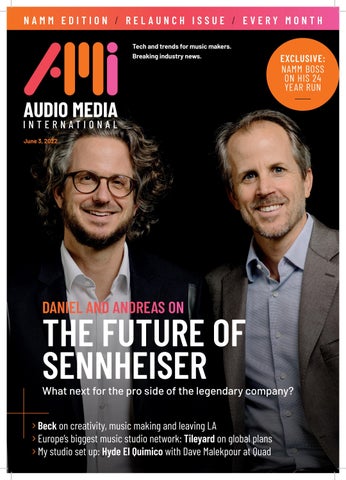
NAMM EDITION / RELAUNCH ISSUE / EVERY MONTH Tech and trends for music makers. Breaking industry news.
EXCLUSIVE: NAMM BOSS ON HIS 24 YEAR RUN
June 3, 2022
THE FUTURE OF SENNHEISER
What next for the pro side of the legendary company? Beck on creativity, music making and leaving LA Europe’s biggest music studio network: Tileyard on global plans My studio set up: Hyde El Quimico with Dave Malekpour at Quad
OC16
Making Passion Heard _
THE ALL NEW
In Vienna. Again.
LARGE-DIAPHRAGM CONDENSER MICROPHONE DESIGNED AND ENGINEERED IN VIENNA
40 Hz / 160 Hz High Pass Filter Equipped with the CKR6 Capsule Handmade in Vienna
Open-AcousticsTechnology Max. SPL: 148 dB SPL Flat Design & Low Weight
AUDIO EXCELLENCE ON A BUDGET.
Further information: https://austrian.audio
24
14
26 4 EDITOR’S LETTER We’re back in print - let us explain how and why...
Contributor spotlight
6 NEWS Joe Lamond on tradition and transformation at NAMM
11 AN AUDIENCE WITH... BECK We meet Beck in Austin ahead of his live return
14 STUDIO PROFILE
ANDY PRICE Bylines for Guitar, NME and Uncut plus Audio Media International. He talks Tileyard on p14.
Nick Keynes on Tileyard North, TYX and global plans
18 STUDIO 101 Fiona Cruickshank on Air, Abbey Road and her first track
20 STUDIO PROFILE: ROCKFIELD STUDIOS Following the new film, we look at the past and future
MARK SPARROW The Forbes audiophile catches up with Sennheiser to discover what’s next for all things pro audio.
24 MY STUDIO SETUP Hyde El Quimico talks Augspurger Monitors with Dave Malekpour
26 COVER STORY An interview with Daniel and Andreas Sennheiser
33 CONVENTION DIARY
TIM HALLAS Teacher, engineer and musician. Tim looks at the history of Rockfield Studios on p20.
Where next after NAMM? Let us guide you audiomediainternational.com
3
@AUDIOMEDIAINT
The return of Audio Media International W
elcome back. It’s been a while! It’s been a couple of years since we were in print, to be precise. We’ve spent the last two years making sure Audio Media International works for our 50,000 strong industry audience across site, social and newsletter. We’ve also worked extensively with partners and newcomers to the studio, live and install industry to make sure we’re meeting the needs of the industry and we’d like to thank all of our supporters over the last couple of years from Martin Audio to Neumann, L-Acoustics to Genelec, JZ Mics to PMC. When we took ownership of Audio Media International at the start of the pandemic, we assumed our print edition would come back much sooner but finally we’re ready for NAMM and you’ve told us how useful the site has been during this period. Our figures show us that too and our US online audience now represents a record 38% of our traffic. In this issue we speak to NAMM boss Joe Lamond, Beck and Sennheiser to give you some insight into the mix of features and interviews we’ll have each month. As ever, the aim is to give you news online and features that matter in print alongside a helpful review of everything in our Friday newsletter. If you haven’t signed up for the newsletter, now is the time... We hope you like the issue and join us for the next one. Enjoy the show!
“ We’d like to thank all of our supporters over the last couple of years”
Richard Melville, CEO richard@audiomediainternational.com
This issue is also online: audiomediainternational.com/magazine
GOT A STORY FOR US? news@audiomediainternational.com
WANT TO BE IN THE NEXT ISSUE? rosie@audiomediainternational.com
AMI HQ Audio Media International Unit 23, Tileyard Studios, Tileyard Road, Kings Cross London N7 9AH, UK All contents © 2022 Audio Media International Ltd or published under license. All rights resrved. No part of this publication may be used, stored, reproduced or published in print, online or via social media without permission of the publisher. All information correct at time of press. AMI cannot accept responsibility for errors or inaccuracies in the infomation provided.
Please recycle your copy of Audio Media International
4
audiomediainternational.com
handcraf ted pre mi um –l ev el m icroph o nes w ww.jzm ic.com
With 24 years at NAMM, Joe Lamond knows what makes the industry tick...
EXCLUSIVE: Joe Lamond on what to expect at NAMM 2022 Ahead of his standing down as President and CEO of NAMM, we speak to Joe Lamond about his twenty year-stint as head honcho of one of the industry’s most important associations, and learn how the upcoming June show has ended up being one of NAMM’s most pivotal. In announcing his departure from the role of President and CEO of NAMM in the summer
6
audiomediainternational.com
of last year, Joe Lamond – the man who has overseen NAMM’s collective endeavours for the last twenty years – marked the end of an era of staggering global growth and unprecedented importance, not to mention the annual trade shows cementing themselves as cornerstones for the music making industry. Since taking the role back in 2001, Joe has witnessed the exponential boom of software-based companies taking even more
of the limelight from traditional instrument manufacturers, as well as the rise of the internet, a boom in digital B2B relationships and, most recently, a global pandemic. Navigating these industry-reshaping shifts and jolts has been keeping Lamond busy over the past few decades, and now, as NAMM 2022 prepares for its grand opening on June 3rd, Joe is looking forward to bringing his presidency to a climax with the deft merging
NEWS
For all the latest tech, trends and breaking industry news visit:
audiomediainternational.com
of the summer event with the Anaheim-based winter staple, though he has next year’s NAMM to oversee, too. We spoke to Joe to find out more about his life at the helm of NAMM, and to understand what aspects of running the show have provided him with the most joy, and where the winds of change will sail him next… AMI: So, firstly, we should talk about the fact that you’re stepping down from the role that you’ve been doing for 20 + years, what prompted this change? Joe Lamond: I think in a sense we’re all artists, and artists drive our society. They push us, make us uncomfortable make us feel all those wonderful things with their art and their music, so I think at heart I was still a little bit of an artist. I thought ‘what’s next’. I’ve had a wonderful, wonderful time, we accomplished a lot together. But, I need to be uncomfortable. I need to be pushed and always be out there on the edge. That was really one of the drivers. There was really nothing wrong at all. I think we want to keep pushing ourselves. AMI: The NAMM show is obviously back this year, for the first in-person NAMM since 2020. What can attendees expect, and has it been more challenging than usual to organise the upcoming show? JL: We use that phrase ‘transformation and tradition’, because so much has changed. Nobody is going to arrive at NAMM 2022 the same as they were in 2020. We’ve all changed. We’ve all been impacted by this pandemic and many of us have lost loved ones. Our industry tribute to the people we’ve lost during this time is 280 people long. We’ve all been changed by this, so that’s the transformative part. Companies have changed and had to adapt. Also, there’s a tradition to this. We are in a sense still dealing with the fact that people love to come together around music, whether it’s concerts or theatre, or education – we’re rooted in tradition. If you’re arriving at the show this year you’re going to be thinking ‘which foot am I leading with? The transformative foot or the traditional foot’. I think there’s going to be this interesting
experience when we get there of wanting to feel nostalgic and getting back to that place we were which was wonderful, but at the same time it’s different. Kind of like Frodo going back to The Shire in The Lord of the Rings. You’re not the same person any more, you’ve changed, and we have. People will recognise a lot of it, there’s a lot you will find familiar, but at the same time the exhibits will be different. So, those two words – transformation and tradition – best describe what to expect. You’ll find a home that you remember. But, it won’t be the same, because you’re not the same.
changed and how disruptive things are right now. The people who are there are going to be the ones looking for those clues as to how the industry’s future will go. It’s an interesting one, there’ll be a lot of curious people, looking to see if they can predict the future of the industry.
AMI: Do you think the switch to hosting the show in June – and the merging of Summer and Winter NAMMs – will change anything about the show’s ethos this year?
JL: Number one was helping our membership through it, and number two was helping our membership through it. Probably number three, four and five too. That was everything from funding studies to figure out how soon music classes could come back safely. Literally funding aerosol studies about wind instruments and how to set up a band room post-COVID. Lobbying the government for relief for the parts of the industry that had to shut down, particularly the touring and live sectors. Helping other governments around the world understand the value of this sector to the economy, and help support them. Though we’ve got a lot of multi-nationals, a lot of our members are small businesses, manufacturers and retailers. They were looking for guidance on the latest regulations on opening safely and how to resume safely. Tens of millions of dollars were put into the education system to help schools and a lot of that went to the arts. Every industry needs a voice, and that’s the role we found during the pandemic. That’s what was most needed since we weren’t doing the physical gatherings. On the other hand, we had to survive ourselves. Sometimes, there were sleepless nights with no revenue. Luckily, we’d built up some reserves over the years which allowed us to keep all our team paid and employed, and able to work diligently on behalf of the industry. So, that was how I spent most of my time – helping our members and helping our organisation get through this.
JL: The cycle of our show being in January traditionally meant that it was aligned with a
“There’s a lot you will find familiar, but at the same time the exhibits will be different”
time of renewal, coming out of the Christmas holidays and looking ahead to a new year. This show belongs in January and it will return there. We’ve got one more off-cycle show in April, and we’re smaller – we’re probably half the size that you remember. As organisers, I kind of think that’s a challenge sometimes. We’ve made it all fit and we’ll make it flow well. But, as organisers we like big. Then again attendees were saying that it was maybe getting a little too big for a while. There’s going to be a big difference regarding the fact that it’s a different time of year, and the show is smaller. Some companies are demonstrating some amazing innovations, while others are just barely keeping up with supply chain issues and other macro economic issues. It’s a disruptive time. I think the show will illustrate how the show has
AMI: Navigating NAMM’s trajectory out of COVID must have been tough, what have been some of the key priorities for NAMM beyond the show’s organisation over the last couple of years?
AMI: The virtual ‘Believe in Music’ week was a fantastic way around not having a real show,
audiomediainternational.com
7
Joe Lamond joins Steve Wonder at the TEC Awards
yet still keeping NAMM a critical fixture. How different was that to organise? JL: It was weird to go back to your own bed every night instead of a hotel! It was really fun and we learned a lot. Some of which we’ve applied to this show. With NAMM Show+ you’ll be able to access the first true digital version of our show. I think one of the thing we learned was how many countries there are around the world that couldn’t attend the physical show, but wanted to. I think out of the 195 countries in the world we had 180 that attended and participated in Believe in Music. For those who are physically there, this app will be a great tool to help you be more organised and network more easily. You can watch a session while running to another meeting. The NAMM Show + app will not just make the show more effective, but for those who can’t come at all, there’ll be multiple streaming events from the show, from the education sessions or the entertainment. This is our first time welcoming so many people from around the world into the NAMM experience via NAMM Show+. We took what we learned and it’s now going to forever be part of our physical gatherings. For us, how to make those that are there virtually have some semblance of the same
8
audiomediainternational.com
“With NAMM Show+ you’ll be able to access the first true digital version of our show” experience as those that are there physically is the toughest challenge. Because it won’t be the same. Trying to emulate the physical experience virtually is difficult. It’s almost like trying to describe a sunset to someone versus just watching it. That’s the challenge for anyone in this space now, approximating an experience. They simply aren’t the same. AMI: Can you remember your very first NAMM, what year was that? And what products were making a splash back then? JL: I was 22 years old, it was January 1983. I was working for a small music store in Sacramento. As a little holiday present they sent me and the other store manager to the NAMM show. We were young and had never been before. It was amazing. It was probably a fraction of the size it is now, but it was still so overwhelming. We felt so inadequate and like we didn’t belong there. I had an absolute blast
but I never forgot that feeling of ‘this thing is so big, and I’m just from a small store’. I’ve always tried to think about attendees at the NAMM show in that way. Every year there’s someone just like I was, coming to the show for the first time. My goal has always been to make that person feel as welcome as a long lost friend. That had been the vision that we created with the NAMM show, to make it your place. It’s your clubhouse. It’s where you come to see all your friends and do you business. Over the years it’s always a difficult task, especially as it got bigger, but that was still always the goal. So whether it’s their fiftieth show or their first, they feel like they’re at home. Our team has done a wonderful job at that. AMI: Can you remember some of the products that you first saw at NAMMs over the years, that made you think ‘wow, that’s going to be a game-changer!’ JL: I mean there’s been so many breakthroughs. When MIDI was introduced springs to mind. Oddly enough one of the first meetings around MIDI was at my first show in 1983. Needless to say I wasn’t involved in it, but that’s when that started. I remember the breakthrough in mixing consoles that enhanced
NEWS
For all the latest tech, trends and breaking industry news visit:
audiomediainternational.com
sound quality, ADAT was huge. I remember people saying to me ‘let me get this straight, there are an * endless* number of tracks?” Back in the day of course, some of the best music ever recorded was done via bouncing back and forth between 8 tracks of tape, but when those limitations were lifted that was a really big deal. Those types of things were mind-blowing technology breakthroughs. It’s interesting at the same time as all this was happening we celebrated a Les Paul and a Strat, or my instrument the drums. There were refinements but they were fundamentally unchanged as the years went on. So that transformation and tradition concept has perhaps always been a part of our show. AMI: There seems to be a pattern of longterm leadership of the NAMM Presidency – with both William Gard and Larry Linkin taking the role for considerable stretches. Is it a role that’s hard to let go of, and what aspects will you miss? JL: Yeah, you’ve got to go back to 1947 when Bill Gard started. Then Larry Linkin is the only living former CEO of NAMM. He’s the only one I get to talk to and commiserate with. Prior to my role (and I was already working here, I just moved offices down the hall when I came in in 2001), the last time NAMM put together a search committee was 1981. I said recently that if practice makes perfect we’re going to do very poorly at this because we don’t do this very often! I think steady leadership has been one of the hallmarks of NAMM, and I think that’s led to long term success for NAMM. But it’s also critical to know when it’s time for new leadership. As much as I was also looking to be challenged and move on, I also knew that the world was changing enough for someone with a different vision and a different perspective to take the reins. I remember the show from 1983 to my last one in 2020 – that’s a lot of pattern recognition. I thought it’d make sense for someone to look at it completely differently. Our industry is changing too so the gathering will be changing. I felt that it was responsible to start the process at the 2020 show. Whoever takes the role will be better
equipped to plan NAMM’s future, they’ll probably make less mistakes than I made, they’ll obviously be better looking because that’s a low bar! But change is good, and it’s accelerating very fast right now. I mean we don’t do this very often, there’s only been three CEOs since World War II. To quote Peter Drucker, the aim of a nonprofit like NAMM is a changed human being. So, your methodology is different and your planning is different. By definition those things take longer. It can take years to find the right projects to invest in, let alone undertake them and publish and peer review them, and use them. That’s a good five/six year run. The profit world is more focused on the next quarter’s financials. Associations have a longer timeline to get things done – that doesn’t meant they’re less efficient but it’s down to the fact that they do different things. If we lobby the US congress for a law change, that can affect 50 million school kids this fall. No one company in the industry can have that sort of impact, but collectively as an organisation, an association can. We can literally impact the education of school kids, with a change of language that we lobbied for. AMI: Do you think that NAMM and Anaheim are now interconnected, and what’s the reason that the Anaheim Convention Center has cemented itself as NAMM’s home for so long?
“The aim of a nonprofit like NAMM is a changed human being”
JL: I think it’s the right place for our members. Most of us are regular working people. There’s something about that community in Southern California which is comfortable. Our families feel comfortable coming here. We do have a very family feel to this organisation. The tradition part is important too. NAMM’s 121 years old now, but Anaheim has become synonymous with us as a group of loyal working people that bring the tools to music to the world. It’s a nice place to be, the facility has grown with us over time. They’ve always been accommodating and literally built new halls as we grew too. In 1983 when I came this thing was two little halls. That’s how big NAMM was then. Even though we’re half the size we were in 2020 we’re still taking up the whole convention center. AMI: Finally, when you think back on your twenty year+ stint as the head of NAMM, what have been the biggest thrills and the biggest learns for you – and where do you think you’ll head next? JL: It’ll be 21 years this month as CEO, though I’ve been with NAMM for 24. I’ll be here one more year. It will always come down to the people that we’ve been able to work with. Visiting NAMM members around the world, visiting their factories, their stores and having dinner in their homes. It’s always going to be about the people. These are very special people, most of them are trying to create a more musical world, and that’s the why of what they do. The fact that we’ve been able to work with these wonderful people for a lifetime has been fantastic. There’s been such camaraderie. I’ve got a million stories of meeting wonderful people, and that’s what I’ll never ever forget. Yes there’s the shows and there’s the logistics and trucks and budgets. If you ask ten members of NAMM what we should do you’ll get eleven different opinions back. But some moments will never be repeated. My role allowed me to meet some absolute heroes. I was just lucky enough to be there and absorb those moments and appreciate them. For a little kid from Buffalo, New York that was an exciting ride.
audiomediainternational.com
9
PRI SM SOUND’ S NEW FL AGSHIP CONVERTER O FFERI NG 8 TO 12 8 CHANNELS OF HIGH QUALITY ANALOGUE I/O UP TO 384KHZ
Shippi
n
SUMMg in ER 2022 Preor now b ders ein taken g
THE PERFECT SOLUTION FOR DOLBY ATMOS, PRO-TOOLS, ARCHIVING AND MULTI-ROOM APPLICATIONS QCLOCKS - FOUR CLOCK DOMAINS WITH INTEGRATED ROUTING ALLOWING ONE TO FOUR STUDIOS TO BE RUN FROM A SINGLE UNIT TOTAL CONTROL VIA FRONTPANEL TOUCH SCREEN, IPAD OR DESKTOP REMOTE APPLICATION COMPLETELY MODULAR ARCHITECTURE SUPPORTING MULTIPLE DIGITAL FORMATS INCLUDING PRO-TOOLS, DANTE, AES…
JOIN THE ULTIMATE COLLECTION Contact us to hear why the world’s best choose the world’s best
DREAM ADA-128 SALES@PRISMSOUND.COM
WWW.PRISMSOUND.COM
COME AND SEE PRISM SOUND AT THE SHOW! VISIT US AT BOOTH #16114 AND FIND OUT ALL ABOUT THE ADA-128 - OUR NEW FLAGSHIP UNIT
HEAR WHY THE WORLD’S BEST CHOOSE THE WORLD’S BEST
A complete production suite. The Ultimate Collection.
JOIN THE ULTIMATE COLLECTION
NOW SHIPPING! If you are creating music, movie soundtracks, mastering, producing radio productions, the ultimate solution has arrived. HEAR WHY THE WORLD’S
Audio equipment available as The Ultimate Collection
LYRA 1
BEST CHOOSE THE WORLD’S BEST
DREAM ADA-128 Prism Sound hardware, SADiE and Tracktion software deliver the most powerful tools for end-to-end production.
LYRA 2
TITAN
Don’t compromise, Go Ultimate.
NOW SHIPPING! NOW SHIPPING!
Contact us to hear why the world’s best choose the world’s best
Image shows The Ultimate Collection Lyra 2
SALES@PRISMSOUND.COM
WWW.PRISMSOUND.COM
HEAR WHY THE WORLD’S BEST CHOOSE THE WORLD’S BEST ADA128AMFULLPAGEAD-v2.indd 1
24/05/2022 16:06
ARTIST INTERVIEW
AN AUDIENCE WITH...
BECK. Audio Media International was lucky enough to sit down with Beck at a SXSW Keynote session as he returned to Austin to kick off his acoustic shows. On being back in Austin to play an acoustic set at ACL Live I remember Johnny Cash playing Emos ahead of me in 1994 in Austin, my first tour – I didn’t really know what I was doing. I think my mic stand fell and hit someone. They had a huge welt on their head, I gave them a hug and they cried. I remember at one point looking up and the whole audience had left. On creativity and freedom in the pandemic... I didn’t do anything in Covid, for me it was so abrupt. I remember sitting in my living room, nothing going on – it felt like being at the airport when the flight is cancelled. It was a windfall of time I had dreamed of but I didn’t do anything, just loafed. I couldn’t sink into anything creative. I went to the beach and floated in the pool.
The absence of touring and playing made me realise how much live music is a part of my life. I went to more shows than ever before last summer. I did a record with Pharrell and I had been wanting to work with the Neptunes over 20 years ago. The first day I worked with him, he said ‘sit down, I’ve got something’. And I said I want to make something happy. And he plays Happy! I showed up about three days too late – it could have been my song. We got together in 2018 and finished the project which was Hyperspace. When you talk to U2 or Paul McCartney, they always want to write their next big record. I saw the Strokes recently and the whole crowd knows every word. The lyrics in my songs are too weird to people to sing along to. I see things that I want to fix and that is what drives me to the next album.
On his childhood and education around poetry and songwriting... I grew up in a forgotten part of LA, I felt like it was an invisible culture, not the LA you see in the movies. Kind of a mix of culture really. It was kind of a notorious area with gangs. It was pretty hardcore. It was one of the most violent places in the US when I was a teenager. I remember playing with people who had bandages on because they were shot the night before. A pretty impoverished place. There was a used furniture place that would also do your taxes and rent video tapes. I spent the time mostly ditching high school and spent time at the Central Library in LA. There were so many books, many of them hadn’t been pulled off the shelf. I could get lost in there, kind of like
Beck: “people used to call me farm boy”
audiomediainternational.com
11
ARTIST INTERVIEW
BECK. an analogue internet. My family were on hard times, I didn’t have a room – I was sleeping under a dining table. The library burned down in 1986 and I cried – 400,000 books gone. It demonstrated to me how ephemeral all of this is. All these things we’re making are ephemeral. It gave me this idea that if you write a good song, in time, people aren’t going to know you wrote it. Most people might not know the difference between composers even if they were born hundreds of years apart. It will be the same with rock music. On leaving LA... I saw a TV commercial for Greyhound – anywhere in the US for $30! It was a great deal. They pulled out a map and asked me where I wanted to go. I took a 3 day bus ride with no sleep. I arrived in New York, east village and started playing at folk events. Daniel Johnston was there around the same time. New York was still a little bit rough. I was completely unprepared, I had been doing music for years but nobody would give me a gig. Everyone was shocked when Loser came out, myself included. The song got on the radio, it was number 1, I had no manager, no label. Then limos started turning up but I didn’t expect it to last. The record label people who passed on Loser and wanted to shape things, I realised they don’t know what they were talking about so it gave me an idea to experiment. I played a bowling alley and created a system where the instruments could kind of play themselves and left while the music was still playing to the record execs. I called the alley and my voice came over the speakers and then the gig stopped. I still got signed! Over the grunge or alternative period, I used to write deep songs that sounded like Leonard Cohen, people at that time called me farm boy. The humour of my work is important – I look at the Beatles documentary and they’re all clowning around. On Odelay reception... A producer came to me and had heard Odelay before it was released. He told me
it was going to be a failure and needed to be reworked and I spent a lot of money on it. Loser was a big hit, but there was one hit wonder talk around me and I kind of believed it too. I was shocked that Odelay found an audience. It got great reviews. I think when you’re young you have a strong instinct with these things. I remember there were a lot of things that were being reinvented – you’d turn on the TV and Bjork was pop star! On lyrics and poetry... As a teenager I read a poetry magazine and befriended a poetry teacher and they kind of took me under their wing and said who’s this weird kid? Around rap at the time, a lot of stuff was happening with poetic lyrics. I thought a lot of lyric writing was cliched but I also thought it was great
“I created a system where the instruments could play themselves and left while the music was still playing...” that you can put art into lyrics. It was a revelation that you could put art in songs. I thought if I snuck stuff in, most people wouldn’t notice it but some would. By the way, if you go on Google, all my lyrics are wrong – no wonder people think my lyrics are weird. There’s a beauty in mishearing lyrics like “excuse me while I kiss this guy”. I’m doing a Joni Mitchell tribute in a couple of weeks – her writing is so advanced, there’s a compression of language and imagery in it. You’re not directly saying I miss you, but the lyrics are creating that feeling and giving you that atmosphere. The weird lyrics of Loser gives you a feeling that puts you in a mental space, I learned that from poets really. It gives you a sense of wild energy, being alienated in this world that adults have constructed. You can get esoteric with songwriting but you can be like Hank Williams or a
hymn – some of the best songs can be simple and I’ve tried that – songs like ‘I can’t help falling in love with you’, that’s the highest level, almost impossible to write. Like being incredibly heartfelt but not, really and not making it a cliche – it’s a delicate line to find. I struggled starting out in that I loved Guthrie and the Beatles, Chip Trick – how do you reconcile these things. Music was very divided when I was growing up and post streaming, everything is mixed together, almost beyond genre. Just iterations – they’re all different ways of saying the same things. It’s a wild world of possibility. On making albums, singles and streaming... Because I was doing folk and rap type stuff, it made people distrustful. I was probably more influenced by filmmakers rather than musicians. I look at albums like a filmmaker – this one is going to take place in the 70s or in England, every album is like a different world. I like the concept of an album because of the way songs speak to each other, context is everything. An album is always greater than the individual parts and it is going away – I know that – but the album is a great place to play and explore. I was isolated when I was younger, so the folk singer profile was ideal. I didn’t have money for machines or synths so I couldn’t be like Moby or Aphex Twin. I feel like acoustic performances are like going to the bones of the song. It’s a reduction, a purity – I like the possibilities. I toured Sea Change and it’s wild what you can break and go with it when it’s just you and the audience. Playing solo is a bit indulgent I think. I think there’s certain artists that put something out and fix or tweak it once it’s on streaming services, I think it’s a good idea. I’ve been re-recording some of my songs, Loser etc – it’s an interesting concept to go back. Taylor Swift did it and Sinatra too, Elvis also I think. All the songs you play over the years evolve and change while live of course. Like Bob Dylan.
audiomediainternational.com
13
STUDIO PROFILE
NICK KEYNES ON
TILEYARD NORTH, TYX AND BEYOND BY ANDY PRICE
F
rom its humble beginnings as a small private workspace in 2011, Tileyard London has become Europe’s largest musicfocused workplace community. On the eve of the opening of Wakefield’s Tileyard North, co-founder Nick Keynes speaks to us about the past, present and future of Tileyard’s talent curation philosophy, and reveals to us how a new membershipbased model will ultimately provide professionals with pro studio access around the world. If you take a stroll around Kings Cross these days, you’ll notice an omnipresent array of cranes laddering across the skyline, the rattle of drills and more than a few high-vis jacket-clad workmen
From Mark Ronson to Lady Gaga to the latest grime acts, Tileyard attracts a wide mix of music makers.
14
audiomediainternational.com
scurrying the streets, as London’s formerly dilapidated station hub continues to be restructured into one of the capital’s most attractively modern work and social destinations. Over a decade ago, Kings Cross was in a quite different state. Nick Keynes, the former bass player of 90s boyband Ultra, was on the lookout for somewhere to house the small music production business that he’d formed with fellow members Michael Harwood and Jon O’Mahoney. With the guidance of property developer Paul Kempe, Nick and co set up shop within a neglected industrial estate at the then still fairly grim auspices of Kings Cross. This punt would eventually lead Nick and Paul to begin re-working the site into Europe’s largest music-focused creative workspace – Tileyard London. 11 years on, and Tileyard London is a booming studio and workspace provider for artists, labels, writers, publishers and managers including Apple Music 1, The Prodigy, SoundCloud, Spitfire Audio and Audio Media International. With over 85 bespoke studios within its warren of corridors. Tileyard now also warmly welcomes in businesses that work in the creative sector more broadly. More than just providing a comfortable and professional working environment, Tileyard’s ethos is centred on cultivating a spirit of community. After a decade of growth and success, this successful Tileyard model is set to be replicated
STUDIO PROFILE
“What Tileyard fundamentally is all about is talent incubation – we want to create an environment where talent can thrive”
audiomediainternational.com
15
Tileyard North links two music hubs of the UK - the scale is staggering.
STUDIO PROFILE
Gearbox Records allows direct to vinyl recording
in Yorkshire, at Wakefield’s Rutland Mills. Nick Keynes sat down with us for a conversation about the impending opening of this 135,000 square foot second site, as well as Tileyard’s intriguing new TYX membership plan and a more global future… AMI: Hi Nick, let’s start with the biggest news at the moment, which is the imminent phased opening of Tileyard North up in Wakefield. Firstly, what spurred the team to open a new site up in the North of England? Nick Keynes: For many years we’ve been thinking about how to expand. The world’s a big place, and the country’s a big place. What Tileyard fundamentally is all about is talent incubation – we want to create an environment where talent can thrive. For many years we’ve felt that it’s all very well having a London hub but we wanted to help talent around the country. So, we’ve ended up pinning the tail on the donkey in Wakefield. AMI: Do you see this new Northern site as the start of a larger expansion of Tileyard, and what are your thoughts on potential overseas development, and launching Tileyard as a global brand? NK: Yeah, that has been on our mind. Pre-pandemic we spent quite a bit of time visiting various different countries and locations. There’s quite a few people overseas that had come to Tileyard to work and collaborate, who subsequently invited us to look at some locations. So we scoped out Los Angeles,
16
audiomediainternational.com
New York, Texas, Singapore and Stockholm. So, we’re thinking about some significant expansion. We’re music-focused primarily of course, so we want to target those more music-oriented cities. We’ve looked at Berlin as well. Anywhere really where there’s creative talent. AMI: Tileyard Education will see significant focus with the opening of the North site, can you give us a little background on when the Education side launched, and do you see a through line between studying there and finding yourself in full time employment within a Tileyard ecosystem? NK: Education is a really big part of it. When we first set up at the Tileyard London site we actually ran a few small workshops aimed at artists and young managers. Fundamentally it was about a fast-track way to get into the business of music. Then we parked that for two or three years when we started really building Tileyard, and then wanted to reinvigorate it. We launched Tileyard Education. It’s a post-grad space aimed specifically at qualifications
STUDIO PROFILE
in music. Production, writing, business, marketing – these areas. It’s a really important entry point into the industry, and people can spend time within an ecosystem where they can see people working professionally, and learn from their experience. AMI: Switching back to the original Kings Cross site now, can you give us a bit of a brief rundown on how the last year or so has been for Tileyard London? What have been the most notable additions to the site? NK: Well it’s been a funny old three years. There’s been a lot of workplace providers that have had a horrific time during the pandemic. We’ve been very
“People come to Tileyard for more than just the space... We’re now actually at a state where we’re 100% occupied”
fortuitous in that the curation of the community that we’ve undertaken has meant that people come to Tileyard for more than just the space. We didn’t lose very many people at all. We’re now actually at a state where we’re 100% occupied. So that’s a fantastic place to be. We’ve actually expanded our site over the last two or three years. We’ve welcomed a few more businesses. SoundCloud has recently joined us. I’ve spent five years trying to persuade them to situate themselves here, and they finally decided that the time was right. AMI: Can you explain to us a little about the concept of TYX, the new membership-based studio access? It sounds like a truly innovative, exciting concept. NK: Absolutely. Ever since we started, our model was to build spaces for clients. So they can make it their space. Rather than running our studios commercially. Increasingly, as Tileyard has grown, we’ve noted that more and more people just need a studio for a day or to complete a project. Or they want to run short camps. We didn’t really have an offering for those needs. For the last three or four years we’ve been working on a way to expand into a studios-for-hire type model. But what we didn’t want to do was to do it in a sort of old-school way. We wanted to create a model that was automated but was flexible. Something that was multi-faceted in terms of the type of spaces available. We created the model of Tileyard X (TYX) which is basically a membership offering. It’s a sub-brand of Tileyard effectively. The core values of the business are the
same as Tileyard’s. We still want to curate those spaces, but it’s very much a case of rather than taking a permanent space, you take a membership where you build credits. We’ve got Dolby Atmos mix studios (recently established by Platoon) , we’ve got a range of world-class production studios which double up as listening studios, we’ve got great mix studios. There’s also a lot of simple plug-in-and go studios, designed for users who want to bring a project in where they can literally just plug-in via Thunderbolt, with no set-up required at all. We’re building an influencer production studio, a photographic studio as well as straight meeting rooms and desk space. So TYX is almost like ‘Tileyard in a box’ if you like. It’s everything that we do and we’ve wrapped it into a packaged membership offering. In the future, I’d like for anyone that has a need for a content space, anywhere in the world will be able to use their nearest Tileyard. The idea does seem to have gone down very well so far. I think we are providing something that solves a problem for many people. AMI: How important is the concept of community to the Tileyard ethos? And is that something that you think will play an increasing role in the future in many professional spheres – blurring those distinct work/ life mindsets? NK: It’s the root of our business. While we own the real estate and have 180 tenants, that’s not really our business model. Our focus is on building a community. And, it’s the curation of who we bring in that creates the community. If someone wants to take up space at Tileyard the most pressing concerns for us are ‘who are you?’, ‘what do you do?’ and ‘what will you bring to our community?’ That’s far more important than the rent that you’re paying. We want to know what value our tenants can bring beyond paying for the space. That has been our mindset and business model from day one, back when we had lots of empty space and we were looking to fill it. We were super selective on who we brought in, and quite brave. Particularly from Paul’s perspective. We held out, and I think that’s why now we’ve got a really meaningful community.
audiomediainternational.com
17
STUDIO 101
STUDIO Audio Media International spoke with the Music Producers Guild (MPG) to highlight the great work that producers are doing and how they’ve coped with the challenges of the last year. Here we catch up with Fiona Cruickshank, freelance engineer and producer. Based in London, Cruickshank worked in-house at AIR Studios for 11 years before joining AIR Management in 2018 and is now freelance, working across a range of major studios. As well as engineering and mixing, Cruickshank also works in classical and score editing, having worked on many high-profile projects including everything from The Grand Budapest Hotel to the Bowie biopic Stardust. Audio Media International sat down for a chat with Cruickshank to find out more… How has the pandemic changed the way you work over the last year and will any of those changes remain? The biggest thing is that we couldn’t all be in the same room. So I’ve been doing a lot of mixing in my own studio, and then doing review sessions on Audiomovers and Zoom. When it comes to recording, there were a lot fewer people allowed in the studios,
18
audiomediainternational.com
client-wise as well, so quite often that’s done remotely. And I think that’s something that might carry on, especially for American clients who might think that they don’t necessarily need to spend money to travel over if they can listen remotely in good quality and still give their feedback. The other big difference was the layout for musicians. We had them set them up two and a half metres apart, so that’s been a big change in how we set up mics and how we record things. I think that will go back to traditional seating – I kind of miss the lovely blend of having them all sitting closer together. What’s the most challenging aspect of your job? The remote comms. I’m having to think about all of that stuff when, really, I want to think about the creative part.
Last year the ‘client interfacing’ was also challenging. Because I do a lot of film work, the composer and the director or producer would usually be there and it’s all about helping the composer to keep their vision, but also making sure that the director is getting what they want. Usually, I think it’s about translating what a producer wants to the musicians, especially if the composer is someone that doesn’t read a score, but does everything by ear. They know exactly what they want, but they don’t necessarily know how to communicate it. So it’s my job to get that across in the right way. What bit of studio kit can you not live without? Mixing-wise, I could not live without my UAD plugins. I think they sound incredible and they do a lot of models of the kind of analogue gear that I learnt on at AIR.
STUDIO 101
“The good thing that Abbey Road is trying to do is showcase female engineers that are out there”
What are you working on at the moment? I’m working on a TV show with Keaton Henson. We just worked on a film called Supernova which was recently released. Also, I worked on an album with Dot Allison. What project from your career so far did you enjoy the most? It’s really hard to pick one, but one of my most memorable was when I assisted with Dario Marianelli. He’s one of my favourite film composers and getting to work with your heroes is obviously amazing. Also working with Keaton [Henson] has been great and Mary Poppins Returns was also a highlight. Which artists or producers are you listening to at the moment? I’ve been kind of obsessed by The Staves’ record. And, I’ve also just started listening to the latest two from Taylor Swift – I can’t believe I haven’t listened to that yet. I’ve also been listening to quite a lot of Americana-type stuff recently. In terms of recording and production, what’s the album you turn to as your gold standard as a reference? One of my absolute favourites is Beck, especially Sea Change. It’s one of my favourite albums ever and I think it just sounds absolutely incredible. It still sounds like you’re in the room with the musicians, but it’s also really produced somehow. The quality of the recording and the mix is amazing, and that’s something I strive for. How to you feel about live streams vs gigs – will they always be around? I think there’s definitely a benefit to both. There will never be anything like being in a crowd of people watching your favourite music but live streamed gigs can make certain stuff more accessible, especially for people who suffer with stage fright. And similarly I think it’s probably helped to make things like classical music more accessible to people without them having
to pay a lot of money. So hopefully some of that will continue in future. Where was the first place you first made a track and how? It was probably a combination of my living room and my old piano teacher’s studio. My piano teacher when I was a kid had his garage converted into a studio and it had amazing Moog synths, a piano Hammond and a desk and other stuff. For my first track, I think I would have been using Digital Performer or Cubase. That was my own composition, which I hope will never see the light of day! It was very Didoesque. I think it was then that I realised I should definitely be on the other side of the glass… How did the Tonmeister course at the University of Surrey prepare you for what you do now? They have this incredible placement year where you go in and work in the industry so I did my placement at AIR for a year. Obviously it’s a lot easier to get a job after having the chance to make such amazing contacts. A lot of the courses out there now are spitting out hundreds of graduates, but with no real plan of what happens next. But the Tonmeister course really helps set you on a path.
Why is AIR Studios’ new diversity scholarship so important – will it change things at a grass roots level? It’s really important to break down the barriers. I think for a lot of people, money is a big part of the problem. I know a lot of engineers that got into their jobs because they lived in London or they knew someone in London so they could work for free for a studio, and then work their way up. Like many others, I didn’t have that sort of connection in London and I could never have afforded to work for free. So having a scholarship like this that says if you’ve got the drive and the talent, then money shouldn’t be the thing that holds you back, is really important. And also, maybe studios should stop making people work for free. AIR has always been really good about this – even for school work experience they’ve paid for expenses and travel. Abbey Road still lacks female engineers or a diverse line up – what do you think could help? The good thing that Abbey Road is trying to do is showcase female engineers that are out there. I feel like we all have responsibility to show that we exist, because when I was young and wanting to get into the industry, I can’t remember seeing many pictures of women engineering, or behind a desk. For Abbey Road and AIR to both be showing female engineers that are making a successful career out of it, I think that’s really important. I’m also proud of AIR for trying to get people into it, at the university stage. It’s not that the studios are saying ‘we don’t want to hire girls’, but there just aren’t that many girls applying for jobs. So we have to try and make it easier for people to see that it’s a possible career progression from an earlier age.
Abbey Road Equalise events have showcased female studio talent
audiomediainternational.com
19
STUDIO PROFILE
ROCKFIELD STUDIOS
It’s one of the most legendary studios in the history of rock, and is still going strong today. But the genesis of Rockfield Studios was born out of a homespun base for its founder to try and become the next Elvis says Tim Hallas...
20
audiomediainternational.com
STUDIO PROFILE
I
f you travel along the M4 motorway, away from London, you eventually cross the Severn bridge and enter the Wye valley and the Forest of Dean. It’s an area of astounding natural beauty and the Welsh/English border is worth a visit regardless of why you’re there. But tucked away in this part of the world, just outside the small town of Monmouth, up a small side road, on the site of an old farm is an iconic piece of recording history – Rockfield Studios; the legendary farmhouse studio that has welcomed artists as diverse as Rush, Oasis, Coldplay, Black Sabbath and, most notably, Queen – who laid down the towering Bohemian Rhapsody here. Rockfield Studios started out as a kind of accident. Kingsley Ward and his brother Charles wanted to play in a rock and roll band. It was the late 1950s, Elvis was king – and two young welsh farmers decided that they wanted to be singers and songwriters so bought themselves a guitar for five pounds and wrote a couple of songs. Living in rural Monmouthshire, recording studios were few-and-far between (read: non-existent), but the Ward brothers realised they needed to record their songs if they were to make any progress in the music business. Fortunately, a local man had a tape recorder and was prepared to let the brothers borrow it to record their songs. So, Kingsley borrowed the tape machine and operated the controls while Charles strummed their songs.
WIDENING THE FIELD With their songs recorded the boys realised that they needed to go to London to get any further and play their songs to a record company. In the days before the Internet, it was pretty difficult to pinpoint
The studio still retains a cosy, relaxed feel, away from distractions
addresses, so the lads worked out where they needed to go by looking at the only resource they had: the centre label on one of their records: EMI, Haynes, Middlesex. However, once they arrived, and the security guard had greeted them with, presumably some confusion, and pointed out that they had arrived at the pressing plant, and not the offices or studios. He told the Wards they needed to go to EMI House in Central London and that they might have more luck getting their tapes heard there. Once they finally arrived at EMI House, they were greeted by a receptionist who, admiring their pluck, told them that they needed to see a producer. Kingsley remembers seeing the names of all the producers up on the wall including some names that they recognised including Norrie Paramore, the producer of Cliff Richard & The Shadows, and George Martin; soon to be the producer of a small band from Liverpool. The receptionist booked them an appointment with Mr Martin for the following Tuesday. So Kingsley and Charles had to drive all the way back to Monmouth, and then all the way back to London again a few days later. When the lads finally found themselves in a fancy record company executive office, they were greeted by the affable George Martin with their small two-track tape machine on their lap, and EMI’s shiny tape machine and impressive equipment all around. Martin asked the lads to play them their songs but, not being very technical yet, they didn’t know how to get the tape off the machine. Despite what must have been quite an embarrassing scene as they fumbled with their contraption, George Martin liked what he heard and told the Ward brothers to go away, work on their craft and come back in six months. But the boys never went back… Kingsley and Charles did, however, end up working with another famed producer – Joe Meek. The Ward brothers released a few records with the innovative Joe, but what they really got from him was a knowledge of recording and producing. Because Meek had a selfbuilt studio and the brothers were recording in it, they could see what Joe was doing, and they stored that knowledge for future use. At this time, studios outside of major cities were few-and-far between, and completely non-existent in rural Wales. But rock and roll was popular everywhere, so Kingsley and Charles decided to setup their own recording facility at the farm where they grew up. They acquired a simple tape machine and set it up in the attic of their parents’ house. This was the beginning of what would eventually become Rockfield Studios.
FUTURE PROOF Initially, the boys decided to call their fledgling studio Future Sounds Limited. They only had a basic setup, but they offered a service to local bands to record their songs onto acetate for £5. Even though the equipment was limited, it was easier for many local artists to access than getting to London. From starting out as wannabe rock stars, the Ward brothers had accidentally opened up the first commercial studio, though they didn’t really know it at the time. The quality of their recordings got better-and-better, and they began to acquire some higher quality equipment. An engineer in Swansea, Neil Ross of Rosser Electronics, built them a console and they invested in a Ferrograph tape machine on which to record.
audiomediainternational.com
21
STUDIO PROFILE
In 2000, Rockfield had a focus on analogue gear
The Coach House Studio
Rockfield was the first ever studio to house artists on site overnight
By the mid-60s, Future Sounds were making some exceptional recordings so headed back to EMI in London to present the major label with the last five years worth of recordings. The brothers met with Roy Pip, an A&R representative, who was very impressed with what Kingsley and Charles had achieved. He offered them a contract on the spot to find, develop and record artists around the country for EMI to release. Suddenly the brothers went from a small-time commercial recording facility to being affiliated with one of the biggest record companies in the country and working with major artists. One of the first major artists to come to Future Sounds was Dave Edmunds who suggested that Kingsley and Charles name the studios after the small village down the road – serendipitously called ‘Rockfield’. Rockfield Studios has kept the name ever since.
ROCKFIELD RESIDENTIAL Around 1965 a band from New York, Elephant’s Memory, arrived at Rockfield Studios to do some recording. Elephant’s Memory would go on to become the backing band for John Lennon and Yoko Ono – but in 1965 they were just starting out. The problem was, the band had nowhere to stay and, in 1965, Monmouth had no hotels, so the band had to stay with Kingsley and Charles’s parents. By accident Rockfield had also become the first residential studio where artists all stayed and recorded on site. By this point the studio in the attic of the house was becoming a little outdated and definitely too small, so Rockfield built the next generation
22
audiomediainternational.com
of its studio in the stable block next to the house. This became the Coach House Studio, and this is where it remains to this day. Rockfield also invested in an advanced 8-track tape machine which, in 1967, put them on a par with the biggest studios in London. Within eight years Rockfield had gone from a homespun DIY project to competing with the most famous recording studios in the country. Kingsley was determined to be ahead of the game with technology and ensured that anything the likes of Abbey Road had, Rockfield would have.
PUTTING THE ROCK IN ROCKFIELD Staying ahead of the curve meant that bigger and bigger artists started to use Rockfield Studios. Black Sabbath with a young Ozzy Osbourne booked the studios with Kingsley recording an early demo version of Paranoid but it was in 1970 that Rockfield had its first really big hit. Dave Edmunds (he of the name change) recorded I Hear You Knocking at Rockfield which was a UK number one single for six weeks – and became that year’s Christmas number one. The song did very well elsewhere and was top-ten in several other countries including no. 4 on the US Billboard chart and it went on to eventually sell over three million copies. Suddenly everyone wanted to record out at Rockfield Studios. In 1972 Rockfield added another studio in the main farm courtyard. This allowed two completely separate artists to record and stay at Rockfield simultaneously. Artists who made use of this included Hawkwind, Iggy Pop and, of course, Queen.
STUDIO PROFILE
Queen had recorded their 1974 album Sheer Heart Attack at Rockfield and returned the following year to work on A Night at The Opera. Kingsley recalls hearing Freddie Mercury working on an early version of what would be their magnum opus, Bohemian Rhapsody, on a little piano in the room that is now the studio’s administration office. The 2018 Queen biopic, Bohemian Rhapsody, tells some of this story, and has become part of the folklore of the Rockfield site. It’s now a permanent part of the history of Queen and the story of creation of that magnificent song.
THE 1980S AT ROCKFIELD STUDIOS The 1980s saw Rockfield continue to grow with the acquisition of an additional rehearsal and accommodation premises down the road (now Monnow Valley Studios) and an endless parade of A-list musicians coming to record at the site including Adam & the Ants, Iggy Pop, Robert Plant and The Stone Roses. But by the end of the 80s the company had grown so big Charles and Kingsley decided to split the business. Charles took over running what became Monnow Valley and fitted it out as a high-end studio in its own right, and Kingsley stayed at Rockfield. There was no spectacular falling out – just two brothers wanting to head in their own directions. Around this time Rockfield was refitted with Neve VR consoles. The Neve VR featured flying faders, a powerful routing matrix and a lot of other advanced functionality.
THE PAST IS THE FUTURE
spaces for the Quadrangle are either side of the control room and, again, have a variety of acoustics for different levels of ambience during capture. The Quadrangle comes equipped with a Bösendorfer grand piano and another Hammond Organ. One of the most unique features of Rockfield Studios is its purposebuilt echo chambers. There are three chambers built into sections of the Quadrangle for different reverb times, which, alongside the 4 EMT plate reverbs provide a wide range of reverb sounds. These are patchable from either studio, and add more analogue charm to the recordings captured in Rockfield’s two studios.
THE FUTURE OF ROCKFIELD STUDIOS Rockfield remains one of the most exciting and in-demand studio complexes in the UK. Its unique charm, coupled with exceptionally high-quality specification means it remains hugely popular with a large number of artists. As with a lot of businesses they have broadened their appeal and, under the management of Lisa Ward (Kingsley’s daughter), Rockfield has moved into offering masterclasses for students in the studios with professional engineers. This year it is hosting the 2022 songwriting sessions as part of the Pro7ect Songwriting Retreat. With the Bohemian Rhapsody film in 2018 and a documentary about the 25th anniversary of (What’s The Story) Morning Glory by Oasis featuring Rockfield heavily and, of course, a documentary about Rockfield Studios itself, Interest has been renewed in the studios. Here’s hoping they are still recording amazing music across the next six decades.
Around the year 2000 Rockfield was re-fitted again. At this point Kingsley made the bold move to use entirely vintage equipment. The Quadrangle studios were fitted out with an MCI console that originally came from CBS’s Studio in London in 1976 and the Coach House Studios were fitted out with a Neve 8128 console. To move back to an all-analogue signal path in 2000 was a pretty daring move. Everything else in music production was switching to digital with Pro Tools becoming more widespread, and audio interfaces becoming significantly more affordable for most home musicians. To decide to do exactly the opposite of this might have been bold – but it was one that has paid off. The entirely vintage approach enticed artists that wanted ‘that’ classic sound, and to try to capture some of the ‘warmth’ that, at the time, only vintage gear could give you.
ROCKFIELD STUDIOS IN THE PRESENT DAY Rockfield Studios, as it is now, still retains all the charm, character and history that it has built up over 60+ years of recording. When you arrive, it looks, to all intents and purposes, still quite a lot like a farm. The drive is only partly made, and you pass what appear to be barns and stables. As you approach the site, the first building you see on the right is the Coach House studio. This is still based round its Neve 8128 console but features a wide array of outboard from API, Neve and Rosser Electronics. The live rooms feature several spaces, each with their own individual acoustic for different levels of ‘liveness’ and several isolation booths for amps, vocals or a less lively acoustic. The live room contains a beautiful Yamaha grand piano, a Hammond organ and an array of vintage electric pianos. The Coach House can record either to Pro Tools or to the 24-track Studer tape machine for a completely analogue capture. If you turn left from the drive, you reach the main courtyard, or Quadrangle, which is where the Quadrangle studio is based, along with its accommodation block and the admin building for the site. The Quadrangle studio is still based around the same MCI console fed into either Pro Tools or another Studer 24-track machine. The live
audiomediainternational.com
23
MY STUDIO SETUP
MY STUDIO SETUP Hyde El Quimico talks Augspurger Monitors when mixing his new record at Quad Studios
24
audiomediainternational.com
Since the early 2000s, Puerto Rican producer and mix engineer Hyde El Quimico has played an essential role in crafting the hip-shaking dembo rhythms of reggaeton. Hyde’s credits read like a who’s who of multi-platinum Latin superstars from reggaeton pioneers Daddy Yankee, Wisin Y Yandel to chart-breaking newcomer artists Ozuna and Reik. La Base is the name of his studio, record label and management company he co-founded with his partner Wisin (Grammy award-winning reggaeton artist & producer) to develop and manage artists and producers. When Hyde is mixing a reggaeton record, it’s essential that he hear every nuance in the mix with absolute clarity and feel how the bass hits. Hyde credits Augspurger monitors for allowing him to fit more musical information in the mix and hit high levels of volume without the harsh effects of limiting. As chief engineer at La Base, Hyde uses the Augspurger Duo 12MF-Sub18 to create his signature sound. When it came to Hyde’s latest project – mixing
MY STUDIO SETUP
Left: Dave Malekpour and Hyde El Quimico at Quad Studios, NYC
“There is no small speaker that can give you this level of clarity and power. I can feel the air of the bass when it hits just like a big speaker” Ozuna’s new record at the legendary Quad Studios in Time Square, NYC – he turned to the team at Augspurger to provide the tools he needed. Quad’s Studio Q1 already houses beasty Augspurger Duo 15V main monitors, but Hyde requested to try out the brand’s new MX-65 near-field monitors, fresh from their launch at Summer NAMM 2021. The team at Augspurger set up the MX-65 as a third reference option next to the Duo 15Vs and the Yamaha NS10s already in situ… “There is no small speaker that can give you this level of clarity and power. I can feel the air of the bass when it hits just like a big speaker.” He continued, “Translation-wise, they are the same. I can go back and forth, and my drums feel like they are in the same place. But also, you don’t have to run them up. If you are at low level, they sound like true near-field speakers, and you can hear everything. But when you need the power, it’s there!” For Hyde’s Ozuna mix, Dave Malekpour – President and CEO of Augspurger – was able to take the curve from La Base and tune that into the Q1 system at Quad, which allowed Hyde to open up his mix files and get to work faster.
Hyde noted, “I’m so much quicker at getting where I want to get to sonically. Something that used to take me a few hours or maybe half a day to get right now takes me one or two hours. The mixes translate perfectly, and I think that’s a good thing about working with Augspurgers. Once Dave tuned them with my curve, I felt like I was in my studio in Puerto Rico.” Augspurger was already making waves in the genre before reggaeton gained the mainstream recognition it has today. Back in 2002, Daddy Yankee installed Augspurger Classic 215H and Sub18s in his private studio in Puerto Rico. Shortly after, Lunay Tunes ordered the same speakers for his studio. These two artists and studios fueled the local Puerto Rican music scene from the start, paving the way for emerging reggaeton artists over the following two decades. Malekpour offered his thoughts on why the Augspurger sound fits reggaeton so well; “Puerto Rico has its own vibe, there’s a warmth to the interactions with people there, it’s a very feelingbased environment. I think Augspurger speakers connect the music to the feeling.”
audiomediainternational.com
25
THE DEFINITIVE CONSTANT CURVATURE ARRAY
TORUS is a solid, well-designed speaker that perfectly fills that space where a point source is not quite enough, and a line array is too much. A nice addition to the toolbox. Adjustable horizontal coverage and great rigging options are a bonus.
Steve Payne
CEO, Soundworks of Virginia
The constant curvature array that has the industry talking
Unite Your Audience The Martin Audio Experience
26
audiomediainternational.com
3480-TORUS quotes advert AMI-A4.indd 1
martin-audio.com 23/05/2022 17:27
C
M
Y
CM
MY
CY
MY
K
27
audiomediainternational.com
COVER STORY
COVER STORY
AN INTERVIEW WITH
DANIEL AND ANDREAS SENNHEISER Quitting a $50B consumer market to focus on pro, the Sennheiser brothers explain all... BY MARK SPARROW
28
audiomediainternational.com
COVER STORY
F
amily businesses can be a hotbed of sibling rivalry and a battlefield of arguments and egos. On the plus side, family businesses can be agile and quick to respond to rapidly changing markets. You can also say things to a family member that you may not necessarily be able to say to a colleague. There’s much to be said for a well-run family business, perhaps. I suspect brothers Daniel and Andreas Sennheiser – the joint CEOs of Sennheiser electronic GmbH & Co. KG – are nearly always in tune with each other because they appear to speak with one voice when it comes to the future of one of the world’s best-known audio brands. The German company that was founded back in 1945 by Prof Dr. Fritz Sennheiser is still an independent family business and the brothers are the third generation of the family to run the company. Daniel is the elder by a year and has a background in design and marketing. His career has involved working for a variety of agencies and blue-chip FMCG concerns including Procter & Gamble. In 2008, Daniel joined Sennheiser and set up the company’s strategic innovation department. Younger brother Andreas studied Management and Production at the Swiss Federal Institute of Technology (ETHZ) in Zurich, with a focus on Electrical Engineering and Logistics. Andreas gained his doctorate in 2004, four years after graduating before going on to work for Hilti AG before joining Sennheiser in 2010 where he was responsible for the company’s lean management and strategic supply chain design. It was in 2013 that the two brothers were appointed joint CEOs of Sennheiser and began planning the longterm strategy for the company. During our interview, Daniel and Andreas set out the rationale behind their recent decision to sell the consumer business and license the brand to the giant Swiss hearing-aid and audio company Sonova AG. The announcement that Sennheiser was selling off its most visible division came as something of a shock to the consumer audio industry when it was announced last year. Why was the company pulling out of a market that has annual sales of $50bn? Would Sennheiser even be able to find a buyer without running the risk that the brand would be taken downmarket, ruining the family’s hard-won reputation for audio excellence? The deal took around 24 months to complete from the original strategic decision to find a partner for the consumer business to the signing on the dotted line with Sonova. I wondered whether the idea of hiving off the consumer business was an emotional
wrench for the two brothers after so many years in the market as a household name under their control. Andreas was first to answer: “We concluded that we needed to focus on the pro divisions of the company. We reviewed our business strategy 24 months ago and found that there was growth potential for all four, but at the same time they were following different paths in different markets. Increasingly there was less crossfertilization of technology between the consumer business and pro divisions. “Our teams were becoming more specialized and the consumer business had different market dynamics. We looked at the opportunities for all four units and concluded that the independent family business was best placed to fund and develop the
“We looked at the opportunities... and concluded that the independent family business was best placed to fund and develop the three pro divisions” three pro divisions most effectively. Those are the divisions that have all the differentiation needed to bring on superior technology, deliver remarkable audio experiences and Sennheiser’s reputation for rock-solid reliability.” The brothers found an interesting hybrid solution to their conundrum by finding a partner that was willing to work with them by licensing the brand for the consumer business rather than buying it outright. The deal required a lot of trust. If Sennheiser had sold out the consumer business to a consumer audio rival, it’s doubtful that such an arrangement would have worked. I wondered if that was because Sennheiser is a family-owned business and that’s what enabled the two brothers to weave such an artful and elegant solution? Daniel responded first: “Yes. That’s exactly the point. We were not necessarily looking for the highest bidder but the best strategic and cultural match. And we believe that’s what we found with Sonova. In the end, time will tell whether it was the right decision for us. We didn’t take it lightly. We looked at this move very carefully with consideration for the brand, the heritage and our family name. We believe it will be a very successful move and the exciting part is that we can now focus on the pro side of the business which is where we believe we
audiomediainternational.com
29
COVER STORY
can make a bigger impact with the competencies we have on board. Andreas added: “We knew the consumer business had high-growth opportunities in a multibillion-euro market. However, we thought it would be better if it were attached to a larger company. It was purely from a business development perspective that we thought our consumer child would be better off under a new roof where it could grow and flourish. We decided that the three remaining pro areas of the business would be better off if we held onto them and put all our efforts into a strong growth strategy for them.” Daniel then chipped in: “I think the consumer division is in good hands now. It was a risk but a good risk. It’s mostly run by the same team because we transferred more than 600 of our employees to Sonova AG. We trust those people will continue the business successfully, because we have worked with them for many years and know how passionate they are in what they do. “When we were seeking a partner, we looked at several companies, but with Sonova we believe we chose the perfect company to work with. It’s not only what Sonova can get from us, but also how we can jointly strengthen the brand. Our two companies will jointly discuss the development of the Sennheiser brand while we will still own it. We licensed the name to Sonova and we will work as a true partnership.
Daniel: “I think the consumer division is in good hands. It was a risk but a good risk”
30
audiomediainternational.com
Both companies can win if we play it right. I believe that we have similar cultures with the same intention of cherishing the Sennheiser brand. Sonova also has a great track record for excellent audio quality and good brand building.” Daniel and Andreas are now turning their considerable energies and talents to nurturing the remainder of the Sennheiser business which consists of the three divisions. The professional audio division produces equipment for touring, broadcasting and theatre use like wireless and wired microphones. Then there’s the business communications division which is increasingly important in the world of hybrid working and teleconferencing. Finally, there’s the Neumann microphones business in Berlin, perhaps the brightest jewel in Sennheiser’s corporate crown. Sennheiser acquired Neumann back in 1991 when it was probably the most high-profile brand acquisition the company had ever made. Neumann is the last word in high-end studio microphones and its products have a legendary reputation with sound engineers all over the world. Countless platinumselling albums have been created in some of the world’s best recording studios using Neumann microphones. The brand is the Rolls-Royce of studio microphones and the brothers have now taken the business further by producing specialist instrument microphones and speakers for recording studios.
COVER STORY
“When we were seeking a partner, we looked at several companies, but with Sonova we believe we chose the perfect company to work with”
audiomediainternational.com
31
COVER STORY
Currently, Neumann makes up around 20% of Sennheiser’s turnover but this should increase with the ambitious plans the brothers have for the brand. Daniel describes the company’s remaining divisions as being like a string of pearls in an audio necklace. The company has a reputation for producing products of the very highest audio standards. I can see why Daniel and Andreas felt the need to concentrate on undertaking advanced research into emerging audio applications. Perhaps the consumer division had become a distraction and was taking up too much of the brothers’ time; time that could be better spent focusing on the company’s core DNA of advanced audio research and development. Andreas explained: “In our Business Communications division we make microphones for meetings and they are also used widely in higher education. We want to be present in the world’s meeting rooms. For example, our Team Connect Ceiling 2 microphone can be installed in ceilings and will follow a speaker around a room using beamforming. Sennheiser microphones are used in many lecture theaters around the world. With the development of dynamic classrooms and virtual and hybrid teaching, microphones must deliver the clearest possible sound to students studying remotely. We also have microphones that provide assistive listening for people with hearing difficulties in live environments, products such as our Mobile Connect system.
32
audiomediainternational.com
“Our microphones offer a different level of quality compared to the all-in-one teleconferencing products like video bars. That’s the real difference that we bring to the table. We can integrate our products by working with integrators so they can create and design the best meeting rooms possible. This requires a different skillset and we are truly agnostic when it comes to different systems. Sennheiser works with many different manufacturers and we have developed APIs that can connect our equipment to Crestron systems as well as Teams and Zoom-certified solutions. We can play with everyone because we only really care about the quality of the audio experience.” When it comes to pro audio, Sennheiser has held on to a few of its classic headphone models like the iconic HD 25 beloved by many DJs. The company also continues to make the very best wired, wireless and instrument microphones for entertainment and broadcasting applications. Sennheiser plans to consolidate its strong position in the global market by continuing to win over customers in the Live and Broadcasting business with reliable audio solutions and first-class sound quality. In addition, the audio specialist aims to develop corresponding software solutions for optimal workflows for these applications. The company has also invested heavily in AMBEO 3D Audio, a spatial sound technology aimed at VR applications. Sennheiser has been recording 9.1 music since 2010 and has developed an algorithm
COVER STORY
The famous HD25 headphone was originally developed for air travel on Concorde in 1989
that can create 9.1 music from conventional stereo recordings. Spatial sound is a rapidly developing market with plenty of competition from the likes of Dolby Atmos which is now available on Apple Music with spatial music mixes. The first AMBEO product, the AMBEO VR Mic for professional VR/AR/XR sound recording was introduced in 2016 and Sennheiser also created the first augmented audio listening accessory for Magic Leap’s AR/VR goggles, the AMBEO AR One. I began my interview with Daniel and Andreas Sennheiser thinking that I would be talking to two brothers who had been forced to sell off the family silver in what is an incredibly competitive market. It turns out that nothing could be further from the truth. Instead, I encountered two brothers who had put an incredible amount of careful thought into developing a strategy that would deliver their consumer division into the care of a bigger partner that could develop great products for consumers in an incredibly fast-moving and fickle market. And they have done this while still protecting the reputation of the brand going forward. I’m in no doubt that the brothers made the right decision and now they can direct their energies into the professional side of the business with its greater research needs and its higher financial returns which can fund more advanced research into the cuttingedge audio technologies that Sennheiser has always been known for. I ended the interview by asking Andreas and Daniel where they thought Sennheiser would be in five years. Their answer was unequivocal: “There are a couple of streams that will matter in the next five years. One is immersive audio experiences, whether for conferencing or live productions. The 3D immersive experience is becoming increasingly important in live performances but it’s also important in hybrid situations using virtual reality. Another stream will be the integration of our meeting-room systems and microphones that we discussed earlier. “The products that we bring to the market must be the pearls in any system. We want to make the best possible microphones with seamless integration with other systems. We want to focus on offering the best possible ingredients for the overall audio experience. With Neumann, we have a very clear strategy for
producing more products for our professional customers. Neumann has already started producing specialist instrument microphones and studio monitors. We will be releasing more microphones for live performances soon. “In the next five years, we will cover significantly more of the whole production stream for both live and studio productions. Sennheiser and Neumann brands will continue to stand for reliability, innovation and remarkable sound. That’s what Sennheiser stands for and in the next five years that will become even more important. We will do lots more development and continue to ‘over-invest’ in our development.” I came away from my interview with the impression that these two thoughtful brothers had taken the right and difficult decision for their business. They are no longer bogged down with the short production cycles of the consumer audio market and can now turn their attention to developing the advanced audio technology of the future without the distraction of a consumer marketplace that’s as much about fashion as it is about audio technology. The future is looking bright right now for Sennheiser.
“With Neumann, we will produce more products for our professional customers”
audiomediainternational.com
33
READING THIS? SO ARE YOUR CUSTOMERS. We accept all adverts unless they feature a man hugging a speaker… And don’t worry - if that’s your advert, we can help you create an advert that looks great for free and then it’s yours forever. Audio Media International reaches live, studio and install industry members every day. From engineers to CEOs, studios to venues, artists to R&D, we’ve got you covered.
Want to reach 50,000 industry members each month? Talk to rosie@audiomediainternational.com audiomediainternational.com
WHAT’S ON
CONVENTION DIARY 2022-23 SHOW
INFOCOMM 2022 4th-10th June 2022 Las Vegas Convention Center, Las Vegas, USA
PLASA Show 2022 4th-6th September 2022 Olympia National Hall, London, UK
IBC Show 2022 9th–13th September 2022 RAI, Amsterdam, Netherlands
www.infocommshow.org
www.plasashow.com
show.ibc.org
BPM 2022
AES New York 2022
ISE 2023*
15th-16th October 2022 Cranmore Park, Solihull, UK www.bpmshow.co.uk
19th-20th October 2022 Jakob Javitz Centre, New York, USA aes2.org
31st Jan–3rd Feb 2023 Fira de Barcelona Gran Via, Barcelona, Spain www.iseurope.org
* Integrated Systems Europe is the AV industry show
SXSW 2023 10th-19th March 2023 Austin, Texas, USA www.sxsw.com
audiomediainternational.com
35
AMPLIFY YOUR STORY In just 3 days*, Starscream Communications generated 35 pieces of coverage reaching a global audience of over 335 million. Find out how your brand can reach the same audience. Start your FREE PR health check now:
a dedicated PR agency for pro audio brands. *At CES 2022 36
audiomediainternational.com
starscreamcommunications.com