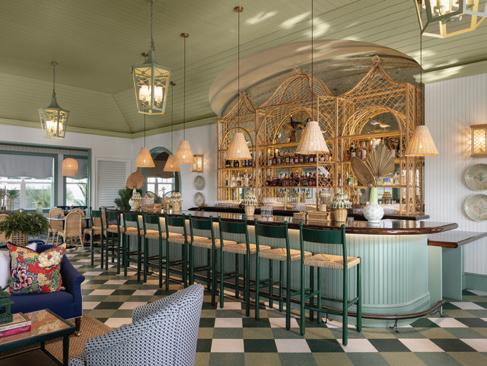
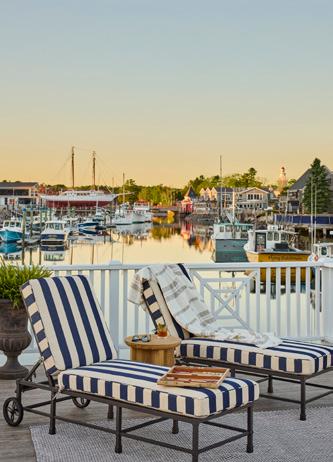
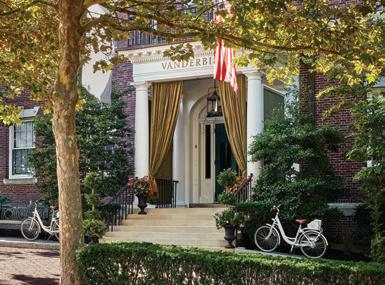
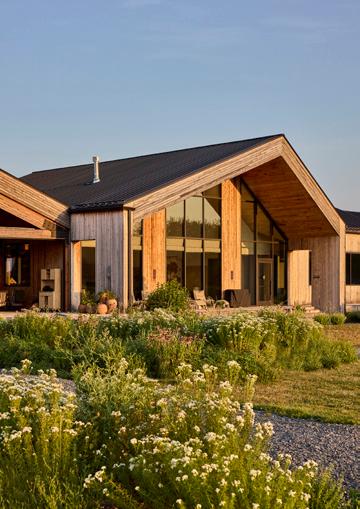
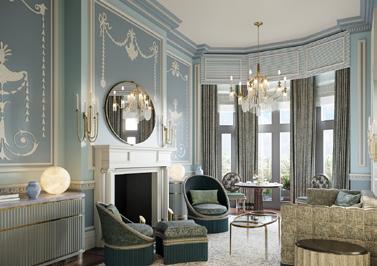
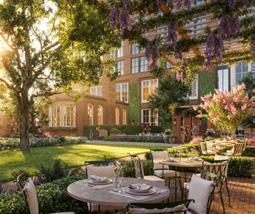
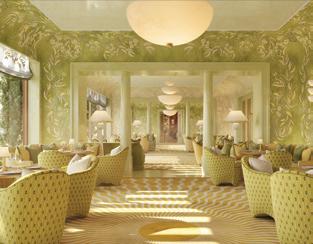
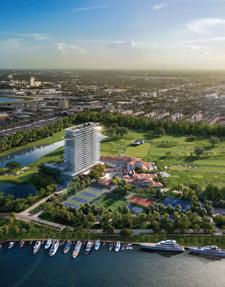
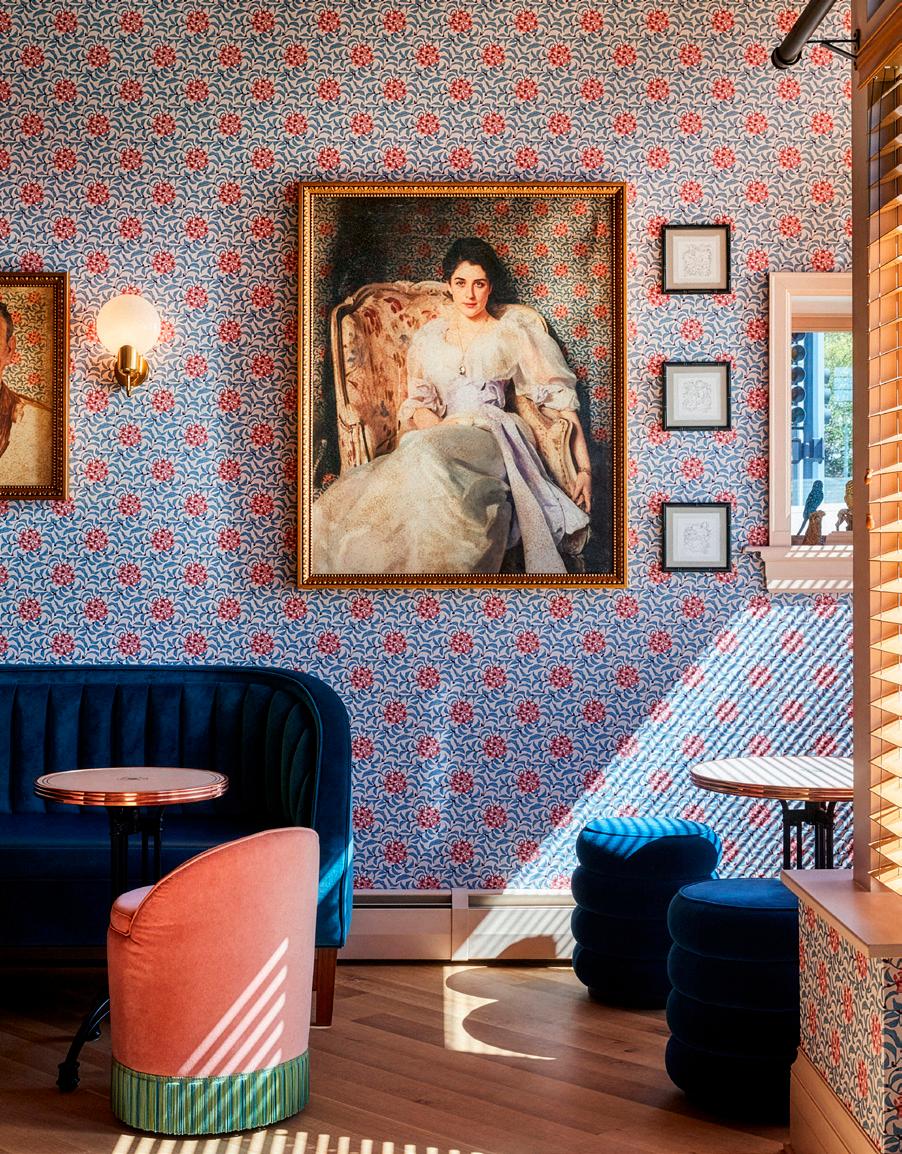
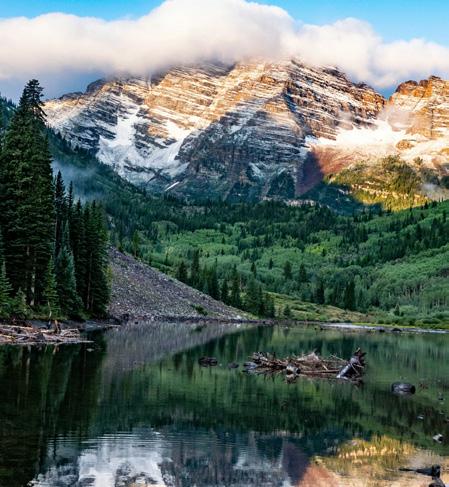
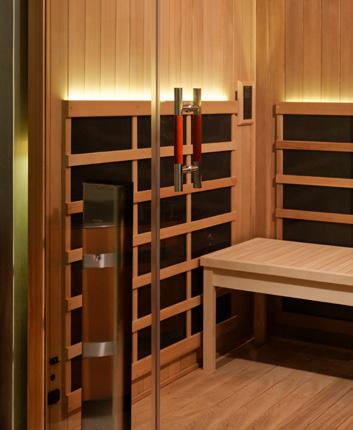
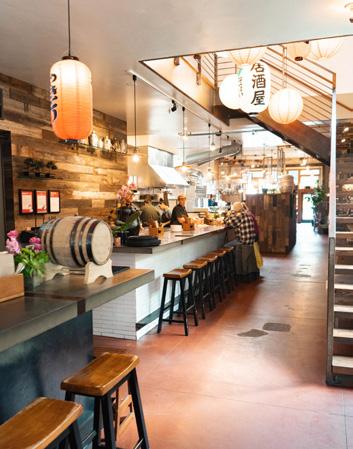
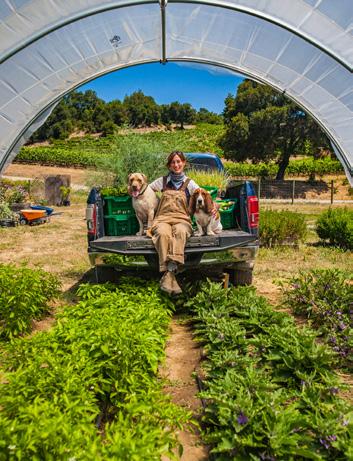
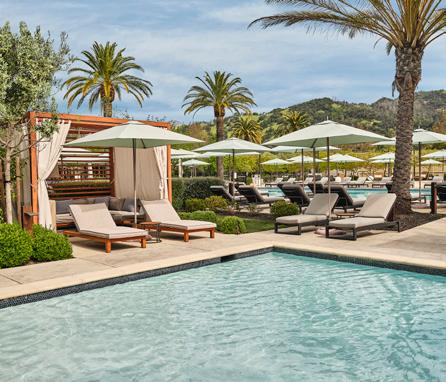
British designer Alex Eagle shares her impeccably curated edit of London’s most discreet and desirable addresses.
30
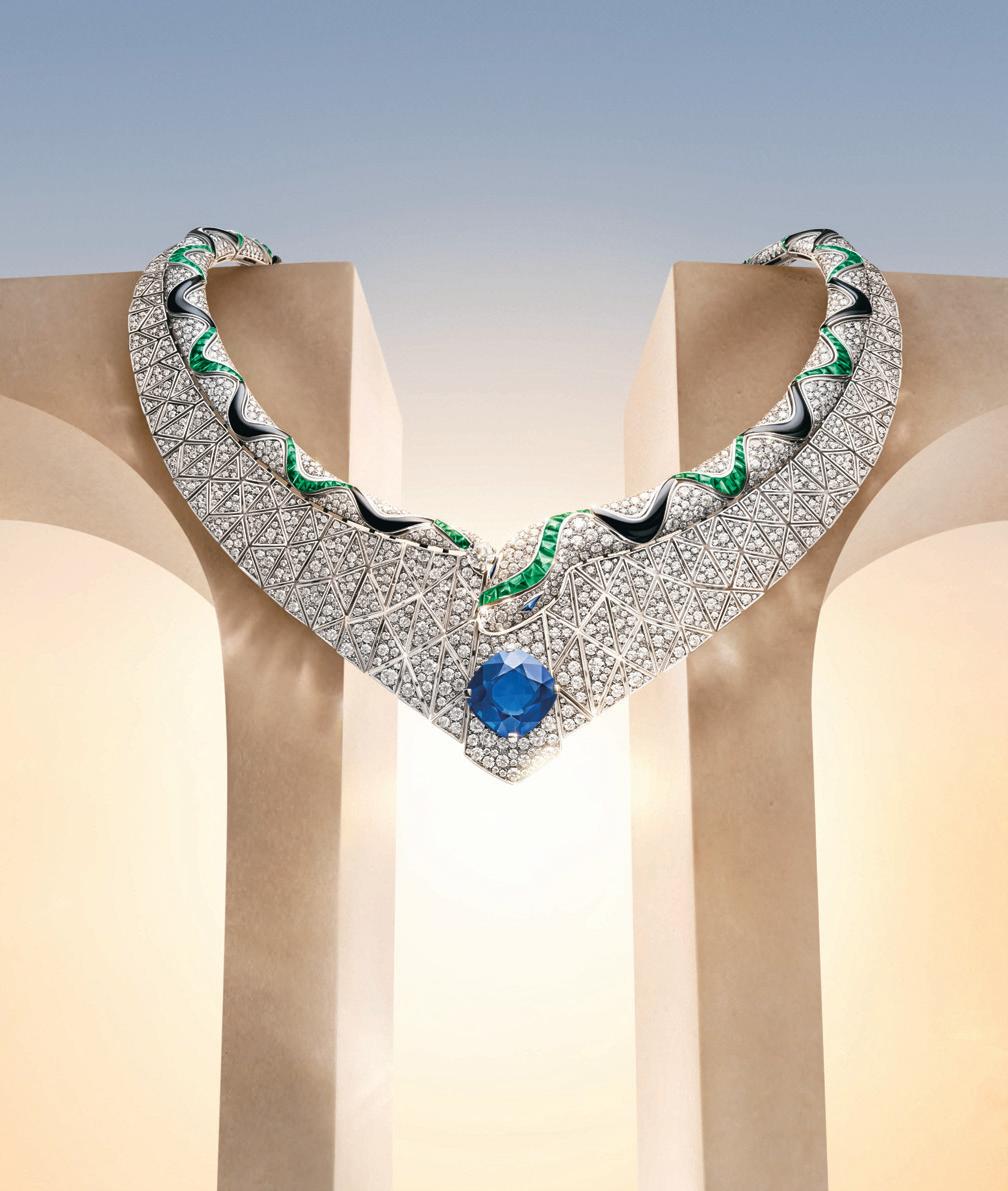
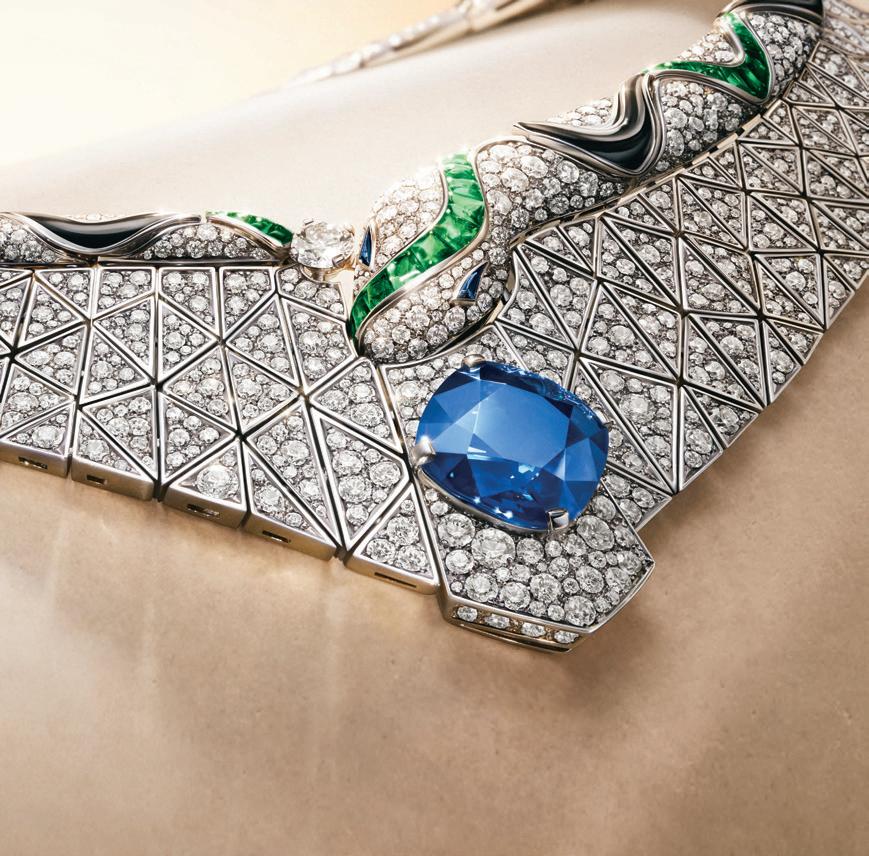
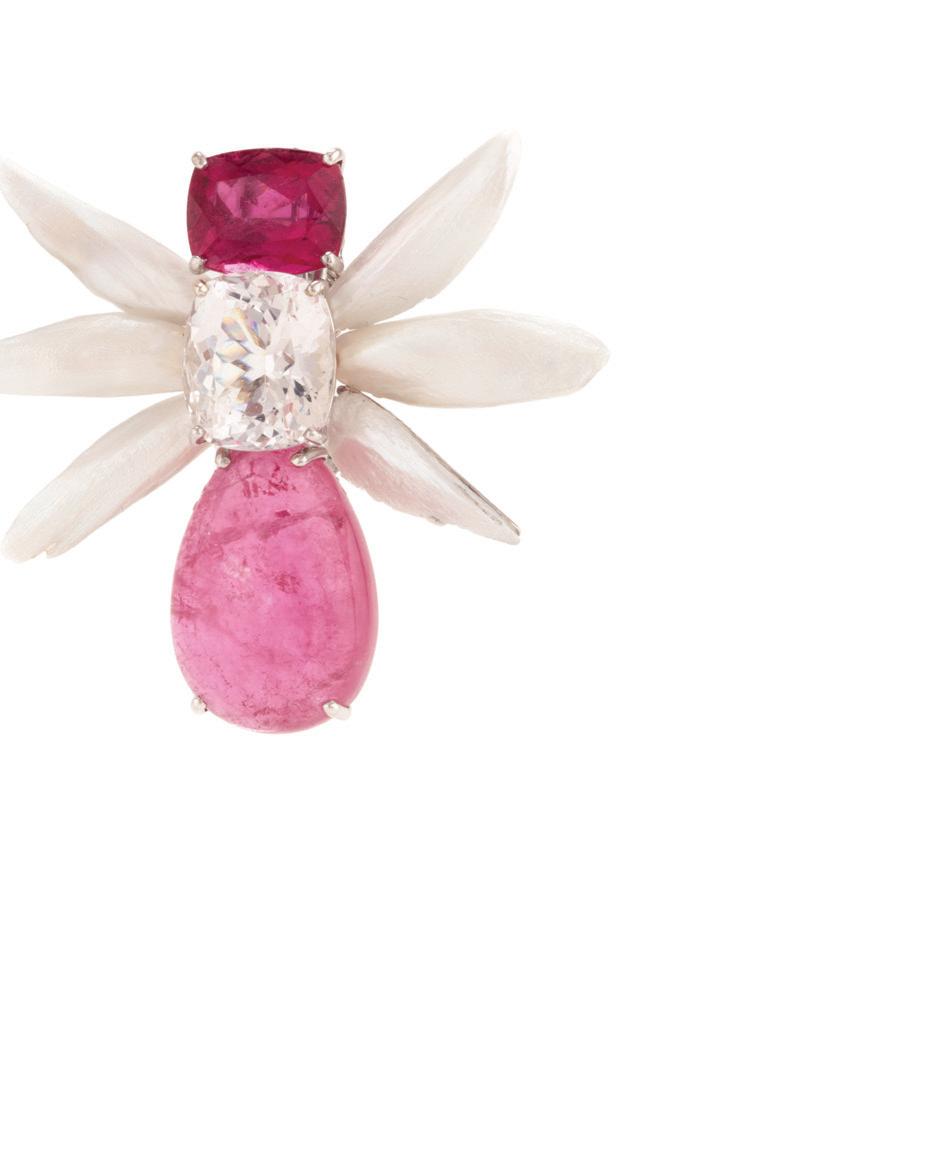
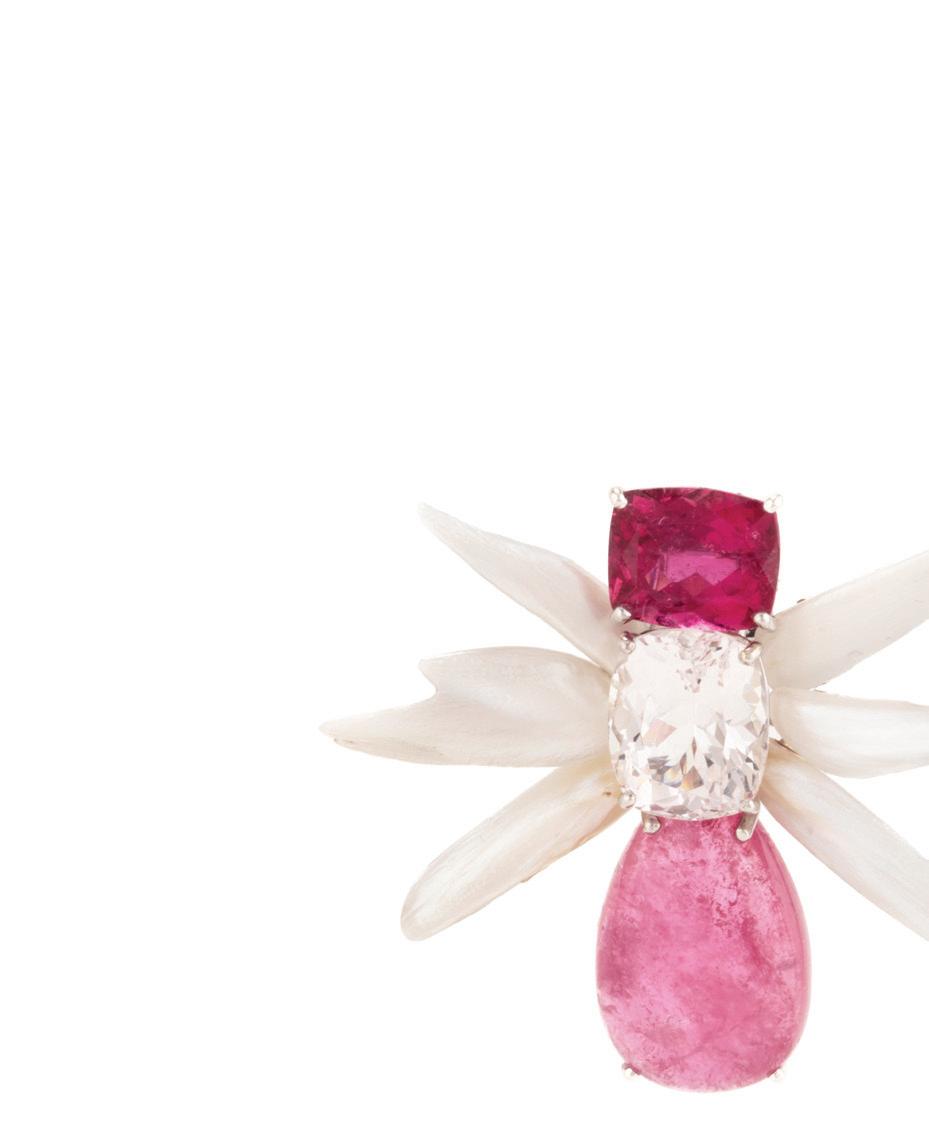
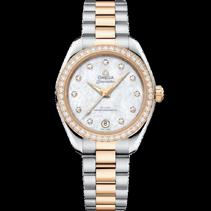
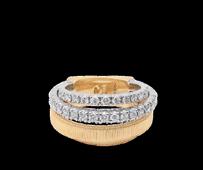
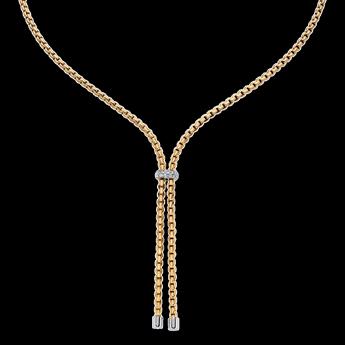
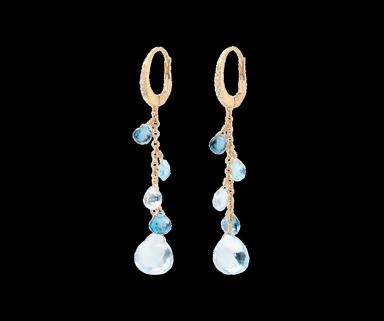
Heirloom Elements
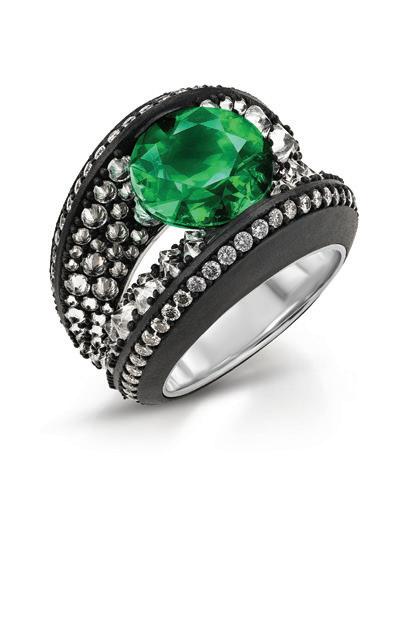
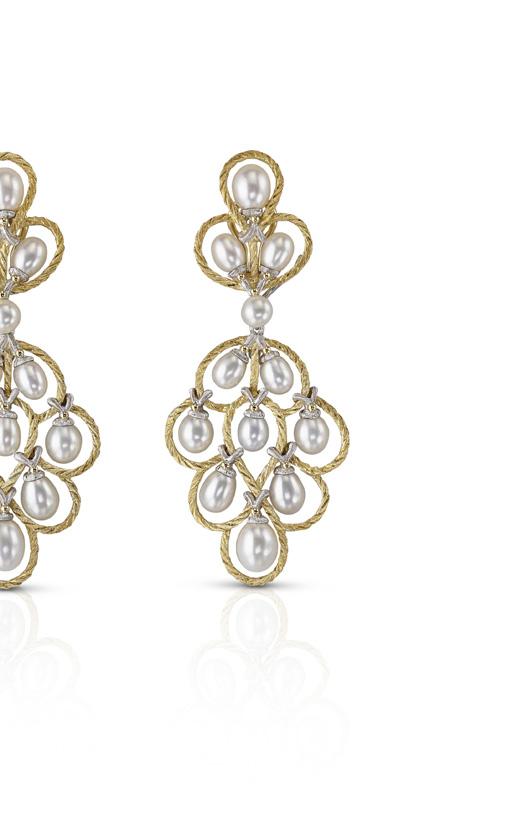
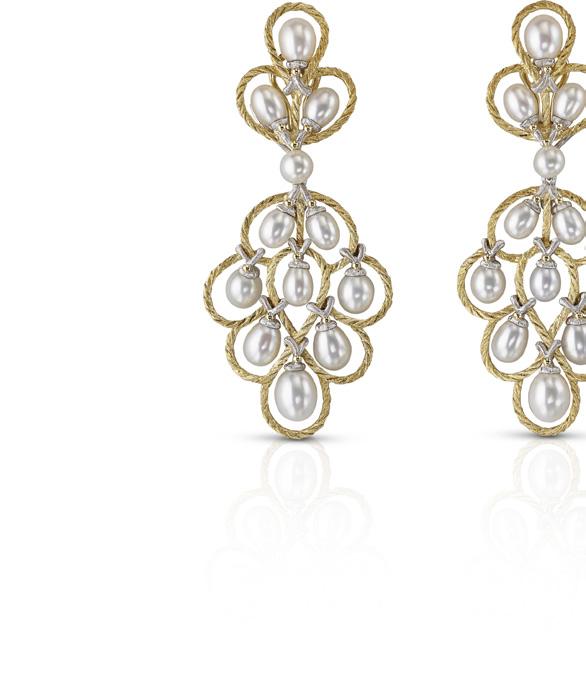
These must-have accessories are instant collectibles, blending old-world elegance with a modern flair.
34
Grand Illusion
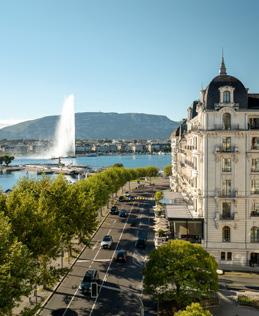
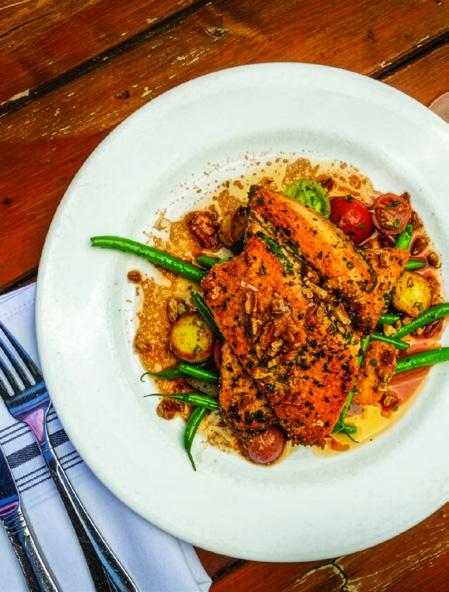
At L’Atelier Robuchon at The Woodward, Auberge Collection, in Geneva, every night ends on a sweet note that’s full of surprises.
56
Mane Attraction
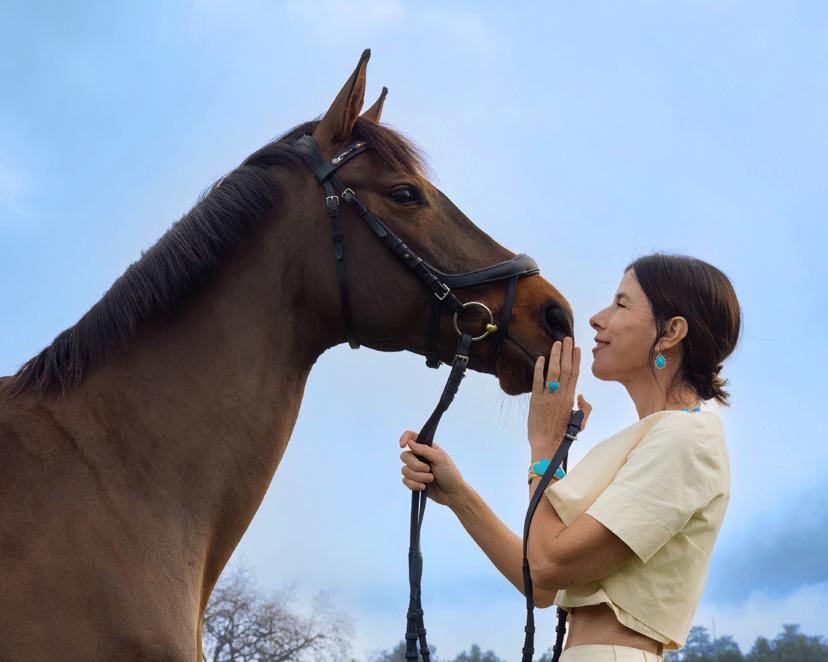
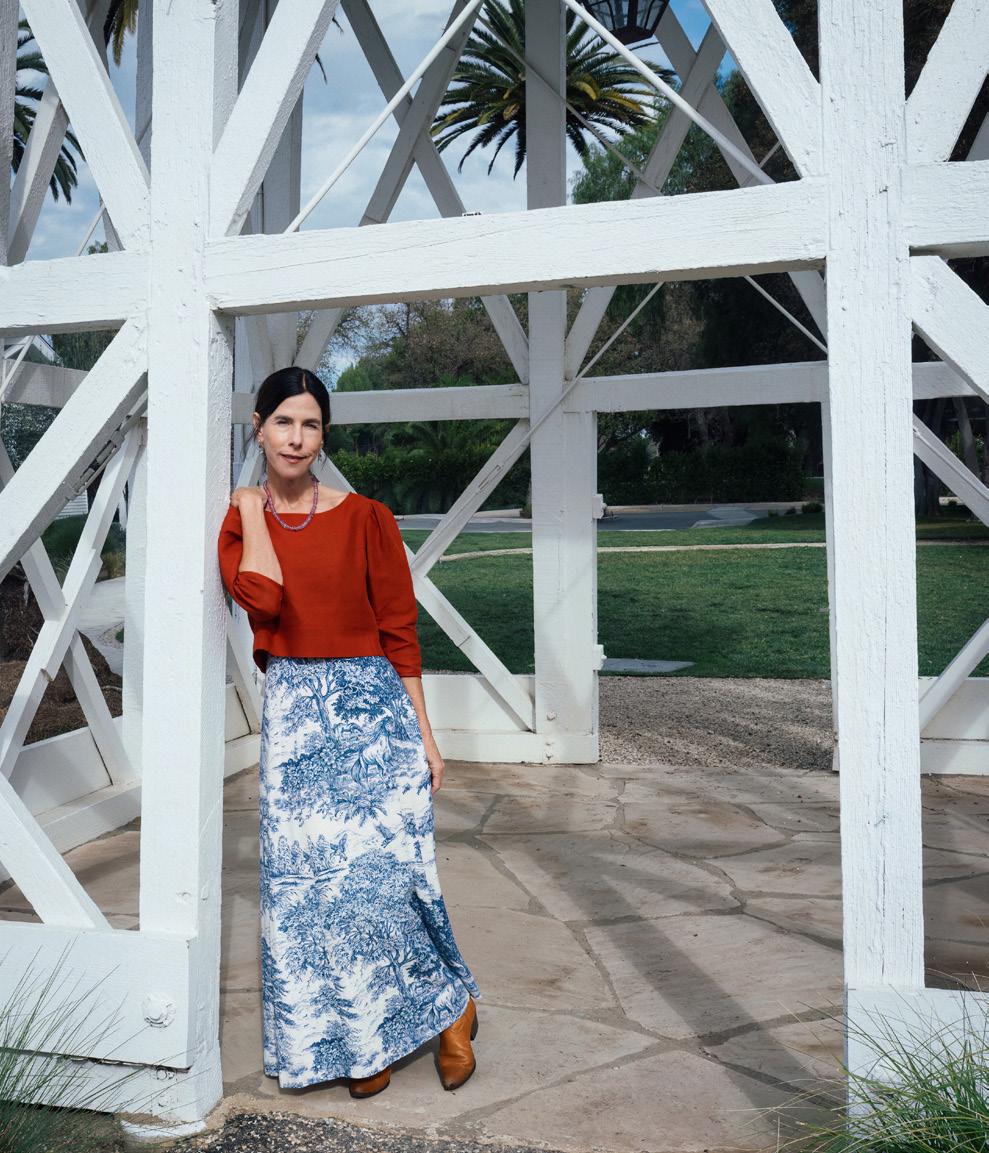
In California’s Santa Ynez Valley, jewelry designer Irene Neuwirth finds a place for all her passions: fashion, horses, and nature.
BESPOKE
70
A Different Cut
London’s legendary Savile Row has always been about heritage. In 2026, it’s also about reinvention.
84
Fatto a Mano
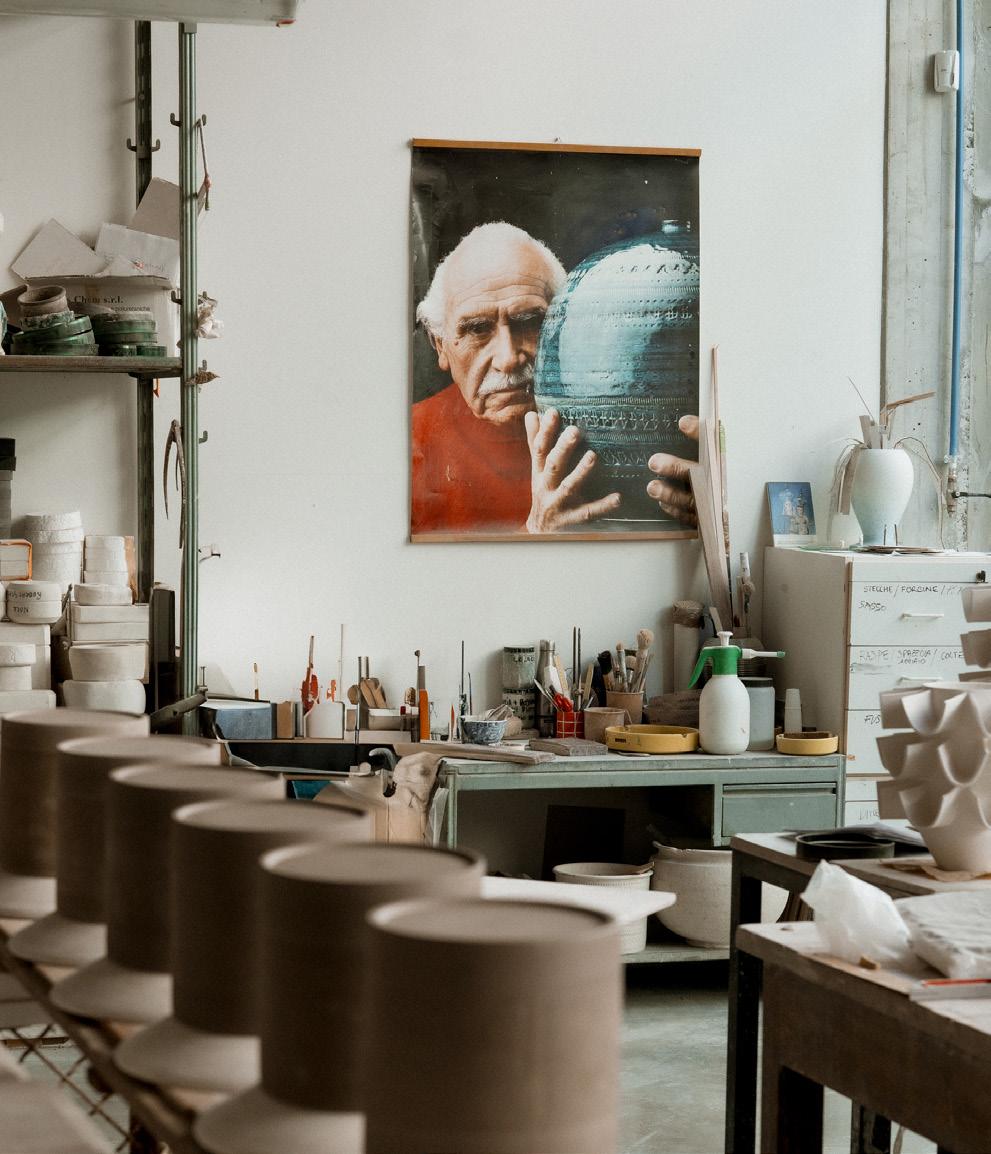
At Italian pottery house Bitossi, Tuscany’s artisan craft traditions take on bold new shapes.
SAVOR
40
True, Wild, and Free
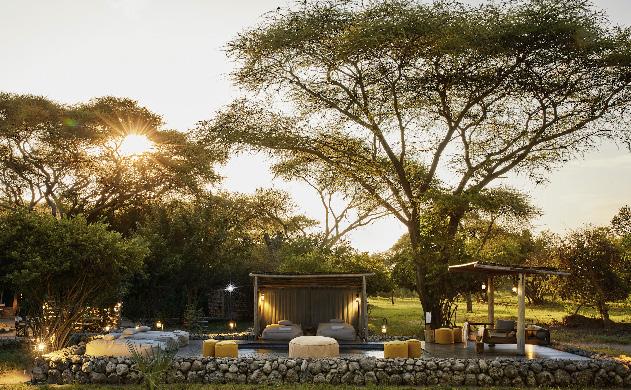
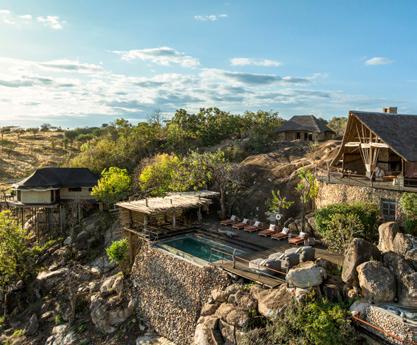
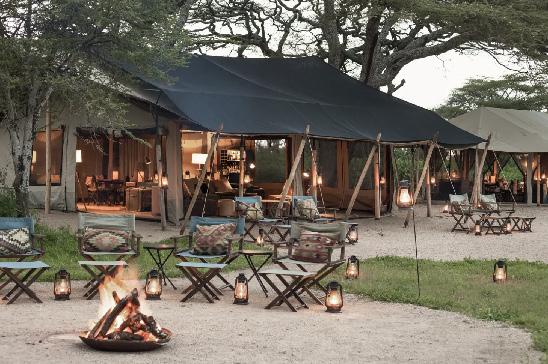
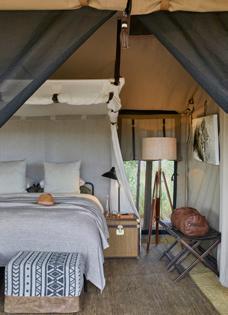
The new Auberge Safari introduces a diverse array of luxury camp and lodge experiences, connecting—and protecting—Tanzania’s most coveted wildlife areas.
96
The New Tuscan Table
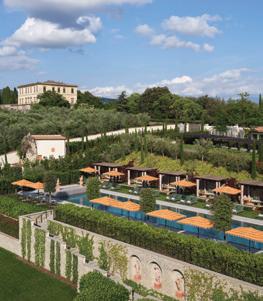
At Collegio alla Querce, Auberge Collection, the ageold stories of classic Italian cuisine are retold through modern interpretations and local ingredients.
VOYAGE
110
Behind the Wheel
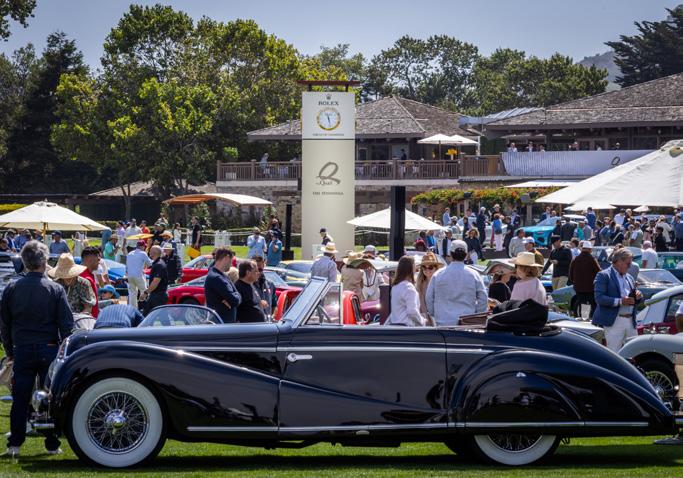
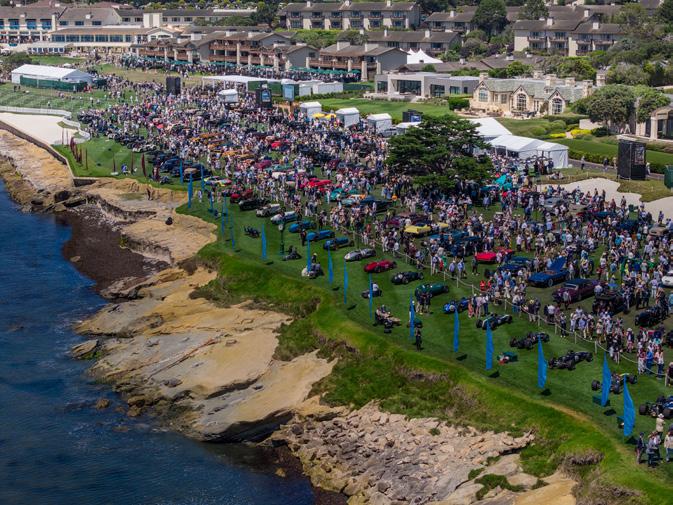
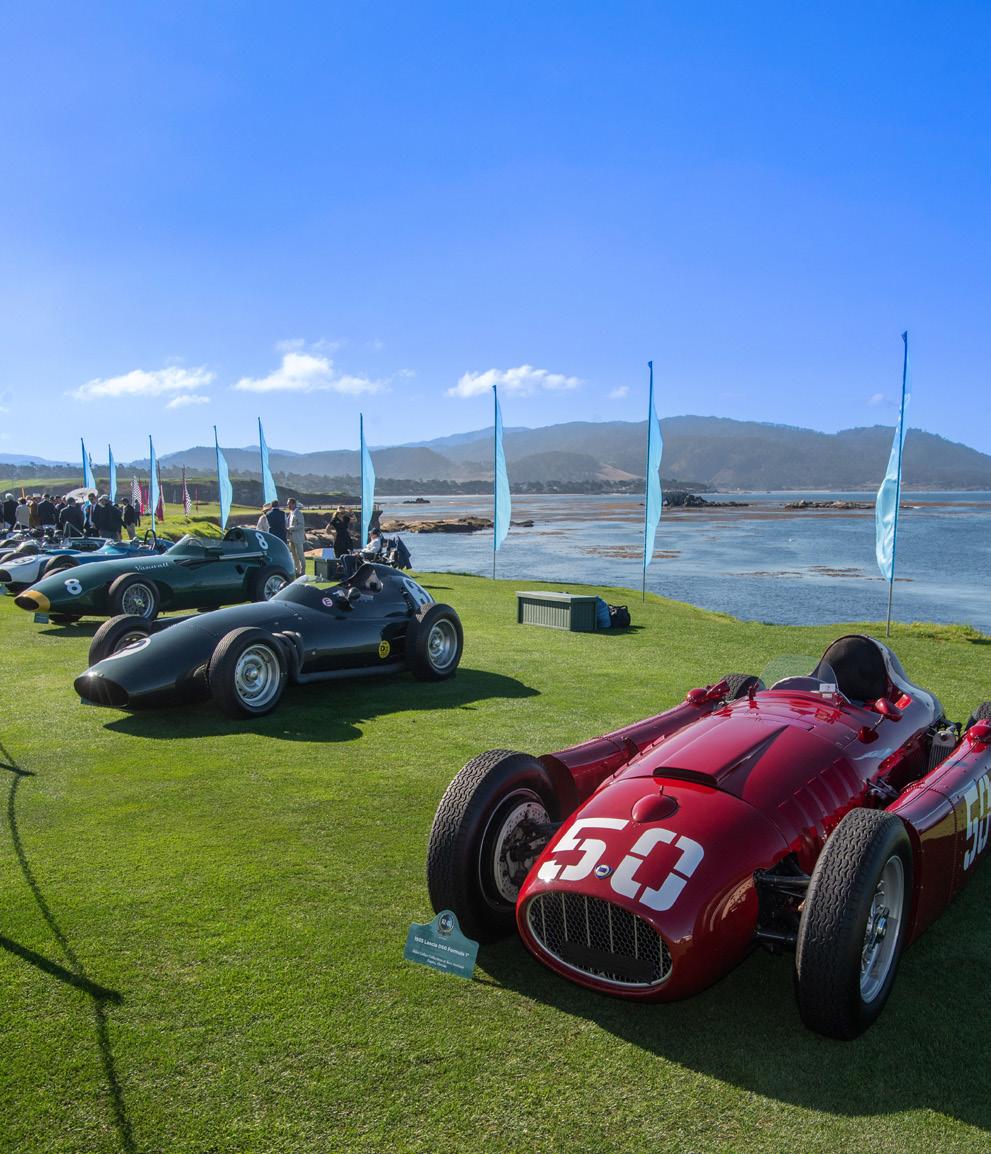
Monterey Car Week brings together a love for speed, beauty, and performance.
118
Swiss Beats
Few music festivals command the reverence of Montreux, where one man’s gift for befriending legends transformed a lakeside gathering into an enduring legacy.
CONNECT
130
Fire in the Soul
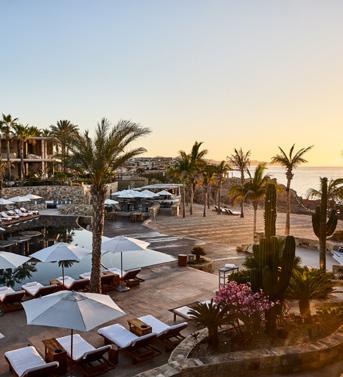
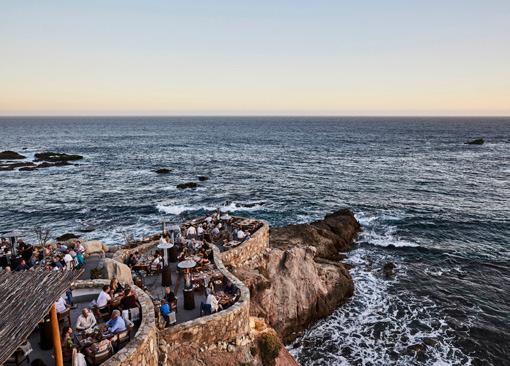
At Chileno Bay, Auberge Collection, the path to restoration is illuminated by ancestral practices and the quiet power of the elements.
140
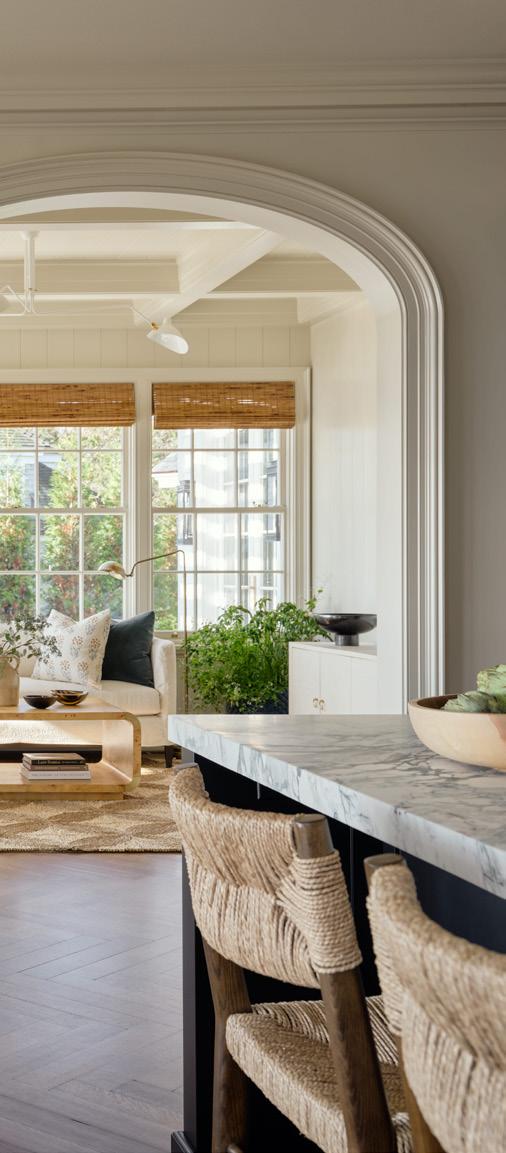
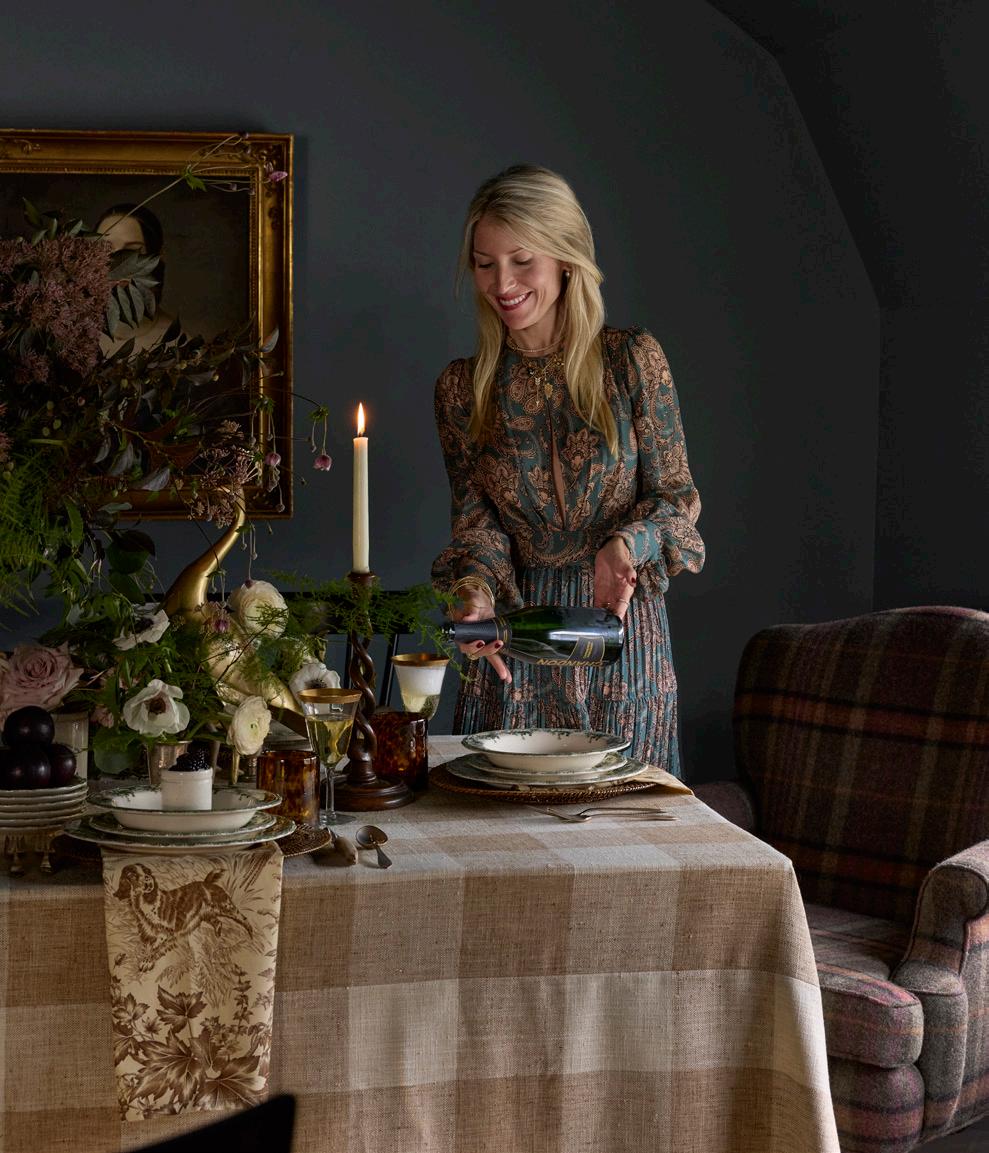
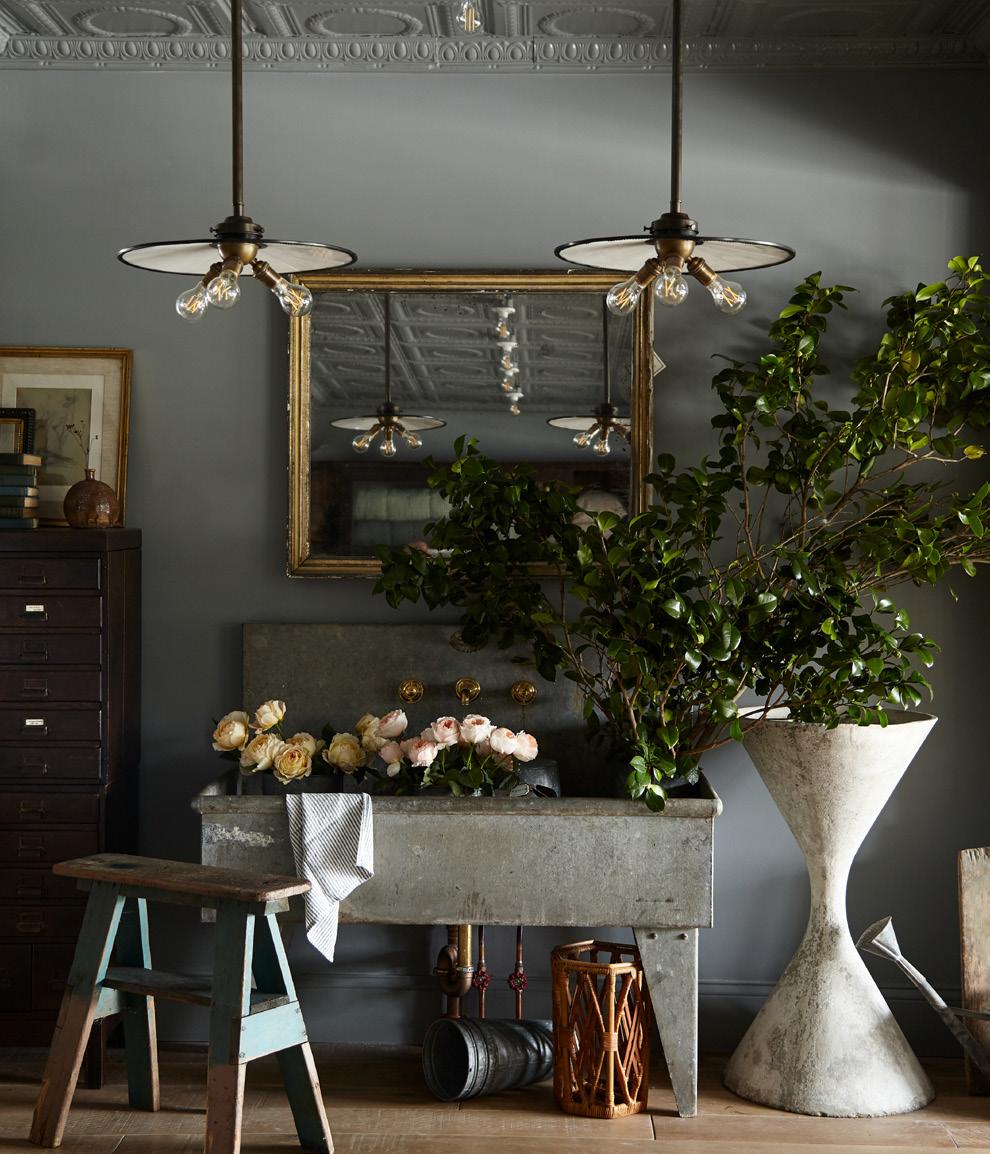
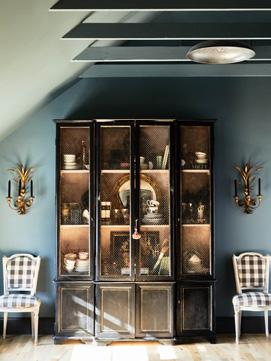
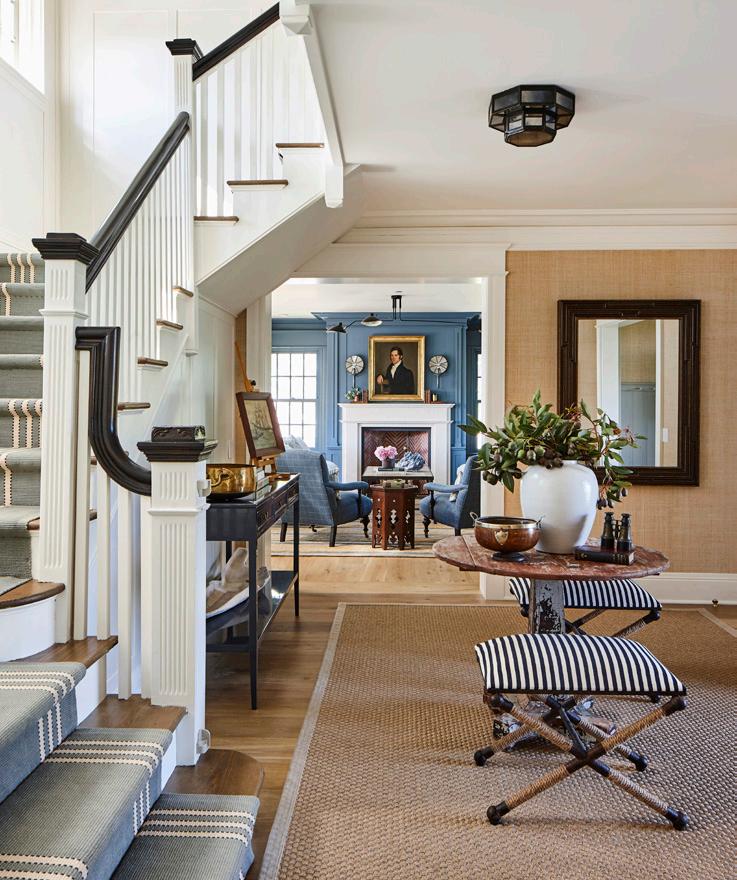
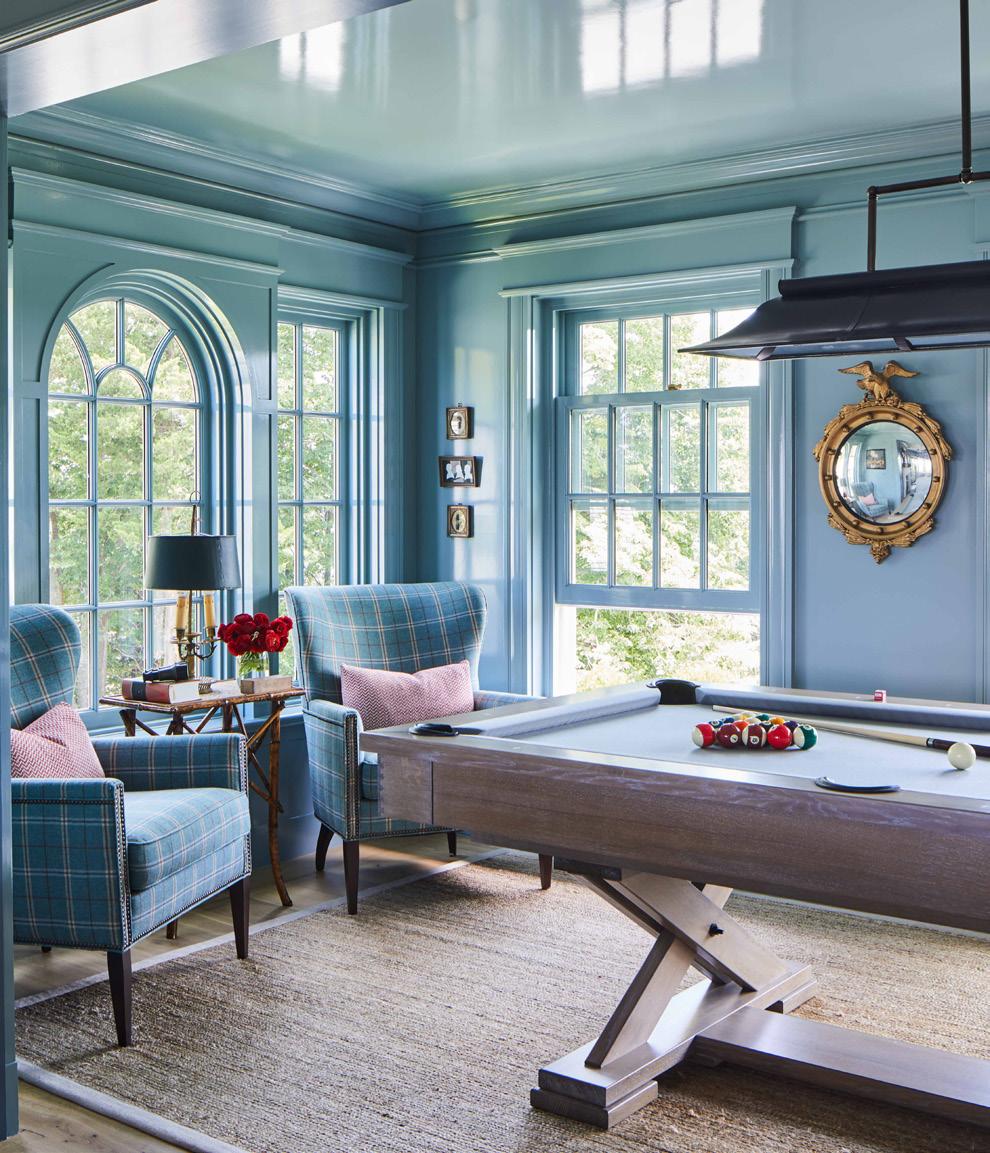
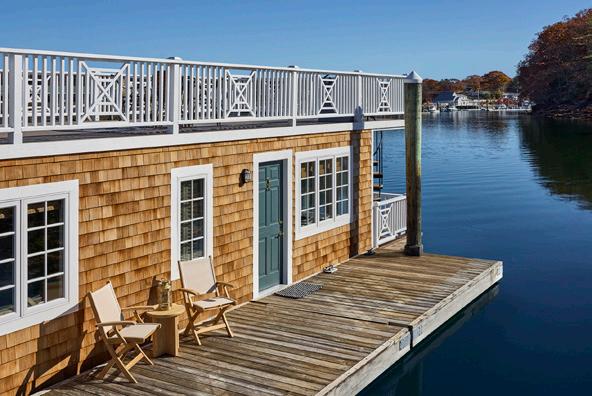
Where the Heart Is Designer and The Huntress founder Jenny Wolf brings a special sense of home to her eclectic and globally inspired interiors.
150
At Home in the Blue Ridge Mountains
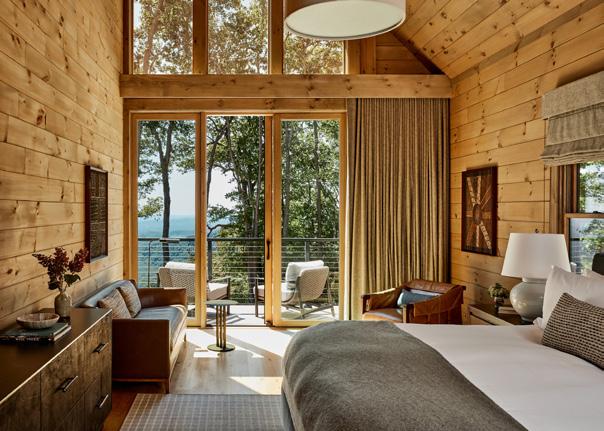
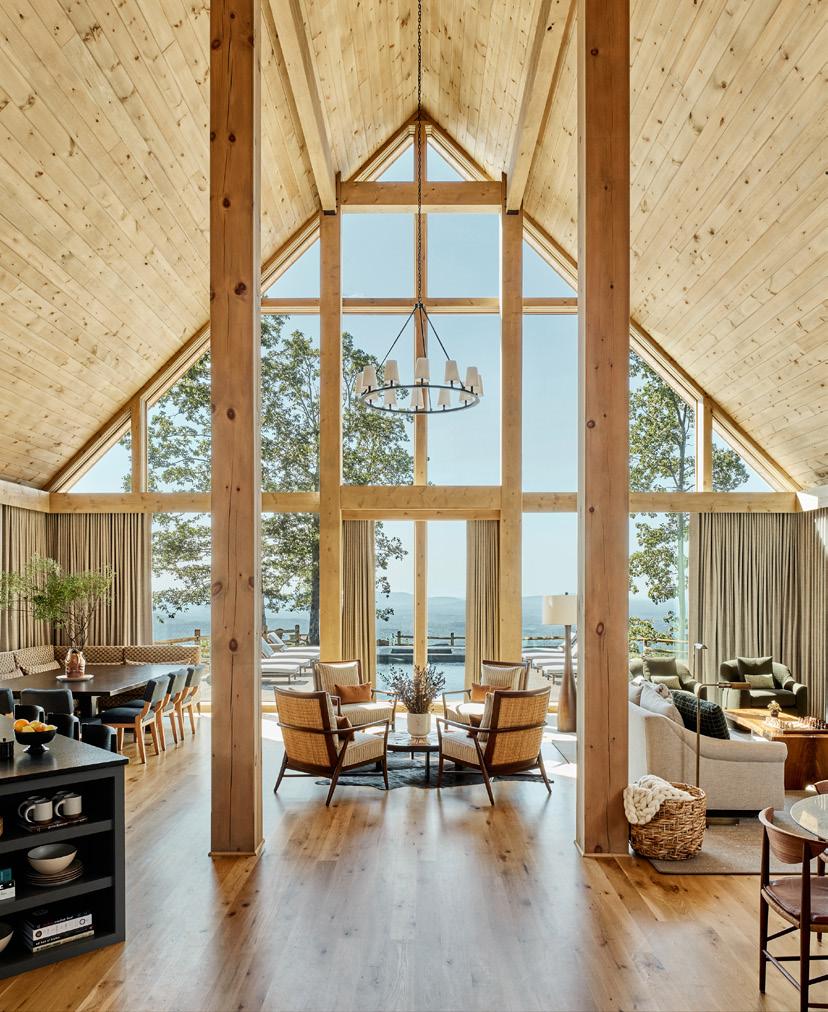
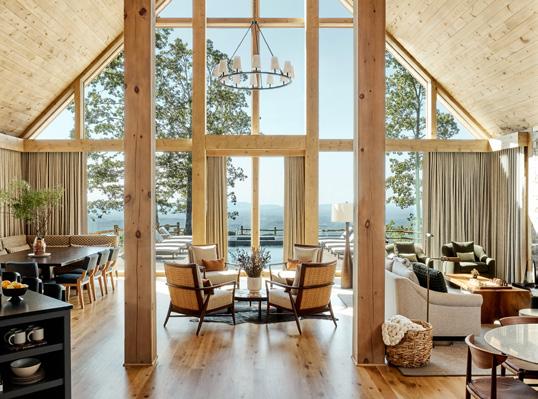
A limited collection of Auberge Residences at The Lodge at Primland brings year-round living to one of Virginia’s most protected mountain landscapes.
155
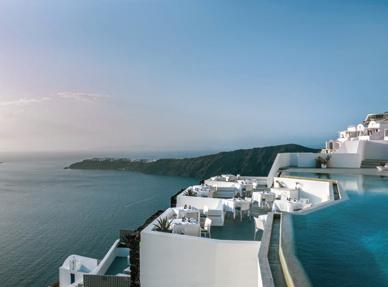
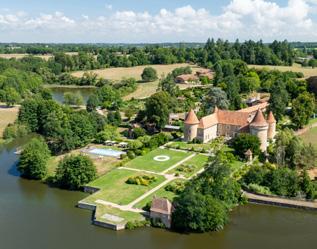
Experience the World of Auberge Extraordinary stays, exceptional cuisine, wellbeing journeys, and transformative adventures await at Auberge Collection properties around the globe.
168
Last Call
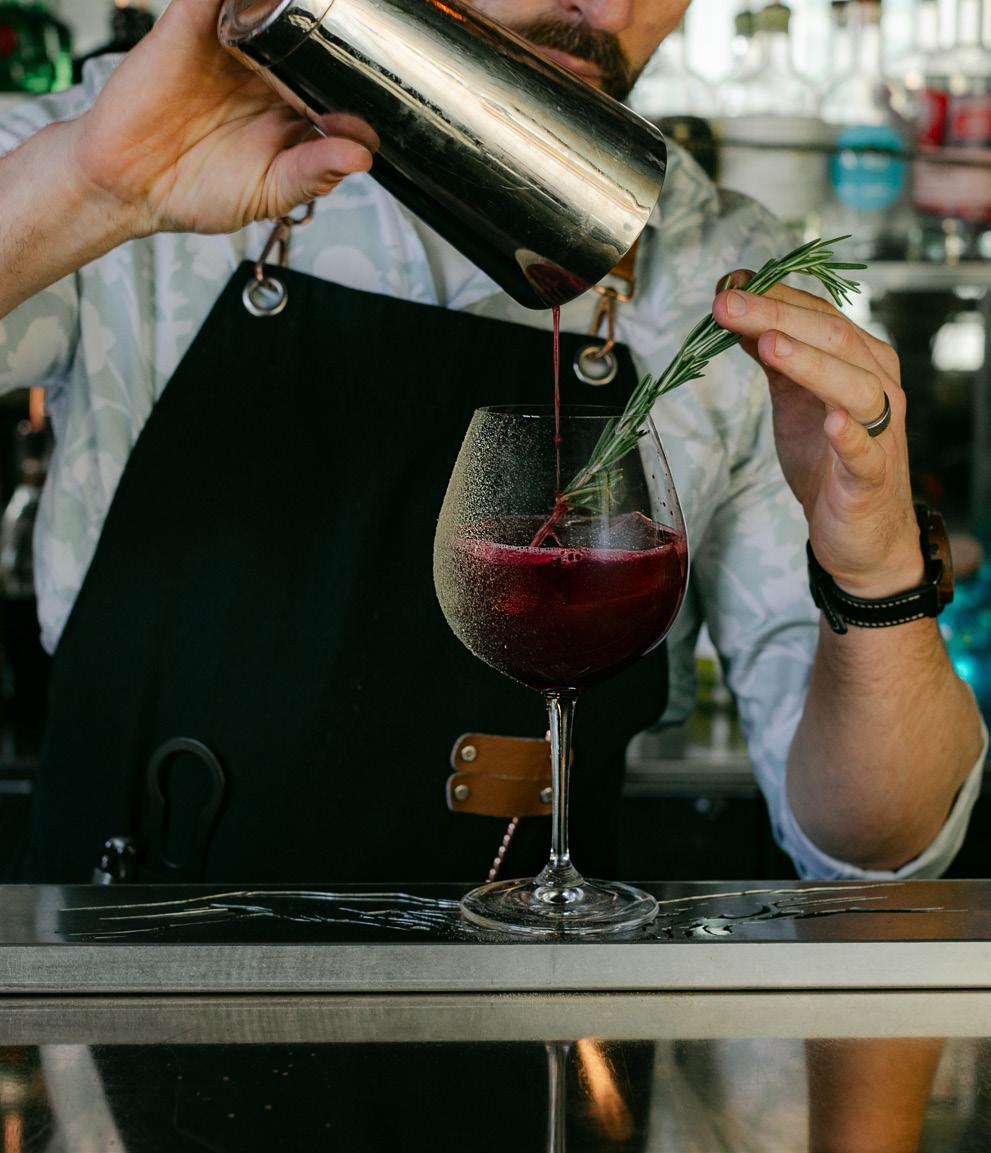
Craft White Barn Inn, Auberge Collection’s Napa on Ice.
A DIFFERENT CUT
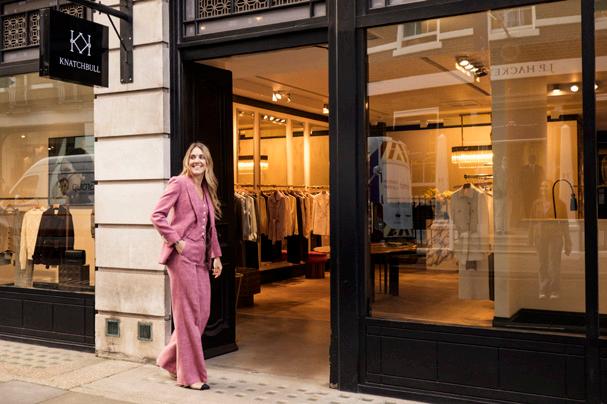
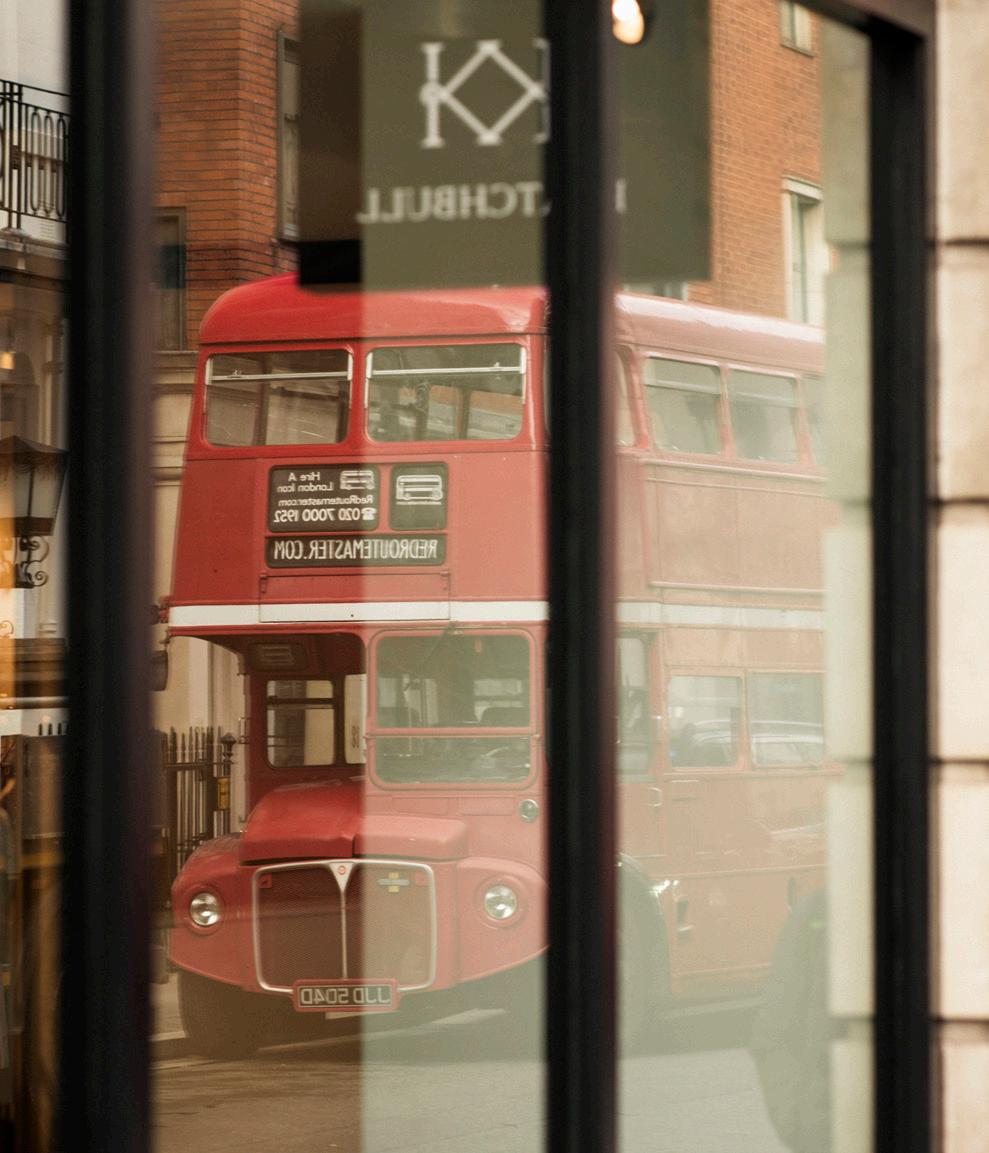
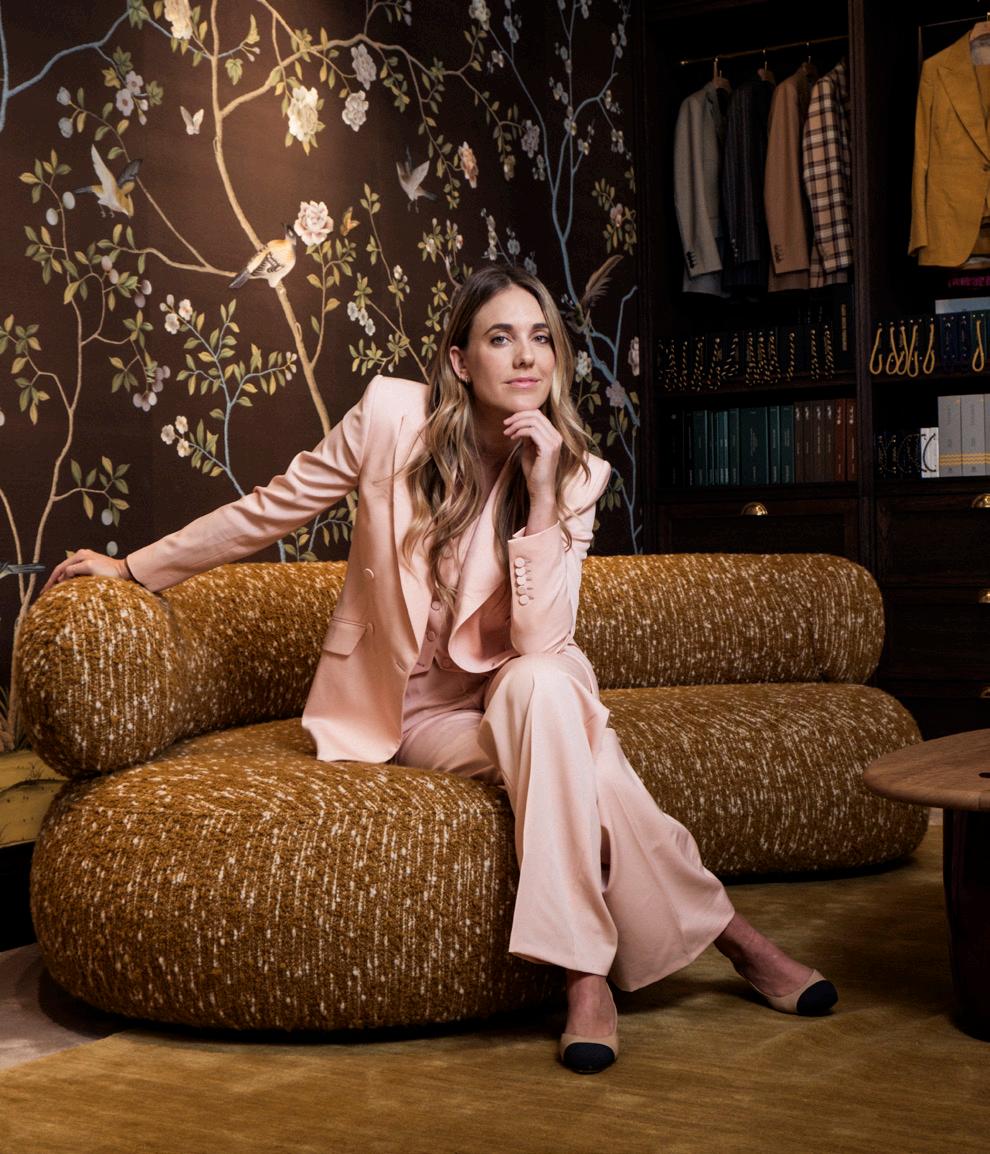
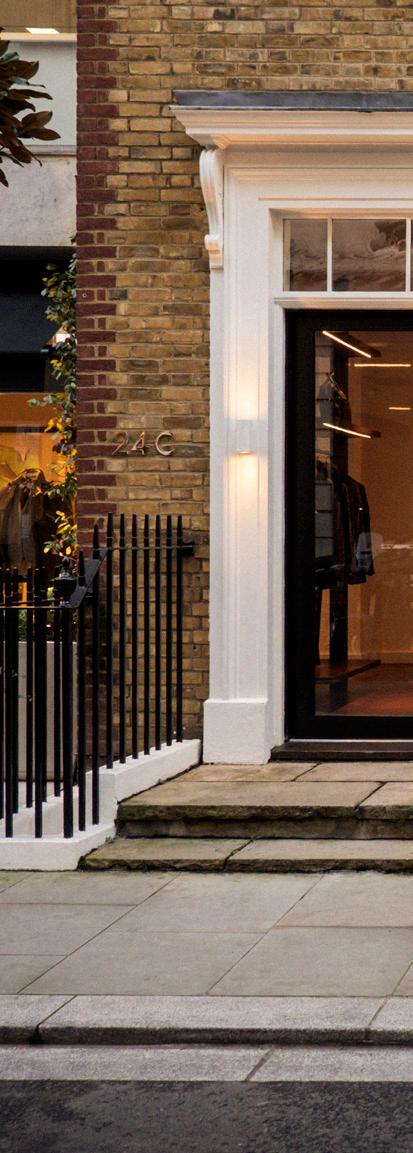
Explore the craft and creativity behind Knatchbull, Daisy Knatchbull’s atelier on London’s legendary tailoring street, Savile Row, located a stone’s throw from the soon-to-open Cambridge House, Auberge Collection.
Discover the world of Auberge and encounter new seasonal stories and films online at auberge.com/journal.
Follow @auberge:
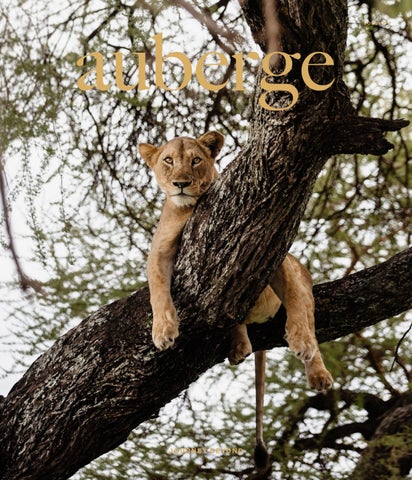
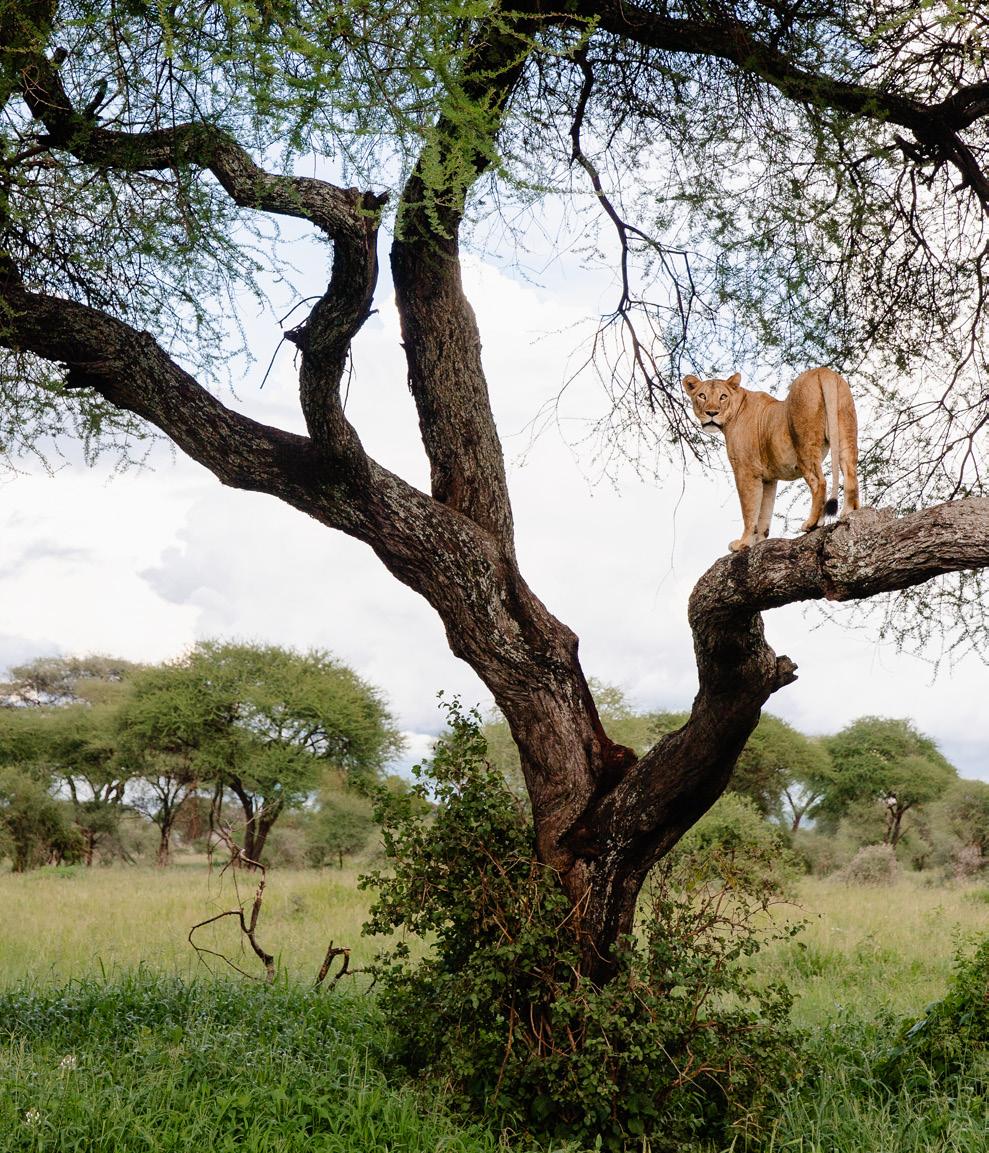
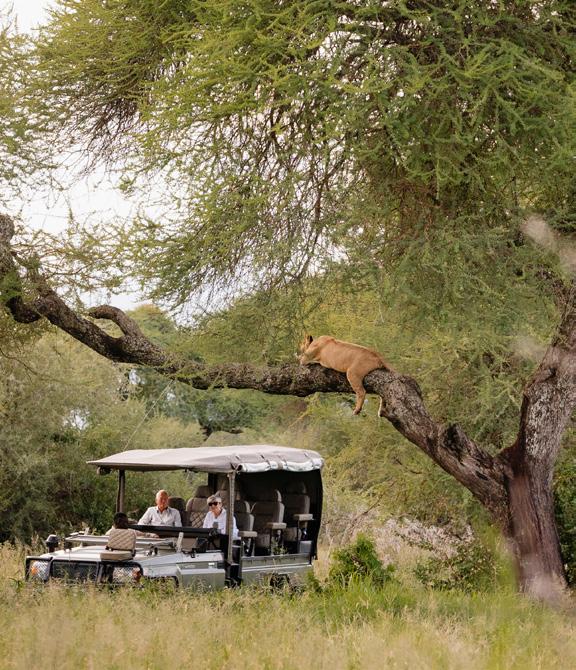
About the Cover A lioness in Tanzania’s Burunge Wildlife Management Area, where Little Chem Chem, Auberge Collection is part of the newly debuted Auberge Safari. Photography by Teagan Cunniffe
Aleksandar Cvetkovic
A Different Cut, page 70
Cvetkovic, a London-based journalist and partner and head of strategy at Birch creative studio, writes about luxury for FT Weekend, Robb Report, Elite Traveler, and Monocle, among other titles.
Joaquin Trujillo
Fire in the Soul, page 130
Trujillo’s photography is part of the SFMOMA collection, Amon Carter Museum, and Weisman Art Foundation, and he has exhibited at Paris Photo, Art Miami, and The Armory Show, among others. Based in Brooklyn, he travels the world for his artistic practice.
Carlotta Cardana
A Different Cut, page 70
An editorial and commercial photographer based in London, Cardana has exhibited in numerous international galleries and festivals, and is included in the collection of the National Portrait Gallery and Parliamentary Art Collection.
Mary Holland
True, Wild & Free, page 40
Holland is a South African writer based in New York. She has written for the Financial Times, Condé Nast Traveler, Wall Street Journal, and more, and is the New York correspondent for Monocle
David Coggins
Behind the Wheel, page 110
Coggins is the author of, most recently, The Believer: A Year in the Fly Fishing Life . He also writes The Contender newsletter and is founding editor of The Print Edition newspaper. He lives in New York.
Teagan Cunniffe
True, Wild, & Free, page 40
Cunniffe’s photography has taken her around the globe, yet she is always happy for an assignment in her native home of South Africa. Through imagery, she aims to translate wild beauty that encourages others to see and feel it for themselves.
PUBLISHED BY
2026 by NMG Network, LLC. All rights reserved. No part of this publication may be reprinted without the written consent of the publisher. Opinions are solely those of the contributors and are not necessarily endorsed by NMG Network.
Volume V May 2026
CEO & PUBLISHER
Jason Cutinella
Jackie Caradonio Global Editorial Director
Jill Newman Editor-in-Chief
Brian Joseph Art Director
Erin Agostinelli Managing Editor
Scott Bay Contributing Editor
EDITORIAL & CREATIVE
Contributing Writers
Christopher Bagley, Dalya Benor, David Coggins, Aleksander Cvetkovic, Mary Holland, Adam McCulloch, Terry Ward
Contributing Photographers
Christopher Bagley, Carlotta Cardana, Andrea Di Lorenzo, Guillaume Megevand, Ellie Thorne, Joaquin Trujillo, Greta Tucker
Contributing Videographers Ollie Rillands
OPERATIONS
Merri Gruesser Chief Operating Officer
Sabrine Rivera Operations Director
Joe V. Bock Corporate Affairs
ADVERTISING
Amanda Gillentine Head of Integrated Marketing amanda@nmgnetwork.com
Mike Wiley VP Sales mike@nmgnetwork.com
Marly Graubard Global Brand Partnerships marly@nmgnetwork.com
AUBERGE COLLECTION
Callie Stanton SVP of Brand
Amalia Ramos Senior Director Creative Services and Brand
Hannah Kibble Senior Director of Content
Oceanview Residences
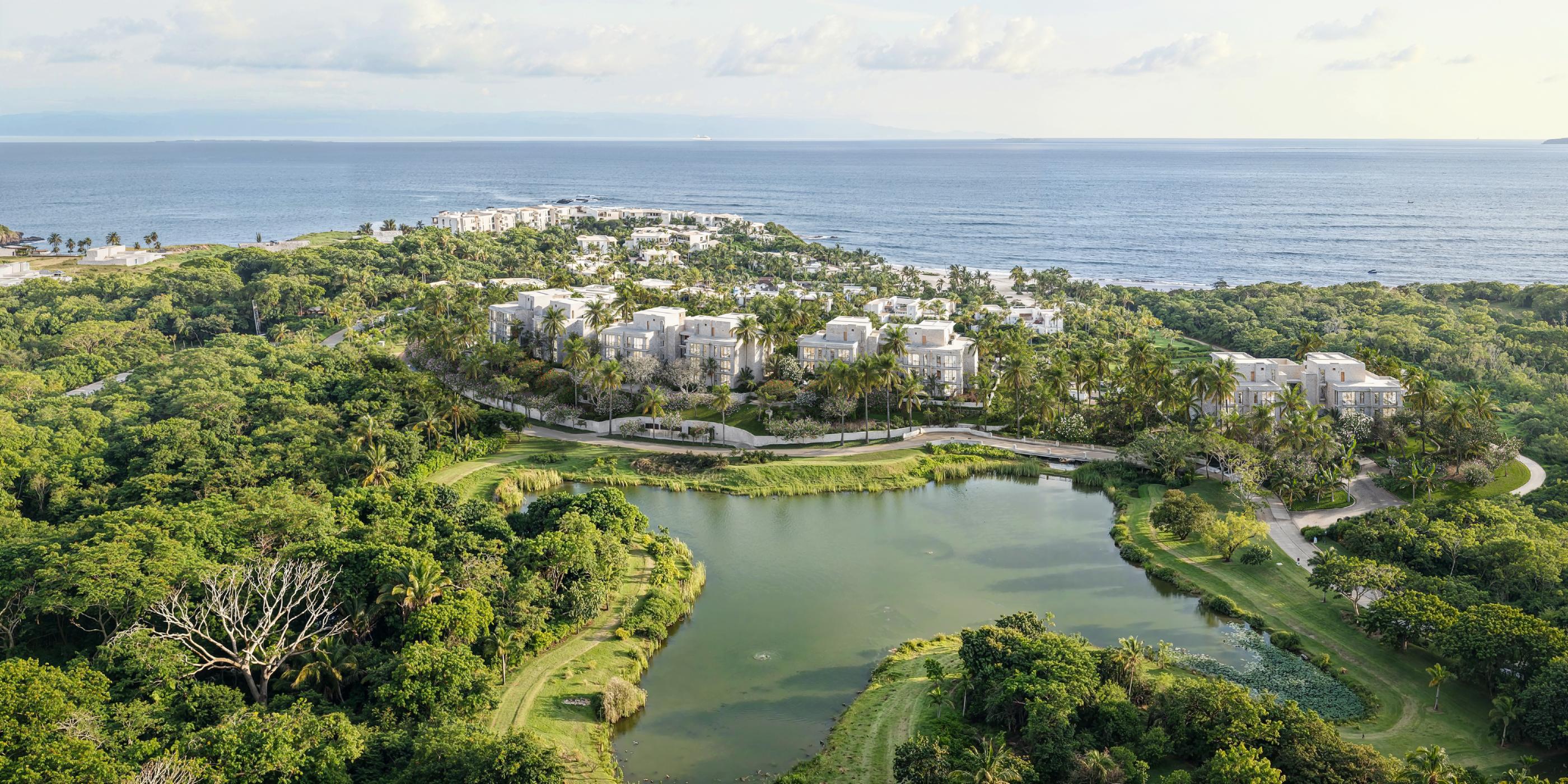
A bold new chapter unfolds at Susurros del Corazón with the debut of the Oceanview Residencesa limited collection of 24 turnkey homes set along the Pacific Ocean
Designed for indoor- outdoor living , each residence opens to expansive ocean panoramas, with uninterrupted views stretching toward the wild, sculptural beauty of the Marietas Islands With deliveries starting in 2027, this next phase introduces an elevated collection of amenities, one - of-a-kind experiences, and a reimaged beachfront
Discover Punta de Mita’s next evolution in luxury living , where the story of Susurros continues to take shape
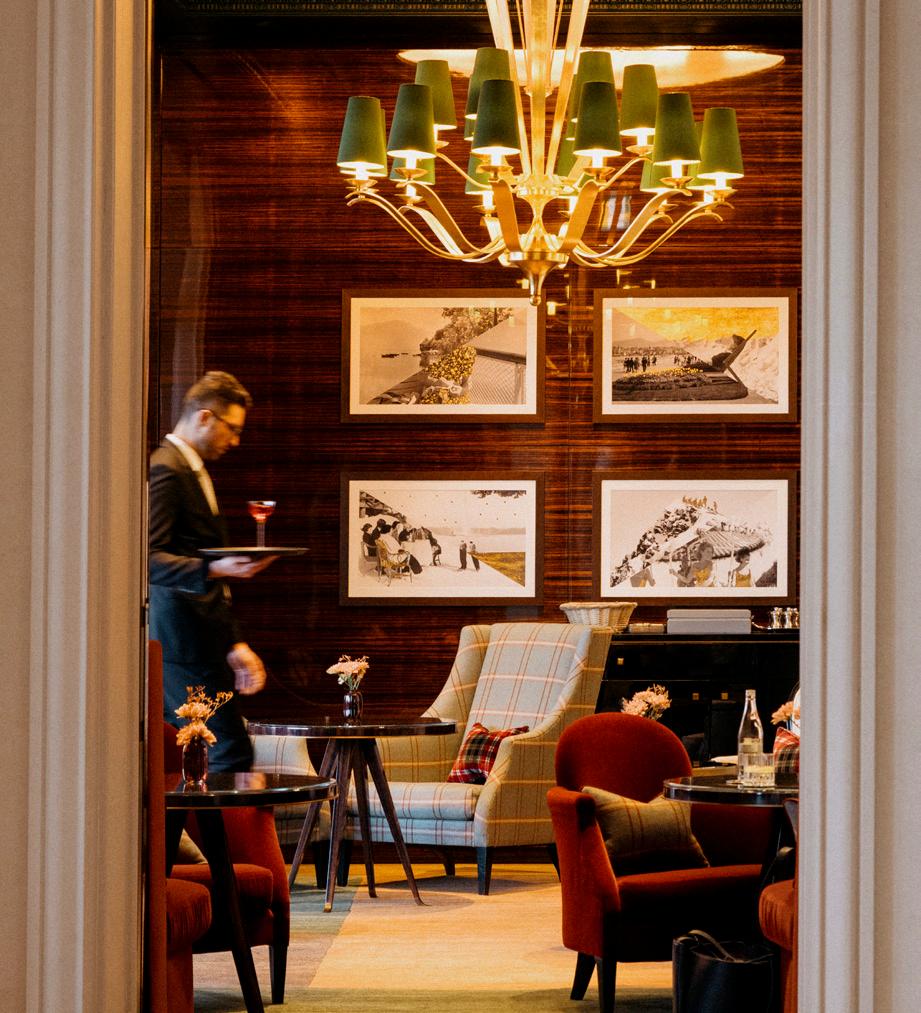
The Bastion Collection’s L’Atelier Robuchon, at The Woodward, Auberge Collection, in Geneva. Photography by Guillaume Megevand.
Eagle Eye
British designer Alex Eagle shares her impeccably curated edit of London’s most discreet and desirable addresses.
BY RACHEL GARRAHAN
In a city as layered and fast-moving as London, true tastemakers are less about trends and more about instinct. They know which streets to wander when the light hits just right, which tables to book before everyone else catches on, and where culture quietly bubbles up before it spills into the mainstream. Alex Eagle is one such insider: Her influence is felt across wardrobes, interiors, even entire neighborhoods.
For proof, look no further than her many influential city hot spots. Alex Eagle Studio, her meticulously curated space blending art, design, and timeless yet pared-back fashion is no mere shop; it’s a destination. She is also co-founder of Eagle + Hodges, an interiors and furniture studio devoted to craftsmanship and considered living. And her most ambitious venture yet, 180 Quarter, developed with her husband, Mark Wadhwa, reimagines an entire city block with a health club, boutiques, apartments, restaurants, and cafés, plus a rooftop outpost of Soho House overlooking the Thames.
With a life spent shaping how her native city looks and feels, Eagle knows exactly where to go and what to do to keep her finger on the ever-changing London pulse.
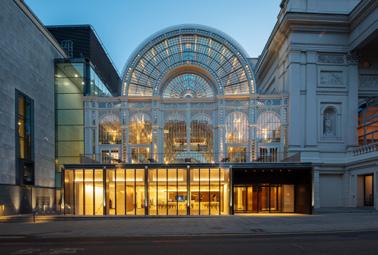
This is my absolute favorite place to go in London. I love getting all dressed up and going to the ballet or opera, and I recommend that you have a drink during the interval in its elegant Crush Room.
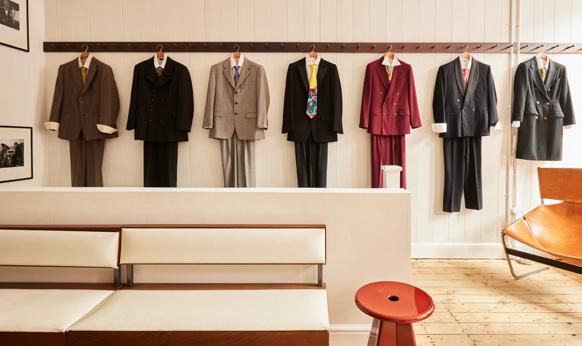
The store has the most gorgeous curation of archival suits and tailoring, ranging from the 19th century to the 1970s. Its location on Cecil Court in Covent Garden on a Victorian London cobbled street makes it a wonderful place to visit.
LIBERTY JOY ARCHIVE
ROYAL OPERA HOUSE
BAR DES PRÉS
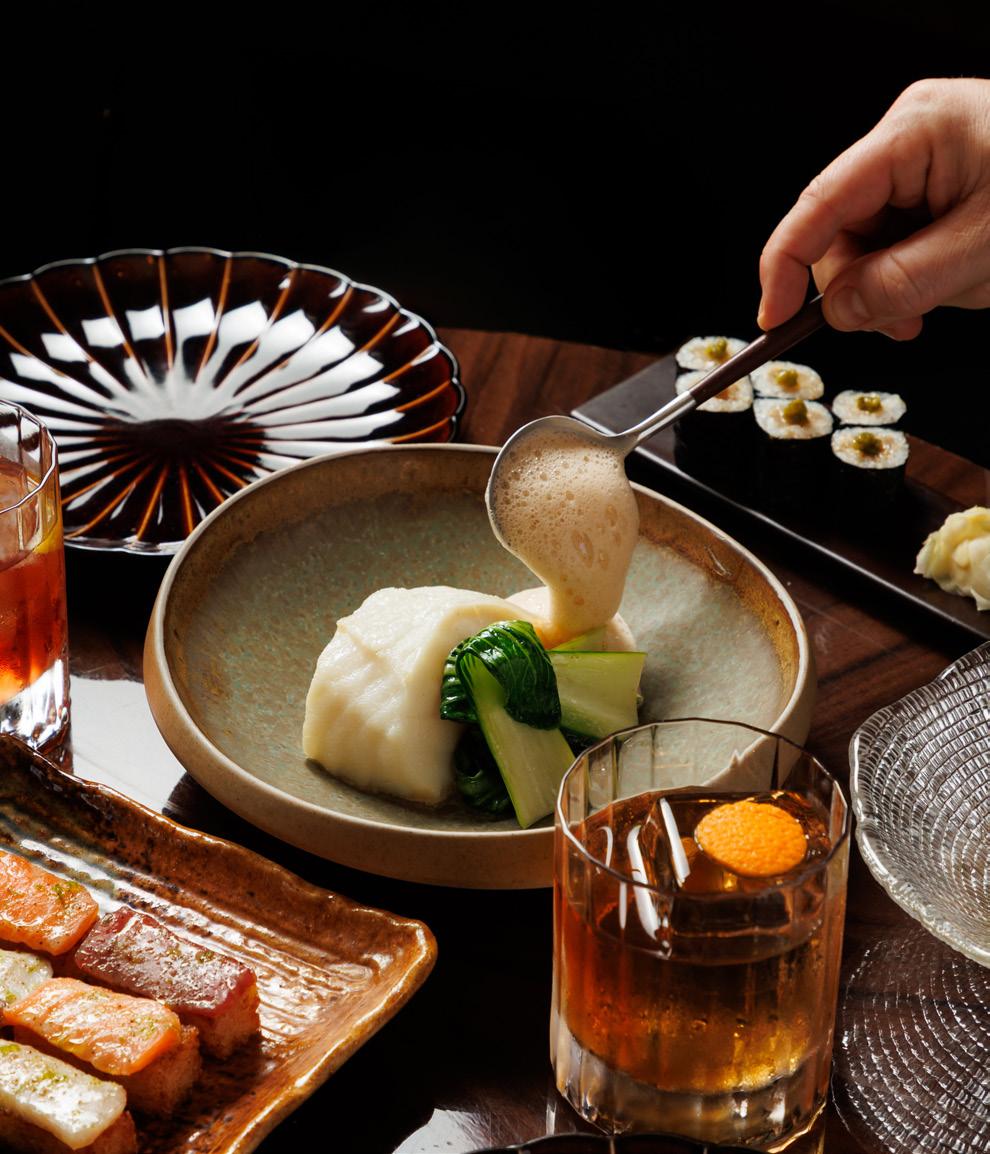
This Mayfair restaurant from chef Cyril Lignac blends French and Japanese flavors beautifully. Its gorgeous lighting makes it a really sexy place for a date night but it’s equally good to go all dressed up for dinner with friends.
MOUKI MOU
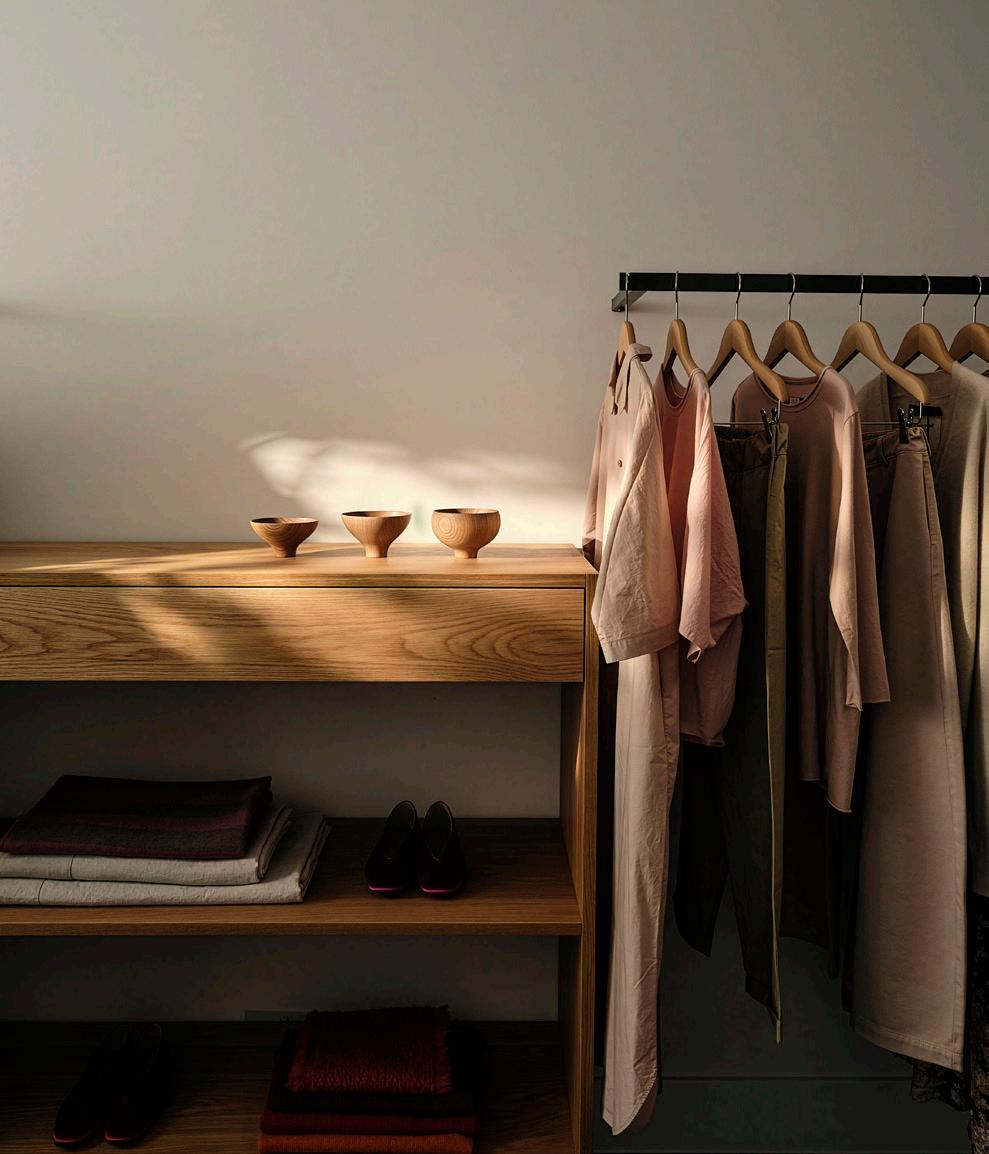
Maria Lemos, the owner of Mouki Mou on Marylebone’s Chiltern Street, has incredible taste. Her boutique is a lovely place to pick up things that are not trend-driven but made to last, from fashion to ceramics to gorgeous handbags.
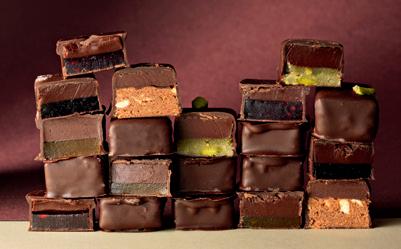
Tucked away on tiny Smith Court just off Brewer Street in Soho, this cozy chocolate shop was founded in 2004 by Scottish pâtissier and chocolatier William Curley. It serves delicious tea and hot chocolate, alongside the most indulgent handmade chocolates.
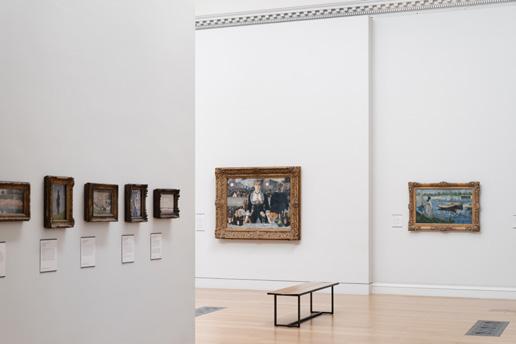
I love the Courtauld Gallery inside beautiful Somerset House. Industrialist and collector Samuel Courtauld amassed an outstanding collection of Impressionist and Post-Impressionist masterpieces, and it’s the perfect place to spend a quiet couple of hours.
WILLIAM CURLEY
COURTAULD GALLERY
heirloom
ELEMENTS
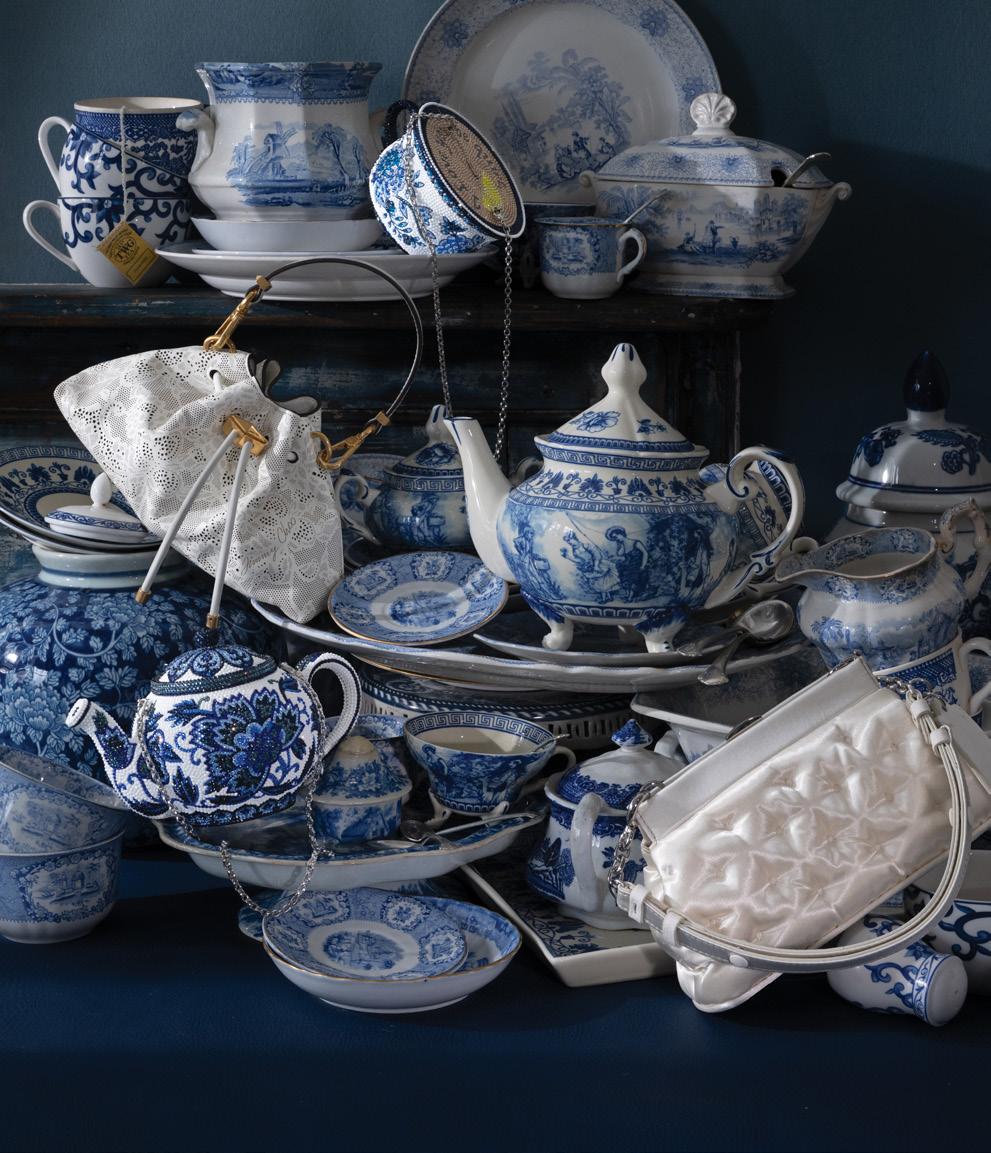
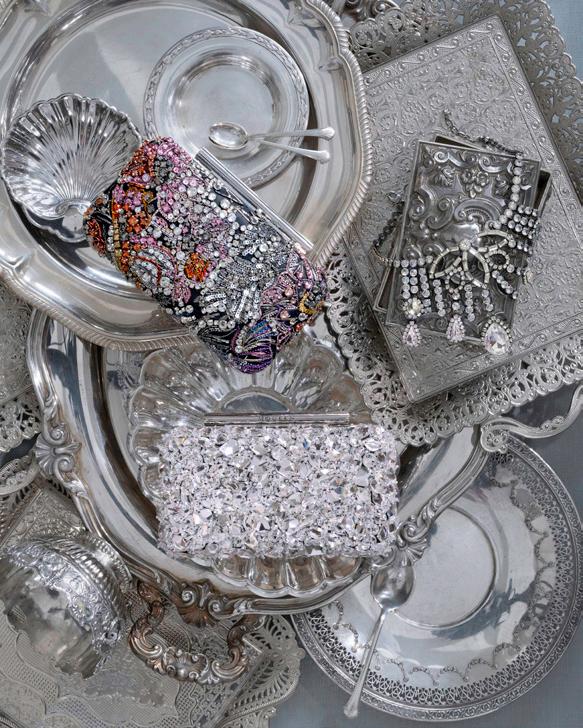
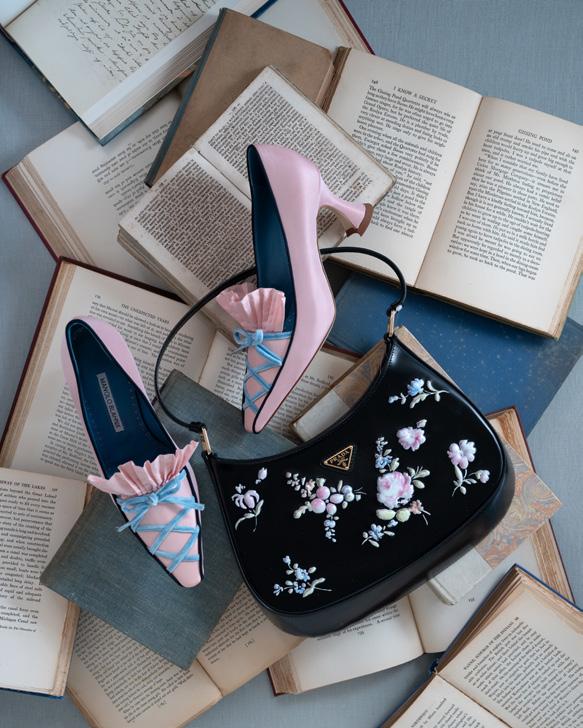
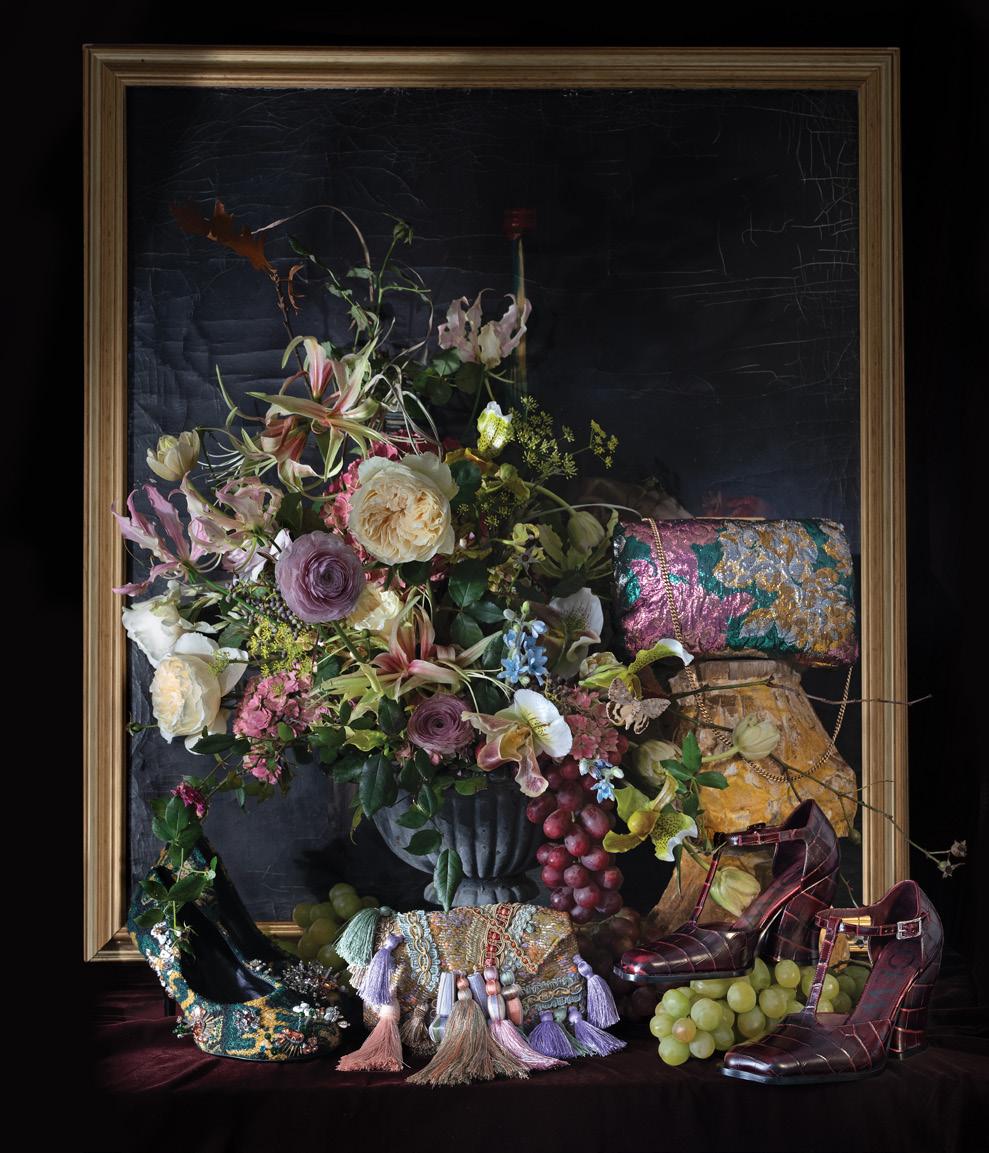
The most iconic accessories transcend time—and make a lasting impression. These must-haves are instant collectibles, blending old-world elegance with a modern flair.
PRODUCED BY CARRIE GOLDBERG
PHOTOGRAPHED BY CORBIN GURKIN
mcqueen.com; McQueen crystal embroidery T-bar box clutch in pale gold, $7,390.
Opposite, from top: Judith Leiber Couture teapot tranquili-tea handbag, $5,495, judithleiber.com; Jimmy Choo latte perforated lace leather shoulder bag, $1,395, jimmychoo.com; Judith Leiber Couture teacup tranquili-tea clutch, $5,195, judithleiber.com; Maison Margiela Glam Slam small embroidered satin clutch, $2,990, modaoperandi.com.
Above, clockwise from top: McQueen smashed floral embroidery T-bar box clutch, $6,750; McQueen chandelier necklace in antique silver, $2,490;
Above: Prada Cleo printed leather shoulder bag, $4,000, available at mytheresa.com;
Rohan 70 velvet and grosgrain trimmed silk pumps, $1,325, manoloblahnik.com.
Opposite, clockwise from top: Saint Laurent small clutch in pink and green, $3,450, available at fwrd.com; Loewe Onda croc-embossed leather T-bar pumps, $1,250, loewe.com; Dries Van Noten tassel embellished jacquard envelope bag, $1,255, available at bergdorfgoodman.com; Dries Van Noten embellished jacquard pumps, $1,295, available at mytheresa.com.
Manolo Blahnik
At L’Atelier Robuchon at The Woodward, Auberge Collection, in Geneva, every night ends on a sweet note that’s full of surprises.
BY JACKIE CARADONIO
PHOTOGRAPHY BY GUILLAUME
Grand
ILLUSION
MEGEVAND
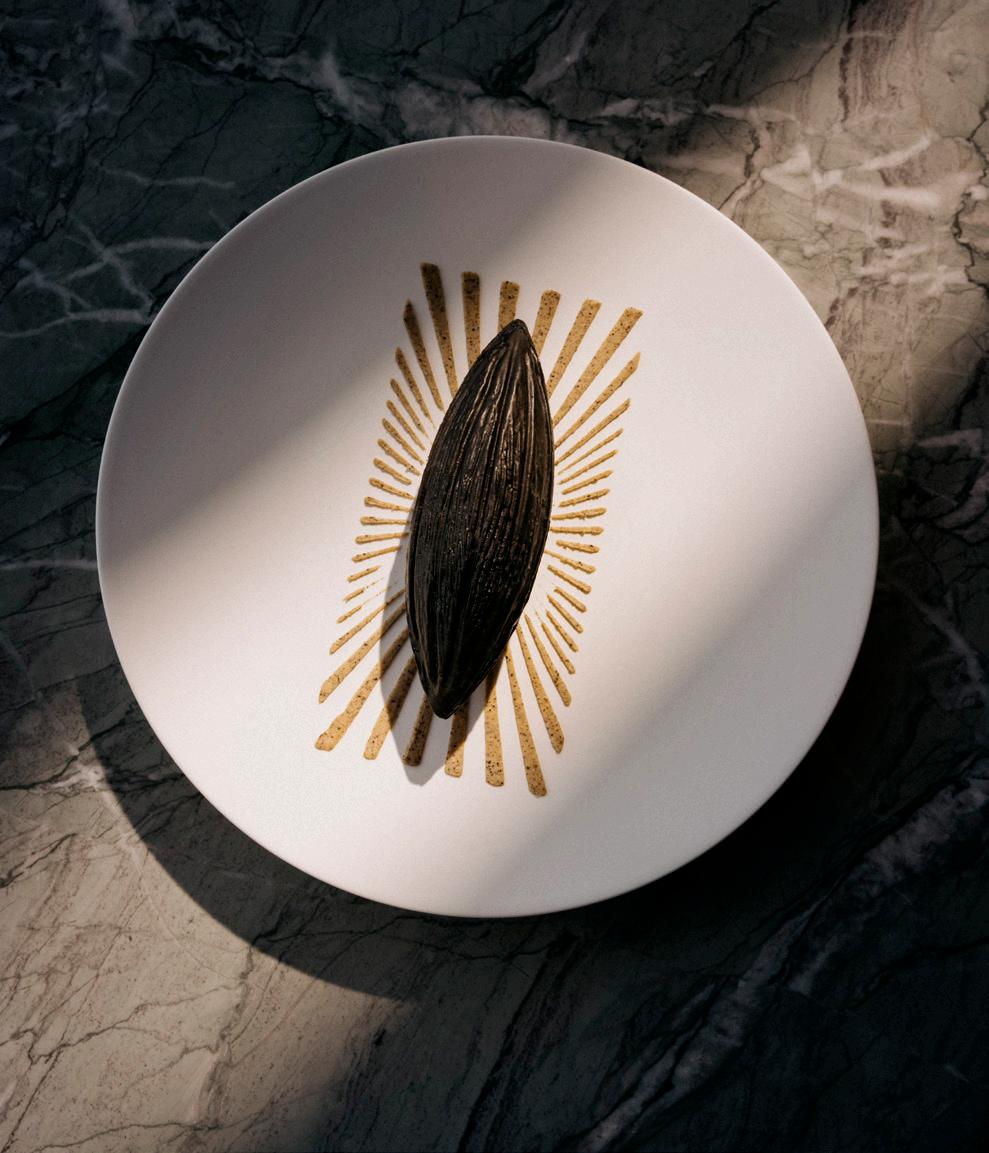
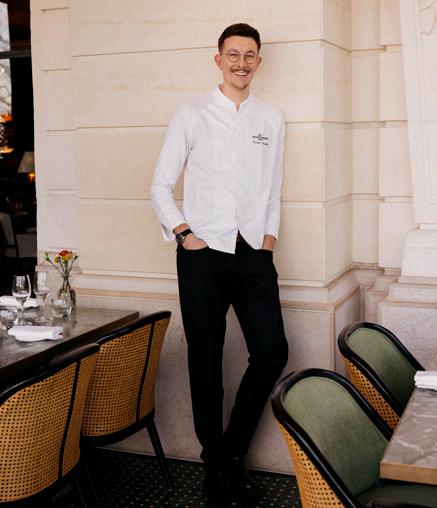
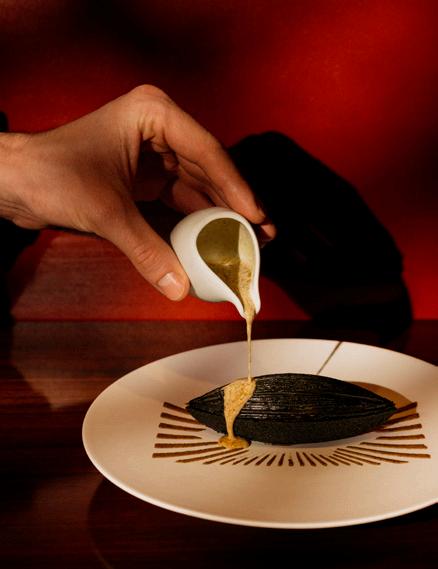
When chef Titouan Claudet was tasked with creating a dessert for the tasting menu at L’Atelier Robuchon, at The Woodward, Auberge Collection in Geneva, his first instinct was to craft a crowd-pleaser. For many titans of pastry that would translate into one primary ingredient: chocolate. But Claudet—who hails from Besançon, France, and has shared the kitchen with luminaries such as Anne-Sophie Pic and won Gault&Millau’s coveted Pastry Chef of the Year in 2025—the answer lay in a flavor more subtle: vanilla. “After a tasting menu, chocolate is too heavy,” he says. “Vanilla is universally loved but lighter and more refined.”
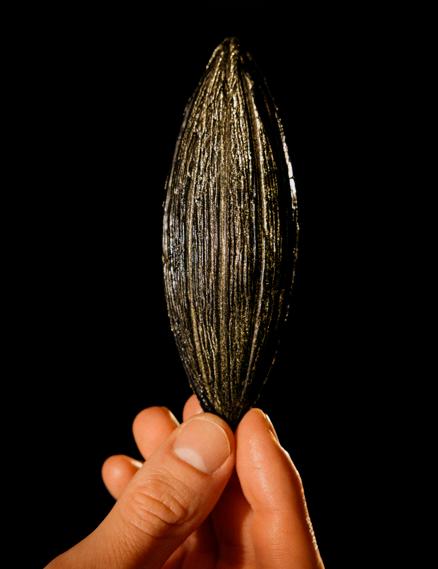
Still, this would be no vanilla vanilla dessert. Rather, La Vanille would be an exercise in illusion and texture—a sculptural interpretation
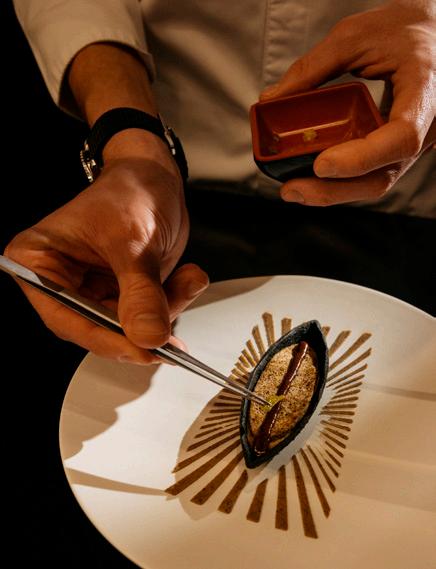
of the vanilla pod itself, rendered in caramel, mousse, ice cream, and biscuit. Claudet began with a three-dimensional silhouette, which he crafted from cookie dough set in a custom mold and darkened with charcoaltinted caramel. Inside, the composition came together layer by layer: a base of vanilla cream, crisp biscuit, praline for depth, and confit calamansi for a bright, citrusy snap, followed by vanilla ice cream and a featherlight vanilla mousse sealed beneath the caramel lid.
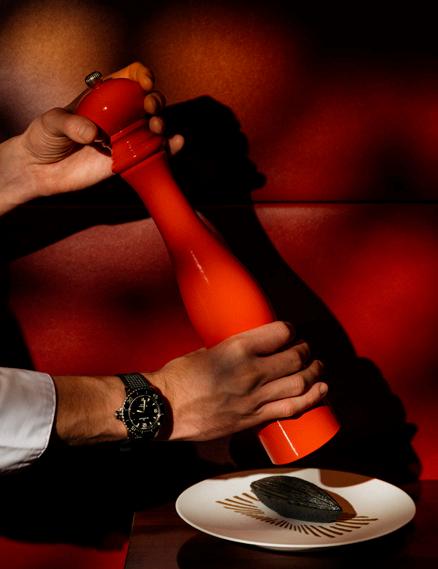
Placed on a dish atop a pattern of vanilla cremeux, the pod is presented with a tableside pour of vanilla crème anglaise. Diners are encouraged to carve the dessert into slices rather than deconstruct it “so that every bite includes all of the elements—all the texture,” Claudet says. “This is the experience of La Vanille.”
a custom mold
composed of sweet
tinted by a charcoal-infused caramel, and textured to mimic a vanilla bean pod to the finest detail. Layers of vanilla cream, crisp biscuit, praline, confit calamansi, vanilla ice cream, and featherlight mousse are carefully topped with delicate pieces of citrus. The covered pod is then dusted with a finely ground vanilla powder. The final touch is velvety vanilla crème anglaise, poured tableside.
From left: Chef Titouan Claudet crafted
for La Vanille’s “pod,”
biscuit
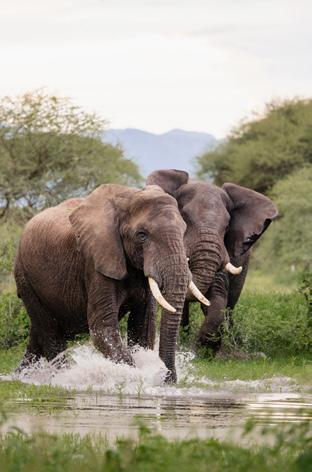
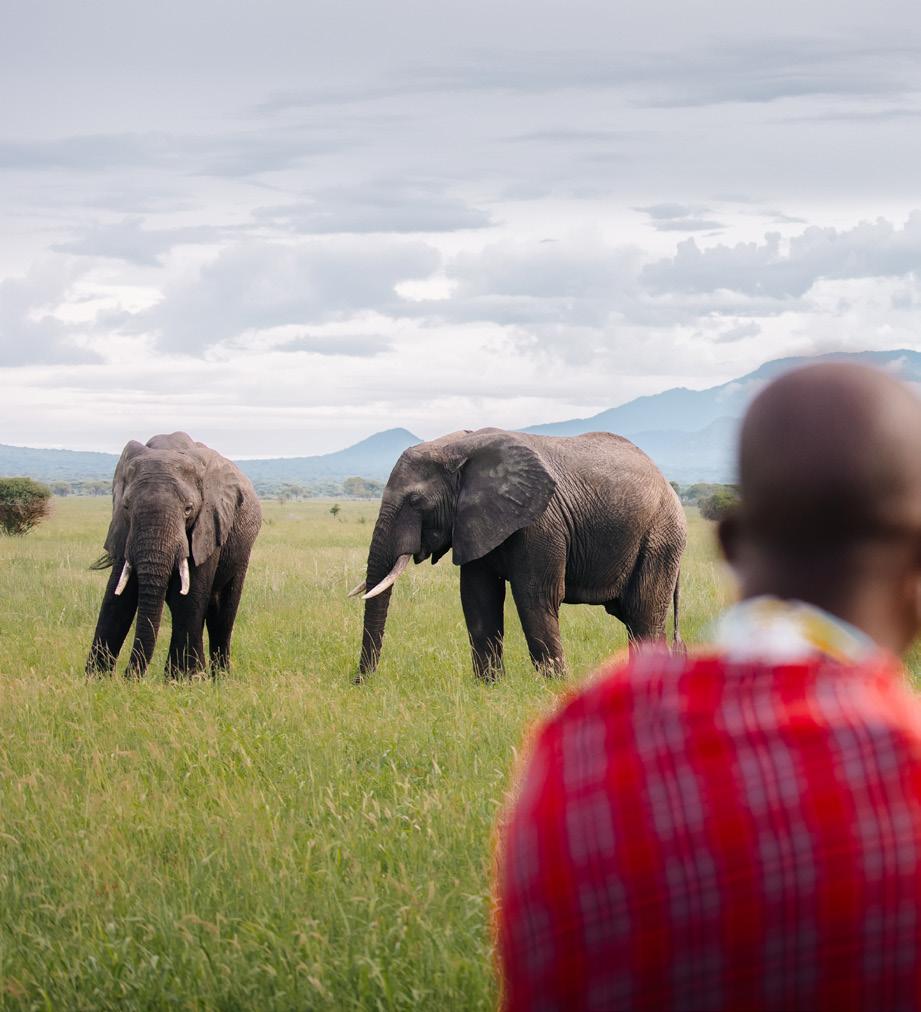
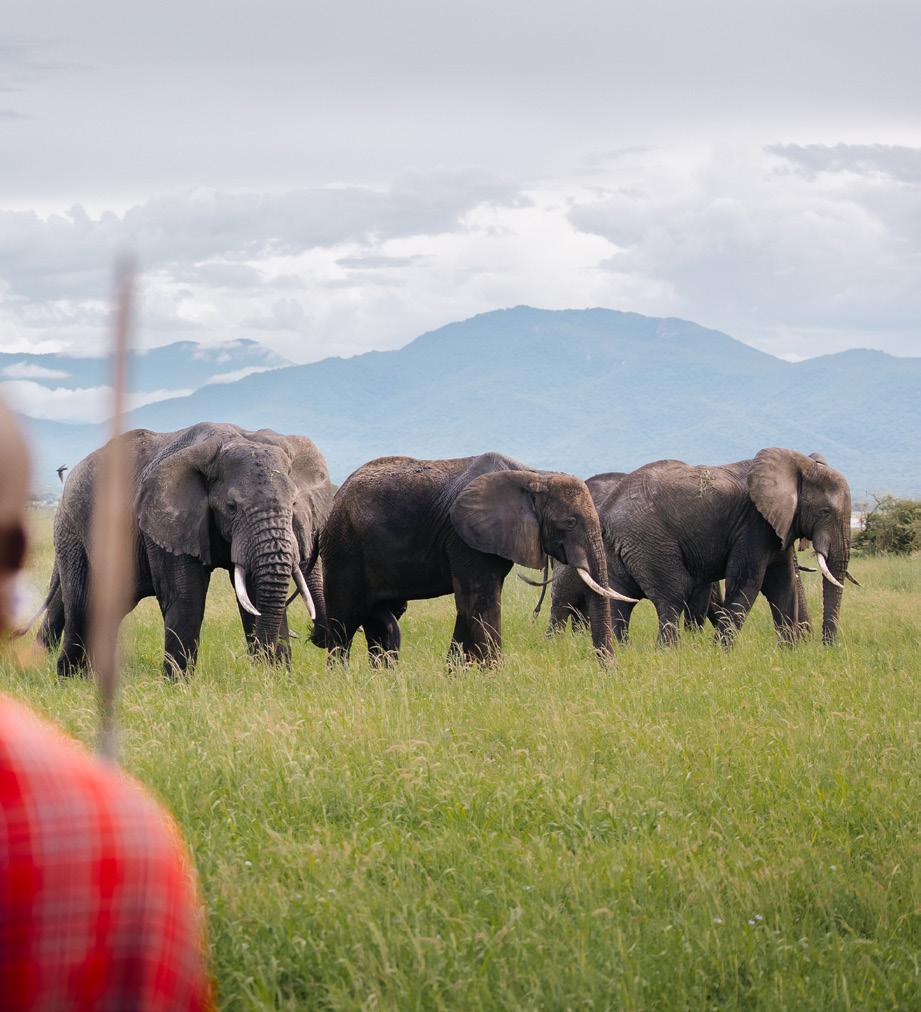
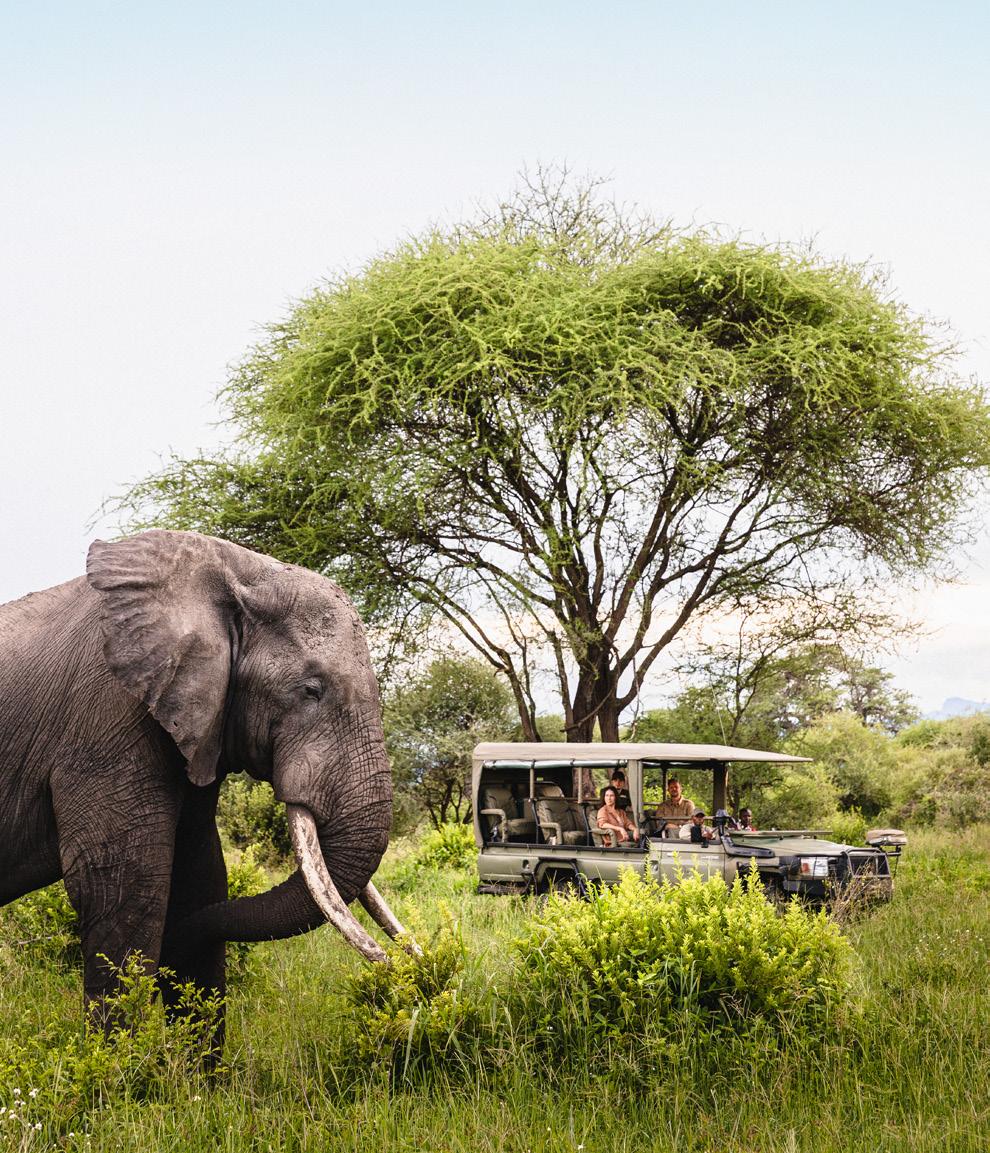
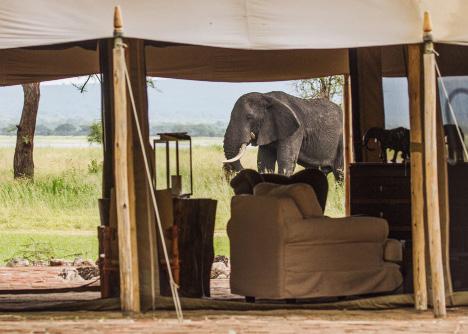
Elephants graze at Little Chem Chem, Auberge Collection, in northern Tanzania’s Burunge Wildlife Management Area. Photography by Teagan Cunniffe.
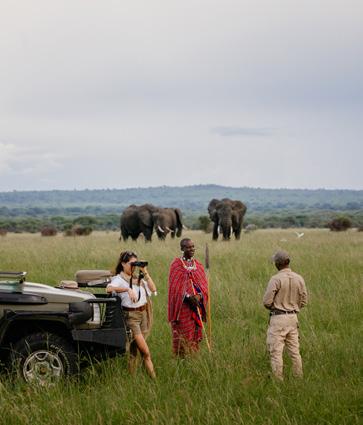
Close-up animal sightings are common in the protected wildlife areas where Auberge Safari lodges and camps are located.
True, Wild, & Free
Auberge introduces Auberge Safari with nine luxury lodges and camps offering unique experiences that connect—and protect—Tanzania’s most coveted wildlife areas.
BY MARY HOLLAND
PHOTOGRAPHY BY TEAGAN CUNNIFFE
It was early morning in Tanzania’s Mwiba Wildlife Reserve, and the savanna was still. The empty green plains stretched for miles until they disappeared into the distant mountains, cutting a clean, sharp line across the powder-blue sky. All signs of life were quiet, just rousing from a night of slumber: the odd cluster of wildebeest, chewing the grass and whipping their tails; elephants lumbering in slow unison.
But the most impactful presence on this crisp morning was the utter lack of one presence in particular: no other humans—not even human sounds—as far as the eye could see or ear could detect. The ensuing stillness felt less like absence and more like space—something increasingly rare and immediately felt.
At Mwiba Wildlife Reserve, a protected wildlife area south of Serengeti National Park, such thrilling and secluded animal sightings are so common as to be almost ordinary—even the Great Migration, the legendary
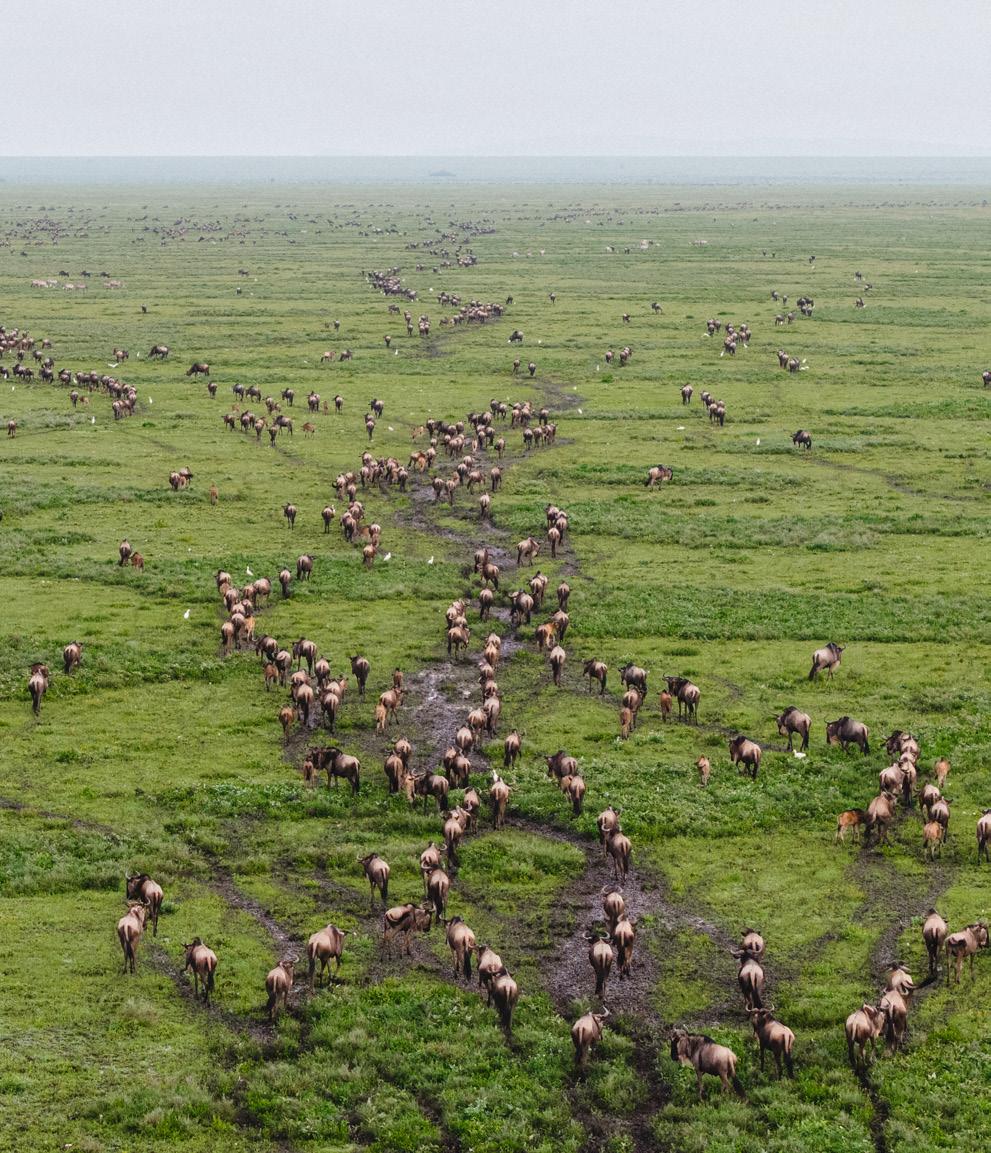
phenomenon that sees 2 million wildebeest and hundreds of thousands of zebras and antelopes cross the Serengeti, can often be glimpsed without another human in sight.
One of the largest conservation initiatives in Tanzania, this swath of land has been under the stewardship of the Friedkin Conservation Fund since 1994. The fund’s core mission—to sustain the land, the ecosystem, and the local community—is shaped by a philosophy of connection. The Friedkin family’s relationship to Tanzania spans more than four decades, informed both by time spent in the bush and a deep respect for what must remain untouched. Across the greater ecosystem, this commitment extends beyond the environment into surrounding communities, supporting access to education, creating pathways to economic independence, and helping to shape a future where both wildlife and people can thrive in balance.
Over the last five years alone, the Friedkin Conservation Fund has made staggering strides in community initiatives, enrolling 2,700 individuals (80 percent of them women)
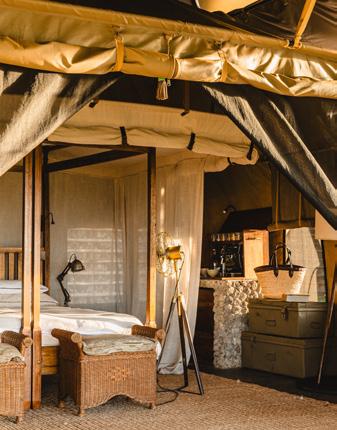
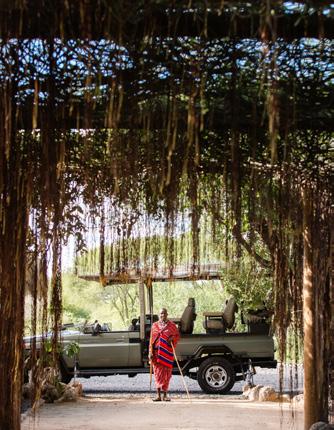
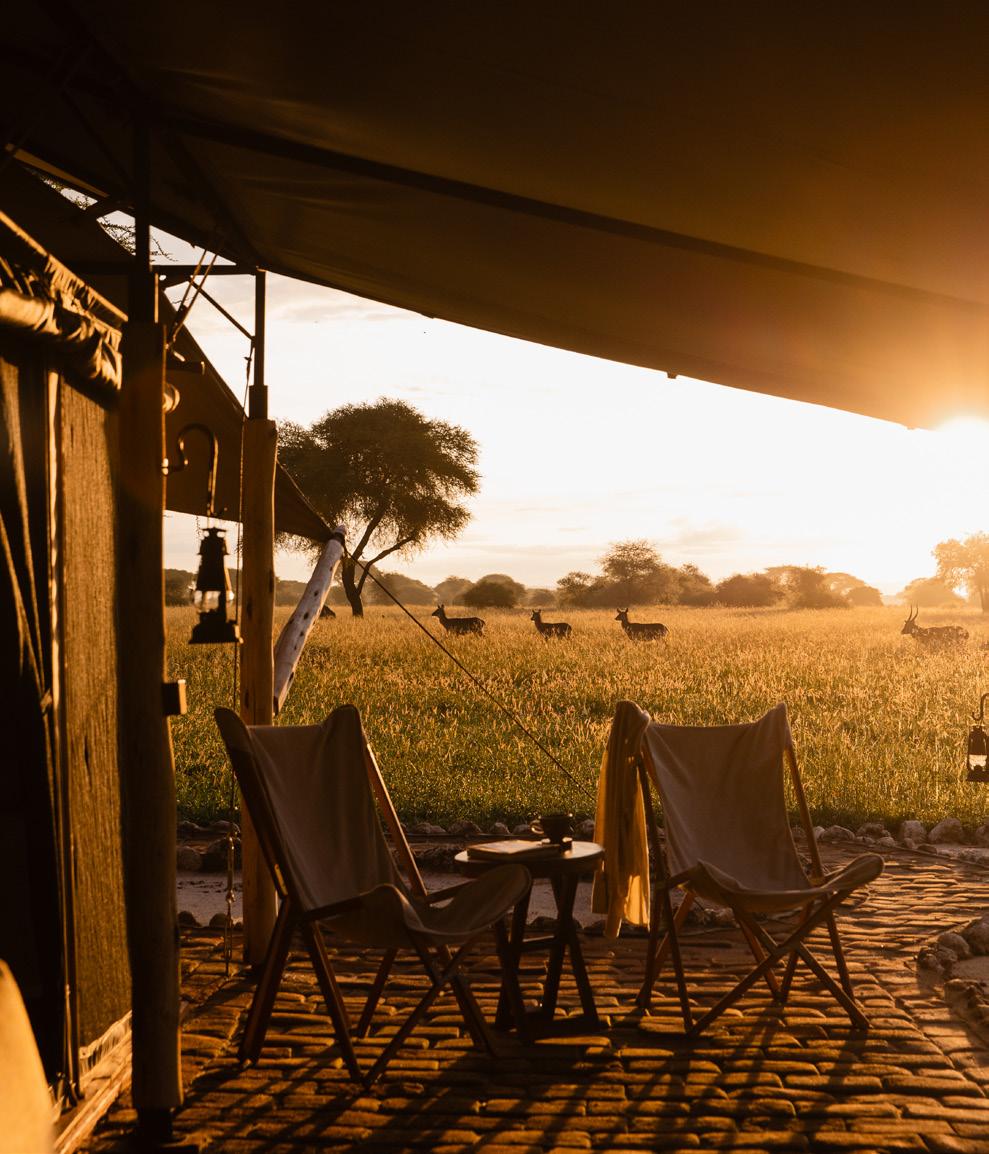
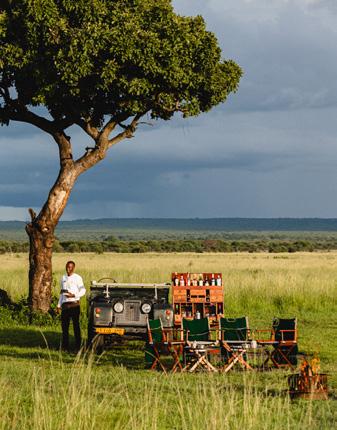
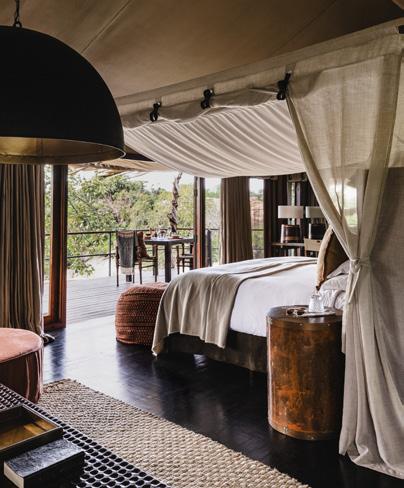
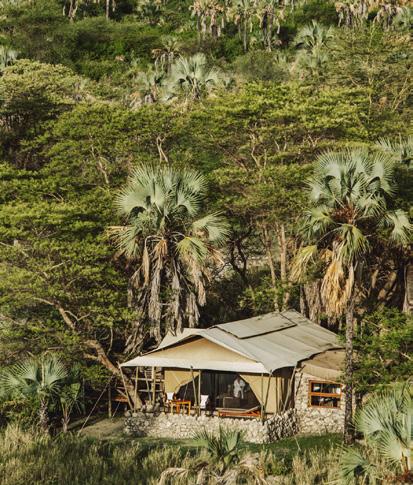
Above, from left: A tented suite at Little Chem Chem, Auberge Collection; a safari truck awaits at Little Chem Chem. Opposite: Wildlife sightings often occur right in camp. Here, a herd of waterbuck pass by a tent at Little Chem Chem.
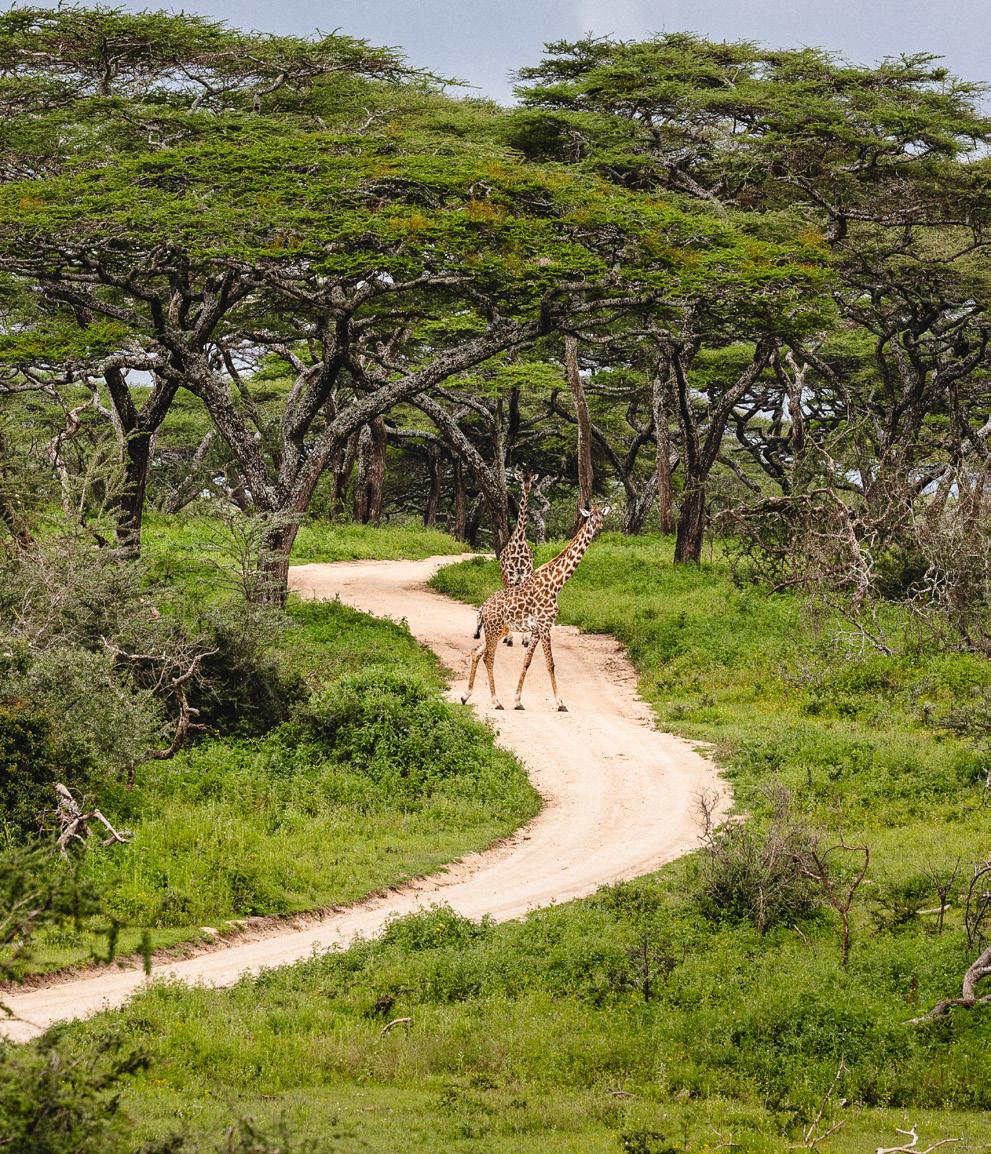
Clockwise, from top left: On safari in the Burunge Wildlife Management Area; game drive glimpses of cheetahs, zebras, and elephants. Opposite: A pair of giraffes crosses a private road in Serengeti National Game Park, near Songa, Auberge Collection.
into an Economic Empowerment Program, providing 2,500 daily school meals, and supporting 57 scholarship students. Conservation has been positively impacted too: The fund safeguards hundreds of square miles of land, forming protected buffer zones around Serengeti National Park and the Ngorongoro Conservation Area. Thousands of acres of invasive plant species have been cleared, and critically endangered black rhinos have been cared for via national darting initiatives. It’s a long-term commitment, and the work, by all accounts, is just getting started.
Those who visit the Mwiba Wildlife Reserve’s Mwiba Lodge, Auberge Collection also enjoy the benefits of these monumental efforts. The hilltop luxury lodge is the beating heart of the protected area, offering intimate sightings within the private Mwiba Wildlife Reserve, as well as wellbeing experiences and cultural visits with local Hadzabe and Datoga communities. And now, it’s part of the new Auberge Safari, a collective of nine luxury lodges and camps across Tanzania, each with its own identity, shaped
by legacy, locale, culture, and connection. Uniting two of East Africa’s most respected conservation-led safari operators—Legendary Expeditions and Chem Chem Safari—the collection establishes a new course of extraordinary journeys and meaningful experiences in some of the most sought-after parts of the country.
At Mwiba Lodge, that’s most evident when it comes to proximity to wildlife. Guests have their own dedicated vehicle and guide, and are free to travel at their own pace, in their own language, and on their own terms. But they needn’t travel far to experience the riches of the reserve.
As that crisp morning quietly unfolded, the lodge’s truck— still the only one in sight—suddenly stopped short at the sight of two male cheetahs peering inquisitively, and perhaps hungrily, amid the tips of the blades of grass. Our guide inched the vehicle closer, then off the road and into the brush. Two brothers lounging in the sun, he told us, adding it was unlikely they’d hunt due to the heat of the fast-rising sun. Then, a sound. The pair’s ears
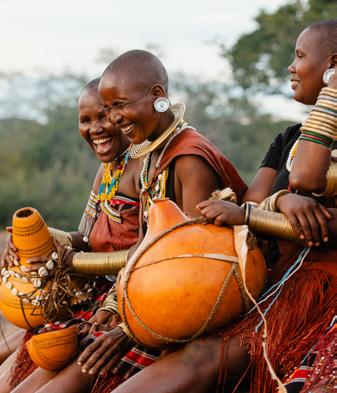
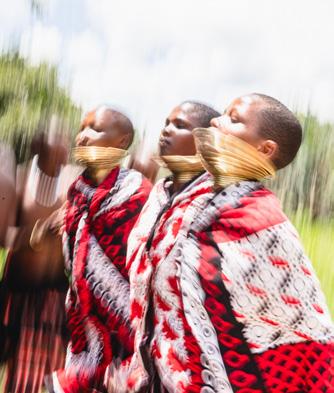
Above: The Datoga people of the Mwiba Reserve share their traditions, dance, and crafts with guests of Mwiba Lodge, Auberge Collection. Opposite: Wildebeest pass through the Serengeti, near Songa, during the Great Migration.
pricked up, their necks turning as they scanned the plains for signs of life. Nothing. Across the savanna, all was still, yet we patiently waited, watching, as they flicked their tails, rolled over, and occasionally bolted upright.
Eventually, they stood and sauntered into the grass, continuing about their lazy day. Remarkably, more than 20 minutes had passed. Had we shared this sighting with other safari-goers, a prolonged and intimate encounter may have been less likely—and certainly more crowded.
Such close-up moments make for a different kind of safari, where the wild beauty of Tanzania isn’t hotly pursued, but rather profoundly absorbed. Moments unfold gradually, often lingering far longer than expected—simply because nothing interrupts them.
That meaningful approach is central to each of Auberge Safari’s unique camps: Legendary Lodge near the city of Arusha; Mwiba Lodge in the Mwiba Wildlife
Reserve; Mwiba Plains in The Greater Mwiba Protected Wildlife Area. Nyasi and Songa in Northern Serengeti; Mila in the Serengeti’s Western Corridor. And Chem Chem Lodge, Little Chem Chem, and Forest Chem Chem in the Burunge Wildlife Management Area in northern Tanzania. Together, they stretch some 115 miles, connecting—and protecting—the richest wildlife areas throughout Tanzania.
About 100 miles south of Mwiba, near Lake Manyara, Chem Chem’s conservation initiatives have been underway for nearly two decades, focused largely on rewilding one of Tanzania’s most important wildlife migration corridors, between Lake Manyara National Park, Tarangire National Park, and the Serengeti through the Ngorongoro Crater. Until recently, this vital stretch of migratory land was totally degraded, with no animals passing through—that is, until the Chem Chem Association became its official steward, leading an intensive regeneration and repopulating period, and creating three lodges on the land to build
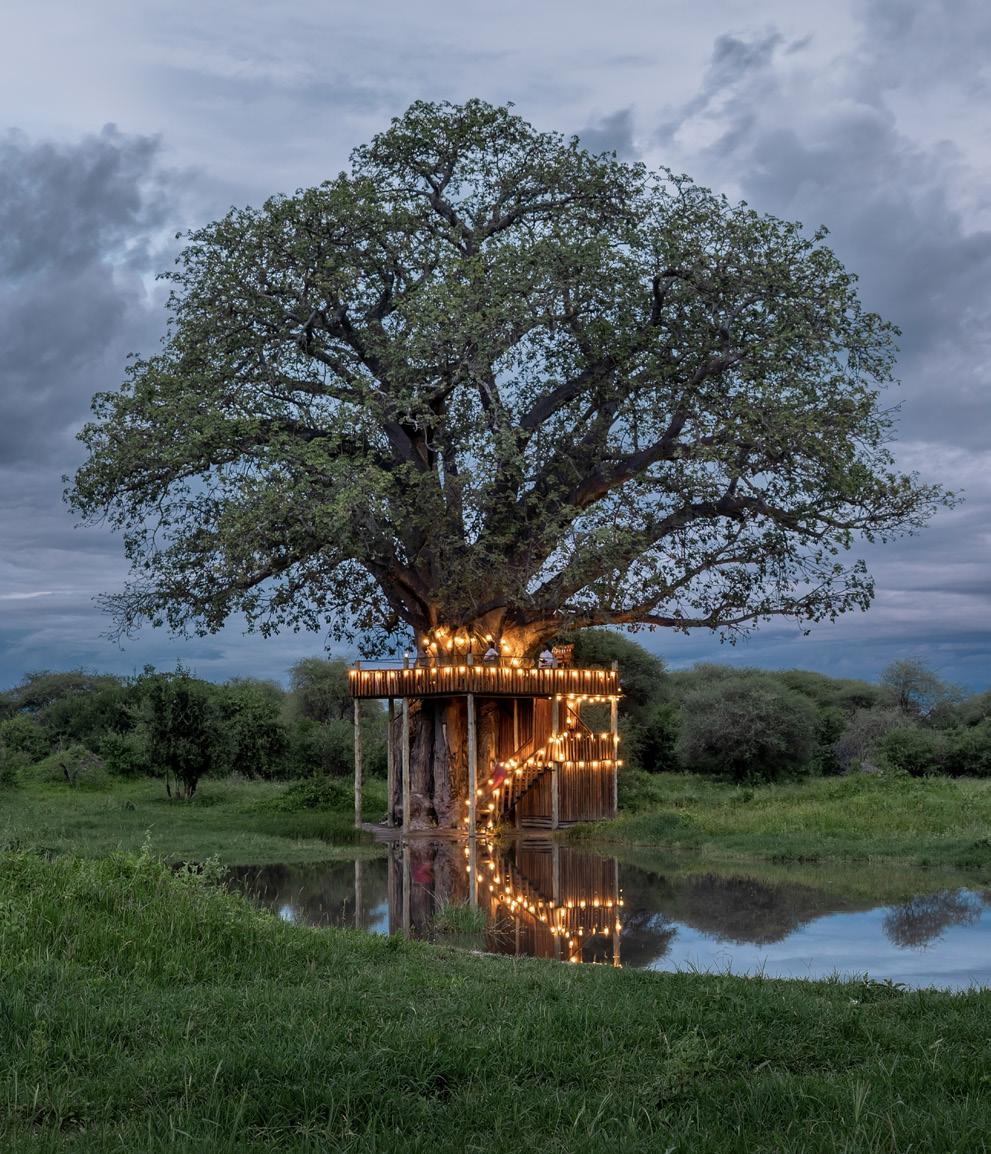
Above, from left: Night falls on Little Chem Chem; lunch is served with panoramic views over the Kwakuchinga Wildlife Corridor. Opposite: At Little Chem Chem, an acacia tree serves as a natural viewing platform, offering bird’s-eye views of the surrounding plains.
new economic opportunities for local communities. Nearly two decades later, driving through the 50,000acre Chem Chem exclusive-use protected wildlife area, guests are witness to something once considered unthinkable: elephants crossing the grassy corridor, lions napping atop sycamore fig branches, and giraffes reaching for acacia leaves. What was once almost gone now thrives again as the land regains its rhythm.
With each stay at Auberge Safari, slow and steady is the ethos applied to every part of the experience. Historically, a safari has been prescriptive, bookended by predawn and sunset game drives that create a fastpaced itinerary often antithetical to the freedom of wild nature. But Auberge Safari takes a more rooted, holistic approach: Time is less structured, and unique experiences—such as Chem Chem’s silent walks and ponya cuisine (the latter derived from the Swahili word for “to heal” and including native Tanzanian power foods like moringa and baobab)—emphasize
meaningful moments over standardized programming. Similarly, at Mwiba Lodge, you can start the day any time you like, breakfast can be packed and eaten on the go, and guests can come and go as they please.
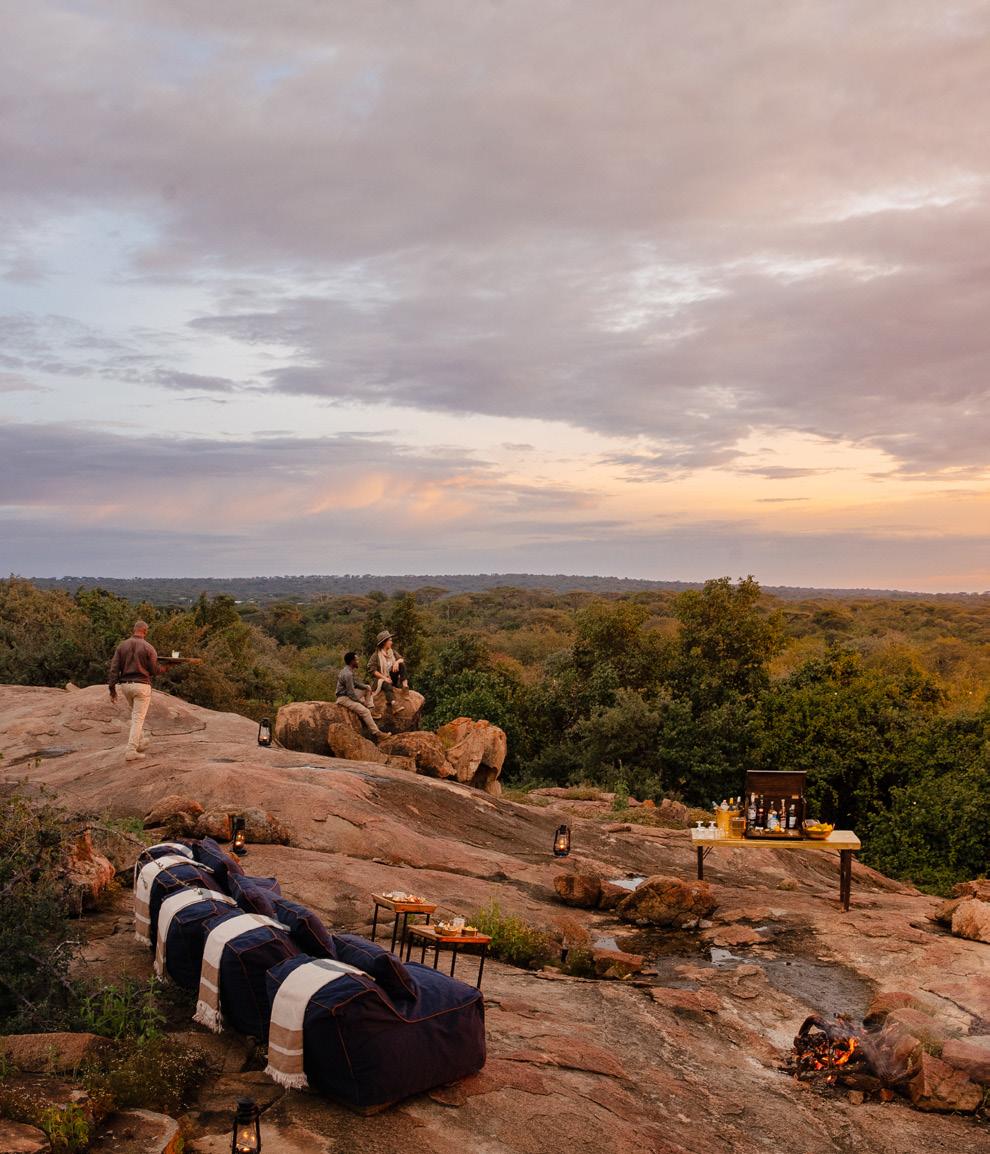
Of course, the adrenaline of a close-up wildlife experience is always just around the bend—though one can never predict exactly what it might be. One evening at Mwiba Lodge, sundowners were set up on ancient boulders overlooking the plains, and single-seat sofas draped with blankets were arranged around a campfire. The sun still hovered above the horizon, its yellow halo cast over the plains. Then, one by one, as day slipped into night, the stars appeared so brightly it was as though someone had flicked a switch. Almost anywhere else, this would have been the time to race back to camp, with national parks closing and long drives ahead. But here, no one stirred. There was no schedule, no expediency, no watchtapping—just a moment of stillness, where for a few minutes, it was the stars, the wilderness, and only us.
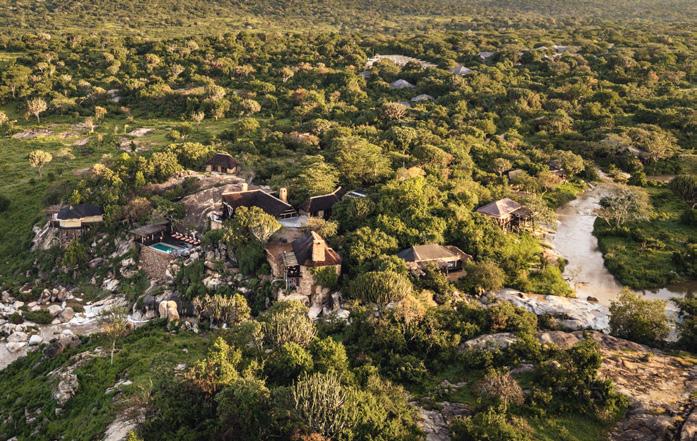
Above: A bird’s-eye view of Mwiba Lodge. Opposite: Sundowners in the Mwiba Wildlife Reserve.
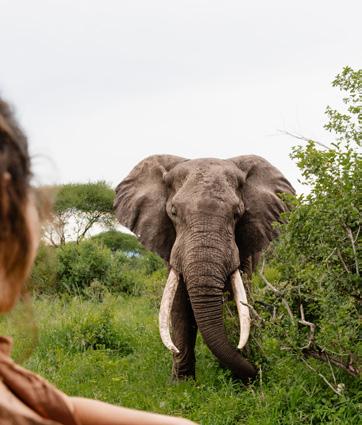
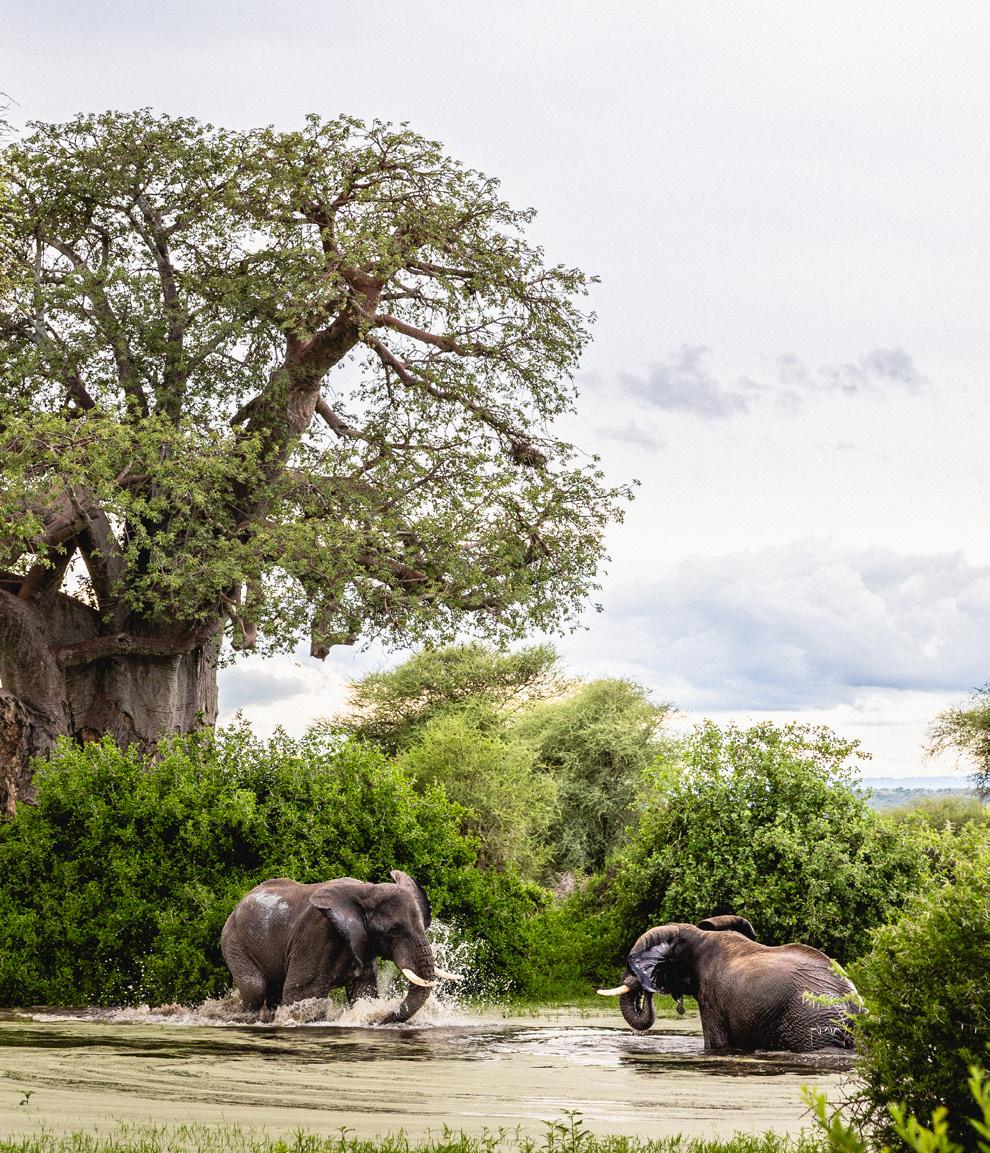
Up-close with the elephants at Little Chem Chem. Opposite: A tented suite at Mwiba Lodge in Tanzania’s Mwiba Reserve.
Into the Wilds of Tanzania
DAYS 1–2: ARUSHA TO MWIBA RESERVE
The trip begins at Legendary Lodge, Auberge Collection, a quiet, garden-filled estate on a working coffee plantation just outside the Tanzanian capital city of Arusha. It’s a welcome—and restorative—start to an epic adventure.
The next morning, a short flight delivers guests to Mwiba Reserve, an exclusive-use protected wildlife area on the southern edge of the Serengeti. Mwiba Lodge, Auberge Collection, rises from granite boulders, its open-air design oriented toward sweeping views. With virtually no other vehicles in the area, game drives here feel unhurried, and walking safaris offer even closer interactions.
DAYS 2–5: CULTURE AND WILDLIFE IN MWIBA
Mwiba is as much about culture as wildlife. Time here may include visiting the Hadzabe, one of Africa’s last hunter-gatherer groups, or spending time with the Datoga, known for their metalwork and pastoral traditions.
Back in the bush, the focus remains on the rich diversity of wildlife, tracked with your guide during the day and on night drives after dusk. Between outings, Mwiba Lodge invites downtime: coffee on a private deck, a swim overlooking the savanna, sundowners after a starlit alfresco dinner.
DAYS 5–7: THE WESTERN SERENGETI
At Mila, Auberge Collection, in the vast and wildlife-rich plains of the Serengeti’s Western Corridor, the scale expands. The plains here support year-round wildlife, including some of the region’s largest lion prides. A hot-air balloon safari is a highlight for its jaw-dropping bird’s-eye views of the savanna—but there’s endless appeal in staying grounded too: Game drives here may reveal cheetahs hunting, lions lazing, and wildbeest making their long trek in the Great Migration.
From the sweeping savannas of the Serengeti to the baobab-dotted plains of Burunge, Auberge Safari itineraries blend culture, conservation, and endless untamed beauty.
DAYS 7–10: SLOW SAFARI
The final stop, Little Chem Chem, Auberge Collection, sits amid the Burunge Wildlife Management Area, between Tarangire National Park and Lake Manyara National Park, in a private conservation area reserved only for guests. Known for its Slow Safari approach, the property encourages a different tempo and a measured approach: fewer miles covered, more focus on the details.
That ethos plays out in game drives—often centering on tracking the area’s big tusker elephants—as well as visits to nearby Maasai communities, silent walks, rejuvenating wellbeing treatments, and ponya (Swahili for “to heal”) cuisine.
EAST MEADOWS: A NEW CHAPTER OF WATERFRONT LIVING AT KIAWAH RIVER
In California’s Santa Ynez Valley, jewelry designer Irene Neuwirth finds a place for all her passions: fashion, horses, and nature.
AND
WRITTEN
PHOTOGRAPHED BY CHRISTOPHER BAGLEY
When people meet Irene Neuwirth—
founder of the eponymous and fanatically collected jewelry brand—they’re often expecting a laid-back Californian, barefoot and perhaps just returned from the beach. Raised in Los Angeles and known for her chic but unfussy aesthetic, the designer seems to embody a certain carefree, West Coast ease. But as Neuwirth will be the first to tell you, being chill isn’t really her thing. She’s afraid of the ocean, and even when she was a teenager growing up in Venice Beach, she was never the type to hop on a skateboard.
“People are always like, ‘She’s so low-key!’” Neuwirth says. “But I’m not. I’m controlling and obsessive and meticulous.”
Mostly, those traits manifest in Neuwirth’s two biggest interests—jewelry and horses— and in both realms, her intensity and determination have served her well. On the jewelry front, she has been on a tear since the early 2000s, when, as a recent college graduate with no formal design training, she created 10 pieces and began calling—some might say hounding—the jewelry buyer at Barneys New York until she secured an inperson meeting. (“It’s very hard to tell me no,” she says.)
Barneys bought the collection and Neuwirth promptly gave herself a crash course in all
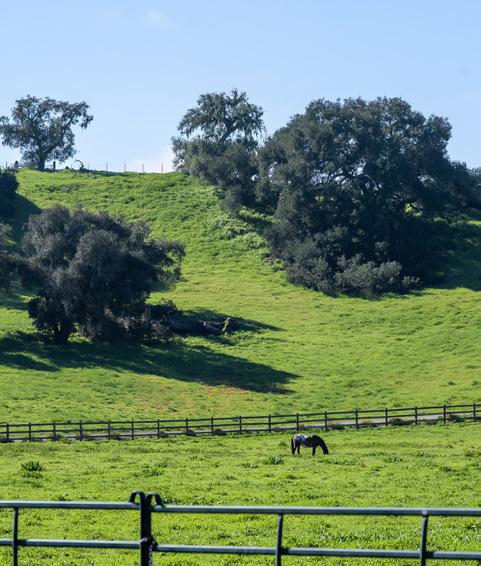
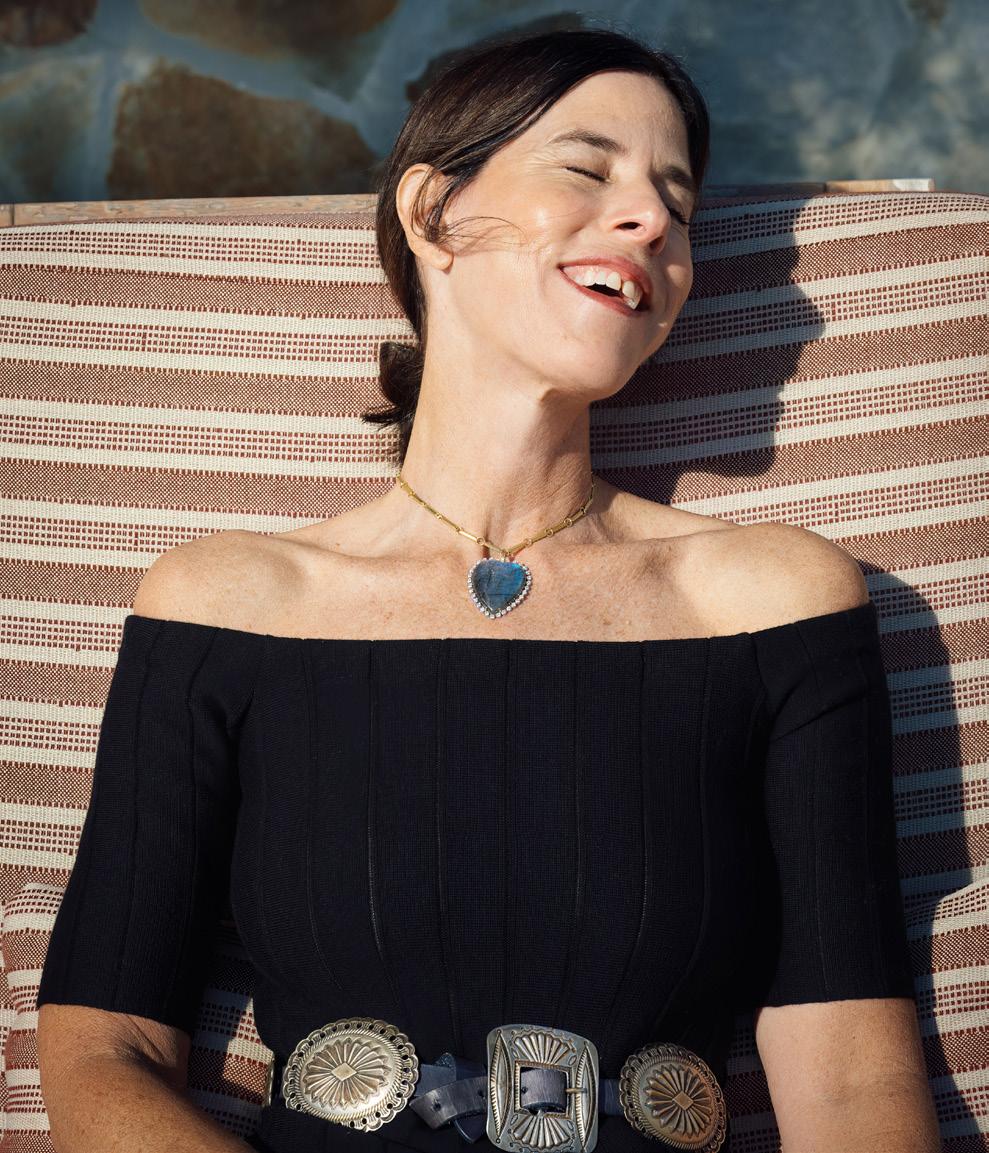
Above: A pastoral roadside scene in Los Olivos. Opposite: Neuwirth wearing a labradorite and diamond pendant by the pool at The Inn at Mattei’s Tavern, Auberge Collection.
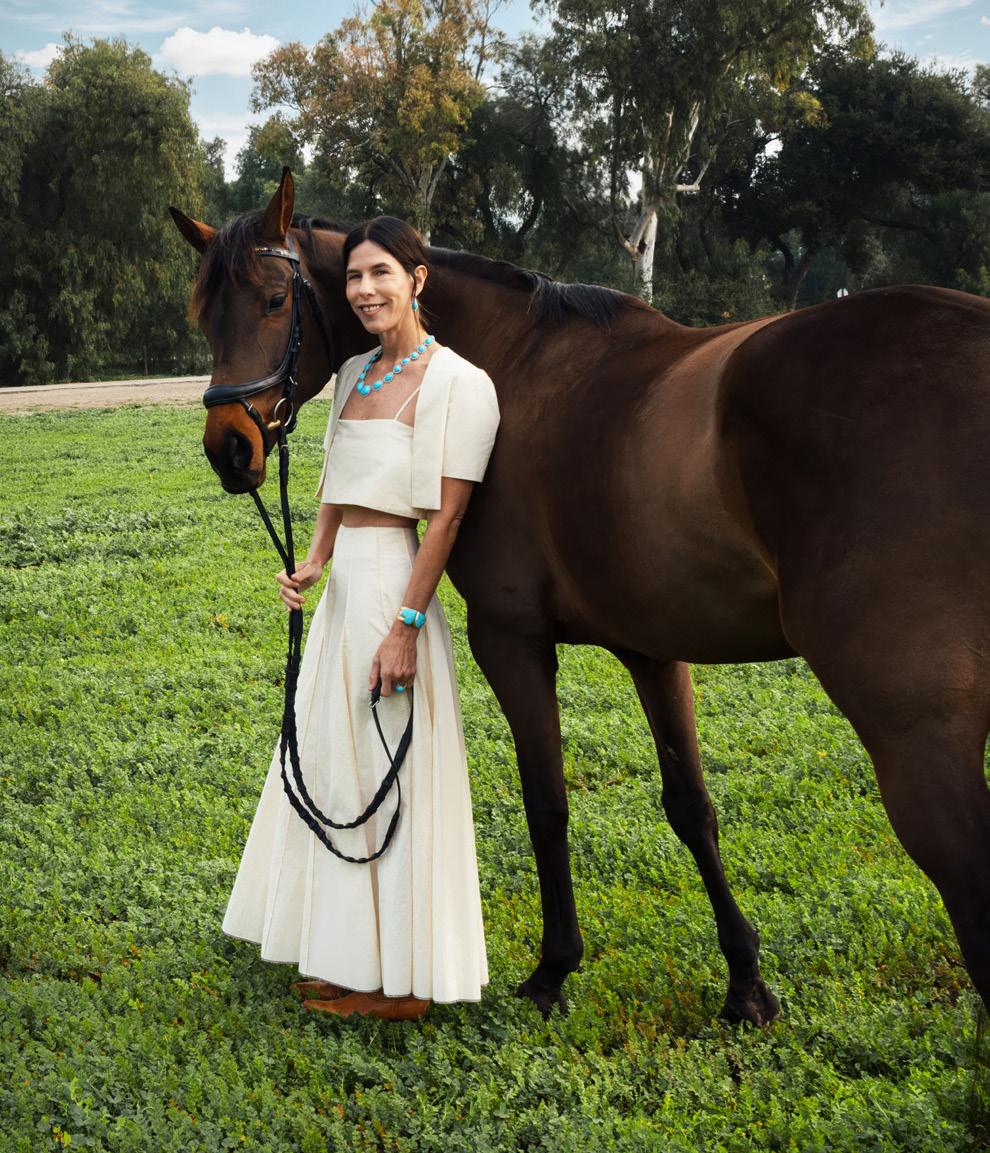
Previous spread, from left: One of many equestrian-inspired details at The Inn at Mattei’s Tavern; Neuwirth, in her turquoise jewelry, with horse Lulu.
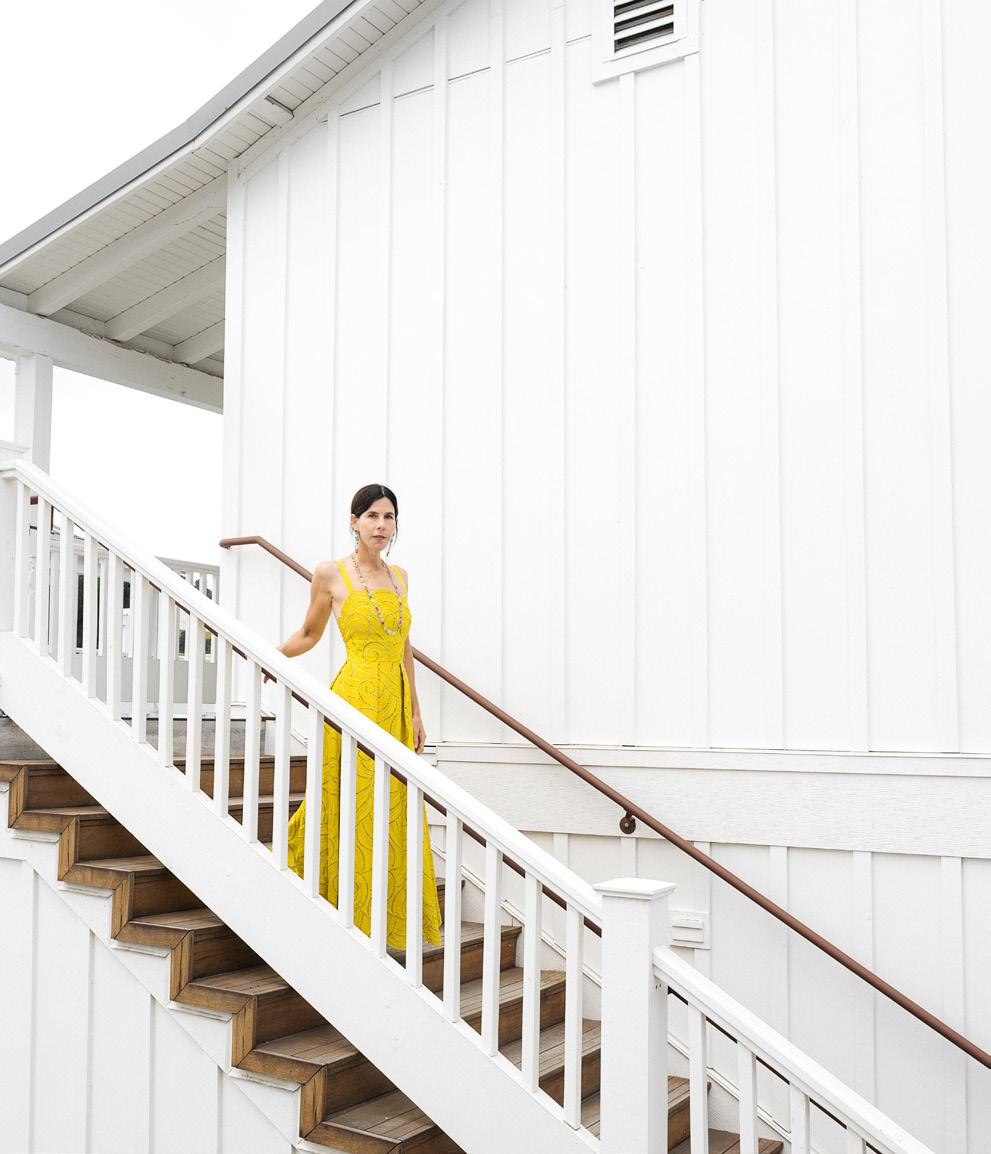
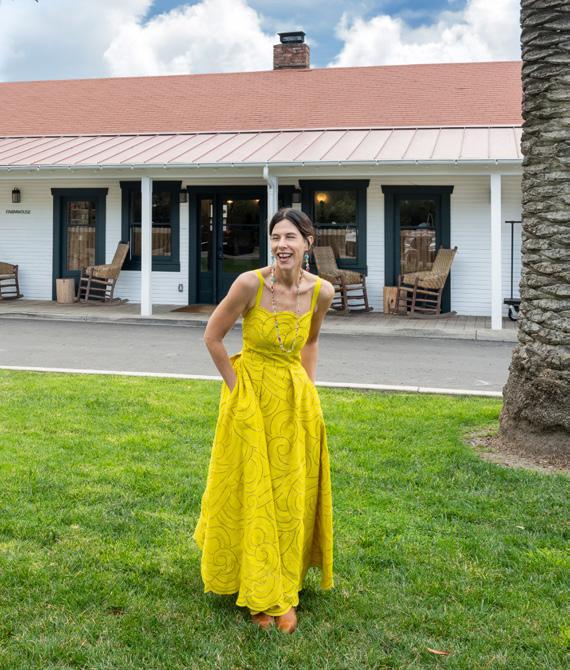
Opposite: In her trademark bright dress and her own colorful jewelry designs, Irene Neuwirth feels right at home in the rustic sophistication of The Inn at Mattei’s Tavern.
Above: A quiet moment at The Tavern, the property’s signature restaurant.
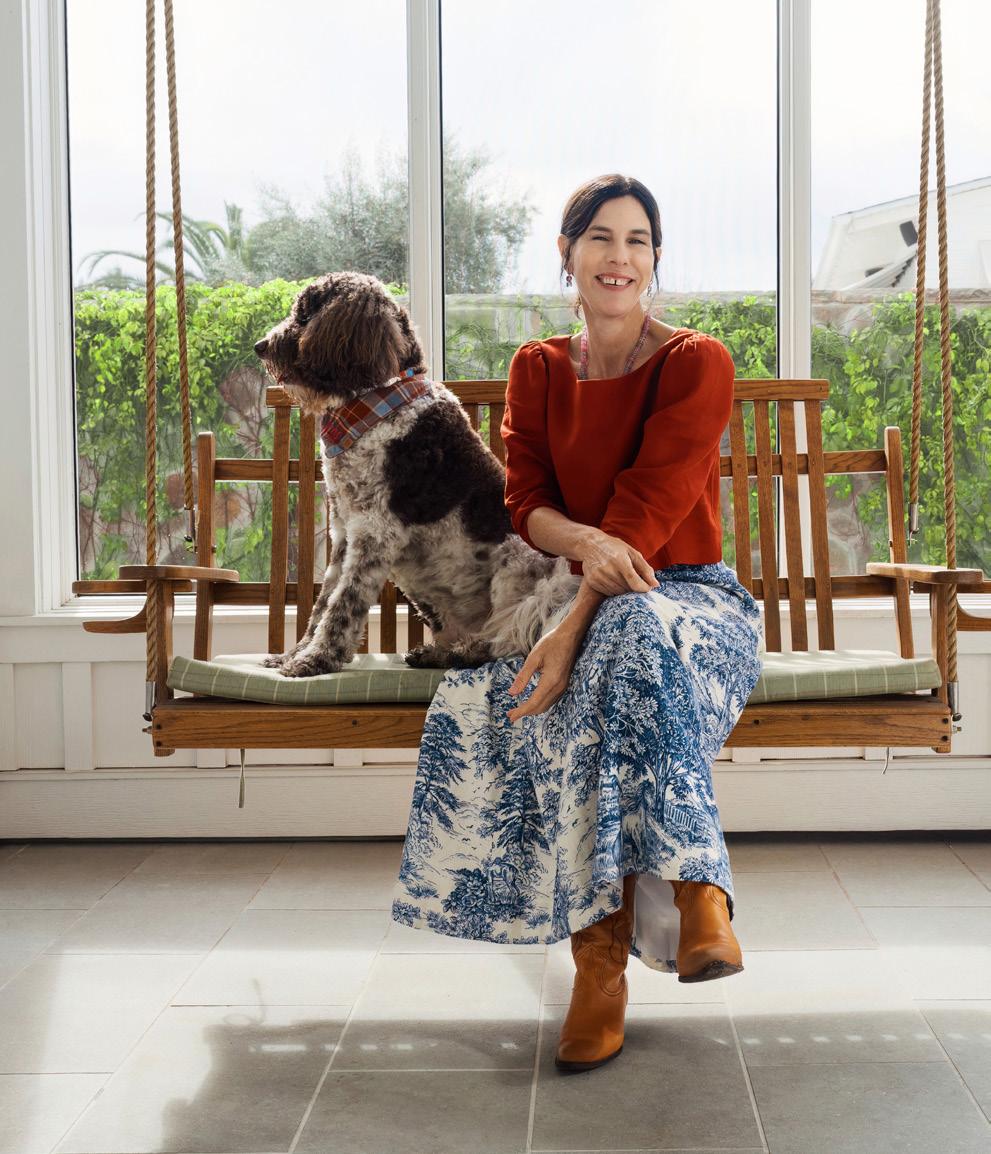
Neuwirth with Ernie, one of her labradoodles, on the porch of a guest room at The Inn at Mattei’s Tavern.
aspects of the business, from wax carving and metalsmithing to P&L statements. Along the way, she refined her signature aesthetic with uniquely vivid, playful designs that showcase richly colored gemstones while leaving ample room for whimsy. Today Neuwirth has boutiques on Madison Avenue in New York and on Melrose Place in Los Angeles, and her pieces are a frequent presence on red carpets and in fashion spreads.
By comparison, her path to becoming a competitive equestrian was a bit more circuitous. When Neuwirth first began competing in Los Angeles at age 13, progress came slowly; her parents were supportive but wary of the sport’s demands on both time and budget. “I showed a lot, but it was at a very low level,” she says. “I thought, one day when I make enough money, I’m going to buy myself a horse and get back into it in some way. Well, it took a while. I didn’t sit on a horse for 23 years.”
When she did get back in the saddle, she did so with a vengeance: She has won a string of blue ribbons at show-jumping championships in the amateur owner division and is a mainstay at Wellington International and other stops on the elite circuit.
On the day we meet for lunch at The Inn at Mattei’s Tavern, Auberge Collection, in California’s Santa Ynez wine country, Neuwirth makes her way through a cheeseburger and fries, texting with her team in Florida where her horses (six of
them, at current count) are based for the winter season. “I mean, it’s insane,” she says. “I keep buying more horses, and I’m competing across the country from where I live. But I love it so much. It’s really fun to be competitive at something you’re good at.”
Although show jumping and jewelry making might seem to have little in common, Neuwirth finds the two pursuits overlap in surprising and meaningful ways. Like working with rare gemstones, cavorting with unpredictable thousand-pound mammals requires an intuitive respect for nature. And when things go right, it can take on a meditative, even spiritual quality. “Riding takes all of your concentration,” she says. “When I ride, it’s the only thing I think about.”
Both disciplines also require a balance of control and surrender, along with a willingness to get one’s hands dirty. “Even though riding is a very expensive sport, you can’t just buy your way in,” she says. “You have to be really sensitive and attuned to the horse if you want to do well.”
Juggling the dual roles of full-time designer and competitive athlete brings its own set of challenges, yet Neuwirth has found that riding, for all the dedication and focus it requires, has also helped temper her workaholic tendencies. “It allowed me to put my obsessiveness somewhere else and be a little looser with my business,” she says. “I’m still incredibly involved in everything, but just, like, 10 percent looser, which is better for everyone.”
Above: A gentle moment with Lulu, a purebred Trakehner. Opposite:
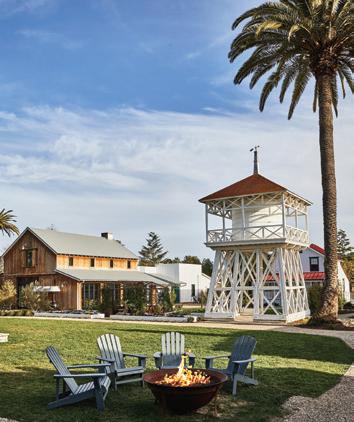
Under the historic water tower at The Inn at Mattei’s Tavern.
When she does manage to relax, Neuwirth often spends her downtime with her longtime boyfriend, film producer and director Phil Lord, and their three labradoodles. She recently celebrated her 50th birthday outside Rome with 150 guests who flew in for the weekend. (Among them: Bruce Springsteen, whose wife, Patti Scialfa, is a longtime friend.)
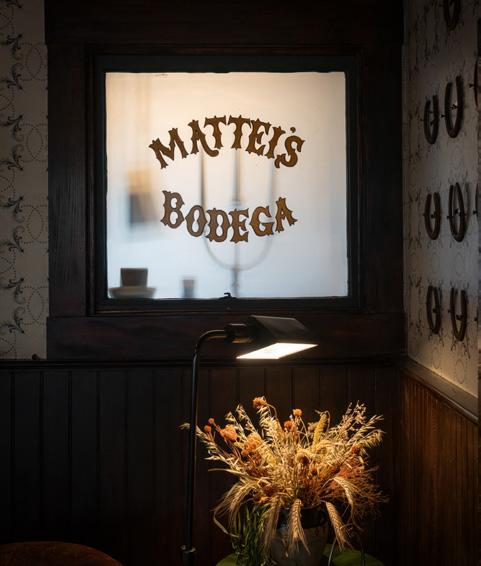
Given all the bouncing around, it helps that Neuwirth’s house is in a quiet stretch of Malibu. She trains at a barn north of Los Angeles and feels fully at home in the rustic refinement of The Inn at Mattei’s Tavern in Los Olivos. Originally built as a stagecoach stop in 1886, it is still dotted with antique horseshoes and other equestrian details. Neuwirth first visited the property with her family as a child and has returned to the coastal valley many times over the years—for riding, wine tasting, or simply taking in the rugged beauty of the surrounding hills and centuries-old live oaks.
As Neuwirth finishes her burger and shows me photos of her horses on her phone, it’s clear that if she didn’t have a thriving business to run, she’d be on horseback as we speak. “After Florida, all six horses will be in New Jersey for the spring, and then they’ll go to the Hamptons for the summer,” she says. “I’ll meet them there. They have a very nice life.”
Above: The Tavern at The Inn at Mattei’s Tavern.
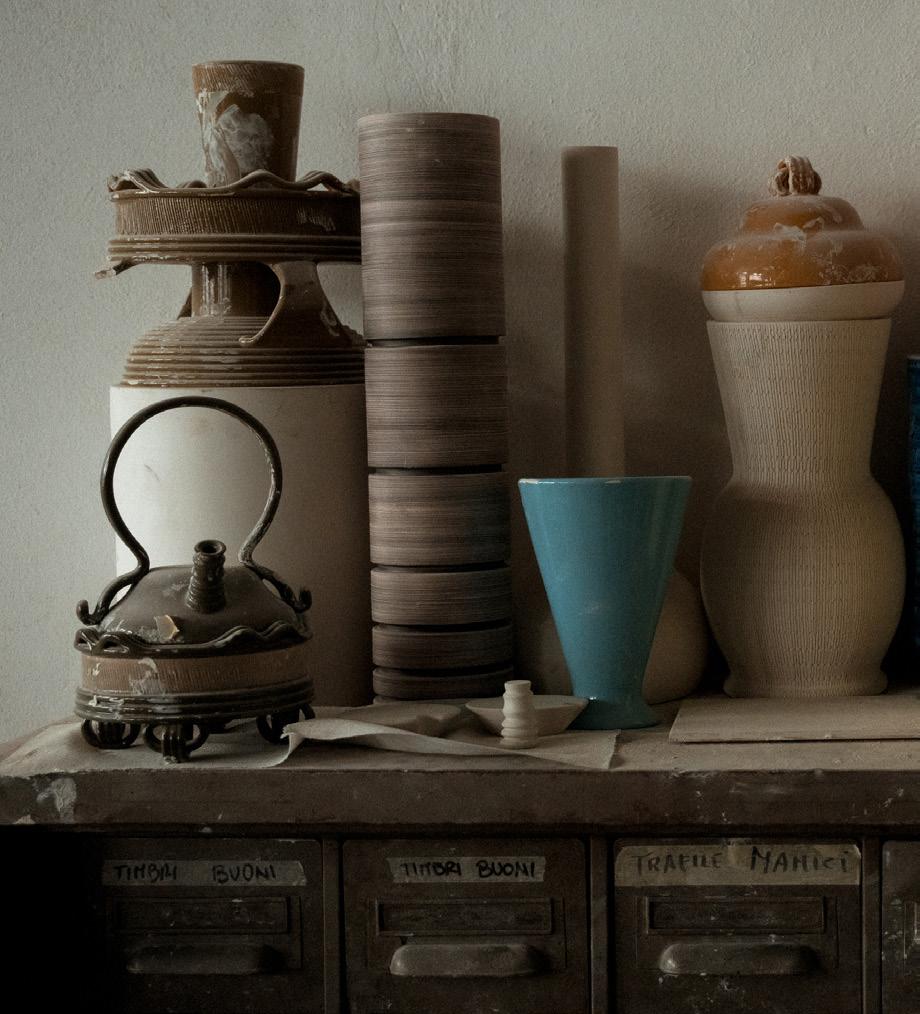
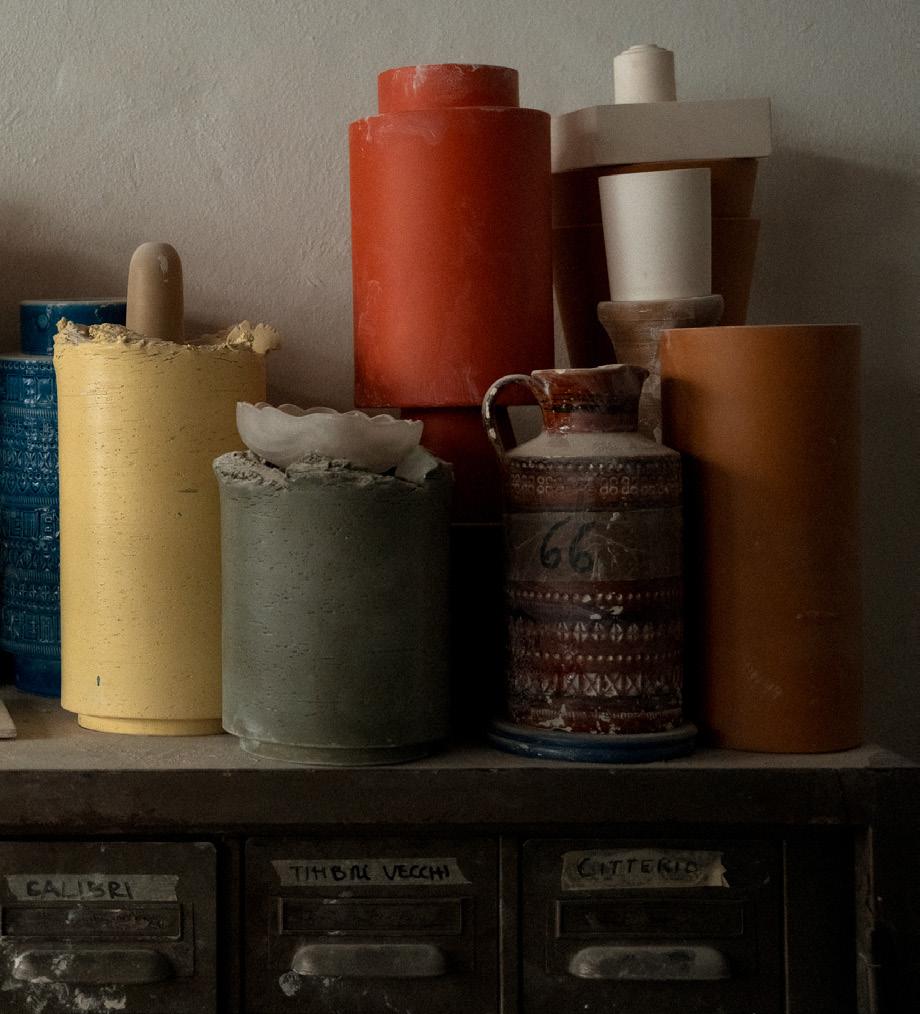
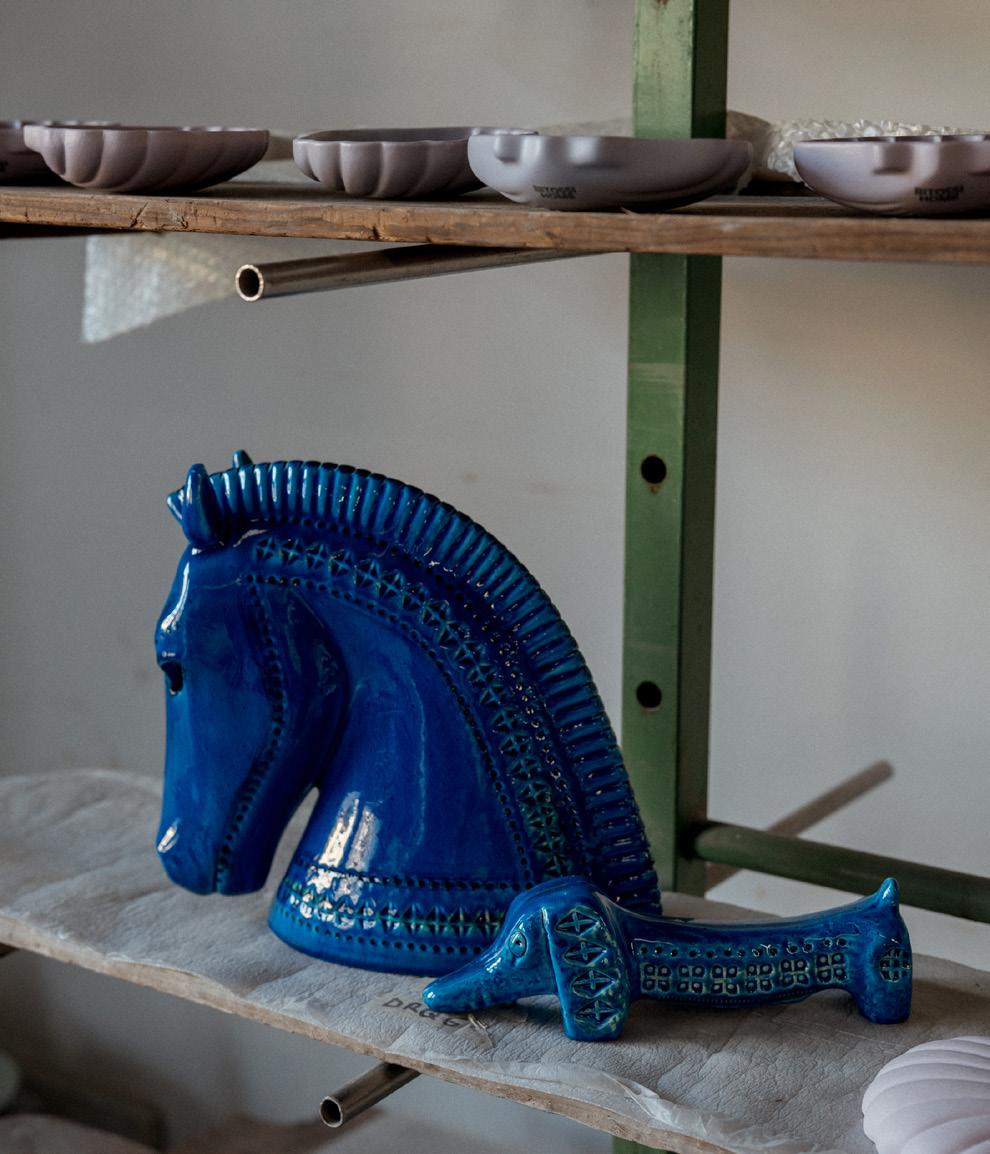
Bitossi ceramics have been hand-crafted in Montelupo Fiorentino, Tuscany, since the 1500s. Photography by Ellie Thorne.
BY ALEKS CVETKOVIC
London’s legendary Savile Row has always been about heritage. In 2026, it’s also about reinvention.
A Different Cut
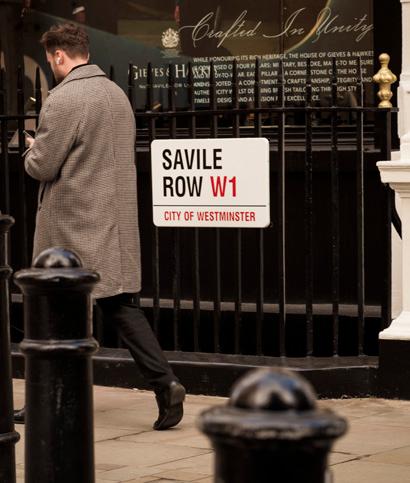
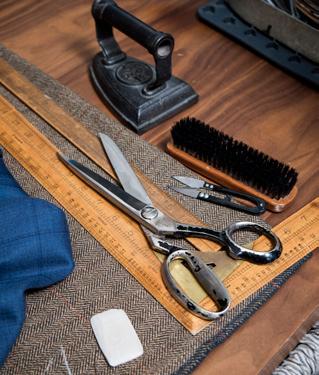
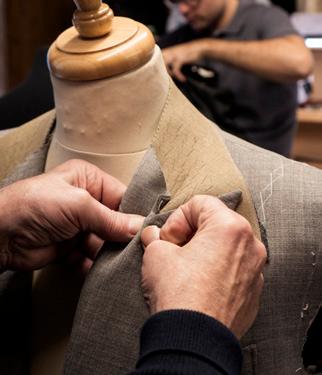
Just a stone’s throw from the soon-to-open Cambridge House, Auberge Collection, the world’s most famous tailoring street— Savile Row—trades on more than 200 years of tradition. Case in point: Henry Poole opened its first shop in 1846 and, since then, the foundation of his craft has remained largely unchanged. Patterns are still drafted on paper, coats are cut by hand, and garments are assembled using techniques that predate electricity. As in generations past, apprentices still rise through a hierarchy of coatmakers, cutters, and finishers. For most houses, “trend” is considered a dirty word.
Lately, however, something quietly radical is happening behind Savile Row’s formidable doors and brass plaques. A new generation of tailors is bending, though not entirely breaking, the rules as they rethink their place in modern fashion—and yet they are still just as committed to maintaining the codified craftsmanship that earned them their prestigious address in the first place. From womenswear pioneers to streetwear stylists, these visionaries are reshaping London’s most famously buttoned-up street, one perfectly placed stitch at a time.
KNATCHBULL
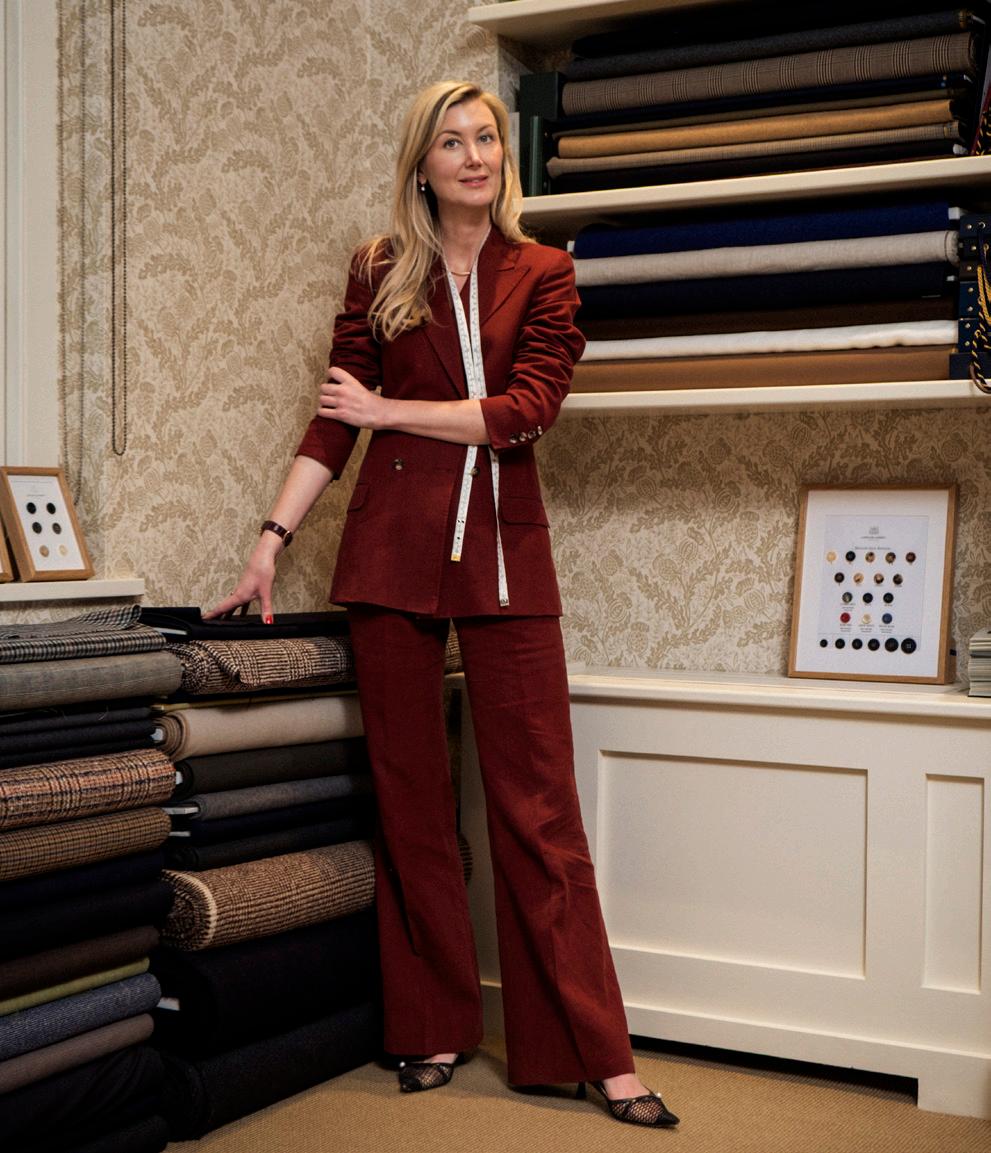
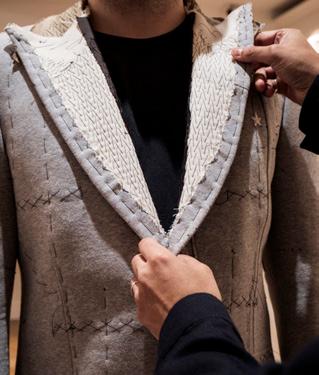
As founder of the first women’s-only tailoring house on Savile Row, Daisy Knatchbull is nothing short of a disruptor. The former communications executive began her career at Huntsman, one of the Row’s most famous houses, where she fell in love with bespoke tailoring—and also spotted a gap in the industry. “For decades, women’s suits were largely adaptations of men’s tailoring, simply scaled down rather than thoughtfully redesigned with the female form in mind,” Knatchbull says.
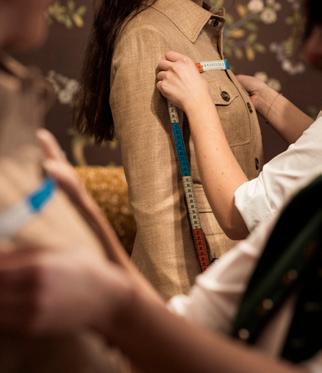
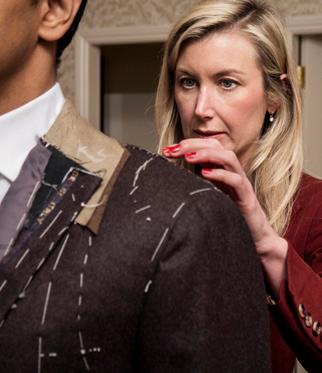
In 2019, she changed that by establishing her namesake atelier combining traditional tailoring craft with modern womenswear design. “At Knatchbull, we start from a completely different perspective,” she says. “We have a team of female tailors who understand the female body and the nuances that come with it.” (Lending further credit are high-profile fans like Gwyneth Paltrow and Gillian Anderson.) Each commission begins with an in-depth consultation, where tailors take precise measurements and discuss the client’s lifestyle, needs, and what they hope to highlight or conceal. Knatchbull subverts classically masculine styles, tailoring garments to accentuate a small waist or sculpting silhouettes to define curves. Smart checked suits are made with dramatic, wide-leg pants, and extra-long, form-fitting tuxedo jackets can even become a dress. The result, according to Knatchbull: “Suits that are powerful and elegant, while truly celebrating modern femininity.”
CASELY-HAYFORD
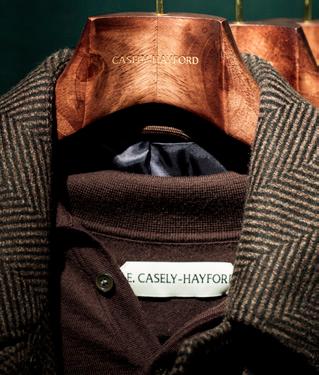
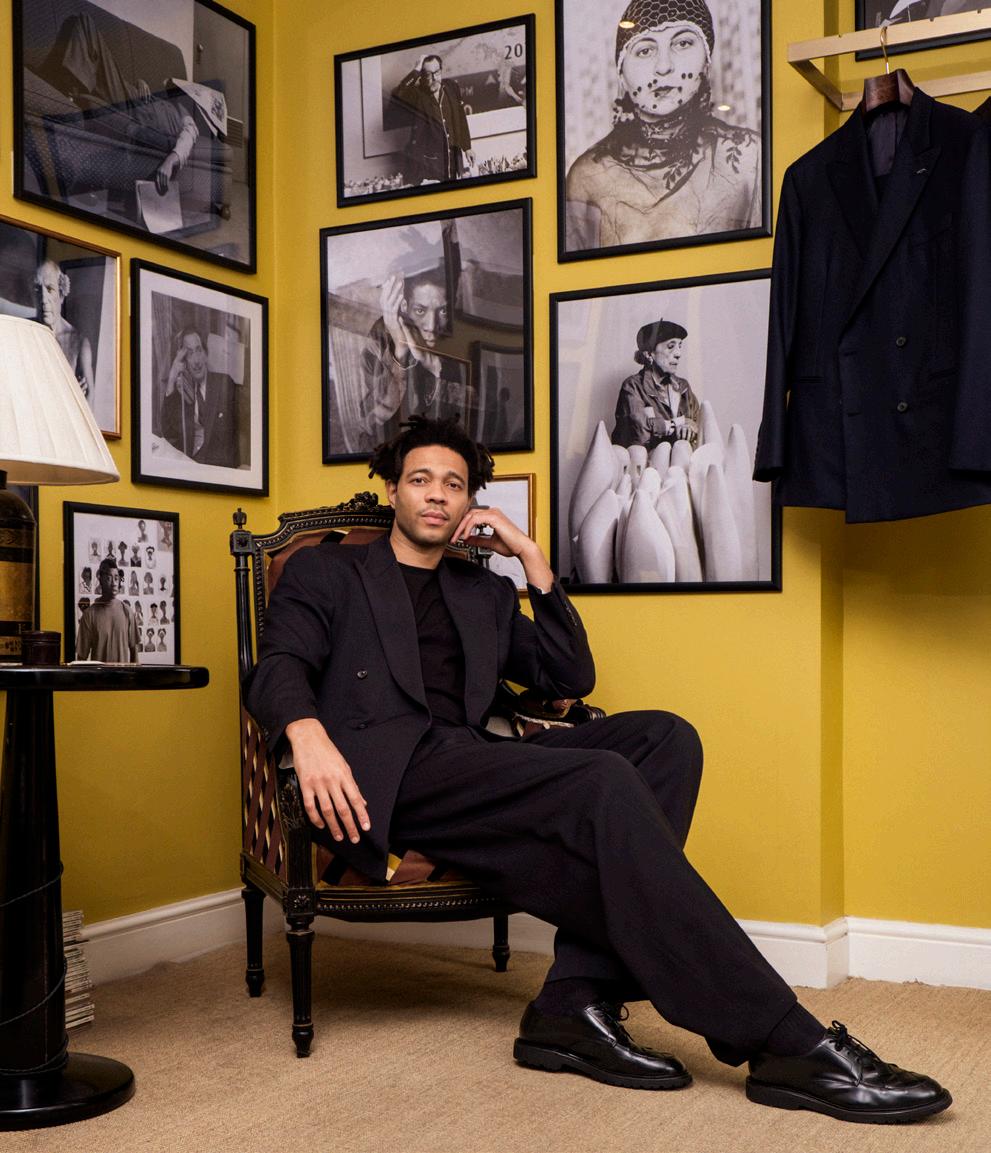
For Charlie Casely-Hayford, suiting is about creative dialogue. “We enjoy building clients’ wardrobes with them rather than thinking about garments in isolation,” he says.
Since taking the reins of Casely-Hayford—the house founded in 1984 by his late father, legendary designer Joe Casely-Hayford—the second-generation tailor has viewed his role as a steward of legacy. To that end, his workshop remains grounded in classical technique, but intent on evolving “the language around traditional tailoring.” Suits are cut generously and fluidly, in materials that ooze sophistication. Signature touches include wool crepe (a material normally reserved for couture womenswear), concealed fly fronts, and louche, double-breasted silhouettes.
As Casely-Hayford puts it, his approach is defined by an idea that his father impressed upon him for many years: “The whisper is louder than the shout.”
CAROLINE ANDREW
Caroline Andrew’s atelier on Old Burlington Street reads more residential than workshop—and that’s by design. “I really like to spend time with a customer during their first consultation,” says Andrew, who tailors for both masculine and feminine sensibilities. “I want clients to feel really relaxed so they give me their authentic selves and the true version of how they’ll be wearing the suit.”
This enables Andrew to craft garments that are truly lifestyle appropriate, with cuts, cloth, and construction made as comfortable and flattering as possible. Understated is the operative word here: A Caroline Andrew suit retains the elegance that Savile Row suiting is known for, but with a contemporary point of view informed by the fashion world today. “It’s important to pick up on subtle changes in taste—the colors, cuts, and fabrics that work well in 2026,” she says.
That plays out in her classic two-button, notch-lapel suit jackets—made in unexpected materials, like vibrant blue worsted wools—and field jackets cut from dustypink corduroy. One of her favorite fabrics is traditional Black Watch tartan, with its deep navy and forest green checks, which she uses in everything from neat, doublebreasted suits to indulgent smoking jackets. What can be found in every piece, however, is Andrew’s signature balance blending heritage with quiet innovation.
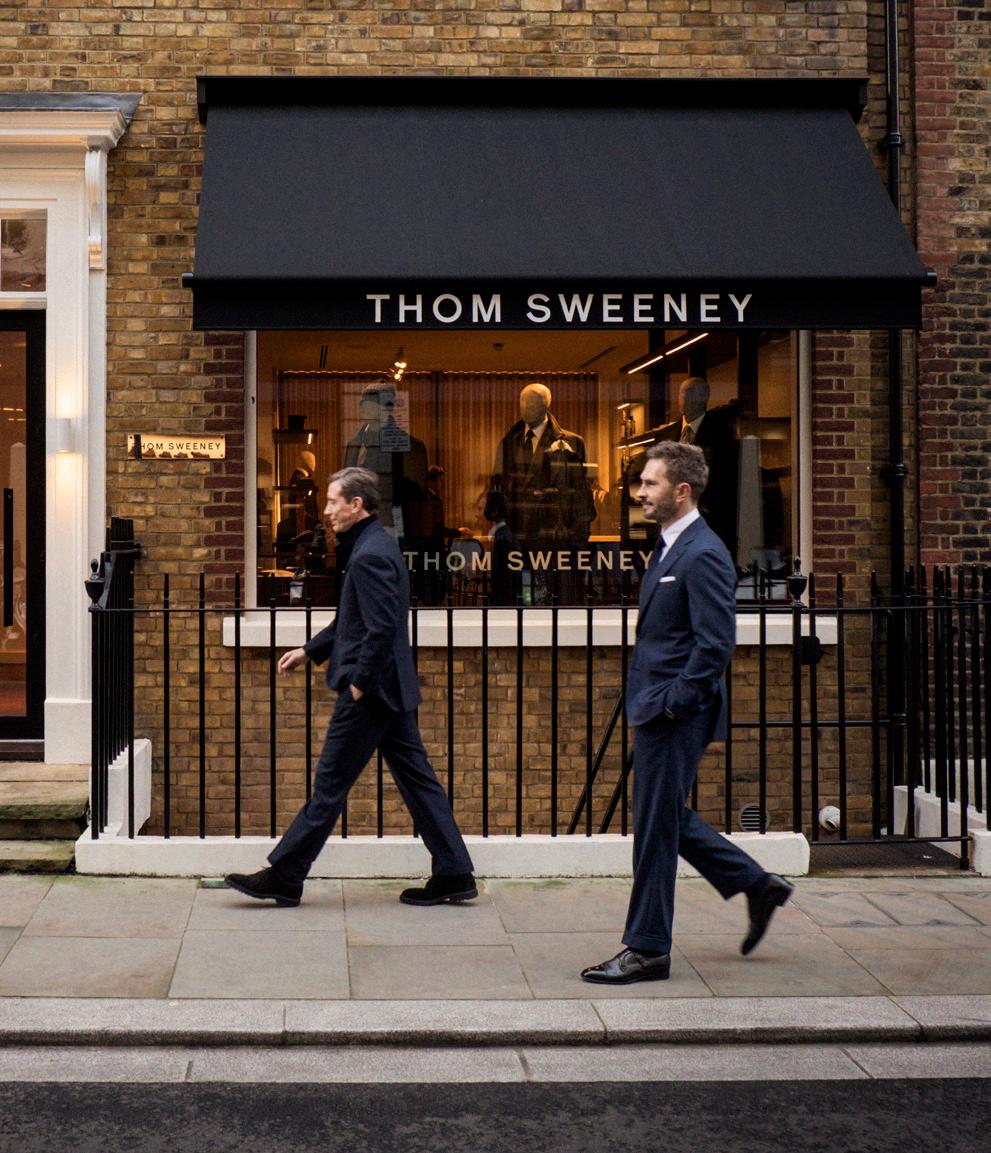
THOM SWEENEY
When Thom Whiddett and Luke Sweeney founded Thom Sweeney in 2007, it was with the goal of making Savile Row feel lighter, softer, and more modern. The duo deliberately positioned their flagship workshop on Old Burlington Street, a stone’s throw from the Row as a nod to their missive of eschewing the establishment— not too much, but just enough.
“We recognized that men didn’t always want their suits to feel like suits of armor,” Whiddett says. “We made our jackets softer, slimmer, and a bit shorter than traditional Savile Row, referencing Italian tailoring without losing our British identity.” This philosophy applies equally to Thom Sweeney’s bespoke tailoring and ready-to-wear collections, which mix luxurious casual wear with curated seasonal edits of modern suits and separates. The goal is to dress clients— including Daniel Craig and Bradley Cooper—“from Monday through Sunday,” Whiddett says.
Appropriately, clients are meant to linger at Thom Sweeney’s flagship, a five-story townhouse with a barbershop, tailoring workrooms, and top-floor club room. The emphasis is less on transactions than on creating an atmosphere where men can feel quietly at home, moving between floors with an espresso in hand or settling upstairs with a newspaper and a cocktail between fittings. The same approach shapes the company’s presence stateside, where outposts in New York, Miami, and Los Angeles have been designed to replicate the unhurried, club-like atmosphere of its London home.
CLOTHSURGEON
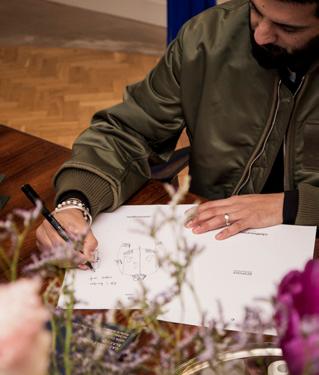
Yes, Rav Matharu will make you a flawless suit, but his brand, Clothsurgeon, founded in 2012, is best known for something less conventional: hand-tailored streetwear. The former soccer player opened his shop on the Row in 2022, offering hoodies, tracksuits, and bomber jackets—casual pieces to be sure, but all constructed with the same rigor as a three-piece suit.
It’s a more free-form approach to the old days of tailoring, Matharu says. “We have a unique offering, allowing the customer to create whatever garment they wish.” Much like any custom suit, the process begins with an initial conversation and a sketch. Drawing from his deep understanding of both the tailoring world and contemporary menswear, he adheres to oldschool practices, taking up to 25 measurements and cutting paper patterns (using a scalpel, not traditional tailors’ shears—hence the name) before a garment is handsewn in his London workrooms. Such effort elevates everyday casual wear into new territory: cashmere joggers, a corduroy work jacket, and wool and cashmere flannel jeans all look and feel as sharp as they are personalized.
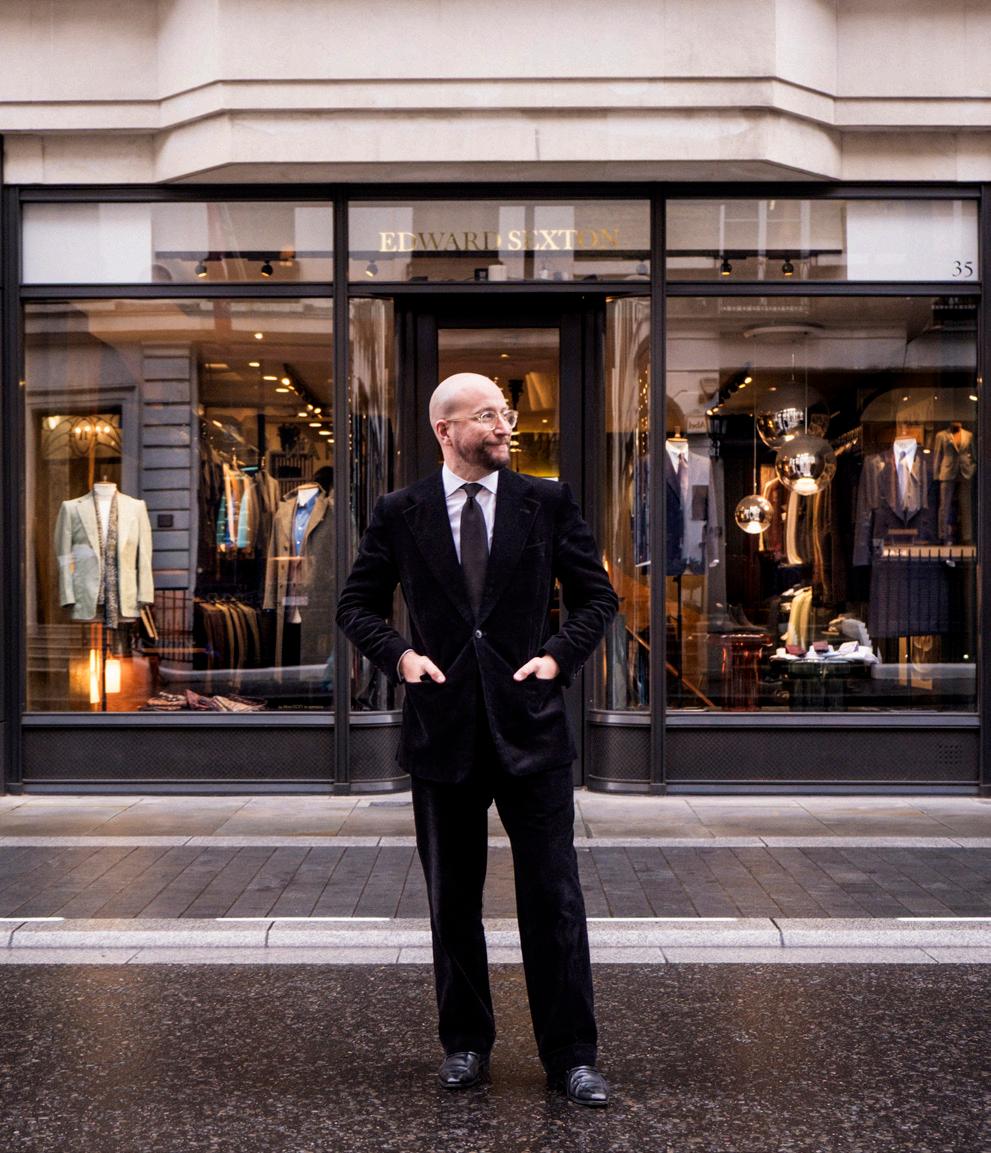
EDWARD SEXTON
In 1969, Nutters of Savile Row debuted and instantly broke with convention as the go-to tailor for musicians, artists, and creative rebels—all of whom frequented the atelier for huge lapels, exaggerated shoulders, nipped-in waists, and scandalously tight trousers. Co-founder Edward Sexton was one half of the partnership behind the avant-garde newcomer, going on to open his eponymous tailoring studio on the Row in 2022. Though Sexton has since passed, his outside-the-box style carries on thanks to the adept tailoring of head cutter Joseph Butler.
Butler’s focus is on preserving Sexton’s bold, architectural style, while subtly refining the way garments look and feel. In practice, that means retaining the dramatic silhouettes on which the workshop was founded: peak lapels, longer-length jackets, and hourglass waistlines are all still trademarks. But the experimentation doesn’t end there. Aligning with the needs of modern clients—including Harry Styles—Butler emphasizes slightly softer constructions, using less internal canvas and horsehair than traditional tailoring to give suits greater ease and movement—and a fresh wearability that reflects the times.
Fatto a Mano
At Italian pottery house Bitossi, Tuscany’s artisan craft traditions take on bold new shapes.
BY JILL NEWMAN | PHOTOGRAPHY BY ELLIE THORNE
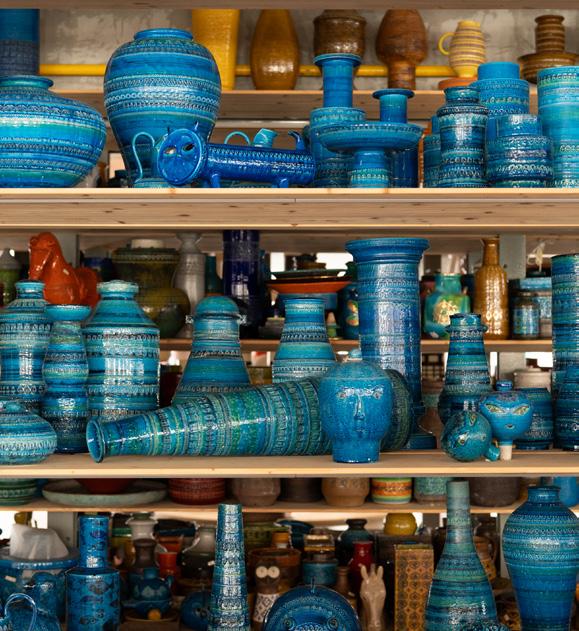
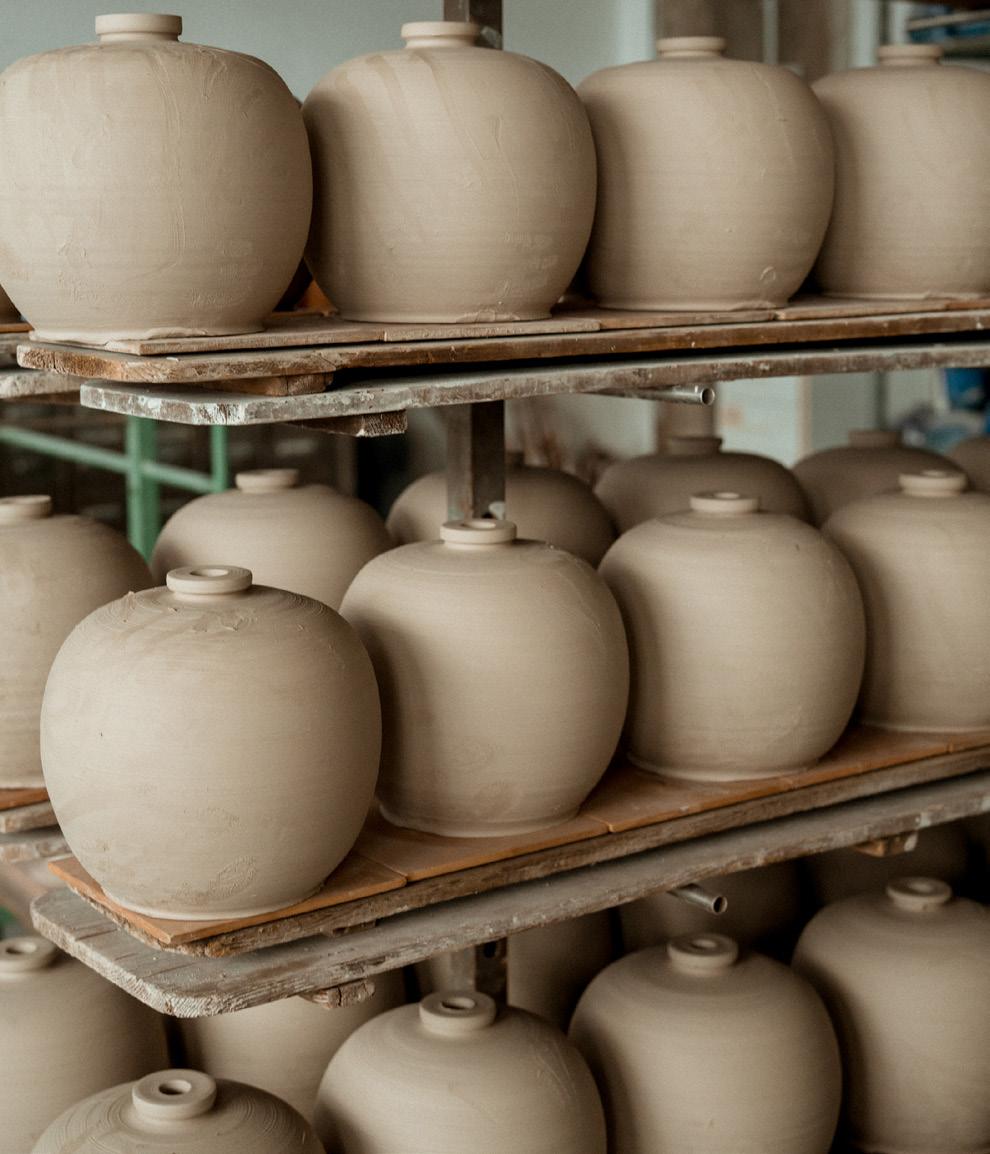
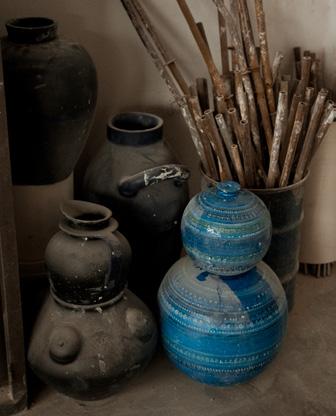
At the Bitossi workshop in Montelupo Fiorentino, Tuscany, dozens of freshly thrown pots dry before being painted and fired in the kiln. Opposite: The pottery house’s Rimini Blu collection draws inspiration from sunlight shimmering across the sea.
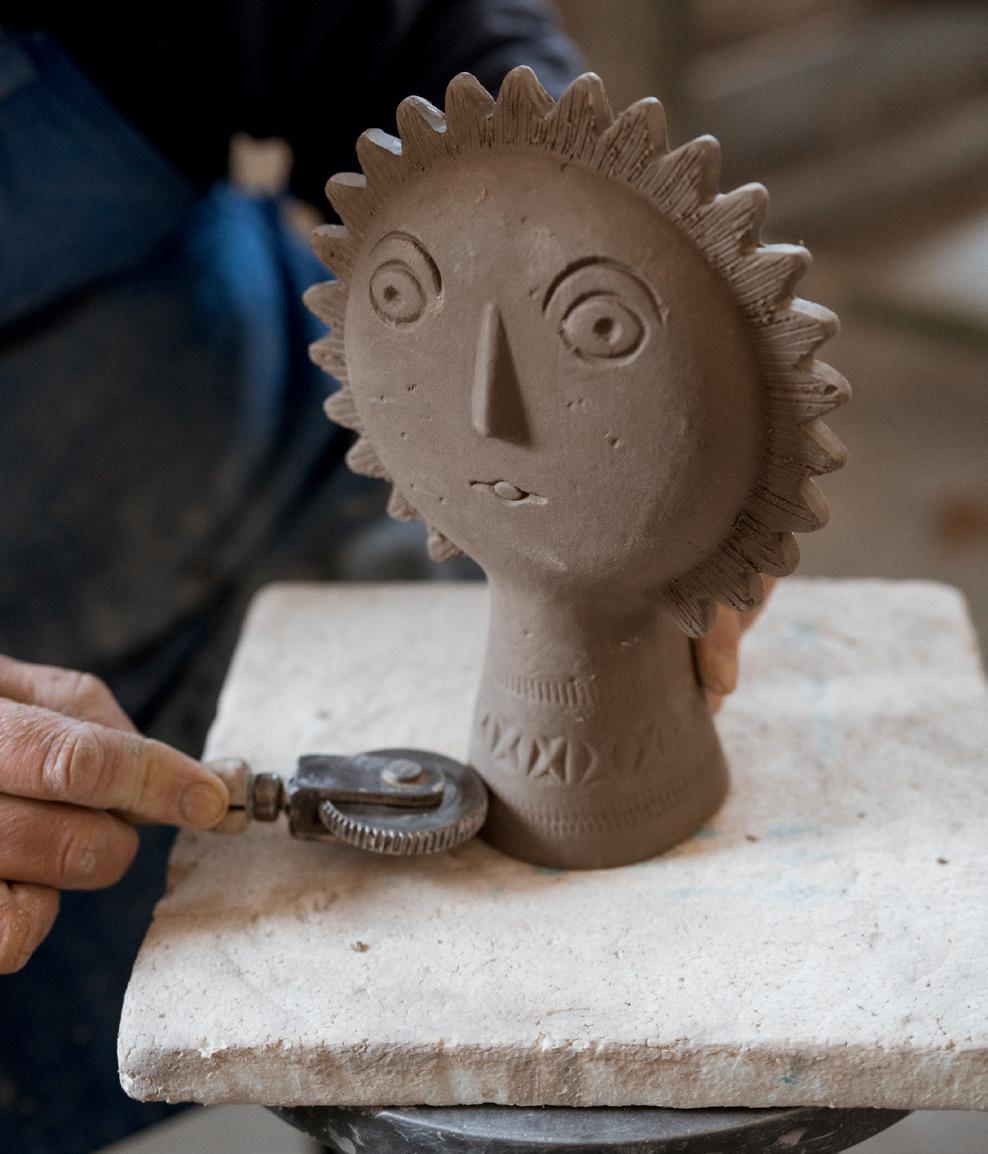
Amid the rolling vineyards and olive groves of the Montelupo Fiorentino region a sunlit workshop hums with quiet industry. Newly forged pots wait to be fired. Freshly glazed vases gleam in vivid color. Craftspeople shape clay on wheels and delicately engrave and paint each vessel and figurine by hand.
Since the late 13th century, this Tuscan enclave—just west of Florence—has been the artisanal heart of a deeply held craft tradition in ceramics. It flourished during the Renaissance, when art and industry thrived under the Medici, as the region fostered all the essentials for successful pottery-making: Rich clay came from the surrounding hills, and the Arno River was the lifeline by which fragile earthenware and majolica could be easily transported to the rest of Italy, then across Europe and beyond.
Few family names have been more vital to that history—or endured as long—as Bitossi. Their dynasty dates as far back as the 1530s, when archival records document ancestors working as potters and kiln masters. Yet it wasn’t until 1921 that Guido Bitossi officially established the business that has become one of Italy’s most influential ceramic houses. It’s defining chapter was the postwar years under the creative direction of Aldo Londi, whose vision helped reshape contemporary pottery and create a modern design language.
A Montelupo native, Londi approached ceramics as something far more meaningful than mere craft; he believed the pieces were living art. His philosophy was simple: Objects for the home should be expressive and functional, and elevate everyday life. In 1955, he established a union with architect Ettore Sottsass that would last more than 40 years and see the creation of pieces that
Above, from left: Ceramics dry before being glazed and fired; layers of pigment build the collection’s luminous blue finish. Opposite: Layers of pigment build the Rimini Blu collection’s blue finish.
beautifully embodied his ethos—graphic, sculptural, and boldly modern vases, bowls, and vessels that redefined what ceramic objects could be and cemented Bitossi’s reputation as an art pottery pioneer. (Those original pieces, made from the 1950s through the 1980s, are now coveted collectibles: In 2023, one of Sottsass’s 1966 totem sculptures sold for nearly $900,000.)
Today, the house’s vision is carried out under creative director Ginevra Bocini, Guido Bitossi’s great-granddaughter. (Bocini’s mother, Cinzia Bitossi—who attended school at the historic Collegio alla Querce, now an Auberge Collection property—previously served as the longtime creative director.) Since taking the helm in 2017, Bocini has balanced her family’s long heritage with new, contemporary aesthetics, expanding the house through collaborations with global designers
and artists, such as Patricia Urquiola, Nathalie Du Pasquier, and Max Lamb. She has also led partnerships with Gucci, Supreme, and Fornasetti, as well as with art galleries and cultural institutions. This year, Bitossi introduces projects with Italian-born furniture designer Martino Gamper and Lisbon-based Studio HAOS.
“At Bitossi, a dialogue between past and present is central to our identity,” Bocini says. “We continue to draw from the region’s extraordinary craft culture while engaging with contemporary design and artistic experimentation, maintaining an open conversation with the wider world.”
A visit to Bitossi’s expansive archives unfolds like a tactile history of Italian design. The curated museum displays pieces through time: prewar classics, postwar graphic
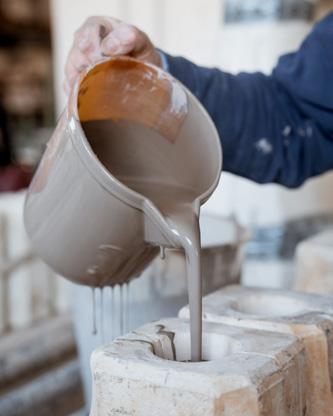
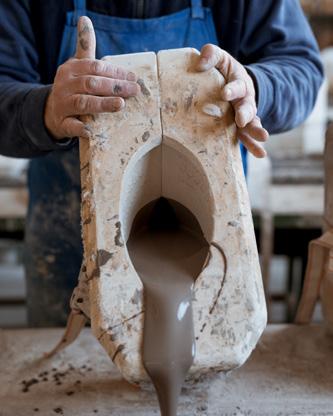
Below: Artisans pour local clay into molds. Opposite: Years at the wheel are required to shape perfectly uniform vases.
patterns, pop-art color waves, metallic glazes. Taken together, the assemblage underscores Londi’s central belief—that this house of pottery eschews a singular aesthetic in favor of experimentation and artistic relevance.
“Londi interpreted the international postwar desire for modernity through a deeply Italian and Tuscan lens,” Bocini says. “He translated a local, centuries-old craft culture into a language that felt fresh, joyful, and accessible, while remaining rigorously handmade.”
Among Londi’s most iconic collections is his 1950s Rimini Blu. Inspired by the sun’s dancing reflection on the Adriatic, the cobaltblue pottery, finished with a crystalline glaze, transformed traditional ceramics into the realm of art and design. Decades later, those mesmerizing lapis lazuli pieces are instantly recognizable. Inside the archive, displayed prominently, their effect is still hypnotic.
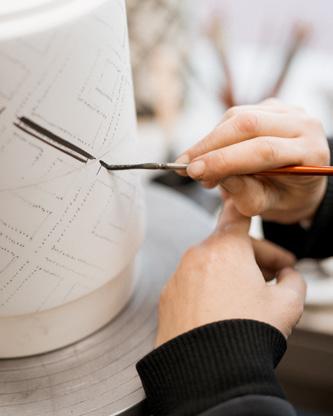
Bitossi’s process remains resolutely artisanal. Every piece is still made entirely by hand; some can take up to a month to complete. Around 15 artisans specialize in various aspects, from wheel throwing and mold making to glazing and firing—all skills honed over years of training and sensitivity to the material. To ensure the craft lives on for another five centuries, the house also operates a school where apprentices learn the skills and sensibilities of pottery making from masters.
The precious clay of Montelupo Fiorentino remains faithfully alive in those skilled hands, and with each new piece, another chapter is added to Bitossi’s proverbial book of craft. “Ceramics are a powerful medium for storytelling,” Bocini says. “They convey diverse forms of expression, cultural narratives, and human experiences.”
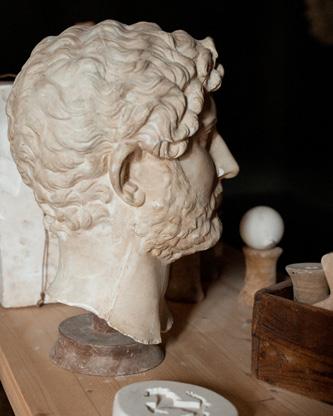
Above, from left: Bitossi’s extensive archives preserve pottery dating back centuries; every piece is meticulously hand-detailed and painted.
Opposite: A portrait of Aldo Londi, the longtime artistic director who shaped the house’s creative vision for nearly 50 years.
We encourage and support an affirmative advertising, marketing and sales program in which there are no barriers to obtaining housing because of race, color, sex, religion, handicap, familial status or national origin. Neither Auberge Resorts LL nor any of its affiliates or related persons (the “Auberge Group”) makes any representation, warranty or guarantee, expressed or implied, in respect of any statement or information made or contained in these materials Neither Auberge Resorts L.LC nor any of its affiliates or related persons (the “Auberge Group”) makes any representation, warranty or guarantee, expressed or implied, in respect of any statement or information made or contained in these materials. Neither the Auberge Group nor any of its directors, officers, employees or agents has or will have any responsibility or liability arising out of, or related to, these materials or the transactions contemplated by these materials, including any liability or responsibility for any statement or information made or contained in or the use of these materials.
A Land Beyond Imagination
On the eastern coast of Puerto Rico lies Moncayo Golf & Ocean Club, a beautiful destination that finds true balance along the sea. This private residential community is designed to bring together family and friends, with ample opportunities for water sports, surfing, hiking, and island exploration. Accentuated by an 18-hole championship golf course and 9-hole short course created by Mackenzie & Ebert, Moncayo unites stunning natural beauty, ultra-premium residences, high-end amenities, and superior service to achieve a life of enrichment, wellness, and harmony.
moncayo.com
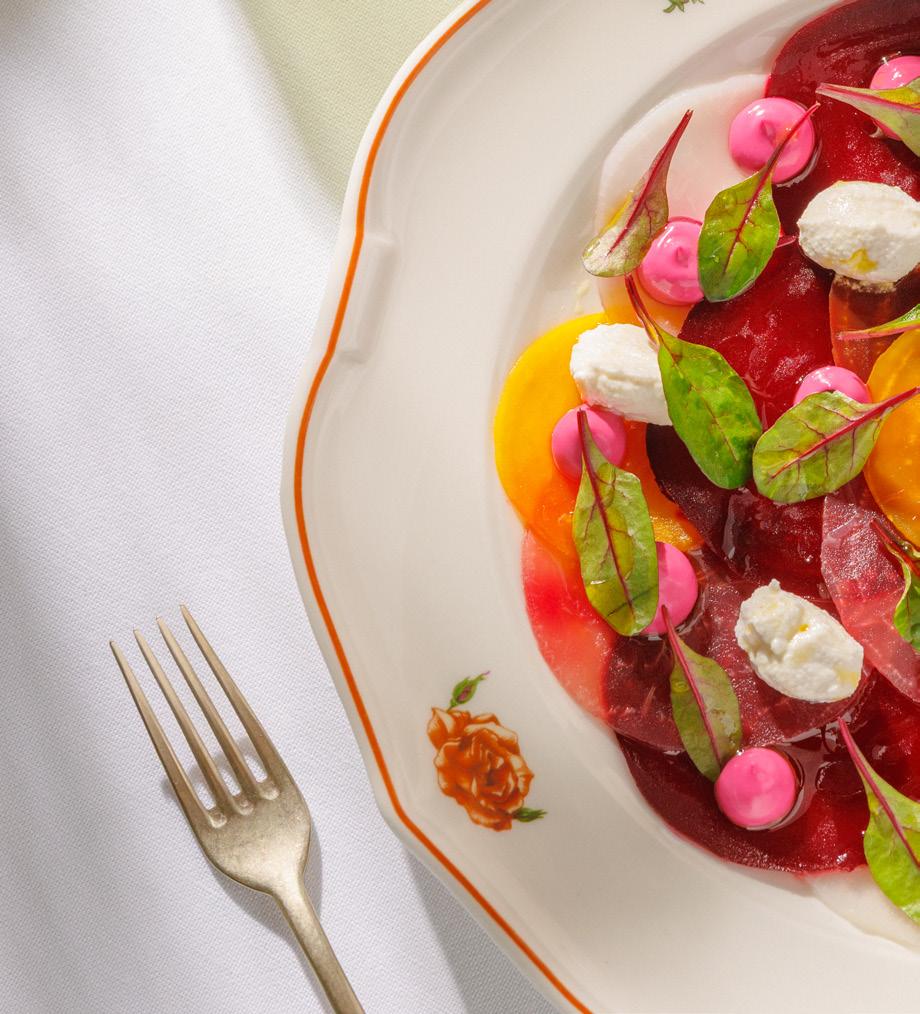
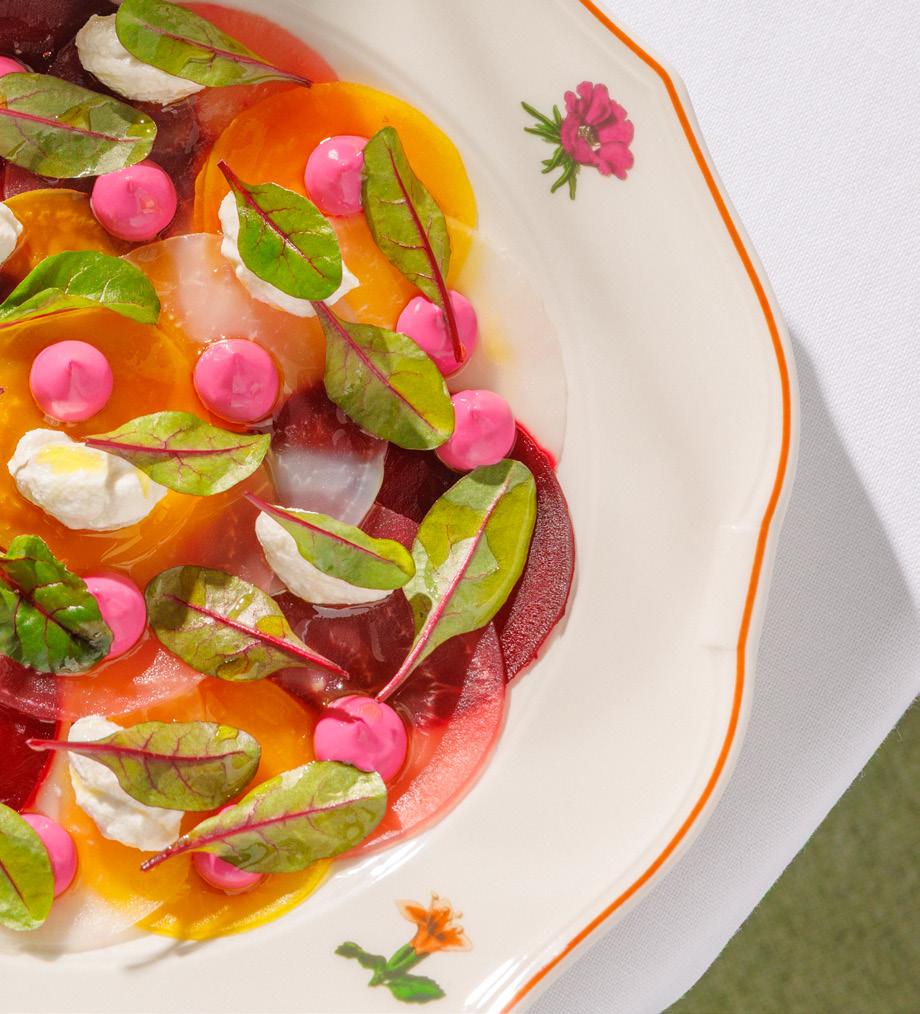
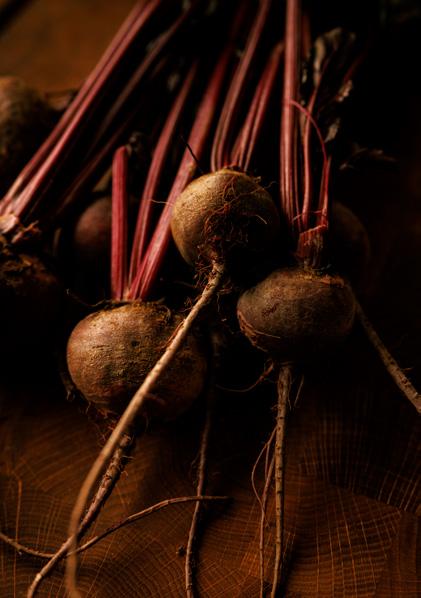
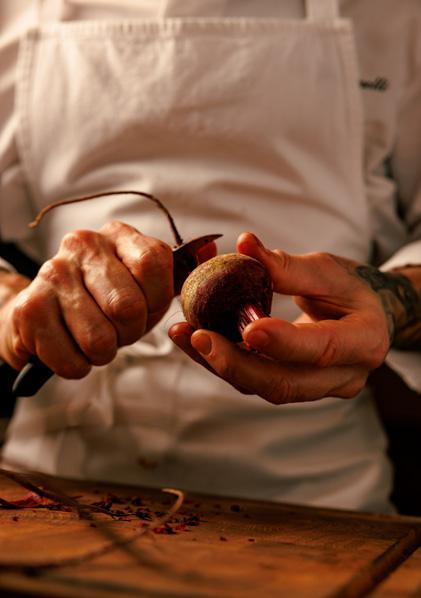
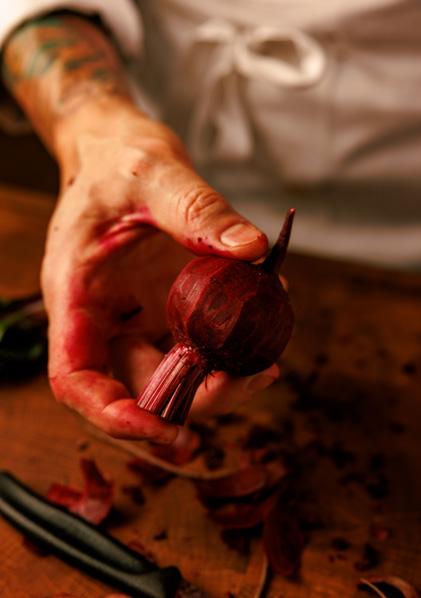
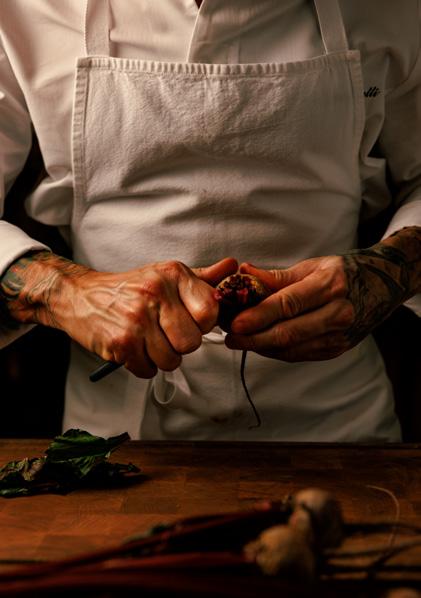
Spring beet carpaccio from La Gamella, the signature restaurant at Collegio alla Querce, Auberge Collection, in Florence, Italy. Photography by Andrea Di Lorenzo.
The NEW
TUSCAN Table
At Collegio alla Querce, Auberge Collection, the age-old stories of classic Italian cuisine are retold through modern interpretations and local ingredients.
BY JILL NEWMAN | PHOTOGRAPHED BY ANDREA DI LORENZO
No place expresses itself through food quite like Italy. Here, every dish and ingredient is rife with meaning: The reigning pasta shapes of any given region are points of serious pride (Emilia-Romagna’s tortellini, Puglia’s orecchiette), and sauce is defined—one might even say prescribed—by the local ingredients (one need only look to Rome’s revered cacio e pepe for evidence). In Tuscany especially, recipes are inherited like heirlooms—and what’s on a plate is never considered just sustenance; it’s practically sacred, another form of storytelling.
“Food is culture, tradition, and history,” says executive chef Nicola Zamperetti, who has been adapting his own culinary stories at Collegio alla Querce, Auberge Collection since it opened last year. Each of the dishes he has created for La Gamella, the hotel’s signature dining destination, comes with a delectable plot—rooted in his native country’s culinary past, supplied by the local bounty, and informed by his own sophisticated techniques and flair for flavor pairing.
Before creating La Gamella’s menu, Zamperetti devoted himself to learning the history of Tuscany’s culinary traditions, meeting with local farmers and studying the ingredients that have been native to these fertile lands for centuries. In the kitchen, he adapted his findings with careful experimentation, interpreting classic dishes subtly yet elegantly to create a menu that’s modern yet rustic, simple yet sophisticated. “Nothing overcomplicated,” he says. “Nothing that hides the true flavor.”
That philosophy is evident in dishes like panzanella, a traditional bread salad. Zamperetti’s version is simple: San Lorenzo bread, ripe tomatoes, cucumbers, and roasted tomato cream—remarkably aromatic and pleasing. Meanwhile, Mediterranean turbot is
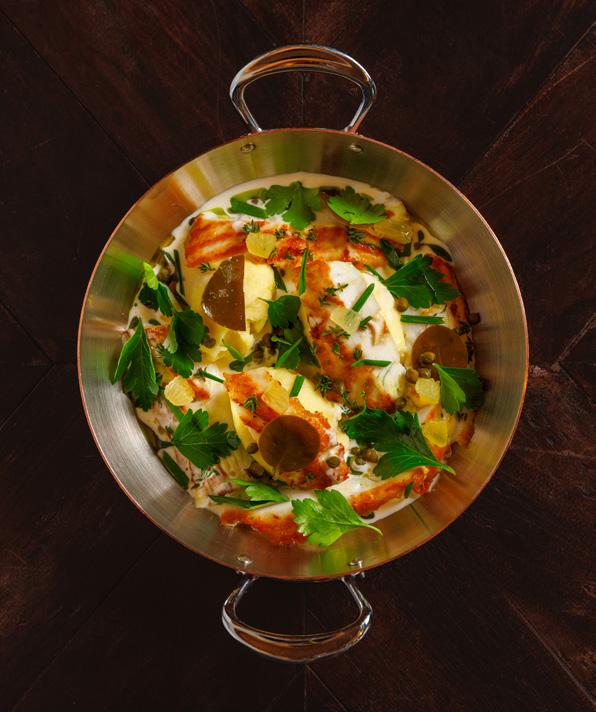
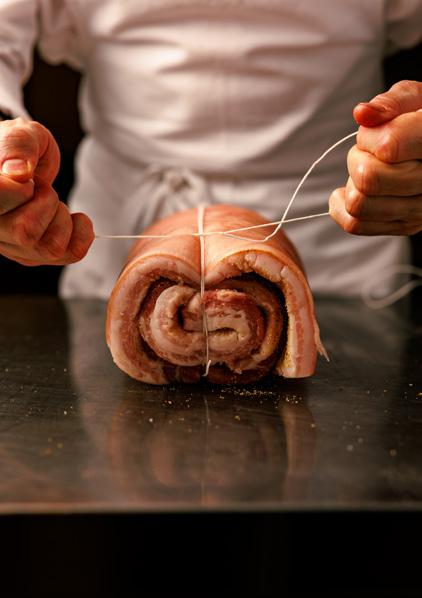
dry-aged like beef to enrich the fish’s natural flavor and buttery texture, and served with a lemon-caper sauce and herbs. The archetypal bistecca alla Fiorentina is another classic redux, served charcoal grilled and bone-in, and accompanied with roasted tubers and rosemary truffle sauce.
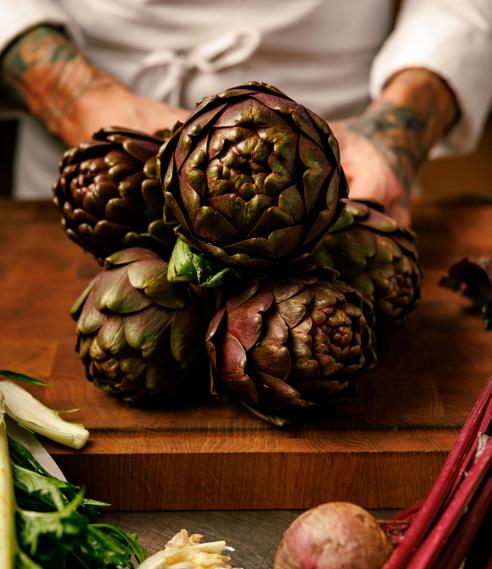
Zamperetti first discovered the luscious flavors of his native Italy’s fruits and vegetables during his time in Sicily. While leading the kitchen of one of the island’s top restaurants, the chef found himself repeatedly preparing a signature dish: whole artichokes dressed with olive oil, salt, parsley, and garlic, roasted on charcoal until the heart is smoky and tender. During his tenure there, he peeled so many artichokes that, when he left his position, he marked the chapter with a large artichoke tattooed across his hand.
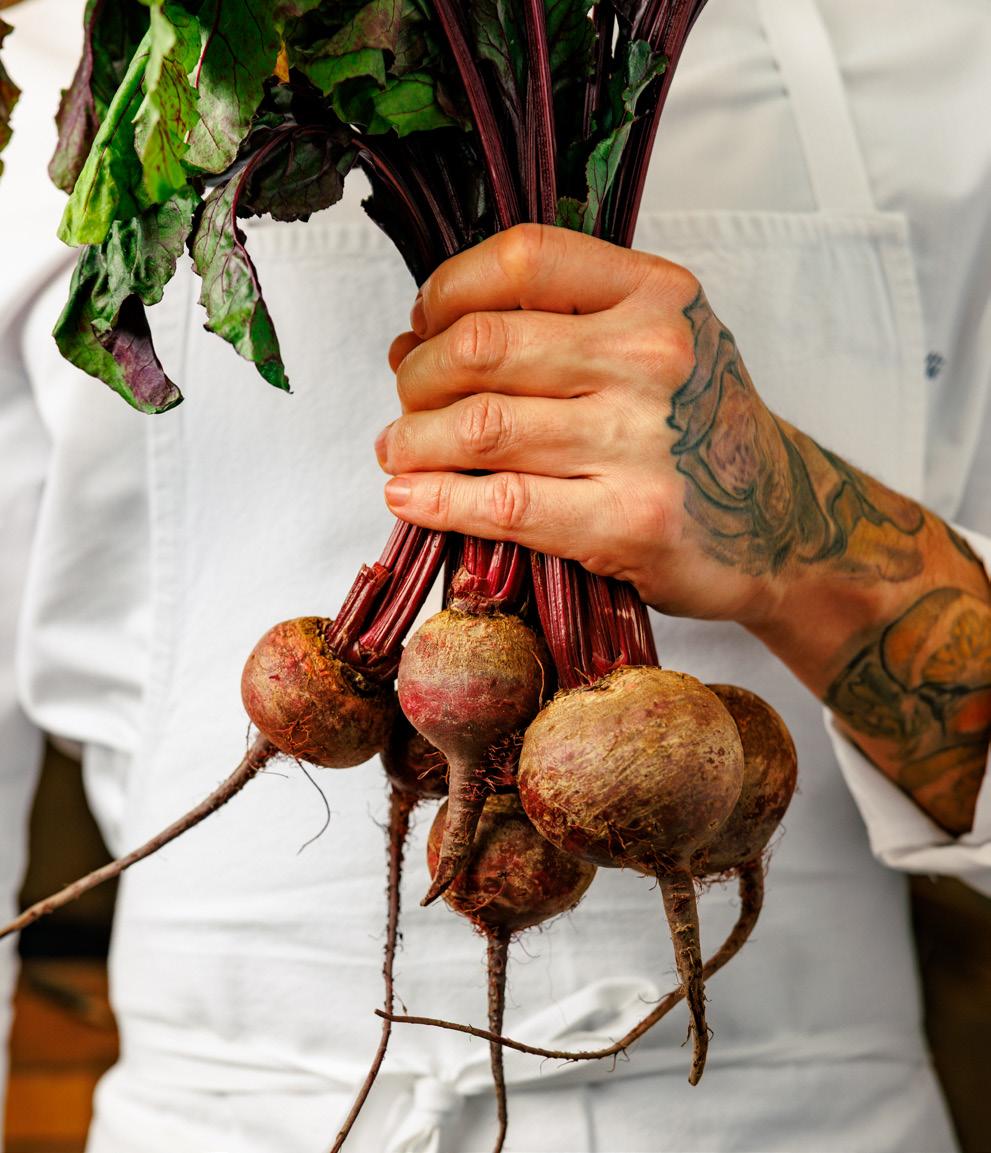
At Collegio alla Querce, vegetables also take center stage. Locally grown beets become a vibrant carpaccio of red, white, and golden yellow slices with vegan almond ricotta and herbs. “When you say carpaccio, the first thing that comes to mind is beef or tuna carpaccio,” he says. “We challenged that expectation with super-fresh vegetables that are just as tasty.”
The dish shifts with the seasons: tomatoes in summer, zucchini in fall—always what the farmers offer at their peak.
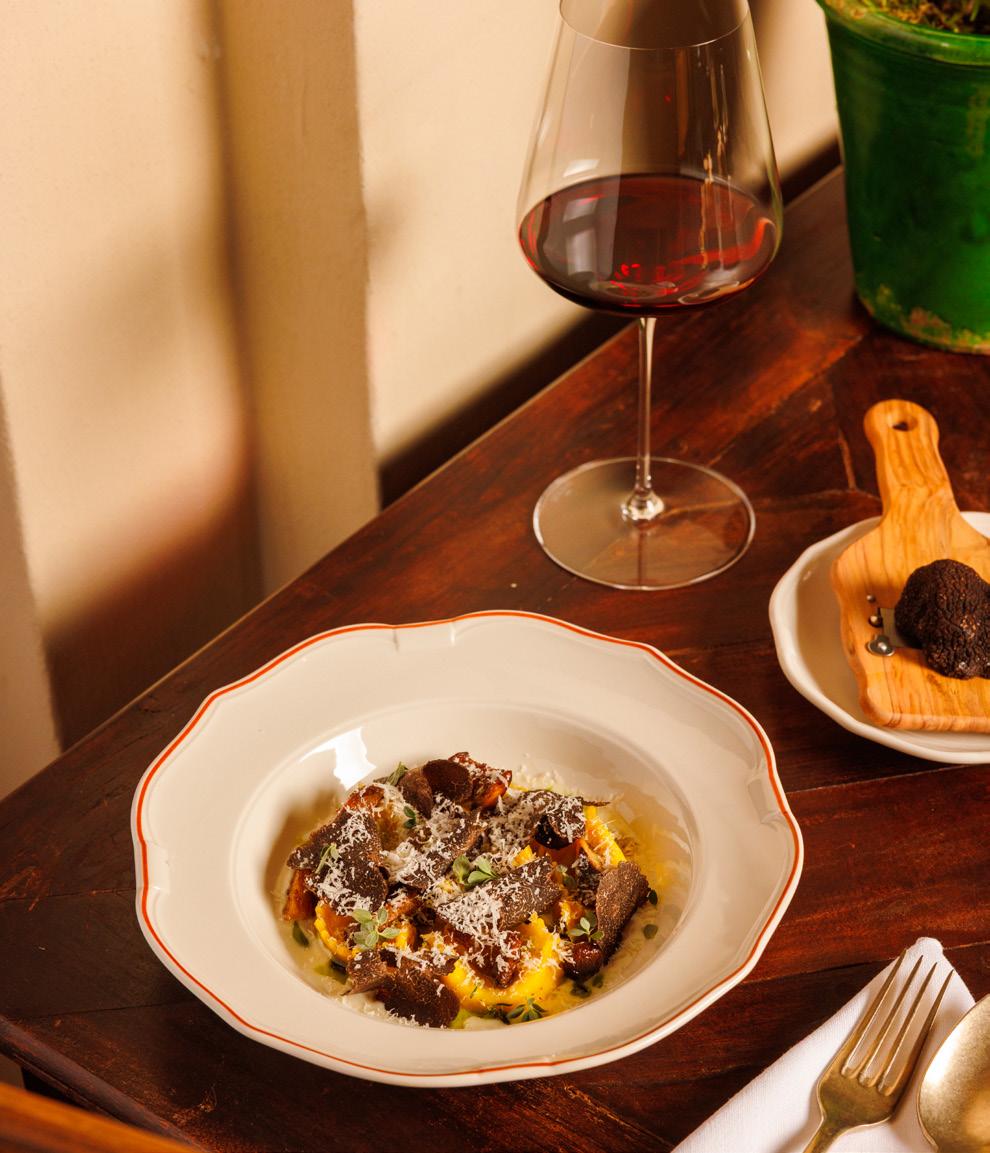
And, of course, there is pasta: Delicate doughy parcels filled with porcini mushrooms, ricotta, black truffles, and Gran Mugello cheese from a nearby dairy capture the forests and farms surrounding the property—and tell the many stories of Tuscany’s cooking. A dramatic reinvention the dish is not, says Zamperetti. Rather, like so many of his beloved dishes, it is an echo of the past, distilling centuries of tradition through a distinctly fresh lens. “It’s familiar dishes that give guests a sense of place, prepared in surprising ways.”
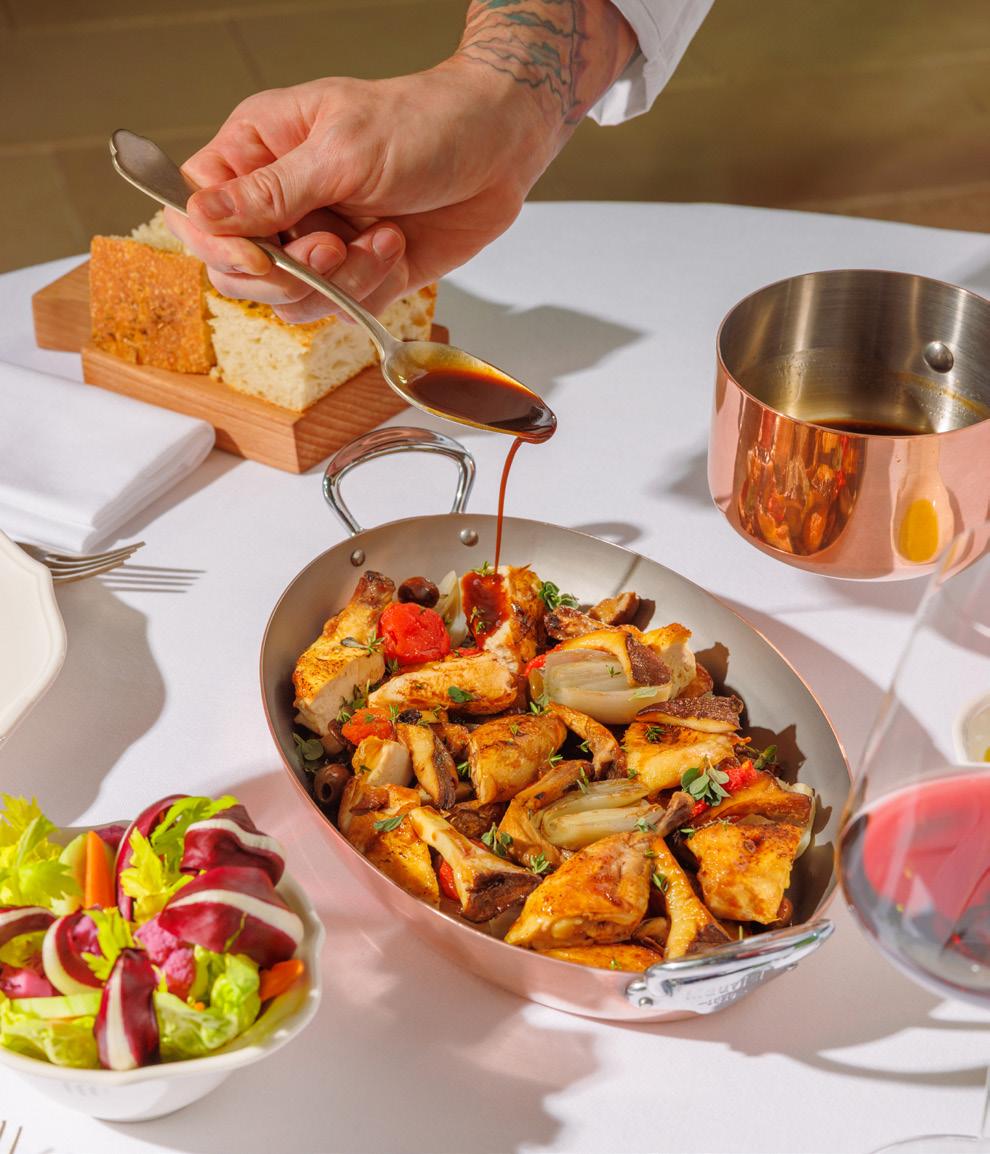
At La Gamella, the signature restaurant at Collegio alla Querce, Auberge Collection, executive chef Nicola Zamperetti reimagines classic dishes, like chicken cacciatore, with a modern touch.
Above: Turbot is dry-aged like beef to deepen its flavor and texture, then paired with a lemon-caper sauce.
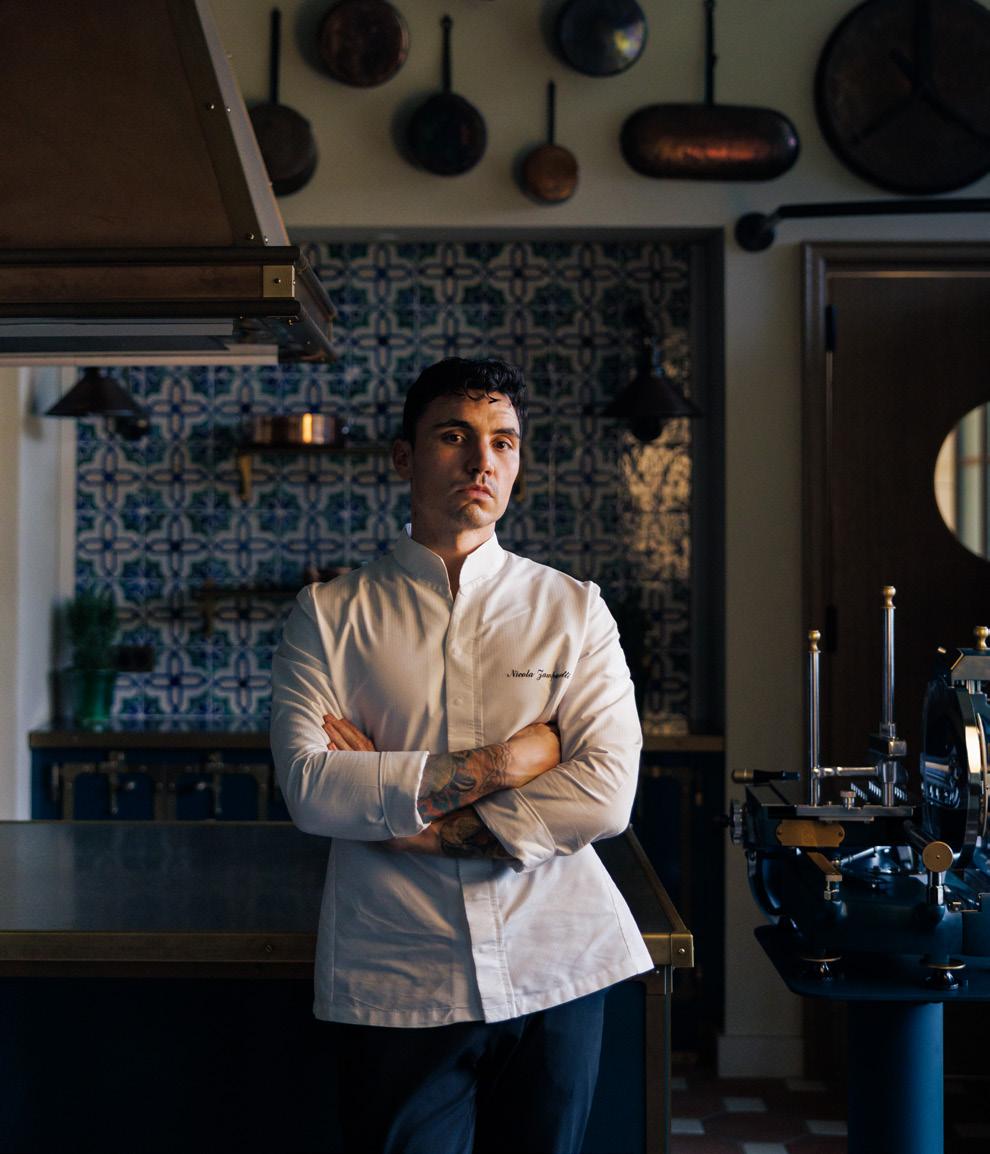
Opposite: Chef Zamperetti—who was born and raised in Italy’s Veneto region—in his kitchen at La Gamella.
Above: Locally grown produce drives the seasonal menu at La Gamella, as seen in this spring beet carpaccio, in which charcoal-grilled marinated beets are thinly sliced and served with vegan almond ricotta and fresh herbs.
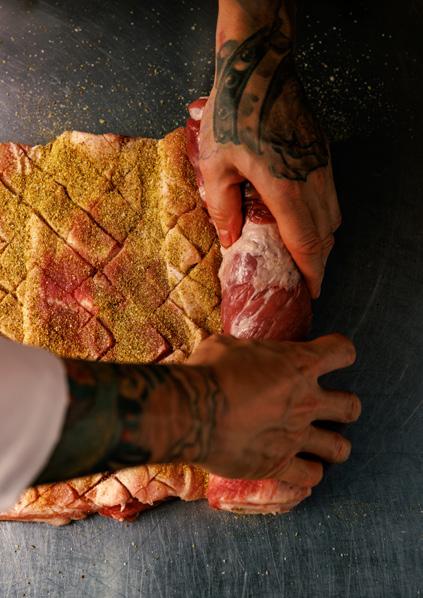
Above: Chef Zamperetti honors the region’s culinary heritage with simply prepared beef dishes, like Tuscany’s Casentino gray pork.
Opposite: Truffles, a regional favorite, are a constant presence on the menu, including in this pasta stuffed with porcini mushrooms, ricotta, black truffles, and Gran Mugello cheese.
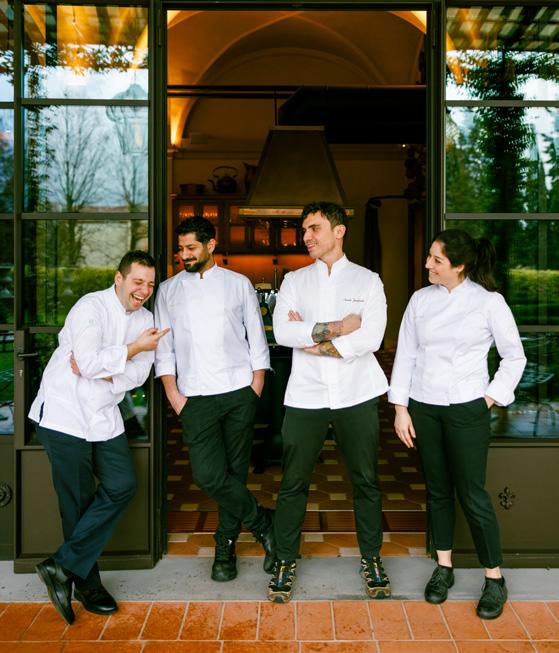
Above: Chef Zamperetti and his team enjoy a moment between services. From left: Stefano Campanelli, chef de cuisine; Mirko Cafasso, executive sous chef; chef Zamperetti; and Giorgia Broglia, pastry chef.
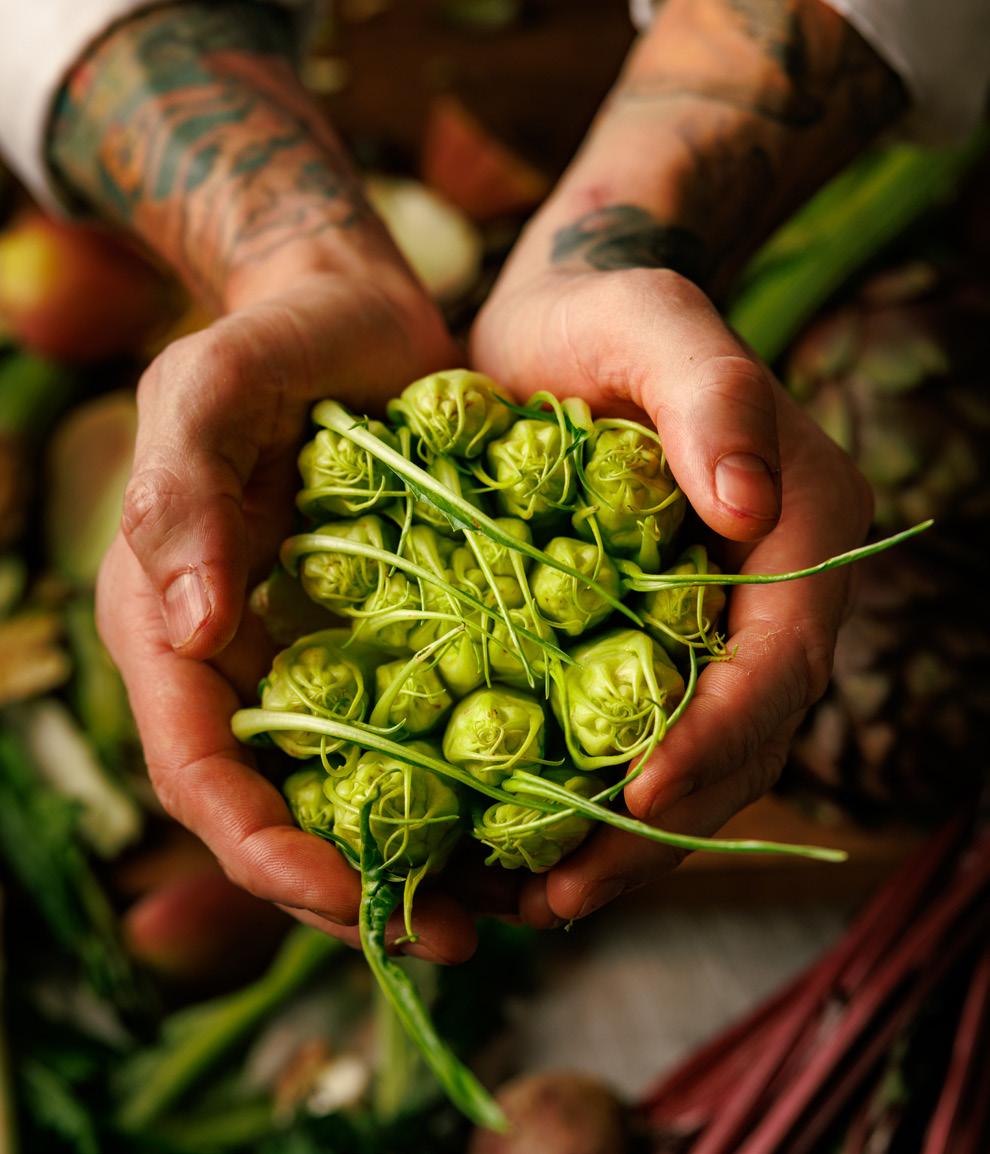
Opposite: Fresh puntarelle chicory, another favorite Tuscany vegetable sourced from a local farm.
Monterey Car Week brings together a love for speed, beauty, and performance.
BY DAVID COGGINS
We love cars for their elegance, their sense of design, and their speed. This equation changes over time—you may be a Porsche partisan of a certain vintage or an Aston Martin aficionado who tolerates only British racing green. Over a long weekend at Monterey Car Week, you can go headlong into the most beautiful cars in the world owned by the most obsessive collectors—and the scenery isn’t half bad either. It’s a remarkable gathering of people who are united by their love of motorsport: Formula 1 drivers, legendary dealers, hardcore collectors, industry insiders, and those who simply like to see fast, beautiful things in action.
The Quail, a Motorsports Gathering
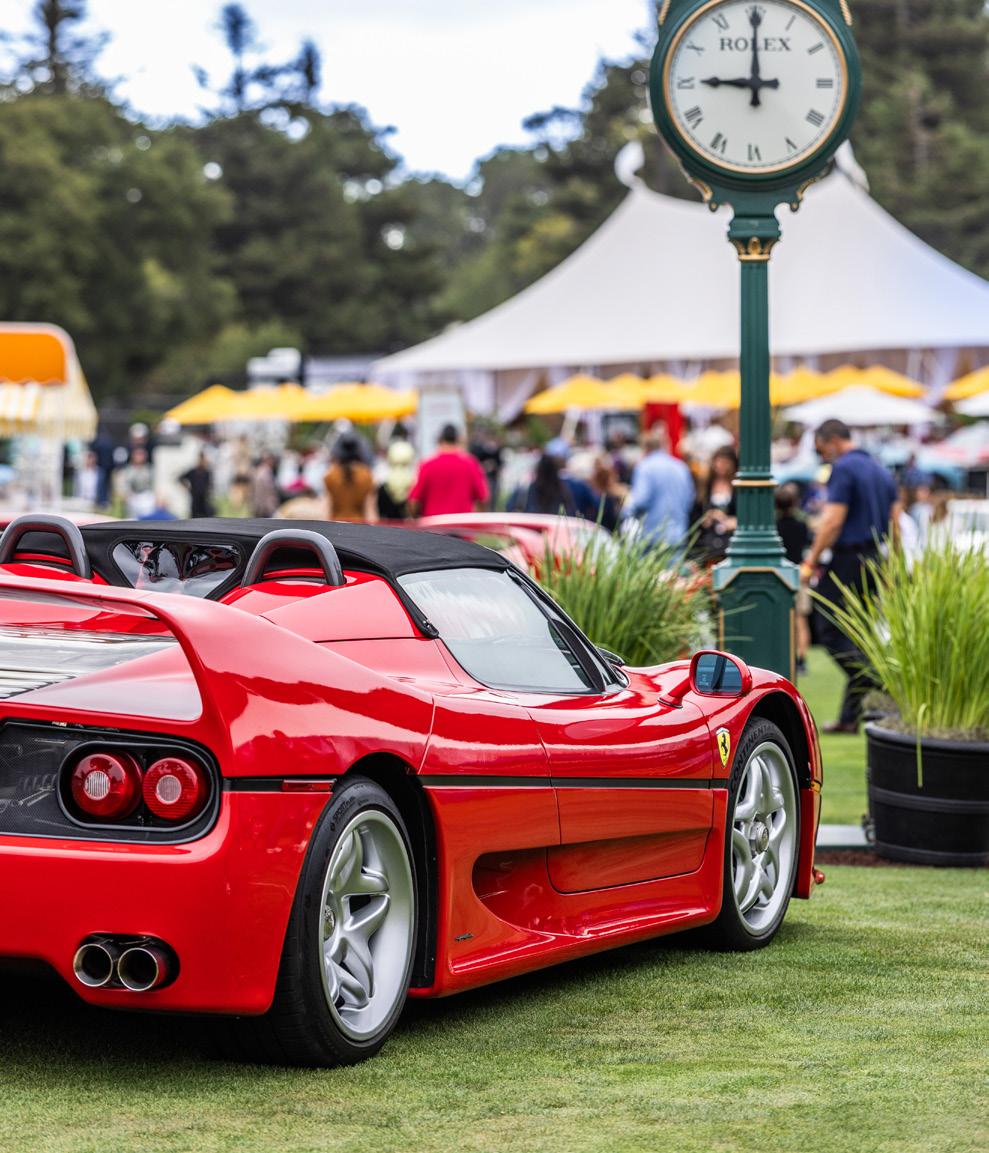
At this refined event, a few hundred cars compete against one another, automotive companies reveal their latest models—and there’s plenty of Champagne to go around too. You might come across a Ferrari F50 from the mid ’90s or get lucky and see Rolex Testimonee and endurance racing legend Scott Pruett talking with president of Motor Sport at The Quail, Gordon McCall.
Pebble Beach, Concourse d’Elegance
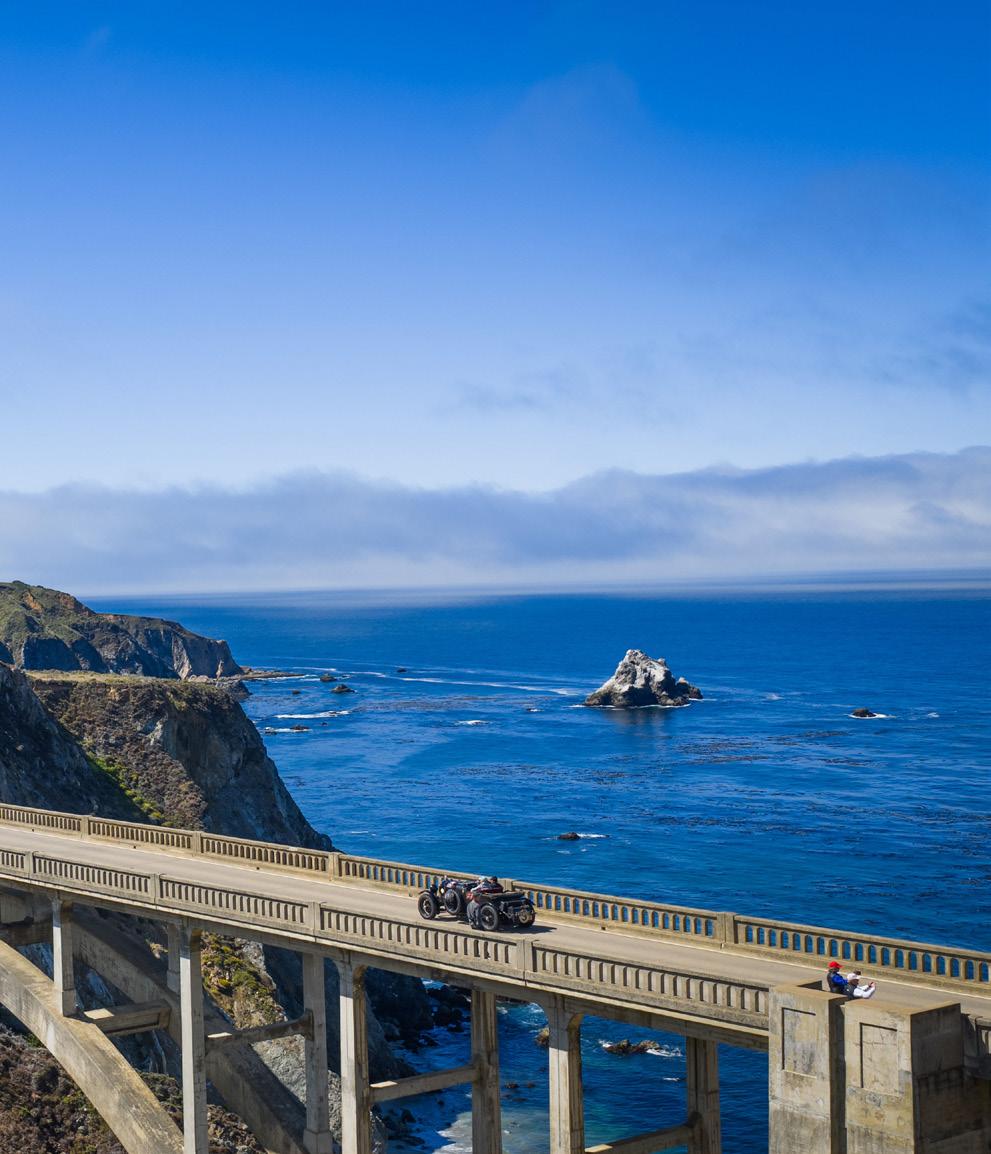
America’s foremost car competition takes place on the 18th hole of one of the most scenic settings in all of golf. Guests can’t help but admire the views—the ocean is right there—but the legendary cars are just as impressive, like this 1955 Mercedes-Benz 300SL Roadster. Thrillingly, these cars don’t just sit there; they drive along the gorgeous coastal highways before arriving for the competition.
Rolex Monterey Motorsports Reunion
At the Raceway at Laguna Seca, cars drive the way they were intended: fast. It’s quite something when a pack of 1930s Bugattis tears around the track. Pay attention to the famous corkscrew turn—a white-knuckling experience even for spectators—and don’t forget the watches. There’s plenty of performance in the Rolex timepieces that grace the show and serve as part of the purse for the week’s winners.
Vineyard Escapes
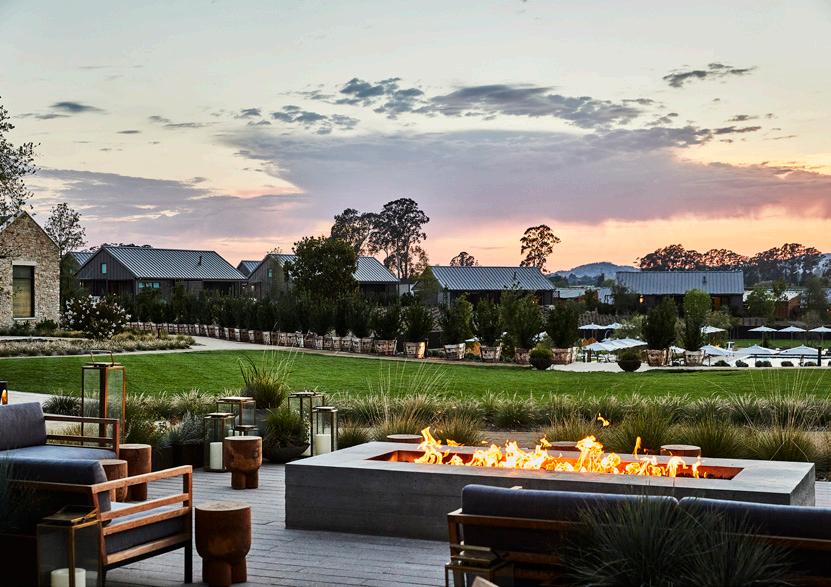
Three Auberge Collection properties in Napa Valley place guests near the racing heart of the Monterey Car Week action.
stanly ranch, auberge collection
Set on the southern edge of Napa Valley, Stanly Ranch is a modern retreat where vineyards frame a design-forward take on wine-country living. A swimming pool, transformative wellbeing experiences, and seasonal cuisine set a decidedly California scene, while many of the 135 standalone cottages and suites, as well as the private residences, open to outdoor living spaces.
auberge du soleil, auberge collection
Perched above Rutherford, Auberge du Soleil pairs contemporary residential design with Michelin-starred dining and panoramic valley views. Its 15,000-bottle cellar spans local icons and global benchmarks. The 50 rooms and suites—many housed within French-inspired maisons—feature fireplaces, soaking tubs, and private outlooks onto vineyards and olive groves.
solage, auberge collection
At the northern end of the valley in Calistoga, the 100-room Solage offers a contemporary take on the vineyard escape, centered on wellbeing and open-air living. Geothermal pools and a bathhouse at Spa Solage, Wellbeing by Auberge place the focus on grounded wellness, while Solbar presents globally influenced, seasonal cuisine.
Stanly Ranch, Auberge Collection
Since 1967,
every year
the Montreux Jazz Festival has been held
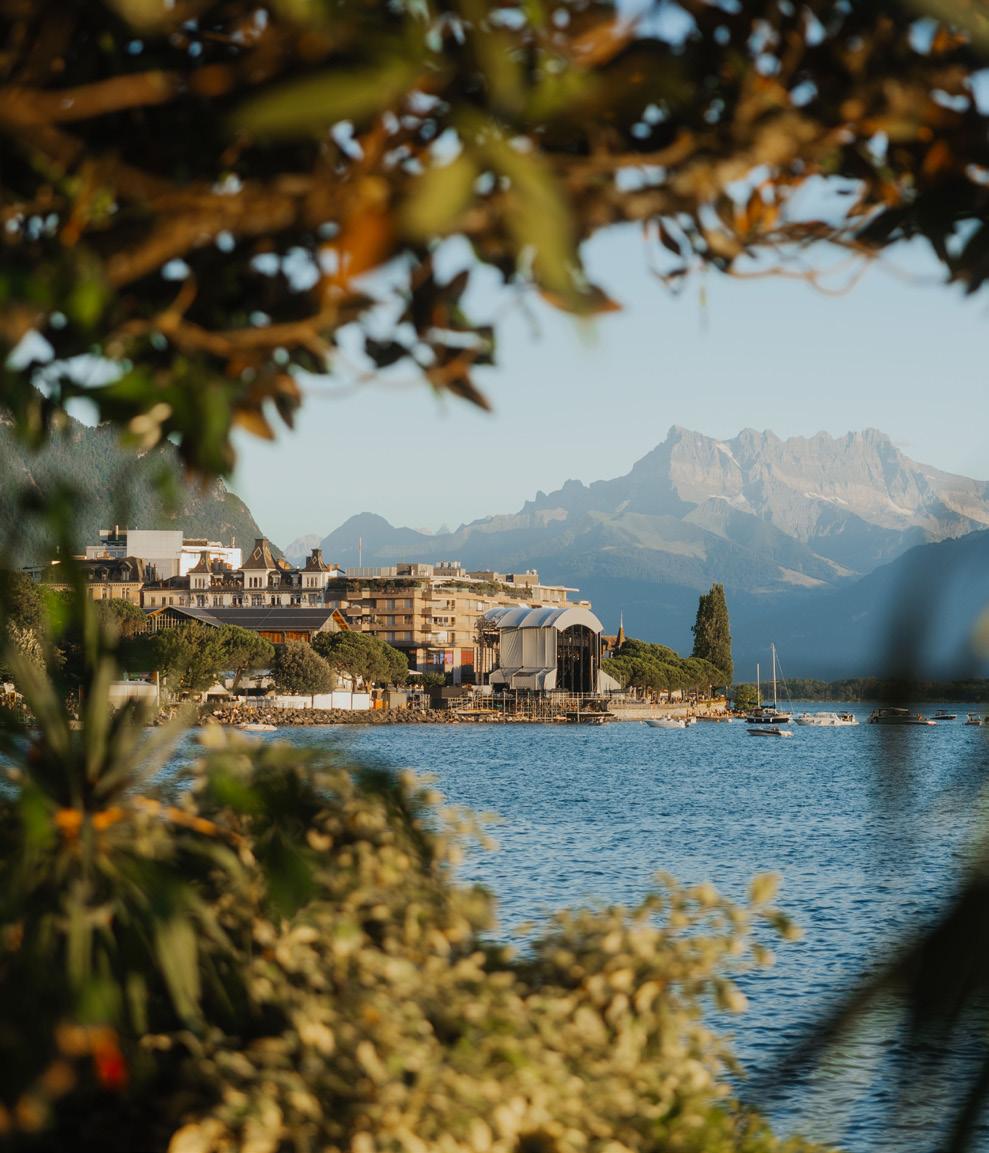
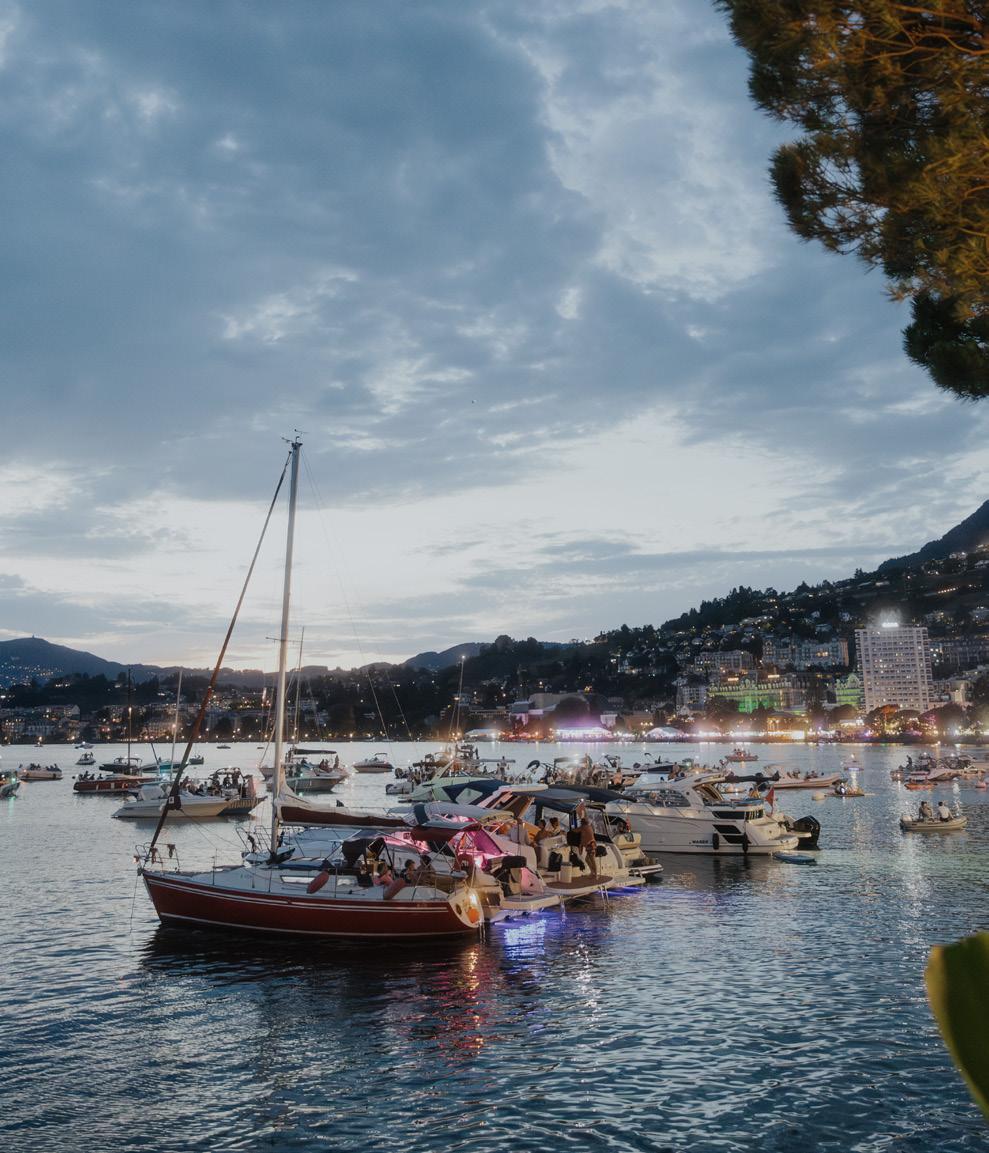
on the edge of Lake Geneva, 60 miles outside of the city of Geneva, where The Woodward, Auberge Collection is located.
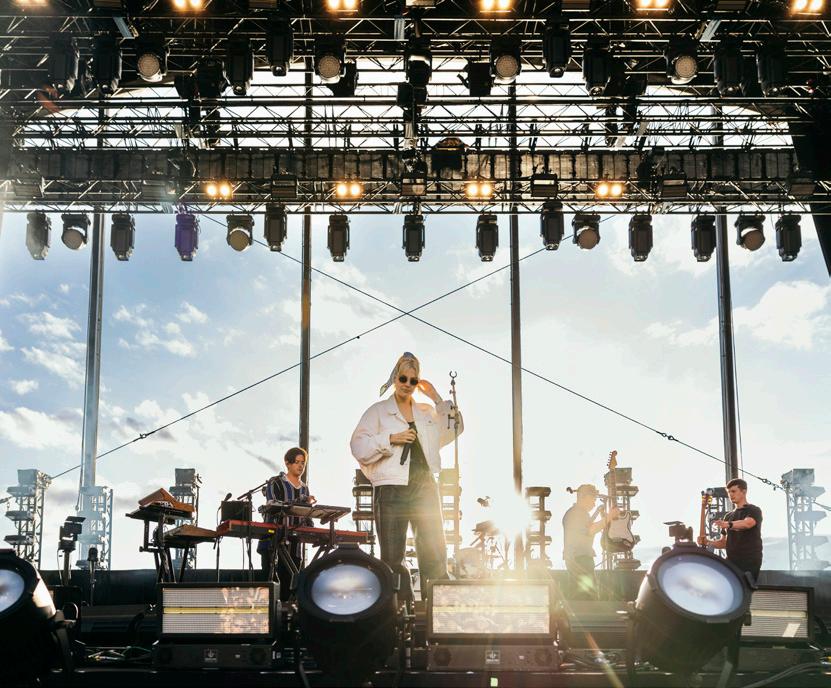
Opposite: London Grammar takes the stage at the 2025 festival.
Few music festivals command the reverence of Montreux, where one man’s gift for befriending legends transformed a lakeside gathering into a global jazz institution—and an enduring legacy.
BY ADAM MCCULLOCH
Swiss Beats
The world’s great music festivals each have an identity hewn from their surroundings. Coachella has the California desert, Lollapalooza the Chicago skyline, Glastonbury the Somerset countryside. But the Montreux Jazz Festival, approaching its 60th edition this summer, may just have the strongest aesthetic appeal of all: It’s set in a glorious belle epoque town on the edge of the vast Lake Geneva, fringed with soaring Alpine peaks. It’s no wonder artists and cultural figures—including David Bowie, Freddie Mercury, Tchaikovsky, Zelda Fitzgerald, Vladimir Nabokov, and Noël Coward—have all, at various times, chosen to live here.
The natural amphitheater and the town’s international potpourri of attitudes, languages, and tastes make Montreux different. But above all, it’s the festival’s integrity and great music from an array of genres that make it so special.
Its CEO since 1999, Mathieu Jaton, credits this idealistic aura to the extraordinary passion of one man: founder Claude Nobs, the “nothing is impossible guy,” as Jaton calls him, and a man who turns all notions of Swiss conservatism on their head. Nobs joined the local tourist board in 1960, becoming its head within a few years, by which time he’d brought a little-known band called the Rolling Stones
to perform at the town’s Golden Rose TV symposium. (He was keen to lure the Beatles, too, but was overruled by people who may not have known as much about music as he did.)
“He wanted to promote this quiet Swiss town around the world and contribute to culture,” says Jaton, who worked closely with the founder from 1994 until Nobs’s passing in 2013. “He wanted to create a mecca for music and musicians.”
The first Montreux Jazz Festival took place in 1967 and featured saxophonist Charles Lloyd with pianist Keith Jarrett and drummer Jack DeJohnette. At 1969’s event, Nobs realized a dream by recording a hugely popular album: Les McCann and Eddie Harris’s Swiss Movement, featuring the evergreen hit “Compared to What.” Nobs also filmed the performances, many of which are now immortalized on YouTube: Ella Fitzgerald singing Burt Bacharach’s “A House Is Not a Home,” also from 1969, is among hundreds of musical and historic gems.
Jaton says “Claude was all about connections” and knew he could only achieve his vision by winning over industry insiders. He went to New York to see Atlantic Records boss Nesuhi Ertegun without an appointment and charmed his way into a meeting. Such was
their immediate rapport that soon two of Nobs’s idols, Atlantic artists Aretha Franklin and Roberta Flack, were winging their way to Montreux.
If this was a demonstration of Nobs’s musical range, things took a much noisier turn in the early 1970s when Led Zeppelin, Santana, and Pink Floyd headlined. The appearance of a decidedly new type of fan—long hair, bell bottoms, and all—was a test for Montreux locals. “The more conservative people weren’t so happy with people smoking joints in the gardens,” Jaton says with a laugh. “Claude wasn’t popular with everyone just then.”
Still, Montreux became a magnet for musicians as much as audiences. It has always been a place to hang, meet other bands, have jam sessions; it has never been just another stop on a world tour. The Rolling Stones’ Bill Wyman says playing at Montreux alongside blues legends Buddy Guy and Muddy Waters was “the greatest moment of my career.”
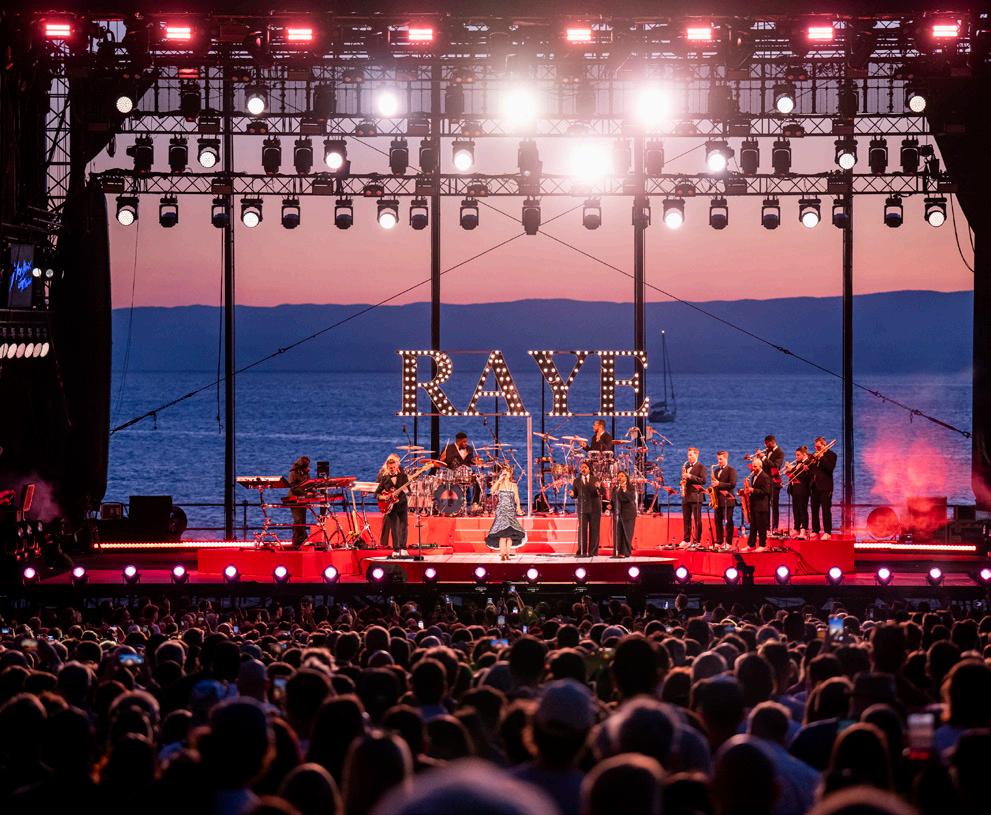
This year’s 60th edition brings more of that musical camaraderie, with first-night headliner, British soul and jazz singer Raye, performing with an astonishing array of guests: soul legend Al Green, pop master Mark Ronson, and the golden-voiced Shirley Bassey, now in her 80s, among them.
“It’s the original prestige festival. If they invite you to perform here it’s your duty and an honor to come.”
—QUESTLOVE
British singer Raye takes the stage at the 2025 Montreux Jazz Festival. This year, she will be the first-night headliner, along with guests Al Green, Mark Ronson, and Shirley Bassey.
The Montreux Jazz Festival’s promotional posters have long been considered collectible, designed by some of the biggest names in art, music, and fashion. Opposite: This year’s was created by French fashion designer Kévin Germanier.
MILTON GLASER, 1977
DAVID BOWIE, 1995
KEITH HARING 1983
MARYLOU FAURE, 2021
KÉVIN GERMANIER, 2026
“The first time Raye came, in 2024, we put her on with Janelle Monáe, and she did another crazy show last year,” Jaton says. “For the 60th anniversary we’ve given her carte blanche, and she’s decided to do a show that reflects the history of music at Montreux inspired by people like Ella and Nina [Simone]. It’s a pure Montreux story and something that you can only see here.”
Raye has spoken about the significance the 2024 show had on her: “I am so enamored and in awe of the history of all the artists who have stood on the stage we shared. I left the stage feeling the highest of highs.”
Also this year, folk legend James Taylor and Irish soul singer Van Morrison are appearing
on the same night. “This one is emotional for me,” Jaton says of the two acts. Though they are scheduled to play separately, there is always the hope that they may be moved to join each other on stage. After all, crazier things have happened: In 1981, Nobs famously got Freddie Mercury and David Bowie to co-record a version of the latter’s iconic “Under Pressure” at Montreux’s Mountain Studios. “Nothing is impossible!” Jaton says. (To wit: Another fan-favorite Bowie collaboration, “This Is Not America,” featuring the Pat Metheny Group, was also recorded there in 1984.)
Sting also makes a return this year, with his 12th appearance on the Montreux stage. He has long talked up the importance of Nobs’s influence on the jamboree, calling the founder
an “abiding spirit and presence” at the festival. “His warmth and inclusive nature of all kinds of music … was an important statement to make,” Sting says. “Barriers are not helpful. I like festivals that open their doors to all kinds of musical interpretations.”
Six-time Grammy winner, drummer, DJ, and filmmaker Ahmir Khalib Thompson, better known as Questlove, leader of the Roots, is another headliner this year who became friends with Nobs after performing at the festival. “It’s the original prestige festival,” he says. “If they invite you to perform here it’s your duty and an honor to come. A lot of my inspirations, like Nina Simone and Miles Davis—the gigs they’ve done here I’ve studied over and over.”
With his desire to make Montreux a cultural destination, Nobs also promoted the festival with beautiful branding. The names behind its posters are as godlike in the design world as those of the musicians in the sonic word: Andy Warhol, David Bowie, Julian Opie, among others. “Artists are given full creative freedom,” Jaton says of the iconic posters. “They reflect the times and artistic trends in which they were created, showcasing the evolution of visual arts, from photography and painting to purely graphic works.”
For this year’s edition, fashion designer Kévin Germanier—who has dressed Beyoncé, Björk, and Lady Gaga—took the creative reins of the consequential poster, producing an astonishing riot of rich, saturated color composed of
60,000 beads and sequins, all hand-woven on black velvet. “Music isn’t just a saxophone or a guitar; it’s a feeling,” Germanier says. “I tried to capture that explosion, that emotion that makes your body sway and your heart stir.”
So woven into the musical zeitgeist is Montreux that it has been immortalized in legendary music itself—although one of the most notorious incidents in the town’s musical history happened just outside of it, at another Nobs-promoted concert. In December 1971, during a performance by Frank Zappa, an audience member fired a flare gun, causing a fire in the festival’s main venue. The members of Deep Purple—another headliner at the 2026 festival—watched from a nearby hotel bar as Nobs rushed to help evacuate concertgoers.
(There were no fatalities or major injuries.)
The following year, the rock band released its famous anthem “Smoke on the Water,” with the following lyrics inspired by the event:
Funky Claude was running in and out He was pulling kids out the ground now
Deep Purple’s long association with Montreux means the band’s appearance at this year’s festival will also be emotional for Jaton: “It’s likely to be the last time we’ll see them here,” he says. Such personal testimonies reveal so much about the legacy of music and art renewed with each year’s event. “You can’t describe it—words don’t do it justice,” Quincy Jones once famously said of it. “You just have to come and experience it.”
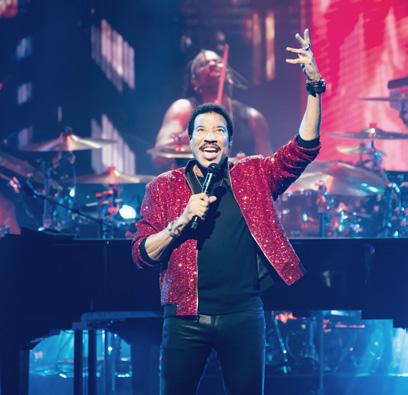
Stars of the Montreux Jazz Festival through the years include (from left): Grace Jones, Sting, Lady Gaga and Tony Bennett, and Lionel Richie.
All That Jazz
In its 60 years, the Montreux Jazz Festival has grown from staging just three artists in 1967— Charles Lloyd, Keith Jarrett, and Jack DeJohnette—to nearly 80, with about 250,000 attendees in recent years. This year’s festival takes place July 3–18. Headliners include Raye, Sting, John Legend, the Roots, Deep Purple, Van Morrison, and James Taylor. Performances are held at the Convention Centre, which houses two main stages: Auditorium Stravinski and Montreux Jazz Lab. There is also the smaller Montreux Jazz Café; a plethora of petite stages, such as the intimate Funky Claude’s Bar; and the Ipanema Terrace, where world-famous DJs spin. Many performances are free.
To explore Montreux beyond the music scene, the Léman Express train network allows visitors to take in the spectacular UNESCO-listed terraced vineyards and local attractions without missing any performances. Top sites include Chaplin’s World, a brilliant interactive museum dedicated to the great film innovator on the grounds of
his family house. There is also the atmospheric, medieval Chillon Castle and the recently opened Fort de Chillon, a World War II bunker set into the mountainside. One of the best local excursions is to take the funicular to the peak of Rochers-de-Naye, which towers 6,700 feet above Montreux. At the top, a cafe and observation deck offer views as far as Eiger mountain to the east. The train also stops at the little village of Caux, where Claude Nobs’s chalet can be found.
Visitors to the festival can extend the experience with a stay at The Woodward, Auberge Collection, located just 60 miles away in Geneva. Through its close relationship with the Montreux Jazz Festival, the hotel offers privileged access that goes far beyond the expected, including lastminute tickets, entry to the Director’s Lounge for intimate views of the performances, and a series of exclusive touches reserved for guests only. Back in Geneva, the experience continues in complete privacy, with dedicated streaming access from the comfort of the hotel.
The best seats in the house are often on Lake Geneva, where boaters can soak in the Montreux sound from their yachts.
Opposite: Prince performs at the 2013 festival.
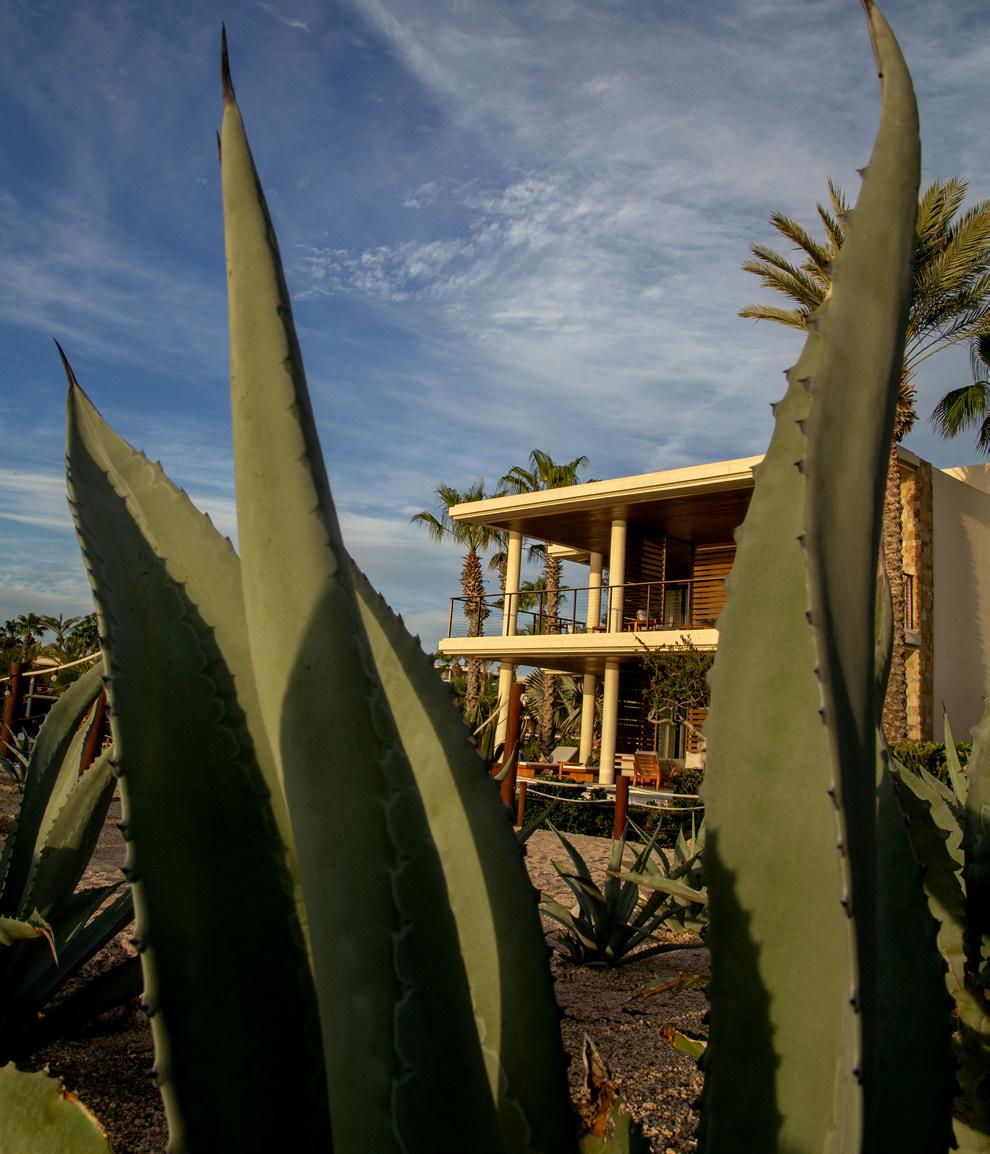
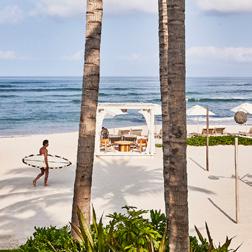
Chileno Bay Resort & Residences, Auberge Collection, in Los Cabos, Mexico. Photography by Joaquin Trujillo.
Fire in the Soul
At Chileno Bay, Auberge Collection, the path to restoration is illuminated by ancestral practices and the quiet power of the elements.
BY ESME BENJAMIN
| PHOTOGRAPHY BY JOAQUIN TRUJILLO
Beams of soft morning sunshine
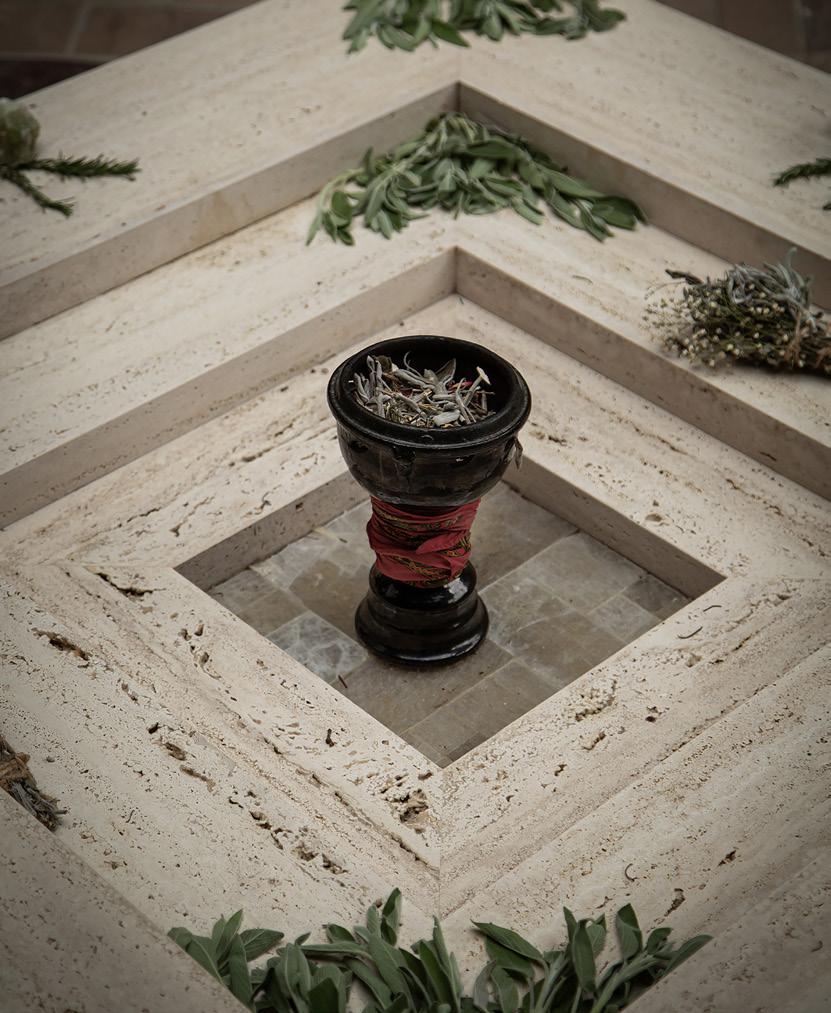
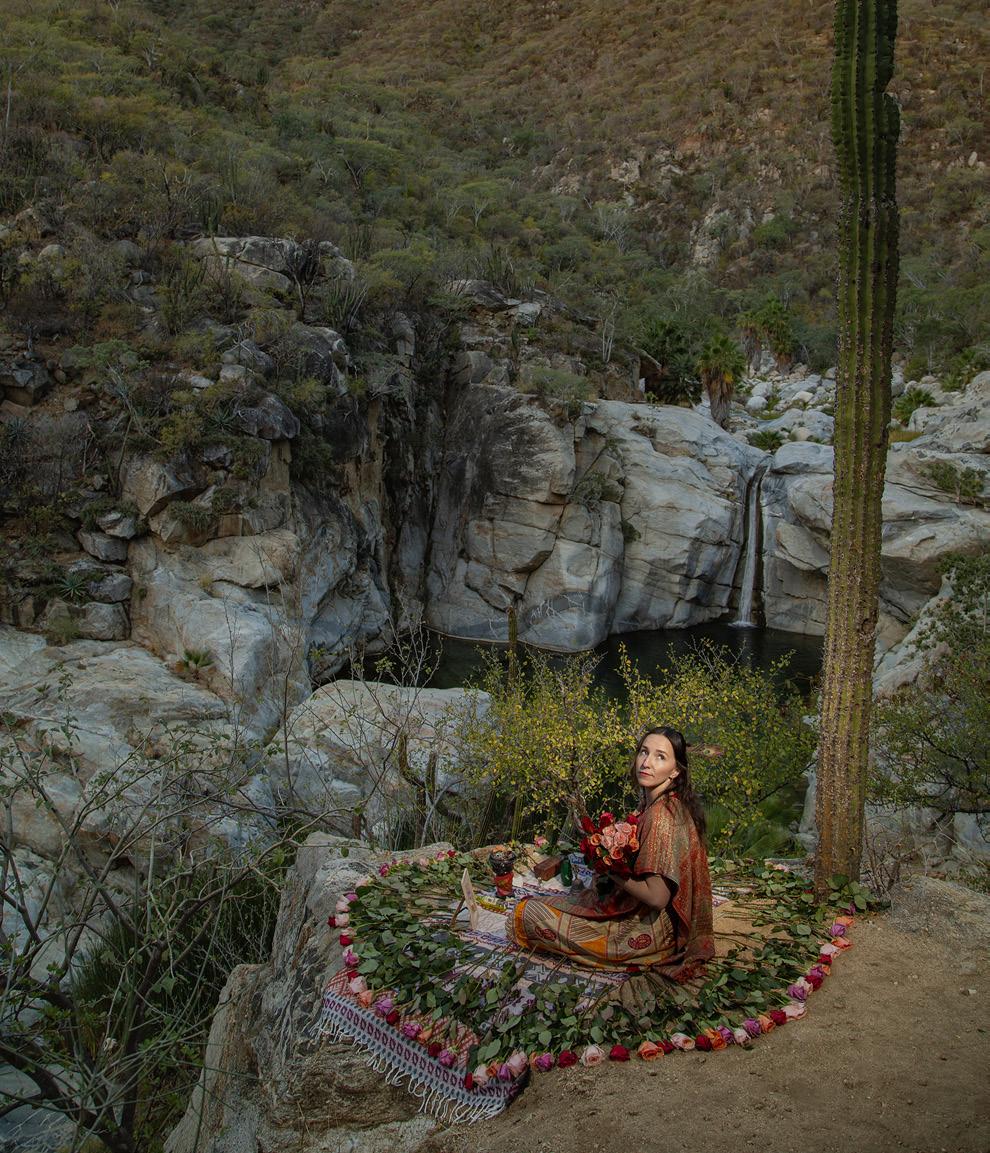
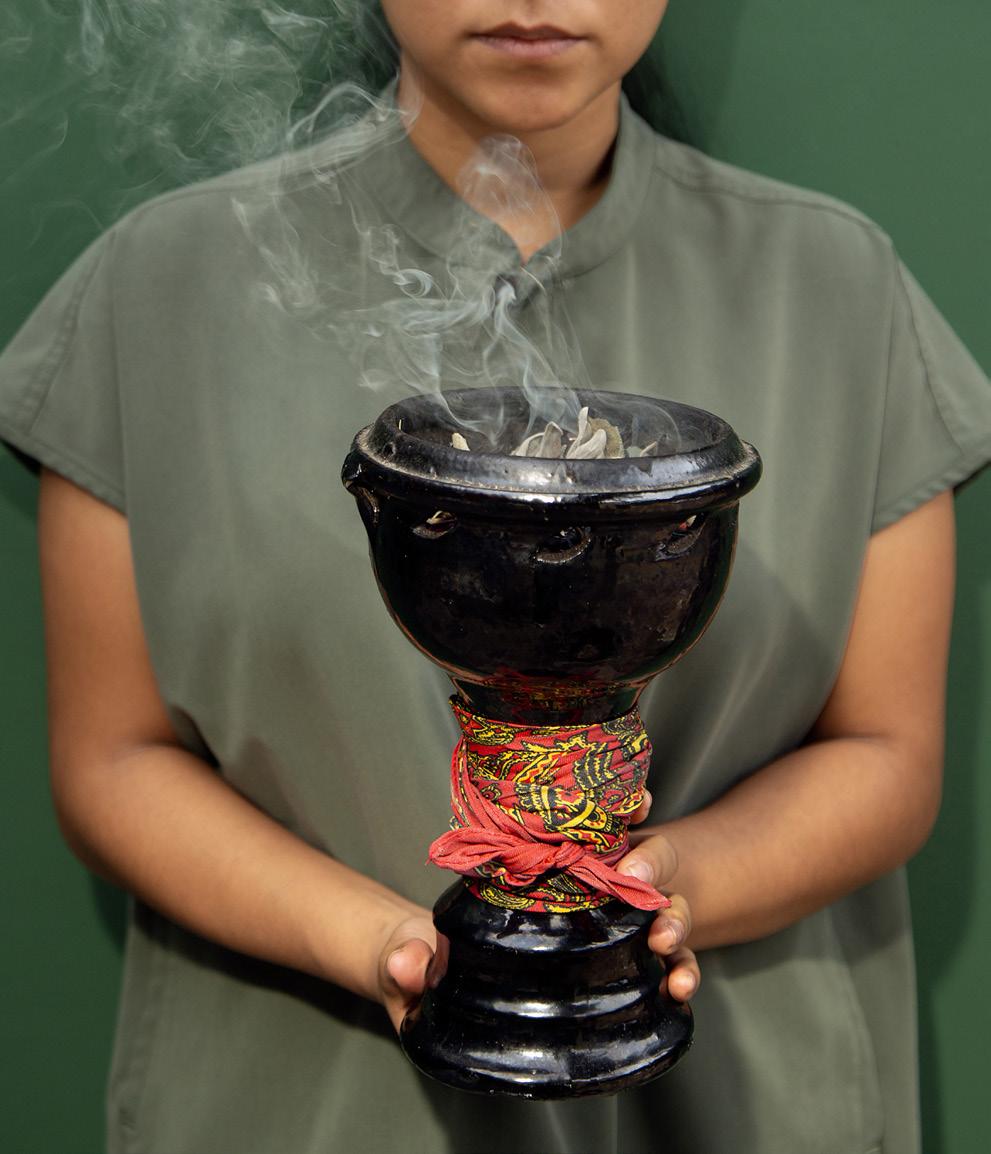
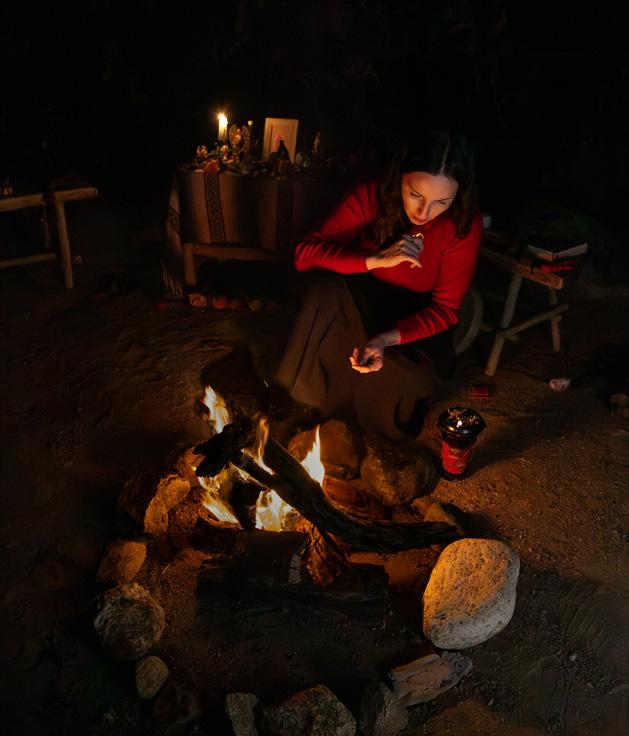
flooded the hills of Rancho Ecológico Sol de Mayo, a desert oasis at the edge of Baja California’s Sierra de la Laguna mountain range. Rose Green struck a match, coaxing a flame to life in her ceramic chalice. The still air filled with fragrant smoke from the burning copal, an aromatic tree resin used for centuries in this part of the world as sacred incense for spiritual cleansing. Green whispered something inaudible into the chalice, then gently blew on the glowing copal, surrounding her body in pale plumes of smoke that drifted over the hillside cacti and emerald-hued river below.
This sacred ritual is a monthly practice for Green—and a form of self-therapy as essential as the treatments she offers her own clients. As the resident curandera (healer) at Chileno Bay Resort & Residences, Auberge
Collection, she spends her days tending to others’ physical and emotional needs, but these solo pilgrimages “clear the channel,” as she puts it, both restoring herself and deepening her communion with nature, her ancestors, and the four elements. They also allow her to return to Chileno Bay spiritually recalibrated and ready to transmit that clarity and awareness to those in her care.
“To be a healer is to help other people expand and find their hearts—to find themselves,” she told me that morning, as the smoke cleared and the desert sun rose overhead. “To be a healer is a calling. We feel it from the moment we arrive in this world.”
Green, whose full name is Maria Del Rosario Fernández Green, comes from a long line of herbalists, intuitives, and healers.
This spread and previous: Rose Green, resident healer at Sol, Wellbeing by Auberge, at Chileno Bay Resort & Residences, Auberge Collection, performs a copal ritual in the Baja California desert.
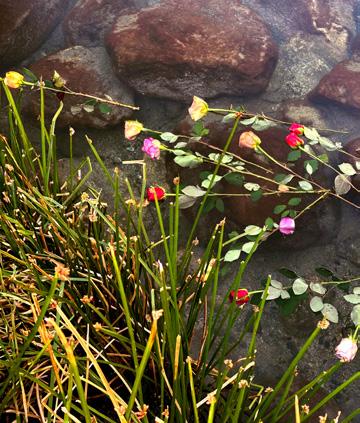
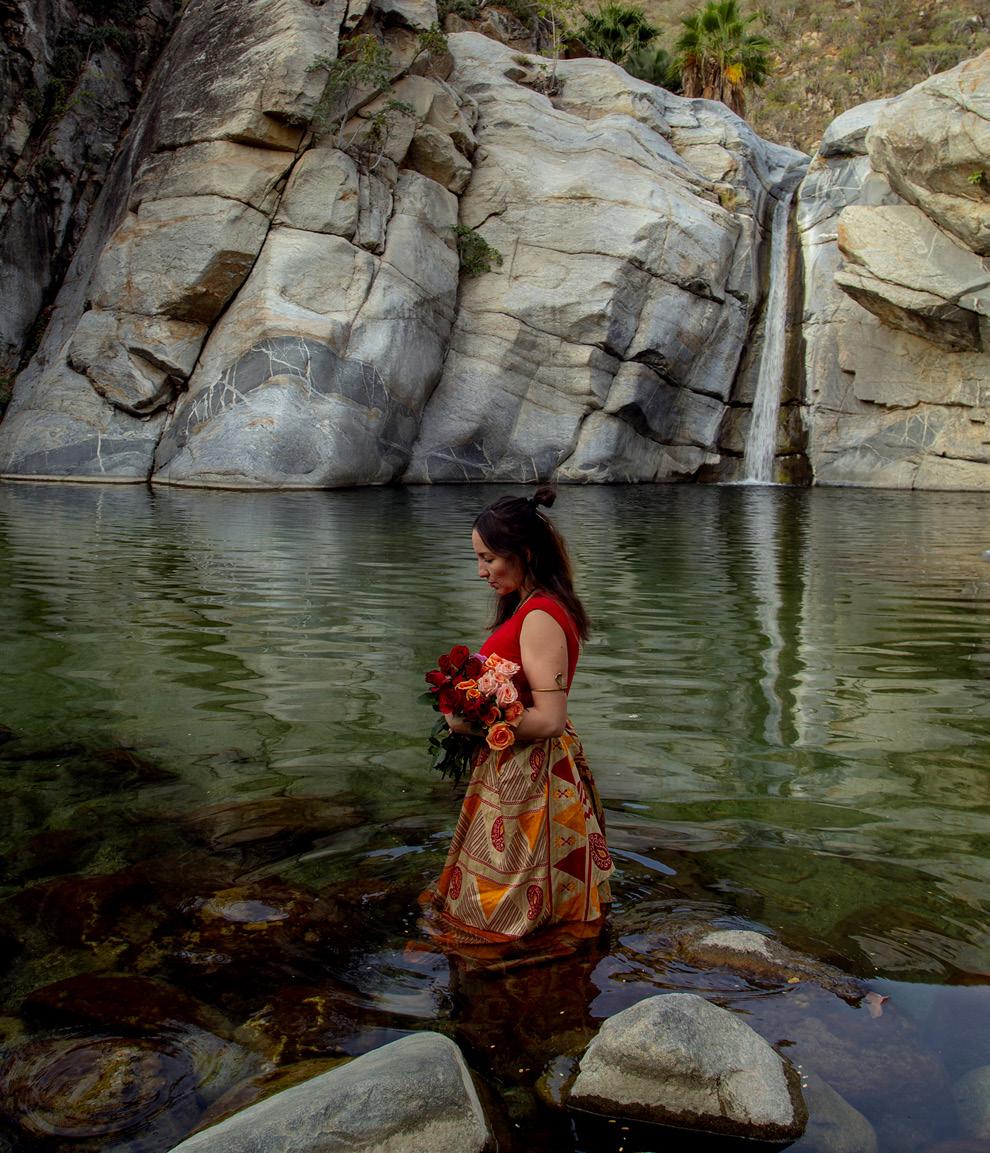
She briefly pursued a different path— building a successful career as a pastry chef that even led to an appearance on MasterChef México in 2015—but her ancestral calling always tugged at her. Over time, a series of detours and cosmic nudges drew her back to healing, and she began to recognize and develop gifts uniquely her own. She now goes by the name Rose, a flower that “means love and compassion,” she says—and a fitting moniker, I thought to myself, as I watched her wade into the river and float two armfuls of the flower on its surface. The final step of her pilgrimage, sealing the ritual, the flowers were an offering to Mother Nature and a symbol to honor all those in need of healing.
“All healers are different, because their mission is different,” she explained, as the roses bobbed and dispersed in the shallow, clear waters. “Mine is to help people embrace their roots, to bring union and
“We need to understand that the elements live inside of us, so we can start having this connection with our roots, with Mother Earth.”
—ROSE GREEN
compassion, and to be kind to themselves, because we are all searching for self-love.”
That mission springs to life at Chileno Bay’s Sol, Wellbeing by Auberge, where Green shares the healing customs of her ancestors through authentic treatments rooted in traditional Mexican therapies. Part of The Joy of Wellbeing by Auberge—guided by principles of Awe, Connect, Excel, and Nurture—is the Sacred Copal Ritual, a transformative experience based on the very practices that Green engages in during her desert ceremonies.
The Sacred Copal Ritual began with what Green told me would be a “gentle interview” to identify my needs—of mind, body, and spirit. Seated on the floor, cross-legged and facing me, she took a pinch of copal from a small dish and dropped it into a burning chalice, just as I had seen her do in the desert. As the aromatic smoke rose, she
The ceramic chalice Green uses in her pilgrimages is part of the Sacred Copal Ritual performed for guests at Sol, Wellbeing by Auberge.
for generations, allowing them to deepen their communion with nature and their ancestors.
The Sacred Copal Ritual at Sol, Wellbeing by Auberge at Chileno Bay Resort & Residences is based on a pilgrimage that Mexican healers have been making
instructed me to repeat my name three times, then express my intentions: what I wished to welcome into my life and what I wanted to let go of. “Don’t hold back,” Green told me. “This is your chance to say it all.”
The smoke, she explained, represents the cleansing element of fire, providing an energetic release while also opening a symbolic portal to my ancestors. I closed my eyes as Green moved the chalice around me, softly uttering prayers in light language—a channeled form of communication used for clearing energetic blockages—and enveloping my body in incense.
Earlier, in the desert, as the copal burned, Green had rhythmically chanted to the beat of a drum, her voice bouncing off the huge boulders surrounding us. In our version, at Sol, the same chants elicited in me a new sensation that I could hear men’s voices joining hers. “Those were your ancestors,” Green concluded, explaining that the ritual is a kind of transgenerational healing practice. The voices I had heard were the protectors of my lineage, showing up for me in a moment of vulnerability, perhaps.
The Sacred Copal Ritual continued with more traditional wellbeing modalities: an herbal cleanse, using a bundle of sage and rosemary to stimulate circulation with brisk tapping and sweeping motions, then a body scrub using more of the finely ground copal. As the tiny grains of resin were worked over my limbs, I was struck by the idea of literally shedding old parts of myself to make space for the new.
With my skin freshly exfoliated, Green smoothed on a warm, copal-infused clay mask, representing the earth element. “On a
physical level, it helps your skin to hydrate,” she said, “but on an energetic level, you’re connecting with a female energy—the energy of Mother Earth, where the clay came from. We need that because, as women, we need self-love.”
Green then gently guided me to an outdoor shower where I let the warm spray wash over my body. The stream felt practically spiritual, each drop carrying away the tension I had been unconsciously carrying with me. A massage followed, with Green intuitively focusing on areas where she sensed “stuckness,” as she called it—parts of my body marred by physical or emotional tightness.
“You’ve been carrying a lot of people and a lot of situations,” Green told me as she vigorously swept her fingertips across my body, as if brushing away invisible cobwebs. “Your shoulders were so tired. The sweeping cleans the energy so you will feel lighter.”
Lighter, yes, and with knot-free muscles and glowing skin—but the most profound change I felt was the kind of calmness that comes from feeling genuinely cared for.
In the desert, Green had told me that copal rituals are meant to bring the healing powers of nature inward. “We need to understand the elements live inside of us,” she said, “so we can start having this connection with our roots, with Mother Earth.” Only after the Sacred Copal Ritual ended did I fully embrace the meaning of this: Tuned into myself in a way I had rarely felt in my life, I wasn’t merely the recipient of a wellness treatment. Green had fostered a new connection within me—with nature, with my ancestors—and in the process, I had discovered the healer within myself.
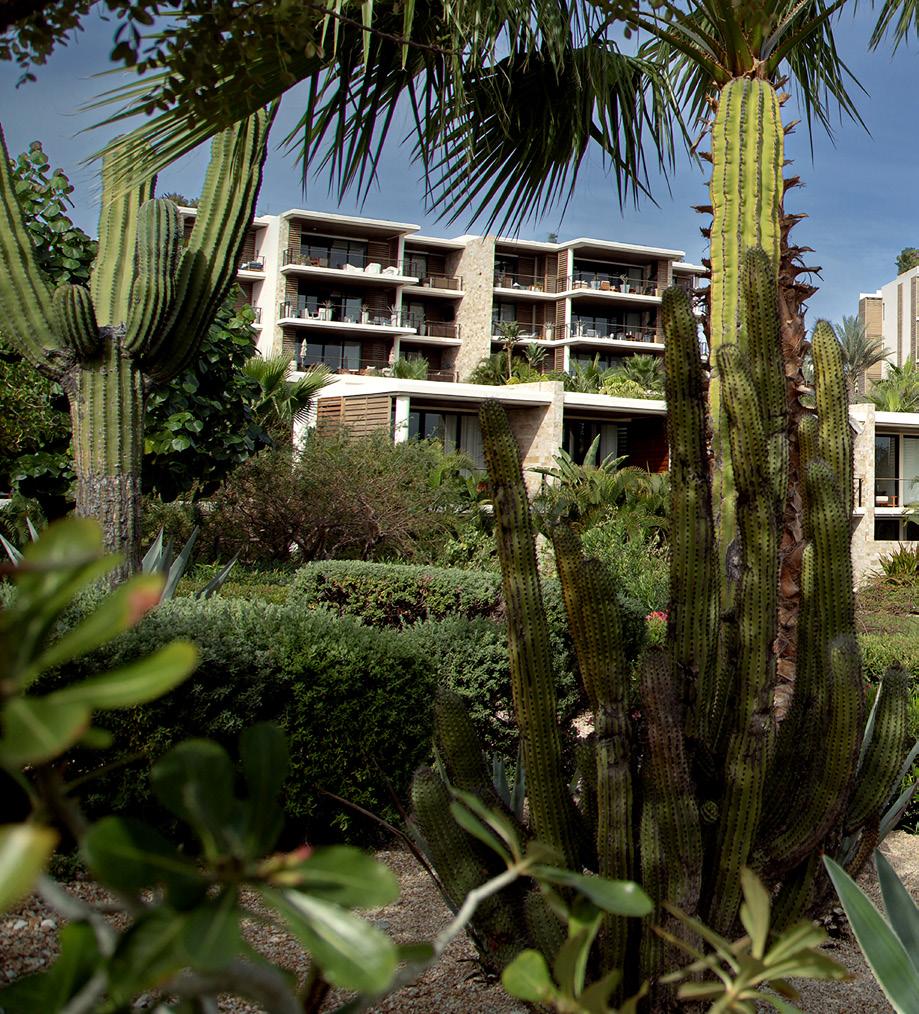
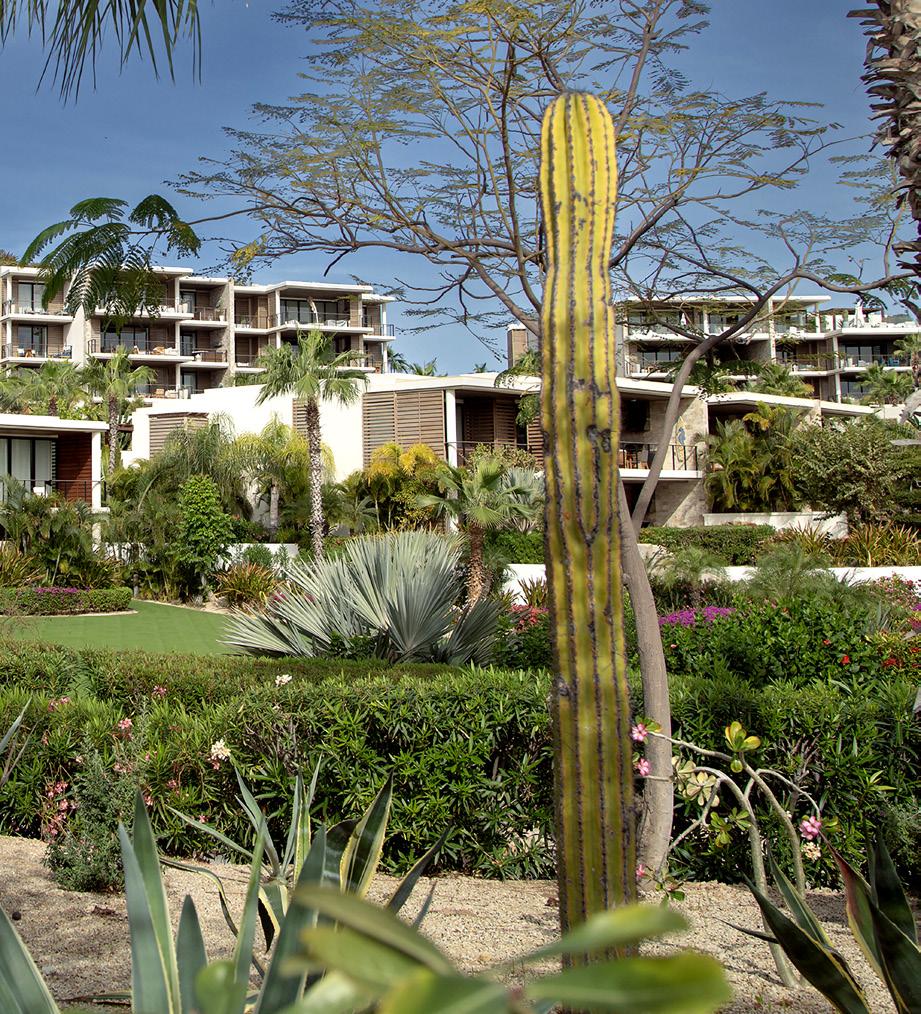
Chileno Bay Resort & Residences is nestled into the Baja California landscape, part of the natural elements that Green incorporates into her healing therapies.
Where the HEART IS
Designer and The Huntress founder Jenny Wolf brings a special sense of home to her eclectic and globally inspired interiors.
BY DALYA BENOR
“Home is a feeling.”
For New York City–based interior designer Jenny Wolf, interiors have always been deeply personal. “In my own home, I like things to feel collected,” she says. “I like linking the past to the present—a mix of antiques and eclecticism with contemporary pieces.”
Wolf’s projects, which tend toward a coastal-chic meets English-countryside aesthetic outfitted with carefully sourced antiques, are drawn from a deep well of experiences and a life well-lived. Born in New Orleans to parents who were furniture dealers, she was surrounded by a love of design from an early age. “As a small child, I always said that I was going to be an interior designer,” she says.
While she tends to design intuitively, pulling pieces from all parts of the world, Wolf says her stylistic sensibility stems from a love of travel, her upbringing in the South, and a semester abroad at Oxford during her university years. Funnily enough, she didn’t realize the influence it had on her until she returned 20 years later. “When I went back, I was like, oh my gosh, this is where I got all this from,” she says. “There was something that I picked up in my travels that I didn’t know was so ingrained in what I was designing. It’s the same with my upbringing: My family has a more traditional Southern aesthetic, which comes from Europe.”
Wolf’s eponymous design studio, which she founded in 2011, has since led her talents to residential projects such as a Park Avenue penthouse and an expansive family home in Greenwich, Connecticut, that bear the marks of her signature aesthetic: warm, inviting spaces that blend color and pattern seamlessly, overflowing with carefully sourced antiques alongside muted natural textures. It’s old world meets new language— one that’s entirely her own, rooted in a love for the hunt, which can also be found in her interior designs for White Barn Inn, Auberge Collection in Kennebunkport, Maine.
It’s precisely this hunt that led to the founding of The Huntress, Wolf’s exquisite homewares and antiques store in Pound Ridge, New York. Shopping for antiques is one of Wolf’s great loves—and great talents— and she sources from all over the world, from flea markets in Paris to Southern estate sales. Each piece tells a story of time and place, which Wolf then uses to outfit her many projects.
“As my design business was growing, I was feeling the need to find a space where I could spread my wings,” she says. In her 20 years living in New York, Wolf says, she had never been to Bedford, New York, the tony Westchester enclave that Martha Stewart calls home, but she visited one weekend to scout
Interior designer Jenny Wolf—pictured opposite at White Barn Inn, Auberge Collection—always keeps the essence of “home” in focus, whether she’s crafting an expansive family home in Greenwich, Connecticut (shown on previous spread), or a Park Avenue penthouse.
for potential retail locations at the urging of a friend. She happened to pass by a building with a “for sale” sign on it, and the rest is history. “I couldn’t have found a better home to build the store,” she says.
Her biggest restoration project to date, The Huntress took two years of renovations, eventually birthing her brick-and-mortar lifestyle brand, where she stocks everything from fashion to food to bespoke tea blends. “I was just collecting” without a real plan, she says, “going to antique shows and traveling to Europe, pulling things that I loved. Part of my design ethos is: Buy things you love and find a way to make them work together.”
Before honing her skills in the design world, Wolf spent her early years in New York working for Ralph Lauren, cutting her teeth as a visual merchandiser for the label’s stores and working on window displays. This early
career experience serendipitously led to her current path—though few of life’s roads are truly a straight line. A work trip took Wolf to the iconic West Virginia hotel The Greenbrier, where she was working on an installation. “That visit was a turning point for me,” she says. “I was awestruck by the design and the risk taking. I’d never seen anything like it.”
The classic Americana hotel, founded in 1778 and redesigned by famed interior designer Dorothy Draper in 1948, inspired Wolf to make the leap into interiors. After returning to New York, she enrolled in Parsons School of Design, got her first client in her final year of study, and was off to the races.
Her latest project is close to her heart: White Barn Inn’s new houseboats. Growing up, Wolf frequented Hilton Head, South Carolina, and weekends were spent with
The Huntress, Wolf’s brick-and-mortar shop in Bedford, New York, offers antiques, art, and furnishings the designer has collected around the world.
Wolf’s Watch Hill House, a residential project in Rhode Island, marries coastal-chic warmth with personally sourced antiques, art, objets d’art, and textiles.
her father on his sailboat. “I grew up on the water,” she says. “My dad was a big boater.” Thus, when the call came to lend her prowess to the hotel’s Cora Houseboat, she had a well of personal experience from which to tap.
Drawing from her Southern roots, the project was a chance to meld her worlds together, amalgamating The Huntress’s English countryside charm with the White Barn Inn’s coastal aesthetic. “The direction for it was so interesting because it’s not overly nautical,” she says. “It was like creating an extension of the hotel onto the boat.” Rather than treating it like a traditional houseboat, Wolf wanted to give the floating accommodations a feeling of a cottage on the water. “You really don’t feel like you’re on a boat when you’re on it,” she says. “Then you go outside!”
Resting on the banks of Maine’s Kennebunk River, the brand-new houseboat is tethered to the White Barn Inn’s private dock, blending indoor-outdoor environs into a cozy, luxurious coastal respite with incredible views of the marina. Because White Barn Inn is inherently a New England hotel, Wolf says she took design cues from British elements alongside traditional American motifs, expressed in what she calls a “classic yet refined” style.
It’s all part of an ethos that’s as personal as it is eclectic: “I like to lean into all aspects of creating spaces that cater to gathering and a feeling of enjoyment,” she says. “That’s why I started The Huntress in the first place—my love and passion for collecting antiques, giving them a new, fresh perspective. That’s part of the work that I do.”
Wolf’s designs for Cora Houseboat at White Barn Inn, Auberge Collection feature a private rooftop deck and coastal interiors that capture Kennebunk’s iconic Maine aesthetic.
At Home in the Blue Ridge Mountains
A limited collection of Auberge Residences at The Lodge at Primland brings year-round living to one of Virginia’s most protected mountain landscapes.
The Lodge at Primland, Auberge Collection resists easy definition. Set on 12,000 acres of protected wilderness in Virginia’s Blue Ridge Mountains, it has been shaped by decades of careful stewardship by the Primat family, who envisioned the estate as a place of seclusion and serenity. Now, with the arrival of the Auberge Residences at Primland, ownership of a slice of this all-season mountain landscape is finally possible.
Limited to just 25 turnkey homes, the residences are seamlessly woven into the fabric of the surrounding landscapes. Designed by Hart Howerton, the architecture leans on native stone, natural woods, and pared-back interiors, with double-height living spaces and fireplaces that frame the surrounding wilderness rather than compete with it. The fully furnished homes are equipped with custom artwork, along with luxury details. For those who wish to design their dream Blue Ridge escape, The Estates, located nearby, will comprise 26 customizable homesites.
Ownership comes with access to Primland’s understated pleasures: a Donald Steel–designed golf course, farm-to-table dining, and guided outdoor pursuits from hiking and horseback riding to sporting clays, pickleball, archery, and fishing. Crucially, though, scale remains controlled. With a limited number of residences dispersed across this vast land, Primland retains its defining quality—a feeling of escape from the outside world. From $5.8 million; ownprimland.com.
The Hawk Eye Luxury Residence sits among The Lodge at Primland, Auberge Collection’s 12,000 private acres.
Now available to book, the Hawk Eye Luxury Residence features a four-bedroom primary residence and twobedroom guesthouse, plus a games cottage, outdoor kitchen, private heated pool, and two hot tubs.
The Auberge Gift Card
Give the gift of extraordinary travel
Experience the WORLD OF AUBERGE
MAYFLOWER INN AND SPA, Auberge Collection
Washington, Connecticut
A storied countryside escape where high design meets acres of woodland gardens and every season inspires a uniquely New England approach to holistic wellbeing.
WHITE BARN INN, Auberge Collection
Kennebunk, Maine
A landmark of New England hospitality with a legendary culinary heritage and an intimate, private-home atmosphere celebrating every season in the salt-air elegance of Kennebunk.
THE DUNLIN, Auberge Collection
Kiawah River, South Carolina
A riverfront sanctuary near Charleston honoring Lowcountry rhythms and the quietude of the marsh while inviting nature-driven pursuits that imbue the South’s signature, soulful ease.
THE VANDERBILT, Auberge Collection
Newport, Rhode Island
An iconic downtown mansion combining Gilded Age grandeur with bold interiors, a private-club atmosphere and a harbourview Roof Deck, energizing the city’s historic waterfront.
U.S. East Coast
WILDFLOWER FARMS, Auberge Collection
Hudson Valley, New York
A coveted Hudson Valley retreat where nature’s wild comforts unfold. Amid sweeping wildflower meadows, woodlands, and a namesake farm influencing seasonal cuisine, wellbeing is rooted in the land and trails stretch for miles, inviting both stillness and the call to wander.
THE LODGE AT PRIMLAND, Auberge Collection
Blue Ridge Mountains, Virginia
Perched high in the Blue Ridge Mountains, this 12,000-acre private estate invites a spirited return to nature through unbridled outdoor adventure and warm Virginian hospitality.
AUBERGE DU SOLEIL, Auberge Collection
Valley, California
Wine country’s quintessential hillside retreat, where sun-soaked terraces, a Michelin-starred restaurant, and breathtaking vineyard views blend California’s spirit with Provençal grace.
U.S. West Coast
THE INN AT MATTEI’S TAVERN, Auberge Collection
Los Olivos, California
A reimagined stagecoach stop just north of Santa Barbara, serving as the social heart of Los Olivos through landmark heritage, poolside relaxation, and celebrated wine-country cuisine.
SOLAGE, Auberge Collection
Napa Valley, California
A Calistoga oasis set against the dramatic Palisades, welcoming visitors and local vintners alike with Michelin-recognized dining and a fresh, energetic take on wine country luxury.
STANLY RANCH, Auberge Collection
Napa Valley, California
A dynamic destination representing the new generation of Napa, where rolling vineyards and wide-open skies inspire seasonal, farm-driven cuisine and a spirit of bold adventure.
Napa
Hawai‘i
Santa Fe, New Mexico
MAUNA LANI, Auberge Collection
Hawai‘i
An oceanfront sanctuary on the sacred Kohala Coast, where storied fishponds, white-sand beaches and a relaxed Beach Club define barefoot-Hawaiian luxury for every generation.
BOWIE HOUSE, Auberge Collection
Fort Worth, Texas
A bold, urban retreat channeling the spirit of the New West, where art, culture, and vibrant dining converge within Fort Worth’s buzzing Cultural District.
& Central U.S.
COMMODORE PERRY ESTATE, Auberge Collection
Austin, Texas
European elegance meets the heart of Austin at this re-envisioned landmark, where gracious Texan hospitality imbues the mansion and its formal gardens with a vibrant, convivial spirit.
BISHOP’S LODGE, Auberge Collection
A storied Tesuque Valley retreat where Southwestern adventures unfold against the Sangre de Cristo Mountains and vibrant cultural traditions meet a soulful, high-desert culinary scene.
Aspen, Colorado
Aspen’s legendary social heartbeat since 1889 fuses frontier spirit with modern style, offering iconic gathering spaces and unfettered access to the Rockies’ alpine allure.
the Mountains
GOLDENER HIRSCH, Auberge Collection
Deer Valley, Utah
Bavarian charm unites with sleek modern design at this Deer Valley landmark, offering an iconic alpine social scene and direct access to legendary ski runs.
ELEMENT 52, Auberge Collection
Telluride, Colorado
An intimate collection of slopeside residences in the heart of Telluride, offering refined alpine living and direct access to the rugged San Juan peaks.
HOTEL JEROME, Auberge Collection
MADELINE, Auberge Collection
Telluride, Colorado
Telluride’s premier Mountain Village basecamp and home to the Rockies’ most exclusive private social club, pairs alpine sophistication with year-round outdoor adventures.
SLEEPING INDIAN RANCH, Auberge Collection
Ridgway, Colorado
Set on 15,000 wild acres northwest of Telluride, a grand timberframed residence offers rugged luxury, endless adventure, and cinematic views beneath Colorado’s unspoiled Cimarron Range.
THE LODGE AT BLUE SKY, Auberge Collection
Park City, Utah
Modern architectural elegance meets the raw beauty of a 4,000-acre, landhonoring ranch, offering a soulful, high-alpine escape defined by wild adventures and understated luxury.
Mexico
SUSURROS DEL CORAZÓN, Auberge Collection
Punta de Mita, Mexico
Where the jungle meets sea, this surf-inspired retreat on the untouched shores of Bahía de Banderas marries artisanal Mexican craftsmanship and raw coastal beauty with barefoot luxury, oceanfront adventure, and the playful spirit of a luxuriously relaxed escape.
Los Cabos, Mexico
The contemporary Baja retreat on Los Cabos’ most celebrated beach is renowned for its dynamic dining scene, swimmable waters, vibrant reefs, and effortless indoor-outdoor living.
ESPERANZA, Auberge Collection
Los Cabos, Mexico
An iconic Los Cabos retreat perched atop Punta Ballena’s dramatic bluffs, where panoramic Sea of Cortez horizons, cliffside dining, and infinity-edge serenity converge.
CHILENO BAY, Auberge Collection
ETÉREO, Auberge Collection
Riviera Maya, Mexico
Floating above a lush mangrove forest on Kanai’s unspoiled white sands, the ethereal Riviera Maya oasis pairs refined luxury with transformative wellbeing, vibrant cuisine, and the spirit of Mayan culture.
HACIENDA ALTAGRACIA, Auberge Collection
Costa Rica
An inspiring Costa Rican sanctuary where soul-stirring wellbeing and unbridled adventures span acres of untouched tropical forest and lush coffee farms in the Talamanca Mountains.
& Central America
Europe
GRACE
HOTEL, Auberge Collection
Santorini, Greece
Suspended above Santorini’s caldera, the cliffside sanctuary offers infinity-horizon views, Cycladic elegance, and Michelin-awarded culinary artistry.
THE WOODWARD, Auberge Collection
Geneva, Switzerland
A refined all-suite sanctuary positioned directly on Lake Geneva, with Mont Blanc views, a serene Guerlain spa, and exceptional dining institutions including the city’s only two-Michelin-starred L’Atelier Robuchon.
COLLEGIO ALLA QUERCE, Auberge Collection
Florence, Italy
In the hills of Florence, the storied landmark blends Renaissance grandeur with modern luxury—complete with frescoed suites, Baroque gardens, and sophisticated culinary and experience-led wellbeing— serving as a gateway to both urban culture and countryside calm.
DOMAINE DES ETANGS, Auberge Collection
Massignac, France
A 13th-century château nestled on 2,500 forested acres, where world-class art and Michelin-starred, farm-to-table dining create a storybook escape rooted in French country tradition.
CAMBRIDGE
HOUSE, Auberge Collection
London, United Kingdom
Mayfair’s great house is reimagined as a vibrant social sanctuary, offering a harmonious blend of unique dining destinations, an Auberge spa, and an exclusive members club set to define the new pulse of modern London.
THE BIRDSALL, Auberge
Collection
Houston, Texas (2027)
The social heart of Houston’s prestigious River Oaks’ enclave, The RO, this urban destination combines a luxury hotel and private club to redefine sophisticated city living.
MONCAYO, Auberge Collection
Puerto Rico (2029)
A transformative beachfront resort and members-only community nestled between El Yunque’s rainforest and the Caribbean Sea, where Taínoinspired wellness, extensive overwater activities, and organic farm-totable dining celebrate Puerto Rico’s captivating culture and radiant soul.
THE STOCKMAN
Auberge Collection
Steamboat Springs, Colorado (2030)
A new benchmark for refined alpine living emerges in Steamboat Springs, at the base of one of Colorado’s most storied peaks. This ultra-luxury ski-in, ski-out hotel and residences offer an all-season retreat, reimagining the enduring spirit of the American West for a new era.
SHELL BAY, Auberge Collection
South Florida (2027)
Setting the new standard for luxury on Florida’s Gold Coast, this private enclave brings together entertainment and wellness with sophisticated amenities, including luxury residences, a yacht club, a world-class racquet club, and an ultraexclusive Greg Norman-designed golf course.
Coming Soon
THE KNOX, Auberge Collection
Dallas, Texas (2026)
A glamorous playground for the discerning, where bold design, wellbeing, and a vibrant culture and culinary scene define the new heart of Dallas.
THE SHORE CLUB, Auberge Collection
Miami Beach, Florida (2028)
An iconic Art Deco landmark reborn as the ultimate Miami Beach sanctuary, where luxury residences and a boutique hotel anchor a private, salt-air botanical enclave.
CHEM CHEM LODGE, Auberge Collection
Burunge Wildlife Management Area, Tanzania
The birthplace of the Slow Safari, this sanctuary amid a palm-dotted oasis defines a soulful Tanzanian escape. Transformative moments are revealed in silent walks and dinners beneath the stars, while the lodge’s secluded tented suites invite recalibration with the rhythms of the wild.
LITTLE CHEM CHEM, Auberge Collection
Burunge Wildlife Management Area, Tanzania
Meandering game drives awash with wildlife encounters give way to sundowners on the plains and leisurely lantern-lit dinners at this vintage-inspired camp in the heart of big game territory. This is a wilderness shared by few.
Auberge Safari
An exclusive-use woodland hideaway tucked beneath a canopy of trees, perfect for family-centric safaris. Exceptional wildlife viewing sets the tone for shared adventures and stories recounted around the fire. Each moment here is as wild as it is unhurried.
LEGENDARY LODGE, Auberge Collection
Arusha, Tanzania
A storied coffee estate on the outskirts of Arusha, the lodge’s sprawling tropical gardens temper the bustle beyond. Here, elegant garden cottages set amid manicured lawns and a serene spa and pool provide space to pause—before or after the wild.
FOREST CHEM CHEM, Auberge Collection
Kwakuchinja Wildlife Corridor, Tanzania
MWIBA LODGE, Auberge Collection
Mwiba Reserve, Tanzania
Perched atop ancient boulders within an exclusive-use conservation area, this safari idyll’s suites claim unparalleled privacy and expansive views. Immersive cultural interactions awaken new perspectives of the land, as do game drives beneath starlight. Here, every adventure is unstaged and unscripted.
NYASI, Auberge Collection
Lamai, Northern Serengeti, Tanzania
Positioned amid the far-reaching plains of the northern Serengeti’s secluded Lamai Wedge, the wild sets the pace at this intimate retreat. Discover a land of contrasts, where the adrenaline of the Great Migration’s dramatic river crossings gives way to tranquil evenings gathered around the fire.
MWIBA PLAINS, Auberge Collection
The Greater Mwiba Protected Wildlife Area, Tanzania
An explorer's enclave set on the fringe of emerald-green grasslands, the camp offers an exclusive vantage point to witness the spectacle of the Great Migration’s calving season. This is the wild at its most untamed.
SONGA, Auberge Collection
Kogatende, Northern Serengeti
A safari refuge sprawled across a hillside, the camp’s tented rooms gaze out over distant plains. Quiet nights under canvas contrast with exhilarating days on the banks of the Mara, where the Great Migration’s river crossings play out in pure spectacle.
MILA, Auberge Collection
Nyasirori, Western Serengeti, Tanzania
Vintage-era charm meets contemporary refinement within the canvas at this profoundly private safari outpost. In the heart of lion country, adventure beckons—game drives at first light, walking safaris through the bush and toasts to the sun as it sinks over the savannas.
White Barn Inn, Auberge Collection’s NAPA ON ICE
INGREDIENTS
1 1/2 ounces Forij Tulsi Rose Gin (or your gin of choice)
1/2 ounce Aperol
1 1/2 ounces unsweetened concord grape juice
1/2 ounce fresh-squeezed lime juice
DIRECTIONS
Pour all ingredients into a shaker and shake vigorously. Strain onto fresh ice in a large Burgundy glass. Garnish with a fresh rosemary sprig.
aspen standard
HIGH-ALTITUDE LIFESTYLE
Felix Roasting Co. at Hotel Jerome, Auberge Collection.
ASP E N E VER AFT E R
Where to eat, shop, play, and stay in Colorado’s perennial high-altitude hot spot.
In the pantheon of the world’s best-loved mountain towns, few places can hold a candle to Aspen.
An icon of the American West, it’s a rare destination that delivers as much in powder-spun slopes, sublime autumn vistas, and varied hiking terrain as it offers in world-class cultural highlights, all wrapped in the Victorian-era charm of Colorado’s storybook setting.
Come summer and fall, long days in the great outdoors segue seamlessly into forays into art, music, film, and fine dining. Begin your morning gently rising with the sun from the Roaring Fork Valley in a hot air balloon, then spend the afternoon hiking through the autumnal glow of an aspen grove along the Maroon Lake Scenic Loop. Afterward, retreat back to town to enjoy a Michelin-starred restaurant or an independent film screening at a historic theater.
RISE & SHINE
Any energetic Aspen day starts with something strong, and preferably artfully rendered in the cup, too, from one of the town’s talented baristas. Tucked inside the historic Hotel Jerome, Auberge Collection (auberge.com/ hotel-jerome), the design-forward Felix Roasting Co. (felixroastingco.com) transports those in need of caffeine to the ambiance of a turn-ofthe-century coffeehouse. Floral wall coverings, vintage Murano glass chandeliers, pressed-tin ceilings, and velvet-clad chairs are the backdrop for espresso drinks brewed from beans predominantly sourced from farms in the highlands of Ethiopia and Central and South America. For something delightful and surprising, consider the honeycomb lavender latte made with raw cacao and espresso-infused steamed sweet cream and garnished with lavender from the hotel’s garden.
Stick around for a leisurely breakfast at Michelin-recommended Prospect, where breakfast favorites tap seasonal ingredients in dishes like the huckleberry skillet cake—a decadent pancake-style cake cooked in a cast iron skillet, topped with Meyer lemon butter and candied pine nuts.
For a grab-and-go option before a day on the trails, Silvers (silversaspen.com) puts an elevated spin on the bagel bar. Everything is baked on-site, with artisanal spreads as toppers. Among the chef-prepared sandwiches is the caviar bagel, served open-faced with herbed cream cheese and lashings of the decadent black pearls.
ADVENTURE IS CALLING
Aspen draws fitness fanatics keen to pedal on their own power to gain 1,300 feet of elevation along the seven-mile route from Highlands to Maroon Lake—as well as those who prefer to tackle this iconic route on an e-bike. A pleasure to cycle either way, Maroon Creek Road stays mostly empty of vehicles, putting the joy entirely in the journey during peak cycling season, which runs from late May into October. You’ll find pedal-assist e-bikes, kids’ bikes, road bikes, and more at locally owned Aspen Bikes (aspenbikes.com), which boasts Aspen’s largest rental fleet.
A natural high—with little effort required— awaits when ascend with Blazing Adventures (blazingadventures.com) for a sunrise hot air balloon ride, followed by a delightful Champagne brunch back on the ground. Expect incredible views of the Elk Mountains and Roaring Fork Valley, whether the region is donned in a coat of many colors for autumn or at peak emerald in summer.
Guided horseback-riding adventures through the high country with family-owned T-Lazy-7 Ranch (tlazy7.com) are another intrepid option for immersing in Aspen’s unparalleled landscapes as you follow your guide along trails within the White River National Forest. Overnight trips take things up a notch with gourmet meals served under a canopy of stars and plenty of story swapping around the campfire.
WIND DOWN
Wellness comes in as many forms in Aspen as there are humans seeking to channel it. For highly intuitive Pilates and yoga instruction in a boutique fitness space, register well in advance for classes like candlelit restorative yoga and somatic freedom (a blend of intentional breath and realignment work) at O2 (o2life.com). Soundbath sessions with crystal healing bowls, heated Vinyasa flow, and gentle stretch and meditation classes are among the additional ways to relax here and tap into your inner zen.
To reap the benefits of sauna and cold plunge in a private and luxurious setting, Base State Longevity (basestatelongevity.com) offers private suites—and everything you could desire to detoxify, ward off inflammation, and improve circulation. Among the available biohacks are IV drips, red-light therapy to combat jet lag, Normatec leg compression, lymphatic drainage sessions, and concentrated oxygen that’s delivered while you relax.
Above: Maroon Lake, one of Aspen’s most iconic sites on the Maroon Bells network of hiking and biking trails.
SHOP
There’s a retail experience for every shopper ready to indulge along the streets of Aspen. And the best part is that shopping here is as much about the immersive moments as it is the one-of-a-kind goods on the shelves.
For starters, you can browse some of the world’s most sought-after luxury brands in a cozy small-town setting, including Ralph Lauren, Hermès, and Moncler. Morgenthal Frederics (morgenthalfrederics.com), a fine eyewear purveyor from New York, is known for its handcrafted artistry, with frames from sought-after brands like Sabyasachi and its hand-painted enamel flourishes.
lets and huggies earrings among the many solid-gold and gold-plated options.
In recent seasons, Goop, travel-inspired women’s lifestyle shop LoveShackFancy, Revolve, Veronica Beard, and a new, two-story Chanel “seasonal boutique” have opened brick-andmortar shops downtown.
Coveted jewelry brands beckon with all things that glitter within Aspen’s beautiful Victorian buildings in and around Main Street, among them Anna Zuckerman (annazuckerman.com) and Milan’s Buccellati (buccellati.com).
A contemporary jewelry standout is Gorjana (gorjana.com), on the more affordable end of the spectrum, with delicate birthstone brace-
Azzedine Alaïa and Inès & Maréchal are among the carefully curated international labels to browse at beautiful indie boutique Nuages (nuagesaspen.com). And Aspen’s most beloved consignment shop, where regular finds might include such lightly loved treasures as Céline bags and Louboutin heels, is The Little Bird (thelittlebirdinc.com).
If you’re shopping for items you won’t find just anywhere, roughly a dozen walkable blocks in downtown Aspen deliver with more than 50 locally owned shops and boutiques to peruse.
Above, from left: A sauna at Base State Longevity; pearl earrings from Buccellati.
A lunch date takes an intrepid spin when you book Pine Creek Cookhouse (pinecreek cookhouse.com). Inaccessible by car, the log cabin can be reached via a three-mile round trip adventure from Ashcroft ghost town as you follow a Colorado cowboy atop your own horse along a trail lined with quaking aspens. Hearty dishes like hickory-smoked venison French dip and ruby-red rainbow trout with kimchi fried rice are on the menu once you dismount and settle in.
Writer Hunter S. Thompson was a regular at Woody Creek Tavern (woodycreektavern.com), a favorite Roaring Fork Valley watering hole that still inspires pilgrimages by plenty of the journalist’s fans. Restored and updated in 2021, the nearly 50-year-old restaurant is open for lunch and dinner and serves up comfort in the form of bison burgers, chorizo chili, and fried chicken. The restaurant is open all year and getting here is half the fun, since you can pedal a bike along the eight-mile stretch of paved Rio Grande Trail from Aspen right to the tavern’s door (you certainly will have earned the house favorite chocolate brownie dessert by then).
SEE
When Walter Paepcke co-founded the Aspen Ski Corporation in 1946, he envisioned a town where sports and culture each found a place at the table for residents and visitors. Paepcke and his wife, Elizabeth, turned to one of the leading figures of the Bauhaus movement, Herbert Bayer, to define Aspen’s unique aesthetics. Bayer’s most notable projects here
included a restoration of the Wheeler Opera House (wheeleroperahouse.com), which hosts comedy, theater, musical performances, and more, as well as Hotel Jerome. Dive deeper into Bayer’s pioneering designs at the Resnick Center for Herbert Bayer Studies (thebayercenter.org). Upcoming exhibits preserve the designer’s legacy and include Double Take: Recurrent Dialogues in the Art of Herbert Bayer (June 9, 2026, through April 3, 2027).
Art browsers and admirers as well as serious collectors can easily find artist-owned spaces, exhibitions, and galleries all over Aspen and the greater Roaring Fork Valley, with something for nearly every affinity. Head to Christopher Martin Gallery (christophermartingallery.com) and Meuse Gallery (meusegallery.com). The latter
Above; Pine Creek Cookhouse elevates hearty dishes like locally sourced rubyred rainbow trout.
showcases the works of renowned British-born artist Simon Bull, whose bold paintings are a joyful expression of life itself.
For world-class art programming, the Shigeru Ban–designed Aspen Art Museum (aspenartmuseum.org) is the town’s preeminent instution—especially come summer when the annual Art Crush welcomes major international artists and presents a glittering gala where donated original works are offered via live auction.
LISTEN
Aspen’s most legendary live music venue is Belly Up (bellyupaspen.com), which opened its doors in 2005 and continues to host the biggest names in the industry, from Jack White to John Legend. Last year, its owners teamed up with the co-founder of C3 Presents (the production company behind Lollapalooza and Austin City Limits) to open Am7 (am7aspen.com), a live music, private dining, and social club just upstairs from Belly Up, with stunning mountain views.
For a jazz experience that’s world class and accessible to everyone, Jazz Aspen Snowmass
debuted its first permanent space, the Paul JAS Center (jazzaspensnowmass.org), in late 2025. Overlooking the Cooper Avenue Mall, the 175-seat club allowed the nonprofit to turn its existing cafe series into a de facto supper club, with events showcasing jazz, blues, soul, and funk, among myriad other music genres.
ESSENTIAL RESERVATIONS
No other North American mountain town delivers as diverse a dining landscape as Aspen. You’ll feel transported to Bali at Wayan (wayanaspen.com), chef Cedric Vongerichten’s award-winning French Indonesian restaurant filled with custom Indonesian masks and artwork. Also relatively new on the scene, Zigzag (zigzagaspen.com), conjures a Parisian bistro in the mountains with dishes such as French onion soup, moules frites, and baby beet and goat cheese salad. Summer 2025 newcomer Yuki Aspen (yukiaspen.com), by chef Nobu Matsuhisa, serves up Aspen’s finest sushi as well as Wagyu-topped pizzas.
DISCOVER
Aspen’s good life goes all year round. That said, it’s worth noting two kinds of unofficial social calendars here: one based around what
Above, from left: The galleries at the Resnick Center for Herbert Bayer Studies; the Aspen Art Museum.
Mother Nature brings to the table each season (summer and fall mean lake dips, wildflowers, and spectacular foliage), and the other centered on events such as sports, festivals, and cultural programming.
In spring, Aspen Film (aspenfilm.org) hosts one of North America’s premier short-film festivals spotlighting fresh talent during Shortsfest, an Oscar-qualifying event.
If you love books and writers, and wouldn’t mind trying the craft yourself, plan a trip around Summer Words (aspenwords.org), an annual writing conference held for six days in June, with fellowships for emerging writers as well as panels, readings, and workshops.
Also in June, culinary extravaganza Food & Wine Classic (classic.foodandwine.com, June 19–21), lures legends along the lines of chef Jacques Pépin and master sommelier Bobby Stuckey to Aspen Mountain for one of the most hyped food events in the country, complete with cooking demonstrations and private tastings.
Late July’s marquee art event is the Intersect Aspen Art + Design Fair (intersectaspen.com), drawing crowds to the Aspen Ice Garden for an open-air forum showcasing works from bluechip galleries all over the world.
And runners who relish the chance to challenge a dirt trail might consider planning a trip around the Aspen Backcountry Marathon and Heavy Half-Marathon (aravaiparunning.com, August 1) which includes a festival brimming with live music, food trucks, and craft beers.
WHERE TO STAY
Built in 1889, Hotel Jerome, Auberge Collection is deeply woven into the fabric of the Aspen community. The hotel’s latest refresh came from the talented hands of Dallas-based design firm Swoon, which reimagined 93 guest rooms and suites for the 21st century with modern touches like black-and-white, kilim-patterned settees and cashmere drapery. New original art pieces—including works from Adam Eddy and Jordan Wright Patterson—are displayed throughout the rooms. Guests tune in to a game over burgers and beers at the hotel’s historic J-Bar; pamper their sore muscles with a soak in the outdoor hot tub or a massage in Yarrow, Wellbeing by Auberge; and sip craft cocktails next door at the hotel’s subterranean speakeasy, Bad Harriet.
Above: J-Bar at Hotel Jerome, Auberge Collection.
Gold and Blue by Simon Bull | Acrylic on Canvas | 72 x 48 in
wine country
NORTHERN CALIFORNIA STYLE
From 95+ point wines to falconry experiences— discover what sets us apart.
BEYOND the VINES
An insider’s guide to unforgettable California wine country.
Just an hour north of San Francisco is one of the most celebrated wine regions on the planet. Napa and Sonoma sit side by side, connected geographically yet displaying entirely different personalities. Napa impresses with world-class wineries, upscale hotels, and cult-favorite cabernets, while Sonoma moves at a gentler pace, where country roads wind through vineyards and tastings last all afternoon. Together, they form a region ripe for exploring.
Napa Valley
SIP
AMIZETTA VINEYARDS
Panoramic Napa Valley views set the stage at this 40-acre hillside estate overlooking Lake Hennessey in Conn Valley. Estate-grown reds— among them a lovely cabernet sauvignon with notes of Tahitian vanilla and brambleberry and richly layered Bordeaux-style blends—can be sampled during personalized flights at the winery. The setting may be less buzzy than larger Napa tasting rooms, but it’s precisely this intimate experience that makes a visit to Amizetta (amizetta.com) so memorable.
GOOSECROSS CELLARS
The family-owned tasting room and winery east of downtown Yountville pairs old and new Napa sensibilities. On a fine day, there’s no
better place for tasting some of the Bordeauxstyle reds or micro-lot merlots than on the vineyard’s terrace, gazing out over the vines and bucolic countryside. Come to Goosecross (goosecross.com) for an experience that’s both relaxed and refined as well as a chance to try nontypical Napa varieties, among them an easydrinking rosé made from whole-cluster, pressed pinot noir grapes.
SEVEN APART
Rise above the coastal fog line east of Napa for an evocative tasting experience high in the Vaca Mountains at this estate vineyard and winery known for powerful cabernet sauvignons and limited-production bottlings. Guests are welcomed for tastings at Seven Apart’s (sevenapart.com) Base Camp Vineyard at the bottom of Atlas Peak along the scenic Silverado Trail that connects Napa
Above, from left: The terrace at Amizetta; the barrel room at Seven Apart. Opposite: The vineyard at Seven Apart.
and Calistoga. In addition to the winery’s renowned and bold cabernets that appeal to collectors, limited bottlings of aromatic sauvignon blanc with notes of lemon curd and tropical fruits are also worth seeking out.
BENCHMARK WINE GROUP
This leading retailer of 100-point wines from all over the world has a walk-in visitor lounge, The Parker Room, where you chat with members of the sales team to find the perfect bottle to take home. For peace of mind, Benchmark’s (benchmarkwine.com) Provenance Guarantee ensures that all wines have been transported under ideal conditions and hand-inspected to meet the utmost of standards.
FREEMARK ABBEY
One of the oldest and most iconic Napa Valley wineries, Freemark Abbey (freemark abbey.com) traces its roots in the region to 1886 and is largely credited with launching Napa wines onto the global stage. The historic
St. Helena winery was among the first to open a tasting room after the Prohibition era. Open by appointment only, seated, 60-minute appellation tastings feature six current-release red wines that showcase the region’s varied terroir. Other tasting options include a cabernet comparison and a tasting featuring wines from three different decades that plays out in the winery’s intimate Library room.
CARDINALE
Historic stone architecture mixes with a modern interior at this recently renovated winery—a favorite among collectors and set atop a hill in Napa Valley’s Oakville District. Cardinale’s (cardinale.com) estate vineyards craft only a single, coveted cabernet sauvignon from each vintage. Appointment-only tastings go deep on the philosophy behind the wines and the variations between vintages, with some tastings also paired with seasonal small dishes to complete what can only be described as a journey for the senses.
A food-and-wine pairing at Cardinale.
JARVIS ESTATE
An underground marvel carved into the Vaca Mountains, Jarvis (jarviswines.com) offers an immersive cave tasting that feels theatrical yet serene. With estate reds crafted from classic Bordeaux varieties to rich, old-vine chardonnays aging deep within its natural stone walls, the seated experience in its Tasting Chamber is a must.
BOUCHAINE VINEYARDS
The Carneros District’s oldest continuously operated winery, Bouchaine (bouchaine.com) has the same view it had when grapes were first planted here in the 1880s: overlooking rolling hills where fog drifts in on bay breezes. Sustainability drives its winemaking, with chardonnay and pinot noir capturing coastal freshness. The hospitality is warm, pairing wines with sweeping vistas of 87 acres of vineyards and occasional falconry demonstrations.
SAVOR BEAR
At Stanly Ranch, Auberge Collection (auberge.com/stanly-ranch), Executive Chef Anthony Stagnaro and Farm Director Nick Runkle present a seasonal menu that
celebrates Northern California bounty with elemental cooking techniques. Expect hearthfired dishes (don’t miss the wood-fired oysters spiced with annatto), market vegetables, and such covetable options as a cowboy-cut rib eye dry aged for 28 days. Set within Auberge Collection’s most contemporary Napa property, indoor and outdoor seating options invite comfortable lingering, while the wine list spans both local treasures and remarkable international finds.
Bear, the seasonal restaurant at Stanly Ranch, Auberge Collection.
BRYAN GRAY
COMPLINE
Part wine bar, part classroom, Compline (complinerestaurant.com) embodies Napa’s downtown renaissance. The all-day menu is elevated yet unfussy, with eclectic wines by the glass that showcase both local and global producers, curated by a master sommelier partner. Grab a world-class Champagne paired with the duck-fat fries, then dive back into Napa classics. Just steps away, the adjoining Compline Wine Shop showcases California bottlings and an international selection that’s second to none.
CICCIO
A Yountville favorite with a cult following, Ciccio (ciccionapavalley.com) is guided by managing partners Christopher and Martina Kostow (of Michelin-three-starred Meadowood fame), whose warmth and vision infuse the restaurant with a convivial spirit. Wood-fired pizzas and rustic Italian plates
headline the menu, while the wine list is a treasure trove of well-priced global gems that make every visit feel like an insider’s discovery.
CHARLIE’S NAPA VALLEY
This buzzy St. Helena newcomer blends seasonal California cuisine with a lively, modern ambiance. Charlie’s (charliesnv.com) is as much about gathering with friends as it is about inventive food—think Regiis Ova caviar with potato skins and caramelized onion dip, and to-die-for hearth breads, like Hawaiian rolls brushed with charred-pineapple pork fat.
STATION
A chic roadside cafe and provisions spot from Joel Gott (of Gott’s Roadside), Station (stationsh.com) is ideal for a morning espresso or picnic provisions. Favorites are the baconand-egg biscuit, almond croissant, chicken Caesar salad wrap, and New York–style pizza— especially the hot honey pepperoni.
Fresh seafood and raw bar at Charlie’s.
Discover the Sonoma Coast in the heart of downtown Healdsburg. Single-vineyard Chardonnay and Pinot Noir from some of coastal California’s most revered vineyards—elegant, expressive, and deeply rooted in place.
Book your visit today at marinelayerwines.com. 308 B Center St. Healdsburg, CA 95448 · 707.395.0830
EXPERIENCE
OXBOW PUBLIC MARKET
A hub of artisanal energy, Oxbow (oxbowpublicmarket.com) brings together local purveyors, from cheese mongers to coffee roasters. Ideal for grazing or sourcing gifts, it captures Napa’s thriving culinary culture in one bustling marketplace.
BIKE THE VINE TRAIL
Cycling through Napa Valley offers fresh air and vineyard views at your own pace. The Vine Trail (vinetrail.org) connects towns with scenic paths, making it a perfect way to balance indulgence with heart-healthy movement.
CREATIONS FINE JEWELERS
In its third generation of ownership, this locally owned, independent, fine-jewelry store has served Napa and surrounding
communities since the 1970s with personalized attention that keeps loyal customers returning to round out their heirloom collections. From OMEGA timepieces to ready-to-wear jewelry by renowned designers such as Roberto Coin, Marco Bicego, and FOPE, Creations Fine Jewelers (creationsfinejewelers.com) is a onestop shop for all that dazzles.
MONTECRISTI PANAMA HATS
Master weavers from the cities of Cuenca and Montecristi in Ecuador create the covetworthy handmade Panama hats for sale at this downtown Yountville purveyor. A familyowned business, Montecristi Panama Hats (panamahatsco.com) has the largest inventory of Panama hats in the United States and was the first company in Ecuador to export them on a global level.
Above, from left: Oxbow Public Market; the Oak Knoll section of the Napa Valley Vine Trail.
We invite you to visit our Napa Valley boutique, Montecristi Panama Hats, located in the charming wine-country town of Yountville, California.
Our store offers a distinguished selection of genuine Panama hats, handcrafted from the finest toquilla straw. We also feature luxurious natural fibers from Peru, including coats made from the finest alpaca wool and rare vicuña pieces—men’s jackets, as well as scarves and shawls for women—among the most exclusive fibers in the world.
Our boutique also presents refined European menswear from prestigious Spanish and European brands, beautifully crafted leather goods, and an elegant summer linen collection for ladies and gentlemen.
Montecristi Panama Hats
Sonoma SIP
MARINE LAYER WINES
Lovers of pinot noir and chardonnay should seek out this downtown Healdsburg tasting room showcasing wines heralded among the finest along the Sonoma Coast. Marine Layer Wines’ (marinelayerwines.com)
ambiance is curated to conjure a laid-back coastal lounge more than a stuffy cellar experience, with walk-ins welcome for tastings when space allows. Over a flight of pinot noirs, you may find yourself pondering subtle differences in taste that arise from the varied microclimates and soils of the surrounding terroir. Seek out cool-climate chardonnays, like Marine Layer Aries, for a bright acidity that pairs well with seafood.
THREE STICKS
The wine tastings at Three Sticks (threestickswines.com) are staged inside the Vallejo-Casteñada Adobe—a restored 1842 home just off Sonoma Plaza, where reservations are essential and parties are limited to just six guests at a time. Three Sticks farms all its own fruit and is known for terroir-driven pinot noirs and chardonnays from the celebrated Durell, Gap’s Crown, and Walala vineyards.
SCRIBE WINERY
Scribe’s (scribewinery.com) hacienda estate draws a young, creative crowd. Picnics, rosé on the lawn, garden-driven Hacienda menu, and a free-spirited ethos make it a quintessential Sonoma stop. There’s just one caveat: You must be a member. Trust us— join up. The fee includes up to 12 bottles per quarter and members-only dinners at the estate.
Landmark Vineyards in Sonoma Valley.
LANDMARK VINEYARDS
Landmark (landmarkwine.com) has two quintessential Sonoma estates. The Hop Kiln property, set along Highway 12, features expansive lawns, bocce courts you can reserve with tastings, and grounds as gorgeous as the wines. Personalized experiences are elevated with charcuterie boards and hand-painted chocolates. The Kenwood Estate has a similar charm—bocce included—and both locations are peaceful, family-friendly havens for savoring chardonnay and pinot noir amid serene landscapes.
SAVOR
VALLEY BAR & BOTTLE
Inside a historic adobe structure, Valley (valleybarandbottle.com) offers soulful, seasonal fare with global influences. Natural wines complement a vegetable-forward menu that feels intimate and quietly trendsetting,
with dishes like duck breast served with cherries and wild greens.
ENCLOS
Michelin-lauded Enclos (enclos-sonoma.com) captures Sonoma’s terroir through hyperseasonal tasting menus featuring local and organic dairy, produce, meats, and fish that channel chef Brian Limoges’s New England heritage (think lobster roll reimagined with Pacific spiny lobster). Dining here feels immersive and poetic, blurring the lines between food and landscape.
BARNDIVA
Set within a lush garden setting, Barndiva (barndiva.com) epitomizes Sonoma’s farmto-table spirit. Local author and renowned mixologist Scott Beattie conducts interactive cocktail classes—a worthy afternoon respite from wine tastings.
Above, from left: Fresh corn soup at Barndiva; cooking over an open fire at Enclos.
RAMEN GAIJIN
Ramen Gaijin (ramengaijin.com) is an unassuming Sebastopol institution, blending Japanese tradition with Californian creativity. Known for rich broths and vibrant izakaya dishes, it’s the perfect casual counterpoint to wine-country dining.
EXPERIENCE
SOUTH SALMON CREEK BEACH
Sonoma’s rugged coast invites exploration, and South Salmon Creek Beach is among its most tranquil. Long stretches of sand and dramatic Pacific views make it ideal for a meditative walk.
THE BARLOW
The Barlow (thebarlow.net) pulses with energy. Breweries, distilleries, boutiques, and farm-to-
table eateries converge at a 12-acre open-air marketplace of artisans, offering a taste of Sonoma’s creative spirit.
SINGLETHREAD FARM STORE
A charming extension of the acclaimed Michelin-three-starred restaurant, SingleThread’s (singlethreadfarms.com) Healdsburg farm store offers produce, preserves, and flowers—but it’s the Farm La-Yu almond, garlic, and chili oil you need to take home (two jars, at least).
E. R. SAWYER JEWELERS
A heritage jeweler with modern sensibility, E. R. Sawyer (ersawyer.com) pairs craftsmanship with curated design. It’s an elegant shopping stop that feels distinctly Sonoma.
Above, from left: The dining counter at Ramen Gaijin; the farm at SingleThread.
FROM LEFT: SIERRA DOWNEY; JOHN TROXEL
Concierge in Napa. vintages and collector bottles directly to your home or Auberge residence.
Ready to open at the perfect moment.
STAY
STANLY RANCH, AUBERGE COLLECTION
A modern retreat where vineyards meet wellbeing, Stanly Ranch (auberge.com/ stanly-ranch) offers private cottages, an array of holistic wellness treatments, and immersive dining. Beyond keystone restaurant Bear, guests can linger at Gavel café for coffee and pastries or bask by the resort pool with vineyard views and craft cocktails. It’s Napa luxury with a relaxed, sun-kissed ease. Be sure to ask about the Harvest Grange Dinner Series: Each autumn at Stanly Ranch, this event turns the chef’s garden into a seasonal stage—inviting guests to savor multicourse feasts paired with acclaimed Napa vintages under the open sky. With so much to enjoy, you may never want to leave—and you don’t have to. The Vineyard Homes at Stanly Ranch present a rare ownership opportunity: Modern, three- to six-bedroom luxury residences nestled among vineyards offer expansive indoor-outdoor living and full access to Auberge resort amenities.
AUBERGE DU SOLEIL,
AUBERGE COLLECTION
An icon of wine-country luxury, Auberge du Soleil (auberge.com/auberge-du-soleil) offers Provence-inspired design, Michelin-starred dining, and sweeping valley views. Its cellar is among Napa’s most extensive with over 15,000 bottles—a masterful mix of local legends and global benchmarks. Here, the wine list alone can feel like a journey through the world’s most storied vineyards. This November, don’t miss
Gathering in the Grove: Olive Harvest, where 33 acres of heritage olive trees set the stage for an Olives Six Ways tasting menu and hands-on learning moments. Every May, the resort turns Rosé All May into a monthlong, blush-tinged celebration with daily courtyard tastings, thematic cocktails, rosé-paired dining, and spa rituals inspired by the season’s signature hue.
SOLAGE, AUBERGE COLLECTION
Laid-back luxury defines Solage (auberge.com/ solage), with geothermal pools, a destination wellbeing retreat, and contemporary casitas. Its signature restaurant, Solbar, delivers vibrant, globally inspired cuisine that balances light, delicate flavors with bold, soul-soothing dishes, all crafted from farm-fresh Napa Valley produce and cross-border influences (recent dishes have included miso-carrot dip, shrimp tartare, olive oil–poached halibut, and an herbed pork schnitzel). Dine indoors or on the chic patio, where firepits and garden views set the stage for refined yet relaxed indulgence.