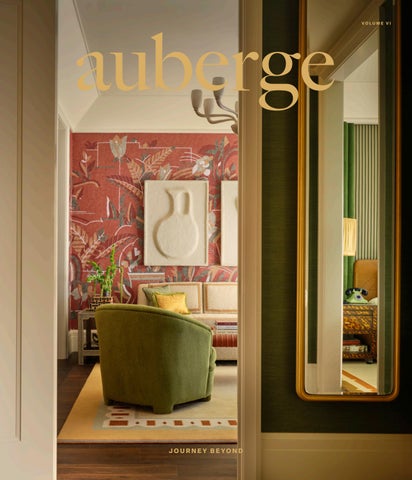
VOLUME VI
VO L U M E V I
Explore more at subzero-wolf.com
The world’s finest refrigeration, cooking, and dishwashing
AUBERGE JOURNAL
MORE IS MORE
Get an inside look at more of Martin Brudnizki’s glamorous designs for this issue’s cover property, the new Dallas icon, The Knox, Auberge Collection.
Discover the world of Auberge and encounter new seasonal stories and films online at auberge.com/journal. On the Cover The Knox, Auberge Collection Photography by Stephen Karlisch
14
STEPHEN KARLISCH
Follow @auberge:
CONTRIBUTORS
16
Liam Hess
Ingrid Abramovitch
Julie Belcove
Behind Closed Doors, page 82
More Is More, page 48
Dallas by Design, page 58
For this issue, London-based Hess
Former Elle Decor executive editor
For Belcove—who writes about the art
uncovered Mayfair’s secret luxury shops.
Abramovitch has been drawn to Martin
world for The New Yorker, The New York
“The area might have a reputation as a
Brudnizki’s work ever since seeing his
Times, and Financial Times—exploring
glitzy billionaire’s playground,” says the
boldly maximalist design for London’s
the people who shape Dallas’s art scene
Vogue senior lifestyle editor. “But it’s
Annabel’s private club. “I love the motto he
satisfied a longtime curiosity. “Some
also home to some of the most exciting
brings to every project: to create spaces
punch above their weight when it comes
small-scale fashion stores and ateliers
that make people think, ‘I am going to have
to collectors’ passion and influence,” she
in the city.”
the best time here,’” she says.
says. “Dallas is one of them.”
Brian Klutch
Brad Torchia
Korena Bolding
From Auberge, with Love, page 136
Golden Hour, page 122
Dallas by Design, page 58
Photographer and videographer
Los Angeles–based photographer
Bolding, a Dallas-based photographer
Klutch maintains a full production
Torchia captured Olympic medalist Gus
and art director, has traveled the globe
studio in New York City while traveling
Kenworthy—and his rescue dog, Birdie—
on assignment, from Antarctica to
worldwide to shoot personal and
at Goldener Hirsch, Auberge Collection
Bhutan, but capturing her hometown
commercial projects for clients
in Deer Valley, Utah. “I will never forget
provides a unique—and welcome—
including ESPN and The New York
seeing the two of them in their corner
challenge. “It forces me to see my city
Times. In 2020, he published his
booth enjoying a little fondue together,”
and its people beyond the familiarity of
first book, LH365.
he says.
everyday life,” she says.
CEO & PUBLISHER Jason Cutinella
Jackie Caradonio Global Editorial Director Jill Newman Editor-in-Chief Brian Struble Art Director Erin Agostinelli Managing Editor
E D I T O R I A L & C R E AT I V E Contributing Writers Ingrid Abramovitch, Julie Belcove, Esme Benjamin, Jane Broughton, Liam Hess, Jen Murphy, Kristie Ramirez, Regan Stephens Contributing Photographers Korena Bolding, Brooks Burris, Teagan Cunniffe, Bryce Duffy, Nani Welch Keli'iho'omalu, Brian Klutch, Will Nielsen, Brad Torchia
O P E R AT I O N S Sabrine Rivera Operations Director
ADVERTISING Mike Wiley VP Sales mike@nmgnetwork.com Marly Graubard Global Brand Partnerships marly@nmgnetwork.com PUBLISHED BY
2026 by NMG Network, LLC. All rights reserved. No part of this publication may be reprinted without the written consent of the publisher. Opinions are solely those of the contributors and are not necessarily endorsed by NMG Network. Volume VI November 2026
Rachel Lee Account Executive rachel@nmgnetwork.com
AU B E R G E C O L L ECT I O N Callie Stanton SVP of Brand Amalia Ramos Senior Director Creative Services and Brand Hannah Kibble Senior Director of Content
ELLIE THORNE
C O N T E N TS
24 The Talented Mr. Bridges More than a decade since his debut album, Fort Worth’s Leon Bridges proves his gifts extend far beyond music. 32 The Spirit of Sicily Furtuna Skin’s formulas begin on an 800-acre Sicilian estate where ancient olive groves, wild botanicals, and family history come together in a single bottle. 38 Woven in Time Louis Vuitton reimagines its iconic Monogram in a tactile new chapter. C O N N ECT
48 More Is More At The Knox, Auberge Collection, interior designer Martin Brudnizki brings his theatrical sensibility to Texas—and creates a new cultural icon in one of Dallas’s most vibrant neighborhoods. 20
58 Dallas by Design Meet five cultural forces whose ambitions are transforming the city into an art capital on its own terms. V O YA G E
70 Still Life Chem Chem properties, part of Auberge Collection’s new Auberge Safari portfolio, offer rare access to the restorative power and unhurried rhythms of Tanzania’s wild landscapes. BESPOKE
82 Behind Closed Doors Discover the discreet Mayfair boutiques redefining shopping in London’s most prestigious neighborhood.
94 London Curated From contemporary design and modern art to fashion and theater, the season’s cultural calendar is well worth planning a trip around. S AV O R
104 Island Bounty At CanoeHouse, at Mauna Lani, Auberge Collection, Top Chef star Rhoda Magbitang turns Hawai'i’s natural bounty into a delicious portrait of place. 114 Heart & Sol At Elio, the new restaurant at Susurros del Corazón, Auberge Collection, the flavors of the Mediterranean meet the convivial spirit of Mexico’s Pacific coast.
136 Portraits of Place The best hotels are more than homes away from home—they’re sources of inspiration. Eight designers, artists, and other makers sketch, paint, and scribble odes to their favorite Auberge Collection destinations. 144 Higher Ground Auberge Collection’s mountain residences bring refined, yearround living to some of America’s most spectacular landscapes.
155 Experience the World of Auberge Extraordinary stays, exceptional cuisine, wellbeing journeys, and transformative adventures await at Auberge Collection properties around the globe. 168 Last Call Craft Goldener Hirsch, Auberge Collection’s Smokey Miner.
122
ESCAPE
122 Golden Hour After retirement, reinvention, and an Olympic comeback, Gus Kenworthy is writing a new chapter on and off the mountain.
BRYCE DUFFY
GLIMPSE
Leon Bridges performs at Bowie House, Auberge Collection, in Fort Worth, Texas, as part of Auberge Concert Series. Photography by Brooks Burris.
Leon Bridges relaxes in the Mulberry Room before taking the stage at Bowie House, Auberge Collection.
24
BY K R I ST I E R A M I R E Z | P H OTO G R A P H Y BY B R O O KS B U R R I S
More than a decade since his debut album, Fort Worth’s Leon Bridges proves his gifts extend far beyond music.
The Talented Mr. Bridges I
t’s a hot and humid September Sunday in Fort Worth, Texas, but inside Bowie House, Auberge Collection, things couldn’t be more chill for Grammy Award winner Leon Bridges. He’s just casually walked through the guest-filled lobby and bar of the hotel, and he knows exactly where he’s going. The hotel has become his second home since opening in 2023. “That’s when you know you nailed it as a hotel,” Bridges tells me, as he leans back on an orange velvet settee in the bar. “I feel at home here. The surreal part is that I live super close and I can walk here. It feels very warm. It’s got that rustic feel. It’s taken a long time to have something this cool in Fort Worth.” Dressed in crisp, dark Wranglers, cognac-colored loafers, and oversized Saint Laurent sunglasses, Bridges has recently arrived back in Texas from New York City, where he performed songs from his new album
Happiness Anytime on The Tonight Show Starring Jimmy Fallon. Just the night before, he’d popped up on stage during Shaboozey’s tour stop in Dallas to sing a favorite among those born and bred here, the fever-dreamy “Texas Sun,” one of his most beloved collaborations with Houston’s Khruangbin. But tonight he’ll be performing for more than just an audience. Tonight, as the featured performer for the Auberge Concert Series, his show will benefit North Texans in need through his foundation, The Big Good, which he co-founded five years ago with Texas Christian University’s most winning football coach, College Football Hall of Famer Gary Patterson. When news of this concert went live on social media, the event sold out in less than 24 hours, and people eager to hear one of Bridges’s first live stateside sets featuring songs from his fifth album flew in from across the country. 25
Bridges seemed to come out of nowhere 11 years ago with his debut album, Coming Home. Its 10 songs oozed a 1950s crooner energy and Bridges, with his elegant slim suits and clean-cut image, echoed an era and a longing for a nostalgic time few of his listeners had even been alive for. He’d been working double duty as a dishwasher at Del Frisco’s Grille and table busser at Rosa’s Cafe, rushing to open mic nights after dinner service. When he uploaded songs to SoundCloud, people listened, and that eventually led to a deal with Columbia Records. Coming Home and his next three albums—Good Thing, Gold-Diggers Sound, and Leon—all have an enduring, multigenerational appeal, and an evergreenness that makes pressing play feel right for anytime, any 26
mood. Many of the songs are soulful, moody ballads. Happiness Anytime is a stark departure from the tempo he’s known for, but the album is authentically Leon Bridges. “On the Leon album there’s a song on it called ‘Peaceful Place,’ which I feel ultimately became the North Star for Happiness Anytime, sonically and where I was spiritually,” Bridges says. “I really love how that song felt on stage—the energy. I was kind of reflecting, and a lot of my songs are slow songs.” To bring the new vibe, Bridges connected with Lydia Kitto and J Lloyd of British duo Jungle. The collaboration pushed him creatively and rhythmically to a place that felt like a homecoming. “I thought that Jungle would be the perfect crew to bring this new album to life,” Bridges says.
“I feel at home [at Bowie House]. It feels very warm. It’s got that rustic feel. It’s taken a long time to have something this cool in Fort Worth.”
PHOTO CREDIT
—LEON BRIDGES
Bridges grew up in Fort Worth and still calls the Texas city home. Bowie House is a familiar address for the performer.
27
“One thing that makes my collaborations different is having a sense of family,” Bridges says. “We had met before at a festival and didn’t really know each other personally, but I felt like I had known them forever.” This past summer, Bridges tested the songs in Europe. “The first show was in Paris, but the Montreux Jazz Festival was part of the beginning of the live set of Happiness Anytime,” Bridges says. “It was awesome to see how people responded to it. This album is so universal. It’s one of those things that’s so undeniable— as soon as you press play, people are moving. It’s nice to pick up the tempo a little bit.” With those bouncy beats came the natural inclination to move his body, finally giving him the opportunity to lean into his lifelong relationship with dance. “Dance is my first love,” Bridges says. “It’s really nice to be able to sharpen that side of me and keep growing, keep taking dance classes. During the process we referenced a lot of obscure Brazilian and Afrobeat rhythms like Fela Kuti. His music was inspired by American soul music, so as a Texas R&B artist it’s like a full-circle moment.” An hour before showtime, a line has formed outside the Silverton Room at Bowie House. In addition to fans, Fort Worth’s philanthropic set has shown up for a great cause. Bowie House owner and horsewoman Jo Ellard is here alongside fellow Texans and guests who came in from Chicago, Minnesota, and coast to coast. Bridges’s parents are here too. Through The Big Good and Auberge Concert Series, tonight’s performance will provide resources to North Texans experiencing food insecurity, something that Bridges has had personal experience with. “There were harder times than others, but the beautiful thing is that God always provided,” Bridges says. “Other people were kind enough to help us out in times of need. Those moments stay with you. They linger inside me. Everyone deserves a good education, to have food—the basic things we take for granted.” 28
“I think I’ll be [in Fort Worth] as long as God allows me to. I’ve never had any desire to live anywhere else.” —LEON BRIDGES
Bridges takes the stage at Bowie House for the Auberge Concert Series, benefiting his foundation, The Big Good (thebiggood.org).
29
Over the last five years, The Big Good has raised $10 million through fundraising efforts, benefiting those in Bridges’s Texas backyard. “One thing I always say is that my superpower is having the heart of a servant. In that capacity, it’s about taking care of my family and friends, and giving other people, like aspiring musicians, a platform,” Bridges says. “But I wanted to give back in a bigger way. I think about all the people in my journey who helped me out along the way. It only made sense to start a foundation.” This is where Bridges’s real magic lies. As famous as he is, he’s remarkably humble and accessible. “That’s one thing that’s hard for me to gauge—the weight of whatever my fame is,” he says. “It’s good to not really believe the hype.” He is regularly out in Fort Worth and Dallas, happy to say hello and fist-bump a fan. “That’s the awesome thing about Fort Worth: I still go out, I still go to the grocery store, I still go to bars in 30
the area. The awesome thing is that people are still respectful of your space. I think I’ll be here as long as God allows me to. I’ve never had any desire to live anywhere else.” The word Tejas is tattooed on his left arm. Lisa, his mom’s name, is tattooed on the other arm, while Eartha, his grandmother’s name, is tattooed on his stomach—all reminders of where he’s from. It’s clear how much this city and his family mean to him, feelings he had to put down in a song. “One that’s very near and dear to me is ‘Tears of Joy,’” Bridges says, just before his fireside chat with fans. “It’s about me reflecting on my trajectory and thinking this is truly a blessed life to live. I’m super grateful to still be here doing my thing. It’s a celebration.” From the looks of things here, the crowd couldn’t agree more.
31
PHOTO CREDIT
The ingredients behind Agatha Relota Luczo’s Furtuna skincare line come from her family’s biodiverse Sicilian farm, where ancient olive trees and wild botanicals flourish.
PHOTO CREDIT
32
The Spirit of Sicily Furtuna Skin’s formulas begin on an 800-acre Sicilian estate where ancient olive groves, wild botanicals, and family history come together in a single bottle. BY ES M E B E N JA M I N
LINDA WIT
D
ropped into Furtuna Skin’s Sicilian estate with no context, you might assume you’ve arrived at a luxury countryside retreat or perhaps even the entrance to a national park. Beyond a pair of wrought-iron gates lies more than 800 acres of rugged, biodiverse landscape: ancient olive groves, wildflowers fed by natural spring water, hiking trails that wind through the hills, and a gentle breeze filled with the scent of lemons and herbs. Seventy percent of the property is protected bioreserve, making it one of Sicily’s most ecologically rich stretches of land.
But this isn’t a resort; it’s a working organic farm. The wild botanicals that flourish here are harvested at peak potency before finding their way into bottles of Furtuna Skin, the luxury skincare line whose formulas are rooted—quite literally—in the Sicilian landscape. Every serum and oil begins with plants that have evolved for centuries in this rugged corner of Italy, making the estate not just the brand’s headquarters, but its defining ingredient. For founder Agatha Relota Luczo, a former model and a mother of four, buying the land wasn’t meant to be the first step toward building a beauty company. The story begins 33
with a promise her husband made as a 10-year-old boy, when he told his grandmother he would one day buy back the land where she was born and raised. Years later, the couple made good on that childhood vow, first purchasing a small parcel of wild Sicilian hillside before gradually expanding it into the sprawling organic estate that now supplies Furtuna Skin’s signature botanicals. To call the Furtuna Estate fertile is an understatement. “You can feel that the land has a heartbeat,” Luczo says. “It just wants to keep giving and producing more of these incredible plants.” The region’s mineral-rich volcanic soil supports some 500 species of flowers and herbs and 80 varieties of medicinal plants. At the same time, the elements can be unforgiving—intense heat, bitter cold, and fierce volcanic winds force native botanicals to adapt in order to survive. That resilience, Luczo believes, makes them “supercharged with nutrients.” 34
Scientific research appears to support the claim. In one published study, Furtuna’s wild-grown plants were compared with cultivated versions of the same species and were found to contain higher concentrations of beneficial compounds. “When you’re starting off with great water and soil, you’re going to have these amazing plants that are so healing for the skin and the body,” Luczo says, noting that many natural skincare products fall short because their ingredients are farmed conventionally rather than wild-grown and foraged. Every Furtuna formula begins in the hands of Pasquale Marino, PhD, a master botanist and agronomist whom Luczo affectionately calls “the plant whisperer.” As steward of the estate’s abundant flora, Marino knows each species intimately and can identify the precise moment a plant reaches peak potency. Once harvested, the botanicals undergo what Furtuna calls its Soundbath Extraction Method. Inside a cylindrical, ultrasound-like machine, sound waves penetrate the plants’ cell walls, releasing delicate vitamins, antioxidants, and amino
Sicily’s mineral-rich volcanic soil supports some 500 species of flowers and herbs and 80 varieties of medicinal plants. Opposite: Hand-drawn notes on botanical formulas from the Furtuna lab.
“You can feel that the land has a heartbeat. It just wants to keep giving and producing more of these incredible plants.”
LINDA WIT
— A G AT H A R E L O TA L U C Z O, F O U N D E R O F F U R T U N A
35
Furtuna products are offered at Aelia, Wellbeing by Auberge, at Collegio alla Querce, Auberge Collection.
acids without compromising their integrity. The resulting bioactives are infused into solvents such as olive-leaf water, extra-virgin olive oil, or hydroglycerin before being sent to an off-site lab, where they’re transformed into high-performance skincare formulas. Olives—specifically olive-leaf water and extra-virgin olive oil—sit at the heart of Furtuna’s formulations, including its hero product, the Biphase Moisturizing Oil. The estate is home to ancient olive trees that are hundreds, and in some cases thousands, of years old. It’s hardly surprising that olive oil remains central to the brand: For millennia, it has been prized throughout the Mediterranean as both medicine and beauty treatment. “I really think that extra-virgin olive oil is the fountain of youth,” says Luczo, who is so passionate about the ingredient that she became certified as an olive oil sommelier and competition judge. “It’s so powerful. I drink it every single morning on an empty stomach.” 36
Most people, she says, have become accustomed to rancid olive oil without realizing it. “The more pungent and peppery it is, the better it is for you,” Luczo says. “You’re tasting all the polyphenols that help bring down inflammation in the body.” (The curious can sample Furtuna’s award-winning six-olive blend, sold in 250 ml bottles for $85.) That reverence for quality carries through every stage of Furtuna Skin’s production. The brand bottles its formulas in UV-blocking glass to protect delicate bioactives before shipping them around the world—including Aelia, Wellbeing by Auberge, at Collegio alla Querce, Auberge Collection, where Furtuna Skin is exclusively used. For Luczo, every bottle carries a piece of Sicily with it. “Imagine a beautiful Italian girl running through the fields,” she says. “She’s not wearing makeup, but her skin is beautiful, her face tilted to the sun, passing among the olive and lemon trees.” 36
PATAGONIA - EXPLORE THE WORLD TO EXPLORE OURSELVES
Start to Finish
Woven in Time Louis Vuitton reimagines its iconic Monogram in a tactile new chapter. BY J I L L N E W M A N
38
F
ew symbols have the staying power of Louis Vuitton’s Monogram. Created in 1896 by Georges Vuitton—the founder’s son—the iconic lettering was designed to distinguish the house from imitators. Its interlocking LV initials and floral motifs have since become shorthand for travel, heritage, and enduring style—yet the Monogram has never stood still, appearing in creative expressions, from Takashi Murakami’s exuberant multicolor interpretation to Yayoi Kusama’s hypnotic dots. For its 130th anniversary, Louis Vuitton gives the icon another dimension with Monogram
Emblème, a woven jacquard fabric whose richly tactile surface has the effect of embroidery. Even its Peuplier color tells a story: The warm neutral takes inspiration from the poplar wood traditionally used to frame the classic brown Louis Vuitton trunks. The new canvas is used to create house favorites, including the Speedy and Side Trunk handbags, crafted with techniques that echo Louis Vuitton’s historic trunkmaking savoir-faire. From weaving the fabric on looms to hand-painting and braiding leather, each step connects past and present—proof that even a legend can benefit from a little reinvention. 39
T H E FA B R I C O F A N I C O N Louis Vuitton began as a trunk maker, so durability has always been part of its design ethos. Monogram Emblème is woven from water-repellent GOTS-certified cotton and linen jacquard, creating its distinct embroidered effect. Above: The Side Trunk is fitted with a signature lock. The handles on the Speedy 30 Soft Monogram Emblème Peuplier bag are braided by hand. Opposite: An artisan carefully positions threads on the loom before they are woven into the richly textured Monogram Emblème canvas.
40
41
TOOLS OF THE TRADE Introduced in the early 1930s as soft luggage, the Speedy captured an era enamored with movement, modernity, and the newfound freedom of faster travel. Above: Leather ties are meticulously hand-painted. Opposite: The components of the Speedy 30 Soft Monogram Emblème Peuplier await assembly.
42
43
44
TRUNK SHOW The signature details offer some of the clearest links to Louis Vuitton’s trunk-making heritage. Left: The Speedy 30 Soft Monogram Emblème Peuplier is finished with contrasting leather trim, a removable strap, address tag, and signature lock. Above: Metal corners— an enduring detail borrowed from the house’s original travel trunks—are carefully fitted to the Side Trunk Monogram Emblème.
45
The interiors of The Knox, Auberge Collection, a glamorous playground defining Dallas’s cultural cadence. Photography by Stephen Karlisch.
Designer Martin Brudnizki’s glamorous interiors for The Knox, Auberge Collection offer moments of connection, curiosity, and discovery.
48
BY I N G R I D A B R A M OV I C H
With the highly anticipated opening of The Knox, Auberge Collection, interior designer Martin Brudnizki brings his theatrical sensibility to Texas—and creates a new cultural icon in one of Dallas’s most vibrant neighborhoods.
STEPHEN KARLISCH
MORE IS MORE 49
Dallas’s tree-lined Katy Trail inspired a softer theme in many spaces.
50
PHOTO CREDIT
The Knox’s proximity to
“I want people to enter a space and feel, 'I am in the best possible place I can be.'" —MARTIN BRUDNIZKI
STEPHEN KARLISCH
W
hen The Knox, Auberge Collection opens in Dallas in early 2027, the hotel will bring a bold new standard of luxury to a city increasingly commanding the international spotlight. For its interiors, Martin Brudnizki looked to the city itself—and the exuberance, confidence, and unapologetic glamour that have long defined it. During a reconnaissance trip, he found all three embodied in an impeccably dressed grande dame. “At nine in the morning, she was wearing a Chanel suit, full makeup, and jewelry,” the Swedish-born interior designer recalls. “I just thought that was so fabulous. To me that is
Dallas in a nutshell: high-octane glamour. People here dress up. And it’s just so incredibly friendly.” That spirit became the starting point for The Knox, Brudnizki’s first collaboration with Auberge Collection. “This is about creating something uber-glamorous,” he says of the Dallas hotel. “It’s for the ladies who lunch, for the men who meet for a drink.” Brudnizki first became an international design star with his lavish reinvention of London’s legendary private members’ club Annabel’s in 2018. His theatrical, garden-inspired 51
Whether a Parisian cafe, a nightclub in Mexico, or his own home, Brudnizki’s projects are maximalist, artfully layered—and never dull. Above, from left: La residence in the English countryside. Opposite: The mosaicked entrance to Chiki, a dazzling members’ lounge in Mexico’s Baja California Sur.
52
transformation of the Georgian townhouse was an object lesson in immersive escapism—from the subterranean Jungle Room, with its animal-print banquettes and glass palms, to the Powder Room, a selfie magnet in pink onyx and marble. Yet as his 2025 book, My Life in Colors (Rizzoli), makes clear, Brudnizki is far more than a maximalist.
architecture, history, and location. Whatever the aesthetic, his work is grounded in architectural logic. Underneath the decorative flourishes is a careful understanding of how spaces should flow and how people move through them. Equally important is atmosphere. “I want people to enter a space and feel, ‘I am in the best possible place I can be,’” he says.
His portfolio spans hotels, restaurants, private clubs, and residences, including a château he is currently renovating in the South of France. Each project is site-specific. Brudnizki moves fluidly across what he calls the “four pillars” of his practice—maximalism, minimalism, classicism, and modernism—dialing each up or down depending on the
As a new build, The Knox offered Brudnizki a rare opportunity to create a sense of place from the ground up. The hotel sits at the heart of the rapidly evolving Knox Street neighborhood, between historic Knox Street’s shopping corridor and Highland Park, an established pocket of Dallas now emerging as a new center of gravity for the city. With the hotel poised to become
FROM LEFT: MARINA DENISOVA, JAMES MCDONALD, COURTESY OF COSTA PALMAS. DOUGLAS FRIEDMAN PHOTOGRAPHY
Plage Parisienne restaurant; Binderton, the designer’s
53
PHOTO CREDIT
54
In the suites and rooms at The Knox, miles of marble, deep emerald green hues, and original artwork and furnishings capture the sophisticated style of Dallas.
STEPHEN KARLISCH
one of the enclave’s defining addresses, Brudnizki drew on Dallas’s confidence, sophistication, and unmistakable sense of occasion. “It’s a fabulous place to be, and that became the overriding narrative,” he says. “I wanted the hotel to feel like Dallas.” To achieve this, he developed an earthy palette with leather, saddlework, and equestrian references nodding to cattle and horse country. This theme reaches its crescendo in The Cordovan Room, a leather-clad bar and restaurant embellished with cowhide and studs. Elsewhere, the hotel’s proximity to the nearby Katy Trail, a tree-lined park created from a former Union Pacific rail line, inspired a softer theme. The grand salon known as the Belvedere Terrace is enveloped in a custom de
Gournay silk wallcovering hand-embroidered with roses and cascading wisteria drawn from the park itself. For Brudnizki, the success of a hotel lies not only in its aesthetics but in its ability to transport guests into a fully imagined world. Every space is orchestrated to elicit a wow. Guests are first greeted in The Salon sheathed in sunburst veneer that leads into The Cabinet Room, a welcoming space that’s more personal library than hotel lobby. A grand staircase leads to the Fringe Club, a cocktail lounge and performance venue inspired by the glamour of 1950s supper clubs. Mirrored disco balls, rich red passementerie, and the room’s playful name—a nod to both decorative fringe and Britain’s independent theater 55
scene—capture Brudnizki’s talent for balancing elegance with wit. “It’s like a journey,” he says of the hotel’s many themed rooms. “Every space is an experience.” Creating that sense of theater depends as much on lighting as decoration. Working with designer Arnold Chan of London-based Isometrix, Brudnizki’s studio integrates lighting models into the design process from the earliest stages, carefully choreographing how a room evolves from morning coffee to late-night cocktails. “You can spend all the money in the world on beautiful materials, cushions, passementerie, and silk,” he says, “but if you don’t light it properly, it will fall flat.” 56
Brudnizki’s next major endeavor continues his long relationship with Annabel’s founder Richard Caring, with a Manhattan outpost of the celebrated club now in development, alongside commissions across Asia and the Middle East. But whether he is restoring a French chateau, designing a New York club, or creating an entirely new destination in Texas, his ambition remains the same: create spaces that celebrate a sense of place. At The Knox, that philosophy finds expression in a hotel that embraces Dallas on its own terms—its style, generosity, and larger-than-life personality—and transforms them into an experience that could happen nowhere else.
57
Dallas, by Design Meet five cultural forces whose ambitions are transforming this Texas city into an art capital on its own terms. BY J U L I E B E LC OV E P H OTO G R A P H Y BY KO R E N A B O L D I N G
At Alden Pinnell’s home in Dallas, Donald Judd’s Untitled (1989). Opposite: Continuous Living Room Scene (2007—2008) by Dutch artist Mark Manders, exhibited at
58
The Power Station.
59
The garden at the Nasher Sculpture Center. Opposite: Marguerite Hoffman with Dana Schutz’s Mountain Group (2018), from Hoffman’s private collection.
Local denizens of the art world are also fiercely competitive, says legendary collector Marguerite Hoffman—not necessarily with one another, but with established art capitals like New York and London.
Dallas isn’t known as the Big D for nothing. The city’s 20th-century economic boom fueled civic pride in everything from business and sports to culture—and helped produce some of the nation’s most formidable art collectors. “These collections that have been built over the last 70, 80, even 100 years,” says Capera Ryan, deputy chairman of Christie’s Americas. “They were built with the same spirit that brought people to Texas originally—that wildcatter spirit, where they do it on their own terms.” 60
That ambition is increasingly visible across the city. The encyclopedic Dallas Museum of Art (DMA) and the Nasher Sculpture Center have been joined by the edgier The Power Station and a growing number of young galleries. Civic-minded collectors have also turned their attention to the immensely popular Katy Trail, a 3.5-mile landscaped path built along a former railroad line. The KTX Biennial will unveil a new installation of public works along the trail, where The Knox, Auberge Collection, will debut in January. “Art is essential for having any kind of an interesting community,” says Alden Pinnell, a prominent collector and founder of The Power Station. “If Dallas is going to be a dynamic, incredible, world-class city, art has to be a big part of that.” For generations, Dallas’s collectors have thought big, bought boldly, and built institutions to match. Now a new chapter is taking shape. Here are five Dallasites defining the city’s art scene today—and where it goes next.
MARGUERITE HOFFMAN Marguerite Hoffman and her late husband, Robert, were taking what she calls their annual “state-of-themarriage walk” at a Colorado fishing camp when he posed a question that would help reshape Dallas’s cultural landscape. The DMA had asked Marguerite to lead a fundraising campaign, and Robert proposed earmarking the couple’s prized art collection for the museum—a generous gift by any standard. But, he wondered, “How can we amplify that?”
Unlike many contemporary collectors, however, Hoffman has little interest in getting to know artists through studio visits. “I really want to separate the object from what I think about the artist and allow it to have its own power and story,” she says. She also dreads the possibility of wounding an artist with her response. “What they do is incredibly courageous. Even if I don’t respond to it, it’s like, ‘Man, you went in there today and tried to do something.’”
Their answer was to invite two other couples to join them. The resulting pledge by the Hoffmans, Cindy and Howard Rachofsky, and Deedie and Rusty Rose would make all three couples household names in Dallas—and the art world at large. “There’s satisfaction when you do something on your own,” Hoffman says more than 20 years later. “But there’s a bigger sense of satisfaction when you work together because you can do something much more ambitious.”
DAVID NEEDLEMAN
Robert, a National Lampoon founder and Coca-Cola bottling magnate, gravitated toward canonical postwar artists, including Mark Rothko, Cy Twombly, and his favorite, Jasper Johns. After Robert’s death, Hoffman surveyed the collection with fresh eyes. “We had a lot of white-male-artist paint power on the walls,” she says. “I still love those paintings, but I’ve been fighting for women’s rights for a long time. Why wasn’t I showing women artists?” She has since added female powerhouses including Dana Schutz and Amy Sillman. Hoffman, who worked in the art world—including at the DMA and a gallery—before becoming a major collector, is also writing a book on another passion: medieval manuscripts. 61
From left: Picnic Surf Shapes collaboration with Gabriel Rico; Ed Ruscha’s Travel Agency (1988—1989); an untitled work by Mathew Cerletty. Opposite: Alden Pinnell at home.
ALDEN PINNELL Growing up in Durham, North Carolina, Alden Pinnell began collecting photography in high school—mostly $50 works by friends of his mother, a photographer and curator who taught at Duke University. After graduating from Southern Methodist University in Dallas and co-founding skincare brand SkinCeuticals—using research from his father, a Duke dermatologist—he began dabbling in contemporary art. But it wasn’t until he sold the company to L’Oréal Group and moved to New York City in 2005 that his collecting kicked into high gear. Pinnell joined the board of Dia Art Foundation, relished studio visits with acclaimed artists such as Lucas Samaras, and even began scouting real estate for kunsthalle-style space of his own. “I looked at some real estate, but it became completely apparent to me that, why would it matter?” he recalls. “There’s [already] 20 great places.” Then he thought of Texas, where he owned the perfect property for displaying 21st-century art: a former Dallas Power and Light Company building. “We had 62
this incredible opportunity to change the landscape in Dallas,” says Pinnell, who returned to the city with his wife, Janelle, and opened The Power Station in 2011. The sprawling space has since presented exhibits by a host of innovative artists who otherwise might not have passed through Dallas, among them Oscar Tuazon and Jacob Kassay. In 2020, Pinnell and artist Gregory Ruppe launched Picnic Surf Shapes, selling Ruppe’s exquisitely crafted surfboards to fund experimental art projects. To house their private collection, the Pinnells built a striking, boomerang-shaped brutalist residence with a standalone gallery. Their holdings include stars who emerged in the 1960s and 1970s, such as Donald Judd and Cindy Sherman, but Pinnell is increasingly drawn to “very adventurous stuff” by artists such as Mark Bradford, Kara Walker, and the duo Lizzie Fitch and Ryan Trecartin—“people of my generation.”
63
PHOTO CREDIT
CAPERA RYAN Capera Ryan likes to say that she entered the Dallas art world before she was born. “I was in my mom’s womb when she was a docent at the museum,” she says with a laugh. “I was hearing her give tours by osmosis.” Her early indoctrination included flipping through auction catalogs—her grandmother was a dedicated collector with a soft spot for Wayne Thiebaud’s dessert paintings—and peering from her bedroom window into Raymond Nasher’s backyard, where pieces from his superlative sculpture collection stood long before he founded the Nasher Sculpture Center. “I always say in jest that I started selling him Girl Scout cookies,” Ryan says, “and he trained me to sell him art.” At 14, she received her first Warhol from her grandmother: a portrait of the sharpshooter and entertainer Annie Oakley. Ryan went on to Vanderbilt University, where she ran the student center’s art gallery. A summer internship at Christie’s in New York introduced her to the auction business, and she was hooked.
Clockwise, from top: Capera Ryan’s private collection includes Amanda Baldwin’s Wyland Woods (2022); Ruth Asawa’s Cream (1967). Opposite: Jessica Nowitzki, photographed at Grange Hall. From her private collection, Spencer Russell Lewis’s Untitled (2025) and Lonnie Holley’s The Wings of Freedom (2022).
64
“This is a relationship business,” Ryan says. “It’s about building trust and transparency with these friends who become clients, or clients who become friends.”
MAKEUP: KIM ROZELL
Untitled (2000); Wayne Thiebaud’s Black Ice
After a few years at Sotheby’s, Ryan returned home to manage Christie’s business development in the Southwest. In 2016, she was promoted to deputy chairman of Christie’s Americas. Her territory may stretch coast to coast, but she remains a fixture of the Dallas scene, where her deep connections have helped bring celebrated collections to the sale room, including Edwin L. Cox’s Impressionist masterpieces, Nancy Lee and Perry R. Bass’s modern art trove, T. Boone Pickens’s paintings of the American West, and pianist Van Cliburn’s art, decor, and jewelry.
Nowitzki studied international business in college but longed for a more creative career. After graduation, she moved to Dallas and landed a job at the fledgling Goss Gallery. Later, its founder, Kenny Goss, and his then-partner, the late pop star George Michael, formed the Goss-Michael Foundation for their collection of British contemporary art and tapped Nowitzki as associate director.
JESSICA NOWITZKI Jessica Nowitzki was working in the art world well before she met her husband, former NBA superstar Dirk Nowitzki—and before collecting became de rigueur for pro basketball players. Today, as a collector, advisor, board member, philanthropist, and entrepreneur, she represents the new generation of Dallas art boosters. The daughter of a Swedish father and Kenyan mother, Nowitzki grew up in Sweden surrounded by carvings, pottery, and textiles her mother had brought from Africa. “It was her way of feeling at home,” she recalls.
On a tight personal budget, she initially contented herself mostly with art books. Since 2012, however, she has assembled a collection centered on artists of the African diaspora. A favorite is Yinka Shonibare’s Girl Balancing Knowledge, a sculpture of a figure clad in kente cloth and standing on one foot while supporting a stack of books on her raised leg. “It’s not too overpowering to live with,” she says, “but it has a very strong message.” Nowitzki is president of her husband’s namesake foundation and serves on several boards, including the DMA and South Africa’s Zeitz Museum of Contemporary Art Africa, as well as the Nasher Sculpture Center’s advisory council. More recently, she has begun advising private collectors, and in October 2026 helped bring an edition of the Dallas Invitational boutique art fair to London. Her enthusiasm has also drawn her husband into the art fold, though she says Dirk trusts her to lead the acquisitions: “He knows I’ve done my research.” 65
PHOTO CREDIT
66
Right: Francisco Moreno in his studio. Opposite: The artist with his Unicorn Hunt painting.
FRANCISCO MORENO For a newly minted graduate of the prestigious Rhode Island School of Design, the typical destination might be New York or Los Angeles. But Francisco Moreno needed studio space big enough to match his ambitions. So, after earning his MFA, he headed home to Texas in 2012. He already had one particularly audacious idea: WCD Project, which paired a 1975 Datsun 280Z with a monumental riff on the Emanuel Leutze painting Washington Crossing the Delaware, both obscured by camouflage. Fourteen years later, the installation-cumperformance piece became a highlight of Moreno’s recent midcareer survey at Dallas Contemporary. The city, Moreno says, gave him room to develop his mature style—what one friend calls “new old master sci-fi surrealist.” Moreno puts it more simply: “Dallas is a good place to make stuff.” His work encompasses complex history paintings that draw on his Mexican heritage and science fiction; renderings of his dog sprinting across a green expanse; and Chapel, a church-like structure filled with a mural inspired by everything from baroque master Peter Paul Rubens to his parents’ houseplants to robots.
His whimsical canvases of squirrels eating pizza or drinking wine—which he calls “mirrors of the human psyche”—have proved wildly popular with collectors. Before his art practice could support him, Moreno, who grew up in nearby Arlington, worked as a gallery teacher at the Rachofsky Collection, now The Warehouse, and helped with the annual Two x Two auction benefiting the DMA and amfAR. Both put him in contact with Dallas’s art-world power players. That tight-knit community continues to support him. “One of the pros of working here is getting to interact with such amazing art lovers,” Moreno notes. “I’m fascinated by the collectors because they’re the stewards of our work.” 67
A silent walk at Little Chem Chem, Auberge Collection, in the exclusive-use Burunge Wildlife Management Area of northern Tanzania. Photography by Teagan Cunniffe.
Chem Chem properties, part of Auberge Collection’s new Auberge Safari portfolio, offer rare access to the restorative power and unhurried rhythms of Tanzania’s wild landscapes. BY JA N E B R O U G H TO N P H OTO G R A P H Y BY T E AG A N C U N N I F F E
STILL LIFE
70
Up-close wildlife sightings are common on silent walks, one of the touchstones of Slow Safari at Chem Chem Lodge, Auberge Collection.
71
PHOTO CREDIT
72
Raposh John’s red shuka swayed hypnotically as he moved through the Tanzanian savannah. Palm fronds crackled in the breeze, and the air was warm and sweet with the heady fragrance of wild mint and basil crushed underfoot. Our group of three had been invited by the Maasai safari guide to walk in complete silence. Phones, cameras, and smartwatches had all been left behind in our suites at Chem Chem Lodge, Auberge Collection. The feeling of being unencumbered by any form of communication felt novel, if slightly unnerving. I inhaled a long sooooooo, then exhaled hammmmmm, the sounds helping me focus on my breath and bring awareness to my senses rather than the thoughts colliding in my head. John silently pointed out a tawny eagle on top of a nearby fever tree, then gestured at a half-gnawed leopard tortoise shell lying in the path. Was that the work of a hyena? I allowed the thought to come and go but didn’t say a word. The soft-focus stares of giraffe and wildebeest followed us as we soon arrived on the shores of Lake Manyara. Clutched in the palm of my hand was a scrap of paper on which I had scribbled a private thought—a behavior I had been wary of dragging with me—that I wanted to release. John crouched down to make a fire the traditional way, using a spindle of hard grewia wood and zebra dung bundled in dry grass. I tossed my toxic trait
into the flames, surprised at the power of this simple, symbolic gesture of letting go. There was time to wander off, to enjoy the freedom of not having to be anywhere else, unfettered in the vast nature of the private Burunge Wildlife Management Area. Later, our group gathered around a bonfire on camping stools to sip homemade tea made from wild herbs, baobab powder, and honey. The silence felt easy. Silent walks are one of many ways Chem Chem properties—comprised of the flagship Chem Chem Lodge and two luxury tented camps, Little Chem Chem, Auberge Collection and Forest Chem Chem, Auberge Collection—invite guests to experience the Tanzanian wilderness at a more intentional pace. The properties are part of nine extraordinary lodges and camps within Auberge Safari, Auberge Collection’s portfolio set across exclusive-use reserves, conservationled wildlife management areas, and Serengeti National Park in northern Tanzania. Uniting properties from Chem Chem and Legendary Expeditions, the portfolio offers rare access to the shared wonder of the wild through private guides and vehicles, meaningful cultural encounters, and experiences shaped by each destination. The Chem Chem properties are also the birthplace of Slow Safari, a philosophy introduced here in 2011 and shaped by co-founder Fabia Bausch’s belief that guests should have greater freedom over their time. Rather than waking before dawn, sharing a vehicle with strangers, and racing from one sighting to the next, guests can decide where to go, when to leave, and how long to linger. With Auberge Safari, luxury is expressed as time, privacy, and freedom. Bausch emphasizes that decelerating the pace of a safari can deepen the experience. “Slow Safari isn’t about
At Auberge Collection’s Chem Chem properties, Maasai guides lead guests on mindful wilderness experiences, bringing a sense of freedom and wellbeing to the traditional safari.
73
At Little Chem Chem, lunch is served in the shade of an acacia tree after a morning among the wilds of the Burunge Wildlife Management Area.
PHOTO CREDIT
74
seeing less; it’s about feeling more,” she says. “We give guests the choice and the time and space to listen to their inner voice again.” To that end, Chem Chem trains its guides against the reflex to fill every pause, creating space for guests to become more deeply immersed in the landscape. What began as a more flexible approach to game drives now informs everything from silent bush walks to wellbeing rituals and cuisine. On my first game drive, with head guide Salum Mpapa, the Maasai quietly observed how I reacted to each scene and wildlife encounter, engaging with me at times while allowing for comfortable pockets of silence between conversations. Compared with other safaris in which I had sat captive as guides rattled off rote facts and figures as if on autopilot, this time, I found myself immersed— and more inquisitive—as I was given time to ponder and reflect. It was less about remembering textbook details and more about how it felt to hear the call of a bird, to see a lioness nuzzling its cub, to smell the sweet scent of acacia in the wind. The morning with Mpapa ended beneath a 1,000-yearold baobab, where breakfast was laid out by executive chef Jimmy Ngira: light pancakes with honey and homemade chocolate-and-cashew spread (Tanzanian Nutella, as Ngira called it); caramelized onion and goat cheese tartlets; and moringa muffins baked with both the seeds and the leaves. Every dish was built on ponya, a Swahili word meaning “healing,” and another facet of Chem Chem’s mindful safari ethos. Like the Slow Safari concept, Chem Chem’s ponya cuisine is all about freedom of choice. You can order a
burger and fries off the Mama Menu and chase it with a Maasai shot of immune-boosting ginger, garlic, raw onion, lemon, and honey. (And whether you notice or not, the burger itself is ponya—the patty, bun, and mayo are all homemade.) Most of the ingredients used in the kitchen are sourced from local small-scale farmers who grow without pesticides or hormones. Chem Chem’s own greenhouses and in-camp gardens provide much of the produce and herbs, including local specialties such as moringa, baobab powder, turmeric, and ginger—many of them regarded as medicine by Tanzanian communities. Wild herbs, like sage, basil, and mint, are cut on-site and dried for teas. Chem Chem’s ponya culinary program has become a cultural touchstone, and another daring departure from the typical safari experience, with lighter, brighter, and wholly satisfying dishes. One such dish, ice cream spun with baobab powder, stayed with me long after my last bite. It was tart and faintly sherbetlike, served with roasted pineapple slices nicely caramelized at the edges—a triumph of contrasting textures and flavors that lingered on my palate for days. One evening, as Mpapa and I climbed high into a baobab tree for sundowners, the reason for all the slowness came into particular focus for me. Looking out over the landscape from our elevated perch, I reflected on how this land was, not so long ago, almost gone. The 55,000-acre Burunge Wildlife Management Area once faced depopulation, its migration corridor between Lake Manyara and Tarangire National Park nearly reduced to dust as cattle grazing and poaching
“Slow Safari isn’t about seeing less; it’s about feeling more. We give guests the choice and the time and space to listen to their inner voice again.” — FA B I A B A U S C H , F O U N D E R , C H E M C H E M P R O P E R T I E S , A U B E R G E C O L L E C T I O N
75
Across Chem Chem’s trio of camps, Slow Safari takes many forms, from beekeeping and silent walks to birdwatching and Maasai-hosted boma dinners.
76
77
By leaving time to observe without expectation, Slow Safari can transform a wildlife encounter into something intimate and emotional. Opposite: A luxury tented suite at Little Chem Chem, Auberge Collection.
78
ravaged the ecosystem. The elephant population dwindled and nearly disappeared entirely. For almost two decades, Chem Chem, which leases the land from a confederation of 10 local villages, has invested heavily in anti-poaching efforts to turn it around. In 2021, the big tuskers swam across Lake Manyara, once again crossing the corridor after decades of desertion. Community is another vital part of Chem Chem’s broader mission. Over the past four years, the properties’ initiatives have trained nearly 3,000 people, approximately 2,900 of whom have gone on to establish businesses in beekeeping, poultry, sunflower cultivation, vegetable farming, and other fields. As a result, local incomes have risen by 150 percent. In a place where a good cow still counts as currency, that’s a seismic shift. The initiative continues as a second wave of training took place earlier this year with another 3,000 people. I glimpsed many of the area’s majestic elephants one afternoon with Mpapa. Silence was again a part of the experience as my guide cut the engine and we basked
in the quiet glory of the pachyderms’ morning feast. A young elephant approached our vehicle, coming right up to me as I sat dead still while Mpapa quietly reassured me that all was well. Staring into the eyes of an elephant is as close as I’ve come to a religious experience. His exploratory trunk rested inches from my face—so close I could feel his breath. Tears streamed down my cheeks, not of fear but of pure joy. That kind of encounter captures the promise at the heart of Slow Safari: When urgency falls away, the wilderness has room to reveal itself. Now part of the broader Auberge Safari portfolio, the philosophy offers travelers a more personal and deeply immersive way to experience Tanzania. After all, when you slow down and remove the selfimposed pressures of a hurried life, you cannot be late for anything. There is no wrong time—only right now. Three days at Chem Chem may not be the cure for a life lived at high speed, but it is a fairly persuasive argument for slowing down long after you’ve gone home. 79
The showroom at Connolly in London’s Mayfair neighborhood, where Cambridge House, Auberge Collection will soon open.
Behind Closed Doors
BY L I A M H ES S
82
RIGHT: KENSINGTON LEVERNE
Mayfair’s most exclusive addresses are rarely on display: Behind unmarked doors, above historic arcades, and inside Georgian townhouses, a secret luxury quietly exists—one of private ateliers, invitation-only salons, and immersive townhouses that feel more like members’ clubs than retail. These discreet boutiques are redefining shopping and proving that, in London’s most prestigious neighborhood, the experience is often more important than the sale.
83
PHOTO CREDIT
84
Charlie Barron Among serious jewelry collectors, Charlie Barron’s Bruton Street gallery has become something of an open secret. Ensconced inside a Georgian townhouse, the gallery showcases an extraordinary mix of antique and contemporary treasures, from ancient Roman rings and signed Van Cleef & Arpels and Boivin jewels to museumworthy Cartier clocks and contemporary diamond pieces. But its greatest luxury is its subtle ambiance. “The gallery has almost organically become a home away from home,” Barron says. “It’s designed to feel less like a showroom and more like a private drawing room or library”—hence the space’s cozy charm, lined with bookshelves, deep armchairs, and sofas to encourage visitors to settle in over tea rather than pull out their wallets. Barron spends much of the year traveling the world in search of remarkable pieces, and it’s here, sharing
RIGHT: LEO BIEBER; BOTTOM: BILLY BARRACLOUGH
their stories, that his expertise is most compelling.
85
AP House From the street, Audemars Piguet’s Clifford Street address gives almost nothing away. A simple brass logo, a doorman in a green peaked cap and matching coat, and an elegant Georgian entrance are the only clues that this is no private residence, but rather one of the Swiss watchmaker’s exclusive houses. Inside, a series of elegant rooms unfolds one after the other: a whiskey-inspired watch cellar, an elegant living room centered on a grand piano, a silk-lined drawing room lined with photographs of rock icons. There’s even a vinyl listening room and rooftop terrace to encourage lingering. And while the subtle idea is that you might perhaps be tempted to purchase one of the house’s exquisite and foremost a place of leisure, describing it as “a freespirited space for discovery and connection.”
86
PHOTO CREDIT
timepieces, the watchmaker insists that AP House is first
87
PHOTO KENSINGTON CREDIT LEVERNE
88
Saman Amel The by-appointment Saman Amel atelier on Albemarle Street doesn’t even have a sign outside. Ring the buzzer beside the peacock-blue door to be let in, then head up a narrow staircase to arrive at what feels more like a beautifully appointed London flat than one of the city’s most sought-after tailoring destinations. Opened in 2024, the Swedish label’s residence pairs Scandinavian restraint with old-world elegance. Museum-quality 1930s Swedish furniture, midcentury art, and craft objects create a quietly sophisticated backdrop for fittings, whether clients are commissioning softly tailored wool-silk suits, bespoke outerwear, or custom cashmere knitwear. “For many reasons, Mayfair was always the natural place to be,” says cofounder Dag Granath (shown above, at right, with partner Amel). “Here, the history of so many spectacular makers and institutions is always surrounding you.”
89
90
Connolly Spread across a handsome Mayfair townhouse on Clifford Street, Connolly blurs the lines between boutique, gallery, and home. Those in the know head to the private suite upstairs where clients can commission everything from made-to-order luggage to car interiors. With art books, midcentury lighting, and an open fireplace, it feels less like a shop than owner Isabel Ettedgui’s own living room. Founded in 1878, Connolly built its reputation crafting leathers found in Rolls-Royce and Aston Martin cars, as well as the queen’s coronation coach. Ettedgui enlisted Parisbased designers Gilles & Boissier to transform the townhouse into a space that’s part boutique, part home (she lives upstairs), complete with rotating exhibitions of antiques and motoring memorabilia.
91
Lily Gabriella Elia The 19th-century covered shopping street of Burlington Arcade may be one of Mayfair’s busiest passages, but few visitors realize there’s a private penthouse hidden just above it. Through an unassuming side door near the Piccadilly entrance, you’ll find the appointment-only jewelry salon of Lily Gabriella Elia. The powder-pink jewel box of a space reflects the Brazilian-born, London-based designer’s sculptural approach to jewelry, where vibrant colors, unexpected materials, and asymmetric lines define her singular aesthetic. It’s also where she works closely with clients to transform inherited pieces into meaningful and oneof-a-kind contemporary heirlooms. “I want the experience to feel less like walking into a traditional jewelry store and more like visiting a friend in their home,” Elia says. “Fine jewelry is deeply personal, and I believe choosing or commissioning a piece should be a relaxed, intimate conversation rather than a transactional experience.”
92
100 POINTS OVER 30 TIMES.
GIFT EXTRAORDINARILY. penfolds.com
©2026 TWE IMPORTS, SONOMA, CA
N O D N LO London never lacks for cultural attractions, but this season the city’s creative calendar is especially compelling. Landmark museum openings, headline-making exhibitions, and acclaimed theater productions are transforming the capital into one of Europe’s most exciting cities for live events. From contemporary design and modern art to fashion and musical theater, the newest highlights are well worth planning a trip around. BY L I A M H ES S
CURATED 94
95
JOHN PAWSON
THROUGH OUR EYES: SÁMI ART AND CULTURE
SOMERSET HOUSE
N O V E M B E R 6, 2 0 2 6 – F E B R U A R Y 7, 2 0 2 7
Winter at Somerset House traditionally begins with its iconic ice-skating rink, but this season another attraction deserves equal attention: Through Our Eyes shines a spotlight on the their artistic traditions alongside contemporary conversations around identity, culture, and land rights. Rich in textiles, jewelry, photography, and storytelling, it’s a fascinating exhibition that is perfectly timed for the city’s frostiest months.
96
JEAN-BAPTISTE BÉRANGER
Sámi, the Indigenous people of Northern Europe, exploring
LONDON MUSEUM
O P E N S N O V E M B E R 2 8, 2 0 2 6
The London Museum begins an exciting chapter with the opening of its spectacular new home in the restored Victorian market buildings at Smithfield. Spanning nearly 2,000 years of London’s history, from Roman Londinium to the city’s modern cultural scene, the immersive galleries blend cutting-edge technology with extraordinary artifacts, including the dazzling Cheapside Hoard collection of Elizabethan and Jacobean jewelry. In the subterranean galleries, a six-meter viewing window will even offer glimpses of Thameslink trains rumbling
PEGGY GUGGENHEIM IN LONDON: THE MAKING OF A COLLECTOR
T H E R O YA L A C A D E M Y O F A R T S
past. Contemporary programming, including DJ nights inspired by neighboring nightclub Fabric, promises the makings of a museum that will look as much to London’s future as its past.
N OV E M B E R 2 1, 2 0 2 6 – M A R C H 1 4, 2 0 2 7
This landmark exhibition explores one of the most influential—and often overlooked— chapters in Peggy Guggenheim’s life: her years as a pioneering gallerist in 1930s London. Bringing together an impressive collection of modernist, surrealist, and abstract masterpieces, it reveals how her time in the British capital shaped the vision that would later redefine art in Paris, New York, and, ultimately, Venice. It’s an illuminating portrait of one of the 20th century’s greatest cultural tastemakers.
MODERN PAINTING FROM THE COURTAULD AND REUBEN COLLECTIONS
C O U R TA U L D G A L L E R Y ONGOING
Modern Painting from the Courtauld and Reuben Collections brings together modernist heavyweights from Picasso to Magritte. Highlights range from Cézanne’s near-abstract Turning Road and Modigliani’s radical Nude to Man Ray’s monumental Black Widow (Nativity), on view in the UK for the first time in more than 50 years. Surrealist works from the Reuben Collection round out this compact survey of 20th-century experimentation.
97
THE NUE BLACK AESTHETIC
THE DESIGN MUSEUM
N O V E M B E R 6, 2 0 2 6 – A U G U S T 8, 2 0 2 7
Guest-curated by design editor Charlene Prempeh, this timely exhibition celebrates the Black designers, architects, and artists reshaping Britain’s creative landscape. Through fashion, textiles, furniture, and architecture— including works by design luminaries Samuel Ross and Bianca Saunders—it explores the cultural influence and innovation driving contemporary British design. Bold, thoughtprovoking, and visually striking, it’s one of the season’s essential exhibitions.
INTO THE WOODS
N O Ë L C O W A R D T H E AT R E SEPTEMBER 22, 2026– J A N U A R Y 9, 2 0 2 7
Following its sold-out, Olivier Award–winning run at the Bridge Theatre, Stephen Sondheim and James Lapine’s beloved musical has arrived in the West End for what promises to be one of the season’s hottest tickets. Director Jordan Fein—fresh from his acclaimed Fiddler on the Roof at the Regent’s Park Open Air Theatre—joins celebrated designer Tom Scutt, whose recent revival of Cabaret dazzled audiences in London and New York, for this witty, dark, and endlessly inventive fairy tale
THE ’90S: ART AND FASHION
TAT E B R I TA I N
O C T O B E R 8, 2 0 2 6 – F E B R U A R Y 1 4 , 2 0 2 7
If you haven’t already heard, ’90s fashion is back—and nobody knows it better than Edward Enninful, former editor-in-chief of British Vogue. Not only was Enninful one of the most influential image-makers of that decade, but he has also served as a front-row witness to its recent revival on the runway. Now, as a curator, he’s brought together the artists, photographers, and designers who defined the era. Equal parts nostalgia and cultural history, it’s a stylish look back at one of Britain’s most creative decades.
98
for grown-ups.
peruvianconnection.com
Artisan apparel for nomads and romantics.
Washington, D.C. Chicago Kansas City Santa Fe
CAMBRIDGE HOUSE, AUBERGE COLLECTION
FEBRUARY 2027
Opening in February, Cambridge House, Auberge Collection will transform
influences, while Laura Gonzalez will shape the bar, wellbeing spaces,
one of Mayfair’s great landmarks into a glamorous 102-room hotel,
and members club.
bringing a new era of elegance to 94 Piccadilly. The storied Georgian building has played a starring role in London life since 1756, hosting
At Cambridge House’s social heart will be Major’s, created in
aristocratic families for more than a century before becoming the famed
partnership with Major Food Group. Set across a dramatic Georgian
In & Out Naval and Military Club.
ballroom and jasmine-fringed courtyard, the restaurant is poised to become one of Mayfair’s most coveted tables. Meanwhile, the hotel’s
Now, its next chapter promises to be every bit as captivating: Designer
expansive wellbeing destination, Baeden House, inspired by British
Jean-Louis Deniot is reimagining the residence and guest spaces
healing traditions and Roman bathhouses, will offer hydrotherapy, a
with a classically English sensibility infused with Britain’s eclectic
swimming pool, heat rooms, and a fully outfitted gym.
100
101
PHOTO CREDIT
CanoeHouse, the signature restaurant at Mauna Lani, Auberge Collection, on the Big Island of Hawai'i. Photography by Nani Welch Keli'iho'omalu.
PHOTO CREDIT
Island Bounty At CanoeHouse, at Mauna Lani, Auberge Collection, Top Chef winner Rhoda Magbitang transforms Hawai'i’s fleeting harvests and abundant fresh catches into a delicious—and ever-evolving—portrait of place. BY R E G A N S T E P H E N S | P H OTO G R A P H Y BY N A N I W E L C H K E L I ' I H O'O M A L U
104
Top Chef winner Rhoda Magbitang’s ahi tuna sashimi is a signature dish at CanoeHouse at Mauna Lani, Auberge Collection.
105
The hydroponic greenhouse at Calabash Farm on Hawai'i Island is one of Chef Magbitang’s goto resources for a broad range of locally—and sustainably— grown produce.
106
“Food should always have a sense of place because nature is the biggest dictator of what grows anywhere.” — R H O D A M A G B I TA N G , E X E C U T I V E C H E F, C A N O E H O U S E
A
t Calabash Farm in Hawi, near the northern tip of Hawai'i Island, the route to the produce passes through an art gallery. The works lining its walls, many by local artists, come from the collection of Tiffany and Tim Shafto, the curator and artist behind DeEtte & Allan. Inside the hydroponic greenhouse, the produce is as carefully composed as the artwork: vibrant, lime-green mojito cucumbers dotted with sunny yellow blossoms; lacy sprays of flowering cilantro; kohlrabi in shades of plum and pale jade, broad leaves fanning gracefully from each sculptural globe. Beyond the gardens, the property opens toward the ocean, a breeze winding through the flourishing papaya plants and dragon fruit that dangles from trellises.
Chef Rhoda Magbitang says Calabash’s avocados are among the creamiest she’s tasted, their gradations of green so precise that “it looks like an illustration,” she says. “I was just floored by the stuff that they are growing, and the set-up is beautiful.” For Magbitang—the executive chef of CanoeHouse at Mauna Lani, Auberge Collection, and winner of the latest season of Bravo’s Top Chef—sourcing ingredients locally isn’t just a virtue; it’s a guiding principle. She grew up in the Philippines and has worked in acclaimed kitchens, including at The Inn at Mattei's Tavern, Auberge Collection, in Los Olivos, California. Cooking on the Island of Hawai'i, though, demands a different kind of flexibility, as Magbitang seeks out nearby ingredients at their peak—and lets them inspire her dishes. “We’re trying to mold ourselves into what this island can give us,” she says. “Not the other way around.” 107
Magbitang carried that philosophy through each Top Chef “Not only is she growing things that no one else on the challenge. “In a way, that’s always how I have approached my island is growing, she asks us for suggestions about what we style of cooking,” she says. “Food should always have a sense want her to grow,” Magbitang says of Shafto. At the moment, of place because nature is the biggest dictator of what grows the farmer is cultivating radicchio for the chef, despite a anywhere.” In the season premiere, that meant taking North climate that can make chicories and endive difficult to grow. Carolina sweet potatoes and filtering them through her own history, transforming the state’s signature crop into a soySometimes the bitter greens go into Magbitang’s tongue-inglazed homage to Filipino camote cue—a dish that earned cheek Chef’s Salad, which changes with the farm’s bounty. her the first elimination challenge win of the season. “We as Shafto’s beets, kohlrabi, radishes, and whatever else is ready chefs should be able to adapt with what is being provided to to harvest are shaved and tossed with a seaweed-anchovy us,” Magbitang says. “Frankly, it’s so much more fun that way.” vinaigrette, dates, and Parmesan—a loose, island-grown riff on the classic Caesar. On one occasion, it included Magbitang followed that victory with another eliminaCalabash’s water eggplant, which Magbitang says eats tion-challenge win in episode two, becoming the first like a spongy apple and, much to some diners’ surprise, contestant in Top Chef history to claim the season’s first two is tender enough to eat raw. “It’s delicious,” she says. elimination challenges. The rest, of course, is history: In June, she was crowned the show’s first Filipina champion Calabash Farm is so small that Shafto is only able to supply and the first woman to take the title since Season 17. produce for CanoeHouse, and the restaurant doesn’t place conventional orders by quantity. “Whatever is ready to harBack on Hawai'i Island, Magbitang puts the philosophy vest, she’s going to harvest and give to us,” Magbitang says, that led her to Top Chef glory into practice through an evadding, “and we’re going to figure out what to do with it.” er-evolving roster of nearby purveyors. The approach builds on CanoeHouse’s long connection to local sourcing—the The entirety of a small farm’s green bean crop might last restaurant opened in 1989 and, drawing on island farmers the kitchen a few days or weeks. To keep a harvest from and fishermen, became an early home of Hawai'i Regional disappearing after a service or two, Magbitang and her team Cuisine. With Calabash Farm, that tradition continues often preserve ingredients at their peak. Thus, Calabash’s through an uncommonly close partnership between chef mojito cucumbers are fermented into kimchi; microseasonal and dedicated growers like the Shaftos of Calabash Farm. fruits—wild passion fruit, mangoes, jackfruit, mango108
Chef Magbitang and Calabash Farm co-owner Tiffany Shafto survey the vast and verdant grounds of the estate.
109
“CanoeHouse will always be a work in progress, and that's where all the fun comes from.” — C H E F R H O D A M A G B I TA N G
steens, and guanabana, or soursop—become vinegars and other souring agents. “We’re building this crazy pantry of different ferments,” Magbitang says. “You have to be careful: Hawai'i’s humidity is naturally conducive to fermentation, and microbiomes develop with minimal intervention.”
110
further. “I think CanoeHouse could be a great canvas for that style of cooking,” she says. “It will always be a work in progress, and that's where all the fun comes from.”
One tub in the walk-in is filled with banana ketchup made from Hawaiian blue bananas. The batch is still fermenting, and Magbitang is considering how best to use it in a dish. The recipe connects the island’s produce to a Philippine condiment the chef grew up eating. She remembers the Filipino staple as intensely red, sweet, and a little spicy—a creative response to a lack of tomatoes during the World War II era. Like much of CanoeHouse’s preservation program, it shows how constraint can spur invention and connects a taste from Magbitang’s childhood with the ingredients of her new home.
While Calabash Farm is one of Magbitang’s most closely held sourcing relationships, it’s only one part of the network shaping the CanoeHouse menu. At the sprawling Honolulu Fish Auction on the island’s Pier 38—the only fresh-tuna auction of its kind in the country—a brass bell rings at 5:30 a.m. six mornings every week to signal the start of the fish auction. The catch is weighed, tagged, and presented on iced pallets, then sold to buyers representing wholesalers, retailers, distributors, and restaurants. The floor runs about three-quarters of a football field and stays cold enough that buyers work in parkas at dawn, moving down the rows before bidding to inspect the massive, glistening fish.
That same instinct—using what a place provides to express something personal—also shaped Magbitang’s cooking on Top Chef. At CanoeHouse, she sees room to explore it
Tuna is the main event—with tails cut so the fish can be graded, from one to three for color, texture, and fat content. But the boats also land mahi-mahi, opah,
The alfresco dining room at CanoeHouse overlooks the Pacific Ocean.
111
“We as chefs should be able to adapt with what is being provided to us. Frankly, it’s so much more fun that way.” — C H E F R H O D A M A G B I TA N G
112
Magbitang's ethos that local flavors and ingredients should inform every dish was key to her win on Top Chef.
ono, monchong, snapper, swordfish, and other fish caught alongside it. “The bycatch is so pretty,” Magbitang says. “It almost doesn’t deserve that term.” Whatever ultimately reaches CanoeHouse becomes a rotating fresh-catch preparation, paired with vegetables from island farms. One day that may mean mahi or opah, or smaller snappers served whole. As with Calabash Farm, Magbitang’s kitchen team responds to what arrives, drawing on honed technique to bring out each ingredient’s character. In the whole-fish dish, the two sides of her sourcing network meet on the plate, with fish from the auction accompanied by tangy kimchi made from Shafto’s mojito cucumbers. Most CanoeHouse diners are visitors, and Magbitang knows they’re not always coming to dinner looking for
a new perspective on local cuisine. “There’s a typical expectation that when you feed people who are vacationing, they don’t want to think about what they’re eating,” she says. Still, she hopes the meal broadens their sense of what Hawaiian cuisine can be. “I would love for our guests to leave knowing that the food here is dynamic.” Sometimes that message arrives as a plate of just-caught sashimi; other times as raw eggplant grown in an art dealer’s greenhouse. And when the kitchen gets only three guanabanas—far too few to anchor a dish—the team turns them into vinegar, extending one tiny harvest to dozens and dozens of plates. It’s a small but mighty endeavor that brings authentic flavor, in countless forms, to every dish. “When we get something this special in the kitchen, we want to use it thoughtfully,” Magbitang says. “We are so lucky to have this abundance.” 113
114
Heart & Sol At Elio, the reimagined signature restaurant at Susurros del Corazón, Auberge Collection, the flavors of the Mediterranean meet the convivial spirit of Mexico’s Pacific coast. BY JAC K I E C A R A D O N I O P H OTO G R A P H Y BY W I L L N I E L S E N
I
n the Mediterranean, a long dinner never needs a reason. Fresh seafood, a bottle of wine, a table filled with laughter, and nowhere else to be can carry an evening for hours. The same could be said of Mexico’s Pacific coast. That kinship is at the heart of Elio, the refreshed coastal Mediterranean restaurant at Susurros del Corazón, Auberge Collection, in Punta de Mita. Borrowing its name from the Greek god of the sun, the new signature dining destination is a fitting marriage of cultures and cuisines, says Susurros del Corazón General Manager Christian González. “There’s definitely a similarity in the way that we eat and dine in Mexico with the
culinary culture of the Med,” he says. “There is a sense of no rushing your meal—just staying and sitting and sharing the experience and the view and, obviously, the food.” Elio puts that shared philosophy—that the dinner table is a place to settle in, share food and conversation, and spend time with the people around it—into practice through a menu that applies Mediterranean traditions and techniques to the bounty of Punta de Mita. Regional seafood, such as octopus, shrimp, scallops, and locally caught fish, claims center stage, as does produce grown in the surrounding valleys: green beans, tomatoes, peas, and a rainbow of fresh herbs, all from local, sustainable farms. 115
The dishes themselves take an expansive view of Mediterranean cuisine. “We don’t want to just focus on Greek cuisine,” González says, pointing to influences that range from Spain to North Africa. Charcoal-grilled local octopus becomes a play on souvlaki, while a seafood risotto combines Arborio rice with shrimp, scallops, and octopus from nearby waters. A seasonal burrata salad pairs the Italian cheese with Mexican heirloom tomatoes, snap peas, dukkah, pistachios, and pesto. The grilled catch of the day comes with chermoula, cherry tomatoes, Kalamata olives, feta, and herbs; from the land, lamb chops are accompanied by oyster mushrooms, braised greens, and potato purée. It’s an approach that González—who 116
grew up in nearby Puerto Vallarta—describes as combining “an abundance of local ingredients with the traditional techniques and ingredients of the Med.” The restaurant’s wine list makes an equally compelling case for the connection. Bottles from Italy, Greece, Spain, and France share a menu with wines from Mexico—a country whose viticultural tradition is both older and more geographically diverse than many visitors may realize. Winemaking here stretches back centuries: Casa Madero, founded in Coahuila in 1597, is widely recognized as the oldest continuously operating winery in the Americas. Beyond the increasingly well-known Valle de
Elio’s cuisine spotlights ingredients from Mexico’s fresh seafood, produce, and even wine, to European imports like Arborio rice and
PHOTO CREDIT
artisanal olive oil.
117
“Elio is a way for us to interpret Mediterranean inspiration through a local lens. We’re helping our guests discover Mexico through food and wine.” —C H R I ST I A N G O N Z Á L E Z , G E N E R A L M A N AG E R, S U S U R R OS D E L C O R A ZÓ N, AU B E R G E C O L L ECT I O N
Guadalupe, the country has 13 wine regions, and González hopes to introduce diners to small-production labels from all of them. “Of course so much of the wine list will come from Europe, but I think it’s also important— and I would imagine unexpected for many guests—to celebrate Mexico’s history of producing great wines,” he says. That opportunity for delicious discovery is central to Elio. “It’s a way for us to interpret Mediterranean inspiration through a local lens,” González says. “We’re helping our guests discover Mexico through food and wine.” And then there is the setting itself. The reference feels especially apt as Elio looks west across Bahía de Banderas, and evenings 118
are marked by the golden sunsets for which this stretch of coast is known. Guests can arrive for a cocktail as the light begins to change, move into appetizers and shared plates as the sun slips toward the Pacific, then settle in for homemade pastas, fresh seafood, and a bottle of wine come dusk. The idea, González says, is for the experience to evolve almost imperceptibly with the evening, its pacing taking its cue from the shifting light. “We’re creating the kind of evening where you lose sense of time,” he says. Generous, convivial, shared—it is an idea equally at home on the shores of Punta de Mita or the Mediterranean, two distant coasts brought together, at Elio, under one sun.
PHOTO CREDIT
Sunset at Elio, which derives its name from the Greek god of the sun.
119
Fresh powder at Deer Valley Ski Resort in Utah, where Goldener Hirsch, Auberge Collection is nestled among the slopes of Silver Lake Village. Photography by Bryce Duffy.
121
COURTESY PHOTO OF AUBERGE CREDIT
122
PHOTO CREDIT
Golden Hour After retirement, reinvention, and an Olympic comeback, Gus Kenworthy is writing a new chapter—on and off the mountain. BY J E N M U R P H Y | P H OTO G R A P H Y BY B R A D TO R C H I A S T Y L I N G B Y J U L I E M AT O S A N D H A N N A H S C H O N
123
“Goldener Hirsch is stunning. It feels like being in Europe.” —GUS KENWORTHY
PHOTO CREDIT
124
G
us Kenworthy’s arrival in Park City, Utah, feels like a homecoming. The British American freestyle skier says his performance here at the 2015 U.S. Grand Prix World Cup marked a pivotal moment in both his professional and personal trajectory. He won the halfpipe skiing competition by landing an unprecedented four double corks (flips or rotations), a huge progression for the sport, when most competitors were stomping just two of the technical tricks. “That changed the tone of my halfpipe skiing,” Kenworthy says. “It also gave me the courage to come out.”
TOP RIGHT : BRYCE DUFFY
Eight months after his historic performance, Kenworthy publicly announced he was gay in an ESPN The Magazine cover story. The first openly gay professional freestyle skier, he instantly became a trailblazer for LGBTQ+ visibility in action sports. “I thought when I came out everything would be taken away from me,” he says. “But I was on top. There was nothing that could be taken away from what I achieved.”
Opposite: Olympic freestyle skier Gus Kenworthy, with dog Birdie, at Goldener Hirsch, Auberge Collection. Above, from top: A view of the slopes from Goldener Hirsch’s rooftop pool; a hand-carved chair at The Kitz restaurant.
Raised in Telluride, Colorado, Kenworthy spent years training in Park City, the official year-round headquarters for Team USA’s ski and snowboard athletes. He competed in two Olympic Games under the Team USA banner, including the 2014 Winter Olympics in Sochi, Russia, where he earned a silver medal in slopestyle, then switched allegiance to Great Britain to honor his mother’s heritage. After competing for Great Britain at the 2022 Winter Olympics, he announced he would rejoin Team USA and return to Park City to train for the 2026–2027 season. 125
PHOTO CREDIT
126
Kenworthy and Birdie enjoy midmountain wine and fondue at Goldener Hirsch’s modern alpine stübe, The Hirsch.
127
It wasn’t long ago that skiing seemed like a closed chapter for Kenworthy. Following the 2022 Beijing Olympics, the then-30-year-old athlete announced his retirement, saying he wanted to pursue acting and other interests. “My love of skiing has ebbed and flowed throughout my life,” he says. “I was obsessed as a kid. When I wasn’t actually skiing, I was playing skiing video games or drawing skiers. But things change when it becomes your job.” His career wasn’t without roadblocks—including a serious one leading up to Beijing when he suffered a brutal stretch of concussions that left him dizzy, nauseous, and struggling to train. “If it had been any other season I would have quit,” he says. “But the Olympics were in such close reach. I made myself push on.” Within a year of retirement, the dizziness and lightheadedness Kenworthy frequently experienced with exertion went away and he wondered whether he still had it in him to compete. “I think I lost my identity a bit when I retired,” he says. “I thought this next stretch would be super glamorous and easy, but the pieces didn’t fall into place, and I went through a pretty debilitating breakup. It was a period when I was doubting myself again.” Though Kenworthy is among the most versatile freestyle skiers in history, stacking podiums in slopestyle, halfpipe, and big air, when he came out of retirement in 2025, he chose to focus his attention solely on halfpipe. That year’s debut of The Snow League—created by snowboarding legend Shaun White, and the first professional winter sports league dedicated exclusively to snowboard and freeski halfpipe competitions—solidified his resolve to return to competition. “I think The Snow League is one of the best things to happen to ski and snowboard halfpipe,” he says. “Even for athletes, halfpipe runs can start to look the same, but the head-to-head element adds strategy and ups the stakes. It feels like you’re playing more of a game.” Kenworthy earned his first podium spot in six years at The Snow League stop in Beijing in December 2025, fueling his Olympic ambitions ahead of Milano Cortina, Italy, in 2026. He capped his comeback with a sixth-place finish in the men’s freeski halfpipe, and his score of 84.75 was his best 128
Kenworthy and Birdie relax at the bar at The Hirsch after a day among the peaks of Deer Valley.
“I love small mountain ski towns, and Park City doesn’t get any more charming.”
PHOTO CREDIT
—GUS KENWORTHY
129
slopes right outside the hotel’s door. Opposite: Kenworthy competes in the halfpipe during the Men’s Ski Semifinals in Aspen at The Snow League in 2025.
130
OPPOSITE: DEAN BLOTTO GRAY FOR THE SNOW LEAGUE
Ski-in/ski-out access at Goldener Hirsch puts Deer Valley’s celebrated
131
PHOTO CREDIT
132
Olympic finish since his Sochi silver medal in slopestyle more than a decade earlier. The only openly gay man in his sport, he says the wins aren’t just personal—they’re representative of something bigger. “I constantly want to prove myself and do right by the LGBTQ+ community because they have been so supportive,” he says.
TOP RIGHT : BRYCE DUFFY, BOTTOM RIGHT: COURTESY OF AUBERGE
Now, at 35, Kenworthy jokes he is the “old man” on Team USA. The 2030 Winter Olympics in the French Alps loom as a possibility, but he says he’s trying to focus on the here and now. This summer he got engaged to his partner, Andrew Rigby, and the couple just bought an apartment in New York City. Kenworthy, who has been crisscrossing the globe for competitions since he was a teenager, now also wants to experience the world as a traveler, rather than a competitor. “As a kid I’d fly to Geneva, get on a bus to go to a town in Switzerland, train and have a qualifying day, and then leave,” he says. “I didn’t go out and explore because I had to rest and I didn’t want to eat something that might throw me off. I’m finally traveling for fun.” Last year saw Kenworthy visit Australia for the first time. Croatia, Thailand, Vietnam, and Sri Lanka are next on his travel wish list—and he still hasn’t ever skied at Jackson Hole Mountain Resort in Wyoming. But he leaves room for old favorites too: In Park City with Birdie, his beloved dog rescued from South Korea during the 2018 PyeongChang Games, he stays at Goldener Hirsch, Auberge Collection. (Back in his hometown of Telluride, he has also joined Madeline Hotel & Residences, Auberge Collection’s new Crest Club as a charter member.) “This property is stunning,” he says of Goldener Hirsch. “It feels like being in Europe. Birdie likes that we can walk out the front door and hike the Silver Lake Trail through the woods.”
Above: Set in Silver Lake Village, Goldener Hirsch occupies a prime perch in the heart of Deer Valley.
Being back in Park City, he can’t help but think about his next chapter as a competitive skier—and his spirit is as fiery as ever. One of his biggest goals is to get back on the podium at The Snow League, which will make its debut here in January 2027. To prepare for that competition and the 2034 Winter Olympics, Park City has built a new 22-foot-high superpipe. “It’s just one more reason to love Park City,” Kenworthy says. “I love small mountain ski towns, and it doesn’t get any more charming.” 133
FA S H I O N C R E D I T S Page 122 // Bogner Jeen denim jacket, $2,400, bogner.com. Page 124 // Bogner Apollo cashmere sweater, $1,100; Bogner Sergio pants, $490; Moncler boots, price upon request, moncler.com; Omega Seamaster Planet Ocean 600M, $8,600, omega.com; Jacques Marie Mage glasses, jacquesmariemage.com. Pages 126–127 // Bogner Roxter cashmere pullover, $1,500; Ferrari Style trousers in moka cavalry wool twill, price upon request, store.ferrari.com; Ferrari Style Chelsea shell boots in brushed brown leather, $1,490. Page 129 // Buck Mason Como cashmere polo in natural, $158, buckmason.com; Uniqlo socks, $5, uniqlo.com. Pages 130 & 132 // Moncler T-shirt; Bogner Jett pants, $1,100; Moncler boots. Above // Moncler Grenoble ski jacket in nylon with mountain life print, $2,165; Moncler Grenoble pants in 2L plain weave GORE-TEX®, $1,740. .
134
Sheepskin Coats for an Iconic You Overland sheepskin coats offer warmth without bulk and a flattering fit—even on the coldest days. Natural, durable, sustainable, and luxurious, sheepskin is ideal for winter wear. Explore Overland’s exceptional selection of sheepskin coats and embrace your own iconic style.
Overland.com (800) 683-7526
Portraits of Place
The best hotels are more than homes away from home—they’re sources of inspiration. Here, eight designers, artists, and other creatives sketch, paint, and scribble odes to their favorite Auberge Collection escapes. P H OTO G R A P H Y BY B R I A N K L U TC H
136
Laura Kim + Fernando Garcia
CO-FOUNDERS + CO-CREATIVE DIRECTORS, MONSE I n s p i r e d b y W I L D F L O W E R FA R M S , A U B E R G E C O L L E C T I O N
“Wildflower Farms is a perfect easy escape from the city for us. The name itself reminds us of what keeps us happiest and inspired: being wild and having flowers.”
137
Jenni Kayne
FOUNDER, JENNI KAYNE I n s p i r e d b y T H E I N N AT M AT T E I ’ S TAV E R N , A U B E R G E C O L L E C T I O N
“Mattei’s has become one of my favorite places to retreat to in California—the Lavender Barn especially. The name alone brings me back to the horses and feeling quiet and rooted in a place that’s so tranquil. I love that our Oak Essentials skincare is part of the facial and body treatments there; it feels like such a natural fit for a space built around ritual, slowing down, and reconnecting.” 138
Lela Rose
FOUNDER, LELA ROSE Inspired by BOW I E H O U SE, AU B E R G E C O L L ECT I O N
“There’s something truly special about places that make you feel at home the moment you arrive, and Bowie House does just that. It captures everything I love about Texas—its warmth, generosity, effortless style, and sense of hospitality.” 139
Jenny Walton
FOUNDER, JENNY SAIS QUOI Inspired by C O L L EG I O A L L A Q U E R C E, AU B E R G E C O L L ECT I O N
“Wherever I travel, I carry a small gouache set and use the hotel’s own stationery as my sketchbook. These little studies are a way of slowing down and noticing the details that make a place unforgettable. At Collegio alla Querce, it was the tree-covered hills, the sculptures, the flowers, and the thoughtful details tucked into every corner.” 140
Riley Sheehey
ARTIST + TEXTILE DESIGNER I n s p i r e d b y T H E L O D G E AT P R I M L A N D , A U B E R G E C O L L E C T I O N
“During our stay at Primland, I remember thinking how cute the room keys were, and I held onto one to paint when I got back. I painted a miniature version of the lodge, as seen from our walk from where we were staying—at one of the Pinnacle cottages—to dinner our first night as a little keepsake to help remember our trip.” 141
Nick Fouquet
HATMAKER + FOUNDER, NICK FOUQUET Inspired by BOW I E H O U SE, AU B E R G E C O L L ECT I O N
“The inspiration for this piece grew out of my time at Bowie House—that distinct feeling of elevated Fort Worth elegance with a touch of trouble. Its palette, textures, and mood are drawn from those moments, while subtle numbers woven into the work reference specific memories. Together, they form a quiet homage to the great state of Texas: its character, contradictions, and enduring spirit.” 142
Celerie Kemble INTERIOR DESIGNER
I n s p i r e d b y M AY F L O W E R I N N A N D S PA , A U B E R G E C O L L E C T I O N
“Each Mayflower room was designed to be like paper flowers: carrying a full garden’s bloom with the vibrancy of high-summer color, the fragility of watercolor and crepe, and just enough irreverence to keep it from feeling precious. They embody the tangible spirit of an all-season escape, never having to choose just one season to be.” 143
Higher Ground From the Colorado Rockies to Virginia’s Blue Ridge Mountains, Auberge Collection’s mountain residences bring refined, year-round living to some of America’s most spectacular landscapes. BY J E N M U R P H Y
John Muir famously said, “Going to the mountains is going home.” That sense of belonging helps explain why alpine landscapes have drawn adventurers, wellbeing seekers, and great outdoor enthusiasts for generations. In the mountains, nature dictates the daily cadence: waking to the sound of birdsong, stepping out your door onto the ski slopes or hiking trails, gazing at the star-studded night sky. From the Colorado Rockies to Virginia’s Blue Ridge Mountains, Auberge Collection’s extraordinary portfolio of mountain residences brings together nature, privacy, and exclusive amenities— making every return to the mountains feel like coming home.
144
The snowy mountain landscapes of Telluride provide a winter playground for homeowners at Madeline Hotel and Residences, Auberge Collection.
145
The Lodge at Blue Sky, Auberge Collection PA R K C I T Y, U TA H
Tucked into the pristine foothills of Utah’s Wasatch Mountains, The Lodge at Blue Sky offers rare access to a sweeping swatch of wilderness on more than 4,000 acres of ranchland—and the resort’s new residential community offers the ultimate year-round refuge for nature enthusiasts. The preserve offers three distinct residential offerings: Farmhouse Homes on one-acre lots, larger Farm Estates on three to eight acres, and 18 Crescent Lodge Villas, where amenities include a spa, pool, yoga studio, and farm-to-table restaurant. Outdoor pursuits naturally shape daily life here. Hiking, Homeowners become members of Crescent Club,
horseback riding, fly-fishing, sporting clays, and skiing are
with access to seasonal programming, personalized
all within easy reach. Park City Mountain Resort is just 30
wellbeing offerings, and year-round outdoor
minutes away, while owners also enjoy access to Blue Sky’s
adventures. Summer might bring farm-to-table dinners
private Ski Lounge and the nearby Silver Star Chairlift.
at Gracie’s Farm, the property’s regenerative, female-
Back at the resort, the pace slows with whiskey tastings
led farm, while winter offers heli-skiing excursions
at High West Distillery, creek-side cold plunges, and
across private terrain.
wellbeing sessions led by resident practitioners.
146
Goldener Hirsch, Auberge Collection D E E R VA L L E Y, U TA H
In Deer Valley’s Silver Lake Village, Goldener Hirsch pairs
Owners have access to ski valet services, on-mountain ski
the character of a classic alpine retreat with contem-
storage, and Goldener Hirsch’s dedicated ski facilities. After a
porary mountain residences. Two sky bridges connect
day on the slopes, many head to the hotel’s Après Chalet out-
the original Austrian-inspired inn with a sleek six-story
door patio for cocktails or the rooftop pool and hot tub. Dinner
residential addition designed by architect Tom Kundig.
at The Hirsch restaurant continues the alpine experience, drawing on Old World traditions with dishes such as fondue
While the historic inn takes its design cues from classic
and schnitzel served in a setting that blends European charm
European chalet style, with antiques and carved wood
with contemporary mountain style.
furnishings, the residences are thoroughly modern. Open kitchens flow into generous living spaces, where
Deer Valley is equally active outside of ski season. The lifts
gas fireplaces, original artwork, and furnished terraces
serve nearly 60 miles of mountain bike trails, and Goldener
invite slow mornings, relaxed evenings, and time
Guides can help owners discover lesser-known, wildflower-
spent together.
lined trails and half-day hikes to alpine lakes and waterfalls.
147
The Stockman, Auberge Collection S T E A M B O AT S P R I N G S , C O L O R A D O
In Colorado, Steamboat Springs stands tall as a premier ski destination with a deep-rooted cowboy soul. Scheduled to open in 2030, The Stockman takes
Interiors combine timber, stone, and custom millwork.
inspiration from the town’s dual heritage, reflecting its
Shared amenities will include ski lockers and valet
long-standing blend of rugged refinement and outdoor
services, along with access to the Stockman hotel’s
recreation.
spa, three restaurants, and outdoor heated pools and hot tubs.
Located at the base of Mount Werner, the ski-in/ski-out
148
property will include 95 residences, ranging from studios
Outside ski season, Steamboat offers year-round
to five-bedroom penthouses. Thirteen rooftop barn
activities, from mountain biking to fly-fishing on the
homes, designed with double-height ceilings and loft
Yampa River, along with summer concerts at Howelsen
spaces that reference traditional Western ranches, are
Hill and the long-running Steamboat Pro Rodeo,
the residential portfolio’s most distinctive offerings.
reflecting an enduring Western heritage.
Madeline Hotel and Residences, Auberge Collection TELLURIDE, COLORADO
Cradled in a dramatic box canyon surrounded by 14,000foot peaks, Telluride is one of the American West’s most picturesque playgrounds. High above town, in the heart of Mountain Village, Madeline Hotel and Residences stands as the ultimate address for mountain adventure. Winter begins just outside your front door, where ski valets await with warmed boots and a concierge is at the ready to arrange guided wilderness outings, such as backcountry skiing, ice climbing, and snowmobiling. At day’s end, many gather at the Timber Room, the intimate indoor-outdoor cocktail lounge known for its signature old-fashioned and relaxed après atmosphere. Residences range from one to four bedrooms, with chef’s kitchens, gas fireplaces, soaking tubs, and, in many homes, steam showers, terraces, and outdoor firepits overlooking the ski slopes. Madeline Hotel and Residences is also home to Crest Club, a private members-only community with unparalleled amenities, exclusive seasonal events, wine dinners, wellbeing programming, and the hotel’s heated slopeside pool. Just steps away, the gondola provides an easy connection to downtown Telluride—where Element 52, Auberge Collection, sits at its base—as well as annual events including the Telluride Film Festival and Telluride Bluegrass Festival.
149
The Lodge at Primland, Auberge Collection B L U E R I D G E M O U N TA I N S , V I R G I N I A
When founder Didier Primat created Primland, he envi-
outdoor terraces, kitchens, and hot tubs encourage
sioned a place where life would move at the pace of the
time spent outside all year long.
mountains: waking to sunlight spilling across the ridgelines of the Blue Mountains; hiking beneath a canopy of
The Lodge at Primland evokes the spirit of a refined
oak and hickory trees; casting for wily brown trout along
mountain retreat, with days shaped by outdoor pursuits,
a picturesque stretch of the Dan River.
from mountain biking and fly-fishing to sporting clays, off-road adventures, and golf on the award-winning
150
The resort’s residential collection brings that concept
Highland Course—one of Virginia’s premier golf
to life with 25 homes positioned along a 20-mile
destinations. Evenings often revolve around live bluegrass
mountaintop ridge, designed to immerse owners in
performances at Stables Saloon, part of Virginia’s
the surrounding landscape. Built from native wood
Heritage Music Trail. Two pools, a kids club, a restaurant
and stone, the three- to five-bedroom residences
and bar, and a gym and movement studio are set to debut
emphasize indoor-outdoor living. Floor-to-ceiling
in 2027. Owners can also recharge at Sage, Wellbeing by
windows frame expansive mountain views, while
Auberge, or join expert-led fitness classes.
One-of-a-Kind Homes To create the feeling of home in extraordinary places, Auberge Collection offers private homes, villas, and estates in the world’s most inspiring destinations. Each pairs local immersion with generous space and seclusion, while Auberge's signature experiences and thoughtful service remain close at hand.
U N I T E D S TAT E S
MEXICO
Auberge Beach Residences
Chileno Bay
Fort Lauderdale, Florida
Bishop’s Lodge
Santa Fe, New Mexico
Element 52
Los Cabos, Mexico
Esperanza
Los Cabos, Mexico
Susurros del Corazón Punta de Mita, Mexico
Telluride, Colorado
Goldener Hirsch Deer Valley, Utah
EUROPE
Collegio alla Querce
Hotel Jerome
Florence, Italy
Madeline Hotel and Residences
Massignac, France
Aspen, Colorado
Telluride, Colorado
Domaine des Etangs Grace Hotel
Santorini, Greece
Mauna Lani
Hawaii Island, Hawaii
Sleeping Indian Lodge Telluride, Colorado
Stanly Ranch
Napa Valley, California
The Dunlin
Kiawah River, South Carolina
The Lodge at Blue Sky Park City, Utah
The Lodge at Primland Meadows of Dan, Virginia
151
HOME TO THE DUNLIN , AUBE RG E COLLECTION 2 0 M I L E S O F W AT E R F R O N T
152
|
NEW HOMES FROM $1.5 M
|
HOMESITES FROM $275,000
©KIAWAH RIVER REAL ESTATE 2026. ALL RIGHTS RESERVED. OBTAIN THE PROPERTY REPORT REQUIRED BY FEDERAL LAW AND READ IT BEFORE SIGNING ANYTHING. NO FEDERAL OR STATE AGENCY HAS ENDORSED OR JUDGED THE MERITS OR VALUE, IF ANY, OF THE PROPERTY. THIS IS NOT INTENDED TO BE AN OFFER TO SELL NOR A SOLICITATION OF OFFER TO BUY REAL ESTATE IN ANY JURISDICTION WHERE PROHIBITED BY LAW. KIAWAH RIVER IS REGISTERED WITH THE MASSACHUSETTS BOARD OF REGISTRATION OF REAL ESTATE BROKERS AND SALESPEOPLE, ONE FEDERAL ST., STE 600, BOSTON, MA 02110-2012 AND THE CONSUMER FINANCIAL PROTECTION BUREAU, 1700 G ST., N.W., WASHINGTON, D.C. 20552. FOR NY RESIDENTS: THE COMPLETE OFFERING TERMS FOR THE SALES OF LOTS ARE IN THE CPS-12 APPLICATION AVAILABLE FROM THE SPONSOR, KIAWAH RIVER INVESTMENT (FILE NO. CP19-0037). PA PROMOTIONAL PROPERTY LICENSE #OL001175. WARNING: THE CALIFORNIA BUREAU OF REAL ESTATE HAS NOT INSPECTED, EXAMINED, OR QUALIFIED THIS OFFERING. EQUAL HOUSING OPPORTUNITY.
RE IVE U T A S
ar ore Than We Ever Seek
INTRODUCING EAST MEADOWS A New Collection of Waterfront Homesites A distinctive community woven into waterways and landscape, where exceptional dining, a private clubhouse, and a restorative spa complement a life shaped by the outdoors.
+1 843. 350.6804
153
The Auberge Gift Card Give the gift of extraordinary travel
AUBERGE.COM/GIF T-CARD
STEPHEN KARLISCH
EXPERIENCE THE WORLD OF AUBERGE
United States
COMMODORE PERRY ESTATE, Auberge Collection
Austin, Texas
European elegance meets the heart of Austin at this re-envisioned landmark, where gracious Texan hospitality imbues the mansion and its formal gardens with a vibrant, convivial spirit.
HOTEL JEROME, Auberge Collection Aspen, Colorado
Aspen’s legendary social heartbeat since 1889 fuses frontier spirit with modern style, offering iconic gathering spaces and unfettered access to the Rockies’ alpine allure.
GOLDENER HIRSCH, Auberge Collection Deer Valley, Utah
Bavarian charm unites with sleek modern design at this Deer Valley landmark, offering an iconic alpine social scene and direct
156
access to legendary ski runs.
THE KNOX, Auberge Collection Dallas, Texas
Woven into the magnetic Knox Street neighborhood, a new cultural icon takes shape at one of Dallas’s most enviable addresses—a glamorous playground for the discerning, defined by restorative wellbeing, a vibrant culinary and cultural scene, and Martin Brudnizki’s bold design.
AUBERGE BEACH RESIDENCES Fort Lauderdale, Florida
A community of modern residences just steps from the ocean, with sweeping Atlantic views, private beach-club living, and a rare position as Fort Lauderdale’s most extraordinary beachfront property.
BOWIE HOUSE, Auberge Collection Fort Worth, Texas
A bold, urban retreat channeling the spirit of the New West, where art, culture, and vibrant dining converge within Fort Worth’s buzzing Cultural District.
MAUNA LANI, Auberge Collection Hawai'i
An oceanfront sanctuary on the sacred Kohala Coast, where storied fishponds, white-sand beaches and a relaxed Beach Club define barefoot-Hawaiian luxury for every generation.
157
WHITE BARN INN, Auberge Collection Kennebunk, Maine
A landmark of New England hospitality with a legendary culinary heritage and an intimate, private-home atmosphere celebrating
WILDFLOWER FARMS, Auberge Collection
every season in the salt-air elegance of Kennebunk.
Hudson Valley, New York
A coveted Hudson Valley retreat where nature’s wild comforts unfold. Amid sweeping wildflower meadows, woodlands, and a namesake farm influencing seasonal cuisine, wellbeing is rooted in the land and trails stretch for miles, inviting both stillness and the call to wander.
SOLAGE, Auberge Collection
Napa Valley, California
A Calistoga oasis set against the dramatic Palisades, welcoming visitors and local vintners alike with Michelin-recognized dining and a fresh, energetic take on wine country luxury.
THE DUNLIN, Auberge Collection
Kiawah River, South Carolina A riverfront sanctuary near Charleston honoring Lowcountry rhythms and the quietude of the marsh while inviting nature-driven pursuits that imbue the South’s signature, soulful ease.
158
THE LODGE AT PRIMLAND, Auberge Collection
Blue Ridge Mountains, Virginia Perched high in the Blue Ridge Mountains, this 12,000-acre private estate invites a spirited return to nature through unbridled outdoor adventure and warm Virginian hospitality.
THE INN AT MATTEI’S TAVERN, Auberge Collection Los Olivos, California
A reimagined stagecoach stop just north of Santa Barbara, serving as the social heart of Los Olivos through landmark heritage, poolside relaxation, and celebrated wine-country cuisine.
AUBERGE DU SOLEIL, Auberge Collection Napa Valley, California
Wine country’s quintessential hillside retreat, where sun-soaked terraces, a Michelin-starred restaurant, and breathtaking vineyard views blend California’s spirit with Provençal grace.
159
STANLY RANCH, Auberge Collection Napa Valley, California
A dynamic destination representing the new generation of Napa, where rolling vineyards and wide-open skies inspire seasonal, farm-driven cuisine and a spirit of bold adventure.
THE VANDERBILT, Auberge Collection Newport, Rhode Island
An iconic downtown mansion combining Gilded Age grandeur with bold interiors, a private-club atmosphere and a harborview Roof Deck, energizing the city’s historic waterfront.
BISHOP’S LODGE, Auberge Collection Santa Fe, New Mexico
A storied retreat where Southwestern adventures unfold against the Sangre de Cristo Mountains and vibrant cultural traditions meet a soulful, high-desert culinary scene.
THE LODGE AT BLUE SKY, Auberge Collection Park City, Utah
Modern architectural elegance meets the raw beauty of a 4,000-acre, land-honoring ranch, offering a soulful, high-alpine escape defined by wild adventures and understated luxury.
160
MADELINE, Auberge Collection Telluride, Colorado
Telluride’s premier Mountain Village basecamp—and home to the Rockies’ most exclusive private social club—pairs alpine sophistication with yearround outdoor adventures.
ELEMENT 52, Auberge Collection Telluride, Colorado
An intimate collection of slopeside residences in the heart of Telluride, offering refined alpine living and direct access to the rugged San Juan peaks.
MAYFLOWER INN AND SPA, Auberge Collection Washington, Connecticut
A stylish countryside escape where high design meets acres of woodland gardens and every season inspires a uniquely New England approach to holistic wellbeing.
SLEEPING INDIAN RANCH, Auberge Collection Ridgway, Colorado
Set on 15,000 wild acres northwest of Telluride, a grand timber-framed residence offers rugged luxury, endless adventure, and cinematic views beneath Colorado’s unspoiled Cimarron Range.
161
Mexico
CHILENO BAY, Auberge Collection Los Cabos, Mexico
The contemporary Baja retreat on Los Cabos’ most celebrated beach is renowned for its dynamic dining scene, swimmable waters, vibrant reefs, and effortless indoor-outdoor living.
ETÉREO, Auberge Collection
Riviera Maya, Mexico
Floating above a lush mangrove forest on Kanai’s unspoiled white sands, the ethereal Riviera Maya oasis pairs refined luxury with transformative wellbeing, vibrant cuisine, and
162
the spirit of Mayan culture.
ESPERANZA, Auberge Collection Los Cabos, Mexico
An iconic Los Cabos retreat perched atop Punta Ballena’s dramatic bluffs, where panoramic Sea of Cortez horizons, cliffside dining, and infinity-edge serenity converge.
SUSURROS DEL CORAZÓN, Auberge Collection Punta de Mita, Mexico
Where jungle meets sea, this surf-inspired retreat on the untouched shores of Bahía de Banderas marries artisanal Mexican craftsmanship and raw coastal beauty with barefoot luxury, oceanfront adventure, and the playful spirit of a luxuriously relaxed escape.
& Central America
HACIENDA ALTAGRACIA, Auberge Collection Costa Rica
An inspiring Costa Rican sanctuary where soul-stirring wellbeing and unbridled adventures span acres of untouched tropical forest and lush coffee farms in the Talamanca Mountains.
163
COLLEGIO ALLA QUERCE, Auberge Collection Florence, Italy
In the hills of Florence, the storied landmark blends Renaissance grandeur with modern luxury—complete with frescoed suites, Baroque gardens, and sophisticated culinary and experience-led wellbeing— serving as a gateway to both urban culture and countryside calm.
THE WOODWARD, Auberge Collection
Geneva, Switzerland
A refined all-suite sanctuary positioned directly on Lake Geneva, with Mont Blanc views, a serene Guerlain
Europe
spa, and exceptional dining institutions including the city’s only two-Michelin-starred L’Atelier Robuchon.
CAMBRIDGE HOUSE, Auberge Collection London, United Kingdom Mayfair’s great house is reimagined as a vibrant social sanctuary, offering a harmonious blend of unique dining destinations, Wellbeing by Auberge, and an exclusive members’ club set to define the new pulse of modern London.
DOMAINE DES ETANGS, Auberge Collection Massignac, France A 13th-century château nestled on 2,500 forested acres, where world-class art and Michelin-starred, farm-to-table dining create a storybook escape rooted in French country tradition.
GRACE HOTEL, Auberge Collection Santorini, Greece Suspended above Santorini’s caldera, the cliffside sanctuary offers infinityhorizon views, Cycladic elegance, and
164
Michelin-awarded culinary artistry.
THE BIRDSALL, Auberge Collection Houston, Texas (2028) The social heart of Houston’s prestigious River Oaks enclave, The RO, this urban destination combines a luxury hotel and private club to redefine sophisticated city living.
THE SHORE CLUB, Auberge Collection
Miami Beach, Florida (2028) An iconic Art Deco landmark reborn as the ultimate Miami Beach sanctuary, where luxury residences and a boutique hotel anchor a private, salt-air botanical enclave.
THE STOCKMAN, Auberge Collection
Steamboat Springs, Colorado (2030) A new benchmark for refined alpine living emerges in Steamboat Springs, at the base of one of Colorado’s most storied peaks. This ultra-luxury ski-in, ski-out hotel and residences offer an all-season retreat, reimagining the enduring spirit of the American West for a new era.
Coming Soon MONCAYO, Auberge Collection Puerto Rico (2029)
A transformative beachfront resort and members-only community nestled between El Yunque’s rainforest and the Caribbean Sea, where Taíno-
SHELL BAY, Auberge Collection South Florida (2027)
Setting the new standard for luxury on Florida’s Gold Coast, this private enclave brings together entertainment and wellness with sophisticated amenities, including luxury residences, a yacht club, a world-class racquet club, and an ultraexclusive Greg Norman-designed golf course.
inspired wellness, extensive overwater activities, and organic farm-totable dining celebrate Puerto Rico’s captivating culture and radiant soul.
165
SONGA, Auberge Collection
Kogatende, Northern Serengeti, Tanzania A safari refuge sprawled across a hillside, the camp’s tented rooms gaze out over distant plains. Quiet nights under canvas contrast with exhilarating days on the banks of the Mara, where the Great Migration’s river crossings play out in pure spectacle.
LEGENDARY LODGE, Auberge Collection Arusha, Tanzania
A storied coffee estate on the outskirts of Arusha, the lodge’s sprawling tropical gardens temper the bustle beyond. Here, elegant garden cottages set amid manicured lawns and a serene spa and pool provide space to pause—before or after the wild.
Auberge Safari
MILA, Auberge Collection
Nyasirori, Western Serengeti, Tanzania Vintage-era charm meets contemporary refinement within the canvas at this profoundly private safari outpost. In the heart of lion country, adventure beckons—game drives at first light, walking safaris through the bush and toasts to the sun as it sinks over the savannas.
MWIBA LODGE, Auberge Collection
Mwiba Reserve, Tanzania
Perched atop ancient boulders within an exclusive-use conservation area, this safari idyll’s suites claim unparalleled privacy and expansive views. Immersive cultural interactions awaken new perspectives of the land, as do game drives beneath starlight. Here, every adventure is unstaged and unscripted.
166
LITTLE CHEM CHEM, Auberge Collection Burunge Wildlife Management Area, Tanzania
Meandering game drives awash with wildlife encounters give way to sundowners on the plains and leisurely lantern-lit dinners at this vintage-inspired camp in the heart of big game territory. This is a wilderness shared by few.
CHEM CHEM LODGE, Auberge Collection
Burunge Wildlife Management Area, Tanzania The birthplace of the Slow Safari, this sanctuary amid a palm-dotted oasis defines a soulful Tanzanian escape. Transformative moments are revealed in silent walks and dinners beneath the stars, while the lodge’s secluded tented suites invite recalibration with the rhythms of the wild.
FOREST CHEM CHEM, Auberge Collection
Kwakuchinja Wildlife Corridor, Tanzania An exclusive-use woodland hideaway tucked beneath a canopy of trees, perfect for family-centric safaris. Exceptional wildlife viewing sets the tone for shared adventures and stories recounted around the fire. Each moment here is as wild as it is unhurried.
MWIBA PLAINS, Auberge Collection
NYASI, Auberge Collection
Lamai, Northern Serengeti, Tanzania Positioned amid the far-reaching plains of the Northern Serengeti’s secluded Lamai Wedge, the wild sets the pace at this intimate retreat. Discover a land of contrasts, where
The Greater Mwiba Protected Wildlife Area, Tanzania An explorer's enclave set on the fringe of emerald-green grasslands, the camp offers an exclusive vantage point to witness the spectacle of the Great Migration’s calving season. This is the wild at its most untamed.
the adrenaline of the Great Migration’s dramatic river crossings gives way to tranquil evenings gathered around the fire.
167
Last Call Goldener Hirsch, Auberge Collection’s SMOKEY MINER I N G R E D I E N TS
1½ ounces High West Bourbon ¼ ounce Averna ¼ ounce maple syrup 1 dash orange bitters 3 dashes black walnut bitters 2 walnut halves, lightly toasted (optional) 1 sprig rosemary (optional) DIRECTIONS
Pour all ingredients into a mixing glass, stir, and strain into a rocks glass over a large ice sphere or cube. Garnish with walnuts and rosemary. To add a delicate earthiness, smoke under a dome if you have one.
BRAD TORCHIA
168
A U B E R G E .C O M / J O U R N A L